Contemporary Jewelry Tells a Story at IAIA

To celebrate over six decades of the revolutionary educational institution, museum of the Institute of American Indian Arts (IAIA) decided to showcase the breadth and scope its spectacular contemporary jewelry collection made by students, faculty, and artists-in-residence. The Stories We Carry shows that wearable art can convey ancient tales, speak truth to power, and incorporate surprising materials in the hands of forward-thinking innovators.

The exhibition – which has occupied the upper floor of Santa Fe’s IAIA Museum of Contemporary Native Arts for a four-year run – is on view through September 28, 2026.
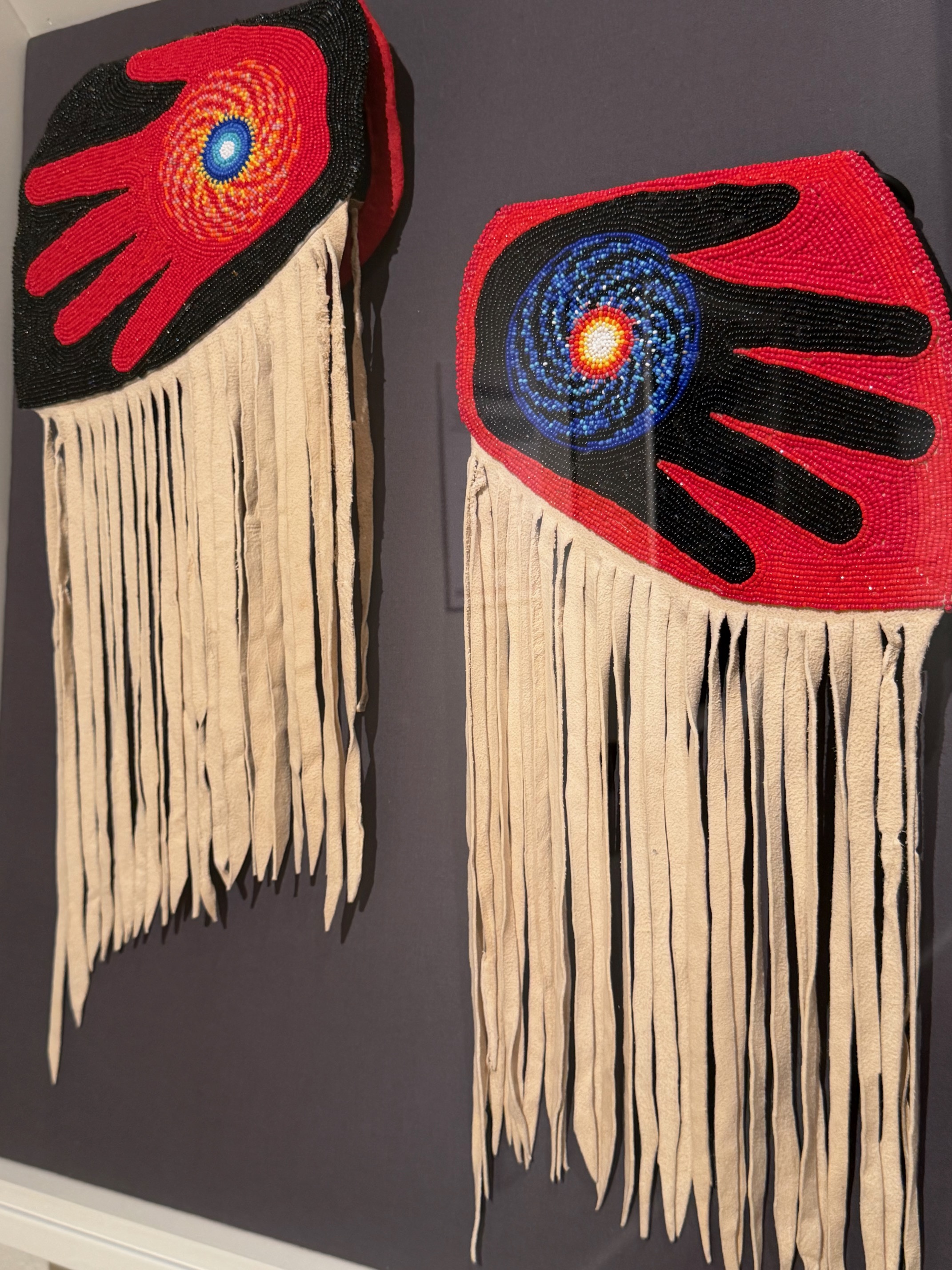
Dramatic 1980 fringed, beaded gauntlet cuffs on buckskin by Marcus Amerman (Choctaw); featuring spirals of energy that emanates from the artist’s hands.

Take a walk through the exhibition in our Flickr album, and see what we’re talking about right here in closeups of the displays on the IAIA site.

The diverse range of jewelry created over the years at IAIA might surprise anyone with a stereotypical view of “Native jewelry,” but it’s exactly this mastery of ideas and materials that keeps visitors coming back for a closer look and to admire new favorites from the over 100 pieces on display.
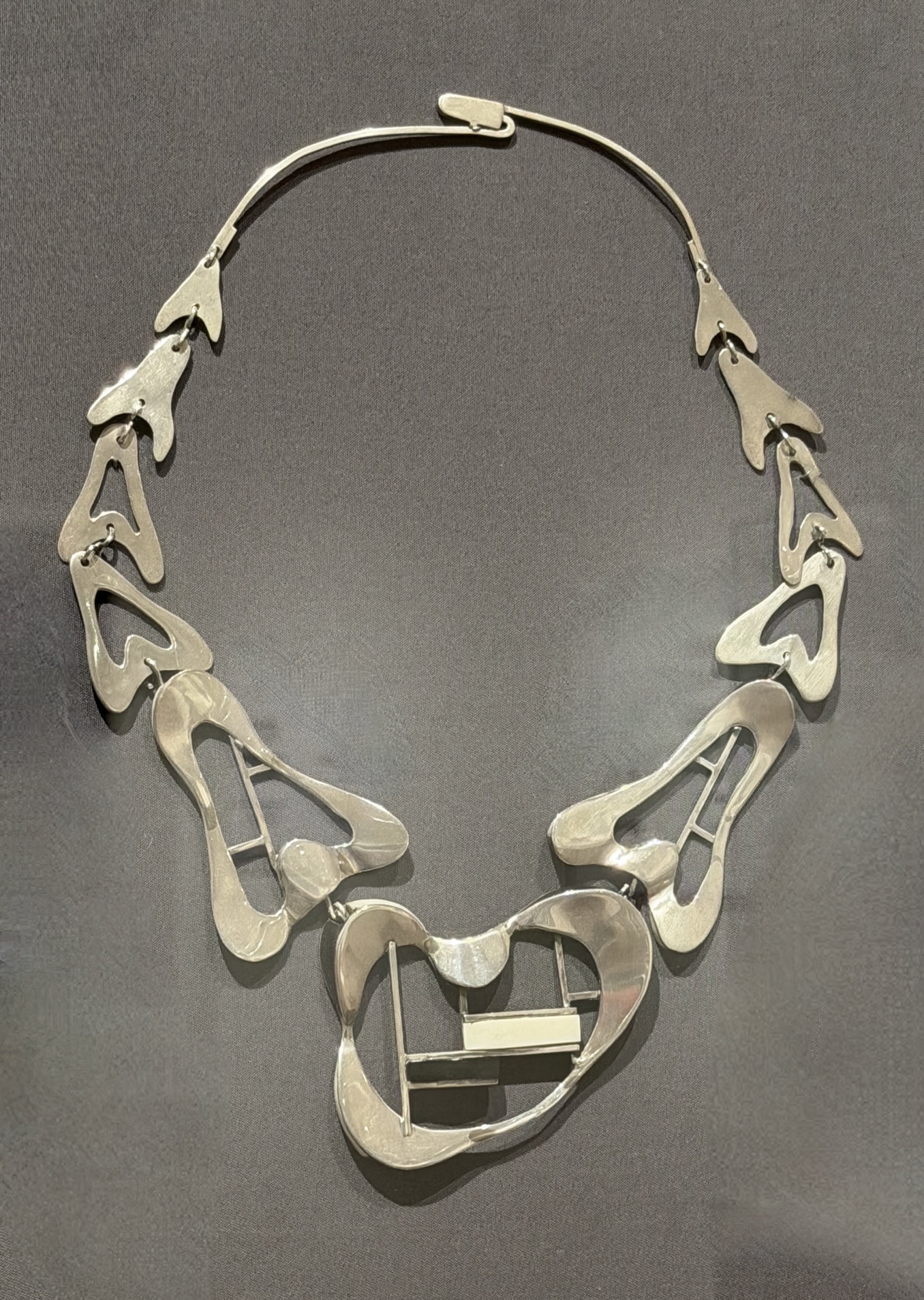
1974 silver, jet, ivory necklace by unknown artist in IAIA Honors Collection.
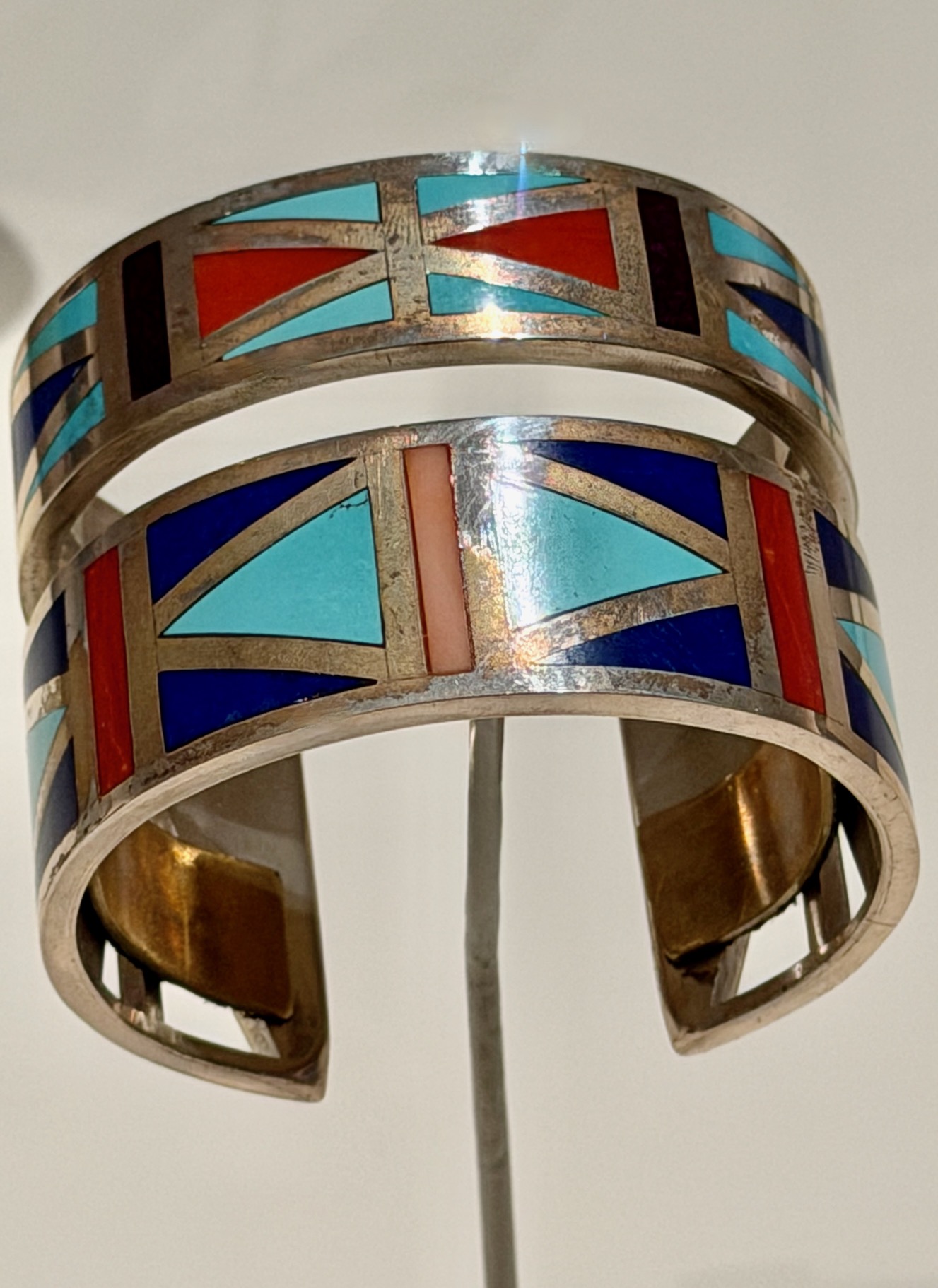
1995 bracelet by Robert Gresse, Jr. (Crow); made with silver, turquoise, lapis, coral, sugilite, and buffalo horn.

The first gallery is a clean, white space that presents the full range of techniquqes, processes, and types of wearable art.  It’s no surprise that the curator has chosen to present the innovative, masterful belt by Denise Wallce to kick off the show. Denise has crafted ten distinctive silver/gold inlaid figures who are each gathering materials and making traditional art of the Pacific Northwest. Take a close-up look at the miniature craft makers going about their work.
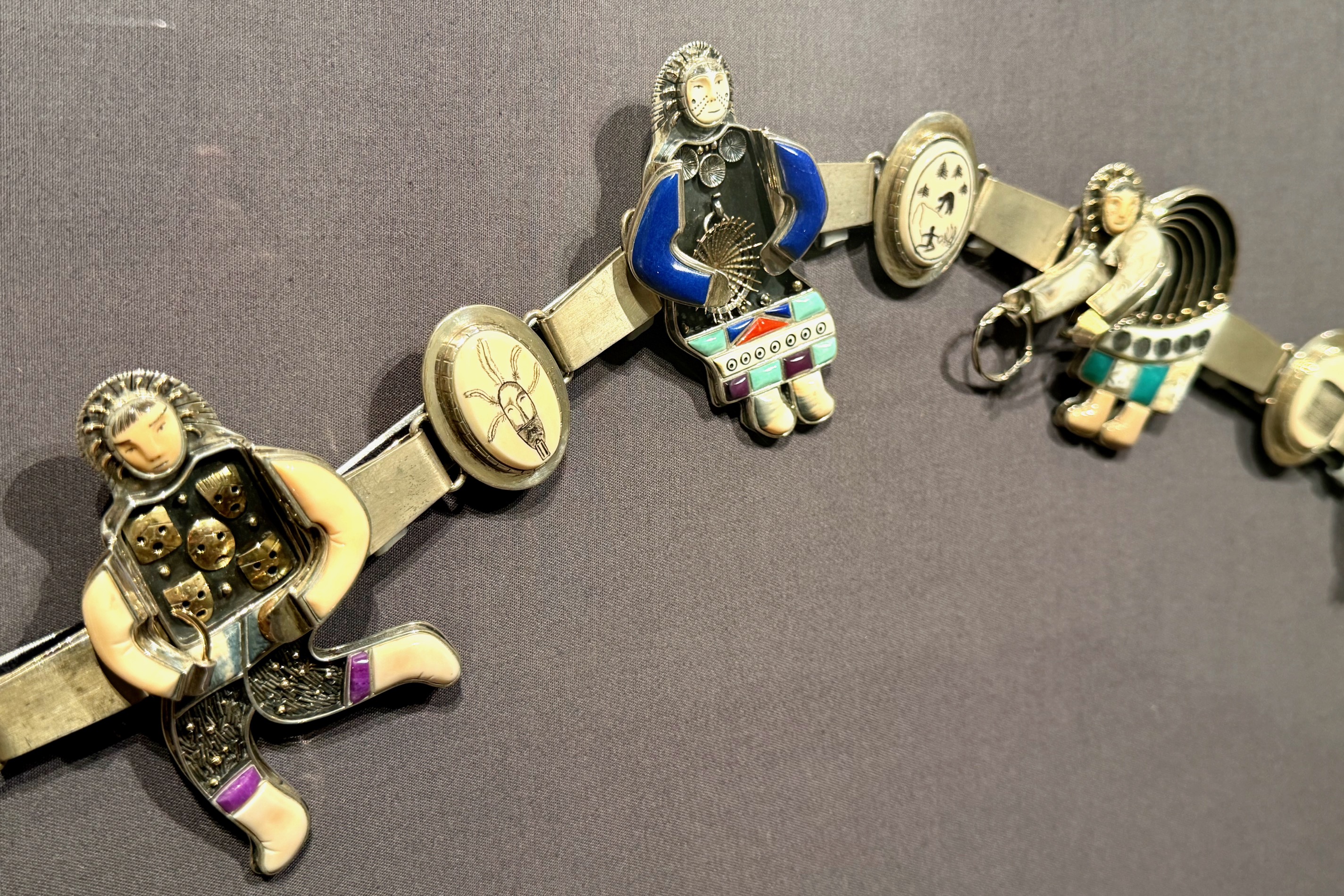
Detail of 1992 silver Craftsperson’s Belt by Denise Wallace (Chugach Aleut), featuring figures making traditional crafts; figures inlaid with semiprecious stones and gold, interspersed with incised fossilized ivory.

Over a dozen cases are filled with spectacular works that emphasize the material process that decades of IAIA students, faculty, and museum donors have contributed to the broader collection – necklaces, cuffs, belts, bolos, and pins made through inlay, casting, enamel, beadwork, and other studio techniques.
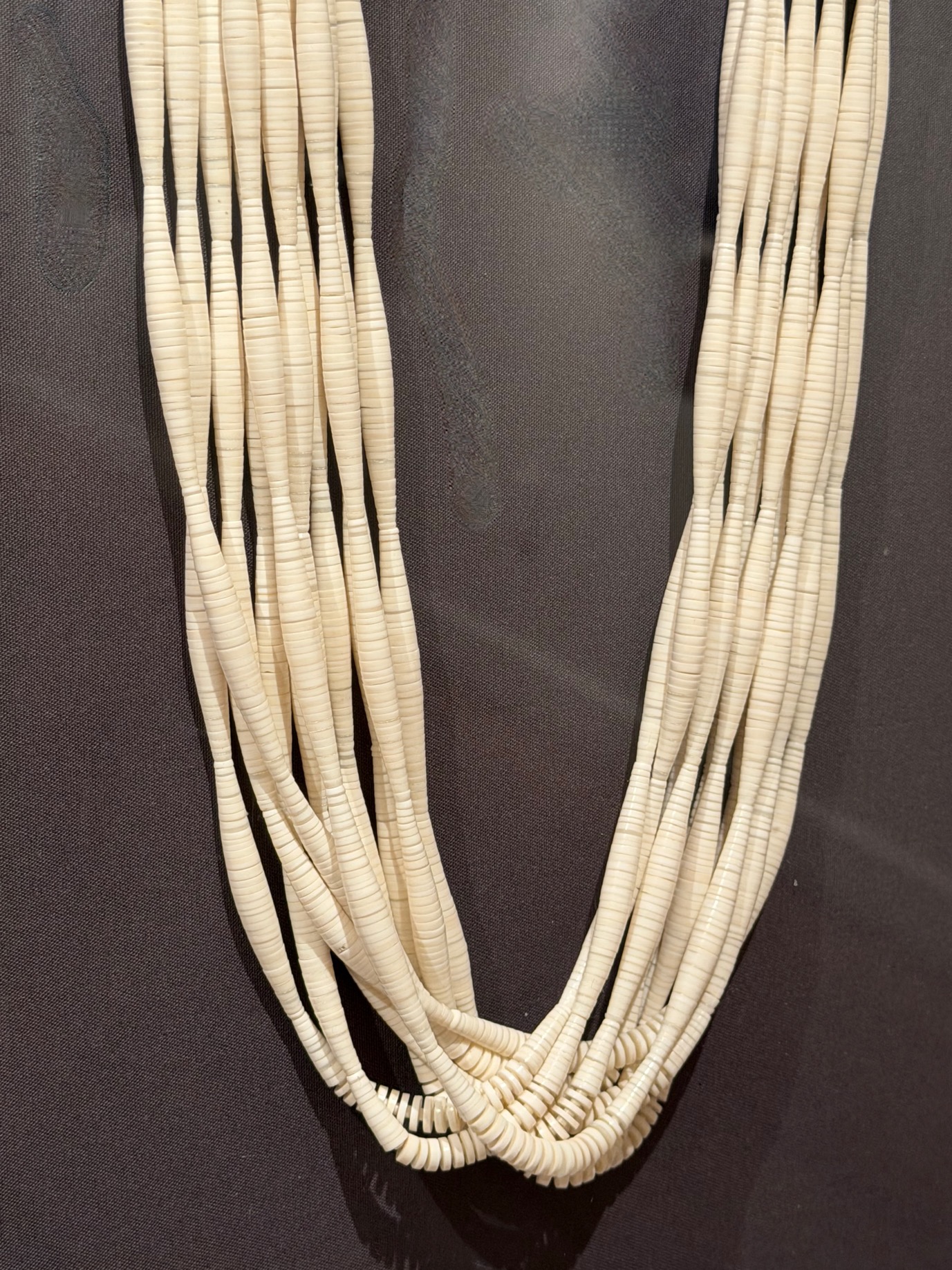
Traditional handmade bead technique with modern sensibility: 2001 white melon shell necklace by Juan Cate (Kewa-Santo Domingo Pueblo)
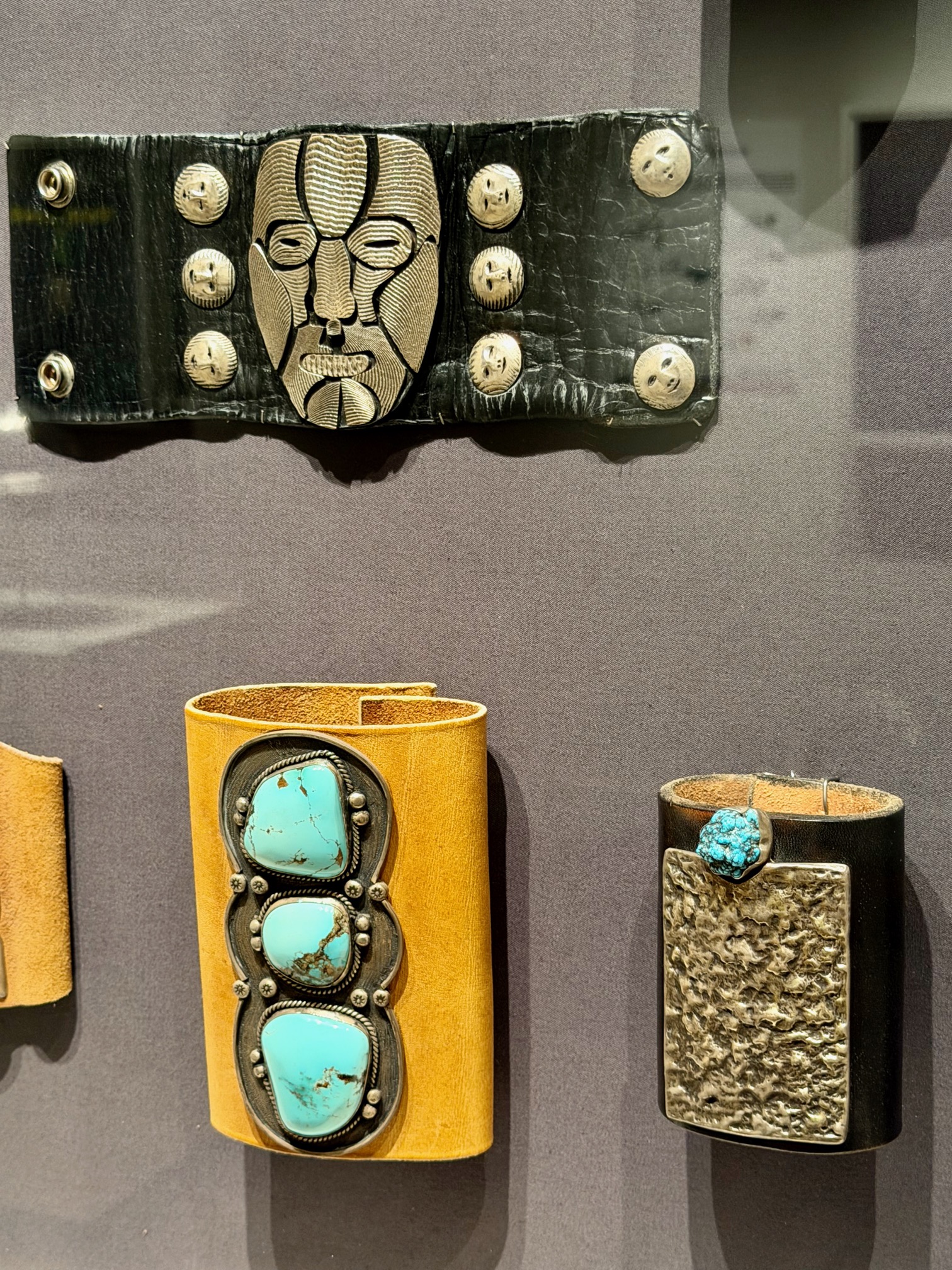
Leather with cast silver: 2001 Inuit Mask Bowguard by Mark Holiday (Diné), 1969 bowguard by Ramos Pacheco (Kewa-Santo Domingo Pueblo) from the IAIA Honors Collection, and 1981 Gato Bow Guard by Mark Swazo Hinds (Pueblo of Tesuque).

Some of the remarkable pieces collected by IAIA from the early years of the its Honors program are unfortunately marked “unknown artist.” But it’s still exciting to see early student pieces by artists like Estelle Loretto or Marcus Amerman who are considered leaders in contemporary Southwest art. (Click here to see our coverage of Marcus’s 1995 retrospective at the Wheelwright.)
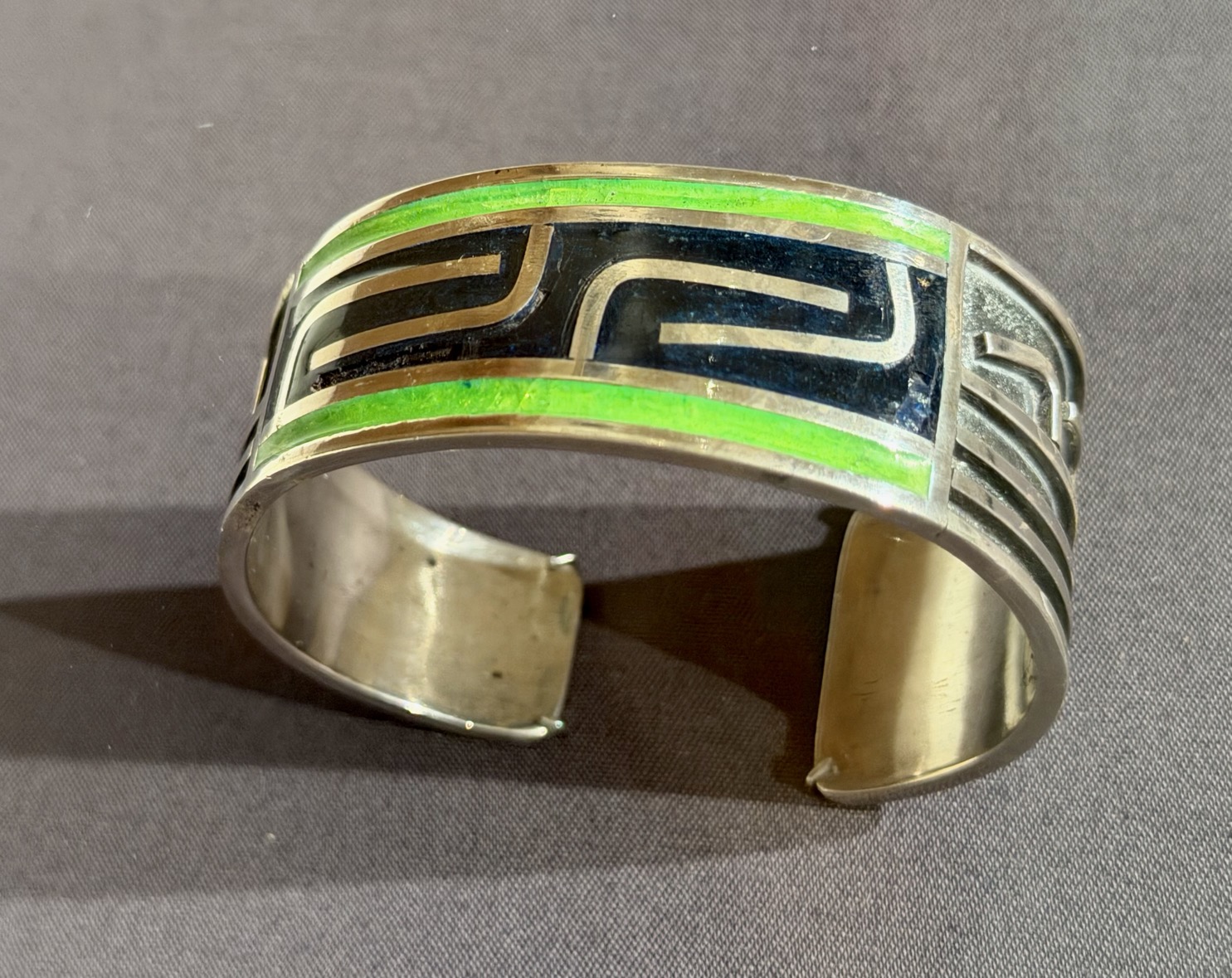
1974 silver enameled pin by Gilbert Kellywood (Ohkay Owingeh) from the IAIA Honors Collection.
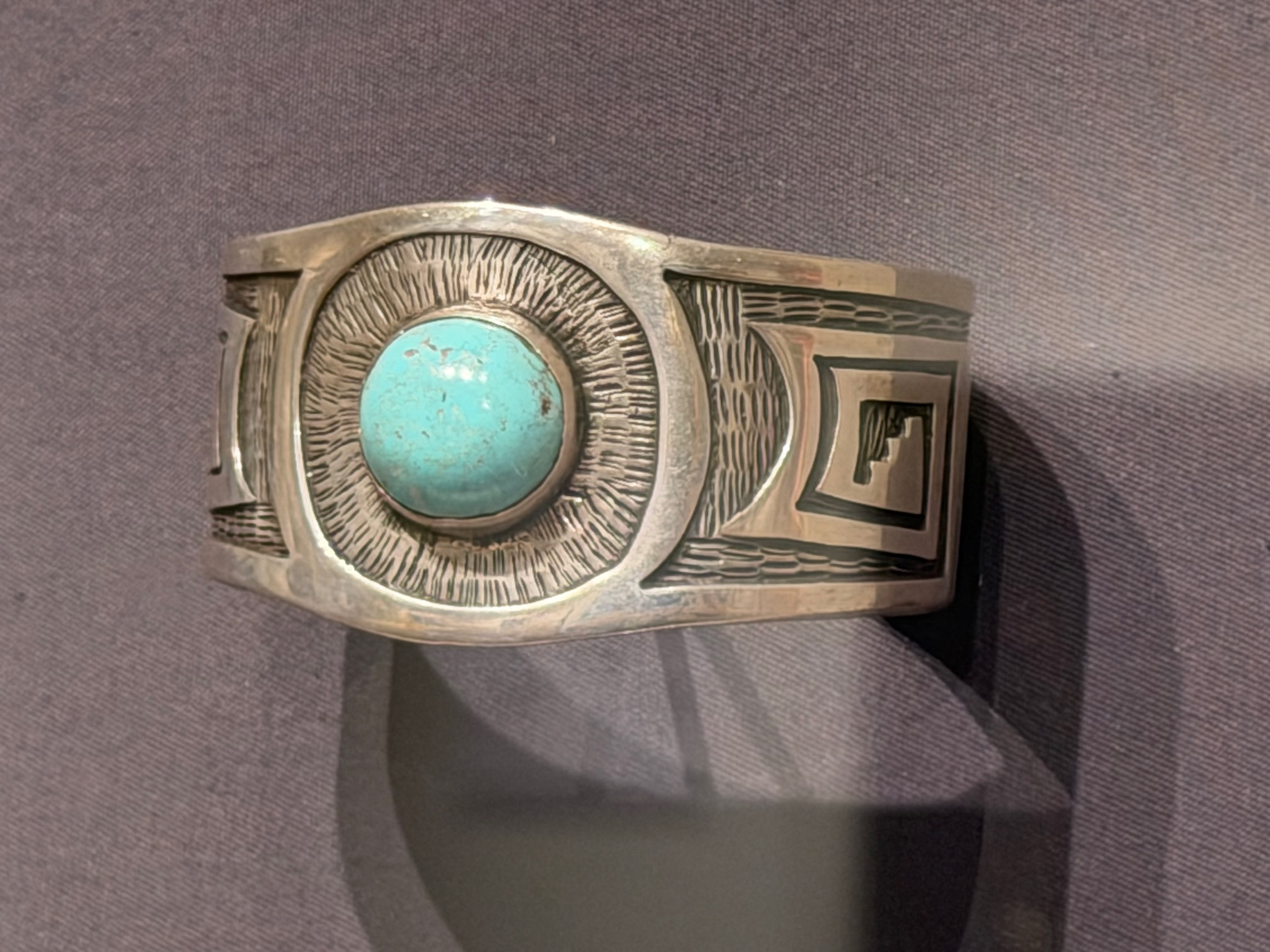
1962-1983 nickel silver and Carico turquoise bracelet by unknown Hopi artist the IAIA Honors Collection.

The second gallery begins with a large photo of the “room where it happens” – the IAIA jewelry studio. Back in the early Sixties, IAIA’s jewelry studio was begun by legendrary Charles Loloma (Hopi), who merged modernist aesthetics with traditional jewelry practice and encouraged his students to follow their own aesthetic paths. The innovation hasn’t stopped.
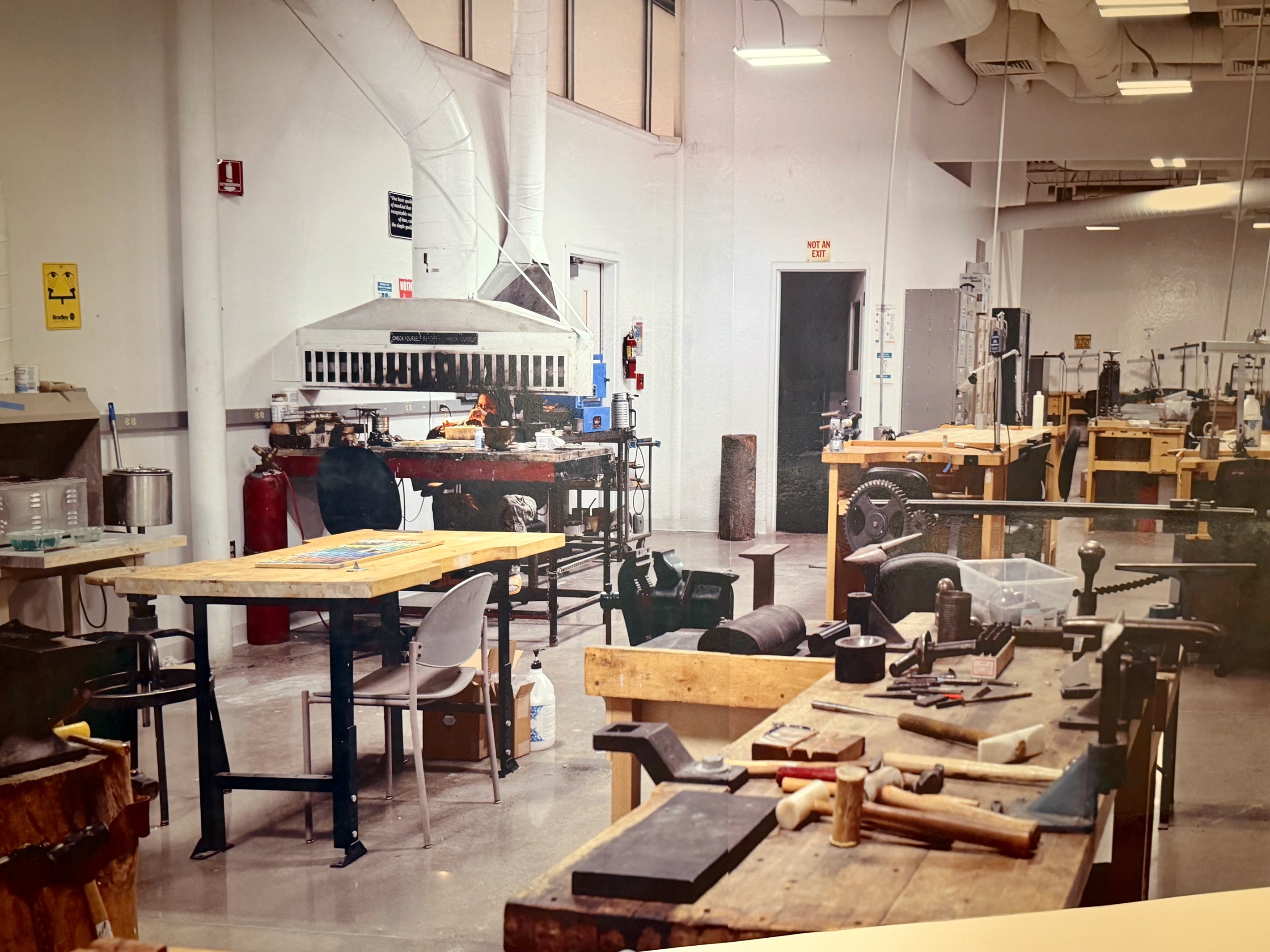
2022 photo of IAIA jewelry studio and student work stations by Sallie Wesaw-Sloan (Eastern Shoshone)

The gallery is filled wth workd by IAIA graduates, visiting artists, and faculty – a mind-bending experience that sets traditional, futuristic, technological, and controversial work side by side. Jewelry and wearable art that holds both a shining vision of the future and reflects upon dark corners of Indigenous history. It’s all quite a tribute to the creativity campus that IAIA was at its inception and continues to be.
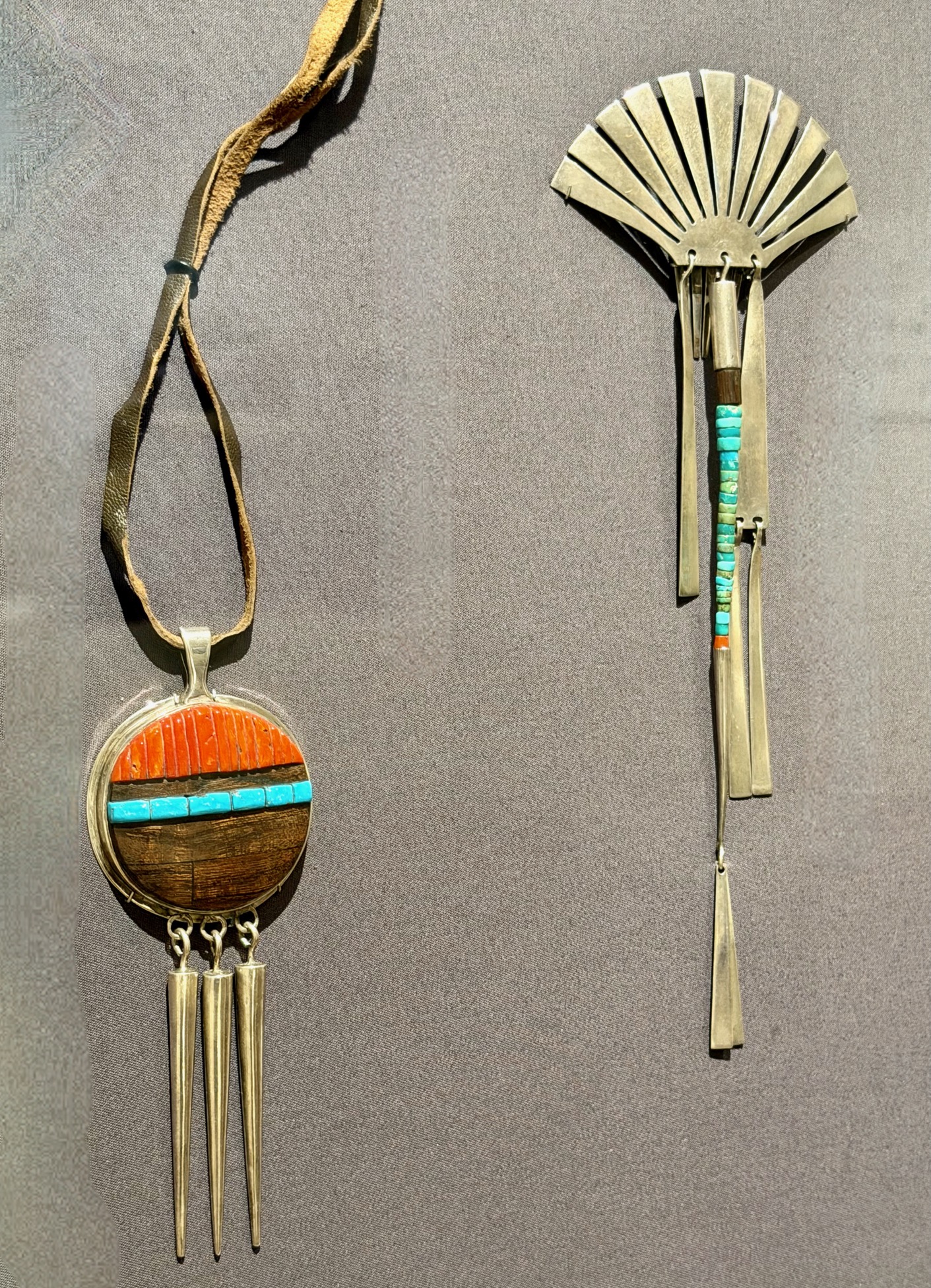
Two pieces of silver, coral, turquoise, and ironweed jewelry by 1962-1965 IAIA faculty member Charles Loloma (Hopi) – a 1973 pendant and a 1963-1965 hair comb.
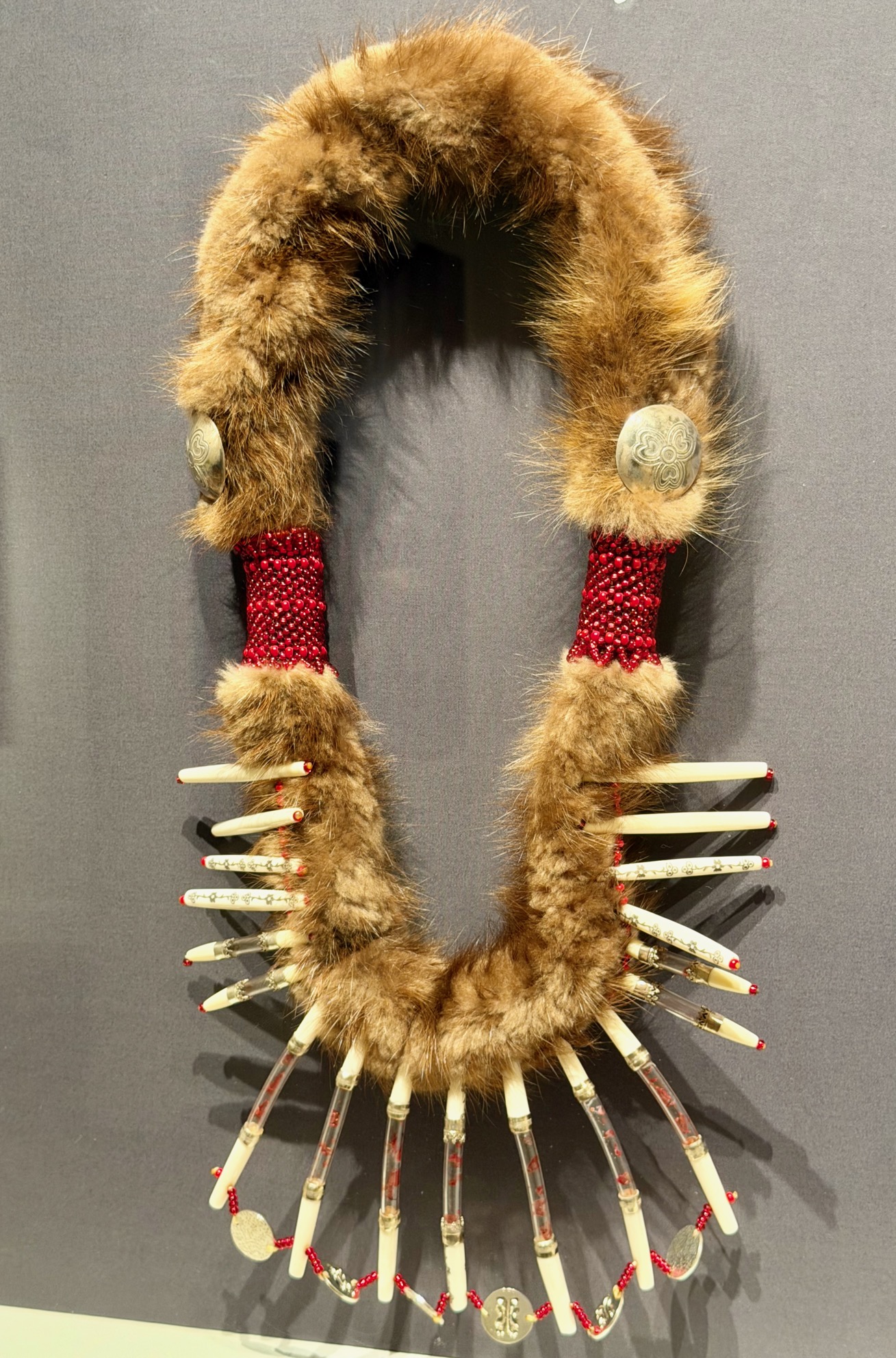
2017 Decimation by Decimal by IAIA 2019 artist in residence Jodi Webster (Ho Chunk/Prairie Band Potawatami; necklace made with beaver pelt, sterling silver, bone beads, glass beads (with faux blood), and sinew – all precious materials not normally associated with jewelry.

The last gallery features a mix of storytelling – everything from metalwork on a Mohawk hard hat telling a story of East Coast construction-trade prowess to pow-pow princess crowns to politics and a barely-there magical quartz amulet by Pacific Northwest artist Isaac Tait (Nisga’a). Contemporary achievement, 20th century culture, and ancient myths are all put to work in the IAIA jewelry studio.
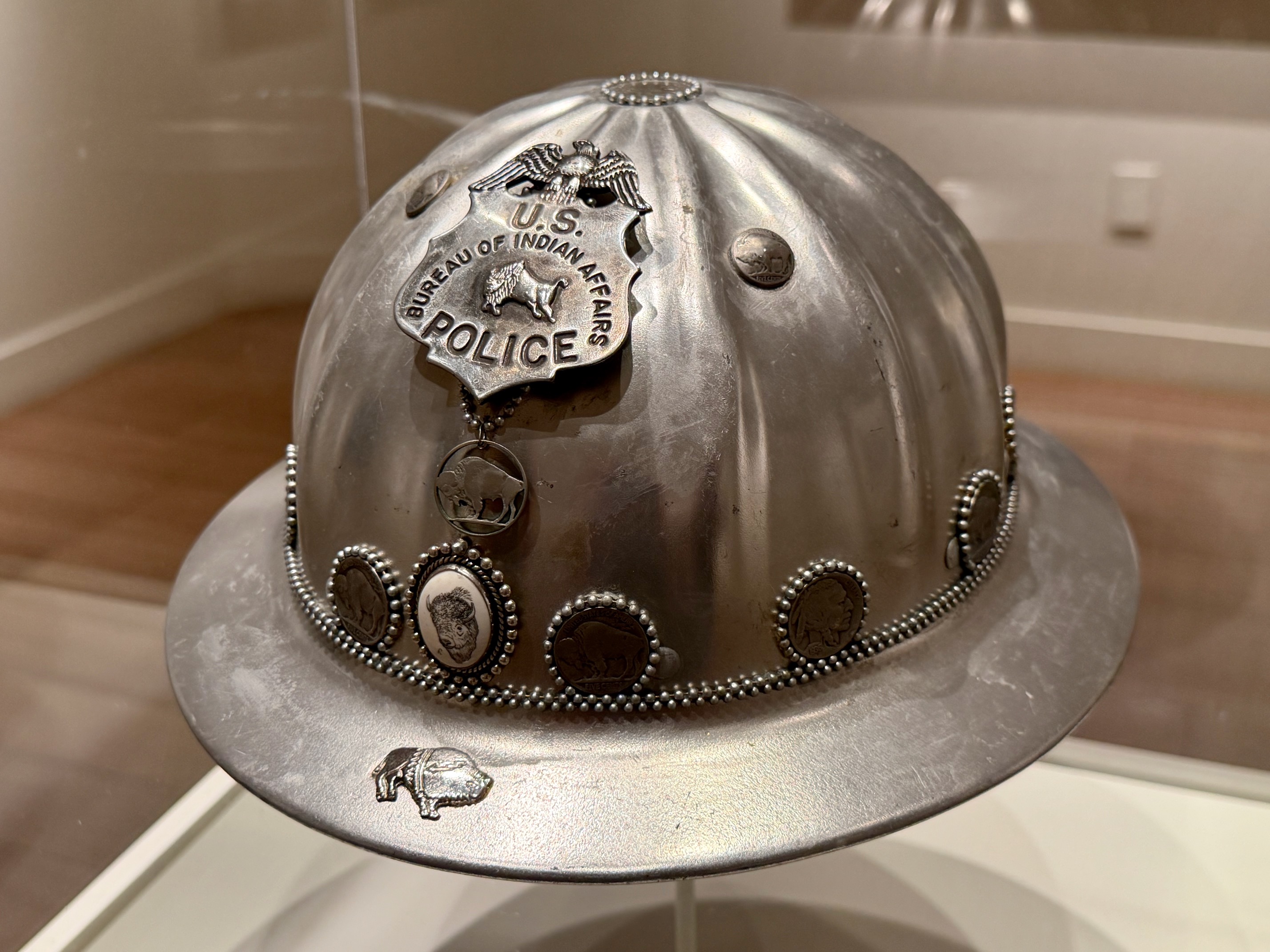
1999 Indian Police Headdress by Richard Glazer Danay (Mohawk) – an aluminum construction worker’s hard hat with silver from buffalo nickel coins with attached BIA police badge, created in tribute to the legendary Mohawk skywalkers who specialize in Manhattan skyscraper construction.

The exhibition represents over 100 years of Indigenous jewelry in all its forms from IAIA’s permanet collection. Take a walk through the exhibition with guest-curator Brian Fleetwood (Mvskoke), who explains his inspiration behind his selections and explains how wearable art has told stories from ancient times:

See all eight of IAIA’s short videos about these artists and this fascinating tribute to creativity and culture here, including the backstory on the crowns.
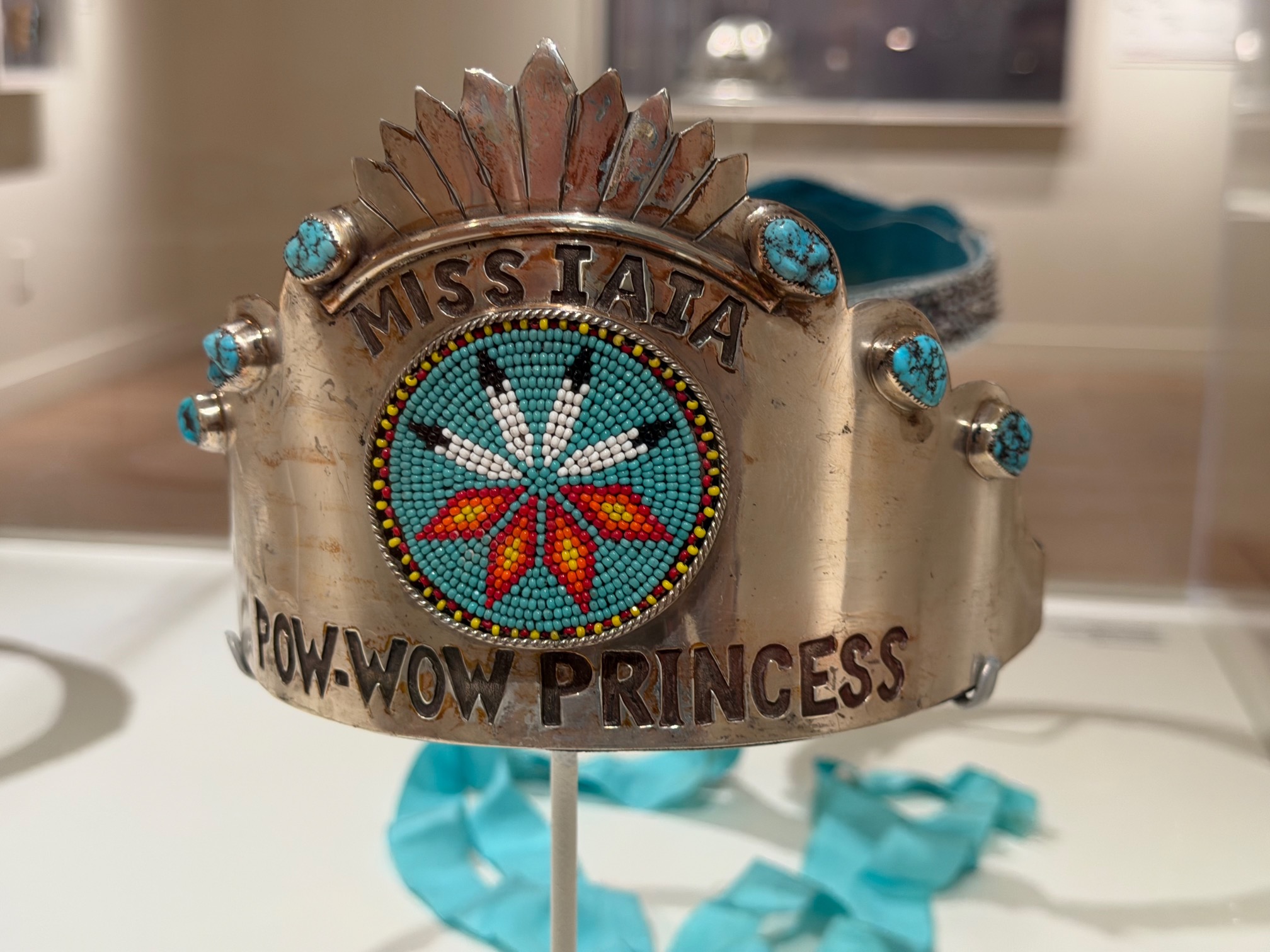
Mark of Native Indigenous royalty: 1978 silver, turquoise, and beaded Miss IAIA Pow-Pow Princess crown by Lutz Whitebird (Southern Cheyenne)

Altered Landscapes and Children of the Earth Experience in Reno

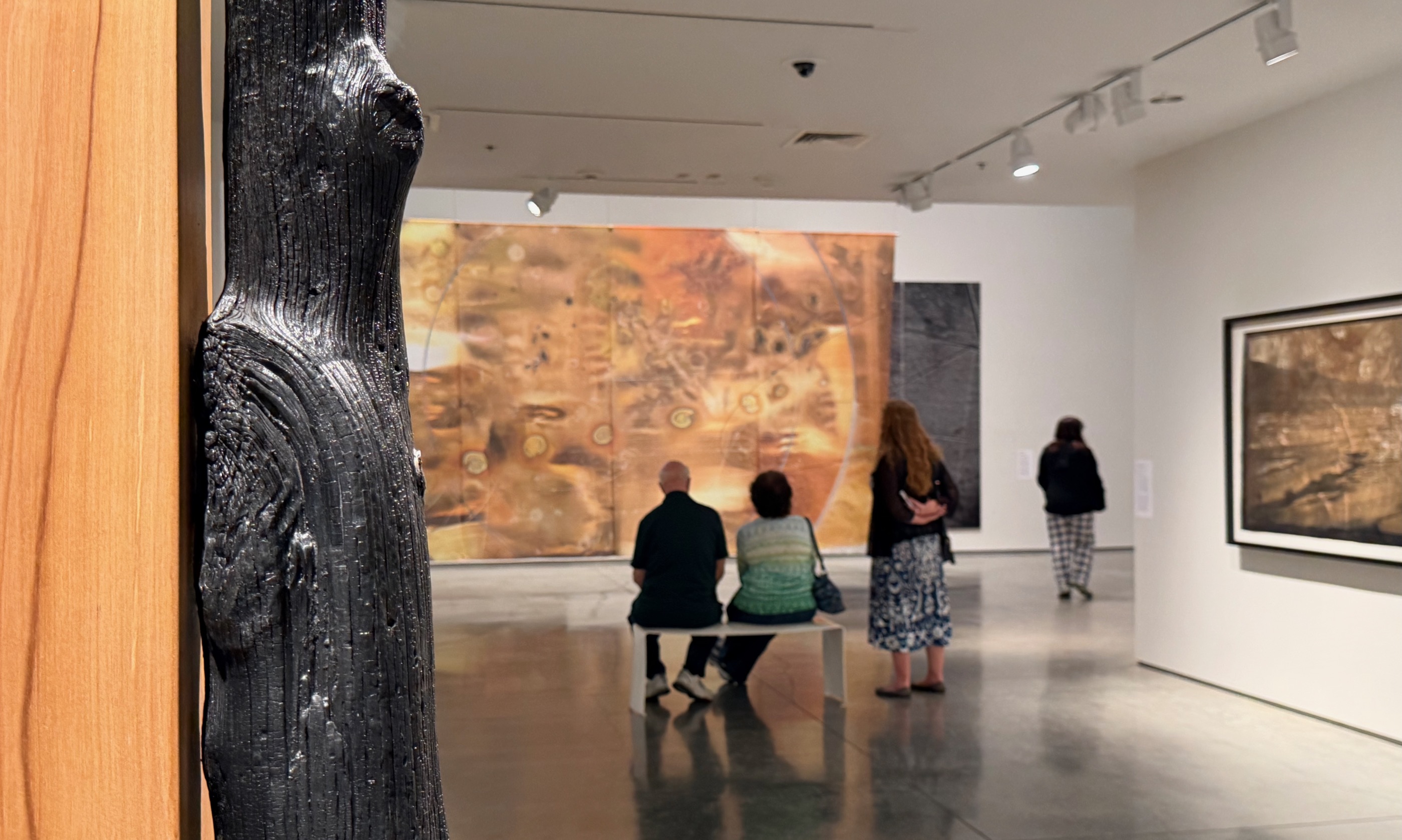
For years, the Nevada Museum of Art has been collecting photographs by artists whose work puts the environment, our culture’s addiction to nuclear and fossil fuel, construction booms, and degradation of desert landscapes front and center. Altered Lands and the Anthropocene, on view in Reno through September 20, is a beautiful installation across the second floor that causes visitors to stop, look, and contemplate what it took to record such tour de force images.

It’s all part of the museum’s massive Into the Time Horizon exhibition.  Take a walk through the galleries in our Flickr album.

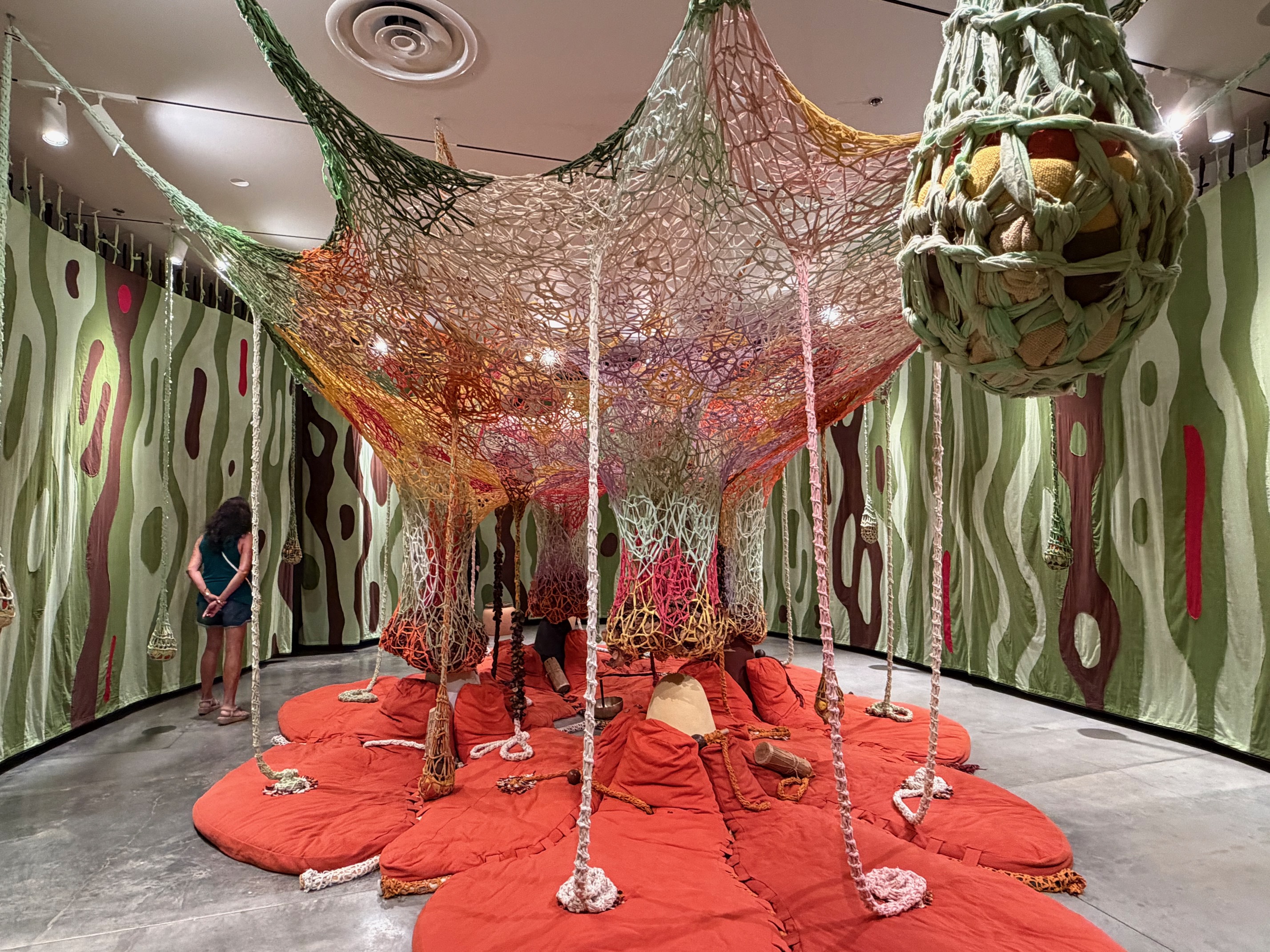
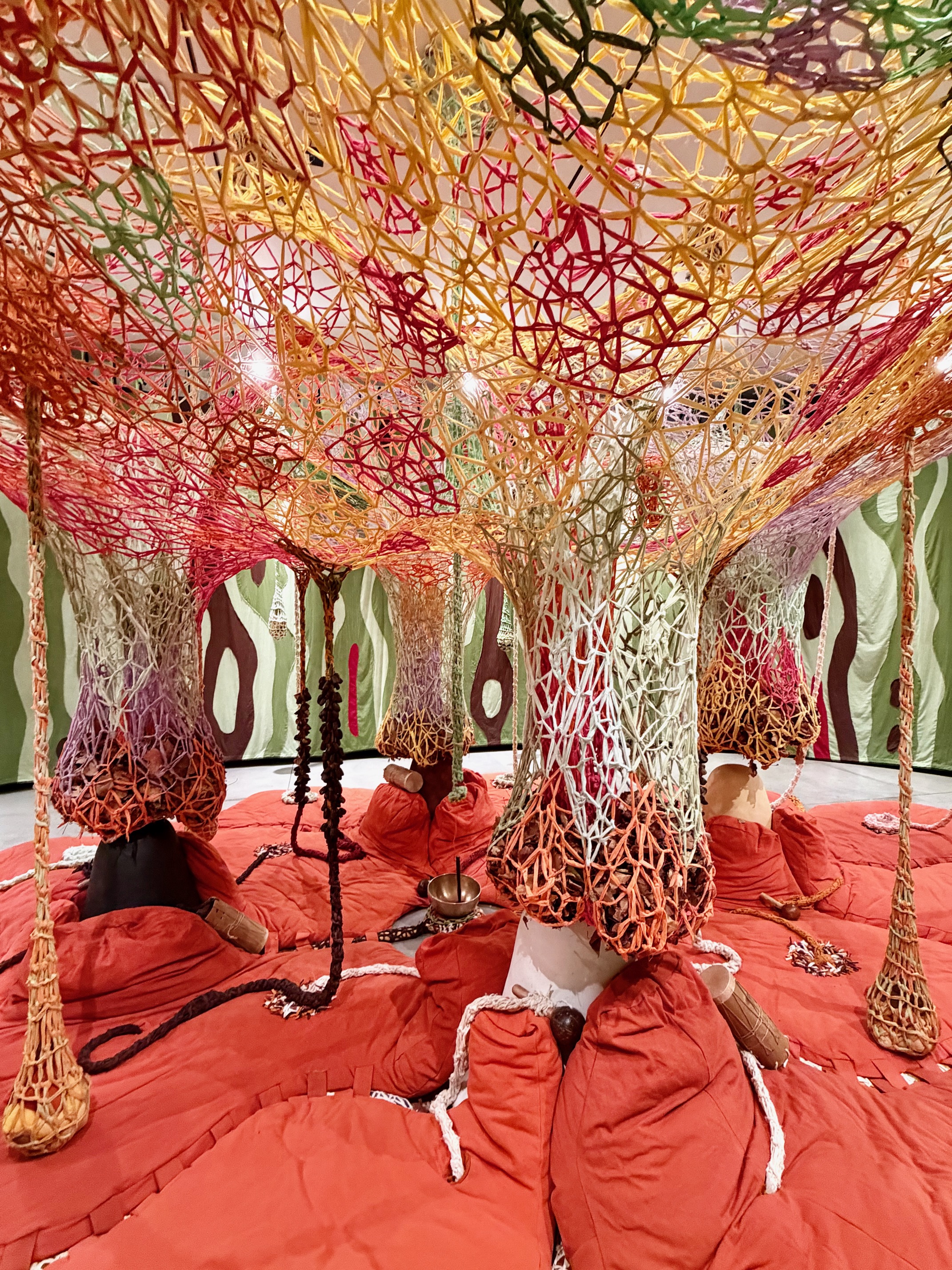
Sensual, cocoon-like participatory space at the core of Ernesto Neto’s 2019 Children of the Earth – filled with futons, pots, crytals, instruments, and spice smells Courtesy: Tanya Bonakdar Gallery, New York.

The masterful photo exhibition is next door to a solo installation that serves as a great respite – the immersive, colorful, magical playground-style environment Ernesto Neto: Children of the Earth, also on view through September 20. More about this in a moment.

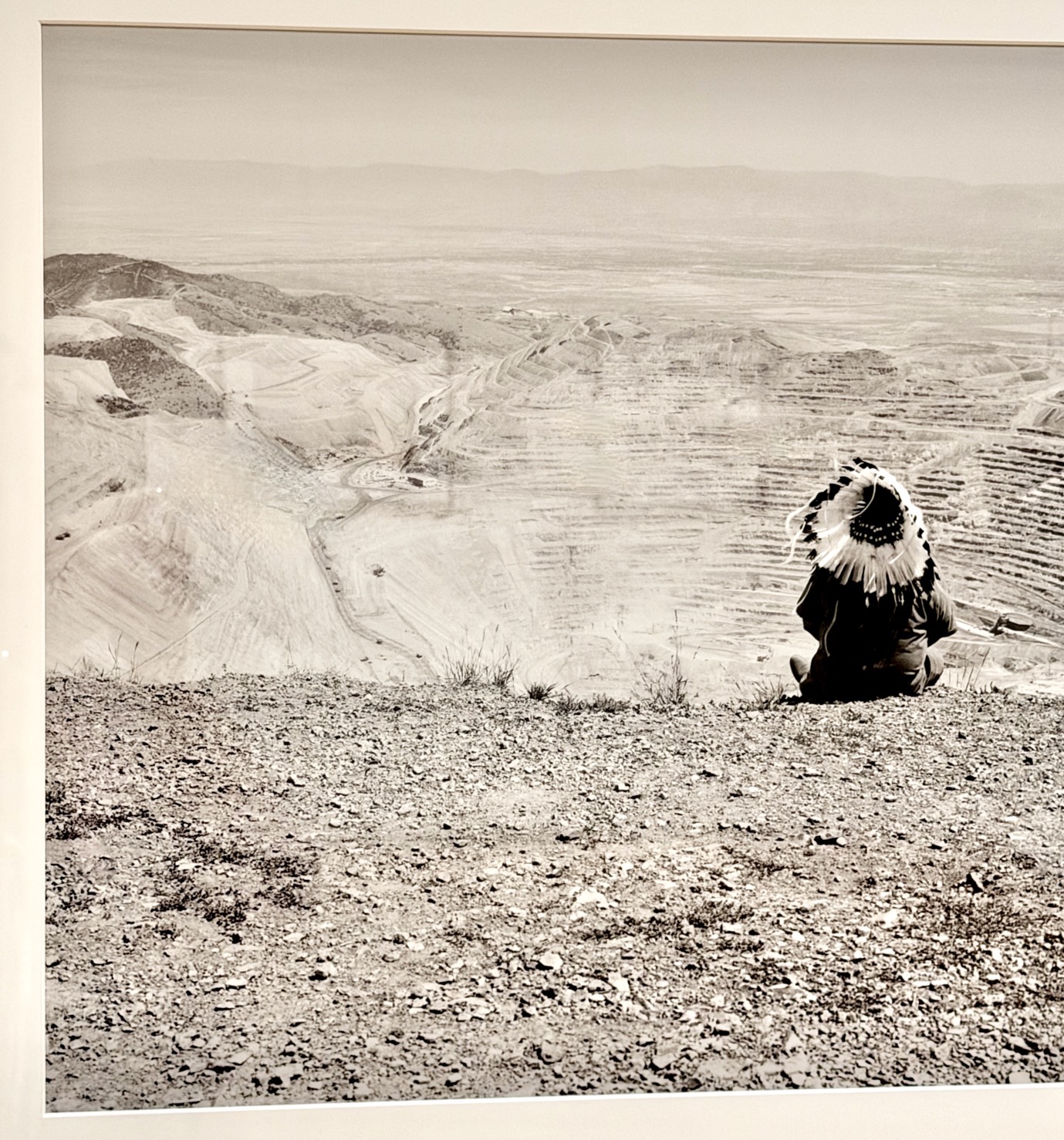
The first section of the photography galleries features traditional documentay photography about legacies of industrial-scale extraction of oil, gas, uranium, and minerals across the West – Edward Weston’s image of big equipment at work toward the end of the Great Depression, Robert Adam’s aerial view of the legacy of Colorado mining, and Zig Jackson’s headdress-adorned Native American perched at the edge of the largest mine on earth in Utah.

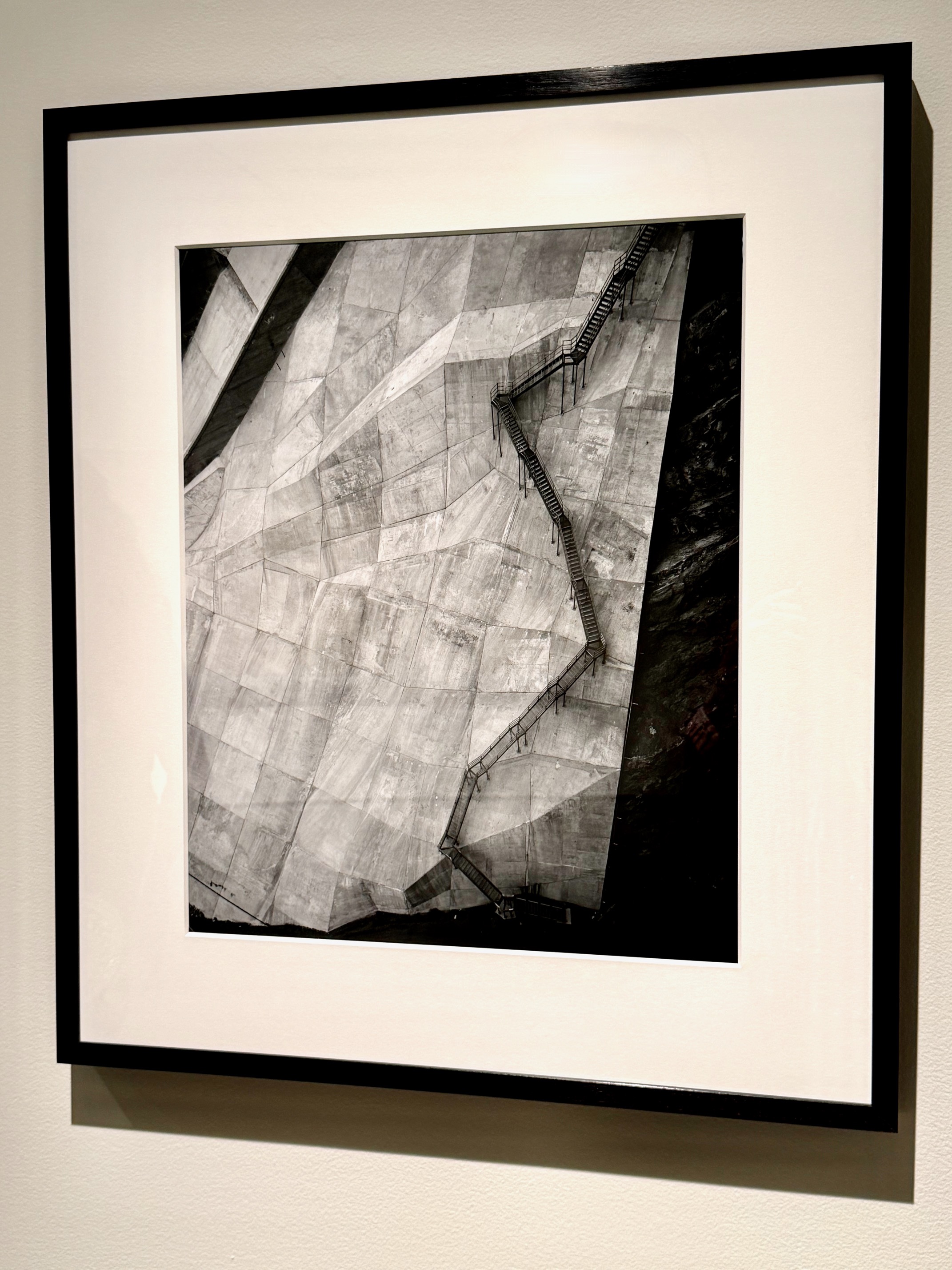
Toshio Shibata’s 1997 silver gelatin print Coolidge Dam, San Carlos, AZ – a controversial project built as part of the San Carlos Indian Irrigation Project on tribal burial grounds.
2004 (printed 2020) archival inkjet print by Zig Jackson (Mandan/Hidatsa/Arikara) Indian Man at Kennecott Copper Mines, Toole, Utah – a man in a war bonnet sits at the edge of the largest human excavation on earth.

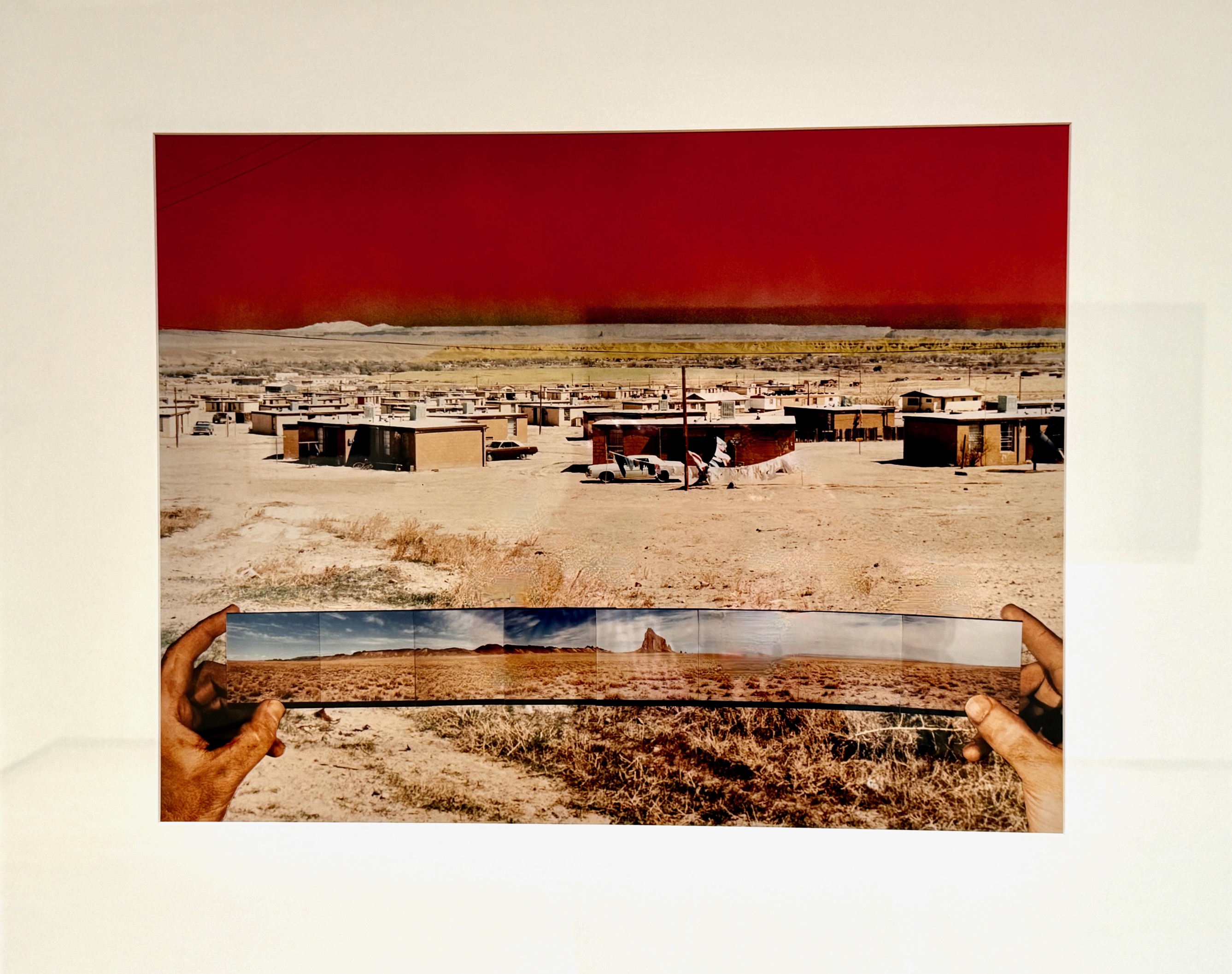
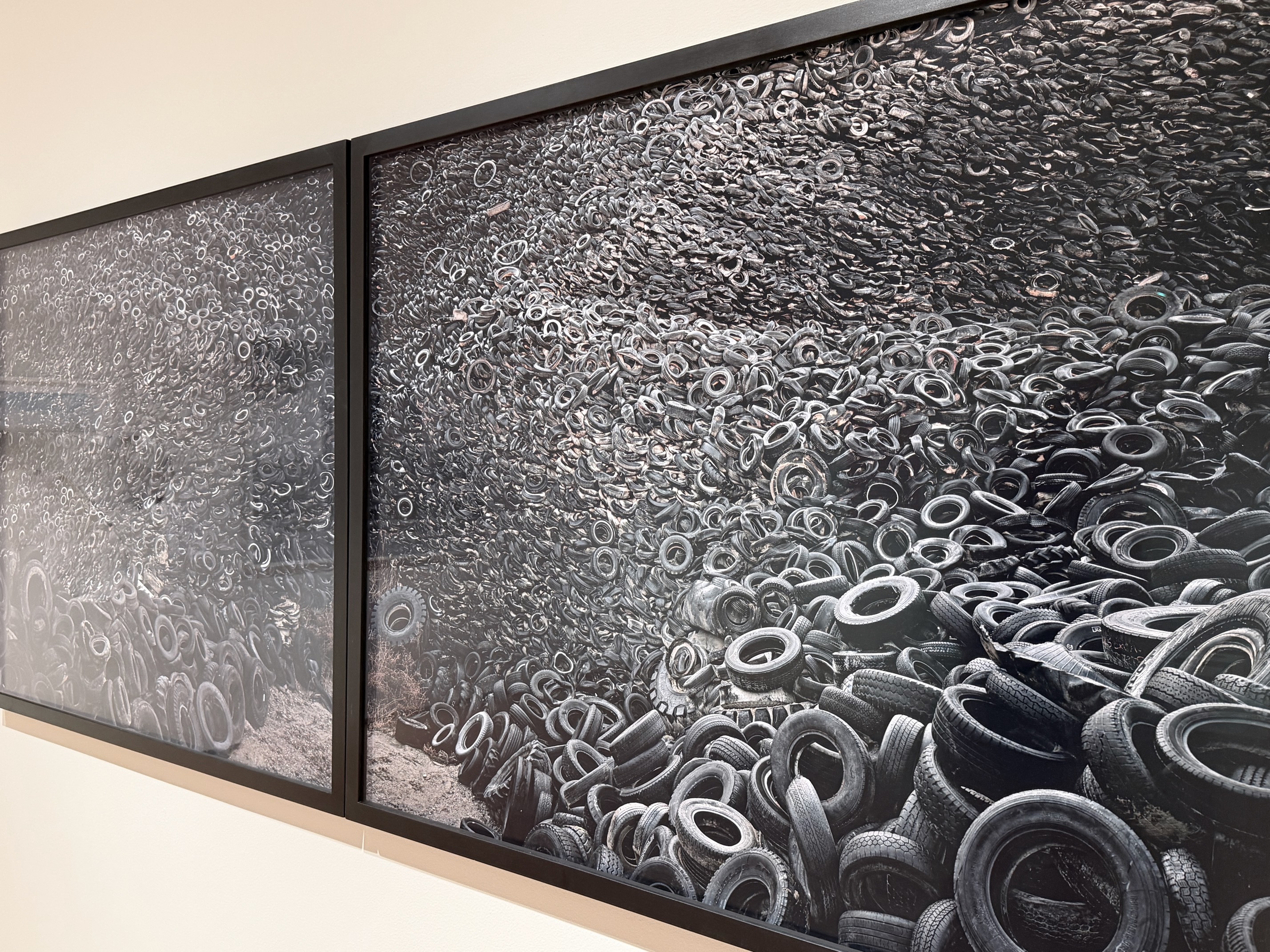
These share the space with evidence of long-lasting consequences of uranium mining by Patrick Nagatani and a startling document of America’s disposal culture from Edward Burtynski. Each image is crammed with feeling that the ominous impacts will be around for a long time – moving calls to action.

In pursuit of nuclear fuel: Patrick Nagatani’s 1990 chromogenic print ’Bida Hi’/Opposite Views: Northeast-Navajo Tract Homes and Uranium Tailings, Southwest-Shiprock, New Mexico – from his Nuclear Enchatment series highlighting the community contaminated from the 1950s uranium mill at Shiprock.
Impact of relying upon fossil fuel:  Edward Burtynski’s 1999 chromogenic color print Oxford Tire Pile #9a and #9b, Westley, California, USA – a documentation of a massive industrial hazard, which later caught fire and contaminated nearby communities and water resources.

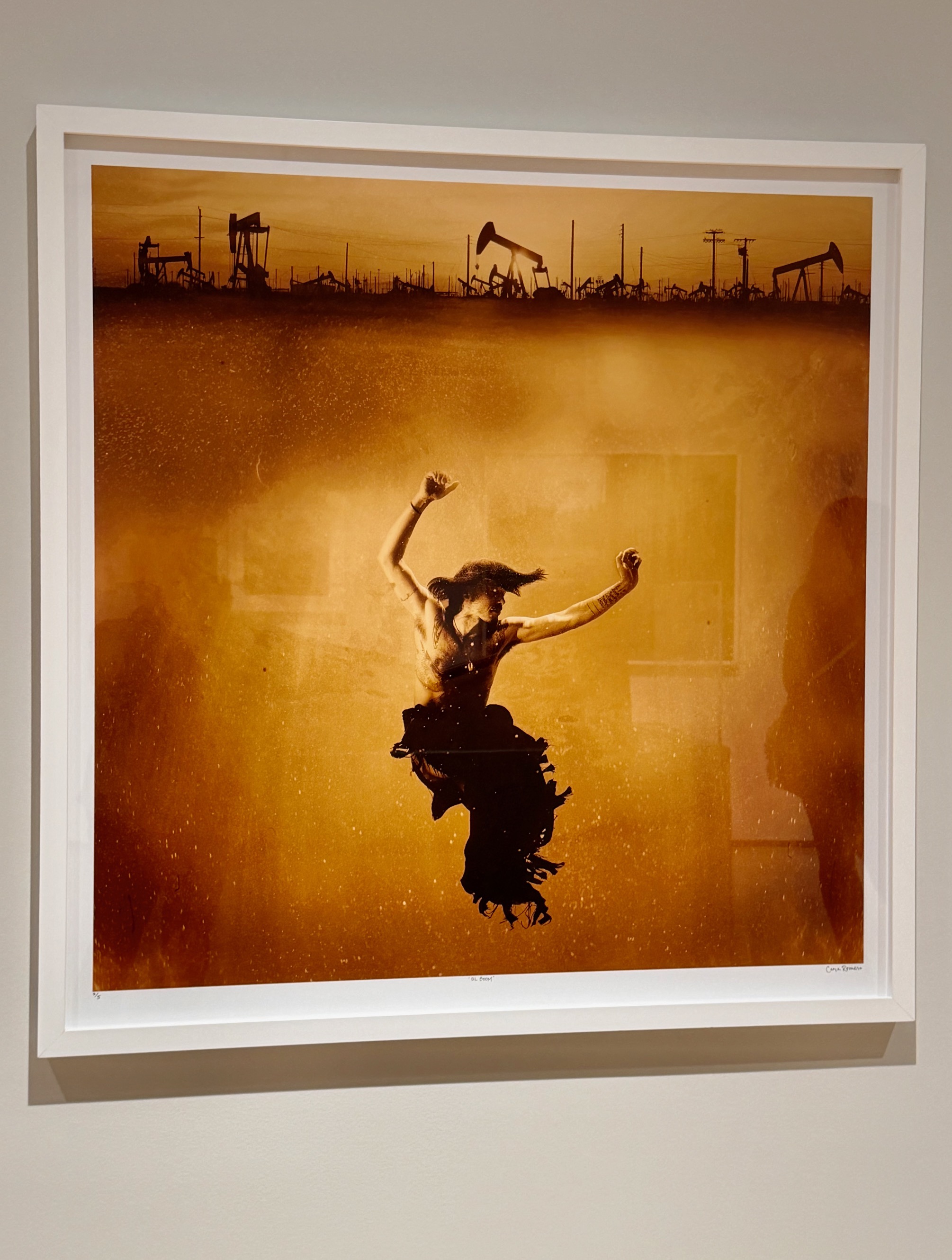
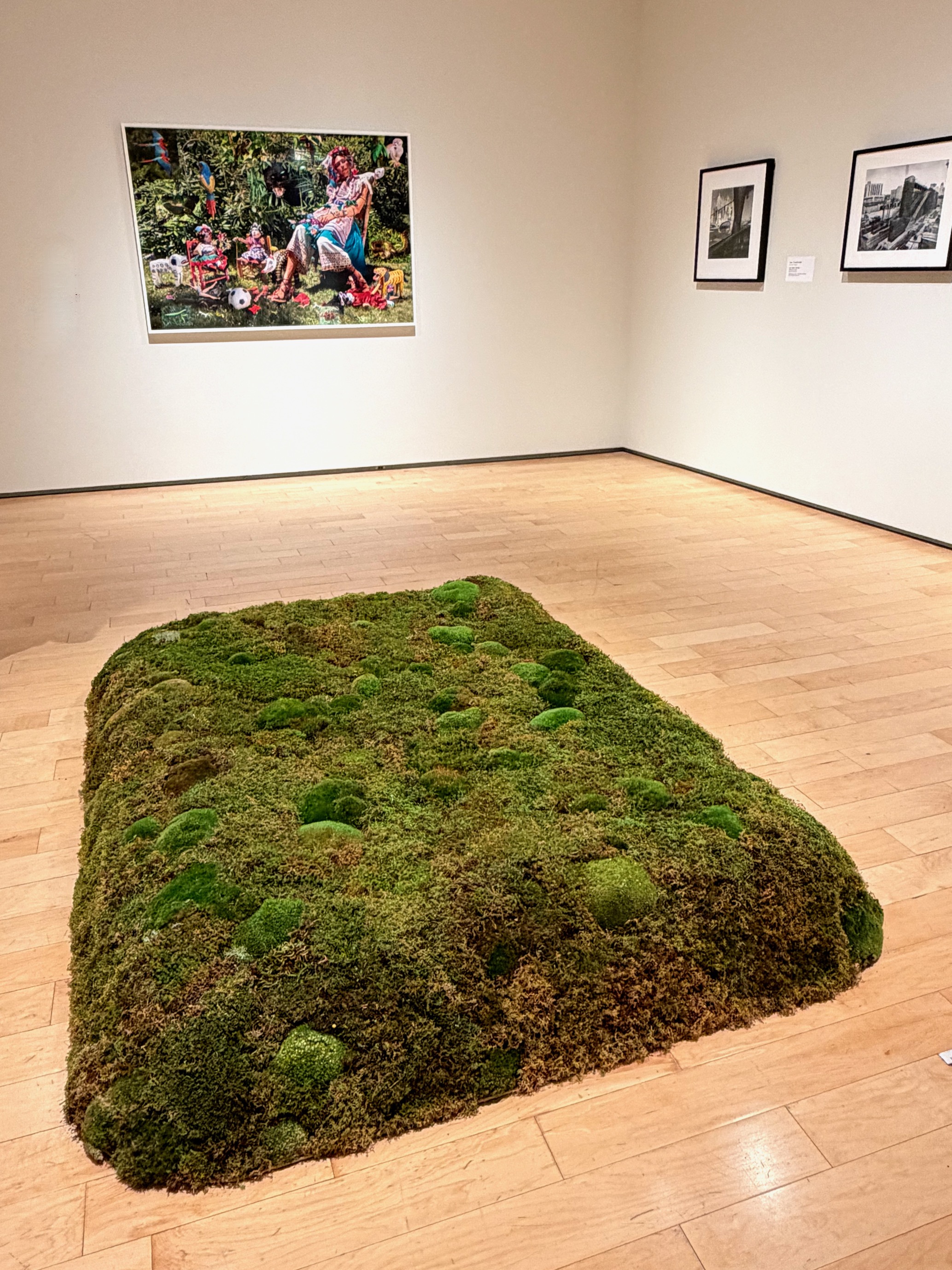
To mix it up, the curators have thrown in a touch of the surreal – an arresting image by Cara Romero collaged into the oil-field landscape near where she grew up, and Meg Webster’s sculpture from living Earth. Beautiful and inviting art from across the room, but more thought-provoking as you draw near.

2015 archival inkjet print Oil Boom by Cara Romero (Chemehuevi) from her “Water Memories” series – with collaborator artist-activist Canupa Hanska Luger (Mandan/Hidatsa/Arikara/Lakota) floating in brown liquid below an oil pump.
Meg Webster’s 1986/2005 peat moss, earth, and plastic installation Moss Bed, Queen – evoking relaxation in nature with materials collected nearby from the forest; on walls, work by Martine Gutierrez and Lee Friedlander. Courtesy: Walker Art Center, Minneapolis; Nevada Museum of Art.

Some of the largest works also require visitors to take them in from a distance – such as Rohini Devashar’s gorgeous, huge printed silk.

Visitors contemplate Rohini Devashar’s 2023 Latent Field (Field One) – colliding molecules and celestial bodies printed on silk. Courtesy: the artist and Gallery Wendi Norris, San Francisco.

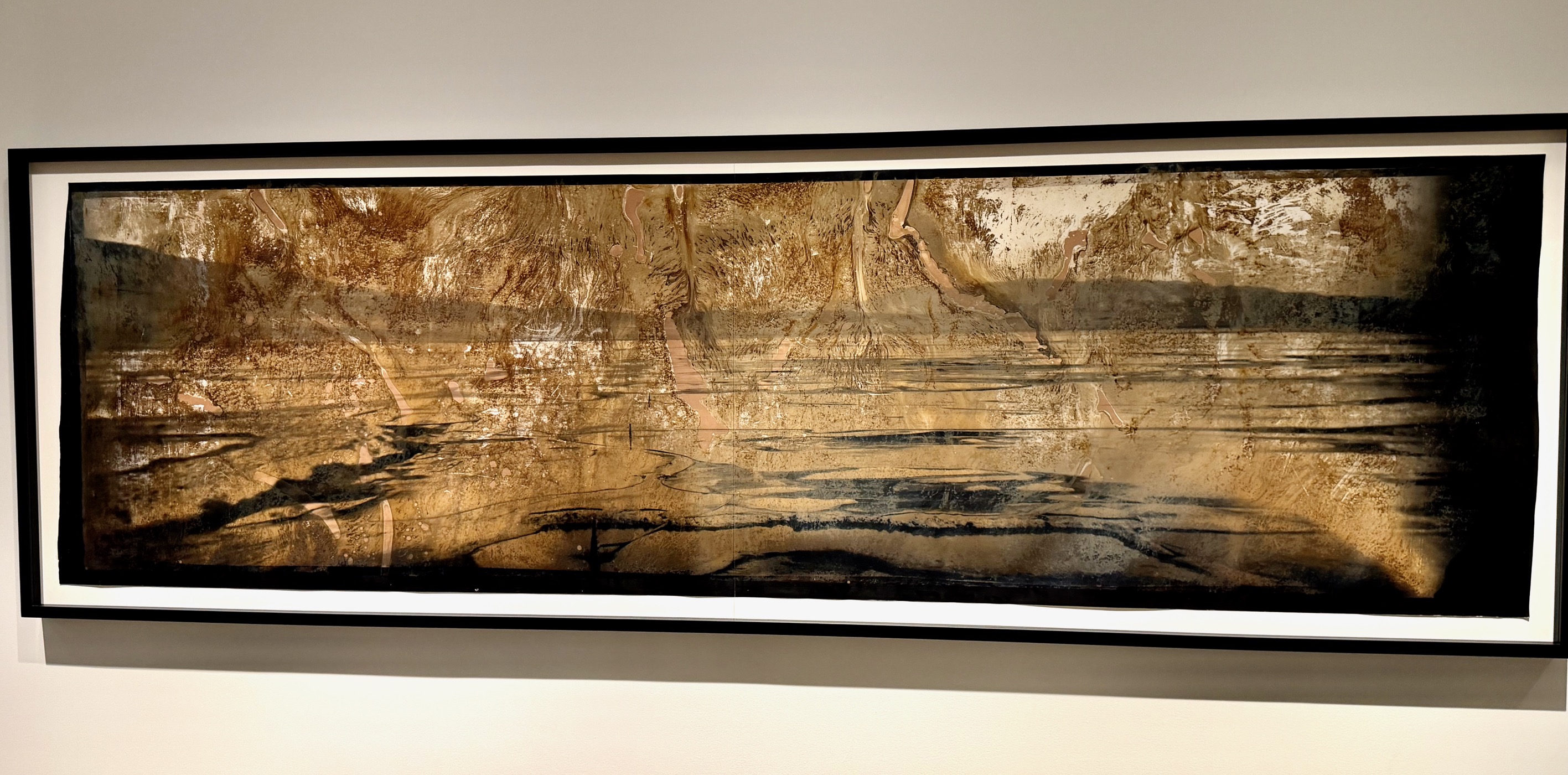
But in most cases in this section, you have to get close to the fine print to truly understand what you’re seeing. Most appear abstract. An epic seemingly all-black work by David Maisel is actually a collage of aerial views of the bombing runs in the Dugway Proving Ground in Utah. The evocative, overlapping images in a gelatin silver print by Laura Bon, Tristan Duke, and Richard Nielsen was done inside a container-shipping-sized camera obscura at the tragic environmental site of Owens Lake. The huge one-of-a-kind photo was actually developed in the sad lakewater.

2013 gelatin silver print Bubblers, Owens Dry Lakebed (Lakebed Developed) – project by the Optics Division of the Metabolic Studio created by Laura Bon, Tristan Duke, and Richard Nielsen. Created on light-sensitive paper via camera obscura inside a shipping-container studio, developed in the lakebed.

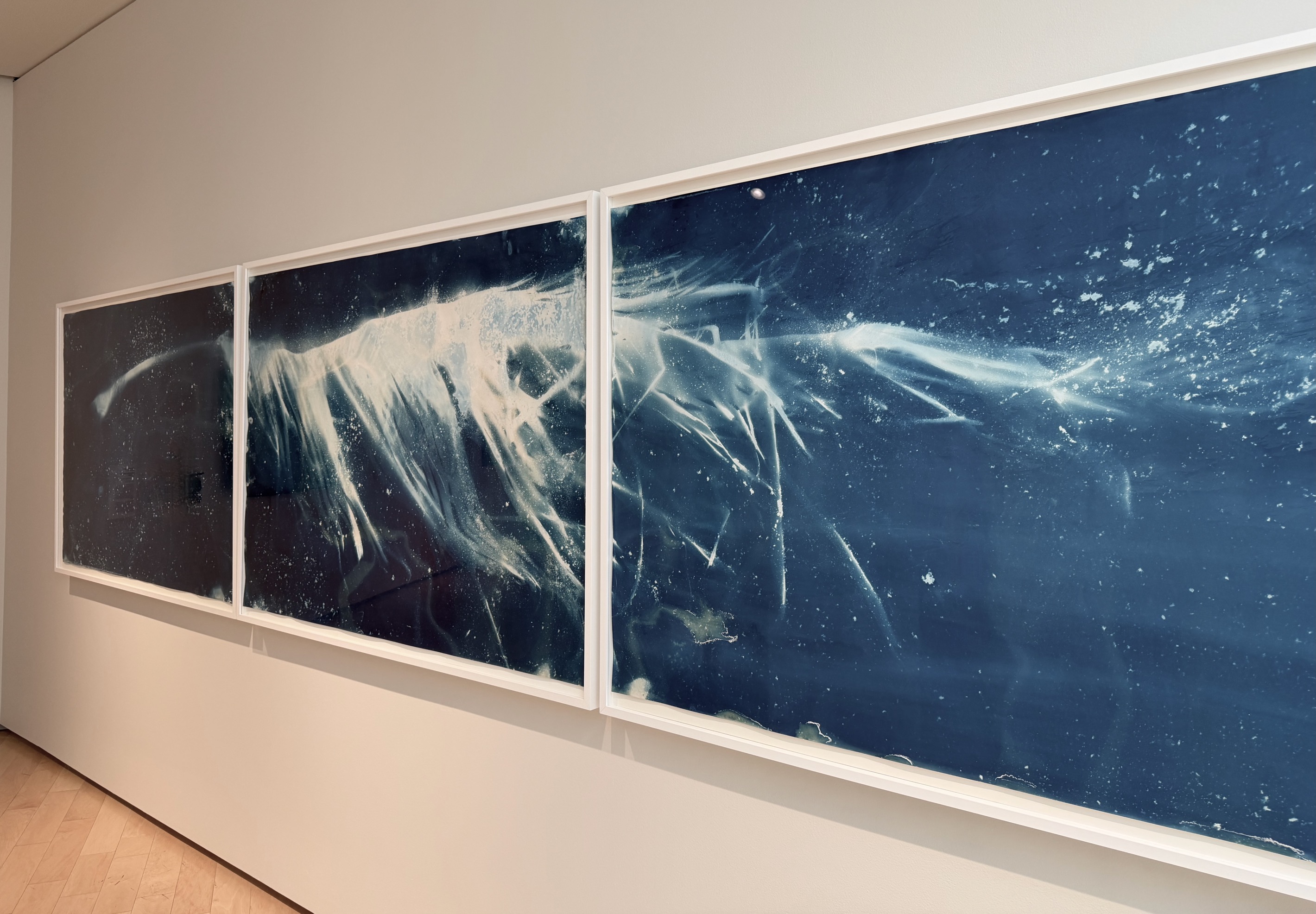
A similarly epic achievement is displayed in the gallery devoted to documenting the aftermath of the Marshall Islands nuclear detonation experiment following World War II – Meghann Riepenhoff’s cyanotype tryptich made right there on a contaminated beach using plants that (like the people) are still in recovery.

Marshall Islands project: Meghann Riepenhoff’s 2023 Untitled (Adaptive Radiation: Radioactive Palm Triptych – a cyanotype made from laying native medicinal plants found across pre-treated paper; washed in the waters of Bikini Atoll, the site of extensive nuclear tests in the 1950s. Courtesy: the artist and Yossi Milo Gallery, NYC

The images are stunning but the content is disturbing (and meant to be), so visitors are actually eager to enter Ernesto Neto’s nearby recuperation chamber.  Adults and children can find respite, surrounded by natural dyed fabrics (you can even put on matching play-jackets!) that provide a mysterious, happy entry to a magical world.

Surround yourself with cushions, create healing sounds with a Tibetan singing bowl, lay down, smell the fragarent spices, look at playful Amazon-inspired hanging jungle things, think about the future, and be happy to be among the Children of the Earth.

Exploring the sensual, cocoon-like participatory space at the core of Ernesto Neto’s 2019 Children of the Earth – filled with futons, pots, crytals, instruments, and spice smells Courtesy: Tanya Bonakdar Gallery, NYC

Thanks to the Nevada Museum of Art for providing an amazing, unforgettable experience!

Indian Theater and Contemporary Art at SITE Santa Fe

The ambitious project paid off. Indian Theater: Native Performance, Art, and Self-Determination since 1969, on view at SITE Santa Fe and the IAIA Museum of Contemporary Native Arts through September 7, is a masterful mix of history, contemporary art, performance, and revealing installations that challenge what you know and think you know.

Filling the entire museum, the exhibition uses painting, sculptures, and performance sculptures to chronicle how radical performances by Native Americans shifted conversations, illuminated forgotten populations and treaties, asked difficult questions, and thoroughly influenced the trajectory of the contemporary Native American art movement.

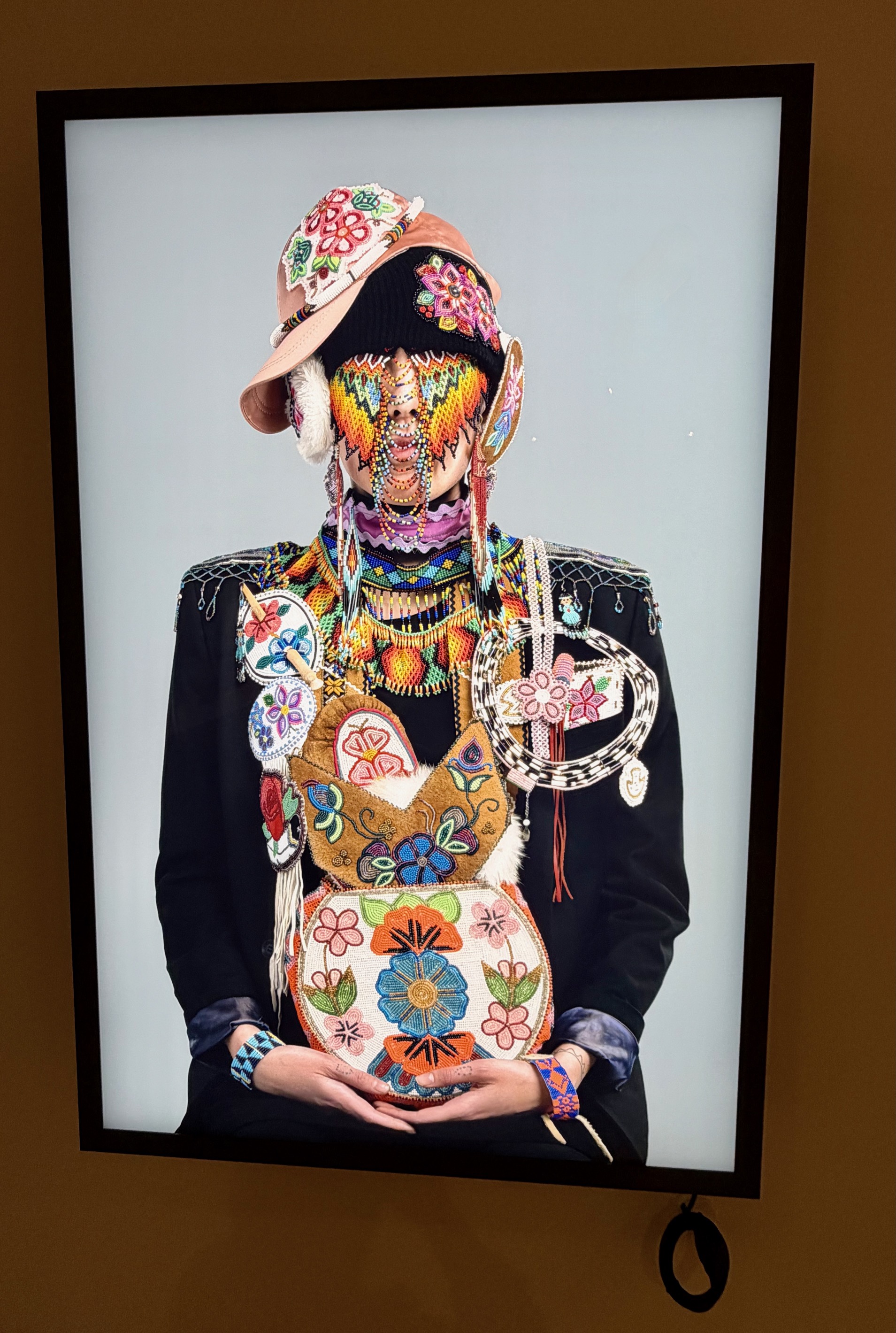
2019 lightbox portrait Headdress – Jeneen by Dana Claxton (Lakota); the sitter bedecked in beads and embroidered gifts. Courtesy: the artist and Forge Project Collection.

Take a walk through the show (and a few performances) in our Flickr album.

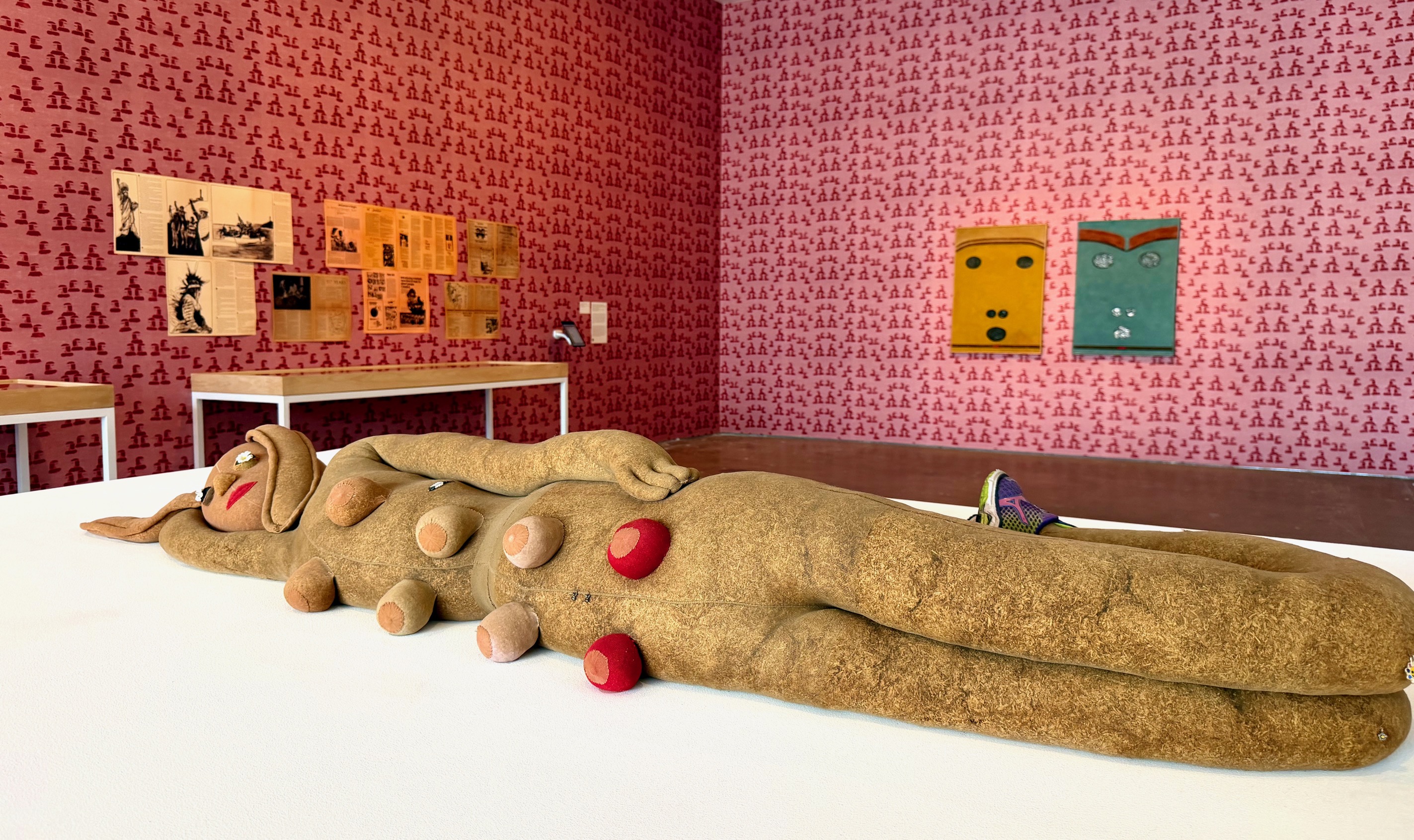
In the entry, a provocative neon sign by Demian DinéYazhi (Diné) beckons, but visitors are immediately pulled into the large space surrounded by a graphic history of the historic Alcatraz occupation (1969-1971, one-of-a-kind mask wall pieces by Lloyd Kiva New (leader of brand-new The Institute of American Indian Arts 1967-1978), IAIA’s 1969 manifesto on Indian Theater, and a 1972 video of a NYC production by the Native American Theater Ensemble (running on an ancient Sony Trinitron). It’s all surrounded by a wall textile designed by Linda Lomahaftawa (Hopi/Choctaw) when she was an IAIA student in the Sixties.  A provocative sculpture by Gabrielle L’Hirondelle Hill (Métis) adds the contemporary drama.

Exhibition entry: 2021 mixed media Counterblaste by Gabrielle L’Hirondelle Hill (Métis); tobacco-stuffed pantyhose rabbit-human figure; surrounded by 1969 Alcatraz occuption documentation and paintings by Lloyd Kiva New. Courtesy: Center for Curatorial Studies, Bard College; IAIA Museum of Contemporary Native Art; Art Bridges.

This sets the stage for curator Candace Hopkins’ thesis – in the 1960s, Native American performance went hand-in-hand with greater activism, self-determination by tribes, and contemporary art in all its forms.  Listen to her explain:

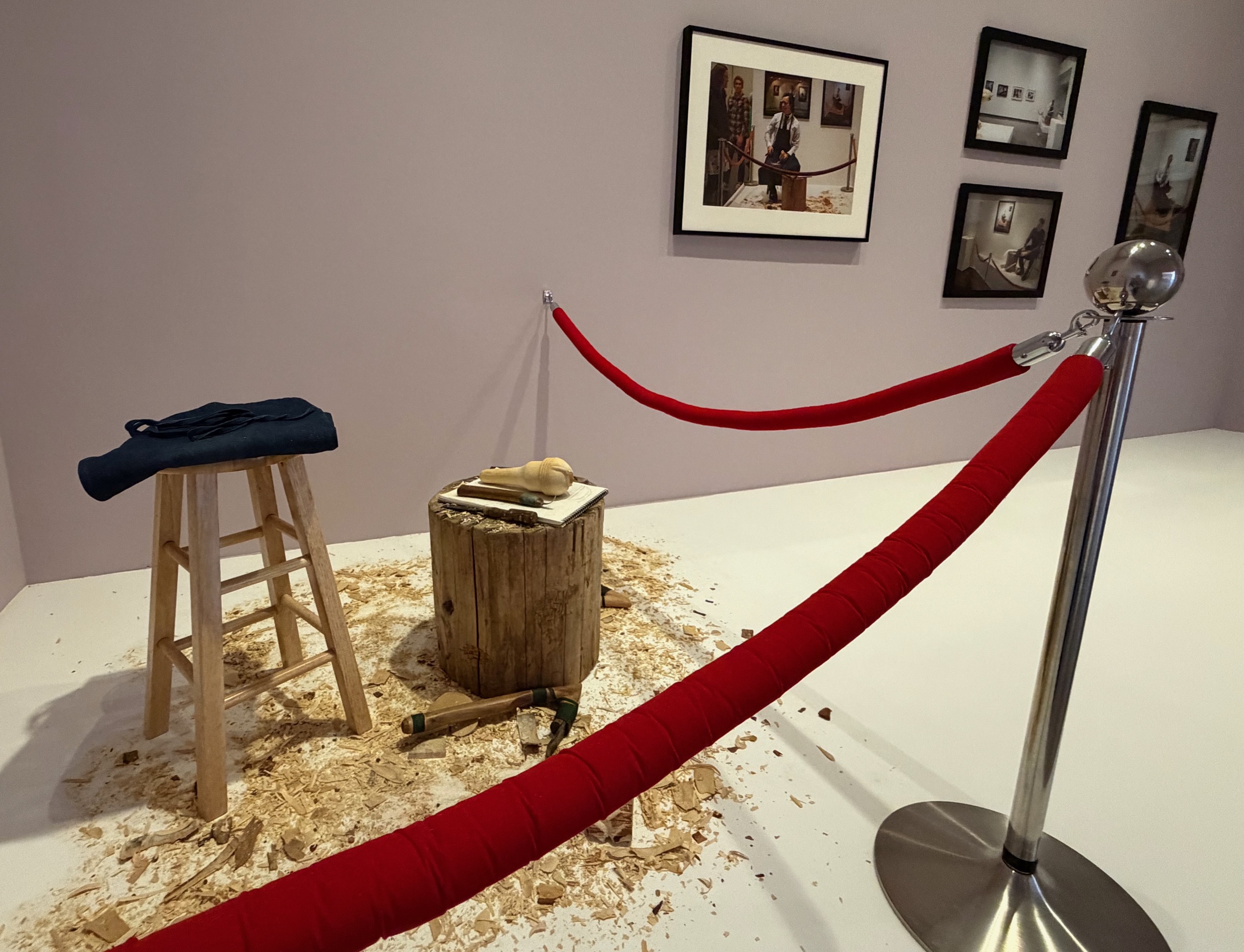
Two performance spaces lie just beyond this gallery. First Nicholas Galanin’s gallery where his performance The White Carver happens weekly (surrounded by photos of previous performances since it was first staged in 2012). The White Carver tackles the subject of appropriation and Native cultural misunderstanding head on.

Behind the velvet rope: set for 2012-ongoing White Carver performance by Nicholas Galanin (Tlingit/Unangax) in which a Caucasian woodcarver replicates an object made by a Galinin – a commentary about appropriation and commercialization of Indigenous culture by non-Native communities. Courtesy: Gochman Family Collection.

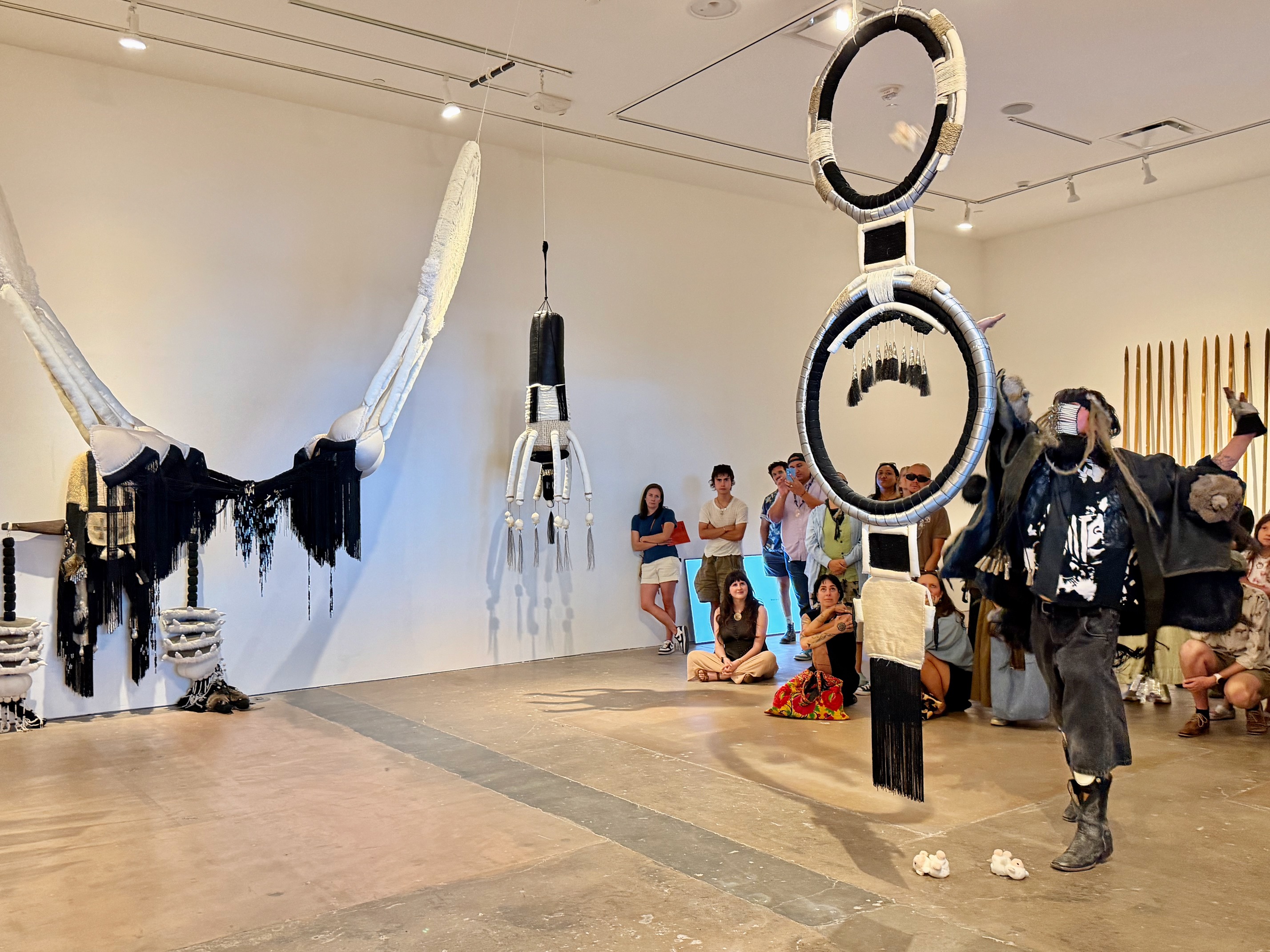
Next, you enter a room hung with giant earring sculptures from Eric-Paul Riege (Diné), who activated them in a ritualistic performance at SITE in August. Riege’s installation allows everyone a simultaneous experience of the contemporary and cultural deep time.  Kite’s floor installation, right nearby, does this, too. (Check out our previous post about Kite’s innovative IAIA show here.)

Museum goers watch Eric-Paul Riege (Diné) interact with his mixed-fiber scultptures 2020-2022 jaatloh4Ye’iitsoh (“earrings for the big god”) (August 15, 2026); oversized jewelry suggesting knowledge by listening, harmony of natural fibers, and totems of memory. Courtesy: Forge Project Collection, traditional lands of the Moh-He-Con-Nuck; Art Bridges.

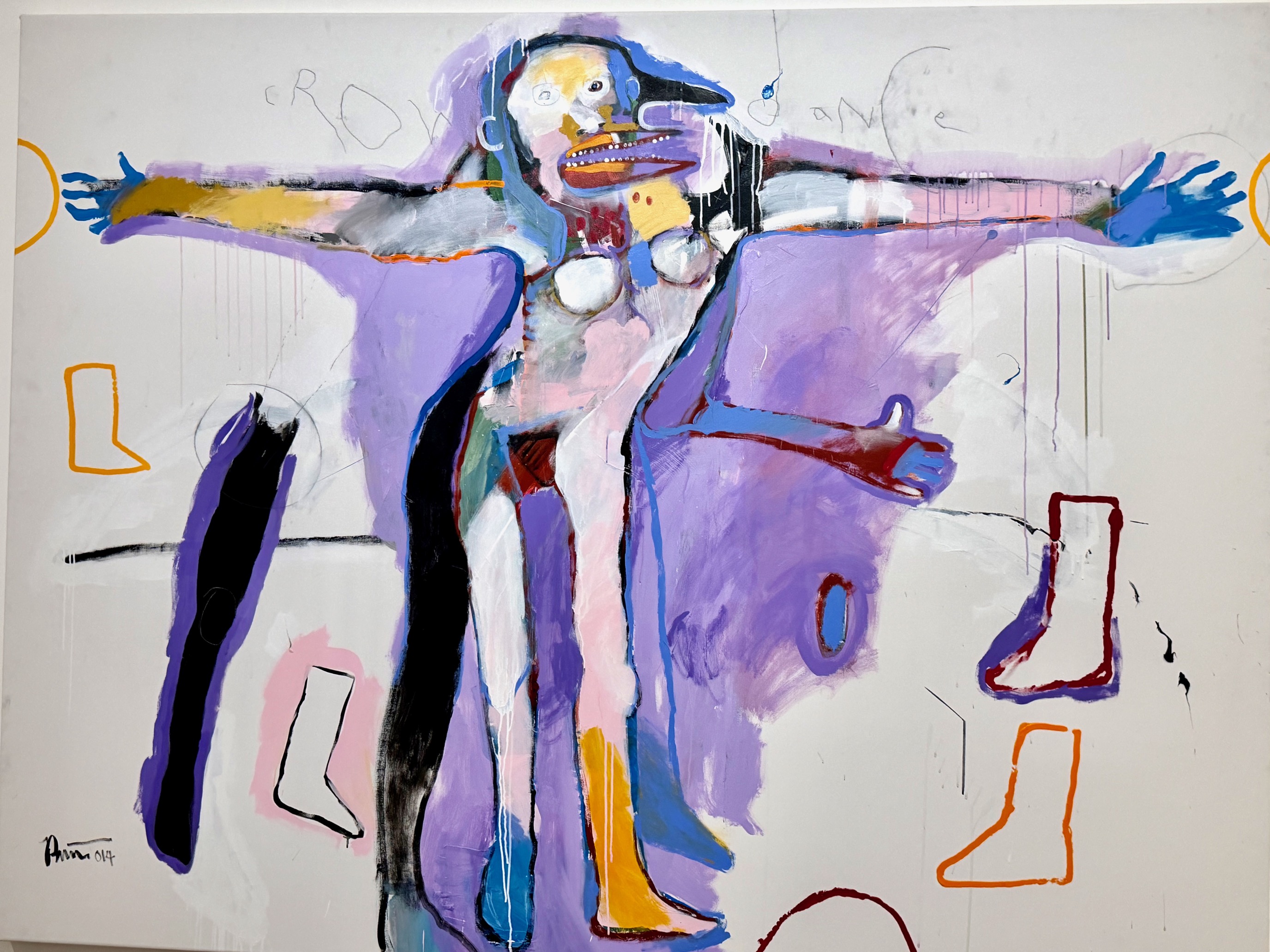
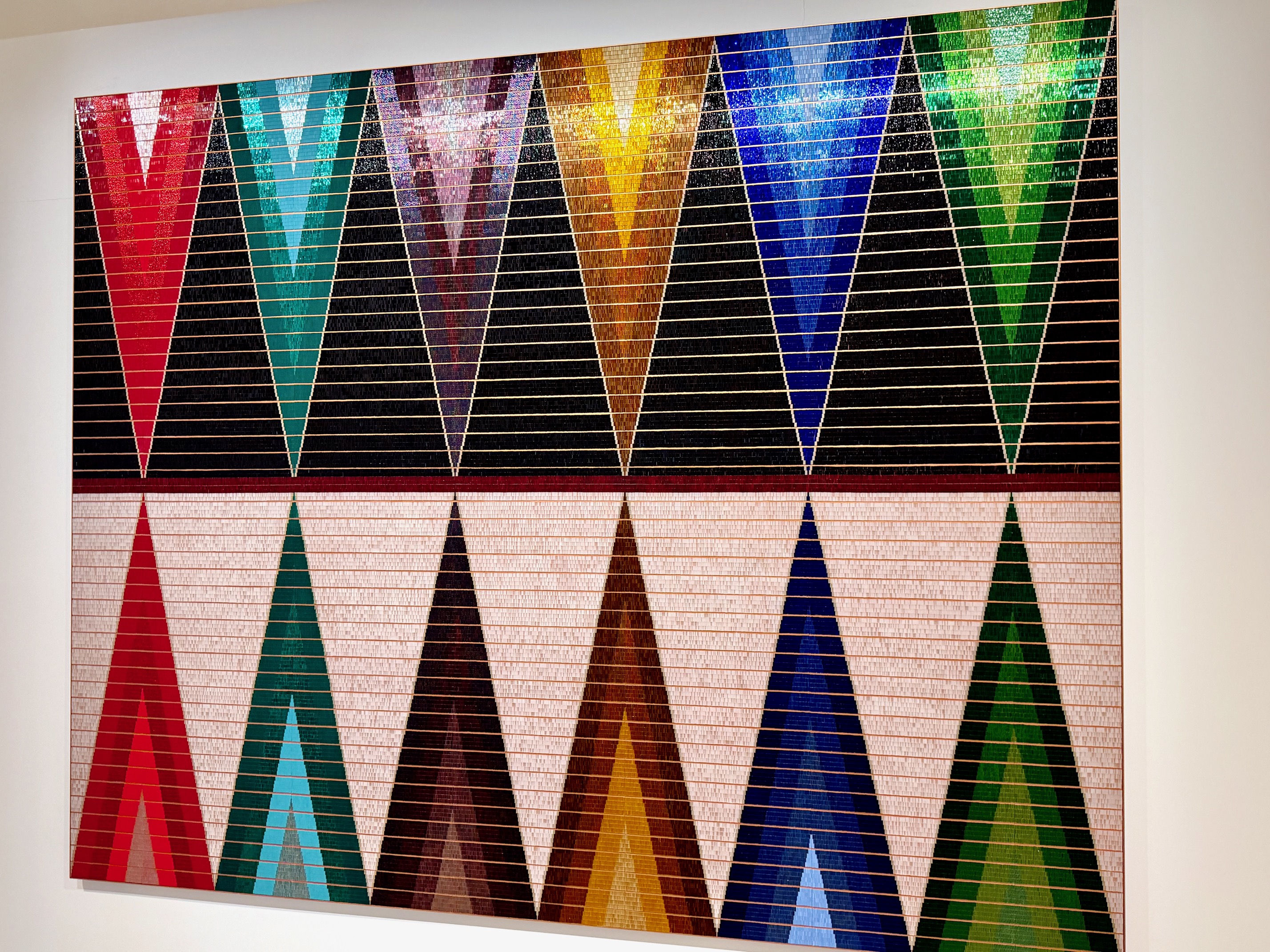
Two-dimensional art on display also evokes a mix of ancient and “now.” Action painting mixed with cultural symbols. Bugle beads or painted blankets echoing color-field painting.

2014 acrylic and graphite Crow Dance by Rick Bartow (Wiyot). Courtesy: Denver Art Museum.
2022 acrylic and glass bugle bead Wopila/Lineage II by Dyani White Hawk (Sicangu Lakota) – a reference to the long tradition of Lakota abstraction. Courtesy: Gochman Family Collection.

Mash-ups of pop culture, cartoony cheesecake, ancient craft, culture, and social commentary – all the work on display incorporate aspects of performance.

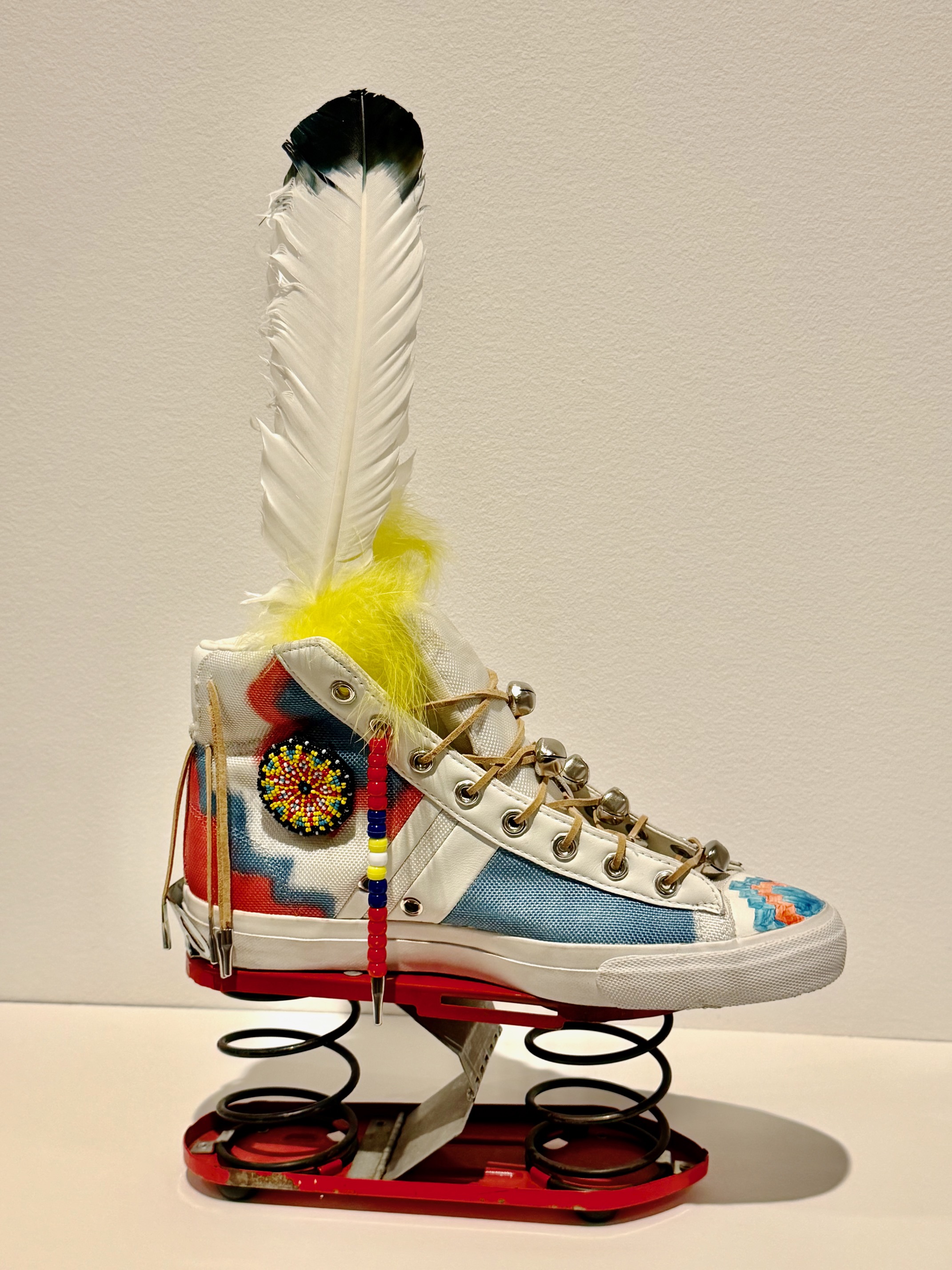
1990 sculpture War Dance Technology by performance artist James Luna (Payomkowicham, Ipai, and Mexican). Courtesy: Gochman Family Collection.
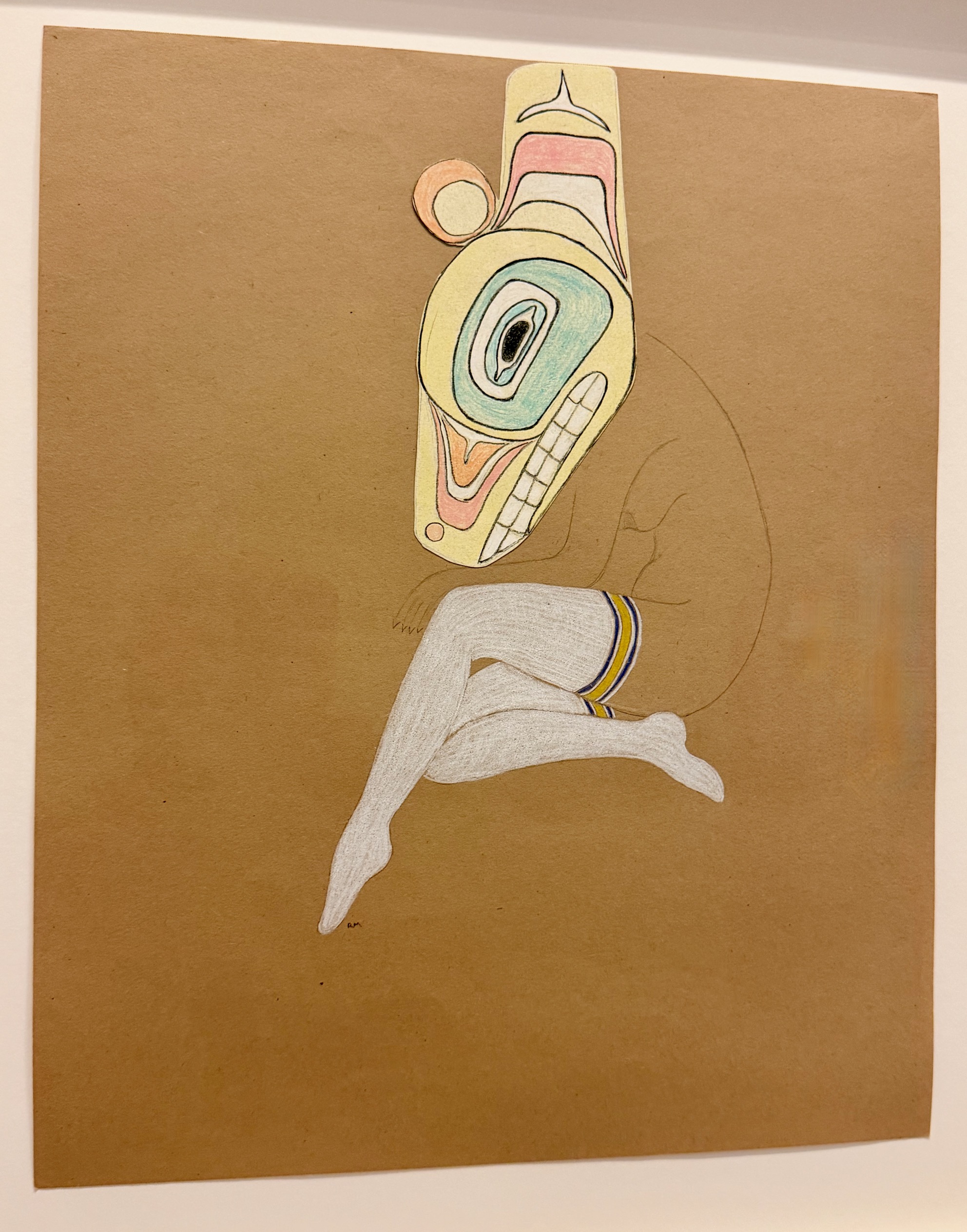
2014-2022 graphite and colored pencil drawing Killer Smile by Rachel Martin (Tlingit/Tsaagweidei, Killer Whale Clan of the Yellow Cedar House Eagle Moiety). Courtesy: the artist.

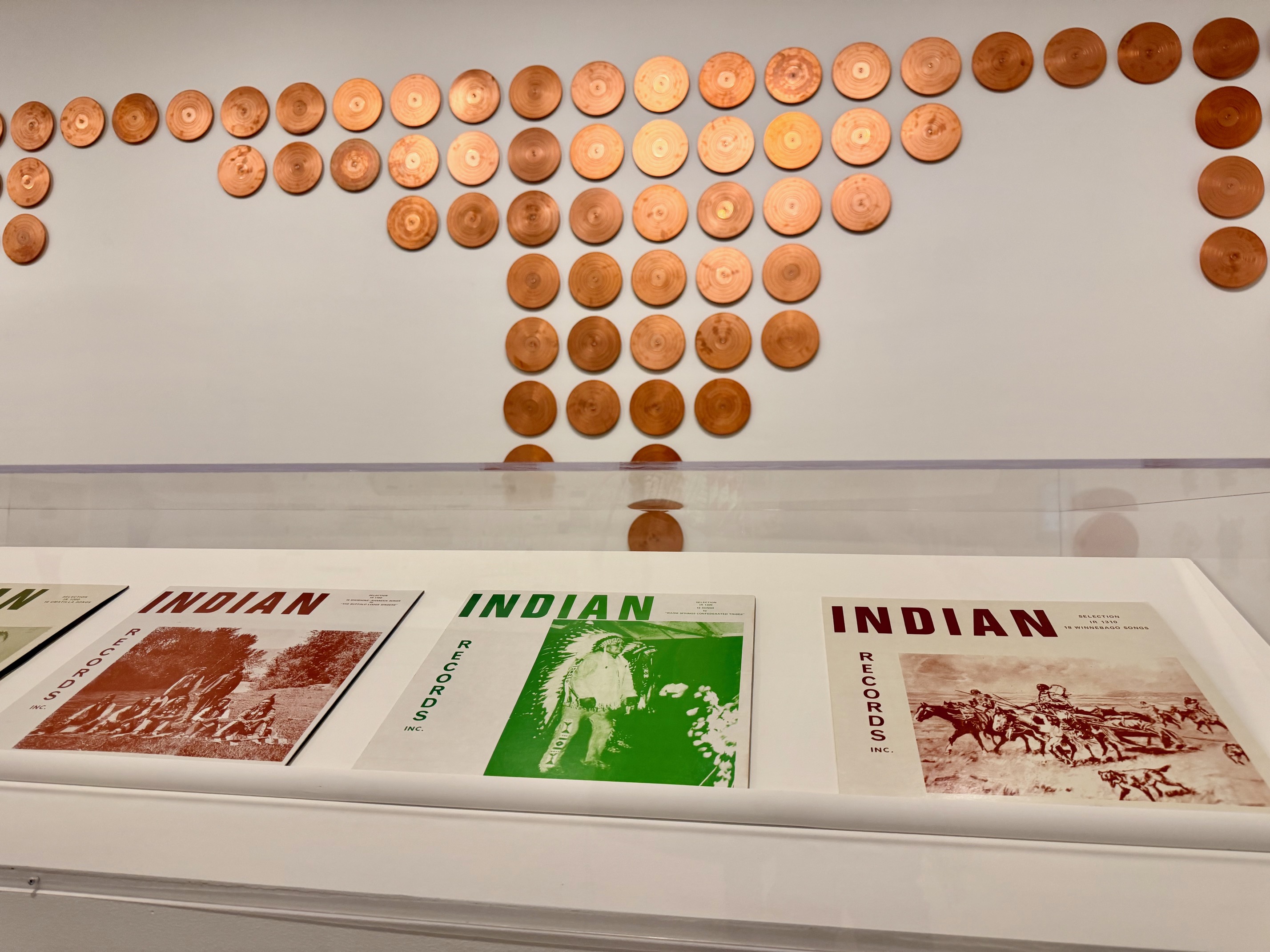
The back gallery takes us back into time to consider the irony of early ethnomusic recording in the Pacific Northwest during a period when potlatches were banned and ceremonies forbidden.  The exhibition has a beautiful installation of Native American LPs from the 1960s and 1970s beneath a stunning installation by Sonny Asu of copper recordings that cannot be played.

1960s-1970s LP recordings of Native American tribal songs by Indian Records; at rear, 2012 copper record installation “Ellipsis” by Sonny Asu (Ligwilda’xw Kwakwaka’wakw from the Wei Wai Kum Nation) – 138 records not intended for play. Courtesy: Forge Project Collection, traditional lands of the Moh-He-Con-Nuck.
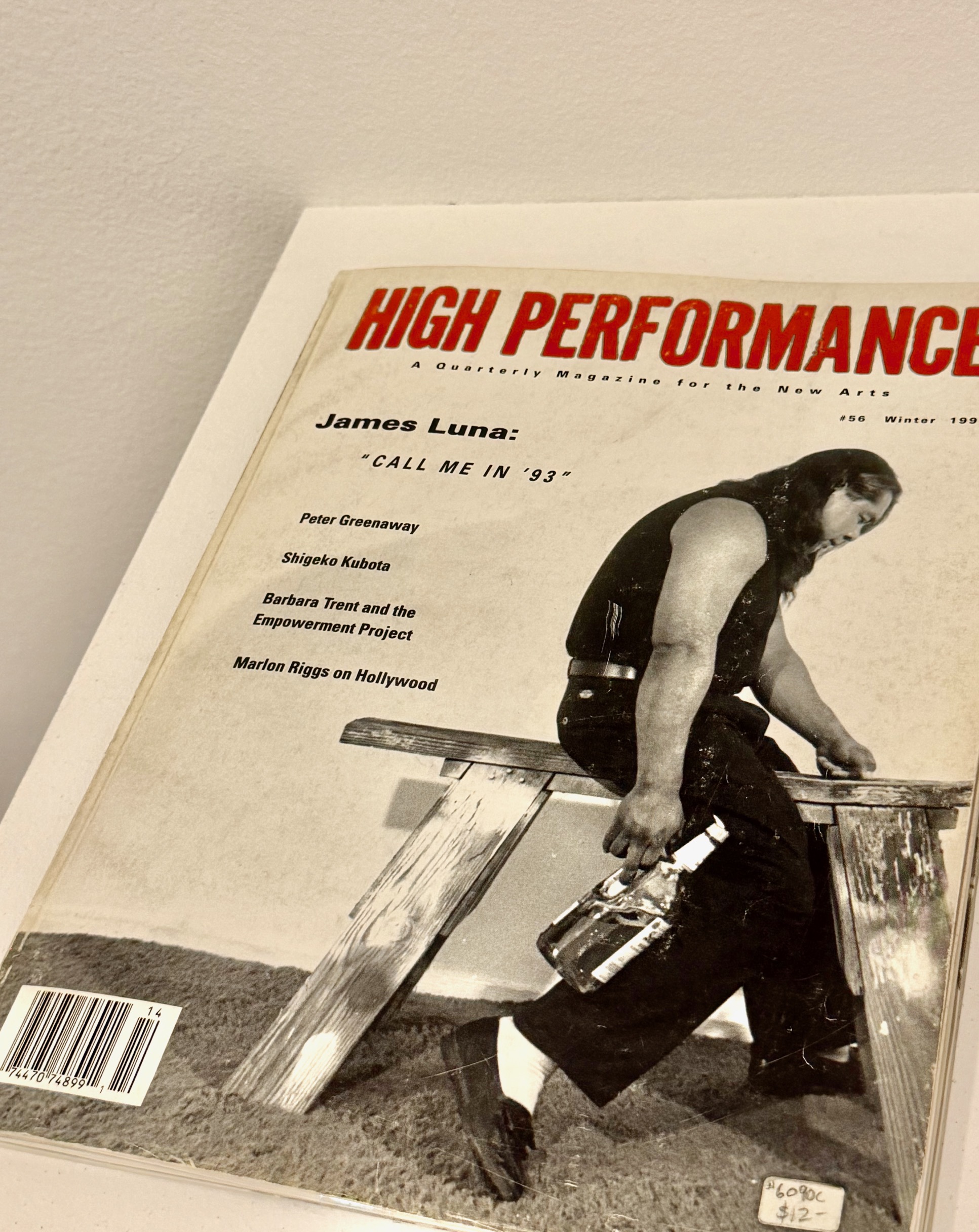
1991 High Performance art magazine cover featuring James Luna during his AA Meeting/Art History performance.

In every room, videos display performances on stages (Jeffrey Gibson or Spiderwoman Theater) or in nature (asinnajaq (Inuk). One room is devoted to a set, props, and documentation of work by the influential performance artist James Luna, whose art did not shy away from the ever-present issue of alcoholism in Native communities.

The exhibition also includes an immersive, highly theatrical, multi-gallery installation by the New Red Order. Here’s the manifesto by NRO’s Adam and Zach Kahalil (Sault Tribe of Chippewa Indians) and Jackson Polys (Tlingit).

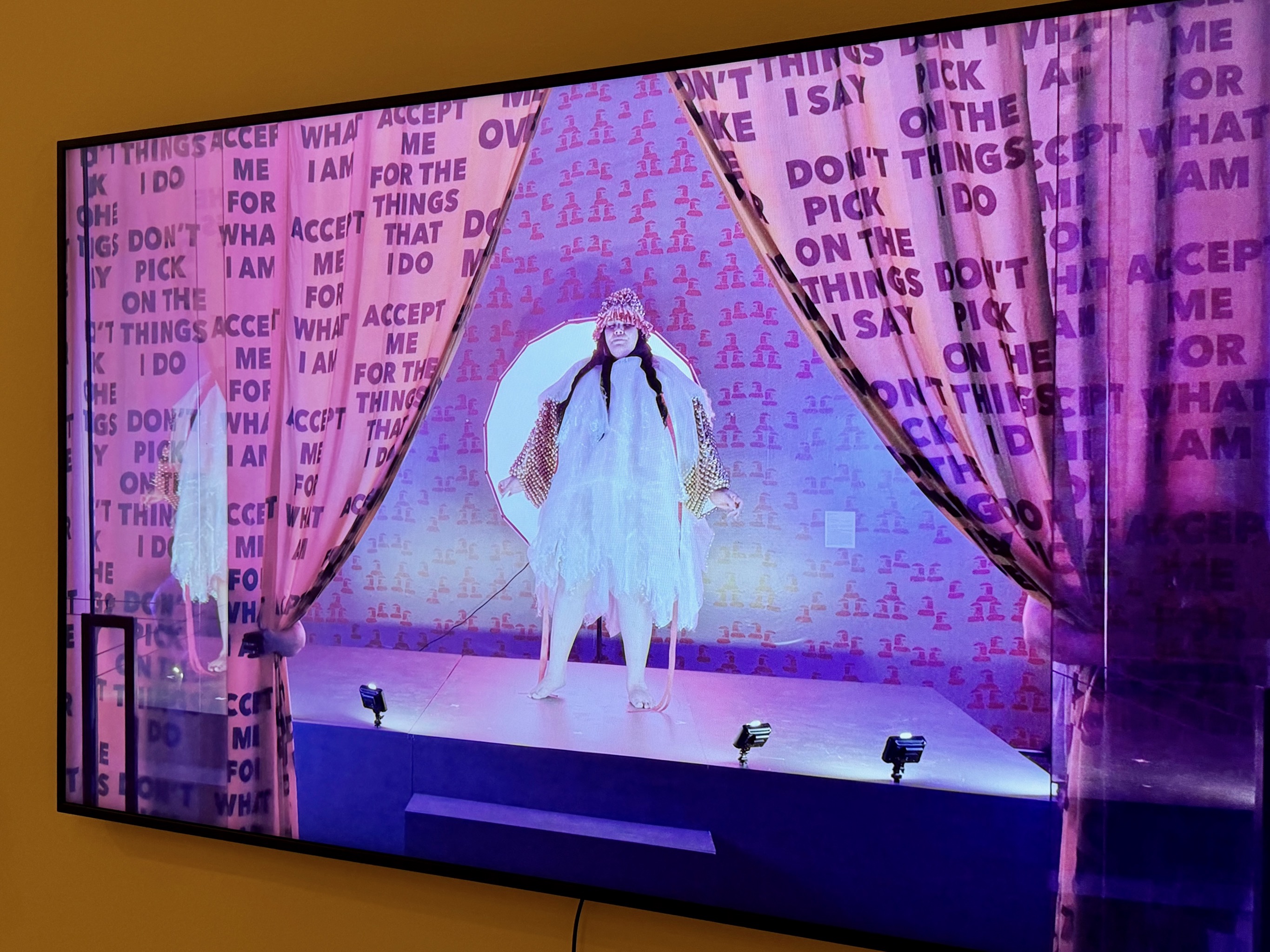
2023 performance documentation video of Don’t Make Me Over by Jeffrey Gibson (Mississippi Band of Choctaw and Cherokee) featuring performer Ariel Twist (Nehiyaw). Courtesy: the artist.

NRO uses satiric videos, props, murals, documents and timelines,  merchandise, and graffiti style to illuminate collisions of history, pop culture, and consciousness surrounding urban Native communities today – a totally head-spinning (and brain-spinning) experience.

Video of the 2020-ongoing Progenerator installation by the New Red Order, a mixed-media installation by artists Adam and Zach Kahalil (Sault Tribe of Chippewa Indians) and Jackson Polys (Tlingit) that probes societal stereotypes alongside non-Natives’ fascination with Native culture. Courtesy: the artists.

And thanks to the recreation by Erica Lord, SITE Santa Fe visitors were able to experience Artifact Revisited. Erica recreated an acclaimed 1987 performance by James Luna – a still Native body on display within a museum, encased in glass. In Erica’s recreation, her “cabinet” was surrounded by museum signage purporting to explain “Indians” and provide context for the “exhibit.” In the age of NAGPRA, the experience was unforgettable. Watch the performance heare, and listen to Erica explains how she came to perform this historic piece and how it felt.

For more background on the connections between Native American theater, politics, and art, here’s a link to the recently published book about this never-before-told story.

Watching Clay Artist Jody Folwell Break the Rules

Contemporary ceramicist Jody Folwell (Santa Clara Pueblo) always knew she was going to make art that was a bit different, even as she was learning traditional Pueblo pottery making at the kitchen table from her her mom, celebrated artist Rose Naranjo. Satirical, sculptural, social-political, and avant-garde ceramic statements line the gallery from start to finish in O’Powa O’Meng: The Art and Legacy of Jody Folwell, a celebratory retrospective exhibition at the New Mexico Museum of Art through September 13, 2026.

The Santa Fe stop is the final on the exhibition’s journey across the United States, which started at the Fralin Museum of Art at the University of Virginia.

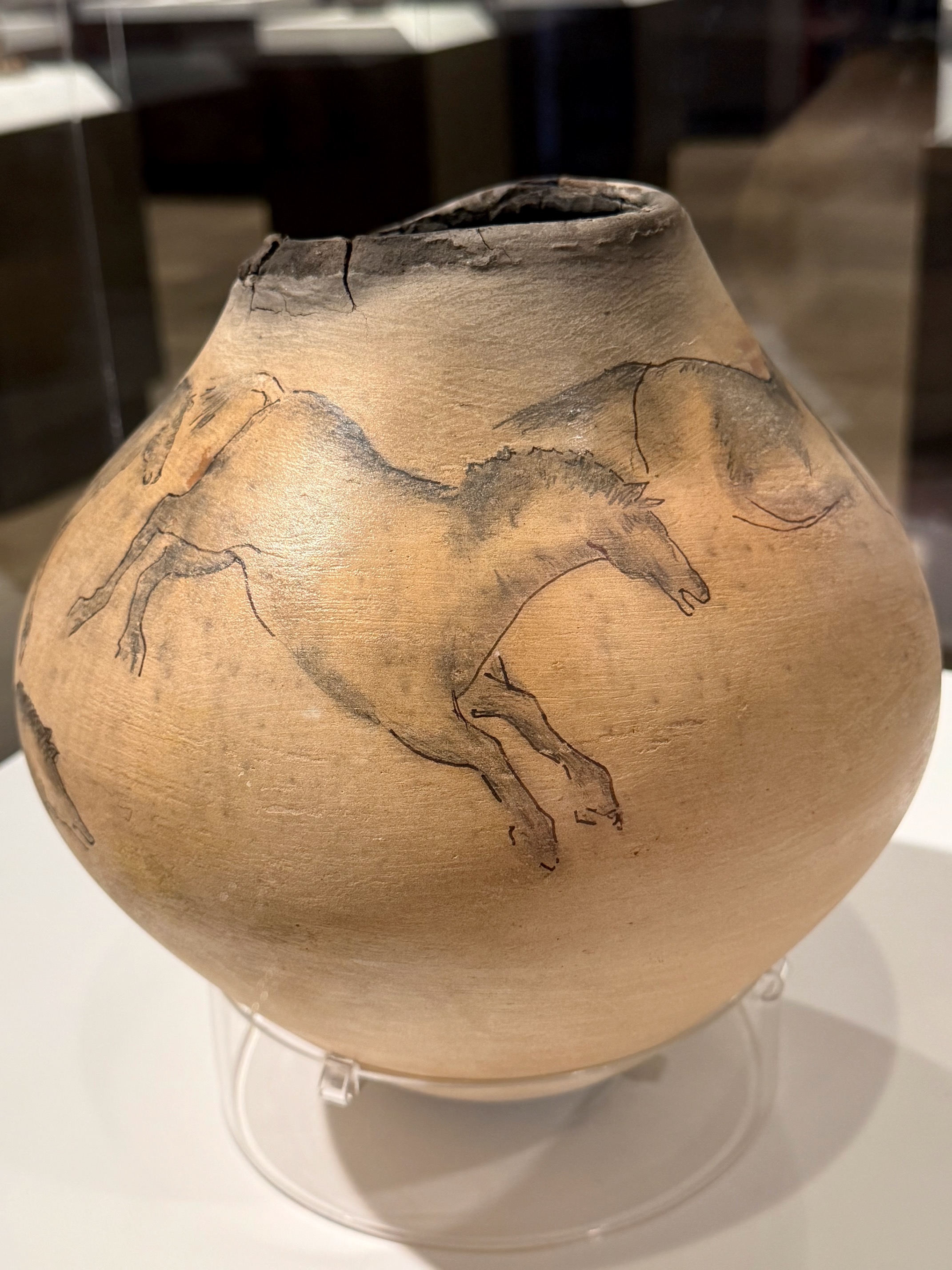
2018 Ancient pot by Jody Falwell (Santa Clara Pueblo), with painting inspired by Lascaux cave painting; rim evokes fire’s importance to humanity’s art making traditions. Courtesy: private collection.

Walk through the show to see our favorites in our Flickr album.

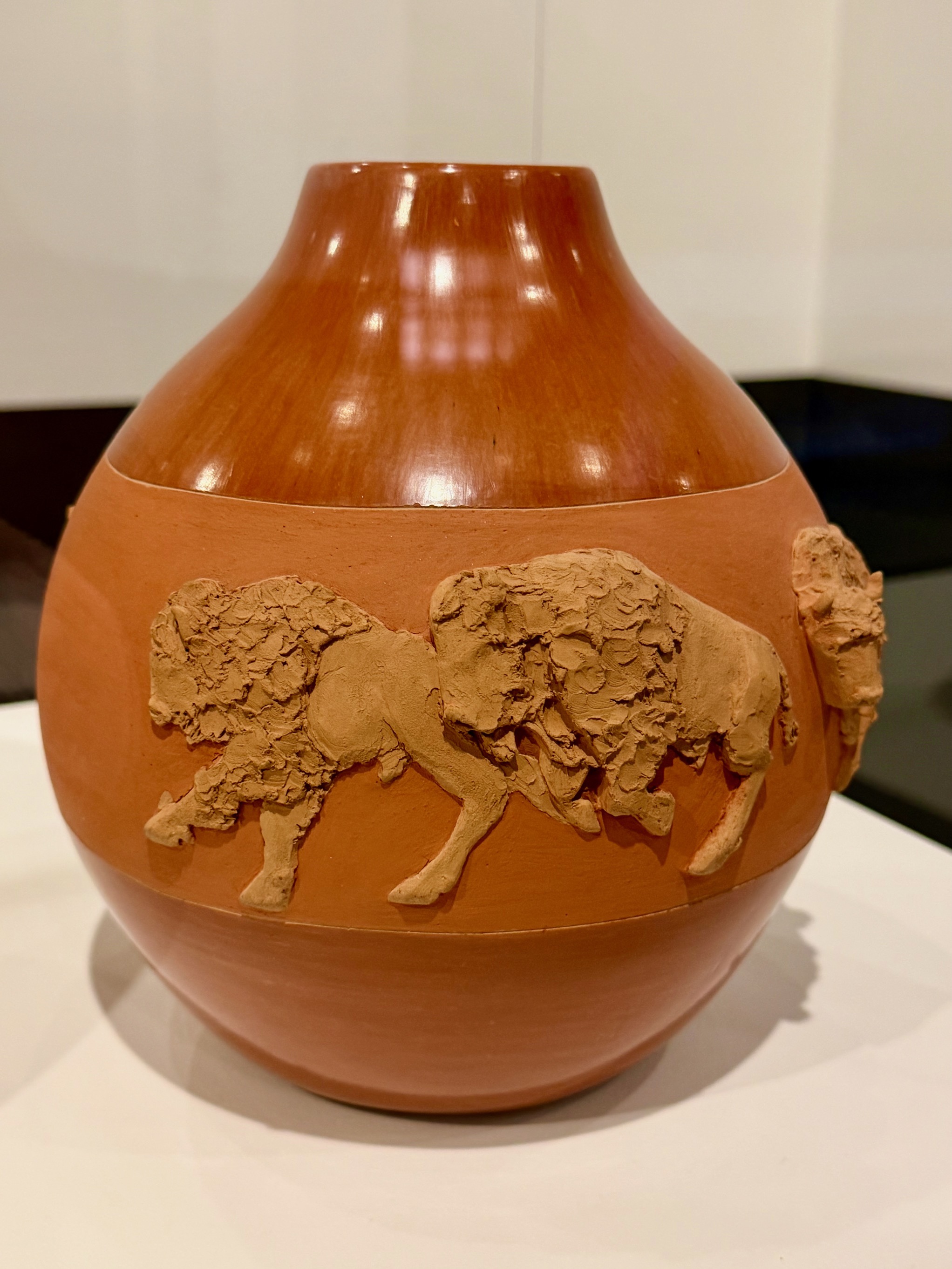
The exhibition does not unfold chronologically, even though it features some of Jody’s (and her family’s) most ground-breaking and controversial work. At one end is Half a Step, that she credits as one of her earliest nontraditional ceramic statements, featuring a lively bison thundering around the partially polished curved surface – a “half step” away from what was expected from Santa Clara pottery at the Santa Fe Indian Market in 1975. At the other end is her collaboration with the acclaimed sculptor Bob Hazous (Chiricahua Apache) that won Best in Show in 1984. Who had ever seen a green Pueblo pot with loaded commentary?

1975 Half a Step pot by Jody Falwell (Santa Clara Pueblo) – featuring sculpted animals and an unpolished band. Courtesy: Museum of Indian Arts and Culture.
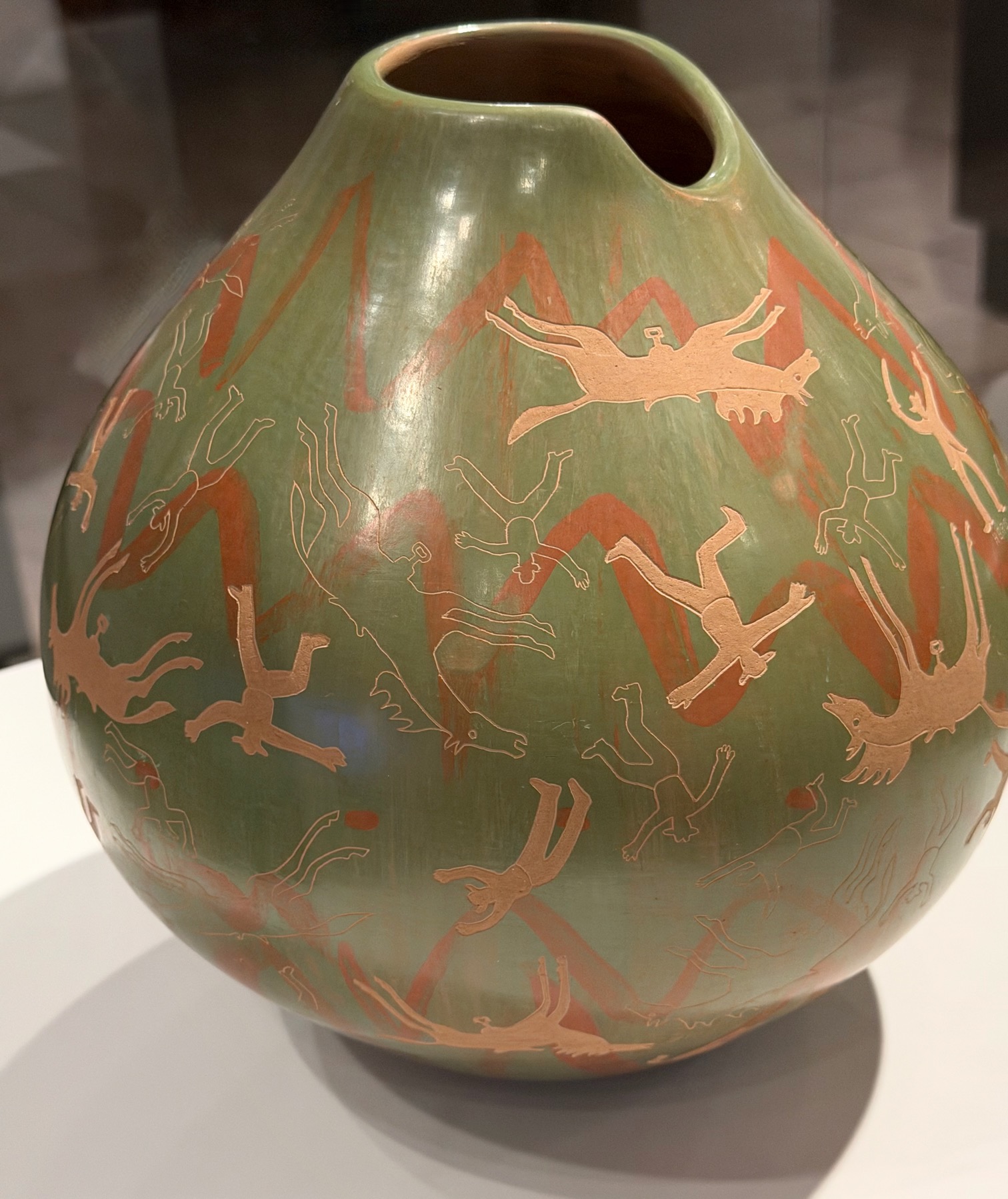
Jody’s 1984 Hero Pot collaboration with Bob Hazous (Chiricahua Apache), awarded Best in Show at that year’s Santa Fe Indian Market for its unconventional color, shape, and subject. Courtesy: private collection.

Collaborations, social commentary, sculptural details, and different painting styles encourage gallery goers to move slowly, stop, look, and circumnavigate each work to let the beauty, humor, or story sink in. Jody’s recent multi-pot ceramic installation The Cycle of Pottery is Us causes viewers to stop, think, and reflect on not only the persistence of the traditional Tewa art form, but of the entire human cycle of birth and rebirth.

Detail of Jody’s 2024 The Cycle of Pottery is Us, a sequential reference to black-and-white Ancestral Pueblo ceramic traditions, the art form’s near-loss 50 years ago, and its resurgence. Courtesy: Tia Collection.

As cultural appropriation carries a loade charge in the art world, Jody’s feels that her fascination by sinuous designs of other cultures, the cheekiness of Pop culture, and admired styles of epochs in Western art history gives her license to honor them. She incorporates Plains Indian ledger book style, Maori iconography, comic books, and even the cave paintings of Lascaux.  A wide lens from her travel and studies delights visitors as she takes them on a world journey of history, art, and people.

2008 Northwest Coast Art 101 incised with a tribute to her love of fluidity of Pacific Coast design; at rear, 2006 Doh San Quah (I Stole It) painted in Plains Indian ledger style. Courtesy: private collections.

The feelilng behind the show chronicles how much the maternal ceramic making tradition means to her. 
2013 Star Wars pot by daughter Susan Folwell (Santa Clara Pueblo), with images of Hopi style and cosmologies. Courtesy: Fred Jones Jr. Museum of Art at University of Oklahoma, Norman.

The exhibition includes a large traditional bread making bowl by her mother as well as work by her daughters and grandchildren – accomplished artists in their own right.

Jody titled her show O’Powa O’Meng (“I came here, I got here, I’m still going”) to demonstrate her continued commitment both to innovation in her art form and to inspire the next generation of contemporary artists.

Several pieces involve a mix of tiles (some broken) and pots with incriptions or depictions woven across all of them, such as The Buffalo Hunt that she created for the Santa Fe installation and Buffalo Soldier, a meditation on Obama’s historic presidency and the enslaved workers who originally built the White House.

Hear more about pushing the boundaries from inside a Tewa home dedicated to art making from Jody and daughter Susan as they talk about exhibition’s final stop with curator Jill Ahlberg Yohe at Santa Fe’s New Mexico Museum of Art.

Makowa: Modern Skywatching with the Ancients

Look up at the night sky and find patterns in the stars. You can do that, even though you’re standing inside the exhibition Makowa: The Worlds Above Us at Santa Fe’s Museum of Indian Arts and Culture through January 31, 2027. The wall-sized photo murals of day and night skies provide the backdrop to sculptures, pottery, and textiles with stylized images of stars, planets, the Sun, Moon, meteors, and changes of season.

Beautifully crafted objects and immersive photos provide contemplative spaces to consider the different types of skyward observations that Indigenous communities have made across millennia, and how stories and rituals convey this knowledge across generations.

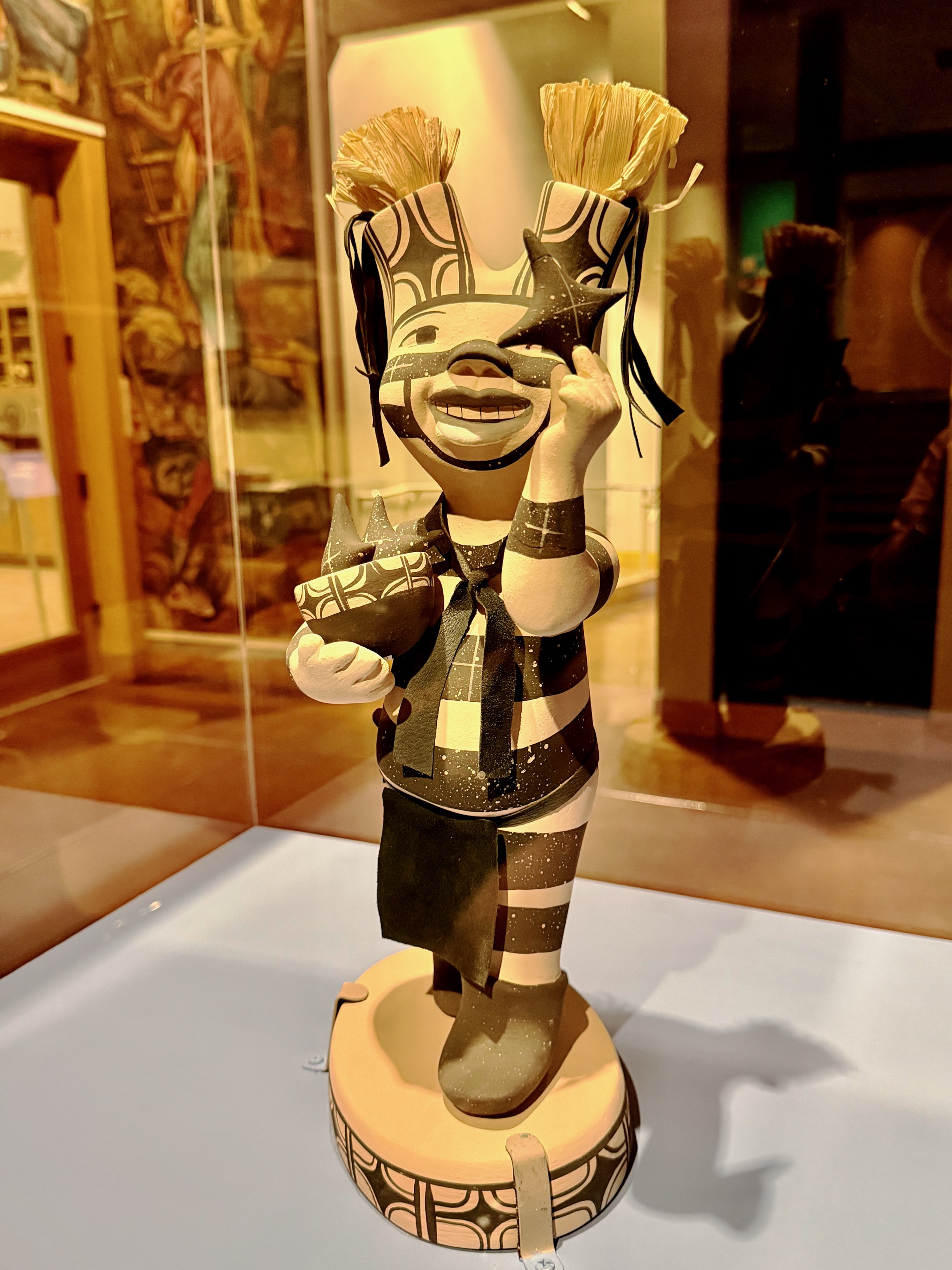
Exhibition welcome: 2009 Evening Star ceramic sculpture by Kathleen Wall (Jemez Pueblo) – a Koshare holds stars important to celestial calendar.

Kathleen Wall’s charming Koshare holding up the Evening Star welcomes everyone to the journey. Take a look through our Flickr album to see some of our other favorites.

A mix of historic and contemporary art underscores the story behind star gazing. Tracking their slow movement across the night skies, sky watchers have long seen stars as important guides. The Ancients used petroglyph images as reminders of how to use ancestor stars for guidance – to tell time, mark seasons, and take journeys through vast desert landscapes.

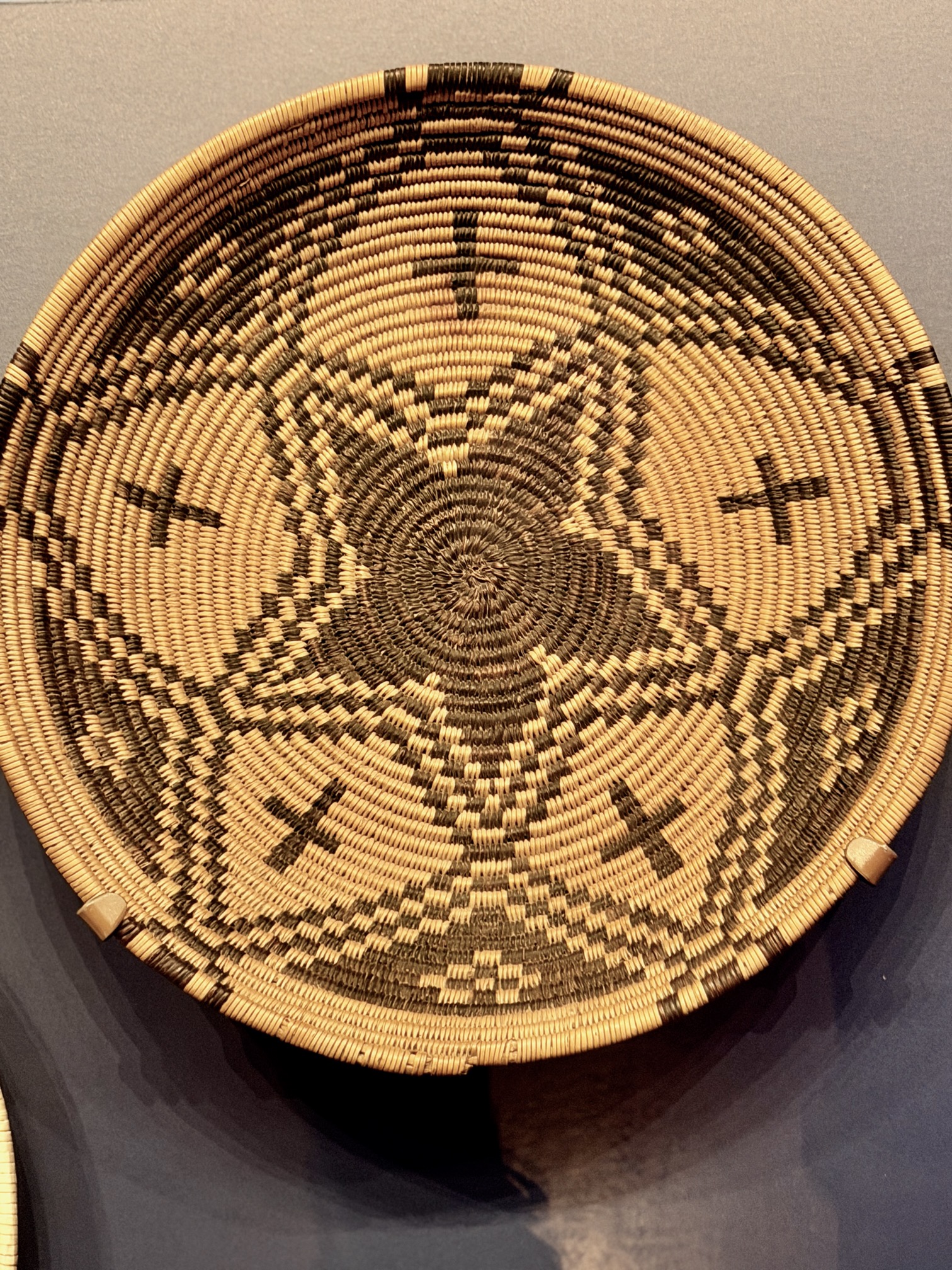
Star patterns: 1930s tray woven by unknown Tohono O’ohdam artist.
2020 Star Child painting by George Toya (Jemez Pueblo), showing a star surrounded by ancestors in the night sky. Courtesy: private collection

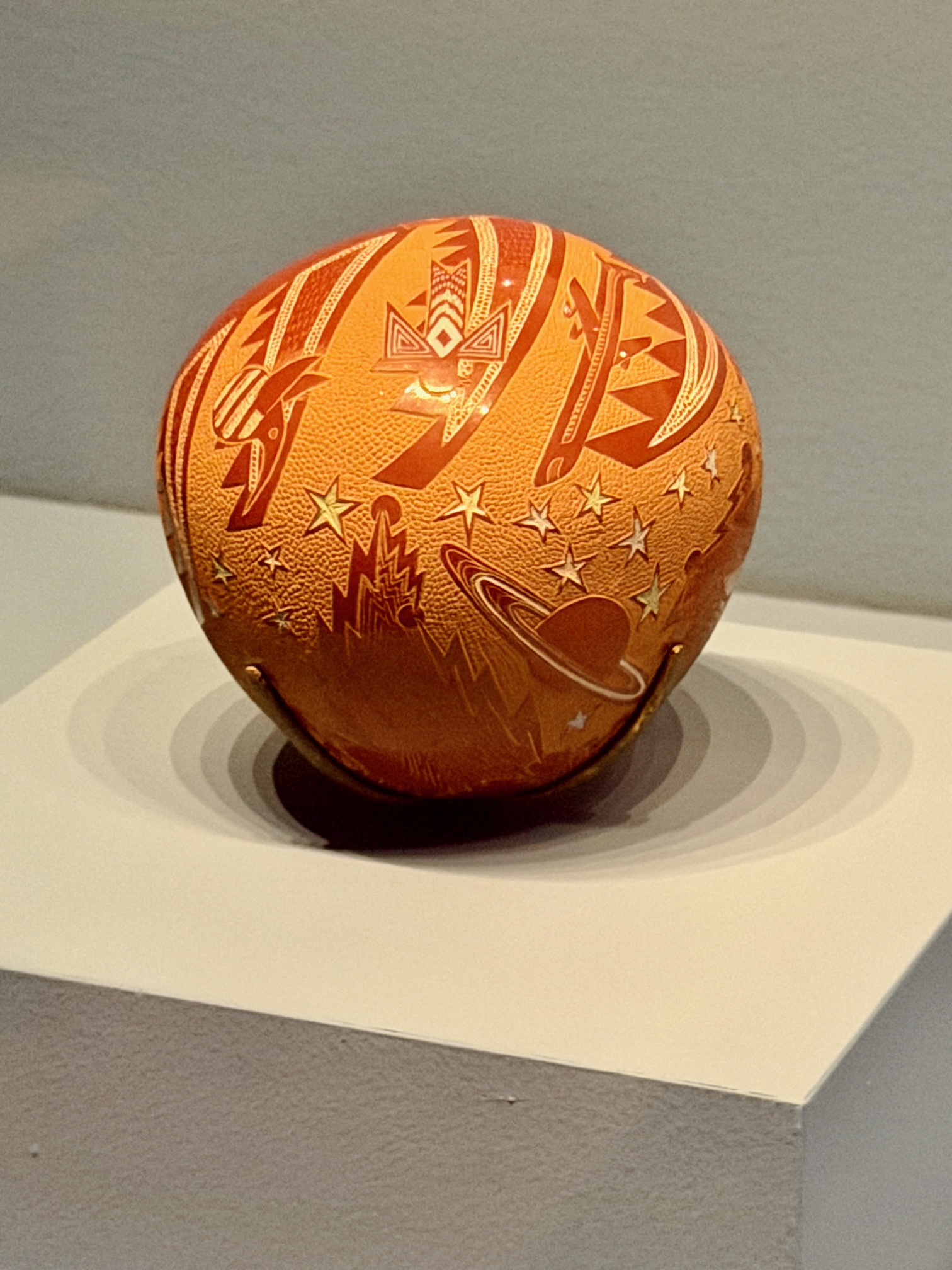
Recent artworks suggest a range of the activity in the day and night sky. Phases of the Moon inform agricultural cycles. Planetary alignments, meteor showers, and also plane traffic are all part of night-sky viewing today. Rosemary Lonewolf’s tiny pot summarizes this dynamism nicely.

Distant worlds and a crowded sky: 1992 miniature Spaced Out jar by Rosemary Lonewolf (Santa Clara Pueblo).
2000-2001 sand painting by Joe Ben Jr. (Diné) linking phases of the Moon to planting cycles.

The curators show how traditional symbols of clouds, sky, and sky dynamics are learned, used, and adapted over the centuries by exhibiting modern woven regalia alongside ancestral Puebloan pots from Chacoan culture. It shows that abstract Indigenous symbols do not exist in a single place and time – they are used and reused.

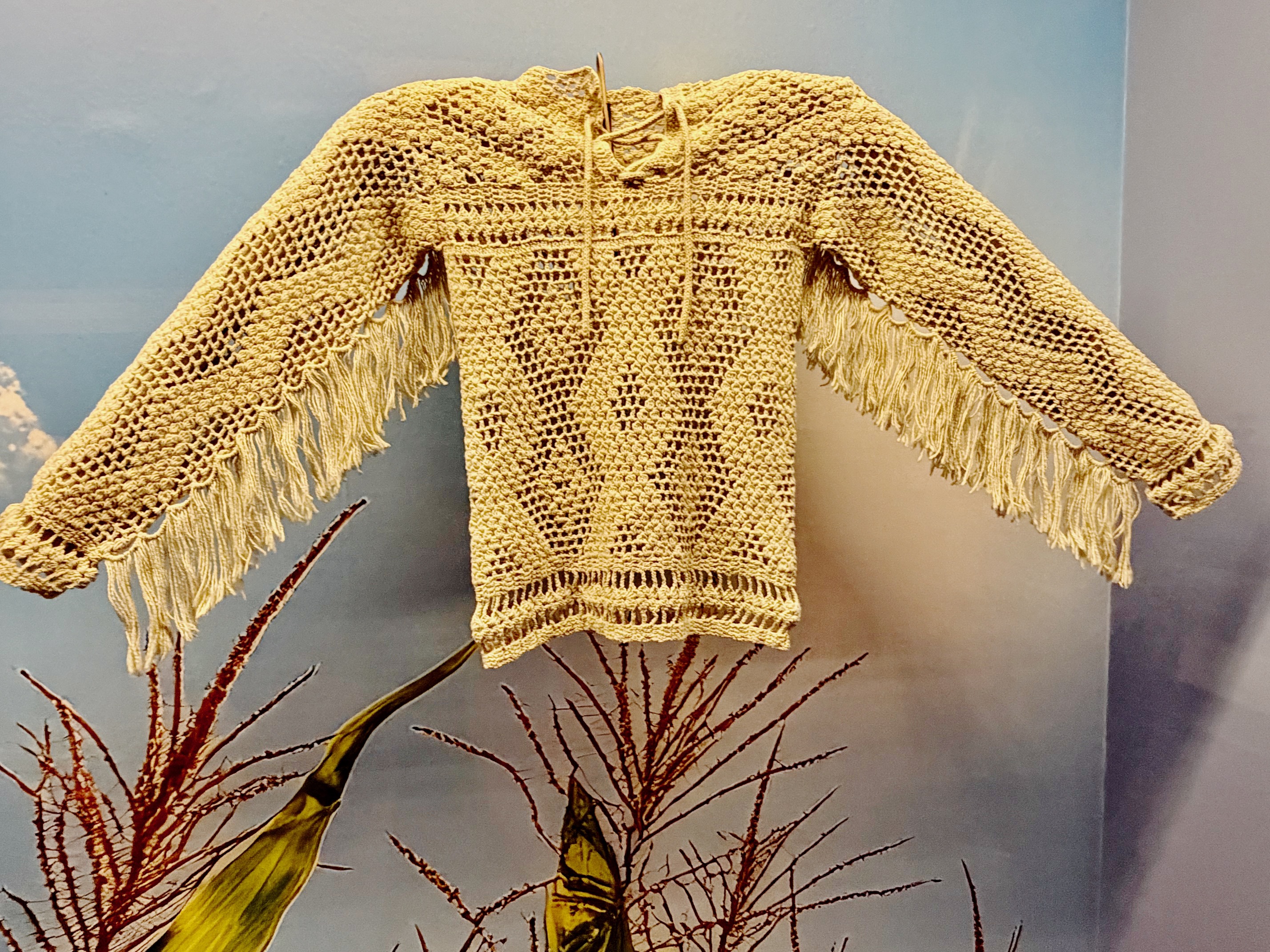
Acknowledging the lively, changing sky: 1984 shirt with sky symbols woven by Evelyn Quintana (Okay Owingeh) with Ancestral Pueblo ceramics below.

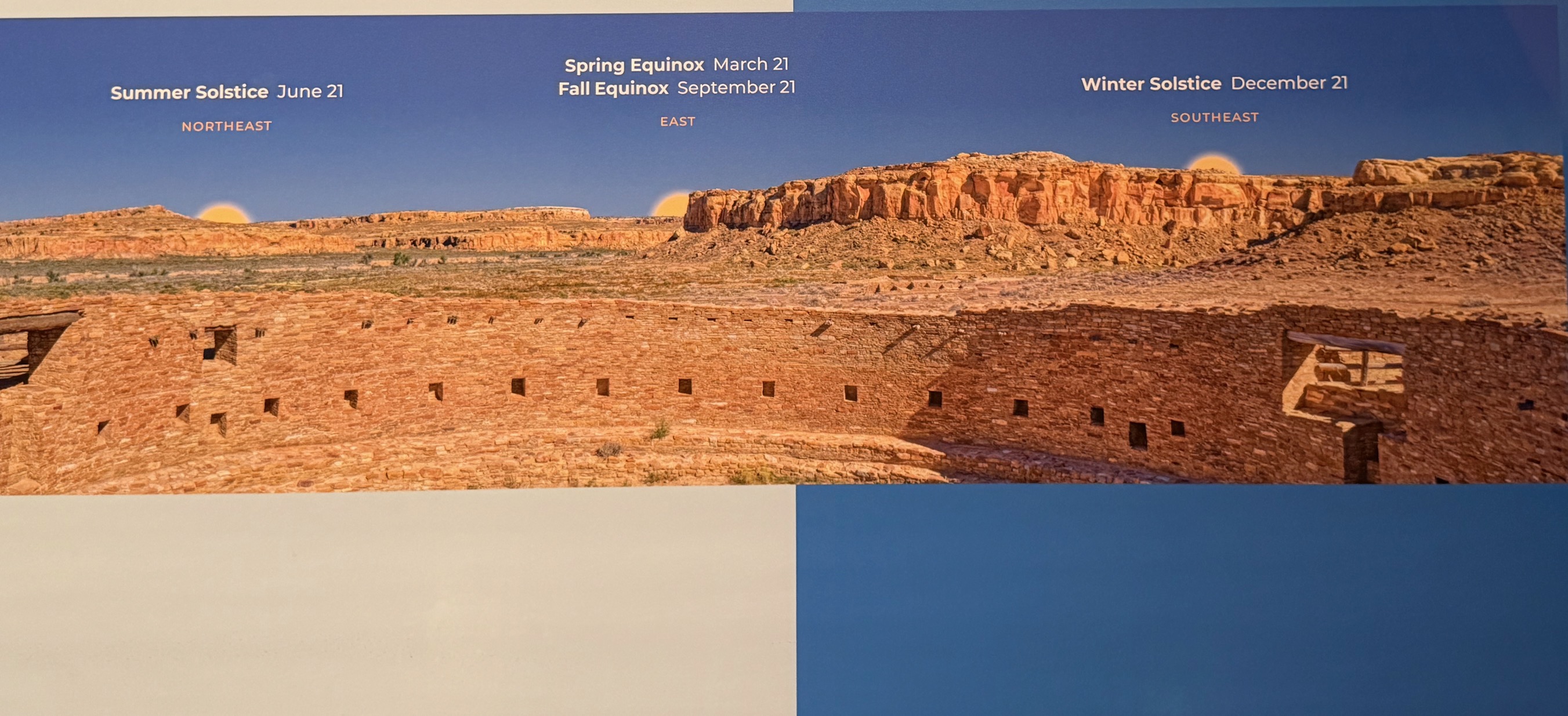
The exhibition also takes a deep dive into how ancient architecture and landscapes across the Four Corners are used to mark cardinal directions, annual cycles, and astronomical phenomenon. Chaco’s magnificent kivas are featured in dramatic photo murals that show how a combination of architecture, horizon markers, and sunrise to mark the seasons.

Equinox and solstice: Duke Johnson’s 2022 photo of the Great Kiva Casa Rinconada at Chaco Canyon showing where the Sun rises against the landscape at key times of the year.

Aerial photographs show how buildings reflect astronomical alignments. Most visitors stand intrigued before an archaeoastronimical explanation of Chaco Canyon’s famous Sun Dagger, which transformed Fajada Butte into an observatory to mark the solstice and equinox.

Google Earth photos of Chaco Canyon National Historic Park. showing how structures are aligned to the cardinal directions – Pueblo Bonito and the Great Kiva at Casa Rinconada.
Visitor watches the Sun Dagger Explorer, a virtual experience of the archaeoastronomy site on Fajada Butte in Chaco Canyon. Courtesy: Advanced Computing Center for the Arts and Design at Ohio State University, The Solstice Project, and the New Mexico Museum of Natural History and Science.

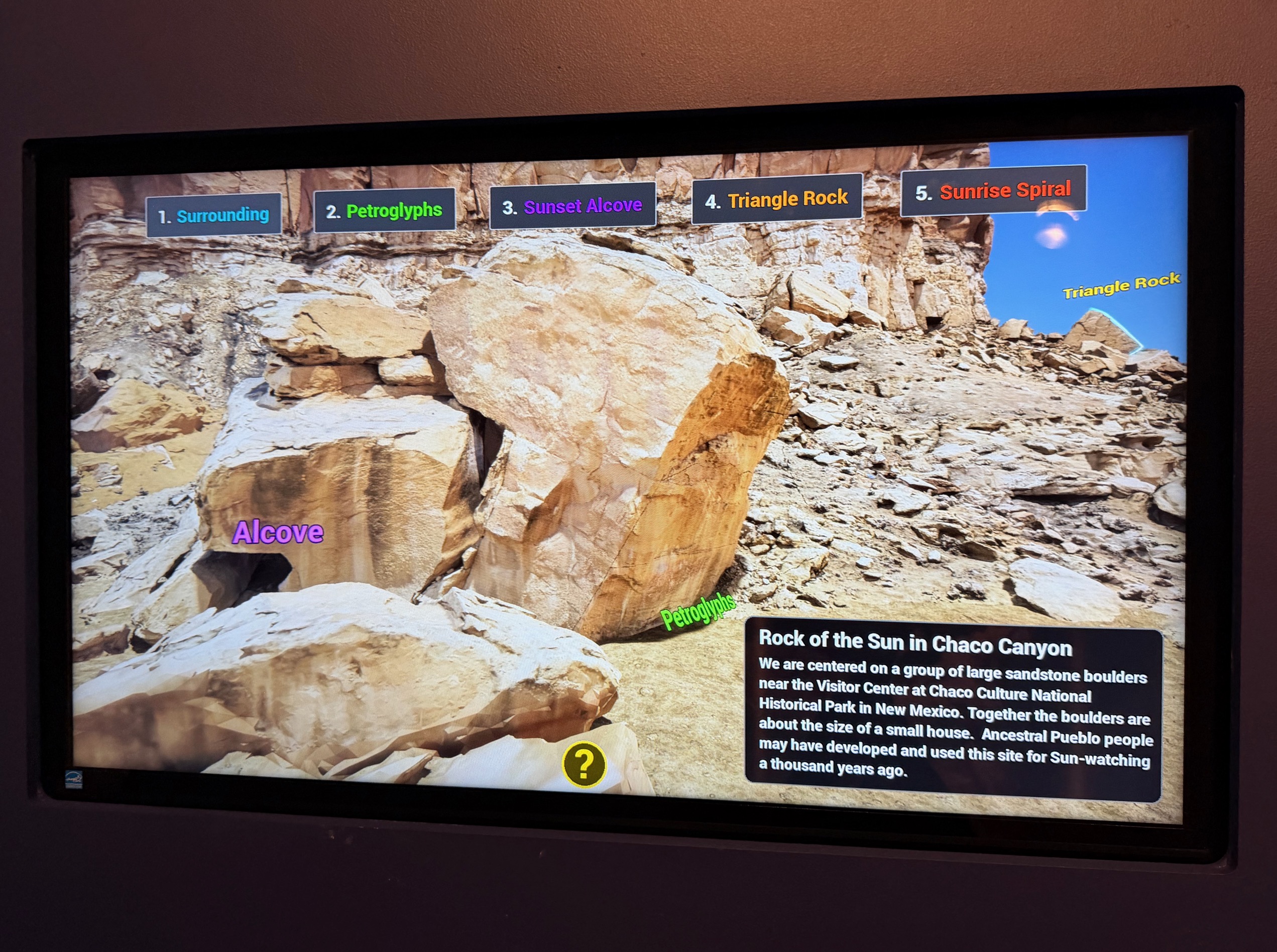
Best of all, visitors themselves can explore the video interactive of another Chaco site – Rock of the Sun – to experience what it’s like to interact with petroglyphs, shadows, and the skies to mark time within the year. Nearby, there’s a copy of a petroglyph (carving into stone) that archeoastronomers suggest could depict an exploding star that was visible for 3 weeks in the year 1054.

Interactive video screen that provides visitors with a virtual experience of Rock of the Sun, an archaeoastronomy site in Chaco Canyon National Historic Park.

Other sections of the exhibition focus on the animals that serve as sky messengers – bats, eagles, and other birds – and rituals that honor the four cardinal directions.

One of the key themes here is to respect the elements – not try to control them – which is emphasized brilliantly in the final fitting tribute to these scientist farmers. Phenomenon such as rain, wind, clounds, and thunder seemed unpredictable to the Ancients, so ceremonies and dances were performed to convey desire for favorable elements. Beautifully woven cotton garments, paintings, and ritual headgear are rich in layered meanings – seasonal calendars, rain, and lightning.

Farmer scientists: 1920-1940 cotton shirt featuring zigzag lighting patterns by unknown Okay Owingeh artist.

It’s a reminder of the intergenerational wisdom used to coax agricultural bounty from the seemingly barren stark desert.

For deeper insights, the curators recommend a visit to the Star Stories website by WeRNative and the Native Skywatchers website.

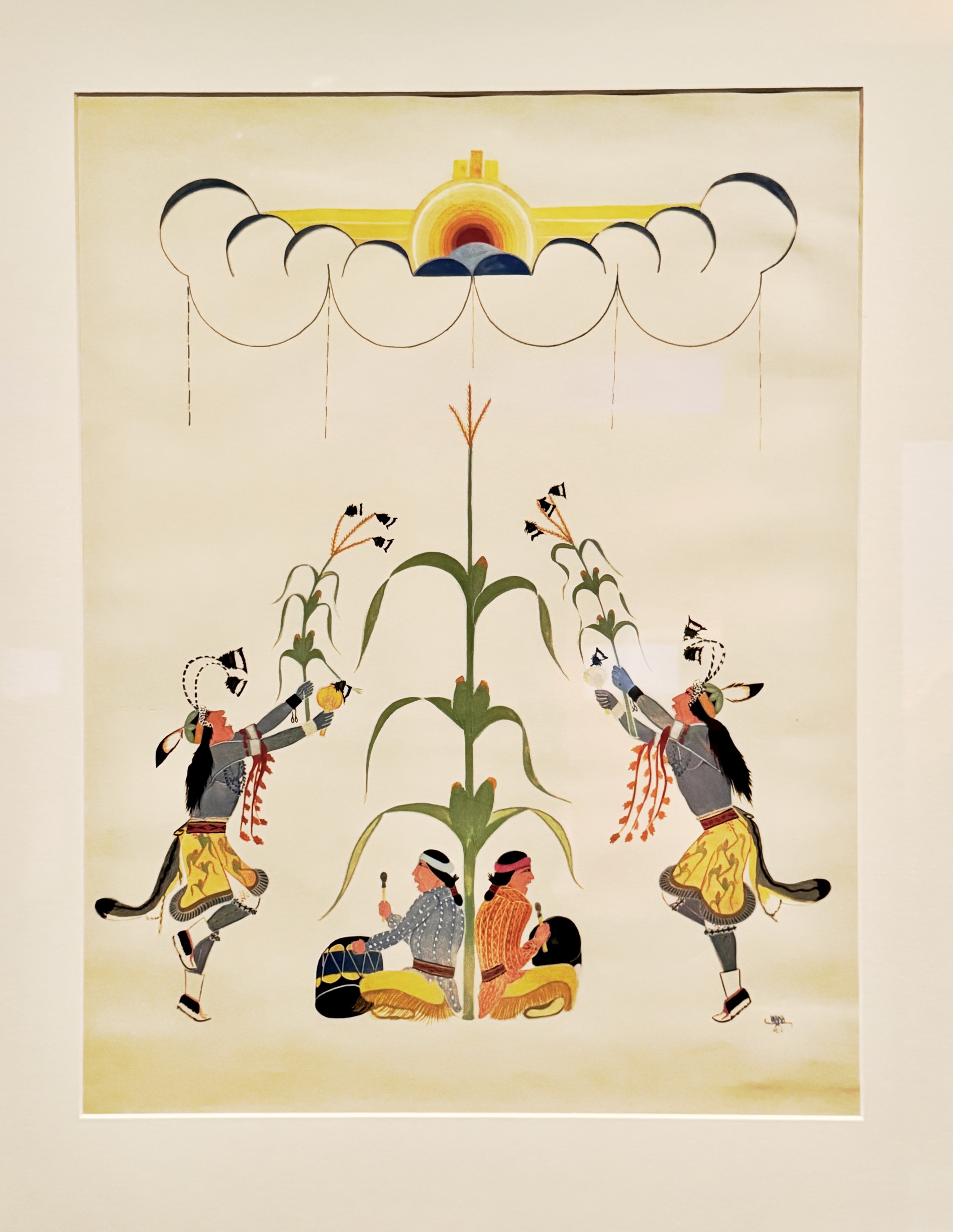
1938 painting Mythical Corn Ceremony by Ignacio Mosquino (Waka Yeni Dewa) (Zia Pueblo).
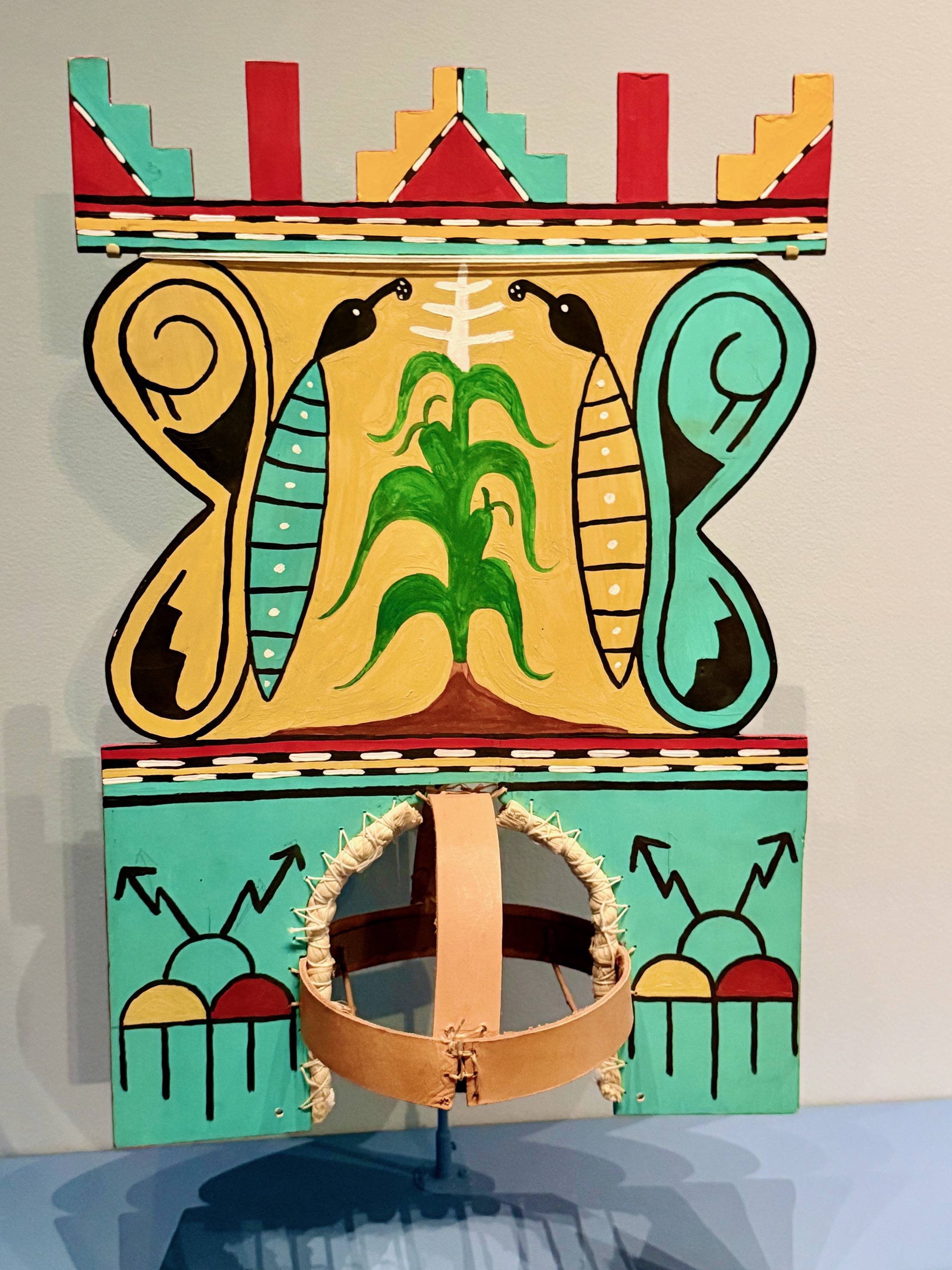
2005-2009 Hopi tablita Butterfly Maiden by unknown Hopi artist.

Viewing Deep Time with Australian Contemporary Indigenous Artists

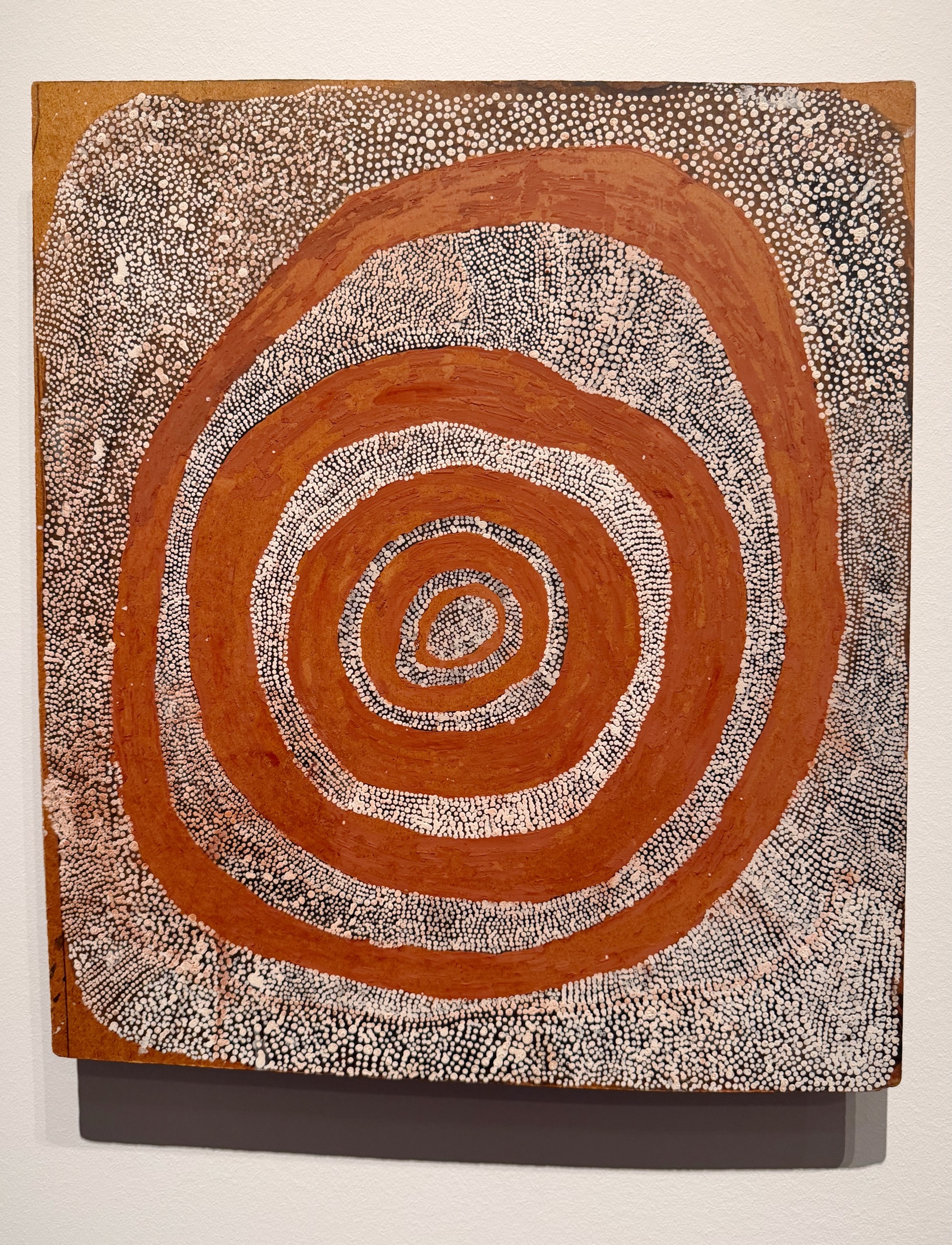
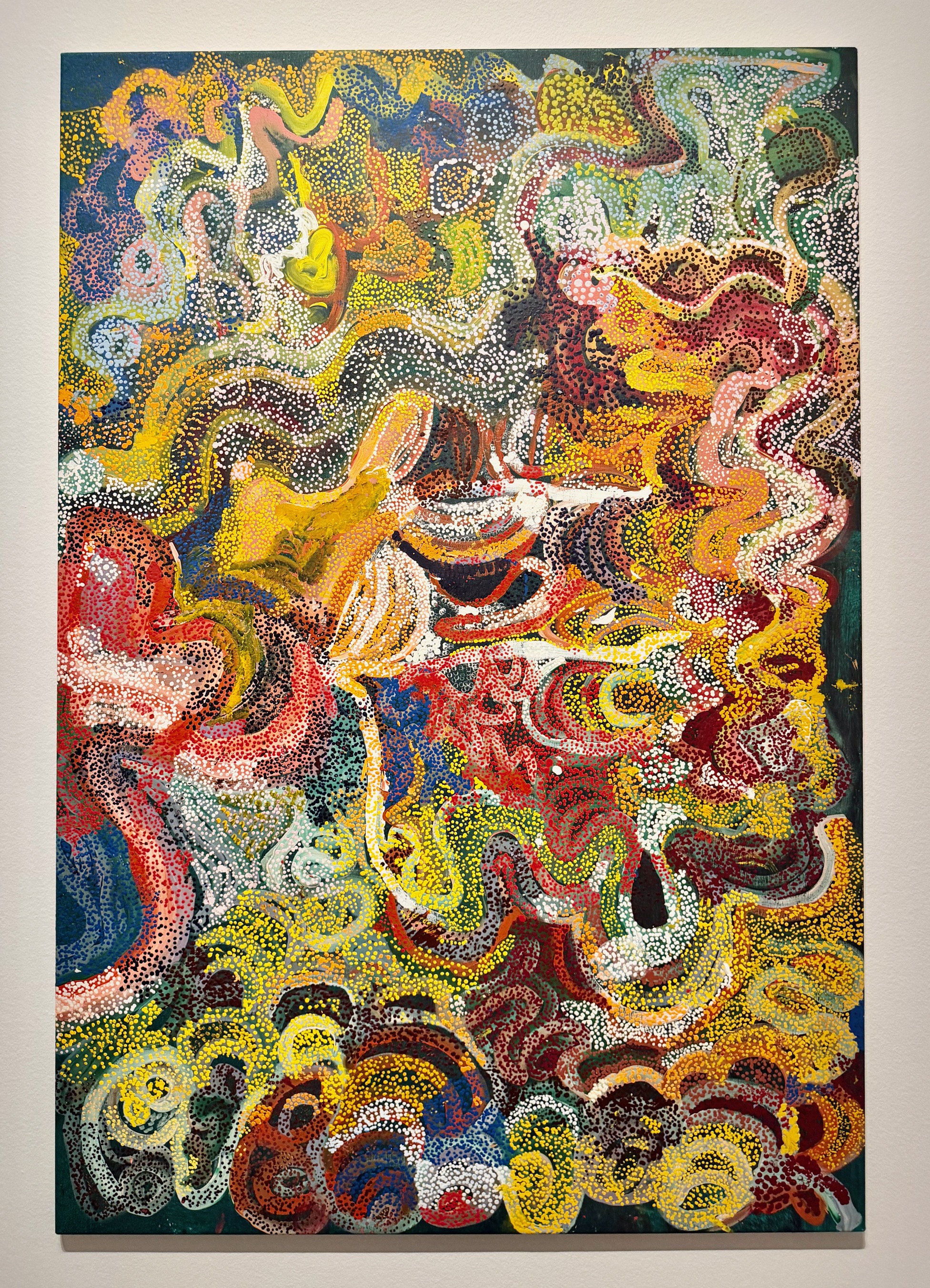
The massive exhibition is a blockbuster of abstraction – giant canvases, bold strokes, and enough dots and concentric circles to satisfy the most avid Kusama fan. But these visions don’t emanate from the 20th century’s Western modernist tradition. They’re the work of visionary artists from the Outback, whose abstractions use traditional icons as meditations on stories and landscapes that indigenous Australian people have relayed for thousands of generations.

The Stars We Do Not See is a journey like no other through the Denver Art Museum through July 26, 2026.

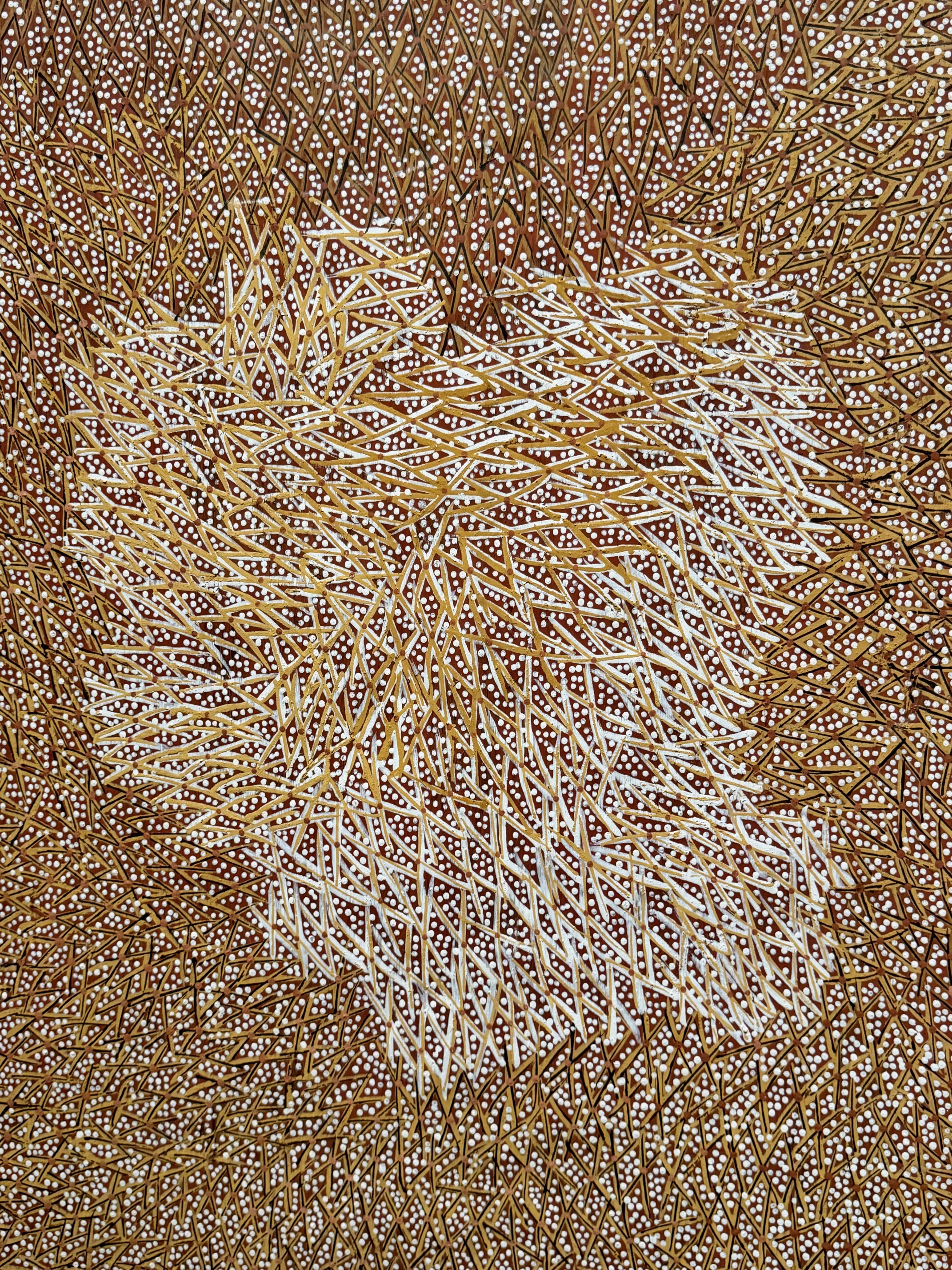
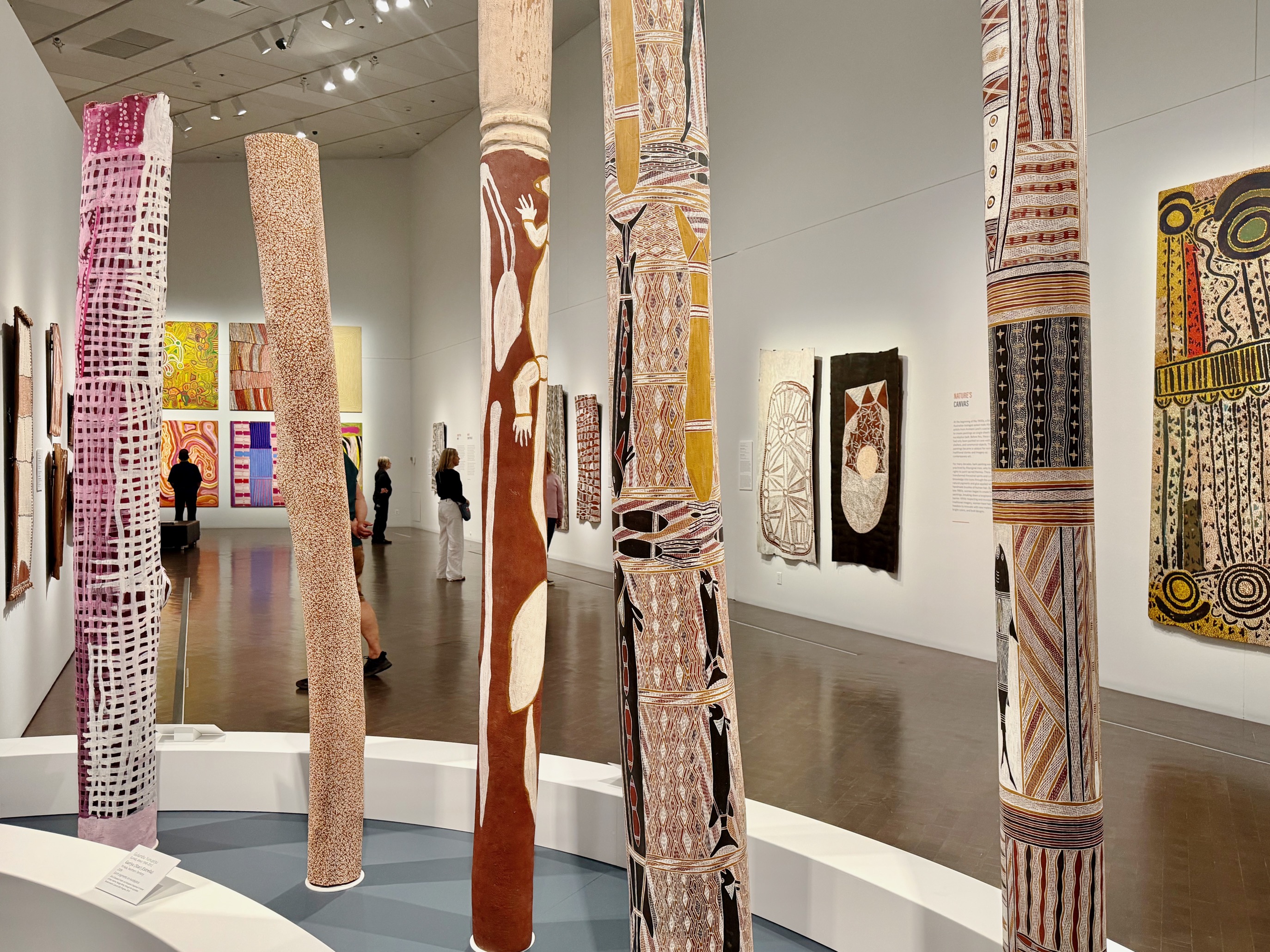
Detail of 2011 Gan’yu (Stars) by Gulumbu Yunupinju (Gumatj), referencing ancestral stories of the creation of stars and universe. Courtesy: National Gallery of Victoria, Canada

The winding path reveals principles of cyclical time, how the spirits of the land influence specific Indigenous cultures, and how icons of sacred landscapes and water sources are translated onto horizonless painted canvases.

Enjoy some of our favorites – full-size works and close-ups of paint details – in our Flickr album.

1980 painting Spirit Dreaming Through Napperby Country by Tim Leura and Clifford Possum Tjapaltjarri (Anmatyerre) – a recollection of ancestral homelands taken by cattle ranchers in the early 1900s. Courtesy: National Gallery of Victoria

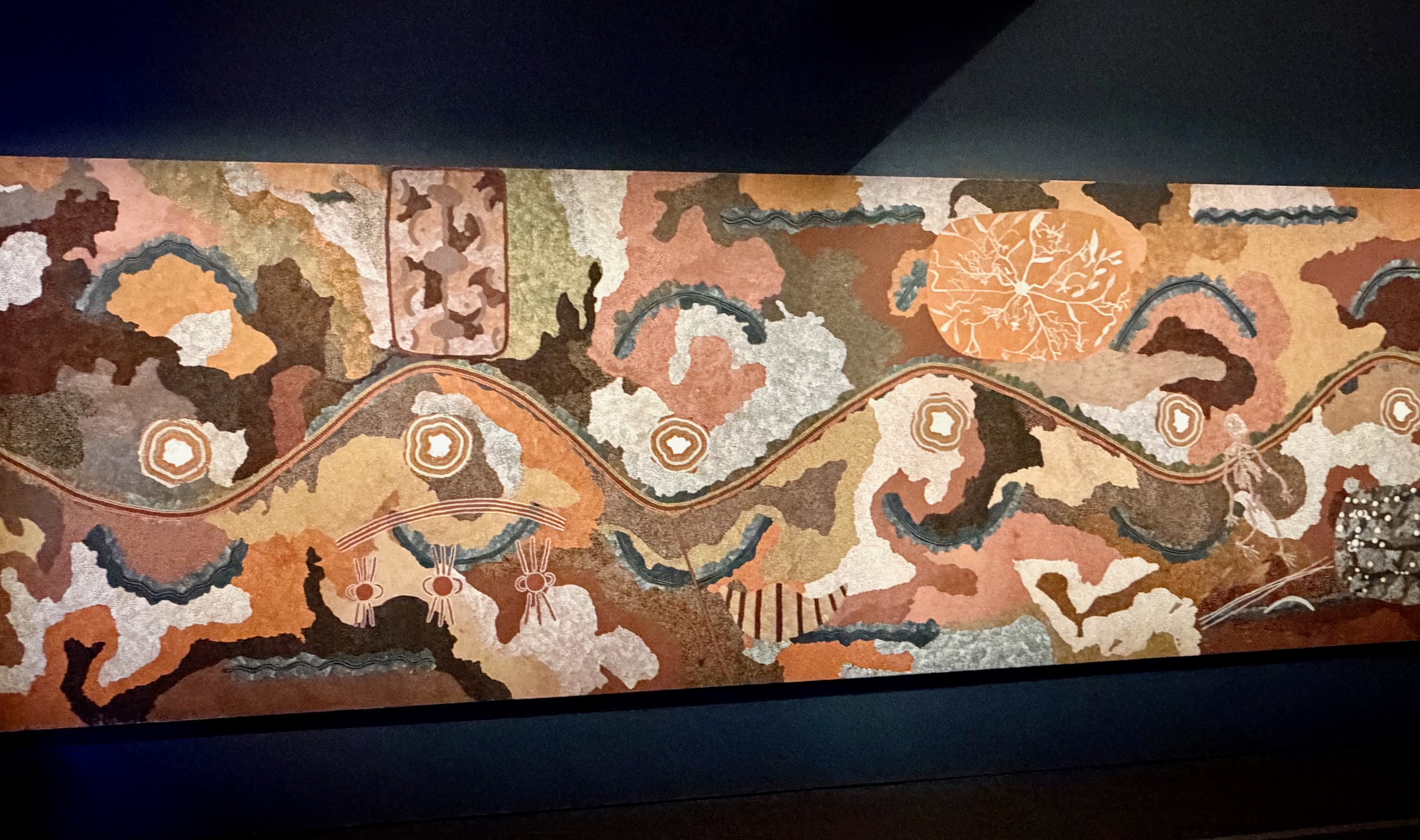
At every turn, there are gigantic room-size works (some realized as large-group colleborations) and arrays of towering carved and painted memorial poles. Abstract symbols denote spirit beings, water, river systems, nature or animal traces. Everything is drawn from the massive collection of the National Gallery of Victoria, Canada.

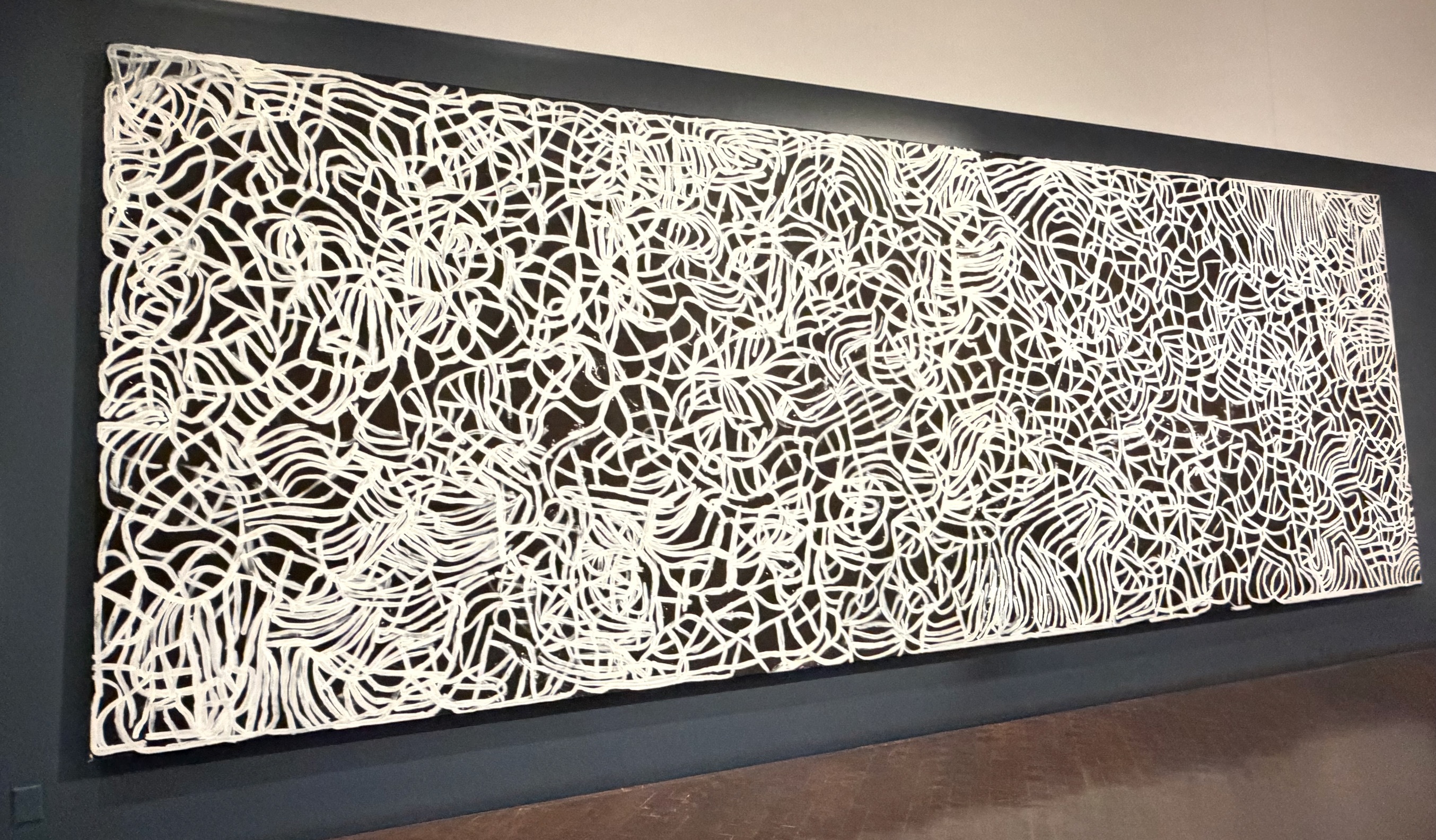
Epic 1995 abstraction Anwerlarr Anganenty (Big Yam Dreaming) by Emily Kam Kngwarry (Anmatyerre), depicting a network of sacred underground roots. Courtesy: National Gallery of Victoria

The curators start and end the show with arresting contemporary works by urban Indiginous artists – a neon installation, video, a painted skateboard, and representational works referencing forced relocation and unjust assimilation policies.

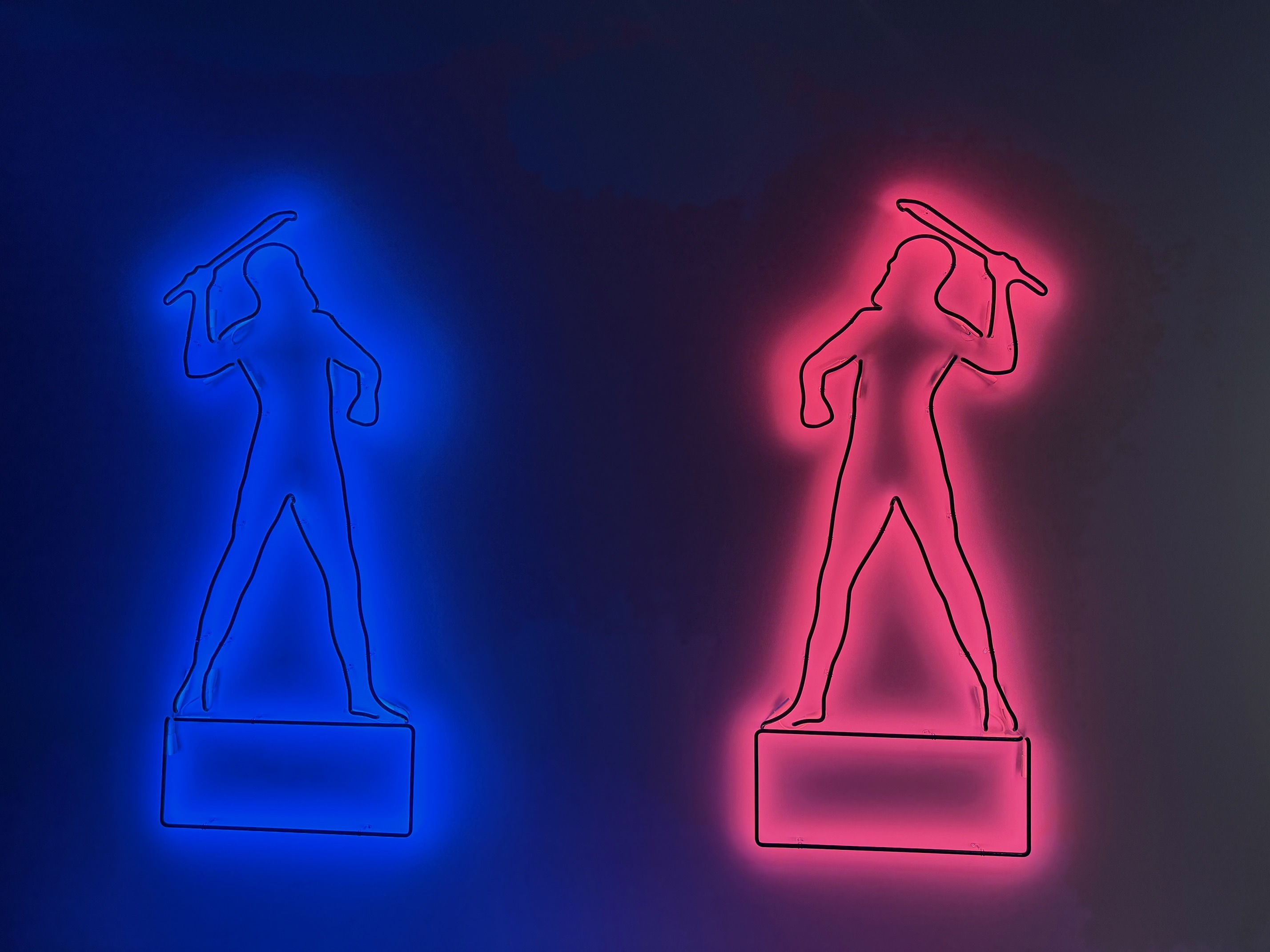
2020 neon “OA Warrior I (Blue) (Azul)” and “OA Warrior I (Pink) (Rosa)” by Reko Rennie (Kamilarol) – a mix of ancestral and urban culture. Courtesy: National Gallery of Victoria
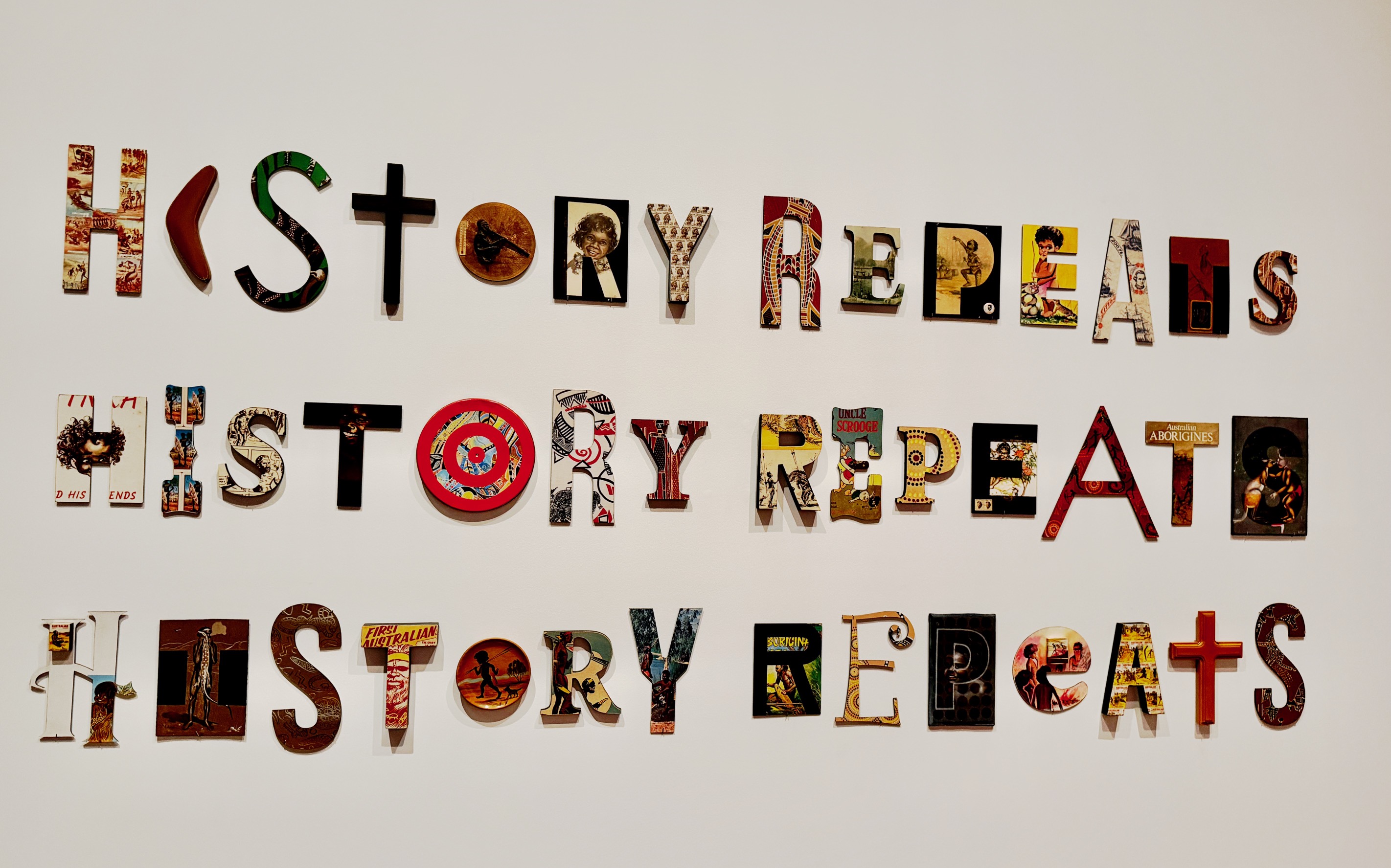
2022 History Repeats by Tony Albert (Girramay/Yidinji/Kuku Yalanji)– a work made of recycled vintage commercial knicknacks featuring appropriated Aboriginal iconography. Courtesy: National Gallery of Victoria

But the majority of the show shows how traditional artists using earth pigments on eucalyptus bark prior to the 1970s gave way to community artist who used new synthetic pigments to paint first on posterboard and then on canvas.

1972 Snake and Water Dreaming by Yala Yala Gibbs Tjungurray (Pintupi) from the first Indiginous art community in Papuna, Northern Territory to establish a contemporary art center; design from ritual body painting and cave art. Courtesy: National Gallery of Victoria
Conceptual Maps: 2006 conceptual abstraction Kalaya Wati (Emu Man) by Alkawari Dawson (Pitjantjatjara). Courtesy: National Gallery of Victoria

For more about the artists and how/why they create, take a look at the exhibition guide here.

Experience the majesty, scale, and experience of this exhibition through this walk-through produced by the Denver Museum of Art. Listen for the explanation of how the exhibit received its title, too!

Don’t worry if you missed this in Denver. The Stars We Do Not See will be on view at the Portland Art Museum in Oregon from September 5, 2026 through January 3, 2027, and at the Peabody Essex Museum in Massachusetts from February 27, 2027 through June 13, 2027.

First gallery with display of eucalyptus memorial poles carved by Northern Aboriginal artists and painted with ritual designs

Eternal Signs from the Australian Outback

It’s not often you find yourself surrounded by vibrant contemporary art that directly connects you to dreams and stories that have been told and retold for tens of thousands of years. Meet some exceptional visual storytellers from nearly twenty Australian regions in Eternal Signs: Indigenous Australian Art from the Kaplan and Levi Collection, on view at the Nevada Museum of Art in Reno through November 2, 2025.

This exhibition showcases well-known and emerging artists in different geographic areas of Australia’s north coast and interior desert. See our favorites in our Flickr album and consult the map to locate the communities where the featured artists work.

2011 acrylic painting Wanampi Jukurrpa by Tiger Palpatja (Pitjantjatjara) from Kaltjiti, APY Lands about the water serpent and how sacred rock forms were created.

For thousands of millenia, the indigenous groups in Australia have created rock art, painted spiritual images on eucalyptus bark, and documented their “dreams” – a mix of creation stories, confirmation of people’s integration with the land and animals, and everyday life.  These visual affirmations present a simultaneous representation of past, present, and future, hence the term “eternal signs.”

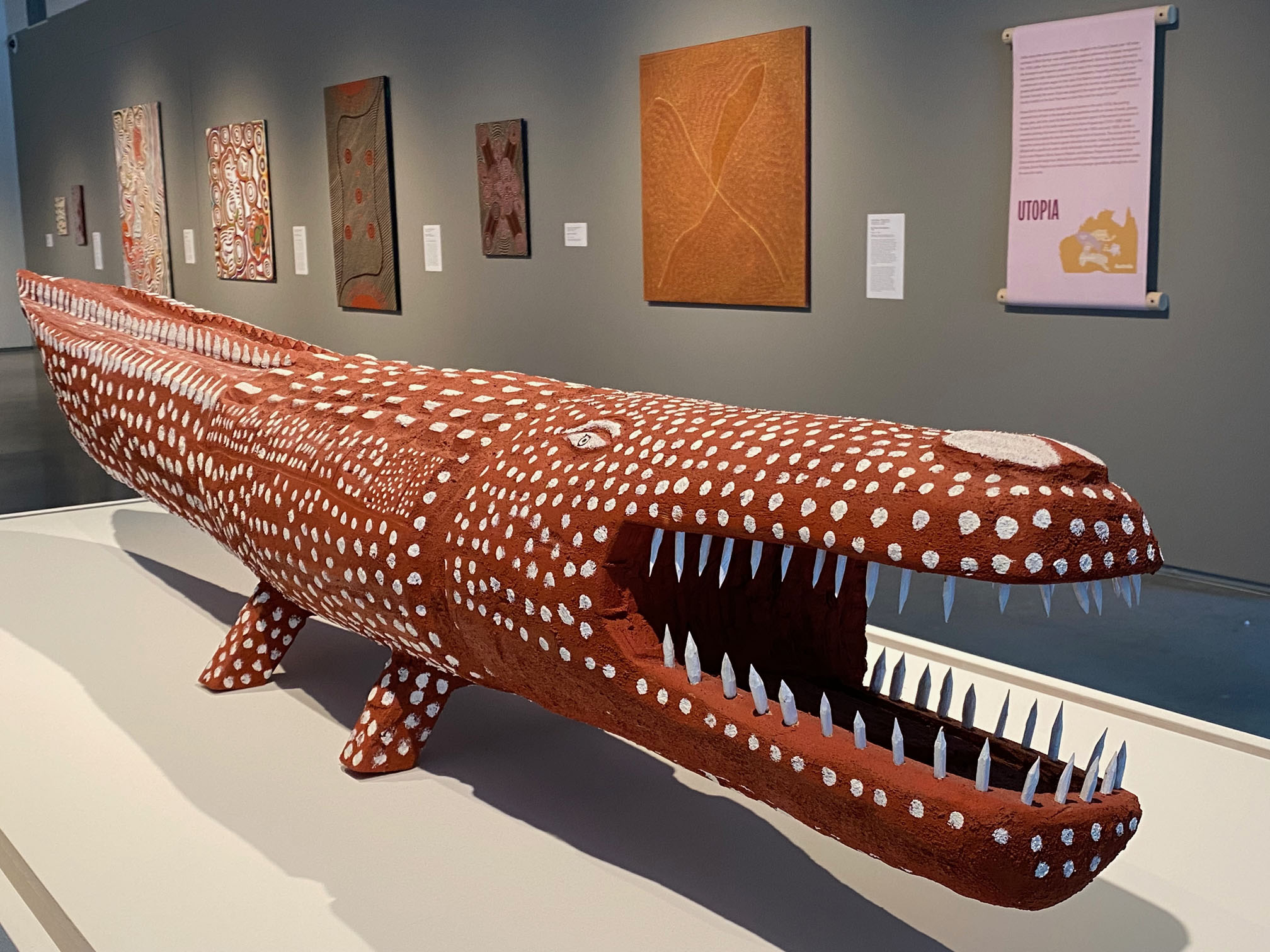
2001 Saltwater Crocodile by Craig Koometa (Wik-Alkan) from Aurukun, in far north of Queensland; at rear, paintings by artists from Utopia at the edge of the Tanami Desert.

Stories, images, culture, dreams, and language differ greatly among Australia’s 120 indigenous groups. (We’ve indicated each artist’s geographic region and particular language after their name.)

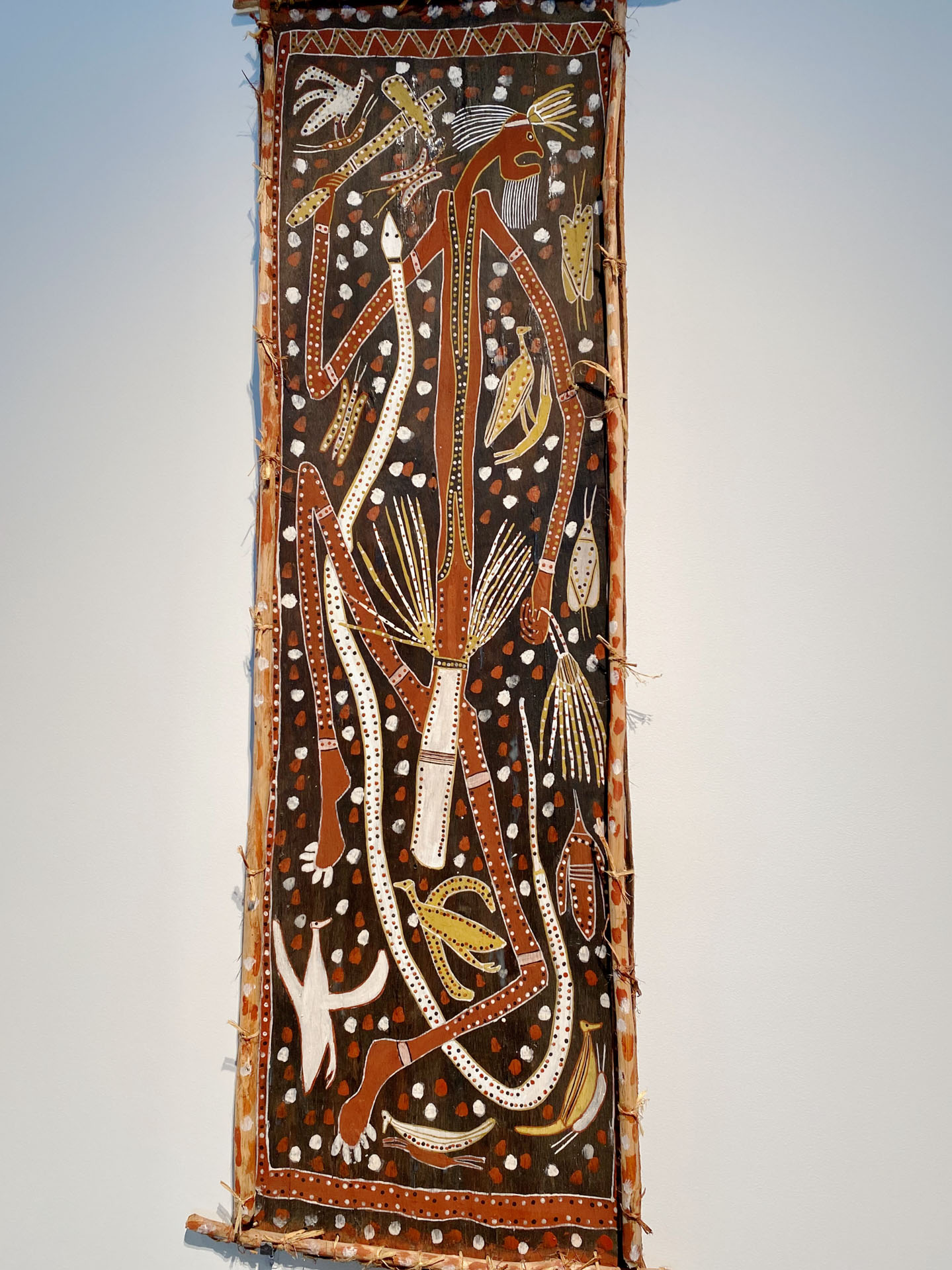
From Arnhem Land in the north, Paddy Fordham Wainburranga (Rembarrnga) from Wugularr, Northern Territory is one of the best-known artists shown. Growing up in the bush, Paddy was eleven when he first encountered anyone outside his traditional community. In the 1970s, he moved to Maningrida, a government-sponsored settlement, and began painting at the Arts & Culture Center. Paddy’s work often depicts ancestral spirits that he first encountered in rock art.

1991 Balangalngalan by Paddy Fordham Wainburranga (Rembarrnga) – a shape-shiting ancestor who guides and heals.
1994 painted wood Manjhkikilyo (Malevolent Mimih Spirit) by Paddy Fordham Wainburranga (Rembarrnga) from Wugularr, Northern Territory – a bad ancestral spirit from ancient cave art.

John Bulunbulun (Ganalbingu), another Maningrida Arts & Culture Center artist, also starts with traditional dreams and forms – for example, he uses a traditional hollow-log coffin as a basis from which to sculpt a three-dimensional dream about the long-necked turtle creator. Take a look.

More recent work by Yirrkala artists in East Arnham reflect ecological concerns and the clans’ interest in protecting ancestral lands. A dramatic sculpture by Guynbi Ganambarr (Naymil) reflects the rich, majestic, and spiritual coastal life of the Grove Peninsula. A masterful wall piece by Djambawa Marawili (Madarrpa) is one in a series that he’s used to affirm his people’s land and sea rights – even used as legal evidence in court cases challenging indigenous rights to land and sea, demonstrating the deep, spiritual meaning behind their claims.

Cormorant catches a freshwater fish: 2011 carved eucalyptus bark Wurran Ga Baypinga by Guynbi Ganambarr (Naymil) from Yirrkala, East Arnhem
2014 Source of Fire by Djambawa Marawili (Madarrpa) from Yirrkala in East Arnhem; ochres and sawdust on bark showing strong ancestral truth-tellers.

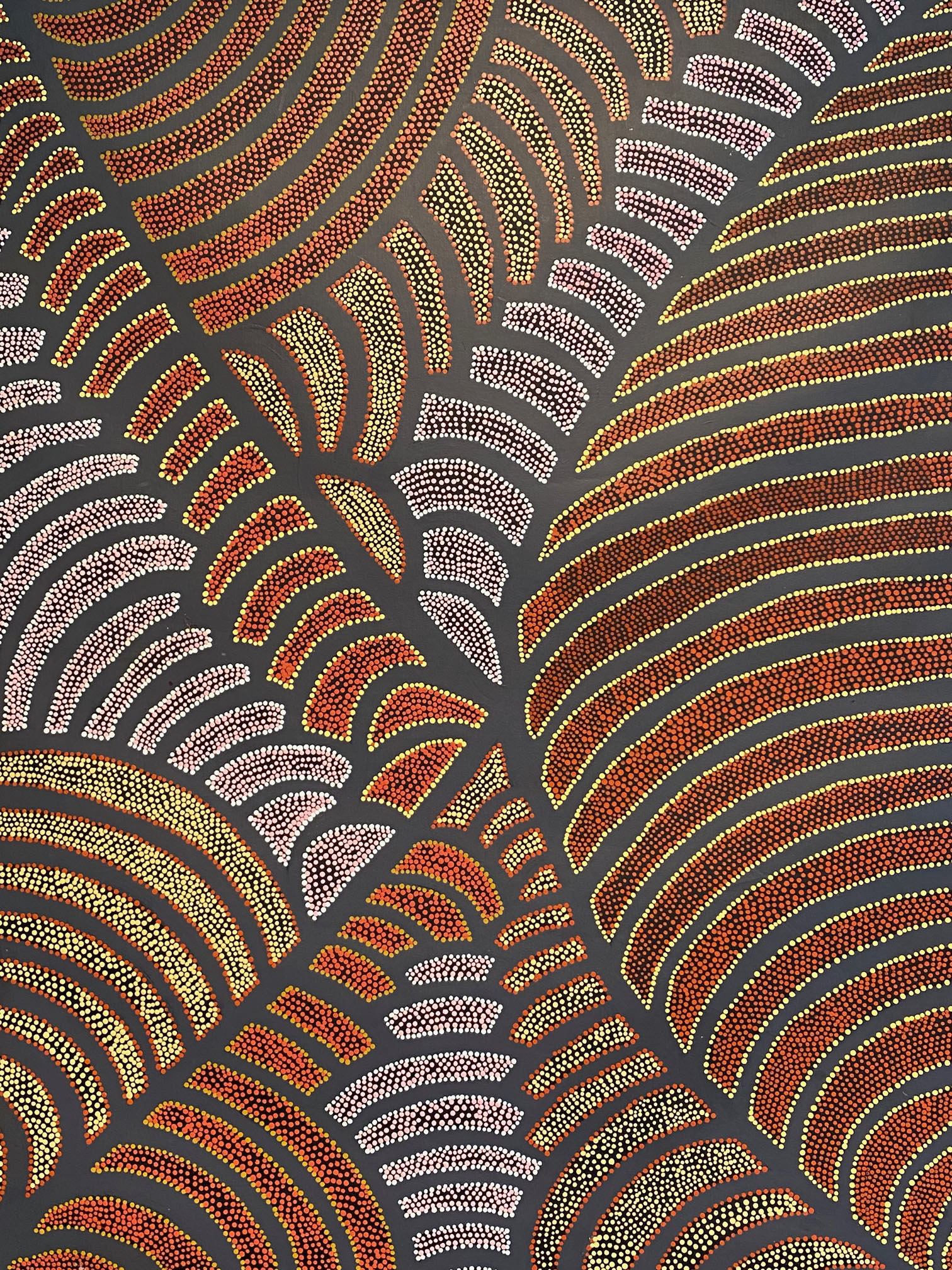
Here are two works by the award-winning Petyarre sisters from the area of Utopia on the border of the Tanami Desert in central Australia – an area that began to achieve acclaim as an art center in the late 1990s with dot paintings referencing the landscape and women’s expertise in bush medicine.

Detail of 1992 acrylic Mountain Devil Awelye by Gloria Tamerre Petyarre (Anmatyerre) from Utopia in the central Tanami Desert.
1996 acrylic My Place Atnangkere by Kathleen Petyarre (Anmatyerre) from Utopia in the central Tanami Desert; aerial view of creation story journey across the desert homeland.

We have to give a big shout-out to Robert Kaplan and Margaret Levi for donating over 70 of these amazing artworks to the Nevada Museum of Art. Their passion shows!

In case you aren’t able to enjoy this insightful, beautiful show at the Nevada Art Museum, art lovers will be able enjoy The Stars We Do Not See: Australian Indigenous Art from the National Gallery of Victoria in Melbourne as it tours across the North America. Right now, The Stars We Do Not See is scheduled for the National Gallery in Washington, D.C. through March 1, 2026.

2008 ochres on linen Sing Out Spring – Yiyili Country by David Cox (Goonlyandi/Walmajarri) from Warmun, Western Australia.

The Stars We Do Not See will travel to the Denver Art Museum (April 19 – July 26, 2026), Portland Art Museum (September 2026 – January 2027), Peabody Essex Museum in Salem (February – June 2027), and the Royal Ontario Museum in Toronto (July 2027 – January 2028).

Two 2004 acrylic paintings Ngura (Country) by Tali Tali Pompey (Pitjantjatjara) from Kaltjiti, APY Lands.

Painters Tell Stories of Nature’s Resilience

Feel like things are out of balance?  Seven narrative painters let animals take center stage get visitors thinking about the future for nature and the world in Vivarium, Exploring Intersections of Art, Storytelling, and the Resilience of the Living World at the Albuquerque Museum through February 9, 2025..

Big, bold paintings let nature tell the story and present juxtapositions that present questions about society, environmental dissonance, and what messages animals might want to send. See some of our favorites in our Flickr album.

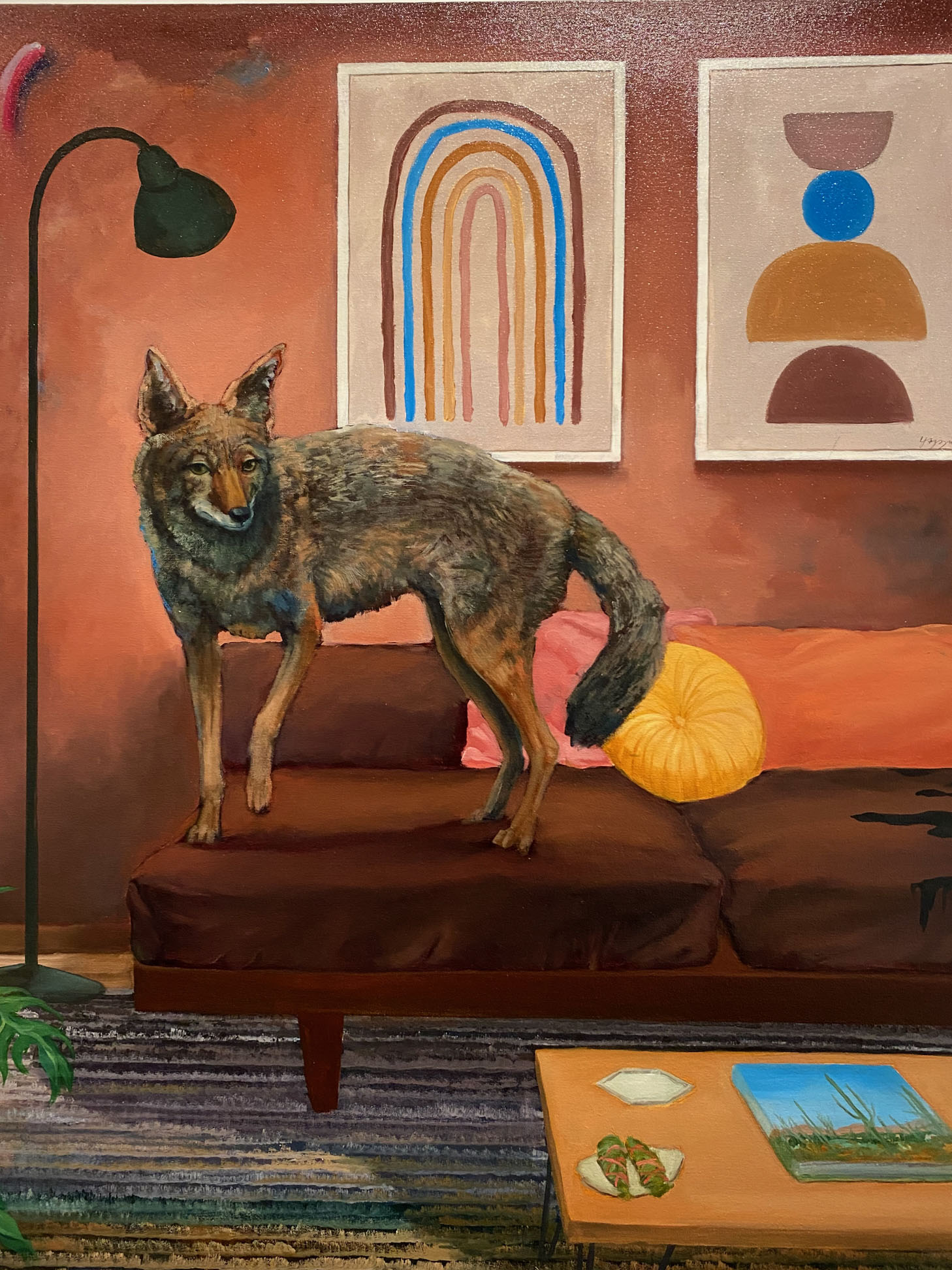
2023 oil Astrid by Stephen J. Yazzie (Laguna Pueblo/Diné). Courtesy: private collection

Although the exhibition begins with a small selection of works from Santa Fe’s Tia Collection – Dan Namingha (Hopi-Tewa), Nanibah Chacon (Dine/Chicana), and others – the majority of the space features a selection of works by the seven featured painters. Clusters of paintings immerse viewers in each artist’s unique world, style, and narrative – mini-vivariums, or artificial worlds.

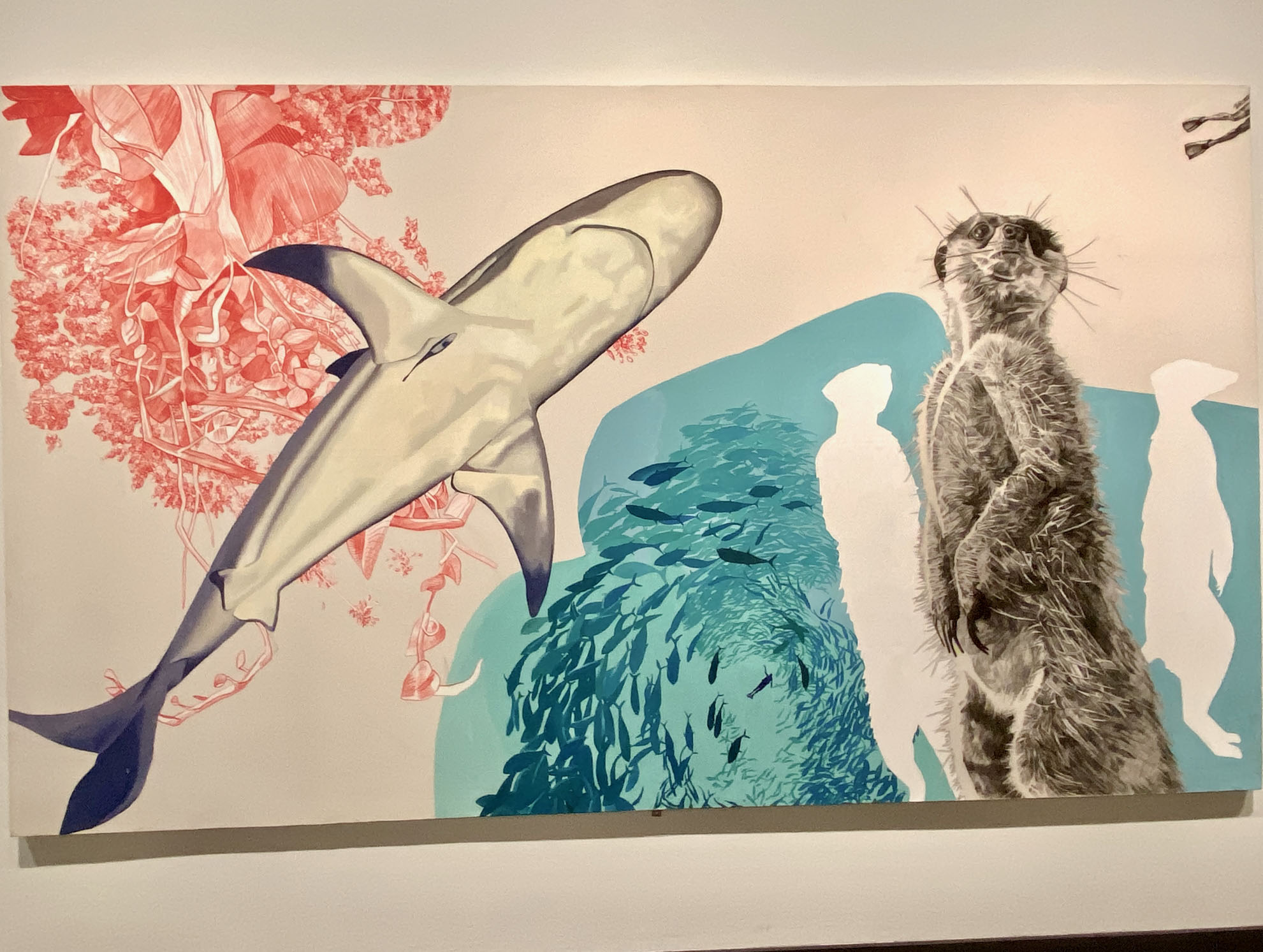
Nature explodes of Nathan Budoff’s giant canvases – tigers, meerkats, swimming octopii, schools of fish, prarie dogs – all floating and interacting in a pure, white space.  He creates realistic depictions in charcoal, oil, acrylic, and ink, but juxtaposes natural components that are startling. Visitors stand back, pause, take it all in at once, trying to make sense of how these magnificent creatures interact in unusual landscapes.  Mostly, the canvases do not include people, but Nathan enjoys letting the remarkable, minutely observed wildlife speak their own truths.

2017 charcoal, oil, acrylic, and ink Imminent Danger by Nathan Budoff – showing systems and social behaviors in the natural world. Courtesy: the artist.

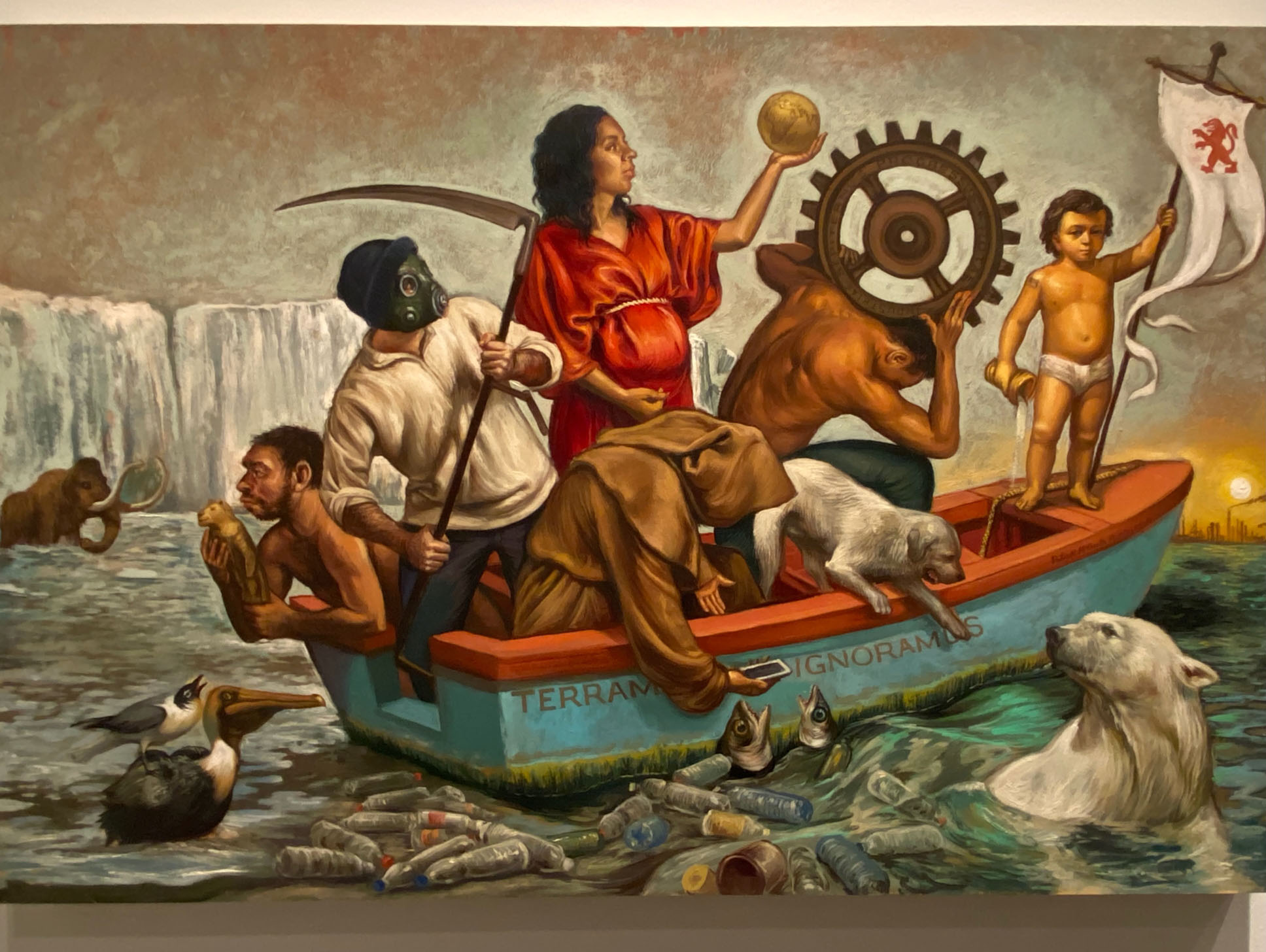
Paintings by Patrick McGrath Muñiz are intellectual puzzles, mixing modern issues, depictions of modern technology, and classical Renaissance and

Baroque painting techniques.  Signs, symbols, and details on the horizon demand slow scrutiny to unravel the allegories and associations packed into the paintings.

2018 oil painting Terram Ignoramus by Patrick McGrath Muñiz – a warning about the perils of climate change; depicting a perilous Arctic journey in a boat named “We know not the earth.” Courtesy: the artist

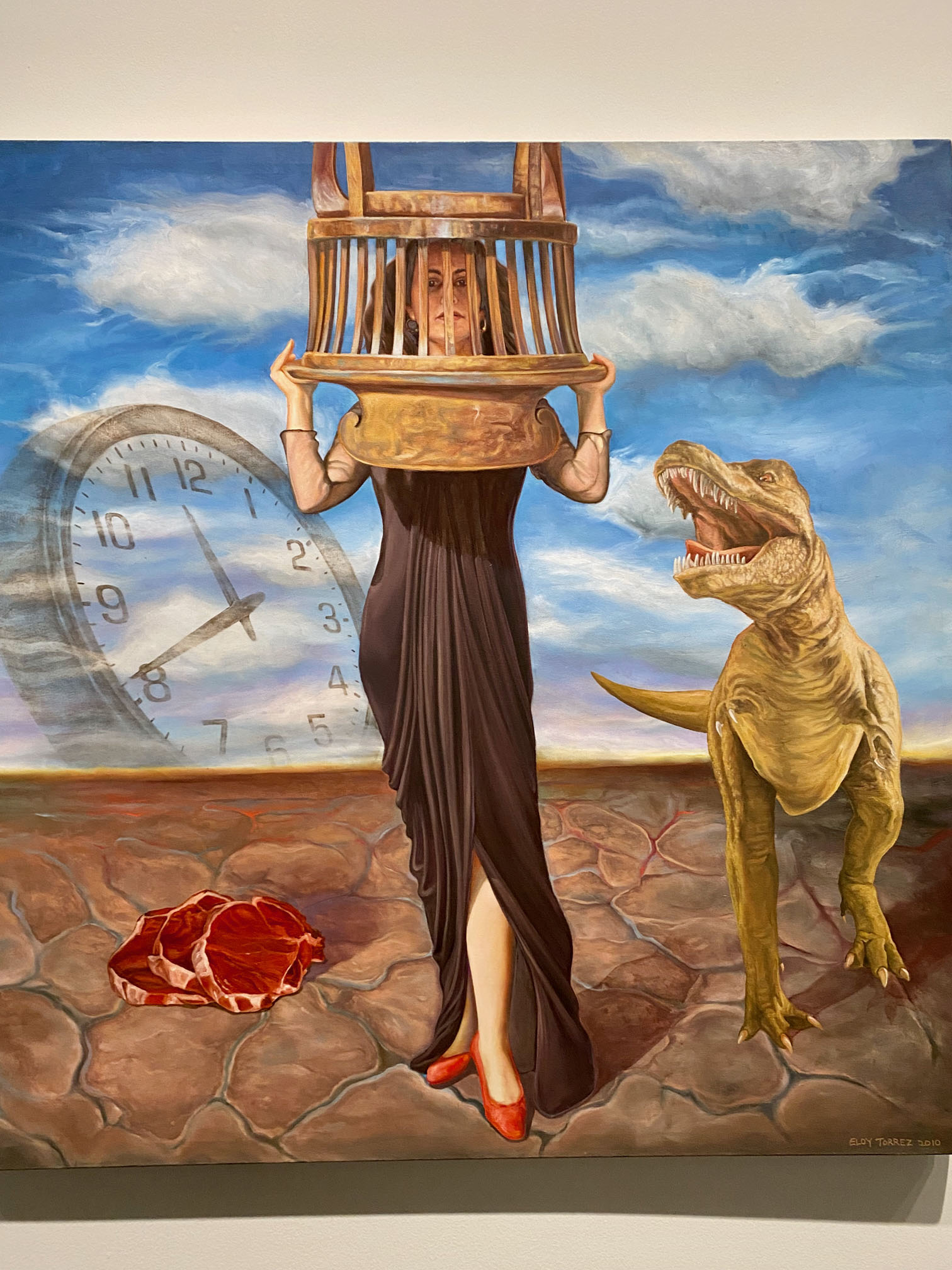
Eloy Torres, a Chicano activist and muralist, uses religious, mythological, and surrealist pictorial conventions to construct worlds that lets the viewer their intuition to connect the dots.

2006 oil portrait of Cheech Martin It’s a Brown World After All by Eloy Torrez; the crown connects him to his ancestral past. Courtesy: Riverside Art Museum.
2010 oil on panel Meat by Eloy Torrez, a surreal allegory on precarious relationships between humans and thenatural world. Courtesy: the artist.

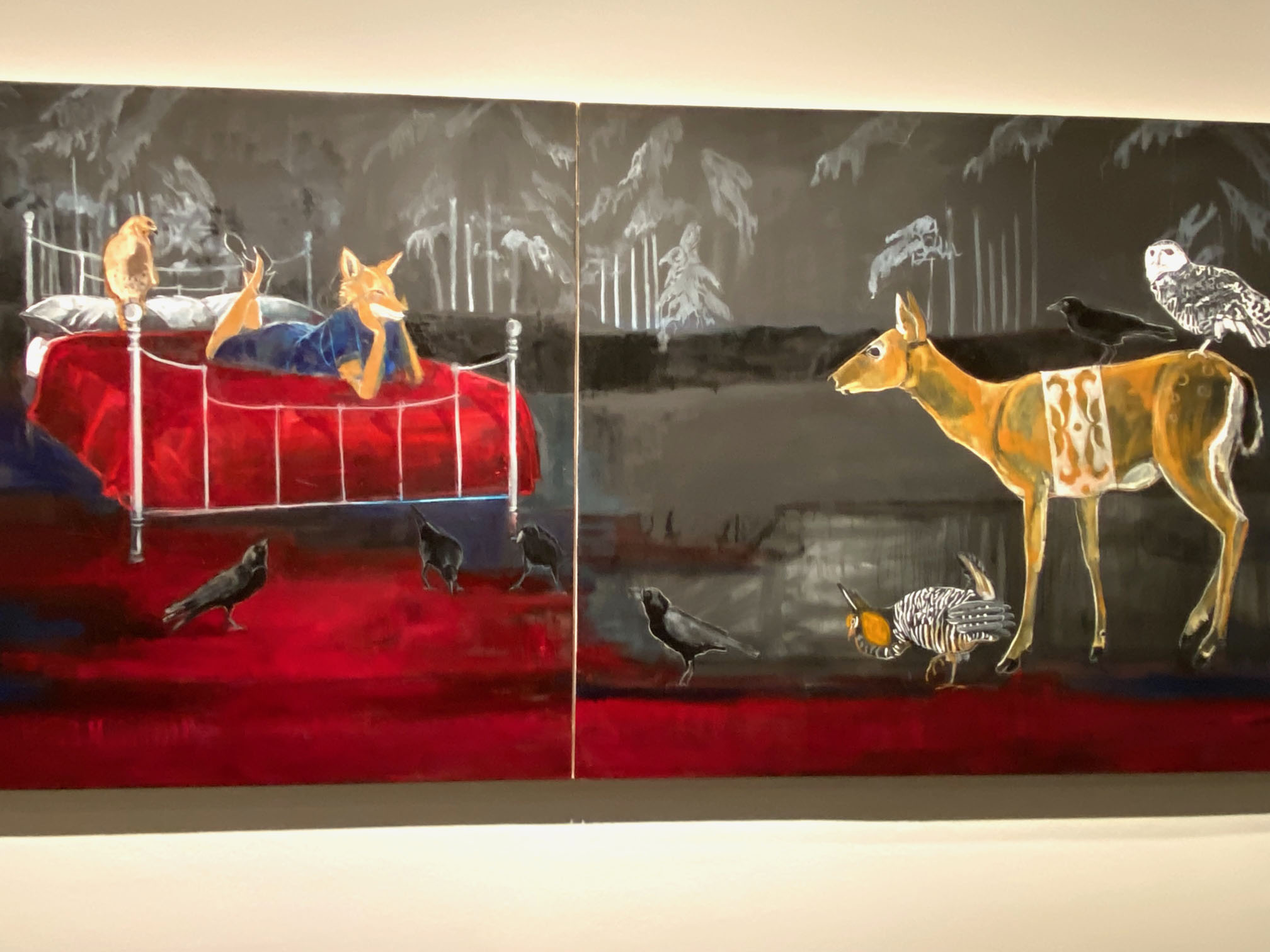
Stephen J. Yazzie (Laguna Pueblo/Diné) exhibits a series of works in which Coyote inhabits upscale suburban interiors, emphasizing the inside/outside, nature/culture dichotomies in contemporary life.

Julie Buffalohead (Ponca Tribe of Oklahoma), a member of her tribe’s Deer Clan, creates narratives featuring animals as protagonists, often metaphors for interactions between natural and spiritual realms. Large works allow players in her stories to prance, dance, and float across saturated color fields.

2018 oil and pastel Straight Legs by Julie Buffalohead (Ponca Tribe of Oklahoma) – a painting reflecting her membership in the Deer Clan. Courtesy: University of Wyoming Art Museum

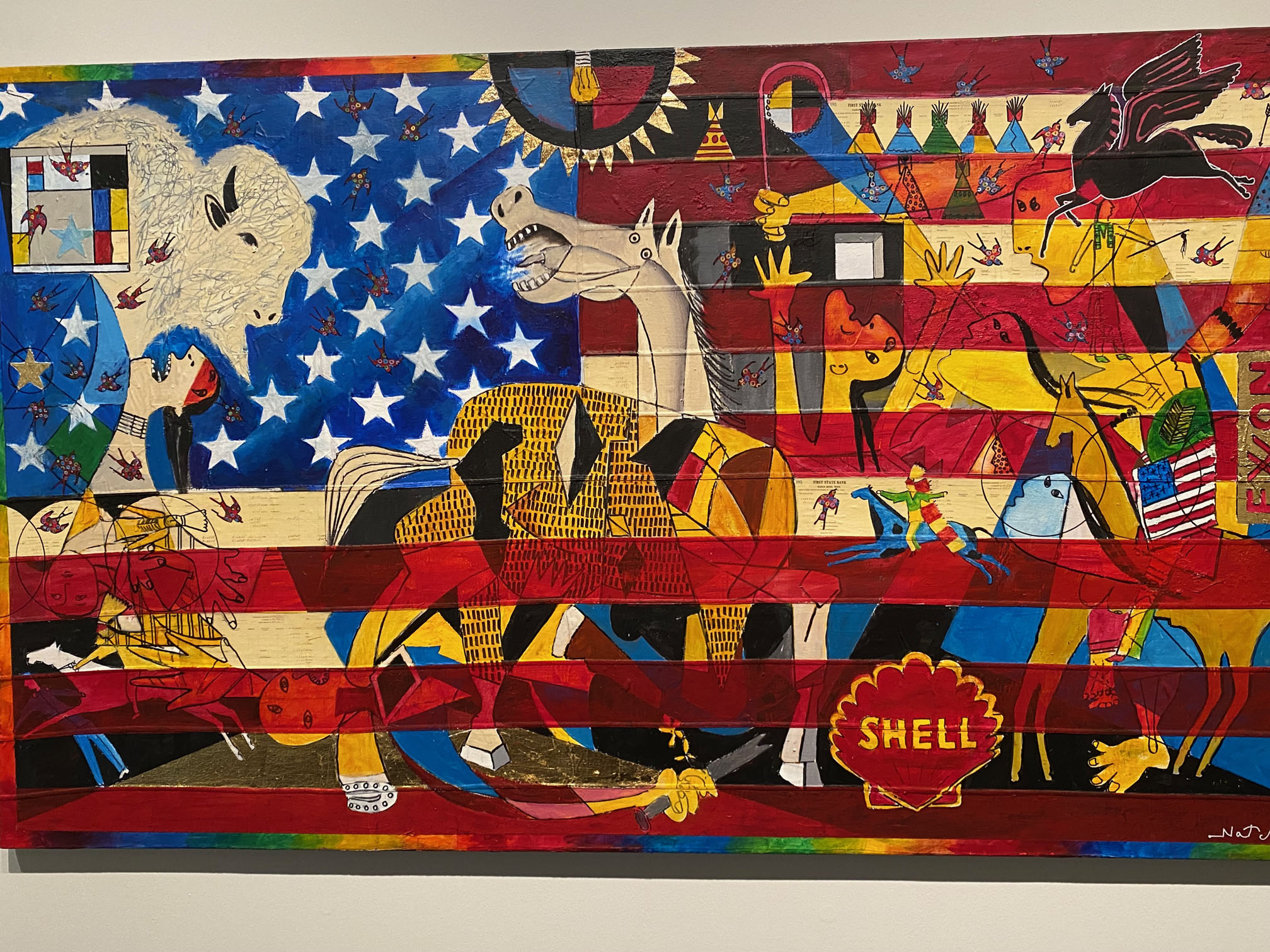
Artist/educator Stan Netchez (Shoshone/Tataviam) presents a throught-provoking masterpiece, using Picasso’s Guernica imagery, US brands, and indigenous spiritual icons to display the chaos and destruction inflicted on indigenous peoples.

2019 acrylic, oil, and metal leaf “Guernica Flag” by Stan Netchez (Shoshone/Tataviam) – a critique of colonialism’s impact. Courtesy: Tia Collection

Listen in on a panel with four of these storytellers conducted by the Albuquerque Museum.

National Gallery Celebrates 50 Contemporary Native Artists

If you want to take a trip across American land with 50 living Native artists, there’s still time to catch the ground-breaking exhibition, The Land Carries Our Ancestors: Contemporary Art by Native Americans, at Connecticut’s New Britain Museum of American Art through September 15, 2024.

The National Gallery of Art in Washington, D.C. asked Jaune Quick-to-See Smith (Citizen of the Confederated Salish and Kootenai Nation) to survey the United States and create an exhibition reflecting the diversity of the living Native American artists.

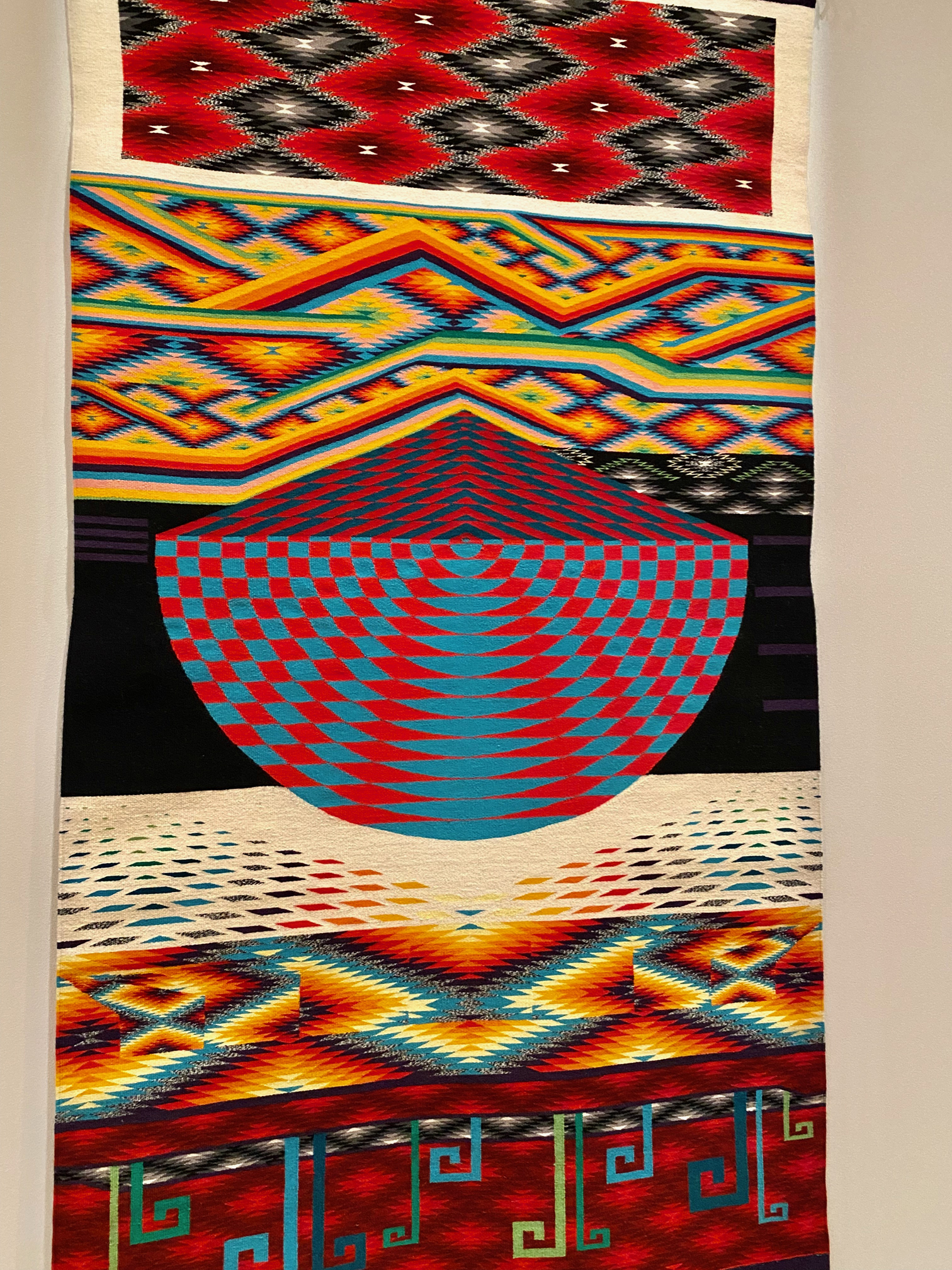
2014 wool weaving World Traveler by Melissa Cody (Navajo). Courtesy: Stark Museum of Art.

Smith, whose own artistic achievement was honored most recently in a three-museum retrospective in 2023-2024, became the first artist invited to curate a show at the National Gallery.

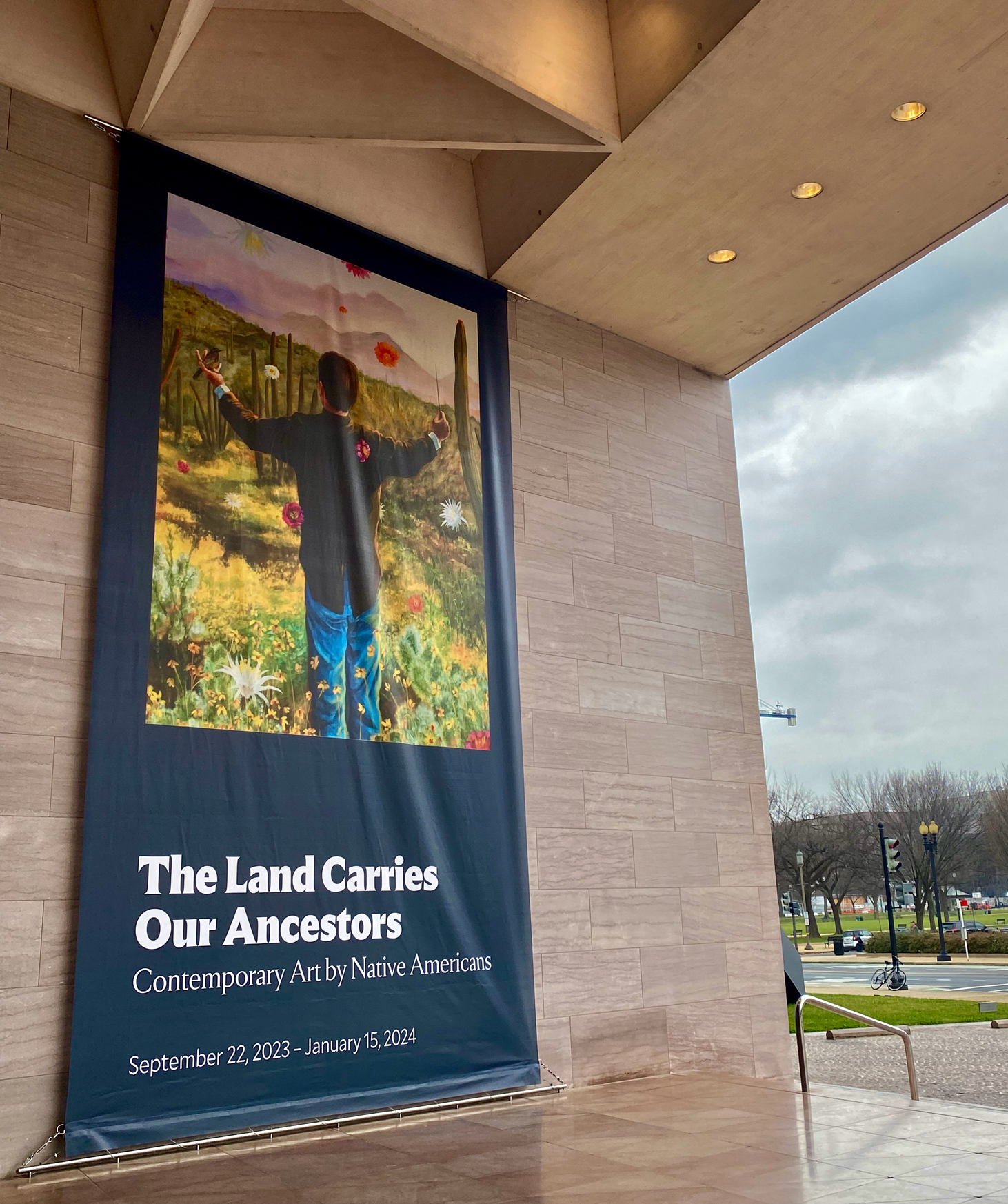
Entrance banner features Orchestrating a Blooming Desert by Steven Yazzie (Diné/Laguna Pueblo).

Smith has always done whatever possible to increase the visibilty of Native artists in the contemporary art world. For this exhibition, she chose 50 intergenerational artists from diverse regions, cultures, and artistic practices. Look at our Flickr album of the National Gallery installation to see some of our favorites.

All of the works reflect the artists’ deep connection to the land, especially Orchestrating a Blooming Desert by Steven Yazzie (Diné/Laguna Pueblo), a painting that reflects one man’s joyful encounter with a lush landscape.

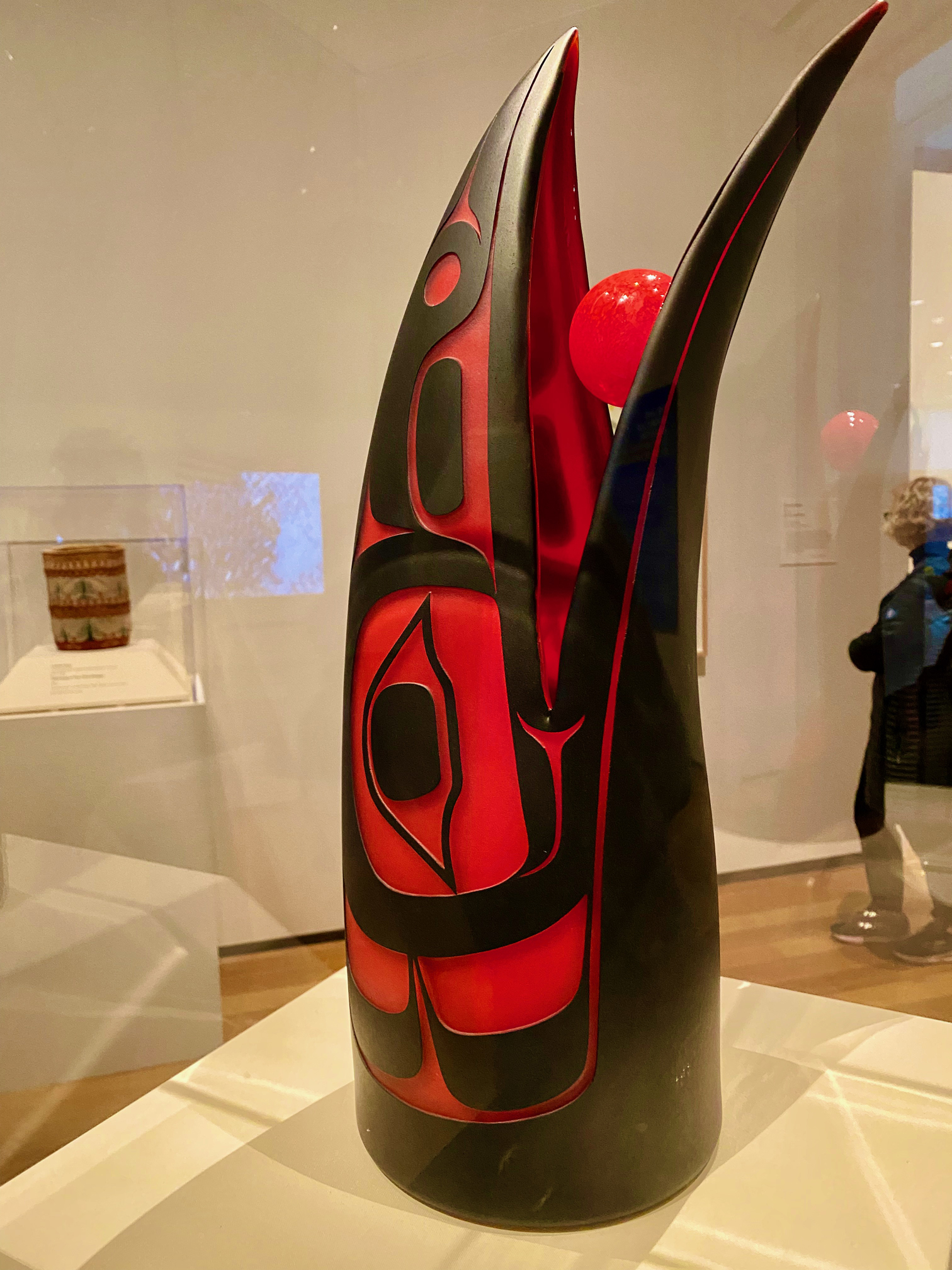
Some works depict a tribe’s link to the natural world through origin stories. Visitors are mesmerized by Preston Singletary’s exquisite sculpture of Tlingit creation-myth legend, Raven stealing the Sun. It’s glorious to admire this dramatic icon fully realized in a distinctly nontraditional medium – blown and sand-carved glass.

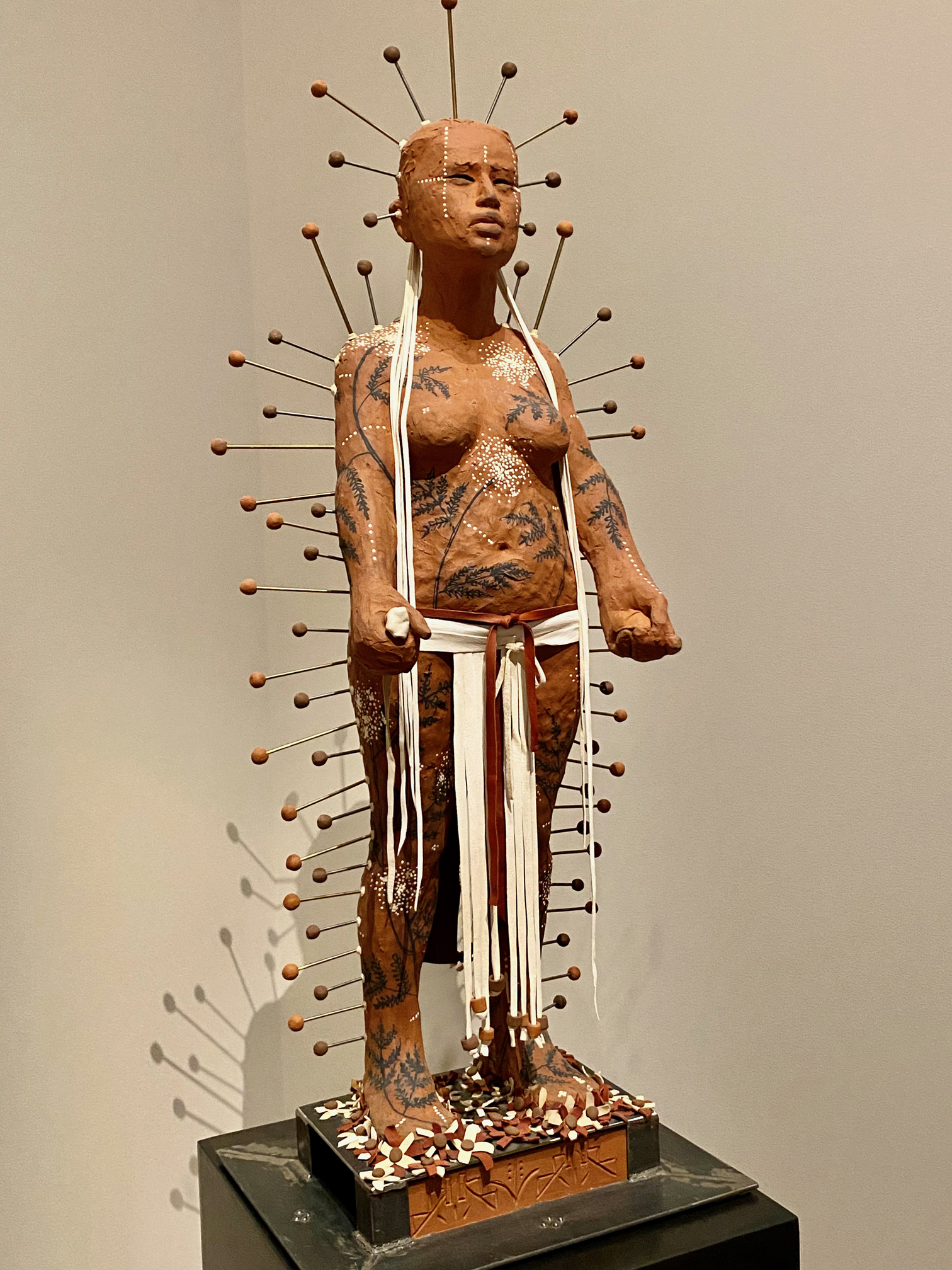
Experiencing the large, spiritual earth-colored ceramic figure by Rose B. Simpson (Santa Clara Pueblo) harkens back to eras when people had a more integral connection to the earth. Simpson calls her figure Tonantzin, an Aztec name for earth mothers, corn mothers, and even the Virgin of Guadalupe.

2017 blown and sand-carved glass Raven Steals the Sun by Preston Singletary (Tlingit). Courtesy: private collector.
2021 ceramic, steel, leather, and brass Tonantzin by Rose B. Simpson (Santa Clara Pueblo). Courtesy: Tia Collection.

Smith has chosen to hang many smaller two-dimensional works across a long wall in a checkerboard to suggest that visitors reflect on the impact of 1887 Dawes Act upon Native lands – a law that cut Native territory into “checkerboard” lots to facilitate private ownership.

At the National Gallery, Jeffrey Gibson’s punching bag (all made of found materials) was hung nearby, reminding us of the delicate balance that has to be struck by simultaneously caring for and taking gifts from the earth.

Next to checkerboard wall, the 2020 beaded punching bag To Feel Myself Loved On the Earth by Jeffrey Gibson (Mississippi Band of Choctaw Indians/Cherokee Nation). Courtesy: Hirschhorn Museum.

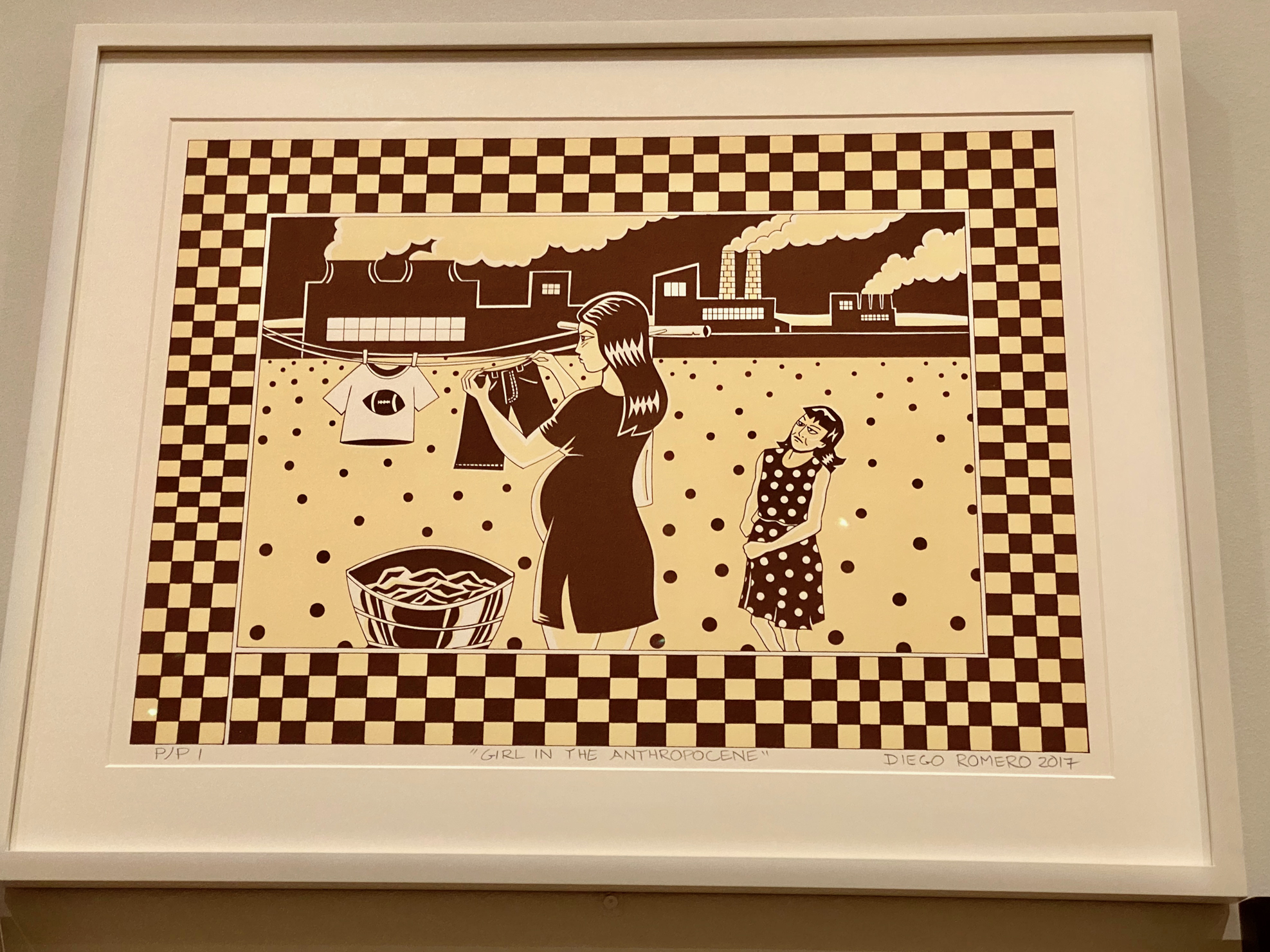
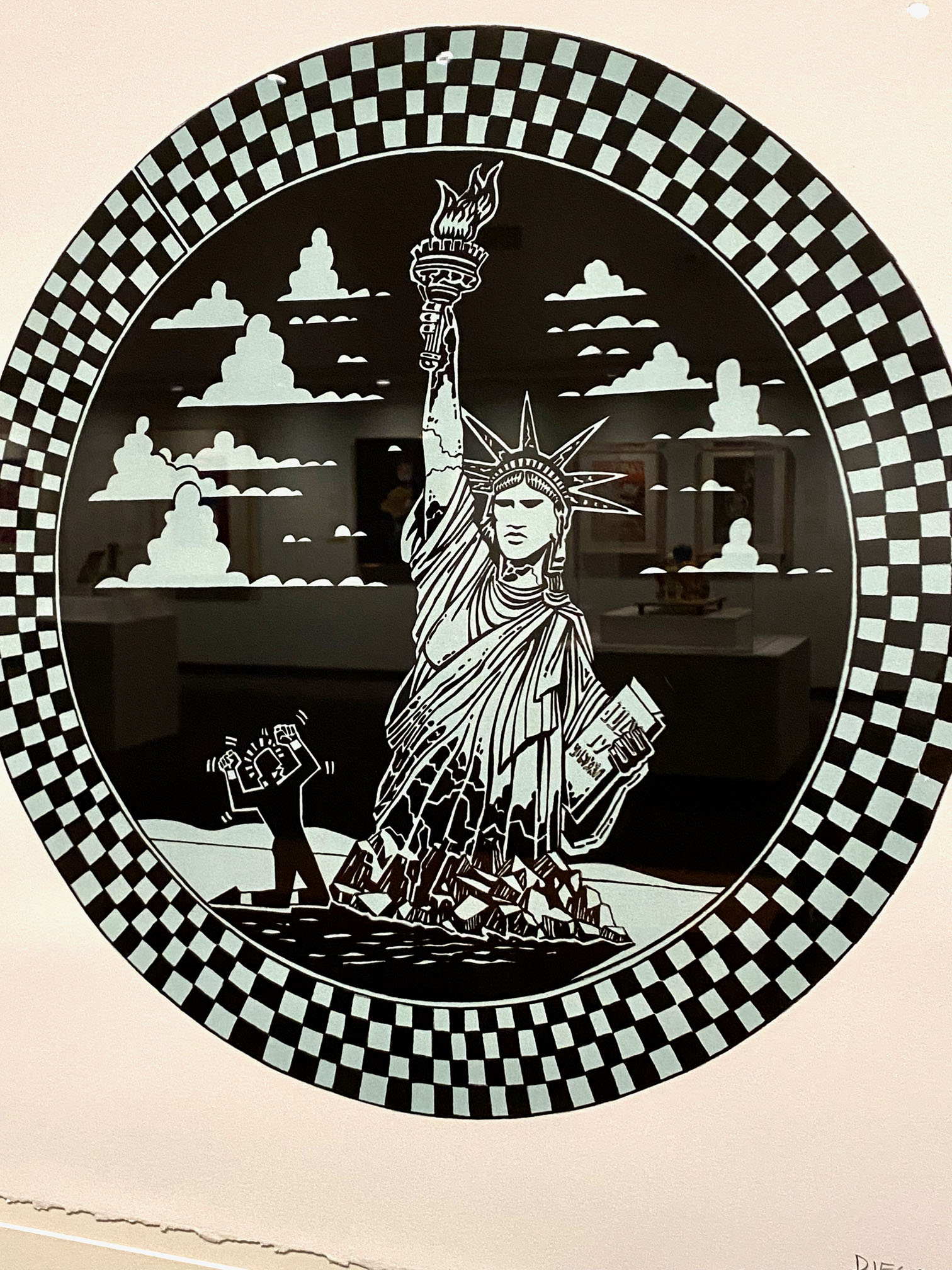
Some artists mix impressions of modern life with tribal lands, such as satiric works by Diego Romero (Cochiti Pueblo) and stylized symbols in a monoprint by Joe Fedderson (Colville Confederated Tribes).

2017 lithograph Girl in the Anthropocene by Diego Romero (Cochiti Pueblo). Private collection

In addition to sculptures, paintings, and photos, Smith has also included pieces made for fashion runways, live performances, and social protests.

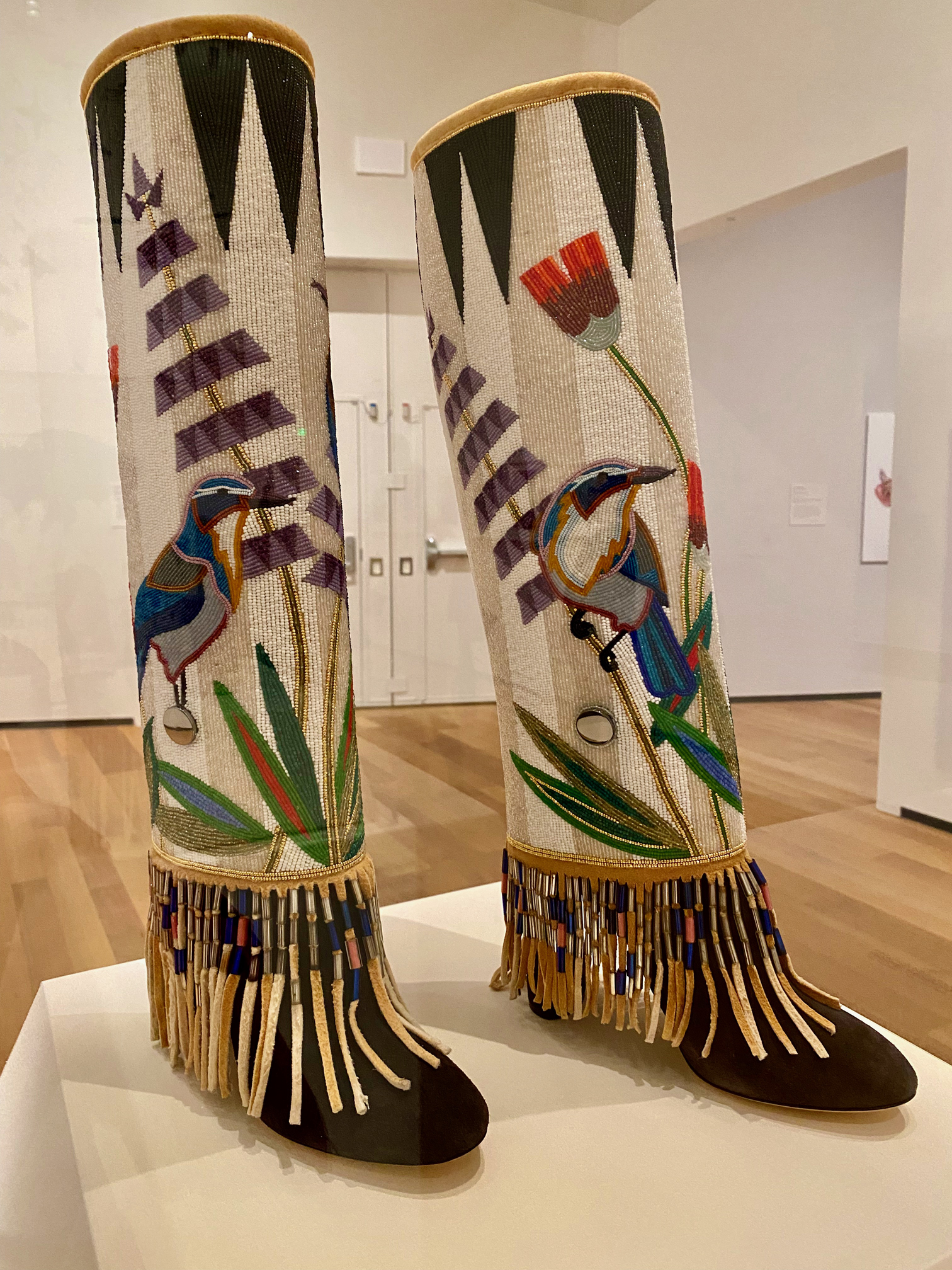
Fashion designer Jamie Okuma (La Jolla Band of Luiseno Indians) beaded her fringed fashion boots with a portrait of her family’s pet scrub jay.

Ten foot-long fiber seashell earrings designed for an interactive video and gallery performance by fiber and performance artist Eric-Paul Riege (Diné) are a reminder of the ancient trade networks that brought trade items from the ocean to the interior deserts.

2021 beaded and fringed Casedei boots by Jaime Okuma (La Jolla Band of Luiseno Indians). Courtesy: Dartmouth College’s Hood Museum
2020 mixed-fiber installation jaatloh4Ye’iitosoh [3-4] by Eric-Paul Riege (Diné). Courtesy: Tia Collection.

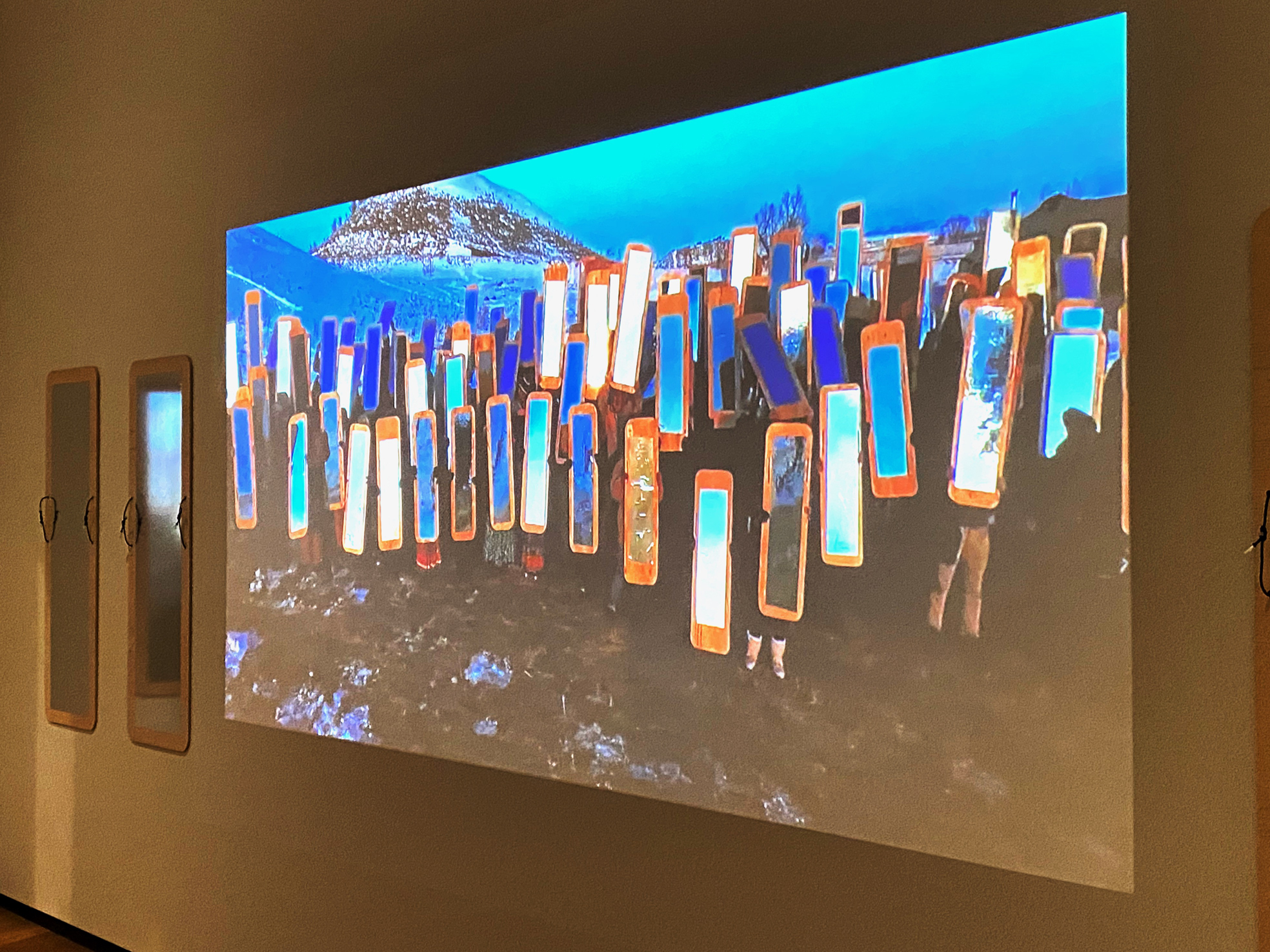
A wall of “mirror shields” were mounted by artist-activist Cannupa Hanska Luger (Mandan/Hidatsa/Arikara/Lakota), showing just a small sample of the 1,000 protective and reflective shields made by people to help water protectors during thre 2016 pipeline intervention at Standing Rock Sioux Tribe Reservation, Luger’s childhood home. Take a look at Luger’s instruction video here.

The shields served to protect the peaceful protesters from rubber bullets and water cannons, and reflected images of the security forces back to them. The crowd-sourced shields were also used in a social-action performance piece at Standing Rock.

2016 mirror shields and video for Mirror Shield Project – River (The Water Spirit) by Cannupa Hanska Luger (Mandan/Hidatsa/Arikara/Lakota). Courtesy: the artist, Garth Greenan Gallery.

Textiles and vinyl drawings also pack a punch in this show. Take a look at the dazzler woven by Melissa Cody (Diné), who draws inspiration from video gaming and the matriarchs of Navajo Nation. Watch her interview from her recent exhibition at MoMA PS1.

Here, John Hitchcock explains how his room-sized drawing, Impact vs. Influence, incorporates his influences – nature, family, Native beadwork, and the next-door military base:

Take a look the National Gallery’s trailer and meet the 50 contemporary artists whose work and relationship to the land is celebrated in the show:

Wit, Humor & Satire in Albuquerque

If you want to have a good laugh or contemplate a biting piece of social satire, head over to Wit, Humor & Satire at the Albuquerque Museum, on view through January 29.

Pulled from the museum’s permanent collection, themed sections of the show present artists’ side-glance takes on Western mythology, art jokes, image puns, and politics.

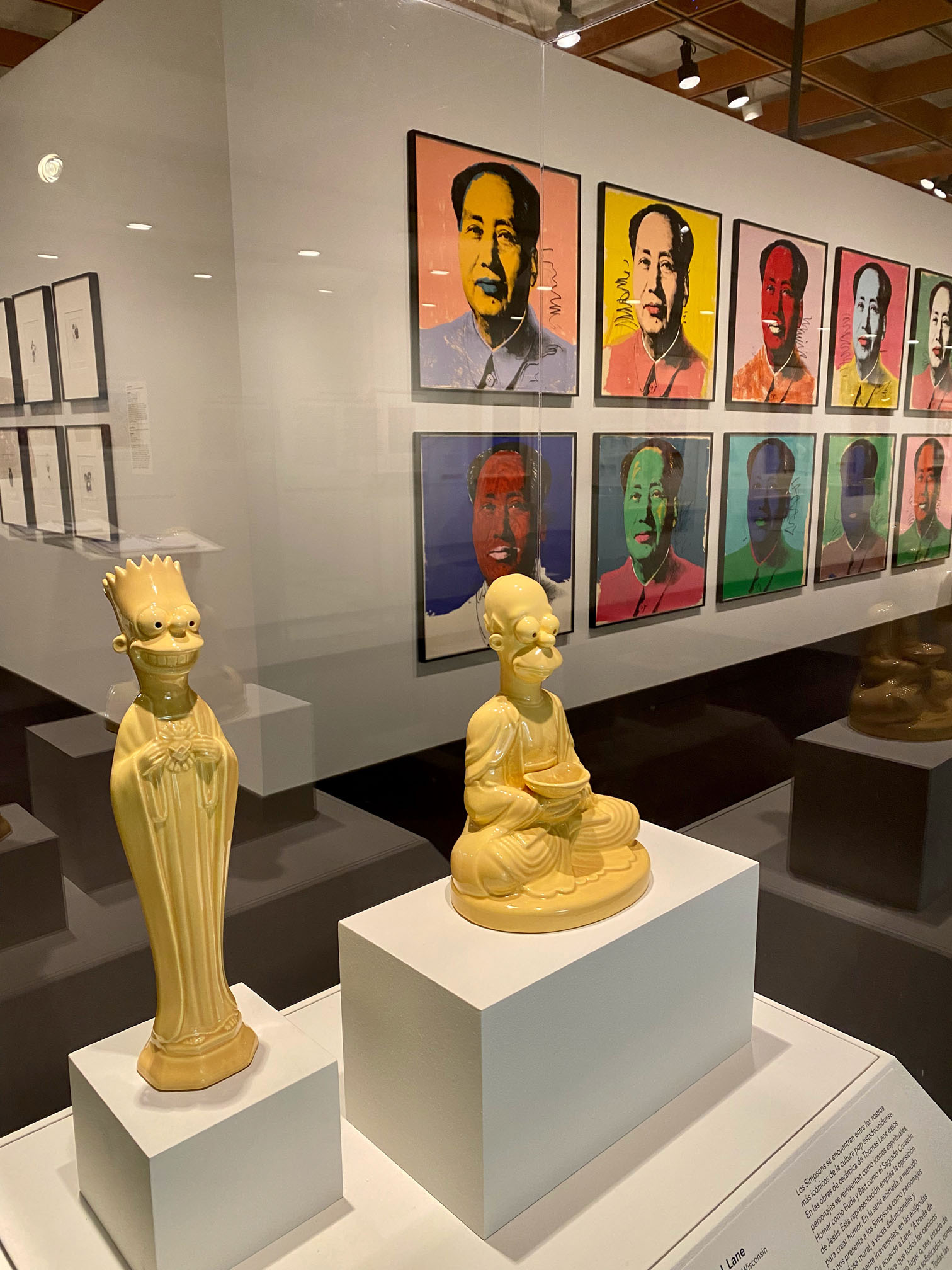
Right in the entry, you see the huge wall of Warhol Mao Tse-Tungs in blazing Pop Art colors, alongside Thomas J. Lane’s satirical ceramics – Bart Simpson impersonating Jesus and Homer as Buddha. Irreverant satire mixed with social commentary in impeccable execution.

Art history “jokes” and political portraits: Thomas J. Lane’s satirical Simpson ceramics with Warhol’s monumental 1972 Mao Tse Tung silkscreens.

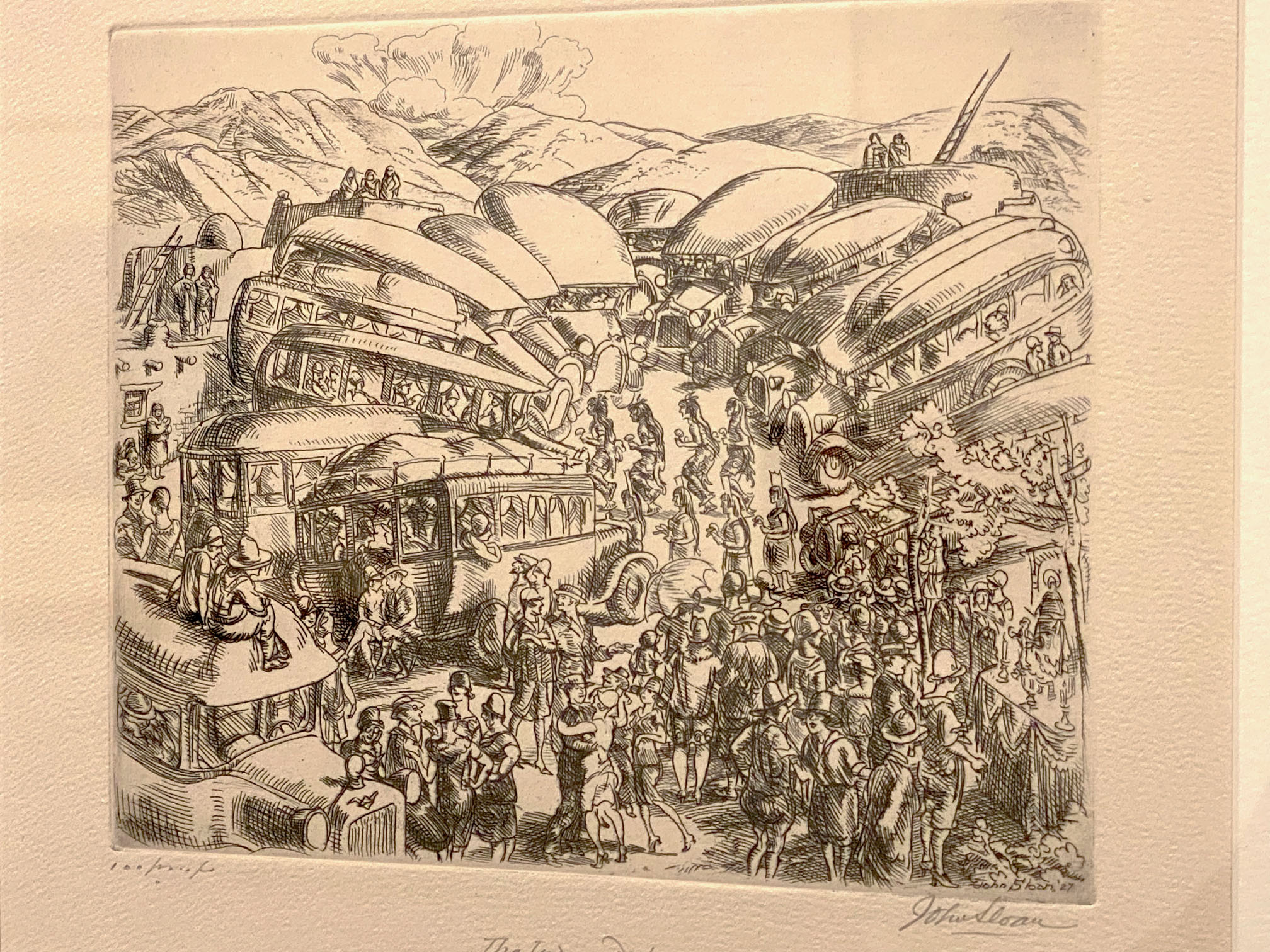
There’s a dark 18th-century Goya etching in the first gallery and a funny Sloan print skewering 1920s tourists, but most of the offerings are more recent vintage, particularly whimsical sculptures and social commentary of the Seventies, Eighties, and Nineties. 

Comments on Commodification: John Sloane’s 1927 Indian Detour etching, a satire showing hoards of souvenir-buying tourists descending upon Indian pueblos on their Fred Harvey packaged excursions.

It’s nice to encounter clever Sixties and Seventies Warhol, Rauchenberg, and Red Grooms prints in other humorous sections of the show, and to revisit Southwestern superstars like the T.C. Canon and Scholder, who like challenging stereotypes of what people think of Western people and cultures.

Political commentary: Red Grooms’ 1976 silkscreen Bicentennial Bandwagon,”which references America’s troubled past versus all-out patriotic celebration of American history.

Most of the anti-War and social commentary are in the back half of the gallery, with strong pieces by Bob Haozous, John L. Doyle, and Sue Coe. Diego Romero lays it out with a lithograph that resembles his normal medium of politics-on-a-plate.

War: 1990 steel-plated sculpture El Piloto by Bob Haozous, depicting a skeleton pilot whose nose is a plane with a bomb trailing.
Political commentary: Diego Romero’s 2011 Apocalypto lithograph.

Another stand-out is the first poster ever designed by Keith Haring – a combination of images that came to define subterranean visual protest in the dark, scary times of 1980s New York. He debuted it for an anti-nuclear rally in Central Park, but his unforgettable images and icons soon became ubiquitous on City streets and subways, on T-shirts, and downtown art galleries.

Indigenous humor and commentary are well represented by Jason Garcia’s water-carrying pueblo gals in a contemporary landscape and Wendy Red Star’s Native seasons studio-portraiture spoof.

War commentary: Keith Haring’s first poster – his 1982 Anti-Nuclear Weapons Poster, featuring his iconic “radiant baby”.
Western mythologies: Subversive autumnal studio self-portrait from Wendy Red Star’s 2006 digital print series Four Seasons, which highlights artificial elements.

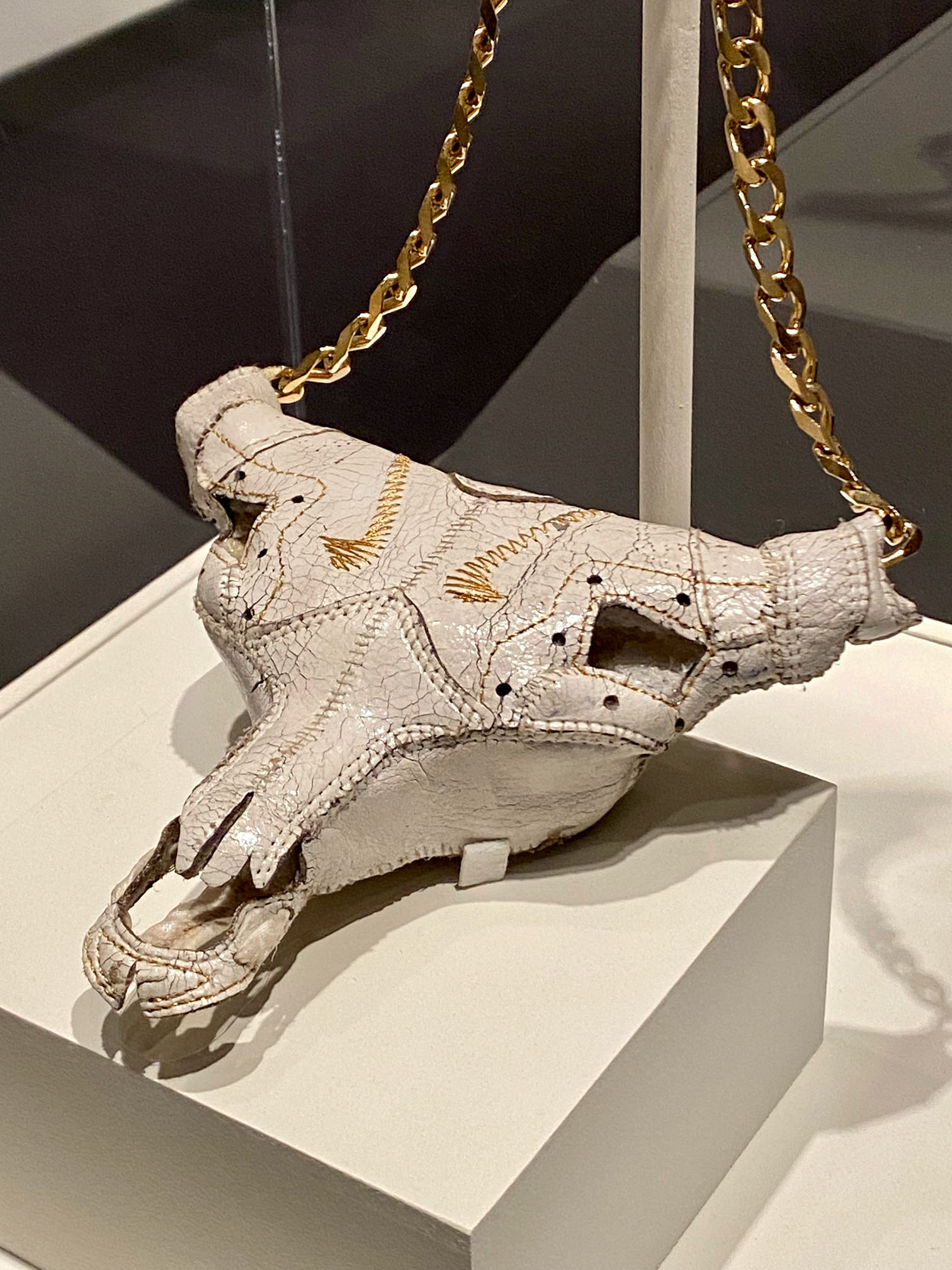
Too bad that no one knows who made the 1960s traditional Zuni pop-culture Disney necklace. But it’s fun to contemplate the Nike-sneaker sculpture/neckpiece by Sean Paul Gallegos.

Exploring wit: 1960s silver Zuni necklace by unknown artist featuring Disney characters inlaid with shell, coral, turquoise, and jet.
Commodification commentary: 2015 satiric “high fashion” neckpiece by Sean Paul Gallegos, created from recycled Nike sneakers and gold thread.

There’s a lot to think about and enjoy in this provocative show. Visit our Flickr album to enjoy more of our favorite works.