Makowa: Modern Skywatching with the Ancients

Look up at the night sky and find patterns in the stars. You can do that, even though you’re standing inside the exhibition Makowa: The Worlds Above Us at Santa Fe’s Museum of Indian Arts and Culture through January 31, 2027. The wall-sized photo murals of day and night skies provide the backdrop to sculptures, pottery, and textiles with stylized images of stars, planets, the Sun, Moon, meteors, and changes of season.

Beautifully crafted objects and immersive photos provide contemplative spaces to consider the different types of skyward observations that Indigenous communities have made across millennia, and how stories and rituals convey this knowledge across generations.
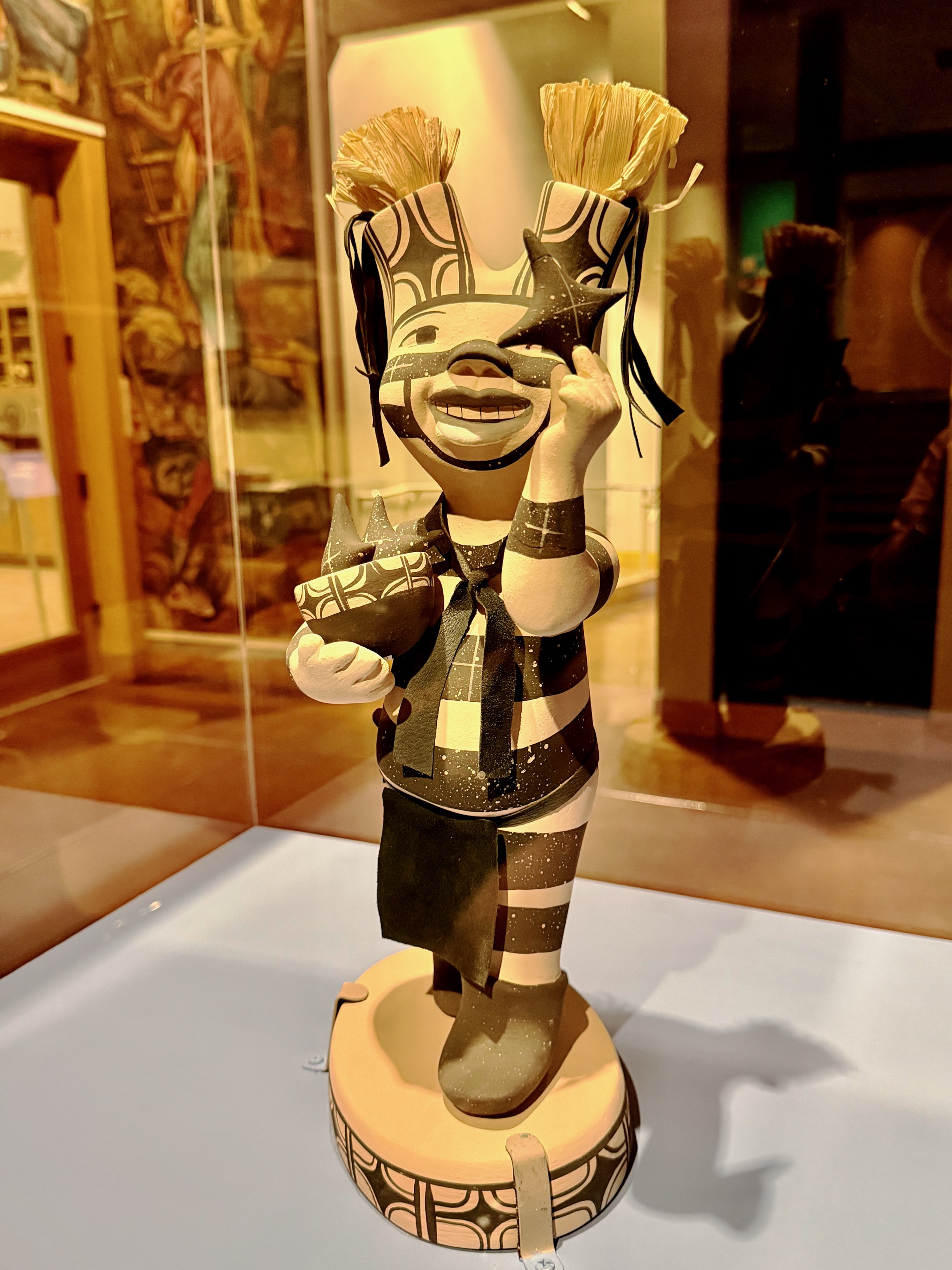
Exhibition welcome: 2009 Evening Star ceramic sculpture by Kathleen Wall (Jemez Pueblo) – a Koshare holds stars important to celestial calendar.

Kathleen Wall’s charming Koshare holding up the Evening Star welcomes everyone to the journey. Take a look through our Flickr album to see some of our other favorites.

A mix of historic and contemporary art underscores the story behind star gazing. Tracking their slow movement across the night skies, sky watchers have long seen stars as important guides. The Ancients used petroglyph images as reminders of how to use ancestor stars for guidance – to tell time, mark seasons, and take journeys through vast desert landscapes.
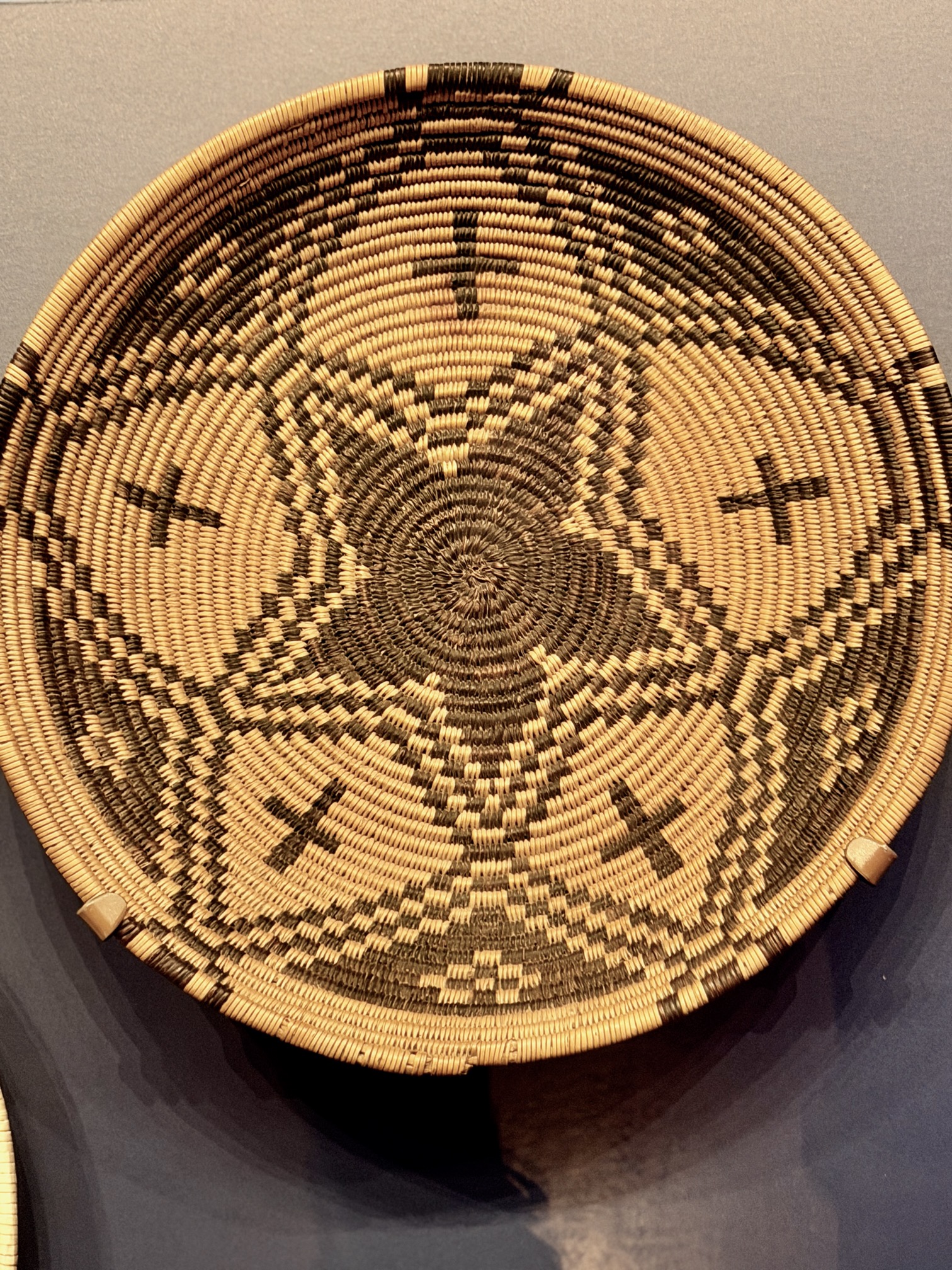
Star patterns: 1930s tray woven by unknown Tohono O’ohdam artist.
2020 Star Child painting by George Toya (Jemez Pueblo), showing a star surrounded by ancestors in the night sky. Courtesy: private collection

Recent artworks suggest a range of the activity in the day and night sky. Phases of the Moon inform agricultural cycles. Planetary alignments, meteor showers, and also plane traffic are all part of night-sky viewing today. Rosemary Lonewolf’s tiny pot summarizes this dynamism nicely.
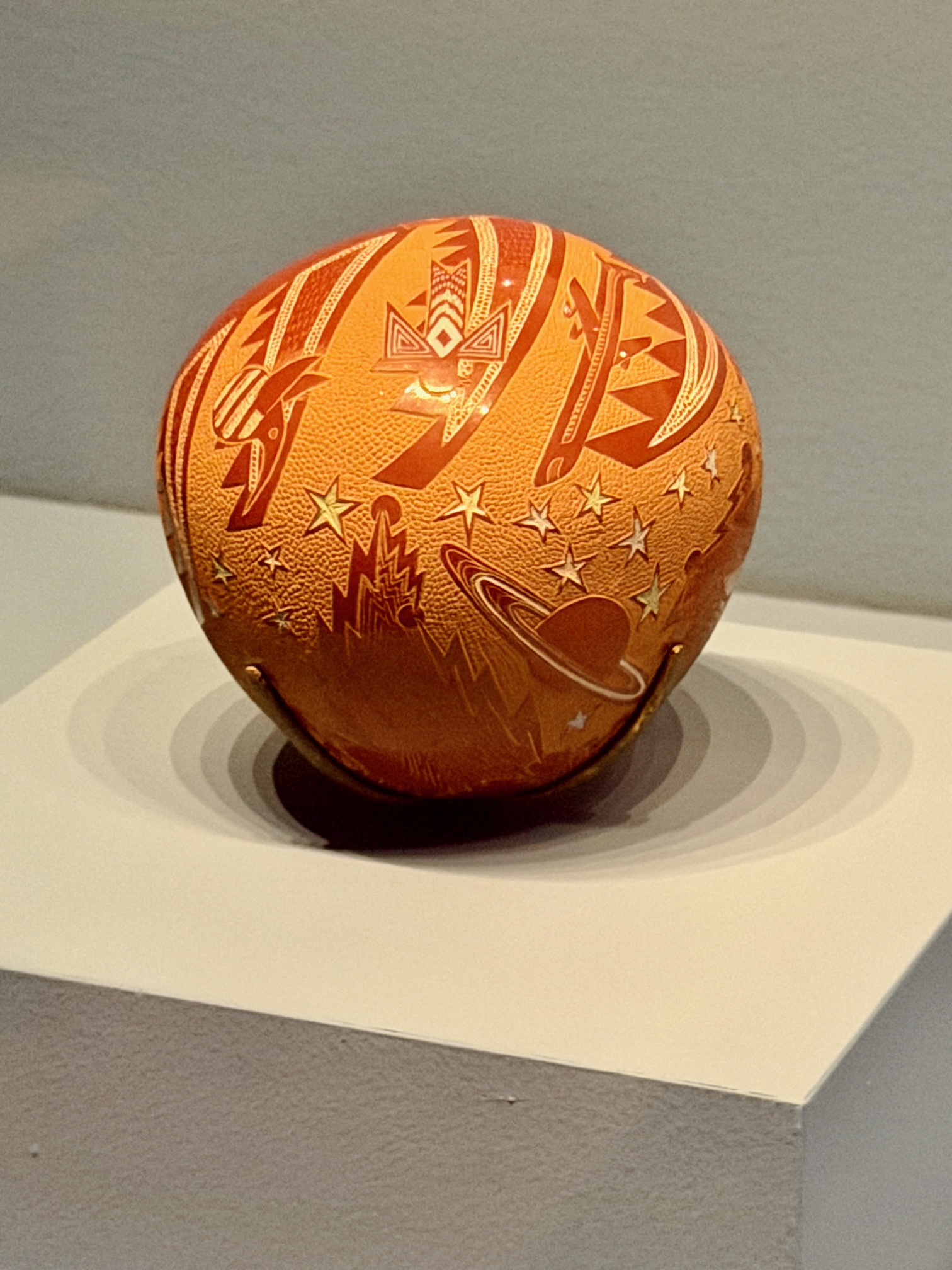
Distant worlds and a crowded sky: 1992 miniature Spaced Out jar by Rosemary Lonewolf (Santa Clara Pueblo).
2000-2001 sand painting by Joe Ben Jr. (Diné) linking phases of the Moon to planting cycles.

The curators show how traditional symbols of clouds, sky, and sky dynamics are learned, used, and adapted over the centuries by exhibiting modern woven regalia alongside ancestral Puebloan pots from Chacoan culture. It shows that abstract Indigenous symbols do not exist in a single place and time – they are used and reused.

Acknowledging the lively, changing sky: 1984 shirt with sky symbols woven by Evelyn Quintana (Okay Owingeh) with Ancestral Pueblo ceramics below.

The exhibition also takes a deep dive into how ancient architecture and landscapes across the Four Corners are used to mark cardinal directions, annual cycles, and astronomical phenomenon. Chaco’s magnificent kivas are featured in dramatic photo murals that show how a combination of architecture, horizon markers, and sunrise to mark the seasons.
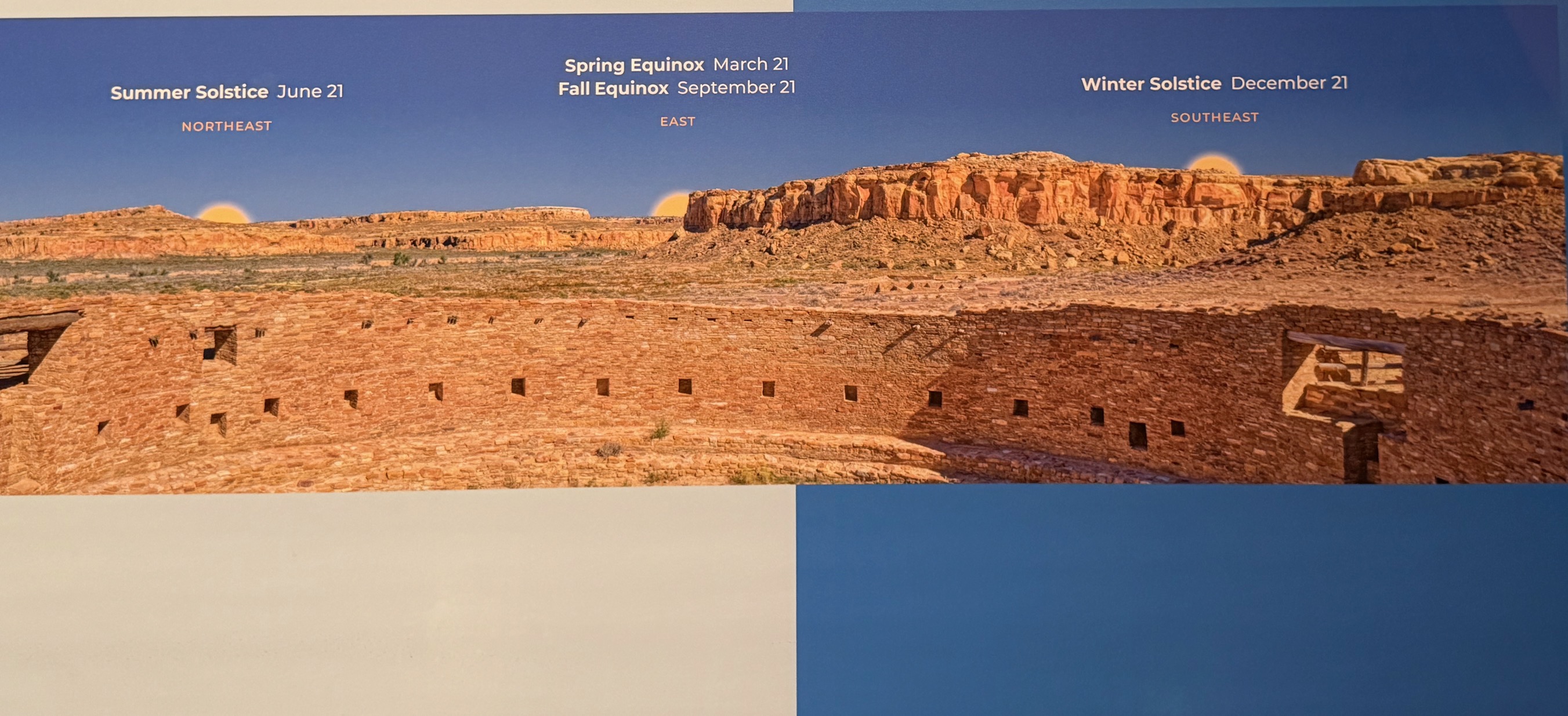
Equinox and solstice: Duke Johnson’s 2022 photo of the Great Kiva Casa Rinconada at Chaco Canyon showing where the Sun rises against the landscape at key times of the year.

Aerial photographs show how buildings reflect astronomical alignments. Most visitors stand intrigued before an archaeoastronimical explanation of Chaco Canyon’s famous Sun Dagger, which transformed Fajada Butte into an observatory to mark the solstice and equinox.

Google Earth photos of Chaco Canyon National Historic Park. showing how structures are aligned to the cardinal directions – Pueblo Bonito and the Great Kiva at Casa Rinconada.
Visitor watches the Sun Dagger Explorer, a virtual experience of the archaeoastronomy site on Fajada Butte in Chaco Canyon. Courtesy: Advanced Computing Center for the Arts and Design at Ohio State University, The Solstice Project, and the New Mexico Museum of Natural History and Science.

Best of all, visitors themselves can explore the video interactive of another Chaco site – Rock of the Sun – to experience what it’s like to interact with petroglyphs, shadows, and the skies to mark time within the year. Nearby, there’s a copy of a petroglyph (carving into stone) that archeoastronomers suggest could depict an exploding star that was visible for 3 weeks in the year 1054.
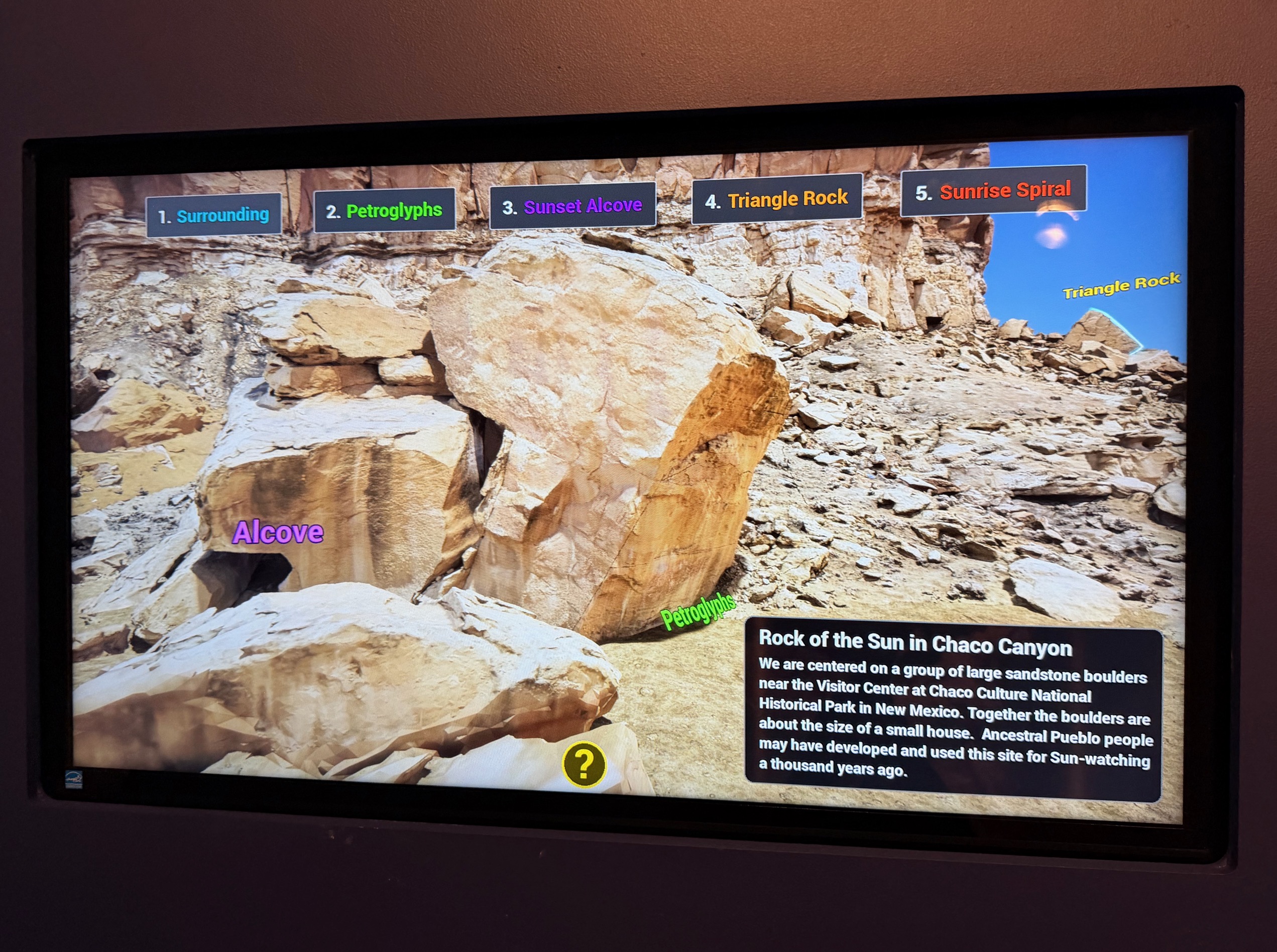
Interactive video screen that provides visitors with a virtual experience of Rock of the Sun, an archaeoastronomy site in Chaco Canyon National Historic Park.

Other sections of the exhibition focus on the animals that serve as sky messengers – bats, eagles, and other birds – and rituals that honor the four cardinal directions.

One of the key themes here is to respect the elements – not try to control them – which is emphasized brilliantly in the final fitting tribute to these scientist farmers. Phenomenon such as rain, wind, clounds, and thunder seemed unpredictable to the Ancients, so ceremonies and dances were performed to convey desire for favorable elements. Beautifully woven cotton garments, paintings, and ritual headgear are rich in layered meanings – seasonal calendars, rain, and lightning.
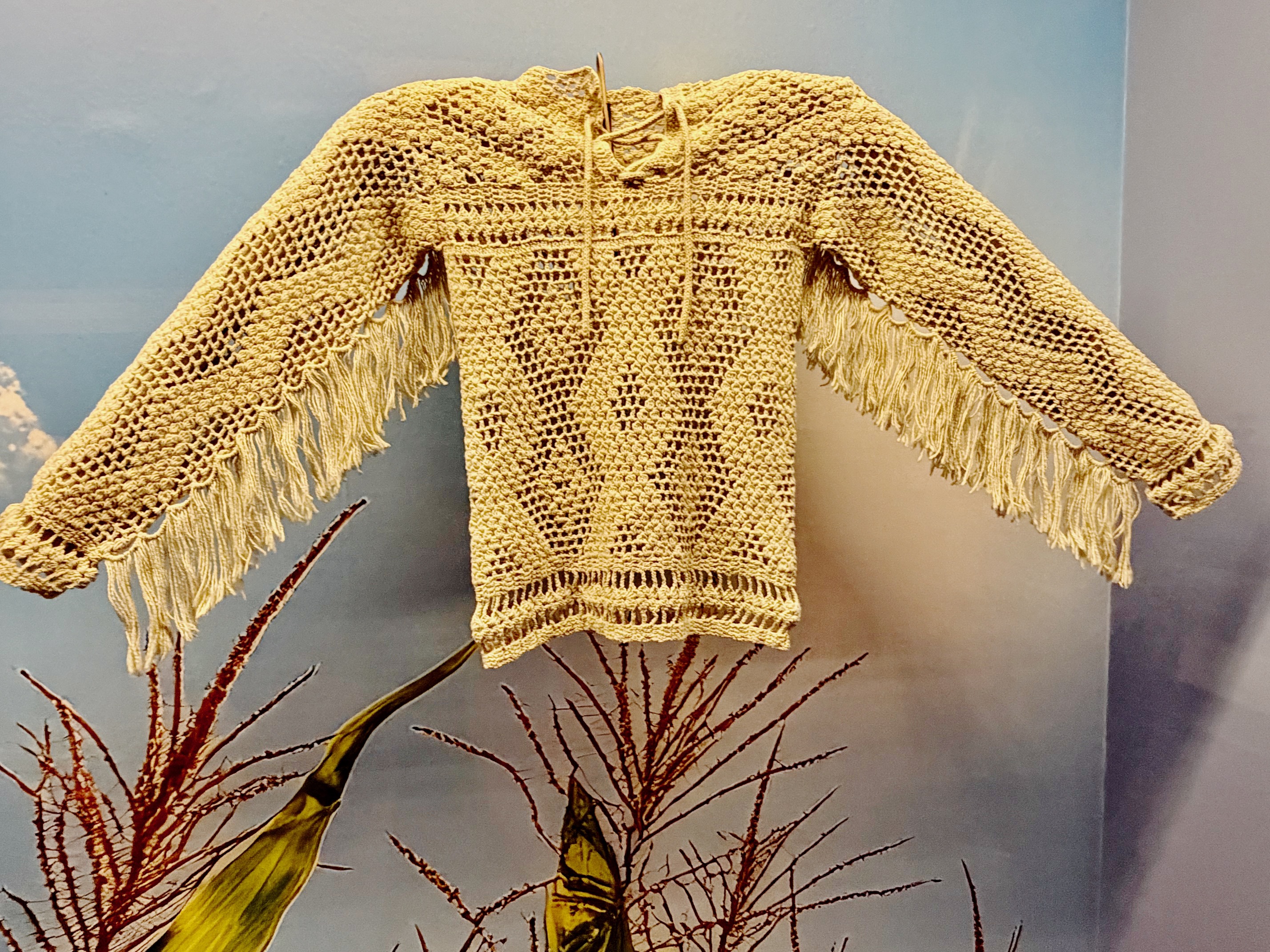
Farmer scientists: 1920-1940 cotton shirt featuring zigzag lighting patterns by unknown Okay Owingeh artist.

It’s a reminder of the intergenerational wisdom used to coax agricultural bounty from the seemingly barren stark desert.

For deeper insights, the curators recommend a visit to the Star Stories website by WeRNative and the Native Skywatchers website.
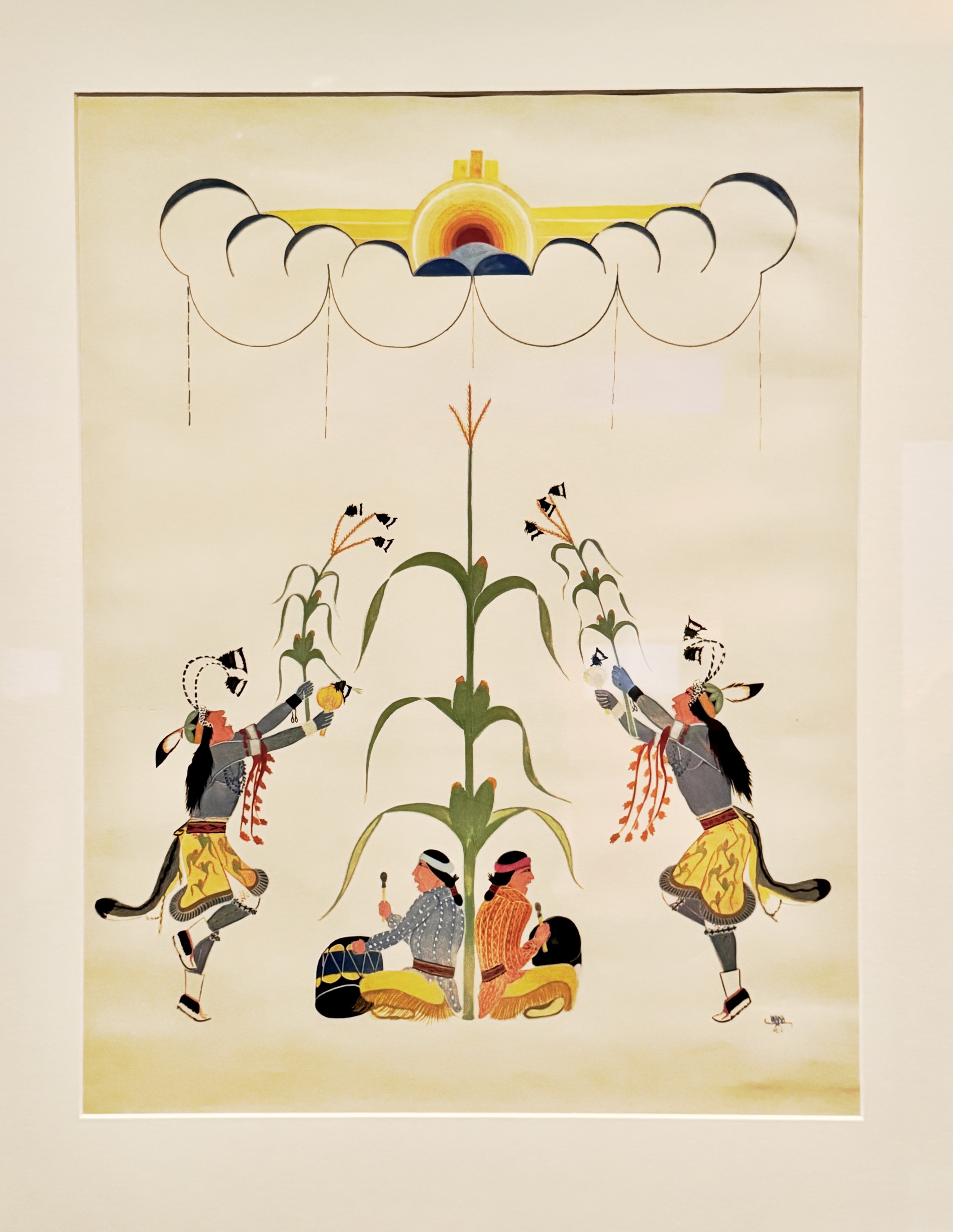
1938 painting Mythical Corn Ceremony by Ignacio Mosquino (Waka Yeni Dewa) (Zia Pueblo).
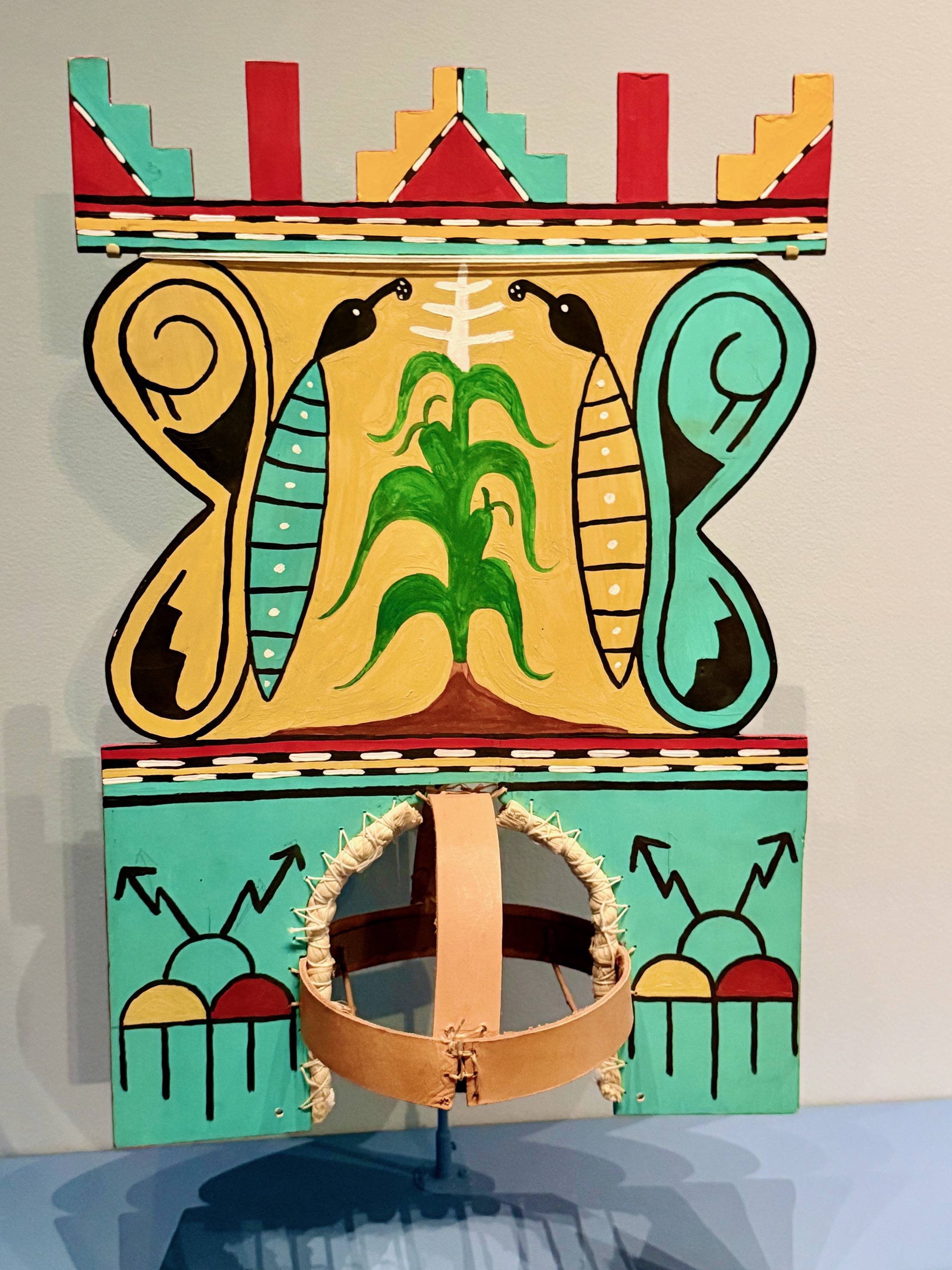
2005-2009 Hopi tablita Butterfly Maiden by unknown Hopi artist.

Jewelry Reflects Cosmic Splendor at AMNH

There’s plenty of dazzling eye candy tucked away in a corner of the Gems and Mineral Hall inside the American Museum of Natural History. Look at sparkly diamonds, rubies, emeralds, turquoise, and every other polished gem you can think of as you contemplate the mysteries of stars, planets, and distant galaxies in Cosmic Splendor: Jewelry from the Collections of Van Cleef & Arpels, on view through January 4, 2026.

The gallery is an ethereal cosmic universe – it feels like you’re floating in deep space where infinite points of light illuminate and reflect thousands of facets of about 60 astronomy-based jewelry creations by the 129-year-old luxury house. It’s a small space, but the illusion suggests the limitless night sky.

Inspired by images of the the spiral Porpoise Galaxy: 2021 Opal Nebula Clip; black opal surrounded by gold, emeralds, rubies, sapphires, tourmaline, and diamonds. From Van Cleef’s Under the Stars high jewelry collection. Courtesy: private collection.

The curators have arranged the dazzlers into loose astronomical themes, like the Sun, Moon, Planets, and Galaxies, but closer inspection demonstrates how the the designers of these works were inspired by the views of the Milky Way, knowledge about black holes or meteors, or images from the Hubble Space Telescope

The Moon: 1969 yellow gold Moon pendant to commemorate the first men to land there; ruby marks the spot. Courtesy: Van Cleef & Arpels.
2021 Whirlpool Galaxy Clip, inspired by the Ring Nebula in the constellation Lyra; blue tourmaline (center) with garnet outer ring. From Van Cleef’s Under the Stars high jewelry collection. Courtesy: private collection.

The masterworks in the AMNH exhibition are drawn primarily from Van Cleef’s Sous les étoiles (Under the Stars) collection, but a few pieces are showstoppers from previous collections inspired by Jules Verne’s sci-fi or NASA’s 1969 Moon landing.

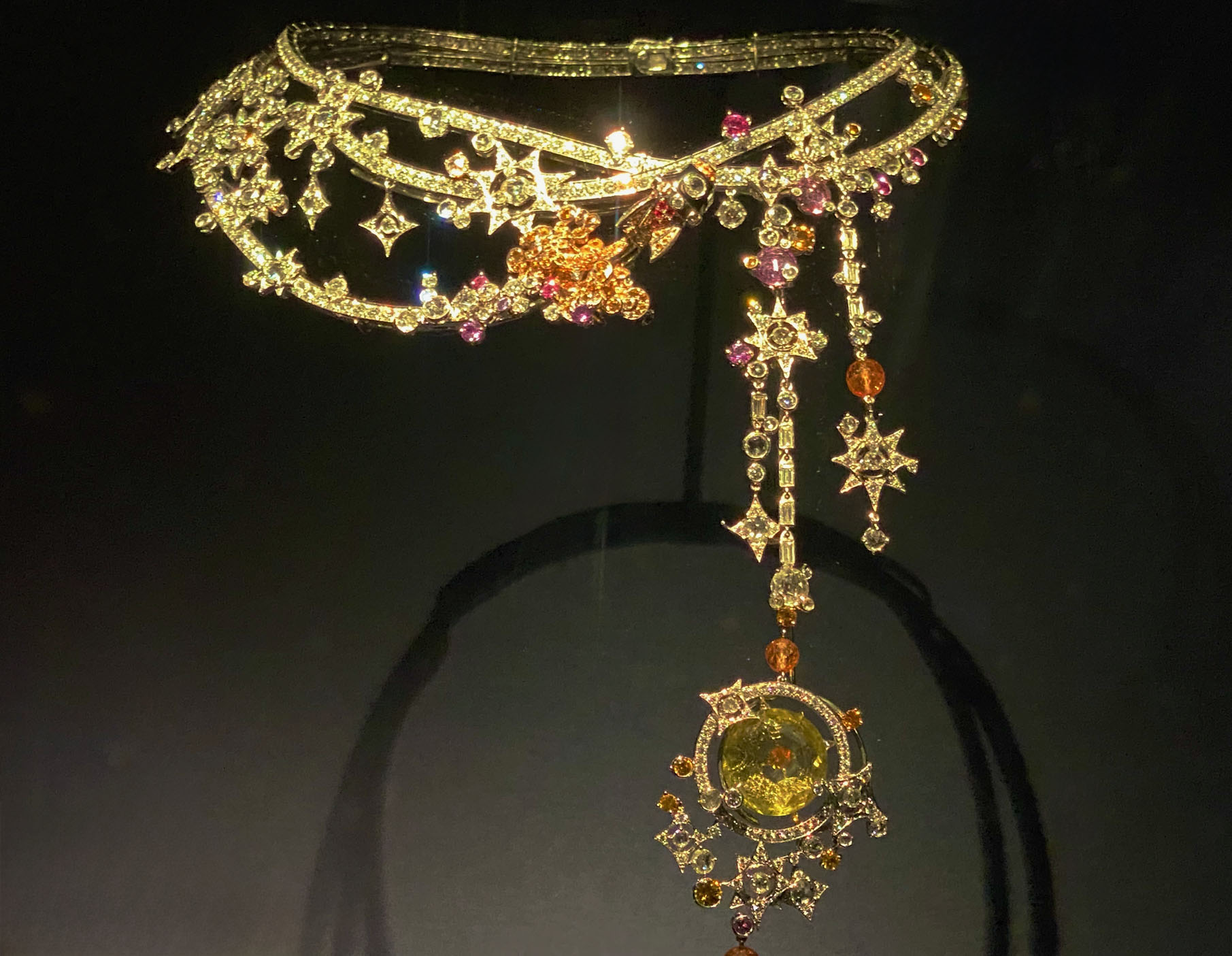
Inspired by Jules Verne’s 1865 sci-fi space travel story – the 2010 gold, sapphire, garnet, and diamond Tampa Necklace. From Van Cleef’s Extraordinary Journeys high jewelry collection. Courtesy: private collection.

See some of our favorites in our Flickr album.

2021 gold, mauve and pink sapphire, ruby, and diamond Doubles Galaxies Saphir Mauve Clip; inspired by the Virgo constellation’s merging Butterfly galaxies. From Van Cleef’s Under the Stars high jewelry collection.
2010 Star Necklace; gold and diamonds flow around an Australian black opal. From Van Cleef’s Extraordinary Journeys high jewelry collection. Courtesy: private collection.

Listen as Nicolas Bos, Van Cleef’s CEO and Artistic Director describes the history and inspiration of the Sous les étoiles (Under the Stars) collection.

Here’s astrophysicist Isabelle Grenier explaining more about the scientific inspiration behind these these jeweled masterpieces.

Before January 4, take a video stroll through the exhibit courtesy of Van Cleef & Arpels here.

Out of This World: 2021 gold, sapphire, and diamond Stellar Explosion Transformable Necklace; designed to be reconfigured as separate necklaces and a clip. From Van Cleef’s Under the Stars high jewelry collection. Courtesy: private collection.