Indian Theater and Contemporary Art at SITE Santa Fe

The ambitious project paid off. Indian Theater: Native Performance, Art, and Self-Determination since 1969, on view at SITE Santa Fe and the IAIA Museum of Contemporary Native Arts through September 7, is a masterful mix of history, contemporary art, performance, and revealing installations that challenge what you know and think you know.

Filling the entire museum, the exhibition uses painting, sculptures, and performance sculptures to chronicle how radical performances by Native Americans shifted conversations, illuminated forgotten populations and treaties, asked difficult questions, and thoroughly influenced the trajectory of the contemporary Native American art movement.
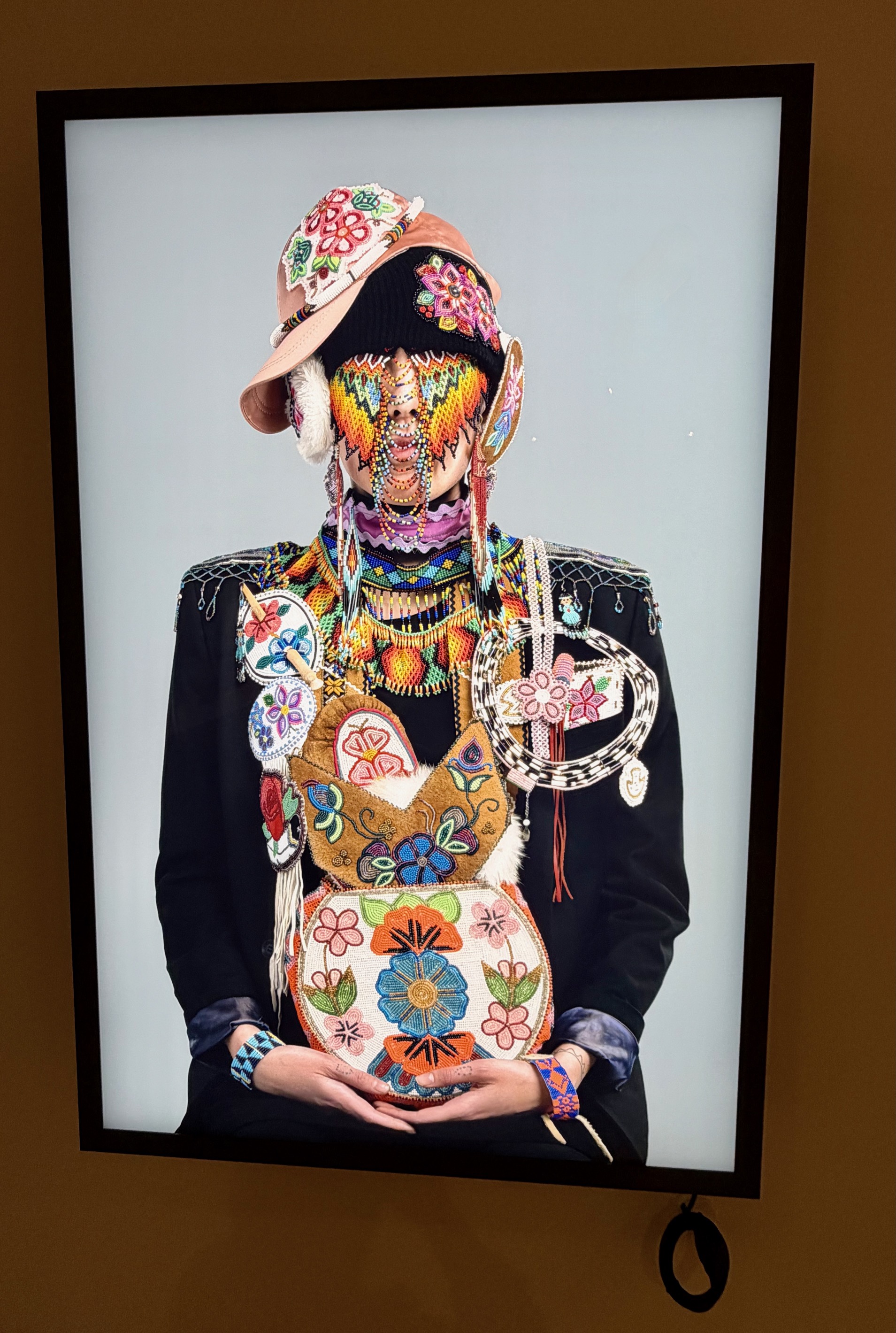
2019 lightbox portrait Headdress – Jeneen by Dana Claxton (Lakota); the sitter bedecked in beads and embroidered gifts. Courtesy: the artist and Forge Project Collection.

Take a walk through the show (and a few performances) in our Flickr album.

In the entry, a provocative neon sign by Demian DinéYazhi (Diné) beckons, but visitors are immediately pulled into the large space surrounded by a graphic history of the historic Alcatraz occupation (1969-1971, one-of-a-kind mask wall pieces by Lloyd Kiva New (leader of brand-new The Institute of American Indian Arts 1967-1978), IAIA’s 1969 manifesto on Indian Theater, and a 1972 video of a NYC production by the Native American Theater Ensemble (running on an ancient Sony Trinitron). It’s all surrounded by a wall textile designed by Linda Lomahaftawa (Hopi/Choctaw) when she was an IAIA student in the Sixties.  A provocative sculpture by Gabrielle L’Hirondelle Hill (Métis) adds the contemporary drama.
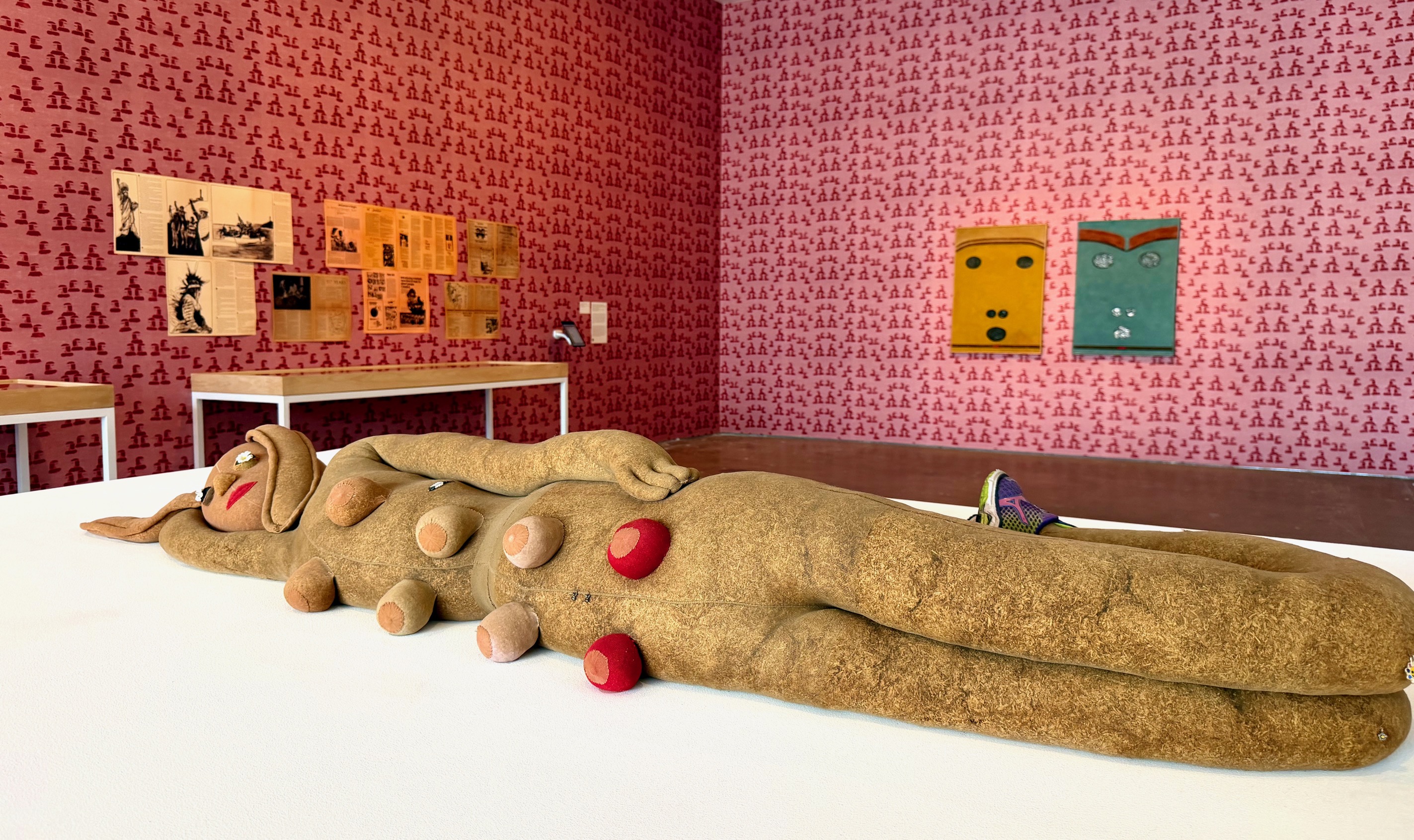
Exhibition entry: 2021 mixed media Counterblaste by Gabrielle L’Hirondelle Hill (Métis); tobacco-stuffed pantyhose rabbit-human figure; surrounded by 1969 Alcatraz occuption documentation and paintings by Lloyd Kiva New. Courtesy: Center for Curatorial Studies, Bard College; IAIA Museum of Contemporary Native Art; Art Bridges.

This sets the stage for curator Candace Hopkins’ thesis – in the 1960s, Native American performance went hand-in-hand with greater activism, self-determination by tribes, and contemporary art in all its forms.  Listen to her explain:

Two performance spaces lie just beyond this gallery. First Nicholas Galanin’s gallery where his performance The White Carver happens weekly (surrounded by photos of previous performances since it was first staged in 2012). The White Carver tackles the subject of appropriation and Native cultural misunderstanding head on.
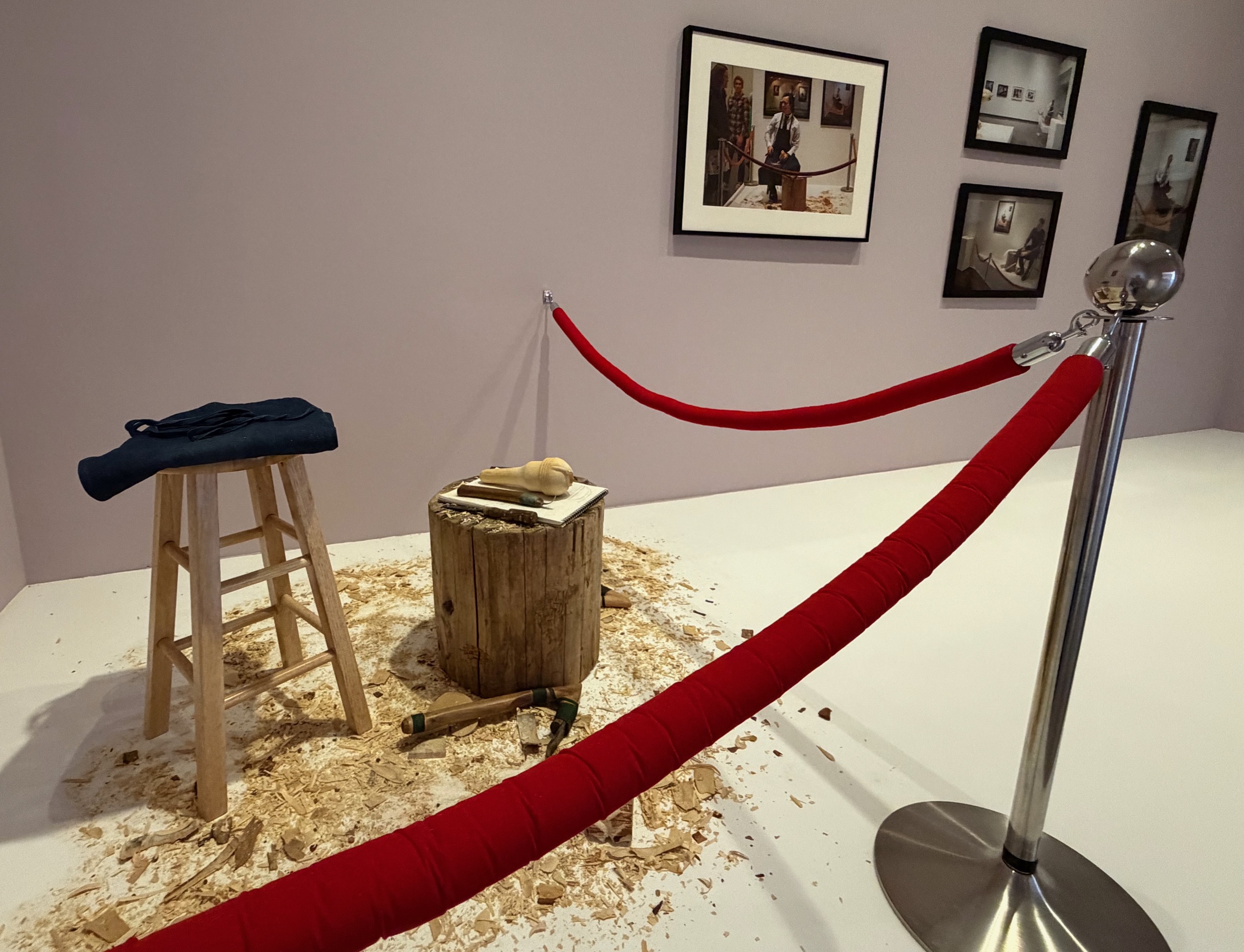
Behind the velvet rope: set for 2012-ongoing White Carver performance by Nicholas Galanin (Tlingit/Unangax) in which a Caucasian woodcarver replicates an object made by a Galinin – a commentary about appropriation and commercialization of Indigenous culture by non-Native communities. Courtesy: Gochman Family Collection.

Next, you enter a room hung with giant earring sculptures from Eric-Paul Riege (Diné), who activated them in a ritualistic performance at SITE in August. Riege’s installation allows everyone a simultaneous experience of the contemporary and cultural deep time.  Kite’s floor installation, right nearby, does this, too. (Check out our previous post about Kite’s innovative IAIA show here.)
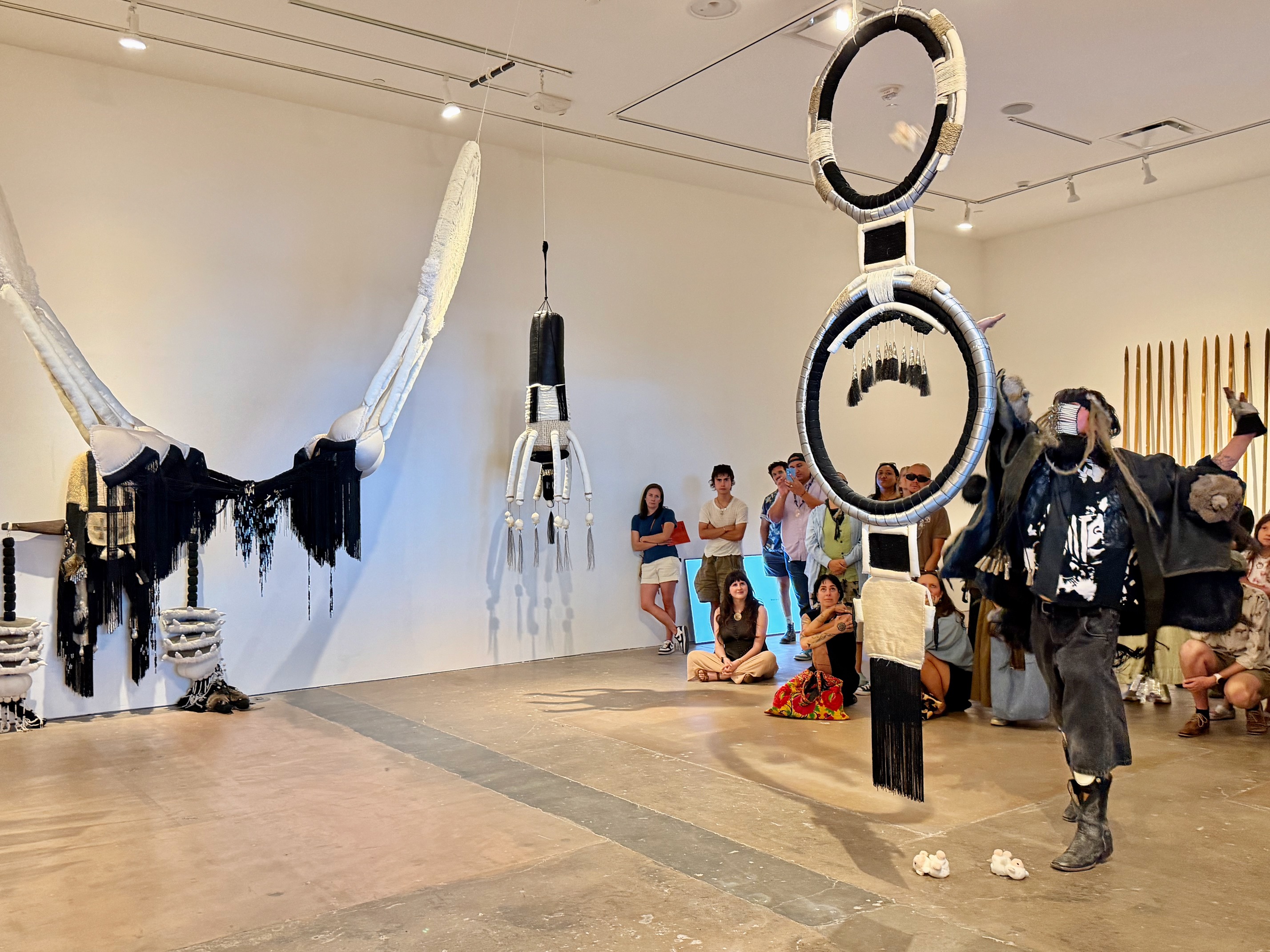
Museum goers watch Eric-Paul Riege (Diné) interact with his mixed-fiber scultptures 2020-2022 jaatloh4Ye’iitsoh (“earrings for the big god”) (August 15, 2026); oversized jewelry suggesting knowledge by listening, harmony of natural fibers, and totems of memory. Courtesy: Forge Project Collection, traditional lands of the Moh-He-Con-Nuck; Art Bridges.

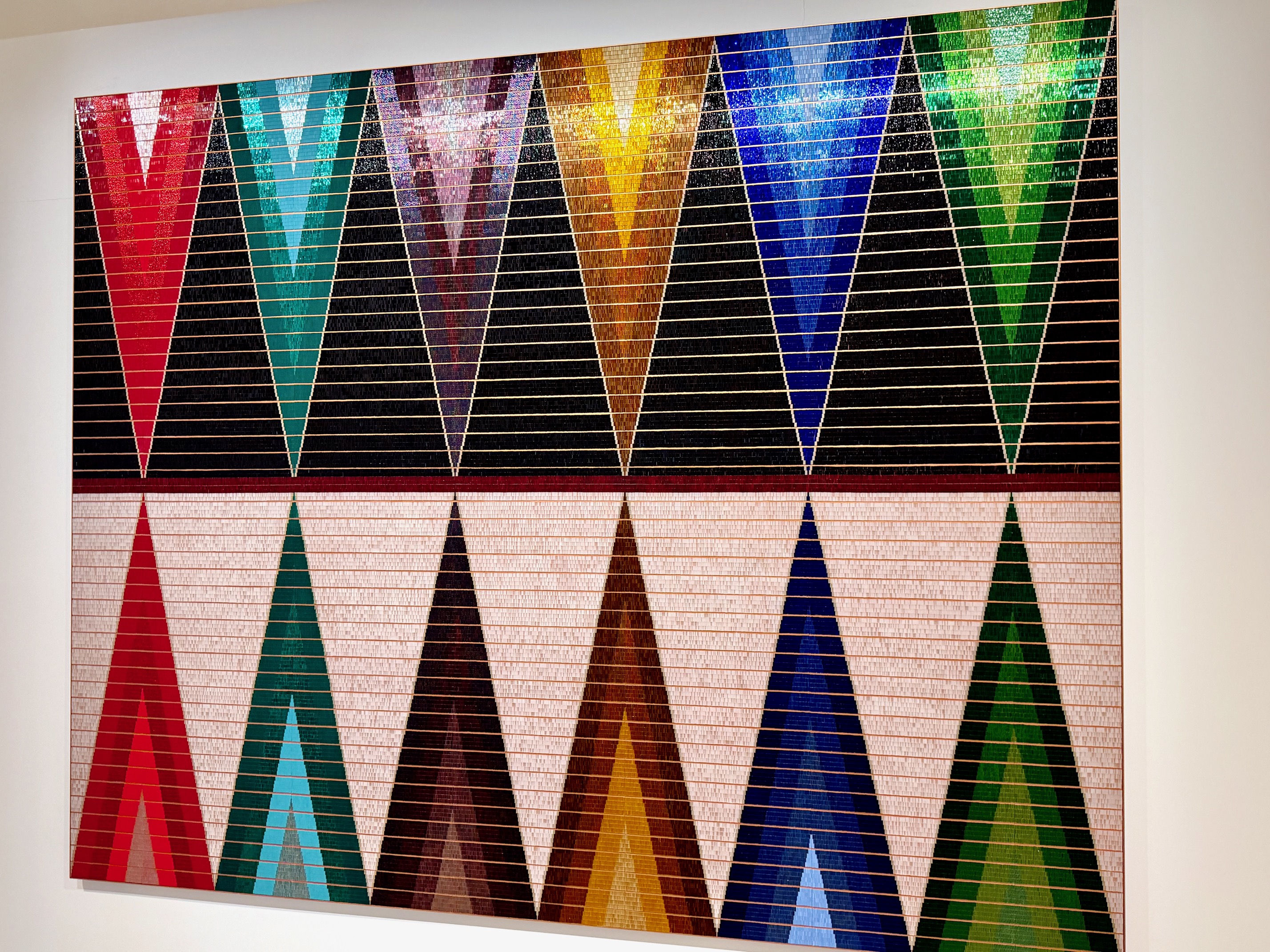
Two-dimensional art on display also evokes a mix of ancient and “now.” Action painting mixed with cultural symbols. Bugle beads or painted blankets echoing color-field painting.
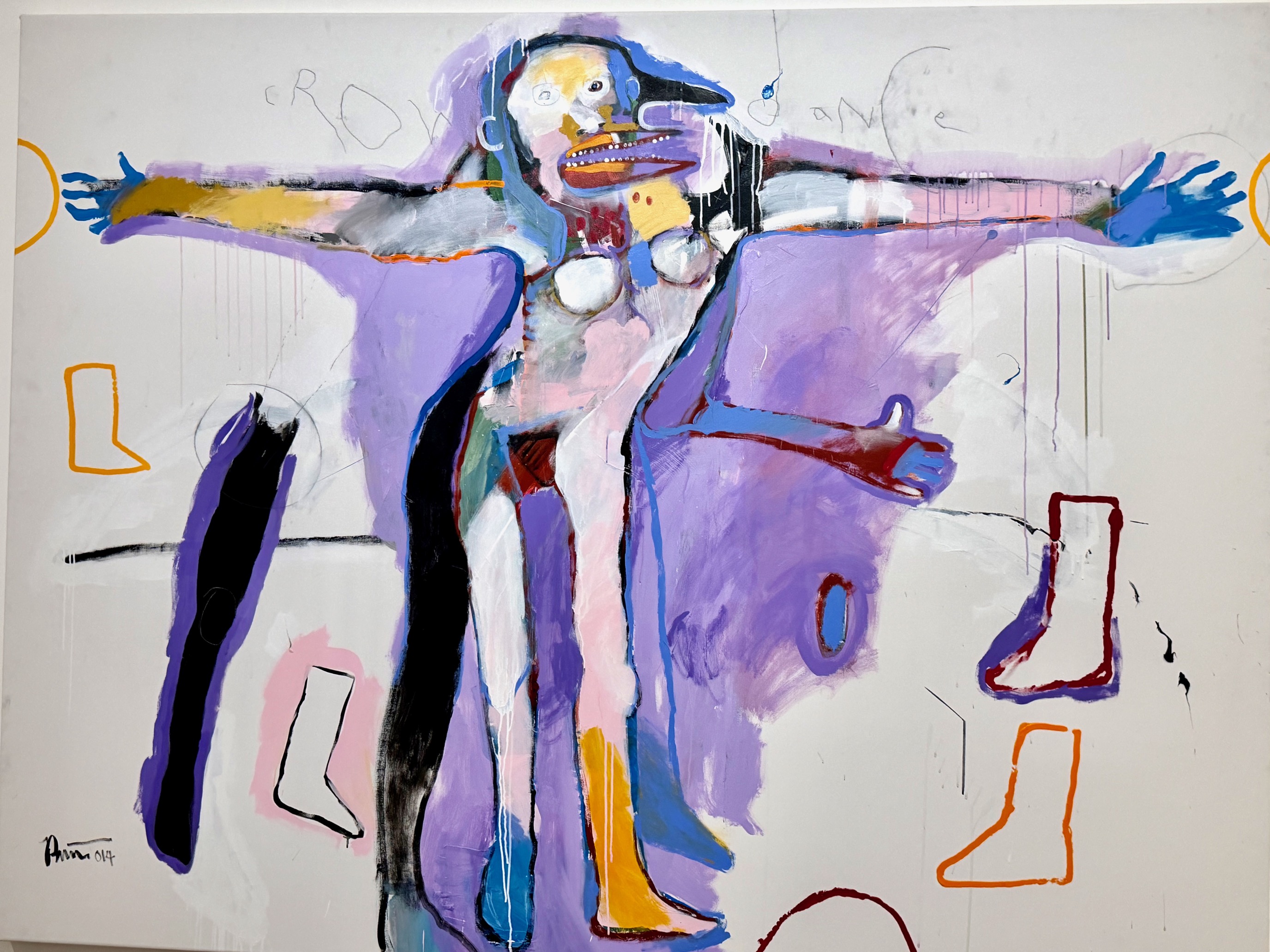
2014 acrylic and graphite Crow Dance by Rick Bartow (Wiyot). Courtesy: Denver Art Museum.
2022 acrylic and glass bugle bead Wopila/Lineage II by Dyani White Hawk (Sicangu Lakota) – a reference to the long tradition of Lakota abstraction. Courtesy: Gochman Family Collection.

Mash-ups of pop culture, cartoony cheesecake, ancient craft, culture, and social commentary – all the work on display incorporate aspects of performance.
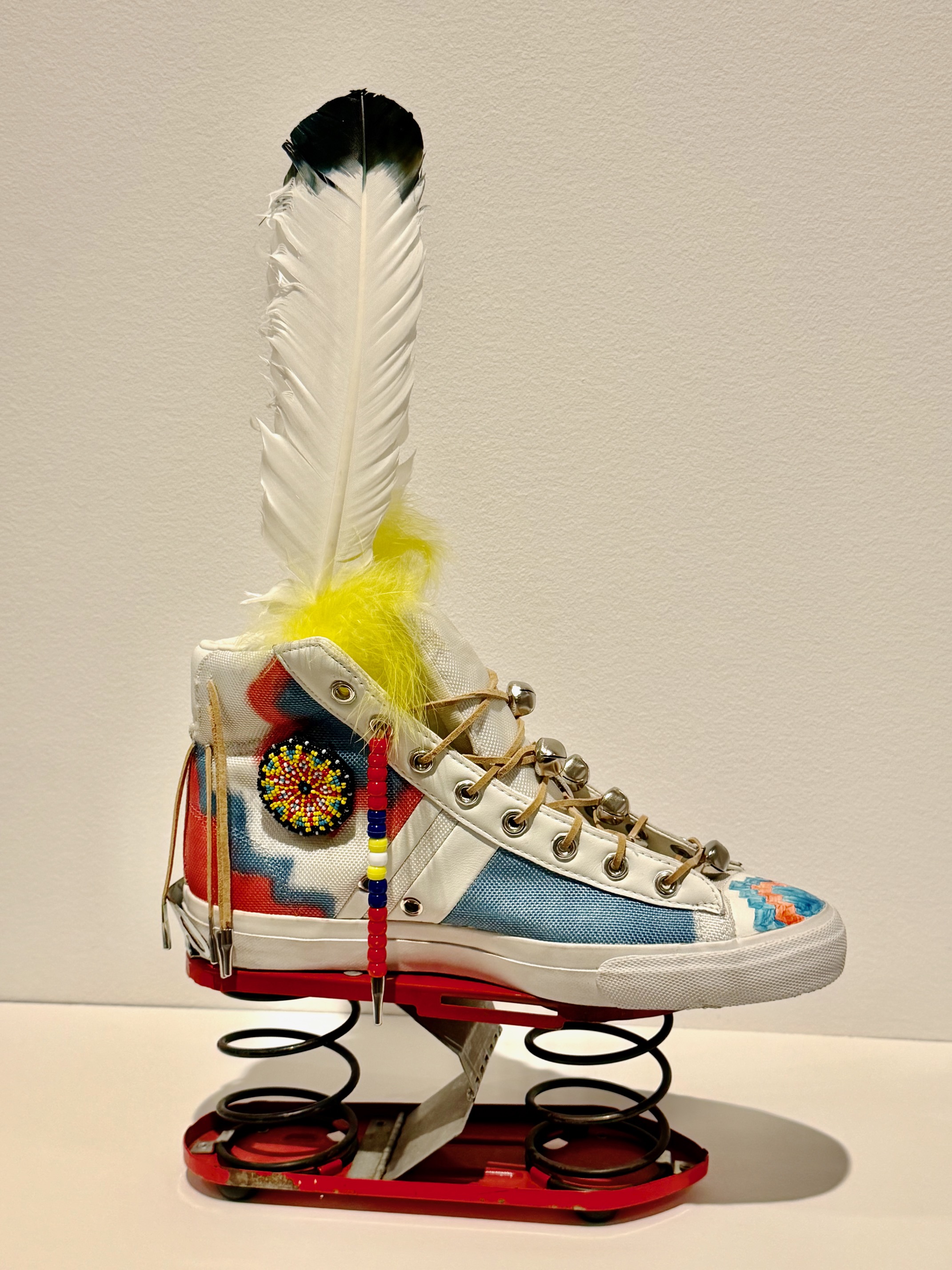
1990 sculpture War Dance Technology by performance artist James Luna (Payomkowicham, Ipai, and Mexican). Courtesy: Gochman Family Collection.
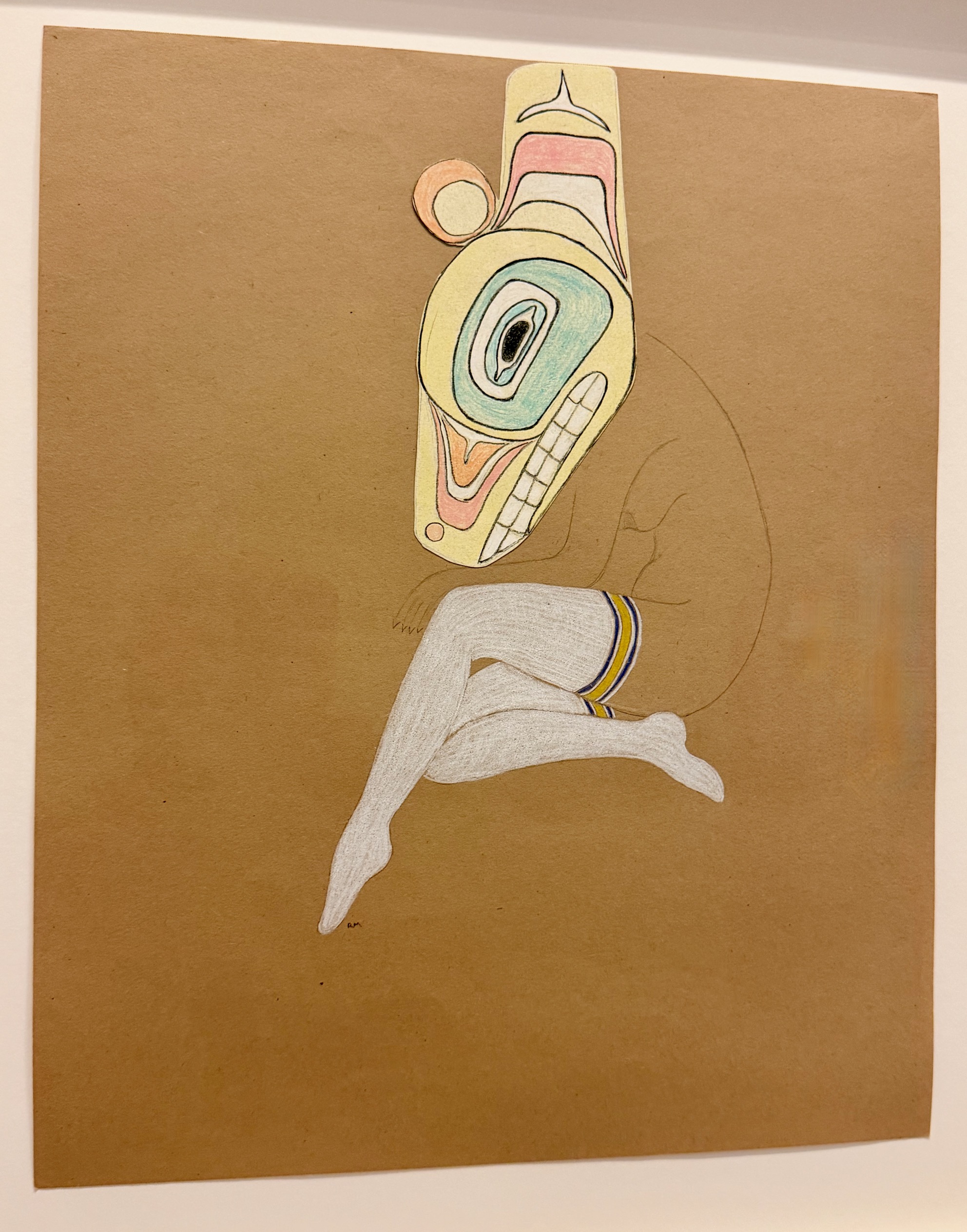
2014-2022 graphite and colored pencil drawing Killer Smile by Rachel Martin (Tlingit/Tsaagweidei, Killer Whale Clan of the Yellow Cedar House Eagle Moiety). Courtesy: the artist.

The back gallery takes us back into time to consider the irony of early ethnomusic recording in the Pacific Northwest during a period when potlatches were banned and ceremonies forbidden.  The exhibition has a beautiful installation of Native American LPs from the 1960s and 1970s beneath a stunning installation by Sonny Asu of copper recordings that cannot be played.
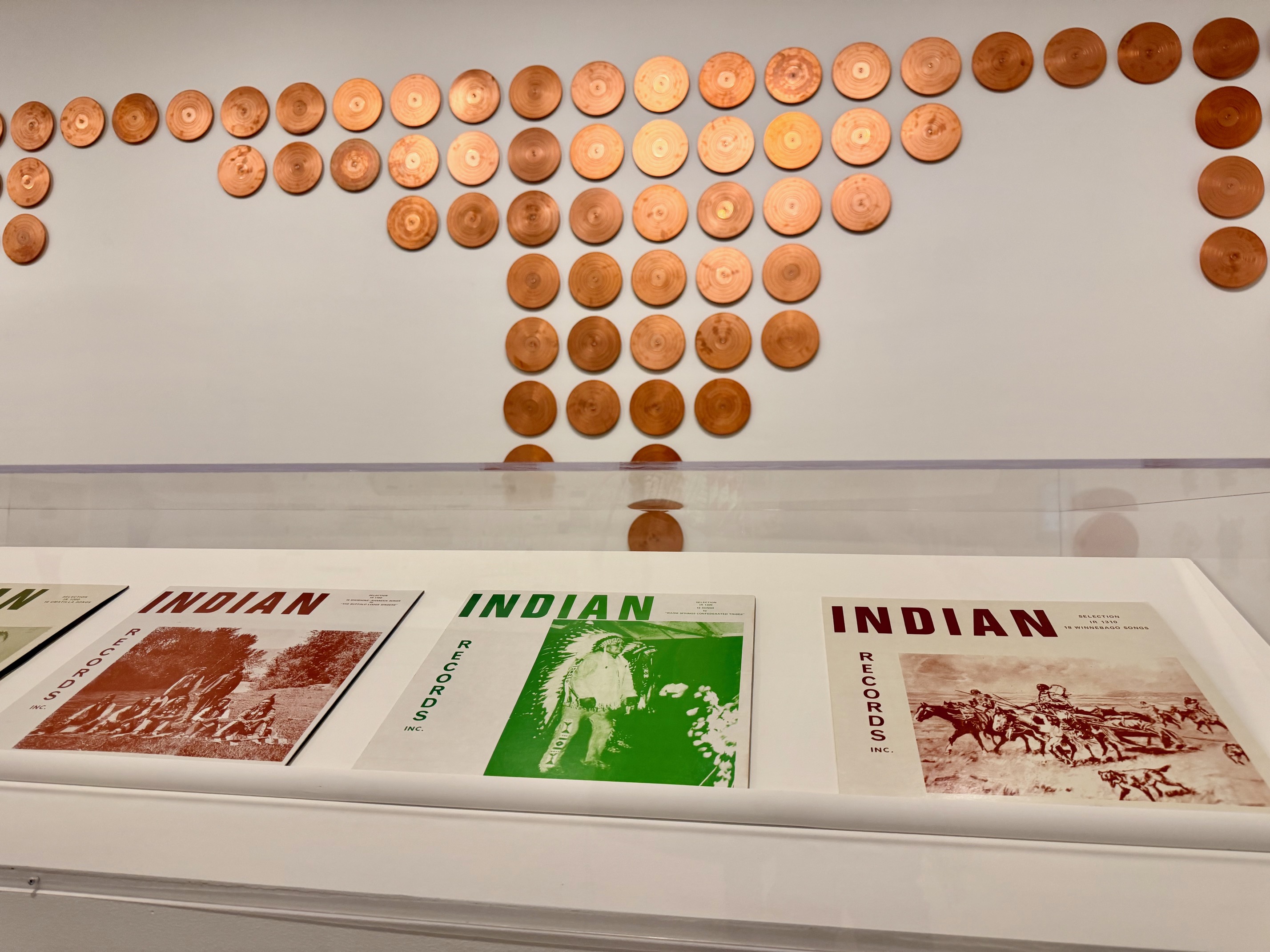
1960s-1970s LP recordings of Native American tribal songs by Indian Records; at rear, 2012 copper record installation “Ellipsis” by Sonny Asu (Ligwilda’xw Kwakwaka’wakw from the Wei Wai Kum Nation) – 138 records not intended for play. Courtesy: Forge Project Collection, traditional lands of the Moh-He-Con-Nuck.
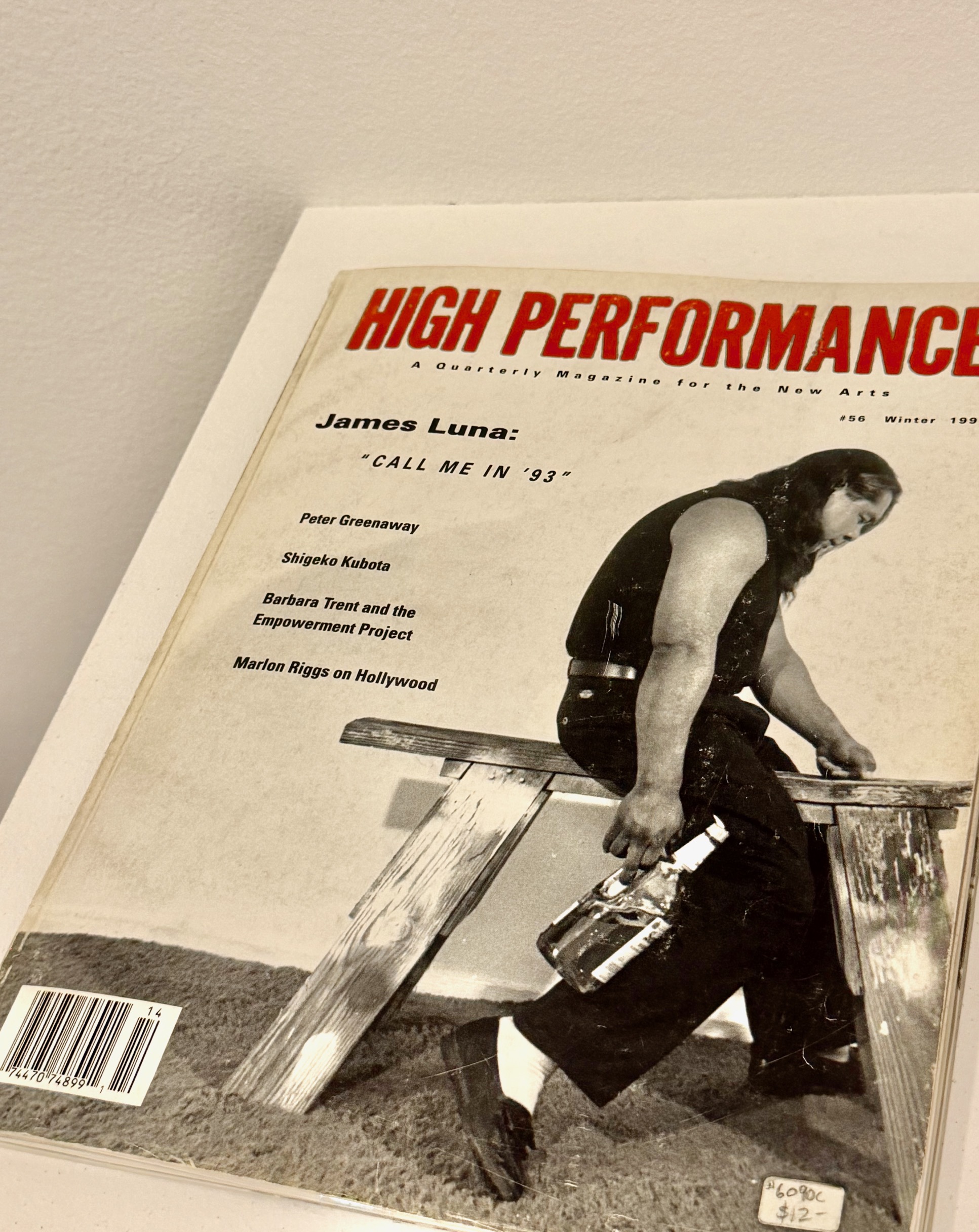
1991 High Performance art magazine cover featuring James Luna during his AA Meeting/Art History performance.

In every room, videos display performances on stages (Jeffrey Gibson or Spiderwoman Theater) or in nature (asinnajaq (Inuk). One room is devoted to a set, props, and documentation of work by the influential performance artist James Luna, whose art did not shy away from the ever-present issue of alcoholism in Native communities.

The exhibition also includes an immersive, highly theatrical, multi-gallery installation by the New Red Order. Here’s the manifesto by NRO’s Adam and Zach Kahalil (Sault Tribe of Chippewa Indians) and Jackson Polys (Tlingit).
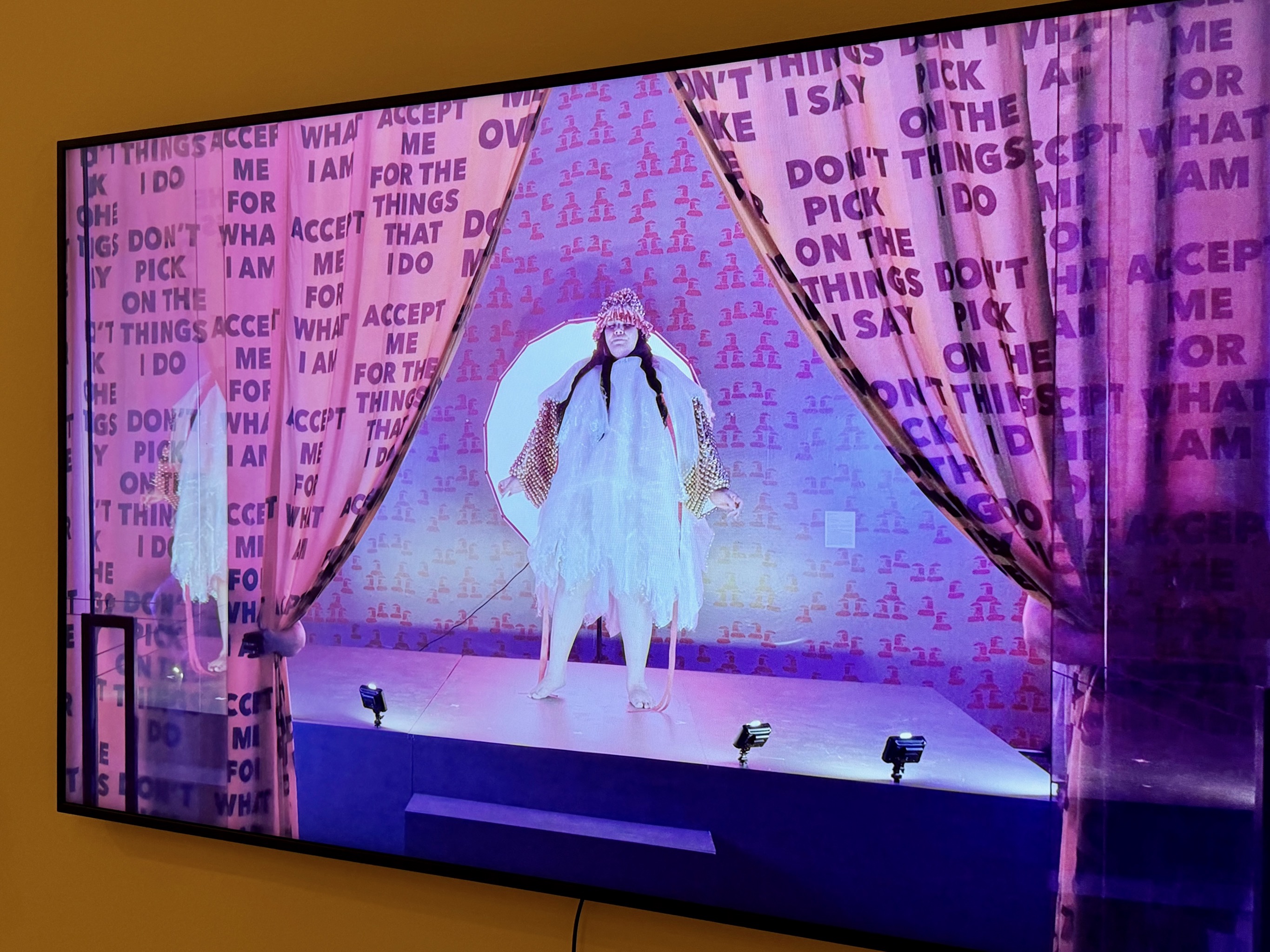
2023 performance documentation video of Don’t Make Me Over by Jeffrey Gibson (Mississippi Band of Choctaw and Cherokee) featuring performer Ariel Twist (Nehiyaw). Courtesy: the artist.

NRO uses satiric videos, props, murals, documents and timelines,  merchandise, and graffiti style to illuminate collisions of history, pop culture, and consciousness surrounding urban Native communities today – a totally head-spinning (and brain-spinning) experience.

Video of the 2020-ongoing Progenerator installation by the New Red Order, a mixed-media installation by artists Adam and Zach Kahalil (Sault Tribe of Chippewa Indians) and Jackson Polys (Tlingit) that probes societal stereotypes alongside non-Natives’ fascination with Native culture. Courtesy: the artists.

And thanks to the recreation by Erica Lord, SITE Santa Fe visitors were able to experience Artifact Revisited. Erica recreated an acclaimed 1987 performance by James Luna – a still Native body on display within a museum, encased in glass. In Erica’s recreation, her “cabinet” was surrounded by museum signage purporting to explain “Indians” and provide context for the “exhibit.” In the age of NAGPRA, the experience was unforgettable. Watch the performance heare, and listen to Erica explains how she came to perform this historic piece and how it felt.

For more background on the connections between Native American theater, politics, and art, here’s a link to the recently published book about this never-before-told story.
Watching Clay Artist Jody Folwell Break the Rules

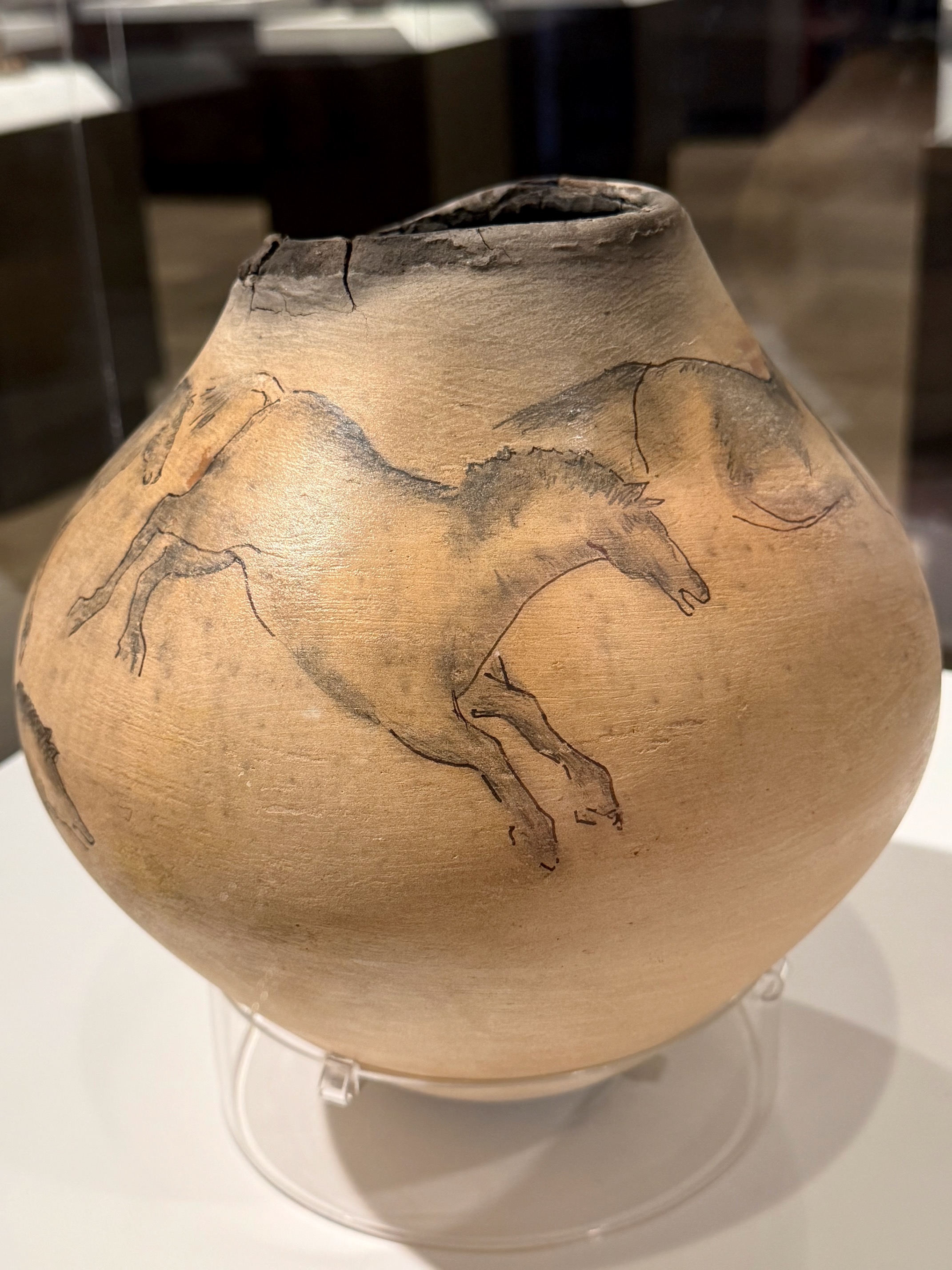
Contemporary ceramicist Jody Folwell (Santa Clara Pueblo) always knew she was going to make art that was a bit different, even as she was learning traditional Pueblo pottery making at the kitchen table from her her mom, celebrated artist Rose Naranjo. Satirical, sculptural, social-political, and avant-garde ceramic statements line the gallery from start to finish in O’Powa O’Meng: The Art and Legacy of Jody Folwell, a celebratory retrospective exhibition at the New Mexico Museum of Art through September 13, 2026.

The Santa Fe stop is the final on the exhibition’s journey across the United States, which started at the Fralin Museum of Art at the University of Virginia.

2018 Ancient pot by Jody Falwell (Santa Clara Pueblo), with painting inspired by Lascaux cave painting; rim evokes fire’s importance to humanity’s art making traditions. Courtesy: private collection.

Walk through the show to see our favorites in our Flickr album.

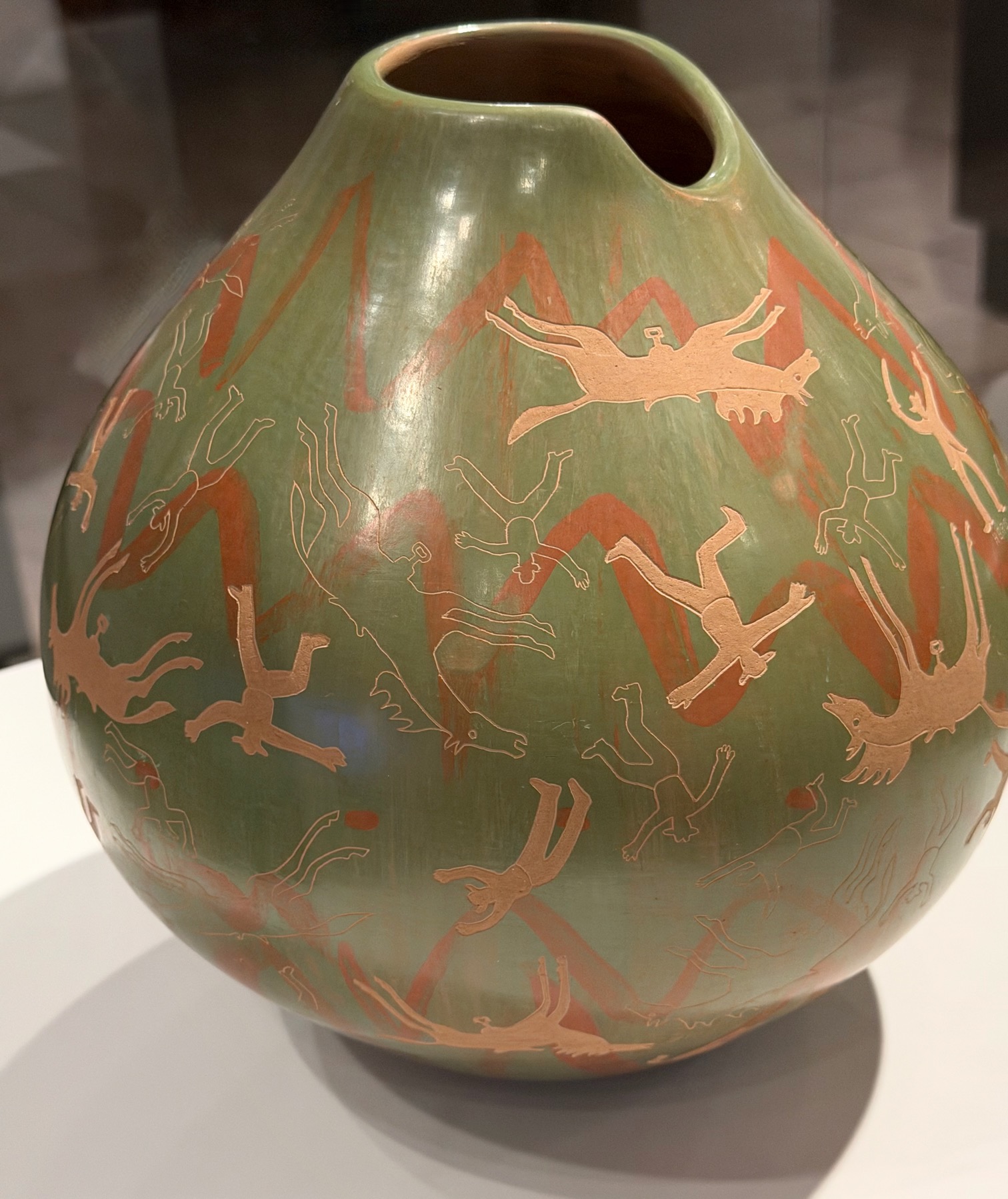
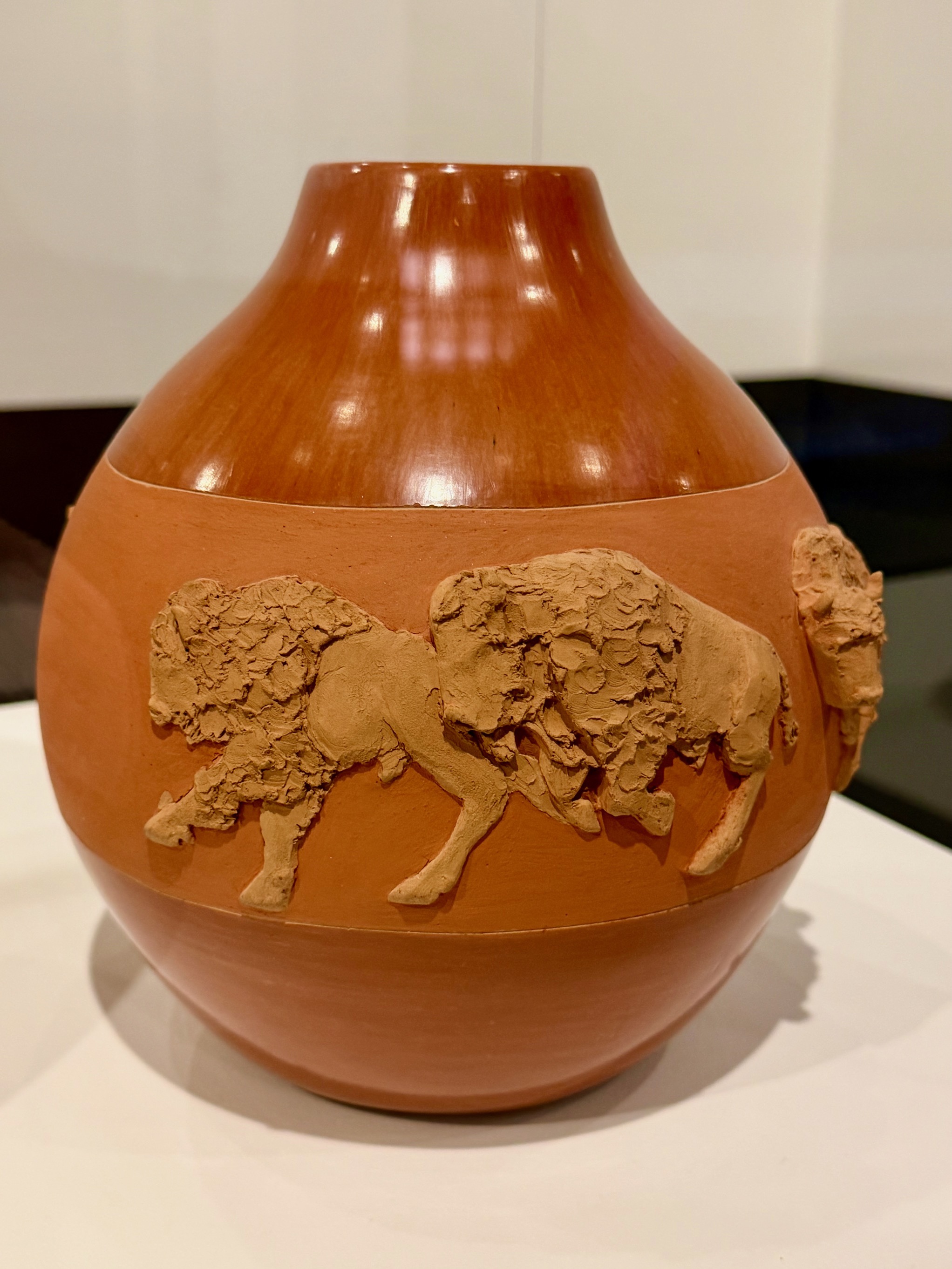
The exhibition does not unfold chronologically, even though it features some of Jody’s (and her family’s) most ground-breaking and controversial work. At one end is Half a Step, that she credits as one of her earliest nontraditional ceramic statements, featuring a lively bison thundering around the partially polished curved surface – a “half step” away from what was expected from Santa Clara pottery at the Santa Fe Indian Market in 1975. At the other end is her collaboration with the acclaimed sculptor Bob Hazous (Chiricahua Apache) that won Best in Show in 1984. Who had ever seen a green Pueblo pot with loaded commentary?

1975 Half a Step pot by Jody Falwell (Santa Clara Pueblo) – featuring sculpted animals and an unpolished band. Courtesy: Museum of Indian Arts and Culture.
Jody’s 1984 Hero Pot collaboration with Bob Hazous (Chiricahua Apache), awarded Best in Show at that year’s Santa Fe Indian Market for its unconventional color, shape, and subject. Courtesy: private collection.

Collaborations, social commentary, sculptural details, and different painting styles encourage gallery goers to move slowly, stop, look, and circumnavigate each work to let the beauty, humor, or story sink in. Jody’s recent multi-pot ceramic installation The Cycle of Pottery is Us causes viewers to stop, think, and reflect on not only the persistence of the traditional Tewa art form, but of the entire human cycle of birth and rebirth.

Detail of Jody’s 2024 The Cycle of Pottery is Us, a sequential reference to black-and-white Ancestral Pueblo ceramic traditions, the art form’s near-loss 50 years ago, and its resurgence. Courtesy: Tia Collection.

As cultural appropriation carries a loade charge in the art world, Jody’s feels that her fascination by sinuous designs of other cultures, the cheekiness of Pop culture, and admired styles of epochs in Western art history gives her license to honor them. She incorporates Plains Indian ledger book style, Maori iconography, comic books, and even the cave paintings of Lascaux.  A wide lens from her travel and studies delights visitors as she takes them on a world journey of history, art, and people.

2008 Northwest Coast Art 101 incised with a tribute to her love of fluidity of Pacific Coast design; at rear, 2006 Doh San Quah (I Stole It) painted in Plains Indian ledger style. Courtesy: private collections.

The feelilng behind the show chronicles how much the maternal ceramic making tradition means to her. 

2013 Star Wars pot by daughter Susan Folwell (Santa Clara Pueblo), with images of Hopi style and cosmologies. Courtesy: Fred Jones Jr. Museum of Art at University of Oklahoma, Norman.

The exhibition includes a large traditional bread making bowl by her mother as well as work by her daughters and grandchildren – accomplished artists in their own right.

Jody titled her show O’Powa O’Meng (“I came here, I got here, I’m still going”) to demonstrate her continued commitment both to innovation in her art form and to inspire the next generation of contemporary artists.

Several pieces involve a mix of tiles (some broken) and pots with incriptions or depictions woven across all of them, such as The Buffalo Hunt that she created for the Santa Fe installation and Buffalo Soldier, a meditation on Obama’s historic presidency and the enslaved workers who originally built the White House.

Hear more about pushing the boundaries from inside a Tewa home dedicated to art making from Jody and daughter Susan as they talk about exhibition’s final stop with curator Jill Ahlberg Yohe at Santa Fe’s New Mexico Museum of Art.

Makowa: Modern Skywatching with the Ancients

Look up at the night sky and find patterns in the stars. You can do that, even though you’re standing inside the exhibition Makowa: The Worlds Above Us at Santa Fe’s Museum of Indian Arts and Culture through January 31, 2027. The wall-sized photo murals of day and night skies provide the backdrop to sculptures, pottery, and textiles with stylized images of stars, planets, the Sun, Moon, meteors, and changes of season.

Beautifully crafted objects and immersive photos provide contemplative spaces to consider the different types of skyward observations that Indigenous communities have made across millennia, and how stories and rituals convey this knowledge across generations.

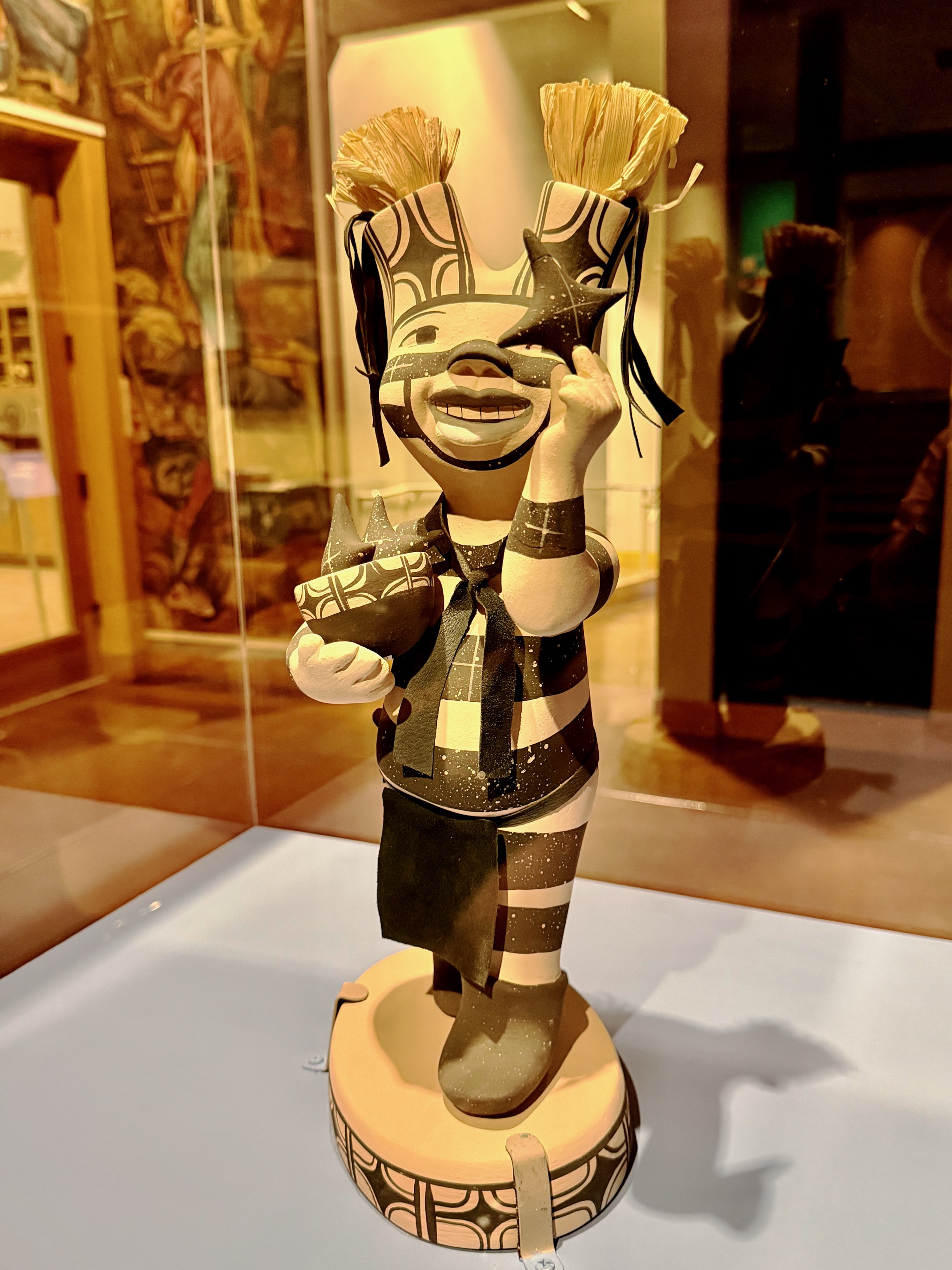
Exhibition welcome: 2009 Evening Star ceramic sculpture by Kathleen Wall (Jemez Pueblo) – a Koshare holds stars important to celestial calendar.

Kathleen Wall’s charming Koshare holding up the Evening Star welcomes everyone to the journey. Take a look through our Flickr album to see some of our other favorites.

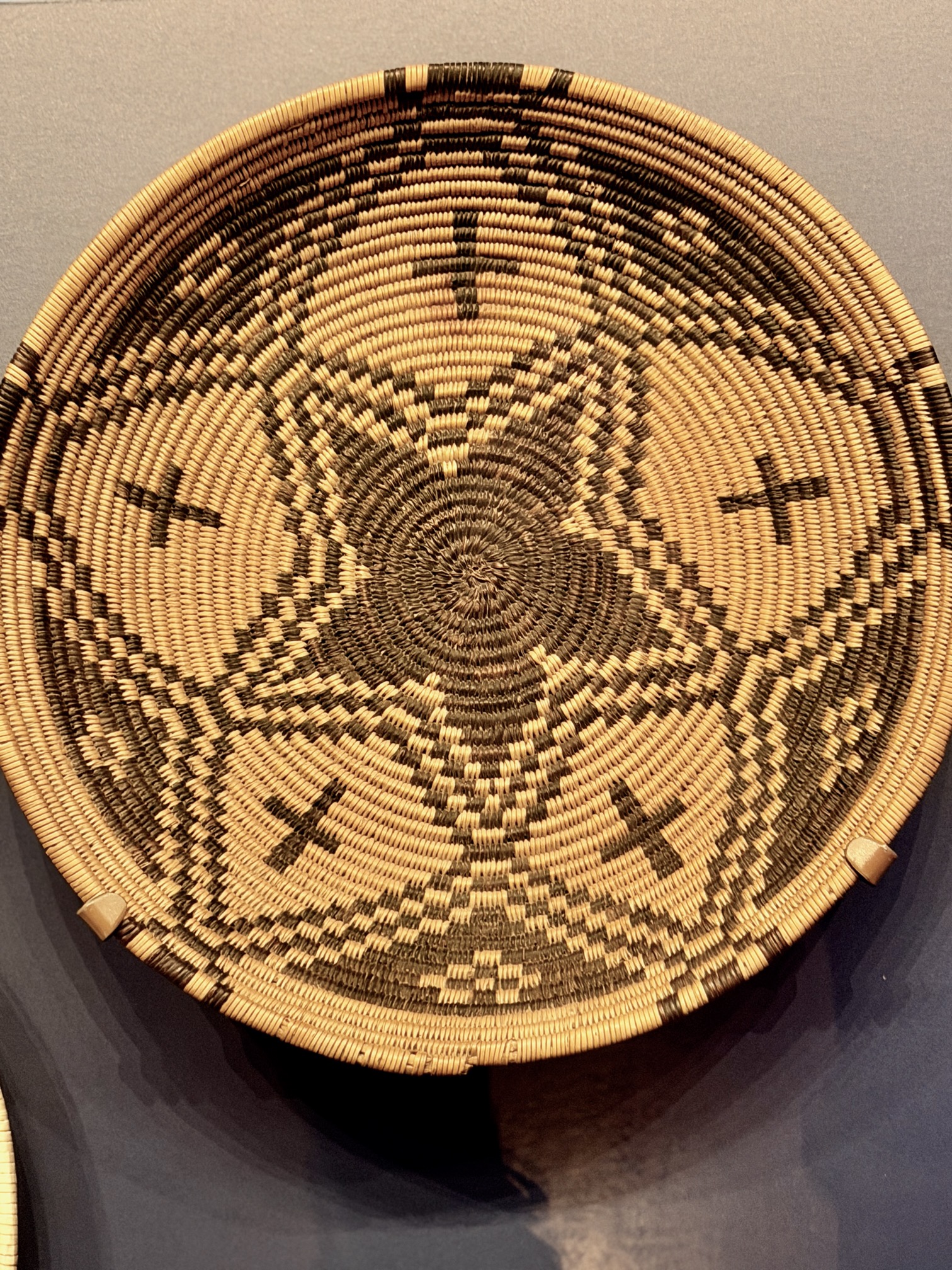
A mix of historic and contemporary art underscores the story behind star gazing. Tracking their slow movement across the night skies, sky watchers have long seen stars as important guides. The Ancients used petroglyph images as reminders of how to use ancestor stars for guidance – to tell time, mark seasons, and take journeys through vast desert landscapes.

Star patterns: 1930s tray woven by unknown Tohono O’ohdam artist.
2020 Star Child painting by George Toya (Jemez Pueblo), showing a star surrounded by ancestors in the night sky. Courtesy: private collection

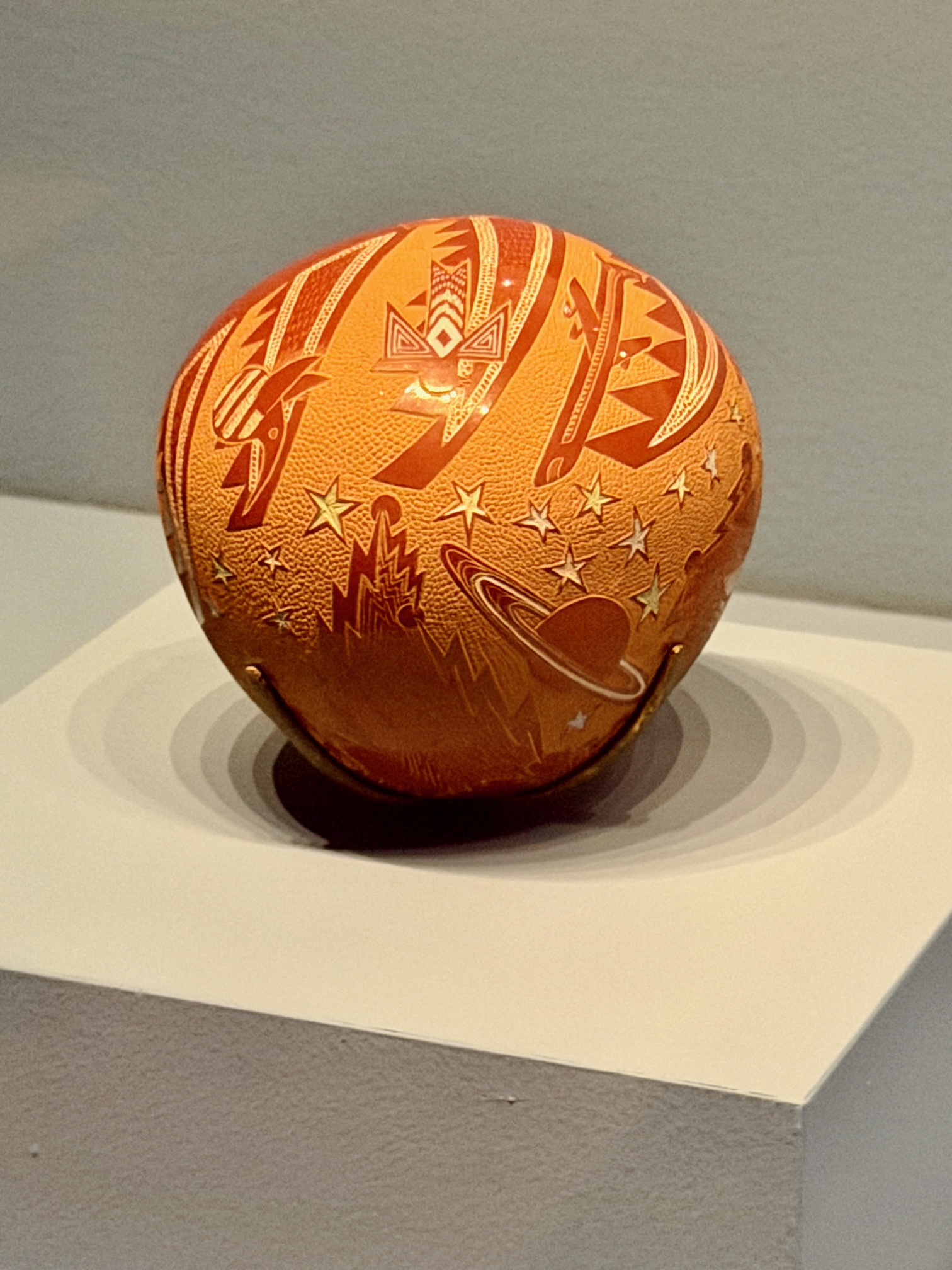
Recent artworks suggest a range of the activity in the day and night sky. Phases of the Moon inform agricultural cycles. Planetary alignments, meteor showers, and also plane traffic are all part of night-sky viewing today. Rosemary Lonewolf’s tiny pot summarizes this dynamism nicely.

Distant worlds and a crowded sky: 1992 miniature Spaced Out jar by Rosemary Lonewolf (Santa Clara Pueblo).
2000-2001 sand painting by Joe Ben Jr. (Diné) linking phases of the Moon to planting cycles.

The curators show how traditional symbols of clouds, sky, and sky dynamics are learned, used, and adapted over the centuries by exhibiting modern woven regalia alongside ancestral Puebloan pots from Chacoan culture. It shows that abstract Indigenous symbols do not exist in a single place and time – they are used and reused.

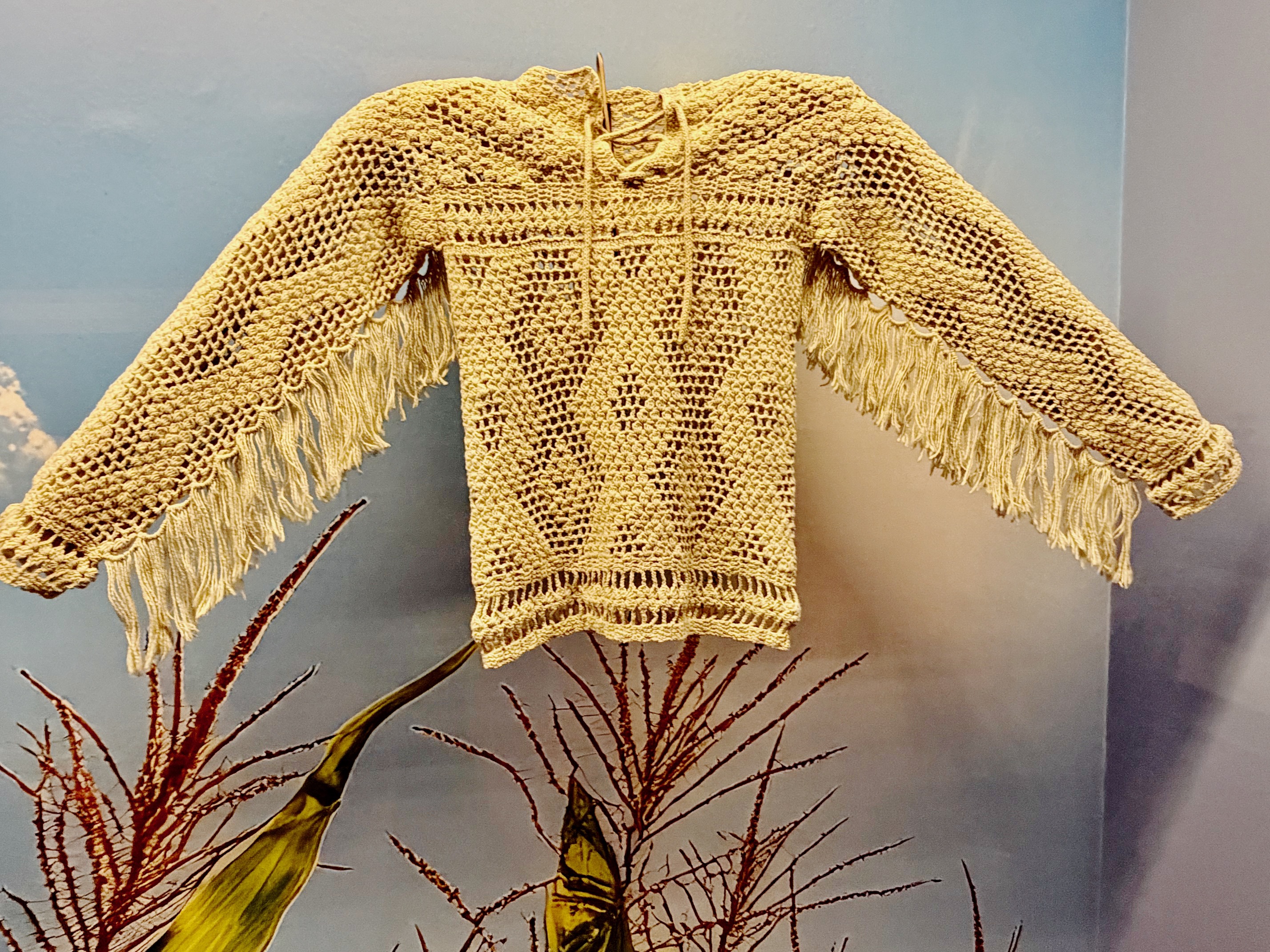
Acknowledging the lively, changing sky: 1984 shirt with sky symbols woven by Evelyn Quintana (Okay Owingeh) with Ancestral Pueblo ceramics below.

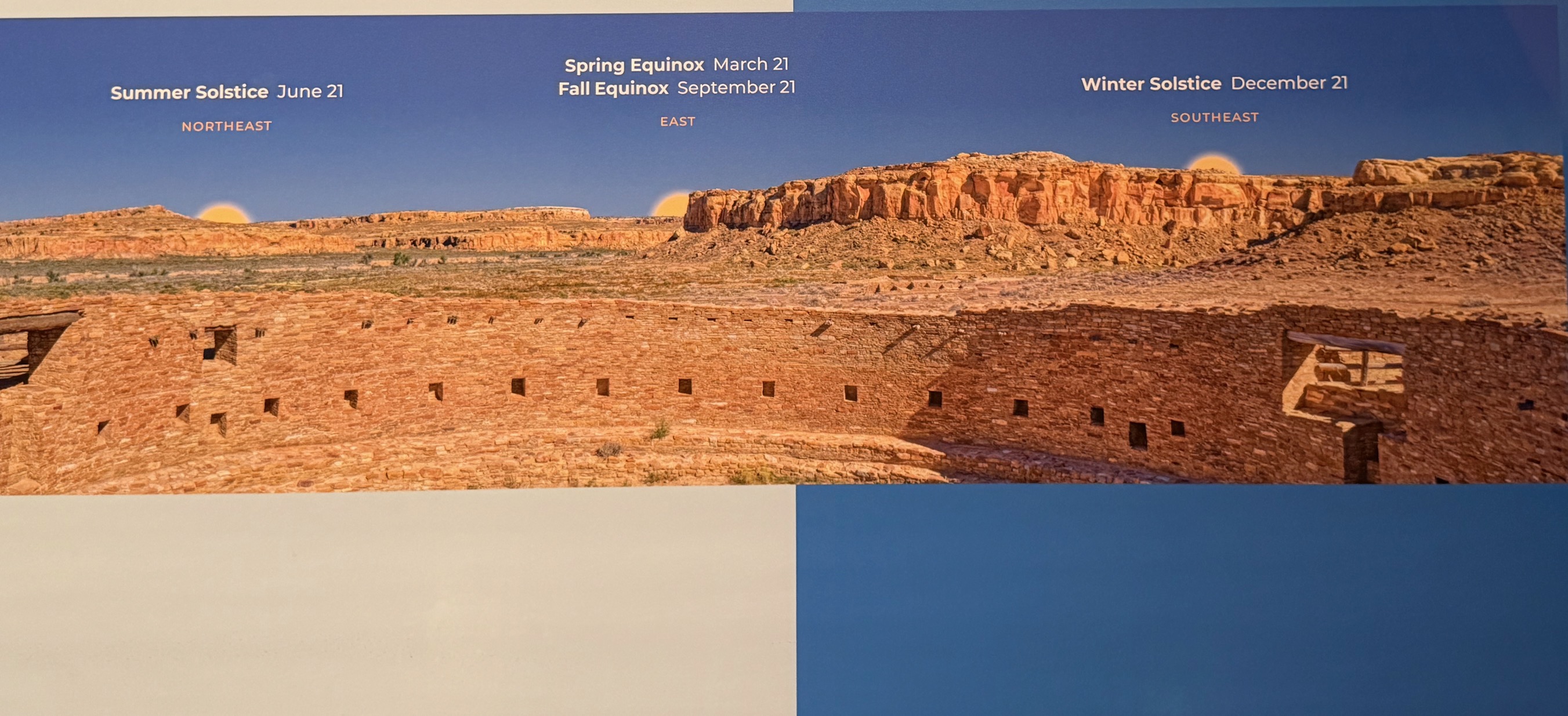
The exhibition also takes a deep dive into how ancient architecture and landscapes across the Four Corners are used to mark cardinal directions, annual cycles, and astronomical phenomenon. Chaco’s magnificent kivas are featured in dramatic photo murals that show how a combination of architecture, horizon markers, and sunrise to mark the seasons.

Equinox and solstice: Duke Johnson’s 2022 photo of the Great Kiva Casa Rinconada at Chaco Canyon showing where the Sun rises against the landscape at key times of the year.

Aerial photographs show how buildings reflect astronomical alignments. Most visitors stand intrigued before an archaeoastronimical explanation of Chaco Canyon’s famous Sun Dagger, which transformed Fajada Butte into an observatory to mark the solstice and equinox.

Google Earth photos of Chaco Canyon National Historic Park. showing how structures are aligned to the cardinal directions – Pueblo Bonito and the Great Kiva at Casa Rinconada.
Visitor watches the Sun Dagger Explorer, a virtual experience of the archaeoastronomy site on Fajada Butte in Chaco Canyon. Courtesy: Advanced Computing Center for the Arts and Design at Ohio State University, The Solstice Project, and the New Mexico Museum of Natural History and Science.

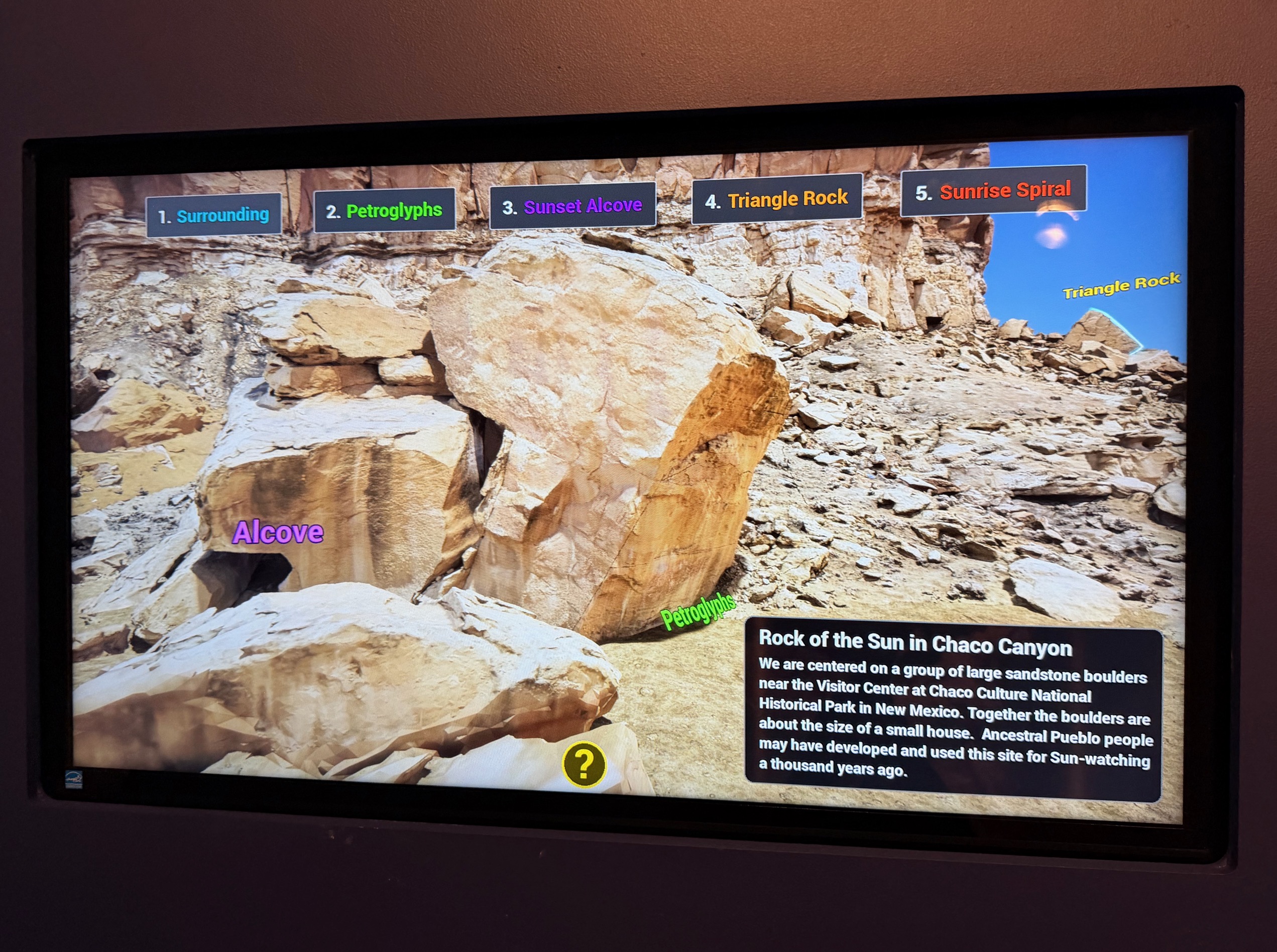
Best of all, visitors themselves can explore the video interactive of another Chaco site – Rock of the Sun – to experience what it’s like to interact with petroglyphs, shadows, and the skies to mark time within the year. Nearby, there’s a copy of a petroglyph (carving into stone) that archeoastronomers suggest could depict an exploding star that was visible for 3 weeks in the year 1054.

Interactive video screen that provides visitors with a virtual experience of Rock of the Sun, an archaeoastronomy site in Chaco Canyon National Historic Park.

Other sections of the exhibition focus on the animals that serve as sky messengers – bats, eagles, and other birds – and rituals that honor the four cardinal directions.

One of the key themes here is to respect the elements – not try to control them – which is emphasized brilliantly in the final fitting tribute to these scientist farmers. Phenomenon such as rain, wind, clounds, and thunder seemed unpredictable to the Ancients, so ceremonies and dances were performed to convey desire for favorable elements. Beautifully woven cotton garments, paintings, and ritual headgear are rich in layered meanings – seasonal calendars, rain, and lightning.

Farmer scientists: 1920-1940 cotton shirt featuring zigzag lighting patterns by unknown Okay Owingeh artist.

It’s a reminder of the intergenerational wisdom used to coax agricultural bounty from the seemingly barren stark desert.

For deeper insights, the curators recommend a visit to the Star Stories website by WeRNative and the Native Skywatchers website.

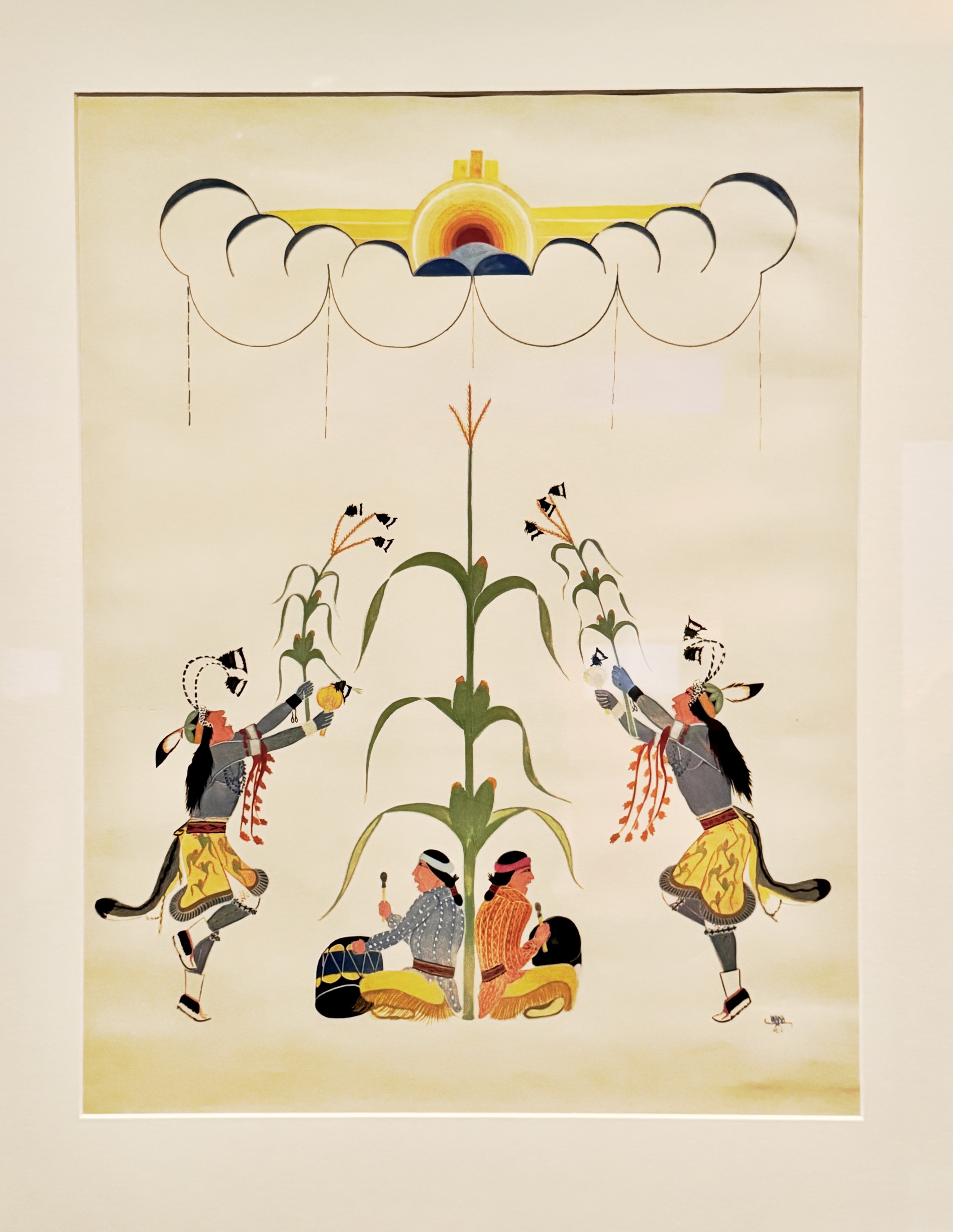
1938 painting Mythical Corn Ceremony by Ignacio Mosquino (Waka Yeni Dewa) (Zia Pueblo).
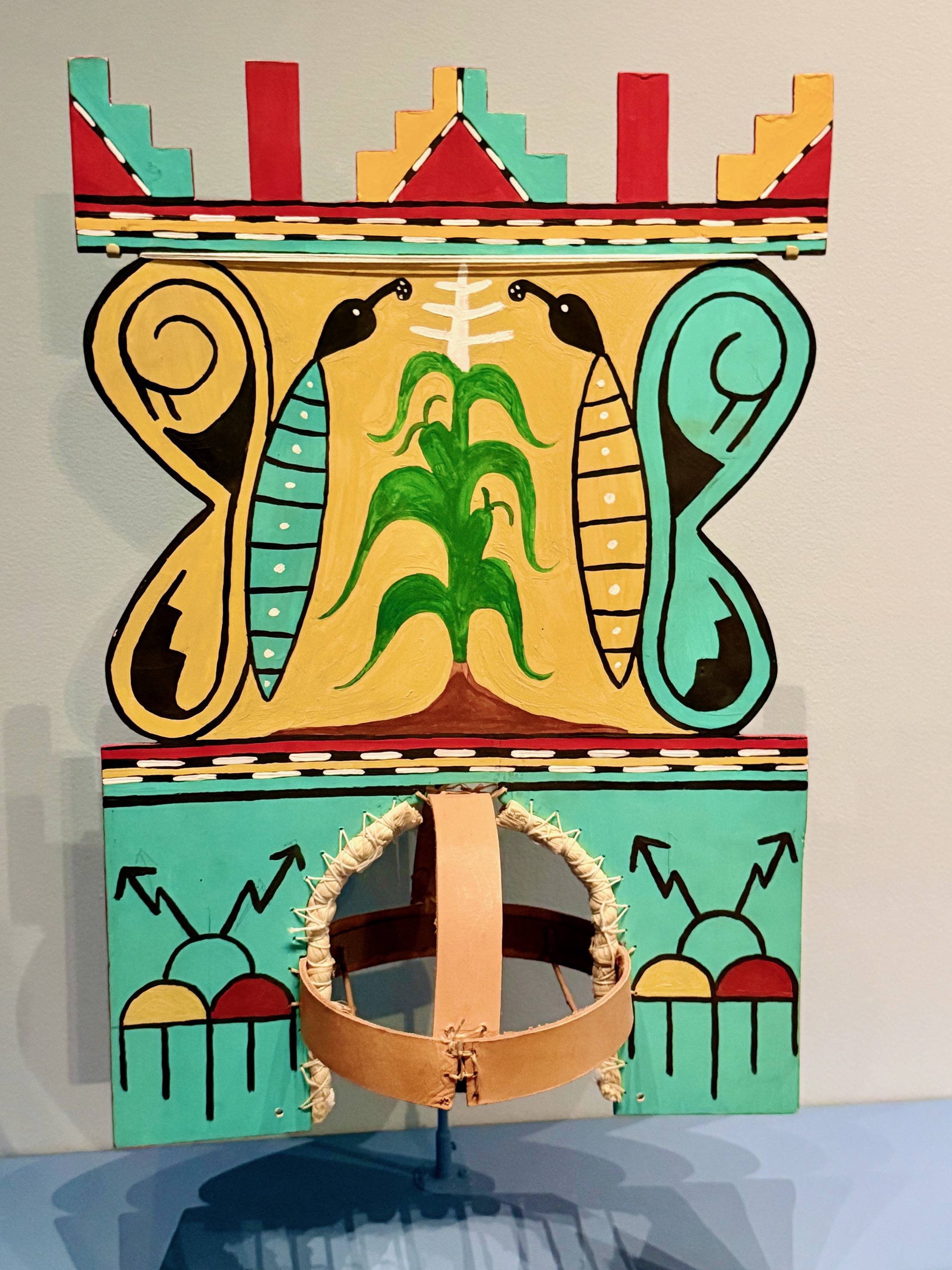
2005-2009 Hopi tablita Butterfly Maiden by unknown Hopi artist.

WWII Veterans Flock to Make Art in Taos

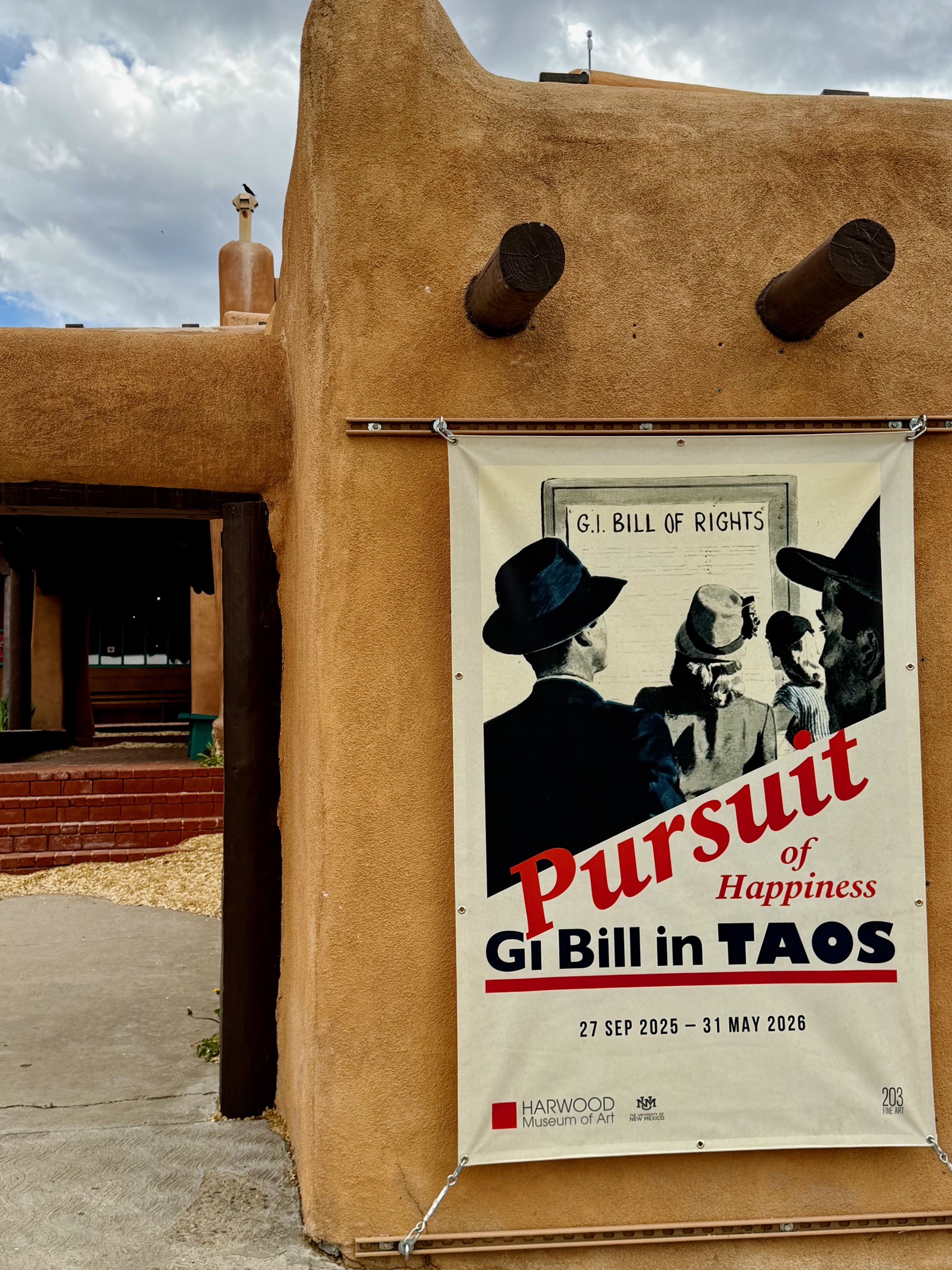
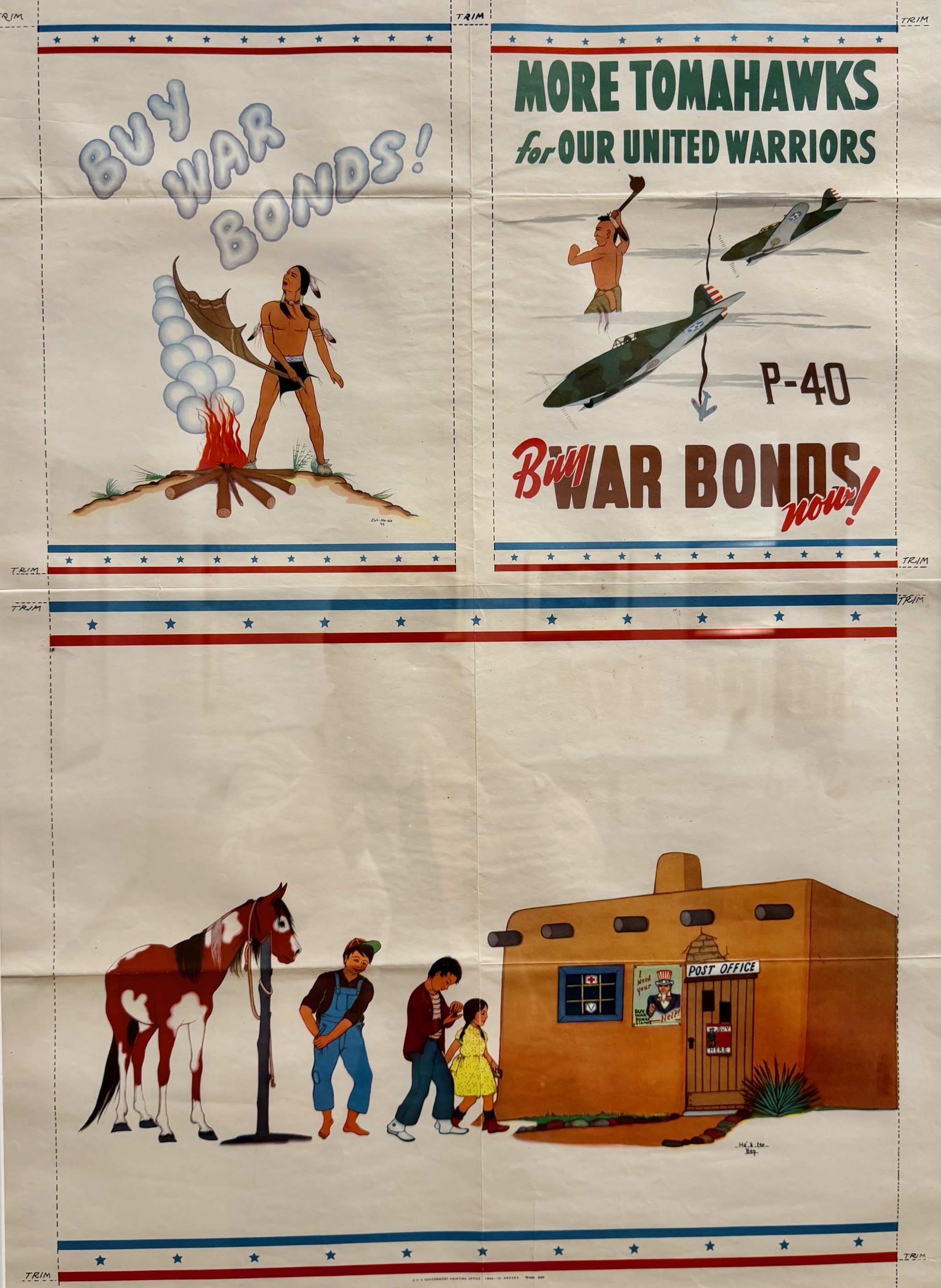
The quiet adobe museum entrance displaying a retro WWII-era poster prepares no one for the ultra-modern abstraction extravaganza inside the Harwood.

Pursuit of Happiness: GI Bill in Taos, on view through May 31, 2026, shows and explains how an influx of rule-breaking painters from both coasts returned from the War, enrolled in contemporary art classes, and created the mid-century phenomenon that art historians classify as Taos Modern. Take a virtual visit in our Flickr album.

Harwood Museum of Art entrance in Taos

The exhibition tells the story of young people who first applied their talents to defend America in Europe, the Pacific, and the home front, and then chose to channel their energies and experiences through color and paint on large canvases to give life to postwar Abstract Expressionism, big-field flat color painting, and innovative materials.

The exhibition captures both the energy and optimism of the moment and shines a light on the mentors, teachers, and educational institutions that gave these vets a platform to experiment as social realism’s dominance in the art scene was giving way to new expressions – inner spiritualism, bold strokes, and white canvases with wide open spaces.

South Pacific Army airman Wolcott Ely’s undated oil From the Seas that are South – trained in Paris and was a private student of Andrew Dasburg in New Mexico. Courtesy: Taos Municipal Schools Historical Art Collection.

Mid-century modern dominates the exhibition, but there are a few references to artists’ wartime experiences – dramatic ink drawings from Oli Shivonen’s European war journals and Janet Lippencott’s expressive canvas that puts the viewer amid the carnage in London from one of Germany’s final bombing raids – something she experienced as a WAC serving on Eisenhower’s staff.

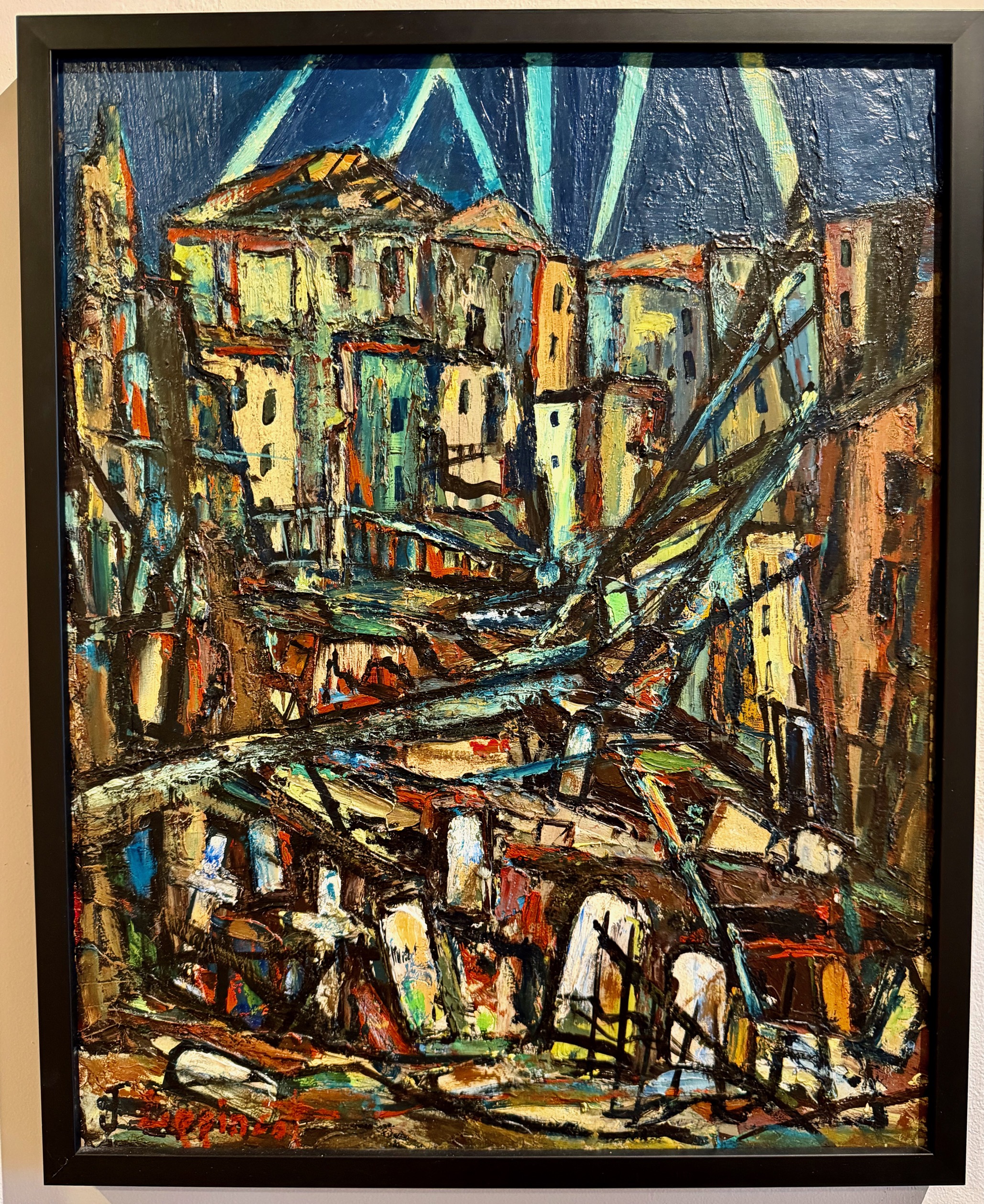
Janet Lippencott’s 1940s painting Raid – reflecting her experience as a WAC in London during one of Germany’s final 1944 bombing raids; in 1949, she used the GI Bill to study at the Bisttram School of Fine Art.
An award-winning 1942 poster by Taos Pueblo artist, cartoonist, and Army veteran Eve Mirabal, who studied at the Taos Valley Art School. Courtesy: private collection.

The exhibition frames the work by highlighting the seasonal and year-round schools that welcomed students under the GI Bill of 1944, which provided WWII vets with benefits for education, mortages, and employment. A remarkably high percentage of veterans took advantage of this transformative legislation that built America’s middle class. To learn more, download the gallery guide here.

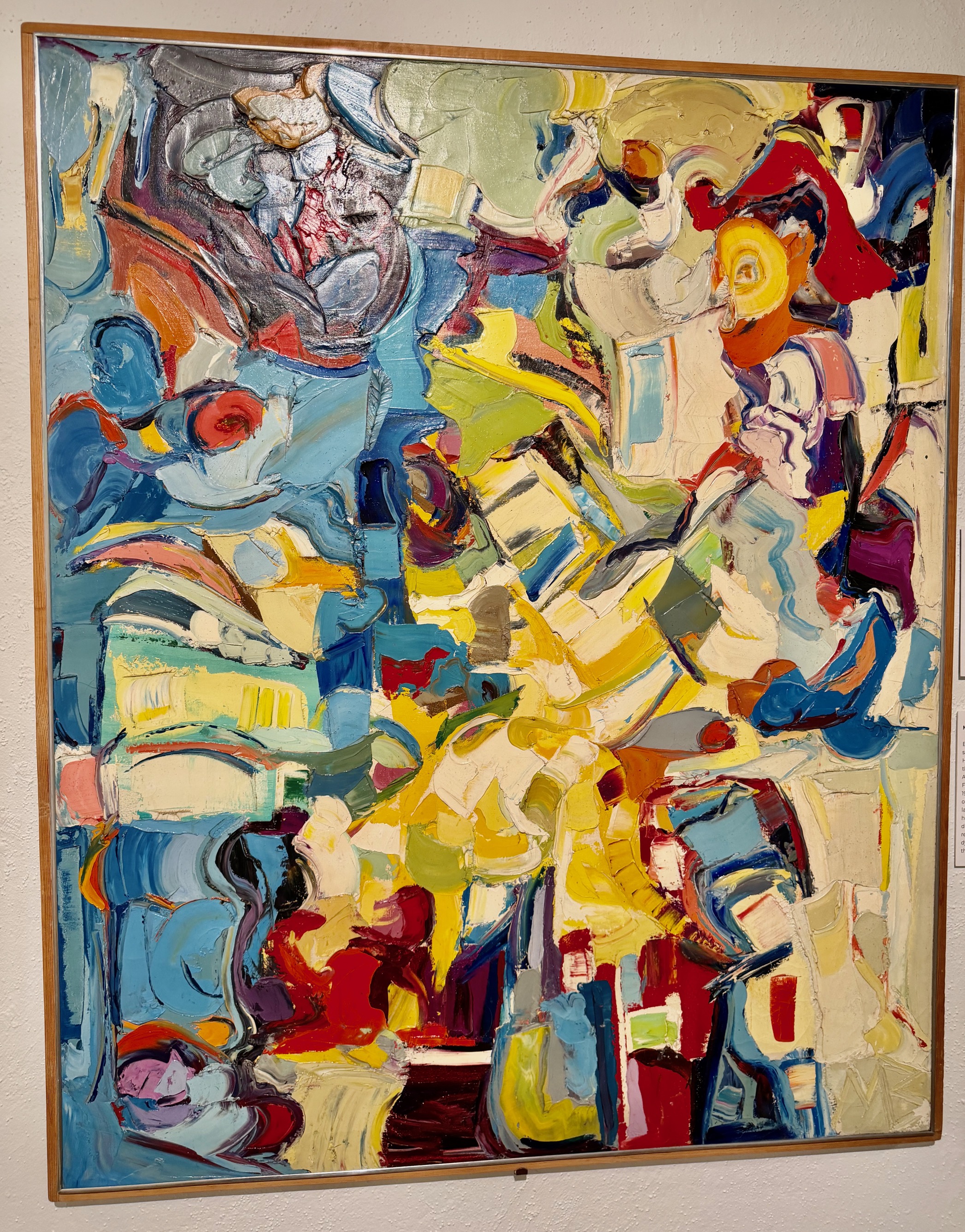
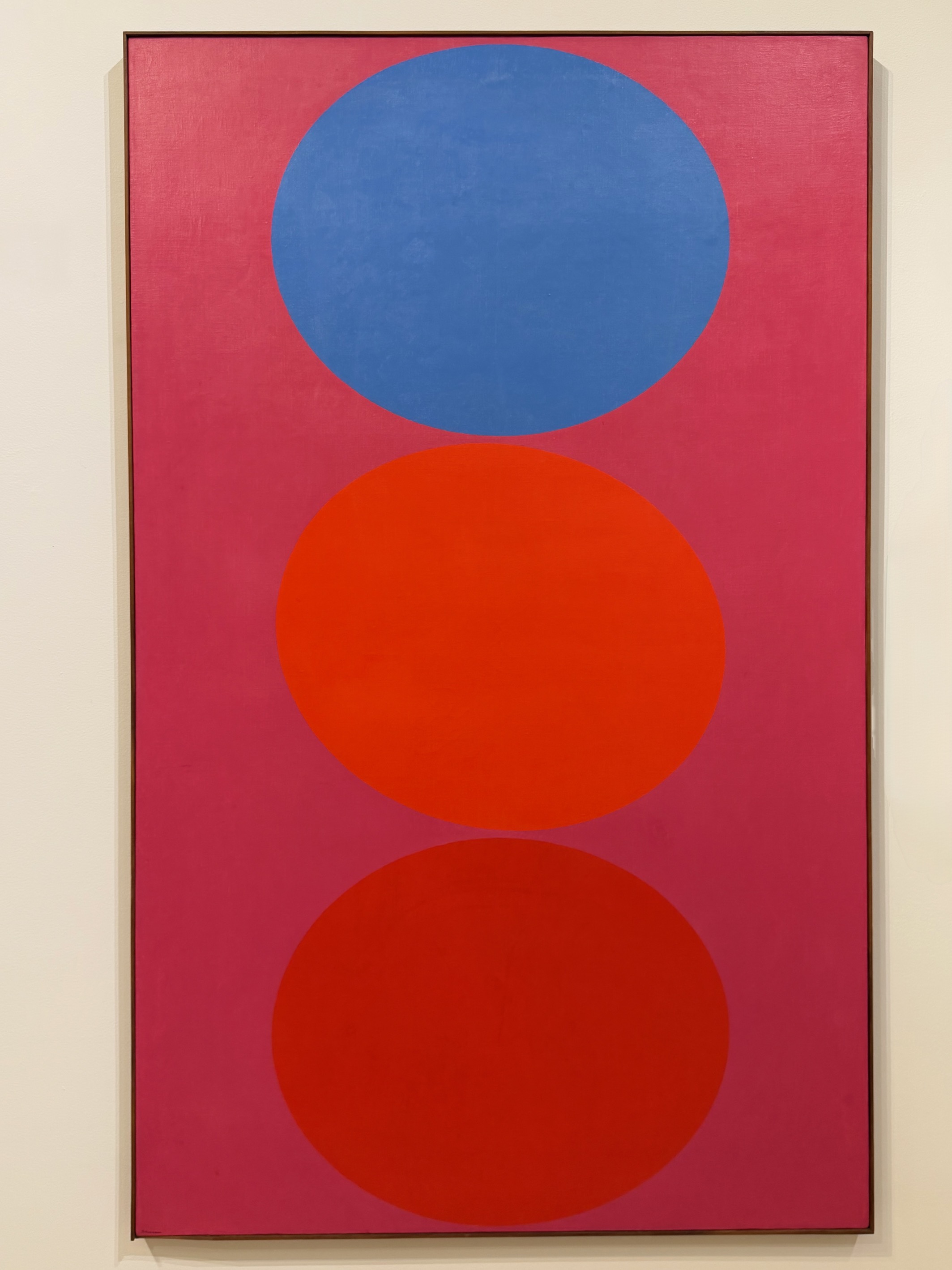
Gestural abstraction by a former student of the UNM Taos Field School on the GI Bill – Malcolm Brown’s 1960 oil painting Olaf’s Dream.

The earliest modern art program in Taos was the University of New Mexico Summer Field School, which began in 1929. Students worked and slept on the grounds of today’s Harwood itself. By the time that GI Bill students attended, property owner and philanthropist Elizabeth Lucy Harwood gifted her former residence – now the Harwood Museum – to UNM. The exhibition showcases work by former UNM summer students R.C. Ellis and Malcolm Brown.

Although she wasn’t on the GI Bill, the Harwood has an entire room full of the UNM program’s most acclaimed attendee, Ms. Agnes Martin, who shared studio space alongside returning war vets in 1947.

Transcendentalist artist Emil Bisttram also accepted GI Bill students into his seasonal fine arts program, which emphasized the principles of Kandinsky and European spiritual abstractionists. Although Taos was his home, Bisttram offered summer and winter fine arts sessions were in Los Angeles and Phoenix, where he taught. Janet Lippincott, who became a lifelong Taos resident, and Cliff Harmon, who also trained with Albers at Black Mountain College, are featured.

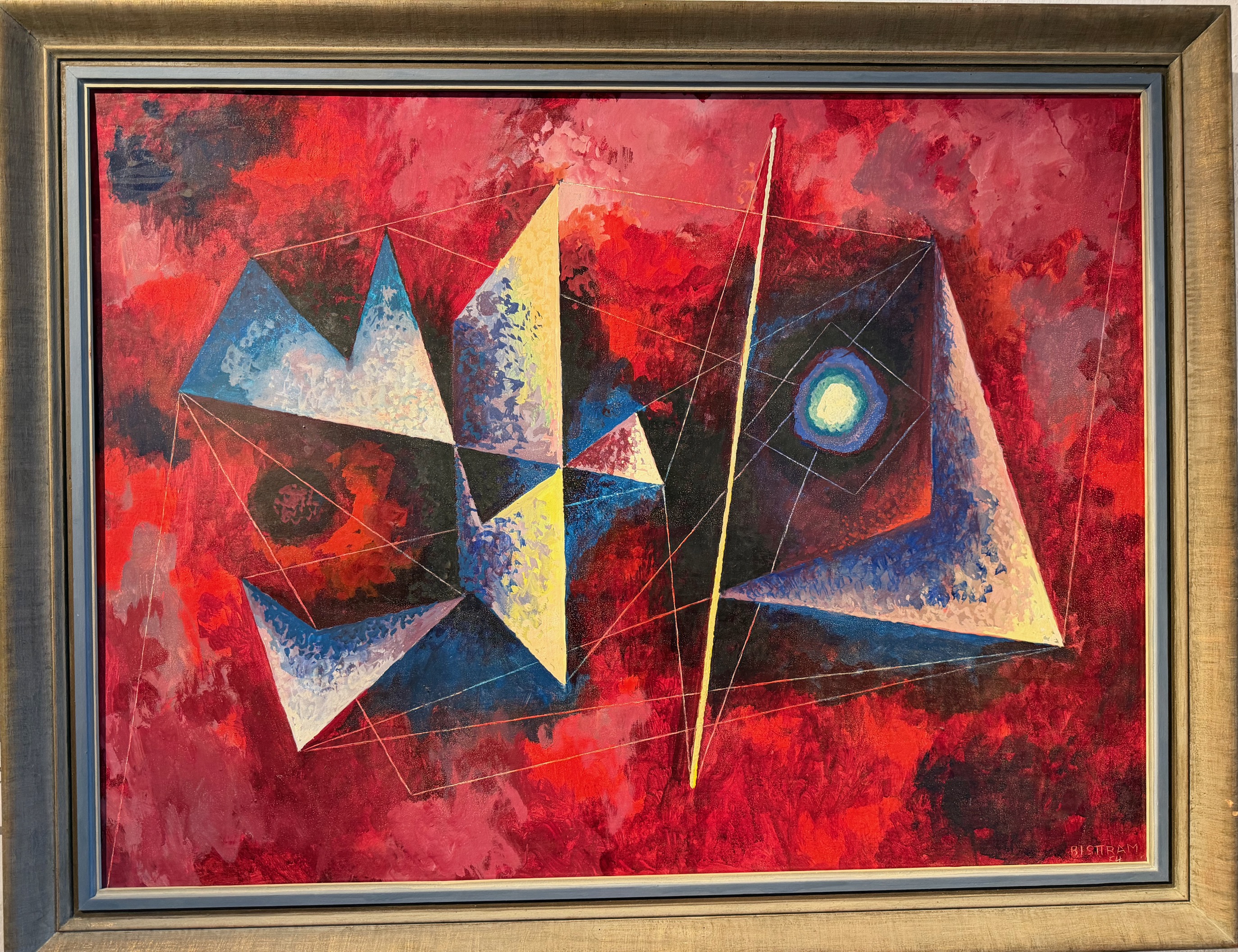
Founder of Bisttram School of Fine Art –transcendentalist Emil Bisttram’s 1954 geometric abstraction Out of Space.
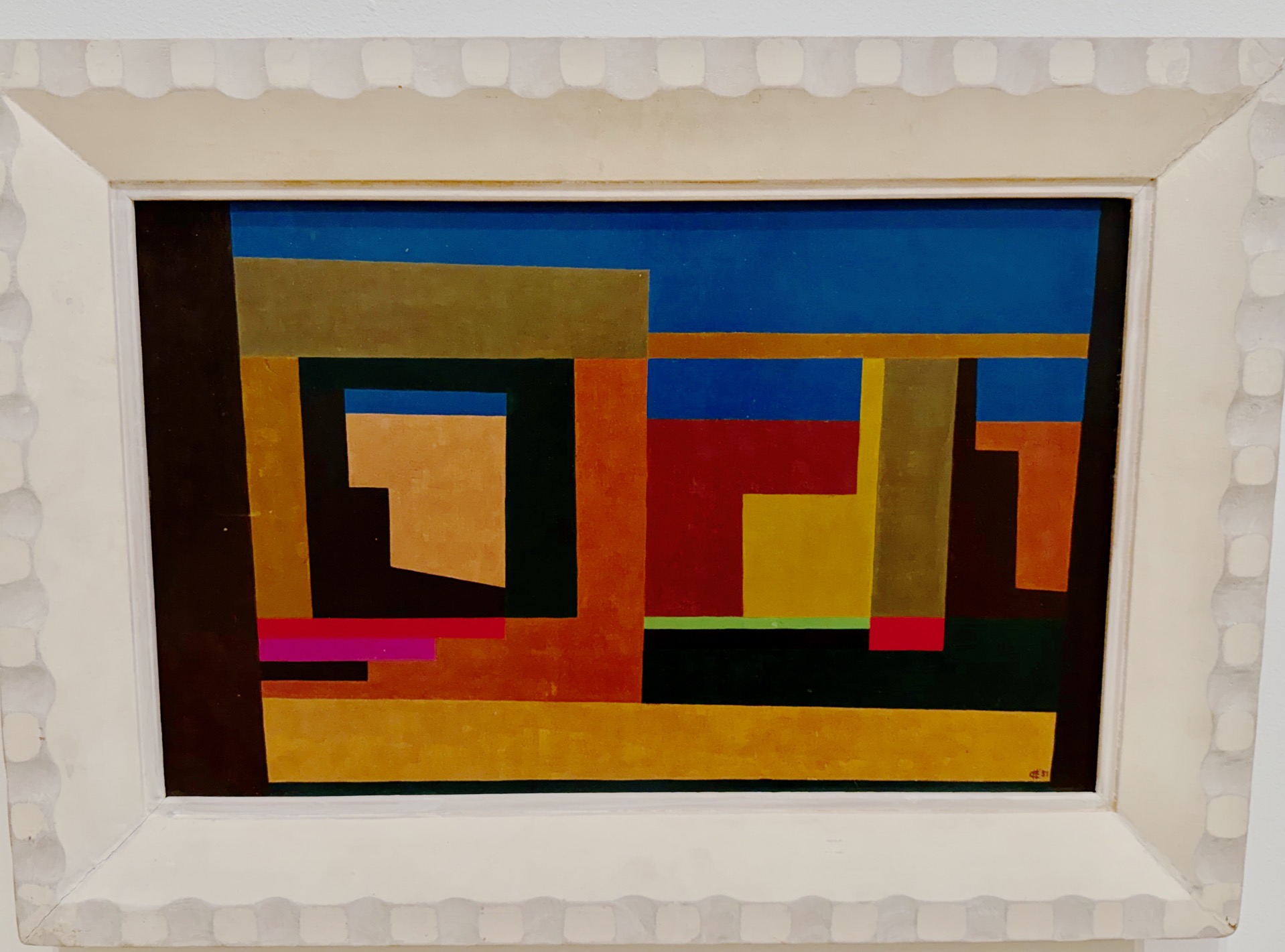
Work by a former student of Josef Albers at Black Mountain College and the Bisttram School of Fine Art on the GI Bill – Navy sonarman Cliff Harmon’s 1951 oil painting, Construction.

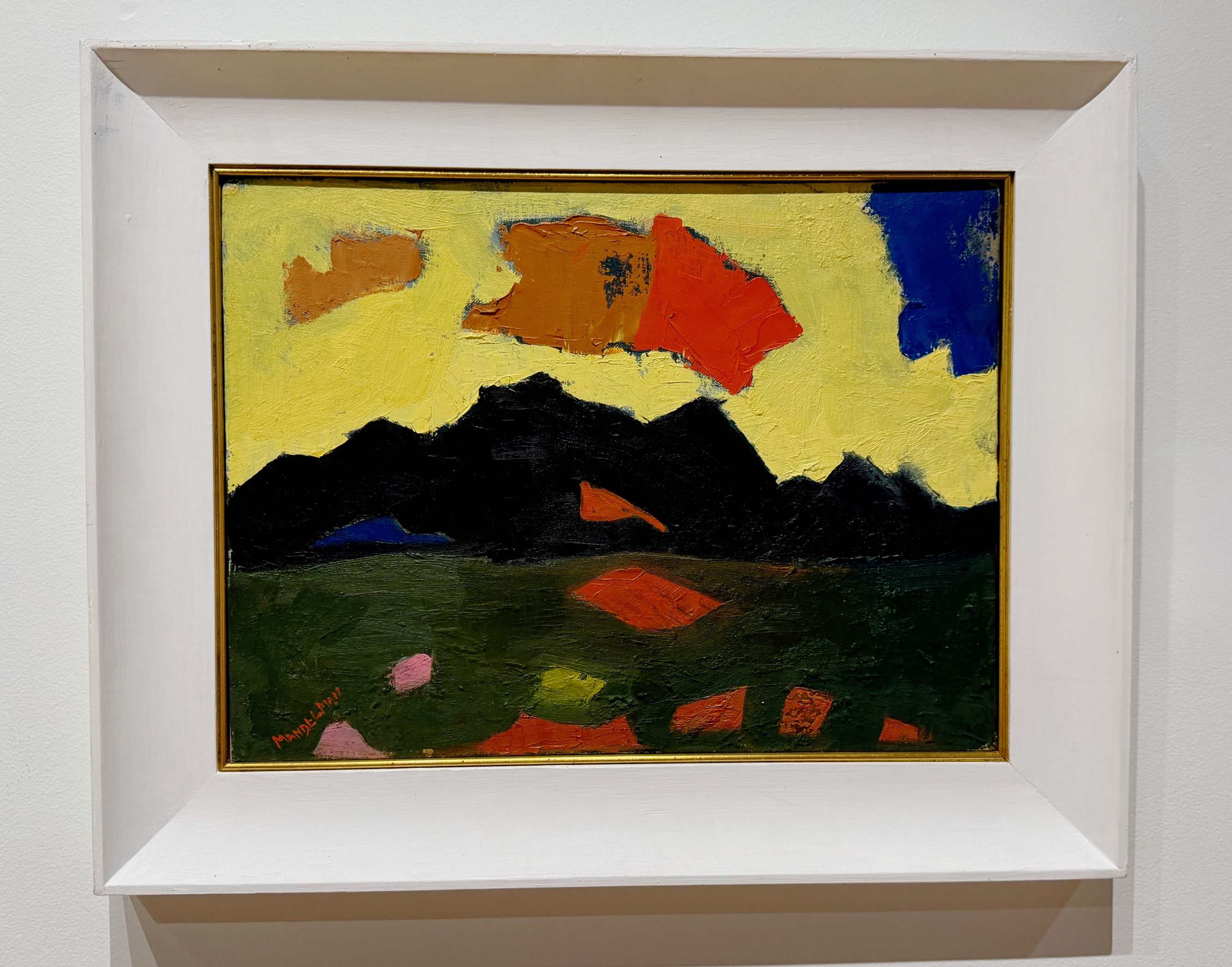
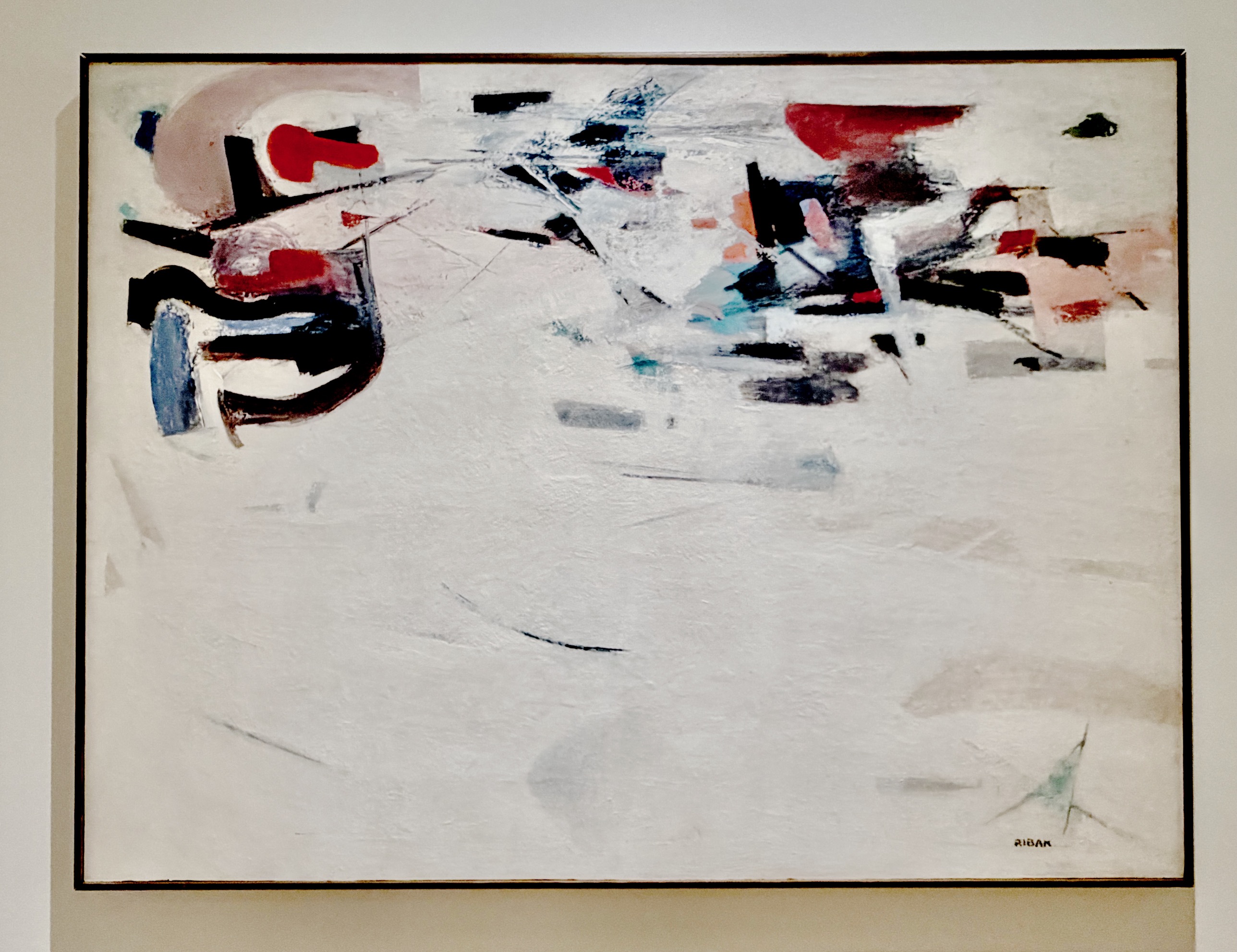
The cross-pollination of styles, personalities, spiritual influences, and teaching philosophies in Taos was intense and rewarding in those post-war years. Two upstart abstractionists – Bea Mandelman and Louis Ribak – arrived and began the Taos Valley Art School in 1947, which welcomed 20 students per semester.

A significant number of works are by Leger-trained Mandelman and social-realist-turned abstractionist Ribak, and their former GI Bill students – Louis Catusco, Ted Egri, Leo Garel, Herman Rednick, and Eve Mirabal (the Taos Pueblo artist credited as the first female Native cartoonist in America).

Co-founder of the Taos Valley Art School – Beatrice Mandelman’s 1950 Mouintain (formally Dark Cloud)
Co-founder of the Taos Valley Art School – Louis Ribak’s 1950 abstract Movement No. 2.

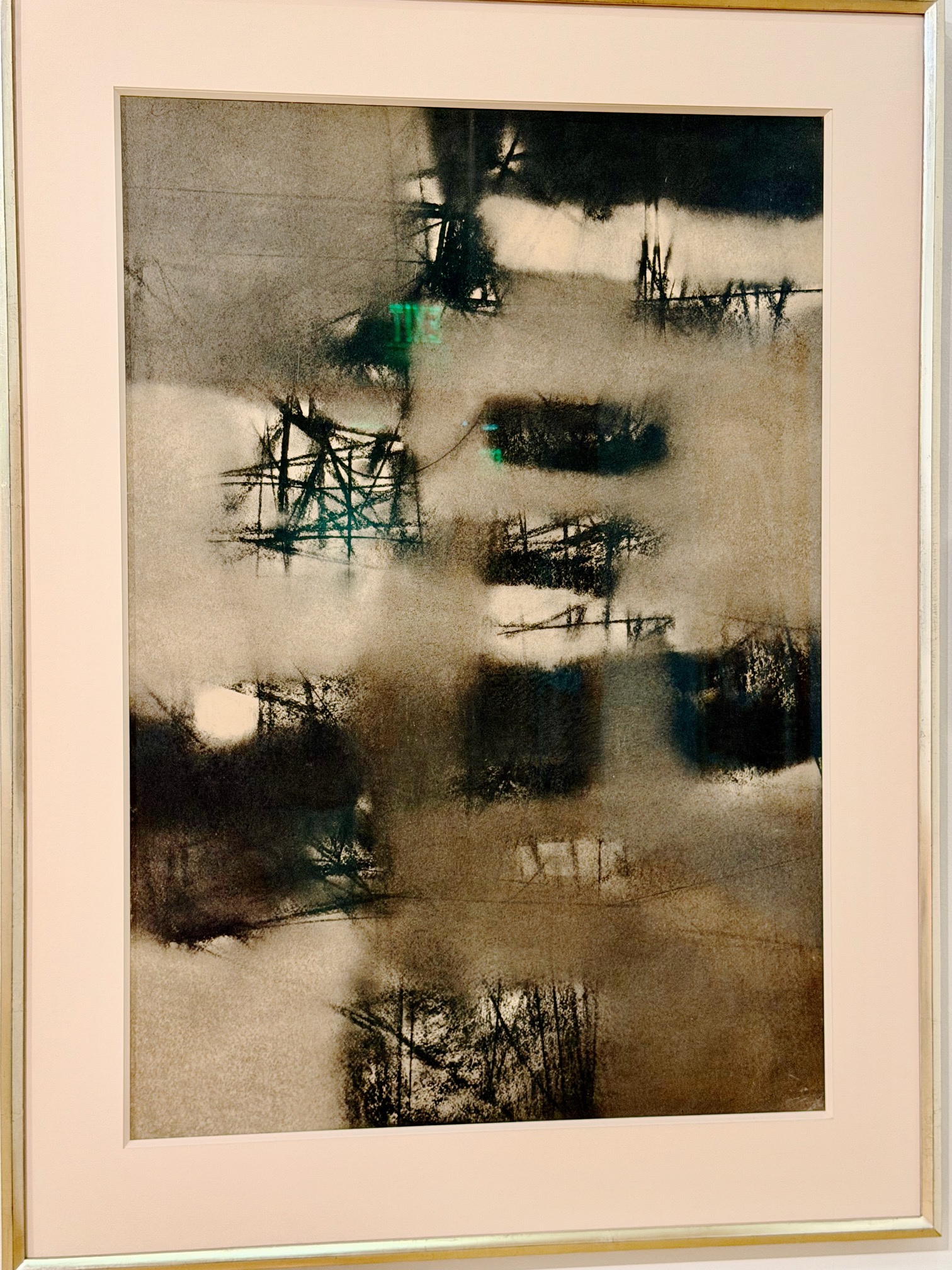
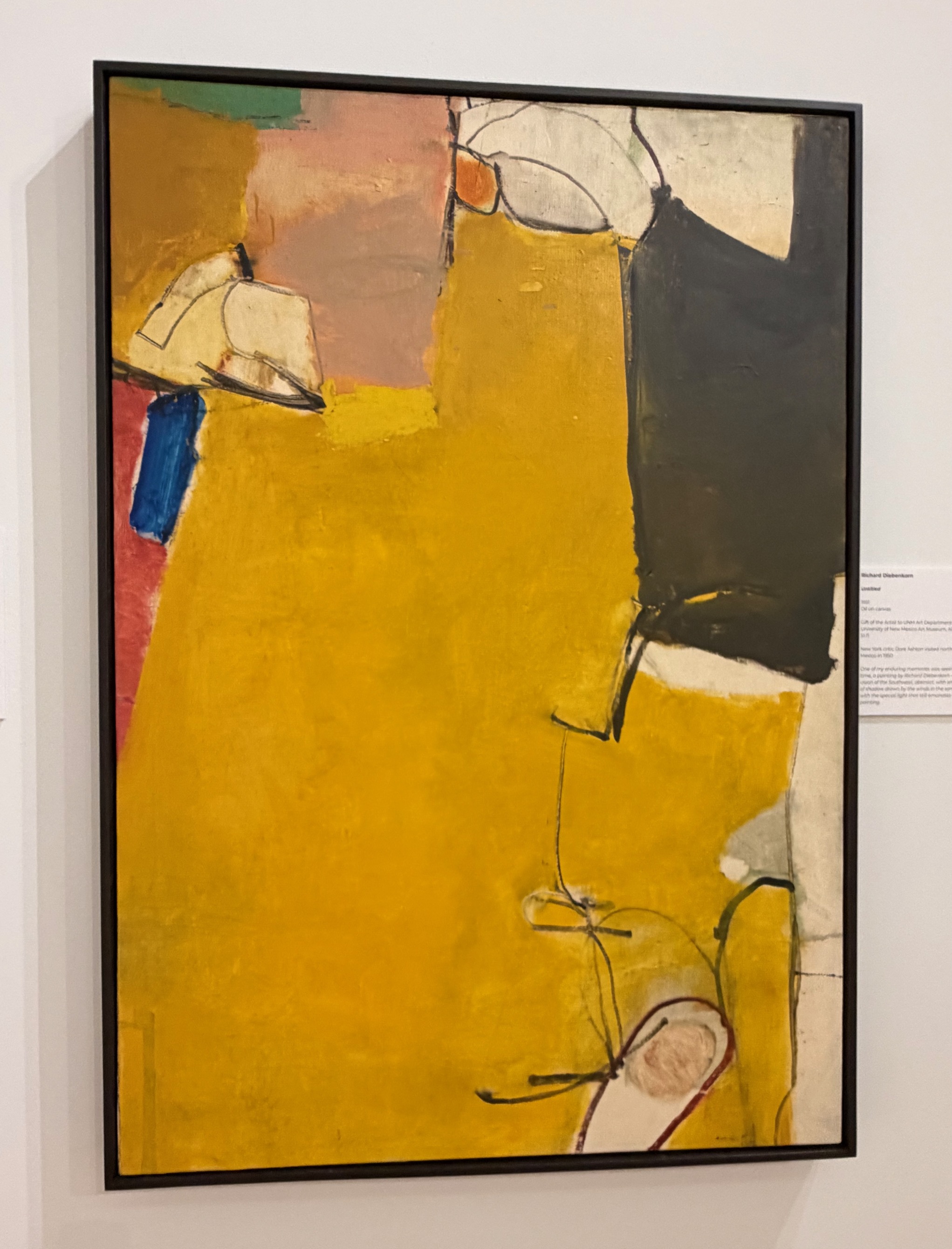
Clyfford Still-trained painters also made their way to Taos from the California School of Fine Arts, the legendary modern-art training ground in San Francisco. The Harwood’s all-white back gallery features spectacular works by Clay Spohn, Lawrence Calcagno, and Ed Corbett. When the pay was too low at CSFA, even Richard Diebenkorn enrolled in UNM to use his more generous GI Bill benefits.

Edward Corbett’s 1951 chalk on paper Number 9 – former student at California School of Fine Arts who moved to Taos. Courtesy: Tia Collection.
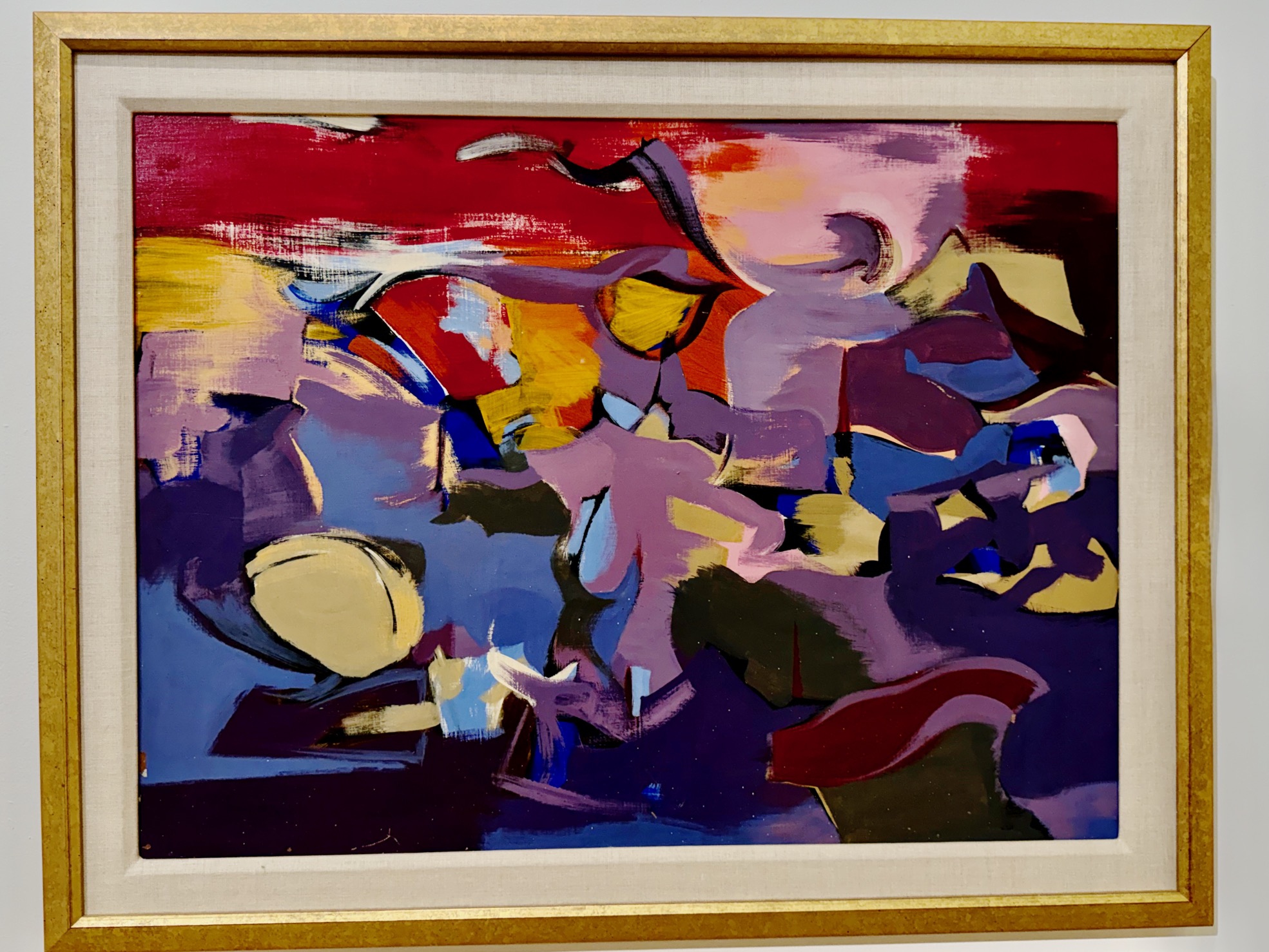
Former teacher and student at California School of Fine Arts who moved to University of New Mexico – Richard Diebenkorn’s 1951 untitled abstraction inspired by New Mexico’s Southwestern landscape.

The back corner features work by two former Black Mountain College. Several are by Oli Shivonen, who served in the corps of artists and sound engineers in the “Ghost Army” that created battlefield deceptions to deceive Axis troops. Note the flat shapes and bold colors, reminiscent of another Ghost Army vet, Ellsworth Kelly.  
 
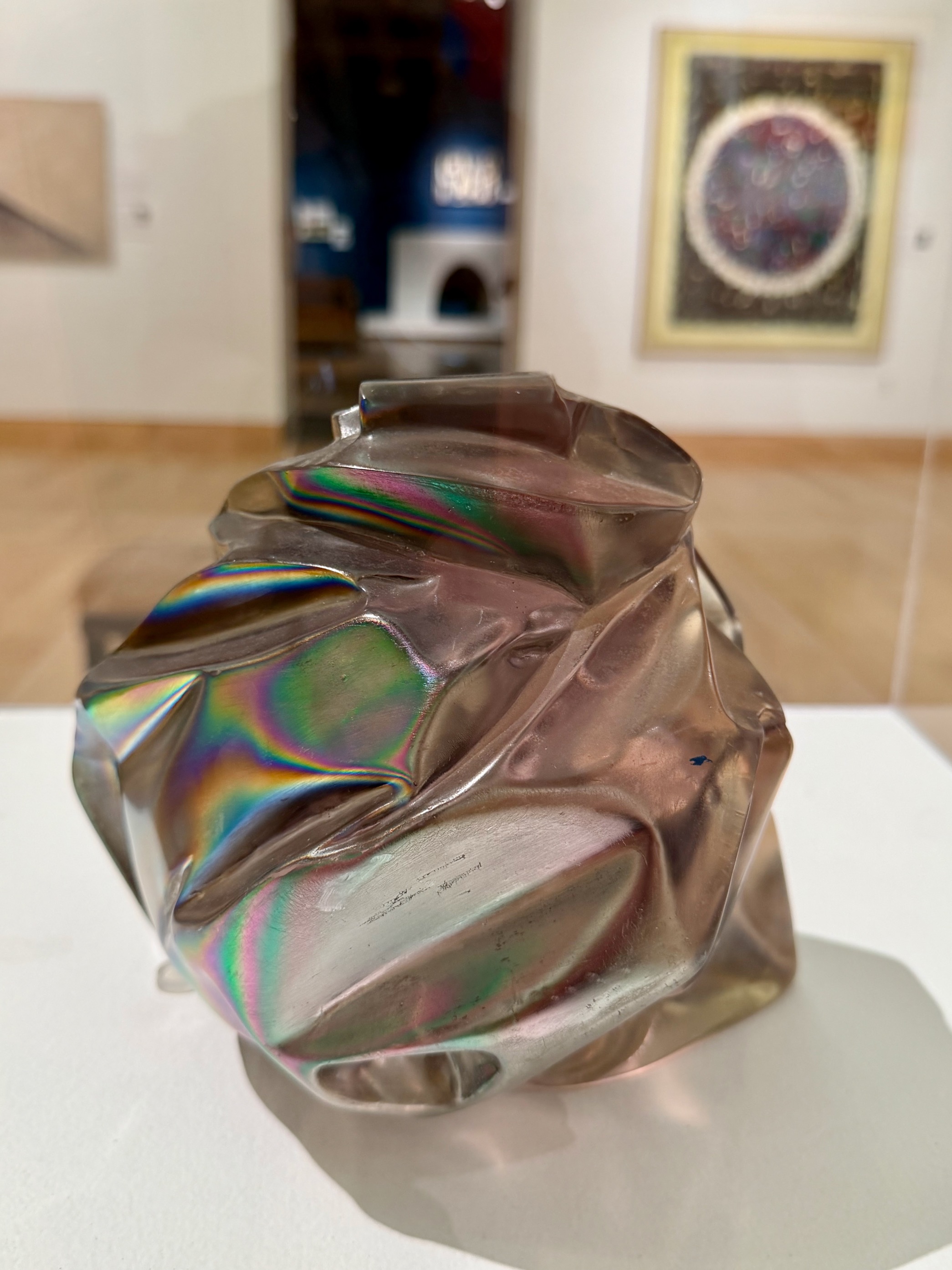
A small multiple by John Chamberlain also stands here – a tribute to the inspiration that Chamberlain drew from the new methods, material, and iridescent magic reflected in work by another SoCal-to-Taos transplant, Larry Bell.    

Former Black Mountain College student on the GI Bill who moved to Taos – Oli Shivonen’s 1965 color abstraction Column Three.
John Chamberlain’s 1971 El Molé based on crumpled paper bags – one of a cast poly resin edition by Gemini G.E.L.; coated with silicon oxide. Courtesy: private collection

For more stories, background, and innovations by GI Bill beneficiaries across the US art world, listen to this lecture by the curator of this amazing show, MaLin Wilson-Powell:

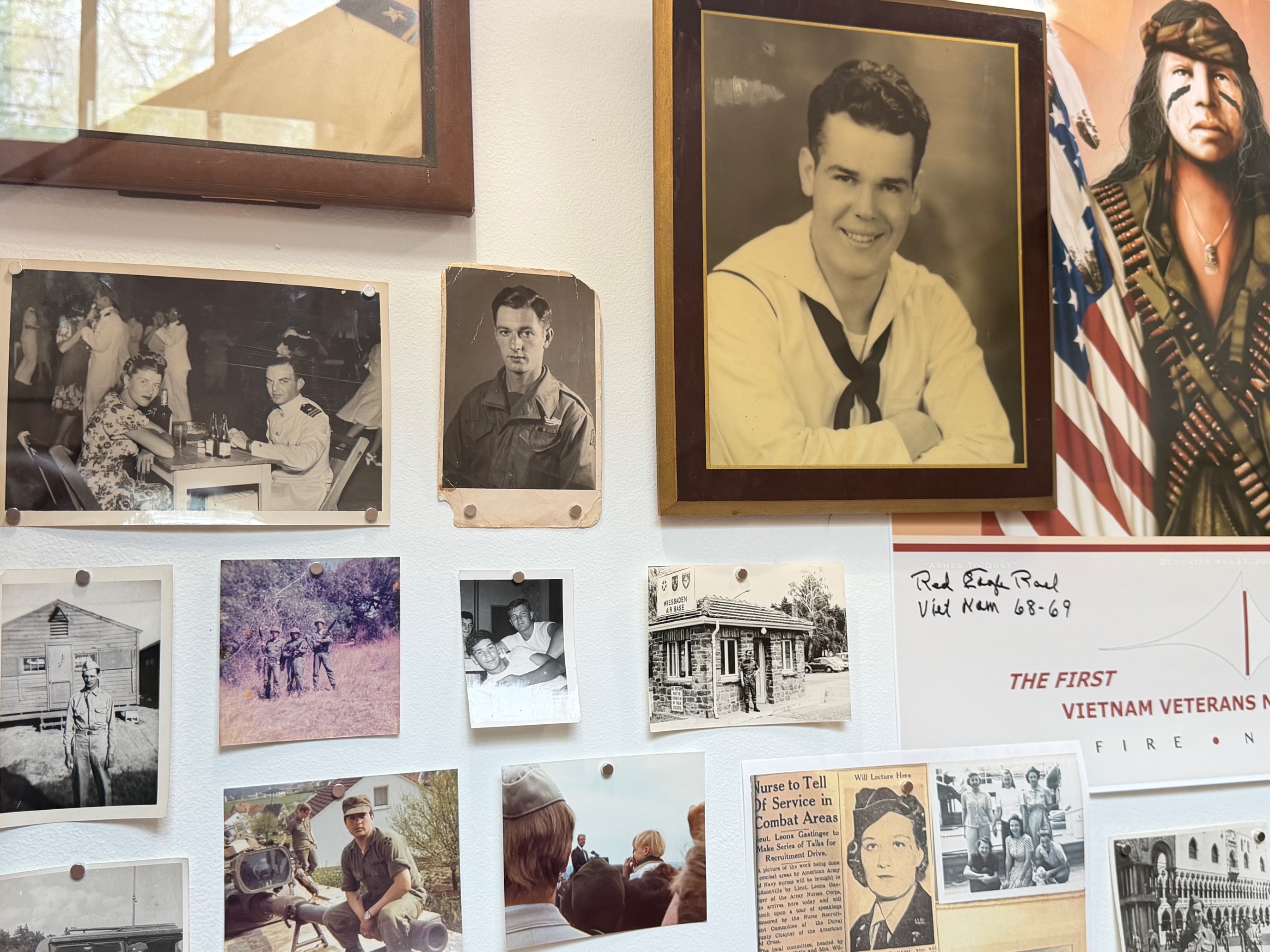
And in a living tribute to all of the Taos veterans, the Harwood created a community space for temporary exhibition of photos, memories, and tributes right inside this remarkable exhibition that honors the men and women of art and service.

Photos and other items donated by the community for the Harwood’s veteran memorabilia space.

Everything Modern at Fechin House in Taos

The 1915 founding of the Taos Society of Artists captulted Taos into one of the most recognized art colonies in the United States due to its traveling exhibitions of romantic, colorful paintings depicting the people, places, and traditions of unique to Northern New Mexico.

But another group of artists and cultural influencers arrived a few years later to inject the art scene there with a new, more contemporary style – one reflecting the approach associated with European modernism and the trends showcased in the 1913 Armory Show.

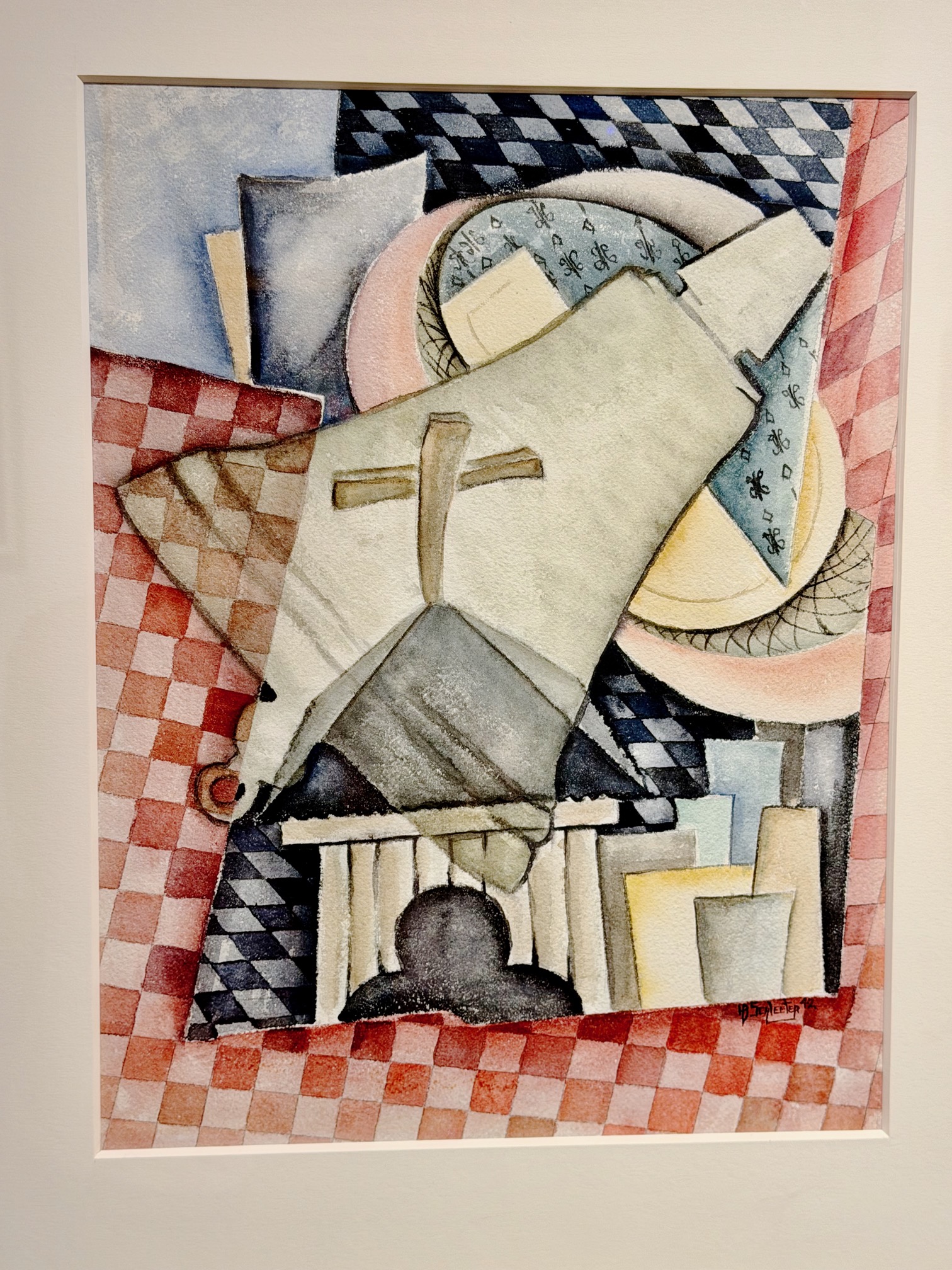
1943 watercolor by Howard Schleeter, who experimented with many contemporary styles

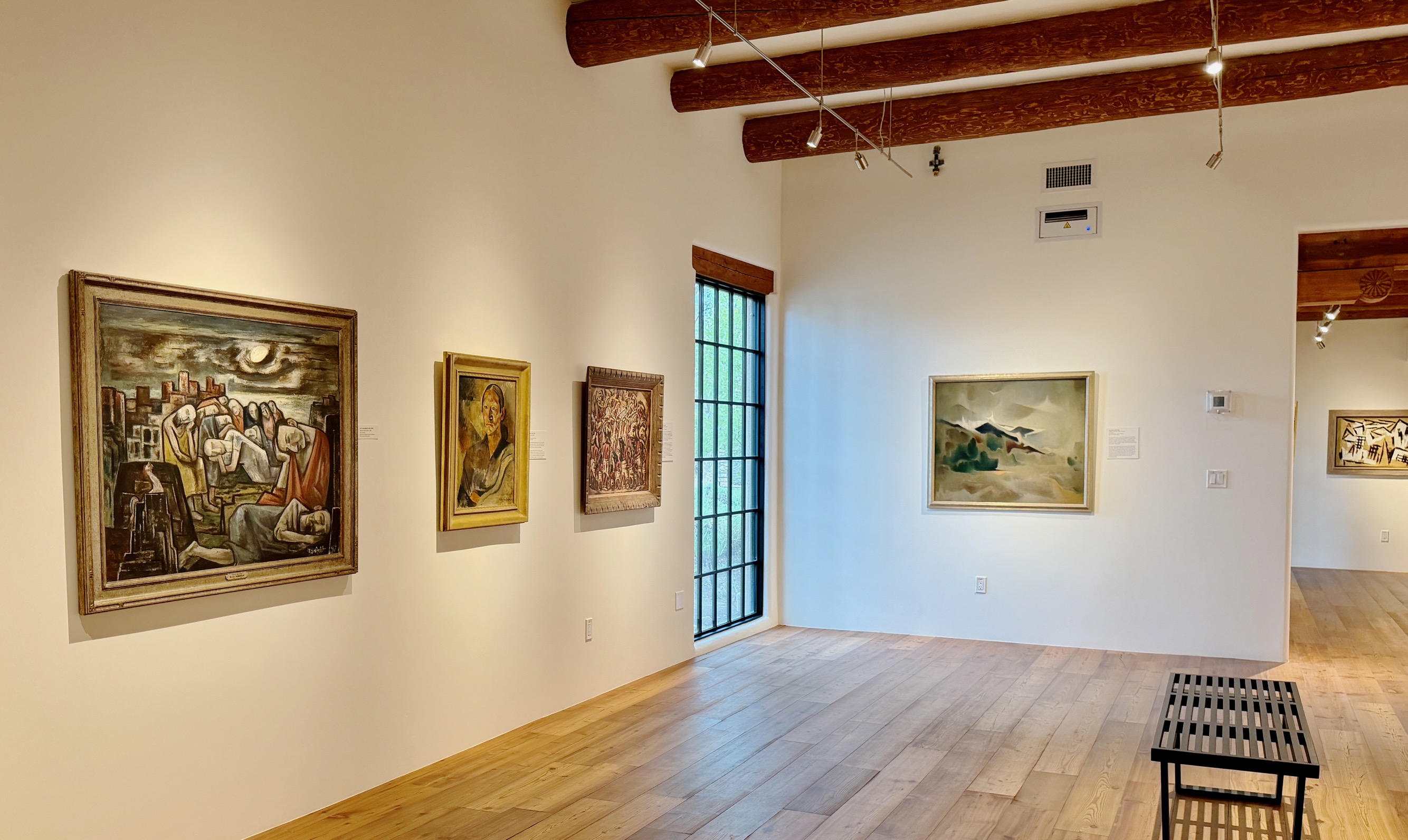
This less traditional group of innovators – and the next generation of their followers – are celebrated by the Taos Art Museum in its exhibition Taos Reimagined: Modernist Experiments in the High Desert, on view in the beautiful, new Janis and Roy Coffee Gallery at Fechin House through May 10, 2026. Most of the works in the show are selected from the museum’s own collection.

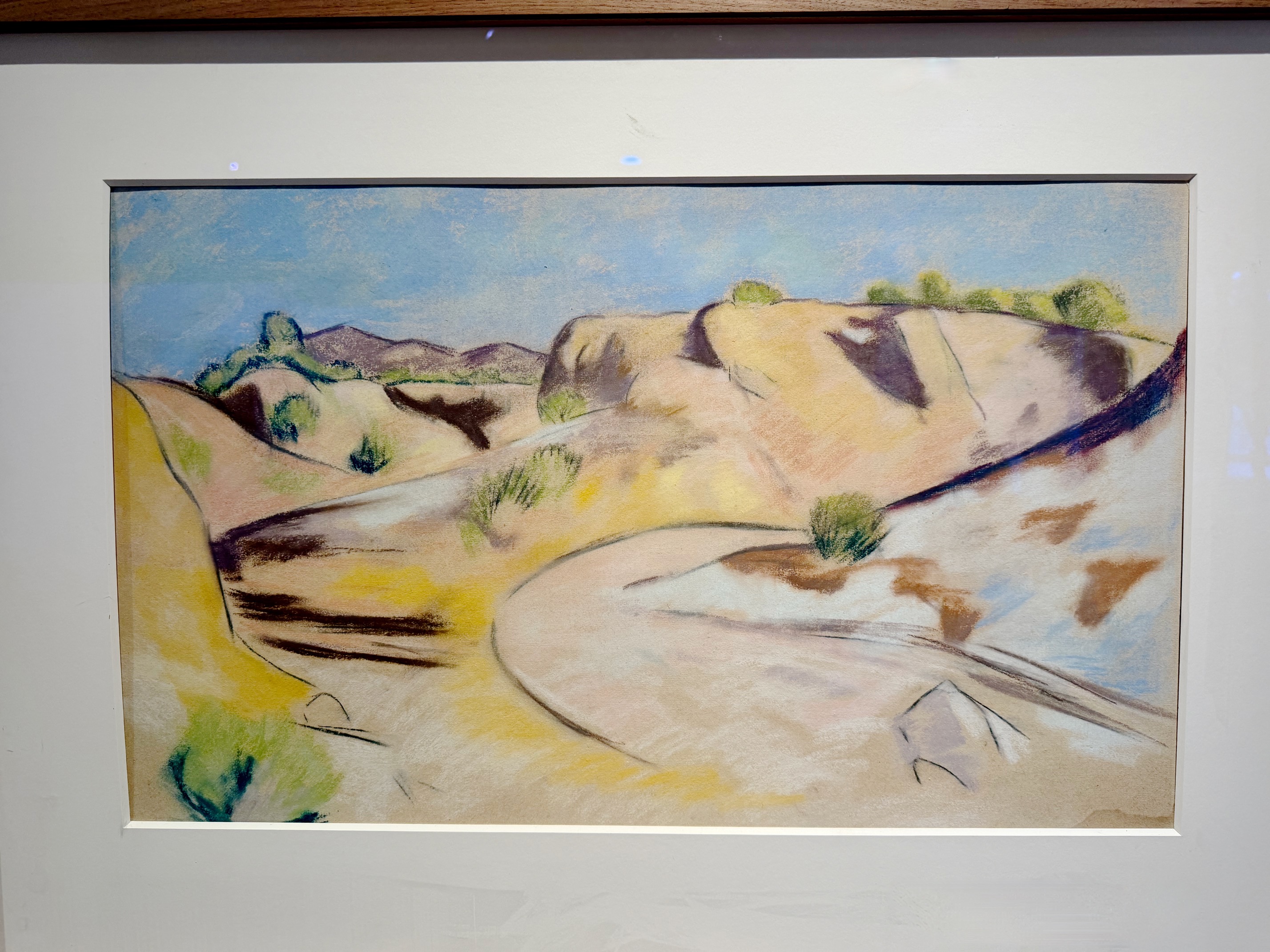
After moving to Taos in 1917, philanthropist and fan-of-the-avant-garde Mabel Dodge soon recruited East Coast modern mavericks to join her. One of her first friends to take the trip West was painter Marsden Hartley, whose early symbolic abstractions electrified European critics and clients of Stieglitz’s gallery in New York.  One of his modernist landscapes is featured in this show.

Marsden Hartley’s 1918 drawing New Mexico – a pastel by one of America’s early modernists inspired by New Mexico. Courtesy: The Owings Gallery

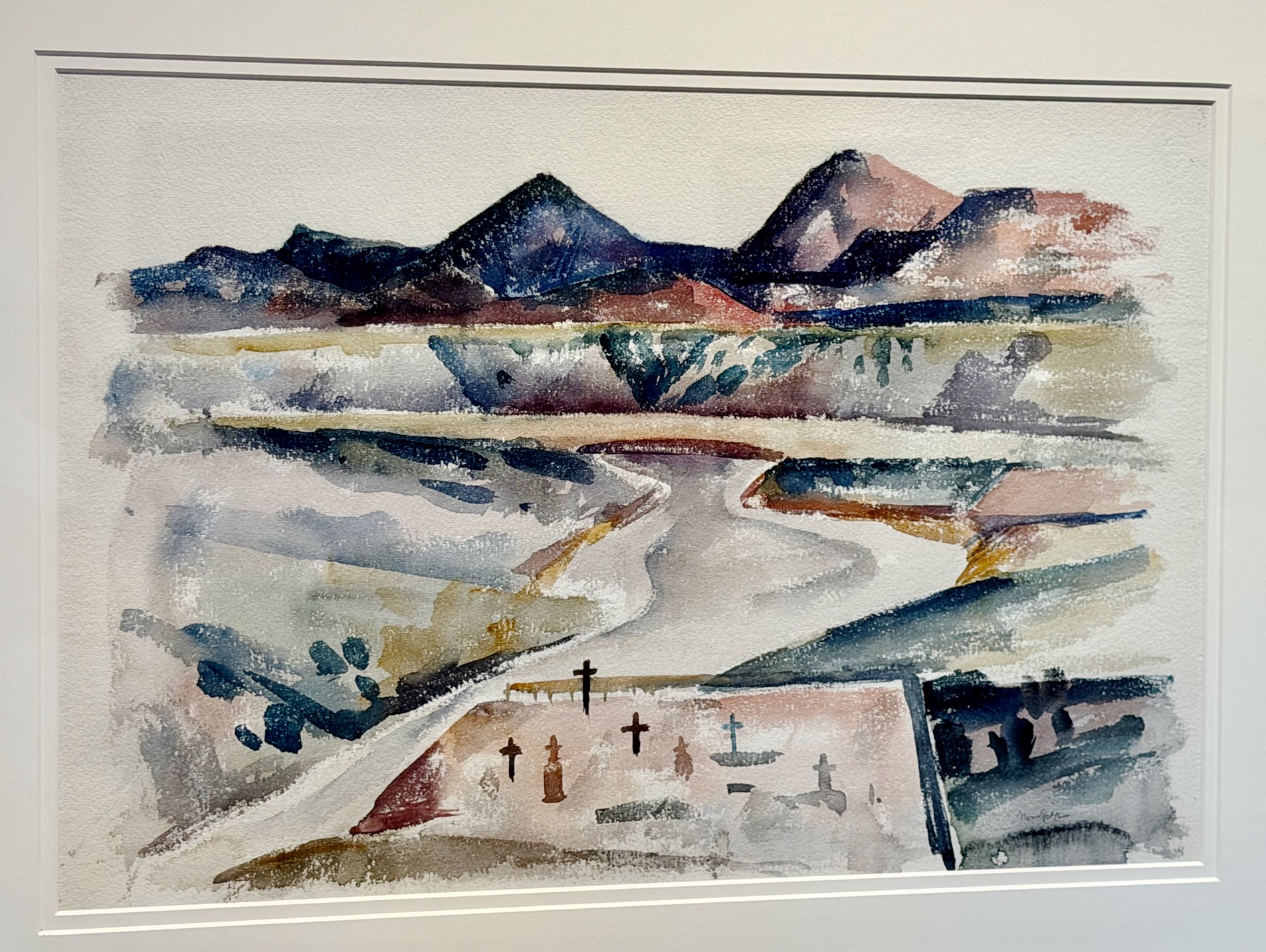
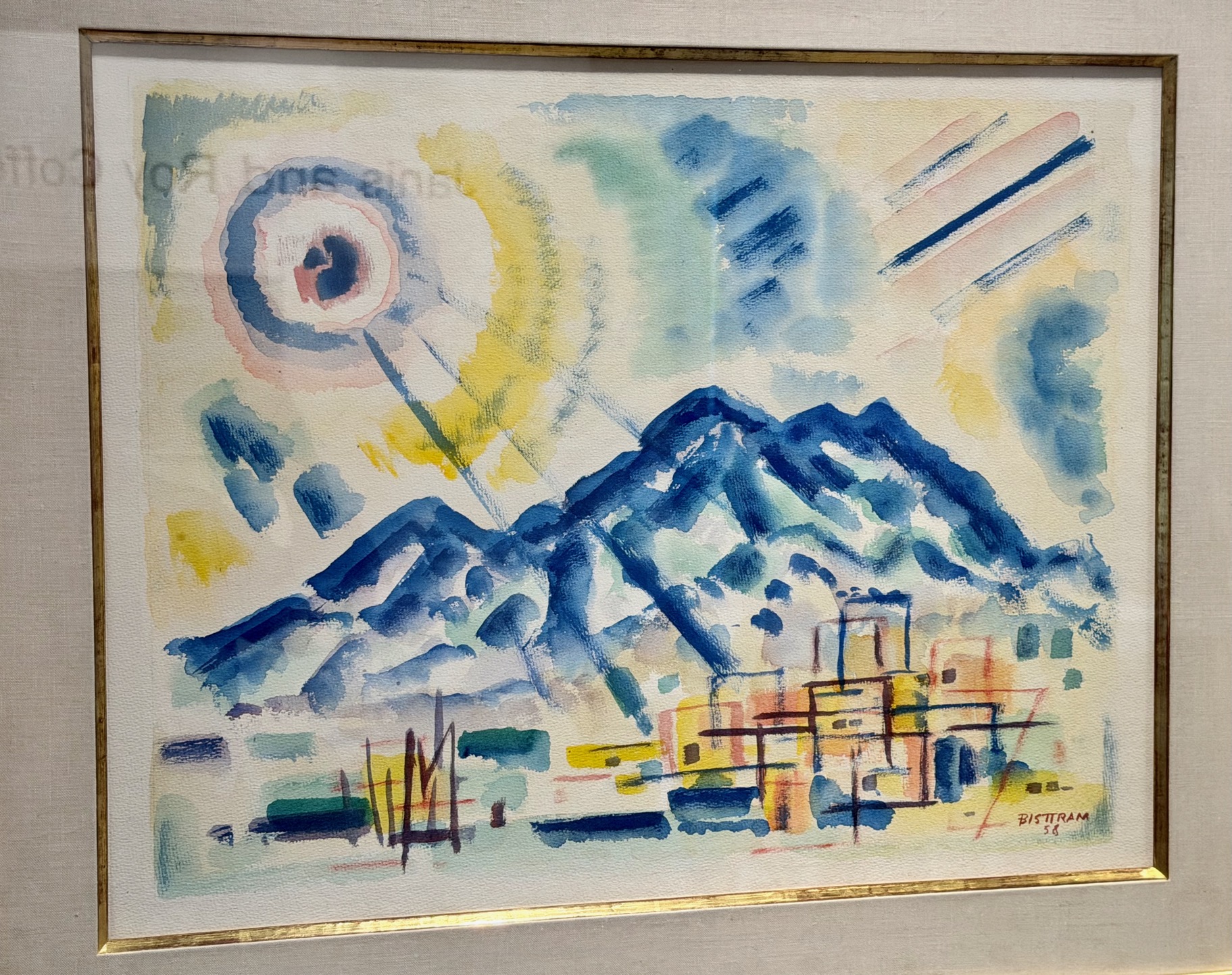
It’s thrilling to view the Hartley watercolor next to landscapes by modernist B.J.O. Nordfeldt and Emil Bisttram.

B.J.O. Nordfeld’s watercolor Campo Santo – landscape painted by an artist who was significantly influenced by Cezanne’s modern innovations.
Emil Bisttram’s 1958 watercolor Sun Over Pueblo.

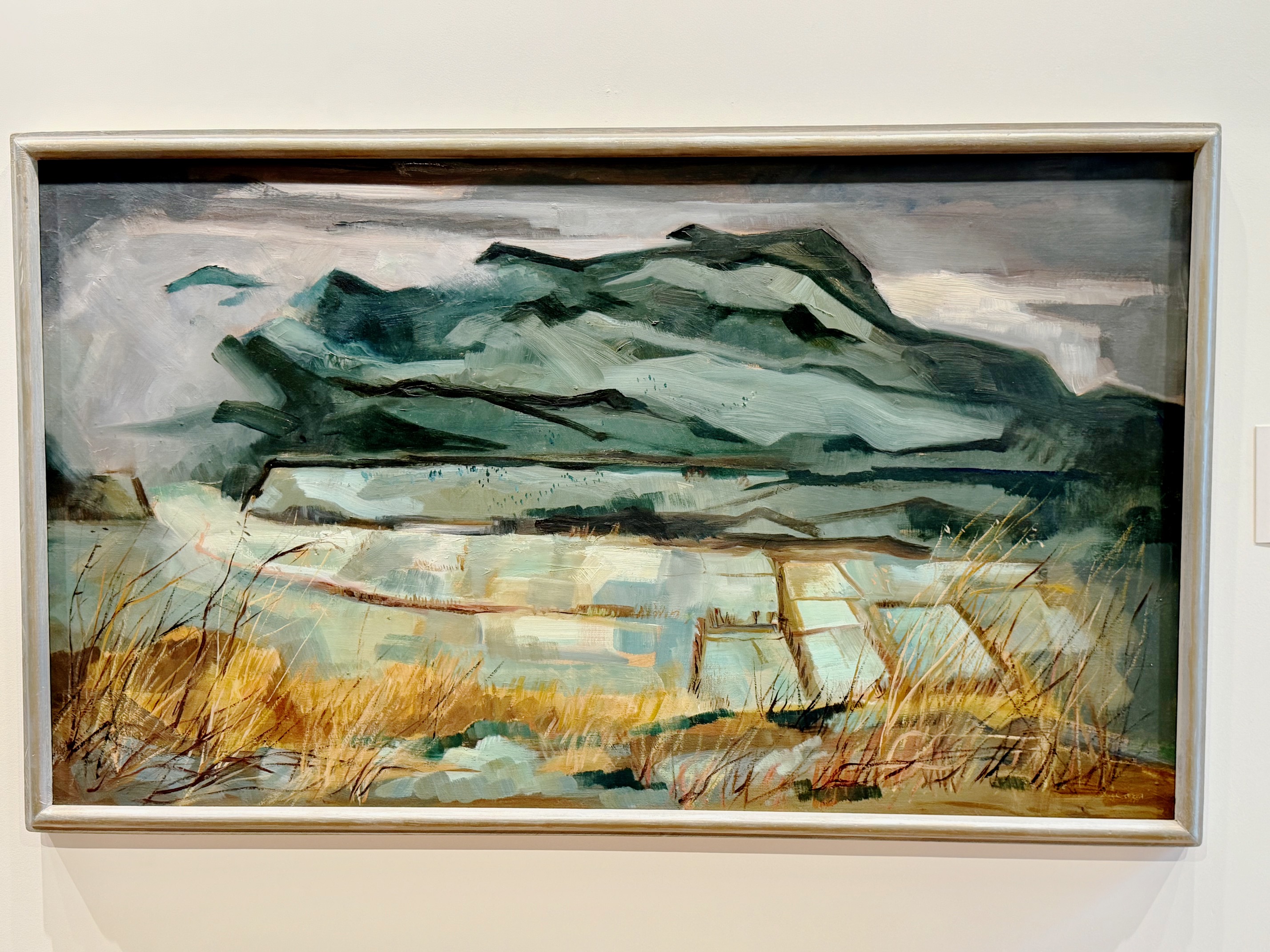
Much of the work on display was painted mid-century – some works by older mondernists (like Nordfeldt or Dasburg) and others by artists arriving in the 1940s and 1950s (often called the Taos Modernists). Louis Ribak and Beatrice Mandelman arrived in the 1940s co-founded the Taos Valley Art School in 1947, and effectively served as the center for postwar modernism in Taos for the next decade.

1964 painting Rift Series #23 by Beatrice Mandelman –a co-founder of the Taos Valley Art School with husband Louis Ribak
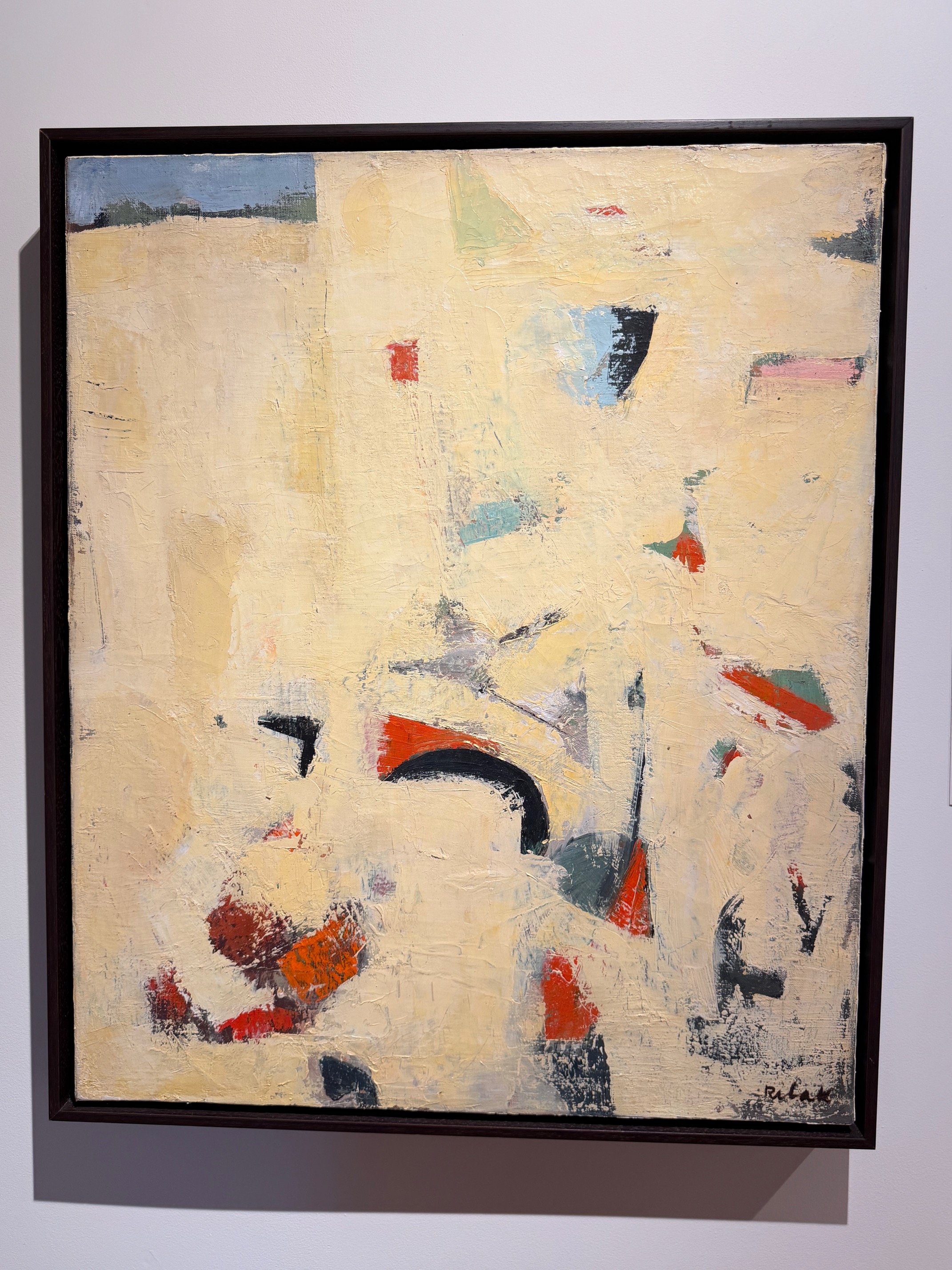
Louis Ribak’s Untitled (No. 9) – painting by one of the most influential teachers encouraging experimentation at the Taos Valley Art School. Courtesy: private collector; the Owings Gallery

It’s a beautiful, light-filled space that shows off these magnificent works to great advantage.  Take a look at some of our favorites in our Flickr album.

Doel Reed’s 1974 oil This Morning at Eight.
Janis and Roy Coffee Gallery

Gus Baumann’s Legacy of Art and Fun in Santa Fe

Gus Baumann, America’s greatest master of color woodblock prints, never considered himself a fine artist. Nevertheless, his prints, sculptures, paintings, commercial art, furniture, and marionette stages fill four galleries in his grand retrospective at the New Mexico Museum of Art – Gustave Baumann: The Artist’s Environment, on view through February 22, 2026.

Demand for Gus’s intricate block-printed sun-dappled Western landscapes from the 1920s through the 1950s still runs high. So, it’s a treat to learn how Gus achieved such a high degree of technical proficiency early in his career, lived Arts and Crafts philosophy, relished immersion in art colonies, and found his family in Santa Fe.

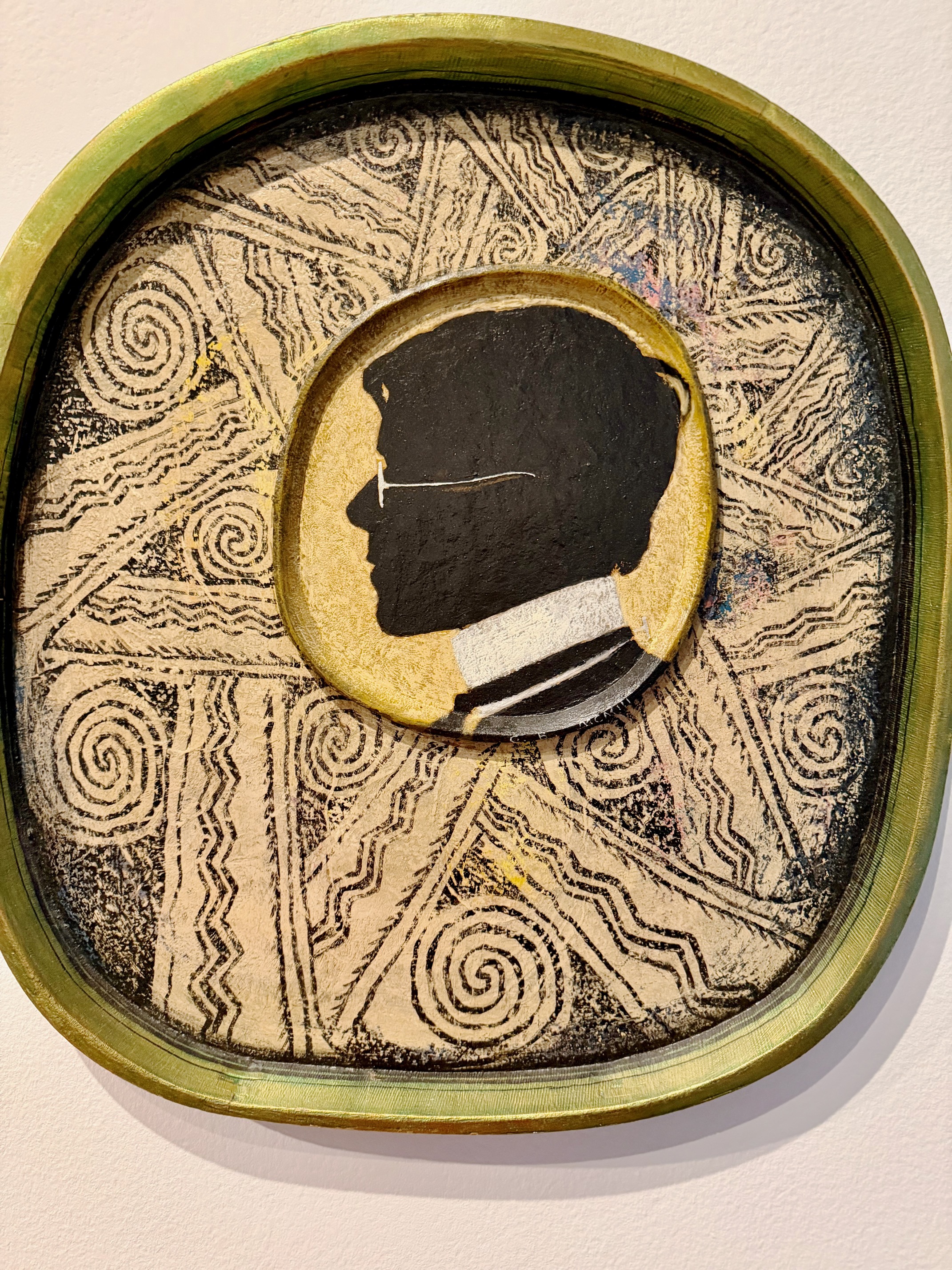
Gus Baumann’s 1903 oil Self-portrait (Silhouette) painted in his Chicago studio; reworked in Santa Fe after 1920 with a border inspired by Mimbres pottery.
See some of our favorites in our Flickr album.

Although Gus was born in Germany in 1881, his family emigrated to Chicago when he was around ten. His father was a craftsman and woodcarver, and it left an impression.  The first themed section of the exhibit – “Finding His Way”– gives a glimpse into his family background, early commercial art work, wood carving expertise, and furniture he designed later in the 1930s.

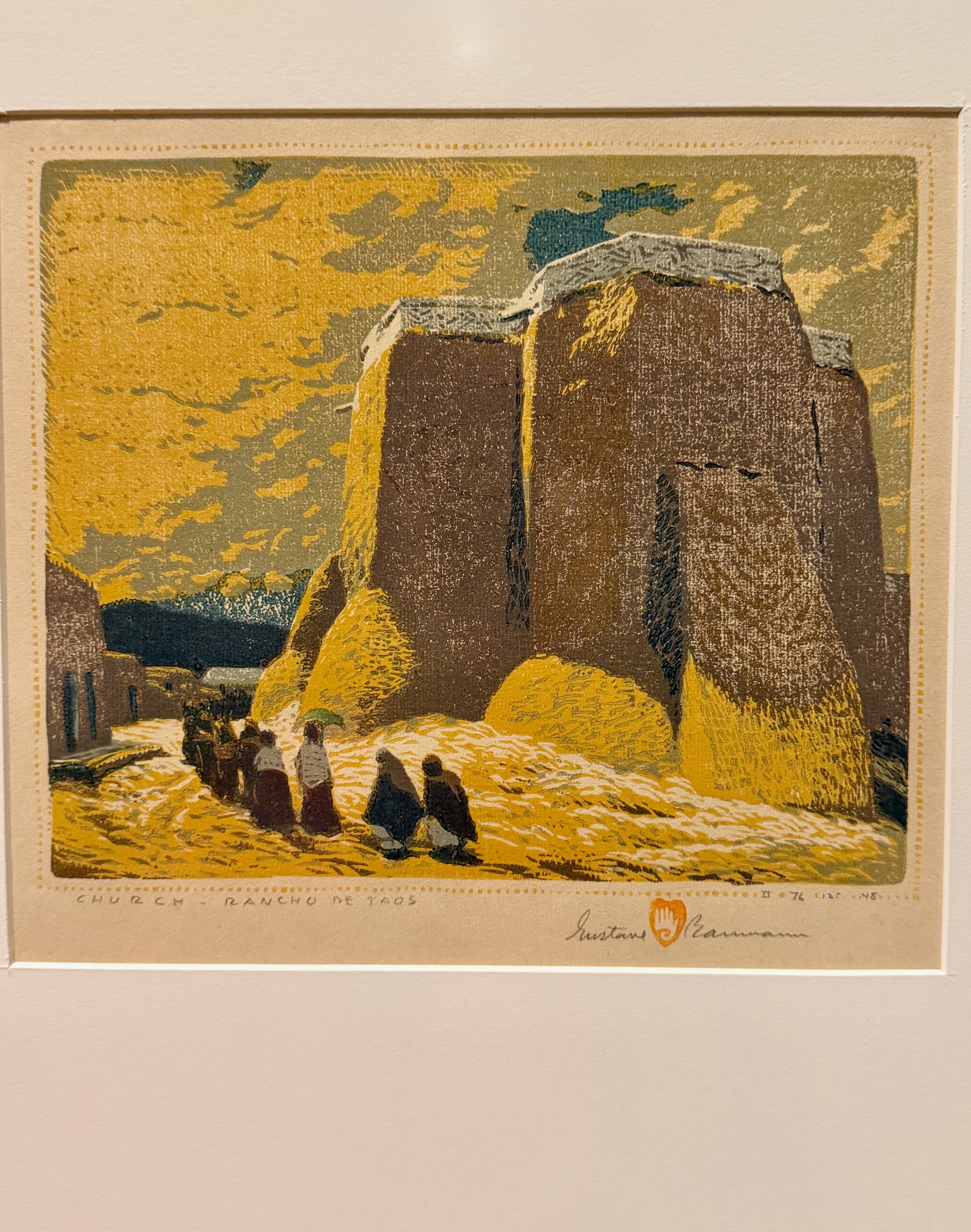
Gus Baumann’s 1919 color woodblock print Church Ranchos de Taos – one of the first modern artists to depict this iconic church; printed in 1948.
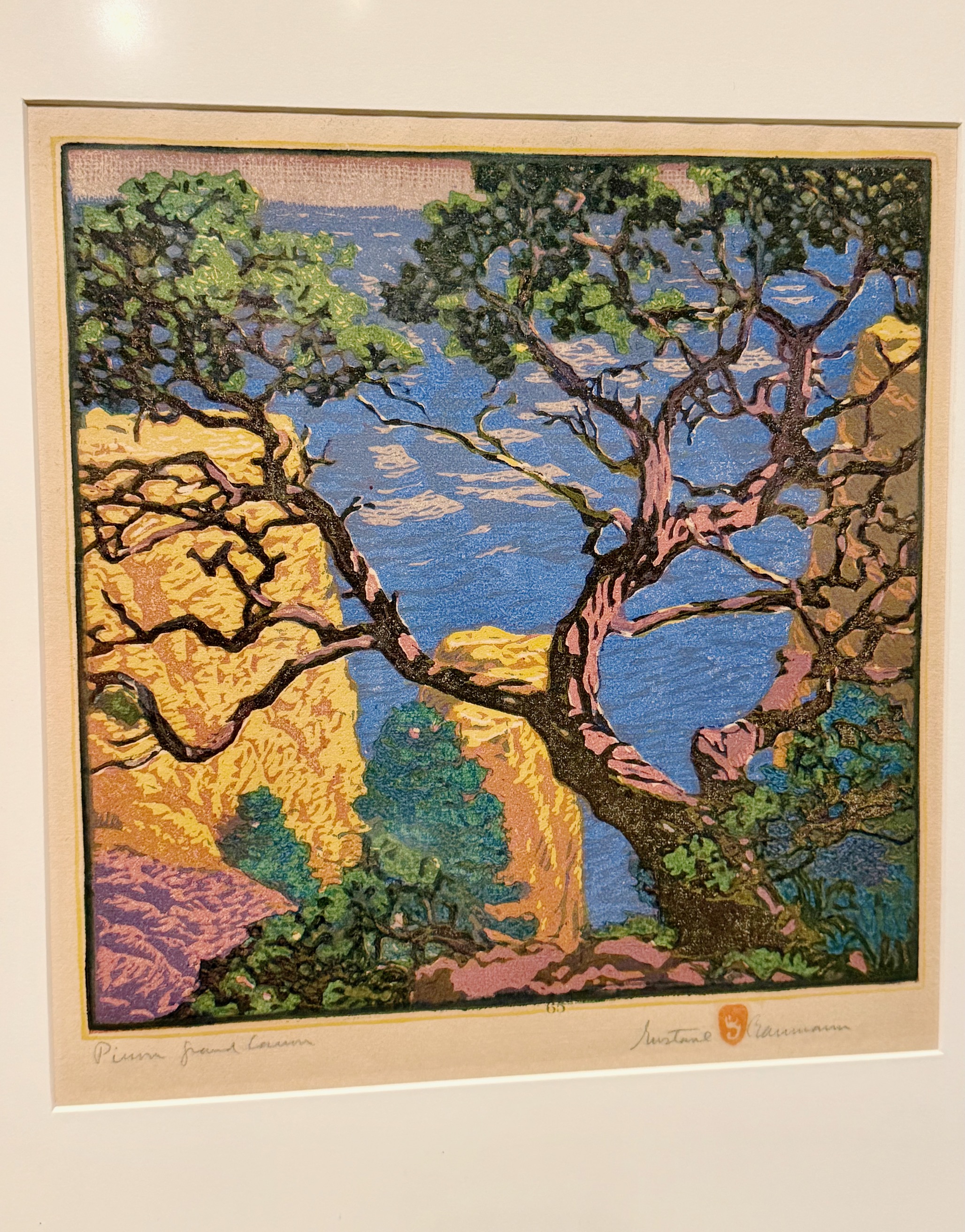
Gus Baumann’s 1921 color woodblock print Piñon Grand Canyon – one of four landscapes created after his first visit.

When he was 17 and his dad left the family, Gus had to find work to help his mom make ends meet.  He worked full time at a Chicago wood-engraving shop that cut illustrations for books, magazines, and newspapers. When he was 20, Gus opened his own wood-engraving studio.

To fine tune his skill, he attended Munich’s Royal Arts and Crafts School for a year to learn from the best German color wood-block print masters – a move that chose traditional skills over academy fine-arts training. When he returned to Chicago, he opened Baumann Graphic Art Service.

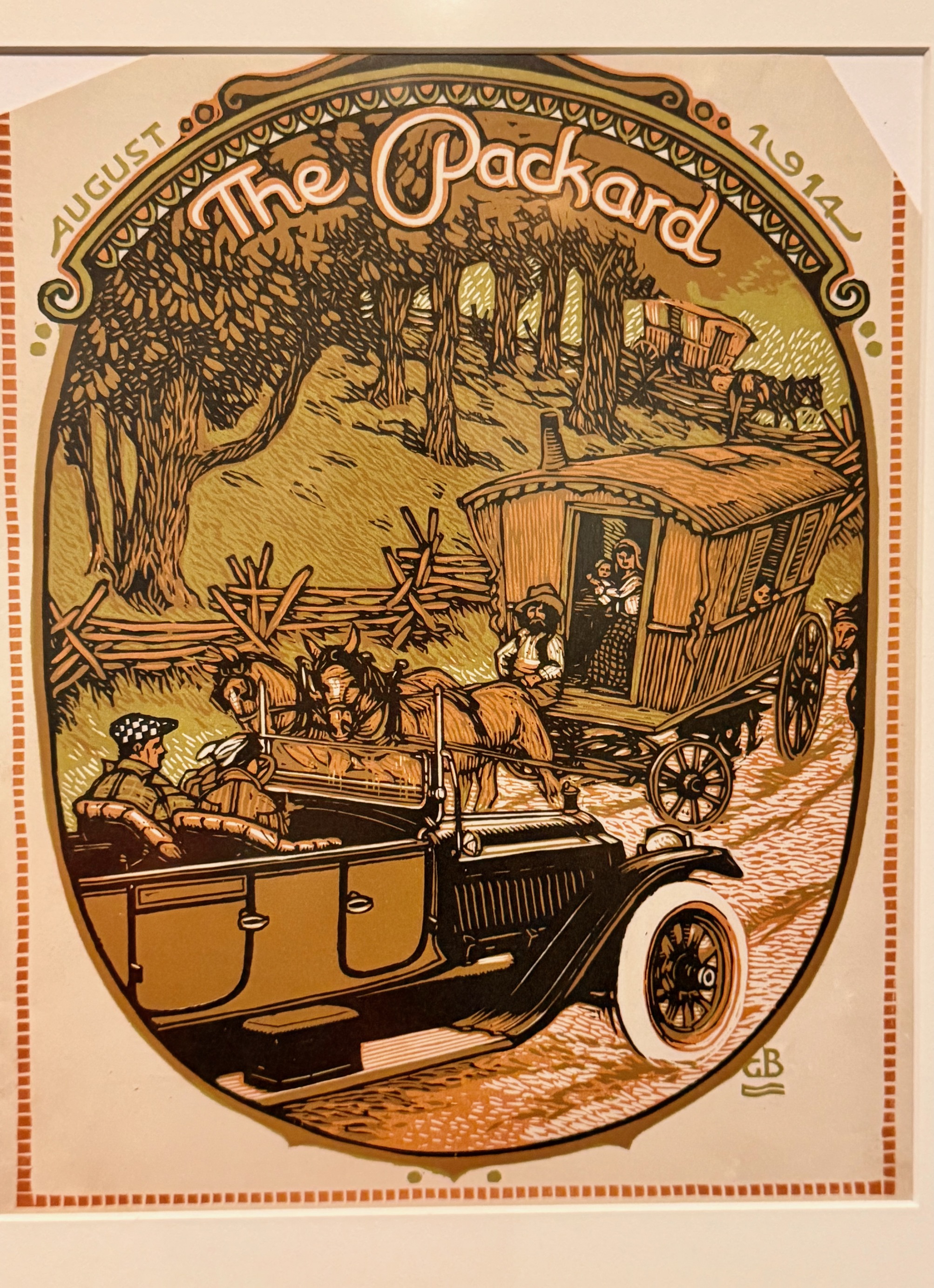
Gus Baumann’s 1913 Illustration for a Calendar: The Packard Car Motor Company, August 1914 – one of four he created for Packard.
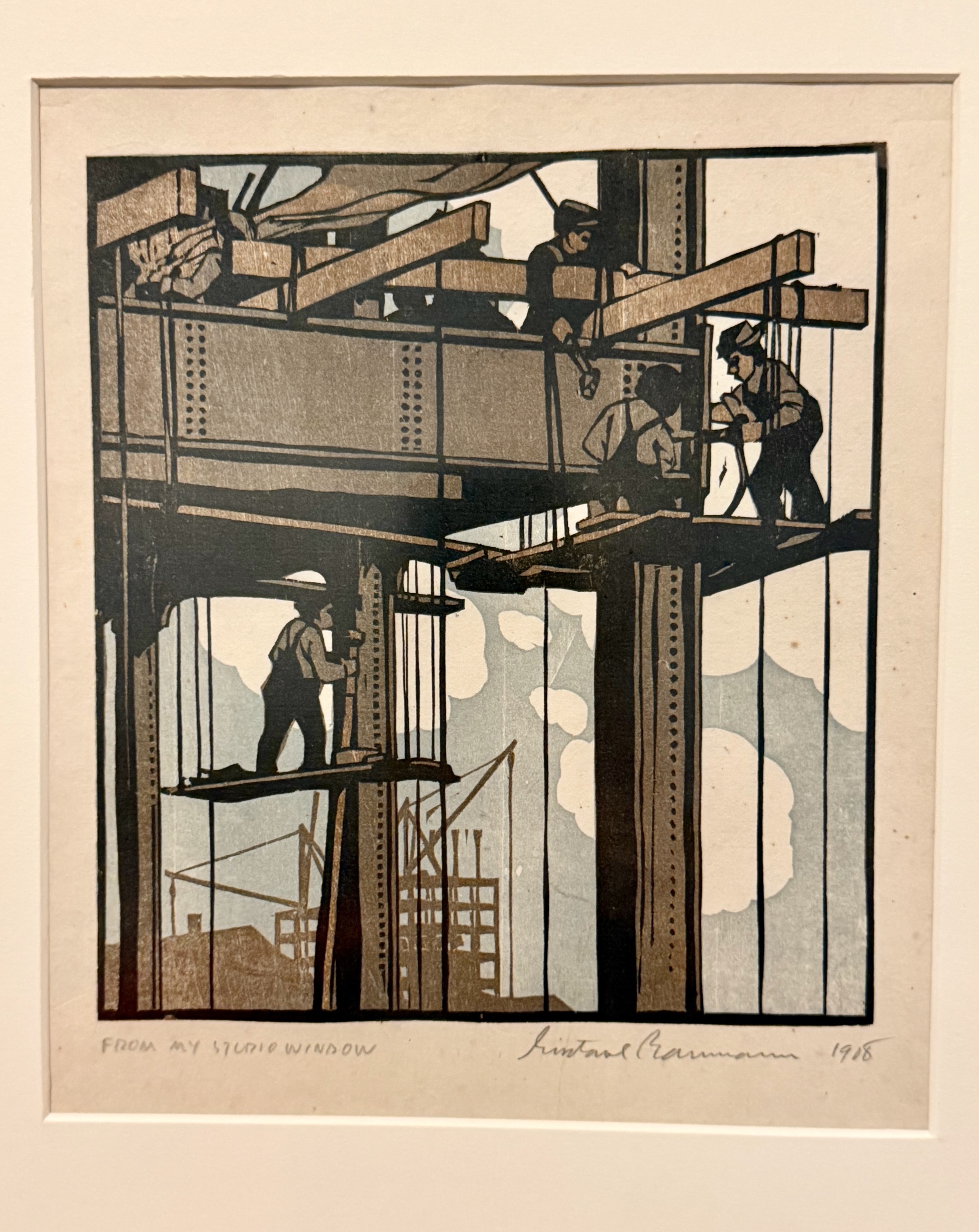
Gus Baumann’s 1908 color woodcut From My Studio Window in downtown Chicago –the high-rise McCormack Building going up on South Michigan Avenue.

Although Gus found success, his love of craft and traditional printmaking methods drew him to an art colony in Nashville, Indiana that revered traditional crafts and a slower pace of life.  The second section of the exhibition – “A Rolling Stone” – highlights work he did in Munich, his acclaimed print series featuring Indiana craftsmen, coastal life in Provincetown, and the electricity he felt in New York.

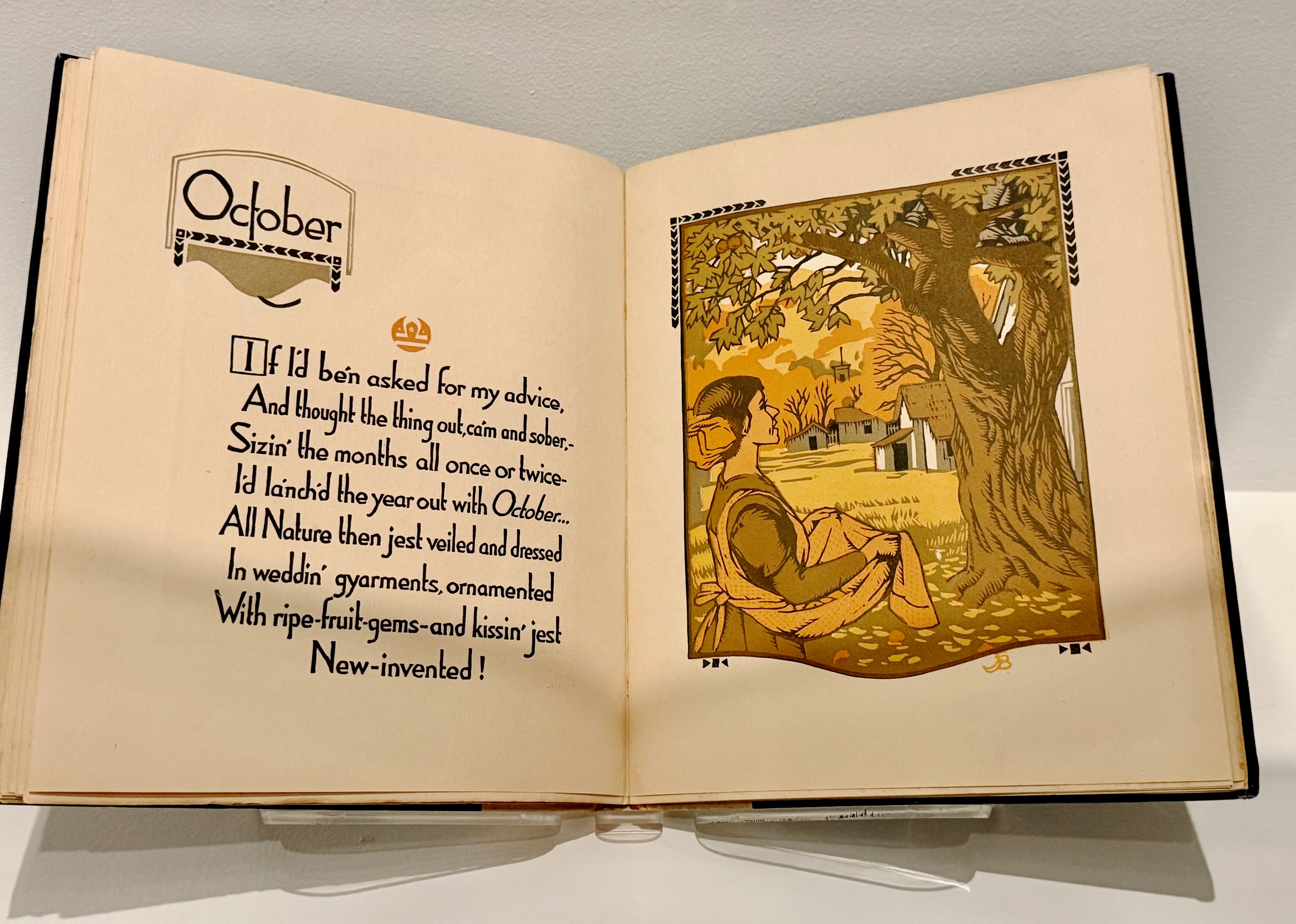
Gus Baumann’s 1912 book All the Year Round – woodcut illustrations and poetry James Whitcomb Riley, featuring scenes of daily rural life for each month of the year.

But his life would change forever when he traveled West and landed in New Mexico in 1918. Due to his reputation as an award-winning printmaker, Santa Fe welcomed him with open arms. Gus was struck by the unique Hispanic and Pueblo ways of life, the beauty of the Southwest, and the growing art colony in Santa Fe. 

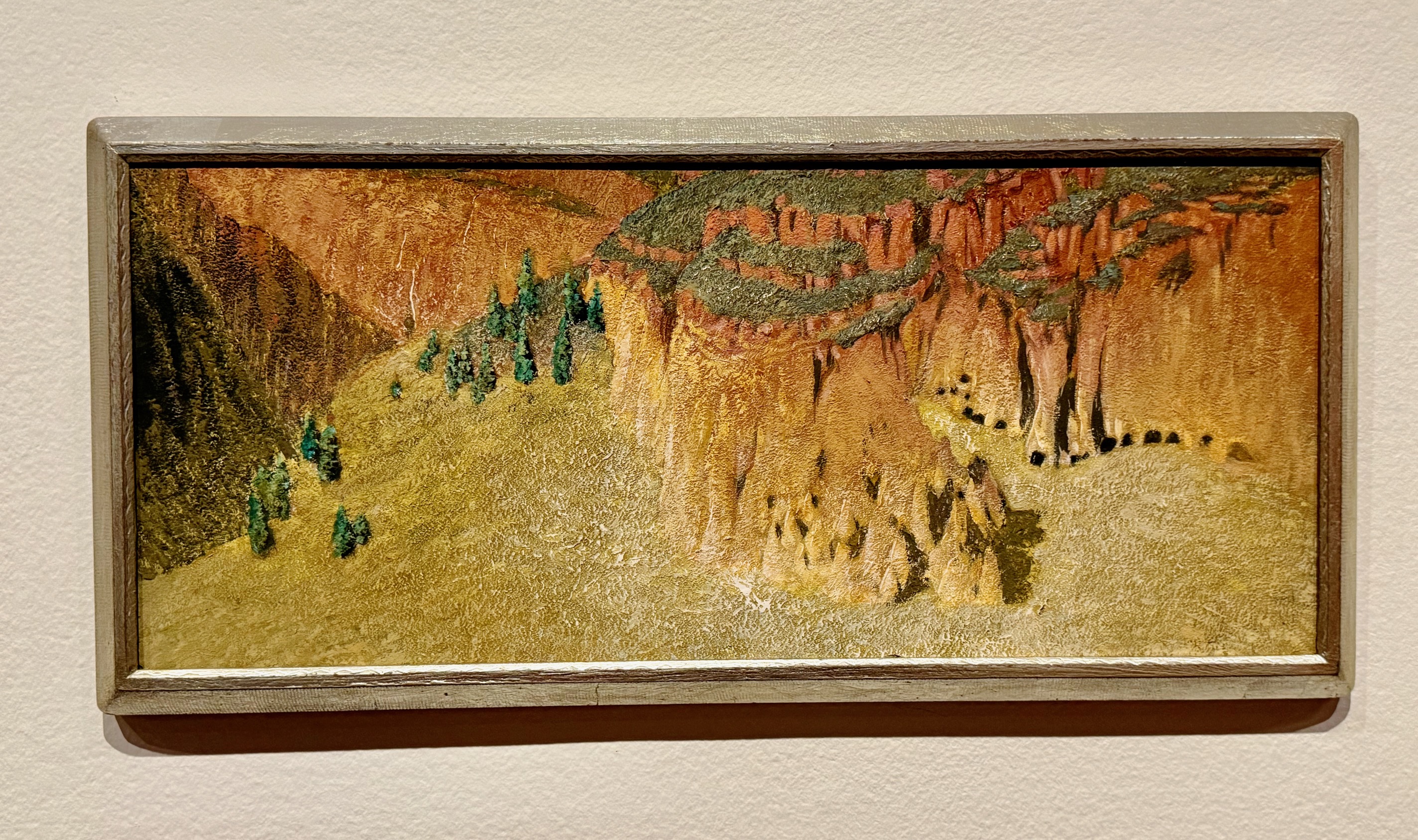
Gus Baumann’s 1925 oil painting Frijoles Canyon – a panorama of ancient tuff dwellings of Tuyoni Pueblo at Bandelier.

Before long, Gus was making and selling gorgeous prints, traveling to archeological sites, attending dances at the pueblos, soaking up the ambience of ancient Spanish churches, and putting brush to canvas, and partying with his new artist friends. And he met Jane, the love of his life, and started a family – creating a life full of fun, art, play, and community service.

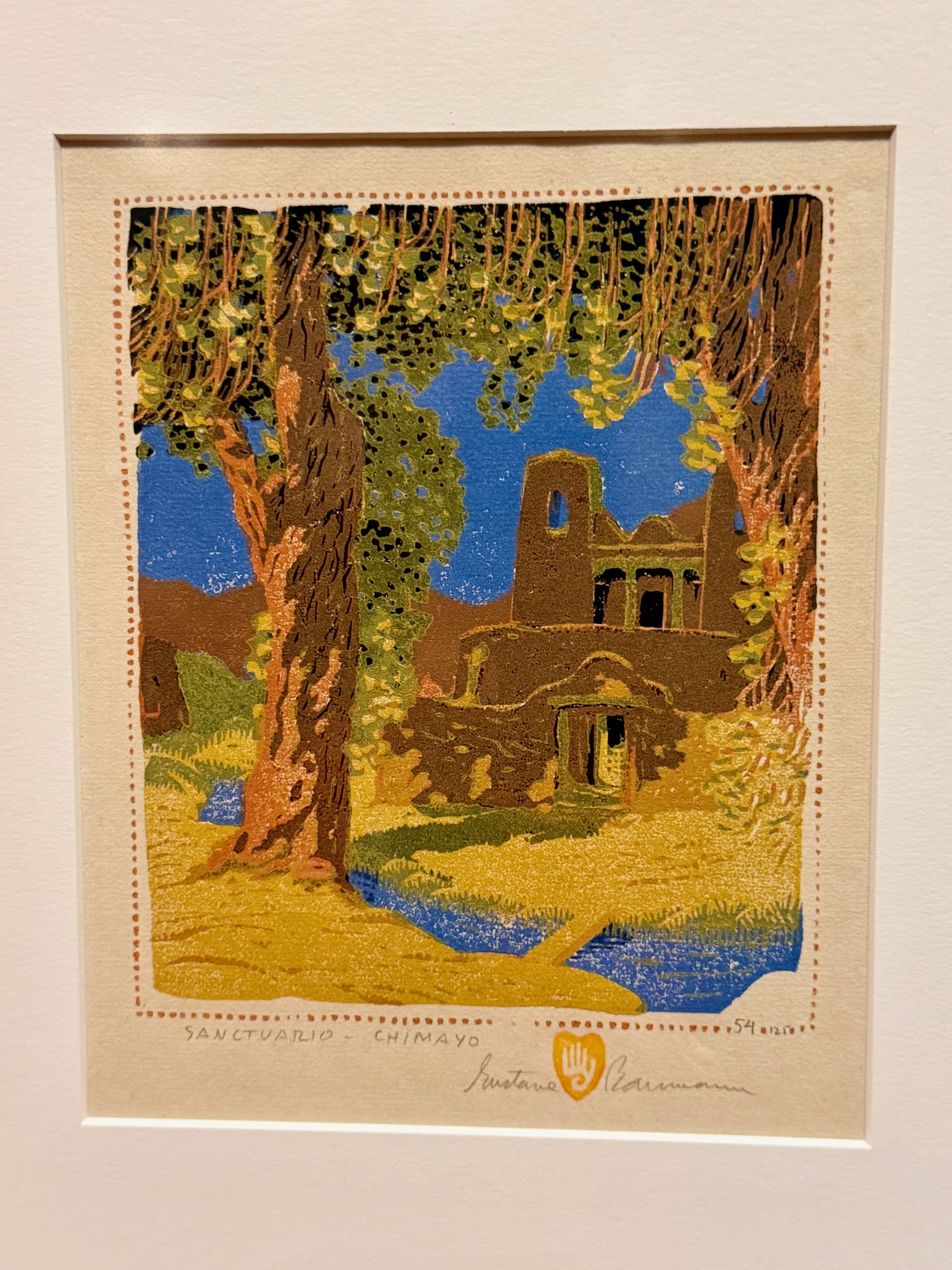
Gus Baumann’s 1924 color woodblock print Sanctuario Chimayo – learning of the historic church’s imminent sale on a sketching trip, he lobbied successfully for its preservation.
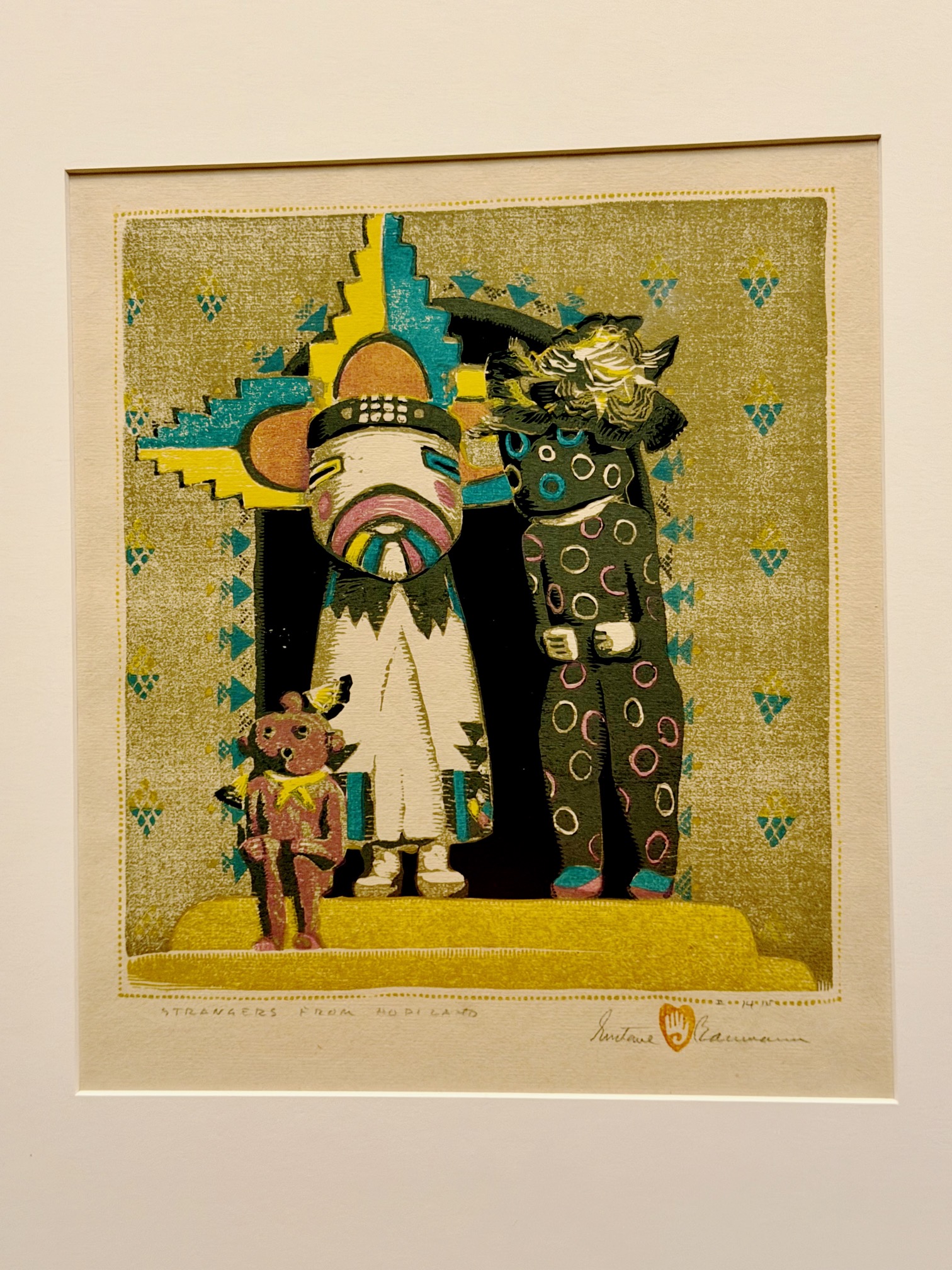
Gus Baumann’s 1921 color woodblock print Strangers from Hopiland, featuring kachinas from his collection; printed in the 1930s.

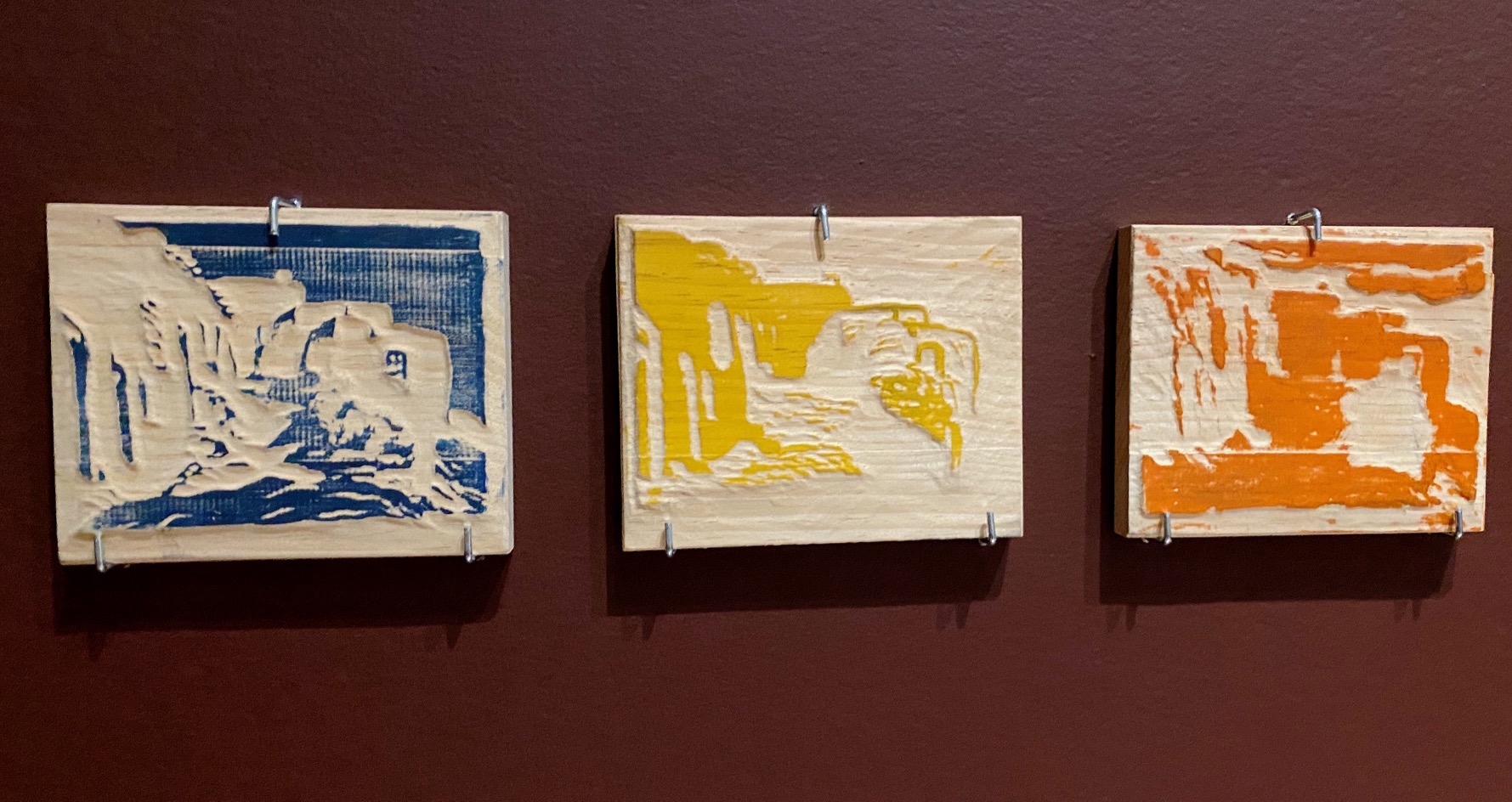
Since Jane and Ann Baumann donated so much of Gus’s work to the New Mexico Museum of Art, the curators were able to display finished prints alongside drawings and wood blocks that give visitors insight to his process.  One long wall dissects his multi-color printing process for his famed Old Santa Fe – the initial drawing, the separately carved color blocks, single-color proofs, multi-color runs, and the finished six-color print.

Reproductions of Baumann’s blue, yellow, and orange woodblocks for his 1925 print Old Santa Fe.

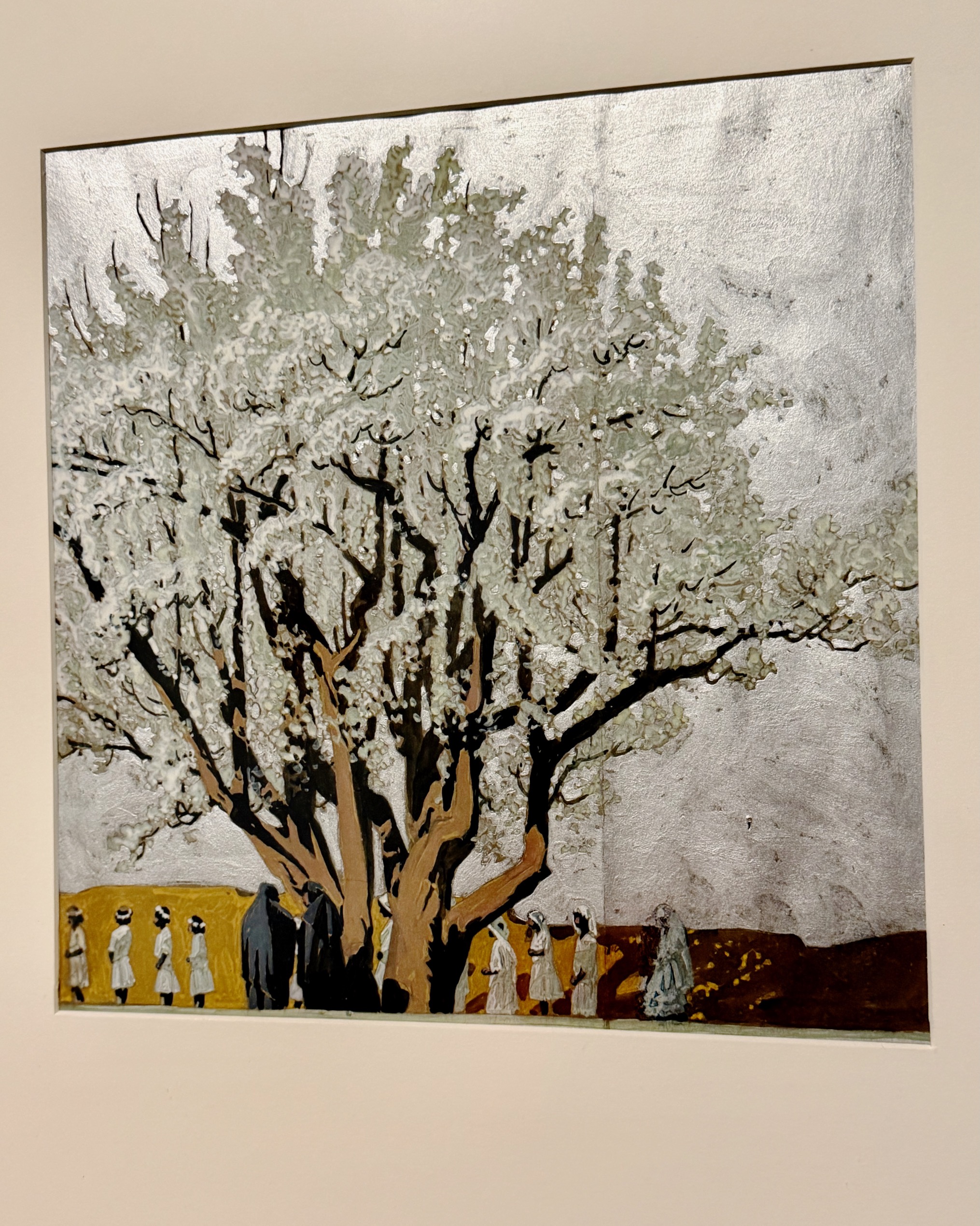
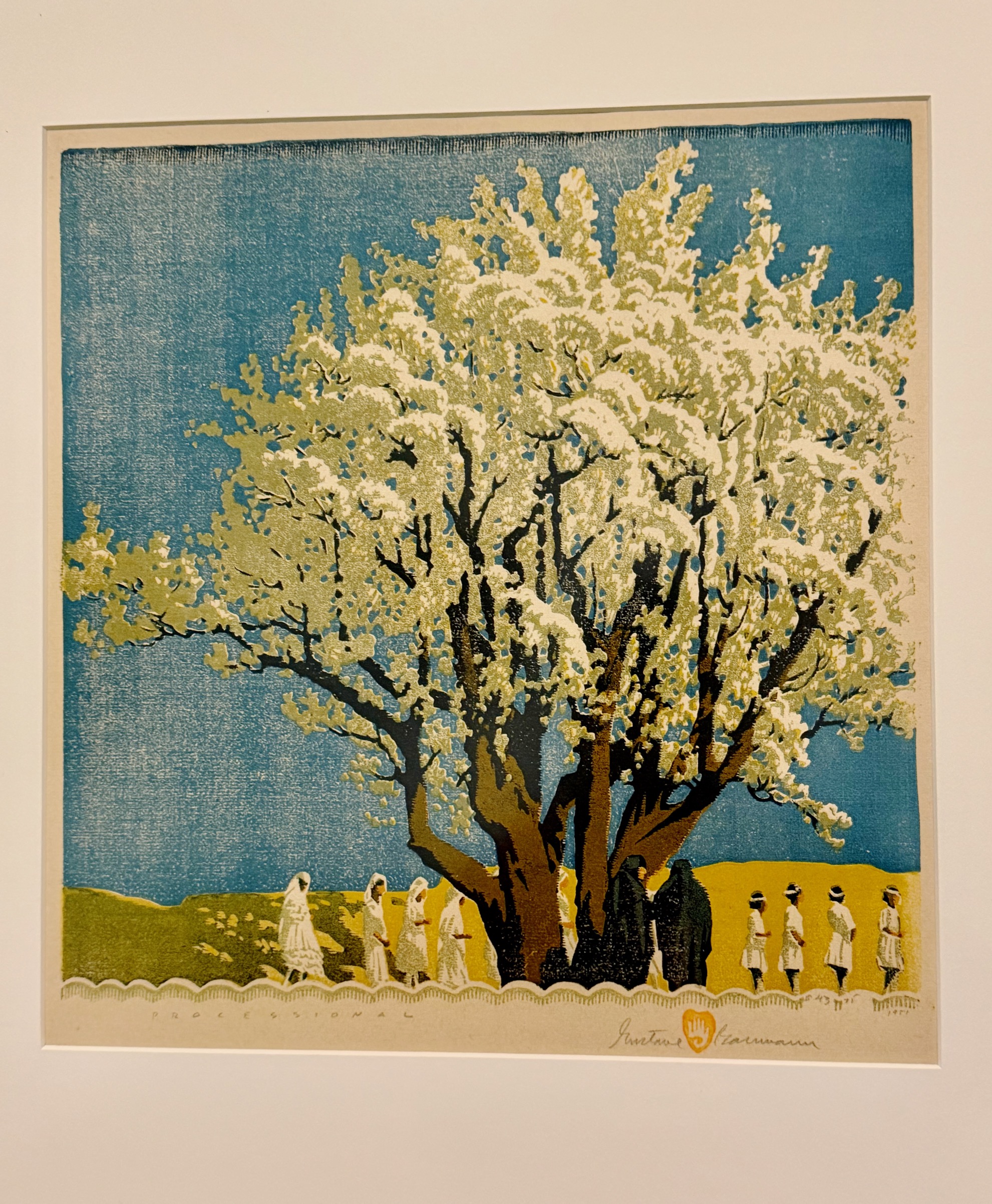
Nearly a half-dozen example of Gus’s watercolor paintings and finished prints are displayed side by side. Visitors are delighted to stand, look, compare, and wonder how he conceptualized steps to carve blocks for each color and achieve images of such depth and vibrancy.
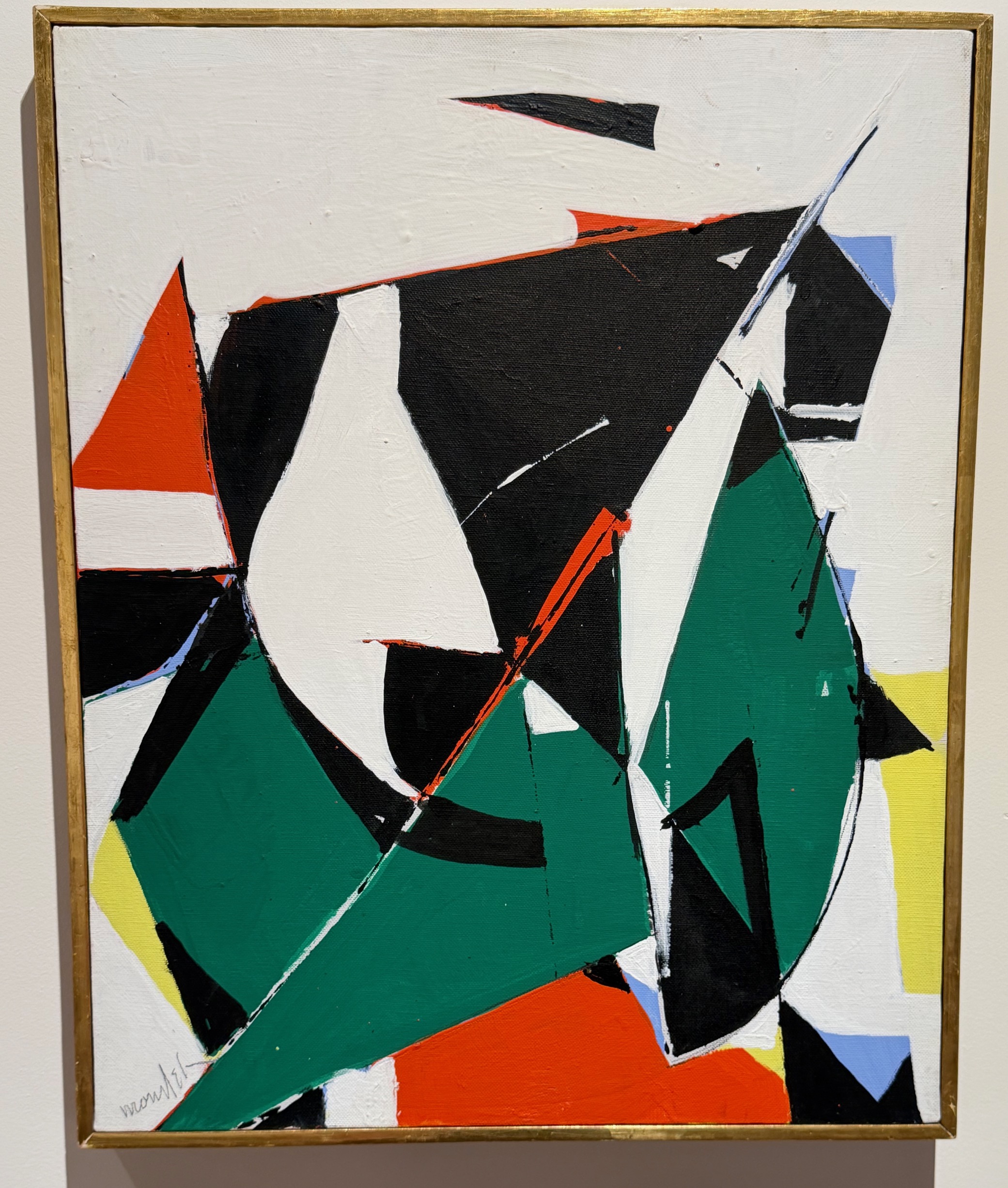
Gus Baumann’s 1930 watercolor Processional (Study), featuring girls walking to their First Holy Communion under a blooming tree and silver sky.
Gus Baumann’s 1930 color woodcut print Processional (printed 1951), based upon his watercolor.

The final gallery “An Artist by Accident” displays an array of intricate color woodcuts, experimental paintings, satirical works, paintings Spanish religious icons, whimisical wood carvings, and everyone’s favorites – Baumann’s marionettes.

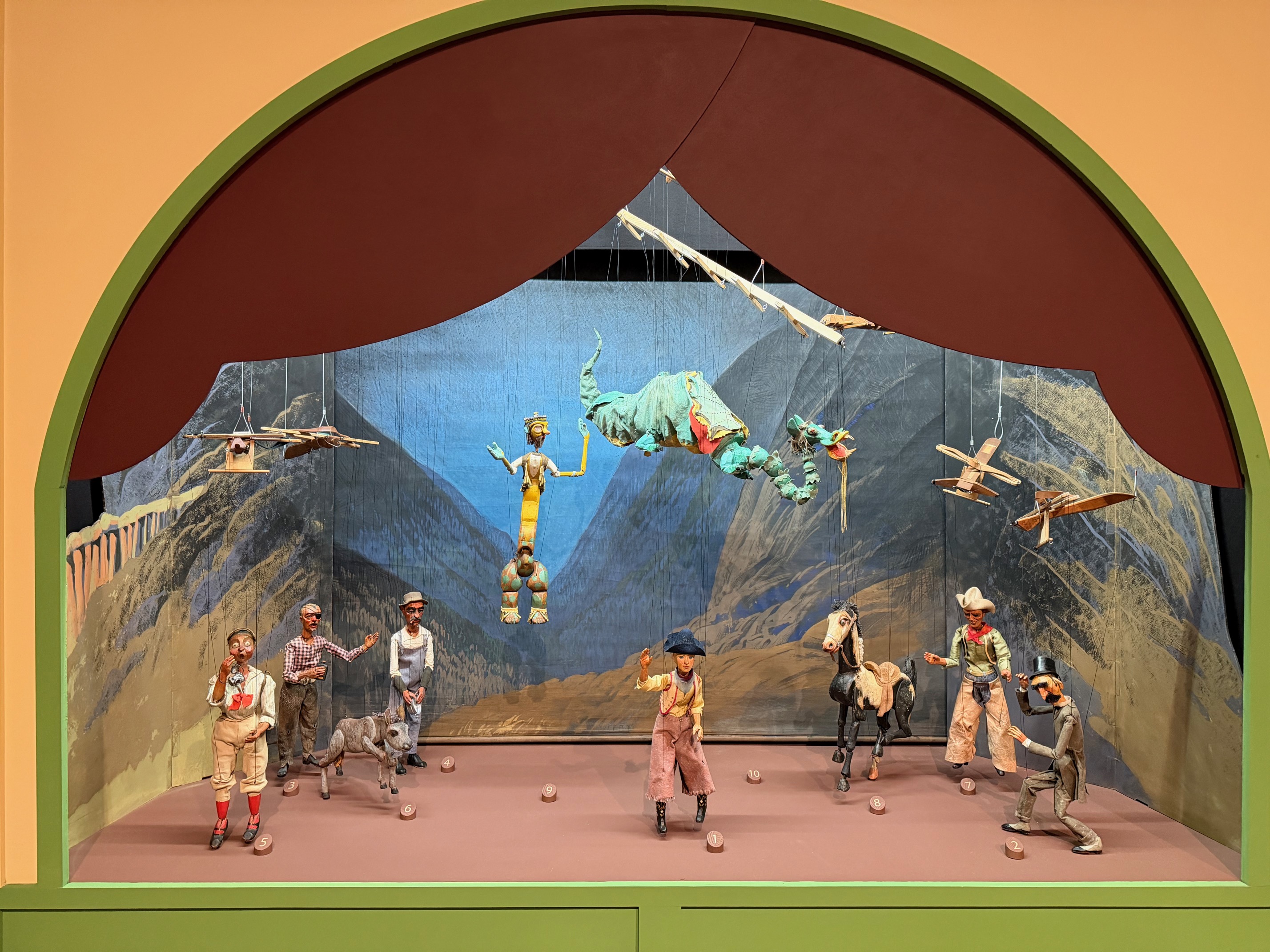
It’s the first time Gus and Jane’s marionette casts have been displayed in decades, complete with hand-painted backdrops – scenes representing just a few of the couple’s scripted shows that they performed at home, in venues around Santa Fe, at world fairs, and on tour. 

Gus and Jane Baumann’s stage set for the Santa Fe Puppett Wranglers’ 1932 marionette production of the comic melodrama The Golden Dragon Mine –starring The Tourist Lady, Temperence the Miner, Hardpan, Burro, Old Man of the Mountain, the Green Dragon, Nambé Nell, Coco the Horse, Pecos Bill, and Lord Leffinghoop.

Whimsey, delight, innovation, social commentary, and fun are all there, with surprises unfolding around every corner.  And this is all just a fraction of Gus’s creative output from his coming-of-age in the horse-and-buggy era to the Atomic Age.

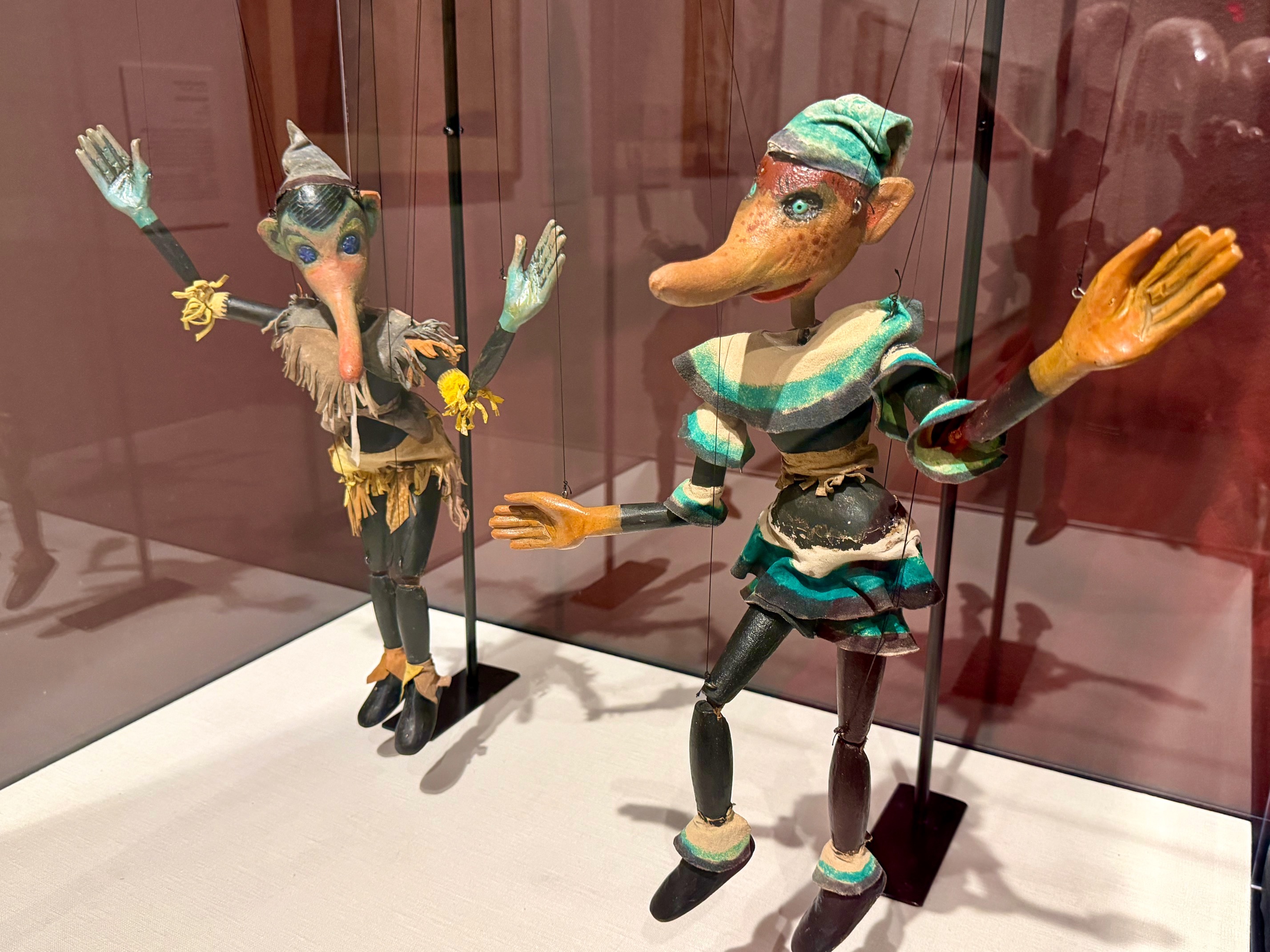
Gus Baumann’s 1940 marionette comedy stars of Teatro Duende – Long Nose (“Nosey”), the Duendi and Freckles the Duende – mischief-making Iberian elves.

No, he didn’t follow the traditional academic path, but he did leave his creative touch on America’s printmaking traditions, the foundation of many Santa Fe cultural and historical institutions, and the care and feeding of a state full of artists as head of New Mexico’s New Deal artist programs.

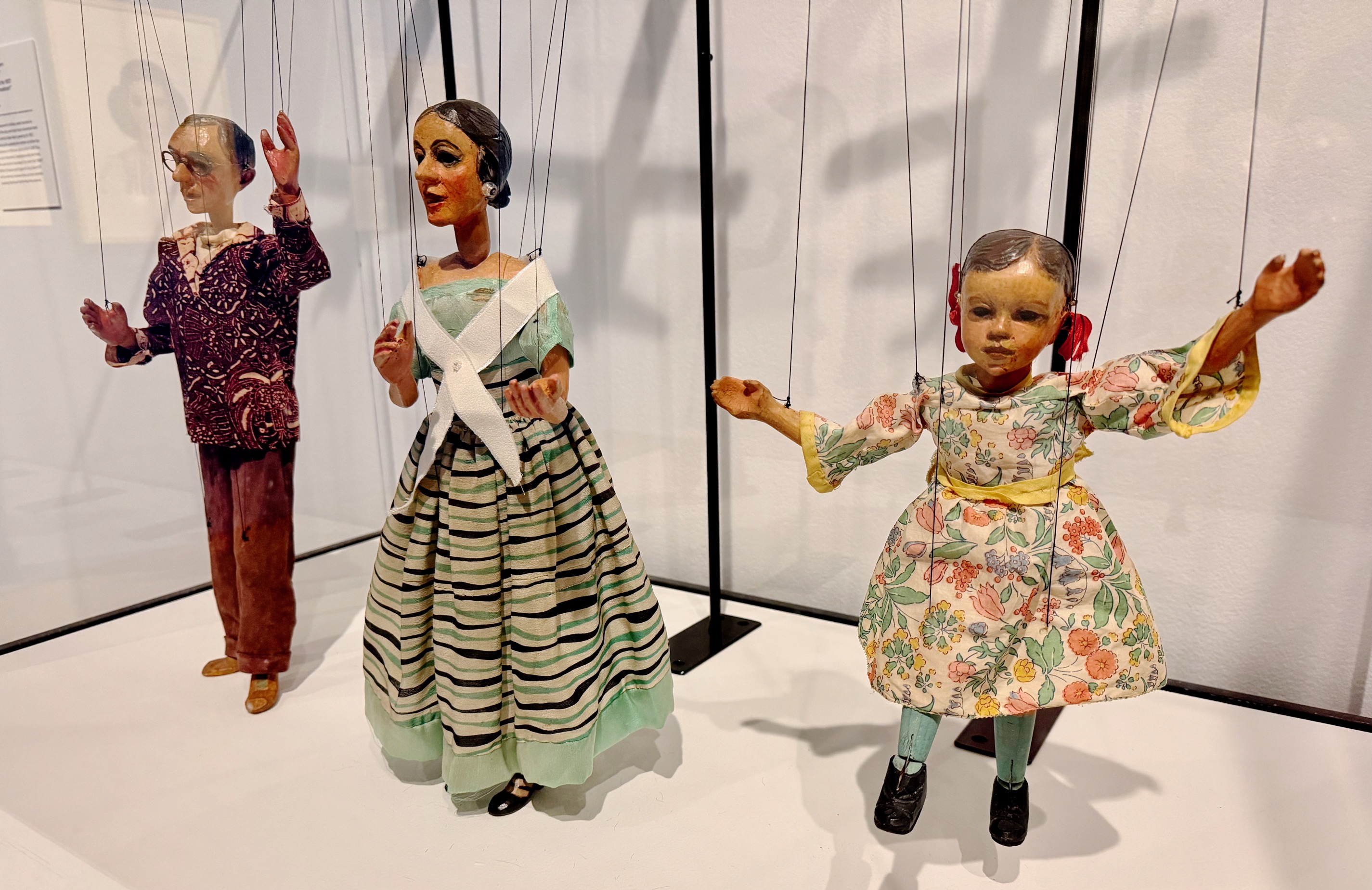
Gus Baumann’s 1932 carved family portrait – marionettes Gus, Jane, and Ann – with costumes by Jane.

Georgia O’Keeffe’s Modern Living

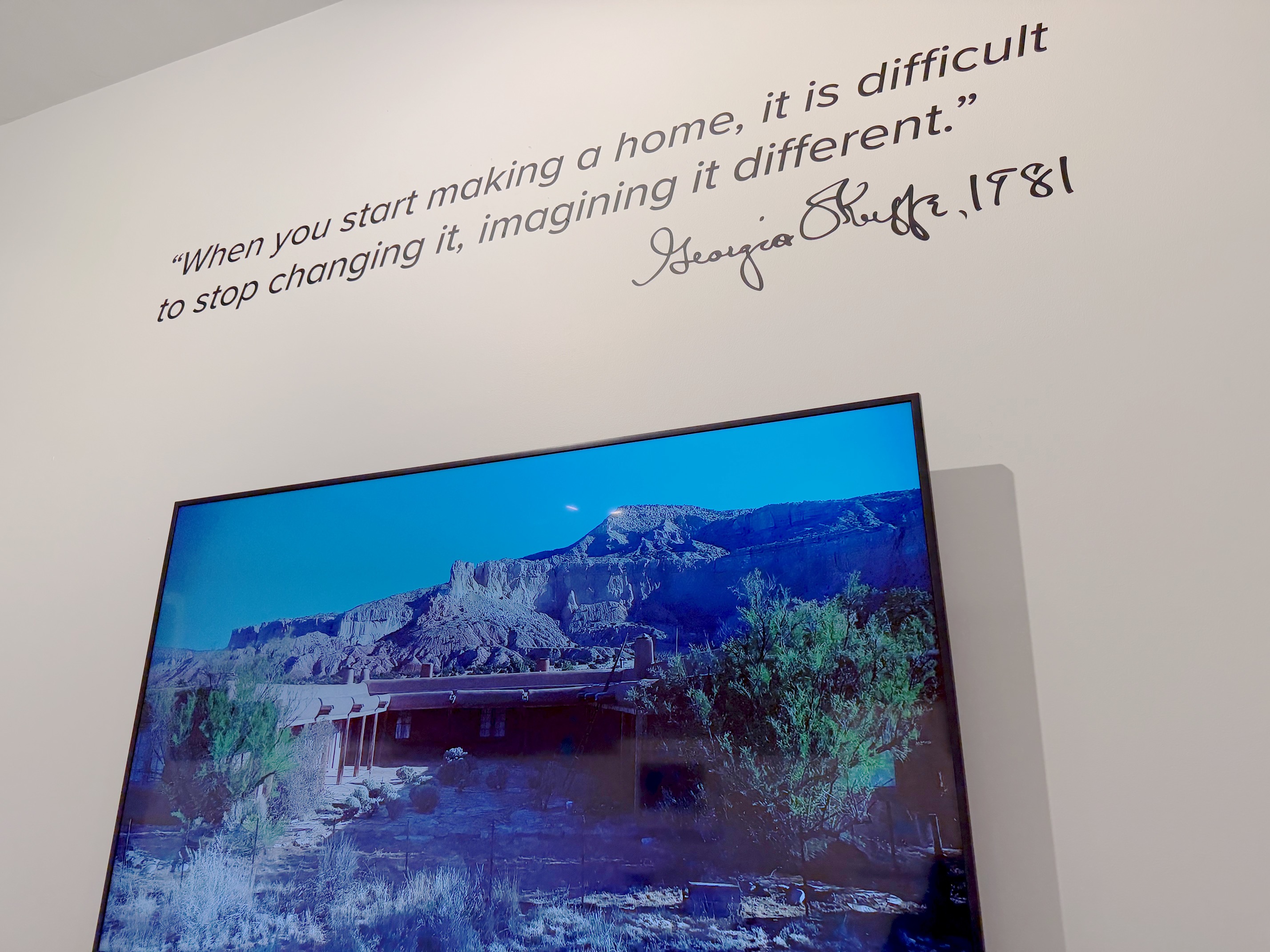
How do you turn a 200-year-old adobe home into a temple of mid-century modern design? See how Georgia O’Keeffe did it in Artful Living: O’Keeffe and Modern Design, an exhibition available on-line and at the GOK Museum’s Welcome Center near her home and studio in Abiquiu, New Mexico through January 31, 2027.

When Georgia bought her second New Mexico home in 1945, it was a wreck. All the better, for her to envision the possibilities of her dream house. Why was she obsessed with this? It had a home garden and irrigation, a placita in the center of the house with a working well, the iconic black door in the red wall, and an incredible view of the stunning landscape (and Pedernal).

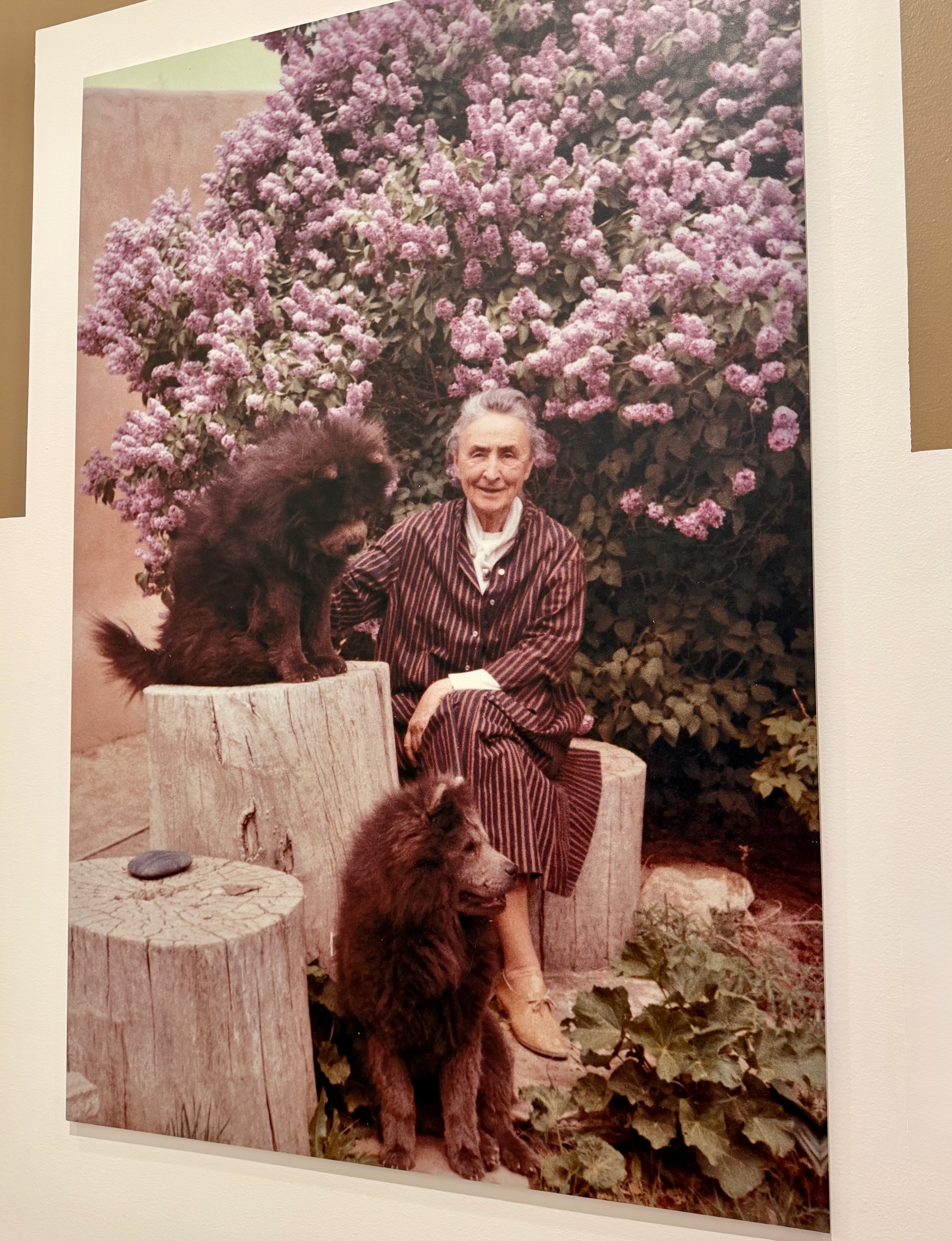
Todd Webb’s 1962 photo Georgia O’Keeffe and Chows in Abiquiú Garden with Georgia in a striped Marimekko dress.

By collaborating for the next four years with her friend and project manager Maria Chabot, the property was transformed into a showcase for everything modern – furniture, fabrics, lamps, tableware, and (eventually) architectural innovations like skylights, gigantic picture windows, and open-plan living.  To keep her creative sparks going, Georgia never stopped rearranging, adding, and switching things up.

The exhibition space is small, but provides a tight curated selection of Georgia’s things accompanied by great photos of her interiors over time.

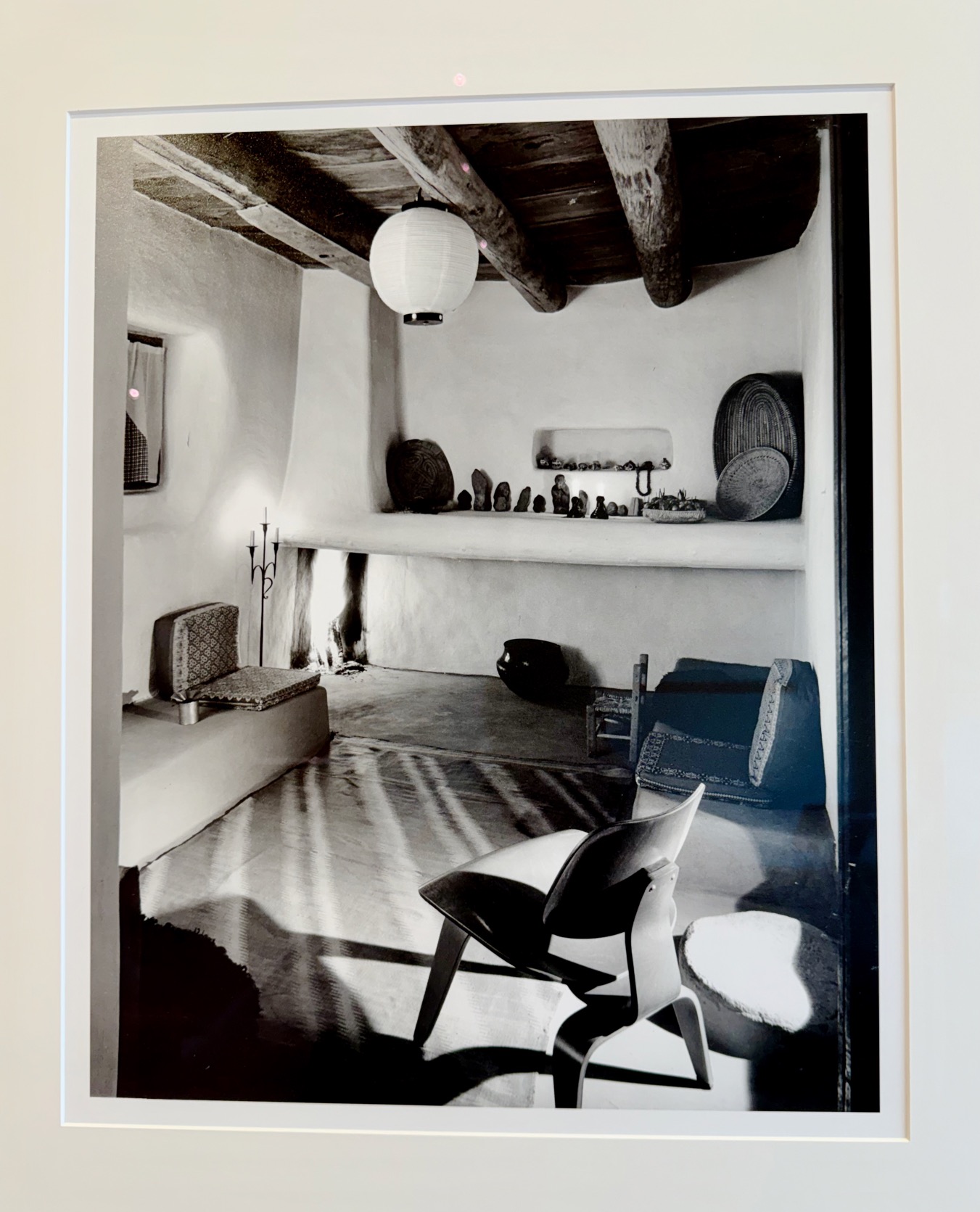
Balthazar Korab’s 1965 photo Abiquiú House, Indian Room with Noguchi lamp and Eames chair.
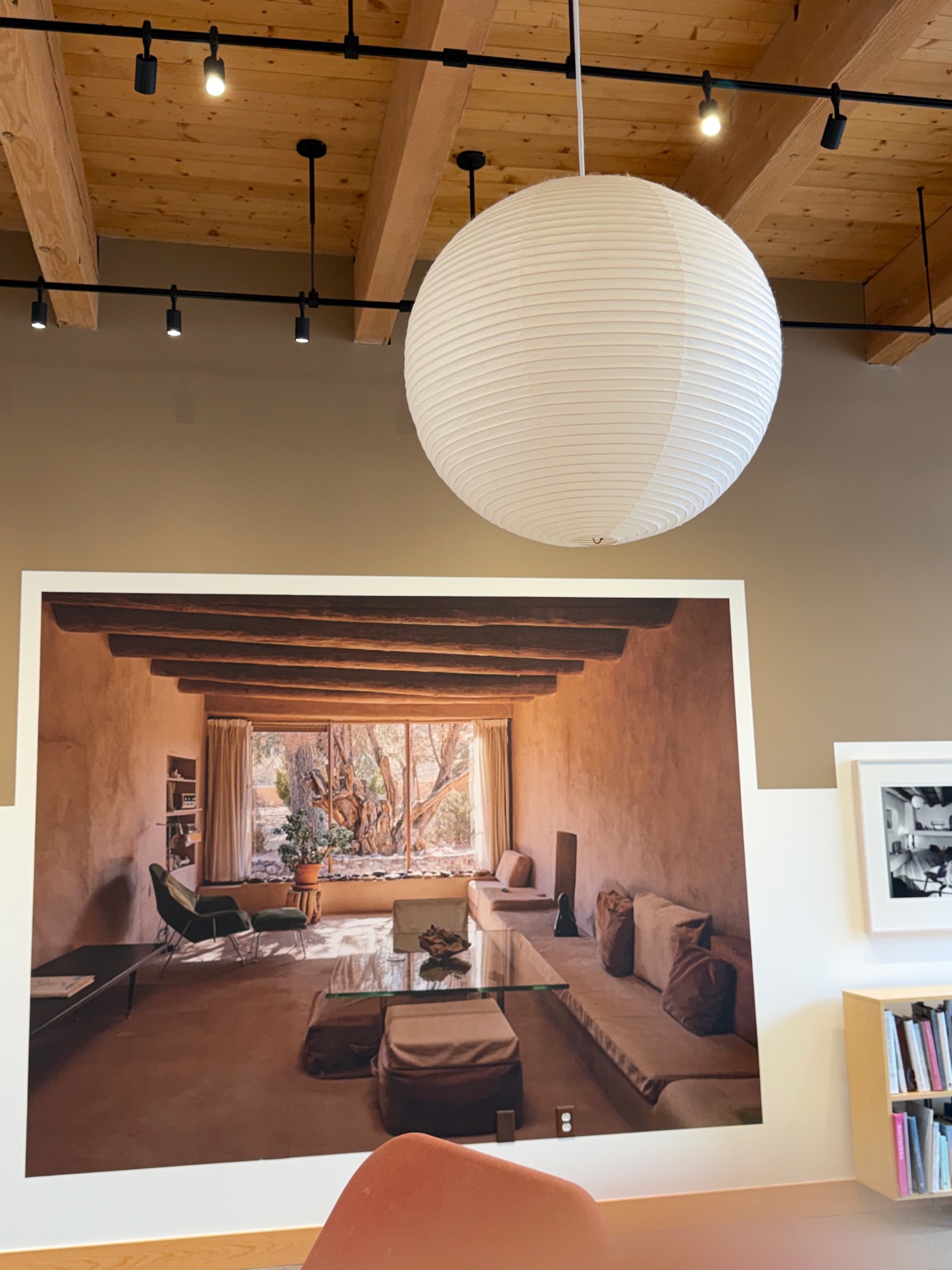
1960s Akari Lantern, a gift from sculptor and designer Isamu Noguchi with Krysta Jabczenski’s 2019 photo of her living room arranged as she left it in 1984.

The furniture is front and center, made by a who’s who of American 20th century designers.  After all, as one of the recognized greats of modern American painting, the designers were often her friends, too. Simple, clean, modern lines – that’s what Georgia liked. But she loved design innovations, too.

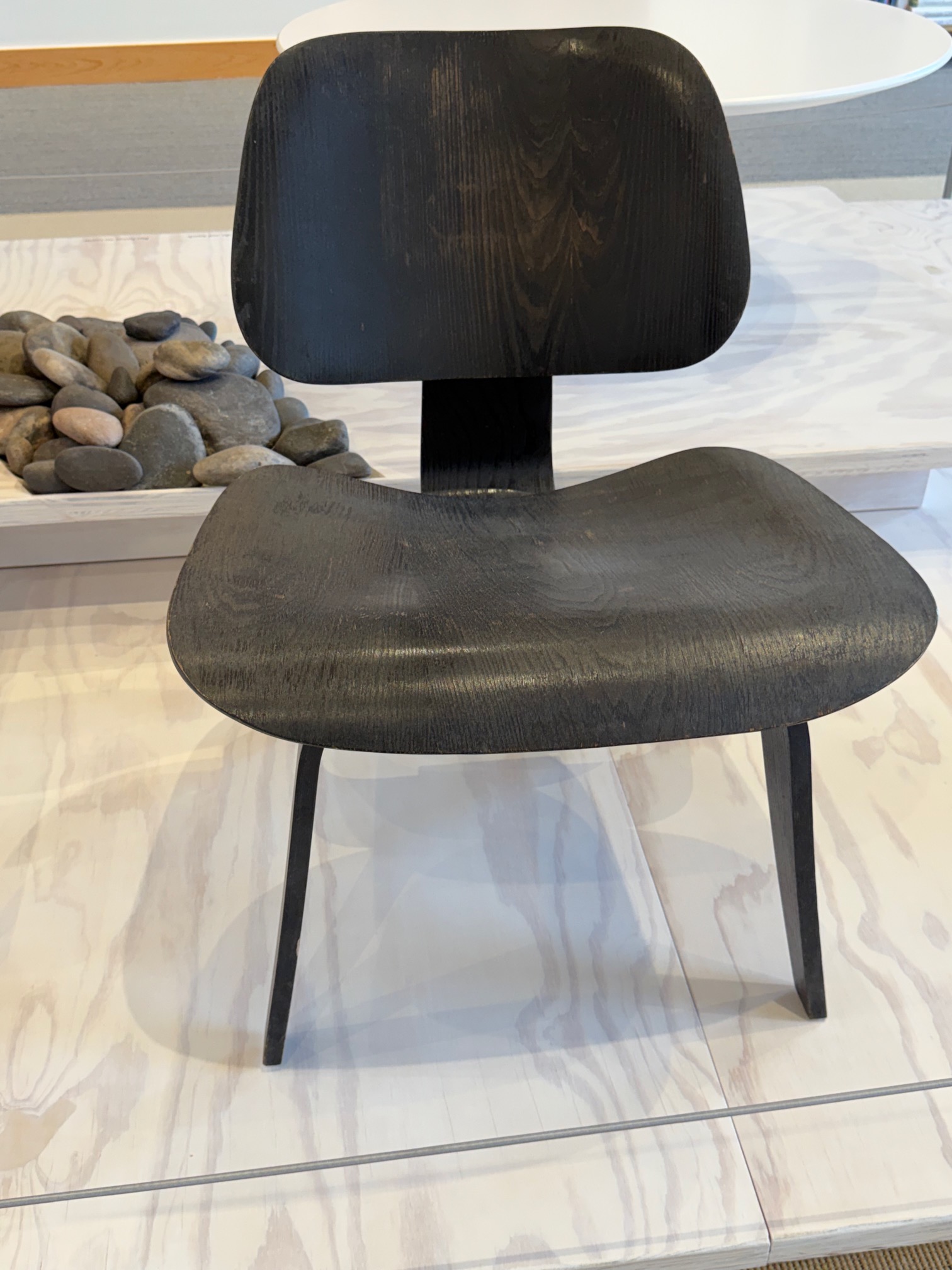
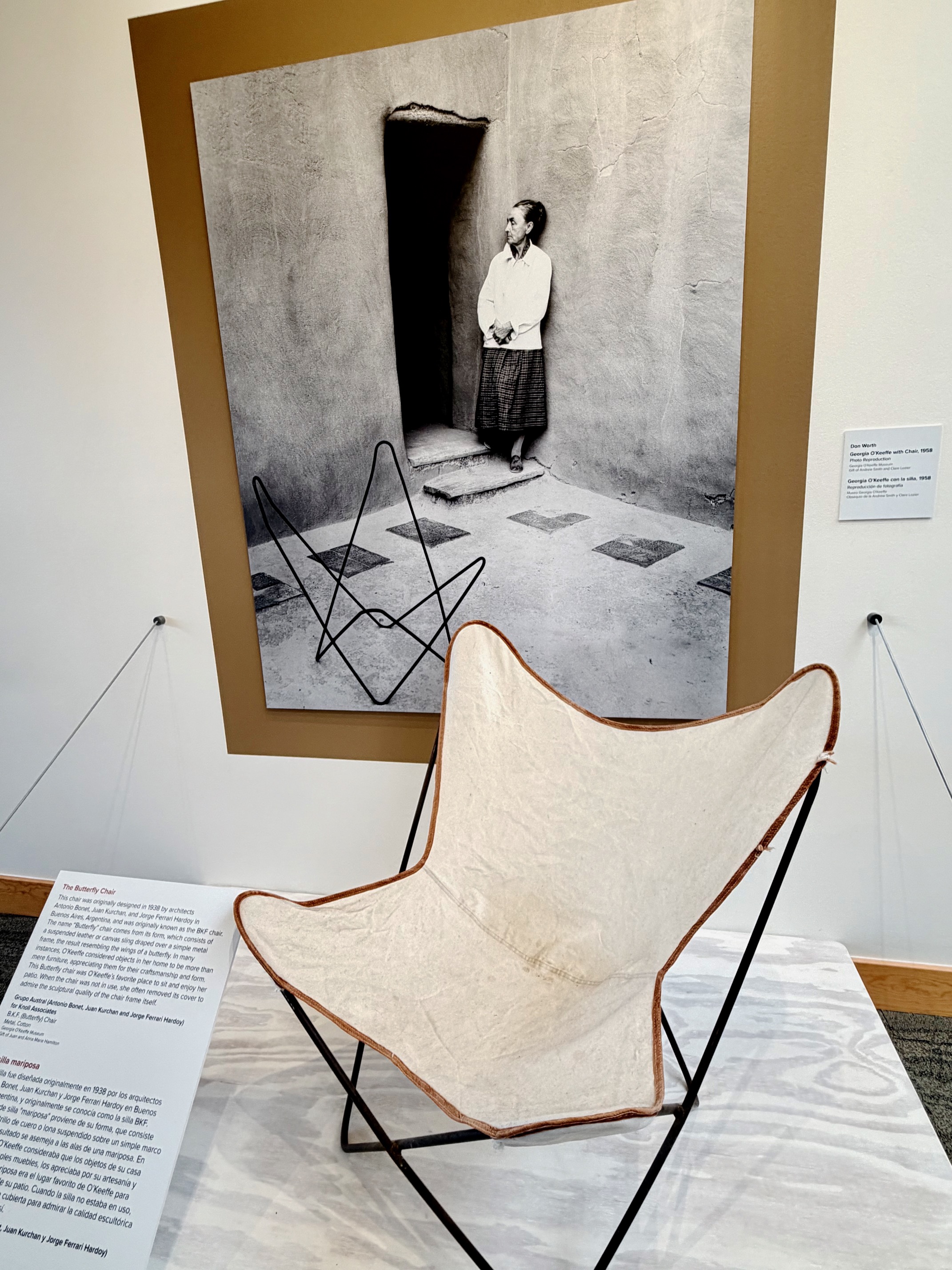
No wonder she was captivated by the innovative BFK (“Butterfly”) chair designed by a trio of Argentine architects in 1938. She ordered one from Knoll, used it on her patio, and sometimes took the cover off just to admire the frame. And she bought several LCW chairs by her friends, Charles and Ray Eames – the molded-plywood marvel that defined a design decade.

1940s LCW Plywood Lounge Side Chair designed by Charles and Ray Eames for Herman Miller – the first chair in the Eames’ molded plywood series.
Don Worth’s 1958 photo Georgia O’Keeffe with Chair with 1938 metal and cotton Butterfly Chair for Knoll Associates.

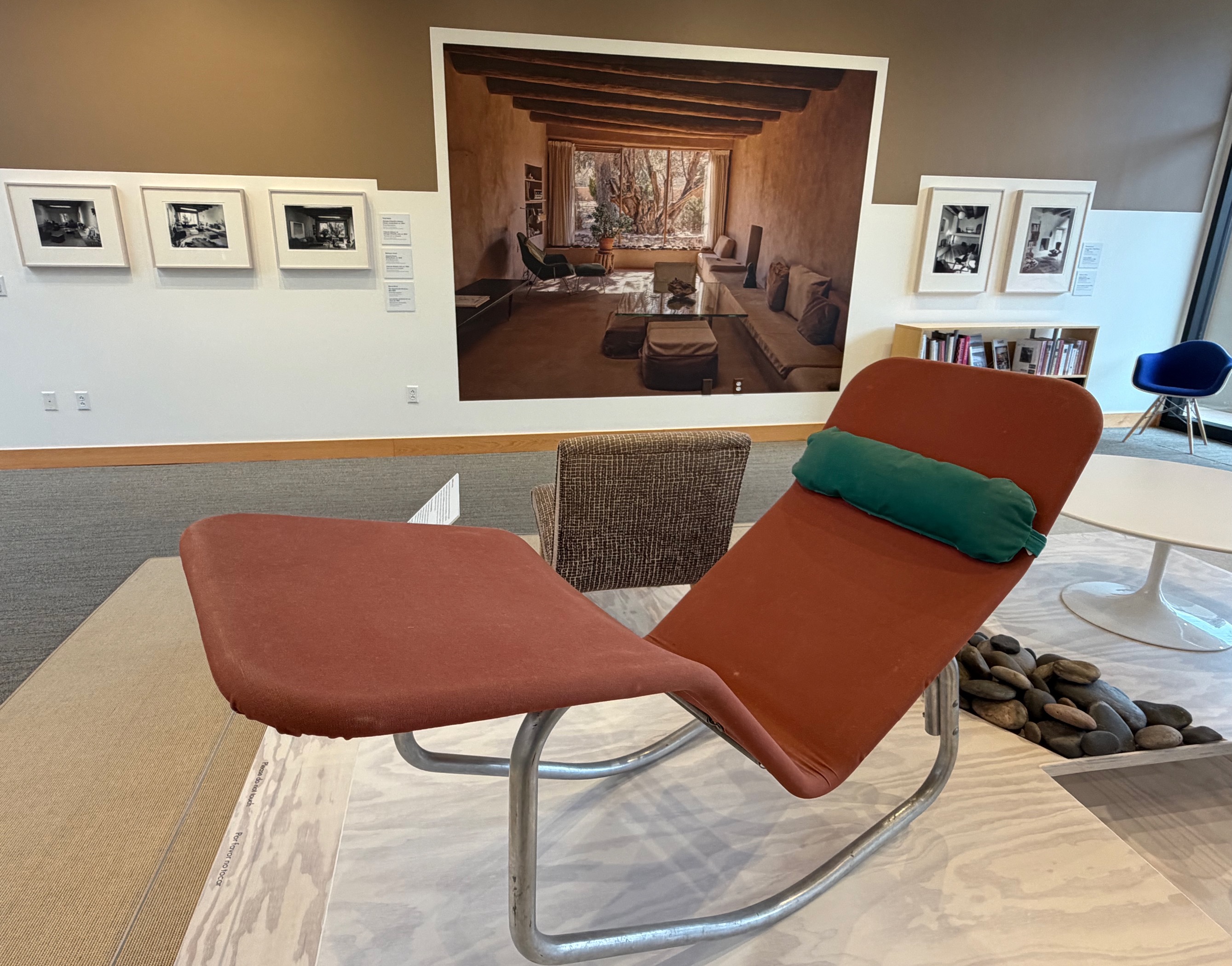
But perhaps her most-used piece was the versatile BARWA Lounger – perfect for laying back and listening to classical music or looking at the stars during a summer camping trip to the badlands. The aluminum frame made it light enough to strap to the top of her car.

1940s BARWA Lounger designed by Edgar Bartolucci and John Waldheim of BARWA Associates; Georgia relaxed here while listening to classical music.

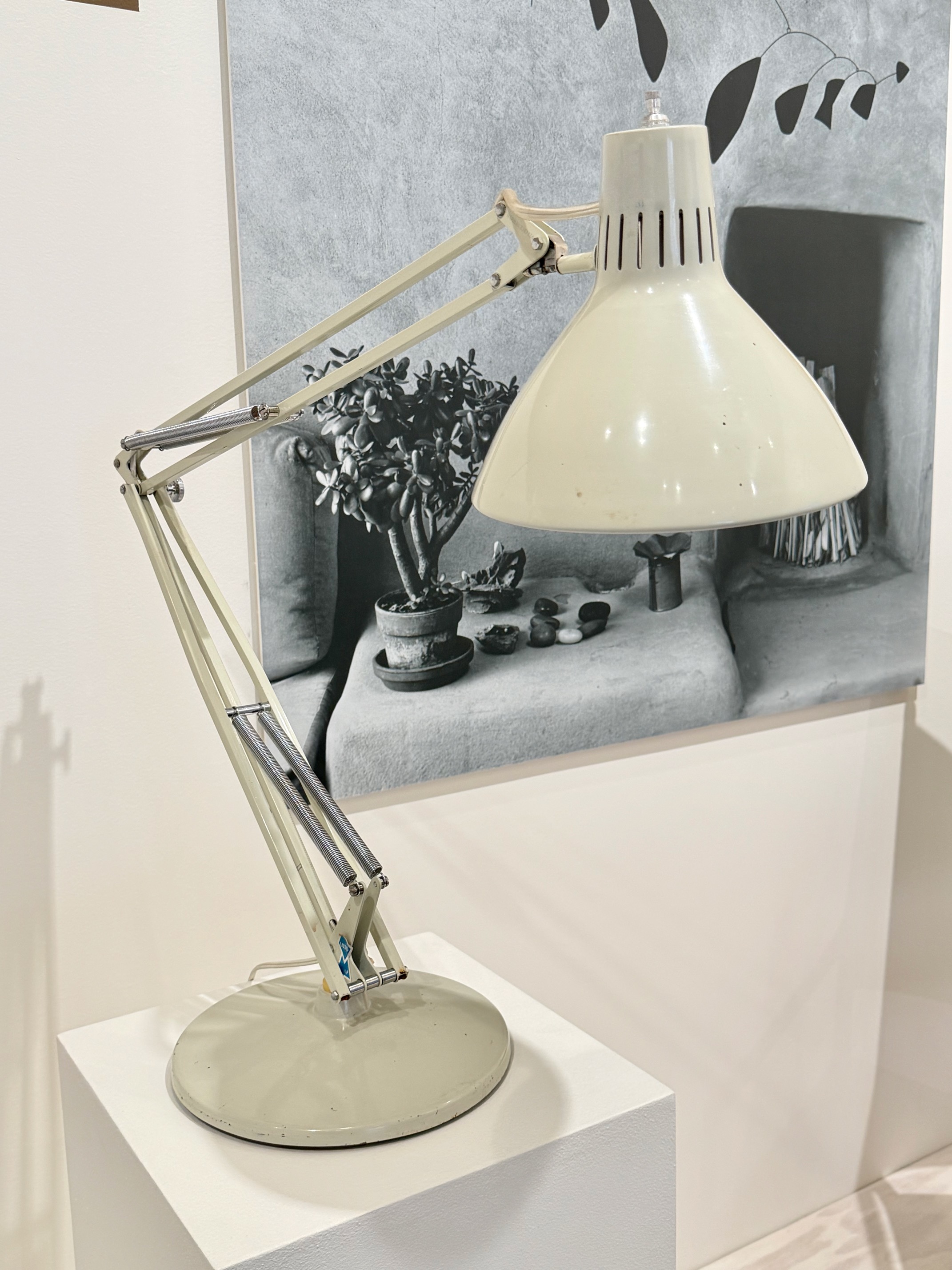
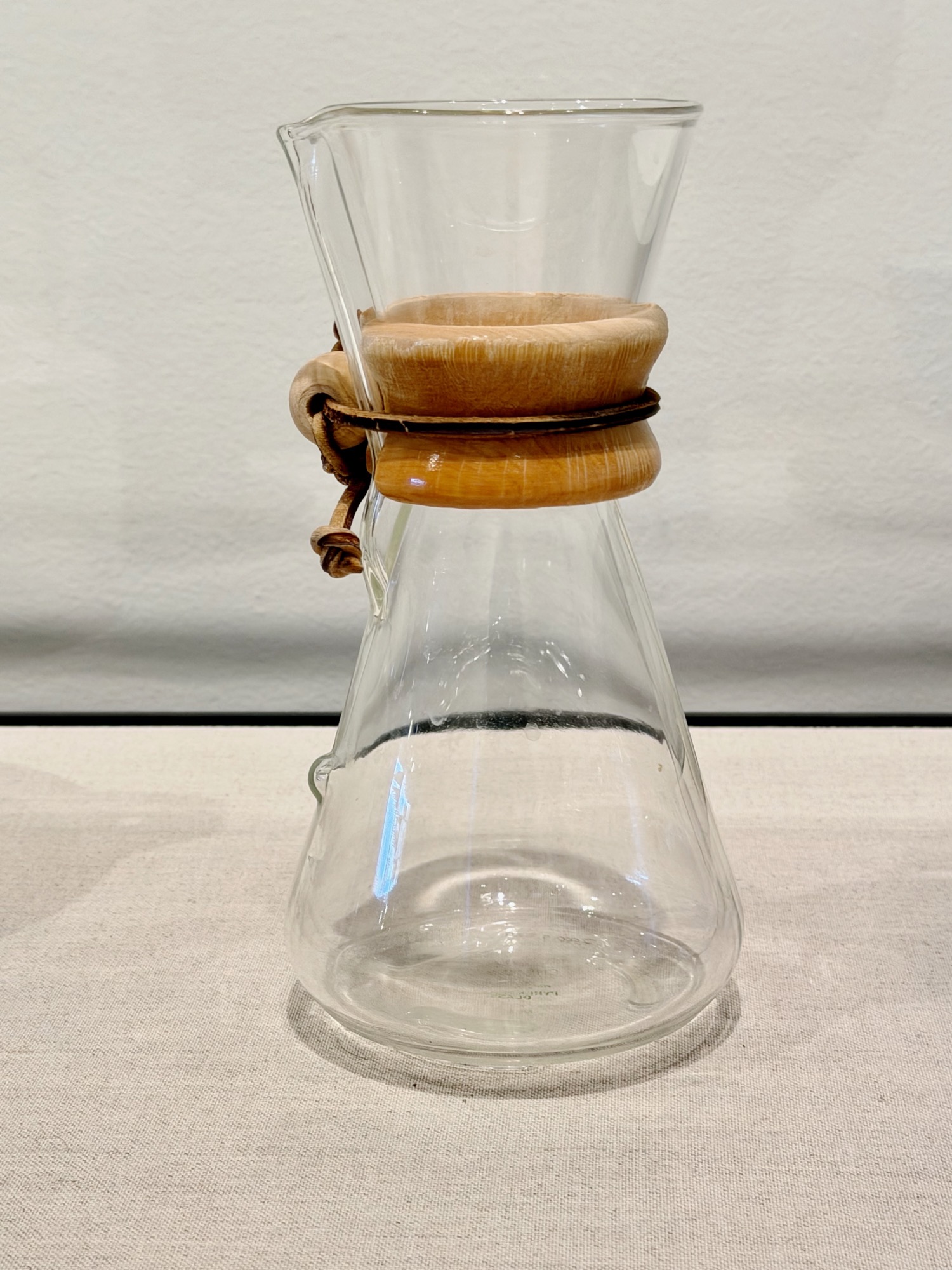
Of course, Georgia loved her rock and bone collections, but she also collected practical items for her home that epitomized mid-century design.  Why not select a Finnish design innovation that you could adjust to get the light just right on your work desk or still life? Or use a sleek, modern, see-through coffee maker to prepare your morning cup of Bustelo? Pure bliss.

Finnish design: 1960s metal Luxo Lamp designed by Jac Jacobsen.
Everyday modern design: 1950s Chemex coffee maker designed by Peter Schlumbohm for Chemex.

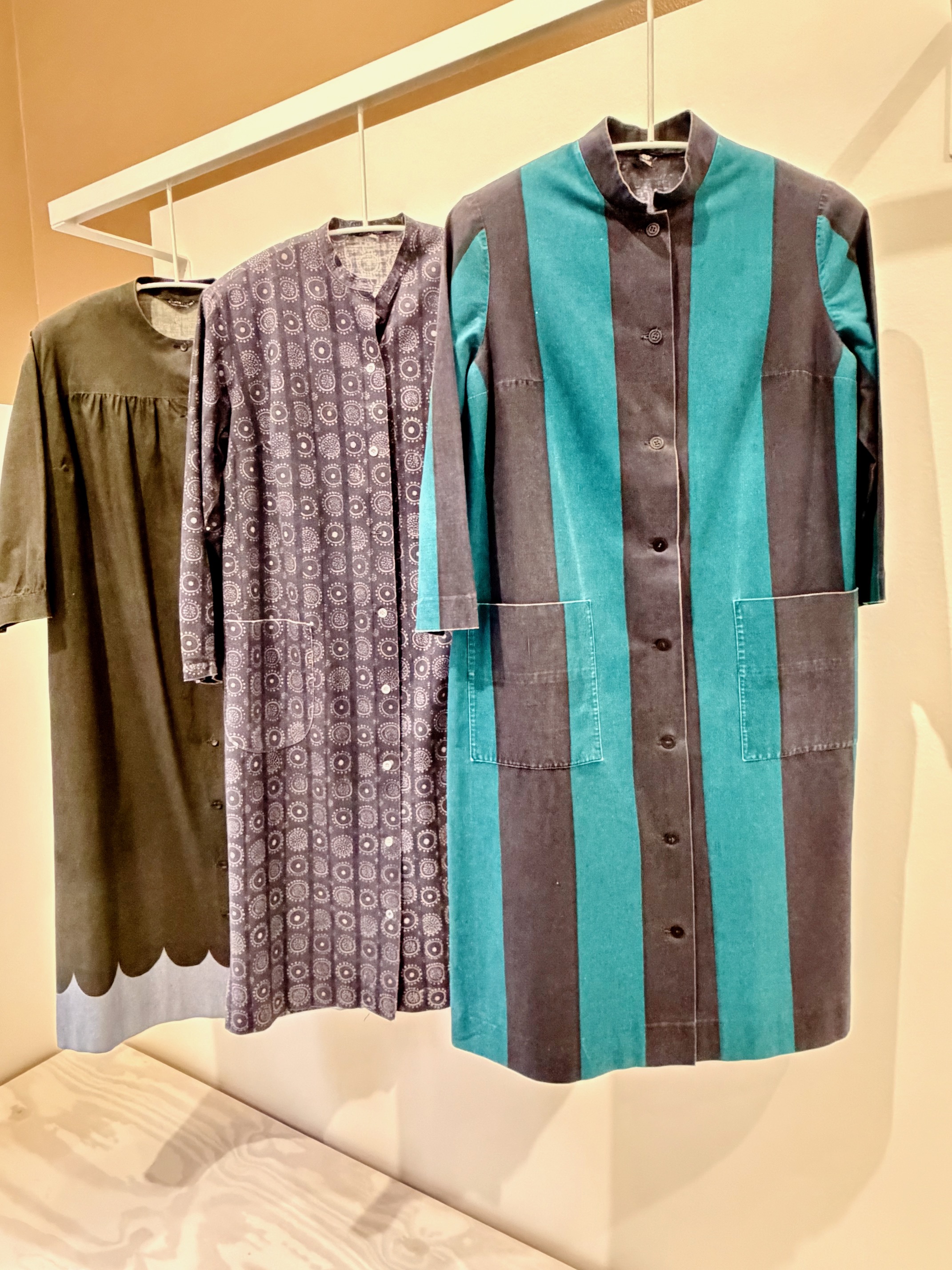
The curators also want us to remember that modern design principles also extended to Georgia’s dress preferences.

Three cool cotton dresses by Anika Ramala for Marimekko – 1963-1965 Varjo dress, 1961 Karutakkj dress, and 1963 Asumistakki dress.

When she wasn’t posing for the most famous photographers against the red rocks of New Mexico in her black hat and wrap dress, she preferred wearing loose-fitting Marimekko dresses.   A working studio artist could really move in them to prepare canvases, rehang paintings around the house, or carry around stuff in the pockets. Never mind that the dresses from the popular Finnish design house were marketed as the finishing sartorial touch for any modern Sixties interior.

Feel free to revisit our past blog post about the wildly successful traveling exhibition about Georgia’s fashions here.

See some of our favorite photos, furniture, and items in our Flickr album.

Two of her best friends and travel buddies were Alexander and Susan Girard. Georgia always welcomed the small textiles that Alexander Girard gifted her. Although she never adopted his revolutionary conversation-pit seating, she did get out the sewing notions and turn his iconic designs into small throw pillows placed lovingly (and colorfully) throughout her house. She also covered her kitchen work surfaces in Marimekko oil cloth to make it pop, too.

Visit this fantastic design exhibition on line here, and read more about each of Georgia’s mid-century modern choices.

For more, listen to Giustina Renzoni, the museum’s curator of historic properties, discuss how Georgia turned her modern sensibilities into a legendary high desert home:

And if you’re really interested in what Georgia had in her closet, the next time you’re in New Mexico, sign up for that new extra-special tour!

Video still of Georgia O’Keeffe’s Abiquiú home and her philosophy about home design

Contemporary Art Extravaganza Provides Time-Travel Portals

The scale and scope of the contemporary art on display is tremendous, but how often do art-seekers also get an opportunity to travel across ancient streets and landscapes, to meet real and fictional historic characters, contemplate fables and real-life stories, and see art of the past and present side by side?

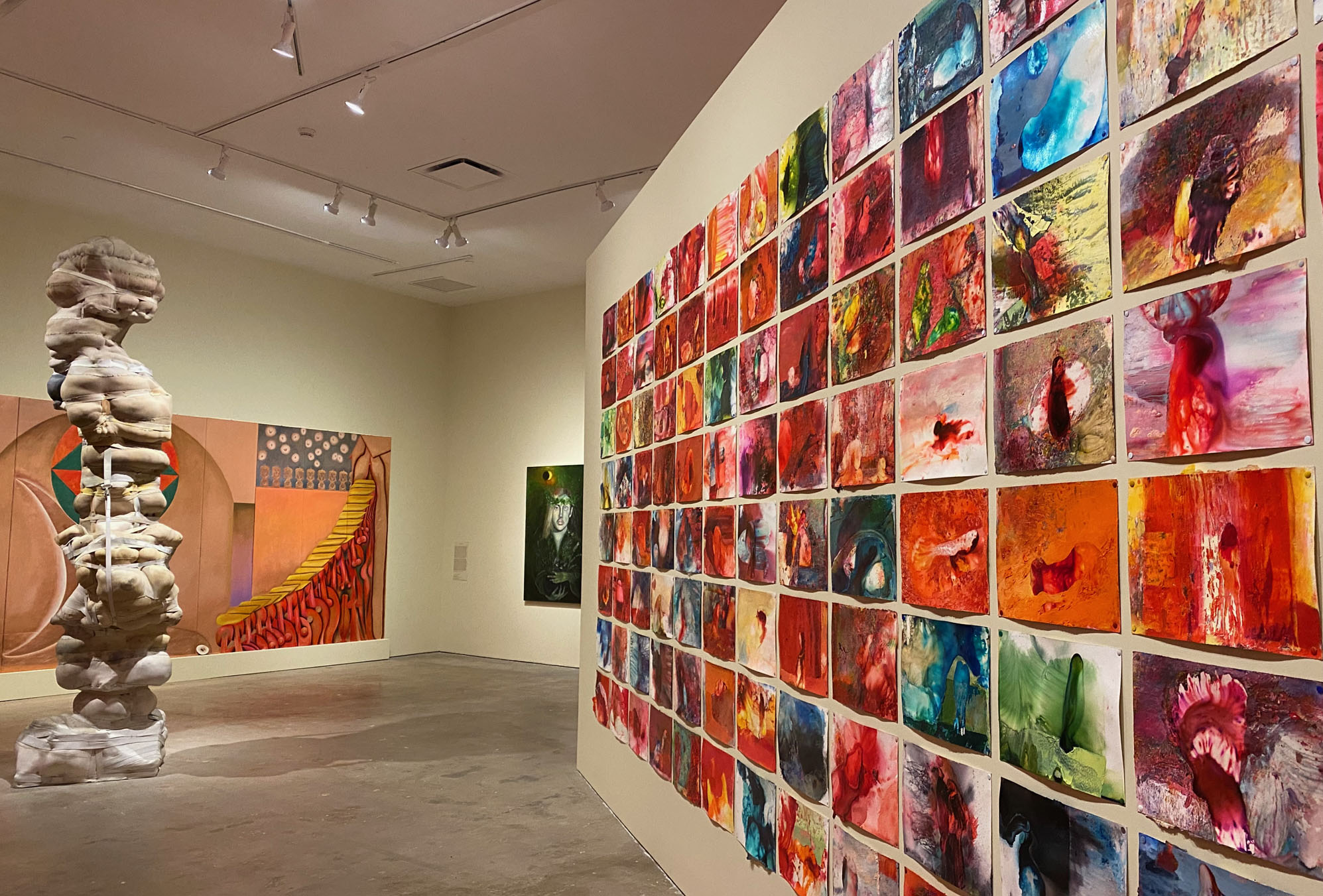
It can take days to experience and fully absorb all of the history and potential futues presented in the films, paintings, sculptures, and installations in Once Within a Time: 12th SITE Santa Fe International, on view across 15 art spaces across Santa Fe through January 12, 2026.

Exhibition banner in the courtyard of Palace of the Governors (1610) (New Mexico History Museum) – gateway to SITE installations by Daisy Quezada Ureña (Santa Fe) and Charisse Perlina Weston. (Harlem, New York)

Besides the expansive white galleries and screening rooms of SITE’s museum in Santa Fe’s always-popping Railyard District, visitors can choose to contemplate giant abstract murals in a church-like auditorium, an innovative historical-object installation in a 400-year-old seat of power, or enter an old foundry to see an evocative installation by a Silk Road artist across farm fields adjacent to the Old Spanish Trail.

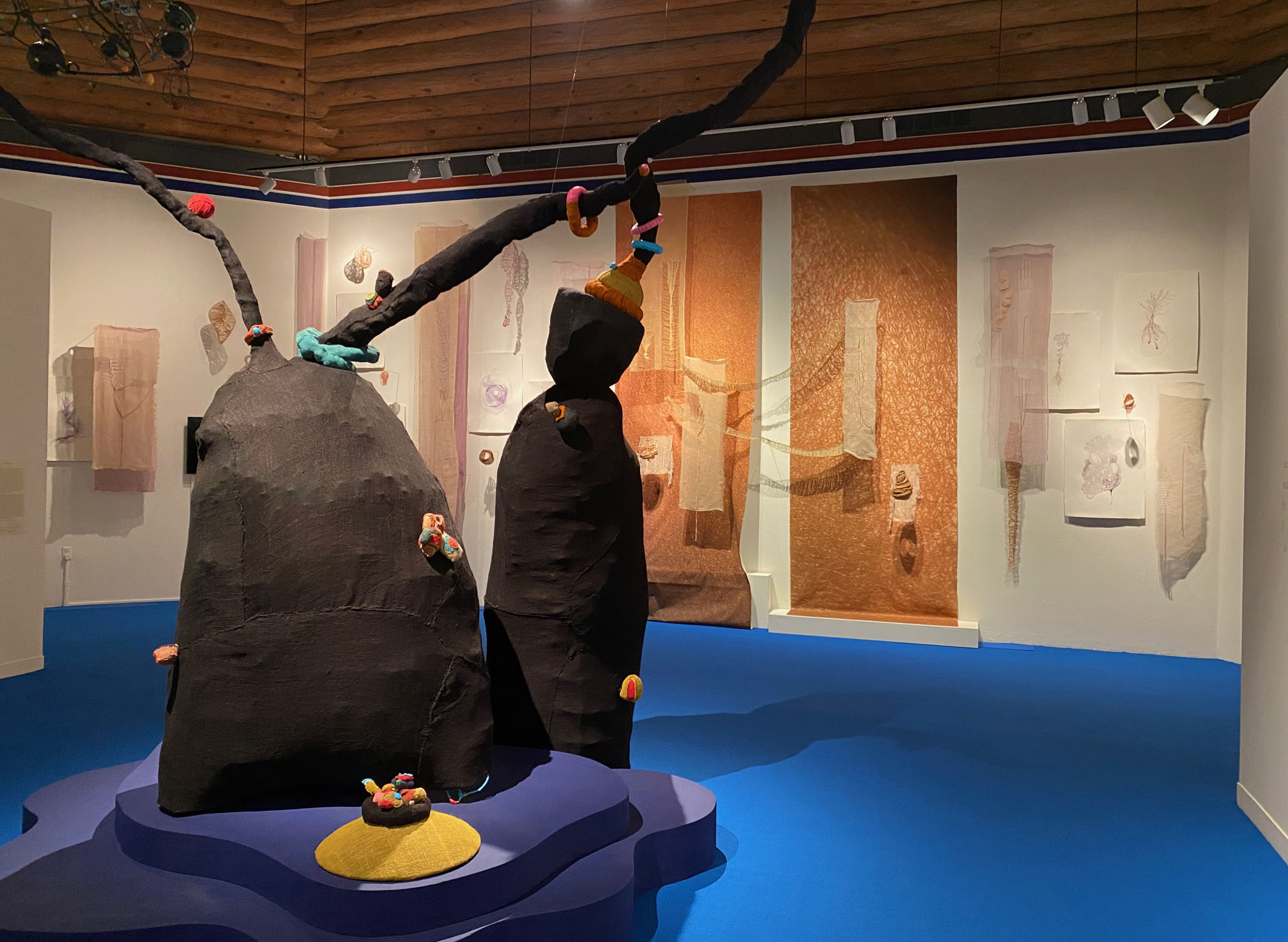
SITE Santa Fe gallery theme: appears like real life and sensual free-thinkers. 2025 mixed-media sculpture “18-1-4-5-7-21-14-4” by Patricia Ayres; copper work by Santiago de Paoli; Katja Sieb’s 2025 “perpetual novice” painting; and 2020 grid painting “Atlas” by Penny Siopis (South Africa).
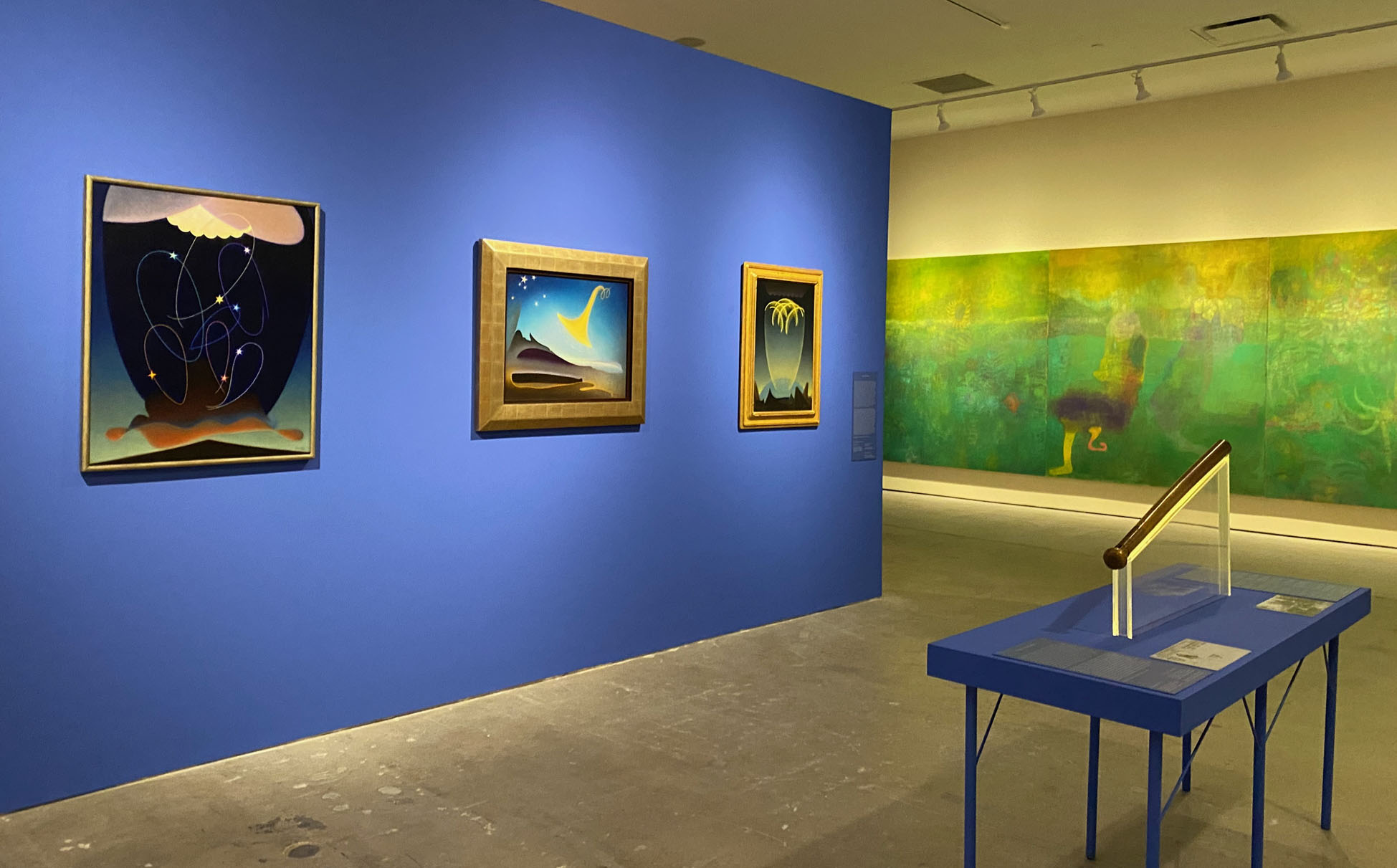
SITE Santa Fe gallery theme: in touch with light (spiritual) – Agnes Pelton’s paintings (1930s), Maja Ruznic’s mural (2025), and the 1895 healing rod of itinerant Southwestern mystic Francis Schlatter. Courtesy: Phoeix Art Museum; New Mexico Museum of Art; Oakland Museum of California; Maja Ruznic and Karma Gallery; and New Mexico History Museum.

In every space and art encounter, visitors may reflect upon whether history is repeating itself and whether inspiration can be drawn from futures that artists imagined nearly a century ago. Each space is designed for visitors to look, read, encounter, and reflect.

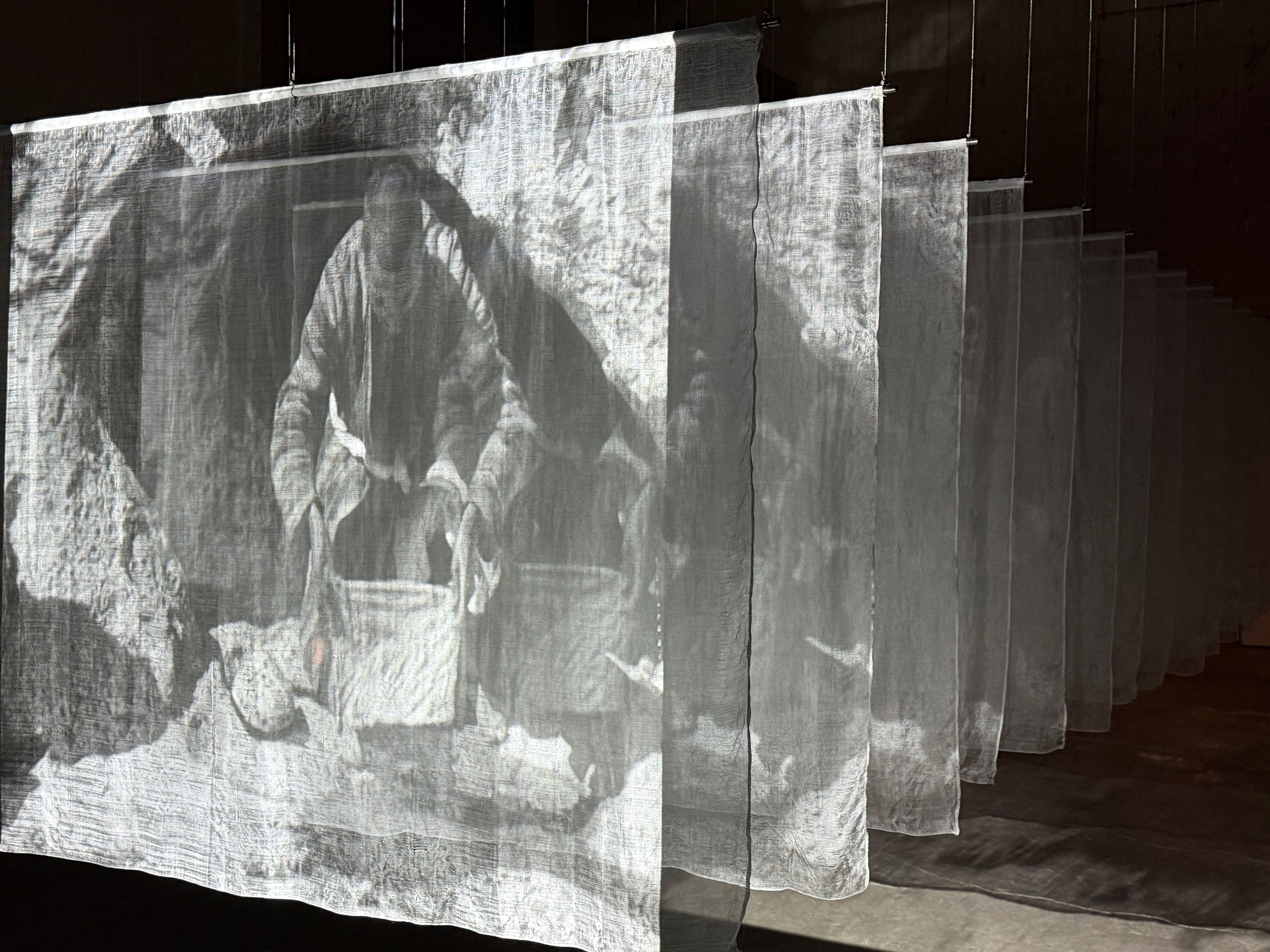
In the old foundry at Tesuque: 2024 video As We Fade by Saodat Ismailova (Uzbeckistan), showing visitors to one of Central Asia’s most sacred sites (Throne of Solomon) along the ancient Silk Road; projected across 24 suspended silk screens. Courtesy: the artist and Milan’s Pirelli HangarBicocca.

The theme for the show – Once Within a Time – is inspired by Godfrey Reggio’s most recent film – a suggestive and wordless mix of innocence, nostalgic images, visual poetry, and the future facing the next generation. The film screens continuously inside SITE, with visitors caught up in Godfrey’s dream-like images, which highlighted in this mesmerizing movie trailer:

Like Godfrey’s film, each space and gallery presents a theme, story, historic character, and provocative contemporary art that pulls back in time, creates an unforgettable experience, and asks the viewer to go inward to contemplate the future. 

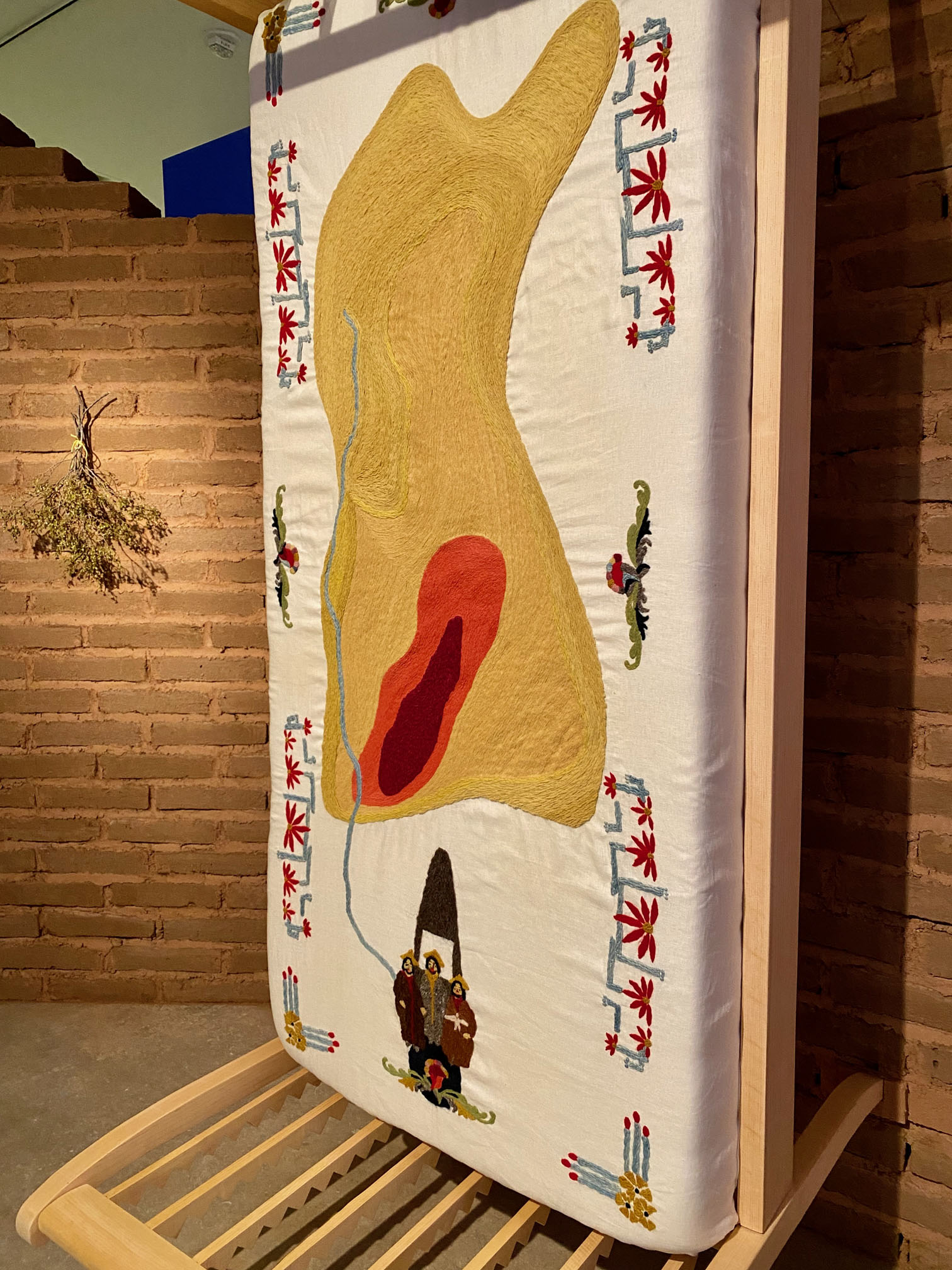
Joanna Keane Lopez’s 2024 Batter my heart, three person’d God – adobe, a handmade bed, colcha embroidery showing a radiation cloud, and creosote bush, referencing her family’s experience of living downwind of the Trinity detonation.

SITE’s galleries, for example, present themes such as storytelling, technology and language, the power of spiritual energy, and New Mexico’s undeniable status as a natural Land of Enchantment.  

The exhibition presents traditional New Mexico superstars and inspirations –  Awa Tsireh and Helen Cordero (San Ildefonso Pueblo), Agnes Pelton, Rebecca Salsbury James, Florence Miller Pierce, Pop Chalee (Taos), Pablita Velarde (Santa Clara Pueblo), and Eliot Porter – alongside artists who are breaking through on the international stage.

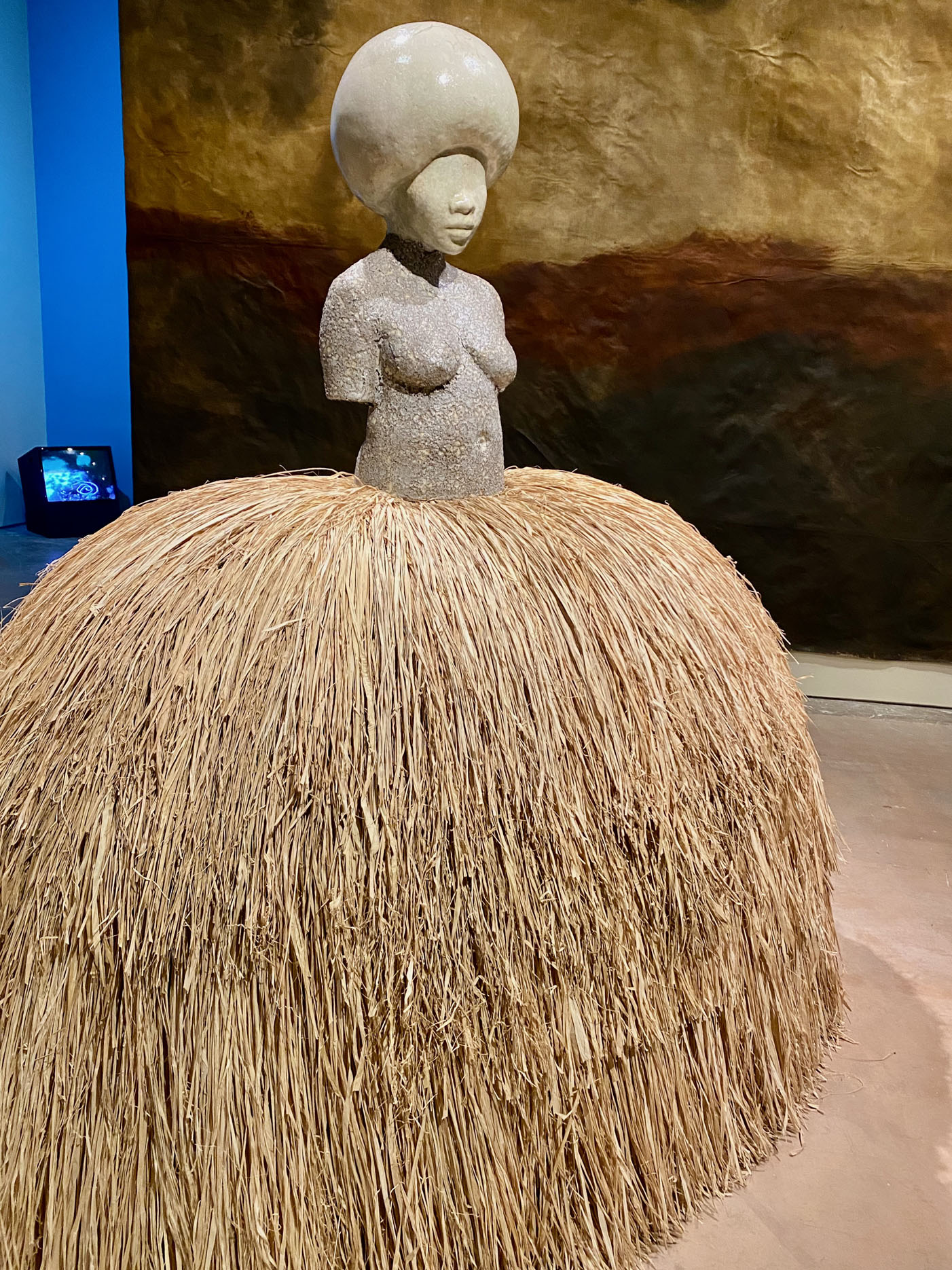
Cochiti pueblo ceramicist Helen Cordero’s storyteller figures are paired with Pablita Velardi’s storyteller illustrations (both are inspired by grandfathers and fathers) and Simone Leigh’s epic stone and raffia goddesses.

SITE Santa Fe gallery theme: storytelling. Simone Leigh’s 2025 untiled stoneware and raffia sculpture. At rear, 2025 oil The Solemn and Dignified Burial Befitting My Beloved for All Seasons by Dominique Knowles. Courtesy: Matthew Marks Gallery; the artist and Hannah Hoffman Gallery, Los Angeles.
Gallery theme: storytelling. Helen Cordero’s 1970 painted clay Storyteller – the creator of the Cochiti Pueblo sculptural tradition, inspired by her grandfather’s stories; championed by patron Alexander Girard. Courtesy: School for Advanced Research.
SITE Santa Fe gallery theme: language Marilou Schultz’s 2024 weaving Integrated Circuit Chip & AI Diné Weaving – a reference to the controvercial 1970s Fairchild Semiconductor chip plant on Navajo Nation staffed primarily with Diné women. Courtesy: private foundation.

The story of the legendary WWII heroes, the Navajo Code Talkers, is featured in a gallery alongside Marilou Schultz’s weavings of chip technology using traditional Diné methods with Fred Hammersly’s ground-breaking IBM computer drawings at the University of New Mexico in 1968-1970. 

Fred was given an opportunity to create the first mainframe-generated art in the form of drawings programmed by traditional IBM punch-card technology and the Art1 program.  SIITE not only displays a selection of the 400 computer drawings that he generated over the course of 18 months, but some of the punch cards he used, which are now archived at the Smithsonian’s Archives of American Art.

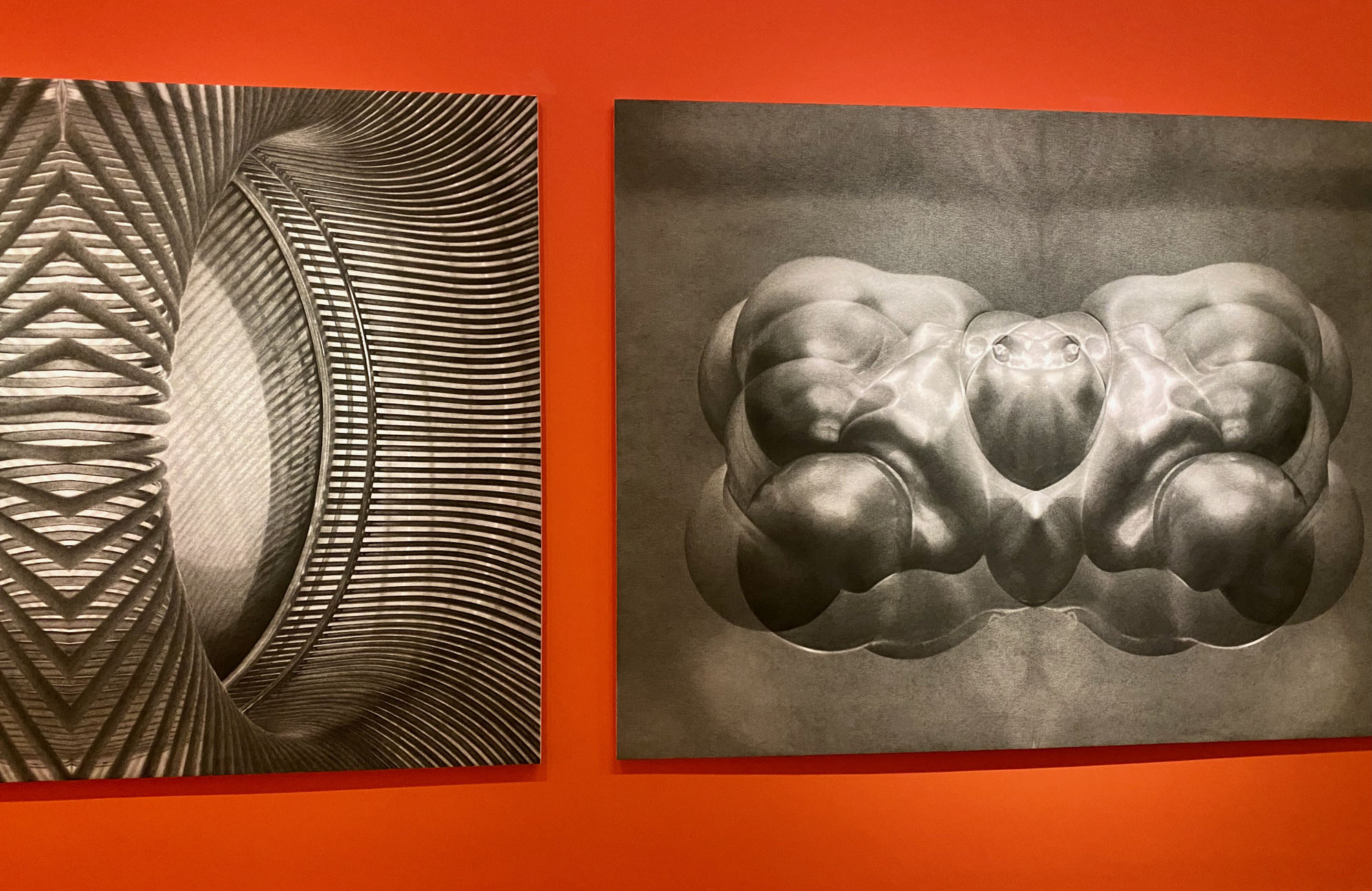
Sensual free-thinkers are represented by the story of Santa Fe gambling mogul Doña Tules (Maria Gertrudis Barceló) and her actual 1840s money chest, witty contemporary porcelain playing cards and magical paintings by Katja Seib (UK), and jaw-dropping drawings by Shanghai’s Zhang Yunyao.

SITE Santa Fe gallery theme: sensual free-thinkers. Two of three 2025 Connector drawings by Zhang Yunyao (Shanghai); pencil on stretched felt. Courtesy: the artist, Don Gallery.

Around the corner from Agnes Pelton’s transcendental paintings are Diego Medina’s landscapes reflecting the Piro-Mansa-Tiwa spiritual power inhabiting ancestral lands of Southern New Mexico and also installations about a different type of New Mexico light – the impact of the nuclear energy tests on people living downwind and the legacy of uranium mining across native lands.

SITE Santa Fe gallery theme:In touch with light (nuclear energy): Will Wilson’s 2025 series Hubris on the Land – aerial photography of abandoned 1940s uranium mines on Navajo Nation paired with his documentation of Land Art sites created by Holt, Smithson, Heiser, and Turrell in the 1960s-1970s. Courtesy: the artist

New Mexico’s natural world is paid tribute in stories and artwork by travelers and residents – watercolors of Pueblo spirits and wildlife by Awa Tsireh (Alfonso Roybal) in the 1930s, Vladimir Nabokov’s sketches of butterfly wing cells (1940s-1950s), and Eliot Porter’s spectacular photos of Tesuque jays in the 1960s.

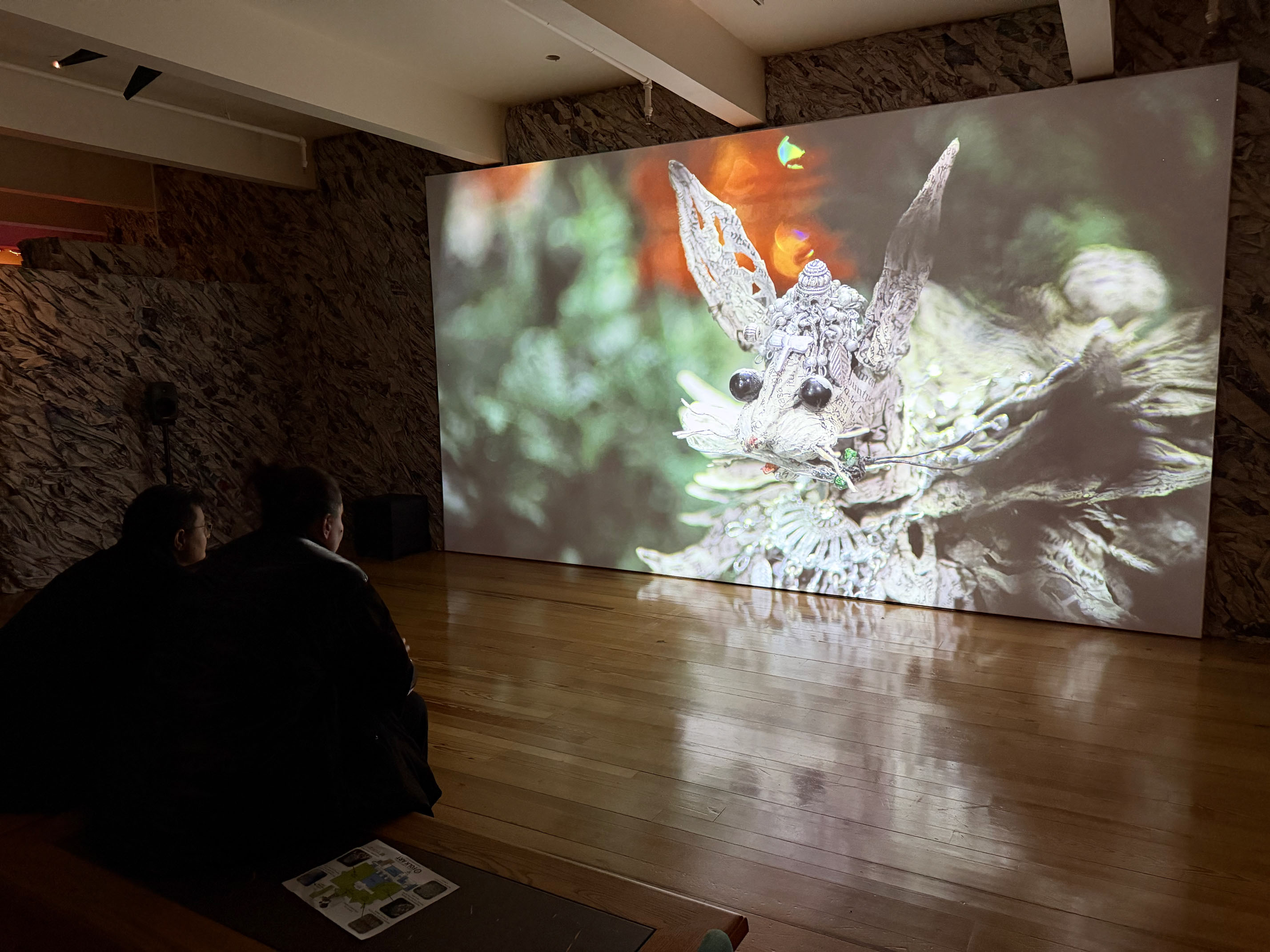
But these examples are just snippets of Once Within a Time – the entire show deserves multiple visits, and time to visit the other locations in the city, such as the hidden basement natural wonderland epic at the Museum of Internatonal Folk Art created by Taiwan ‘s Zhang Xu Zhan. It’s not only an immersive environment, but a film, animal-spirit sculptures, and selections from the MoIFA’s paper funerary object collection.  Don’t miss the Day of the Dead altar, the 18th-century Pere Lachaise Cemetary tribute initially collected by Mr. Girard himself, and paper funerary fantasies made by the artist’s own family. Truly unforgettable.
Museum of International Folk Art: Zhang Xu Zhan’s 2020-2022 paper-animation video Compound Eyes of Tropical (Animal story series), with a Southeastern Asian deer-mouse outwitting a group of predatory crocodiles. Courtesy: the artist and Project Fulfill Art Space, Taiwan.

The Wheelwright Museum of the American Indian fills the Klah Gallery (in the shape of a traditional hogan) with a meditation on healing by Cristina Flores Pescorán, a wild organic sculpture by Nora Naranjo Morse, and a mini-retrospective of paintings by the incomparable Emmi Whitehorse.

Wheelwright Klah Gallery theme: journeys. Nora Naranjo Morse’s sculpture Into the Forever; on walls, Cristina Flores Pescorán’s 2025 installation Treinta y ocho. Ofrendas para reescribir historia medica y renacer Huaca. Courtesy: the artists

The Tesuque location also features rooms with installations by Mexico’s Guillermo Galindo incorporating burned wood from the recent New Mexico fires (crossed with Picasso’s Guernica),  David Horvitz’s tribute to the men incarcerated in Santa Fe’s Japanese internment camp (and a hat from one them), and Thailand’s Korakrit Arunanondchai’s room-sized contemplation that incorporates the ashes from the burning of Zozobra.

Video of Korakrit Arunanondchai’s 2025 installation Unity for Nostalgia, with floor incorporating ashes from Santa Fe’s Zozobra’s burning and a prayer to the phoenix; layered soundtrack. Courtesy: the artist, Bangkok City Gallery, London’s Carlos/Ishikawa, CLEARNING NY-LA, Kukje Gallery, Seoul
Video of Max Hooper Schneider’s 2025 Written in Sand (Finquita Garden) installation; spheres mysteriously travel sand channels. Courtesy: the artist; Maureen Paley, London, Hove; Francois Ghebaley, Los Angeles, New York.

For more, take a walk through the main exhibit and five other sites in and around Santa in our Flickr album to see work by legendary New Mexican artists, and travel back and forth to see how contemporary art reflects epic histories and mystic systems of the Southwest.

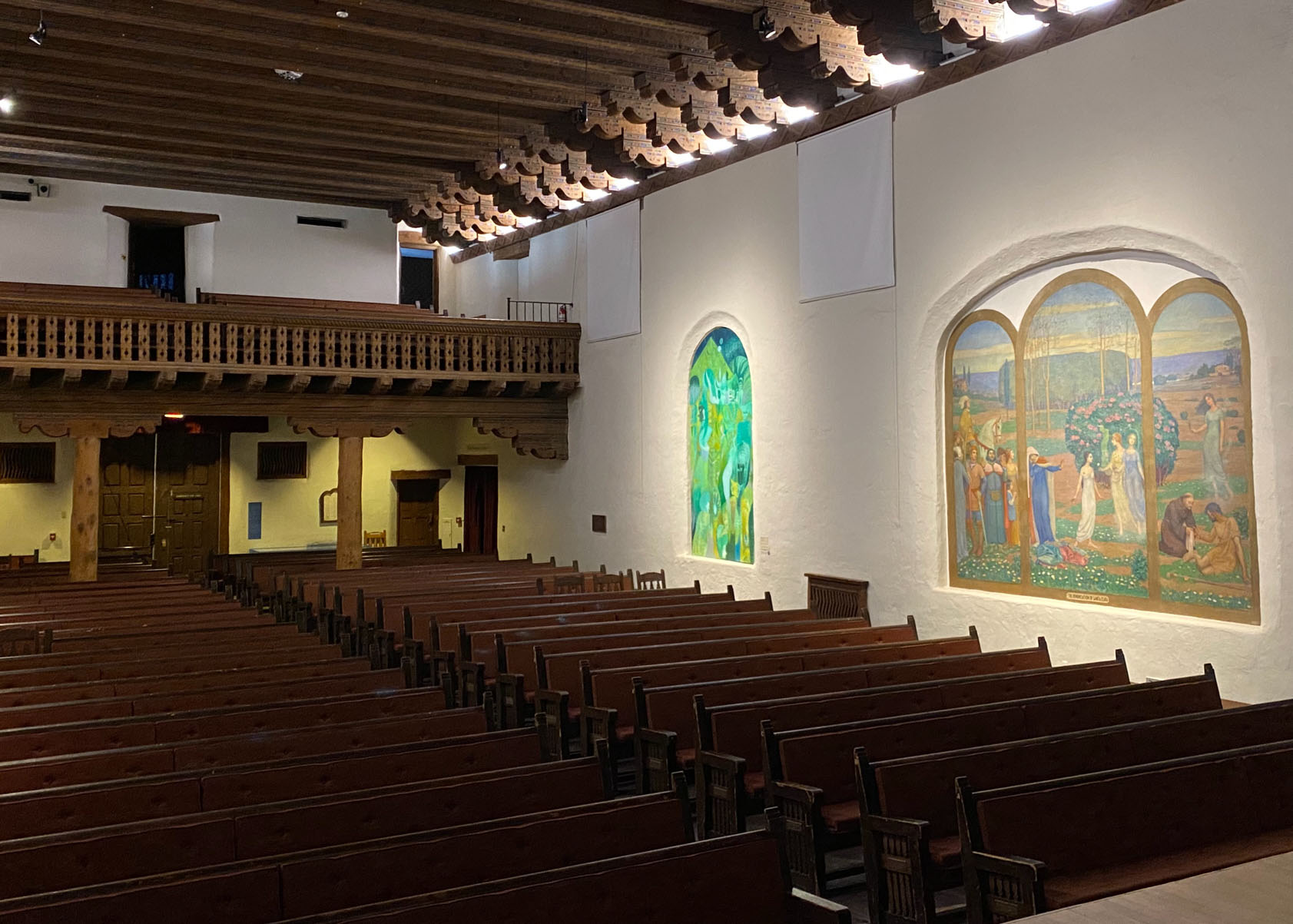
View of historic St. Francis Auditorium (1917) with Maja Ruznic’s 2025 Kisa Pada, Trava Raste, Gora Zeleni installed atop Donald Beauregad’s painting The Conversion of St. Francis; to right, Beauregard’s The Renunciation of Santa Clara.

Portrait Masterworks at Home in Taos

To see the works by one of the top virtuoso portraitists of the 20th century, drop into the home that Nicolai Fechin designed and built for his family in Taos, New Mexico. Masterful oil and charcoal portraits created throughout his life are hung in quiet, contemplative corners of his spectacular 1920s home as part of Masterful Expression: Nicolai Fechin’s Portraiture, on view at the Taos Art Museum at Fechin House through December 31, 2025.

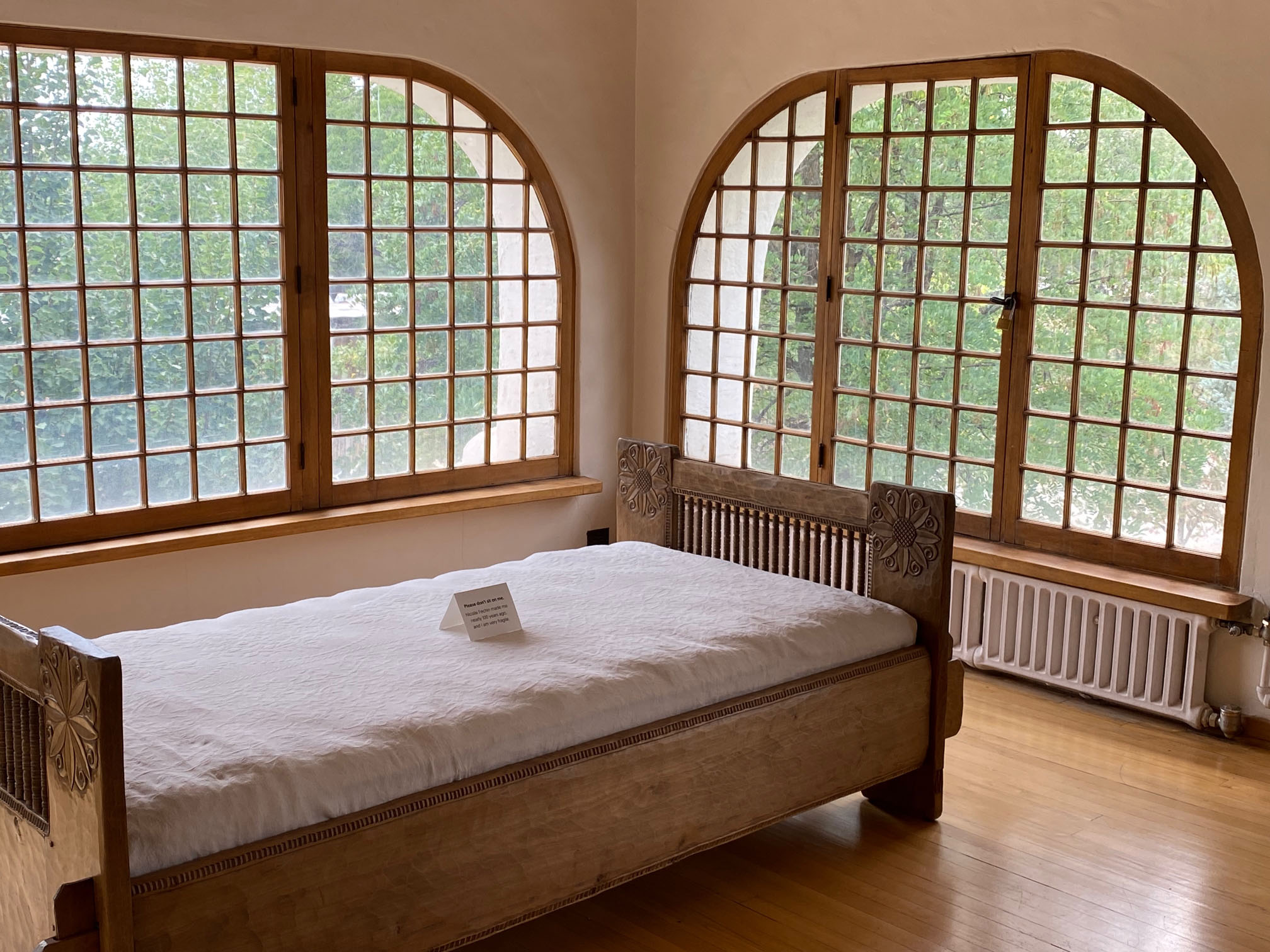
The house itself is a masterwork with all the doors, railings, and embellishments carved by Fechin’s own hand, but the portraits and small, carved wooden busts show why he is considered one of the greatest Russian artists ever to take up residency in the United States.

Fechin’s undated charcoal portrait Manuelita. Courtesy: private collector
Fechin’s 1927-1933 oil painting Taos Studio Interior. Courtesy: private collection; Owings Gallery.

Fechin grew up during the time when Russia was ruled by the Czar, and thrived at the Higher Art School of the Russian Imperial Academy of Arts in St. Petersburg, where he studied with the acclaimed Russian history painter, Ilya Rapin.

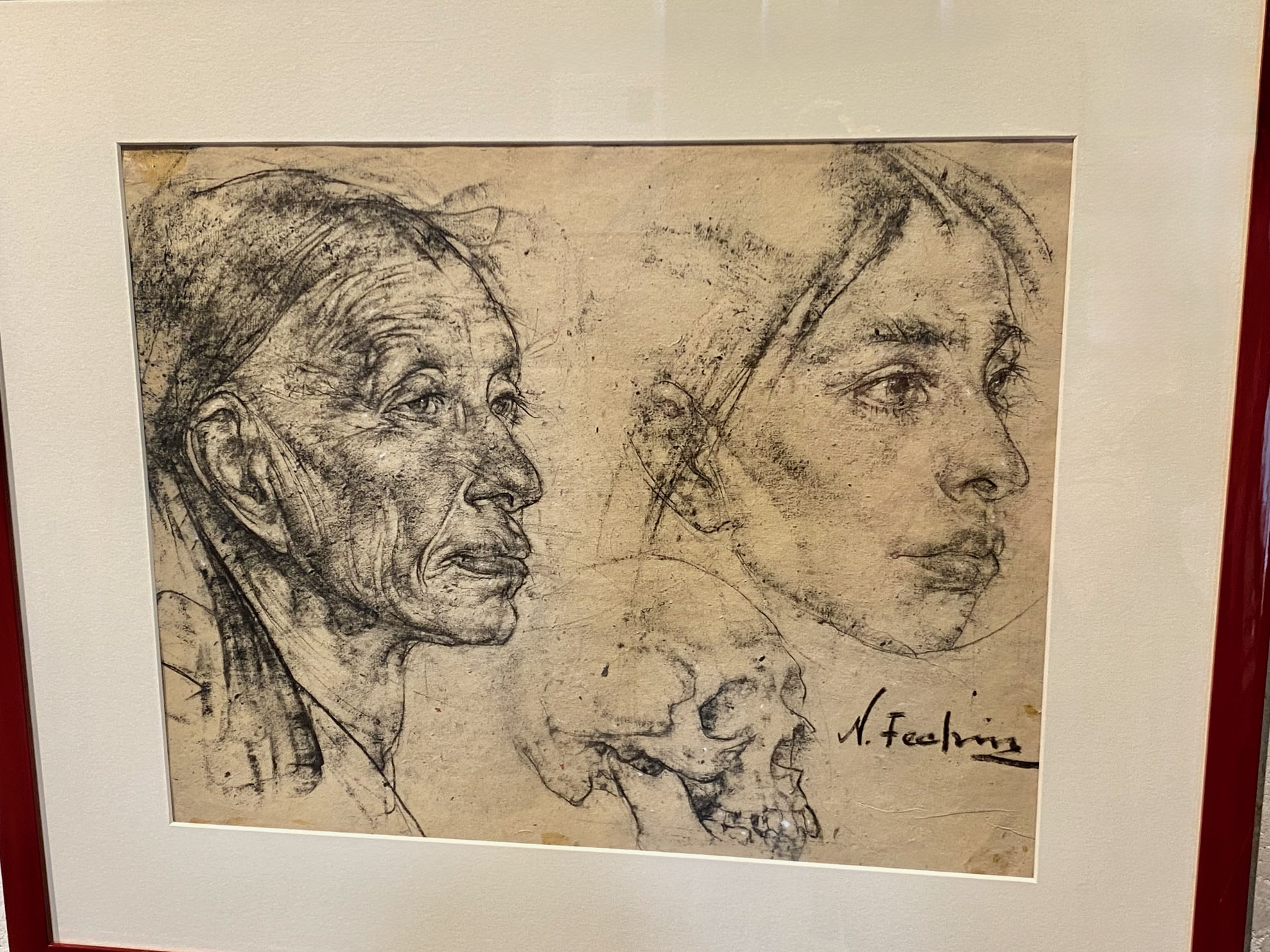
Fechin’s classical training followed the principles advocated by the French virtuoso, Dominque Ingre – subtle human expression, anatomical awareness, and verisimilitude that jumps right of the page (or canvas).

Fechin’s charcoal Head and Skull Study. Courtesy: private collector

Fechin learned his lessons well and won national acclaim in Russia by 1908 for his grand, epic depictions of peasant life, which provided an opportunity for his work to be shown internationally and gain fans in the United States.  But it was his reputation for portraits that captured the essence of human expression that cemented his reputation in the United States and provided him with continuing commissions.

When the Russian Revolution and civil war brought disruption to the domestic life he was starting to build with his new bride, Alexandra, an American benefactor arranged for them to emigrate to the United States.  As soon as the Fechin family landed in the United States, the commissions began, largely due to the enthusiastic public reaction his portraits in shows at the Grand Central Gallery and the Brooklyn Museum.

Fechin’s undated oil portrait Russian Singer with Fan. Courtesy: private collector
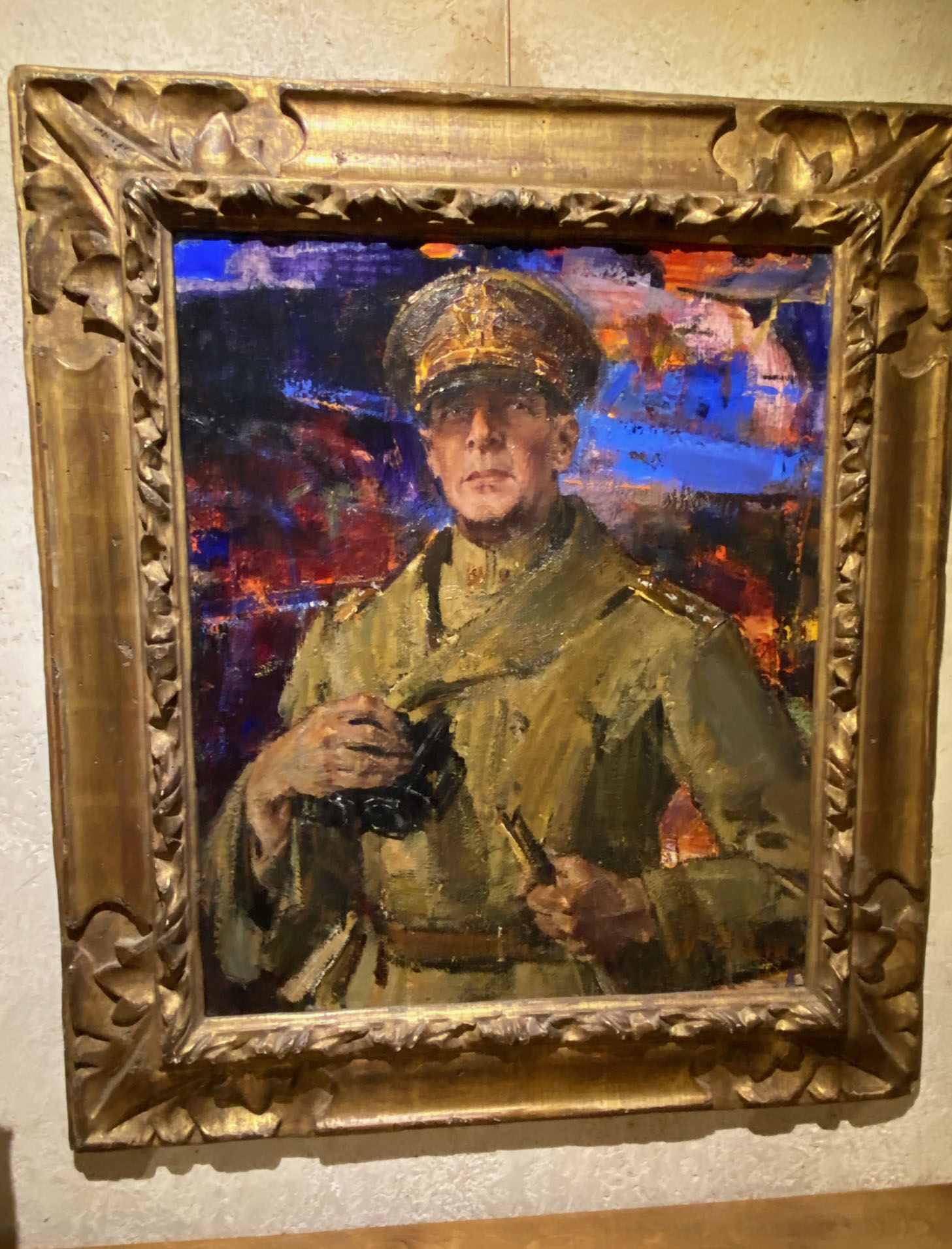
Fechin’s 1951 oil portrait of General Mac Arthur. Courtesy: Taos Art Museum

For health reasons, Fechin and his family left the sophisticated steets of New York City during the high-flying 1920s for the high desert of Taos – a thriving art community anchored by Mabel Dodge Luhan. Fechin figured that when the tumult in Russia died down, he would return. But that never happened.

The exhibition, with many works drawn from private collections, provides a glimpse of the Fechin family over time, with portraits and sculptures of his wife early in their courtship (an oil), a bronze bust, and drawn portraits in their life in New Mexico.

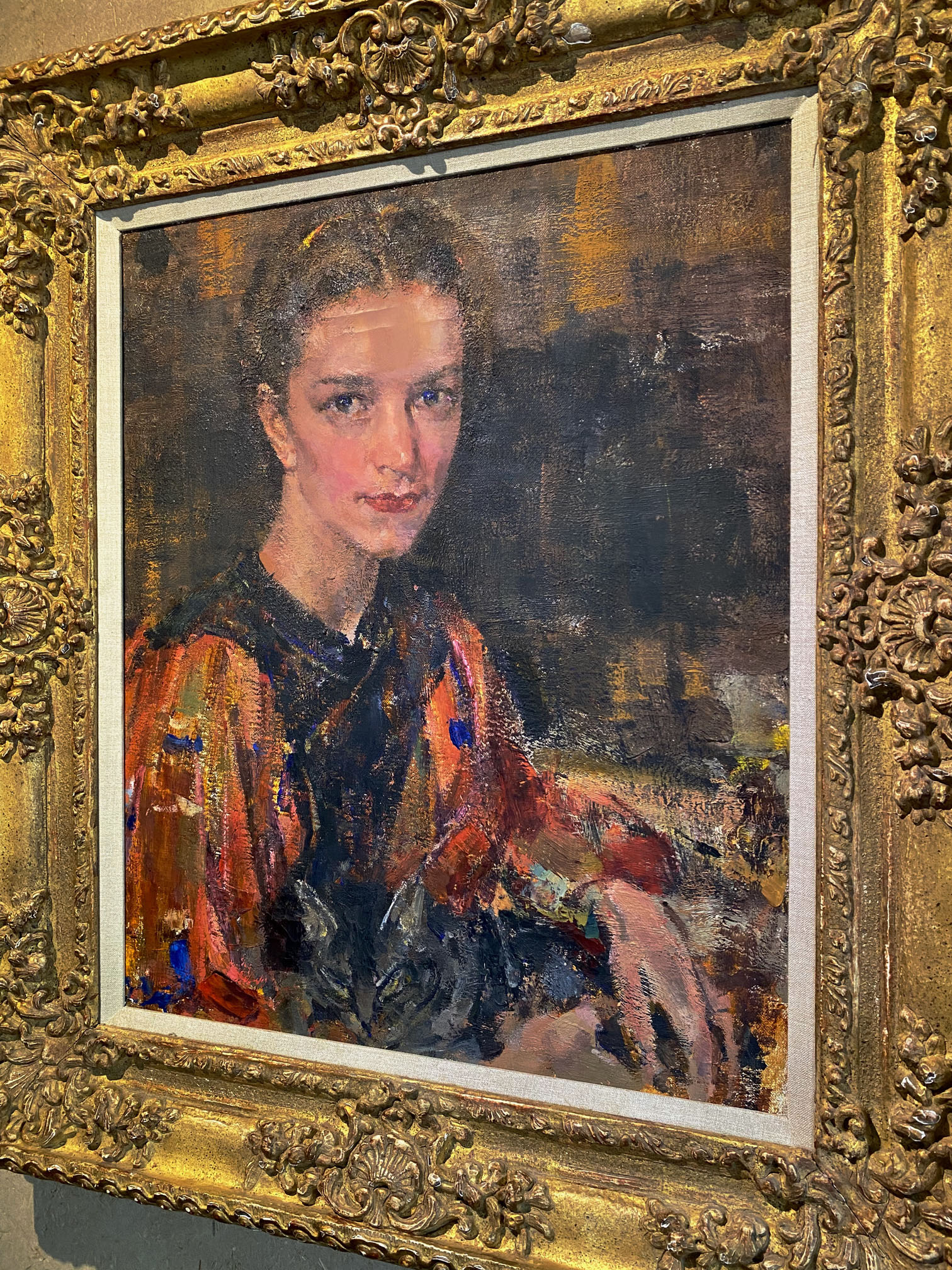
Fechin’s 1910 oil portrait of his wife Alexandra with Coral Beads. Courtesy: private collector
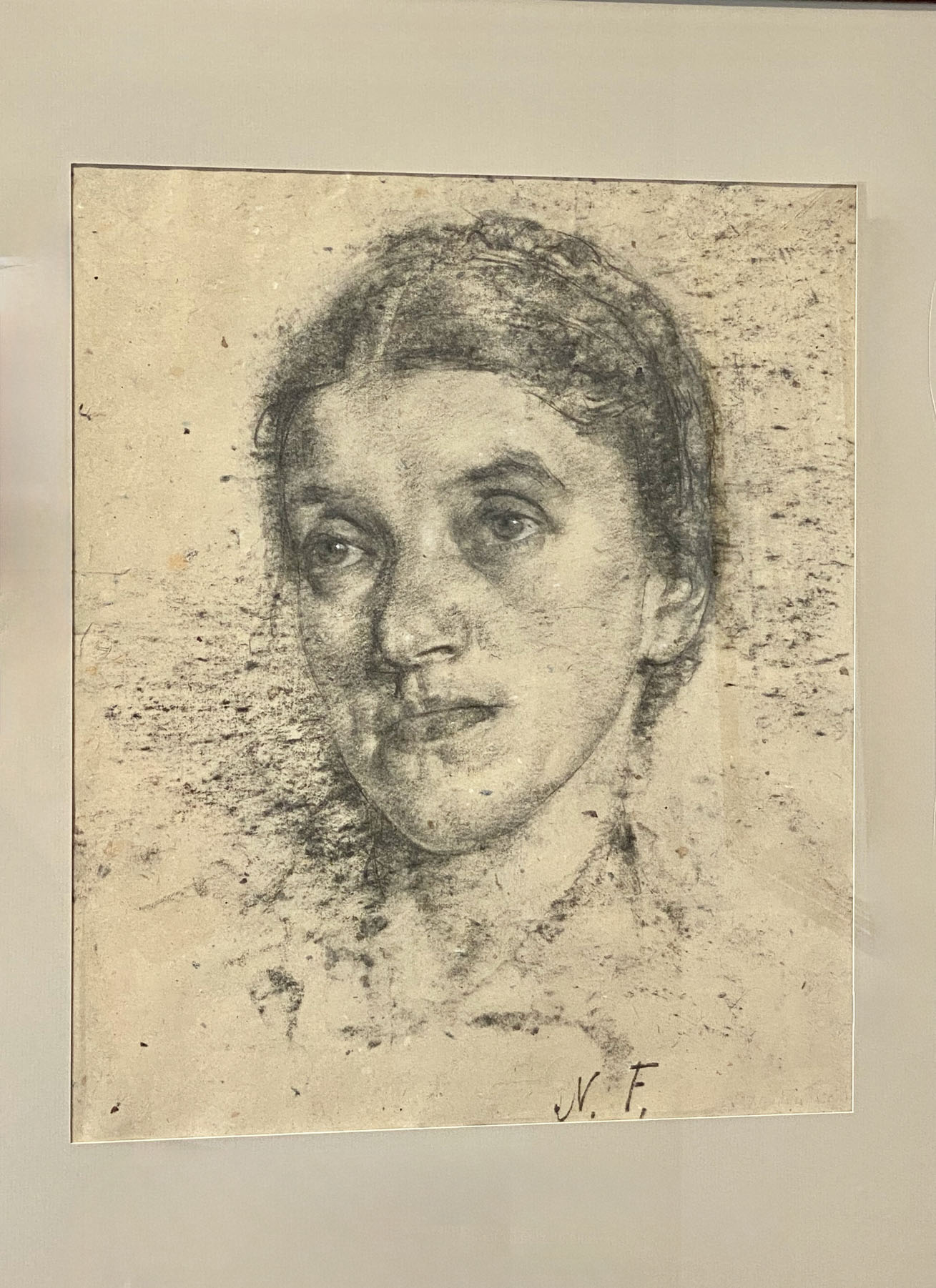
Fechin’s 1927-1933 charcoal portrait of his wife Alexandra; on rice paper. Courtesy: private collector

His beloved daughter Enya – who ultimately saved and restored this unforgettable home and her dad’s studio – is shown as a baby in Russia, as an older child in carved wooden busts, and in paintings in her coming of age, as well as a portrait of her as a grown woman looking out for her dad later in his life.

Fechin’s carved wooden bust of his daughter Eya.. Courtesy: private collector
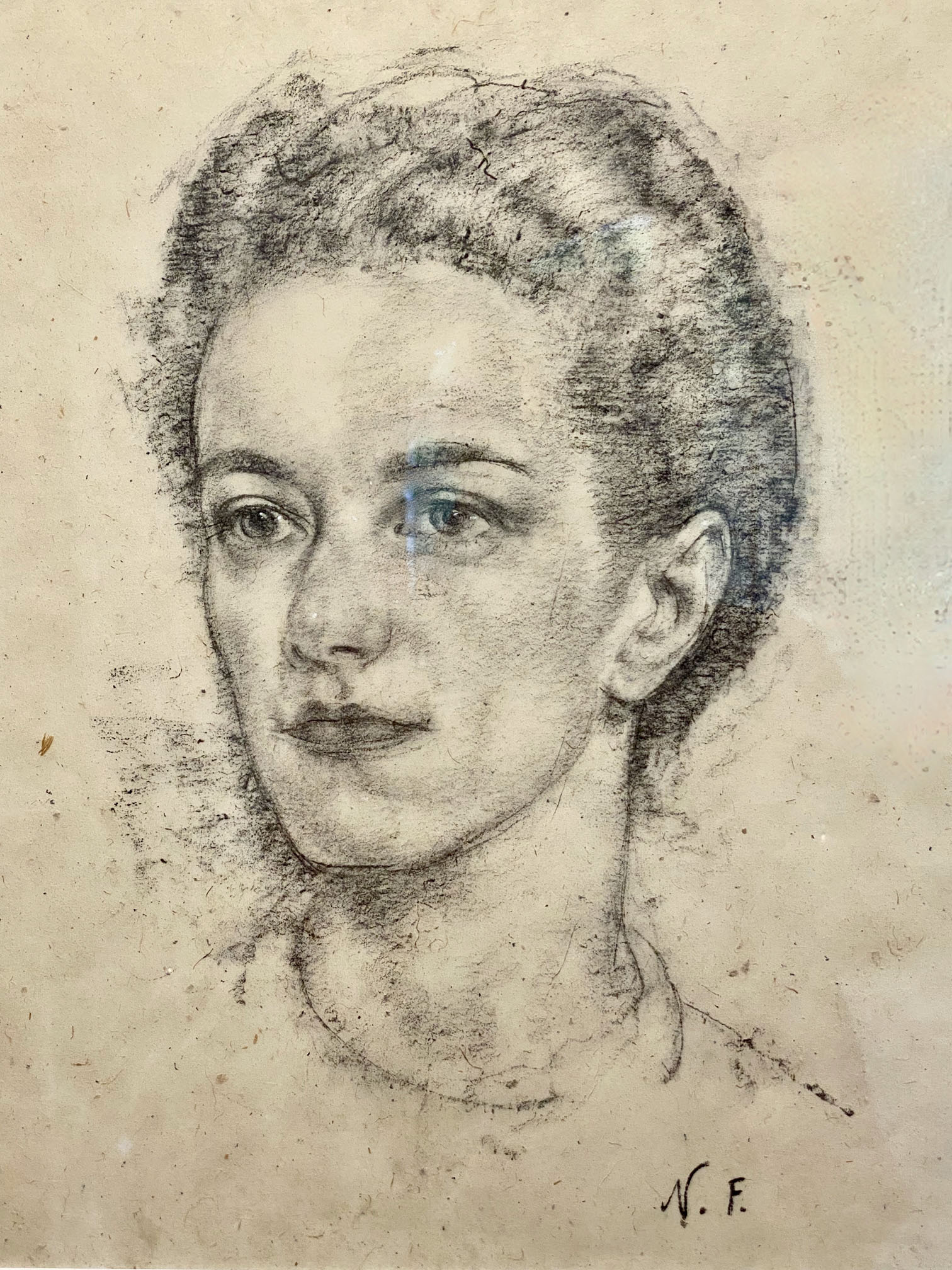
Fechin’s 1940s charcoal portrait of his daughter Eya; on rice paper. Courtesy: private collector

The exhibit also includes sensitive, gorgeous portraits and studies that Fechin created in his five-month stay in Bali in 1938 – delicate features of young models and reflective expressions of respected elders. All have clean, sure lines and carefully observed, personalized nuances.

Fechin’s 1938 charcoal portrait Balinese Girl with Long Hair. Courtesy: private collector
Fechin’s 1938 charcoal portrait Balinese Man with Beard. Courtesy: private collector

This walk-through the Fechin home holds delight and awe at every turn – awe at the hand-carved interiors and delight at at the humanity and diversity of the faces greeting us in every room. Visit, if you can!

Take a look at more in our Flickr album.

Fechin’s 1950s charcoal self- portrait on rice paper. Courtesy: private collector
Fechin’s 1940s charcoal portrait of his daughter Eya; on rice paper. Courtesy: private collector
Inside the 1933 Fechin house: sunroom on the second floor features his hand-carved bed for his daughter, Eya.

Abstracting Nature in Albuquerque

How do abstract artists visually channel their response to awesome landscapes? You’ll get a glimpse of how ten artists approach natue and atmospheric phenomenon in Abstracing Nature, an engaging contemporary exhibition at the Albuquerque Museum, on view thorugh October 12.

Works by grand-master abstractionists Richard Diebenkorn and Agnes Martin greet you right at the entrance. 

Diebenkorn isn’t normally associated with New Mexico, but decades before embarking upon his epic Ocean Park series, he spent two years (1950-1952) at the University of New Mexico (1950-1952) working toward his MFA before returning to the West Coast.

Richard Diebenkorn’s 1952 Untitled (Albuquerque), featuring deep earth tones and undulating forms.

The Diebenkorn on display is a recent museum acquisition from those years. Complete abstract expressionist approach to the colors and undulating geologic forms he saw surrounding the post-war boom town.

Martin – the abstractionist grand-dame of New Mexico – made no attempt to hide the fact that her grids and minimal approach were expressions of the tranquililty and serenity she saw and felt from her retreats in Cuba and Galisteo, New Mexico.  She was channeling her emotional, meditative response in her surroundings – not following the reductivist, minimalist trend fo the East and West Coast gallery scene.

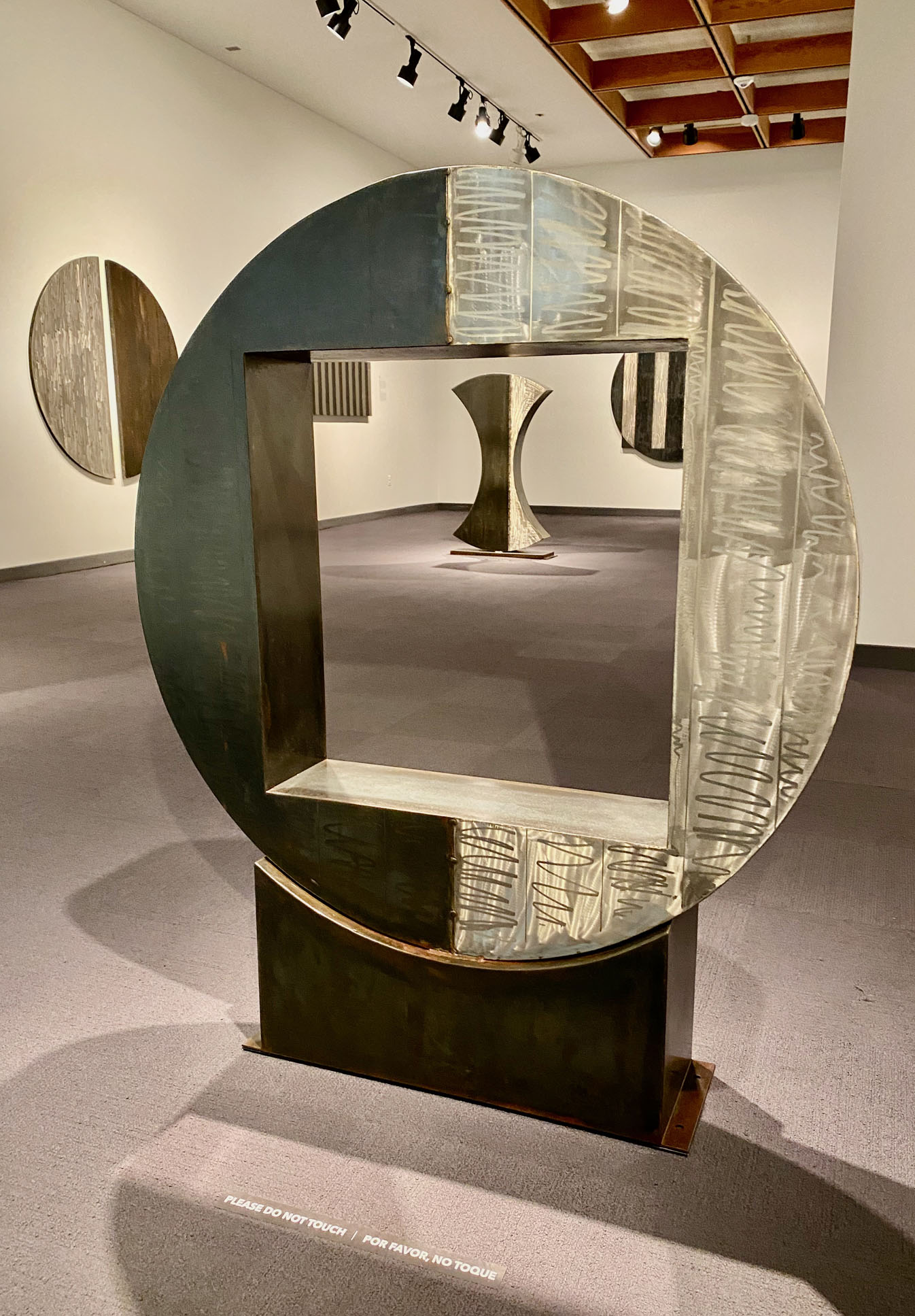
By getting up close to the two Martin paintings, you can appreciate her hand-drawn approach. Several stainless-steel sculptures by Agnes Martin’s great friend and student Karen Yank are nearby. The gleaming, hard-edged pieces do not resemble her mentor’s approach, except for the light, gestural touches across the surface.

Agnes Martin’s 1980 acrylic Untitled #6. Courtesy: New Mexico Museum of Art.
Karen Yank’s 2023 steel View with Silhouette VII and other sculptures visible through the portal. Courtesy: the artist.

The large pastels by Emmi Whitehorse look to the landscape and sacred colors of the Navajo Nation inspiration – a poetic approach most evident in Yei Retires to Mt. Taylor. Dramatic blue gestures suggest the spiritual turquoise color associated with the Navajo’s soutnern sacred mountain Tsoodzil.

Emmi Whitehorse 1985 pastel abstraction on canvas Yei Retires to Mt. Taylor.

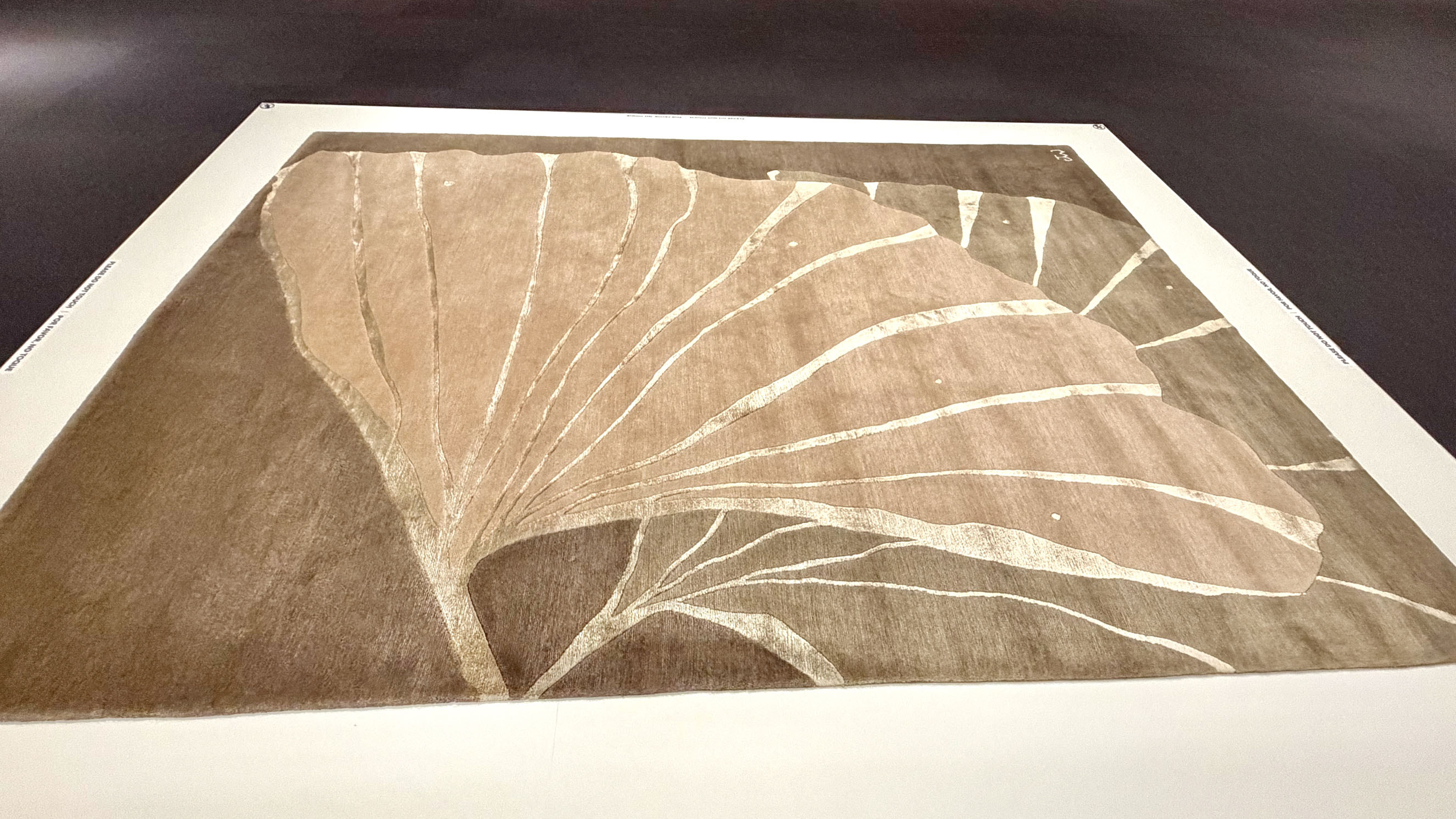
Abstractions used by textile artist Joan Weissman come from a place of process in which she starts with recognizable nature studies but allows her iterations to become more abstract.  Approaching her seemingly abstract Ginko, only gradually do visitors see that the hand-knotted rug (created at large scale by Pakistani artisans) is an extreme close-up of a leaf. 

Joan Weissman’s 2006 Ginko, a wool and silk hand-knotted rug, highlighting the intricacies of the leaf. Courtesy: the artist

2023 Hearing the Sun by Marietta Patricia Leis. Courtesy: the artist

Mariette Patricia Leis translates her experience of nature more formally. In one case, six seemingly minimalist wall-mounted panels are painted to reflect how we perceive the color of sunlight in different atmospheres and at different times of the day.

Another is a series of abstract panels suggesting horizons across volcanic surfaces during Iceland’s 24 hours of darkness.

Enjoy walking through the full exhibition in our Flickr album.

Detail of 2018 Vacuities by Marietta Patricia Leis inspired by Iceland’s winter night sky. Courtesy: the artist.

Here’s a close look at Judy Tuwaletstiwa’s 2001 Divination. She transformed sand by creating an arrangement of glass objects – cubes, spheres, and organic shapes – all displayed across a soft sand base.

Like the rest of the work in this exhibition, it allows us to think about the natural world, our perception of it, and the many ways that the experience can be transformed into art.