Just before the US Bicentennial in 1976, a city rose inside 88 Pine Street in downtown Manhattan – Creative Time’s first public art project. It was a crazy, hilarious, participatory comic papier-mâché labrynth that was dreamed up by a beloved Pop Art power couple – Red Grooms and Mimi Gross – that was a love letter to New York City.
Their cartoon Manhattan had everything – Times Square, the World Trade Center, the Staten Island Ferry, Wall Street, and even a subway car on springs you could enter and bounce around in amid life-sized papier-mâché and soft-sculpted passengers.
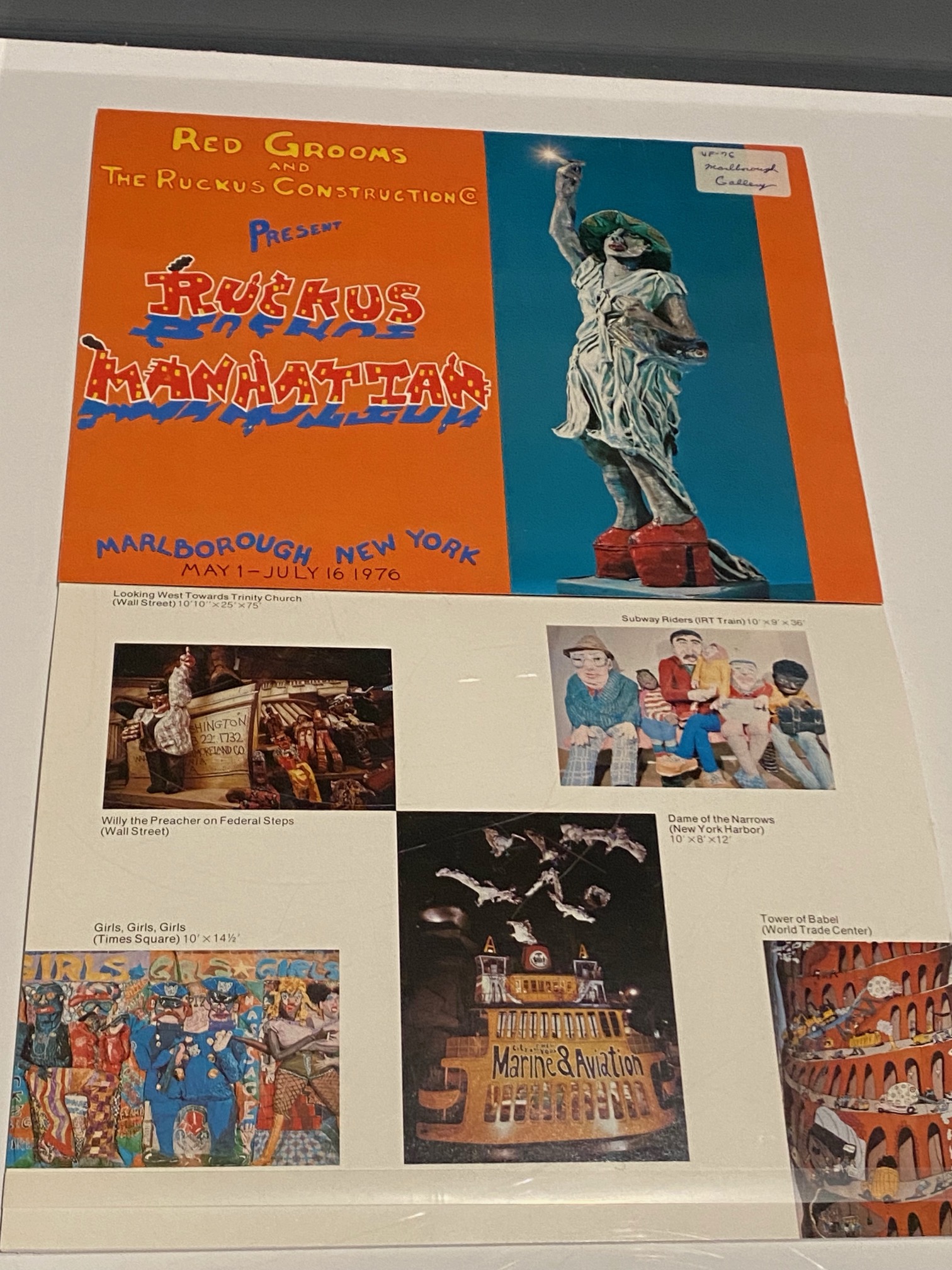
Publicity and photos from the 1976 installation of Ruckus Manhattan at Marlborough Gallery on 57th Street.
Within the 6,400-square-foot area, you could walk through big brightly painted, silly constructions to experience all the sights, sounds, and crazy characters everyone observes and bumps into on New York City streets. It was sensational (drawing 50,000 visitors) and people came back over and over to catch things they didn’t notice the first time.
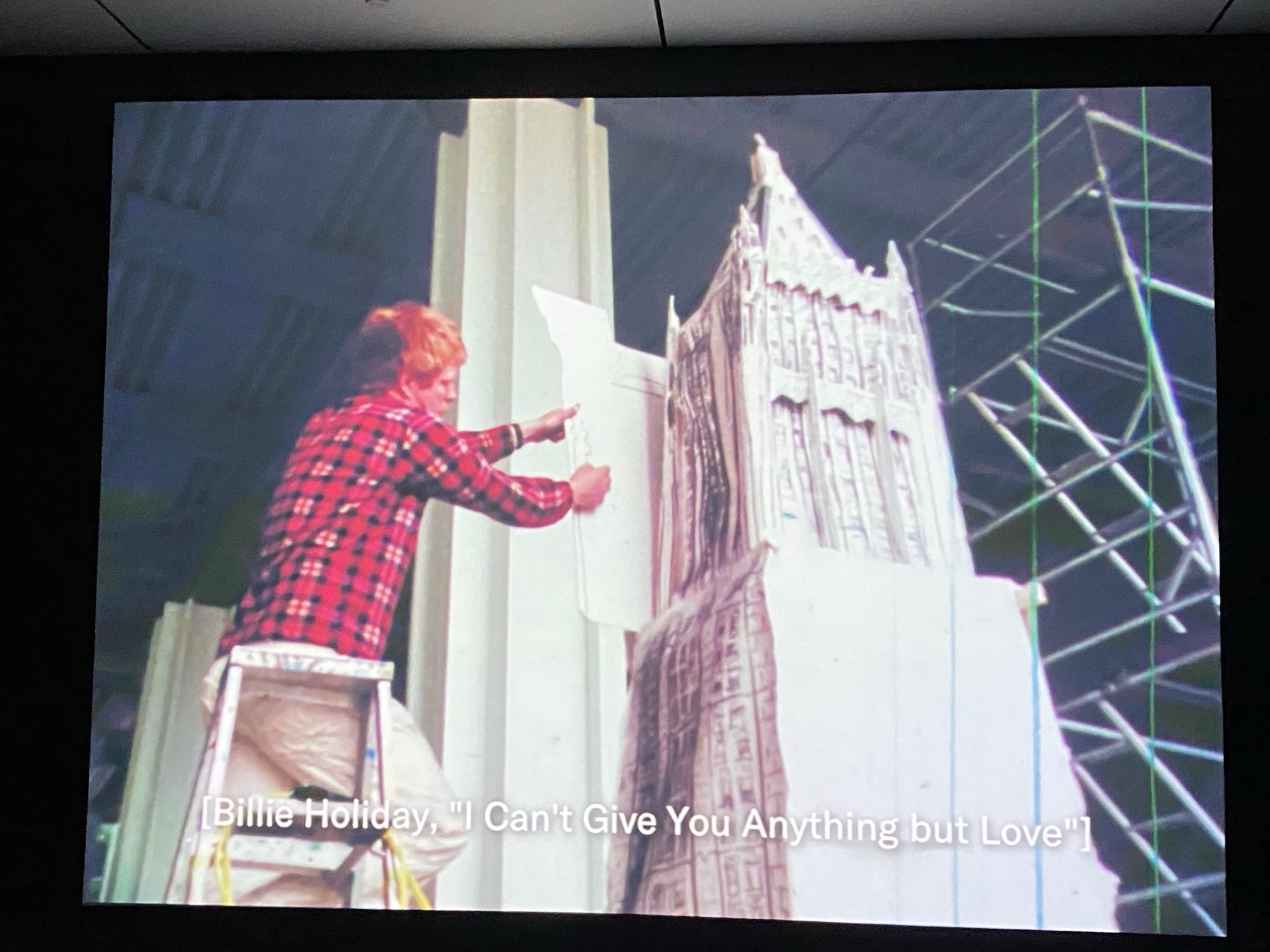
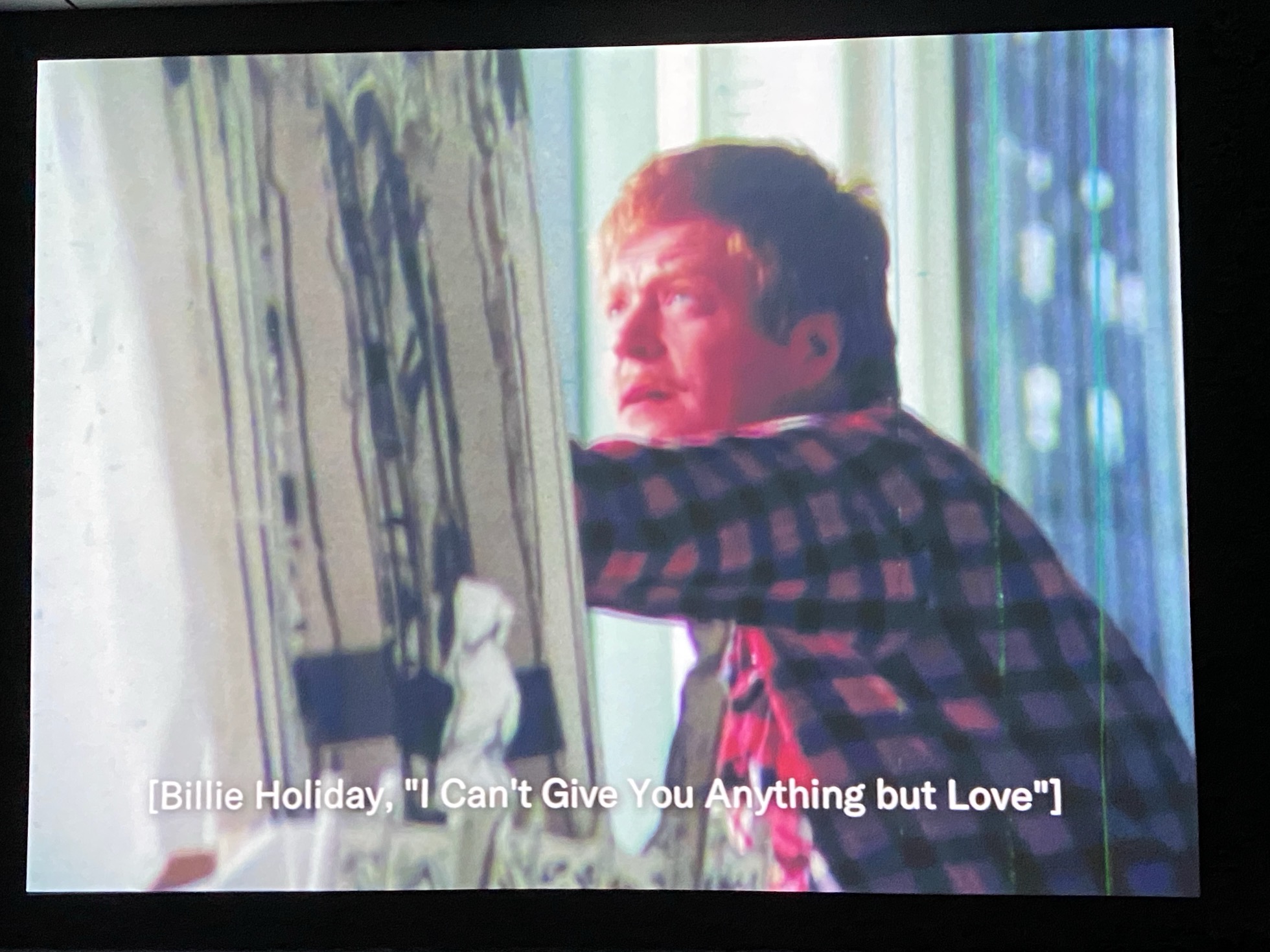
Film still from Ruckus Manhattan documentary by Red Grooms and Mimi Gross, showing Red Grooms at work on the Woolworth Building for the 1975 installation at 88 Pine Street, Financial District.
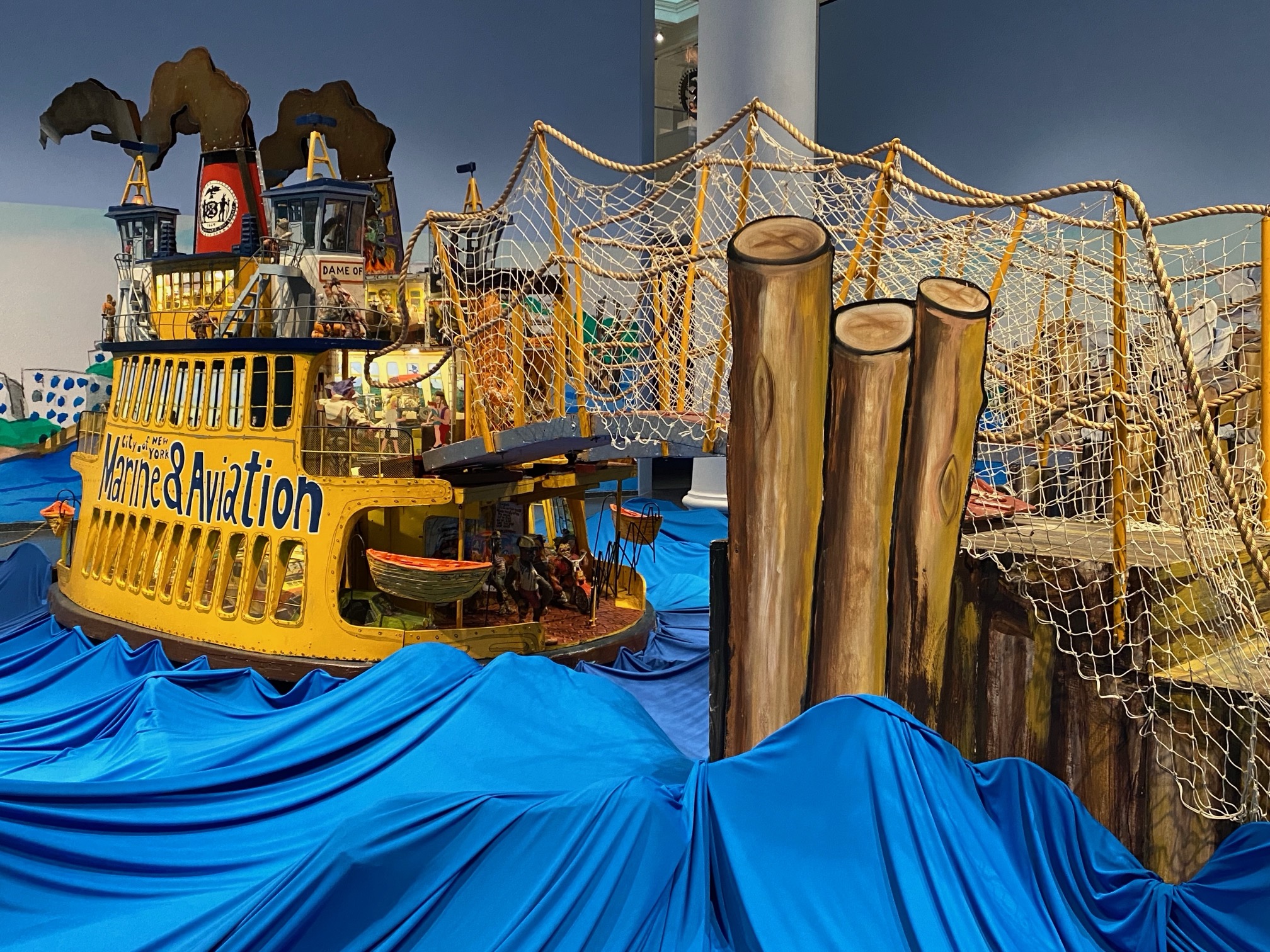
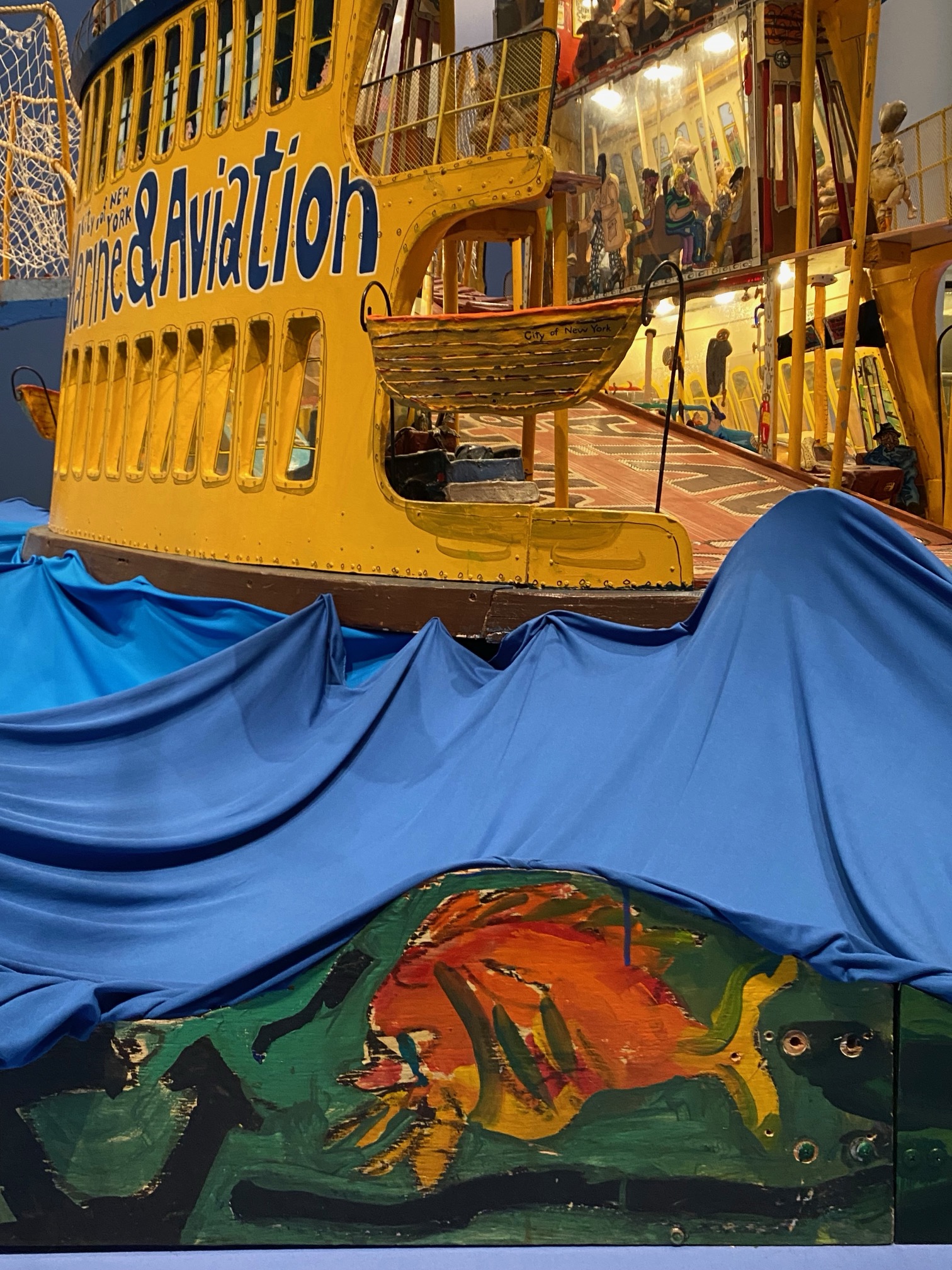
The major part of the first-floor installation depicts the blue waters of New York Harbor (an undulating, draped blue plastic sheet) and a big, cartoon-like Staten Island Ferry – Dame of the Narrows – pulling into its berth at the terminal. The yellow ferry boat is packed with picture-taking tourists, commuters, vehicles, and (as usual) a few passengers and a motorcyclist poised at the edge of the lower deck, waiting for the bump against the landing and the hinged gate release before scooting ashore.
Dame of the Narrows, a 1975 installation by Red Grooms, Mimi Gross, and their collaborators known as the Ruckus Construction Company; here, a cartoon version of the Staten Island Ferry is about to arrive at the dock.
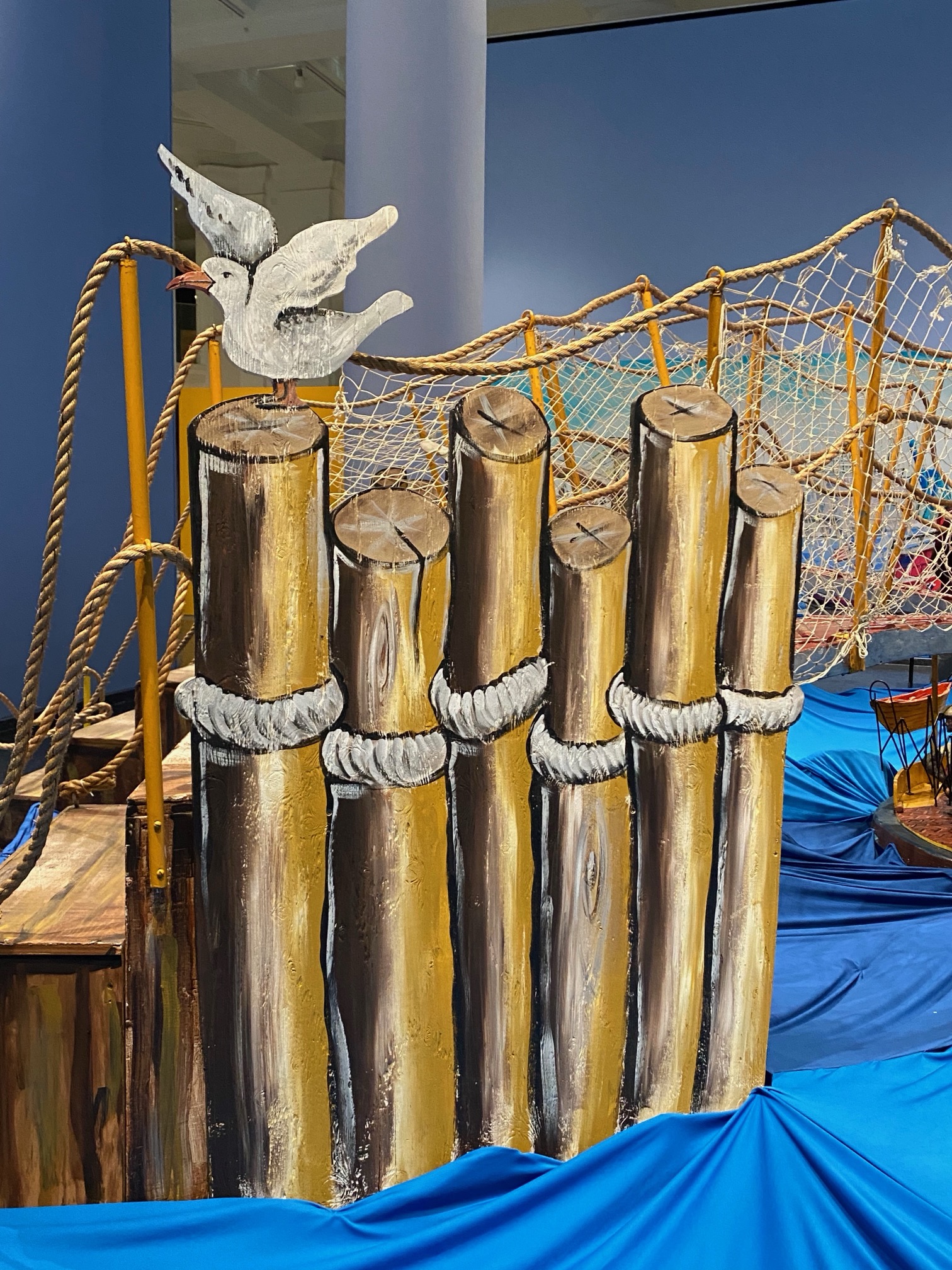
A seagull sits atop the vertical wooden pillars that line the terminal approach. It’s the same as you’ve witnessed a thousand times in real life. Funny how the harbor smells, humidity, and seagull sounds pop into your head, making you feel as if you’re really there.
Cartoon seagull looks for a meal atop the timbers lining the Manhattan dock for the Staten Island Ferry; 1975 installation from Ruckus Manhattan.
View of the lifeboat and underwater life beneath the cartoon Staten Island Ferry Dame of the Narrows, 1975 installation from Ruckus Manhattan.
Like the rest of the larger Ruckus Manhattan, this harbor installation was created from Red’s sketches of the ferry people, architecture, and technology by a crew of around 40 other members of his team – the Ruckus Construction Company. It was a joyous mix of painters, sculptors, puppet makers, performance artists, and kids, all on view through the plate glass windows of 88 Pine Street in the Financial District, bringing the buildings and neighborhoods of Manhattan to life.
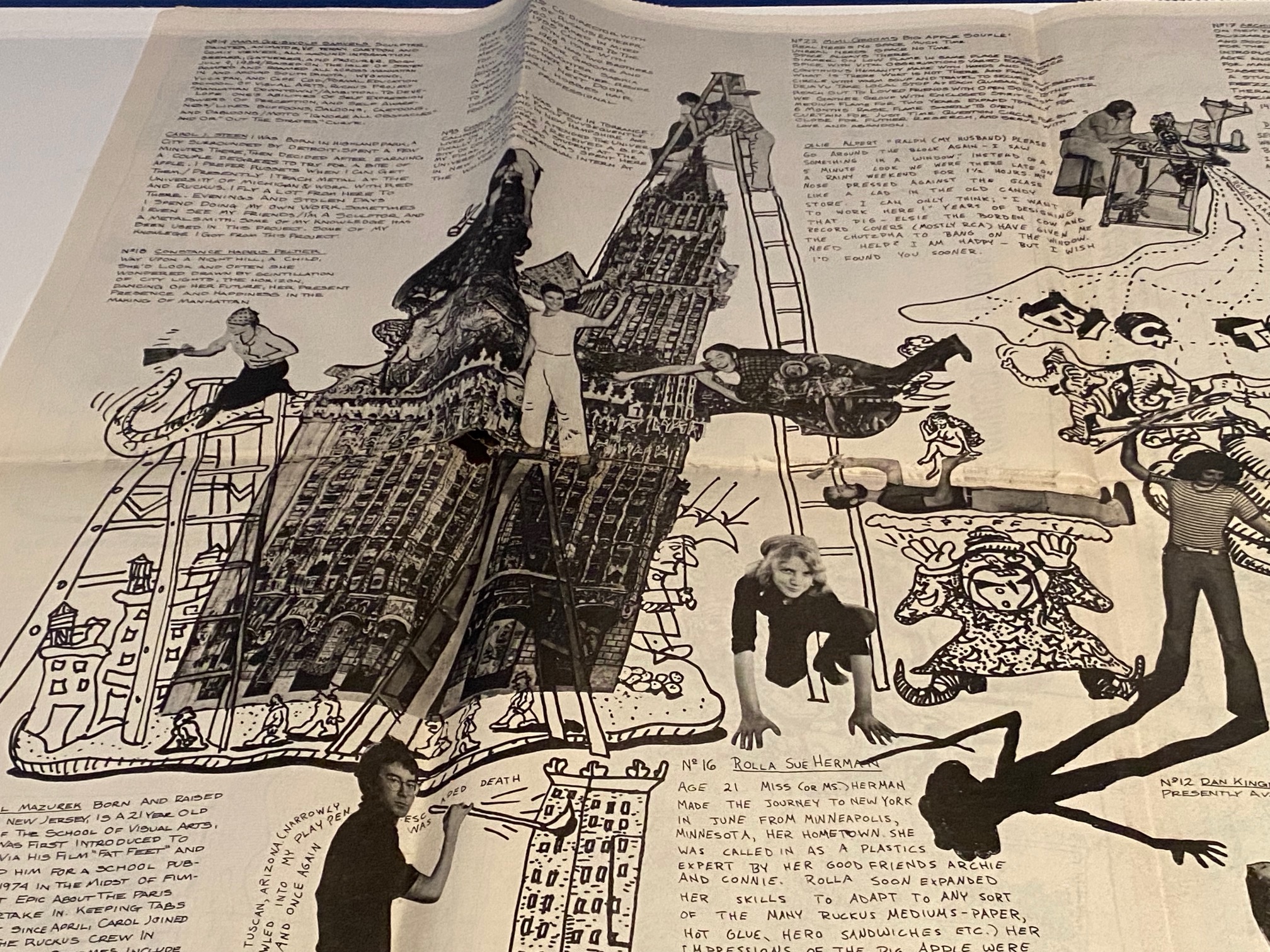
Centerfold of The Daily Ruckus comic newspaper created in lieu of an exhibition catalog; November 1975 issue includes pictures and bios of the installation artists.
Surrounding it all are two long painted murals from 1992, featuring landmarks across the waters – the skyscrapers of Jersey City above Journal Square, the looming cranes of the container shipping port, and the Verazzano Narrows Bridge is shoved in there, too, right at the edge.
Video of Design for Staren Island Ferry – enlargement of a 1992 watercolor and drawing by Red Grooms.
After Ruckus Manhattan closed downtown in 1975, the entire kit and kaboodle moved uptown to Marlborough Gallery on 57th Street in 1976. Nearly 100,000 people came to see it in Midtown, as did Jackie O. In 1977, Dame of the Narrows was presented to the Brooklyn Museum by the newly formed Citizens Committee for New York City, which began community initiatives to help the City rise up after its devastating fiscal crisis.
Brooklyn has a nice collection of ephemera that it’s put on display in an adjacent gallery that runs Red and Mimi’s Ruckus Manhattan documentary. Here’s a clip with Red and Mimi:
Visitors can take a minute and see photos of the full-scale installation, a brochure for a 1993 installation at Grand Central Terminal, and The Daily Ruckus newspaper handed out at the 88 Pine Street opening.
Video showing the exterior of the 42nd Street Porno Bookstore and a leather-clad passerby, a 1976 installation for Ruckus Manhattan.
For visitors who want to see what Times Square was like before it was renovated into a more family-friendly environment, the museum has installed another Ruckus component (not as family friendly…be warned!). Around the corner (hidden from the ferry installation), you’re greeted by a seedy façade and live-sized leather-clad lurker. Welcome to the 42nd Street Porno Bookstore! Inside, you can peruse goofy magazine covers that spoof Times Square’s dicey past alongside a satirical peep show and another sketchy lurker.
Thanks to the Ruckus team for its creation, to Alex Katz for donating the Bookstore, and to Brooklyn Museum for this walk down Memory Lane and its preservation of one of New York’s best-loved art extravaganzas!
Film still from Ruckus Manhattan documentary by Red Grooms and Mimi Gross, showing Red Grooms at work the 1975 installation at 88 Pine.
The scale and scope of the contemporary art on display is tremendous, but how often do art-seekers also get an opportunity to travel across ancient streets and landscapes, to meet real and fictional historic characters, contemplate fables and real-life stories, and see art of the past and present side by side?
It can take days to experience and fully absorb all of the history and potential futues presented in the films, paintings, sculptures, and installations in Once Within a Time: 12th SITE Santa Fe International, on view across 15 art spaces across Santa Fe through January 12, 2026.
Exhibition banner in the courtyard of Palace of the Governors (1610) (New Mexico History Museum) – gateway to SITE installations by Daisy Quezada Ureña (Santa Fe) and Charisse Perlina Weston. (Harlem, New York)
Besides the expansive white galleries and screening rooms of SITE’s museum in Santa Fe’s always-popping Railyard District, visitors can choose to contemplate giant abstract murals in a church-like auditorium, an innovative historical-object installation in a 400-year-old seat of power, or enter an old foundry to see an evocative installation by a Silk Road artist across farm fields adjacent to the Old Spanish Trail.
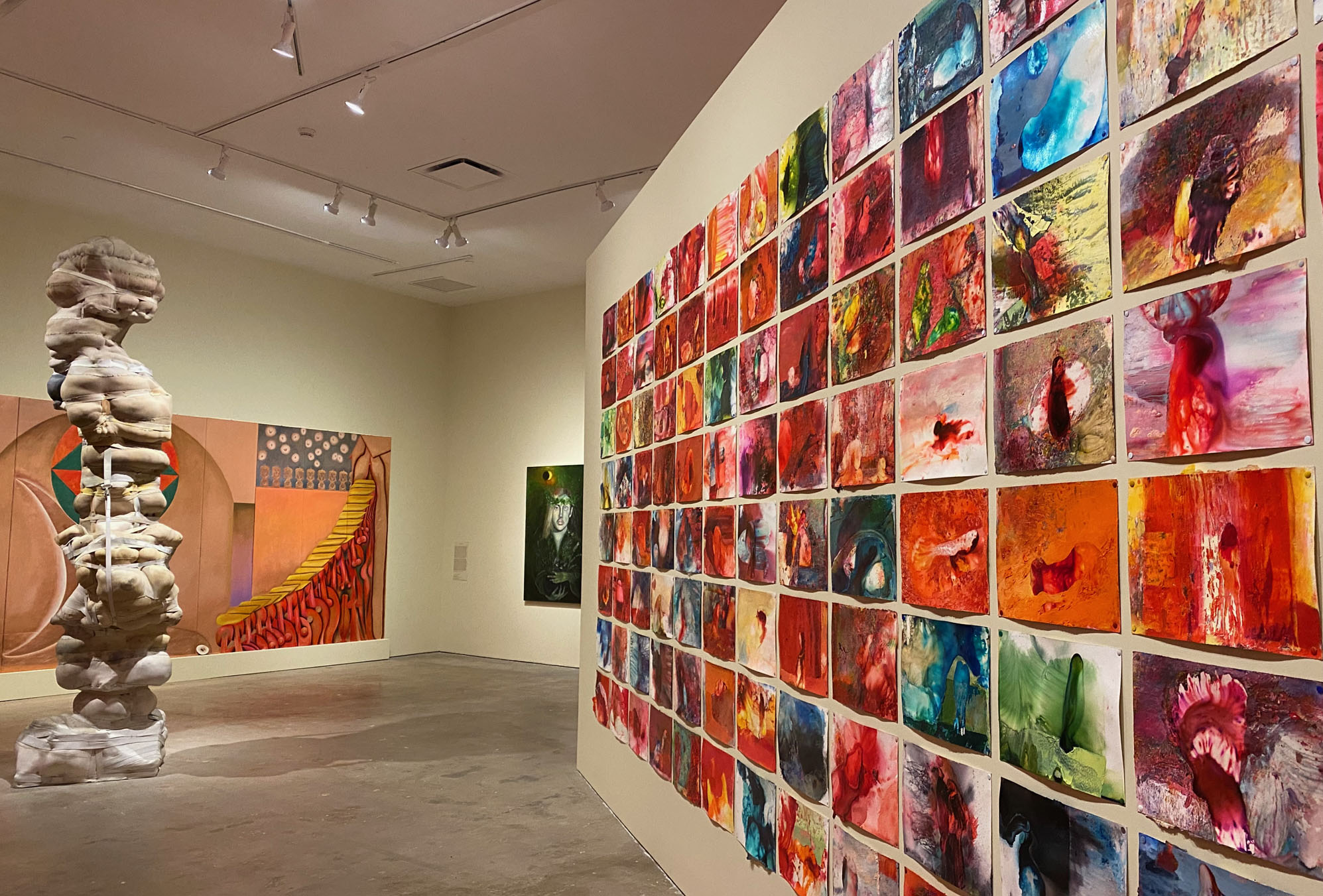
SITE Santa Fe gallery theme: appears like real life and sensual free-thinkers. 2025 mixed-media sculpture “18-1-4-5-7-21-14-4” by Patricia Ayres; copper work by Santiago de Paoli; Katja Sieb’s 2025 “perpetual novice” painting; and 2020 grid painting “Atlas” by Penny Siopis (South Africa).
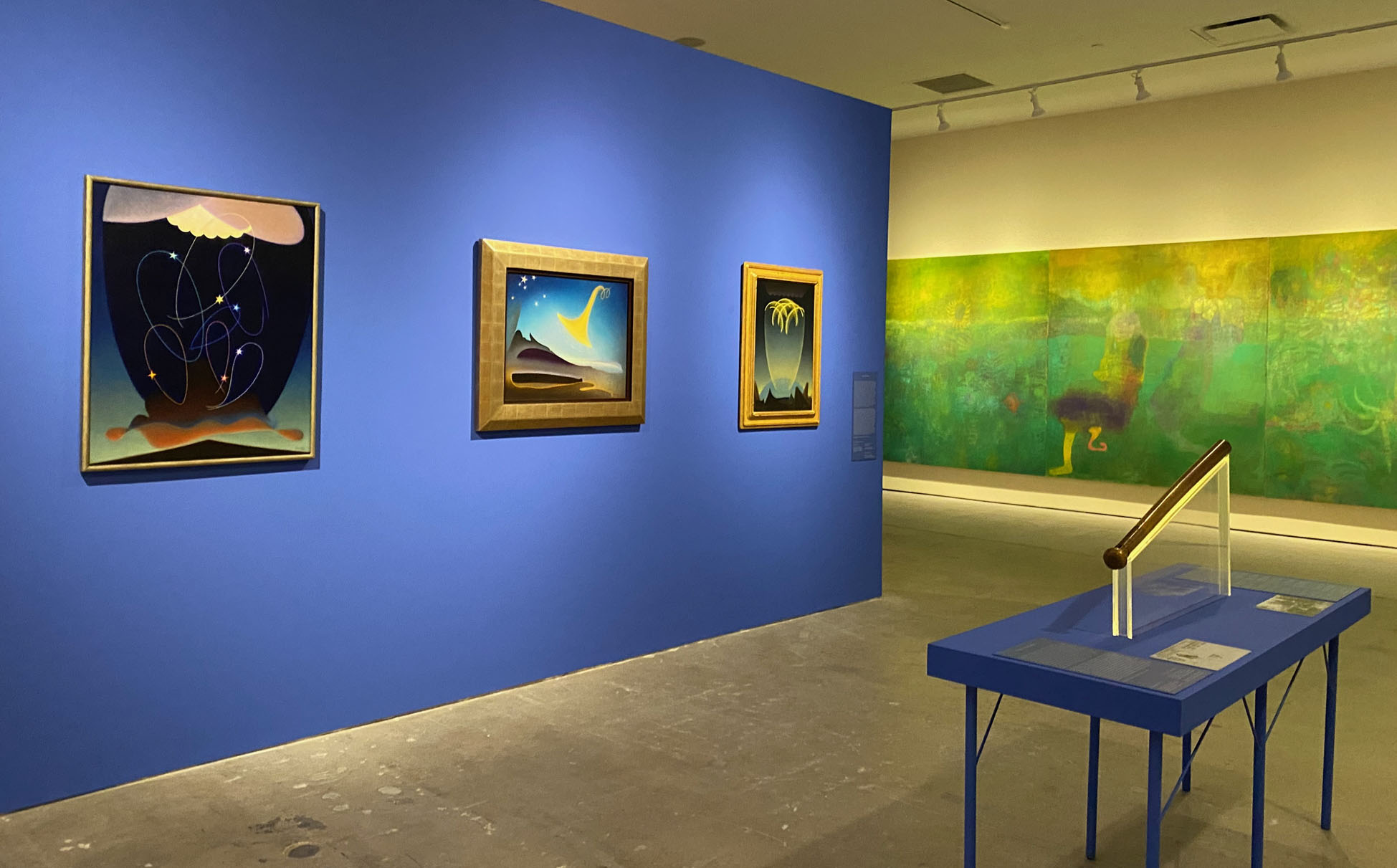
SITE Santa Fe gallery theme: in touch with light (spiritual) – Agnes Pelton’s paintings (1930s), Maja Ruznic’s mural (2025), and the 1895 healing rod of itinerant Southwestern mystic Francis Schlatter. Courtesy: Phoeix Art Museum; New Mexico Museum of Art; Oakland Museum of California; Maja Ruznic and Karma Gallery; and New Mexico History Museum.
In every space and art encounter, visitors may reflect upon whether history is repeating itself and whether inspiration can be drawn from futures that artists imagined nearly a century ago. Each space is designed for visitors to look, read, encounter, and reflect.
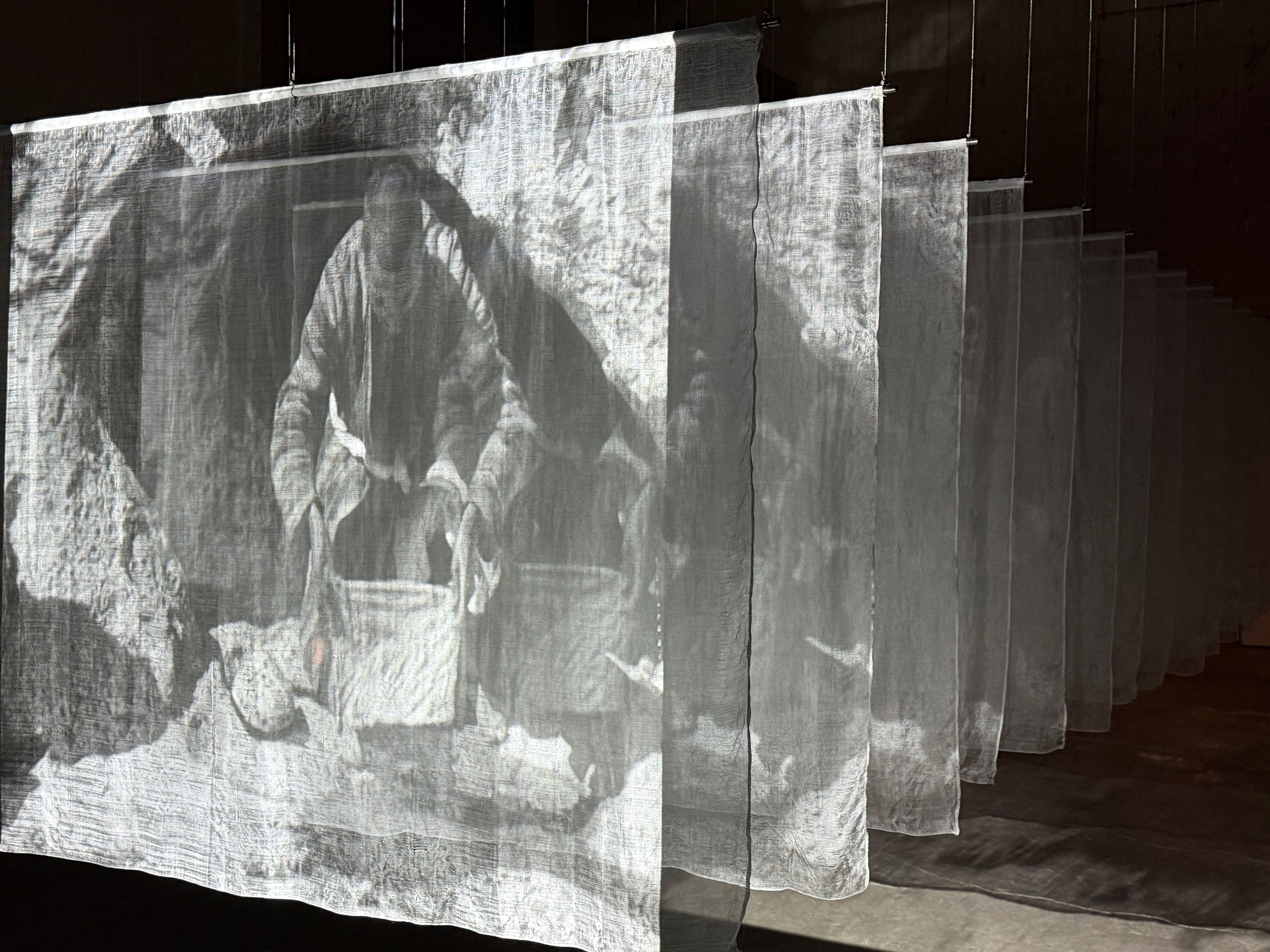
In the old foundry at Tesuque: 2024 video As We Fade by Saodat Ismailova (Uzbeckistan), showing visitors to one of Central Asia’s most sacred sites (Throne of Solomon) along the ancient Silk Road; projected across 24 suspended silk screens. Courtesy: the artist and Milan’s Pirelli HangarBicocca.
The theme for the show – Once Within a Time – is inspired by Godfrey Reggio’s most recent film – a suggestive and wordless mix of innocence, nostalgic images, visual poetry, and the future facing the next generation. The film screens continuously inside SITE, with visitors caught up in Godfrey’s dream-like images, which highlighted in this mesmerizing movie trailer:
Like Godfrey’s film, each space and gallery presents a theme, story, historic character, and provocative contemporary art that pulls back in time, creates an unforgettable experience, and asks the viewer to go inward to contemplate the future.
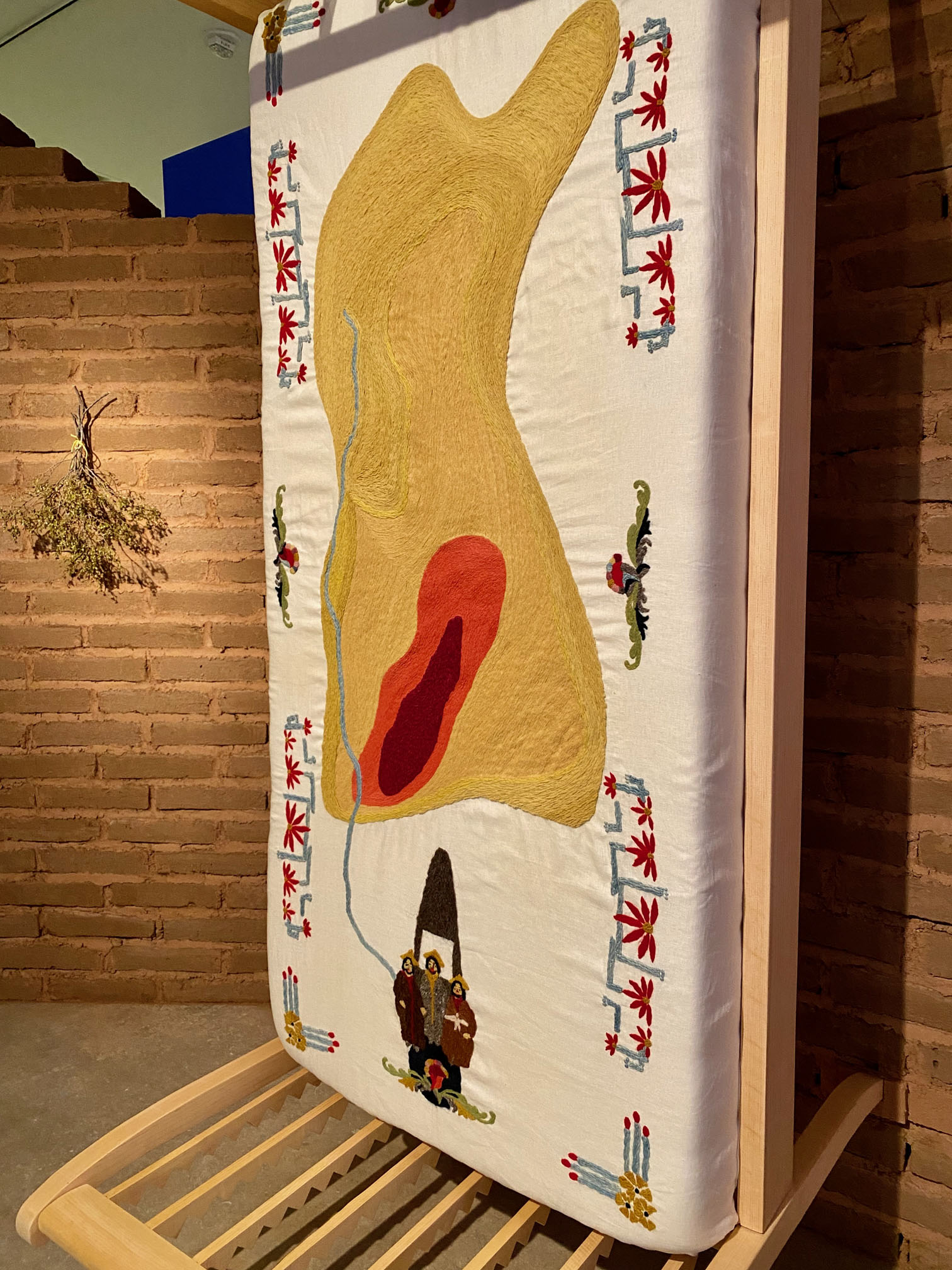
Joanna Keane Lopez’s 2024 Batter my heart, three person’d God – adobe, a handmade bed, colcha embroidery showing a radiation cloud, and creosote bush, referencing her family’s experience of living downwind of the Trinity detonation.
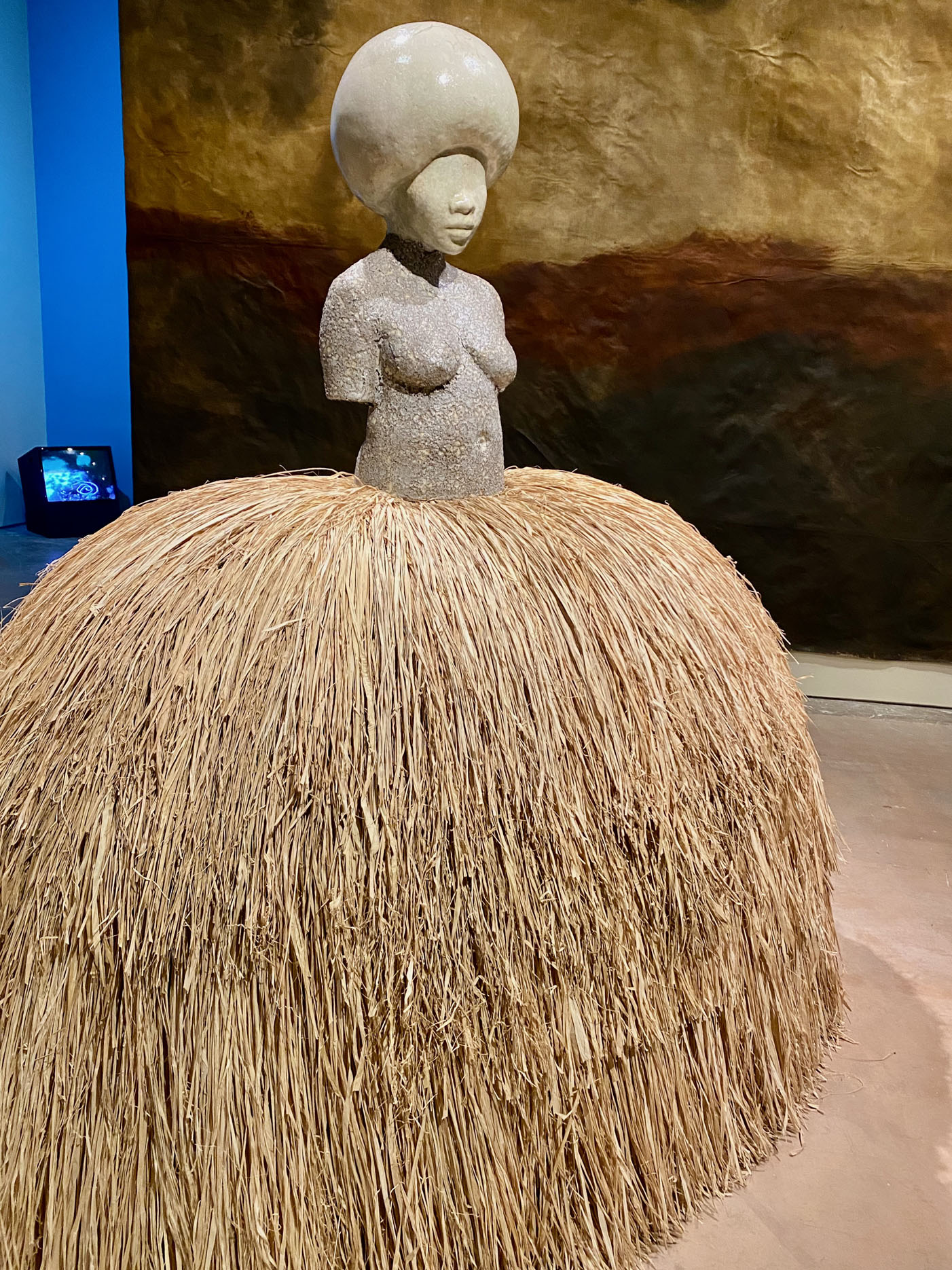
Cochiti pueblo ceramicist Helen Cordero’s storyteller figures are paired with Pablita Velardi’s storyteller illustrations (both are inspired by grandfathers and fathers) and Simone Leigh’s epic stone and raffia goddesses.
SITE Santa Fe gallery theme: storytelling. Simone Leigh’s 2025 untiled stoneware and raffia sculpture. At rear, 2025 oil The Solemn and Dignified Burial Befitting My Beloved for All Seasons by Dominique Knowles. Courtesy: Matthew Marks Gallery; the artist and Hannah Hoffman Gallery, Los Angeles.
Gallery theme: storytelling. Helen Cordero’s 1970 painted clay Storyteller – the creator of the Cochiti Pueblo sculptural tradition, inspired by her grandfather’s stories; championed by patron Alexander Girard. Courtesy: School for Advanced Research.
SITE Santa Fe gallery theme: language Marilou Schultz’s 2024 weaving Integrated Circuit Chip & AI Diné Weaving – a reference to the controvercial 1970s Fairchild Semiconductor chip plant on Navajo Nation staffed primarily with Diné women. Courtesy: private foundation.
The story of the legendary WWII heroes, the Navajo Code Talkers, is featured in a gallery alongside Marilou Schultz’s weavings of chip technology using traditional Diné methods with Fred Hammersly’s ground-breaking IBM computer drawings at the University of New Mexico in 1968-1970.
Fred was given an opportunity to create the first mainframe-generated art in the form of drawings programmed by traditional IBM punch-card technology and the Art1 program. SIITE not only displays a selection of the 400 computer drawings that he generated over the course of 18 months, but some of the punch cards he used, which are now archived at the Smithsonian’s Archives of American Art.
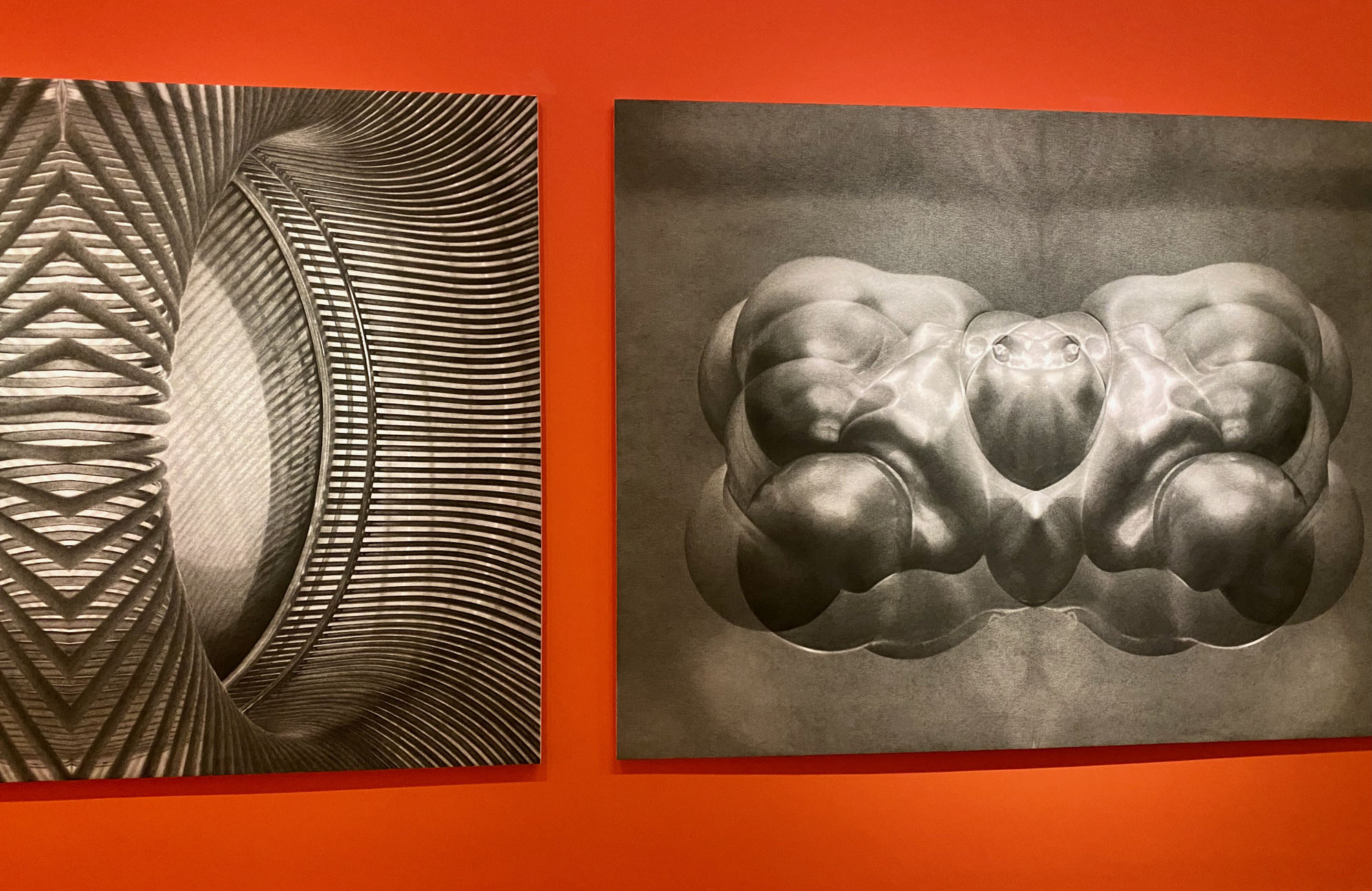
Sensual free-thinkers are represented by the story of Santa Fe gambling mogul Doña Tules (Maria Gertrudis Barceló) and her actual 1840s money chest, witty contemporary porcelain playing cards and magical paintings by Katja Seib (UK), and jaw-dropping drawings by Shanghai’s Zhang Yunyao.
SITE Santa Fe gallery theme: sensual free-thinkers. Two of three 2025 Connector drawings by Zhang Yunyao (Shanghai); pencil on stretched felt. Courtesy: the artist, Don Gallery.
Around the corner from Agnes Pelton’s transcendental paintings are Diego Medina’s landscapes reflecting the Piro-Mansa-Tiwa spiritual power inhabiting ancestral lands of Southern New Mexico and also installations about a different type of New Mexico light – the impact of the nuclear energy tests on people living downwind and the legacy of uranium mining across native lands.
SITE Santa Fe gallery theme:In touch with light (nuclear energy): Will Wilson’s 2025 series Hubris on the Land – aerial photography of abandoned 1940s uranium mines on Navajo Nation paired with his documentation of Land Art sites created by Holt, Smithson, Heiser, and Turrell in the 1960s-1970s. Courtesy: the artist
New Mexico’s natural world is paid tribute in stories and artwork by travelers and residents – watercolors of Pueblo spirits and wildlife by Awa Tsireh (Alfonso Roybal) in the 1930s, Vladimir Nabokov’s sketches of butterfly wing cells (1940s-1950s), and Eliot Porter’s spectacular photos of Tesuque jays in the 1960s.
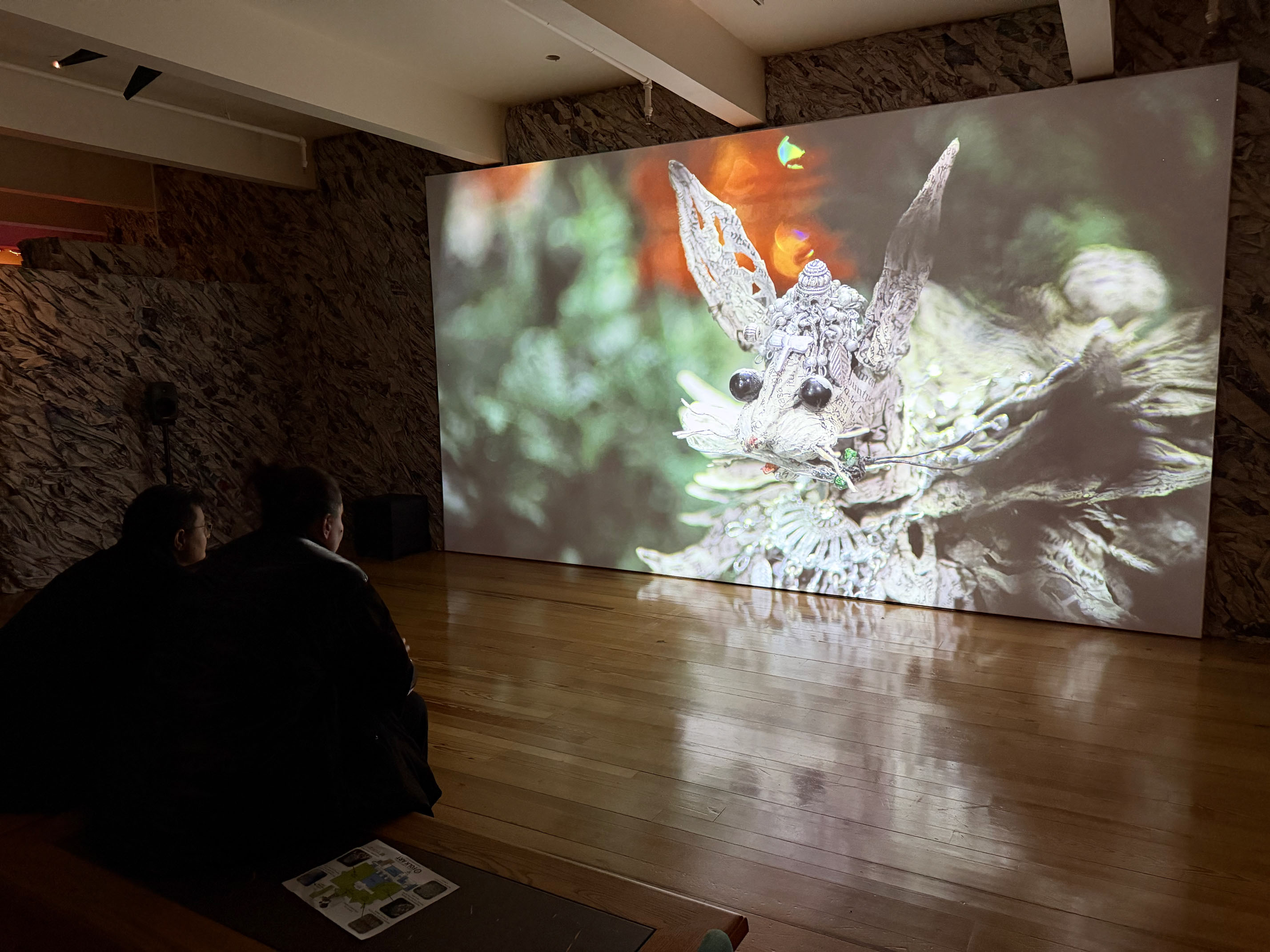
But these examples are just snippets of Once Within a Time – the entire show deserves multiple visits, and time to visit the other locations in the city, such as the hidden basement natural wonderland epic at the Museum of Internatonal Folk Art created by Taiwan ‘s Zhang Xu Zhan. It’s not only an immersive environment, but a film, animal-spirit sculptures, and selections from the MoIFA’s paper funerary object collection. Don’t miss the Day of the Dead altar, the 18th-century Pere Lachaise Cemetary tribute initially collected by Mr. Girard himself, and paper funerary fantasies made by the artist’s own family. Truly unforgettable.
Museum of International Folk Art: Zhang Xu Zhan’s 2020-2022 paper-animation video Compound Eyes of Tropical (Animal story series), with a Southeastern Asian deer-mouse outwitting a group of predatory crocodiles. Courtesy: the artist and Project Fulfill Art Space, Taiwan.
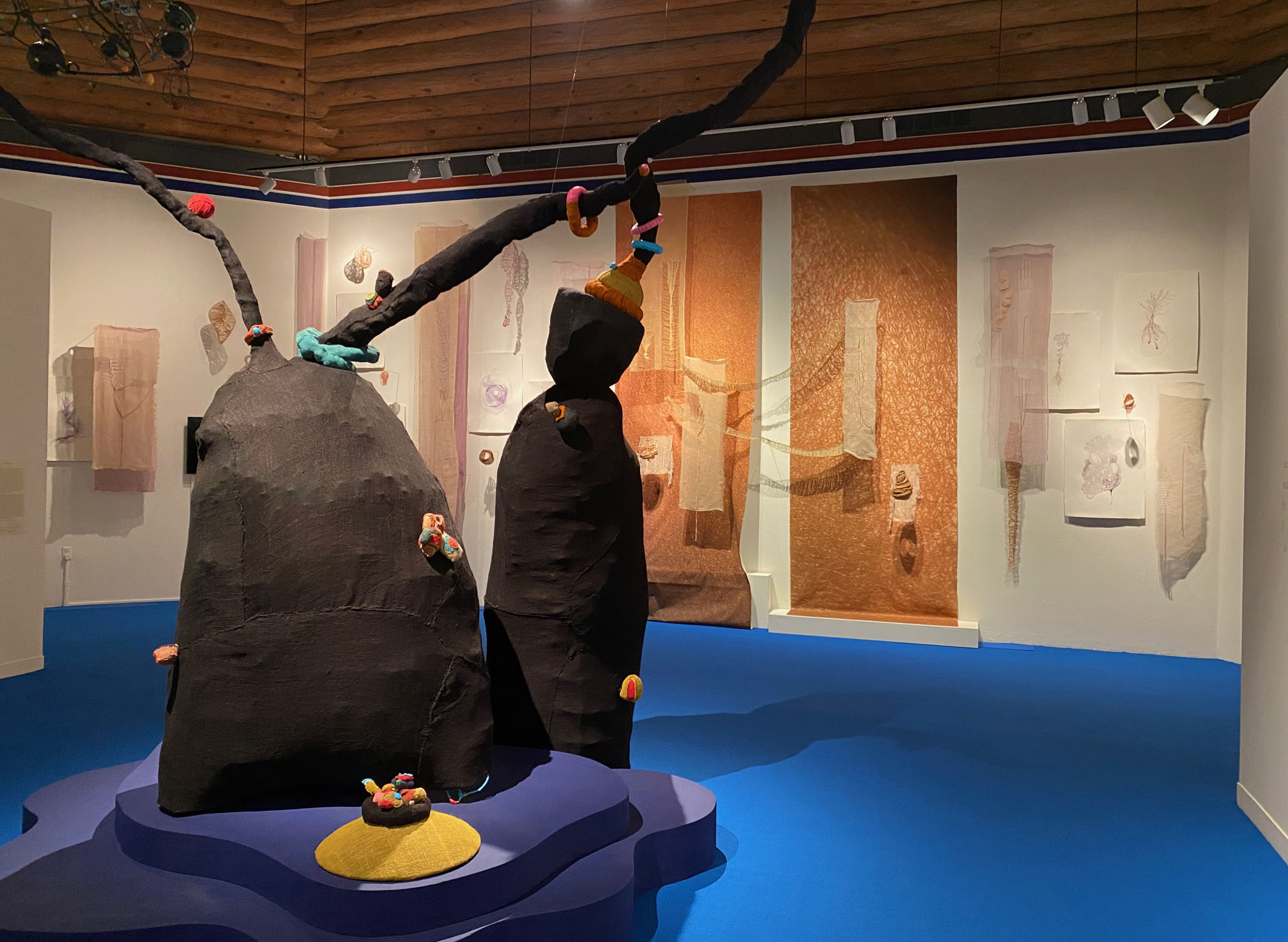
The Wheelwright Museum of the American Indian fills the Klah Gallery (in the shape of a traditional hogan) with a meditation on healing by Cristina Flores Pescorán, a wild organic sculpture by Nora Naranjo Morse, and a mini-retrospective of paintings by the incomparable Emmi Whitehorse.
Wheelwright Klah Gallery theme: journeys. Nora Naranjo Morse’s sculpture Into the Forever; on walls, Cristina Flores Pescorán’s 2025 installation Treinta y ocho. Ofrendas para reescribir historia medica y renacer Huaca. Courtesy: the artists
The Tesuque location also features rooms with installations by Mexico’s Guillermo Galindo incorporating burned wood from the recent New Mexico fires (crossed with Picasso’s Guernica), David Horvitz’s tribute to the men incarcerated in Santa Fe’s Japanese internment camp (and a hat from one them), and Thailand’s Korakrit Arunanondchai’s room-sized contemplation that incorporates the ashes from the burning of Zozobra.
Video of Korakrit Arunanondchai’s 2025 installation Unity for Nostalgia, with floor incorporating ashes from Santa Fe’s Zozobra’s burning and a prayer to the phoenix; layered soundtrack. Courtesy: the artist, Bangkok City Gallery, London’s Carlos/Ishikawa, CLEARNING NY-LA, Kukje Gallery, Seoul
Video of Max Hooper Schneider’s 2025 Written in Sand (Finquita Garden) installation; spheres mysteriously travel sand channels. Courtesy: the artist; Maureen Paley, London, Hove; Francois Ghebaley, Los Angeles, New York.
For more, take a walk through the main exhibit and five other sites in and around Santa in our Flickr album to see work by legendary New Mexican artists, and travel back and forth to see how contemporary art reflects epic histories and mystic systems of the Southwest.
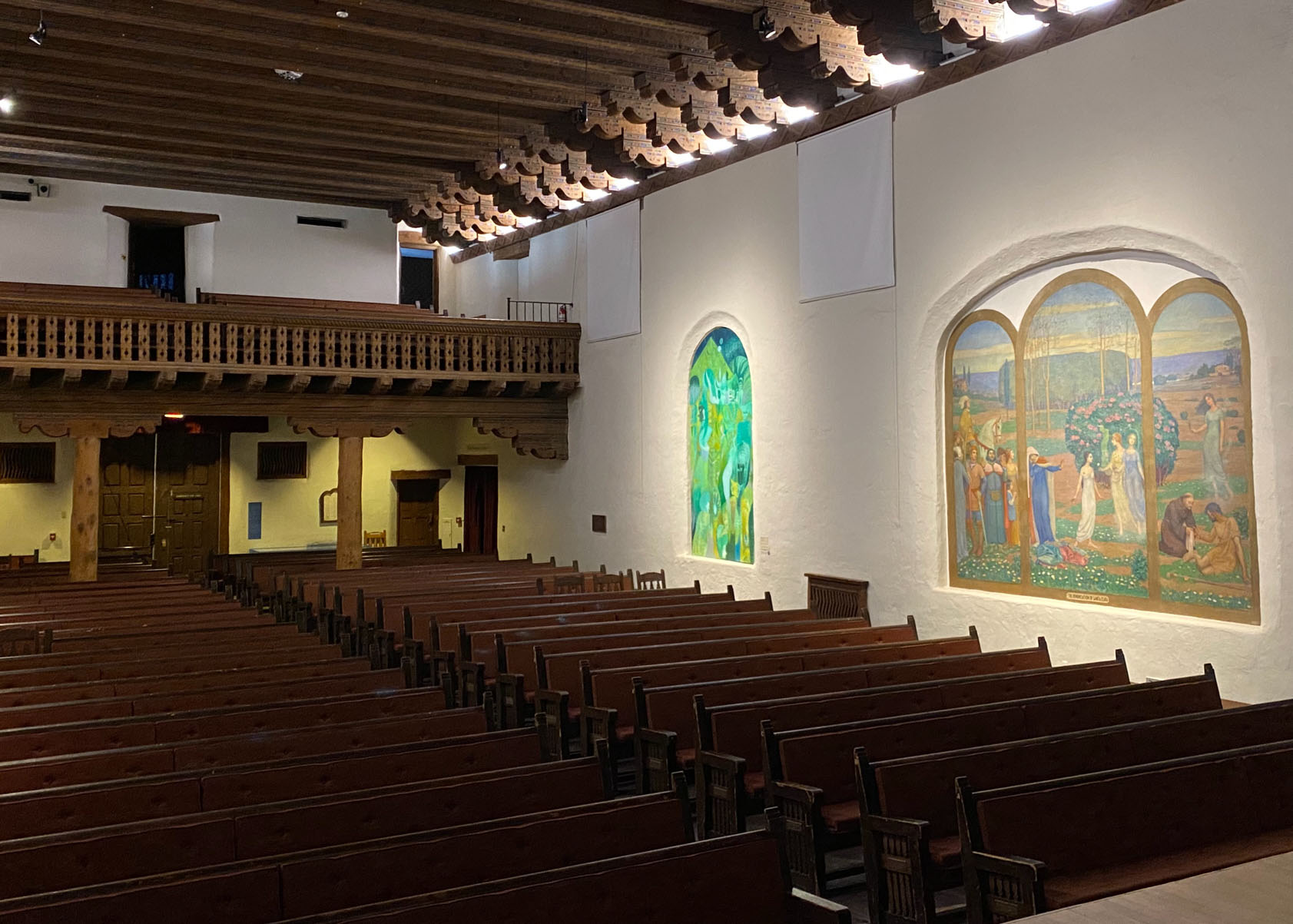
View of historic St. Francis Auditorium (1917) with Maja Ruznic’s 2025 Kisa Pada, Trava Raste, Gora Zeleni installed atop Donald Beauregad’s painting The Conversion of St. Francis; to right, Beauregard’s The Renunciation of Santa Clara.





 itsnewstoyou