Onstage at Theatre Picasso at Tate Modern

To celebrate the 100th birthday of its most acclaimed Picasso painting – and its own 25th birthday – the Tate Modern decided to commission a team of creative curators and designers to create an innovative experience and new lens through which to view an artist who seems to define 20th-century modernism.

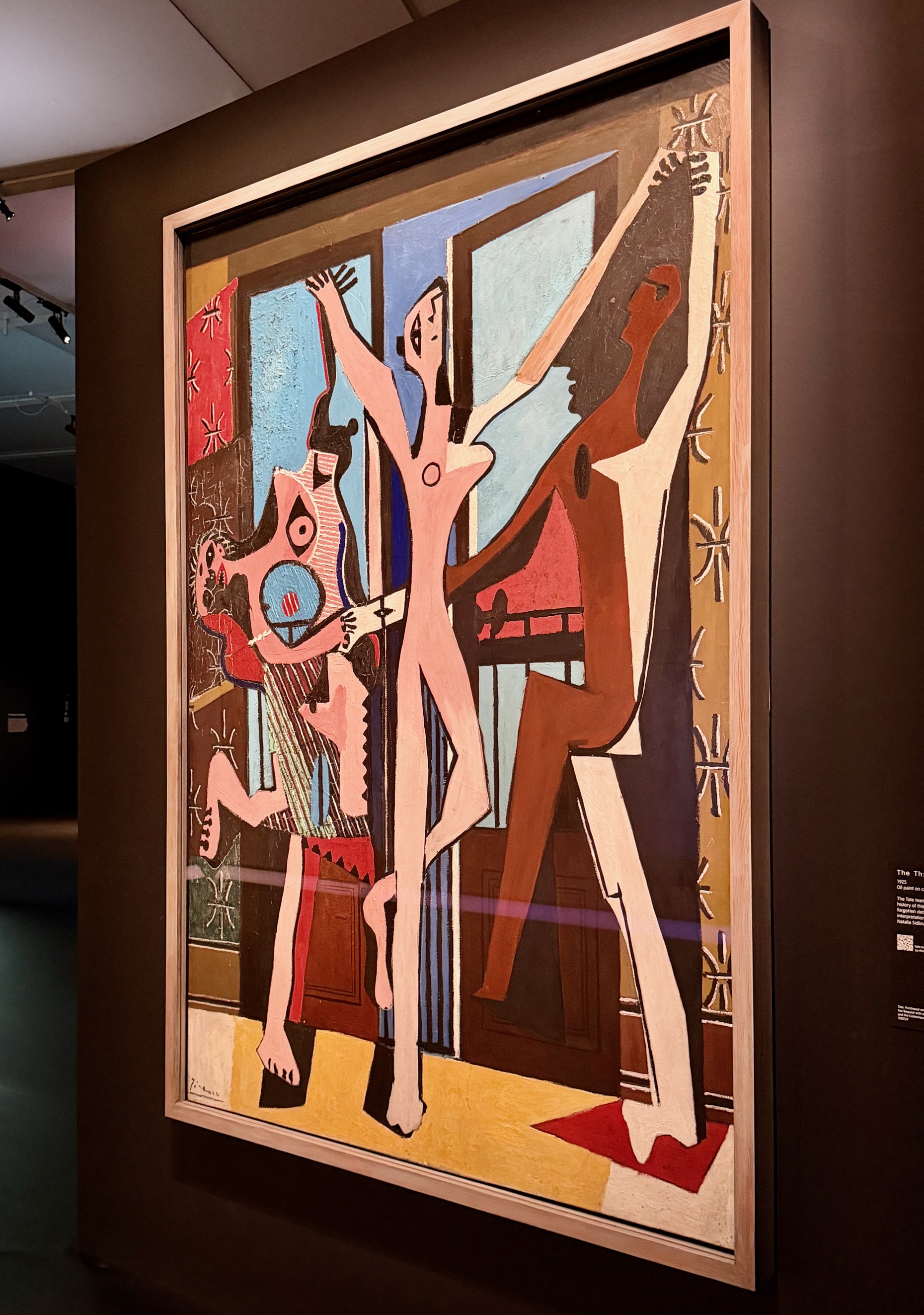
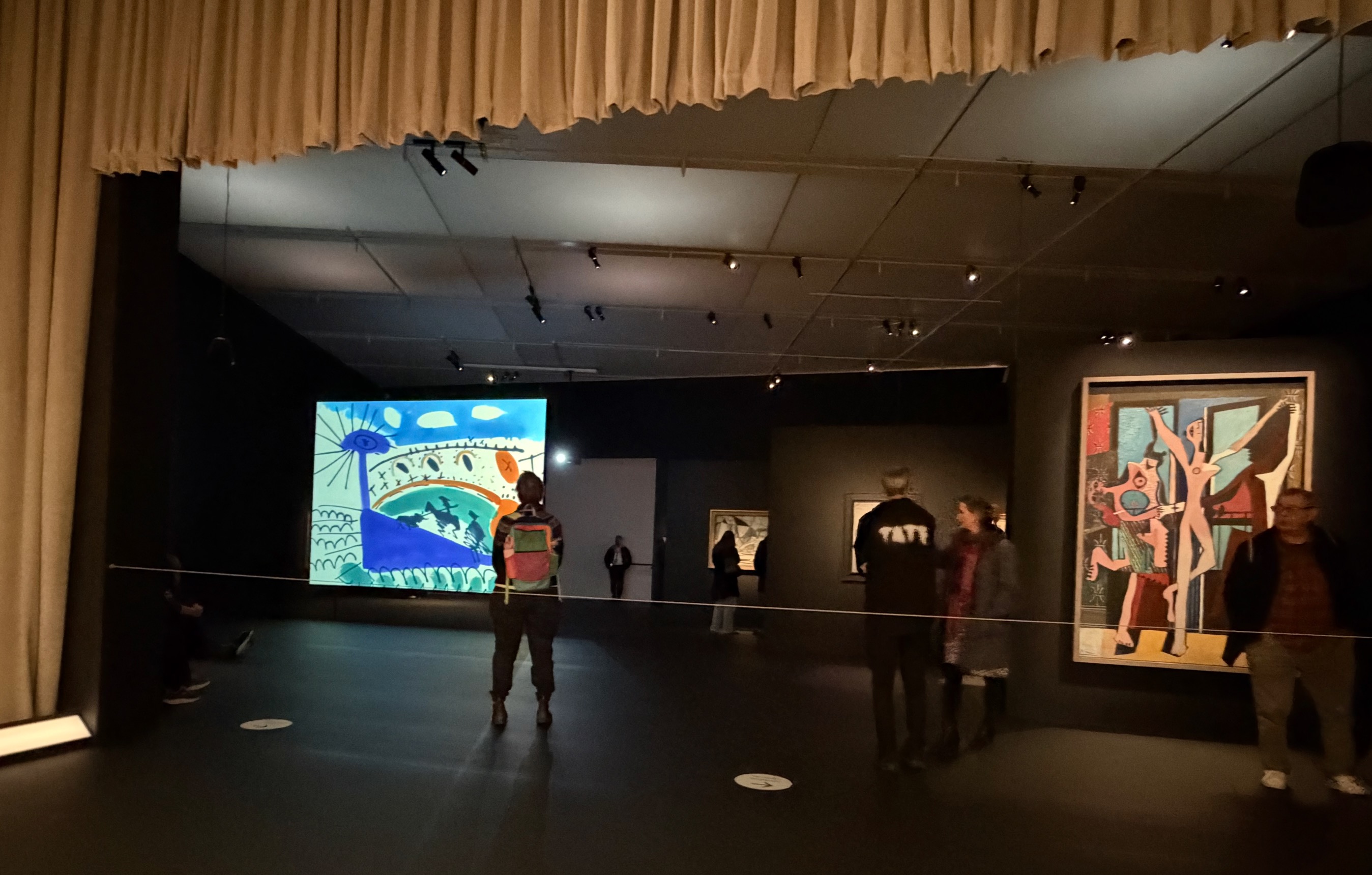
Theatre Picasso uses a proscenium-like stage, tiered seating, and a big screen to give everyone a backstage pass to view The Three Dancers and nearly 50 other works by the master himself. It’s all on view through April 12, 2026.

How do you create a fresh viewpoint on Picasso?

Picasso’s 1925 The Three Dancers – one of the Tate’s best-known works

The Tate Modern recruited two art-world mavericks – MacArthur (“genius”) grant recipient Wu Tsang and curator/author Enrique Fuenteblanca – who came up with a plan to stage the art in the same theatrical way that Picasso lived, created, and shape-shifted his entire life. .  Check out our favorite views in our Flickr album.

The exhibition entry is a nearly blank, but vigorously painted wall that only increases the suspense about what you will encounter inside – very much like entering a theatre with pent-up anticipation about the performance you’ll experience.  Some of the first images you see are images of Picasso hamming it up in makeshift costumes and headdresses in photos and film stills taken by his avant-garde pals – a reminder of his embrace of big personality, outsize physical statements, and alter egos. He was always performing in public.

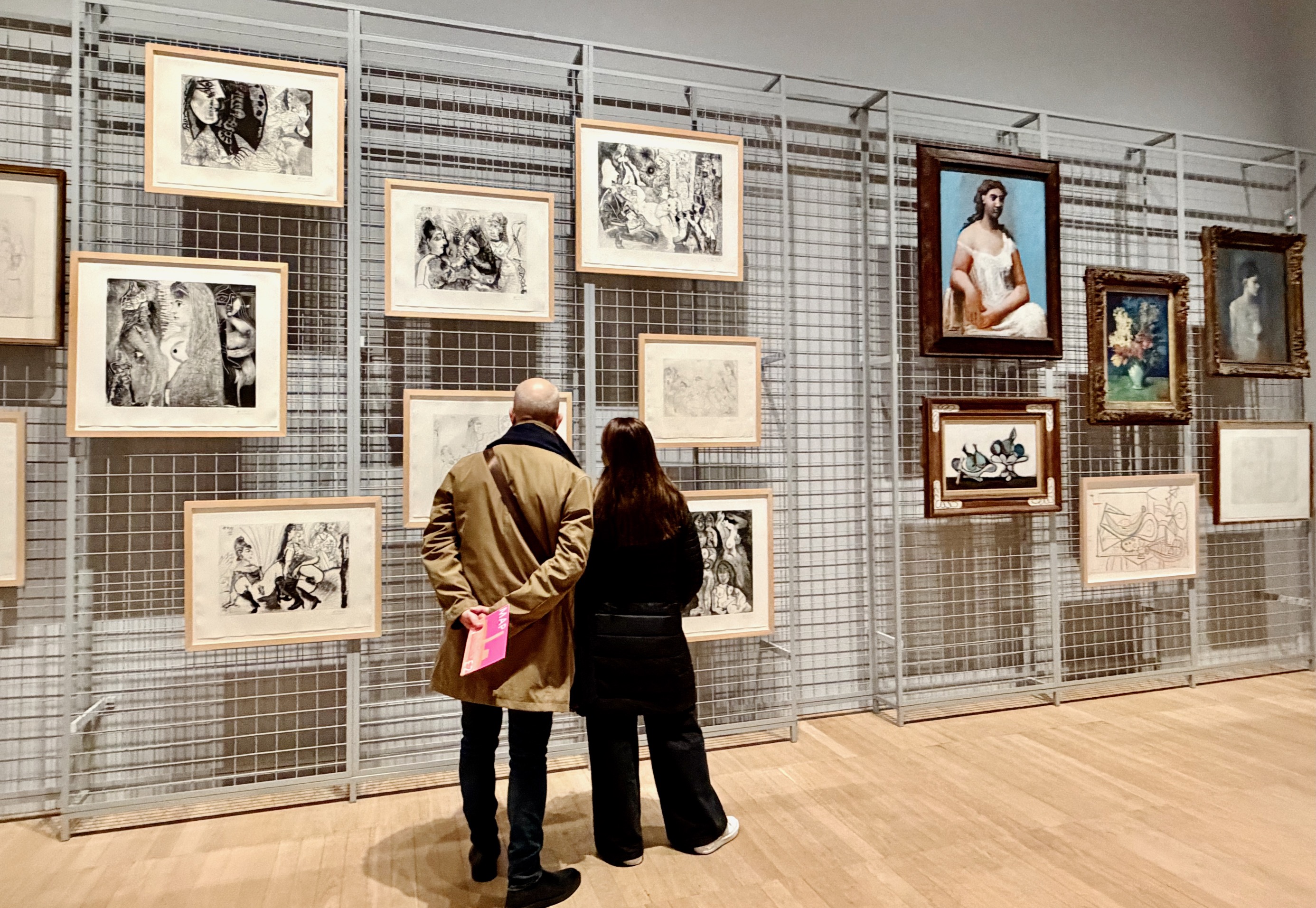
Performativity: Visitors scan a “backstage” wall of Picasso’s theatrically staged and posed scenes, some classical and some scandalous but always being showcased

A winding path leads next to a gallery with fittings hung with artwork that creates a slightly backstage feel. It’s a wall of smaller etchings, prints, and paintings from Picasso’s entire career, all selected to show how he loved creating a compositional frame for his sitters, groups, and abstracted still lifes. The curators want us to think about his performativity.

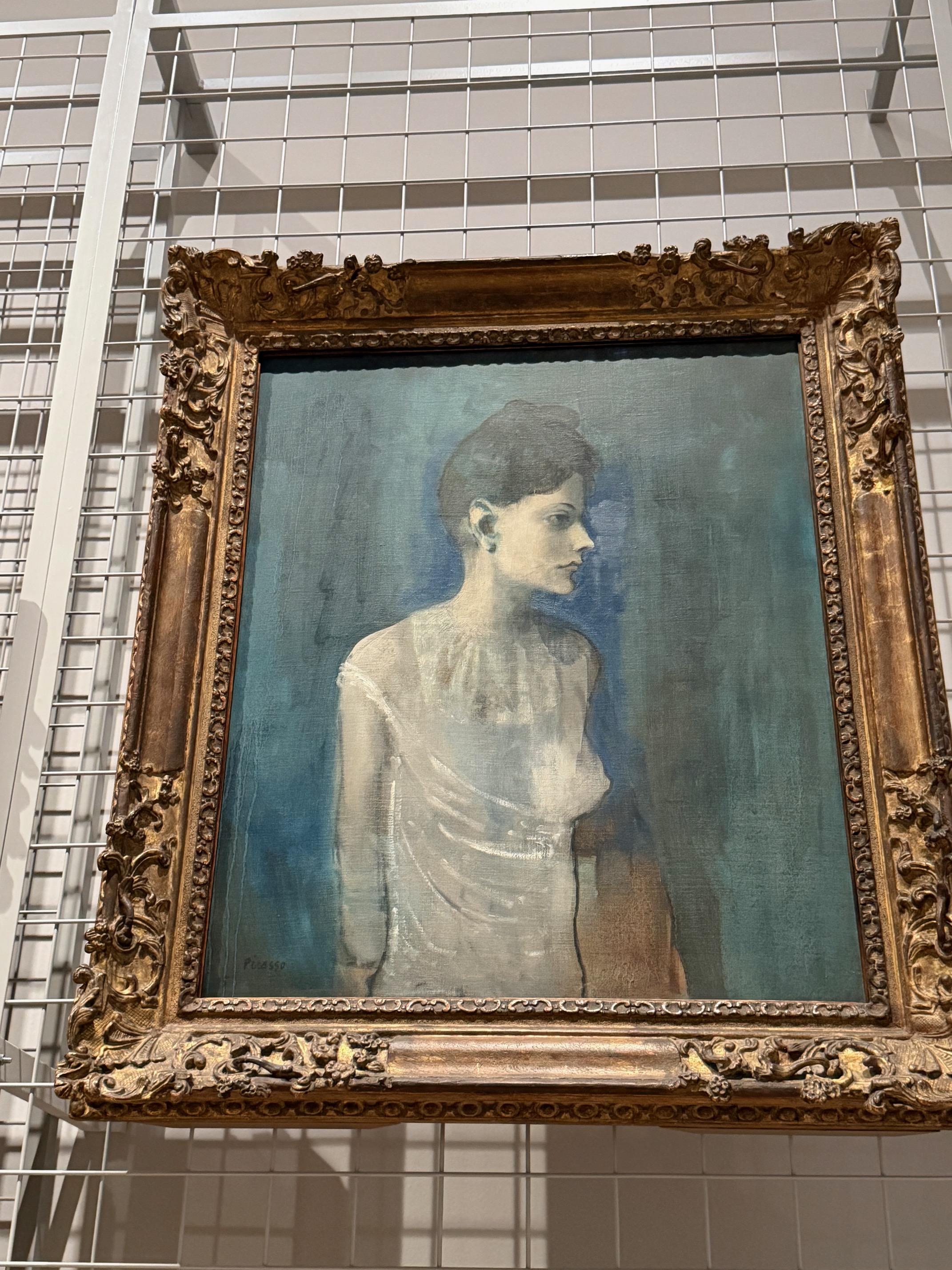
Picasso’s 1905 Girl in a Chemise – initially painted as a depiction of a young man
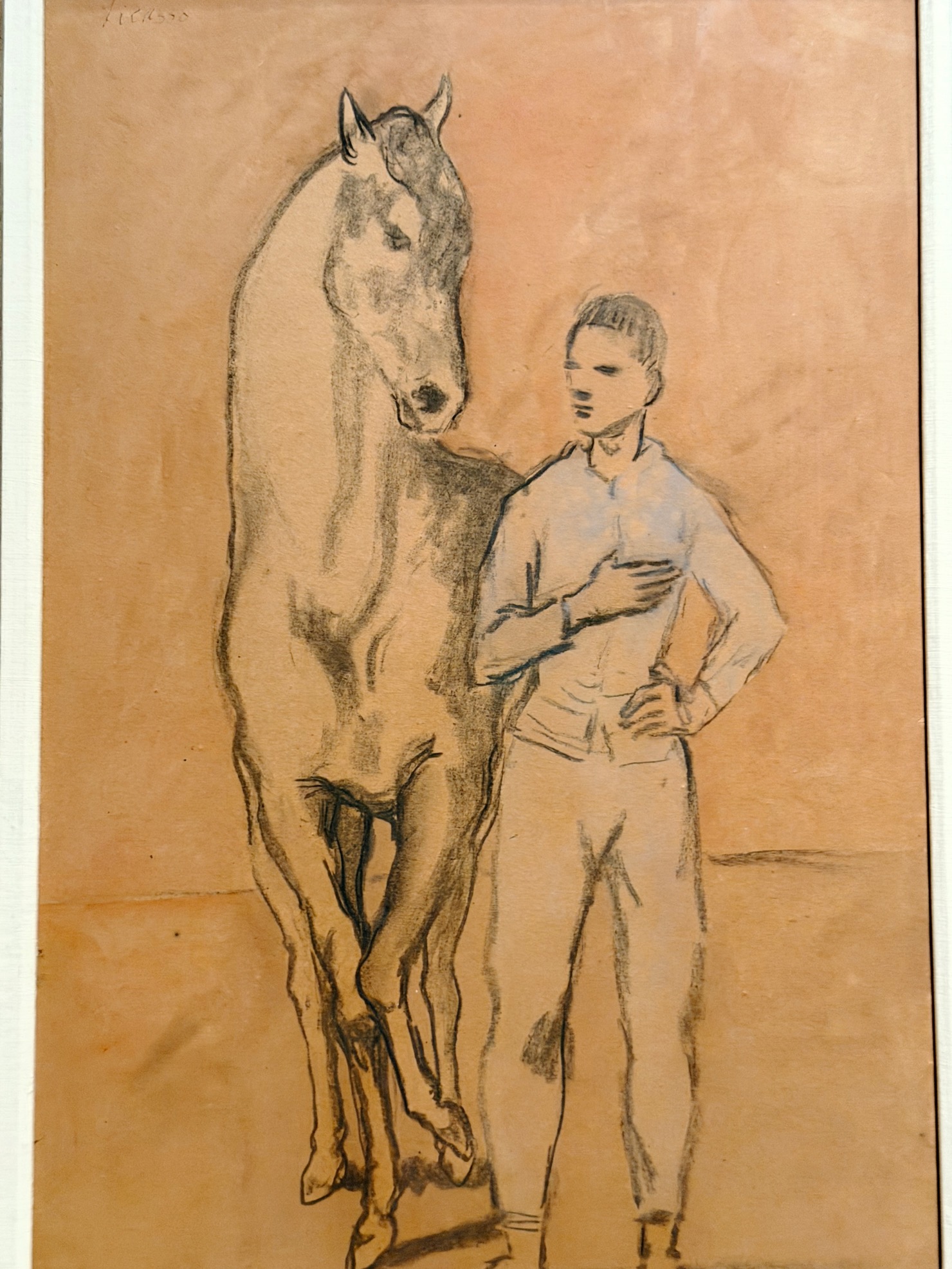
Picasso’s 1905-1906 watercolor and gouache Horse with a Youth in Blue.

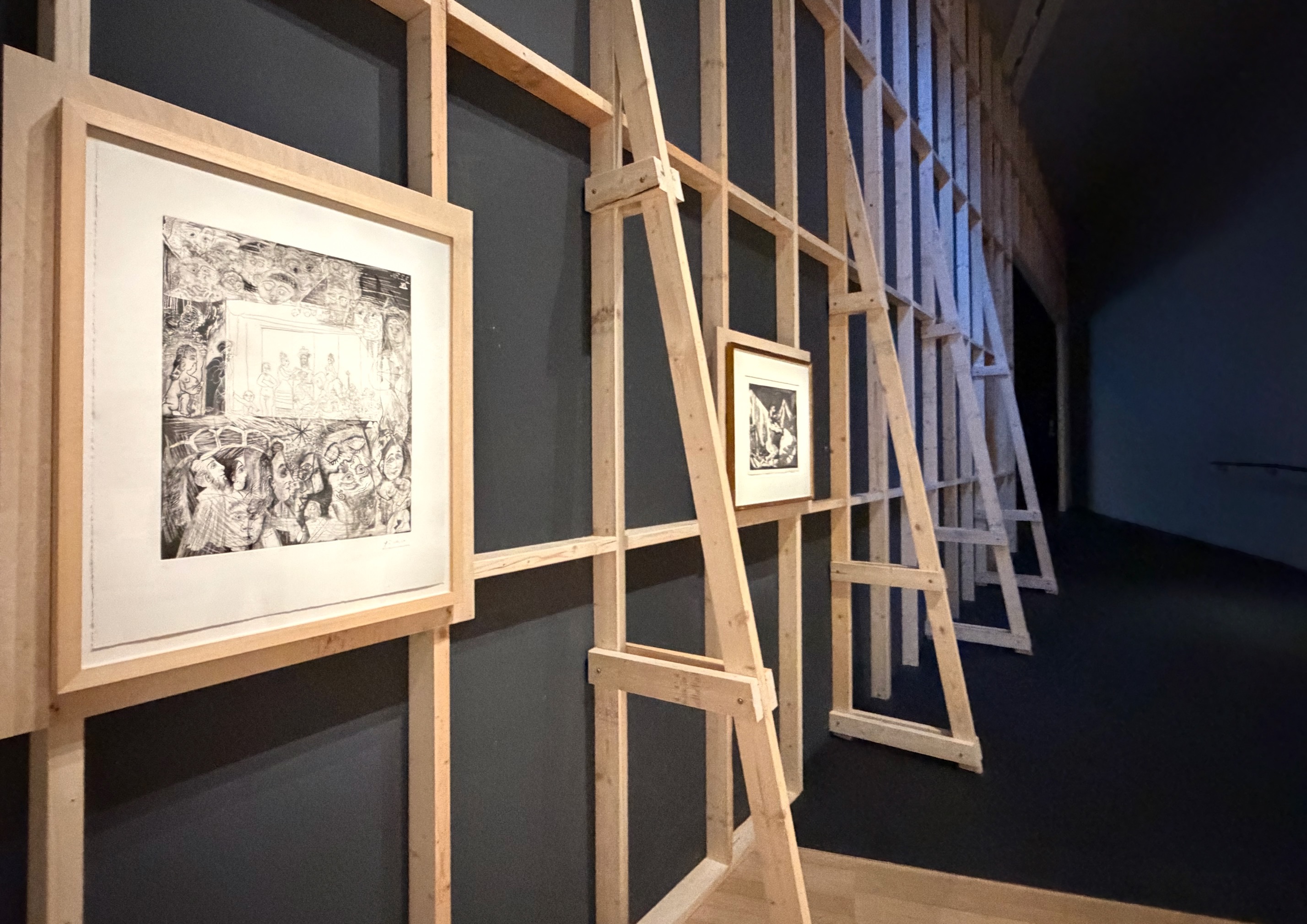
Walking further, you see a photo from a 1932 exhibition that Picasso famously “staged” himself, followed by a wall of wooden supports that definitely looks like you’re manuevering behind a stage set. There are two carefully placed Picasso etchings that reference Rembrandt that drive home the point about Picasso’s heightened theatricality, including a print with the chaotic mass of humanity hovering about a stage set with unusual players.

Two of Picasso’s etching and aquatints mounted “backstage” – 1970 Ecce Homo after Rembrandt IV State V 03-02-1970 and 1936 Faun Revealing a Sleeping Woman (Jupiter and Antiope, after Rembrandt).

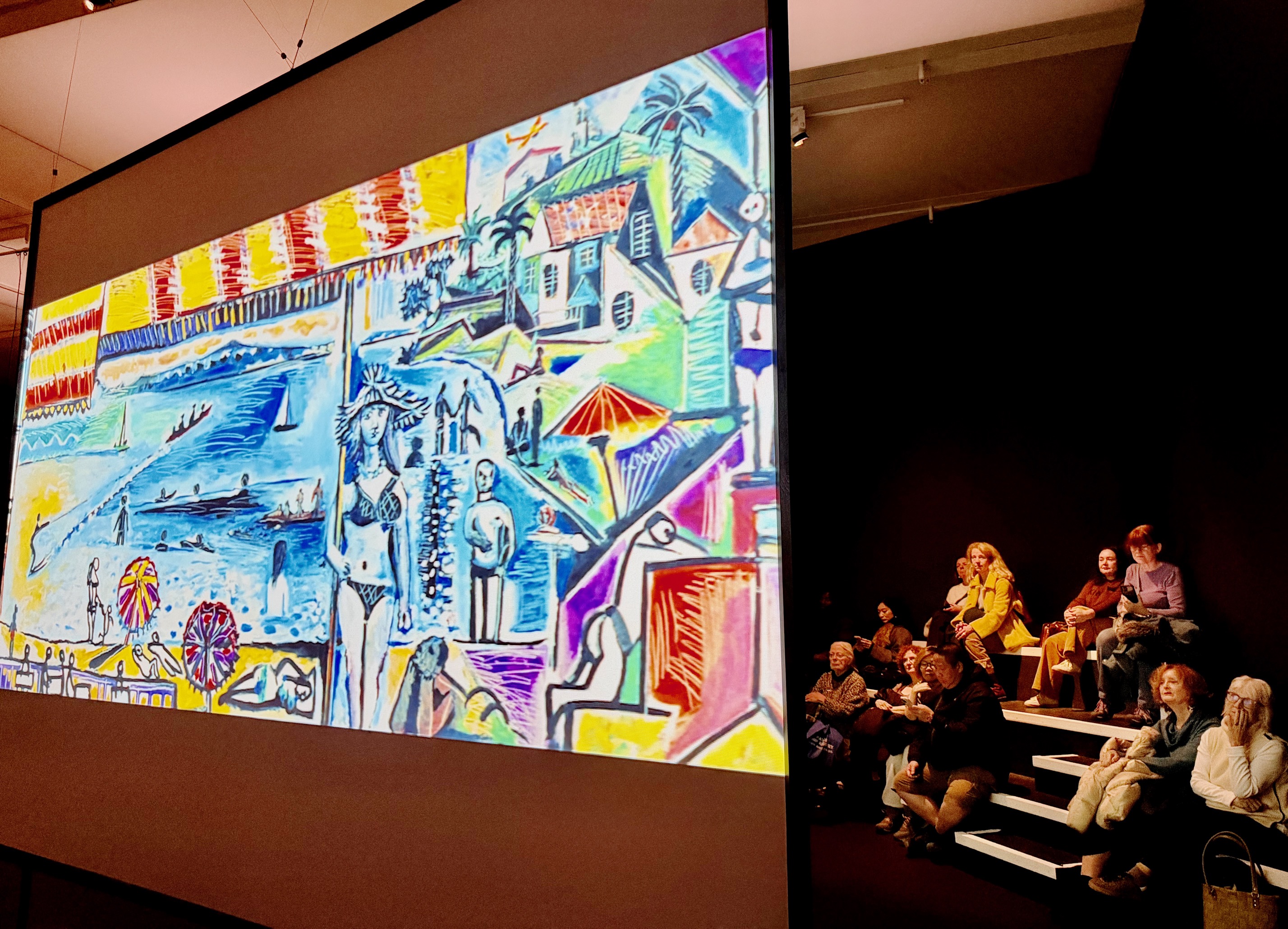
Around the corner into the main exhibition space, you see it all – a large movie screen, a film showing Picasso in action, and a proscenium across the room that functions like an aperture through which to view more Picassos. An audience sits in rapt attention watching the movie, which features drawings that materialize in thin air from Picasso’s hand.

From behind the screen: audience watches Henri-Georges Clouzot’s 1956 film The Mystery of Picasso. Courtesy: Gaumont

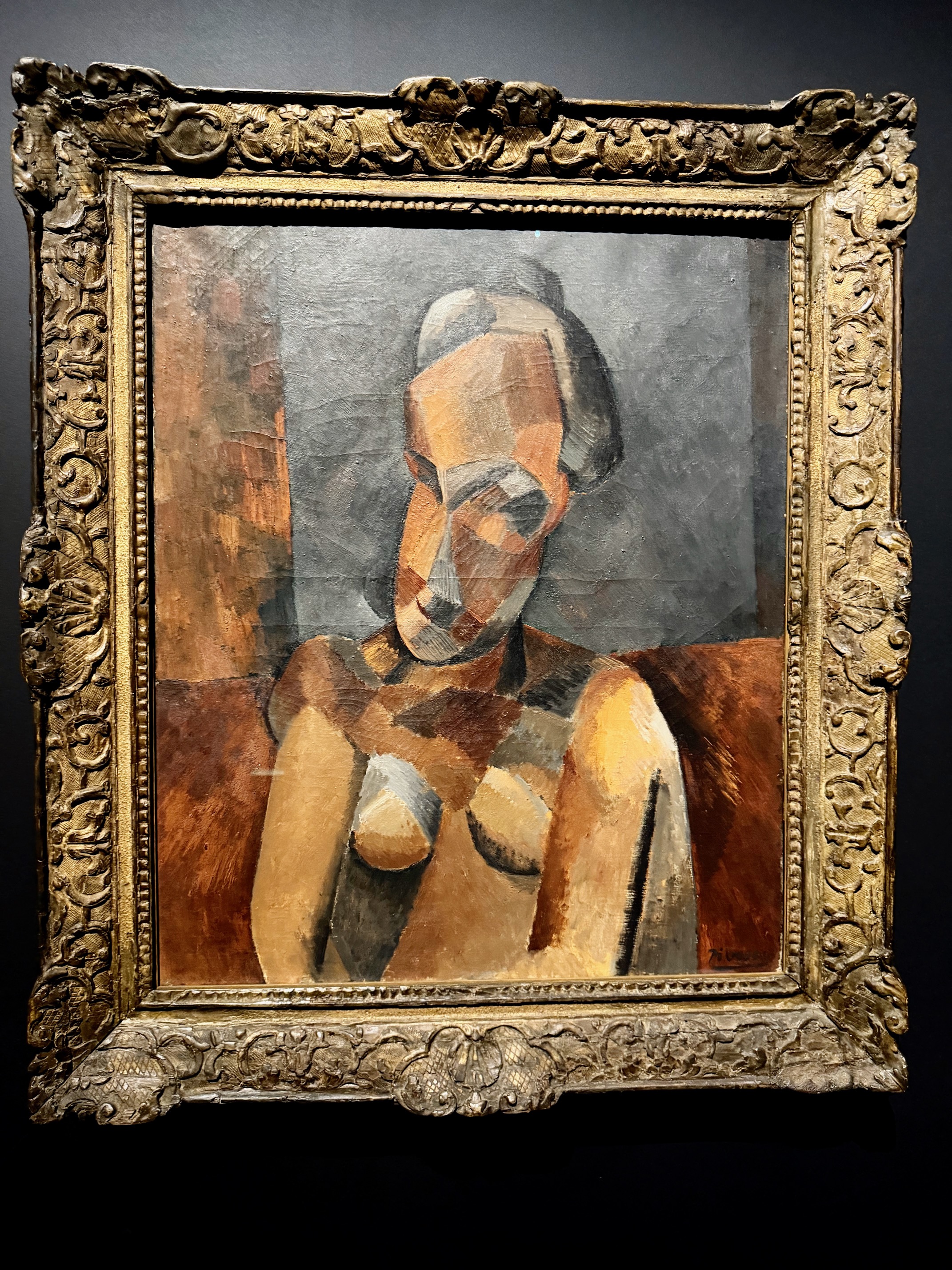
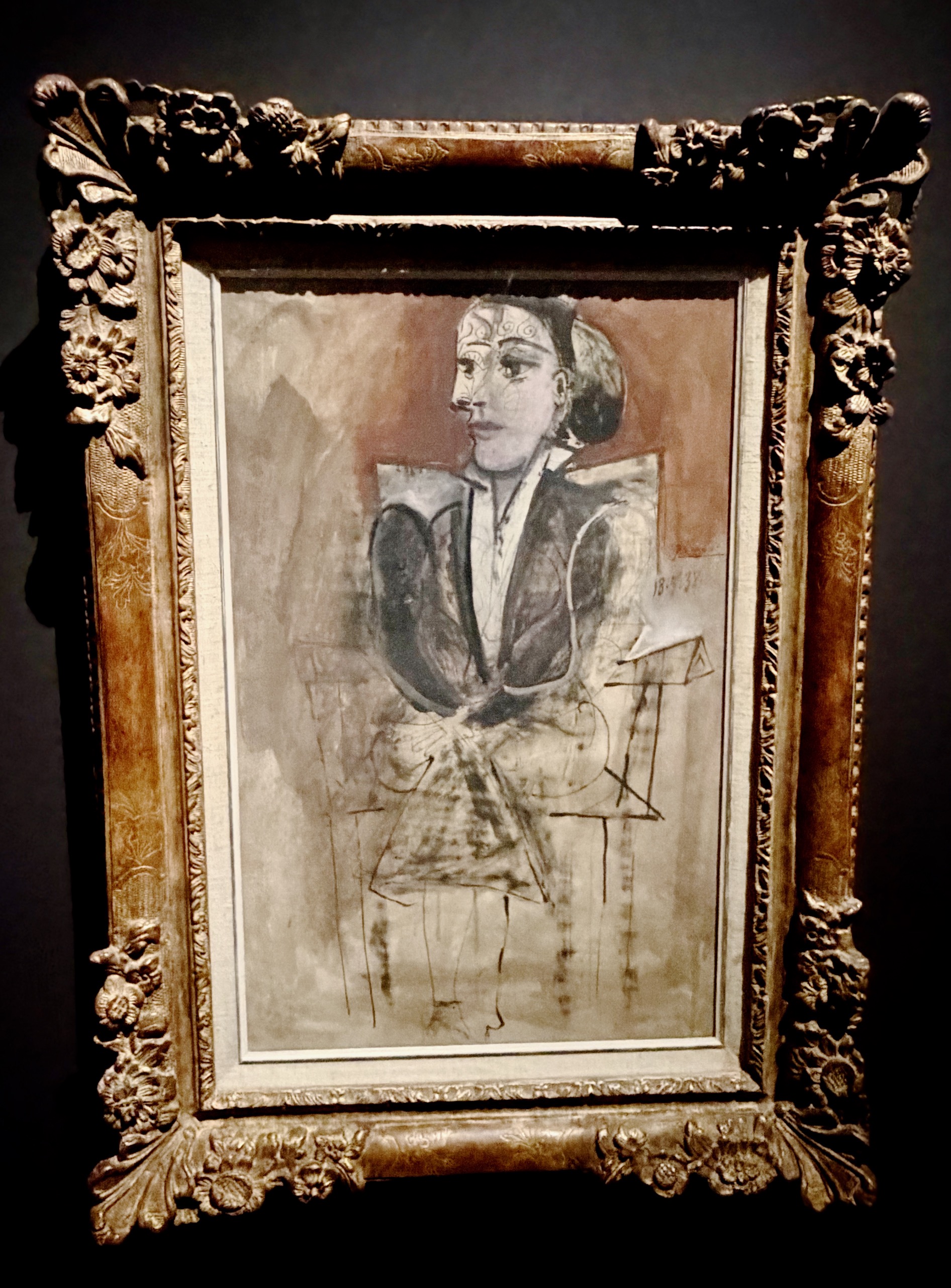
An inviting exhibition space opens out to the left, featuring works a range of works collected by the Tate (along with a few on loan from Muséée international Picasso-Paris) – cubist portraits, early still life collages, dramatically posed models, action sketches of bullfights, and his post-War lithograph Dove, which became the symbol of the international peace movement. It highlights how the artist staged and experimented with people, events, and symbols in his art.

Contemplating the museum’s collecting choices: Picasso’s 1909 oil Bust of a Woman.
Picasso’s 1938 ink, gouache, and oil Dora Maar Seated.

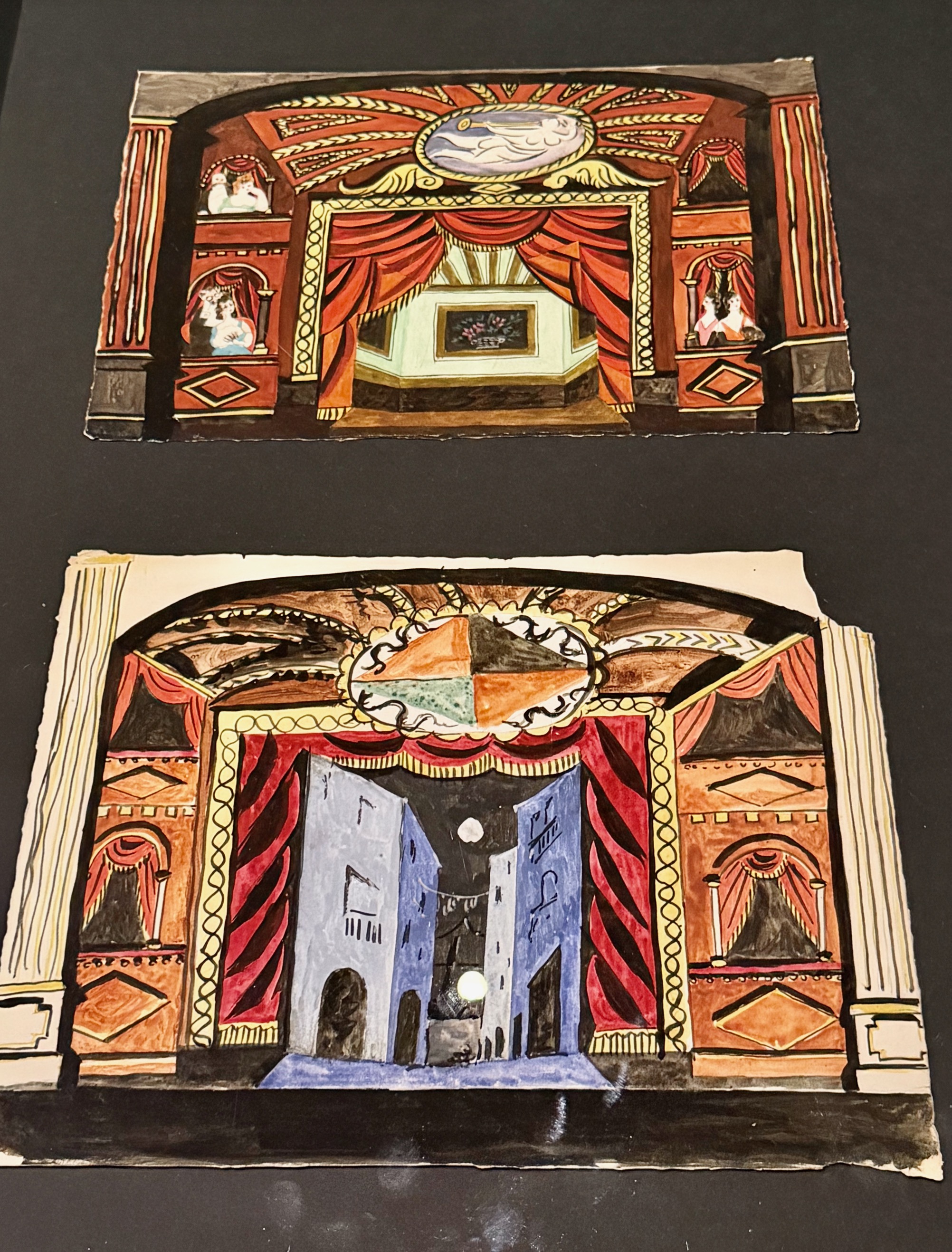
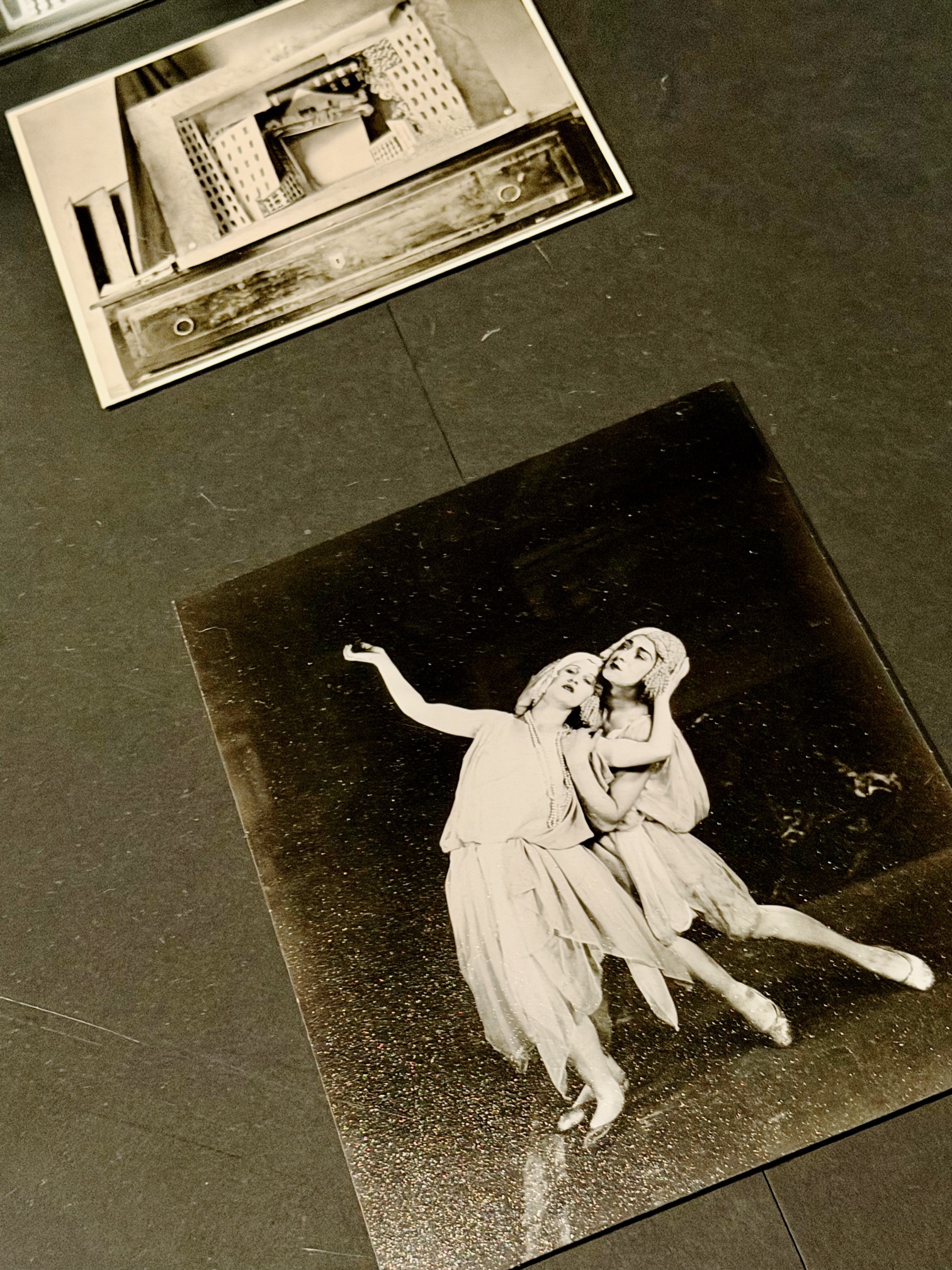
The journey all leads to a punctuation point – a view into Picasso’s early enthusiasm and aptitude for live theater, dance, artifice, and fantasy of the theater itself. Cases of small photos and sketches that chronicle Picasso’s designs for stage drops, costumes, and sets for the Ballet Russe – a legendary collaboration that boosted Picasso’s fame and fortune.

Copies of Picasso’s set designs for Sergei Diaghilev’s Ballets Russes: 1920 sketch for the ballet Pucinella and 1921 sketch for Cuadro Flamenco.
1917 photo of the Parade set model for the Ballet Russe; Sasha’s 1927 photo of Venus (Vera Petrova) and Apollo (Boris Lissanevitch) in Picasso’s costumes for Mercure for a rival avant-garde company.

And finally, there’s a full view – from a proscenium stage – of The Three Dancers, in which three performers form a tableau near an open window.

The audience takes the stage: view of Henri-Georges Clouzot’s 1956 film The Mystery of Picasso and Picasso’s 1925 The Three Dancers. Courtesy: Gaumont; the Tate.

Here’s the Tate’s deeper dive into Picasso’s inspiration from popular dance and how he channeled personal trauma and loss into his final painting. No wonder he kept this work particularly close.

And turn around to see the finalé – Picasso’s The Painter and His Model,

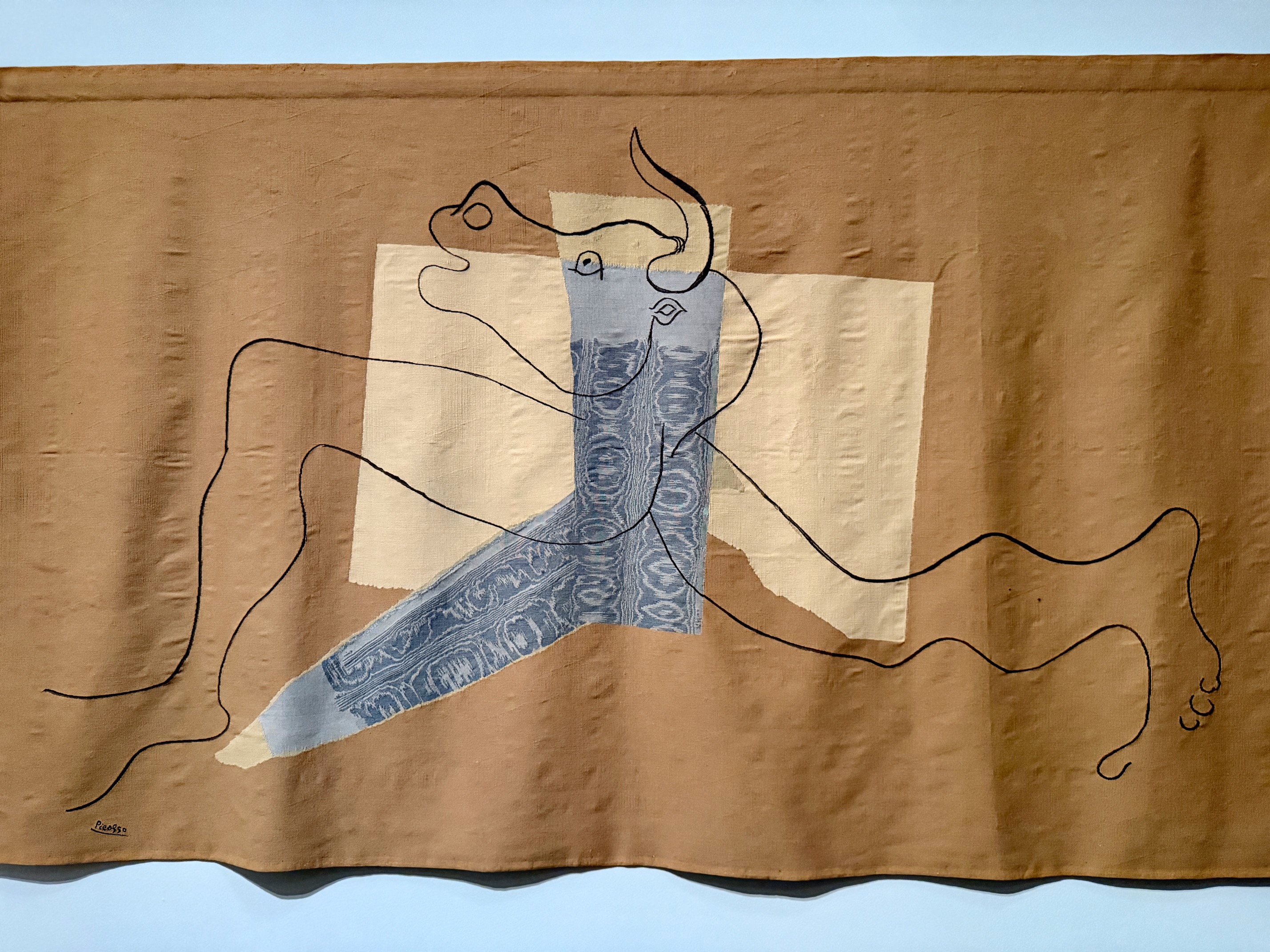
The Acrobat, and a dramatic tapestry of one of Picasso’s personae, The Minotaur, that seems like a big, grand theatrical drop curtain. It isn’t, but hits the perfect note to the end of an entertaining, theatrical show about one of the 20th century’s epic performers.

1935 wool and silk tapestry after Picasso’s 1928 Le Minotaur. Courtesy: Musée Picasso, Antibes.

Where Bowie, Blahnik, and Blitz Kids Ruled 80s Culture

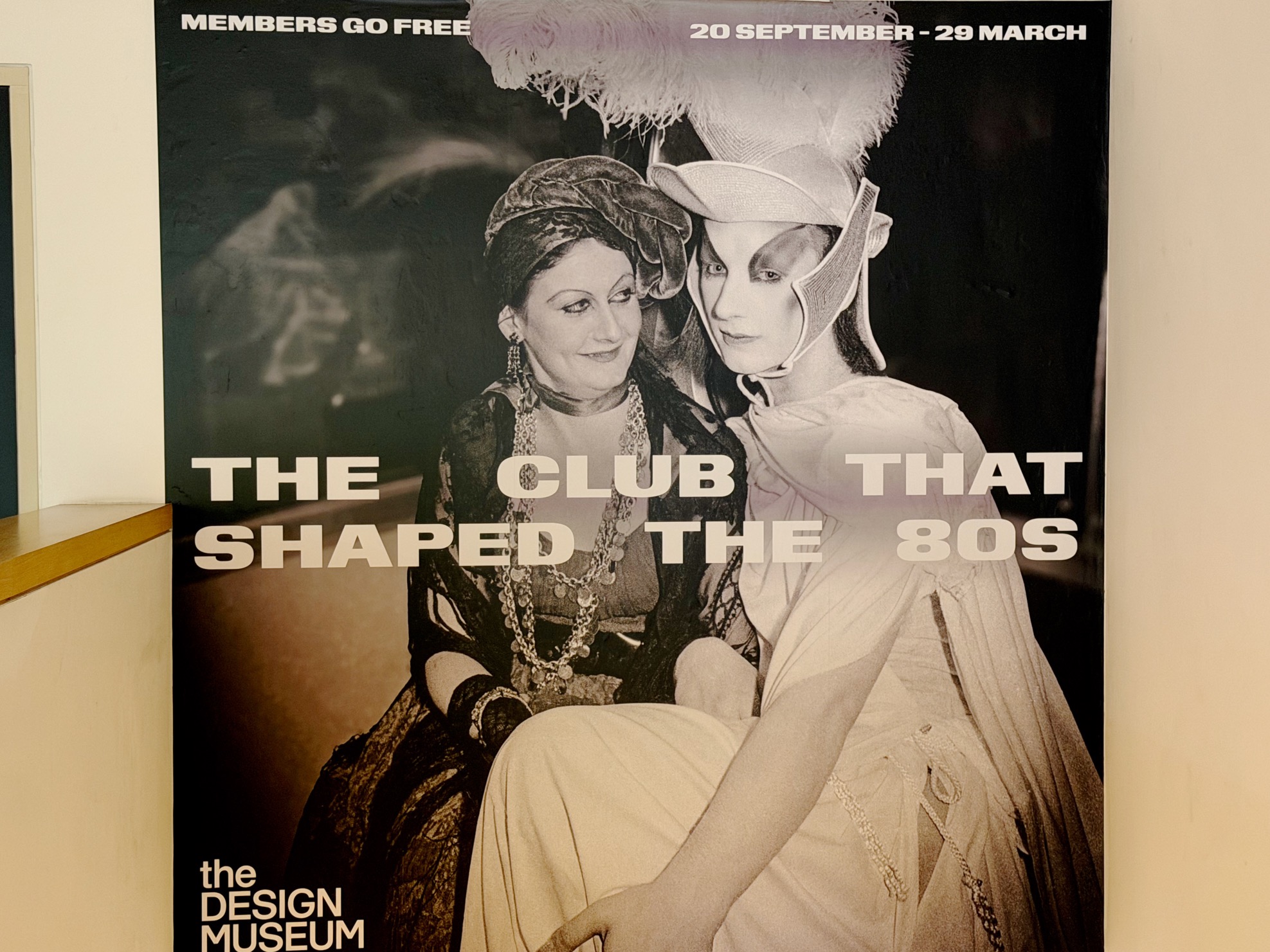
You’ll have to go downstairs and get past the doorman to get into the club where art, design, trend, creative dress, techno-pop, synth, retro, and gender-bending fashions rule. The Design Museum in Kensington, London has created a time machine that takes visitors back to the edgy days of Covent Garden through the exhibition Blitz: the club that shaped the 80s, on view through March 29, 2026.

As soon as you enter the museum lobby, you can tell who’s there for the exhibition. Many are dressed for the occasion in bold designs, sparkly accessories, band T-shirts, and 80s hair accessories. Everyone’s having fun, going back to their youthful club days in London, remembering the “private party” at the Blitz wine bar every Tuesday night.

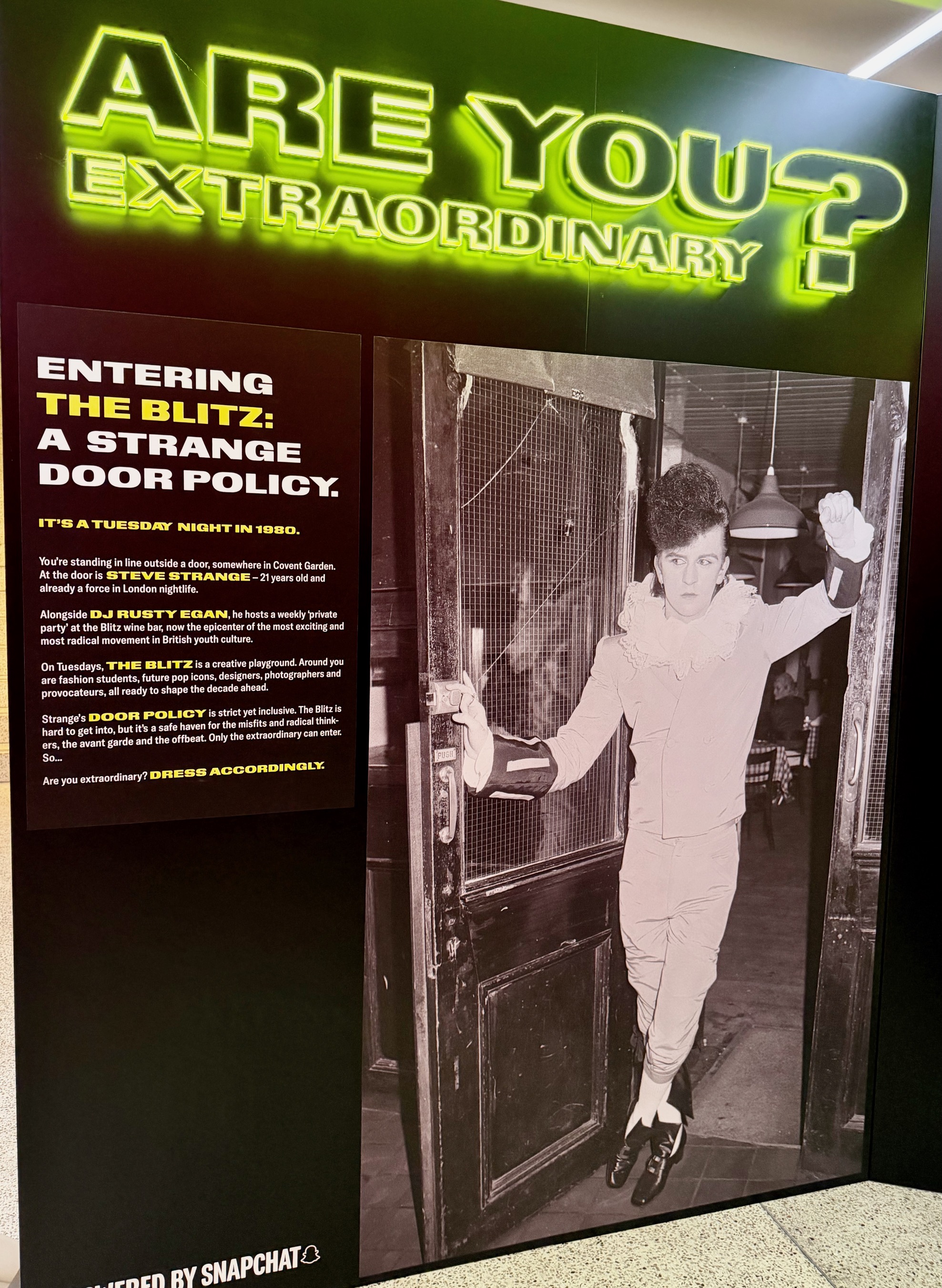
Exhibition entrance with photo of Steve Strange, who decided who got into the Blitz club.

See some of our favorite memorabilia and fashion in our Flickr album.

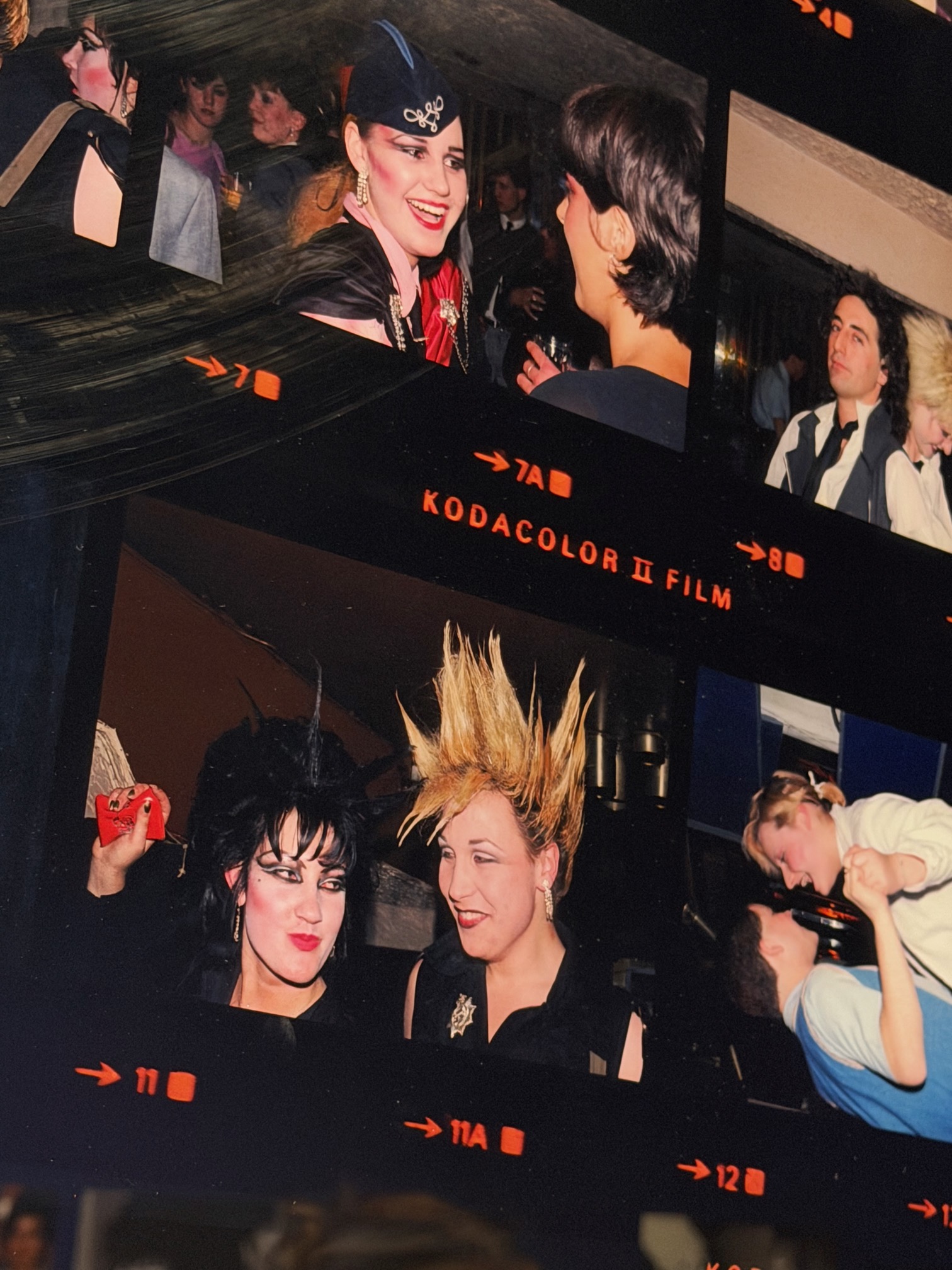
The exhibition recreates the convergence of everything cool in London culture circa 1979-1980. Visitors stand before posters, walls of photos, and fashion recollecting their own experiences at the Tuesday-night wine-bar “private party” where Steve Strange and DJ Rusty Eagan presided over bare-bones space that came alive with color, outrageous fashion, and ginormous personalities. Steve worked the door and (for a nano-second) Boy George ran the coat room. No one repeated outfits.

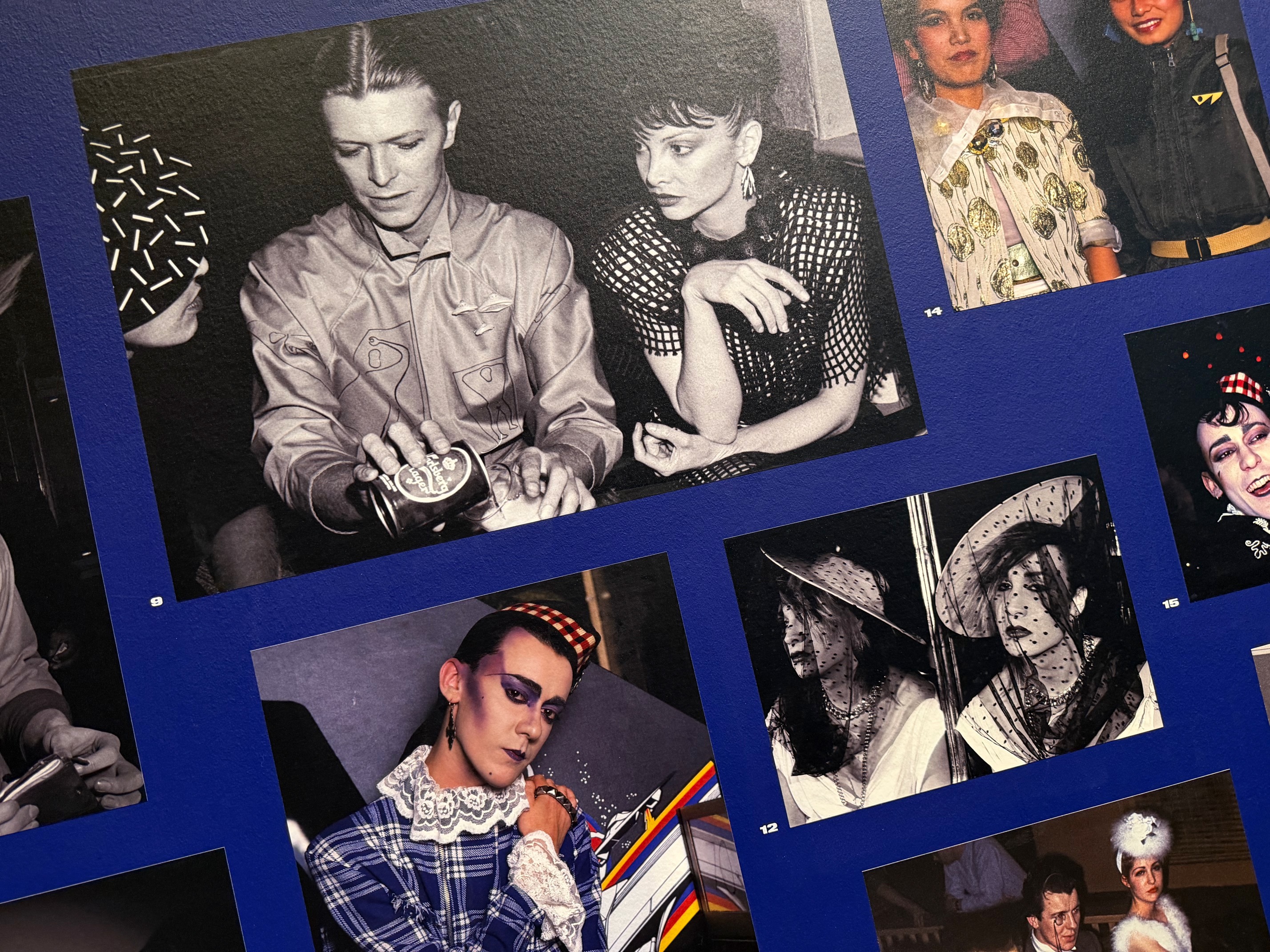
Photo wall of Blitz party goers 1979-1980 – (top) David Bowie and Toni Basil by Robert Rosen; double portrait by Robyn Beeche; (bottom) designer/club kid Stephen Linard by Robyn Beeche; Marilyn at Club for Heroes by Robert Rosen; and Stephen Linard by Ted Polhemus.

The journey opens with a look at the counter-culture that was percolating in Britain in the mid-1970s – the subversive punk scene, young people’s passion for European retro avant-garde cinema and art (thought to be more exciting that UK’s drab day-to-day), the magic of public persona reinvention (look no further than the music and image of the morphing Mr. Bowie), and and subversive, transmuting morals exemplified by drag and The Rocky Horror Picture Show.

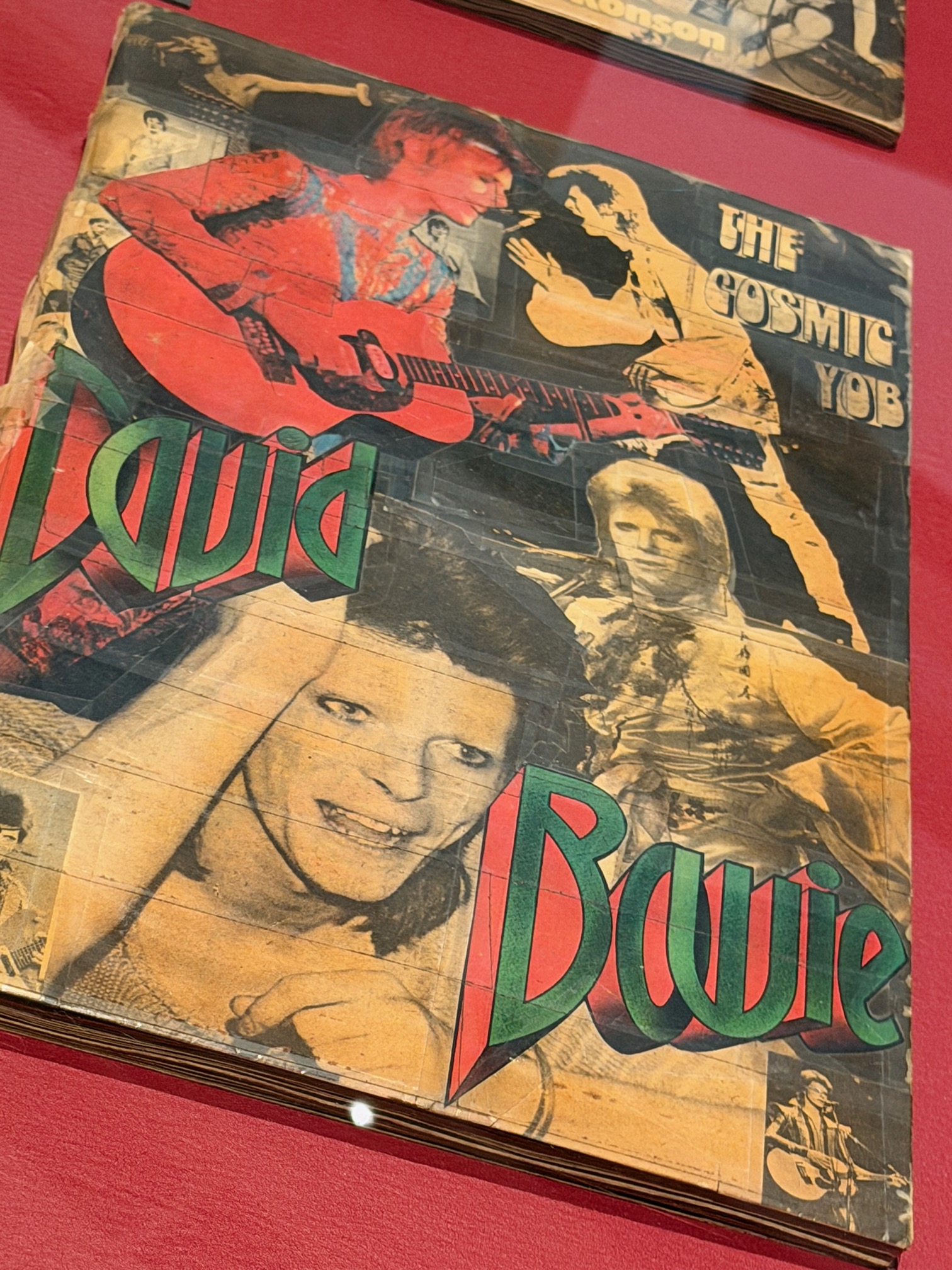
Keeping track of a style and music influencer – late 1970s scrapbooks with pictures of David Bowie. Courtesy: Iain R. Webb.
Clubbing before Blitz: Nicola Tyson’s 1978 photos of “Bowie Night” hosted by DJ Rusty Egan and Steve Strange at Billy’s Club in Soho, London. Courtesy: Sadie Coles HQ, London.

DJ Rusty Egan began by hosting parties at other venues (“Bowie Night” and so forth) before asking the Blitz to agree to his recurring weekly event. Young art and fashion students of St. Martin’s and Central flocked to these party nights, turning themselves (and friends) into unique cultural creations. You were safe at the Blitz.

Student designer David Hola’s 1979 robe and dress; 1979 photo by Derek Ridgers of makeup artist Lesley Chilkes wearing it. Courtesy: Lesley Chilkes
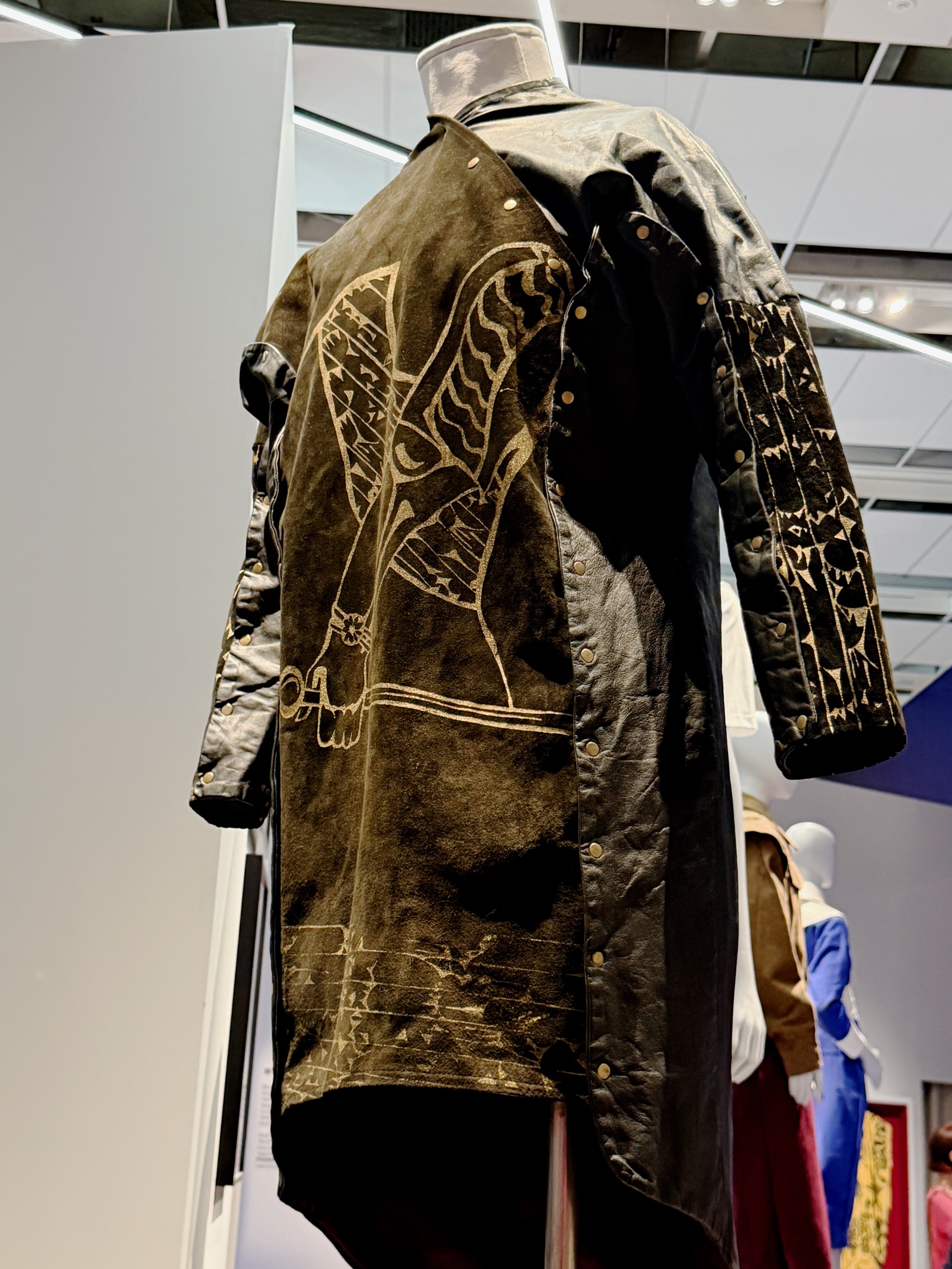
1980 man’s hand-painted leather coat by Melissa Caplan for Pallium Products. Courtesy: the artist.

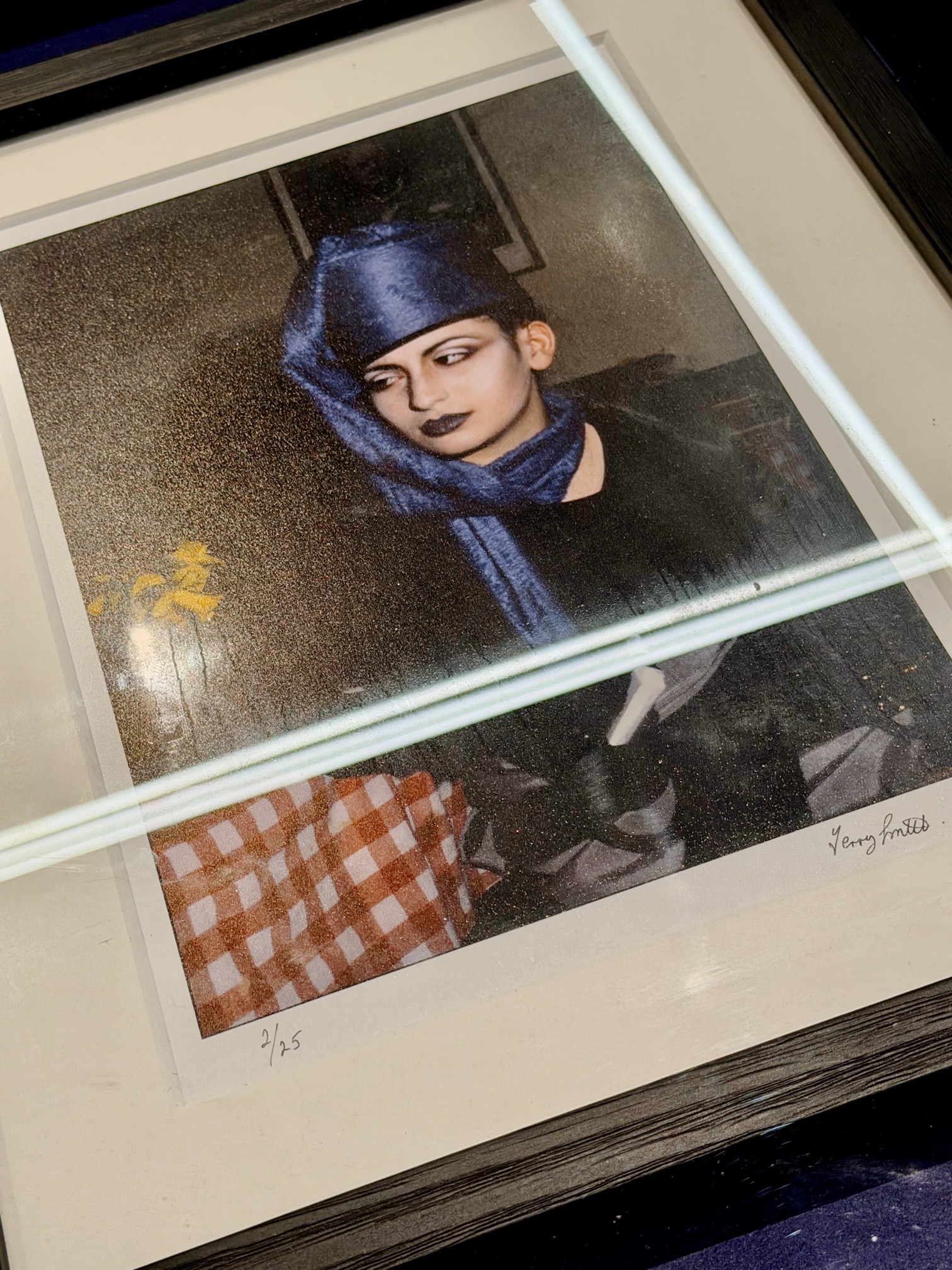
Fashion and innovation at the club were key, and after the Blitz club opened in 1979, it didn’t take long for the press to catch on.  Spandau Ballet did their first live performance at the Blitz, costumed by up-and-coming student designers. Manolo Blahnik and (future milliner to Dior and Diana) Stephen Jones were just part of the crowd, collaborating with designer friends, musicians, and make-up and hair artists to create look after look. They never imagined from those funky club days that their business would become the stuff of Met Galas, big-time runways, and museum archives.

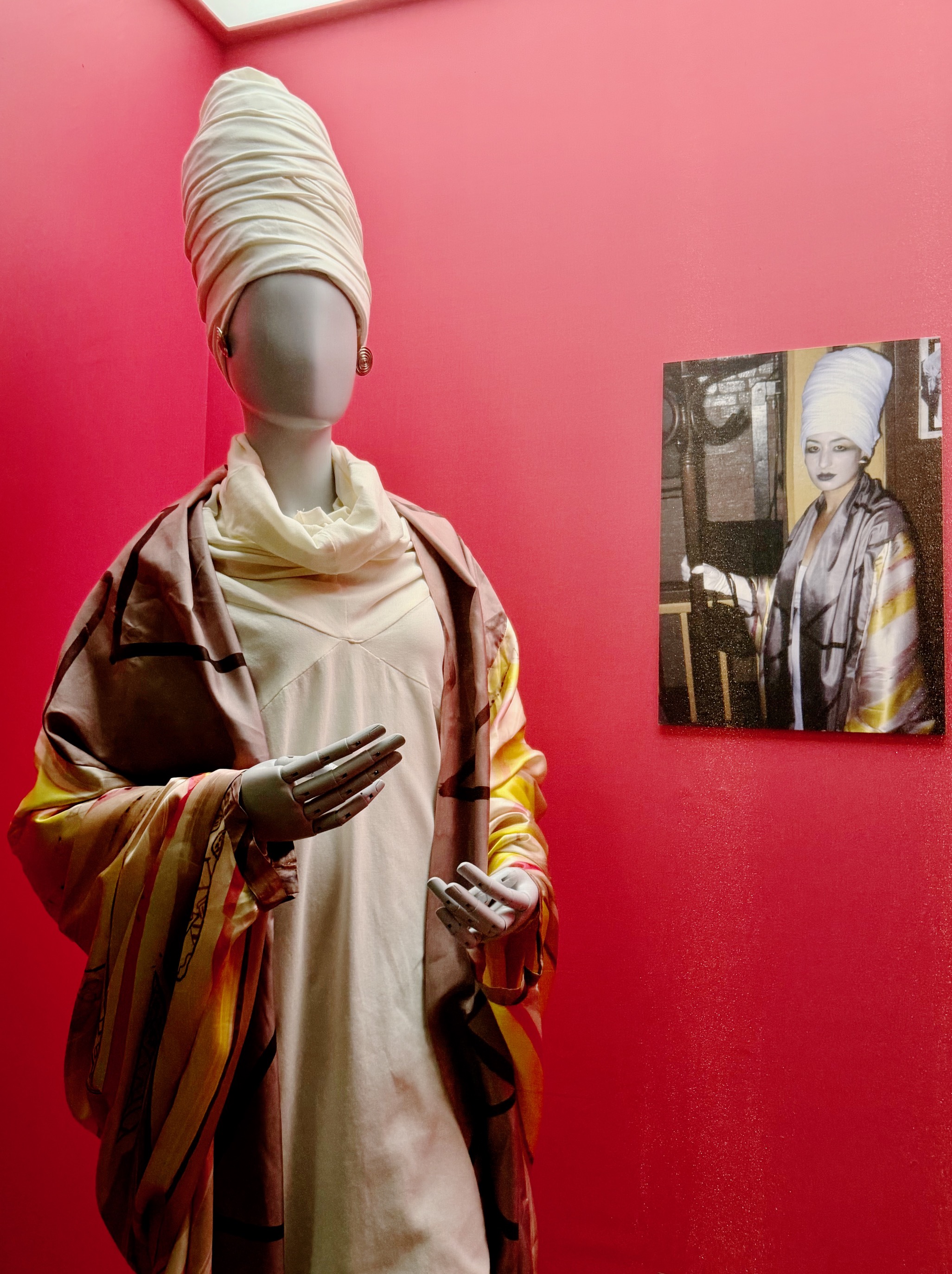
Peter Ashworth’s 1980 photograph of Blitz style icon Kim Bowen wearing the Archbishop hat by Stephen Jones. Courtesy: Iain R. Webb.
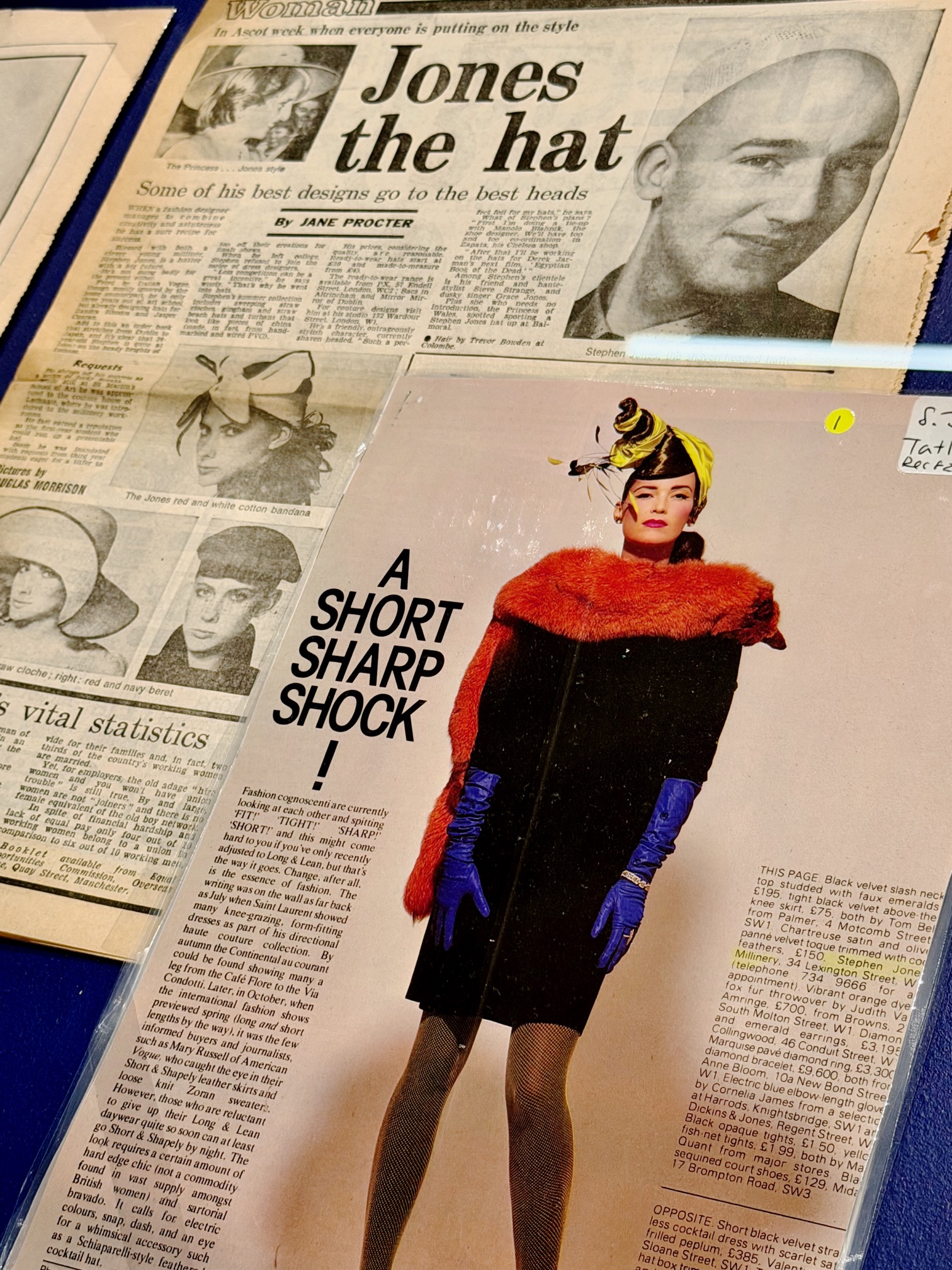
Press about milliner Stephen Jones from a 1982 article in the Daily Express and 1983 story in Tatler. Courtesy: Stephen Jones; Central St. Martin’s Museum.

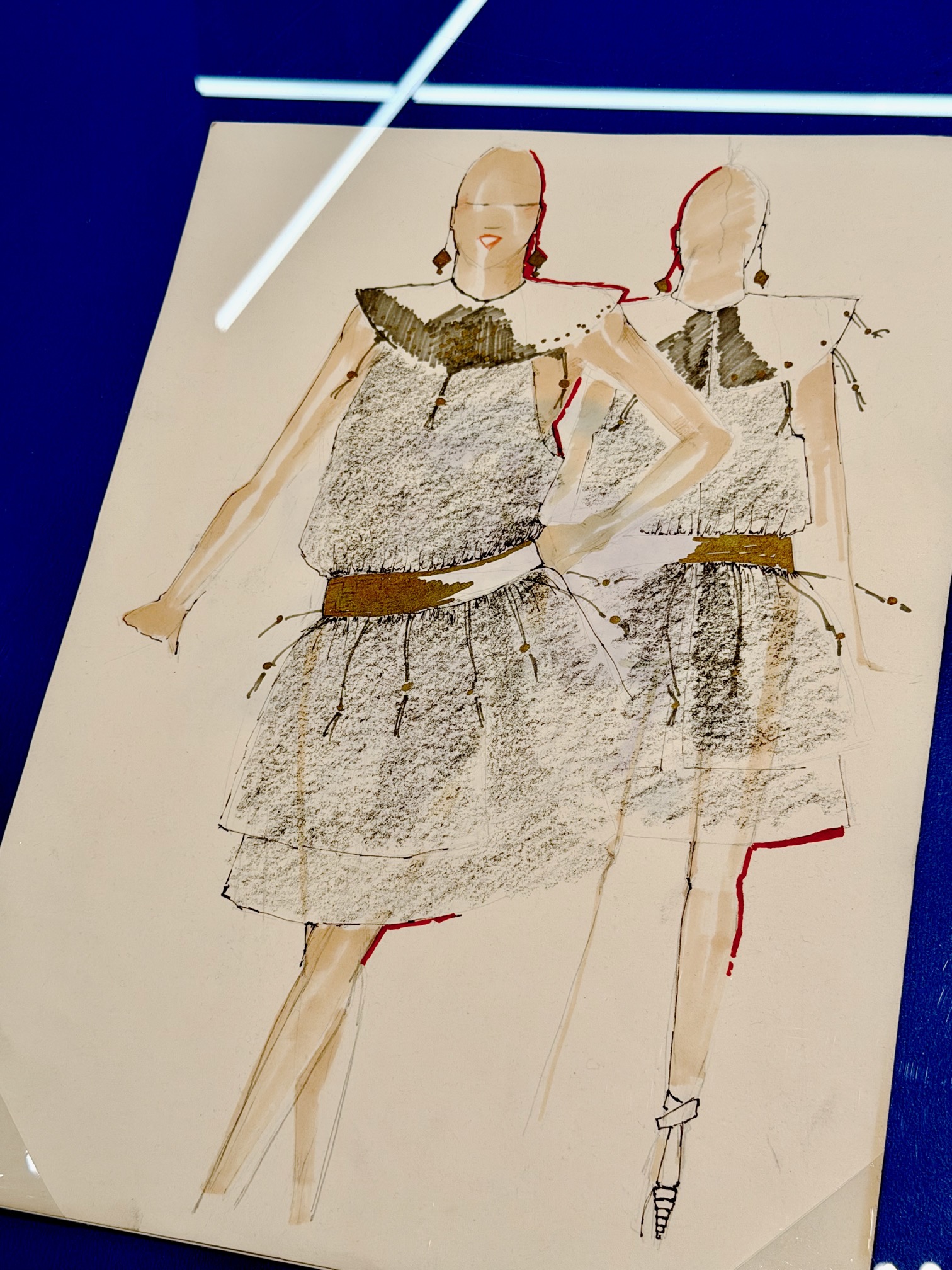
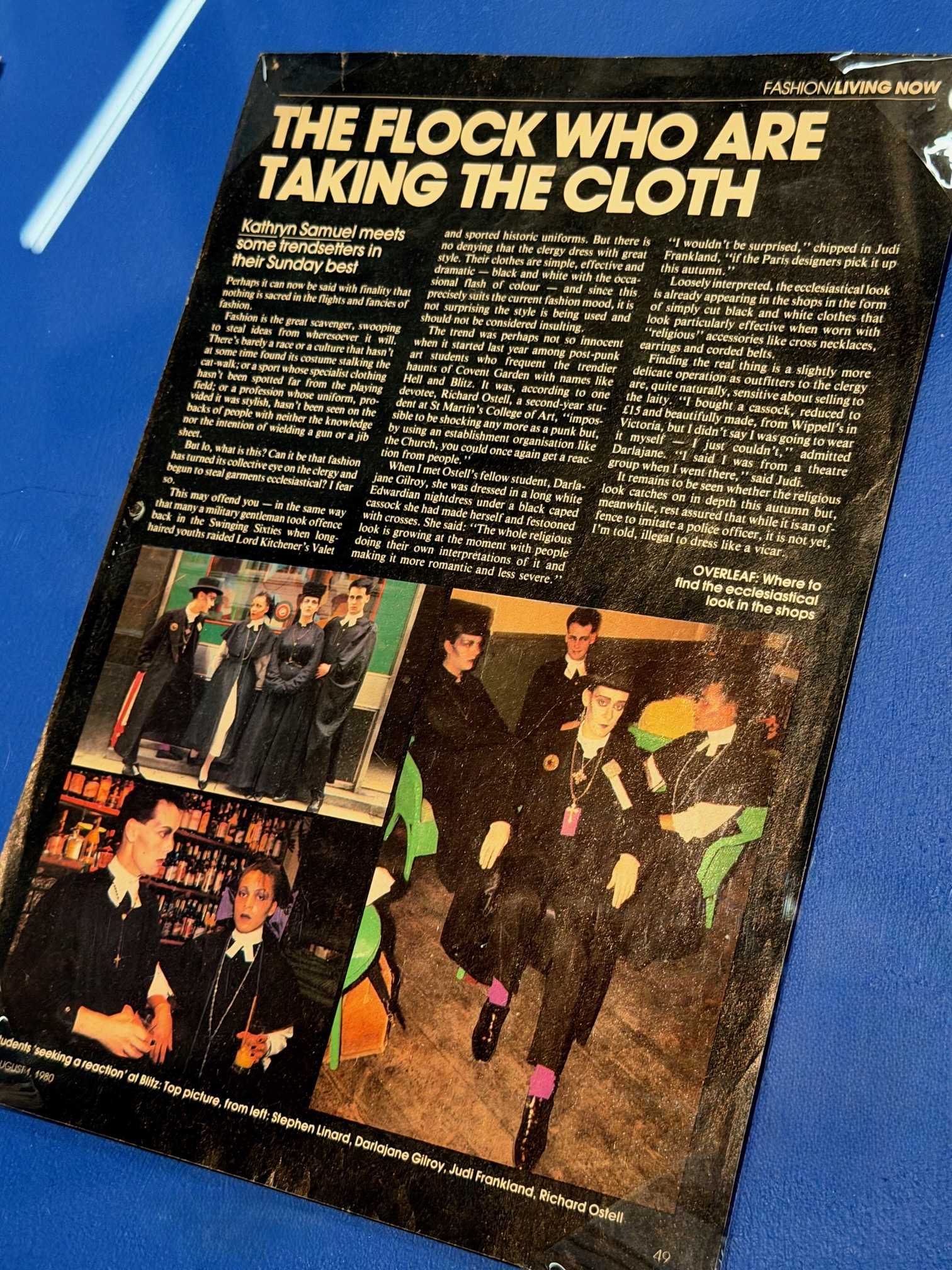
The exhibition shows off many of the designers who defined the ever-evolving look of (what the press called) “The New Romantics.”  Backless leather dresses by Fiona Dealey, retro zoot suits by Chris Sullivan, ecclesiastical-inspired unisex garb by Darla-Jane Gilroy, and socio-political tank-top commentary by Sue Clowes. After their graduation collections, many of them sold clothes at Camden Market or specialty boutiques near the club. Their careers were off and running.

Darla-Jane Gilroy’s 1980 fashion illustration for her final-year student collection.
1980 magazine story about the Blitz designers inspired by ecclesiastical garb.

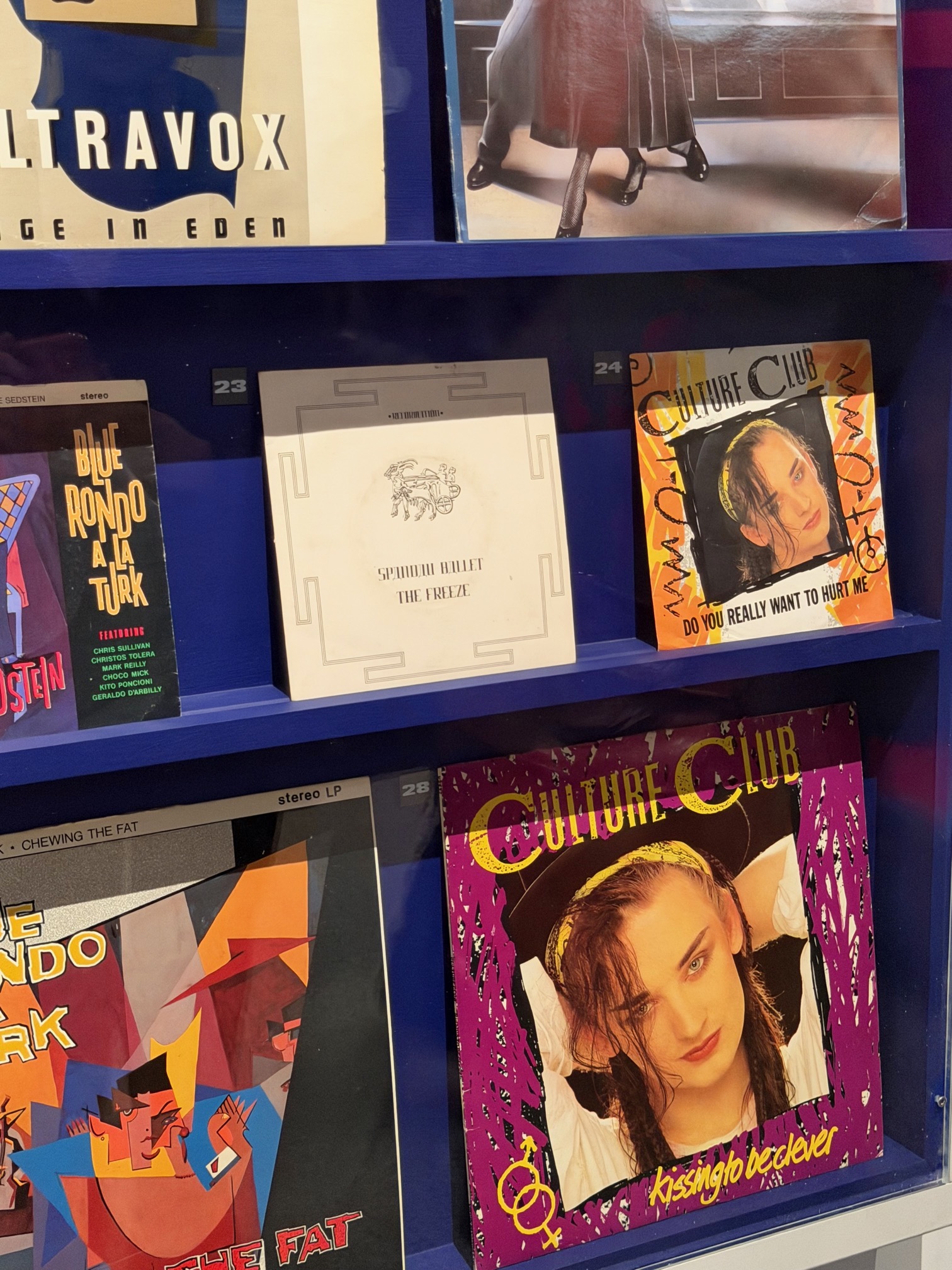
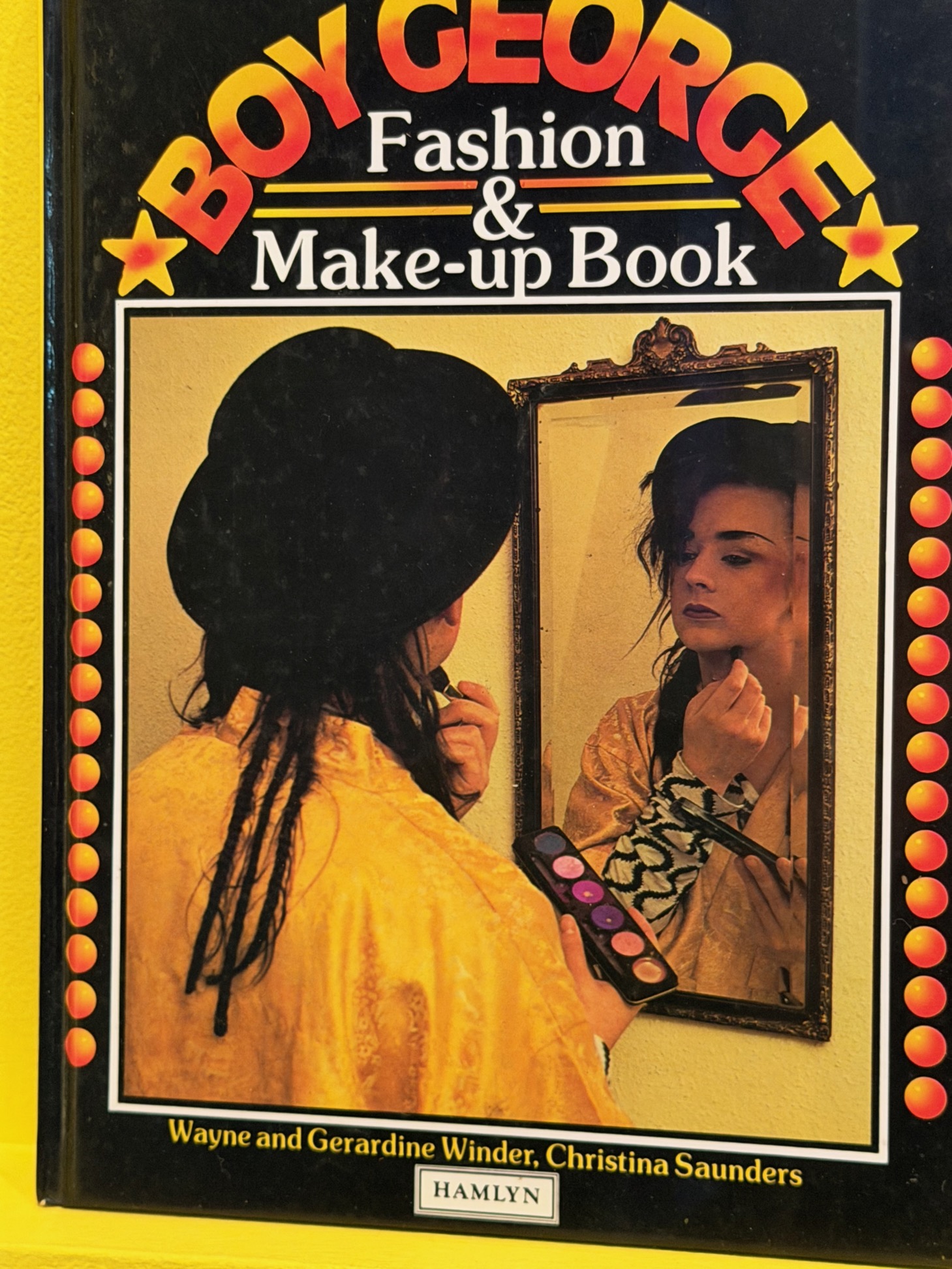
Celebrity sightings were common at the club in those days. But just as many of the “Blitz Kids” promoted their own celebrity. Eventually Steve Strange was starring in music videos for his group Visage and Boy George was fronting Culture Club, all with revolutionary clothes, makeup, hats, and hair. With the advent of the wildly successful MTV, the whole thing went TV-viral.

Blitz Kids hit the charts – album and record-sleeve art for Spandau Ballet by Graham Smith and Culture Club.
1984 book by Wayne and Gerardine Winder and Christina Saunders, Boy George Fashion & Makeup Book. Courtesy: Michael Bean.

The central gallery of the exhibition is a physical recreation of the club with a period soundtrack. Although there aren’t any drinks being served, a virtual DJ Rusty Egan and virtual images of club goers thoroughly entertained museum visitors, all remembering those days when they were young and the the scene felt so alive. 

Video of the Blitz recreation inside the exhibit with virtual club-goers and museum visitors enjoying the scene at the bar.

Several visitors shepherded their now-adult kids through the exhibit, reliving those days and explaining how it felt to be witnessing pop-culture history-in-the making. You see walls of record albums from the era, a series of MTV video clips, and first editions of i-D magazine that quickly morphed from a punk-music publication to a chronicle of Blitz Kid fashion and street style.

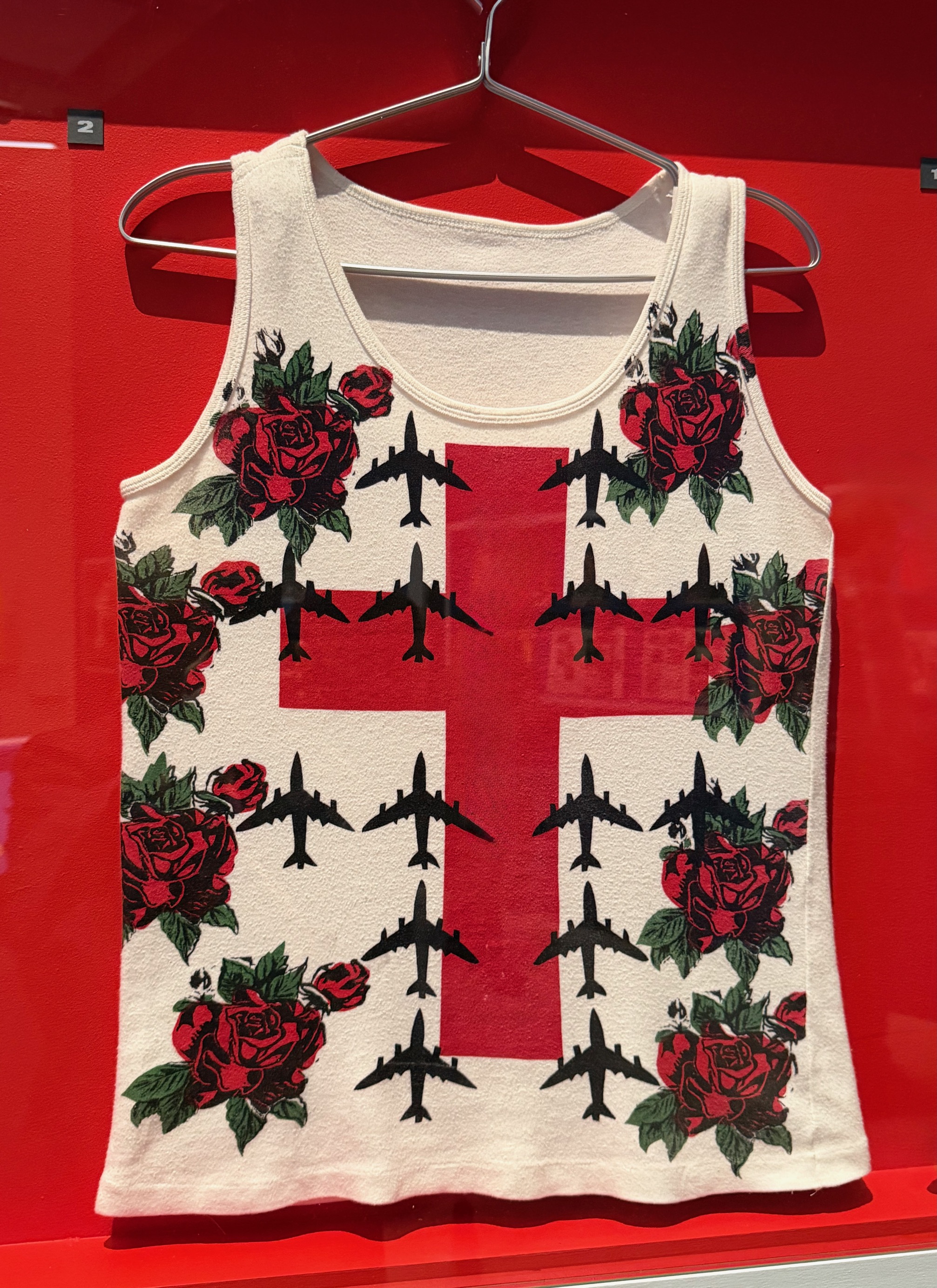
Sue Cowles’ 1981 “Destruction of Purity” vest with images of warplanes, English roses, and St. George’s cross. Courtesy: Mikey Bean.
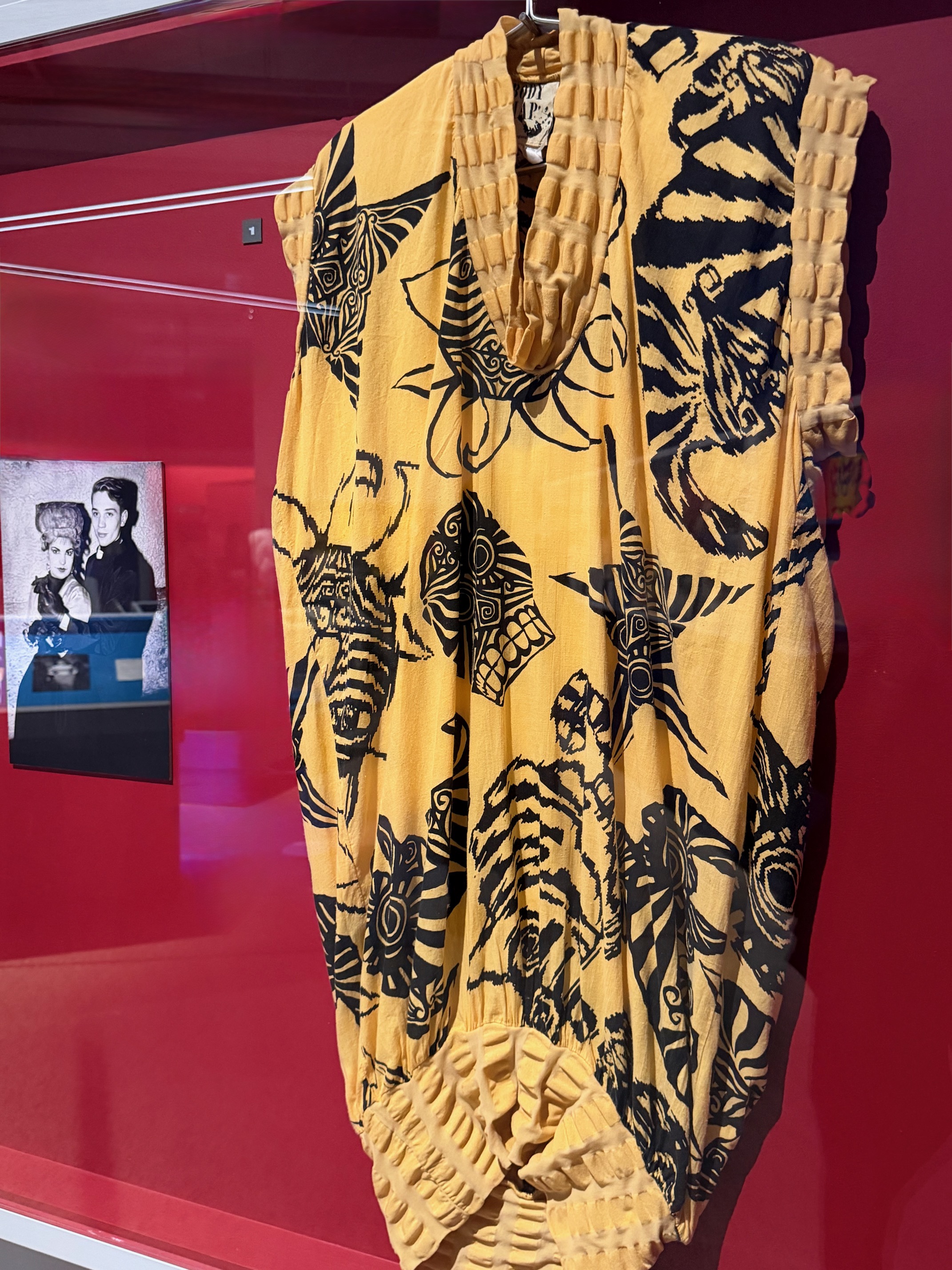
Graham Smith’s 1980 photo of BodyMap creators Stevie Stewart and David Holah with 1986 BodyMap tunic with print by Hilde Smith. Courtesy: University of Westminster Menswear Archive.

Watch this short video with curator Danielle Thom, Gary Kemp of Spandau Ballet, and Blitz creator Rusty Egan, who talk about the creative sparks that flew in a pre-Internet society.

Bravo to The Design Museum for making so many Londoners so happy, and to let everyone see, feel, and experience a time when transformation people and ideas seemed limitless and an army of misfit creatives changed pop-culture, design, and fashion for the better.

Welcome to the exhibition

Exploring Marie Antoinette’s Style at the V&A

In her day, she was considered a style icon, spendthrift, deviant, monster, and hapless victim. And why are we still talking about her and dissecting her lifestyle, look, and acquisitions over 200 years later?

You’ll find the answer in the South Kensington V&A galleries with portraits, clothes, artifacts, and haute couture fashion in Marie Antoinette Style, on view in London through March 22, 2026.

The Victoria & Albert Museum has pulled incredibly well-preserved fashions from its own 18th-century collection, and has also borrowed from Versailles and European collections that scooped up Marie’s stuff when it was ransacked and put on the open market after her death during the French Revolution – jewels, furniture, Sèvres table settings, and remnants of her dress fabric.

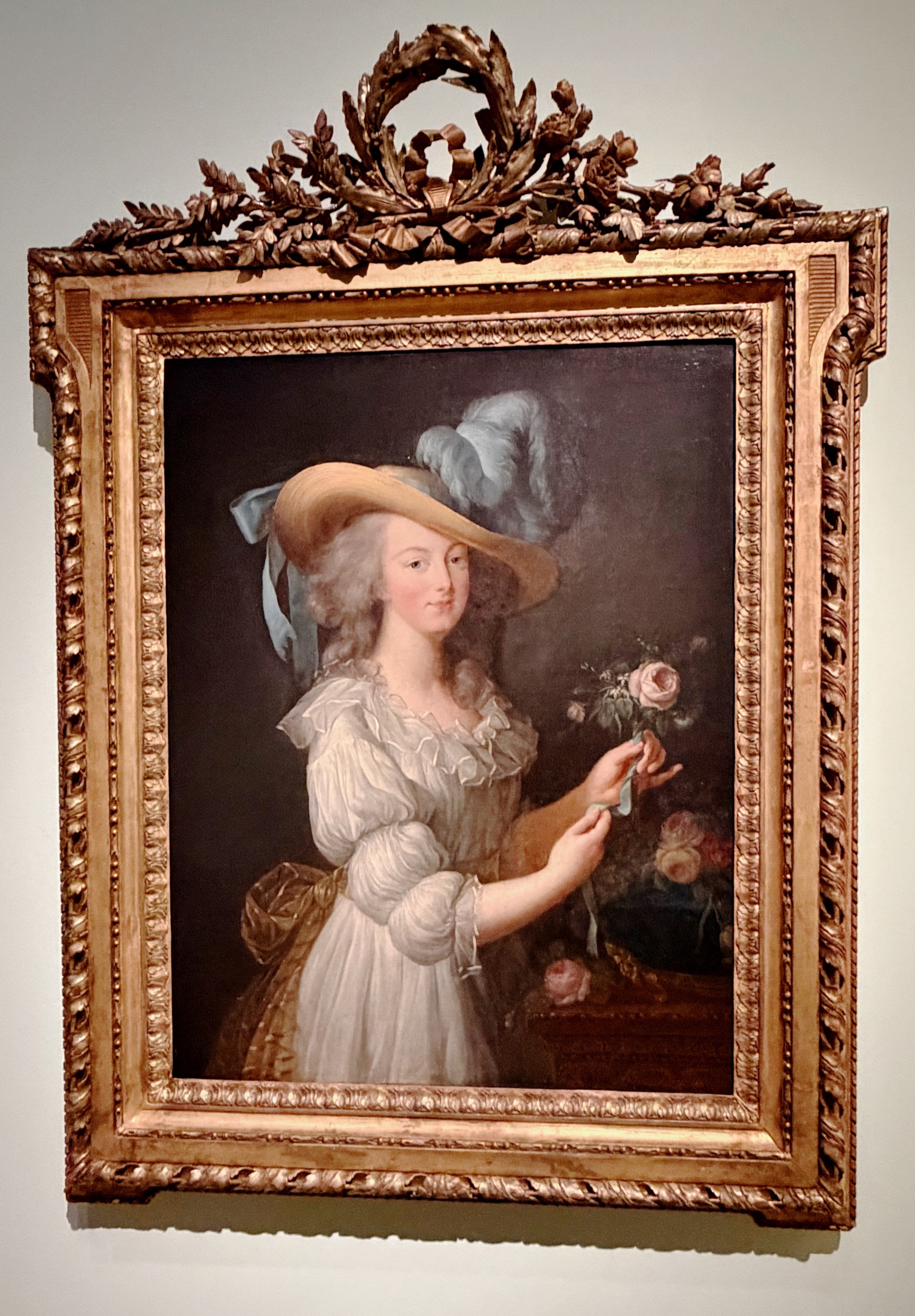
1783 Marie Antoinette in a muslin dress by Elisabeth Louise Vigée Le Brun; seeing the queen in a dress resembling underwear shocked everyone who saw it at the Paris Salon, but it soon became the style. Courtesy: National Gallery of Art, Washington, D.C.

As befitting a Versailles icon, the introductory gallery is a dazzling room of mirrors. With the dramatic illumination of opulent court dresses, wedding attire, royal portraits nof Marie, fans, and swaths of over-the-top embroidered silk, the effect is magnified by the points of light dancing across multiple reflections of sumptuously draped fabric.

Take a look through some of our favorites on display in our Flickr album.

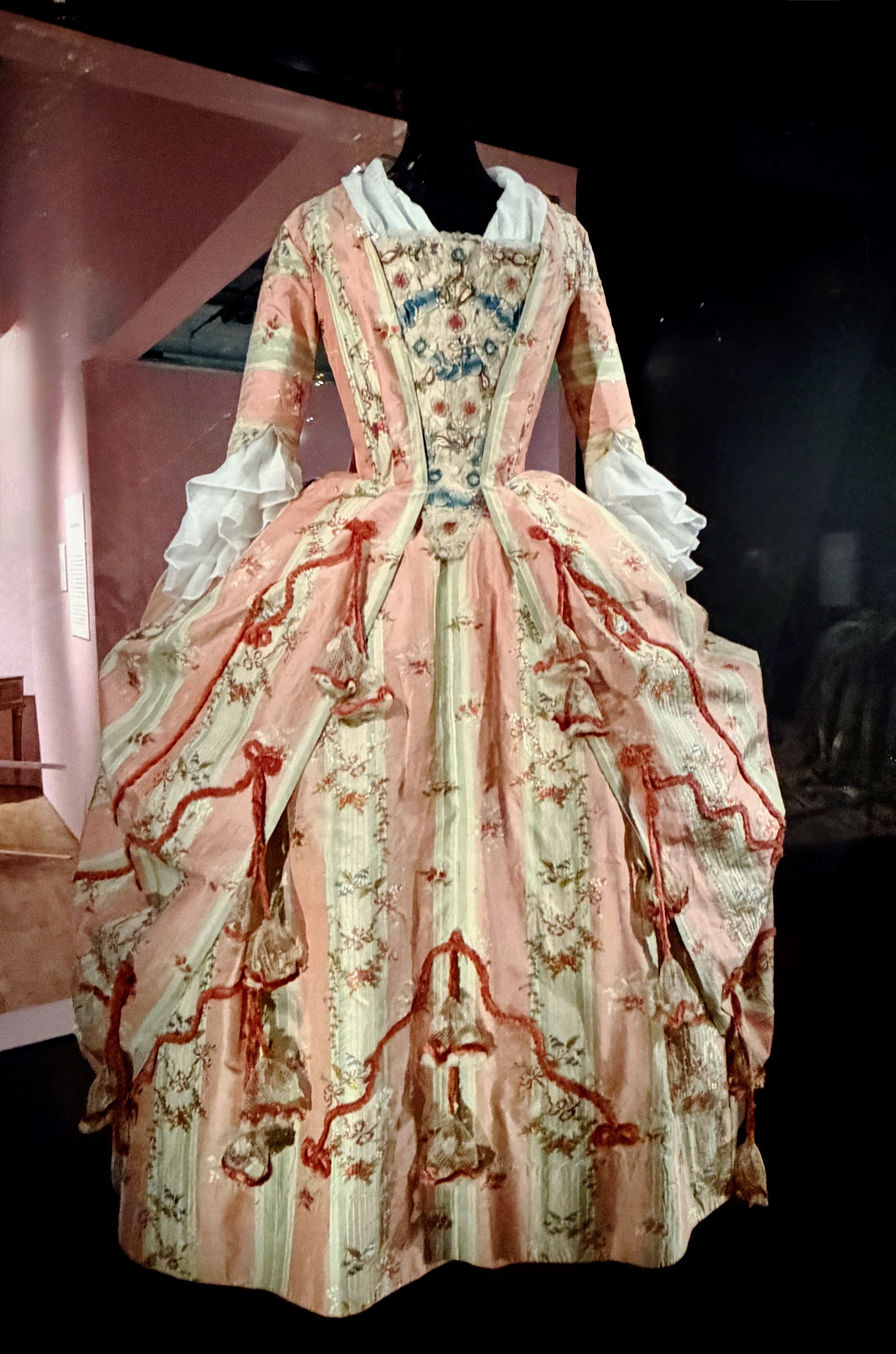
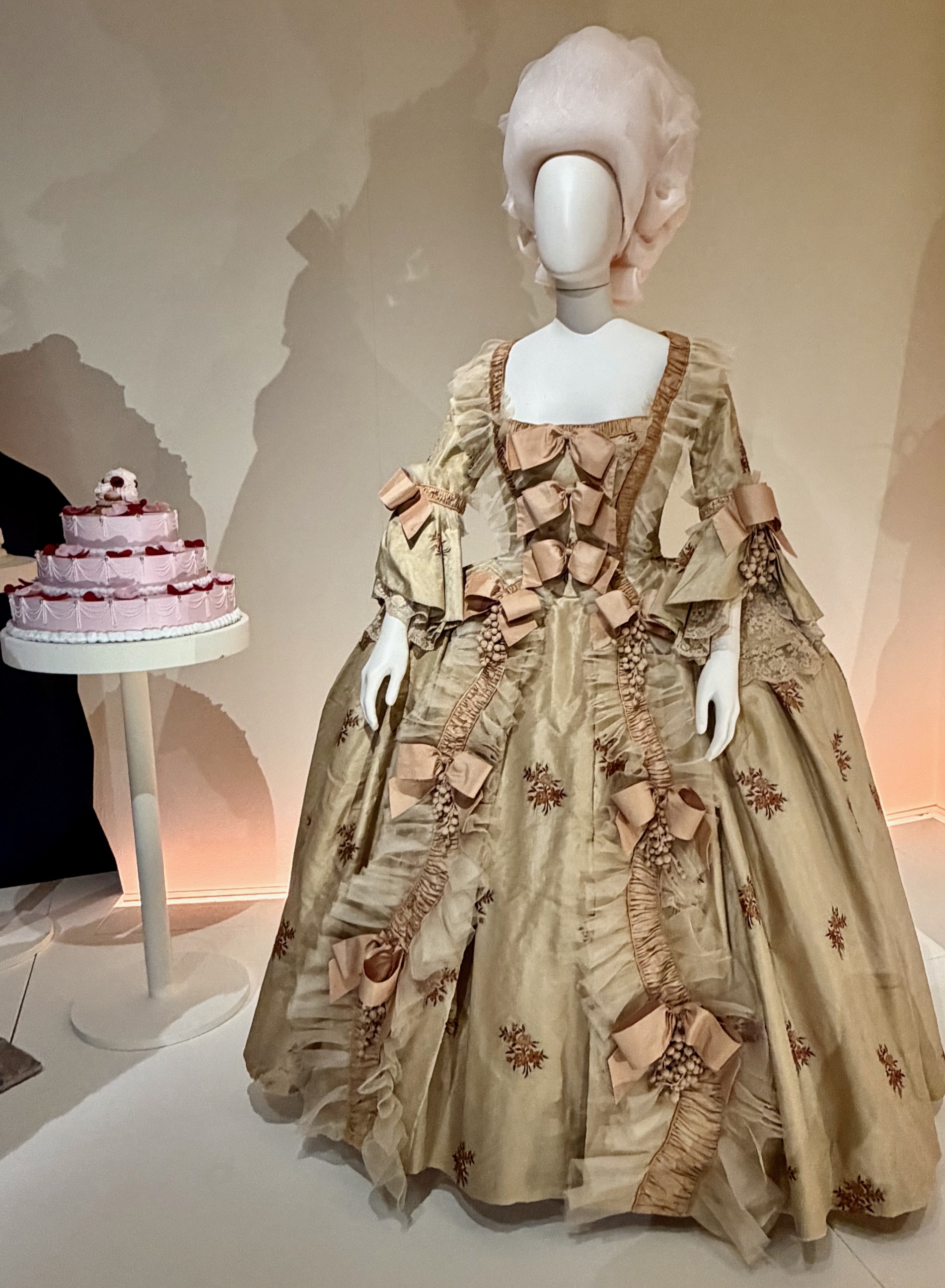
1775 French robe à la française à la Polonaise silk taffeta, silk chenille, and linen lace; less formal style with skirts looped up to create volume. Courtesy: Los Angeles County Museum of Art.
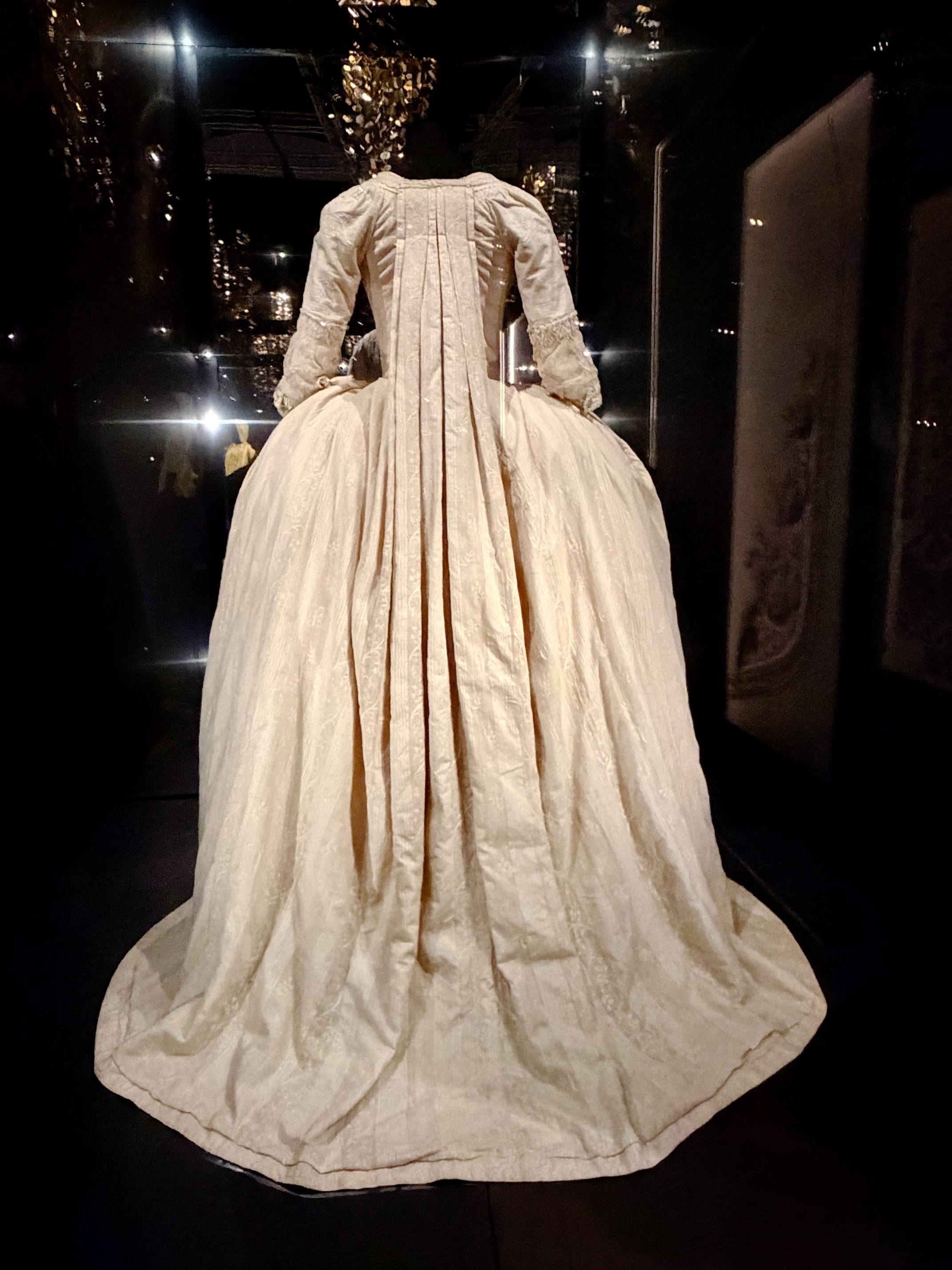
1775-1780 French embroidered cotton and linen muslin robe à la française – a fresh, light style innovated by the French court; silk lining creates a blush effect. Courtesy: V&A

You experience how Marie’s fashion sense changed from the big-time Rococo style she sported as a teen to the more minimal muslin style she popularized as she and her friends gallivanted around the Tríanon grounds in jaunty Italian straw bonnets.

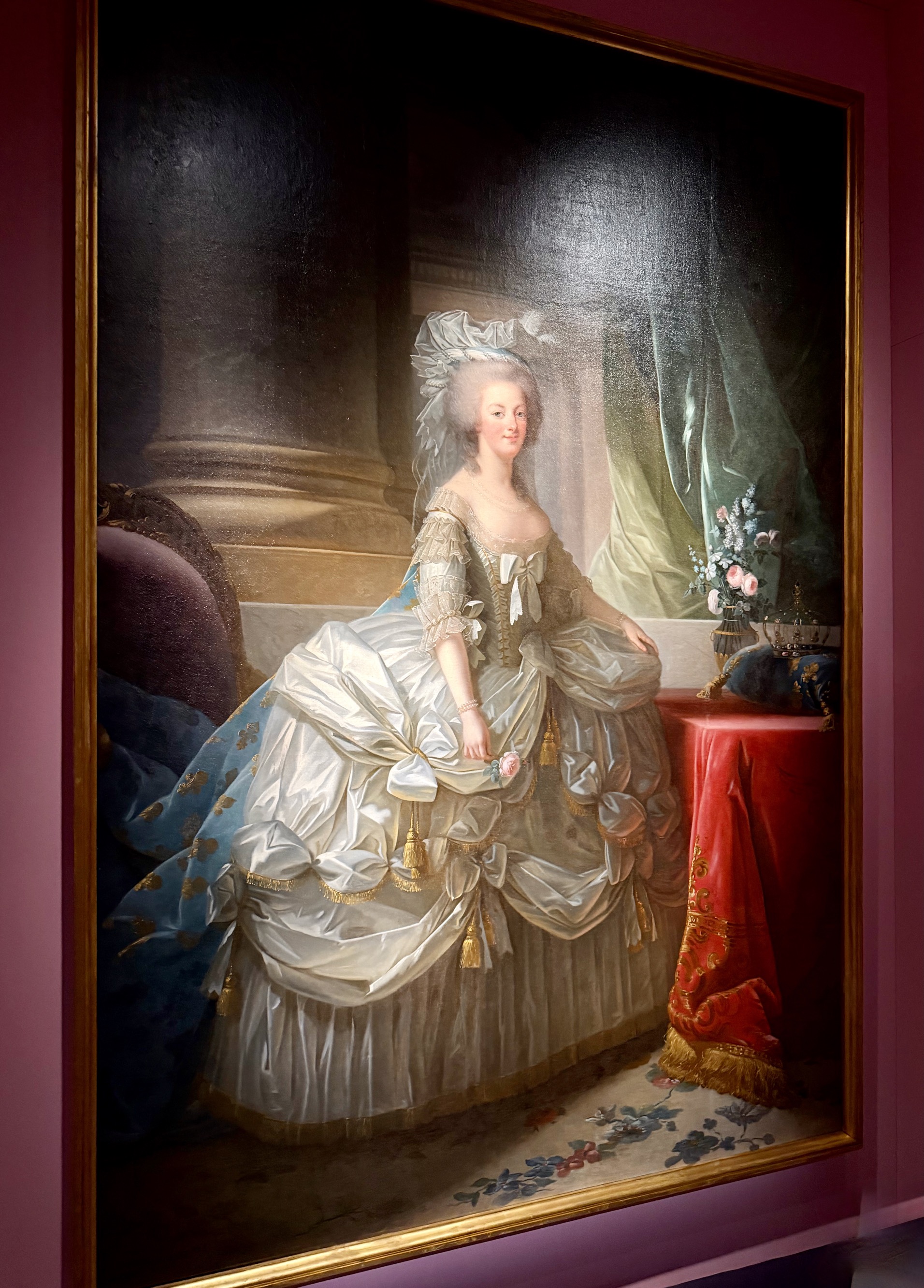
Style icon: later painting based on 1778 oil Queen Marie-Antoinette in Court Dress by Elisabeth Louise Vigée Le Brun; the queen at 22. Courtesy: Versailles, musée national des chateaux de Versailles.
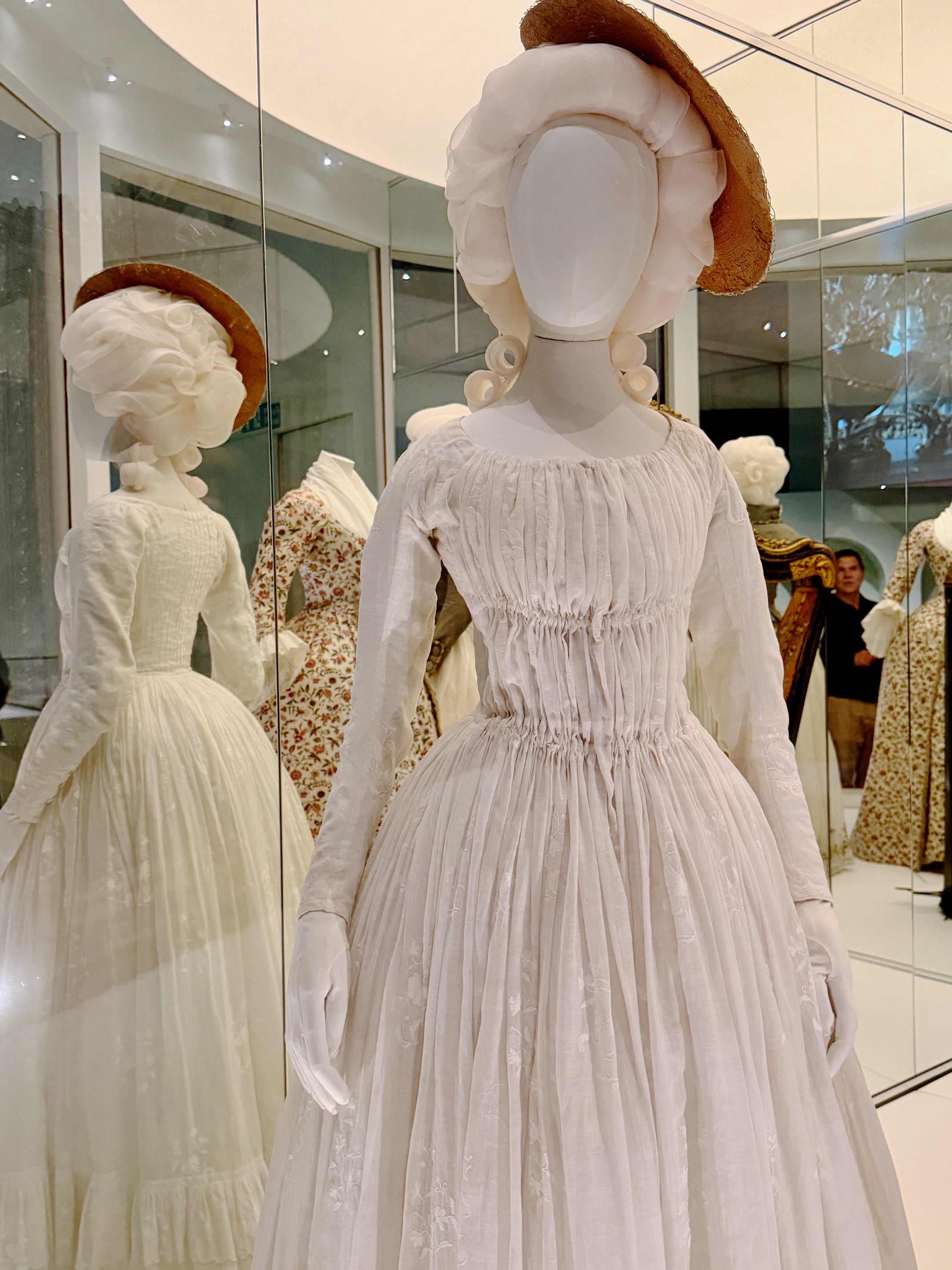
Informal dress that Marie popularized: 1760-1780 “shepherdess” hat (bergères) of Italian straw and a rare 1785-1790 embroidered muslin dress (robe en chemise) owned by Madame Oberkampf of Jouy-en-Josas. Courtesy: V&A; Musée de la Toile de Jouy

Plates from 18th-century fashion publications show off the latest extravagant details of hair poufs that Marie popularized. Incredibly, there’s also an actual shoe owned by the style icon herself.  As queen, she received four new pairs of shoes per week!  Watch this short video to get a close-up view of her 230-year-old silk and kid shoe that survived!

During her reign, Marie had an outsized influence on interior design, landscape architecture, the decorative arts, and music. Her fashion selections and hairstyles were noted, discussed, and copied.

When the winds of democratic change came to France, Marie’s attire changed again to a more pared-down republican look that every patriotic woman in Paris also sported, right down to the patriotic silk cockades pinned to hats and lapels.

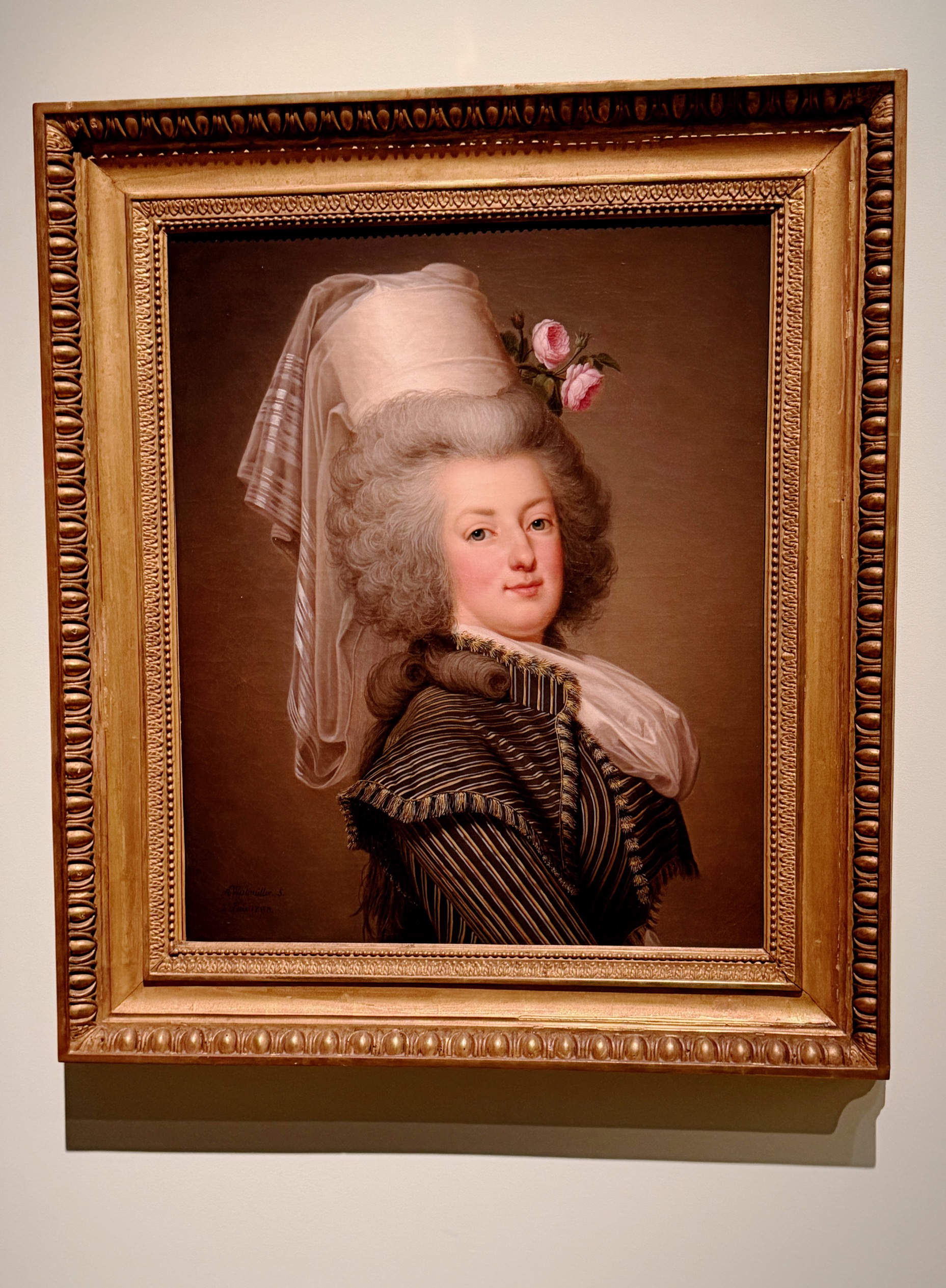
Years of the Republic: 1789 oil Marie Antoinette wearing a fashionable jacket (pierrot) and gauze-draped white silk fez; portrait by Adolf-Ulrich Wertmüller. Courtesy: Versailles, musée national des chateaux de Versailles et de Tríanon.
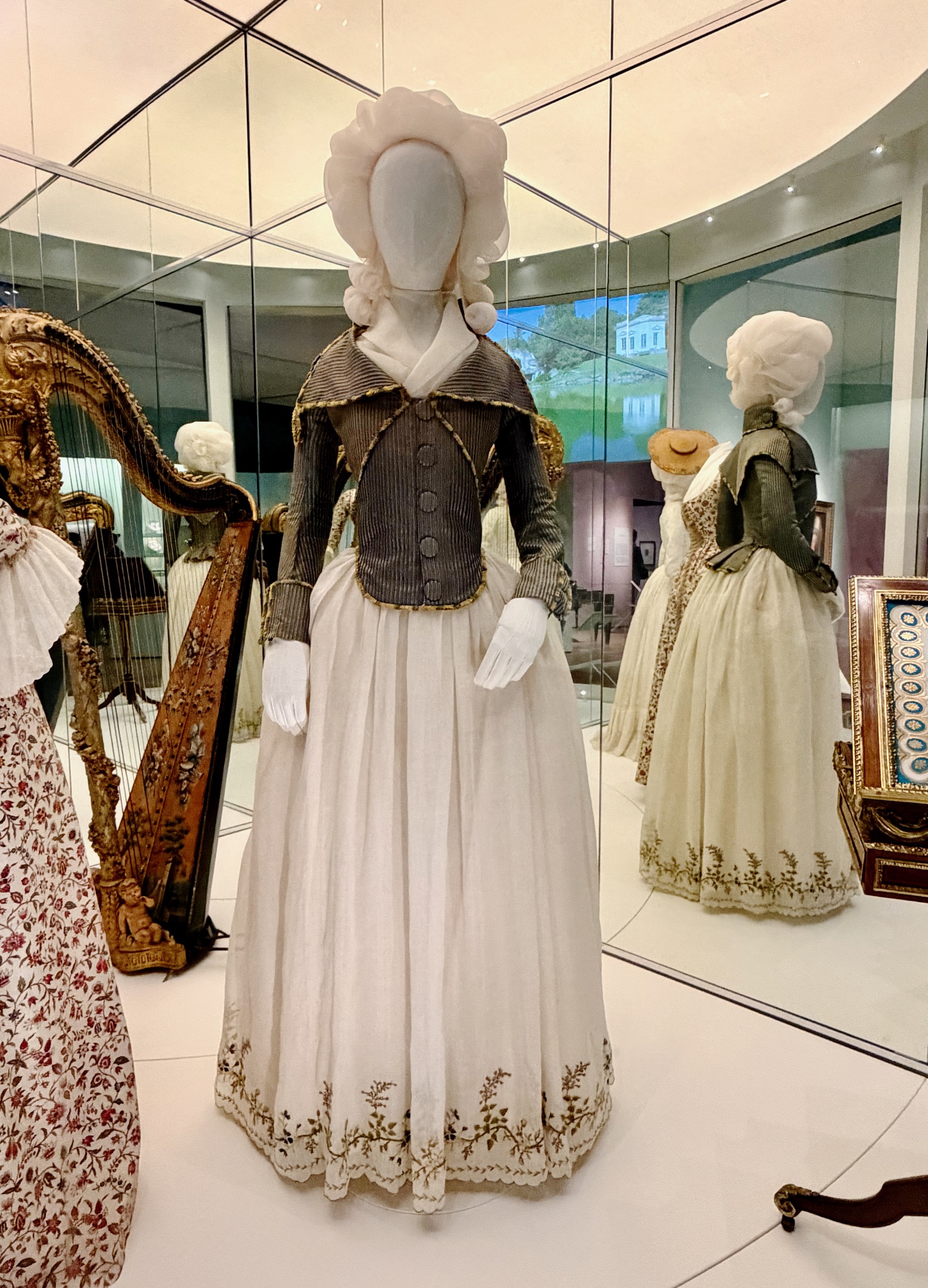
Years of the Republic: Height of French 1780s-1790s fashion – a 1790 striped silk pierrot (jacket) work atop a muslin petticoat, decorated with tambour embroidery. Courtesy: V&A

But by then public opinion had turned against Marie, largely due to the unfortunate incident that completely tarnished the public’s view of her – The Diamond Necklace Affair. In an exhibition section titled “The Queen of Sparkle,” the curators display a modern copy of the necklace that created the ruckus alongside lavish jewelry created from the diamonds removed (and resold) by an 18th-century con artist. 

Here, the V&A’s Senior Curator Sarah Grant provides a close-up look at those infamous diamonds and tells the story:

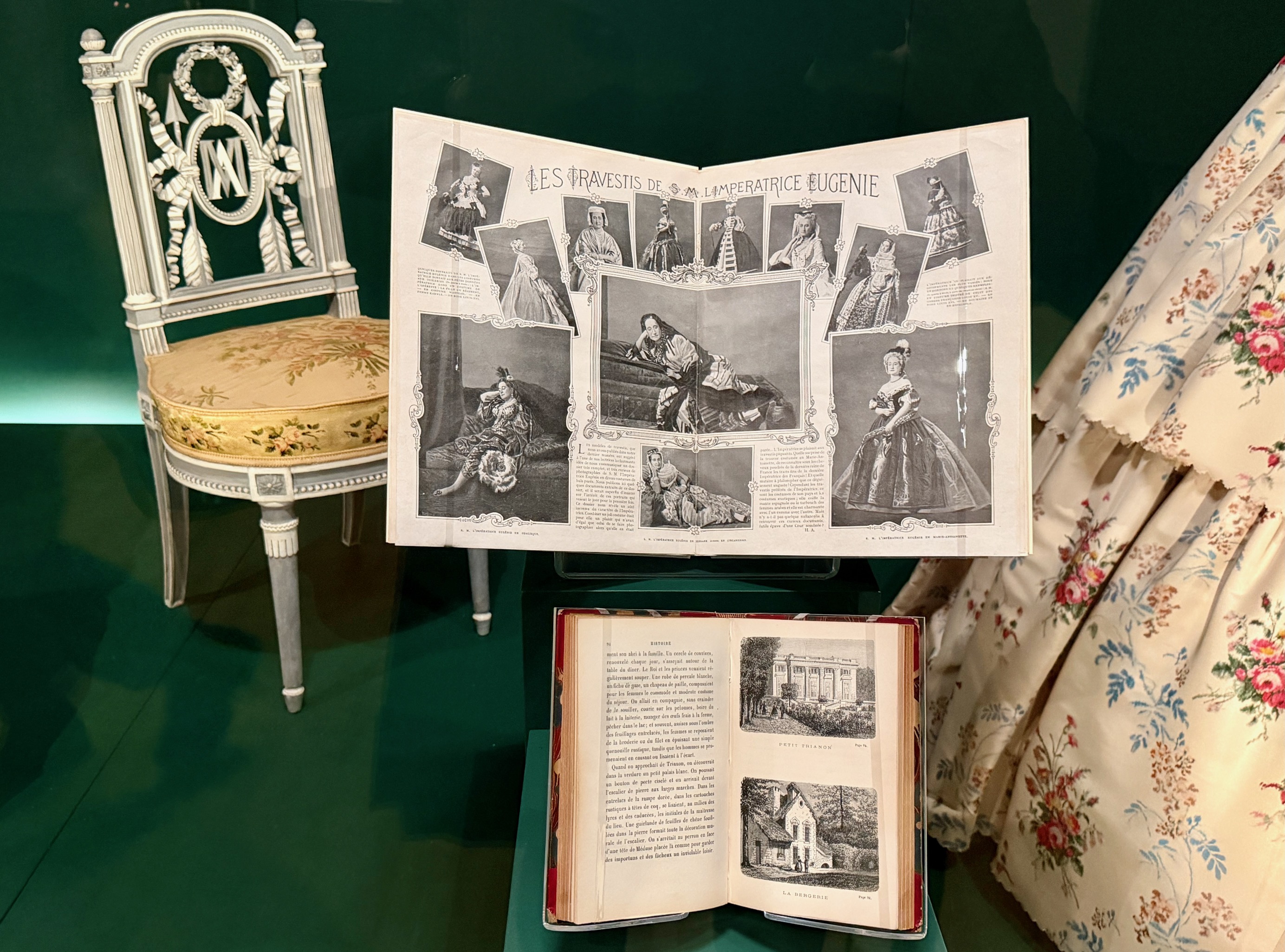
Decried, denounced, and executed, it’s remarkable that 75 years later, Marie-Antoinette style and influence had a come-back, thanks to an obsessive 19th century fan, Empress Eugénie of France.  Eugénie loved Marie’s fashion sense began sporting her look at various fancy-dress balls. She even commissioned haute courtier designer Charles Frederick Worth to design some looks, and he was happy to oblige.

Over the years, the Marie Antoinette’s Tríanon retreat had fallen into extreme disrepair and its contents scattered. Eugénie set about to find much of the furniture Marie had commissioned, did a major rehab job on the property, and had a big, public exhibition about Marie at the Tríanon’s reopening in 1867.

Style revival: Marie Antoinette’s 1784 carved monogrammed chair, part of a four-piece set; 1911 Fémina magazine article about Empress Eugénie’s love of big court costumes; and Eugénie’s 1867 exhibition catalogue about Marie Antoinette at the Petit Trianon. Courtesy: Versailles, musée national des chateaux de Versailles et de Tríanon; private collection; V&A

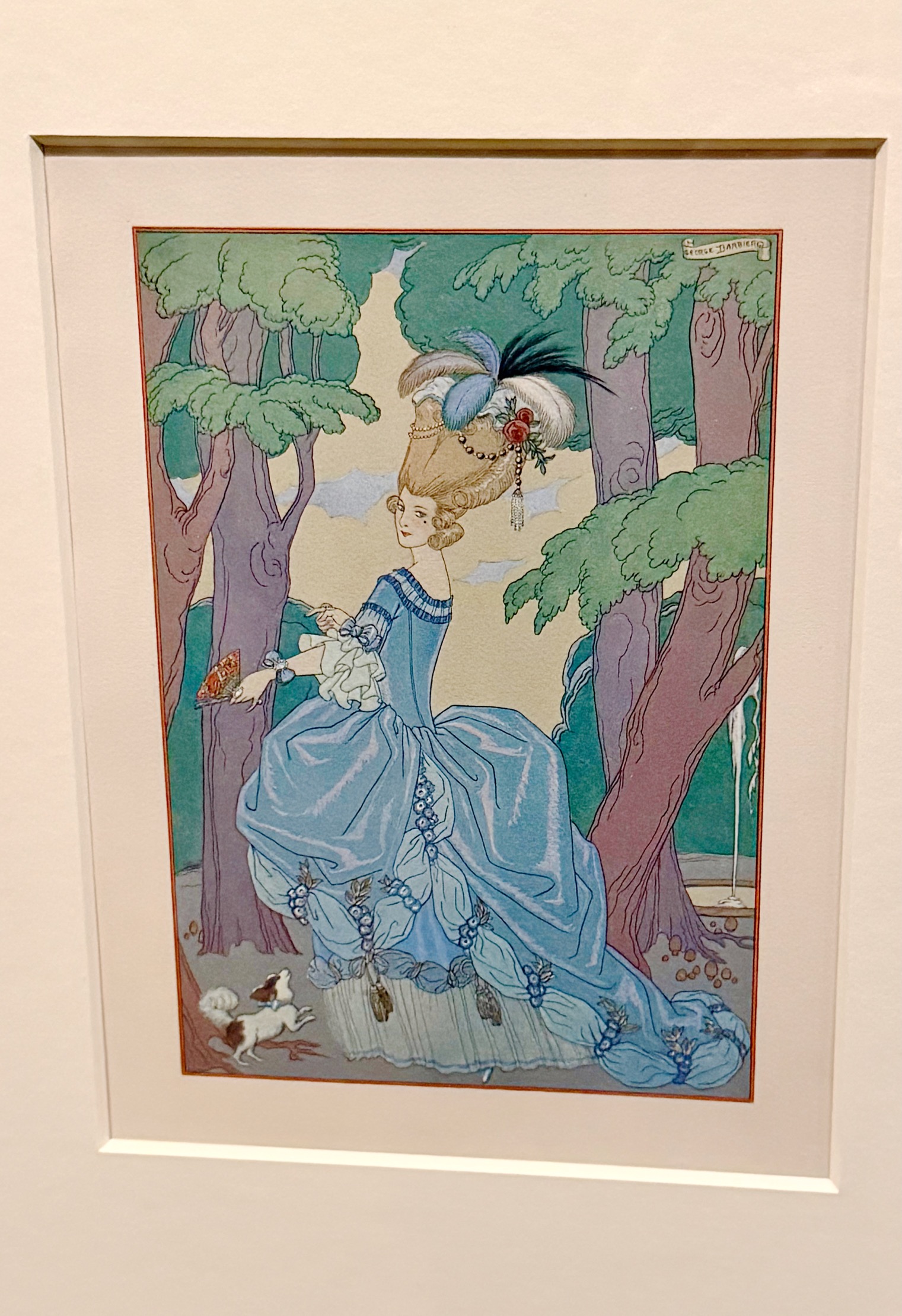
Spurred by Eugénie’s very public fandom into the 20th century, pop culture did not lose sight of Marie Antoinette as a style on display at upscale costume parties or as the evergreen image of fairy-tale princesses. The V&A shows illustrations using the queen’s pouf-do, tiny waist, princess-heel shoes, and voluminous 18th-century gowns to convey royal ingenues right into the 1910s and 1920s.

20th c. fairy tale princess: George Barbier’s 1928 illustration “L’Allée (The Pathway)” for Fete Galantes (Gallant Festivities) featuring an Art Deco image of Marie Antoinette based on Elisabeth Louise Vigée Le Brun’s portrait. Courtesy: private collection
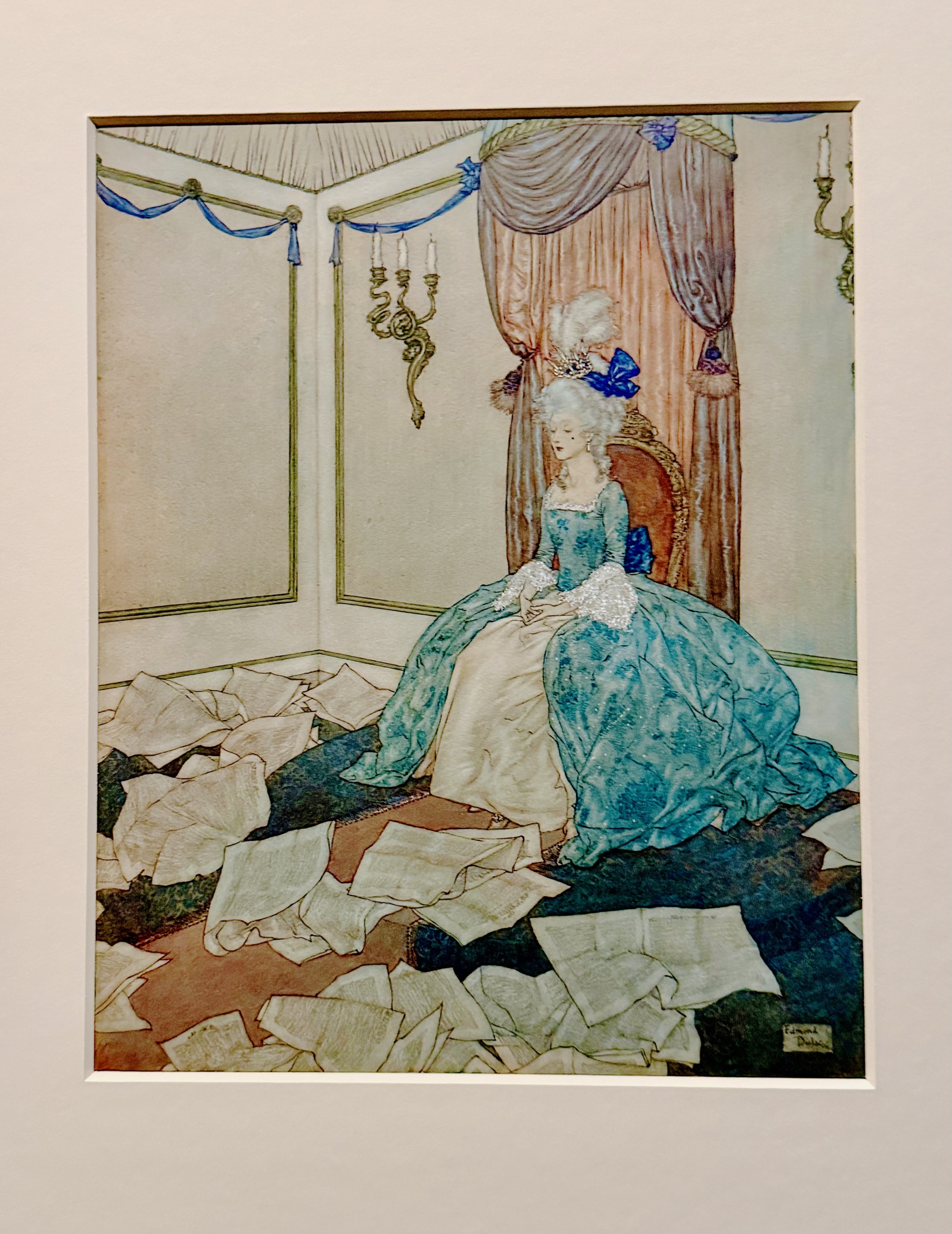
20th c. fairy tale queen: Edmund Dulac’s 1911 watercolor illustration of Marie Antoinette as Hans Christian Anderson’s Snow Queen; aloof, seated on an icicle throne. Courtesy: private collection.

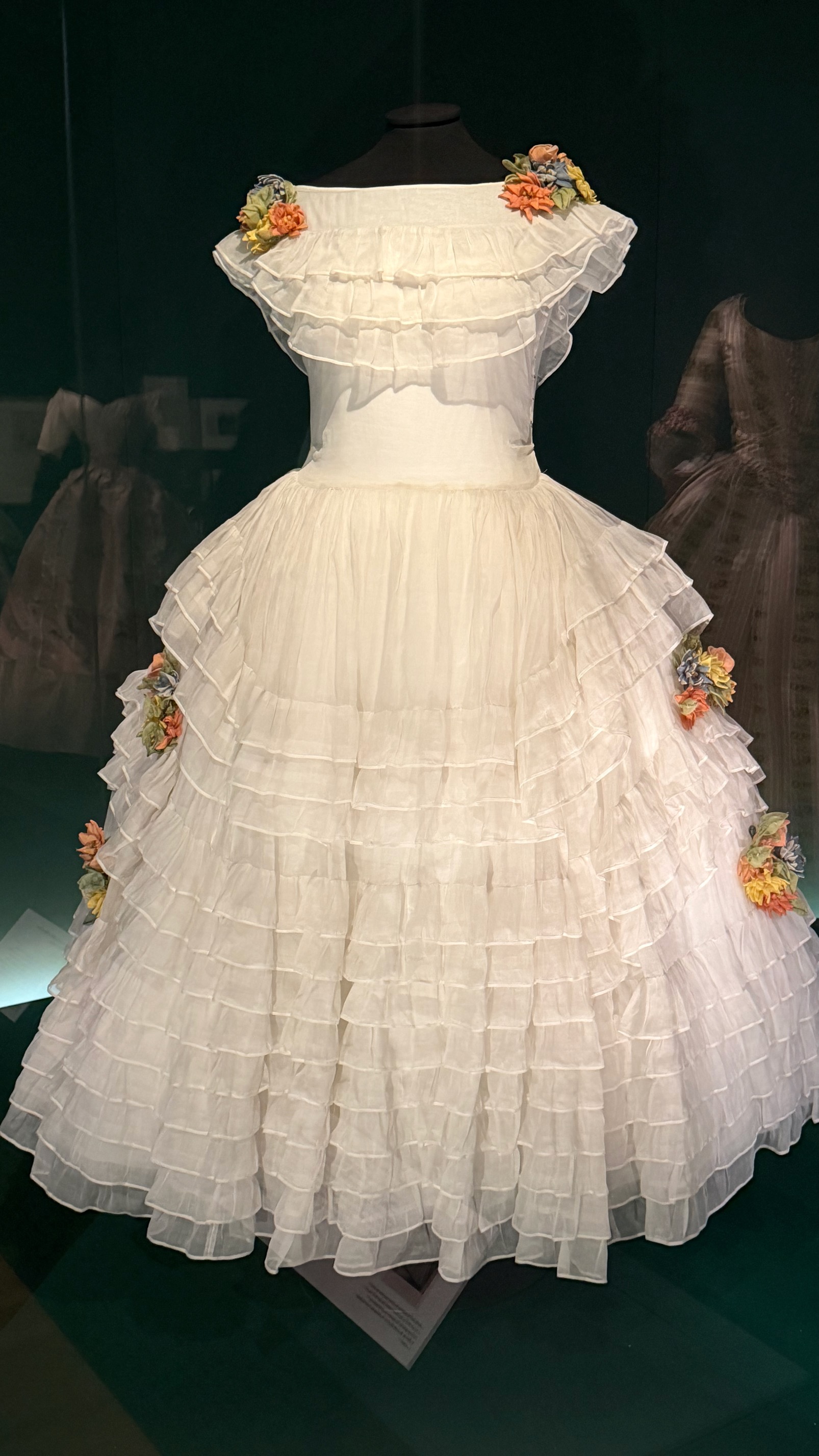
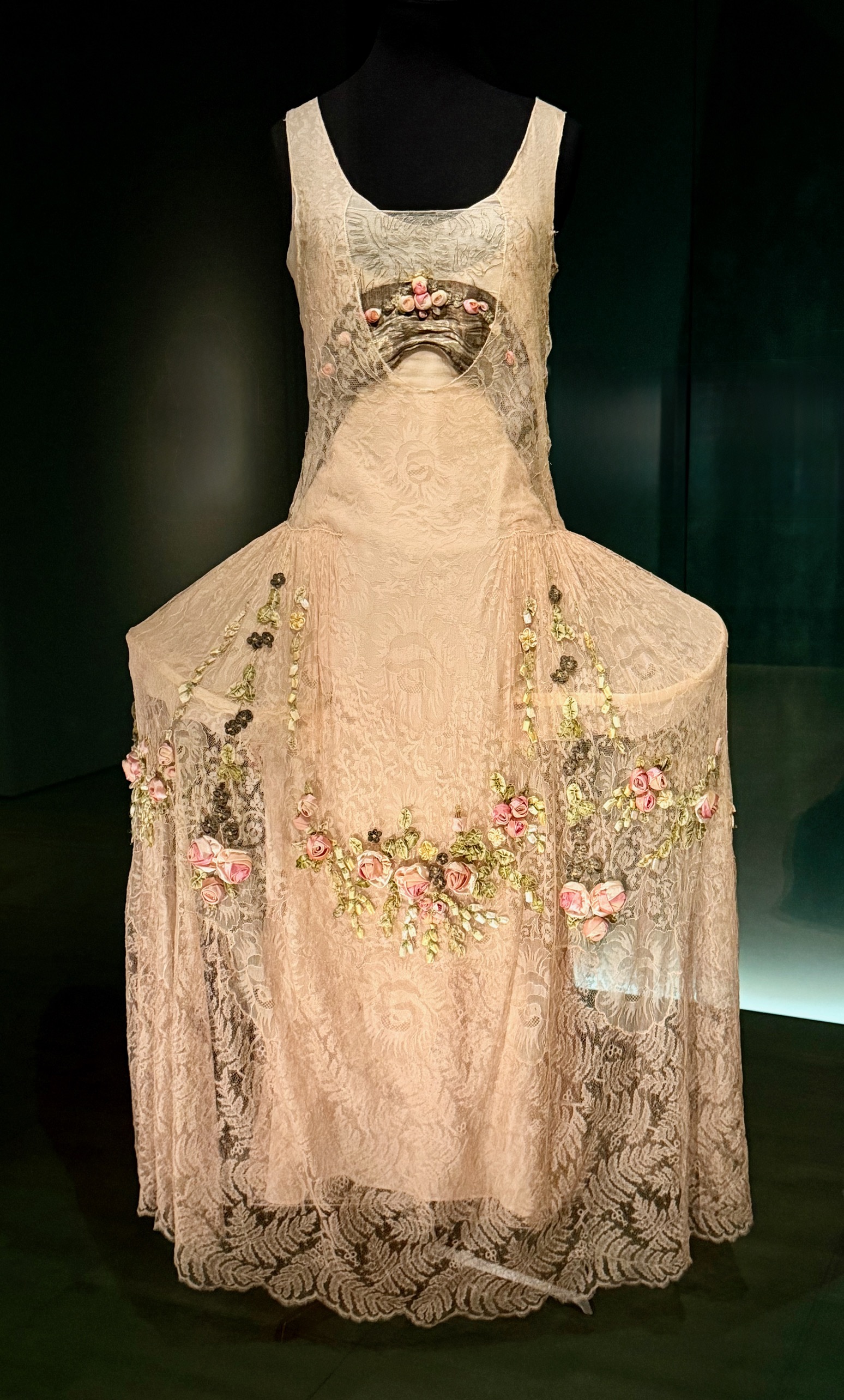
And 1920s fashion designers took note, mixing gauzy references to Marie’s muslin dresses with full skirts and panniers.

Referencing Marie Antoinette’s lingerie style: Jeanne Lanvin’s 1922-1923 silk organiza robe d’style (evening dress); a chemise with panniers. Courtesy: V&A
Boué Soers’ “lingerie frock” – a 1923 appliqued silk chiffon robe d’style (evening dress) with panniers and ribbon roses; advertised showing models as Trianon shepardesses. Courtesy: Designmuseum Danmark

The spectacular finale to the exhibition pays tribute to the costume designers and haute couturiers who have translated Marie’s style into modern times. Even Manolo Blahnik jumped at the invitation to make shoes for Coppola’s Marie Antoinette film actresses, making each pair himself and basking in the glamor of using truly opulent silks and embellishments. It’s fun to see an entire wall of them.

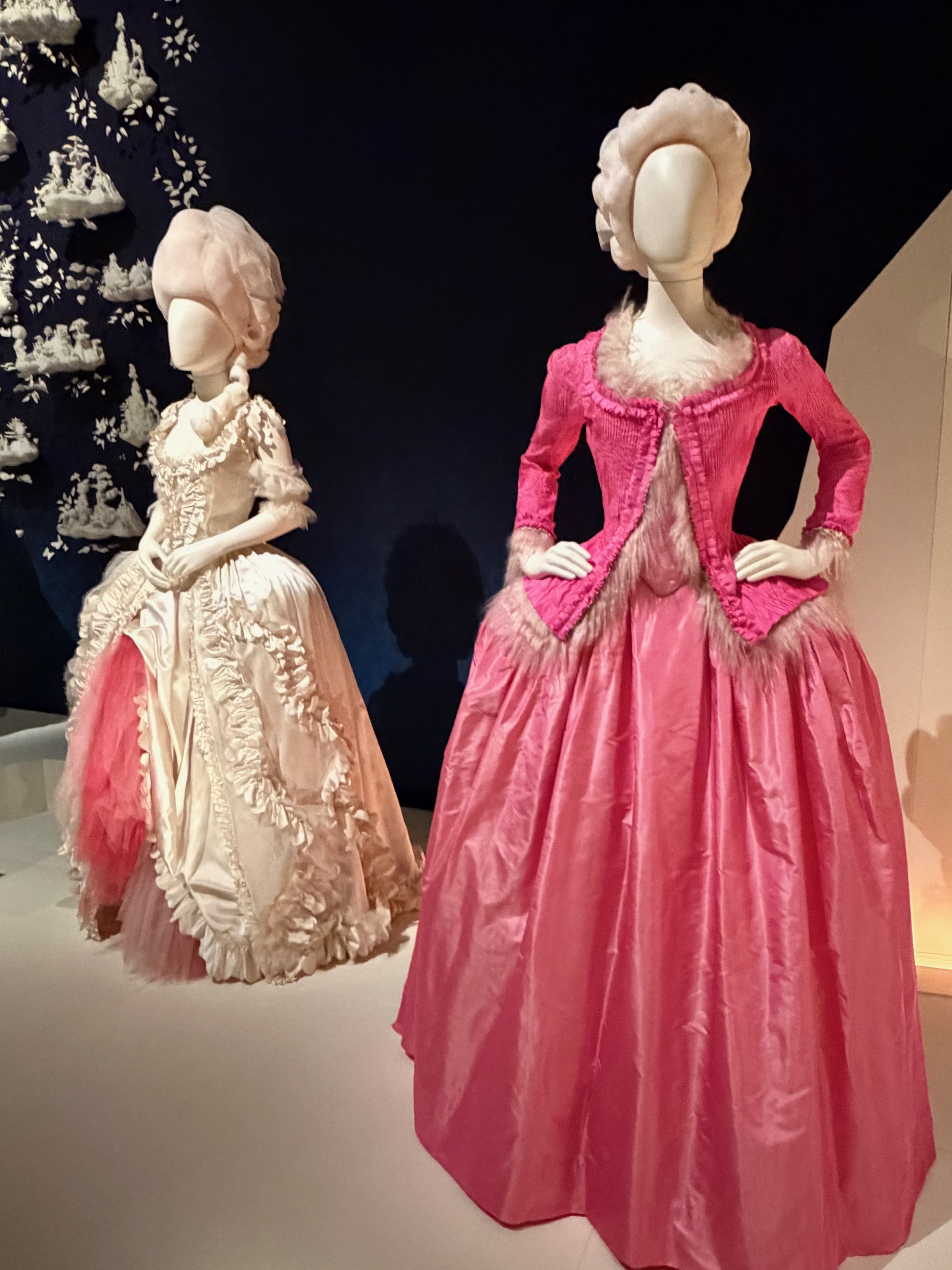
Neon pink costumes by Milena Canonero worn by Kirsten Dunst in Sofia Coppola’s 2006 film, Marie Antoinette. Courtesy: private collection.
Adrian’s silk gown worn by Norma Shearer in Willard Van Dyke’s 1938 Marie Antoinette film. Courtesy: private collection

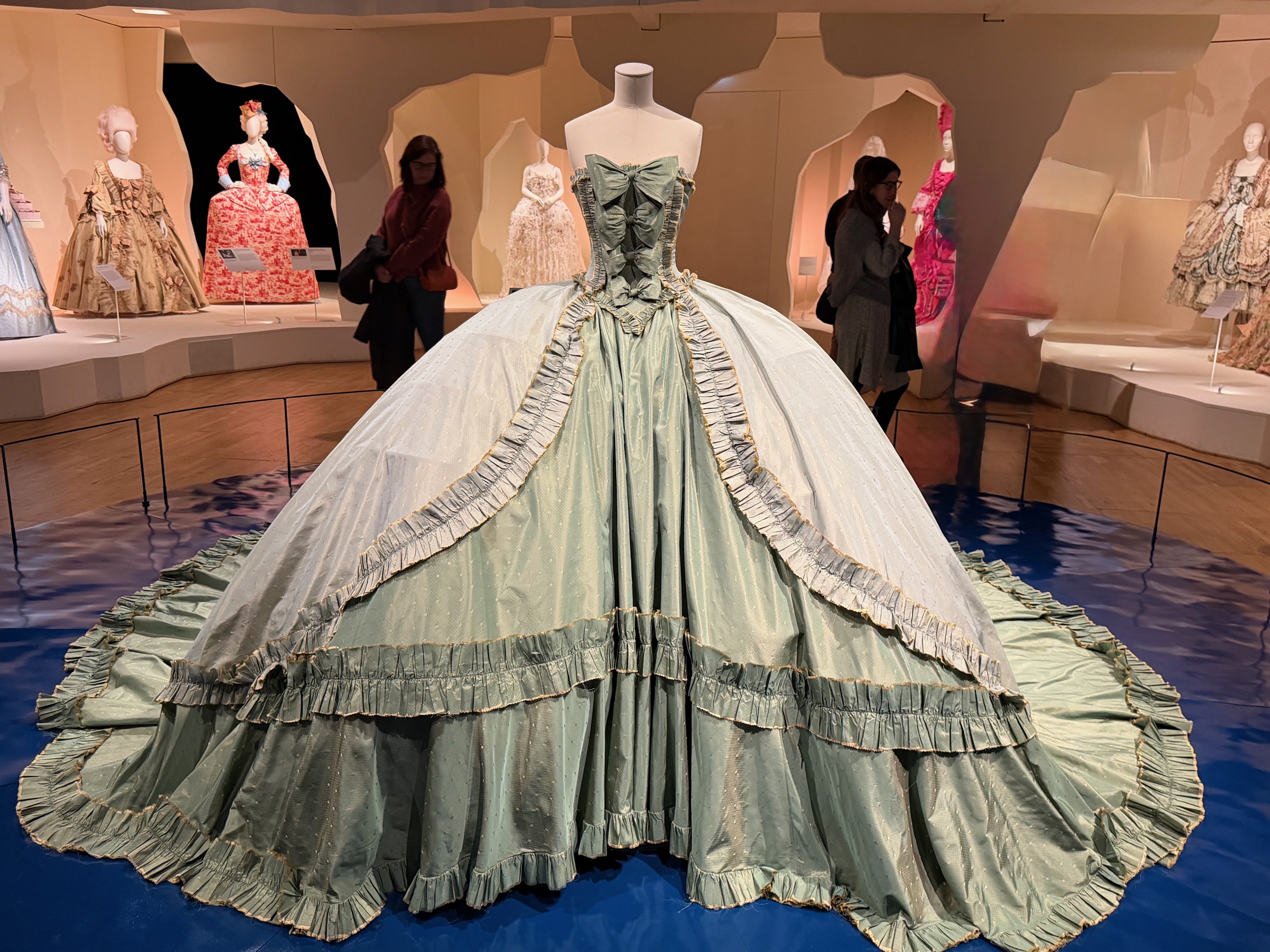
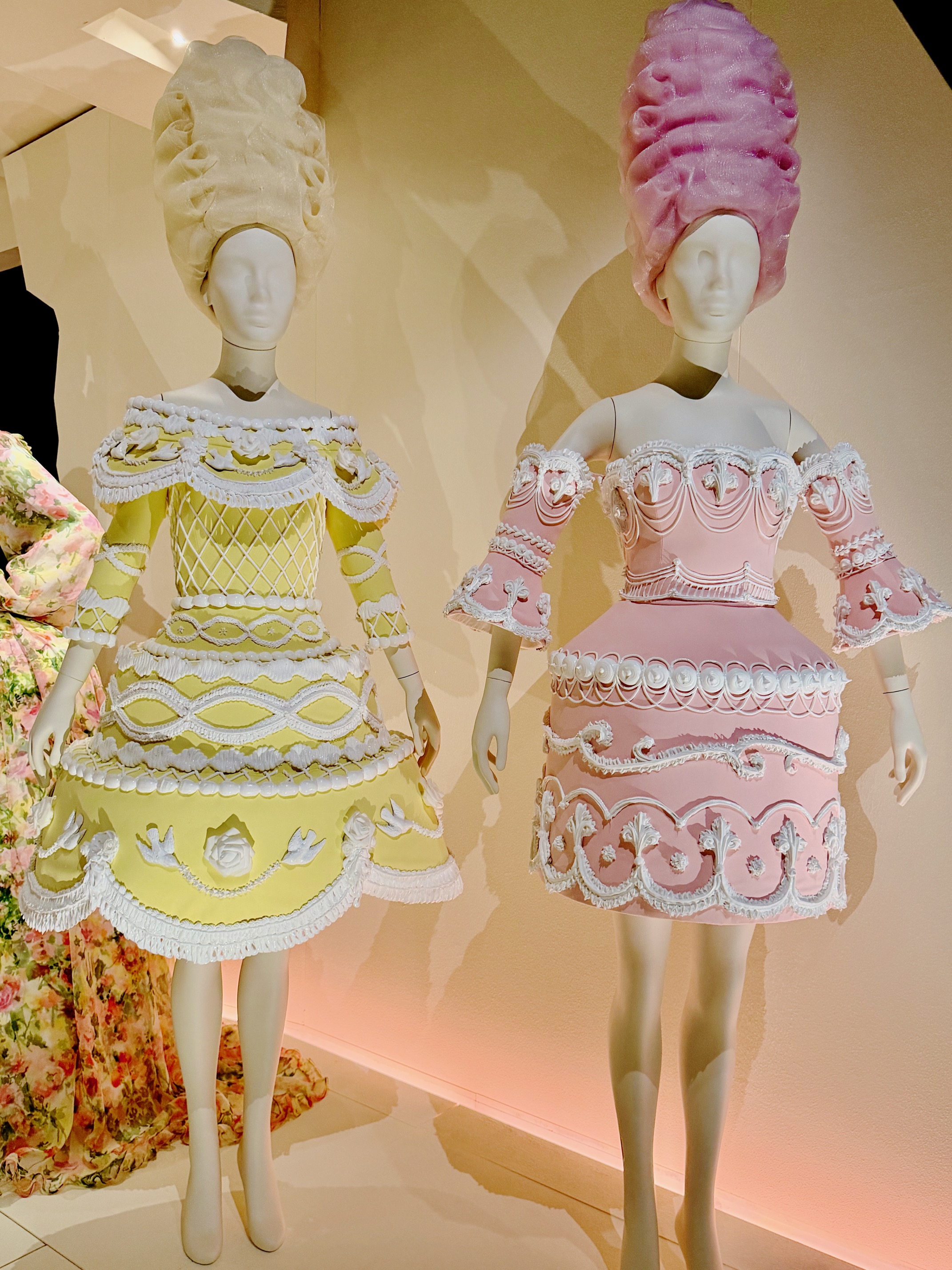
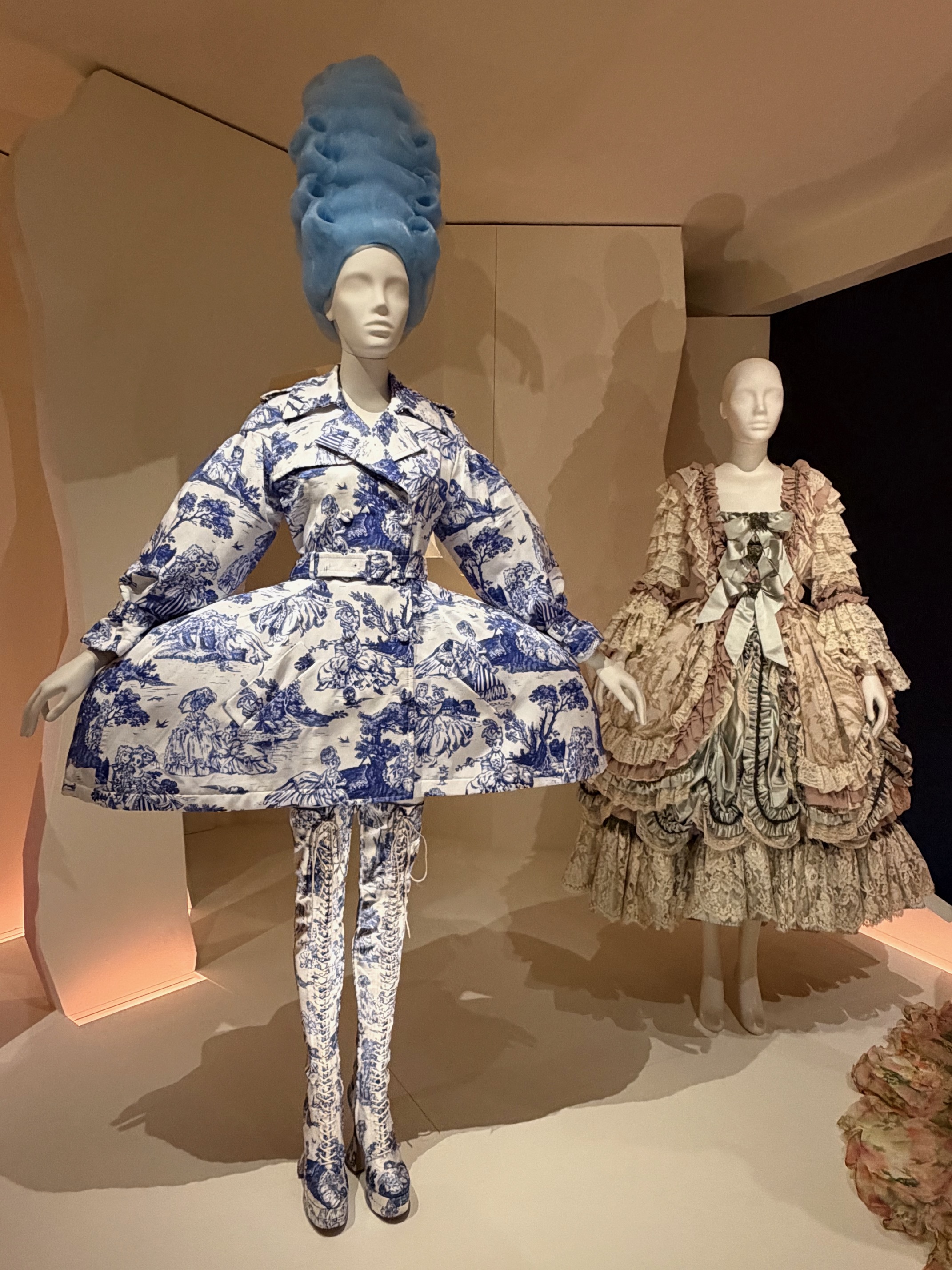
The show closes with a bigger-than-big wide gown by Galliano for Dior, surrounded by two tiers of Moschino silicone cake dresses, Moschino toile de jouy pannier spoofs, Marmalade’s drag ensemble, Vivienne Westwood’s bridal take, and even Lagerfeld’s take on those scandalous diamonds for Chanel. 

Gallery of restyled Marie Antoinette fashions by contemporary designers; at center, John Galliano’s 1998 iridescent silk taffeta Marquise Masquée gown for Dior. Courtesy: Dior

It’s an unmistakable style that’s recognizable hundreds of years later, and one everyone who’s seen this unforgettable show is still talking about!

Be forewarned: Schiaparelli opens at the V&A South Kensington on March 28, 2026.

Jeremy Scott’s 2020-2021 silicone cake dresses from a runway show mixing contemporary and 18th century style and fun. Courtesy: Moschino archives.
Jeremy Scott’s 2020-2021 cotton anime Toile de Jouy mini-pannier dress with matching boots and Franco Moschino’s 1990 silk and lace robe á la polonaise. Courtesy: Moschino archives.

Visionary Collector Amasses Trove of Radical Works

It’s quite a leap from taking an art appreciation class with your daughter in your mid-thirties to assembling an enormous collection of paintings by radical art-world revolutionaries and anarchists. But that’s what one woman did and and the work is on display in Radical Harmony: Helene Kröller-Müller’s Neo-Impressionists, on view at the National Gallery in London through February 8, 2026.

Crowds have been flocking to see incredible works by Seurat, Signac, and Van Gogh, and meet the Dutch and Belgian painters who adopted their breakthroughs and ran with these innovations for two decades at the end of the 19th century. 

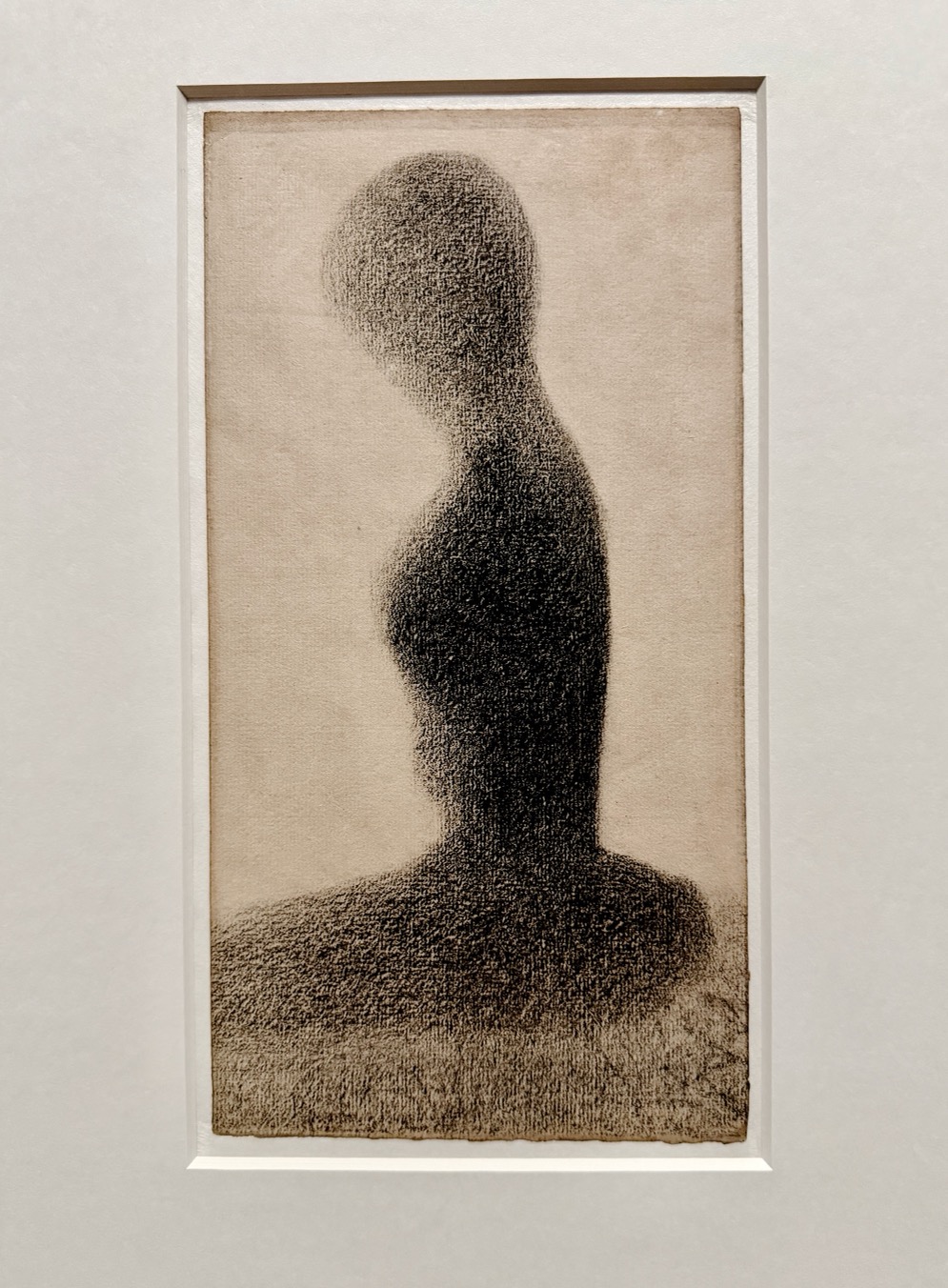
Seurat’s 1884-1885 Young Woman: Study for ‘A Sunday on Le Grande Jatte’” – a radical abstracted, dematerialized image. Courtesy: Kröller-Müller Museum

Maginificent, much-loved works were collected in the early 20th century by Helene Kröller-Müller, the daughter of a wealthy German industrialist.  Her husband ran businesses for her father (and eventually his entire company) in Rotterdam, where they lived.

Helene was always encouraged to follow her intellectual interests, and new ideas. After taking a class about art in 1905 from Dutch artist/dealer/critic H.P. Bremmer, Helene began to understand why the radical colors, compositions, and subjects in paintings by Van Gogh, Seurat, and others moved her so deeply. Working with Bremmer as an advisor, Helene eventually amassed the largest collection of Van Gogh paintings and drawings in the world (outside of the Van Gogh Museum itself).

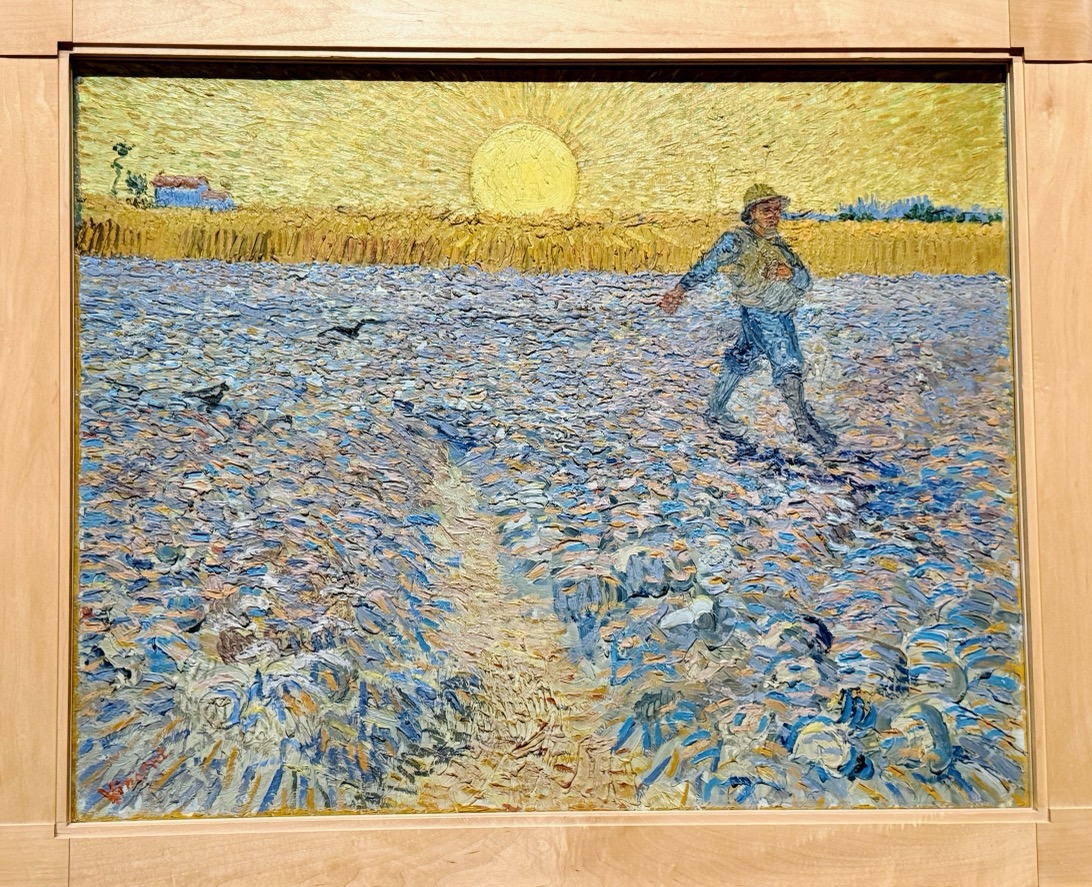
Van Gogh’s 1888 oil The Sower with the Sun rising hopefully over a rural worker. Courtesy: Kröller-Müller Museum

Helene sometimes accompanied Bremmer on buying trips with the goal of creating a public collection where people could see and experience the genesis of modern art.  In 1912, they even visited Signac in his studio, where Helene purchases two magnificent tranquil harbor views – one by Signac and one by his late friend, Seurat.

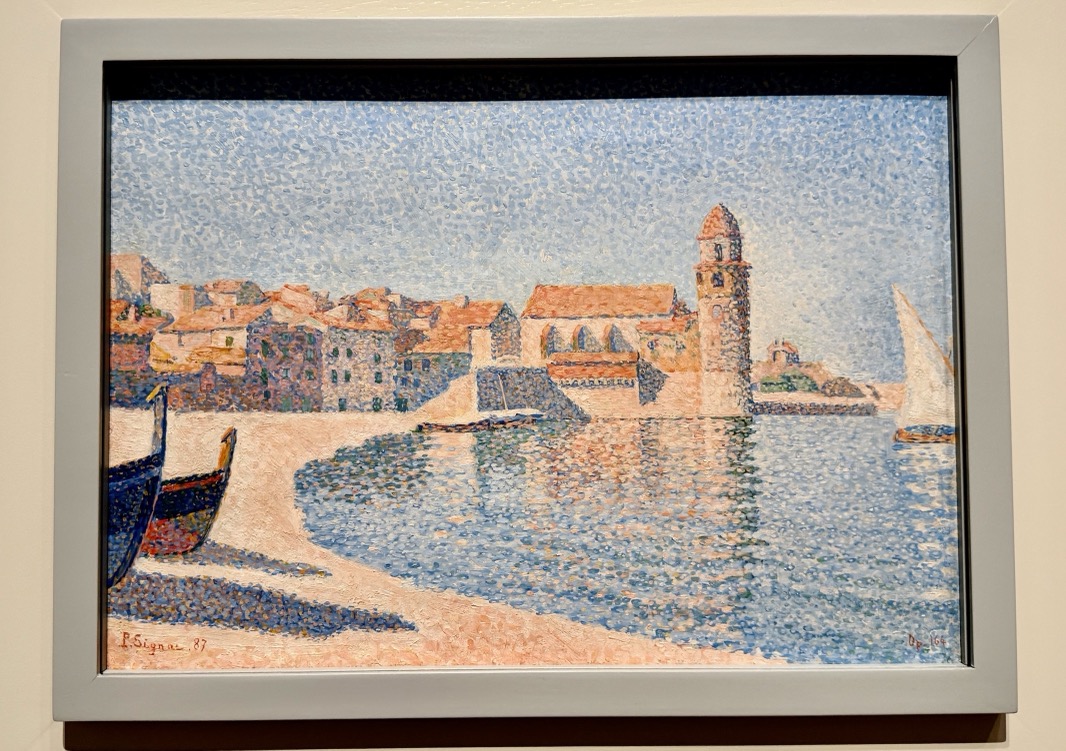
One of Helene’s first “new art” purchases on a buying trip to Paris: Signac’s 1887 oil pof the French Riviera capturing the Sun’s reflected light – Collioure, The Bell Tower, Opus 164. Courtesy: Kröller-Müller Museum

Here’s a brief video about Helene Kröller-Müller’s passion for art, how she built her massive collection, and the beautiful museum in the Netherlands countryside that should be on every art lover’s bucket list :

This gorgeous exhibition in central London shines a light on this visionary collector, but the focus is less on Helene’s history and fully on her stellar collection of Neo-impressionist painting and related works from the National Gallery and other collections. See some of our favorites in our Flickr album.

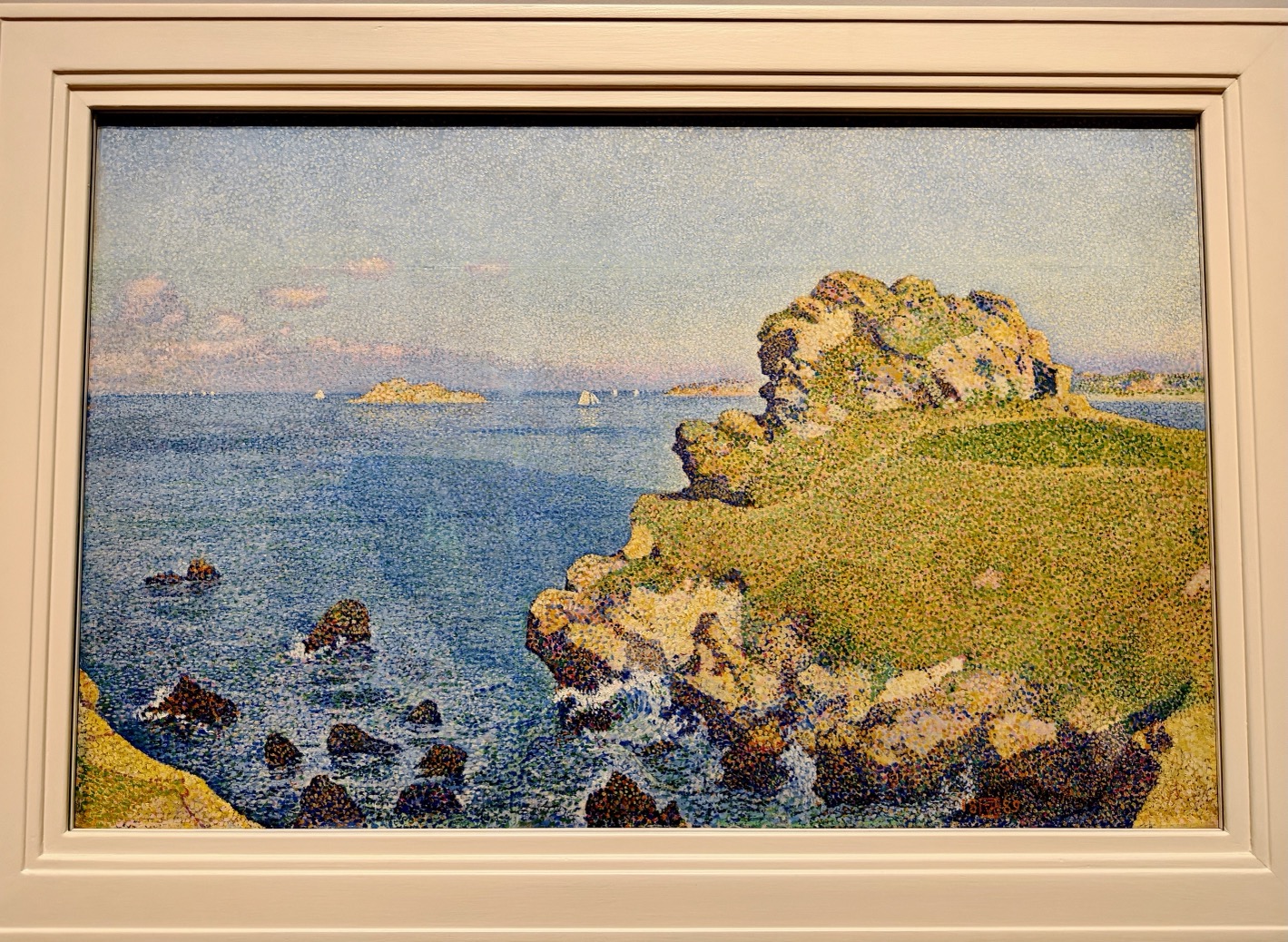
The exhibition begins with paintings by Seurat and Signac, who adopted color theory for their pointillist techniques to create shimmering images of simplified, tranquil harbors and seascapes. This new radical painting approach electrified artists across Europe, such as Belgian painter Theo van Rysselberghe and Dutch artist Jan van Toroop, whose works are also hung in the first gallery.

Van Rysselberghe’s 1889 oil inspired by Seurat ‘Per-Kiridy’ at High Tide. Courtesy: Kröller-Müller Museum

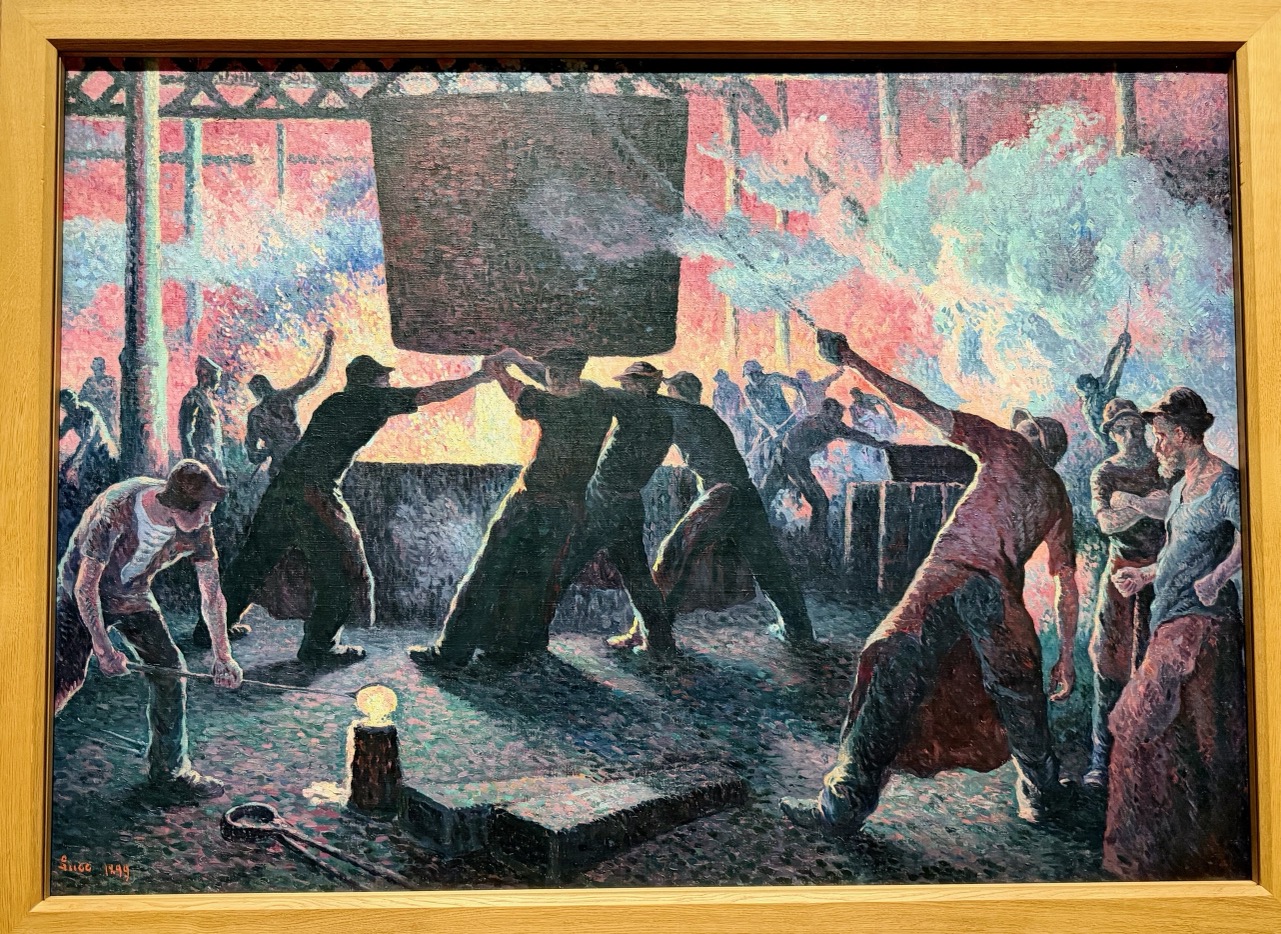
At a time when industrialization was transforming life, Helene did not shy away from acquiring works made by artists proud of their radical, progressive politics. Many of the artists featured in the exhibition were proud to call themselves anarchists – passionate radicals who used art to advocate for workers’ rights, elevate the image of working people, and create a hope of increasing harmony with nature.
Maximilien Luce’s 1899 The Iron Foundry showing strength and integrity of Belgian steel workers amid dangerous conditions – an acquisition that hung in the office of Helene’s industrialist husband. Courtesy: Kröller-Müller Museum

To create the pictoral harmony that they sought, these painters often stripped details out of landscapes. When people are present, they are depicted with highly simplified, streamlined faces – pleasing, but impersonal. These stand in contrast to paintings by Belgian and Dutch painters who applied their new color techniques to beautiful large portraits of their politically progressive friends and patrons.

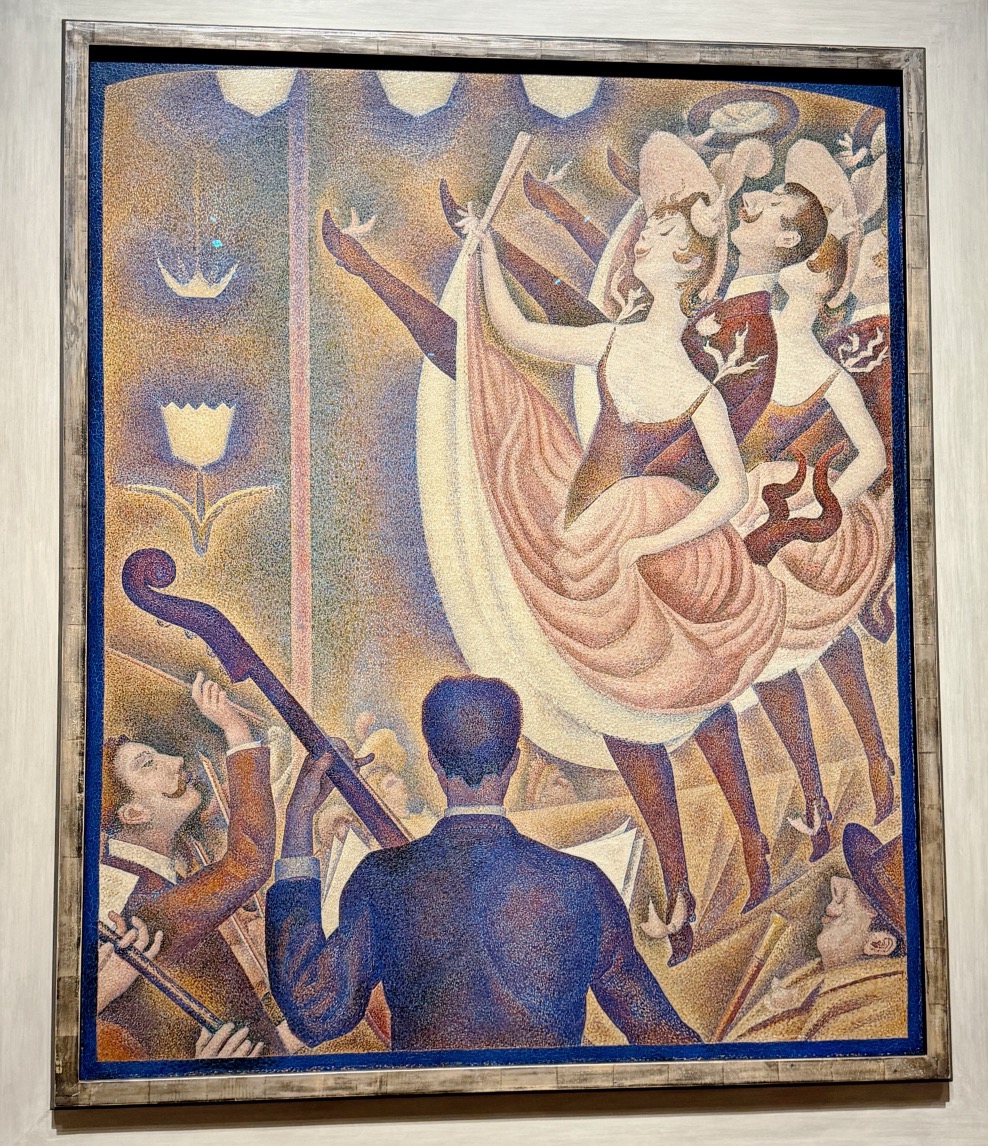
Seurat’s 1889-1890 grand Chahut – a stylized manifesto of his painting philosophy; features artificial, compressed, stylized figures and space. Courtesy: Kröller-Müller Museum
The centerpiece of the show is Seurat’s enormous painting of the scandalous can-can dance at a raucous late-night Paris venue. It’s the biggest, baddest, Neo-Impressionist work in Helene’s collection. The curators surrounded it with works showing how much other radical painters enjoyed music and nightlife.
But just beyond this gallery, you’re surrounded by still, quiet domestic interiors and sun-dappled garden scenes in a gallery titled “The Silent Picture.” People are introspective, lost in thought, or lost in a book. Helene loved collecting large-scale works that seem to envelope viewers with stillness and calm.

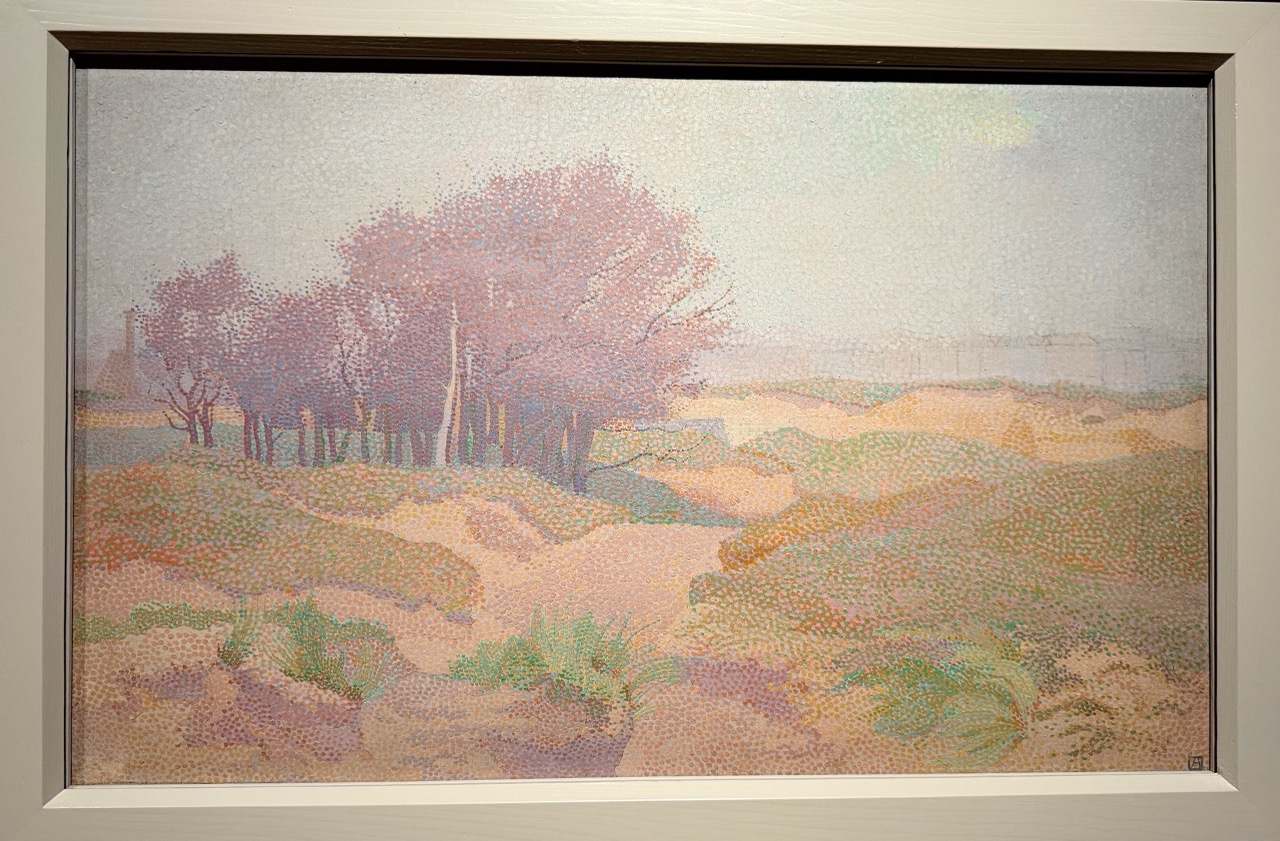
And she truly loved the serene, nearly empty landscapes that this group of painters created. The long horizon of the sea only adds to these works’ peaceful presence.  Helene wanted her museum to have clean lines, and unadorned galleries so that visitors could stand, contemplate, and find peace with these works. She truly felt these new, modern paintings had the ability to provide respite and even feel something spiritual.

Johann Aarts’s 1895 oil Landscape with Dunes – a tranquil, simplified view of an urban seaside town, indicated by faint buildings on the horizon. Courtesy: Kröller-Müller Museum
Signac’s 1890 Saint-Briac, The Beacons, Opus 120 – the most radical of his four views of the River Fémur along the Breton coast. Courtesy: private collection

Take a walk through this incredible show with the curators from the National Gallery, and hear how Seurat, Signac, and their contemporaries broke the rules and made history:

Epic Histories of Kerry James Marshall Wow London

It’s fitting that Kerry James Marshall provides a master class in history painting at the Royal Academy of Arts in London – one of the most sensational shows to inhabit those hallowed galleries off Picadilly – Kerry James Marshall: The Histories, on view through January 18, 2026.

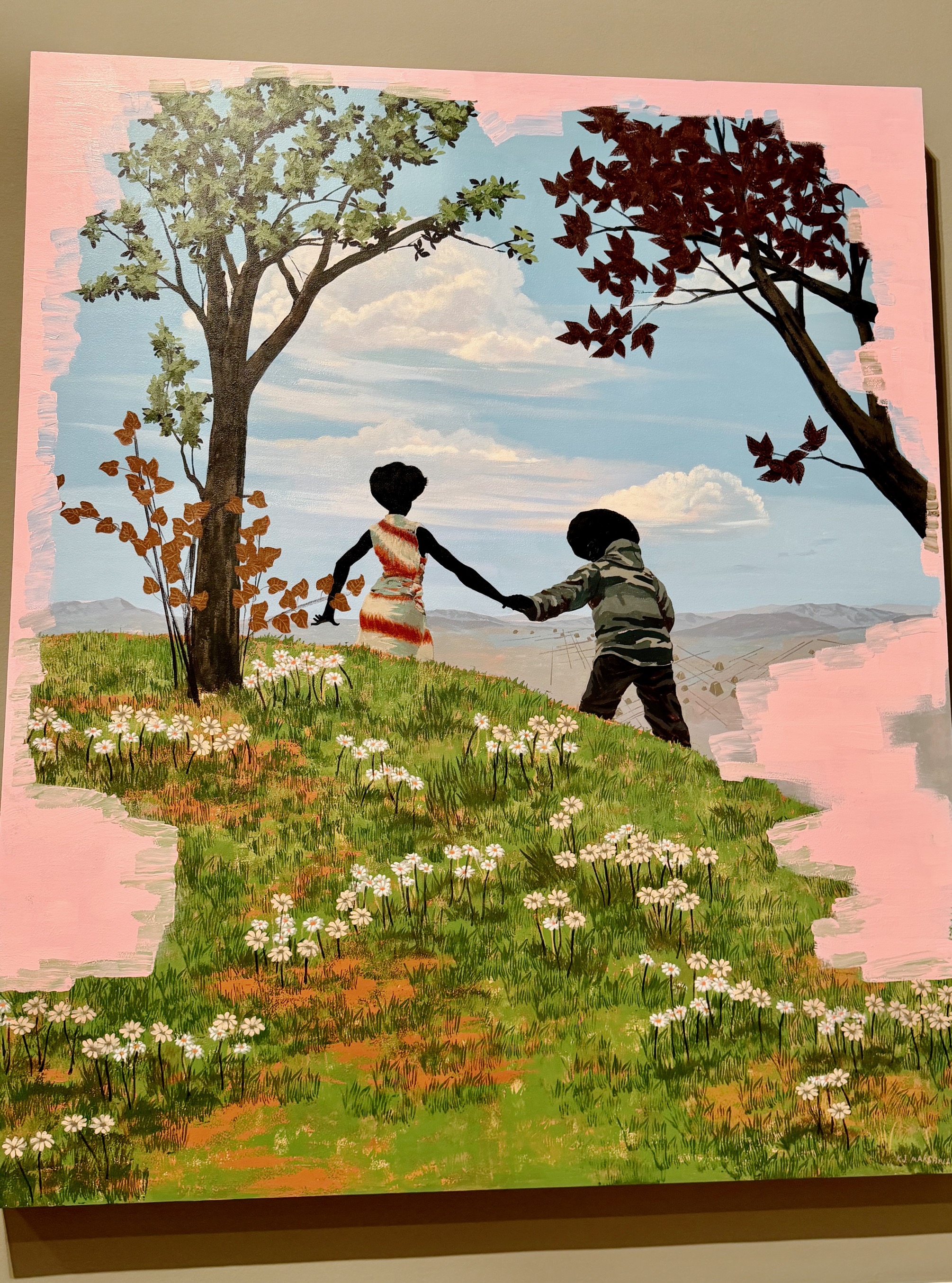
Marshall’s work fills eleven galleries of Burlington House with masterful paintings that put Black subjects back into the frame – Black citizens working in museums and art studios, delivering style in neighborhood barber and beauty shops, maintaining gardens in public housing projects, and wafting through floral fields à la Watteau and Fragonard.

Marshall’s 2008 acrylic Vignette #13 – a Rococo-inspired scene with a couple walkng through a meadow. Courtesy: private collection.

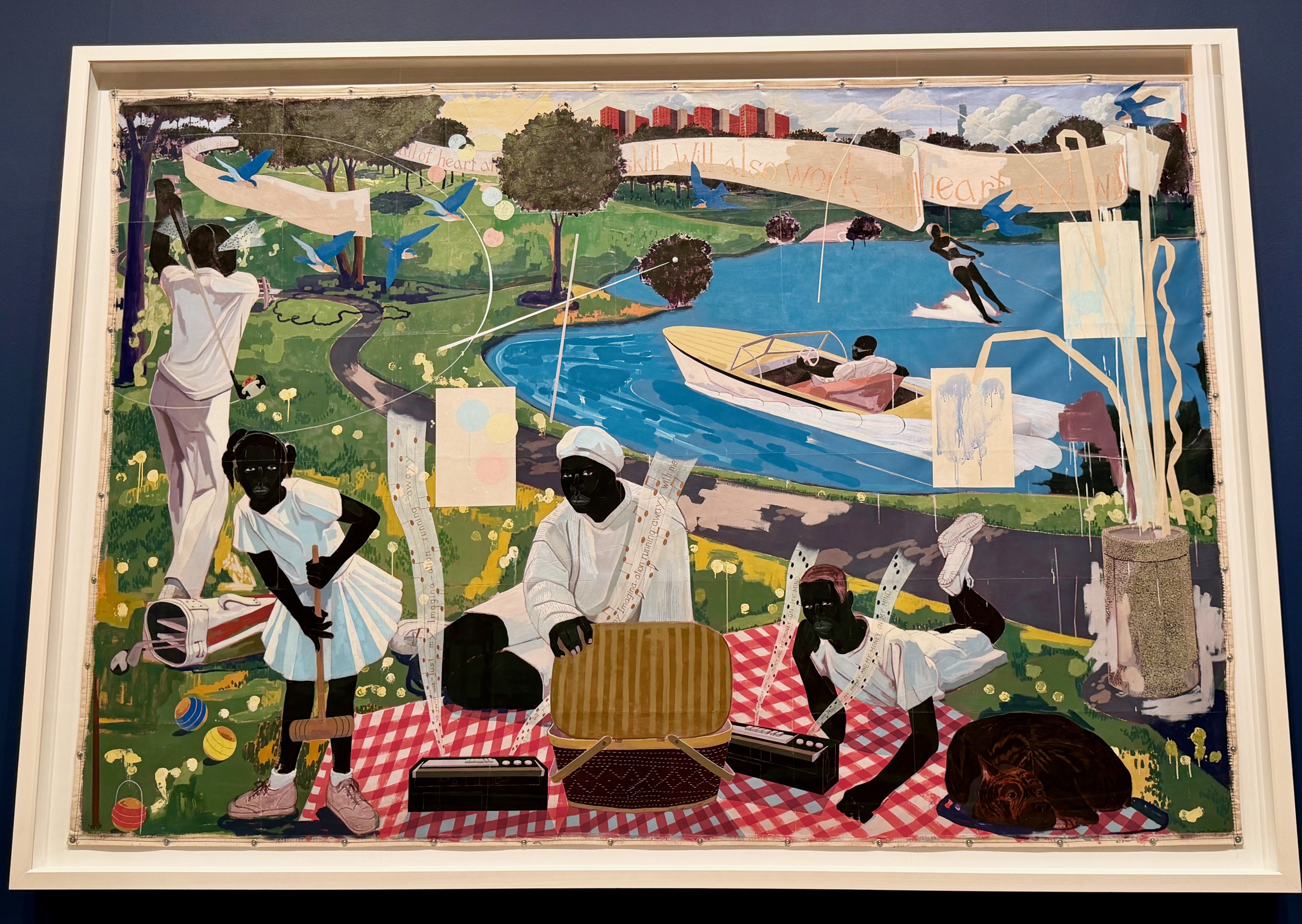
Most of these scenes are presented on a large scale and jam-packed with art-historical, literary, and world-history references. In The Painting of Modern Life-themed gallery, his grand Past Times certainly evokes Parisian leisure-class epics by Manet and the Post-Impressionists. Marshall’s twist is to depict a wholesome, all-white-clad Black family enjoying its picnic lunch lakeside as music and lyrics by The Temptations and Snoop Dogg (literally) drift up from the radios to ask if this is “just my imagination.”

Referencing Manet and Seurat, Marshall’s 1997 acrylic and collage Past Times, where a middle-class family enjoys a picnic and music in a lakeside park. Courtesy: Art Institute of Chicago.

Take a quick look at the Academy’s exhibition preview video and hear Marshall talk about his inspirations and approach:

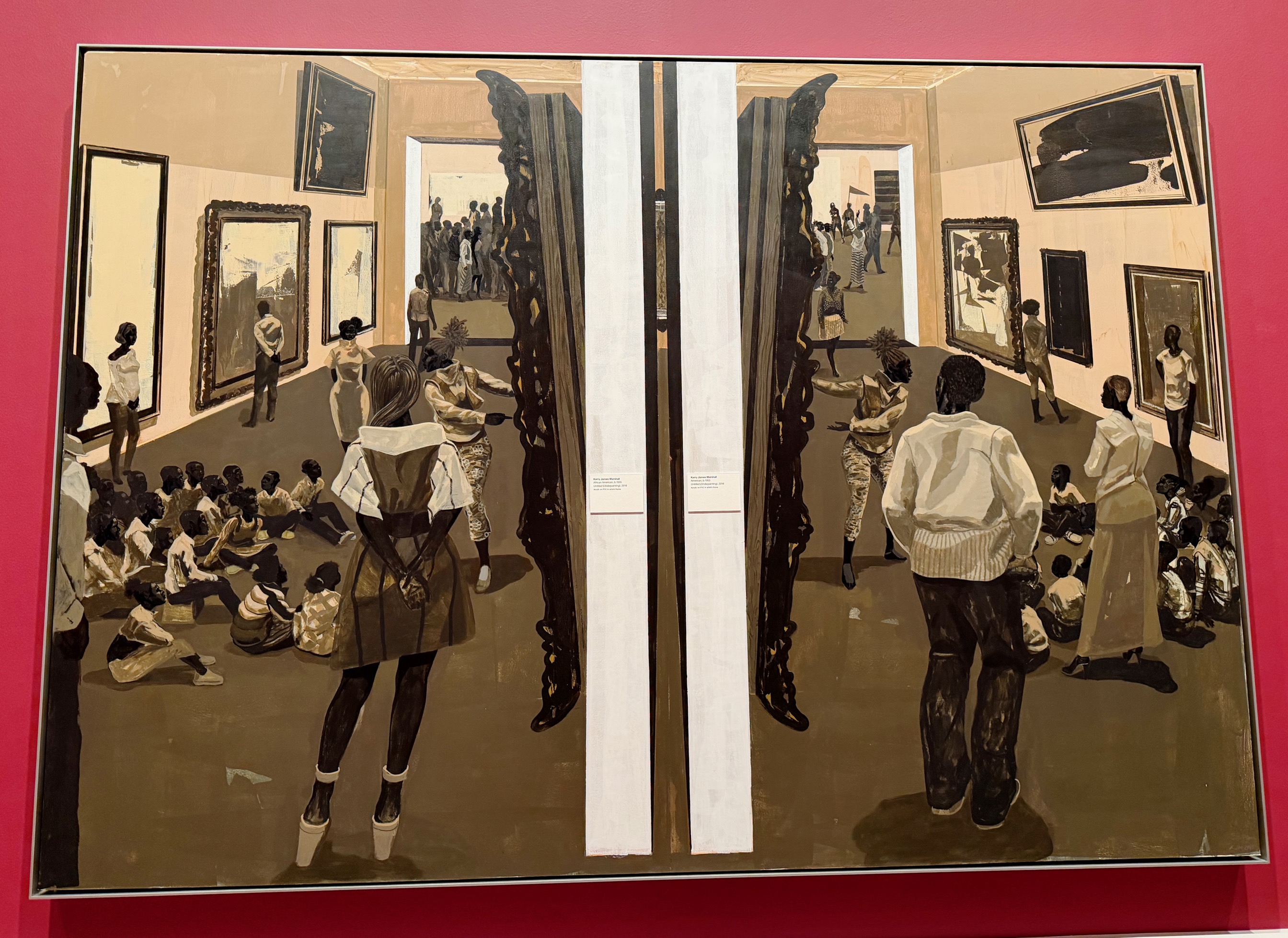
The exhibition begins with a gallery depcting self-confident artistic portraits, scenes from the academic art studio, and kids joyfully visiting a museum for the first time – a recollection of Marshall’s own exhilarating inauguration to a new world.

Marshall’s 2018 acrylic and collage Untitled (Underpainting), showing two rooms of Black kids on a museum school trip – reflecting on his earliest museum outings. Courtesy: Glenstone Museum

It’s followed by some of his earlier works inspired by Ralph Ellison’s 1952 Invisible Man and the similarly named 1897 book by H.G. Wells, with Marshall’s innovative black-on-black portraits.

Here’s a short video with Marshall describing all the different ways he uses black paint to create such vivid dimensionality:

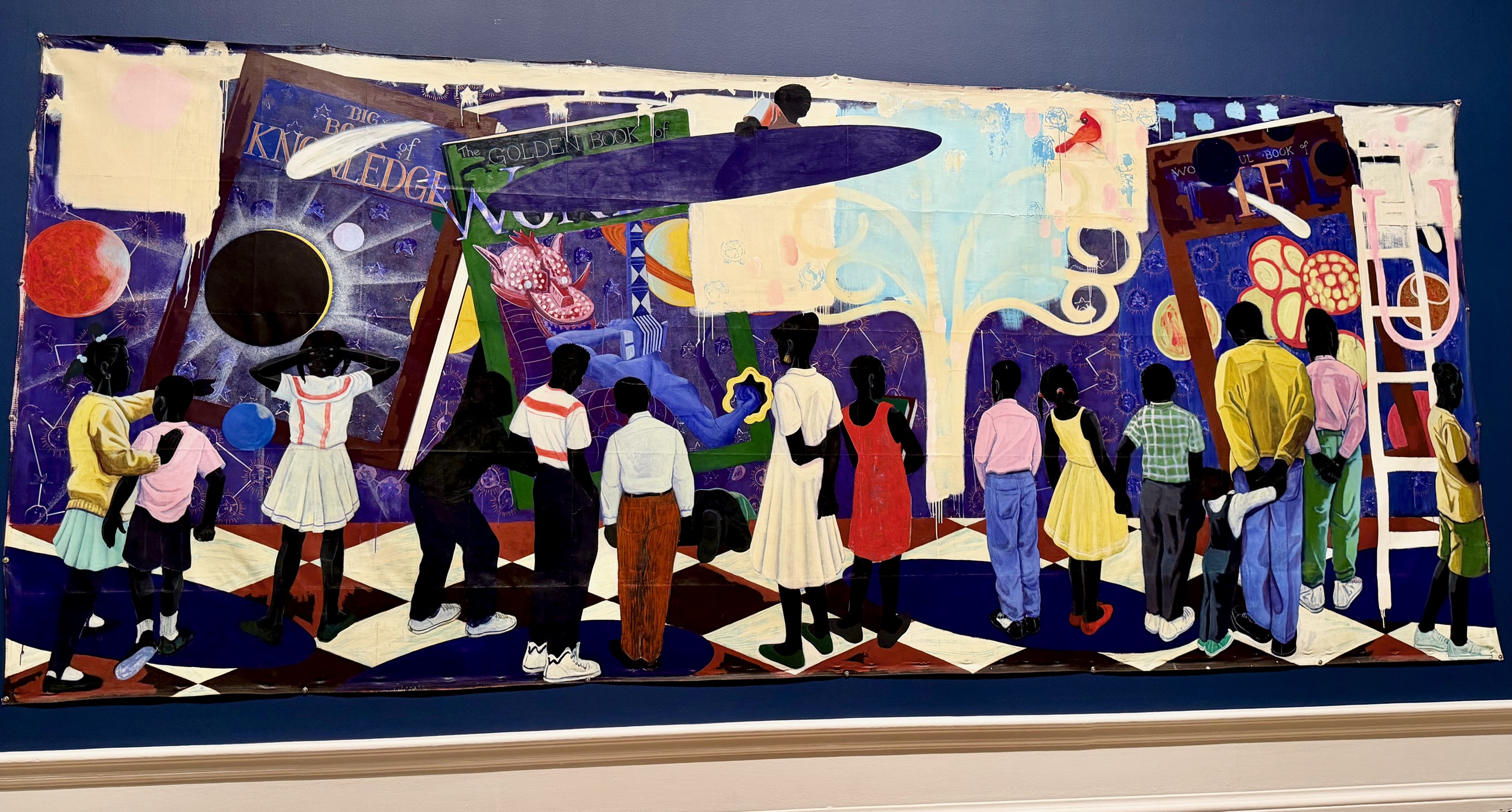
Other modern-life paintings bring viewers unexpectedly into a world of gardens among Chicago public-housing complexes and a magical world of books awaiting eager young readers.

Marshall’s 1995 mixed-media mural Knowledge and Wonder –showing inquisitive children surrounded by a world of books. Courtesy: City of Chicago Public Art Program and Chicago Public Library.

Other galleries are hung with Marshall’s assertive portraits of historic African-American abolitionist and literary figures, like Harriet Tubman and Phillis Wheatley-Peters, and tributes to 20th century political and cultural leaders.

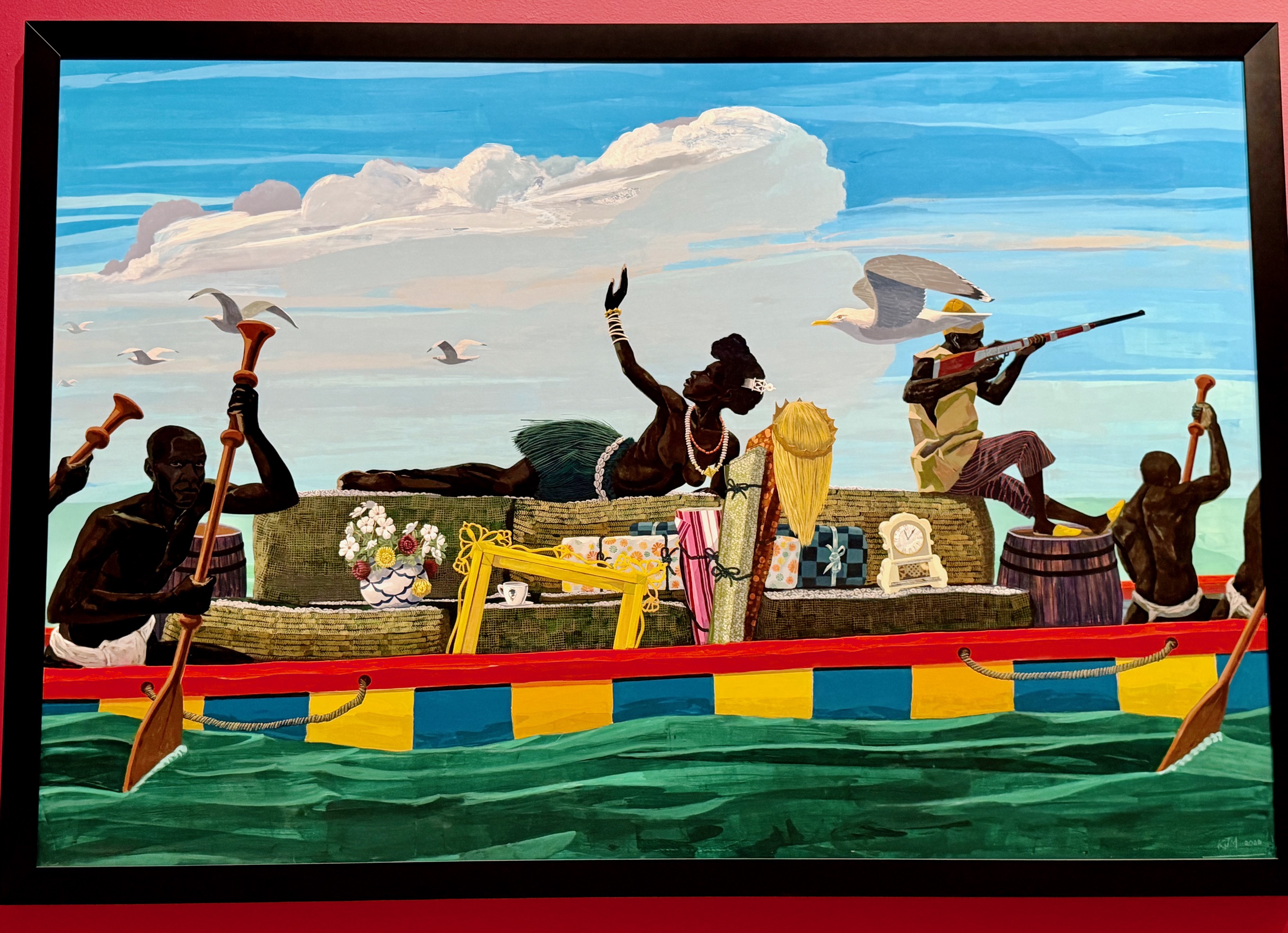
But the most talked-about works are Marshall’s grand canvases depicting the history of the trans-Atlantic slave trade – a group of symbolic works on the terrors of the Middle Passage (an Atlantic crossing where many souls never made it to the far shore) and dramatic murals of the Africans who successfully facilitated the capture and sale of fellow Africans.

Africa Revisited: Marshall’s 2025 acrylic Haul, showing Africans transporting payment from European slave traders for trafficked Africans. Courtesy: the artist and David Zwirner, London.

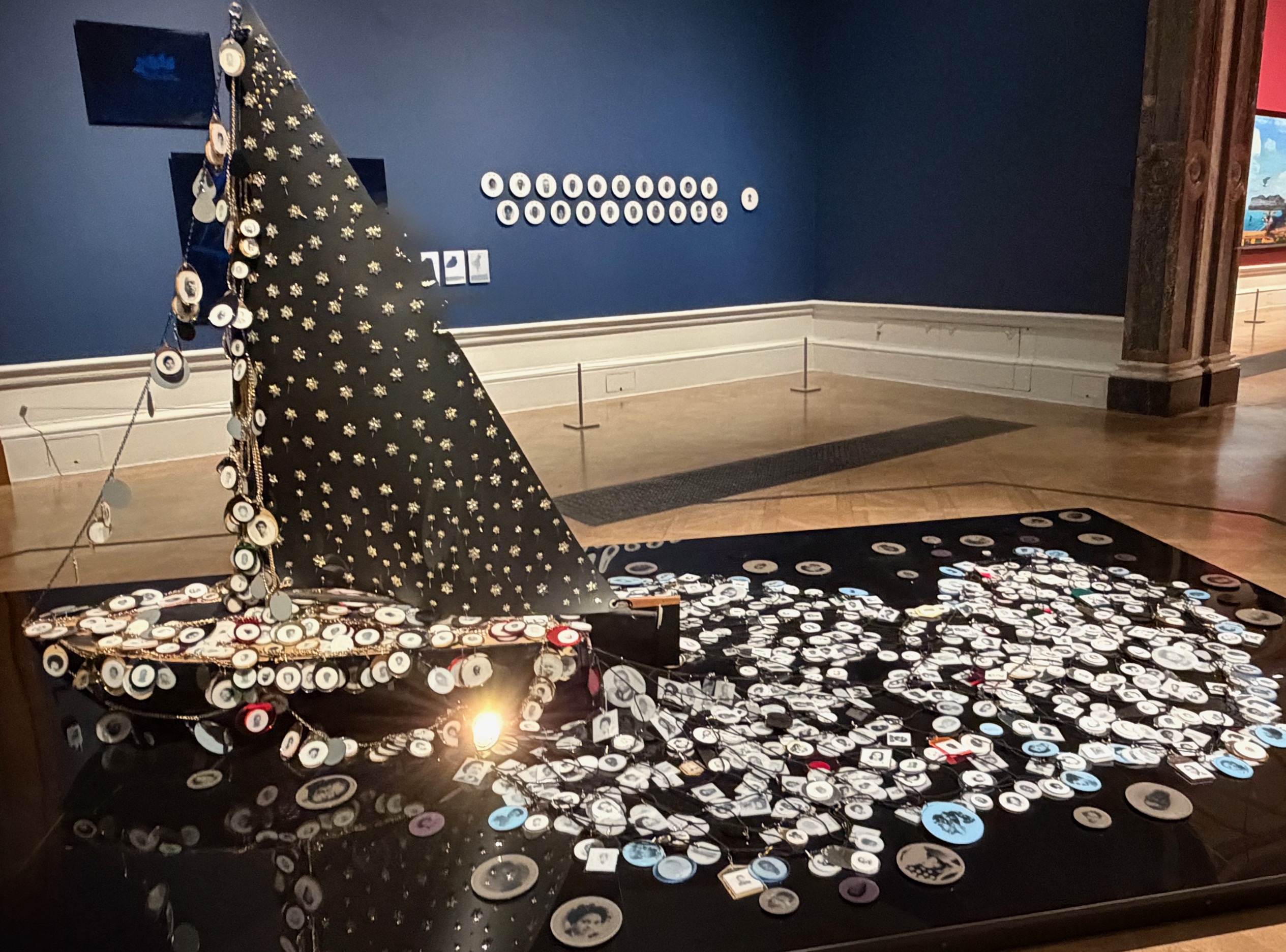
Visitors linger quietly in one of the last galleries devoted to Marshall’s installation at the 2003 Venice Bienniale. Most circumnavigate the sailing ship to get a better look at the hundreds with African-American achievement medals that are scattered about it. They also take close, respectful looks at each of the the commemorative ceramic plates that Marshall created with invented portraits of the first enslaved Africans brought to America.

Marshall’s 2003-ongoing mixed-media installation Wake originally displayed at the 2003 Venice Bienniale – a sailing ship covered with African-American achievement medals with other photographs and portraits. Courtesy: Rennie Collection, Vancouver.

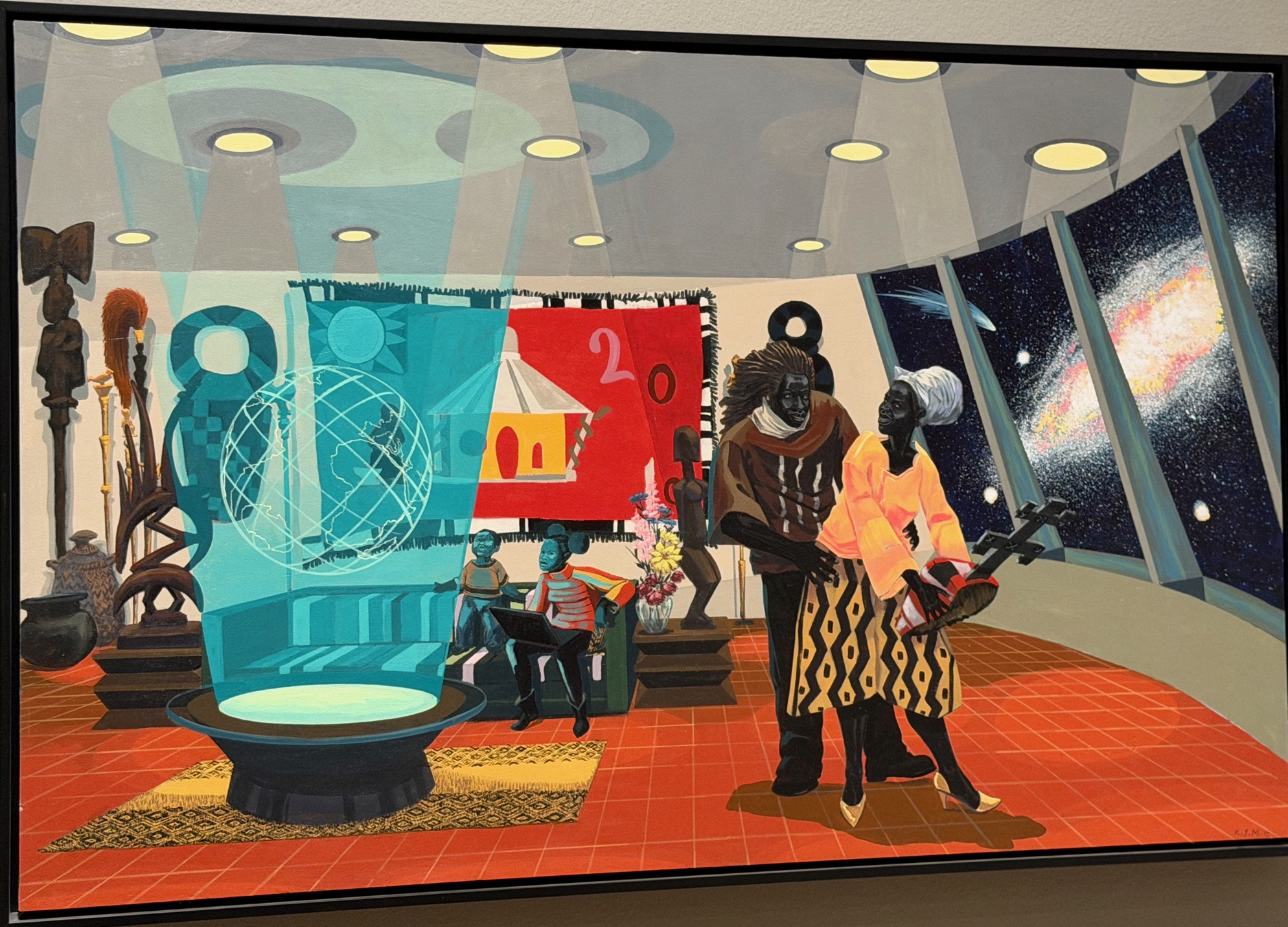
The show closes with an Afro-Futurist vision – a family in a beautifully appointed living room shooting through the universe with a view of the cosmos.

Marshall’s 2010 Afro-Futurist oil Keeping the Culture, a family of the future living in the cosmos. Courtesy: private collection.

Past, present, future, brilliant color, intriguing composition, successful Black protagonists – everything about the exhibition creates an indelible adjustment to what you thought you knew about daily Black life, lost history, and potential futures.

See more our favorite works in our Flickr album.

If you missed this show at the Royal Academy in London, Kerry James Marshall: The Histories will be shown at Kunsthaus Zürich from Februrary 27 to August 16 (2026) and at Musée d’Art Moderne de Paris from September 18, 2026 to January 24, 2027.

Marshall’s 2014 acrylic Untitled (Porch Deck). Courtesy: Kravis Collection.
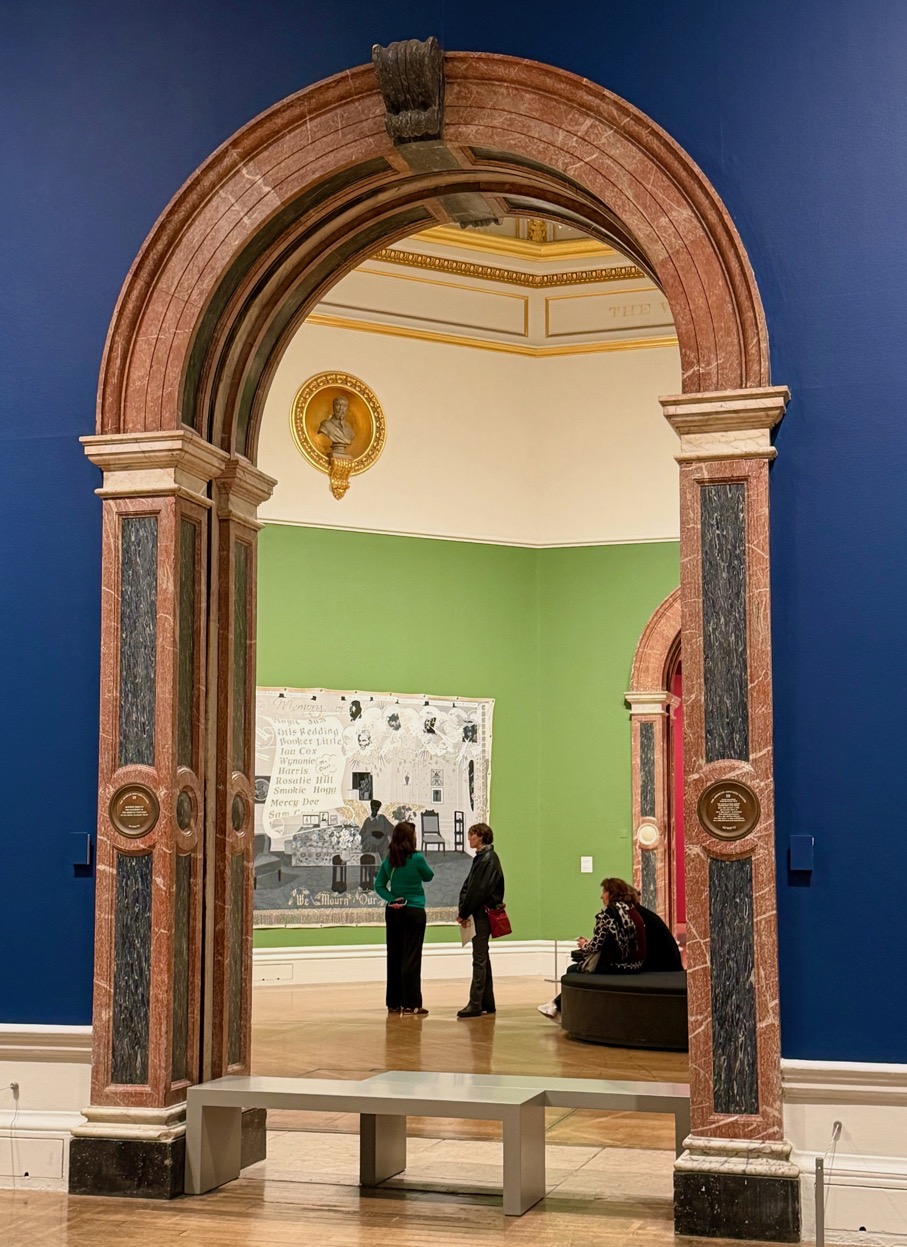
Through the arch of the central gallery; view of Marshall’s 1998 mourning tribute Souvenir IV.. Courtesy: Whitney Museum of American Art.
I