Nigerian Modernism at Tate Modern

How do artists forge a path forward in contemporary art by adapting to and then shaking off the constraints of colonialism? The Tate Modern explains how one country’s artists did it through its expansive exhibition Nigerian Modernism: Art and Independence, on view in the Nathalie Bell Building Level 4 through May 10, 2026.

The exhibition unfolds across nine galleries that provide some history, honor 20th century art legends, and introduce groups of artists that converged in universities and other towns to chart their unique paths. It’s a sensational visual ride through an art culture that had to contend with civil wars, upheavals, ethnic conflict, and the decision either to stay put and build artistic infrastructure or to build another life abroad.
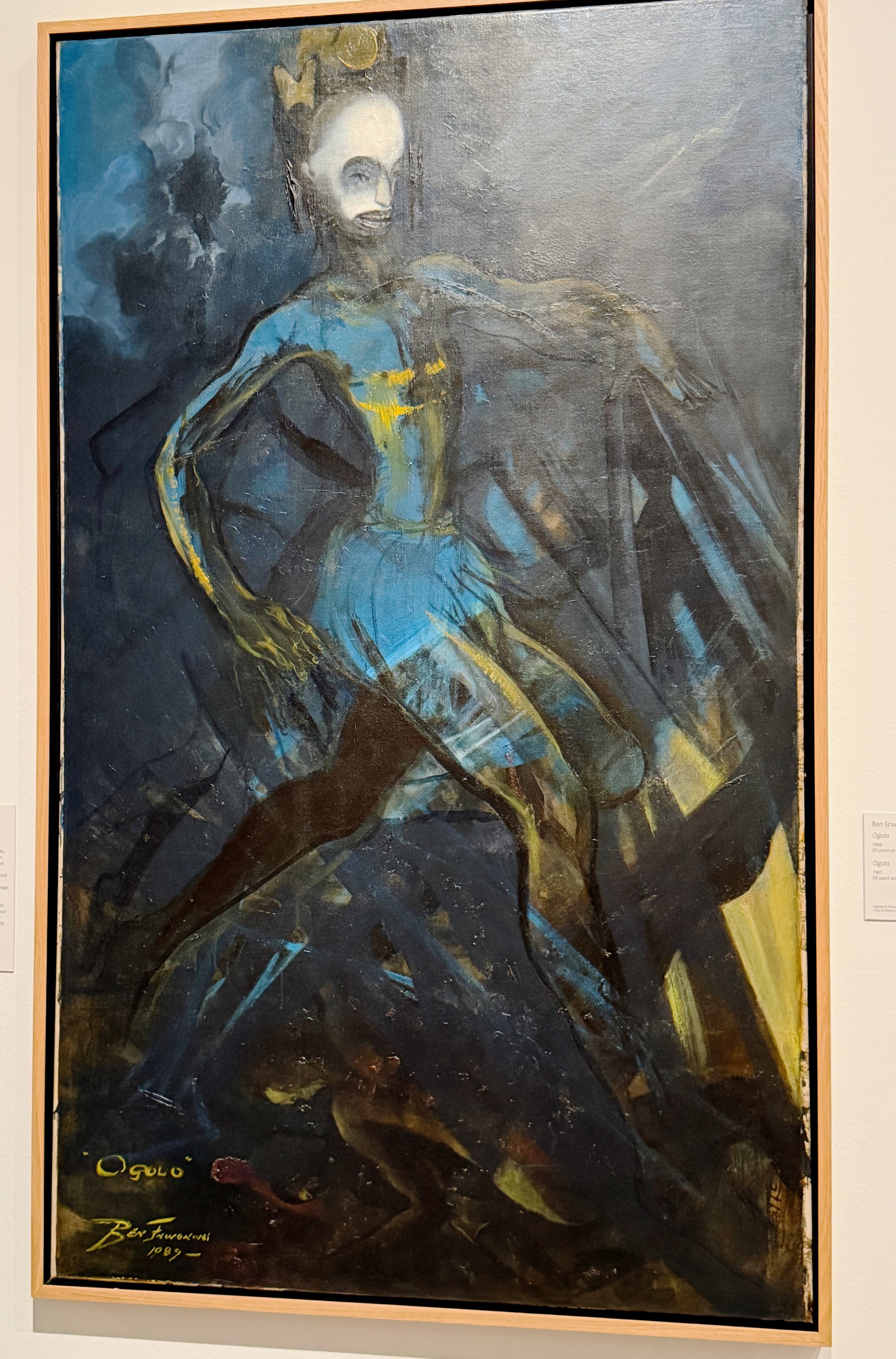
Ben Enwonwu’s masterful 1986 painting Ogolo with an Igbo masquerade figure showing how to transition from this world to the next. Courtesy: Osahon Okunbo Foundation.
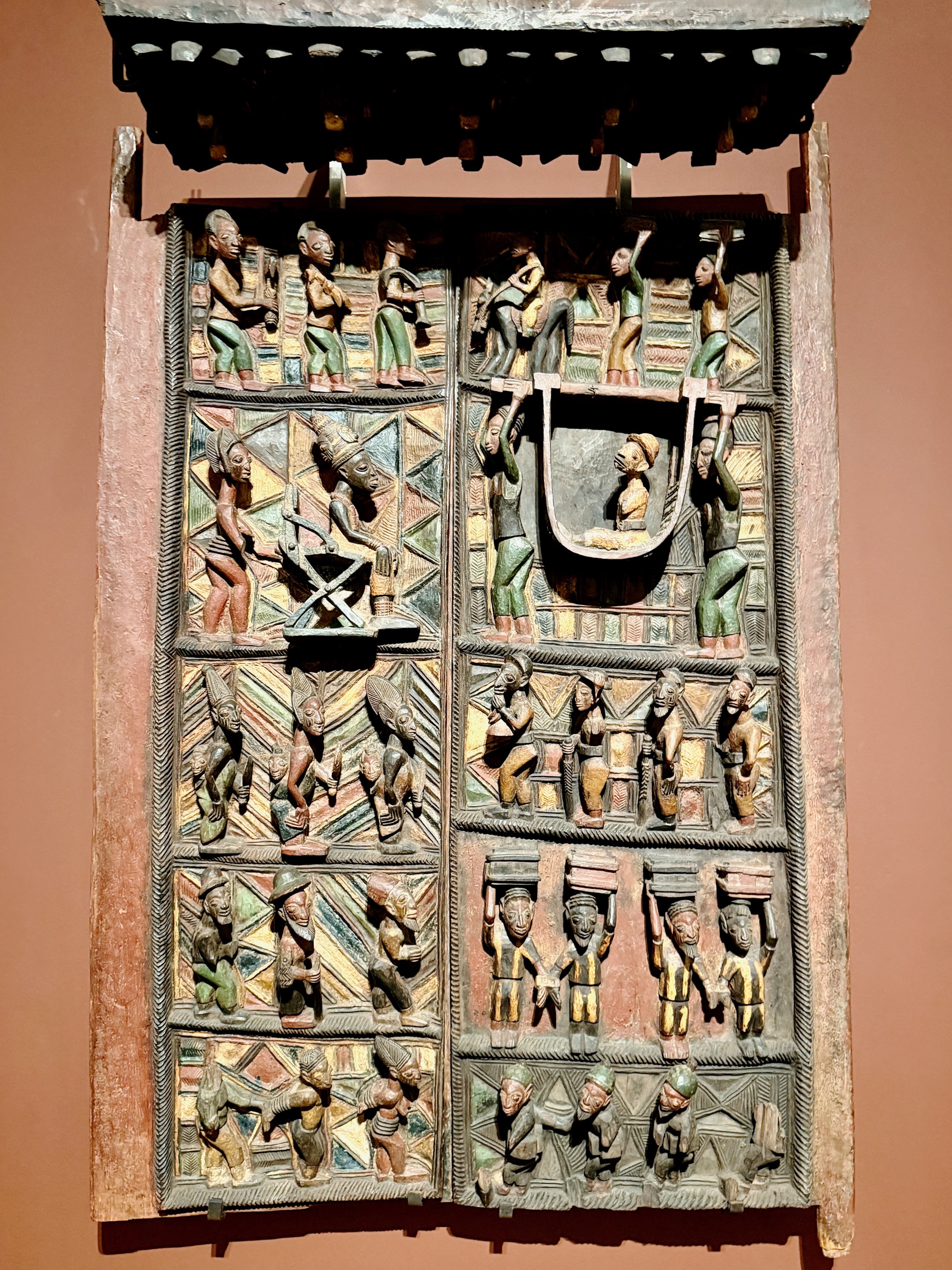
Early moderns: Olowe of Ise’s 1910-1914 carved and painted double doors showing Ogaga the king of Ikere and his wife receiving the British ambassador in Ondo province in 1895; exhibited at the Nigerian Pavilion in 1924 British Empire Exhibition. Courtesy: British Museum.

See some of our favorite works in our Flickr album.

The modernist tour begins with an introduction to artists who paved the way before Nigeria became an official colony of Great Britain in 1914 – such as late 18th-early 19th century photographer Jonathan Adagogo Green – and Aina Onabolu, a self-taught artist who went to Europe in the 1920s for academic art training. He then returned to Nigeria to create and implement a secondary-school art curriculum that taught young artists how to use European art techniques (perspective, color theory, easel painting) to depict Nigerian subjects.

Onabolu’s work was significant, since colonial schools had none. They were trying to create turn students into perfect “British” civil servants and missionary schools were out to destroy ethic Nigerian practices and symbols.

In this first gallery, you see work by the next generation of figurative artists who came of age during British rule, traveled to Europe, and blended what they learned with African subjects – traditionally inspired sculptures by globe-trotting Yoruba carving advocate, Lamidi Olonade Fakeye; portraits and scenes by modernist pioneer Akinola Lasekan; modern sculptural influencer Justice D. Akeredolu; and works by sculptor Felix Udabor, who opened the first contemporary gallery in Lagos.
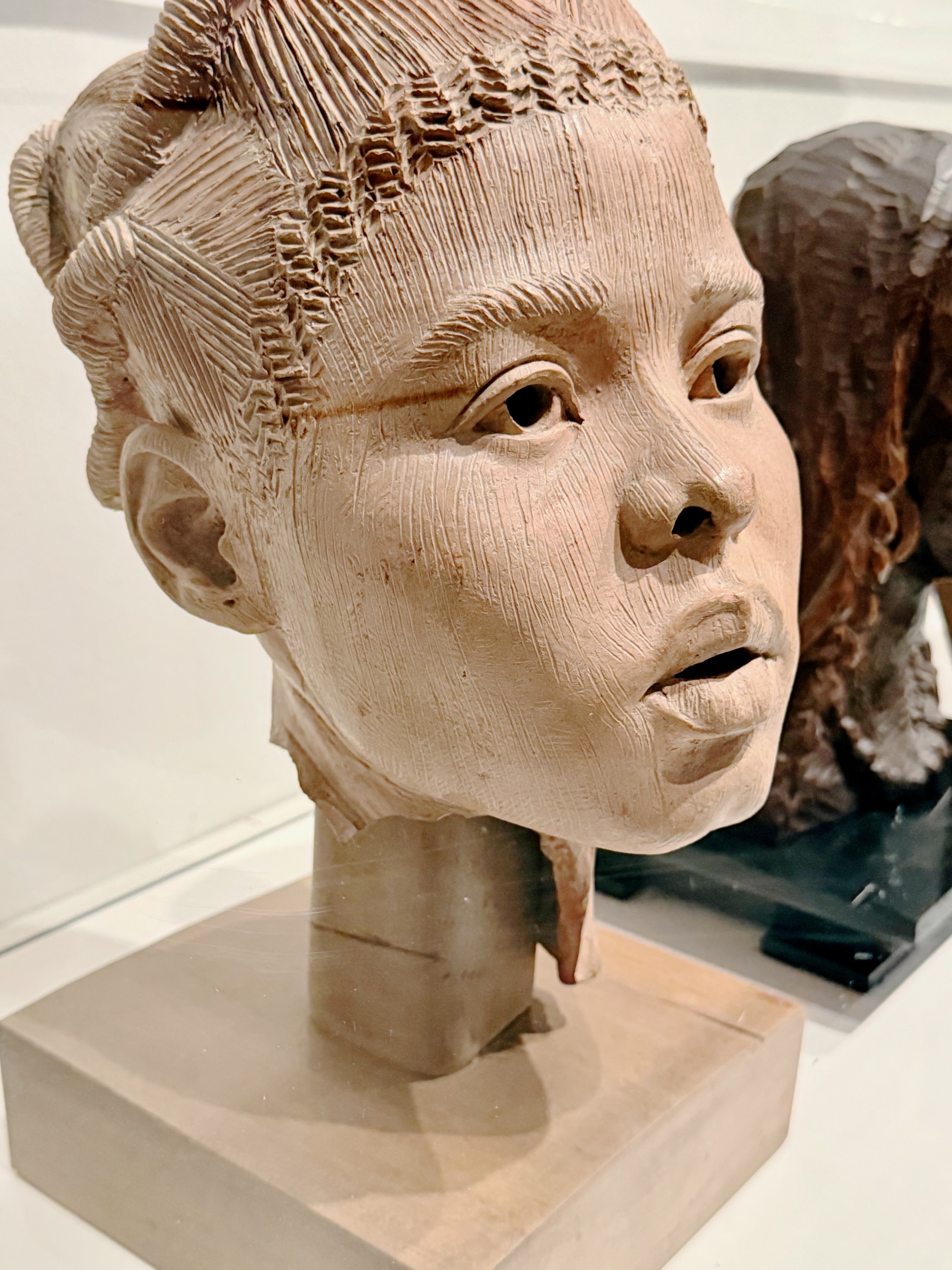
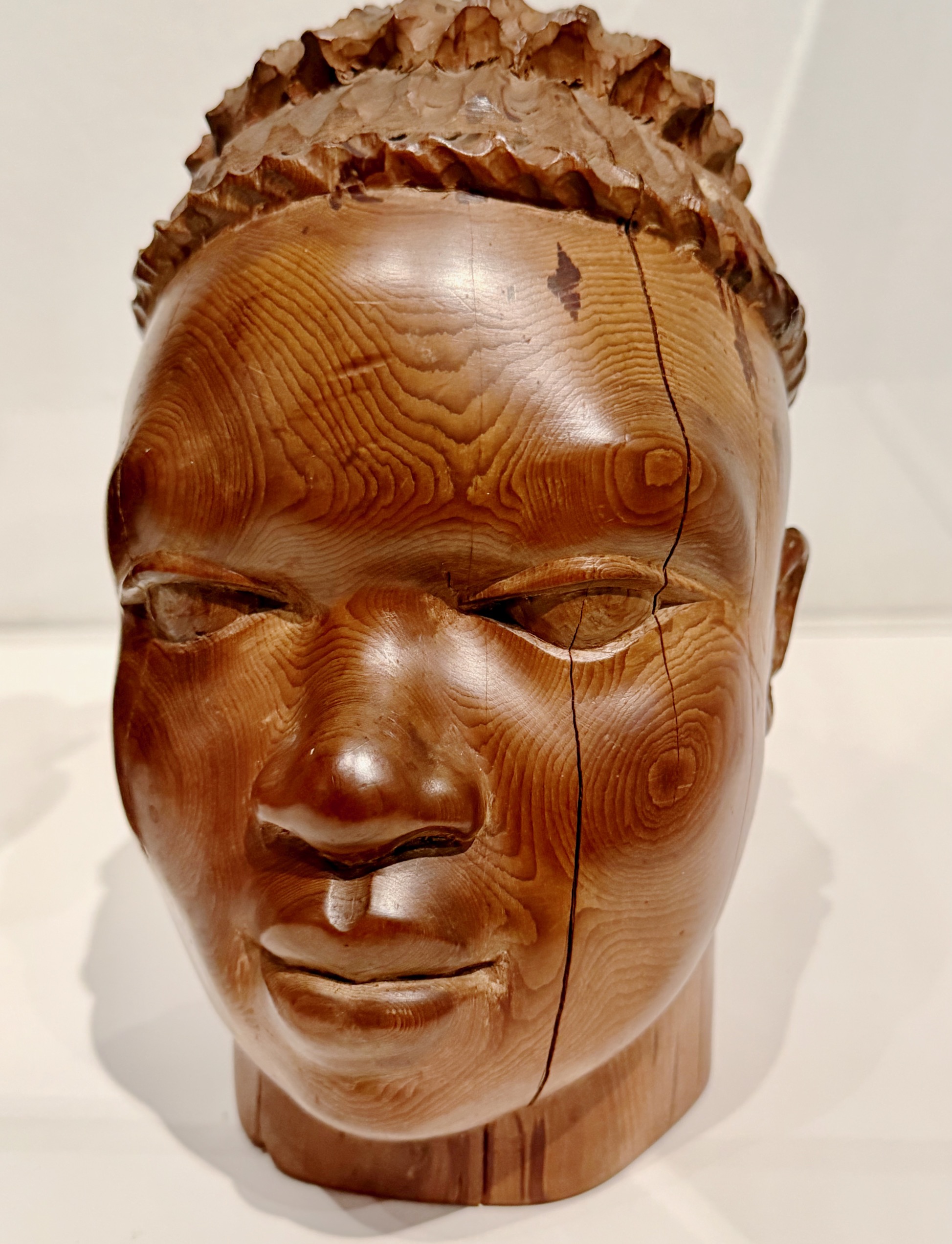
Abayomi Barber’s undated Ola Edu I, a terracotta bust of a Yoruba woman that blends European and Yoruba artistic traditions. Courtesy: private collection.
Acclaimed Benin carver Felix Udabor’s regal 1930s Head of A Girl. Courtesy: University of Birmingham collections.

This room leads to a spectacular display of dramatic modernist ebony figures by Africa’s first internationally recognized modern painter, Ben Enwonwu. The room is a mini-retrospective of his work, from early student sculpture that has a Henry Moore influence to a self-portrait and larger, more emotive gestural work.
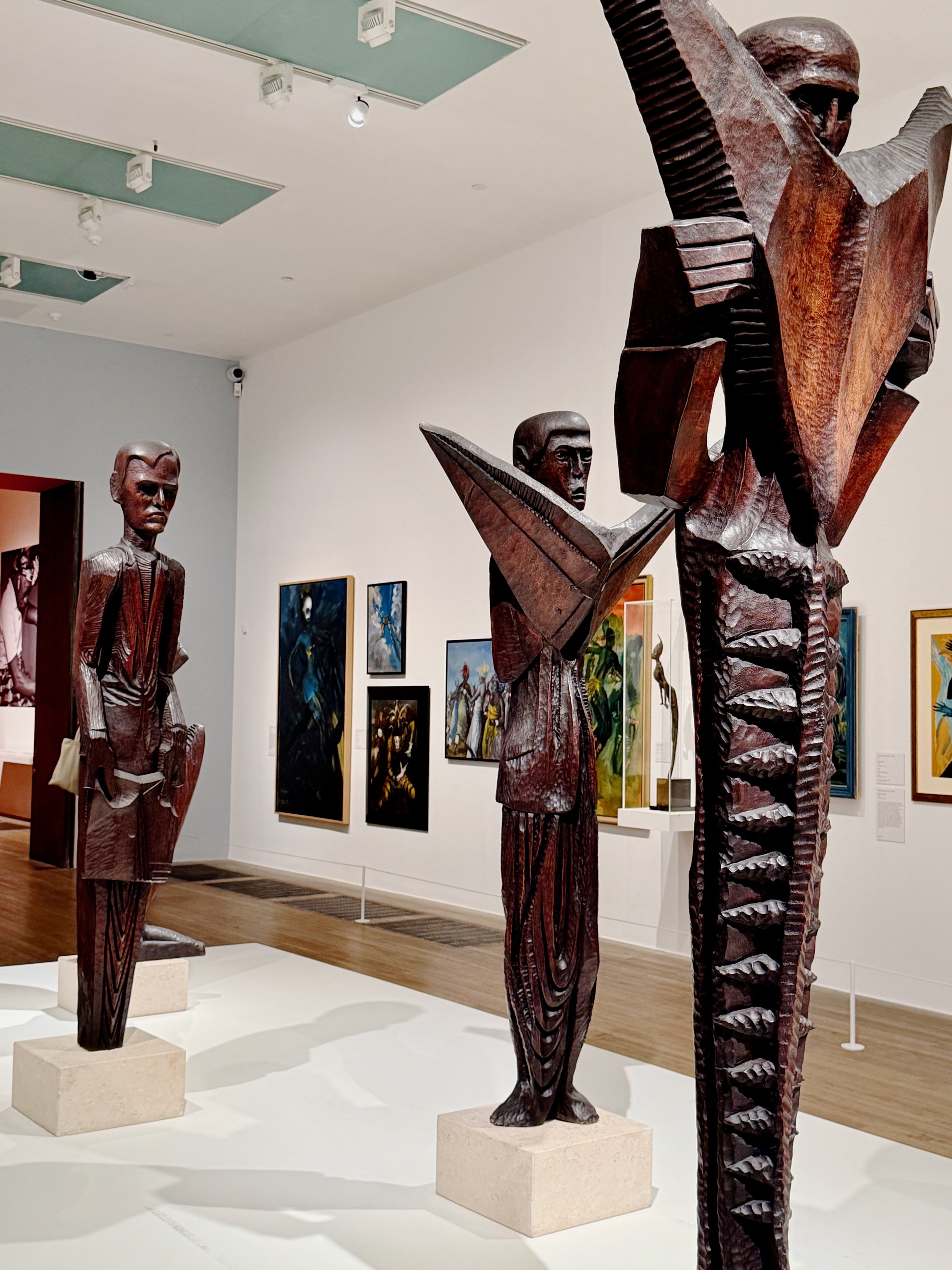
Ben Enwonwu’s 1961 ebony series Seven Wooden Sculptures Commissioned by The Daily Mirror surrounded by a retrospective of his modern paintings. Courtesy: Access Holdings Plc
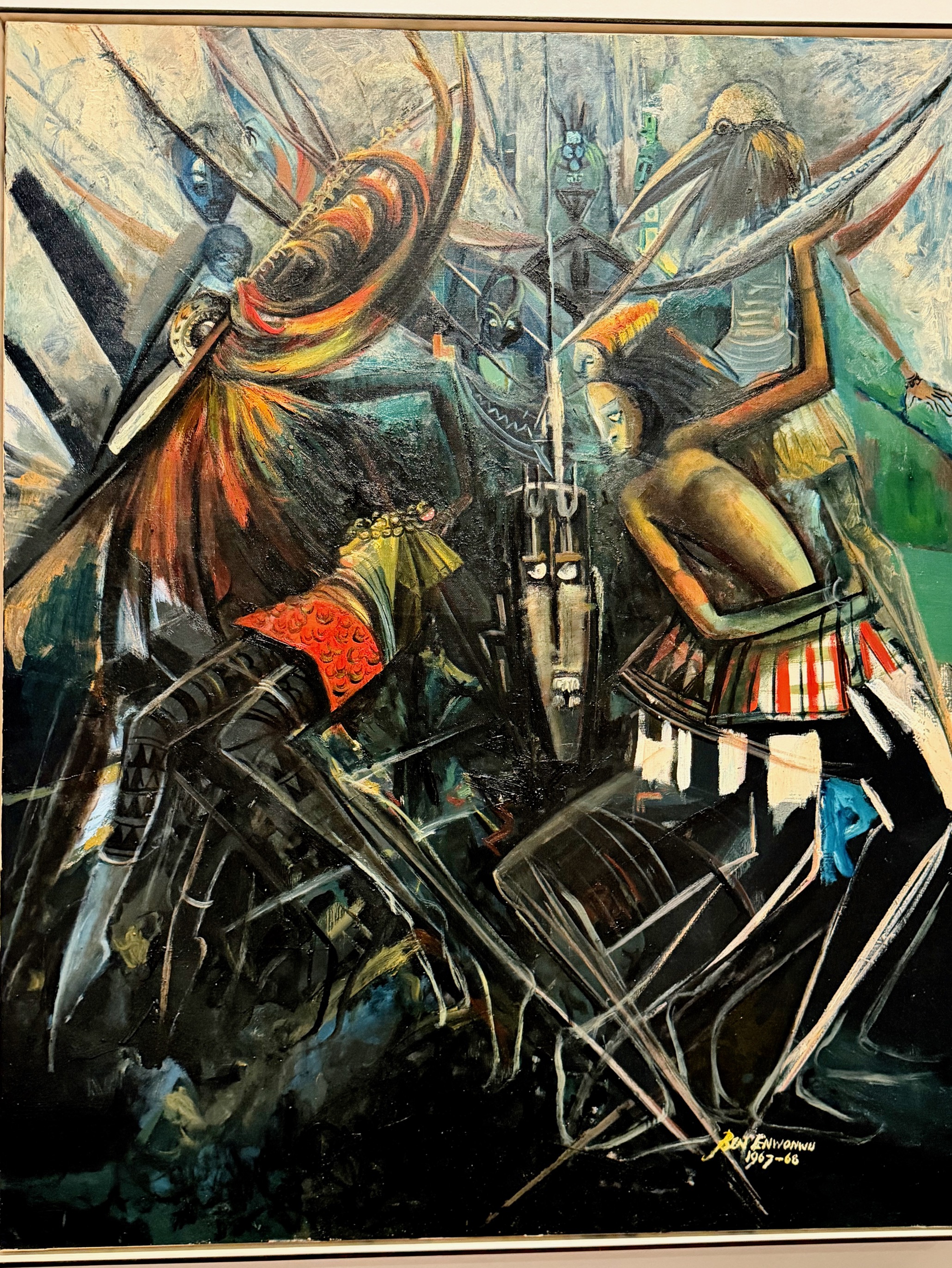
Ben Enwonwu’s 1967-1968 Crucified Gods Galore – an invocation of ancestral dancing, masked, frenzied spirits evoking the chaos of the Nigerian Civil War. Courtesy: private collection

Born into an esteemed Nigerian family, Enwonwu was championed as a young artist by the top British art educator in the colony, and a received scholarship to train in London. He soaked up post-War artistic trends, exhibited extensively, toured and lectured across the United States, and sculpted the Queen when she visited Nigeria. Yet, through it all, he was blunt about repression under the colonial regime and advocated for the African Nationalist movement. Nigeria won its independence in 1960.
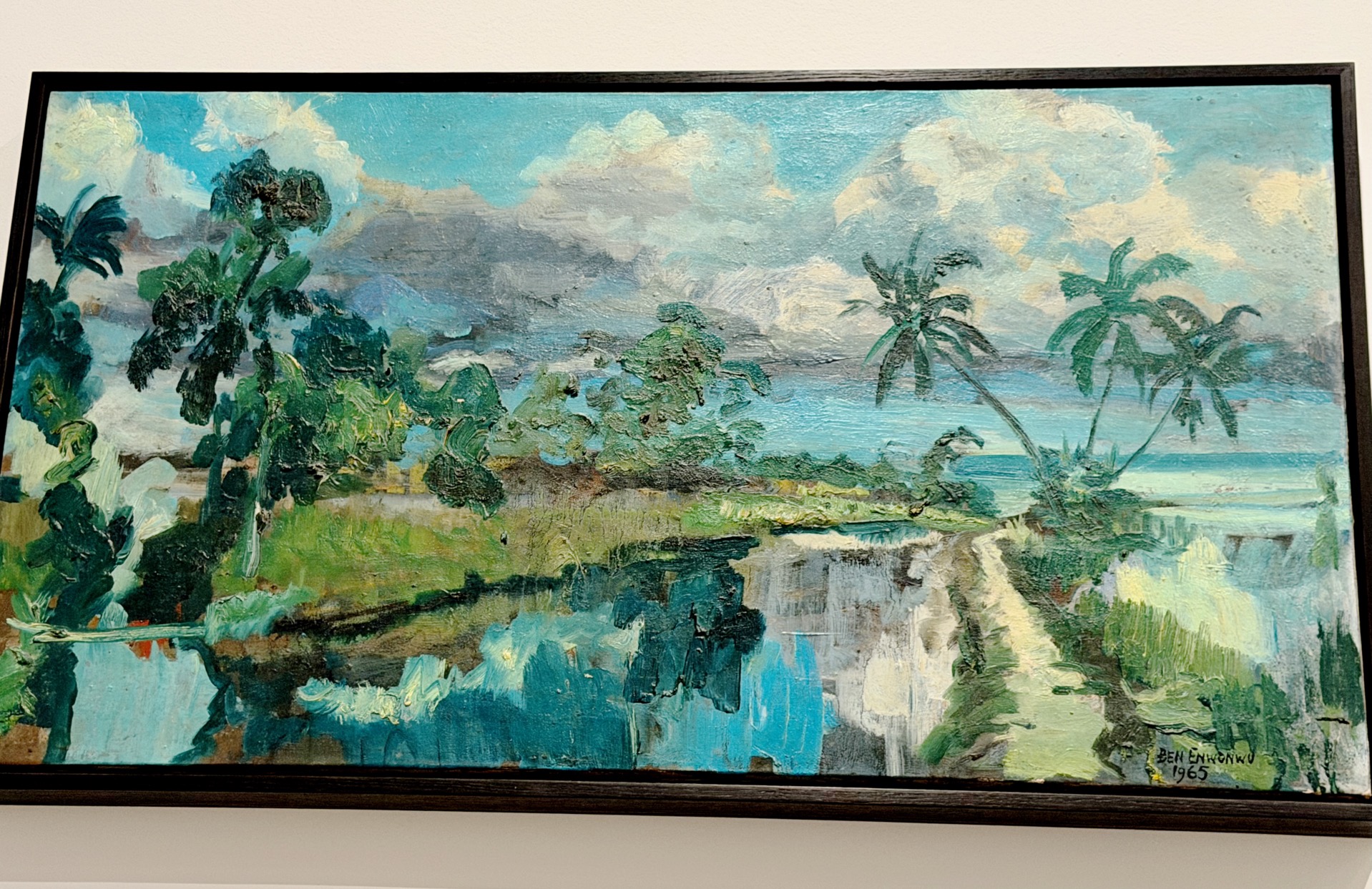
Ben Enwonwu’s 1965 oil River Niger Landscape. Courtesy: private collection.

The next gallery shows the work and legacy of Nigerian art ambassador Ladi Kwali, who transformed traditional forms of earthenware into high-fired glazed modern art admired and collected worldwide.

With independence, formally trained artists, writers, poets, and dramatists formed associations to usher in new, more expressive works across all media – work that reflected a Nigerian sensibility, not just Europe’s. Pop music and new art flourished and Lagos nightclubs ruled. Successive exhibition galleries hone in on trends in different cities and geographic regions throughout Nigeria.  

There’s a room dedicated to work by artists who wrote the manifesto for and created the legendary Zaria Art Society –Emmanual Okechukwu Odita, Bruce Onobrakpeya, Yusuf Grillo, Uche Okeke, Demas Nwoko, and Oseluka Osadebe. They wanted art to reflect Nigeria’s cultures – all of them, including Islam and Christian religions as well as traditional ethnic practices.
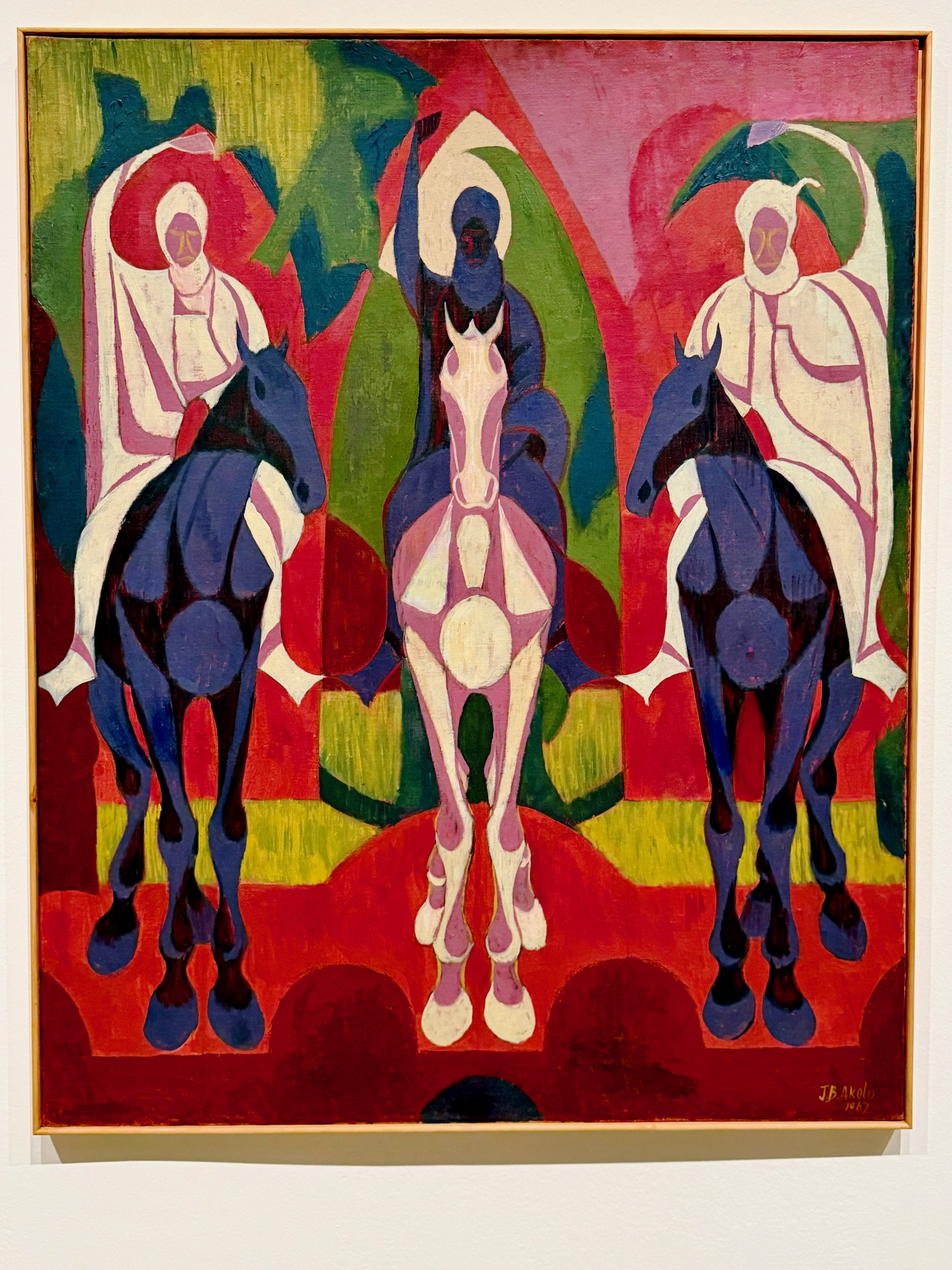
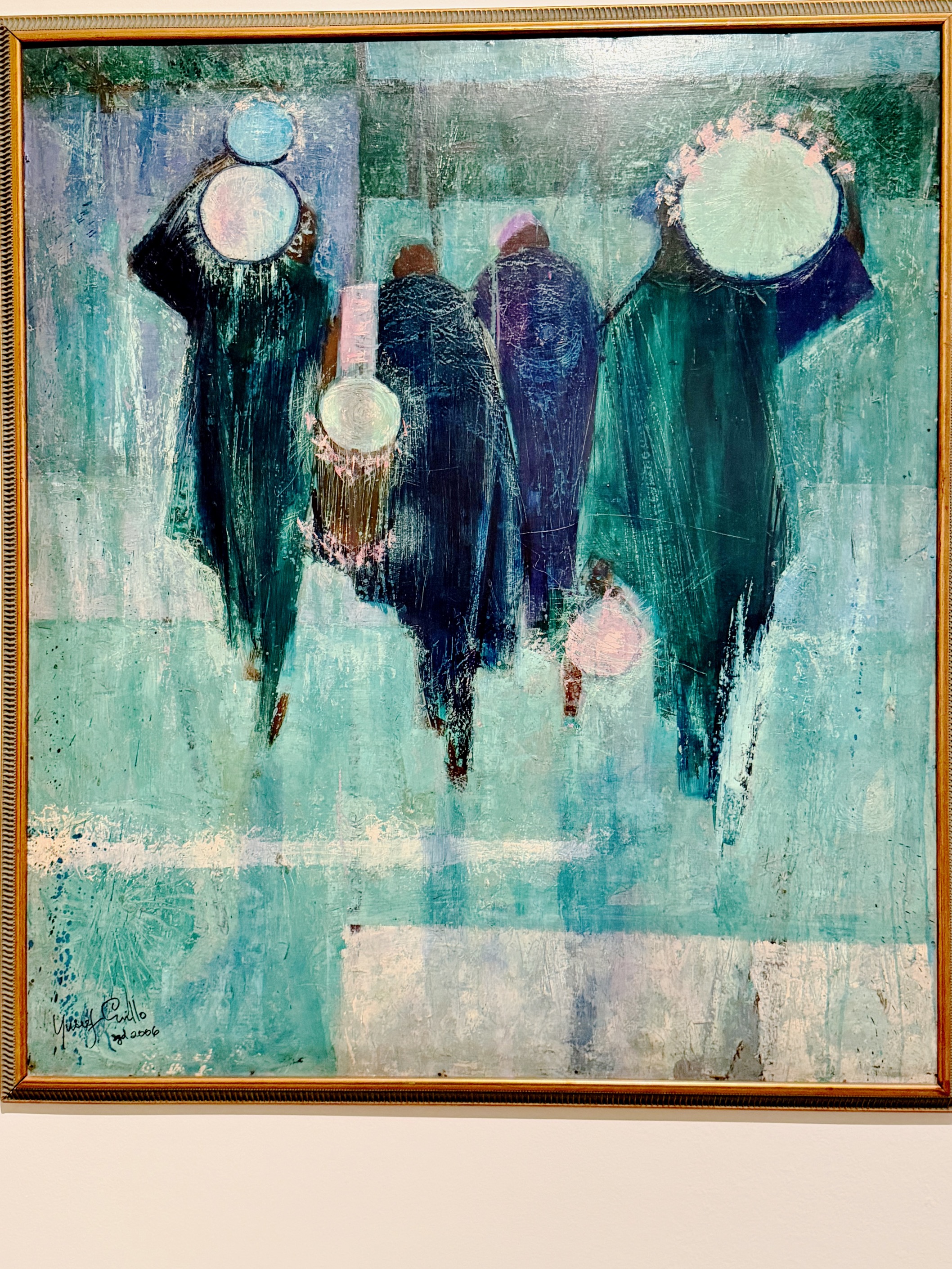
Zaria Art Society: Jimo Akolo’s 1962 oil painting Fulani Horsemen, who brought Islamic religion into northern Nigeria. Courtesy: Bristol Museum.
Zaria Art Society: Yusef Grillo’s 1983-1999 oil painting Drummers’ Return. Courtesy: Pan-Atlantic University’s Yemisi Shyllon Museum.

And the world was eager to see it, as exhibitions were organized and showcased overseas.
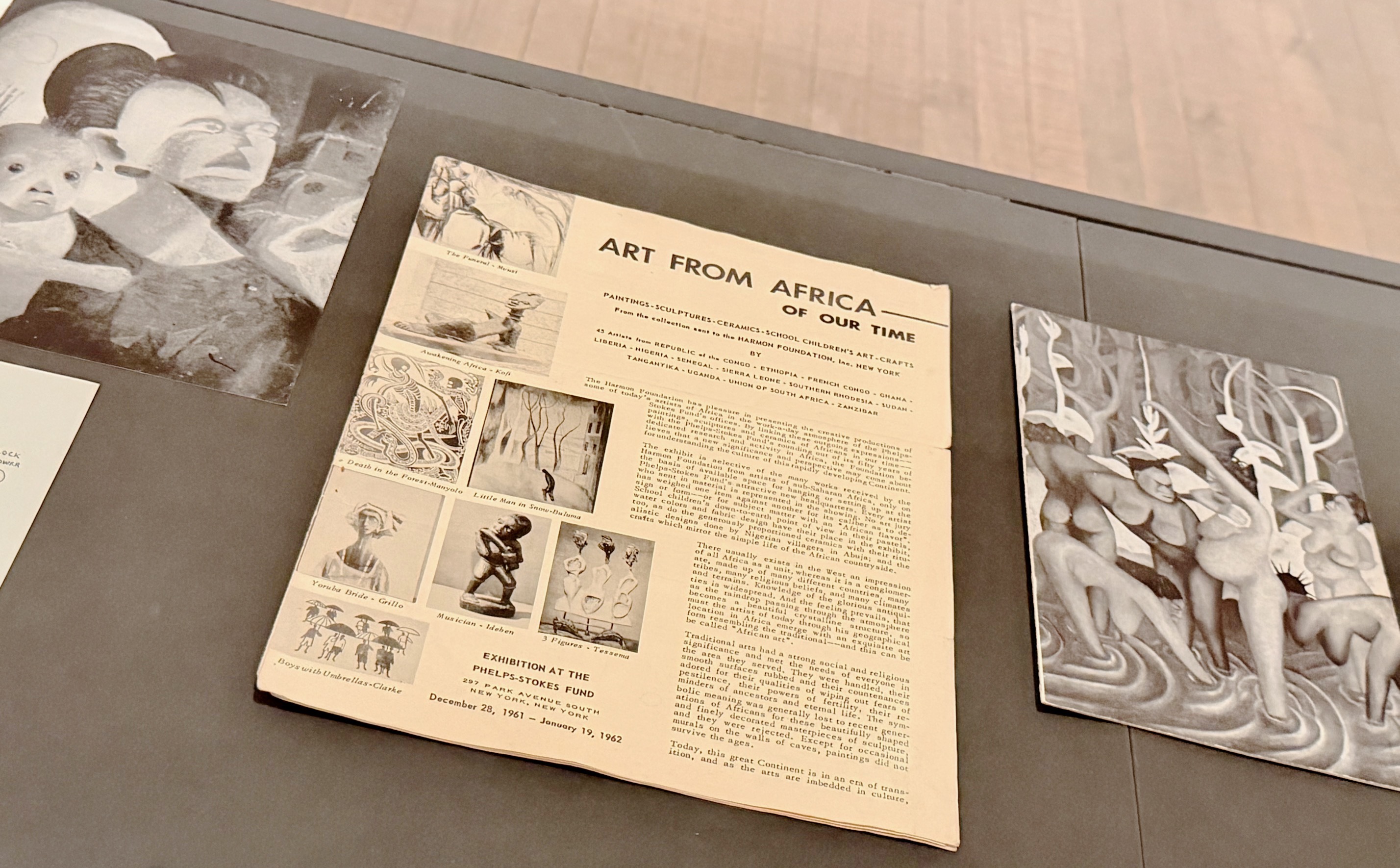
Art of new nation: 1961 publication Art from Africa of Our Time promoting an exhibition of modern African art in New York. Courtesy:  New Culture Foundation

The New Sacred Art Movement was happening deep in the 400-year-old Osun-Osagbo Sacred Groves of southwest Nigeria, where artist Susanne Wenger gathered committed individuals (bricklayers, concrete workers) and other artists to transform (and save) the forest by building ritual clearings and shrines. In 2005, UNESCO declared it a World Heritage Site.
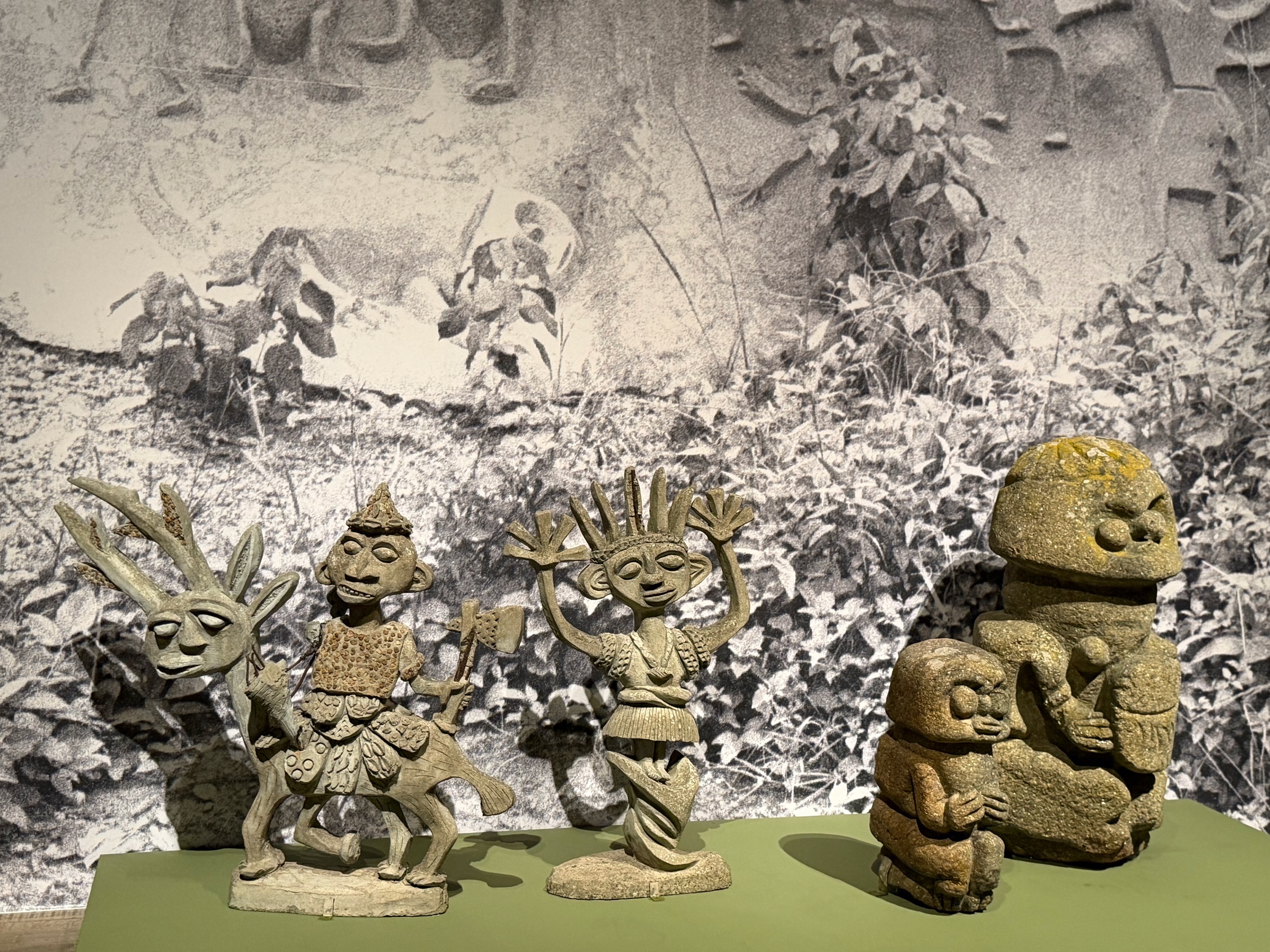
New art for the Sacred Forest: Against a background depicting the forests Osun-Osogbo Sacred Groves, sculptures from the shrine – Adebisi Akanji’s 1990s cement sculptures of river goddess Osun and war god Ogun Timeyin; and Buraimoh Gbadamosi’s 1980s stone sculptures of benevolent nature spirits, Sango and Osun. Courtesy: private collection.

The artists associated with The Oshogbo School lived in a community where Christian, Muslim, and Yoruba festivals and ceremonies were held side by side. The cultural center in Osogbo was active, inviting international artists to run workshops and sending out theatrical troupes to perform traditional stories in honor of the the region’s river goddess, Osun.

When theater leaders wanted more community involvement, they trained theater performers and technicians to run painting, printmaking, and textile workshops. Many workshop participants and teachers went on to create and innovate, as shown on the walls.
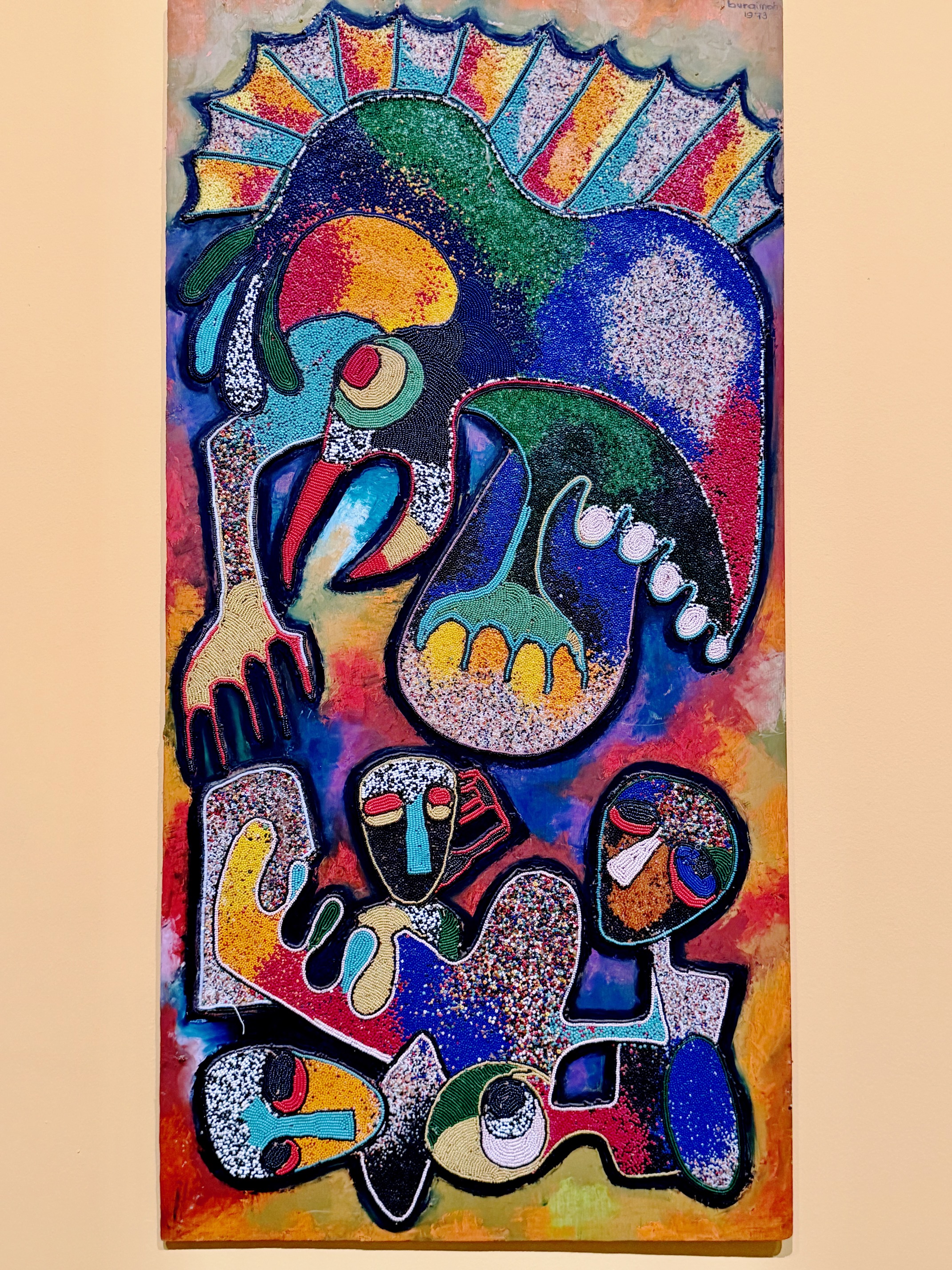
The Oshaogbo School: Jimoh Buraimoh’s 1973 beadwork panel Figural Abstract referencing traditional Yoruba beaded staffs, stools, and crowns. Courtesy: private collection.
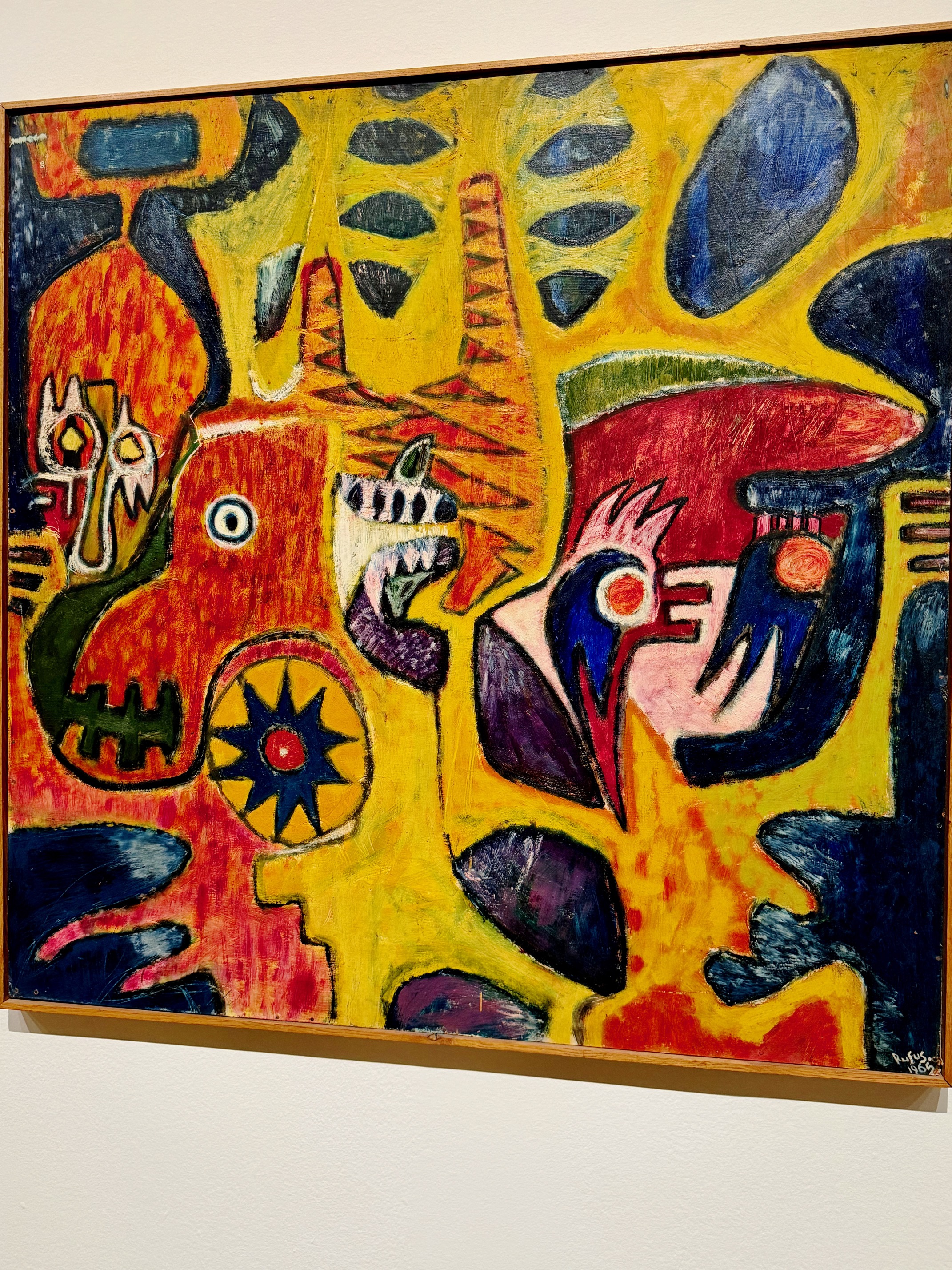
The Oshaogbo School: Rufus Ogundele’s 1965 oil painting Sacrifice to Ogun, God of Thunder. Courtesy: private collection.

The Nsukka School developed at University of Nigeria, whose students were from a wide range of ethnic backgrounds. Uche Okeke was invited to lead the art department, and asked students to use art to “reclaim” indigenous culture toward the end of the 1960s after Nigeria’s tumultuous civil war. Artists mixed symbols from different ethnic traditions and produced powerful work.
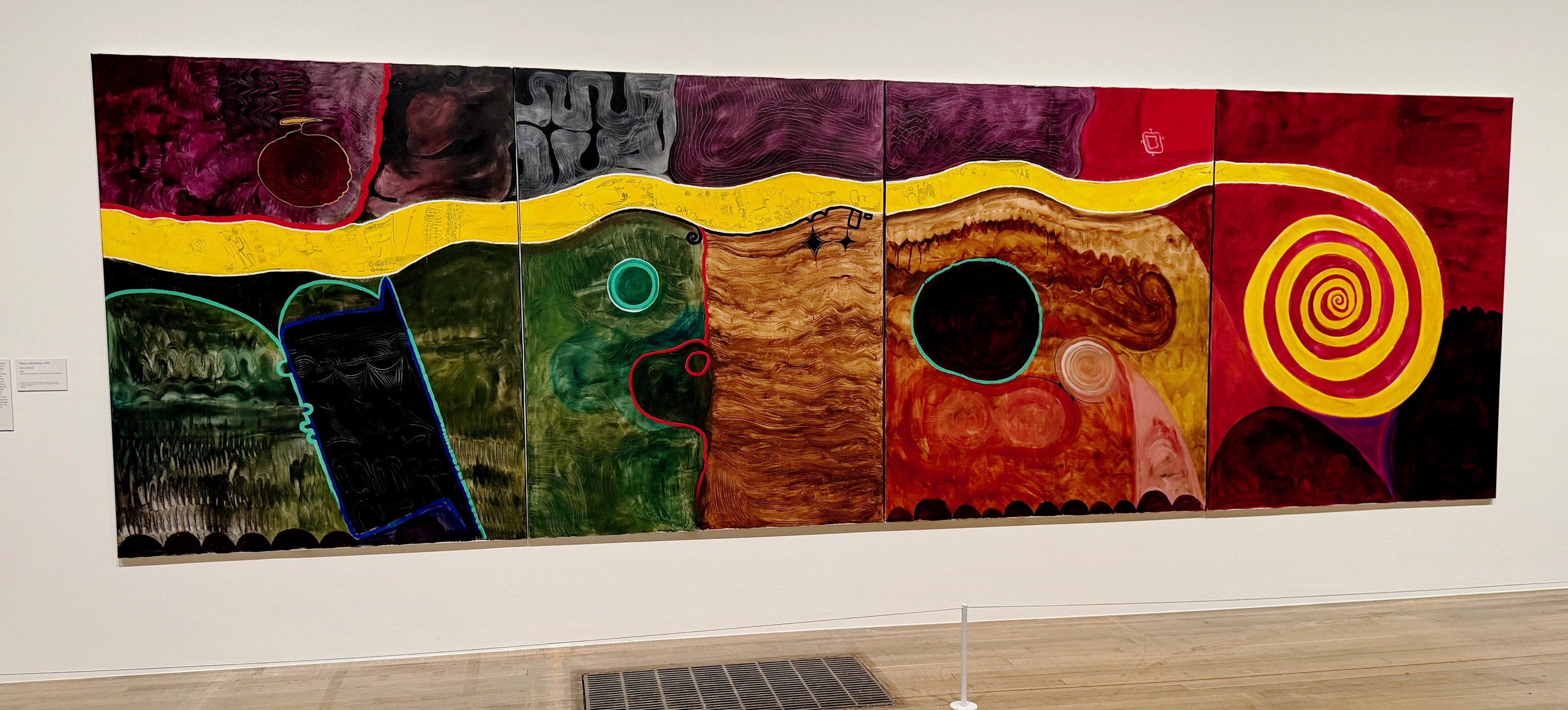
Nsukka School: Obiora Udechukwu’s 1993 four-panel ink and acrylic painting Our Journey – referencing the political unrest in Nigeria following the 1993 election when the military government refused to release election returns to maintain power. Courtesy: Hood Museum of Art, Dartmouth.
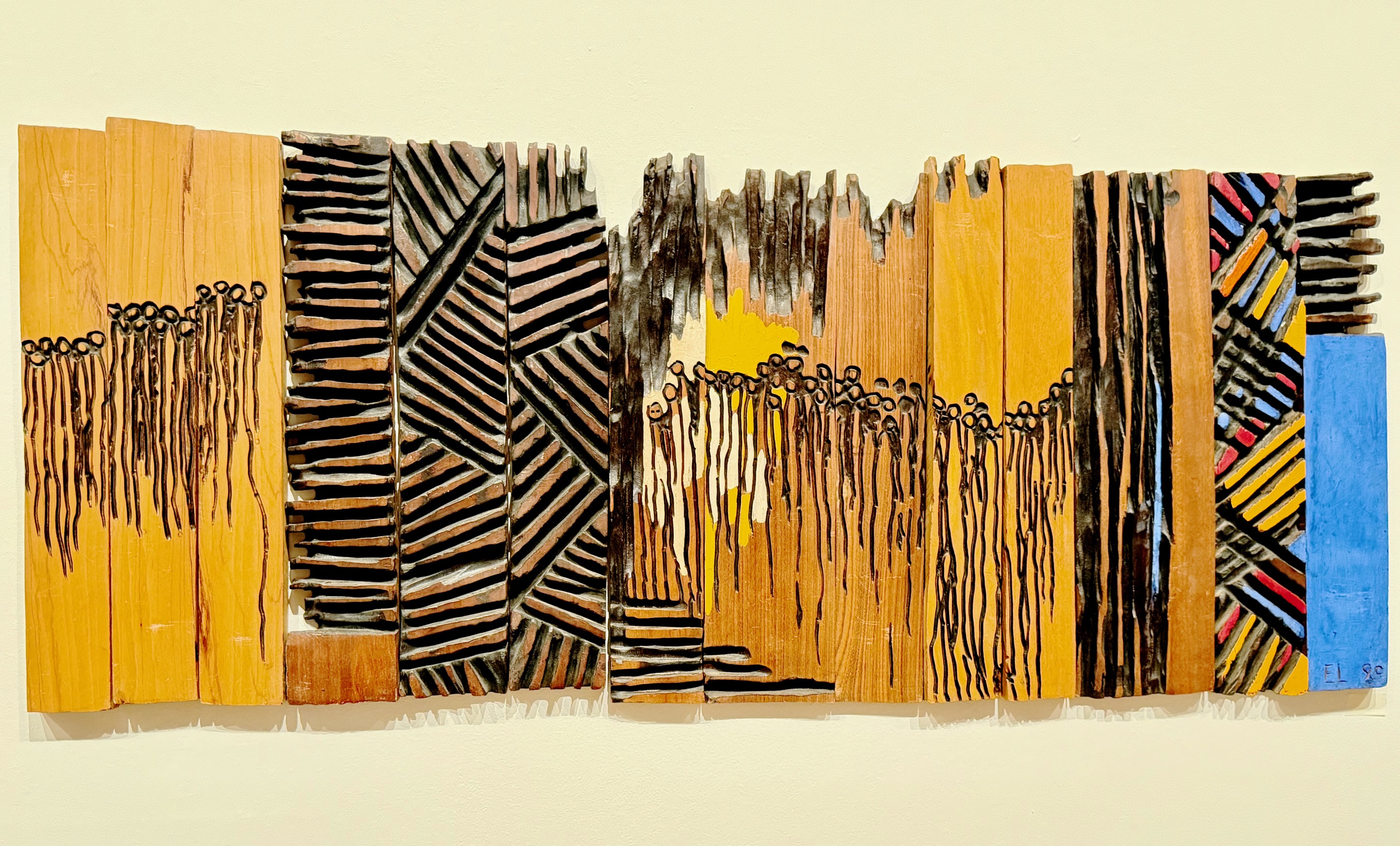
Nsukka School: El Anatsui’s 1965 tempera and house paint on tropical hardwood Solemn Crowds at Dawn.

The final gallery showcases the work of Uzo Egonu, a Nigerian artist who left his homeland for a successful career abroad as an innovator in the British Black Art Movement. He’s a keen observer of the events, changes, and tumult that have rocked his home country, and through his work cheers on those whose work continues there.
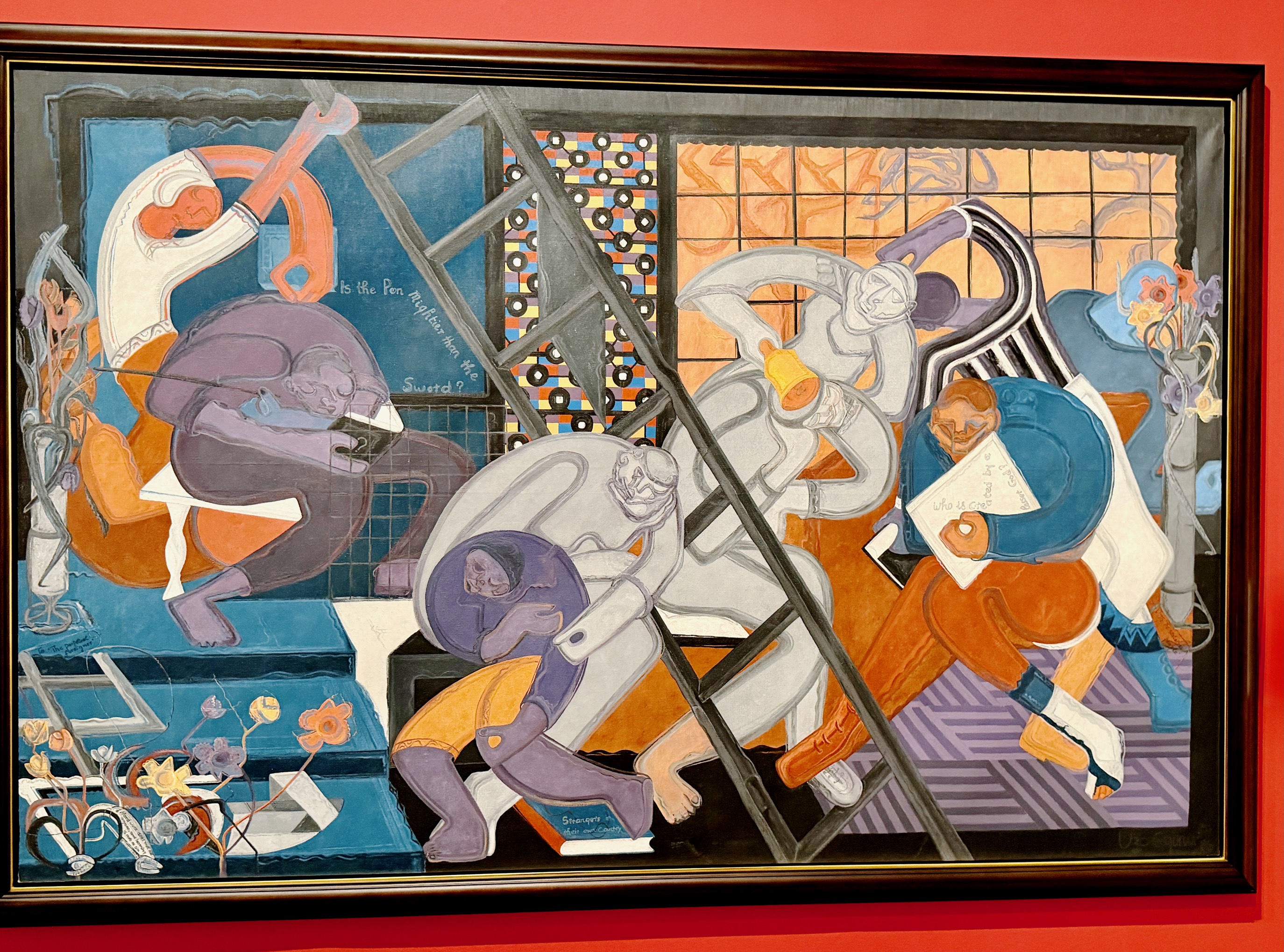
Uzo Egonu’s 1985 oil painting Will Knowledge Safeguard Freedom 2 – a reflection on the potential of the creative arts and technical advancements to improve a free society. Courtesy: private collection

For a glimpse of life inside a Lagos gallery today, meet chief Nike davies-Okundaye, one of Nigher’s best-known textile artists and painters. It’s a recent video produced by the Tate in honor of living artists carrying on modern legacies of this extraordinary exhibition:

To read the Tate guidebook for this show, click here.
Weaving Meanings into Colorful South African Art

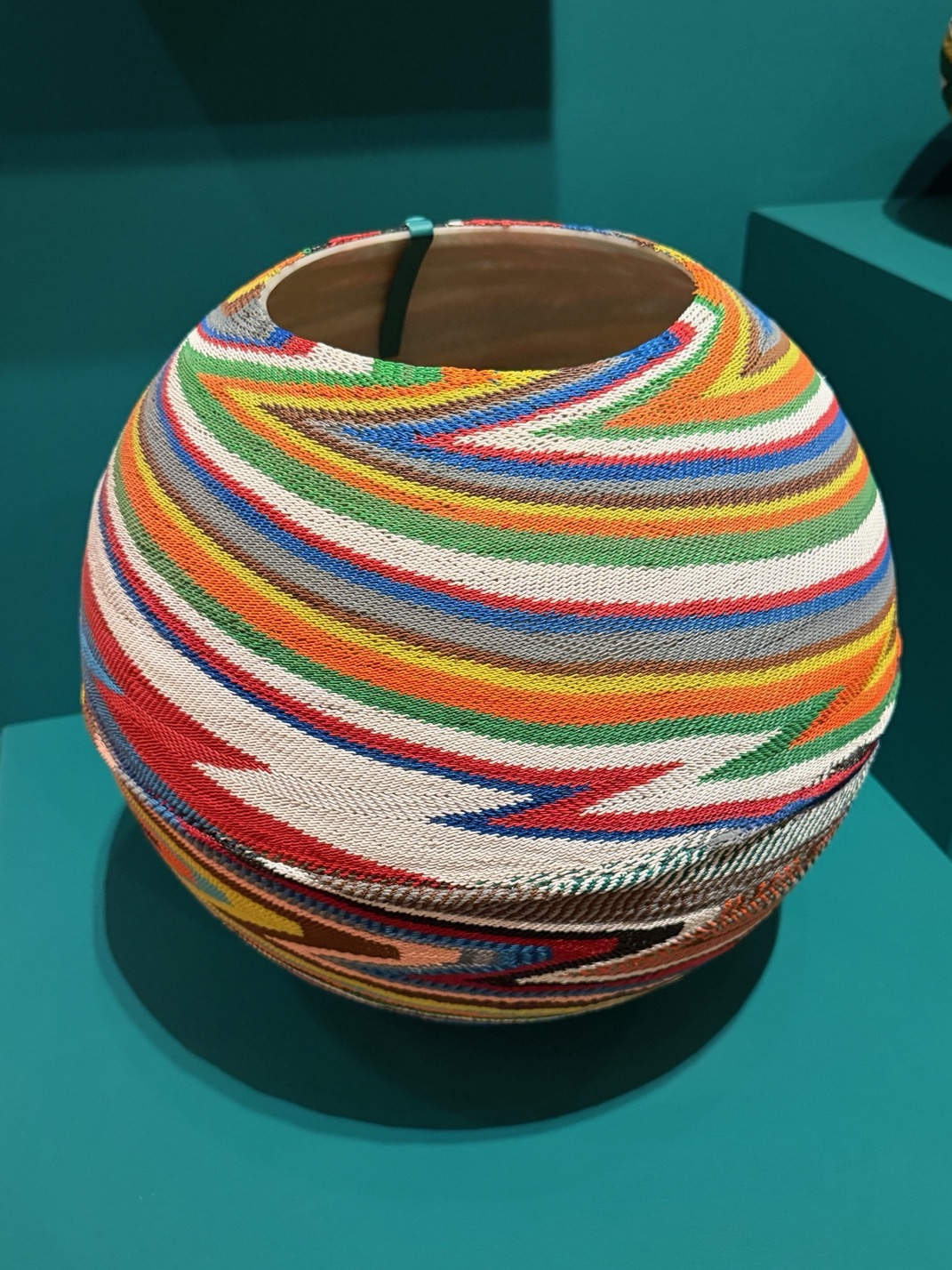
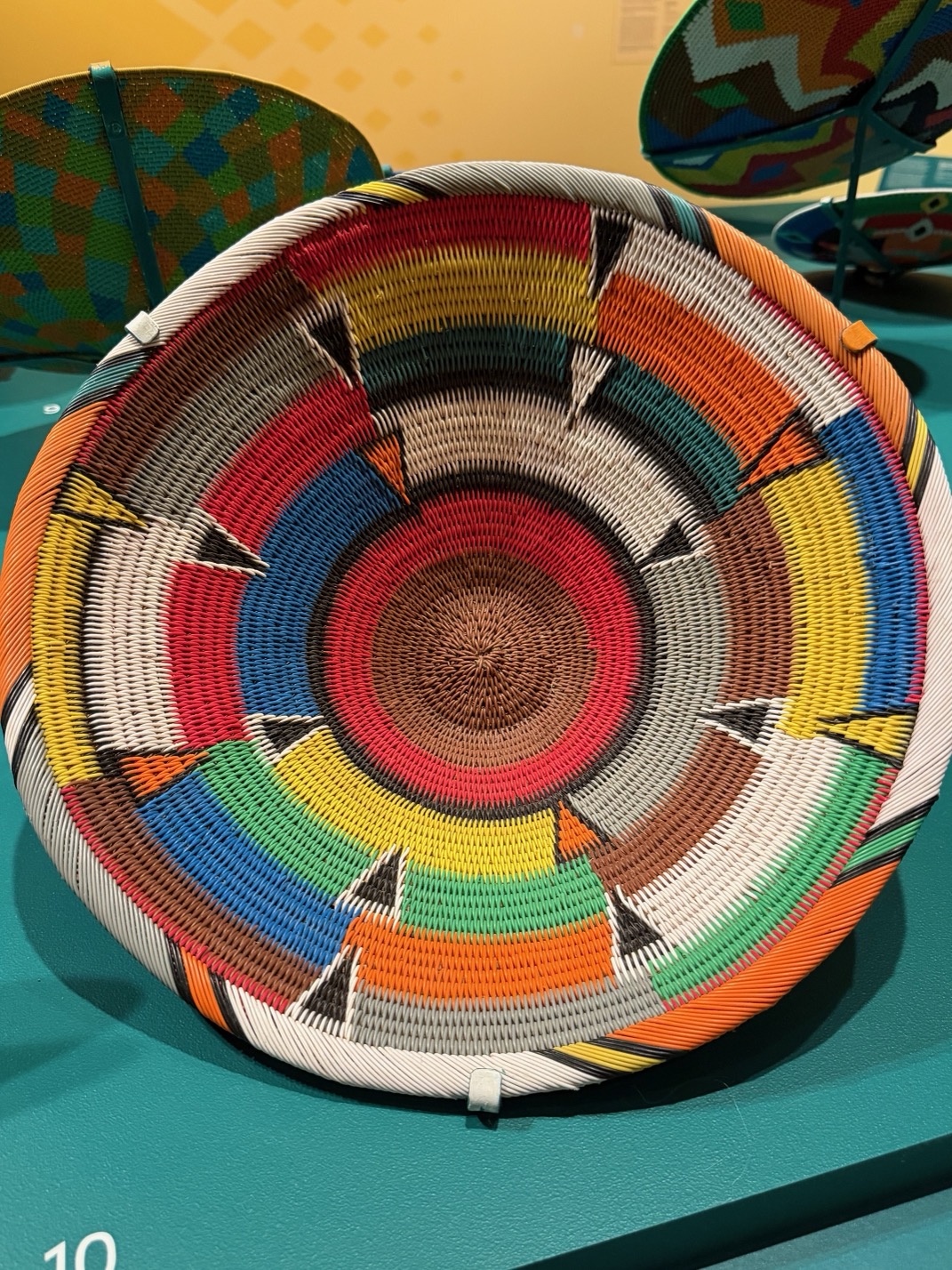
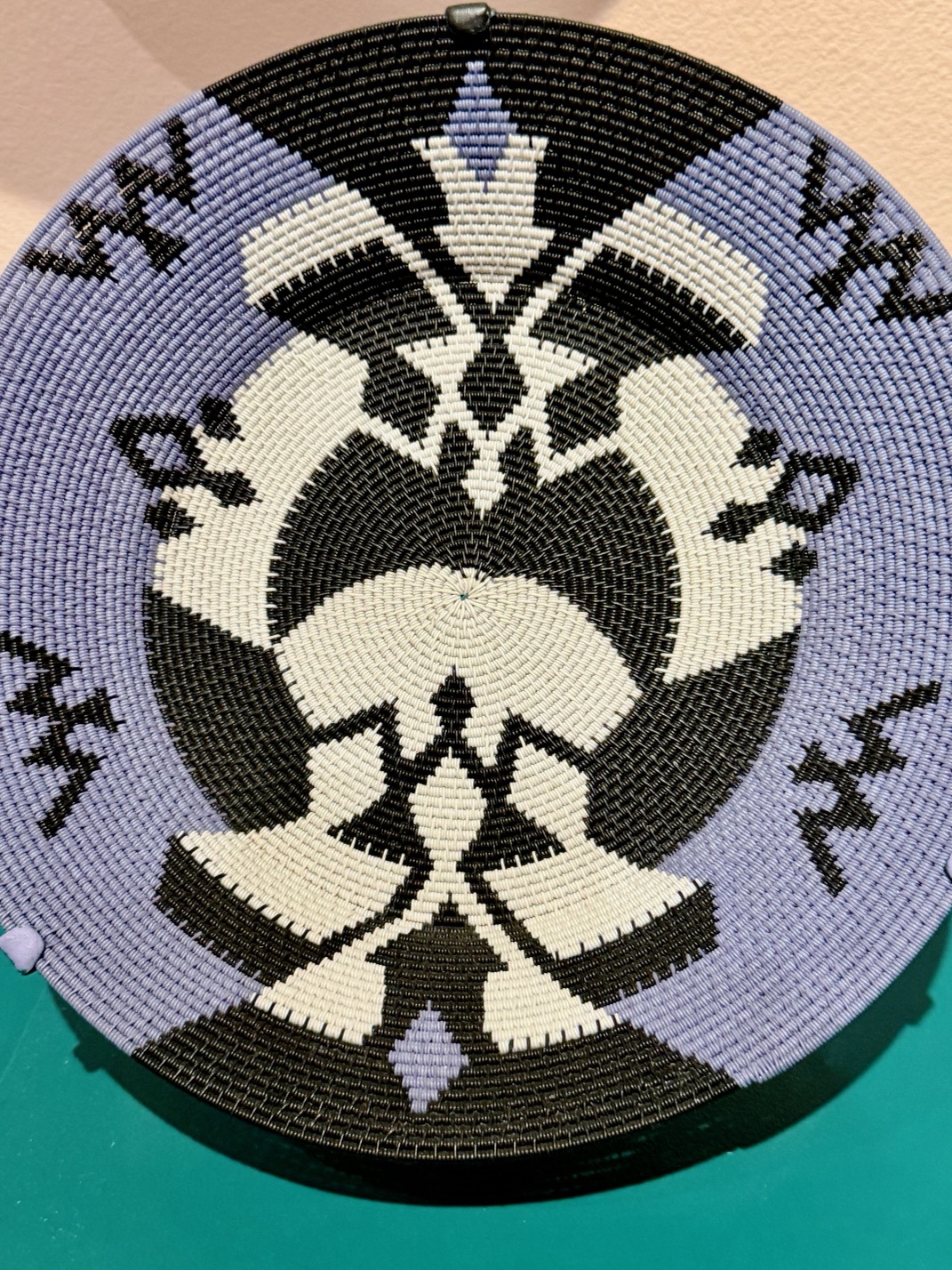
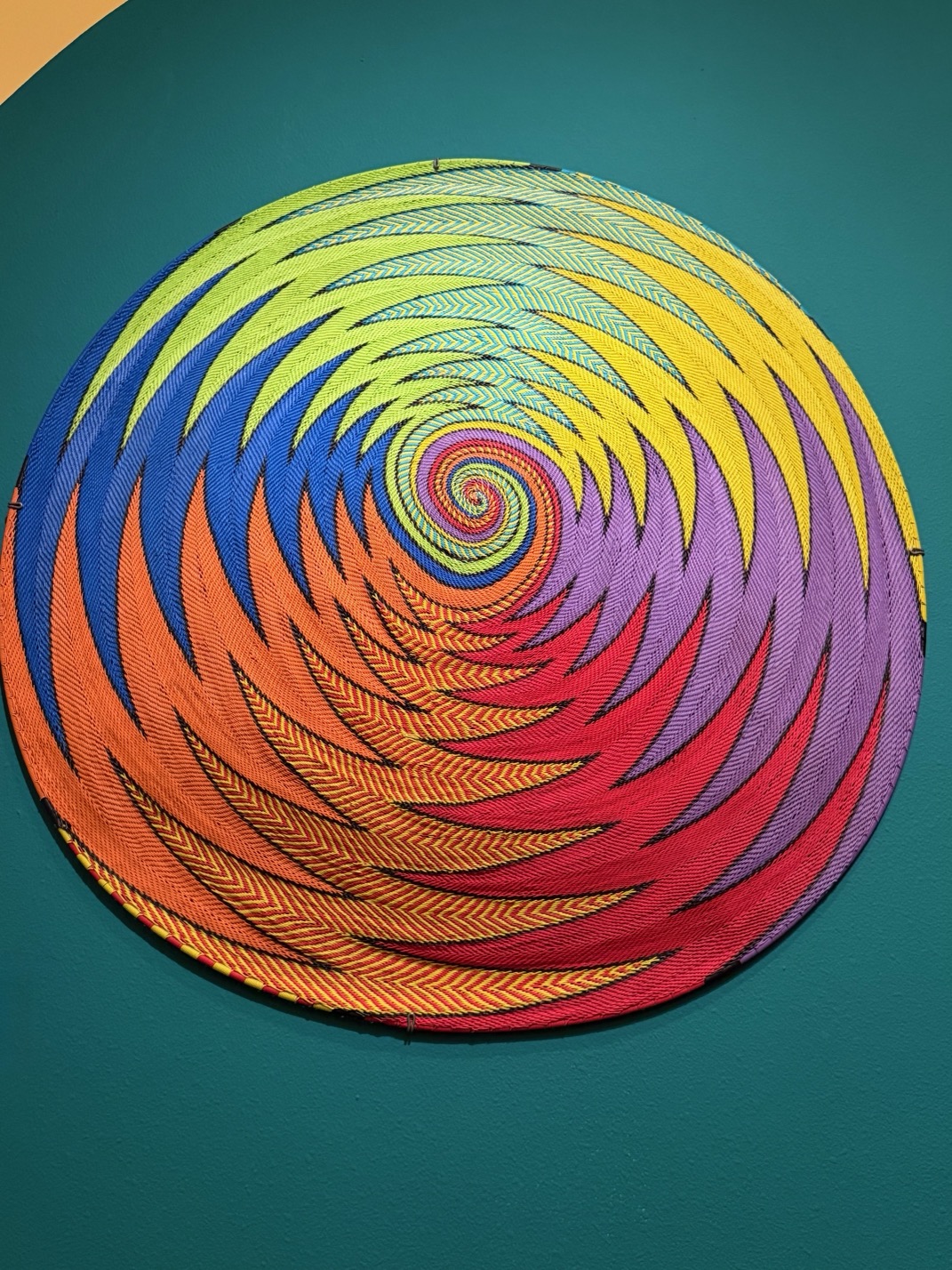
How do you take a domestic beer pot and lid and turn it into art? Take a look at the dazzling designs on display in the first museum exhibition dedicated to one of the most unique art forms to blossom in post-Apartheid South Africa – iNgqikithi yokuPhica/Weaving Meanings: Telephone Wire Art from South Africa, on view at Santa Fe’s International Museum of Folk Art through March 29, 2026.

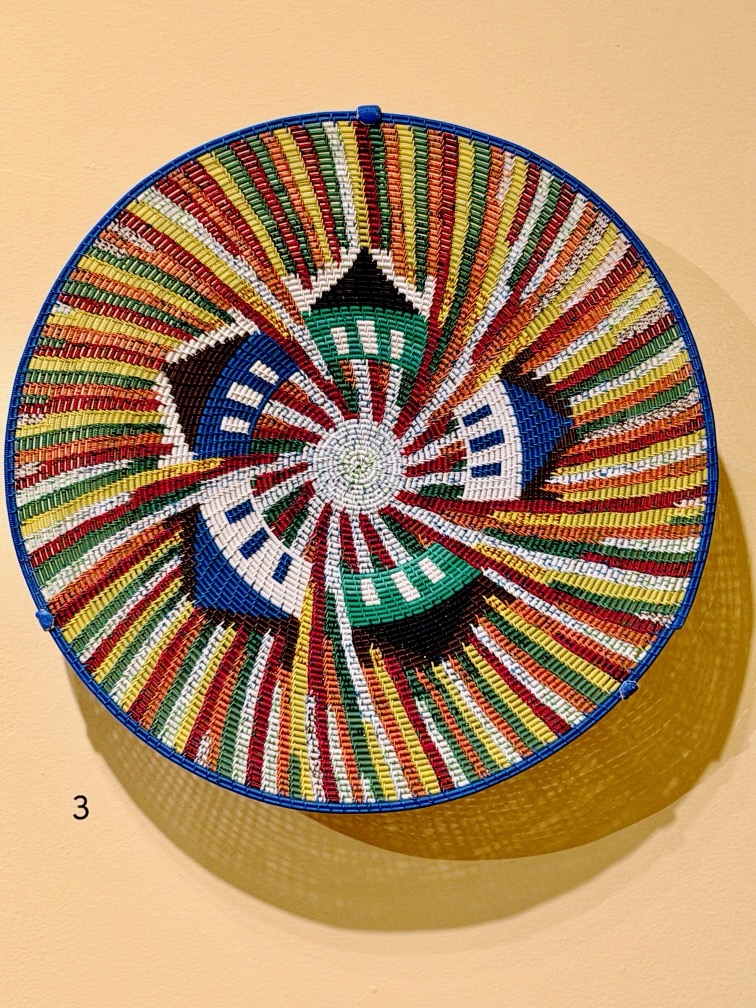
It’s easy to be overwhelmed at the the intricacy of the colorful, whirling designs that first meet your eye. But when you slow down to look more closely, all sorts of meanings appear – ancient tribal writing, village scenes, Zululand wildlife, patriotic emblems, and even celebrated achievements in the sports world

Dudu Cele’s 1990s The New South Africa telephone-wire weaving celebrating the end of apartheid featuring the colors of the nation’s new flag.
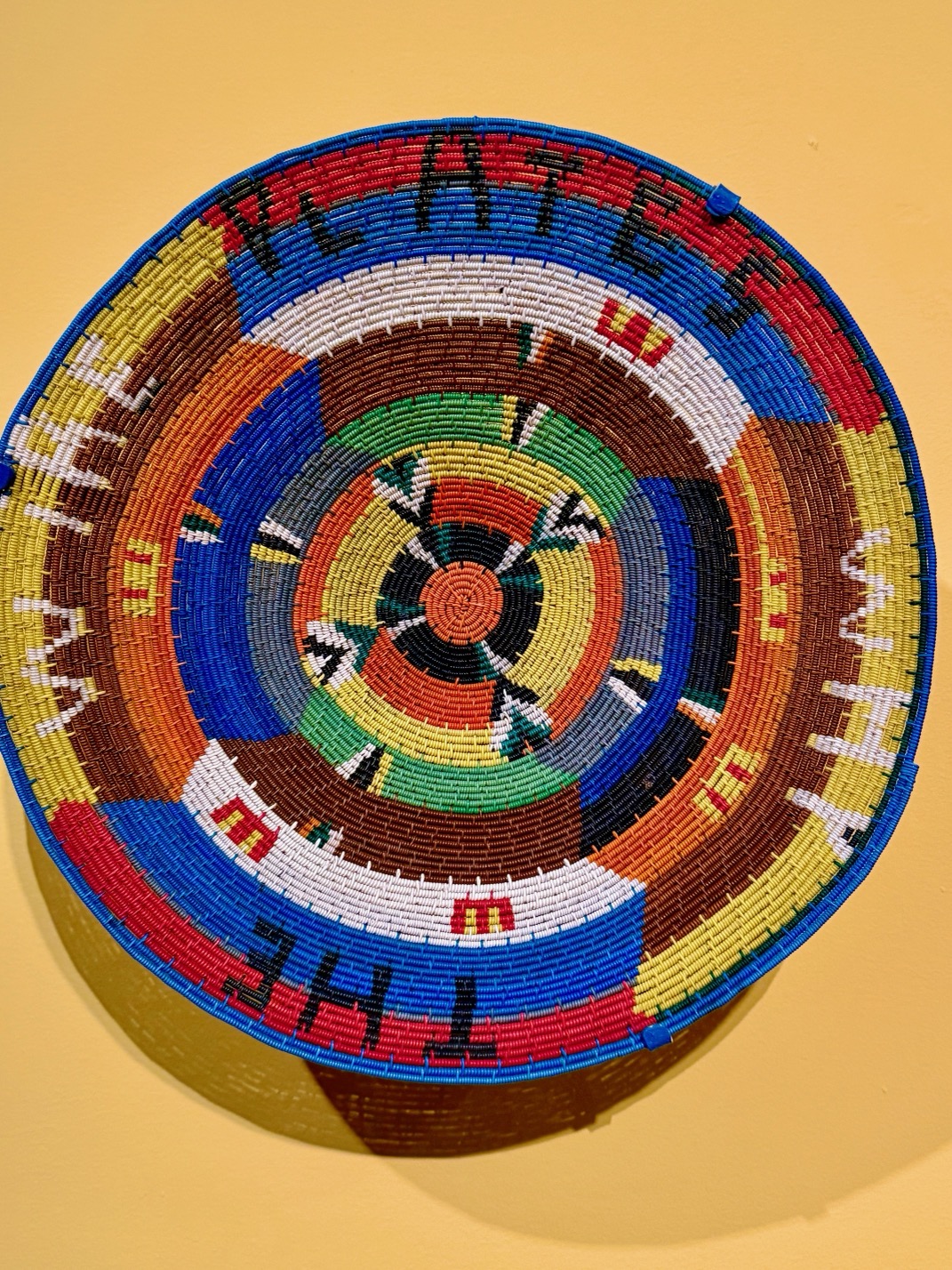
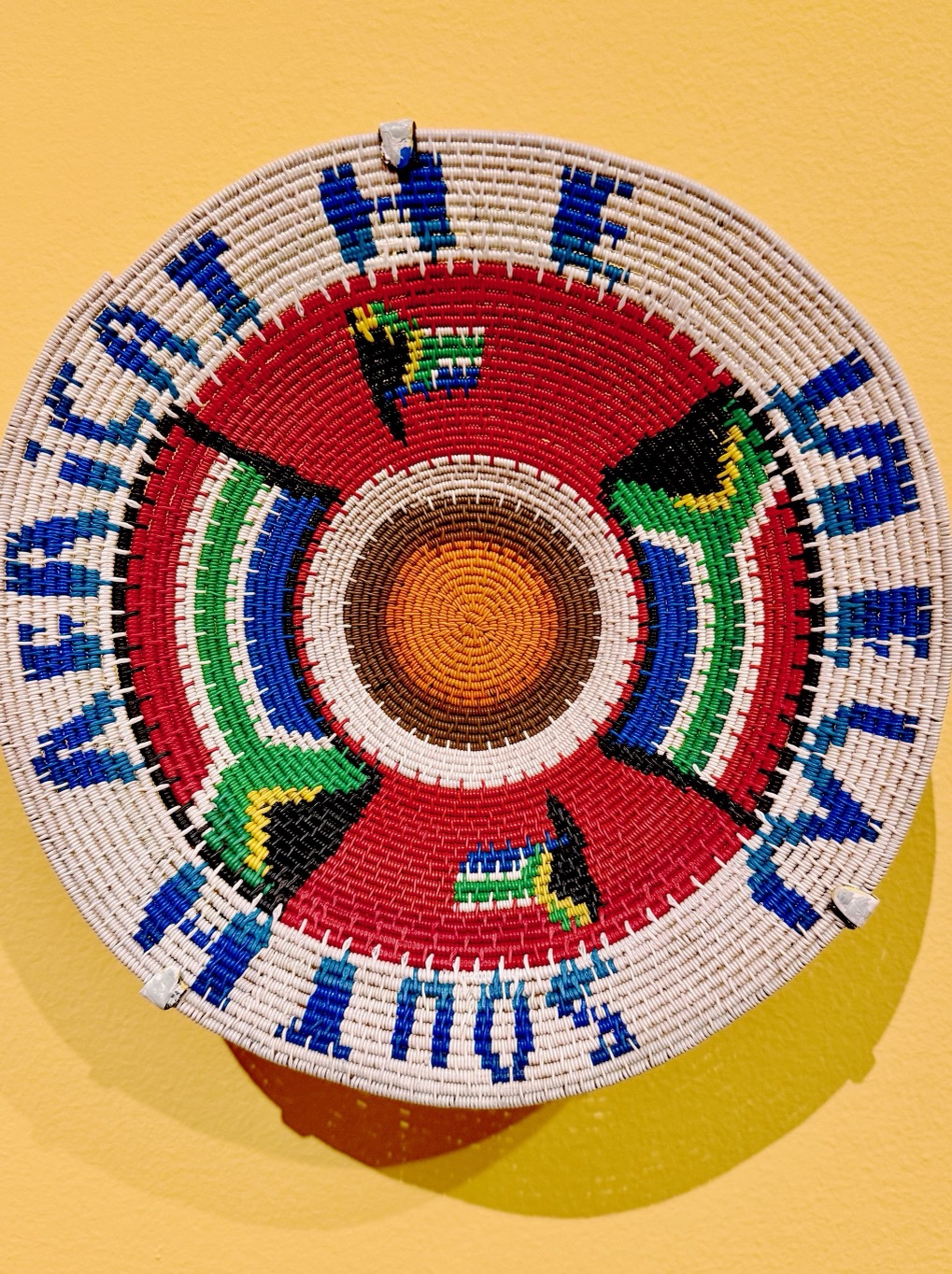
Master weaver Bheki Diamini’s 1990s telephone-wire basket Why the Wire Plates? Courtesy: Arment-Rimelspach collection

Take a look at some of our favorite works in our Flickr album.

The journey begins with Bheki Diamini’s 1990s telephone-wire basket, whose text asks the question “Why the Wire Plates?” T

The exhibition answers by explaining the long history of African wire weaving, the stories of innovators who started using colorful telephone wire in the 1990s, and how it became an economic game-changer for practitioners.

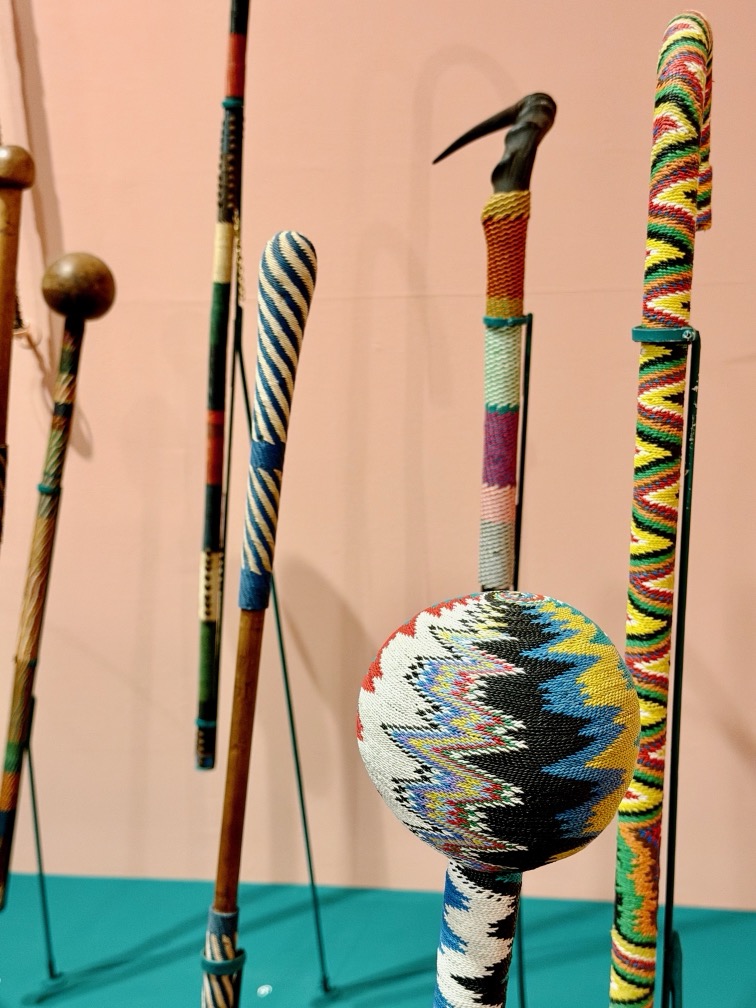
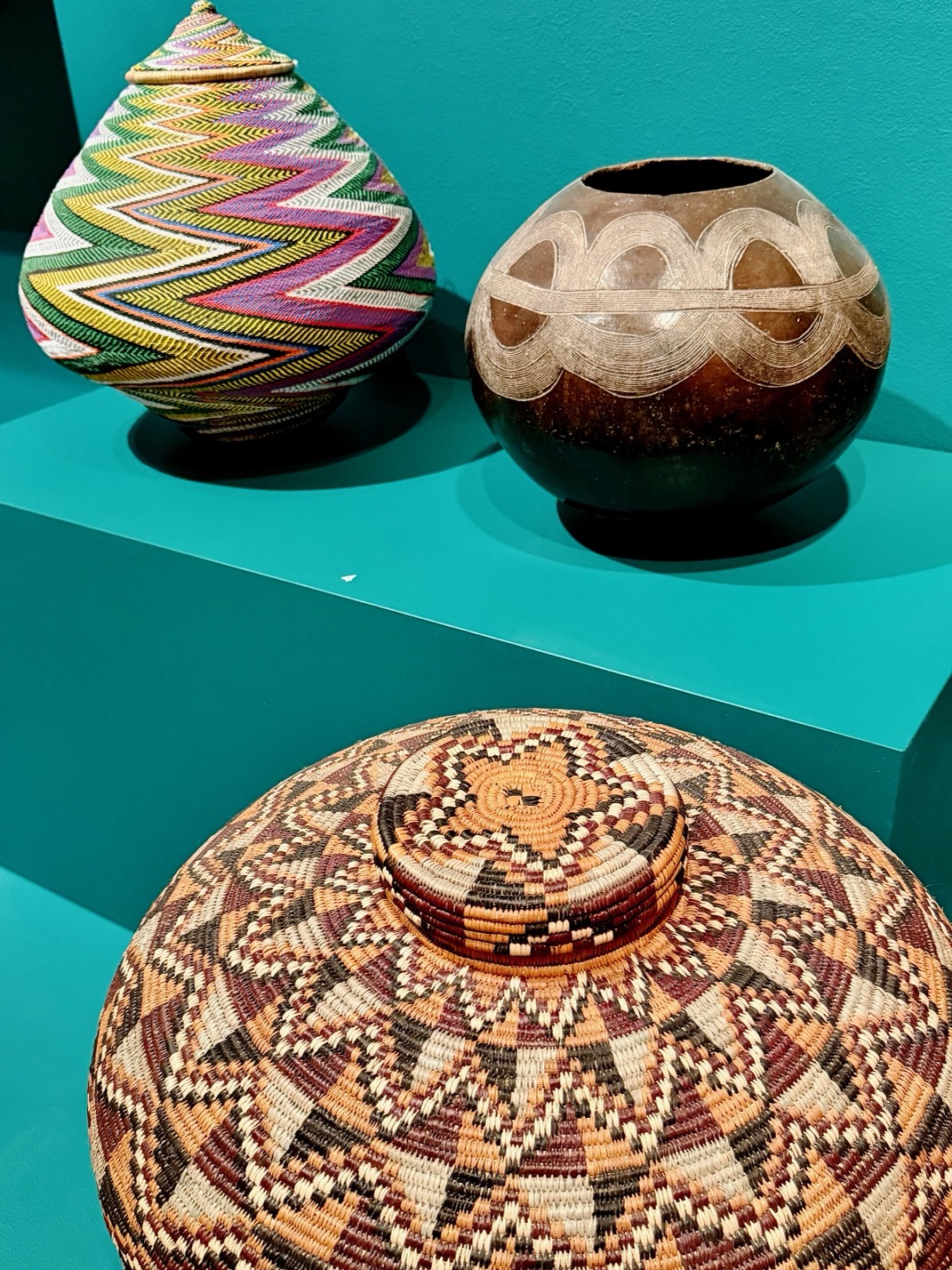
As far back as the 16th century, wire and metal rods were popular trade items in South Africa, and by the 19th century, everyday people were embellishing snuff containers and traditional sparring and walking sticks with intricate wire weaves. Although traditional beer and grain pots were made of woven fiber, and sometimes people wove in beads to personalize (and identify) their own.

An array of sparring sticks embellished with telephone wire and other materials –dancing sticks, 2005 walking stick, and Peter Lekotjo’s 2005 knobbed fighting stick.
Rare late 20th-century works made of telephone wire and natural materials – a palm and grass basket embellished with telephone wire, an earthenware grain-storage pot, and Laurentia Diamini’s grain storage basket woven with palm and grass.

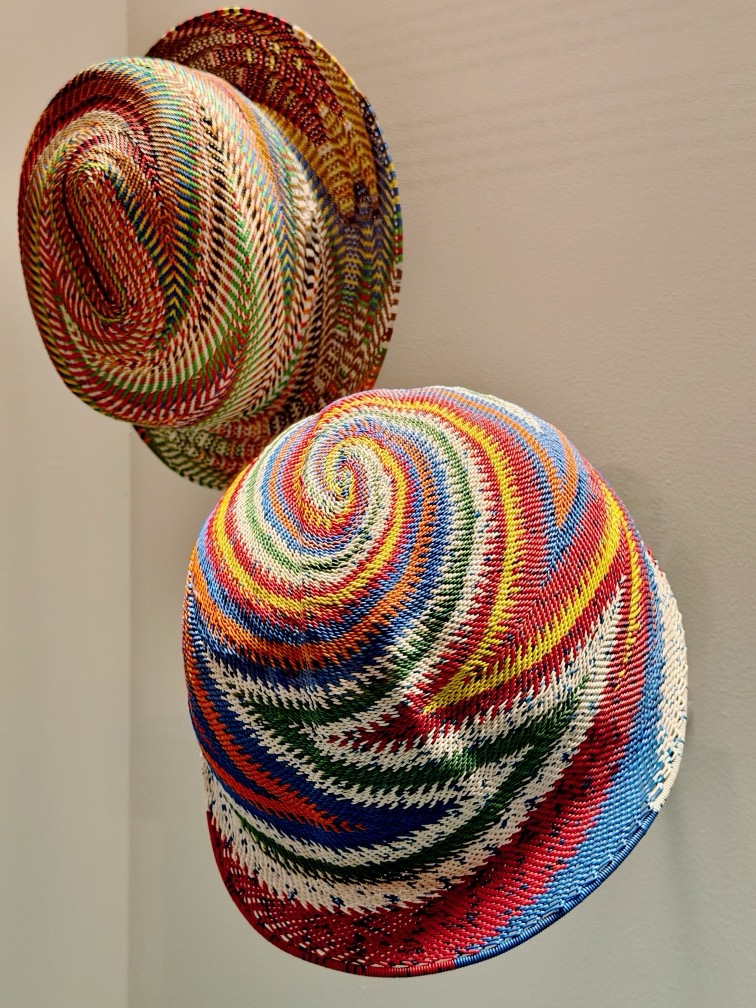
In the 20th century, when a few weavers began incorporating colorful telephone wire into their work, it didn’t take long until highly decorated sticks, colorful hats, amped-up drinking cups, and beer pot lids were transformed. Under the repressive apartheid system, Black South Africans lived under highly restrictive work-life conditions, just scraping by and hardly able to afford most art making materials.  

As telephone technology was deployed across Black communities in South Africa, the spools of colorful, coated wire surged in popularity as a tool more creative expression because workers often cast it off when industrial projects were done. Cheap (or free!), plentiful, and in a dozen colors! Perfect!.

Two hats embellished with telephone wire – a top hat (pre-2007) and Shadercke Ntuli’s 2000 hard hat – similar to those used for mine-worker dance performances.
Michael Mfeke’s late 20th-century telephone-wire basket in the shape of a beer pot (ukhamba).

Rather than making an historical exhibition, the curators have chosen to focus on grouping work by and presenting biographies of the innovators – like master weavers Bheki Diamini, Jerita Mmola, Elliot Mkhize, Vincent Sithole, and othes – who popularized this art form with makers in their own country and collectors internationally. It’s captivating to see all the ways Sithole, for example, incorporated wildlife into his designs to satisfy demand from tourists who began flocking to South Africa as a safari destination.

Colorful 1990 telephone-wire food basket (xirutu) by Jerita Mmola of Limpopo, South Africa.
Elliot Mkhize’s 1997 telephone-wire basket with abstract symbols inspired by ancient Zulu hierographic writing.

A compelling video in the center of the exhibition takes visitors into the Maphumolo family home to show how increased revenue from art sales – in South Africa and abroad at art festivals – have boosted living standards and opportunities for artists on an intergenerational basis.

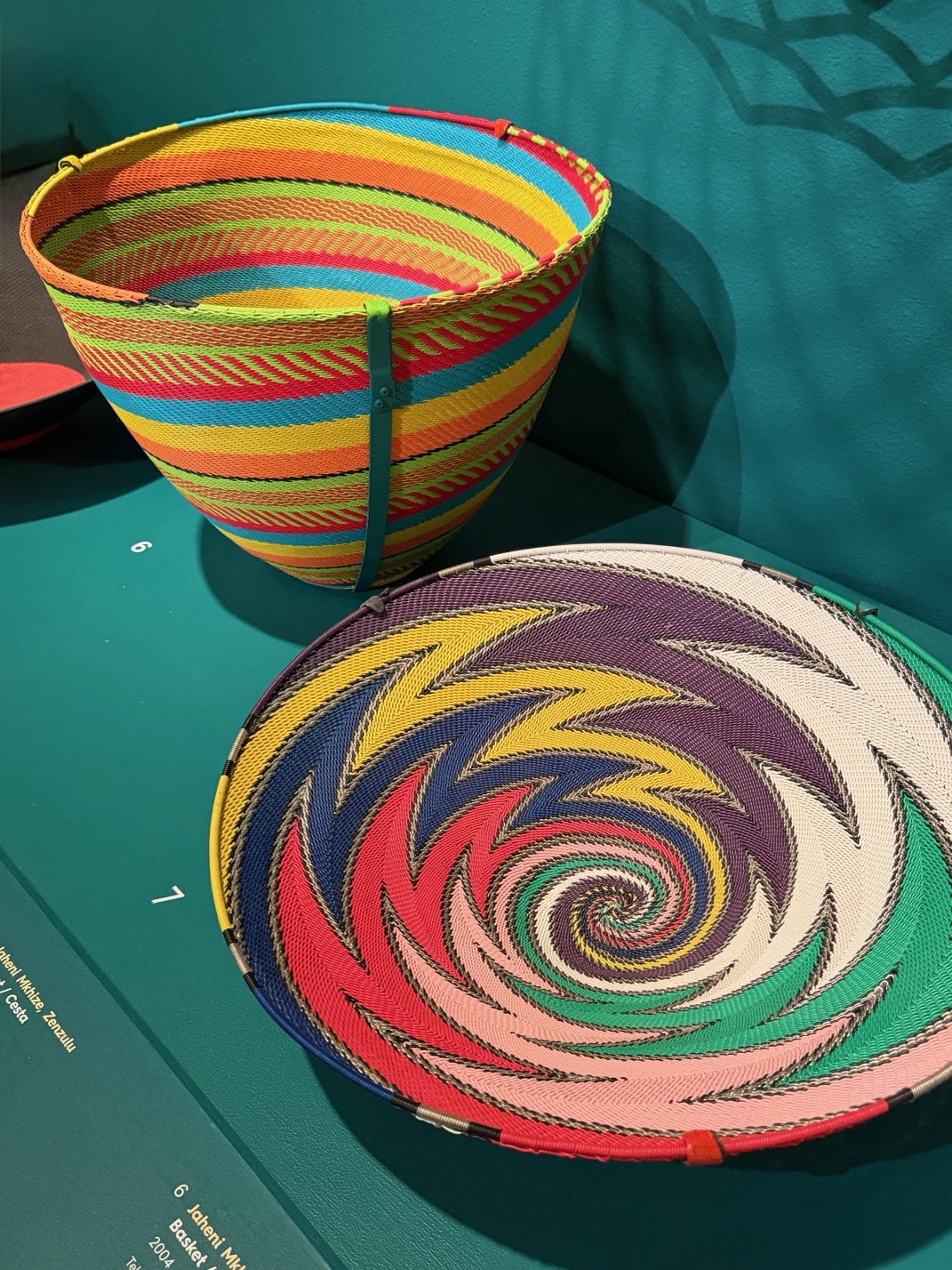
Renowned soft-wire weaver Jaheni Mkhize’s dynamic 2006 telephone-wire basket.
Two by master soft-wire innovator Jaheni Mkhize – 2004 cone-shaped basket and colorful 2000 telephone-sire basket.

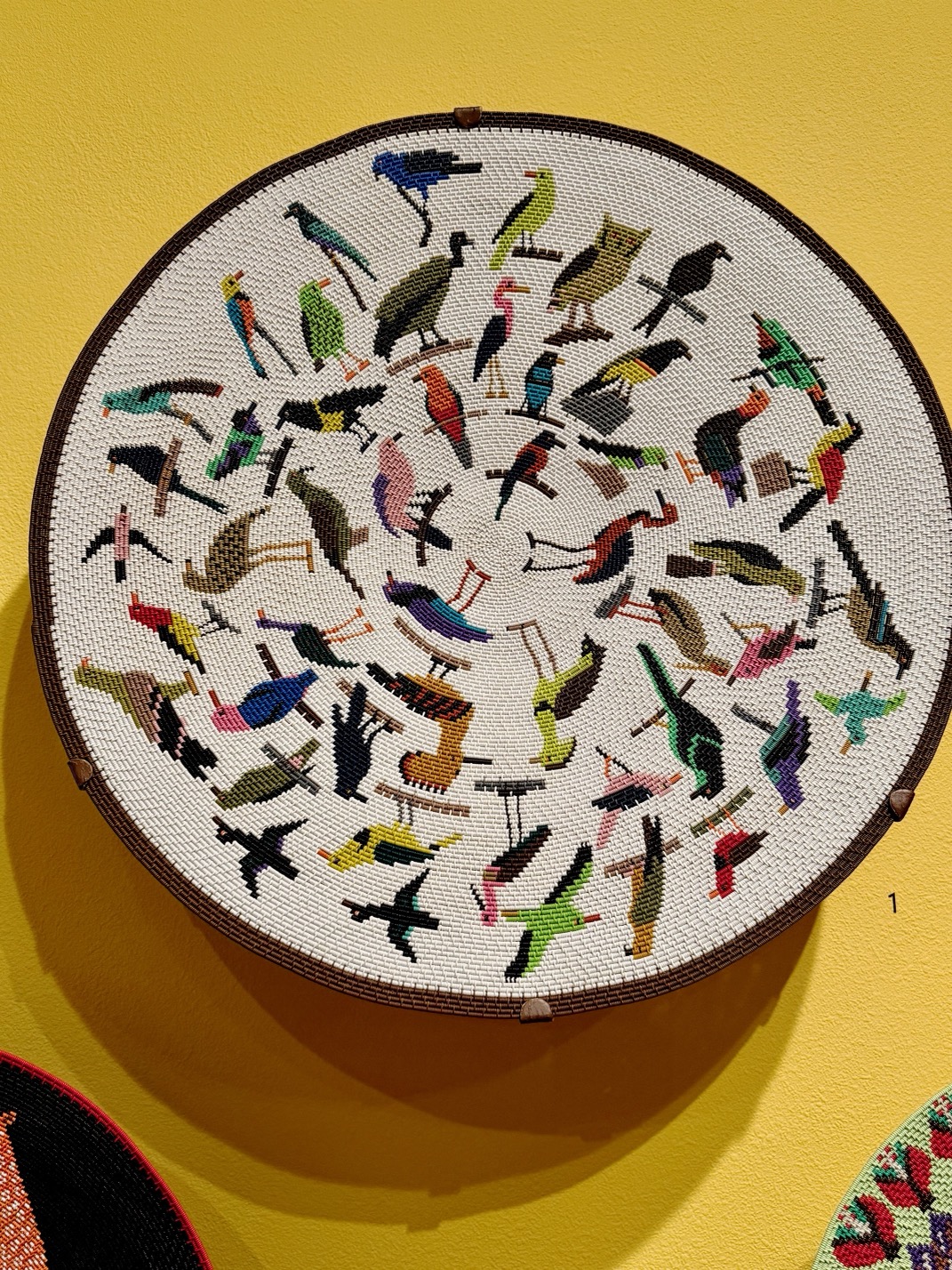
In the mid-1990s and early 2000s, as tourism to South Africa increased, weavers began to incorporate South African wildlife, create whimsical wire animals, and depict rural villages to boost a new pride in the homeland. Sports triumphs are celebrated by weavers, too.

Figurative master Vincent Sithole’s 2008 telephone wire basket depicting numerous species of South African birds. Courtesy: Arment-Rimelspach collection.
Octavia Gwala’s 2005 telephone-wire and wire weaving showing a rondavel – a circle of thatched-roof Zulu homes that form a homestead.

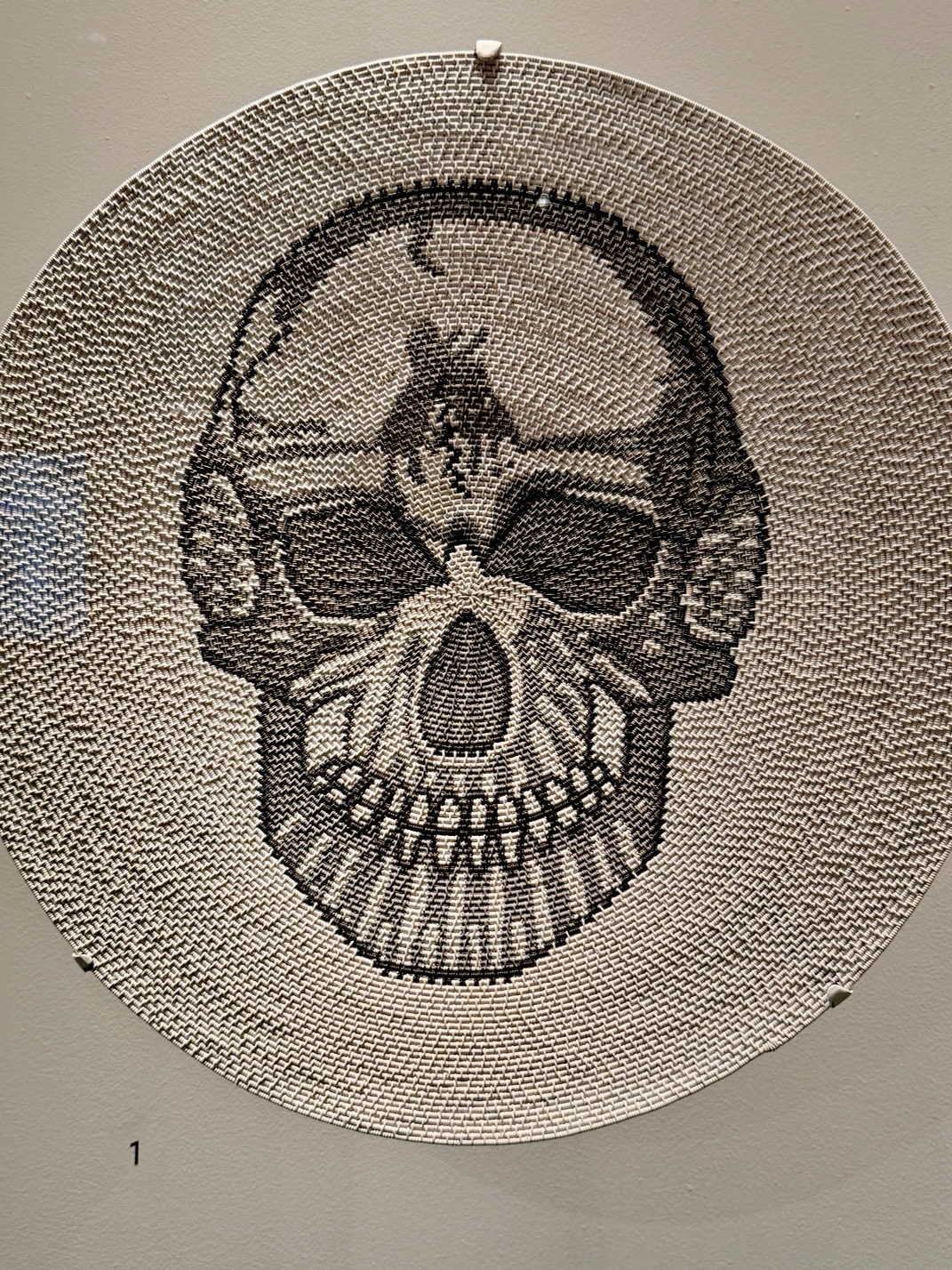
The exhibition walk-through concludes with work exemplifying new trends – baskets that incorporate pop culture references. three-dimensional wall pieces, and shimmering works in gleaming woven copper wire.

Simon Mavundla’s 2013 telephone-wire and wire basket Grey’s Anatomy Series: Norma Frontalis from a design by Marisa Fick-Jordaan. Courtesy: Arment-Rimelspach collection.
Details of 2009 Nature Series, Wall Platter, Rousseau, a three-dimensional telephone-wire sculpture designed by Marisa Fick-Jordaan

In the exhibition promo, indigenous knowledge-keepers explain more about what these artworks mean and see some of the masters at work.

Enjoy this look at the riches on display in this beautiful show.

Thanks to collectors David Arment and Jim Rimelspach, whose passion, patronage, and vision have introduced us to beautiful work by the most innovative artists and families creating in South Africa today, and donated so many exquisite works to IFAM’s permanent collection.

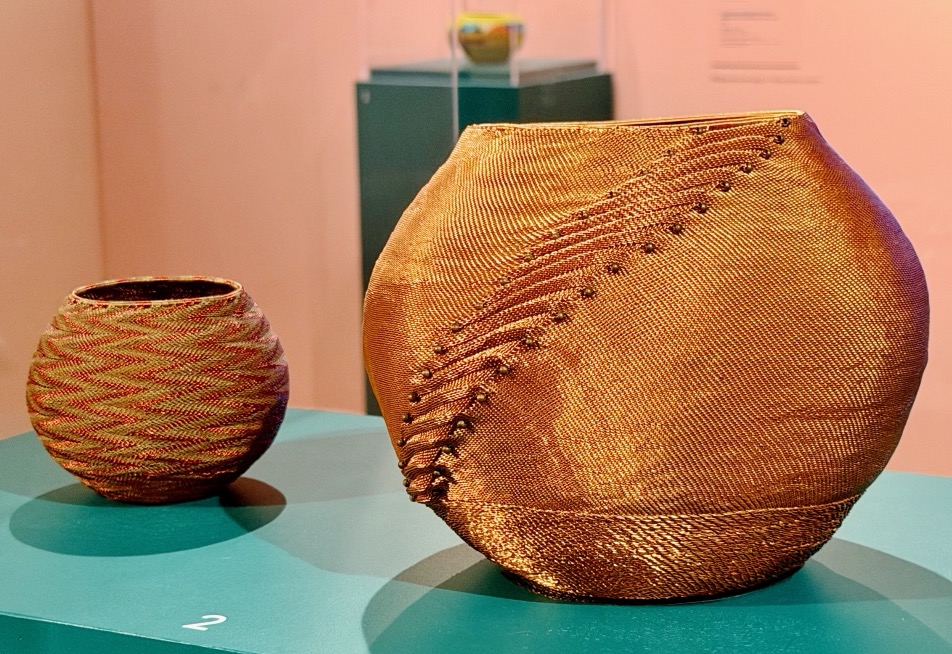
Two metal baskets from Threads of Africa project: Bandile Mtshali’s 2010 brass and copper-wire basket and Jobe Sithole’s 2016 copper wire and brass bead basket.