Indian Theater and Contemporary Art at SITE Santa Fe

The ambitious project paid off. Indian Theater: Native Performance, Art, and Self-Determination since 1969, on view at SITE Santa Fe and the IAIA Museum of Contemporary Native Arts through September 7, is a masterful mix of history, contemporary art, performance, and revealing installations that challenge what you know and think you know.

Filling the entire museum, the exhibition uses painting, sculptures, and performance sculptures to chronicle how radical performances by Native Americans shifted conversations, illuminated forgotten populations and treaties, asked difficult questions, and thoroughly influenced the trajectory of the contemporary Native American art movement.
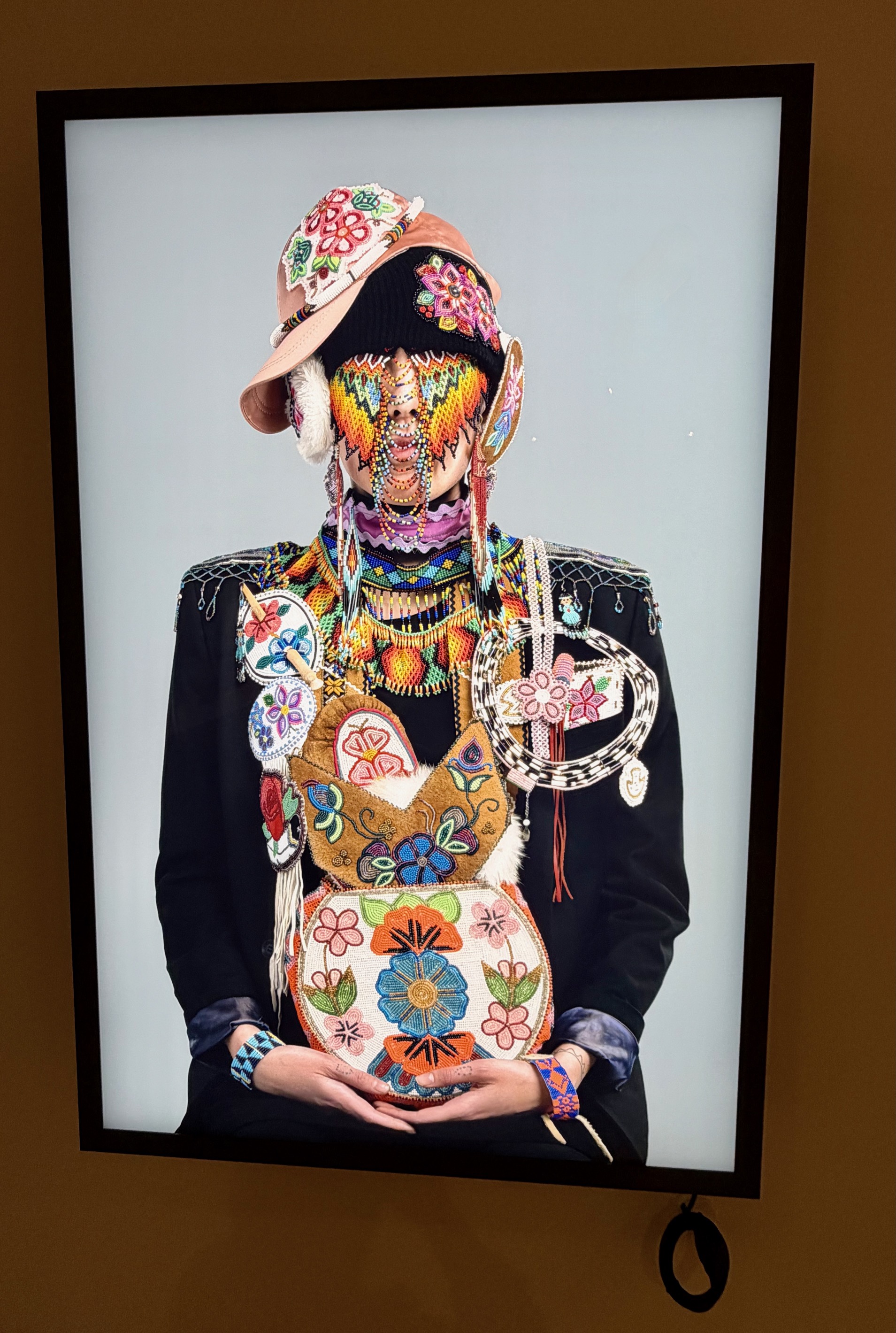
2019 lightbox portrait Headdress – Jeneen by Dana Claxton (Lakota); the sitter bedecked in beads and embroidered gifts. Courtesy: the artist and Forge Project Collection.

Take a walk through the show (and a few performances) in our Flickr album.

In the entry, a provocative neon sign by Demian DinéYazhi (Diné) beckons, but visitors are immediately pulled into the large space surrounded by a graphic history of the historic Alcatraz occupation (1969-1971, one-of-a-kind mask wall pieces by Lloyd Kiva New (leader of brand-new The Institute of American Indian Arts 1967-1978), IAIA’s 1969 manifesto on Indian Theater, and a 1972 video of a NYC production by the Native American Theater Ensemble (running on an ancient Sony Trinitron). It’s all surrounded by a wall textile designed by Linda Lomahaftawa (Hopi/Choctaw) when she was an IAIA student in the Sixties.  A provocative sculpture by Gabrielle L’Hirondelle Hill (Métis) adds the contemporary drama.
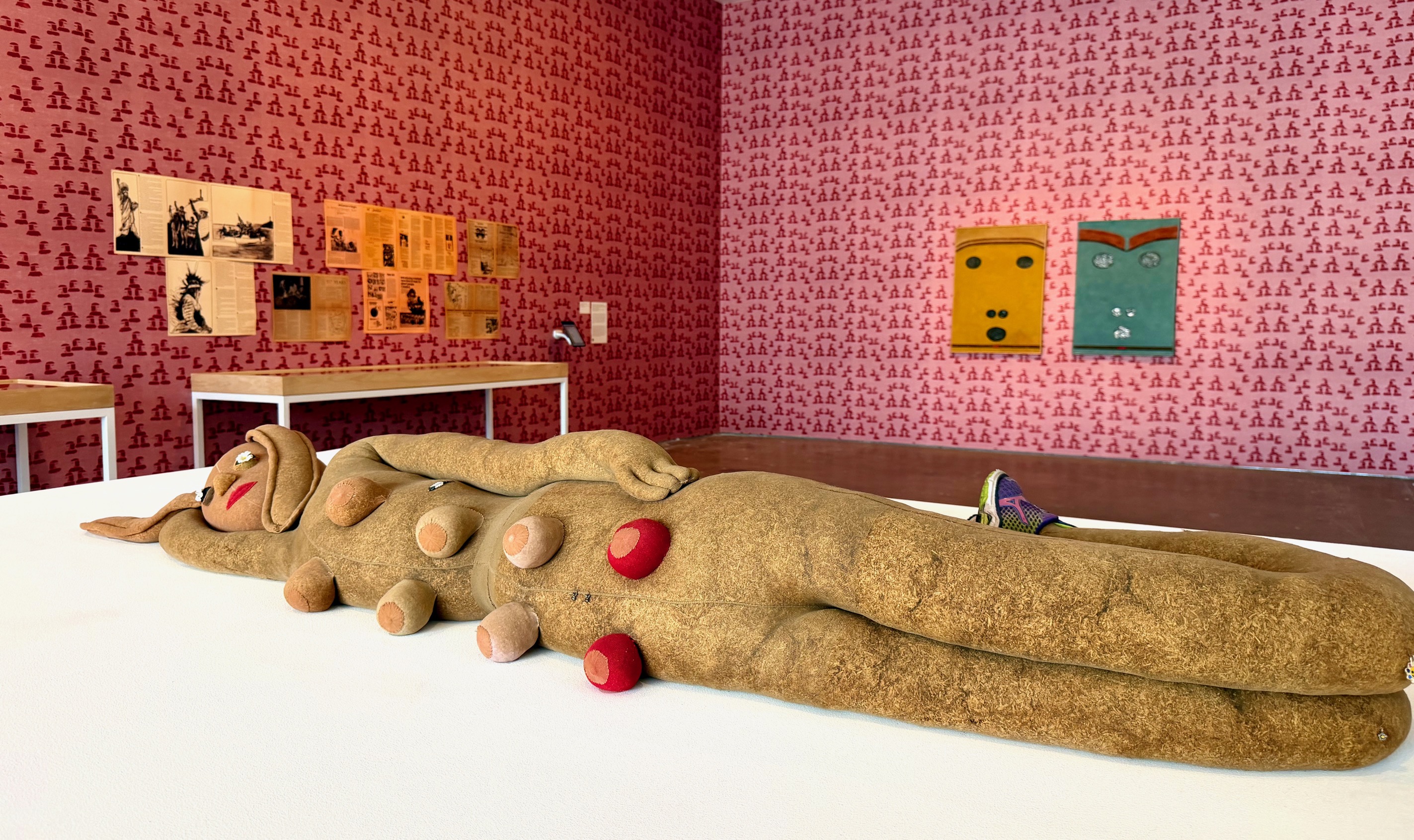
Exhibition entry: 2021 mixed media Counterblaste by Gabrielle L’Hirondelle Hill (Métis); tobacco-stuffed pantyhose rabbit-human figure; surrounded by 1969 Alcatraz occuption documentation and paintings by Lloyd Kiva New. Courtesy: Center for Curatorial Studies, Bard College; IAIA Museum of Contemporary Native Art; Art Bridges.

This sets the stage for curator Candace Hopkins’ thesis – in the 1960s, Native American performance went hand-in-hand with greater activism, self-determination by tribes, and contemporary art in all its forms.  Listen to her explain:

Two performance spaces lie just beyond this gallery. First Nicholas Galanin’s gallery where his performance The White Carver happens weekly (surrounded by photos of previous performances since it was first staged in 2012). The White Carver tackles the subject of appropriation and Native cultural misunderstanding head on.
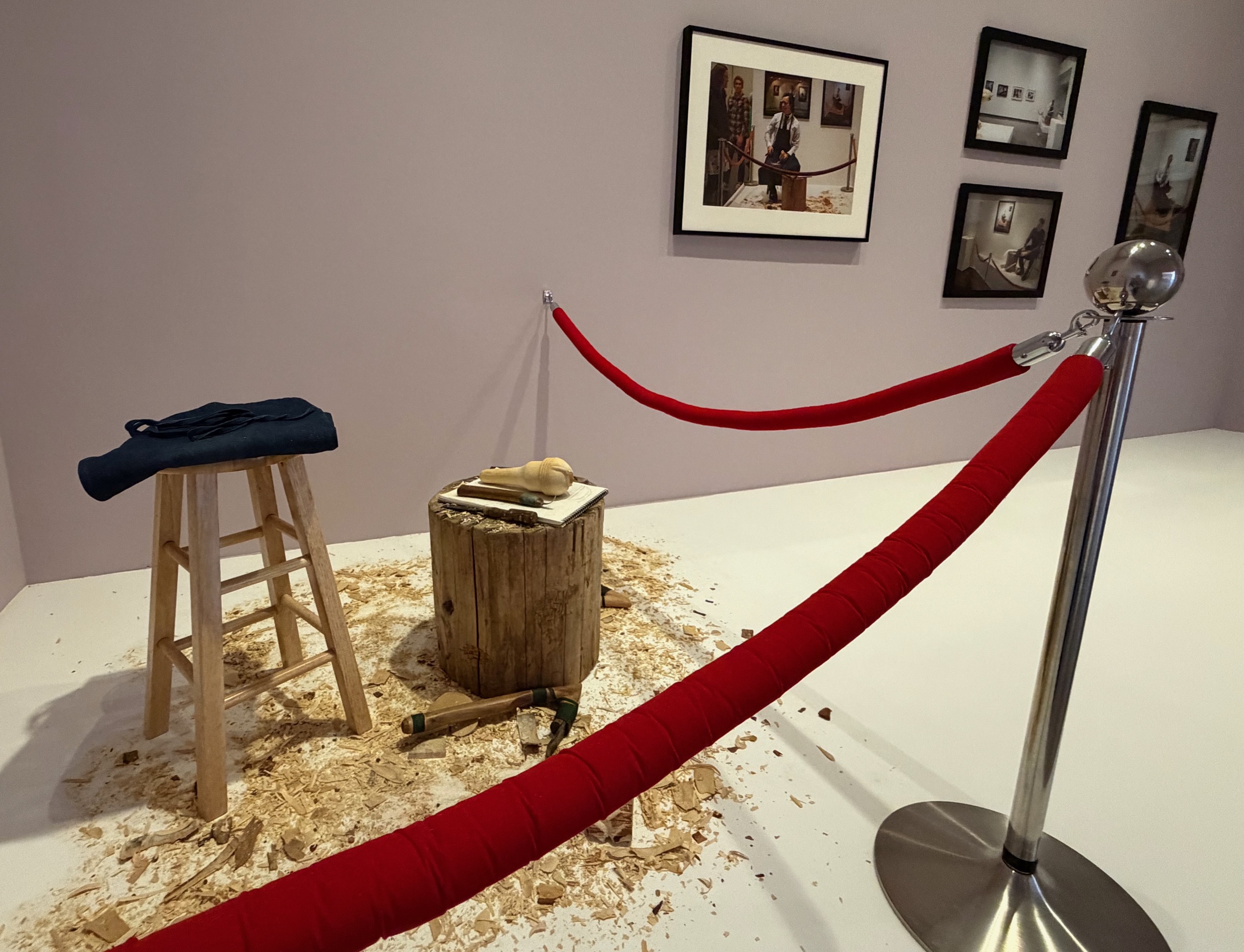
Behind the velvet rope: set for 2012-ongoing White Carver performance by Nicholas Galanin (Tlingit/Unangax) in which a Caucasian woodcarver replicates an object made by a Galinin – a commentary about appropriation and commercialization of Indigenous culture by non-Native communities. Courtesy: Gochman Family Collection.

Next, you enter a room hung with giant earring sculptures from Eric-Paul Riege (Diné), who activated them in a ritualistic performance at SITE in August. Riege’s installation allows everyone a simultaneous experience of the contemporary and cultural deep time.  Kite’s floor installation, right nearby, does this, too. (Check out our previous post about Kite’s innovative IAIA show here.)
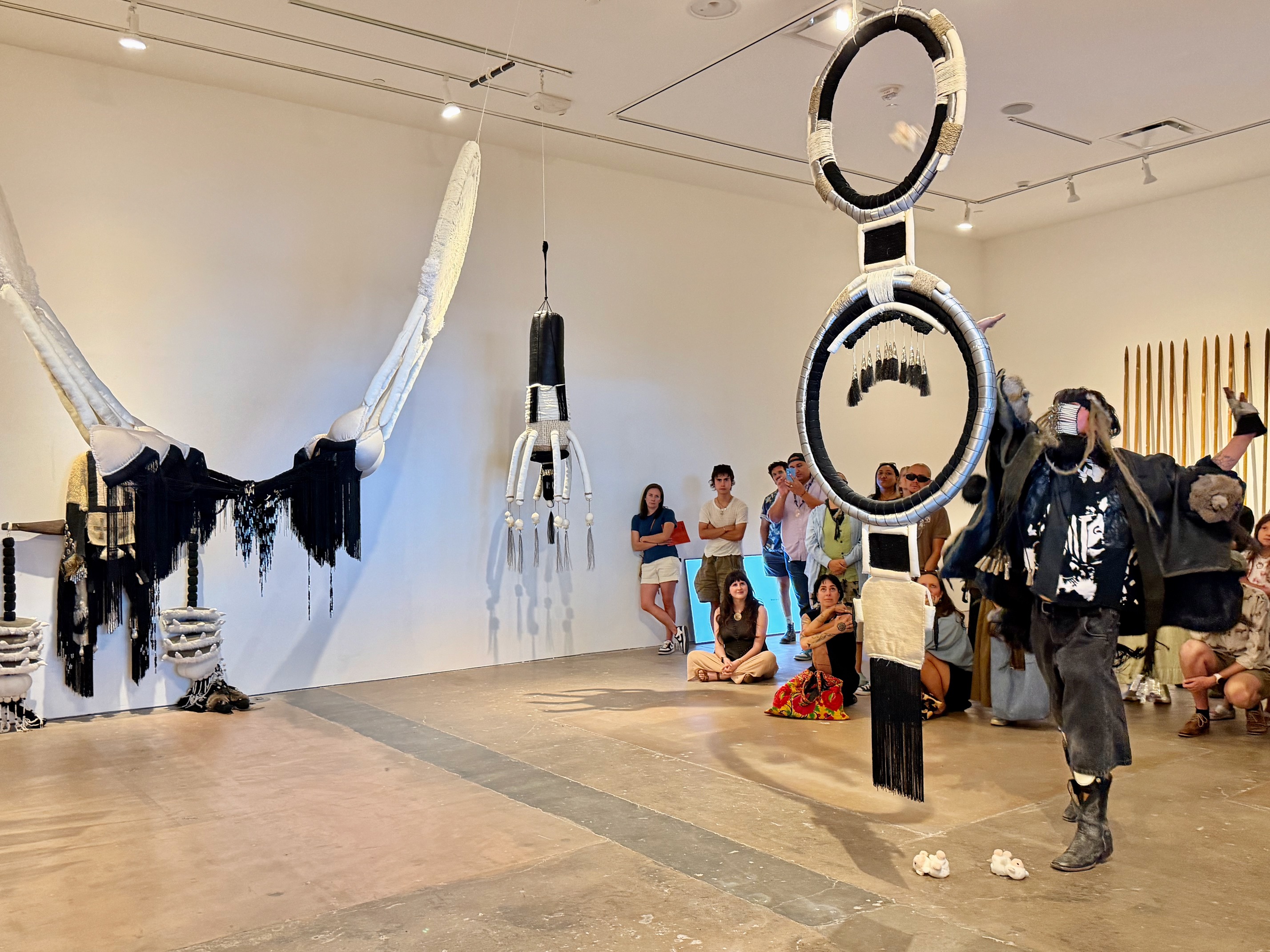
Museum goers watch Eric-Paul Riege (Diné) interact with his mixed-fiber scultptures 2020-2022 jaatloh4Ye’iitsoh (“earrings for the big god”) (August 15, 2026); oversized jewelry suggesting knowledge by listening, harmony of natural fibers, and totems of memory. Courtesy: Forge Project Collection, traditional lands of the Moh-He-Con-Nuck; Art Bridges.

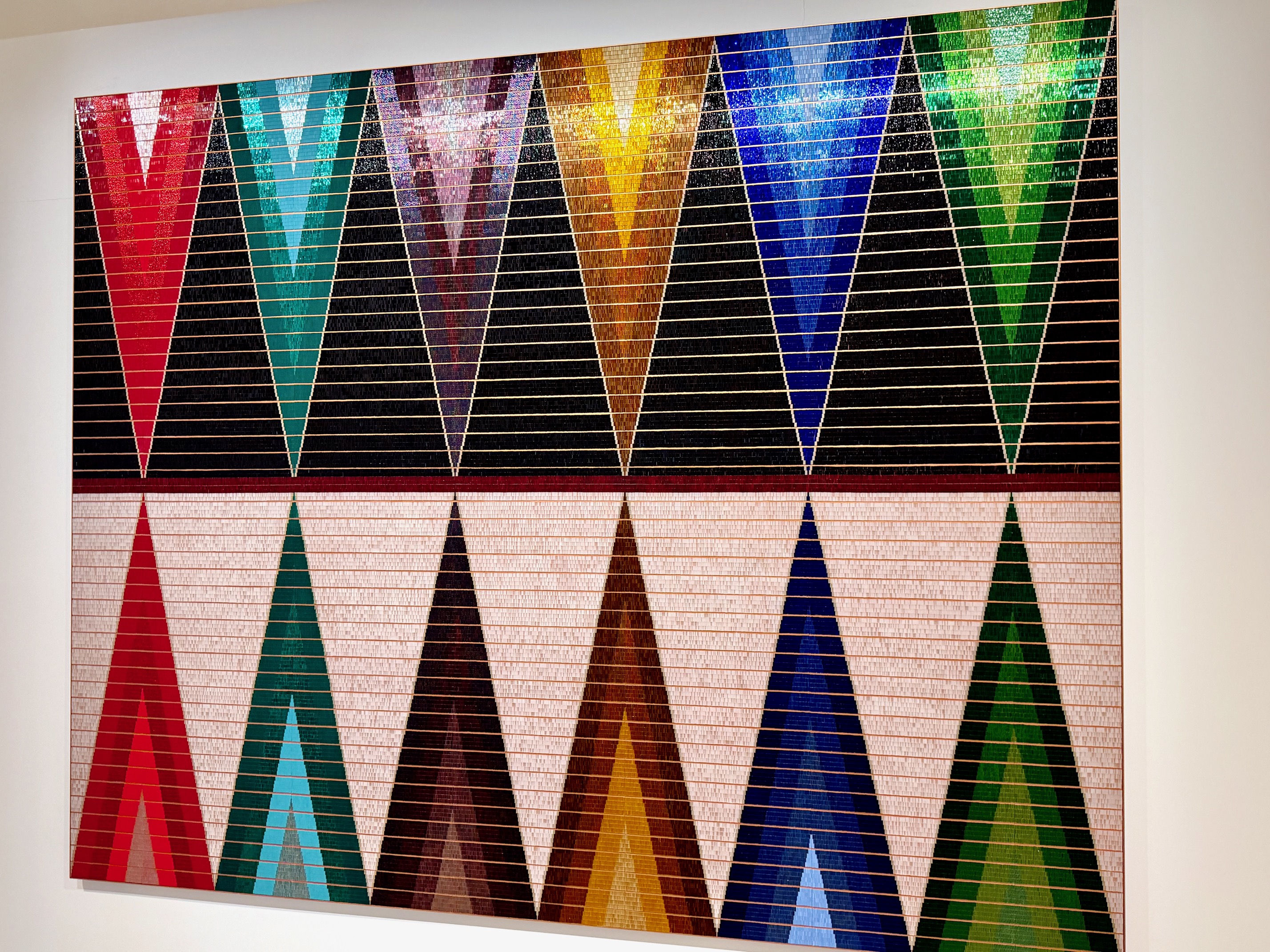
Two-dimensional art on display also evokes a mix of ancient and “now.” Action painting mixed with cultural symbols. Bugle beads or painted blankets echoing color-field painting.
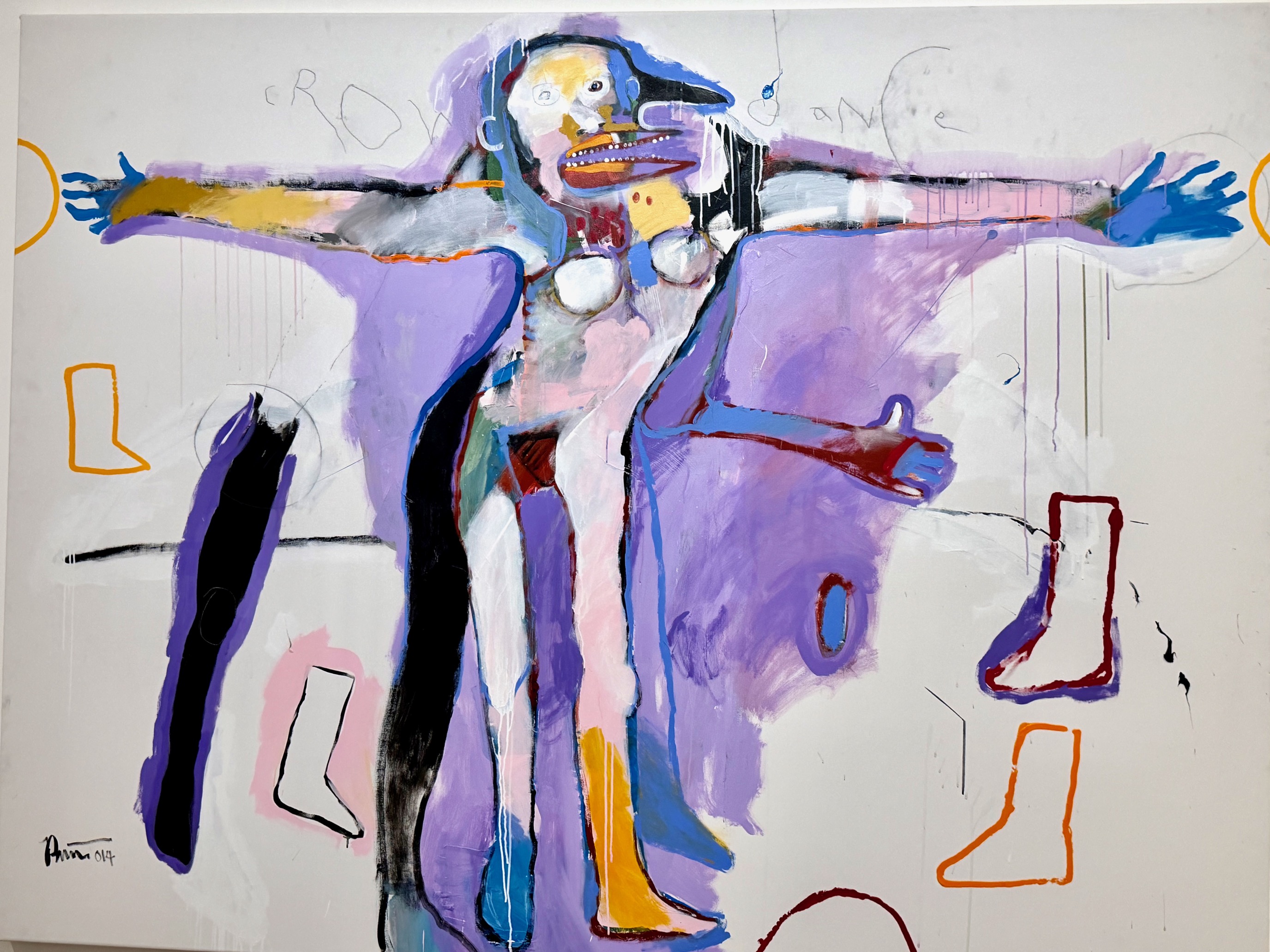
2014 acrylic and graphite Crow Dance by Rick Bartow (Wiyot). Courtesy: Denver Art Museum.
2022 acrylic and glass bugle bead Wopila/Lineage II by Dyani White Hawk (Sicangu Lakota) – a reference to the long tradition of Lakota abstraction. Courtesy: Gochman Family Collection.

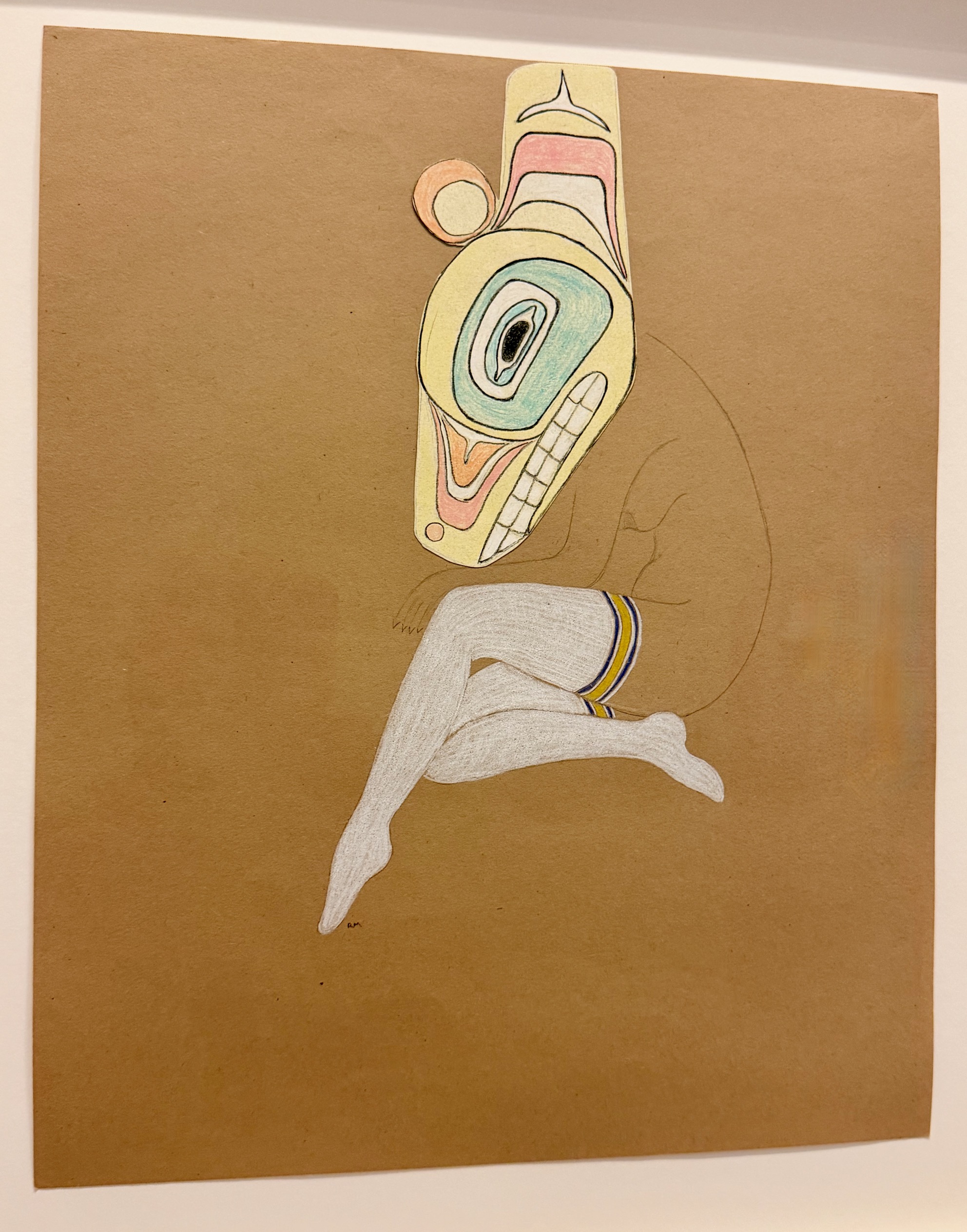
Mash-ups of pop culture, cartoony cheesecake, ancient craft, culture, and social commentary – all the work on display incorporate aspects of performance.
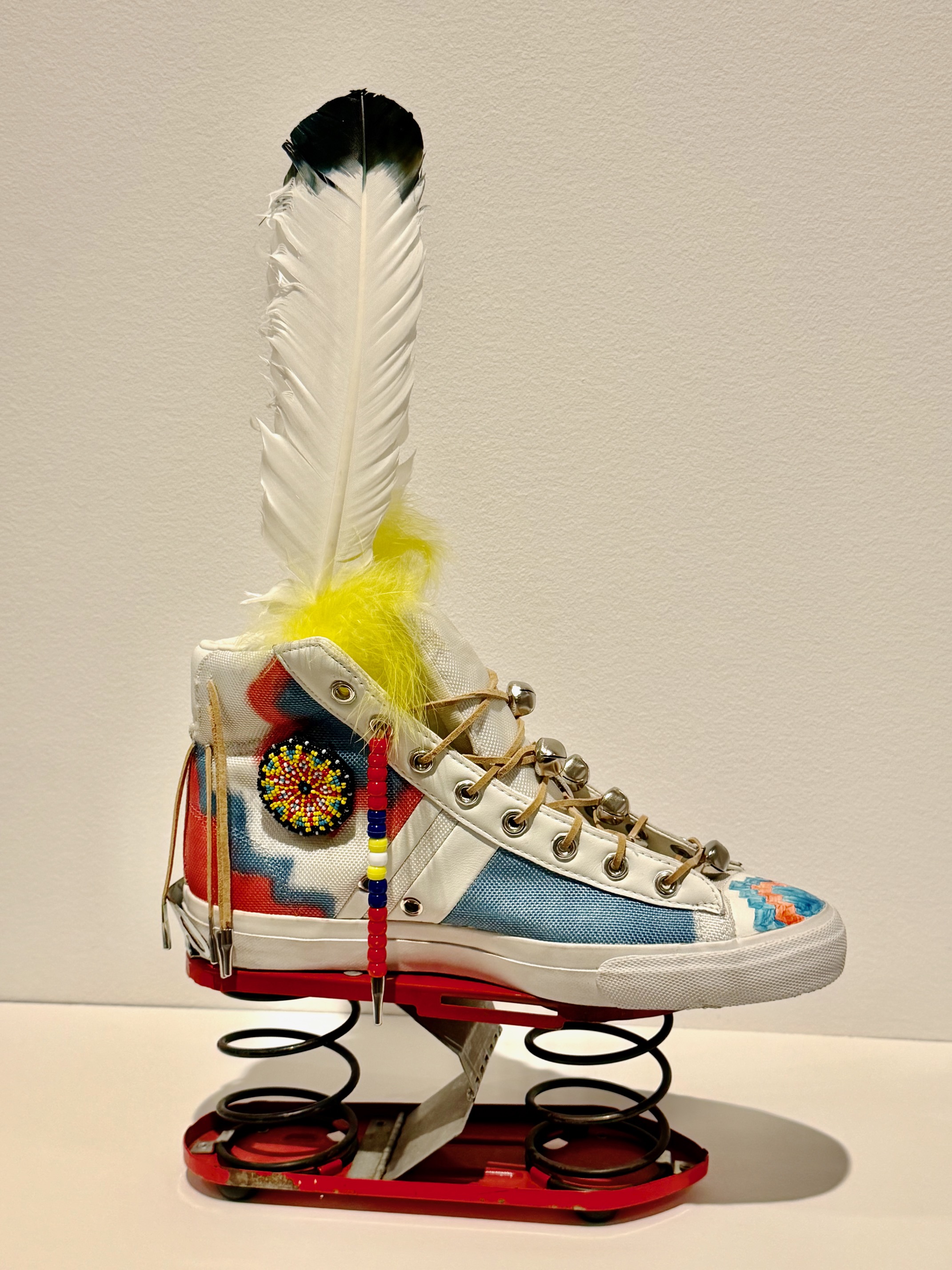
1990 sculpture War Dance Technology by performance artist James Luna (Payomkowicham, Ipai, and Mexican). Courtesy: Gochman Family Collection.
2014-2022 graphite and colored pencil drawing Killer Smile by Rachel Martin (Tlingit/Tsaagweidei, Killer Whale Clan of the Yellow Cedar House Eagle Moiety). Courtesy: the artist.

The back gallery takes us back into time to consider the irony of early ethnomusic recording in the Pacific Northwest during a period when potlatches were banned and ceremonies forbidden.  The exhibition has a beautiful installation of Native American LPs from the 1960s and 1970s beneath a stunning installation by Sonny Asu of copper recordings that cannot be played.
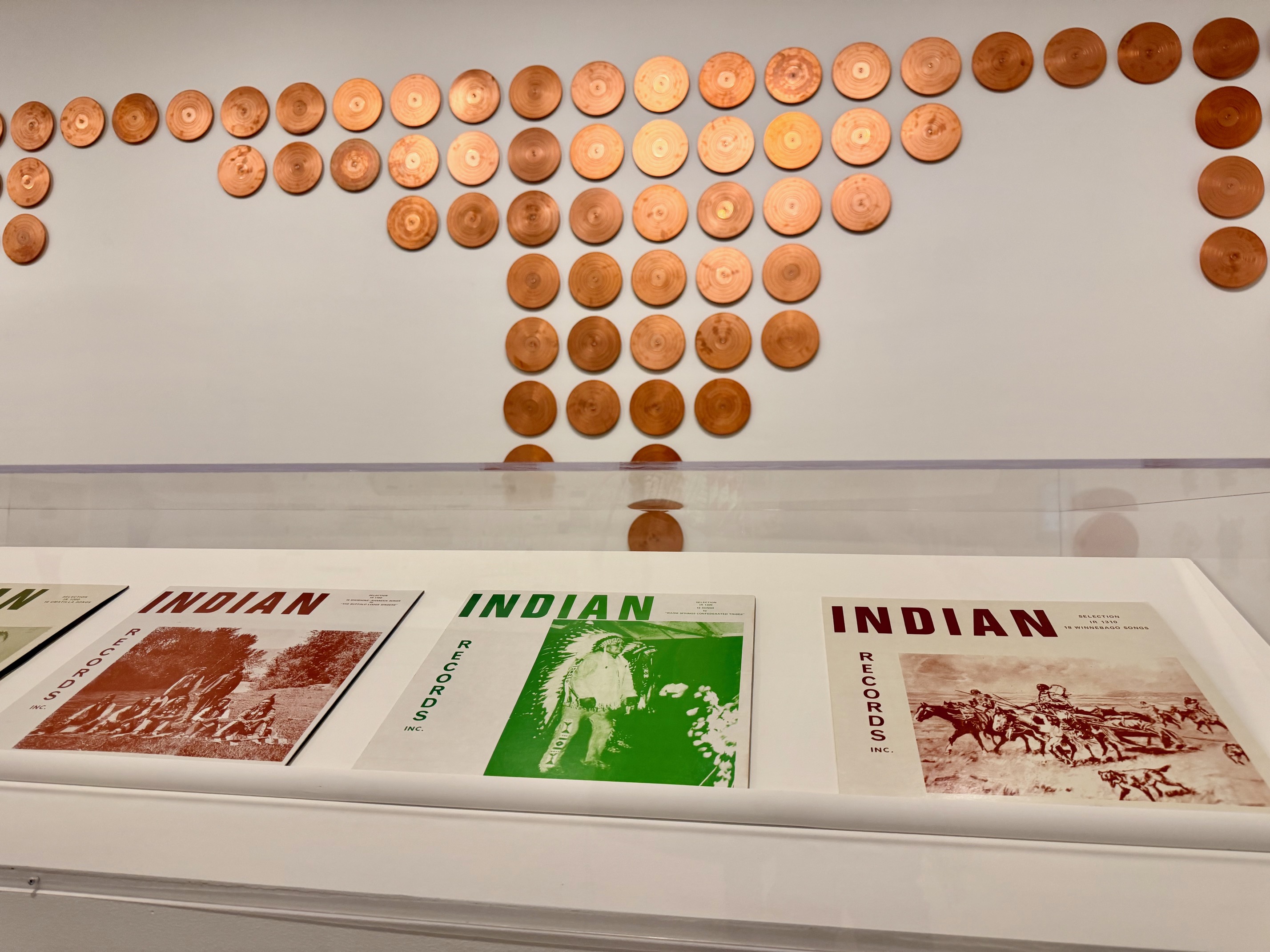

1960s-1970s LP recordings of Native American tribal songs by Indian Records; at rear, 2012 copper record installation “Ellipsis” by Sonny Asu (Ligwilda’xw Kwakwaka’wakw from the Wei Wai Kum Nation) – 138 records not intended for play. Courtesy: Forge Project Collection, traditional lands of the Moh-He-Con-Nuck.
1991 High Performance art magazine cover featuring James Luna during his AA Meeting/Art History performance.

In every room, videos display performances on stages (Jeffrey Gibson or Spiderwoman Theater) or in nature (asinnajaq (Inuk). One room is devoted to a set, props, and documentation of work by the influential performance artist James Luna, whose art did not shy away from the ever-present issue of alcoholism in Native communities.

The exhibition also includes an immersive, highly theatrical, multi-gallery installation by the New Red Order. Here’s the manifesto by NRO’s Adam and Zach Kahalil (Sault Tribe of Chippewa Indians) and Jackson Polys (Tlingit).
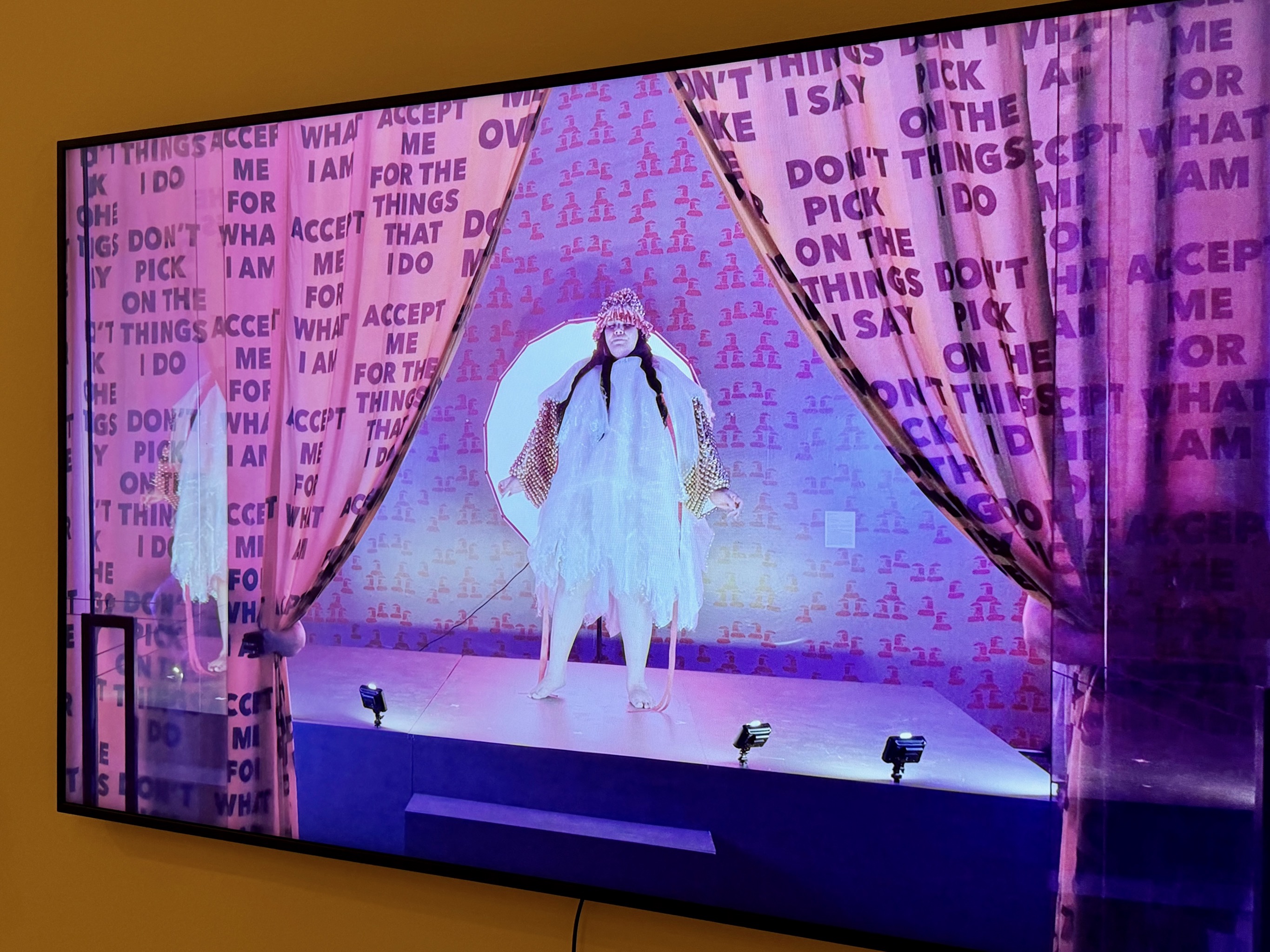
2023 performance documentation video of Don’t Make Me Over by Jeffrey Gibson (Mississippi Band of Choctaw and Cherokee) featuring performer Ariel Twist (Nehiyaw). Courtesy: the artist.

NRO uses satiric videos, props, murals, documents and timelines,  merchandise, and graffiti style to illuminate collisions of history, pop culture, and consciousness surrounding urban Native communities today – a totally head-spinning (and brain-spinning) experience.

Video of the 2020-ongoing Progenerator installation by the New Red Order, a mixed-media installation by artists Adam and Zach Kahalil (Sault Tribe of Chippewa Indians) and Jackson Polys (Tlingit) that probes societal stereotypes alongside non-Natives’ fascination with Native culture. Courtesy: the artists.

And thanks to the recreation by Erica Lord, SITE Santa Fe visitors were able to experience Artifact Revisited. Erica recreated an acclaimed 1987 performance by James Luna – a still Native body on display within a museum, encased in glass. In Erica’s recreation, her “cabinet” was surrounded by museum signage purporting to explain “Indians” and provide context for the “exhibit.” In the age of NAGPRA, the experience was unforgettable. Watch the performance heare, and listen to Erica explains how she came to perform this historic piece and how it felt.

For more background on the connections between Native American theater, politics, and art, here’s a link to the recently published book about this never-before-told story.

Kite Dreams with AI at IAIA

How does a Lakȟóta artist link dreams and artificial intelligence to imagine futures for her people? Experience five years of innovative installations in Kite and Wíhaŋble S’a Center: Dreaming with AI, on view at the IAIA Museum of Contemporary Native Arts in Santa Fe through July 13, 2025.

The IAIA exhibition – Suzanne Kite’s third solo exhibition this year across the United States – presents several installations that highlight her collaborative work that merges cutting-edge technology with Indigenous knowledge systems. 

Download the exhibition catalogue here, and look at photos of the installation in our Flickr album.

2023 Wičhíŋčala Šakówiŋ (Seven Little Girls) and Wicháhpi Wóihanbleya (Dreamlike Star) use stones to translate Kite’s dreams into Lakhóta symbols.

In Iron Road and Dreamlike Star, stones and minerals (the building blocks of computers!) are arranged in Lakȟóta geometric language that suggest Lakȟóta quilt patterns. They’re placed atop a mirror to show resonance between the Earth and the cosmos (stars).

2023 Wicháhpi Wóihanbleya (Dreamlike Star) suggest that ancestor stars can point the way to Indigenous futures.

In this first section, inputs are taken from Kite’s dreams. Using AI, her dreams are translated into geometric Lakȟóta shapes created by designer Sadie Red Wing. Kite has figured out a way to bypass large-scale, commercial AI networks in favor of an AI model (run on her PC) that aligns more closely with Indigenous knowledge systems.    

A digital embroidery machine has yards of embroidered black velvet flowing out of it.  Oihanke Wanica (Infinity) is a collaboration with New York City’s Center for Art, Research and Alliances. As you examine the velvet, you’ll find geometric Lakȟóta shapes translated (using AI) from Kite’s dreams.

Nearby, there’s a comfortable lounge where you can watch Cosmologyscape, an interactive digital quilt – a public art project in which AI translates the public’s dreams into artist-created geometric symbols. It’s a collaboration with Alisha B. Wormsley, so the virtual community quilt manifests both African-American and Lakȟóta shapes.

2023 Oihanke Wanica (Infinity) – a digital embroidery machine stitches symbols representing dreams onto black velvet. Collaborator; Center for Art, Research and Alliances.
Lounge to watch Kite and Alisha B. Wormsley’s 2024 Cosmologyscape – Ai translates the public’s dreams into symbols for an ever-expanding digital quilt.

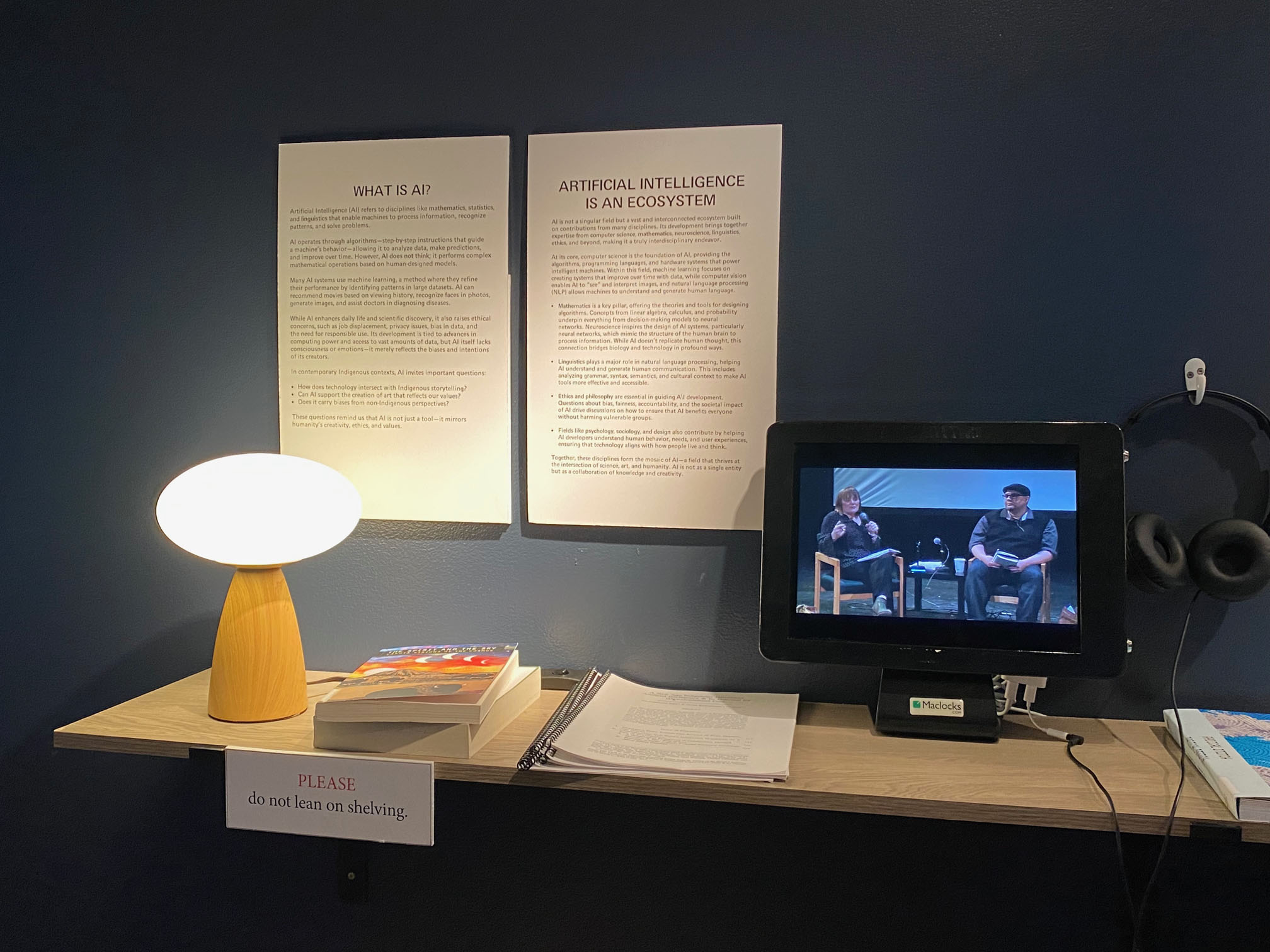
Installations in the other half of the exhibition shows collaborative projects that combine Indigenous knowledge systems and AI. Along one wall in the spectacular, tranquil gallery, you can explore a print and digital resource library on international research programs that integrate Indigenous knowledge systems into AI design.

Abundant Intelligences – a library and digital resource station for information on AI and futurism in contemporary Indigenous art.

Oneiris is a large interactive station through which visitors are invited to generate dream symbols that AI adds into a wall-sized display that looks like a portal to the cosmos. Inspired by the Lakȟóta concept of a Dream Language, she and her many technical collaborators genuinely bring dreams to life.

Oneiris – a collaborative project using advanced AI models to allow visitors to bring dreams to life.

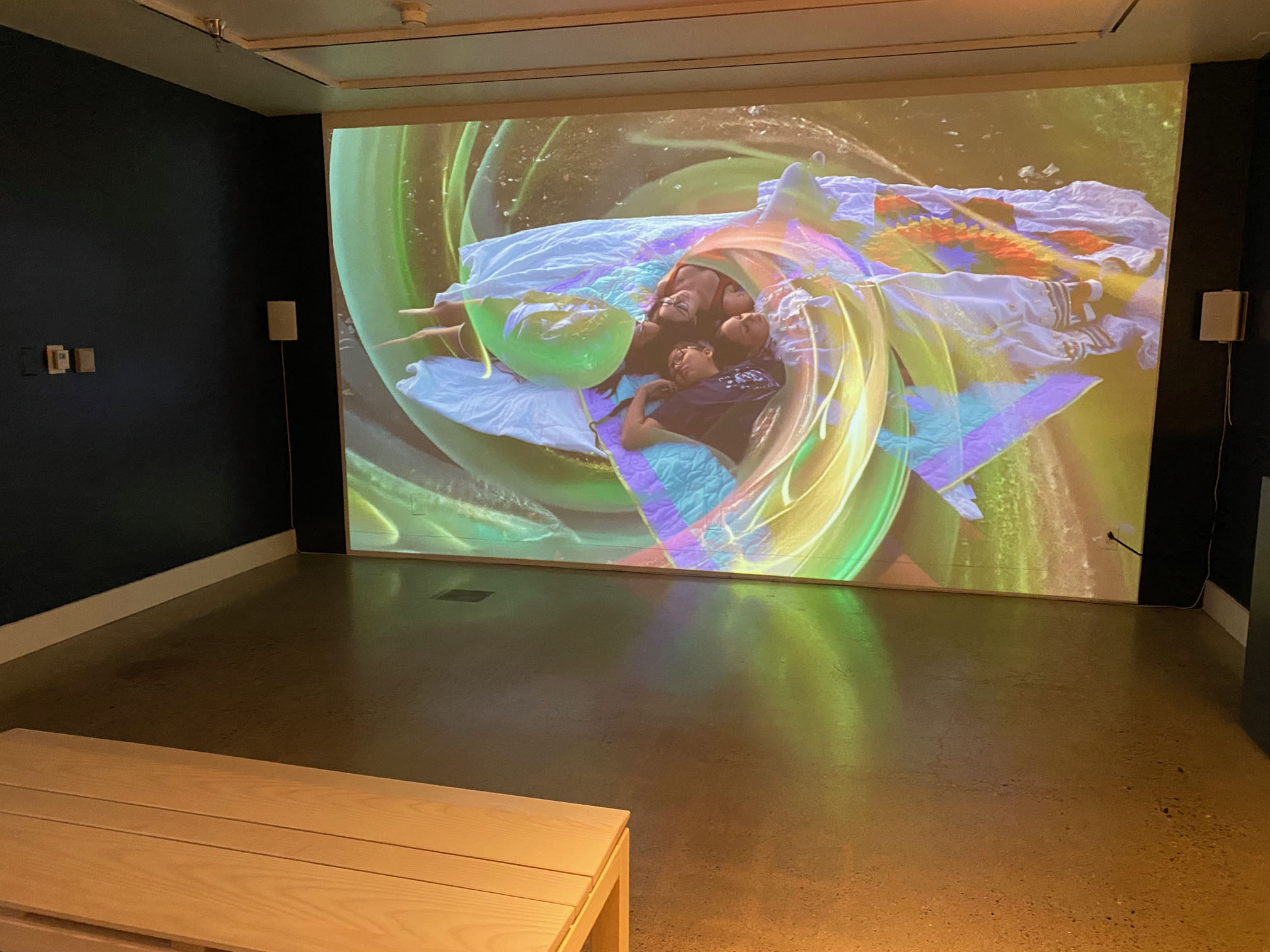
Spashed across the final wall of the space, The Land Paints Itself is a video collaboration with her Wíhaŋble S’a Center for Indigenous AI at Bard – a lab that explores Indigenous advances in this science and art. Watch as AI generates dazzling colors and patterns as four Lakȟóta dream about Indigenous futures. Kite suggests that the evolving technology of dreams is a legitimate way for her nation to envision ways forward.

2025 The Land Paints Itself video that uses AI to illustrate Lakhóta people’s dreams about Indigenous futures.

Provocative, visionary, and affirmative – meet Kite herself in an interview with Artforum editor Tina Rivers Ryan in March 2025, when Kite’s work was featured on the cover.