Altered Landscapes and Children of the Earth Experience in Reno

For years, the Nevada Museum of Art has been collecting photographs by artists whose work puts the environment, our culture’s addiction to nuclear and fossil fuel, construction booms, and degradation of desert landscapes front and center. Altered Lands and the Anthropocene, on view in Reno through September 20, is a beautiful installation across the second floor that causes visitors to stop, look, and contemplate what it took to record such tour de force images.

It’s all part of the museum’s massive Into the Time Horizon exhibition.  Take a walk through the galleries in our Flickr album.
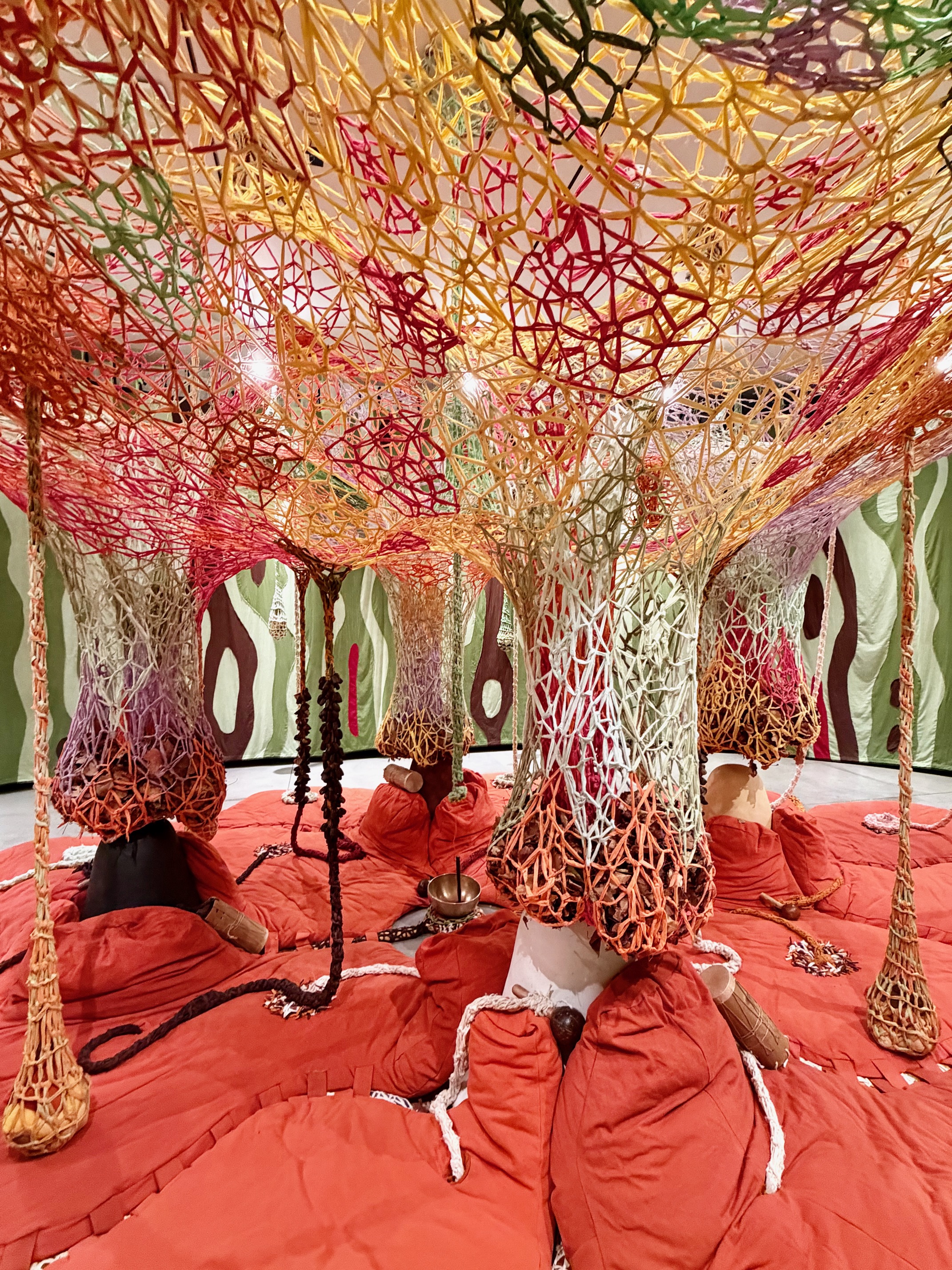
Sensual, cocoon-like participatory space at the core of Ernesto Neto’s 2019 Children of the Earth – filled with futons, pots, crytals, instruments, and spice smells Courtesy: Tanya Bonakdar Gallery, New York.

The masterful photo exhibition is next door to a solo installation that serves as a great respite – the immersive, colorful, magical playground-style environment Ernesto Neto: Children of the Earth, also on view through September 20. More about this in a moment.

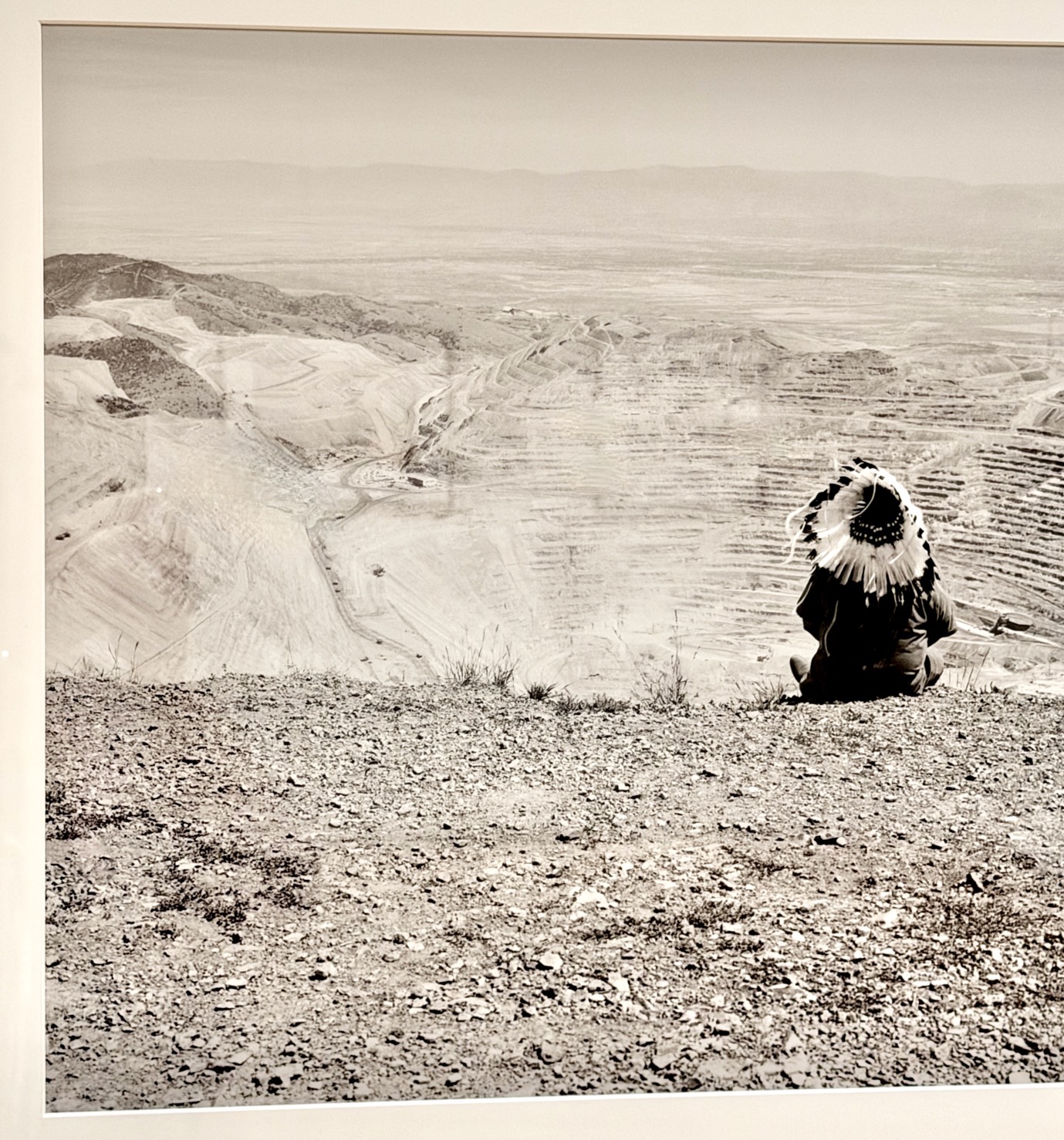
The first section of the photography galleries features traditional documentay photography about legacies of industrial-scale extraction of oil, gas, uranium, and minerals across the West – Edward Weston’s image of big equipment at work toward the end of the Great Depression, Robert Adam’s aerial view of the legacy of Colorado mining, and Zig Jackson’s headdress-adorned Native American perched at the edge of the largest mine on earth in Utah.
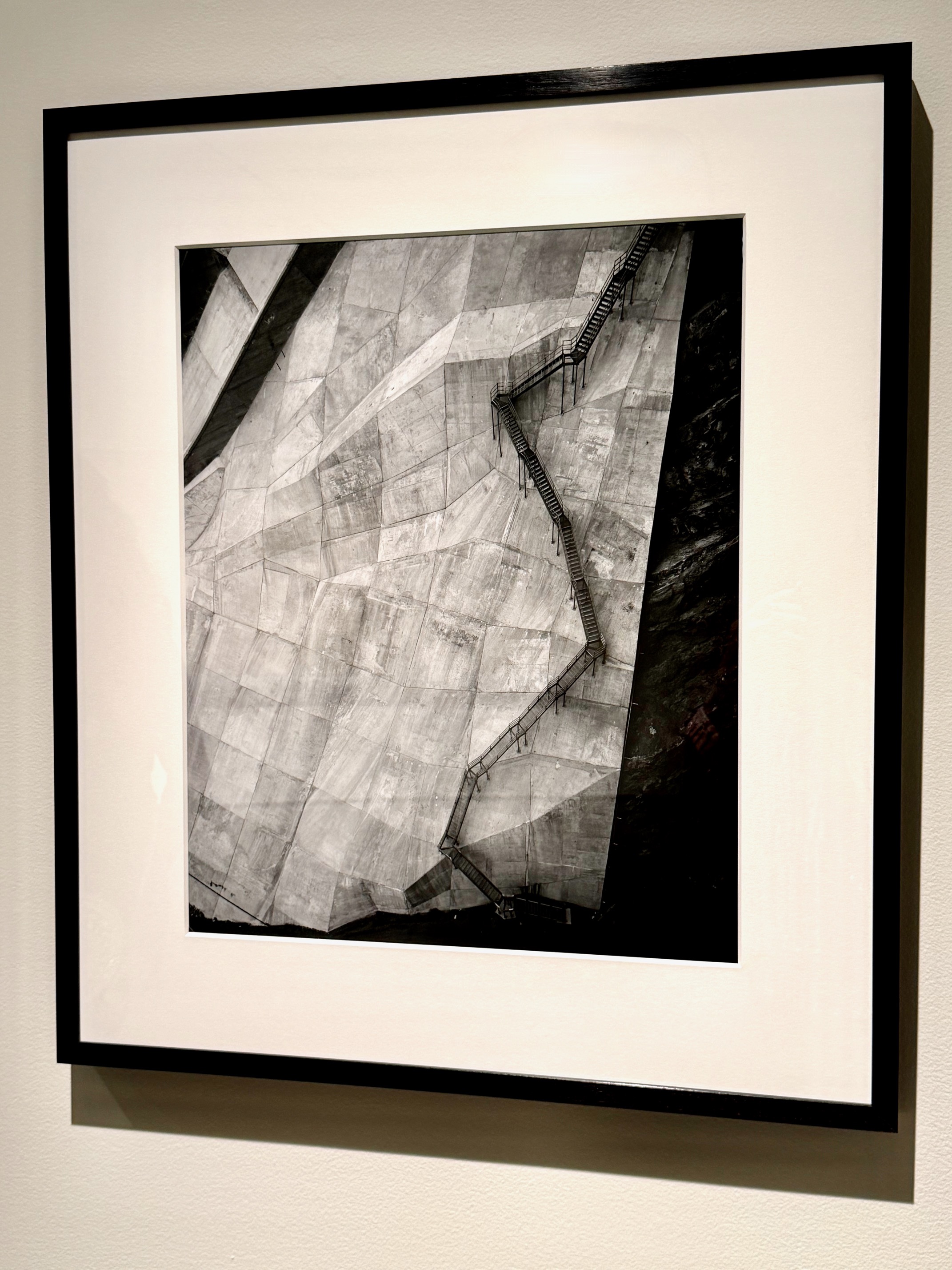
Toshio Shibata’s 1997 silver gelatin print Coolidge Dam, San Carlos, AZ – a controversial project built as part of the San Carlos Indian Irrigation Project on tribal burial grounds.
2004 (printed 2020) archival inkjet print by Zig Jackson (Mandan/Hidatsa/Arikara) Indian Man at Kennecott Copper Mines, Toole, Utah – a man in a war bonnet sits at the edge of the largest human excavation on earth.

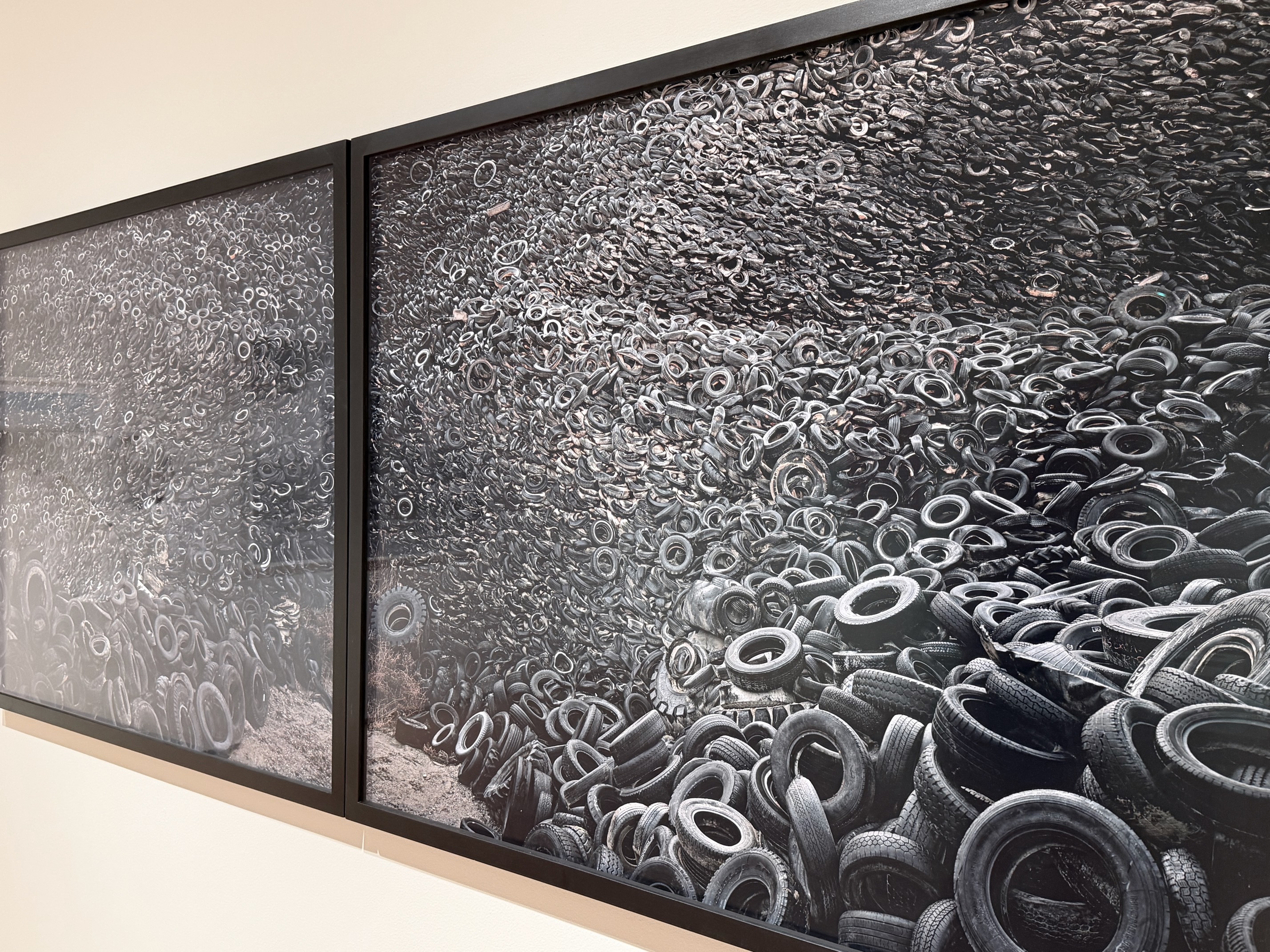
These share the space with evidence of long-lasting consequences of uranium mining by Patrick Nagatani and a startling document of America’s disposal culture from Edward Burtynski. Each image is crammed with feeling that the ominous impacts will be around for a long time – moving calls to action.
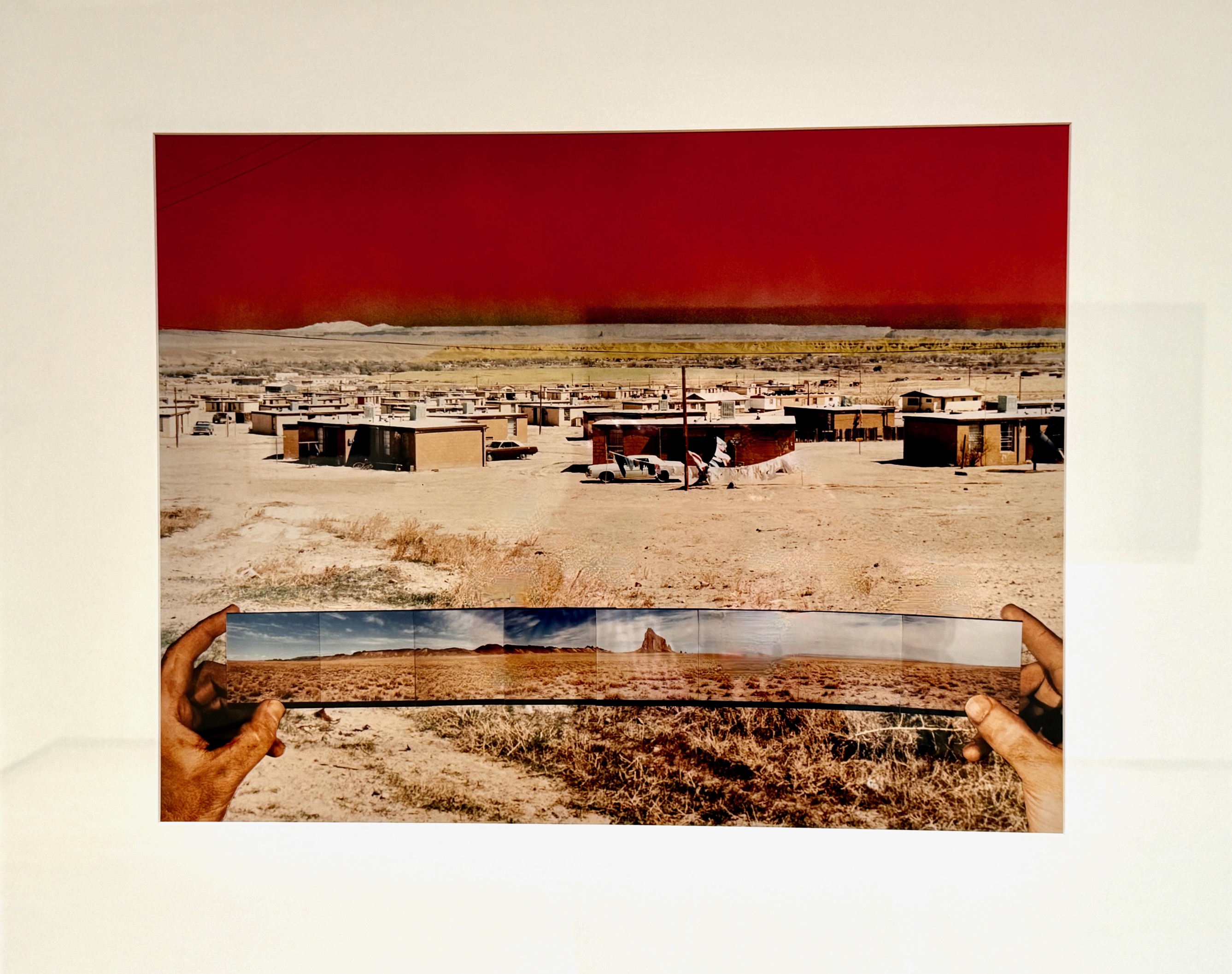
In pursuit of nuclear fuel: Patrick Nagatani’s 1990 chromogenic print ’Bida Hi’/Opposite Views: Northeast-Navajo Tract Homes and Uranium Tailings, Southwest-Shiprock, New Mexico – from his Nuclear Enchatment series highlighting the community contaminated from the 1950s uranium mill at Shiprock.
Impact of relying upon fossil fuel:  Edward Burtynski’s 1999 chromogenic color print Oxford Tire Pile #9a and #9b, Westley, California, USA – a documentation of a massive industrial hazard, which later caught fire and contaminated nearby communities and water resources.

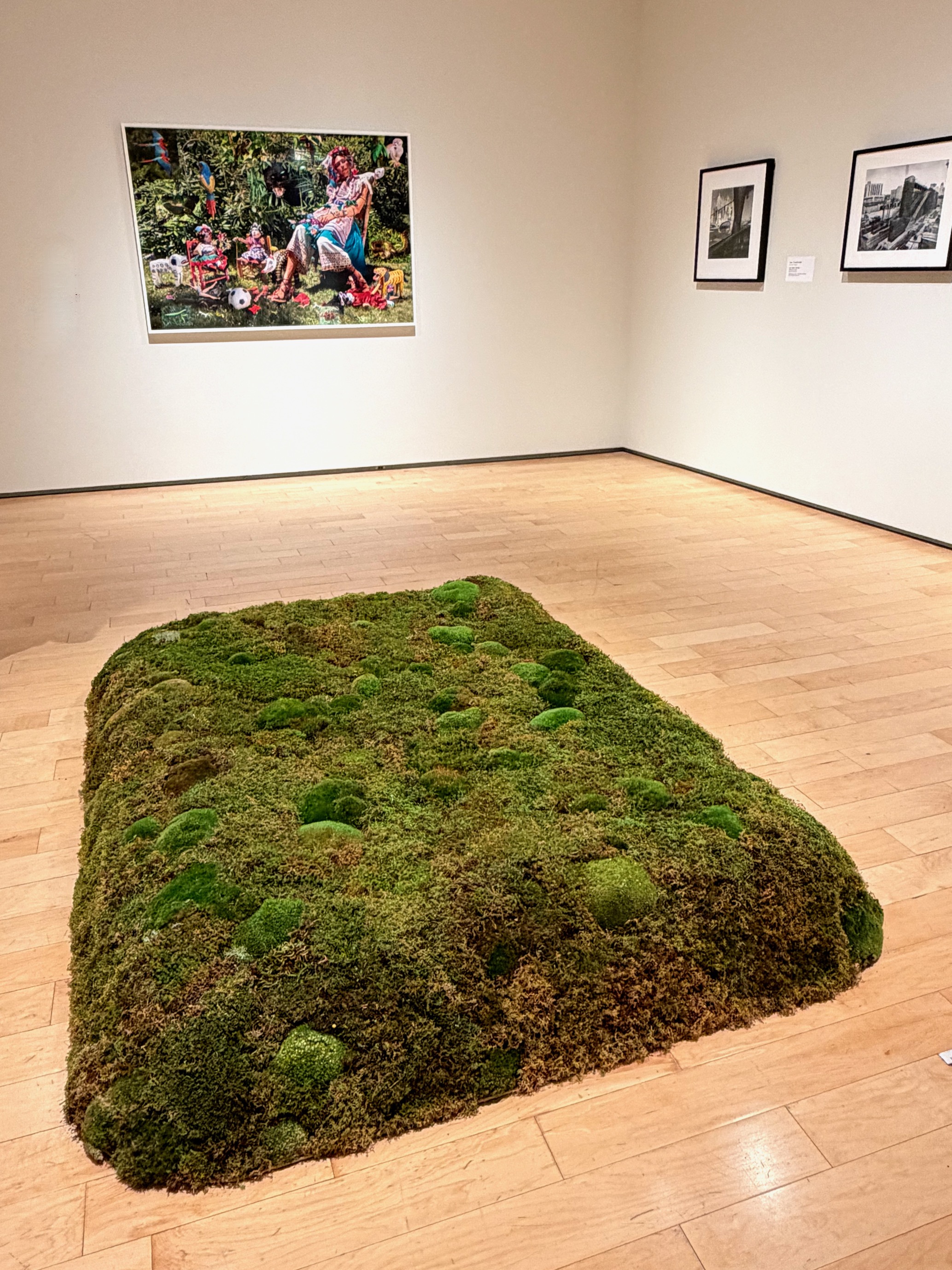
To mix it up, the curators have thrown in a touch of the surreal – an arresting image by Cara Romero collaged into the oil-field landscape near where she grew up, and Meg Webster’s sculpture from living Earth. Beautiful and inviting art from across the room, but more thought-provoking as you draw near.
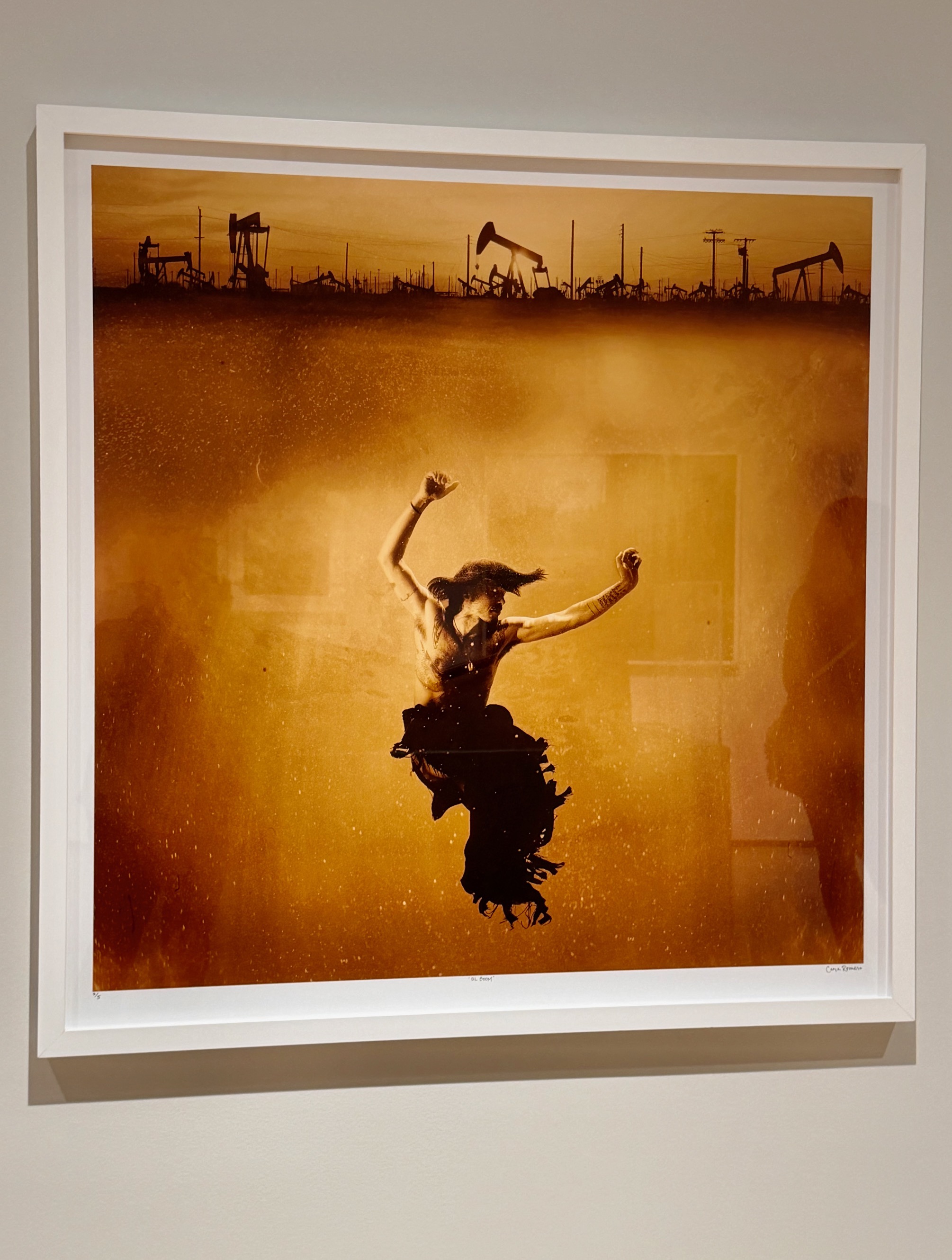
2015 archival inkjet print Oil Boom by Cara Romero (Chemehuevi) from her “Water Memories” series – with collaborator artist-activist Canupa Hanska Luger (Mandan/Hidatsa/Arikara/Lakota) floating in brown liquid below an oil pump.
Meg Webster’s 1986/2005 peat moss, earth, and plastic installation Moss Bed, Queen – evoking relaxation in nature with materials collected nearby from the forest; on walls, work by Martine Gutierrez and Lee Friedlander. Courtesy: Walker Art Center, Minneapolis; Nevada Museum of Art.

Some of the largest works also require visitors to take them in from a distance – such as Rohini Devashar’s gorgeous, huge printed silk.
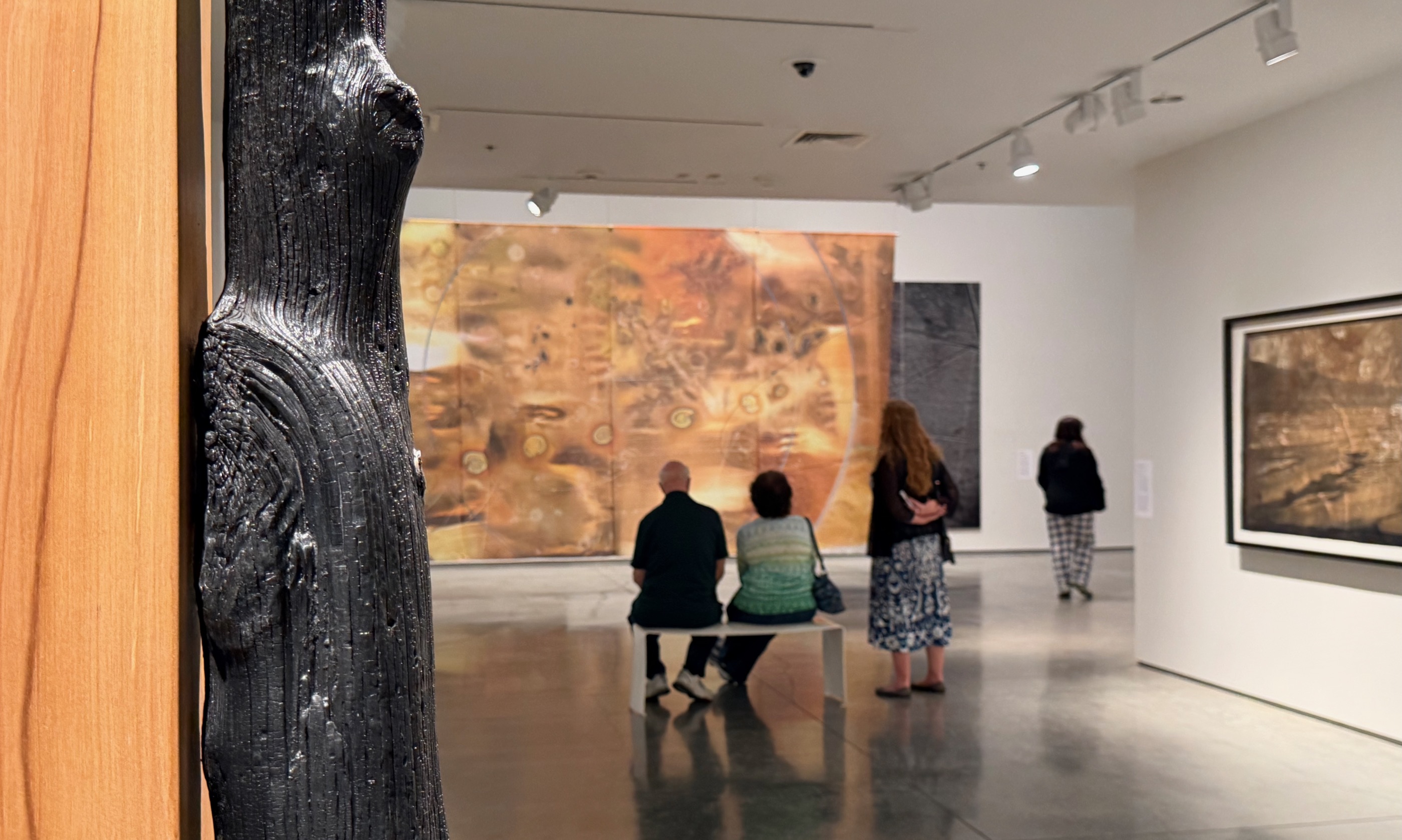
Visitors contemplate Rohini Devashar’s 2023 Latent Field (Field One) – colliding molecules and celestial bodies printed on silk. Courtesy: the artist and Gallery Wendi Norris, San Francisco.

But in most cases in this section, you have to get close to the fine print to truly understand what you’re seeing. Most appear abstract. An epic seemingly all-black work by David Maisel is actually a collage of aerial views of the bombing runs in the Dugway Proving Ground in Utah. The evocative, overlapping images in a gelatin silver print by Laura Bon, Tristan Duke, and Richard Nielsen was done inside a container-shipping-sized camera obscura at the tragic environmental site of Owens Lake. The huge one-of-a-kind photo was actually developed in the sad lakewater.
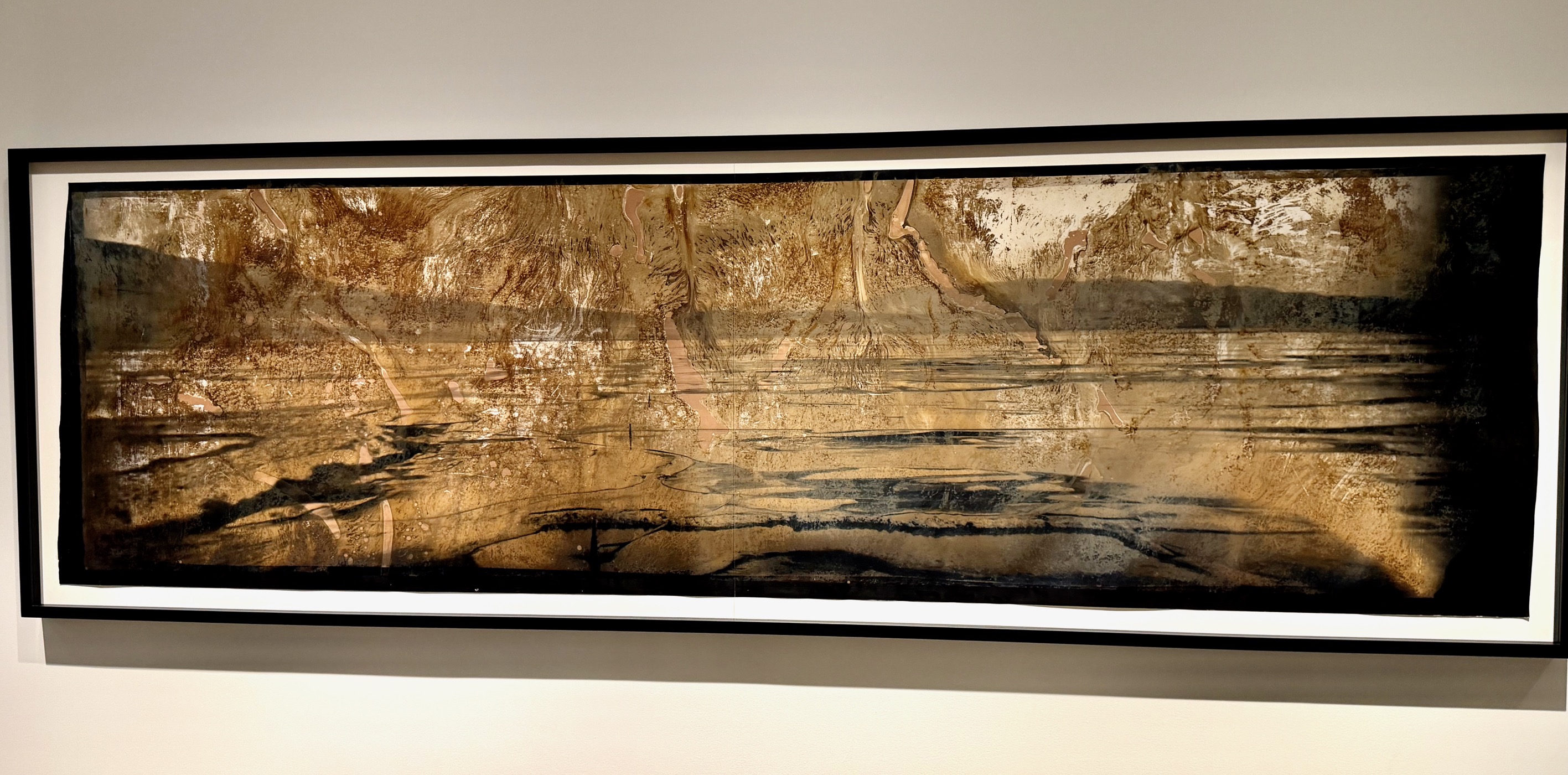
2013 gelatin silver print Bubblers, Owens Dry Lakebed (Lakebed Developed) – project by the Optics Division of the Metabolic Studio created by Laura Bon, Tristan Duke, and Richard Nielsen. Created on light-sensitive paper via camera obscura inside a shipping-container studio, developed in the lakebed.

A similarly epic achievement is displayed in the gallery devoted to documenting the aftermath of the Marshall Islands nuclear detonation experiment following World War II – Meghann Riepenhoff’s cyanotype tryptich made right there on a contaminated beach using plants that (like the people) are still in recovery.
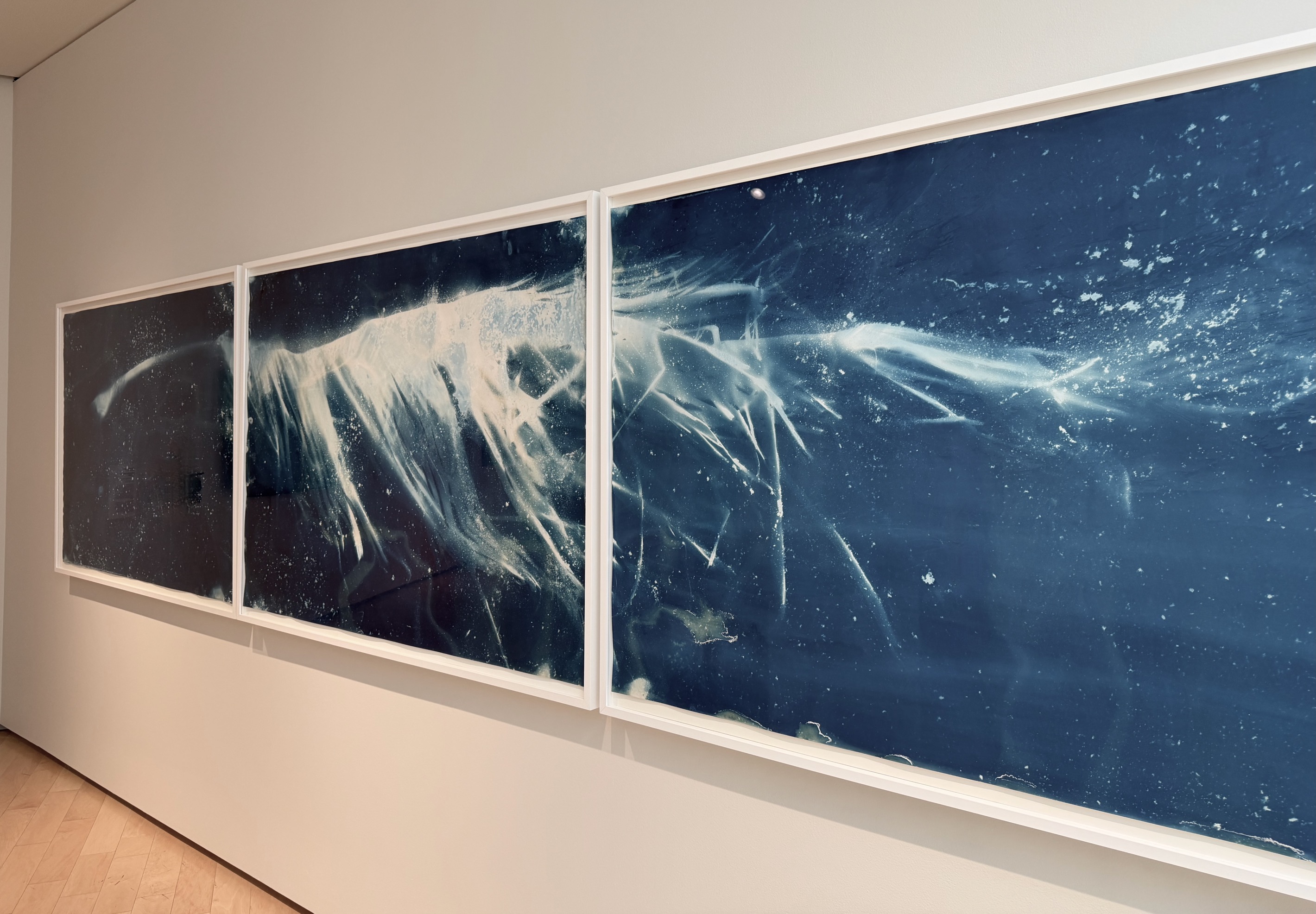
Marshall Islands project: Meghann Riepenhoff’s 2023 Untitled (Adaptive Radiation: Radioactive Palm Triptych – a cyanotype made from laying native medicinal plants found across pre-treated paper; washed in the waters of Bikini Atoll, the site of extensive nuclear tests in the 1950s. Courtesy: the artist and Yossi Milo Gallery, NYC

The images are stunning but the content is disturbing (and meant to be), so visitors are actually eager to enter Ernesto Neto’s nearby recuperation chamber.  Adults and children can find respite, surrounded by natural dyed fabrics (you can even put on matching play-jackets!) that provide a mysterious, happy entry to a magical world.

Surround yourself with cushions, create healing sounds with a Tibetan singing bowl, lay down, smell the fragarent spices, look at playful Amazon-inspired hanging jungle things, think about the future, and be happy to be among the Children of the Earth.
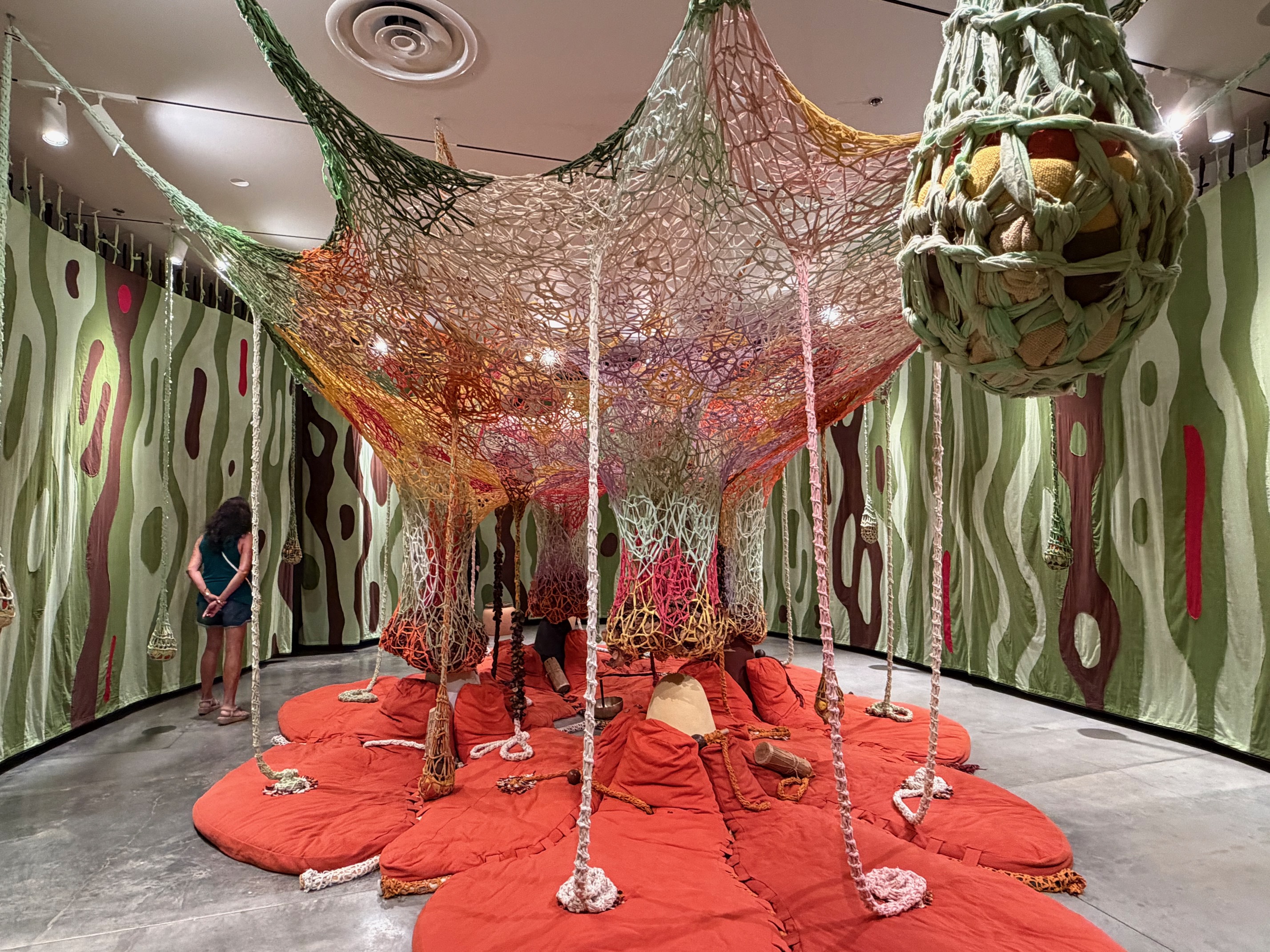
Exploring the sensual, cocoon-like participatory space at the core of Ernesto Neto’s 2019 Children of the Earth – filled with futons, pots, crytals, instruments, and spice smells Courtesy: Tanya Bonakdar Gallery, NYC

Thanks to the Nevada Museum of Art for providing an amazing, unforgettable experience!
Environmental Alerts by Native Artists

Who better to ask us to pay attention to environmental impacts than people whose ancestors have been stewards of the land for millennia? Earth, air, fire, and water is the thematic structure for this beautiful, throught-provoking contemporary art show Essential Elements: Art, Environment, and Indigenous Futures, on view at Santa Fe’s Museum of Indian Arts and Culture through May 31, 2026.

The curators have selected 31 artists from 18 tribal communities across the United States to draw our attention to how tribal communities and the rest of us can listen to the Earth and imagine positive outcomes in the future.

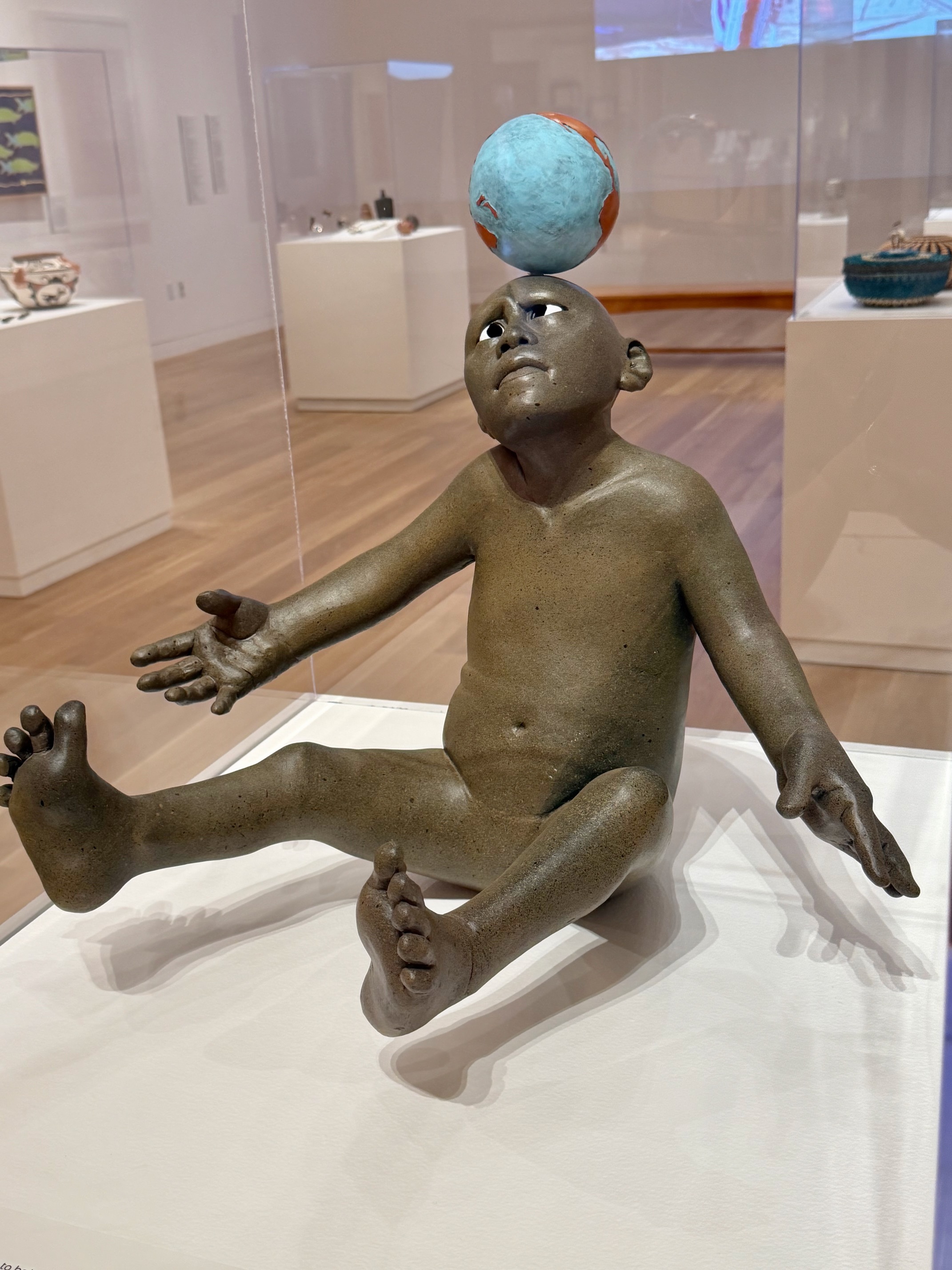
The Earth on edge: 2020 fired clay Unstable World by Roxanne Swentzell (Santa Clara Pueblo). Courtesy: private collector.

Some jewelry, paintings, drawings, pots, and installations draw attention to traditional symbols of the Earth’s health (traditional symbols, wildlife living in a healthy environment), but many include pointed references to recent wildfires and other devastating alterations affecting tribal agriculture and people’s health.

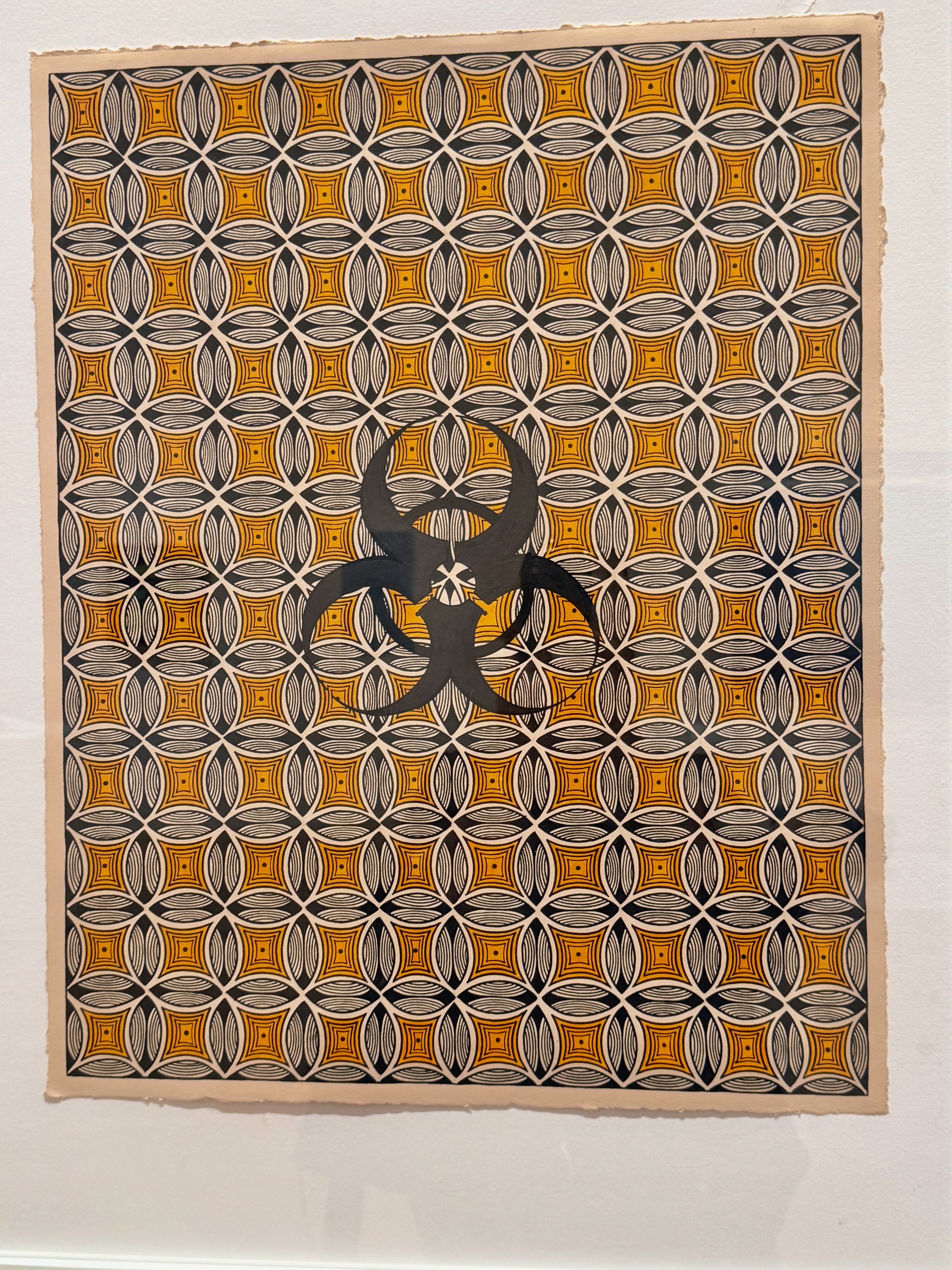
2025 pen-and-ink drawing Biohazard Beauty II by Rowan Harrison (Diné/Isleta Pueblo). Courtesy: the artist.

Take a look at some of our favorite work in our Flickr album.

The Earth section begins with Roxanne Swentzell’s large ceramic sculpture Unstable World, which sets the tone for the rest of the show – Native art that calls attention to our current environmental balancing act. Nearby, several Diné artists ring the alarm bell about the insidious damage being done to Navajo Nation and nearby pueblos – and their own families – from the long legacy of open-pit uranium mining and contamination from nuclear testing.

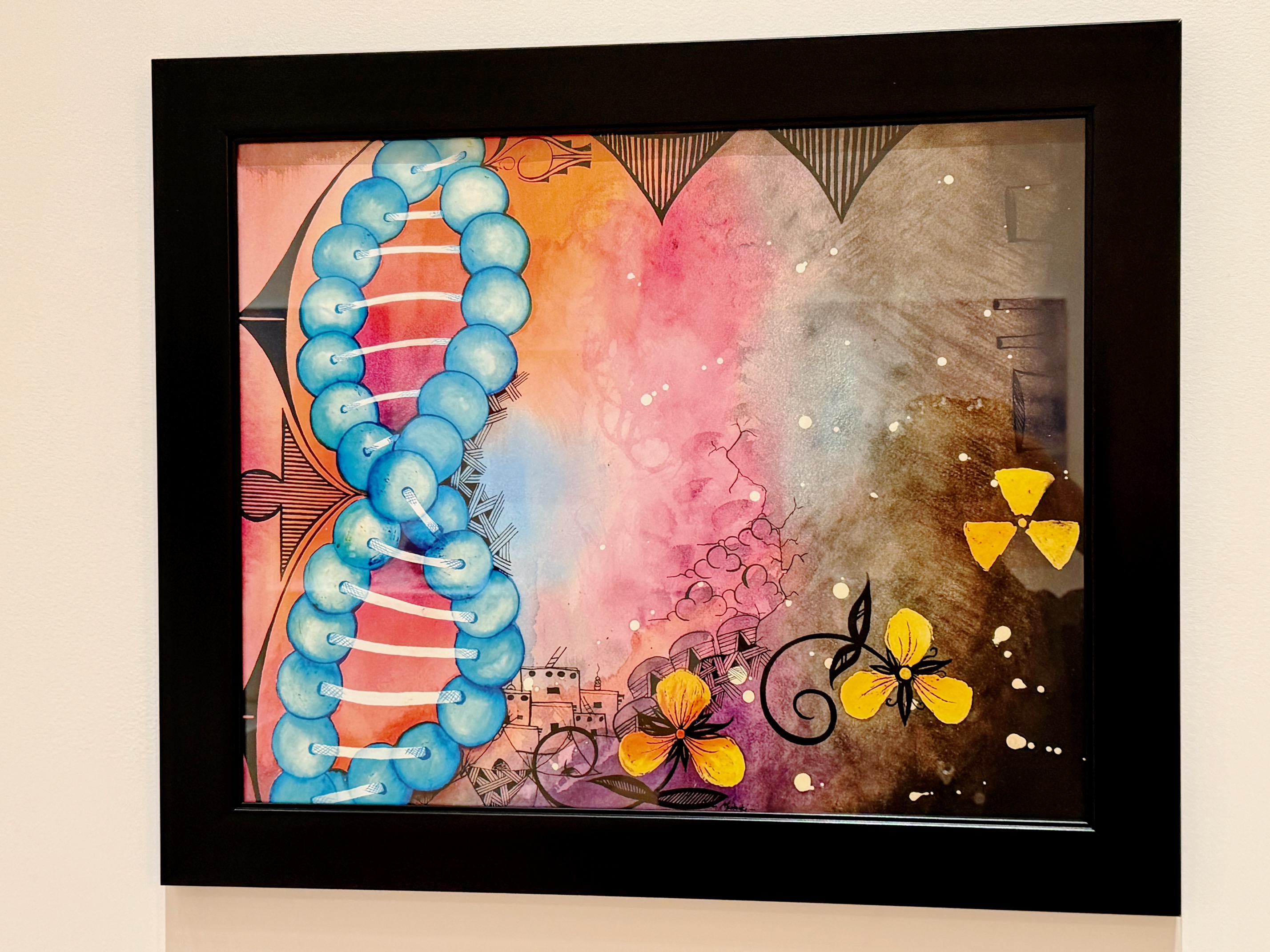
Rowan Harrison’s intricate drawings are made to raise awarness of intergenerational health challenges and to honor and support to cancer victims. The curators have given lots of space to Diné artist Shayla Blatchford’s photo-interview Anti-Uranium Mapping Project, including a sobering map of the nearly 500 abandoned uranium mines scattered across her homeland. Biologist-artist-public health advocate Mallery Quetawki (Zuni Pueblo), creates abstracted works. Only when you get close do you see the shapes are radiation symbols of uranium contamination working its way into DNA strands.

2019 We Will Continue to Fight by biologist-artist Mallery Quetawki (Zuni Pueblo), raising awareness of how radiation contamination on native land damages people’s DNA. Courtesy: the artist, University of New Mexico Community Environmental Health Program

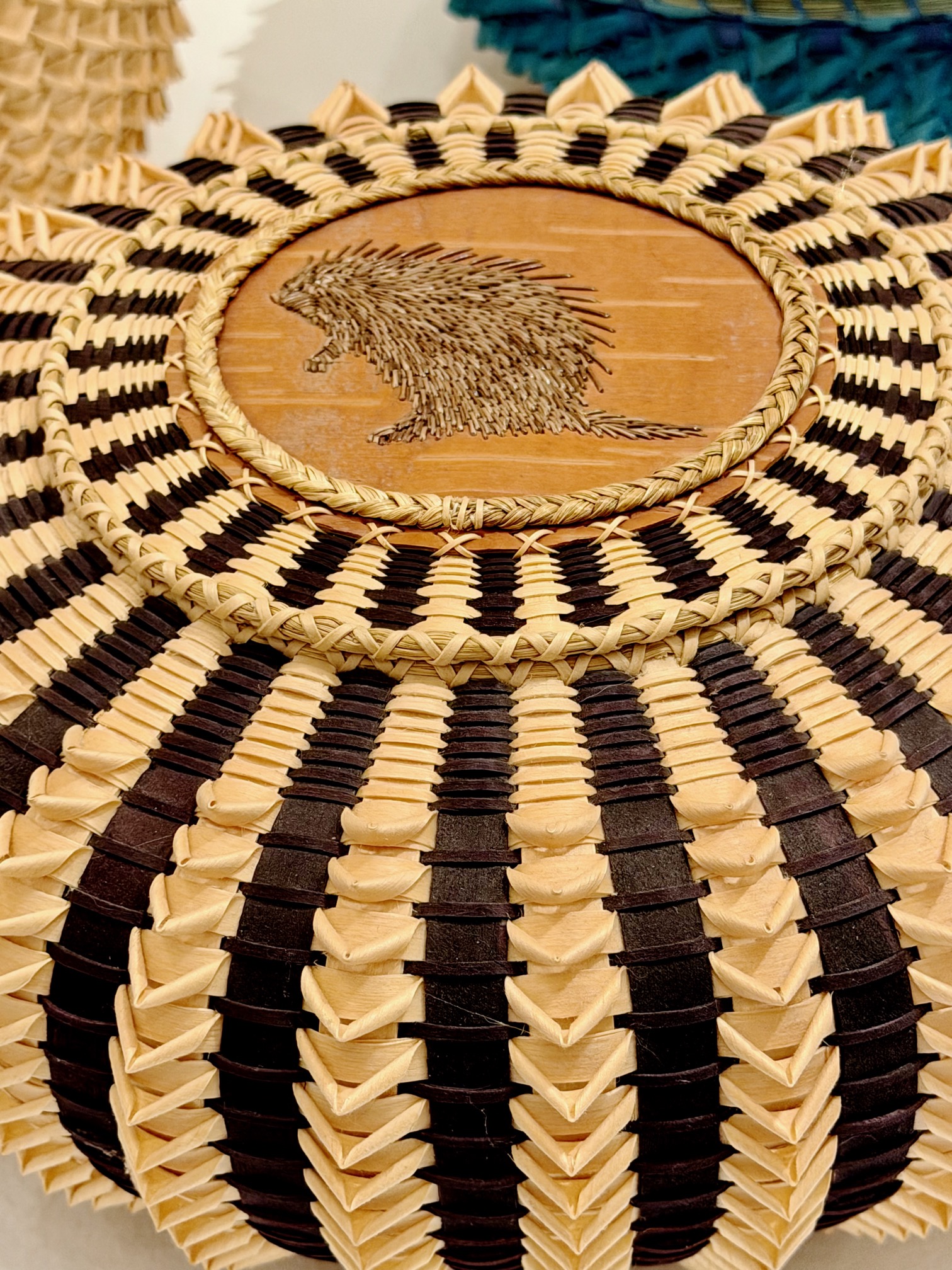
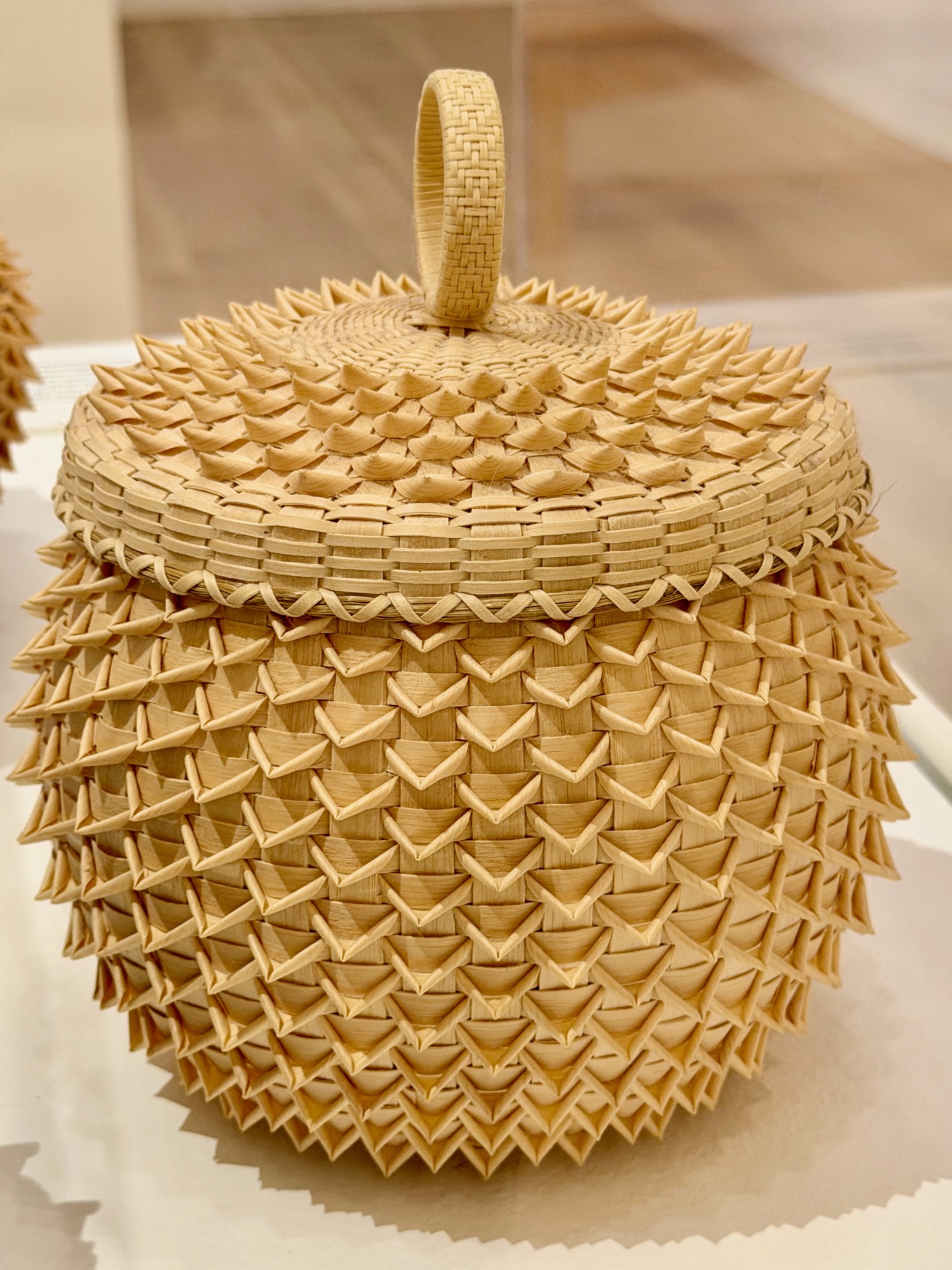
Beautiful, intricately woven baskets are displayed nearby. As you admire the creations of Jeremy Frey (Passamaquoddy), a 2025 recipient of the MacArthur Fellowship “genius” grant, it’s unsettling to learn that Jeremy and other Eastern art virtuosos are concerned that their baskets could be the last. Black ash and other natural materials are disappearing from their homelands at an alarming rate due to the triumph of invasive plant species.

Closeup of 2010 Lidded Basket with Porcupine Design by Jeremy Frey (Passamaquoddy) woven from black ash, sweetgrass, and porcupine quills; 2010 SWIA Market award winner. Courtesy: private collection.
2015 Ash Basket by Jeremy Frey (Passamaquoddy) woven from black ash, which is important to the tribe’s creation story, but highly endangered. Courtesy: private loan.

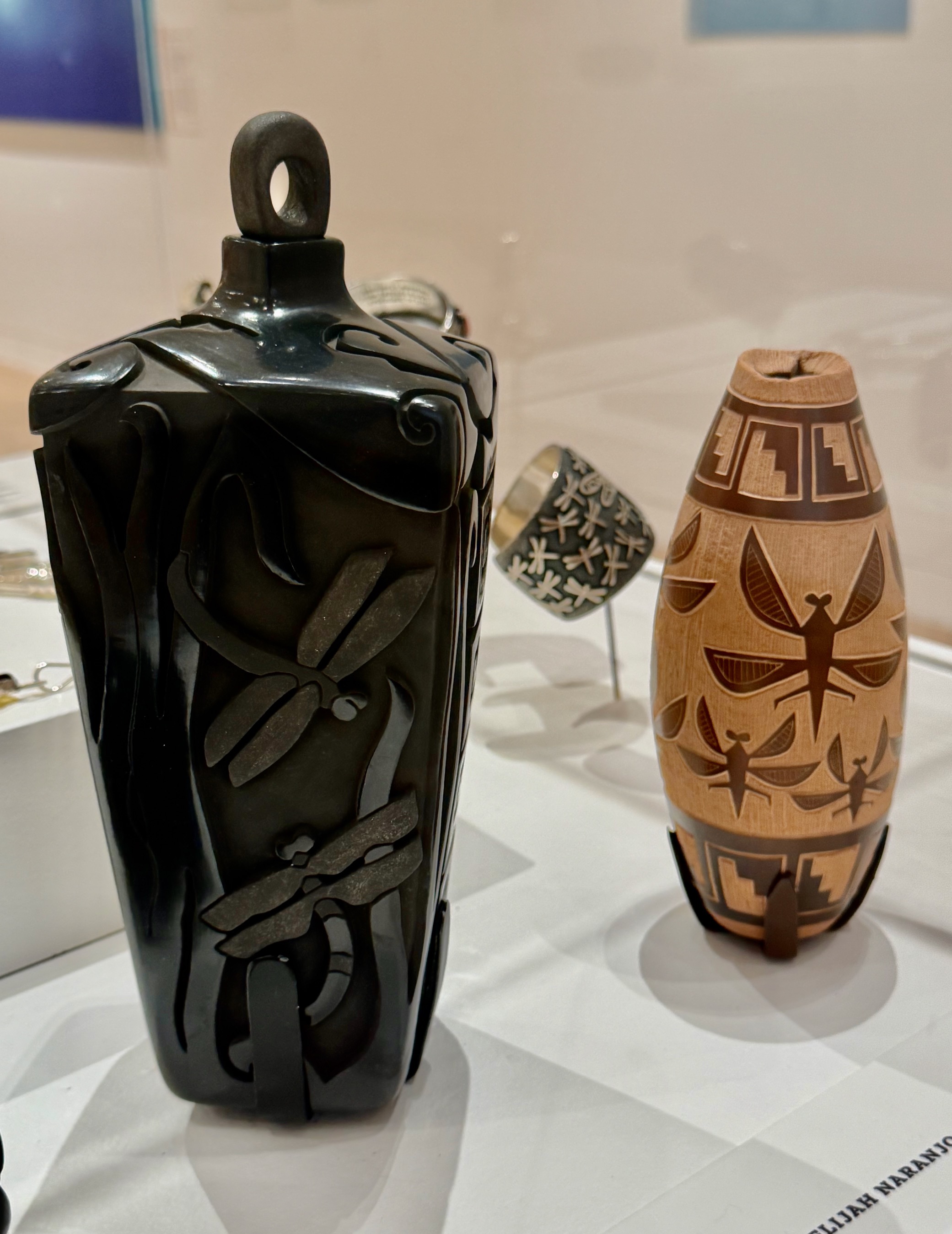
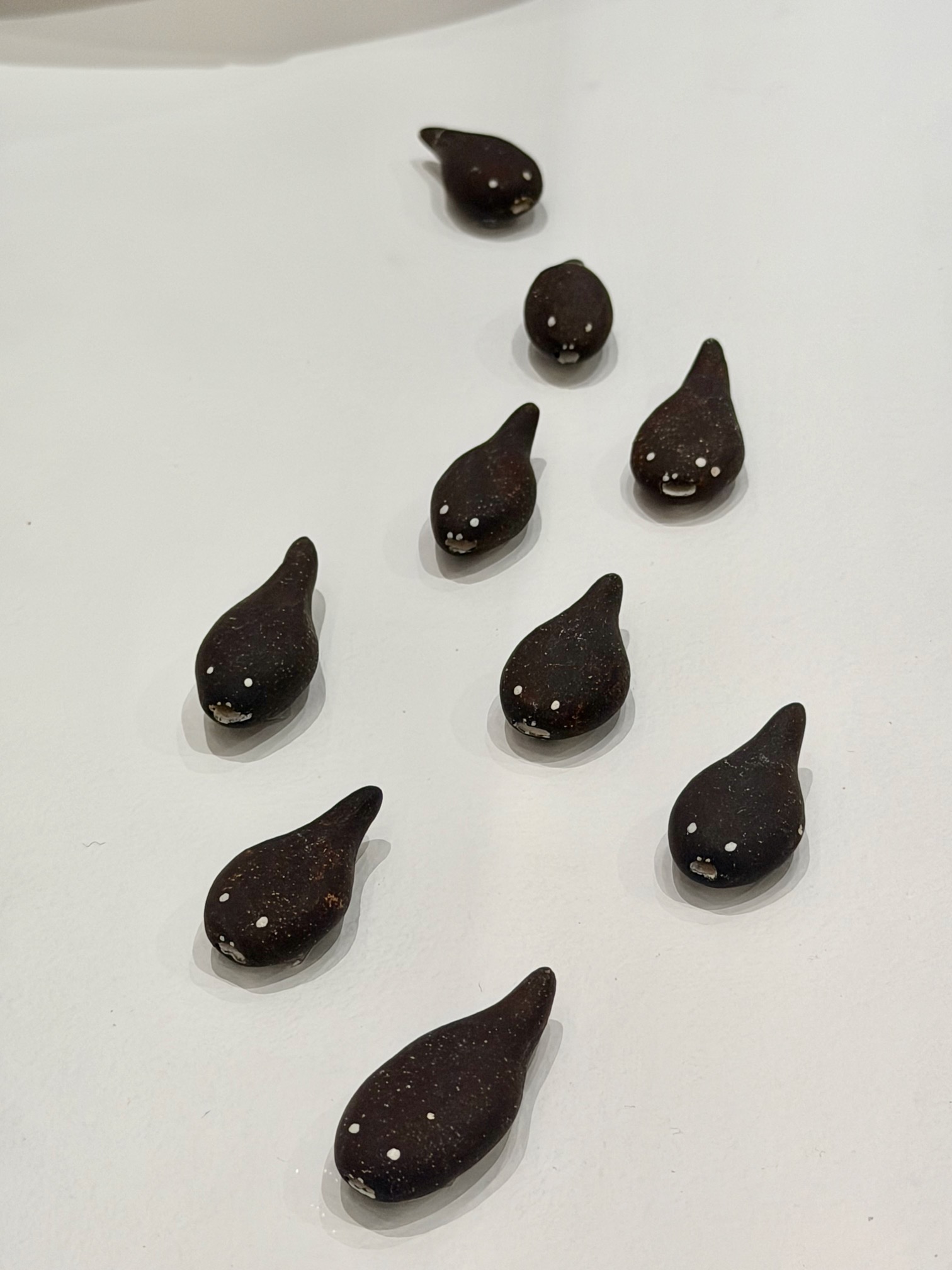
Other jewelry and ceramics artists incorporate images of animals, insects, and other indicators of what the world looks like when clean water and healthy air abound – dragonflies, tadpoles and frogs, and Avanyu, the all-important Puebloan water spirit. Multimedia artist Cannupa Hanska Luger is seen (via video) in a ritual performance “from the future” to ensure people’s continual gratitude for food, shelter, and tools.

Art featuring creatures of healthy air: 2001 Dragonfly Tall Lidded Jar by Autumn Borts (Santa Clara Pueblo), 2005 Dragonfly Bracelet by Ramon Dalangyawma (Hopi), and 2006 Dragonfly Vase by Dolly Naranjo Neikrug (Santa Clara Pueblo).
Keystone water species: 1958 ceramic Tadpole Figurines by Lucy Lewis (Acoma Pueblo); clay, crushed potshard temper, slip, and carbon paint.

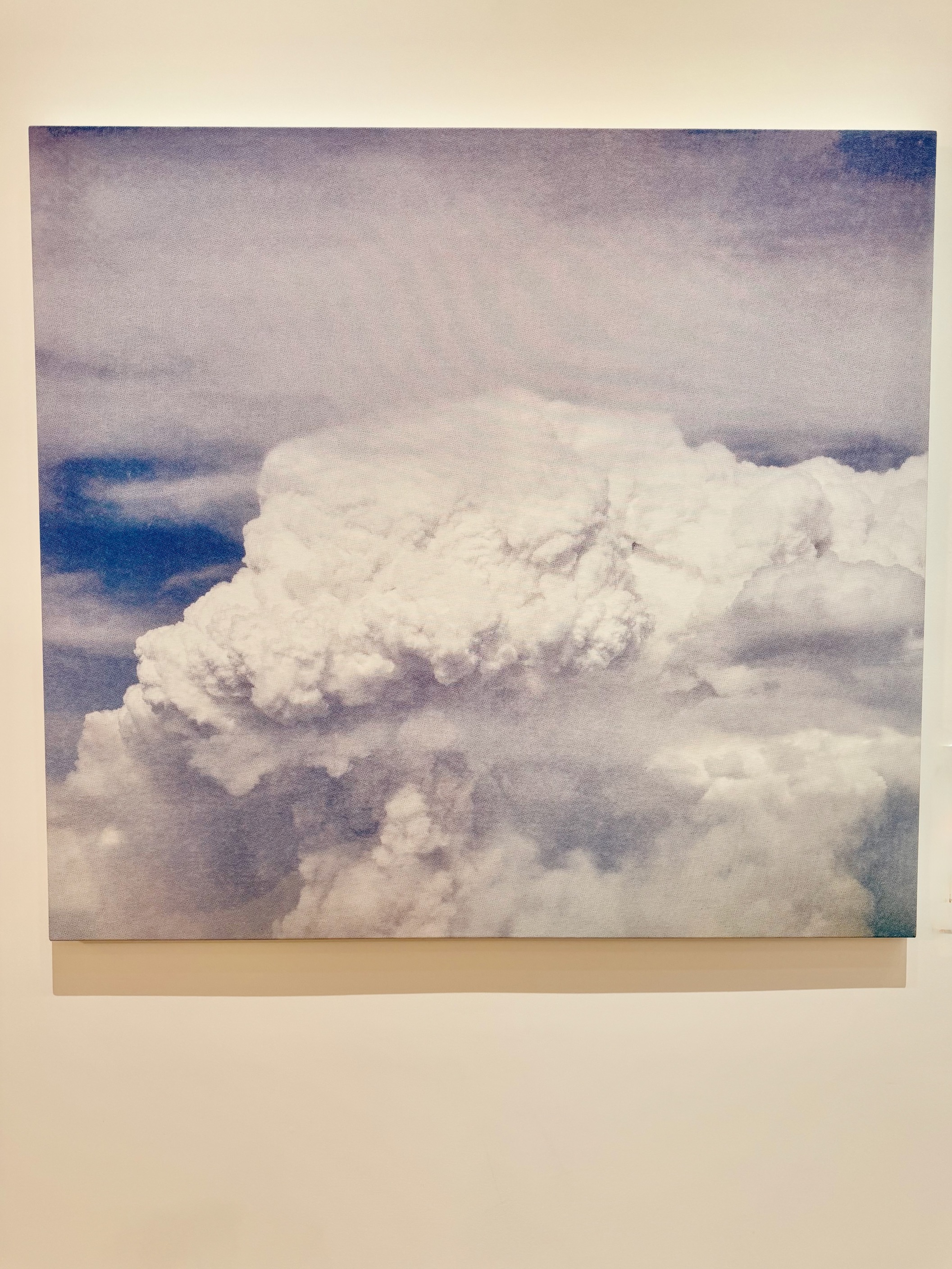
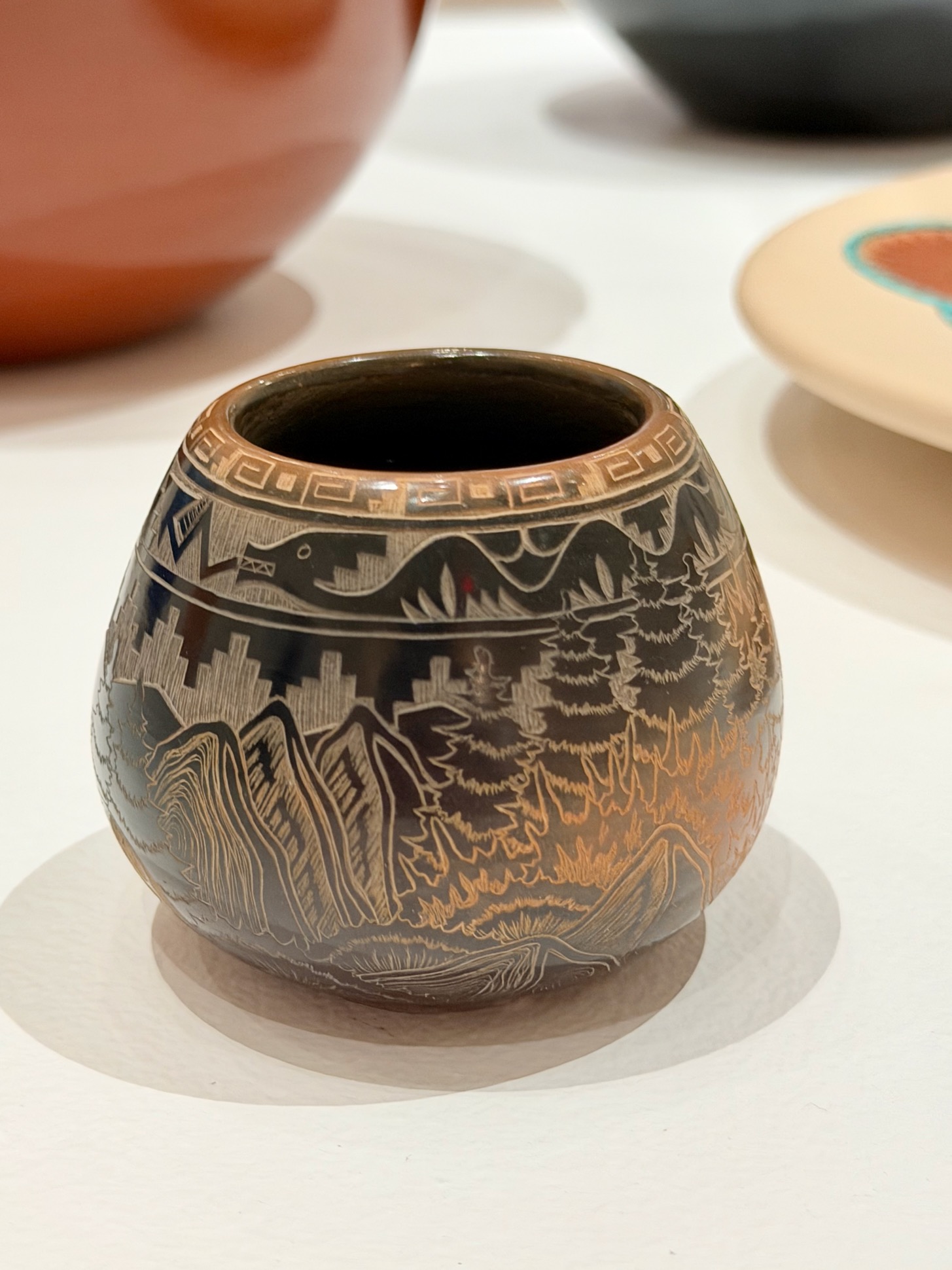
Considering the string of recent devastating wildfires that have plagued New Mexico in recent years, the artwork in the exhibition representing the element of fire is truly resonant. Kevin Naranjo made a tiny ceramic jar into which he carved his recollection of the wildly destructive 2011 Las Conchas Fire. Michael Namingha’s spectacular digital image is not just a pretty view of the sky. It’s the image of a cloud that only appears above an extremely intense heat source – exactly what he photographed during the 2022 Hermit’s Peak Fire or that New Mexicans witnessed in the Trinity blast.

2024 silkscreen Disaster 2 by Michael Namingha (Tewa-Hopi) – a pyrocumulus cloud emerging from the Hermit’s Peak Fire, the largest wildfire in New Mexico’s history. Courtesy: the artist, Niman Fine Art.
2011 Las Conchas Fire by Kevin Naranjo (Santa Clara Pueblo) – a carved (sgraffito) ceramic depcting trees, land, and fire that burned 150,000 acres of Santa Clara’s land on the Pajarito Plateau, including ancestral sites; the Avanyu water spirit hovers above.

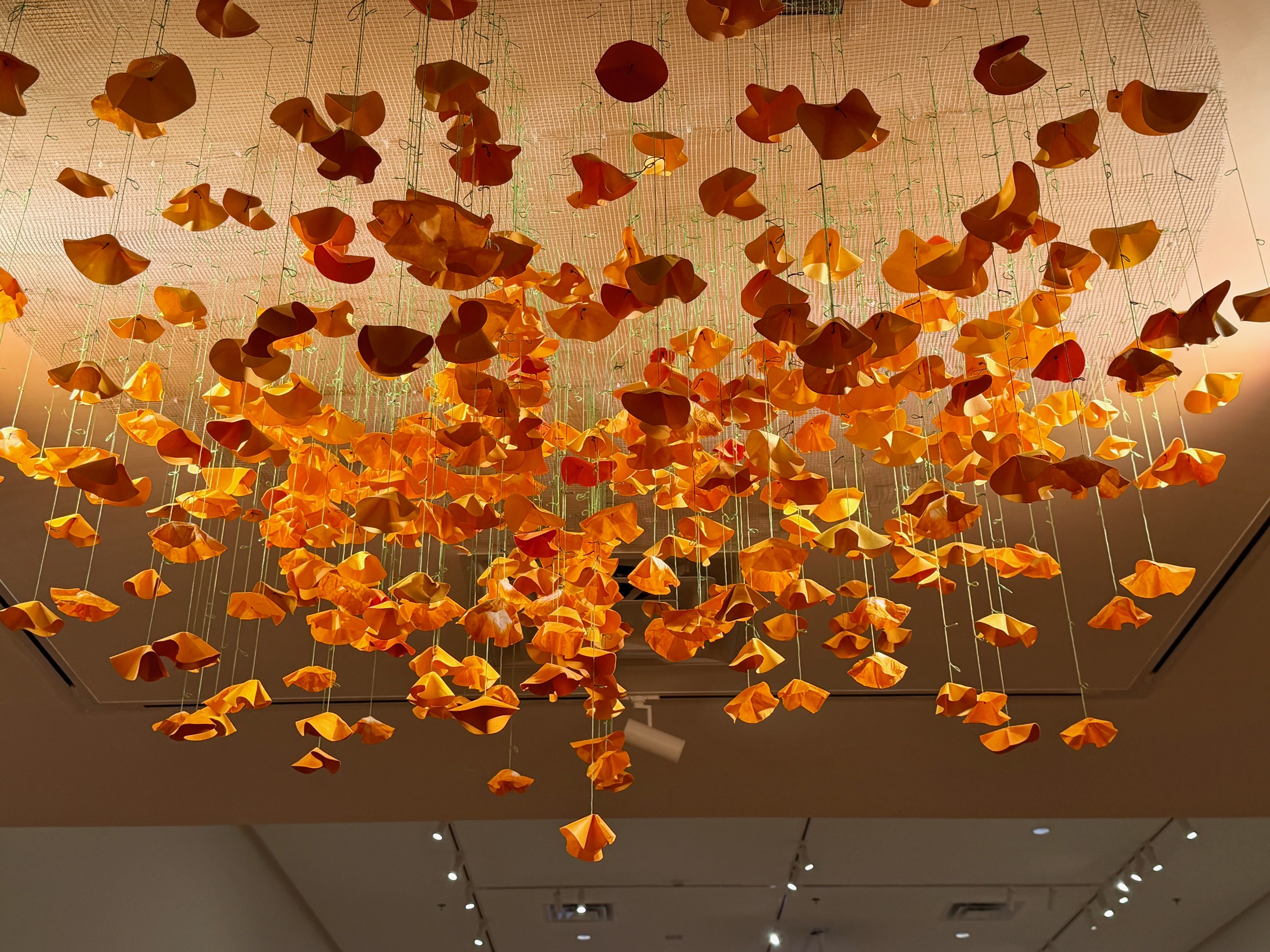
Overhead, as you enter or leave this thought-provoking experience, you see paper poppies – the first flowers that bloom after a fire.  Artist Leah Mata Fragua (Northern Chumash) is going a step further with her art after this exhibition ends. She’ll take her paper blossoms back home and burn them in a ritual that recycles her beautiful art back into the Earth.

2025 dyed handmade paper installation The Sun is on the Ground by Leah Mata Fragua (Northern Chumash), suggesting the wild poppies that bloom right after a wild fire. Installation intended to be recycled with fire at the exhibition’s conclusion. Courtesy: the artist