Environmental Alerts by Native Artists

Who better to ask us to pay attention to environmental impacts than people whose ancestors have been stewards of the land for millennia? Earth, air, fire, and water is the thematic structure for this beautiful, throught-provoking contemporary art show Essential Elements: Art, Environment, and Indigenous Futures, on view at Santa Fe’s Museum of Indian Arts and Culture through May 31, 2026.

The curators have selected 31 artists from 18 tribal communities across the United States to draw our attention to how tribal communities and the rest of us can listen to the Earth and imagine positive outcomes in the future.
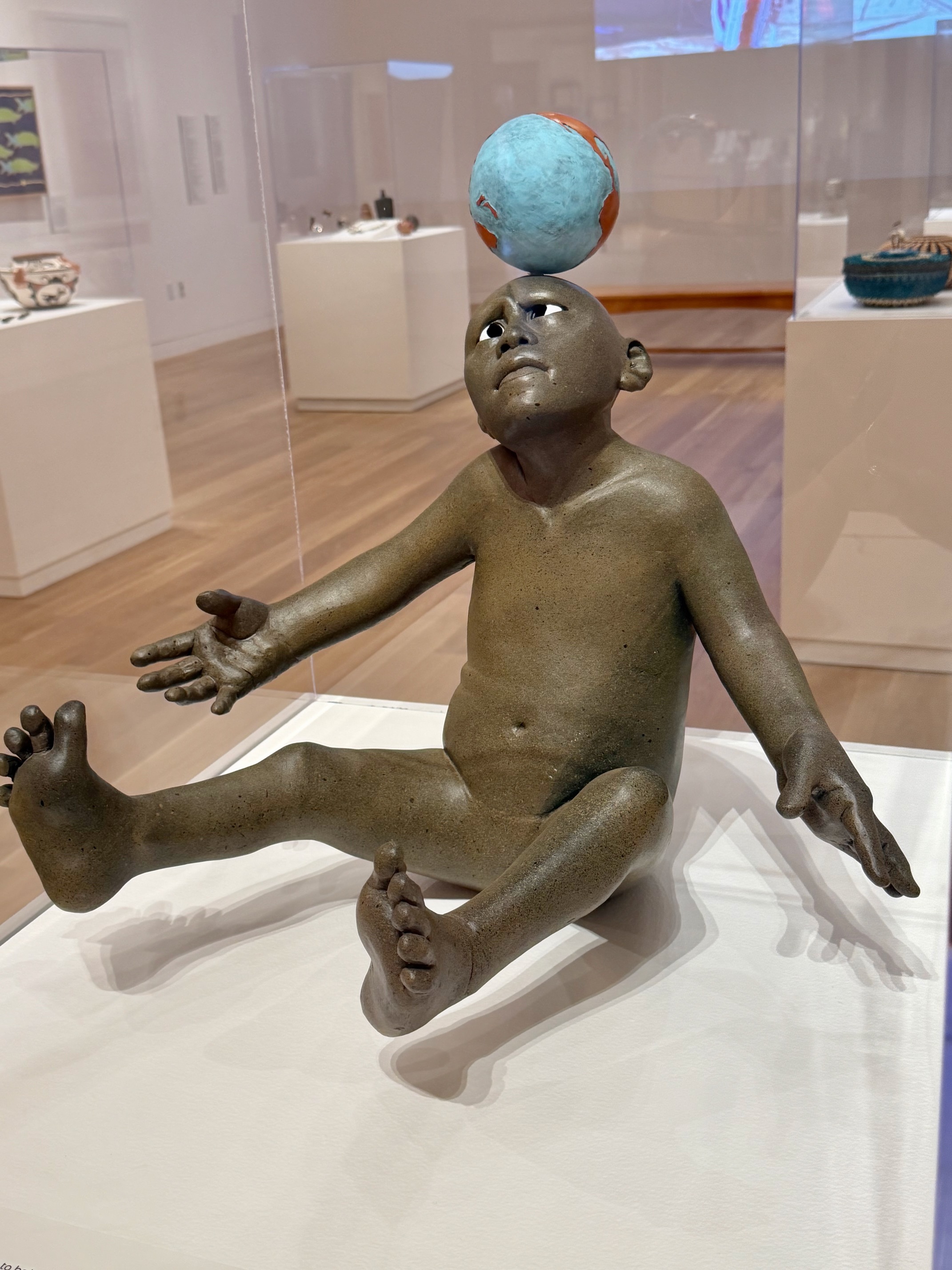
The Earth on edge: 2020 fired clay Unstable World by Roxanne Swentzell (Santa Clara Pueblo). Courtesy: private collector.

Some jewelry, paintings, drawings, pots, and installations draw attention to traditional symbols of the Earth’s health (traditional symbols, wildlife living in a healthy environment), but many include pointed references to recent wildfires and other devastating alterations affecting tribal agriculture and people’s health.
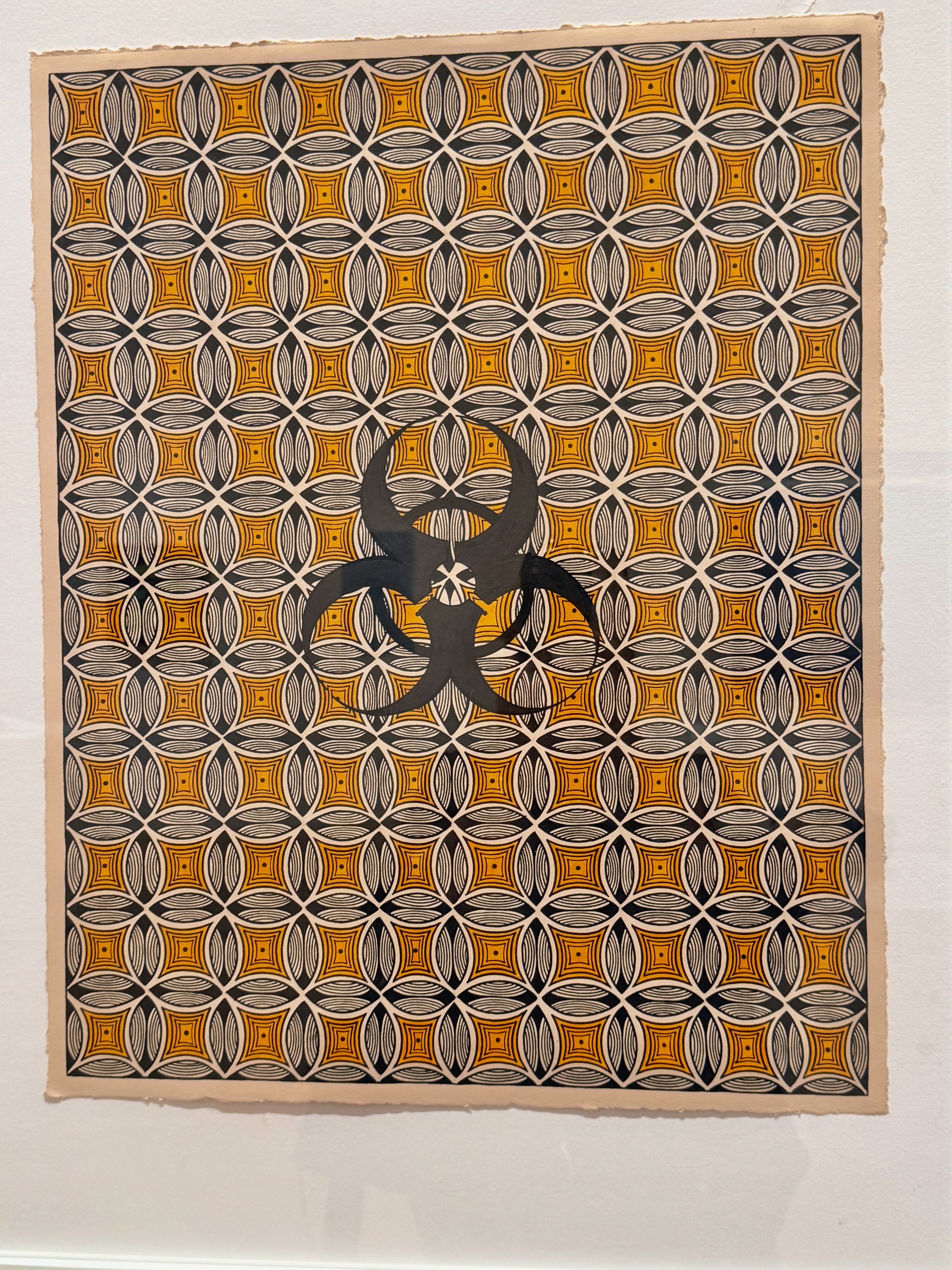
2025 pen-and-ink drawing Biohazard Beauty II by Rowan Harrison (Diné/Isleta Pueblo). Courtesy: the artist.

Take a look at some of our favorite work in our Flickr album.

The Earth section begins with Roxanne Swentzell’s large ceramic sculpture Unstable World, which sets the tone for the rest of the show – Native art that calls attention to our current environmental balancing act. Nearby, several Diné artists ring the alarm bell about the insidious damage being done to Navajo Nation and nearby pueblos – and their own families – from the long legacy of open-pit uranium mining and contamination from nuclear testing.

Rowan Harrison’s intricate drawings are made to raise awarness of intergenerational health challenges and to honor and support to cancer victims. The curators have given lots of space to Diné artist Shayla Blatchford’s photo-interview Anti-Uranium Mapping Project, including a sobering map of the nearly 500 abandoned uranium mines scattered across her homeland. Biologist-artist-public health advocate Mallery Quetawki (Zuni Pueblo), creates abstracted works. Only when you get close do you see the shapes are radiation symbols of uranium contamination working its way into DNA strands.
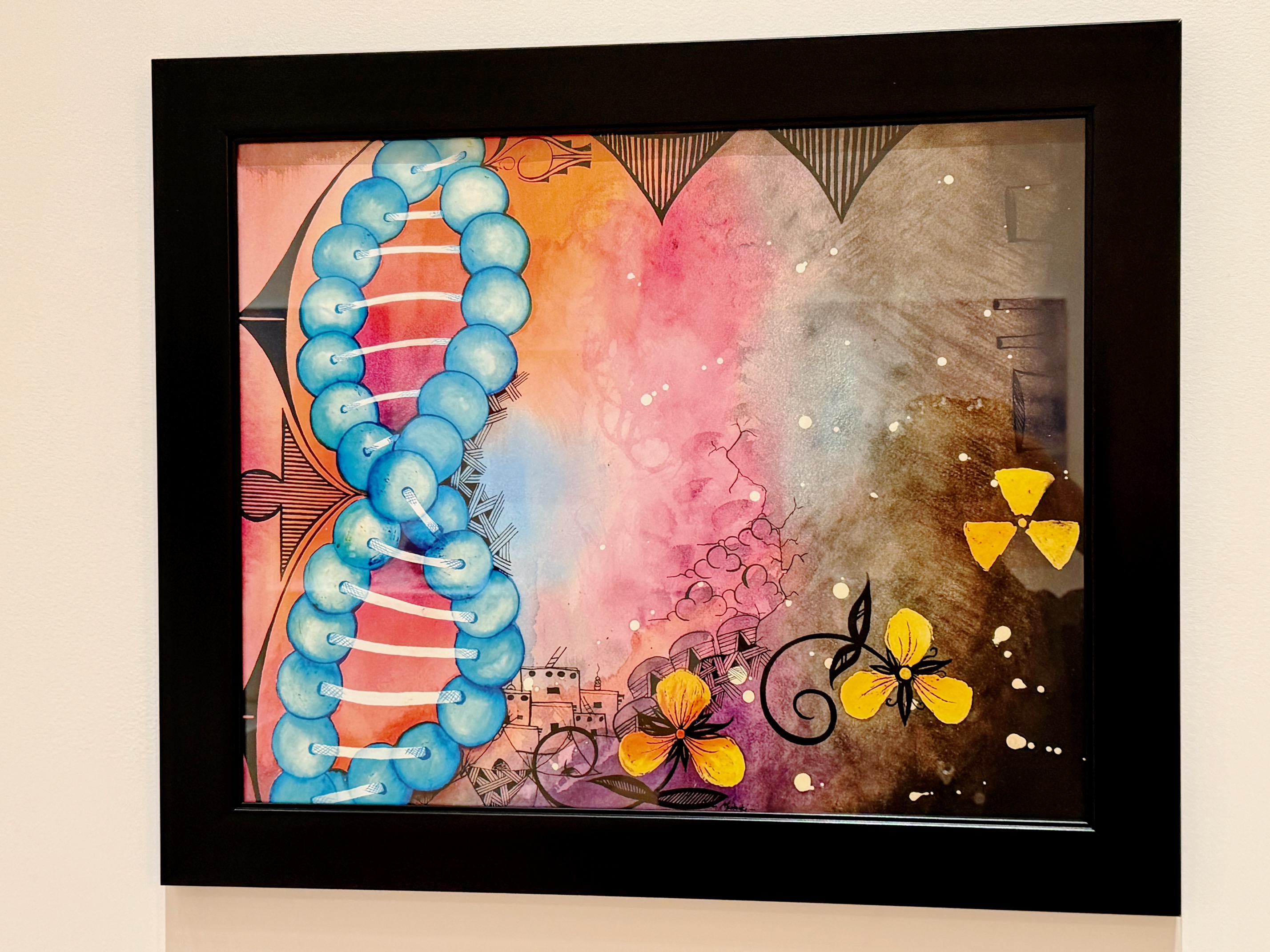
2019 We Will Continue to Fight by biologist-artist Mallery Quetawki (Zuni Pueblo), raising awareness of how radiation contamination on native land damages people’s DNA. Courtesy: the artist, University of New Mexico Community Environmental Health Program

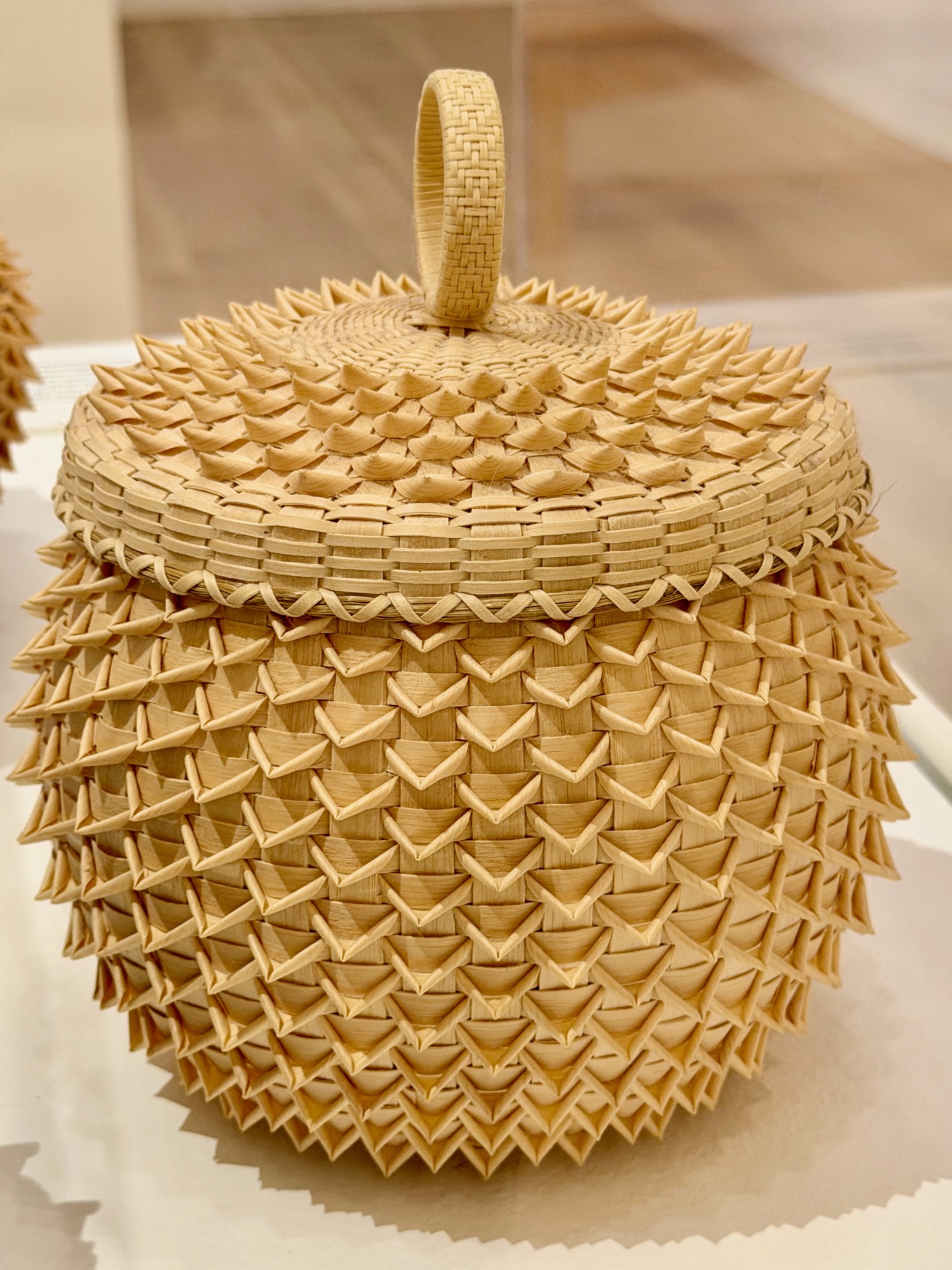
Beautiful, intricately woven baskets are displayed nearby. As you admire the creations of Jeremy Frey (Passamaquoddy), a 2025 recipient of the MacArthur Fellowship “genius” grant, it’s unsettling to learn that Jeremy and other Eastern art virtuosos are concerned that their baskets could be the last. Black ash and other natural materials are disappearing from their homelands at an alarming rate due to the triumph of invasive plant species.
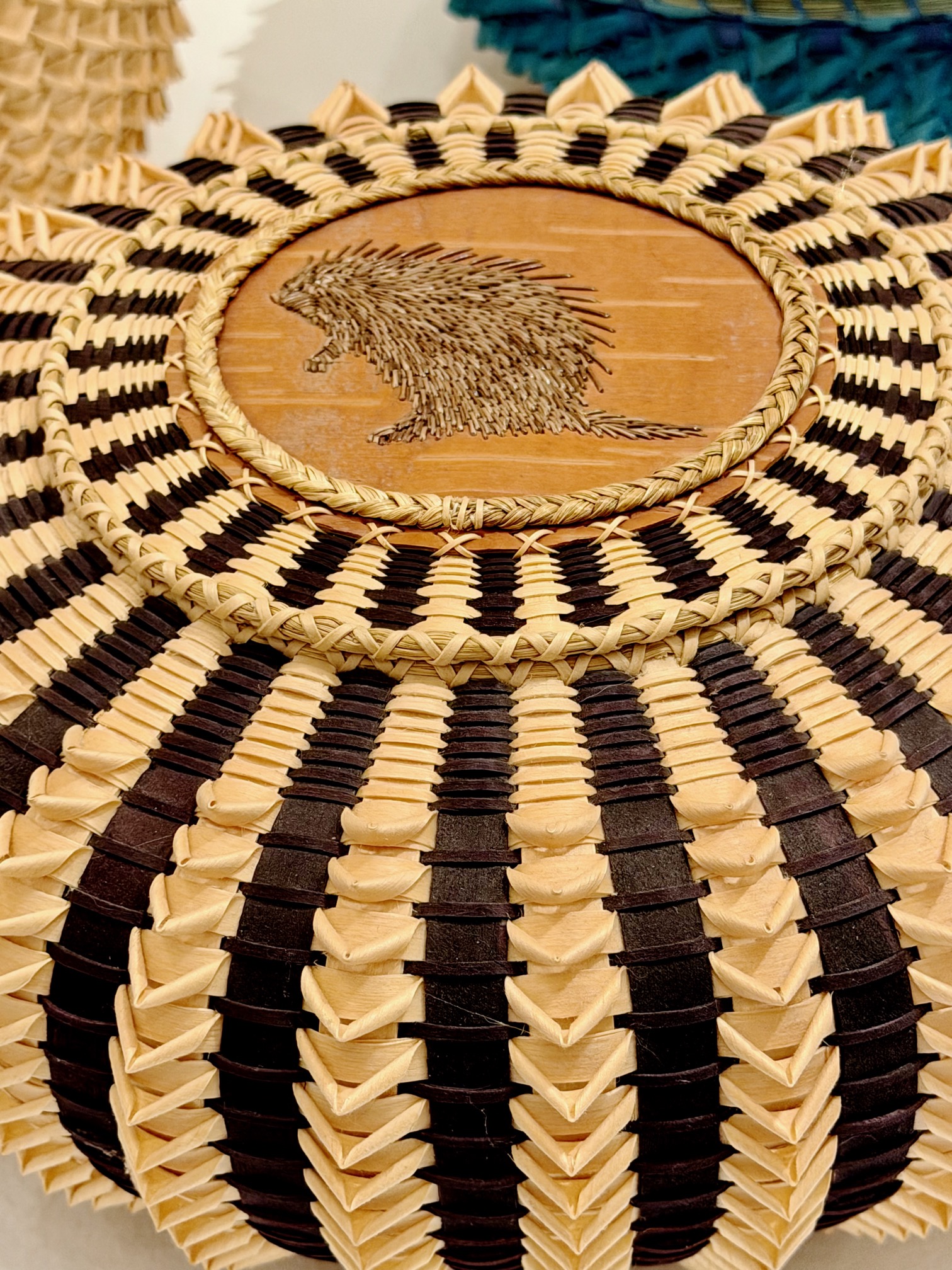
Closeup of 2010 Lidded Basket with Porcupine Design by Jeremy Frey (Passamaquoddy) woven from black ash, sweetgrass, and porcupine quills; 2010 SWIA Market award winner. Courtesy: private collection.
2015 Ash Basket by Jeremy Frey (Passamaquoddy) woven from black ash, which is important to the tribe’s creation story, but highly endangered. Courtesy: private loan.

Other jewelry and ceramics artists incorporate images of animals, insects, and other indicators of what the world looks like when clean water and healthy air abound – dragonflies, tadpoles and frogs, and Avanyu, the all-important Puebloan water spirit. Multimedia artist Cannupa Hanska Luger is seen (via video) in a ritual performance “from the future” to ensure people’s continual gratitude for food, shelter, and tools.
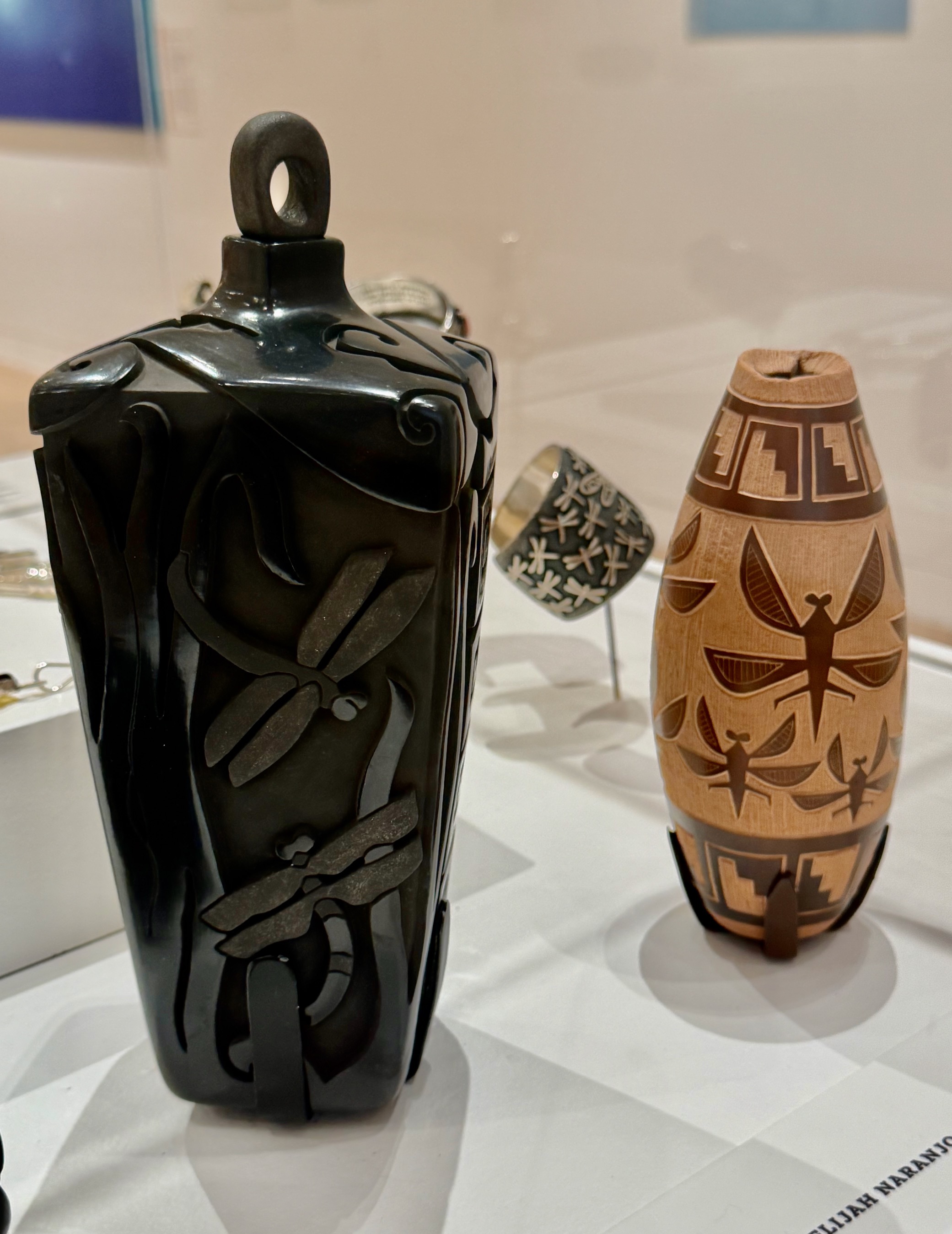
Art featuring creatures of healthy air: 2001 Dragonfly Tall Lidded Jar by Autumn Borts (Santa Clara Pueblo), 2005 Dragonfly Bracelet by Ramon Dalangyawma (Hopi), and 2006 Dragonfly Vase by Dolly Naranjo Neikrug (Santa Clara Pueblo).
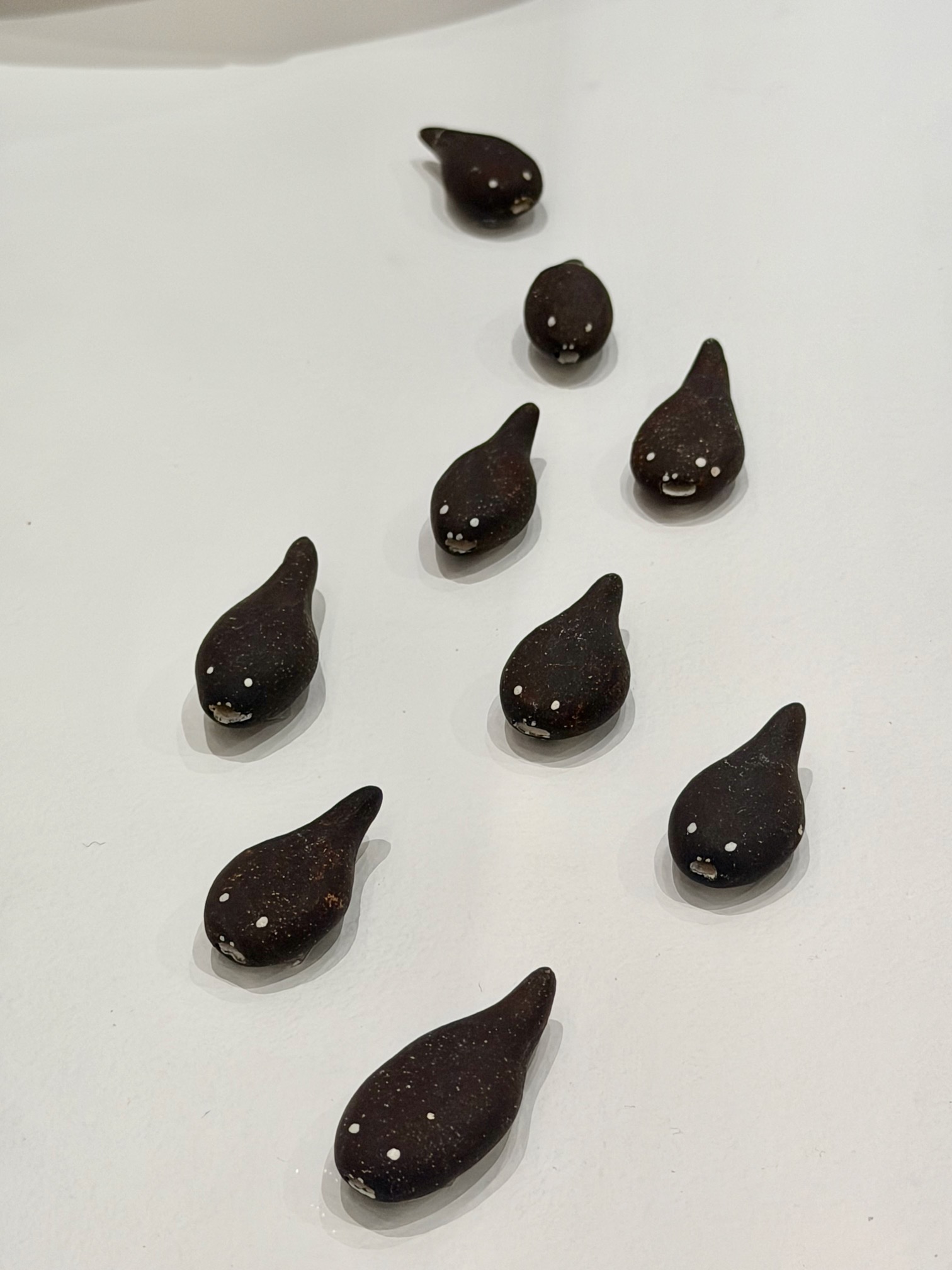
Keystone water species: 1958 ceramic Tadpole Figurines by Lucy Lewis (Acoma Pueblo); clay, crushed potshard temper, slip, and carbon paint.

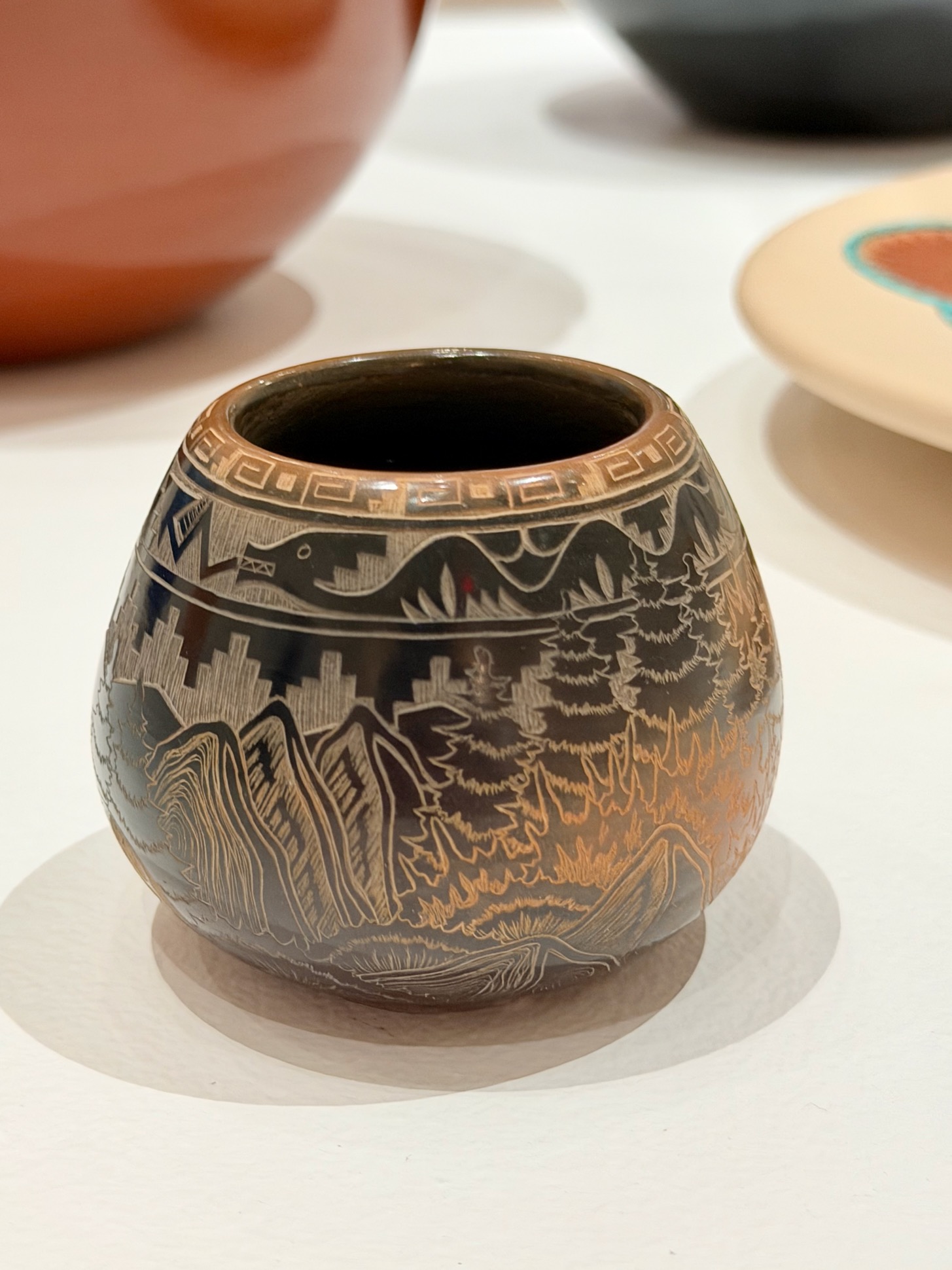
Considering the string of recent devastating wildfires that have plagued New Mexico in recent years, the artwork in the exhibition representing the element of fire is truly resonant. Kevin Naranjo made a tiny ceramic jar into which he carved his recollection of the wildly destructive 2011 Las Conchas Fire. Michael Namingha’s spectacular digital image is not just a pretty view of the sky. It’s the image of a cloud that only appears above an extremely intense heat source – exactly what he photographed during the 2022 Hermit’s Peak Fire or that New Mexicans witnessed in the Trinity blast.
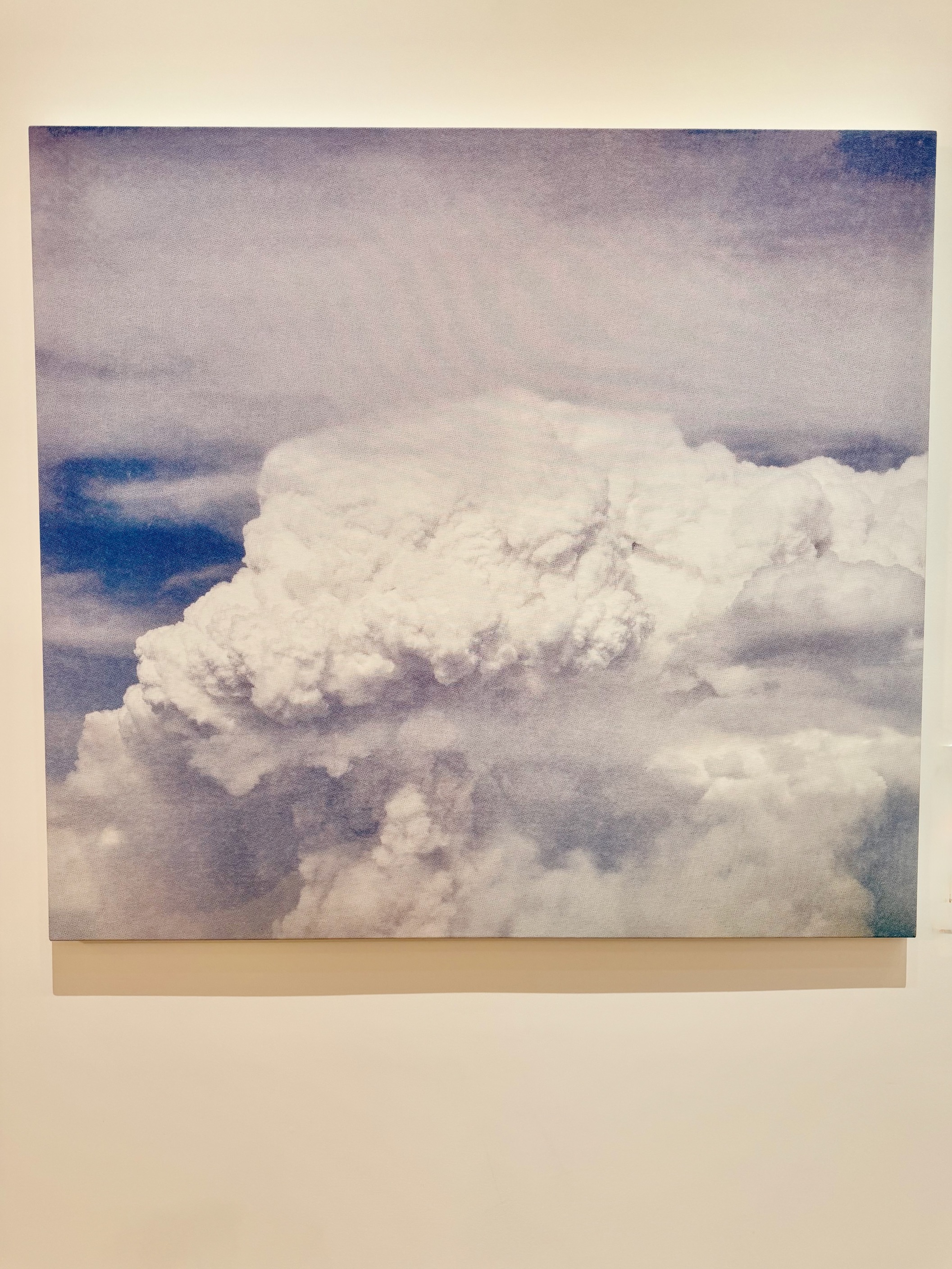
2024 silkscreen Disaster 2 by Michael Namingha (Tewa-Hopi) – a pyrocumulus cloud emerging from the Hermit’s Peak Fire, the largest wildfire in New Mexico’s history. Courtesy: the artist, Niman Fine Art.
2011 Las Conchas Fire by Kevin Naranjo (Santa Clara Pueblo) – a carved (sgraffito) ceramic depcting trees, land, and fire that burned 150,000 acres of Santa Clara’s land on the Pajarito Plateau, including ancestral sites; the Avanyu water spirit hovers above.

Overhead, as you enter or leave this thought-provoking experience, you see paper poppies – the first flowers that bloom after a fire.  Artist Leah Mata Fragua (Northern Chumash) is going a step further with her art after this exhibition ends. She’ll take her paper blossoms back home and burn them in a ritual that recycles her beautiful art back into the Earth.
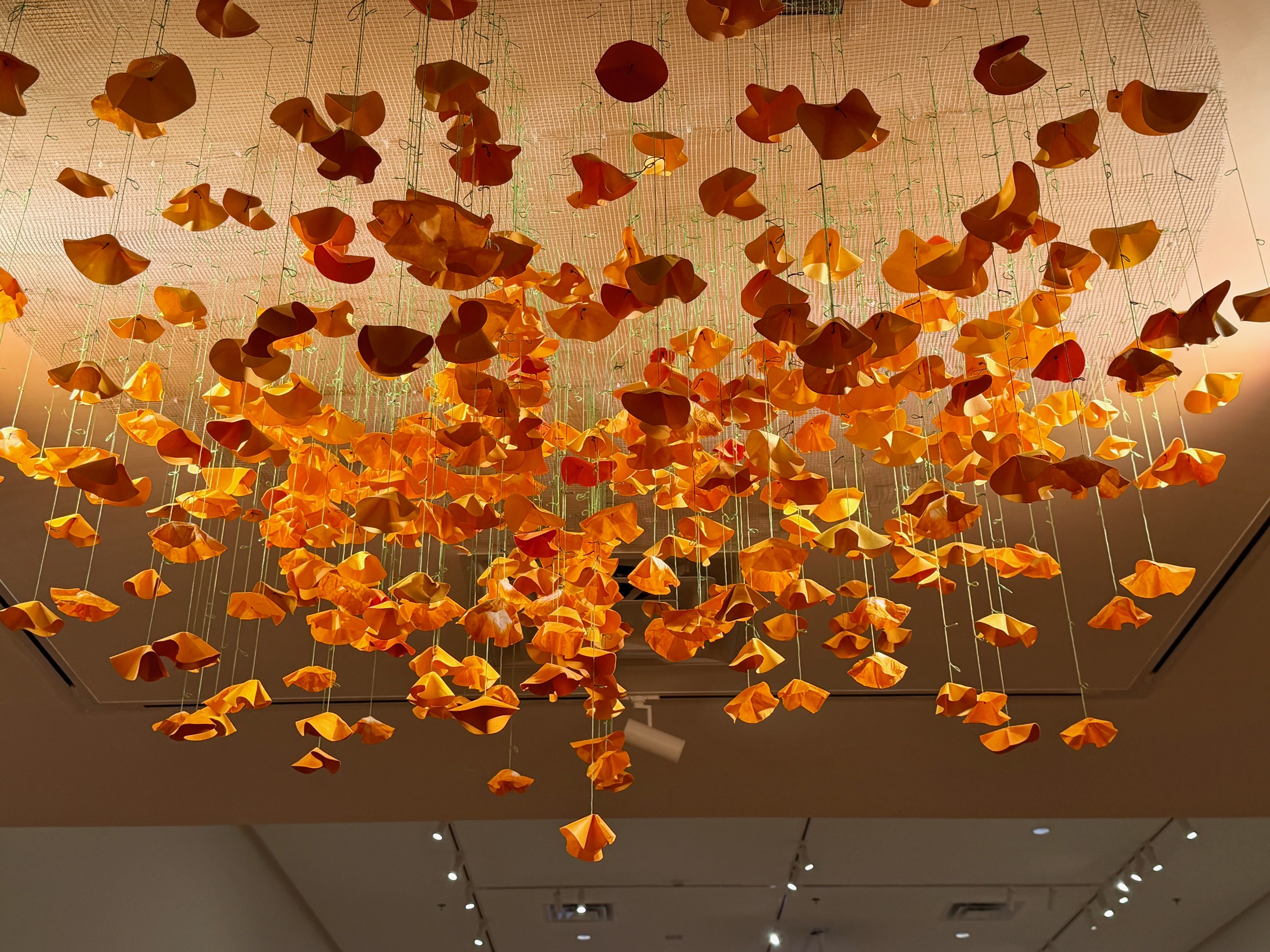
2025 dyed handmade paper installation The Sun is on the Ground by Leah Mata Fragua (Northern Chumash), suggesting the wild poppies that bloom right after a wild fire. Installation intended to be recycled with fire at the exhibition’s conclusion. Courtesy: the artist

MIAC Connects Diné Textiles to Land and Community

Building on the groundwork laid in the artist-curated exhibition Grounded in Clay: The Spirit of Pueblo Pottery (opening in St. Louis on March 7), Santa Fe’s Museum of Indian Arts and Culture asked five Navajo textile artists, photographers, and scholars to delve into MIAC’s historic collections to tell the story of Diné weavng.

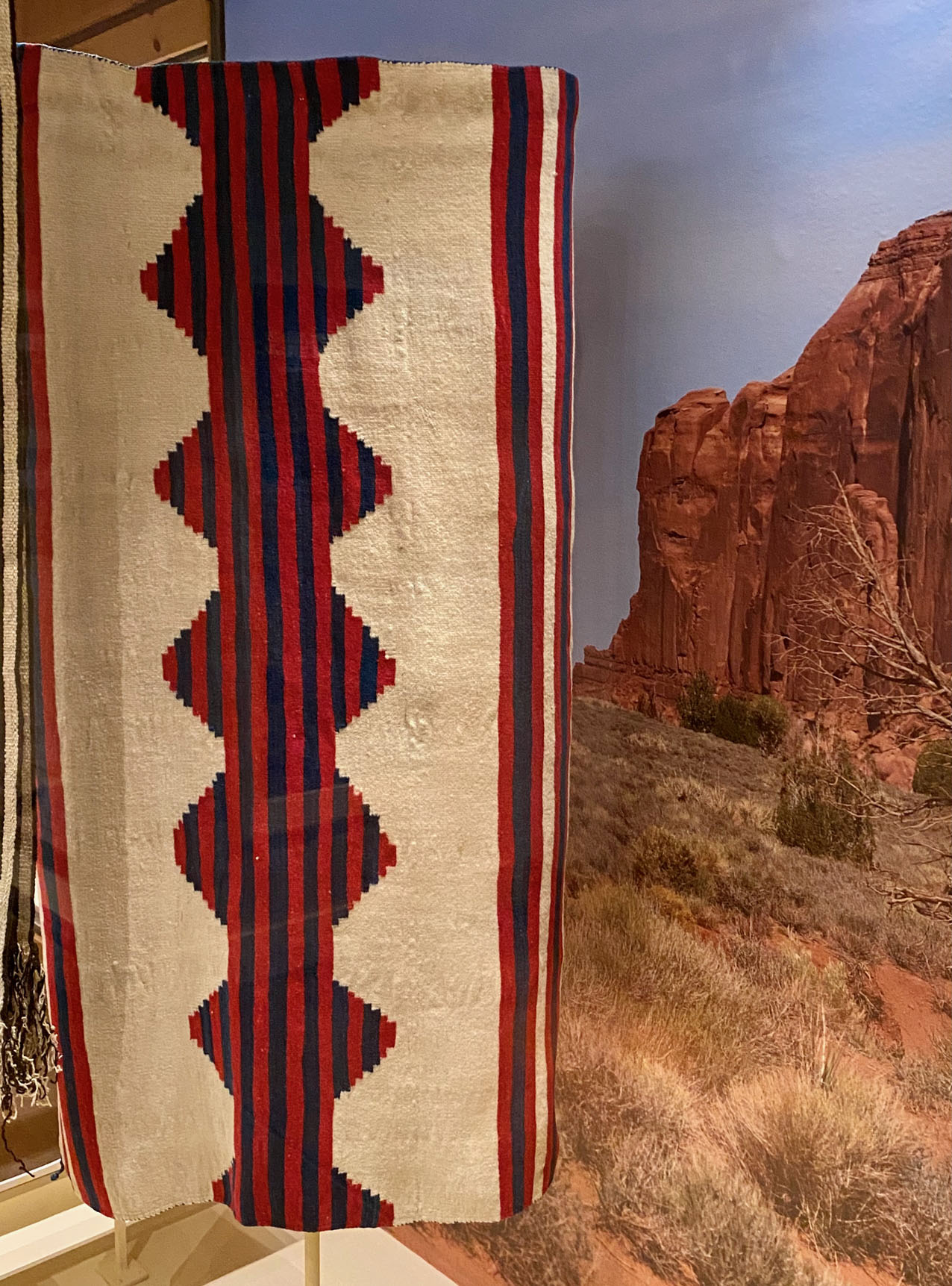
Horizons: Weaving Between the Lines with Diné Textiles, on view through February 2, 2025, presents historic and contemporary weavings alongside epic photographs of Navajo Nation landscapes to show the connections textile artist have to ancestors, their mentors, the community, the land, and their materials.

Historic Diné weaving with photomural by co-curator Rapheal Begay. Courtesy: the artist.

Appropriately, the story told by over 30 historic textiles is presented in MIAC’s Masterpieces gallery.

The entrance presents a dazzling display – a pictorial blanket woven in the 1890s set against a photomural of co-curator Rapheal Begay’s family sheep corral. It’s a visual testament to the importance of wool, life, and the 27,000 square miles of Navajo Nation. 

The blanket’s creator (unknown today) was an astute observer of the life on the land and translated it all into warp and weft – cow punchers, cattle, boots, birds, and new-fangled railroad cars, that only arrived in Navajo Country around the 1880s. Click here to see the detail.

1885 pictorial blanket created with Germantown wool yarn introduced in the Southwest by the railroads; photomural Navel (Hunter’s Point, AZ) by co-curator Rapheal Begay. Photo courtesy of artist.

Nothing was newer than the railroad, at the time this artist depicted it – a steam-fed invention from the East that would change western life forever, but that also brought a wide array of colorful yarn that could be mixed and matched with vegetal dyes to create new Native designs.

The intertwined history of Diné (“The People” in the Navajo language), textile art, and the land is told through quotes and recollections by the exhibition’s Native collaborators. While examining masterful geometric weaving techniques in 19th-century works, visitors are provided with an historic context – the types of art materials introduced to captives imprisoned at Bosque Redondo after the Long Walk, the images that could be interpreted as a longing for the homeland by the incarcerated, and coded spiritual affirmations.

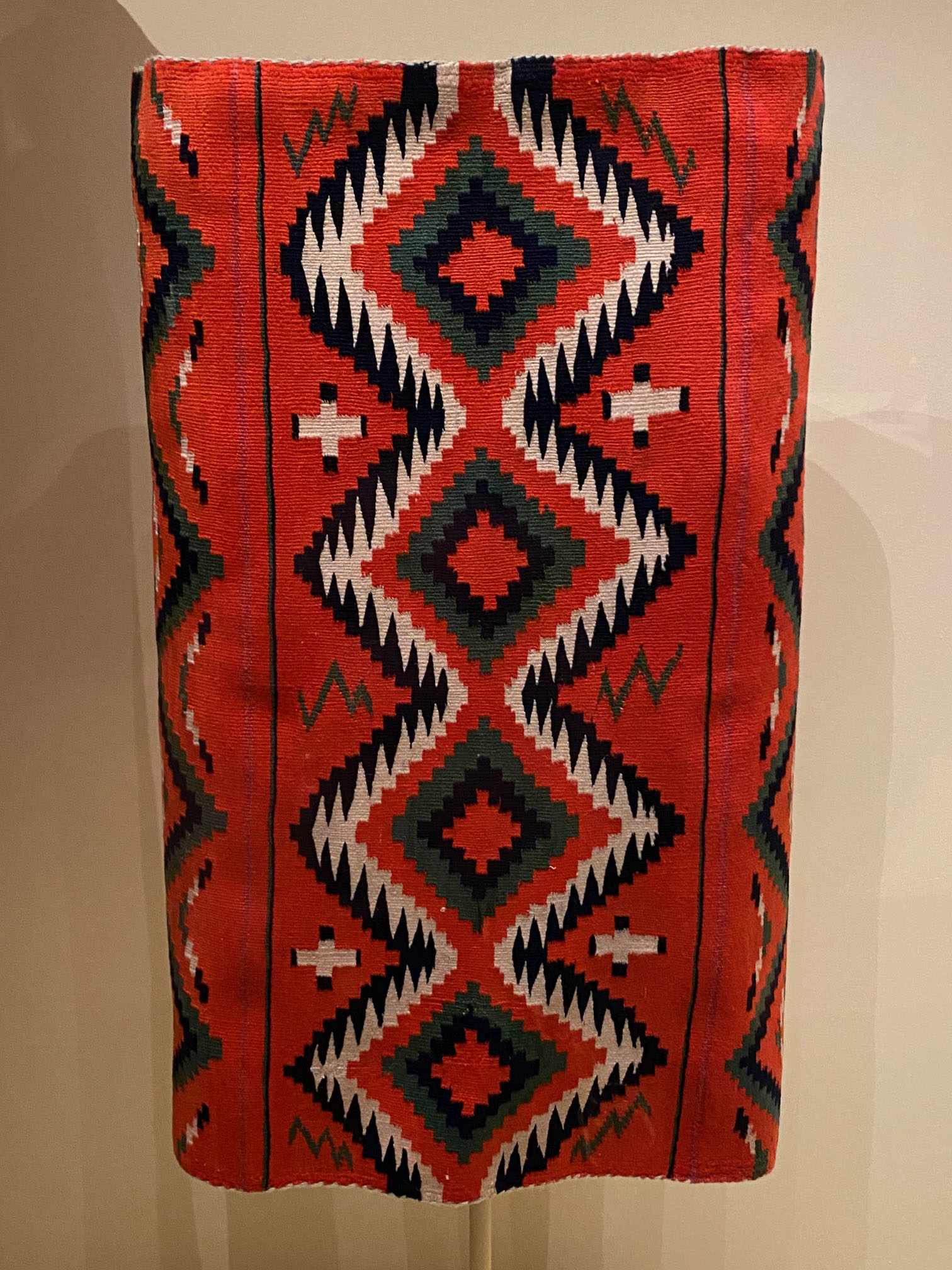
1850-1860 hand-spun wool child’s (or saddle) blanket with Spider Woman crosses; created with natural cocineal, indigo, and chamisa dye
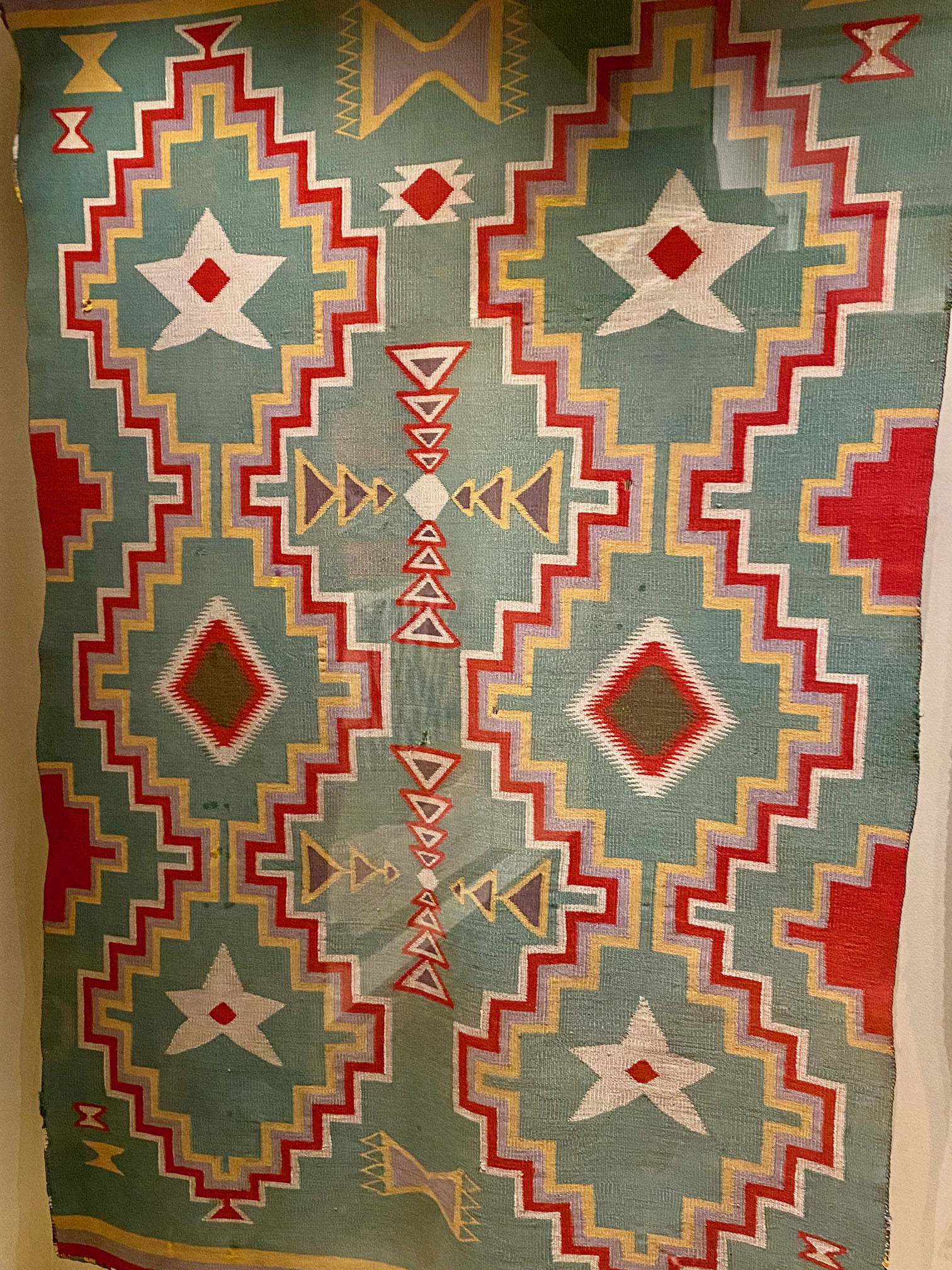
1880-1897 rug made with Germantown wool yarn, cotton string, and raveled yarn; materials used in weaving at Bosque Redondo era, post-Long Walk.

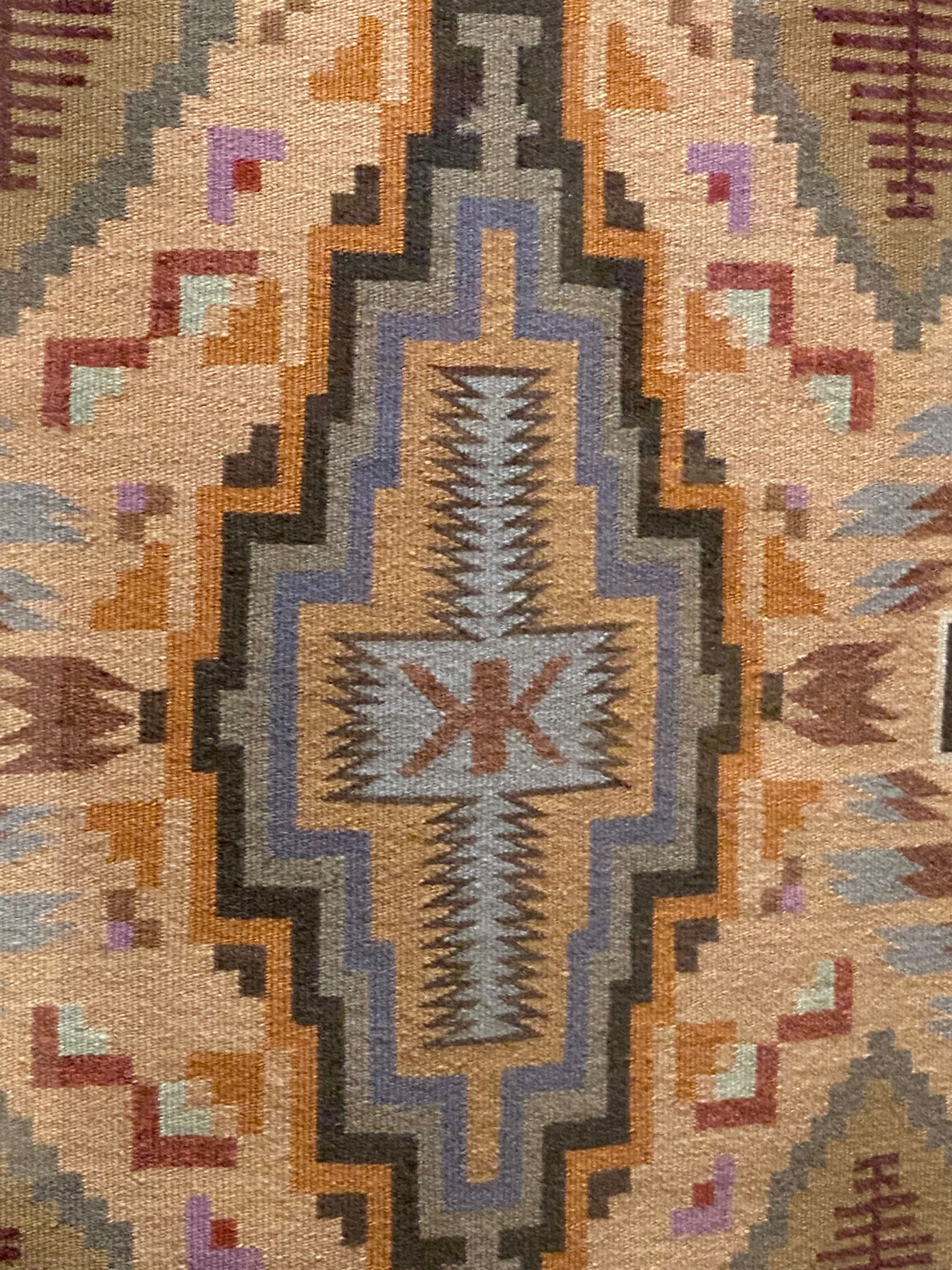
The participants in the exhibition make sure that viewers also experience how the landscape inspires the work of the past and contemporary Native textile artists. Diné fiber artist Tyrrell Tapaha includes her two-panel dress in which incorporates images of the Utah clouds and mountains that bring her spiritual peace. The masterful wall hanging by Lillie Joe uses the palette of the desert to create a mesmerizing geometric dazzler.

2020 two-panel dress by fiber artist Tyrrell Tapaha with images from Utah landscapes that inspired her; woven from churro, silk, mohair, and marino wool..
Close up of highly detailed 1980s Burntwater wall hanging by Lillie Joe, reflecting colors and patterns of the Navajo Nation landscape.

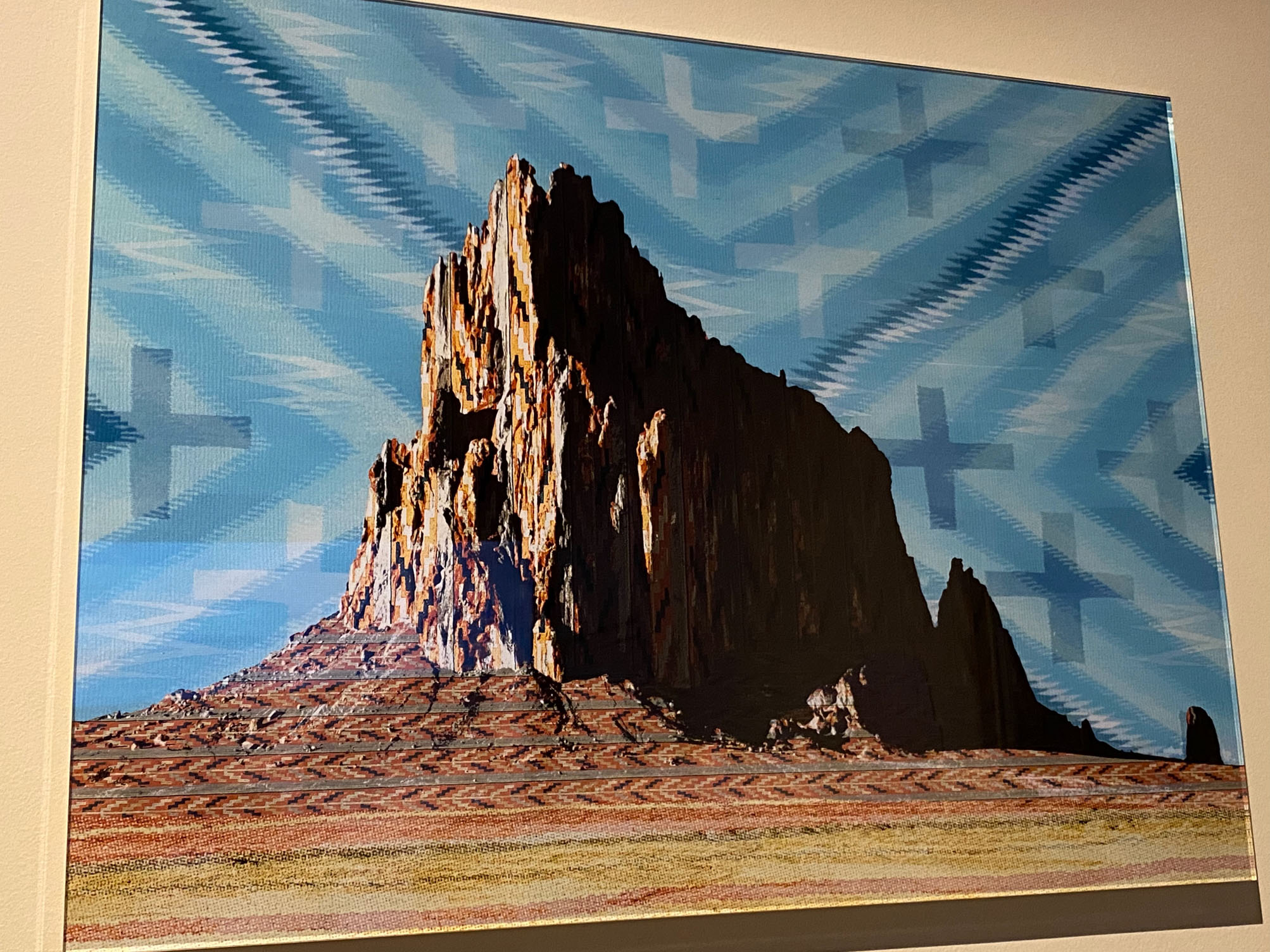
The curators feature both the photography of co-curator Rapheal Begay and Darby Raymond-Overstreet to allow gallery visitors to experience the awesome beauty of the homeland that inspires artists. Digital artist Raymond-Overstreet overlays geometric textile patterns across his luscious, beautiful landscapes.

2018 digital print Woven Landscape, Shiprock by Darby Raymond-Overstreet (Diné), overlaying digital landscapes with traditional weavings. Courtesy: the artist

Take a look at some of our favorite works in our Flickr album. And enjoy these historic and contemporary dazzlers.

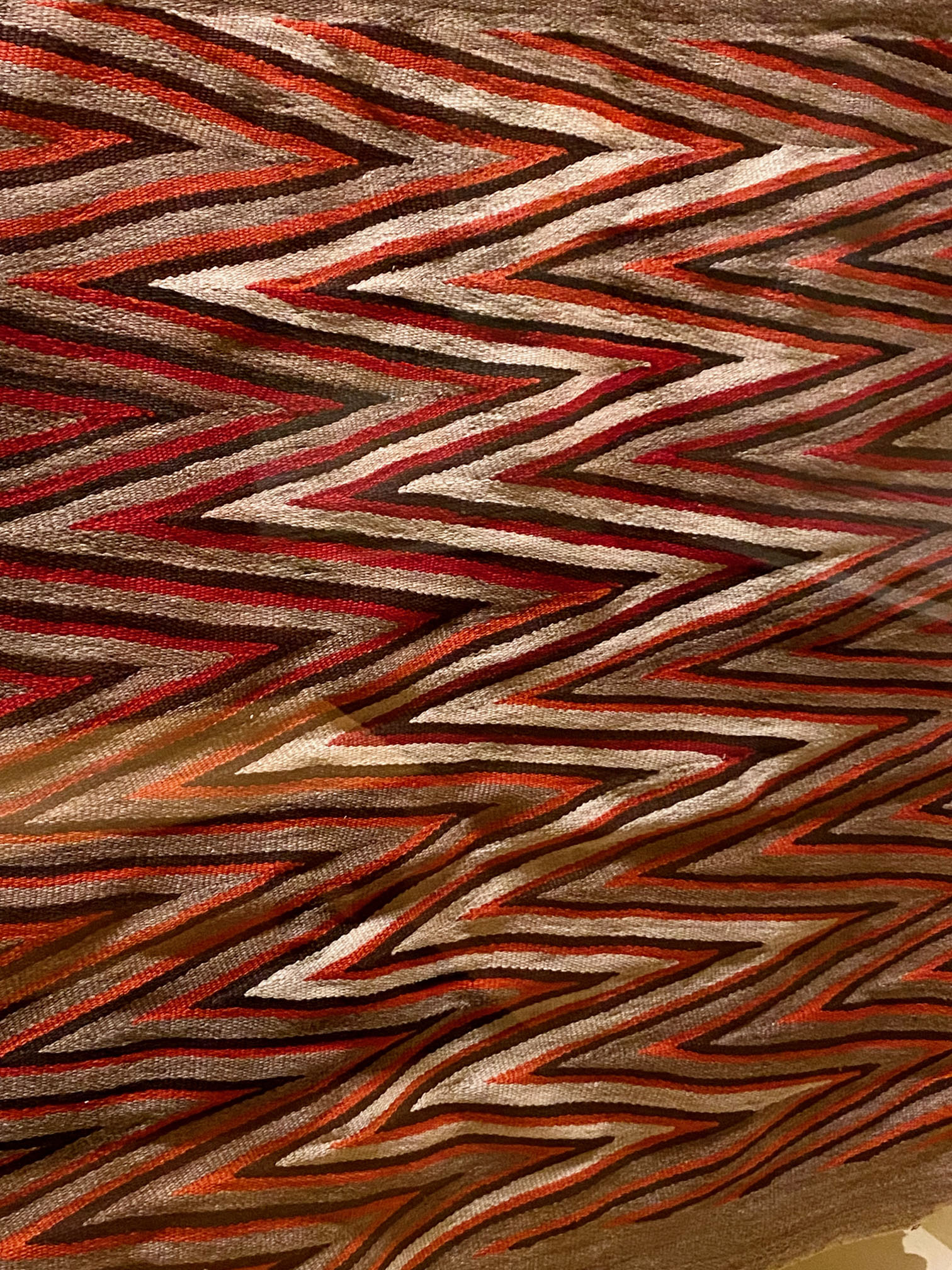
Detail of 1895 wedge weave blanket made with commercial cotton string and Germantown wool – a dramatic 19th c. weaving innovation. Courtesy: International Museum of Folk Art.
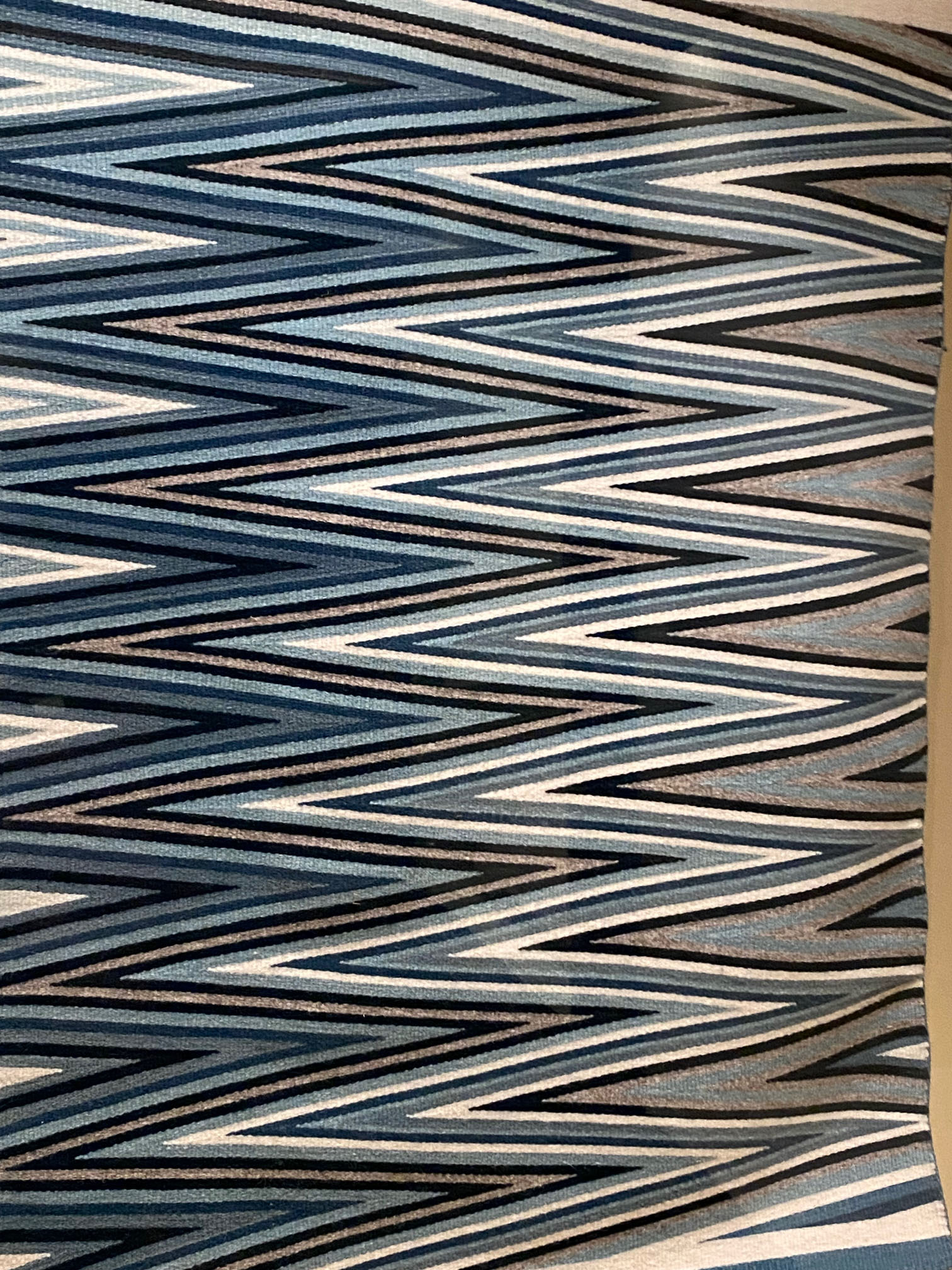
2022 wedge weave by Kevin Aspaas; white and grey wool yarn with indigo dye. Courtesy: private collection.
Detail of dynamic Diné 1960 wool tapestry weave. Courtesy: International Museum of Folk Art