Bird Watching Opportunity at The Met

1-4 Birds in Japan

Detail from Flock of Cranes (1767-1784) by Ishida Yutei, a six-panel folding screen

An avian free-for-all is happening on the second floor of the Met’s Asian Wing, with a lot of flapping, stalking, crowing, and displaying for all the world to see through July 28.

The birds (and one big, hairy deer) really come alive in the Sackler Wing show, Birds in the Art of Japan, The curators went into the collections to dig out masterworks featuring dozens of species of birds native to Japan, including medieval to modern clothing, jewelry, paintings, sculptures, ceramics, and baskets. If you’re a bird-lover still wondering whether the AMNH will ever bring back the Birds of the World dioramas in all their splendor, you’ll find comfort on examining all these species close up in the quietude of the Met,

The exhibition starts behind the 12th century Buddhist temple platform and just past the 13th Century Bodhisattvas, where you’re greeted by a charming rooster that’s actually an 18th century incense burner. Turn the corner and you’ll come face to face with a startling 2011 Japanese sculpture — Kohei Nawa’s PixCell-Deer#24, an auspicious presence (ref. the messenger animal of the Shinto deities) in the form of a taxidermy specimen that Kohei creativly covered in glass bubbles.
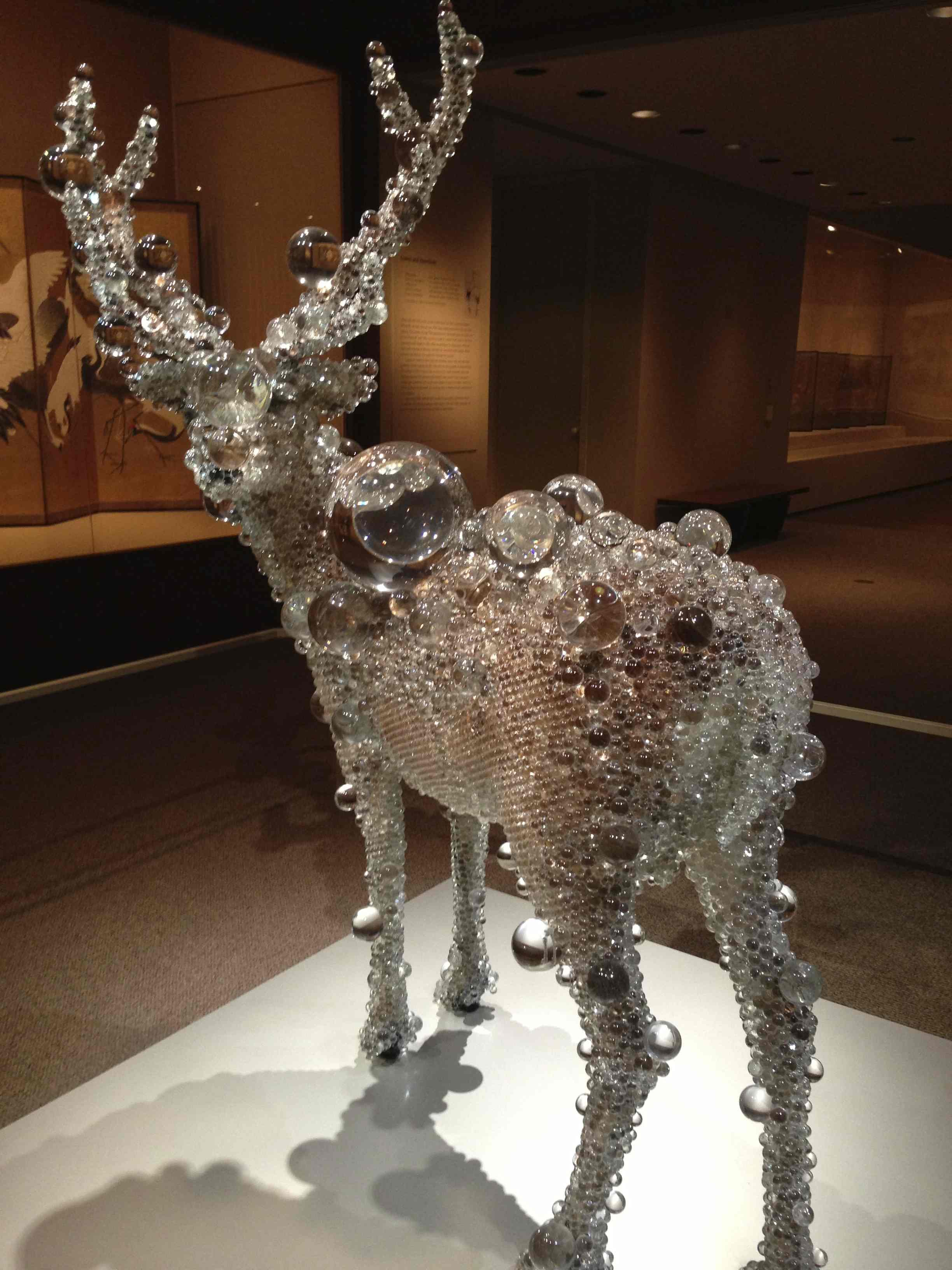
How did Kohei Nawa’s deer get in here?

How did Kohei Nawa’s deer get in here?

Every gallery delivers a surprise, from the water birds area right through to the “exotics”. Exquisite paintings of the 1700 are interspersed with startling realistic works by the masters of the forge. One of the show-stoppers is a spectacular life-size iron eagle hovering from his perch in the raptor gallery that the curators reckon was made for display at one of the late 19th century world expositions. The detail is amazing. Each feather was forged and riveted individually onto the bird’s metal body. It’s no wonder that the eagle, a nearby raven, and another headdress normally live in the Arms and Armor Department at The Met. Nice collaboration!

Check out our Flickr site for a walk-through of some of our favorite works, including the embroidered Phoenix-covered kimono, the 1908 Peafowl painting/screen by Mochizuki Gyokkei, Asano Toshichi’s hawk-shaped zither, and Kamisaka Sekka’s artistic book, which is brilliantly displayed in interactive form by the Met’s digital team.

Spectacular iron eagle lent by Arms & Armor Department

Spectacular iron eagle lent by Arms & Armor Department

Enjoy this wildlife walk through the eyes of artists on the other side of the world, and be sure to relax in the George Nakashima reading room – a kind of “fire pit” roundtable where we found visitors sharing their impressions of the show. Check out the Met’s on-line catalog of the exhibition, but do yourself a favor and hike over to the Met in the next month before these birds fly away back to the collections.

You won’t be seeing the birds in the wild, but it’s likely that J.J. Audubon would approve. You’ll find joy in getting to know your new Asian friends, who you will likely spot in future exhibitions or in the aviary at the zoo.

Kimono embroidery detail. What did the Phoenix signify to this 19th c. bride?

Kimono embroidery detail. What did the Phoenix signify to this 19th c. bride?
Philadelphia Museums Reach 2.4M YouTube Views

Since Philadelphia museums, zoos, and gardens began posting videos online in 2008, collective YouTube views have climbed to 2.4 million, as chronicled in our latest report, Philadelphia Museums: 2013 Video and Social Media Rankings. The biggest surprise about the Philadelphia museum videos is that stylistically they are a bit different than New York museum videos. The institutions in Philly take a more whimsical approach to science, use a lot more promotional videos to drive exhibition attendance, and occasionally throw in a bit of the macabre.

Longwood Garden’s Top Philadelphia Exhibition Video of 2012

The Top Philadelphia Exhibition Video of 2012, courtesy of the Longwood Gardens grounds crew and Bruce Munro

Highlights of our report on 32 Philadelphia museums:

As of year-end 2012, the Philadelphia institutions with the highest number of total YouTube channel views are the Penn Museum, the Mutter Museum, and Longwood Gardens. Penn’s channel features a mix of behind-the-scenes videos about exhibits, anthropology lectures, and a gigantic docu-archive; the Mutter produces highly creative shorts highlighting selections from its tantalizingly weird collection; and Longwood simply has tons and tons of fans that want to see what’s up with the seasons.

Last year, Longwood Gardens produced Philadelphia’s highest rated museum video — Light: Installations by Bruce Munro. Over 36,000 nature and art lovers viewed this short about Longwood transforming itself into Munro’s luminous vision. The garden also pumped out other video promos and features all year that kept their fans coming back to hit the YouTube channel.

The Penn Museum’s Top Anthropology Video of 2012 features a sheik among many other people and places in 1959 Nigeria

The Penn Museum’s Top 2012 Anthropology Video Nigeria #29 (1959) features a sheik, a mosque, a fuel depot with camels, and country life the way it used to be

The Penn Museum’s YouTube channel surpassed 1 million views in May. Penn’s been adding an enormous anthropology film collection to its channel (over 400 films) and the time-machine quality is irresistible. It’s no surprise that Penn’s Maya 2012: Lords of Time videos captivated the public all year, but it is interesting that the silent travelogue Nigeria #29 (1959) is up to 17,000 views. You could poke around that channel for days.

The Chemical Heritage Foundation produced Philadelphia’s most popular science video. Over 26,000 people watched A Distillations Explainer: Sweat, part of the Foundation’s Blood, Sweat, and Tears series (see below). It’s an entertaining, well-produced podcast series.

The Mutter Museum presents its unusual medical collections quite effectively through its YouTube series. Their 2012 series feature the curator taking “mystery” items out of the cabinets and challenging the viewers to identify them. Not for the squeamish, but really clever and nicely scripted.

The most active museum Twitter users in Philadelphia are the National Constitution Center, the Eastern State Penitentiary, and the Penn Museum. The most active Flickr users during 2012 were the Franklin Institute Science Museum and the Pennsylvania Academy of the Fine Arts. The largest Flickr photo pools are populated by Longwood Gardens and Eastern State Penitentiary enthusiasts.

All the video and social media details on 32 museums are in the report. Click here to see what’s included and make a purchase from our Its News To You Reports shop.

Enjoy watching Philadelphia’s top science video, courtesy of the Chemical Heritage Foundation. Meet Louis Pasteur and find out why sweat often smells:

Early Birds Meet Lavish Flock at NY Historical

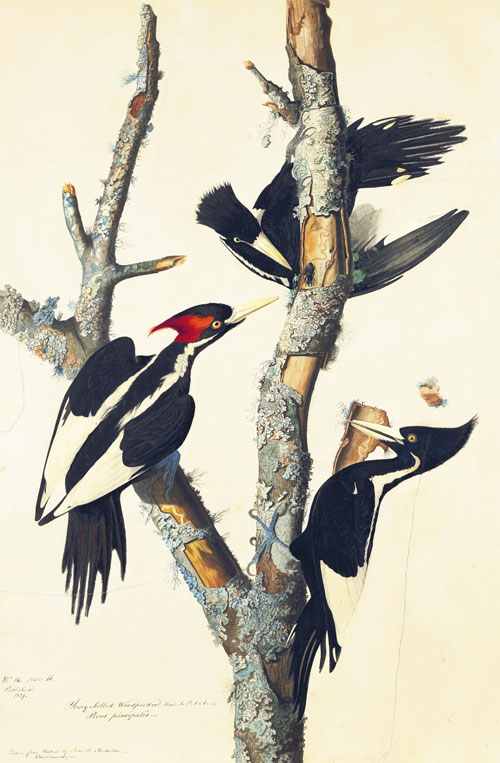
JJ Audubon's Ivory-billed Woodpecker: Study for Havell, pl. 66 (c. 1825–26) Source: NYHS

JJ Audubon’s Ivory-billed Woodpecker: Study for Havell, pl. 66 (c. 1825–26) Source: NYHS

In a week where Baz Luhrmann’s The Great Gatsby is captivating audiences with grand, lavish cinematography and color, take a moment to check out the 18th century’s competition — an immersive-media extravaganza conceived and marketed by artist-entrepreneur JJ Audubon. It’s so big that the New-York Historical Society had to break it into three parts. Rush to see Audubon’s Aviary: Part I of the Complete Flock.

NYHS owns just about every watercolor that JJA ever did for the gigantic engraved folio that he sold to celebrity clients back in the 1820s and 1830s. He created watercolors of every bird in America (474), made the images life size for maximum visual impact, had them engraved by UK superstar Robert Havell, Jr., structured a unique package to appeal to high-end collectors, embarked on a road show, and sold subscriptions to his IMAX-sized The Birds of America.

NYHS kicks off its trilogy by presenting Audubon’s original watercolors in the order in which they were engraved and filling an adjacent gallery with the artist’s earliest work. The exhibition reveals how this self-taught artist developed his remarkable skill with pastels, a pin board, and a cut-and-paste approach. Take a look at the on-line gallery.

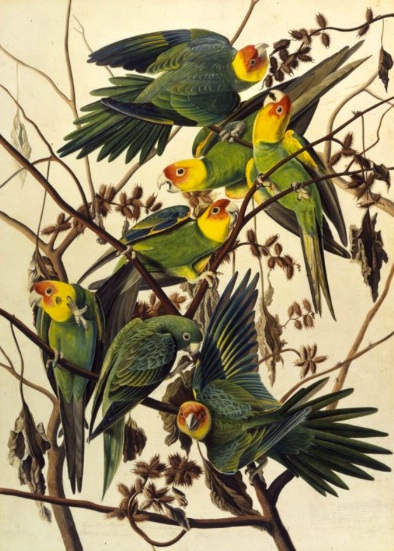
JJ Audubon painted them before they went extinct: Carolina Parakeet: Study for Havell, pl. 26, (c. 1825). Source: NYHS

JJ Audubon painted them before they went extinct: Carolina Parakeet: Study for Havell, pl. 26, (c. 1825). Source: NYHS

A nice touch is the collaboration with the Cornell Lab of Ornithology, who provides us with recordings of the birds – both on a free audio device in the gallery and here on line.

If you can’t get to the show, peruse the “early birds” stories and highlights in this fascinating PDF by Roberta Olson from the journal Master Drawings, where you’ll learn some behind-the-scenes dish on JJA and see his headshot. Scrolling through, you’ll also see some of his earliest paintings, which were only discovered in the La Rochelle Museum of Natural History in France in 1995.

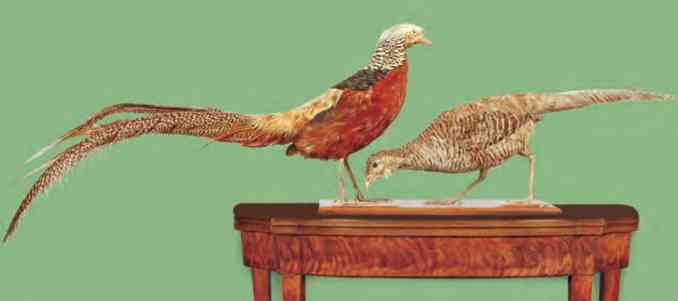
In the PDF, you’ll also read about how he was inspired by Mr. Peale’s museum in Philadelphia early in his career, ended up painting some crazy Golden Pheasants (now residing at Harvard) that were once presented to George Washington by Lafayette as a gift from the King of France (Figures 18 and 19), observe nearly identical reworked paintings (starting at Figure 34), and see the grid system he used for reference on his pin board (secrets revealed).

Mounted Golden Pheasants once owned by George Washington were early JJA subjects. Source: Harvard’s Museum of Comparative Zoology

Mounted Golden Pheasants once owned by George Washington were early JJA subjects. Source: Harvard’s Museum of Comparative Zoology

Interior Design Goes Medieval Avant-Garde at National Gallery

An avant-garde 1890s tapestry by Morris & Co., Edward Burne-Jones, William Morris, and John Henry Dearle (designers), The Arming and Departure of the Knights of the Round Table on the Quest for the Holy Grail. Collection of Jimmy Page, courtesy of Paul Reeves, London

An avant-garde 1890s tapestry by Morris & Co., Edward Burne-Jones, William Morris, and John Henry Dearle (designers), The Arming and Departure of the Knights of the Round Table on the Quest for the Holy Grail. Collection of Jimmy Page, courtesy of Paul Reeves, London

How did a secret society of artists in the 19th century turn into one of the most beloved interior design trends of the modern era? That story is the most surprising part of the exhibition (closing May 19) at Washington’s National Gallery of Art, Pre-Raphaelites: Victorian Art and Design, 1848–1900.

Organized by the Tate (and originally titled Pre-Raphaelites: Victorian Avant-Garde), the show introduces us to the PR Brotherhood (founded 1848), whose oil paintings and writings looked to the Middle Ages, myths, and legends of ancient literature for the spirituality that they felt was missing from modern, rapidly industrializing life.

Early collaboration by Rossetti and Morris, The Arming of a Knight chair, 1856 – 1857, painted pine, leather, and nails. Source: Delaware Art Museum, Wilmington.

Early collaboration by Rossetti and Morris, The Arming of a Knight chair, 1856 – 1857, painted pine, leather, and nails from the Delaware Art Museum,.

Dante Rosetti, William Holman Hunt, Edward Burne-Jones, William Morris, and others took inspiration from meticulous observation of nature, sensual textiles replicated in their paintings, and ethereal muses in medieval robes, which they often painted on location in leafy, natural settings.

In 1859, Rosetti painted a cupboard as a wedding gift for Morris. It wasn’t long before these pals ran with the inspiration — constructing medieval-inspired furniture and decorating it with similar mystical medieval images and experimenting with mixed media (images + poetry) on tiles, tables, and other creations made by hand.

For all the beautiful painting in the National Gallery’s show, the most startling room is the one that showcases the fact that the painters took it one step further by creating chairs, tapestries, tables, and textiles for forward-looking couples who wanted to live the 360-degree experience. In the 1860s, Morris & Co. was the go-to interior design shop for medieval-style avant-garde furnishings. They singlehandedly drove the stained-glass revival in Victorian architecture.

In 1873, Morris & Co. went international, selling wallpaper in Boston. Soon, American retailers in most major cities were carrying the hand-blocked or woven wall coverings and textiles.

Block-printed cotton designed by Morris (printed 1884-1917) from The Baltimore Museum of Art

Block-printed cotton designed by Morris (printed 1884-1917) from The Baltimore Museum of Art

Ever the advocate of the handmade, Morris was passionate about the relationship of decorative arts to the modernist movement. During Oscar Wilde’s US speaking tour in 1882, his lectures about Morris, the Pre-Raphaelites, and the nobility of hand-crafted work spread the trend in hand-crafted interior design in America.

Today, just about every museum shop carries William Morris-inspired something-or-others. Here’s the Tate’s video about the 17th century carved oak bed that Morris himself used in the 1890s. It’s all about the hand-made approach to the bedding textiles – a modern-medieval collaboration between his designer daughter, Mary, and wife, Jane.

Hats off to the Tate and National Gallery for presenting avant-garde design in a new light. Check out the rest of the Tate’s PR videos, including the one with Karen Elson on the topic of model as muse, then and now.

Fluffy AMNH Animal Superstars Win Webby

Steve Quinn, diorama curator

Steve Quinn, diorama master

Steve Quinn couldn’t send them to the L’Oreal Paris hair and make-up room like Tim Gunn does on Project Runway. They’re just too big, too famous, and too fragile. We’re talking about the furry animals that populate the 43 dioramas on Floor 1 of the American Museum of Natural History’s in the Hall of North American Mammals.

So how do you buff, puff, make up, color, groom, blow dry, restore eyelashes, color brows, and repair noses on New York superstars that have been in the (literal) spotlight since the early 1940s? That’s the subject of AMNH’s YouTube sensation, Restoring Dioramas in Hall of North American Mammals a 16-show reality series that won a prestigious Webby Award earlier this month. Download the North American Mammal app (with before and after looks at the enhanced fur).

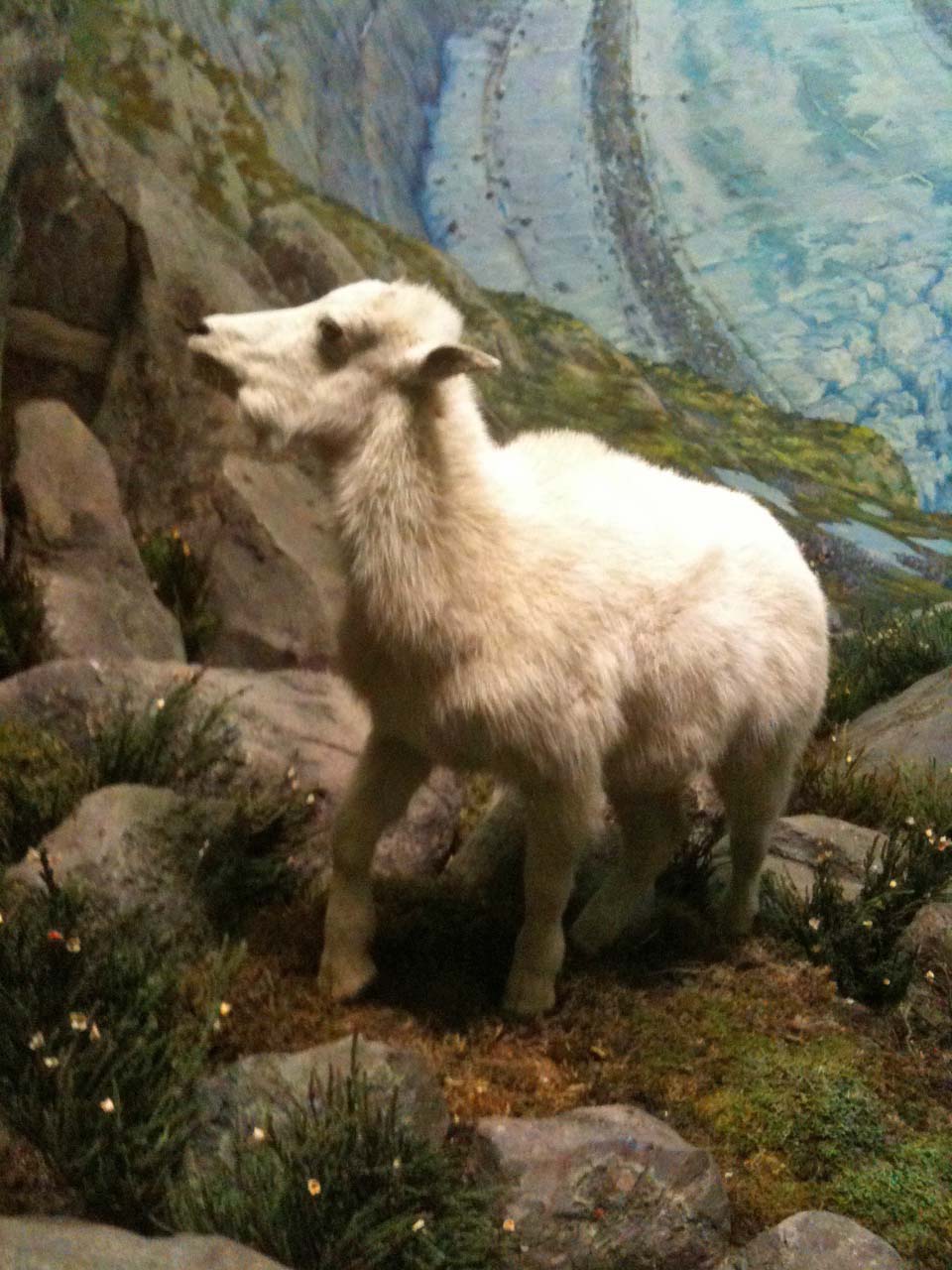
No more "demon" eye in the baby Mountain Goat, who is surrounded by thousands of flowers refurbished by AMNH volunteers

No more “demon” eye in the baby Mountain Goat, who is surrounded by thousands of flowers refurbished by AMNH volunteers

Steve Quinn leads a team of accomplished artists to, well, perform makeovers on the animals, plants, and background paintings that reside inside some of the most famous 3D attractions inside the AMNH. Steve told us that the first step was to update the decades-old lighting inside each case with state-of-the-art illumination that would inflict much less damage on the mammal coiffures.

His team engineered wooden platforms that extended into each scene so that leaf-turning and snow repair could occur with minimal disruption to the diorama floor. If you watch the 4-minute videos, you’ll see how they fixed a bison’s nose, put whiskers on cougars, restored the grass on the Great Plains, and restored the jackrabbit’s ears. The runaway hit of the series is Updating the “Moon Shadow” in the Wolf Diorama. With over 8,000 views, it’s not going to knock Dr. Neil off the AMNH charts any time soon, but Steve’s magical artistry is something to savor.

Go to the AMNH YouTube channel and scroll down to find the North American Mammal diorama series, depicting Steve and his crew at work. Check out this series trailer:

Just before Steve retired the other week, he gave us a special Night at the Museum, walking around and visiting his favorite dioramas after the visitors left.

Steve, you’re a total rock star. Thanks for all your spectacular work at AMNH over the years, and congratulations on the Webby.

Elvis has left the building.

Get Out into the Fresh Air (in Italy and France)

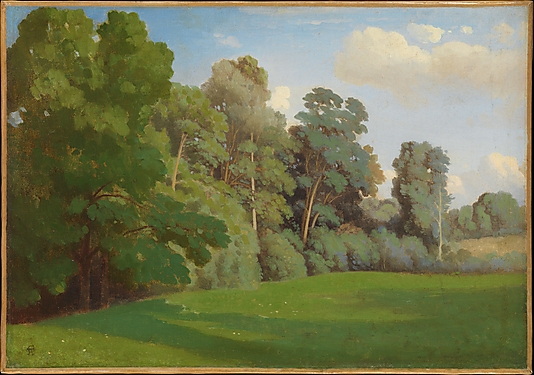
Théodore Caruelle d'Aligny’s Edge of a Wood (1850). Oil on canvas done northeast of Paris. The flattening technique was developed with his hiking companion, Corot.

Théodore Caruelle d’Aligny’s Edge of a Wood (1850). Oil on canvas done northeast of Paris. The flattening technique was developed with his hiking companion, Corot.

There’s nothing like stepping out into the fresh air to get a little perspective – exactly the view taken by the group of landscape painters featured in the Met’s exhibition, The Path of Nature: French Paintings from the Wheelock Whitney Collection, 1785-1850, on display in the Lehman Wing for a few more days.

Most of them feature Italian or French landscapes, and you’ll be surprised to know these tranquil, beautiful visions of nature were considered a little bit radical at the time. Apparently, there once was a time when painters didn’t travel beyond the studio, and certainly did not work outdoors.

Installation view of The Gate to the Temple of Luxor (1836) by La Bouëre. After Napolean invaded Egypt, the exotic Middle East became all the rage. The missing obelisk ended up in the Place de la Concorde.

Installation view of The Gate to the Temple of Luxor (1836) by La Bouëre. After Napolean invaded Egypt, the exotic Middle East became all the rage. The missing obelisk ended up in the Place de la Concorde.

The artists in this collection (gifted to the Met 10 years ago by Mr. Whitney) literally went on the road, took to the hills, and created spectacularly perfect outdoor oils to record a bit of the exotic, wild, and ruined visions they experienced. And it all happened long before Monet went outside to serialize his haystacks.

If you’ve ever wanted to take a Grand Tour of the wonders of Europe and the Middle East, now is your chance. Check out the Met’s online gallery of these works, and enter the mountains, hillsides, parks, ruins, and vistas with new 18th and 19th century friends.

If you have some time, you can listen to the Met’s curator, Asher Miller, discuss how adventure travel inspired a generation of painters to break the rules.

Don’t be Sad, He’s Irish!

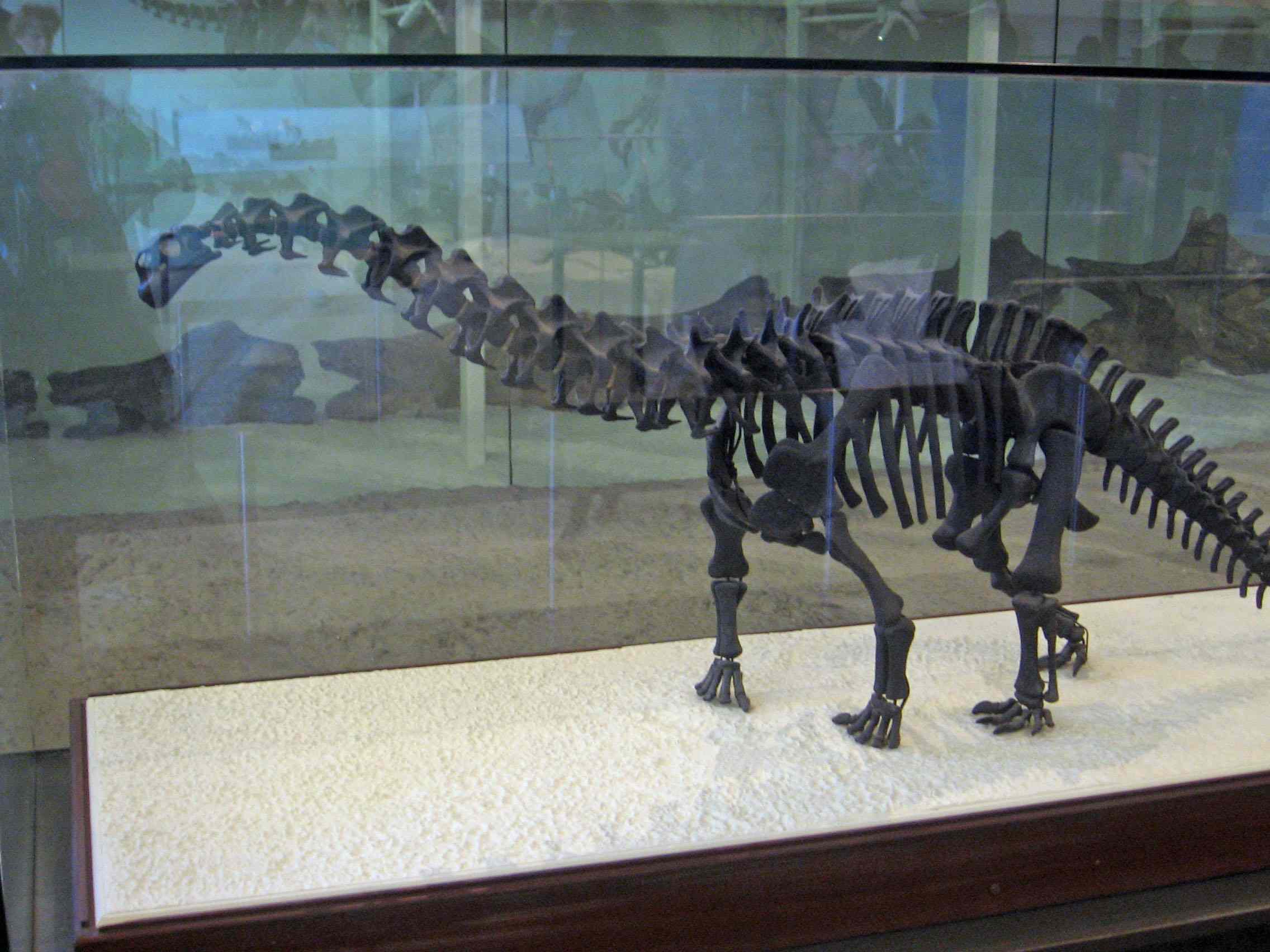
Apatosaurus holds court on the Fourth Floor of AMNH. Source: Scott Robert Anselmo

Apatosaurus holds court on the Fourth Floor of AMNH. Source: Scott Robert Anselmo

There’s no way to count the number of times that people get upset because his actual scientific name is no longer Brontosaurus.

He’s one of the most famous dinosaur celebrities in the world and you may know him as Brontosaurus from your Flintstone days, but his real name is the Apatosaurus.

So just think about it….It’s the perfect day for you to learn to say his “Irish” name — A-PAT-o’saurus. Isn’t that better? Go over to wish him well this weekend.

ModelHe’s the largest dinosaur on display in New York. He came here all the way from Wyoming, and he’s been standing here since 1905, when J.P. Morgan and the AMNH crew unveiled him. It was the first time that a really big dinosaur was ever mounted in 3D anywhere in the world.

To the left is the “architect’s model” that the 1905 crew used to figure out how to weld together enough steel to keep the tons of rock up in the air. A-PAT-o’saurus, Happy Irish Day!

Virtual Ancestor Cornered in High-Tech Tree by AMNH

Carl Buell’s rendering of the hypothetical placental ancestor, a small insect-eating animal. Source: AMNH

Carl Buell’s rendering of the hypothetical placental ancestor, a small insect-eating animal. Source: AMNH

Who says dinosaurs get all the attention?

One of the big front-page science stories of the last few weeks is that a global team of researchers has mapped our ancestor tree back in time to a hypothetical small, furry critter that emerged just after the dinosaurs went extinct. The big news is that through a giant high-tech, data-crunching technique, 15-20 molecular-data scientists collaborating in six countries around the world figured out that the hypothetical ancestor to nearly all the mammals alive today emerged 200,000 to 400,000 years after the comet crashed to Earth 65 million years ago.

Ok, it wasn’t the first mammal (the ancestor to platypuses, opossums, kangaroos, and a lot of other extinct things came much earlier), but let’s applaud the American Natural History Museum for telling this story so clearly to a writer at The New York Times that it made it to the front page.

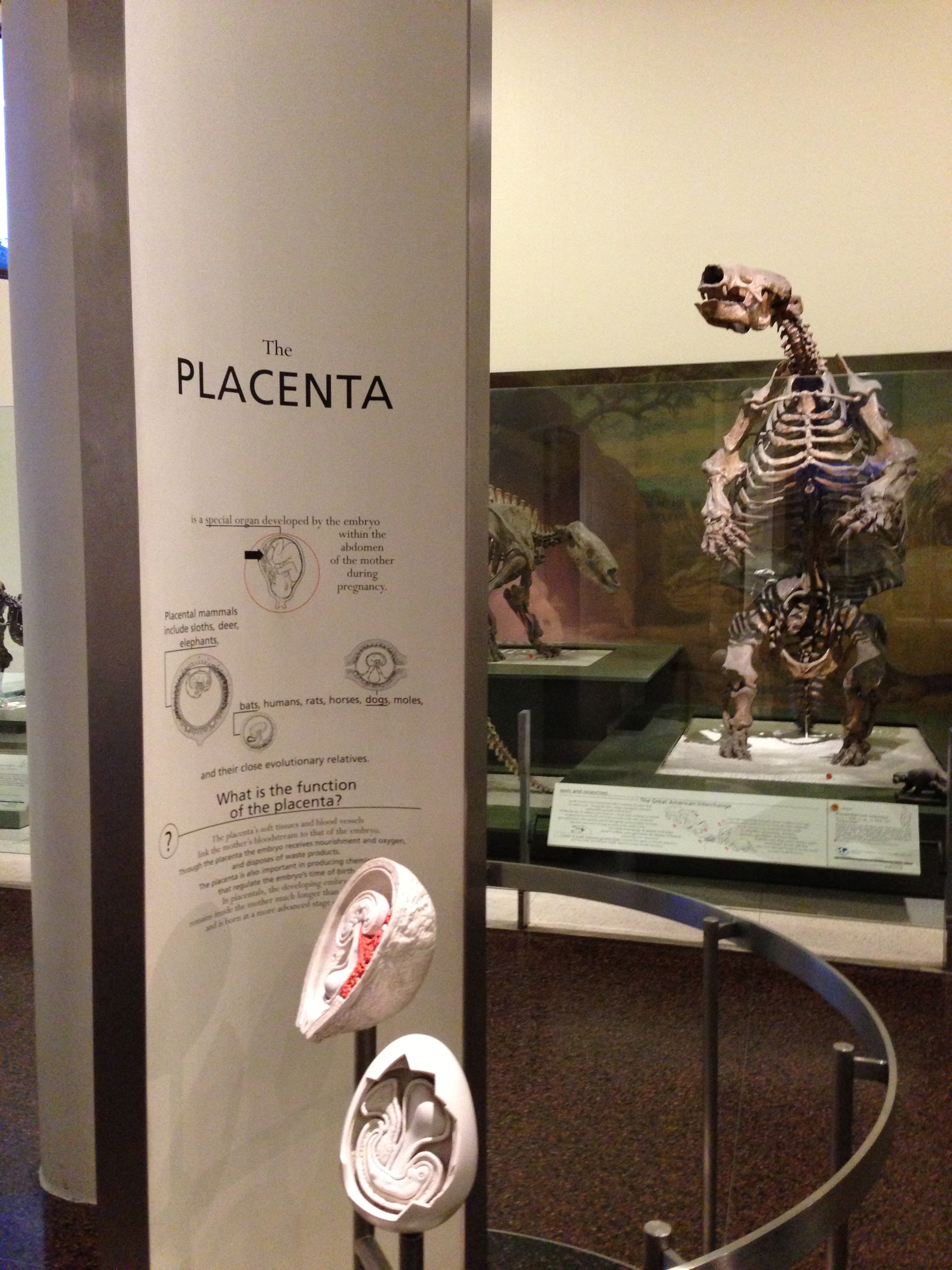
Column on AMNH Fourth Floor exhibit space that marks the spot where the virtual critter emerged along the evolutionary pathway in the Hall of Primitive Mammals.

Column on AMNH Fourth Floor exhibit space that marks the spot where the virtual critter emerged along the evolutionary pathway in the Hall of Primitive Mammals.

At Thursday’s Social Media Week event on how to tell stories in science, panelists repeatedly emphasized how hard it is to make clarity emerge from a morass of data.  In a way, this “story about the rat” reached a social-media science storytelling trifecta: over 240 comments “about the rat” on the NYT web site, a neat little video that’s racked up over 11,000 views in just two weeks, and an exhibition layout for the vertebrate paleo collection on the museum’s Fourth Floor that lets you stand in the exact spot on the evolutionary pathway where this tiny hypothetical ancestor emerged. (See the photo with the Giant Sloth, to the left.)

Great job, AMNH and Stony Brook storytellers for giving us this video view into deep time, showing how MorphoBank crunches data, and creating another social-media star out of a virtual ball of fur.

PS: The fossil background talent in this video appears to be a model of Gobiconodon, an actual Cretaceous mammal from 110 million years ago who’s not directly related to the star of this show, but looks good on camera.

Cage’s Zen Den at the Academy

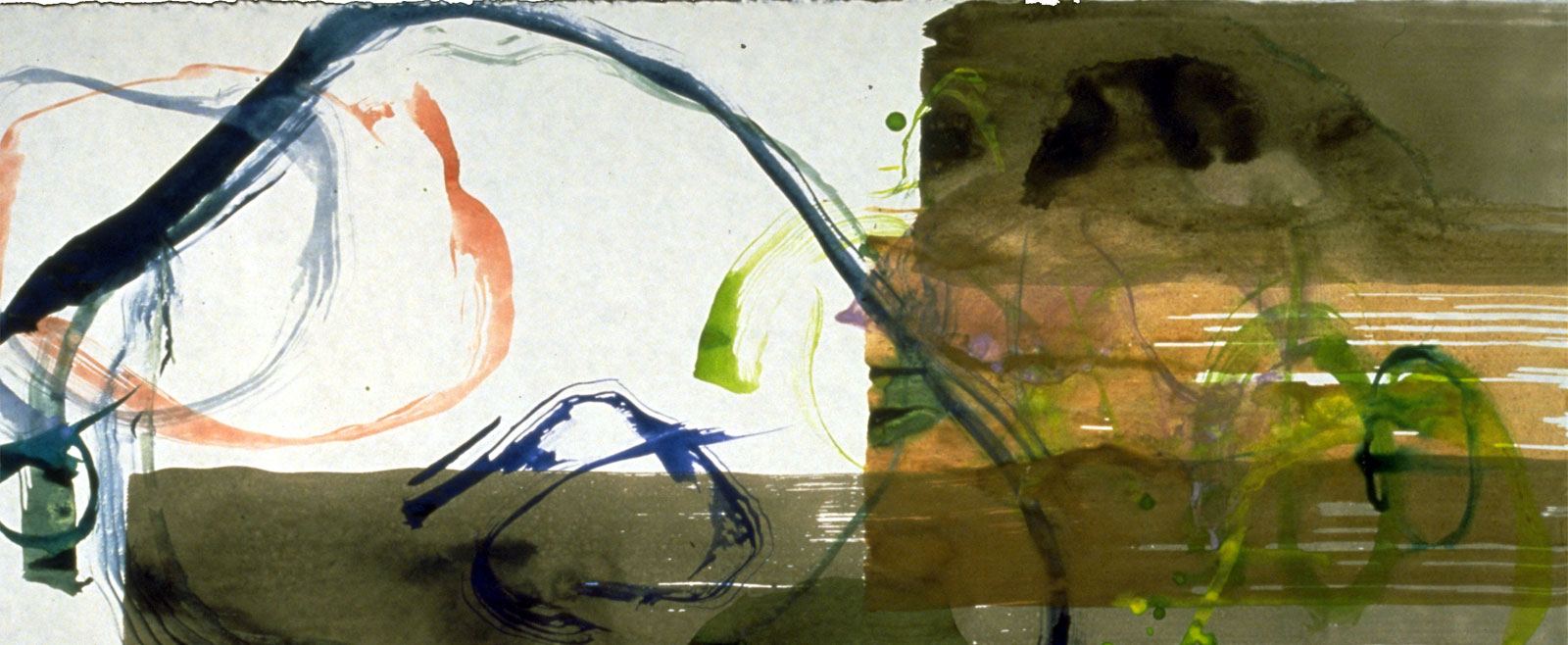
Cage's New River Watercolor Series I on parchment paper. Courtesy: Mountain Lake Workshop

Cage’s New River Watercolor Series I on parchment paper. Courtesy: Mountain Lake Workshop

Take one of the most controversial composers of the 20th century, give him some watercolors, drop him at the foot of the Blue Ridge Mountains, and leave everything to chance. See what happens.

You’ll see the results at the National Academy Museum’s John Cage: The Sight of Silence show this weekend. Back in 1988, Cage was the artist in residence at the Mountain Lake Workshop in Blacksburg, Virginia. He spent his time making a series of watercolors inspired by his trip to a Zen garden and temple in Kyoto, where he saw stones floating on a field of raked gravel.

Cage, whose lifelong interest in using chance (via the I Ching) to select and structure his musical compositions, decided to apply the same principles to watercolors, drawings, and prints. He customized some large-scale brushes that he could drag across wet paper like rakes, picked up feathers, and collected stones from the New River.

The brush, paper wetting, colors, stones, and actions are all determined by chance to stunning effect. Watch the artist at work and hear him talk about his process here:

Now see the results at the Academy and witness pure Zen.

Hidden New York Christmas Trees

NYPL’s nature-inspired Christmas tree

New York Public Library’s nature-inspired Christmas tree in Astor Hall on 42nd Street

Although Rockefeller Center has New York’s most popular tree, don’t forget to check out two others that are on the list of everyone’s favorites.

The grand tree inside the main entrance of the New York Public Library this season is an Age-of-Innocence wonder that has become the new favorite photo backdrop of New York City visitors this season It’s never crowded inside Mr. Astor’s grand hall, so there’s plenty of time to pose in front of the tree to show the folks back home what a beautiful time they’re having in City splendor. It’s in an intimate, spectacular setting with grand staircases, blazing illuminations, and ornaments evoking the natural world. IMG_1628

Now that Theodore Roosevelt has taken up residence in his Memorial on the First Floor, the American Museum of Natural History has moved one of the most charming trees in the City to the Grand Hall at the 77th Street entrance.

The fun of the Origami Tree is to get close enough to identify each of the 500 folded-paper ornaments by species. This year, the scientific theme is groupings of animals. You’ll find suspended origami doves circling a tree decorated with spiders, dinosaurs, lemurs, skunks, pelicans, cultures of bacteria, jellyfish, and many more surprises inspired by the vast holdings of the AMNH. Volunteers have been working since July to create this delightful menagerie.

If you haven’t seen these holiday wonders, check them out before they disappear.

The base of the AMNH Origami Tree features groups of ring-tailed lemurs and flock of doves

The base of the AMNH Origami Tree features groups of ring-tailed lemurs and flock of doves