FIT Honors Transatlantic Nightlife Queen

1990 Mathu & Zaldy body suit and attached boots that Susanne wore to an Armani party

1990 Mathu & Zaldy body suit and attached boots that Susanne wore to an Armani party

If you think the music and fashion stopped after Studio 54 shut its doors to Liza, Liz, Andy, Calvin, Halston, and Yves, FIT’s club-scene exhibition, Fashion Underground: The World of Susanne Bartsch, presents evidence to the contrary through December 5.

The show features nightlife splendor (with all the trimmings) from Susanne’s clothes-to-be-seen-in archive. Plus, you’ll get the thrill of pretending that you’ve stepped into one of her over-the-top parties, filled with celebrities, outrageous clothes, spectacle, and glitter.

Wielding "the list" in a 2008 Jean-Paul Gaultier jacket and Patricia Fields hat

Wielding “the list” in a 2008 Jean-Paul Gaultier jacket and Patricia Fields hat

Right downstairs at the gallery entrance, you’ll be taken back to a graffiti-splashed Nineties club entrance with a dolled-up doorkeeper sizing you up and holding “the list”. But there’s no anxiety about whether you’ll be let inside…Just walk in and be transported back to 1981.

 As the glittery disco 54 era was coming to an end in New York in 1981, Bartsch arrived from London and opened up a shop in Soho filled with up-and-coming London designers that were creating the “new look” catching on in clubs across the pond.

In the early 1980s, Japanese and British designers experimented with crinkly natural fibers and oversized smocks – which looked fresh and hip after a decade of form-fitting, glitzy disco looks.

The Eighties -- Vivienne Westwood looks with Galliano linen ensembles

The Eighties — Vivienne Westwood looks with Galliano linen ensembles

Susanne sold the oversized, anti-disco baggy look of nightlife trendsetters Boy George and Leigh Bowery, imported dandy mix-and-match men’s and women’s looks from Vivienne Westwood, and featured flowing frocks by London’s Rachel Auburn.

The first part of the FIT show walks down this part of memory lane, including linen frocks by Mr. Galliano. Smocks are punctuated with dramatic hats (decades before fascinators) or beads from Portobello Road.

By the late Eighties, all that had given way to raggedy and accessorized mash-ups sported by the Material Girl and by the Nineties, bejeweled and bedazzled clubwear reigned again. Susanne was regularly hosting parties clad in an ever-evolving array of embellished corsets, fashioned by the master of form and shape, Mr. Pearl.

Two Mr. Pearl corset ensembles (1989, 1991) with 1992 Mugler Cowgirl ensemble, worn by Naomi Campbell Installation view of “Fashion Underground: The World of Susanne Bartsch” September 18 – December 5, 2015 The Museum at FIT New York, New York

Mr. Pearl corset ensembles (1989, 1991) with 1992 Mugler Cowgirl ensemble for Naomi Campbell

In a well-deserved tribute to his creations, FIT has installed a carousel of Mr. Pearl’s work on a turntable in the show’s back room of the show, next to a corner where mannequins form a towering tribute to the magic of Mr. Mugler, another of Ms. Bartsch’s favorites. After she introduced Mr. Pearl to Mr. Mugler, the rest was fashion history.

Fashion designers flocked to her parties and she did justice to them all – working in their hats, jackets, shoes, bags, and separates into her never-ending array of special occasion get-ups. When you peruse the specific looks on display in the show, it’s an all-star line-up of New York, Paris, and London fashion heavyweights.

Gareth Pugh 2015 ensemble of paper, Lycra and leather

Gareth Pugh 2015 ensemble of paper, Lycra and leather

The show screams of creativity and it’s wonderful that curator Valerie Steele put a spotlight on this Queen of Nightlife and her impact on the underground/high fashion scene for the last three decades. A lot of Susanne’s featured clubwear is credited to Mathu & Zaldy, who turned out plenty of over-the-top looks when designer ready-to-wear just didn’t pack enough punch for a special occasion.

Another charming touch in the show is the ensemble of paper, Lycra and leather contributed by Gareth Pugh. Susanne asked him to send something she could (and would) wear.

As always, FIT provides lots of history and photographs of Susanne and friends in action at multitudes of balls and parties on its exhibition website. Spend time looking at Susanne in action and at snapshots of her historic Love Ball. For close-ups of the clothes and costumes, visit our Flickr feed.

Take 360 spin around each room of the show courtesy of FIT’s virtual tour produced by Synthescape. The arrows appearing on the floor will take you to all three rooms.

Do you wish you could have been at the opening of this exhibit? Not to worry – her friends and fans let you in on the party and remember unforgettable nights in this celebratory video. Even Calvin’s there:
Texas Retirement for World Famous NYC Dinos

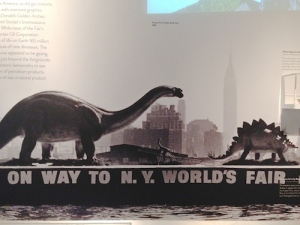
A 1964 New York Times photo of the Sinclair Dinosaur and Stegosaurus passing by the Empire State Building on their way to the Queens fairgrounds

A 1964 New York Times photo of the Sinclair Dinosaur and Stegosaurus viewing the Empire State Building on their way to the Worlds Fair fairgrounds

The Sinclair dinosaur was a sensation when he arrived in New York City to star in the 1964 World’s Fair. Millions of visitors queued to have their pictures taken with him and get a glimpse of life-size replicas of the scale and scope of the Mesozoic megafauna.

T. Rex, Stegosaurus, Triceratops, Trachodon…never mind that they lived millions of years apart – just to see them inspired science geeks, wonder seekers, and future paleontologists – an unforgettable childhood impression.

It may surprise you to learn that Sinclair and T. Rex are living a blissful retirement in Texas where there are no Unispheres, freeways, lines of tourists, or ticket booths…about 75 miles southwest of Fort Worth in a state park with another unique connection to New York.

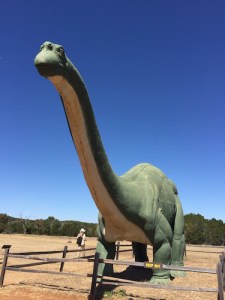
Sinclair relaxes in a Texas corral

Sinclair relaxes in a Texas corral

The gargantuan dinosaur trackway up on the fourth floor of the American Museum of Natural History is from the Paluxy River in Dinosaur Valley State Park, where these two former New Yorkers have retired.

Back in the Thirties, AMNH field explorer Roland T. Bird told his boss, Barnum Brown, about the Texas trackways. In 1940, aided by WPA crews, the submerged tracks were excavated, cut into 1,200 pieces and shipped off to the AMNH, the Smithsonian, the University of Texas, and a few other places.The excavation was a media sensation, with chronicles appearing everywhere.

In New York, the jigsaw-puzzle track pieces were eventually reassembled and placed under the Apatosaurus/Brontosaurus, where they remain today.

Apatosaurus atop Paluxy trackway in New York at AMNH

Apatosaurus atop Paluxy trackway in New York at AMNH

The big, round blobby tracks that appear to match those of Apatosaurus are reckoned to be those of Sauroposeidon and the three-toed tracks running right alongside are those of Acrocanthosaurus, a predator.

Even though this spectacular trackway got moved to New York, there are still plenty in in the park. There are at least five big sites, which have all been documented in the Dinosaur Valley State Park footprint-mapping project. See the results here. When you click on each photo mosaics or track overlays, they will open in Google Earth. Find the R.T. Bird site under Track Site Area 2.

But how did the New York dinosaurs get to Glen Rose? The entire dinosaur group toured the United States for a few years after the Fair, right around the time that Texans lobbied to have the Paluxy Trackway declared a state park. No dinosaur fossils at the time, but there were lots of footprints, mostly underwater but a few on the shoreline. Neighboring ranchers donated the land, hoping to keep the site intact and spur tourism dollars.

Sauropod footprints underwater at the Paluxy River, Glen Rose, Texas

Sauropod footprints underwater at the Paluxy River, Glen Rose, Texas

When the Sinclair tour concluded, Atlantic Richfield’s idea was to donate all the dinosaurs to the Smithsonian, but when the Smithsonian said they didn’t want the group, the band broke up. One went to Vernal, one to Cleveland, but Glen Rose was the only location that managed to get the two biggest stars. Did the New York connection make the difference?

It’s hard to know, but the recently opened Perot Museum of Nature and Science features a pop culture corner in its dinosaur hall with replicas of all of the NYC’s World’s Fair dinosaurs!

For the complete story, check out this video of the tracksite and an introduction to the Google Earth mapping project, old videos of Mr. Bird’s historic 1940s excavation, and cameos by the Sinclair dinosaur and friends.

World’s Fair T Rex enjoying a quiet life in Texas

World’s Fair T Rex enjoying a quiet life in Texas

Frida Khalo Extravaganza Ending with Colorful Surprises

NYBG’s Haupt Conservatory is transformed into Frida’s Casa Azul

NYBG’s Haupt Conservatory is transformed into Frida’s Casa Azul

Ever since the New York Botanical Garden installed its Frida Khalo: Art, Garden, Life show, it’s been a nonstop party and feast for the eyes, ears, and tastebuds.

Not sufficient to import fourteen of Frida’s rarely seen paintings for the formal gallery upstairs in its library building, the creative NYBG team has made environments, commissioned artists, designed apps, booked acts, hosted special events, transformed the conservatory, made a wall of cactus, redesigned menus, and even brought in a taco truck to give everyone an immersion into her sophisticated Mexican lifestyle.

This blockbuster sensory experience is in its last week, going out with a bang with a Dia de los Muertos theme as this traditional Mexican holiday collides with our own Halloween. Sugar skulls and whimsical skeletons are taking over Frida and Diego’s pyramid that serves as the centerpiece of the garden portion of the show.

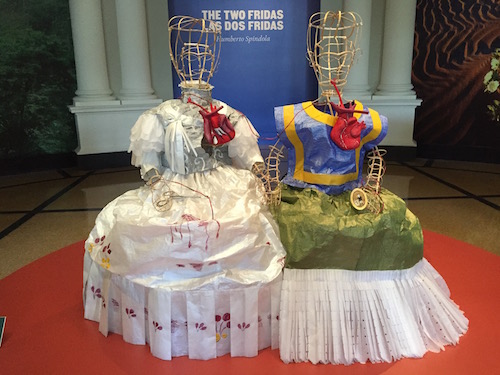
Tissue-paper dresses for The Two Fridas by artist Humberto Spindola

Tissue-paper dresses for The Two Fridas by artist Humberto Spindola

It’s an appropriate mix, given Frida’s own proclivity to merge the everyday with the surreal in her own works. The Library has an exquisite collection of her self-portrait and still life paintings, featuring flowers, animals, and deep-rooted Mexican myth and culture.

Downstairs in the Britton Rotunda, there’s a stunning installation of The Two Fridas by artist Humberto Spindola – side-by-side mannequins wearing tissue-paper dresses in colors that Frida sported, but with the surreal outer heart that she painted more than once. Visitors approach as if it were a shrine with special powers.

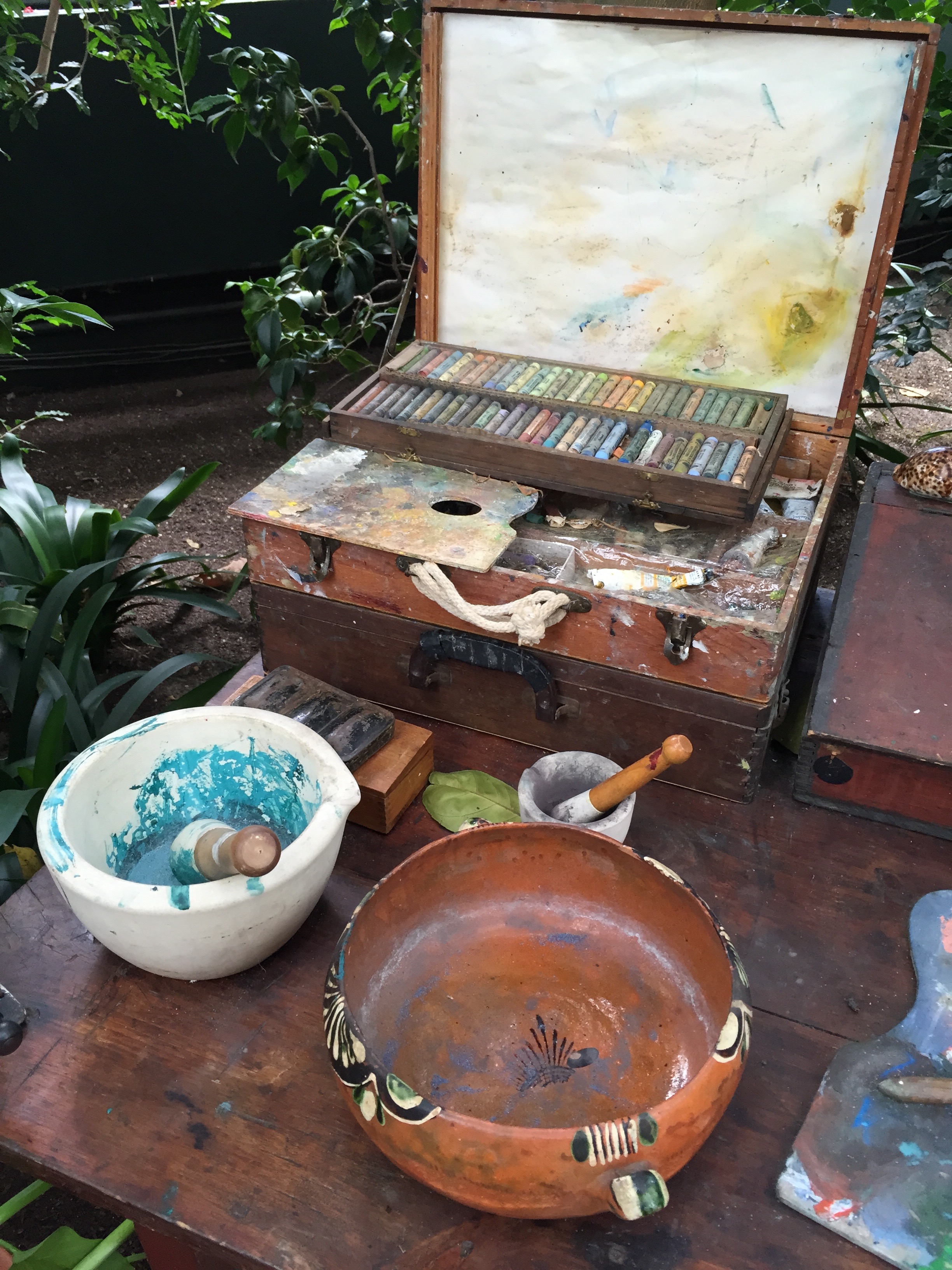
Frida’s workspace

Frida’s workspace

The Haupt Conservatory serves up a riot of color with floating blue containers of vivid flowers, the dynamic blue of the recreated Casa Azul, where she lived, pops of the types of flowers with which she adorned her table and sills, and the intensely painted Mexican-style pyramid in the center of it all.

The sensations are so bright that it’s easy to miss the recreation of Frida’s studio, tucked away in the trees to the left of the main event – brushes, paints, paint sticks, and other tools.

Outdoors, the curators have succulents jammed into every piece of oversize Mexican pottery near a “wall” of cactus, replicating a natural fence that Diego had outside his studio for decades.

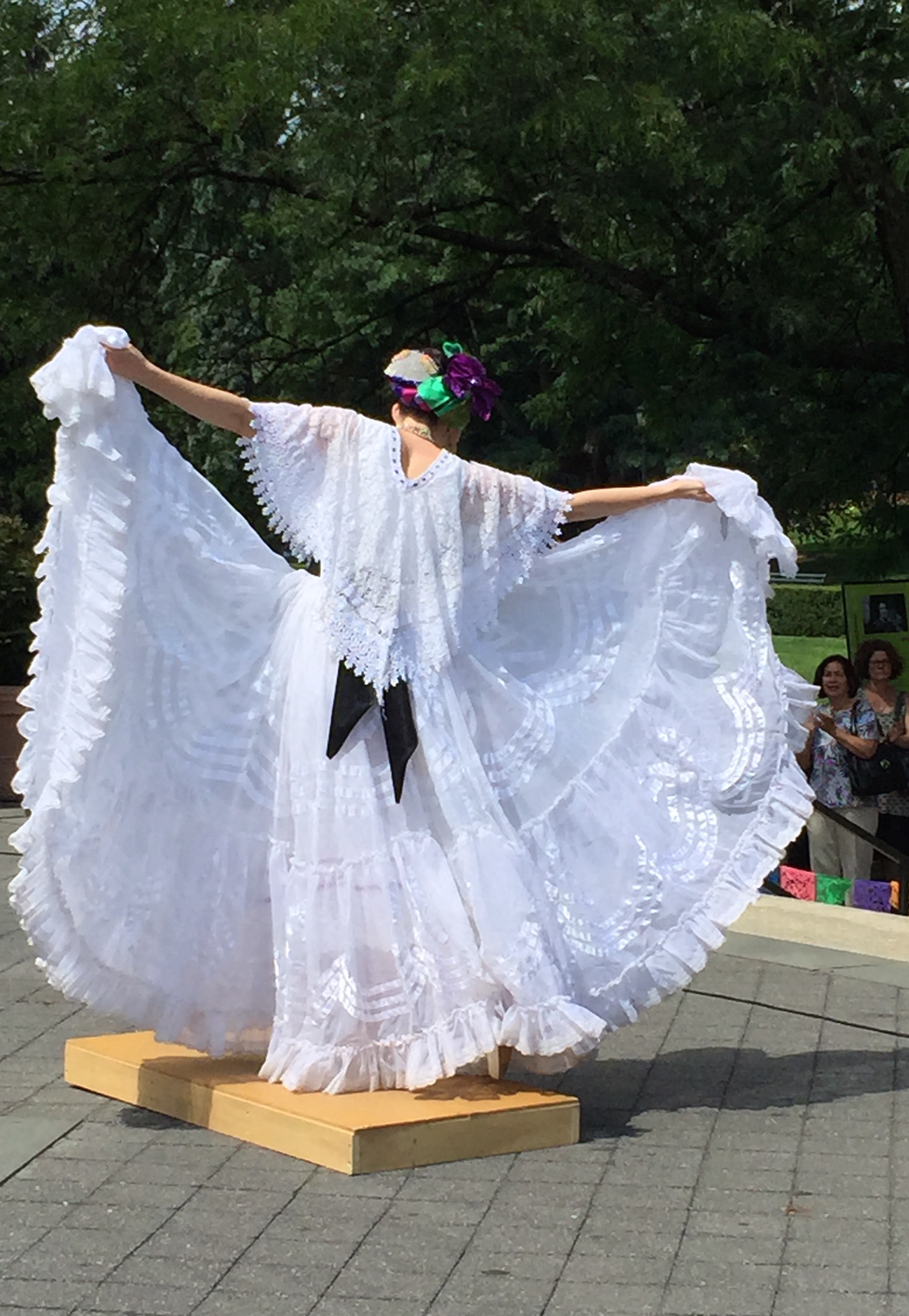
Soloist from Capulli Danza Mexicana channels her inner Frida for the crowd

Soloist from Capulli Danza Mexicana channels her inner Frida for the crowd

The “Life” portion of the show’s title is represented by the generous schedule of music, performances, films, and events that the NYBG has featured throughout the show’s six-month run. Dance companies, all-female mariachi bands, chefs, and authors provide sensuous infusions of movement, wit, gaiety, and sophistication that Frida embodied her entire life. Flashing red skirts, exciting beats, fast footwork, dramatic flourishes, and meaty conversation all contribute to the experience of who Frida was, how she lived, and what she loved.

Download the exhibition panel to see all the parts of Mexico City that meant so much to Frida and Diego – images of parks, gardens, markets, and historic sites, including photos of Casa Azul.

Download the app for your visit, and go to our Flickr site to see the photos and a few videos of the dancers in action.

Take a look at what the NYBG team achieved:

If you have time, check out the YouTube of the all-star kick-off symposium dedicated to Frida last May.


Sneaker Culture Wows Brooklyn

Nike’s original Air Jordan I (1985) and the 25th anniversary Run-DMC Adidas brings joy to Brooklyn fans

Nike’s original Air Jordan I (1985) and the 25th anniversary Run-DMC Adidas bring joy to Brooklyn fans

Crowds in Brooklyn are levitating with excitement as they explore their own sartorial history in The Rise of Sneaker Culture, an exhibition running at the Brooklyn Museum through this weekend. Finally, a fashion history and technology show that really resonates with the men in the room!

The hundreds of historic sneakers, mostly from the Bata Shoe Museum collection in Toronto, tell the story of how casual sports footwear came to be so dominant in today’s high-fashion landscape.

Although there are a few examples of women’s footwear – early Keds from 1916 and iconic Reeboks from the Jane Fonda-fitness era – the focus is squarely on the men, their sports, and their athletic-inspired designer footwear.

The history section of the show shows some of the earliest rubberized sports shoes from UK collections, but quickly moves into familiar New York City territory when colorful creations began appearing at pick-up games on basketball courts around the city in the 1970s, and when the tide really turned through sports and music licensing.

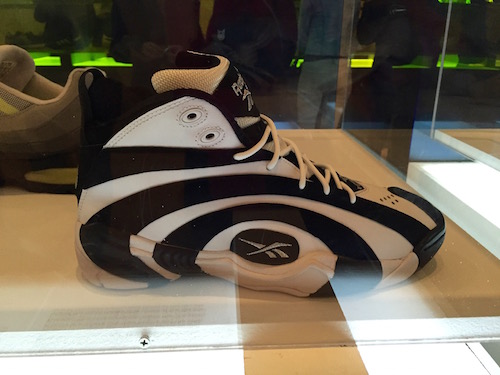
No one forgets the first time they saw Reebok’s Shaqnosis in 1995 (reissue)

No one forgets the first time they saw Reebok’s Shaqnosis in 1995 (reissue)

Crowds and docents jockey for space to worship at the altar of Nike’s 1985 Air Jordan I alongside the autographed reissue of Run-DMC’s 1986 Adidas. After Michael Jordan inked that deal and hip-hop video was distributed worldwide on MTV, sneaker fashion went viral. Electrifying images of loosely laced footwear were seen and copied by fans from the Bronx to Kathmandu. The right shoes and lacing style could wordlessly convey to others in the know, “I know what’s going down.”

Beautifully installed, Brooklyn crowds could work their way through men’s footwear history down one side and up the other – the original P.F. Flyers, original Chuck Taylors, streamlined European designs from the 1970s, Adidas’s early fitness shoes with built-in microprocessors, Nike’s Air Force 1, and Magic Johnson’s Weapons for Converse.

Nike’s 2009 limited edition for LeBron

Nike’s 2009 limited edition for LeBron

After the awesome case with the entire evolution of Air Jordans, the curators lined up a riot of color, technology, status, and design with evidence of so many subsequent licensing deals. Kanye’s new Yeezy Boot for Adidas was interesting, but the Reebock’s Shaqnosis and Nike’s limited edition for LeBron really stopped people in their tracks.

High-fashion sneakers by design and art luminaries Damien Hirst, Jeremy Scott, Chanel, Pierre Hardy, Raf Simons, Giuseppi Zanotti, and Rick Owens brought visitors right into the present day – when guys wear sneakers and tuxes to the Emmys, just as Michael Jordan predicted they would three decades ago.

A great touch at the show’s exit was the opportunity for visitors to leave a note about their own personal “sneaker story” and draw their favorite one.

Take a look at our favorite footwear from the show on our Flickr feed, all presented in chronological order. And enjoy this brief presentation on men’s contemporary footwear in this behind-the-scenes peek into the collections of the Bata Shoe Museum with senior curator Elizabeth Semmelhack:

Daring Docent Dishes with Digital Adam at The Met

Digital Adam and the Docent reenact what Paradise was like before The Fall

Digital Adam and the Docent reenact what Paradise was like before The Fall

There’s no need to check into the Met after hours to see a classical statue come to life. In Renaissance gallery 504 on the main floor, a digital version of Tullio Lombardo’s 15th-century Adam is interacting with visitors and a knowledgeable Docent in Reid Farrington’s The Return performance through August 2.

The Return is quite a production and its illusions created in the Italian Renaissance gallery would make any animation fan jump for joy.

Classical Adam (the marble one) is installed prominently in the gallery where half the performance takes place. Its presence is a miracle, since the beautiful Renaissance sculpture totally shattered in a freak fall in 2002.

To repair it – a complex undertaking — Met team made a digital replica of all the pieces to decide how to fit everything back together again and spent years making it whole.

Tullio Lombardo’s Adam (1490-1495), which fell and shattered in 2002, but has been exquisitely repaired

Tullio Lombardo’s Adam (1490-1495), which fell and shattered in 2002, and is now repaired

Now, it’s Digital Adam who’s the fascinating co-star of the show, brought back to life by performance artist Reid Farrington who envisioned a tribute to the virtuosity of the Met’s conservation team who so flawlessly reassembled Tullio’s Adam.

The other half of the performance involves an improv actor, a motion sensor suit, and a crew of digital engineers and prop masters, all camped out on the stage of the Met’s auditorium in the Egyptian wing. As the stage actor moves in the auditorium, Digital Adam moves, speaks, answers questions, and holds up a Warhol and a Van Gogh inside his lifesize digital frame in the Renaissance gallery to the delight of the audience and his sidekick, The Docent. See photos on our Flickr feed.

The audience decides what part of Classical Adam’s renovation will get discussed next, but the witty duo soon veer off into other fascinating topics:

Actor in motion-capture portrays Digital Adam, whose image is simulcast at the right and in gallery 504

Actor in motion-capture portrays Digital Adam, whose image is simulcast at the right and in gallery 504

What does it feel like to always look good and never age? Does Classical Adam remember back to the marble quarry? Does Biblical Adam remember what Garden of Eden was like before the Fall? Adam’s clever responses reveal that his Eden experience was a lot about infinity pools and the good life.

At one point, Digital Adam invites the Docent to portray Eve in his telling of what happened after the Serpent appeared with that apple. Then the attention turns back to Classical Adam, as the Docent shows Lombardo’s thinking about that particular moment portrayed in marble.

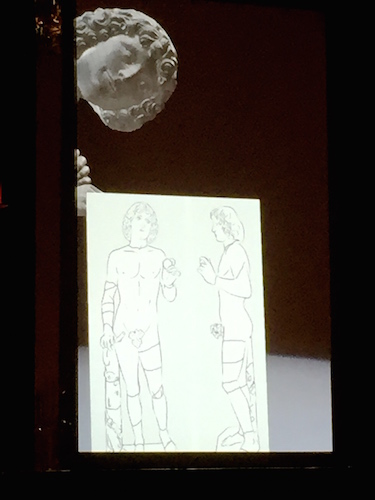
Digital Adam shows drawing of where the breaks in Lombardo’s Adam occurred

Digital Adam shows drawing of the breaks in Lombardo’s Adam

These two need their own ongoing talk show about history, time and space in some corner of the Met. Until August 2, ask the information desk for The Return’s program and go marvel at both the gallery and the behind-the-scenes performances. Or go to the live stream on the Met Museum’s website.

After meeting Digital Adam, you’ll never again wonder about what’s going on inside Classical Adam’s cool, calm, beautiful marble head.

Before Shapewear: Six Centuries of How to Look Good

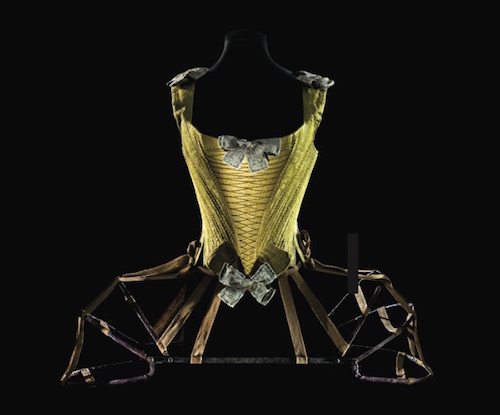
Articulated French pannier made of iron, leather, and fabric tape, 1770. Source: Les Arts Décoratifs. Photo: Patricia Canino.

Whalebone corset (1740-1760) above 1770 articulated French pannier that collapsed. Source: Les Arts Décoratifs. Photo: Patricia Canino

If you’ve ever successfully poured yourself into a pair of tight jeans, pay a visit to the Bard Graduate Center Gallery’s townhouse through July 26 to see Fashioning the Body: An Intimate History of the Silhouette, a three-story exhibition of how women – and men — pushed, pulled, and shaped their bodies into the “hot” silhouette of the day.

The show originated in the Musée des Arts Décoratifs in Paris in 2013 tells the story of how fashion divas and dandies utilized undergarments to stiffen, enhance, pad, and pouf themselves to create the iconic shapes we admire in paintings, photos, magazines, and other pre-digital media.

Painted yellow silk taffeta American robe a la Polonaise, 1780-1785 Installation views of “China: Through the Looking Glass” May 7 - August 16, 2015 Metropolitan Museum of Art New York, New York

American robe a la Polonaise held up by wire, 1780-1785. Source: Metropolitan Museum of Art, “China” exhibition.

Corsets (some iron!), farthingales, whalebone stays, panniers, crinolines, bustles, and girdles from the 15th century until today are all on display. You’ll see exactly how those whalebone stays stiffened corsets worn by nearly every woman from the 1500s to 1800s, and be amazed to learn that little children were also strapped into kids’ corsets to help shape “unformed” bodies right up through the 1950s in Western Europe.

Mr. James would approve of all the engineering that the curators reveal for us. Who knew that those wide panniers under 18th century French court skirts had elaborate mechanisms that could collapse to let their wearers squeeze through narrow carriage doors or tight household doorways? Automated models demonstrate just how neatly these ingenious apparatus operated to create the illusion of width just below super-tiny corseted waists.

How were those elaborate poufs created at the back of 1770s court gowns in the “Polonaise style”? Ladies could manipulate wires through eyelets in the voluminous triple-part skirts to create just the right amount of volume, drape, and flash.

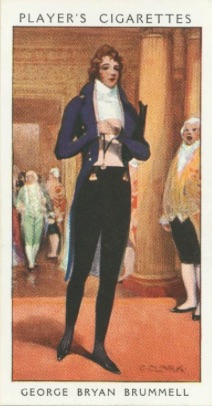
Uber-dandy Beau Brummel. Source: NYPL’s digitized George Arents Collection.

Uber-dandy Beau Brummel. Source: NYPL’s digitized George Arents Collection.

And the men! Under the sparkle jackets of 1770s court dress (subject of our previous post), the guys consciously padded chests, calves, and other body parts to give the appearance of a more muscular physique even if they hadn’t been working out. Shapely men’s calves were all the more important since high-end men’s footwear at the time consisted of elevated Louis heels.

For dandies of the 1800s, it was all clothes, all the time, so an even wider array of sartorial artifice came into being—tight men’s corsets, stomach belts, padding, and (more) fake calves. Striking a pose meant everything,

The in-gallery app provides lots of insightful commentary on the items and apparatus. On the second floor, Bard has a line of mannequins that illustrate the changes in female silhouettes. Here’s a walk –through of that part of the installation:

Watch this companion video to see some the collapsible pannier, corsets, and girdles in the show – direct predecessors to the shapewear of today:

When Apple Met Alto and Game Boy Began

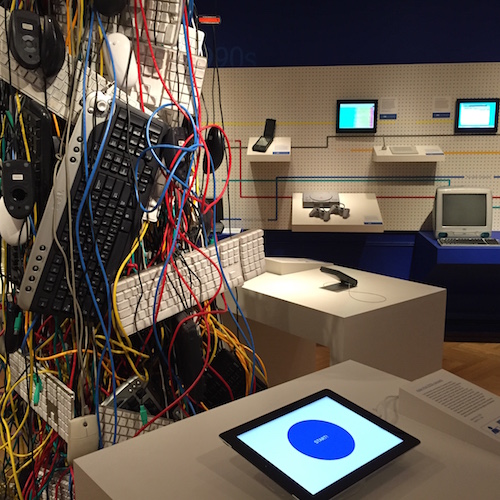
Tower of keyboards and wires in the center of the fourth-floor gallery; Newton visible against the history wall

Tower of keyboards and wires in the center of the fourth-floor gallery; Newton, PlayStation, and iMac visible on the history wall as iPad watches over everything

What’s the longest you ever sat in front of a computer screen or stared at stuff on your phone? Can you even remember a time before there were texts, browsers, and interactive screens? Bard Graduate Center Gallery has assembled a retrospective that asks you to remember your first keyboard, joystick, trackball, and mouse in their exhibition, The Interface Experience: Forty Years of Personal Computing, on view through July 19.

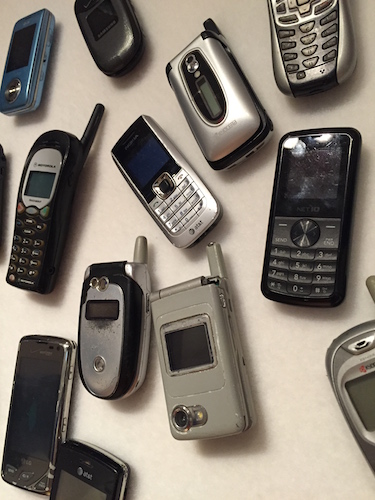
Plus, you can touch everything in the show and even sort through maybe every clamshell and Internet-enabled cellphone ever designed. What a stroll down memory lane!

Your first view of the fourth-floor show is a tangled tower of keyboards and cables, surrounded by a pegboard gallery with little platforms displaying the timeline of devices – desktop PCs, tablets, and game consoles.

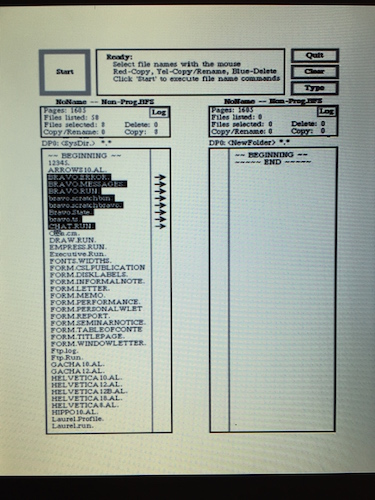
The 1973 Xerox Alto operating system featured the first mouse and graphic user interface.

The 1973 Xerox Alto operating system featured the first mouse and graphic user interface.

The oldest item in the show is the famous (but rarely glimpsed) 1973 Xerox Alto operating system, which the curators display on an ever-playing loop. Experience what Steve Jobs saw when he came face to face with the first graphical user interface, replete with the screen arrow. Brain flash on using a mouse to point to stuff on a screen – Steve said that someday everyone would be using something like this interface.

Walk on to see the Apple IIe (Woz built in an unbelievable 64K of RAM), VisiCalc (first “killer app” all quants had to have – a spreadsheet), and the predecessor to Steve’s Macintosh – the 1981 Xerox Star, which was the first commercially produced computer system to use a mouse and GUI. At a price of $16,000 in 1981, Steve’s up-and-coming Apple Macintosh was positioned to become a winner.

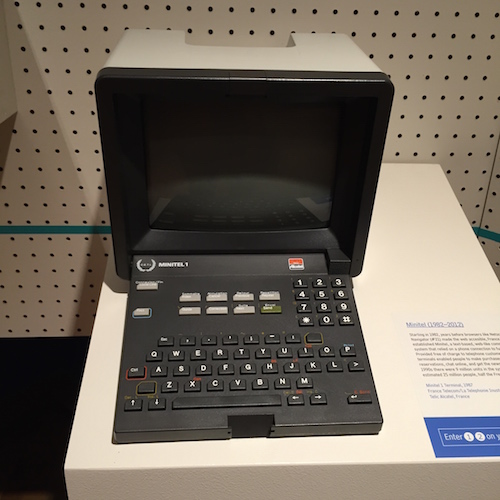
Before web browsers: Rarely seen, the exotic Minitel (1987 model) text information interface, which the French government distributed for free to half its population.

Before web browsers: Rarely seen, the exotic Minitel (1987 model) text information interface, which the French government distributed for free to half its population.

The Commodore 64 and IBM’s PC aren’t neglected, and neither is MS-DOS. Consider other game-changers such as Palm Pilot, Newton, and Kinect. You can touch them all and remember the way it was before things got smaller, faster, and got more oomph. Get a glimpse of the installation (pegboards and all) on our Flickr feed.

Don’t worry if you can’t get up to 86th Street to handle the technology in person. As usual, Bard’s students and faculty, who collaborated on this show, have produced a highly fulfilling web application that highlights everything in their show, adds historic tidbits, and shows each piece’s original print and TV ads.

Click on “Grid” to see all the exhibition items. Click on “Connections” to read interesting comments by the curators comparing different items or telling little histories about the relationships between the tech innovations. Click on “Device Statistics” to see how many units of each sold, how long it was in the market, and how much each would cost in today’s dollars. You’ll be able to sort the items by any of these parameters.

Steve’s hip and happening1998 iMac injected color into a drab, drab desktop computing world

Steve’s hip and happening1998 iMac injected color into a drab, drab desktop computing world

Example: sorted by today’s cost, the most expensive computing investment in the show would be the Xerox Alto operating system at (today) $225,981.

Be sure to click on “more” and enjoy the gallery of magazine ads for these innovations. And check out the 1979 TV commercial for Xerox Alto, on loan from the Xerox Archives, and please, do not miss the unforgettable all singing and dancing MS-DOS product introduction video.

You’ll read memories shared by gallery visitors about various items in the exhibition. For that matter, click on any item on the Grid and add your own story about your first personal encounter with these icons!

Bravo, Bard Graduate Center!

Mobile phones for days – the future of computing. The curators put these up with Velcro so visitors could feel them.

Mobile phones for days – the future of computing. The curators put these up with Velcro so visitors could feel them.

Enlightenment through Gems

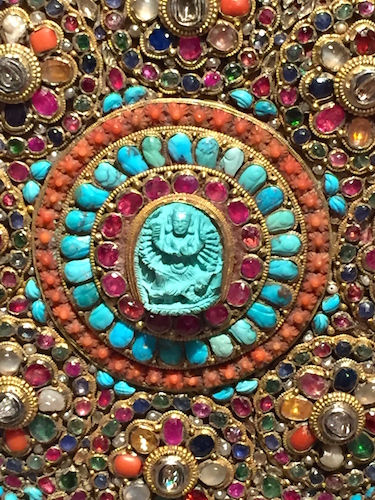
Center of 8-in. ritual offering dish made in 17th-18th c. Nepal

Turquoise Dhurga defeats a dragon in the center of 8-in. ritual offering dish (17th-18th c. Nepal)

It’s clear that wearing and giving precious (and semi-precious) gems can elevate the mind to higher levels of consciousness – at least in the minds of the Tibetan Buddhists – according to what you’ll see in Sacred Traditions of the Himalayas, running through this weekend at the Metropolitan Museum of Art.

The curators feature some remarkable statues, ritual dancewear, mandalas, and arms in the show, but let’s focus on the jewel-encrusted mosaics, containers, and jewelry displayed in the corner of the second-floor gallery, estimated to date from the 17th to 20th centuries.

Tibetan Buddhism emerged over the centuries in a dry, dusty, seemingly barren but beautiful region where people’s own adornment or bright flags atop mountain passes seem to be the only bursts of color. Inside homes, personal shrines, and monastery temples hang intricate, colorful mandalas pictorially suggesting the path to enlightenment, often symbolized by brightly adorned temples.

Mrs. Tsarong and two ladies from Tsang wearing special-occasion jewelry and hats as photographed by C. Suydam Cutting in 1937. Courtesy: Newark Museum collection

Mrs. Tsarong and two ladies from Tsang sport special-occasion jewelry and hats near Lhasa in 1937. Photo: C. Suydam Cutting. Courtesy: Newark Museum

These conceptual centers of enlightenment are often thought of as colorful crystal palaces emblazoned with jewels – an attractive image to hold in one’s mind on the lifelong journey to this higher plane of existence. What better way to remember your goal than to contemplate bedazzling diamonds, rubies, emeralds, sapphires, garnets, quartz, pearls, amber, coral, lapis lazuli, and turquoise?

To honor one’s journey to enlightenment, wealthy Tibetans often donated jewels to temples to adorn statues of the deities or commissioned personal devotional objects. That’s why you see so many jewel-encrusted objects in the Met’s collection. Personal shrines had jewel mosaics jam-packed with a dazzling array of stones. Gigantic statues were adorned with jewel-encrusted ornaments and surrounded by similarly elaborate containers for offerings.

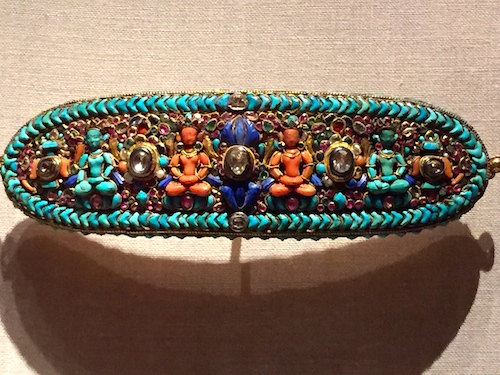
This Forehead Ornament for a Deity is only 8 inches long. Four celestial Buddhas are interspersed with diamonds

This Forehead Ornament for a Deity is only 8 inches long. Four celestial Buddhas are interspersed with diamonds

For special occasions, women sported accessories with amazing numbers of stones, reminding everyone of their social status, wealth, and devotion to an enlightened path.

Although some of the metal work was done in and around Lhasa, Tibet’s capital, the majority of the eye-popping jeweled settings were created across the border in Kathmandu, Nepal by Newari masters who created some of the most intricate visions in metal, wood, and paint ever known to the world. We’ve provided you with some close-up looks here and on our Flickr site. As shown, the result is a mix of Tibetan and Hindu imagery – typical of this region where so many cultural influences mix.

Densely packed diamonds, rubies, emeralds, sapphires, garnets, quartz, pearls, amber, coral, lapis, and turquoise in corner of Birth of the Buddha mosaic (18th-19th c. Nepal)

Densely packed diamonds, rubies, emeralds, sapphires, garnets, quartz, pearls, amber, coral, lapis, and turquoise in corner of Birth of the Buddha mosaic (18th-19th c. Nepal)

The Met’s own site for the objects in the show also allows you to zoom in on the details. Learn more about how the Met conserves such intricate jewel work in this blog post by an intern in the conservation department. See close-ups of how the Newaris set their gems.

Finally, explore Tibet as it was 100 years ago through this slideshow prepared for this show at the Met by the Newark Museum, which itself has a world-class collection of Tibetan objects and perhaps the largest collection of photographs of Tibetan people and temples from that time.

Lincoln Speaks at The Morgan

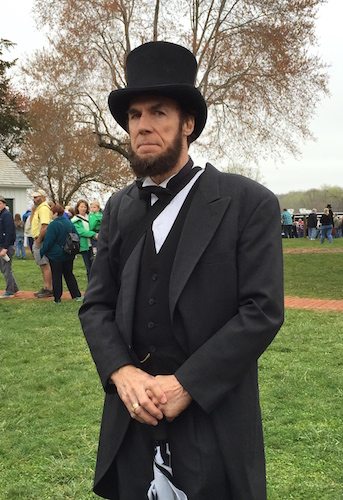
Lincoln reenactor visiting the 150th Anniversary of the Civil War Surrender, Appomattox Court House, April 2015

Lincoln reenactor visiting the 150th Anniversary of the Civil War Surrender, Appomattox Court House, April 2015

A grammar book, a book of math homework, dark romantic poetry, and required Shakespeare reading could be found in any literate teen’s bookshelf. In this case, they belong to Abraham Lincoln – key items that bring insight to his love of words, literature, and learning in the Morgan Library’s exceptional show, Lincoln Speaks: Words That Transformed a Nation, on view through June 7.

The show begins with Lincoln’s early books and poems, including those inspired by Mr. Poe’s The Raven, and presents drafts, manuscripts, letters, and the occasional photograph in a sequence that follows the trajectory of Mr. Lincoln’s life – campaigner, leader, emancipator, chief, and icon for the ages.

Follow along in the online version of the exhibition here and take a close look at some of the most important writings and objects in the show.

You’ll see Lincoln’s first use of the “house divided” reference and hear a reading his famous “house divided” speech (click here). Experience Lincoln’s ability to connect with the everyday voter by using clear, plain language.

Right Hand of Lincoln, a 1888 painted bronze cast by Leonard Volk, from original cast done in 1860 when Lincoln was nominated for President. Source: NYHS

Right Hand of Lincoln, a 1888 painted bronze cast by Leonard Volk, from original cast done in 1860 when Lincoln was nominated for President. Source: NYHS

The visual centerpiece of this unique tribute – a cast of Lincoln’s hands that were eventually scaled up for use in the Lincoln Memorial – is on loan from New-York Historical Society. Among other remarkable items are the Emancipation Proclamation and the first letter he wrote on April 2, 1865 at the fall or Richmond. It was to his wife, Mary, and ironically it would be the last she would receive.

The website and museum installation both feature terrific media and commentary, including an insightful documentary screening in the gallery.

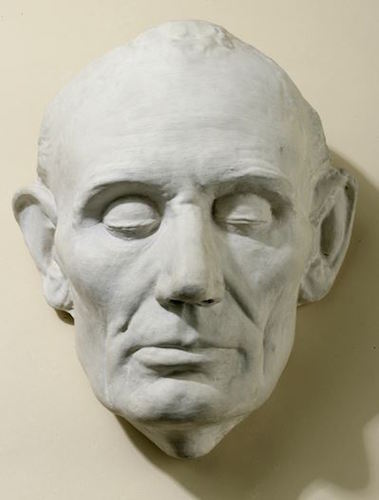
Copy of life cast done by Leonard Volk of LIncoln in 1860. Source: NYHS

Copy of life cast done by Leonard Volk of LIncoln in 1860. Source: NYHS

The Civil War and the end of slavery are primary topics, of course, but looking at the handwriting, personal notes, and original writing provide significant insight to this monumentally important individual.

Although it’s not related to the exhibition, click here to see Lincoln, Grant, and other reenactors recreating the sights and sounds of the Civil War surrender at the 150th anniversary at Appomattox Court House, Virginia.

Saints in the ‘Hood in Brooklyn

Kehinde Wiley’s Saint Amelie in stained glass, 2014

Kehinde Wiley’s Saint Amelie in stained glass, 2014

Take a look at the saints as you’ve never seen them in Kehinde Wiley: A New Republic through this weekend at the Brooklyn Museum of Art.

They’re not saints, exactly, but Mr. Wiley is asking you to look at the young African American men you pass in your everyday life in a slightly different way – through the lens of Byzantine icons and Medieval stained glass. The icons and would-be saints are magnificent, proud, and mysterious, just like his slightly earlier portraits that are grace the walls of Lucious Lyon’s mansion in the hit series Empire.

The Cantor Gallery is filled with these men of higher purpose, and the crowds love it. Bronze busts echo the 18th century marble work of Houdon, and visitors check them out from all angles.

The Archangel Gabriel, Wiley’s 22-karat gold leaf and oil on wood painting from his Iconic series

The Archangel Gabriel, Wiley’s 22-karat gold leaf and oil on wood painting from his Iconic series

Beyond this gallery, the curators have assembled a survey of Mr. Wiley’s 14-year career – dominated by his giant canvases in which guys from the neighborhood take on the heroic poses of European aristocrats and conquerors. In fact, when he began, Wiley would scan neighborhood streets for handsome, statuesque subjects and ask them if they would feel comfortable posing as other-era men of means in his painting studio. Those who said yes were asked to select the person they felt comfortable emulating from Wiley’s library of art books on European portraiture.

Elsewhere in the show are Wiley’s first-ever bronze sculpture of female subjects and selections from his world tour, where he found portrait subjects in Israel, Palestine, Africa, and the Indian subcontinent. Check out some of the works in our Flickr feed and on the museum website.

Although it’s common to see a gigantic Wiley portrait in another museum these days, Brooklyn is proud that it was among the first to collect his work. If you journey to another floor, you’ll see a five-panel painting installed on a ceiling like some Renaissance master’s and several portraits from his Passing/Posing series in 2003.

If you can’t get to Brooklyn to see this show, let Mr. Wiley take you through the exhibition via video: