Tony Week Pilgrimage to NYPL

Al's studio at New York Public Library of the Performing Arts

Al watches over his studio at NYPL for the Performing Arts

Tony favorite Kinky Boots is playing at the Hirschfeld, but as you contemplate the number of awards it will pick up Sunday night, walk over to the entrance of NYPL at Lincoln Center to pay tribute to Al himself. Peek through the window of NYPL for the Performing Arts to see the nook where every Broadway star since the 1920s had their portrait done –the studio of Al Hirschfeld, the man who immortalized them all.

Look through the window and you’ll see his drawing table, lamp, and the cozy, cushioned barber chair where he perched day after day, recording entertainment history over the decades with his unmistakable whimsical flair and line. The Lincoln Center library is a fitting home for Al’s studio furniture, since he consulted the NYPL theater archives for a lot of his work.

Liza in Minnelli On Minnelli (1999), one of more than 20 portraits Al did of her. In color for The New York Times. Source: Library of Congress.

Liza in Minnelli On Minnelli (1999), one of more than 20 portraits Al did of her. Source: Library of Congress.

It’s hard to believe that Hirschfeld first began drawing celebrity caricatures in the 1920s, and continued his illustrious career for the next eighty years. Click on this link to his dealer’s site (Margo Feiden) to scroll through all the plays and musicals he’s covered, documenting the quirks, panache, and performances of everyone from Fanny Brice to Martin Short.

You can click through the “time table” of Al’s work at the gallery site, or in the Timeline of the Hirschfeld Foundation’s website. Every drawing after 1948 was done from a cushioned barber chair in which he could swivel to his heart’s content. Initially, he found it on the Bowery for $3.00, but the one you’ll see in the Performing Arts library entrance is the replacement (the original just wore out), which he bought in 1993 from a barber shop in the Chrysler Building.

So, pay tribute to Broadway’s most beloved artist. And before we post about the Impressionist Line show at the Frick, why not watch a 20th century master of line make his mark so you can imagine all the creativity that emanated from the table you see in the window. The clip from The Line King, uploaded to YouTube by Al’s grandson, documents the legend drawing a caricature of Paul Newman as he appeared in Our Town. 

Philadelphia Museums Reach 2.4M YouTube Views

Since Philadelphia museums, zoos, and gardens began posting videos online in 2008, collective YouTube views have climbed to 2.4 million, as chronicled in our latest report, Philadelphia Museums: 2013 Video and Social Media Rankings. The biggest surprise about the Philadelphia museum videos is that stylistically they are a bit different than New York museum videos. The institutions in Philly take a more whimsical approach to science, use a lot more promotional videos to drive exhibition attendance, and occasionally throw in a bit of the macabre.

Longwood Garden’s Top Philadelphia Exhibition Video of 2012

The Top Philadelphia Exhibition Video of 2012, courtesy of the Longwood Gardens grounds crew and Bruce Munro

Highlights of our report on 32 Philadelphia museums:

As of year-end 2012, the Philadelphia institutions with the highest number of total YouTube channel views are the Penn Museum, the Mutter Museum, and Longwood Gardens. Penn’s channel features a mix of behind-the-scenes videos about exhibits, anthropology lectures, and a gigantic docu-archive; the Mutter produces highly creative shorts highlighting selections from its tantalizingly weird collection; and Longwood simply has tons and tons of fans that want to see what’s up with the seasons.

Last year, Longwood Gardens produced Philadelphia’s highest rated museum video — Light: Installations by Bruce Munro. Over 36,000 nature and art lovers viewed this short about Longwood transforming itself into Munro’s luminous vision. The garden also pumped out other video promos and features all year that kept their fans coming back to hit the YouTube channel.

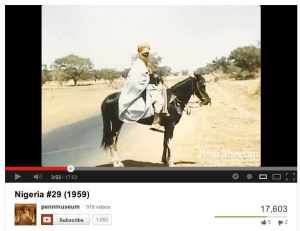
The Penn Museum’s Top Anthropology Video of 2012 features a sheik among many other people and places in 1959 Nigeria

The Penn Museum’s Top 2012 Anthropology Video Nigeria #29 (1959) features a sheik, a mosque, a fuel depot with camels, and country life the way it used to be

The Penn Museum’s YouTube channel surpassed 1 million views in May. Penn’s been adding an enormous anthropology film collection to its channel (over 400 films) and the time-machine quality is irresistible. It’s no surprise that Penn’s Maya 2012: Lords of Time videos captivated the public all year, but it is interesting that the silent travelogue Nigeria #29 (1959) is up to 17,000 views. You could poke around that channel for days.

The Chemical Heritage Foundation produced Philadelphia’s most popular science video. Over 26,000 people watched A Distillations Explainer: Sweat, part of the Foundation’s Blood, Sweat, and Tears series (see below). It’s an entertaining, well-produced podcast series.

The Mutter Museum presents its unusual medical collections quite effectively through its YouTube series. Their 2012 series feature the curator taking “mystery” items out of the cabinets and challenging the viewers to identify them. Not for the squeamish, but really clever and nicely scripted.

The most active museum Twitter users in Philadelphia are the National Constitution Center, the Eastern State Penitentiary, and the Penn Museum. The most active Flickr users during 2012 were the Franklin Institute Science Museum and the Pennsylvania Academy of the Fine Arts. The largest Flickr photo pools are populated by Longwood Gardens and Eastern State Penitentiary enthusiasts.

All the video and social media details on 32 museums are in the report. Click here to see what’s included and make a purchase from our Its News To You Reports shop.

Enjoy watching Philadelphia’s top science video, courtesy of the Chemical Heritage Foundation. Meet Louis Pasteur and find out why sweat often smells:

Enter House of Memory at The Customs House

Detail of Dad’s House, (2012). Horse hair, feathers, cotton cloth, Photo by Clarissa Rose Pepper.

Detail of Dad’s House (2012). Installation with horse hair, feathers, cotton cloth, Photo by Clarissa Rose Pepper.

What do you remember about where you grew up? About your family when you were young? C. Maxx Stevens, an artist of the Seminole/Muscogee Nation of Oklahoma, answers these questions for herself (and us) in the evocative show, House of Memory, in its final weeks at the Customs House at the Smithsonian’s National Museum of the American Indian in New York.

Stevens, currently teaching art at University of Colorado-Boulder, scrounges around in junk stores and yard sales out west to find the ephemeral materials for her installations – slightly transparent gauze made into hoop-skirt structures and large multimedia recreations of 1950s homes with floating scrims. Can you see through the haze?

The experience of walking around the show takes you back to corners of Stevens’ memory growing up in a multitribal community of Plainview, Kansas, just outside Wichita. It may not be like your own experience, but the stuff she weaves, scatters, and constructs will cause you to tap into your own memories.

Three Graces (2004) installation. Source: Eitelijorg Museum of American Indians and Western Art, Indianapolis

Three Graces (2004) mixed-media installation. Source: Eitelijorg Museum of American Indians and Western Art, Indianapolis

The first gallery with The Three Graces is a tribute to her relationships with her sisters, and a must-see for lovers of fabrics, textiles, and interwoven mixed media.

The second gallery has several installation that resemble mini-stage sets that trigger memories through scattered photos, altered clothing, suspended objects, horse hair, garden stakes, and evocative combinations of other props – Dad’s House, Mum’s House, Sister’s House, Four Directions House, and House of Transitions.

Detail of Cultural Landscape installation of 1950s houses (2012). Photo: Clarissa Rose Pepper

Detail of Cultural Landscape installation of 1950s houses (2012). Photo: Clarissa Rose Pepper

Cultural Landscape is an immersive installation with tiny illuminated homes (found in thrift stores), scrims, and multimedia that “remembers” the 1950s streets of her suburban Kansas community.

The Smithsonian chose to publish black-and-white photos of the installations, which we’re using here. It’s kind of fitting…not quite of-the-moment and a little back-in-time feeling.

Want to reflect more about your own childhood home, your grandparents, and your neighborhood? Take a trip down to the Customs House before June 16, and let Stevens take you on that journey.

NMAI is making the leap into downloadable digital media with this show, so go to the iTunes U store, type in “NMAI-NY” and download the app, which contains an audio guide for this show. If you’d prefer to read about Stevens and her work, download the PDF.

Dive Into MAD’s New Jewelry Web

MAD's digital gallery navigation tool, featuring a photo of a model wearing Peter Hoogeboom’s Spanish Collar (1995)

MAD’s digital gallery navigation tool, featuring a photo of a model wearing Peter Hoogeboom’s Spanish Collar (1995)

The Museum of Art and Design has spent a lot of time collecting brooches, collars, rings, and pins for its collection — around 200 mid-century pieces over the last few years. About half of MAD’s new stuff is on display in the show, Wear It or Not: Recent Jewelry Acquisitions, which closes this Sunday.

If you can’t get up to Columbus Circle to see the works in person, be sure to check out the new digital archive for the show. MAD has spent considerable time and effort to get its collections pushed out through the web, and the effort really pays off.

This photo of Peter Hoogeboom’s Spanish Collar shows the navigation tools that MAD has designed for its on-line archive that let you zoom in close right in to take in all of the construction details of his ceramic, silver, and brass construction.

Model wearing The Big Spiderweb, No. 2 made of sterling silver in 2005 by Lucie Heskett-Brem, The Gold Weaver. Photo: Louis Brem

Model wearing The Big Spiderweb, No. 2 made of sterling silver in 2005 by Lucie Heskett-Brem, The Gold Weaver. Photo: Louis Brem

Use the + to zoom in, and then click on the arrows to navigate up, down, left, and right across the image. The detail is incredible.

Dive into the archive to zoom in on Robert Ebendorf’s Berlin Wall brooch (made from guess what?), Luis Acosta’s multilayered paper constructions, and The Big Spiderweb. Also be sure to inspect Boris Bally’s brooches that were crafted from recycled traffic signals and the 19th century Sprocket Cuff from Northern Pakistan. It looks on trend right now.

You’ll be inside the archive for hours, since every time you click on an artist’s work, other related innovations pop up in the sidebar.

And what’s up with that red adhesive piece by Rebecca Strzelec? Take a look at how you wear it!

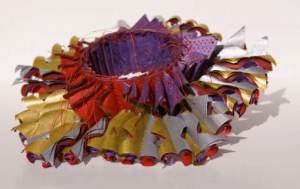
Luis Acosta’s 2009 bracelet is made of six layers of stitched paper. Photo: Luis Acosta

Luis Acosta’s 2009 bracelet is made of six layers of stitched paper. Photo: Luis Acosta

Whitney to Remove Gigantic Rose (Again)

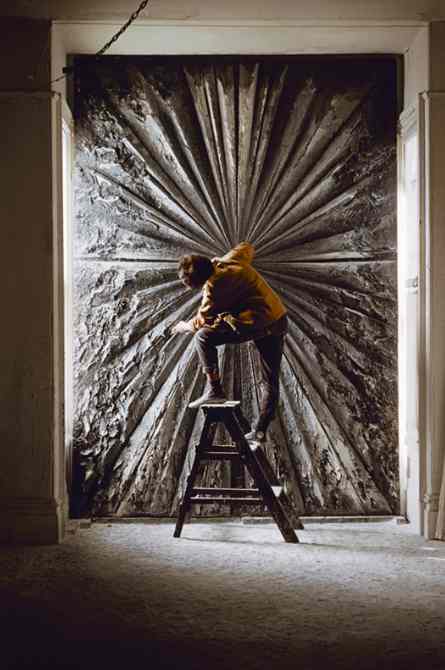
Jay DeFeo working on what she then called The Death Rose, 1960. Photo: Bert Glinn. © Bert Glinn/Magnum Photos

Jay DeFeo working on what she then called The Death Rose, 1960. Photo: Bert Glinn. © Bert Glinn/Magnum Photos

It was hard enough to get it out of the apartment after she created it nearly 50 years ago. Get to The Whitney’s show Jay DeFeo: A Retrospective this week before the moving crews come back. The Rose, DeFeo’s legendary painting (or is it a sculpture?) is the focal point of this Bay Area artist’s exhibition.

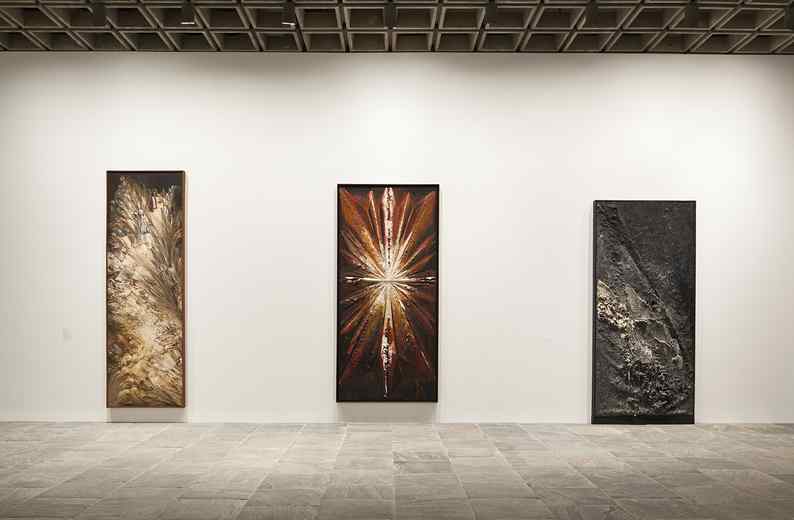
Early in her career, DeFeo drew inspiration from prehistoric art, the cosmos, and terrestrial forces of nature. In the late 1950s and early 1960s, she painstakingly built up the surfaces of her oil paintings, which often evoked geologic forces – slow, large-scale shifts of monumental proportion. (See the installation view of three of these works).

DeFeo was invited to show at MoMA in the historic, 1959 all-star show, Sixteen Americans, which included Rauchenberg, Johns, Kelly, Stella, de Kooning and Nevelson. She sent some of her 3D impasto works, but didn’t consider her largest piece, The Rose, quite finished. She became obsessed and spent six more years layering paint on the canvas. Listen to DeFeo herself talk about the difficulty in creating the 3D effects in The Rose in a drafty apartment in the late 1950s.

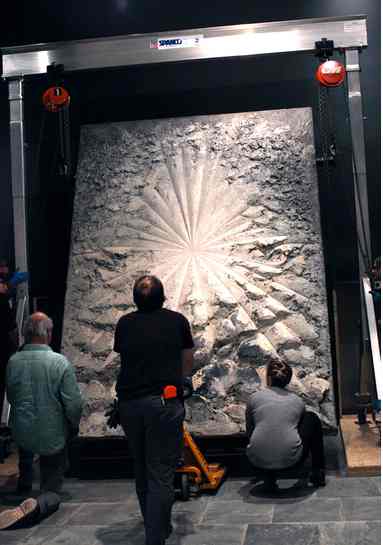
The Whitney removed the side panels of The Rose and used a two-ton gantry to get it as close to the wall as possible. Source: Whitney Museum. Photo: Paula Court.

The Whitney removed the side panels of The Rose and used a two-ton gantry to get it as close to the wall as possible. Source: Whitney Museum. Photo: Paula Court.

Unfortunately, she couldn’t even get it out of her apartment, because the 3D surface she created ended up being too big to fit through the door and weighing…oh, about a ton. DeFeo had a small army of movers come upstairs to her apartment-studio, rip out the wall, and lower it to the street with a forklift. Watch and listen to Bruce Connor’s take on how it all came down in his interview with SFMoMA).

After that, The Rose went on display in California, but ultimately was installed as the showpiece of a conference room at the San Francisco Art Institute. For all the right reasons, temporary wall was built to conceal and protect it, but ultimately The Rose was hidden from view from 1979 until 1995, when the Whitney team unearthed it. Now, they own it.

Recently, the Whitney had the task of getting a truly monumental work out of storage, shipping it to the West Coast for the SF edition of the show, and bringing it back to New York.

Recently, The Rose arrived back at the Whitney from the show’s run at the San Francisco Museum of Modern Art. It’s one of the most complicated pieces for the museum to ship, move, and install – just like the original transfer.

Click on this link and scroll down to find the Whitney’s photo show of what it took to get it up to the Fourth Floor. See how a crew of handlers got a one-ton work from the street to the gallery.

Get to the show before it closes June 2, and enjoy DeFeo’s jewelry, geology-inspired work, drawings, and never-before-seen photos of this Beat-era innovator.

Installation view at The Whitney. Photo: Sheldan C. Collins

Installation view at The Whitney. Photo: Sheldan C. Collins

Monumental Impression of Fashion at the Met

Monet’s
Women in the Garden (1866) from the
Musée d'Orsay, Paris features impressions of fast-changing dappled sunlight and ladies’ fashions (e.g. the fad for soutache)

Monet’s
Women in the Garden (1866) from the
Musée d’Orsay, Paris featuring impressions of fast-changing dappled sunlight and ladies’ fashions (e.g. the fad for soutache)

You can witness the collisions of the new crashing into the old in the Metropolitan Museum’s joyous show, Impressionism, Fashion, and Modernity. Impressionism’s heaviest hitters (Manet, Monet, Renoir, Cassatt, and Morisot) are displayed alongside stunning 19th Century dresses, suits, accessories, and underthings to prove a point — that incorporating the latest fashions was one of the cudgels that these rule-breakers used to facilitate their revolution in painting.

The show features paintings from three grand Impressionist collections (the Met, the Art Institute of Chicago, and the Musée d’Orsay), and includes breathtaking dresses from NYC’s fashion-collection superpowers – the Met, the Brooklyn Museum, FIT, and Museum of the City of New York.

The Met’s website explains the key themes of the show, but it’s no substitute for going through the galleries in person. Why? The tiny photos cannot do justice to the monumentality of these paintings, where scandalous 19th-century fashionistas stormed the barricades of the French Salon, in large-format framed paintings normally reserved for staid, moralistic history paintings.

Summer day dress worn by Madame Bartholomé in her husband’s painting In the Conservatory 
(1880) 
Source:
Musée d'Orsay

Crisp summer day dress worn by Madame Bartholomé in her husband’s 1880 painting In the Conservatory. Source:
Musée d’Orsay

The size, colors, and techniques are amazing, especially as the Impressionists moved outdoors just as new technology was encouraging lifestyle and fashion revolution. Steam-powered train lines were inventing the concept of the weekend getaway for City hipsters, so a lot of the paintings feature dappled sunlight with high-fashion young people lolling about in nature. (See the show’s highlights.)

The show’s curators shine the spotlight on how fashion, innovation, and the art world influenced one another: New aniline dyes allowed hot pink, bold color-blocking and vivid hues for extravagant skirts and dressing gowns. New fabric-finishing technology enabled super-white cotton fabric to be crafted into diaphanous, desirable, but high-maintenance dresses and gowns for the first time in fashion history.

The Met scatters mass media throughout the galleries, just to demonstrate fashion’s democratization during 1850-1890. New printing technology enabled trendy fashion magazines to be consumed by the masses. New-fangled duplication techniques revolutionized the studio photograph by inventing the eight-image carte-de-visite – a paper-based way to market your “celebrity” self and show off your fashion chops long 150 years before Facebook and YouTube.

Silk and ivory French parasol (1860-69) from Brooklyn Museum Costume Collection at The Met (Source: gift of Mrs. William Ashbaugh)

Silk and ivory French parasol (1860-69) from Brooklyn Museum Costume Collection at The Met (Source: gift of Mrs. William Ashbaugh)

Pop-art pink velvet, boleros with pompoms, lace parasols, Worth gowns, kid gloves, top hats, corsets, hat shop girls, high-end boutiques, and Cezanne’s surprising oil painting based on a fashion-magazine layout. Which part of this show is the best?

Go before May 29, when the show decamps for Chicago for its June 26 opening.

Early Birds Meet Lavish Flock at NY Historical

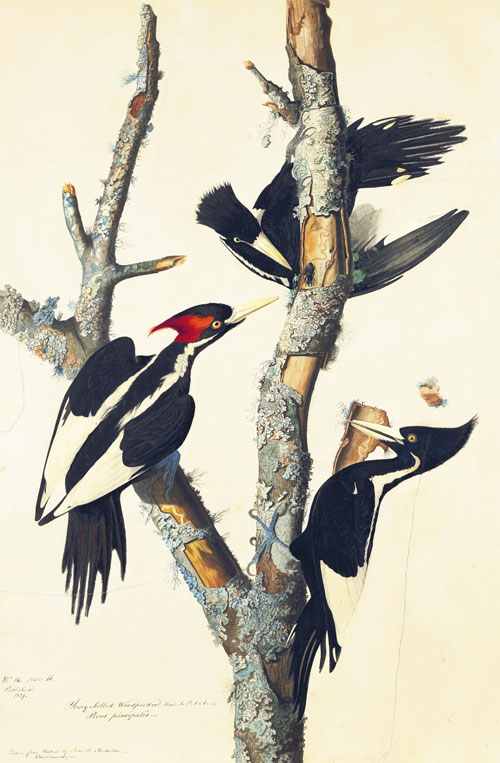
JJ Audubon's Ivory-billed Woodpecker: Study for Havell, pl. 66 (c. 1825–26) Source: NYHS

JJ Audubon’s Ivory-billed Woodpecker: Study for Havell, pl. 66 (c. 1825–26) Source: NYHS

In a week where Baz Luhrmann’s The Great Gatsby is captivating audiences with grand, lavish cinematography and color, take a moment to check out the 18th century’s competition — an immersive-media extravaganza conceived and marketed by artist-entrepreneur JJ Audubon. It’s so big that the New-York Historical Society had to break it into three parts. Rush to see Audubon’s Aviary: Part I of the Complete Flock.

NYHS owns just about every watercolor that JJA ever did for the gigantic engraved folio that he sold to celebrity clients back in the 1820s and 1830s. He created watercolors of every bird in America (474), made the images life size for maximum visual impact, had them engraved by UK superstar Robert Havell, Jr., structured a unique package to appeal to high-end collectors, embarked on a road show, and sold subscriptions to his IMAX-sized The Birds of America.

NYHS kicks off its trilogy by presenting Audubon’s original watercolors in the order in which they were engraved and filling an adjacent gallery with the artist’s earliest work. The exhibition reveals how this self-taught artist developed his remarkable skill with pastels, a pin board, and a cut-and-paste approach. Take a look at the on-line gallery.

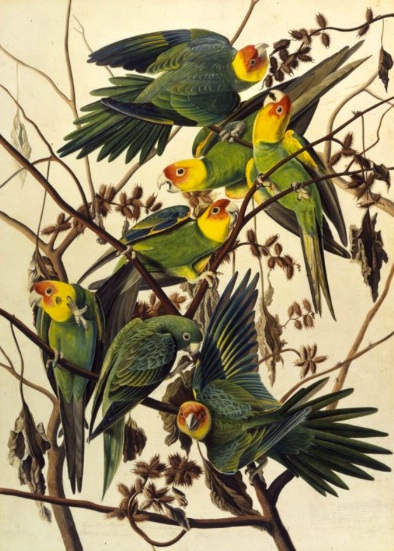
JJ Audubon painted them before they went extinct: Carolina Parakeet: Study for Havell, pl. 26, (c. 1825). Source: NYHS

JJ Audubon painted them before they went extinct: Carolina Parakeet: Study for Havell, pl. 26, (c. 1825). Source: NYHS

A nice touch is the collaboration with the Cornell Lab of Ornithology, who provides us with recordings of the birds – both on a free audio device in the gallery and here on line.

If you can’t get to the show, peruse the “early birds” stories and highlights in this fascinating PDF by Roberta Olson from the journal Master Drawings, where you’ll learn some behind-the-scenes dish on JJA and see his headshot. Scrolling through, you’ll also see some of his earliest paintings, which were only discovered in the La Rochelle Museum of Natural History in France in 1995.

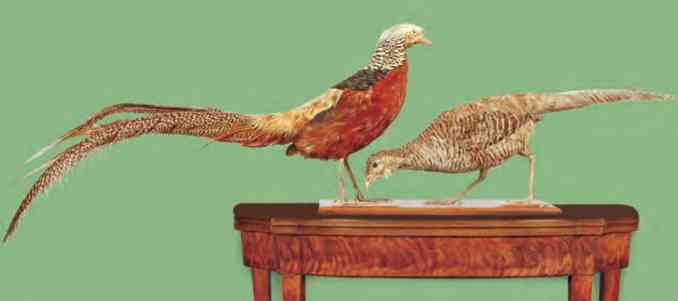
In the PDF, you’ll also read about how he was inspired by Mr. Peale’s museum in Philadelphia early in his career, ended up painting some crazy Golden Pheasants (now residing at Harvard) that were once presented to George Washington by Lafayette as a gift from the King of France (Figures 18 and 19), observe nearly identical reworked paintings (starting at Figure 34), and see the grid system he used for reference on his pin board (secrets revealed).

Mounted Golden Pheasants once owned by George Washington were early JJA subjects. Source: Harvard’s Museum of Comparative Zoology

Mounted Golden Pheasants once owned by George Washington were early JJA subjects. Source: Harvard’s Museum of Comparative Zoology

Interior Design Goes Medieval Avant-Garde at National Gallery

An avant-garde 1890s tapestry by Morris & Co., Edward Burne-Jones, William Morris, and John Henry Dearle (designers), The Arming and Departure of the Knights of the Round Table on the Quest for the Holy Grail. Collection of Jimmy Page, courtesy of Paul Reeves, London

An avant-garde 1890s tapestry by Morris & Co., Edward Burne-Jones, William Morris, and John Henry Dearle (designers), The Arming and Departure of the Knights of the Round Table on the Quest for the Holy Grail. Collection of Jimmy Page, courtesy of Paul Reeves, London

How did a secret society of artists in the 19th century turn into one of the most beloved interior design trends of the modern era? That story is the most surprising part of the exhibition (closing May 19) at Washington’s National Gallery of Art, Pre-Raphaelites: Victorian Art and Design, 1848–1900.

Organized by the Tate (and originally titled Pre-Raphaelites: Victorian Avant-Garde), the show introduces us to the PR Brotherhood (founded 1848), whose oil paintings and writings looked to the Middle Ages, myths, and legends of ancient literature for the spirituality that they felt was missing from modern, rapidly industrializing life.

Early collaboration by Rossetti and Morris, The Arming of a Knight chair, 1856 – 1857, painted pine, leather, and nails. Source: Delaware Art Museum, Wilmington.

Early collaboration by Rossetti and Morris, The Arming of a Knight chair, 1856 – 1857, painted pine, leather, and nails from the Delaware Art Museum,.

Dante Rosetti, William Holman Hunt, Edward Burne-Jones, William Morris, and others took inspiration from meticulous observation of nature, sensual textiles replicated in their paintings, and ethereal muses in medieval robes, which they often painted on location in leafy, natural settings.

In 1859, Rosetti painted a cupboard as a wedding gift for Morris. It wasn’t long before these pals ran with the inspiration — constructing medieval-inspired furniture and decorating it with similar mystical medieval images and experimenting with mixed media (images + poetry) on tiles, tables, and other creations made by hand.

For all the beautiful painting in the National Gallery’s show, the most startling room is the one that showcases the fact that the painters took it one step further by creating chairs, tapestries, tables, and textiles for forward-looking couples who wanted to live the 360-degree experience. In the 1860s, Morris & Co. was the go-to interior design shop for medieval-style avant-garde furnishings. They singlehandedly drove the stained-glass revival in Victorian architecture.

In 1873, Morris & Co. went international, selling wallpaper in Boston. Soon, American retailers in most major cities were carrying the hand-blocked or woven wall coverings and textiles.

Block-printed cotton designed by Morris (printed 1884-1917) from The Baltimore Museum of Art

Block-printed cotton designed by Morris (printed 1884-1917) from The Baltimore Museum of Art

Ever the advocate of the handmade, Morris was passionate about the relationship of decorative arts to the modernist movement. During Oscar Wilde’s US speaking tour in 1882, his lectures about Morris, the Pre-Raphaelites, and the nobility of hand-crafted work spread the trend in hand-crafted interior design in America.

Today, just about every museum shop carries William Morris-inspired something-or-others. Here’s the Tate’s video about the 17th century carved oak bed that Morris himself used in the 1890s. It’s all about the hand-made approach to the bedding textiles – a modern-medieval collaboration between his designer daughter, Mary, and wife, Jane.

Hats off to the Tate and National Gallery for presenting avant-garde design in a new light. Check out the rest of the Tate’s PR videos, including the one with Karen Elson on the topic of model as muse, then and now.

NYC Museum Videos Receive 49 Million Views on Social Media

The Japan Society’s popular Japanese language series

The Japan Society’s popular Japanese language series

After reposting so many museum videos here, we wondered how much video museums were producing, what social media they were using, and who had the most viewership and followers. We counted, and found that the museums, zoos, and botanic gardens around New York have racked up 48.8 million views on their public YouTube channels since 2007.

The volume of activity on was so significant that we couldn’t help documenting it and packaging the rankings into a report, NYC Museums: 2013 Video and Social Media Rankings.

Museum folks may want to purchase the full 48-page report to see how their organization stacks up, but here are some of our key findings:

As of year-end 2012, NYC museums with the highest number of all-time YouTube channel views were the Paley Center, American Museum of Natural History, and  Japan Society. Paley merges its NYC and LA feeds, and it’s 33M all-time video views are mostly from TV celebrity show panels in LA. So if we’re really looking at the museum programming champs in NYC, it would be AMNH (15M), Japan Society (7M), and MoMA (6M).

The Top NYC Museum Video of 2012 -- an AMNH Science Bulletin Whales Give Dolphins a Lift

The Top NYC Museum Video of 2012 — an AMNH Science Bulletin Whales Give Dolphins a Lift

The top NYC museum viral video of all time is The Known Universe video produced by AMNH for the Rubin Museum’s 2009 show, Visions of the Cosmos – 11M views and still growing. The video was generated from the Hayden Planetarium’s data set.

In  2012, another AMNH video, Whales Give Dolphins a Lift, went viral with 2M views. The AMNH has an active video-production team supplying content to its Science Bulletin walls inside the museum. Hats off to them for making a winning wordless video out of a few still photographs from field scientists in Hawaii, simple titles, and tranquil music.

The popularity of Japan Society’s language lessons are driving the numbers on their channel. Who can resist clicking through all the 2-minute lessons in their Waku Waku Japanese series with Konomi?

Asia Society’s Top NYC Museum Music Video of 2012

Asia Society’s Top NYC Museum Music Video of 2012

The top 2012 NYC museum music video was produced by the Asia Society, Arif Lohar and Friends: Jugni Ji!. Who knew that the finale to a Sufi pop legend’s concert on Park Avenue one year ago would rack up over half a million views?

The top star featured in a 2012 NYC museum exhibition video was a piece of 18th century mechanical furniture displayed at the Metropolitan. Viewership of The Roentgens’ Berlin Secretary Cabinet grew from 182,000 views at year-end 2012 to 1.6 million today. Can anyone explain how mechanical furniture received 25 times the viewership of the Met’s video walk-through of its blockbuster McQueen show, Savage Beauty?

The NYC museums using the greatest range of social media and video channels are The Jewish Museum and the Rubin.  One of the best under-the-radar NYC museum Flickr sites was the historical archive of Wall Street documents and treasures posted by the Museum of American Finance.

All the video and social media rankings 63 museums are in the report. Click here to see what’s included and make a purchase from our Its News To You Reports shop.

OK, here it is: the all-time top NYC museum video from 2009:

Morgan Deconstructs Degas’s 19th c. Cirque-du-Soleil Experience

Edgar Degas, Miss La La at the Cirque Fernando, 1879. Oil on canvas. Source: National Gallery © National Gallery, London / Art Resource, NY

Edgar Degas, Miss La La at the Cirque Fernando, 1879. Oil on canvas. Source: National Gallery © National Gallery, London / Art Resource, NY

Long before Cirque du Soleil began selling $180 seats to eight shows in Las Vegas or Floating Kabarette came to Brooklyn, high society and avant-garde crowds were flocking to extravagant theaters on Montmartre in Paris to see the finest aerialists from Europe.

The Morgan Library’s exquisite micro-show, Degas, Miss La La, and the Cirque Fernandodocuments the meticulous work of Mr. Degas to portray the magic, daring, and wonder inside a 2,000-seat arena where he experienced the artistry of one of the must-see acts of 1879 – a mixed-race German aerialist who hung from a trapeze clenching an apparatus in her teeth from which she dangled a firing cannon.

As in the Met’s blockbuster show, Impressionism, Fashion, and Modernity (which also features a circus-themed painting in its last gallery), the Morgan makes the case that Degas selected this subject because was associated with the height of fashion (along with café concerts and racetracks). Although this particular work was the only circus image Degas would ever paint, just tackling the dazzle and glamour of Miss La La dangling 70 feet in the air (before the cannon stunt) showed that he was capturing what was “happening” among high society and artsy types in their “modern” life.

A vibrant pastel study of the artist by Mr. Degas. Source: Tate, London/Art Resource, NY

A vibrant pastel study of the artist by Mr. Degas. Source: Tate, London/Art Resource, NY

Although we can marvel at how well Degas captured this fleeting moment, the Morgan lays bare that this work was planned in meticulous detail. They’ve displayed preparatory works, sketchbooks, and even architectural drawings of the theatre’s interior that Degas created to work out the feeling, look, composition, and setting for this spectacular work. As Degas said, “No art was less spontaneous than mine.”

If you love Impressionism and theatricality, get over to the Morgan to enjoy the mechanics behind the creative process and flip through the digital version of our artist’s sketchbook (which was to fragile to be sent from France) right inside the colorful upstairs gallery.

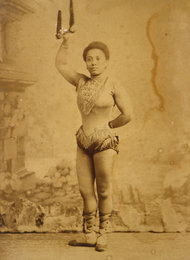
Visit Mr. Degas and Ms. La La before May 12, when they leave for the Continent. (Sorry, no video, but here’s a photo of the star herself.)

Photograph of the artist, Miss La La (c. 1880). Albumen silver print. Source: Zimmerli Art Museum, Rutgers University

Photograph of the artist, Miss La La (c. 1880). Albumen silver print. Source: Zimmerli Art Museum, Rutgers University