FIT Matches Uniformity with Nonconformity

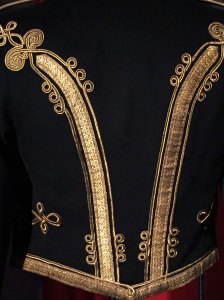
Detail from British Royal Rifle Corps “Mess Dress” Jacket (1900), a possible inspiration for Ralph Lauren

Detail from British Royal Rifle Corps “Mess Dress” Jacket (1900), a possible inspiration for Ralph Lauren?

Whether you pass a flight attendant in the airport, see an EMS pro at work on the street, watch a referee on TV, or place an order with the counterperson at your favorite fast-food chain, you may not immediately see the individual who is wearing the uniform. You just perceive that a professional is at work.

But how does the uniform design create your perception? And who designed the uniform? What signal does it send?

Conversely, how do designers take inspiration from uniforms and design looks that make us think that the wearer is a rule-breaker, a nonconformist, or chic, stylish person?

The Museum at FIT provides the answers on its website and in its first-floor show Uniformity through November 19, an illuminating tribute to history and fashion that shows how conformity and troubled times can serve as springboards for creativity, expression, and whimsy in the larger cultural landscape.

Michael Kors camouflage (2013)

Michael Kors camouflage (2013)

The introductory video features Thom Browne explaining how he took inspiration from executive and schoolboy uniforms for his groundbreaking Milan show in 2009.

The show then unfolds by juxtaposing high fashion with uniforms from FIT’s collection, organized into neat themes – military, domestic, sport, work, and school. Here’s our Flickr album of our favorites from these themes.

Right up front, the curators provide a visual backstory to the evolution of the US/European military uniforms with two galleries and an iPad that show what British and US soldiers wore over the last 240 years. The experience makes you think about who put the navy into Navy (it was adopted in 1802) and shows that ladies and kids wearing “sailor suits” is a 100-plus-year tradition in fashion.

Mainbocher’s well-cut 1942 uniform for the U.S. Navy W.A.V.E.S. (1942) and Chanel’s chic military-inspired ensemble (1960)

Mainbocher’s well-cut 1942 U.S. Navy W.A.V.E.S. uniform and Chanel’s chic military-inspired ensemble (1960)

Although the 21st-century gown by Galliano and the in-you-face statement by Kors demonstrates how transgressive camouflage can look on the runway, Claire McCardell’s little boxy 1947 jacket reminds us how Ike’s WWII U.S. Army Air Corps look kept going for nearly a decade as an icon in the booming US ready-to-wear sportswear market. Both guys and gals had to sport that neat, pulled together look atop their rompers, sport shorts, and khakis.

The hot pink Fiorucci jumpsuit that telegraphed hipness in NYC disco fashion in the Seventies is right at home next to the 1970s Coast Guard flight suit in fire-resistant orange synthetic. As these two electric pieces fight for attention, the curators leaves us to ponder their genesis in the 1940s olive wool Air Force flight suit.

A nearby juxtaposition switches to uniforms as muted, minimalist understatement – the soothing side-by-side designs for worn by WWI and WWII nurses with the barely-there Nineties work coat adopted by the seamstresses and magic-makers at Martin Margiela’s deconstructivist atelier.

1993 Vivienne Westwood baseball cap

1993 Vivienne Westwood baseball cap

Gernreich channels schoolgirls, Vivienne Westwood mimics logo-branded baseball caps, and Ungaro reinterprets collegiate-sports jerseys right across from vintage Princeton blazers from the Twenties and Forties.

The creative takes on all the different types of uniforms screams whimsy and fun for the fashion forward.

One of the show’s highlights, however, is a philosophical look back by the designer who made so many of America’s most familiar uniforms happen — Avis, TWA, FedEx, and McDonalds. Listen as FIT sits down with Stan Herman to talk about his work, life, and the uniforms he created and wore:

Mizrahi Shows His Colors at Jewish Museum

An early 1988 look in orange-orange wool – scarf, coat, and jumpsuit

An early 1988 look in orange-orange wool – scarf, coat, and jumpsuit

For a shot of color and inspiration to let creative impulses run free, trot up to the second floor of the Jewish Museum to see the closing day of the tribute to one of New York’s favorite sons — “Isaac Mizrahi: An Unruly History”. It’s open late tonight until 8 pm.

Isaac has filled four galleries with the results of his imagining in the worlds of fashion, theater, and film, showing how it’s done when you have so many talents, so many ideas, interest in everything, and so little time. You just do it all.

The entry to the show is a wall of organized color, all pulled from his meticulously organized archive of fabrics and color swatches – a great introduction to a brilliant mind harnessed to bring a little more beauty and whimsy into the world.

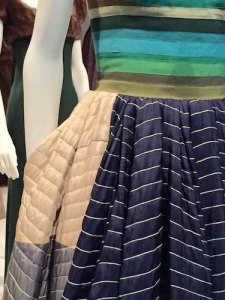
Inspired by elevator padding – silk quilting and grosgrain go to the ball in 2005

Inspired by elevator padding – silk quilting and grosgrain go to the ball in 2005

Beyond that, the first room – mostly from his early 1990 collections – is a riot of color   featuring his high-low approach to style: pair something everyday (like a T-shirt or bomber jacket) with silk-taffeta glamor (like a ball-gown skirt). This is where Isaac made his splash into the world of fashion, and it’s a fun, exciting introduction to the rest of the exhibit.

The curators have mounted his fashion sketches floor to ceiling in a small gallery, showing how Isaac maps out his fashion shows like storyboarding a movie. The room also reveals his passion for drawing, his favorite part of creating a collection.

Another gallery gives a nod to his theatrical costuming work and the next features two ensembles that demonstrate his interest in everyday style and good causes: Isaac was one of the first big-name designers work with Target, and here we see one of those 2004 sweaters.

Sketches with swatches organize the run of show

Sketches with swatches organize the run of show

His Coca-Cola sequined dress grew out of his collaboration with a charity that employed the homeless to collect and flatten discarded cans. Isaac had a Parisian couture house cut the smashed metal into sequins and had them hand-embroidered – another think-about-the-world creation.

Witty, wonderful, and full of life – Isaac’s accessories, film, fashions, and colors should inspire you to get a little more creative with your own day to day. Visit via our Flickr album, watch the Isaac video snippets, and listen to the audio tour the show.

For more Isaac right here, watch his conversation with editor Wendy Goodman on style and the pressures of starting out in the fashion industry.

See Hamilton No Waiting

Taking their Shot in the lobby of the Public Theater in 2015

Taking their Shot in the lobby of the Public Theater in 2015

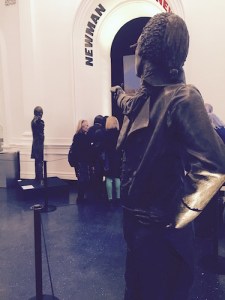
If you really want to experience Hamilton before the Tony Awards, it’s not that hard. Get up to New-York Historical Society at 77th Street and Central Park West and check out the life-size bronze statues of Hamilton and Burr one second before The Shot.

If you went to see Hamilton last year at the Public, you had to pass right between Kim Crowley’s bronze recreations when you entered the theater — a bespectacled Hamilton (wearing tinted glasses because he was facing the sunrise) and an intense Burr who was branded for all time in the history books one second later.

These action figures were initially installed at NYHS in 2004 as part of its ground-breaking Hamilton show…a magnificent installation that drew both raves (for the classy reimagining of NYHS and its exhibitions program after a near-collapse of that institution) and criticism (was it pandering to New York’s besmirched banking community?).

Their 1797 dueling pistols in the NYHS lobby

Their 1797 dueling pistols in the NYHS lobby

Interesting that 2004 was the 300th anniversary of both the duel and the year that NYHS was founded. In fact, Hamilton’s attending doctor that day was one of the founders.

NYHS Ham

Hamilton takes aim inside NYHS

After three hundred years and countless tries at the Hamilton’s pre-show lottery at the Richard Rodgers Theater, it will be a little disconnect to realize that the two facing off in the white marbled lobby are not Lin Manuel and Leslie Odom, Jr. The intensity and the historical dress are there, but the faces are different. Just stand there and run through all the lyrics you’ve memorized from the show.

Walk a few steps further and gaze down at the actual pistols – not stage props – and Angelica Schuyler’s letter to her brother, conveying the terrible news. All real, in her own hand, dated July 11, 1804.

OK, that’s just the lobby. By now, you’ve probably heard that NYHS has just announced its Summer of Hamilton, replete with a large gallery show of all the Hamilton-related documents, artifacts, and portraits plus special clips from Hamilton, movie musicals that inspired Lin, Ron Chernow’s book, and costumed performers on July 4 weekend.

But why not visit right now and have Ham and Burr all to yourself? To fill in the blanks about Ham’s life or prep to see the Broadway show, treat yourself to an exploration of the 2004 Ham show website. It’s full of all types of fun things – a quiz to test your Ham knowledge, a map of where Hamilton hung out in New York City, and real-life historical portraits of all the Schuyler sisters and everyone else in the Broadway show.

Lin's Ham 4 Ham reading outside the theater during the preview lottery

Lin’s Ham 4 Ham reading outside the theater during the preview lottery

There’s even a handy timeline of Hamilton’s “strange and amazing life,” which is a nice reference for things you’ve seen (or hope to see) in the show. For true fans (or curiosity-seekers), there’s even a small selection of short academic papers on Hamilton, including an interview with Ron Chernow, whose book inspired the current Broadway smash hit, and other brief treatises on his schooling, the duel, and the hours before his death.

Although it’s not inside the museum (or the Richard Rodgers), you can check out other Hamilton excitement at the Ham4Ham shows performed at lottery time on 47th Street, many of which have been taped by fans and put up on YouTube. Check out the recreation of the cabinet meeting by the Tony-nominated crew:

Whitney’s Left the Building — Turner and Friends Move In

Marcel Breuer building on Madison, once the Whitney, now The Met

Marcel Breuer building on Madison, once the Whitney, now The Met

Start your engines – the doors to the Met Breuer swung open last week, and it’s a celebrity-studded, jazz-filled opening. The Met has turned Marcel Breuer’s brutalist masterpiece on Madison into a showcase for everything that’s cool, digital, live, and happening.

First, the art: Superstars from the last 500 years of art history are throwing it down in a big, bold, can-you-believe-who’s-here, two-floor mash-up extravaganza, Unfinished: Thoughts Left Visible.

Imagine turning a corner and finding a room packed with the Holy Grail of 19th-century “abstraction” – five barely-there masterworks by Mr. Turner, fresh off the plane from London. It’s not taking anything away from Titian, El Greco, or German Expressionists, who are in the show. It’s just that it’s rare for Gothamites to get up close and personal with this painter’s painter without buying a ticket to London and trekking to Millbank. Once word gets out, hopefully the Breuer downstairs admissions desk will be as jammed as the return line for Hamilton.

One of five late masterworks by Mr. Turner from the Tate

One of five late masterworks by Mr. Turner from the Tate

Yes, it’s strange to encounter Renaissance masters or a monumental Picasso when the gigantic elevator doors open on the upper floors. The fresh juxtapositions of old and new, familiar and unknown make your head spin, but in a good way.

The show features Renaissance masters, 19th century gods (see Matisse and Van Gogh’s side-by-side country cottages), and 20th century hot shots from international collections, MoMA, and 81st Street. The curatorial throw-down is something only the Met can do – scale, scope, and smarts – asking accessible questions and responding with wit from its own collection and other top institutions that have agreed to give their masterworks a trip to New York.

First view of Unfinished

First view of Renaissance masters in Unfinished

Eight years ago, when the Whitney Museum of American Art began planning its move to the Meatpacking District, its board approached the Met and asked if it wanted to take over the famous Breuer building on Madison Avenue.

The answer was “yes” but only if the takeover would be done the Met way – using the full scope of the Met’s holdings, leveraging its interest in new digital and performing arts, and showcasing international modern artists who might not have received the recognition here (in the United States) that they deserved. In other words, turn old-world institutionalism on its head. And they’ve done that.

Just look at the first one-woman show in the United States for Indian modernist, Nasreen Mohamedi. The delicate drawings evoke Klee, Malevich, and Agnes Martin purity and line and shed a whole new light on how modernism was being transformed on the subcontinent in the Seventies and Eighties.


Coffee CupSecond, the live arts element: Since it will be open late on Thursday and Friday evenings, hopefully it will become new Upper East Side’s version of the Rubin’s K-2 Lounge two nights a week – a fun, lively hang-out for music, performance, and art lovers. The rear first-floor gallery has been turned into a contemplative, cool showcase for jazz, programmed by Met Live Arts. Take a look at what’s up through the end of the month with Relation: A Performance Residency by Vijay Iyer.


Welcoming crew with the digital wall

Welcoming crew with the digital wall

Third, the new: So what else has changed at 75th and Madison? The pile-up of art books is gone from the reception desk, and the welcome wall is ablaze with a classy digital marquee offering glimpses of the world’s most precious treasures at each of the Met’s (now) three locations.

In a nod to those stupendous Lila Acheson Wallace bouquets in the Met’s Grand Hall, there’s also an oversize spring arrangement gracing the welcome area.

Fourth, the familiar: People who know the old Whitney well remember the tiny clay colony that resided in a corner of the stairwell next to a window overlooking Madison Avenue. At the press preview, art critics kept pausing on the stairwell landing to marvel at the fact that the beloved Charles Simmonds piece, Dwellings, is still there on loan from the Whitney.

Dwellings, an installation by Charles Simmonds in the stairwell (and across the street), still on loan from the Whitney

Look for Dwellings, a 1982 installation by Charles Simmonds, in the stairwell (and across the street), still on loan from the Whitney

Look out the window and you’ll see the tiny clay and sand Dwellings nestled into the chimney and roof of the Apple Store across the street, same as they have been since 1982. Like the rest of the new Met Breuer, it might be the same place, but you’ll see lots of well-loved modern art in a new, fresh way.

And be sure to download Soundwalk 9:09 by John Luther Adams, commissioned by MetLiveArts for visitors to enjoy as they trek between 81st Street to the Met Breuer — two audio tracks from which to choose, depending on whether you’re making the nine-minute walk uptown or downtown.

New York Artists Celebrate Coney Island

Steeplechase Funny Face, the symbol of a famous amusement park.

Steeplechase Funny Face, the symbol of a famous amusement park.

How did a strip of pristine, white-sand beach turn into one of the most fantastical, lurid, menacing, and whimsical destinations in the United States? You won’t find a sociological essay, but you’ll experience a lot of evidence in the Brooklyn Museum’s Coney Island extravaganza.

See Coney Island: Visions of an American Dreamland, 1861–2008 through March 13 and visit Stephen Powers: Coney Island Is Still Dreamland (To a Seagull) on the Fifth Floor through August 21.

The crowds filling the galleries last Saturday night savored the experience of the sky-high towers of contemporary hand-painted, Coney-inspired signs by the collaborative, ICY SIGNS. You could stand for an hour, just taking in all the messages, philosophy, and witty send-ups of contemporary life, curated by TED-talking artist Stephen Powers.

Through the door, however, another world waits. Seeing Coney Island’s gaudy jumble today from the air or Q train, it’s hard to imagine how it looked in the mid-1800s in the post-Civil War era.

Chase’s 1886 oil, Landscape, Near Coney Island

Chase’s 1886 oil, Landscape, Near Coney Island

The show, organized by Hartford’s Wadsworth Atheneum Museum of Art, opens with tranquil landscapes of the aspiring middle-classes enjoying the salt air and low-key entertainments and diversions on the beach – maybe having a photo taken by an itinerant photographer, or sampling some sweet treats. Back in these more genteel times, the sandy shores were open to a mix of races and nations, or so the oils by William Merritt Chase and John Henry Twachtman attest.

How times changed! A giant vintage black-and-white film clip of romance on a roller coaster draws you into a world of more visceral wonder – carousel horses and gambling wheels interspersed with a hundreds of works by famous American artists that explore the magic, mayhem, and malevolence that made Coney such a phenomenon.

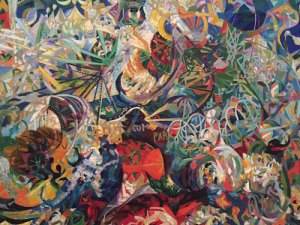
Detail of Joseph Stella’s 1913-1914 Battle of Lights, Coney Island, Mardi Gras from Yale University.

Detail of Joseph Stella’s 1913-1914 Battle of Lights, Coney Island, Mardi Gras from Yale University.

Figurative work from Reginald Marsh and others catapult you back to bawdy bathers and burlesque scenes brought to life last year in Broadway’s On the Town. Photographs by Arbus, Weegee, and Walker Evans provide close-up views of what it was like above and under the boardwalk.

Much of the shows’s fun is driven by the jarring injection of super-cool modern abstraction next to the flotsam and jetsam of the actual historic artifacts.

Edwin Porter’s 1905 silent movie Coney Island at Night gave nickelodeon viewers a novel way to see Edison’s incandescent lights in all their glory.

It’s startling to see Joseph Stella’s Futurist-inspired tribute to Coney Island’s Mardis Gras and realize that it’s from the same 1910-1914 era in which Jimmy Durante played honkey tonk piano for newcomer Mae West. It was all happening at the same time as the Armory Show.

1991 acrylic painting featuring iconic Spook-A-Rama Cyclops by Arnold Mesches.

1991 acrylic painting featuring iconic Spook-A-Rama Cyclops by Arnold Mesches.

Frank Stella’s 1950’s abstraction holds its own amidst the sideshow banners and relics that inspired his jarring color bars and mystery portal. Maybe it’s not a coincidence that right around the corner you come face-to-face with the real-life Coney landmark – the Cyclops who lured riders into America’s largest dark ride, Spook-A-Rama. The curators have placed him right next to his menacingly large portrait by Arnold Mesches.

Take a walk on the wild side of history, art, and sideshow performance while you can in person or via our Flickr album.

The Stephen Powers installation runs through the summer. Here he is explaining the allure of Coney Island as a contemporary inspiration:

Warhol Moved Out So Picasso Could Play

Bronze She-Goat, 1950, who usually lives outside in MoMA’s garden.

Bronze She-Goat, 1950, who usually lives outside in MoMA’s garden.

To mount the blockbuster Picasso Sculpture show, closing February 7, MoMA cleared out Andy, Roy, Jasper, and all the Judds from the Fourth Floor and let in an array of whimsical animals, personnages, and concoctions. If you couldn’t get in the front door of the show or were discouraged by the crowds, take a look at our favorites in our Flickr album.

The surprise is that every one of the dozen or so galleries is filled with the most delightful Picasso creations. You don’t really need a guidebook or an understanding of the history of modern art. You can just look and smile. Just like Picasso did.

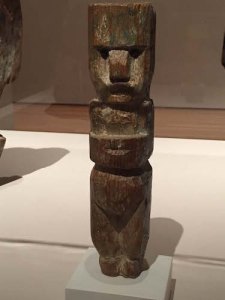
Even he needed a break from his Blue Period, and the first gallery shows two little wooden “dolls” carved in 1906 – a response to Gauguin’s shockingly primitive Tahitian wood carvings that rocked Picasso’s world when he encountered them in gallery. Rough, painted, angular, and shamanistic – a good way to work out the creative kinks at the same time you were creating the Demoiselles downstairs. Pure primitive…no gallery guide needed.

Carved wooden Doll inspired by Gauguin, 1907. From Gallery of Ontario.

Carved wooden Doll inspired by Gauguin, 1907. From Gallery of Ontario.

Next door (directly upstairs from the gallery where the Demoiselles hold court), Picasso’s having his fun with his crazily patterned and painted bronze absinthe glasses, spoons, and fake sugar. The curators have gathered together enough from different collections to have a party. Cubism with a twist of polka-dot fun.

Next, it’s monumental heads carved from plaster. Why do they all seem to be in on a joke? It’s the room where Andy and Roy’s Pop masterpieces usually hang, but Pablo’s big, bulbous curvy heads from the 1930s are just as wry and enjoyable. (See the videos below.)

Already declared “degenerate” by the Nazis in 1937 and featured in their historic touring show, Picasso had his own quiet joke on the oppressors as he lived through the occupation of Paris in 1940-1944. While the Nazis were melting down bronze statuary in Paris to use in their war manufacturing, Pablo somehow managed to sneak into a foundry to make a big, bronze sculpture of large kitty cat on the prowl and other metal works.

Figure, 1938, made of found stuff -- wood, nails, and screws with string, wire, and hardware

Figure, 1938, made of found stuff — wood, nails, and screws with string, wire, and hardware

The kitty, the bicycle-handlebar bull, and the napkin dog are just two among a host of lots of other contraban he defiantly created before liberation.

The rest of the galleries show how Picasso’s wartime scrounging spurred him on to new heights of making something out of nothing and finding delight in transforming somebody’s junk into funny, fool-the-eye sculptures. The She-Goat (usually found hanging outside in MoMA’s garden by The Modern), the car-baboon, a metal owl, goose, and other creatures hold court in the bigger galleries.

Well-wishers crowd around taking feel-good photos and parents show the kids how the artist took everyday objects and turned them into such fun critters.

The stick-people Bathers at the finale are partially made of pieces of painting frames and other found wood, painted and finished with the same rough technique and hand that characterized the “dolls” in the first room. It’s the great Modern Master going rogue channeling outsider art.

The Bathers, 1956. From the Staatsgalerie Stuttgart.

The Bathers, 1956. From the Staatsgalerie Stuttgart.

By the time you get to the model of the monumental head that’s become one of Chicago’s icons (in the last gallery), the crazy sculpture — Picasso’s last —  feels  kind of normal.

It’s telling that MoMA didn’t even put label copy on the stuff. Just a guidebook you can pick up at the entrance, or not. No wonder it’s been the most popular show in New York.

Just when you thought understanding modern art was “hard”, one of the masters comes along, kicks sand in your face, laughs, invites you to do a little beachcombing with him, throws a few sticks together, and asks you to look at what’s right around you in a new way.

Look at a few pieces that MoMA underscores with delightful music.

Stella Leaps Off Walls at The Whitney

Long view of gallery with The Grand Armada (IRS-6, 1X) (1989)

Long view of gallery with The Grand Armada (IRS-6, 1X) (1989)

Leaping loops of bendable pipes! If you’ve never seen paintings that jump off the wall, get over to the Whitney’s Frank Stella: A Retrospective before it closes on February 7.

As Frank himself says, “Painting does not want to be confined by the boundaries of edge and surface.” Ok, no argument here. Nothing up here looks “confined”.

You emerge from the elevator face-to-face with his monumental masterpiece that’s nearly as long as the AMNH Titanosaur. It’s full of more visual nooks and crannies than a walk through Central Park and as vast as Wyoming. It’s a dazzling performance of color, line, and expanse. Before jumping into the rest of the show, the sheer size demands that you slow down to see the detail.

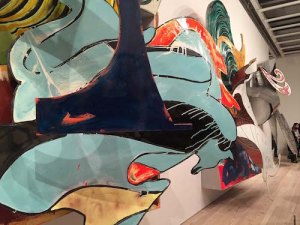
Detail of baroque, monumental 1999 painting, The Earthquake in Chile

Detail of baroque, monumental 1999 painting, The Earthquake in Chile

Let’s admit, however, that the busy, unconfined artworks on the right form a gravitational force field that will lure even the most focused visitor away to explore the whirly color and 3-D protrusions. The label copy says Frank was inspired by Baroque music, letting his paintings function like soundless symphonies.

Through the bays, you catch glimpses of big Protractors and other Day-Glo creations that embody the over-the-top Eighties in New York.

You’ll also encounter of Frank’s most famous geometric meditations and early works from the pre-Soho days. From every angle and position, you see, feel, and meet some mighty heavy output. And it’s only the tip of the iceberg in terms of the full output of this 79-year-old powerhouse.

The Whitney’s solution to showing such a big, diverse, lively group of work was to take advantage of their new, moveable walls. The show’s designers moved all the walls away from the edges of the gallery so that visitors can see from one end to the other and glimpse the full spectrum of Frank’s artistic output.

Wall with works from the 1980s Moby Dick series

Wall with works from the 1980s Moby Dick series

Look through the show on our Flickr feed of the show, with the works sorted into chronological order, and enjoy the curator audio guide on the Whitney website.

On the far east section of the gallery, the 3-D might comes into full view with selections from the Moby Dick series, roaring, raging works that push out from the white wall. The selections are impressive, but are only a small portion of Frank’s total output from that era.

For every one of the 95 works on the wall, there are dozens and dozens of works in each series – just as big and monumental – that didn’t get into the show. The curators told us that it was the biggest problem in mounting Frank’s retrospective: Their size demands that they be bolted into place, so to borrow them for the show, the parts of each huge work must be carefully disassembled and then reassembled. Installing each piece was a challenge akin to moving the Amenemhat II colossus into the Great Hall at The Met. Thank goodness that Frank’s team provided elaborate instruction manuals and how-to drawings.

Circus of Pure Feeling for Malevich, 4 Square Circus, 16 parts, 2009 has a view of the Hudson

Circus of Pure Feeling for Malevich, 4 Square Circus, 16 parts, 2009 has a view of the Hudson

Stella’s most recent work is situated in two special places of honor: His diminutive 2009 creations are parked right next to the Hudson River view – sixteen little curvy sculptural tributes to the collision between the precision of absolute geometry (courtesy of Mr. Malevich) and whimsy playfulness, represented by Mr. Calder, the Whitney’s circus master.

At the other end of the floor, his Black Star dominates on the outdoor balcony overlooking the Meatpacking District and the Standard Hotel. See the video below.

Great tribute, great art, great show at the New Whitney. And thanks for publishing the full catalog and essays online.

Navajo Jewelry Masters Offer Glittering World at Customs House

Bracelet of coral, opal, suglite, lapis, turquoise, gold, and silver by Raymond Yazzie. Courtesy: NMAI/Knight collection. Photo: S. Franks

Bracelet of coral, opal, suglite, lapis, turquoise, gold, and silver by Raymond Yazzie. Courtesy: NMAI/Knight collection. Photo: S. Franks

If you’d like an immersion into a chamber of glistening silver and gems, enter the National Museum of the American Indian’s exhibition of stunning beauty and tranquility — Glittering World: Navajo Jewelry of the Yazzie Family.

The Smithsonian is providing New York with a unique chance to view 300 remarkable necklaces, bracelets, rings, and buckles from a New Mexico family of artists known for catapulting Navajo symbols, colors, and gems into a modern-art context.

Lapis and gold bracelet by Lee Yazzie, 1984. Photo: E. Aboroso, NMAI.

Lapis and gold bracelet by Lee Yazzie, 1984. Photo: E. Aboroso, NMAI.

The focus is on Lee and Raymond Yazzi, brothers whose award-winning, intricate creations are sought by collectors worldwide. You’ll see five magnificent pieces as soon as you enter, including work by their sister, Mary Marie – representing lifetimes of master craftsmanship inspired by the mountains, sun, sky, spirits, and family in Gallup, New Mexico.

Photomurals inside the door will transport you to the red rock monuments of Navajo Nation, 1950s trading posts along the old Route 66, and maps to turquoise mines that have supplied native peoples with high-end bedazzlers since 300 A.D. The Smithsonian will be returning it all to private collectors after January 10, so be sure to enter this beautiful realm before then.

Watch this testament to artistic inspiration and dedication to beauty:

And take a trip to the Navajo world to hear more on a lifetime of creation:

AMNH Highlights Species Living at the Limits

Tartigrades rule the show -- the micro-animal can survive at high heat, high altitude, high pressure, inhospitable climates, without water, and even outer space.

Tartigrades rule the show — the micro-animal survives high heat, high altitude, high pressure, without water, and even outer space.

If you’ve ever wanted to take a magic carpet ride to visit all the animals, plants, and environments you’ve ever seen on National Geographic or Nova, spend some time inside the special exhibition Life at The Limits: Stories of Amazing Species, running through January 3 at the American Museum of Natural History.

The curators and exhibition staff take you to the absolute limits of life on Earth in a “wow factor” show, organized into topics sure to astound.

How high into the atmosphere do animals live? How deep in the ocean? Who is the world-record holder for bite force? Who makes the longest migratory journey? Who is the award-winner for survival in the extreme?

The show will take you into deep caves, to life among the black smokers in ocean depths, to high altitudes, and even into outer space.

A deep-sea diving champion -- the Southern elephant seal can hold its breath for 2 hours and dive to 5,000 feet

A deep-sea diving champion — the Southern elephant seal can hold its breath for 2 hours and dive to 5,000 feet

And they’ve even thrown in some live creatures, too – the popular Axolotls, who retain their juvenile amphibious form into adulthood, and swimmers using the jet-propulsion method – chambered nautilis. Check out a few views on our Flickr feed.

Not to give anything away, but you’ll find out that vultures have been known to fly at 37,000 feet and beaked whales have been known to dive at least 10,000 feet below the ocean’s surface.

Live Chambered nautilis demonstrates jet propulsion

Live Chambered nautilis demonstrates jet propulsion

Crocodiles have a bit force of 3,700 pounds, electric eels and hammerheads can deliver 600 volts, and eagles can subdue animals of up 20 pounds in weight using only their claws. Arctic Terns may migrate 25,000 miles.

There’s no doubt that the stars of the survivalist show are miniscule tartigrades (better known as “water bears” or “moss piglets”). These miniature eight-legged water creatures inhabit climates that no human could. They are able to survive at temperatures colder than Pluto and hotter than boiling water and have been known to survive in the void of space for up to 12 days.

Moreover, tartigrades are prolific: nearly 1,200 species inhabit Earth in lichen, moss, beaches, and dunes and hold the distinction of residing at the International Space Station and being part of Space Shuttle Endeavor’s final flight.

Artist recreation of tube worms absorbing chemicals from ocean vents three miles under the sea – an environment unknown until 1977

Artist recreation of tube worms absorbing chemicals from ocean vents three miles under the sea – an environment unknown until 1977

How did life evolve to adapt to such extremes? Darwin explains it in his theory of natural selection, which leads to gradual adaptations within animal populations.

But you are left to wander and wonder at the engaging displays, animals, specimens, and movies.

Glimpse some of this fascinating exhibition in this video with co-curators John Sparks and Mark Siddall. By the way, the cover photo below is the Axolotl featured in the show:

MoMA Salute to Sixties Art World Transmissions

Announcement for Allan Kaprow’s 1968 Three Country Happening with collaborators in Germany and Argentina, one of the earliest artworks to incorporate an international telecast.

Announcement for Allan Kaprow’s 1968 Three Country Happening in NYC, Germany and Argentina, one of the earliest telecast international performance pieces.

Before restaurants and shops populated Tribeca and Soho in the 60s and 70s, edgy New York City artists were experimenting with happenings, video art, performance pieces, mail art, and assorted ephemeral pieces – Cage, Moorman, Kaprow, Ono, Paik, Grooms, Oldenberg and Maciunas to name a few.

In the pre-Internet days they might have been unaware that half a world away, Eastern European and Latin American artists were catching wind of this new art wave and stamping their own brand on their local art scene.

MoMA’s show, Transmissions: Art in Eastern Europe and Latin America, 1960-1980, captures the zeitgeist and shines a light on the artists, movements, and pieces from important avant-garde artists whose names are not as well known in the States. See it through January 3.

Organized into several rooms and themes, it’s a great collaboration among MoMA’s Departments of Media and Performance Art, Photography, and Drawings and Prints. The result puts a lot of MoMA’s huge Fluxus collection into a proper world context.

Socially relevant art posters from Poland, Cuba, Czech Republic, Yugoslavia

Socially relevant art posters from Poland, Cuba, Czech Republic, Yugoslavia

The first half of the show deals with geometry and its spiritual significance, offbeat artist publications, and mash-us between mail art and street performance.

Favorites include post-minimalist pieces from Brazil, Suprematist-style wall works by Yugoslavia’s Mangelos and an entire wall of photos documenting push-the-envelope street art many Eastern European countries. See our Flickr feed for a walk-through and click the links below for glimpses into MoMA’s show blog.

The next section turns more socio-political with works from the Argentine collective, Instituto Torcuasto di Tella – a center of the avant garde in Buenos Aires from 1959 to 1970. The centerpiece is a large installation for the Venice Biennal by David Lameles – Office of Information about the Vietnam War at Three Levels: The Visual Image, Text and Audio. The glass-walled newsroom is a stage from which performers read “breaking news” from the Vietnam War, just as they did when the collective debuted this in 1968. When the performers aren’t present, visitors can listen to archival recordings in three languages to feel transported back in time and reflect on how and if things have changed.

Installation for the 1968 Venice Biennal by Argentina’s David Lameles – Office of Information about the Vietnam War at Three Levels

Installation for the 1968 Venice Biennal by Argentina’s David Lameles – Office of Information about the Vietnam War at Three Levels

Nearby, visitors see clips from Marta Minujin’s Simultaneity in Simultaneity part of Allen Kaprow’s 1968 Three Country Happening, which was one of the first international telecasts of performance art.

Other galleries feature the blossoming of feminist art and performance art, social-commentary painting and sculpture, and poster art on these two continents. Artists that are familiar in US collections — like Botero (Colombia), Marisol (Venezuela), Marina Abramonovic (Serbia), and Ana Mendieta (Cuba) – are displayed in galleries that introduce other stellar artists to entirely new US audiences.

Oscar Bony’s photo documentation of his 1968 performance piece, The Working Class Family, which displayed an actual Argentine family at an exhibition

Oscar Bony’s photo his 1968 performance piece, The Working Class Family, which put an actual Argentine family on display

Consider Oscar Bony’s photo documentation of his controversial 1968 performance piece, The Working Class Family, where an actual Argentine family displayed themselves for the run of an exhibition at Instituto Torcuasto di Tella. Or Romanian graphic designer Geta Bratescu’s Medea IV, a 1980 sewing-machine drawing made and displayed privately in her studio at the height of a repressive political regime when most artists retreated underground.

The show ends with a spectacular installation: Juan Downey’s 1975-76 masterwork, Video Trans Americas. The gallery floor is painted with an outline map of the Western Hemisphere with banks of video monitors placed atop countries to which he traveled from the tip of South America to New York City, showing the life and times of indigenous people.

Chilean artist Juan Downey’s 1975-76 Video Trans Americas, documenting native peoples from his travels from the tip of South America to New York City

Chilean artist Juan Downey’s 1975-76 Video Trans Americas, documenting his travels from the tip of South America to New York City

Inspired by the idea of a transnational identity, Downey’s piece beautifully sums up the feeling of the entire show – artists and people engaged in a cultural dialogue across time and space.

Thankfully MoMA has given these artists a timeless showcase and home.