When Whales Walked Explained at AMNH

Whales exhibit tells the evolution story. Courtesy: Museum of New Zealand Te Papa Tongarewa

Whales exhibit tells the evolution story. Courtesy: Museum of New Zealand Te Papa Tongarewa

Right inside the exhibit, Whales: Giants of the Deep, the American Museum of Natural History answers two questions that have stumped centuries of nature lovers – how did the world’s largest sea-loving mammals ever evolve from land animals, and who are their closest relatives?

In the last 20 years, DNA experts and paleontologists have been hacking away at these questions, and the show provides some startling visuals and answers: Whales (a group that includes dolphins and porpoises) came from four-legged animals that hovered close to shore lines, snapping up fish. Oh, and their closest relatives on the Mammal Tree of Life are…get ready…hippos. See the show before January 5.
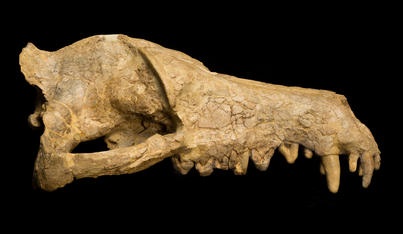
Clue to solving the mystery – the skull of Andrewsarchus, three feet long, found in 1923 by Kan Chuen Pao on AMNH’s second Gobi expedition. Courtesy: AMNH/R. Mickens

Clue to solving the mystery – the skull of Andrewsarchus, three feet long, found in 1923 by Kan Chuen Pao on AMNH’s second Gobi expedition. Courtesy: AMNH/R. Mickens

The first thing you’ll see is a massive skull of Andrewsarchus, a 45-million-year-old whale cousin, who would have stood over six feet tall at the shoulder. He was found in Mongolia on the famous AMNH Central Asiatic Expedition in the 1920s (remember the dinosaur eggs?) and to this day is the only one found.

The paleo team compared the features on his skull to other mammals, ran their analysis through cladistics software, generated a family tree, and learned that Andrewsarchus falls somewhere near the evolutionary point where whales and hippos had a common ancestor, a key clue.

Artist Carl Buell’s depiction of Pakicetus, the oldest known ancestor to  whales

Artist Carl Buell’s depiction of Pakicetus, the oldest known ancestor to whales

A huge discovery in Northern Pakistan in 1983 began to unlock the rest of the mystery. Found in 50-million-year-old Eocene rocks, remains of the enigmatic, four-legged, fish-eating Pakicetus were discovered at the edge of what was once an ancient sea. It was deemed by scientists to be the earliest known modern-whale ancestor. Many specimens were unearthed, with ear bones looking like modern-day dolphins, but ankle bones more like a pig’s, giving scientists a reason to place his ancestry in the “artiodactyl” category, which includes hippos, pigs, antelopes, camels, and other even-toed hoofed animals. Subsequent finds and DNA analysis of modern whales further solidified the hippo-relation hypothesis.

Cladogram showing family relationships of whales and artiodactyls from the AMNH guide for students in grades 6-8

Cladogram showing family relationships of whales and artiodactyls from the AMNH guide for students in grades 6-8

The show includes a full replica of his skeleton, along with other fossils from the subcontinent showing the transition of four-legged wolf-sized animals to the streamlined bodies that we now associate with ocean- and river-going cetaceans. You’ll see a terrific video that animates the transition from longer-snouted, web-footed fish-eaters that paddled through estuaries (Ambulocetus), to more streamlined sea-going mammals whose front legs became flippers and back legs disappeared nearly completely. Kutchicetus (43-46 million years ago) shows evidence that it probably did some deep dives, and Durudon (37 mya) had nostrils at the top of his head, flipper-hands, and apparatus at the end of his tail that suggests a support for flukes.
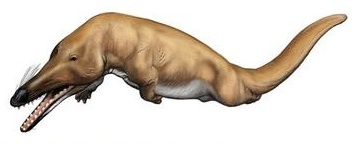
A clue from India. Artist Carl Buell’s depiction of Kutchicetus, dweller in ancient tropical seas

A clue from India. Artist Carl Buell’s depiction of Kutchicetus, who lived in ancient tropical seas

The show was originally organized by the Museum of New Zealand Te Papa Tongarewa, and features a mix of AMNH and Te Papa artifacts and insights.

There are many other wonderful biological, historical, and cultural details to the whale story, as the YouTube below shows (84K hits and counting), but shout-outs must be given to the two stars — large Sperm whale skeletons (think Moby Dick) on display, lovingly named and transported here by the Maoris, who found the stranded duo, prepared, and blessed them for special appearance in New York.
Sporting Pastels in Winter

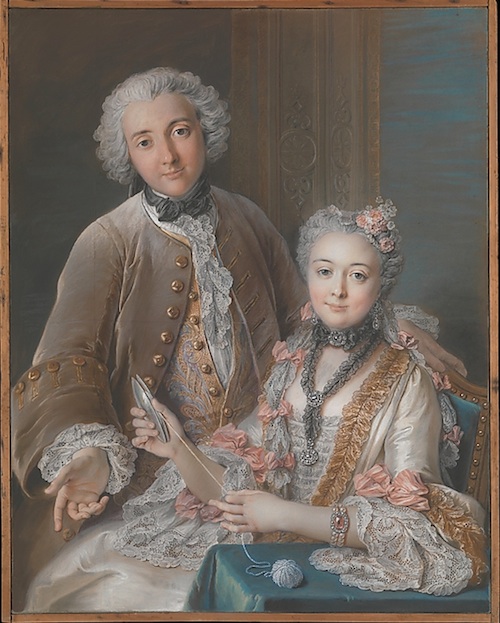
Coypel’s large 1743 double portrait – quite a masterwork in pastel, chalk, and watercolor on four joined sheets of handmade blue paper, mounted on canvas.

Coypel’s large 1743 double portrait – quite a masterwork in pastel, chalk, and watercolor on four joined sheets of handmade blue paper, mounted on canvas.

Most of the subjects are sporting pastels, but a few are wearing brilliant hues that haven’t faded over time in the Metropolitan Museum of Art’s micro-show, Eighteenth-Century Pastels.  The show is sort-of hidden away at the top of the grand stairs in Gallery 624 in the European painting galleries through December 29.

It’s a confessional of sorts. The Met admits that it’s given star status to the pastel drawings of 19th-century luminaries Cassatt, Degas, and Manet for nearly a century (thank you, Mrs. Havemeyer!), but only recently started acquiring the pastel artists who were genuinely the masters of the craft – the pastelists of the 18th century, who catered to kings and royalty.

The drawings are brilliant, but the lights are dim in the gallery to preserve the fragile medium. It’s ironic that the colors still sing after hundreds of years since they’re only bits of colored dust hanging on to delicate, handmade blue paper.

Check out the detail on Coypel’s lace.

Check out the detail on Coypel’s lace.

It’s why the sheer size of Coypel’s gigantic pastel/watercolor 1743 portrait of François de Jullienne and his wife is such a wonder. We’ve clipped some of the detail here to show how the ball of yarn, lace cuffs, and necklaces virtually leap off the paper due to their incredible detail. Is this really just a chalk drawing? No wonder that pastels at that time carried the prestige of fine oil paintings in the best homes of Europe.

Although you have to peek around the other side of this panel, the Met has also given a view into how the magic happened.

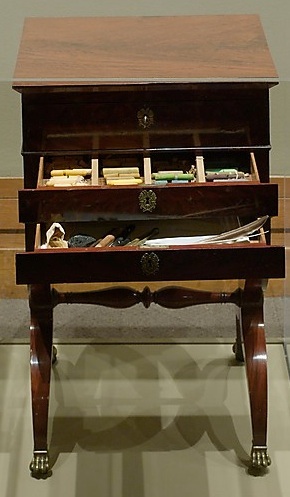
Painters TableThe curators display a rare 1810-20 cabinet that shows how pastel artists arranged their medium, color by color, in cabinet drawers made specifically to hold the chalk and pastel crayons. The artist would draw within arm’s length of the cabinet, reaching for whatever subtle shade he or she felt appropriate to create the lifelike illusions.

The tiny show has striking works by Mr. La Tour, a favorite of Madame de Pompadour who obviously had access to the inner circle. Near a beautiful portrait of her architect hangs a small, intimate portrait of Louis XV – a preparatory work for a later portrait that shows off La Tour’s of-the-moment quality. He was known for his spontaneous life drawings, and this seemingly natural portrait shows why he received so much patronage.

Apparently, La Tour had seven drawers in his studio cabinet and collected hundreds of crayons from the finest makers in Europe.

La Tour’s 1745 small pastel, Préparation for a Portrait of Louis XV, gives royalty the natural treatment

La Tour’s 1745 small pastel, Préparation for a Portrait of Louis XV, gives royalty the natural treatment

Enjoy his work, Wright’s stunning black-and-white portrait of a British “girl with an earring”, and the most adorable Italian boy and girl in the world at the top of the stairs.

Meet American Legends at The Whitney

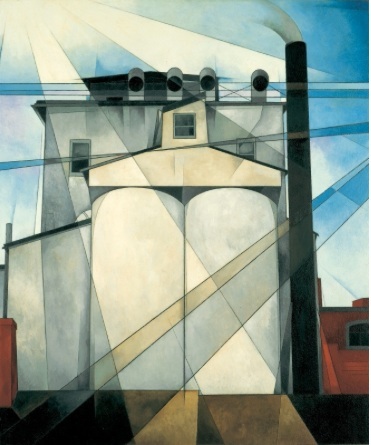
Charles Demuth’s precisionist take on the grain elevators in his hometown, My Egypt, 1927.

Charles Demuth’s precisionist take on the grain elevators in his hometown, My Egypt, 1927.

Five reasons to cozy up with the stars in the American Art Walk of Fame in the Whitney’s top-floor show, American Legends: From Calder to O’Keefe before December 15 when they come down to make room for the next batch of legends from the Whitney’s massive collection:

#1: Charles Demuth. See how he turned the industrial landscape of his Lancaster, Pennsylvania hometown and flowers from his garden into magic. Experience Demuth’s oil, My Egypt, a pristine oil that looks like it was painted yesterday. He captures the monumentality of the local grain elevators and uses his title to channel the greatest architectural feats of the ancient world. The beautiful floral watercolors were some of Ms. Whitney’s favorites.

A Joseph Stella masterpieces: The Brooklyn Bridge: Variation on an Old Theme, 1939.

A Joseph Stella masterpieces: The Brooklyn Bridge: Variation on an Old Theme, 1939.

#2: Joseph Stella’s interpretation of 1930s New York, including one of his best-known works, The Brooklyn Bridge: Variation on an Old Theme, 1939. Here, the painting evokes a cathedral’s stained glass window but it’s actually a love letter to the iconic structure that he painted so many times in his career. If you’ve never walked across this bridge, listen to a civil engineer interpret Mr. Stella’s work on the Whitney’s audio guide.

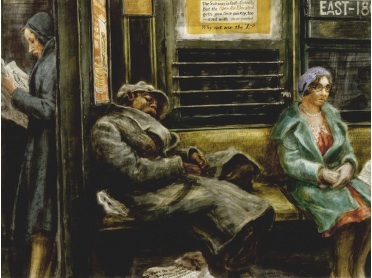
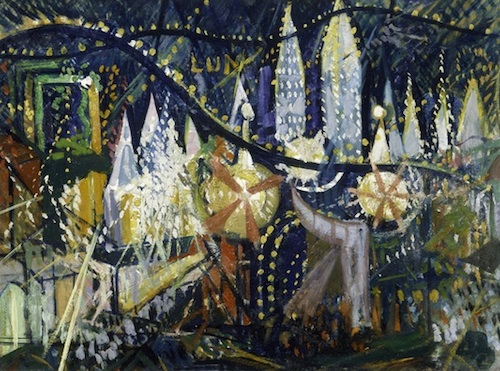
#3: Immersion into bygone New York. Check out Coney Island’s main attraction in 1913 via Mr. Stella’s Luna Park (here’s the audio). Also, the show has many Reginald Marsh works of life during the depression, including Why Not Take the “L”?, and the original “ten cents a dance” girls in his 1933 portrait of taxi dancers.
#4: The whimsy of sculptor Elie Nadelman, whose large, rounded, folk-art-inspired figurative sculptures could certainly work in Mr. Calder’s crazy circus (which is here, too), if they could only be shrunk down to fit into his tiny, tiny circus ring.

Reginald Marsh asks commuters a question in Why Not Use the “L”?, 1930

Reginald Marsh asks commuters a question in Why Not Use the “L”?, 1930

Mr. Nadelman looms large in the Whitney collection, and it’s nice to have a great, big room to dance around all his sculpted people.

#5: Georgia O’Keefe shares a gallery room with Marsden Hartley, a nice pairing of visual mystics captivated by symbols, nature, mysterious abstractions, and the evocative power of landscapes.

There’s a lot to enjoy about many of the other featured legends, so hurry over to drink in the colors of Stuart Davis, watercolors of John Marin, the sharp visions of Ralston Crawford, and eight other anchors of the Whitney collection.

Stella’s 1913 take on the magic of Coney Island’s main attraction, Luna Park

Stella’s 1913 take on the magic of Coney Island’s main attraction, Luna Park

Who will be featured next on the top floor? We’ll see who the curators pick on December 21, when they reveal their next group of Legends.

Artistic and Ethnic Identities Explored in La Bienal at El Museo

Ethno Portrait Cultural Test Shot by Sean Paul Gallegos alongside Reserved Ancestry made from Air Jordans, Arrow collars, and fur.

Indian Removal Act Skeuomorph by Sean Paul Gallegos wearing Reserved Ancestry (on right) sculpted from Air Jordans, Arrow collars, and fur.

Get to know some of NYC’s best new artists by strolling through El Museo del Barrio’s La Bienal 2013 on the Upper East Side before January 4.

Full of fun, reality, street life, high-art provocation, and what it’s like to be an artist in 2013, the show has it all – installations, videos, performance-art artifacts, photographs, sculptures and even a tintype. Take a look at some of our favorites on the Flickr feed, and go to the excellent website for El Museo La Bienal 2013: Here is Where We Jump, the seventh edition of this working contemporary artist showcase, which explores both formal-art and ethnic identity issues.

Small detail of Ignazio Gonzalez-Lang’s “Guess Who” – a grid of 100 inkjet prints of police sketches that appeared in NYC newspapers papers. In this 2012 work, he arranged very similar portraits side by side.

Small detail of Ignazio Gonzalez-Lang’s Guess Who – a grid of 100 inkjet prints of police sketches that appeared in NYC newspapers papers. In this 2012 work, he arranged very similar portraits side by side.

Look closely at the pieces by Sean Paul Gallegos, an artist who considers himself a product of colonial ancestry (his father is Tiwa and Spanish from New Mexico and his mother is Cree and French from Canada). Gallegos juxtaposes his “anthropological” self-portrait with his Native American-inspired headdress made entirely out of cut-up Air Jordan sneakers, Arrow shirt collars, and fur.

A grid of 100 inkjet prints of police sketches by Ignazio Gonzalez-Lang, an NYC Puerto Rican artist, also puts identity to the test. For Guess Who, he’s collected police sketches that have appeared in New York City newspapers, slapped them into a grid, and arranged them in pairs that look all-too-similar. Super thought-provoking.

The Cortez Killer Cutz Radio installation by Eric Ramos Guerrero, a Philippines-born artist, also gets into your head but out of your comfort zone. It’s a full-size, two-room simulation of a Southern California hip hop/R&B radio station streaming late-night song dedications by girlfriends to their incarcerated boyfriends.

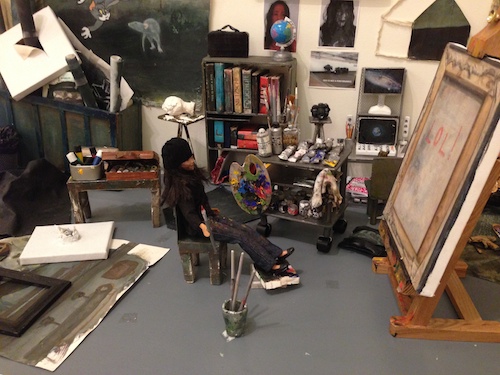
Close-up of the doll-artist contemplating her studio output in Julia San Martin’s Dollhouse

Close-up of the doll-artist contemplating her studio output in Julia San Martin’s Dollhouse

Julia San Martín’s Dollhouse, on the other hand, is a very tiny, detailed installation of a look into the mind and work of the artist. On a miniscule set of her studio, a doll-size painter works on her paintings and drawings, which the Chilean-born artist often rearranges and reshuffles to mimic the working life and consternation of deciding what to paint and what to show.

RISD-trained Gabriela Salazar also looks inward to her studio experience, but in a more formal way. As an artist that often creates large-scale constructed works in the community, she’s taken the remainders of some of her projects – wood shims, foam, cardboard, felt, rope, and wire – and turned them into tiny-scale minimal masterworks, all displayed in a type of “gallery show within a show.”

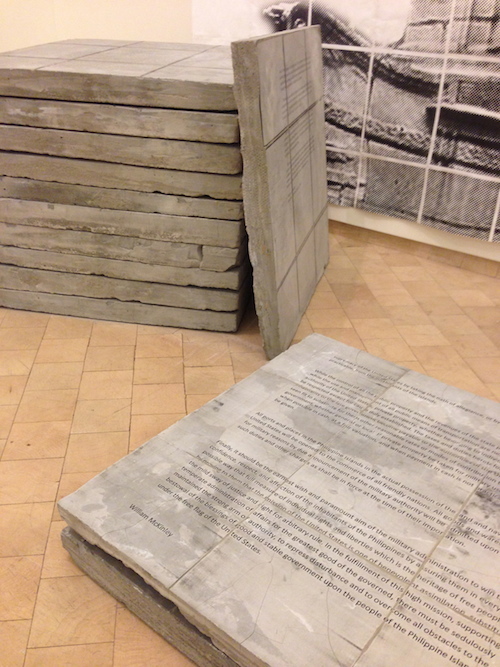
Ramón Miranda Beltrán’s historic documents cast in concrete, featuring President McKinley’s treaties that gave Guam and the Philippines to the US after the Spanish-American War

Ramón Miranda Beltrán’s historic documents cast in concrete, featuring President McKinley’s treaties that gave Guam and the Philippines to the US after the Spanish-American War

And be sure to look for Gabriela Scopazzi’s hilarious Amarilla video where she seranades a captivated group of llamas with an aria. (Sorry, it’s for in-person viewing only and not on the web.)

Work through the show’s website to see more of each artist’s work and learn more about what makes them tick.

Met’s YouTube Star Seeks Holiday Friends

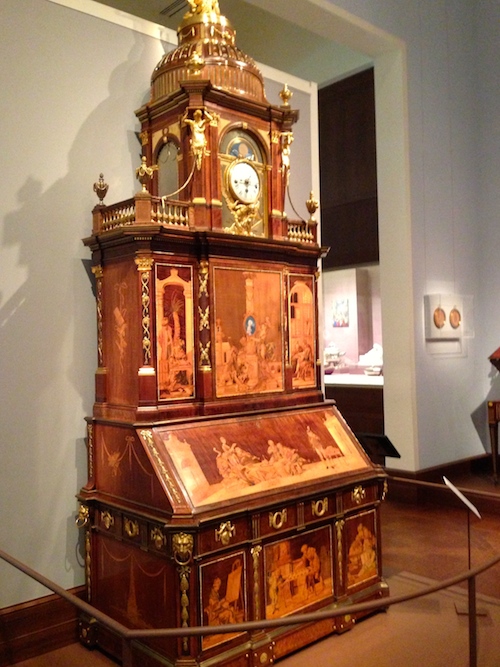
Mr. Roentgen's Berlin Secretary Cabinet, the viral NYC museum YouTube sensation, awaiting visitors in Met Gallery 553

Mr. Roentgen’s Berlin Secretary Cabinet, the viral NYC museum YouTube sensation, awaits visitors in Met’s Gallery 553

It’s lonely at the top. More specifically, it’s lonely in the Metropolitan Museum’s Gallery 553, where one of the biggest YouTube stars in NYC museum history is holding court until January 26 – David Roentgen’s Berlin Secretary Cabinet, which has racked up 4.4 million hits since his show, Extravagant Inventions, closed last January.

That’s right. A piece of mechanical furniture has 4.4 million YouTube fans (in addition to 13K on the Met’s own website) – quite an achievement since it had only around 200,000 when its show closed. It’s not the only piece of mechanical furniture to gain big YouTube numbers (another has over 91K), but to put the Cabinet’s achievement in perspective, consider that the Met’s McQueen video has only racked up 72,000 views in the two years since that blockbuster ended.

The crowds were crazy for the 18th-century marquetry extravaganza (see our earlier post), and the Met asked the Kunstgewerbemuseum, Staatliche Museen zu Berlin if it could keep the YouTube star a little longer.

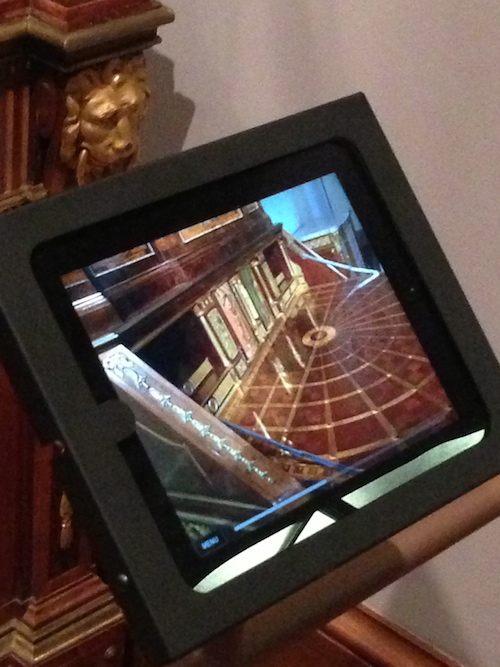
The Cabinet's video, displayed also in the gallery, has gone viral with 4.4M views

The Cabinet’s video, displayed also in the gallery, has gone viral with 4.4M views

The Met dedicated a cozy corner of its First Floor to the Cabinet and some of its other pieces from Mr. Roentgen’s studio — a rolltop desk and tall clock from the Met’s own collection, and a mechanical table lent by the Cooper-Hewitt. Take a closer look on our Flickr feed.

But every time we pass by, the Cabinet seems a little lonely. The Met says it’s likely the most expensive piece of furniture ever manufactured (there were only three), but it seems like the Fabergé eggs in the hallway are getting all the foot traffic. Yes, they’re beautiful, but a piece of marquetry that’s gone viral is something that deserves some in-person praise.

During the holidays, just hang a left at the Christmas tree. Look for a tall stately Cabinet in a gallery on the right after you pass through the European Sculpture Court and before the rooftop elevator. Spend a little time with the star before he decamps the Big Apple for Berlin.

Roentgen's Rolltop Desk also has its own video and has 59,000 YouTube fans of its own

Roentgen’s Rolltop Desk also has its own video and has 59,000 YouTube fans of its own

If you want to see the Roentgens in performance, the Met’s hosting a gallery talk and demo of the mechanical furniture at 2:30pm in Gallery 553 on December 17 and January 14

The Cabinet’s mega-hit video (produced by the Berlin museum, but posted by the Met) is also on display in the gallery — no people, no curators, no talking, no cats…just subtitles, a human hand wielding a key, and the magnificent magic of Mr. Roentgen. Hold on for the hidden easel.

Oldest Painted Theater Curtain in America on View in NC

The original 1858 William Russell Smith drop curtain, displayed in Thalian Hall’s Parquet Hall

The original 1858 William Russell Smith drop curtain, displayed in Thalian Hall’s Parquet Hall

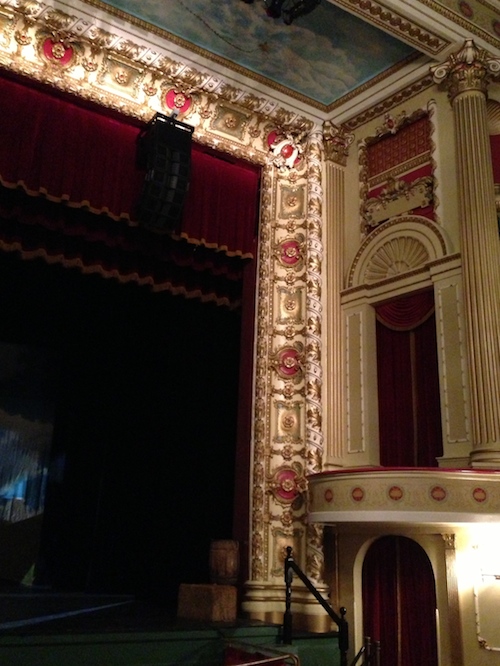
Lincoln was prepping for his sixth debate with Douglas in Illinois when the curtain went up on October 12, 1858 at Thalian Hall in Wilmington, North Carolina – the same curtain, still on display, that is considered to be the oldest existing theater drop in America, painted by Philadelphia-trained landscape artist William Russell Smith.

Back in the 1850s, major theaters up and down the East Coast were in pursuit of the classically trained Smith to create romantic, ethereal landscape images on the gigantic canvas curtains that audiences saw when they entered opera houses. Typically framed by an ornate proscenium, the drop transported theatergoers to the work of make-believe, Moliere, and Macbeth – staples of the touring companies and troupes of the time.

Detail of original drop curtain, done in distemper on 30-foot canvas

Detail of 1858 curtain, distemper on a 30-foot canvas

Today, except for Wilmington’s Thalian Hall treasure, those grand masterpieces are gone, victims of time, decay, and impermanence like the superstars of yesteryear. It’s quite a miracle that Thalian’s original curtain has still survived, considering that it’s not painted in oil, but distemper – a less permanent, water-soluable medium, essentially colors ground into glue. When an artist applies the wet pigment, he sees the opposite color, which gradually turns into the “true” color when the paint dries. It’s a process that could only be executed by a skilled master, particularly on a 30-foot wide canvas. The surface of the curtain holds the granules (like a piece of paper holds pastel fragments).

Wilmington, NC’s Thalian Hall, built 1855-1858, one of the oldest continuously operating theaters in the South

Wilmington, NC’s Thalian Hall, built 1855-1858, one of the oldest continuously operating theaters in the South

No wonder Smith purpose-built a huge studio in his home with poles that could be raised and lowered as he worked on a gigantic scale first with a charcoal sketch, then with distemper (move over, Chuck Close!). When Smith finished painting his commission, he carefully folded the canvas, rolled it on a long pole, and had it delivered to the opera house.

Thalian Hall received its long-distance delivery this way, because Smith never set foot in North Carolina. The new opera house was designed by New York architect John Trimble, who built Barnum’s Museum and many New York theaters of the mid-1800s, including the New Bowery. Smith’s curtain was the finishing touch, depicting an Aegean sailing ship arriving at classical islands filled with temples dedicated to Apollo, evoking commencement of the ancient Olympiad.

Detail of Thalian Hall's beautifully restored proscenium and box

Detail of Thalian Hall’s beautifully restored proscenium and box

The curtain was in service from 1858 until 1909, when a restoration was planned. Historians know it was hung again by 1938 (see the photo in our Flickr feed). It got hurt a little in the 1940 WPA renovations, and was known to be back in place in 1947, but disappeared after 1963. It was rediscovered in 1979, when Mrs. Juanita Menick, the president of the board, told the new Thalian director that she might still have an old curtain that she took years ago to her home for safekeeping. Thank goodness for those large, Southern homes.

Although only 15 feet of the original 30-foot drop remained, tribute was paid to the historic artwork. The fragile canvas was used as part of the set for Thanlian Hall’s 125th anniversary celebration, and now hangs, ready for its closeup, in the luxurious entry to the theater’s orchestra section.

Hear how executive director Tony Rivenbark rediscovered it, and watch historian David Rowland’s talk about the life of William Russell Smith (at 4:20), whose romantic landscapes of New England somewhat predated the Hudson River School; the imagery used in the magnificent theater curtains (at 30:22); and the astonishing discovery recently made in Smith’s grand studio (at 35:30) in this YouTube video.

Thalian Hall's balconies and orchestra

Thalian Hall’s balconies and orchestra

You can read more about the historic theater on its website (and check out the video on Thalian’s “thunder roll” device, another “only remaining in America” theatrical wonder). Glimpse more of this theater’s grandeur and photos of the illustrious performers who have trod its boards on our Flickr feed.

In Wilmington, you can view this remarkable piece of theater history any time during box office hours.

NYU Shows How Modern Art Popped in 1960s Iran

Zarrine-Asfar’s 1970s Black Plaster Hand in oil and pencil on canvas with plaster. Source: Grey

Zarrine-Asfar’s 1970s Black Plaster Hand in oil and pencil on canvas with plaster. Source: Grey

If you go downstairs at NYU’s Grey Art Gallery, a collection of seemingly quiet works will show you how a cadre of avant-Garde painters injected the spirit of 1960s downtown New York into Iran’s gallery scene just before the 1979 revolution transformed Persian society. Get down to Washington Square to contemplate Modern Iranian Art before December 7.

Gallery founder and woman-about-the-world, Abby Weed Grey, made it her priority to collect modern-influenced Iranian artists in the 1960s and 1970s just before the transition from the Shah to the Ayatollah, amassing (and ultimately bequeathing to NYU) the largest Iranian modern art collection outside the country.

Tanavoli’s Persian Telephone I, a 1963 bronze sculpture inspired by Johns and Warhol. Source: Grey

Tanavoli’s Persian Telephone I, a 1963 bronze sculpture inspired by Johns and Warhol. Source: Grey

This show and its scholarship is first rate, hitting a home run with Sixties connoisseurs. Good job, Grey team, with your first-ever e-book on the web site, which connects the dots in some unexpected places.

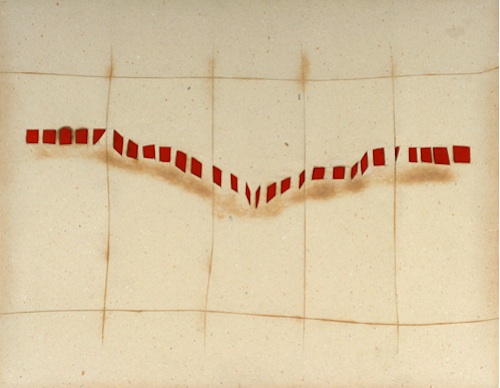
Consider Parviz Tanavoli, who experimented with some Jasper Johns techniques — incorporating dishes into ceramics and playing with bronzed objects. Hamid Zarrine-Asfar was also experimenting with whitewashed 3D grids in a refined, painterly, and Johns-like way. Not copies, but reinterpretations that resonated with cosmopolitan Persians. Abby bought 35 of his works.

Robert Indiana wasn’t the only one playing with letters-as-art during the Sixties.  Abby collected work by a lot of artists who used the calligraphy of their own culture in their work — a more lyrical, poetic approach than the brash American appropriations.

Two extremely understated painting in the show were influenced by one artist’s interest in Cage and Duchamp. Read the label copy, and you’ll learn that they were done by a young revolutionary artist, Mir-Hossein Mousavi, fresh out of school, who later served as Iran’s Prime Minister in the 1980s and challenged Ahmadinejad in a run for president in 2009. He lost, but the work makes you wonder about the number of political candidates (anywhere in the world), who are trained architects interested in channeling the I Ching, playing with alt notation, or using chess as a visual metaphor.

Mir-Hossein Mousavi (Khameneh), Musical Notations, a 1967 mixed media work inspired by Cage. Source: Grey

Mir-Hossein Mousavi (Khameneh), Musical Notations, a 1967 mixed media work inspired by Cage. Source: Grey

The startling image of Kamran Diba’s Diver at the foot of the stairs debuted as part of a multimedia piece, with two actors’ voices repeating the “conversation” that appears on the canvas – a reminder of performance mash-ups that young Yoko Ono might experimenting with around the same time.

The more you probe, the more you’ll see. No Ben Day dots or photo imagery — just glimmers of interdisciplinary thought normally associated with that boundary-pushing Black Mountain crowd.

Abby, you wanted your Middle East buying spree to inspire cross-cultural associations among generations of US scholars. Grey Gallery team, you did your founder proud. Well done in supplying this special lens.

Kamran Diba’s Diver, a 1967 oil that originally included an audio track with two actors’ voices. Source: Grey

Kamran Diba’s 1967 Diver,  whch originally included an audio track with two actors’ voices. Source: Grey

If you can’t get there, browse the e-book and photos of the work here. Abby’s collection of Iranian modern art has its own website, and you can browse through dozens of examples by each of her favorite artists.

If you’re up on Park Avenue, works that Abby collected are also at the Asia Society until January 5 in another exhibition shining the light on Iranian modernism.

History Twist in Brooklyn’s Period Rooms

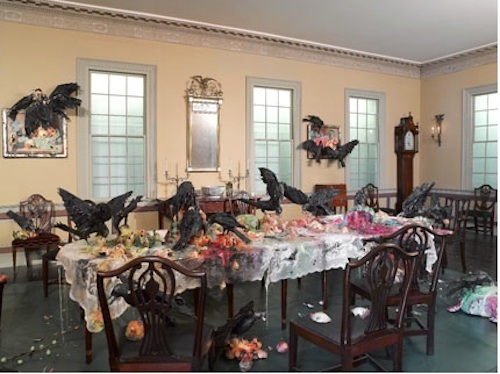
Hegarty’s “activation” of the Cane Acres Plantation dining room: Still Life with Peaches, Pear, Grapes and Crows; Still Life with Watermelon, Peaches and Crows; and Table Cloth with Fruit and Crows. Photo: Brooklyn Museum

Hegarty’s “activation” of the Cane Acres Plantation dining room including Still Life with Watermelon, Peaches and Crows. Photo: Brooklyn Museum

The Brooklyn Museum’s Period Rooms are again the focus of a rip-roaring, history-tearing, upside-down interpretation by an installation artist. Go before December 1 to see what’s happened to three rooms up on the museum’s Fourth Floor in Valerie Hegarty: Alternative Histories.

The dining room from the South Carolina’s Cane Acres Plantation is alive with dozen or so papier-mâché crows that are chowing down on the faux watermelons and peaches that you imagine to have been so beautifully arranged on the long, grand table.

Peering into either of the two plantation doorways, it’s disconcerting to see how the delicacies are being ripped apart and strewn about. The fruit literally pops out of the frames in this cross-referenced mash-up of Hitchcock terror, racial segregation issues, and classic still life painting.

Hegarty’s Pendleton carpet in the Cupola House parlor.

Hegarty’s Pendleton carpet is growing in the Cupola House parlor.

See how Hegarty created it all out of wire, glue, foil, foam, and everything else you can purchase at Michael’s on the Brooklyn Museum’s Flickr feed.

She was equally ambitious in two other rooms from the Cupola House, originally built in Edenton, North Carolina: The 1725 parlor room focuses on a visual “conversation” between General George Washington and Pawnee Chief Sharitarish, featuring a Native American-style Pendleton parlor rug that is “growing” grass, flowers, and roots to make you think about what happened to the native culture over the last few centuries.

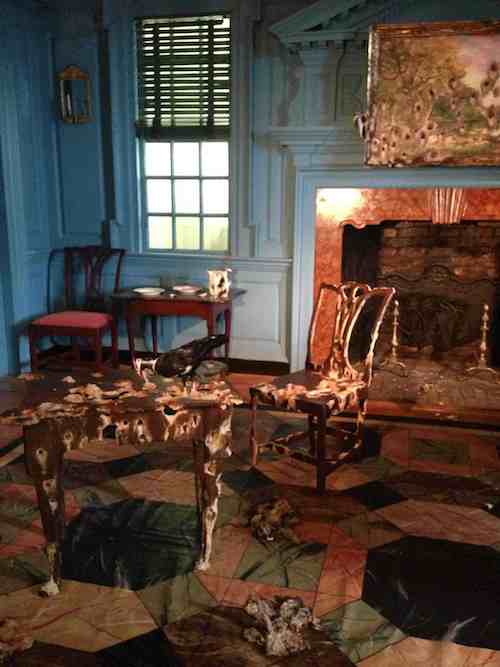
She kicks the Manifest Destiny discussion right where it hurts in the Cupola House “hall” (where guests socialized) by letting two Pileated and Downy Woodpeckers have their way with everything valuable in the room, including (a reproduction of) Thomas Cole’s 1846 painting The Pic-Nic. Nature is getting out of hand.

The Downey Woodpeckers take over the Cupola House hall. Photo: Brooklyn Museum

The Downey Woodpeckers take over the Cupola House hall. Photo: Brooklyn Museum

Get over to Brooklyn and encounter a new twist on what you were taught in grade school history, but watch out for Hegarty’s flying bullets and birds.

Making Yesterday’s Fashion Totally Now

History repeats – a silk Robe d’anglaise from 1765 and a 2009 ribbon-and-wire creation by Agatha Ruiz de la Prada

History repeats – a 1765 silk Robe d’anglaise with Agatha Ruiz de la Prada’s 2009 ribbon-and-wire runway creation

Within FIT’s upstairs gallery, you’ll receive a master class (from the masters) on how to take something old, inject it with an inspired twist, and create Vogue-ready looks ready for the modern world in FIT’s show RetroSpective, running through November 16.

FIT curator Jennifer Farley did an outstanding job of selecting iconic looks associated with well-dressed woman from previous centuries and pulling interpretation after interpretation on that theme from FIT’s collection. Historical references, empire waists, hoop skirts, and leg-o-mutton sleeves all get the old/new side-by-side treatment in the galleries.

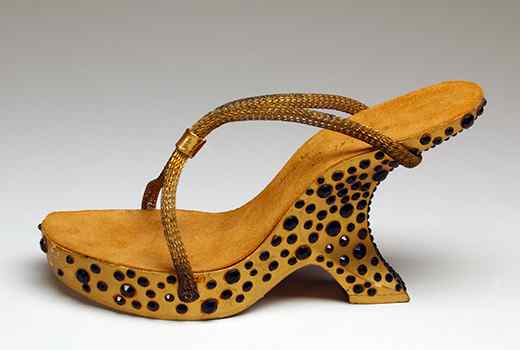
History reinterpreted –elevated sandal created by David Evins for Elizabeth Taylor in her 1961 epic, Cleopatra

History reinterpreted –elevated sandal created by David Evins for Elizabeth Taylor in her 1961 epic, Cleopatra

How did forward-looking designers mine ancient cultures, textures, and materials and make them look current? Look no further than the Grecian evocation of Madame Grés, sandals designed by David Evins for Liz’s 1961 Cleopatra look, Valerie Porr’s 1960s take on Guinevere, and Versace gone baroque. Click on the links to see the pieces on the show’s website.

Was there ever a time that rhinestone buckles weren’t applied to dainty evening shoes? Apparently not in the last several centuries, since examples from the 1740s are displayed alongside Peter Yapp 1910 satin pumps, 1959 Julianelli suede pumps, and 1995 red-velvet Manolos.

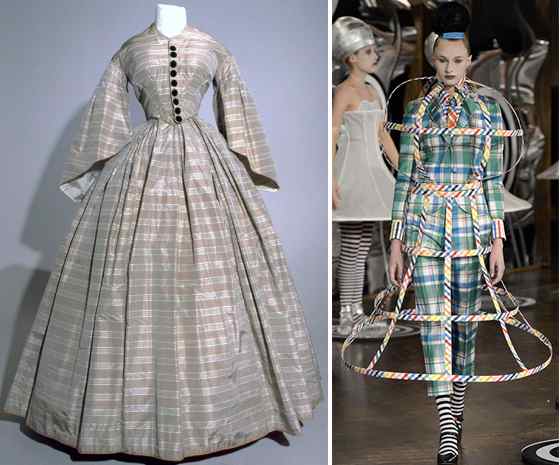
Hoop dreams from 1860 and Thom Browne’s Spring 2013 collection

Hoop dreams from 1860 and Thom Browne’s Spring 2013 collection

In the section on bustles, you’ll see beautiful 1870s creations alongside bustle-inspired works by Schiaparelli (1939), Herrera (1988), and Anna Sui (1999). But across the aisle in the section on hoop skirts, you expect to see 1860s dresses next to more modern works by Hishinuma (1996), Rochas (2004), and Thom Browne (2013). But who could expect to see hoops from the Fifties – Hoop-la (1956), which kept your bouffant skirt fluffed out, and the amazing Belle O’ the Ball collapsible skirt hoop (in its original box!), which allowed every girl-on-the-go to sleep easier knowing that her bouffant could be perfectly pouffed wherever she travelled.

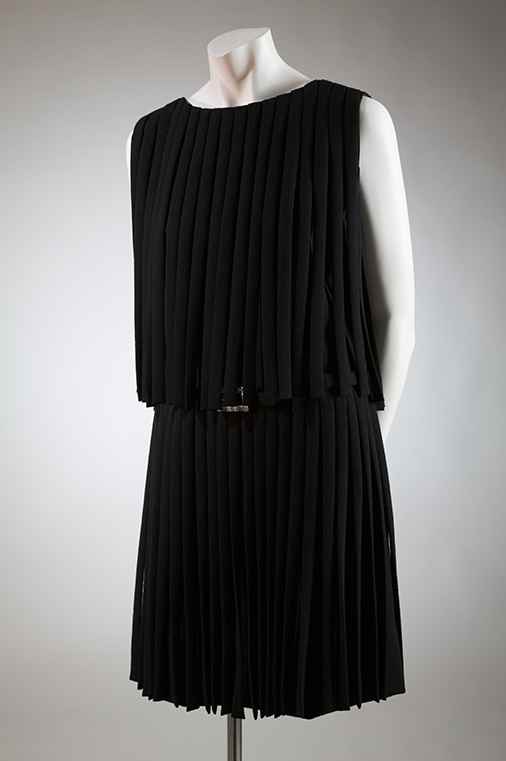
Lauren Bacall’s wool crepe 1965 flapper-inspired dress by Norman Norell

Lauren Bacall’s wool crepe 1965 flapper-inspired dress by Norman Norell

If you love fashion, get to this show and enjoy additional meditation on the decades of transformations associated with the New Look, corsets, platform pumps, playsuits, paper dresses, clogs, grunge, and graffiti. If you can’t get to the show, take some time to look through the show’s website to see about a third of what’s there and to read more about each concept and creation. FIT did a beautiful job on it.

And maybe someone from FIT can explain how Norell made such a perfectly pleated 1965 flapper dress for Lauren Bacall out of wool crepe?

Go Underground and Outside at Grand Central

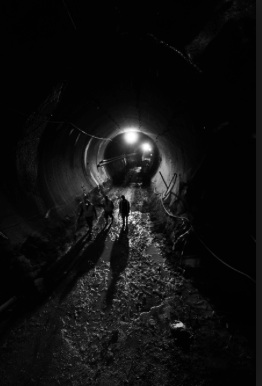
Hiroyuki Suzuki’s dramatic black-and-white view of the massive $8.2B project

Hiroyuki Suzuki’s dramatic black-and-white view of the massive $8.2B project

See New York above and below in two unique photography installations at everyone’s favorite train station right now.

At the New York Transit Museum Annex, you can glimpse your future path to the Hamptons in The Next Level: East Side Access Photographs by Hiroyuki Suzuki through October 27. Suzuki takes you over 14 stories below Grand Central to see the tunnels, sandhogs, tunnel boring machines, and chasms of the huge construction project that will allow 160,000 daily LIRR riders to arrive on Manhattan’s East Side when it’s done in 2019.

Suzuki had never before visited New York before starting his project, but he considers it a thank-you for the relief work done by the US Armed Services following the devastating earthquake and tsunami that hit his home country of Japan in 2011.

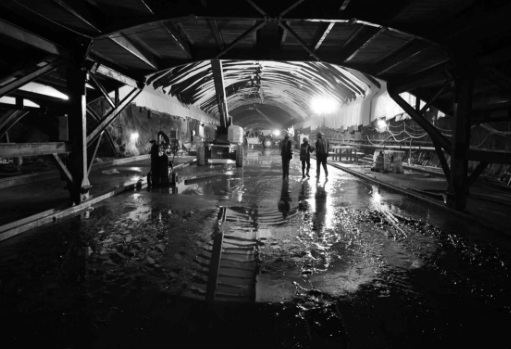
Underground view of East Side Access by Hiroyuki Suzuki

Underground view of East Side Access by Hiroyuki Suzuki

Contemplating the more than 50 black-and-white images, you can feel the monumental achievement happening underground, feel the damp, hear the light sloshing of men and machines moving through slightly damp tunnels, and see the miles of spaghetti-like cables illuminating the gigantic spaces where trains will soon thunder.

Suzuki made four trips down there during the project, and you may not even get to make one, so drop in and take a look at the engineering marvel happening right beneath a good patch of Midtown East. You’ll see supports labeled “48 Street” or “FDR” for orientation in the black wilderness.

Beautiful Hudson River photograph by Robert Rodriguez, Jr. from the one-day exhibition in Vanderbilt Hall

Beautiful Hudson River photograph by Robert Rodriguez, Jr. from the one-day exhibition in Vanderbilt Hall

Speaking of wilderness, get over to Vanderbilt Hall sometime today to experience the opposite – gorgeous landscapes of the spectacular Hudson Valley. To celebrate the achievements of an historic environmental organization (and encourage you to buy a train ticket to see scenery that inspired generations of artists), there’s a one-day-only photo spectacular — 150 images by Annie Leibovitz and 12 other photographers whose subject is the beauty of the Hudson River.

On Time and Place: Celebrating Scenic Hudson’s 50 Years, sponsored by Metro-North and Scenic Hudson, has traveled to five cities to celebrate this historic environmental organization’s 50 years of success. The photos are in Vanderbilt Hall from 10am until 4pm.