Go Underground and Outside at Grand Central

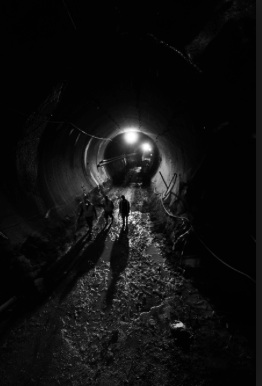
Hiroyuki Suzuki’s dramatic black-and-white view of the massive $8.2B project

Hiroyuki Suzuki’s dramatic black-and-white view of the massive $8.2B project

See New York above and below in two unique photography installations at everyone’s favorite train station right now.

At the New York Transit Museum Annex, you can glimpse your future path to the Hamptons in The Next Level: East Side Access Photographs by Hiroyuki Suzuki through October 27. Suzuki takes you over 14 stories below Grand Central to see the tunnels, sandhogs, tunnel boring machines, and chasms of the huge construction project that will allow 160,000 daily LIRR riders to arrive on Manhattan’s East Side when it’s done in 2019.

Suzuki had never before visited New York before starting his project, but he considers it a thank-you for the relief work done by the US Armed Services following the devastating earthquake and tsunami that hit his home country of Japan in 2011.
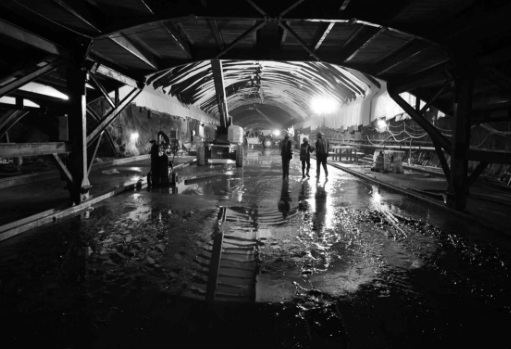
Underground view of East Side Access by Hiroyuki Suzuki

Underground view of East Side Access by Hiroyuki Suzuki

Contemplating the more than 50 black-and-white images, you can feel the monumental achievement happening underground, feel the damp, hear the light sloshing of men and machines moving through slightly damp tunnels, and see the miles of spaghetti-like cables illuminating the gigantic spaces where trains will soon thunder.

Suzuki made four trips down there during the project, and you may not even get to make one, so drop in and take a look at the engineering marvel happening right beneath a good patch of Midtown East. You’ll see supports labeled “48 Street” or “FDR” for orientation in the black wilderness.
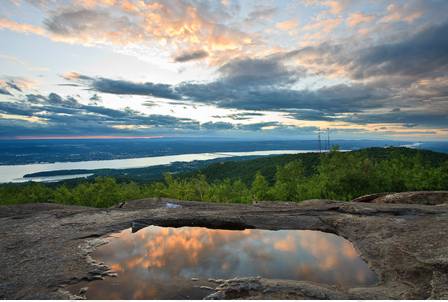
Beautiful Hudson River photograph by Robert Rodriguez, Jr. from the one-day exhibition in Vanderbilt Hall

Beautiful Hudson River photograph by Robert Rodriguez, Jr. from the one-day exhibition in Vanderbilt Hall

Speaking of wilderness, get over to Vanderbilt Hall sometime today to experience the opposite – gorgeous landscapes of the spectacular Hudson Valley. To celebrate the achievements of an historic environmental organization (and encourage you to buy a train ticket to see scenery that inspired generations of artists), there’s a one-day-only photo spectacular — 150 images by Annie Leibovitz and 12 other photographers whose subject is the beauty of the Hudson River.

On Time and Place: Celebrating Scenic Hudson’s 50 Years, sponsored by Metro-North and Scenic Hudson, has traveled to five cities to celebrate this historic environmental organization’s 50 years of success. The photos are in Vanderbilt Hall from 10am until 4pm.

Civil War Photos and High Line

The High Bridge and the former Civil War rail line, now turned into a pedestrian walking trail across the Appomattox River last year by the State of Virginia.

The High Bridge and the former Civil War rail line, now turned into a pedestrian walking trail across the Appomattox River last year by the State of Virginia.

What can you see from the perspective of 150 years after Gettysburg? If you go to Farmville, Virginia, you can experience a tranquil, soaring view of lush greenery 160 feet above the Appomattox River – a railroad trestle that was once burned, chopped, and torn apart in desperation just a few days before Lee’s surrender.

If you go to the Metropolitan Museum of Art today or tomorrow, you can see Photography and the American Civil War, a show on the First Floor that snaps you back to the birth of image-making, self-promotion, and day-to-day documentation in a way that makes today’s mania for image-sharing look a little lame in comparison.

Essentially, there were over 2,000 photographers roaming through the North and South during those four years of the Civil War. They produced over 1 million pictures of people, soldiers, current/former slaves, battlefield encampments, and more. Photographers trailed the troops everywhere they went, setting up tented studios on site.

Half of Timothy O’Sullivan’s stereo photo, Farmville, Va. April 1865, High Bridge of the South Side Railroad across the Appomattox. Source: Library of Congress

Half of Timothy O’Sullivan’s stereo photo, Farmville, Va. April 1865, High Bridge of the South Side Railroad across the Appomattox. Source: Library of Congress

As soon as you walk into the tented galleries, you’ll see a dizzying array of new technology and firsts – the first campaign button (Lincoln’s) using photos, the carte de visite mass marketed by Sojourner Truth to raise funds and promote her many social-change initiatives (check it out), stereo photos, albumen silver prints from glass negatives, Matthew Brady’s Union Square photo studio for the rich and famous, and before-and-after panoramas of what was going on at the front (not easy when the medium does not capture motion). But that’s just the first two rooms, so plan about an hour or more for the rest of the show.

Timothy O’Sullivan’s 1865 photograph, High Bridge, Appomattox, Va. from Gardner's Photographic Sketch Book of the War [c1866] Source: Library of Congress

Timothy O’Sullivan’s 1865 photograph, High Bridge, Appomattox, Va. from Gardner’s Photographic Sketch Book of the War [c1866] Source: Library of Congress

The photos from this week’s walk across the High Bridge in central Virginia is in stark contrast to the Library of Congress photos of the site in 1865, just after the war ended – a ground-up view of the famous rail bridge that was part of the historic photo-tome produced and marketed to the wealthy by Alexander Gardner and a stereo view of same, produced for the 3-D mass market. See and compare more views of Virginia’s Civil War “high line” with our Flickr photos.

There’s a lot more to the Met’s show than it’s possible to write about here (like the original $100K reward poster for Booth that was the first time photos were used in a perp search) and the fact that Brady never actually went to a battlefield (he sent others).

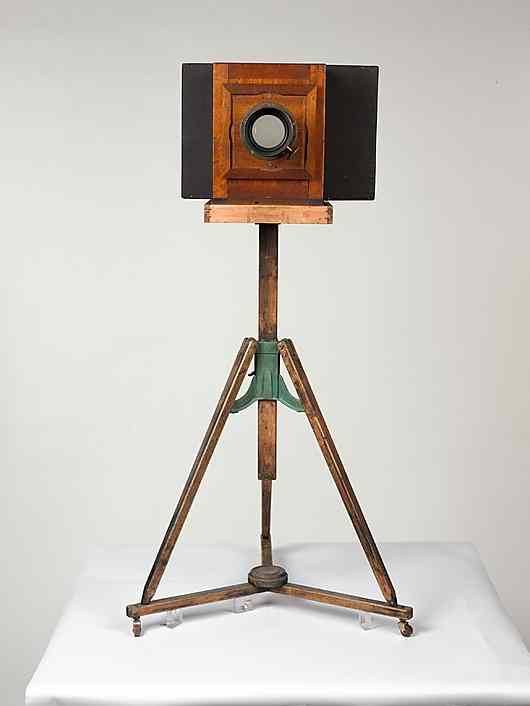
Matthew Brady’s 1860s studio camera is part of the Met’s show. Source: Lowenthell Family Photography Collection.

Matthew Brady’s 1860s studio camera is part of the Met’s show. Source: Lowenthell Family Photography Collection.

It’s simply one of the best shows that the Met has mounted, and congratulations to curator Jeff Rosenheim for this triumph. He’s written a great blog post and recorded a nice 30-minute video that sums up a lot of his thinking.

Check it out and if you’ve missed it, get your Amtrak ticket and head South: This mind-bending, must-see show is coming to the Gibbes Museum, Charleston, South Carolina (September 27, 2013–January 5, 2014), and the New Orleans Museum of Art (January 31–May 4, 2014).

Anxious, Turbulent Skies in Masterful Landscapes

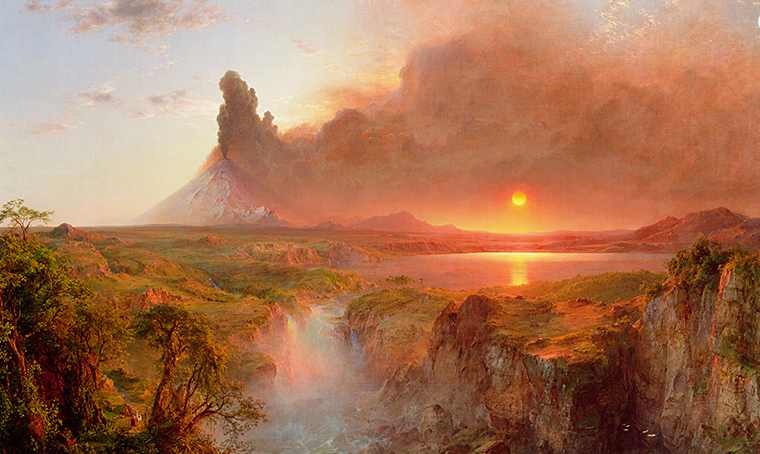
Frederic Edwin Church’s depiction of the volcanic eruption in Ecuador -- Cotopaxi, painted in 1862 and exhibited the following year. Source: Detroit Institute of Arts.

Frederic Edwin Church’s depiction of the volcanic eruption in Ecuador — Cotopaxi, painted in 1862 and shown the following year. Source: Detroit Institute of Arts.

Who expects that gigantic, bold 18th-century people-free landscapes by Bierstadt and Church to bear the heft of telling the anxious backstory of America before, during, and after the Civil War?

It’s true. Big landscapes are the booknds to the dramatic story told by the Smithsonian Museum of American Art’s exhibition to honor the 150th anniversary of Gettysburg, American Painting and the Civil War, installed through September 2 on the upper and lower levels of the Met’s Lehman Wing.

Seeing the stunning upper-gallery works within the context of America’s troubled times is a must. You’ll never look again at a Bierstadt or Church again without checking its date to see if it was painted in the 1859-1865 range.

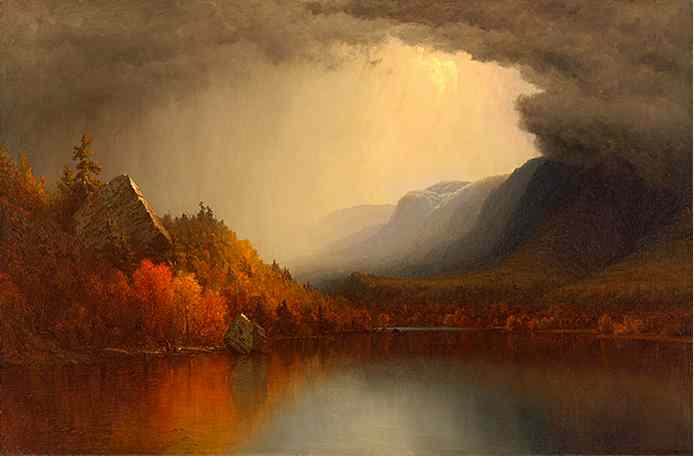
Sanford R. Giffins’s 1863 oil, A Coming Storm, says it all. Retouched by the artist in 1880. Source: Philadelphia Museum of Art.

Sanford R. Giffins’s 1863 oil, A Coming Storm, says it all. Retouched by the artist in 1880. Source: Philadelphia Museum of Art.

Hear Smithsonian curator Eleanor Jones Harvey’s three-minute introduction to how these magnificent landscapes became the “emotional barometer” of the country and what approach genre painters took in the midst of changing times. Then, check out the Smithsonian’s nice timeline and click on Church’s Meteor of 1860 and Our Banner in the Sky from 1861 to see what was in the news while these were being created in the studio.

You’ll find Sanford Gilfford’s A Coming Storm (1863) in the timeline in 1865. Ironically, this was owned by Shakespearean superstar Edwin Booth right after it was painted, but before his brother actor John Wilkes changed history and trashed the family name. When Melville saw the painting in a New York gallery a few weeks later in April 1865, he felt the tragic irony so profoundly that he had to write a poem to process it all.

Bierstadt’s Looking Down Yosemite Valley, California, exhibited in 1865, one year after Lincoln signed legislation declaring this a public reserve. Source: Birmingham Museum of Art.

Bierstadt’s Looking Down Yosemite Valley, California, exhibited in 1865, one year after Lincoln signed legislation declaring this a public reserve. Source: Birmingham Museum of Art.

Church, Homer, and Gifford also painted camp life during the War, and those up-close-and-personal works are also featured in the show, alongside very precise oils of Confederate encampments by Conrad Wise Chapman. Thanks to Richmond’s Museum of the Confederacy, which loaned the works by Chapman, you’ll get to see the famous experimental submarine, The Hunley as it was in 1863. The submersible was raised from the depths near Charleston in 2000 with the tar bucket you’ll see in Chapman’s oil painting

But back to the giant landscape that closes the show upstairs. Bierstadt paid someone to take his place in the Union Army, so maybe that’s why his mind was free concentrate on more placid, ethereal works, such as the show’s finale, Looking Down Yosemite Valley, California of 1865 – a immersive look into the California Eden that Lincoln’s signature in 1864 preserved as public land and away from scarred landscapes of the battlefield states.

What’s the connection between Arctic exploration and unusual nighttime phenomenon of 1864? Watch this video to see how Church used them to convey the mood of the country through his powerful, gigantic, beautiful Aurora Borealis.

See a slide show of 34 paintings in the show and access the full set of video podcasts on the Smithsonian’s web site.

I, YOU, WE: Art on the Front Lines of the 80s Culture Wars

Les Levine mounted his poster everywhere in the subway in 1981, a tough time in New York. Source: The Whitney © Les Levine for The Museum of Mott Art, Inc.

Les Levine mounted his poster everywhere in the subway in 1981, a tough time in New York. Source: The Whitney © Les Levine for The Museum of Mott Art, Inc.

It’s not a comfortable art show, but the 1980s weren’t comfortable times. The Whitney Museum of American Art’s show I, YOU, WE resurrects art from a time when artists were protesting inequality and gentrification, the AIDS epidemic was raging, Wigstock brought gender shifting into the open air, and New York’s downtown community waited apprehensively for the next police crackdown on squatters, community gardens, and anyone flaunting an alternative lifestyle.

As it prepares to move to the High Line in 2015, The Whitney asked its curators to mine its permanent collection to see if there were periods of time that might have been overlooked in the shows of recent years.

I, YOU, WE is the answer: the difficult, searching, and searing work produced by the passionate and disenfranchised denizens of New York’s tumultuous 1980s and early 1990s.

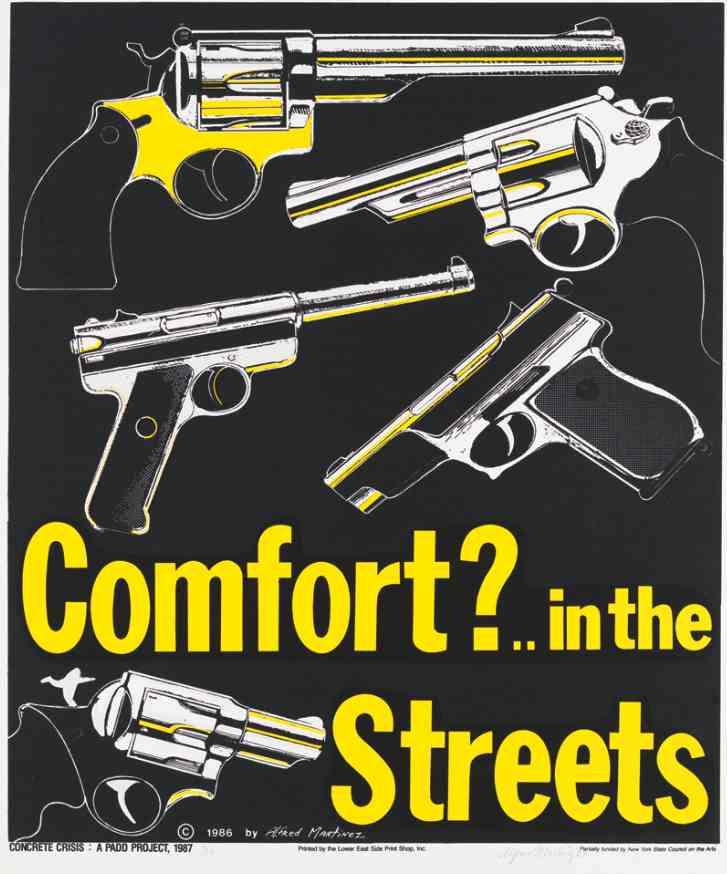
No one could miss Alfred Martinez’s 1987 screenprint. Source: The Whitney. © 1986 by Alfred Martinez

No one could miss Alfred Martinez’s 1987 screenprint. Source: The Whitney. © 1986 by Alfred Martinez

Works feature the flip side of Warhol’s Interview magazine and Studio 54 – people struggling with identities, illness, injustice, and the consequences of Washington’s culture wars against edgy art.

The Whitney produced this video about the “WE” section of the show, when artists began protesting gentrification, how they used art as the lever to galvanize the East Village, and the battles that raged for the community. Other sections of the Whitney show focus on artists’ exploration of race, gender, religion, and the AIDS crisis.

Revisit the emerging street styles – graffiti, comics-inspired drawings, stencils, and posters – as Andrew Castrucci of Bullet Space leafs through one of the seminal art-protest pieces.

When you visit, make enough time to Nan Goldin’s 700-slide extravaganza that documents everything.  Scroll down here to see installation views and  other works in the show by Mapplethorpe, Basquiat, Currin, Wojnarowicz, and Ligon. Tough stuff, but not tougher than the lives these artists lived during that decade.

Congratulations to the Whitney for not forgetting, presenting this work to the next generation, and testing if the work still sticks 20 to 30 years later. The show runs through September 1.

Matthew Barney Digs Up Morgan Treasures

Barney’s show entrance at the Morgan, as photographed by Graham S. Haber. Courtesy: Matthew Barney, Morgan Library.

Barney’s storyboard case for River of Fundament in the entrance to his show at the Morgan. Photo: Graham S. Haber. Courtesy: Matthew Barney, Morgan Library.

The brilliant, perplexing, and mysterious Matthew Barney has combed through the Morgan’s collection to curate mini-collections for the first-ever retrospective of his drawings — Subliming Vessel: The Drawings of Matthew Barney (on view through September 8).

Whether you enjoy his work or not, you can’t deny that he and his curators did a bang-up job of presenting his works-on-paper. Get over to enjoy highlights of the Morgan’s collection in an entirely new way – a mash-up of controversial contemporary work with infrequently seen gems, many collected by J.P. himself.

Barney’s
CREMASTER 4: Manx Manual (1994-95)
Graphite, lacquer, and petroleum jelly on paper framed in cast epoxy, prosthetic plastic, and Manx tartan. Source: Private collection. Courtesy: Matthew Barney, Gladstone Gallery.

Barney’s
CREMASTER 4: Manx Manual (1994-95)
Graphite, lacquer, and petroleum jelly on paper framed in cast epoxy, prosthetic plastic, and Manx tartan. Source: Private collection. Courtesy: Matthew Barney, Gladstone Gallery.

There’s real fun to be had by examining the flat waist-high cases in chronological order (clue: they are marked with the letters A to O). Your walk will take you through Barney’s storyboards for his early works, through Cremaster, and to his current project – River of Fundament, a seven-act opera combining film and live performance.

The cases contain stuff from the Morgan Library interspersed with the props, photos, drawings, and other images that inspired Barney’s extravaganzas. In order to enjoy this to the max, take a guidebook (in a stack right inside the gallery door). Even if you’re a Barney connoisseur, you’ll need the gallery guide to ID the great picks from the Library.

Case C is very satisfying to anyone who’s followed Barney’s career from his satyr-prancing videos at his first Biennials – you’ll see an 18th-century satyr drawing from Italy and the 1290 Persian blockbuster, The Benefits of Animals, opened right to the page with two crazy mountain goats. (And, yes, they’re standing in trees!).

Barney’s Ancient Evenings: Ba Libretto, 2009. Ink, graphite and gold leaf on paperback copy of Norman Mailer’s Ancient Evenings, on carved salt base, in nylon and acrylic vitrine. Courtesy: Marguerite Steed Hoffman and Matthew Barney

Barney’s Ancient Evenings: Ba Libretto, 2009. Ink, graphite and gold leaf on paperback copy of Mailer’s Ancient Evenings, on carved salt base, in nylon and acrylic vitrine. Courtesy: Marguerite Steed Hoffman and Matthew Barney

The Cremaster 2 storyboard in Case F has an Goya drawing and the original edition of one of New York’s most popular entertainments – Joseph Smith’s 1830 The Book of Mormon. (Trust me, you won’t find it without the guidebook.)

Cases K-O contain the River of Fundament storyboards, which were inspired by Norman Mailer’s book, Ancient Evenings, Egyptian reincarnation myths, and the Chrysler bankruptcy. Alongside Barney’s props and things, you’ll glimpse sky burials documented by Curtis, Whitman’s original Leaves of Grass, and a Diane Arbus portrait of Mailer.

Look at the slide show from the exhibition, but know that Barney’s drawings are best enjoyed in person. They’re tiny, detailed, and often disturbing. With many references to Egyptian deities, Renaissance drawings, and cars, each is a tiny world unto itself.

Will you ever understand what those iconic self-lubricating frames are about? It doesn’t matter. It’s just nice to dive into an alternate, mysterious universe and simply swim around in Barney’s non-linear excavation of similarly provocative illuminations and page-turners from Mr. Morgan’s stacks.

More Time Tripping at Grand Central

Annex window view of Lothar Osterburg’s model of his dream of Grand Central as a zeppelin docking station back in the 1930s

Annex window view of Lothar Osterburg’s model of his dream of Grand Central as a zeppelin docking station back in the 1930s

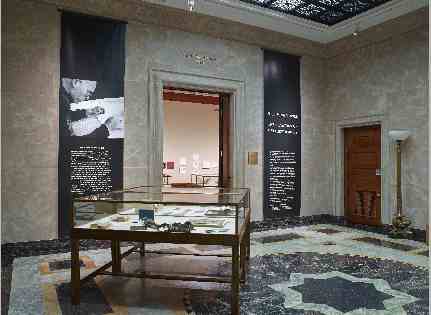
Even if you didn’t manage to board the historic train cars at Grand Central in May, you can still go back in time, courtesy of 18 artists featured in the GCT exhibition in the New York Transit Museum Annex, On Time: Grand Central at 100.

Inspired by The Clock and the continual flow of people and trains through Grand Central, MTA Arts for Transit cooked up a delightful mix of contemporary 2D works, models, videos, and digital art that puts a smile on the face of every commuter, tourist, and art-seeker that we’ve seen inside the tiny Annex.

Look closely to find this minute secret portal: Ledge with Lunette, 2013 by Patrick Jacobs

Look closely to find this minute secret portal: Ledge with Lunette by Patrick Jacobs

Have you seen the mysterious Zeppelin posters by Lothar Osterburg on the subway? Right in the Annex window you’ll see the gigantic, fun-house model that he created to photograph as one step in the process of making the photogravure you see on the A train. Kids and parents can’t resist Lothar’s newspaper-covered multi-story GCT impression and the funny, fat yellow old-time taxis and zeppelin ends that poke out. Right next to it, you can examine his resulting print, Zeppelins Docking on Grand Central.

People are usually transfixed by the 2008 video documenting Frozen Grand Central, where Improv Everywhere staged a 250-person flash mob, where people “froze” for 5 minutes as commuters, tourists, and workers wondered what was going on.

Another hit is Grand Central Diary. London Squared Productions interviewed tourists and commuters about GCT, animated the furniture and items around the terminal, and…well, just watch The Clock and the Maintenance Cart speak for themselves:

Nearby, several small digital screens show Alexander Chen’s Conductor, a 15-minute video loop that animates the subway lines, suggesting trains moving through the system. He turns the subway lines into an animated stringed instrument. No wonder he’s working for Google Creative Labs. Spend a few moments, take a look, and experience it here.

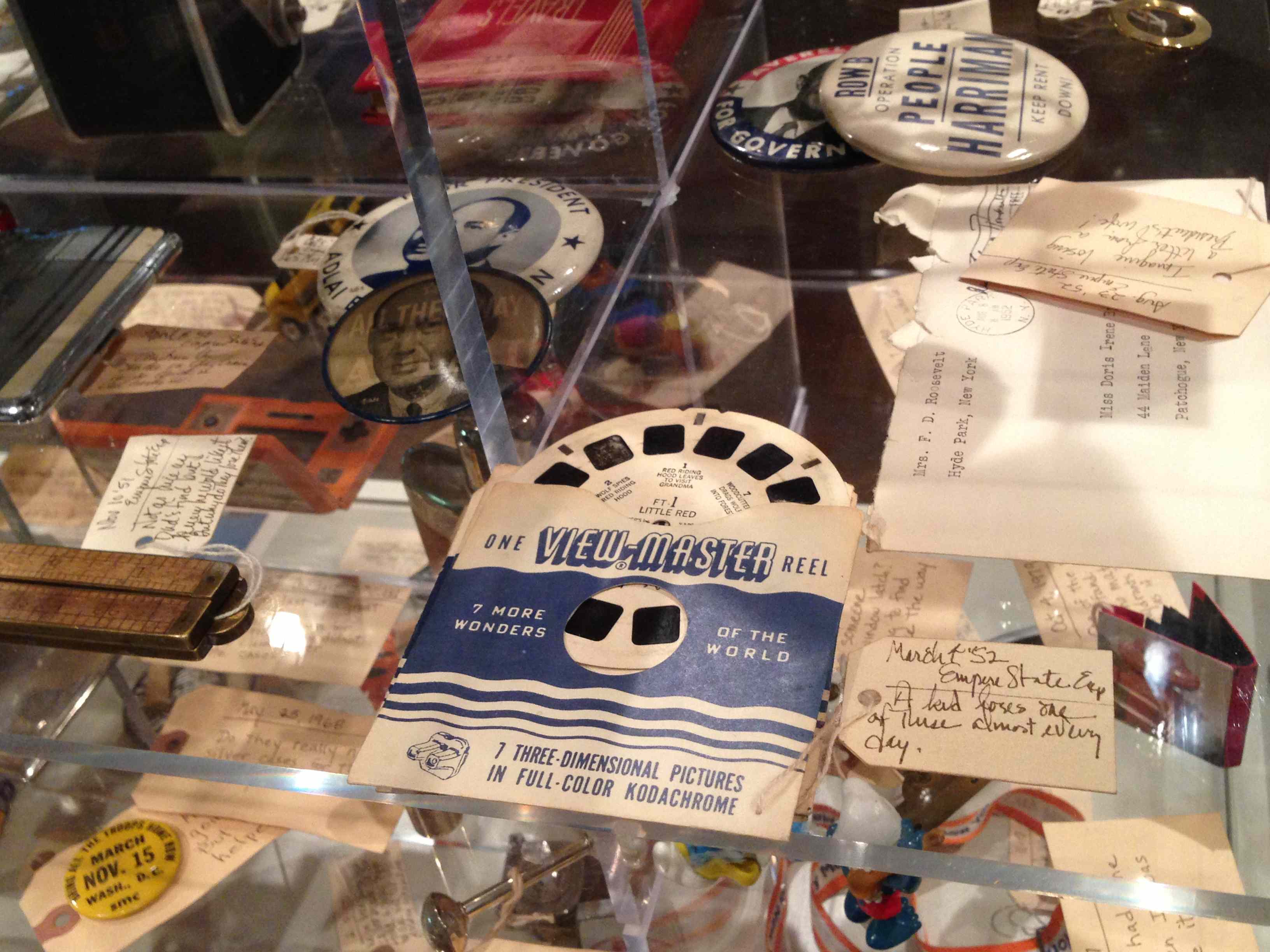
Close-up of Viewmasters and other leave-behinds inside Jane Greengold’s Lost and Found.

Close-up of Viewmasters and other leave-behinds inside Jane Greengold’s Lost and Found.

Another must-see piece (among many) is Jane Greengold’s Lost and Found. She’s created a sort-of fiction about the dozens of tagged items in the vitrine, evoking the memories and observations of generations of conductors who found items that train passengers left behind. Actually, the items you’re looking at are actual leave-behinds collected by real-life conductors, so Jane’s work isn’t entirely made up. The archeological discoveries include things from the old Lake Shore Limited on the NY Central, a 1948 boxed baby tooth, 1943 ration cards, 1952 Viewmasters, a Kennedy campaign button, and a Kindle.

Get to the Annex before July 7. In the meantime, check out curator Amy Hausmann and her artists telling about the fun they had contemplating time, architecture, fashion, and Jackie O.

War Ends at NY Historical

Welcome to New YorkJoin the crowds for two more days to pay tribute to NYC’s Greatest Generation at the revealing, reflective exhibition, WWII & NYC created by the New-York Historical Society. If you can’t get there in person, take a look at the synopsis here, but in the galleries there are surprises at every turn. The slideshow gives you a glimpse.

Right inside, you’ll find a line-up of people checking out a portion of the actual 1938 Cyclotron, a kind-of atom smasher that physicists at Columbia University were using confirm nuclear fission. It’s also surprising to see an interactive map of where “The Manhattan Project” was actually located in Manhattan. At Fifth Avenue and 29th Street, the Army had 300 people on the 22nd Floor of 261 Fifth sourcing materials for the first atom bomb. Other teams were working in the Woolworth Building and at 270 Broadway.

People also cluster around the interactive map of New York’s harbor, which explains how all those interesting-looking, now quiet big buildings, forts, and warehouses along the shore were once alive with 3.3 million active duty service men and women headed for Europe and North Africa. Take this video tour and see it then and now:

And the show would not be complete without a in-depth look at the activities of the Brooklyn Navy Yard and the rise of Rosie the Riveter. Watch this video to experience what it was like from a woman who lived it:

The show includes stories about how Tito Puente, Jacob Lawrence, filmmaker Francis Lee, MoMA, the Metropolitan Museum of Art, Maiden Form, Nabisco, and countless other New York people and companies joined in to the war effort. Check out additional videos expertly produced by NYHS on line. You’ll never look at these City streets or harbor the same way again.

Abstraction All-Stars Featured in MoMA’s LinkedIn

Installation view of the network behind the birth of abstract art

Installation view of the network behind the birth of abstract art, according to MoMA and Columbia Business School

As soon as you arrive at Inventing Abstraction 1910-1925, MoMA’s soon-to-close extravaganza featuring the relationships among painters, poets, composers, and dance innovators, you encounter a big, bold infographic on the wall – a web showing who was collaborating with, influencing, viewing, and reading each other as “abstract art” was born.

The stunning exhibit is a who’s who of modern art, with work by Picasso, Kandinsky, and Malevich (of course), but pulls in works from lesser-known early innovators from Britain, Poland, Italy, and America (hi, Georgia!) and across disciplines. So many connections, so little time! The show has books, music, pioneers of modern dance…just about everything.

If you can’t get to it, don’t worry. MoMA’s put it all on the web so you can explore all the connections yourself. The highlighted names show the artists with over 25 connections, like an early 20th century LinkedIn or really popular Facebook friends. Who knew that Russian fine-art diva Goncharova was more connected than, say, Malevich or El Lissitsky?  I guess inventing Rayism and designing sets for the Ballet Russes paid off in getting her positioned in this MoMA pantheon.

Created by MoMA curators, designers, and pros from the Columbia Business School, the interactive web highlights every artist featured in the massive MoMA show. The infographic allows you to zoom in to see how the buzz, particularly in 1911-1915, brought abstract art into being.  No matter which name you click on, you’ll get to view the works, play the music, and watch the dances – a web-based multimedia tour-de-force.

Now dive into one of the best art-websites ever, and get to know the network and likes of the hot, emerging artists who made the art world of 100 years ago into what we know today.

Watch how this show and web project were brought to life with Excel, great minds, and graphic design. And be sure to check out Paul Ingram’s views on the value of networks at the MoMA video site.

Allen Ginsberg’s Time Machine Walkabout at NYU

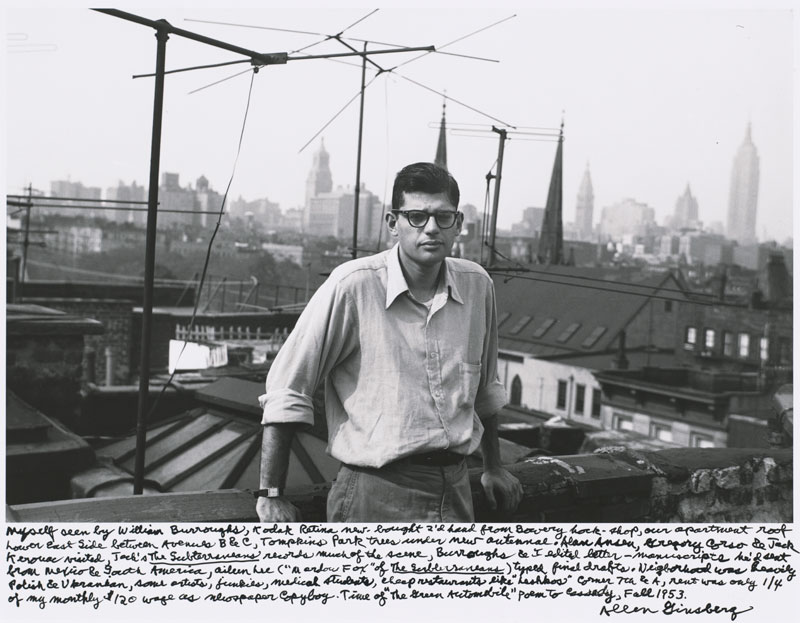
Myself seen by William Burroughs, Kodak Retina new-bought 2'd hand from Bowery hock-shop..., 1953, printed 1984-97. National Gallery of Art, Gift of Gary S. Davis. 
Images © 2012 Allen Ginsberg LLC. All rights reserved.

Myself seen by William Burroughs, Kodak Retina new-bought 2’d hand from Bowery hock-shop…, 1953, printed 1984-97. National Gallery of Art, Gift of Gary S. Davis. 
Images © 2012 Allen Ginsberg LLC. All rights reserved.

Walking through the Grey Art Gallery’s show Beat Memories: The Photographs of Allen Ginsberg is pretty much a stroll through the neighborhood circa 1953 – Tompkins Square Park, Avenue B, three-room apartments for $29 per month.

This incredible tribute to all things Beat was initially mounted by the National Gallery, but the best place to see it is NYU’s gallery in the Village, just steps away from where it all happened. Get to Washington Square to see what it was like to be young, broke, ambitious, and at the edge of a generational shift in America.

Allen Ginsberg had just gotten a $13 Kodak camera in a Bowery pawnshop and began taking photos of himself and his friends – Jack Kerouac, William S. Boroughs, and Gregory Corso. No one was famous yet. About thirty years later, Ginsberg found the snapshots, printed and enlarged them, and wrote in the margins his memories of sharing the flat, living on nothing, and breaking the rules.

The photos tell quite a coming-of-age story – the first publication of Howl, Ferlinghetti’s bookstore in San Francisco, emerging Beat sensibility, and life in a flat at 206 East 7th Street while Kerouac took to the road. The earlier photos were all taken from 1953 to 1963, but later photos of his from the 1980s include Dylan, Larry Rivers, Francesco Clemente, and even Madonna.

As an extra bonus, Grey Art Gallery interns developed a walking tour of Ginsberg’s East Village haunts, so you can actually experience Café Reggio, Café Wha?, and over 25 other spots where it all took place. Download the PDF tour inside the Beat Memories site and walk the walk of literary and cultural rebellion.

Get to this show right now in New York, or catch it in San Francisco’s Contemporary Jewish Museum later this year. If you can’t do either, poke through the online photos with Ginsberg’s commentary at either the Grey or the National Gallery sites (at the latter, you can enlarge the photos to read Ginsberg’s addendums). Here’s a promo from WNET:

If You Love Brooklyn, Get to GO!

Installation view of Yeon Ji Yoo’s The Fight (2012), made of paper, paper pulp, acetate, glue, packing tape, cheesecloth, plastic flowers, recycled plastic bottles and bags

Installation view of Yeon Ji Yoo’s The Fight (2012), made of paper, paper pulp, acetate, glue, packing tape, cheesecloth, plastic flowers, recycled plastic bottles and bags

Tucked away in the Mezzanine Gallery on the second floor at the Brooklyn Museum is a valentine to the borough, its artists, and the support and love they received last September in Go: A Community-Curated Open Studio Project. It mixed trudging around Brooklyn, democracy in action, and high-tech to peer into other worlds right in our own backyard.

The museum commissioned an app, asked artists to open their studios, and invited the world to visit and vote for their favorites. (Apparently, it was inspired by an art competition organized out of Grand Rapids!)

GO tracked the art makers and art seekers – take a look at the “weekend activity heatmap” and the other GPS-gathered stats. The results showed a lot of love – 18,000 visitors making 147,000 studio visits to about 1,700 artists over a two-day period, or about eight studio visits per participant. See the raw data for yourself, broken out by neighborhood. Learn a bit more about the voters here.

Art lovers nominated 9,457 artists for a museum showing, and eventually voting and curators whittled it down to five spectacular representatives. Interestingly, four on display were born outside the United States.

Yeon Ji Yoo of South Korea, currently lives in Greenpoint and works in Red Hook. The large installation piece in the show is inspired by her grandmother’s fading memory. Listen as she talks about growing up in South Korea’s rural countryside:

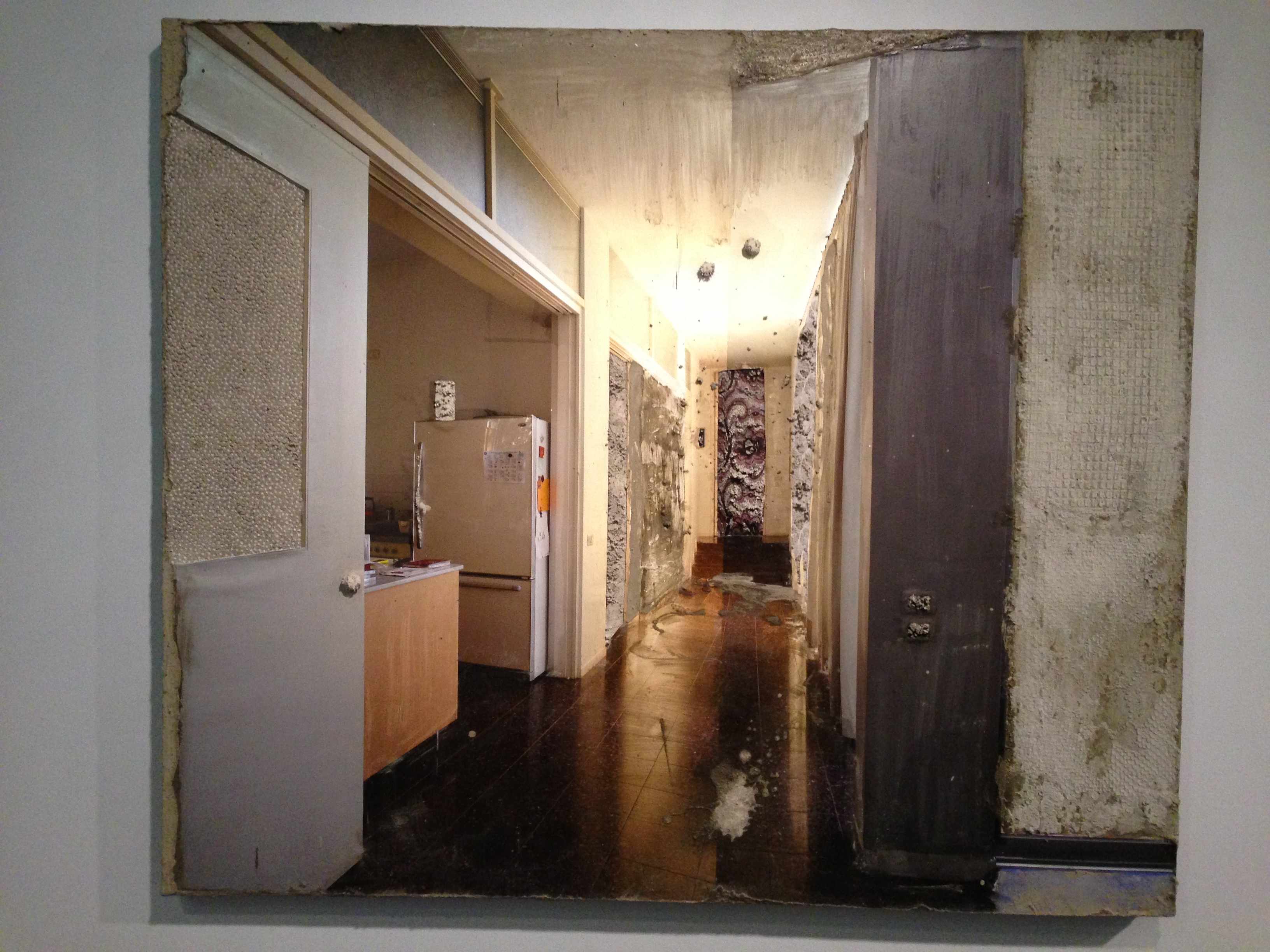
Installation view of Naomi Safran-Hon’s Home Invasion (2011). Archival inkjet print, lace, and cement on canvas

Installation view of Naomi Safran-Hon’s Home Invasion (2011). Archival inkjet print, lace, and cement on canvas

Naomi Safran Hon (of Prospect Heights) prints photographs of her hometown of Haifa, Israel on canvas; makes some cuts in the image; and pushes cement through lace to make a 3-D effect. She feels she’s working out the push/pull of the political and domestic realities of where she grew up. But let her tell you:

Meet the other artists, too: urban watercolorist Adrian Coleman, and painters Oliver Jeffers, and Gabrielle Watson. But if you really love Brooklyn, get over to experience the work in person, and add your comments. The museum’s open late on Thursday.