Shape-shifter, beadwork innovator, pop-culture provocateur, fashion designer, and performance artist – it’s hard to know where to start when summarizing four-decades of work by a Native-American contemporary art superstar. But his first retrospective, Pathfinder: 40 Years of Marcus Amerman, does showcases his wide range of work in spectacular fashion. See it at the Wheelwright Museum of the American Indian in Santa Fe through January 11.
Marcus Amerman (Choctaw Nation of Oklahoma) is best known for his intricate beaded “paintings,” which take center stage.
1994 Stormbringer beaded portrait of Lakota leader Chief Iron Hawk. Surrealist eyes by Man Ray watch from a brewing storm. Courtesy: Colorado Springs Fine Arts Center.
Once Amerman developed his bead technique, which provided a photo-realist spin to a traditional “native” craft, he really felt that he could take on any subject as a contemporary artist – movie stars, historic characters, and cartoon images. The impact is electric.
2002 beaded painting Greetings from Indian Country, merging vintage tourism with pointed social commentary on exploitation. Private collection
Amerman garnered a lot of attention in the late 1980s and early 1990s for merging his beadwork into contemporary fashion. He cites his beaded leather motorcycle jacket with a beaded meme of bikini-clad Brooke Shields starting it all – a shock-worthy mix of leather toughness with one of the hottest young stars of the day. He took on custom commissions and leapt at the opportunity to participate in fashion shows. He was overjoyed to see his buckskin fashions featured in Elle.
1982 Iron Horse Jacket with beaded Brooke Shields. Courtesy: Private collection
American eagles beaded on lapels of 1992 dinner jacket; commissioned by veteran Doug Hyde (Nez Perce, Assiniboine, Chippewa).
It’s obvious that Amerman rejects staying put into a single category. He loves collecting vintage “Indian” objects and collaging art-world and historic references in all of his work. Check out those hubcaps!
2023 acrylic painting Old Masters in the New World, showing 17th century Dutch colonizers next to a Santa Fe train. Courtesy: the artist2023 Rattles found-object collage, mixing pop cultural and Native images. Courtesy: the artist
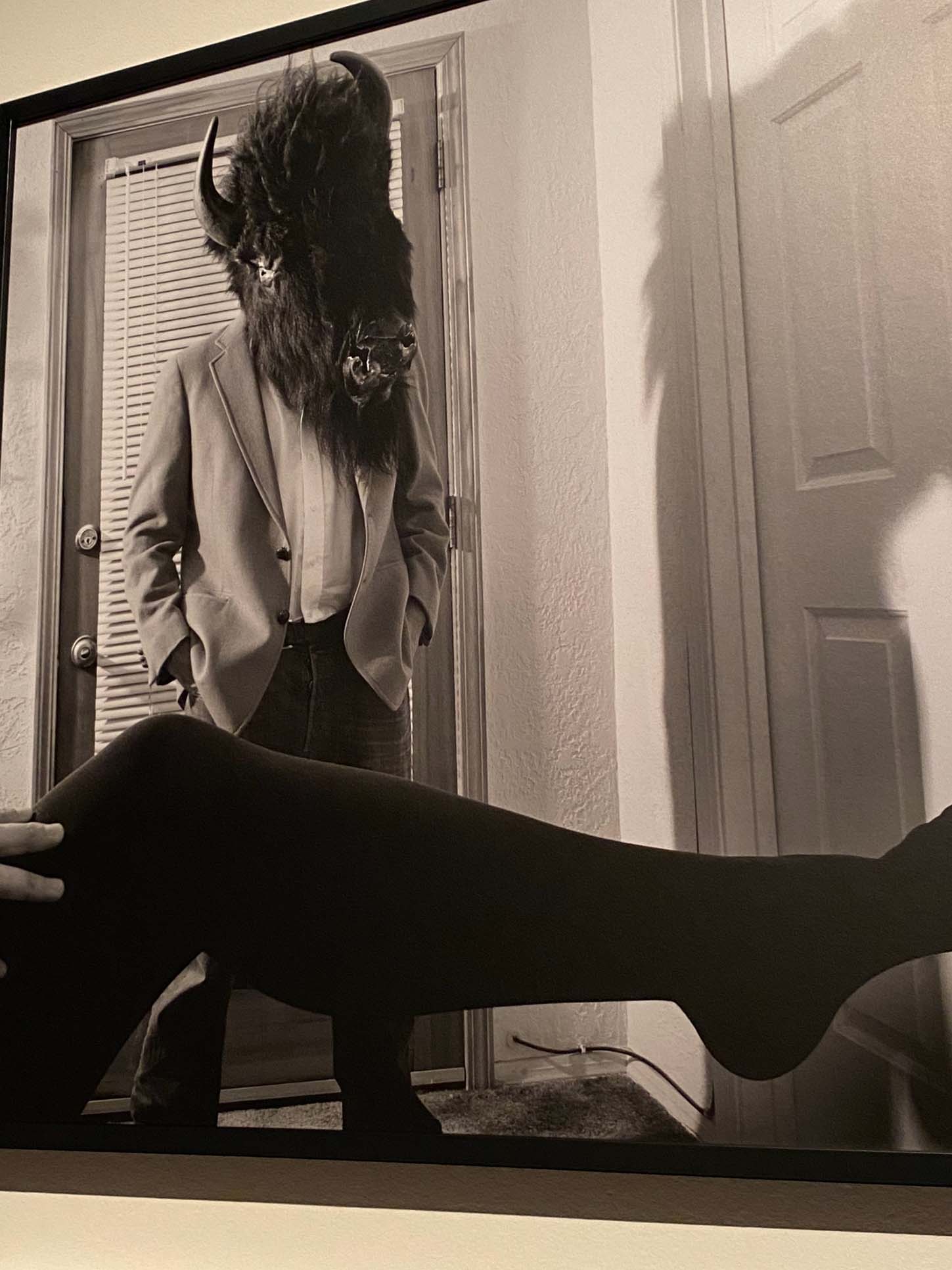
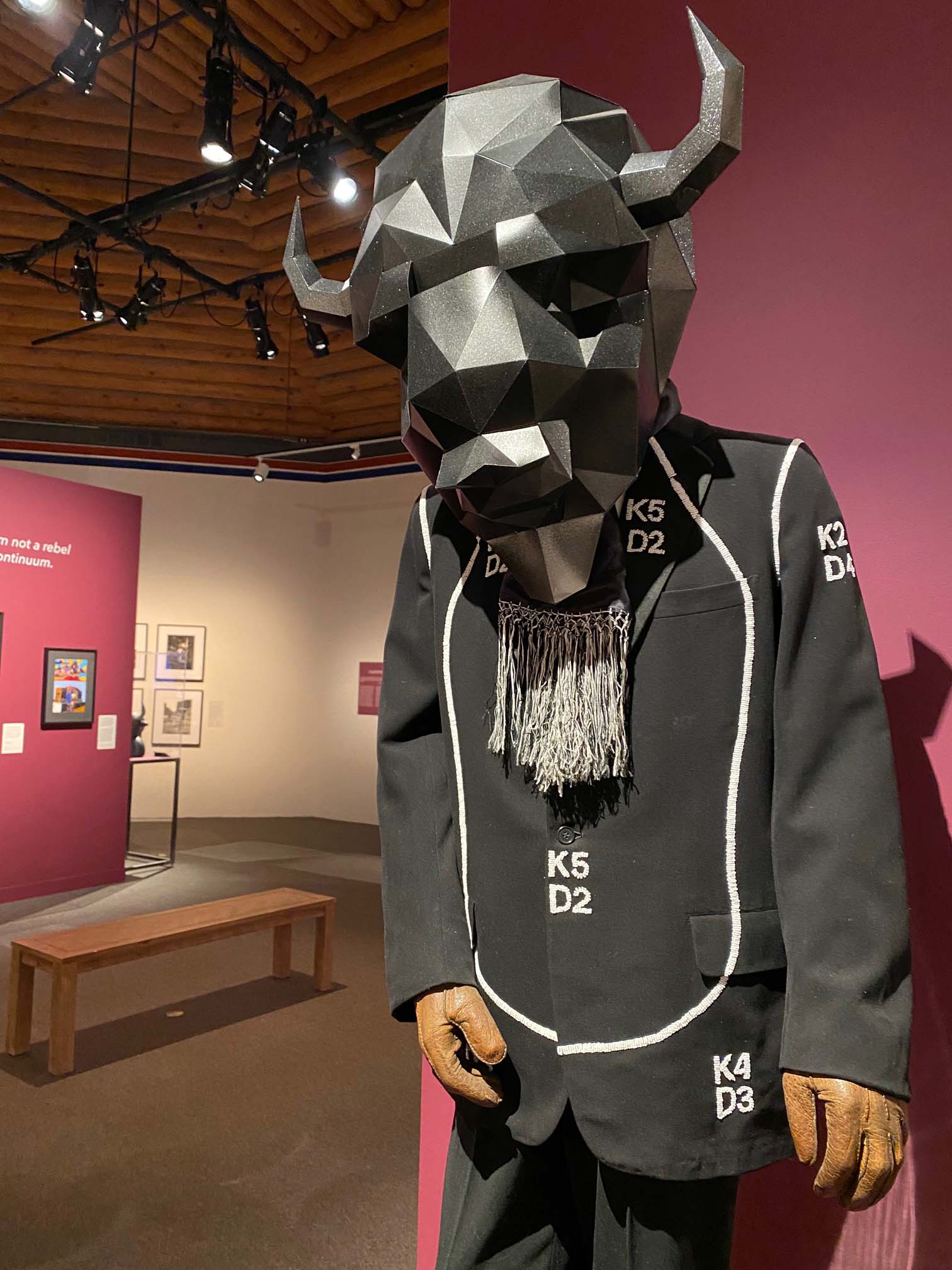
Amerman’s alter ego, Buffalo Man, features prominently in the show, particularly in his collaborations with acclaimed photographer Cara Romero, where icons of Native culture insert themselves into American pop culture.
Cara Romero’s 2013 photo El Graduaté – a collaboration with Amerman’s performance alter ego, Buffalo Man. Courtesy: Cara Romero
2002 Target Jacket with glass beads, worn by the artist in fashion shows as himself and as Buffalo Man. Courtesy: the artist
The gorgeous collaborations with glass artists from Amerman’s time at Pilchuk are a delight – some self-referential and others harkening back to his own culture’s ancestry. He claims that everything he makes is genuinely as “self portrait.”
2010 blown and sand-carved Buffalo Man – a collaboration by Amerman and Preston Singletary (Tlingit). Courtesy: the artist
2006 Glass Shield, one of a series created during a residency at Pilchuk Glass School and inspired by historic Plains Indian shields. Courtesy: the artist
It’s a joyful tribute to an artist who gives back, inspires others, and keeps asking pertinent questions about the role of art and artists in our society.
Enjoy this close-up look at some of Amerman’s masterful beadwork and hear why Amerman continues to create:
If you want to take a trip across American land with 50 living Native artists, there’s still time to catch the ground-breaking exhibition, The Land Carries Our Ancestors: Contemporary Art by Native Americans, at Connecticut’s New Britain Museum of American Art through September 15, 2024.
The National Gallery of Art in Washington, D.C. asked Jaune Quick-to-See Smith (Citizen of the Confederated Salish and Kootenai Nation) to survey the United States and create an exhibition reflecting the diversity of the living Native American artists.
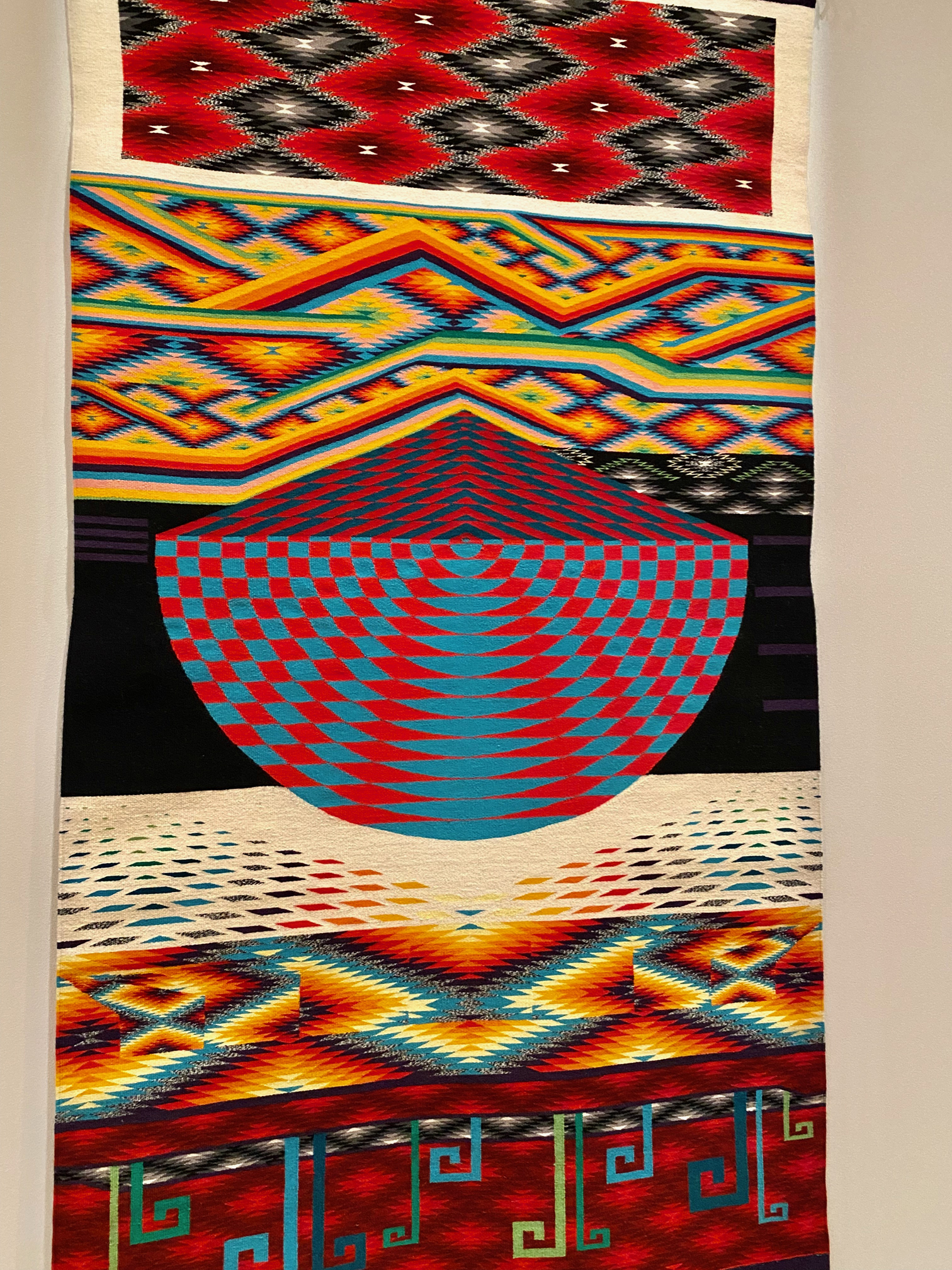
2014 wool weaving World Traveler by Melissa Cody (Navajo). Courtesy: Stark Museum of Art.
Smith, whose own artistic achievement was honored most recently in a three-museum retrospective in 2023-2024, became the first artist invited to curate a show at the National Gallery.
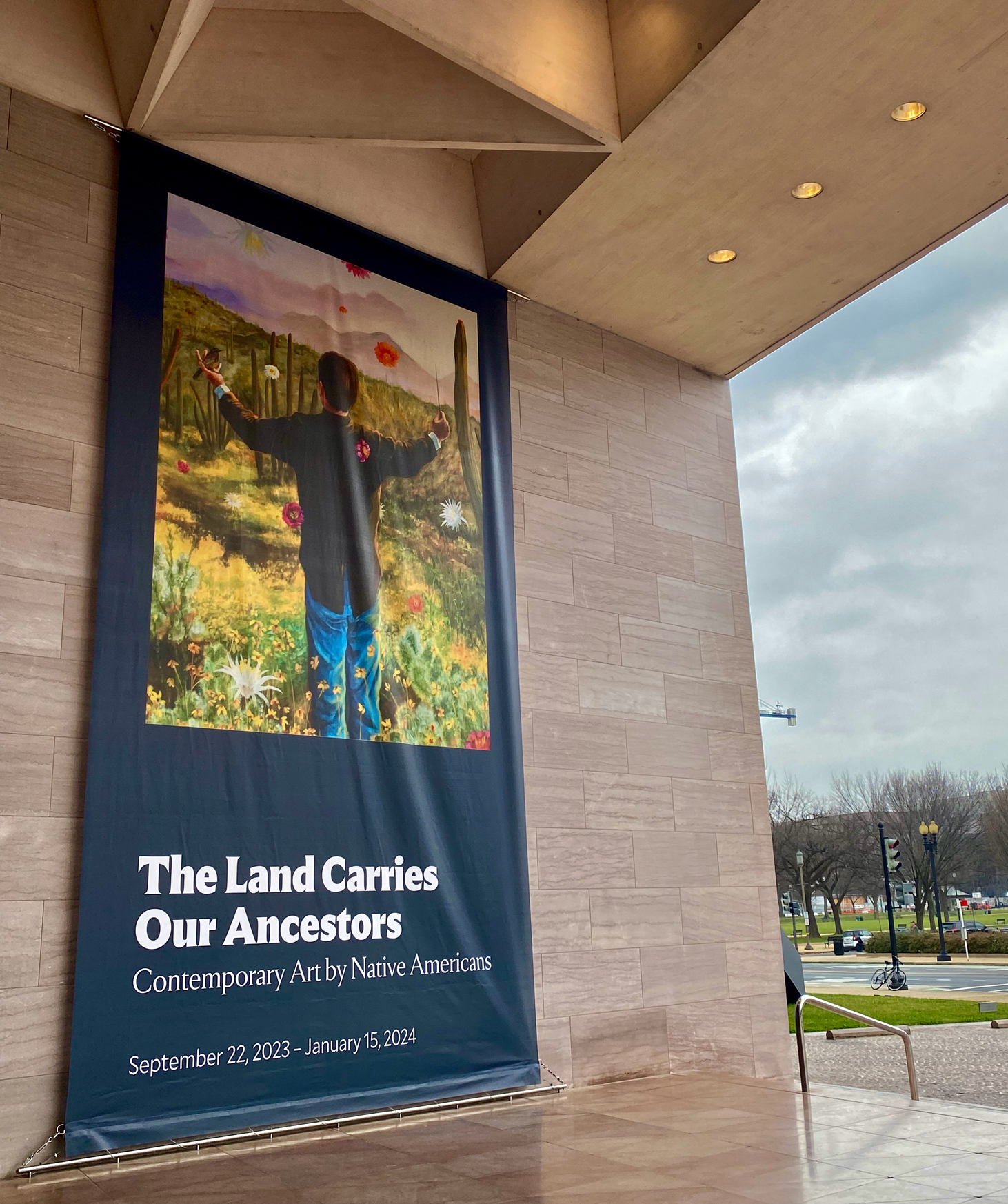
Entrance banner features Orchestrating a Blooming Desert by Steven Yazzie (Diné/Laguna Pueblo).
Smith has always done whatever possible to increase the visibilty of Native artists in the contemporary art world. For this exhibition, she chose 50 intergenerational artists from diverse regions, cultures, and artistic practices. Look at our Flickr album of the National Gallery installation to see some of our favorites.
All of the works reflect the artists’ deep connection to the land, especially Orchestrating a Blooming Desert by Steven Yazzie (Diné/Laguna Pueblo), a painting that reflects one man’s joyful encounter with a lush landscape.
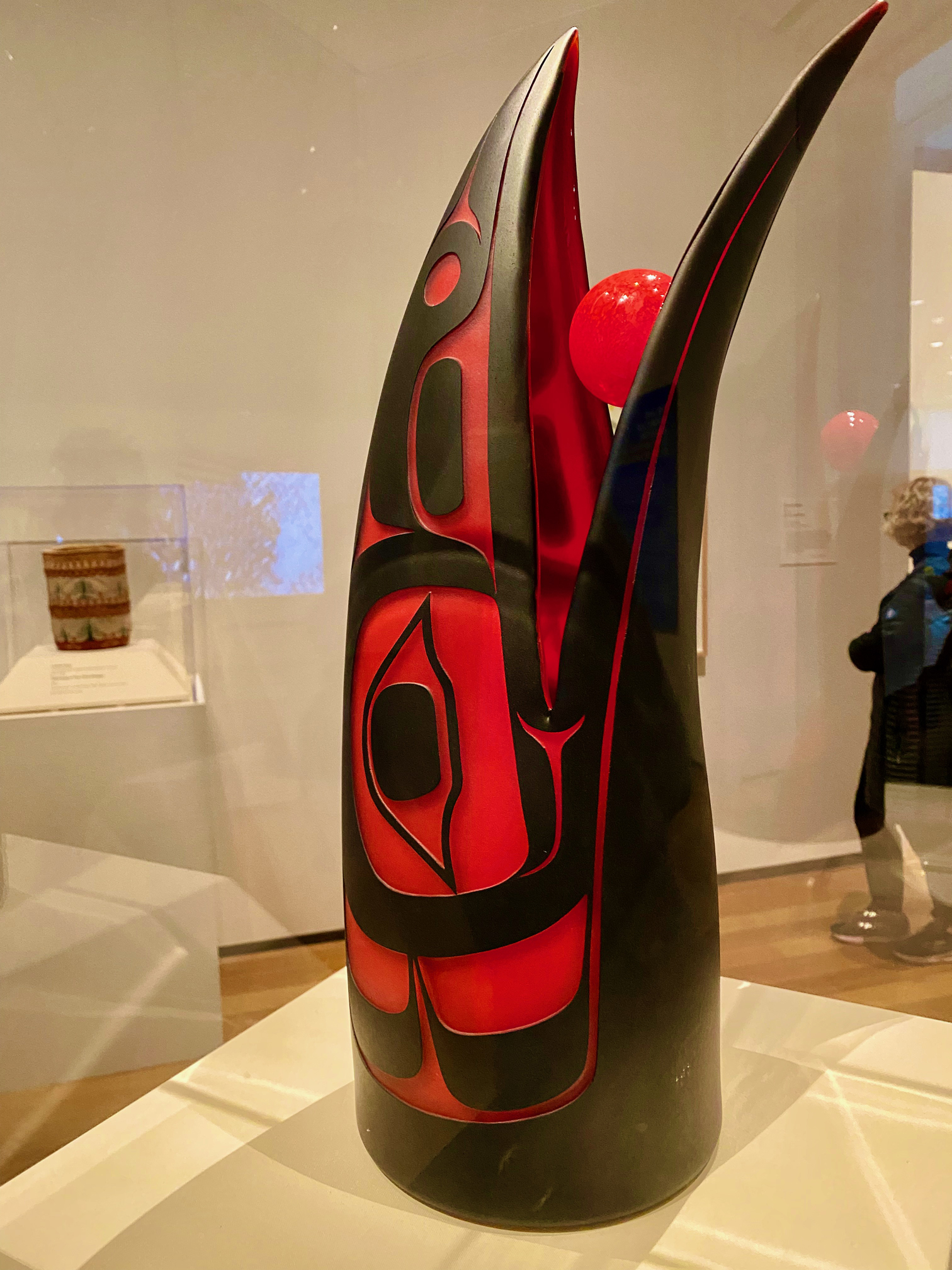
Some works depict a tribe’s link to the natural world through origin stories. Visitors are mesmerized by Preston Singletary’s exquisite sculpture of Tlingit creation-myth legend, Raven stealing the Sun. It’s glorious to admire this dramatic icon fully realized in a distinctly nontraditional medium – blown and sand-carved glass.
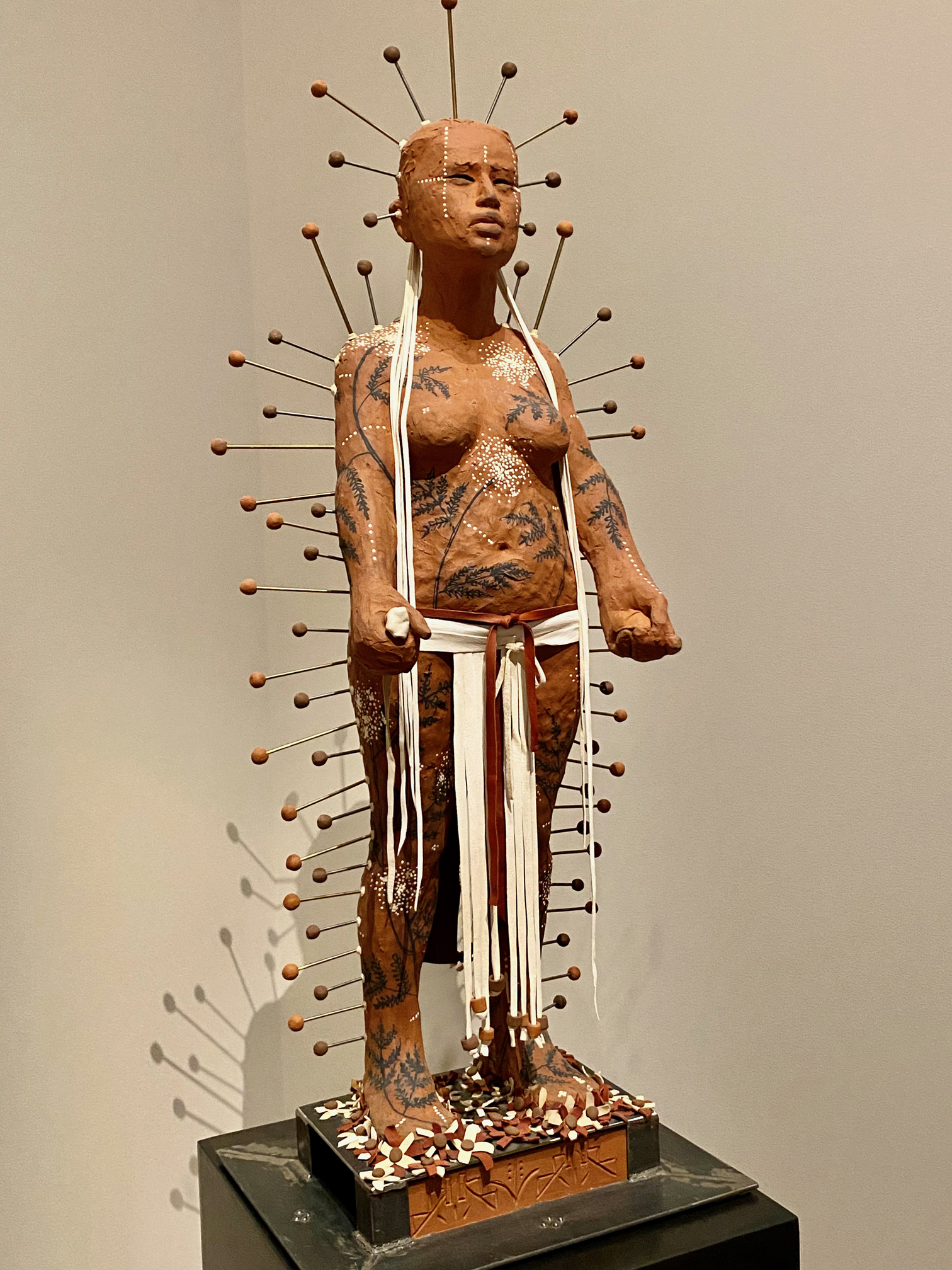
Experiencing the large, spiritual earth-colored ceramic figure by Rose B. Simpson (Santa Clara Pueblo) harkens back to eras when people had a more integral connection to the earth. Simpson calls her figure Tonantzin, an Aztec name for earth mothers, corn mothers, and even the Virgin of Guadalupe.
2017 blown and sand-carved glass Raven Steals the Sun by Preston Singletary (Tlingit). Courtesy: private collector.
2021 ceramic, steel, leather, and brass Tonantzin by Rose B. Simpson (Santa Clara Pueblo). Courtesy: Tia Collection.
Smith has chosen to hang many smaller two-dimensional works across a long wall in a checkerboard to suggest that visitors reflect on the impact of 1887 Dawes Act upon Native lands – a law that cut Native territory into “checkerboard” lots to facilitate private ownership.
At the National Gallery, Jeffrey Gibson’s punching bag (all made of found materials) was hung nearby, reminding us of the delicate balance that has to be struck by simultaneously caring for and taking gifts from the earth.
Next to checkerboard wall, the 2020 beaded punching bag To Feel Myself Loved On the Earth by Jeffrey Gibson (Mississippi Band of Choctaw Indians/Cherokee Nation). Courtesy: Hirschhorn Museum.
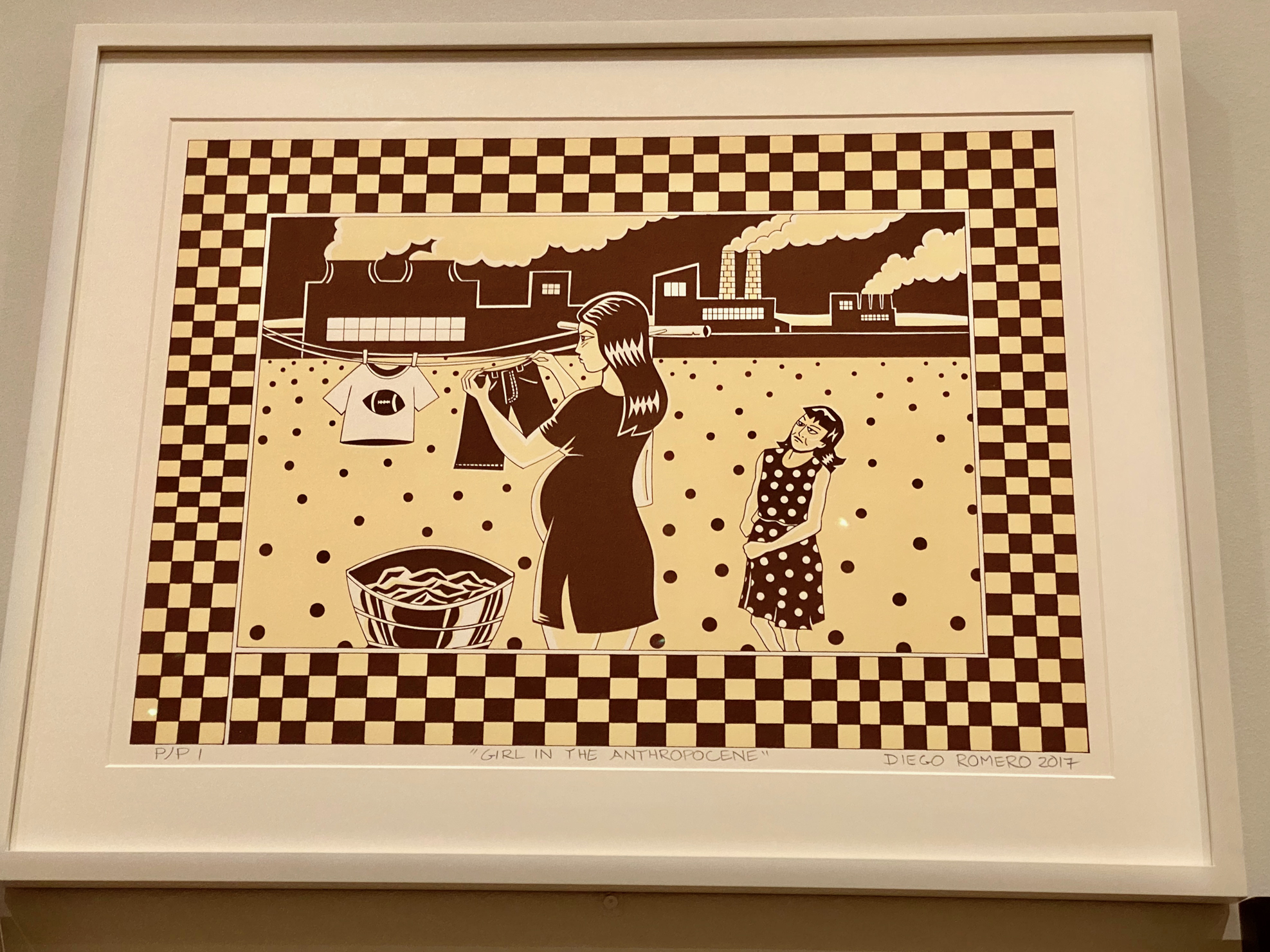
Some artists mix impressions of modern life with tribal lands, such as satiric works by Diego Romero (Cochiti Pueblo) and stylized symbols in a monoprint by Joe Fedderson (Colville Confederated Tribes).
2017 lithograph Girl in the Anthropocene by Diego Romero (Cochiti Pueblo). Private collection
In addition to sculptures, paintings, and photos, Smith has also included pieces made for fashion runways, live performances, and social protests.
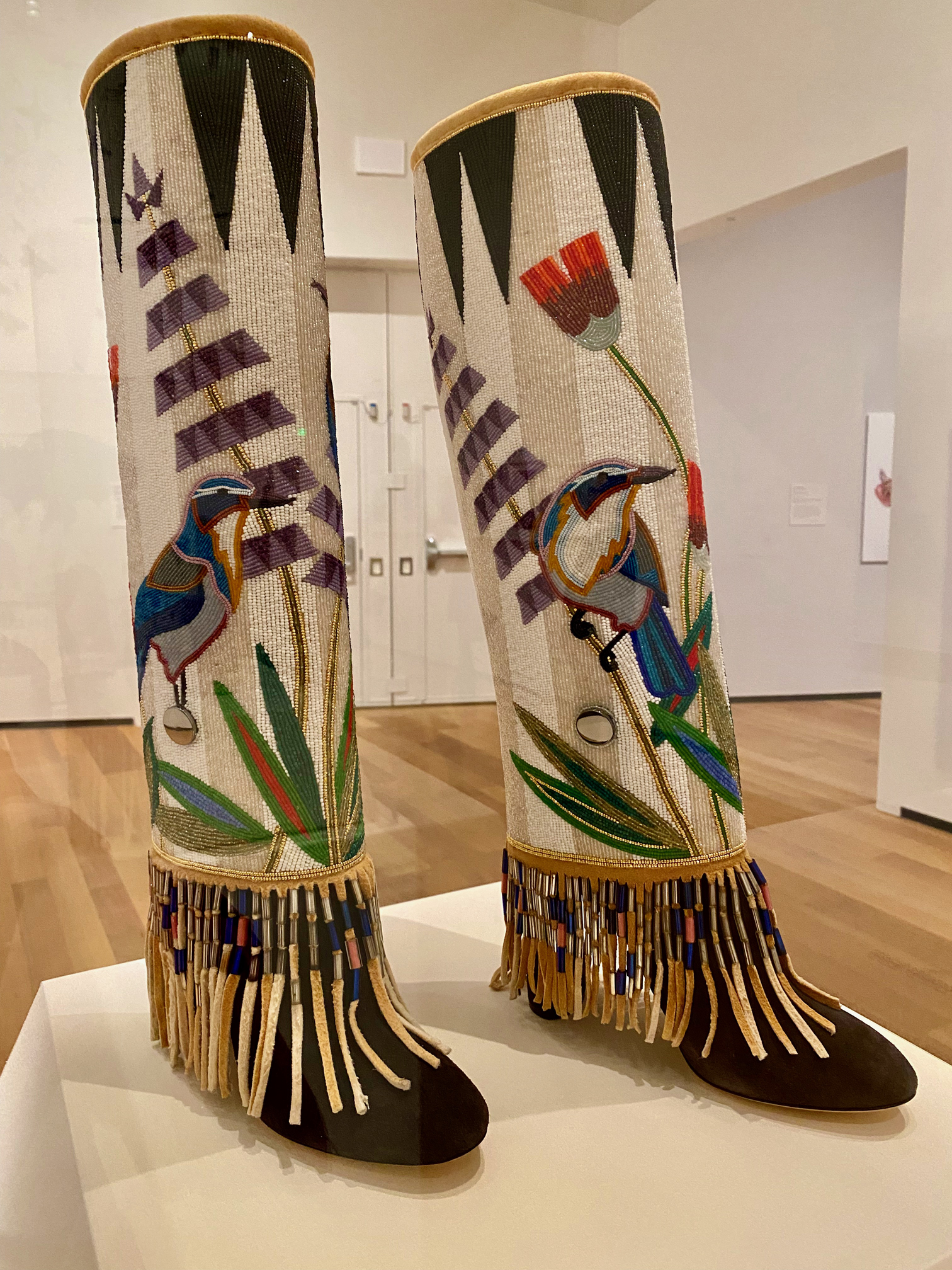
Fashion designer Jamie Okuma (La Jolla Band of Luiseno Indians) beaded her fringed fashion boots with a portrait of her family’s pet scrub jay.
Ten foot-long fiber seashell earrings designed for an interactive video and gallery performance by fiber and performance artist Eric-Paul Riege (Diné) are a reminder of the ancient trade networks that brought trade items from the ocean to the interior deserts.
2021 beaded and fringed Casedei boots by Jaime Okuma (La Jolla Band of Luiseno Indians). Courtesy: Dartmouth College’s Hood Museum
2020 mixed-fiber installation jaatloh4Ye’iitosoh [3-4] by Eric-Paul Riege (Diné). Courtesy: Tia Collection.
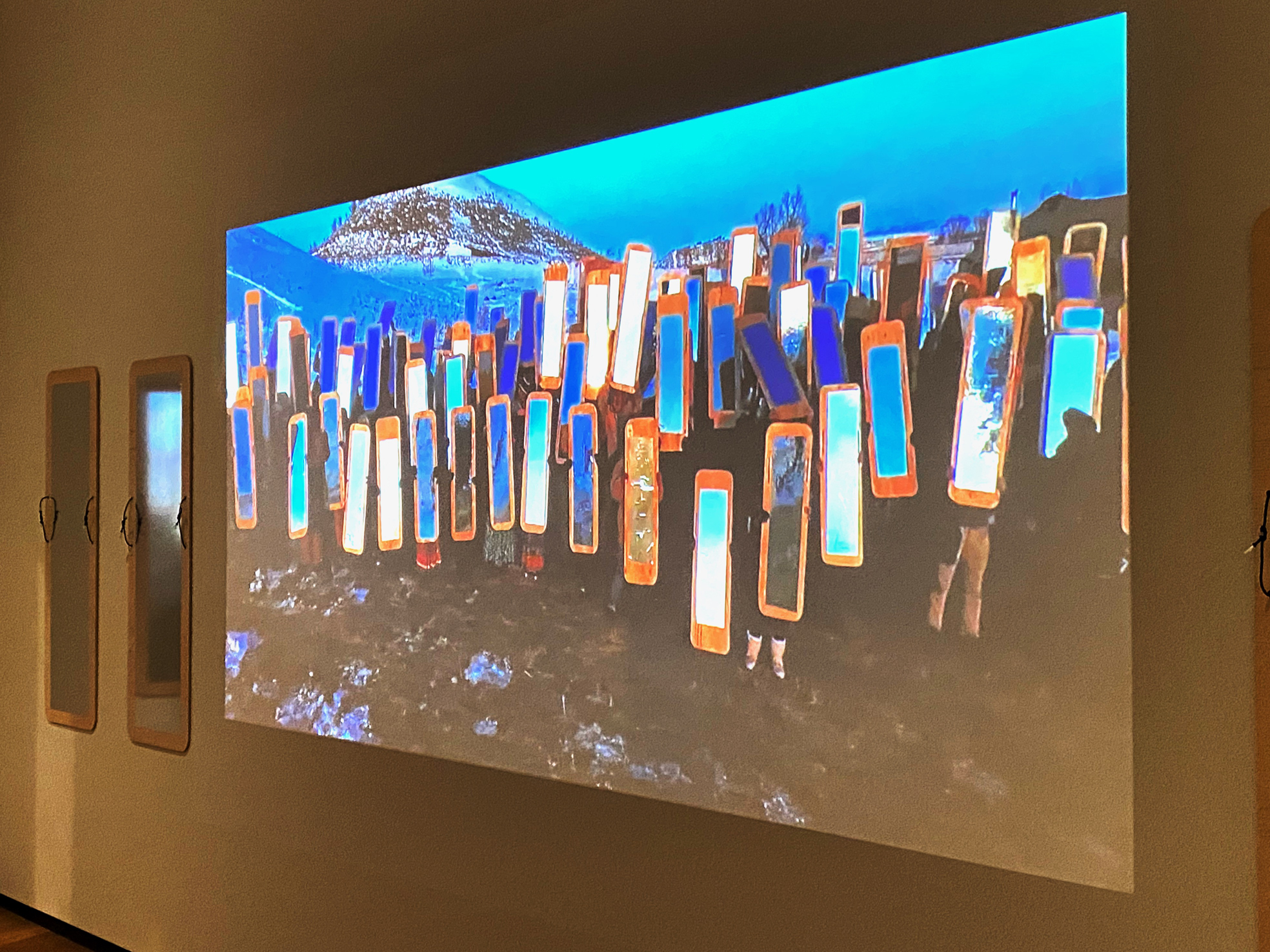
A wall of “mirror shields” were mounted by artist-activist Cannupa Hanska Luger (Mandan/Hidatsa/Arikara/Lakota), showing just a small sample of the 1,000 protective and reflective shields made by people to help water protectors during thre 2016 pipeline intervention at Standing Rock Sioux Tribe Reservation, Luger’s childhood home. Take a look at Luger’s instruction video here.
The shields served to protect the peaceful protesters from rubber bullets and water cannons, and reflected images of the security forces back to them. The crowd-sourced shields were also used in a social-action performance piece at Standing Rock.
2016 mirror shields and video for Mirror Shield Project – River (The Water Spirit) by Cannupa Hanska Luger (Mandan/Hidatsa/Arikara/Lakota). Courtesy: the artist, Garth Greenan Gallery.
Textiles and vinyl drawings also pack a punch in this show. Take a look at the dazzler woven by Melissa Cody (Diné), who draws inspiration from video gaming and the matriarchs of Navajo Nation. Watch her interview from her recent exhibition at MoMA PS1.
Here, John Hitchcock explains how his room-sized drawing, Impact vs. Influence, incorporates his influences – nature, family, Native beadwork, and the next-door military base:
Take a look the National Gallery’s trailer and meet the 50 contemporary artists whose work and relationship to the land is celebrated in the show:
The curators have gathered loans from private collections, museums, individual artists, and big-name galleries to give visitors a decade-by-decade chronicle of the people, families, maker innovations, and contemporary-art trends that converged to showcase works from one the most exciting confluences of creativity in the United States.
Santa Clara artist Nancy Youngblood’s 2018 polished pottery jar (best of pottery category award), granddaughter of Margaret Tafoya. Courtesy: private collection.
The items in the show – traditional pots, dazzling Navajo weavings, whimsical figurines, elaborately embroidered accessories and clothing, social-commentary photos and paintings – are so compelling that it takes two or three visits to actually focus on the thoughtful, illuminating text that accompanies each portion of the show.
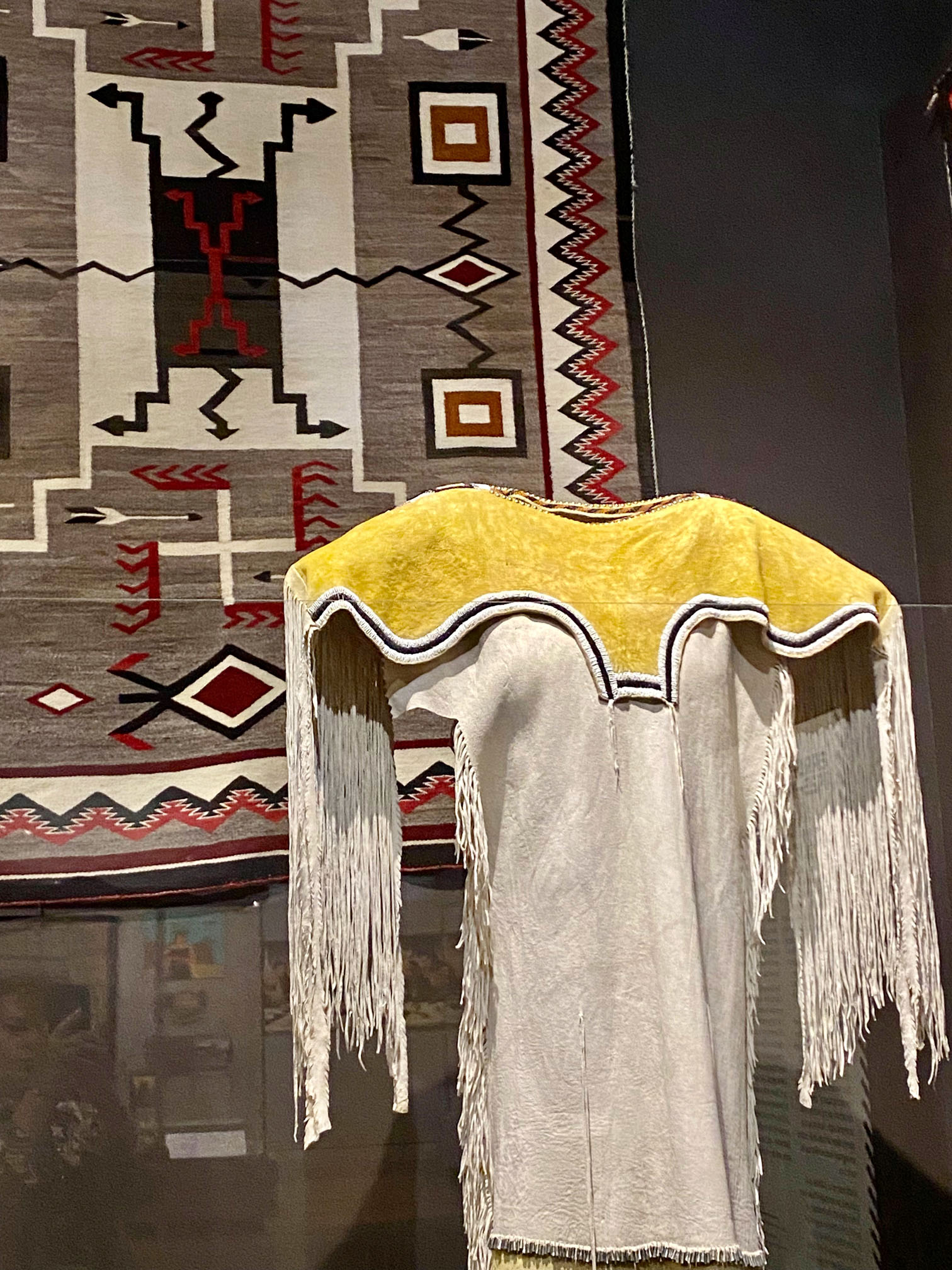
Embellished 1890 buckskin Apache/Ute dress; behind, a 1925-1930 Navajo rug. Courtesy: Cowboys and Indians Antiques, Historic Toadlena Trading Post Museum.
The organizers have provided a revealing chronology of the politics, economics, and social context of each decade of the arts festival, noting changes in the people, processes, power, and patronage over time.
The first gallery brings you back to the earliest days of the market – a time when there were no Indian curators or judges (unlike today!) and when Native makers were not even allowed to sell their own work or interface directly with non-Native buyers.
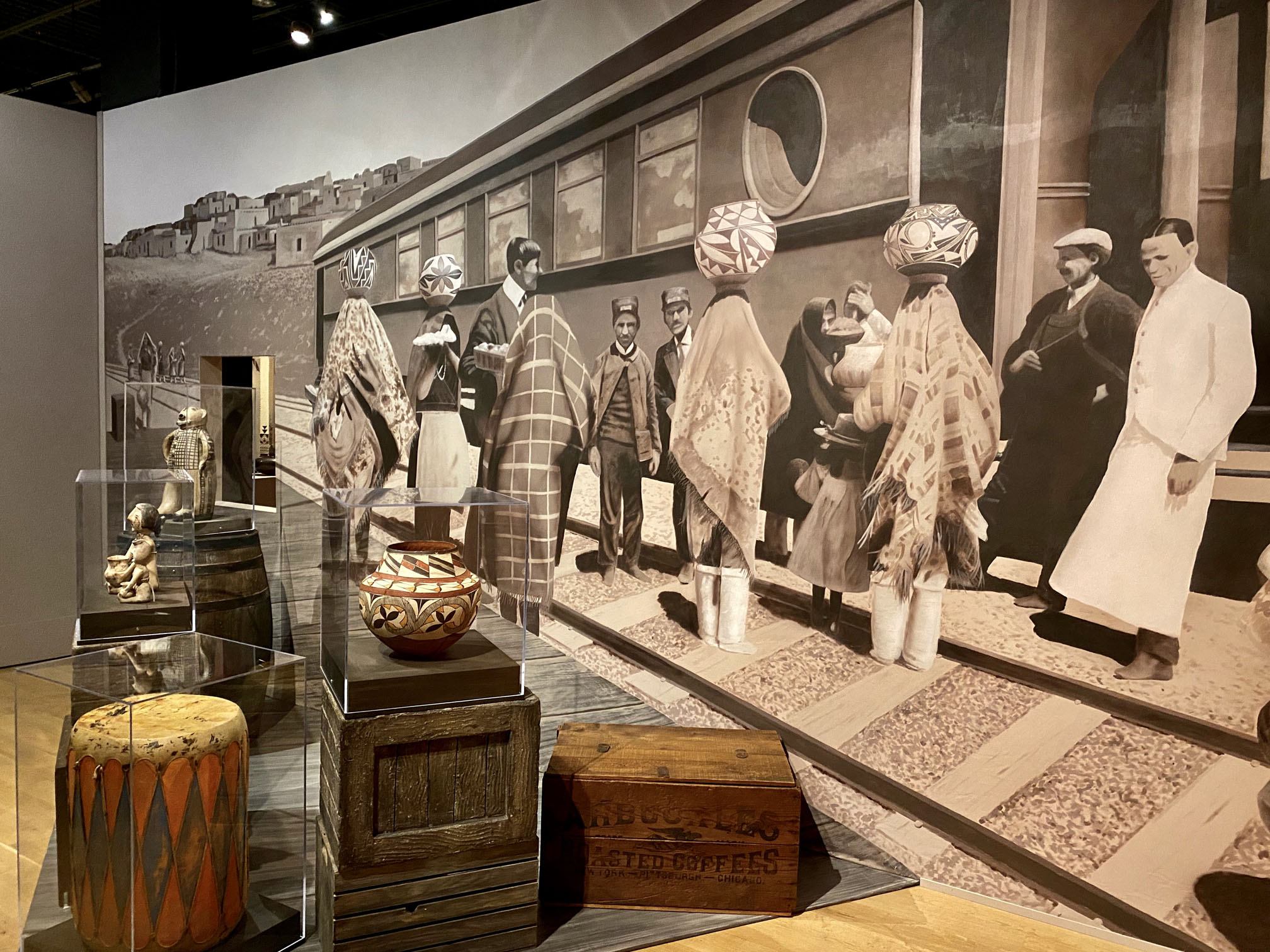
The wall mural harkens back to the days when Pueblo people sold their pots and creations to tourists along the railroad, which in the late 1890s and early 1900s brought curious travelers, East Coast dandies, and traveling showpeople out to the Western badlands.
David Rock’s mural with early Native-made collectibles – early 1900s pottery and 1920s drum.
Turn-of-the-century tom-toms, curios, and older pots are displayed near the rail-top mural; Navajo rugs and beaded moccasins from the period are arrayed across the way. It’s an arrangement that evokes what might be displayed in an old trading post, or at least in the early 1920s Santa Fe markets.
Many of these makers in New Mexico were still living on their ancestral lands, but across the United States, the majority of Indigenous populations had either been relocated to reservations or boarding schools.
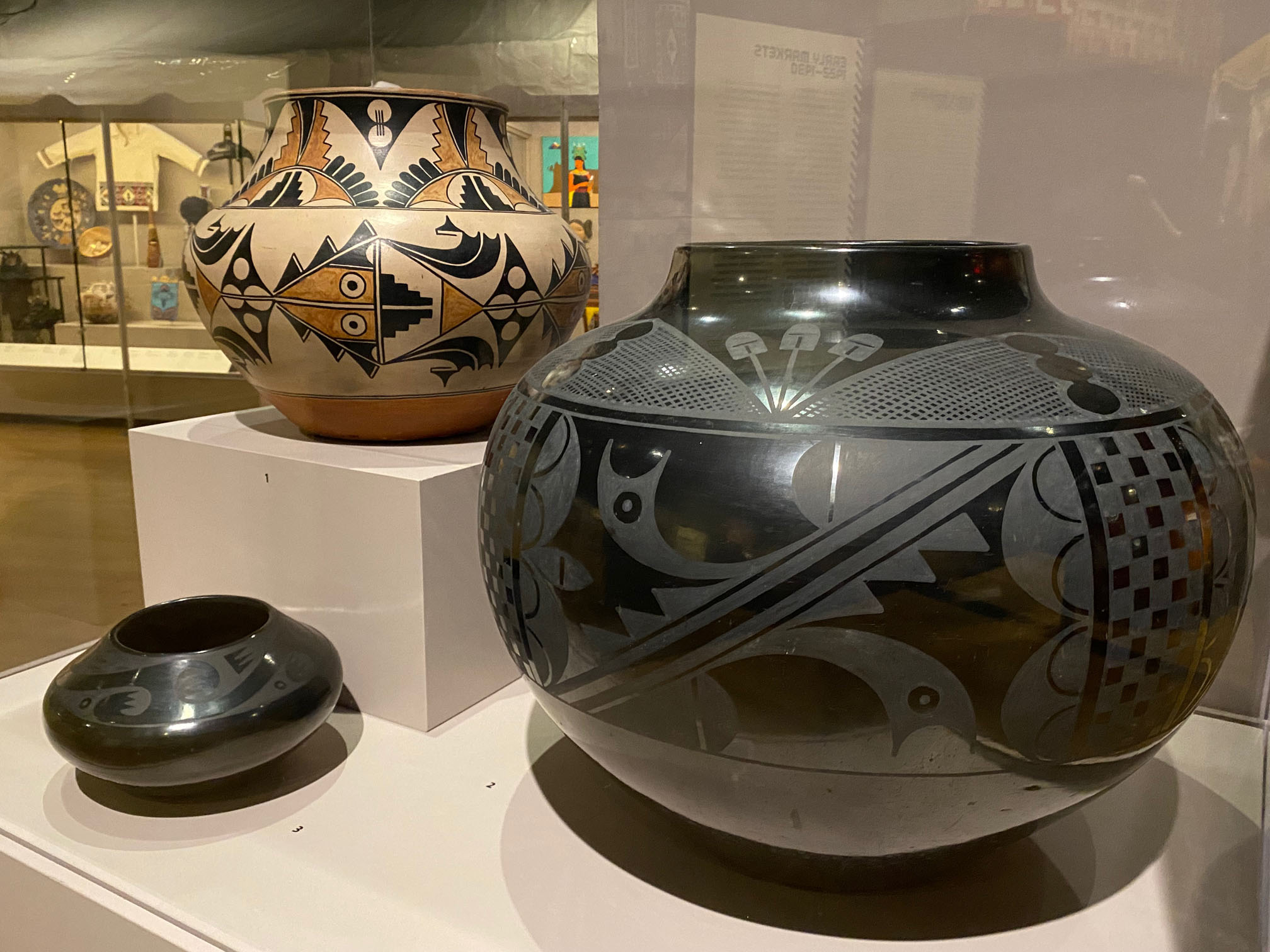
The inter-generational mastery of New Mexico’s Pueblo artists is featured in several vitrines holding examples of black-on-black (and other) masterworks by the Martinez family at San Ildefonso (go, Maria!) and the Tafoyas of Santa Clara, with Margaret’s famous bear-paw imprints.
Work by famed San Ildefonso artist Maria Martinez: 1922 polychrome, large 1942 black pot (award-winner painted by Julian Martinez); and 1928 jar. Courtesy: MICA, SAR
The surrounding gallery features dazzling painted pottery works by Zuni and Acoma from the 1920s – all drawn from the School for Advanced Research (SAR) collection, which began in 1922 to preserve classic works, SAR is the source of the acclaimed exhibition now at the Metropolitan Museum, Grounded in Clay: The Spirit of Pueblo Pottery. Sometimes the artists who made the pot is known; but often the maker is lost to history.
1928 Acoma jar. Courtesy: SAR
In the 1930s and 1940s across the United States, tribal mortality rates increased and their other economic lifelines decreased. But these conditions in the Southwest made the Market an even more important source of family revenue. Throughout the 1940s, the Santa Fe Market boomed.
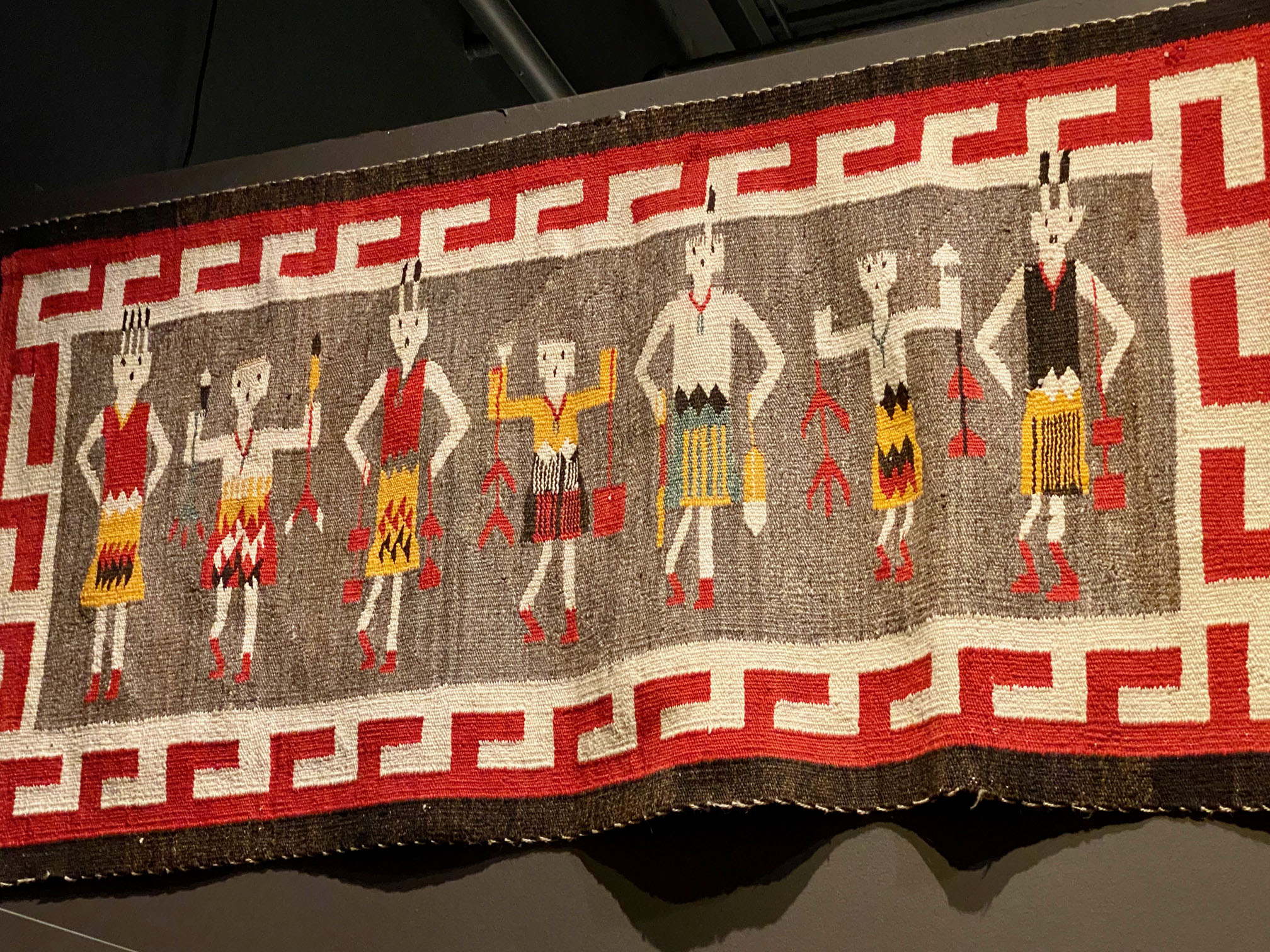
1920-1930 Navajo hand-spun wool rug with figures representing the fire dance. Courtesy: Historic Toadlena Trading Post Museum.
By the 1950s, Federal government instituted policies to encourage Indians to leave their land and move into cities. Unfortunately, Santa Fe Indian Market policies had the same depressing effect – the organizers reduced both the number of artists allowed to show and amount of prize money that could be won.
By 1959, the SF Indian Market was on life support, with a few private donors stepping in with funding just to let it survive.
But during the 1960s, changes were afoot. The Institute for American Indian Arts began in Santa Fe, where Lloyd Kiva New gave Native artists “permission” to throw off traditional conventions and make contemporary art. Across the United States, social-justice movements focused on indigenous people’s rights demanded policy changes to reverse the impact of oppression. By 1968, Congress had passed the Indian Civil Rights Act.
What did that mean for the Market? The majority of works on display in the museum gallery are from the post-1970s period, when the scope, range, voice, virtuosity, and experimentation reflected the times.
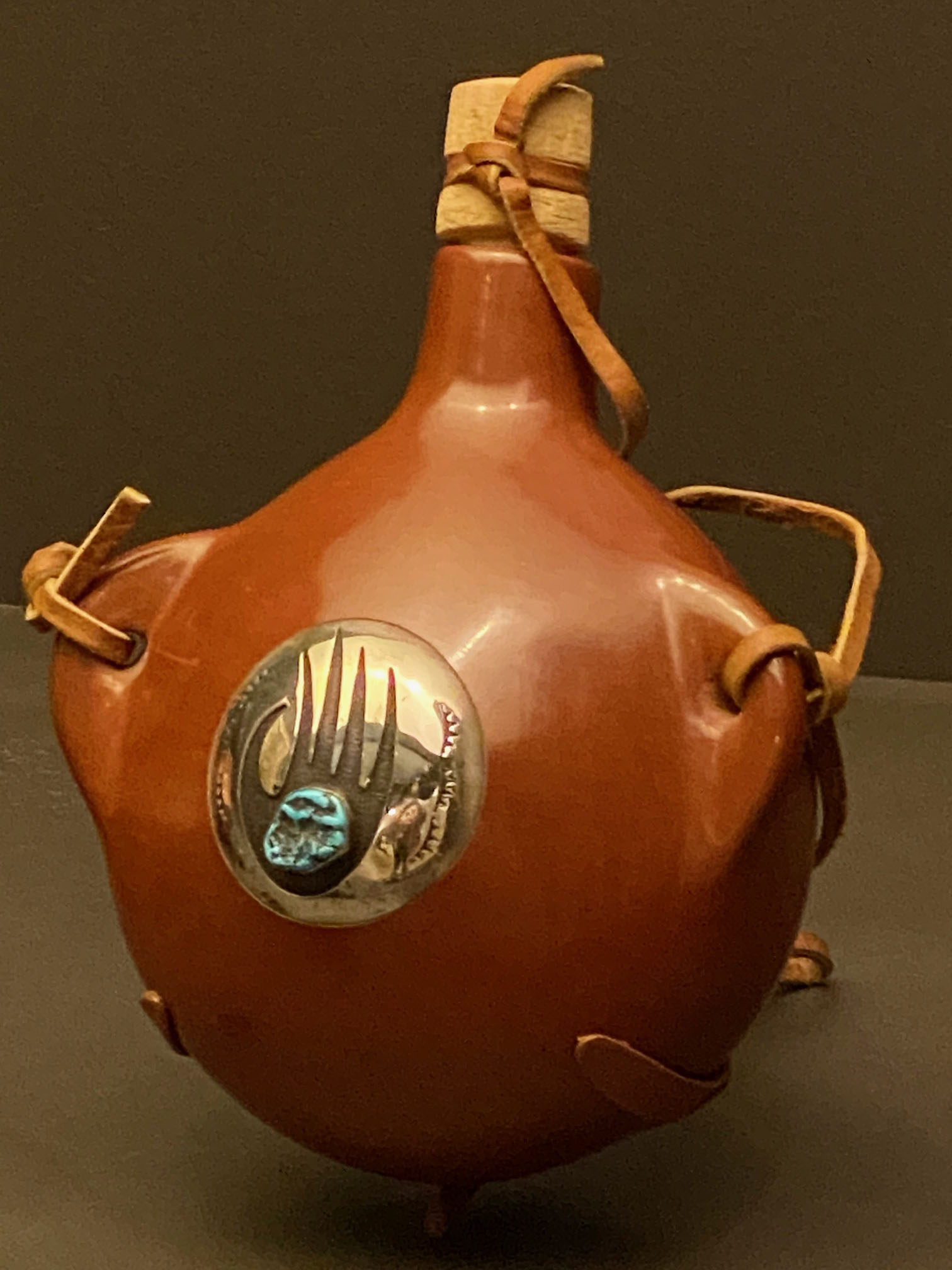
1974 pottery canteen with turquoise and silver by San Ildefonso artists Rose Gonzales and Tse Pe. Courtesy: private collection.
Here are some examples – the glorious, gleaming, turquoise-inlaied 1980s vessel by by Zia/Jemez/San Ildefonso artist Dora Tse Pe and the virtuoso painting on a jar by by Acoma artist Dorothy Toriio.
1980s pottery jar by Zia/Jemez/San Ildefonso artist Dora Tse Pe. Courtesy: private collection.
1990 pottery jar by Acoma artist Dorothy Toriio. Courtesy: King Galleries.
Or, consider the virtuoso silverwork and inlaid belt by Aleutian master Denise Wallace; edgy, theatrical 1990s Cochiti figurines by Virgil Ortiz; and a 1999 horsehair basket woven by Tohono O’odham artist Leona Antone. See more in our Flickr album.
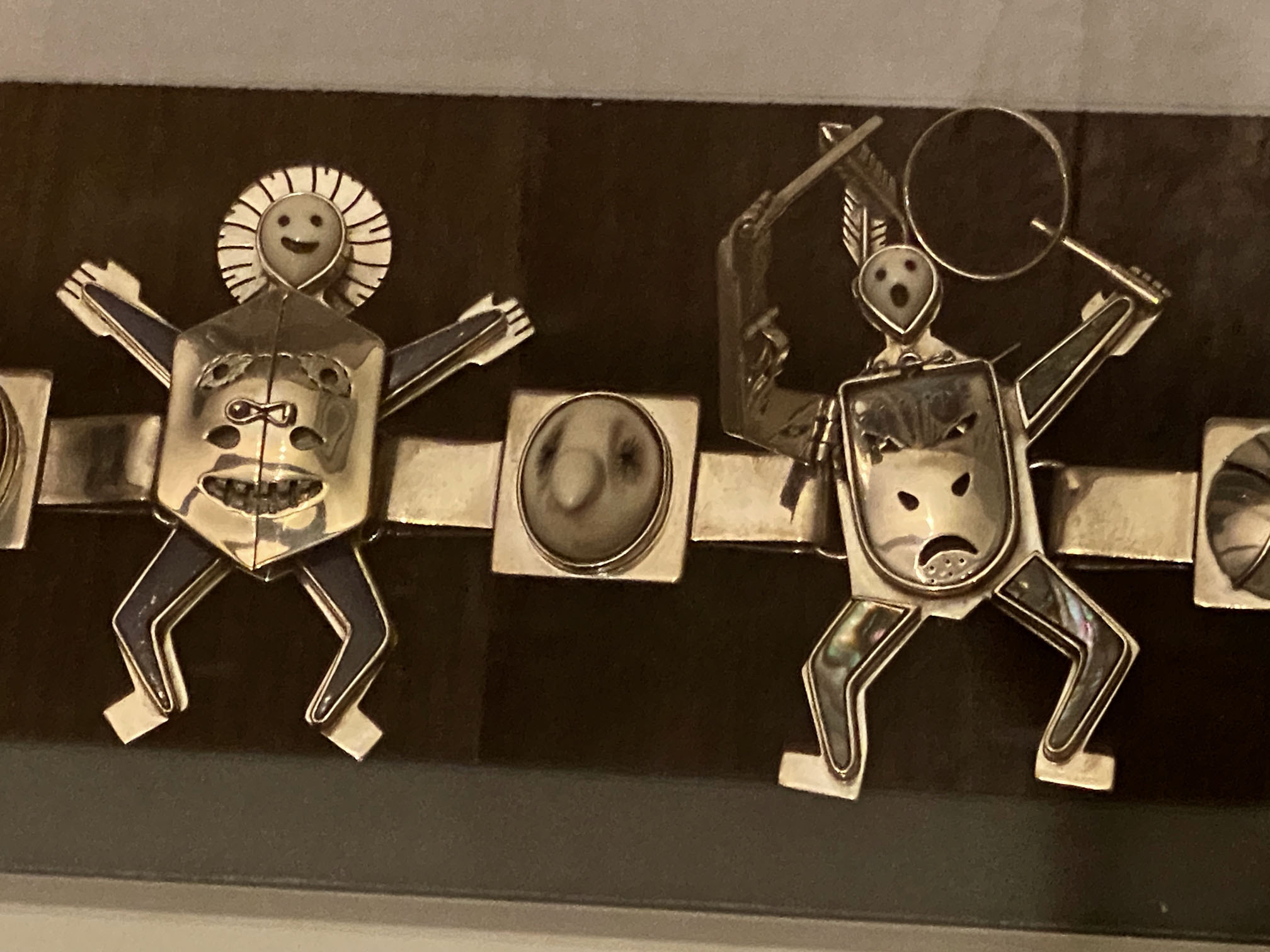
Silver 1986 “Aleut Dancer Belt” by Aleut artist Denise Wallace with abalone, fossil ivory, and lapis; Best in Non-traditional Jewelry Award. Courtesy: private collection.
The show’s finale catapults the story of Indian Market into the future. First, there’s a cluster of sculptural and video works by Virgil Ortiz, featuring his sci-fi, super-powered, time-traveling warriors from the future who travel back to 1680 to fortify the success of the Pueblo Revolt and save Pueblo culture.
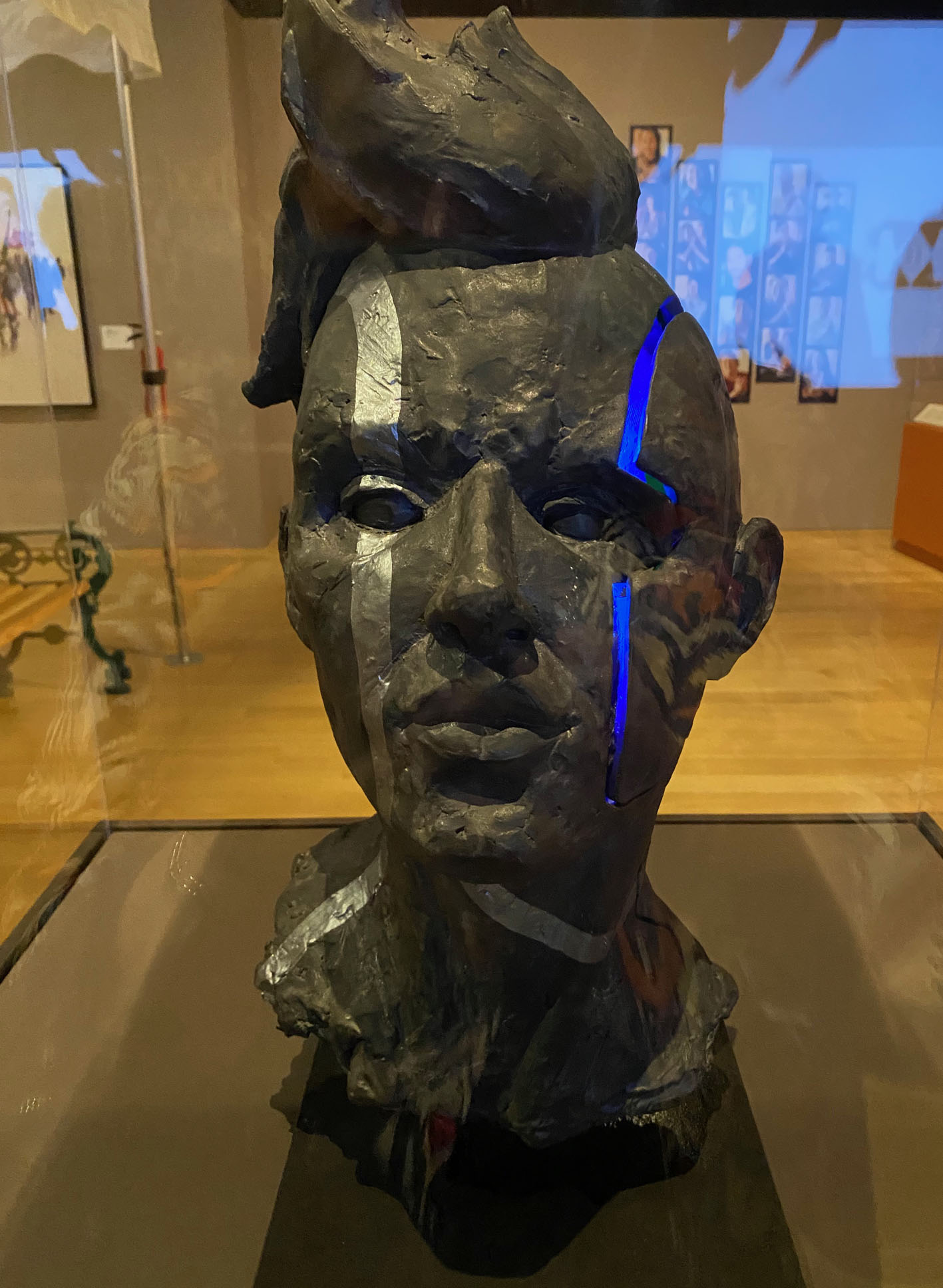
“Kootz (Runner-twin brother of Tahu)” 2018 high-fire clay sculpture with “warning” LED lights by Cochiti artist Virgil Ortiz. – a character from his sci-fi 2180 ReVOltage Series. Courtesy: the artist
“Tahu (Blind Archer)” 2018 sculpture with LED lights by Cochiti artist Virgil Ortiz.. Courtesy: the artist
Second, there’s a photo wall of families and their young children, who create work to enter in to the children’s division. It leaves visitors with the strong feeling that not only will forward-looking artists keep innovating and creating, but that the kids will be all right.
Still of 2022 “Made in Native America” video by Cochiti artist Virgil Ortiz, featuring sci-fi costumes. Courtesy: the artist
What happens when a Native American MacArthur genius is asked by SITE Santa Fe to create an art exhibition during a time of a global pandemic and social justice marches? And invite him to a location where Native Americans make up a significant percentage of the population?
The result is Jeffrey Gibson: The Body Electric – a constantly surprising gallery journey where shape-shifting, cultural disassociation, beadwork, kitsch-image appropriation, gender-identity questions, and science-fiction inspiration reigns.
The show is filled with life-size beaded dolls and garments, films, pulsing papered walls, mysterious film experiences, and social statements either woven or stamped onto clothes (or are they banners?).
Gibson’s 2021 White Swan mixed-media painting in wall-papered gallery with a beaded, life-size, genderless “doll”
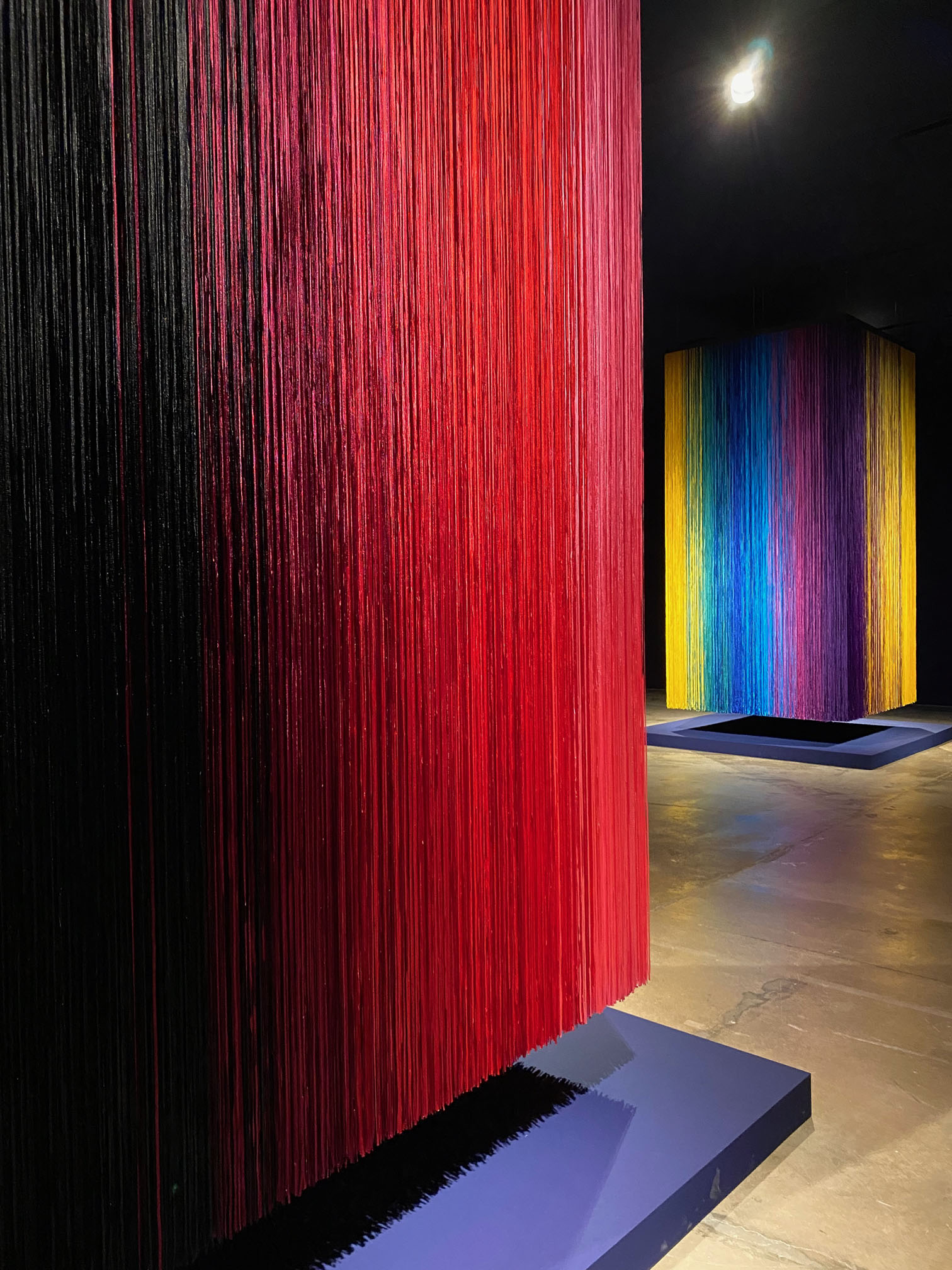
2020 Red Moon and Desert Sky minimalist sculptures created from strands of dance fringe.
Gibson, who is based in New York, is an intertribal artist who is a member of Mississippi Band of Choctaw and half Cherokee. However, his influences were forged from prestigious art schools, international travel, and living in non-Native societies.
The opportunity to come to Santa Fe, host a cinema series and several performances, and stay out West for a while was an open door to explore inter-cultural influences, host discussions with appreciative audiences, and show off his wide intellectual and artistic breadth.
In many of his works, Jeffrey mixes traditional “Indian” materials like beads or fringe with slogans, sayings, dime-store “Indian” images, and big-time art-world references.
See some our favorites from this exhibit in our Flickr album and hear Jeffrey explain his influences in SITE Santa Fe’s audio guide.
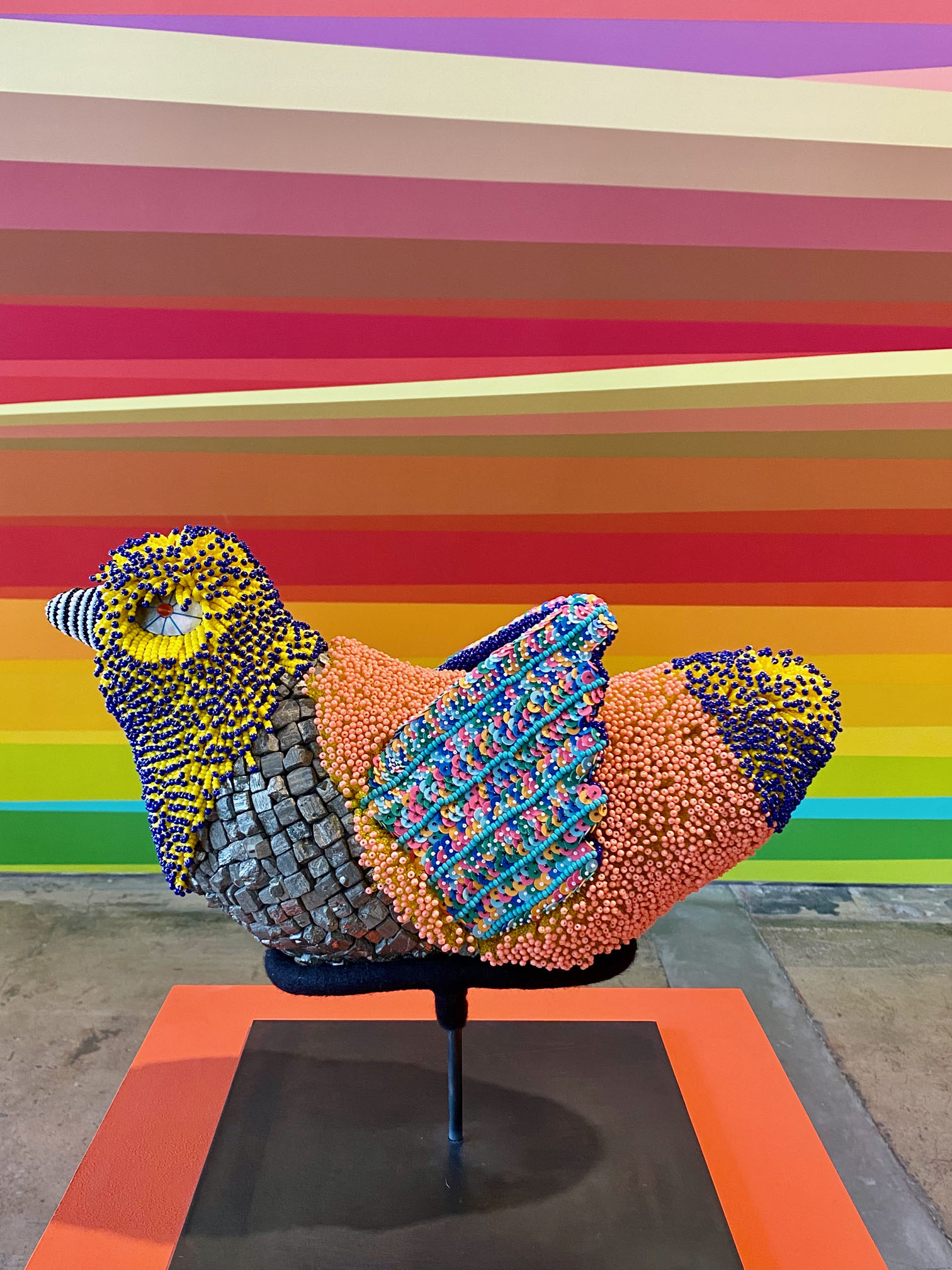
The little beaded birds that greet visitors in the first gallery and the big beaded life-sized “dolls” in the second were inspired by Jeffrey’s early work in the ethnographic collections of the Field Museum, where he encountered Haudenosaunee-made beaded tourist-trade whimsies and traditional “third gender” dolls for the first time. Why not make his own, but over-size them?
2021 My Joy My Joy My Joy, a mixed-media beaded bird inspired by Victorian-era Native American tourist whimsies
The nearby video gallery features a kaleidoscopic multichannel video of Sarah Ortegon, an award-winning Eastern Shoshone/Northern Arapaho jingle dress dancer, performing to the energetic Sisters track by A Tribe Called Red. This piece – She Never Dances Alone – refers to the dancers who came to the Standing Rock Reservation and lent their support to the 2016 pipeline protests though dance.
Here’s Sarah Ortegon in Gibson’s 2019 Times Square installation of She Never Dances Alone here…wait for it:
2021 They Play Endlessly mixed-media crazy quilt of paint, beads, words, and found objects.
And here’s another look at Gibson’s 2020 exhibition at the Brooklyn Museum, where he mixed works from his studio with artifacts and art from Brooklyn’s own collection.
And check out Gibson’s work our album documenting the Smithsonian’s National Museum of the American Indian exhibition of Native painting, Stretching the Canvas, which is on display for the long term.














 itsnewstoyou