Top of the Pop 80s Style at NY Historical

Keith’s “Into 84” exhibition poster inspired by choeographer Bill T. Jones (1983). Photo: Tseng Kwong Chi. © Muna Tseng Dance Projects, Inc.; Keith Haring artwork © Keith Haring Foundation

Keith’s “Into 84” exhibition poster inspired by choeographer Bill T. Jones (1983). Photo: Tseng Kwong Chi. © Muna Tseng Dance Projects, Inc.; Keith Haring artwork © Keith Haring Foundation

When you stand in line to get your tickets for The Armory Show at 100 at the New-York Historical Society, look up and you’ll see a piece of history from the era of Madonna and Danceteria right above you – the entire beautiful, embellished ceiling of one of the must-see stops during the raging Eighties club culture in NYC, Keith Haring’s Pop Shop as part of the special installation Keith Haring All-Over.

Although the Pop Shop closed its doors on Lafayette Street in 2005, it achieved worldwide pop-culture recognition for being the most iconic sites where art, music, dance, graffiti, celebrity, and the street mixed. Haring, whose Radiant Baby and other works ubiquitously plastered subway station walls in the 80s, decided to put Warhol’s commerce-as-art philosophy into practice. He created an art-filled shop downtown where the international art collectors, celebrities, club kids, and graffiti artists would feel comfortable.

Installation view of the Pop Shop ceiling over the cash registers at NYHS, right behind a video wall of Oertel’s Pulling Down the Statue of King George III. Courtesy: NYHS/John Wallen

Installation view of the Pop Shop ceiling over the cash registers at NYHS, right behind a video wall of Oertel’s Pulling Down the Statue of King George III. Courtesy: NYHS/John Wallen

The walls were covered in Haring’s instantly recognizable doodle-cartoon figures and stuff to buy, so when the Haring Foundation gave the ceiling to NYHS, it did so with the stipulation that it be hung somewhere where money is exchanged.  So, right inside the door in the same beautiful entrance hosting the treasures of Revolutionary New York, is the ceiling from a place where music blared, fun was had, all-night parties raged, and Downtown 80s life was celebrated.

Take the elevator to the Luce Center to see the rest of the show, which is on loan to NYHS by the Haring Foundation, which Keith established just before he succumbed to AIDS in 1990. Go to Keith’s website to see him in action in the subway, galleries, and performance and click through images of his amazing body of work in digital form by decade. It’s all here.
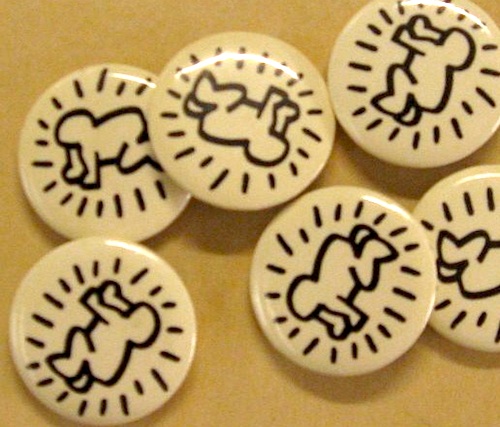
Keith’s “Radiant Baby” buttons in the NYHS collection, gifted by Roy Eddey.

Keith’s “Radiant Baby” buttons in the NYHS collection, gifted by Roy Eddey.

But back upstairs at NYHS, you’ll see Keith’s 1985 repeated-pattern design for a fabric run right above two NYC mile markers from the 1800s, a Haring-painted black-and-pink leather jacket (done with graffiti artist LAII), and Jeremy Scott’s Haring-inspired sneakers for Adidas. The NYHS is also screening some vintage video in the little 80s space, right next to the classical busts of New York’s 19th century high and mighty. Hang out to see Madonna’s 1984 performance of Dress You Up for the Keith’s Party of Life and the 1986 Grace Jones video I’m Not Perfect (But I’m Perfect For You), which Keith co-directed.

The show is tiny, but it’s a great little secret spot to time travel back to the Eighties. For more Keith, visit the Fales Library at NYU for Keith Haring: Languages through February 28 and NYPL’s Why We Fight: Remembering AIDS Activism through April 6. The NYHS installation is an open run.

Hey, and don’t forget to shop in the online Pop Shop, where revenue from (RED) items goes to combatting AIDS.

Must-See Skytop Panorama of NYC Past & Present at The Whitney

The installation view of T. J. Wilcox: In the Air, 2013. Photo: Bill Orcutt
The installation view of T. J. Wilcox: In the Air, 2013. Photo: Bill Orcutt

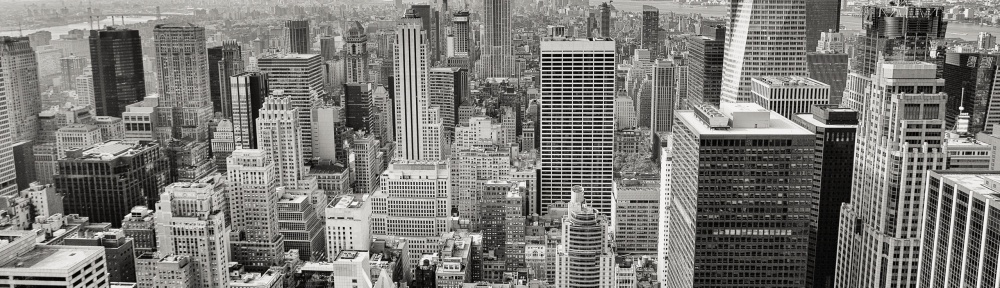
If you want to enjoy a beautiful view of Manhattan from the roof, don’t worry about the snow, rain, or cold weather. Go over to the Whitney Museum before February 9 and take in the film installation T.J. Wilcox, In the Air, that features a beautiful panorama (from the roof of Wilcox’s Union Square studio) that dreamily introduces six stories about the past and present of life, art, energy, fame, events, and cosmic forces that ebb and flow continuously below.

The big, in-the-round screen circles around you (duck and just walk into it), so you can really take in the view, all the way from the Battery to beyond the Empire State Building.

Still from T.J. Wilcox’s panoramic 2013 silent film installation, In the Air. Image courtesy of the artist and Metro Pictures.

Still from T.J. Wilcox’s panoramic 2013 silent film installation, In the Air. Image courtesy of the artist and Metro Pictures.

The film cycles from dawn to dusk, but along the way, Mr. Wilcox takes you on little journeys as you enjoy his movie panorama. The experience is one where you begin to see New York through his eyes, past and present together.

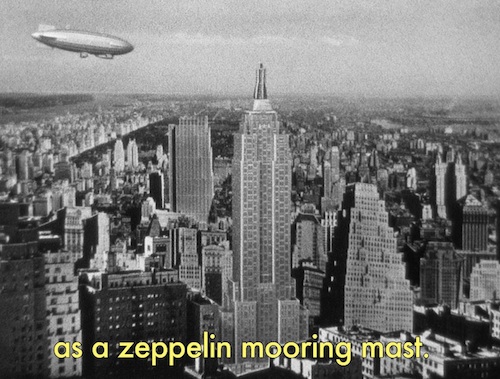
After a few minutes, one of his panorama screens fades you see a short, reflective, poetic, subtitled NYC story-movie. It’s a quiet experience — bringing you back to the Thirties when the Empire State Building was contemplated to be used as a zeppelin-docking station, to the present when 14th Street is one of the best vantage points to contemplate the out-of-this-world spectacle of Manhattanhenge, and the days of glitter, glamour, and grit of Warhol, Gloria Vanderbilt, and fashion-industry icon, Antonio Lopez.

Watching Wilcox’s Gloria Vanderbilt vignette from outside the installation. Photo: Bill Orcutt.

Watching Wilcox’s Gloria Vanderbilt vignette from outside the installation. Photo: Bill Orcutt.

He reminds you that Gertrude Whitney, the museum’s founder, long ago succeeded in a custody battle to care for little Gloria. The film takes you to her apartment and reflects on the fact that Gloria was “in the public eye from birth” and celebrates her vibrant artistic, business, and family accomplishments (re: plenty of shots of Anderson Cooper). Another mini-film focuses upon a nano-second in Warhol’s life, when his Factory crew unfurled Mylar balloons to welcome the arrival of the pope-mobile to New York City in 1965.

Weegee’s Variant of Untitled (Striking Beauty) is hung in an adjacent gallery. Courtesy: Whitney Museum

Weegee’s Variant of Untitled (Striking Beauty) is hung in an adjacent gallery. Courtesy: Whitney Museum

In his musing on the film about fashion-illustrator extraordinaire, Antonio, Wilcox reveals his surprise that Antonio’s studio was located right next to his own building, takes pleasure in asking us to gaze out over the community where so much magnificent art was made, careers enlivened, and life lived.

In a tiny back-room gallery, the Whitney has installed a few other reflections on skies over the City – Weegee’s lightening strike behind the Empire State Building and Yoko’s Sky TV, are two – but the big “wow” here is Mr. Wilcox’s ability to take us on a 35-minute journey in and among the streets and skyline that from his quiet, contemplative perch.

It’s quite a collage of memory, reflection, mythologies, politics, history, and beauty. Click here to see the Whitney’s slide show of the storyboards in Wilcox’s studio, and listen to him talk about it this beautiful work in this YouTube video:

Wool Smart Art Covers Guggenheim

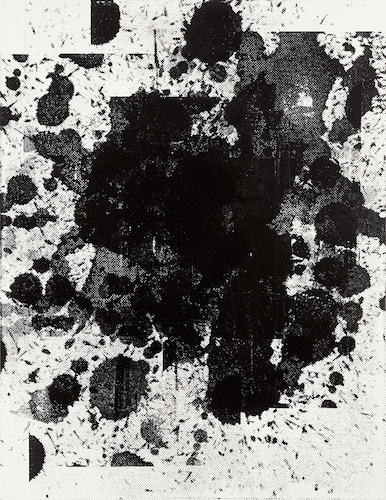
Wool’s untitled 2000 work, silkscreen on linen on the top-floor gallery. © Christopher Wool

Wool’s gigantic 2000 silkscreen installed on the top-floor gallery, a cool, hands-off approach to large-scale work. © Christopher Wool

The Saturday night art crowd packing the free Guggenheim night for the last weekend of the Christopher Wool retrospective was drinking in the cool, edgy dissonance of this savvy, art-world action artist. Check it out in person before January 22, or download the new free Guggenheim app and take the tour on your iPhone.

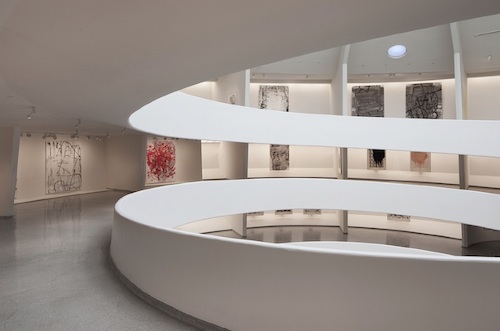
Gazing down from the third or fourth floor, the smooth rungs of Mr. Lloyd-Wright’s spirals punctuate tiers of Mr. Wool’s own spirals, splatters, wipe-outs, word art, and grids of gritty photos. The massive crowd of locals, tourists, and moms with tweens provided a lively audience for work originally germinated in the rough-and-ready Lower East Side during the days when NYC was not-so-nice.

Just up the ramp in the two-story mini-gallery, the curators hung pieces that sum up Wool’s lifetime achievements – large-scale enamels on aluminum using gigantic, ironic gestures and banal advertising-art flowers; channeling the down-and-out feel to 80s New York with cool word-and-letter art evoking graffiti; and appropriating phrases from revolutionary texts that seem to be about one thing but are actually heady philosophical and literary references that only super-smart people would “get.” The work is stunning.

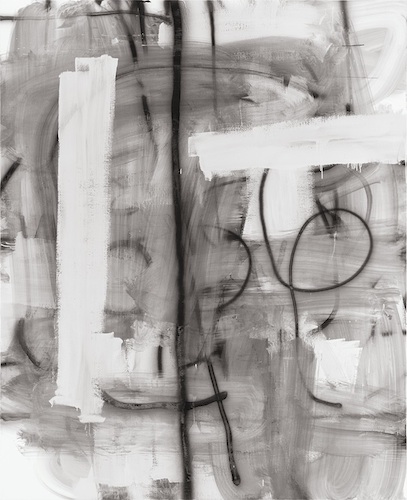
Wool’s 2010 untitled enamel on linen uses erasures, spray, and wipeouts. © Christopher Wool

Wool’s 2010 untitled enamel on linen uses erasures and spray. © Christopher Wool

Then a slightly more chronological journey begins through the rest of the museum. Wool began appropriating rollers used by painters to paint tenement walls and halls to apply decorative patterns methodically across his own giant canvases – taking a bit of the decision making out of the act of painting. At the time, it was an in-you-face comment directed toward more lyrical, or expressive gestural painters. Of course, he would screw up the pattern just a little to add a little extra dig at the current scene. Oh, yes, he mostly kept the color palette to black and white. Smack!

By 1987, he injected letters, words, and texts onto the white canvases and began collaborating with other artists in the “no wave” Downtown scene, which was rife with 8mm filmmakers, performance artists, and musicians reacting against the more commercial artists emanating from CBGB or other clubs. He collaborated making books, always an ephemeral, revolutionary choice.

Hydrant photo that resembles the above work, from East Broadway Breakdown, one of 160 inkjet prints, 1994–95/2002. © Christopher Wool

Hydrant photo with spilled water whose shape resembles the silkscreen above. Photo from East Broadway Breakdown, one of 160 inkjet prints, 1994–95/2002. © Christopher Wool

In the 1990s, the street was used as a start point for both his own photo books, which were shots of lonely urban areas that he photocopied over and over to obtain the I-don’t-care-about-glossy-quality look of the published work. When accessing the iPhone audio track in front of the 1990s photo piece, East Broadway Breakdown, Mr. Wool and the curators pretty much knock your socks off by blasting the superb Nation Time by Joe McPhee right through the earbuds. Thanks to them, you can hear the masterwork music that inspired Wool at the time, jolting you back the mean streets of Chinatown and East Broadway that sparked so much creative juice.

Installation view of Wool’s provocative all-word 1989 Black Book Drawings. Photo: David Heald.

Installation view of Wool’s provocative all-word 1989 Black Book Drawings. Photo: David Heald.

The top rungs of the show are gorgeous, even though that was probably not the original intent – cool, monumental works that are layered, blotted out, white-washed, and splattered over. If a line is blotted out, do you still see the line? If you do your painting on rice paper, is the end result different than when you do it on a canvas?

When you get to the final gallery way, way up top, Wool has digitized fragments of many of these earlier gestural images and silkscreened them onto the giant pieces of stretched linen. Very, very cool and covered in micro-dots from the silkscreen mesh. Check out the works on the Guggenheim website.

Stunning installation of Christopher Wool’s work in Mr. Wright’s building. Photo: David Heald.

Stunning installation of Christopher Wool’s work in Mr. Wright’s building. Photo: David Heald.

If you don’t know Wool’s work, using the iPhone guide provides a valuable context, showing you the works while you listen to the audio and watch other artists talk about Wool. Access some samples here.

But most of the people we saw on Saturday were standing in awe before the gigantic gestural canvases without the aid of an interpretive guide. Thousands of people were examining the curator notes, and moving forward and back within Mr. Wright’s bays to take it in from all angles…the kind of slow, deliberate, thoughtful face-to-face encounters that Mr. Wool likely treasures from cool admirers.

Brooklyn Museum Shows What Rich Americans Buy to Impress

Cabrera

Miguel Cabrera oil (1760) of Dona Maria de la Luz Padilla y Gomez de Cervantes sporting velvet beauty marks and bling

Conspicuous consumptions is nothing new, according to the Brooklyn Museum’s spectacular show, Behind Closed Doors: Art in the Spanish American Home 1492-1898, and they’ve gathered (mostly from their collection) four centuries of blindingly beautiful stuff to show how earlier generations of status-seekers showed off how special and rich they were. Catch it before January 12.

The Fourth-Floor show fills two huge galleries that have been partitioned by the curators into areas corresponding to rooms in a traditional Spanish-American home, where they’ve displayed the stuff that the colonial high and mighty would have put there.  Although two-thirds of the United States was once under Spanish rule, the paintings, furniture, textiles, and other treasures you’ll see are from homes south of the border, including the Caribbean and south of the Isthmus. Check out our Flickr feed.

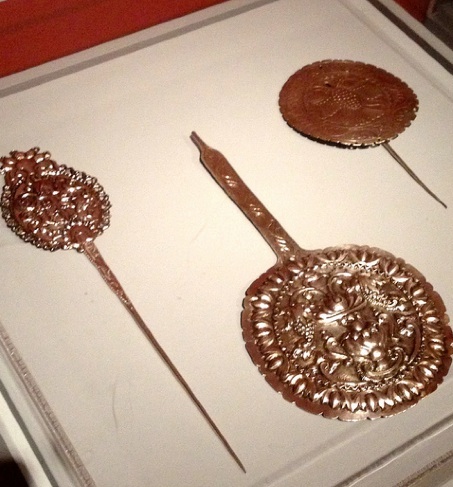
Silver Pins

Giant 18th century silver status pins for women, slightly Incan-style

First, you’d dress to impress and make sure that everyone knew that you were somehow aligned with the upper classes back in Spain. The show puts English and Spanish-American portraits side-by-side in the first gallery to illustrate that the latter weren’t shy about applying ostentatious tiaras and pearls to themselves, slapping on the velvet faux-beauty marks, and shoving royal proclamations into the frame to convey your wealth, status, and privilege. Wealthy English colonials and their portrait painters took a more austere, understated approach.

Second, if you were of mixed race but possibly had some Incan royalty in your blood, you’d hang gold-flecked portrait series of Incan chieftains where everybody could see them in your home. The lady of the house might wrap herself in a locally woven textile sporting mixes of South American deities with that oh-so-familiar-to-Europeans Hapsburg double eagle. Then she’d bling it up with a giant oversize pin made out of solid silver.

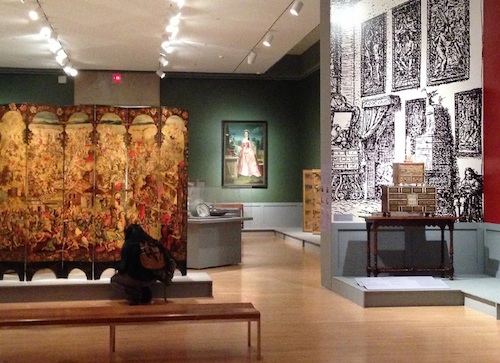
Visitor inspects painted screen in exhibit area with the objects from the grand reception room of an upscale home.

Visitor inspects painted screen in exhibit area with the objects from the grand reception room of an upscale home.

Third, you’d emphasize your casual elegance by actually draping the rugs and tapestries all over the floor, stairs, and risers in the ladies’ sitting room.  After gold, silver, and jewels, textiles were about the biggest luxury anyone could find, and Spanish Americans made and bought a lot. In British America, carpets were only used to cover tables, so the casual distribution of so much wealth below your feet was something only Spanish Americans could afford.

Because the Caribbean and coastal cities of South and Central America were right in the center of shipping and trade routes for centuries, wealthy people could buy pretty much anything they wanted and the curators show it to us – gorgeous Japanese screens, custom-printed Chinese porcelain, English-style sitting chairs, and Turkish rugs. No pennies were pinched in upwardly mobile, Spanish-speaking homes.

Peruvian bed of gilt wood (1700-1760) that would be shown off in a state bedroom.

Peruvian bed of gilt wood (1700-1760) that would be shown off in a state bedroom.

And let’s not forget what treasures were produced right inside the Spanish protectorates – silver shaving basins, polychromed statues of the saints, gigantic gold-framed “statue paintings”, gilded beds, embellished leather traveling trunks (to go to your country home), solid mahogany furniture, and custom-made books of your family’s geneaology. We won’t even get started on the private chapel décor.

This show throws open a window on the first wave of high-status interior design and decoration – a story that is normally confined to the castles in Europe or the palace at Versailles, and one that is perfectly suited to be told by Brooklyn’s extensive Latin American holdings with a couple of key pieces from the sumptuous collections uptown at the Hispanic Society of America.

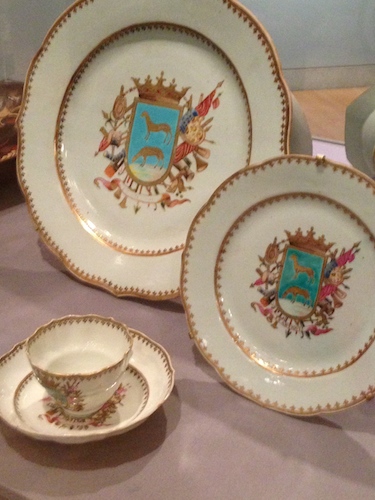
Chinese import: 1770 porcelain featuring South American animals, purchased by Ignazio Lemez de Cervantes

Chinese import: 1770 porcelain featuring South American animals, purchased by Ignazio Lemez de Cervantes

If you want to do a deep dive into upscale living of past centuries, visit the exhibition archive on the Museum’s website and click on the Objects tab. Or, see it all in person when it goes on the road: it opens at the Albuquerque Museum on February 16, the New Orleans Museum of Art on June 20, and the Ringling Museum in Sarasota on October 17.

And congratulations to Brooklyn for making it onto the cover of the winter edition of Humanties, the NEH magazine.

Medieval Enthusiasts Throng to See Departing Treasure

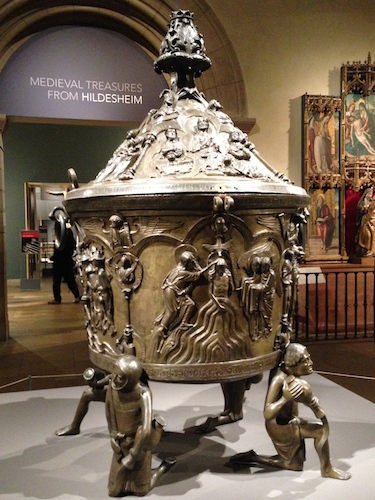
Hildesheim’s large cast 1226 baptismal font installed in the great Medieval Hall

Hildesheim’s large cast 1226 baptismal font installed in the great Medieval Hall

Before the Metropolitan Museum of Art takes down the Baroque Christmas tree, take a look at what’s sitting right behind it – a large, beautiful cast baptismal font that’s one of the treasures of a cathedral in Saxony that’s been transported to New York for the exhibition, Medieval Treasures from Hildesheim, closing January 5.

Like the medieval hall surrounding you, it will take you back to the Middle Ages, along with the manuscripts, castings, croziers, and spectacular rock crystal ornaments in Gallery 521, a few steps away in the special exhibition space that you pass going toward the Lehman wing.

During the holidays, the small space was packed with medieval-art lovers relishing the fact they were seeing treasures from a unique UNESCO World Heritage site right in the heart of Manhattan – the first time they have left Germany.

In the late 12th c., Bernward of Hildesheim, commissioned a dazzling new cover for the Gospel Book, which dates from the late 900s

In the late 12th c., Bernward of Hildesheim, commissioned a dazzling new cover for the Gospel Book, which dates from the late 900s

While renovations were being done at Hildesheim Cathedral, 50 amazing treasures were sent here to give their spiritual heft to the Met’s already hefty medieval holdings. Check out our Flickr site for some of our favorites.

The 1226 baptismal font is a true masterpiece of casting, along with the magnificent eagle that has sat upon a cathedral lectern since 1220. The Jesus figure of the Ringelheim Crucifix at the center of the exhibition is one of the most important (and awe inspiring) large-scale wood sculptures surviving from the post-1000 era in Europe.

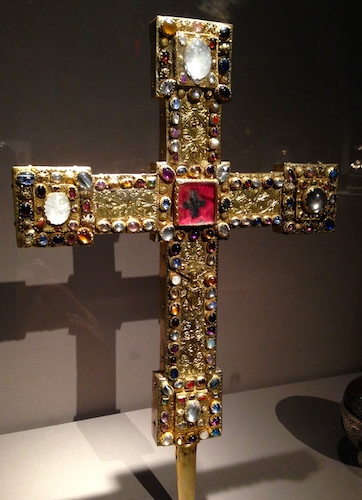
The chalices, reliquaries, croziers once held by medieval bishops, and bound books of the gospels and sacraments will stop you in your tracks.  Seek out the bejeweled cross with what was once believed to be a relic of the True Cross.

As quiet crowds milled around last weekend, savoring the beauty, one youngster came upon the Gospel Book that had been rebound in the second half of the 12th century and asked in a whisper, “Are those real jewels?”

A processional cross, made between 1170 and 1190, which is said to hold relics of the True Cross

A processional cross, made between 1170 and 1190, which is said to hold relics of the True Cross

Many of these treasures, including the bogglingly beautiful Gospel Book, were commissioned by Bishop Bernward of Hildesheim (960-1022), whose aesthetic vision transformed the cathedral into the must-see pilgrimage spot that it remains today.

One out-of-towner told us that they traveled to New York simply to see this show. See the baptismal font and the other works for yourself, and you’ll know why.

If you want to know more or if you’re a fan of the Middle Ages, take the time to sit in on this hour-long presentation about medieval alchemy, metalwork of the 1100s, and how these treasures came to New York:

AMNH Honors America’s Super-Early Explorers

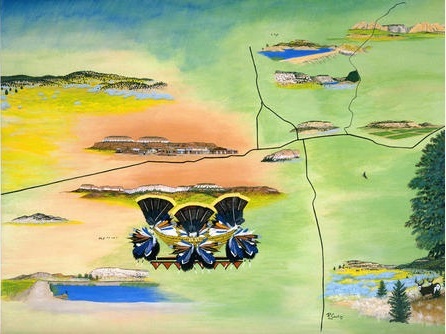
Ronnie Cachini’s 2006 acrylic, Ho’n A:wan Dehwa:we/(Our Land), Source: AMNH/ of A:Shiw A:Wan Museum and Heritage Center

Ronnie Cachini’s 2006 acrylic, Ho’n A:wan Dehwa:we/(Our Land), Source: AMNH/ of A:Shiw A:Wan Museum

Long before John Wesley Powell steered his boats down the rapids and mapped the Grand Canyon for the US Geological Survey, another set of intrepid explorers had walked, mapped, documented, and guided travelers through the entire Colorado River system. Climb up to the hidden Audubon Gallery on the Fourth Floor of the American Museum of Natural History before January 12 and get a fresh perspective on pueblo cartography in the special exhibition, A:shiwi A:wan Ulohnanne: Zuni World.

 The show features 31 paintings by seven contemporary painters from the Zuni Pueblo of New Mexico – one of the ancient tribes whose ancestors built the cliff dwellings and multistory wonders of the Four Corners.

Installation view in the “quiet gallery” on the Fourth Floor of AMNH

Installation view in the “quiet gallery” on the Fourth Floor of AMNH

After 500 years of seeing their sacred places renamed by the conquistadors, Spanish land owners, government mapmakers, and the National Park Service, Zuni cultural leaders thought it was high time to start creating maps that reflected traditional Zuni place names, stories, and symbols. They asked some leading Zuni artists to choose the story, sacred sites, and landscapes that would “map” Zuni cultural history. According to some of the artists in the show, the exercise required them to look at what they knew in an entirely different way.

The Zuni people consider their place of origin to be the Grand Canyon. Back in deep time, the Zuni ancestors were instructed to find “the Middle Place”, so groups set out in journeys to the north, south, east, and west. The northern group, for example, settled in what is now called “Navajo National Monument” and eventually built multistoried dwellings inside the most spectacular red-rock shelter in the American Southwest.

Cliff dwellings in Betatakin alcove, a NPS site at Navajo National Monument where pueblo elders continue to hold sacred ceremonies. Photo: Dan Boone/Ryan Belnap, Bilby Research Center, Northern Arizona University

Cliff dwellings in Betatakin alcove at Navajo National Monument, where pueblo elders travel to hold sacred ceremonies. Photo: Dan Boone/Ryan Belnap, Bilby Research Center, Northern Arizona University

Each painter’s style is different, but when you take it all in, the exploration story is one of fairly mind-blowing proportions – the Zuni ancestors explored the entire Colorado River system, carved petroglyphs in canyons to point travelers to nearby communities, and even journeyed south to the “land of endless summer” –Central America’s coastal communities.

Although the paintings depict myths and symbols in the Southwestern landscapes, East Coast art-lovers should be aware that the Zuni expedition story isn’t fiction: Chaco Canyon’s great archeological sites contain the evidence — tropical shells, stones, Scarlet macaw skeletons, cacao, and the network of banked, engineered roads (circa 850 – 1100 A.D.) that actually lead to many of the places depicted by the Zuni painters.

Geddy Epaloose’s 2006 acrylic, The Middle Place. Source: AMNH/ of A:Shiw A:Wan Museum and Heritage Center

Geddy Epaloose’s 2006 acrylic, The Middle Place. Source: AMNH/ of A:Shiw A:Wan Museum and Heritage Center

Geddy Epaloose’s 2006 painting The Middle Place features an aerial view of Zuni’s Middle Village with sacred trails spiking out in all directions. Colorado River by Ronnie Cachini includes the edge of the distant ocean. Other paintings include the Zuni’s version of their Great Flood, the spiritual importance of their salt lake, and even unmarked lines representing some modern paved roads. Unless you’re Zuni, you’ll have to read the captions on each of the paintings.

Hunted deer is honored with a Zuni necklace

Hunted deer is honored with a Zuni necklace

AMNH has one of the largest collections of Zuni artifacts in the country, and has a good, close working relationship with that pueblo. Entering the Audubon Gallery on the Fourth Floor feels like a sacred space. You’ll be greeted by a hunted deer honored with a necklace of precious stones and ceremonial rods festooned with pieces of traditional Zuni clothing loaned by the painters and their children for us to see while their work is on display in New York.

Make a pilgrimage to this hidden gallery on AMNH’s Fourth Floor and learn about some remarkable people, places, origins, and cartography. (And stop into the First Floor rotunda to see some of the museum’s Chaco Canyon treasures.)

Enjoy this short YouTube video featuring Jim Enote, the director of A:Shiw A:Wan Museum and Heritage Center, who describes the exhibition when it debuted iat the Indian Pueblo Cultural Center.

World Wide Web (and Weft) of Past Centuries at The Met

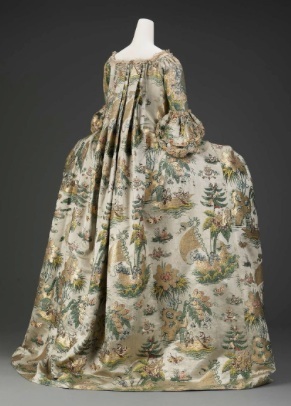
1730s Dutch brocaded satin, featuring exotic Asian islands and fauna, was refashioned into a more fashionable French frock in 1770. Source: Museum of Fine Arts, Boston. The Elizabeth Day McCormick Collection

1730s Dutch brocaded satin showing exotic Asian islands and fauna was refashioned in 1770 into a more fashionable French look. Source: Museum of Fine Arts, Boston.

A joyous collaboration among eight departments of the Metropolitan Museum of Art has written a new history of how a global network of fabric trade and manufacture once served the same purpose that YouTube, music videos, shelter magazines, Vogue, and The New York Times Style section do today – to present images of the latest trends and make anyone in the world that sees them understand the clothes or accessories needed to be “on trend” with other sophisticates.

Interwoven Globe: The Worldwide Textile Trade, 1500–1800, running through January 5, tells a monumental story about how trends went viral pre-Internet. It was a slower world dominated by sailing ships versus transoceanic cables, but the tale spanning centuries, continents, and cultures shows how gorgeous garments, incredible tapestries, bedazzled church vestments, quilted bedding, luxurious wall hangings, tour-de-force printed fabrics, and royal furniture telegraphed “trend” in a different way.

Embroidered muslin dress and fichu. The 18th c. craze for Neoclassical across Europe drove massive imports of lighter-than-air Bengali muslin. Source: The Met

Embroidered muslin dress. The 18th c. European Neoclassical craze drove massive imports of airy Bengali muslin. Source: The Met

The show can’t fully be appreciated in just one walk-through. Each textile and garment is incredible to behold, and the network of interrelationships among craftsmen, artisans, tradesmen, royal buyers, rich merchants, and brave sailors traversing strange shores is equally rich, complex, and layered.

This two-dimensional pageant, enhanced by exquisite gowns and garments whose fabrics were sourced from the four corners of the globe, is given the full-bore treatment in the top-floor galleries reserved for blockbusters.

How do you tell a story this big? The curators decided to put a large interactive map of the 16th- to 18th-century trade routes right inside the door, which brings you up to speed on the French, Portuguese, Spanish, Dutch, and British trade routes linking the Americas, India, the Orient, and islands.

Then come the galleries dedicated to the styles and fiber-tech associated with each – silks woven in China for Europe and Japan, Spanish embroideries that reference Islamic carpet borders, weavings made by Peruvian grand masters of the art, and Indian resist-dye masterpieces that turned into English chintz and fabrics for the King of Siam.

Japanese Jinbaori made from Dutch 17th century wool and Chinese silk, a luxury item worn over samurai armor. Source: John C. Weber Collection

17th c. Japanese Jinbaori made from Dutch wool and Chinese silk, a luxury item worn over samurai armor. Source: John C. Weber Collection

In the Spanish gallery, you’ll see how the crowned double-headed eagles of the Hapsburgs adopt kind of a Chinese-phoenix look when 16th-century Iberian traders commissioned silk artists in Macau to create silk they could sell back home. By the 17th century, everyone – East and West – had become accustomed to enjoying “exotic” images from halfway around the world – birds, animals, architecture, flowers, and landscapes. It had the same impact as Google Earth and World Wide Web access today.

One of the more startling facts is that before Commodore Perry “opened” Japan to the West (ref. Sondheim’s Pacific Overtures, the musical), Japan was more into luxury-goods consumption than production. Apparently, the trend was to import the ultra-luxury, Dutch wool, and make it into topcoats that Samurai warriors could drape over their armor.

If you don’t see this in person, visit the online exhibition site for an encounter that’s a real treat: You’ll get to zoom into each quilt, drape, embroidery, dress, shawl, and piece of fabric to see it all super-close.

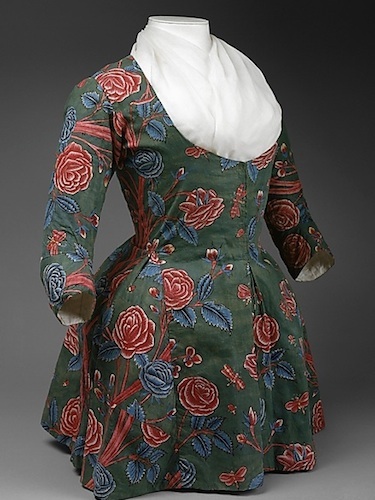
A late-18th century Indian-chintz Dutch jacket that knocked-off a French designer jacket in pink French fabric. Both have similar exotic floral prints. Source: The Met

A late-18th century Indian-chintz Dutch jacket that knocked-off a French designer jacket in pink French fabric. Both have similar exotic floral prints. Source: The Met

Click on the “full screen” button on each and toggle in to examine all of the glorious detail. The web site will tell you the story and show you the items in each gallery. You’ll be surprised to find the genesis of the fabrics-on-walls interior-decorating craze for country homes in the late 1700s and how men-only clubs adopted both plain and exotic dressing-gown dress from the Orient (a style also featured prominently in the current FIT show).

The King of Siam’s royal 18th century guard wore these resist-dye tunics. Fabrics were made in India and tailored in Siam. Source: Royal Ontario Museum, Toronto

The King of Siam’s royal 18th century guard wore these resist-dye tunics. Fabrics were made in India and tailored in Siam. Source: Royal Ontario Museum, Toronto

Magritte’s Surrealist Train Departing MoMA for Houston

Magritte’s 1938 oil, La durée poignardée (Time Transfixed) from The Art Institute of Chicago’s Winterbotham Collection. © Charly Herscovici ADAGP–ARS, 2013

Magritte’s 1938 oil, La durée poignardée (Time Transfixed) from The Art Institute of Chicago’s Winterbotham Collection. © Charly Herscovici ADAGP–ARS, 2013

One of the most recognizable trains in the history of modern art hasn’t left the station. It’s coming out of the wall at MoMA until January 12 as part of the tribute to Belgium’s only big-time Surrealist painter, Magritte: The Mystery of the Ordinary, 1926–1938. But don’t worry – this intriguing tribute chugs on, arriving at The Menil in Houston on Valentine’s Day (February 14) and at Chicago’s Art Institute on June 25. Catch it, because it’s loaded with new revelations, in person and on line.

In person: So many of paintings are icons of 20th century art, that it’s shocking to think that one anarchic visual artist had the chops to turn out so many great works in such a relatively short period of time. Walking through the first couple of galleries, you’ll recognize many famous images, but check out the dates on the labels: 40 were done in just his first three years in Paris between 1927 and 1929! He was so prolific, it makes you wonder when he made time to hang out at cafes, discuss dreams, and publish with Breton and the rest of the crew.

Jasper Johns owns the small version of Magritte’s 1935 oil La clef des songes (The Interpretation of Dreams), which uses English. © Charly Herscovici ADAGP–ARS, 2013. Photograph: Jerry Thompson

Jasper Johns owns the small English version of Magritte’s 1935 oil La clef des songes (The Interpretation of Dreams). © Charly Herscovici ADAGP–ARS, 2013. Photo: Jerry Thompson

Magritte liked making the familiar unfamiliar, playing with fact and fiction, probing dreams and reality, and appropriating pop culture into an art context.

Like Andy Warhol, Magritte began as an ad illustrator, and MoMA’s curators have included a few of his early fashion illustrations. It’s surprising to know that phrases that he injected onto his canvas (like “Ceci n’est pas une pipe”) were written in a script that was one of the most recognizable fonts used in European newspaper and magazine ads in the Twenties.

Was appreciation of Magritte’s ground-breaking cultural appropriation and subversion lost on our own American Pop pantheon? Not really, and the evidence is that one of the best examples of Magritte’s sly presentation of an everyday-object grid with ironic words was lent by the midcentury grandmaster, Jasper Johns.

So much contemporary pop culture and advertising art has reinterpreted, reimagined, and referenced Mr. Magritte’s images that it’s easy to forget that they rocked the world in the Twenties. His reverberation with our beloved 1960s Pop masters (and this show) reminds us that Mr. Magritte truly blazed an innovation pathway in taking the everyday and turning it into art.

MoMA discovered something lurking beneath the surface of its Magritte’s 1936 oil, Le portrait (The Portrait). Gift of Kay Sage Tanguy. © Charly Herscovici ADAGP–ARS, 2013

MoMA discovered something historic lurking under Magritte’s 1936 , Le portrait (The Portrait). Gift of Kay Sage Tanguy. © Charly Herscovici ADAGP–ARS, 2013

And speaking of pioneering, check out the amazing interactive site that lets us enter Magritte’s mind; learn how he turned nature, desire, dreams, language, and symbols into troubling, evocative, subversive works; and see the behind-the-scenes conservation and curatorial work. The beautiful, musical experience is designed by Hello Monday, and should probably win a Webby Award. See it now.

You’ll see how MoMA took off the old varnish, examined the canvases under ultra-violet light, and did detective work of which Magritte and his silent-movie-icon inspiration, Fantômas, would be proud.

Spend time letting each painting’s mini-site load into your browser window, click to hear the curators talk, and keep scrolling down to see what the conservators discovered. You can even toggle back and forth to see the surface of the painting and X-ray.

As a preview, here’s the YouTube video about the “lost” Magritte painting that conservator Cindy Albertson found lurking underneath The Portrait.

And while you’re at it, you might take a minute to see what technology was at work in possibly Magritte’s most famous image:

FIT’s Fresh Take on History via Monocles, Wigs, and Gowns

1924 short-hair, no-hips “boy” look with the signifying monocle.

1924 short-hair, no-hips “boy” look with the signifying monocle.

FIT’s powerful exhibition, A Queer History of Fashion: From the Closet to the Catwalk, throws open the window on what the curators felt was an untold story, and they’ve done history proud — creating a show and website featuring key clothing, points of view, and socio-political breakthroughs during more than 250 years of LGBT history. Visit before January 4.

If you think you know everything about fashion, peruse FIT’s downstairs gallery (or the website) and see how quickly you learn a new angle, a clue, or an insight from the context in which the curators tell their story – a style, epaulet, pattern, tie, mod look, or detail that conveys entirely new meaning.

Right at the foot of the stairs, you’re confronted with side-by-side late 19th century and early 20th sartorial clues sported by the era’s elegant lesbians and gay dandies – shirt collars and ties and Mr. Wilde’s telltale green carnation.

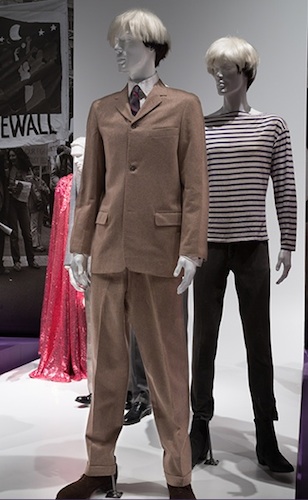
The suit that Andy had made in Hong Kong in 1956 on his first trip abroad compared to his super-hip King of Pop 1960s uniform.

The suit that Andy had made in Hong Kong in 1956 on his first trip abroad compared to his super-hip King of Pop 1960s uniform.

Entering the main gallery, you’ll meet monocled ladies of 1920s Montmartre posing in the “boy look” that went viral throughout the Twenties. Yes, the short hair and mode de le garçonne was adopted by every flapper in the world, but the curators link these changes to trends first sported in scandalous Parisian same-sex clubs.

The clothes tell story after story of how iconic fashion trends were first incubated within gay subcultures – Gernreich’s unisex caftans in the 1960s, YSL channeling Marlene’s tuxes into his 70s “Le Smoking” looks, leather trends in the 80s, and Versace’s bondage dresses in the 90s.

The mannequins have often been touched up with accessories and wigs to evoke innovators and eras, such as the two wigged Warhols, including his striped T and skinny jeans look that seems so “now”.

Other clothes suggest additional narratives: slinky glamour gowns channeling a gay designer’s obsession with feminine ideals, camp queen adaptation of exaggerated feminine points of glory, pre- and post-Stonewall sartorial identity, and even what people are wearing today for their same-sex wedding ceremonies.

Naomi flaunting Gianni’s 1992 bondage-inspired leather couture.

Naomi flaunting Gianni’s 1992 bondage-inspired leather couture.

So many stories, so little time. The security guards literally had to turn the lights off last Saturday night (when FIT closes at 5pm) because the throngs of captivated museum-goers simply didn’t want to leave with so much yet to absorb – Dietrich’s cross-dressing wardrobe on loan from Berlin’s film museum, a Charles James gown from Doris Duke, a Halston provided by Lauren Bacall, the iconic CK underwear billboard image from Times Square, Larry Kramer’s YSL Rive Gauche suit from the 70s, a Mugler-designed gown for chanteuse Joey Arias, and Ru Paul’s red vinyl…well, outfit.

And we haven’t even touched upon the Versace section filled with his Warhol patterns, studded leather, and Baroque-print fantasies. One fan confided that it was her second time because the visuals, details, and narratives were so much to take in.

If you can’t get there before January 4, check out the clothing, concepts, oral histories, and historic timeline on line and yak about it on Facebook.

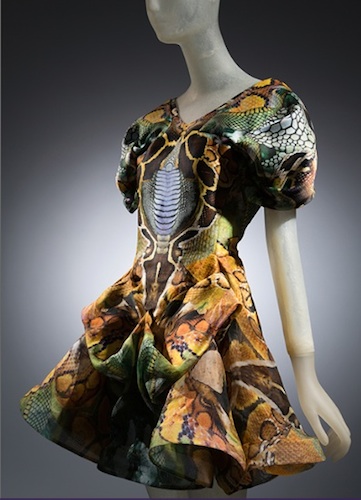
From Mr. McQueen’s Plato’s Atlantis collection, 2010.

From Mr. McQueen’s Plato’s Atlantis collection, 2010.

Hear what inspired curators Valerie Steele and Fred Dennis in this 6-minute Culture Beat episode, and go to FIT’s YouTube site to hear what 20 designers, celebs, and academics had to say at FIT’s symposium on the queer history of fashion.

Here’s Simon Doonan of Barney’s (think windows) talking about how gay style had an impact on the 1960s look on Carnaby Street (so, that’s where those flowered shirts came from!), why overt visual influences are not so evident today, and why the next generation needs to learn about the “fallen heroes” of the late 20th century design community.

When Whales Walked Explained at AMNH

Whales exhibit tells the evolution story. Courtesy: Museum of New Zealand Te Papa Tongarewa

Whales exhibit tells the evolution story. Courtesy: Museum of New Zealand Te Papa Tongarewa

Right inside the exhibit, Whales: Giants of the Deep, the American Museum of Natural History answers two questions that have stumped centuries of nature lovers – how did the world’s largest sea-loving mammals ever evolve from land animals, and who are their closest relatives?

In the last 20 years, DNA experts and paleontologists have been hacking away at these questions, and the show provides some startling visuals and answers: Whales (a group that includes dolphins and porpoises) came from four-legged animals that hovered close to shore lines, snapping up fish. Oh, and their closest relatives on the Mammal Tree of Life are…get ready…hippos. See the show before January 5.

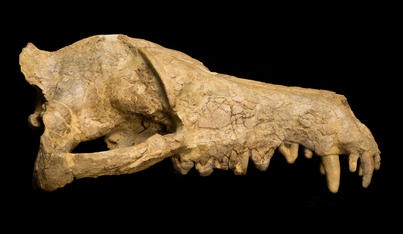
Clue to solving the mystery – the skull of Andrewsarchus, three feet long, found in 1923 by Kan Chuen Pao on AMNH’s second Gobi expedition. Courtesy: AMNH/R. Mickens

Clue to solving the mystery – the skull of Andrewsarchus, three feet long, found in 1923 by Kan Chuen Pao on AMNH’s second Gobi expedition. Courtesy: AMNH/R. Mickens

The first thing you’ll see is a massive skull of Andrewsarchus, a 45-million-year-old whale cousin, who would have stood over six feet tall at the shoulder. He was found in Mongolia on the famous AMNH Central Asiatic Expedition in the 1920s (remember the dinosaur eggs?) and to this day is the only one found.

The paleo team compared the features on his skull to other mammals, ran their analysis through cladistics software, generated a family tree, and learned that Andrewsarchus falls somewhere near the evolutionary point where whales and hippos had a common ancestor, a key clue.

Artist Carl Buell’s depiction of Pakicetus, the oldest known ancestor to  whales

Artist Carl Buell’s depiction of Pakicetus, the oldest known ancestor to whales

A huge discovery in Northern Pakistan in 1983 began to unlock the rest of the mystery. Found in 50-million-year-old Eocene rocks, remains of the enigmatic, four-legged, fish-eating Pakicetus were discovered at the edge of what was once an ancient sea. It was deemed by scientists to be the earliest known modern-whale ancestor. Many specimens were unearthed, with ear bones looking like modern-day dolphins, but ankle bones more like a pig’s, giving scientists a reason to place his ancestry in the “artiodactyl” category, which includes hippos, pigs, antelopes, camels, and other even-toed hoofed animals. Subsequent finds and DNA analysis of modern whales further solidified the hippo-relation hypothesis.

Cladogram showing family relationships of whales and artiodactyls from the AMNH guide for students in grades 6-8

Cladogram showing family relationships of whales and artiodactyls from the AMNH guide for students in grades 6-8

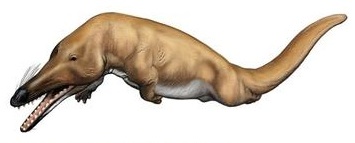
The show includes a full replica of his skeleton, along with other fossils from the subcontinent showing the transition of four-legged wolf-sized animals to the streamlined bodies that we now associate with ocean- and river-going cetaceans. You’ll see a terrific video that animates the transition from longer-snouted, web-footed fish-eaters that paddled through estuaries (Ambulocetus), to more streamlined sea-going mammals whose front legs became flippers and back legs disappeared nearly completely. Kutchicetus (43-46 million years ago) shows evidence that it probably did some deep dives, and Durudon (37 mya) had nostrils at the top of his head, flipper-hands, and apparatus at the end of his tail that suggests a support for flukes.

A clue from India. Artist Carl Buell’s depiction of Kutchicetus, dweller in ancient tropical seas

A clue from India. Artist Carl Buell’s depiction of Kutchicetus, who lived in ancient tropical seas

The show was originally organized by the Museum of New Zealand Te Papa Tongarewa, and features a mix of AMNH and Te Papa artifacts and insights.

There are many other wonderful biological, historical, and cultural details to the whale story, as the YouTube below shows (84K hits and counting), but shout-outs must be given to the two stars — large Sperm whale skeletons (think Moby Dick) on display, lovingly named and transported here by the Maoris, who found the stranded duo, prepared, and blessed them for special appearance in New York.