Stunning Jewelry at Met Reflects Contemporary Art

These stunning creations of Eugene and Hiroko Pijanowski are made from paper cord and canvas

These stunning creations of Eugene and Hiroko Pijanowski are made from paper cord and canvas

The Metropolitan Museum of Art has not only reinstalled its American Modernist wing on the first floor, but it’s given over the design gallery right inside the door to Unique by Design: Contemporary Jewelry in the Donna Schneier Collection, on view through August 31.

Gertrude Stein is holding court in the far back gallery with some of Mr. Stieglitz’s treasures, but on your way to see them, check out the high-class, high-gloss presentation of masterworks of wearable art from the 1960s through today.

The thesis of the show is contemporary jewelry doesn’t exist in a vacuum and often reflects the prevailing art of the day — Pop, Minimalism, Abstraction, and so forth.

In 2007, Ms. Schneier donated 130 of her favorite pieces to the Met – just a small fraction of the collection she has been building for over 30 years. Here, these gleaming, surprising, artful, fun pieces are grouped to highlight their context within various themes of recent contemporary art.
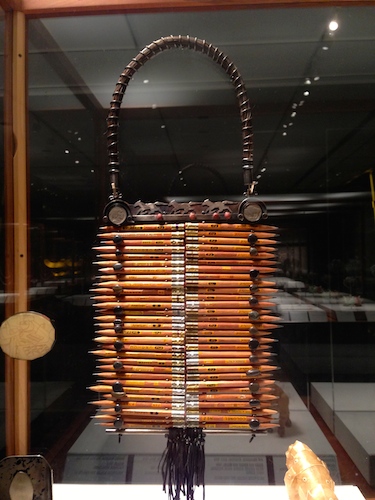
Kiff Slemmonds Sticks and Stones and Words

Kiff Slemmonds Sticks and Stones and Words

As you marvel at each one, you’ll be thinking back across decades of gallery shows and installations of minimalist art, performance art, funky found art, and 3D printing.

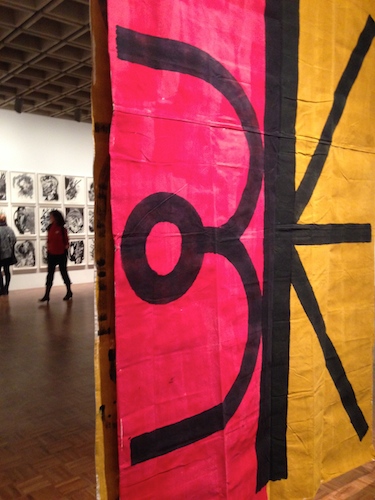
Check out the gold neckpiece right inside the door. You might think it’s a riff on the Met’s room full of Columbian gold across the hall, but this treasure is actually made of paper and canvas by the Pijanowskis (Eugene and Hiroko).

Marvel at what seems to be Native American-inspired breastworks by Kiff Slemmonds. Her art piece is fabricated with a lot of stuff but mainly No. 2 pencils in the “narrative” portion of the show.

If you like self-referential playfulness, consider Gijs Bakker’s piece – a real diamond mounted on a PVC-laminated photo of a diamond. Recyclable art? Check out Robert Ebendorf’s brooch made from crushed auto window glass, beach glass, and a vinyl record.

Ted Noten’s clever Fashionista necklace made of tiny resin high-heeled shoes

Ted Noten’s clever Fashionista necklace made of tiny resin high-heeled shoes

And if you think it’s fun to poke around the history of contemporary art through jewelry that’s neatly tucked inside a single room, don’t ignore the fact that right beyond this gallery door is another art-history tour-de-force-in-a-box: The Met is displaying Mr. Duchamp’s famous green case, which is full of many of the same visual and conceptual challenges – “what is art?”, “what is play?” “what is hidden?”, and “everything you see is not as it appears.”

What would Rose Sélavy herself choose to don from the next room if the Met and Ms. Schneier gave her chance?

Peek at a few of the choices on our Flickr site, but enjoy wandering through the gallery and deciding for Rose and yourself.


Sailing Life Rafts into Brooklyn’s Submerged Motherlands

The tree touches the top of the Cantor Gallery. Photo: Brooklyn Museum

The tree touches the top of the Cantor Gallery. Photos: Brooklyn Museum

The view is dramatic, but the story is it evokes is even bigger than what’s in the room. There’s still time to travel out to the Brooklyn Museum to have the immersive experience of Swoon’s Submerged Motherlands, closing August 24.

The pictures here just don’t do justice to the super-high wrap-around effect of this walk-through take on the emotional side of rising tides throughout the world. A photo can’t take it all in — a sheltering, 60-foot tree with cut-out paper leaves with some day-after-the-Flood rafts parked down below, all decorated with sketches of the peoples and mothers of the world.

And did we mention that Brooklyn visionary Callie Curry (a.k.a. Swoon) actually built and lived on those rafts for a while? Several years ago, she sailed them up and down the Hudson, on the Mississippi, and across the Adriatic.

Close-up of one of Callie’s rafts. Photo: Brooklyn Museum

Close-up of one of Callie’s rafts.

You’ll get to see these jerry-rigged but seaworthy concoctions up close, and examine the drawings, cut paper, and torn, coffee-stained textiles draping walls, floor, and shelters in this dramatic space.

The feeling it evokes makes you wonder if we’re ready for rising seas and climate change. It’s beautiful, monumental, and reminiscent of our recent lights-out experience of Hurricane Sandy, which tore at the edges of Brooklyn, Long Island, and Staten Island just two years ago – exactly what inspired Callie to take this work in this direction.

Hear what it took for Callie to create this fantastic walk-through installation on Brooklyn’s top floor:


You may also want to hear what Callie has to say about being a working artist in the real world – outside the four walls of a gallery – in her talk from TEDxBrooklyn in 2010. She will show you her rafts in action at Minute 5 and tell you what it felt like to arrive on a hand-built raft in Venice, her projects in post-earthquake Haiti, and interacting with people from the neighborhood as she creates art on the sides of Brooklyn buildings. Truly inspirational.

The Sistine Chapel of Fashion Virtuosity

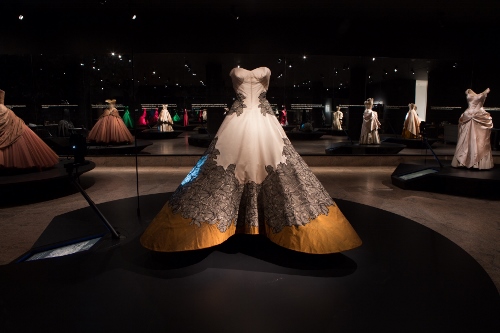
Clover Leaf Ball Gown – a 1953 silk faille, shantung, and black lace sculpture by Mr. James. Part of the Brooklyn Collection at The Met

Clover Leaf Ball Gown – a 1953 silk faille, shantung, and black lace sculpture by Mr. James. Part of the Brooklyn Collection at The Met

When the Brooklyn Museum handed its fashion archive over to the Met in January 2009, the first thought that crossed everyone’s mind was the mind-bending masterworks that would now be sheltered under the protective wing of the Costume Institute’s crack conservation team — “Oooh, maybe the Met will do a Charles James show!”

We’re glad to report that the Met has done this master proud and given his humble admirers a fitting place to worship in its triumphant two-gallery show, Charles James: Beyond Fashion, which ends this weekend, August 10.

1952 portrait by Michael A. Vaccaro / LOOK Magazine. Courtesy: The Met;  Library of Congress

1952 portrait by Michael A. Vaccaro / LOOK Magazine. Courtesy: The Met; Library of Congress

Mr. James is credited with being among the first to perfect the strapless gown in the 1930s, an inspiration for Mr. Dior’s “New Look” in the 1940s, and the epitome of Vogue glamour dressing in the 1950s. He could do things with fabric that others simply couldn’t do or wouldn’t dare…well, maybe except for Madame Gres. He pushed silhouettes and fabrics further than most anyone could conceive and had the temperamental nature, drive for perfection, and uncompromising attention to detail that characterize any of history’s greatest, most passionate artists.

You always look at his creations and ask yourself, “How did he do it?” How did he get a spiral of fabric to stand out as it wraps sinuously around a sleek, strapless electric green silk mermaid dress? Is that sexy Thirties frock actually cut from one scarf?  How did he create virtual moving sculptures from the world’s most expensive fabric?

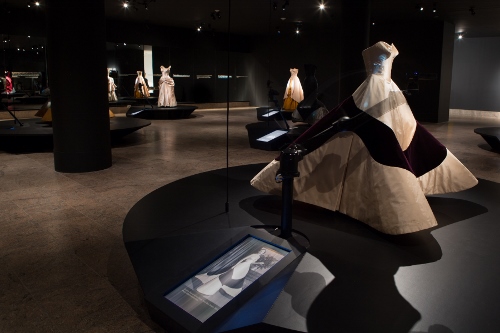
Innovative digital display tells the back story of Mrs. Hearst’s Clover Leaf Gown – too big for Ike’s inaugural, but just right for Queen Elizabeth II’s coronation

Innovative digital display tells the back story of Mrs. Hearst’s Clover Leaf Gown – too big for Ike’s inaugural, but just right for Queen Elizabeth II’s coronation

Long known for his innovative engineering, the Met came to a brilliant solution to explain the magic that Mr. James wrought over his decades of no-two-alike work – hire an architectural firm to show us.

Enter Diller Scofidio + Renfro, who have mounted these sculptures in silk inside an infinity-room gallery and paired each masterpiece with its own personal robot and humongous iPad-type display. Look at the dress and refer to the screen as the dress digitally deconstructs and is assembled again.

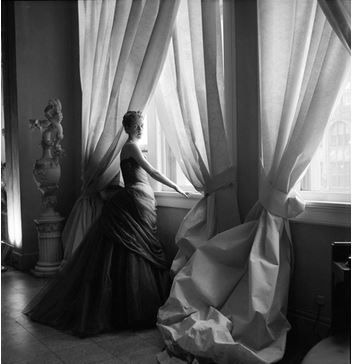
Cecil Beaton’s 1955  photo of Nancy James in the Swan Gown. Courtesy: The Met; Cecil Beaton Studio Archive at Sotheby's

Cecil Beaton’s 1955 photo of Nancy James in the Swan Gown. Courtesy: The Met; Cecil Beaton Studio Archive at Sotheby’s

The crowds waft from dress to dress in no particular order, clustering silently to watch digital magic, see where the robot is pointing, and view photos of Mrs. Randolph Heart, Jr., Gypsy Rose Lee, or Josephine Abercrombie in said gown. The robot with the 1954 Swan Ball Gown captivates viewers by moving underneath to televise close-up views of some of the 1,080 square feet of tulle that Mr. James used to create the oomph.

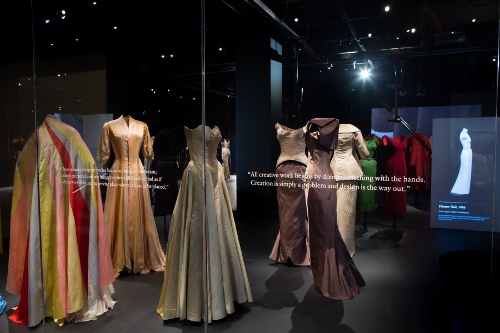
The mirrored walls of the upstairs gallery and the see-through dividers downstairs are emblazoned with the wisdom of the man himself. He seems to be talking right to you as you wonder how he made the fabric do what it’s doing (“It’s the air that’s sculpted, not the silk”) or how he thought about the world of fashion (“We who have been ahead in style have usually been ahead in our thinking”).

Downstairs gallery, newly named for Ms. Wintour, filled with James creations

Downstairs gallery, newly named for Ms. Wintour, filled with James creations

The second gallery (welcome back, ground floor Costume Institute!) displays his wool creations and sharply shaped cocktail wear. It’s interesting that James considered some of these genuinely more innovative than his often-photographed gowns. The curators have placed another of his “first” in a room at the back – the predecessor of today’s puffer coat. On loan from the V&A, it remarkably dates from the 1930s – his soft, sensual, silky answer to the boxy fur jackets that Ms. Schiaparelli was showing in Europe at the time.

We have to thank Mr. James for his vision and for making sure the Brooklyn design lab had so many examples of his masterpieces to teach and inspire future generations of Seventh Avenue designers. As he says, “In fashion, even what seems most fragile must be built on cement.”  Lesson learned.

The Met’s a great steward. Just listen to the love in the tour of the show by its curators:

If you have more time, hear what Zac Posen has to say to the co-curator about The Master:

Last Day for Art & Industrial History: Kara Walker’s “Sugar Baby”

Crowds surround Kara Walker’s monumental sugar sculpture

Crowds surround Kara Walker’s monumental sugar sculpture

The crowds lined up yesterday on Kent Avenue all the way beyond the Williamsburg Bridge, almost to Schaeffer’s Landing, waiting to enter the rusted, aromatic, tumble-down confines of the old Domino Sugar Factory on one of the last days to see Kara Walker’s “A Subtlety, or The Marvelous Sugar Baby”, commissioned by Creative Time.

Today is the last day, so take a look at history in person, on our Flickr page, or in the video below.

Security was in full force to keep the Williamsburg bike path clear and drivers were slowing down to ask, “What’s going on and what are people waiting for?” only to be told by patient fans, “They’re lined up to see art!”

Once inside, the marvelous, gigantic Sugar Baby sculpture was on hand to preside over the far end of the abandoned several-block-long 1851 industrial space that once refined over half the sugar consumed in the entire United States.

One of her many attendants throughout the factory

One of her many attendants throughout the factory

As readers of Friday’s front-page article in The New York Times knew, Walker was again pushing the buttons with her homage to the brutal history of the sugar trade from the 1700s until today by giving us an experience that isn’t really all that sweet. Witnessing Kara’s witnessing is what had people – including some elderly visitors on canes — flocking to the sticky-floored, slightly ominous space. You could smell the sugar and molasses before you even entered the door.

Leading up to the gigantic white sculpture, people encountered all sorts of molasses-children, toting baskets full of…well…looks/smells like molasses. The experience evokes everything that Kara wished for…history, economics, society, race, abuse, industrial profit, and industrial scale.

Take a look at how it was made, and read about the history behind her thinking. Click on this link to Vimeo, look on the Creative Time website to see her sketches and graphic inspirations, and be sure to check out the various stages of Kara’s 3D digital sphinx up close.

If you go to Brooklyn today, expect to wait about an hour in line; once inside, there’s plenty to think about.

Gauguin’s Primitive Universe at MoMA

Be Mysterious (1890) Carved and painted lime wood from Musée d’Orsay, Paris. © RMN-Grand Palais /Art Resource NY.

Be Mysterious (1890) Carved and painted lime wood from Musée d’Orsay, Paris. © RMN-Grand Palais /Art Resource NY.

You can almost hear the rustling pandan leaves, waterfalls rushing into exotic coves, and the drums and chants of fiery Tahitian rituals around powerful idols long since banned by the Christian missionaries…but only if you take the time to get close to the smaller works in MoMA’s revealing sixth-floor show, Gauguin: Metamorphoses through June 8.

Yes, Gauguin’s bright, colorful paintings of island life are displayed, but the show is really about the darker, more primitive experience expressed in Mr. Gauguin’s ceramics, woodcuts, carvings, and monoprints – the works that we rarely get to see en masse.

Hina and Fatu (c. 1892) Carved tamanu wood. Courtesy: Art Gallery of Ontario, Toronto © 2013 AGO

Hina and Fatu (c. 1892) Carved tamanu wood. Courtesy: Art Gallery of Ontario, Toronto © 2013 AGO

After nearly two decades plugging away at his day job, weathering a stock-market crash, struggling to stay in the middle class, cranking out artworks in his spare time, and showing with the Impressionists, he just chucked it all, packed a bag, and went to Tahiti in 1891. From his young-adult years working in the merchant marine, he figured Tahiti was as far away as he could get from his family, responsibilities, and the frustrating Paris art scene where others were making it besides him.

Nothing’s perfect, and the Tahiti he arrived in was already changing from contact with the global trade networks of industrialized countries. No matter. Gauguin was captivated by the thought of connecting with the “true” primitive and savage that lived in the myths, lore, and natural beauty of Polynesia and shoving it all into the face of the avant-garde and art-buying public back home.

The curators have assembled all the images Gauguin created for three dramatic series of woodcuts. The rough edges really come out in Noa Noa (1893) and The Vollard Suite, with a few of the gouged-out woodblocks exhibited right next to several states of the same image.

Mahna no varua ino (The Devil Speaks), state IV / IV, from the suite Noa Noa (Fragrant Scent). (1893–94). Woodcut from private collection. Courtesy: Galleri K, Oslo. © Reto Rodolfo Pedrini, Zurich

Mahna no varua ino (The Devil Speaks), state IV / IV, from the suite Noa Noa (Fragrant Scent).
(1893–94). Woodcut from private collection. Courtesy: Galleri K, Oslo. © Reto Rodolfo Pedrini, Zurich

Black, dark, primitive, edgy – too edgy, in fact, for his dealer, Mr. Vollard, who felt that the prettier oil paintings were a lot more palatable to his clients. (Vollard kept the more expressive primitive prints in the drawer.)

Take a look on MoMA’s special website for the show, which has a detailed timeline for Gauguin’s travels. Clicking on images on the site allows you to zoom in closely on each work. A particularly nice touch is the full digitized version of Gauguin’s unpublished Noa Noa manuscript, which he assembled (but never published) to interpret all the exotic images and symbols of the series for the public and his hoped-for fans. Scroll down to the bottom of this page to see the manuscript, page by page.

Oviri (Savage). (1894) Partly enameled stoneware, from Musée d’Orsay, Paris. © RMN-Grasnd Palais /Art Resource NY

Oviri (Savage). (1894) Partly enameled stoneware, from Musée d’Orsay, Paris. © RMN-Grasnd Palais /Art Resource NY

So here’s your chance to examine what was boxed up for so long along alongside magnificently  disturbing sculptures, panels, and reliefs of goddesses, devils, spirits, waves, women, and mountains created out of tamanu and pua wood with the occasional daubs of colored paint. It’s clear that the design and detail of Gauguin’s beautiful symbolist color paintings got a further workout through all of these other works portraying the dark, mysterious side of life forces emanating from the mind of a struggling artist obsessed with the uber-primitive.

Some say that Picasso was inspired to transform his Demoiselles after seeing some of this raw work (exhibited after Gauguin’s death). Say hello to them seven days a week on MoMA’s 5th Floor.

Get Out of Town with JJ Audubon

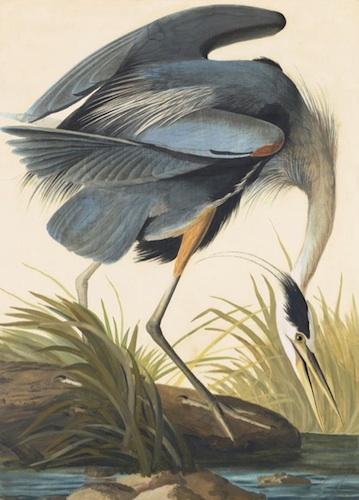
Audubon’s Great Blue Heron (Ardea herodias), Study for Havell pl. 281 (1832). Watercolor, graphite, and pastel on paper, laid on thin board. Courtesy NYHS and Mrs. Audubon

Audubon’s Great Blue Heron (Ardea herodias), Study for Havell pl. 281 (1832). Watercolor, graphite, and pastel on paper, laid on thin board. Courtesy NYHS and Mrs. Audubon

If you need to get out of town Memorial Day weekend, there’s no better traveling companion than J.J. Audubon, whose original watercolors will transport you to another time and place better than any plane, car, or train. Experience his spectacular show at the New-York Historical Society, Audubon’s Aviary: Parts Unknown: Part II of the Complete Flock today and tomorrow.

Can’t make it in person to New York? Not a problem, because you can tour Mr. Audubon’s show (and more) on a fantastic website that shows you his birds, provides the maps of your journey, and more. True, you won’t enjoy the life-size paintings – shocking when you see them in person – but you’ll learn the entire backstory of JJ’s trips through the Southeast US and Northeast Canada as he did the best-job-ever for his epic Birds of America four-volume series.

In the NYHS gallery in the last several weeks, visitors have been running up to the second floor and grabbing the magnifying glasses to study each brushstroke of these magnificent works. Although they’re mostly watercolor, each painting is enhanced with graphite, pastel, gouache, and ink. Because no one’s perfect, a few have birds pasted in from other pieces of paper, but you really can’t tell unless you study them closely.

A second Great Blue Heron (1834), thought to be another species at the time, with the skyline of Key West, Florida. Courtesy NYHS and Mrs. Audubon

A second Great Blue Heron (1834), thought to be another species at the time, with the skyline of Key West, Florida. Courtesy NYHS and Mrs. Audubon

It’s the first time that NYHS has exhibited JJ’s complete watercolor series, but it’s so big – 474 original watercolors – that they had to break it into three separate shows.

Mrs. Audubon presented JJ’s entire set of original work to NYHS in1862. Her husband had worked so hard on these works of art (he didn’t consider them “scientific”) that she commented that sometimes the birds felt like “her rivals.” Better that NYHS preserve them for posterity.

The museum decided to mount the watercolors in the order in which JJ painted them. On the website, you can revisit Part I, but let’s turn our attention to Part II.

As you’d expect from his trips to the Carolinas, Georgia, Florida, Labrador, and Newfoundland in 1831-33, the majority of the birds you’ll see live in and around the water. Two spectacular works are of the Great Blue Heron in two color ways. In JJ’s lifetime, the white- and bluish-colored herons were thought to be two separate species (which they’re not), so we’re treated two very large paintings of one fishing from shore and the other enjoying a meal in sight of the Key West skyline across the bay.

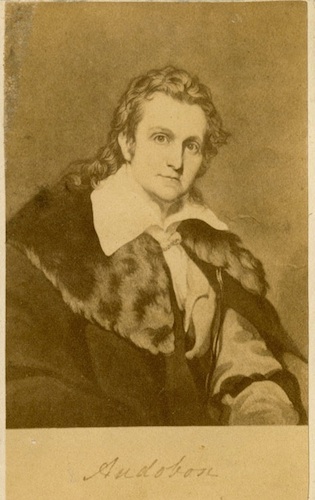
Carte–de–visite of John James Audubon. The legacy lives. Courtesy: NYHS

Carte–de–visite of John James Audubon. The legacy lives. Courtesy: NYHS

It’s amazing to consider that JJ started many of these while he was on his journeys, totally outdoing Banksy as a premiere peripetatic creating-art-wherever road warrior. Of course, he did it all without electricity and frequent-flyer miles hauling around gigantic pieces of perfect paper.

Through it’s collaboration with the Cornell Ornithology Lab, the NYHS provides (on the web and on the gallery audio guides) clips of each bird’s distinctive voice. Another nice in-gallery touch is an iPad app that allows visitors to compare each watercolor with the engraved print made in London by Robert Havell, Jr. for the printed books.

Enjoy JJ’s images here.

Last Call for the Whitney Biennial Uptown

Detail of Elijah Burgher’s “The Pattern of All Patience 1” (2014), featuring magical symbols, installed on the second floor

Detail of Elijah Burgher’s The Pattern of All Patience 1 (2014), featuring magical symbols, installed on the second floor

It’s the last time the Whitney Biennial is holding its big, expansive, colorful, and provocative shindig on the Upper East Side, since it will decamp to its new riverside home at the foot of the High Line next year. Go before it ends on May 25.

It’s amazing to think that this is the 77th time that the Whitney has hosted either an annual or biennial show to showcase the best of American art, as controversial and impossible a task as that may be. This year, the Whitney threw in the towel in trying to showcase “the best” of what’s going on in contemporary art coast to coast. It just wasn’t possible given the expanse, diversity, and barrier-breaking works that American artists are cranking out right now.

Instead, the Whitney invited three innovative curators to choose what should be shown on each of three floors and around town. (Yes, there are offsite works, too.)

“Pillar of Inquiry/Supple Column” (2013-2014) by fiber artist superstar Sheila Hicks

Pillar of Inquiry/Supple Column (2013-2014) by fiber artist superstar Sheila Hicks

The divide-and-conquer approach works, resulting in a fun variety of media, installations, paintings, sculptures, textile art, performance, and collections-as-art. The team pulled it all together in only 18 months while still doing their day jobs at Chicago’s Art Institute, London’s Tate Modern, and Philadelphia’s ICA.

Visit our Flickr album and walk through the press preview with us, where several artists were on hand in the galleries with their work.

It’s a happier, lighter show compared to past Biennials, but that doesn’t mean that the artists ignore social commentary or darker sides of human nature. It just means that you won’t feel as though you need a graduate degree in Conceptual Art to enjoy and ponder the work you’ll encounter.

Highlights: Charlemagne Palestine has created a surprisingly spooky installation in the stairwell that features sonorous sounds emanating from speakers adorned with stuffed animals. LA painter Rebecca Morris has two bright, gigantic delightful paintings on the second floor, curated by Philadelphia’s Anthony Elms, which features several satisfying collections-as-art installations by Julie Ault, Richard Hawkins, and Catherine Opie.

Pterosaur and giant theropod are featured in Shio Kusaka’s third-floor ceramics display

Pterosaur and giant theropod are featured in Shio Kusaka’s fourth-floor ceramics display

Fans of NYC’s 1970s art scene (when Soho was still industrial) will be captivated by The Gregory Battcock Archive, peering at the ephemera collected by one of the decade’s most prominent art critics who died under mysterious circumstances in 1980. Amazingly, it was all found by artist Joseph Grigley wafting around garbage bins in an abandoned storage facility. Grigley’s created a disciplined, loving, and intimate installation of reclaimed Battcock mementos, memories, and letters with Cage, Warhol, Moorman, Paik, Ono, and other 70s superstars.

The top floor takes a down-home approach to some very enjoyable paintings, sculptures, installations, and ceramics. Midwest curator Michelle Grabner said that she wishes she could just camp out there for the run of the show. You’ll enjoy it, too — a dreamy installation by Joel Otterson, a monumental yarn pillar by uber-fiber-artist Sheila Hicks, a witty desk and bookcase by master woodsman-sculptor David Robbins, and shelf of delicate and whimsical ceramics by Shio Kusaka.

Knits with commentary by Lisa Anne Auerbach, including We Are All Pussy Riot

Knits with commentary by Lisa Anne Auerbach, including We Are All Pussy Riot

The third floor, curated by Stuart Comer (who’s recently moved to MoMA), features a lot of screens and digital media, essentially making you think about art in the age of the iPhone. As you step out of the elevator, you’ll encounter Ken Okiishi’s series of painted panels. Oh, wait! They’re actually abstract paintings on upended flat-screen TV displays – sort of like what would happen if Kandinsky’s Seasons were done at the Samsung plant.

The mixing of media keeps morphing in room after room of clever installations by Triple Canopy (antiques meet 3D printing) and Lisa Anne Auerbach (knitting meets social commentary, and zines meet the Giant in Jack and the Beanstalk). See Lisa’s work and listen to her explain her knitting:

There are dozens of other videos and audio guide stops posted on the Biennial web site (click on “watch and listen”), as well as bios of all the artists.

Alert: MAD’s own design biennial opens July 1.

Windows into Famed 12th c. Cathedral at Cloisters

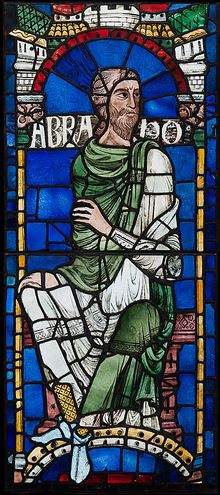
Lamech (detail), from the Ancestors of Christ Windows, Canterbury Cathedral, England, 1178–80. Images © Robert Greshoff Photography, courtesy Dean and Chapter of Canterbury

Lamech (detail), from the Ancestors of Christ Windows, Canterbury Cathedral, England, 1178–80. Images © Robert Greshoff Photography, courtesy Dean and Chapter of Canterbury

If you’ve never gotten to see Canterbury Cathedral, pop into Radiant Light before May 18 to see six magnificently restored Romanesque windows from this historic site, installed appropriately in the Romanesque Gallery near the entrance of The Cloisters.

It’s the first time any of stained glass windows from Canterbury have left home, so it’s a unique chance to gaze upon brilliant, beautiful works designed and made in 1178-1180 and think about the fact that these were seen by Chaucer and millions of pilgrims who trekked to this site over the centuries. Maybe during your trip to the wilds of Fort Tryon Park in northern Manhattan, you’ll act out your own CanterburyTales adventure.

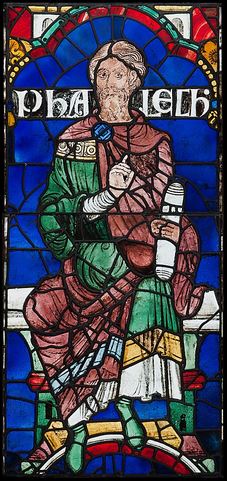
Phalech, one of Noah’s descendants, one of Canterbury’s original 86 stained-glass panels (1178-1780)

Phalech, one of Noah’s descendants, one of Canterbury’s original 86 stained-glass panels (1178-1780)

The Cloisters got the chance to display these medieval masterworks after a brief run at The Getty while the walls of the Canterbury Cathedral were being restored. Lucky us.

The backstory: After King Henry had Thomas Becket killed at Canterbury in 1170, word spread of miracles in 1171, the fastest canonization in history followed in 1173, and pilgrims began flocking to Becket’s former home. A fire in 1174 triggered Canterbury’s rebuilding and redesign, including the plan for an unprecedented series of 86 stained-glass windows to emphasize the connection of priests (versus kings) to Christ.

At the Cloisters, you will see six of the 46 surviving choir windows depicting the Biblical ancestors of Christ, as chronicled in the Book of Luke.

The patriarchs that you’ll meet uptown are Jared, a fifth-generation descendant of Adam; Lamech, the son of Methuselah and father of Noah, who lived during those sinful pre-Flood times; Noah, who appears to be talking to God; Phalec, who lived five or six generations after Noah; Thara, Abraham’s father who hailed from the ancient city of Ur; and Abraham himself.

Abraham with his border back around him again after 200 years

Abraham with his border back around him again after 200 years

Several full-body portraits are reunited for the first time in 200 years with their original stained-glass borders, which mimic those of contemporaneous manuscript illuminations. Phalech’s portrait has a little less detail than the others, and the curators speculate that the artisans may have had to rush a bit to finish this monster-sized commission on time for the Archbishop back in 1180.

Spoiler alert: The faces of Thara and Abraham are 20th-century copies.

How were these painted? How were these  images made? The Cloisters points us the four-minute video below, created by London’s Victoria and Albert Museum to show how medieval artists created their magic.

Making a stained glass panel from Victoria and Albert Museum on Vimeo.

For other views of The Cloisters, see our Flickr album.

Folk Art Couture

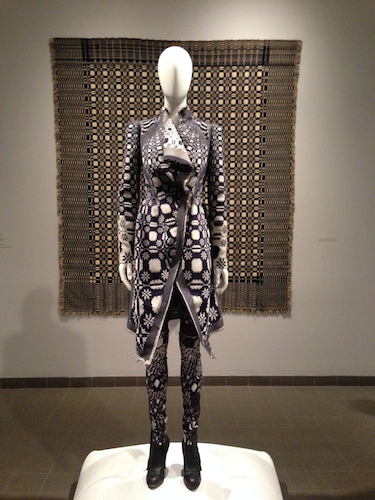
Gary Graham’s coat of wool/cotton jacquard in front of his inspiration — an 1810 Ann Carll Coverlet: “Blazing Star and Snowball.”

Gary Graham’s coat of wool/cotton jacquard in front of his inspiration — an 1810 Ann Carll Coverlet: “Blazing Star and Snowball.”

Delightful, whimsical carved animals from New Mexico don’t often appear on the runway with couture, but they certainly take center stage in the American Folk Art Museum’s fantastic show, Folk Couture: Fashion and Folk Art, which closes today.

No worries, though, the museum has created a detailed, media-rich exhibition site on Tumblr that gives you a close-up look at the fabrics, fashions, and folk art that inspired these fun, creative looks.

The museum pulled 100 of works from its collection and asked thirteen
designers to create clothes – wearable or not – that would reflect the scope, spontaneity, and sheer funkiness of folk art.

A steady stream of fashion-lovers worked their way through three galleries of beautiful clothes and creations inspired by collection pieces from across America — New Mexico folk-art porcupines inspired Jean Yu to make a straw-chiffon cocktail ensemble; an 1810 coverlet from Westbury, Long Island inspired Gary Graham to create a gorgeous jacquard-pattern coat and leggings; a religious sculpture made by German immigrants in North Dakota inspired Brazilian designer Fabio Costa to create an other-worldly white ensemble that would look at home in any avant-garde collection.

Closep-up of Michael Bastian’s sweater icon based upon an 1840s weathervane of the Archangel Gabriel. The look also features a hood with built-in earmuffs.

Closep-up of Michael Bastian’s sweater icon based upon an 1840s weathervane of the Archangel Gabriel. The look also features a hood with built-in earmuffs.

Apparently menswear designer Michael Bastian is a fan of this museum and loves its collection, so he fairly faithfully replicated an angel-weathervane icon on the front of his guy sweater and thought it would be fun (which it is!) to take the top hat and eyewear from a Michigan folk-art sculpture and put them right onto his mannequin’s head. The look is great — modern artist and old-fashioned at the same time.

Visit our Flickr album and the exhibition site to see all of the inspirations from the museum collection and learn more about each designer’s working process. We particularly liked the inspiration board in the gallery, which showed some of the process from art to reimagination to finished gown, coat, and dress.

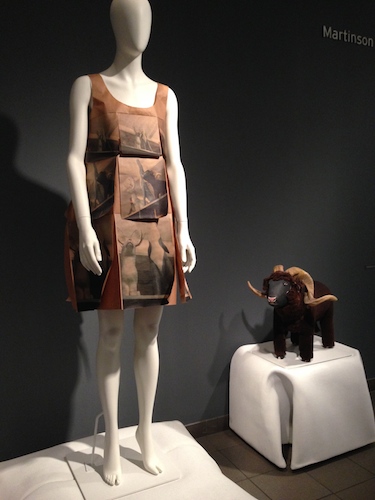
You can’t really beat Yeohlee’s paper dress, featuring images of New Mexico folk-art animals printed on Kraft paper and made into a modern and mod shaman ensemble. Chic and magical at the same time, just like her all of her collections and fans.

Yeohlee’s dress — Shamanistic Printed Prayer Flag Dress from Brown Kraft Paper. Among her whimsical inspirations — a ram carved in 1988 by New Mexico artist Johnson Antonio

Yeohlee’s dress — Shamanistic Printed Prayer Flag Dress from Brown Kraft Paper. Among her whimsical inspirations — a ram carved in 1988 by New Mexico artist Johnson Antonio

We’ve heard that this inspirational show will tour and we’ll keep you posted.

Armory Show Stars on the West Coast of Manhattan

The Artforum Lounge on the Contemporary Pier

The Artforum Lounge on the Contemporary Pier

For four action-packed days, the art crowd made its way to the West Coast of Manhattan Island past gritty lots, warehouses, the ball fields of Clinton, and high-rises-under-construction to enter a white, light-filled glittery expanse of painting, sculpture, and champagne bars at the 2014 edition of The Armory Show.

This year, 205 exhibitors showed off the best in modern masters and contemporary upstarts. Walk through it with us on our Flickr feed.

If you’ve never been there, just know that the art fills two full piers (yes, where the cruise ships come in). You may think the Whitney Biennial is big, but The Armory promenade is vast.

On the Modern Pier: Chicago’s Alan Koppel Gallery gave tribute to original Armory Show in 1913 with several Duchamps, but most of the work is post-1940 by Modern superstars. Right at the start of the pier, Galleria d’Arte Maggiori positioned a nice rough-and-ready Mattia Moreni in kind-of a face-off with a pretty primitive Basquiat nearby.

Dramatic paper collage and charcoal work by Elaine de Kooning with two Picasso ceramics at Vivian Horan

Dramatic paper collage and charcoal work by Elaine de Kooning with two little Picasso ceramics at Vivian Horan

Frankfurt’s Die Galerie gave NYC glamour-icon Louise Nevelson a mini-tribute, and several galleries featured Marca-Relli’s painting/collages.

Best on the Modern Pier: Vivian Horan’s booth, dominated by a large Elaine de Kooning charcoal drawing with collage, but populated by two small Picasso ceramics that most fair goers didn’t even see, although they were practically out in the aisle. You don’t see Picasso ceramics too much, and they really added a nice touch.

Second runner-up was the Armand Bartos booth with a sharp Kenneth Noland, Andy’s chicken soup can under glass, and a no-holds-barred Stella. In fact, there were multiple 1980s 3D Frank Stellas leaping out from walls, demanding attention. Besides posing with the soup can, lots of visitors were snapping photos of themselves in front of Mr. Stella’s work.

1949 Hans Hoffman oil at London’s Crane Kalman

1949 Hans Hoffman oil at London’s Crane Kalman

Welcomed surprises: Even though he taught most of the post-war painters in New York, you don’t often see Hans Hoffman paintings, so it was nice to encounter one of his color explosions at Crane Kalman. And we’ve never seen the two super-early skinny Lichtenstein sculptures at Barcelona’s Galeria Marc Domenech booth. Guess they were made in those lean before-the-dots years on his path to Pop.

Susan Harris curated a great micro-show of 20th century female artists, mostly works on paper (e.g. Georgia O’Keefe, Kiki Smith, Lee Bonticou), all contributed by gallery exhibitors.

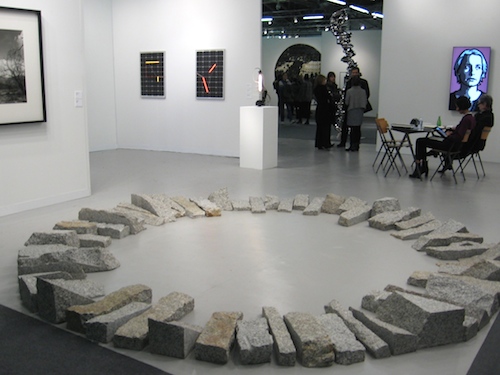
Richard Long’s 1994 Merrivale Circle at the Lisson Gallery

Richard Long’s 1994 Merrivale Circle at the Lisson Gallery

Although you could hike outdoors to get to the second pier along the West Side Highway, most were guided through a wormhole and down a flight of stairs to descend directly into the booths from 17 contemporary galleries across China – a great landing into a warren of booths featuring installations (watch out for the Roomba!), and user-friendly exercise equipment that the PRC makes available in public parks for citizen fitness.

From there, you enter the Contemporary Pier area.  Highlights: the whirling handbag piece (with real handbags) by Egill Saebjornsson at Reykjavik’s i8 Gallery, Richard Long’s stone circle at London’s Lisson Gallery booth, the completely constructed entry to Boesky Gallery, and Claudia Weiser’s cool wooden sculptures at Sies + Hoke (Dusseldorf).

Nick Cave Soundsuits at Jack Shainman

Nick Cave Soundsuits at Jack Shainman

A great place to end the journey was at the Jack Shainman booth, with its dramatic contemporary art exploring expressions from Africa, African-Americans, and global artists — the Nick Cave soundsuits and Richard Mosse’s spectacularly dissonant hot-pink infrared photograph of a waterfall in the continually disintegrating, war-torn Democratic Republic of Congo.

Take a look at the highlights here.

Fair goer relaxes on modernist egg chair under the watchful eye of Dali

Fair goer relaxes on modernist egg chair under the watchful eye of Dali