New Views from/at The Whitney Museum

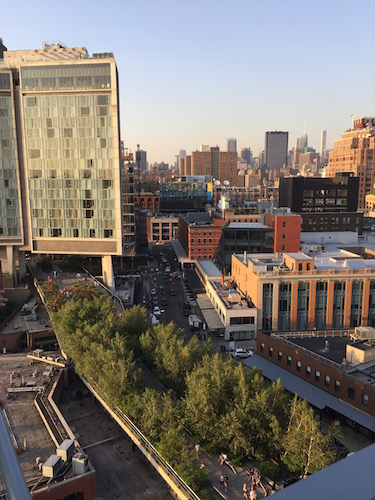
High Line and City views from the Whitney

Towering over the green esplanade of the High Line, the new Whitney Museum of American Art is a spectacular success, inside and out. The inaugural show, America is Hard to See, closing this weekend, features 600 works on all eight floors of the new Renzo Piano-designed landmark. Finally, Gertrude’s collection has room to breathe.

The inaugural installation distributed the massive collection into smartly themed galleries, but moving up and down between the floors is an equal delight – picture windows and balconies offering views of spectacular sunsets over the Hudson and Empire State Building views from entirely new vantage points. Peeking through the doors into the kitchen on the 8th floor reveals some of the best views (think Standard Hotel) offered to any sous chef in the City.
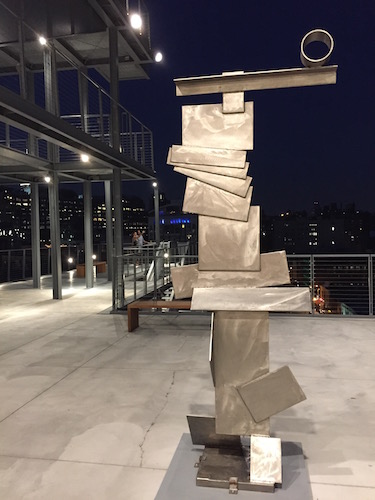
David Smith’s Cubi XXI (1961) enjoys its view of Meatpacking District nightlife from the balcony

David Smith’s Cubi XXI enjoys its balcony view of Meatpacking nightlife

Part of the fun is walking around on the balconies (on every floor) and experiencing the Whitney’s vertical outdoor sculpture park – Joel Shapiro’s playful bronze guy and David Smith’s towering Cubi totems, all against stunning City vistas. It’s Storm King for the urban soul.

Inside, it’s a walk through American art history with themes from the early 20th century (“Forms Abstracted”, “Music, Pink and Blue”, and “Machine Ornament”) with featuring the Whitney’s iconic works by Stella and Dove, O’Keefe and Macdonald-Wright, and Sheeler and Demuth. The clever mix of paintings and sculptures evoke times when American artists did their own takes on the modernist mix of African art and Cubism, colorful abstractions evoking symphonies for the eye, and the beauty of industrial techniques and landscapes in the heartland.

Gallery devoted to 1950s New York Abstract Expressionism with Chamberlain and diSuvero sculptures set against and Lee Krasner's 1957 Seasons

Gallery devoted to 1950s New York Abstract Expressionism with Chamberlain and diSuvero sculptures set against and Lee Krasner’s 1957 Seasons

The curators even pay tribute to early American filmmaking with a continuing mix of reels by 20th century innovators capturing the bustle and abstraction of modern life.

Calder’s “Circus” gets an expansive showcase, surrounded by jazz age depictions of vaudeville, clubs, movie palaces, and downtown edge by Benton, Hopper, Marsh, Weegee, and Cadmus. Around every corner, a new dimension to the American Experience is revealed – social-justice prints of the 1930s, heartland life in the 1940s, wartime calls to action, abstraction and color-field revolutions, and Pop.

Marisol’s Women and Dog group take in Lichtenstein’s Little Big Painting

Marisol’s Women and Dog group take in Lichtenstein’s Little Big Painting

One of the most stunning triumphs is the large gallery dominated by Mr. Chamberlain’s white car-crush tower, Mr. di Suvero’s primal hankchampion sculpture, and Ms. Krasner’s voluptuous 1957 pink and green mural. The clever curators gave Ms. Krasner her place in the spotlight, surrounded by works by Newman, Rothko, Kline, and Mr. Pollack, who is — at least for the run of this show – relegated to a few vertical drip canvases on the faraway opposite wall.

On a lower floor, the curators have hauled out the massive de Feo piece, “The Rose”, and installed it next to works by other female innovators, Lee Bontecou and Louise Nevelson.

If you missed the initial installation, take a look at the Whitney’s website (which features selected works from each of the 23 themed sections), listen to the audio guide introduction, and enjoy views of our favorites on our Flickr page.

Max Weber's Chinese Restaurant, painted in 1915 when Chinese restaurants and Cubism were first popping up in Manhattan

Max Weber’s Chinese Restaurant, made in 1915 when Chinese restaurants and Cubism were both new to Manhattan

The Whitney welcomes late-night guests (until 10 p.m.) every Thursday, Friday, and Saturday. Ride over to NYC’s newest subway station at 11th Avenue and 34th Street and walk down the High Line to the City’s latest hot spot in the Meatpacking District.


Daring Docent Dishes with Digital Adam at The Met

Digital Adam and the Docent reenact what Paradise was like before The Fall

Digital Adam and the Docent reenact what Paradise was like before The Fall

There’s no need to check into the Met after hours to see a classical statue come to life. In Renaissance gallery 504 on the main floor, a digital version of Tullio Lombardo’s 15th-century Adam is interacting with visitors and a knowledgeable Docent in Reid Farrington’s The Return performance through August 2.

The Return is quite a production and its illusions created in the Italian Renaissance gallery would make any animation fan jump for joy.

Classical Adam (the marble one) is installed prominently in the gallery where half the performance takes place. Its presence is a miracle, since the beautiful Renaissance sculpture totally shattered in a freak fall in 2002.

To repair it – a complex undertaking — Met team made a digital replica of all the pieces to decide how to fit everything back together again and spent years making it whole.

Tullio Lombardo’s Adam (1490-1495), which fell and shattered in 2002, but has been exquisitely repaired

Tullio Lombardo’s Adam (1490-1495), which fell and shattered in 2002, and is now repaired

Now, it’s Digital Adam who’s the fascinating co-star of the show, brought back to life by performance artist Reid Farrington who envisioned a tribute to the virtuosity of the Met’s conservation team who so flawlessly reassembled Tullio’s Adam.

The other half of the performance involves an improv actor, a motion sensor suit, and a crew of digital engineers and prop masters, all camped out on the stage of the Met’s auditorium in the Egyptian wing. As the stage actor moves in the auditorium, Digital Adam moves, speaks, answers questions, and holds up a Warhol and a Van Gogh inside his lifesize digital frame in the Renaissance gallery to the delight of the audience and his sidekick, The Docent. See photos on our Flickr feed.

The audience decides what part of Classical Adam’s renovation will get discussed next, but the witty duo soon veer off into other fascinating topics:

Actor in motion-capture portrays Digital Adam, whose image is simulcast at the right and in gallery 504

Actor in motion-capture portrays Digital Adam, whose image is simulcast at the right and in gallery 504

What does it feel like to always look good and never age? Does Classical Adam remember back to the marble quarry? Does Biblical Adam remember what Garden of Eden was like before the Fall? Adam’s clever responses reveal that his Eden experience was a lot about infinity pools and the good life.

At one point, Digital Adam invites the Docent to portray Eve in his telling of what happened after the Serpent appeared with that apple. Then the attention turns back to Classical Adam, as the Docent shows Lombardo’s thinking about that particular moment portrayed in marble.

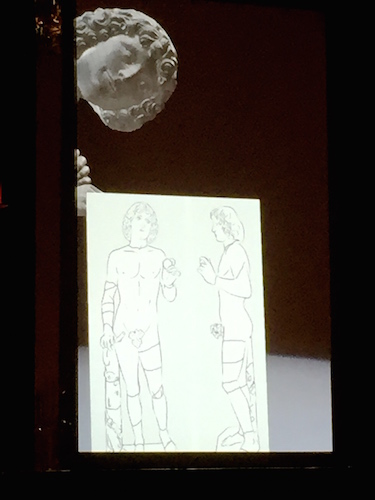
Digital Adam shows drawing of where the breaks in Lombardo’s Adam occurred

Digital Adam shows drawing of the breaks in Lombardo’s Adam

These two need their own ongoing talk show about history, time and space in some corner of the Met. Until August 2, ask the information desk for The Return’s program and go marvel at both the gallery and the behind-the-scenes performances. Or go to the live stream on the Met Museum’s website.

After meeting Digital Adam, you’ll never again wonder about what’s going on inside Classical Adam’s cool, calm, beautiful marble head.

Dramatic Live Steam Show Envelops Virginia Museums

The restored 611 arrives in downtown Roanoke behind the art museum

The restored 611 arrives in downtown Roanoke behind the art museum

For the last month, crowds in western Virginia have been turning out in droves to see the dramatic result of engineering, technology, and determination by several museums and volunteers to resurrect the biggest, fastest passenger steam locomotive to live out its former glory on the Norfolk & Western Railroad.

If the CEO of Norfolk Southern hadn’t sold his Rothko in New York in 2013 and donated $1.5 million of its record-breaking proceeds, this amazing steam revival might not have happened.

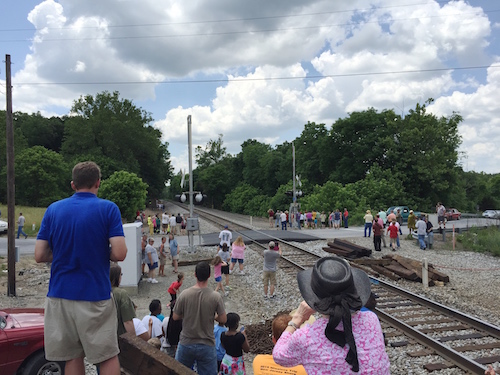
Waiting for the 611 at Evington, Virginia on its debut run

Waiting for the 611 at Evington, Virginia on its debut run

The Virginia Museum of Transportation is celebrating the culmination of efforts to “Fire Up the 611” and let this 100-mile-per-hour wonder rip through the foothills of the Blue Ridge and points east all month and hopefully into the future.

As the 611 made its way from its rehab yard at the North Carolina Transportation Museum in Spencer, North Carolina, people lined the tracks to see the newly refurbished 1950s streamlined locomotive pull 17 passenger cars loaded with fans 140 miles north to its new home in Roanoke. The celebration of 611’s return has been going on all month, as the locomotive keeps making runs to Petersburg, Lynchburg, Radford, and other Virginia towns.

611 parked next to the O. Winston Link Museum

611 parked next to the O. Winston Link Museum

The 611’s Twitter feed lets everyone know when to expect it, although the piercing steam whistle and roaring sound are also sufficient alerts to anyone in a five-mile radius. Listen to its sounds on our Flickr video of its 45-mph pass through one lucky town and see photos its Roanoke arrival.

The 611 and its 13 sister locomotives (Norfolk & Western J Class) were produced after 1941 and pulled passenger trains through Ohio, North Carolina, Virginia, and Tennessee until the late 1950s – around the same time that Rothko painted the canvas that would later benefit the 611’s resurrection. Since it’s retirement, this coal-fired steam engine mostly sat in the yard at the Roanoke museum, but had a brief comeback in the 1980s making a few tourist rail runs.

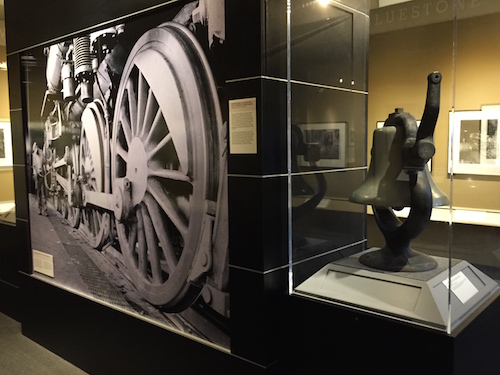
Inside the O. Winston Link Museum, showcasing Link’s spectacular photographs of the last days of steam on the Norfolk & Western Railroad

Inside the O. Winston Link Museum, showcasing Link’s spectacular photographs of the last days of steam on the Norfolk & Western Railroad

Norfolk Southern initiated a “21st Century Steam” initiative, and volunteers at the Roanoke museum began the “Fire Up the 611!” campaign. The NS CEO decided to jump-start the initiative with the $1.5 million from the Rothko sale, and volunteers put in over 8,000 hours to bring the magnificent machine back to life.

When the 611 steamed into downtown Roanoke on May 30, it stopped for photos and an official welcome right behind Roanoke’s contemporary at museum and in front of the O. Winston Link Museum, housing the work of one of the most acclaimed railway photographers of the 20th century in the former Norfolk & Western Railway Building.

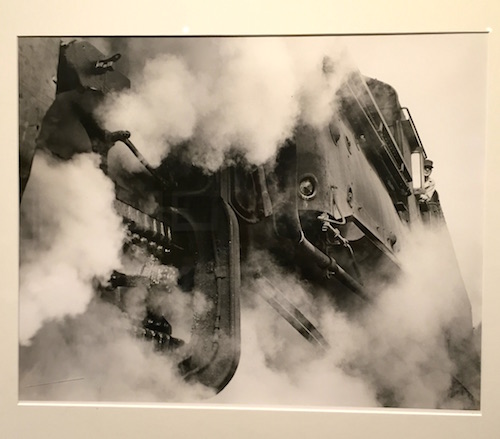
Link’s 1960s portrait of steam locomotive fireman, Joe Estes

Link’s 1960s portrait of steam locomotive fireman, Joe Estes

Link, a Brooklyn-born commercial photographer, fell in love with steam locomotives that he knew were rapidly being replaced by diesel. He innovated nighttime lighting gear to capture dramatic shots of the steam giants coursing through the hills and crossroads of West Virginia and Virginia. Link recorded their sounds as well – recordings that continued to sell well for decades. Catch a glimpse of Link’s gorgeous images, equipment and recordings on our Flickr site.

After finishing its July runs, the 611 will be on display in the museum yard in Roanoke, parked alongside other giants of steam.

Saints in the ‘Hood in Brooklyn

Kehinde Wiley’s Saint Amelie in stained glass, 2014

Kehinde Wiley’s Saint Amelie in stained glass, 2014

Take a look at the saints as you’ve never seen them in Kehinde Wiley: A New Republic through this weekend at the Brooklyn Museum of Art.

They’re not saints, exactly, but Mr. Wiley is asking you to look at the young African American men you pass in your everyday life in a slightly different way – through the lens of Byzantine icons and Medieval stained glass. The icons and would-be saints are magnificent, proud, and mysterious, just like his slightly earlier portraits that are grace the walls of Lucious Lyon’s mansion in the hit series Empire.

The Cantor Gallery is filled with these men of higher purpose, and the crowds love it. Bronze busts echo the 18th century marble work of Houdon, and visitors check them out from all angles.

The Archangel Gabriel, Wiley’s 22-karat gold leaf and oil on wood painting from his Iconic series

The Archangel Gabriel, Wiley’s 22-karat gold leaf and oil on wood painting from his Iconic series

Beyond this gallery, the curators have assembled a survey of Mr. Wiley’s 14-year career – dominated by his giant canvases in which guys from the neighborhood take on the heroic poses of European aristocrats and conquerors. In fact, when he began, Wiley would scan neighborhood streets for handsome, statuesque subjects and ask them if they would feel comfortable posing as other-era men of means in his painting studio. Those who said yes were asked to select the person they felt comfortable emulating from Wiley’s library of art books on European portraiture.

Elsewhere in the show are Wiley’s first-ever bronze sculpture of female subjects and selections from his world tour, where he found portrait subjects in Israel, Palestine, Africa, and the Indian subcontinent. Check out some of the works in our Flickr feed and on the museum website.

Although it’s common to see a gigantic Wiley portrait in another museum these days, Brooklyn is proud that it was among the first to collect his work. If you journey to another floor, you’ll see a five-panel painting installed on a ceiling like some Renaissance master’s and several portraits from his Passing/Posing series in 2003.

If you can’t get to Brooklyn to see this show, let Mr. Wiley take you through the exhibition via video:

Bird Watching with Audubon: Forget the Binoculars

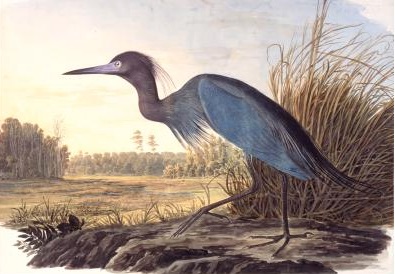
Little Blue Heron (Egretta caerulea), Havell plate no. 307, 1832

Little Blue Heron (Egretta caerulea), Havell plate no. 307, 1832

If you climb up to the second story of the New-York Historical Society to see Audubon’s birds, grab the magnifying glass right inside the gallery door. See the magnificent details painted by the watercolor master of all time in  Audubon’s Aviary: The Final Flight (Part III of The Complete Flock), running through this weekend.

NYHS is the lucky owner of every watecolor JJA produced to make his historic Birds of America subscription project in the early 1800s, which documented over 700 species.

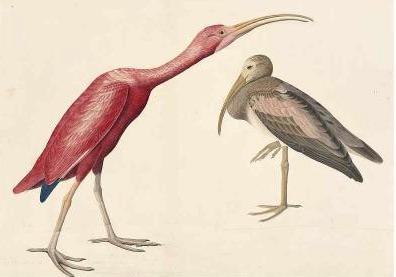
Scarlet Ibis (Eudocimus ruber), Havell plate no. 397, 1837

Scarlet Ibis (Eudocimus ruber), Havell plate no. 397, 1837

The watercolor collection – from which engravings were made – is so large that NYHS had to split the exhibition into three parts. It’s a joy to look at the life-size paintings that Audubon produced through the magnifying lens, seeing the tiny brushstrokes on lush feathers and miniscule detail on the small hummingbirds.

Paintings featured in all three shows are hung in the sequence that JJA painted them. Although JJA traveled extensively throughout the East and South, he never actually saw birds west of the Missouri in the wild.

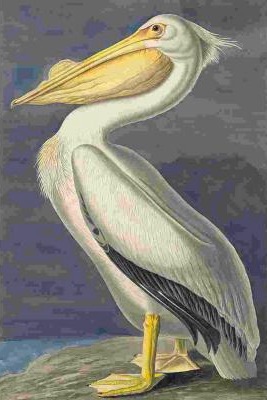
American White Pelican (Pelecanus erythrorhynchos), Havell plate no. 311

American White Pelican (Pelecanus erythrorhynchos), Havell plate no. 311

By the time Audubon began cranking out the watercolors needed for his final installment of his masterwork, lots of new birds were being discovered out West. Scrambling to keep up – after all, he committed to documenting every American bird – he accessed specimens collected by recent Western expeditions, Lewis & Clark’s trove, and other American specimens archived in Europe.

He holed up in Charleston, South Carolina in the winter of 1836 and worked, worked, worked to finish all the watercolors, which would be shipped to Mr. Havell in the UK for engraving.

How did Mr. Auduon’s studio work compare to the real thing? See for yourself in this bird-watching documentary shown inside the gallery. The birds featured are from the previous installation of the exhibit, including the rare, rambunctious Prairie Chicken at 1:25.

For more, go to the show’s excellent website, explore some of JJA’s works in more depth, and listen to the bird calls for the exhibition, courtesy of the Cornell Lab of Ornithology.

On Kawara: Time and Life as Art

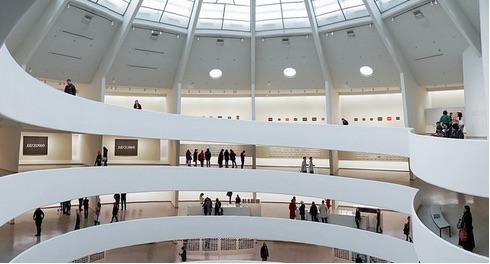
On Karawa always wanted to see his work on the timeless, spiritual spiral ramps of the Guggenheim and got his wish. Photo by David Heald

On Karawa always wanted to see his work on the Guggenheim’s timeless, spiritual spiral ramps. Photo by David Heald

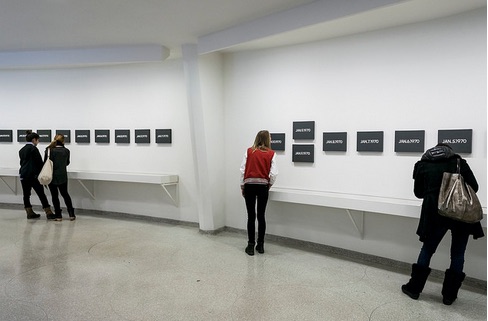
Back in the 1970s, you couldn’t find a language-art or Conceptual art exhibition without the enigmatic world traveler On Kawara. Sometimes you would see canvases with a single day’s date, but other times you might encounter a single telegram sent from a major world city with simply the message: “I am still alive.”

The Guggenheim is paying tribute to this favorite through the weekend in its show On Kawara – Silence, and has done a magnificent job of displaying and interpreting the life work of an artist who always appeared barely there. Although he was fully immersed in the New York art scene, he seemed always to be on the go, traveling to some other major world capital. He managed to make art out of this peripatetic life.

Visitors peruse On Karawa’s Today series paintings and peer into their newspaper-lined storage boxes below. Photo by David Heald

Visitors peruse On Karawa’s Today series paintings and peer into their newspaper-lined storage boxes below. Photo by David Heald

Indeed, at one point in his early life he thought he might like to be a travel agent, but an immersion in the ancient cave paintings of Altamira changed that. He decided to dedicate himself to art and set upon a unique course.

At the start of the walk up the spiral ramp, you encounter his Today series – a continuous set of rectangle canvases, painted each day with the day’s date, beginning with January 1, 1970. Over the next four decades, he would create more than 3,000 of these. In a twist, the Guggenheim displays many with its associated storage box that the artist assembled each day when he was done, lined with the newspaper from the same day.

From the I Got Up postcard series. Photo by David Heald

From the I Got Up postcard series. Photo by David Heald

Although the artist never intended the paintings to be shown with the storage boxes, the throngs of visitors have quite a time looking at the date and then peering down to see what else was happening in the world that day – for example, Golda Meir’s proclamations about Israeli-Egyptian standoffs, desegregation in the South, the Chicago Seven trial, and Vincent Canby reviews.

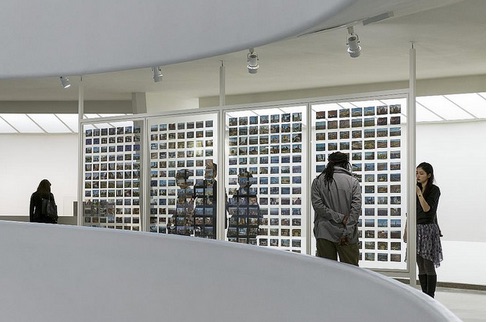
It’s stunning to see the assemblage of tourist postcards that he sent at the rate of two per day to friends and colleagues with the stamped inscription I Got Up Today with a time stamp of his rising. Travel and personal routine systematized and packaged into a series of projects he carried out from 1968 through 1979.

He didn’t want the moments or people to pass as he journeyed throughout the world, so he began the series I Met. He noted every single person he met every day for twelve years – friends, artists, waiters, store clerks – and typed their names on pieces of paper that were time-stamped and bound into books.

Viewers peruse a fraction of the 1,800 postcards that On Kawara sent to document the time he got up at various cities in his travels. Photo by David Heald

Viewers peruse a fraction of the 8,000 postcards that On Kawara sent to document the time he got up at various cities in his travels. Photo by David Heald

It’s amazing to encounter the bound volumes on the ramp, visitors circling the extensive set wondering what it must have been like to carry out this level of life documentation.

The curators explain more in the video below about how On Kawara took on monumental projects to translate his day-to-day life, travels, and schedule into the art that fills this meditative, peaceful, and mind-expanding show:

See more views of this thought-provoking installation here. For more curator videos, click here.

Benton’s Freebie Masterpiece at The Met

Viewer contemplates “The Changing West” panel of Thomas Hart Benton’s America Today mural (1930-1931)

Met visitor contemplates “The Changing West” panel of Thomas Hart Benton’s America Today mural (1930-1931)

When times get tough, did you ever take on a job or make something for free just to build up your resume and showcase what you could do? That’s exactly what one New York up-and-comer did, and it really paid off. The Metropolitan Museum of Art’s show, Thomas Hart Benton’s ‘America Today’ Mural Rediscovered, tells the story.

Back in 1930, the New School was just completing its modern building in the Village on West 12th Street and was seeking something to jazz up the boardroom.

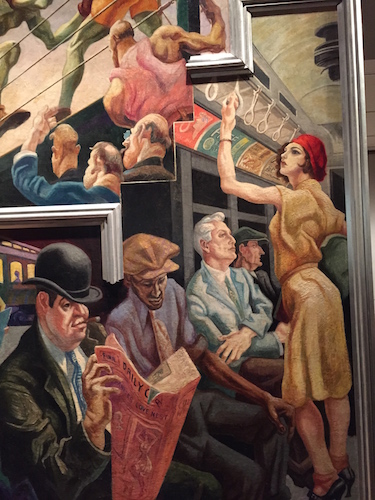
“City Activities with Subway” portion of America Today based on his portrait sketches

“City Activities with Subway” portion of America Today based on his portrait sketches. (It’s Pollack’s sister-in-law, Elizabeth)

Mr. Orozco, the famed Mexican muralist, had already been commissioned for the more visible dining room/lounge, and Mr. Benton, who was teaching at the Art Students League, saw an opportunity to showcase his painting chops.

Social realist chronicler Reginald Marsh had introduced Benton to the mysteries of mastering egg tempera, and Benton felt ready to go to town on a large-scale portrait of American life in all of its regional glory. Here’s the deal: no pay, just loft studio space about a block away.

Twenty years earlier, Benton had hung around Paris, soaking up the birth of the French Cubist and Italian Futurist movements in Europe. Ten years earlier, he roamed around the back roads of the United States, filling up sketchbooks with steel town landscapes, lumber camps, oil derricks popping up in Los Angeles, dives, diners, and small town stuff.

“Steel” portion of the mural, featuring model Jackson Pollack, Benton’s student

“Steel” portion of the mural, featuring model Jackson Pollack, Benton’s student

The mural began taking shape, crammed to the gills with swirling activities, people, industry, and pop culture that he saw. Need models? Why not ask Jackson Pollack, his art student, and his sister to pose?

It’s hard to imagine serious board meetings taking place in a room so alive with oversized ambition and action. Over the decades, the New School repurposed the room for classroom lectures, and over time, the scuffed mural was removed completely.

Lucky for us, Benton’s 1930s historic masterpiece found its way to the Met, which has lovingly restored and installed it in a rectangular room just beyond the Frank Lloyd Wright room.

The curators have filled the adjacent galleries with extra treats: the inspirational sketches from Benton’s earlier road trips and works by Mr. Pollack and Benton’s Village contemporaries.

See our Flickr album to glimpse the installation (and works by early Pollack, Abbott, Marsh from the Met’s collection), and watch the Met curators tell the story of how Mr. Benton’s freebie paid off and their joy in giving this ten-panel chronicle a new home.

Sturtevant’s Mini-MoMA Imitation Game

Sturtevant’s 2004 piece — a reproduction of an light bulb and cord installation “ Gonzalez-Torres Untitled (America)”. On far wall, “Study for Rosenquist’s Spaghetti & Glass”, an oil painted in 1965-1966

Sturtevant interprets Gonzalez-Torres Untitled (America) (2004). On far wall, Study for Rosenquist’s Spaghetti & Glass, an oil painted in 1965-1966

The free Friday night crowd at MoMA could not get enough of the Elaine Sturtevant tribute, Double Trouble, closing this weekend. Sturtevant spent her long career creating ready-mades out of other people’s art.

The show is a who’s who of 20th century art, except that all the pieces were done by Ms. Sturtevant. The show has it all – an entryway plastered with Warhol’s cow wallpaper (done by her), Lichtensteins, Rosenquists, Johns oil paintings – all done in her hand. Take a walk through our Flickr site and see more in the photos on the curator’s blog.

It’s all imitation, except that Elaine’s versions are really, really good. It’s hard to tell them from the originals displayed through the rest of the museum. Nothing in the show is a line-by-line copy, but you’ll have to go MoMA’s permanent galleries to compare them with the real thing.

Sturtevant’s 1967-1968 oil on canvas,Study for LIchtenstein’s ‘Happy Tears’

Sturtevant’s 1967-1968 oil on canvas, Study for LIchtenstein’s ‘Happy Tears’

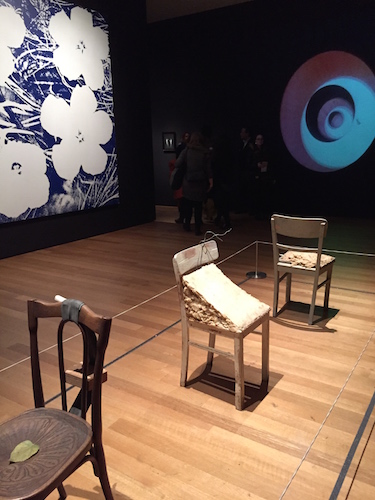
In fact, MoMA encourages a trek upstairs to compare Duchamp’s own ready-mades and whirligig. Or Mr. Beuys slabs of fat with those sitting on Sturtevant’s chairs in the darkened gallery.

Can anyone distinguish the Warhol Wall Flowers that Elaine made from the reproduced images of the originals on the stuff all over the gift shop?

The Gonzalez-Torres installation was the dramatic high point, all flashy bulbs in a charismatic, mysterious circle near the pretty perfect interpretations of early video games. Everyone is having a blast lining up to contemplate Sturtevant’s walk down digital memory lane with her interpretation of Pacman 1.0.

Is that Sturtevant’s Duane Hanson museum security guard reproduction in the corner? Oh, no, it’s an actual MoMa guard! Sorry. Just about everything else is a fool-the-eye art encounter. Total fun in the white cube.

Sturtevant’s 1990 vision of Warhol’s Flowers alongside her 1968 Duchamp film with interpretations of three Beuys chairs

Sturtevant’s 1990 vision of Warhol’s Flowers alongside her 1968 Duchamp film with interpretations of three Beuys chairs

Nature Meditations in the Land of Fire and Ice

Katrín Sigurðardóttir, Haul IV (2004) travelling landscape-in-a-box on loan from private collector. Courtesy: The artist.

Katrín Sigurðardóttir, Haul IV (2004) travelling landscape-in-a-box on loan from private collector. Courtesy: The artist.

When the weather dips below freezing and people think they’re in the Arctic, there’s no better place to get out of the elements and meditate on the landscapes of long, dark winters than the third floor of Scandinavia House on Park Avenue. Until tomorrow, January 10, you’ll join eleven contemporary artists from the sub-arctic on their journeys in a show mounted by the Katonah Museum of Art, Iceland Artists Respond to Place.

Bjork may get all the media attention, but do yourself a favor and walk through this three-gallery show, which beautifully and simply presents the work of Iceland’s other leading visual artists. See the land of fire and ice through their eyes.

Olafur Eliasson, The Aerial River Series, 2000 on loan from private collector. Courtesy: The artist. Installation photo: Ben Blackwell

Olafur Eliasson, The Aerial River Series, 2000 on loan from private collector. Courtesy: The artist. Photo: Ben Blackwell

Olafur Eliasson takes you on an aerial journey along a 60-mile meltwater river, from the mouth to the source. Ragna Róbertsdóttir splatters miniscule lava rocks against a wall but it’s not what it sounds like. Far from a violent eruption, it’s an undulating, mesmerizing meditation that you’ll spend time contemplating.

For sheer romantic and modernist punch, enjoy Georg Guðni Hauksson’s two works – a large landscape memory and a solid dark blue canvas evoking the long winter nights (like an emotional Ad Reinhardt).

Lava rocks “talk” in Egill Sæbjörnsson’s Pleasure Stones installation (2008) on loan from private collector. Courtesy: The artist.

Lava rocks “talk” in Egill Sæbjörnsson’s Pleasure Stones installation (2008) on loan from private collector. Courtesy: The artist.

Egill Saebjornsson takes home the whimsy award with a multimedia installation in which rocks speak (seriously!). Eggert Pétursson zeros in the microscopic natural phenomenon – painting flowers (life sized) in patterns that read like tapestries. You’ll wish you were on some hikes with him. Katrín Sigurðardóttir simply packs up her landscapes into boxes. Tiny, tiny recreations of vast, romantic landscapes.

When we visited the galleries this week, visitors were asking if there was more they could see. Scandinavia House always hosts classy, elegant shows, so although the exhibition space is limited, we have to admit they always leave us wanting to see what’s next from that part of the world.

Seth Myers was recounting his Icelandic adventures this week on Late Night. If you can’t get to the country like Seth or visit the show, at least you can spend chilly days and nights like the natives do, courtesy of this instructional video produced by Scandinavia House:


36 Hours of Jeff Koons at The Whitney

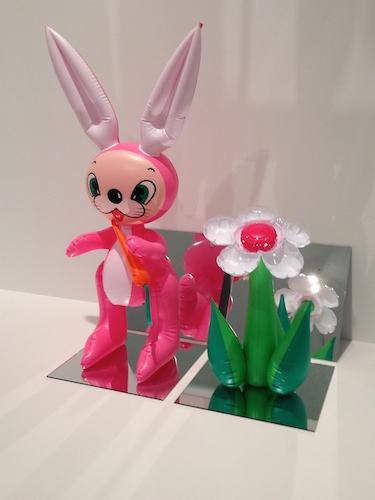
Inflatable Flower and Bunny, a cheeky take on minimalist work NYC galleries showcased in the 1970s

Inflatable Flower and Bunny, a cheeky take on minimalist work NYC galleries showcased in the 1970s

It’s the last 36 hours, and the Whitney is taking it’s Jeff Koons retrospective out with a bang – all day, all night fun-filled wonder on all four floors, letting the crowds take in his irreverent porcelains, 70s inflatables, whimsical fool-the-eye aluminum sculptures, and giant billboards. It’s the first proper retrospective that Koons has had in New York and the last show to be mounted on Madison Avenue before the Whitney moves to the High Line.

Any day of the week, lines of art-seekers have snaked out the door of the Whitney, past the pretzel carts on Madison and around the corner along 75th Street, waiting for admission into this no-holes-barred finale.

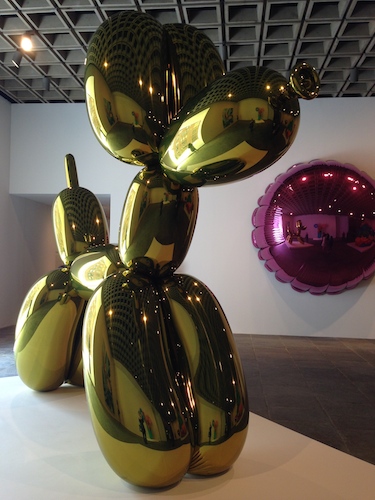
The curators and crew have done a spectacular job with the installation – no mean feat, since those big bulbous “inflatables” on the top floor are really highly polished, super-heavy hunks of stainless steel. Oh, and don’t get any fingerprints or scratches on the highly polished surfaces…it will break the illusion that these are just Mylar balloons!

Ten-ton stainless steel Balloon Dog with Moon (Light Pink) (1994-2000)

Ten-ton stainless steel Balloon Dog with Moon (Light Pink) (1994-2000)

The show starts strong on the second floor with a light-filled room of recreated works from the late Seventies – actually inflatable flowers, bunnies, and what-not. Everything uses angled mirrors.

You can’t get the joke unless you trod the floors of those West Broadway galleries in Soho way back then and saw the Minimalists and Earth Works guys in full force.Think Barry Le Va, Heizer, and Smithson who arranged rocks or dirt in a few square feet of gallery space and added a mirror or two to make a statement about nature, art, reflection (i.e. art viewing), and formal criticism inside the art world.

Koons turns all this on its head with silly found inflatables and similarly formalist presentation. It’s kitchen sponges instead of Richard Long’s rocks! Thanks, Whitney and Mr. Koons, for giving us this walk down memory lane.

The main space on Floor 2 is devoted to a spectacular low-light installation of favorite Koons pieces from the early Eighties. Several double-decker and triple-decker vitrines house illuminated and never-used Hoover vacuum cleaners, which Koons assembled to illustrate the feeling of “newness” in American society.

Billboard and illuminated Hoover vacuum cleaners, the essence of “newness” from 1983

Billboard and illuminated Hoover vacuum cleaners, the essence of “newness” from 1983

It’s a beautiful, magical room dominated by a gigantic billboard on The New, all of it from his first window-display installation on 14th Street and Fifth, when Marcia Tucker had her New Museum there back in 1983, just before the move to Soho.

Speaking of moves, it seems fitting to come full circle – spectacular early works by Mr. Koons that debuted on 14th Street as the finale to the Whitney’s long run on Madison Avenue, just prior to its move back to its new 14th Street neighborhood.

Missed the show? Take a look on our Flickr feed.