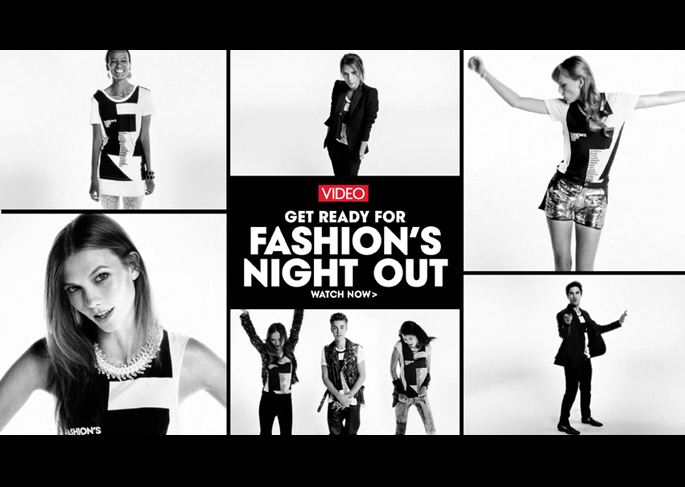
Better use the holiday weekend to rest up, since Fashion’s Night Out happens next Thursday!
The tents are going up at Lincoln Center, the stores are getting ready for the onslaught, and the NYPD is gearing up for crowd control everywhere in the City.
Check out the New York event listings at the web site, or (if you’re not in NYC that night) the FNO worldwide or elsewhere US sites. Hey, there are even events planned in Wyoming and online, so there’s no excuse not to shop, contribute to a cause (by buying stuff from the collection), and have fun all night!
If you’re in NYC, start early, have a strategy, and be prepared for crowds. The web site lets you sort the 800-plus events by neighborhood, shopping category, and the type of event you’re hankering for (pop-ups, fashion shows, new product launches, charity-focused, DJs, designer appearances, and block parties).
Contemporary Iranian Art installation at The Met with Tanavoli’s sculpture and Farmanfarmaian’s mirrored glass mosaic.
You really don’t expect to find stunning contemporary art works way, way back in a remote corner of the Islamic Art wing, and you really don’t expect to see new, sparkly stuff from Iran. Surprise!
Once you make your way back on the second floor, past the 13th century enameled and gilded glass from Syria, you’ll spy a secluded gallery with shimmering light. It’s Parviz Tanavoli’s dramatic Sufi-inspired sculpture at the center and Flight of the Dolphin, a mirrored mosaic by Iran’s most famous female artist casting its magic.
Monir Shahroudy Farmanfarmaian, who made the mirrored mosaic, is probably Iran’s best-known female artist. In 1944, she studied in New York at Cornell and Parsons and got to know art-world luminaries like Pollack, Stella, and Warhol. It changed her life and her art, as you’ll hear in this video shot inside the gallery by ArtAsiaPacific.
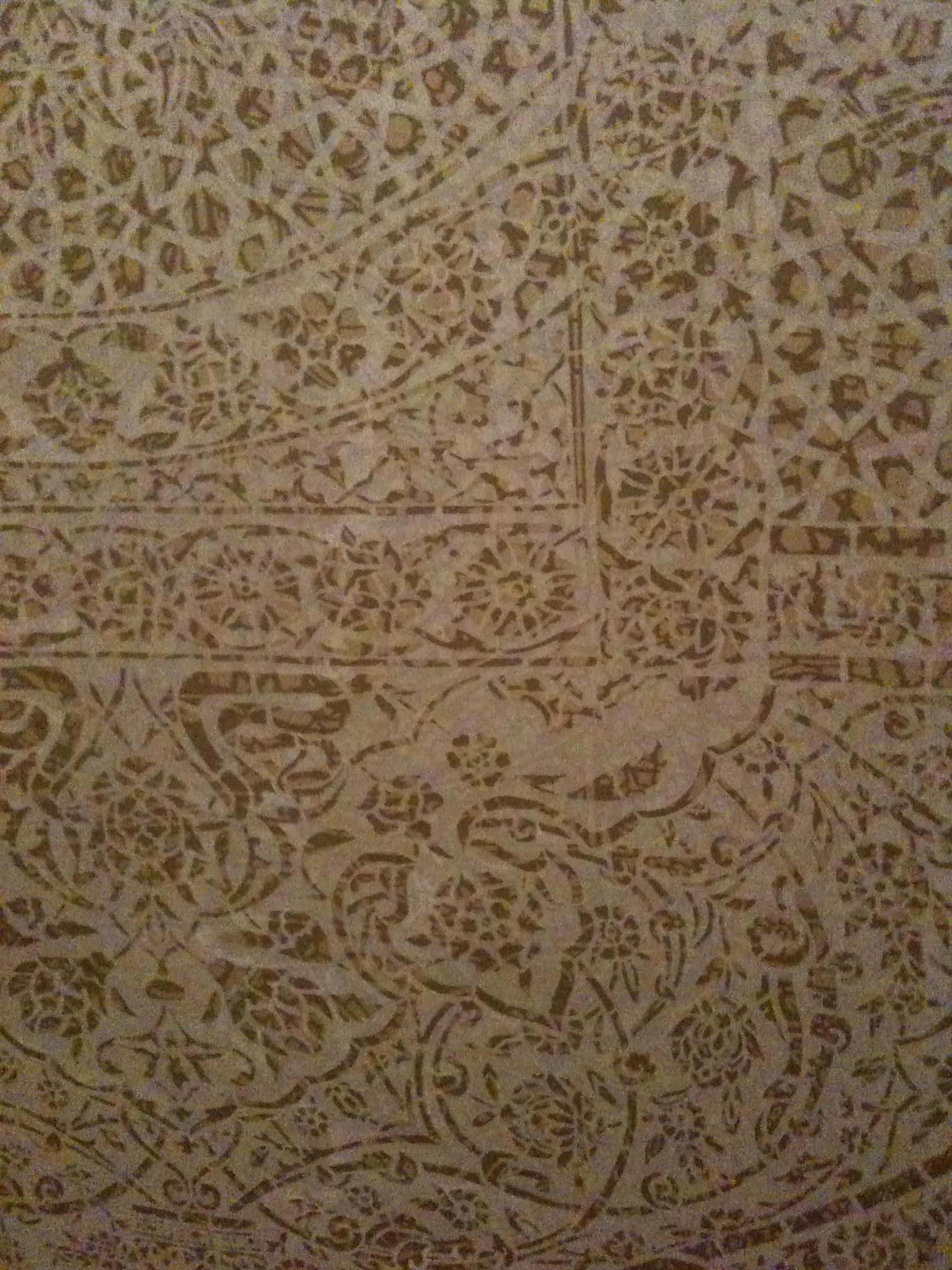
Detail of Still Garden (2011) by Afruz Amighi.
Last weekend, the tiny show enjoyed a steady stream of visitors. Most were captivated by another truly remarkable piece – Afruz Amighi’s Still Garden. The closer you get to the wall-size hanging, the more amazement you’ll have. Afruz has cut intricate patterns into thin polyester fabric that’s commonly used to construct refugee tents and has projected white light through it. The light-shadow play inches behind have a mesmerizing effect that you just have to experience in person.
Although everything’s now in the Met’s permanent collection, it’s worth making the journey through the Arab Lands upstairs and experience the light from Iran at the end.
Don’t despair if you haven’t gotten to the Met’s Costume Institute show Schiaparelli and Prada: Impossible Conversations. The Met’s put up a spectacular web site that lets you in behind the scenes, around the dining table, and inside the head of everyone’s favorite fashion icon, Iris Apfel.
If you get to the gallery this week before the show ends, expect large crowds (“normal” large, not like McQueen). Hopefully you’ll get close enough to the clothes to check out Schiaparelli’s innovative tree-bark rayon. If you can’t get there, preview the exhibition set-up on line, and go take the curator’s walk through (the second video from the top).
You can look through some of the images that the Met is sharing on line, but they don’t feature some of the in-person eye-poppers – the blue-squiggled Schiaparelli bridal veil on loan from Philadelphia, a color photo of Schiaparelli’s gold sari dress and veil (although the Horst photo is great), or Prada’s stuff with monkey and banana prints. [Prada quote: “I never thought people would want to wear clothes with monkeys and bananas on them.”]
One of the biggest complaints visitors have about the show is that it’s so hard to see and hear the “conversation” videos between Prada and Schiaparelli (played by Judy Davis, and, yes, someone did ask me “who played Prada?”). Not a problem, because all eight conversation videos are posted online (scroll to the bottom of the page).
If you have an extra hour in front of the computer, here’s the added bonus: the video of Iris Apfel discussing good and bad taste in contemporary fashion at the Met last June. Who doesn’t want Iris’s amazing perspective on style?
If you don’t have the time, just check out The Rules by Elsa Schiaparelli, courtesy of Philadelphia’s 2005 exhibition site. Agree? Disagree? Well, maybe you’ll concur with Prada’s side of the conversation.
During the summer heat wave, there’s a way to cool down in Chelsea and let the team from the Science Gallery at Trinity College challenge you to think differently about the splashing water you take for granted.
Take advantage of the final weeks of Surface Tension: The Future of Water at Eyebeam Art & Technology Center on West 21st Street, an incubator for digital art/design experimentation. For the past two-plus months, they’ve hosted an exhibition (first curated in Dublin) on the social-economic-political tensions created by water scarcity.
As soon as you walk into Eyebeam, you’ll be struck by the plethora of infographics that show you just how much water bounty that we have in the United States versus the availability and consumption per capita in the rest of the world. What’s your water footprint?
One of the ways you’ll find out is by looking at The Virtual Water Project, a celebrated infographic by German designer Tim Kekeritz, that depicts everyday objects and the amount of water required to produce them. Download the iPhone app. For $1.99, it will blow your mind (but not your budget) and continue to deliver a truly a conscious-raising experience of epic proportion.
Another unforgettable experience is Bit.Fall by artist Julius Popp, an installation that translates words from Internet newsfeeds into bits that are reconverted into a stunning waterfall of words:
There’s so much great stuff: multiple takes on water consumption, conservation, next-gen thinking, third-world innovations, and art-meets-technology solutions. Like Tele-Present Water by David Bowen, which recreates actual water movements from NOAA data being collected from a random buoy out in the ocean.
If you can’t get over to Chelsea for an hour, just click through the thought-provoking objects, artworks, design solutions, documentaries, and thought pieces by the scientists, artists, engineers, and designers whose works are on display on the Dublin microsite.
 Better use the holiday weekend to rest up, since Fashion’s Night Out happens next Thursday!