MoMA Connects Music and Modernism

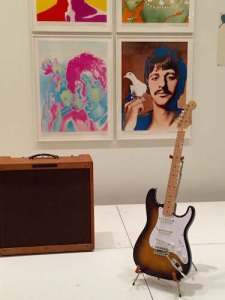
A decade apart – 1957 Stratocaster and Avendon’s 1967 posters of the Beatles

A decade apart – 1957 Stratocaster and Avendon’s 1967 posters of the Beatles

The MoMA Design Department had a brilliant idea – to tell the history of 20th century music culture by pulling out objects and two-dimensional art from the museum’s rich collection. How did modernism and music influence one another? See Making Music Modern: Design for Eye and Ear, on view through January 18.

There’s still time to catch some demos of the Scopitone, the Stratocaster, and the Mechanical Flux Orchestra inside the gallery this weekend.

Although a lot of the buzz in the gallery is over visitors’ recollections of the turntables, radios, and album covers on display, the curators do everyone a favor by putting the mod, mod world into historical context at the start of the show.

Early Edison sound experiments, films of Loie Fuller and Josephine Baker, and a poster of Yvette Guilbert from the can-can era remind everyone that shocking live performances, revolutionary music trends (go, ragtime!), and print designs that pushed the limits don’t belong exclusively to the mod, punk, or techno eras.
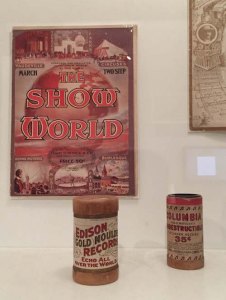
Early pop music innovations: sheet music and Edison wax cylinders

Early pop music innovations: sheet music and Edison wax cylinders

Tucked into side panels and corners are photos of costumed interplanetary performers of the Triadic Ballet at the Bauhaus in 1922 and early Russian avant-garde takes on the advent of radio, the broadcast and communications technology that changed entertainment forever.

These were worlds where artists and designers did it all – fine art, typography, industrial design, textiles, and performance. There are even some snippets of early acoustic-enhancing textiles on display, courtesy of Anni Albers. Design and music mixed, right from the start of the last century.

The sleek, streamlined radios, microphones, and Rural Electrification poster from the 1930s are presented as icons of the earliest era of broadcasting, with reminders from the curators that the designs were made to rescue the radio from its early haywire, spaghetti-city look that first appeared on 1920s garage workbenches across the country. Make it look nice, and you can bring it inside, where we can all enjoy it.

Stylish: 1932 Bakelite radio by Wells Coates and a 1939 Unidyne mic by Benjamin Baker.

Stylish: 1932 Bakelite radio by Wells Coates and a 1939 Unidyne mic by Benjamin Baker.

Throughout the Fifties and Sixties, music and design seemed to go hand in hand. Consider the Sixties revolution in turntable and speaker design – everything fit for a super-modern lifestyle of easy listening with jazz and high-concept percussion album covers nearby.

The invention of the Fender Stratocaster guitar revolutionized the sound and look of early rock and roll with its iconic whammy bar and performances that represented out and out rebellion. Although the Stratocaster was invented in the 1950s, it’s appropriately displayed in front of posters of Bob Dylan, The Yardbirds, and Avedon’s Beatles – an innovation adopted by Buddy Holly that inspired the next generation.

Where pop music and art come together – Sixties album covers, including those by Richard Hamilton and Warhol

Where pop music and art come together – Sixties album covers, including those by Richard Hamilton and Warhol

If you really want to dig into the details, there are dozens of famous album covers and posters on display with tribute paid to their designers. Among the luminaries are pop-god Richard Hamilton’s “White Album” for the Beatles, Warhol’s “Sticky Fingers” cover for the Stones, and Rauchenberg’s design for the vinyl disk inside the Talking Heads’ “Speaking in Tongues” album. The chronicle of the Fillmore East posters is a book unto itself.

And Mr. Jobs’ imprint is never forgotten at MoMA. An early version of his iPod is displayed right next to the Seventies invention from Japan that rocked the music world – the Sony Walkman.

If you can’t make it, take a look at the show through our Flickr views. We’ve grouped the items in chronological order.

And check out the excellent MoMA blog posts about the show on MoMA’s “Inside/Out” platform, where curators go to share enthusiasm about the hunt for the Stratocaster, famous rock posters, and other gems from the Fifties and Sixties. Leave your own comments, reflection on music and design, and memories right there on the MoMA website.

Before Walkmans and iPods

Before Walkmans and iPods

Navajo Jewelry Masters Offer Glittering World at Customs House

Bracelet of coral, opal, suglite, lapis, turquoise, gold, and silver by Raymond Yazzie. Courtesy: NMAI/Knight collection. Photo: S. Franks

Bracelet of coral, opal, suglite, lapis, turquoise, gold, and silver by Raymond Yazzie. Courtesy: NMAI/Knight collection. Photo: S. Franks

If you’d like an immersion into a chamber of glistening silver and gems, enter the National Museum of the American Indian’s exhibition of stunning beauty and tranquility — Glittering World: Navajo Jewelry of the Yazzie Family.

The Smithsonian is providing New York with a unique chance to view 300 remarkable necklaces, bracelets, rings, and buckles from a New Mexico family of artists known for catapulting Navajo symbols, colors, and gems into a modern-art context.

Lapis and gold bracelet by Lee Yazzie, 1984. Photo: E. Aboroso, NMAI.

Lapis and gold bracelet by Lee Yazzie, 1984. Photo: E. Aboroso, NMAI.

The focus is on Lee and Raymond Yazzi, brothers whose award-winning, intricate creations are sought by collectors worldwide. You’ll see five magnificent pieces as soon as you enter, including work by their sister, Mary Marie – representing lifetimes of master craftsmanship inspired by the mountains, sun, sky, spirits, and family in Gallup, New Mexico.

Photomurals inside the door will transport you to the red rock monuments of Navajo Nation, 1950s trading posts along the old Route 66, and maps to turquoise mines that have supplied native peoples with high-end bedazzlers since 300 A.D. The Smithsonian will be returning it all to private collectors after January 10, so be sure to enter this beautiful realm before then.

Watch this testament to artistic inspiration and dedication to beauty:

And take a trip to the Navajo world to hear more on a lifetime of creation:

MoMA Salute to Sixties Art World Transmissions

Announcement for Allan Kaprow’s 1968 Three Country Happening with collaborators in Germany and Argentina, one of the earliest artworks to incorporate an international telecast.

Announcement for Allan Kaprow’s 1968 Three Country Happening in NYC, Germany and Argentina, one of the earliest telecast international performance pieces.

Before restaurants and shops populated Tribeca and Soho in the 60s and 70s, edgy New York City artists were experimenting with happenings, video art, performance pieces, mail art, and assorted ephemeral pieces – Cage, Moorman, Kaprow, Ono, Paik, Grooms, Oldenberg and Maciunas to name a few.

In the pre-Internet days they might have been unaware that half a world away, Eastern European and Latin American artists were catching wind of this new art wave and stamping their own brand on their local art scene.

MoMA’s show, Transmissions: Art in Eastern Europe and Latin America, 1960-1980, captures the zeitgeist and shines a light on the artists, movements, and pieces from important avant-garde artists whose names are not as well known in the States. See it through January 3.

Organized into several rooms and themes, it’s a great collaboration among MoMA’s Departments of Media and Performance Art, Photography, and Drawings and Prints. The result puts a lot of MoMA’s huge Fluxus collection into a proper world context.

Socially relevant art posters from Poland, Cuba, Czech Republic, Yugoslavia

Socially relevant art posters from Poland, Cuba, Czech Republic, Yugoslavia

The first half of the show deals with geometry and its spiritual significance, offbeat artist publications, and mash-us between mail art and street performance.

Favorites include post-minimalist pieces from Brazil, Suprematist-style wall works by Yugoslavia’s Mangelos and an entire wall of photos documenting push-the-envelope street art many Eastern European countries. See our Flickr feed for a walk-through and click the links below for glimpses into MoMA’s show blog.

The next section turns more socio-political with works from the Argentine collective, Instituto Torcuasto di Tella – a center of the avant garde in Buenos Aires from 1959 to 1970. The centerpiece is a large installation for the Venice Biennal by David Lameles – Office of Information about the Vietnam War at Three Levels: The Visual Image, Text and Audio. The glass-walled newsroom is a stage from which performers read “breaking news” from the Vietnam War, just as they did when the collective debuted this in 1968. When the performers aren’t present, visitors can listen to archival recordings in three languages to feel transported back in time and reflect on how and if things have changed.

Installation for the 1968 Venice Biennal by Argentina’s David Lameles – Office of Information about the Vietnam War at Three Levels

Installation for the 1968 Venice Biennal by Argentina’s David Lameles – Office of Information about the Vietnam War at Three Levels

Nearby, visitors see clips from Marta Minujin’s Simultaneity in Simultaneity part of Allen Kaprow’s 1968 Three Country Happening, which was one of the first international telecasts of performance art.

Other galleries feature the blossoming of feminist art and performance art, social-commentary painting and sculpture, and poster art on these two continents. Artists that are familiar in US collections — like Botero (Colombia), Marisol (Venezuela), Marina Abramonovic (Serbia), and Ana Mendieta (Cuba) – are displayed in galleries that introduce other stellar artists to entirely new US audiences.

Oscar Bony’s photo documentation of his 1968 performance piece, The Working Class Family, which displayed an actual Argentine family at an exhibition

Oscar Bony’s photo his 1968 performance piece, The Working Class Family, which put an actual Argentine family on display

Consider Oscar Bony’s photo documentation of his controversial 1968 performance piece, The Working Class Family, where an actual Argentine family displayed themselves for the run of an exhibition at Instituto Torcuasto di Tella. Or Romanian graphic designer Geta Bratescu’s Medea IV, a 1980 sewing-machine drawing made and displayed privately in her studio at the height of a repressive political regime when most artists retreated underground.

The show ends with a spectacular installation: Juan Downey’s 1975-76 masterwork, Video Trans Americas. The gallery floor is painted with an outline map of the Western Hemisphere with banks of video monitors placed atop countries to which he traveled from the tip of South America to New York City, showing the life and times of indigenous people.

Chilean artist Juan Downey’s 1975-76 Video Trans Americas, documenting native peoples from his travels from the tip of South America to New York City

Chilean artist Juan Downey’s 1975-76 Video Trans Americas, documenting his travels from the tip of South America to New York City

Inspired by the idea of a transnational identity, Downey’s piece beautifully sums up the feeling of the entire show – artists and people engaged in a cultural dialogue across time and space.

Thankfully MoMA has given these artists a timeless showcase and home.

Texas Retirement for World Famous NYC Dinos

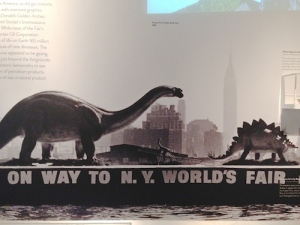
A 1964 New York Times photo of the Sinclair Dinosaur and Stegosaurus passing by the Empire State Building on their way to the Queens fairgrounds

A 1964 New York Times photo of the Sinclair Dinosaur and Stegosaurus viewing the Empire State Building on their way to the Worlds Fair fairgrounds

The Sinclair dinosaur was a sensation when he arrived in New York City to star in the 1964 World’s Fair. Millions of visitors queued to have their pictures taken with him and get a glimpse of life-size replicas of the scale and scope of the Mesozoic megafauna.

T. Rex, Stegosaurus, Triceratops, Trachodon…never mind that they lived millions of years apart – just to see them inspired science geeks, wonder seekers, and future paleontologists – an unforgettable childhood impression.

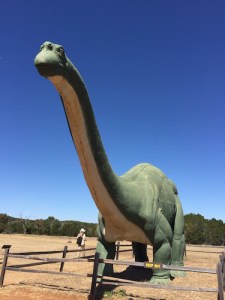
It may surprise you to learn that Sinclair and T. Rex are living a blissful retirement in Texas where there are no Unispheres, freeways, lines of tourists, or ticket booths…about 75 miles southwest of Fort Worth in a state park with another unique connection to New York.

Sinclair relaxes in a Texas corral

Sinclair relaxes in a Texas corral

The gargantuan dinosaur trackway up on the fourth floor of the American Museum of Natural History is from the Paluxy River in Dinosaur Valley State Park, where these two former New Yorkers have retired.

Back in the Thirties, AMNH field explorer Roland T. Bird told his boss, Barnum Brown, about the Texas trackways. In 1940, aided by WPA crews, the submerged tracks were excavated, cut into 1,200 pieces and shipped off to the AMNH, the Smithsonian, the University of Texas, and a few other places.The excavation was a media sensation, with chronicles appearing everywhere.

In New York, the jigsaw-puzzle track pieces were eventually reassembled and placed under the Apatosaurus/Brontosaurus, where they remain today.

Apatosaurus atop Paluxy trackway in New York at AMNH

Apatosaurus atop Paluxy trackway in New York at AMNH

The big, round blobby tracks that appear to match those of Apatosaurus are reckoned to be those of Sauroposeidon and the three-toed tracks running right alongside are those of Acrocanthosaurus, a predator.

Even though this spectacular trackway got moved to New York, there are still plenty in in the park. There are at least five big sites, which have all been documented in the Dinosaur Valley State Park footprint-mapping project. See the results here. When you click on each photo mosaics or track overlays, they will open in Google Earth. Find the R.T. Bird site under Track Site Area 2.

But how did the New York dinosaurs get to Glen Rose? The entire dinosaur group toured the United States for a few years after the Fair, right around the time that Texans lobbied to have the Paluxy Trackway declared a state park. No dinosaur fossils at the time, but there were lots of footprints, mostly underwater but a few on the shoreline. Neighboring ranchers donated the land, hoping to keep the site intact and spur tourism dollars.

Sauropod footprints underwater at the Paluxy River, Glen Rose, Texas

Sauropod footprints underwater at the Paluxy River, Glen Rose, Texas

When the Sinclair tour concluded, Atlantic Richfield’s idea was to donate all the dinosaurs to the Smithsonian, but when the Smithsonian said they didn’t want the group, the band broke up. One went to Vernal, one to Cleveland, but Glen Rose was the only location that managed to get the two biggest stars. Did the New York connection make the difference?

It’s hard to know, but the recently opened Perot Museum of Nature and Science features a pop culture corner in its dinosaur hall with replicas of all of the NYC’s World’s Fair dinosaurs!

For the complete story, check out this video of the tracksite and an introduction to the Google Earth mapping project, old videos of Mr. Bird’s historic 1940s excavation, and cameos by the Sinclair dinosaur and friends.

World’s Fair T Rex enjoying a quiet life in Texas

World’s Fair T Rex enjoying a quiet life in Texas

Frida Khalo Extravaganza Ending with Colorful Surprises

NYBG’s Haupt Conservatory is transformed into Frida’s Casa Azul

NYBG’s Haupt Conservatory is transformed into Frida’s Casa Azul

Ever since the New York Botanical Garden installed its Frida Khalo: Art, Garden, Life show, it’s been a nonstop party and feast for the eyes, ears, and tastebuds.

Not sufficient to import fourteen of Frida’s rarely seen paintings for the formal gallery upstairs in its library building, the creative NYBG team has made environments, commissioned artists, designed apps, booked acts, hosted special events, transformed the conservatory, made a wall of cactus, redesigned menus, and even brought in a taco truck to give everyone an immersion into her sophisticated Mexican lifestyle.

This blockbuster sensory experience is in its last week, going out with a bang with a Dia de los Muertos theme as this traditional Mexican holiday collides with our own Halloween. Sugar skulls and whimsical skeletons are taking over Frida and Diego’s pyramid that serves as the centerpiece of the garden portion of the show.

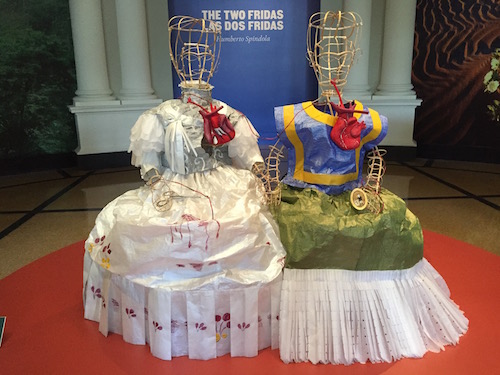
Tissue-paper dresses for The Two Fridas by artist Humberto Spindola

Tissue-paper dresses for The Two Fridas by artist Humberto Spindola

It’s an appropriate mix, given Frida’s own proclivity to merge the everyday with the surreal in her own works. The Library has an exquisite collection of her self-portrait and still life paintings, featuring flowers, animals, and deep-rooted Mexican myth and culture.

Downstairs in the Britton Rotunda, there’s a stunning installation of The Two Fridas by artist Humberto Spindola – side-by-side mannequins wearing tissue-paper dresses in colors that Frida sported, but with the surreal outer heart that she painted more than once. Visitors approach as if it were a shrine with special powers.

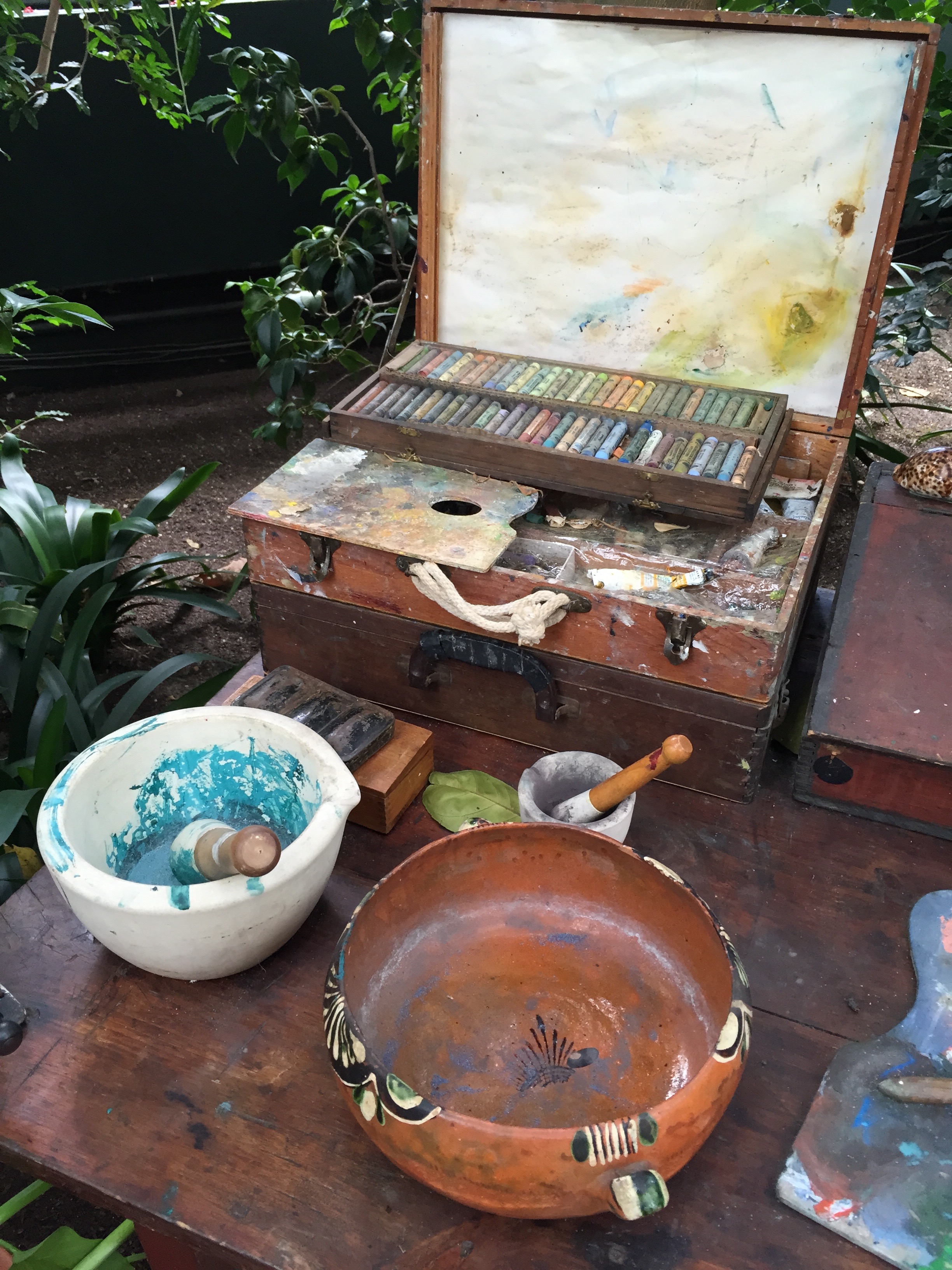
Frida’s workspace

Frida’s workspace

The Haupt Conservatory serves up a riot of color with floating blue containers of vivid flowers, the dynamic blue of the recreated Casa Azul, where she lived, pops of the types of flowers with which she adorned her table and sills, and the intensely painted Mexican-style pyramid in the center of it all.

The sensations are so bright that it’s easy to miss the recreation of Frida’s studio, tucked away in the trees to the left of the main event – brushes, paints, paint sticks, and other tools.

Outdoors, the curators have succulents jammed into every piece of oversize Mexican pottery near a “wall” of cactus, replicating a natural fence that Diego had outside his studio for decades.

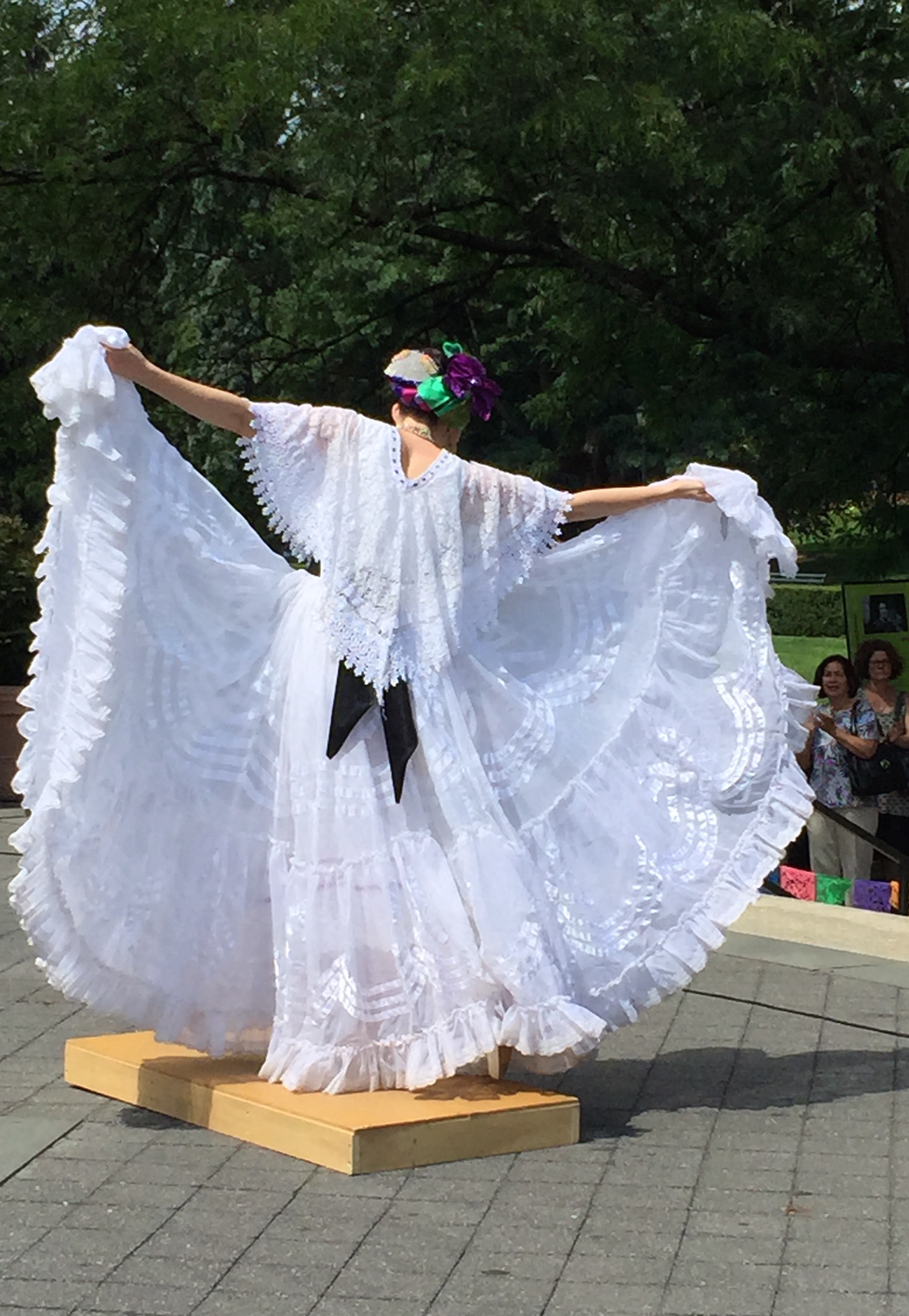
Soloist from Capulli Danza Mexicana channels her inner Frida for the crowd

Soloist from Capulli Danza Mexicana channels her inner Frida for the crowd

The “Life” portion of the show’s title is represented by the generous schedule of music, performances, films, and events that the NYBG has featured throughout the show’s six-month run. Dance companies, all-female mariachi bands, chefs, and authors provide sensuous infusions of movement, wit, gaiety, and sophistication that Frida embodied her entire life. Flashing red skirts, exciting beats, fast footwork, dramatic flourishes, and meaty conversation all contribute to the experience of who Frida was, how she lived, and what she loved.

Download the exhibition panel to see all the parts of Mexico City that meant so much to Frida and Diego – images of parks, gardens, markets, and historic sites, including photos of Casa Azul.

Download the app for your visit, and go to our Flickr site to see the photos and a few videos of the dancers in action.

Take a look at what the NYBG team achieved:

If you have time, check out the YouTube of the all-star kick-off symposium dedicated to Frida last May.


New Views from/at The Whitney Museum

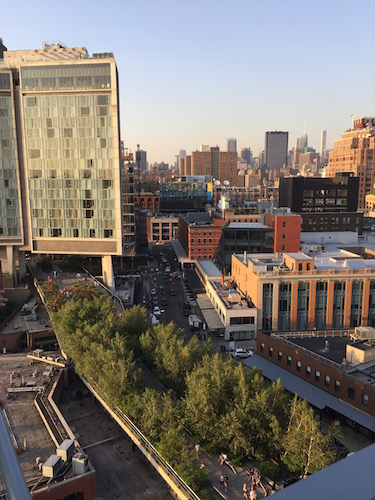
High Line and City views from the Whitney

Towering over the green esplanade of the High Line, the new Whitney Museum of American Art is a spectacular success, inside and out. The inaugural show, America is Hard to See, closing this weekend, features 600 works on all eight floors of the new Renzo Piano-designed landmark. Finally, Gertrude’s collection has room to breathe.

The inaugural installation distributed the massive collection into smartly themed galleries, but moving up and down between the floors is an equal delight – picture windows and balconies offering views of spectacular sunsets over the Hudson and Empire State Building views from entirely new vantage points. Peeking through the doors into the kitchen on the 8th floor reveals some of the best views (think Standard Hotel) offered to any sous chef in the City.

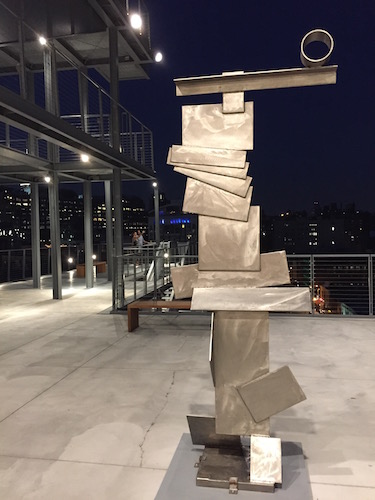
David Smith’s Cubi XXI (1961) enjoys its view of Meatpacking District nightlife from the balcony

David Smith’s Cubi XXI enjoys its balcony view of Meatpacking nightlife

Part of the fun is walking around on the balconies (on every floor) and experiencing the Whitney’s vertical outdoor sculpture park – Joel Shapiro’s playful bronze guy and David Smith’s towering Cubi totems, all against stunning City vistas. It’s Storm King for the urban soul.

Inside, it’s a walk through American art history with themes from the early 20th century (“Forms Abstracted”, “Music, Pink and Blue”, and “Machine Ornament”) with featuring the Whitney’s iconic works by Stella and Dove, O’Keefe and Macdonald-Wright, and Sheeler and Demuth. The clever mix of paintings and sculptures evoke times when American artists did their own takes on the modernist mix of African art and Cubism, colorful abstractions evoking symphonies for the eye, and the beauty of industrial techniques and landscapes in the heartland.

Gallery devoted to 1950s New York Abstract Expressionism with Chamberlain and diSuvero sculptures set against and Lee Krasner's 1957 Seasons

Gallery devoted to 1950s New York Abstract Expressionism with Chamberlain and diSuvero sculptures set against and Lee Krasner’s 1957 Seasons

The curators even pay tribute to early American filmmaking with a continuing mix of reels by 20th century innovators capturing the bustle and abstraction of modern life.

Calder’s “Circus” gets an expansive showcase, surrounded by jazz age depictions of vaudeville, clubs, movie palaces, and downtown edge by Benton, Hopper, Marsh, Weegee, and Cadmus. Around every corner, a new dimension to the American Experience is revealed – social-justice prints of the 1930s, heartland life in the 1940s, wartime calls to action, abstraction and color-field revolutions, and Pop.

Marisol’s Women and Dog group take in Lichtenstein’s Little Big Painting

Marisol’s Women and Dog group take in Lichtenstein’s Little Big Painting

One of the most stunning triumphs is the large gallery dominated by Mr. Chamberlain’s white car-crush tower, Mr. di Suvero’s primal hankchampion sculpture, and Ms. Krasner’s voluptuous 1957 pink and green mural. The clever curators gave Ms. Krasner her place in the spotlight, surrounded by works by Newman, Rothko, Kline, and Mr. Pollack, who is — at least for the run of this show – relegated to a few vertical drip canvases on the faraway opposite wall.

On a lower floor, the curators have hauled out the massive de Feo piece, “The Rose”, and installed it next to works by other female innovators, Lee Bontecou and Louise Nevelson.

If you missed the initial installation, take a look at the Whitney’s website (which features selected works from each of the 23 themed sections), listen to the audio guide introduction, and enjoy views of our favorites on our Flickr page.

Max Weber's Chinese Restaurant, painted in 1915 when Chinese restaurants and Cubism were first popping up in Manhattan

Max Weber’s Chinese Restaurant, made in 1915 when Chinese restaurants and Cubism were both new to Manhattan

The Whitney welcomes late-night guests (until 10 p.m.) every Thursday, Friday, and Saturday. Ride over to NYC’s newest subway station at 11th Avenue and 34th Street and walk down the High Line to the City’s latest hot spot in the Meatpacking District.


Daring Docent Dishes with Digital Adam at The Met

Digital Adam and the Docent reenact what Paradise was like before The Fall

Digital Adam and the Docent reenact what Paradise was like before The Fall

There’s no need to check into the Met after hours to see a classical statue come to life. In Renaissance gallery 504 on the main floor, a digital version of Tullio Lombardo’s 15th-century Adam is interacting with visitors and a knowledgeable Docent in Reid Farrington’s The Return performance through August 2.

The Return is quite a production and its illusions created in the Italian Renaissance gallery would make any animation fan jump for joy.

Classical Adam (the marble one) is installed prominently in the gallery where half the performance takes place. Its presence is a miracle, since the beautiful Renaissance sculpture totally shattered in a freak fall in 2002.

To repair it – a complex undertaking — Met team made a digital replica of all the pieces to decide how to fit everything back together again and spent years making it whole.

Tullio Lombardo’s Adam (1490-1495), which fell and shattered in 2002, but has been exquisitely repaired

Tullio Lombardo’s Adam (1490-1495), which fell and shattered in 2002, and is now repaired

Now, it’s Digital Adam who’s the fascinating co-star of the show, brought back to life by performance artist Reid Farrington who envisioned a tribute to the virtuosity of the Met’s conservation team who so flawlessly reassembled Tullio’s Adam.

The other half of the performance involves an improv actor, a motion sensor suit, and a crew of digital engineers and prop masters, all camped out on the stage of the Met’s auditorium in the Egyptian wing. As the stage actor moves in the auditorium, Digital Adam moves, speaks, answers questions, and holds up a Warhol and a Van Gogh inside his lifesize digital frame in the Renaissance gallery to the delight of the audience and his sidekick, The Docent. See photos on our Flickr feed.

The audience decides what part of Classical Adam’s renovation will get discussed next, but the witty duo soon veer off into other fascinating topics:

Actor in motion-capture portrays Digital Adam, whose image is simulcast at the right and in gallery 504

Actor in motion-capture portrays Digital Adam, whose image is simulcast at the right and in gallery 504

What does it feel like to always look good and never age? Does Classical Adam remember back to the marble quarry? Does Biblical Adam remember what Garden of Eden was like before the Fall? Adam’s clever responses reveal that his Eden experience was a lot about infinity pools and the good life.

At one point, Digital Adam invites the Docent to portray Eve in his telling of what happened after the Serpent appeared with that apple. Then the attention turns back to Classical Adam, as the Docent shows Lombardo’s thinking about that particular moment portrayed in marble.

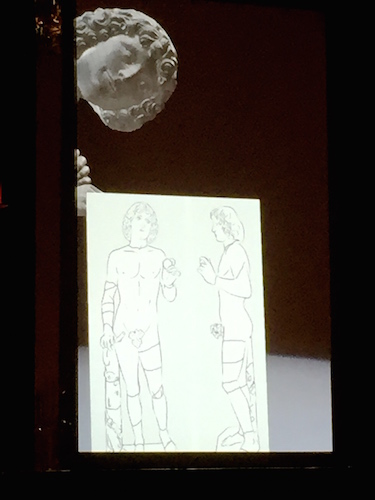
Digital Adam shows drawing of where the breaks in Lombardo’s Adam occurred

Digital Adam shows drawing of the breaks in Lombardo’s Adam

These two need their own ongoing talk show about history, time and space in some corner of the Met. Until August 2, ask the information desk for The Return’s program and go marvel at both the gallery and the behind-the-scenes performances. Or go to the live stream on the Met Museum’s website.

After meeting Digital Adam, you’ll never again wonder about what’s going on inside Classical Adam’s cool, calm, beautiful marble head.

Enlightenment through Gems

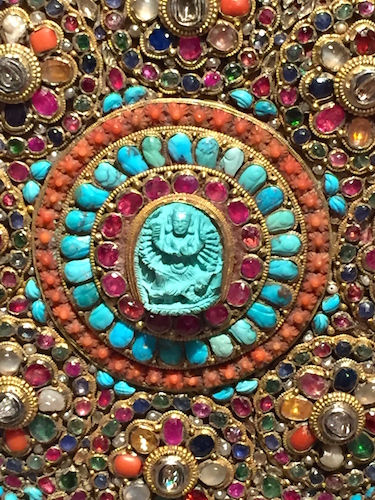
Center of 8-in. ritual offering dish made in 17th-18th c. Nepal

Turquoise Dhurga defeats a dragon in the center of 8-in. ritual offering dish (17th-18th c. Nepal)

It’s clear that wearing and giving precious (and semi-precious) gems can elevate the mind to higher levels of consciousness – at least in the minds of the Tibetan Buddhists – according to what you’ll see in Sacred Traditions of the Himalayas, running through this weekend at the Metropolitan Museum of Art.

The curators feature some remarkable statues, ritual dancewear, mandalas, and arms in the show, but let’s focus on the jewel-encrusted mosaics, containers, and jewelry displayed in the corner of the second-floor gallery, estimated to date from the 17th to 20th centuries.

Tibetan Buddhism emerged over the centuries in a dry, dusty, seemingly barren but beautiful region where people’s own adornment or bright flags atop mountain passes seem to be the only bursts of color. Inside homes, personal shrines, and monastery temples hang intricate, colorful mandalas pictorially suggesting the path to enlightenment, often symbolized by brightly adorned temples.

Mrs. Tsarong and two ladies from Tsang wearing special-occasion jewelry and hats as photographed by C. Suydam Cutting in 1937. Courtesy: Newark Museum collection

Mrs. Tsarong and two ladies from Tsang sport special-occasion jewelry and hats near Lhasa in 1937. Photo: C. Suydam Cutting. Courtesy: Newark Museum

These conceptual centers of enlightenment are often thought of as colorful crystal palaces emblazoned with jewels – an attractive image to hold in one’s mind on the lifelong journey to this higher plane of existence. What better way to remember your goal than to contemplate bedazzling diamonds, rubies, emeralds, sapphires, garnets, quartz, pearls, amber, coral, lapis lazuli, and turquoise?

To honor one’s journey to enlightenment, wealthy Tibetans often donated jewels to temples to adorn statues of the deities or commissioned personal devotional objects. That’s why you see so many jewel-encrusted objects in the Met’s collection. Personal shrines had jewel mosaics jam-packed with a dazzling array of stones. Gigantic statues were adorned with jewel-encrusted ornaments and surrounded by similarly elaborate containers for offerings.

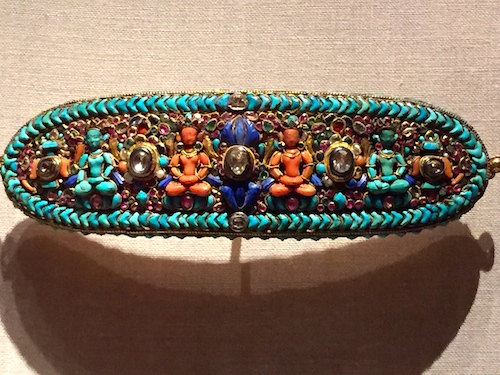
This Forehead Ornament for a Deity is only 8 inches long. Four celestial Buddhas are interspersed with diamonds

This Forehead Ornament for a Deity is only 8 inches long. Four celestial Buddhas are interspersed with diamonds

For special occasions, women sported accessories with amazing numbers of stones, reminding everyone of their social status, wealth, and devotion to an enlightened path.

Although some of the metal work was done in and around Lhasa, Tibet’s capital, the majority of the eye-popping jeweled settings were created across the border in Kathmandu, Nepal by Newari masters who created some of the most intricate visions in metal, wood, and paint ever known to the world. We’ve provided you with some close-up looks here and on our Flickr site. As shown, the result is a mix of Tibetan and Hindu imagery – typical of this region where so many cultural influences mix.

Densely packed diamonds, rubies, emeralds, sapphires, garnets, quartz, pearls, amber, coral, lapis, and turquoise in corner of Birth of the Buddha mosaic (18th-19th c. Nepal)

Densely packed diamonds, rubies, emeralds, sapphires, garnets, quartz, pearls, amber, coral, lapis, and turquoise in corner of Birth of the Buddha mosaic (18th-19th c. Nepal)

The Met’s own site for the objects in the show also allows you to zoom in on the details. Learn more about how the Met conserves such intricate jewel work in this blog post by an intern in the conservation department. See close-ups of how the Newaris set their gems.

Finally, explore Tibet as it was 100 years ago through this slideshow prepared for this show at the Met by the Newark Museum, which itself has a world-class collection of Tibetan objects and perhaps the largest collection of photographs of Tibetan people and temples from that time.

Plains Indians Wearable Art at The Met

1780 Plains Indian horned headdress assembled from a powerful mix of materials including bison horns, deer and horsehair, porcupine quills, glass beads, wood, metal cones, cotton cloth, silk ribbon, and paint. From the Musée du quai Branly in Paris

1780 Horned headdress assembled from a powerful mix from mighty bison , deer, and horse. From Musée du quai Branly in Paris.

With all the attention this week on the couture gowns at the Metropolitan Museum of Art ball and Costume Institute show, don’t forget that some of the most elaborately embellished mixed-media wearable art is installed on the second floor in the expansive tribute, The Plains Indians: Artists of Earth and Sky, through this weekend.

The masterworks have been gathered from select European and North American collections and feature beadwork (mostly on leather), symbolic headdresses, and magical objects that directly telegraph the wearer’s connection to nature, the universe, and supernatural power.

The show was organized by the Musée du quai Branly, Paris, in collaboration with The Met, and in partnership with The Nelson-Atkins Museum of Art, Kansas City, and features works from the 18th century through today (like the China exhibition in the other wing).

All-over beading on contemporary platform shoes by artist Jamie Okuma, 2014.

All-over beading on 2014 platform shoes by artist Jamie Okuma.

The curators track changes in materials, styles, and concerns of the Osage, Quapaw, Omaha, Crow, Cheyenne, Arapaho, Lakota, Blackfeet, Pawnee, Kiowa, Comanche, and Meskwaki nations from the time they dominated the Midwest through the demise of the buffalo, the great wars, the transition to reservation life, and participation in 21st century art and culture.

Take a read through the curators’ story on this exhibition site and see some of our favorite looks on our Flickr feed, where we’ve organized the pieces in chronological order. We’re giving you a close-up view of some of the bead, quill, and embroidery work. You can see the transition from more shamanistic embellishment to use of imported Venetian glass beads, to the all-over bead style, and finally to current creations, such as Jaime Okuma’s beaded platform shoes.

Central painting on large-scale Mythic Bird robe from the Illinois Confederacy, 1700-1740. Courtesy: Musée du quai Branly in Paris

Central painting on Mythic Bird robe, Illinois Confederacy, 1700-1740. Courtesy: Musée du quai Branly in Paris

Much of the painting and handwork was divided according to gender – men painted figures and women did the beadwork and painted the geometric forms. This beautiful robe with a geometric mythological bird is one of the earliest surviving large-scale paintings from Plains tribes, and the beaded geometry of the 1895 Crow wedding robe is another marvel.

Compare the mixed-media horned headdresses from 1780s Missouri with Chief Red Cloud’s dramatic all-business trophy-feathered war bonnet of 1865. The fluffy-feathered 1925 creation from Cody’s Buffalo Bill Center almost makes you wonder if that version were strictly for wild west shows.

It’s also interesting to learn that the powerful symbolic paintings on shirts and shields were essentially “owned” by their creators.

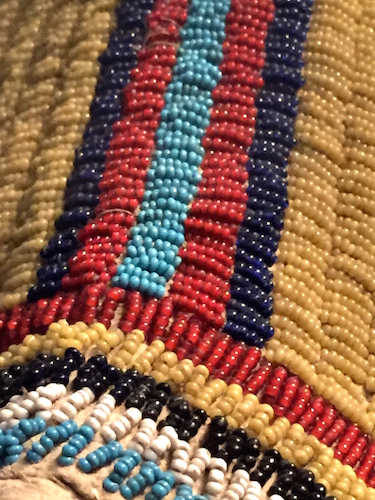
Close up of the tiny Venetian seed beads used to decorate a Lakota woman’s dress (Teton Sioux), 1865. From the Smithsonian’s NMAI

Tiny Venetian seed beads decorate a Lakota woman’s 1865 dress. From the Smithsonian’s NMAI

Similar to what we learned about 1920s French couture designers’ concerns about unlicensed copies in FIT’s recent Faking It show, anyone wanting to replicate a particular war shirt or shield, had to be granted formal permission. The Met exhibition explains that replication permission of Plains Indian designs were closely held and protected for generations.

A full database of the amazing objects in the show is on the Met’s website, as well as the complete audio guide to the exhibit on the museum’s Soundcloud site. As you click on the audio tracks, you’ll see a small thumbnail of the object.

Listen to curator Gaylord Torrence, explain how French culture and embroidery techniques collided with Plains Indians culture three hundred years ago to such magnificent result:


Reverent Ceramic Master Honored in NC

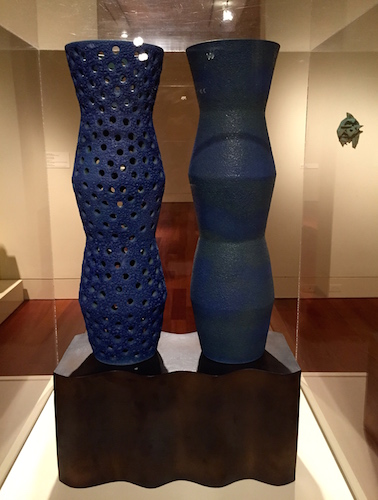
Hiroshi’s “Twin Vase”, a monumental 2002 stoneware sculpture with crawl glaze

Hiroshi’s Twin Vase, a monumental 2002 stoneware sculpture with crawl glaze

Known for a strong pottery tradition, North Carolina’s Cameron Art Museum is paying tribute to a Japanese ceramic expert in Hiroshi Sueyoshi: Master of Reverence through September 6.

As a young artist who apprentices with ceramic masters of 1960s Japan, he was advised by folk artist Shoji Hamada to see as much of the world as he could before he turned 25.

In the early 1970s, he came to Asheboro to help build a pottery, trained with Japanese ceramic-artist ex-pats, worked at Seagrove, and landed teaching jobs at several North Carolina colleges.

By the end of the decade, he relocated to Wilmington, teaching and serving as an artist-in-resident at the Museum.

Although the show features the full scope of Hiroshi’s work, it exhibits the work of the ceramic artists who influenced him. Works by Rita Duckworth, Isamu Noguchi, Peter Voulkos, and Shoji Hamada are shown side-by-side with his own, demonstrating the tradition upon which he draws.

Rock Garden, a 2014 interpretation of a Zen garden made with hand-built “rocks”. He wants the viewer to be conscious of their surroundings

Rock Garden, Hiroshi’s 2014 interpretation of a Zen garden made with hand-built “rocks”.

Landscapes, biomorphic shapes, streams, voids, spirals, crackled surfaces, and Zen gardens – you’ll see and feel it all as you slowly work through the galleries. Find power in Hiroshi’s simplicity and lots of detail upon closer inspection.

The sculptures echoes of the primitive power of Brancusi and installations evoke the meditative calm of the Rothko Chapel. The museum has even hung up some of the coverings that Hiroshi uses for his pottery tables on the wall in the back gallery. Their subtle dust-ground, worked surfaces feel like subtle, magical Twombly atmospheres. So, even Hiroshi’s work cloths feel like art.

If you can’t make it to see this beautiful work in Wilmington, take a stroll through our Flickr site.

Biomorphic 2009 wall sculpture Blossom. Stoneware with crater and crawl glaze. Courtesy: New Hanover Library

Biomorphic 2009 wall sculpture Blossom. Stoneware with crater and crawl glaze. Courtesy: New Hanover Library