Ennion: Luxury Tableware at The Met

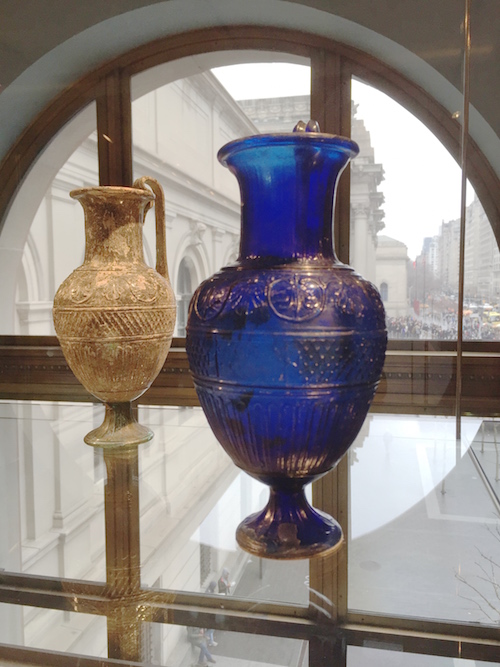
Two identical one-handled Ennion jugs from different sites. On right, the only Ennion piece with an intact foot, 1st c. A.D.

Two identical one-handled Ennion jugs from different sites. On right, the only Ennion piece with an intact foot, 1st c. A.D.

It’s unlikely that you have any of this sought-after designer’s pieces accompanying your best table setting or that the MAD Museum has any of his hand-blown, molded glassworks in their collection.

Two thousand years before ABC Carpet began retailing high-end home goods on Broadway and Martha Stewart branded her at-home lifestyle line, a Mediterranean craftsman in Sidon, Lebanon (then Phoenecia) created a line that every aspiring tastemaker in the Roman Empire just had to have. The Metropolitan Museum of Art pays tribute to his output in Ennion: Master of Roman Glass, on view just off the Greek-Roman study galleries through April 12.

Who needs old-fashioned metal cups or pottery jugs on the well-laid Roman table when Ennion was creating stunning cobalt-blue and transparent glass equivalents?

Two-handled cup, with Ennion’s Greek brand (“Ennion made this/it”). Blown glass into mold, 1st c. A.D. Courtesy: Turin museum; other by private collector

Two-handled cup, with Ennion’s Greek brand (“Ennion made this/it”). Blown glass into mold, 1st c. A.D. Courtesy: Turin museum; other by private collector

Ennion’s workshop was on the cutting edge of a manufacturing-and-craft revolution – blowing glass into decorative molds (which took the guesswork out of creating place settings for four, six, or ten) and exporting sets for sale throughout The Empire.

Ennion’s competitors were doing the same, but Ennion of Sidon had the big brand emblazoned on his work, working it into the design in the same way that MK, DKNY, DVF or YSL do today. His logo was written in Greek, the universal language of the first century: ““Ennion made me/it.” Scholars reckon that it was all made and exported from Sidon, a first-century glassmaking powerhouse, since none of Ennion’s molds featured a bilingual brand.

After two millennia, only about 50 of Ennion’s gorgeous works remain, and the Met’s show has assembled about half that amount from its own collection (courtesy of master-collector J. Pierpont Morgan), the Corning Museum, private collections, and other museums of antiquities in Israeli and Europe.
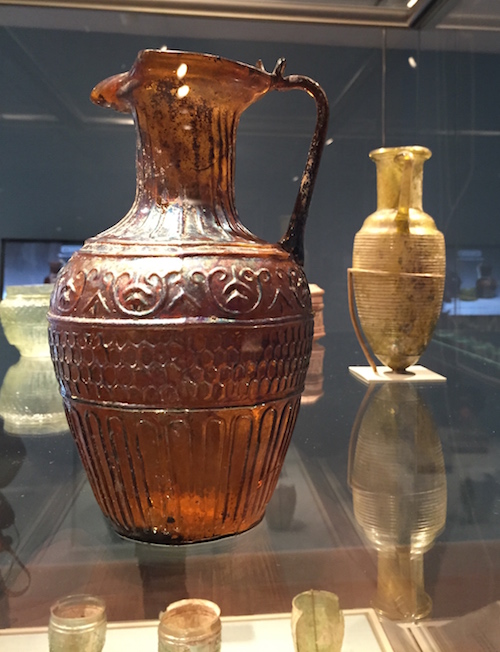
Non-Ennion glass jug made in a four-part mold; right, a two-handled amphora blown into a three-part mold, ist c. A.D. Source: The Met

Non-Ennion glass jug made in a four-part mold, 1st c. A.D. Source: The Met

In addition to Sidon, Ennion’s output has been found in excavations of ancient homes in places as far flung as Jerusalem, Croatia, Italy, and Spain. The Met’s team has had fun displaying glassware from identical molds next to one another, despite the fact that pairs were discovered thousands of miles from each other at different archeological sites.

Check out the Met’s beautiful tribute to a master artist on our Flickr feed.
Killer Heels as Art in Brooklyn

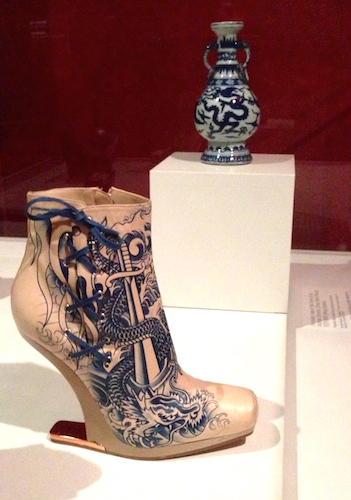
Gaultier’s 2012 Nude Tattoo Boot displayed next to its inspiration, a Chinese porcelain Ming vase (1573-1619)

Gaultier’s 2012 Nude Tattoo Boot displayed next to its inspiration, a Chinese porcelain Ming vase (1573-1619)

The hottest show in New York right now is Killer Heels: The Art of the High-Heeled Shoe, a curatorial masterwork that the Brooklyn Museum has decided to extend through March 1.

As soon as you enter the first-floor gallery, you’ll encounter Zach Gold’s mesmerizing Spike video, a wall-sized video extravaganza of high fashion, high glamour, and high heels. Why rush into the first room of the exhibition when your eye is trying process all the lush details? This digital kaleidoscope genuinely sets the tone for what lies ahead – an historical mash-up of style, fashion, and design all seen through the lens of ladies’ shoes.

What an eyeful – carefully composed vitrines where you can behold golden Baroque curliques on Prada platforms, 1920s evening shoes, and a 19th century gilded table. What about silver-and-pearl Chanel boots whose heels mimic the 1890s Gorham candlestick right next to them? Or the red-hot strappy Miu Miu shoes whose ornament is identical to the handles on a 18th-century Wedgewood ice cream cup? Check out our Flickr feed to see some of our favorites.

2008 Heels by Miu Miu next to a Wedgewood ice cream cup and saucer (1790-1800)

2008 Heels by Miu Miu next to a Wedgewood ice cream cup and saucer (1790-1800)

Everywhere you look, there are delightful juxtapositions across time, culture, and material – embellished pointy-toed heels from the 1690s, iron-and-leather pallets that boosted the feet of ladies above the muck of 18th-century city streets, and sky-high mother-of-pearl-inlay stilt shoes that Syrian beauties sported in the Twenties. It’s interesting that the latter are displayed in proximity to those dangerous purple Vivienne Westwood gillies that gave Naomi Campbell such problems on the runway.

Nothing’s chronological. It’s all designed to unfold in your mind by pinging unexpected references and associations – designer shoes next to concoctions from another place and time, fantastical embellishments, and streamlined perfection.

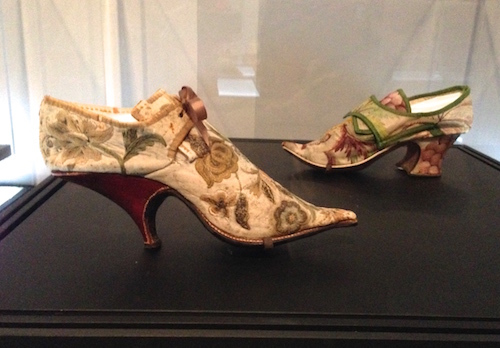
Fashionable, embellished pointy-toed 1690 French and 1720 British heels

Fashionable, embellished pointy-toed 1690 French and 1720 British heels

Provocative, room-sized videos commissioned for this show and small historical films only heighten the pizzazz. Check out Edison’s 1903 short, The Gay Shoe Clerk, or snippets from Sophia Coppola’s Marie Antoinette or other Hollywood classics. Don’t miss Eve A.D. 2000, shot in 1939 to predict what fashions and footwear of the future would look like. You’ll have fun evaluating whether those Thirties visionaries got it right.

There’s simply too much to describe – glass slippers by Georgina Goodman, political-statement heels, shoes that seem to take Metamorphoses at its word, and architectural-engineering wonders. Go see for yourself. You’ll find shoes by Ford, Ferragamo, Prada, Gaultier, and unknown Italian, French, and British craftsmen of long ago.

Watch curator Lisa Small’s video but make the trip out to Brooklyn to immerse yourself in one of the best adventures of the season:

Sturtevant’s Mini-MoMA Imitation Game

Sturtevant’s 2004 piece — a reproduction of an light bulb and cord installation “ Gonzalez-Torres Untitled (America)”. On far wall, “Study for Rosenquist’s Spaghetti & Glass”, an oil painted in 1965-1966

Sturtevant interprets Gonzalez-Torres Untitled (America) (2004). On far wall, Study for Rosenquist’s Spaghetti & Glass, an oil painted in 1965-1966

The free Friday night crowd at MoMA could not get enough of the Elaine Sturtevant tribute, Double Trouble, closing this weekend. Sturtevant spent her long career creating ready-mades out of other people’s art.

The show is a who’s who of 20th century art, except that all the pieces were done by Ms. Sturtevant. The show has it all – an entryway plastered with Warhol’s cow wallpaper (done by her), Lichtensteins, Rosenquists, Johns oil paintings – all done in her hand. Take a walk through our Flickr site and see more in the photos on the curator’s blog.

It’s all imitation, except that Elaine’s versions are really, really good. It’s hard to tell them from the originals displayed through the rest of the museum. Nothing in the show is a line-by-line copy, but you’ll have to go MoMA’s permanent galleries to compare them with the real thing.

Sturtevant’s 1967-1968 oil on canvas,Study for LIchtenstein’s ‘Happy Tears’

Sturtevant’s 1967-1968 oil on canvas, Study for LIchtenstein’s ‘Happy Tears’

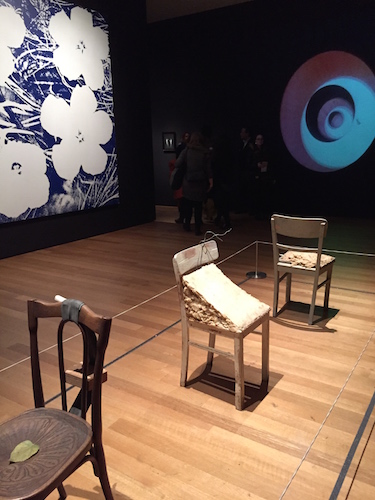
In fact, MoMA encourages a trek upstairs to compare Duchamp’s own ready-mades and whirligig. Or Mr. Beuys slabs of fat with those sitting on Sturtevant’s chairs in the darkened gallery.

Can anyone distinguish the Warhol Wall Flowers that Elaine made from the reproduced images of the originals on the stuff all over the gift shop?

The Gonzalez-Torres installation was the dramatic high point, all flashy bulbs in a charismatic, mysterious circle near the pretty perfect interpretations of early video games. Everyone is having a blast lining up to contemplate Sturtevant’s walk down digital memory lane with her interpretation of Pacman 1.0.

Is that Sturtevant’s Duane Hanson museum security guard reproduction in the corner? Oh, no, it’s an actual MoMa guard! Sorry. Just about everything else is a fool-the-eye art encounter. Total fun in the white cube.

Sturtevant’s 1990 vision of Warhol’s Flowers alongside her 1968 Duchamp film with interpretations of three Beuys chairs

Sturtevant’s 1990 vision of Warhol’s Flowers alongside her 1968 Duchamp film with interpretations of three Beuys chairs

Nature Meditations in the Land of Fire and Ice

Katrín Sigurðardóttir, Haul IV (2004) travelling landscape-in-a-box on loan from private collector. Courtesy: The artist.

Katrín Sigurðardóttir, Haul IV (2004) travelling landscape-in-a-box on loan from private collector. Courtesy: The artist.

When the weather dips below freezing and people think they’re in the Arctic, there’s no better place to get out of the elements and meditate on the landscapes of long, dark winters than the third floor of Scandinavia House on Park Avenue. Until tomorrow, January 10, you’ll join eleven contemporary artists from the sub-arctic on their journeys in a show mounted by the Katonah Museum of Art, Iceland Artists Respond to Place.

Bjork may get all the media attention, but do yourself a favor and walk through this three-gallery show, which beautifully and simply presents the work of Iceland’s other leading visual artists. See the land of fire and ice through their eyes.

Olafur Eliasson, The Aerial River Series, 2000 on loan from private collector. Courtesy: The artist. Installation photo: Ben Blackwell

Olafur Eliasson, The Aerial River Series, 2000 on loan from private collector. Courtesy: The artist. Photo: Ben Blackwell

Olafur Eliasson takes you on an aerial journey along a 60-mile meltwater river, from the mouth to the source. Ragna Róbertsdóttir splatters miniscule lava rocks against a wall but it’s not what it sounds like. Far from a violent eruption, it’s an undulating, mesmerizing meditation that you’ll spend time contemplating.

For sheer romantic and modernist punch, enjoy Georg Guðni Hauksson’s two works – a large landscape memory and a solid dark blue canvas evoking the long winter nights (like an emotional Ad Reinhardt).

Lava rocks “talk” in Egill Sæbjörnsson’s Pleasure Stones installation (2008) on loan from private collector. Courtesy: The artist.

Lava rocks “talk” in Egill Sæbjörnsson’s Pleasure Stones installation (2008) on loan from private collector. Courtesy: The artist.

Egill Saebjornsson takes home the whimsy award with a multimedia installation in which rocks speak (seriously!). Eggert Pétursson zeros in the microscopic natural phenomenon – painting flowers (life sized) in patterns that read like tapestries. You’ll wish you were on some hikes with him. Katrín Sigurðardóttir simply packs up her landscapes into boxes. Tiny, tiny recreations of vast, romantic landscapes.

When we visited the galleries this week, visitors were asking if there was more they could see. Scandinavia House always hosts classy, elegant shows, so although the exhibition space is limited, we have to admit they always leave us wanting to see what’s next from that part of the world.

Seth Myers was recounting his Icelandic adventures this week on Late Night. If you can’t get to the country like Seth or visit the show, at least you can spend chilly days and nights like the natives do, courtesy of this instructional video produced by Scandinavia House:


36 Hours of Jeff Koons at The Whitney

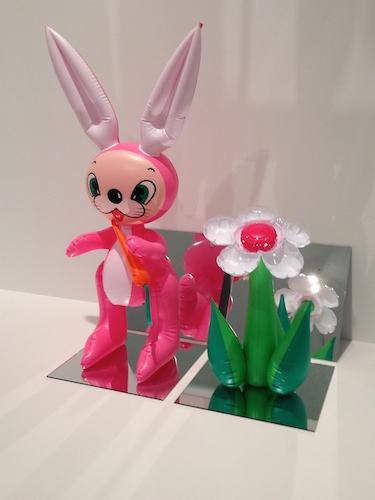
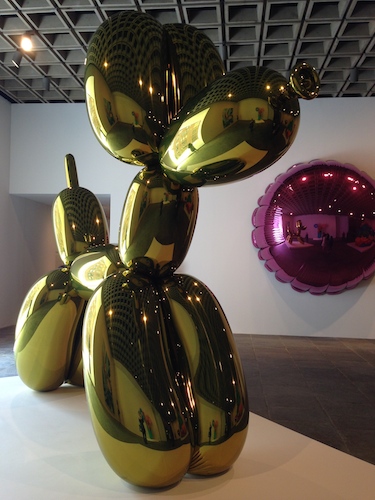
Inflatable Flower and Bunny, a cheeky take on minimalist work NYC galleries showcased in the 1970s

Inflatable Flower and Bunny, a cheeky take on minimalist work NYC galleries showcased in the 1970s

It’s the last 36 hours, and the Whitney is taking it’s Jeff Koons retrospective out with a bang – all day, all night fun-filled wonder on all four floors, letting the crowds take in his irreverent porcelains, 70s inflatables, whimsical fool-the-eye aluminum sculptures, and giant billboards. It’s the first proper retrospective that Koons has had in New York and the last show to be mounted on Madison Avenue before the Whitney moves to the High Line.

Any day of the week, lines of art-seekers have snaked out the door of the Whitney, past the pretzel carts on Madison and around the corner along 75th Street, waiting for admission into this no-holes-barred finale.

The curators and crew have done a spectacular job with the installation – no mean feat, since those big bulbous “inflatables” on the top floor are really highly polished, super-heavy hunks of stainless steel. Oh, and don’t get any fingerprints or scratches on the highly polished surfaces…it will break the illusion that these are just Mylar balloons!

Ten-ton stainless steel Balloon Dog with Moon (Light Pink) (1994-2000)

Ten-ton stainless steel Balloon Dog with Moon (Light Pink) (1994-2000)

The show starts strong on the second floor with a light-filled room of recreated works from the late Seventies – actually inflatable flowers, bunnies, and what-not. Everything uses angled mirrors.

You can’t get the joke unless you trod the floors of those West Broadway galleries in Soho way back then and saw the Minimalists and Earth Works guys in full force.Think Barry Le Va, Heizer, and Smithson who arranged rocks or dirt in a few square feet of gallery space and added a mirror or two to make a statement about nature, art, reflection (i.e. art viewing), and formal criticism inside the art world.

Koons turns all this on its head with silly found inflatables and similarly formalist presentation. It’s kitchen sponges instead of Richard Long’s rocks! Thanks, Whitney and Mr. Koons, for giving us this walk down memory lane.

The main space on Floor 2 is devoted to a spectacular low-light installation of favorite Koons pieces from the early Eighties. Several double-decker and triple-decker vitrines house illuminated and never-used Hoover vacuum cleaners, which Koons assembled to illustrate the feeling of “newness” in American society.

Billboard and illuminated Hoover vacuum cleaners, the essence of “newness” from 1983

Billboard and illuminated Hoover vacuum cleaners, the essence of “newness” from 1983

It’s a beautiful, magical room dominated by a gigantic billboard on The New, all of it from his first window-display installation on 14th Street and Fifth, when Marcia Tucker had her New Museum there back in 1983, just before the move to Soho.

Speaking of moves, it seems fitting to come full circle – spectacular early works by Mr. Koons that debuted on 14th Street as the finale to the Whitney’s long run on Madison Avenue, just prior to its move back to its new 14th Street neighborhood.

Missed the show? Take a look on our Flickr feed.
Stunning Jewelry at Met Reflects Contemporary Art

These stunning creations of Eugene and Hiroko Pijanowski are made from paper cord and canvas

These stunning creations of Eugene and Hiroko Pijanowski are made from paper cord and canvas

The Metropolitan Museum of Art has not only reinstalled its American Modernist wing on the first floor, but it’s given over the design gallery right inside the door to Unique by Design: Contemporary Jewelry in the Donna Schneier Collection, on view through August 31.

Gertrude Stein is holding court in the far back gallery with some of Mr. Stieglitz’s treasures, but on your way to see them, check out the high-class, high-gloss presentation of masterworks of wearable art from the 1960s through today.

The thesis of the show is contemporary jewelry doesn’t exist in a vacuum and often reflects the prevailing art of the day — Pop, Minimalism, Abstraction, and so forth.

In 2007, Ms. Schneier donated 130 of her favorite pieces to the Met – just a small fraction of the collection she has been building for over 30 years. Here, these gleaming, surprising, artful, fun pieces are grouped to highlight their context within various themes of recent contemporary art.

Kiff Slemmonds Sticks and Stones and Words

Kiff Slemmonds Sticks and Stones and Words

As you marvel at each one, you’ll be thinking back across decades of gallery shows and installations of minimalist art, performance art, funky found art, and 3D printing.

Check out the gold neckpiece right inside the door. You might think it’s a riff on the Met’s room full of Columbian gold across the hall, but this treasure is actually made of paper and canvas by the Pijanowskis (Eugene and Hiroko).

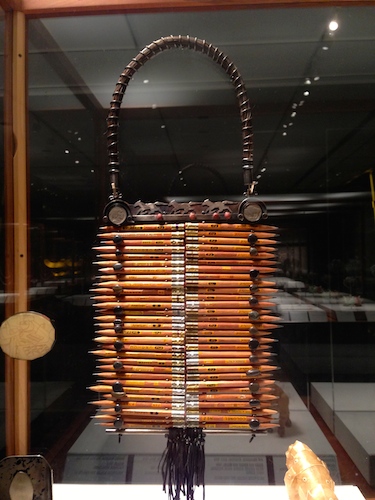
Marvel at what seems to be Native American-inspired breastworks by Kiff Slemmonds. Her art piece is fabricated with a lot of stuff but mainly No. 2 pencils in the “narrative” portion of the show.

If you like self-referential playfulness, consider Gijs Bakker’s piece – a real diamond mounted on a PVC-laminated photo of a diamond. Recyclable art? Check out Robert Ebendorf’s brooch made from crushed auto window glass, beach glass, and a vinyl record.

Ted Noten’s clever Fashionista necklace made of tiny resin high-heeled shoes

Ted Noten’s clever Fashionista necklace made of tiny resin high-heeled shoes

And if you think it’s fun to poke around the history of contemporary art through jewelry that’s neatly tucked inside a single room, don’t ignore the fact that right beyond this gallery door is another art-history tour-de-force-in-a-box: The Met is displaying Mr. Duchamp’s famous green case, which is full of many of the same visual and conceptual challenges – “what is art?”, “what is play?” “what is hidden?”, and “everything you see is not as it appears.”

What would Rose Sélavy herself choose to don from the next room if the Met and Ms. Schneier gave her chance?

Peek at a few of the choices on our Flickr site, but enjoy wandering through the gallery and deciding for Rose and yourself.


Sailing Life Rafts into Brooklyn’s Submerged Motherlands

The tree touches the top of the Cantor Gallery. Photo: Brooklyn Museum

The tree touches the top of the Cantor Gallery. Photos: Brooklyn Museum

The view is dramatic, but the story is it evokes is even bigger than what’s in the room. There’s still time to travel out to the Brooklyn Museum to have the immersive experience of Swoon’s Submerged Motherlands, closing August 24.

The pictures here just don’t do justice to the super-high wrap-around effect of this walk-through take on the emotional side of rising tides throughout the world. A photo can’t take it all in — a sheltering, 60-foot tree with cut-out paper leaves with some day-after-the-Flood rafts parked down below, all decorated with sketches of the peoples and mothers of the world.

And did we mention that Brooklyn visionary Callie Curry (a.k.a. Swoon) actually built and lived on those rafts for a while? Several years ago, she sailed them up and down the Hudson, on the Mississippi, and across the Adriatic.

Close-up of one of Callie’s rafts. Photo: Brooklyn Museum

Close-up of one of Callie’s rafts.

You’ll get to see these jerry-rigged but seaworthy concoctions up close, and examine the drawings, cut paper, and torn, coffee-stained textiles draping walls, floor, and shelters in this dramatic space.

The feeling it evokes makes you wonder if we’re ready for rising seas and climate change. It’s beautiful, monumental, and reminiscent of our recent lights-out experience of Hurricane Sandy, which tore at the edges of Brooklyn, Long Island, and Staten Island just two years ago – exactly what inspired Callie to take this work in this direction.

Hear what it took for Callie to create this fantastic walk-through installation on Brooklyn’s top floor:


You may also want to hear what Callie has to say about being a working artist in the real world – outside the four walls of a gallery – in her talk from TEDxBrooklyn in 2010. She will show you her rafts in action at Minute 5 and tell you what it felt like to arrive on a hand-built raft in Venice, her projects in post-earthquake Haiti, and interacting with people from the neighborhood as she creates art on the sides of Brooklyn buildings. Truly inspirational.

Folk Art Geniuses Take a Trip

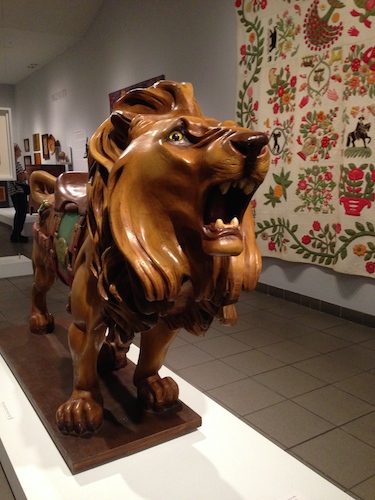
Brooklyn’s Lion, carved in 1910 by Marcus Charles Illions, who worked at the carousel shop and later set up his own studio

Brooklyn’s Lion, carved in 1910 by Marcus Charles Illions, who worked at the carousel shop and later set up his own studio

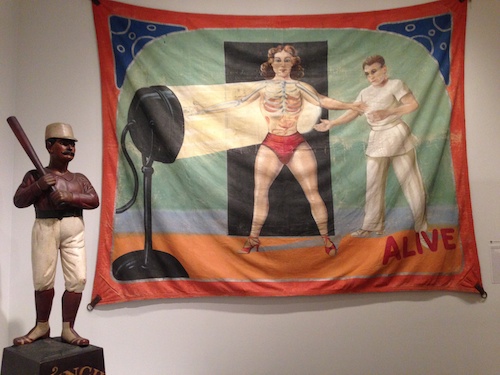
The American Folk Art Museum knows how to put on a show and take it on the road. After today, the staff will be packing up Self-Taught Genius: Treasures from the American Folk Art Museum and letting the Brooklyn Lion, Connecticut’s Weathervane Elephant, Chicago’s Sideshow “Radium Girl”, and a baseball old-timer from Centre Street see what’s up in Davenport, San Diego, Fort Worth, New Orleans, Saint Louis, and Tampa. We’re betting that there will be crowds waiting to greet them.

The museum’s staff has brought out its best to show off four centuries of made-in-America maker art – furniture, sculptures, textiles, painting, and what-not. It’s genius that they’ve put the spotlight on “genius” because their collection is jam-packed with some truly remarkable artists, visionaries, and craftsmen. Get the full view on the Museum web site and some close-ups on our Flickr page.

The curators say that the United States was a make-it-up-as-you-go-along democracy, so they felt “self taught” was right in line with this unique Americana theme – having a vision and making a masterwork.

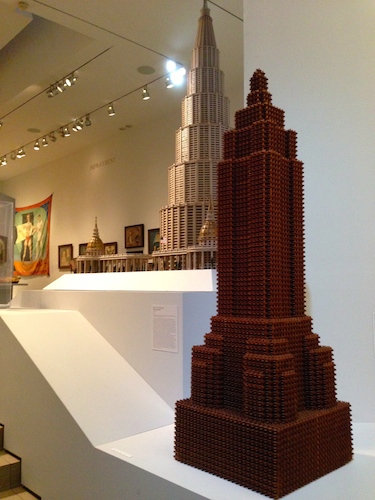
Empire State Building, carved in New Jersey in 1931 from precious cherry wood. Auriti's Palace is just behind.

Empire State Building, carved in New Jersey in 1931 from precious cherry wood. Auriti’s Palace is just behind.

Yes, there are some true eccentrics in the mix, but let’s momentarily focus on the People with a Plan from the section of the show on “Achievers”. Their works are immensely pleasurable and intense, and they’re right inside the entry.

You could spend hours contemplating the detail and work that went into the monumental Empire State Building made from cut cherry wood pieces in New Jersey in 1931. No one knows who created it, but legend has it that it was an ironworker that actually worked on that 13-month wonder and couldn’t let go of the achievement.

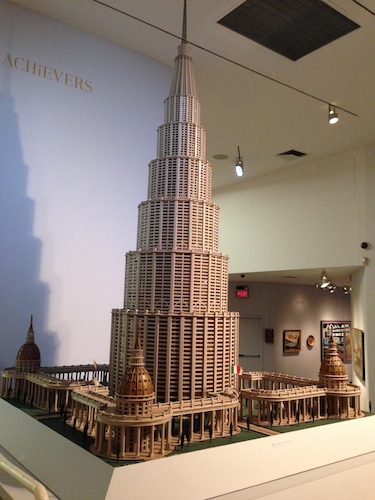
Consider The Encyclopedic Palace of the World, created by Maurino Auriti, an auto body worker who just loved designing and building architecture. Mind blowing. If his visionary campus was actually constructed, the skyscraper would be taller than that spire in Dubai.

The Encyclopedic Palace, created by Maurino Auriti, an auto body mechanic, in the 1950s from from wood, plastic, glass, metal, hair combs, and hobby kit parts

The Encyclopedic Palace, created by Maurino Auriti, an auto body mechanic, in the 1950s from wood, plastic, glass, metal, hair combs, and hobby kit parts

If you get to Lincoln Square today, you’ll enjoy one amazing treasure after another, but if not, check it out the beautiful web site archive created by the museum team for the tour. Browse by time period, theme, or artist.

And check out the Museum’s other brilliant online solution to letting you in on the world’s interpretation of these works. They’ve assembled all the media written and produced about the pieces in the show, which have often served as a springboard for scholarly research. This is a fun, serious treasure chest of work, so probe to your heart’s content — baseball folk art, mourning pictures, 18th century folk-art Washington portraits, and even more recent works.

What will it take to take this show of masterworks on the road? Last year, Auriti’s The Encyclopedic Palace was chosen as the theme of the  55th International Venice Biennial, so it got to go on its first trip to Italy.

Get a glimpse of where the folk art lives when it’s not on display and see how art gets packed to take a trip.

Baseball statue from 114 Centre Street and the sideshow’s Radium Girl banner from Chicago in the 1930s

Baseball statue from 114 Centre Street and the sideshow’s Radium Girl banner from Chicago in the 1930s

Dissident Artist Leaves Brooklyn for Second Time

The artist in Williamsburg, 1983. From his New York Photograph Series (1983-1993). Courtesy: the artist

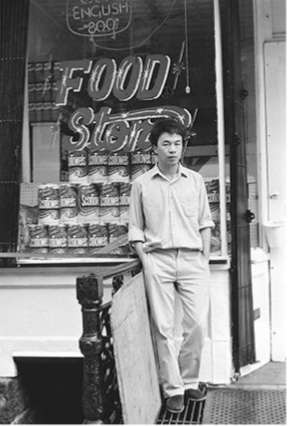
Then: Ai Weiwei in Williamsburg, 1983. From his New York Photograph Series (1983-1993). Courtesy: the artist

If you haven’t yet trekked to Brooklyn to see one of the world’s most famous international provocateurs, go this weekend to see Ai Weiwei: According to What? and get to know the work of the artist who was incarcerated a few years ago by the Chinese government for pulling the veil off its bureaucratic repression and dishonesty. Closing August 10, it’s the last stop on the show’s North American tour – a fitting finale since Ai Weiwei first lived in Williamsburg when he moved to New York back in 1983.

You know him either from his collaboration on the famous “bird nest” stadium at the 2008 Beijing Olympics, smashing Han Dynasty vases as an art project, or from having bulldozers sent by the Chinese government to eradicate his studio in 2011 and being put into house arrest for 81 days – an event that made front-page news and sparked an international outcry – museums and political leaders took out protest ads, made videos, placed flowers on his public works, and called for his release all over the world.

Close-up of R itual, one of the six dioramas of S.A.C.R.E.D. (2011-2013), inspired by his 2008 incarceration. Courtesy of Ai Weiwei Studio. © Ai Weiwei

Now: Close-up of R itual, one of six dioramas of S.A.C.R.E.D. (2011-2013), showing his 2008 incarceration. Courtesy of Ai Weiwei Studio. © Ai Weiwei

Even before you hit the admissions booth, you’ll see his response to all of this – a series of six large, mysterious boxes that make up his work, S.A.C.R.E.D. You climb up to peer into them, right inside Brooklyn’s entrance. Inside, you’ll see everyday depictions of what it was like for him in detainment – eating, sleeping under the watch of the uniformed guards, and interrogations.

Upstairs, you’ll see an expansive show filled with thought-provoking works along with some black-and-white photos of his East-Village life in the 1980s, where he hug with Tan Dun, Xu Bing, and other artists-on-the-move and artists-on-the-run from a conformist Mainland.

At a distance, his sculptures seem like simple, cool contemporary installations. Read the label copy and you realize the subversive is at work. It looks like some found-art piece, but the room is actually filled with the full contents of a young woman’s home. Ai Weiwei found her and all her stuff on the side of a road after the authorities evicted her.

Straight (2008-2012) is made from 70 tons of rebar reclaimed from the Sichuan earthquake and hammered straight back into rods. © Ai Weiwei

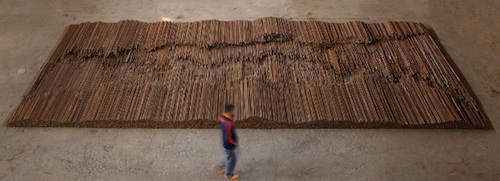
Straight (2008-2012) is made from 70 tons of rebar rods, reclaimed from the Sichuan earthquake and hammered straight. © Ai Weiwei

A single room is devoted to Straight, a monumental installation made up of rebar, metal rods used to strengthen concrete calls. Except that this is the actual rebar from the 2008 earthquake that claimed 5,400 young lives in Sichuan Province when the schools collapsed due to shoddy construction practices. He bought the scrap rebar from those buildings, spent four years hammering to straighten them out, and assembled the rods into a 70-ton sculpture. Nearby, he’s listed the names of every school child – something that the Chinese government never did.

Performance art: dropping a Han dynasty vase (206 BC-220 AD), along with other historic ceramic pieces altered by a dip into modern industrial paint (2007-2010). Photo: C. Carver. Courtesy: the artist

Performance art: dropping a Han dynasty vase (206 BC-220 AD), along with other historic ceramic pieces altered by a dip into modern industrial paint (2007-2010). Photo: C. Carver. Courtesy: the artist

How and why does he do it? Find out by listening to Ai Weiwei’s answers to visitors’ questions. You’ll have quite an insight to his thought process, since there are 45 pages of video Q&A. Well worth the time to meet this brave, inspirational artist-activist.

He’s simply one of the top contemporary artists working today and you owe it to yourself to experience work that literally takes on the world. Kudos to the Brooklyn Museum for also publishing the amazing teacher’s guide, which asks students to ponder and think about news, authority, and speaking out.

Watch as the Brooklyn crew assembles Stacked, Ai Weiwei’s 2014 sculpture made from 700 bicycles, a comment on the transportation traditionally used by Chinese commuters until the dawn of the smog-inducing automobile. It’s all happening under the watchful Egyptian eye on Brooklyn’s main floor:

The Sistine Chapel of Fashion Virtuosity

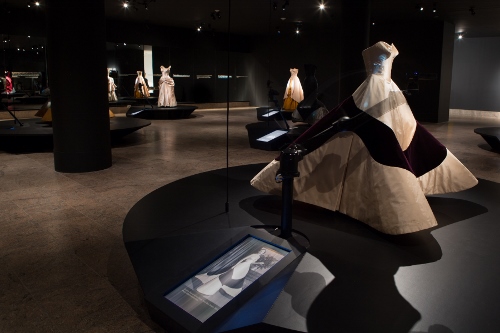
Clover Leaf Ball Gown – a 1953 silk faille, shantung, and black lace sculpture by Mr. James. Part of the Brooklyn Collection at The Met

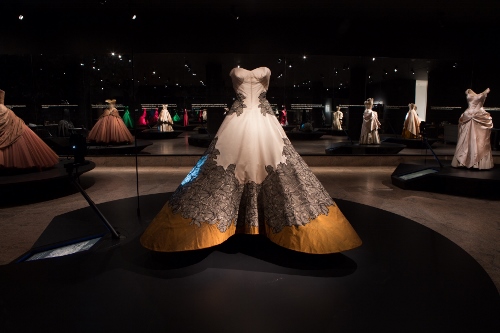
Clover Leaf Ball Gown – a 1953 silk faille, shantung, and black lace sculpture by Mr. James. Part of the Brooklyn Collection at The Met

When the Brooklyn Museum handed its fashion archive over to the Met in January 2009, the first thought that crossed everyone’s mind was the mind-bending masterworks that would now be sheltered under the protective wing of the Costume Institute’s crack conservation team — “Oooh, maybe the Met will do a Charles James show!”

We’re glad to report that the Met has done this master proud and given his humble admirers a fitting place to worship in its triumphant two-gallery show, Charles James: Beyond Fashion, which ends this weekend, August 10.

1952 portrait by Michael A. Vaccaro / LOOK Magazine. Courtesy: The Met;  Library of Congress

1952 portrait by Michael A. Vaccaro / LOOK Magazine. Courtesy: The Met; Library of Congress

Mr. James is credited with being among the first to perfect the strapless gown in the 1930s, an inspiration for Mr. Dior’s “New Look” in the 1940s, and the epitome of Vogue glamour dressing in the 1950s. He could do things with fabric that others simply couldn’t do or wouldn’t dare…well, maybe except for Madame Gres. He pushed silhouettes and fabrics further than most anyone could conceive and had the temperamental nature, drive for perfection, and uncompromising attention to detail that characterize any of history’s greatest, most passionate artists.

You always look at his creations and ask yourself, “How did he do it?” How did he get a spiral of fabric to stand out as it wraps sinuously around a sleek, strapless electric green silk mermaid dress? Is that sexy Thirties frock actually cut from one scarf?  How did he create virtual moving sculptures from the world’s most expensive fabric?

Innovative digital display tells the back story of Mrs. Hearst’s Clover Leaf Gown – too big for Ike’s inaugural, but just right for Queen Elizabeth II’s coronation

Innovative digital display tells the back story of Mrs. Hearst’s Clover Leaf Gown – too big for Ike’s inaugural, but just right for Queen Elizabeth II’s coronation

Long known for his innovative engineering, the Met came to a brilliant solution to explain the magic that Mr. James wrought over his decades of no-two-alike work – hire an architectural firm to show us.

Enter Diller Scofidio + Renfro, who have mounted these sculptures in silk inside an infinity-room gallery and paired each masterpiece with its own personal robot and humongous iPad-type display. Look at the dress and refer to the screen as the dress digitally deconstructs and is assembled again.

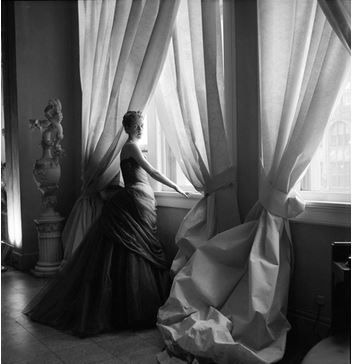
Cecil Beaton’s 1955  photo of Nancy James in the Swan Gown. Courtesy: The Met; Cecil Beaton Studio Archive at Sotheby's

Cecil Beaton’s 1955 photo of Nancy James in the Swan Gown. Courtesy: The Met; Cecil Beaton Studio Archive at Sotheby’s

The crowds waft from dress to dress in no particular order, clustering silently to watch digital magic, see where the robot is pointing, and view photos of Mrs. Randolph Heart, Jr., Gypsy Rose Lee, or Josephine Abercrombie in said gown. The robot with the 1954 Swan Ball Gown captivates viewers by moving underneath to televise close-up views of some of the 1,080 square feet of tulle that Mr. James used to create the oomph.

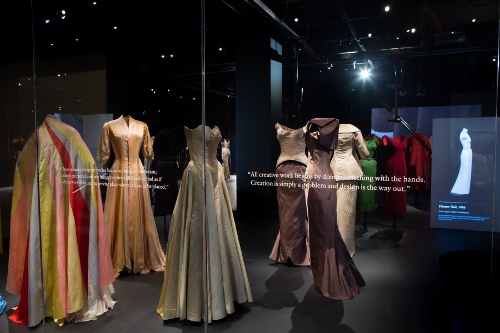
The mirrored walls of the upstairs gallery and the see-through dividers downstairs are emblazoned with the wisdom of the man himself. He seems to be talking right to you as you wonder how he made the fabric do what it’s doing (“It’s the air that’s sculpted, not the silk”) or how he thought about the world of fashion (“We who have been ahead in style have usually been ahead in our thinking”).

Downstairs gallery, newly named for Ms. Wintour, filled with James creations

Downstairs gallery, newly named for Ms. Wintour, filled with James creations

The second gallery (welcome back, ground floor Costume Institute!) displays his wool creations and sharply shaped cocktail wear. It’s interesting that James considered some of these genuinely more innovative than his often-photographed gowns. The curators have placed another of his “first” in a room at the back – the predecessor of today’s puffer coat. On loan from the V&A, it remarkably dates from the 1930s – his soft, sensual, silky answer to the boxy fur jackets that Ms. Schiaparelli was showing in Europe at the time.

We have to thank Mr. James for his vision and for making sure the Brooklyn design lab had so many examples of his masterpieces to teach and inspire future generations of Seventh Avenue designers. As he says, “In fashion, even what seems most fragile must be built on cement.”  Lesson learned.

The Met’s a great steward. Just listen to the love in the tour of the show by its curators:

If you have more time, hear what Zac Posen has to say to the co-curator about The Master: