Unknown's avatar

About MsSusanB

Arts and technology writer who is in the know about the latest and greatest that New York City – and other places in the country – have to offer and the fossils that are being dug up around the world

1950s and 60s Vintage Rolling through Midtown This Week

GM Model 5106 (1958-mid-1970s)

GM Model 5106 (1958-mid-1970s)

Christmas shoppers in NYC’s Midtown are in for a special retro-treat this week. For $2.25, they can take a trip back in time, as New York City Transit shuttles 42nd Street travelers from Twelfth Avenue to the East River on its collection of vintage buses.

It’s a fun way to travel to two of the best holiday markets in the City – Bryant Park and Grand Central Terminal – by enjoying a “good old days” vibe, complete with vintage ads. mtabus1211

The antique buses are due to roll east along the M42 route at 8:30am, 11:30am, and 2:30pm. If you aren’t in the vicinity of 42nd Street, look for parked antique buses opposite Macy’s (at Sixth and 35th Street) and across from Union Square between 10am and 3:30pm all week.

Transit will be featuring six styles of vintage buses from its collection, including five models from General Motors and one from Mack Truck and Bus. The earliest model is GM’s Model 5101, which ran the streets from 1949 to 1966; the most recent vintage is GM Model 5305A, which debuted in 1968 and ran until 1984.

Even though MetroCards are “new” (they debuted in 1993), they’ll work on the retro-buses. Check out this 1949 Rapid Transit movie to feel the way it used to be, and be sure to catch one of the retro-subway trains every Sunday until December 30 on the M Line between 2 Ave and Queens Plaza.
Mayans Dispute 2012 Ending

Illumination translates glyphs into numbers on stele, marking the end of the Long Count cycle on December 29, 775 CE

Illumination translates glyphs into numbers on stele, marking the end of the Long Count cycle on December 29, 775 CE

One of the best things about the Penn Museum’s “Maya 2012: Lord of Time” exhibition is the manner in which the curators meld the ancient, the mathematical, the historic, and the modern to answer the question “Will the world end at the end of the Mayan Long Count calendar in December 2012?”

The exhibition is built around the spectacular work that Penn’s archeological teams have done for decades in Copan, an ancient Mayan city located in today’s Honduras not far from the Guatemalan border – excavating tombs, uncovering clues to the succession of rulers, and figuring out exactly what all the once-cryptic hieroglyphics tell us. Check out the Flickr photos.

It turns out that the rulers kept a tight rein on the calendar, astronomic phenomenon, and various time-counting cycles to assert their right to rule. As some of the most spectacular stele show, the stone monuments actually enabled kings to embody dates, such as October 21, 731 (Copan Stele A).

Censor lid depicting founder of the Copan dynasty (695 CE)

Censor lid depicting founder of the Copan dynasty (695 CE)

The towering Quirigua Stele C from Guatemala associates the ruler with December 29, 775, the last time that the calendar flipped to the number 13.0.0.0 to signal the end of the Long Count.

There are many beautiful altars, sculptures, and pieces from the Penn’s collection, but the curators also went further, including the famous Dresden Codex, the Popol Vuh, and a phenomenal digital blow-up of a map showing how and where the Aztecs and Spaniards brought down the Maya. But one of the best contributions to the show are the video interviews with contemporary Maya commenting on their still-thriving culture and debunking the worries of their global neighbors about events later this month.

It’s obvious the view that Penn is taking, since the show is scheduled to run through January 13, 2013. Here’s Penn’s YouTube preview:

Holiday Rush for Christopher Columbus

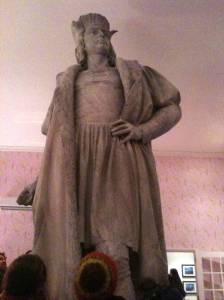
Greeting visitors in his apartment 75 feet in the air

Greeting visitors in his apartment 75 feet in the air

It’s the holiday season in New York, with art lovers rushing to see the spectacular apartment that Tatzu Nishi has created (courtesy of The Public Art Fund) for Christopher Columbus, the man at the center of things near the Time-Warner Building.

He’s been standing atop that column since 1892, so it’s about time that he had us over to see his taste in décor, books, and light TV viewing.  Here’s the Flickr feed, which takes you on a 360-degree view of his digs.

Who knew Captain Columbus was into pop culture? He even has a copy of one of Andy’s early cat lithos in his bookcase. Enjoy the holiday views that Columbus is enjoying, and get your free tickets now, because you won’t be seeing the City from this view again!

What Columbus is reading inside his apartment

What Columbus is reading inside his apartment

NYC Spider Theater Due to Close

Bronze Spider 1, 1995 by Ms. Bourgeois lurks at the show’s entrance

About the best spider theater in town is about to close in a few weeks – the live-animal floor show inside the American Museum of National History’s Spiders Alive! exhibition, where an actual spider-handler enthralls the crowds with myth-busting tales while introducing the arachnid star of the show, a Chilean Rose Hair Tarantula. Nearly 20 live species are crawling around the terrariums, but crowds are flocking to the live demo/theater area of the show and sitting spellbound until intermission. Go see it!

Since the AMNH never does anything second-rate, it’s fitting to note that welcoming visitors to the show is an art-world superstar. Lurking inconspicuously in the “canoe” lobby area outside the show is one of the smaller bronze spiders crafted by Louise Bourgeois. It’s smaller than the babies that graced the 1999 opening of Tate Modern’s Turbine Hall in London (and later the Guggenheim in Bilbao and Rockefeller Center), but who cares? Stop by for a glimpse.

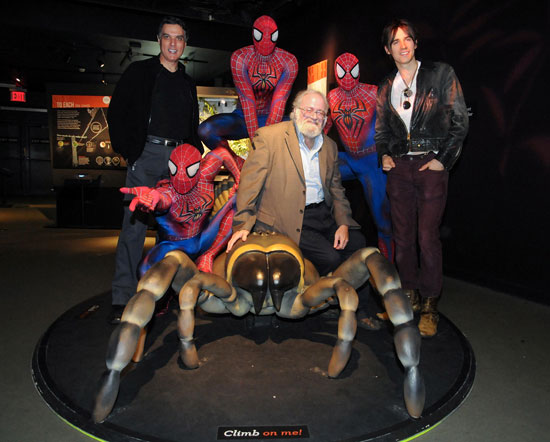
Robert Cuccioli, AMNH curator Norman Platnik, Reeve Carney and multiple Spider-Men take in AMNH’s “Spiders Alive!” © AMNH\R. Mickens

And lest you think that AMNH ignored the other obvious art-world connection, it didn’t, as shown by this amusing photo in September, when the cast of that other spider-themed show came to visit AMNH curator Normal Platnik for a walk-through.

Check out the opening-day YouTube promo below, but go meet the spiders up close and personal before they leave after January 6. If you’re a sci café geek that wants more, go poke around the AMNH World Spider Catalog.

235 Years of Veteran History in a High-Tech Park

Open again after the hurricane, best-kept-secret BLDG 92 has opened its doors to honor veteran, industrial, medical, and military history at the Brooklyn Navy Yard Center.

The stunning displays of over 235 years of history in New York Harbor inside are nothing compared to the experience of traipsing around by bus and foot to poke in and around the mix of crumbling 19th-century architecture, active dry docks, overgrown campuses, historic streets, and state-of-the-art sustainable design.

Take a look at the sights seen during the sunny days of summer on the Flickr feed, and book your trip now. It’s an adventure to get there (subways aren’t exactly close), but you will feel amazing to walk in the footsteps of so many heroes of American history and innovation, like Commodore Perry, Dr. Squibb, the North Atlantic Command for WWII, and Rosie the Riveter.

If it all feels and looks a little like a back lot, it is. (Boardwalk Empire shoots at the Steiner Studios and SNL builds sets there.)

Check out the photo of the tugboat under repair in the third oldest dry dock in the country – right where the Monitor was built for combat during the Civil War.  And if you’re a Navy history buff, immerse yourself in BLDG 92’s Flickr stream courtesy of the National Archives, stereoscopes and all.

What have you been missing?  Just check out this video, and then go see the real thing on foot, by bus,  by bicycle, or on an industrial tour:

Do-It-Yourself Fashion Alphabet

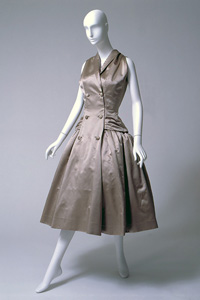
Christian Dior, dress in satin, 1954, France, gift of Sally Cary Iselin.

You’ve probably been too busy looking for electrical outlets below 34th Street to have noticed that today is the last day of the exhibition Fashion, A-Z: Highlights from the Collection of the Museum at FIT, Part Two.

Don’t worry, because as your power (and Internet) comes back on, you can get your fashion fix via FIT’s new digital archive that lets you surf by alphabet to see all the famous designers and dresses that are in the collection. Search by designer or brand, they’re all there.

The gallery show has the outfits arranged A (for Adrian with a MoMA-inspired creation) to Z (Zoran) in its upstairs gallery. The curators often placed two designer ensembles side-by-side, emphasizing the original designer (for example, Dior) and the younger designer who took over creative duties for the house over time (for example, YSL for Dior).

It’s a treat to see side-by-side examples of new and old Hermes (featuring Gaultier vs. the Kelly bag), Valentino, Balmain, Kenzo, YSL, Dior, and Comme des Garcon creatives.

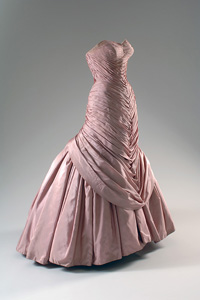
Charles James, evening dress in silk taffeta and net, 1955, USA, gift of Robert Wells In Memory of Lisa Kirk.

Is Charles James still the reigning world champion? Take a trip to Seventh Avenue today or start surfing fashion history to make your own determination.

MoMA Displays Post-Sandy Boardwalk Episode

Maybe it’s a bridge and not a coastal boardwalk, but the character in Munch’s pastel on view at MoMA through April 2013 pretty much sums up the experience of so many Tri-State residents in the last week.  Ironically, the privately owned drawing went up only a few days before the hurricane stormed through the region, devastating homes, beaches, and the Chelsea galleries.

Many downtown museums remain closed, including the South Street Seaport Museum, the New York City Police Museum, the National Museum of the American Indian, and the Skyscraper Museum, although the Museum of Jewish Heritage at the Battery has just announced its reopening. On the West Side, the Intrepid is closed until it can fix its inundated welcome center and repair the outdoor protective bubble around the space shuttle Enterprise, which got a little beat up. The High Line is repairing all of its electrical infrastructure.

To help the arts and museum community during this difficult week, MoMA has posted a PDF with instructions on conserving art works that have sustained flood damage and held a workshop with conservators from the American Institute for Conservation Collections Emergency Response Team for afflicted dealers and collectors this past weekend.

While the repairs and restoration will take time and with another windy storm on the way toward New York, Mr. Munch’s 117-year-old evocation remains pretty much on point.

NYC High Line Wilderness Being Swept Away

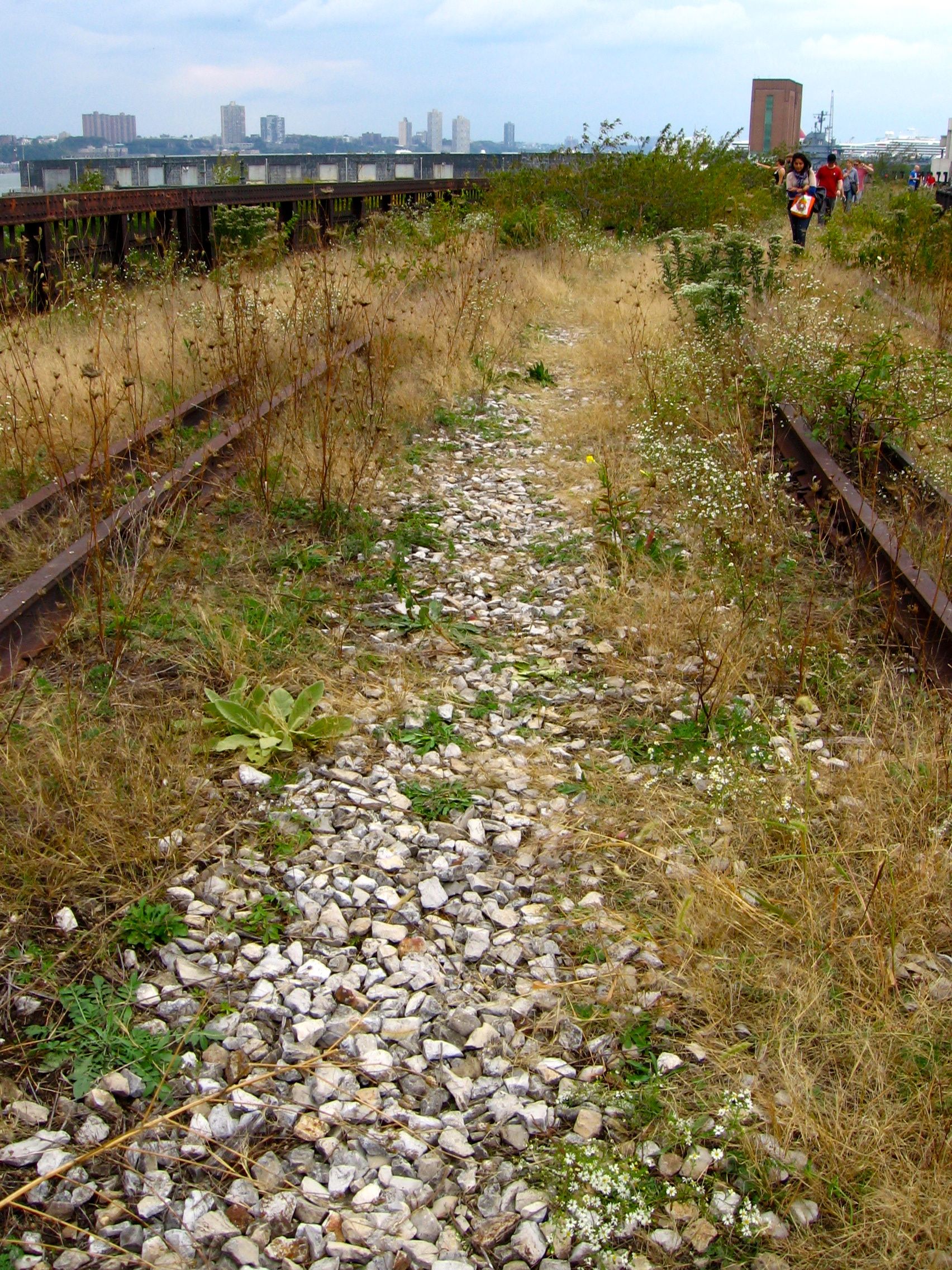
It’s not going to be swept away by Hurricane Sandy…We’re just alerting you to the fact that the last section of the High Line looping the West Side Rail Yards is about to undergo its final construction transformation from 30th Street up to 34th Street, right across the street from the Javits Convention Center.

As soon as the hurricane subsides, crews will start transforming the railroad-bed wilderness into a beautiful promenade designed by James Corner Field Operations, Diller Scofidio + Renfro, and planting designer Piet Oudolf. The City acquired the property from CSX Transportation this summer – the final piece of rail property to complete the High Line vision.

Earlier this month, the High Line opened up this final frontier to foot traffic as part of Open House New York, and we’re providing a last virtual look on the Flickr site.  Enjoy the trees, the views, the historic photos, and graffiti of the old elevated railway before the skyscrapers start rising over the old Penn Central yards.

And be sure to find the theropod dinosaur lurking in the weeds above Eleventh Avenue!

Hirschhorn Goes Overboard at Gladstone

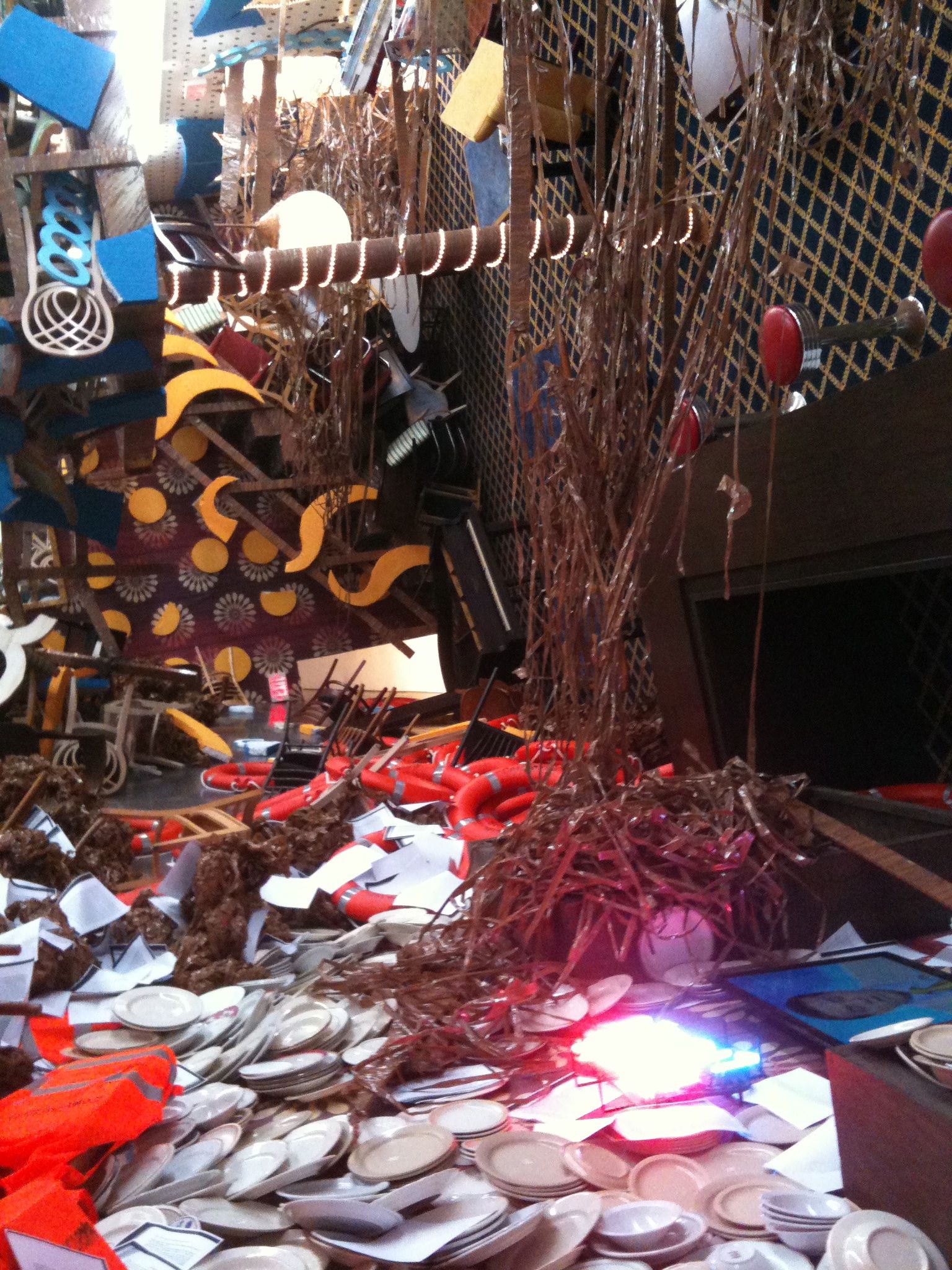
This may look like a Judy Pfaff installation, but it’s a close-up of the engaging, room-size environmental work by social commentator Thomas Hirschhorn on view until October 20 at Gladstone Gallery in Chelsea.

Concordia, Concordia is a riff on the tumultuous, larger-than-life grounding tumble of the Italian cruise ship, Costa Concordia in January 2012. Gladstone has other close-ups on its website, but its worth a walk over to 530 West 21st to get the full experience for yourself.

Hirschhorn was inspired by the furniture-akimbo nature of the interior photos of the luxury liner and the refusal of the ship’s captain to tend to the self-inflicted disaster.  There’s a lot to look at – including Hirschhorn’s cheeky inclusion of The Raft of the Medusa.  Look hard. You’ll find it. There’s no safe place.

Coe Multimedia Accessory Collection at The Met

Detail of Possible bag (1900) from the Coe Collection at The Met

McQueen and the Paris runways have nothing over the 18th and 19th-century Native Americans who knew how to mix unusual materials and meanings into symbolic, functional, innovative, and salable accessories. A collector with an eye for the interesting is honored in the Met’s Michael C. Rockefeller wing in the micro-show, The Coe Collection of American Indian Art.

Ted Coe of Santa Fe was inspired to collect both ancient and contemporary works by Native Americans that caught his attention, amassing thousands of pieces that he bequeathed to the Met. He mounted a truly innovative show at AMNH in 1986, which linked old and new traditions in Native American art making, Lost and Found Traditions: Native American Art 1965-1985. The Met’s curators decided to honor his work by selecting forty objects.

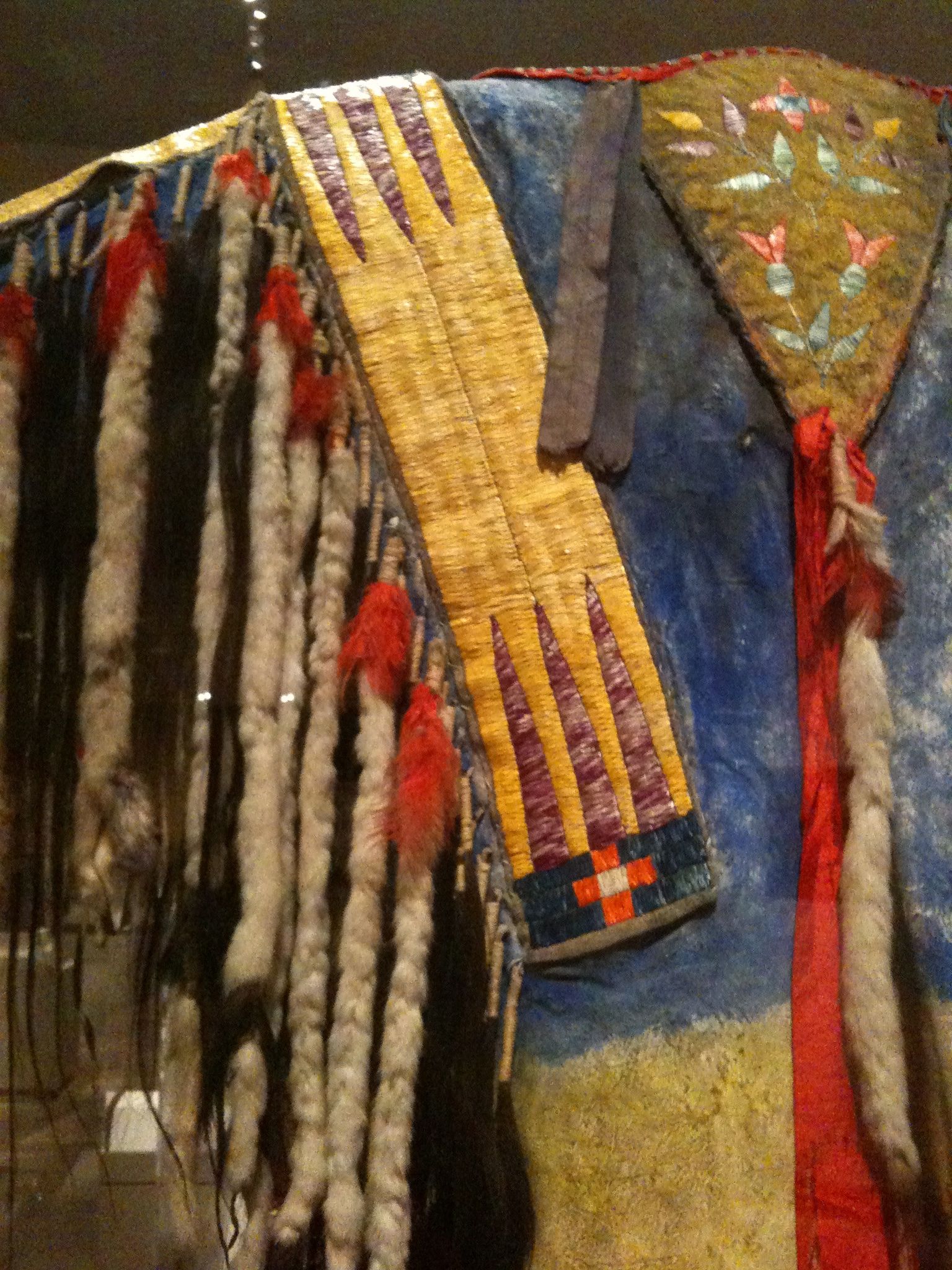
Detail of Arikara Leadership shirt (1860) from Coe collection at The Met

The show isn’t all about wearable art, but we decided to focus on a few details that you might find of interest. We’ve organized the Flickr feed to document some of the oldest to the newest creations on display, ranging from mid-Mississippian carved stone tools from 4,000 B.C. to the cheeky dough bowl (1994) made by Chochiti potter Diego Ramirez.

In between, you’ll see an array of sophisticated and rough creations made by artists from the 1700s to early 1900s for Native American leaders, nomads, and tourists – all designed, embellished, and crafted in a variety of materials. Who knew that nuns taught Canadian tribal artists to embroider with moose hair? Enjoy the details.