The tree touches the top of the Cantor Gallery. Photos: Brooklyn Museum
The view is dramatic, but the story is it evokes is even bigger than what’s in the room. There’s still time to travel out to the Brooklyn Museum to have the immersive experience of Swoon’s Submerged Motherlands, closing August 24.
The pictures here just don’t do justice to the super-high wrap-around effect of this walk-through take on the emotional side of rising tides throughout the world. A photo can’t take it all in — a sheltering, 60-foot tree with cut-out paper leaves with some day-after-the-Flood rafts parked down below, all decorated with sketches of the peoples and mothers of the world.
And did we mention that Brooklyn visionary Callie Curry (a.k.a. Swoon) actually built and lived on those rafts for a while? Several years ago, she sailed them up and down the Hudson, on the Mississippi, and across the Adriatic.
Close-up of one of Callie’s rafts.
You’ll get to see these jerry-rigged but seaworthy concoctions up close, and examine the drawings, cut paper, and torn, coffee-stained textiles draping walls, floor, and shelters in this dramatic space.
The feeling it evokes makes you wonder if we’re ready for rising seas and climate change. It’s beautiful, monumental, and reminiscent of our recent lights-out experience of Hurricane Sandy, which tore at the edges of Brooklyn, Long Island, and Staten Island just two years ago – exactly what inspired Callie to take this work in this direction.
Hear what it took for Callie to create this fantastic walk-through installation on Brooklyn’s top floor:
You may also want to hear what Callie has to say about being a working artist in the real world – outside the four walls of a gallery – in her talk from TEDxBrooklyn in 2010. She will show you her rafts in action at Minute 5 and tell you what it felt like to arrive on a hand-built raft in Venice, her projects in post-earthquake Haiti, and interacting with people from the neighborhood as she creates art on the sides of Brooklyn buildings. Truly inspirational.
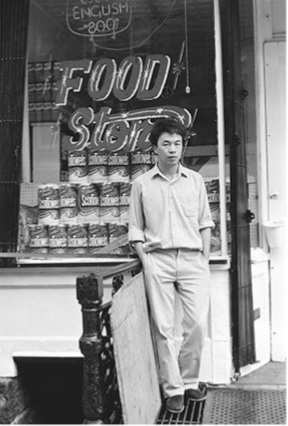
Then: Ai Weiwei in Williamsburg, 1983. From his New York Photograph Series (1983-1993). Courtesy: the artist
If you haven’t yet trekked to Brooklyn to see one of the world’s most famous international provocateurs, go this weekend to see Ai Weiwei: According to What? and get to know the work of the artist who was incarcerated a few years ago by the Chinese government for pulling the veil off its bureaucratic repression and dishonesty. Closing August 10, it’s the last stop on the show’s North American tour – a fitting finale since Ai Weiwei first lived in Williamsburg when he moved to New York back in 1983.
You know him either from his collaboration on the famous “bird nest” stadium at the 2008 Beijing Olympics, smashing Han Dynasty vases as an art project, or from having bulldozers sent by the Chinese government to eradicate his studio in 2011 and being put into house arrest for 81 days – an event that made front-page news and sparked an international outcry – museums and political leaders took out protest ads, made videos, placed flowers on his public works, and called for his release all over the world.
Even before you hit the admissions booth, you’ll see his response to all of this – a series of six large, mysterious boxes that make up his work, S.A.C.R.E.D. You climb up to peer into them, right inside Brooklyn’s entrance. Inside, you’ll see everyday depictions of what it was like for him in detainment – eating, sleeping under the watch of the uniformed guards, and interrogations.
Upstairs, you’ll see an expansive show filled with thought-provoking works along with some black-and-white photos of his East-Village life in the 1980s, where he hug with Tan Dun, Xu Bing, and other artists-on-the-move and artists-on-the-run from a conformist Mainland.
At a distance, his sculptures seem like simple, cool contemporary installations. Read the label copy and you realize the subversive is at work. It looks like some found-art piece, but the room is actually filled with the full contents of a young woman’s home. Ai Weiwei found her and all her stuff on the side of a road after the authorities evicted her.
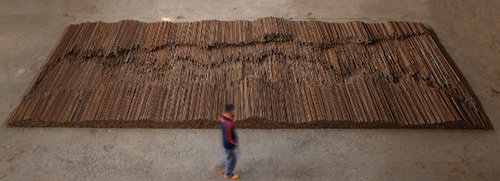
A single room is devoted to Straight, a monumental installation made up of rebar, metal rods used to strengthen concrete calls. Except that this is the actual rebar from the 2008 earthquake that claimed 5,400 young lives in Sichuan Province when the schools collapsed due to shoddy construction practices. He bought the scrap rebar from those buildings, spent four years hammering to straighten them out, and assembled the rods into a 70-ton sculpture. Nearby, he’s listed the names of every school child – something that the Chinese government never did.
Performance art: dropping a Han dynasty vase (206 BC-220 AD), along with other historic ceramic pieces altered by a dip into modern industrial paint (2007-2010). Photo: C. Carver. Courtesy: the artist
How and why does he do it? Find out by listening to Ai Weiwei’s answers to visitors’ questions. You’ll have quite an insight to his thought process, since there are 45 pages of video Q&A. Well worth the time to meet this brave, inspirational artist-activist.
He’s simply one of the top contemporary artists working today and you owe it to yourself to experience work that literally takes on the world. Kudos to the Brooklyn Museum for also publishing the amazing teacher’s guide, which asks students to ponder and think about news, authority, and speaking out.
Watch as the Brooklyn crew assembles Stacked, Ai Weiwei’s 2014 sculpture made from 700 bicycles, a comment on the transportation traditionally used by Chinese commuters until the dawn of the smog-inducing automobile. It’s all happening under the watchful Egyptian eye on Brooklyn’s main floor:
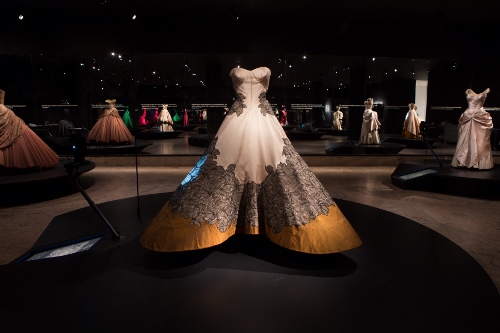
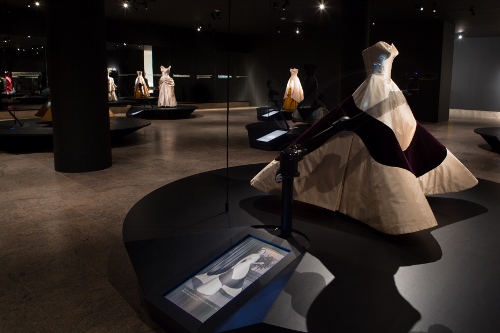
Clover Leaf Ball Gown – a 1953 silk faille, shantung, and black lace sculpture by Mr. James. Part of the Brooklyn Collection at The Met
When the Brooklyn Museum handed its fashion archive over to the Met in January 2009, the first thought that crossed everyone’s mind was the mind-bending masterworks that would now be sheltered under the protective wing of the Costume Institute’s crack conservation team — “Oooh, maybe the Met will do a Charles James show!”
We’re glad to report that the Met has done this master proud and given his humble admirers a fitting place to worship in its triumphant two-gallery show, Charles James: Beyond Fashion, which ends this weekend, August 10.
1952 portrait by Michael A. Vaccaro / LOOK Magazine. Courtesy: The Met; Library of Congress
Mr. James is credited with being among the first to perfect the strapless gown in the 1930s, an inspiration for Mr. Dior’s “New Look” in the 1940s, and the epitome of Vogue glamour dressing in the 1950s. He could do things with fabric that others simply couldn’t do or wouldn’t dare…well, maybe except for Madame Gres. He pushed silhouettes and fabrics further than most anyone could conceive and had the temperamental nature, drive for perfection, and uncompromising attention to detail that characterize any of history’s greatest, most passionate artists.
You always look at his creations and ask yourself, “How did he do it?” How did he get a spiral of fabric to stand out as it wraps sinuously around a sleek, strapless electric green silk mermaid dress? Is that sexy Thirties frock actually cut from one scarf? How did he create virtual moving sculptures from the world’s most expensive fabric?
Innovative digital display tells the back story of Mrs. Hearst’s Clover Leaf Gown – too big for Ike’s inaugural, but just right for Queen Elizabeth II’s coronation
Long known for his innovative engineering, the Met came to a brilliant solution to explain the magic that Mr. James wrought over his decades of no-two-alike work – hire an architectural firm to show us.
Enter Diller Scofidio + Renfro, who have mounted these sculptures in silk inside an infinity-room gallery and paired each masterpiece with its own personal robot and humongous iPad-type display. Look at the dress and refer to the screen as the dress digitally deconstructs and is assembled again.
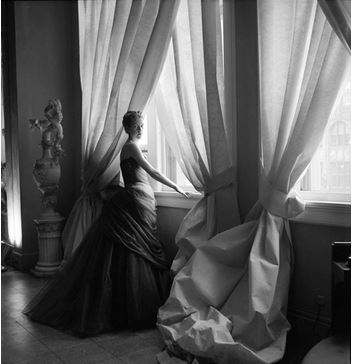
Cecil Beaton’s 1955 photo of Nancy James in the Swan Gown. Courtesy: The Met; Cecil Beaton Studio Archive at Sotheby’s
The crowds waft from dress to dress in no particular order, clustering silently to watch digital magic, see where the robot is pointing, and view photos of Mrs. Randolph Heart, Jr., Gypsy Rose Lee, or Josephine Abercrombie in said gown. The robot with the 1954 Swan Ball Gown captivates viewers by moving underneath to televise close-up views of some of the 1,080 square feet of tulle that Mr. James used to create the oomph.
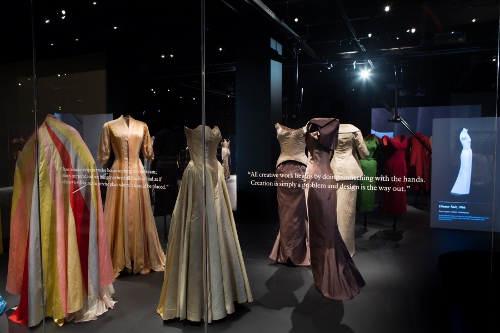
The mirrored walls of the upstairs gallery and the see-through dividers downstairs are emblazoned with the wisdom of the man himself. He seems to be talking right to you as you wonder how he made the fabric do what it’s doing (“It’s the air that’s sculpted, not the silk”) or how he thought about the world of fashion (“We who have been ahead in style have usually been ahead in our thinking”).
Downstairs gallery, newly named for Ms. Wintour, filled with James creations
The second gallery (welcome back, ground floor Costume Institute!) displays his wool creations and sharply shaped cocktail wear. It’s interesting that James considered some of these genuinely more innovative than his often-photographed gowns. The curators have placed another of his “first” in a room at the back – the predecessor of today’s puffer coat. On loan from the V&A, it remarkably dates from the 1930s – his soft, sensual, silky answer to the boxy fur jackets that Ms. Schiaparelli was showing in Europe at the time.
We have to thank Mr. James for his vision and for making sure the Brooklyn design lab had so many examples of his masterpieces to teach and inspire future generations of Seventh Avenue designers. As he says, “In fashion, even what seems most fragile must be built on cement.” Lesson learned.
The Met’s a great steward. Just listen to the love in the tour of the show by its curators:
If you have more time, hear what Zac Posen has to say to the co-curator about The Master:
The first-ever adult Night at the Museum sleepover at the American Museum of Natural History last night was a hit, thanks to the enthusiasm and star power of Dr. Mark Siddall, the curator of the fantastic exhibition, The Power of Poison, closing August 10.
Early in the evening, Siddall mingled with sleepover guests at dinner in the Powerhouse and later in a series late-night talks from the Victorian theater inside the Poison show where costumed performers normally show visitors how to gather clues to solve a period murder mystery involving poison. (Think “I’ve got poison in my pocket” from A Gentleman’s Guide to Love and Murder.)
After dinner, the adventurers, some in costumes themselves, made quick trips with their stuffed animals to the cots under the Blue Whale and bounded up the stairs through the low-light galleries to reach the shark IMAX, live animal demos, fossil tours, and Siddall’s Poison briefings.
The Victorian theater inside Poison. Photo: AMNH/D. Finnan
You had to pass through the always eerie Hall of Reptiles and Amphibians (hello, Komodo dragons!) to enter the magical kingdom of the Poison galleries.
Once inside, you were transported to a tropical rainforest, with golden poison-dart frogs under a dome, huge models of dangerous insects, and a toxin-eating Howler Monkey lurking on a branch.
Beyond the tropics, the show morphed into a land of make-believe…or was it? Tableaux with a sleeping Snow White, the witches of Macbeth, and the Mad Hatter were captivating, with the label copy bringing you back down to earth by explaining the role played by poisons and toxins in these scenes and what exactly witches’ brew contained.
Supplies for the toxic witches’ brew. Source: AMNH
A Chinese emperor (the one with the terra cotta army, no less!) ingests mercury in one diorama, thinking it’s going to give him immortality. Wrong move. Glancing down, you find out that as recently as 1948, mercury-laced teething powder was still being used on babies in the United States.
A spectacular illusion along the way is a magical set of Greek vases whose painted figures came to life to tell stories of how poison helped Hercules and doomed Ms. Medea.
The lively vases are a prelude to the exhibition team’s greatest wonder – the Enchanted Book – a gigantic tome where ancient illustrations leap to life as you turn big, think parchment pages. Visitors could not get enough of that magic book. Somehow the AMNH digital team replicated it on the website, so click here to take a look at The Power of Poison: An Enchanted Bookand turn the pages on line.
Here’s a glimpse of one story from the belladonna page, providing the backstory on how witches fly:
A lot of Siddall’s spectacular, magical, immersive, theatrical exhibition explains the science behind venoms, the “arms races” in the natural world, poison’s role in children’s stories, and how to analyze clues in solving murder mysteries.
Check out the Victorian-style introduction to Poison with Dr. Mark Siddall, its creator, and get a little taste of what the sleepover guests saw and heard.
To ward off any bad dreams about toxins or creepy crawlers, a lot of the late-nighters nestled in to watch vintage Abbott and Costello and Superman films and post Instagrams from the cozy, pillow-lined pit in center of the Hall of Planet Earth.
PS: If you can’t get to this show before August 10, download the iPad app, Power of Poison: Be a Detective that allows you to experience the last portion of the show. It’s been nominated for a 2014 Webby Award in the Education and Reference category.
Claude Johnson of the Black Fives Foundation, surrounded by memorabilia, in The Black Fives show at New -York Historical Society.
With LeBron James’s big announcement in the news, it’s a good time to trek over to the New York Historical Society to learn about how it all started – basketball, African American domination of the sport, and pro trades — in the fascinating second-floor show, The Black Fives, running through July 20.
When basketball really took off in the 1910s and 1920s, the top starting players were known as “fives.” Pre-integration, when African-Americans had their own teams, the amateur club starters were known as “black fives.” NYHS produced this show in collaboration with Claude Johnson, director of the Black Fives Foundation, who has been leading the charge to collect, document, and interpret the unknown or forgotten history of African American participation in one of America’s favorite games.
Recap: Basketball began in 1891, using peach baskets, as a game to keep youngsters occupied during long winters in the Northeast. in 1904, Harvard-educated Edwin “EB” Bancroft Henderson introduced the game to African-Americans through the public-school phys ed classes he taught in Washington, D.C. Physical activity was seen as a way to combat TB and pneumonia, which were rampant in cities. Here’s a short clip about Henderson:
It wasn’t long before basketball came to Harlem, Cleveland, Chicago, Pittsburgh, Atlantic City, and Pittsburgh, where there were large populations of young African American men and coach/role models ready to start something new in public schools, churches, and colleges.
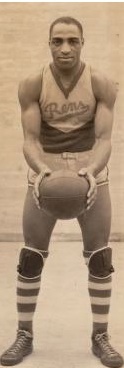
Charles “Tarzan” Cooper (1907-1980), the star center who won the 1939 World Pro Basketball Tournament championship with the Rens. Photo: Black Fives Foundation.
Johnson’s collection of original cotton jerseys, trunks, stop-clocks, balls, and shoes from the 1910-1920 era is amazing, and really brings you back to the days when basketball courts were surrounded by wire mesh to protect fans (“cage match”, anyone?). You’ll see original, handmade basketball shoes, crafted of canvas and kangaroo leather and a life-size photo of how these snazzy sportsmen dressed.
Since NYC gymnasiums were still racially segregated, African-American clubs had to find alternate spaces to play. Uptown, the rise of basketball just happened to coincide with the Harlem Renaissance. Solution: use a ballroom and combine dancing, jazz orchestras, and basketball.
Ballrooms and basketball boomed, with “black five” teams now having really nice home courts. In 1923, Bob Douglas created the first Black-owned pro team for Harlem’s 2,500-seat-capacity Renaissance Ballroom at 138th Street. Douglas christened them the New York Renaissance Big Five (fans called them the “New York Rens”), and promptly started offering big-time contracts to the best players in town. By luring top talent with lucrative pay, the Rens would dominate basketball for decades to come.
Since they couldn’t compete at first in white leagues, the Rens went barnstorming across the country to play white teams, averaging 130 games per season. Some venues were as large as 10,000 seats. Fans went wild during the Depression to see the amazing Rens. From 1923 on, the Rens won 1,673 out of 1,944 games, led by Charles “Tarzan” Cooper. By 1939, they captured the first World Championship of Pro Basketball in Chicago, defeating the top white team in the country, the Oshkosh All Stars. The Rens were hailed as the top team of the decade, black or white.
This 1971 Milton Bradley game , in the NYHS collection, celebrates the Harlem Globetrotters, who were a team that started on Chicago’s South Side
To learn more about this history, visit NYHS or go to the foundation’s web site and click through each section of the exhibition in the pull-down menu. In the Depression Era section, you’ll get the entire backstory on how the Harlem Globetrotters were actually from South Side Chicago and how even they got creamed by The Rens in ‘39. (The Globetrotters didn’t actually play a game in Harlem until 1968!)
Check out the exhibition video:
Here, you’ll see more about the Black Fives and Brooklyn, and how the Barclay Center is commemorating the “Black Five” era:
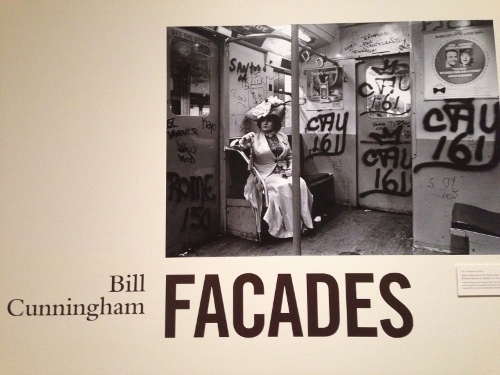
Cunningham’s photo of Editta Sherman in period dress on a 70s graffiti-covered subway car going to a shoot at the Brooklyn Botanic Gardens
Uber-fashion documentarian Bill Cunningham had a great idea in 1968, just as NYC was sliding toward financial crisis, crime, and (goes without saying) neglect of architectural sites, like Grand Central. Why not celebrate two centuries of NYC fashion and splendor on the street?
What were people wearing when some of the City’s most iconic homes, churches, and public buildings were built? Was it possible for a black-and-white photograph to reveal some new insight about the City from combining fashion, architecture, and a little fashion flair and attitude?
Editta poses for Bill in embroidered frock coat and breeches in front of St. Paul’s Chapel, the oldest church building (1766) in Manhattan
Results of Bill’s eight-year project are on display through July 15 in the Bill Cunningham: Facadesphoto exhibition on the second floor of the New-York Historical Society.
Without the aid of Wikipedia, he researched the years that some of his favorite historic places were built, and began scouring thrift stores for get-ups from the matching decade. He enlisted his muse, Editta Sherman, a fellow photographer and neighbor at the Carnegie Hall studios. For the next eight years, Editta and Bill went on weekend odysseys throughout the City, modeling and documenting over 500 historic outfits in front of interesting but sometimes forgotten facades.
In 1976, Bill gave 88 of his silver-gelatin prints to NYHS – the core of the current show, which is hung to emphasize the chronology of fashion and architectural style. The show was jammed with fashion lovers last weekend, soaking in the details from Bill and Eddita’s journey back in time.
Editta dresses for Bill in Gertrude Vanderbilt Whitney’s own Callot Soeurs at the 1904 Harry Payne Whitney House
It starts with Editta dressed in an 18th c. embroidered coat and breeches in front of the 1766 tower of St. Paul’s Chapel at Broadway and Fulton – the oldest church building in Manhattan that was considered “suburban” when President Washington lived here. Remarkably, they discovered this satorial gem in a Ninth Avenue second-hand store.
The visual treats just keep coming – a diaphanous Empire muslin on a model in front of City Hall (1803), Civil War-era frocks at Sniffen Court in Murray Hill, bustles and parasols at the 1884 Villard Houses (Helmsley Palace), and many spectacular gowns from the Gilded Age. Consider Eddita channeling “Diamond Lil” in front of 1891 Delmonico’s, the first modern American restaurant that innovated a la carte dining, private dining rooms, Lobster Newberg, and Baked Alaska.
In two photos, the team managed to borrow some historically relevant gowns – Gertrude Whitney’s Callot Soeurs frock for the shoot at the 1906 Payne Whitney home by Stanford White (Fifth & 79th) and Mrs. J.P. Morgan’s Worth gown at the gazelle gates of the Apthorp.
Bill Cunningham’s take on modern fashions at the 1968 GM Building
The curators note that although women’s fashion in the early 20th century was fairly liberating, the public architecture of New York remained tightly classical. The show’s final shots soar with the optimism of the modern – the “New Look” in front of the Paris Theater (1948), full-skirted flair on Park Avenue by the Lever House (1952), Givenchy at the Guggenheim (1959), and mod looks at the GM Building (1968).
You will savor every minute of your journey with these creative geniuses. Check out a few photos on the NYHS web site, find a copy of the 1978 book Facades, or get to the show.
If you didn’t see the film about Bill, rent it from iTunes or Netflix or buy the DVD. You can glimpse Eddita (a.k.a. The Dutchess) in the movie trailer below:
Detail of Elijah Burgher’s The Pattern of All Patience 1 (2014), featuring magical symbols, installed on the second floor
It’s the last time the Whitney Biennial is holding its big, expansive, colorful, and provocative shindig on the Upper East Side, since it will decamp to its new riverside home at the foot of the High Line next year. Go before it ends on May 25.
It’s amazing to think that this is the 77th time that the Whitney has hosted either an annual or biennial show to showcase the best of American art, as controversial and impossible a task as that may be. This year, the Whitney threw in the towel in trying to showcase “the best” of what’s going on in contemporary art coast to coast. It just wasn’t possible given the expanse, diversity, and barrier-breaking works that American artists are cranking out right now.
Instead, the Whitney invited three innovative curators to choose what should be shown on each of three floors and around town. (Yes, there are offsite works, too.)
Pillar of Inquiry/Supple Column (2013-2014) by fiber artist superstar Sheila Hicks
The divide-and-conquer approach works, resulting in a fun variety of media, installations, paintings, sculptures, textile art, performance, and collections-as-art. The team pulled it all together in only 18 months while still doing their day jobs at Chicago’s Art Institute, London’s Tate Modern, and Philadelphia’s ICA.
Visit our Flickr album and walk through the press preview with us, where several artists were on hand in the galleries with their work.
It’s a happier, lighter show compared to past Biennials, but that doesn’t mean that the artists ignore social commentary or darker sides of human nature. It just means that you won’t feel as though you need a graduate degree in Conceptual Art to enjoy and ponder the work you’ll encounter.
Highlights: Charlemagne Palestine has created a surprisingly spooky installation in the stairwell that features sonorous sounds emanating from speakers adorned with stuffed animals. LA painter Rebecca Morris has two bright, gigantic delightful paintings on the second floor, curated by Philadelphia’s Anthony Elms, which features several satisfying collections-as-art installations by Julie Ault, Richard Hawkins, and Catherine Opie.
Pterosaur and giant theropod are featured in Shio Kusaka’s fourth-floor ceramics display
Fans of NYC’s 1970s art scene (when Soho was still industrial) will be captivated by The Gregory Battcock Archive, peering at the ephemera collected by one of the decade’s most prominent art critics who died under mysterious circumstances in 1980. Amazingly, it was all found by artist Joseph Grigley wafting around garbage bins in an abandoned storage facility. Grigley’s created a disciplined, loving, and intimate installation of reclaimed Battcock mementos, memories, and letters with Cage, Warhol, Moorman, Paik, Ono, and other 70s superstars.
The top floor takes a down-home approach to some very enjoyable paintings, sculptures, installations, and ceramics. Midwest curator Michelle Grabner said that she wishes she could just camp out there for the run of the show. You’ll enjoy it, too — a dreamy installation by Joel Otterson, a monumental yarn pillar by uber-fiber-artist Sheila Hicks, a witty desk and bookcase by master woodsman-sculptor David Robbins, and shelf of delicate and whimsical ceramics by Shio Kusaka.
Knits with commentary by Lisa Anne Auerbach, including WeAreAllPussyRiot
The third floor, curated by Stuart Comer (who’s recently moved to MoMA), features a lot of screens and digital media, essentially making you think about art in the age of the iPhone. As you step out of the elevator, you’ll encounter Ken Okiishi’s series of painted panels. Oh, wait! They’re actually abstract paintings on upended flat-screen TV displays – sort of like what would happen if Kandinsky’s Seasons were done at the Samsung plant.
The mixing of media keeps morphing in room after room of clever installations by Triple Canopy (antiques meet 3D printing) and Lisa Anne Auerbach (knitting meets social commentary, and zines meet the Giant in Jack and the Beanstalk). See Lisa’s work and listen to her explain her knitting:
There are dozens of other videos and audio guide stops posted on the Biennial web site (click on “watch and listen”), as well as bios of all the artists.
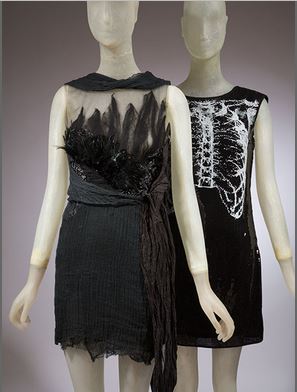
Rodarte’s California condor-inspired evening dress (2010) (left) next to their chest X-ray dress for Target (2011) (right)
In contemporary times, you can’t really have a fashion trend unless you can get the items for your total “look” at H&M, Topshop, Macy’s, Nordstrom Rack, or another mass-market ready-to-wear site. Not everyone is fortunate enough to have designers send stuff over for a red-carpet look.
FIT’s wonderful Trend-ology exhibition acknowledges that although trends today may start from celebrity looks in magazines or on TV, they often arrive fairly quickly at Target, Zara, Express, and other shops. The pace of knock-offs has increased due to the mania for trend, faster speeds in shipping containers across oceans, and “instant” digital media.
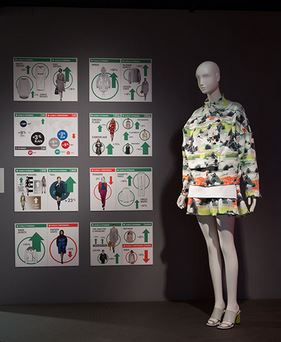
As soon as you enter the upstairs gallery, FIT features a wall of 2014 trend data from consultant WGSN right next to an “on trend” ensemble from Opening Ceremony.
WSGN trend analysis and “on trend” Opening Ceremony ensemble (2014)
You see at a glance how WGSN parses global runway shows each season into key looks, colors, tones, flower shapes, and skirt lengths for ready-to-wear company clients. Without detailed Paris-NY-Milan-London catwalk analysis, how would anyone know what was “trending”?
Spoiler alert: from the analysis depicted here, autumn/winter 2014 is all going to be all about pastel blue, the slip dress, hand-drawn patterns, and midi-length skirts.
There’s also an iPad streaming coverage of the latest award-show red carpet right in front of side-by-side ensembles by the Rodarte sisters – one from their 2010 high-end couture line and one from their sold-out line for Target in 2011.
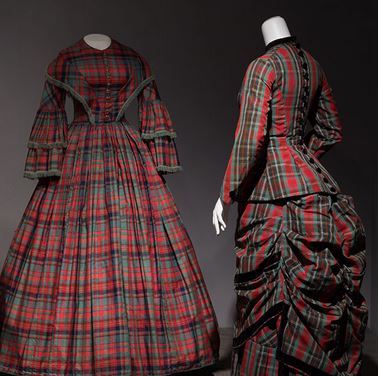
19th century passion for plaid in silk dress (1852) and wool bustle dress.
The curators have stuck two former “it” bags in front of you, too – one from Fendi and the other from Murakami’s colorful collection for Vuitton.
A photograph from a look at Celine’s Fall 2013 collection is mirrored on the mannequin behind, who sports an identical look that’s being marketed to the masses at Zara.
From the vintage looks in the rest of the galleries, the curators prove that trends mattered in the last few centuries, too. Neon yellow hues became the rage in the late 1700s due to the proliferation of imported Chinese silks.
Plaid mania was inspired by Queen Victoria’s Highlands flings at Balmoral Castle in the 1850s, and the craze for mass-produced paisley proliferated throughout the 19th century, following the invention of the Jacquard loom.
Dior “New Look” (1950) (left) inspired Anne Fogarty to create a full-skirt dress for budget-conscious homemakers in 1954 (right)
Of course, most of the galleries showcase trends from FIT’s vast archive of more recent fashions – Hollywood bias-cut silks, jet-set fashions following the British Invasion, disco-era menswear (the wide pant legs and patterned shirts seemed to baffle younger male gallery goers), Donna Karen’s iconic 1980s wrap-skirt-bodysuit, and fashions covered in designer logos from the 90s.
The biggest surprise: That Anne Fogarty’s “housewife” dress owes its genesis to Dior’s New Look. Hey, Lucy! Hey, Ethel!
Strangest item: Halston’s uncharacteristic tie dye ensemble that looks more like a Giorgio di Sant’Angelo than the nearby Giorgio di Sant’Angelo.
Greatest pleasure: Seeing the mini-documentary about the first days of Vogue magazine location shoots in the 1960s, surrounded by mod, space-age Carnaby Street looks.
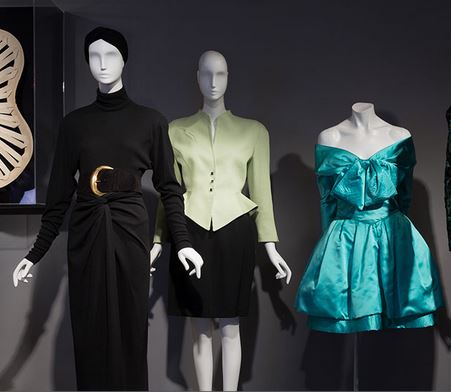
Eighties trends: Donna’s wrap, Thierry’s cut, and an absolutely fabulous Lacroix
Take a tour of 250 years of trends on FIT’s engaging, dazzling web site.
Yang Jiechang’s Crying Landscape (2003) shares the Gallery for Art of Ancient China with a sandstone stele from the Northern Wei dynasty (489-495) and the 1319 Buddha of Medicine.
Normally, the galleries for Asian Art at the Metropolitan Museum of Art are pretty tranquil. But through April 6, you’ll find them buzzing with contemporary art lovers reveling in the hunt to find the most famous, subversive, subtle works by Chinese painters, sculptors, and digital artists residing amidst centuries-old treasures in the widely popular exhibition, Ink Art: Past as Present in Contemporary China.
The Met gave the Chinese art curators free reign to pluck sly works from the in-house contemporary collections created by Chinese artists over the last 20 years, grab monumental works from private collectors, and mount a tribute to how post-Cultural Revolution innovators parse the traditions associated with centuries-old art making in their ancestral country.
How do the hottest artists on the planet turn calligraphy and inked woodblocks into biting social commentary? Take a stroll through the second floor Asian art wing.
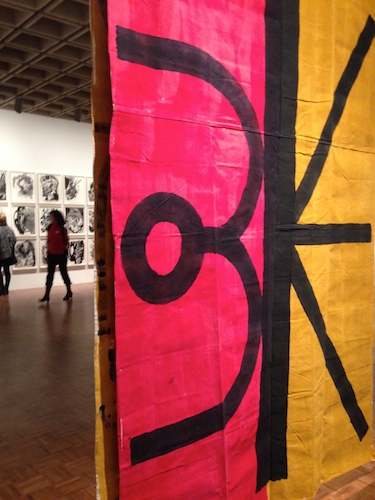
Inspired by Cultural Revolution posters, the letters in Wu Shanzhuan’s Character Image of Black Character Font (1989) have no meaning. Courtesy: Private collector, the artist.
Just past the balcony-bar area, the monumental 1319 Buddha of Medicine mural from Shanxi Province, China, casts a benign presence over the Gallery for Art of Ancient China. But just stage right, two larger-than-life works on paper preview how Chinese artists twist the “then” into the “now”.
Yang Jiechang’s Crying Landscape panels are painted in the beautiful, colorful “old school” flat Asian style but depict decidedly unbeautiful industrial and political subjects. Similarly, Qiu Zhirie’s Nanjing Yangzi River Bridge ink triptych features masterful, large-scale ink-brush technique but uses art-world icons to relay a disturbing story. It’s an installation triumph that will haunt you every time you pass through that room again.
Large-scale calligraphy by many of the artists makes ink-pot-and-brush tradition echo with gestures as large as Rothko’s. In the galleries with meticulously crafted “landscape” drawings and images, you’ll ask how this modern crew managed to produce scrolls with such heft and detail. Take a walk-through of the show through our Flickr site.
In 1995, Ai Weiwei corporatized a Han Dynasty (206 B.C. – 9 A.D.) earthenware jar. Courtesy: M + Sigg, the artist
Along the way to back of the wing, the curators play hide-and-seek, putting Ai Weiwei’s “enhanced” Han Dynasty jar right in the aisle with the “unmodernized” earthenware vessels, and mounting Hong Hoo’s subtly colored, hilarious historical “atlas” silkscreens in a case that practically dares unfocused visitors to pass them by as they drift toward the Astor Court.
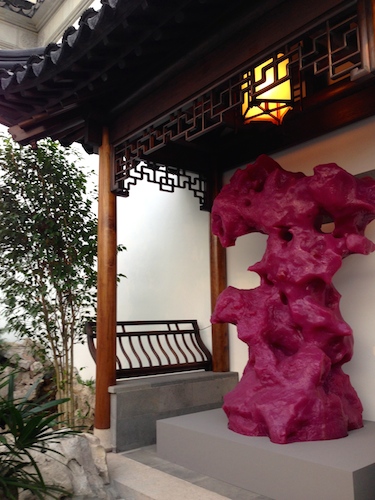
Hopefully by the time they get to the rock garden they will notice Zhang Jianjun’s crazy pink silicone rubber “scholar rock” right next to the real ones. Zhan Wang’s stainless steel scholar rock and Shou Fan’s side chairs are beautifully arranged in the Ming Dynasty room just off the Court, along with more of Ai Weiwei’s furniture hijinx.
After you’re done getting a feel for how the galleries have been transformed, go back into the Met’s exhibition web site to study the brushwork and details and get to know some of the artists.
Zhang Jianjun’s 2008 silicone rubber ScholarRock (TheMirageGarden) sits under a 17th-century pagoda in the Met’s Astor Court. Courtesy: Sigg Collection, the atist
Although the web site appears to be more plain-vanilla than jazzy, you’ll be surprised to see that the digital back-end of the Met archives lets you zoom into each of the paintings to see the handsome handwork of each of these wunderkinds from each thematic section of the show. You can even peruse the gigantic scrolls up close, section by section.
The video room, where art lovers can relax and watch a rotating collection of work, is a nice touch. The modern digital sign to the side tells you exactly where you are in the rotation.
Here’s a link to one of the featured videos: Get to know the constantly transforming cityscape of Beijing through Chen Shaoxiong’s 2005 Ink City, and see what happens when a contemporary artist paints daily life in Beijing with traditional tools and ports his day-to-night experience to video.
The 1980 version of The Perfecto, which debuted in 1928 and is still sold by Schott Bros. Source: FIT
The FIT fashion and textile grad students always pull out the stops on their shows in the Museum at FIT’s side gallery, turning mini-shows into main events, as in their current exhibition, Beyond Rebellion: Fashioning the Biker Jacket. The gallery installation highlights the jacket’s role in history, culture, couture, and street fashion, but the team makes its history come alive even further on their superb companion digital site featuring photos, videos, and the historical context. See the jackets in person and touch the leather swatches before April 5, and go play with the web site at any time.
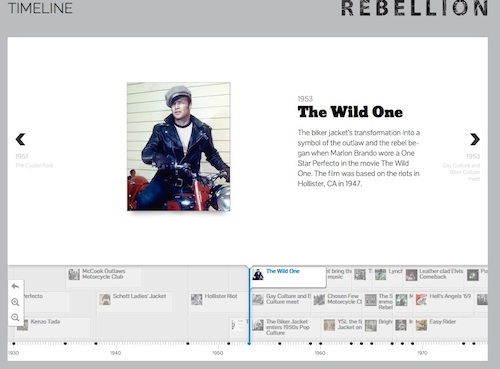
The digital timeline begins with the birth of the motorcycle in the UK in 1902, but the fashion story starts in 1928 with the debut of the leather riding jacket, The Perfecto by the Schott Bros. It’s the template upon which all other cool looks – street, couture, punk, ready-to-wear – are based. It combines the swag of a WWI aviator jackets with the utility and protection needed by one of the original road warriors. Retail: $5.50.
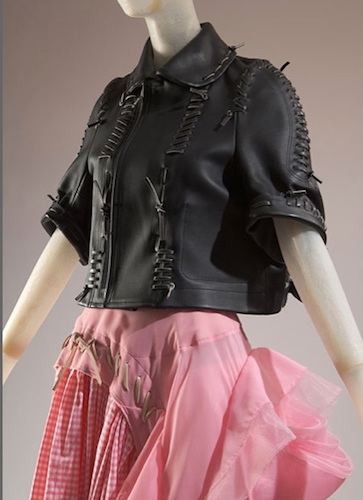
From Rei Kawakubo’s 2005 Biker + Ballerina collection (leather, gingham, and tulle) for Comme des Garcons. Source: FIT.
In the first gallery next to The Perfecto, fashionable visitors were hovering to take in all the information in Paula Sim’s excellent illustrated deconstruction of the jacket’s iconic design features as if it were the Rosetta Stone. How and why did the details we know so well all originate? The asymmetrical zip thwarts wind, epaulets secure riding gloves during breaks, the belt keeps wind from whistling up your back, and zips at the wrist do the same for the glove-sleeve juncture. The extensive use of hardware was a desirable touch inspired by chrome and metal features on the just-taking-off auto industry. Want or need?
It didn’t take long for motorcycle-loving vets to start applying patches and insignias to the aviator-inspired jackets, just as they had done with patches, insignias, and pins during the war. By the 1930s, as shown on the timeline, club patches gradually became associated with “outlaw” clubs. Nevertheless, the popularity of motorcycle riding grew, documented by the curators with a 1951 Sears catalog showing a premium $33.95 leather moto jacket featuring a snap-off lamb collar and “built-in kidney support”.
Screenshot from the FIT show timeline
As the curators note, the watershed year for this utility bomber was 1953, when Brando sported cuffed-jeans-and-jacket attire in The Wild One. Banned initially in the UK, the film (and Brando) became a sensation, giving mass audiences a pop-culture version of what happened in the 1947 Hollister, California motorcycle club riots.
The style went viral, pushed further into street-style consciousness by emerging rock-and-rollers and The King himself, Elvis. Take a look at some iconic 50s performances that the digital curators included on the show’s website. Scroll up to 1956 in the timeline to see Gene Vincent tear it up onstage and to 1968 to see Elvis rocking his leather look doing Jailhouse Rockin his NBC comeback special.
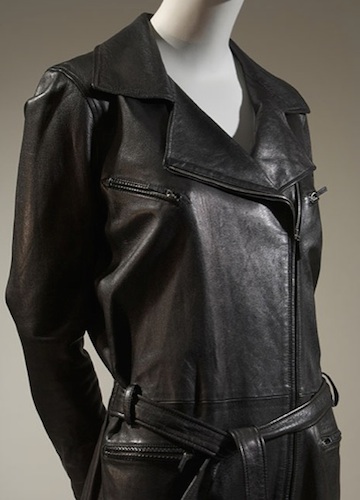
It’s so Schott: Stefano Pilati’s Fall 2009 jumpsuit for YSL. Source: FIT, gift of YSL.
In 1960, YSL became the first high-fashion designer to bring the biker look to the runway – a move that contributed to his exit from the House of Dior. Never mind, though. When he opened his own house two years later, he continued riffing on the bad-girl theme. The rest was history, with plenty of rock musicians, high-end designers, and Vogue stylists following suit.
The curators feature New York’s own Ramones as the epitome of the 1970s motorcycle-jacket-wearing punk-music rebels, and present lots of album covers as evidence of the jacket’s enduring presence.
As for fashion from the FIT collections, the team has pulled together a dozen high-end interpretations, beginning with Mr. Versace’s 1993 gold-stitched biker jacket with pull-tab logo hardware and a more subdued version by Emporio Armani. Fashion lovers have plenty of other versions to savor from Ms. Herrera, Rick Owens, JPG, Rei Kawakubo, and others.
All the techniques rolled into one: Jean Paul Gaultier’s 1987 leather, fake fur, suede, and wool jacket with trapunto, elbow studs, fringe, and pin stripes. Source: FIT, gift of Anne Zartaian.
In the far corner, the team offers a wall where you can touch and compare different types of hides and treatments used for jackets, marvel at the trapunto-on-leather techniques Mr. Versace and JPG used so extensively, and learn that patent leather was invented in 1811.
As for the current popularity of the biker jacket on the Streets of New York, enjoy the slide show by the FIT student team, shot on the only warm weekend day so far this year in Williamsburg: