Impressionist Line Ends at Frick

Toulouse-Lautrec, The Jockey, 1899. Color-printed lithograph on cream wove paper

Toulouse-Lautrec, The Jockey, 1899. Color-printed lithograph on cream paper

If you’re already nostalgic for the grand Impressionist show that ended at The Met, you can still find your favorites filling the Frick’s two downstairs galleries and the room next to the gift shop. While the Clark Art Institute (Williamstown, Massachusetts) was undergoing renovation, the Frick borrowed some of their finest works on paper for the gem-of-a-show, The Impressionist Line from Degas to Toulouse-Lautrec: Drawings and Prints from the Clark.

If you loved seeing Al Hirschfeld apply his pen and ink to paper in our last post, you will delight in perusing how lines by Degas, Manet, Lautrec, and Gaugin created a profitable niche in the rapidly expanding art market at the 19th century’s end. (By the way, Hirschfeld fans, who knew that Monet drew crazy caricatures to support himself early in his career? Claude’s Man with a Snuff Box looks like it was drawn in the 1950s…not the 1850s!)

Toulouse-Lautrec, Miss Loïe Fuller (1893), Lithograph printed touched with gold and silver powder. Source: Clark Art Institute

Toulouse-Lautrec, Miss Loïe Fuller (1893), Lithograph printed touched with gold and silver powder. Source: Clark Art Institute

Although a few politically charged works are in the show (like Manet’s 1874 print of the Commune uprising The Barricade), the majority are masterworks of portraiture, everyday life, cafes, and modern entertainments like horseracing, circuses, and boulevard promenades. Some of our favorites are Degas’s sketches of horses in motion and Lautrec’s circus-themed sketches that he drew from memory while in rehab.

If you can’t get to the show, the Frick web site allows you to peruse all of these works in detail (with the curator’s descriptions) by decade, by artist, or by the order in which they’re hung in the exhibition.

For sheer theatricality and delight, Lautrec takes the cake in this show, as shown in the images here. The hand-painted 1896 Lumiere Brothers film below shows silk-clad modern dance pioneer Loïe Fuller making the moves that inspired Lautrec to create dozens of experimental lithographs (sprinkled in gold and silver powder, no less!) of her abstractionist performances.

Yes, it’s all about the line.

If you have time, watch the video of the co-curator’s lecture about Impressionist line and how sketches, watercolors, woodcuts, lithographs, pastels, and improvised etchings created a revolution in affordable art.

Toulouse-Lautrec, The Englishman at the Moulin Rouge, 1892. Color-printed lithograph

Toulouse-Lautrec, The Englishman at the Moulin Rouge, 1892. Color-printed lithograph

Tony Week Pilgrimage to NYPL

Al's studio at New York Public Library of the Performing Arts

Al watches over his studio at NYPL for the Performing Arts

Tony favorite Kinky Boots is playing at the Hirschfeld, but as you contemplate the number of awards it will pick up Sunday night, walk over to the entrance of NYPL at Lincoln Center to pay tribute to Al himself. Peek through the window of NYPL for the Performing Arts to see the nook where every Broadway star since the 1920s had their portrait done –the studio of Al Hirschfeld, the man who immortalized them all.

Look through the window and you’ll see his drawing table, lamp, and the cozy, cushioned barber chair where he perched day after day, recording entertainment history over the decades with his unmistakable whimsical flair and line. The Lincoln Center library is a fitting home for Al’s studio furniture, since he consulted the NYPL theater archives for a lot of his work.

Liza in Minnelli On Minnelli (1999), one of more than 20 portraits Al did of her. In color for The New York Times. Source: Library of Congress.

Liza in Minnelli On Minnelli (1999), one of more than 20 portraits Al did of her. Source: Library of Congress.

It’s hard to believe that Hirschfeld first began drawing celebrity caricatures in the 1920s, and continued his illustrious career for the next eighty years. Click on this link to his dealer’s site (Margo Feiden) to scroll through all the plays and musicals he’s covered, documenting the quirks, panache, and performances of everyone from Fanny Brice to Martin Short.

You can click through the “time table” of Al’s work at the gallery site, or in the Timeline of the Hirschfeld Foundation’s website. Every drawing after 1948 was done from a cushioned barber chair in which he could swivel to his heart’s content. Initially, he found it on the Bowery for $3.00, but the one you’ll see in the Performing Arts library entrance is the replacement (the original just wore out), which he bought in 1993 from a barber shop in the Chrysler Building.

So, pay tribute to Broadway’s most beloved artist. And before we post about the Impressionist Line show at the Frick, why not watch a 20th century master of line make his mark so you can imagine all the creativity that emanated from the table you see in the window. The clip from The Line King, uploaded to YouTube by Al’s grandson, documents the legend drawing a caricature of Paul Newman as he appeared in Our Town. 

Philadelphia Museums Reach 2.4M YouTube Views

Since Philadelphia museums, zoos, and gardens began posting videos online in 2008, collective YouTube views have climbed to 2.4 million, as chronicled in our latest report, Philadelphia Museums: 2013 Video and Social Media Rankings. The biggest surprise about the Philadelphia museum videos is that stylistically they are a bit different than New York museum videos. The institutions in Philly take a more whimsical approach to science, use a lot more promotional videos to drive exhibition attendance, and occasionally throw in a bit of the macabre.

Longwood Garden’s Top Philadelphia Exhibition Video of 2012

The Top Philadelphia Exhibition Video of 2012, courtesy of the Longwood Gardens grounds crew and Bruce Munro

Highlights of our report on 32 Philadelphia museums:

As of year-end 2012, the Philadelphia institutions with the highest number of total YouTube channel views are the Penn Museum, the Mutter Museum, and Longwood Gardens. Penn’s channel features a mix of behind-the-scenes videos about exhibits, anthropology lectures, and a gigantic docu-archive; the Mutter produces highly creative shorts highlighting selections from its tantalizingly weird collection; and Longwood simply has tons and tons of fans that want to see what’s up with the seasons.

Last year, Longwood Gardens produced Philadelphia’s highest rated museum video — Light: Installations by Bruce Munro. Over 36,000 nature and art lovers viewed this short about Longwood transforming itself into Munro’s luminous vision. The garden also pumped out other video promos and features all year that kept their fans coming back to hit the YouTube channel.

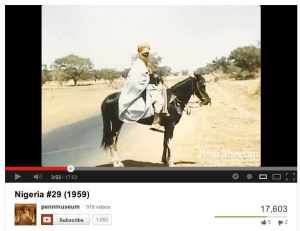
The Penn Museum’s Top Anthropology Video of 2012 features a sheik among many other people and places in 1959 Nigeria

The Penn Museum’s Top 2012 Anthropology Video Nigeria #29 (1959) features a sheik, a mosque, a fuel depot with camels, and country life the way it used to be

The Penn Museum’s YouTube channel surpassed 1 million views in May. Penn’s been adding an enormous anthropology film collection to its channel (over 400 films) and the time-machine quality is irresistible. It’s no surprise that Penn’s Maya 2012: Lords of Time videos captivated the public all year, but it is interesting that the silent travelogue Nigeria #29 (1959) is up to 17,000 views. You could poke around that channel for days.

The Chemical Heritage Foundation produced Philadelphia’s most popular science video. Over 26,000 people watched A Distillations Explainer: Sweat, part of the Foundation’s Blood, Sweat, and Tears series (see below). It’s an entertaining, well-produced podcast series.

The Mutter Museum presents its unusual medical collections quite effectively through its YouTube series. Their 2012 series feature the curator taking “mystery” items out of the cabinets and challenging the viewers to identify them. Not for the squeamish, but really clever and nicely scripted.

The most active museum Twitter users in Philadelphia are the National Constitution Center, the Eastern State Penitentiary, and the Penn Museum. The most active Flickr users during 2012 were the Franklin Institute Science Museum and the Pennsylvania Academy of the Fine Arts. The largest Flickr photo pools are populated by Longwood Gardens and Eastern State Penitentiary enthusiasts.

All the video and social media details on 32 museums are in the report. Click here to see what’s included and make a purchase from our Its News To You Reports shop.

Enjoy watching Philadelphia’s top science video, courtesy of the Chemical Heritage Foundation. Meet Louis Pasteur and find out why sweat often smells:

War Ends at NY Historical

Welcome to New YorkJoin the crowds for two more days to pay tribute to NYC’s Greatest Generation at the revealing, reflective exhibition, WWII & NYC created by the New-York Historical Society. If you can’t get there in person, take a look at the synopsis here, but in the galleries there are surprises at every turn. The slideshow gives you a glimpse.

Right inside, you’ll find a line-up of people checking out a portion of the actual 1938 Cyclotron, a kind-of atom smasher that physicists at Columbia University were using confirm nuclear fission. It’s also surprising to see an interactive map of where “The Manhattan Project” was actually located in Manhattan. At Fifth Avenue and 29th Street, the Army had 300 people on the 22nd Floor of 261 Fifth sourcing materials for the first atom bomb. Other teams were working in the Woolworth Building and at 270 Broadway.

People also cluster around the interactive map of New York’s harbor, which explains how all those interesting-looking, now quiet big buildings, forts, and warehouses along the shore were once alive with 3.3 million active duty service men and women headed for Europe and North Africa. Take this video tour and see it then and now:

And the show would not be complete without a in-depth look at the activities of the Brooklyn Navy Yard and the rise of Rosie the Riveter. Watch this video to experience what it was like from a woman who lived it:

The show includes stories about how Tito Puente, Jacob Lawrence, filmmaker Francis Lee, MoMA, the Metropolitan Museum of Art, Maiden Form, Nabisco, and countless other New York people and companies joined in to the war effort. Check out additional videos expertly produced by NYHS on line. You’ll never look at these City streets or harbor the same way again.

NYC Museum Videos Receive 49 Million Views on Social Media

The Japan Society’s popular Japanese language series

The Japan Society’s popular Japanese language series

After reposting so many museum videos here, we wondered how much video museums were producing, what social media they were using, and who had the most viewership and followers. We counted, and found that the museums, zoos, and botanic gardens around New York have racked up 48.8 million views on their public YouTube channels since 2007.

The volume of activity on was so significant that we couldn’t help documenting it and packaging the rankings into a report, NYC Museums: 2013 Video and Social Media Rankings.

Museum folks may want to purchase the full 48-page report to see how their organization stacks up, but here are some of our key findings:

As of year-end 2012, NYC museums with the highest number of all-time YouTube channel views were the Paley Center, American Museum of Natural History, and  Japan Society. Paley merges its NYC and LA feeds, and it’s 33M all-time video views are mostly from TV celebrity show panels in LA. So if we’re really looking at the museum programming champs in NYC, it would be AMNH (15M), Japan Society (7M), and MoMA (6M).

The Top NYC Museum Video of 2012 -- an AMNH Science Bulletin Whales Give Dolphins a Lift

The Top NYC Museum Video of 2012 — an AMNH Science Bulletin Whales Give Dolphins a Lift

The top NYC museum viral video of all time is The Known Universe video produced by AMNH for the Rubin Museum’s 2009 show, Visions of the Cosmos – 11M views and still growing. The video was generated from the Hayden Planetarium’s data set.

In  2012, another AMNH video, Whales Give Dolphins a Lift, went viral with 2M views. The AMNH has an active video-production team supplying content to its Science Bulletin walls inside the museum. Hats off to them for making a winning wordless video out of a few still photographs from field scientists in Hawaii, simple titles, and tranquil music.

The popularity of Japan Society’s language lessons are driving the numbers on their channel. Who can resist clicking through all the 2-minute lessons in their Waku Waku Japanese series with Konomi?

Asia Society’s Top NYC Museum Music Video of 2012

Asia Society’s Top NYC Museum Music Video of 2012

The top 2012 NYC museum music video was produced by the Asia Society, Arif Lohar and Friends: Jugni Ji!. Who knew that the finale to a Sufi pop legend’s concert on Park Avenue one year ago would rack up over half a million views?

The top star featured in a 2012 NYC museum exhibition video was a piece of 18th century mechanical furniture displayed at the Metropolitan. Viewership of The Roentgens’ Berlin Secretary Cabinet grew from 182,000 views at year-end 2012 to 1.6 million today. Can anyone explain how mechanical furniture received 25 times the viewership of the Met’s video walk-through of its blockbuster McQueen show, Savage Beauty?

The NYC museums using the greatest range of social media and video channels are The Jewish Museum and the Rubin.  One of the best under-the-radar NYC museum Flickr sites was the historical archive of Wall Street documents and treasures posted by the Museum of American Finance.

All the video and social media rankings 63 museums are in the report. Click here to see what’s included and make a purchase from our Its News To You Reports shop.

OK, here it is: the all-time top NYC museum video from 2009:

FIT’s Fashion Tech Timeline

Black velvet evening dress by Charles James (c. 1955) with a zipper inserted along that diagonal seam

Black velvet evening dress by Charles James (c. 1955) with a 3-ft. zipper inserted along that diagonal seam

Once you see the clothes in FIT’s Fashion and Technology exhibition inside a technology context, you’ll start making the connections at other shows all over town.

Exhibit A right inside the entrance – a seamless nylon-powder dress and bag made from CAD software and a 3D printer by Freedom of Choice in 2005 is a mesh wonder that is made by the same process as Amanda Levete’s woven Fruit Bowl in MoMA’s current Applied Design show.

Take the brilliant purple British day dress that FIT displays as an example of the revolution in color that occurred in the 1860s as analine dyes began to be used for the first time in commercial cloth manufacture. The Metropolitan Museum showcases the same point (except surrounded by Manet and Monet masterpieces) in its blockbuster time-series Impressionism, Fashion and Modernity. (Reference Camille.)

The 1860s color revolution due to analine dyes in commercial fabrics

The 1860s color revolution due to analine dyes in commercial fabrics

Outstanding achievement award invention + application at the FIT show: invention of the zipper in 1913 and the stunning accomplishment of Charles James, who inserted a three-foot-long zipper into a spectacular gown in a hidden seam on the bias (see left).

In Fashion and Technology, FIT makes brilliant use of its own stellar collection to chronicle the changes in technology that revolutionized fashion, from the advent of the Spinning Jenny in 1764 to the world’s first programmable T-shirt (see below).

For fans of the 18th and 19th centuries, here’s what technology mattered:

1764 – cotton replaces wool and linen as the go-to fabric (thanks, Spinning Jenny)

1780s – machine-knit textiles (200 years before double-knits)

1801 – Jacquard looms create complex patterns by using punch cards (up to 10,000, so take that Univac!)

1846 – sewing machines eliminate tedious hand stitching for the interiors of gowns

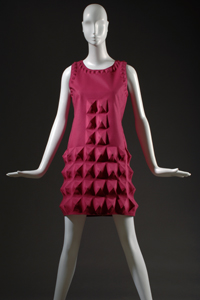
Pierre Cardin, dress, fuchsia “Cardine” textile with molded 3D shapes, 1968, Gift of Lauren Bacall.

Pierre Cardin, dress, fuchsia “Cardine” textile with molded 3D shapes, 1968, Gift of Lauren Bacall.

1856 – analine dyes bring about a color revolution to ladies’ fashions (go, hot pink!)

1857 – chain-stitch sewing machine

1860s – more color complexity with roller-printed fabrics

1880s – collapsible bustles let ladies sit down

1882 – celluloid used to imitate ivory and tortoiseshell for accessories

Check out the excellent exhibition timeline interactive to see these breakthroughs and what happened in the 20th and 21st centuries.

As promised, here’s the video of the world’s first programmable T-shirt:

Fluffy AMNH Animal Superstars Win Webby

Steve Quinn, diorama curator

Steve Quinn, diorama master

Steve Quinn couldn’t send them to the L’Oreal Paris hair and make-up room like Tim Gunn does on Project Runway. They’re just too big, too famous, and too fragile. We’re talking about the furry animals that populate the 43 dioramas on Floor 1 of the American Museum of Natural History’s in the Hall of North American Mammals.

So how do you buff, puff, make up, color, groom, blow dry, restore eyelashes, color brows, and repair noses on New York superstars that have been in the (literal) spotlight since the early 1940s? That’s the subject of AMNH’s YouTube sensation, Restoring Dioramas in Hall of North American Mammals a 16-show reality series that won a prestigious Webby Award earlier this month. Download the North American Mammal app (with before and after looks at the enhanced fur).

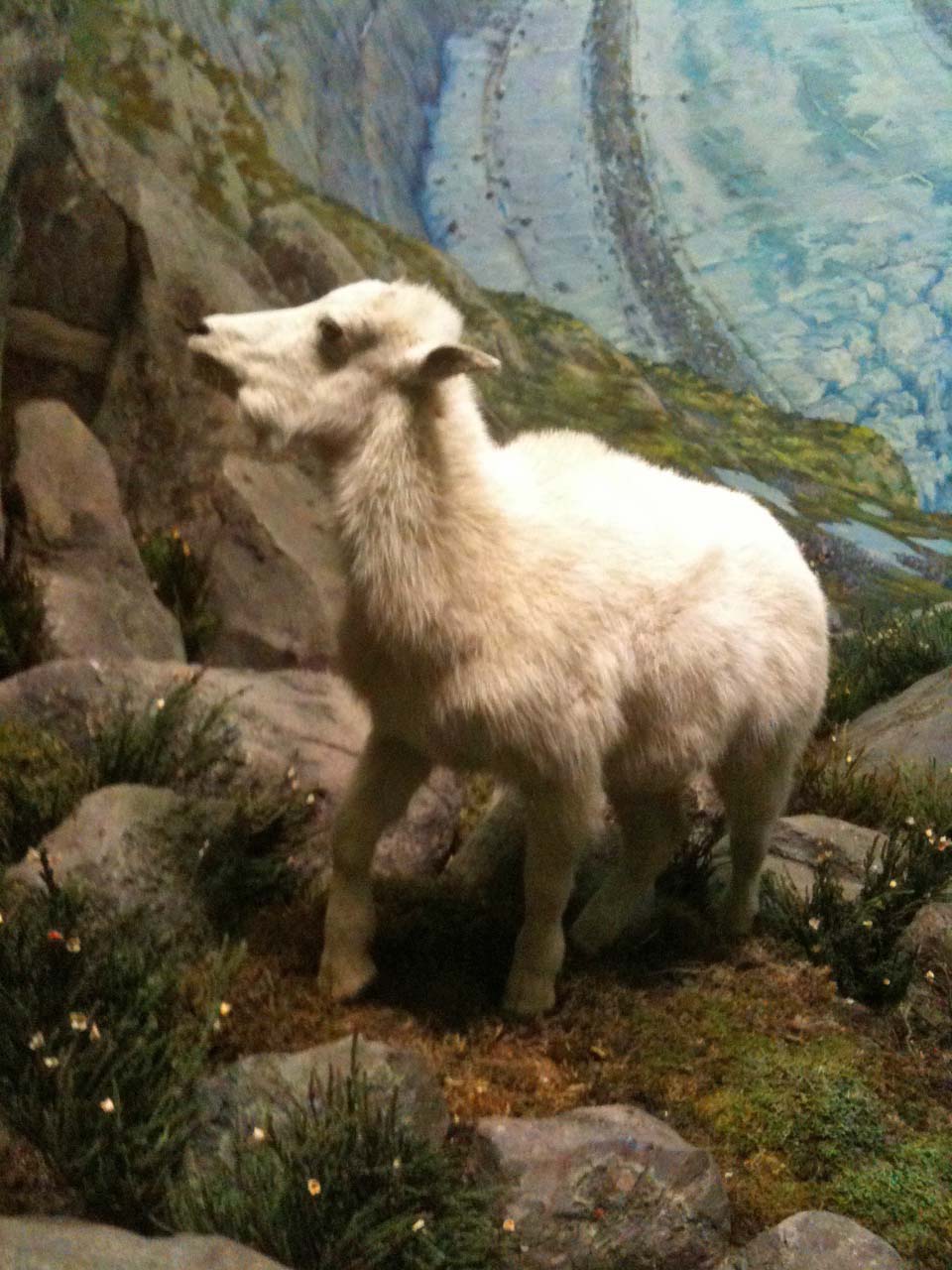
No more "demon" eye in the baby Mountain Goat, who is surrounded by thousands of flowers refurbished by AMNH volunteers

No more “demon” eye in the baby Mountain Goat, who is surrounded by thousands of flowers refurbished by AMNH volunteers

Steve Quinn leads a team of accomplished artists to, well, perform makeovers on the animals, plants, and background paintings that reside inside some of the most famous 3D attractions inside the AMNH. Steve told us that the first step was to update the decades-old lighting inside each case with state-of-the-art illumination that would inflict much less damage on the mammal coiffures.

His team engineered wooden platforms that extended into each scene so that leaf-turning and snow repair could occur with minimal disruption to the diorama floor. If you watch the 4-minute videos, you’ll see how they fixed a bison’s nose, put whiskers on cougars, restored the grass on the Great Plains, and restored the jackrabbit’s ears. The runaway hit of the series is Updating the “Moon Shadow” in the Wolf Diorama. With over 8,000 views, it’s not going to knock Dr. Neil off the AMNH charts any time soon, but Steve’s magical artistry is something to savor.

Go to the AMNH YouTube channel and scroll down to find the North American Mammal diorama series, depicting Steve and his crew at work. Check out this series trailer:

Just before Steve retired the other week, he gave us a special Night at the Museum, walking around and visiting his favorite dioramas after the visitors left.

Steve, you’re a total rock star. Thanks for all your spectacular work at AMNH over the years, and congratulations on the Webby.

Elvis has left the building.

Surrealists Get Out Pencils and Scissors at The Morgan

César Moro’s Adorée au grand air (1935). Source: The Getty Research Institute.

César Moro’s Adorée au grand air (1935). Source: The Getty Research Institute.

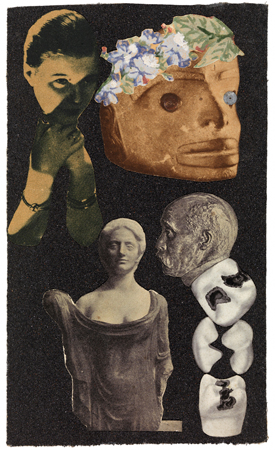
Automatic drawing, games, rubbings, collage, and dreams are all chronicled in the spectacular Drawing Surrealism show closing today at The Morgan. It’s an encyclopedia of what you can do with a scissors and pencil and demonstrates that these forms of play were critical to the most famous Surrealist works by superstars Ernst, Dali, Masson, and their European colleagues.

Some of the off-the-wall creations born out of the Surrealist’s drawing games eventually made their way into big-time oil paintings. The curators also contend that the monochrome grey-scale of some famous paintings is actually a tribute to the importance they attached to charcoal and pencil media.

The show, co-organized with the LA County Museum of Art, is the first time that Surrealist drawings have been the subject of an exhibition, and curators make quite the case for drawing technology transfer by showing us how these techniques (especially collage) spread to the rest of the world.

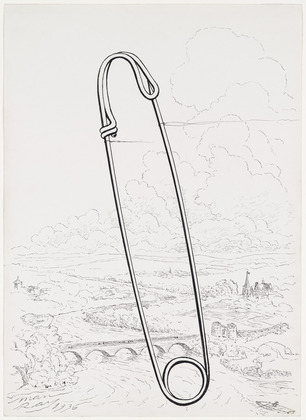
Man Ray’s Safety Pin (1936). Ink and pencil on paper. Source: MoMA. © 2013 Man Ray Trust / Artists Rights Society (ARS)

Man Ray’s Safety Pin (1936). Ink and pencil on paper. Source: MoMA. © 2013 Man Ray Trust / Artists Rights Society (ARS)

One of the genuine revelations is the work and importance of César Moro, a Parisian-trained Peruvian who brought Surrealism to Mexico and the rest of Latin America.

You can’t help but be struck by the forerunners of Pop: Man Ray’s Safety Pin sure looks like a precursor to Claes Oldenburg’s 1970s Clothespin, and there’s no question about the influence of Eduardo Paolozzi’s 1940s Surrealist-influenced collages: He and Richard Hamilton invented Pop Art in Britiain.

When the show was installed at LACMA, several contemporary artists were asked to create Surrealist-inspired works. Listen as Alexandra Grant, Mark Licari, and Stas Orlovski show and tell how European mind-and-hand games of the 1930s inspire work today:

Get Out into the Fresh Air (in Italy and France)

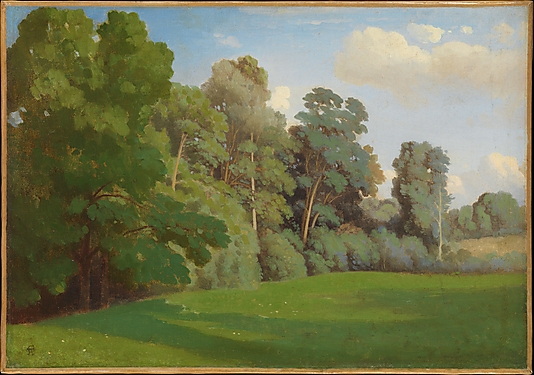
Théodore Caruelle d'Aligny’s Edge of a Wood (1850). Oil on canvas done northeast of Paris. The flattening technique was developed with his hiking companion, Corot.

Théodore Caruelle d’Aligny’s Edge of a Wood (1850). Oil on canvas done northeast of Paris. The flattening technique was developed with his hiking companion, Corot.

There’s nothing like stepping out into the fresh air to get a little perspective – exactly the view taken by the group of landscape painters featured in the Met’s exhibition, The Path of Nature: French Paintings from the Wheelock Whitney Collection, 1785-1850, on display in the Lehman Wing for a few more days.

Most of them feature Italian or French landscapes, and you’ll be surprised to know these tranquil, beautiful visions of nature were considered a little bit radical at the time. Apparently, there once was a time when painters didn’t travel beyond the studio, and certainly did not work outdoors.

Installation view of The Gate to the Temple of Luxor (1836) by La Bouëre. After Napolean invaded Egypt, the exotic Middle East became all the rage. The missing obelisk ended up in the Place de la Concorde.

Installation view of The Gate to the Temple of Luxor (1836) by La Bouëre. After Napolean invaded Egypt, the exotic Middle East became all the rage. The missing obelisk ended up in the Place de la Concorde.

The artists in this collection (gifted to the Met 10 years ago by Mr. Whitney) literally went on the road, took to the hills, and created spectacularly perfect outdoor oils to record a bit of the exotic, wild, and ruined visions they experienced. And it all happened long before Monet went outside to serialize his haystacks.

If you’ve ever wanted to take a Grand Tour of the wonders of Europe and the Middle East, now is your chance. Check out the Met’s online gallery of these works, and enter the mountains, hillsides, parks, ruins, and vistas with new 18th and 19th century friends.

If you have some time, you can listen to the Met’s curator, Asher Miller, discuss how adventure travel inspired a generation of painters to break the rules.

Abstraction All-Stars Featured in MoMA’s LinkedIn

Installation view of the network behind the birth of abstract art

Installation view of the network behind the birth of abstract art, according to MoMA and Columbia Business School

As soon as you arrive at Inventing Abstraction 1910-1925, MoMA’s soon-to-close extravaganza featuring the relationships among painters, poets, composers, and dance innovators, you encounter a big, bold infographic on the wall – a web showing who was collaborating with, influencing, viewing, and reading each other as “abstract art” was born.

The stunning exhibit is a who’s who of modern art, with work by Picasso, Kandinsky, and Malevich (of course), but pulls in works from lesser-known early innovators from Britain, Poland, Italy, and America (hi, Georgia!) and across disciplines. So many connections, so little time! The show has books, music, pioneers of modern dance…just about everything.

If you can’t get to it, don’t worry. MoMA’s put it all on the web so you can explore all the connections yourself. The highlighted names show the artists with over 25 connections, like an early 20th century LinkedIn or really popular Facebook friends. Who knew that Russian fine-art diva Goncharova was more connected than, say, Malevich or El Lissitsky?  I guess inventing Rayism and designing sets for the Ballet Russes paid off in getting her positioned in this MoMA pantheon.

Created by MoMA curators, designers, and pros from the Columbia Business School, the interactive web highlights every artist featured in the massive MoMA show. The infographic allows you to zoom in to see how the buzz, particularly in 1911-1915, brought abstract art into being.  No matter which name you click on, you’ll get to view the works, play the music, and watch the dances – a web-based multimedia tour-de-force.

Now dive into one of the best art-websites ever, and get to know the network and likes of the hot, emerging artists who made the art world of 100 years ago into what we know today.

Watch how this show and web project were brought to life with Excel, great minds, and graphic design. And be sure to check out Paul Ingram’s views on the value of networks at the MoMA video site.