150 Years of Splendor at The Met

Entrance with Noguchi’s 1945 Kouros and Rodin’s controversial 1876 sculpture

The Met has pulled out all the stops on its 150th birthday show, Making the Met, 1870-2020, on view at Fifth Avenue through January 3 – incredible installation, intriguing stories, and a phenomenal digital showcase. So even if you can’t come to New York to see it in person, the Met website has it all!

The exhibition tells the story of the Met over the last 150 years – from its first incarnation in a house on 14th Street to its ever-expanding footprint in Central Park – shows the incredible art that benefactors donated, and relays the stories of the men and women who made it happen.

Head of a Hindu god, Bhairava, made by 16th c. Nepalese artists 

Walking into the dramatic exhibition entrance, you’re surrounded by figures from different eras and cultures – a little girl from 5th century Greece holding two doves, a gilded mask of a Hindu god beautifully crafted by Nepalese masters of the 16th century, and Avedon’s 1957 portrait of a pensive Marilyn Monroe.

At the press opening, senior researcher associate Laura Corey explained that these were chosen to encourage visitors to think about the people behind the Met – collectors, curators, artists, restoration experts, and other staff. According to Laura, the African power figure from the Republic of Congo was one of the first artworks chosen for the welcome gallery.  He’s looking right across to Marilyn, and they are sharing a similar expression and mood.

1906 photo of The Great Hall 

At Noguchi’s Kouros sculpture, you can look left or right down a “street” lined with arches – portals that beckon you to step into different chapters of the Museum’s history. Each arch proclaims the decade and the theme. In between, there are huge slideshows from the museum’s past ­– how the Great Hall used to look, ladies in turn-of-the-century hats taking their art appreciation classes, Fifties moms and kids looking at art.

We’ve included our favorite artworks in our Flickr album, but the Met has produced a spectacular multimedia walk-through (posted on Google Arts & Culture), where you can experience all ten stories through photos, films, and links to blogs. Definitely watch the silent 1928 “Behind the Scenes” film showing museum shops, painters, gilders, and photographers at work. No surprise that the museum was into multimedia way back then!

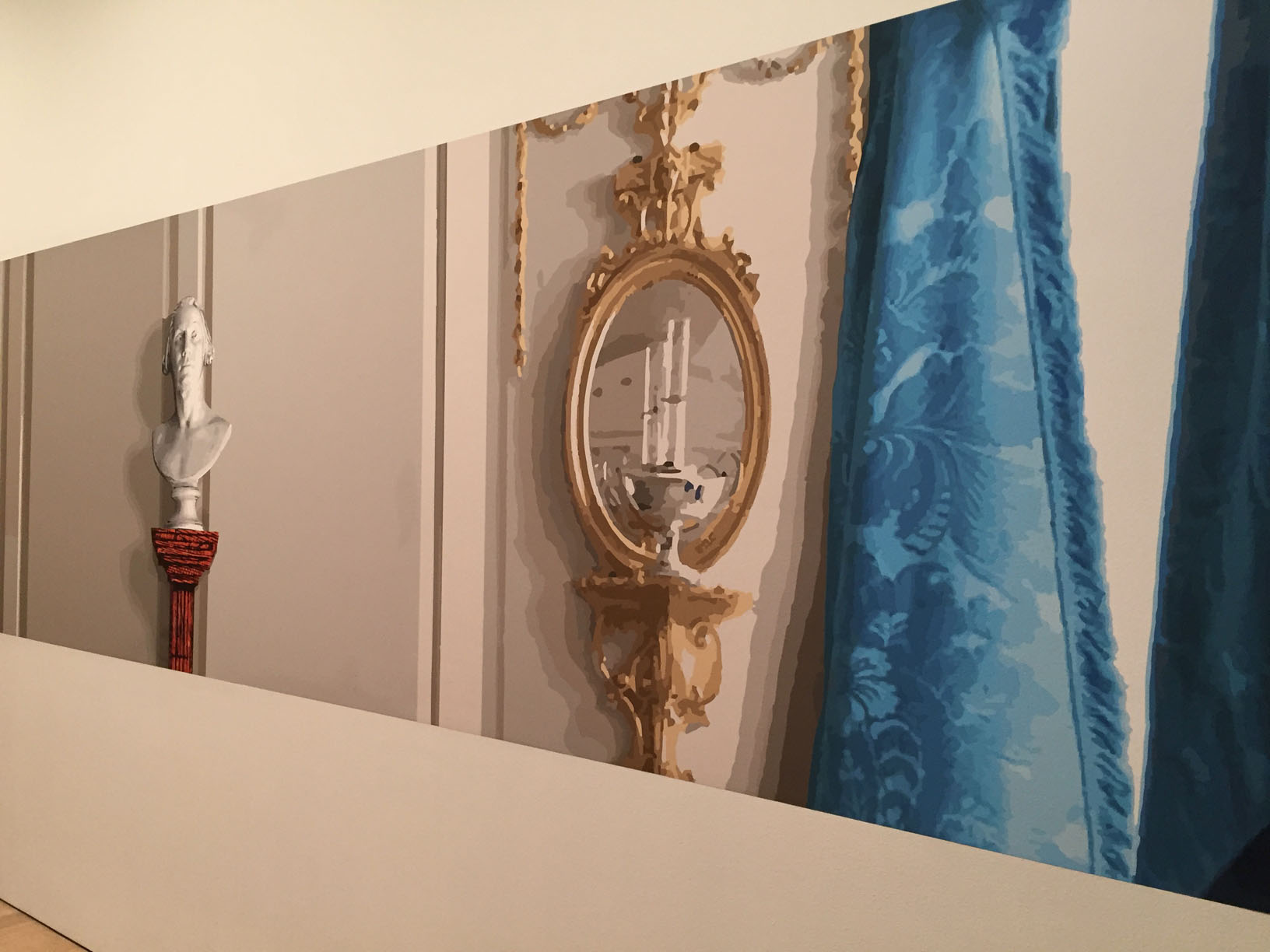
Houdon’s 1778 bust of Franklin and reflection of Manet’s Young Lady in 1866

Through the first arch titled “The Founding” (the 1870s), you pass a huge Cypriot head (the first director was into archaeology) and the first paintings donated by the founding trustees. Houdon’s spectacular Ben Franklin gazes quietly (and slyly) at Manet’s Young Lady in 1866 – the first contemporary painting in the Met’s collection. It depicts a life-size, modern gal in her dressing gown – an image that shocked early visitors to the Met’s classical galleries! Of course, Ben looks on approvingly.

Next, you’ll see a 15th-century Turkish turban helmet and 17th-century Japanese armor. The story here is that the Met green-lighted Bashford Dean, a zoologist and world traveler working at the AMNH, to begin the arms and armor collection. Other curators began collecting works on paper, textiles, lace, wallpaper, musical instruments, and contemporary designs. In the Twenties, curators headed straight to the UK to scoop up samples from Morris & Company.
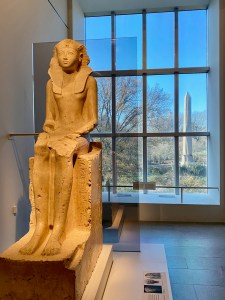
1479-1458 B.C. statue of Hatshepsut, and Cleopatra’s Needle (1450 B.C.) in Central Park

Around the corner is a tribute to the deep-pocketed donors like Morgan and B. Altman, who gave the Met lots of upscale, princely treasures ­– paintings by Vermeer and Ingres, fancy furniture, and tapestries. A treasure trove gifted by generous benefactors fills a wall – pistols for kings, cosmetic cases for Egyptians, bedazzled tablewear, and Middle Eastern glass.

Back into the main “street,” you’re right next to an imposing, reconstructed sculpture of Egypt’s female pharaoh Hatshepsut with a stunning view of Central Park’s Egyptian obelisk through the window.

These lead to the stories of how the Met collected art via excavations of archaeological sites – the Kharga Oasis (1908), Egypt (1880-1931) with Wah’s tomb stuff, Nimrud (Iraq), and along an ancient trade route (1934). The intrepid Bashford Dean enters the story again – excavating a Crusader castle, but only bringing back “dismal finds,” such as Crusader lamps, melted chain mail, and shards of stained glass, and (our favorite!) a projectile from a Crusades-era catapult (1250).
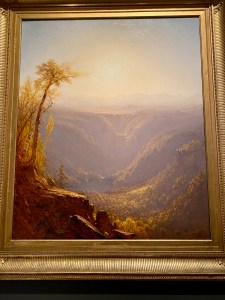
1864 A Gorge in the Mountains by Sanford Robinson Gifford

Apparently, it took a lot for a fancy museum to turn its attention from Europe to collecting art from the Western Hemisphere, but wealthy patrons had the goods. The American room features Sargent’s best-dressed “Madame X” and an enormous 1830 honeycomb quilt by Elizabeth Clarkson, the first quilt to enter the Met’s collection in 1923. There’s also a gorgeous Catskill Mountain landscape by Sanford Robinson Gifford, once owned by AMNH’s long-serving president, Mr. Jessup.

A gallery packed with work by Degas, Monet, Cassatt, Cezanne, and their Japanese masters tells the story of the Havemeyers, the Met patrons who lavished the museum with Tiffany glass (likely picked out by Mr. Tiffany himself), impressionist masters (picked out by Ms. Cassatt herself), and much more.

I Saw the Figure 5 in Gold (1928) by Demuth

At the midpoint of the exhibition, you learn that Stieglitz had a rough time trying to convince the Met to honor contemporary photography. The Met also refused Ms. Whitney’s collection in 1929. Gertrude’s response was to start her own museum, which joined MoMA (which debuted in 1929) in celebrating modernism. The Met finally did accept modern works through Georgia O’Keeffe’s 1949 gift, and proudly displays a Demuth and Kandinsky in the show.

The Monuments Men story looms large, with Met curators playing a major role in discovering and returning art looted during World War II. There’s a 1945 model of an Army helmet prototype designed by the Met’s armor expert, hand-crafted in solid aluminum.

1965 Yves Saint Laurent Mondrian dress and 1966 Balenciaga coat

The largest gallery in the show tells the story of how the Met beefed up its collections and expanded gallery space during what it calls “The Centennial Era” – Islamic art, fashion, Asian and African art, and modern art from the 20th century.

The final story about the Museum’s current focus ­– adding works by artists and from regions that are underrepresented in its collections – is represented by a large El Anatsui piece, an embellished Tibetan saddle, a wall of art guitars, a large Faith Ringgold story quilt, and other intriguing works.

The museum’s done a tremendous job online telling all the stories via its digital primer.  Click here to hear in-depth stories on the Met’s audio guide with Steve Martin, check out this video with his narration, get the backstory on every artwork in the show, and definitely visit the multimedia walk-through .

And check out this exhibition video showing how the museum’s architecture evolved to house these growing collections. In the 1880s, Olmstead and Vaux assigned a spot in Central Park for the Met. It’s interesting that one of the initial designs (which no one liked) was not scheduled for completion until 1990!! It’s a microcosm of 150 years of architecture and history.

Mexican Artist Builds Wall Atop The Met

Zamora’s wall with southern skyline view from the Met terrace

The rooftop mojito bar is missing, but it doesn’t matter to the art lovers trekking up to the Met’s rooftop.  The Roof Garden Commission: Héctor Zamora, Lattice Detour, on view through December 7, invites you to stroll around Héctor’s undulating wall and experience what it feels like to have your ideal, verdant view of Central Park and the soaring skyline partially interrupted.

On a bright, sunny day (and New York as had many recently), Metropolitan Museum visitors are taking the time contemplate this simple, provocative, statement by a Mexican installation artist. Héctor’s wall is only 11 feet high and made of see-through bricks – the kind created to let air and sun pass through courtyard walls in steamy Mediterranean, Middle Eastern, and Latin American climates.

Partial view through blocks made from Mexican earth

For this Met installation, Héctor had the blocks for the wall made from Mexico’s earth and asked a crew of Mexican and Latin American builders to hand-craft it the traditional way. As you circumnavigate Héctor’s wall, you have to position yourself just right to get a good view, and then it’s only a tiny, tiny fraction of what lies beyond.

And you have to be close, which lets you appreciate the artistry of the patterns and tunnels of the lattice, which also casts geometric patterns on the roof.

Héctor’s hope is that his installation enables quiet contemplation on thinking about the world that lies just beyond the walls of the Met. If you free-associate about walls, national borders, or larger societal issues, OK, but Héctor presents his architectural statement in a straightforward manner – basic building blocks that originated in ancient times.  You can create the experience what you want.

Take a tour of the installation in our Flickr album, enjoy the spectacular rooftop views in this Met’s video, and hear Héctor Zamora talk about this work with Met curator Iria Candela:

Weekly NYC Virtual Museum Events on What Came Before

Recreation of Manhatta by the Welikea Project, presenting virtually with NYPL

On Tuesday November 10, New York museums and cultural institutions have packed the digital schedule with events that look to the past to inform our understanding of nature, the history of fake news, and the sometimes-forgotten participants in Veteran’s Day – the millions of WWII home-front workers:

At 1pm, the New York Public Library hosts a session with the ground-breaking Welikia Project, which recreates ecosystems that existed in New York City before Henry Hudson sailed into the harbor 400 years ago. The program will explain how the city’s current built environment syncs with the marshes, ponds, rivers, and hills that the Lenape knew so well.

“A Warning to Libellers”, an 1804 broadside attacking vice-president Burr. Collection: NYPL

At 6pm, the New-York Historical Society is taking the long look at the relationships between presidents and the press, going back to the time of the Founding Fathers, investigating how their surrogates spread fake news, and comparing then and now.

At 6pm, the Brooklyn Historical Society will take you behind the gates of the Brooklyn Navy Yard to present the stories and voices of everyday New Yorkers who kept up the riveting, launching, and maintenance of the Atlantic fleet during WWII.

1942 Brooklyn Navy Yard worker. Collection: Brooklyn Historical Society

Find the links to these and other museum events on our virtual events page here. Poster House is having all sorts of virtual get-togethers this week centered around its Chinese and Swiss poster shows, so look through our list. On other days of the week:

  • On Wednesday November 11 at 7:00pm, the Museum of the City of New York explores the history of celebrations in the city – parades, marches, and spontaneous outpourings of emotion on the streets.
  • On Thursday November 12, the Museum at FIT presents a conversation on sustainability in fashion at 6pm, and the International Center of Photography will present the five young photographers it commissioned to make work in response to the COVID crisis at 7pm.

    David Hockney, Self Portrait with Red Braces, 2003. © David Hockney. Photography by Richard Schmidt. Courtesy: The Morgan

  • On Friday at 3pm, there’s another chance to go on a virtual tour of the Morgan Library’s David Hockney portrait show.

Take a look and register for as many of the topics and events that you can fit into your schedule. Most of the events are free, but it’s always nice to add a thank-you donation.

Museum Updates

Last week, we dropped into the Metropolitan Museum to see if we could take a quick peek at the “rediscovered” painting in the Jacob Lawrence American Struggle series, but that didn’t happen, since the lines through the 20th-century wing stretched all the way back to the Rockefeller Wing. Anyone needing to get their Lawrence fix can see his historic Migration series on MoMA’s Fifth floor, and his WWII War Series in its own gallery at The Whitney.

Donald Judd installation at MoMA

Anyone needing to chill out in a clean, white space can have the Donald Judd show at MoMA all to themselves weekdays (MoMA is open 7 days a week).  We swung by last Thursday and found a peaceful garden, empty Matisse Swimming Pool room, and acres of space around Persistence of Memory. Get there now!

If you missed the Museum at FIT conversation last week on Native America Fashion with designer Korina Emmerich and Choctaw-Cherokee artist Jeffrey Gibson, who currently has a three-gallery exhibition in Brooklyn, the conversation is now posted here on the museum’s YouTube channel.

Travel the Sahara Superhighway at The Met

12th – 14th c. terracotta equestrian statue from the Middle Niger civilization (Mali).

As you confront the stone monolith in the entry, get prepared to see art you’ve never before encountered, learn about empires you didn’t know existed, and fill in the blank spot on what you know about African history.
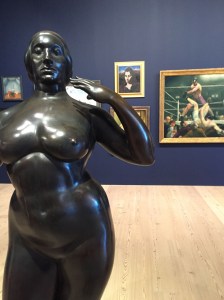
Beauty and cultural discoveries are everywhere in a first-of-its-kind exhibition on Saharan artistic legacies in Sahel: Art and Empires on the Shores of the Sahara, on view through October 26 at the Metropolitan Museum of Art.

Large 12th – 13th c. gold pectoral, found at a burial in northwest Senegal, with elaborate filigree. Courtesy: IFAN, Senegal

The shifting sands of the Sahara are echoed in the centuries of shifting artistic traditions, migrations, civilizations, religions, and cultural affinities of the Saharan people. Take a look at our Flickr album.

This gorgeous show is one of the first to tie and unite the threads of the sub-Sahara’s nearly invisible history for Western audiences. Western approaches to art history have traditionally made it appear as if the people on a large content were a monoculture with no beginning, end, or history. The show brings a deeper artistic and historical context to work that has always suffered from just being lumped together as “African art,” or worse, “primitive art.”

Scholars on two continents are starting to piece the story together, reflected in the exhibition’s design. The alcoves are a primer to walk back through time to understand the region’s complex history, which covers deserts, oases, and farming areas that are the size of Europe. For centuries, the region was criss-crossed by trading routes (the “Saharan superhighway”) through which caravans delivered luxury goods, exotic raw materials, news, and new cultural influences.

Pre-1659 royal tunic, a European import from the Ardra kingdom (south Benin) via Mandé trade routes. Courtesy: Museum Ulm

Wooden or fired clay depictions of warrior kings on horseback from the 3rd through 19th centuries line the exhibition’s central path. Settlements, archeological sites, and kings are named, with the vast region’s artifacts, architecture, and traditions of storytelling joyously placed into a proper context.

There are plenty of national treasures, such as the gold pectoral from Senegal and lively terra cotta sculptures (likely made by women) from Mali, made with the highest levels of craftsmen between the 12th  and 14th centuries. Another highlight is the still-vibrant 8th-century woven tunic from Niger, one of Africa’s most ancient textiles.

The exhibition explains how Islam gradually, peacefully became the dominant religion in sub-Saharan Africa, displacing the previous belief systems. As is the case with other world cultures, artists continued to merge and adapt older, more traditional symbols and forms with the new.

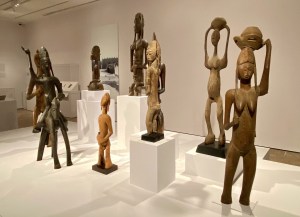
Wood sculptures of Mali’s Bamana people, from the 15th to 20th century

An intriguing 15th-century Italian map-painting documents Mansa Musa, a 14th-century emperor from Mali, who achieved global celebrity status for his over-the-top pilgrimage to Mecca via Cairo and was inspired to develop Timbuktu into a center of Islamic scholarship.

The display of Bamana sculptures, dating from the 15th to 20th centuries, in the rear gallery is the show’s dramatic conclusion, although the walls depict incredible resist-dye textiles made by early 20th century women in Mali and couture-level embroidery on pure white status garments of the Timbuktu elite from the Sixties.

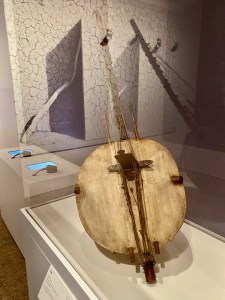
Senegalese kora made before 1878, used by griots to perform social narratives.

The show was an epic undertaking by the Met  – organizing a narrative and objects to tell two thousand years of relatively unknown history; first-time loans of national treasures from the museums in Niger, Mali, Senegal, and Mauritania; arranging for an 8,000-lb. monolith to be shipped across the Atlantic to New York.

The epic histories recounted by griots playing traditional instruments over the centuries play a large role in the exhibition. Koras and percussion instruments are on display, and music permeates the galleries.

Here’s a peaceful walk through the exhibition with music by Toumani Diabaté with Ballake Sissoko:

For an in-depth understanding of this ground-breaking show, join in on this conversation with Met curator Alisa LaGamma and scholar and writer Manthia Diawara:

Learn more about the epic history of the Sahara in the Met’s exhibition guide.

Amy Sillman Gets Shapes to Talk at MoMA

1957 Arp sculpture and view of works by Leger, Frankenthaler and Bonticou

A big, red blob on the fifth floor at MoMA is the welcome sign to one of the most engaging exhibitions in New York ­– the come-hither array of modern artworks in the latest Artist’s Choice show, Amy Sillman: The Shape of Shape, on display through October 4.

But here’s the catch for MoMA visitors – the show has more than 75 works but no labels, no identification, no dates. Just the clue that Amy chose works to explore the role of “shape” in modern art. Small artworks are arranged knee-level on risers (kind of like stadium seating), with larger paintings tilted against the wall.  A few are hung in the traditional way, but it feels as if MoMa’s collection is looking at you and hankering for a conversation. Check it out in our Flickr album.

Rectilinear frame conversation between 1989 Albert Oehlen painting and 1935 “Construction” by Gertrude Green

In our first visit back to the re-opened MoMA, visitors circulated through the room, looking intensively, talking about what they saw, and discussing how pieces might be connected. Although the gallery guide was available via QR code, no one during our visit appeared to seek it out. Everyone seemed quite content to parachute into 110 years of modern visuals and just go for the ride.

What did Amy choose? Abstracted forms, organic shapes, human bodies, and not-bodies – all arranged in a way that makes you feel that one is somehow related to its neighbor. You can’t quite describe why the entire room felt like a tight ensemble, even though one piece might feel like fun and the next a little scary.

It was interesting how unsettled visitors felt by 1970s works by Christina Ramburg and Julian Schnabel. This is exactly what Amy was going for, according to what we overheard her tell students in the gallery yesterday. She wanted to evoke the anxious feelings that most artists experience as they paint, draw, and sculpt and to reflect the times today without being didactic.

Along the east wall – 2008 acrylic by Charline von Heyl, 1920 Arp sculpture, and 1976 drawing by Jay DeFeo

Amy came of age during the Seventies when museums and intellectuals had given abstract expressionism its “heroic” status and crowned minimalists and conceptual artists as successors in the march of modernism. For this Artist’s Choice exhibition, Amy examined MoMA’s vast archive from a different perspective, looking at famous and not-so-famous creators whose work evoked myths, an interest in shadows, tension, anxiety, bodies, and whimsey.

Shadowy Black figures in a dark painting by Zimbabwean artist Thomas Mukarobgwa are echoed by a shadowy figure in a work by Leger. The tiny 1920 stacked Arp sculpture seems to be playing a “Mini-Me” role next to the large, layered 2008 Charline von Heyl acrylic.

Shadows also play key roles in a Lois Lane painting paired with a Kirschner wooduct. See for yourself and make a connection. Download Amy’s zine here to learn more about the works she chose and how she installed them. (She designed it during the quarantine months when the show was shut down.)

Here’s a short overview of the show hosted by MoMA painting/sculpture curator Michelle Kuo:

But you should really dig into the in-depth conversation (with over 10,000 views!) between Amy and Michelle, if you’ve ever been to art school or painted. They talk about art making, art history, Amy’s inspiration from Munch’s little-known litho of a woman hugging a bear, and the way she chose lesser-known works that could have a conversation with you in 2020:

More on MoMA’s reopening
MoMA on 53rd Street is open every day with timed ticketing, and now that the free-ticket offer has concluded, it seems easy to find a time to visit. The Queens outpost at P.S.1 is open until 8:00pm Thursday through Sunday, and is currently showing the acclaimed (and long-anticipated exhibition) Marking Time: Art in the Age of Mass Incarceration through April 4.

Join Live Virtual Events at NYC Museums

Tour “Sahel: Art and Empires on the Shores of the Sahara” at The Met this week

Are you missing your favorite New York museums? We’re happy to report that many of the cultural powerhouses, like the Whitney, The Met, and MoMA have reopened, although timed tickets in the opening weeks have been a little hard to get.

There’s a quick and easy way to get inside, however, by attending one of the live virtual programs being offered.  Check out our new page on events! As you can see, there’s a lot of opportunities to connect.

1929 “Calla Lily Vendor” by Alfredo Ramos Martinez in The Whitney’s must-see exhibition “Vida Americana”

New York museums have been keeping their events going online, and joining in is a great way to meet curators, docents, tour some blockbuster shows, and join in on the discussions happening around town about art and the social-justice movement (past and present), women’s issues and history, and even listen to ETHEL play classical music from the virtual Met balcony on Friday night.

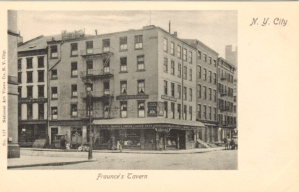
For smaller museums, the virtual events have been a great way to broaden programming to a national or international audience.  In recent on-line programs produced by Fraunces Tavern, it’s been nice to see colonial history buffs from Virginia and New England join in on the discussion. At last week’s New York Transit Museum’s talk on the 20th Century Limited, a few UK railroad enthusiasts joined in the chat room!

Hear about the preservation of Washington and Hamilton’s hangout, Fraunces Tavern, one of NYC’s oldest buildings this week

So, it’s a great way to be in the virtual room where it’s happening with others who love history and conversation as much as you do!  Take a look at the array of topics and events and register.

Most of the events are free, although after the months-long shut down here, it’s always nice to give a thank-you donation.

Reopening Update

This week, we’ll welcome the opening of the Guggenheim and Jewish Museum along Fifth Avenue and the International Center of Photography at its new home on Essex on the Lower East Side, where the Tenement Museum has begun neighborhood walking tours again.

Welcome back!!

Enjoy this beautiful four-hour meditative Met Live Arts performance by Lee Mingwei and Bill T. Jones at The Met this week

Back in Time with Wolf Nation at the Whitney

1-4 Wolf Nation at The Whitney

2018 Wolf Nation video, featuring endangered red wolves in New York and evoking the vanished Lenape (Wolf Clan) of Manhattan and New Jersey

The darkened room with the plaintive cries of the wolves is the heart of Alan Michelson: Wolf Nation, at the Whitney Museum of American Art through January 12, but the other three installations created by the internationally renowned Mohawk artist take you back to experience what the Lenapes saw over 400 years ago on the very ground upon which you stand.

It’s subtle and it’s outside the pace of today’s bustling Meatpacking District, so take your time and slow down.

1-1 Wolf Nation at The Whitney

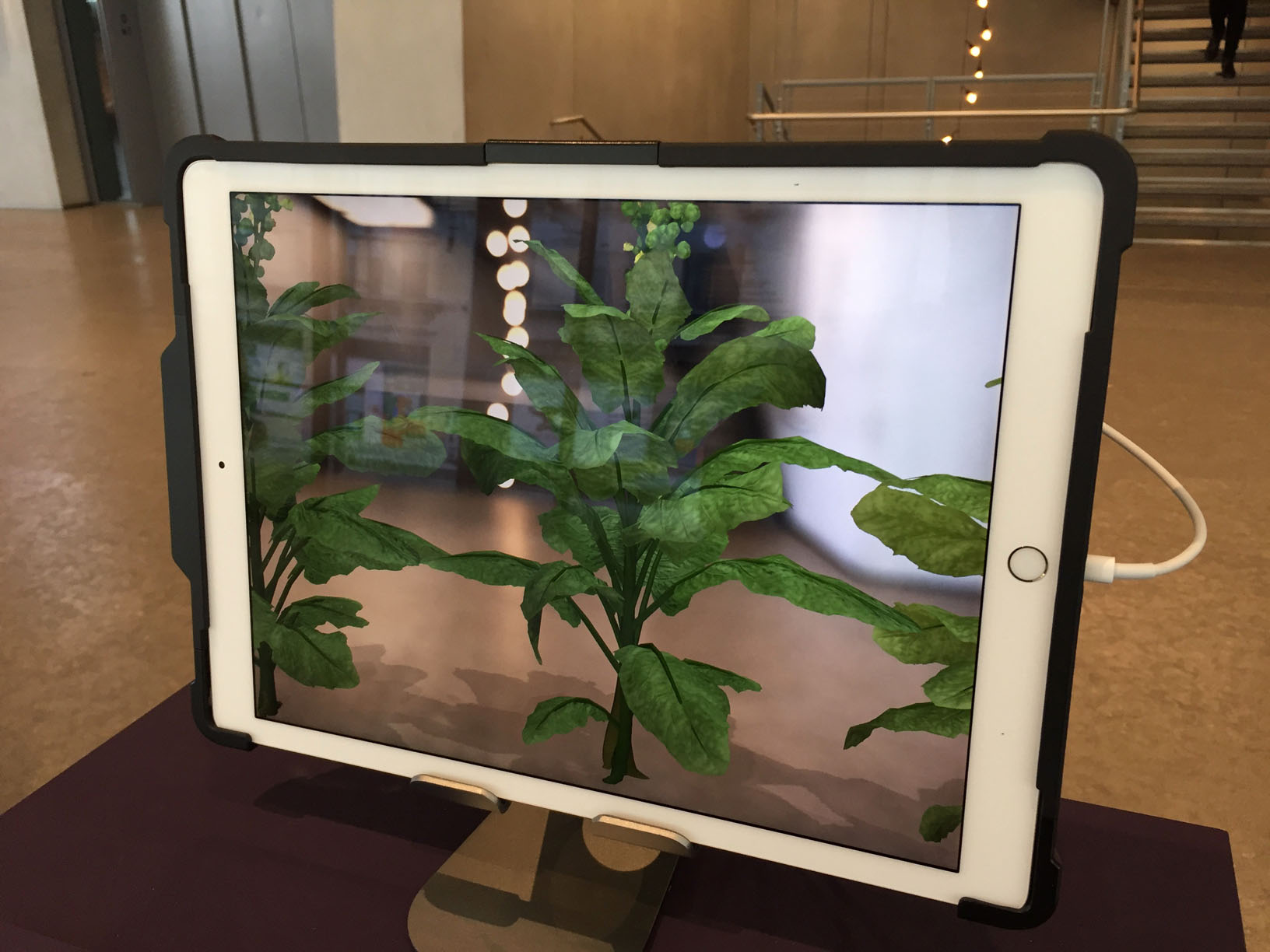
Sapponckanikan (Tobacco Field) that allows visitors to walk among ritual tobacco plantings in the museum lobby, near the Lenape’s original field

The first experience is right inside the entrance – an augmented reality (AR) piece that transforms the busy lobby into a tobacco field that historians say was planted over 400 hundred years ago by the Lenape people where Ganesvoort Street ends today.

Through an iPad (or by downloading AR co-creator Steven Fragale’s app), visitors can watch and walk through a field of lush tobacco plants that the original inhabitants of Manhattan used for rituals and ceremonies.  Different from the commercial tobacco that was grown for export, the virtual plants are based upon the type grown by Michelson’s sister in her upstate garden.

It’s an effective experience that causes visitors to stop and think about nature, history, indigenous cultures, and cycles of life in an ultra-modern, hyperactive environment that is typically untethered to the ancient or natural.

On the fifth floor, the experiences continue in a hallway and theater just off the Rachel Harrison retrospective.

1-5 Wolf Nation at The Whitney

Mt. Vernon-inspired wallpaper backdrop for 2019 Town Destroyer AR installation that evokes memory of 1779 destruction of the Haudenosaunee people in New York State

A second AR installation, Town Destroyer, uses a genteel, upscale, Mount Vernon-inspired colonial interior to educate visitors about a particularly gruesome removal of 60 settlements of Native people during the early years of the American Revolution in upstate New York.

The wallpaper image of General Washington becomes a 3D marble bust when seen through the AR app, upon which is projected a map of the lands taken from the Haudnosaunee, upon his orders, by the Sullivan Expedition in 1779. Projections of State historical markers tell the sad tale, reminding viewers of the forgotten history of displacement, violence, and greed endured by New York’s First Nations…even at the hands of our Revolutionary heroes.

Visitors who see the installation rush over to read the label copy to get better informed about this forgotten history and to wonder what else was left out of American history books about the vanquished people.

Wolf Nation_AR Images

Historical markers and maps about 1779 Continental Army aggression against Native Americans in Town Destroyer AR installation

The large, comfortable dark theater has an enormous wide-screen video of several of New York’s most endangered species – red wolves. You’re seeing them at night in their native habitat upstate, or so it seems. In actuality, you are seeing residents of a captive breeding colony maintained in the hopes of increasing the remaining population of 17.

It looks like a mysterious nighttime scene, shot with a surveillance camera. The pace is slow, with different members of the group arriving, listening, and leaving, fully alert. Sounds of their calls in the distance fill the room.

The effect is hypnotic, allowing viewers to slow down, see the wolves at their eye level, and reflect upon status of our indigenous wildlife and people.  The Lenape, who first colonized Manhattan and New Jersey, identified as Wolf Clan. The color and shape of the cinema projection evokes wampum, the purple and white clamshell beads strung by the Lenape as gifts or to seal treaties.

All of Michelson’s work here requires visitors to slow down their pace and see their surroundings through the eyes of people who stood right there 400 years ago.

1-3 Wolf Nation at The Whitney

Shattemuc video in which a boat’s searchlight illuminates the Hudson River shoreline at night

Shattemuc, a quiet video does just that.  Sit for a while, and see what the Hudson River looks like, illuminated only by a circle of light from a boat that is making its way slowly through the waters in the dead of night. No skyscrapers, no water taxis, no giant clocks.  Just shoreline, trees, cliffs, an occasional small settlement, small boats, and a small, up-close personal feeling.

Then later, as you take in the magnificent view Hudson from the west windows of the fifth-floor Whitney, Michelson’s work allows you to envision what the Lenape saw.

So, despite the distance in time, did Native Americans truly vanish from the shores of New York? Actually, the city today hosts one of the largest populations among big cities in the United States, including many working artists and cultural scholars.

Michelson is one of the leading voices advocating that museums and galleries reflect the work of the first Americans, and congratulations to The Whitney for making this a priority. See Michelson’s seminar on this here.

Urban Indian: Native New York Now at the Museum of the City of New York, running through March 8, testifies to the continuing vibrancy of the First Americans in the cultural capital.

Cardin Sees the Future Through Fashion

The Brooklyn Museum’s latest blockbuster fashion exhibition Pierre Cardin: Future Fashion, open through January 5, presents the work of a French designer who continues to be inspired by the belief that simplicity, design, and science are essential ingredients for a world that lives in peace, treats men and women equally, and looks to the horizon.

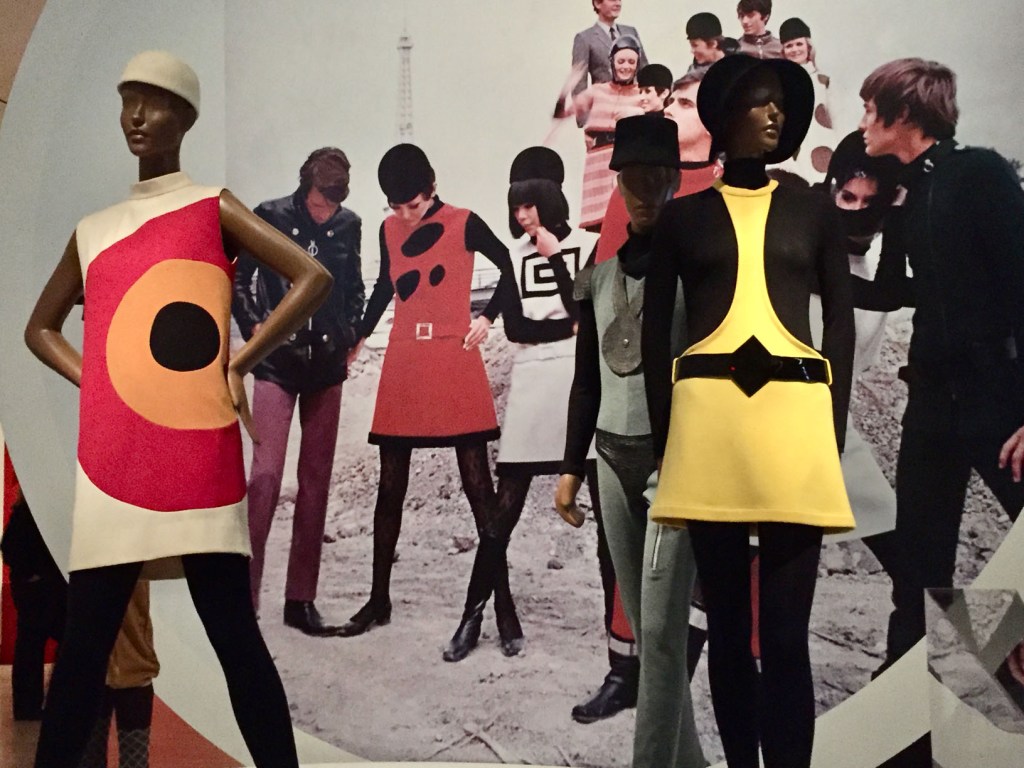
Geometric minidresses and men’s ensembles worn with tights and over bodysuits from the revolutionary 1964 Cosmocorps collection

Cardin came of age as a designer in the 1950s creating luscious swing coats, lasso-backed draped suits, and prim (but red-hot) looks for Jackie Kennedy. But he shot to “influencer” status in the early 1960s with unisex looks, bodysuits, collarless jackets for the Beatles, reliance on a fashion-forward Japanese model, turtlenecks (for men and women), hoods, felt helmets, and body jewelry – in other words, all the basic building blocks that would be used to clothe the crew of the Starship Enterprise.

1957 “lasso back” suit, 1968 bodysuit ensemble, and Cosmocorps photo with video showing the unisex Star Trek costumes it inspired in 1966

The Brooklyn show begins with a chronology of Cardin’s young life – soldier, costumer, and Christian’s first employee at the House of Dior in 1946 – but rapidly gives way to a sensational array of tubular, unisex clothing from his mind-blowing Cosmocorps collection, which had so much impact on Sixties culture. Take a look at our favorites in Flickr album.

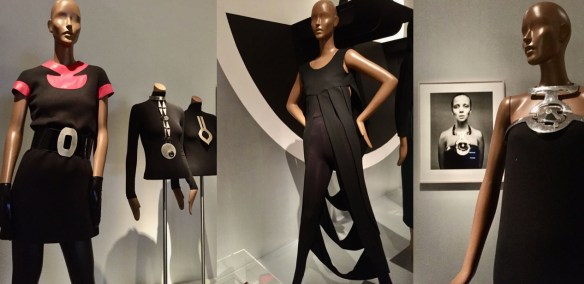
1968 wool and vinyl minidress, 1966 aluminum statement jewelry, a 1970 wool crepe “Kinetic” dress, and Avedon photo of Penelope Tree wearing a 1968 evening dress and collar

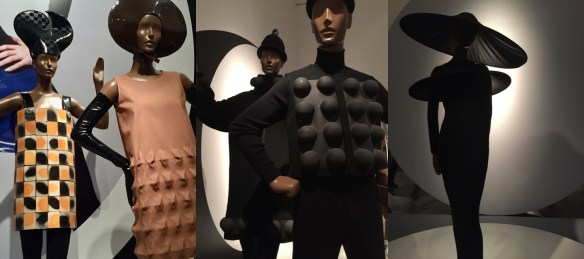
Although several other European designers could be credited with the evolution of the miniskirt, no one channeled the Space Age like Pierre Cardin when it came to shape, form, and use of new fabrics and materials – lenticular plexiglass, vinyl, Dynel pressed into 3D forms and shaped for the body, and parabolic structures that underpinned evening gowns, men’s jackets, and skirts. Pierre even went so far as to visit Houston and slip on an Apollo 11 astronaut’s suit.

1969 lenticular plexiglass and vinyl “armor” dress, 1968 heat-molded Dynel dress, 2007 jersey coat and suit with rubber, and 1991 jersey evening ensemble with parabolic shoulders and hat

It’s clear that the Sixties and Seventies fashions in the show reflect what was going on in the art world at the time – bright, bold colors of Pop Art, pared-down minimalism, an embrace of non-traditional materials, and kinetic art. (Carwash dresses, anyone?)

Even Cardin’s forays into furniture design reflect his belief that his hand-made contemporary works genuinely functioned as art first and utilitarian additions to the home second.

1968 circle coat and hat, next to 1979 Junior Unit, and 1977 Serge Manzon lamp

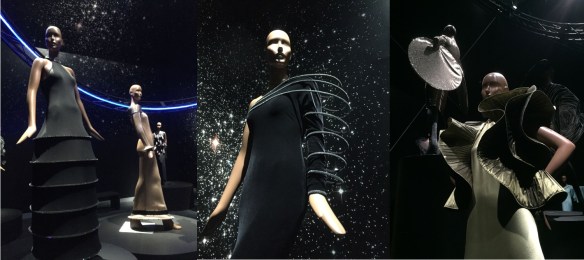
The final gallery in the Brooklyn show is a darkened room populated with mannequins in shimmering gowns and suits, electrified dresses and sportswear, and pieces embellished with parabolic hoops and flourishes – sheer Space Age magic. Slight swoops across the space, framing the last 20 years of Cardin’s output with an other-worldly, visionary feel.

2008 evening dress with parabolic hem, 2003 evening gown with plastic tubes, 1994/2000 velvet evening dress with Swarovski crystals on the orbital sleeves, and 2013 silk/lame evening dress with Swarovski crystals

A surprise inspiration is the revelation that Cardin at 97 is still designing and looking toward the future.  His predictions? That people will be on the Moon in 2069 wearing his Cosmocorps look, women will be sporting tube clothing and Plexiglass cloche hats, and that men will be wearing kinetic tunics and elliptical trousers.  Why not?

Watch as the curator explains how Cardin envisioned the future…

…and why this retrospective of his work is just right right now:

Fresh Look at Gertrude Whitney’s Collection

Lachaise 1912-1927 bronze Standing Woman with works acquired by Gertrude Vanderbilt Whitney herself

The Whitney’s Collection: Selections from 1900 to 1965 is a full-floor installation that focuses on the institution’s origin in 1930 as an eclectic, lively space where of-the-moment art could make a statement to the world – the same as today.

But rather than concentrate exclusively on all of the masterworks of American art that the museum owns, this show integrates some practically forgotten works and artists that the curators feel deserve a fresh look. So, walking through this chronological show, everyone gets a taste of something completely unexpected.

See some of our favorites here on Flickr.

When the elevator doors open, the first gallery is a tribute to the passion of Gertrude Whitney, the only American artist to establish a major museum. Lachaise’s bronze beauty beckons visitors to take a closer look at paintings that Gertrude herself acquired. Photographs of the Whitney’s earliest incarnation downtown are nearby to set the context.

Anne Goldthwaite’s 1926 Rebecca, purchased by Gertrude Vanderbilt Whitney 

It wasn’t a museum collection in the traditional sense, because Gertrude acquired paintings and sculptures by artists that she wanted to support. Better-known works by Bellows, Benton, and Bluemner are on display here, but so is a beautiful, rarely shown 1926 portrait by Anne Goldthwaite, a women’s rights activist from Alabama whose work was included in the 1913 Armory Show, but is not that well known today.

Subsequent galleries group artists inspired by uniquely American landscapes ­– urban engineering achievements of New York (Man Ray, Stella, Stettenheimer), O’Keeffe’s evocations of nature’s spirituality, and clean, idealized visions of modern industrial campuses (Demuth, Sheeler).

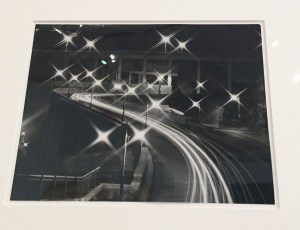
Andreas Feininger’s 1940 photo of the West Side Highway

Photographs dot the walls, including Herbert W. Gleason’s other-worldly 1908 images of Walden Pond and a modern 1940 image of the West Side Highway by Feininger, which anyone can see through windows in the Whitney’s Hudson-facing interior staircase.

A dark side gallery features one of the Whitney’s greatest treasures – Calder’s Circus, which has been newly conserved and restored. The ringmaster, bareback rider, and trapeze artists – all based upon actual performers from the Twenties ­– occupy the spotlight, surrounded by Calder’s performance props, Victrola, and whistles.

Here’s a recent video containing excerpts of how Circus was brought to life by the master himself and how it’s been conserved for posterity by a team at the Whitney:

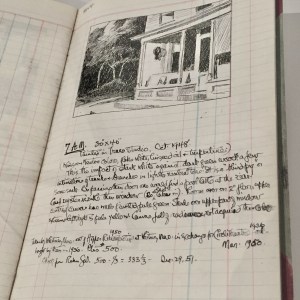
An additional highlight in another gallery is the “show within a show” of Edward Hopper works and drawings – his early work from Paris, the solitary American townscapes, and a sketchbook in which he documented every painting he made. Everyone spends time here.

Edward Hopper’s ledger book documenting all his work 

A melancholy dark gallery is hung with paintings by American émigré artists whose work evokes surrealist experimentation, the war, urban isolation, and growing societal dissonance. A counterpoint (and surprise) is a 1939 animated film by experimental film pioneer Mary Ellen Bute, a symphonic short shown to the crowds at Radio City Music Hall before movie features.

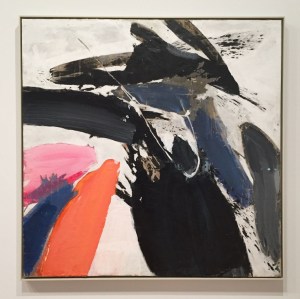
The gallery devoted to Fifties abstraction showcases the usual suspects (Pollack, de Kooning, Kline), but intersperses new acquisitions and lesser-known players, such as a 1959 abstract canvas by Ed Clark, an African-American artist who trained in Paris courtesy of the GI Bill, which holds its own against the other AE powerhouses in the room.

Ed Clark’s 1959 abstract poured-acrylic painting 

Big David Smith and Barnett Newman sculptures reign on the outdoor terrace, right next to the joyful Pop Art gallery, dominated by a massive, four-panel 1964 Wesselmann and an engaging multi-person self-portrait (with dog) by Marisol in the corner.

The walk-through is a reminder of the riches that anchored the first 30 years of the Whitney and the efforts that the museum is taking to find powerful artwork from the archive that enhances the traditional narrative of 20th century American art history.
Go soon before the team changes it out for the next collection installation, and take the audio tour on the Whitney website.

Getting a breath of fresh air: Barnett Newman’s 1966 Here III and David Smith’s 1961 Lectern Sentinel

MoMA Activates Sensory Landscape Daily

Large moveable sculpture covered in tiny bells

MoMA’s open again, and as the sun comes down daily, a sparkling, tinkling, gleaming landscape created by Korean multimedia artist Haegue Yang comes alive in the Museum of Modern Art’s multistory atrium.

Giant, stylized animalistic sculptures glide across the space, carefully guided by a black-clad dozen performers who appear every day at 4 p.m. for the one-hour activation.

Handles is a dreamscape world, where six large sculptural pieces inhabit an atrium enlivened by reflective biomorphic shapes climbing playfully up the walls.

When the performers move them, the giant sculptures, sheathed in a neat layer of bells, subtly chime to a soundtrack of tweeting birds and a tranquil symphony. Magic that soothes museum goers into a contemplative state.

A team of performers activate the installation daily

The piece reflects Haegue’s growing interest in using choreography and sound to build a sensory experience for art viewers. Gradually, she’s incorporated performers moving in geometric patterns, pulling oversized sculptures across and around the space, in a modern take on utopian Triadic Ballet-style movement.

Environmental phenomenon, geopolitical stresses, and modern art pioneers all factor into her work. Read MoMA’s interview with her here.

There’s plenty of time to see Handles, which will be activated for MoMA visitors through April 12, 2020.

See more photos of the installation on Flickr and watch a few moments of the performance here.