Warhol, The Queen, Madonna, and The Scream

Warhol’s 1984 silkscreen, The
Scream
(After
Munch). Source: Part of the founding collection contributed
by
The
Andy
Warhol
Foundation
for
the
Visual Arts to The Andy Warhol Museum;  ©2013
AWFVA/ ARS, NY

Warhol’s 1984 silkscreen, The
Scream
(After
Munch). Source: Part of the founding collection contributed
by
The
Andy
Warhol
Foundation
for
the
Visual Arts to The Andy Warhol Museum; ©2013
AWFVA/ ARS, NY

Andy is kicking Mr. Munch’s Scream up a notch on Park Avenue, all to the delight of the Queen of Norway, in the Scandinavia House’s stellar exhibition, Munch, Warhol, and the Multiple Image through July 27.

Actually, Queen Sonja herself was one of Andy’s subjects in his Celebrity series, so it’s no wonder that she flew in to preside over Mr. Munch’s 150th birthday at a New York show where his most iconic work is appropriated and reimagined by the Master of Pop.

Andy first encountered Munch’s woodcuts in Oslo in the 1970s, and took home reproductions. So, when a now-defunct 57th Street gallery invited him to their 1982 Munch exhibition and offered him a commission to make 15 paintings and 30 silkscreens about the work, Warhol accepted.

The Scream was so iconic, Andy considered it almost a “ready made”, as ripe as any other pop culture image for his flat, unemotional, Day-Glo serial treatment. Ditto for Munch’s Madonna and Self Portrait with Skeleton Arm. He photographed reproductions of four Munch works, blew them up, traced on them, and rephotographed what he had traced. And then he turned it all over to a master silkscreen printer with suggested colors. So totally Andy.
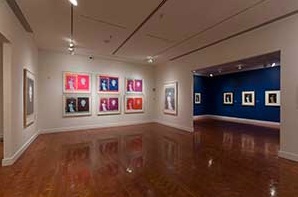
Room full of Munch Madonna prints seen from gallery with Warhol silkscreens of same. Eileen Travell’s photo for Scandinavia House/The American-Scandinavian Foundation, 2013

Room full of Munch Madonna prints seen from gallery with Warhol silkscreens of same. Eileen Travell’s photo for Scandinavia House/The American-Scandinavian Foundation, 2013

With all the commotion earlier this year at MoMA over The Scream (like fans along the red carpet, jockeying to get their photographs taken with the world’s-most-anxious celebrity-on-a-bridge), this show deserves similar crowds. Because Warhol’s prints were never published, you’re seeing one-of-a-kind prints that are dispersed around the world and rarely on view.

The curators have also brought together (with the help of The Munch Museum in Norway) multiples created by Munch. It’s fascinating to compare the five controversial Madonna prints side by side, walk into the first Warhol gallery, turn around, and see both Munch and Warhol Madonna interpretations right in front of you. It’s a smart, immensely satisfying installation.

You’ll enjoy listening to what the Queen had to say (first 8 minutes of the video) and see photos of her younger self at The Factory with Andy and Mr. Rosenquist.

Oh, and the photo below isn’t a disco queen from Studio 54. It’s Andy’s wall-sized reinterpretation of Munch’s The Brooch, Eva Mudocci, a lithograph originally done in 1903 to celebrate the beautiful, talked-about violinist.

The last 15 minutes of the video features the curator showing the work of the two Modern masters who knew how to leverage print technology and multiples into fame, fortune, and icon status.
Founders in Beta

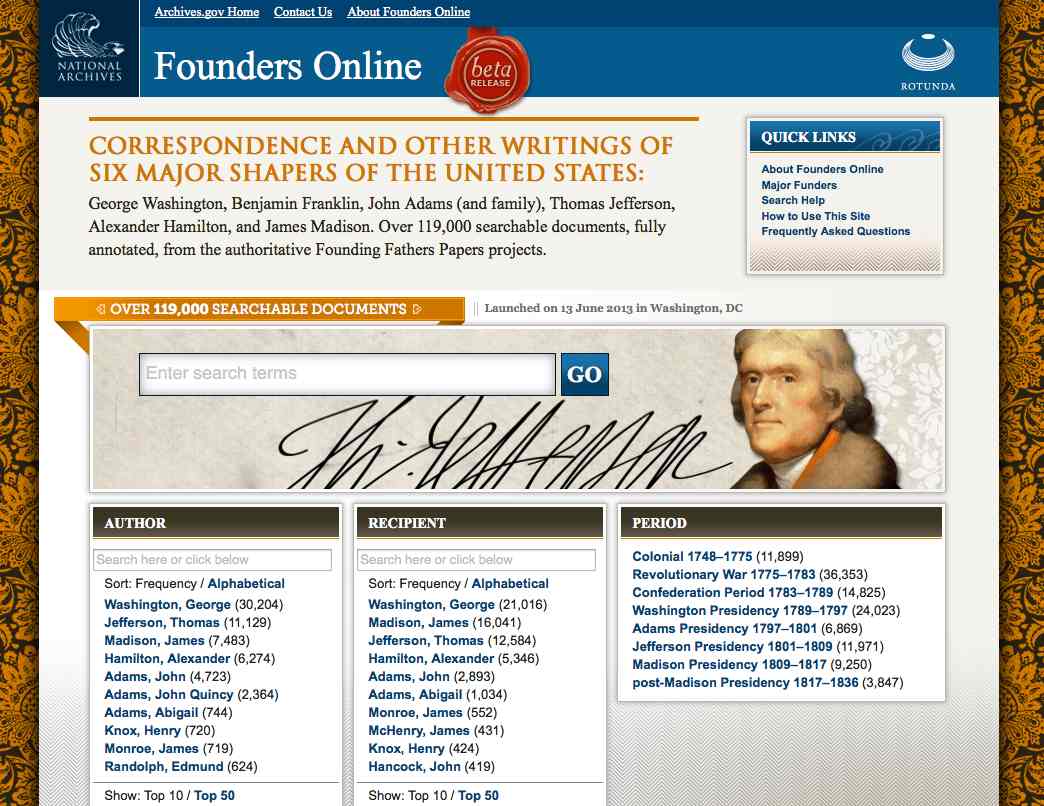
Founders OnlineThere’s no better way to celebrate the Fourth of July weekend than spending a little time with Founders Online, a collaboration between the National Archives and the University of Virginia Press, featuring posts from six of our most popular founding fathers – Washington, Franklin, Hamilton, Adams, Jefferson, and Madison.

The National Historical Publication and Records Commission (within the Archives) decided to liberate everyone from trekking to libraries by putting all of the diary posts, letters, and day-to-day chronicles of the Founders online.

You can go right to the earliest drafts of Tom J’s Declaration, and read young Washington’s journal entries on his first trip over the mountains of western Virgina in 1747.

The site, still in beta, currently has over 119,000 searchable documents – who wrote to whom and what the daily buzz was about in the colonial times. You can search by person, sender, recipient, concept, or era.

Jump in and see what Franklin’s or Hamilton’s revolutionary days were like, or ramble through the early White House years. It will be like scanning 18th century Twitter feeds or FB timelines of your favorite founders.

(And speaking of beta, check out Tom J’s copy of his unedited Declaration in the new NYPL Digital Collection.)

Washington, D.C. Museum Videos Reach 14 Million YouTube Views

Since Smithsonian branches and other Washington, D.C. museums, zoos, and gardens began posting videos on line in 2007, collective YouTube views have climbed to 14 million, as chronicled in our latest report, Washington D.C. Museums: 2013 Video and Social Media Rankings.

Although the 14 million total is less than the 49 million views racked up by New York museums, don’t forget that two high-profile DC institutions – National Geographic and the Smithsonian – produce significant amounts of programming distributed on their popular cable TV channels, dedicated apps, and snazzy web sites. Even though it has a DC museum space, NatGeo (a joint venture with Fox Cable) has largely abandoned YouTube; however, the 18 individual Smithsonian branches are all still posting their own stuff regardless of the more comprehensive joint venture with Showtime.

In the Top 2012 Cultural Museum Video, archival footage is cleverly coupled with behind-the-scenes looks at the National Archives’ 1940s Census release

In the Top Cultural Museum Video, archival footage is cleverly coupled with behind-the-scenes looks at the National Archives’ 1940s Census release

Here are some findings from our report on video and social media produced by DC institutions:

As of year-end 2012, the Washington museums having the highest number of total YouTube channel views were the Library of Congress (4.5M), the National Archives (2.1M), and the United States Holocaust Memorial Museum (1.6M). The top two are information powerhouses with massive collections to push out for public consumption, and the third is right on their heels with an innovative series with curators interpreting interesting items from their collections.

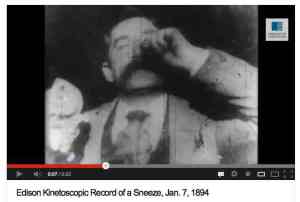
All-time top DC museum video, one of Edison’s earliest films, with over 329K hits on YouTube

All-time top DC museum video, one of Edison’s earliest films, with over 329K hits on YouTube

Edison still delivers. It’s interesting that the top ranked DC museum video of all time is Edison Kinetoscopic Record of a Sneeze, Jan. 7, 1894, the earliest surviving copyrighted moviesuggesting that our greatest media innovator is having the last laugh, contributing over 329,000 hits to the number-one ranking by Library of Congress on YouTube. It’s short enough for Fred Ott to be on Vine.

Four museum video channels have surpassed 1 million views. To put the DC numbers in context, if they were merged with the New York museum video rankings, the Library of Congress (4.5M) would rank seventh, just ahead of the Metropolitan Museum of Art. The Library of Congress would rank eight (2.1M), just ahead of the New York Public Library.

The National Zoo produced Washington’s top-viewed 2012 museum video – Shanthi, the National Zoo’s Musical Elephant, Plays the Harmonica!. Over 290,000 viewers watched this middle-aged mom experiment with a musical instrument in her enclosure and listen to her keeper talk about her performance. Shanthi’s viewership greatly surpassed the numbers generated by the most popular 2011 Washington museum video, the National Portrait Gallery’s Conan O’ Brien as Seen by Artist John Kascht. Surely, Conan would be amused.

The Smithsonian American Art Museum’s Top Exhibition Video of 2012 features curator Chris Melisinos describing why video games belong in an art museum

The Smithsonian American Art Museum’s Top Exhibition Video of 2012 features curator Chris Melisinos describing why video games belong in an art museum

The top cultural video was a behind-the-scenes work at the National Archives for the release of the 1940s census. Over 115,000 family historians watched Learn About the 1940s Census, which showed the Archives census team, provided information on how to find your family’s records, and worked in interesting archival footage from the original census.

The Smithsonian American Art Museum produced Washington’s top video about a museum exhibition. Over 28,600 people watched The Art of Video Games: Chris Melissinos, Curator, a brief look into the evolution of the stories, technology, and visualization advances of this mass entertainment medium.

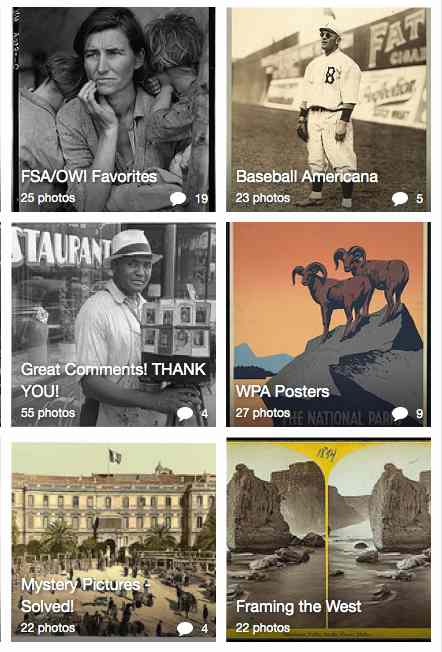
A few of the Flickr sets from Library of Congress

A few of the Flickr sets from Library of Congress

The most active Twitter users are the National Museum of American History, the National Air and Space Museum, and the National Postal Museum. But except for Air and Space, it’s a different set for Facebook followers.

The most active Flickr users are the National Archives, the Library of Congress, and the Smithsonian American Art Museum. The Archives has organized its photos into creatively themed sets, such as “White House Wednesdays,” “Millinery Monday,” pictures of the 1940s census being taken, and pets of the First Families. The Library of Congress also posts a folder containing “mystery” photos and asks the public to help to identify them.

All the detailed video and social media statistics on 42 museums are in the report. Click here to see what’s included and make a purchase from our Its News To You Reports shop.

Enjoy the most popular DC museum video, a musical visit with the National Zoo’s sensation, Shanthi:

Mardis Gras Indians Land in NC Beach Town

"Chief Albert Lambreaux: No Hum Bow, Don’t Know How" costume. In the pilot, the character returns to his devastated home six months after Katrina, enters, and emerges in this costume.

“Chief Albert Lambreaux: No Hum Bow, Don’t Know How” costume. In the pilot, the character returns to his devastated home six months after Katrina, enters, and emerges in this costume.

Towering feathered headdresses, intricate beaded panels, plumes, and miles and miles of ruffled edging adorn more than a dozen Mardis Gras Indians that are camping out until November 3 at the Cameron Art Museum in Wilmington, North Carolina.

The dazzling incarnations are all part of the exhibition, Well Suited: The Costumes of Alonzo V. Wilson for HBO’s ® Treme. Alonzo was on hand for the opening, where he explained the challenges he faced designing elaborate, 60-lb. Mardis Gras Indian costumes for the actors playing characters living in New Orleans’ Tremé neighborhood (the Third Ward) in the months after Hurricane Katrina.

The African-American men who bead the panels and feather the elaborate costumes for their Mardis Gras Indian tribes typically take all year to execute their visions, which reflect their position in the tribe (e.g. the Big Chief, Second Chief, Spy Boy, Wild Man). To meet HBO’s production schedule, Alonzo and his team often had a much shorter time to create the patches, headdresses, staffs, panels, and shoes for the script’s characters.

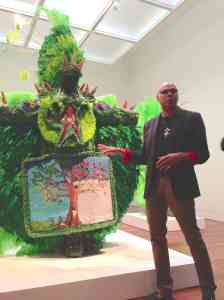
Alonzo Wilson explains how the cycle of life and the seasons are reflected on the beaded apron of the "Big Chief: Tree of Life" costume.

Alonzo Wilson explains how the cycle of life and the seasons are reflected on the beaded apron of the “Big Chief: Tree of Life” costume.

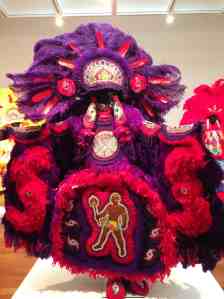
For the series, Alonzo felt it was important to embed part of each character’s story into the stories being told on the panels, even if the costume was only seen for a few minutes on TV. Thankfully, the exhibition (and our Flickr feed) lets you closely examine some of this character development-in-beadwork – a chief shedding a crystal tear for his hurricane-damaged home, a white buffalo evoking the return of bounty post-Katrina, and stunning use of hurricane weather symbols amidst a bold S.O.S.

Originally mounted by the Ogden Museum of Southern Art, curator Bradley Sumrall was impressed by Alonzo’s use of narrative that broke through the typical Hollywood stereotypes of African Americans and Indians. “We could have just done a show with traditional Mardi Gras Indian costumes, but Alonzo’s work had so much narrative built in.” With the mix of African-American, Native American, government, city, and current-event references, Bradley felt the layers of meaning in such intricate craftwork was an achievement worthy of a fine-art exhibition.

"Spy Boy: Katrina Memorial" costume. Feathers on lower half spell out "S.O.S.", the international distress signal, using the universal symbol for hurricanes from weather maps.

“Spy Boy: Katrina Memorial” costume. Feathers on lower half spell out the “S.O.S.” distress signal, using the universal weather-map symbol for hurricanes.

The NC stop for the show is a way for others to understand a bit more about New Orleans people, neighborhoods, and culture. Plus, Wilmington is Alonzo’s hometown. The movie and slide show inside the gallery provide an even deeper window into to this achievement – showing how Alonzo and his crew learned from the traditional craftsmen, shared new beading techniques, and received some “rescue help” from the locals when the production deadlines were too much to handle.

The exhibition all adds up to win-win storytelling about Alonzo, his team, New Orleans, and the Indians. Read an interview with Alonzo on the HBO blog and see behind-the-scenes production photos on page 40 of the Wilmington magazine Salt.

More Time Tripping at Grand Central

Annex window view of Lothar Osterburg’s model of his dream of Grand Central as a zeppelin docking station back in the 1930s

Annex window view of Lothar Osterburg’s model of his dream of Grand Central as a zeppelin docking station back in the 1930s

Even if you didn’t manage to board the historic train cars at Grand Central in May, you can still go back in time, courtesy of 18 artists featured in the GCT exhibition in the New York Transit Museum Annex, On Time: Grand Central at 100.

Inspired by The Clock and the continual flow of people and trains through Grand Central, MTA Arts for Transit cooked up a delightful mix of contemporary 2D works, models, videos, and digital art that puts a smile on the face of every commuter, tourist, and art-seeker that we’ve seen inside the tiny Annex.

Look closely to find this minute secret portal: Ledge with Lunette, 2013 by Patrick Jacobs

Look closely to find this minute secret portal: Ledge with Lunette by Patrick Jacobs

Have you seen the mysterious Zeppelin posters by Lothar Osterburg on the subway? Right in the Annex window you’ll see the gigantic, fun-house model that he created to photograph as one step in the process of making the photogravure you see on the A train. Kids and parents can’t resist Lothar’s newspaper-covered multi-story GCT impression and the funny, fat yellow old-time taxis and zeppelin ends that poke out. Right next to it, you can examine his resulting print, Zeppelins Docking on Grand Central.

People are usually transfixed by the 2008 video documenting Frozen Grand Central, where Improv Everywhere staged a 250-person flash mob, where people “froze” for 5 minutes as commuters, tourists, and workers wondered what was going on.

Another hit is Grand Central Diary. London Squared Productions interviewed tourists and commuters about GCT, animated the furniture and items around the terminal, and…well, just watch The Clock and the Maintenance Cart speak for themselves:

Nearby, several small digital screens show Alexander Chen’s Conductor, a 15-minute video loop that animates the subway lines, suggesting trains moving through the system. He turns the subway lines into an animated stringed instrument. No wonder he’s working for Google Creative Labs. Spend a few moments, take a look, and experience it here.

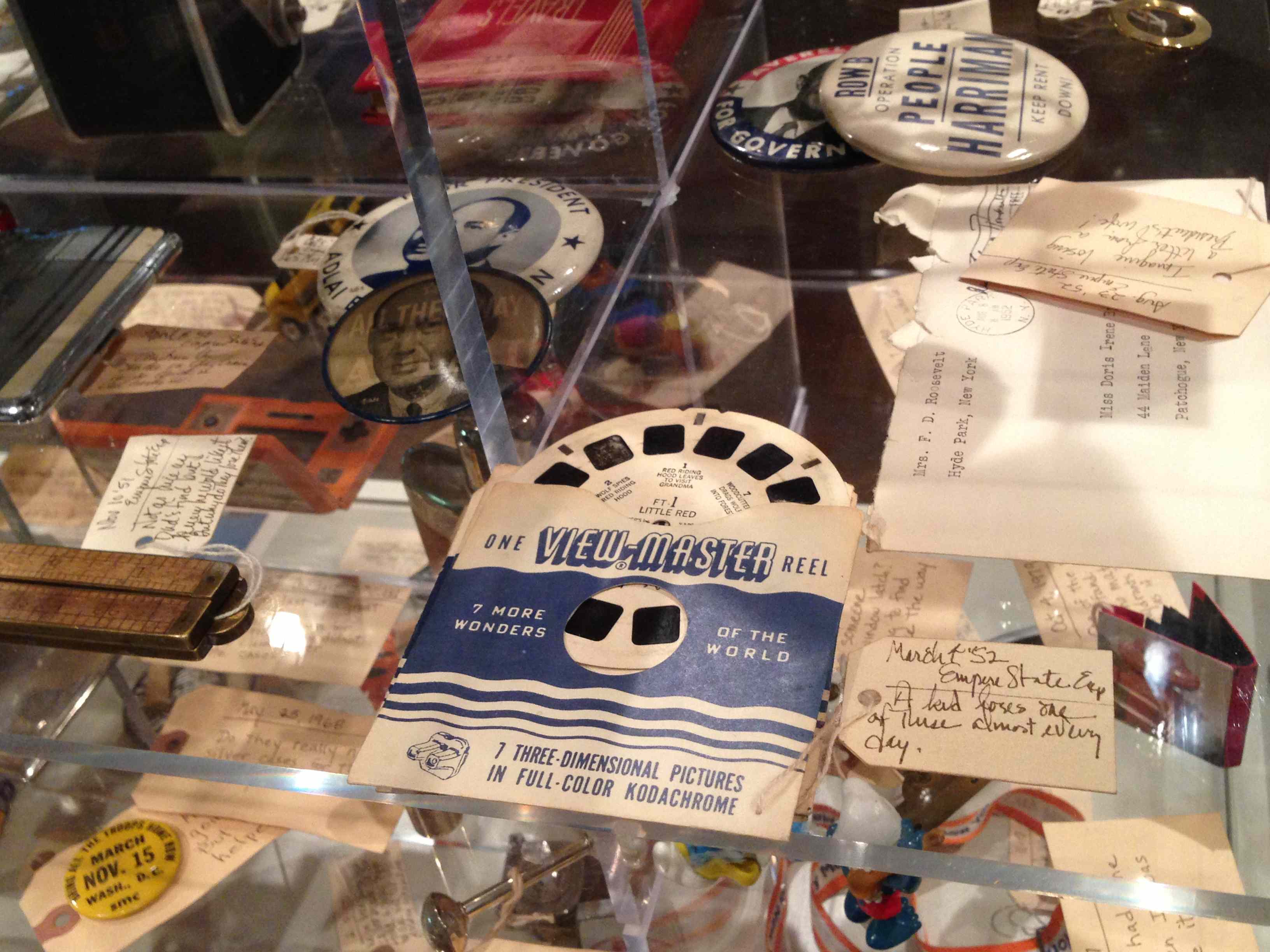
Close-up of Viewmasters and other leave-behinds inside Jane Greengold’s Lost and Found.

Close-up of Viewmasters and other leave-behinds inside Jane Greengold’s Lost and Found.

Another must-see piece (among many) is Jane Greengold’s Lost and Found. She’s created a sort-of fiction about the dozens of tagged items in the vitrine, evoking the memories and observations of generations of conductors who found items that train passengers left behind. Actually, the items you’re looking at are actual leave-behinds collected by real-life conductors, so Jane’s work isn’t entirely made up. The archeological discoveries include things from the old Lake Shore Limited on the NY Central, a 1948 boxed baby tooth, 1943 ration cards, 1952 Viewmasters, a Kennedy campaign button, and a Kindle.

Get to the Annex before July 7. In the meantime, check out curator Amy Hausmann and her artists telling about the fun they had contemplating time, architecture, fashion, and Jackie O.

Mary Cassatt’s Tech Start-Up Chronicled by NYPL

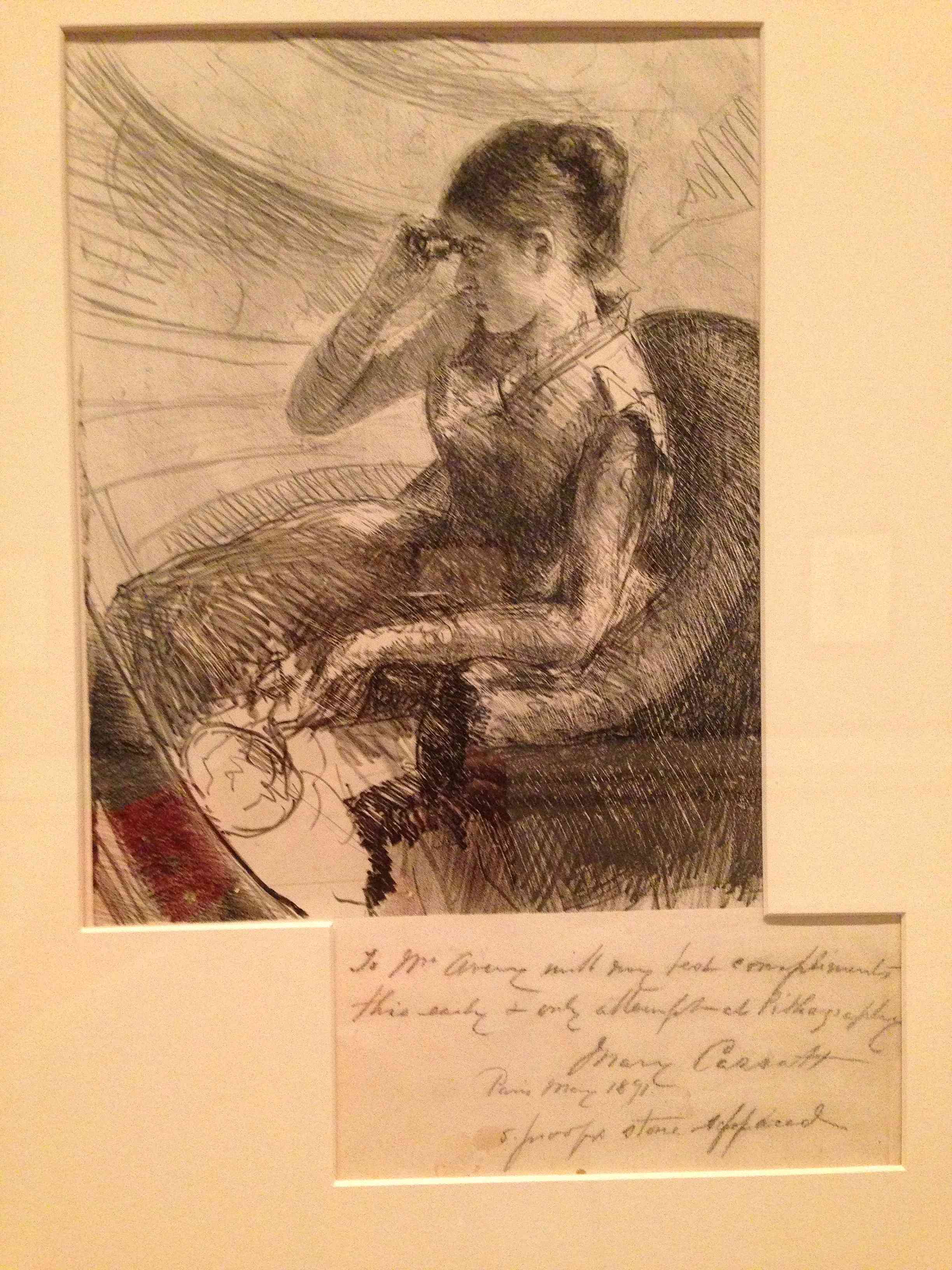
Woman Seated in a Loge (1881). The only lithograph Cassatt ever did, personally inscribed to Mr. Avery.

Woman Seated in a Loge (1881). The only lithograph Cassatt ever did, personally inscribed to Mr. Avery.

Still using a flip phone? Don’t know how to code? There’s nothing wrong with sticking with what you know, but expanding horizons with new technology is always good. In 1876, it’s exactly why Mr. Degas invited 32-year-old Mary Cassatt into his studio, showed her some of his printmaking techniques, and encouraged her to jump in and try something new. She did, and her technological triumph is the story of NYPL’s illuminating third-floor show, Daring Methods: The Prints of Mary Cassatt, which ends Saturday.

The show gives you a new slant, documenting this American artist’s struggle to make new work, push her technical boundaries, and mash up styles to total critical acclaim at the turn of the last century. NYPL found itself in a unique position to mount this show, since art dealer/print collector Samuel Putnam Avery made an unprecedented donation back in 1900 — more than 17,000 19th-century prints, including dozens and dozens he purchased directly from Cassatt as evolved her printmaking between 1878 and 1898.

The Letter (1891) – color print with drypoint and aquatint. This is an earlier state (iii/iv) of Cassatt’s famous print minus the wallpaper pattern and letter on the desk

The Letter – 1891 color print with drypoint and aquatint. This is an earlier state (iii/iv) of Cassatt’s famous print minus the wallpaper pattern and letter on the desk

This show provides art-lovers with a unique, chronological walk-through of Cassatt’s technical trial-and-error, beginning with her early drypoints (1878 costume studies suggested by Degas), simple drypoints and etchings, and her only litho (see right). Cassatt continued to experiment throughout the 1880s, perfecting her softground, drypoint, aquatint, and etching techniques, often mashing them together – brave moves by a stylish, curious female artist of the modern era.

Gallery visitors walk slowly from print to print, taking in the subtle changes, redirects, and reworks of this modern, mid-career artist determined to find status and success in the male-dominated Parisian art scene of the late 19th century.

The NYPL curators decided to hang multiple versions of similar subjects side by side, so you can really examine the mind of the artist at work. It’s interesting that Cassatt let Avery have prints off cancelled plates that she pulled after the “good” print run was finished. You’ll see the scratched-up images in the show next to the best ones.

The Fitting – 1891 color print with drypoint and aquating, printed with three plates

The Fitting – 1891 color print with drypoint and aquatint, printed with three plates

In 1890, everything changed for Cassatt, when she saw an exhibition of Japanese woodblock prints took the Parisian cultural community by storm. It was the moment that her technical experiments paid off and her printmaking vision, style, and legacy became sharply focused. In the last portion of the show, you witness her brilliant response — making intaglio look like woodblock, applying multiple areas of bright color, injecting pattern into domestic surfaces, and zooming in for low-angle close-ups of private moments in women’s lives.

Enjoy NYPL’s selections from Mr. Avery’s collection and spend some time examining the multiple states of the most beloved prints in the Impressionist canon, mash-ups of aquatint and drypoint. It’s a master class in color, ink, and composition.

If you can’t get to the show this week, download the PDF and take a look at Ms. Cassatt’s technical journey. Then go out and try something new.

Impressionist Line Ends at Frick

Toulouse-Lautrec, The Jockey, 1899. Color-printed lithograph on cream wove paper

Toulouse-Lautrec, The Jockey, 1899. Color-printed lithograph on cream paper

If you’re already nostalgic for the grand Impressionist show that ended at The Met, you can still find your favorites filling the Frick’s two downstairs galleries and the room next to the gift shop. While the Clark Art Institute (Williamstown, Massachusetts) was undergoing renovation, the Frick borrowed some of their finest works on paper for the gem-of-a-show, The Impressionist Line from Degas to Toulouse-Lautrec: Drawings and Prints from the Clark.

If you loved seeing Al Hirschfeld apply his pen and ink to paper in our last post, you will delight in perusing how lines by Degas, Manet, Lautrec, and Gaugin created a profitable niche in the rapidly expanding art market at the 19th century’s end. (By the way, Hirschfeld fans, who knew that Monet drew crazy caricatures to support himself early in his career? Claude’s Man with a Snuff Box looks like it was drawn in the 1950s…not the 1850s!)

Toulouse-Lautrec, Miss Loïe Fuller (1893), Lithograph printed touched with gold and silver powder. Source: Clark Art Institute

Toulouse-Lautrec, Miss Loïe Fuller (1893), Lithograph printed touched with gold and silver powder. Source: Clark Art Institute

Although a few politically charged works are in the show (like Manet’s 1874 print of the Commune uprising The Barricade), the majority are masterworks of portraiture, everyday life, cafes, and modern entertainments like horseracing, circuses, and boulevard promenades. Some of our favorites are Degas’s sketches of horses in motion and Lautrec’s circus-themed sketches that he drew from memory while in rehab.

If you can’t get to the show, the Frick web site allows you to peruse all of these works in detail (with the curator’s descriptions) by decade, by artist, or by the order in which they’re hung in the exhibition.

For sheer theatricality and delight, Lautrec takes the cake in this show, as shown in the images here. The hand-painted 1896 Lumiere Brothers film below shows silk-clad modern dance pioneer Loïe Fuller making the moves that inspired Lautrec to create dozens of experimental lithographs (sprinkled in gold and silver powder, no less!) of her abstractionist performances.

Yes, it’s all about the line.

If you have time, watch the video of the co-curator’s lecture about Impressionist line and how sketches, watercolors, woodcuts, lithographs, pastels, and improvised etchings created a revolution in affordable art.

Toulouse-Lautrec, The Englishman at the Moulin Rouge, 1892. Color-printed lithograph

Toulouse-Lautrec, The Englishman at the Moulin Rouge, 1892. Color-printed lithograph

Tony Week Pilgrimage to NYPL

Al's studio at New York Public Library of the Performing Arts

Al watches over his studio at NYPL for the Performing Arts

Tony favorite Kinky Boots is playing at the Hirschfeld, but as you contemplate the number of awards it will pick up Sunday night, walk over to the entrance of NYPL at Lincoln Center to pay tribute to Al himself. Peek through the window of NYPL for the Performing Arts to see the nook where every Broadway star since the 1920s had their portrait done –the studio of Al Hirschfeld, the man who immortalized them all.

Look through the window and you’ll see his drawing table, lamp, and the cozy, cushioned barber chair where he perched day after day, recording entertainment history over the decades with his unmistakable whimsical flair and line. The Lincoln Center library is a fitting home for Al’s studio furniture, since he consulted the NYPL theater archives for a lot of his work.

Liza in Minnelli On Minnelli (1999), one of more than 20 portraits Al did of her. In color for The New York Times. Source: Library of Congress.

Liza in Minnelli On Minnelli (1999), one of more than 20 portraits Al did of her. Source: Library of Congress.

It’s hard to believe that Hirschfeld first began drawing celebrity caricatures in the 1920s, and continued his illustrious career for the next eighty years. Click on this link to his dealer’s site (Margo Feiden) to scroll through all the plays and musicals he’s covered, documenting the quirks, panache, and performances of everyone from Fanny Brice to Martin Short.

You can click through the “time table” of Al’s work at the gallery site, or in the Timeline of the Hirschfeld Foundation’s website. Every drawing after 1948 was done from a cushioned barber chair in which he could swivel to his heart’s content. Initially, he found it on the Bowery for $3.00, but the one you’ll see in the Performing Arts library entrance is the replacement (the original just wore out), which he bought in 1993 from a barber shop in the Chrysler Building.

So, pay tribute to Broadway’s most beloved artist. And before we post about the Impressionist Line show at the Frick, why not watch a 20th century master of line make his mark so you can imagine all the creativity that emanated from the table you see in the window. The clip from The Line King, uploaded to YouTube by Al’s grandson, documents the legend drawing a caricature of Paul Newman as he appeared in Our Town. 

Whitney to Remove Gigantic Rose (Again)

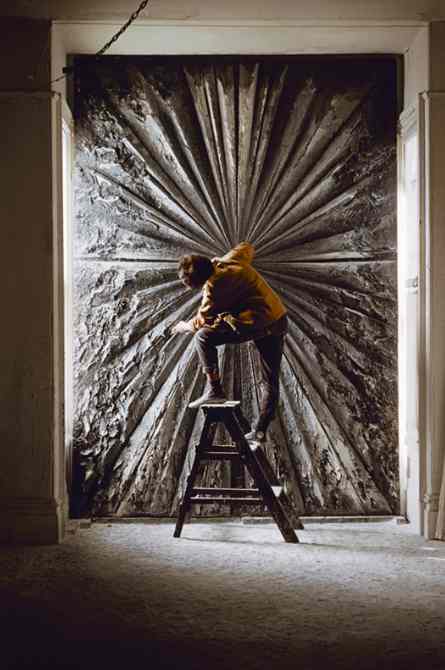
Jay DeFeo working on what she then called The Death Rose, 1960. Photo: Bert Glinn. © Bert Glinn/Magnum Photos

Jay DeFeo working on what she then called The Death Rose, 1960. Photo: Bert Glinn. © Bert Glinn/Magnum Photos

It was hard enough to get it out of the apartment after she created it nearly 50 years ago. Get to The Whitney’s show Jay DeFeo: A Retrospective this week before the moving crews come back. The Rose, DeFeo’s legendary painting (or is it a sculpture?) is the focal point of this Bay Area artist’s exhibition.

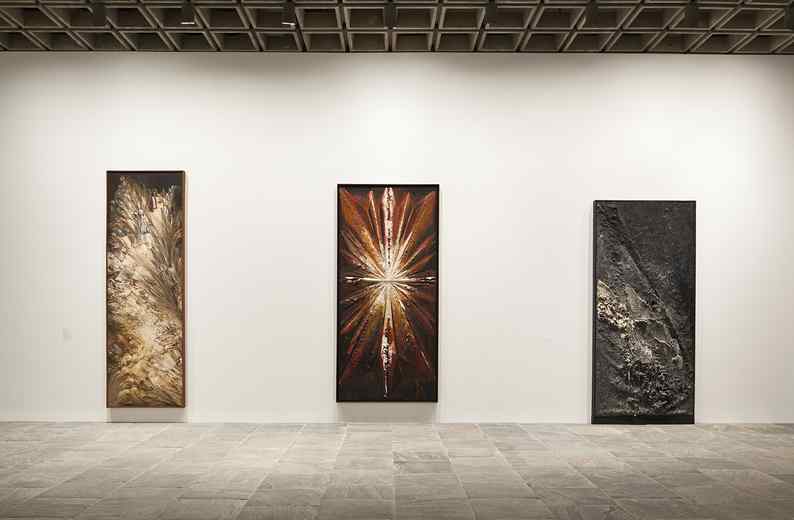
Early in her career, DeFeo drew inspiration from prehistoric art, the cosmos, and terrestrial forces of nature. In the late 1950s and early 1960s, she painstakingly built up the surfaces of her oil paintings, which often evoked geologic forces – slow, large-scale shifts of monumental proportion. (See the installation view of three of these works).

DeFeo was invited to show at MoMA in the historic, 1959 all-star show, Sixteen Americans, which included Rauchenberg, Johns, Kelly, Stella, de Kooning and Nevelson. She sent some of her 3D impasto works, but didn’t consider her largest piece, The Rose, quite finished. She became obsessed and spent six more years layering paint on the canvas. Listen to DeFeo herself talk about the difficulty in creating the 3D effects in The Rose in a drafty apartment in the late 1950s.

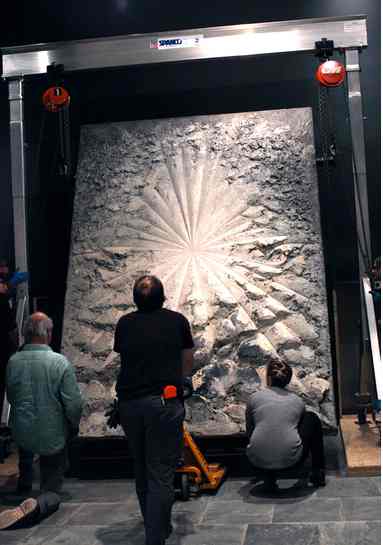
The Whitney removed the side panels of The Rose and used a two-ton gantry to get it as close to the wall as possible. Source: Whitney Museum. Photo: Paula Court.

The Whitney removed the side panels of The Rose and used a two-ton gantry to get it as close to the wall as possible. Source: Whitney Museum. Photo: Paula Court.

Unfortunately, she couldn’t even get it out of her apartment, because the 3D surface she created ended up being too big to fit through the door and weighing…oh, about a ton. DeFeo had a small army of movers come upstairs to her apartment-studio, rip out the wall, and lower it to the street with a forklift. Watch and listen to Bruce Connor’s take on how it all came down in his interview with SFMoMA).

After that, The Rose went on display in California, but ultimately was installed as the showpiece of a conference room at the San Francisco Art Institute. For all the right reasons, temporary wall was built to conceal and protect it, but ultimately The Rose was hidden from view from 1979 until 1995, when the Whitney team unearthed it. Now, they own it.

Recently, the Whitney had the task of getting a truly monumental work out of storage, shipping it to the West Coast for the SF edition of the show, and bringing it back to New York.

Recently, The Rose arrived back at the Whitney from the show’s run at the San Francisco Museum of Modern Art. It’s one of the most complicated pieces for the museum to ship, move, and install – just like the original transfer.

Click on this link and scroll down to find the Whitney’s photo show of what it took to get it up to the Fourth Floor. See how a crew of handlers got a one-ton work from the street to the gallery.

Get to the show before it closes June 2, and enjoy DeFeo’s jewelry, geology-inspired work, drawings, and never-before-seen photos of this Beat-era innovator.

Installation view at The Whitney. Photo: Sheldan C. Collins

Installation view at The Whitney. Photo: Sheldan C. Collins

War Ends at NY Historical

Welcome to New YorkJoin the crowds for two more days to pay tribute to NYC’s Greatest Generation at the revealing, reflective exhibition, WWII & NYC created by the New-York Historical Society. If you can’t get there in person, take a look at the synopsis here, but in the galleries there are surprises at every turn. The slideshow gives you a glimpse.

Right inside, you’ll find a line-up of people checking out a portion of the actual 1938 Cyclotron, a kind-of atom smasher that physicists at Columbia University were using confirm nuclear fission. It’s also surprising to see an interactive map of where “The Manhattan Project” was actually located in Manhattan. At Fifth Avenue and 29th Street, the Army had 300 people on the 22nd Floor of 261 Fifth sourcing materials for the first atom bomb. Other teams were working in the Woolworth Building and at 270 Broadway.

People also cluster around the interactive map of New York’s harbor, which explains how all those interesting-looking, now quiet big buildings, forts, and warehouses along the shore were once alive with 3.3 million active duty service men and women headed for Europe and North Africa. Take this video tour and see it then and now:

And the show would not be complete without a in-depth look at the activities of the Brooklyn Navy Yard and the rise of Rosie the Riveter. Watch this video to experience what it was like from a woman who lived it:

The show includes stories about how Tito Puente, Jacob Lawrence, filmmaker Francis Lee, MoMA, the Metropolitan Museum of Art, Maiden Form, Nabisco, and countless other New York people and companies joined in to the war effort. Check out additional videos expertly produced by NYHS on line. You’ll never look at these City streets or harbor the same way again.