Vote for Plain or Fancy at The Met

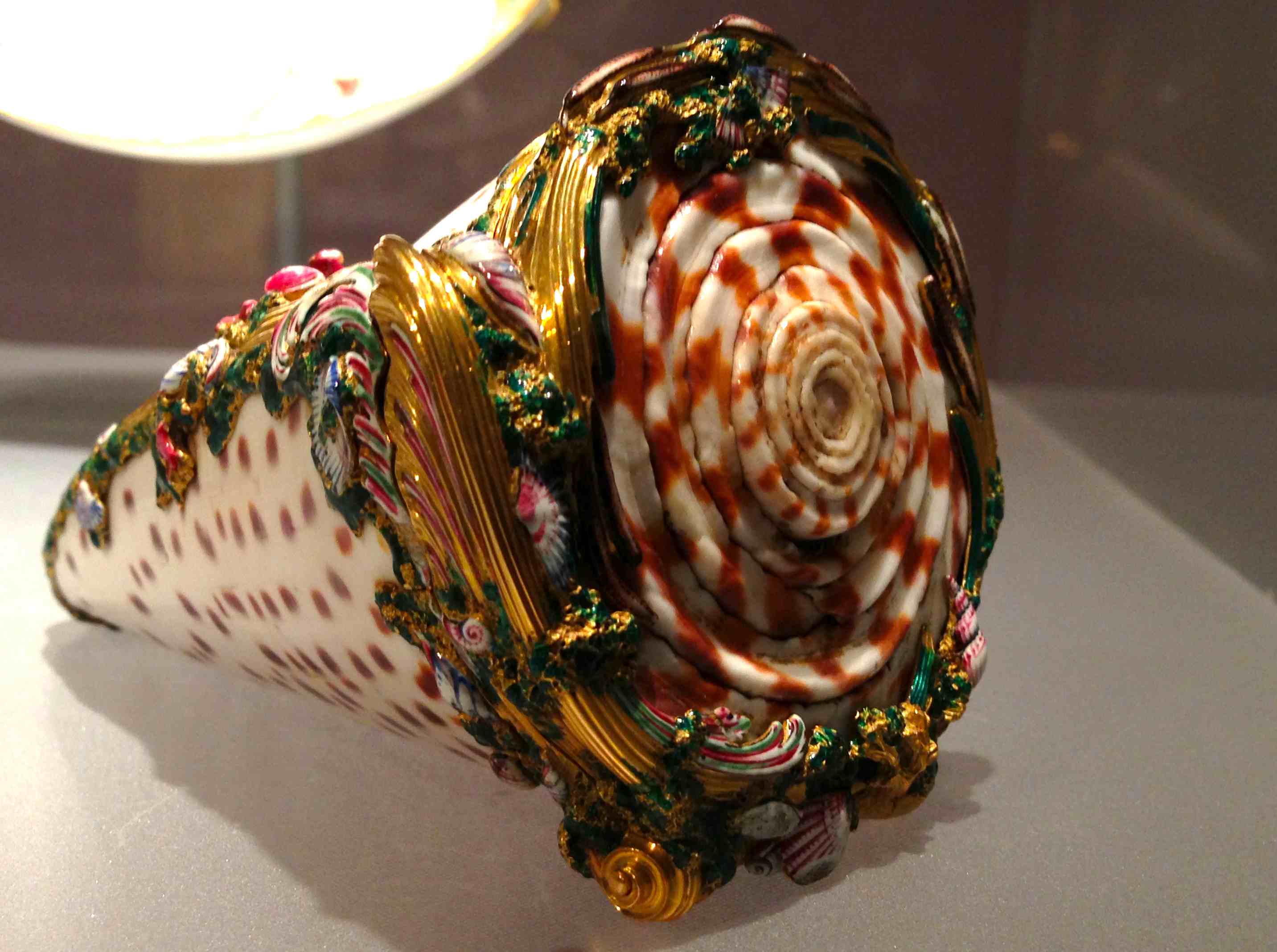
Our vote for best “fancy” object: A beach shell embellished with enamel and gold by Barnabe Sageret around 1745.

Our vote for best “fancy” object: A beach shell embellished with enamel and gold by Barnabe Sageret around 1745.

You wouldn’t think that a presentation of luxury items would emphasize democratic participation, but that’s just what the Metropolitan Museum has embedded (on line and onsite) within its thought-provoking, beautiful show, Plain or Fancy? Restraint and Exuberance in the Decorative Arts, on view on the first floor through August 18.

The curators of European Decorative Arts have assembled “plain” objects to the left side of the gallery, “fancy” ones on the right, and…well, they’ve asked you to decide about the ones in the middle. Tablet screens in the exhibition and the Met’s web site have an interactive that lets you choose if some of these are to your taste and how you’d classify them. You can enter a comment about each that shoots off to the show’s Twitter feed.

Our vote for best “plain” object: The obviously expensive porcelain bowl used by Marie Antoinette at her “fantasy” dairy farm. The curators tell us that the head of the Sèvres  Manufactory was worried that his other clients would think it was too “barbaric.”

Our vote for best “plain” object: The obviously expensive porcelain bowl used by Marie Antoinette at her “fantasy” dairy farm. The curators tell us that the head of the Sèvres Manufactory was worried that his other clients would think it was too “barbaric.”

The whole idea of the show was to gather some of the greats from the European Decorative Arts collection and ask the viewers to consider their own feelings about “plain” and “fancy” (derived from “fantasy”). If something is “plain”, do you feel more noble admiring a piece’s elegant simplicity? If you see a grandly embellished bauble, does it make you cringe, or give you a sense of relief that someone else’s purchase is stimulating the economy?

The curators don’t refrain from hammering these gems into their socio-political contexts. One of the “plain” porcelains is a Sèvres bowl used by Marie Antoinette as she cavorted with friends on her fantasy dairy farm pre-Revolution. Several “plain” pieces of silver tableware were likely made from melted down “fancy” pieces after Cromwell’s 17th-century reformation in England. The photos on our Flickr site let you in on what the curators said about many of our favorite items.

Is it “plain” or “fancy”? A clean design on a giant 1635 glass goblet inscribed with a detailed cartography of the course of the Rhine River. J.P. Morgan liked it and gave it to the Met.

Is it “plain” or “fancy”? A clean design on a giant 1635 glass goblet inscribed with a detailed cartography of the course of the Rhine River. J.P. Morgan liked it and gave it to the Met.

Items range from the 1400s to the 20th century. One of our favorites in the “fancy” imagination department is a snuff box made from a beach shell decorated lavishly with enamel and gold. Who wouldn’t want to look at that? Another is a gigantic Dutch glass goblet that has been engraved with a detailed map showing the entire course of the Rhine River. Amazing.

The show is filled with Wedgwood, Sèvres, Wiener Werkstätte, and other surprises. Although you can see the items in the show on the Met’s website, it’s much better to examine these items up close in person and read what the curators had to say about each.

Better yet, think about how you feel about the designs, and weigh in on Metmedia and Twitter. What do you choose?

Vote

Patching Up the Emperor’s Carpet

Carpet

Installation view of the Emperor’s Carpet, second half 16th century. Iran, Safavid period (1501–1722). Source: The Met.

If royal guests had walked all over your Persian carpet for the last 600 years, how many repairs would you need? Before coming to the Met, the 16th-century Emperor’s Carpet, covered in animals and poetry, was once owned by the Shah of Iran and the Hapsburgs.

Since this large, beautiful carpet arrived in New York 60 years ago, the Metropolitan Museum was only able to display it twice because it was in such fragile shape.  When they turned it over, they saw it had been patched over 700 times. How could they stabilize it and install it in their expansive New Galleries of the Art of the Arab Lands on the second floor?

You’ll find out all about the behind-the-scenes work analyzing, stabilizing, patching, and repairing it in the micro- show, Making the Invisible Visible: Conservation and Islamic Art.

Carpet Detail

Restored corner of the Emperor’s Carpet.

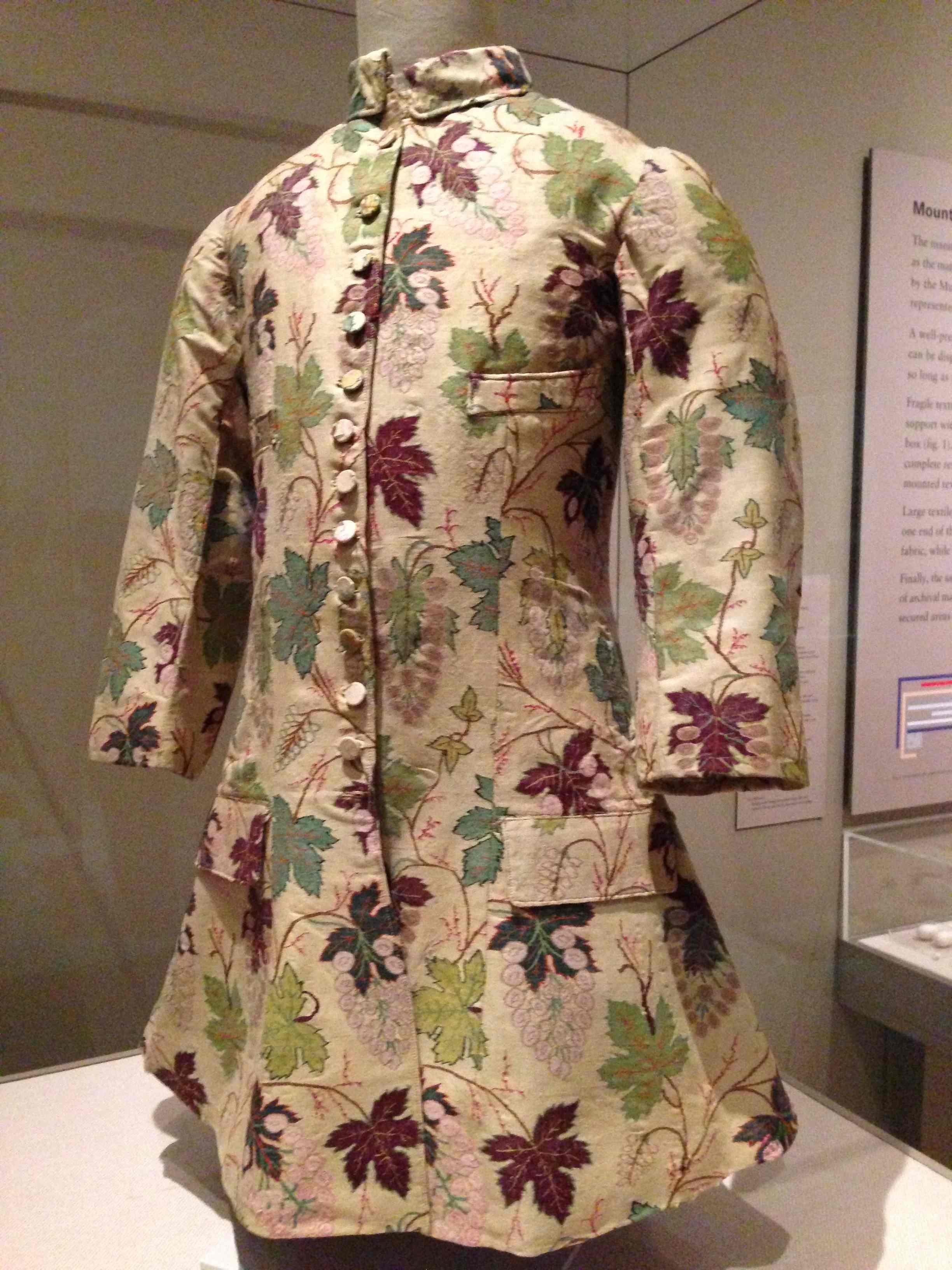
The show features all manner of science, technology, and process that the magical conservators put to work for other pieces, too – ceramics, tapestries made of gold and silver threads, wood, and works on paper over the last 2,000 years. One of our favorites is the child’s coat made from antique pashmina. They also have examples of the natural materials that were crushed and pounded into pigments for all these beautiful dyes and paints.

Although the gallery is tiny, the Met decided to send visitors on a treasure hunt by providing a brochure through which seekers of conservation wizardry can locate the Emperor’s Carpet and other works throughout the dozens of Islamic Art galleries. See the details on these and more our Flickr site.

Child Coat

Child’s coat from India on display in the show. Tailored in the late 19th c., but but fabric woven late 18th c. The textile is from Kashmir and is likely pashmina.

One of the shockers is seeing what the conservators reckon are the true colors of the 1707 Damascus room, long a favorite of Met period-room fans. The science showed that the darkened panels that we’re so familiar with were once bright, bright blue and gold.

If you can’t see the conservator’s showcase before August 4, read about all the science and technology on line at the special web site. You’ll find links to the stories of rehab for the carpet, the child’s coat, the gold-weave chadar, and more.

If you have eight minutes, take a look at three years of work on the royal carpet by the Met’s magicians:

All Smiles at The Mouse Museum on 53rd St

View of Oldenburg’s Mouse Museum/Ray Gun Wing at MoMA. Photo: Jason Mandella. © 2013 The Museum of Modern Art

View of Oldenburg’s Mouse Museum/Ray Gun Wing at MoMA. Photo: Jason Mandella. © 2013 The Museum of Modern Art

Is it the best museum in the world? One of the happiest places to be in New York right now is Claes Oldenburg’s Mouse Museum and Ray Gun Wing, currently installed in MoMA’s atrium as the scene-stealing companion to the Fifth Floor exhibit, Claes Oldenburg: The Street and The Store, which ends August 5.

You’ll want to take your time contemplating the Pop master’s 1970s curated collection of average, everyday stuff that he showcased inside a geometric mouse-head structure, originally a design he proposed for Chicago’s (then unbuilt) Museum of Contemporary Art.

In the mid-1960s, Oldenburg began collecting souvenirs, rubber toys, and crazy stuff he found on his wanderings and storing them on shelves of his 14th Street studio. An early idea was a display of artificial vegetables and other food with Fluxus genius George Maciunas. It never happened, but luckily some of the 1960s-style replicas repurposed here in the Mouse collection.

Inside view. On loan from the Austrian Ludwig Foundation, since 1991. © 1965–77 Claes Oldenburg. Photo by MoMA Imaging Services Dept. © 2013 The Museum of Modern Art

Inside view. On loan from the Austrian Ludwig Foundation, since 1991. © 1965–77 Claes Oldenburg. Photo by MoMA Imaging Services Dept. © 2013 The Museum of Modern Art

Oldenburg decided to submit his museum to Documenta 5, whose theme was “inquiry into reality—today’s imagery.” He washed off his dusty collection (you can hear the tape of that inside) and he and some friends organized 367 objects into display categories. For Documenta, the little building itself was fabricated in Germany.

What’s really inside? In a riff on the classification systems that were then in vogue by conceptual artists, Oldenburg “classified” all his fun stuff – landscape, human beings, food, body parts, clothing (including makeup), tools, animals, buildings (including monuments and souvenirs), money containers, smoking articles, and studio remnants.

Here’s MoMA’s take on the importance of this little museum and its Ray Gun Wing:

Now, enjoy a virtual walk-through to examine this tiny museum’s treasures, shot by Christian Zurn when it was on display at MUMOK in Vienna last year. Do yourself a favor and go see this spectacularly funny, whimsical collection for yourself.

Want to spend some time with Claes himself? Here’s a YouTube of the master recollecting his life in the Sixties, travels to LA with Warhol, and how his soft sculptures came to be, click here.

Shimmering Curtains of Liquor-Bottle Caps Hung in Brooklyn

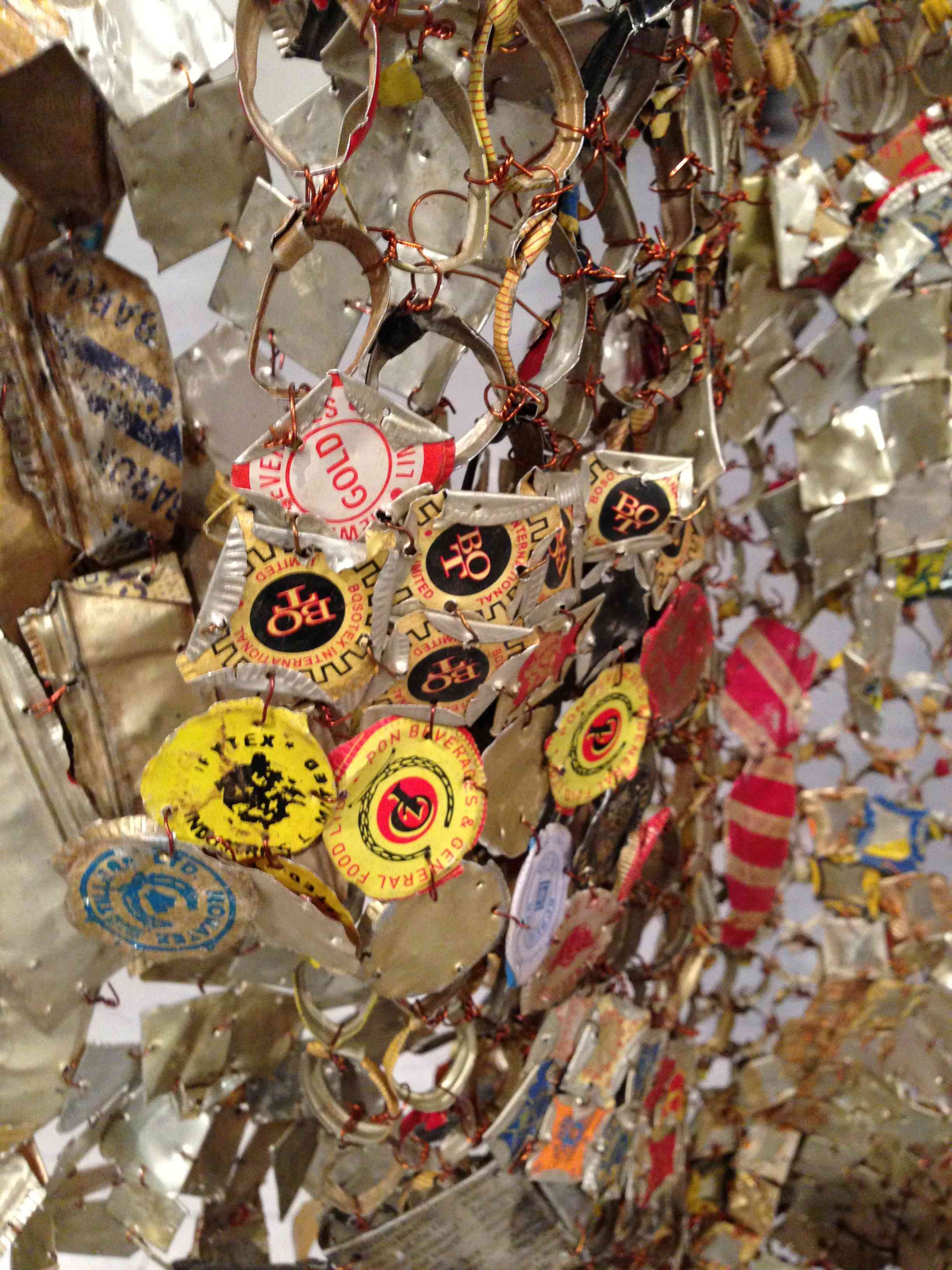
Installation view in the Iris and B. Gerald Cantor Gallery on the Fifth Floor. Brooklyn Museum photo: JongHeon Martin Kim.

Installation view in the Iris and B. Gerald Cantor Gallery on the Fifth Floor. Brooklyn Museum photo: JongHeon Martin Kim.

They’re big, they’re from Africa, they’re hung in one of the most spectacular art spaces in the City, and you need to see them before August 18. If you’re going out to Brooklyn to see the Sargent show, be sure to see the spectacular contemporary installation, Gravity and Grace: Monumental Works by El Anatsui.

The one-man retrospective of London-trained Ghanaian artist El Anatsui (his first) takes up half of the Brooklyn Museum’s Fifth Floor, but really shines under the skylight in the Iris and B. Gerald Gallery.

DetailYou might have seen his large piece hung in the African gallery on the First Floor of the Met or his installation in the 20s on the High Line, but in Brooklyn you’ll see 30 big, shimmering pieces arranged on walls and suspended under the dome. They’re all made out of scrounged metal material and wire from garbage dumps near his home, but the experience of seeing these big, beautiful pieces could not feel further from the source.

Hung from the ceiling, the metal-and-wire pieces look like open-weave textiles fabricated on a grand scale. Visitors wander through Anatsui’s hangings, silently gazing, stepping up to look close, and then move further back to wonder how he creates such a lightweight, effortless illusion from years of collected, flattened, punched bottle caps and stuff.

Earth's SkinTwo more galleries feature other large-scale works, arranged and pinned on walls, bunched like beautiful fabrics. Anatsui creates his gigantic constructions, carefully sorting the different colors of metal from the various brands of beverages. He says it’s like doing a watercolor wash, and when you view the work in person, you’ll be stunned by the variety of color, pattern, and lovingly arranged metal tapestries.

Here’s a time-lapse video of the Brooklyn crew installing the show, initially mounted at the Akron Art Museum. Anatsui says that he enjoys giving installation crews and curators a lot of leeway in how they hang his work, and he was a little surprised (in a good way) about some of the choices by the crew in Brooklyn. See for yourself. The big, shiny silver sculptures snaking across the floor are made of milk tin lids.

Virtual Visit to the Met’s Punk Couture Show

IMG_2416Too hot to get over to the Met this weekend and climb up all those high stairs out front? Stay in the comfort of your air-conditioned home and take this virtual tour of the Met’s Punk: Chaos to Couture show (closing August 14).

Curator Andrew Bolton explains the real-life inspirations for much of the iconic looks in this show –people from music, pop, and celebrity worlds, taking you through the galleries one by one, emphasizing the importance of recycling and deconstruction to the haute couture designers of today.

Our favorites: Rodarte’s crochet looks alongside those of Westwood and McLaren, McQueen’s faux recycled trash bag dresses, Chris Bailey’s spiked Burberry ensemble, and the great finale – Comme des Garcon’s amazing collection with trousers, mutton sleeves, and disassembled pieces of clothing brilliantly attached for maximum punch to the runway models.

Look closely, remember, and enjoy.

Think…Download…Make at New Museum

Open-source vacuum assembled from downloadable instructions, a red thermos, hardware store items, and 3D printed parts

Open-source vacuum assembled from downloadable instructions, a red thermos, hardware store items, and 3D printed parts

If you haven’t been exposed to the DIY (Do It Yourself) movement, drop into the New Museum’s Adhocracy show at its Studio 231 storefront this weekend.

It’s a 25-project showcase of cutting-edge design solutions, including DIY as well as some film, video, low-tech high tech, and crazy, new approaches to making stuff in the 21st century.

The DIY sections that we particularly liked were the household appliances made by downloading Open Source instructions, manufacturing components with 3D printers, and buying the remaining bits and pieces at the hardware store. Why spend money on a Dyson when you can build your own vacuum cleaner from a thermos container and other scrounged parts? Each solution is more fascinating than the next, with displays of OS-compatible coffee grinders, water boilers, and bicycle parts and their instructions.

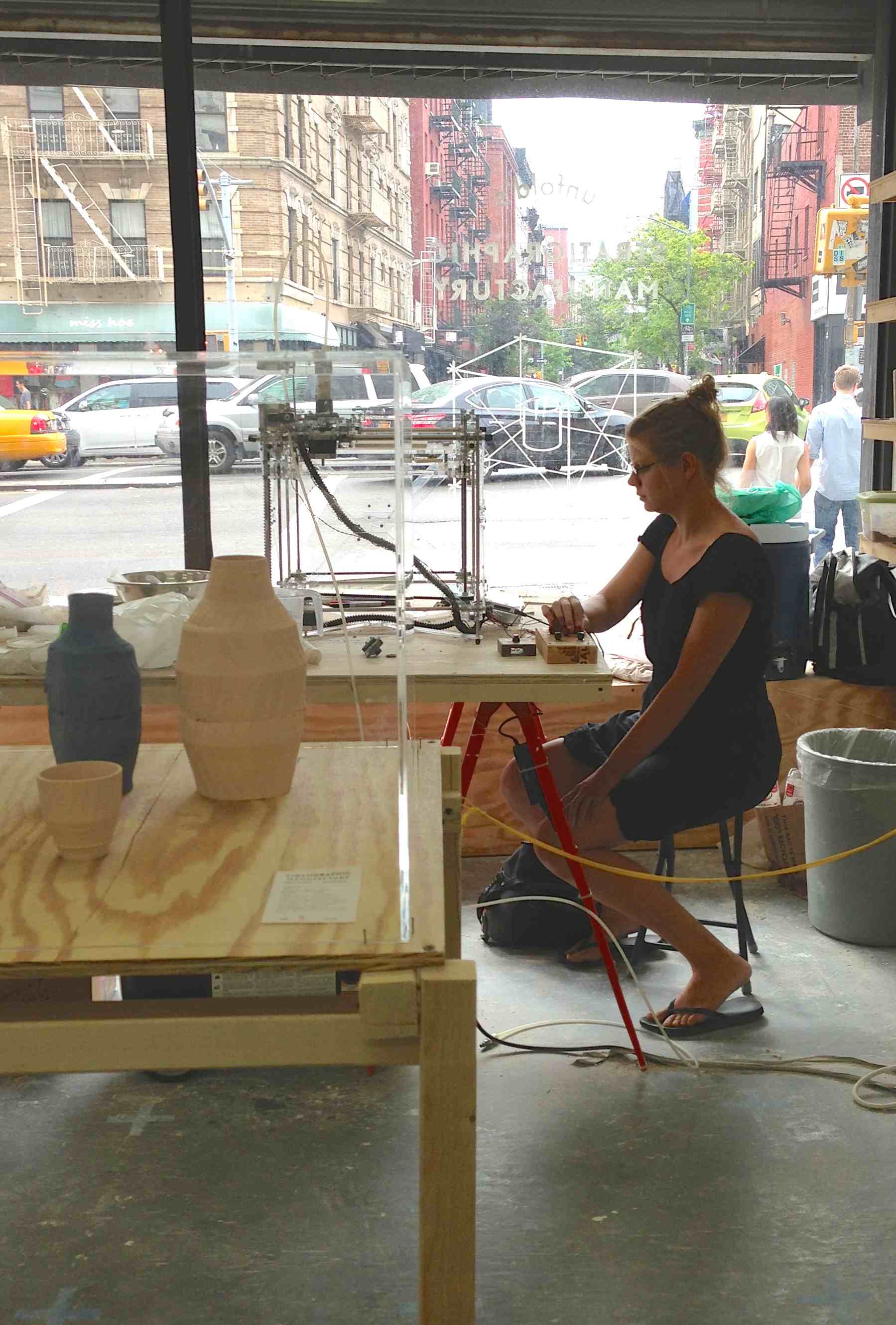
Larisa Daiga uses Unfold's Stratigraphic Manufactury (3D ceramic device) to make coil pots from Gowanus sludge

Larisa Daiga uses Unfold’s Stratigraphic Manufactury (3D ceramic device) to make coil pots from Gowanus sludge

Other displays highlighted the best inventions from Kickstarter (e.g. Central Standard Time wristbands and iPod Nano multimedia wristwatches) and solutions for using the Arduino microcontroller – lion tracking collars in Kenya and an earthquake-sensing device created and marketed by a 14-year old in Chile. It tweets you when there’s a tremor. Click here to see some photos, and if you feel like making something, explore your options on Adafruit..

Right in the storefront window, NYC ceramicist Larisa Daiga uses a ceramic 3D printer to make a tiny coiled pot. Larisa told us that she couldn’t touch the porcelain, because it was actually sludge from Brooklyn’s beloved Superfund site, the Gowanus, and loaded with biotixins.

Daiga felt it was interesting to be part of Unfold’s Stratigraphic Manufactury project, making coil pots (one of the oldest technologies of humankind) with toxic waste. Days spent in the window of Adhocracy let her contemplate how sludge might be reused and recycled instead of being trucked and dumped into unsuspecting landfills in the rest of the country. View her Adhocracy output and see the machine at work on her Flickr feed.

Another DIY favorite from Helsinki is featured in the show — Restaurant Day, when everyone in the city has permission to open their own restaurant on the curb. It’s one step beyond Smorgasburg.


Washington, D.C. Museum Videos Reach 14 Million YouTube Views

Since Smithsonian branches and other Washington, D.C. museums, zoos, and gardens began posting videos on line in 2007, collective YouTube views have climbed to 14 million, as chronicled in our latest report, Washington D.C. Museums: 2013 Video and Social Media Rankings.

Although the 14 million total is less than the 49 million views racked up by New York museums, don’t forget that two high-profile DC institutions – National Geographic and the Smithsonian – produce significant amounts of programming distributed on their popular cable TV channels, dedicated apps, and snazzy web sites. Even though it has a DC museum space, NatGeo (a joint venture with Fox Cable) has largely abandoned YouTube; however, the 18 individual Smithsonian branches are all still posting their own stuff regardless of the more comprehensive joint venture with Showtime.

In the Top 2012 Cultural Museum Video, archival footage is cleverly coupled with behind-the-scenes looks at the National Archives’ 1940s Census release

In the Top Cultural Museum Video, archival footage is cleverly coupled with behind-the-scenes looks at the National Archives’ 1940s Census release

Here are some findings from our report on video and social media produced by DC institutions:

As of year-end 2012, the Washington museums having the highest number of total YouTube channel views were the Library of Congress (4.5M), the National Archives (2.1M), and the United States Holocaust Memorial Museum (1.6M). The top two are information powerhouses with massive collections to push out for public consumption, and the third is right on their heels with an innovative series with curators interpreting interesting items from their collections.

All-time top DC museum video, one of Edison’s earliest films, with over 329K hits on YouTube

All-time top DC museum video, one of Edison’s earliest films, with over 329K hits on YouTube

Edison still delivers. It’s interesting that the top ranked DC museum video of all time is Edison Kinetoscopic Record of a Sneeze, Jan. 7, 1894, the earliest surviving copyrighted moviesuggesting that our greatest media innovator is having the last laugh, contributing over 329,000 hits to the number-one ranking by Library of Congress on YouTube. It’s short enough for Fred Ott to be on Vine.

Four museum video channels have surpassed 1 million views. To put the DC numbers in context, if they were merged with the New York museum video rankings, the Library of Congress (4.5M) would rank seventh, just ahead of the Metropolitan Museum of Art. The Library of Congress would rank eight (2.1M), just ahead of the New York Public Library.

The National Zoo produced Washington’s top-viewed 2012 museum video – Shanthi, the National Zoo’s Musical Elephant, Plays the Harmonica!. Over 290,000 viewers watched this middle-aged mom experiment with a musical instrument in her enclosure and listen to her keeper talk about her performance. Shanthi’s viewership greatly surpassed the numbers generated by the most popular 2011 Washington museum video, the National Portrait Gallery’s Conan O’ Brien as Seen by Artist John Kascht. Surely, Conan would be amused.

The Smithsonian American Art Museum’s Top Exhibition Video of 2012 features curator Chris Melisinos describing why video games belong in an art museum

The Smithsonian American Art Museum’s Top Exhibition Video of 2012 features curator Chris Melisinos describing why video games belong in an art museum

The top cultural video was a behind-the-scenes work at the National Archives for the release of the 1940s census. Over 115,000 family historians watched Learn About the 1940s Census, which showed the Archives census team, provided information on how to find your family’s records, and worked in interesting archival footage from the original census.

The Smithsonian American Art Museum produced Washington’s top video about a museum exhibition. Over 28,600 people watched The Art of Video Games: Chris Melissinos, Curator, a brief look into the evolution of the stories, technology, and visualization advances of this mass entertainment medium.

A few of the Flickr sets from Library of Congress

A few of the Flickr sets from Library of Congress

The most active Twitter users are the National Museum of American History, the National Air and Space Museum, and the National Postal Museum. But except for Air and Space, it’s a different set for Facebook followers.

The most active Flickr users are the National Archives, the Library of Congress, and the Smithsonian American Art Museum. The Archives has organized its photos into creatively themed sets, such as “White House Wednesdays,” “Millinery Monday,” pictures of the 1940s census being taken, and pets of the First Families. The Library of Congress also posts a folder containing “mystery” photos and asks the public to help to identify them.

All the detailed video and social media statistics on 42 museums are in the report. Click here to see what’s included and make a purchase from our Its News To You Reports shop.

Enjoy the most popular DC museum video, a musical visit with the National Zoo’s sensation, Shanthi:

Mardis Gras Indians Land in NC Beach Town

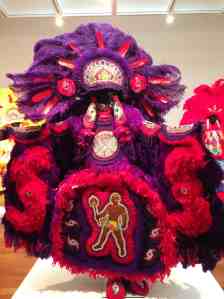
"Chief Albert Lambreaux: No Hum Bow, Don’t Know How" costume. In the pilot, the character returns to his devastated home six months after Katrina, enters, and emerges in this costume.

“Chief Albert Lambreaux: No Hum Bow, Don’t Know How” costume. In the pilot, the character returns to his devastated home six months after Katrina, enters, and emerges in this costume.

Towering feathered headdresses, intricate beaded panels, plumes, and miles and miles of ruffled edging adorn more than a dozen Mardis Gras Indians that are camping out until November 3 at the Cameron Art Museum in Wilmington, North Carolina.

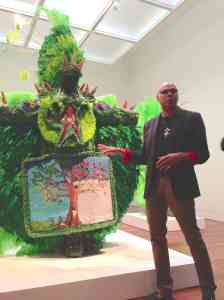
The dazzling incarnations are all part of the exhibition, Well Suited: The Costumes of Alonzo V. Wilson for HBO’s ® Treme. Alonzo was on hand for the opening, where he explained the challenges he faced designing elaborate, 60-lb. Mardis Gras Indian costumes for the actors playing characters living in New Orleans’ Tremé neighborhood (the Third Ward) in the months after Hurricane Katrina.

The African-American men who bead the panels and feather the elaborate costumes for their Mardis Gras Indian tribes typically take all year to execute their visions, which reflect their position in the tribe (e.g. the Big Chief, Second Chief, Spy Boy, Wild Man). To meet HBO’s production schedule, Alonzo and his team often had a much shorter time to create the patches, headdresses, staffs, panels, and shoes for the script’s characters.

Alonzo Wilson explains how the cycle of life and the seasons are reflected on the beaded apron of the "Big Chief: Tree of Life" costume.

Alonzo Wilson explains how the cycle of life and the seasons are reflected on the beaded apron of the “Big Chief: Tree of Life” costume.

For the series, Alonzo felt it was important to embed part of each character’s story into the stories being told on the panels, even if the costume was only seen for a few minutes on TV. Thankfully, the exhibition (and our Flickr feed) lets you closely examine some of this character development-in-beadwork – a chief shedding a crystal tear for his hurricane-damaged home, a white buffalo evoking the return of bounty post-Katrina, and stunning use of hurricane weather symbols amidst a bold S.O.S.

Originally mounted by the Ogden Museum of Southern Art, curator Bradley Sumrall was impressed by Alonzo’s use of narrative that broke through the typical Hollywood stereotypes of African Americans and Indians. “We could have just done a show with traditional Mardi Gras Indian costumes, but Alonzo’s work had so much narrative built in.” With the mix of African-American, Native American, government, city, and current-event references, Bradley felt the layers of meaning in such intricate craftwork was an achievement worthy of a fine-art exhibition.

"Spy Boy: Katrina Memorial" costume. Feathers on lower half spell out "S.O.S.", the international distress signal, using the universal symbol for hurricanes from weather maps.

“Spy Boy: Katrina Memorial” costume. Feathers on lower half spell out the “S.O.S.” distress signal, using the universal weather-map symbol for hurricanes.

The NC stop for the show is a way for others to understand a bit more about New Orleans people, neighborhoods, and culture. Plus, Wilmington is Alonzo’s hometown. The movie and slide show inside the gallery provide an even deeper window into to this achievement – showing how Alonzo and his crew learned from the traditional craftsmen, shared new beading techniques, and received some “rescue help” from the locals when the production deadlines were too much to handle.

The exhibition all adds up to win-win storytelling about Alonzo, his team, New Orleans, and the Indians. Read an interview with Alonzo on the HBO blog and see behind-the-scenes production photos on page 40 of the Wilmington magazine Salt.

More Time Tripping at Grand Central

Annex window view of Lothar Osterburg’s model of his dream of Grand Central as a zeppelin docking station back in the 1930s

Annex window view of Lothar Osterburg’s model of his dream of Grand Central as a zeppelin docking station back in the 1930s

Even if you didn’t manage to board the historic train cars at Grand Central in May, you can still go back in time, courtesy of 18 artists featured in the GCT exhibition in the New York Transit Museum Annex, On Time: Grand Central at 100.

Inspired by The Clock and the continual flow of people and trains through Grand Central, MTA Arts for Transit cooked up a delightful mix of contemporary 2D works, models, videos, and digital art that puts a smile on the face of every commuter, tourist, and art-seeker that we’ve seen inside the tiny Annex.

Look closely to find this minute secret portal: Ledge with Lunette, 2013 by Patrick Jacobs

Look closely to find this minute secret portal: Ledge with Lunette by Patrick Jacobs

Have you seen the mysterious Zeppelin posters by Lothar Osterburg on the subway? Right in the Annex window you’ll see the gigantic, fun-house model that he created to photograph as one step in the process of making the photogravure you see on the A train. Kids and parents can’t resist Lothar’s newspaper-covered multi-story GCT impression and the funny, fat yellow old-time taxis and zeppelin ends that poke out. Right next to it, you can examine his resulting print, Zeppelins Docking on Grand Central.

People are usually transfixed by the 2008 video documenting Frozen Grand Central, where Improv Everywhere staged a 250-person flash mob, where people “froze” for 5 minutes as commuters, tourists, and workers wondered what was going on.

Another hit is Grand Central Diary. London Squared Productions interviewed tourists and commuters about GCT, animated the furniture and items around the terminal, and…well, just watch The Clock and the Maintenance Cart speak for themselves:

Nearby, several small digital screens show Alexander Chen’s Conductor, a 15-minute video loop that animates the subway lines, suggesting trains moving through the system. He turns the subway lines into an animated stringed instrument. No wonder he’s working for Google Creative Labs. Spend a few moments, take a look, and experience it here.

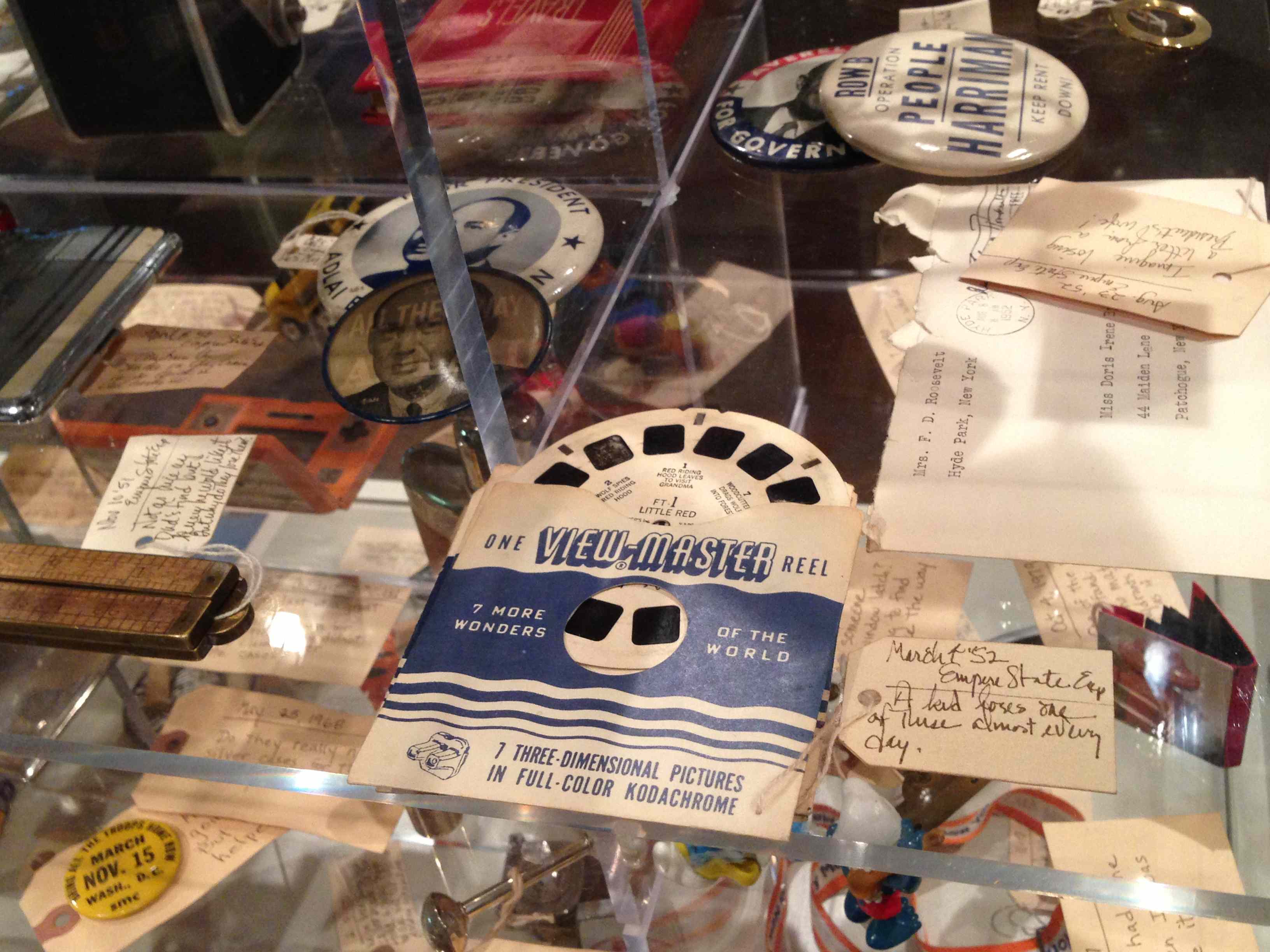
Close-up of Viewmasters and other leave-behinds inside Jane Greengold’s Lost and Found.

Close-up of Viewmasters and other leave-behinds inside Jane Greengold’s Lost and Found.

Another must-see piece (among many) is Jane Greengold’s Lost and Found. She’s created a sort-of fiction about the dozens of tagged items in the vitrine, evoking the memories and observations of generations of conductors who found items that train passengers left behind. Actually, the items you’re looking at are actual leave-behinds collected by real-life conductors, so Jane’s work isn’t entirely made up. The archeological discoveries include things from the old Lake Shore Limited on the NY Central, a 1948 boxed baby tooth, 1943 ration cards, 1952 Viewmasters, a Kennedy campaign button, and a Kindle.

Get to the Annex before July 7. In the meantime, check out curator Amy Hausmann and her artists telling about the fun they had contemplating time, architecture, fashion, and Jackie O.

Bird Watching Opportunity at The Met

1-4 Birds in Japan

Detail from Flock of Cranes (1767-1784) by Ishida Yutei, a six-panel folding screen

An avian free-for-all is happening on the second floor of the Met’s Asian Wing, with a lot of flapping, stalking, crowing, and displaying for all the world to see through July 28.

The birds (and one big, hairy deer) really come alive in the Sackler Wing show, Birds in the Art of Japan, The curators went into the collections to dig out masterworks featuring dozens of species of birds native to Japan, including medieval to modern clothing, jewelry, paintings, sculptures, ceramics, and baskets. If you’re a bird-lover still wondering whether the AMNH will ever bring back the Birds of the World dioramas in all their splendor, you’ll find comfort on examining all these species close up in the quietude of the Met,

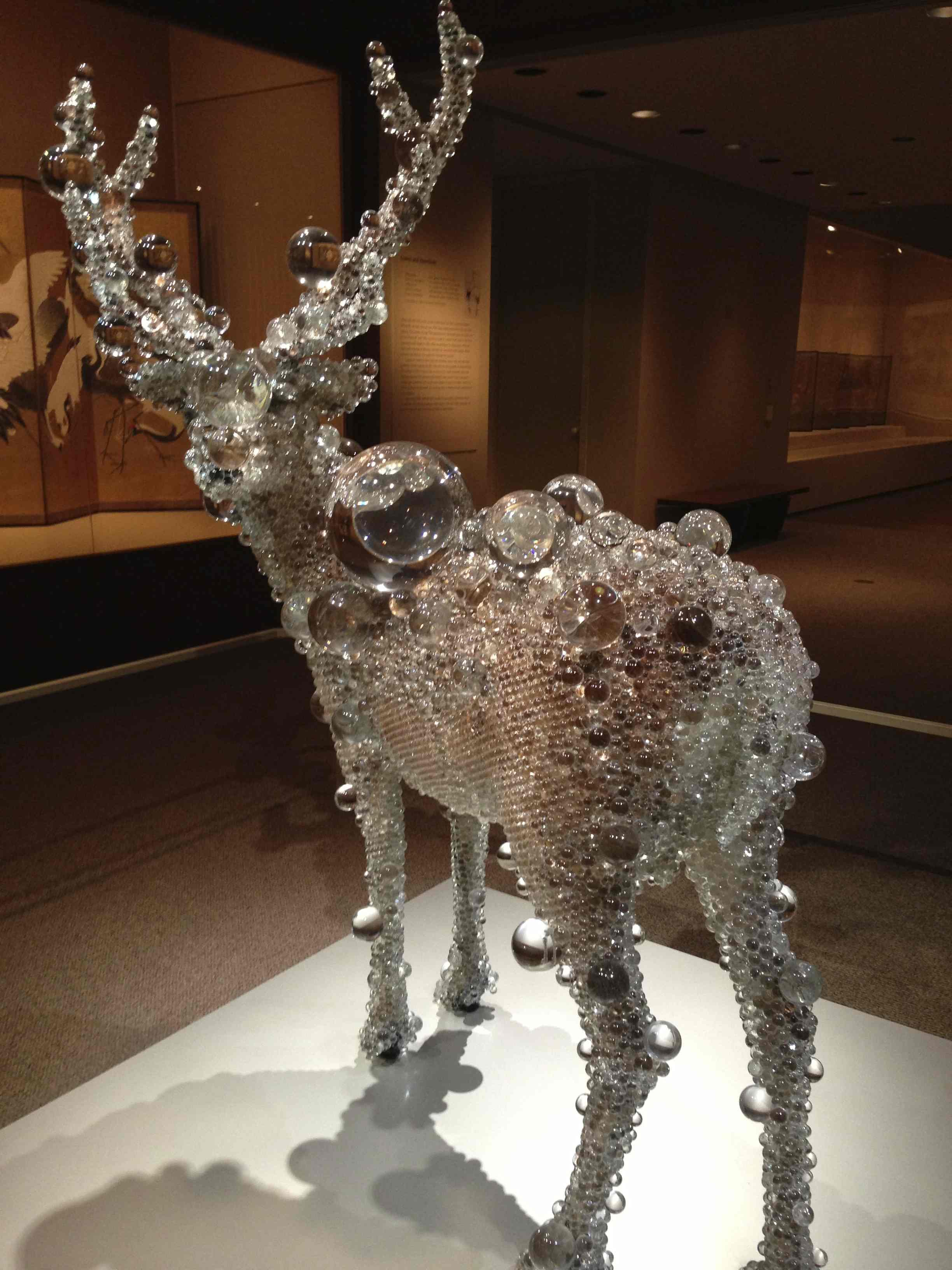
The exhibition starts behind the 12th century Buddhist temple platform and just past the 13th Century Bodhisattvas, where you’re greeted by a charming rooster that’s actually an 18th century incense burner. Turn the corner and you’ll come face to face with a startling 2011 Japanese sculpture — Kohei Nawa’s PixCell-Deer#24, an auspicious presence (ref. the messenger animal of the Shinto deities) in the form of a taxidermy specimen that Kohei creativly covered in glass bubbles.

How did Kohei Nawa’s deer get in here?

How did Kohei Nawa’s deer get in here?

Every gallery delivers a surprise, from the water birds area right through to the “exotics”. Exquisite paintings of the 1700 are interspersed with startling realistic works by the masters of the forge. One of the show-stoppers is a spectacular life-size iron eagle hovering from his perch in the raptor gallery that the curators reckon was made for display at one of the late 19th century world expositions. The detail is amazing. Each feather was forged and riveted individually onto the bird’s metal body. It’s no wonder that the eagle, a nearby raven, and another headdress normally live in the Arms and Armor Department at The Met. Nice collaboration!

Check out our Flickr site for a walk-through of some of our favorite works, including the embroidered Phoenix-covered kimono, the 1908 Peafowl painting/screen by Mochizuki Gyokkei, Asano Toshichi’s hawk-shaped zither, and Kamisaka Sekka’s artistic book, which is brilliantly displayed in interactive form by the Met’s digital team.

Spectacular iron eagle lent by Arms & Armor Department

Spectacular iron eagle lent by Arms & Armor Department

Enjoy this wildlife walk through the eyes of artists on the other side of the world, and be sure to relax in the George Nakashima reading room – a kind of “fire pit” roundtable where we found visitors sharing their impressions of the show. Check out the Met’s on-line catalog of the exhibition, but do yourself a favor and hike over to the Met in the next month before these birds fly away back to the collections.

You won’t be seeing the birds in the wild, but it’s likely that J.J. Audubon would approve. You’ll find joy in getting to know your new Asian friends, who you will likely spot in future exhibitions or in the aviary at the zoo.

Kimono embroidery detail. What did the Phoenix signify to this 19th c. bride?

Kimono embroidery detail. What did the Phoenix signify to this 19th c. bride?