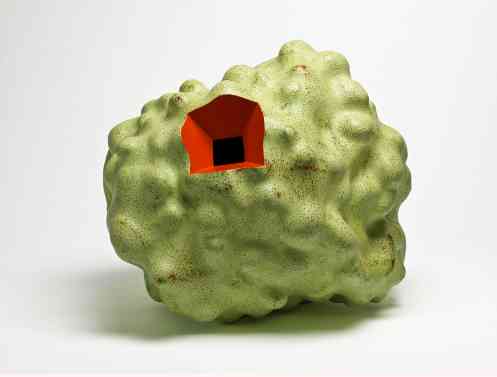
Catalog cover close-up of Price’s finely sanded ceramic surfaces
If you want to feel happy, step into the Frank Gehry-designed space at the back of the first floor of the Metropolitan Museum of Art before September 22 to see Ken Price Sculpture: A Retrospective.You’ll find colorful abstract ceramic sculptures that absolutely defy you to smile.
Blobs, twists, eggs with things popping out, and joyful fantasy shapes abound in the clean, white space. It’s impossible to make sense out of any of it, except the feeling that you are let loose inside the mind of a California artist, who claimed to have a “highway to the unconscious.”
Price, a superstar on the West Coast, is fairly unknown here in the East, so it’s nice to get to know him. As a student, he was tutored by legendary ceramic artist Peter Voulkos and then worked mostly around Venice, California (and occasionally Taos) for the next 50 years, producing delightful, collectable pieces, and hanging out with LA greats Rusha, Irwin, Keinholz, Bell, and Bengston.
The show begins with Price’s most recent work and works back through time, so you’ll encounter some of the larger, crazier, colorful pieces right as you walk in. Some of the ceramic surfaces of look pebbly and coarse, but this is right where Price worked his magic. He painted coat after coat atop his fired pieces, and then meticulously sanded it all down to make a silky smooth surface. You really can’t tell unless you’re eyeball-to-eyeball with the blob sculptures, but the cover of the catalog (top left) gives you a hint.
This experience suggests the type of fun, contemporary shows that The Met will mount when it takes up residence at the Whitney’s building on Madison, once that institution decamps for the High Line in 2015.
Take 3 minutes to let curator Stephanie Barron walk you through LACMA’s installation earlier this year, which is pretty much what you’ll experience on Fifth Avenue. She tells you a little about Gehry’s gallery approach and talks about her relationship with the fun, fabulous Ken Price. Enjoy the spin, and get over to The Met for some real California fun.
All those years walking up and down the aisles at craft fairs may have you convinced that there’s nothing new in wood art. Get over to the final days of Against the Grain: Wood in Contemporary Art, Craft, and Design at the Museum of Art and Design.
It’s not what you’d expect, and curator Lowery Stokes Sims has done a magnificent job in telling us what’s trending now with forward-looking artists on the scene.
In short, she focuses her two-floor exhibition on seven trends that she sees: Artists, like Ai Weiwei, working on socio-political themes, whimsical designers who make us smile, digital artists pushing the envelope with wood, collages, virtuoso technique, takes on trees, and works that just capitalize on the beautiful texture in the wood itself.
Check out our Flickr feed for views of some of our favorite works, and MAD’s four-minute video as Sims herself walks you through the show, the artists, and her thinking about the pieces and themes.
Steam-bent ash chairs by Christopher Kurtz
But let’s focus on some of our favorites, which you can see on Flickr.
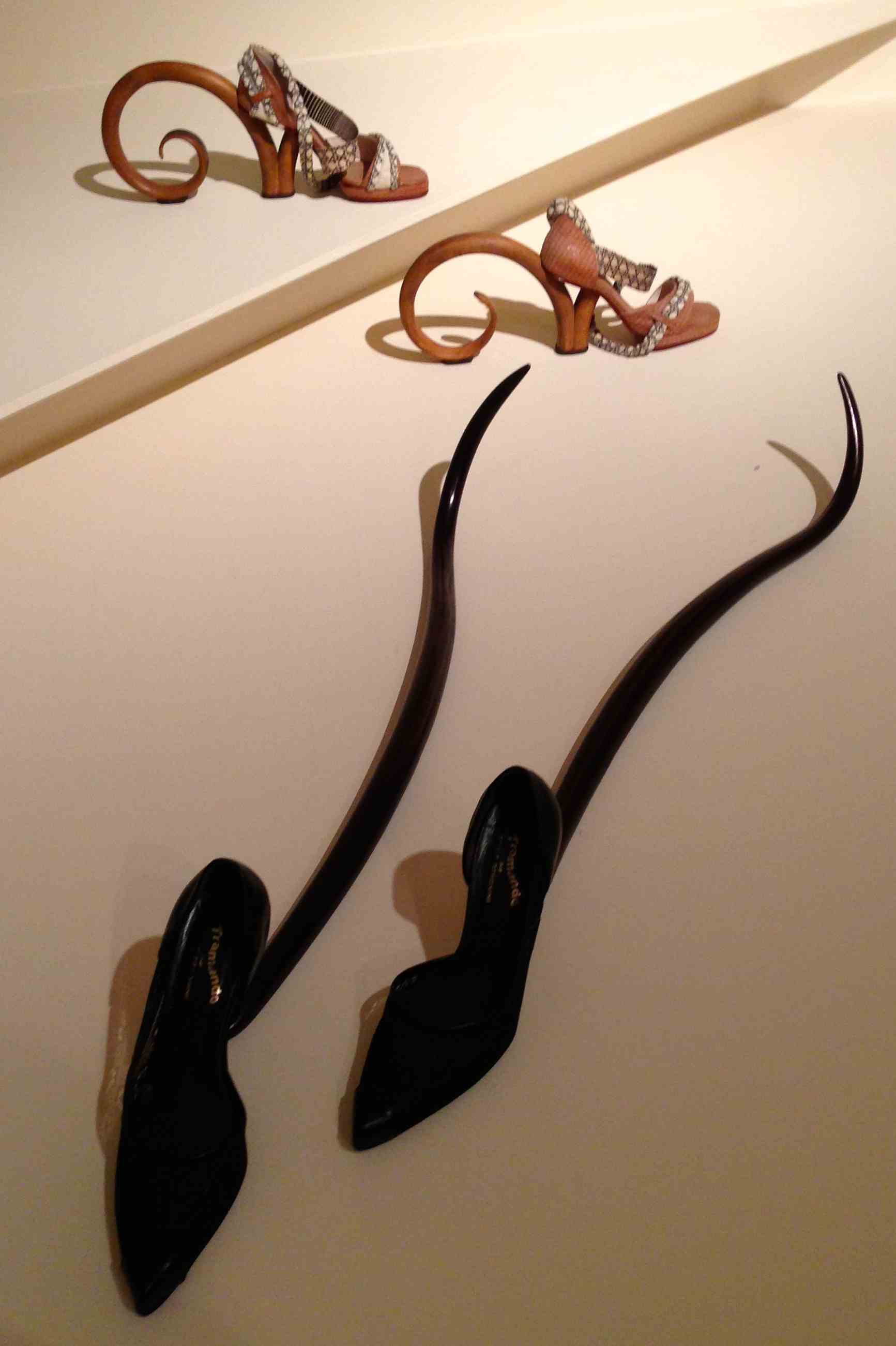
Wood as fashion: What about these shoes by Pablo Reinoso? If you’re thinking Dutch wooden shoes, think again, because these dainties are inspired by Thonet chairs, that he’s embellished with long, wooden “tails”. Or wooden hats by fashionable Moody & Farrell of London.
Music: How did Maria Elena Gonzalez go from looking at a fallen birch tree to creating paper-thin birch rolls that can create stunning music on a player piano? Watch and hear it all on this video of her player piano in action.
Laurel Roth’s Hominid: Chimpanze (2011) from vere wood with Swarovsky crystals in the teeth
How-did-they-do-that category: Bud Latvin’s gravity-defying wooden spiral sculptures, Christopher Kurtz’s impossible steam-bent chairs, and Elisa Strozyk’s wooden textile.
Recycled surprises: Think about what it took to turn 8,000 recycled chopsticks into a collapsible sofa. Good going, Yuya Yoshida.
If you can get to this show today or tomorrow, go. If not, take time to meet Leonard Drew in his studio, see his wood works in progress, and hear what success in wood feels like:
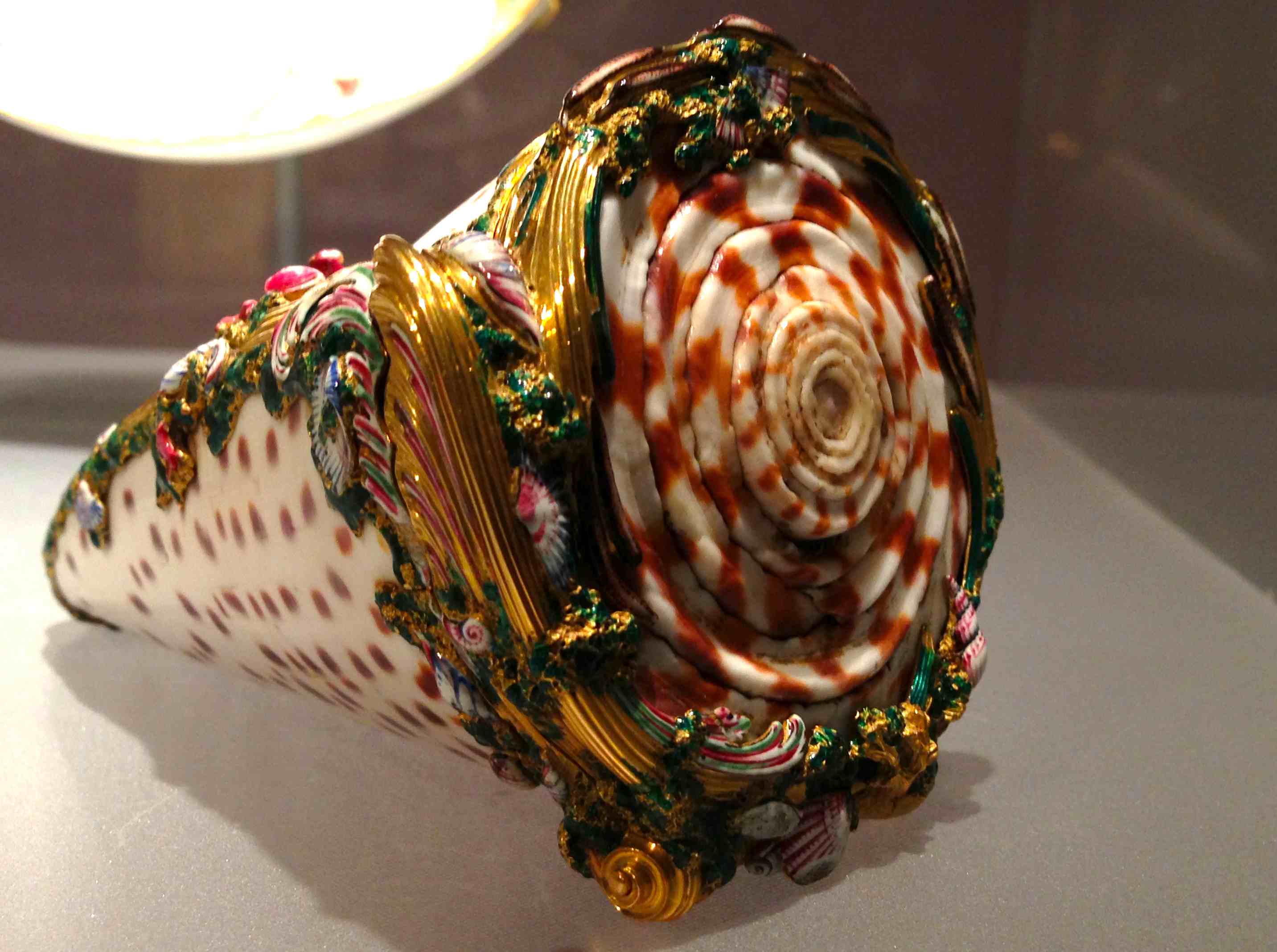
Our vote for best “fancy” object: A beach shell embellished with enamel and gold by Barnabe Sageret around 1745.
You wouldn’t think that a presentation of luxury items would emphasize democratic participation, but that’s just what the Metropolitan Museum has embedded (on line and onsite) within its thought-provoking, beautiful show, Plain or Fancy? Restraint and Exuberance in the Decorative Arts, on view on the first floor through August 18.
The curators of European Decorative Arts have assembled “plain” objects to the left side of the gallery, “fancy” ones on the right, and…well, they’ve asked you to decide about the ones in the middle. Tablet screens in the exhibition and the Met’s web site have an interactive that lets you choose if some of these are to your taste and how you’d classify them. You can enter a comment about each that shoots off to the show’s Twitter feed.
Our vote for best “plain” object: The obviously expensive porcelain bowl used by Marie Antoinette at her “fantasy” dairy farm. The curators tell us that the head of the Sèvres Manufactory was worried that his other clients would think it was too “barbaric.”
The whole idea of the show was to gather some of the greats from the European Decorative Arts collection and ask the viewers to consider their own feelings about “plain” and “fancy” (derived from “fantasy”). If something is “plain”, do you feel more noble admiring a piece’s elegant simplicity? If you see a grandly embellished bauble, does it make you cringe, or give you a sense of relief that someone else’s purchase is stimulating the economy?
The curators don’t refrain from hammering these gems into their socio-political contexts. One of the “plain” porcelains is a Sèvres bowl used by Marie Antoinette as she cavorted with friends on her fantasy dairy farm pre-Revolution. Several “plain” pieces of silver tableware were likely made from melted down “fancy” pieces after Cromwell’s 17th-century reformation in England. The photos on our Flickr site let you in on what the curators said about many of our favorite items.
Is it “plain” or “fancy”? A clean design on a giant 1635 glass goblet inscribed with a detailed cartography of the course of the Rhine River. J.P. Morgan liked it and gave it to the Met.
Items range from the 1400s to the 20th century. One of our favorites in the “fancy” imagination department is a snuff box made from a beach shell decorated lavishly with enamel and gold. Who wouldn’t want to look at that? Another is a gigantic Dutch glass goblet that has been engraved with a detailed map showing the entire course of the Rhine River. Amazing.
The show is filled with Wedgwood, Sèvres, Wiener Werkstätte, and other surprises. Although you can see the items in the show on the Met’s website, it’s much better to examine these items up close in person and read what the curators had to say about each.
Better yet, think about how you feel about the designs, and weigh in on Metmedia and Twitter. What do you choose?
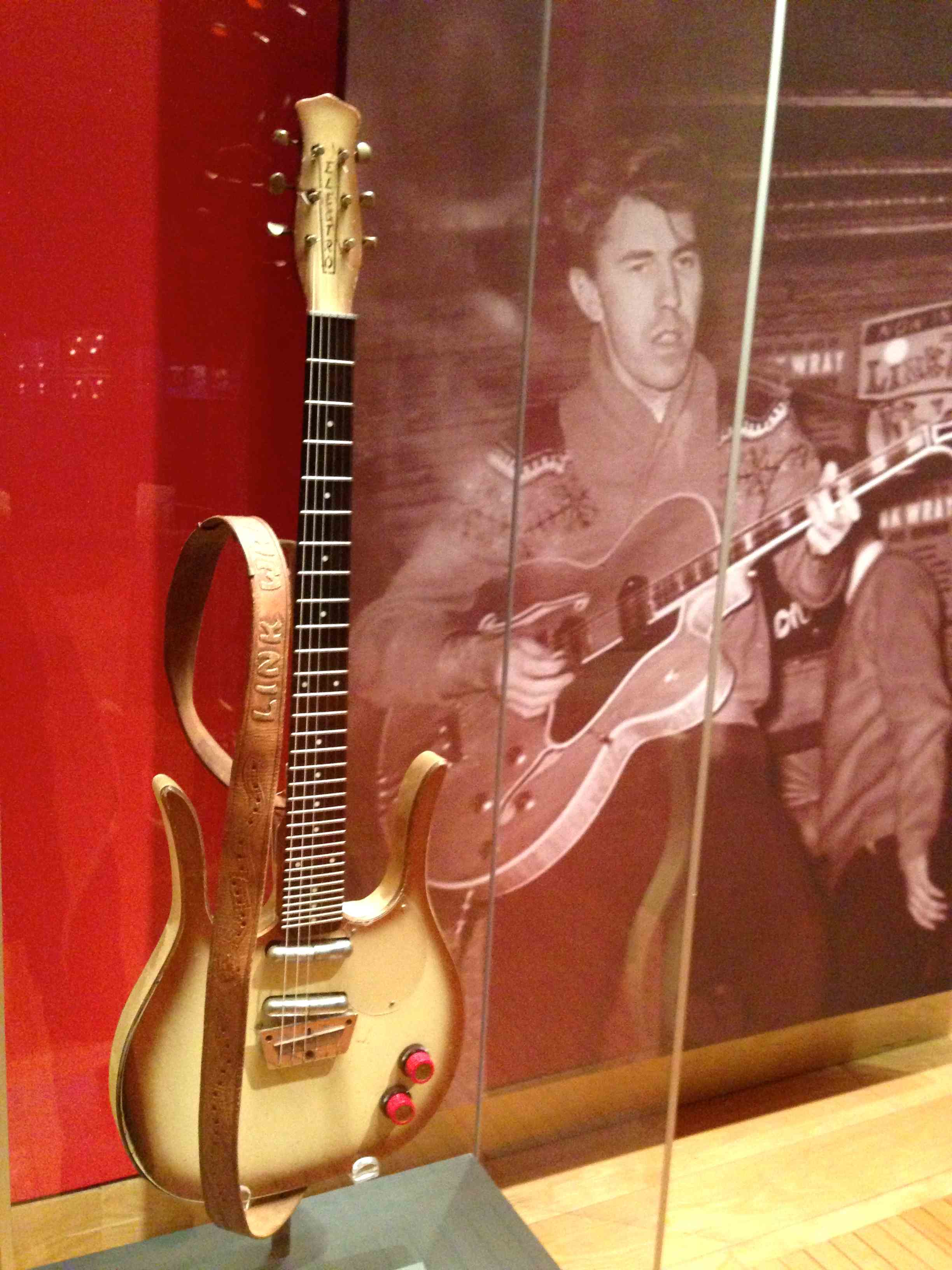
Link Wray in the 1950s and the guitar that introduced the power chord, wah wah, and distortion to rock ‘n’ roll
It’s not all flute music. Did you know that Link Wray, a Shawnee rock innovator, created the wah-wah, the power chord, and distortion echo that all rock superstars since the 1950s adopted? It’s just one part of the story told by Up Where We Belong: Native Musicians in Popular Culture, up through August 11 at the National Museum of the American Indian down at New York’s Customs House.
Don’t take our word for it. Take a seat in the comfortable bandstand-lounge inside the show and watch as Led Zeppelin’s Jimmy Page and The Edge discuss the importance that Wray’s innovations had on them and everyone in the scene.
The show doesn’t ignore jazz, blues, or rap but a lot of the pizzazz is seeing the stuff associated with folk, rock, and country stars alongside quotes (on the walls and in video clips) from legends like Slash, Ringo, Townsend, and Dylan testifying to the ties they had to fellow artists like Robbie Robertson, Jessie Ed Davis, and others. The show has historic (and beautiful) guitars and that famous multi-colored coat worn by Jimi Hendrix. You’ll really be amazed at the profusion of talent and historic connections.
Installation view with photos of Stevie Salas, Jessie Ed Davis, and Randy Castillo.
You don’t normally associate Jimi Hendrix with the tribes, but the NMAI scholars reveal that his paternal grandmother was Cherokee who once played on the vaudeville circuit. It’s also a surprise to see Randy Castillo’s drum set from the last Mötley Crüe tour suspended reverently overhead. (Randy replaced Tommy Lee.) Check out our Flickr site for views of the show.
The NMAI scholars, as usual, did a stellar job digging out the facts behind the men and women honored. Like reminding us that Jessie Ed Davis first met John Lennon at The Rolling Stones Rock and Roll Circus and that Johnny Cash was one of the first pop music voices singing out on behalf of the Native American cause back in the 1960s.
The Hendrix coat of many colors
The heart of the show, however, is the music. NMAI made sure that there’s plenty of opportunity to listen in to why these stars were great. You can sink into big, red settees throughout the space and snap on headphones, relax in the bandstand-like lounge room to watch 20 film clips, or play with iPads in the listening gallery. You’ll enjoy hearing Buffy sing “Universal Soldier”, Kristofferson and Coolidge performing their Grammy-winning duets, Link Wray rocking out with “Raw-Hide” during the American Bandstand days, and Illinois Jacquet’s swinging tenor sax on “Stompin’ at the Savoy”.
The NMAI did an incredible job not only with the show itself, but also with its fascinating run-of-show blog, which includes articles on how the Hendrix coat was loaned to the show, jazz great Mildred Bailey, and recollections contributed by the show’s visitors.
Enjoy this walk through music history and reconnect with some of the best in the business. A truly wonderful slant on what makes American pop culture so great. If you’re in New York, get down to see Rita Coolidge in person at her free NMAI concert at 6pm on Thursday, August 8.
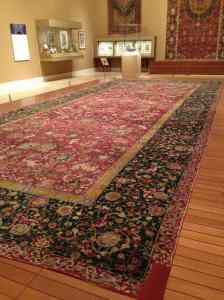
Installation view of the Emperor’s Carpet, second half 16th century. Iran, Safavid period (1501–1722). Source: The Met.
If royal guests had walked all over your Persian carpet for the last 600 years, how many repairs would you need? Before coming to the Met, the 16th-century Emperor’s Carpet, covered in animals and poetry, was once owned by the Shah of Iran and the Hapsburgs.
Since this large, beautiful carpet arrived in New York 60 years ago, the Metropolitan Museum was only able to display it twice because it was in such fragile shape. When they turned it over, they saw it had been patched over 700 times. How could they stabilize it and install it in their expansive New Galleries of the Art of the Arab Lands on the second floor?
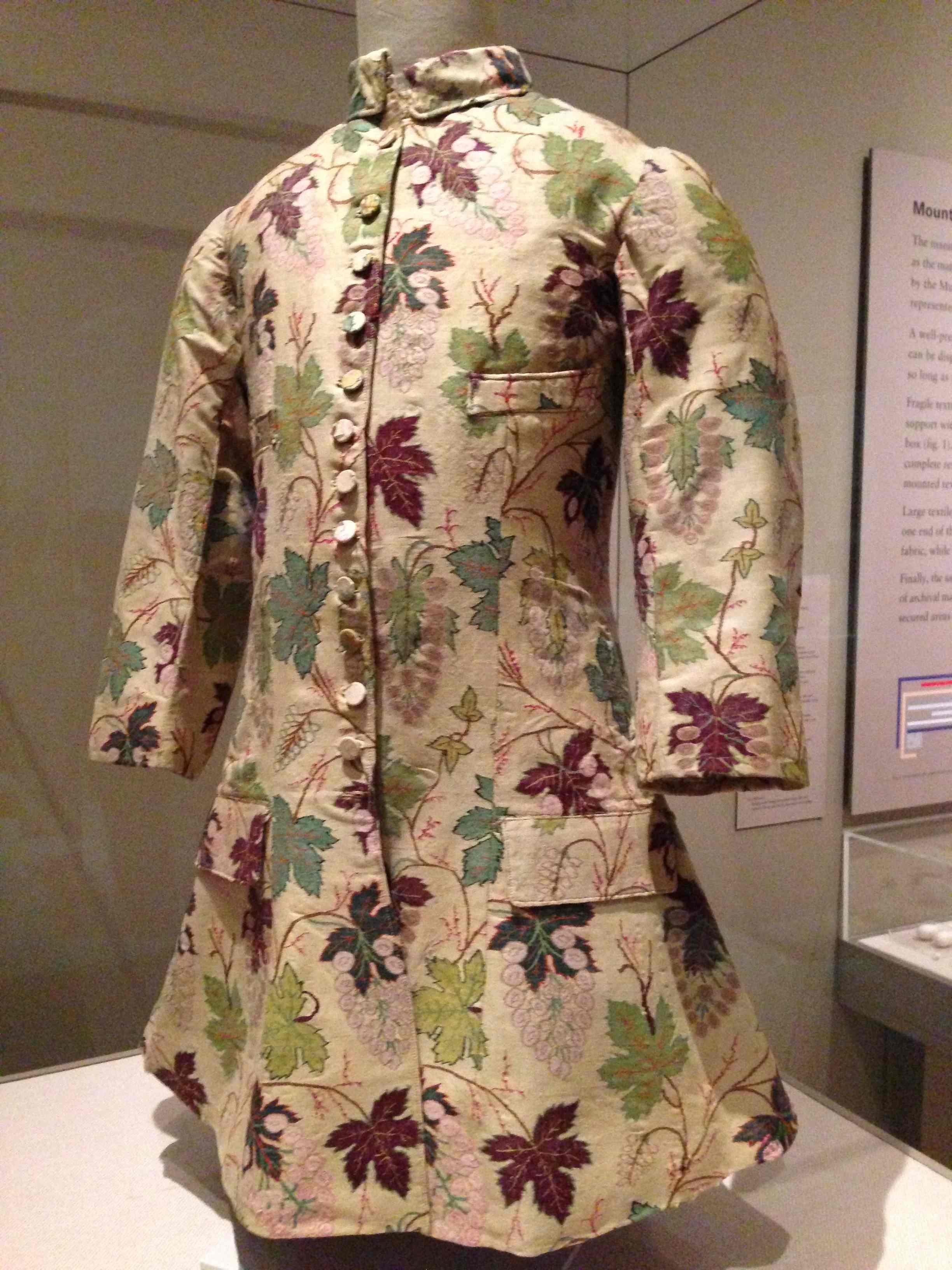
The show features all manner of science, technology, and process that the magical conservators put to work for other pieces, too – ceramics, tapestries made of gold and silver threads, wood, and works on paper over the last 2,000 years. One of our favorites is the child’s coat made from antique pashmina. They also have examples of the natural materials that were crushed and pounded into pigments for all these beautiful dyes and paints.
Although the gallery is tiny, the Met decided to send visitors on a treasure hunt by providing a brochure through which seekers of conservation wizardry can locate the Emperor’s Carpet and other works throughout the dozens of Islamic Art galleries. See the details on these and more our Flickr site.
Child’s coat from India on display in the show. Tailored in the late 19th c., but but fabric woven late 18th c. The textile is from Kashmir and is likely pashmina.
One of the shockers is seeing what the conservators reckon are the true colors of the 1707 Damascus room, long a favorite of Met period-room fans. The science showed that the darkened panels that we’re so familiar with were once bright, bright blue and gold.
If you can’t see the conservator’s showcase before August 4, read about all the science and technology on line at the special web site. You’ll find links to the stories of rehab for the carpet, the child’s coat, the gold-weave chadar, and more.
If you have eight minutes, take a look at three years of work on the royal carpet by the Met’s magicians:
Infant-size palm leaf sandals (only 2 x 5 in.) made at the Kharga Oasis, Byzantine-era Egypt (4th-7th c.)
Will all the excitement over babies this week (the Royals and the Fallons), you might want to sneak a peak at some of the most perfect infant shoes ever, on display at the Met’s micro-exhibit, Objects from the Kharga Oasis, right under the grand staircase just past security until August 4.
Back in the 1930s, Metropolitan Museum archaeologists found this pair of infant sandals crafted beautifully from palm leaves at an oasis in the western Egyptian desert that was one of the earliest frontier Christian communities serving the trans-Saharan caravan routes.
The shoes are tiny – only about 2 x 5 inches – and were made during the Coptic (Byzantine) era sometime between 300 AD and 600 AD. There are also 1,500 year-old linen tunics and caps for kids and adults nearby, too. It’s amazing that the clothing survived at all.
Totally wearable Kharga bracelet. Iron from 4th-7th c. Egypt. Source: Metropolitan Museum of Art
Besides building churches (and there are plenty of photos and illustrations in the show), the communities around Kharga were busy growing grains, sesame, olives, and grapes. They apparently had a huge business making and exporting wine to the thirsty Egyptians 150 miles east along the Nile and 400 miles northeast in Cairo.
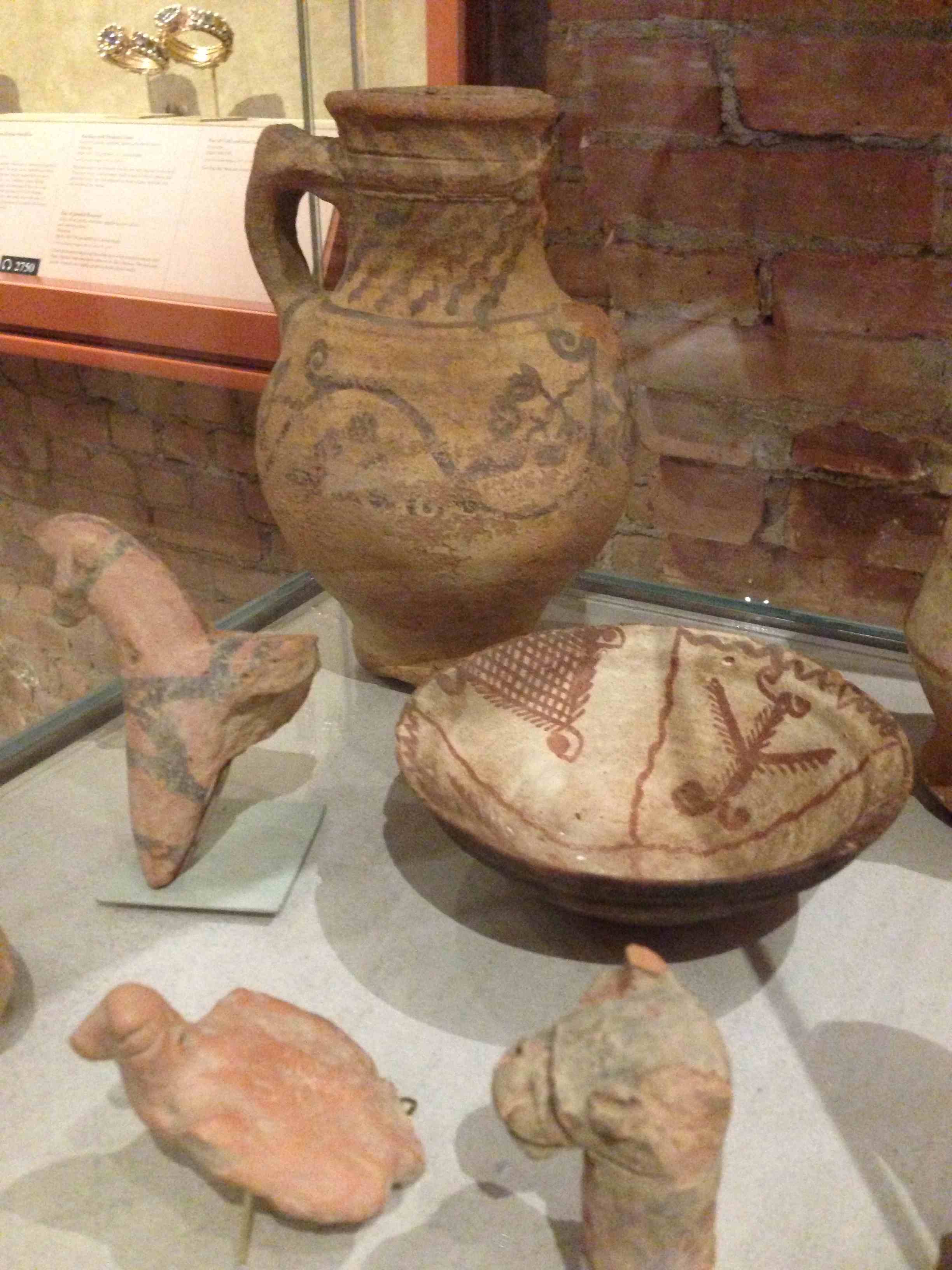
Drawing upon a ceramic craft tradition that was happening at the oasis since Old Kingdom times (2600 BC), potters cranked out transport jugs for the vino (shown here) and decorated them with grapevine paintings. The show has jewelry, tombstones, and photos of early Christian churches, but the brand-new-looking baby shoes are really the stars of the show.
Among dozens of ceramic items dug up by the Met are grapevine-decorated earthenware jugs to transport locally made wine from the Oasis to the Nile and upriver to Cairo.
There’s no way to cool off the Spanish heat you’ll experience at the dance-til-you-drop exhibition Flamenco: 100 Years of Flamenco in New York, currently in the last weeks at NYPL’s Library of Performing Arts at Lincoln Center (until August 3).
NYPL gives us videos, recordings, a few costumes, and other memorabilia, but mostly you’ll hear the castanets and rapid-fire footwork of the best of the best. Who knew that the first woman to appear in front of Edison’s movie camera was Carmencita, the Spanish sensation who debuted at Niblo’s Garden in 1889, and had a fairly good run at Koster & Bial’s Music Hall on 24th and Sixth Avenue. Her portrait by Sargent is at the Musee d’Orsay and her portrait by Chase at the Met. Here’s a link to Edison’s 1894 flick.
Carmencita’s fan photo (c. 1890). Source: NYPL Billy Rose Collection
This first Spanish-dance craze was further fueled in 1916 by the arrival in New York of La Argentina (Antonia Merce), Spain’s first modernist dance artist who fused classical dance, regional styles, and Flamenco. A decade later, she returned with a full company and presented New York’s first full-length Spanish dance-theater piece. By then, Ruth St. Denis, Martha Graham, and Ted Shawn were already incorporating Latin moves, gestures, and rhythms into their performances, and La Argentina’s company had a spectacular run. Here she is in a solo.
Although there’s lots more to the story, one of the best parts of the exhibition features photos, albums, videos, and recordings of the fast footwork of Carmen Amaya, who Sol Hurok billed as “The Human Vesuvius” in her 1941 New York debut. She could kick the 15-foot train of her dress right into the air.
Amaya’s innovation is that she injected a bit of the Gypsy style into Flamenco and was somewhat of a Spanish-dance rule-breaker – sporting tight-fitting trousers to show off her super-fancy footwork. Superstars Dietrich and Hepburn were also wearing trousers at the time, but it was a first in Amaya’s field of work.
Good move, Carmen, as shown in this clip from Follow the Boys, a 1944 all-star vehicle released by Universal to boost morale during the War. It’s like watching a great jazz tapper at work. Move over, Riverdance people.
Source: Archival clip, Follow the Boys, from the DVD, Queen of the Gypsies, A Portrait of Carmen Amaya.
Too hot to get over to the Met this weekend and climb up all those high stairs out front? Stay in the comfort of your air-conditioned home and take this virtual tour of the Met’s Punk: Chaos to Couture show (closing August 14).
Curator Andrew Bolton explains the real-life inspirations for much of the iconic looks in this show –people from music, pop, and celebrity worlds, taking you through the galleries one by one, emphasizing the importance of recycling and deconstruction to the haute couture designers of today.
Our favorites: Rodarte’s crochet looks alongside those of Westwood and McLaren, McQueen’s faux recycled trash bag dresses, Chris Bailey’s spiked Burberry ensemble, and the great finale – Comme des Garcon’s amazing collection with trousers, mutton sleeves, and disassembled pieces of clothing brilliantly attached for maximum punch to the runway models.
Open-source vacuum assembled from downloadable instructions, a red thermos, hardware store items, and 3D printed parts
If you haven’t been exposed to the DIY (Do It Yourself) movement, drop into the New Museum’s Adhocracy show at its Studio 231 storefront this weekend.
It’s a 25-project showcase of cutting-edge design solutions, including DIY as well as some film, video, low-tech high tech, and crazy, new approaches to making stuff in the 21st century.
The DIY sections that we particularly liked were the household appliances made by downloading Open Source instructions, manufacturing components with 3D printers, and buying the remaining bits and pieces at the hardware store. Why spend money on a Dyson when you can build your own vacuum cleaner from a thermos container and other scrounged parts? Each solution is more fascinating than the next, with displays of OS-compatible coffee grinders, water boilers, and bicycle parts and their instructions.
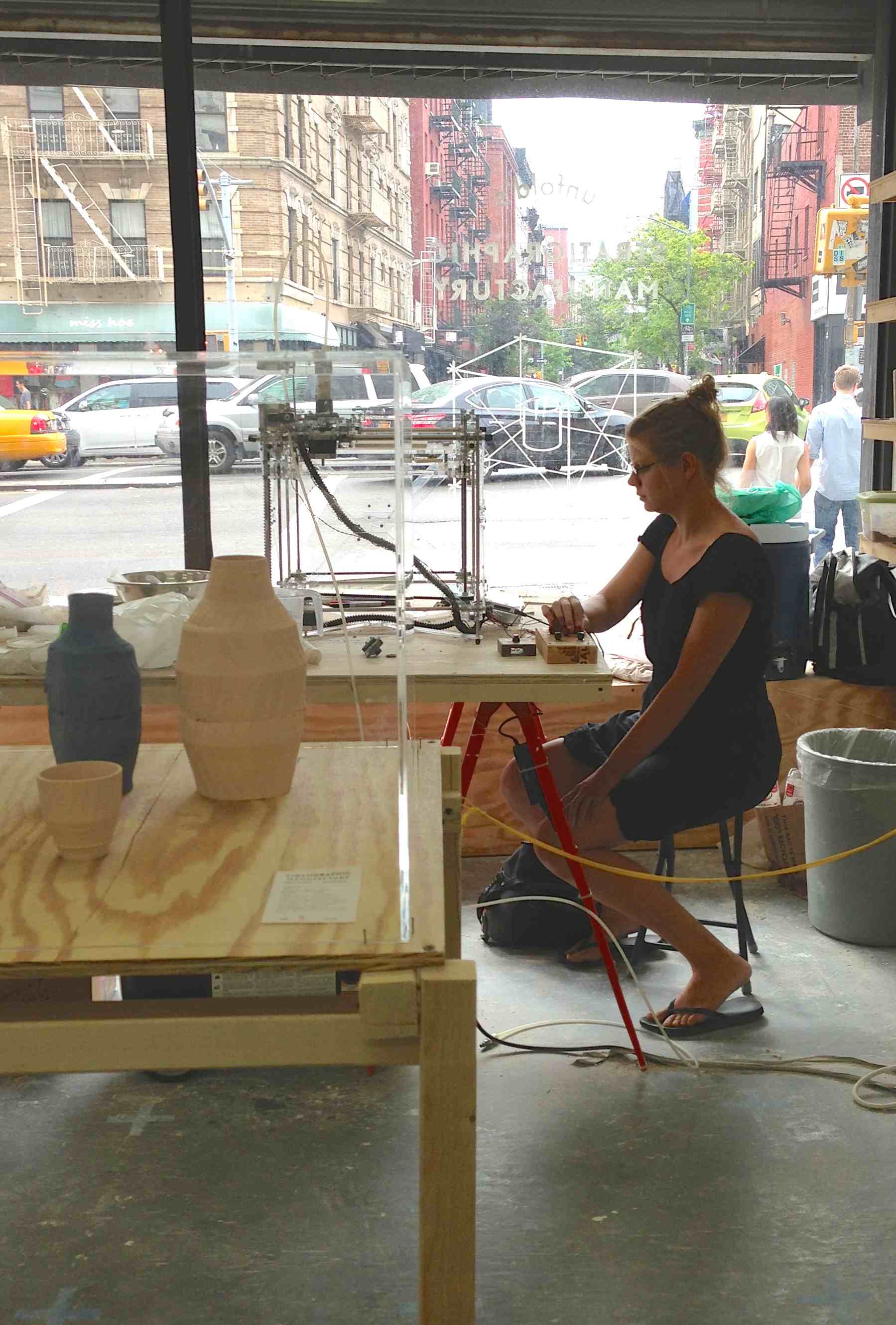
Larisa Daiga uses Unfold’s Stratigraphic Manufactury (3D ceramic device) to make coil pots from Gowanus sludge
Other displays highlighted the best inventions from Kickstarter (e.g. Central Standard Time wristbands and iPod Nano multimedia wristwatches) and solutions for using the Arduino microcontroller – lion tracking collars in Kenya and an earthquake-sensing device created and marketed by a 14-year old in Chile. It tweets you when there’s a tremor. Click here to see some photos, and if you feel like making something, explore your options on Adafruit..
Right in the storefront window, NYC ceramicist Larisa Daiga uses a ceramic 3D printer to make a tiny coiled pot. Larisa told us that she couldn’t touch the porcelain, because it was actually sludge from Brooklyn’s beloved Superfund site, the Gowanus, and loaded with biotixins.
Daiga felt it was interesting to be part of Unfold’s Stratigraphic Manufactury project, making coil pots (one of the oldest technologies of humankind) with toxic waste. Days spent in the window of Adhocracy let her contemplate how sludge might be reused and recycled instead of being trucked and dumped into unsuspecting landfills in the rest of the country. View her Adhocracy output and see the machine at work on her Flickr feed.
Another DIY favorite from Helsinki is featured in the show — Restaurant Day, when everyone in the city has permission to open their own restaurant on the curb. It’s one step beyond Smorgasburg.
Since Smithsonian branches and other Washington, D.C. museums, zoos, and gardens began posting videos on line in 2007, collective YouTube views have climbed to 14 million, as chronicled in our latest report, Washington D.C. Museums: 2013 Video and Social Media Rankings.
Although the 14 million total is less than the 49 million views racked up by New York museums, don’t forget that two high-profile DC institutions – National Geographic and the Smithsonian – produce significant amounts of programming distributed on their popular cable TV channels, dedicated apps, and snazzy web sites. Even though it has a DC museum space, NatGeo (a joint venture with Fox Cable) has largely abandoned YouTube; however, the 18 individual Smithsonian branches are all still posting their own stuff regardless of the more comprehensive joint venture with Showtime.
In the Top Cultural Museum Video, archival footage is cleverly coupled with behind-the-scenes looks at the National Archives’ 1940s Census release
Here are some findings from our report on video and social media produced by DC institutions:
As of year-end 2012, the Washington museums having the highest number of total YouTube channel views were the Library of Congress (4.5M), the National Archives (2.1M), and the United States Holocaust Memorial Museum (1.6M). The top two are information powerhouses with massive collections to push out for public consumption, and the third is right on their heels with an innovative series with curators interpreting interesting items from their collections.
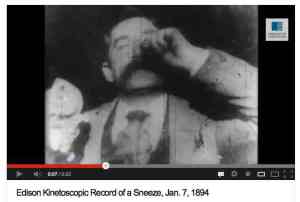
All-time top DC museum video, one of Edison’s earliest films, with over 329K hits on YouTube
Edison still delivers. It’s interesting that the top ranked DC museum video of all time is Edison Kinetoscopic Record of a Sneeze, Jan. 7, 1894, the earliest surviving copyrighted movie – suggesting that our greatest media innovator is having the last laugh, contributing over 329,000 hits to the number-one ranking by Library of Congress on YouTube. It’s short enough for Fred Ott to be on Vine.
Four museum video channels have surpassed 1 million views. To put the DC numbers in context, if they were merged with the New York museum video rankings, the Library of Congress (4.5M) would rank seventh, just ahead of the Metropolitan Museum of Art. The Library of Congress would rank eight (2.1M), just ahead of the New York Public Library.
The National Zoo produced Washington’s top-viewed 2012 museum video – Shanthi, the National Zoo’s Musical Elephant, Plays the Harmonica!. Over 290,000 viewers watched this middle-aged mom experiment with a musical instrument in her enclosure and listen to her keeper talk about her performance. Shanthi’s viewership greatly surpassed the numbers generated by the most popular 2011 Washington museum video, the National Portrait Gallery’s Conan O’ Brien as Seen by Artist John Kascht. Surely, Conan would be amused.
The Smithsonian American Art Museum’s Top Exhibition Video of 2012 features curator Chris Melisinos describing why video games belong in an art museum
The top cultural video was a behind-the-scenes work at the National Archives for the release of the 1940s census. Over 115,000 family historians watched Learn About the 1940s Census, which showed the Archives census team, provided information on how to find your family’s records, and worked in interesting archival footage from the original census.
The Smithsonian American Art Museum produced Washington’s top video about a museum exhibition.Over 28,600 people watched The Art of Video Games: Chris Melissinos, Curator, a brief look into the evolution of the stories, technology, and visualization advances of this mass entertainment medium.
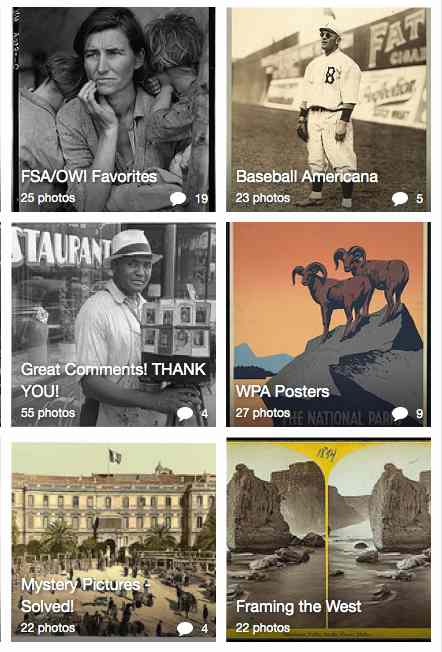
A few of the Flickr sets from Library of Congress
The most active Twitter users are the National Museum of American History, the National Air and Space Museum, and the National Postal Museum. But except for Air and Space, it’s a different set for Facebook followers.
The most active Flickr users are the National Archives, the Library of Congress, and the Smithsonian American Art Museum. The Archives has organized its photos into creatively themed sets, such as “White House Wednesdays,” “Millinery Monday,” pictures of the 1940s census being taken, and pets of the First Families. The Library of Congress also posts a folder containing “mystery” photos and asks the public to help to identify them.
All the detailed video and social media statistics on 42 museums are in the report. Click here to see what’s included and make a purchase from our Its News To You Reports shop.
Enjoy the most popular DC museum video, a musical visit with the National Zoo’s sensation, Shanthi:

















 itsnewstoyou