Infant-size palm leaf sandals (only 2 x 5 in.) made at the Kharga Oasis, Byzantine-era Egypt (4th-7th c.)
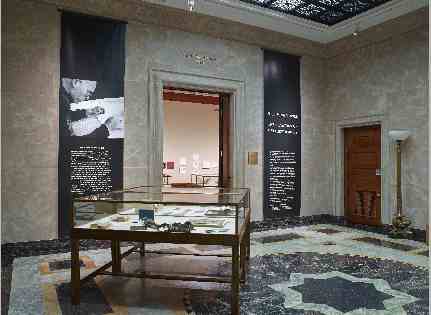
Will all the excitement over babies this week (the Royals and the Fallons), you might want to sneak a peak at some of the most perfect infant shoes ever, on display at the Met’s micro-exhibit, Objects from the Kharga Oasis, right under the grand staircase just past security until August 4.
Back in the 1930s, Metropolitan Museum archaeologists found this pair of infant sandals crafted beautifully from palm leaves at an oasis in the western Egyptian desert that was one of the earliest frontier Christian communities serving the trans-Saharan caravan routes.
The shoes are tiny – only about 2 x 5 inches – and were made during the Coptic (Byzantine) era sometime between 300 AD and 600 AD. There are also 1,500 year-old linen tunics and caps for kids and adults nearby, too. It’s amazing that the clothing survived at all.
Totally wearable Kharga bracelet. Iron from 4th-7th c. Egypt. Source: Metropolitan Museum of Art
Besides building churches (and there are plenty of photos and illustrations in the show), the communities around Kharga were busy growing grains, sesame, olives, and grapes. They apparently had a huge business making and exporting wine to the thirsty Egyptians 150 miles east along the Nile and 400 miles northeast in Cairo.
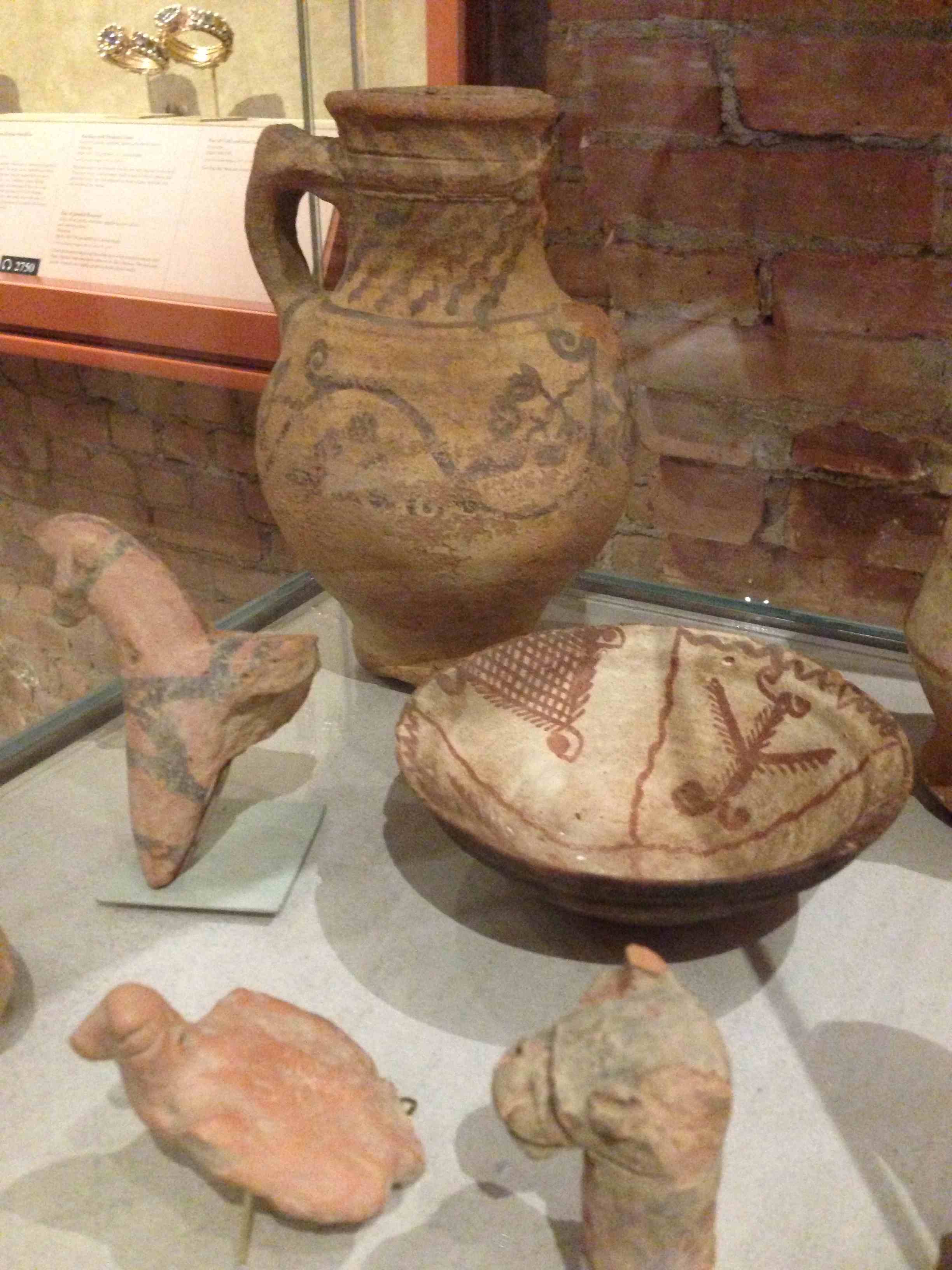
Drawing upon a ceramic craft tradition that was happening at the oasis since Old Kingdom times (2600 BC), potters cranked out transport jugs for the vino (shown here) and decorated them with grapevine paintings. The show has jewelry, tombstones, and photos of early Christian churches, but the brand-new-looking baby shoes are really the stars of the show.
Among dozens of ceramic items dug up by the Met are grapevine-decorated earthenware jugs to transport locally made wine from the Oasis to the Nile and upriver to Cairo.
There’s no way to cool off the Spanish heat you’ll experience at the dance-til-you-drop exhibition Flamenco: 100 Years of Flamenco in New York, currently in the last weeks at NYPL’s Library of Performing Arts at Lincoln Center (until August 3).
NYPL gives us videos, recordings, a few costumes, and other memorabilia, but mostly you’ll hear the castanets and rapid-fire footwork of the best of the best. Who knew that the first woman to appear in front of Edison’s movie camera was Carmencita, the Spanish sensation who debuted at Niblo’s Garden in 1889, and had a fairly good run at Koster & Bial’s Music Hall on 24th and Sixth Avenue. Her portrait by Sargent is at the Musee d’Orsay and her portrait by Chase at the Met. Here’s a link to Edison’s 1894 flick.
Carmencita’s fan photo (c. 1890). Source: NYPL Billy Rose Collection
This first Spanish-dance craze was further fueled in 1916 by the arrival in New York of La Argentina (Antonia Merce), Spain’s first modernist dance artist who fused classical dance, regional styles, and Flamenco. A decade later, she returned with a full company and presented New York’s first full-length Spanish dance-theater piece. By then, Ruth St. Denis, Martha Graham, and Ted Shawn were already incorporating Latin moves, gestures, and rhythms into their performances, and La Argentina’s company had a spectacular run. Here she is in a solo.
Although there’s lots more to the story, one of the best parts of the exhibition features photos, albums, videos, and recordings of the fast footwork of Carmen Amaya, who Sol Hurok billed as “The Human Vesuvius” in her 1941 New York debut. She could kick the 15-foot train of her dress right into the air.
Amaya’s innovation is that she injected a bit of the Gypsy style into Flamenco and was somewhat of a Spanish-dance rule-breaker – sporting tight-fitting trousers to show off her super-fancy footwork. Superstars Dietrich and Hepburn were also wearing trousers at the time, but it was a first in Amaya’s field of work.
Good move, Carmen, as shown in this clip from Follow the Boys, a 1944 all-star vehicle released by Universal to boost morale during the War. It’s like watching a great jazz tapper at work. Move over, Riverdance people.
Source: Archival clip, Follow the Boys, from the DVD, Queen of the Gypsies, A Portrait of Carmen Amaya.
Too hot to get over to the Met this weekend and climb up all those high stairs out front? Stay in the comfort of your air-conditioned home and take this virtual tour of the Met’s Punk: Chaos to Couture show (closing August 14).
Curator Andrew Bolton explains the real-life inspirations for much of the iconic looks in this show –people from music, pop, and celebrity worlds, taking you through the galleries one by one, emphasizing the importance of recycling and deconstruction to the haute couture designers of today.
Our favorites: Rodarte’s crochet looks alongside those of Westwood and McLaren, McQueen’s faux recycled trash bag dresses, Chris Bailey’s spiked Burberry ensemble, and the great finale – Comme des Garcon’s amazing collection with trousers, mutton sleeves, and disassembled pieces of clothing brilliantly attached for maximum punch to the runway models.
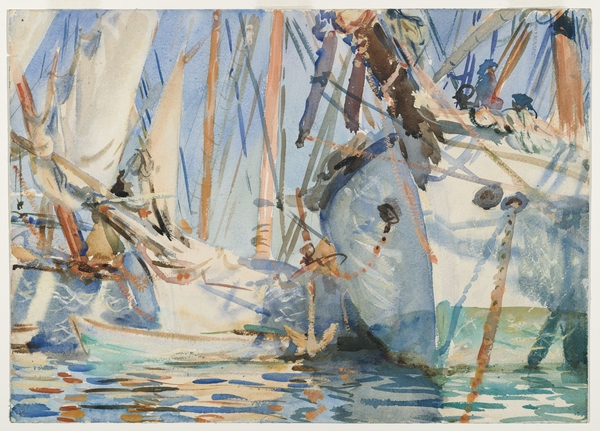
Sargent’s masterful 1908 White Ships that he likely painted in a day. Translucent and opaque watercolor and wax resist with graphite underdrawing, Source: Brooklyn Museum.
Back in 1909, John Singer Sargent’s watercolor show at Knoedler was considered a knockout, drawing discerning crowds in awe of his sensational technique. The images of Bedouin life, Venice, and boats on the Mediterranean were so compelling that the Brooklyn Museum raced in to buy 83 (nearly all of them), forcing Boston’s Museum of Fine Arts to wait until 1912, when they could clean out his entire next watercolor show.
Bedouins (c.1905–6). Opaque and translucent watercolor, Source: Brooklyn Museum.
Walking into John Singer Sargent Watercoloron Brooklyn’s Fourth Floor, you can see why the two great institutions went crazy. With 93 of their finest Sargent purchases collectively displayed, it’s impossible for visitors to pick the most spectacular. They’re all exceptional – the Bedouin horses at rest inside the tent, Sargent’s niece wrapped in her cashmere shawl, the cliffs of the Carrara quarries, and the lush Medici gardens.
How did he make such magnificent work with such an unforgiving medium? How did he whip them out? The two museums asked a team of conservators and curators to put the works under the microscope and ultraviolet light to discern more about the master’s process – the sequence of paint application, the types of paint used, and whether he did a pencil sketch before applying paint to paper.
The team gives visitors insights to the scientific process used — an unusual twist at the back of the gallery that visitors poured through enthusiastically. Brooklyn’s digital team installed a 30-second video in which paper conservator Toni Owen asks visitors what more they’d like to know. Here’s the site where she answers with comments on Sargent’s use of gouache, soft-wax resist, yellow paints, and the difficulties of explaining false-color infrared imaging (FCIR) in limited-space wall text in the gallery.
You’ll learn that Mr. Sargent painted very fast, did not rely on photographs, and did at least one watercolor sitting in a gondola.
Brooklyn’s integrating much more media into its visual art shows, and they’ve hit upon a winning combination here. Some videos show the gardens that were the subjects of Sargent’s work in Italy. Others explain the techniques that Sargent used in the painting next to it.
Listen as artist Monika deVries Gohlke reflects on the type of day Mr. Sargent might have experienced working on his 1908 Melon Boat painting. Watch as she prepares the watercolors, selects his colors, chooses his brushes, and attempts to recreate his “jungle” of shapes and impressions. Does her painting look like his? You be the judge and go get your own paintbox.
Andy is kicking Mr. Munch’s Scream up a notch on Park Avenue, all to the delight of the Queen of Norway, in the Scandinavia House’s stellar exhibition, Munch, Warhol, and the Multiple Imagethrough July 27.
Actually, Queen Sonja herself was one of Andy’s subjects in his Celebrity series, so it’s no wonder that she flew in to preside over Mr. Munch’s 150th birthday at a New York show where his most iconic work is appropriated and reimagined by the Master of Pop.
Andy first encountered Munch’s woodcuts in Oslo in the 1970s, and took home reproductions. So, when a now-defunct 57th Street gallery invited him to their 1982 Munch exhibition and offered him a commission to make 15 paintings and 30 silkscreens about the work, Warhol accepted.
The Scream was so iconic, Andy considered it almost a “ready made”, as ripe as any other pop culture image for his flat, unemotional, Day-Glo serial treatment. Ditto for Munch’s Madonna and Self Portrait with Skeleton Arm. He photographed reproductions of four Munch works, blew them up, traced on them, and rephotographed what he had traced. And then he turned it all over to a master silkscreen printer with suggested colors. So totally Andy.
Room full of Munch Madonna prints seen from gallery with Warhol silkscreens of same. Eileen Travell’s photo for Scandinavia House/The American-Scandinavian Foundation, 2013
With all the commotion earlier this year at MoMA over The Scream (like fans along the red carpet, jockeying to get their photographs taken with the world’s-most-anxious celebrity-on-a-bridge), this show deserves similar crowds. Because Warhol’s prints were never published, you’re seeing one-of-a-kind prints that are dispersed around the world and rarely on view.
The curators have also brought together (with the help of The Munch Museum in Norway) multiples created by Munch. It’s fascinating to compare the five controversial Madonna prints side by side, walk into the first Warhol gallery, turn around, and see both Munch and Warhol Madonna interpretations right in front of you. It’s a smart, immensely satisfying installation.
You’ll enjoy listening to what the Queen had to say (first 8 minutes of the video) and see photos of her younger self at The Factory with Andy and Mr. Rosenquist.
Oh, and the photo below isn’t a disco queen from Studio 54. It’s Andy’s wall-sized reinterpretation of Munch’s The Brooch, Eva Mudocci, a lithograph originally done in 1903 to celebrate the beautiful, talked-about violinist.
The last 15 minutes of the video features the curator showing the work of the two Modern masters who knew how to leverage print technology and multiples into fame, fortune, and icon status.
Barney’s storyboard case for River of Fundament in the entrance to his show at the Morgan. Photo: Graham S. Haber. Courtesy: Matthew Barney, Morgan Library.
The brilliant, perplexing, and mysterious Matthew Barney has combed through the Morgan’s collection to curate mini-collections for the first-ever retrospective of his drawings — Subliming Vessel: The Drawings of Matthew Barney (on view through September 8).
Whether you enjoy his work or not, you can’t deny that he and his curators did a bang-up job of presenting his works-on-paper. Get over to enjoy highlights of the Morgan’s collection in an entirely new way – a mash-up of controversial contemporary work with infrequently seen gems, many collected by J.P. himself.
Barney’s CREMASTER 4: Manx Manual (1994-95) Graphite, lacquer, and petroleum jelly on paper framed in cast epoxy, prosthetic plastic, and Manx tartan. Source: Private collection. Courtesy: Matthew Barney, Gladstone Gallery.
There’s real fun to be had by examining the flat waist-high cases in chronological order (clue: they are marked with the letters A to O). Your walk will take you through Barney’s storyboards for his early works, through Cremaster, and to his current project – River of Fundament, a seven-act opera combining film and live performance.
The cases contain stuff from the Morgan Library interspersed with the props, photos, drawings, and other images that inspired Barney’s extravaganzas. In order to enjoy this to the max, take a guidebook (in a stack right inside the gallery door). Even if you’re a Barney connoisseur, you’ll need the gallery guide to ID the great picks from the Library.
Case C is very satisfying to anyone who’s followed Barney’s career from his satyr-prancing videos at his first Biennials – you’ll see an 18th-century satyr drawing from Italy and the 1290 Persian blockbuster, The Benefits of Animals, opened right to the page with two crazy mountain goats. (And, yes, they’re standing in trees!).
Barney’s Ancient Evenings: Ba Libretto, 2009. Ink, graphite and gold leaf on paperback copy of Mailer’s Ancient Evenings, on carved salt base, in nylon and acrylic vitrine. Courtesy: Marguerite Steed Hoffman and Matthew Barney
The Cremaster 2 storyboard in Case F has an Goya drawing and the original edition of one of New York’s most popular entertainments – Joseph Smith’s 1830 The Book of Mormon. (Trust me, you won’t find it without the guidebook.)
Cases K-O contain the River of Fundament storyboards, which were inspired by Norman Mailer’s book, Ancient Evenings, Egyptian reincarnation myths, and the Chrysler bankruptcy. Alongside Barney’s props and things, you’ll glimpse sky burials documented by Curtis, Whitman’s original Leaves of Grass, and a Diane Arbus portrait of Mailer.
Look at the slide show from the exhibition, but know that Barney’s drawings are best enjoyed in person. They’re tiny, detailed, and often disturbing. With many references to Egyptian deities, Renaissance drawings, and cars, each is a tiny world unto itself.
Will you ever understand what those iconic self-lubricating frames are about? It doesn’t matter. It’s just nice to dive into an alternate, mysterious universe and simply swim around in Barney’s non-linear excavation of similarly provocative illuminations and page-turners from Mr. Morgan’s stacks.
Open-source vacuum assembled from downloadable instructions, a red thermos, hardware store items, and 3D printed parts
If you haven’t been exposed to the DIY (Do It Yourself) movement, drop into the New Museum’s Adhocracy show at its Studio 231 storefront this weekend.
It’s a 25-project showcase of cutting-edge design solutions, including DIY as well as some film, video, low-tech high tech, and crazy, new approaches to making stuff in the 21st century.
The DIY sections that we particularly liked were the household appliances made by downloading Open Source instructions, manufacturing components with 3D printers, and buying the remaining bits and pieces at the hardware store. Why spend money on a Dyson when you can build your own vacuum cleaner from a thermos container and other scrounged parts? Each solution is more fascinating than the next, with displays of OS-compatible coffee grinders, water boilers, and bicycle parts and their instructions.
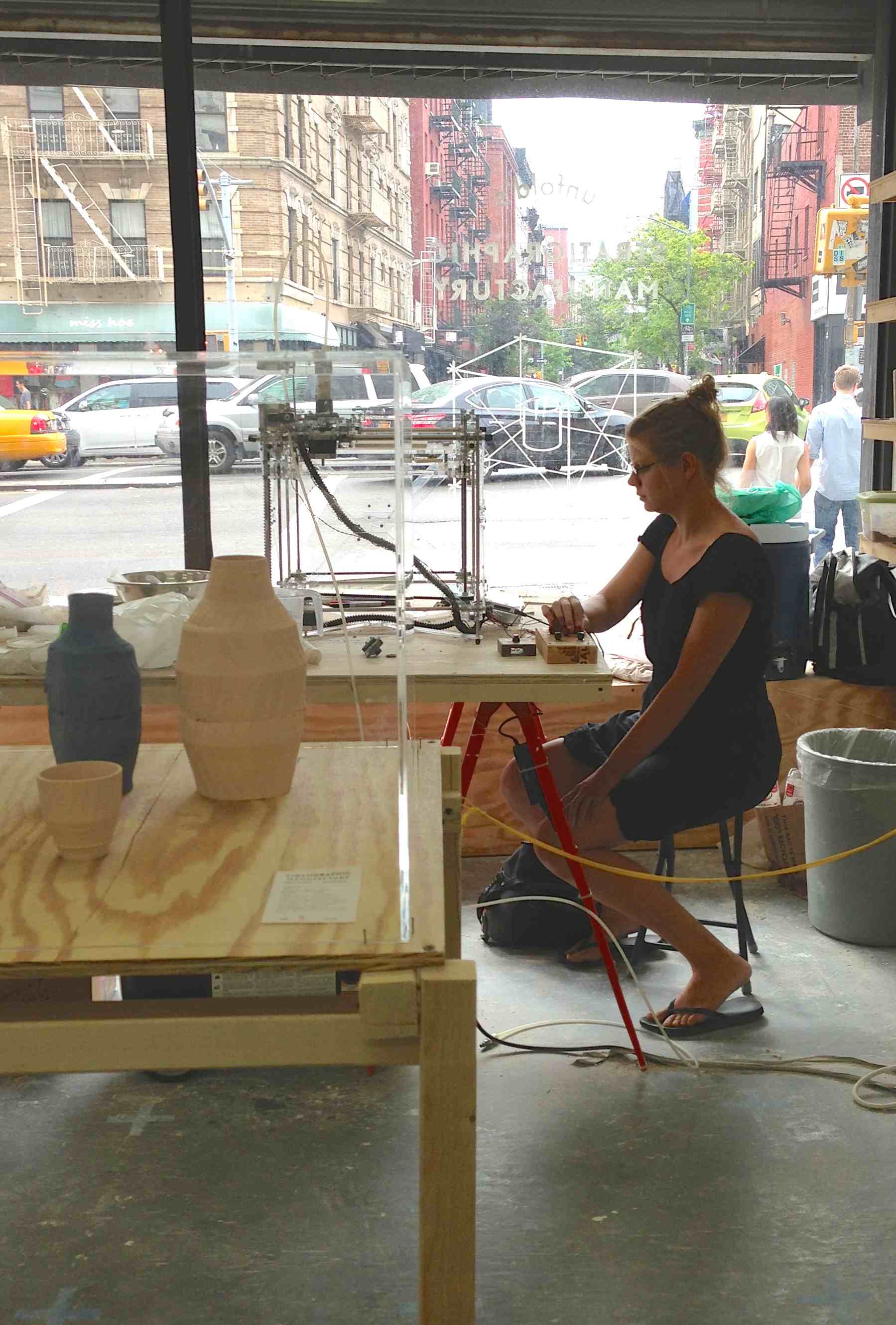
Larisa Daiga uses Unfold’s Stratigraphic Manufactury (3D ceramic device) to make coil pots from Gowanus sludge
Other displays highlighted the best inventions from Kickstarter (e.g. Central Standard Time wristbands and iPod Nano multimedia wristwatches) and solutions for using the Arduino microcontroller – lion tracking collars in Kenya and an earthquake-sensing device created and marketed by a 14-year old in Chile. It tweets you when there’s a tremor. Click here to see some photos, and if you feel like making something, explore your options on Adafruit..
Right in the storefront window, NYC ceramicist Larisa Daiga uses a ceramic 3D printer to make a tiny coiled pot. Larisa told us that she couldn’t touch the porcelain, because it was actually sludge from Brooklyn’s beloved Superfund site, the Gowanus, and loaded with biotixins.
Daiga felt it was interesting to be part of Unfold’s Stratigraphic Manufactury project, making coil pots (one of the oldest technologies of humankind) with toxic waste. Days spent in the window of Adhocracy let her contemplate how sludge might be reused and recycled instead of being trucked and dumped into unsuspecting landfills in the rest of the country. View her Adhocracy output and see the machine at work on her Flickr feed.
Another DIY favorite from Helsinki is featured in the show — Restaurant Day, when everyone in the city has permission to open their own restaurant on the curb. It’s one step beyond Smorgasburg.
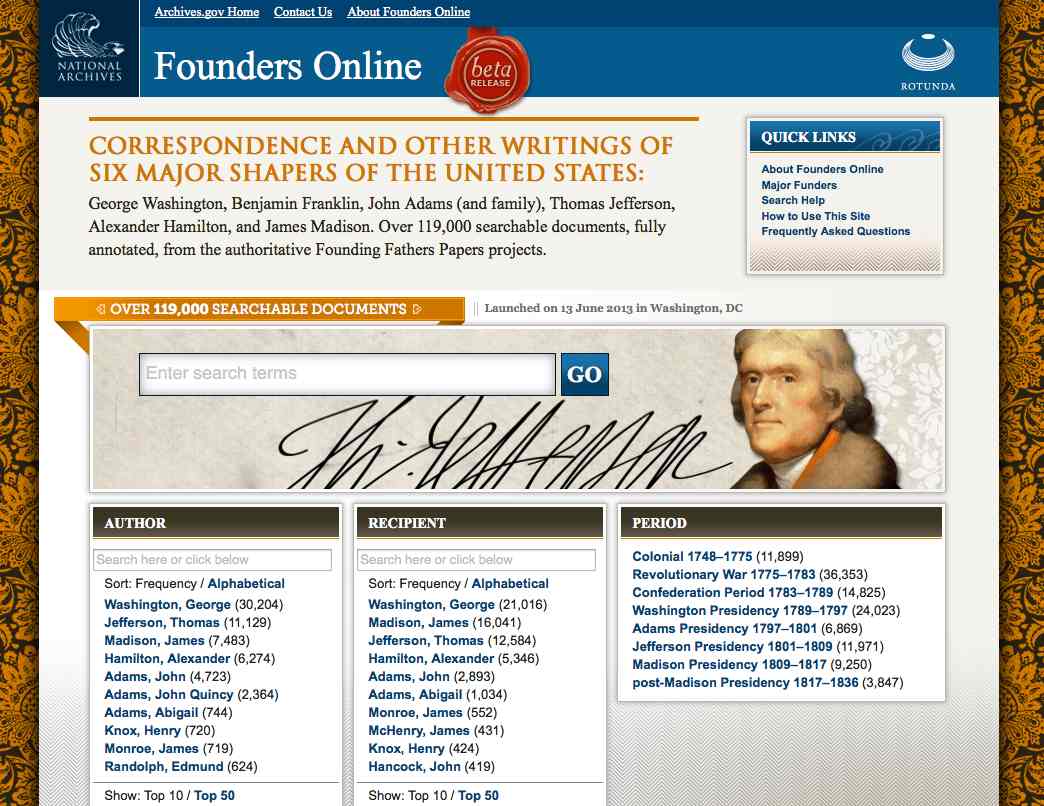
There’s no better way to celebrate the Fourth of July weekend than spending a little time with Founders Online, a collaboration between the National Archives and the University of Virginia Press, featuring posts from six of our most popular founding fathers – Washington, Franklin, Hamilton, Adams, Jefferson, and Madison.
The National Historical Publication and Records Commission (within the Archives) decided to liberate everyone from trekking to libraries by putting all of the diary posts, letters, and day-to-day chronicles of the Founders online.
You can go right to the earliest drafts of Tom J’s Declaration, and read young Washington’s journal entries on his first trip over the mountains of western Virgina in 1747.
The site, still in beta, currently has over 119,000 searchable documents – who wrote to whom and what the daily buzz was about in the colonial times. You can search by person, sender, recipient, concept, or era.
Jump in and see what Franklin’s or Hamilton’s revolutionary days were like, or ramble through the early White House years. It will be like scanning 18th century Twitter feeds or FB timelines of your favorite founders.
(And speaking of beta, check out Tom J’s copy of his unedited Declaration in the new NYPL Digital Collection.)
Since Smithsonian branches and other Washington, D.C. museums, zoos, and gardens began posting videos on line in 2007, collective YouTube views have climbed to 14 million, as chronicled in our latest report, Washington D.C. Museums: 2013 Video and Social Media Rankings.
Although the 14 million total is less than the 49 million views racked up by New York museums, don’t forget that two high-profile DC institutions – National Geographic and the Smithsonian – produce significant amounts of programming distributed on their popular cable TV channels, dedicated apps, and snazzy web sites. Even though it has a DC museum space, NatGeo (a joint venture with Fox Cable) has largely abandoned YouTube; however, the 18 individual Smithsonian branches are all still posting their own stuff regardless of the more comprehensive joint venture with Showtime.
In the Top Cultural Museum Video, archival footage is cleverly coupled with behind-the-scenes looks at the National Archives’ 1940s Census release
Here are some findings from our report on video and social media produced by DC institutions:
As of year-end 2012, the Washington museums having the highest number of total YouTube channel views were the Library of Congress (4.5M), the National Archives (2.1M), and the United States Holocaust Memorial Museum (1.6M). The top two are information powerhouses with massive collections to push out for public consumption, and the third is right on their heels with an innovative series with curators interpreting interesting items from their collections.
All-time top DC museum video, one of Edison’s earliest films, with over 329K hits on YouTube
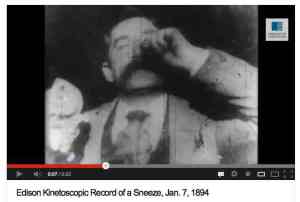
Edison still delivers. It’s interesting that the top ranked DC museum video of all time is Edison Kinetoscopic Record of a Sneeze, Jan. 7, 1894, the earliest surviving copyrighted movie – suggesting that our greatest media innovator is having the last laugh, contributing over 329,000 hits to the number-one ranking by Library of Congress on YouTube. It’s short enough for Fred Ott to be on Vine.
Four museum video channels have surpassed 1 million views. To put the DC numbers in context, if they were merged with the New York museum video rankings, the Library of Congress (4.5M) would rank seventh, just ahead of the Metropolitan Museum of Art. The Library of Congress would rank eight (2.1M), just ahead of the New York Public Library.
The National Zoo produced Washington’s top-viewed 2012 museum video – Shanthi, the National Zoo’s Musical Elephant, Plays the Harmonica!. Over 290,000 viewers watched this middle-aged mom experiment with a musical instrument in her enclosure and listen to her keeper talk about her performance. Shanthi’s viewership greatly surpassed the numbers generated by the most popular 2011 Washington museum video, the National Portrait Gallery’s Conan O’ Brien as Seen by Artist John Kascht. Surely, Conan would be amused.
The Smithsonian American Art Museum’s Top Exhibition Video of 2012 features curator Chris Melisinos describing why video games belong in an art museum
The top cultural video was a behind-the-scenes work at the National Archives for the release of the 1940s census. Over 115,000 family historians watched Learn About the 1940s Census, which showed the Archives census team, provided information on how to find your family’s records, and worked in interesting archival footage from the original census.
The Smithsonian American Art Museum produced Washington’s top video about a museum exhibition.Over 28,600 people watched The Art of Video Games: Chris Melissinos, Curator, a brief look into the evolution of the stories, technology, and visualization advances of this mass entertainment medium.
A few of the Flickr sets from Library of Congress
The most active Twitter users are the National Museum of American History, the National Air and Space Museum, and the National Postal Museum. But except for Air and Space, it’s a different set for Facebook followers.
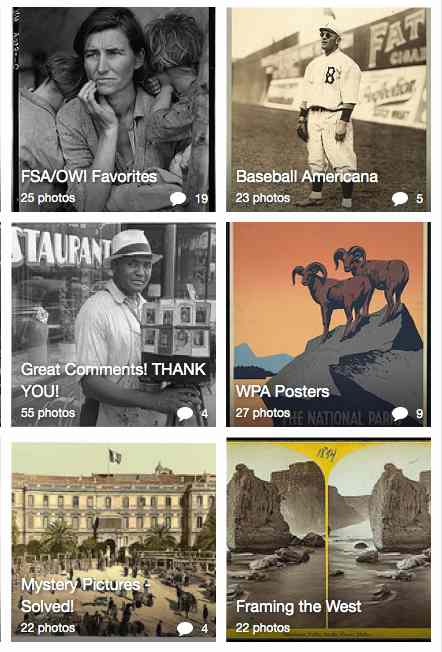
The most active Flickr users are the National Archives, the Library of Congress, and the Smithsonian American Art Museum. The Archives has organized its photos into creatively themed sets, such as “White House Wednesdays,” “Millinery Monday,” pictures of the 1940s census being taken, and pets of the First Families. The Library of Congress also posts a folder containing “mystery” photos and asks the public to help to identify them.
All the detailed video and social media statistics on 42 museums are in the report. Click here to see what’s included and make a purchase from our Its News To You Reports shop.
Enjoy the most popular DC museum video, a musical visit with the National Zoo’s sensation, Shanthi:
“Chief Albert Lambreaux: No Hum Bow, Don’t Know How” costume. In the pilot, the character returns to his devastated home six months after Katrina, enters, and emerges in this costume.
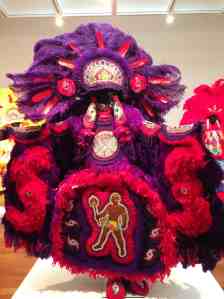
Towering feathered headdresses, intricate beaded panels, plumes, and miles and miles of ruffled edging adorn more than a dozen Mardis Gras Indians that are camping out until November 3 at the Cameron Art Museum in Wilmington, North Carolina.
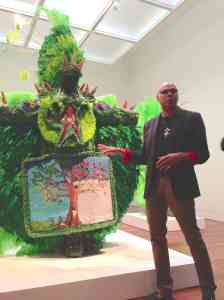
The dazzling incarnations are all part of the exhibition, Well Suited: The Costumes of Alonzo V. Wilson for HBO’s ® Treme. Alonzo was on hand for the opening, where he explained the challenges he faced designing elaborate, 60-lb. Mardis Gras Indian costumes for the actors playing characters living in New Orleans’ Tremé neighborhood (the Third Ward) in the months after Hurricane Katrina.
The African-American men who bead the panels and feather the elaborate costumes for their Mardis Gras Indian tribes typically take all year to execute their visions, which reflect their position in the tribe (e.g. the Big Chief, Second Chief, Spy Boy, Wild Man). To meet HBO’s production schedule, Alonzo and his team often had a much shorter time to create the patches, headdresses, staffs, panels, and shoes for the script’s characters.
Alonzo Wilson explains how the cycle of life and the seasons are reflected on the beaded apron of the “Big Chief: Tree of Life” costume.
For the series, Alonzo felt it was important to embed part of each character’s story into the stories being told on the panels, even if the costume was only seen for a few minutes on TV. Thankfully, the exhibition (and our Flickr feed) lets you closely examine some of this character development-in-beadwork – a chief shedding a crystal tear for his hurricane-damaged home, a white buffalo evoking the return of bounty post-Katrina, and stunning use of hurricane weather symbols amidst a bold S.O.S.
Originally mounted by the Ogden Museum of Southern Art, curator Bradley Sumrall was impressed by Alonzo’s use of narrative that broke through the typical Hollywood stereotypes of African Americans and Indians. “We could have just done a show with traditional Mardi Gras Indian costumes, but Alonzo’s work had so much narrative built in.” With the mix of African-American, Native American, government, city, and current-event references, Bradley felt the layers of meaning in such intricate craftwork was an achievement worthy of a fine-art exhibition.
“Spy Boy: Katrina Memorial” costume. Feathers on lower half spell out the “S.O.S.” distress signal, using the universal weather-map symbol for hurricanes.
The NC stop for the show is a way for others to understand a bit more about New Orleans people, neighborhoods, and culture. Plus, Wilmington is Alonzo’s hometown. The movie and slide show inside the gallery provide an even deeper window into to this achievement – showing how Alonzo and his crew learned from the traditional craftsmen, shared new beading techniques, and received some “rescue help” from the locals when the production deadlines were too much to handle.
The exhibition all adds up to win-win storytelling about Alonzo, his team, New Orleans, and the Indians. Read an interview with Alonzo on the HBO blog and see behind-the-scenes production photos on page 40 of the Wilmington magazine Salt.











 itsnewstoyou
