Philadelphia Museums Reach 2.4M YouTube Views

Since Philadelphia museums, zoos, and gardens began posting videos online in 2008, collective YouTube views have climbed to 2.4 million, as chronicled in our latest report, Philadelphia Museums: 2013 Video and Social Media Rankings. The biggest surprise about the Philadelphia museum videos is that stylistically they are a bit different than New York museum videos. The institutions in Philly take a more whimsical approach to science, use a lot more promotional videos to drive exhibition attendance, and occasionally throw in a bit of the macabre.

Longwood Garden’s Top Philadelphia Exhibition Video of 2012

The Top Philadelphia Exhibition Video of 2012, courtesy of the Longwood Gardens grounds crew and Bruce Munro

Highlights of our report on 32 Philadelphia museums:

As of year-end 2012, the Philadelphia institutions with the highest number of total YouTube channel views are the Penn Museum, the Mutter Museum, and Longwood Gardens. Penn’s channel features a mix of behind-the-scenes videos about exhibits, anthropology lectures, and a gigantic docu-archive; the Mutter produces highly creative shorts highlighting selections from its tantalizingly weird collection; and Longwood simply has tons and tons of fans that want to see what’s up with the seasons.

Last year, Longwood Gardens produced Philadelphia’s highest rated museum video — Light: Installations by Bruce Munro. Over 36,000 nature and art lovers viewed this short about Longwood transforming itself into Munro’s luminous vision. The garden also pumped out other video promos and features all year that kept their fans coming back to hit the YouTube channel.
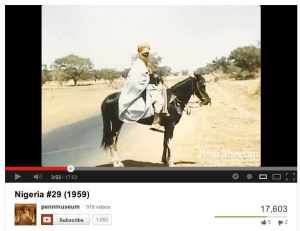
The Penn Museum’s Top Anthropology Video of 2012 features a sheik among many other people and places in 1959 Nigeria

The Penn Museum’s Top 2012 Anthropology Video Nigeria #29 (1959) features a sheik, a mosque, a fuel depot with camels, and country life the way it used to be

The Penn Museum’s YouTube channel surpassed 1 million views in May. Penn’s been adding an enormous anthropology film collection to its channel (over 400 films) and the time-machine quality is irresistible. It’s no surprise that Penn’s Maya 2012: Lords of Time videos captivated the public all year, but it is interesting that the silent travelogue Nigeria #29 (1959) is up to 17,000 views. You could poke around that channel for days.

The Chemical Heritage Foundation produced Philadelphia’s most popular science video. Over 26,000 people watched A Distillations Explainer: Sweat, part of the Foundation’s Blood, Sweat, and Tears series (see below). It’s an entertaining, well-produced podcast series.

The Mutter Museum presents its unusual medical collections quite effectively through its YouTube series. Their 2012 series feature the curator taking “mystery” items out of the cabinets and challenging the viewers to identify them. Not for the squeamish, but really clever and nicely scripted.

The most active museum Twitter users in Philadelphia are the National Constitution Center, the Eastern State Penitentiary, and the Penn Museum. The most active Flickr users during 2012 were the Franklin Institute Science Museum and the Pennsylvania Academy of the Fine Arts. The largest Flickr photo pools are populated by Longwood Gardens and Eastern State Penitentiary enthusiasts.

All the video and social media details on 32 museums are in the report. Click here to see what’s included and make a purchase from our Its News To You Reports shop.

Enjoy watching Philadelphia’s top science video, courtesy of the Chemical Heritage Foundation. Meet Louis Pasteur and find out why sweat often smells:

NYC Museum Videos Receive 49 Million Views on Social Media

The Japan Society’s popular Japanese language series

The Japan Society’s popular Japanese language series

After reposting so many museum videos here, we wondered how much video museums were producing, what social media they were using, and who had the most viewership and followers. We counted, and found that the museums, zoos, and botanic gardens around New York have racked up 48.8 million views on their public YouTube channels since 2007.

The volume of activity on was so significant that we couldn’t help documenting it and packaging the rankings into a report, NYC Museums: 2013 Video and Social Media Rankings.

Museum folks may want to purchase the full 48-page report to see how their organization stacks up, but here are some of our key findings:

As of year-end 2012, NYC museums with the highest number of all-time YouTube channel views were the Paley Center, American Museum of Natural History, and  Japan Society. Paley merges its NYC and LA feeds, and it’s 33M all-time video views are mostly from TV celebrity show panels in LA. So if we’re really looking at the museum programming champs in NYC, it would be AMNH (15M), Japan Society (7M), and MoMA (6M).

The Top NYC Museum Video of 2012 -- an AMNH Science Bulletin Whales Give Dolphins a Lift

The Top NYC Museum Video of 2012 — an AMNH Science Bulletin Whales Give Dolphins a Lift

The top NYC museum viral video of all time is The Known Universe video produced by AMNH for the Rubin Museum’s 2009 show, Visions of the Cosmos – 11M views and still growing. The video was generated from the Hayden Planetarium’s data set.

In  2012, another AMNH video, Whales Give Dolphins a Lift, went viral with 2M views. The AMNH has an active video-production team supplying content to its Science Bulletin walls inside the museum. Hats off to them for making a winning wordless video out of a few still photographs from field scientists in Hawaii, simple titles, and tranquil music.

The popularity of Japan Society’s language lessons are driving the numbers on their channel. Who can resist clicking through all the 2-minute lessons in their Waku Waku Japanese series with Konomi?

Asia Society’s Top NYC Museum Music Video of 2012

Asia Society’s Top NYC Museum Music Video of 2012

The top 2012 NYC museum music video was produced by the Asia Society, Arif Lohar and Friends: Jugni Ji!. Who knew that the finale to a Sufi pop legend’s concert on Park Avenue one year ago would rack up over half a million views?

The top star featured in a 2012 NYC museum exhibition video was a piece of 18th century mechanical furniture displayed at the Metropolitan. Viewership of The Roentgens’ Berlin Secretary Cabinet grew from 182,000 views at year-end 2012 to 1.6 million today. Can anyone explain how mechanical furniture received 25 times the viewership of the Met’s video walk-through of its blockbuster McQueen show, Savage Beauty?

The NYC museums using the greatest range of social media and video channels are The Jewish Museum and the Rubin.  One of the best under-the-radar NYC museum Flickr sites was the historical archive of Wall Street documents and treasures posted by the Museum of American Finance.

All the video and social media rankings 63 museums are in the report. Click here to see what’s included and make a purchase from our Its News To You Reports shop.

OK, here it is: the all-time top NYC museum video from 2009:

Fluffy AMNH Animal Superstars Win Webby

Steve Quinn, diorama curator

Steve Quinn, diorama master

Steve Quinn couldn’t send them to the L’Oreal Paris hair and make-up room like Tim Gunn does on Project Runway. They’re just too big, too famous, and too fragile. We’re talking about the furry animals that populate the 43 dioramas on Floor 1 of the American Museum of Natural History’s in the Hall of North American Mammals.

So how do you buff, puff, make up, color, groom, blow dry, restore eyelashes, color brows, and repair noses on New York superstars that have been in the (literal) spotlight since the early 1940s? That’s the subject of AMNH’s YouTube sensation, Restoring Dioramas in Hall of North American Mammals a 16-show reality series that won a prestigious Webby Award earlier this month. Download the North American Mammal app (with before and after looks at the enhanced fur).

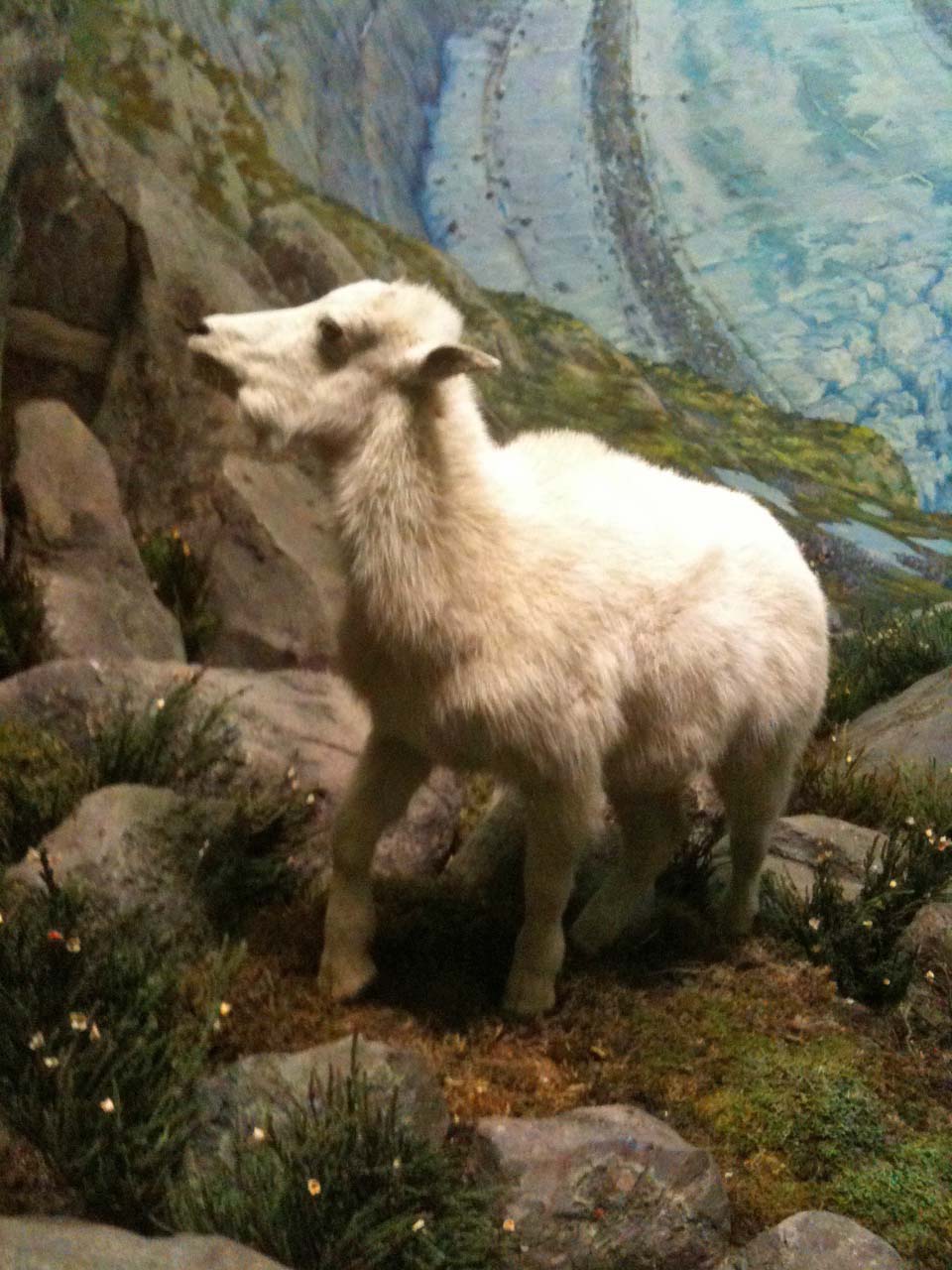
No more "demon" eye in the baby Mountain Goat, who is surrounded by thousands of flowers refurbished by AMNH volunteers

No more “demon” eye in the baby Mountain Goat, who is surrounded by thousands of flowers refurbished by AMNH volunteers

Steve Quinn leads a team of accomplished artists to, well, perform makeovers on the animals, plants, and background paintings that reside inside some of the most famous 3D attractions inside the AMNH. Steve told us that the first step was to update the decades-old lighting inside each case with state-of-the-art illumination that would inflict much less damage on the mammal coiffures.

His team engineered wooden platforms that extended into each scene so that leaf-turning and snow repair could occur with minimal disruption to the diorama floor. If you watch the 4-minute videos, you’ll see how they fixed a bison’s nose, put whiskers on cougars, restored the grass on the Great Plains, and restored the jackrabbit’s ears. The runaway hit of the series is Updating the “Moon Shadow” in the Wolf Diorama. With over 8,000 views, it’s not going to knock Dr. Neil off the AMNH charts any time soon, but Steve’s magical artistry is something to savor.

Go to the AMNH YouTube channel and scroll down to find the North American Mammal diorama series, depicting Steve and his crew at work. Check out this series trailer:

Just before Steve retired the other week, he gave us a special Night at the Museum, walking around and visiting his favorite dioramas after the visitors left.

Steve, you’re a total rock star. Thanks for all your spectacular work at AMNH over the years, and congratulations on the Webby.

Elvis has left the building.

Abstraction All-Stars Featured in MoMA’s LinkedIn

Installation view of the network behind the birth of abstract art

Installation view of the network behind the birth of abstract art, according to MoMA and Columbia Business School

As soon as you arrive at Inventing Abstraction 1910-1925, MoMA’s soon-to-close extravaganza featuring the relationships among painters, poets, composers, and dance innovators, you encounter a big, bold infographic on the wall – a web showing who was collaborating with, influencing, viewing, and reading each other as “abstract art” was born.

The stunning exhibit is a who’s who of modern art, with work by Picasso, Kandinsky, and Malevich (of course), but pulls in works from lesser-known early innovators from Britain, Poland, Italy, and America (hi, Georgia!) and across disciplines. So many connections, so little time! The show has books, music, pioneers of modern dance…just about everything.

If you can’t get to it, don’t worry. MoMA’s put it all on the web so you can explore all the connections yourself. The highlighted names show the artists with over 25 connections, like an early 20th century LinkedIn or really popular Facebook friends. Who knew that Russian fine-art diva Goncharova was more connected than, say, Malevich or El Lissitsky?  I guess inventing Rayism and designing sets for the Ballet Russes paid off in getting her positioned in this MoMA pantheon.

Created by MoMA curators, designers, and pros from the Columbia Business School, the interactive web highlights every artist featured in the massive MoMA show. The infographic allows you to zoom in to see how the buzz, particularly in 1911-1915, brought abstract art into being.  No matter which name you click on, you’ll get to view the works, play the music, and watch the dances – a web-based multimedia tour-de-force.

Now dive into one of the best art-websites ever, and get to know the network and likes of the hot, emerging artists who made the art world of 100 years ago into what we know today.

Watch how this show and web project were brought to life with Excel, great minds, and graphic design. And be sure to check out Paul Ingram’s views on the value of networks at the MoMA video site.

Virtual Ancestor Cornered in High-Tech Tree by AMNH

Carl Buell’s rendering of the hypothetical placental ancestor, a small insect-eating animal. Source: AMNH

Carl Buell’s rendering of the hypothetical placental ancestor, a small insect-eating animal. Source: AMNH

Who says dinosaurs get all the attention?

One of the big front-page science stories of the last few weeks is that a global team of researchers has mapped our ancestor tree back in time to a hypothetical small, furry critter that emerged just after the dinosaurs went extinct. The big news is that through a giant high-tech, data-crunching technique, 15-20 molecular-data scientists collaborating in six countries around the world figured out that the hypothetical ancestor to nearly all the mammals alive today emerged 200,000 to 400,000 years after the comet crashed to Earth 65 million years ago.

Ok, it wasn’t the first mammal (the ancestor to platypuses, opossums, kangaroos, and a lot of other extinct things came much earlier), but let’s applaud the American Natural History Museum for telling this story so clearly to a writer at The New York Times that it made it to the front page.

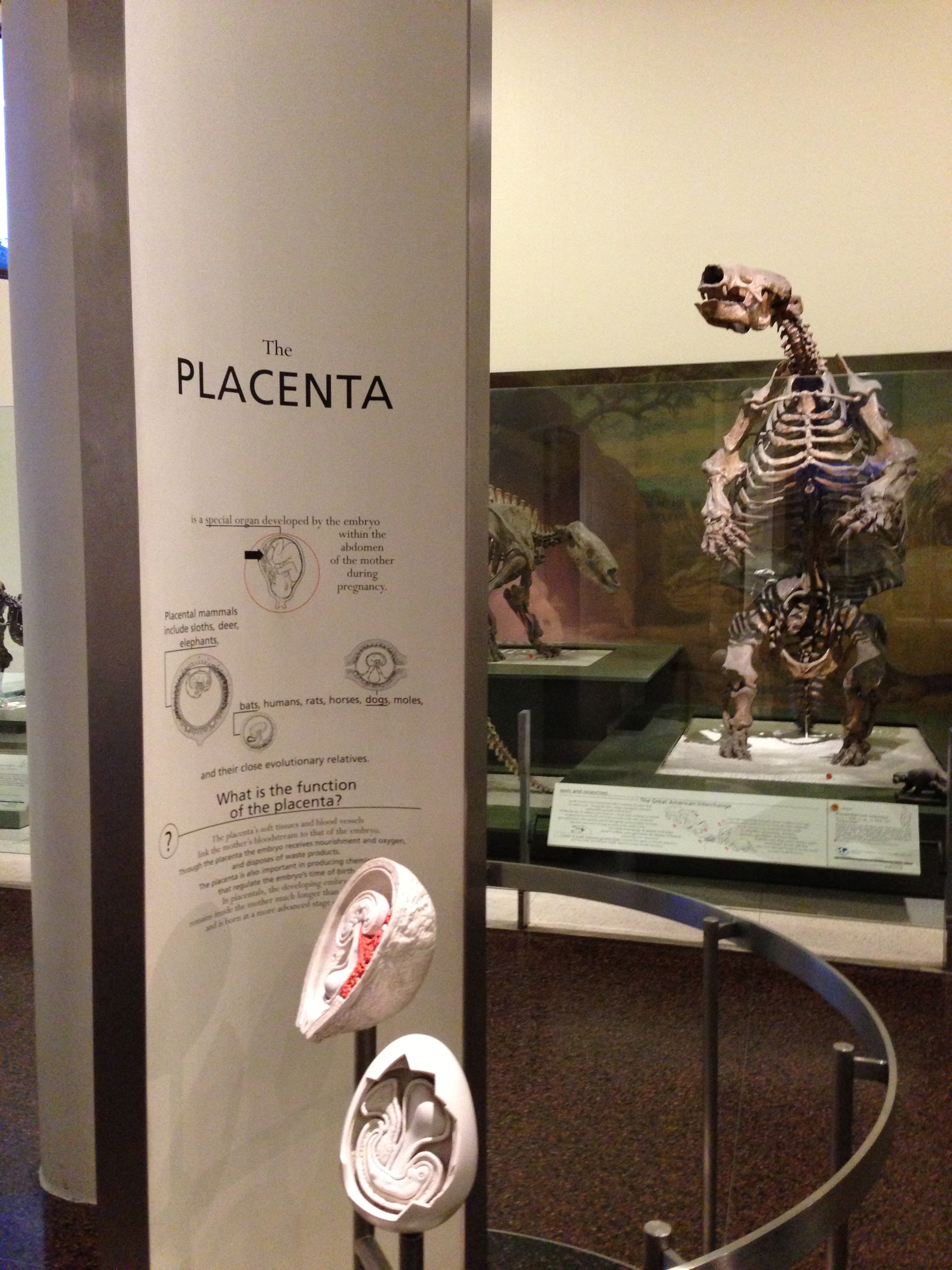
Column on AMNH Fourth Floor exhibit space that marks the spot where the virtual critter emerged along the evolutionary pathway in the Hall of Primitive Mammals.

Column on AMNH Fourth Floor exhibit space that marks the spot where the virtual critter emerged along the evolutionary pathway in the Hall of Primitive Mammals.

At Thursday’s Social Media Week event on how to tell stories in science, panelists repeatedly emphasized how hard it is to make clarity emerge from a morass of data.  In a way, this “story about the rat” reached a social-media science storytelling trifecta: over 240 comments “about the rat” on the NYT web site, a neat little video that’s racked up over 11,000 views in just two weeks, and an exhibition layout for the vertebrate paleo collection on the museum’s Fourth Floor that lets you stand in the exact spot on the evolutionary pathway where this tiny hypothetical ancestor emerged. (See the photo with the Giant Sloth, to the left.)

Great job, AMNH and Stony Brook storytellers for giving us this video view into deep time, showing how MorphoBank crunches data, and creating another social-media star out of a virtual ball of fur.

PS: The fossil background talent in this video appears to be a model of Gobiconodon, an actual Cretaceous mammal from 110 million years ago who’s not directly related to the star of this show, but looks good on camera.

If You Love Brooklyn, Get to GO!

Installation view of Yeon Ji Yoo’s The Fight (2012), made of paper, paper pulp, acetate, glue, packing tape, cheesecloth, plastic flowers, recycled plastic bottles and bags

Installation view of Yeon Ji Yoo’s The Fight (2012), made of paper, paper pulp, acetate, glue, packing tape, cheesecloth, plastic flowers, recycled plastic bottles and bags

Tucked away in the Mezzanine Gallery on the second floor at the Brooklyn Museum is a valentine to the borough, its artists, and the support and love they received last September in Go: A Community-Curated Open Studio Project. It mixed trudging around Brooklyn, democracy in action, and high-tech to peer into other worlds right in our own backyard.

The museum commissioned an app, asked artists to open their studios, and invited the world to visit and vote for their favorites. (Apparently, it was inspired by an art competition organized out of Grand Rapids!)

GO tracked the art makers and art seekers – take a look at the “weekend activity heatmap” and the other GPS-gathered stats. The results showed a lot of love – 18,000 visitors making 147,000 studio visits to about 1,700 artists over a two-day period, or about eight studio visits per participant. See the raw data for yourself, broken out by neighborhood. Learn a bit more about the voters here.

Art lovers nominated 9,457 artists for a museum showing, and eventually voting and curators whittled it down to five spectacular representatives. Interestingly, four on display were born outside the United States.

Yeon Ji Yoo of South Korea, currently lives in Greenpoint and works in Red Hook. The large installation piece in the show is inspired by her grandmother’s fading memory. Listen as she talks about growing up in South Korea’s rural countryside:

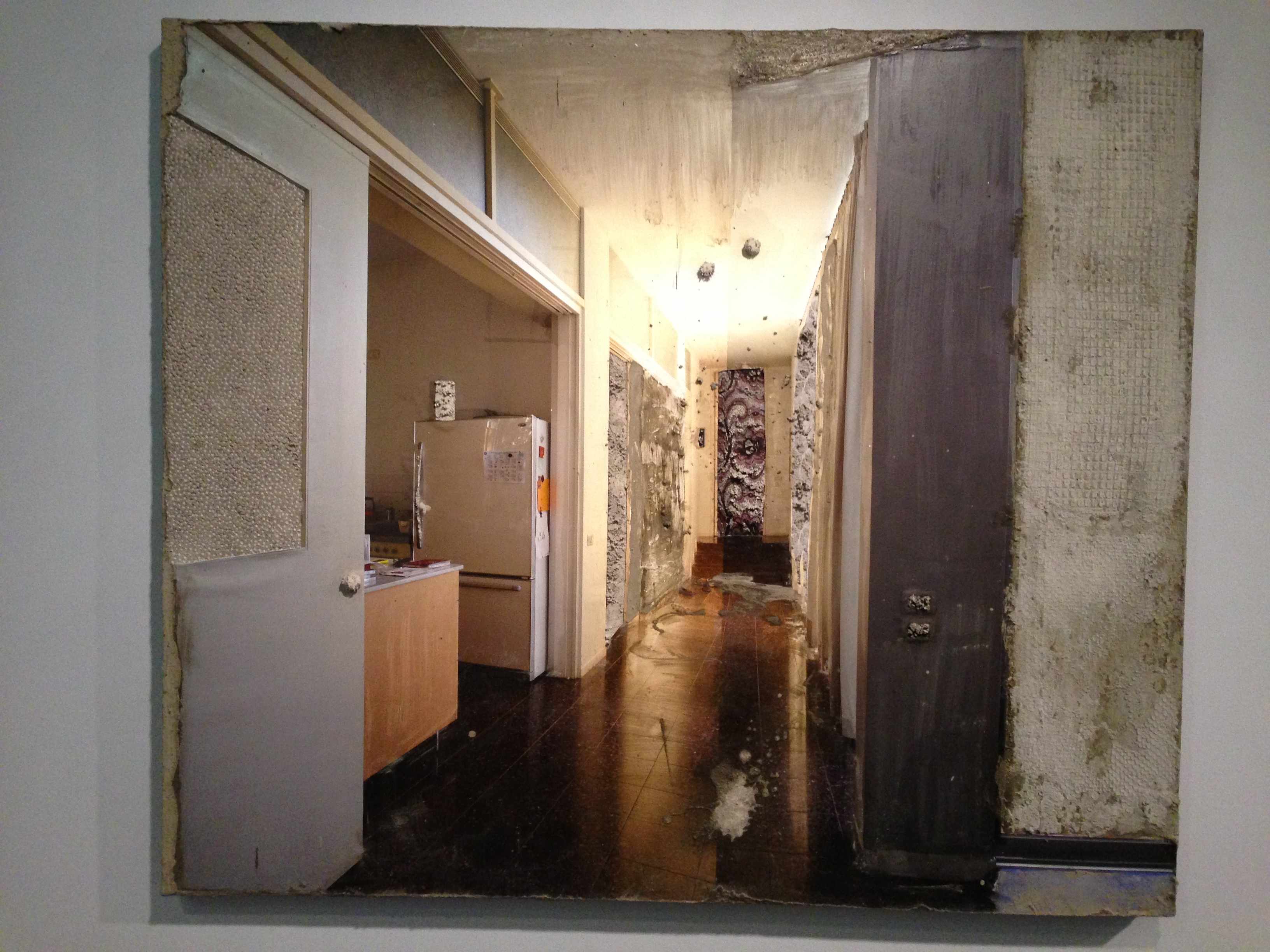
Installation view of Naomi Safran-Hon’s Home Invasion (2011). Archival inkjet print, lace, and cement on canvas

Installation view of Naomi Safran-Hon’s Home Invasion (2011). Archival inkjet print, lace, and cement on canvas

Naomi Safran Hon (of Prospect Heights) prints photographs of her hometown of Haifa, Israel on canvas; makes some cuts in the image; and pushes cement through lace to make a 3-D effect. She feels she’s working out the push/pull of the political and domestic realities of where she grew up. But let her tell you:

Meet the other artists, too: urban watercolorist Adrian Coleman, and painters Oliver Jeffers, and Gabrielle Watson. But if you really love Brooklyn, get over to experience the work in person, and add your comments. The museum’s open late on Thursday.

Design Driven by Necessity at MoMA

The latest design show at MoMA features something that we can’t live without.

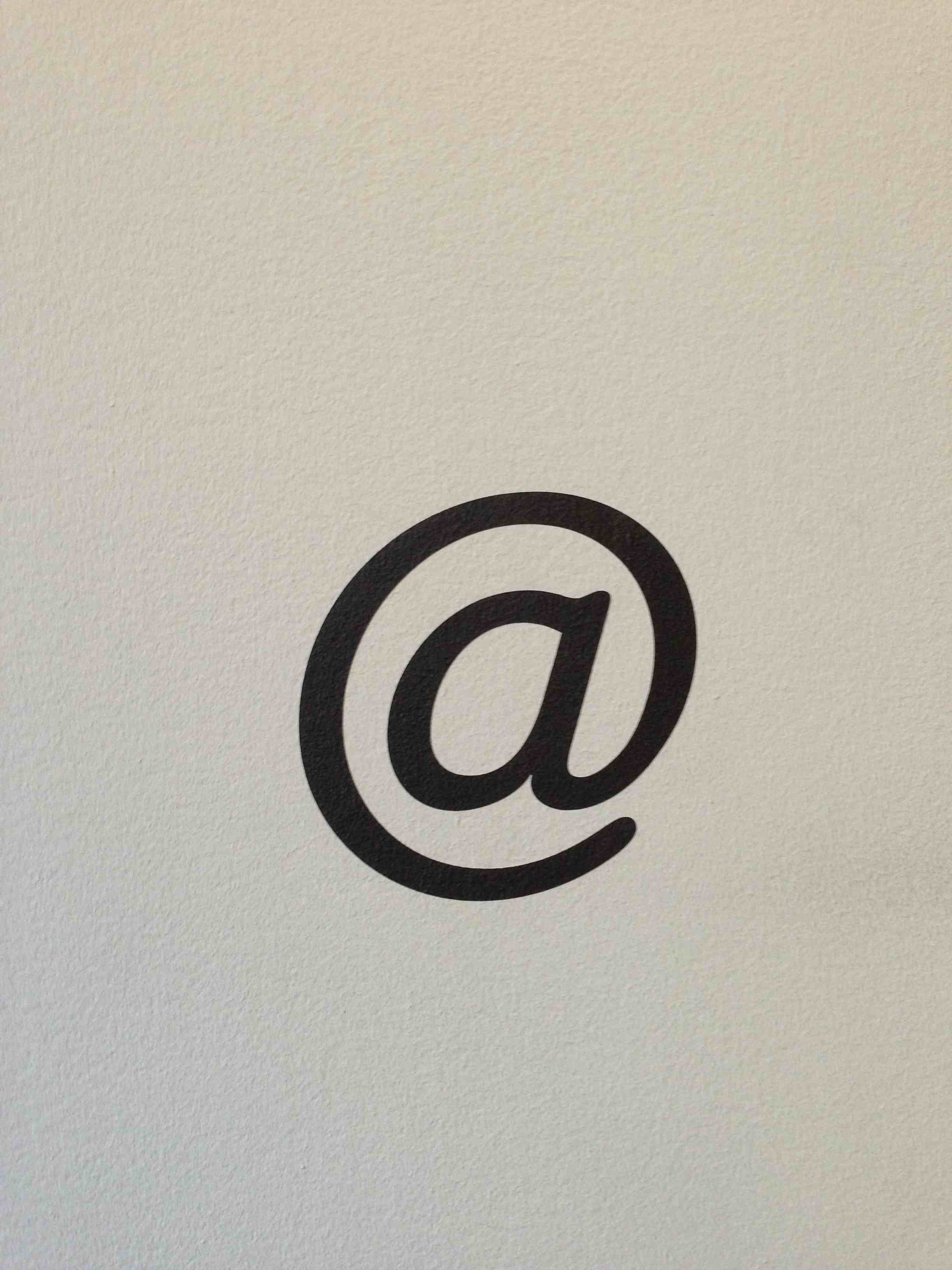
Installation view of @ (1971), ITC American typewriter medium, at MoMA

Installation view of @ (1971), ITC American typewriter medium, at MoMA

You’d never think that @ was a design invention, but it was created in 1971 by Ray Tomlinson, the inventor of the first email system in the United States. The @ made it into MoMA’s design collection and stars there in the show, Born Out of Necessity.

Tomlinson developed it for ARPAnet, because he thought it would be more efficient than using arcane programming language to tell data messages where to go. MoMA says that there’s not a lot agreement as @’s genesis – some say it goes back to the 6th century (from Latin scribes). Others say it’s from the 16th century (Venetian abbreviation for the “amphora” measurement unit), or Norman French  (for “each at” a particular price). Whatever.

The little symbol began appearing on typewriter keyboards in the 19th century, so it eventually migrated to our computer and iPad keyboards, and that’s where Tomlinson got ahold of it. History was made.

Another design star in the show came from the military budget, too — a Utility ¼-Ton 4 X 4 Jeep. Jeep

You may be surprised to know that Jeeps and MoMA go way back to 1951, when they included one in a design exhibit. Quick assembly, fast part-swapping, and portability (when disassembled) for transport made it a design winner. Although this Jeep is from 1952 (just light modifications over the previous model), MoMA says it’s the best military Jeep ever built anywhere.

The show includes an array of other interesting design innovations triggered by need – like Oxo’s Good Grip handles on kitchen items, new-fangled inflatable life rafts that don’t tip in high waves, collapsible wheelchairs, and hand-cranked radios (originally designed for the Third World, but just as useful here during blackouts and hurricanes).

The show closes today, but the @ and the other stuff will be with us for a long, long time.

Is David Roentgen the 18th Century Steve Jobs?

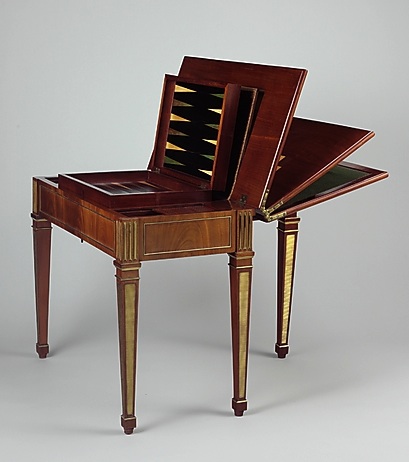
David Roentgen’s Game Table (ca. 1780–83). Oak, walnut, veneered with mahogany, maple, stained maple, holly, stained holly; felt; leather, partially tooled and gilded; iron and steel fittings; brass and gilt bronze mounts. Source: Metropolitan Museum, Pfeiffer Fund, 2007.

David Roentgen’s Game Table (ca. 1780–83). Oak, walnut, veneered with mahogany, maple, stained maple, holly, stained holly; felt; leather, partially tooled and gilded; iron and steel fittings; brass and gilt bronze mounts. Source: Metropolitan Museum, Pfeiffer Fund, 2007.

Even if David Roentgen didn’t produce for the mass-market, he certainly seemed to have written Steve’s playbook  — wow them with innovative design, refined surfaces, exacting craftsmanship, playful art, and sophisticated multimedia integration. Oh, and if that’s not enough, why not make it passkey protected and portable, too? Like Steve, David knew how to turn engineering into art and ka-ching.

Experience out-of-the-box design innovation in the closing week of the Metropolitan Museum’s unforgettable show, Extravagant Inventions, Princely Furniture of the Roentgens. The beauty of the marquetry and fittings on the displayed desks, sofas, clocks, commodes, and rolltop desks would be enough, even if they simply occupied a quiet corner of a drawing room or boudoir.

But if an 18th-century king, queen, or royal saw them in action – revealing hidden apps for writing, reading, drawing, music, games, curios, and hiding the desktop – there was no turning back. The mechanical furniture was so desirable that wealthy trend-setters just had to have it (like iPads).

What social-minded gamer could resist Roentgen’s 1780s Game Table if they saw David’s demo?

The desire to own and show off the most up-to-date artistic engineering marvel had royals running for their strongboxes to put down deposits on anything Roentgen could produce. In fact, the Met tells us that the Berlin Secretary Cabinet, the star of the show, is probably the most expensive piece of furniture ever produced. And we can’t even begin to discuss robot Marie Antoinette playing the dulcimer, or the clocks that turn into orchestras.

When the French Revolution put an end to sales at Versailles, Roentgen cut out the curliques, tailored the outer design to a sleeker look, and shifted his retail operations to Russia. Catherine and her court bought the newer stuff by the cartload.

The Met has an entire YouTube playlist devoted to these 18th century wonders, and you really should peruse them all. Get to the show in the final week and see what another style and multimedia-obsessed generation spent their money on.

And lest it slipped your mind, Steve and Woz’s first Apple 1 computer was assembled within a wooden case. Maybe it’s good that David and his engineering/sales team weren’t around to critique it.

Brooklyn Holiday Art Mash Up

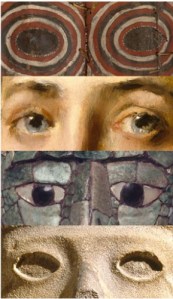
Details of four works in Connecting Cultures, from top: Korumbo Gable Painting, 20th century, unidentified Abelam artist; Girl in a Japanese Costume, circa 1890, William Merritt Chase; Mosaic Head Pendant, 700–800, unidentified Maya artist; and Life-Death Figure, circa 900–1250, unidentified Huastec artist.

Details of four featured works, from top: Korumbo Gable Painting, 20th c. by unidentified Abelam artist; Girl in a Japanese Costume, c. 1890, William Merritt Chase; Mosaic Head Pendant, 700–800, unidentified Maya artist; and Life-Death Figure, c. 900–1250, unidentified Huastec artist.

A big mix-up has happened on the First Floor of The Brooklyn Museum, but it’s OK. In fact, if you like rambling around the Brooklyn Flea, the Connecting Cultures: A World in Brooklyn exhibit is less congested but just as much fun.

The museum curators clearly enjoyed picking and choosing objects from their wide-ranging collections, and packing a gallery full of juxtapositions from different centuries, cultures, and countries. The designers made great use of the soaring space of the Great Hall, creating floor-to-ceiling murals, maps, and display shelves that provoke, delight, and mystify. Check out the museum’s Flickr photostream. As a visitor, you feel as though you’ve wandered in on a modern version of a Victorian-era World Exposition.

Gaston Lachaise’s modern Standing Woman bronze is installed near Nick Cave’s Soundsuit, Picasso’s cubist Woman in Gray portrait is hung next to Huntington’s classical portrait The Sketcher, and Ikea-clean wall grids house ornate pitchers from many cultures and time periods. Catch a glimpse of the variety in the installation views on Flickr, or peruse the objects in Brooklyn’s on-line database.

As an added bonus, the Museum has established both human and social-media feedback options for visitors. It’s nice to use the terminal to input comments on the show (posted on the exhibition site), but maybe it’s even nicer to have staff members positioned inside the exhibit to chat, answer questions, and elicit your comments.

The installation is reflected in Pistoletto’s Standing Man, Standing Woman with Hat, a 1980 silkscreen on stainless steel.

Installation as reflected in Pistoletto’s Standing Man, Standing Woman with Hat, 1980 silkscreen on stainless steel.

The Museum has been collecting since 1823, and there’s both an on-line chronology and a pictorial history slightly hidden away inside the show.

Upcoming and news flash: Brooklyn Museum is going to continue it’s Target First Saturday tradition into the New Year (next on January 5), but for the time being, it’s cancelling the dance party portion of the festivities. Get there for the rest of the night.

Virtual Trip to Design Island

Let me guess. You didn’t get to see the spectacular design show that ended yesterday on Governor’s Island. While their mansion up on 91st Street is being renovated, The Cooper-Hewitt (a.k.a. Smithsonian) outdid itself by mounting a show inside Building 110 on New York Harbor’s hottest party-picnic location.

Graphic Design: Now in Production gathers great design produced since 2000 to feature what creative minds are offering. The summertime crowd loved it, and people flowed right from the ferry into the show and through the aisles where works were grouped around themes like storefronts, branding, typography, and print (it lives!). Check out the action on the Flickr feed.

The show is vibrant, interactive, mind-blowing, provocative, and fully documented in a 10-minute walk-through video with the curator Elleln Lupton that pretty much replicates the experience.

If you’re in LA, the show opens September 30 at UCLA’s Hammer Museum before migrating in 2013-2014 to Grand Rapids, Houston, Winston-Salem, and RISD.

Among our favorites are Brand New’s display, which asks visitors to vote (“before” or “after”) on redesigned corporate logos, and CognitiveMedia’s “RSA Animate: Changing Education Paradigms.”