Frida Khalo Extravaganza Ending with Colorful Surprises

NYBG’s Haupt Conservatory is transformed into Frida’s Casa Azul

NYBG’s Haupt Conservatory is transformed into Frida’s Casa Azul

Ever since the New York Botanical Garden installed its Frida Khalo: Art, Garden, Life show, it’s been a nonstop party and feast for the eyes, ears, and tastebuds.

Not sufficient to import fourteen of Frida’s rarely seen paintings for the formal gallery upstairs in its library building, the creative NYBG team has made environments, commissioned artists, designed apps, booked acts, hosted special events, transformed the conservatory, made a wall of cactus, redesigned menus, and even brought in a taco truck to give everyone an immersion into her sophisticated Mexican lifestyle.

This blockbuster sensory experience is in its last week, going out with a bang with a Dia de los Muertos theme as this traditional Mexican holiday collides with our own Halloween. Sugar skulls and whimsical skeletons are taking over Frida and Diego’s pyramid that serves as the centerpiece of the garden portion of the show.

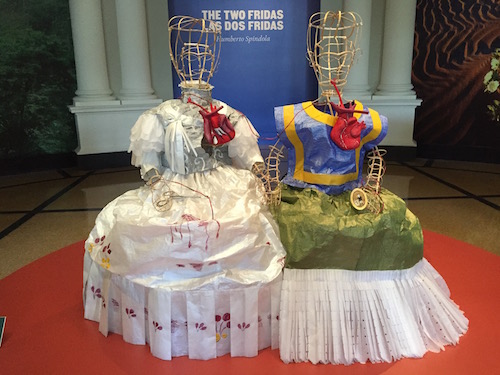
Tissue-paper dresses for The Two Fridas by artist Humberto Spindola

Tissue-paper dresses for The Two Fridas by artist Humberto Spindola

It’s an appropriate mix, given Frida’s own proclivity to merge the everyday with the surreal in her own works. The Library has an exquisite collection of her self-portrait and still life paintings, featuring flowers, animals, and deep-rooted Mexican myth and culture.

Downstairs in the Britton Rotunda, there’s a stunning installation of The Two Fridas by artist Humberto Spindola – side-by-side mannequins wearing tissue-paper dresses in colors that Frida sported, but with the surreal outer heart that she painted more than once. Visitors approach as if it were a shrine with special powers.

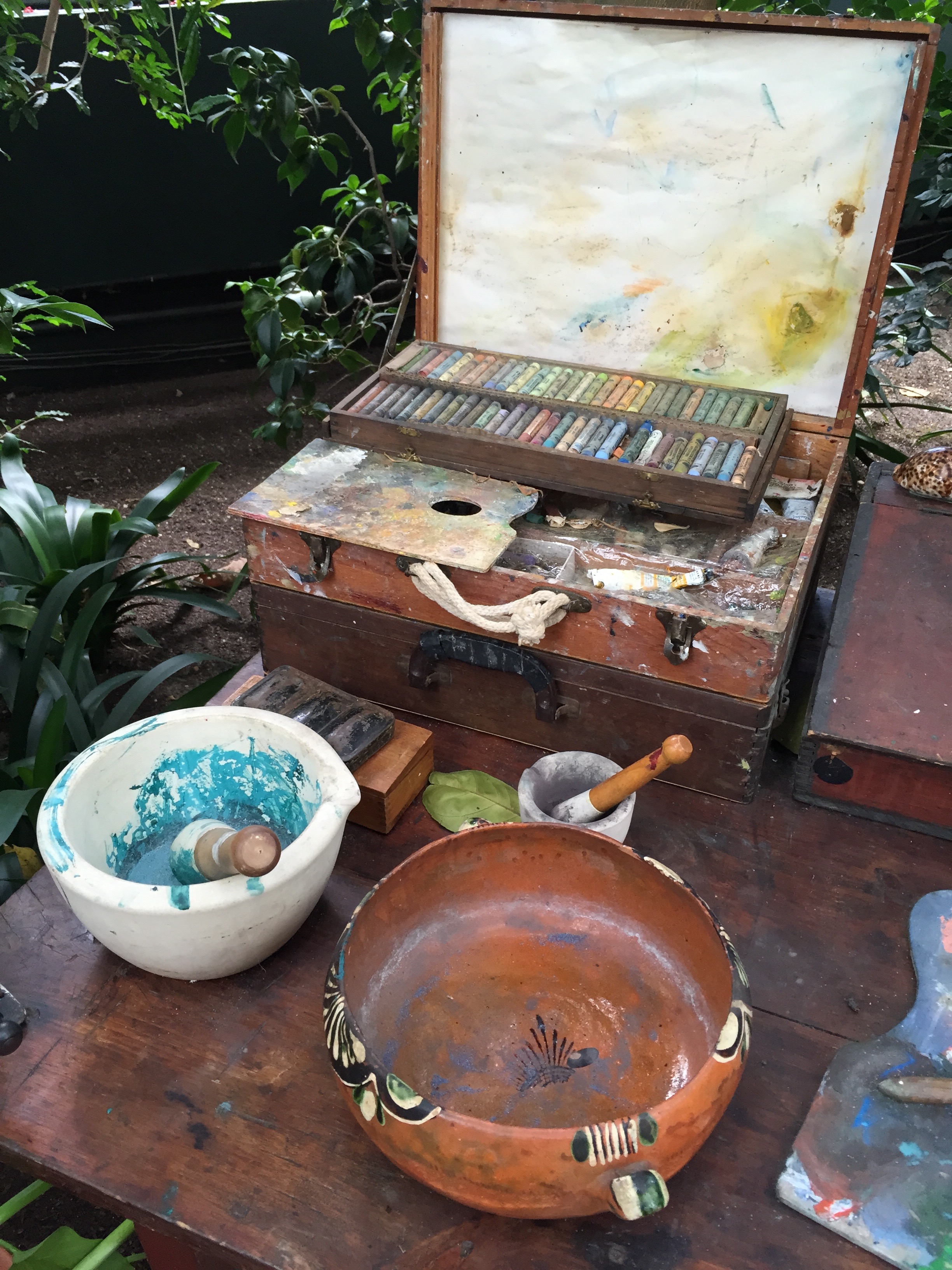
Frida’s workspace

Frida’s workspace

The Haupt Conservatory serves up a riot of color with floating blue containers of vivid flowers, the dynamic blue of the recreated Casa Azul, where she lived, pops of the types of flowers with which she adorned her table and sills, and the intensely painted Mexican-style pyramid in the center of it all.

The sensations are so bright that it’s easy to miss the recreation of Frida’s studio, tucked away in the trees to the left of the main event – brushes, paints, paint sticks, and other tools.

Outdoors, the curators have succulents jammed into every piece of oversize Mexican pottery near a “wall” of cactus, replicating a natural fence that Diego had outside his studio for decades.

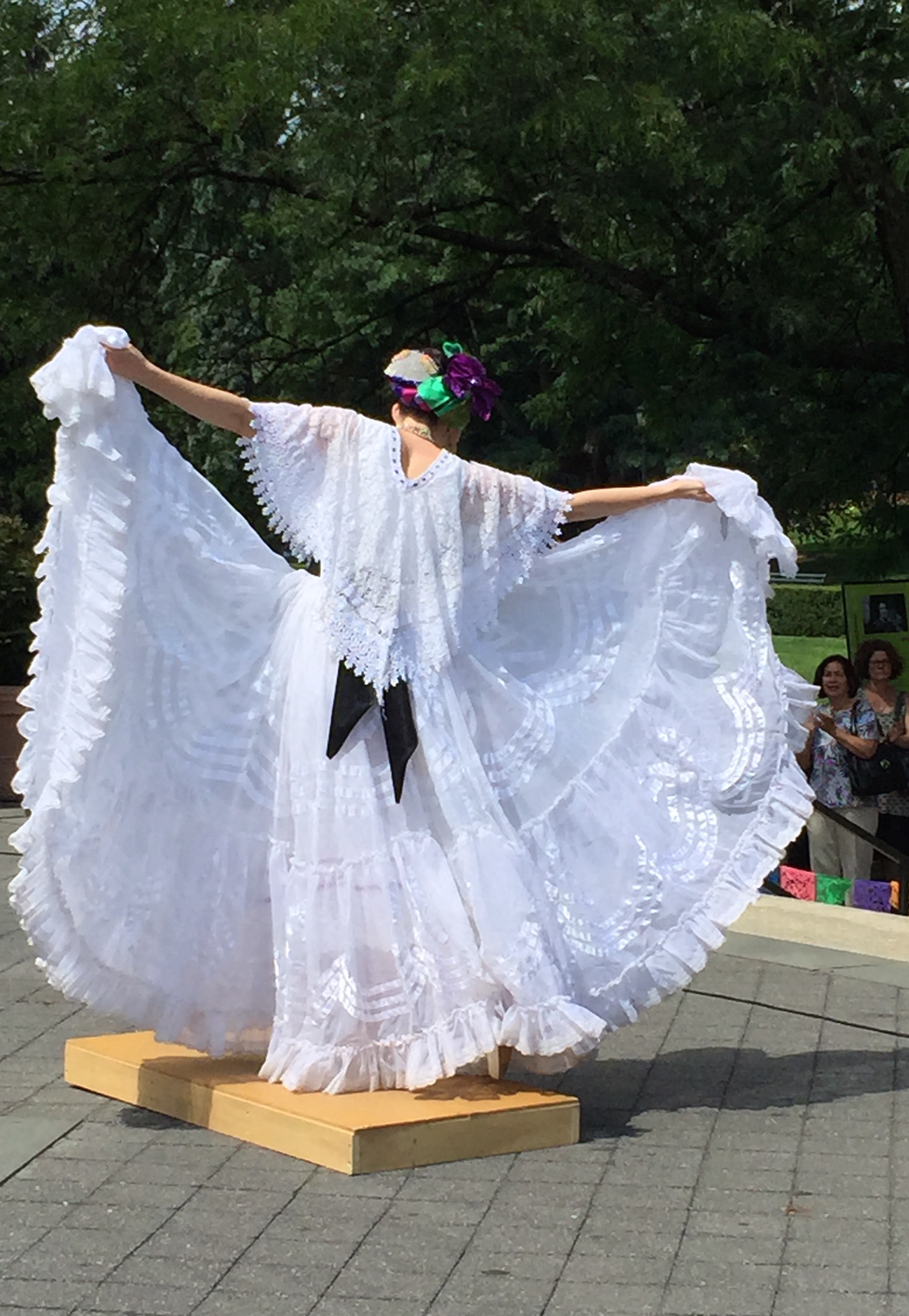
Soloist from Capulli Danza Mexicana channels her inner Frida for the crowd

Soloist from Capulli Danza Mexicana channels her inner Frida for the crowd

The “Life” portion of the show’s title is represented by the generous schedule of music, performances, films, and events that the NYBG has featured throughout the show’s six-month run. Dance companies, all-female mariachi bands, chefs, and authors provide sensuous infusions of movement, wit, gaiety, and sophistication that Frida embodied her entire life. Flashing red skirts, exciting beats, fast footwork, dramatic flourishes, and meaty conversation all contribute to the experience of who Frida was, how she lived, and what she loved.

Download the exhibition panel to see all the parts of Mexico City that meant so much to Frida and Diego – images of parks, gardens, markets, and historic sites, including photos of Casa Azul.

Download the app for your visit, and go to our Flickr site to see the photos and a few videos of the dancers in action.

Take a look at what the NYBG team achieved:

If you have time, check out the YouTube of the all-star kick-off symposium dedicated to Frida last May.


10 Things to Know About Pluto’s Star Turn This Week

In real time, AMNH astrovisualization guru Carter Emmart notes the moment that humans reached the furthest point of exploration on Pluto on the big screen

In real time, AMNH astrovisualization guru Carter Emmart notes the moment that humans reached the furthest point of exploration, passing beyond Pluto

The American Museum of Natural History hosted a sold-out event at the crack of dawn this week to give Pluto fans (and Dr. Neil) a real time, play-by-play of what was happening on the edge of our solar system.

Check out our Flickr feed to see the visualizations created by Dr. Carter Emmart’s team at the Hayden Planetarium and glimpse some of the (human) stars at Mission Control and others who weighed in via Google Hangout from planetariums from around the world.

Here are 10 essential things you should know:

Pluto’s photo from earlier in the week appears on the Google Hangout, showing the “heart” area

Pluto’s photo from earlier in the week appears on the Google Hangout, showing the “heart” area

1) It was a fly-by. The New Horizons spacecraft flew by Pluto. It didn’t land or orbit around it.

2) Pluto has a reddish tint. The new color photos show that Mars isn’t alone.

3) Pluto has five moons. New Horizons is looking for more.

4) This marks the furthest point of human exploration to date. It happened just before 9 a.m. on Tuesday, July 14.

Just in -- the latest from New Horizons: July 17 photo of smooth frozen plains in Pluto’s “heart”

Just in — the latest from New Horizons: July 17 photo of smooth frozen plains in Pluto’s “heart”

5) The spacecraft, New Horizons, is the size of a grand piano. It traveled over 3 billion miles.

6) It took New Horizons 9-1/2 years to get to Pluto. It was launched January 17, 2006 and is expected to keep going out into space for another ten years. For the full story, click here.

7) The new photos confirm that Pluto is young and doesn’t have any craters (like our Moon or Neptune). Its 11,000-foot ice mountains are only 100 million years old (compared to the Rockies at 80 million years old). They formed during our Cretaceous period. More discoveries to come photos and data slowly stream in.

Fran Bagenal, New Horizons's co-PI, and Alice Bowman, the Mission Operation Manager — the first female Mission Operation Manager at APL Johns Hopkins

Fran Bagenal, New Horizons’s co-PI, and Alice Bowman, the first female Mission Operation Manager at APL

8) The transmission speed from the spacecraft is half the speed of an old dial-up modem. That’s why mission control will be receiving photos and other data from this fly-by for the next sixteen months or more.

9) Twenty-five percent of the people on the New Horizons project are women. Alice Bowman is the first female Mission Operations Manager at APL Johns Hopkins.

10) Dr. Neil keeps correcting people to call Pluto a “dwarf planet” but all of the scientists interviewed on the mission love it anyway. Some fans think it should be “grandfathered” into the solar system as an honorary planet.

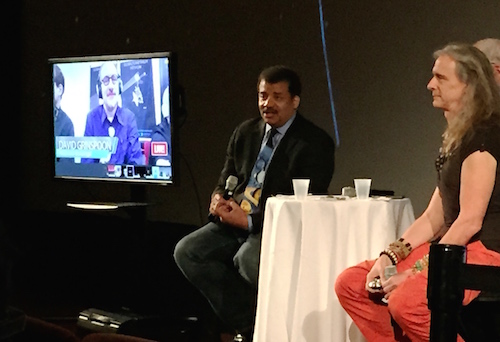
Neil de Grasse Tyson reminds astrobiologist David Grinspoon at Mission Control to call Pluto a “dwarf” planet

Neil de Grasse Tyson reminds astrobiologist David Grinspoon at Mission Control to call Pluto a “dwarf” planet

Does Pluto have a molten core? What’s the topography of Charon? Are there geysers? Are there other moons? What’s going on with the Kuiper Belt? Stay tuned as New Horizons keeps going.

NASA has a TV channel featuring (now) daily media briefings on the photos and data and has a channel with all the updates on New Horizons, including links to new photos.

Also, tune into the New Horizons site hosted by mission control at APL Johns Hopkins. Next month, releases will be on a monthly basis.

Real-time visualization of how the New Horizons maps Pluto

Real-time visualization of how the New Horizons maps Pluto

Credit goes to Carter Emmart, AMNH’s director of astrovisualization, and the other creators of the Digital Universe for inventing this 4D open-source software and sharing it with planetariums around the world and applause for the scientists that made this expedition happen!

Nearly 11,000 people watched this live telecast from AMNH. If you have time, enjoy it for yourself by watching this YouTube recording of the event, currently at 46K views and counting:


Plains Indians Wearable Art at The Met

1780 Plains Indian horned headdress assembled from a powerful mix of materials including bison horns, deer and horsehair, porcupine quills, glass beads, wood, metal cones, cotton cloth, silk ribbon, and paint. From the Musée du quai Branly in Paris

1780 Horned headdress assembled from a powerful mix from mighty bison , deer, and horse. From Musée du quai Branly in Paris.

With all the attention this week on the couture gowns at the Metropolitan Museum of Art ball and Costume Institute show, don’t forget that some of the most elaborately embellished mixed-media wearable art is installed on the second floor in the expansive tribute, The Plains Indians: Artists of Earth and Sky, through this weekend.

The masterworks have been gathered from select European and North American collections and feature beadwork (mostly on leather), symbolic headdresses, and magical objects that directly telegraph the wearer’s connection to nature, the universe, and supernatural power.

The show was organized by the Musée du quai Branly, Paris, in collaboration with The Met, and in partnership with The Nelson-Atkins Museum of Art, Kansas City, and features works from the 18th century through today (like the China exhibition in the other wing).

All-over beading on contemporary platform shoes by artist Jamie Okuma, 2014.

All-over beading on 2014 platform shoes by artist Jamie Okuma.

The curators track changes in materials, styles, and concerns of the Osage, Quapaw, Omaha, Crow, Cheyenne, Arapaho, Lakota, Blackfeet, Pawnee, Kiowa, Comanche, and Meskwaki nations from the time they dominated the Midwest through the demise of the buffalo, the great wars, the transition to reservation life, and participation in 21st century art and culture.

Take a read through the curators’ story on this exhibition site and see some of our favorite looks on our Flickr feed, where we’ve organized the pieces in chronological order. We’re giving you a close-up view of some of the bead, quill, and embroidery work. You can see the transition from more shamanistic embellishment to use of imported Venetian glass beads, to the all-over bead style, and finally to current creations, such as Jaime Okuma’s beaded platform shoes.

Central painting on large-scale Mythic Bird robe from the Illinois Confederacy, 1700-1740. Courtesy: Musée du quai Branly in Paris

Central painting on Mythic Bird robe, Illinois Confederacy, 1700-1740. Courtesy: Musée du quai Branly in Paris

Much of the painting and handwork was divided according to gender – men painted figures and women did the beadwork and painted the geometric forms. This beautiful robe with a geometric mythological bird is one of the earliest surviving large-scale paintings from Plains tribes, and the beaded geometry of the 1895 Crow wedding robe is another marvel.

Compare the mixed-media horned headdresses from 1780s Missouri with Chief Red Cloud’s dramatic all-business trophy-feathered war bonnet of 1865. The fluffy-feathered 1925 creation from Cody’s Buffalo Bill Center almost makes you wonder if that version were strictly for wild west shows.

It’s also interesting to learn that the powerful symbolic paintings on shirts and shields were essentially “owned” by their creators.

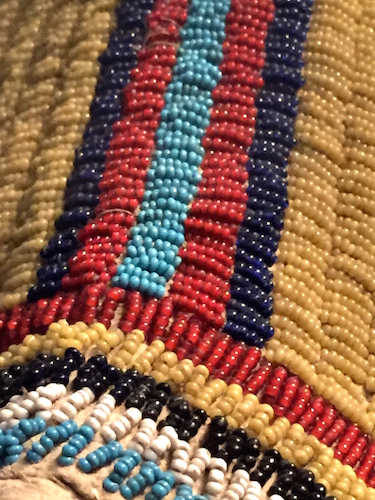
Close up of the tiny Venetian seed beads used to decorate a Lakota woman’s dress (Teton Sioux), 1865. From the Smithsonian’s NMAI

Tiny Venetian seed beads decorate a Lakota woman’s 1865 dress. From the Smithsonian’s NMAI

Similar to what we learned about 1920s French couture designers’ concerns about unlicensed copies in FIT’s recent Faking It show, anyone wanting to replicate a particular war shirt or shield, had to be granted formal permission. The Met exhibition explains that replication permission of Plains Indian designs were closely held and protected for generations.

A full database of the amazing objects in the show is on the Met’s website, as well as the complete audio guide to the exhibit on the museum’s Soundcloud site. As you click on the audio tracks, you’ll see a small thumbnail of the object.

Listen to curator Gaylord Torrence, explain how French culture and embroidery techniques collided with Plains Indians culture three hundred years ago to such magnificent result:


Bird Watching with Audubon: Forget the Binoculars

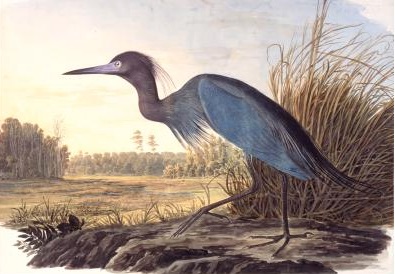
Little Blue Heron (Egretta caerulea), Havell plate no. 307, 1832

Little Blue Heron (Egretta caerulea), Havell plate no. 307, 1832

If you climb up to the second story of the New-York Historical Society to see Audubon’s birds, grab the magnifying glass right inside the gallery door. See the magnificent details painted by the watercolor master of all time in  Audubon’s Aviary: The Final Flight (Part III of The Complete Flock), running through this weekend.

NYHS is the lucky owner of every watecolor JJA produced to make his historic Birds of America subscription project in the early 1800s, which documented over 700 species.

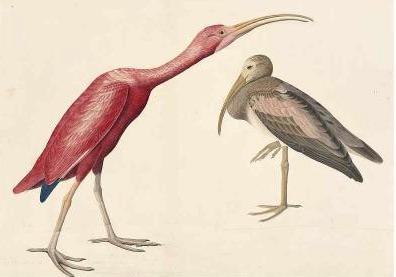
Scarlet Ibis (Eudocimus ruber), Havell plate no. 397, 1837

Scarlet Ibis (Eudocimus ruber), Havell plate no. 397, 1837

The watercolor collection – from which engravings were made – is so large that NYHS had to split the exhibition into three parts. It’s a joy to look at the life-size paintings that Audubon produced through the magnifying lens, seeing the tiny brushstrokes on lush feathers and miniscule detail on the small hummingbirds.

Paintings featured in all three shows are hung in the sequence that JJA painted them. Although JJA traveled extensively throughout the East and South, he never actually saw birds west of the Missouri in the wild.

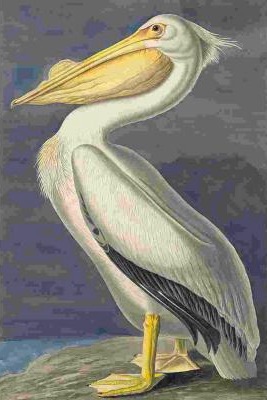
American White Pelican (Pelecanus erythrorhynchos), Havell plate no. 311

American White Pelican (Pelecanus erythrorhynchos), Havell plate no. 311

By the time Audubon began cranking out the watercolors needed for his final installment of his masterwork, lots of new birds were being discovered out West. Scrambling to keep up – after all, he committed to documenting every American bird – he accessed specimens collected by recent Western expeditions, Lewis & Clark’s trove, and other American specimens archived in Europe.

He holed up in Charleston, South Carolina in the winter of 1836 and worked, worked, worked to finish all the watercolors, which would be shipped to Mr. Havell in the UK for engraving.

How did Mr. Auduon’s studio work compare to the real thing? See for yourself in this bird-watching documentary shown inside the gallery. The birds featured are from the previous installation of the exhibit, including the rare, rambunctious Prairie Chicken at 1:25.

For more, go to the show’s excellent website, explore some of JJA’s works in more depth, and listen to the bird calls for the exhibition, courtesy of the Cornell Lab of Ornithology.

Nature Meditations in the Land of Fire and Ice

Katrín Sigurðardóttir, Haul IV (2004) travelling landscape-in-a-box on loan from private collector. Courtesy: The artist.

Katrín Sigurðardóttir, Haul IV (2004) travelling landscape-in-a-box on loan from private collector. Courtesy: The artist.

When the weather dips below freezing and people think they’re in the Arctic, there’s no better place to get out of the elements and meditate on the landscapes of long, dark winters than the third floor of Scandinavia House on Park Avenue. Until tomorrow, January 10, you’ll join eleven contemporary artists from the sub-arctic on their journeys in a show mounted by the Katonah Museum of Art, Iceland Artists Respond to Place.

Bjork may get all the media attention, but do yourself a favor and walk through this three-gallery show, which beautifully and simply presents the work of Iceland’s other leading visual artists. See the land of fire and ice through their eyes.

Olafur Eliasson, The Aerial River Series, 2000 on loan from private collector. Courtesy: The artist. Installation photo: Ben Blackwell

Olafur Eliasson, The Aerial River Series, 2000 on loan from private collector. Courtesy: The artist. Photo: Ben Blackwell

Olafur Eliasson takes you on an aerial journey along a 60-mile meltwater river, from the mouth to the source. Ragna Róbertsdóttir splatters miniscule lava rocks against a wall but it’s not what it sounds like. Far from a violent eruption, it’s an undulating, mesmerizing meditation that you’ll spend time contemplating.

For sheer romantic and modernist punch, enjoy Georg Guðni Hauksson’s two works – a large landscape memory and a solid dark blue canvas evoking the long winter nights (like an emotional Ad Reinhardt).

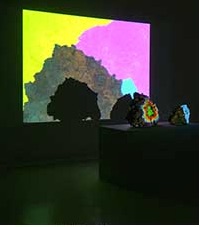
Lava rocks “talk” in Egill Sæbjörnsson’s Pleasure Stones installation (2008) on loan from private collector. Courtesy: The artist.

Lava rocks “talk” in Egill Sæbjörnsson’s Pleasure Stones installation (2008) on loan from private collector. Courtesy: The artist.

Egill Saebjornsson takes home the whimsy award with a multimedia installation in which rocks speak (seriously!). Eggert Pétursson zeros in the microscopic natural phenomenon – painting flowers (life sized) in patterns that read like tapestries. You’ll wish you were on some hikes with him. Katrín Sigurðardóttir simply packs up her landscapes into boxes. Tiny, tiny recreations of vast, romantic landscapes.

When we visited the galleries this week, visitors were asking if there was more they could see. Scandinavia House always hosts classy, elegant shows, so although the exhibition space is limited, we have to admit they always leave us wanting to see what’s next from that part of the world.

Seth Myers was recounting his Icelandic adventures this week on Late Night. If you can’t get to the country like Seth or visit the show, at least you can spend chilly days and nights like the natives do, courtesy of this instructional video produced by Scandinavia House:


Pterosaurs Leave New York

AMNH illustration of Mary Anning’s Dimorphodon. Courtesy: AMNH.

AMNH illustration of Mary Anning’s Dimorphodon. Courtesy: AMNH.

They came from all over the world to hang out for the ball drop, but will be gone by the time of the Super Bowl. Yes, the crazy cast of characters in the American Museum of Natural History’s show, Pterosaurs: Flight in the Age of the Dinosaurs, will decamp for their hometowns tomorrow, January 4 just like everyone else who came to New York and had a blast.

Quetzalcoatlus, Tropeognathus, and “Dark Wing” have been putting on quite a show for AMNH visitors since April, and only time will tell if New Yorkers have learned to stop calling them “dinosaurs.” They are flying reptiles.

AMNH illustration of super-tiny Nemicolopterus from China (10 inches) proves that not all pterosaurs were giants. He lived in the forest.

AMNH illustration of super-tiny Nemicolopterus from China (10 inches) proves that not all pterosaurs were giants. He lived in the forest.

The show features life-sized replicas of these flying machines and the big celebrity “Dark Wing” from Germany – the only pterosaur fossil yet found with impressions of the amazing wing membrane that contains layers and layers of thin muscle, all suspended from a single finger.

Get to know more about these amazing animals in the intro to the show, complete with a peppy soundtrack created by the Museum’s digital divas:


When Mary (“She Sells Sea Shells…”) Anning went scouting along Dorset’s Jurassic Coast in 1828, she found little Dimorphodon and sold it to Mr. Buckland, starting a scientific quest to determine the exact nature of these enigmatic creatures.

Happy Ptreranodon in the Vertebrate Origins hall before the crew made him a star of the show inside the Lefrak Gallery.

Happy Ptreranodon in the Vertebrate Origins hall before the crew made him a star of the show inside the Lefrak Gallery.

Most of the press at the time went gaga for the pterodactyl found in Bavaria during the 1830s and 1840s, named Pterodactylus by Mr. Cuvier. Pterosaur fossils have been around so long that it’s hard to believe that this New York show is the first time that these non-dinos have gotten the full star treatment.

Co-curators Mark Norell and Alexander Kellner and the AMNH exhibitions squad took on the jumbo challenge of mounting this first-ever museum show devoted solely to the vertebrates who “invented” flight. Yes, before birds (or bats) took to the skies, fuzzy-bodied pterosaurs were dive-bombing Mesozoic fish, launching from beaches, and leaving their unmistakable footprints on mudflats all over the ancient world.

Click here to see paleontologists searching for pterosaur footprints on an ancient Upper Jurassic beach in central Wyoming.

Pterosaur tracks in the Wyoming sandstone. Crooked forelimb print (L), hindfoot print (R). Taken on a 2006 trackway field trip with the Tate Museum.

Pterosaur tracks in the Wyoming sandstone. Crooked forelimb print (L), hindfoot print (R). Taken on a 2006 trackway field trip with the Tate Museum.

We couldn’t take photos inside the AMNH show of the beautiful pterosaur trackway from the Utah Field House of Natural History in Vernal, Utah, so this Flickr slide show gives you the idea. The shots were taken ten years ago, when paleontologists were still debating whether pterosaurs were bipedal or quadrupedal. As you can see, these Jurassic pterosaurs left quadrupedal tracks.

It’s doubtful that these flying marvels stayed on the beach for long. Watch here to see how gigantic Quetzalcoatlus and friends took off via the animations by the AMNH digital team, based on Michael Habib’s analytics and simulations. You’ll be surprised by what airplanes and pterosaurs have in common:

Groundbreakers App Ties History and Beauty Together

AppTitle

The New York Botanical Garden carved out an ambitious agenda in its Groundbreakers show – to tie the stories of six women of landscaping history, present a two-gallery recreation of an historic garden, pay tribute to the contributions of several landscapes within NYBG itself, create a poetry walk, and wrap it up with the history of early 20th-century photography and high-gloss publishing. They did it with GPS and an iPhone app, courtesy of Bloomberg.

Closing this weekend, Groundbreakers: Great American Gardens and the Women Who Designed Them is still worth downloading from iTunes, just to get a glimpse into the lives of six landscape-gardening pioneers, see their work, and understand the popularization of American gardening long before the dawn of HGTV or Lifestyles of the Rich and Famous. Here’s the link.

Photos of Ms. Johnston (left), lantern slides and projector, and Beals (right) on NYC street in 1902. Courtesy: NYBG

Photos of Ms. Johnston (left), lantern slides and projector, and Beals (right) on NYC street in 1902. Courtesy: NYBG

Here’s the story: back in the day (early 1900s), garden design and photography were two of the few career avenues available to women.

Way before Instagram, Photoshop, and two-way phone cameras, documenting the lush gardens involved lugging a gigantic, large-format camera up and down garden paths and around water features, processing black-and-white negatives into prints, turning some into newly-invented lantern slides, and having each slide painstakingly colored by hand. It helped if you had a car and an able-bodied assistant to help navigate the flagstone-lined paths with all the heavy gear.

Six American landscape pioneers who changed the course of American gardening. Courtesy: NYBG

Six American landscape pioneers who changed the course of American gardening. Courtesy: NYBG

Also, after the Industrial Revolution, aesthetically minded women (predating Lady Bird Johnson) felt it was time for American homescapes to get a little more spruced up.

The rich and famous were beginning to hire landscape designers to fix up the areas behind their East Side townhomes and acreages around their country estates. Why not document this and inspire upper middle class homeowners to follow suit?

The exhibition gives us a look at how artist visionaries, authors, and the publishing industry worked in tandem to record how landscape architects were creating romantic backyard landscapes and popularize beautification. Although seeing actual lantern slides, projectors, and gigantic tripods is amazing, one of the highlights is a recreation of the slide show by Frances Benjamin Johnston that basically blazed the trail of a new vision of what was possible – one image after another of gorgeous, visionary landscapes on the grounds of homes on the East Coast, California, England, and France.

NYBG recreated the evocative Moon Gate from the Rockefeller garden, inspired by their experience of the Forbidden City and designed by Beatrix Farrand

NYBG recreated the evocative Moon Gate from the Rockefeller garden, inspired by their experience of the Forbidden City and designed by Beatrix Farrand

In the Conservatory, the team at NYBG recreated Mrs. Rockefeller’s garden, originally designed by Beatrix Farrand, to highlight how the garden was conceived, used, and enhanced by the Asian art Mr. and Mrs. John D. collected. Since Farrand took on this project in 1926, NYBG has the sounds of America’s Jazz Age wafting through the galleries. Take a look on our Flickr page.

Another great feature of this show and the app – NYBG’s GPS feature shows you where you are in the expansive garden and encourages you to visit features where these groundbreakers had a hand – such as Marian Coffin’s ornamental conifer collection and Ferrand’s Rose Garden.

Get a closer view of the spectacular Groundbreakers in NYBG’s news-style video:

If you have a bit more time, listen to this curator lecture on the Beautiful Garden movement in America in 1900 and see the photos used by Johnston home to show suburbanites exactly how it should be done. You’ll witness garden images that hadn’t been seen since 1930. Take a look and get inspired:

Click here for other videos: a lecture about Beatrix Farrand created Mrs. Rockefeller’s garden and how the NYBG team recreated it in the stunning Victorian conservatory.

Sailing Life Rafts into Brooklyn’s Submerged Motherlands

The tree touches the top of the Cantor Gallery. Photo: Brooklyn Museum

The tree touches the top of the Cantor Gallery. Photos: Brooklyn Museum

The view is dramatic, but the story is it evokes is even bigger than what’s in the room. There’s still time to travel out to the Brooklyn Museum to have the immersive experience of Swoon’s Submerged Motherlands, closing August 24.

The pictures here just don’t do justice to the super-high wrap-around effect of this walk-through take on the emotional side of rising tides throughout the world. A photo can’t take it all in — a sheltering, 60-foot tree with cut-out paper leaves with some day-after-the-Flood rafts parked down below, all decorated with sketches of the peoples and mothers of the world.

And did we mention that Brooklyn visionary Callie Curry (a.k.a. Swoon) actually built and lived on those rafts for a while? Several years ago, she sailed them up and down the Hudson, on the Mississippi, and across the Adriatic.

Close-up of one of Callie’s rafts. Photo: Brooklyn Museum

Close-up of one of Callie’s rafts.

You’ll get to see these jerry-rigged but seaworthy concoctions up close, and examine the drawings, cut paper, and torn, coffee-stained textiles draping walls, floor, and shelters in this dramatic space.

The feeling it evokes makes you wonder if we’re ready for rising seas and climate change. It’s beautiful, monumental, and reminiscent of our recent lights-out experience of Hurricane Sandy, which tore at the edges of Brooklyn, Long Island, and Staten Island just two years ago – exactly what inspired Callie to take this work in this direction.

Hear what it took for Callie to create this fantastic walk-through installation on Brooklyn’s top floor:


You may also want to hear what Callie has to say about being a working artist in the real world – outside the four walls of a gallery – in her talk from TEDxBrooklyn in 2010. She will show you her rafts in action at Minute 5 and tell you what it felt like to arrive on a hand-built raft in Venice, her projects in post-earthquake Haiti, and interacting with people from the neighborhood as she creates art on the sides of Brooklyn buildings. Truly inspirational.

Poison Packs Punch at AMNH Night at the Museum Adult Sleepover

The sleepover site under the Blue Whale

The sleepover site under the Blue Whale

The first-ever adult Night at the Museum sleepover at the American Museum of Natural History last night was a hit, thanks to the enthusiasm and star power of Dr. Mark Siddall, the curator of the fantastic exhibition, The Power of Poison, closing August 10.

Early in the evening, Siddall mingled with sleepover guests at dinner in the Powerhouse and later in a series late-night talks from the Victorian theater inside the Poison show where costumed performers normally show visitors how to gather clues to solve a period murder mystery involving poison. (Think “I’ve got poison in my pocket” from A Gentleman’s Guide to Love and Murder.)

After dinner, the adventurers, some in costumes themselves, made quick trips with their stuffed animals to the cots under the Blue Whale and bounded up the stairs through the low-light galleries to reach the shark IMAX, live animal demos, fossil tours, and Siddall’s Poison briefings.

The Victorian theater inside Poison. Photo: AMNH/D. Finnan

The Victorian theater inside Poison. Photo: AMNH/D. Finnan

You had to pass through the always eerie Hall of Reptiles and Amphibians (hello, Komodo dragons!) to enter the magical kingdom of the Poison galleries.

Once inside, you were transported to a tropical rainforest, with golden poison-dart frogs under a dome, huge models of dangerous insects, and a toxin-eating Howler Monkey lurking on a branch.

Beyond the tropics, the show morphed into a land of make-believe…or was it? Tableaux with a sleeping Snow White, the witches of Macbeth, and the Mad Hatter were captivating, with the label copy bringing you back down to earth by explaining the role played by poisons and toxins in these scenes and what exactly witches’ brew contained.

Supplies for the toxic witches’ brew. Source: AMNH

Supplies for the toxic witches’ brew. Source: AMNH

A Chinese emperor (the one with the terra cotta army, no less!) ingests mercury in one diorama, thinking it’s going to give him immortality. Wrong move. Glancing down, you find out that as recently as 1948, mercury-laced teething powder was still being used on babies in the United States.

A spectacular illusion along the way is a magical set of Greek vases whose painted figures came to life to tell stories of how poison helped Hercules and doomed Ms. Medea.

The Magic BookThe lively vases are a prelude to the exhibition team’s greatest wonder – the Enchanted Book – a gigantic tome where ancient illustrations leap to life as you turn big, think parchment pages. Visitors could not get enough of that magic book. Somehow the AMNH digital team replicated it on the website, so click here to take a look at The Power of Poison: An Enchanted Book and turn the pages on line.

Here’s a glimpse of one story from the belladonna page, providing the backstory on how witches fly:

A lot of Siddall’s spectacular, magical, immersive, theatrical exhibition explains the science behind venoms, the “arms races” in the natural world, poison’s role in children’s stories, and how to analyze clues in solving murder mysteries.

Check out the Victorian-style introduction to Poison with Dr. Mark Siddall, its creator, and get a little taste of what the sleepover guests saw and heard.

To ward off any bad dreams about toxins or creepy crawlers, a lot of the late-nighters nestled in to watch vintage Abbott and Costello and Superman films and post Instagrams from the cozy, pillow-lined pit in center of the Hall of Planet Earth.

See the Today show’s recap (video after the commercial).

PS: If you can’t get to this show before August 10, download the iPad app, Power of Poison: Be a Detective that allows you to experience the last portion of the show. It’s been nominated for a 2014 Webby Award in the Education and Reference category.

William Morris: Meeting the Needs of Artistic Shoppers

Detail of the large woolen Bird textile that Morris designed in 1878 for his home that was still being sold decades later.

Detail of the large woolen Bird textile that Morris designed in 1878 for his home that was still being sold decades later.

William Morris not only did his historic homework, but was able to channel his convictions about the magic of the Medieval to tap into what artistic Victorian shoppers wanted – stylized visions of nature and old-school craftsmanship, the way it was done in the “old days.” See the evidence in two Metropolitan Museum of Art shows on right now — The Pre-Raphaelite Legacy: British Art and Design (running through October 26) and William Morris Textiles and Wallpaper (closing July 20).

You’ll see how Morris used the historic textile collections at the Victoria & Albert Museum as inspiration for his modern wall coverings and textiles. In the little low-light gallery outside the museum’s textile center –many designed by his designer, John Henry Dearle — right next to the older textiles that inspired them both. You’ll be able to compare Morris’s own winding, intricate patterns with those woven by the 15th-18th c. Venetians, Germans, and Spaniards.

Voided velvet and silk from Venice, 1420

Voided velvet and silk from Venice, 1420

As our Flickr site shows, the Met has its own examples for you to enjoy.

Morris began designing in 1861, went through a couple of iterations of his company and collaborators, and finally landed at Hanover Square in 1917, where his workshop was located just a few steps from Liberty of London on Regent, another retail hotbed of the Arts and Crafts movement where many of the Pre-Raphaelites shopped. As Oscar Wilde once remarked, ““Liberty is the chosen resort of the artistic shopper.”

In 1923, the Met decided to scoop up all of the still-being-sold Morris textiles from London. What you’ll see in the show aren’t the originals, but likely subsequent runs of the super-popular block-printed decorating papers and yardage.


The Backgammon Players, the faux-Medieval, mixed-arts furniture collaboration that started it all1861, with the 1878 Bird wall hanging far right.

The Backgammon Players, the faux-Medieval, mixed-arts furniture collaboration that started it all 1861, with the 1878 Bird wall hanging far right.

The Pre-Raphaelite Legacy has paintings, photos, sculptures, and other works by a wide range of artists. Check out the early painted furniture that Morris did with Edmund Burne-Jones (1861) and the book, written by Morris in archaic English and illustrated by Mr. Burne-Jones at the height of Morris mania (1898).

Next to the furniture collaboration, the curators have hung Morris’s own Bird textile, an intricate woven wonder of woodland creatures and forest marvels. The detail will blow you away, but so will the fact that the original was created in 1878, but what you are looking at was likely manufactured decades later for artistic shoppers and décor enthusiasts who just had to have it.