New Views from/at The Whitney Museum

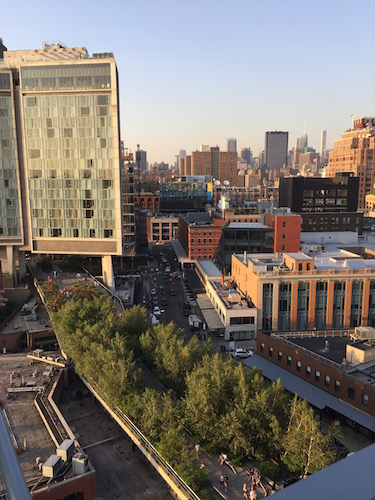
High Line and City views from the Whitney

Towering over the green esplanade of the High Line, the new Whitney Museum of American Art is a spectacular success, inside and out. The inaugural show, America is Hard to See, closing this weekend, features 600 works on all eight floors of the new Renzo Piano-designed landmark. Finally, Gertrude’s collection has room to breathe.

The inaugural installation distributed the massive collection into smartly themed galleries, but moving up and down between the floors is an equal delight – picture windows and balconies offering views of spectacular sunsets over the Hudson and Empire State Building views from entirely new vantage points. Peeking through the doors into the kitchen on the 8th floor reveals some of the best views (think Standard Hotel) offered to any sous chef in the City.

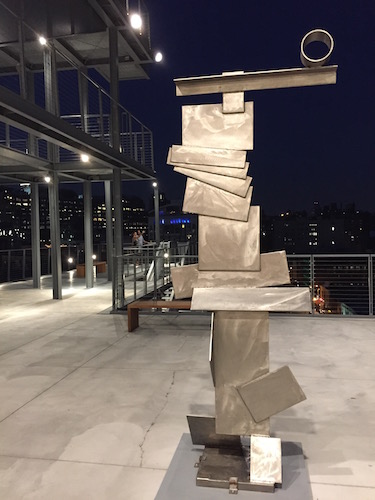
David Smith’s Cubi XXI (1961) enjoys its view of Meatpacking District nightlife from the balcony

David Smith’s Cubi XXI enjoys its balcony view of Meatpacking nightlife

Part of the fun is walking around on the balconies (on every floor) and experiencing the Whitney’s vertical outdoor sculpture park – Joel Shapiro’s playful bronze guy and David Smith’s towering Cubi totems, all against stunning City vistas. It’s Storm King for the urban soul.

Inside, it’s a walk through American art history with themes from the early 20th century (“Forms Abstracted”, “Music, Pink and Blue”, and “Machine Ornament”) with featuring the Whitney’s iconic works by Stella and Dove, O’Keefe and Macdonald-Wright, and Sheeler and Demuth. The clever mix of paintings and sculptures evoke times when American artists did their own takes on the modernist mix of African art and Cubism, colorful abstractions evoking symphonies for the eye, and the beauty of industrial techniques and landscapes in the heartland.

Gallery devoted to 1950s New York Abstract Expressionism with Chamberlain and diSuvero sculptures set against and Lee Krasner's 1957 Seasons

Gallery devoted to 1950s New York Abstract Expressionism with Chamberlain and diSuvero sculptures set against and Lee Krasner’s 1957 Seasons

The curators even pay tribute to early American filmmaking with a continuing mix of reels by 20th century innovators capturing the bustle and abstraction of modern life.

Calder’s “Circus” gets an expansive showcase, surrounded by jazz age depictions of vaudeville, clubs, movie palaces, and downtown edge by Benton, Hopper, Marsh, Weegee, and Cadmus. Around every corner, a new dimension to the American Experience is revealed – social-justice prints of the 1930s, heartland life in the 1940s, wartime calls to action, abstraction and color-field revolutions, and Pop.

Marisol’s Women and Dog group take in Lichtenstein’s Little Big Painting

Marisol’s Women and Dog group take in Lichtenstein’s Little Big Painting

One of the most stunning triumphs is the large gallery dominated by Mr. Chamberlain’s white car-crush tower, Mr. di Suvero’s primal hankchampion sculpture, and Ms. Krasner’s voluptuous 1957 pink and green mural. The clever curators gave Ms. Krasner her place in the spotlight, surrounded by works by Newman, Rothko, Kline, and Mr. Pollack, who is — at least for the run of this show – relegated to a few vertical drip canvases on the faraway opposite wall.

On a lower floor, the curators have hauled out the massive de Feo piece, “The Rose”, and installed it next to works by other female innovators, Lee Bontecou and Louise Nevelson.

If you missed the initial installation, take a look at the Whitney’s website (which features selected works from each of the 23 themed sections), listen to the audio guide introduction, and enjoy views of our favorites on our Flickr page.

Max Weber's Chinese Restaurant, painted in 1915 when Chinese restaurants and Cubism were first popping up in Manhattan

Max Weber’s Chinese Restaurant, made in 1915 when Chinese restaurants and Cubism were both new to Manhattan

The Whitney welcomes late-night guests (until 10 p.m.) every Thursday, Friday, and Saturday. Ride over to NYC’s newest subway station at 11th Avenue and 34th Street and walk down the High Line to the City’s latest hot spot in the Meatpacking District.


Daring Docent Dishes with Digital Adam at The Met

Digital Adam and the Docent reenact what Paradise was like before The Fall

Digital Adam and the Docent reenact what Paradise was like before The Fall

There’s no need to check into the Met after hours to see a classical statue come to life. In Renaissance gallery 504 on the main floor, a digital version of Tullio Lombardo’s 15th-century Adam is interacting with visitors and a knowledgeable Docent in Reid Farrington’s The Return performance through August 2.

The Return is quite a production and its illusions created in the Italian Renaissance gallery would make any animation fan jump for joy.

Classical Adam (the marble one) is installed prominently in the gallery where half the performance takes place. Its presence is a miracle, since the beautiful Renaissance sculpture totally shattered in a freak fall in 2002.

To repair it – a complex undertaking — Met team made a digital replica of all the pieces to decide how to fit everything back together again and spent years making it whole.

Tullio Lombardo’s Adam (1490-1495), which fell and shattered in 2002, but has been exquisitely repaired

Tullio Lombardo’s Adam (1490-1495), which fell and shattered in 2002, and is now repaired

Now, it’s Digital Adam who’s the fascinating co-star of the show, brought back to life by performance artist Reid Farrington who envisioned a tribute to the virtuosity of the Met’s conservation team who so flawlessly reassembled Tullio’s Adam.

The other half of the performance involves an improv actor, a motion sensor suit, and a crew of digital engineers and prop masters, all camped out on the stage of the Met’s auditorium in the Egyptian wing. As the stage actor moves in the auditorium, Digital Adam moves, speaks, answers questions, and holds up a Warhol and a Van Gogh inside his lifesize digital frame in the Renaissance gallery to the delight of the audience and his sidekick, The Docent. See photos on our Flickr feed.

The audience decides what part of Classical Adam’s renovation will get discussed next, but the witty duo soon veer off into other fascinating topics:

Actor in motion-capture portrays Digital Adam, whose image is simulcast at the right and in gallery 504

Actor in motion-capture portrays Digital Adam, whose image is simulcast at the right and in gallery 504

What does it feel like to always look good and never age? Does Classical Adam remember back to the marble quarry? Does Biblical Adam remember what Garden of Eden was like before the Fall? Adam’s clever responses reveal that his Eden experience was a lot about infinity pools and the good life.

At one point, Digital Adam invites the Docent to portray Eve in his telling of what happened after the Serpent appeared with that apple. Then the attention turns back to Classical Adam, as the Docent shows Lombardo’s thinking about that particular moment portrayed in marble.

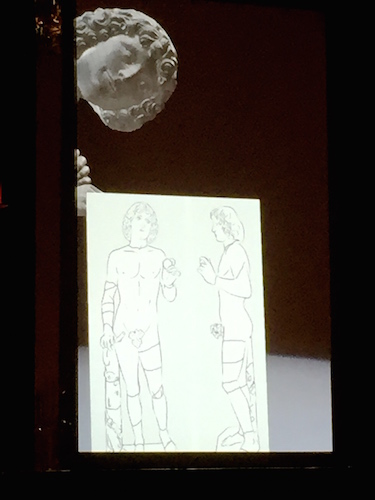
Digital Adam shows drawing of where the breaks in Lombardo’s Adam occurred

Digital Adam shows drawing of the breaks in Lombardo’s Adam

These two need their own ongoing talk show about history, time and space in some corner of the Met. Until August 2, ask the information desk for The Return’s program and go marvel at both the gallery and the behind-the-scenes performances. Or go to the live stream on the Met Museum’s website.

After meeting Digital Adam, you’ll never again wonder about what’s going on inside Classical Adam’s cool, calm, beautiful marble head.

Before Shapewear: Six Centuries of How to Look Good

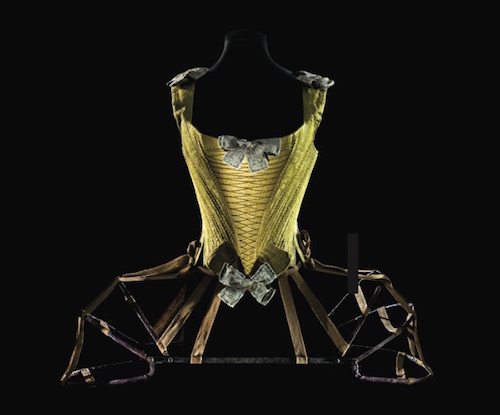
Articulated French pannier made of iron, leather, and fabric tape, 1770. Source: Les Arts Décoratifs. Photo: Patricia Canino.

Whalebone corset (1740-1760) above 1770 articulated French pannier that collapsed. Source: Les Arts Décoratifs. Photo: Patricia Canino

If you’ve ever successfully poured yourself into a pair of tight jeans, pay a visit to the Bard Graduate Center Gallery’s townhouse through July 26 to see Fashioning the Body: An Intimate History of the Silhouette, a three-story exhibition of how women – and men — pushed, pulled, and shaped their bodies into the “hot” silhouette of the day.

The show originated in the Musée des Arts Décoratifs in Paris in 2013 tells the story of how fashion divas and dandies utilized undergarments to stiffen, enhance, pad, and pouf themselves to create the iconic shapes we admire in paintings, photos, magazines, and other pre-digital media.

Painted yellow silk taffeta American robe a la Polonaise, 1780-1785 Installation views of “China: Through the Looking Glass” May 7 - August 16, 2015 Metropolitan Museum of Art New York, New York

American robe a la Polonaise held up by wire, 1780-1785. Source: Metropolitan Museum of Art, “China” exhibition.

Corsets (some iron!), farthingales, whalebone stays, panniers, crinolines, bustles, and girdles from the 15th century until today are all on display. You’ll see exactly how those whalebone stays stiffened corsets worn by nearly every woman from the 1500s to 1800s, and be amazed to learn that little children were also strapped into kids’ corsets to help shape “unformed” bodies right up through the 1950s in Western Europe.

Mr. James would approve of all the engineering that the curators reveal for us. Who knew that those wide panniers under 18th century French court skirts had elaborate mechanisms that could collapse to let their wearers squeeze through narrow carriage doors or tight household doorways? Automated models demonstrate just how neatly these ingenious apparatus operated to create the illusion of width just below super-tiny corseted waists.

How were those elaborate poufs created at the back of 1770s court gowns in the “Polonaise style”? Ladies could manipulate wires through eyelets in the voluminous triple-part skirts to create just the right amount of volume, drape, and flash.

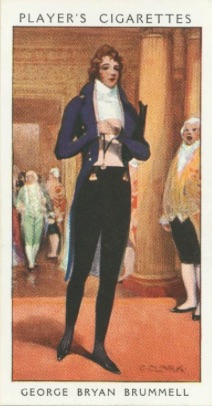
Uber-dandy Beau Brummel. Source: NYPL’s digitized George Arents Collection.

Uber-dandy Beau Brummel. Source: NYPL’s digitized George Arents Collection.

And the men! Under the sparkle jackets of 1770s court dress (subject of our previous post), the guys consciously padded chests, calves, and other body parts to give the appearance of a more muscular physique even if they hadn’t been working out. Shapely men’s calves were all the more important since high-end men’s footwear at the time consisted of elevated Louis heels.

For dandies of the 1800s, it was all clothes, all the time, so an even wider array of sartorial artifice came into being—tight men’s corsets, stomach belts, padding, and (more) fake calves. Striking a pose meant everything,

The in-gallery app provides lots of insightful commentary on the items and apparatus. On the second floor, Bard has a line of mannequins that illustrate the changes in female silhouettes. Here’s a walk –through of that part of the installation:

Watch this companion video to see some the collapsible pannier, corsets, and girdles in the show – direct predecessors to the shapewear of today:

Embroidered Menswear 100% Flash

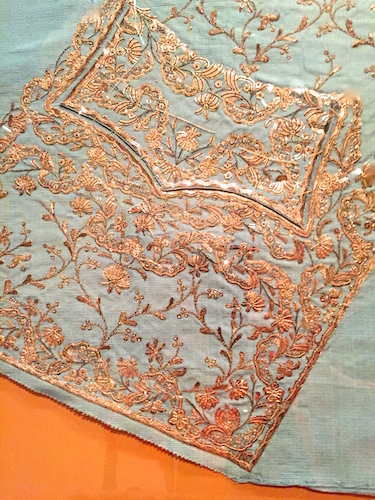
Embroidered front jacket pocket typical of 1780s court wear

Embroidered front jacket pocket typical of 1780s court wear

The womenswear in the Metropolitan Museum of Art’s China show couldn’t be more spectacular, but flashy menswear is not forgotten in the Ratti Center’s show, Elaborate Embroidery: Fabrics for Menswear before 1815, running through July 19.

It’s tiny, but lets you see what rich, fashionable men of the late 1700s and early 1800s were getting from their tailors in the biggest cities of Europe just before the fashions changed. Around 1815, Western men all adopted the monochrome suits that they’re still wearing for formal occasions and business today.

Until that fashion wave hit, the most spectacularly dressed men on the Continent would sport elaborate embroidery on silk or velvet jackets. The Met’s conservation center and textile library has selected some of its most spectacular samples. Check out the elaborate needlework in our Flickr feed.

Waistcoat front panel from 1760s Europe; metal thread embroidery with sequins on silk.

Waistcoat front panel from 1760s; metal thread embroidery with sequins on silk.

The show centers around a few samples that would be on display in retail shops where fashionable men would place custom orders. For more details on the 1770s showroom experience, read the Met’s blog post.

You’ll see swaths of silk or velvet all embroidered to the fit of the customer, just waiting for the tailor to perform the 3D transformation. The handwork is truly incredible. An early sample from the 1760s uses silver (that’s metal) embroidery interlaced with different-sized sequins to catch the light. Just imagine the dazzle when that guy made his entrance at court.

Some of the samples in the cases appear toned down by comparison to the silk-silver-sequin combo, but close inspection reveals how piling on a profusion of different stitches create botanical illusions running up and down the edges of coats and waistcoats. They’re comparable to botanical illustrations in the NYBG’s collections.

Close-up of embroidered velvet sample from 1800-1815, after which men preferred plain suits

Close-up of embroidered velvet sample from 1800-1815, after which men preferred plain suits

The most elaborate work was done in France, but with the switch to more democratic, monochrome suits in the early 1800s meant that people who had developed some of the best embroidery skills in Europe had to look for other jobs.

Whose stitches are on top? East or West? There’s just one more week to compare these snippets of handwork history with the elaborately embroidered 1700s and 1800s Manchu robes on loan from Beijing’s Palace Museum in the downstairs gallery of the Costume Institute. Decide for yourself.

When Apple Met Alto and Game Boy Began

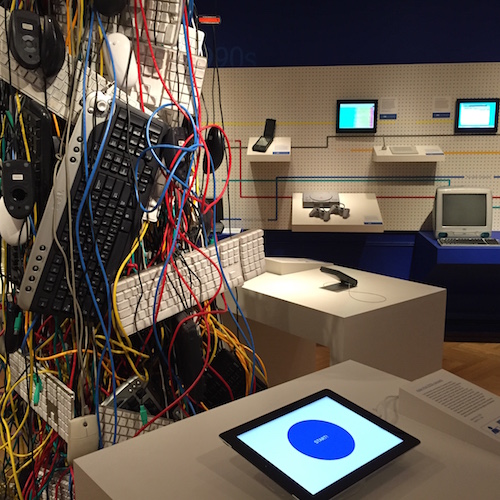
Tower of keyboards and wires in the center of the fourth-floor gallery; Newton visible against the history wall

Tower of keyboards and wires in the center of the fourth-floor gallery; Newton, PlayStation, and iMac visible on the history wall as iPad watches over everything

What’s the longest you ever sat in front of a computer screen or stared at stuff on your phone? Can you even remember a time before there were texts, browsers, and interactive screens? Bard Graduate Center Gallery has assembled a retrospective that asks you to remember your first keyboard, joystick, trackball, and mouse in their exhibition, The Interface Experience: Forty Years of Personal Computing, on view through July 19.

Plus, you can touch everything in the show and even sort through maybe every clamshell and Internet-enabled cellphone ever designed. What a stroll down memory lane!

Your first view of the fourth-floor show is a tangled tower of keyboards and cables, surrounded by a pegboard gallery with little platforms displaying the timeline of devices – desktop PCs, tablets, and game consoles.

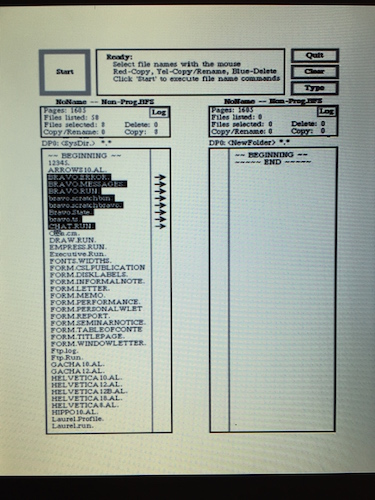
The 1973 Xerox Alto operating system featured the first mouse and graphic user interface.

The 1973 Xerox Alto operating system featured the first mouse and graphic user interface.

The oldest item in the show is the famous (but rarely glimpsed) 1973 Xerox Alto operating system, which the curators display on an ever-playing loop. Experience what Steve Jobs saw when he came face to face with the first graphical user interface, replete with the screen arrow. Brain flash on using a mouse to point to stuff on a screen – Steve said that someday everyone would be using something like this interface.

Walk on to see the Apple IIe (Woz built in an unbelievable 64K of RAM), VisiCalc (first “killer app” all quants had to have – a spreadsheet), and the predecessor to Steve’s Macintosh – the 1981 Xerox Star, which was the first commercially produced computer system to use a mouse and GUI. At a price of $16,000 in 1981, Steve’s up-and-coming Apple Macintosh was positioned to become a winner.

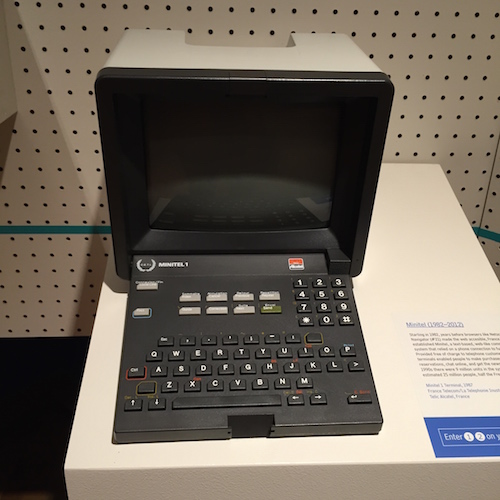
Before web browsers: Rarely seen, the exotic Minitel (1987 model) text information interface, which the French government distributed for free to half its population.

Before web browsers: Rarely seen, the exotic Minitel (1987 model) text information interface, which the French government distributed for free to half its population.

The Commodore 64 and IBM’s PC aren’t neglected, and neither is MS-DOS. Consider other game-changers such as Palm Pilot, Newton, and Kinect. You can touch them all and remember the way it was before things got smaller, faster, and got more oomph. Get a glimpse of the installation (pegboards and all) on our Flickr feed.

Don’t worry if you can’t get up to 86th Street to handle the technology in person. As usual, Bard’s students and faculty, who collaborated on this show, have produced a highly fulfilling web application that highlights everything in their show, adds historic tidbits, and shows each piece’s original print and TV ads.

Click on “Grid” to see all the exhibition items. Click on “Connections” to read interesting comments by the curators comparing different items or telling little histories about the relationships between the tech innovations. Click on “Device Statistics” to see how many units of each sold, how long it was in the market, and how much each would cost in today’s dollars. You’ll be able to sort the items by any of these parameters.

Steve’s hip and happening1998 iMac injected color into a drab, drab desktop computing world

Steve’s hip and happening1998 iMac injected color into a drab, drab desktop computing world

Example: sorted by today’s cost, the most expensive computing investment in the show would be the Xerox Alto operating system at (today) $225,981.

Be sure to click on “more” and enjoy the gallery of magazine ads for these innovations. And check out the 1979 TV commercial for Xerox Alto, on loan from the Xerox Archives, and please, do not miss the unforgettable all singing and dancing MS-DOS product introduction video.

You’ll read memories shared by gallery visitors about various items in the exhibition. For that matter, click on any item on the Grid and add your own story about your first personal encounter with these icons!

Bravo, Bard Graduate Center!

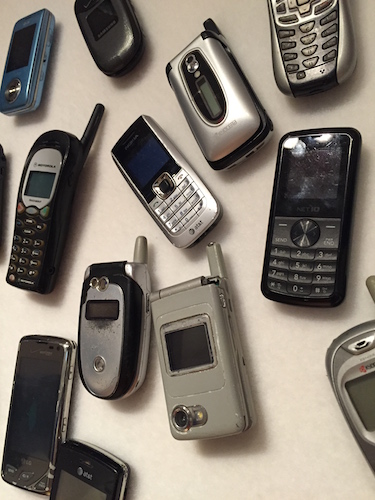
Mobile phones for days – the future of computing. The curators put these up with Velcro so visitors could feel them.

Mobile phones for days – the future of computing. The curators put these up with Velcro so visitors could feel them.

Dramatic Live Steam Show Envelops Virginia Museums

The restored 611 arrives in downtown Roanoke behind the art museum

The restored 611 arrives in downtown Roanoke behind the art museum

For the last month, crowds in western Virginia have been turning out in droves to see the dramatic result of engineering, technology, and determination by several museums and volunteers to resurrect the biggest, fastest passenger steam locomotive to live out its former glory on the Norfolk & Western Railroad.

If the CEO of Norfolk Southern hadn’t sold his Rothko in New York in 2013 and donated $1.5 million of its record-breaking proceeds, this amazing steam revival might not have happened.

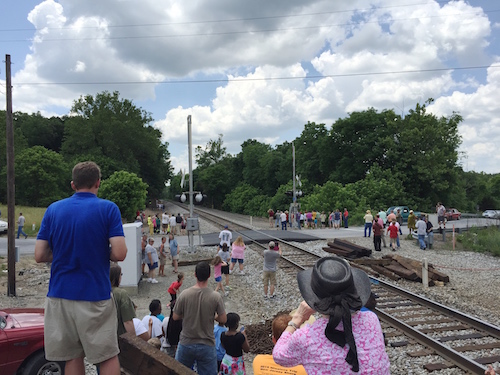
Waiting for the 611 at Evington, Virginia on its debut run

Waiting for the 611 at Evington, Virginia on its debut run

The Virginia Museum of Transportation is celebrating the culmination of efforts to “Fire Up the 611” and let this 100-mile-per-hour wonder rip through the foothills of the Blue Ridge and points east all month and hopefully into the future.

As the 611 made its way from its rehab yard at the North Carolina Transportation Museum in Spencer, North Carolina, people lined the tracks to see the newly refurbished 1950s streamlined locomotive pull 17 passenger cars loaded with fans 140 miles north to its new home in Roanoke. The celebration of 611’s return has been going on all month, as the locomotive keeps making runs to Petersburg, Lynchburg, Radford, and other Virginia towns.

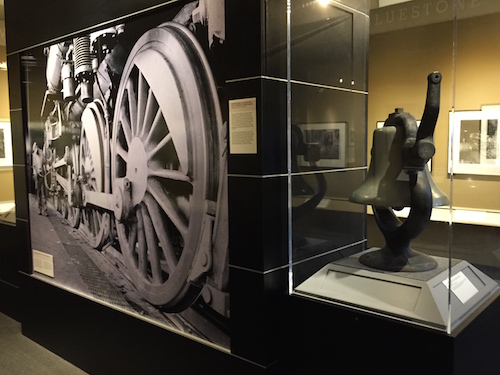
611 parked next to the O. Winston Link Museum

611 parked next to the O. Winston Link Museum

The 611’s Twitter feed lets everyone know when to expect it, although the piercing steam whistle and roaring sound are also sufficient alerts to anyone in a five-mile radius. Listen to its sounds on our Flickr video of its 45-mph pass through one lucky town and see photos its Roanoke arrival.

The 611 and its 13 sister locomotives (Norfolk & Western J Class) were produced after 1941 and pulled passenger trains through Ohio, North Carolina, Virginia, and Tennessee until the late 1950s – around the same time that Rothko painted the canvas that would later benefit the 611’s resurrection. Since it’s retirement, this coal-fired steam engine mostly sat in the yard at the Roanoke museum, but had a brief comeback in the 1980s making a few tourist rail runs.

Inside the O. Winston Link Museum, showcasing Link’s spectacular photographs of the last days of steam on the Norfolk & Western Railroad

Inside the O. Winston Link Museum, showcasing Link’s spectacular photographs of the last days of steam on the Norfolk & Western Railroad

Norfolk Southern initiated a “21st Century Steam” initiative, and volunteers at the Roanoke museum began the “Fire Up the 611!” campaign. The NS CEO decided to jump-start the initiative with the $1.5 million from the Rothko sale, and volunteers put in over 8,000 hours to bring the magnificent machine back to life.

When the 611 steamed into downtown Roanoke on May 30, it stopped for photos and an official welcome right behind Roanoke’s contemporary at museum and in front of the O. Winston Link Museum, housing the work of one of the most acclaimed railway photographers of the 20th century in the former Norfolk & Western Railway Building.

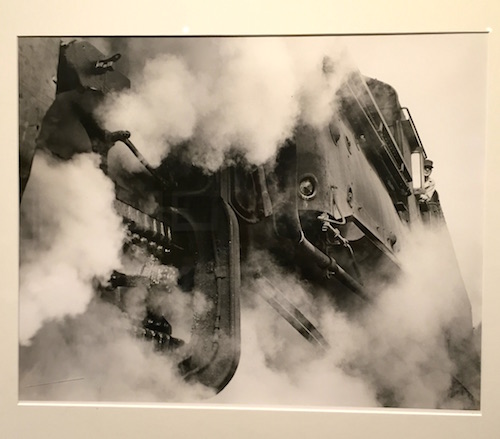
Link’s 1960s portrait of steam locomotive fireman, Joe Estes

Link’s 1960s portrait of steam locomotive fireman, Joe Estes

Link, a Brooklyn-born commercial photographer, fell in love with steam locomotives that he knew were rapidly being replaced by diesel. He innovated nighttime lighting gear to capture dramatic shots of the steam giants coursing through the hills and crossroads of West Virginia and Virginia. Link recorded their sounds as well – recordings that continued to sell well for decades. Catch a glimpse of Link’s gorgeous images, equipment and recordings on our Flickr site.

After finishing its July runs, the 611 will be on display in the museum yard in Roanoke, parked alongside other giants of steam.

Enlightenment through Gems

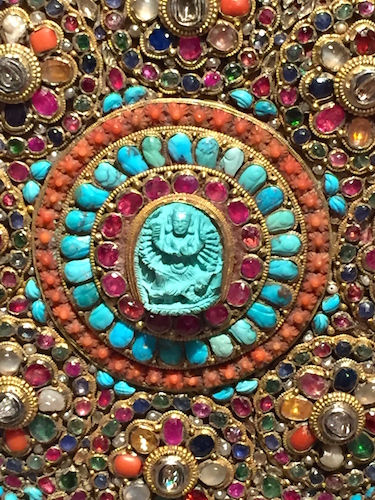
Center of 8-in. ritual offering dish made in 17th-18th c. Nepal

Turquoise Dhurga defeats a dragon in the center of 8-in. ritual offering dish (17th-18th c. Nepal)

It’s clear that wearing and giving precious (and semi-precious) gems can elevate the mind to higher levels of consciousness – at least in the minds of the Tibetan Buddhists – according to what you’ll see in Sacred Traditions of the Himalayas, running through this weekend at the Metropolitan Museum of Art.

The curators feature some remarkable statues, ritual dancewear, mandalas, and arms in the show, but let’s focus on the jewel-encrusted mosaics, containers, and jewelry displayed in the corner of the second-floor gallery, estimated to date from the 17th to 20th centuries.

Tibetan Buddhism emerged over the centuries in a dry, dusty, seemingly barren but beautiful region where people’s own adornment or bright flags atop mountain passes seem to be the only bursts of color. Inside homes, personal shrines, and monastery temples hang intricate, colorful mandalas pictorially suggesting the path to enlightenment, often symbolized by brightly adorned temples.

Mrs. Tsarong and two ladies from Tsang wearing special-occasion jewelry and hats as photographed by C. Suydam Cutting in 1937. Courtesy: Newark Museum collection

Mrs. Tsarong and two ladies from Tsang sport special-occasion jewelry and hats near Lhasa in 1937. Photo: C. Suydam Cutting. Courtesy: Newark Museum

These conceptual centers of enlightenment are often thought of as colorful crystal palaces emblazoned with jewels – an attractive image to hold in one’s mind on the lifelong journey to this higher plane of existence. What better way to remember your goal than to contemplate bedazzling diamonds, rubies, emeralds, sapphires, garnets, quartz, pearls, amber, coral, lapis lazuli, and turquoise?

To honor one’s journey to enlightenment, wealthy Tibetans often donated jewels to temples to adorn statues of the deities or commissioned personal devotional objects. That’s why you see so many jewel-encrusted objects in the Met’s collection. Personal shrines had jewel mosaics jam-packed with a dazzling array of stones. Gigantic statues were adorned with jewel-encrusted ornaments and surrounded by similarly elaborate containers for offerings.

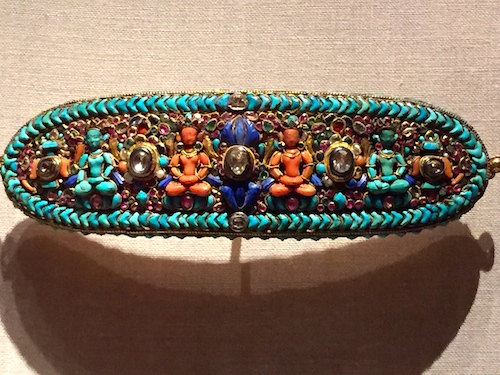
This Forehead Ornament for a Deity is only 8 inches long. Four celestial Buddhas are interspersed with diamonds

This Forehead Ornament for a Deity is only 8 inches long. Four celestial Buddhas are interspersed with diamonds

For special occasions, women sported accessories with amazing numbers of stones, reminding everyone of their social status, wealth, and devotion to an enlightened path.

Although some of the metal work was done in and around Lhasa, Tibet’s capital, the majority of the eye-popping jeweled settings were created across the border in Kathmandu, Nepal by Newari masters who created some of the most intricate visions in metal, wood, and paint ever known to the world. We’ve provided you with some close-up looks here and on our Flickr site. As shown, the result is a mix of Tibetan and Hindu imagery – typical of this region where so many cultural influences mix.

Densely packed diamonds, rubies, emeralds, sapphires, garnets, quartz, pearls, amber, coral, lapis, and turquoise in corner of Birth of the Buddha mosaic (18th-19th c. Nepal)

Densely packed diamonds, rubies, emeralds, sapphires, garnets, quartz, pearls, amber, coral, lapis, and turquoise in corner of Birth of the Buddha mosaic (18th-19th c. Nepal)

The Met’s own site for the objects in the show also allows you to zoom in on the details. Learn more about how the Met conserves such intricate jewel work in this blog post by an intern in the conservation department. See close-ups of how the Newaris set their gems.

Finally, explore Tibet as it was 100 years ago through this slideshow prepared for this show at the Met by the Newark Museum, which itself has a world-class collection of Tibetan objects and perhaps the largest collection of photographs of Tibetan people and temples from that time.

Lincoln Speaks at The Morgan

Lincoln reenactor visiting the 150th Anniversary of the Civil War Surrender, Appomattox Court House, April 2015

Lincoln reenactor visiting the 150th Anniversary of the Civil War Surrender, Appomattox Court House, April 2015

A grammar book, a book of math homework, dark romantic poetry, and required Shakespeare reading could be found in any literate teen’s bookshelf. In this case, they belong to Abraham Lincoln – key items that bring insight to his love of words, literature, and learning in the Morgan Library’s exceptional show, Lincoln Speaks: Words That Transformed a Nation, on view through June 7.

The show begins with Lincoln’s early books and poems, including those inspired by Mr. Poe’s The Raven, and presents drafts, manuscripts, letters, and the occasional photograph in a sequence that follows the trajectory of Mr. Lincoln’s life – campaigner, leader, emancipator, chief, and icon for the ages.

Follow along in the online version of the exhibition here and take a close look at some of the most important writings and objects in the show.

You’ll see Lincoln’s first use of the “house divided” reference and hear a reading his famous “house divided” speech (click here). Experience Lincoln’s ability to connect with the everyday voter by using clear, plain language.

Right Hand of Lincoln, a 1888 painted bronze cast by Leonard Volk, from original cast done in 1860 when Lincoln was nominated for President. Source: NYHS

Right Hand of Lincoln, a 1888 painted bronze cast by Leonard Volk, from original cast done in 1860 when Lincoln was nominated for President. Source: NYHS

The visual centerpiece of this unique tribute – a cast of Lincoln’s hands that were eventually scaled up for use in the Lincoln Memorial – is on loan from New-York Historical Society. Among other remarkable items are the Emancipation Proclamation and the first letter he wrote on April 2, 1865 at the fall or Richmond. It was to his wife, Mary, and ironically it would be the last she would receive.

The website and museum installation both feature terrific media and commentary, including an insightful documentary screening in the gallery.

Copy of life cast done by Leonard Volk of LIncoln in 1860. Source: NYHS

Copy of life cast done by Leonard Volk of LIncoln in 1860. Source: NYHS

The Civil War and the end of slavery are primary topics, of course, but looking at the handwriting, personal notes, and original writing provide significant insight to this monumentally important individual.

Although it’s not related to the exhibition, click here to see Lincoln, Grant, and other reenactors recreating the sights and sounds of the Civil War surrender at the 150th anniversary at Appomattox Court House, Virginia.

Plains Indians Wearable Art at The Met

1780 Plains Indian horned headdress assembled from a powerful mix of materials including bison horns, deer and horsehair, porcupine quills, glass beads, wood, metal cones, cotton cloth, silk ribbon, and paint. From the Musée du quai Branly in Paris

1780 Horned headdress assembled from a powerful mix from mighty bison , deer, and horse. From Musée du quai Branly in Paris.

With all the attention this week on the couture gowns at the Metropolitan Museum of Art ball and Costume Institute show, don’t forget that some of the most elaborately embellished mixed-media wearable art is installed on the second floor in the expansive tribute, The Plains Indians: Artists of Earth and Sky, through this weekend.

The masterworks have been gathered from select European and North American collections and feature beadwork (mostly on leather), symbolic headdresses, and magical objects that directly telegraph the wearer’s connection to nature, the universe, and supernatural power.

The show was organized by the Musée du quai Branly, Paris, in collaboration with The Met, and in partnership with The Nelson-Atkins Museum of Art, Kansas City, and features works from the 18th century through today (like the China exhibition in the other wing).

All-over beading on contemporary platform shoes by artist Jamie Okuma, 2014.

All-over beading on 2014 platform shoes by artist Jamie Okuma.

The curators track changes in materials, styles, and concerns of the Osage, Quapaw, Omaha, Crow, Cheyenne, Arapaho, Lakota, Blackfeet, Pawnee, Kiowa, Comanche, and Meskwaki nations from the time they dominated the Midwest through the demise of the buffalo, the great wars, the transition to reservation life, and participation in 21st century art and culture.

Take a read through the curators’ story on this exhibition site and see some of our favorite looks on our Flickr feed, where we’ve organized the pieces in chronological order. We’re giving you a close-up view of some of the bead, quill, and embroidery work. You can see the transition from more shamanistic embellishment to use of imported Venetian glass beads, to the all-over bead style, and finally to current creations, such as Jaime Okuma’s beaded platform shoes.

Central painting on large-scale Mythic Bird robe from the Illinois Confederacy, 1700-1740. Courtesy: Musée du quai Branly in Paris

Central painting on Mythic Bird robe, Illinois Confederacy, 1700-1740. Courtesy: Musée du quai Branly in Paris

Much of the painting and handwork was divided according to gender – men painted figures and women did the beadwork and painted the geometric forms. This beautiful robe with a geometric mythological bird is one of the earliest surviving large-scale paintings from Plains tribes, and the beaded geometry of the 1895 Crow wedding robe is another marvel.

Compare the mixed-media horned headdresses from 1780s Missouri with Chief Red Cloud’s dramatic all-business trophy-feathered war bonnet of 1865. The fluffy-feathered 1925 creation from Cody’s Buffalo Bill Center almost makes you wonder if that version were strictly for wild west shows.

It’s also interesting to learn that the powerful symbolic paintings on shirts and shields were essentially “owned” by their creators.

Close up of the tiny Venetian seed beads used to decorate a Lakota woman’s dress (Teton Sioux), 1865. From the Smithsonian’s NMAI

Tiny Venetian seed beads decorate a Lakota woman’s 1865 dress. From the Smithsonian’s NMAI

Similar to what we learned about 1920s French couture designers’ concerns about unlicensed copies in FIT’s recent Faking It show, anyone wanting to replicate a particular war shirt or shield, had to be granted formal permission. The Met exhibition explains that replication permission of Plains Indian designs were closely held and protected for generations.

A full database of the amazing objects in the show is on the Met’s website, as well as the complete audio guide to the exhibit on the museum’s Soundcloud site. As you click on the audio tracks, you’ll see a small thumbnail of the object.

Listen to curator Gaylord Torrence, explain how French culture and embroidery techniques collided with Plains Indians culture three hundred years ago to such magnificent result:


Benton’s Freebie Masterpiece at The Met

Viewer contemplates “The Changing West” panel of Thomas Hart Benton’s America Today mural (1930-1931)

Met visitor contemplates “The Changing West” panel of Thomas Hart Benton’s America Today mural (1930-1931)

When times get tough, did you ever take on a job or make something for free just to build up your resume and showcase what you could do? That’s exactly what one New York up-and-comer did, and it really paid off. The Metropolitan Museum of Art’s show, Thomas Hart Benton’s ‘America Today’ Mural Rediscovered, tells the story.

Back in 1930, the New School was just completing its modern building in the Village on West 12th Street and was seeking something to jazz up the boardroom.

“City Activities with Subway” portion of America Today based on his portrait sketches

“City Activities with Subway” portion of America Today based on his portrait sketches. (It’s Pollack’s sister-in-law, Elizabeth)

Mr. Orozco, the famed Mexican muralist, had already been commissioned for the more visible dining room/lounge, and Mr. Benton, who was teaching at the Art Students League, saw an opportunity to showcase his painting chops.

Social realist chronicler Reginald Marsh had introduced Benton to the mysteries of mastering egg tempera, and Benton felt ready to go to town on a large-scale portrait of American life in all of its regional glory. Here’s the deal: no pay, just loft studio space about a block away.

Twenty years earlier, Benton had hung around Paris, soaking up the birth of the French Cubist and Italian Futurist movements in Europe. Ten years earlier, he roamed around the back roads of the United States, filling up sketchbooks with steel town landscapes, lumber camps, oil derricks popping up in Los Angeles, dives, diners, and small town stuff.

“Steel” portion of the mural, featuring model Jackson Pollack, Benton’s student

“Steel” portion of the mural, featuring model Jackson Pollack, Benton’s student

The mural began taking shape, crammed to the gills with swirling activities, people, industry, and pop culture that he saw. Need models? Why not ask Jackson Pollack, his art student, and his sister to pose?

It’s hard to imagine serious board meetings taking place in a room so alive with oversized ambition and action. Over the decades, the New School repurposed the room for classroom lectures, and over time, the scuffed mural was removed completely.

Lucky for us, Benton’s 1930s historic masterpiece found its way to the Met, which has lovingly restored and installed it in a rectangular room just beyond the Frank Lloyd Wright room.

The curators have filled the adjacent galleries with extra treats: the inspirational sketches from Benton’s earlier road trips and works by Mr. Pollack and Benton’s Village contemporaries.

See our Flickr album to glimpse the installation (and works by early Pollack, Abbott, Marsh from the Met’s collection), and watch the Met curators tell the story of how Mr. Benton’s freebie paid off and their joy in giving this ten-panel chronicle a new home.