The Armory Show 2013: It’s a Wrap

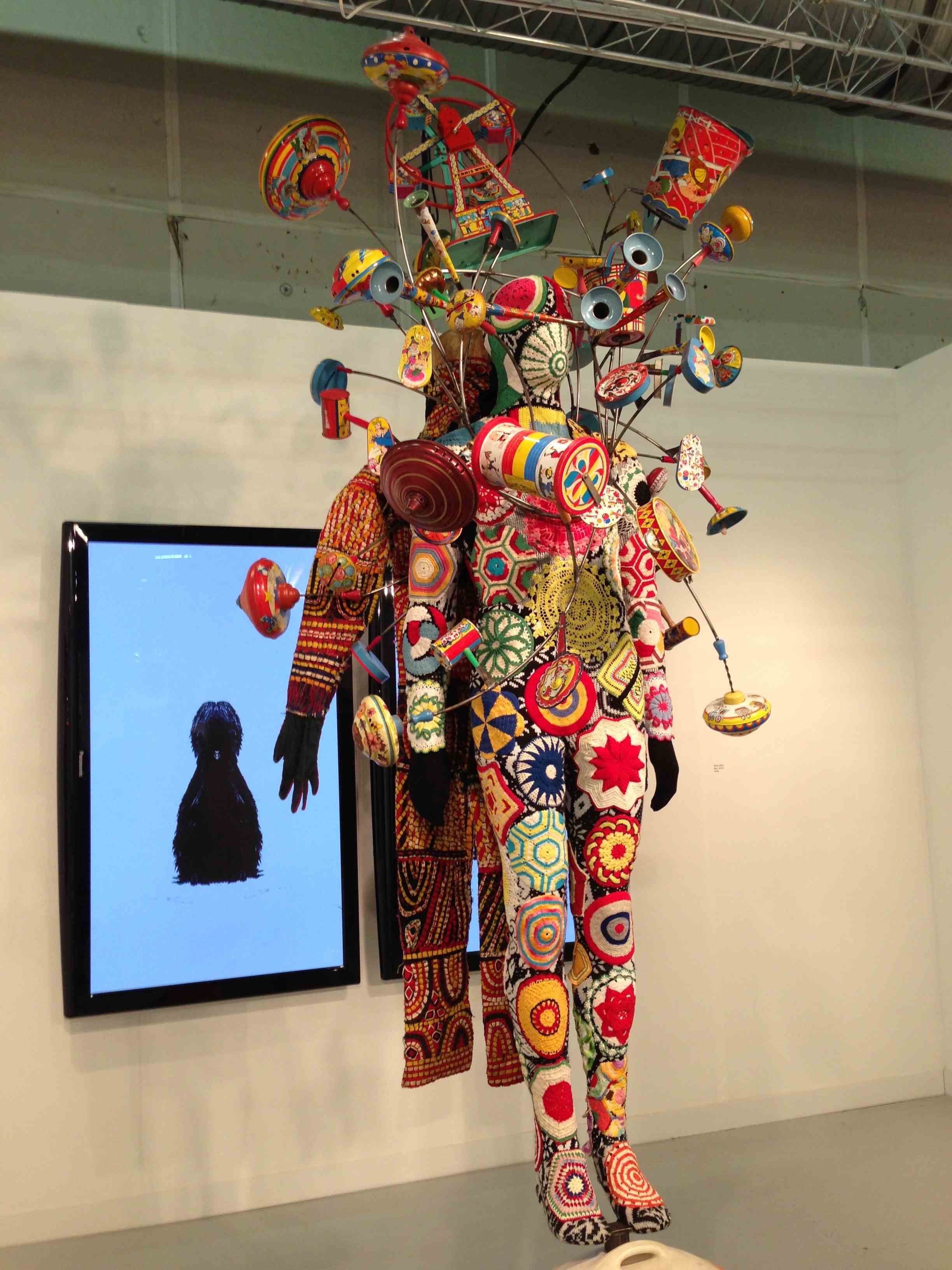
Nick Cave soundsuit (2012) and video featured at Jack Shaniman Gallery booth at the Armory Show’s Contemporary pier

Nick Cave soundsuit (2012) and performance video featured at Jack Shaniman Gallery at the Armory Show’s Contemporary pier

One hundred years ago, The Armory Show blew the roof off New York City as Matisse, Monet, Picasso, Seurat, Lautrec, Kandinsky and The Eight made history at Lexington and 26th Street. It was the beginning of Modern in America, and even Whistler’s Mother showed up.

This week, the 2013 edition of The Armory Show glamorized the West Side with its wall-to-wall extravaganza of modernist and contemporary sculpture, painting, and installation art at Piers 92/94. Take a walk-through of both shows via our Flickr photo feed.

Tributes to the original were in view in the Modern portion of the show, such as Munch’s intense woodcut Vampire II (1895-1902), as were edible Parisian imports from the Laudrée macaroon cart just inside the entrance. The show began right at coat check, where a few people were walking around carrying flattened-out versions of Andy’s Brillo boxes. Around the bend, there was the source: a silver chamber where the Pittsburgh’s Warhol Museum was inviting art-lovers to sit in front of a video camera to record a Warhol screen test. Obviously, the box carriers had claimed their 2.5 minutes of fame.
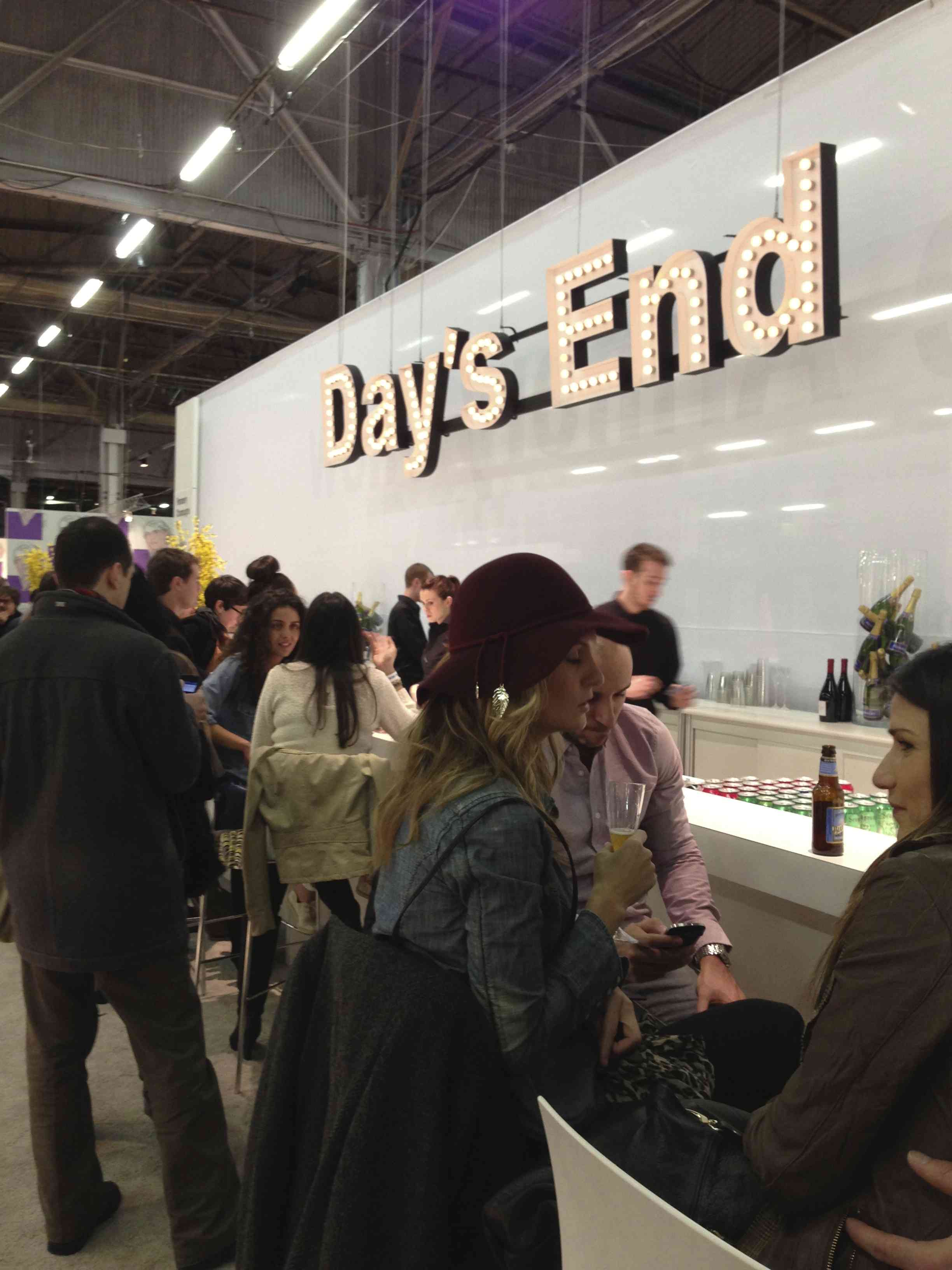
All-important champagne bar at the Armory Show’s Contemporary pier

All-important champagne bar at the Armory Show’s Contemporary pier

The Modern show featured a mix of new and old, but everything certainly looked fresh. People were even taking turns having their pictures taken with a large Basquiat painting at the Tokyo’s Galerie Sho Contemporary Art booth.

The Contemporary pier was filled with twice as much art. Although there were no actual performance installations on Saturday (as there were in last year’s show), two booths attracted lots of bystanders with performance videos – Marlborough’s Shade Composition video by Rashaad Newsome (evoking 80s Harlem ballroom voguing) and one of superstar Nick Cave’s soundsuit performances on a sharp, clean screen mounted right behind an actual, riotous soundsuit. (Be sure to catch his “horses” performing at Grand Central March 25-31 for Creative Time/MTA Arts for Transit.)

Other hits from the Contemporary pier (besides the champagne bar) included Tony Tasset’s snowman made entirely from inert material, right down to the bronze twigs and leaves (Kavi Gupta Gallery) and Kysa Johnson’s monumental recreation and embellishment of a Bank of America waiting room at Morgan Lehman, layered with the calculated, rational precision of Piranesi’s perspective.

Take a look, because it’s all being packed up and shipped back to Dusseldorf, Istanbul, Oslo, London, Paris, and Chelsea today.
Artists Occupy Bank in Queens

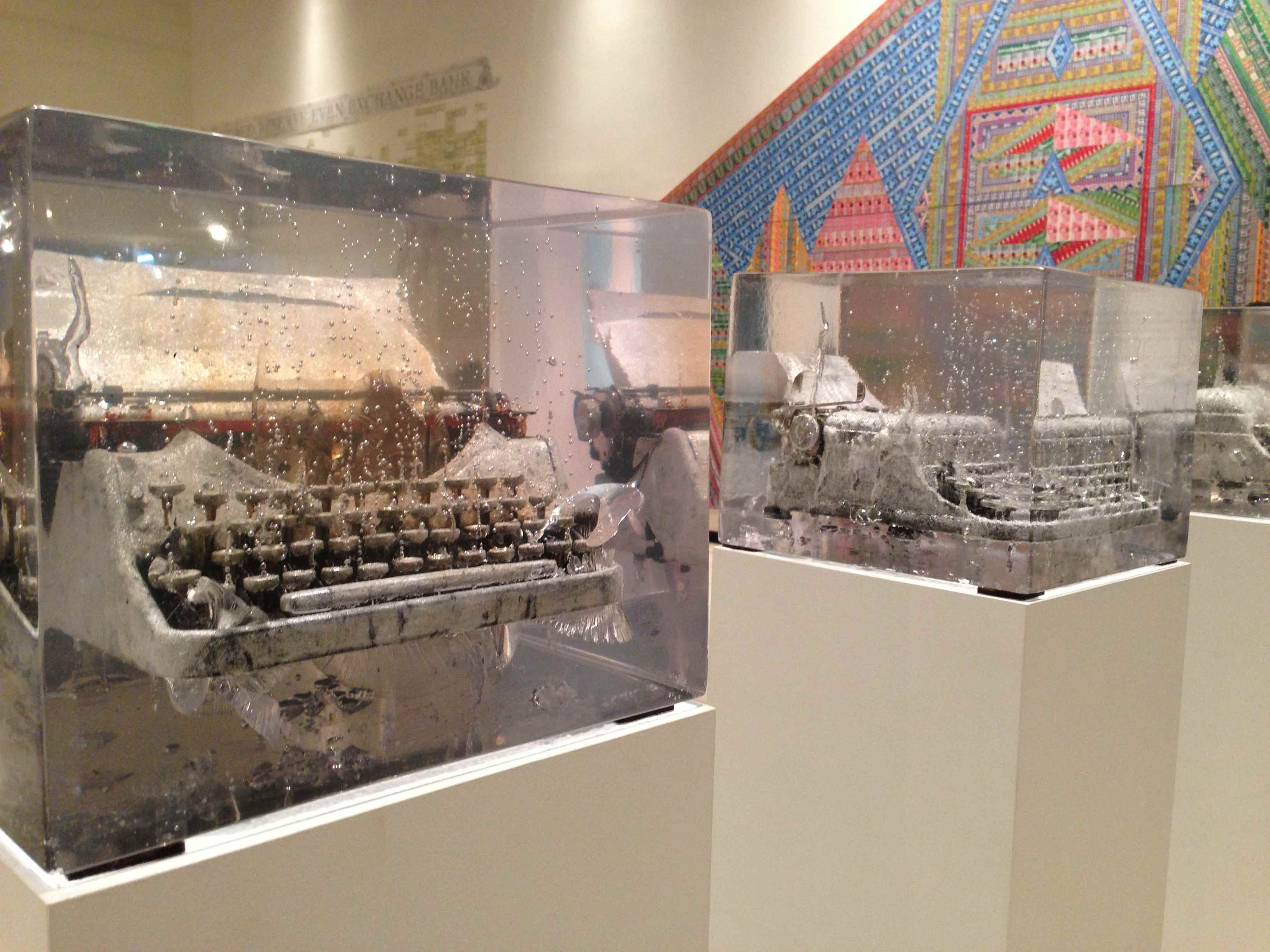
Installation view of Keiko Miyamori's typewriters-in-resin (2012) with Ghost of a Dream's The Price of Happiness mural (2011) made from US and Chinese lottery tickets.

Installation view of Keiko Miyamori’s typewriters-in-resin (2012) with Ghost of a Dream’s The Price of Happiness mural (2011) made from losing US and Chinese lottery tickets.

Just as they did in the Bronx last summer at the Andrew Freedman Home, No Longer Empty has invited artists take over the former Bank of Manhattan in Long Island City and let us contemplate the meaning of currency and exchange in today’s troubled times.

Get over to see how 26 artists from 15 countries think about the American economy in How Much Do I Owe You, which is right next to the Queens Plaza subway station in the Clock Tower Building (29-27 41st Avenue). There’s lots of thought-provoking stuff from the moment you enter the door, like Ghost of a Dream’s The Price of Happiness mural. It depicts a typical American house made up of losing US and Chinese lottery tickets, and was made by the group during their stay in China. Check out more pictures of our favorites on Flickr.

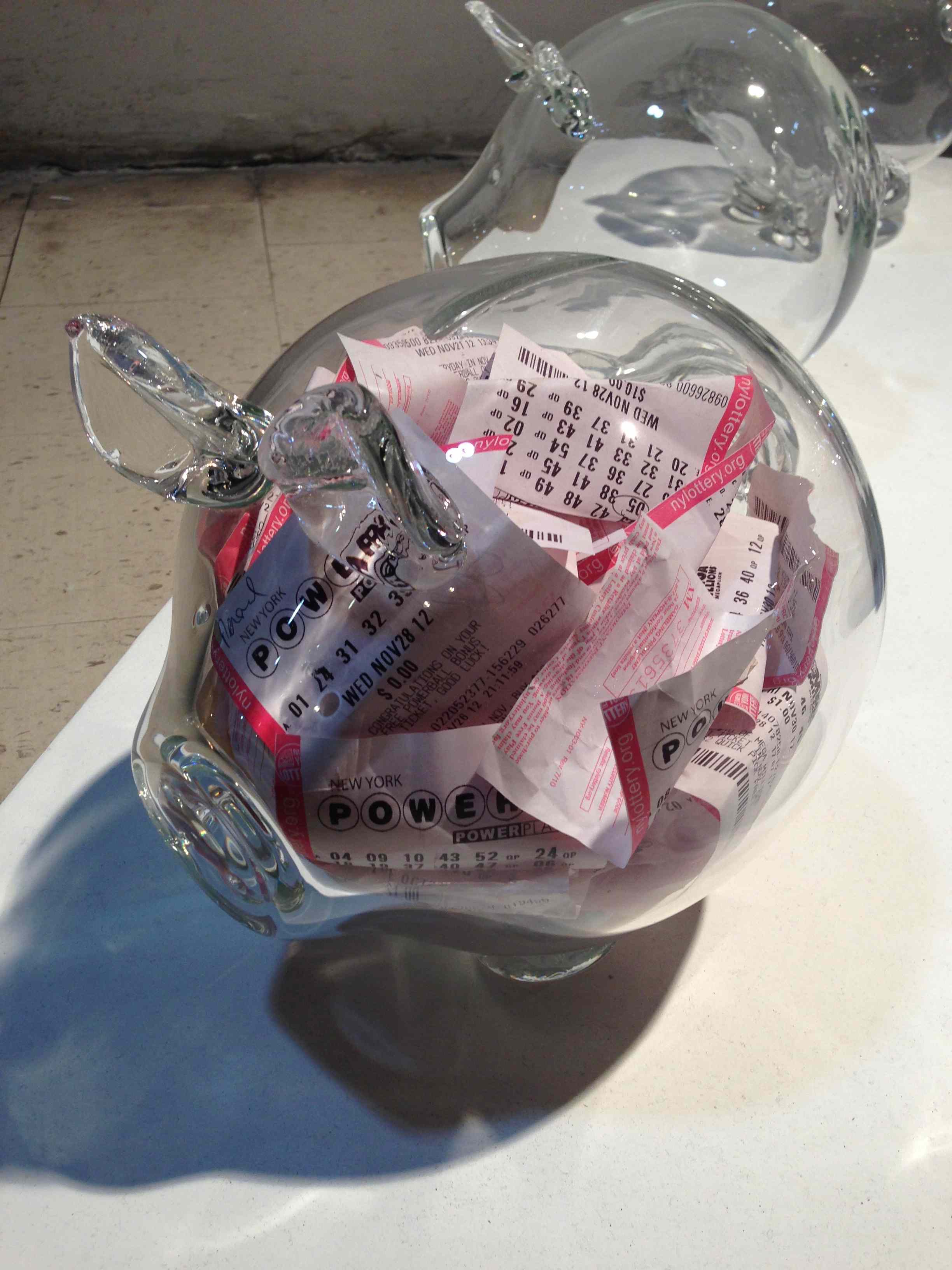
Installation view of Coleen Ford's Saving for our Future (2010), glass piggy banks stuffed with lottery tickets.

Installation view of Coleen Ford’s Saving for our Future (2012), glass piggy banks stuffed with lottery tickets.

Erika Harrsch’s Mao Dragon Kite and several US Dollar Kites fly overhead.  Keiko Miyamori’s typewriters-sunk-in-resin evoke historic systems and intractable problems. Susan Hamburger adorns a faux “bank” space (formerly where the bank tellers worked) with an old-style, symbol-filled mural that lays out relationships among Wall Street and Euro financial actors in the Greek debt crisis.

Downstairs by the bank’s vault, installations have a more private feel. Enter a small room to see and hear the results of Nicky Enright’s survey of the financial status of 80 artists in his Money Talks video (it’s not pretty). Enter a small alcove to watch Ana Prvacki’s amusing video of literal money laundering – in the guise of a “smelling good” household product commercial (think Wet Ones), she cleans and smells dollars in the hopes that she can bring about “a clean money culture”

When you round the corner to enter the open vault, you’ll be completely absorbed in watching Orit Ben-Shitrit’s mysterious performance video, Vive le Capitale, which was shot in HD among the vaults of the old Bankers Trust building at 14 Wall Street.

Last weekend, the gallery was packed for a round-table discussion – one of several live events that No Longer Empty has scheduled here until closing on March 17. Alert: Lots of cool things are planned for the space on March 8, Long Island City Night of Armory Arts Week, so catch a tour or a provocative conversation.

Sarongs in Winter

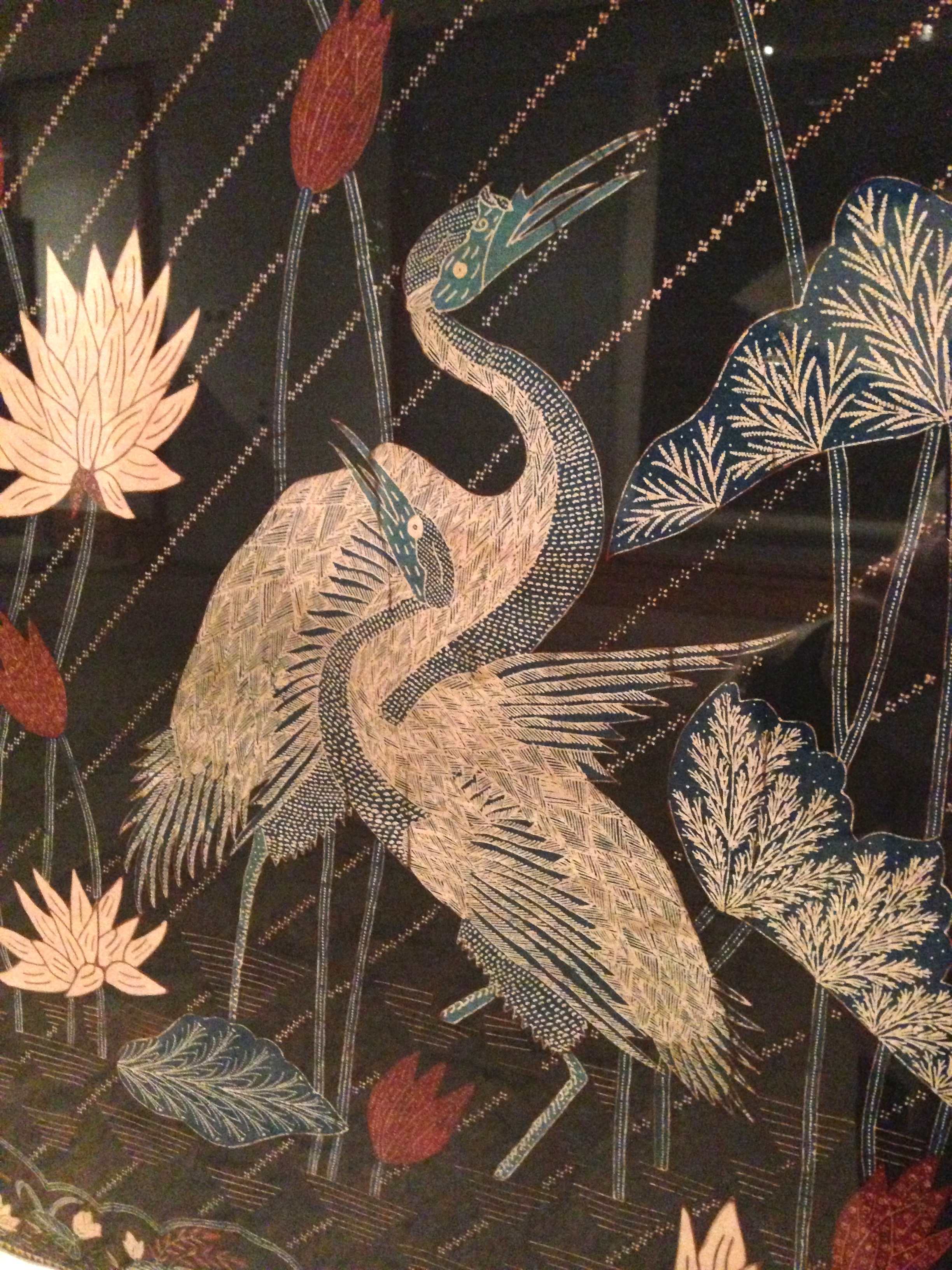
Installation view of woman’s cotton sarong incorporating Chinese-style cranes, probably from the workshop of Mrs. Wilemse (1890-1910). Central Java, Indonesia

Installation view of woman’s cotton sarong incorporating Chinese-style cranes, probably from the workshop of Mrs. Wilemse (1890-1910). Central Java, Indonesia

It’s the smallest show right now at The Met. It doesn’t even have its own web site. If you’re on the way to see Matisse on the First Floor, pause to take a close-up look at some marvels of the textile collection and imagine you’re on the faraway Indonesian island of Java in the micro-show, Resistance and Splendor in Javanese Textiles.

The curators have framed a collection of textile masterworks from that exotic corner of the world, mostly sarongs. If you read the label copy, the series of textiles embellished in the resist-dye technique evoke quite a bit of the recent history of Indonesia.

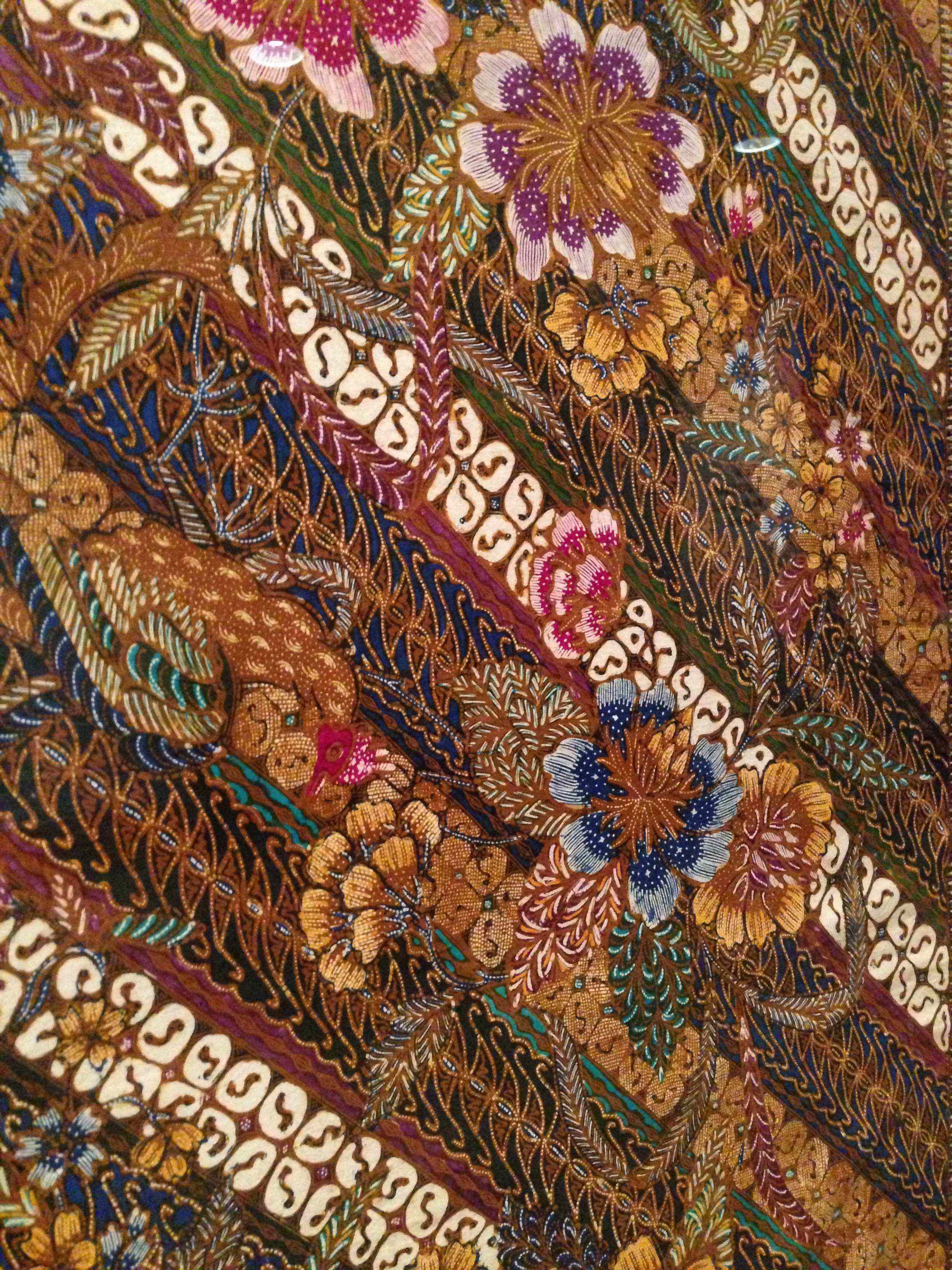
Everyone knows batik, but you may not know that it was cultivated as an export by the Dutch in colonial times on Java (formerly Dutch East Indies). Or that there were workshops whose fabric designs were as identifiable in 1890s Java as 1990s Versace prints are to us.

Small detail of wrapper in Hokokau style (early-mid 1940s). Traditional  motifs on diagonal with European-style flowers.

Small detail of wrapper in Hokokau style (early-mid 1940s). Traditional motifs on diagonal with European-style flowers.

As demand grew throughout the 20th century, designs changed, adhering to tastes of foreign buyers, even while the resist-dye masters kept mashing in the iconography of ancient Javenese royalty. As the curators mention, it’s particularly poignant that some of the most intricate, beautiful resist-dye textiles were made under the difficult WWII Japanese occupation of Indonesia. Apparently cotton shortages allowed the master craftsmen to spend more time perfecting elaborate techniques.

The intricacy, dynamism, and history of this textile display is something you really need to see up close. Thank you, Ratti Textile Center vault.

How to Collect Exotic Oversized Jewelry

Teke style cordiform pendant (Turkmenistan, mid- to late 19th c.), silver, fire-gilded and chased with niello inlay, decorative wire, and table-cut carnelians

Teke style cordiform pendant (Turkmenistan, mid- to late 19th c.), silver, fire-gilded and chased with niello inlay, decorative wire, and table-cut carnelians

Take a peek at the accessories that two intrepid travelers spent years collecting in Central Asia and Iran – oversized jewelry that was so big they had to display it on a wall.  Now that Marshall and Marilyn Wolf have donated their collection to the Metropolitan Museum of Art, the Met has given it the star treatment, way up in that tiny magical Gallery 458 in the Islamic Art wing (which just welcomed its 1 millionth visitor a few weeks ago).

The dazzling show displays the 19th and 20th century creations of Turkmen craftsmen, whose ancestors roamed across Turkmenistan, Uzbekistan, Kazakhstan, and northeastern Iran.

Although Marshall and Marilyn Wolf collected jewelry and ceremonial objects of four tribal styles, the Met’s show spotlights Teke style from Merv, a Turkmenistan city-oasis that was a major hub along the ancient Silk Road. The collectors fell in love with the dynamic pieces – crowns, pendants, pectorals, armbands, rings, and long, vertical ornaments that flowed down braids on the backs of Central Asian beauties. Recent craftsmen may use glass instead of semiprecious stones and carnelian, but in all the vitrines on the Met’s second floor, you’ll see the real thing.

Installation view with matching silver armlets (bilezik), whip, and double-finger matchmaker’s ring with turquoise and carnelians.

Installation view with matching silver armlets (bilezik), whip, and double-finger matchmaker’s ring with turquoise and carnelians.

Take a close-up look at the Met’s spectacular collection photos. When you click on an image, the Met also shows you different views and similar objects from its collection.

Take three minutes to hear Marshall and Marilyn Wolf talk about their passion, how and why they began their collection, explain how their gift plugged a hole in the Met’s own holdings, and show more of their truly stunning pieces.  Keep an eye on that second-floor gallery for more to come.

Inhale…The MAD Exhibit They Won’t Let You See

JickeyThere’s nothing to see…only to experience…in The Art of Scent 1889-2012 currently at the Museum of Art and Design. Designed by Diller, Scofidio + Renfro, the exhibition space is completely bare, save for gentle depressions pressed into the wall where visitors can lean in and experience fragrances considered masterworks of innovation and complexity.

Thank you to curator Chandler Burr for paying tribute to the artists that created these scents. The earliest is Jicky, created by Guerlain in 1889 when the Eiffel Tower was on the rise, the first designer fragrance to use synthetic components.

Walking through these design innovations is an experience you won’t forget. Can you tell that a 1980s fragrance was inspired by the smell of laundry detergent (the essence of “clean”)? Do you agree with Prada’s 1990s take on the romanticism of the 19th century? Do you think Untitled by Daniela Andrier for Margiela in 2010 combines “excitement and unease”, as MAD purports?

MAD has many videos to let you in on the process behind the ephemeral. Listen as Jean-Marc Chaillon discusses what it’s like to create something that can’t be touched:

Ever wonder about the work that goes into designing a celebrity fragrance? Listen in on this enlightening and entertaining curator’s panel on the design and structure of olfactory art:

If You Love Brooklyn, Get to GO!

Installation view of Yeon Ji Yoo’s The Fight (2012), made of paper, paper pulp, acetate, glue, packing tape, cheesecloth, plastic flowers, recycled plastic bottles and bags

Installation view of Yeon Ji Yoo’s The Fight (2012), made of paper, paper pulp, acetate, glue, packing tape, cheesecloth, plastic flowers, recycled plastic bottles and bags

Tucked away in the Mezzanine Gallery on the second floor at the Brooklyn Museum is a valentine to the borough, its artists, and the support and love they received last September in Go: A Community-Curated Open Studio Project. It mixed trudging around Brooklyn, democracy in action, and high-tech to peer into other worlds right in our own backyard.

The museum commissioned an app, asked artists to open their studios, and invited the world to visit and vote for their favorites. (Apparently, it was inspired by an art competition organized out of Grand Rapids!)

GO tracked the art makers and art seekers – take a look at the “weekend activity heatmap” and the other GPS-gathered stats. The results showed a lot of love – 18,000 visitors making 147,000 studio visits to about 1,700 artists over a two-day period, or about eight studio visits per participant. See the raw data for yourself, broken out by neighborhood. Learn a bit more about the voters here.

Art lovers nominated 9,457 artists for a museum showing, and eventually voting and curators whittled it down to five spectacular representatives. Interestingly, four on display were born outside the United States.

Yeon Ji Yoo of South Korea, currently lives in Greenpoint and works in Red Hook. The large installation piece in the show is inspired by her grandmother’s fading memory. Listen as she talks about growing up in South Korea’s rural countryside:

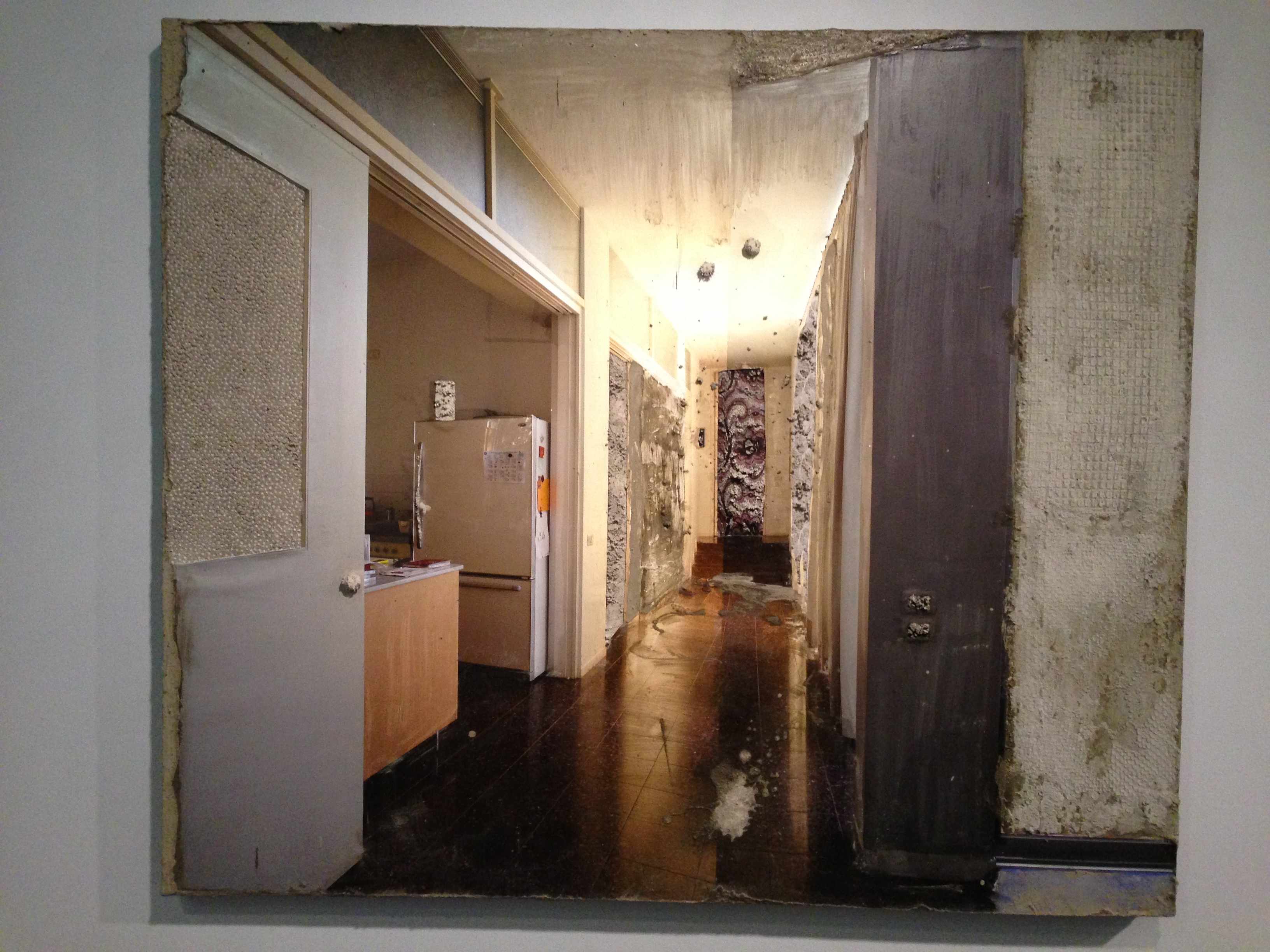
Installation view of Naomi Safran-Hon’s Home Invasion (2011). Archival inkjet print, lace, and cement on canvas

Installation view of Naomi Safran-Hon’s Home Invasion (2011). Archival inkjet print, lace, and cement on canvas

Naomi Safran Hon (of Prospect Heights) prints photographs of her hometown of Haifa, Israel on canvas; makes some cuts in the image; and pushes cement through lace to make a 3-D effect. She feels she’s working out the push/pull of the political and domestic realities of where she grew up. But let her tell you:

Meet the other artists, too: urban watercolorist Adrian Coleman, and painters Oliver Jeffers, and Gabrielle Watson. But if you really love Brooklyn, get over to experience the work in person, and add your comments. The museum’s open late on Thursday.

Thin, Rich, and MAD Embrace of the Middle East

Martin Munkácsi photo of Doris in an ensemble that is in the exhibition. Source: Doris Duke Charitable Foundation Historical Archives, Duke University.

Martin Munkácsi photo of Doris in an ensemble that is in the exhibition. Source: Doris Duke Charitable Foundation Historical Archives, Duke University.

Walking into MAD’s soon-to-close exhibit, Doris Duke’s Shangri La: Architecture, Landscape, and Islamic Art, what do you see? An architect’s model of a small palace by the sea, dazzling objects that adorned it, exotic loungewear inspired by faraway ports of call, Vogue-worthy jewelry, and photographs of a young socialite/philanthropist consulting with master craftsmen in busy Iranian and Moroccan workshops off the world’s most ancient streets.

As you examine these bits and pieces of Shangri La and its history, there’s a single vision that emerges – a portrait of a woman who knew about light, color, beauty, form, design, artistry, history, and had the vision, passion, and resources to put it all together in a way that any interior designer, fashionista, curator, and global traveler would envy.

Here’s the story line: In 1935, Doris Duke fell in love, went on a round-the-world honeymoon with James Cromwell, and fell in love again – with the exotic sights, sounds, patterns, textures, and artisanal wonders of the Middle East. Followed everywhere by reporters, she and James sojourned for months through Palestine, Jordan, Egypt, and the Indian subcontinent, marveling at the dazzling historic architecture, sinuous designs, luxurious carpets, lattice metalwork, colorful tile, and bejeweled ornament.

Tim Street-Porter’s photo of Doris’s dining room at Shangri La (2011) Source: DDFIA

Tim Street-Porter’s photo of Doris’s dining room at Shangri La (2011) Source: DDFIA

She just had to have it, and when she and James landed in Hawaii, she knew that no home in Palm Beach was going to cut it. They bought an ocean-view lot on the Big Island and began constructing a dream house. Her architects hewed to her vision — to create a seaside home into a tribute to the Islamic architecture and design that thrilled her imagination.

They brought artists and designers in from Iran, Syria, India, and Morocco to work on the home, and Doris herself traveled went back to check on progress in the home-country workshops and buy more. Eventually, she amassed one of the largest private collections of Islamic art in the world. Peruse her collecting timeline.

The actual home (now christened Doris Duke Foundation for Islamic Art) is now open to the public. Take time to explore Shangri La on the virtual tour. It hosts not only a 2,500-item collection, but thought-provoking installations by contemporary artists. (So does the show.) Here’s a video of artist Shahzia Sikander sharing what it felt like to project her light installations on this magical dream house.

For more history, watch the curators’ video. Doris’s vision, taste, and style will be on view at MAD for a few more days, then tour museums across the country.

You’ll never walk through the Islamic Wing at The Met again without thinking, “What would Doris do with this?”

Meet The Building You Didn’t Know at NYHS

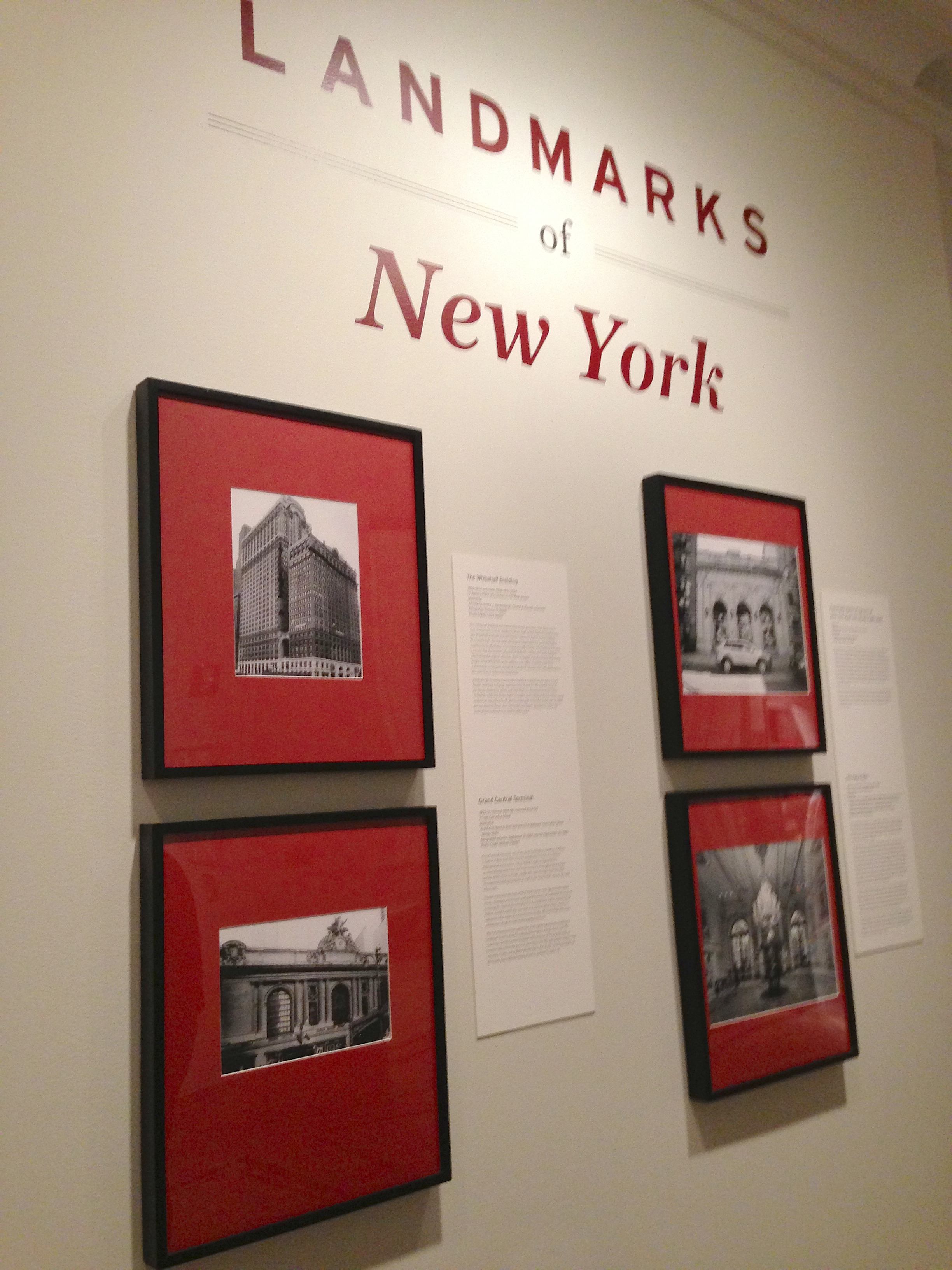
Installation view featuring photos of the Whitehall Building (17 Battery Place), Grand Central Terminal, the Free Public Baths (538 East 11th), and the interior of the Plaza Hotel

Installation view featuring photos of the Whitehall Building (17 Battery Place), Grand Central Terminal, the Free Public Baths (538 East 11th), and the interior of the Plaza Hotel

In one of the most deceptively simple installations at the New-York Historical Society, visitors can’t stop looking, reading, absorbing, talking, and pointing.  The Landmarks of New York show was humming all last weekend, with exhibition goers moving up and down the staid second-floor hallway, quietly moving from photo to photo learning stuff about buildings they’ve seen a million times.

Did you ever think the entire history of New York could be told in 90 identically framed photographs? Take a look at a few of the 1,287 landmarked buildings in NYC. Since the NYHS web site does not contain any of these buildings’ compelling stories, run up to their second floor before the show closes.

The show pays tribute the 1965 Landmarks Law and resulting Landmarks Commission, established in the wake of the greatest architectural disaster in the history of the modern City – the 1963 destruction of the historic Penn Station.  Today, 30,000 structures are protected, and the photos show you some of the exteriors, interiors, and scenic landmarks of our five boroughs.

Installation view of John Bowne House (1661) photo by Jeanne Hamilton

Installation view of John Bowne House (1661) photo by Jeanne Hamilton

Which are the oldest? The Wyckoff House, built sometime before 1641, at 5816 Clarendon Road, Brooklyn, and the oldest surviving home in Queens, the 1661 John Bowne House. The label copy says that Bowne had a huge flare-up with Peter Stuyvesant over his ban on the Quaker religion (actually, he was arrested), which led Bowne to lend his sliver of Flushing to regular meetings of the Quaker community.

Nothing in Manhattan even come close, although 1764 St. Paul’s Chapel is the oldest surviving church. Did you know it was modeled upon St. Martin-in-the-Fields on London’s Trafalgar Square?

This exhibit is packed with story after story of places you pass all the time. Charlie Parker’s Residence at 151 Avenue B is a landmark, partly because Charlie lived there between 1950-1954, but also because Franz Kline did, too.

Lucky for us, that the City has posted all of the Historic District Maps for each borough. Or go to the interactive city map and click on “Landmarks” to see what’s in your neighborhood. Who knew Greenpoint has the Eberhard Faber Pencil Company Historic District? Adventures await. Get to know a building.

Extreme Renaissance Sportswear Back at The Met

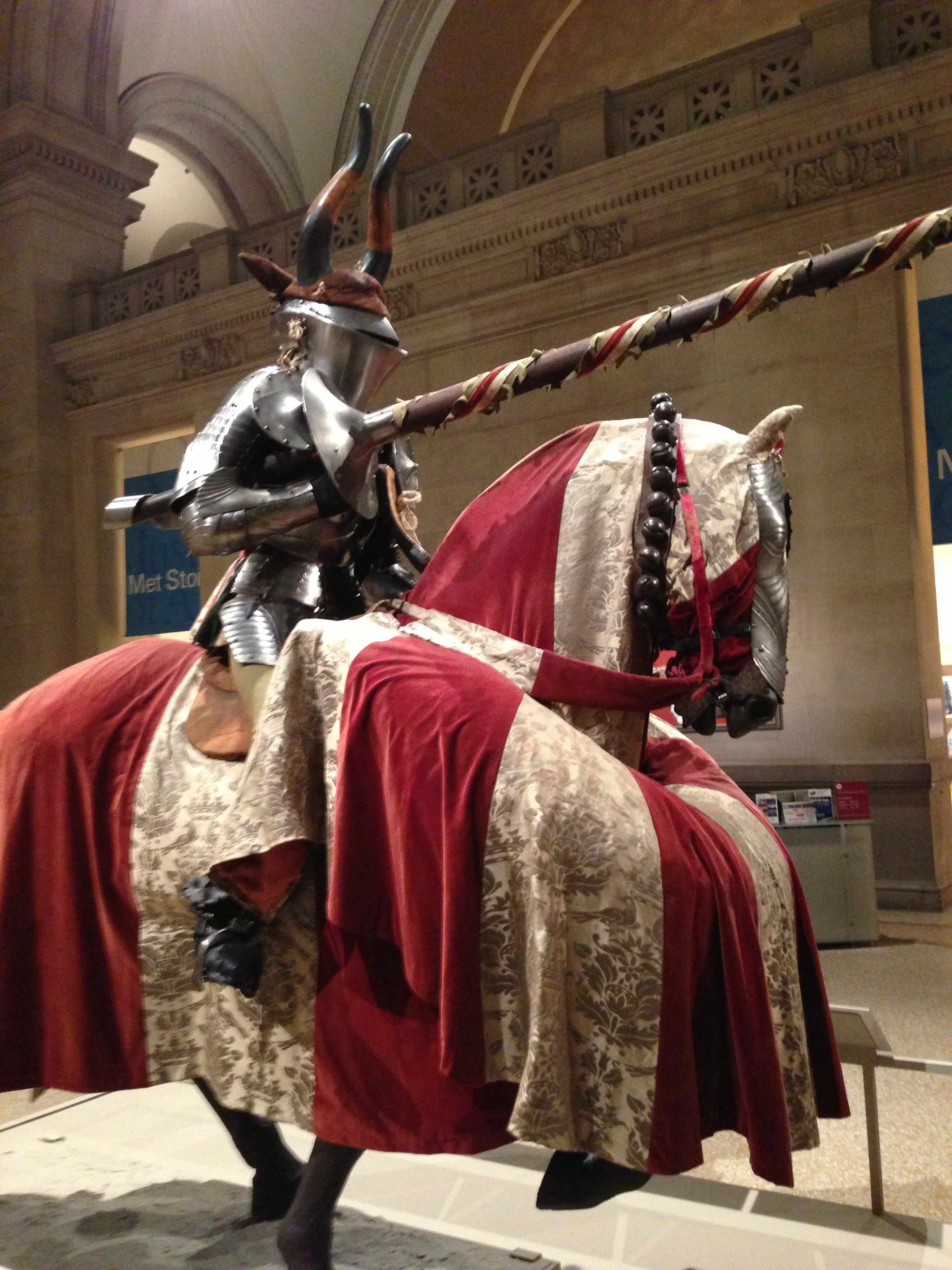
JoustAfter a brief Yuletide absence, the spectacular Armor for the Joust of Peace has been returned to the Great Hall of the Metropolitan Museum of Art, just inside the main entrance, to honor 100 years of the Arms and Armor Department.

Not seen in all its splendor since the 1980s, you’re looking at what extreme sports dressing looked like back in 1500. It all took place as the Renaissance was dawning across Europe, so this outfit was designed for safety and sport – not combat. The objective: unseat your opponent during a horseback charge across an open field with a blunt lance.

Jousts happened on open fields without barricades to separate the horses, so the horse’s head armor completely covered its eyes (yes, galloping blind). A straw-filled bumper hung around his chest for protection. This jouster’s wear was super-heavy (over 80 pounds for the body and 21 for the helmet), with the padded helmet physically bolted to the body armor to protect against whiplash when the inevitable impact occurred.

Solid covering over the horse's eye

Solid covering over the horse’s eye

The Met’s first curator of arms, Bashford Dean, found this German ensemble (even though some pieces were missing) and purchased it in 1904, setting the stage for many, many subsequent acquisitions (oh, about 14,000 more).  It lacked an original helmet, but when Dean saw the one on display (an 1891 recreation made by Parisian armorer superstar Daniel Tacheaux), Dean not only snapped it up, but hired Tacheaux to be the Met’s first armor conservator.

The shield and upper-thigh protectors are also restorations, and so is the horse’s brocade and velvet. But standing so close to this magnificent mount below the arches of the Great Hall, it’s easy to imagine you’re hearing the hoofbeats and roar of the sports crowd, and know that it’s not coming from the gift shop.Detail

Revolutionary Counterculture Gives Birth to Soho

George Maciunas, Self-Portrait, 1961/2012. Installation view. Source: Jonas Mekas Visual Arts Center.

George Maciunas, Self-Portrait, 1961/2012. Installation view. Source: Jonas Mekas Visual Arts Center.

A revolutionary Lithuanian studies at Cooper Union, decides to thumb his nose at elitist art, leads a group genre-busting artists, asks why not use vacant industrial space in a down-and-out part of the city, petitions the City to create artist cooperative-lofts, and…voilà, Soho is born.

Remarkably enough, it’s a story that’s never been told, so kudos to Cooper Union School of Art for the collaboration with Lithuania’s Jonas Mekas Visual Arts Center to mount the exhibition at 41 Cooper Square, Anything Can Substitute Art: Maciunas in Soho. Who better to make the connection between art history, the avant-garde, and real estate?

Yoko Ono Mask (1970) by George Maciunas. Source: Jonas Mekas Visual Arts Center

Yoko Ono Mask (1970) by George Maciunas. Source: Jonas Mekas Visual Arts Center

The show documents the early work of George Maciunas, who emigrated from Lithuania in 1948, studied at Cooper Union in the 1950s, became fascinated with the history of migrations and revolutions in the then-Soviet Union, wrote the famous Fluxus manifesto calling for a revolution against “elitist” art in New York, and gathered a group of downtown provocateurs around him.  He drew a map of the most influential art events of 1965-1967. The roster reads like a who’s who today, but at the time, they were newbies living on the edge — Kaprow, Schneeman, Moorman, Paik, Satie, Rauchenberg, Trish Brown, Gordon and Setterfield, and Yoko.

Thinking about Russian revolutions since the 1230s encouraged Maciunas to ask why a revolution couldn’t be mounted against the art “establishment” by declaring that “anything can be art”. He and his friends produced an avalanche of work that kept things simple and cheap, playing with the concepts of ephemeral events, experiences, packaging, context, and games. You know them today as happenings, performance art, conceptual art, multiples, boxed sets, word art, multimedia, and (possibly) Occupy Wall Street.

Installation view of Ay-O’s Tactile Box (No. 25) (1964). You put your hand into the hole to feel what’s inside. Source: Jonas Mekas Visual Arts Center.

Installation view of Ay-O’s Tactile Box (No. 25) (1964). You put your hand into the hole to feel what’s inside. Source: Jonas Mekas Visual Arts Center.

Mekas, another Lithuanian immigrant and founder of Anthology Film Archives, kept a lot of his friends’ early work, so the gallery is filled with never-before-seen Fluxus art, posters, letters, and maps that normally reside in Vilnius.

Maciunus thought Fluxus principles could also be applied to urban living, business, and real estate, so the show includes correspondence with government officials about permission to establish cooperative artist spaces. A highlight is a hand-drawn map showing where Fluxhouse co-ops would transform abandoned industrial lofts in the 25-square blocks of Soho. His first transformation was 80 Wooster, which gave Fluxus artists a chance to live and work together, unencumbered by walls and tradition — a socially conscious, revolutionary move that eventually influenced the course of art, lifestyles, and real estate here and around the world.