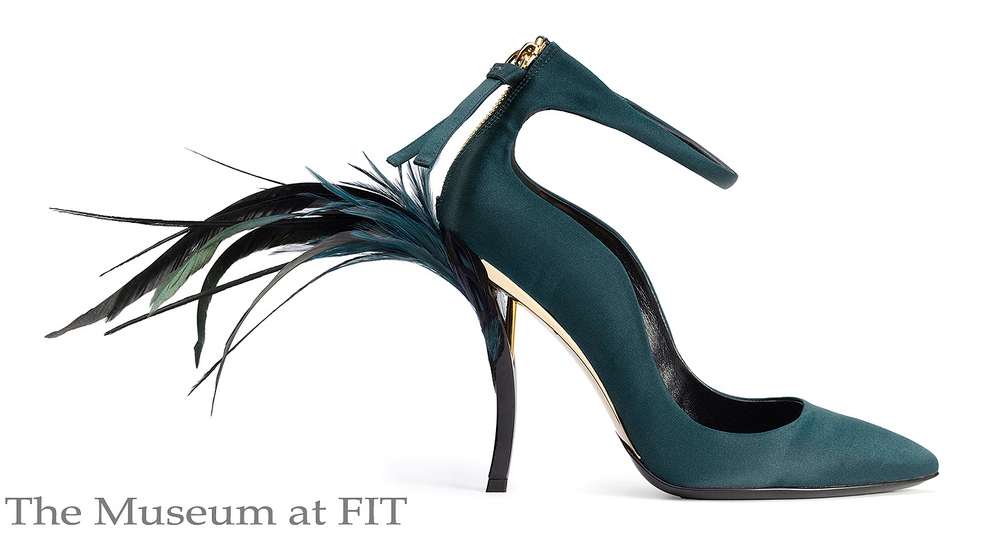
Shoe Obsession or War at FIT

Eyelash Heel pump by Roger Vivier (Bruno Frisoni) (2012-2013). Courtesy of Roger Vivier/Photo by Stephane Garrigues

Eyelash Heel pump by Roger Vivier (Bruno Frisoni) (2012). Courtesy of Roger Vivier/Photo by Stephane Garrigues

The design gauntlet has been thrown down. The Museum at FIT’s lower-level exhibit, Shoe Obsession, pits establishment high-heel designers against upstart shoe artists in a no-holes-barred visual extravaganza that footwear lovers will savor.

There’s really no winner or loser. It’s all an impossible-to-take-in treasure trove. Take a look at FIT’s Flickr site, which gives you a taste, but doesn’t even tell half the story. There are 150 pairs of shoes on display, all fighting for your attention as to which is the best, highest, most outlandish, to-be-seen-in, and impossible-to-wear shoe creation.

Noritaka Tatehana’s Lady Pointe shoes designed for Lady Gaga (2012)

Noritaka Tatehana’s Lady Pointe shoes designed for Lady Gaga (2012)

The show, sponsored by Saks Fifth Avenue, focuses on 21st century shoe design, seeming to claim that bags are over and that shoes are “it”. If stats tell the story, FIT says that the average American woman today has over 20 pairs of shoes – double the average of the late 1990s.

The glass vitrines present all the artistry beautifully. When we visited, admirers were circling each slowly to view the exquisite, fanciful creations from all angles. The center  aisle features selections from several private shoe collections, including a few from McQueen muse Daphne Guiness.

You’ll see over-the-top works by incumbants Vivier, Prada, Blahnik, and Gucci right next to glass houses showcasing the upstarts, as in our photo here: Center front is Mariela’s actual glass slipper, which no one can actually wear. Above it and to the right, are Tea Petrovic’s prototypes inspired by futuristic sculptor Naum Gabo and the soaring architecture of Calatrava. On the left, Janina Alleyne’s menacing Exoskeleton shoe actually has been created by a 3D printer.

Go and make your own choice about what you would take home if you could.

There’s no video to accompany this incredible show (just a book), so enjoy the trailer for the documentary God Save My Shoes, which FIT had running in its 27th Street entrance:

Easter Parade with Horses at Grand Central

GCT security keeping an eye on the red horse

GCT security keeping an eye on the red horse

The colors, crowds, finery, and promenade in Grand Central is every bit as celebratory as the famed Easter Parade on Fifth Avenue, except there’s live music and horses. It’s all part of Nick Cave’s monumental performance Heard NY going on each day at 11am and 2pm in Vanderbilt Hall.

Get there early and take your cameras to see The Ailey School students don the two-person horse costumes, created out of raffia, to whoosh and swirl away to the drums and harp. Take a look at the Flickr photos of yesterday’s 11am performance.

Creative Time and MTA Arts for Transit have decided to use both sections of Vanderbilt Hall for simultaneous performances, so you have lots of options to see the 30 magnificent horses close up. Afterward, you’ll see the volunteers grooming the horses, so there’s lots of opportunity to check out the loving detail that Cave has given each of them.

Half of the 30-horse herd

Half of the 30-horse herd

The raffia flies, the dancers whirl, and it’s breathtaking to see the horses come alive before your eyes and cavort about with their distinct personalities. Even if you go to the Easter Parade at St. Patrick’s on Sunday, you’ll still have time to catch their final 2pm performance.  If you want to see another example of Nick’s work, check out our post on The Armory Show a few weeks ago. For now, enjoy this wonderful promo:

Celebrity Robot Says Good-Bye to Upper East Side

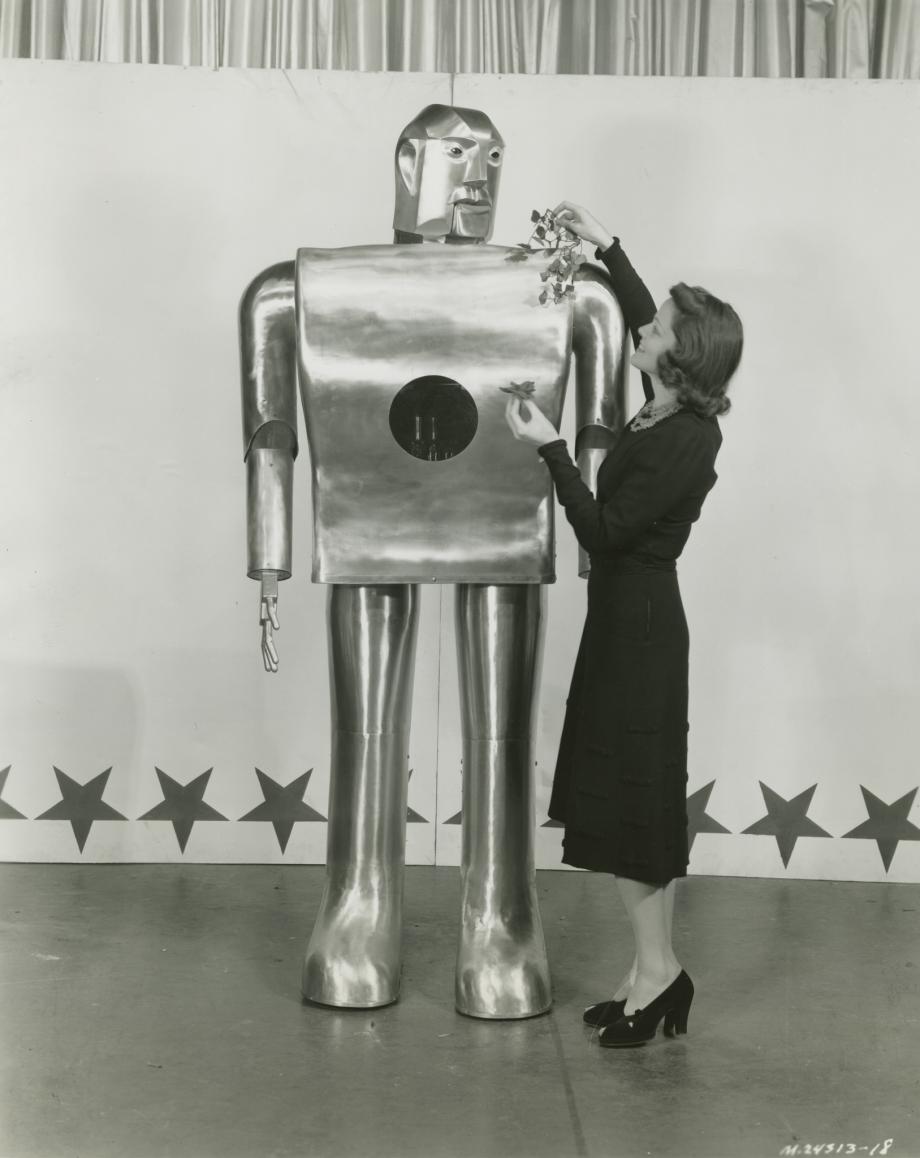
As musician Lois Kendall shows him red roses and green leaves, Elektro tells her the color of each. Source: NYPL

As musician Lois Kendall shows him red roses and green leaves, Elektro tells her the color of each. Source: NYPL

If you love the future, you have to see Elektro, the celebrity robot, who once held court in the Westinghouse pavilion at the 1939 New York’s World’s Fair, before he leaves the city once again. He’s the star attraction in the Museum of the City of New York’s Designing Tomorrow: America’s World’s Fairs of the 1930s exhibition, closing soon.

We couldn’t take photos inside the show, so here’s a publicity picture of Elektro back in 1939. He walked, talked, smoked cigarettes, as you’ll witness in this 1939 YouTube clip. This sensational moto-man used vacuum tubes, a 78 RPM record player, photoelectric cells, and telephone relays to wow the crowds.

But Elektro is only the tip of the Trylon of how fair design and engineering shaped modern American style. The show introduces the industrial design engineers that shaped products that grace MoMA’s design collection and insinuated themselves into everyday life – streamlined appliances, nylon stockings, Herman Miller clocks, Greyhound buses, and superhighways. Check out the MCNY’s excellent Tumblr feed for their visions of the future.

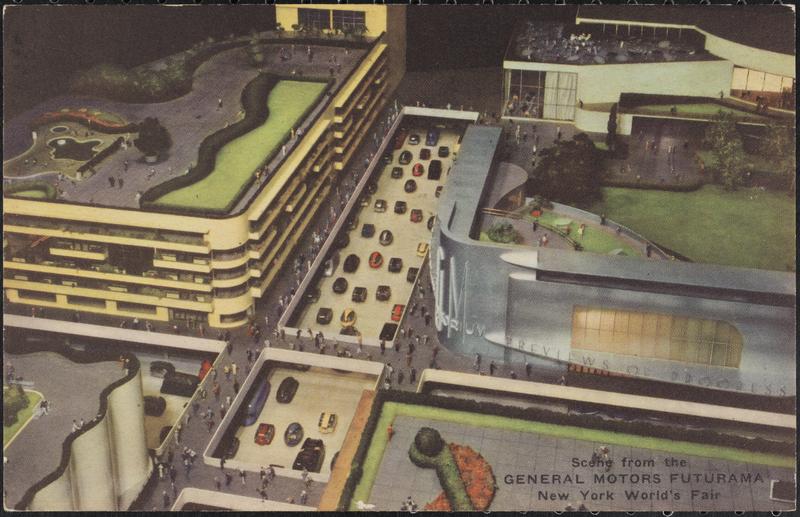
Postcard of the General Motors Futurama, NY 1939 World's Fair. Source: MCNY

Postcard of the General Motors Futurama, NY 1939 World’s Fair, that resembles BPC today. Source: MCNY

Among the show’s highlights are clips showing the GM Futurama, where New Yorkers waited in line for hours to see what the city of 1960 would look like. “Sound chairs” moved them along a conveyor belt where they could witness a vast scale model of modernized America, with superhighways soaring over canyons and cutting through mountains, and urban/suburban cloverleaf interchanges to keep traffic moving.

Afterward, people would exit into a full-scale World of Tomorrow where they would see what the urban intersection of the future would be – filled with pedestrian overpasses, department stores, and unimpeded whizzing traffic. It sure looked a lot like the view of Battery Park City along West Street.

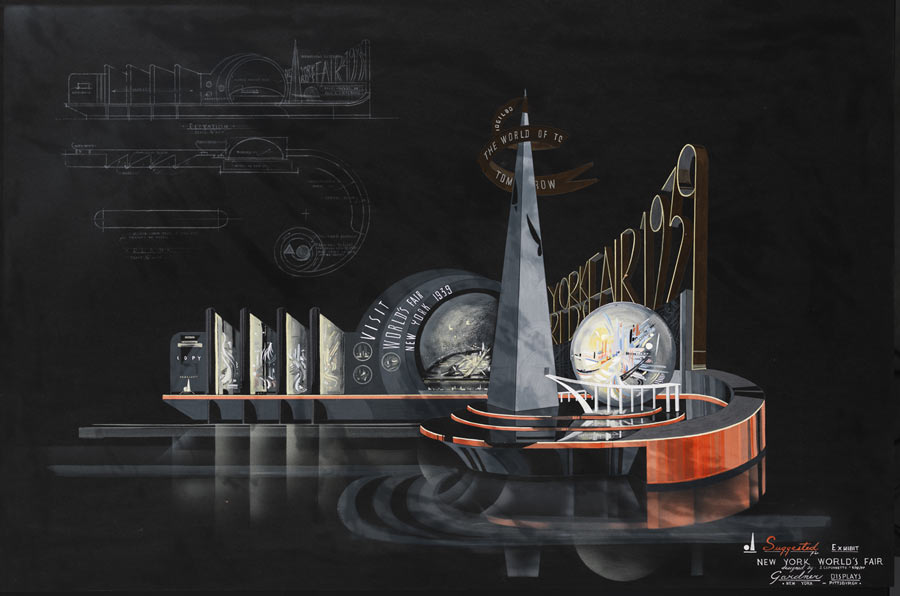
Suggested Exhibit for NY 1939 World's Fair. Watercolor & gouache on board. Source: MCNY

Beautiful watercolor/gouache from MCNY collection: “Suggested Exhibit for NY 1939 World’s Fair.”

Oh! Wallace Harrison, one of the architects of the Trylon and Perisphere actually did the master plan for Battery Park City…and Lincoln Center and the UN Headquarters building and Time-Life on Sixth Avenue!

So, no wonder Elektro feels right right at home in 2013 Manhattan. In 1939, he already could see what it would look like, right from his pavilion!

Take a spin around Elektro’s world, courtesy of the New York Public Library:

70s East Village and Catholic School Mash-Up at MoMA PS1

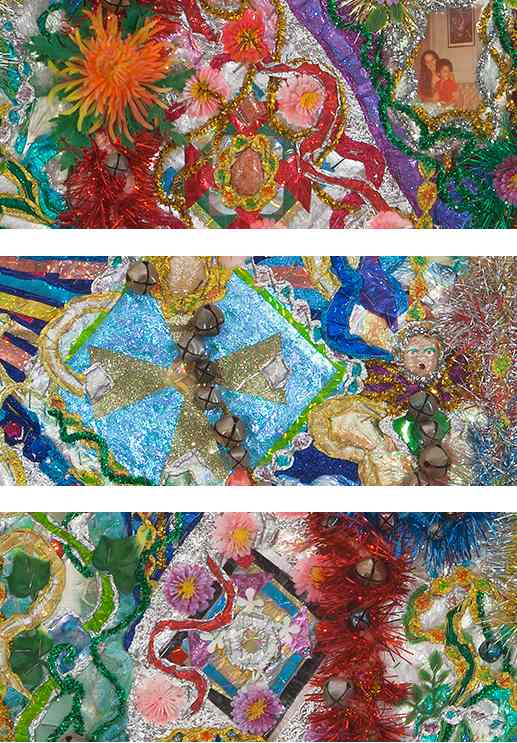
Glittery details from Thomas Lanigant-Schmidt’s 1986 collage, The Infant of Prague as a Personification of Liberation Theology. Source: International Collage Center.

Glittery details from Thomas Lanigant-Schmidt’s 1986 collage, The Infant of Prague as a Personification of Liberation Theology. Source: International Collage Center.

As a young gay runaway in the 1960s, Thomas Lanigan-Schmidt landed in New York City, looked at the trash littering the East Village streets where he roamed, and felt a strange attraction to the cellophane wrappers, fabric, and other dumpster treasures he retrieved. This is the jumping off point for the glittery art retrospective at MoMA PS1, Thomas Lanigan-Schmidt: Tender Love Among the Junk.

From his years of Catholic schooling and altar-boy duty, it wasn’t a stretch for Lanigan-Schmidt to use his street stuff to create glimmering duplicates of chalices, patents, and other altar accouterments. Or to work in the occasional high-school or East Village gay-life reference.

Soon, dozens of precious tin-foil creations were filling his walls. Why not go for an entire transformation? He hung diaphanous painted veils, dressed in drag as a “Czarina Tatlina” (an art-world reference to Russian Constructivism), and began to offer tours of his Gilded Summer Palace to friends. Word of this trash-to-fantasy performance spread, and he soon had a group of fans, including downtown theater innovator Charles Ludlam and famed Metropolitan Museum curator Henry Geldzahler.

Installation view. © MoMA PS1. Photo: Matthew Septimus

Installation view. © MoMA PS1. Photo: Matthew Septimus

Get out to PS1 for this trip. The installation photo here gives you an idea of his brilliance. The area is decorated as a chapel with icons, pilgrims, brownstones, and 1950s school posters. The devotional ledges are packed with tennis figures, aerosol-can consumer products (Secret, Wizard), and Perrier bottles. The walls are filled with Smurf and Miss Piggy plates with bugs in between. And there’s a sort-of East Village Gregorian chant playing in the room.

You’ll enter the recreation of his Czarina’s Gilded Summer Palace and Sacristy of the Hamptons (1969), see many gold-foil Rats (yes, there was a time before gentrification on Ave B/C!), and read through his actual Catholic school workbooks. You’ll love the vibe of experiencing this in an old public school building, too.

As soon as you walk in the door, you’ll find a piece of paper with a copy of his 1989 essay “1969 Mother Stonewall and the Golden Rats”, his first-hand recollection of the night that made history. So, take a walk back in time by seeing this important, unforgettable retrospective. In the meantime, enjoy a virtual visit with this former altar-boy/chronicler of the East Village past in his studio today:

Met Uses Dress to Deconstruct Matisse’s Creative Process

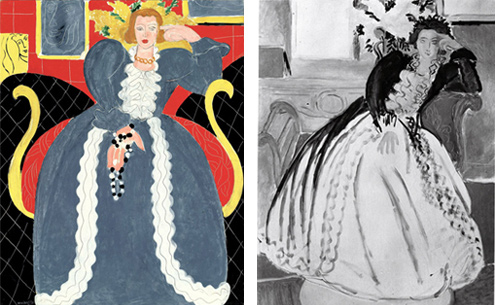
Finished product and earlier stage of Matisse’s The Large Blue Dress (1937). Source: Philadelphia Museum of Art. © 2012 Succession H. Matisse / Artists Rights Society (ARS), New York

Finished product and earlier stage of Matisse’s The Large Blue Dress (1937). Source: Philadelphia Museum of Art. © 2012 Succession H. Matisse / Artists Rights Society (ARS), New York

After walking through gallery after gallery of spectacular Matisse works, it’s a little shocking to turn enter Gallery 6 and see the actual skirt that his model wore to inspire one of his most loved works. Maybe it’s not so shocking, considering how much he loved textiles.

This surprise is just one part of a fascinating eight-gallery blockbuster that deconstructs the master’s creative process – the Metropolitan Museum of Art’s show Matisse: In Search of True Painting.

The show features nearly 50 works from Matisse’s career, chosen especially to reveal his thoughts behind selecting the colors, shapes, and patterns that we know so well. They’ve brought together versions of the same work and hung them next to one another. The Met’s website has views of each gallery.

The Gallery 2 view shows how the Met has displayed some of Matisse’s 1906 experiments. Check out this video narrated by curator Rebecca Rabinow:

Since Matisse liked to have visual reference points, by the 1930s he began more formal documentation of the various stages of each work. His famous Large Blue Dress painting (1937), lent by the Philadelphia Museum of Art, not only features photos of the painting’s stages but the actual blue dress made and worn by the model, Lydia Delectorskaya. Let the curator tell you more about it:

Take a look at some of the selected highlights of the show on the web, but get over to see it all in person to experience fully the power of Matisse’s color and light in a unique, exceptional, and illuminating context.

Virtual Ancestor Cornered in High-Tech Tree by AMNH

Carl Buell’s rendering of the hypothetical placental ancestor, a small insect-eating animal. Source: AMNH

Carl Buell’s rendering of the hypothetical placental ancestor, a small insect-eating animal. Source: AMNH

Who says dinosaurs get all the attention?

One of the big front-page science stories of the last few weeks is that a global team of researchers has mapped our ancestor tree back in time to a hypothetical small, furry critter that emerged just after the dinosaurs went extinct. The big news is that through a giant high-tech, data-crunching technique, 15-20 molecular-data scientists collaborating in six countries around the world figured out that the hypothetical ancestor to nearly all the mammals alive today emerged 200,000 to 400,000 years after the comet crashed to Earth 65 million years ago.

Ok, it wasn’t the first mammal (the ancestor to platypuses, opossums, kangaroos, and a lot of other extinct things came much earlier), but let’s applaud the American Natural History Museum for telling this story so clearly to a writer at The New York Times that it made it to the front page.

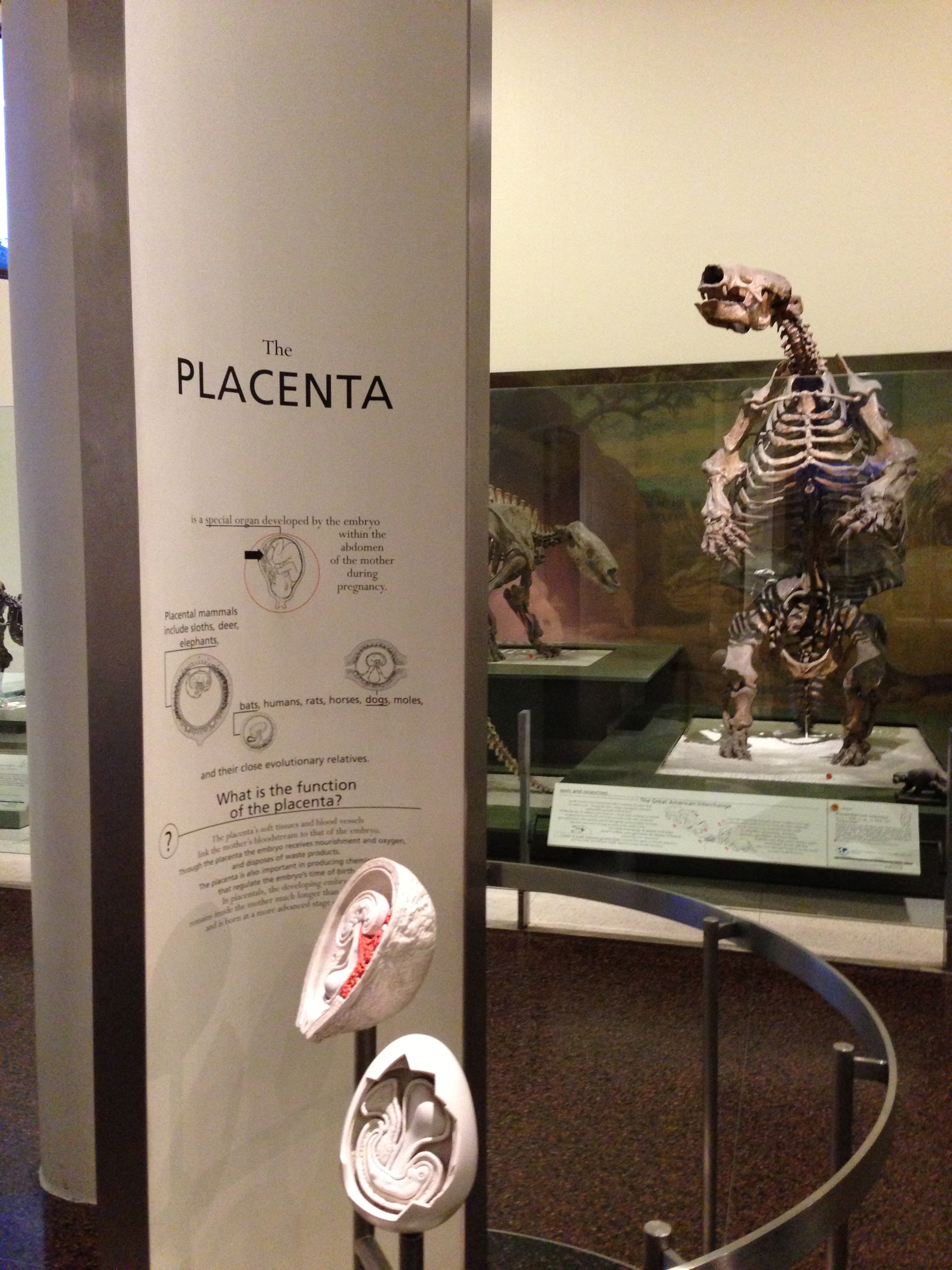
Column on AMNH Fourth Floor exhibit space that marks the spot where the virtual critter emerged along the evolutionary pathway in the Hall of Primitive Mammals.

Column on AMNH Fourth Floor exhibit space that marks the spot where the virtual critter emerged along the evolutionary pathway in the Hall of Primitive Mammals.

At Thursday’s Social Media Week event on how to tell stories in science, panelists repeatedly emphasized how hard it is to make clarity emerge from a morass of data.  In a way, this “story about the rat” reached a social-media science storytelling trifecta: over 240 comments “about the rat” on the NYT web site, a neat little video that’s racked up over 11,000 views in just two weeks, and an exhibition layout for the vertebrate paleo collection on the museum’s Fourth Floor that lets you stand in the exact spot on the evolutionary pathway where this tiny hypothetical ancestor emerged. (See the photo with the Giant Sloth, to the left.)

Great job, AMNH and Stony Brook storytellers for giving us this video view into deep time, showing how MorphoBank crunches data, and creating another social-media star out of a virtual ball of fur.

PS: The fossil background talent in this video appears to be a model of Gobiconodon, an actual Cretaceous mammal from 110 million years ago who’s not directly related to the star of this show, but looks good on camera.

How to Collect Exotic Oversized Jewelry

Teke style cordiform pendant (Turkmenistan, mid- to late 19th c.), silver, fire-gilded and chased with niello inlay, decorative wire, and table-cut carnelians

Teke style cordiform pendant (Turkmenistan, mid- to late 19th c.), silver, fire-gilded and chased with niello inlay, decorative wire, and table-cut carnelians

Take a peek at the accessories that two intrepid travelers spent years collecting in Central Asia and Iran – oversized jewelry that was so big they had to display it on a wall.  Now that Marshall and Marilyn Wolf have donated their collection to the Metropolitan Museum of Art, the Met has given it the star treatment, way up in that tiny magical Gallery 458 in the Islamic Art wing (which just welcomed its 1 millionth visitor a few weeks ago).

The dazzling show displays the 19th and 20th century creations of Turkmen craftsmen, whose ancestors roamed across Turkmenistan, Uzbekistan, Kazakhstan, and northeastern Iran.

Although Marshall and Marilyn Wolf collected jewelry and ceremonial objects of four tribal styles, the Met’s show spotlights Teke style from Merv, a Turkmenistan city-oasis that was a major hub along the ancient Silk Road. The collectors fell in love with the dynamic pieces – crowns, pendants, pectorals, armbands, rings, and long, vertical ornaments that flowed down braids on the backs of Central Asian beauties. Recent craftsmen may use glass instead of semiprecious stones and carnelian, but in all the vitrines on the Met’s second floor, you’ll see the real thing.

Installation view with matching silver armlets (bilezik), whip, and double-finger matchmaker’s ring with turquoise and carnelians.

Installation view with matching silver armlets (bilezik), whip, and double-finger matchmaker’s ring with turquoise and carnelians.

Take a close-up look at the Met’s spectacular collection photos. When you click on an image, the Met also shows you different views and similar objects from its collection.

Take three minutes to hear Marshall and Marilyn Wolf talk about their passion, how and why they began their collection, explain how their gift plugged a hole in the Met’s own holdings, and show more of their truly stunning pieces.  Keep an eye on that second-floor gallery for more to come.

Inhale…The MAD Exhibit They Won’t Let You See

JickeyThere’s nothing to see…only to experience…in The Art of Scent 1889-2012 currently at the Museum of Art and Design. Designed by Diller, Scofidio + Renfro, the exhibition space is completely bare, save for gentle depressions pressed into the wall where visitors can lean in and experience fragrances considered masterworks of innovation and complexity.

Thank you to curator Chandler Burr for paying tribute to the artists that created these scents. The earliest is Jicky, created by Guerlain in 1889 when the Eiffel Tower was on the rise, the first designer fragrance to use synthetic components.

Walking through these design innovations is an experience you won’t forget. Can you tell that a 1980s fragrance was inspired by the smell of laundry detergent (the essence of “clean”)? Do you agree with Prada’s 1990s take on the romanticism of the 19th century? Do you think Untitled by Daniela Andrier for Margiela in 2010 combines “excitement and unease”, as MAD purports?

MAD has many videos to let you in on the process behind the ephemeral. Listen as Jean-Marc Chaillon discusses what it’s like to create something that can’t be touched:

Ever wonder about the work that goes into designing a celebrity fragrance? Listen in on this enlightening and entertaining curator’s panel on the design and structure of olfactory art:

Look Up to See Where Your Grandmother’s Clothes Came From

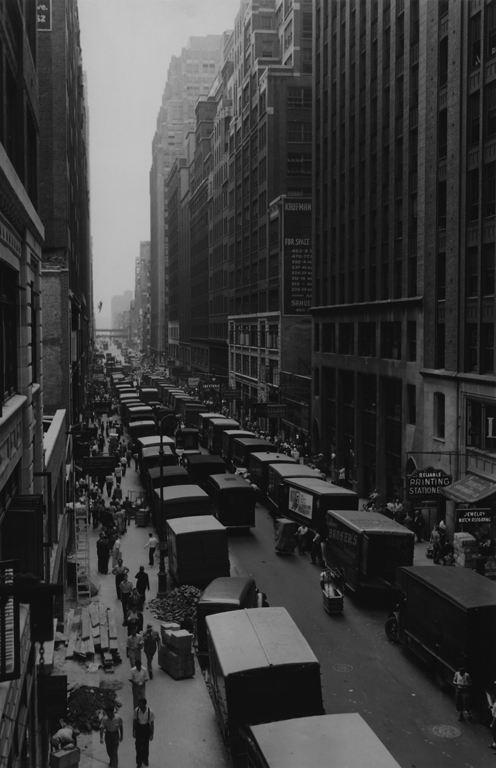
West 35th Street in 1938, looking east between Seventh and Eighth Avenues. Source: NYC Department of Records, Municipal Archives

West 35th Street in 1938, looking east between Seventh and Eighth Avenues. Source: NYC Department of Records, Municipal Archives

It can seem a little quiet walking over to Mood these days. Not too long ago, the streets above 34th Street between Sixth and Eighth Avenues were clogged with push boys, wheeling racks of  materials, trims, and fashions among jobbers, contractors, accessory importers, fabric stores, and showrooms. The way it used to be comes alive in the Skyscraper Museum’s show (closing today) Urban Fabric: Building New York’s Garment District.

In its heyday, those 18 blocks just north and west of Macy’s produced 75% of all US women’s and children’s clothes.  The exhibit tells the story of how this bustling hive happened.  In a nutshell, the old sweatshops in tenement buildings gave way to factory loft spaces in the 1890s around the area where NYU is today. When the big department stores emerged along Sixth Avenue and 23rd Streets, the lofts came with them. But the congestion proved to be a bit much for the female shoppers, who were disturbed by the throngs of guys loitering about on their lunch breaks, and the retailers took action.

The department stores (like Macy’s and Lord & Taylor) moved above 34th Street. To prevent the factory lofts from overwhelming them again, the City implemented the first zoning ordinance in America in 1916. The garment makers, closed out of the fancy retail neighborhood, started razing the Tenderloin District on the West Side and erecting architect-designed skyscrapers (like the Fashion Tower on West 36th) from that point on. About 125 buildings went up on those 18 blocks before the Depression hit.

Here’s a glimpse of what it was like in 1952:

As recently as the 1970s, carts were still being shuttled through the narrow streets, but we know how that story ended.  Today, no one even looks up at the entrances, set-backs, lobbies, or embellishments of these once grand hubs where models, marketers, Mad Men, laborers, seamstresses, teamsters, pattern makers, the designers co-mingled.

Interestingly enough, not a single building is landmarked. In fact, the Skyscraper Museum had trouble even finding photographs of the original buildings and had to turn to historic adverts and early brochures on factory electricity.

For the full, fascinating story by the curator who unearthed it all, listen to Andrew Dolkart of Columbia University, and watch his slide show:

Interns and staff built a nice model of the buildings lining 37th Street for the show, and a big thank you to The Skyscraper Museum for (again) putting the history and installation walkthrough on line. Tell your friends, and be sure to look up next time you walk over to Mood.

If You Love Brooklyn, Get to GO!

Installation view of Yeon Ji Yoo’s The Fight (2012), made of paper, paper pulp, acetate, glue, packing tape, cheesecloth, plastic flowers, recycled plastic bottles and bags

Installation view of Yeon Ji Yoo’s The Fight (2012), made of paper, paper pulp, acetate, glue, packing tape, cheesecloth, plastic flowers, recycled plastic bottles and bags

Tucked away in the Mezzanine Gallery on the second floor at the Brooklyn Museum is a valentine to the borough, its artists, and the support and love they received last September in Go: A Community-Curated Open Studio Project. It mixed trudging around Brooklyn, democracy in action, and high-tech to peer into other worlds right in our own backyard.

The museum commissioned an app, asked artists to open their studios, and invited the world to visit and vote for their favorites. (Apparently, it was inspired by an art competition organized out of Grand Rapids!)

GO tracked the art makers and art seekers – take a look at the “weekend activity heatmap” and the other GPS-gathered stats. The results showed a lot of love – 18,000 visitors making 147,000 studio visits to about 1,700 artists over a two-day period, or about eight studio visits per participant. See the raw data for yourself, broken out by neighborhood. Learn a bit more about the voters here.

Art lovers nominated 9,457 artists for a museum showing, and eventually voting and curators whittled it down to five spectacular representatives. Interestingly, four on display were born outside the United States.

Yeon Ji Yoo of South Korea, currently lives in Greenpoint and works in Red Hook. The large installation piece in the show is inspired by her grandmother’s fading memory. Listen as she talks about growing up in South Korea’s rural countryside:

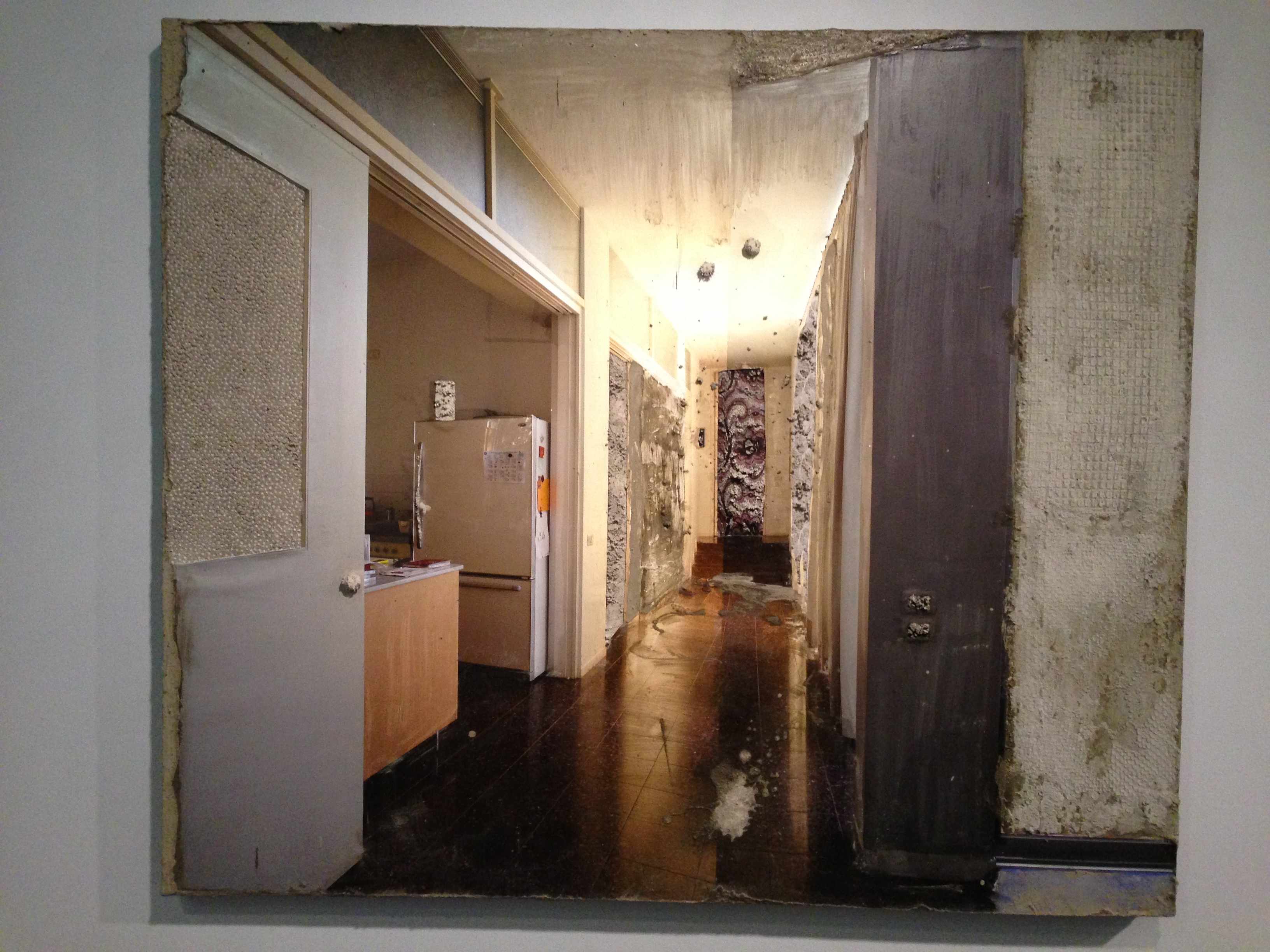
Installation view of Naomi Safran-Hon’s Home Invasion (2011). Archival inkjet print, lace, and cement on canvas

Installation view of Naomi Safran-Hon’s Home Invasion (2011). Archival inkjet print, lace, and cement on canvas

Naomi Safran Hon (of Prospect Heights) prints photographs of her hometown of Haifa, Israel on canvas; makes some cuts in the image; and pushes cement through lace to make a 3-D effect. She feels she’s working out the push/pull of the political and domestic realities of where she grew up. But let her tell you:

Meet the other artists, too: urban watercolorist Adrian Coleman, and painters Oliver Jeffers, and Gabrielle Watson. But if you really love Brooklyn, get over to experience the work in person, and add your comments. The museum’s open late on Thursday.