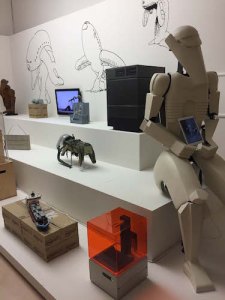
How to Build an Empire at The Met

Close up of Qin chariot horse replicas (221 – 206 B.C.). From: Qin Shihuangdi Mausoleum Site Museum, Lintong

You can’t take it with you, or can you? The Chinese emperor with the terra cotta army thought so. See for yourself in Age of Empires: Chinese Art of the Qin and Han Dynasties (221 B.C-A.D. 220), on view through July 16 at the Met.

There are only a few horses and men from that monumental undertaking on display, but the terra cotta visitors are stunners. They and the other luxury and art objects on loan from 32 museums and archeological institutions in China provide a vivid look into the culture and pride of a people who were just forming an identity as a nation in 221 B.C. Previously, the Chinese continent consisted of warring ethnic tribes.

Heavenly Han horse and military groom in bronze (25 – 220 A.D) from Mianyang City Museum.

About a century earlier, classical Greek style, art, and ideas washed over Europe and Asia due to Alexander’s empire-building success. At the time of the Qin dynasty, when the Great Wall was being built, scholars wonder whether the Chinese emperors had seen (or heard about) large-scale classical Greek sculptures and asked their artists to out-do their Mediterranean counterparts.

Why not build full armies, cities, entertainment troupes, cavalries, and watch towers and bury them in tombs of the emperors, princes, and princesses to serve them in the after life? Like the Egyptians, the Qin and Han emperors and princes wanted a lot of stuff to use in the afterlife. But unlike the Egyptian style, it was all about personality.

Each large-scale sculpture is imbued with individual flair in their apparel, expressions, hairstyles, and weapons. If you listen to the audio guide, the curators tell us that the large-scale terra cotta armies were mass-produced using molds, but the artists were told to give each sculpture-person a dose of individuality before they were done.
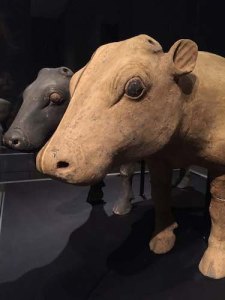
Terracotta cattle (206 B.C. – 9 A.D.) from the Yangling Mausoleum.

That holds true for the animals in the show, too. The Han dynasty had a thing for beautiful, spirited horses and the center gallery in the show displays some beauties. Grooms come along, too.

Apparently the conquering Han rulers kept menageries and ranches, as seen in the show’s room full of rhinos, elephants, cattle, pigs, and animals-turned-into-art-lamps. There’s a twinkle in each of their eyes, too.

Another highlight is the jade suit made for a princess, which was supposed to form added protection in the afterlife. Another is the money tree. Who wouldn’t want one of those?

The show’s objects reflect how many tribes and influences crossed paths over the course of the Han dynasty (think Silk Road) to create the modern view of a single, all-encompassing Chinese culture – diverse textiles, gems, inventions, and ideas.
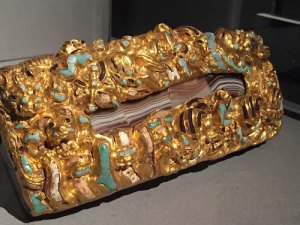
Han Dynasty belt buckle (206 B.C. – 220 A.D.) from Xinjiang Uyghur Autonomous Region Museum

The final object, a bronze mirror from the Han dynasty, reflects it all – the first recorded inscription expressing the desire for the peoples of the “Central Kingdom” (a.k.a. China) prospering for generations to come. It’s the earliest inscription to reference many ethnic groups considering themselves as one people, one China. 

Take a look at all the objects in the collection on the Met’s site, or look at our favorites on Flickr.

Browse through the catalog to see more spectacular stuff that Han dynasty emperors just had to have:
 

Behind the Scenes of the Revolution at NYHS

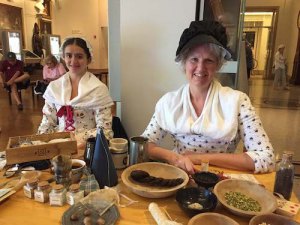
Women of the 3rd New Jersey Regiment, Continental Army, showing soldiers’ everyday life

To celebrate the anniversary of the United States, the New York Historical Society hosted the reenactors of the 3rd New Jersey Regiment of the Continental Army for a little show-and-tell about the private lives of the people who enlisted in the Revolution. Dressed in colonial garb, the men and women of the Third showed what the enlisted men were given as rations, how they cooked it, and what they carried into battle – beans, hard tack, and (maybe) tobacco to barter.

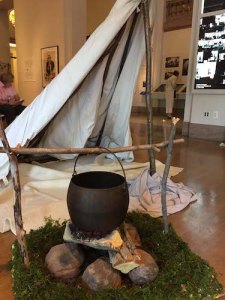
A small tent and campfire cooking pot were set up just feet away from portraits of Revolutionary heroes and the remnants of the statue of King George III that the citizens of New York had torn down by their African-American slaves moments after the Declaration of Independence was read to Washington’s troops in lower Manhattan on July 9, 1776. All that remains here is half the horse’s tail.

A Revolutionary soldier’s home and kitchen during maneuvers

At a nearby table, men and women of the Third showed how the soldiers made their own bullets and cartidges, and the range of apparatus to keep the hand-made ammunition dry — leather pouches and tin boxes. As far as supplies, muskets, and gun powder went, you were on your own during the 1776 skirmishes.

See it all close up in our Flickr album.

Upstairs from demonstrations on the everyday life of troops, you can glimpse the everyday life of the more famous patriots through July 13 in the exhibition, Thomas Jefferson: The Private Man, from the Collections of the Massachusetts Historical Society.

The show includes his inventory of books, crops, slaves, and letters – personal papers that he willed to his granddaughter and her husband, who lived in Massachusetts and eventually gave them to the historical society there.

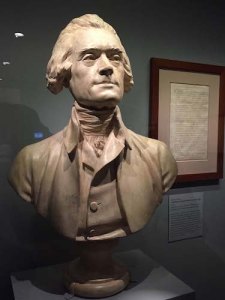
Houdon’s 1789 portrait bust of 46-year-old Jefferson next to his handwritten copy of the Declaration of Independence

The curators have displayed his architectural drawings of various iterations of Monticello, domed residences (never built) for friends, plans to improve the state capitol at Williamsburg (never built because the capitol was moved to Richmond), and an early plan for his summer residence at Poplar Forest (octagonal living room before he went all the way with a fully octagonal building with dramatic skylight).

Given the popularity of Hamilton, the gallery includes a copy of an 1801 letter to his granddaughter with an interesting postscript – a note telling her that Hamilton was doing everything in his power during the neck-and-neck presidential race between Jefferson and Burr to ensure Jefferson’s victory. We all know how that turned out from history and the plot arc of the show.

A nice touch of this small installation is the inclusion of Houdon’s famous 1789 portrait bust of 46-year-old Jefferson, which his granddaughter though made him look far too old. It’s a plaster copy of the marble original, and is positioned next to Jefferson’s own handwritten copy of the original, unedited Declaration of Independence (before the Continental Congress removed the part about slavery).

John Adams’ transcription of Jefferson’s original draft of the Declaration — how scholars know what the Congress cut out to get it passed

The paper next to it is an even bigger surprise – a hand-written copy of Tom’s original grievances by John Adams, who was on the Declaration committee with Jefferson and Franklin. Apparently, during the hot summer of 1776 while Jefferson was toiling away putting the finishing touches on his masterpiece, Adams wrote out his own copy with which he could lobby the various state representatives in the days leading up to the controversial ratification.

Understandably, this copy from the Adams Family Archive also makes its home at the Massachusetts Historical Society, and here in New York visitors get to see it side-by-side with the version written by the Declaration’s original author.

Curtain Up on Theater’s Best at NYPL

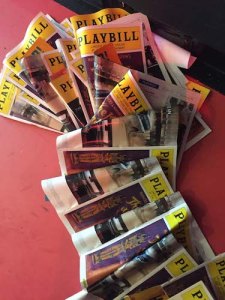
All the Playbills you ever collected

The excitement of Broadway and West End theater is fully on display at the New York Public Library’s show at Lincoln Center, Curtain Up: Celebrating the Last 40 Years of Theatre in New York and London, closing July 30.

It’s a theater-lover’s fantasy journey through four decades of smash hits that cross-pollinated two shores – costumes, stage sets, video clips, lights, sound, and awards. And as the curators point out, the two theatrical epicenters are mirror images of one another.

The Victoria & Albert (V&A) Museum in London, the Society of London Theaters, and our own NYPL assembled this extravaganza with the help of producers, costume designers, actors, theaters, and other owners theatrical history.

The foyer is awash in Playbills, hanging from the ceiling and piled up in corners. It feels like home. It’s hard to know where to look or what to process first. Is it Michael Crawford’s Phantom mask (direct from his own collection)? Is it the overscale streetplan of Times Square or Shaftsbury Avenue? Lola’s thigh-high hot pink Kinky Boots?

A Chorus Line finale top hats by Theoni V. Aldridge from TDF’s Costume Collection.

Take a short walk-through of the show on our Flickr album.

Look closely for windows into innovative set designs (An Inspector Calls, War Horse) amid towering costumed mannequins. But the overpowering sound throughout is One. Who can concentrate on anything else once you see a corridor sprinkled with glittery top hats overhead and Broadway-sized media screen showing the multi-mirrored finale of A Chorus Line.

Besides being everyone’s favorite musical (the first to win London’s coveted Olivier award), the show ushered in the digital age of theater. When it debuted at the Public Theater, the lighting was the first musical to depend on an electronic light board, which made the transitions just as precise at the choreography.

There are backstage notes for The History Boys, box office totals from Evita, period costumes from the theater’s grande dames, and a brief video showing one of the all-time great moments of inspiration and awe onstage — the seconds-long flash accompanying the finale appearance of the magnificent angel in Angels in America.

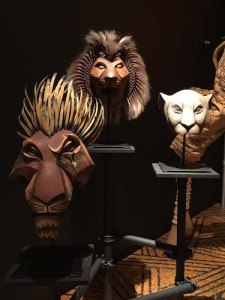
Julie Taymor’s 1997 masks for The Lion King’s Scar, Simba, and Nala

The most dramatic encounter is an area populated with costumes and masks from The Lion King and the swan costume from Matthew Bourne’s all-male Swan Lake.

The “fliers” are aloft, too – Marry Poppins and Elphaba – with a big-finish wall of televisions showing coverage of the Olivier Awards, currently celebrating their 40th anniversary.

The result is a theatrical show together that sings, dances, and reminds everyone of what a life in the theater – either as an actor, technician, or audience member – can be.

To prepare for your next visit to the West End, here’s a short primer on the stats, lingo, and facts about theater culture on both sides of the Atlantic:

Whitney Biennial Takes America’s Pulse in New Home

Larry Bell’s Pacific Red II

Moving into a new home often gives a new perspective on life, and it’s true of this year’s Whitney Biennial. The open, flexible spaces allowed significantly more creativity above the High Line than at the old confines of the Madison Avenue building — Larry Bell’s 2017 “Pacific Red II” installation lording it over The Standard, Asad Raza’s 26-tree installation with the skyline beyond, Cauleen Smith’s banners in the daylight downstairs, and light streaming through the faux “stained glass” window by Raul de Nieves.

Yes, interior spaces are filled with concept art, video installations, slide shows, and paintings, but the glimpses of light and sky serve like punctuation breaks from the sometimes-intense experiences about race, society, rising personal debt (even for artists!), and a throw-away cuture.

Caretaker explains growing trees for Asad Raza’s Root sequence, Mother tongue

The word on the street is that this is one of the most enjoyable Biennials in the show’s history, which is not to say that the curators have avoided challenging work. They haven’t.

Tension…disorientation…protest are all there in reflections on today’s social issues, censorship, social memory, marginalization of populations, and obsessions over the role that too-much-digitalization plays in our hectic lives.

But there are aspirational pieces, too – hopefulness, sincerity, and healing.

Classroom inside the Whitney by Chemi Rosado-Seijo

Think about the (concept art) school set up inside the Whitney. It’s the idea of Puerto Rican artist and educator Chemi Rosado-Seijo, who tried the same displacement between school and museum in his hometown – an experiment that the kids there are still talking about. For the Biennial, Chemi arranged for Lower Manhattan Arts Academy high school students come to the Whitney for classes one day a week; in exchange, work by Whitney artists is moved to the school.

Take a look at our Flickr album, which includes photos of Chemi and some of the other artists from the press preview.

The Whitney has done a spectacular job of documenting all the artists, their statements, and work on their website.

The museum has produced a beautiful testament to this year’s survey. Take a look and witness art history. Seventy-eight years and going strong:

For Royals Who Have Everything

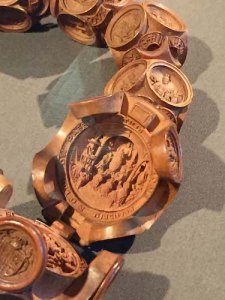
Intricately carved boxwood rosary owned by King Henry VIII and Katherine of Aragon, 1509-1526

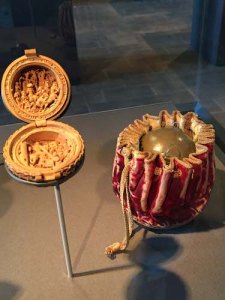
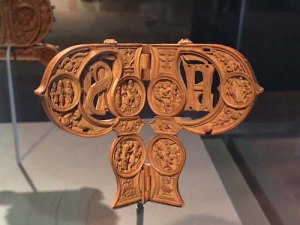
What do you get royals who have everything? If you lived in the early 16th century in Europe, you get a Netherlandish woodcarver to create an amazing, theatrical scene inside a prayer bead or a letter of the alphabet. Fifty amazing treasures from Europe are currently on display at the Met’s Cloisters in the exhibition Small Wonders: Gothic Boxwood Miniatures, closing May 21.

The artists worked on a microscopic scale and packed enough figures into a tiny space that you’d think you were seeing a replication of the finale to a grand opera – main characters, side stories, worlds within worlds.

If you owned one, you’d receive an exquisitely carved boxwood bead that opened to reveal a dramatic scene (usually Biblical), a protective case, and a leather-lined velvet pouch. If you had something like a boxwood altarpiece for your private chapel, the whole thing would fit into a custom-fitted custom case in case you wanted to transport it to your country castle.

You can take it with you; from the Rijksmuseum

Right as you enter the lower-level gallery at the Cloisters, you encounter the largest object in the show, a rosary with 12 immaculately carved multi-sided beads that was owned by Henry VIII and Katherine of Aragon. The theme was the Apostle’s Creed, with each bead telling the story of one of the first apostles – obviously received by the newlyweds before their historic split, which created the Church of England.

The stories behind the fascinating works cannot hold a match to the wonder of seeing these masterpieces in person. One of J.P. Morgan’s donations to the Cloisters – a single bead that reveals layers and layers of figurative sculptures – is always a highlight. It’s incredible that the Cloisters and its partners pulled together some of the best boxwood carvings in the world.

Take a look at the Met’s photo archive, where their high-res digital wizardry allows you to enlarge the photo on your screen to see all of the fine, intricate, tiny detail. Each one of the nearly 50 objects. Also, take a look at our Flickr album of the show.

Letter P opens to reveal the legend of Saint Philip, 1500-1506

Click on the link below to see the video that shows how these incredible small worlds were made: http://players.brightcove.net/911432378001/SkBUku4V_default/index.html?videoId=5249656214001.

Magical Masterworks End Tour at Met

Boy’s 1870-1900 hide shirt decorated in glass beads in geometric pattern by female Crow artist

Exquisite detail and spiritual power are evident in every item showcased in the Metropolitan’s show, Native American Masterpieces from the Charles and Valerie Diker Collection, closing March 31.

The Dikers have spent a lifetime collecting objects of incredible detail, spirit, and beauty and sharing truly dazzling works with the public, most recently in the Indigenous Beauty show which ends its national tour here in New York.

Every time we have visited the small showcase inside the Met’s African and Mesoamerican galleries, visitors have been pouring over every detail of the weave, beadwork, paint, inlay, and woodcarving on the masks, clay jars, baskets, shirts, coats, hats, headdresses, war shields, and hide canvases on display.

Magical colors, geometric patterns, attached talismans, and even mysterious paint splotches pack powerful messages as animals, spirit-creatures, and half-human beings emerge in two and three dimensions.

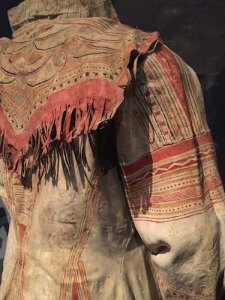
1840s man’s European-style hide coat created by a female Naskapi artist in Labrador

The majority of artwork and clothing dates from the 19th and early 20th centuries, but pieces are earlier, such as a nearly perfect Anasazi clay pot from 1100 A.D., which uses geometric 2-D wizardry on the curved surface to convey the interconnection of underground water reservoirs that enable agricultural communities to thrive in the Southwestern desert.

Native designs and magical powers are sometimes merged with European style, as in a man’s painted hide summer coat, which was created by a female Naskapi artist from Labrador, Canada. Designed inspired by European coats, with images for a good hunt, but worn by the hunter for only one season

The curators have taken care to cite the artists in cases where they are known, such as an1880s buffalo-hide shield painted by Joseph No Two Horns, a Lakota artist who participated in the 1876 Battle of the Little Bighorn.

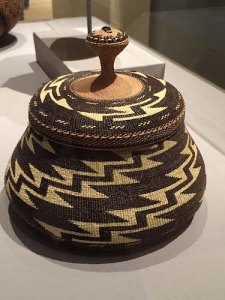
1910 woven quilled basket and 3D lid by Elizabeth Hickox of Northern California

The show puts a spotlight on innovators, who began making monumental works for collectors, such as the large pottery jar by Nampeyo, the first well-known Hopi artist and Elizabeth Hickox, who became known for her three-dimensional embellishments in woven basketry in Northern California.

Enjoy all of the details of our favorites from this show in our Flickr album.

Tiffany Again Illuminates the Carnegie Mansion

Tiffany’s glass vases against De Forest’s stenciled walls of the Teak Room

If you’d like to experience a few moments surrounded by the splendors of the Gilded Age in America, climb the staircase inside the Carnegie Mansion (Cooper Hewitt) and enter another world. As a tribute to the mansion’s second-floor renovation, Cooper Hewitt mined its own collection and borrowed key pieces as part of the installation, Passion for the Exotic: Louis Comfort Tiffany and Lockwood de Forest, closing March 26.

You’ll find yourself in a quiet mystical room that served as the Carnegie family library when it was first designed in 1902 by Lockwood de Forest, a superstar of the Aesthetic movement. The Smithsonian has brought the room back to its original glory, carved teak, stenciled walls, and all.

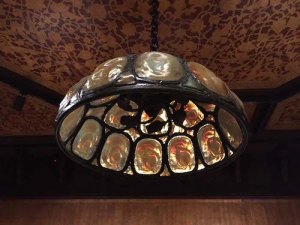
Paying tribute to Mr. Carnegie’s passion for all things Tiffany, the curators have brought out their lamps, lit them up, and borrowed a magnificent turtleback Tiffany chandelier that is close to original. The effect of low light emanating through all the iridescent glass and illuminating the walls and built-in cabinet is unusually magical.

Painted bronze and blown glass Turtleback glass chandelier by Tiffany Studios, 1910

The design triumph is even more interesting when you think that at the time, 92 percent of New Yorkers did not even have electricity. So, this installation is not only beautiful, but stands as a 1902 example of cutting-edge technology and avant-garde design.

Take a look at our Flickr album, showing the objects in the room, and explore each one and its provenance on a special page on the Cooper Hewitt website.

So, how did this seemingly perfect collaboration interior embellishment, light, and the exotic happen? De Forest and Tiffany, who began working together in the 1880s, both shared a passion for the intricate designs of the Middle East and India. Each globetrotter had seen Indian interiors firsthand and felt their American design practices would benefit from exotic infusions.

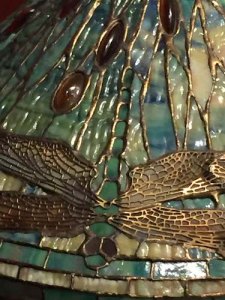
Electrified Dragonfly Lamp designed by Clara Driscoll, who led the Women’s Glass Cutting Department

Tiffany and de Forest once were business partners, but after that dissolved, they kept working together on a project-by-project basis. De Forest brokered a deal with a workshop in Ahmedabad in Gujarat, India, to manufacture decorative teak wood and brass panels that he designed for his own and Tiffany’s interior-design clients.

So the installation at the Cooper Hewitt is your chance to experience the magic of one of America’s great design collaborations.

To give the room a unique aesthetic glow, De Forest stenciled the wall in yellow lacquer to create an illusion that he associated with Indian screens. The teak details, inspired by Indian design, and the built-in cabinet inside Mr. Carnegie’s room came from the Gujarat workshop.

The Teak Room is currently the most complete De Forest interior still in existence in the site for which it was created. Seeing this work, lit by the glow of the Tiffany lamps and decorated with other Tiffany decorative objects, is a must.

Japanese-inspired Tiffany desk set, 1910-1920.

And when you climb the grant staircase to the second floor, you can also take advantage of the interactive display at the top of the stairs, which is loaded with history about the mansion and photos showing the original interiors.

If you want to soak in more of Tiffany’s prowess, watch Ben Macklowe’s Cooper Hewitt livestream on the master’s background, influences, technology, and business and find out what happened to the Tiffany-designed rooms at the White House:

Sixties Bus and Jag Pulling Out of MoMA

1967 bus by Mason Williams and Max Yavno with designer autographs from MoMA’s 1968 Word and Image show, with Joshua Light Snow’s 1967 Liquid Loops

Big alert to baby boomers: Only a little time left to catch MoMA’s big Sixties bus that’s parked on the fourth floor in a room filled with psychedelic posters and a Fillmore-style rock show light extravaganza. It’s all part of the crowd-pleaser of a show that’s been in residence for about a year – From the Collection: 1960-1969, closing March 19.

The curators cleared out the floor and organized their permanent collection year by year, taking you through every movement, ism, and trend in contemporary art of the Sixties, from Rauchenberg’s combines from his downtown loft, to Christo’s wraps, to Warhol’s Pop, the psychedelic revolution in poster and cover art, and the rise of women taking on the art establishment (go, Eva Hesse and Lynda Benglis!). Except for the room with the Beatles and the bus, it’s like vintage Artforum come to life.

Wall of 1967 psychedelic posters publicizing East and West coast rock bands

MoMA called upon six of its departments to assemble the look, touch, and feel of the decade, from scrappy mix-it-up works to minimal plastic design and flat-out revolts to the museum world.

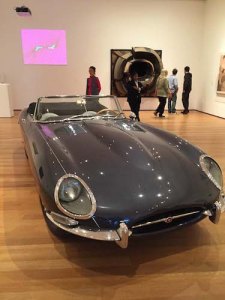
The first room features an sleek Jaguar roadster from the design department, the first commercially produced car to resemble racers. It’s a reminder that aerodynamic lines of 1961 swinging London were a harbringer of things to come as imaginations and images turned to space, rockets, and the future as the years of the Sixties ticked by.

See shots of some of our favorites in a chronological gallery walk in our Flickr album. The decade begins with Bubble wrap (thanks again, design department!) and concludes with NASA Apollo photographs.

The aforementioned bus is actually a flat 1967 display that MoMA kept in its warehouse that was designed by Mason Williams and Max Yavno MoMA’s 1968 poster show Word and Image. It’s covered with autographs of Milton Glaser and other famous designers whose work was featured in the original show.

Jaguar’s aerodynamic 1961 E-Type Roadster sharing space with a Lee Bonticou work

For the rest of the weekend, the bus serves as kind of a boomer hangout. The Avedon Beatles (distributed in magazines worldwide to promote their Sgt. Pepper transition) and other iconic rock images are in the room.

Other hang-outs for different populations include the cushion-cubes near the video monitors showing analog reel-to-reel videos from the years when Portapak video cameras were born (remember when video cameras weren’t on your phone?) an cool art hounds entranced by all four walls of Mr. Rosenquist’s mind-blowing F-111 masterwork. It’s installed just as Mr. Castelli did way back when.

Hear what James Rosenquist was thinking in 1964 as he created his iconic wraparound painting, F-111. Thank you, MoMA!


Revolution Inside MoMA

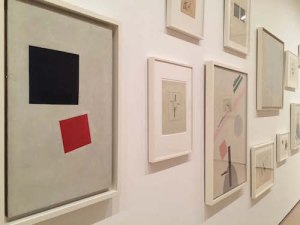
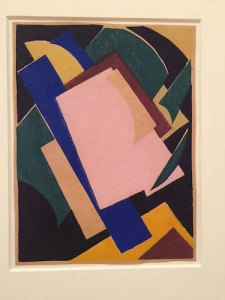
1915-1917 Suprematist works by Kazimir Malevich

1915-1917 Suprematist works by Kazimir Malevich

The Museum of Modern Art has pulled 260 paintings, films, magazines, books, drawing, porcelain, posters, and paraphernalia from its collection to take us back 100 years and tell the story of one of the most astonishing artistic and political breakthroughs of the 20th century in A Revolutionary Impulse: The Rise of the Russian Avant-Garde, closing March 12.

While Picasso and company were breaking boundaries in Paris, the Russians exited the war years by overthrowing their monarchy, getting rid of classical style, inventing non-objective picture making, and creating forms of revolutionary works that could reach the masses.

Lyubov Popova’s 1917-1919 print showing Cubo-Suprematist style

Lyubov Popova’s 1917-1919 print with Cubo-Suprematist style

Creativity, artistic manifestos, photo mash-ups, new cinematic forms, and philosophical inventions poured forth like an avalanche between 1913 and 1923.

The curators at MoMA have organized the show chronologically to try to give context to the players and the “isms” that were being invented and then upended by the next new thing – Rayonism, Cubo-Futurism, Suprematism, Constructivism.

The artists truly believed that abstraction and upheaval from classic style would usher in the utopia envisioned by the fall of the Czar, hence the profusion of experimentation in theater, film, photography, cinema, books, textiles, household goods, and publishing.

Easel painting was a no-no. Manifestos, how-to-do-it manuals, and Suprematist road shows were the norm. Due to MoMA’s dedicated collecting in this almost-forgotten period, all of the art, tools, passions, and beliefs are brought to life in the show.

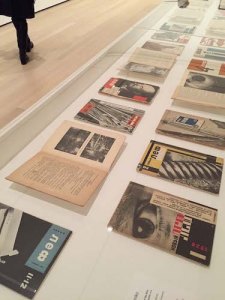
1928 magazine covers by Rodchenko for New LEF: Journal of the Left Front of the Arts

Rodchenko’s 1928 magazine covers for New LEF: Journal of the Left Front of the Arts

MoMA allows gallery goers to peek inside two of its most notable books in its Russian collection through digital touchscreens – Malevich’s 1920 portfolio of Suprematist drawings and El Lissitzky’s 1922 illustrated children’s book Of Two Squares.

El Lissitsky’s unbound prints from his historic Proun manifesto are mounted across the wall of the fourth gallery, allowing close examination of the masterful lithographer.

The latter galleries focus on 1920s Cubo-Futurist theater costumes and stage sets, breakthrough cinema techniques (with three films screening simultaneously in an immersion room), mass-market publications, and posters advertising films and sporting extravaganzas. See examples of all on Flickr.

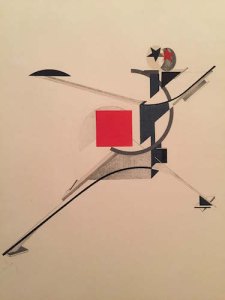
El Lissitzky 1923 litho honoring the 1920 restaging of the Cubo-Futurist opera “Victory Over the Sun”

El Lissitzky 1923 litho honoring the 1920 restaging of the famed Cubo-Futurist opera Victory Over the Sun

Everywhere you look, Rodchenko’s innovative typography, photographs, and layouts are jumping out, demanding attention. Among the more unusual surprises are Rodchenko’s branding for the state airline and the modernist  layouts in the 1925 Kino-Pravda films used to tell the public the status of Lenin’s vital signs during his final days.

The innovations created by this group of artist-revolutionaries would soon be undone by the Stalin’s preference for social realism. But although he stamped out Russian modernism in his day, the white-on-white Malevich, El Lissitsky’s fourth dimension, Vertov’s lightening fast film edits, and Rodchenko’s tilting letters still pack the punch on MoMA’s white walls nearly 100 years after they were created.

Take a look at some of our favorite pieces on Flickr, and watch a brief orientation to the show by MoMA curator Sarah Suzuki.

Mark Leckey Mixes It Up at MoMA PS1

Mark Leckey’s 2013 Felix the Cat, a tribute to TV’s first celebrity.

Mark Leckey’s 2013 Felix the Cat, a tribute to TV’s first celebrity.

It’s the last weekend to take a walk through the output of the creative mind of an award-winning British artist MoMA PS1, which has dedicated its top two floors of the schoolhouse to Mark Leckey: Containers and Their Drivers. Film assemblages, appropriated pop images, and funky juxtapositions are served up to everyone plucky enough to climb the stairs and peek around corners.

Visitors take an eclectic journey through a labyrinth of video galleries, movie rooms, and installations. The highlight is his 1999 breakthrough film about UK trance-dance culture, Fiorucci Made Me Hardcore, using found footage.

Several small rooms include meditations on RCA’s first TV transmission in 1928 using a Felix the Cat. For added punch, Leckey adds his own inflatable oversize Felix to the gallery.

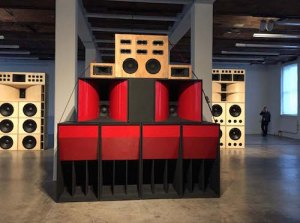
Mark Leckey’s 2001-2001 Sound System sculptures, which communicate all on their own

Mark Leckey’s 2001-2001 Sound System sculptures, which communicate all on their own

The intimate viewing experience is punctuated by large-scale installations of provocative work that asks visitors to reconsider their experience of everyday objects.

One major room contains towers of low-range, mid-range and high-range frequency speakers that emit tweets and signs, programmed to converse. Their range of sounds make one recollect times in Leckey’s early career, when he used his speaker-towers in showdowns with other large, inert behemoths, such as gigantic quarry rocks or Henry Moore sculptures. Visitors slow down to get close to the structures and wait for them to speak.

Installation view of The Universal Addressability of Dumb Things (Machine), with costume, Lego ship, copy of a 1959 Soviet space dog suit

Installation view of The Universal Addressability of Dumb Things (Machine), with costume, Lego ship, copy of a 1959 Soviet space dog suit

Other large-scale installations are from Leckey’s recent project to “collect” interesting art and artifacts inside his computer, assemble them into virtual installations, and then reproduce it all in 3D. Leckey’s multi-part project, The Universal Addressability of Dumb Things, is depicted in the Flickr album here. The objects are carefully placed but it takes a (literal) scorecard in the gallery to discern what you’re seeing – a copy of a work by another young artist, an engineering model, or fantastical emanation of Leckey’s own mind.

The two ends of a mysterious, dark gallery with fluorescent painted figures are anchored by archeological fragments of the mythological past, except that the fragments are 3D-printed copies.

Traversing one floor, sounds emanate from Leckey’s 2010 green room/shrine. Enter to find a large fluorescent fixture above, a quiet crowd just taking it all in, and the focal point — a talking Samsung smart refrigerator that steals the show. The refrigerator holds court, surrounded by fantasy videos of itself hurtling through time and the cosmos.

Check out Leckey’s 2010 video of the GreenScreenRefrigerator to hear what’s inside the mind of his smart appliance and contemplate a future dominated by the Internet of Things.