Ever wonder what story is told by the food on your plate? It’s all explained in the show at the American Museum of Natural History, Our Global Kitchen: Food, Nature, Culture, now in its final weekend.
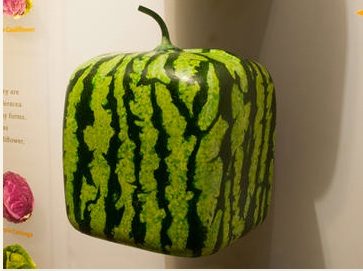
It’s a fascinating walk-through of how food is produced, transported, and consumed by cultures all over the world. You’ll see examples of the zillions of varieties of potatoes archived by the Peruvians high up in the Andes and interesting twists like cube-shaped melons grown in Japan.
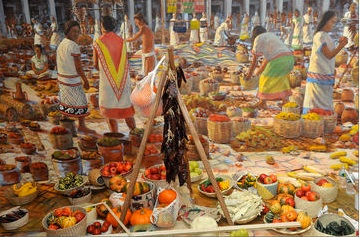
Diorama of the Aztec Tiatelolco market in 1519, just before the Conquistadors arrived. Photo: AMNH/R. Mickens
What’s everyone’s favorite part of the show? Most people can’t get enough of the interactive light table where you can watch the hands of master chefs making some incredible ethnic dishes and the Aztec market. The latter is a full-scale diorama of what shopping was like in 1519 down in Mexico City just before the conquistadors arrived. The market is vast, with an amazing array of items, all neatly arranged in sections, not unlike Eataly’s adventurous stalls near Madison Square.
You’ll get a glimpse of what was on the table of Gandhi, Roman royalty, the Great Khan, and other historic celebrities. The best is seeing what Otzi, the mummified Ice Man was packing as he crossed the Alps about 5,000 years ago.
Here’s the informative introductory video for this thought-provoking and mouth-watering show.
Open-source vacuum assembled from downloadable instructions, a red thermos, hardware store items, and 3D printed parts
If you haven’t been exposed to the DIY (Do It Yourself) movement, drop into the New Museum’s Adhocracy show at its Studio 231 storefront this weekend.
It’s a 25-project showcase of cutting-edge design solutions, including DIY as well as some film, video, low-tech high tech, and crazy, new approaches to making stuff in the 21st century.
The DIY sections that we particularly liked were the household appliances made by downloading Open Source instructions, manufacturing components with 3D printers, and buying the remaining bits and pieces at the hardware store. Why spend money on a Dyson when you can build your own vacuum cleaner from a thermos container and other scrounged parts? Each solution is more fascinating than the next, with displays of OS-compatible coffee grinders, water boilers, and bicycle parts and their instructions.
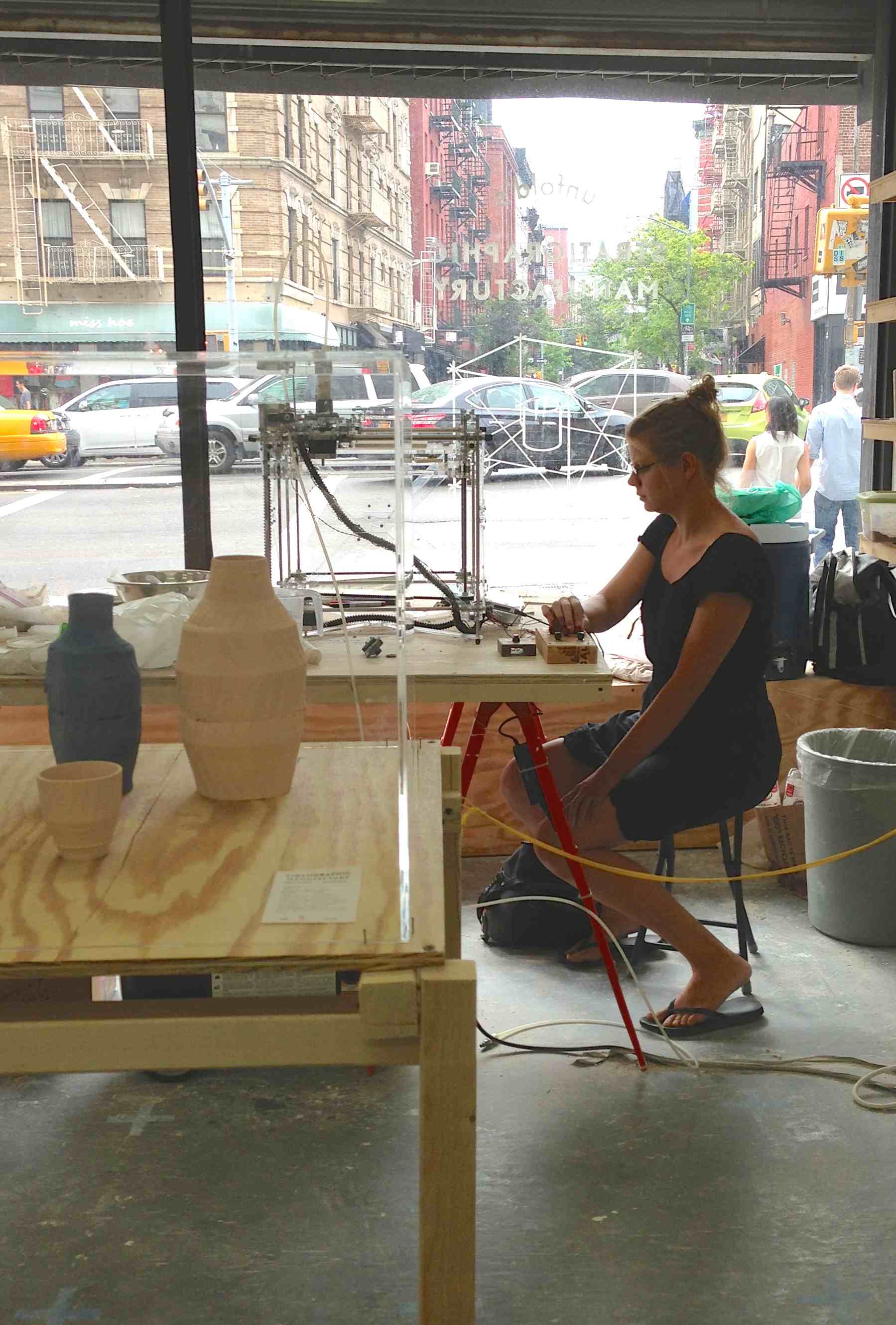
Larisa Daiga uses Unfold’s Stratigraphic Manufactury (3D ceramic device) to make coil pots from Gowanus sludge
Other displays highlighted the best inventions from Kickstarter (e.g. Central Standard Time wristbands and iPod Nano multimedia wristwatches) and solutions for using the Arduino microcontroller – lion tracking collars in Kenya and an earthquake-sensing device created and marketed by a 14-year old in Chile. It tweets you when there’s a tremor. Click here to see some photos, and if you feel like making something, explore your options on Adafruit..
Right in the storefront window, NYC ceramicist Larisa Daiga uses a ceramic 3D printer to make a tiny coiled pot. Larisa told us that she couldn’t touch the porcelain, because it was actually sludge from Brooklyn’s beloved Superfund site, the Gowanus, and loaded with biotixins.
Daiga felt it was interesting to be part of Unfold’s Stratigraphic Manufactury project, making coil pots (one of the oldest technologies of humankind) with toxic waste. Days spent in the window of Adhocracy let her contemplate how sludge might be reused and recycled instead of being trucked and dumped into unsuspecting landfills in the rest of the country. View her Adhocracy output and see the machine at work on her Flickr feed.
Another DIY favorite from Helsinki is featured in the show — Restaurant Day, when everyone in the city has permission to open their own restaurant on the curb. It’s one step beyond Smorgasburg.
Since Philadelphia museums, zoos, and gardens began posting videos online in 2008, collective YouTube views have climbed to 2.4 million, as chronicled in our latest report, Philadelphia Museums: 2013 Video and Social Media Rankings. The biggest surprise about the Philadelphia museum videos is that stylistically they are a bit different than New York museum videos. The institutions in Philly take a more whimsical approach to science, use a lot more promotional videos to drive exhibition attendance, and occasionally throw in a bit of the macabre.
The Top Philadelphia Exhibition Video of 2012, courtesy of the Longwood Gardens grounds crew and Bruce Munro
Highlights of our report on 32 Philadelphia museums:
As of year-end 2012, the Philadelphia institutions with the highest number of total YouTube channel views are the Penn Museum, the Mutter Museum, and Longwood Gardens. Penn’s channel features a mix of behind-the-scenes videos about exhibits, anthropology lectures, and a gigantic docu-archive; the Mutter produces highly creative shorts highlighting selections from its tantalizingly weird collection; and Longwood simply has tons and tons of fans that want to see what’s up with the seasons.
Last year, Longwood Gardens produced Philadelphia’s highest rated museum video — Light: Installations by Bruce Munro.Over 36,000 nature and art lovers viewed this short about Longwood transforming itself into Munro’s luminous vision. The garden also pumped out other video promos and features all year that kept their fans coming back to hit the YouTube channel.
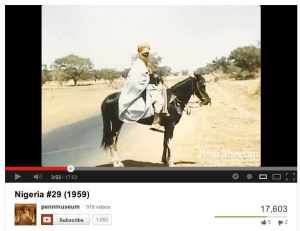
The Penn Museum’s Top 2012 Anthropology Video Nigeria #29 (1959) features a sheik, a mosque, a fuel depot with camels, and country life the way it used to be
The Penn Museum’s YouTube channel surpassed 1 million views in May. Penn’s been adding an enormous anthropology film collection to its channel (over 400 films) and the time-machine quality is irresistible. It’s no surprise that Penn’s Maya 2012: Lords of Time videos captivated the public all year, but it is interesting that the silent travelogue Nigeria #29 (1959) is up to 17,000 views. You could poke around that channel for days.
The Chemical Heritage Foundation produced Philadelphia’s most popular science video.Over 26,000 people watched A Distillations Explainer: Sweat, part of the Foundation’s Blood, Sweat, and Tears series (see below). It’s an entertaining, well-produced podcast series.
The Mutter Museum presents its unusual medical collections quite effectively through its YouTube series. Their 2012 series feature the curator taking “mystery” items out of the cabinets and challenging the viewers to identify them. Not for the squeamish, but really clever and nicely scripted.
The most active museum Twitter users in Philadelphia are the National Constitution Center, the Eastern State Penitentiary, and the Penn Museum. The most active Flickr users during 2012 were the Franklin Institute Science Museum and the Pennsylvania Academy of the Fine Arts. The largest Flickr photo pools are populated by Longwood Gardens and Eastern State Penitentiary enthusiasts.
All the video and social media details on 32 museums are in the report. Click here to see what’s included and make a purchase from our Its News To You Reports shop.
Enjoy watching Philadelphia’s top science video, courtesy of the Chemical Heritage Foundation. Meet Louis Pasteur and find out why sweat often smells:
The Japan Society’s popular Japanese language series
After reposting so many museum videos here, we wondered how much video museums were producing, what social media they were using, and who had the most viewership and followers. We counted, and found that the museums, zoos, and botanic gardens around New York have racked up 48.8 million views on their public YouTube channels since 2007.
Museum folks may want to purchase the full 48-page report to see how their organization stacks up, but here are some of our key findings:
As of year-end 2012, NYC museums with the highest number of all-time YouTube channel views were the Paley Center, American Museum of Natural History, and Japan Society. Paley merges its NYC and LA feeds, and it’s 33M all-time video views are mostly from TV celebrity show panels in LA. So if we’re really looking at the museum programming champs in NYC, it would be AMNH (15M), Japan Society (7M), and MoMA (6M).
The Top NYC Museum Video of 2012 — an AMNH Science Bulletin Whales Give Dolphins a Lift
The top NYC museum viral video of all time is The Known Universe video produced by AMNH for the Rubin Museum’s 2009 show, Visions of the Cosmos– 11M views and still growing. The video was generated from the Hayden Planetarium’s data set.
In 2012, another AMNH video, Whales Give Dolphins a Lift, went viral with 2M views.The AMNH has an active video-production team supplying content to its Science Bulletin walls inside the museum. Hats off to them for making a winning wordless video out of a few still photographs from field scientists in Hawaii, simple titles, and tranquil music.
The popularity of Japan Society’s language lessons are driving the numbers on their channel. Who can resist clicking through all the 2-minute lessons in their Waku Waku Japanese series with Konomi?
Asia Society’s Top NYC Museum Music Video of 2012
The top 2012 NYC museum music video was produced by the Asia Society, Arif Lohar and Friends: Jugni Ji!. Who knew that the finale to a Sufi pop legend’s concert on Park Avenue one year ago would rack up over half a million views?
The top star featured in a 2012 NYC museum exhibition video was a piece of 18th century mechanical furniture displayed at the Metropolitan. Viewership ofThe Roentgens’ Berlin Secretary Cabinetgrew from 182,000 views at year-end 2012 to 1.6 million today. Can anyone explain how mechanical furniture received 25 times the viewership of the Met’s video walk-through of its blockbuster McQueen show, Savage Beauty?
The NYC museums using the greatest range of social media and video channels are The Jewish Museum and the Rubin. One of the best under-the-radar NYC museum Flickr sites was the historical archive of Wall Street documents and treasures posted by the Museum of American Finance.
All the video and social media rankings 63 museums are in the report. Click here to see what’s included and make a purchase from our Its News To You Reports shop.
OK, here it is: the all-time top NYC museum video from 2009:
Black velvet evening dress by Charles James (c. 1955) with a 3-ft. zipper inserted along that diagonal seam
Once you see the clothes in FIT’s Fashion and Technology exhibition inside a technology context, you’ll start making the connections at other shows all over town.
Exhibit A right inside the entrance – a seamless nylon-powder dress and bag made from CAD software and a 3D printer by Freedom of Choice in 2005 is a mesh wonder that is made by the same process as Amanda Levete’s woven Fruit Bowl in MoMA’s current Applied Design show.
Take the brilliant purple British day dress that FIT displays as an example of the revolution in color that occurred in the 1860s as analine dyes began to be used for the first time in commercial cloth manufacture. The Metropolitan Museum showcases the same point (except surrounded by Manet and Monet masterpieces) in its blockbuster time-series Impressionism, Fashion and Modernity. (Reference Camille.)
The 1860s color revolution due to analine dyes in commercial fabrics
Outstanding achievement award invention + application at the FIT show: invention of the zipper in 1913 and the stunning accomplishment of Charles James, who inserted a three-foot-long zipper into a spectacular gown in a hidden seam on the bias (see left).
In Fashion and Technology, FIT makes brilliant use of its own stellar collection to chronicle the changes in technology that revolutionized fashion, from the advent of the Spinning Jenny in 1764 to the world’s first programmable T-shirt (see below).
For fans of the 18th and 19th centuries, here’s what technology mattered:
1764 – cotton replaces wool and linen as the go-to fabric (thanks, Spinning Jenny)
1780s – machine-knit textiles (200 years before double-knits)
1801 – Jacquard looms create complex patterns by using punch cards (up to 10,000, so take that Univac!)
1846 – sewing machines eliminate tedious hand stitching for the interiors of gowns
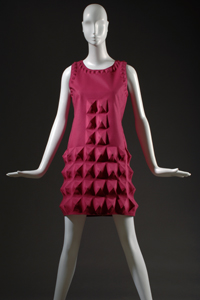
Pierre Cardin, dress, fuchsia “Cardine” textile with molded 3D shapes, 1968, Gift of Lauren Bacall.
1856 – analine dyes bring about a color revolution to ladies’ fashions (go, hot pink!)
1857 – chain-stitch sewing machine
1860s – more color complexity with roller-printed fabrics
1880s – collapsible bustles let ladies sit down
1882 – celluloid used to imitate ivory and tortoiseshell for accessories
Check out the excellent exhibition timeline interactive to see these breakthroughs and what happened in the 20th and 21st centuries.
As promised, here’s the video of the world’s first programmable T-shirt:
Steve Quinn couldn’t send them to the L’Oreal Paris hair and make-up room like Tim Gunn does on Project Runway. They’re just too big, too famous, and too fragile. We’re talking about the furry animals that populate the 43 dioramas on Floor 1 of the American Museum of Natural History’s in the Hall of North American Mammals.
So how do you buff, puff, make up, color, groom, blow dry, restore eyelashes, color brows, and repair noses on New York superstars that have been in the (literal) spotlight since the early 1940s? That’s the subject of AMNH’s YouTube sensation, Restoring Dioramas in Hall of North American Mammals – a 16-show reality series that won a prestigious Webby Award earlier this month. Download the North American Mammal app (with before and after looks at the enhanced fur).
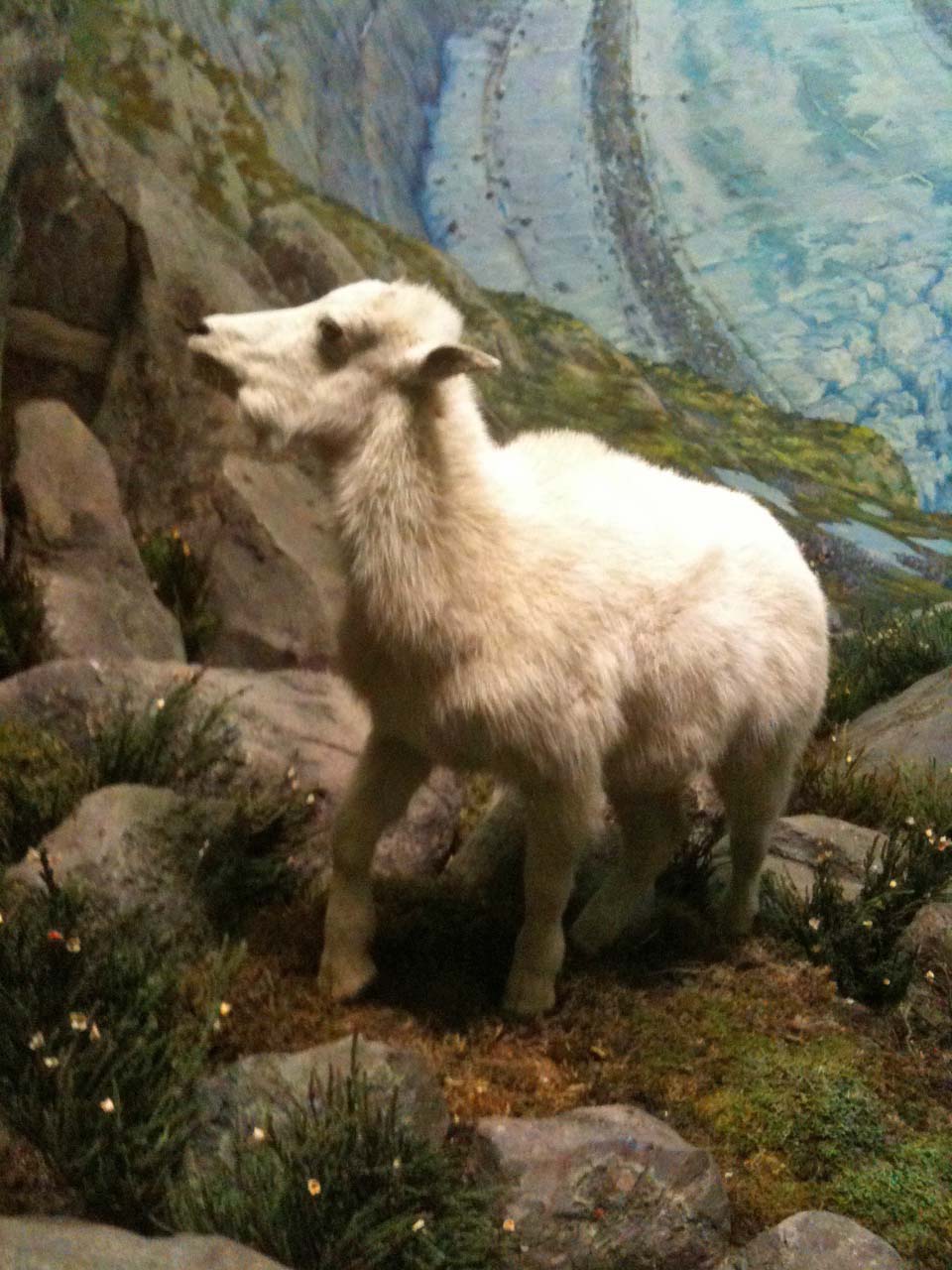
No more “demon” eye in the baby Mountain Goat, who is surrounded by thousands of flowers refurbished by AMNH volunteers
Steve Quinn leads a team of accomplished artists to, well, perform makeovers on the animals, plants, and background paintings that reside inside some of the most famous 3D attractions inside the AMNH. Steve told us that the first step was to update the decades-old lighting inside each case with state-of-the-art illumination that would inflict much less damage on the mammal coiffures.
His team engineered wooden platforms that extended into each scene so that leaf-turning and snow repair could occur with minimal disruption to the diorama floor. If you watch the 4-minute videos, you’ll see how they fixed a bison’s nose, put whiskers on cougars, restored the grass on the Great Plains, and restored the jackrabbit’s ears. The runaway hit of the series is Updating the “Moon Shadow” in the Wolf Diorama. With over 8,000 views, it’s not going to knock Dr. Neil off the AMNH charts any time soon, but Steve’s magical artistry is something to savor.
Go to the AMNH YouTube channel and scroll down to find the North American Mammal diorama series, depicting Steve and his crew at work. Check out this series trailer:
Just before Steve retired the other week, he gave us a special Night at the Museum, walking around and visiting his favorite dioramas after the visitors left.
Steve, you’re a total rock star. Thanks for all your spectacular work at AMNH over the years, and congratulations on the Webby.
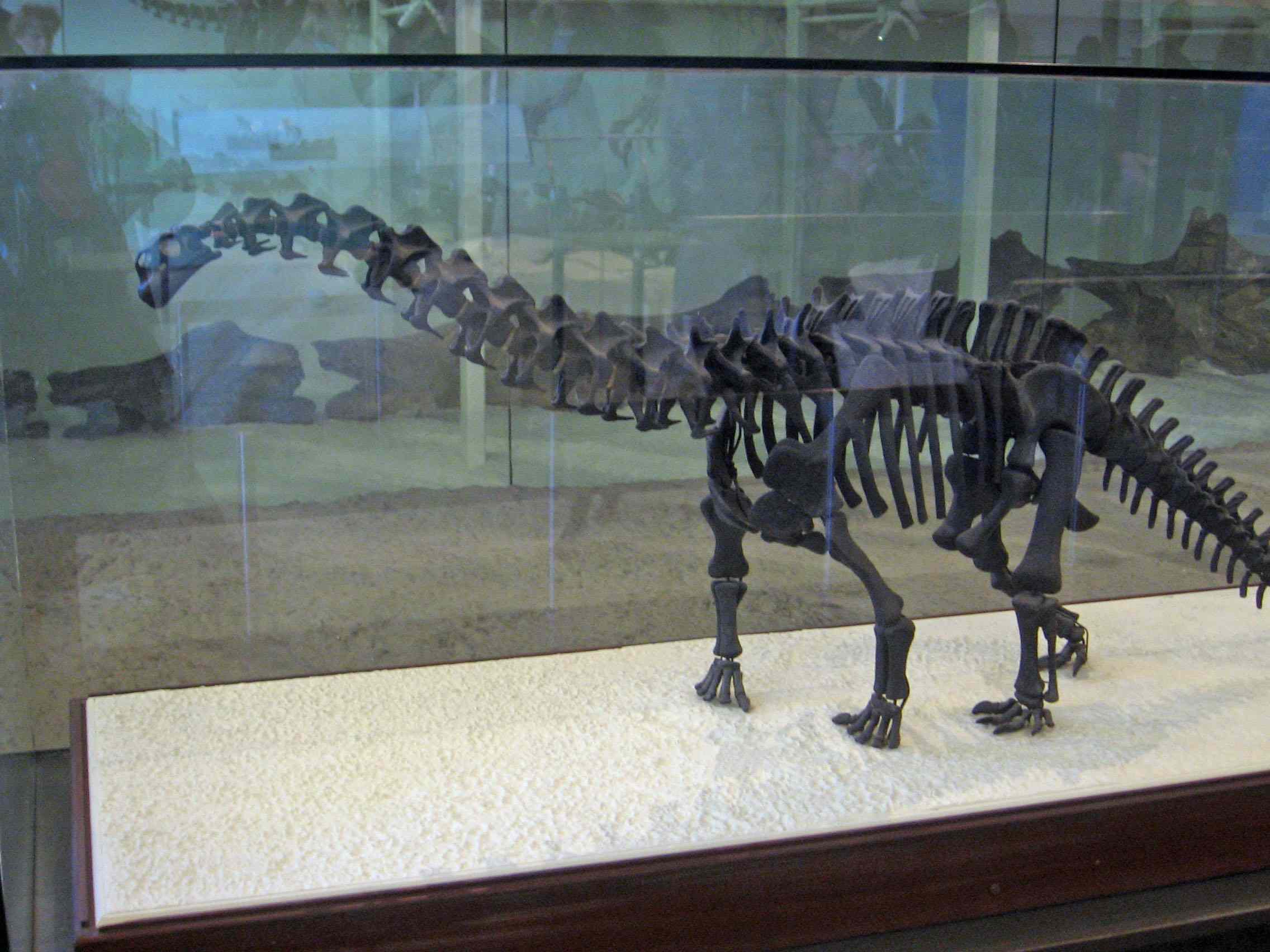
Apatosaurus holds court on the Fourth Floor of AMNH. Source: Scott Robert Anselmo
There’s no way to count the number of times that people get upset because his actual scientific name is no longer Brontosaurus.
He’s one of the most famous dinosaur celebrities in the world and you may know him as Brontosaurus from your Flintstone days, but his real name is the Apatosaurus.
So just think about it….It’s the perfect day for you to learn to say his “Irish” name — A-PAT-o’saurus. Isn’t that better? Go over to wish him well this weekend.
He’s the largest dinosaur on display in New York. He came here all the way from Wyoming, and he’s been standing here since 1905, when J.P. Morgan and the AMNH crew unveiled him. It was the first time that a really big dinosaur was ever mounted in 3D anywhere in the world.
To the left is the “architect’s model” that the 1905 crew used to figure out how to weld together enough steel to keep the tons of rock up in the air. A-PAT-o’saurus, Happy Irish Day!
Replica of the round CRT and game controllers developed at MIT in 1962 to run Spacewar on DEC’s PDP-1, the first commercial interactive computer. Note input-output typewriter.
It’s all aliens, flying saucers, galaxies, and other worlds inside the Museum of the Moving Image’s tribute to gaming history, Spacewar! Video Games Blast Off, soon ending in Queens.
The big, expansive dark gallery is a gamer’s dream, with flashing lights, arcade consoles, virtual headgear, and wall-sized projections distributed around the room. Last weekend, enthusiastic museum-goers were happily roaming through the space, enjoying the please-touch experience of interacting with 20 historic video games from the last 50 years. Yes, they all work!
The show begins with a reverential replica of the game that started it all in 1962 at MIT, Spacewar, the first virtual intergalactic battle in deep space. Check out the story of SpaceWar, a slick, fun video created by the Computer History Museum in Silicon Valley. (Spoiler alert: it involves model railroading.) If you want to read more, here are links to the 1972 Rolling Stone article that predicted that computer gaming was going to take off in big ways.
Child waits turn as museum-goer enjoys GalaxyForceII, Sega’s 1988 arcade game built upon a flight-simulator cabinet.
The museum did not feel compelled to arrange its time-machine arcade in chronological fashion, and it’s fun switching back and forth among the different technologies. You’ll find Atari’s 1979 Asteroids arcade unitis next toNintendo’s 2009 Super Mario Galaxy II and Atari’s 1982 home console for Yar’s Revenge. There’s even the 2009 iPad game Osmos.
No one has to wait very long to step up and play, although there was tiny queue for Space Invaders, the 1972 arcade sensation that was one of the earliest microprocessor-based units. Dads were having fun explaining to kids exactly why it didn’t fire as fast as games they have at home.
Leave that light saber app holstered, and get to Astoria to relive what it was like the first time you fought in space. Note: Admission gets each person four complimentary arcade tokens, but you can always buy more.
Carl Buell’s rendering of the hypothetical placental ancestor, a small insect-eating animal. Source: AMNH
Who says dinosaurs get all the attention?
One of the big front-page science stories of the last few weeks is that a global team of researchers has mapped our ancestor tree back in time to a hypothetical small, furry critter that emerged just after the dinosaurs went extinct. The big news is that through a giant high-tech, data-crunching technique, 15-20 molecular-data scientists collaborating in six countries around the world figured out that the hypothetical ancestor to nearly all the mammals alive today emerged 200,000 to 400,000 years after the comet crashed to Earth 65 million years ago.
Ok, it wasn’t the first mammal (the ancestor to platypuses, opossums, kangaroos, and a lot of other extinct things came much earlier), but let’s applaud the American Natural History Museum for telling this story so clearly to a writer at The New York Times that it made it to the front page.
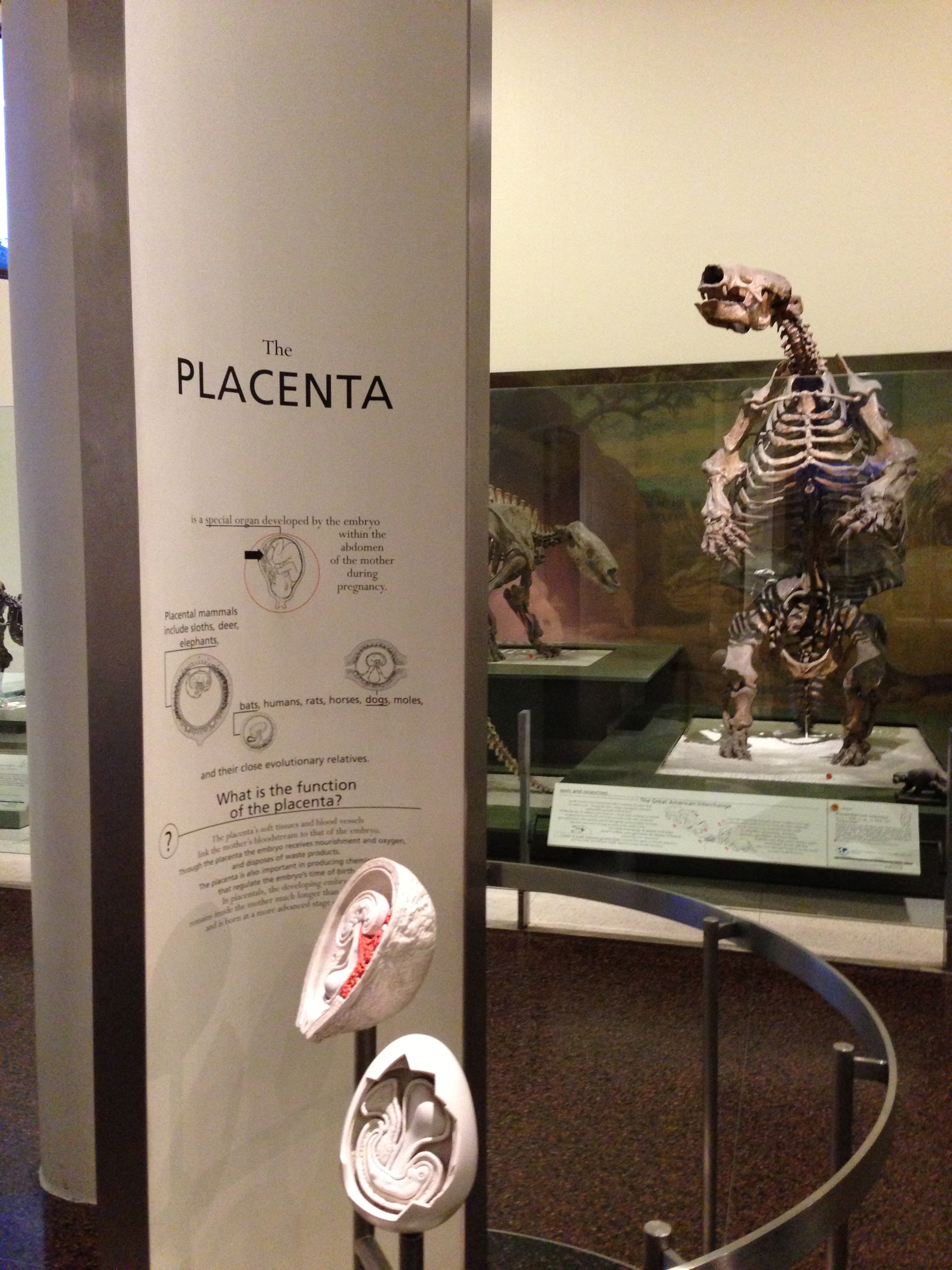
Column on AMNH Fourth Floor exhibit space that marks the spot where the virtual critter emerged along the evolutionary pathway in the Hall of Primitive Mammals.
At Thursday’s Social Media Week event on how to tell stories in science, panelists repeatedly emphasized how hard it is to make clarity emerge from a morass of data. In a way, this “story about the rat” reached a social-media science storytelling trifecta: over 240 comments “about the rat” on the NYT web site, a neat little video that’s racked up over 11,000 views in just two weeks, and an exhibition layout for the vertebrate paleo collection on the museum’s Fourth Floor that lets you stand in the exact spot on the evolutionary pathway where this tiny hypothetical ancestor emerged. (See the photo with the Giant Sloth, to the left.)
Great job, AMNH and Stony Brook storytellers for giving us this video view into deep time, showing how MorphoBank crunches data, and creating another social-media star out of a virtual ball of fur.
PS: The fossil background talent in this video appears to be a model of Gobiconodon, an actual Cretaceous mammal from 110 million years ago who’s not directly related to the star of this show, but looks good on camera.
Left Hand of Maitreya, Buddha of the Future, Holding the Looped End of His Robe Xiangtangshan: Northern Group of Caves, North Cave, south face altar of central pillar, 550-559 ce., limestone. Source: Asian Art Museum of San Francisco, Transfer from the Fine Arts Museum of San Francisco
The exhibition closing today on 84th Street isn’t about Herzog’s 12,000-year old French cave art, but about truly monumental art that has been largely unknown in the West until the University of Chicago unveiled a truly spectacular achievement – the digital recreation of a Sixth Century Buddhist cave temple destroyed in the 20th century by vandals selling to the international Asian art market.
The story of this cave temple’s recreation began when the University of Chicago started asking what happened to all the stuff from the vandalized cave temples that were originally built as hostels for wandering Buddhist monks in the Fourth Century in Northern China along the old East-West trade routes. UC ultimately identified about 100 statue fragments in museums and collections all over the world.
Take a look at the cave temples today and the techniques used by the University to bring an amazing collection back together in virtual reality:
At NYU, you first immerse yourself in the Digital Cave and then enter the elegant gallery to see the works themselves – holy men, heads and hands of Bodhisattvas, and little monsters all gathered from collections from Penn, the Met, the V&A, the Nelson-Atkins of Kansas City, and the Asia Art Museum of San Francisco. Check out the highlights on line.











 itsnewstoyou