Native Americans Rock Pop Music

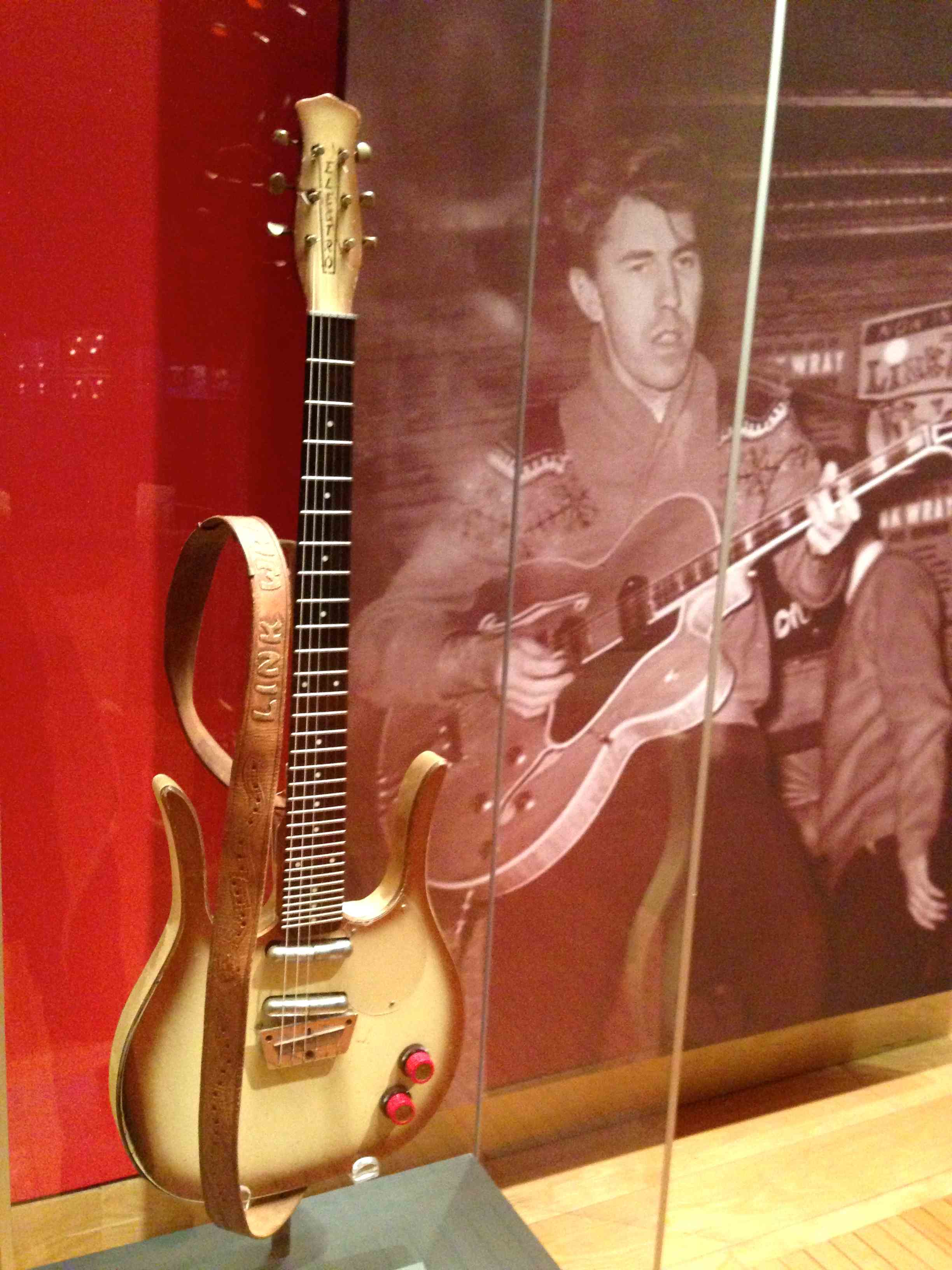
Link Wray in the 1950s and the guitar that introduced the power chord, wah wah, and distortion to rock ‘n’ roll

Link Wray in the 1950s and the guitar that introduced the power chord, wah wah, and distortion to rock ‘n’ roll

It’s not all flute music. Did you know that Link Wray, a Shawnee rock innovator, created the wah-wah, the power chord, and distortion echo that all rock superstars since the 1950s adopted? It’s just one part of the story told by Up Where We Belong: Native Musicians in Popular Culture, up through August 11 at the National Museum of the American Indian down at New York’s Customs House.

Don’t take our word for it. Take a seat in the comfortable bandstand-lounge inside the show and watch as Led Zeppelin’s Jimmy Page and The Edge discuss the importance that Wray’s innovations had on them and everyone in the scene.

The show doesn’t ignore jazz, blues, or rap but a lot of the pizzazz is seeing the stuff associated with folk, rock, and country stars alongside quotes (on the walls and in video clips) from legends like Slash, Ringo, Townsend, and Dylan testifying to the ties they had to fellow artists like Robbie Robertson, Jessie Ed Davis, and others. The show has historic (and beautiful) guitars and that famous multi-colored coat worn by Jimi Hendrix. You’ll really be amazed at the profusion of talent and historic connections.

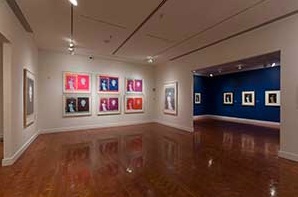
Installation view with photos of Stevie Salas, Jessie Ed Davis, and Randy Castillo.

Installation view with photos of Stevie Salas, Jessie Ed Davis, and Randy Castillo.

You don’t normally associate Jimi Hendrix with the tribes, but the NMAI scholars reveal that his paternal grandmother was Cherokee who once played on the vaudeville circuit. It’s also a surprise to see Randy Castillo’s drum set from the last Mötley Crüe tour suspended reverently overhead. (Randy replaced Tommy Lee.) Check out our Flickr site for views of the show.

The NMAI scholars, as usual, did a stellar job digging out the facts behind the men and women honored. Like reminding us that Jessie Ed Davis first met John Lennon at The Rolling Stones Rock and Roll Circus and that Johnny Cash was one of the first pop music voices singing out on behalf of the Native American cause back in the 1960s.

The Hendrix coat of many colors

The Hendrix coat of many colors

The heart of the show, however, is the music. NMAI made sure that there’s plenty of opportunity to listen in to why these stars were great. You can sink into big, red settees throughout the space and snap on headphones, relax in the bandstand-like lounge room to watch 20 film clips, or play with iPads in the listening gallery. You’ll enjoy hearing Buffy sing “Universal Soldier”, Kristofferson and Coolidge performing their Grammy-winning duets, Link Wray rocking out with “Raw-Hide” during the American Bandstand days, and Illinois Jacquet’s swinging tenor sax on “Stompin’ at the Savoy”.

The NMAI did an incredible job not only with the show itself, but also with its fascinating run-of-show blog, which includes articles on how the Hendrix coat was loaned to the show, jazz great Mildred Bailey, and recollections contributed by the show’s visitors.

Enjoy this walk through music history and reconnect with some of the best in the business. A truly wonderful slant on what makes American pop culture so great.  If you’re in New York, get down to see Rita Coolidge in person at her free NMAI concert at 6pm on Thursday, August 8.

Warhol, The Queen, Madonna, and The Scream

Warhol’s 1984 silkscreen, The
Scream
(After
Munch). Source: Part of the founding collection contributed
by
The
Andy
Warhol
Foundation
for
the
Visual Arts to The Andy Warhol Museum;  ©2013
AWFVA/ ARS, NY

Warhol’s 1984 silkscreen, The
Scream
(After
Munch). Source: Part of the founding collection contributed
by
The
Andy
Warhol
Foundation
for
the
Visual Arts to The Andy Warhol Museum; ©2013
AWFVA/ ARS, NY

Andy is kicking Mr. Munch’s Scream up a notch on Park Avenue, all to the delight of the Queen of Norway, in the Scandinavia House’s stellar exhibition, Munch, Warhol, and the Multiple Image through July 27.

Actually, Queen Sonja herself was one of Andy’s subjects in his Celebrity series, so it’s no wonder that she flew in to preside over Mr. Munch’s 150th birthday at a New York show where his most iconic work is appropriated and reimagined by the Master of Pop.

Andy first encountered Munch’s woodcuts in Oslo in the 1970s, and took home reproductions. So, when a now-defunct 57th Street gallery invited him to their 1982 Munch exhibition and offered him a commission to make 15 paintings and 30 silkscreens about the work, Warhol accepted.

The Scream was so iconic, Andy considered it almost a “ready made”, as ripe as any other pop culture image for his flat, unemotional, Day-Glo serial treatment. Ditto for Munch’s Madonna and Self Portrait with Skeleton Arm. He photographed reproductions of four Munch works, blew them up, traced on them, and rephotographed what he had traced. And then he turned it all over to a master silkscreen printer with suggested colors. So totally Andy.

Room full of Munch Madonna prints seen from gallery with Warhol silkscreens of same. Eileen Travell’s photo for Scandinavia House/The American-Scandinavian Foundation, 2013

Room full of Munch Madonna prints seen from gallery with Warhol silkscreens of same. Eileen Travell’s photo for Scandinavia House/The American-Scandinavian Foundation, 2013

With all the commotion earlier this year at MoMA over The Scream (like fans along the red carpet, jockeying to get their photographs taken with the world’s-most-anxious celebrity-on-a-bridge), this show deserves similar crowds. Because Warhol’s prints were never published, you’re seeing one-of-a-kind prints that are dispersed around the world and rarely on view.

The curators have also brought together (with the help of The Munch Museum in Norway) multiples created by Munch. It’s fascinating to compare the five controversial Madonna prints side by side, walk into the first Warhol gallery, turn around, and see both Munch and Warhol Madonna interpretations right in front of you. It’s a smart, immensely satisfying installation.

You’ll enjoy listening to what the Queen had to say (first 8 minutes of the video) and see photos of her younger self at The Factory with Andy and Mr. Rosenquist.

Oh, and the photo below isn’t a disco queen from Studio 54. It’s Andy’s wall-sized reinterpretation of Munch’s The Brooch, Eva Mudocci, a lithograph originally done in 1903 to celebrate the beautiful, talked-about violinist.

The last 15 minutes of the video features the curator showing the work of the two Modern masters who knew how to leverage print technology and multiples into fame, fortune, and icon status.

Washington, D.C. Museum Videos Reach 14 Million YouTube Views

Since Smithsonian branches and other Washington, D.C. museums, zoos, and gardens began posting videos on line in 2007, collective YouTube views have climbed to 14 million, as chronicled in our latest report, Washington D.C. Museums: 2013 Video and Social Media Rankings.

Although the 14 million total is less than the 49 million views racked up by New York museums, don’t forget that two high-profile DC institutions – National Geographic and the Smithsonian – produce significant amounts of programming distributed on their popular cable TV channels, dedicated apps, and snazzy web sites. Even though it has a DC museum space, NatGeo (a joint venture with Fox Cable) has largely abandoned YouTube; however, the 18 individual Smithsonian branches are all still posting their own stuff regardless of the more comprehensive joint venture with Showtime.

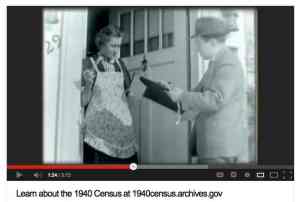
In the Top 2012 Cultural Museum Video, archival footage is cleverly coupled with behind-the-scenes looks at the National Archives’ 1940s Census release

In the Top Cultural Museum Video, archival footage is cleverly coupled with behind-the-scenes looks at the National Archives’ 1940s Census release

Here are some findings from our report on video and social media produced by DC institutions:

As of year-end 2012, the Washington museums having the highest number of total YouTube channel views were the Library of Congress (4.5M), the National Archives (2.1M), and the United States Holocaust Memorial Museum (1.6M). The top two are information powerhouses with massive collections to push out for public consumption, and the third is right on their heels with an innovative series with curators interpreting interesting items from their collections.

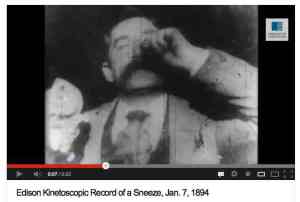
All-time top DC museum video, one of Edison’s earliest films, with over 329K hits on YouTube

All-time top DC museum video, one of Edison’s earliest films, with over 329K hits on YouTube

Edison still delivers. It’s interesting that the top ranked DC museum video of all time is Edison Kinetoscopic Record of a Sneeze, Jan. 7, 1894, the earliest surviving copyrighted moviesuggesting that our greatest media innovator is having the last laugh, contributing over 329,000 hits to the number-one ranking by Library of Congress on YouTube. It’s short enough for Fred Ott to be on Vine.

Four museum video channels have surpassed 1 million views. To put the DC numbers in context, if they were merged with the New York museum video rankings, the Library of Congress (4.5M) would rank seventh, just ahead of the Metropolitan Museum of Art. The Library of Congress would rank eight (2.1M), just ahead of the New York Public Library.

The National Zoo produced Washington’s top-viewed 2012 museum video – Shanthi, the National Zoo’s Musical Elephant, Plays the Harmonica!. Over 290,000 viewers watched this middle-aged mom experiment with a musical instrument in her enclosure and listen to her keeper talk about her performance. Shanthi’s viewership greatly surpassed the numbers generated by the most popular 2011 Washington museum video, the National Portrait Gallery’s Conan O’ Brien as Seen by Artist John Kascht. Surely, Conan would be amused.

The Smithsonian American Art Museum’s Top Exhibition Video of 2012 features curator Chris Melisinos describing why video games belong in an art museum

The Smithsonian American Art Museum’s Top Exhibition Video of 2012 features curator Chris Melisinos describing why video games belong in an art museum

The top cultural video was a behind-the-scenes work at the National Archives for the release of the 1940s census. Over 115,000 family historians watched Learn About the 1940s Census, which showed the Archives census team, provided information on how to find your family’s records, and worked in interesting archival footage from the original census.

The Smithsonian American Art Museum produced Washington’s top video about a museum exhibition. Over 28,600 people watched The Art of Video Games: Chris Melissinos, Curator, a brief look into the evolution of the stories, technology, and visualization advances of this mass entertainment medium.

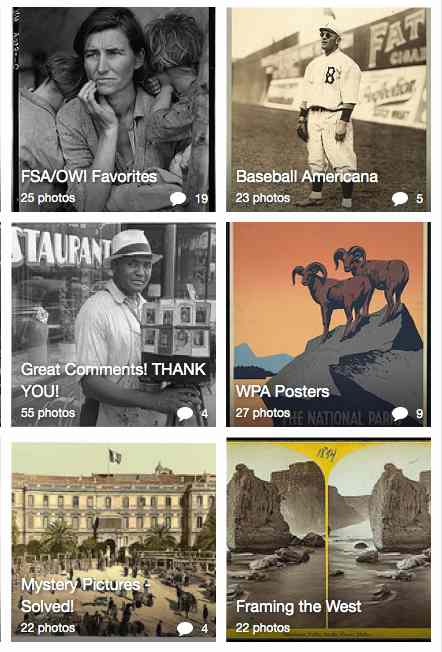
A few of the Flickr sets from Library of Congress

A few of the Flickr sets from Library of Congress

The most active Twitter users are the National Museum of American History, the National Air and Space Museum, and the National Postal Museum. But except for Air and Space, it’s a different set for Facebook followers.

The most active Flickr users are the National Archives, the Library of Congress, and the Smithsonian American Art Museum. The Archives has organized its photos into creatively themed sets, such as “White House Wednesdays,” “Millinery Monday,” pictures of the 1940s census being taken, and pets of the First Families. The Library of Congress also posts a folder containing “mystery” photos and asks the public to help to identify them.

All the detailed video and social media statistics on 42 museums are in the report. Click here to see what’s included and make a purchase from our Its News To You Reports shop.

Enjoy the most popular DC museum video, a musical visit with the National Zoo’s sensation, Shanthi:

Philadelphia Museums Reach 2.4M YouTube Views

Since Philadelphia museums, zoos, and gardens began posting videos online in 2008, collective YouTube views have climbed to 2.4 million, as chronicled in our latest report, Philadelphia Museums: 2013 Video and Social Media Rankings. The biggest surprise about the Philadelphia museum videos is that stylistically they are a bit different than New York museum videos. The institutions in Philly take a more whimsical approach to science, use a lot more promotional videos to drive exhibition attendance, and occasionally throw in a bit of the macabre.

Longwood Garden’s Top Philadelphia Exhibition Video of 2012

The Top Philadelphia Exhibition Video of 2012, courtesy of the Longwood Gardens grounds crew and Bruce Munro

Highlights of our report on 32 Philadelphia museums:

As of year-end 2012, the Philadelphia institutions with the highest number of total YouTube channel views are the Penn Museum, the Mutter Museum, and Longwood Gardens. Penn’s channel features a mix of behind-the-scenes videos about exhibits, anthropology lectures, and a gigantic docu-archive; the Mutter produces highly creative shorts highlighting selections from its tantalizingly weird collection; and Longwood simply has tons and tons of fans that want to see what’s up with the seasons.

Last year, Longwood Gardens produced Philadelphia’s highest rated museum video — Light: Installations by Bruce Munro. Over 36,000 nature and art lovers viewed this short about Longwood transforming itself into Munro’s luminous vision. The garden also pumped out other video promos and features all year that kept their fans coming back to hit the YouTube channel.

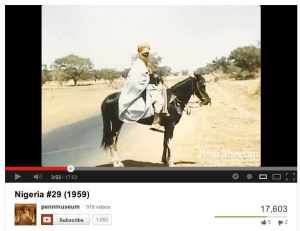
The Penn Museum’s Top Anthropology Video of 2012 features a sheik among many other people and places in 1959 Nigeria

The Penn Museum’s Top 2012 Anthropology Video Nigeria #29 (1959) features a sheik, a mosque, a fuel depot with camels, and country life the way it used to be

The Penn Museum’s YouTube channel surpassed 1 million views in May. Penn’s been adding an enormous anthropology film collection to its channel (over 400 films) and the time-machine quality is irresistible. It’s no surprise that Penn’s Maya 2012: Lords of Time videos captivated the public all year, but it is interesting that the silent travelogue Nigeria #29 (1959) is up to 17,000 views. You could poke around that channel for days.

The Chemical Heritage Foundation produced Philadelphia’s most popular science video. Over 26,000 people watched A Distillations Explainer: Sweat, part of the Foundation’s Blood, Sweat, and Tears series (see below). It’s an entertaining, well-produced podcast series.

The Mutter Museum presents its unusual medical collections quite effectively through its YouTube series. Their 2012 series feature the curator taking “mystery” items out of the cabinets and challenging the viewers to identify them. Not for the squeamish, but really clever and nicely scripted.

The most active museum Twitter users in Philadelphia are the National Constitution Center, the Eastern State Penitentiary, and the Penn Museum. The most active Flickr users during 2012 were the Franklin Institute Science Museum and the Pennsylvania Academy of the Fine Arts. The largest Flickr photo pools are populated by Longwood Gardens and Eastern State Penitentiary enthusiasts.

All the video and social media details on 32 museums are in the report. Click here to see what’s included and make a purchase from our Its News To You Reports shop.

Enjoy watching Philadelphia’s top science video, courtesy of the Chemical Heritage Foundation. Meet Louis Pasteur and find out why sweat often smells:

Interior Design Goes Medieval Avant-Garde at National Gallery

An avant-garde 1890s tapestry by Morris & Co., Edward Burne-Jones, William Morris, and John Henry Dearle (designers), The Arming and Departure of the Knights of the Round Table on the Quest for the Holy Grail. Collection of Jimmy Page, courtesy of Paul Reeves, London

An avant-garde 1890s tapestry by Morris & Co., Edward Burne-Jones, William Morris, and John Henry Dearle (designers), The Arming and Departure of the Knights of the Round Table on the Quest for the Holy Grail. Collection of Jimmy Page, courtesy of Paul Reeves, London

How did a secret society of artists in the 19th century turn into one of the most beloved interior design trends of the modern era? That story is the most surprising part of the exhibition (closing May 19) at Washington’s National Gallery of Art, Pre-Raphaelites: Victorian Art and Design, 1848–1900.

Organized by the Tate (and originally titled Pre-Raphaelites: Victorian Avant-Garde), the show introduces us to the PR Brotherhood (founded 1848), whose oil paintings and writings looked to the Middle Ages, myths, and legends of ancient literature for the spirituality that they felt was missing from modern, rapidly industrializing life.

Early collaboration by Rossetti and Morris, The Arming of a Knight chair, 1856 – 1857, painted pine, leather, and nails. Source: Delaware Art Museum, Wilmington.

Early collaboration by Rossetti and Morris, The Arming of a Knight chair, 1856 – 1857, painted pine, leather, and nails from the Delaware Art Museum,.

Dante Rosetti, William Holman Hunt, Edward Burne-Jones, William Morris, and others took inspiration from meticulous observation of nature, sensual textiles replicated in their paintings, and ethereal muses in medieval robes, which they often painted on location in leafy, natural settings.

In 1859, Rosetti painted a cupboard as a wedding gift for Morris. It wasn’t long before these pals ran with the inspiration — constructing medieval-inspired furniture and decorating it with similar mystical medieval images and experimenting with mixed media (images + poetry) on tiles, tables, and other creations made by hand.

For all the beautiful painting in the National Gallery’s show, the most startling room is the one that showcases the fact that the painters took it one step further by creating chairs, tapestries, tables, and textiles for forward-looking couples who wanted to live the 360-degree experience. In the 1860s, Morris & Co. was the go-to interior design shop for medieval-style avant-garde furnishings. They singlehandedly drove the stained-glass revival in Victorian architecture.

In 1873, Morris & Co. went international, selling wallpaper in Boston. Soon, American retailers in most major cities were carrying the hand-blocked or woven wall coverings and textiles.

Block-printed cotton designed by Morris (printed 1884-1917) from The Baltimore Museum of Art

Block-printed cotton designed by Morris (printed 1884-1917) from The Baltimore Museum of Art

Ever the advocate of the handmade, Morris was passionate about the relationship of decorative arts to the modernist movement. During Oscar Wilde’s US speaking tour in 1882, his lectures about Morris, the Pre-Raphaelites, and the nobility of hand-crafted work spread the trend in hand-crafted interior design in America.

Today, just about every museum shop carries William Morris-inspired something-or-others. Here’s the Tate’s video about the 17th century carved oak bed that Morris himself used in the 1890s. It’s all about the hand-made approach to the bedding textiles – a modern-medieval collaboration between his designer daughter, Mary, and wife, Jane.

Hats off to the Tate and National Gallery for presenting avant-garde design in a new light. Check out the rest of the Tate’s PR videos, including the one with Karen Elson on the topic of model as muse, then and now.

NYC Museum Videos Receive 49 Million Views on Social Media

The Japan Society’s popular Japanese language series

The Japan Society’s popular Japanese language series

After reposting so many museum videos here, we wondered how much video museums were producing, what social media they were using, and who had the most viewership and followers. We counted, and found that the museums, zoos, and botanic gardens around New York have racked up 48.8 million views on their public YouTube channels since 2007.

The volume of activity on was so significant that we couldn’t help documenting it and packaging the rankings into a report, NYC Museums: 2013 Video and Social Media Rankings.

Museum folks may want to purchase the full 48-page report to see how their organization stacks up, but here are some of our key findings:

As of year-end 2012, NYC museums with the highest number of all-time YouTube channel views were the Paley Center, American Museum of Natural History, and  Japan Society. Paley merges its NYC and LA feeds, and it’s 33M all-time video views are mostly from TV celebrity show panels in LA. So if we’re really looking at the museum programming champs in NYC, it would be AMNH (15M), Japan Society (7M), and MoMA (6M).

The Top NYC Museum Video of 2012 -- an AMNH Science Bulletin Whales Give Dolphins a Lift

The Top NYC Museum Video of 2012 — an AMNH Science Bulletin Whales Give Dolphins a Lift

The top NYC museum viral video of all time is The Known Universe video produced by AMNH for the Rubin Museum’s 2009 show, Visions of the Cosmos – 11M views and still growing. The video was generated from the Hayden Planetarium’s data set.

In  2012, another AMNH video, Whales Give Dolphins a Lift, went viral with 2M views. The AMNH has an active video-production team supplying content to its Science Bulletin walls inside the museum. Hats off to them for making a winning wordless video out of a few still photographs from field scientists in Hawaii, simple titles, and tranquil music.

The popularity of Japan Society’s language lessons are driving the numbers on their channel. Who can resist clicking through all the 2-minute lessons in their Waku Waku Japanese series with Konomi?

Asia Society’s Top NYC Museum Music Video of 2012

Asia Society’s Top NYC Museum Music Video of 2012

The top 2012 NYC museum music video was produced by the Asia Society, Arif Lohar and Friends: Jugni Ji!. Who knew that the finale to a Sufi pop legend’s concert on Park Avenue one year ago would rack up over half a million views?

The top star featured in a 2012 NYC museum exhibition video was a piece of 18th century mechanical furniture displayed at the Metropolitan. Viewership of The Roentgens’ Berlin Secretary Cabinet grew from 182,000 views at year-end 2012 to 1.6 million today. Can anyone explain how mechanical furniture received 25 times the viewership of the Met’s video walk-through of its blockbuster McQueen show, Savage Beauty?

The NYC museums using the greatest range of social media and video channels are The Jewish Museum and the Rubin.  One of the best under-the-radar NYC museum Flickr sites was the historical archive of Wall Street documents and treasures posted by the Museum of American Finance.

All the video and social media rankings 63 museums are in the report. Click here to see what’s included and make a purchase from our Its News To You Reports shop.

OK, here it is: the all-time top NYC museum video from 2009:

Celebrity Robot Says Good-Bye to Upper East Side

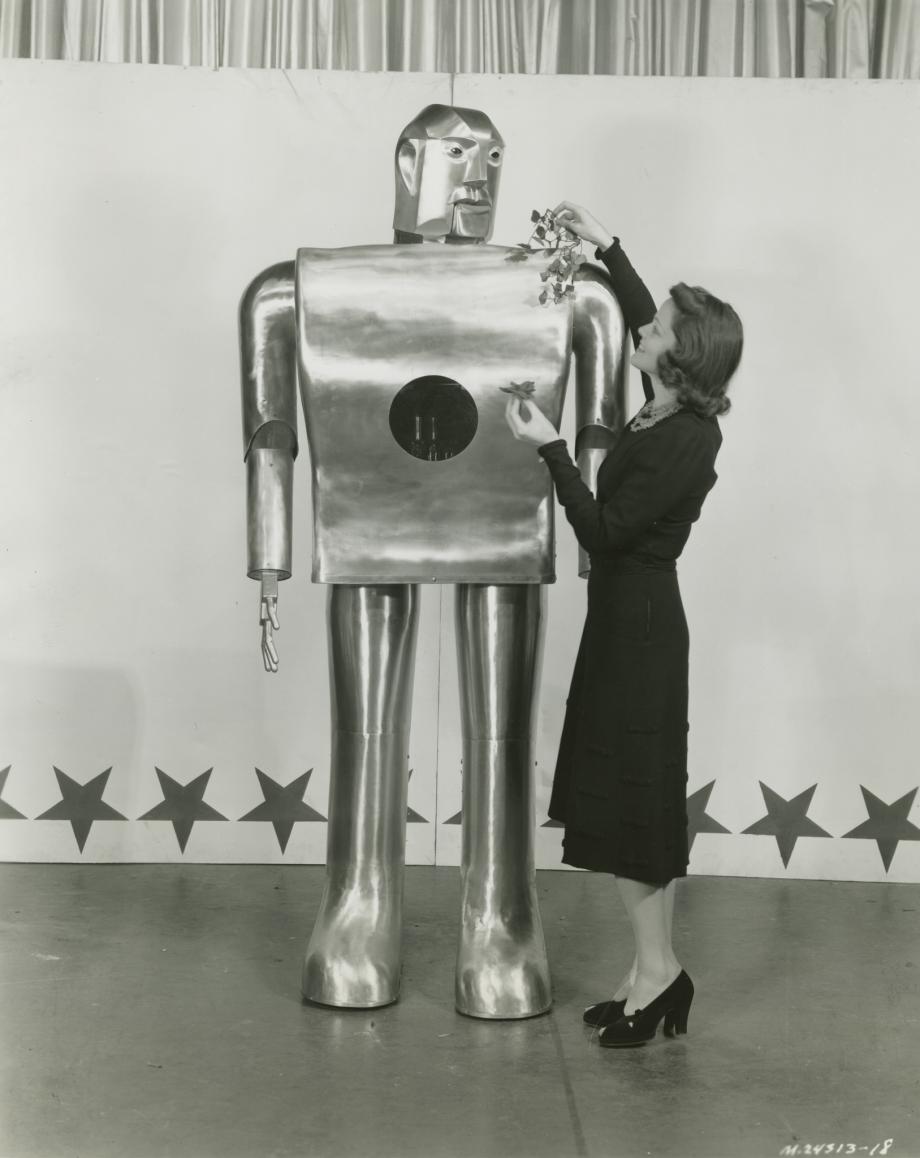
As musician Lois Kendall shows him red roses and green leaves, Elektro tells her the color of each. Source: NYPL

As musician Lois Kendall shows him red roses and green leaves, Elektro tells her the color of each. Source: NYPL

If you love the future, you have to see Elektro, the celebrity robot, who once held court in the Westinghouse pavilion at the 1939 New York’s World’s Fair, before he leaves the city once again. He’s the star attraction in the Museum of the City of New York’s Designing Tomorrow: America’s World’s Fairs of the 1930s exhibition, closing soon.

We couldn’t take photos inside the show, so here’s a publicity picture of Elektro back in 1939. He walked, talked, smoked cigarettes, as you’ll witness in this 1939 YouTube clip. This sensational moto-man used vacuum tubes, a 78 RPM record player, photoelectric cells, and telephone relays to wow the crowds.

But Elektro is only the tip of the Trylon of how fair design and engineering shaped modern American style. The show introduces the industrial design engineers that shaped products that grace MoMA’s design collection and insinuated themselves into everyday life – streamlined appliances, nylon stockings, Herman Miller clocks, Greyhound buses, and superhighways. Check out the MCNY’s excellent Tumblr feed for their visions of the future.

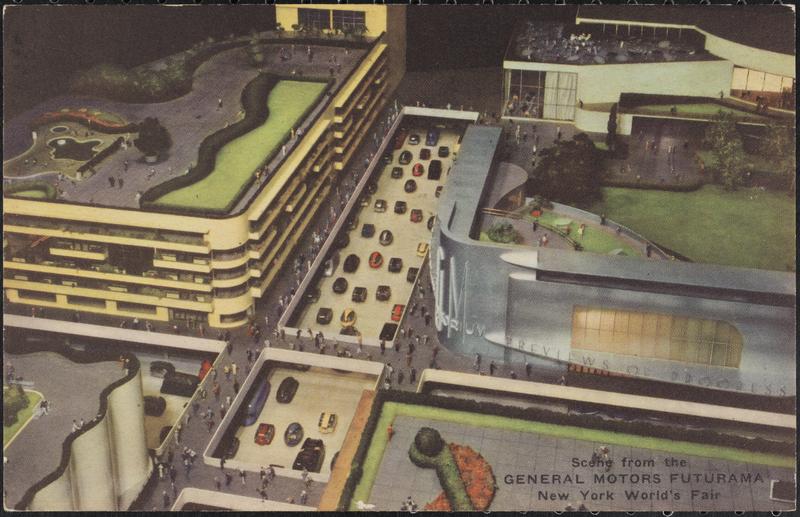
Postcard of the General Motors Futurama, NY 1939 World's Fair. Source: MCNY

Postcard of the General Motors Futurama, NY 1939 World’s Fair, that resembles BPC today. Source: MCNY

Among the show’s highlights are clips showing the GM Futurama, where New Yorkers waited in line for hours to see what the city of 1960 would look like. “Sound chairs” moved them along a conveyor belt where they could witness a vast scale model of modernized America, with superhighways soaring over canyons and cutting through mountains, and urban/suburban cloverleaf interchanges to keep traffic moving.

Afterward, people would exit into a full-scale World of Tomorrow where they would see what the urban intersection of the future would be – filled with pedestrian overpasses, department stores, and unimpeded whizzing traffic. It sure looked a lot like the view of Battery Park City along West Street.

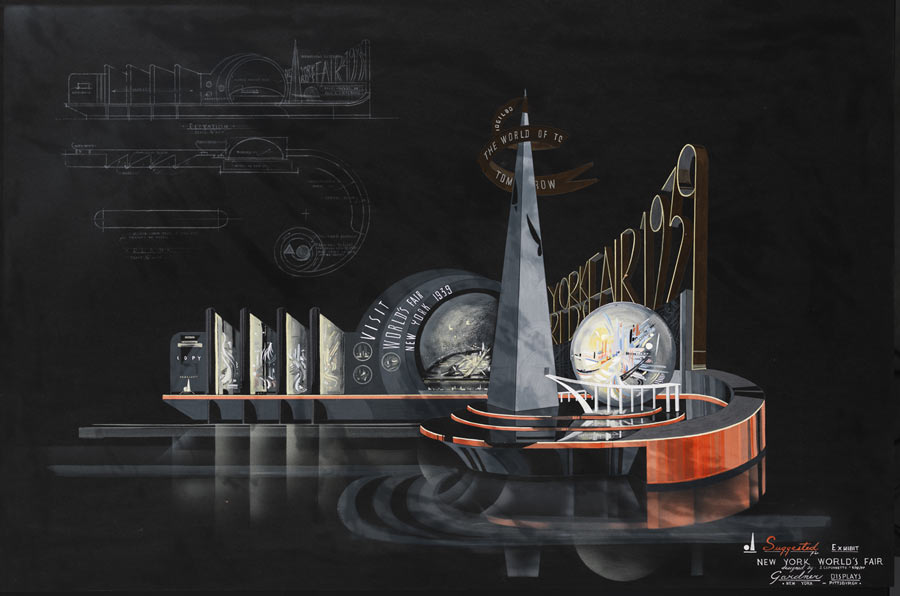
Suggested Exhibit for NY 1939 World's Fair. Watercolor & gouache on board. Source: MCNY

Beautiful watercolor/gouache from MCNY collection: “Suggested Exhibit for NY 1939 World’s Fair.”

Oh! Wallace Harrison, one of the architects of the Trylon and Perisphere actually did the master plan for Battery Park City…and Lincoln Center and the UN Headquarters building and Time-Life on Sixth Avenue!

So, no wonder Elektro feels right right at home in 2013 Manhattan. In 1939, he already could see what it would look like, right from his pavilion!

Take a spin around Elektro’s world, courtesy of the New York Public Library:

Inhale…The MAD Exhibit They Won’t Let You See

JickeyThere’s nothing to see…only to experience…in The Art of Scent 1889-2012 currently at the Museum of Art and Design. Designed by Diller, Scofidio + Renfro, the exhibition space is completely bare, save for gentle depressions pressed into the wall where visitors can lean in and experience fragrances considered masterworks of innovation and complexity.

Thank you to curator Chandler Burr for paying tribute to the artists that created these scents. The earliest is Jicky, created by Guerlain in 1889 when the Eiffel Tower was on the rise, the first designer fragrance to use synthetic components.

Walking through these design innovations is an experience you won’t forget. Can you tell that a 1980s fragrance was inspired by the smell of laundry detergent (the essence of “clean”)? Do you agree with Prada’s 1990s take on the romanticism of the 19th century? Do you think Untitled by Daniela Andrier for Margiela in 2010 combines “excitement and unease”, as MAD purports?

MAD has many videos to let you in on the process behind the ephemeral. Listen as Jean-Marc Chaillon discusses what it’s like to create something that can’t be touched:

Ever wonder about the work that goes into designing a celebrity fragrance? Listen in on this enlightening and entertaining curator’s panel on the design and structure of olfactory art:

Look Up to See Where Your Grandmother’s Clothes Came From

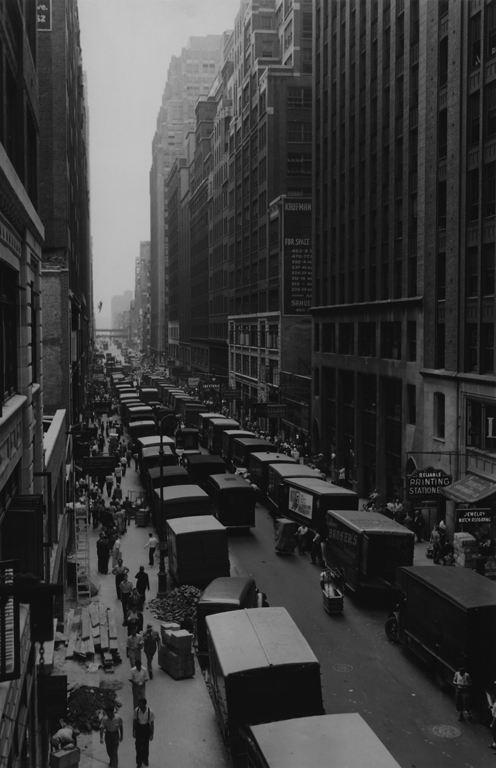
West 35th Street in 1938, looking east between Seventh and Eighth Avenues. Source: NYC Department of Records, Municipal Archives

West 35th Street in 1938, looking east between Seventh and Eighth Avenues. Source: NYC Department of Records, Municipal Archives

It can seem a little quiet walking over to Mood these days. Not too long ago, the streets above 34th Street between Sixth and Eighth Avenues were clogged with push boys, wheeling racks of  materials, trims, and fashions among jobbers, contractors, accessory importers, fabric stores, and showrooms. The way it used to be comes alive in the Skyscraper Museum’s show (closing today) Urban Fabric: Building New York’s Garment District.

In its heyday, those 18 blocks just north and west of Macy’s produced 75% of all US women’s and children’s clothes.  The exhibit tells the story of how this bustling hive happened.  In a nutshell, the old sweatshops in tenement buildings gave way to factory loft spaces in the 1890s around the area where NYU is today. When the big department stores emerged along Sixth Avenue and 23rd Streets, the lofts came with them. But the congestion proved to be a bit much for the female shoppers, who were disturbed by the throngs of guys loitering about on their lunch breaks, and the retailers took action.

The department stores (like Macy’s and Lord & Taylor) moved above 34th Street. To prevent the factory lofts from overwhelming them again, the City implemented the first zoning ordinance in America in 1916. The garment makers, closed out of the fancy retail neighborhood, started razing the Tenderloin District on the West Side and erecting architect-designed skyscrapers (like the Fashion Tower on West 36th) from that point on. About 125 buildings went up on those 18 blocks before the Depression hit.

Here’s a glimpse of what it was like in 1952:

As recently as the 1970s, carts were still being shuttled through the narrow streets, but we know how that story ended.  Today, no one even looks up at the entrances, set-backs, lobbies, or embellishments of these once grand hubs where models, marketers, Mad Men, laborers, seamstresses, teamsters, pattern makers, the designers co-mingled.

Interestingly enough, not a single building is landmarked. In fact, the Skyscraper Museum had trouble even finding photographs of the original buildings and had to turn to historic adverts and early brochures on factory electricity.

For the full, fascinating story by the curator who unearthed it all, listen to Andrew Dolkart of Columbia University, and watch his slide show:

Interns and staff built a nice model of the buildings lining 37th Street for the show, and a big thank you to The Skyscraper Museum for (again) putting the history and installation walkthrough on line. Tell your friends, and be sure to look up next time you walk over to Mood.

What Seinfeld Ate for Lunch

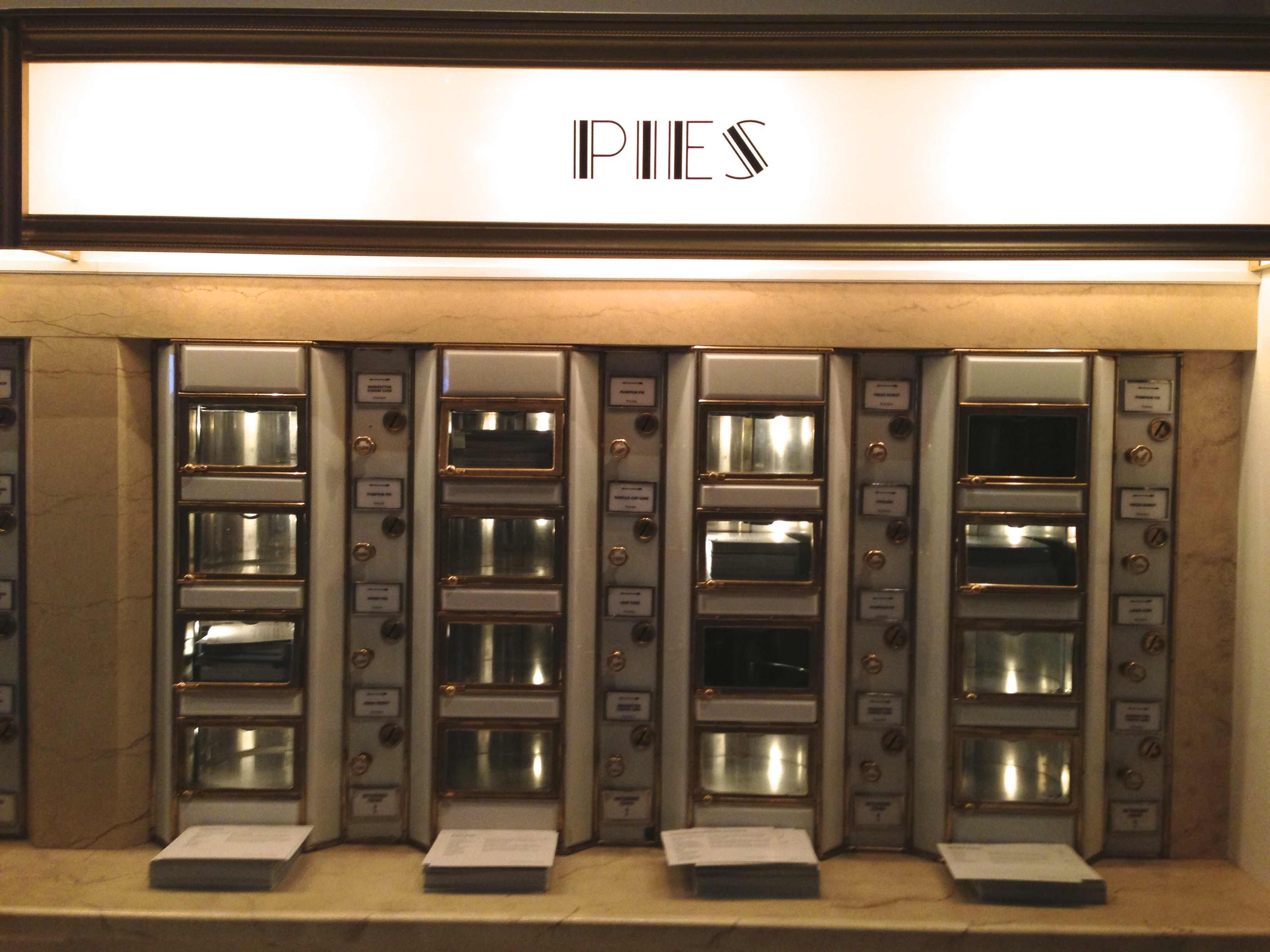
Installation view of the pie section of the historic Automat

Installation view of the pie section of the historic Automat

If you’re a New Yorker, you eat the same stuff – Chinese take out, sushi, hero sandwiches, and the occasional power lunch. So, where did it come from? How long have these New York traditions been going on? Did you know that take-out began in 1976?

Get to see the New York Public Library’s walk-through of culinary history at Lunch Hour NYC. As soon as you enter, you see a reproduction of the oyster carts that fed millions of working New Yorkers in the early 1800s, when these small bites were so plentiful in our waters that entrepreneurs made fortunes shipping them to Paris and London.

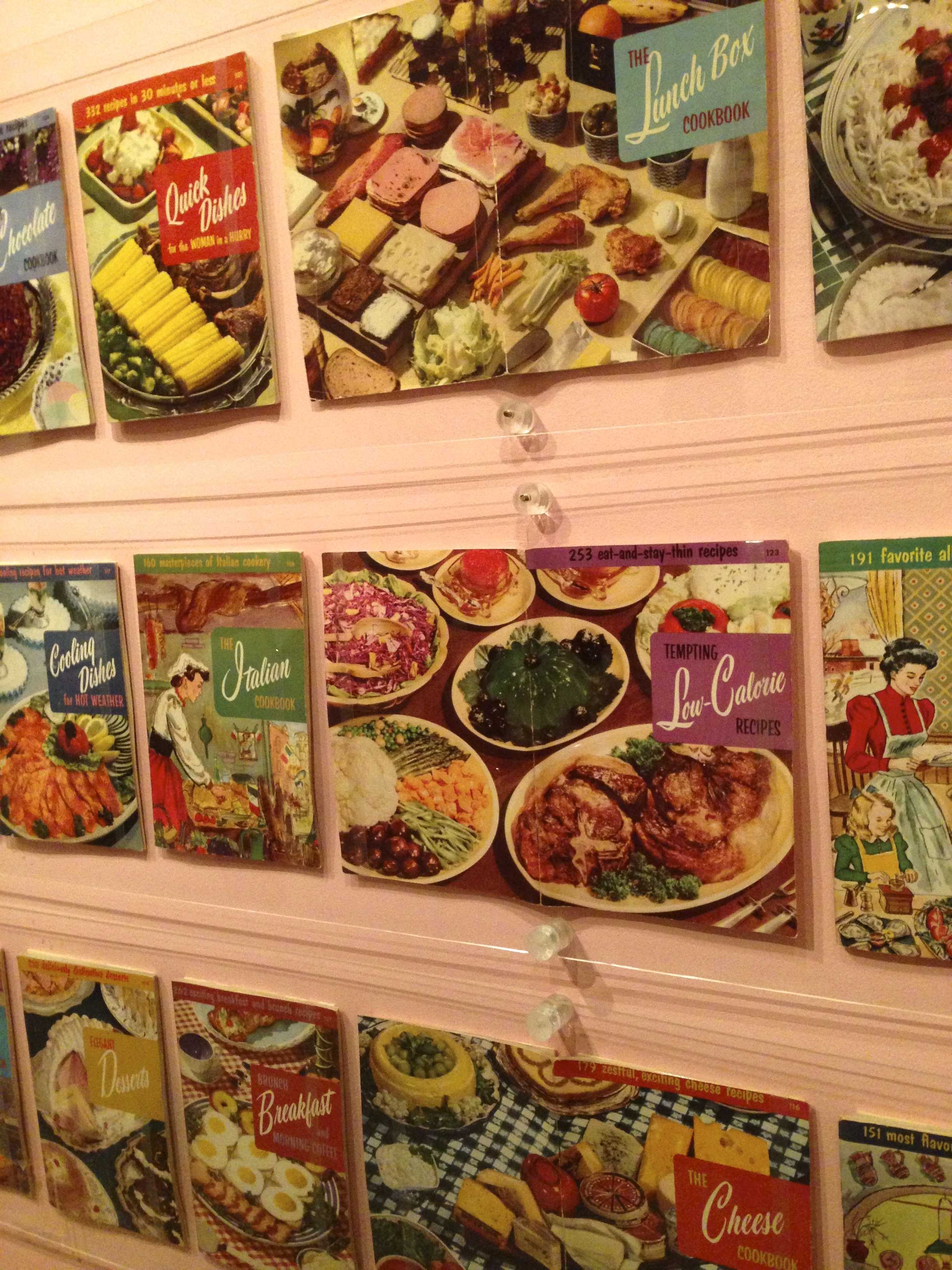
Recipes for 1960s homemakers

Installation view of homemaker recipes

You’ll also see tribute paid to the ubiquitous Chinese take-out bike, learn that pretzels have been sold on street corners for 150 years, and meet the creator of the stainless steel hot dog cart, Ed Beller. Listen to his story yourself.

Of course, the genuine star of the show is the Automat wall. You not only get a glimpse of the original doors, but you can go around behind the scenes and see where workers put in the fresh creamed spinach, baked beans, beef with burgundy sauce, and pie. People tend to linger in this section of the show, watching videos of Marlo Thomas in That Girl, a career girl without a lot of cash eyeing the yummier selections chosen by more successful types – a theme that’s also echoed in the clips from other movies, too.

Nostalgia lovers will be delighted to see a vintage Frigidere, a wall full of lunch boxes, and an array of 1950s and 1960s homemaker recipe booklets, and to learn that dieting crazes go back for decades. (Favorite: the article “Nice People Don’t Eat” from a 1941 Ladies Home Journal.) There’s also a 1940s Betty Crocker book with open to an article that any New Yorker would find comforting:  “Meals at Odd Hours.” Watch the NYPL’s lively video promo:

Get a close-up look with these photos on Flickr.

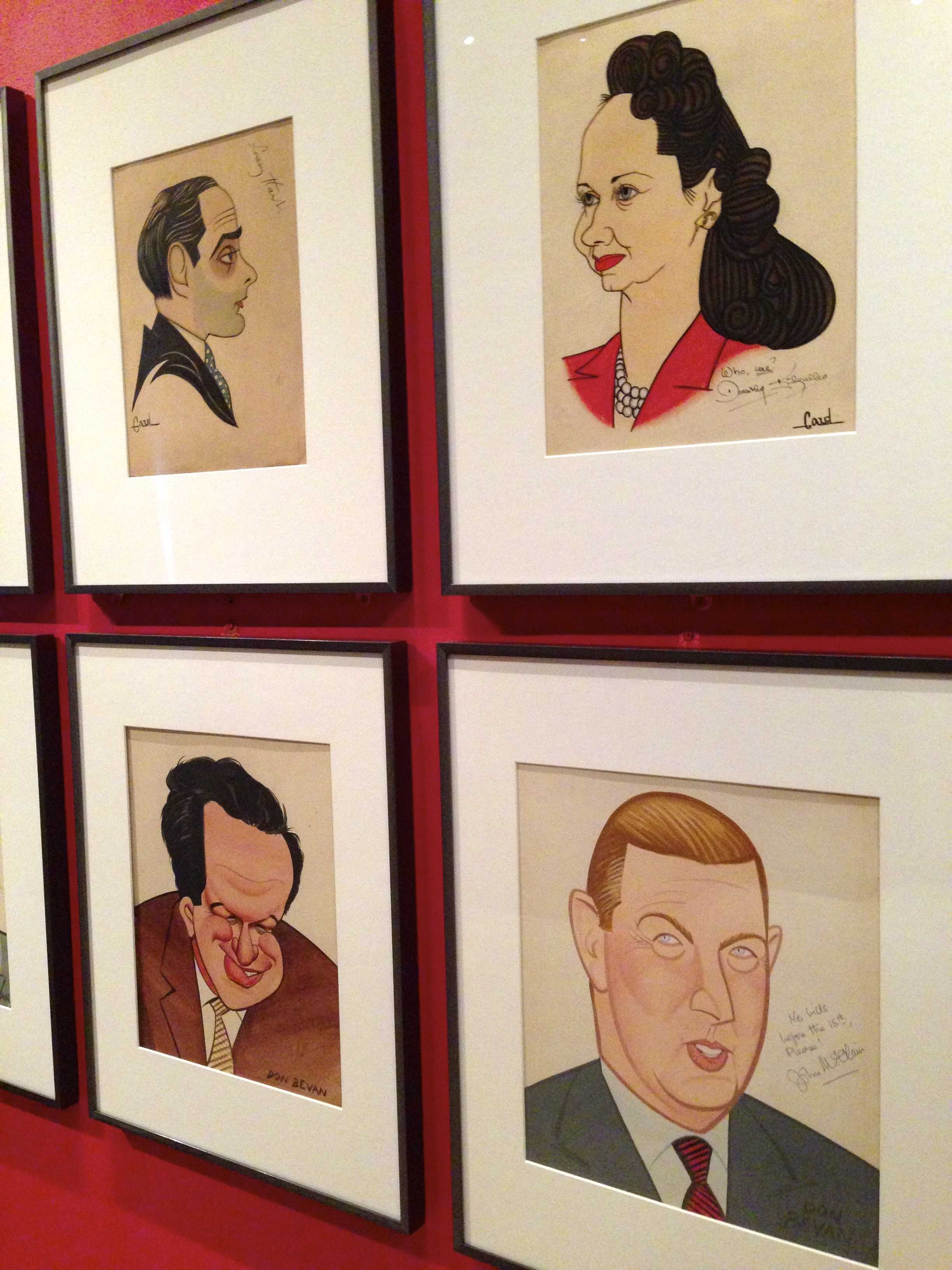
Installation view of Alex Gard’s portraits at Sardi’s – Lorenz Hart, Dorothy Kilgallen, Al Capp, and John McClain. Collection: NYPL

Installation view of Alex Gard’s portraits at Sardi’s – Lorenz Hart, Dorothy Kilgallen, Al Capp, and John McClain. Collection: NYPL

NYPL has a terrific Automat-themed website, filled with revelations. Go read about how cafeterias began in 1898 at 130 Broadway, how peanut butter began in 1900, how Alex Gard did all those portraits at Sardi’s in exchange for dinners on a regular basis, and how NYPL needs volunteers to transcribe its collection of historic menus.  (Go sign up.)