What do 19th-century tobacco-store Scotsmen and Spanish-clad dancers mounted on the fronts of tall-masted trading ships have to do with the rise of Modernism in the United States and the 1913 Armory Show?
Find out through August 21 at the New-York Historical Society’s exhibition, which traces the path of one of America’s modern-art pioneers in The Folk Art Collection of Elie and Viola Nadelman. Take a look on our Flickr feed.
The engaging show is largely drawn from the NYHS collection and tells the story of how a Polish immigrant fused his love of European and American woodworking tradition with Picasso’s love of “the primitive” and developed his own pop-culture-infused modernist sculpture style.
Feisty figurehead from the shipwrecked clipper ship Rosa Isabella, carved in Hamburg in 1865
The show, which travels next to the Addison Gallery of American Art in Andover, Massachusetts, is a delightful window into how modernism crept onto America’s 20th century radar as 19th-century traditions were becoming a thing of the past.
Nadelman’s sculptures were included in the ground-breaking Armory Show in 1913 and showcased in one-man shows at Stieglitz’s 291 Gallery and other NYC Modernist hotspots.
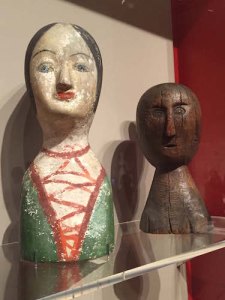
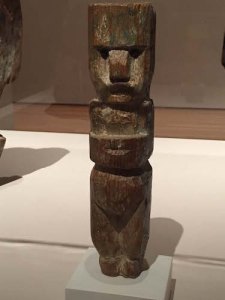
As the NYHS show makes clear, the whitened faces and painted-to-look-weathered bodies of his circus girls, tango dancers, and vaudevillians echoed back to shapes, colors, and styles he favored from carved tobacco-store Indian sculptures, figureheads salvaged from sailing ships, chalkware busts, and untrained American portraitists of years gone by.
Milliner heads 1820 – 1870
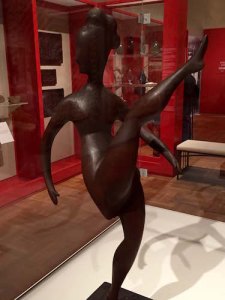
First made in plaster (like popular chalkware tchotchkes) and later in painted cherry wood, Nadelman’s whimsical figures dance, prance, high kick, and entertain in a vaudevillian and Jazz-Age way that their folk-art counterparts never do. Encountering the show’s monumental woodworks at the entrance to the show showcase Edelman’s brilliance in packaging New American rhythms into tabletop sculpture works a sly, backward-looking wink at the past.
Elie shared his love of rapidly disappearing woodcarving, hand-painted boxes and chests, and wooden kitchen objects with his wife, Viola, who led the charge in amassing one of the greatest collections of American folk art ever. The couple scooped up over 15,000 European and Americana work at a rapid pace – so rapid that Elie dropped his art career and concentrated full time on collecting.
Nadelman’s high-kicking cherry wood “Dancer” sculpture (1922) on loan from the Jewish Museum
The show is a tribute to their vision and energy (move over, Abby Aldrich Rockefeller!). They were among the first to coin the term “folk art” and opened their own folk art museum in Riverdale in 1924.
When the Depression hit, the couple was forced to sell and the bulk of the collection became the core of the NYHS “everyday history” collection – kitchen implements, toys, miniatures, hat-shop heads, paintings, weathervanes, and you-name-it. Indeed, the back half of the show is a glimpse into everyday life, culinary arts, and domestic entertainments.
It’s an important look into American history, the history of collecting, and the birth of Modernist sensibilities in New York – a show that pays fitting tribute to a core component of one of New York’s storied institutions.
Taking their Shot in the lobby of the Public Theater in 2015
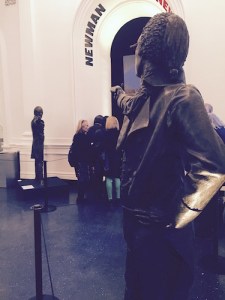
If you really want to experience Hamilton before the Tony Awards, it’s not that hard. Get up to New-York Historical Society at 77th Street and Central Park West and check out the life-size bronze statues of Hamilton and Burr one second before The Shot.
If you went to see Hamilton last year at the Public, you had to pass right between Kim Crowley’s bronze recreations when you entered the theater — a bespectacled Hamilton (wearing tinted glasses because he was facing the sunrise) and an intense Burr who was branded for all time in the history books one second later.
These action figures were initially installed at NYHS in 2004 as part of its ground-breaking Hamilton show…a magnificent installation that drew both raves (for the classy reimagining of NYHS and its exhibitions program after a near-collapse of that institution) and criticism (was it pandering to New York’s besmirched banking community?).
Their 1797 dueling pistols in the NYHS lobby
Interesting that 2004 was the 300th anniversary of both the duel and the year that NYHS was founded. In fact, Hamilton’s attending doctor that day was one of the founders.
Hamilton takes aim inside NYHS
After three hundred years and countless tries at the Hamilton’s pre-show lottery at the Richard Rodgers Theater, it will be a little disconnect to realize that the two facing off in the white marbled lobby are not Lin Manuel and Leslie Odom, Jr. The intensity and the historical dress are there, but the faces are different. Just stand there and run through all the lyrics you’ve memorized from the show.
Walk a few steps further and gaze down at the actual pistols – not stage props – and Angelica Schuyler’s letter to her brother, conveying the terrible news. All real, in her own hand, dated July 11, 1804.
OK, that’s just the lobby. By now, you’ve probably heard that NYHS has just announced its Summer of Hamilton, replete with a large gallery show of all the Hamilton-related documents, artifacts, and portraits plus special clips from Hamilton, movie musicals that inspired Lin, Ron Chernow’s book, and costumed performers on July 4 weekend.
But why not visit right now and have Ham and Burr all to yourself? To fill in the blanks about Ham’s life or prep to see the Broadway show, treat yourself to an exploration of the 2004 Ham show website. It’s full of all types of fun things – a quiz to test your Ham knowledge, a map of where Hamilton hung out in New York City, and real-life historical portraits of all the Schuyler sisters and everyone else in the Broadway show.
Lin’s Ham 4 Ham reading outside the theater during the preview lottery
There’s even a handy timeline of Hamilton’s “strange and amazing life,” which is a nice reference for things you’ve seen (or hope to see) in the show. For true fans (or curiosity-seekers), there’s even a small selection of short academic papers on Hamilton, including an interview with Ron Chernow, whose book inspired the current Broadway smash hit, and other brief treatises on his schooling, the duel, and the hours before his death.
Although it’s not inside the museum (or the Richard Rodgers), you can check out other Hamilton excitement at the Ham4Ham shows performed at lottery time on 47th Street, many of which have been taped by fans and put up on YouTube. Check out the recreation of the cabinet meeting by the Tony-nominated crew:
The show is an historical overview of one of the most replicated and popular board-game entertainments of the Western world — The Goose, a board-game design that has existed since the Middle Ages.
It’s remarkable to see over 70 examples including hand-colored woodblock prints, games from copperplate engravings, chromolithographs, and commercially printed folding boards spanning the 1600s through today.
Most feature some form of The Goose. The Goose board is designed as a single track in which players move their markers toward the finish based on a dice roll. Sound familiar? The rules have been around since 1600.
Detail of The New Game of Aerostatic Balloons, a 1784 French hand-colored engraving depicting the early history of ballooning
Wildly popular across the European continent, the Goose game has survived and depicted the French Revolution, the fall of Napoleon, the various configurations of royal marriages, WWII, and the evolution of social mores.
After the French Revolution, Goose games appealing to the middle-class appear, providing graphic lessons about reading music notation, the Parisian theater, ethnicity in America states, and countries you’d visit on an round-the-world voyages. A late 18th century French game depicts the history of ballooning, featuring Ben Franklin’s witness to a spectacular liftoff in Paris.
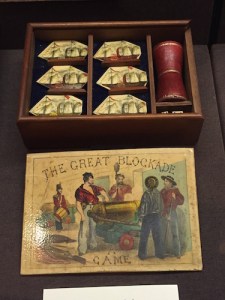
At the end of the 19th century, the games featured subjects like British ships running the Union blockades in America’s Civil War, monuments of the world, and significant inventors like Edison and Roebling (complete with a picture of the brand new Brooklyn Bridge).
Game pieces for The Game of the Great Blockade, produced in 1863 London about the British ships that were helping the Confederacy by running through the Union blockade during the Civil War
Commercials creep into the mix, too, but what else is new? The Grolier has again hit a home run with chronicle of Western culture’s time spent around a table, hanging with friends, and rolling the dice.
Click here to view some of our favorites in our Flickr album.
Marcel Breuer building on Madison, once the Whitney, now The Met
Start your engines – the doors to the Met Breuer swung open last week, and it’s a celebrity-studded, jazz-filled opening. The Met has turned Marcel Breuer’s brutalist masterpiece on Madison into a showcase for everything that’s cool, digital, live, and happening.
First, the art: Superstars from the last 500 years of art history are throwing it down in a big, bold, can-you-believe-who’s-here, two-floor mash-up extravaganza, Unfinished: Thoughts Left Visible.
Imagine turning a corner and finding a room packed with the Holy Grail of 19th-century “abstraction” – five barely-there masterworks by Mr. Turner, fresh off the plane from London. It’s not taking anything away from Titian, El Greco, or German Expressionists, who are in the show. It’s just that it’s rare for Gothamites to get up close and personal with this painter’s painter without buying a ticket to London and trekking to Millbank. Once word gets out, hopefully the Breuer downstairs admissions desk will be as jammed as the return line for Hamilton.
One of five late masterworks by Mr. Turner from the Tate
Yes, it’s strange to encounter Renaissance masters or a monumental Picasso when the gigantic elevator doors open on the upper floors. The fresh juxtapositions of old and new, familiar and unknown make your head spin, but in a good way.
The show features Renaissance masters, 19th century gods (see Matisse and Van Gogh’s side-by-side country cottages), and 20th century hot shots from international collections, MoMA, and 81st Street. The curatorial throw-down is something only the Met can do – scale, scope, and smarts – asking accessible questions and responding with wit from its own collection and other top institutions that have agreed to give their masterworks a trip to New York.
First view of Renaissance masters in Unfinished
Eight years ago, when the Whitney Museum of American Art began planning its move to the Meatpacking District, its board approached the Met and asked if it wanted to take over the famous Breuer building on Madison Avenue.
The answer was “yes” but only if the takeover would be done the Met way – using the full scope of the Met’s holdings, leveraging its interest in new digital and performing arts, and showcasing international modern artists who might not have received the recognition here (in the United States) that they deserved. In other words, turn old-world institutionalism on its head. And they’ve done that.
Just look at the first one-woman show in the United States for Indian modernist, Nasreen Mohamedi. The delicate drawings evoke Klee, Malevich, and Agnes Martin purity and line and shed a whole new light on how modernism was being transformed on the subcontinent in the Seventies and Eighties.
Second, the live arts element: Since it will be open late on Thursday and Friday evenings, hopefully it will become new Upper East Side’s version of the Rubin’s K-2 Lounge two nights a week – a fun, lively hang-out for music, performance, and art lovers. The rear first-floor gallery has been turned into a contemplative, cool showcase for jazz, programmed by Met Live Arts. Take a look at what’s up through the end of the month with Relation: A Performance Residency by Vijay Iyer.
Welcoming crew with the digital wall
Third, the new: So what else has changed at 75th and Madison? The pile-up of art books is gone from the reception desk, and the welcome wall is ablaze with a classy digital marquee offering glimpses of the world’s most precious treasures at each of the Met’s (now) three locations.
In a nod to those stupendous Lila Acheson Wallace bouquets in the Met’s Grand Hall, there’s also an oversize spring arrangement gracing the welcome area.
Fourth, the familiar: People who know the old Whitney well remember the tiny clay colony that resided in a corner of the stairwell next to a window overlooking Madison Avenue. At the press preview, art critics kept pausing on the stairwell landing to marvel at the fact that the beloved Charles Simmonds piece, Dwellings, is still there on loan from the Whitney.
Look for Dwellings, a 1982 installation by Charles Simmonds, in the stairwell (and across the street), still on loan from the Whitney
Look out the window and you’ll see the tiny clay and sand Dwellings nestled into the chimney and roof of the Apple Store across the street, same as they have been since 1982. Like the rest of the new Met Breuer, it might be the same place, but you’ll see lots of well-loved modern art in a new, fresh way.
And be sure to download Soundwalk 9:09 by John Luther Adams, commissioned by MetLiveArts for visitors to enjoy as they trek between 81st Street to the Met Breuer — two audio tracks from which to choose, depending on whether you’re making the nine-minute walk uptown or downtown.
Steeplechase Funny Face, the symbol of a famous amusement park.
How did a strip of pristine, white-sand beach turn into one of the most fantastical, lurid, menacing, and whimsical destinations in the United States? You won’t find a sociological essay, but you’ll experience a lot of evidence in the Brooklyn Museum’s Coney Island extravaganza.
The crowds filling the galleries last Saturday night savored the experience of the sky-high towers of contemporary hand-painted, Coney-inspired signs by the collaborative, ICY SIGNS. You could stand for an hour, just taking in all the messages, philosophy, and witty send-ups of contemporary life, curated by TED-talking artist Stephen Powers.
Through the door, however, another world waits. Seeing Coney Island’s gaudy jumble today from the air or Q train, it’s hard to imagine how it looked in the mid-1800s in the post-Civil War era.
Chase’s 1886 oil, Landscape, Near Coney Island
The show, organized by Hartford’s Wadsworth Atheneum Museum of Art, opens with tranquil landscapes of the aspiring middle-classes enjoying the salt air and low-key entertainments and diversions on the beach – maybe having a photo taken by an itinerant photographer, or sampling some sweet treats. Back in these more genteel times, the sandy shores were open to a mix of races and nations, or so the oils by William Merritt Chase and John Henry Twachtman attest.
How times changed! A giant vintage black-and-white film clip of romance on a roller coaster draws you into a world of more visceral wonder – carousel horses and gambling wheels interspersed with a hundreds of works by famous American artists that explore the magic, mayhem, and malevolence that made Coney such a phenomenon.
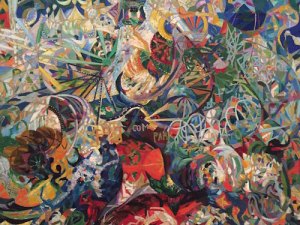
Detail of Joseph Stella’s 1913-1914 Battle of Lights, Coney Island, Mardi Gras from Yale University.
Figurative work from Reginald Marsh and others catapult you back to bawdy bathers and burlesque scenes brought to life last year in Broadway’s On the Town. Photographs by Arbus, Weegee, and Walker Evans provide close-up views of what it was like above and under the boardwalk.
Much of the shows’s fun is driven by the jarring injection of super-cool modern abstraction next to the flotsam and jetsam of the actual historic artifacts.
Edwin Porter’s 1905 silent movie Coney Island at Night gave nickelodeon viewers a novel way to see Edison’s incandescent lights in all their glory.
It’s startling to see Joseph Stella’s Futurist-inspired tribute to Coney Island’s Mardis Gras and realize that it’s from the same 1910-1914 era in which Jimmy Durante played honkey tonk piano for newcomer Mae West. It was all happening at the same time as the Armory Show.
1991 acrylic painting featuring iconic Spook-A-Rama Cyclops by Arnold Mesches.
Frank Stella’s 1950’s abstraction holds its own amidst the sideshow banners and relics that inspired his jarring color bars and mystery portal. Maybe it’s not a coincidence that right around the corner you come face-to-face with the real-life Coney landmark – the Cyclops who lured riders into America’s largest dark ride, Spook-A-Rama. The curators have placed him right next to his menacingly large portrait by Arnold Mesches.
Take a walk on the wild side of history, art, and sideshow performance while you can in person or via our Flickr album.
The Stephen Powers installation runs through the summer. Here he is explaining the allure of Coney Island as a contemporary inspiration:
Bronze She-Goat, 1950, who usually lives outside in MoMA’s garden.
To mount the blockbuster Picasso Sculpture show, closing February 7, MoMA cleared out Andy, Roy, Jasper, and all the Judds from the Fourth Floor and let in an array of whimsical animals, personnages, and concoctions. If you couldn’t get in the front door of the show or were discouraged by the crowds, take a look at our favorites in our Flickr album.
The surprise is that every one of the dozen or so galleries is filled with the most delightful Picasso creations. You don’t really need a guidebook or an understanding of the history of modern art. You can just look and smile. Just like Picasso did.
Even he needed a break from his Blue Period, and the first gallery shows two little wooden “dolls” carved in 1906 – a response to Gauguin’s shockingly primitive Tahitian wood carvings that rocked Picasso’s world when he encountered them in gallery. Rough, painted, angular, and shamanistic – a good way to work out the creative kinks at the same time you were creating the Demoiselles downstairs. Pure primitive…no gallery guide needed.
Carved wooden Doll inspired by Gauguin, 1907. From Gallery of Ontario.
Next door (directly upstairs from the gallery where the Demoiselles hold court), Picasso’s having his fun with his crazily patterned and painted bronze absinthe glasses, spoons, and fake sugar. The curators have gathered together enough from different collections to have a party. Cubism with a twist of polka-dot fun.
Next, it’s monumental heads carved from plaster. Why do they all seem to be in on a joke? It’s the room where Andy and Roy’s Pop masterpieces usually hang, but Pablo’s big, bulbous curvy heads from the 1930s are just as wry and enjoyable. (See the videos below.)
Already declared “degenerate” by the Nazis in 1937 and featured in their historic touring show, Picasso had his own quiet joke on the oppressors as he lived through the occupation of Paris in 1940-1944. While the Nazis were melting down bronze statuary in Paris to use in their war manufacturing, Pablo somehow managed to sneak into a foundry to make a big, bronze sculpture of large kitty cat on the prowl and other metal works.
Figure, 1938, made of found stuff — wood, nails, and screws with string, wire, and hardware
The kitty, the bicycle-handlebar bull, and the napkin dog are just two among a host of lots of other contraban he defiantly created before liberation.
The rest of the galleries show how Picasso’s wartime scrounging spurred him on to new heights of making something out of nothing and finding delight in transforming somebody’s junk into funny, fool-the-eye sculptures. The She-Goat (usually found hanging outside in MoMA’s garden by The Modern), the car-baboon, a metal owl, goose, and other creatures hold court in the bigger galleries.
Well-wishers crowd around taking feel-good photos and parents show the kids how the artist took everyday objects and turned them into such fun critters.
The stick-people Bathers at the finale are partially made of pieces of painting frames and other found wood, painted and finished with the same rough technique and hand that characterized the “dolls” in the first room. It’s the great Modern Master going rogue channeling outsider art.
The Bathers, 1956. From the Staatsgalerie Stuttgart.
By the time you get to the model of the monumental head that’s become one of Chicago’s icons (in the last gallery), the crazy sculpture — Picasso’s last — feels kind of normal.
It’s telling that MoMA didn’t even put label copy on the stuff. Just a guidebook you can pick up at the entrance, or not. No wonder it’s been the most popular show in New York.
Just when you thought understanding modern art was “hard”, one of the masters comes along, kicks sand in your face, laughs, invites you to do a little beachcombing with him, throws a few sticks together, and asks you to look at what’s right around you in a new way.
Look at a few pieces that MoMA underscores with delightful music.
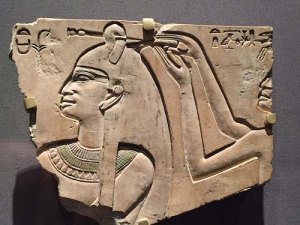
Henut does Queen Neferu’s hair, 11th dynasty (2051-2000 B.C.) Courtesy: Brooklyn Museum
While New York City is digging out from record snowfalls, there’s some great news about a few items that have been buried for centuries and are none the worse for wear – cosmetic boxes, bracelets, belts, and styling tips of the great divas (male and female) of ancient Egypt. The Metropolitan Museum of Art moved some gems out of the cavernous Egyptian wing – and borrowed a few things from Brooklyn and elsewhere – for its monumental tribute to the 12th dynasty, Ancient Egypt Transformed: The Middle Kingdom, closing today.
Usually buried among the collections on the first floor, the curators pulled out some of our favorites from the galleries (along the way to the Costume Institute) and presented them as the spectacular showpieces they are. It warrants a shout-out to the effort it took to conceive, mount, and present this terrific show. What a way to leverage the collections that are right inside the city limits!
Queen or Princess as a Sphinx, 12th dynasty (1981-1802 B.C.) Once owned by Emperor Hadrian , later by a Cardinal. From Brooklyn Museum
The story of the transformations happening in Egypt’s 11tth to 13th Dynasties (ca. 2030–1650 B.C.) is big (enough to fill twelve galleries), so we’re just highlighting a few of the things we noticed that modern People of Style might enjoy. Check out our Flickr site.
First, Brooklyn is in the house in the gallery dedicated to royal women: off to the side, there’s a limestone relief fragment (normally at the Brooklyn Museum of Art) showing Queen Nefuru having her tresses done by 11th Dynasty celebrity stylist, Henut. The curators point out that a telltale sign of royals (men and women) is the distinctive winged-eye look that her makeup artist achieved in kohl. The styling is incised in limestone, showing the Queen getting ready to emulate Hathor, the goddess of love and romance. In those days (2051-2000 B.C.), only royals could sport the jeweled necklace or eye makeup style.
Nearby, Brooklyn also contributes a beautifully sculpted head, said to be broken off from a larger sphinx statue from the 12th Dynasty – a protective guardian featuring a fantastic coif that only a queen or a princess would sport. It was all wigs, all the time.
372-piece cloisonné pectoral of Princess Sithathoryunet. Gold, carnelian, lapis lazuli, turquoise, and garnet. 12th dynasty (1887-1878 B.C.).
One of the most spectacular pieces is the 372-piece cloisonné pectoral worn by Princess Sithathoryunet. It’s a 12th Dynasty masterwork (1887-1878 B.C.). of gold, carnelian, lapis lazuli, turquoise, and garnet. The piece is magical and protective, but instead of being inlaid with the name of the princess, it features the name of the king. The idea is that the king himself is being protected when the royal daughter wears it – not the diva herself. You get what you pay for.
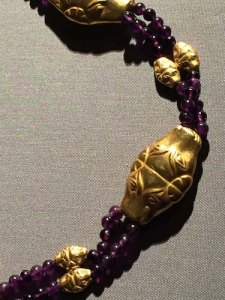
She also had another set of formal jewelry — a cowerie shell girdle and matching bracelet of gold, carnelian, feldspar, and crystal. The imitation shells had small pellets inside, which would have made a tinkling sound when she walked. The same is true for the feline-headed set of jewelry of gold and amethyst.
Feline-Headed Girdle of gold and amethyst from 12th Dynasty (1887-1813 B.C.).
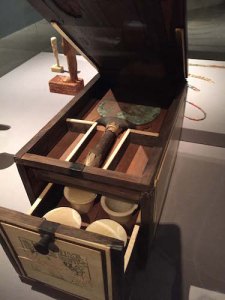
Sithathoryunet kept these and other treasures in a beautiful jewelry box, which is displayed nearby alongside a cosmetic box. The Met reconstructed the wood boxes by putting the ebony, ivory, gold, carnelian, blue faience, and silver back into place. Magnificent. Look for it all when these spectacular items go back on display at the back of the Egyptian Wing later this year.
By this time in Middle Kingdom culture, the elites started copying the royals, so some of the buried treasures that the Met found on its early 20th century expeditions belonged more to aspirational upper classes than the royals themselves. Check out the cosmetic case and mirror belonging to Amenemhat IV’s royal butler, Kemeni. Or the faience necklace worn by Wah, the overseer who served Meketre, the royal chief steward serving kings in both the 11th and 12th Dynasties.
The Met found a bonanza of fantastic reality art in Meketre’s tomb – so much that only a few pieces were brought up to the second floor for the special show. The show features a real-life depiction of a grainery and sport fishing boat, but if you look on the first floor as you walk through to the Costume Institute, you’ll see many more boats and several more rooms of day-to-day life – all meant to serve Meketre in the next world.
Cosmetic box of the royal butler, Kemeni, with four ointment jars and a mirror. 12th dynasty (1814-1805 BC.)
The Met has meticulously documented this show online. Spend a snow day (or not) by taking a tour through all twelve galleries on the Met’s web site and listening to the curators’ take on the on-line audio guide, which also features photos of each of the objects. Here’s where you can search the exhibition objects and find more detail.
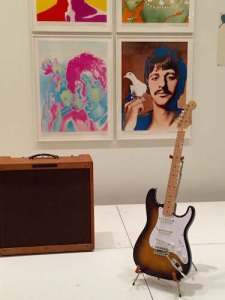
A decade apart – 1957 Stratocaster and Avendon’s 1967 posters of the Beatles
The MoMA Design Department had a brilliant idea – to tell the history of 20th century music culture by pulling out objects and two-dimensional art from the museum’s rich collection. How did modernism and music influence one another? See Making Music Modern: Design for Eye and Ear, on view through January 18.
There’s still time to catch some demos of the Scopitone, the Stratocaster, and the Mechanical Flux Orchestra inside the gallery this weekend.
Although a lot of the buzz in the gallery is over visitors’ recollections of the turntables, radios, and album covers on display, the curators do everyone a favor by putting the mod, mod world into historical context at the start of the show.
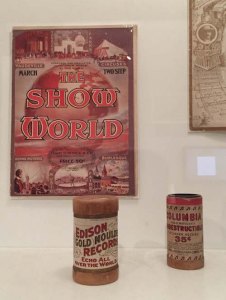
Early Edison sound experiments, films of Loie Fuller and Josephine Baker, and a poster of Yvette Guilbert from the can-can era remind everyone that shocking live performances, revolutionary music trends (go, ragtime!), and print designs that pushed the limits don’t belong exclusively to the mod, punk, or techno eras.
Early pop music innovations: sheet music and Edison wax cylinders
Tucked into side panels and corners are photos of costumed interplanetary performers of the Triadic Ballet at the Bauhaus in 1922 and early Russian avant-garde takes on the advent of radio, the broadcast and communications technology that changed entertainment forever.
These were worlds where artists and designers did it all – fine art, typography, industrial design, textiles, and performance. There are even some snippets of early acoustic-enhancing textiles on display, courtesy of Anni Albers. Design and music mixed, right from the start of the last century.
The sleek, streamlined radios, microphones, and Rural Electrification poster from the 1930s are presented as icons of the earliest era of broadcasting, with reminders from the curators that the designs were made to rescue the radio from its early haywire, spaghetti-city look that first appeared on 1920s garage workbenches across the country. Make it look nice, and you can bring it inside, where we can all enjoy it.
Stylish: 1932 Bakelite radio by Wells Coates and a 1939 Unidyne mic by Benjamin Baker.
Throughout the Fifties and Sixties, music and design seemed to go hand in hand. Consider the Sixties revolution in turntable and speaker design – everything fit for a super-modern lifestyle of easy listening with jazz and high-concept percussion album covers nearby.
The invention of the Fender Stratocaster guitar revolutionized the sound and look of early rock and roll with its iconic whammy bar and performances that represented out and out rebellion. Although the Stratocaster was invented in the 1950s, it’s appropriately displayed in front of posters of Bob Dylan, The Yardbirds, and Avedon’s Beatles – an innovation adopted by Buddy Holly that inspired the next generation.
Where pop music and art come together – Sixties album covers, including those by Richard Hamilton and Warhol
If you really want to dig into the details, there are dozens of famous album covers and posters on display with tribute paid to their designers. Among the luminaries are pop-god Richard Hamilton’s “White Album” for the Beatles, Warhol’s “Sticky Fingers” cover for the Stones, and Rauchenberg’s design for the vinyl disk inside the Talking Heads’ “Speaking in Tongues” album. The chronicle of the Fillmore East posters is a book unto itself.
And Mr. Jobs’ imprint is never forgotten at MoMA. An early version of his iPod is displayed right next to the Seventies invention from Japan that rocked the music world – the Sony Walkman.
If you can’t make it, take a look at the show through our Flickr views. We’ve grouped the items in chronological order.
And check out the excellent MoMA blog posts about the show on MoMA’s “Inside/Out” platform, where curators go to share enthusiasm about the hunt for the Stratocaster, famous rock posters, and other gems from the Fifties and Sixties. Leave your own comments, reflection on music and design, and memories right there on the MoMA website.
Washington Square Sunday folk singing, early 1960s. Courtesy: MCNY/Nat Norman
The large map inside the exhibition tells the entire story of how a folk music revival germinated on a few blocks in Greenwich Village in the 1950s and exploded into a national mania for twelve-string guitars, songs of protest, and music that paid tribute to deep, deep roots of the American experience.
The show ties together the tale of how Woody Guthrie and Alan Lomax got the ball rolling by shining a spotlight on Appalachian and Southern purveyors of down-home folk singing and inspiring a generation to look back, pay tribute, and carry it forward. MCNY has plenty of listening stations scattered throughout the gallery, offering up rare recordings that speak to the roots of popular music of the Sixties.
It’s a revelation to listen to Lomax’s 1934 recording of Ledbelly singing Good Night Irene and MidnightSpecial long before Pete Seeger, The Weavers, and Johnny Cash catapulted them to the charts in the Fifties and Sixties.
Flyers, broadsides, and other paraphernalia from Greenwich Village clubs paper the walls and vitrines, as the show steps through the story of how that sleepy NYC neighborhood transformed itself into a destination for the likes of Bob Dylan and other activist-artists who inspired a generation.
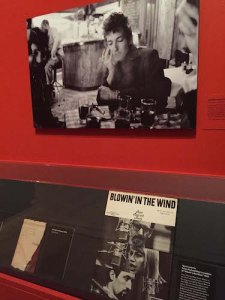
1964 photo Dylan at Kettle of Fish Bar at 114 MacDougal Street above his sheet music
Music studios, clubs, publishing houses, coffee houses, and cold-water flats were all jammed into a few city blocks that functioned like a 24/7 open-mic night. Back in the late Fifties and early Sixties, music was pouring out of nearly every door on Bleecker Street and MacDougal.
The convergence spawned a network of producers and publishers who felt it was their mission to bring folk music to a wider audience – uptown at Town Hall, on alternative radio stations across the country, and executives at the big labels. Some of the highlights at the back of the gallery are Dylan’s handwritten lyrics for Blowin’ In the Wind and Mr. Tambourine Man.
Political battles are found at every turn in the installation, from Seeger’s encounter with McCarthy’s House Un-American Activities Committee to inspirational performances by Pete, Odetta or Peter, Paul & Mary at historic marches and protests. The music was always there, intertwined with the events of the day.
First edition of “Sing Out!” magazine, 1950
Although folk and roots music inspired artists like The Beatles and The Rolling Stones, the MCNY show notes that after Dylan went electric and the British invaded New York, the folk music juggernaut lost some of its steam. No matter. You can still see it all recreating itself on Bleecker Street at The Bitter End any night of the week, listen to an up-and-coming singer-songwriter, and view lots of those historic posters on the back wall after MCNY’s show closes.
Announcement for Allan Kaprow’s 1968 Three Country Happening in NYC, Germany and Argentina, one of the earliest telecast international performance pieces.
Before restaurants and shops populated Tribeca and Soho in the 60s and 70s, edgy New York City artists were experimenting with happenings, video art, performance pieces, mail art, and assorted ephemeral pieces – Cage, Moorman, Kaprow, Ono, Paik, Grooms, Oldenberg and Maciunas to name a few.
In the pre-Internet days they might have been unaware that half a world away, Eastern European and Latin American artists were catching wind of this new art wave and stamping their own brand on their local art scene.
MoMA’s show, Transmissions: Art in Eastern Europe and Latin America, 1960-1980, captures the zeitgeist and shines a light on the artists, movements, and pieces from important avant-garde artists whose names are not as well known in the States. See it through January 3.
Organized into several rooms and themes, it’s a great collaboration among MoMA’s Departments of Media and Performance Art, Photography, and Drawings and Prints. The result puts a lot of MoMA’s huge Fluxus collection into a proper world context.
Socially relevant art posters from Poland, Cuba, Czech Republic, Yugoslavia
The first half of the show deals with geometry and its spiritual significance, offbeat artist publications, and mash-us between mail art and street performance.
Favorites include post-minimalist pieces from Brazil, Suprematist-style wall works by Yugoslavia’s Mangelos and an entire wall of photos documenting push-the-envelope street art many Eastern European countries. See our Flickr feed for a walk-through and click the links below for glimpses into MoMA’s show blog.
The next section turns more socio-political with works from the Argentine collective, Instituto Torcuasto di Tella – a center of the avant garde in Buenos Aires from 1959 to 1970. The centerpiece is a large installation for the Venice Biennal by David Lameles – Office of Information about the Vietnam War at Three Levels: The Visual Image, Text and Audio. The glass-walled newsroom is a stage from which performers read “breaking news” from the Vietnam War, just as they did when the collective debuted this in 1968. When the performers aren’t present, visitors can listen to archival recordings in three languages to feel transported back in time and reflect on how and if things have changed.
Installation for the 1968 Venice Biennal by Argentina’s David Lameles – Office of Information about the Vietnam War at Three Levels
Nearby, visitors see clips from Marta Minujin’s Simultaneity in Simultaneity part of Allen Kaprow’s 1968 Three Country Happening, which was one of the first international telecasts of performance art.
Other galleries feature the blossoming of feminist art and performance art, social-commentary painting and sculpture, and poster art on these two continents. Artists that are familiar in US collections — like Botero (Colombia), Marisol (Venezuela), Marina Abramonovic (Serbia), and Ana Mendieta (Cuba) – are displayed in galleries that introduce other stellar artists to entirely new US audiences.
Oscar Bony’s photo his 1968 performance piece, The Working Class Family, which put an actual Argentine family on display
Consider Oscar Bony’s photo documentation of his controversial 1968 performance piece, The Working Class Family, where an actual Argentine family displayed themselves for the run of an exhibition at Instituto Torcuasto di Tella. Or Romanian graphic designer Geta Bratescu’sMedea IV, a 1980 sewing-machine drawing made and displayed privately in her studio at the height of a repressive political regime when most artists retreated underground.
The show ends with a spectacular installation: Juan Downey’s 1975-76 masterwork, Video Trans Americas. The gallery floor is painted with an outline map of the Western Hemisphere with banks of video monitors placed atop countries to which he traveled from the tip of South America to New York City, showing the life and times of indigenous people.
Chilean artist Juan Downey’s 1975-76 Video Trans Americas, documenting his travels from the tip of South America to New York City
Inspired by the idea of a transnational identity, Downey’s piece beautifully sums up the feeling of the entire show – artists and people engaged in a cultural dialogue across time and space.
Thankfully MoMA has given these artists a timeless showcase and home.

















 itsnewstoyou