The Art of ElBulli’s Culinary Genius

Notebooks and menu drawings from ElBulli’s kitchen displayed in front of a mural of Ferran Adrià and staff in Roses, Spain in the most famous kitchen in the world. Courtesy: elBullifoundation, The Drawing Center

Notebooks and menu drawings from ElBulli’s kitchen displayed in front of a mural of Ferran Adrià and staff in Roses, Spain in the most famous kitchen in the world. Courtesy: elBullifoundation, The Drawing Center

If you weren’t able to visit the famed ElBulli restaurant on the coast of Spain before it closed two years ago, don’t worry. Pop down to Soho to meet the man, his team, and his legacy through The Drawing Center’s provocative show, Ferran Adrià: Notes on Creativity, running through February 28.

Even if you can’t taste the world-renowned creations, you’ll feel as though you’ve entered his kitchen during the six months per year that his team worked on R&D through up-close looks at experiments, plating, techniques, codes, inventions, and graphic treatises. Take a look at the installation on our Flickr feed.
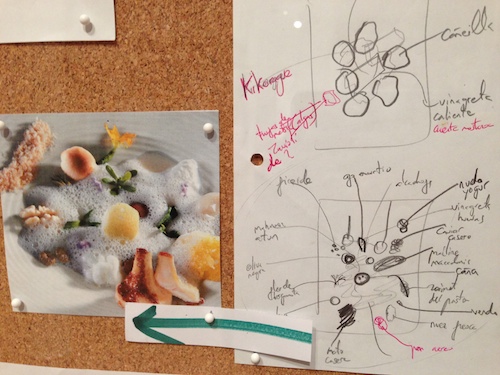
Close-up of large working board of photo and diagrams document the plating and components of each dish. Courtesy: elBullifoundation

Close-up of large working board of photo and diagrams document the plating and components of each dish. Courtesy: elBullifoundation

Last weekend, the Wooster Street space was jammed with visitors eager to see glimpse the genius behind the magic of the famed elBulli – notebooks filled with diagrams of exacting platings of food, a room inside the gallery evoking elBulli’s Barcelona archive, huge storyboards pinned with drawings and photographs of artist-inspired dishes, and glass-topped tables containing inventions that created some of the most amazing food–art in the world.

Examples: the apparatus that turns cheese into “spaghetti”, the glass bowls used to serve diners “edible air”, or the cocktail device that literally sprays a dry martini right into a diner’s mouth.
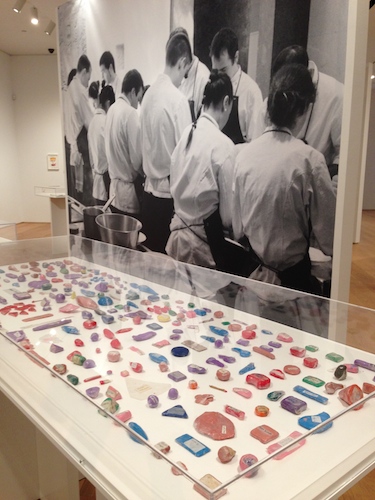
240 plasticine models used to standardize recreation of the sizes and shapes of various portions of food used as components in his highly inventive, artistic dishes. Courtesy: elBullifoundation, The Drawing Center

240 plasticine models used by staff to recreate precise shapes and portions of artistic dish components.

And how do you keep the beautiful dishes consistent? By making little plastic sculptures so that the kitchen crew knows how to duplicate forms for delicate platings precisely on everyone’s plate. When you’re delivering identical 40-course dinners to guests who have flown halfway around the world to join you for dinner, precision counts.

Improvisation may have happened during the six months of the year that elBulli shut down to devote itself to R&D, but not so much during dining-season crunch time. Just look at the large wall drawing that Adrià sketched for this show — Map of the Creative Process: Decoding the Genome of Creativity. Organization is key.

Last weekend, there were no empty seats in the downstairs video viewing gallery, as visitors sat mesmerized by 1846, the 90-minute film co-produced by The Drawing Center, showing every dish Adriá ever served at elBulli (1987 – 2011).
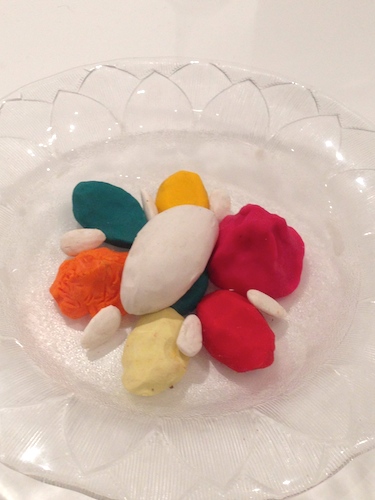
Plasticine model of the 1994 Le Menestra dish composed only of textures, including cauliflower mousse, basil jelly, almond sorbet, avocado, and numerous other components. Courtesy: elBullifoundation

Plasticine model of the 1994 Le Menestra dish composed only of textures, including cauliflower mousse, basil jelly, almond sorbet, avocado, and numerous other components.

Photos of gorgeous, glistening food on plates, rocks, and wood lilted by to an opera soundtrack punctuated by the sounds of water lapping on the shore near the restaurant.  Plates of vegetables, seafood slices, sprigs, and flowers wafted by. What are those spoons filled with? What appeared to be “hatching” out of that egg? What was the egg? What was perching on a stalk like an insect? The effect made you feel as if you were seeing life on Earth evolve…biomorphic shapes surrounded by foam.

You could tell that these art-and-food lovers had absorbed the exhibit upstairs when there was a collective gasp of recognition when the real-life version of La Menestra (accurately and lovingly represented in plascticene upstairs) floated onto the screen.

Since he shut the most desired and famous restaurant in the world, Adrià has been hard at work making sure that his thoughts, processes, philosophy, and research were well documented and translated to digital form. Although it’s still in beta, he’s incorporating it all into an online encyclopedia of gastronomic knowledge.

Kudos to Brett Littman and his team at The Drawing Center for mounting a show that pays tribute to food-as-art and shows us how creativity, inspiration, and documentation (in the hands of an genius, or team of geniuses) can turn experiments in a kitchen on a small Spanish seaside cove into a global digital export of wisdom and innovation for the next generation of chefs.

Take a look at Bullifoundation’s promo video to see what’s in store:

Happily, this show is going on the road in the United States before it leaves for The Netherlands in 2016:  See it at the ACE Museum in LA (May 4-July 31), Museum of Contemporary Art in Cleveland (September 26-January 18, 2015), or Minneapolis Institute of Art (September 17, 2015-January 3, 2016).

Here’s a link to Documenting Documenta, a 2011 film about Adrià’s life, inspiration, work, and participation in Documenta 12, an international cultural festival in Kassel, Germany that happens every five years.

The Corset that Changed Cultural History and the Man Who Made It

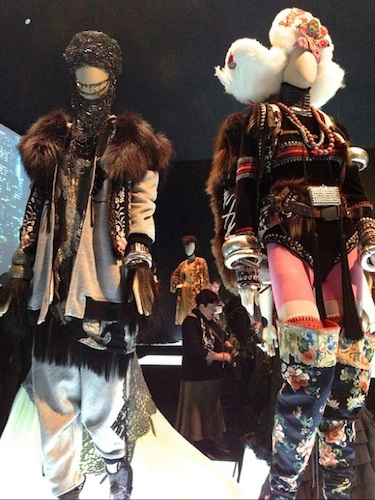
JPG’s creation for Madonna’s “Like a Virgin” segment of her 1990 tour. Made from vintage 1930s lame

JPG’s creation for Madonna’s “Like a Virgin” segment of her 1990 tour. Made from vintage 1930s lame

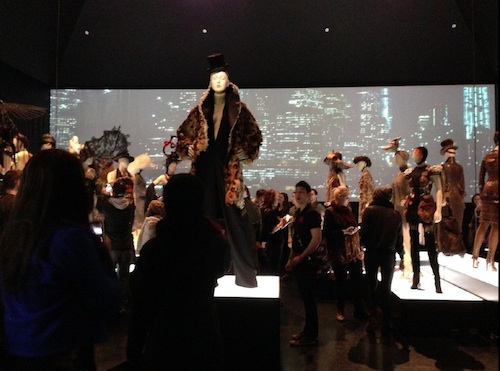
Amidst the light, glamour, glitter, and mystery sending shock waves and awe through the masses crowding into the Brooklyn Museum’s show, The Fashion World of Jean Paul Gaultier: From the Sidewalk to the Catwalk, a hush falls as each person realizes they’re only an arm’s length away from the Icon’s icon. Lovingly crafted from vintage lame, JPG and Madonna had no idea (according to Madonna) what a sensation their underwear-as-outerwear statement would create in fashion, performance, pop, and culture when JPG designed her get-ups for the Blond Ambition World Tour. Get out to Brooklyn to experience this über-tribute before Feb 23.

Madonna’s lent her JPG corsets to the section of the show where the walls are covered in quilted satin, and JPG dug into his archives, too: You’ll see the series of illustrations he did to show the looks he would create for the tour, as well as JPG’s personal Polaroids shot during the initial fittings. If you’re very quiet in this part of the show, you’ll also hear visitors gasp when they realize that they’re looking back at artifacts from 1990!

Crowds listen to the mannequin sing in the Metropolis gallery during the show’s final week.

Crowds listen to the mannequin sing in the Metropolis gallery during the show’s final week.

This genuinely theatrical tribute to JPG is chock full of corsets and cages made from silk, leather, raffia, wheat, and enough other stuff to win the Unconventional Materials challenge hands-down. O ye of Project Runway, worship at the mannequins of the Master!

At the entrance to the show, there are two small photo portraits of JPG taken by Mr. Warhol himself. They’re at a dance club in 1984 and JPG is in one of his Boy Toy collection outfits. Andy is quoted as saying, “What he does is really art.” It’s a curatorial anointment that offers a subtle, quiet, reflective moment to what you’re about to experience.

Dealing with the recent blizzards would have been more fun if you had shopped JPG’s Voyage Voyage ready-to-wear collection (2010-2011). These are styled with pieces from older collections.

Dealing with the recent blizzards would have been more fun if you had shopped JPG’s Voyage Voyage ready-to-wear collection (2010-2011). These are styled with pieces from older collections.

Room after room of gender-bending, mind-altering, color-crazy, history-twisting looks, gowns, shoes, bodysuits, and haute handwork reminds us that JPG has been pushing the boundaries for over 40 years, inspired by French sailors, French culture, 50s TV, global culture, his grandmothers unmentionables drawer, and the ever-inspiring gritty street. How do you use embroidery, neoprene, stuffed silk tubes, tulle, and illusion in a subversive manner? Take a stroll through JPG’s master class.

You’ll find mermaids worn by Beyoncé, a French sailor-striped gown worn by Princess Caroline, red carpet looks worn by Ms. Cotillard, a Mongolian shearing coat sported by Bjork, and photos of supermodels and superstars sporting outrageous and inventive looks. The names of the collections alone tell you the scope of his interests – Haute Couture Salon Atmosphere, Ze Parisienne, Flower Power and Skinheads, Paris and Its Muses, So British, Forbidden Gaultier, and Great Journey collections.

Close-up of corset from JPG’s Countryside Babes collection, prêt-à-porter spring/summer 2006. Made of wheat and braided straw, created in 84 hours

Close-up of corset from JPG’s Countryside Babes collection, prêt-à-porter spring/summer 2006. Made of wheat and braided straw, created in 84 hours

The show features 140 ensembles in all, enough to fill the entire wing. Mr. Gaultier even tells us that he expanded it a little for Brooklyn’s gigantic space, adding a “Muses” section with American icons and runway looks for big-boned, curvy girls.

Oh, and did I mention that the mannequins talk? (We can’t even begin on that, so here’s a video to explain how that magic happened.)

Brooklyn is the last stop on JPG’s North American tour, which was organized by the Montreal Museum of Fine Arts and Maison Jean Paul Gaultier.

If you can’t visit, take a walk through the show via our Flickr photos, and listen in on an hour-long discussion between JPG himself and the show’s curator Thierry-Maxime Lorio, where they talk about his “express yourself” philosophy.

The special promo video will give you a taste of the creative genius behind 40 years of memorable, challenging fashion as art:

Top of the Pop 80s Style at NY Historical

Keith’s “Into 84” exhibition poster inspired by choeographer Bill T. Jones (1983). Photo: Tseng Kwong Chi. © Muna Tseng Dance Projects, Inc.; Keith Haring artwork © Keith Haring Foundation

Keith’s “Into 84” exhibition poster inspired by choeographer Bill T. Jones (1983). Photo: Tseng Kwong Chi. © Muna Tseng Dance Projects, Inc.; Keith Haring artwork © Keith Haring Foundation

When you stand in line to get your tickets for The Armory Show at 100 at the New-York Historical Society, look up and you’ll see a piece of history from the era of Madonna and Danceteria right above you – the entire beautiful, embellished ceiling of one of the must-see stops during the raging Eighties club culture in NYC, Keith Haring’s Pop Shop as part of the special installation Keith Haring All-Over.

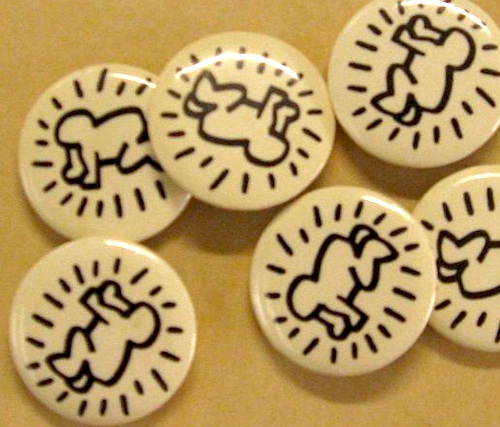
Although the Pop Shop closed its doors on Lafayette Street in 2005, it achieved worldwide pop-culture recognition for being the most iconic sites where art, music, dance, graffiti, celebrity, and the street mixed. Haring, whose Radiant Baby and other works ubiquitously plastered subway station walls in the 80s, decided to put Warhol’s commerce-as-art philosophy into practice. He created an art-filled shop downtown where the international art collectors, celebrities, club kids, and graffiti artists would feel comfortable.

Installation view of the Pop Shop ceiling over the cash registers at NYHS, right behind a video wall of Oertel’s Pulling Down the Statue of King George III. Courtesy: NYHS/John Wallen

Installation view of the Pop Shop ceiling over the cash registers at NYHS, right behind a video wall of Oertel’s Pulling Down the Statue of King George III. Courtesy: NYHS/John Wallen

The walls were covered in Haring’s instantly recognizable doodle-cartoon figures and stuff to buy, so when the Haring Foundation gave the ceiling to NYHS, it did so with the stipulation that it be hung somewhere where money is exchanged.  So, right inside the door in the same beautiful entrance hosting the treasures of Revolutionary New York, is the ceiling from a place where music blared, fun was had, all-night parties raged, and Downtown 80s life was celebrated.

Take the elevator to the Luce Center to see the rest of the show, which is on loan to NYHS by the Haring Foundation, which Keith established just before he succumbed to AIDS in 1990. Go to Keith’s website to see him in action in the subway, galleries, and performance and click through images of his amazing body of work in digital form by decade. It’s all here.

Keith’s “Radiant Baby” buttons in the NYHS collection, gifted by Roy Eddey.

Keith’s “Radiant Baby” buttons in the NYHS collection, gifted by Roy Eddey.

But back upstairs at NYHS, you’ll see Keith’s 1985 repeated-pattern design for a fabric run right above two NYC mile markers from the 1800s, a Haring-painted black-and-pink leather jacket (done with graffiti artist LAII), and Jeremy Scott’s Haring-inspired sneakers for Adidas. The NYHS is also screening some vintage video in the little 80s space, right next to the classical busts of New York’s 19th century high and mighty. Hang out to see Madonna’s 1984 performance of Dress You Up for the Keith’s Party of Life and the 1986 Grace Jones video I’m Not Perfect (But I’m Perfect For You), which Keith co-directed.

The show is tiny, but it’s a great little secret spot to time travel back to the Eighties. For more Keith, visit the Fales Library at NYU for Keith Haring: Languages through February 28 and NYPL’s Why We Fight: Remembering AIDS Activism through April 6. The NYHS installation is an open run.

Hey, and don’t forget to shop in the online Pop Shop, where revenue from (RED) items goes to combatting AIDS.

Must-See Skytop Panorama of NYC Past & Present at The Whitney

The installation view of T. J. Wilcox: In the Air, 2013. Photo: Bill Orcutt

The installation view of T. J. Wilcox: In the Air, 2013. Photo: Bill Orcutt

If you want to enjoy a beautiful view of Manhattan from the roof, don’t worry about the snow, rain, or cold weather. Go over to the Whitney Museum before February 9 and take in the film installation T.J. Wilcox, In the Air, that features a beautiful panorama (from the roof of Wilcox’s Union Square studio) that dreamily introduces six stories about the past and present of life, art, energy, fame, events, and cosmic forces that ebb and flow continuously below.

The big, in-the-round screen circles around you (duck and just walk into it), so you can really take in the view, all the way from the Battery to beyond the Empire State Building.

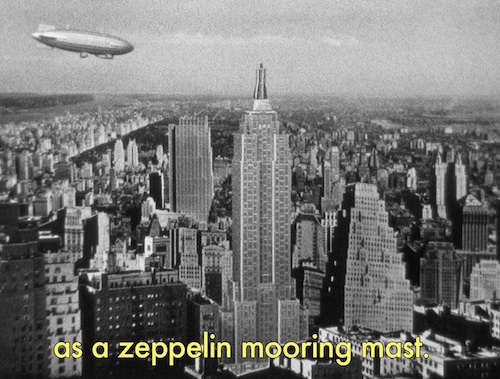
Still from T.J. Wilcox’s panoramic 2013 silent film installation, In the Air. Image courtesy of the artist and Metro Pictures.

Still from T.J. Wilcox’s panoramic 2013 silent film installation, In the Air. Image courtesy of the artist and Metro Pictures.

The film cycles from dawn to dusk, but along the way, Mr. Wilcox takes you on little journeys as you enjoy his movie panorama. The experience is one where you begin to see New York through his eyes, past and present together.

After a few minutes, one of his panorama screens fades you see a short, reflective, poetic, subtitled NYC story-movie. It’s a quiet experience — bringing you back to the Thirties when the Empire State Building was contemplated to be used as a zeppelin-docking station, to the present when 14th Street is one of the best vantage points to contemplate the out-of-this-world spectacle of Manhattanhenge, and the days of glitter, glamour, and grit of Warhol, Gloria Vanderbilt, and fashion-industry icon, Antonio Lopez.

Watching Wilcox’s Gloria Vanderbilt vignette from outside the installation. Photo: Bill Orcutt.

Watching Wilcox’s Gloria Vanderbilt vignette from outside the installation. Photo: Bill Orcutt.

He reminds you that Gertrude Whitney, the museum’s founder, long ago succeeded in a custody battle to care for little Gloria. The film takes you to her apartment and reflects on the fact that Gloria was “in the public eye from birth” and celebrates her vibrant artistic, business, and family accomplishments (re: plenty of shots of Anderson Cooper). Another mini-film focuses upon a nano-second in Warhol’s life, when his Factory crew unfurled Mylar balloons to welcome the arrival of the pope-mobile to New York City in 1965.

Weegee’s Variant of Untitled (Striking Beauty) is hung in an adjacent gallery. Courtesy: Whitney Museum

Weegee’s Variant of Untitled (Striking Beauty) is hung in an adjacent gallery. Courtesy: Whitney Museum

In his musing on the film about fashion-illustrator extraordinaire, Antonio, Wilcox reveals his surprise that Antonio’s studio was located right next to his own building, takes pleasure in asking us to gaze out over the community where so much magnificent art was made, careers enlivened, and life lived.

In a tiny back-room gallery, the Whitney has installed a few other reflections on skies over the City – Weegee’s lightening strike behind the Empire State Building and Yoko’s Sky TV, are two – but the big “wow” here is Mr. Wilcox’s ability to take us on a 35-minute journey in and among the streets and skyline that from his quiet, contemplative perch.

It’s quite a collage of memory, reflection, mythologies, politics, history, and beauty. Click here to see the Whitney’s slide show of the storyboards in Wilcox’s studio, and listen to him talk about it this beautiful work in this YouTube video:

Tiny Natural History Show Has Eyes Bugging Out

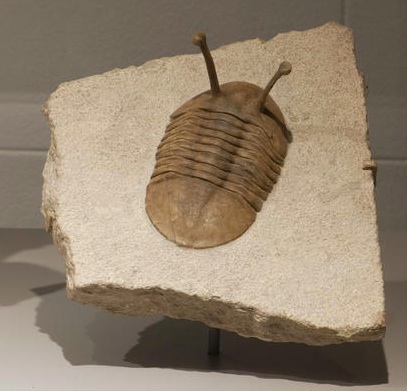
Asaphus, from St. Petersburg, has eyes bugging out (Ordovidian, 490-440 mya). Photo: ©AMNH/R.Mickens)

Asaphus, from St. Petersburg, has eyes bugging out (Ordovidian, 490-440 mya). Photo: ©AMNH/R.Mickens)

Confined to a tiny case in the “canoe” rotunda at the American Museum of Natural History, some extinct species from more than 400 million years ago are putting on quite a show, thanks to two trilobite lovers from the heavy-metal music and vert paleo worlds.

Andy Secher and Martin Shugar went through their massive trilobite collections (Andy has 4,000 in his Manhattan apartment and Martin turned over 200,000 fossils and shells to AMNH) and picked out fifteen “best of the best” from each of the six geologic periods that hosted these little waterway critters – from the Cambrian to the Permian (521 to 240 million years ago). It’s quite something, considering there are over 20,000 recognized species lingering in 281 million years of rocks around the world!

When the exoskeleton of Dicranurus disintegrated in the Lower Devonian, it left a fossilized cast that is so perfectly prepared you think you’re watching him in action

When the exoskeleton of Dicranurus disintegrated in the Lower Devonian, it left a fossilized cast so perfectly prepared you think you’re watching him in action

The tiny show, which is in an open-ended run,  is a “wow” due to the spectacular preservation and preparation of each of these little snubs of rock containing fossilized “casts” of animals whose exoskeletons disintegrated soon after they expired millions of years ago. The state of preservation of even the most delicate features is pretty remarkable.

Consider Asaphus kowalewskii from Ordivician rocks near St. Petersburg (490-440 mya), whose long eye stalks are truly a wonder of nature, evolution, and behind-the-scenes prep that make this character’s eyes pop. Trilobites invented complex, multi-lens eyes, and this Asaphus provocatively suggests the ability to check things out above the sediments where they burrowed, sort of like a horseshoe crab equipped with a modern submarine periscope.

The little Olenoides on display hails from British Columbia’s famous Burgess Shale and has long antenna curving back along its sides. He’s also found in New York, Pennsylvania, Virginia, Utah, and other places in Cambrian rocks 450-490 million years old.  For all those AMNH visitors asking where they can see the Burgess Shale, here’s your chance to commune with a critter and some rock from the same formation that so inspired uber-naturalist Stephen Jay Gould.

Olenoides of British Columbia’s Burgess Shale (Cambrian 450-490 mya) has curve-back spines

Olenoides of British Columbia’s Burgess Shale (Cambrian 450-490 mya)

Walliserops has a full trident sprouting out of his head –a unique apparatus that adapted him for who-knows-what in Devonian life in what-is-now Morocco. Is this where Neptune got the idea of what works best down under the sea?

The hometown favorite is Arctinurus boltoni, first found in upstate New York in the early 1800s during the construction of the Erie Canal. The AMNH has an entire website showcasing these upstate wonders from the Rochester Shale. See them all and take a peek behind the scenes into the AMNH collection drawers on the image gallery.

Andy and Martin’s enthusiasm for trilobites puts them in good company. Tom Jefferson and Ben Franklin are said to have collected them. Trilobite fossils were hawked on 15th century European streets and several trilobite websites say that 25,000-year-old European burials were found with these fossils, too.

Trilobites with tridents and horns. Walliserops is found in Morocco’s Lower to Middle Devonian strata.

Trilobites with tridents and horns. Walliserops is found in Morocco’s Lower to Middle Devonian strata.

Although AMNH has terrific trilobite blog and a page with “Twenty Trilobite Fast Facts,” why not go for the slick YouTube video tour? Watch as AMNH’s Neil Landman, Andy, and Martin talk about their passion and show the cabinet-sized exhibit in close-up.  You really need to come, meet the trilobites, and journey back to a time on Earth before animals had even colonized land.


AMNH Honors America’s Super-Early Explorers

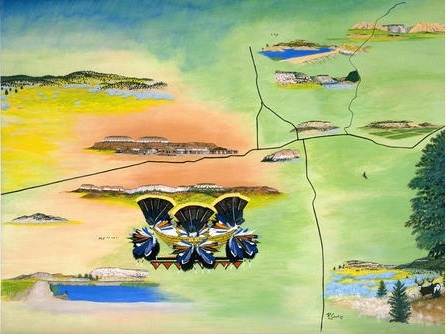
Ronnie Cachini’s 2006 acrylic, Ho’n A:wan Dehwa:we/(Our Land), Source: AMNH/ of A:Shiw A:Wan Museum and Heritage Center

Ronnie Cachini’s 2006 acrylic, Ho’n A:wan Dehwa:we/(Our Land), Source: AMNH/ of A:Shiw A:Wan Museum

Long before John Wesley Powell steered his boats down the rapids and mapped the Grand Canyon for the US Geological Survey, another set of intrepid explorers had walked, mapped, documented, and guided travelers through the entire Colorado River system. Climb up to the hidden Audubon Gallery on the Fourth Floor of the American Museum of Natural History before January 12 and get a fresh perspective on pueblo cartography in the special exhibition, A:shiwi A:wan Ulohnanne: Zuni World.

 The show features 31 paintings by seven contemporary painters from the Zuni Pueblo of New Mexico – one of the ancient tribes whose ancestors built the cliff dwellings and multistory wonders of the Four Corners.

Installation view in the “quiet gallery” on the Fourth Floor of AMNH

Installation view in the “quiet gallery” on the Fourth Floor of AMNH

After 500 years of seeing their sacred places renamed by the conquistadors, Spanish land owners, government mapmakers, and the National Park Service, Zuni cultural leaders thought it was high time to start creating maps that reflected traditional Zuni place names, stories, and symbols. They asked some leading Zuni artists to choose the story, sacred sites, and landscapes that would “map” Zuni cultural history. According to some of the artists in the show, the exercise required them to look at what they knew in an entirely different way.

The Zuni people consider their place of origin to be the Grand Canyon. Back in deep time, the Zuni ancestors were instructed to find “the Middle Place”, so groups set out in journeys to the north, south, east, and west. The northern group, for example, settled in what is now called “Navajo National Monument” and eventually built multistoried dwellings inside the most spectacular red-rock shelter in the American Southwest.

Cliff dwellings in Betatakin alcove, a NPS site at Navajo National Monument where pueblo elders continue to hold sacred ceremonies. Photo: Dan Boone/Ryan Belnap, Bilby Research Center, Northern Arizona University

Cliff dwellings in Betatakin alcove at Navajo National Monument, where pueblo elders travel to hold sacred ceremonies. Photo: Dan Boone/Ryan Belnap, Bilby Research Center, Northern Arizona University

Each painter’s style is different, but when you take it all in, the exploration story is one of fairly mind-blowing proportions – the Zuni ancestors explored the entire Colorado River system, carved petroglyphs in canyons to point travelers to nearby communities, and even journeyed south to the “land of endless summer” –Central America’s coastal communities.

Although the paintings depict myths and symbols in the Southwestern landscapes, East Coast art-lovers should be aware that the Zuni expedition story isn’t fiction: Chaco Canyon’s great archeological sites contain the evidence — tropical shells, stones, Scarlet macaw skeletons, cacao, and the network of banked, engineered roads (circa 850 – 1100 A.D.) that actually lead to many of the places depicted by the Zuni painters.

Geddy Epaloose’s 2006 acrylic, The Middle Place. Source: AMNH/ of A:Shiw A:Wan Museum and Heritage Center

Geddy Epaloose’s 2006 acrylic, The Middle Place. Source: AMNH/ of A:Shiw A:Wan Museum and Heritage Center

Geddy Epaloose’s 2006 painting The Middle Place features an aerial view of Zuni’s Middle Village with sacred trails spiking out in all directions. Colorado River by Ronnie Cachini includes the edge of the distant ocean. Other paintings include the Zuni’s version of their Great Flood, the spiritual importance of their salt lake, and even unmarked lines representing some modern paved roads. Unless you’re Zuni, you’ll have to read the captions on each of the paintings.

Hunted deer is honored with a Zuni necklace

Hunted deer is honored with a Zuni necklace

AMNH has one of the largest collections of Zuni artifacts in the country, and has a good, close working relationship with that pueblo. Entering the Audubon Gallery on the Fourth Floor feels like a sacred space. You’ll be greeted by a hunted deer honored with a necklace of precious stones and ceremonial rods festooned with pieces of traditional Zuni clothing loaned by the painters and their children for us to see while their work is on display in New York.

Make a pilgrimage to this hidden gallery on AMNH’s Fourth Floor and learn about some remarkable people, places, origins, and cartography. (And stop into the First Floor rotunda to see some of the museum’s Chaco Canyon treasures.)

Enjoy this short YouTube video featuring Jim Enote, the director of A:Shiw A:Wan Museum and Heritage Center, who describes the exhibition when it debuted iat the Indian Pueblo Cultural Center.

Magritte’s Surrealist Train Departing MoMA for Houston

Magritte’s 1938 oil, La durée poignardée (Time Transfixed) from The Art Institute of Chicago’s Winterbotham Collection. © Charly Herscovici ADAGP–ARS, 2013

Magritte’s 1938 oil, La durée poignardée (Time Transfixed) from The Art Institute of Chicago’s Winterbotham Collection. © Charly Herscovici ADAGP–ARS, 2013

One of the most recognizable trains in the history of modern art hasn’t left the station. It’s coming out of the wall at MoMA until January 12 as part of the tribute to Belgium’s only big-time Surrealist painter, Magritte: The Mystery of the Ordinary, 1926–1938. But don’t worry – this intriguing tribute chugs on, arriving at The Menil in Houston on Valentine’s Day (February 14) and at Chicago’s Art Institute on June 25. Catch it, because it’s loaded with new revelations, in person and on line.

In person: So many of paintings are icons of 20th century art, that it’s shocking to think that one anarchic visual artist had the chops to turn out so many great works in such a relatively short period of time. Walking through the first couple of galleries, you’ll recognize many famous images, but check out the dates on the labels: 40 were done in just his first three years in Paris between 1927 and 1929! He was so prolific, it makes you wonder when he made time to hang out at cafes, discuss dreams, and publish with Breton and the rest of the crew.

Jasper Johns owns the small version of Magritte’s 1935 oil La clef des songes (The Interpretation of Dreams), which uses English. © Charly Herscovici ADAGP–ARS, 2013. Photograph: Jerry Thompson

Jasper Johns owns the small English version of Magritte’s 1935 oil La clef des songes (The Interpretation of Dreams). © Charly Herscovici ADAGP–ARS, 2013. Photo: Jerry Thompson

Magritte liked making the familiar unfamiliar, playing with fact and fiction, probing dreams and reality, and appropriating pop culture into an art context.

Like Andy Warhol, Magritte began as an ad illustrator, and MoMA’s curators have included a few of his early fashion illustrations. It’s surprising to know that phrases that he injected onto his canvas (like “Ceci n’est pas une pipe”) were written in a script that was one of the most recognizable fonts used in European newspaper and magazine ads in the Twenties.

Was appreciation of Magritte’s ground-breaking cultural appropriation and subversion lost on our own American Pop pantheon? Not really, and the evidence is that one of the best examples of Magritte’s sly presentation of an everyday-object grid with ironic words was lent by the midcentury grandmaster, Jasper Johns.

So much contemporary pop culture and advertising art has reinterpreted, reimagined, and referenced Mr. Magritte’s images that it’s easy to forget that they rocked the world in the Twenties. His reverberation with our beloved 1960s Pop masters (and this show) reminds us that Mr. Magritte truly blazed an innovation pathway in taking the everyday and turning it into art.

MoMA discovered something lurking beneath the surface of its Magritte’s 1936 oil, Le portrait (The Portrait). Gift of Kay Sage Tanguy. © Charly Herscovici ADAGP–ARS, 2013

MoMA discovered something historic lurking under Magritte’s 1936 , Le portrait (The Portrait). Gift of Kay Sage Tanguy. © Charly Herscovici ADAGP–ARS, 2013

And speaking of pioneering, check out the amazing interactive site that lets us enter Magritte’s mind; learn how he turned nature, desire, dreams, language, and symbols into troubling, evocative, subversive works; and see the behind-the-scenes conservation and curatorial work. The beautiful, musical experience is designed by Hello Monday, and should probably win a Webby Award. See it now.

You’ll see how MoMA took off the old varnish, examined the canvases under ultra-violet light, and did detective work of which Magritte and his silent-movie-icon inspiration, Fantômas, would be proud.

Spend time letting each painting’s mini-site load into your browser window, click to hear the curators talk, and keep scrolling down to see what the conservators discovered. You can even toggle back and forth to see the surface of the painting and X-ray.

As a preview, here’s the YouTube video about the “lost” Magritte painting that conservator Cindy Albertson found lurking underneath The Portrait.

And while you’re at it, you might take a minute to see what technology was at work in possibly Magritte’s most famous image:

FIT’s Fresh Take on History via Monocles, Wigs, and Gowns

1924 short-hair, no-hips “boy” look with the signifying monocle.

1924 short-hair, no-hips “boy” look with the signifying monocle.

FIT’s powerful exhibition, A Queer History of Fashion: From the Closet to the Catwalk, throws open the window on what the curators felt was an untold story, and they’ve done history proud — creating a show and website featuring key clothing, points of view, and socio-political breakthroughs during more than 250 years of LGBT history. Visit before January 4.

If you think you know everything about fashion, peruse FIT’s downstairs gallery (or the website) and see how quickly you learn a new angle, a clue, or an insight from the context in which the curators tell their story – a style, epaulet, pattern, tie, mod look, or detail that conveys entirely new meaning.

Right at the foot of the stairs, you’re confronted with side-by-side late 19th century and early 20th sartorial clues sported by the era’s elegant lesbians and gay dandies – shirt collars and ties and Mr. Wilde’s telltale green carnation.

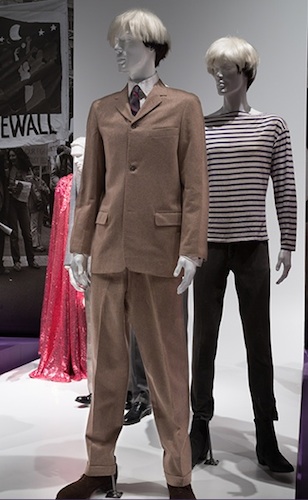
The suit that Andy had made in Hong Kong in 1956 on his first trip abroad compared to his super-hip King of Pop 1960s uniform.

The suit that Andy had made in Hong Kong in 1956 on his first trip abroad compared to his super-hip King of Pop 1960s uniform.

Entering the main gallery, you’ll meet monocled ladies of 1920s Montmartre posing in the “boy look” that went viral throughout the Twenties. Yes, the short hair and mode de le garçonne was adopted by every flapper in the world, but the curators link these changes to trends first sported in scandalous Parisian same-sex clubs.

The clothes tell story after story of how iconic fashion trends were first incubated within gay subcultures – Gernreich’s unisex caftans in the 1960s, YSL channeling Marlene’s tuxes into his 70s “Le Smoking” looks, leather trends in the 80s, and Versace’s bondage dresses in the 90s.

The mannequins have often been touched up with accessories and wigs to evoke innovators and eras, such as the two wigged Warhols, including his striped T and skinny jeans look that seems so “now”.

Other clothes suggest additional narratives: slinky glamour gowns channeling a gay designer’s obsession with feminine ideals, camp queen adaptation of exaggerated feminine points of glory, pre- and post-Stonewall sartorial identity, and even what people are wearing today for their same-sex wedding ceremonies.

Naomi flaunting Gianni’s 1992 bondage-inspired leather couture.

Naomi flaunting Gianni’s 1992 bondage-inspired leather couture.

So many stories, so little time. The security guards literally had to turn the lights off last Saturday night (when FIT closes at 5pm) because the throngs of captivated museum-goers simply didn’t want to leave with so much yet to absorb – Dietrich’s cross-dressing wardrobe on loan from Berlin’s film museum, a Charles James gown from Doris Duke, a Halston provided by Lauren Bacall, the iconic CK underwear billboard image from Times Square, Larry Kramer’s YSL Rive Gauche suit from the 70s, a Mugler-designed gown for chanteuse Joey Arias, and Ru Paul’s red vinyl…well, outfit.

And we haven’t even touched upon the Versace section filled with his Warhol patterns, studded leather, and Baroque-print fantasies. One fan confided that it was her second time because the visuals, details, and narratives were so much to take in.

If you can’t get there before January 4, check out the clothing, concepts, oral histories, and historic timeline on line and yak about it on Facebook.

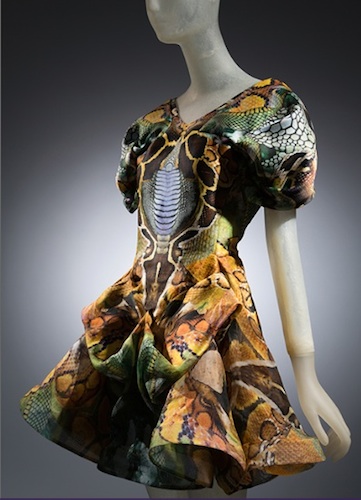
From Mr. McQueen’s Plato’s Atlantis collection, 2010.

From Mr. McQueen’s Plato’s Atlantis collection, 2010.

Hear what inspired curators Valerie Steele and Fred Dennis in this 6-minute Culture Beat episode, and go to FIT’s YouTube site to hear what 20 designers, celebs, and academics had to say at FIT’s symposium on the queer history of fashion.

Here’s Simon Doonan of Barney’s (think windows) talking about how gay style had an impact on the 1960s look on Carnaby Street (so, that’s where those flowered shirts came from!), why overt visual influences are not so evident today, and why the next generation needs to learn about the “fallen heroes” of the late 20th century design community.

When Whales Walked Explained at AMNH

Whales exhibit tells the evolution story. Courtesy: Museum of New Zealand Te Papa Tongarewa

Whales exhibit tells the evolution story. Courtesy: Museum of New Zealand Te Papa Tongarewa

Right inside the exhibit, Whales: Giants of the Deep, the American Museum of Natural History answers two questions that have stumped centuries of nature lovers – how did the world’s largest sea-loving mammals ever evolve from land animals, and who are their closest relatives?

In the last 20 years, DNA experts and paleontologists have been hacking away at these questions, and the show provides some startling visuals and answers: Whales (a group that includes dolphins and porpoises) came from four-legged animals that hovered close to shore lines, snapping up fish. Oh, and their closest relatives on the Mammal Tree of Life are…get ready…hippos. See the show before January 5.

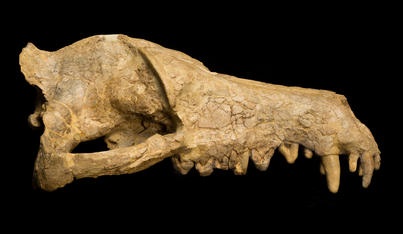
Clue to solving the mystery – the skull of Andrewsarchus, three feet long, found in 1923 by Kan Chuen Pao on AMNH’s second Gobi expedition. Courtesy: AMNH/R. Mickens

Clue to solving the mystery – the skull of Andrewsarchus, three feet long, found in 1923 by Kan Chuen Pao on AMNH’s second Gobi expedition. Courtesy: AMNH/R. Mickens

The first thing you’ll see is a massive skull of Andrewsarchus, a 45-million-year-old whale cousin, who would have stood over six feet tall at the shoulder. He was found in Mongolia on the famous AMNH Central Asiatic Expedition in the 1920s (remember the dinosaur eggs?) and to this day is the only one found.

The paleo team compared the features on his skull to other mammals, ran their analysis through cladistics software, generated a family tree, and learned that Andrewsarchus falls somewhere near the evolutionary point where whales and hippos had a common ancestor, a key clue.

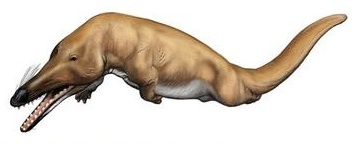
Artist Carl Buell’s depiction of Pakicetus, the oldest known ancestor to  whales

Artist Carl Buell’s depiction of Pakicetus, the oldest known ancestor to whales

A huge discovery in Northern Pakistan in 1983 began to unlock the rest of the mystery. Found in 50-million-year-old Eocene rocks, remains of the enigmatic, four-legged, fish-eating Pakicetus were discovered at the edge of what was once an ancient sea. It was deemed by scientists to be the earliest known modern-whale ancestor. Many specimens were unearthed, with ear bones looking like modern-day dolphins, but ankle bones more like a pig’s, giving scientists a reason to place his ancestry in the “artiodactyl” category, which includes hippos, pigs, antelopes, camels, and other even-toed hoofed animals. Subsequent finds and DNA analysis of modern whales further solidified the hippo-relation hypothesis.

Cladogram showing family relationships of whales and artiodactyls from the AMNH guide for students in grades 6-8

Cladogram showing family relationships of whales and artiodactyls from the AMNH guide for students in grades 6-8

The show includes a full replica of his skeleton, along with other fossils from the subcontinent showing the transition of four-legged wolf-sized animals to the streamlined bodies that we now associate with ocean- and river-going cetaceans. You’ll see a terrific video that animates the transition from longer-snouted, web-footed fish-eaters that paddled through estuaries (Ambulocetus), to more streamlined sea-going mammals whose front legs became flippers and back legs disappeared nearly completely. Kutchicetus (43-46 million years ago) shows evidence that it probably did some deep dives, and Durudon (37 mya) had nostrils at the top of his head, flipper-hands, and apparatus at the end of his tail that suggests a support for flukes.

A clue from India. Artist Carl Buell’s depiction of Kutchicetus, dweller in ancient tropical seas

A clue from India. Artist Carl Buell’s depiction of Kutchicetus, who lived in ancient tropical seas

The show was originally organized by the Museum of New Zealand Te Papa Tongarewa, and features a mix of AMNH and Te Papa artifacts and insights.

There are many other wonderful biological, historical, and cultural details to the whale story, as the YouTube below shows (84K hits and counting), but shout-outs must be given to the two stars — large Sperm whale skeletons (think Moby Dick) on display, lovingly named and transported here by the Maoris, who found the stranded duo, prepared, and blessed them for special appearance in New York.

Artistic and Ethnic Identities Explored in La Bienal at El Museo

Ethno Portrait Cultural Test Shot by Sean Paul Gallegos alongside Reserved Ancestry made from Air Jordans, Arrow collars, and fur.

Indian Removal Act Skeuomorph by Sean Paul Gallegos wearing Reserved Ancestry (on right) sculpted from Air Jordans, Arrow collars, and fur.

Get to know some of NYC’s best new artists by strolling through El Museo del Barrio’s La Bienal 2013 on the Upper East Side before January 4.

Full of fun, reality, street life, high-art provocation, and what it’s like to be an artist in 2013, the show has it all – installations, videos, performance-art artifacts, photographs, sculptures and even a tintype. Take a look at some of our favorites on the Flickr feed, and go to the excellent website for El Museo La Bienal 2013: Here is Where We Jump, the seventh edition of this working contemporary artist showcase, which explores both formal-art and ethnic identity issues.

Small detail of Ignazio Gonzalez-Lang’s “Guess Who” – a grid of 100 inkjet prints of police sketches that appeared in NYC newspapers papers. In this 2012 work, he arranged very similar portraits side by side.

Small detail of Ignazio Gonzalez-Lang’s Guess Who – a grid of 100 inkjet prints of police sketches that appeared in NYC newspapers papers. In this 2012 work, he arranged very similar portraits side by side.

Look closely at the pieces by Sean Paul Gallegos, an artist who considers himself a product of colonial ancestry (his father is Tiwa and Spanish from New Mexico and his mother is Cree and French from Canada). Gallegos juxtaposes his “anthropological” self-portrait with his Native American-inspired headdress made entirely out of cut-up Air Jordan sneakers, Arrow shirt collars, and fur.

A grid of 100 inkjet prints of police sketches by Ignazio Gonzalez-Lang, an NYC Puerto Rican artist, also puts identity to the test. For Guess Who, he’s collected police sketches that have appeared in New York City newspapers, slapped them into a grid, and arranged them in pairs that look all-too-similar. Super thought-provoking.

The Cortez Killer Cutz Radio installation by Eric Ramos Guerrero, a Philippines-born artist, also gets into your head but out of your comfort zone. It’s a full-size, two-room simulation of a Southern California hip hop/R&B radio station streaming late-night song dedications by girlfriends to their incarcerated boyfriends.

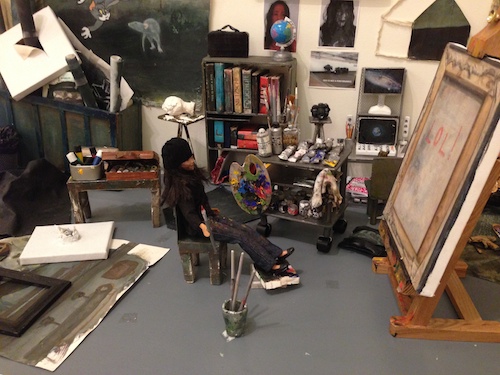
Close-up of the doll-artist contemplating her studio output in Julia San Martin’s Dollhouse

Close-up of the doll-artist contemplating her studio output in Julia San Martin’s Dollhouse

Julia San Martín’s Dollhouse, on the other hand, is a very tiny, detailed installation of a look into the mind and work of the artist. On a miniscule set of her studio, a doll-size painter works on her paintings and drawings, which the Chilean-born artist often rearranges and reshuffles to mimic the working life and consternation of deciding what to paint and what to show.

RISD-trained Gabriela Salazar also looks inward to her studio experience, but in a more formal way. As an artist that often creates large-scale constructed works in the community, she’s taken the remainders of some of her projects – wood shims, foam, cardboard, felt, rope, and wire – and turned them into tiny-scale minimal masterworks, all displayed in a type of “gallery show within a show.”

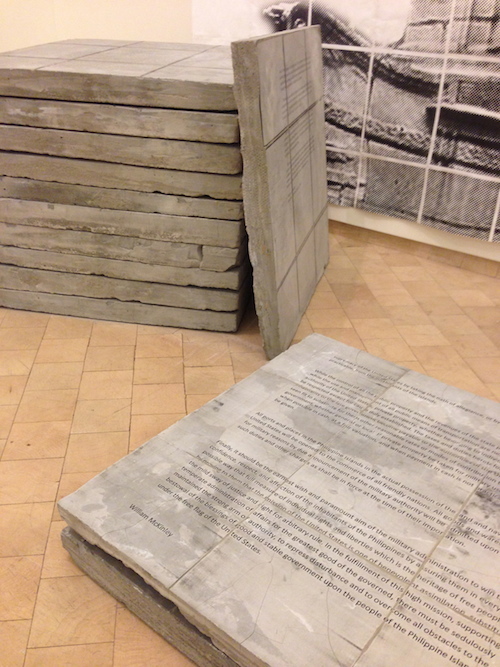
Ramón Miranda Beltrán’s historic documents cast in concrete, featuring President McKinley’s treaties that gave Guam and the Philippines to the US after the Spanish-American War

Ramón Miranda Beltrán’s historic documents cast in concrete, featuring President McKinley’s treaties that gave Guam and the Philippines to the US after the Spanish-American War

And be sure to look for Gabriela Scopazzi’s hilarious Amarilla video where she seranades a captivated group of llamas with an aria. (Sorry, it’s for in-person viewing only and not on the web.)

Work through the show’s website to see more of each artist’s work and learn more about what makes them tick.