Benton’s Freebie Masterpiece at The Met

Viewer contemplates “The Changing West” panel of Thomas Hart Benton’s America Today mural (1930-1931)

Met visitor contemplates “The Changing West” panel of Thomas Hart Benton’s America Today mural (1930-1931)

When times get tough, did you ever take on a job or make something for free just to build up your resume and showcase what you could do? That’s exactly what one New York up-and-comer did, and it really paid off. The Metropolitan Museum of Art’s show, Thomas Hart Benton’s ‘America Today’ Mural Rediscovered, tells the story.

Back in 1930, the New School was just completing its modern building in the Village on West 12th Street and was seeking something to jazz up the boardroom.
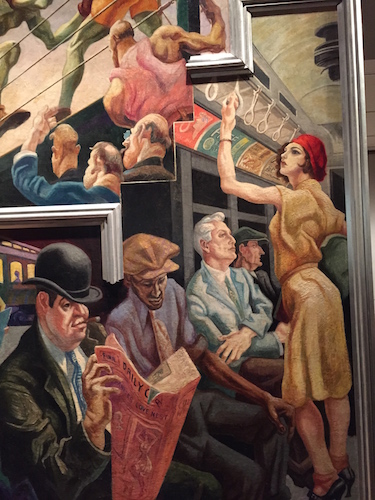
“City Activities with Subway” portion of America Today based on his portrait sketches

“City Activities with Subway” portion of America Today based on his portrait sketches. (It’s Pollack’s sister-in-law, Elizabeth)

Mr. Orozco, the famed Mexican muralist, had already been commissioned for the more visible dining room/lounge, and Mr. Benton, who was teaching at the Art Students League, saw an opportunity to showcase his painting chops.

Social realist chronicler Reginald Marsh had introduced Benton to the mysteries of mastering egg tempera, and Benton felt ready to go to town on a large-scale portrait of American life in all of its regional glory. Here’s the deal: no pay, just loft studio space about a block away.

Twenty years earlier, Benton had hung around Paris, soaking up the birth of the French Cubist and Italian Futurist movements in Europe. Ten years earlier, he roamed around the back roads of the United States, filling up sketchbooks with steel town landscapes, lumber camps, oil derricks popping up in Los Angeles, dives, diners, and small town stuff.

“Steel” portion of the mural, featuring model Jackson Pollack, Benton’s student

“Steel” portion of the mural, featuring model Jackson Pollack, Benton’s student

The mural began taking shape, crammed to the gills with swirling activities, people, industry, and pop culture that he saw. Need models? Why not ask Jackson Pollack, his art student, and his sister to pose?

It’s hard to imagine serious board meetings taking place in a room so alive with oversized ambition and action. Over the decades, the New School repurposed the room for classroom lectures, and over time, the scuffed mural was removed completely.

Lucky for us, Benton’s 1930s historic masterpiece found its way to the Met, which has lovingly restored and installed it in a rectangular room just beyond the Frank Lloyd Wright room.

The curators have filled the adjacent galleries with extra treats: the inspirational sketches from Benton’s earlier road trips and works by Mr. Pollack and Benton’s Village contemporaries.

See our Flickr album to glimpse the installation (and works by early Pollack, Abbott, Marsh from the Met’s collection), and watch the Met curators tell the story of how Mr. Benton’s freebie paid off and their joy in giving this ten-panel chronicle a new home.
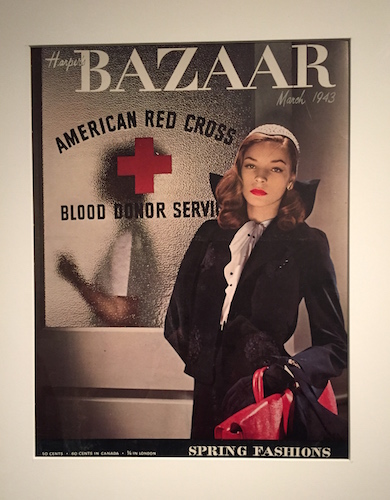
FIT Tribute to Lauren’s Look

18-year-old Bacall poses as a Red Cross WWII nurse on Harpers Bazaar cover, March 1943. Cover photo: Louise Dahl Wolfe

18-year-old Bacall poses as a Red Cross WWII nurse on Harpers Bazaar cover, March 1943. Cover photo: Louise Dahl Wolfe

What’s a New York City style icon to do when you run out of room at the Dakota but can’t bear to part with 700 of your favorite designer dresses, gown, daytime wear, and accessories? Give them to FIT, of course.

The FIT graduate students are paying tribute to the classic simplicity, clean lines, and casual elegance of a particularly generous donor in the capsule show, Lauren Bacall: The Look, on view at The Museum at FIT through April 4.

The show chronicles Bacall’s start (under the watchful eye of Ms. Vreeland) as a Forties’ cover girl and her quick ascent into the Hollywood pantheon as a 19-year-old leading lady in To Have and Have Not with her soon-to-be-husband Mr. Bogart.

The students have unearthed an early studio photo-test of various hairstyles for the Hollywood newcomer – revealing the casual, wavy down-to-the-shoulder look that would be her signature look for the rest of her life.

1968 Cardin dress of Dynel, which can be crushed and washed without losing its shape. Worn in the 1968 CBS fashion special, Bacall and The Boys

1968 Cardin dress of Dynel, which can be crushed and washed without losing its shape. Worn in the 1968 CBS fashion special, Bacall and The Boys

Take a look at clips of Lauren at her best in snippets from famous films, including How to Marry a Millionaire alongside Ms. Monroe and Designing Women.

On to the clothes: The narrow gallery displays a hot pink Norell coat from Sex and The Single Girl, but the focal point of the show is in the back room — an array of frocks custom-fit for Bacall from the leading Sixties designers as part of a 1968 CBS special, Bacall and The Boys.

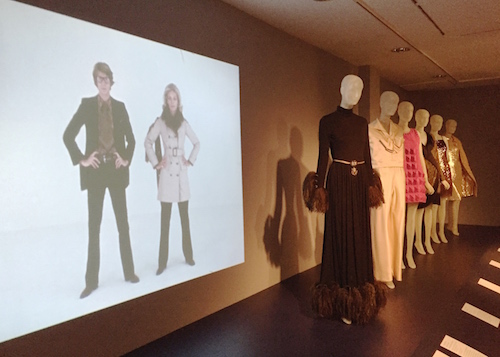
The wall-size projection shows Bacall modeling the outfits you’ll see right in the gallery – looks from Yves Saint Laurent, Pierre Cardin, Mr. Ungaro, and Marc Bohan of Dior. All of the designers make appearances and clearly Ms. Bacall has an artist-muse connection with each of them.

The back wall features a silk Ungaro pantsuit with sleek dresses that became Ms. Bacall’s day-to-day “uniform” around town – most by Norell and Miss Dior. There’s also an iPad featuring close-ups of outfits that don’t appear in this capsule show (but do appear in the FIT show downstairs on Halston and YSL).

1968 CBS special Bacall and The Boys showing Yves Saint-Laurent with Lauren Bacall. Nearby are ensembles and dresses by Marc Bohan of Dior, Cardin, Norell, YSL, and Ungaro.

1968 CBS special Bacall and The Boys showing Yves Saint-Laurent with Lauren Bacall. Nearby are ensembles and dresses by Marc Bohan of Dior, Cardin, Norell, YSL, and Ungaro.

As always, the students have provided some digital punch to the show on line: Click through the FIT timeline, loaded with great 1960s-style fashion illustrations.

See what’s on the iPad by clicking here and enjoy looks from Ms. Bacall’s closet by Ossie Clark, Halston, YSL, Norell, Chanel, and Pucci.

For more of Lauren’s looks, visit the exhibition website, FIT’s Flickr website and our own Flickr site.

Norell’s 1956 “Subway” cashmere silk ensemble.

Norell’s 1956 “Subway” cashmere silk ensemble.

Times Square Time Machine at the Skyscraper Museum

Poster from the Schubert archives of “The City at 42nd Street”, the never-built 1979 mall-superblock plan

Poster from the Schubert archives of “The City at 42nd Street”, the never-built 1979 mall-superblock plan

Two weeks ago, the eyes of the world were on Times Square, but how did it get that way? Take a walk through history at The Skyscraper Museum’s exhibition — Times Square, 1984: The Post Modernist Moment through February 15.

You’ll find out that the crazy, frenetic, chaotic landscape of this town square and its surrounding theaters was nearly lost when the City Fathers and the real-estate community thought Times Square should be “sanitized”. It took wrecking balls destroying several historic theaters to bring activists, celebrities, actors, historians, and preservationists into the streets and paddy wagons to reverse course.

The skyscrapers that were finally built at Times Square, including the Times Towers of 1997 and 2004

The skyscrapers that were finally built at Times Square, including the Times Towers of 1997 and 2004

The Skyscraper Museum has assembled the architectural models, videos, personal memorabilia collections, and planning sketches to resurrect this nearly forgotten war story. See the installation views on our Flickr site.

The show opens with a 1905 Mutoscope film showing the panorama from the top of the new Times Tower – the first skyscraper in that part of town. See it here on the exhibition web site. The Times started the ball drop in 1907, and it’s continued as one of the City’s most famous traditions.

The “Great White Way” name became popular in the 1920s and 1930s to indicate the glow from theater marquees lining Broadway, Seventh Avenue, and the side streets. The second skyscraper wasn’t built until 1927 (the Paramount Building/ Hard Rock Café), and remarkably, no other skyscrapers popped up until 1972.

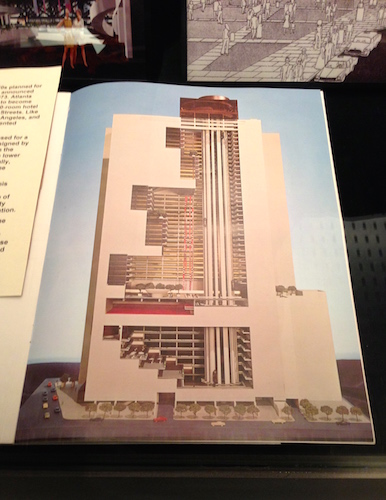
Cutaway drawing of the Portman/Marriott Marquis Hotel (1973-1985), which kept focus inward away from tawdry Times Square

Cutaway drawing of the Portman/Marriott Marquis Hotel (1973-1985), which kept focus inward away from tawdry Times Square

The Portman Hotel (now Marriott Marquis) project was sketched out in 1973, but it took until 1985 to open. The fortress-like complex was designed to look inward on purpose – away from the tawdry street life that characterized Times Square in the “bad old” days when drug pushers, crime, pickpockets, loudmouths, and fistfights were the norm. The atrium and rotating rooftop restaurant were marvels to tourists, who were happy to have an inside-escape route.

By 1979, it was so bad outside that the City proposed some drastic plans to make it all better: Why not tear down a few blocks and make an indoor entertainment mall, complete with a 15-story indoor Ferris wheel and the world’s biggest movie screen? Why not make Times Square look more like Sixth Avenue by building monolithic skyscrapers on each corner of Broadway at 42nd?

Real estate deals ruled the city at the time, and the bonanza created by tourism was still decades away.

Save the Theaters study with 1982 photos of Joe Papp and others protesting the destruction of the Helen Hays and Morosco to build the  Portman. Courtesy: Lee Harris Pomeroy

Save the Theaters study and 1982 photos of Joe Papp protesting the destruction of the Helen Hays and Morosco to build the Portman. Courtesy: Lee Harris Pomeroy

The actors, preservationists, and architects were aghast at plans to tear down so many historic theaters for the Portman/Marriott Marquis and began staging street protests and galvanizing public opinion to save Broadway. Through a lot of community organizing, a Save the Theaters study, and a night where all the theaters turned the lights out, the battle was won. Yes, new towers would be built, but the demolition of theaters would stop.

In 1993, Disney pledged to take over and restore the New Amsterdam, the study identified theater features of historic value (including backstage areas), and a 42nd Street redevelopment effort commenced. Julian Eltinge’s theater (now AMC Empire 25) was moved 130 feet down the street, rehearsal studios were built, and the New Victory brought children’s theater to a house that used to be Minsky’s (and the Belasco).

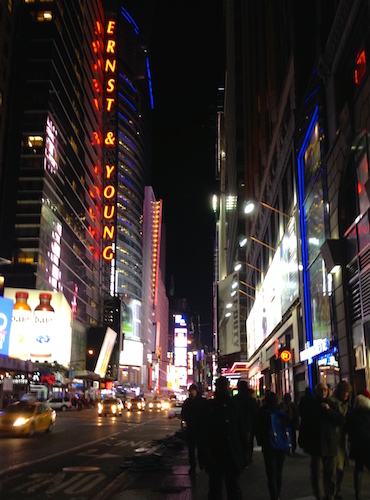
Today, the crossroads is dominated by tall, sparkling skyscrapers and bustling with high-spending visitors. The TKTS island serves as a concrete village green for the entire area.

Looking north today toward Times Square and 42nd Street

Looking north today toward Times Square and 42nd Street

Insiders at the Skyscraper Museum’s winter program at Columbia University let us in on the fact that the there are actually design requirements for flashing signs and billboards in Times Square to be at off-angles and tilts to maintain the slapped-together look of the area – design elements flouted by Vornado’s new block-long HD video billboard.

This short synopsis is only the tip of the iceberg on Times Square. For the full story and history, get to the show and take time to watch Carol Willis’ historic, all-star panel from last November, where you’ll meet the people who saved the Theater District, remade 42nd Street, and created the landscape of Times Square that the world knows today. You’ll never look at it the same way again:


For more, click here to read the exhibition story online and see more photos, videos, and artifacts.

Nature Meditations in the Land of Fire and Ice

Katrín Sigurðardóttir, Haul IV (2004) travelling landscape-in-a-box on loan from private collector. Courtesy: The artist.

Katrín Sigurðardóttir, Haul IV (2004) travelling landscape-in-a-box on loan from private collector. Courtesy: The artist.

When the weather dips below freezing and people think they’re in the Arctic, there’s no better place to get out of the elements and meditate on the landscapes of long, dark winters than the third floor of Scandinavia House on Park Avenue. Until tomorrow, January 10, you’ll join eleven contemporary artists from the sub-arctic on their journeys in a show mounted by the Katonah Museum of Art, Iceland Artists Respond to Place.

Bjork may get all the media attention, but do yourself a favor and walk through this three-gallery show, which beautifully and simply presents the work of Iceland’s other leading visual artists. See the land of fire and ice through their eyes.

Olafur Eliasson, The Aerial River Series, 2000 on loan from private collector. Courtesy: The artist. Installation photo: Ben Blackwell

Olafur Eliasson, The Aerial River Series, 2000 on loan from private collector. Courtesy: The artist. Photo: Ben Blackwell

Olafur Eliasson takes you on an aerial journey along a 60-mile meltwater river, from the mouth to the source. Ragna Róbertsdóttir splatters miniscule lava rocks against a wall but it’s not what it sounds like. Far from a violent eruption, it’s an undulating, mesmerizing meditation that you’ll spend time contemplating.

For sheer romantic and modernist punch, enjoy Georg Guðni Hauksson’s two works – a large landscape memory and a solid dark blue canvas evoking the long winter nights (like an emotional Ad Reinhardt).

Lava rocks “talk” in Egill Sæbjörnsson’s Pleasure Stones installation (2008) on loan from private collector. Courtesy: The artist.

Lava rocks “talk” in Egill Sæbjörnsson’s Pleasure Stones installation (2008) on loan from private collector. Courtesy: The artist.

Egill Saebjornsson takes home the whimsy award with a multimedia installation in which rocks speak (seriously!). Eggert Pétursson zeros in the microscopic natural phenomenon – painting flowers (life sized) in patterns that read like tapestries. You’ll wish you were on some hikes with him. Katrín Sigurðardóttir simply packs up her landscapes into boxes. Tiny, tiny recreations of vast, romantic landscapes.

When we visited the galleries this week, visitors were asking if there was more they could see. Scandinavia House always hosts classy, elegant shows, so although the exhibition space is limited, we have to admit they always leave us wanting to see what’s next from that part of the world.

Seth Myers was recounting his Icelandic adventures this week on Late Night. If you can’t get to the country like Seth or visit the show, at least you can spend chilly days and nights like the natives do, courtesy of this instructional video produced by Scandinavia House:


Pterosaurs Leave New York

AMNH illustration of Mary Anning’s Dimorphodon. Courtesy: AMNH.

AMNH illustration of Mary Anning’s Dimorphodon. Courtesy: AMNH.

They came from all over the world to hang out for the ball drop, but will be gone by the time of the Super Bowl. Yes, the crazy cast of characters in the American Museum of Natural History’s show, Pterosaurs: Flight in the Age of the Dinosaurs, will decamp for their hometowns tomorrow, January 4 just like everyone else who came to New York and had a blast.

Quetzalcoatlus, Tropeognathus, and “Dark Wing” have been putting on quite a show for AMNH visitors since April, and only time will tell if New Yorkers have learned to stop calling them “dinosaurs.” They are flying reptiles.

AMNH illustration of super-tiny Nemicolopterus from China (10 inches) proves that not all pterosaurs were giants. He lived in the forest.

AMNH illustration of super-tiny Nemicolopterus from China (10 inches) proves that not all pterosaurs were giants. He lived in the forest.

The show features life-sized replicas of these flying machines and the big celebrity “Dark Wing” from Germany – the only pterosaur fossil yet found with impressions of the amazing wing membrane that contains layers and layers of thin muscle, all suspended from a single finger.

Get to know more about these amazing animals in the intro to the show, complete with a peppy soundtrack created by the Museum’s digital divas:


When Mary (“She Sells Sea Shells…”) Anning went scouting along Dorset’s Jurassic Coast in 1828, she found little Dimorphodon and sold it to Mr. Buckland, starting a scientific quest to determine the exact nature of these enigmatic creatures.

Happy Ptreranodon in the Vertebrate Origins hall before the crew made him a star of the show inside the Lefrak Gallery.

Happy Ptreranodon in the Vertebrate Origins hall before the crew made him a star of the show inside the Lefrak Gallery.

Most of the press at the time went gaga for the pterodactyl found in Bavaria during the 1830s and 1840s, named Pterodactylus by Mr. Cuvier. Pterosaur fossils have been around so long that it’s hard to believe that this New York show is the first time that these non-dinos have gotten the full star treatment.

Co-curators Mark Norell and Alexander Kellner and the AMNH exhibitions squad took on the jumbo challenge of mounting this first-ever museum show devoted solely to the vertebrates who “invented” flight. Yes, before birds (or bats) took to the skies, fuzzy-bodied pterosaurs were dive-bombing Mesozoic fish, launching from beaches, and leaving their unmistakable footprints on mudflats all over the ancient world.

Click here to see paleontologists searching for pterosaur footprints on an ancient Upper Jurassic beach in central Wyoming.

Pterosaur tracks in the Wyoming sandstone. Crooked forelimb print (L), hindfoot print (R). Taken on a 2006 trackway field trip with the Tate Museum.

Pterosaur tracks in the Wyoming sandstone. Crooked forelimb print (L), hindfoot print (R). Taken on a 2006 trackway field trip with the Tate Museum.

We couldn’t take photos inside the AMNH show of the beautiful pterosaur trackway from the Utah Field House of Natural History in Vernal, Utah, so this Flickr slide show gives you the idea. The shots were taken ten years ago, when paleontologists were still debating whether pterosaurs were bipedal or quadrupedal. As you can see, these Jurassic pterosaurs left quadrupedal tracks.

It’s doubtful that these flying marvels stayed on the beach for long. Watch here to see how gigantic Quetzalcoatlus and friends took off via the animations by the AMNH digital team, based on Michael Habib’s analytics and simulations. You’ll be surprised by what airplanes and pterosaurs have in common:

Philly Hosts Patrick Kelly’s Runway of Love

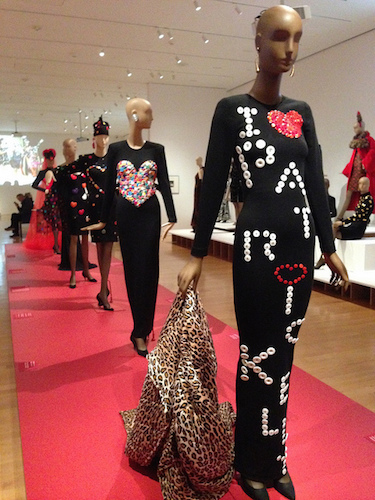
Mismatched button-inspired looks line the center runway in the show (1986)

Mismatched button-inspired looks line the center runway in the show (1986)

Supermodels having fun, crazy colorful buttons, zingy color, and tongue-in-cheek tributes to fashion’s greats – it’s all on display at the Philadelphia Museum of Art’s tribute to one of our all-time favorite fashion designers in the exhibition Patrick Kelly: Runway of Love, on through December 7.

Click here to see our favorite Flickr photos from the exhibition, which has been packed with fashion admirers throughout the show’s run. The gallery is ablaze with life, references to African-American heritage, supermodel sizzle, and the sheer joy that Patrick took in upending fashion’s icons.

The center runway features lots of Patrick’s iconic button dresses, evoking his grandmother’s way of using mismatched buttons to refresh his well-worn clothes as a kid in Mississippi. As a youngster, Patrick consumed acres of fashion magazines – Vogue and Harpers were his favorites – and high-tailed it to Paris as soon as he could.

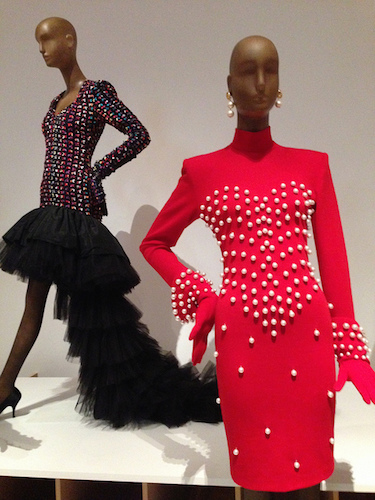
Always fun to spoof Chanel’s use of pearls (1988) and create a Ricci-inspired flamenco dress once modeled by Iman

Always fun to spoof Chanel’s use of pearls (1988) and create a Ricci-inspired flamenco dress once modeled by Iman

He made and sold voluminous coats (inspired by Issey Miyake and Balenciaga) on the streets of Paris to earn cash. But soon his cut-up jersey tube dresses caught the eye of editors of Elle. Maybe it was because he created them for his model-friends to wear on casting calls. When the “tubes” were published, Bergdorf’s placed an order, put his work in their windows, and his career was off and running.

He appropriated sly references to Black culture in the American South and put his own unique high-fashion spin – flouncy dance dresses made from bandana fabric, denim jumpers inspired by sharecropper wear, runway shows with models sporting Blackamoor turbans, and watermelon accessories. Paris went wild over his exuberant runway shows.

A lot of the excitement was over the models who walked his shows — Pat Cleveland, Iman, L’Wren Scott, and other beauties – who cavorted and flounced all his flirty and fun creations. Watch the trailer and see Patrick and his supermodels in action:


Patrick created a bit of fashion history in 1986 when Pat Cleveland interpreted Josephine Baker in Patrick’s famous Banana Dance costume, a collaboration with jeweler David Spada. The photos went viral.

Two looks inspired by Josephine Baker. Left, the “Banana Dance Costume” (1986), a collaboration with jewelry designer David Spada

Two looks inspired by Josephine Baker. Left, the “Banana Dance Costume” (1986), a collaboration with jewelry designer David Spada

The show features videos of Patrick sporting his familiar denim overalls, a joyful designer with a lot of love in his heart for his models, friends, and colleagues. It’s fitting that the museum has posted on its web the things that he loved best. Click here to see Patrick’s Love List and a photo of Bette Davis wearing one of his looks.

If you can’t get to Philly to see the show, click here to see the museum’s site and work your way through each mini-slideshow. The curator’s copy is attached to each look.

Thanks to Bill T. Jones for lending so many of Patrick’s inspired creations and to the museum’s web team that has created such a terrific documentation of this bright light.

And how does a fashion exhibition like Patrick’s all come together? Here’s a backstage look with the exhibitions team:


FIT’s Fun, Flirty Historic Lingerie Show

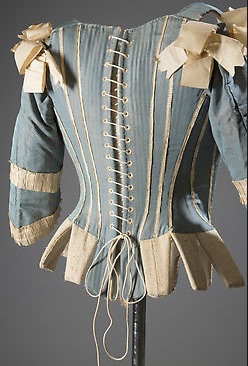
Unusual combination: Sleeves on a silk corset with whalebone stays, circa 1770

Unusual combination: Sleeves on a silk corset with whalebone stays, circa 1770

After sifting through hundreds of corsets, petticoats, slips, nightgowns, knickers, baby dolls, and stockings, the FIT curators have selected 70 key pieces from the archives that lay out trajectory of ladies’ underthings in Exposed: A History of Lingerie, on display through November 15.

The upstairs gallery – usually reserved for gems from FIT’s spectacular collection – takes you on a journey through four centuries of shape-shifting garments that really contributed to the silhouettes of yesteryear. Remarkably, many look totally “today”. The first room pairs underwear and outerwear to make the point.

Hard corsetry items follow next – bustles and corsets from the 17th and 18th centuries, including two that are reckoned to be some of the first examples (at least, in FIT’s collection) of “underwear as outerwear” – a delicate, lavish petticoat and a spectacular 17th century whalebone corset. The telltale signs: If you weren’t showing them off, why would you own a corset with sleeves or a petticoat with such fine hand-embroidered detail?

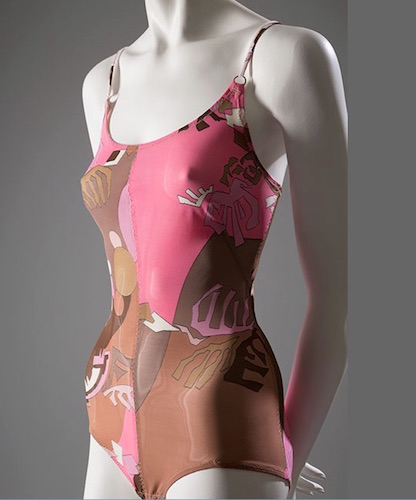
1969 Pucci Lycra-Spandex body stocking for Formfit Rogers

1969 Lycra-Spandex body stocking by Pucci for Formfit Rogers

Predating flappers by more than a century, you can gaze upon the unstructured “natural corset” that 1815 fashionistas wore under their white Grecian-style muslins. One hundred years later, underwear history repeats itself with the 1920s silk underwear designed to be worn under the “corsetless” styles of the Roaring Twenties.

Then it’s on to many more 1920s intimate-fashion innovations – hostess gowns, boudoir mules, French cami-knickers sold at Saks, and the ultimate in period bohemian luxury, the Fortuny tea gown.

Retail history is noted in the 1930s section. Alongside the languid lounging pajamas, negligees, and lingerie-inspired evening gowns, you’ll learn that in 1935, Bergdorf Goodman became the first Manhattan retailer to open up a specialty store within the store specifically devoted to lingerie.

1949 overwire and a 1951 nylon net and silk taffeta petticoat from Dior.

1949 overwire and a 1951 nylon net and silk taffeta petticoat from Dior.

In the 1940s section of the show, special honor is given to Dior’s structured nylon petticoats that gave the New Look’s iconic silhouette its shape, the role of the overwire bra, and the sensation caused by the 1940 debut of nylon stockings – a fashion must-have that quickly became impossible to acquire during WWII.

Historic intimate gems keep appearing through the exhibition, culminating in more recent innovations, such as the Gaultier’s girdle dress, Rudi Gernriech’s no-bra bra, and the revolutionary Wonderbra, as well as up-to-the-minute styles by La Perla, Agent Provocateur, and Victoria’s Secret.

Want to know more? FIT again gives us a stellar on-line exhibition site organized by decade. On each decade, click on “more images” to see nearly the entire exhibition. FIT’s exhibition blog contains the backstory on a dozen or more pieces from the collection.

Even if you’re able to get to Seventh Avenue this week, why not take a walk-through with Coleen Hill, the curator who created this beautiful, thoughtful, and delight-packed show?

The Paper Bag Was Her Design

MoMA honors Margaret Knight, 1870s inventor of the flat-bottomed paper bag

MoMA honors Margaret Knight, 1870s inventor of the flat-bottomed paper bag

What will the MoMA curators pull out of the design collection next? Designing Modern Women 1890–1990, running through October 19, puts the spotlight on furniture, textiles, graphics, performance, kitchens, and even inflatables designed by some innovative women over the last century. How can you not love a show that begins with 1890s modern-dance provocateur Loïe Fuller and ends with 1980s pop icon Grace Jones?

The crowd last weekend was loving every bit of it, pausing to watch videos sprinkled throughout the show and marvel at designs – some 80 to 100 years old that are as modern today as they were at their creation.

The next time you carry away your morning muffin from the coffee counter in that little white paper bag, ponder that the flat-bottomed paper bag was invented in the 1870s by Margaret E. Knight and Charles B. Stilwell. Ms. Knight not only invented this classic, but also invented the machine that made it and was one of the first American women ever to receive a patent.

1901 dinner service by Jutta Sika and Koloman Moser

1901 dinner service by Jutta Sika and Koloman Moser

No, the dinner service is not from Pottery Barn. It was created in 1901 by the Austrian design team of Jutta Sika and Koloman Moser. Didn’t I just see a copy of Eileen Gray’s 1927 adjustable table at the D & D Building? Open shelving in your new, modern kitchen? Yes, that was Charlotte Perriand’s idea, and MoMA has (for the first time) installed this full-size, fully efficient, ground-breaking kitchen from her 1952 project with Le Corbusier.

And what about the Slinky? Invented by Betty and Richard James in 1945. You’ll have fun peering into the design cases and learning more about the women behind some remarkable things.

Slinky was designed by Betty and Richard James in 1945

Slinky was designed by Betty and Richard James in 1945

In the 1960s portion of the show, you’ll see those famous Fillmore posters designed by Bonnie Maclean. And there’s an entire wall filled with iconic pop and punk graphics – all created by female designers – that should be familiar to anyone that traversed the downtown CBGBs scene.

There’s no digital media to accompany this fantastic show, so take a walk through our Flickr site. All of the items are from MoMA’s own collection, and we’ve taken slight liberties by arranging the photos in the show album in chronological order of the year that each design debuted.

And to bring it all back to the beginning of this design innovation tribute: Here’s a glimpse of 1897 Art Nouveau performance art by Loïe Fuller, courtesy of the Lumiere Brothers. The color you see here is a result of hand-tinting the film, but her actual perfomances used new theatrical stage lighting for which she held numerous patents. Listen to the MoMA curators explain her influence, but get over to MoMA (or the Flickr site) to take in this super-fun tribute to 100-plus years of smart women who thought differently and made it happen.

Sailing Life Rafts into Brooklyn’s Submerged Motherlands

The tree touches the top of the Cantor Gallery. Photo: Brooklyn Museum

The tree touches the top of the Cantor Gallery. Photos: Brooklyn Museum

The view is dramatic, but the story is it evokes is even bigger than what’s in the room. There’s still time to travel out to the Brooklyn Museum to have the immersive experience of Swoon’s Submerged Motherlands, closing August 24.

The pictures here just don’t do justice to the super-high wrap-around effect of this walk-through take on the emotional side of rising tides throughout the world. A photo can’t take it all in — a sheltering, 60-foot tree with cut-out paper leaves with some day-after-the-Flood rafts parked down below, all decorated with sketches of the peoples and mothers of the world.

And did we mention that Brooklyn visionary Callie Curry (a.k.a. Swoon) actually built and lived on those rafts for a while? Several years ago, she sailed them up and down the Hudson, on the Mississippi, and across the Adriatic.

Close-up of one of Callie’s rafts. Photo: Brooklyn Museum

Close-up of one of Callie’s rafts.

You’ll get to see these jerry-rigged but seaworthy concoctions up close, and examine the drawings, cut paper, and torn, coffee-stained textiles draping walls, floor, and shelters in this dramatic space.

The feeling it evokes makes you wonder if we’re ready for rising seas and climate change. It’s beautiful, monumental, and reminiscent of our recent lights-out experience of Hurricane Sandy, which tore at the edges of Brooklyn, Long Island, and Staten Island just two years ago – exactly what inspired Callie to take this work in this direction.

Hear what it took for Callie to create this fantastic walk-through installation on Brooklyn’s top floor:


You may also want to hear what Callie has to say about being a working artist in the real world – outside the four walls of a gallery – in her talk from TEDxBrooklyn in 2010. She will show you her rafts in action at Minute 5 and tell you what it felt like to arrive on a hand-built raft in Venice, her projects in post-earthquake Haiti, and interacting with people from the neighborhood as she creates art on the sides of Brooklyn buildings. Truly inspirational.

Dissident Artist Leaves Brooklyn for Second Time

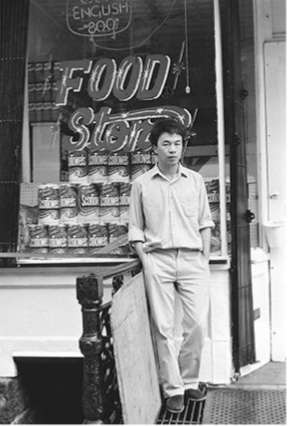
The artist in Williamsburg, 1983. From his New York Photograph Series (1983-1993). Courtesy: the artist

Then: Ai Weiwei in Williamsburg, 1983. From his New York Photograph Series (1983-1993). Courtesy: the artist

If you haven’t yet trekked to Brooklyn to see one of the world’s most famous international provocateurs, go this weekend to see Ai Weiwei: According to What? and get to know the work of the artist who was incarcerated a few years ago by the Chinese government for pulling the veil off its bureaucratic repression and dishonesty. Closing August 10, it’s the last stop on the show’s North American tour – a fitting finale since Ai Weiwei first lived in Williamsburg when he moved to New York back in 1983.

You know him either from his collaboration on the famous “bird nest” stadium at the 2008 Beijing Olympics, smashing Han Dynasty vases as an art project, or from having bulldozers sent by the Chinese government to eradicate his studio in 2011 and being put into house arrest for 81 days – an event that made front-page news and sparked an international outcry – museums and political leaders took out protest ads, made videos, placed flowers on his public works, and called for his release all over the world.

Close-up of R itual, one of the six dioramas of S.A.C.R.E.D. (2011-2013), inspired by his 2008 incarceration. Courtesy of Ai Weiwei Studio. © Ai Weiwei

Now: Close-up of R itual, one of six dioramas of S.A.C.R.E.D. (2011-2013), showing his 2008 incarceration. Courtesy of Ai Weiwei Studio. © Ai Weiwei

Even before you hit the admissions booth, you’ll see his response to all of this – a series of six large, mysterious boxes that make up his work, S.A.C.R.E.D. You climb up to peer into them, right inside Brooklyn’s entrance. Inside, you’ll see everyday depictions of what it was like for him in detainment – eating, sleeping under the watch of the uniformed guards, and interrogations.

Upstairs, you’ll see an expansive show filled with thought-provoking works along with some black-and-white photos of his East-Village life in the 1980s, where he hug with Tan Dun, Xu Bing, and other artists-on-the-move and artists-on-the-run from a conformist Mainland.

At a distance, his sculptures seem like simple, cool contemporary installations. Read the label copy and you realize the subversive is at work. It looks like some found-art piece, but the room is actually filled with the full contents of a young woman’s home. Ai Weiwei found her and all her stuff on the side of a road after the authorities evicted her.

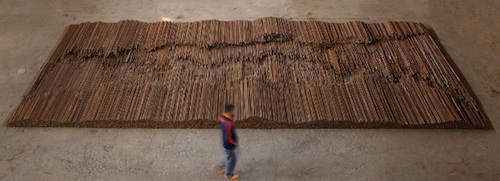
Straight (2008-2012) is made from 70 tons of rebar reclaimed from the Sichuan earthquake and hammered straight back into rods. © Ai Weiwei

Straight (2008-2012) is made from 70 tons of rebar rods, reclaimed from the Sichuan earthquake and hammered straight. © Ai Weiwei

A single room is devoted to Straight, a monumental installation made up of rebar, metal rods used to strengthen concrete calls. Except that this is the actual rebar from the 2008 earthquake that claimed 5,400 young lives in Sichuan Province when the schools collapsed due to shoddy construction practices. He bought the scrap rebar from those buildings, spent four years hammering to straighten them out, and assembled the rods into a 70-ton sculpture. Nearby, he’s listed the names of every school child – something that the Chinese government never did.

Performance art: dropping a Han dynasty vase (206 BC-220 AD), along with other historic ceramic pieces altered by a dip into modern industrial paint (2007-2010). Photo: C. Carver. Courtesy: the artist

Performance art: dropping a Han dynasty vase (206 BC-220 AD), along with other historic ceramic pieces altered by a dip into modern industrial paint (2007-2010). Photo: C. Carver. Courtesy: the artist

How and why does he do it? Find out by listening to Ai Weiwei’s answers to visitors’ questions. You’ll have quite an insight to his thought process, since there are 45 pages of video Q&A. Well worth the time to meet this brave, inspirational artist-activist.

He’s simply one of the top contemporary artists working today and you owe it to yourself to experience work that literally takes on the world. Kudos to the Brooklyn Museum for also publishing the amazing teacher’s guide, which asks students to ponder and think about news, authority, and speaking out.

Watch as the Brooklyn crew assembles Stacked, Ai Weiwei’s 2014 sculpture made from 700 bicycles, a comment on the transportation traditionally used by Chinese commuters until the dawn of the smog-inducing automobile. It’s all happening under the watchful Egyptian eye on Brooklyn’s main floor: