Contemporary Art Extravaganza Provides Time-Travel Portals

The scale and scope of the contemporary art on display is tremendous, but how often do art-seekers also get an opportunity to travel across ancient streets and landscapes, to meet real and fictional historic characters, contemplate fables and real-life stories, and see art of the past and present side by side?

It can take days to experience and fully absorb all of the history and potential futues presented in the films, paintings, sculptures, and installations in Once Within a Time: 12th SITE Santa Fe International, on view across 15 art spaces across Santa Fe through January 12, 2026.

Exhibition banner in the courtyard of Palace of the Governors (1610) (New Mexico History Museum) – gateway to SITE installations by Daisy Quezada Ureña (Santa Fe) and Charisse Perlina Weston. (Harlem, New York)

Besides the expansive white galleries and screening rooms of SITE’s museum in Santa Fe’s always-popping Railyard District, visitors can choose to contemplate giant abstract murals in a church-like auditorium, an innovative historical-object installation in a 400-year-old seat of power, or enter an old foundry to see an evocative installation by a Silk Road artist across farm fields adjacent to the Old Spanish Trail.

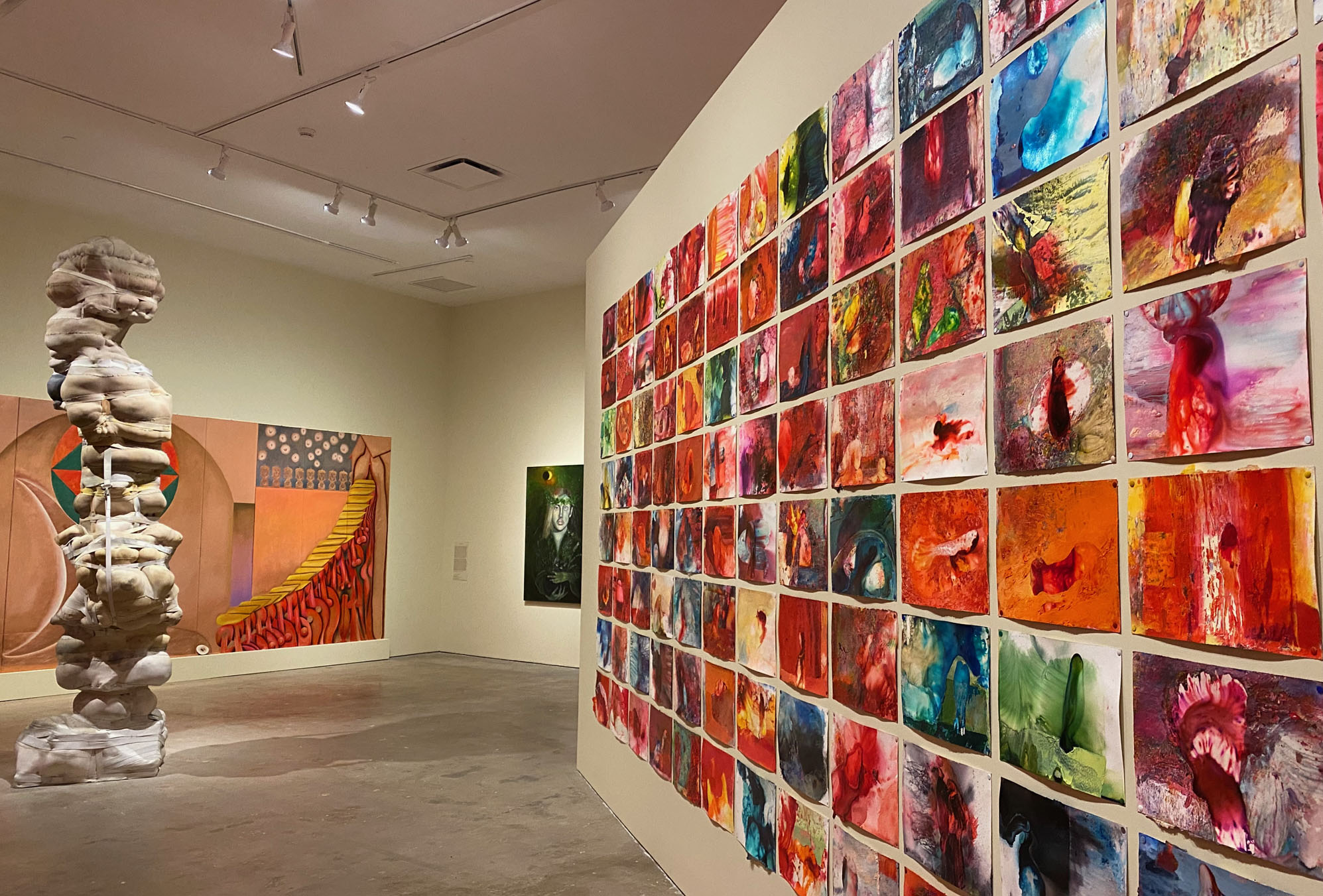
SITE Santa Fe gallery theme: appears like real life and sensual free-thinkers. 2025 mixed-media sculpture “18-1-4-5-7-21-14-4” by Patricia Ayres; copper work by Santiago de Paoli; Katja Sieb’s 2025 “perpetual novice” painting; and 2020 grid painting “Atlas” by Penny Siopis (South Africa).
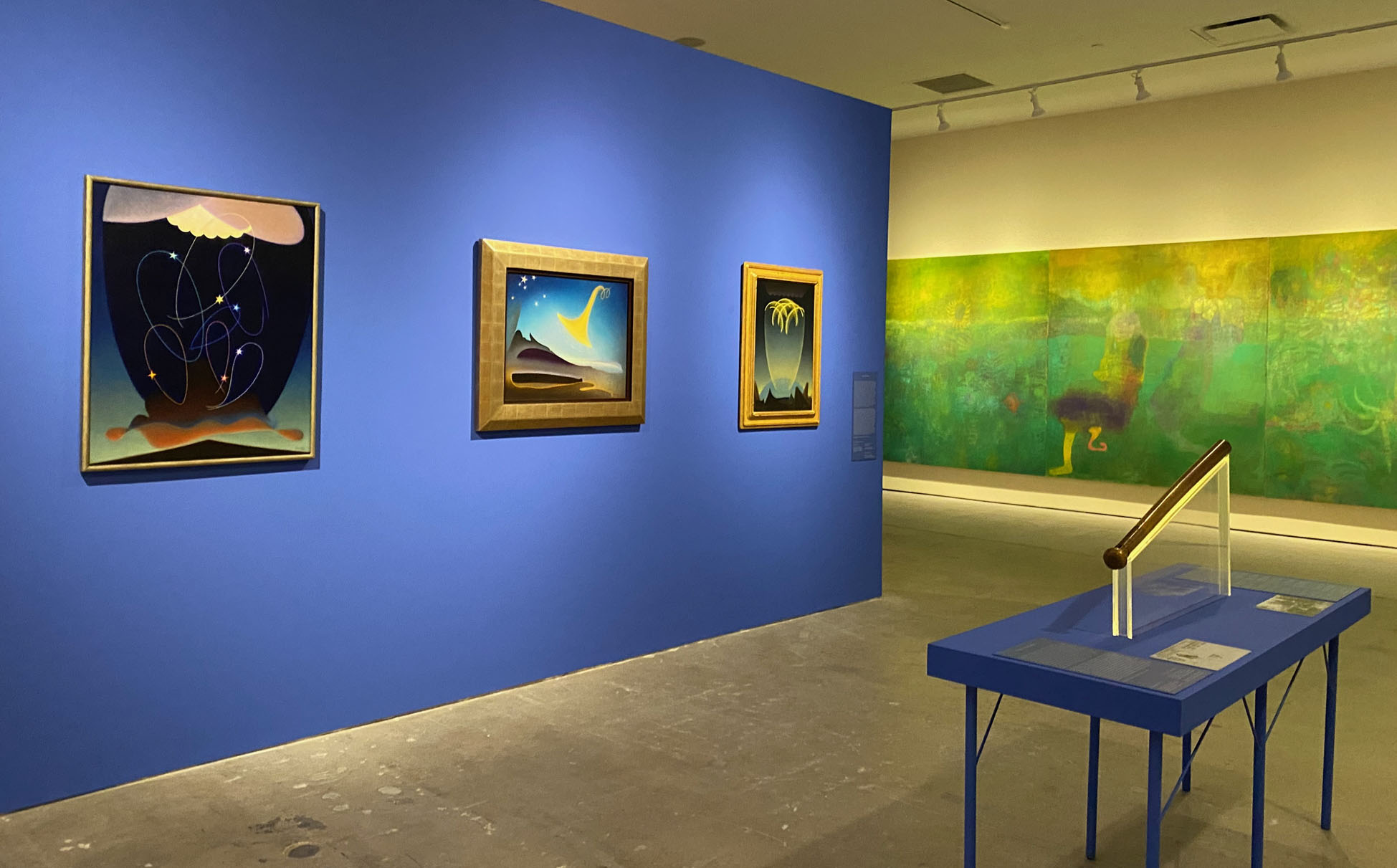
SITE Santa Fe gallery theme: in touch with light (spiritual) – Agnes Pelton’s paintings (1930s), Maja Ruznic’s mural (2025), and the 1895 healing rod of itinerant Southwestern mystic Francis Schlatter. Courtesy: Phoeix Art Museum; New Mexico Museum of Art; Oakland Museum of California; Maja Ruznic and Karma Gallery; and New Mexico History Museum.

In every space and art encounter, visitors may reflect upon whether history is repeating itself and whether inspiration can be drawn from futures that artists imagined nearly a century ago. Each space is designed for visitors to look, read, encounter, and reflect.

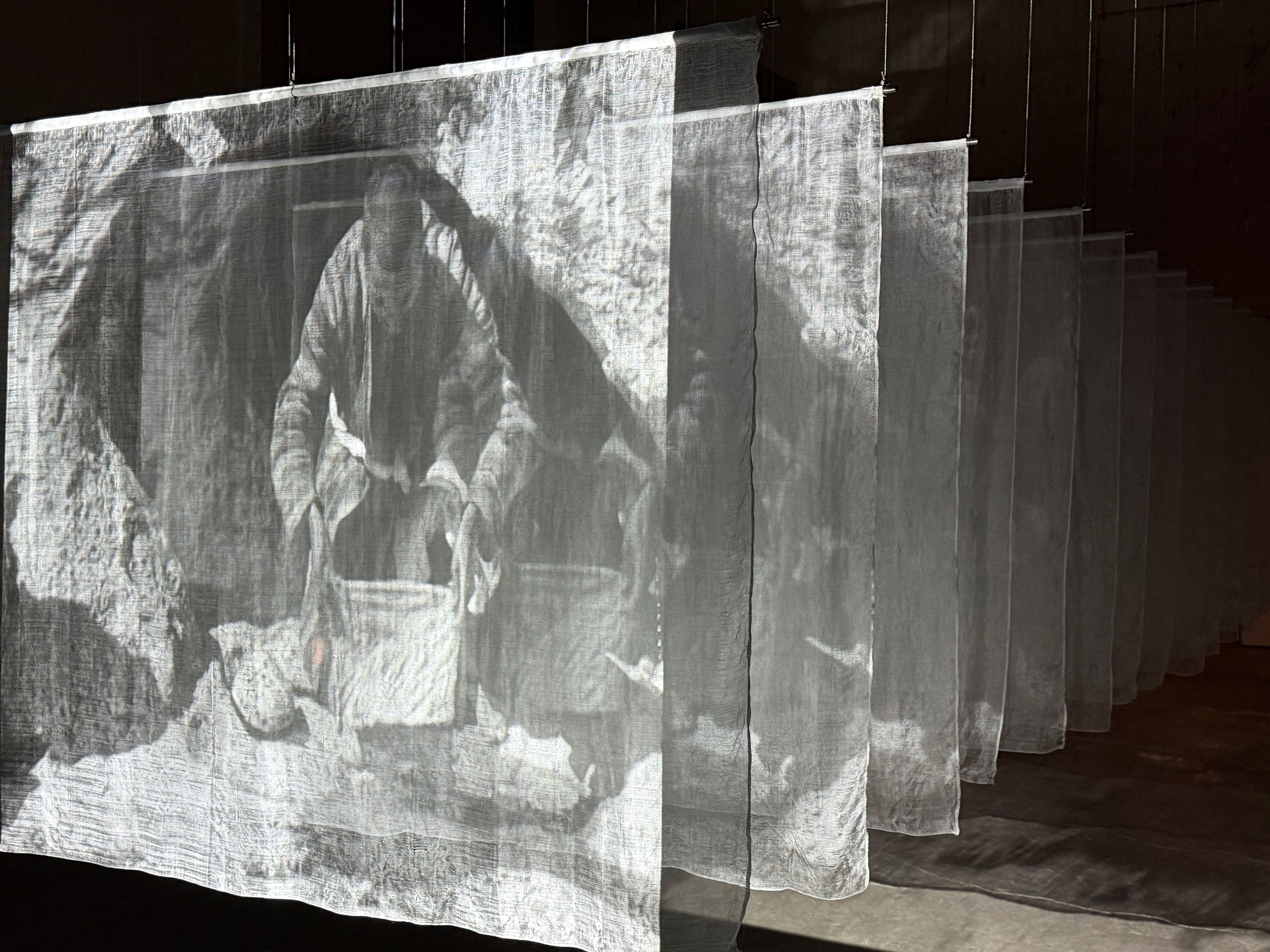
In the old foundry at Tesuque: 2024 video As We Fade by Saodat Ismailova (Uzbeckistan), showing visitors to one of Central Asia’s most sacred sites (Throne of Solomon) along the ancient Silk Road; projected across 24 suspended silk screens. Courtesy: the artist and Milan’s Pirelli HangarBicocca.

The theme for the show – Once Within a Time – is inspired by Godfrey Reggio’s most recent film – a suggestive and wordless mix of innocence, nostalgic images, visual poetry, and the future facing the next generation. The film screens continuously inside SITE, with visitors caught up in Godfrey’s dream-like images, which highlighted in this mesmerizing movie trailer:

Like Godfrey’s film, each space and gallery presents a theme, story, historic character, and provocative contemporary art that pulls back in time, creates an unforgettable experience, and asks the viewer to go inward to contemplate the future. 

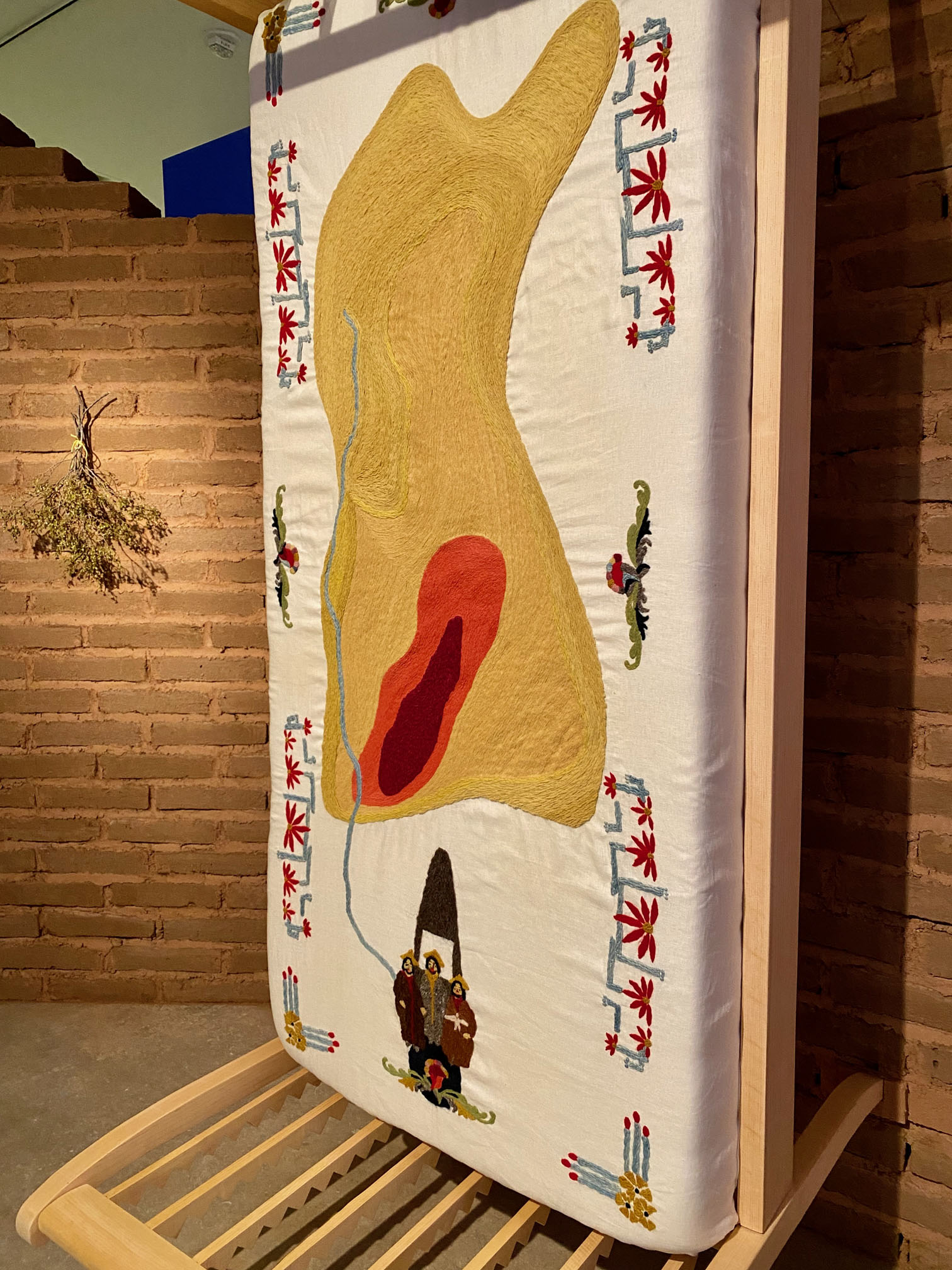
Joanna Keane Lopez’s 2024 Batter my heart, three person’d God – adobe, a handmade bed, colcha embroidery showing a radiation cloud, and creosote bush, referencing her family’s experience of living downwind of the Trinity detonation.

SITE’s galleries, for example, present themes such as storytelling, technology and language, the power of spiritual energy, and New Mexico’s undeniable status as a natural Land of Enchantment.  

The exhibition presents traditional New Mexico superstars and inspirations –  Awa Tsireh and Helen Cordero (San Ildefonso Pueblo), Agnes Pelton, Rebecca Salsbury James, Florence Miller Pierce, Pop Chalee (Taos), Pablita Velarde (Santa Clara Pueblo), and Eliot Porter – alongside artists who are breaking through on the international stage.

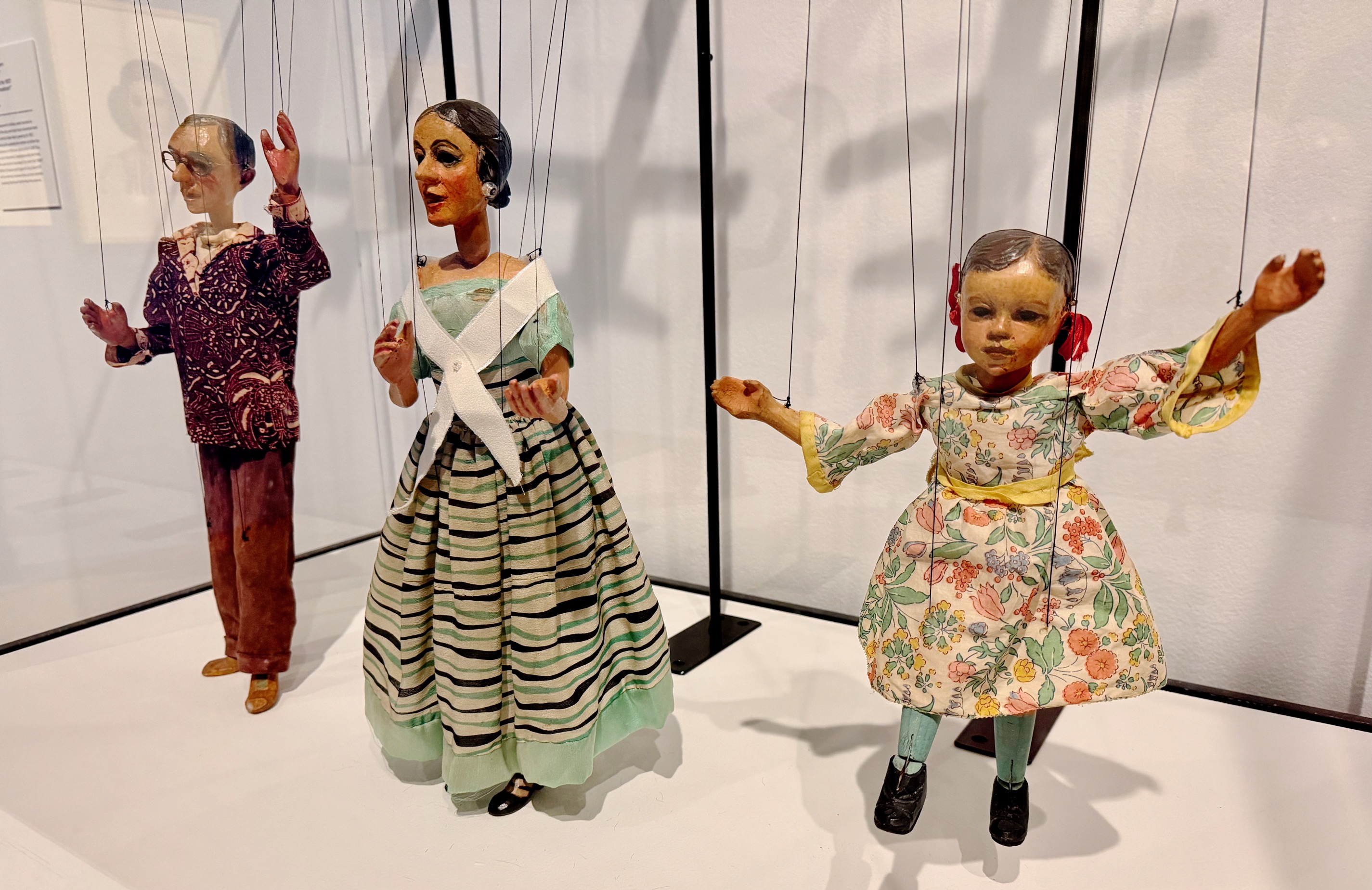
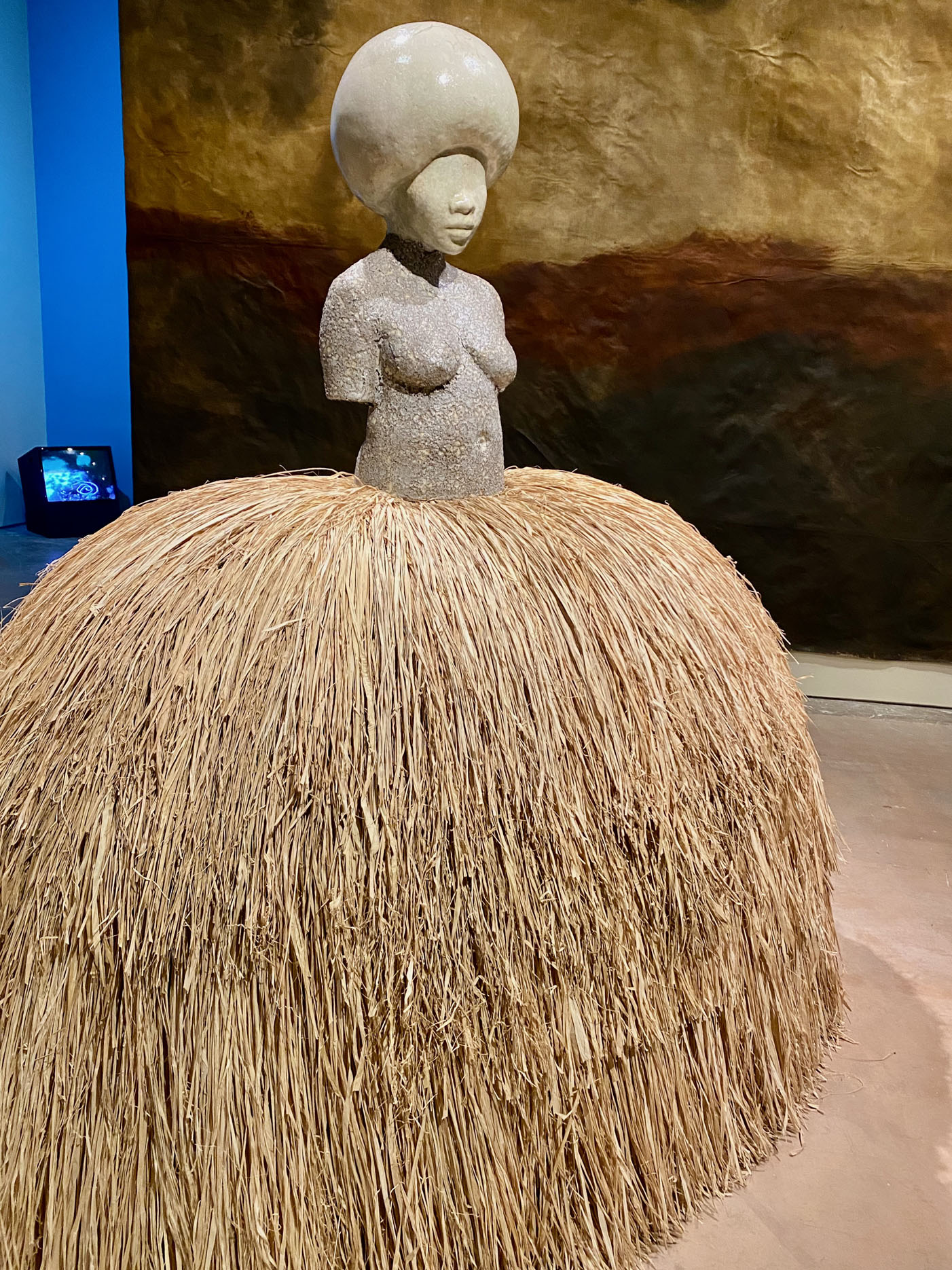
Cochiti pueblo ceramicist Helen Cordero’s storyteller figures are paired with Pablita Velardi’s storyteller illustrations (both are inspired by grandfathers and fathers) and Simone Leigh’s epic stone and raffia goddesses.

SITE Santa Fe gallery theme: storytelling. Simone Leigh’s 2025 untiled stoneware and raffia sculpture. At rear, 2025 oil The Solemn and Dignified Burial Befitting My Beloved for All Seasons by Dominique Knowles. Courtesy: Matthew Marks Gallery; the artist and Hannah Hoffman Gallery, Los Angeles.
Gallery theme: storytelling. Helen Cordero’s 1970 painted clay Storyteller – the creator of the Cochiti Pueblo sculptural tradition, inspired by her grandfather’s stories; championed by patron Alexander Girard. Courtesy: School for Advanced Research.
SITE Santa Fe gallery theme: language Marilou Schultz’s 2024 weaving Integrated Circuit Chip & AI Diné Weaving – a reference to the controvercial 1970s Fairchild Semiconductor chip plant on Navajo Nation staffed primarily with Diné women. Courtesy: private foundation.

The story of the legendary WWII heroes, the Navajo Code Talkers, is featured in a gallery alongside Marilou Schultz’s weavings of chip technology using traditional Diné methods with Fred Hammersly’s ground-breaking IBM computer drawings at the University of New Mexico in 1968-1970. 

Fred was given an opportunity to create the first mainframe-generated art in the form of drawings programmed by traditional IBM punch-card technology and the Art1 program.  SIITE not only displays a selection of the 400 computer drawings that he generated over the course of 18 months, but some of the punch cards he used, which are now archived at the Smithsonian’s Archives of American Art.

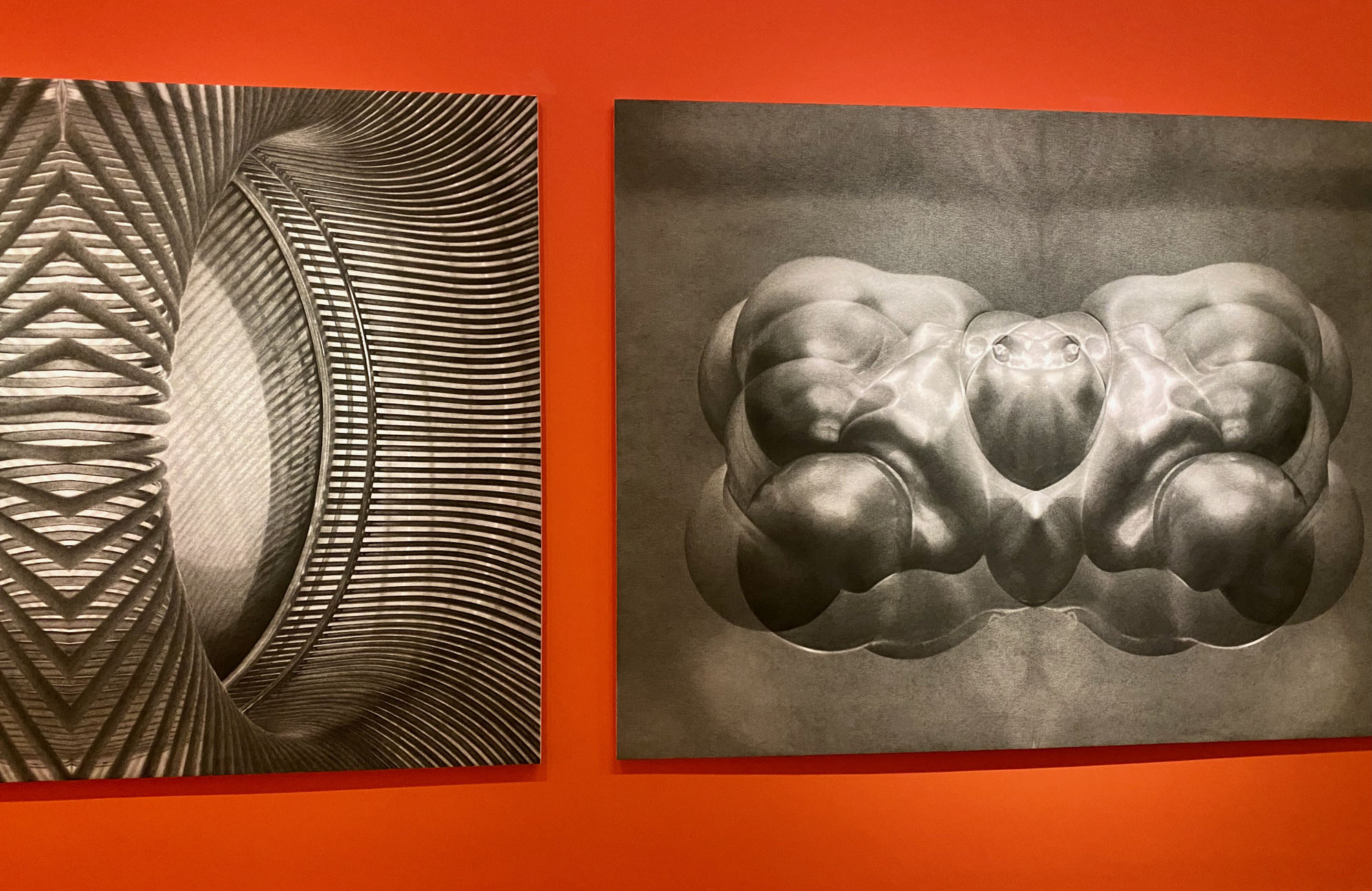
Sensual free-thinkers are represented by the story of Santa Fe gambling mogul Doña Tules (Maria Gertrudis Barceló) and her actual 1840s money chest, witty contemporary porcelain playing cards and magical paintings by Katja Seib (UK), and jaw-dropping drawings by Shanghai’s Zhang Yunyao.

SITE Santa Fe gallery theme: sensual free-thinkers. Two of three 2025 Connector drawings by Zhang Yunyao (Shanghai); pencil on stretched felt. Courtesy: the artist, Don Gallery.

Around the corner from Agnes Pelton’s transcendental paintings are Diego Medina’s landscapes reflecting the Piro-Mansa-Tiwa spiritual power inhabiting ancestral lands of Southern New Mexico and also installations about a different type of New Mexico light – the impact of the nuclear energy tests on people living downwind and the legacy of uranium mining across native lands.

SITE Santa Fe gallery theme:In touch with light (nuclear energy): Will Wilson’s 2025 series Hubris on the Land – aerial photography of abandoned 1940s uranium mines on Navajo Nation paired with his documentation of Land Art sites created by Holt, Smithson, Heiser, and Turrell in the 1960s-1970s. Courtesy: the artist

New Mexico’s natural world is paid tribute in stories and artwork by travelers and residents – watercolors of Pueblo spirits and wildlife by Awa Tsireh (Alfonso Roybal) in the 1930s, Vladimir Nabokov’s sketches of butterfly wing cells (1940s-1950s), and Eliot Porter’s spectacular photos of Tesuque jays in the 1960s.

But these examples are just snippets of Once Within a Time – the entire show deserves multiple visits, and time to visit the other locations in the city, such as the hidden basement natural wonderland epic at the Museum of Internatonal Folk Art created by Taiwan ‘s Zhang Xu Zhan. It’s not only an immersive environment, but a film, animal-spirit sculptures, and selections from the MoIFA’s paper funerary object collection.  Don’t miss the Day of the Dead altar, the 18th-century Pere Lachaise Cemetary tribute initially collected by Mr. Girard himself, and paper funerary fantasies made by the artist’s own family. Truly unforgettable.
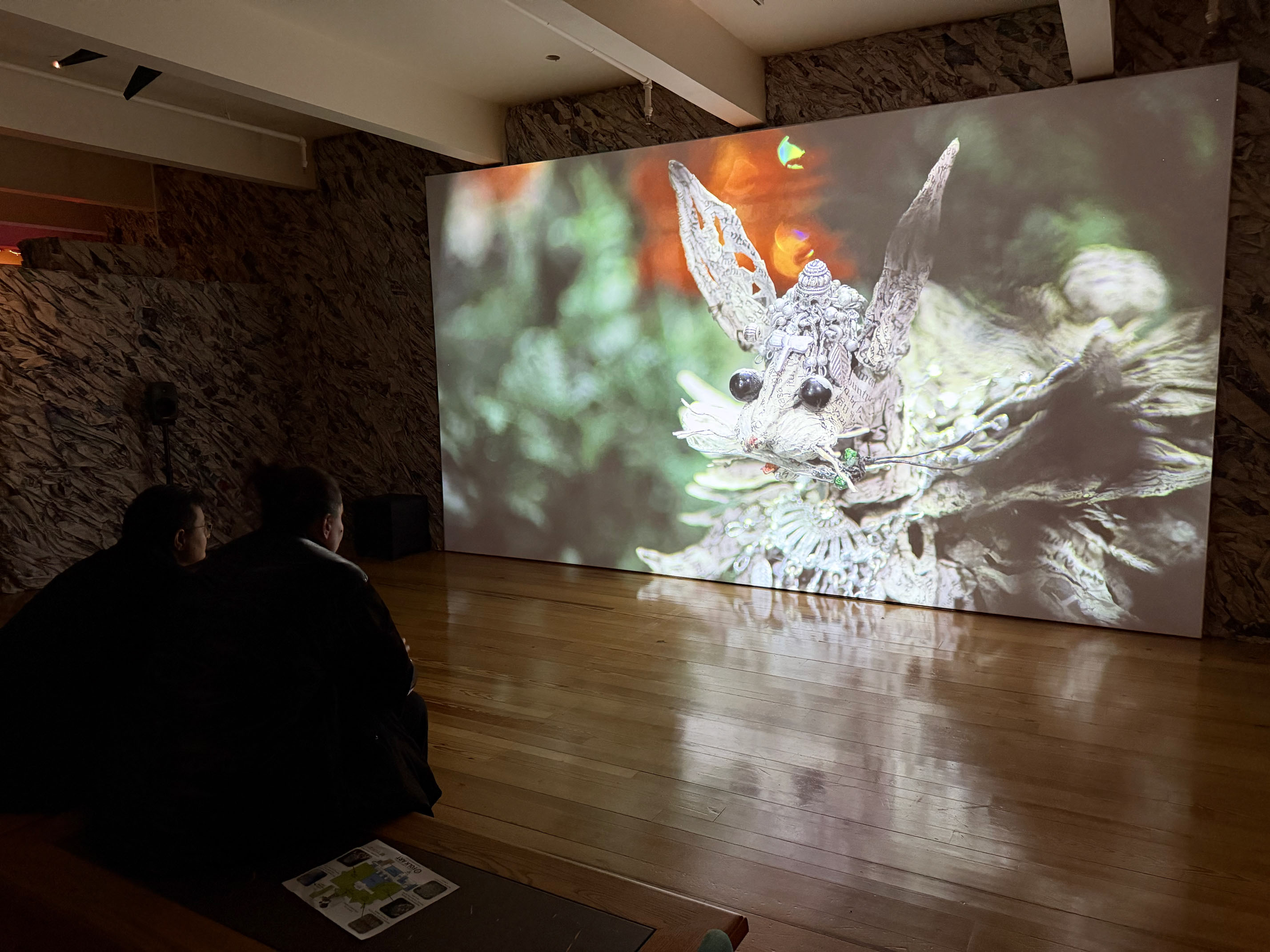
Museum of International Folk Art: Zhang Xu Zhan’s 2020-2022 paper-animation video Compound Eyes of Tropical (Animal story series), with a Southeastern Asian deer-mouse outwitting a group of predatory crocodiles. Courtesy: the artist and Project Fulfill Art Space, Taiwan.

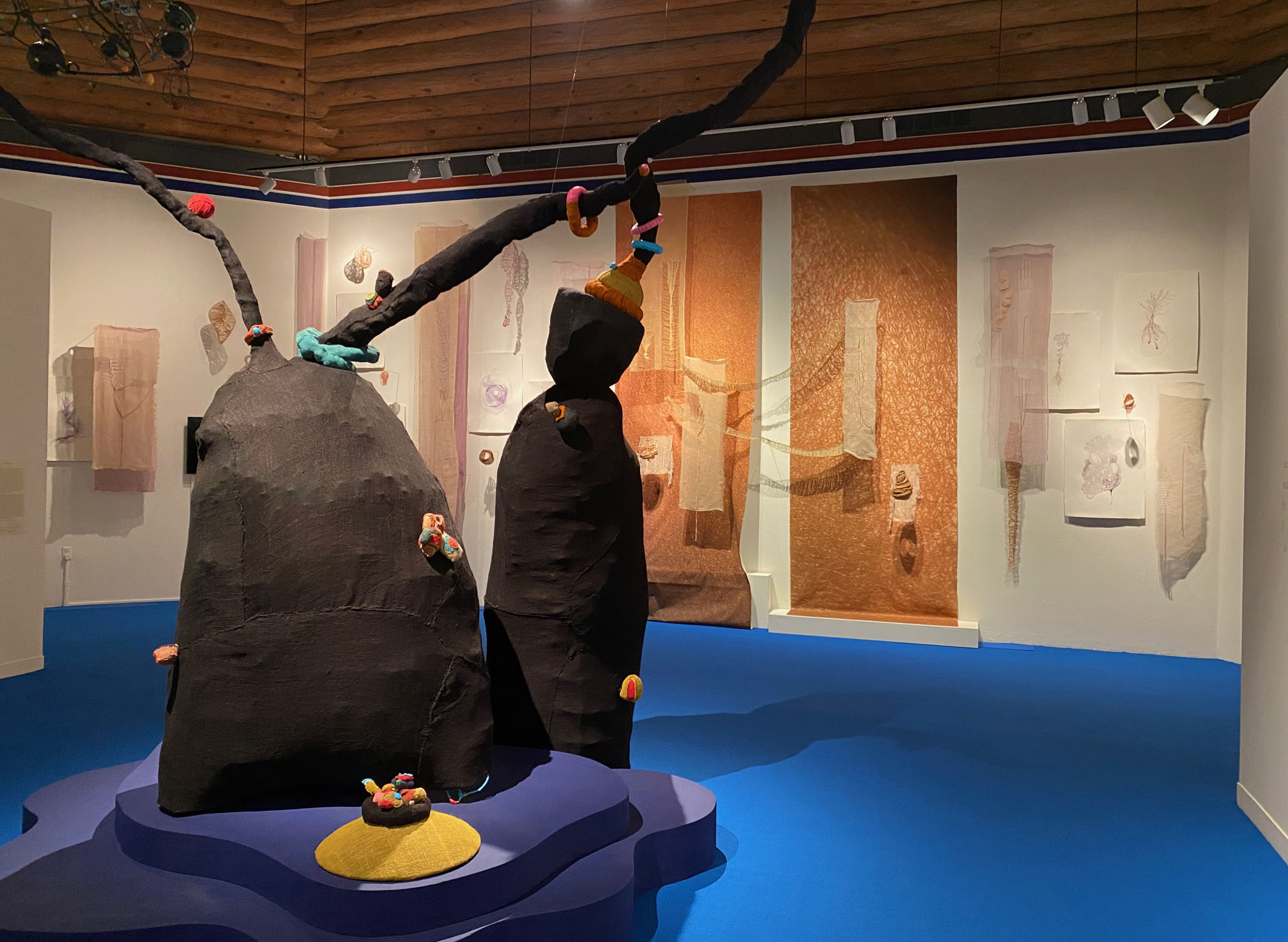
The Wheelwright Museum of the American Indian fills the Klah Gallery (in the shape of a traditional hogan) with a meditation on healing by Cristina Flores Pescorán, a wild organic sculpture by Nora Naranjo Morse, and a mini-retrospective of paintings by the incomparable Emmi Whitehorse.

Wheelwright Klah Gallery theme: journeys. Nora Naranjo Morse’s sculpture Into the Forever; on walls, Cristina Flores Pescorán’s 2025 installation Treinta y ocho. Ofrendas para reescribir historia medica y renacer Huaca. Courtesy: the artists

The Tesuque location also features rooms with installations by Mexico’s Guillermo Galindo incorporating burned wood from the recent New Mexico fires (crossed with Picasso’s Guernica),  David Horvitz’s tribute to the men incarcerated in Santa Fe’s Japanese internment camp (and a hat from one them), and Thailand’s Korakrit Arunanondchai’s room-sized contemplation that incorporates the ashes from the burning of Zozobra.

Video of Korakrit Arunanondchai’s 2025 installation Unity for Nostalgia, with floor incorporating ashes from Santa Fe’s Zozobra’s burning and a prayer to the phoenix; layered soundtrack. Courtesy: the artist, Bangkok City Gallery, London’s Carlos/Ishikawa, CLEARNING NY-LA, Kukje Gallery, Seoul
Video of Max Hooper Schneider’s 2025 Written in Sand (Finquita Garden) installation; spheres mysteriously travel sand channels. Courtesy: the artist; Maureen Paley, London, Hove; Francois Ghebaley, Los Angeles, New York.

For more, take a walk through the main exhibit and five other sites in and around Santa in our Flickr album to see work by legendary New Mexican artists, and travel back and forth to see how contemporary art reflects epic histories and mystic systems of the Southwest.

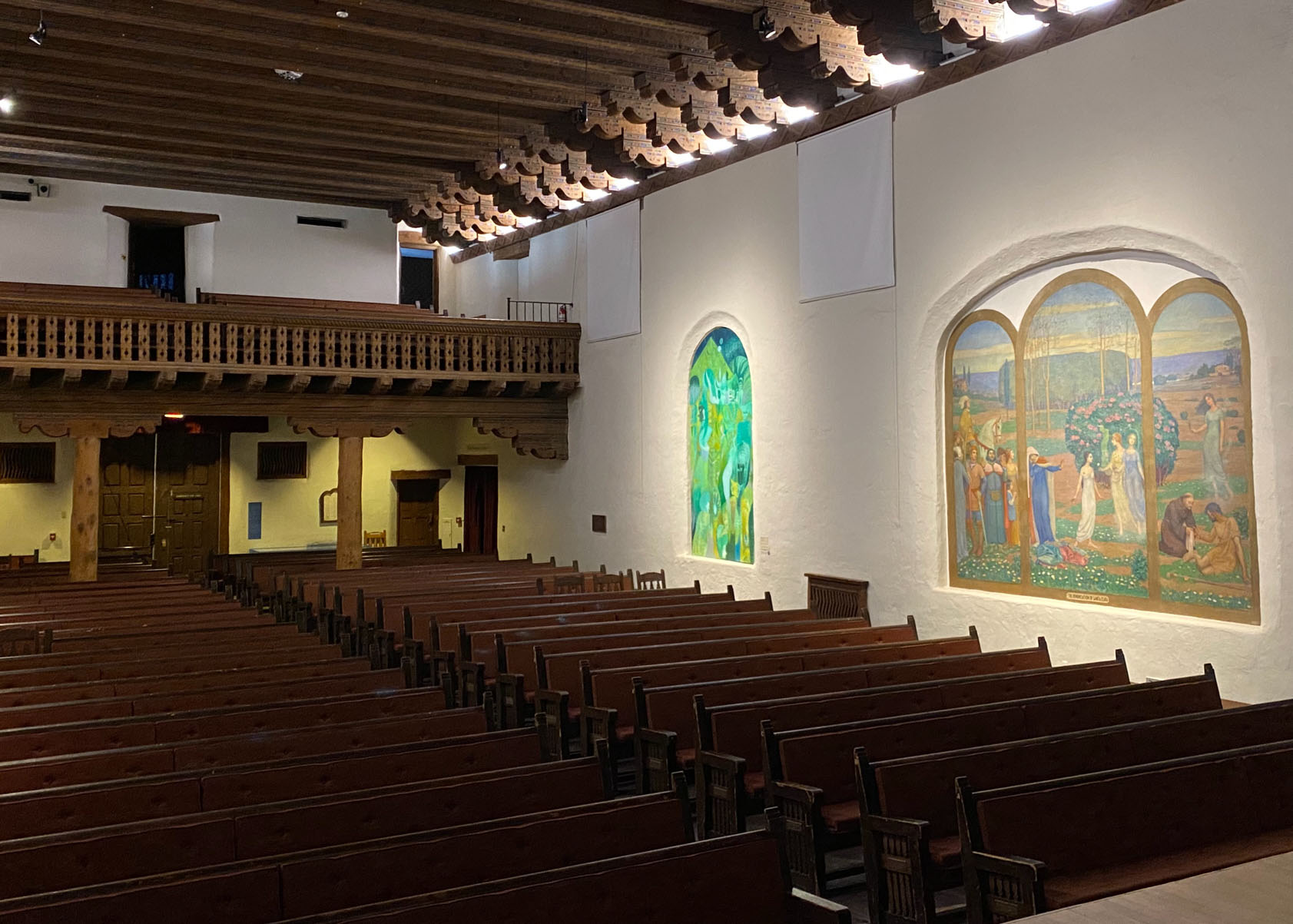
View of historic St. Francis Auditorium (1917) with Maja Ruznic’s 2025 Kisa Pada, Trava Raste, Gora Zeleni installed atop Donald Beauregad’s painting The Conversion of St. Francis; to right, Beauregard’s The Renunciation of Santa Clara.

Hanging Out with Georgia’s Stuff

Fans have had a special opportunity to get up close to that iconic black dress and gaucho hat, OK Calder pin, denim apron, and Marimekko dress in Georgia O’Keeffe: Making a Life, on view in Santa Fe through October 19 2025 at the O’Keeffe Museum.

After you’ve walked through a somewhat chronological presentation of Ms. O’Keeffe’s paintings in the museum, the final two galleries allow you to take a close-up look at tools, cookbooks, and other stuff that she used to make things – sculpture, recipes, pastels, and clay pots.

Photomural of Todd Webb’s 1962 photograph Georgia Making Stew, Ghost Ranch.

Due to the overwhelming popular response to Living Modern, the traveling exhibition that featured O’Keeffe’s wardrobe and chronicled how she portrayed herself for the greatest photographers of the 20th century, the museum curators decided to give visitors a little taste of the woman behind the art.

See some of our favorite things in our Flickr album here, and listen to the museum’s audio guide here.

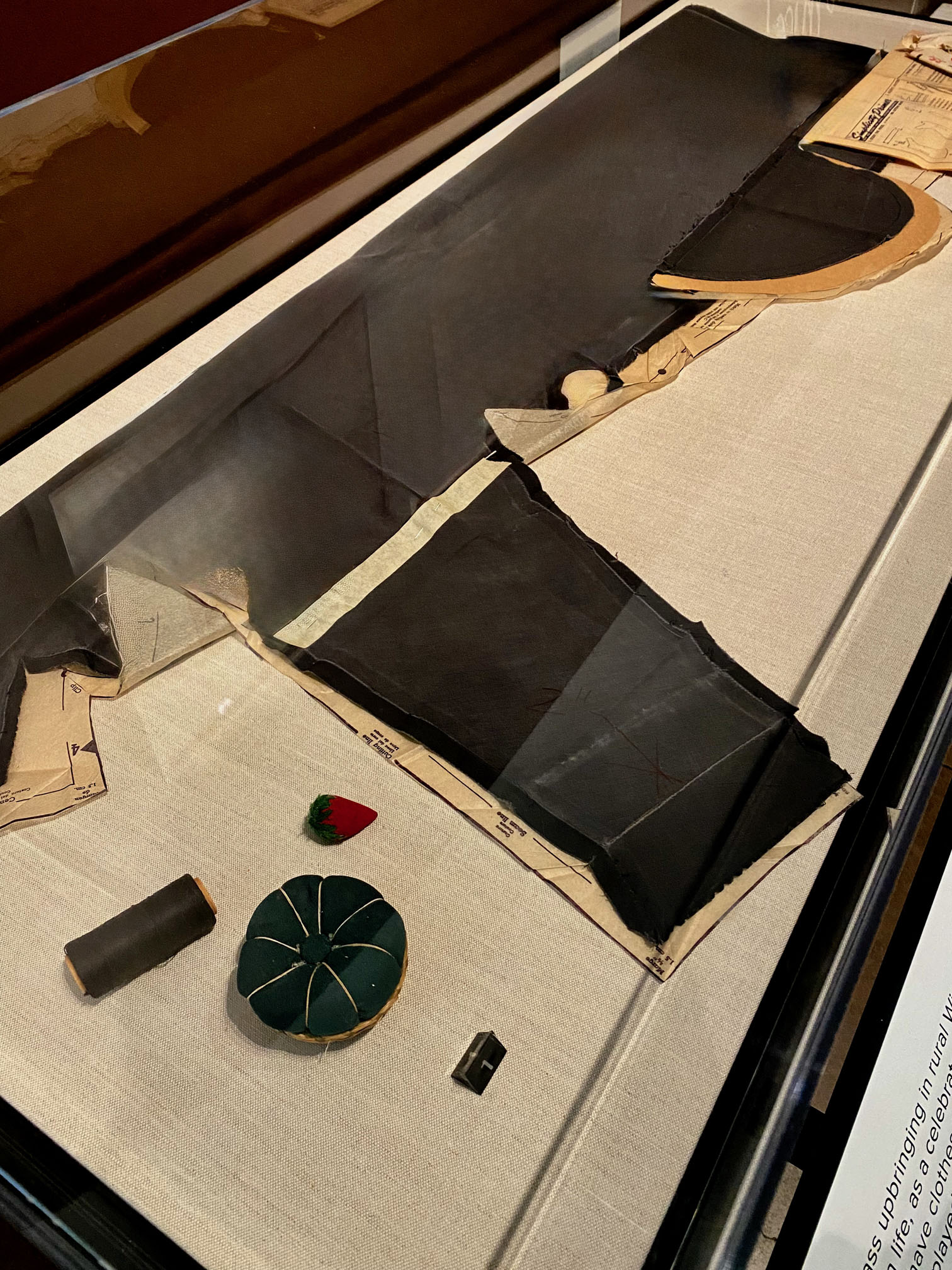
It’s the first time that the O’Keeffee Museum has itself presented her clothing. To emphasize the “making” part of her life in New Mexico, they’ve included a case showing how Santa Fe artist Carol Sarkasian moonlighted as Georgia’s seamstress. There’s a case with sewing notions and cut pattern pieces for another version of Georgia’s always in-style black wrap dress. She totally believed in multiples!

Georgia’s iconic 1960-1970 wrap dress sewn by Carol Sarkasian with 1950 belt by Hector Aguilar; Tony Vacarro’s 1960 Portrait of O’Keeffe with one of her dogs.
 
Sewing notions, cut fabric, and tissue-paper pattern – Carol Sarkasian’s preparation to make a wrap dress for Ms. O’Keeffe.

She also believed in wearing her clothes for a long time, and so they showed they had years of life.

The most popular feature of her Abiquiu home tour is the kitchen and pantry, and learn about Georgia’s farm-to-table approach with her garden, recipies, and day-to-day lifestyle.  Here, you get a glimpse of the modern and traditional appliances used for her daily coffee ritual (yes, she loved Bustelo!) and get to peruse a sampling of her cookbooks and hand-written recipies. 

Shelves with Georgia’s pantry items

One of her unrealized dreams was to write a cookbook, and it shows. She was all about healthy eating and living, and in her later years she relied upon her trusted Abiquiu team to assist with gardening, cooking, and putting out a spread for the constant stream of visitors.  (No recluse, she!)

From the pantry: Georgia’s cookbooks with her hand-written breakfast, rice, and drink recipe cards.

The final room shows the process and tools she used to create her paintings, pastels, and sculptures

There’s a dramatic photomural of Georgia standing in front of her largest sculpture – temporarily housed nearby at the New Mexico Museum of Art until the new GOK museum is built.  Beneath, you see several prototypes – a wax spiral made in 1916 and bronze maquettes from the Forties.

Cast when she was in her nineties, the case demonstrates that she kept making versions of this her whole life and finding inspiration from stuff found on her New Mexico wanderings.

Bruce Webber’s photo of Georgia and her 1979-1980 spiral sculpture; the case below with its inspiration – a ram’s horn and earlier maquettes.

There are things from her travels to Japan, an unfinished work on an easel, and a case showing the pot she made when her assistant, Juan Hamilton, convinced her to keep making shapes, even when her macular degeneration made it impossible for her to paint.

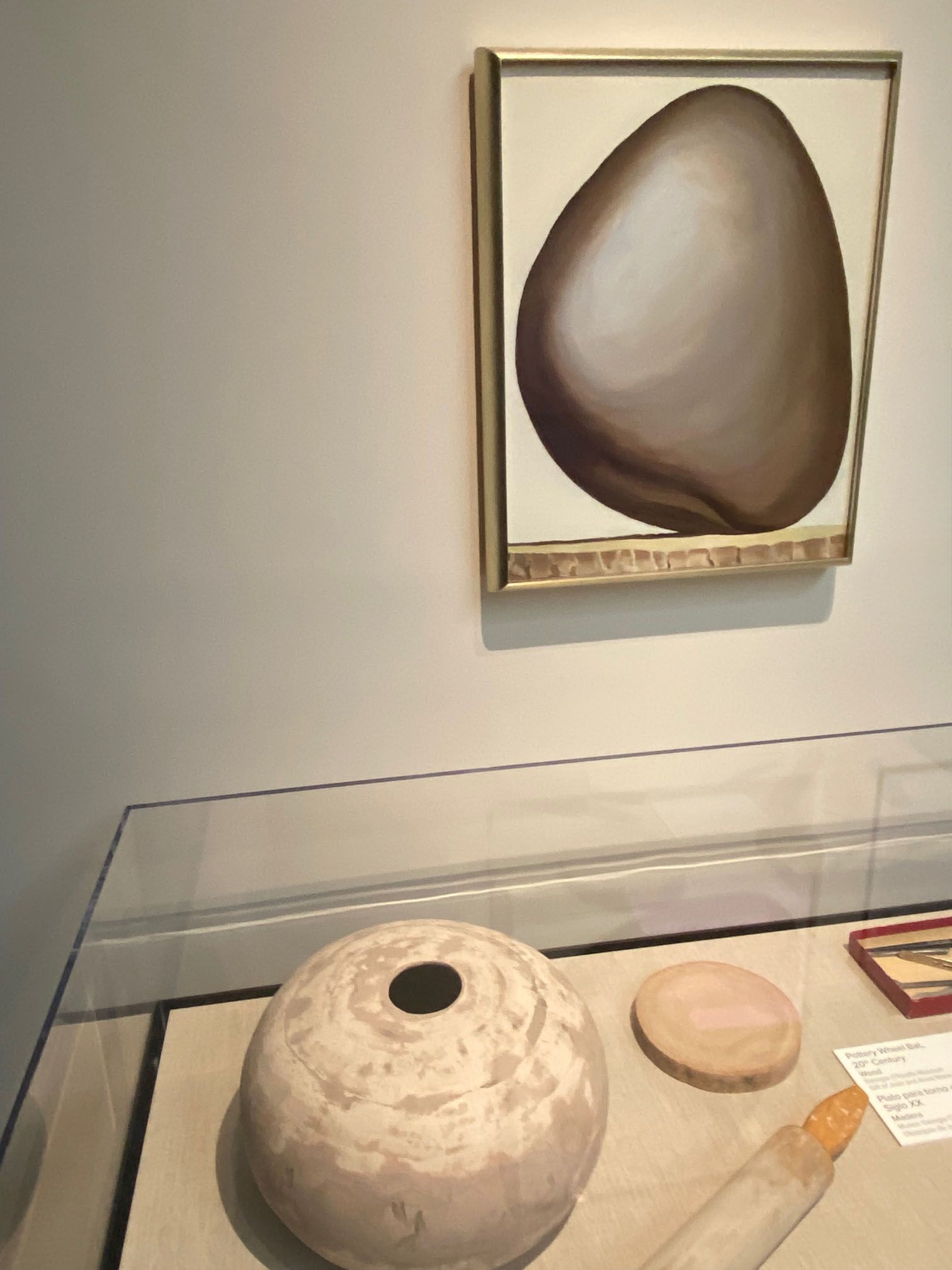
The round, smooth shape echoes the rocks that she liked to collect, so it’s fitting that the museum paired her tools and pot with a beautiful oil painting done of one of her favorites.

1963-1971 Black Rock with White Background; below, Georgia’s 1980 stoneware pot and tools– a pottery wheel bat and Sears rolling pin.
Georgia’s denim studio apron and an unfinished work – a pencil sketch on primed canvas.

For more on Georgia and her life, listen to Pita Lopez, who worked as a companion and secretary for Miss O’Keeffee from 1974 to 1986 and later oversaw maintenance and preservation of her Abiquiu and Ghost Ranch homes.

Sculptor Shonnard Invents a Two-Continent Creative Life

The joyful retrospective Eugenie Shonnard: Breaking the Mold, on view at Santa Fe’s New Mexico Museum of Art through September 1, 2025, tells the story of a determined young artist in turn-of-the-century Brooklyn who seized opportunities to follow her dream, learn from the best, forge lifelong friendships, and transform inspirations of the nature and culture around her into fine art.

In 1927, Shonnard took up full-time residence as Santa Fe’s first academically trained sculptor. For years, the community considered her the “dean of sculpture”, but after she passed away in 1978 at the age of 91, gradually her legacy and accomplishments faded into obscurity.

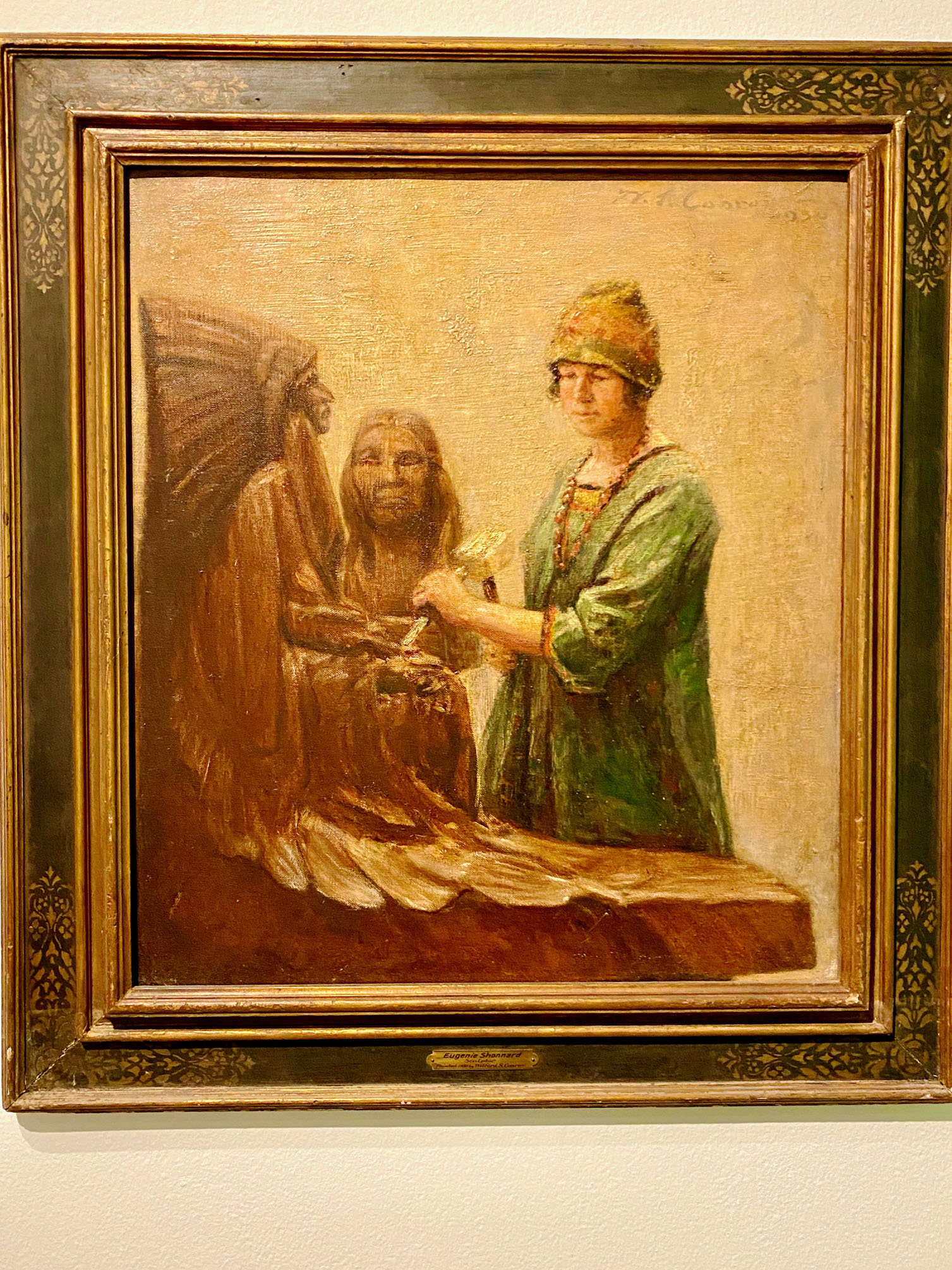
1930 portrait of Eugenie Shonnard in her sculpture studio by Wilford S. Conrow.

This year, the Museum chose to showcase Shonnard’s range of accomplishments – sculpture, painting, furniture, and architectural design. The strategy has worked, since most visitors remark, “What a beautiful body of work! Why haven’t we heard about her before?

Looking at the strong, robust sculptures of Breton peasants and Native American celebrity Dr. Charles Eastman featured in the introductory gallery, you would never guess that Shonnard started life as a sickly child whose wealthy parents kept her close to home. She spent lots of time outdoors with pets, nature, and the serenity of the Hudson Valley.

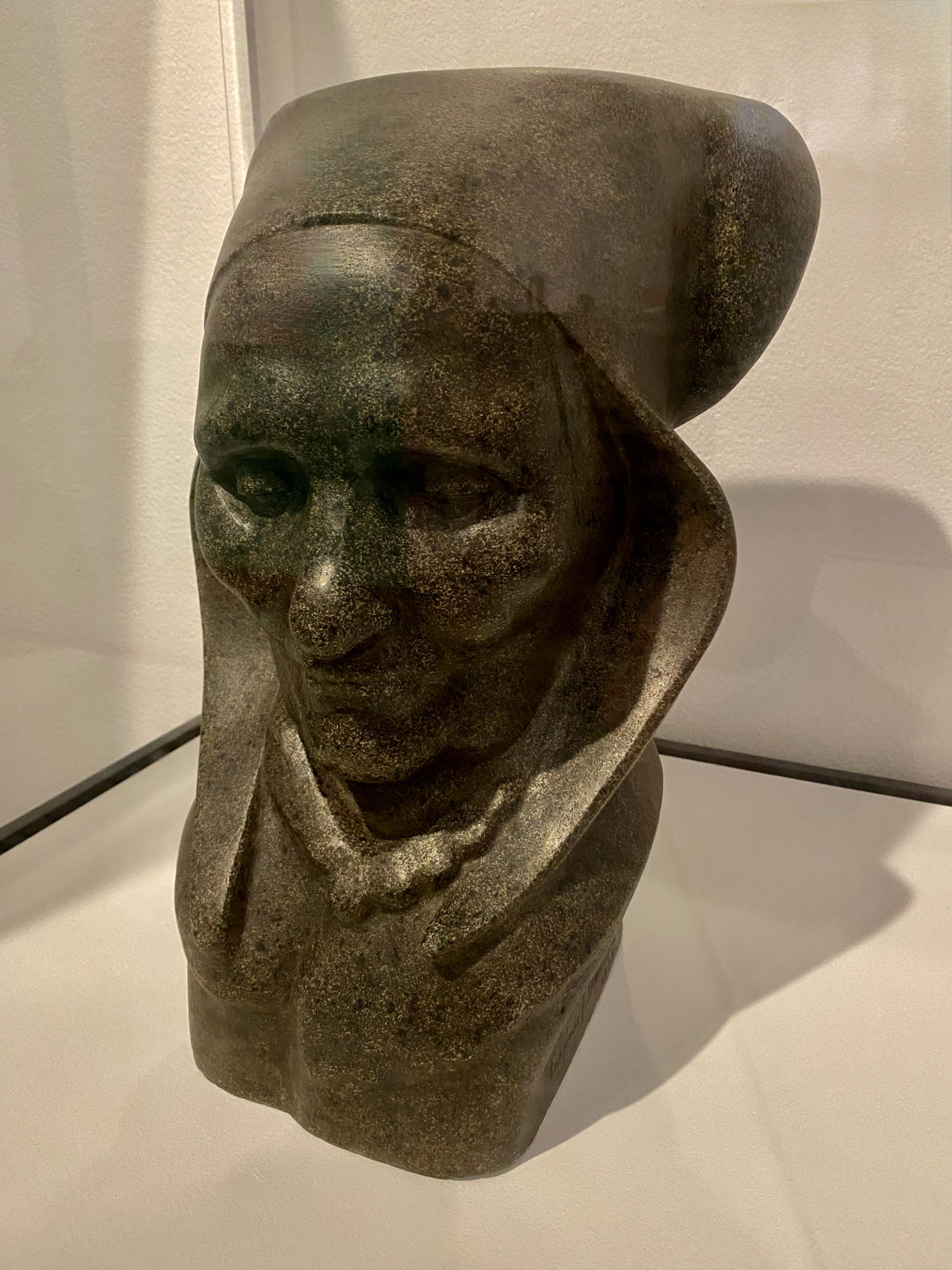
Shonnard’s 1923 granite portrait of a Basque woman, La Grandmére.
Shonnard’s 1926 direct-carved mahogany portrait of Dr. Charles Eastman, Chief Ohiyesa Communing with the Great Spirit.

Always considered a talented watercolorist, her teenage life took quite a turn when her mother allowed her to enroll in the New York School of Applied Design for Women – a school that taught proficiency in the “lesser arts” like lacemaking, wallpaper design, and book illustration, and cover design so that young women could have “appropriate” careers.

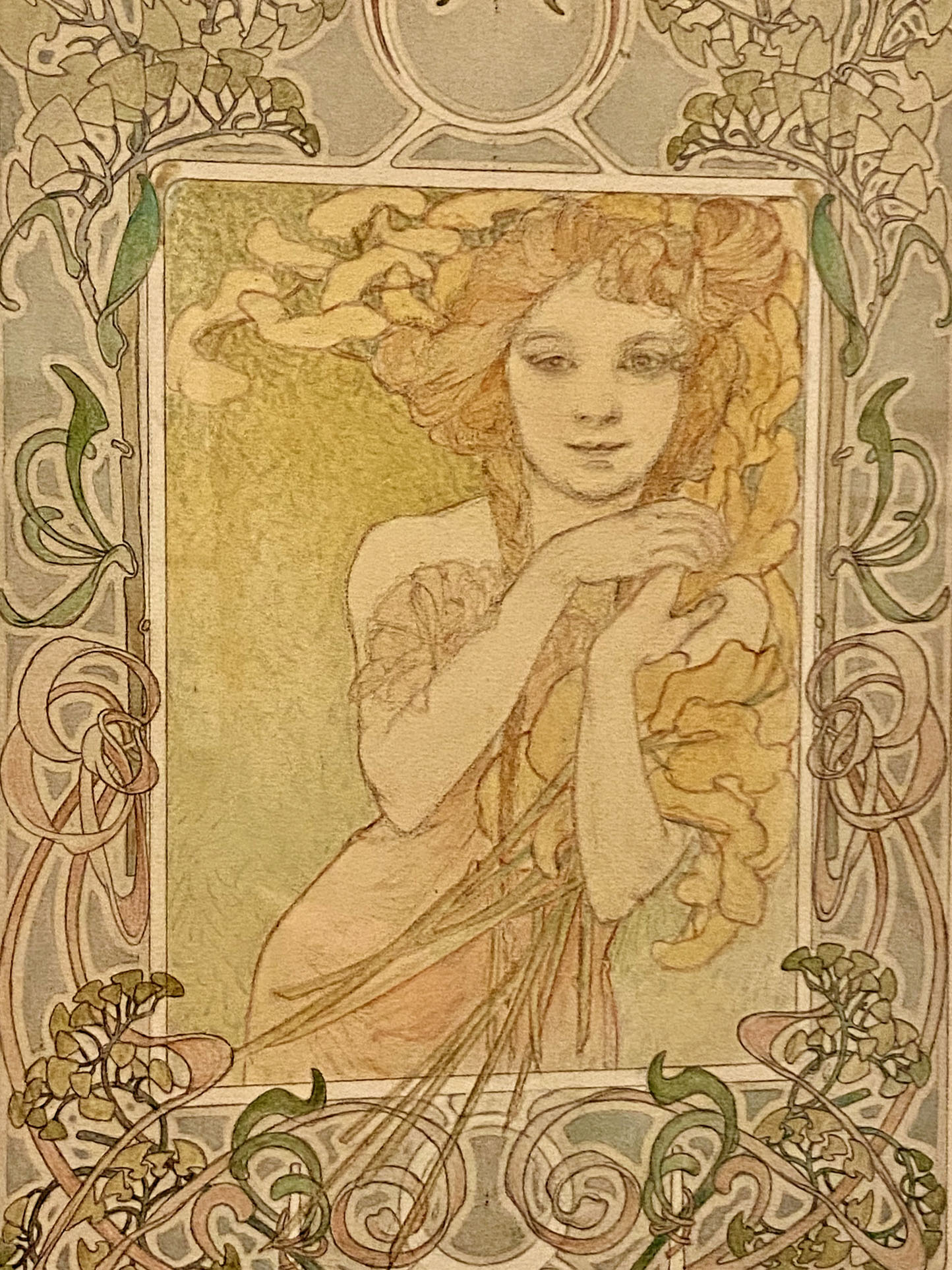
Shonnard’s 1907 pencil and watercolor design in the pastel “Mucha style” – organic designs framing ethereal woman with flowing tresses.

The most sought-after course was a figure drawing class taught by a visiting European professor – the famous Art Nouveau superstar Alphonse Mucha. A master draughtsman and designer, he taught students how to convey human expression in quick, sure, animated line and to use expressive, organic designs from nature to give their work a modern something extra.

Mucha immediately recognized Shonnard’s skill in blending human empathy and line, and advised her to think beyond what was offered at her school. He suggested that she go to Paris, train with top European sculptors (he’d provide letters of introduction), and seriously purse a “fine arts” path.  

Although her doctors advised her against making the long transatlantic passage, she and her mother set off for Paris in 1911. She loved it! She followed up with Mucha’s suggestions (and contacts), began her fine-arts sculptural training, and met other young American female sculpture students (like Gertrude Vanderbilt Whitney and Malvina Hoffman) who were soaking up all of the influences that the Parisian modern art scene offered.

Although he had retired from teaching students, Rodin made an exception for Shonnard and told her he’d be happy to review her work periodically. She worked across a variety of sculptural media (stone, clay, wood) in the atelier of Antoine Bourdelle (an early adoptor of Art Deco who also taught Matisse), showed with the American Woman’s Art Association, and exhibited at the Paris Salon.

When World War I forced Shonnard’s return to New York, she enrolled at the Art Students League for classes with superstar American sculptor James Earle Fraser.

Two of Shonnard’s popular garden commissions – a crane and pelican.

Combining everything she learned from Rodin, Mucha, Bourdelle, and Fraser, she began to excel in stripping her depictions of her subjects down to the essentials that captured each person (or animal’s) inner spirit.

Inspired by Brittany: Shonnard’s 1926 oak Figure of a Woman. Courtesy: Panhandle-Plains Historical Museum, Canyon, Texas

Her career began to take off – commissions for sculptures, shows in New York, and acclaim for her portraits of people and gentle animals. Shonnard made the most of it, showing at New York galleries and the Booklyn Museum, working with her mentor Mucha, and criss-crossing America and Europe in the 1920s.

Like decades of artists before her, she was often drawn to Brittany to capture the spirituality, nature, and culture of the people in her art.

In 1925, she made a fortuitous stop in New Mexico at the invitation of museum director Edger Lee Hewitt, who introduced her to the thriving art community and innovative Native American artists. 

As with Brittany, much about the Southwest resonated with her – dramatic landscapes, spirituality of ancient New Mexican cultures, and the unique architecture and religious art of old churches.  She also drove out into the country to create plein air watercolors of the same Abiquiu landscapes that later inspired O’Keeffe.

Shonnard’s 1925 watercolor of Abiquiu’s unique landscape, Red and White Cliffs with Mesa.

Her sculptures inspired by her New Mexico experience created a sensation in Paris in 1926 – beautiful, direct-carved portraits from the faraway Southwest on display next to her work from Brittany.

Shonnard’s untitled 1925 mahogany Indian bust, shown in her solo show in Paris.

By 1927, Shonnard moved permanently to Santa Fe and began her own full-time studio from which she produced commissions, designed Southwest-inspired furniture, and explored Spanish and Pueblo cultures more deeply.

The exhibition includes designs for private chapel commissions with John Gaw Meem, examples of her furniture, and keenstone panels – her lightweight material invention that liberated her from manipulating heavy granite and wood in her studio, so she could keep carving and sculpting with a lighter material well into her seventies.

People who knew Shonnard said that she exuded a positive spirit throughout her life, seeking harmony with nature, animals, and people. It’s fitting that this retrospective includes a large room populated with her beloved birds, woodland, and backyard animals, and concludes with works by local artists she admired and whose works she collected – Maria and Juan Martinez and Awa Tsireh.

Detail of Shonnard’s Madonna sculpture.
Shonnard’s 1950 portrait Maria, a tribute to the acclaimed San Ildefonso artist.

Get to know this Santa Fe legend by looking through all her beautiful work (and work by her mentors) in our Flickr album.

Celebrating Juan Pino, First Pueblo Printmaker

It’s been just over 100 years ago that Juan Pino of Tesuque Pueblo popped into the Santa Fe studio of Charles Kassler, and experienced his enthusiasm about linoleum printmaking – a new-ish way to make multiple images without using an expensive press or chemicals.

Charles offered Juan some materials to take home so he could try it, and Juan got to work. See the results in Printing the Pueblo World: Juan Pino of Tay Tsu’geh Oweenge, on display at Santa Fe’s Museum of Indian Arts and Culture through August 17, 2025.

Take a look at our favorites in our Flickr album.

Exhibition banner on Museum Hill

Unlike his friend Kassler, who trained formally at Princeton and the Art Institute of Chicago, Juan received his artistic training in the Pueblo world, learning observation, craftsmanship, and patience from the ceramic and textile artists around him. By 1924, booming tourism in Northern New Mexico had created a big market for modern and traditional pueblo ceramics (think Maria Martinez and Margaret Tafoya) and for pueblo painters, like Julian Martinez and Awa Tsireh (Alfonso Roybal).

Juan Pino’s 1925 linocut print of people by the church in the Tesuque Pueblo plaza

Juan was an expert in wood carving, ceramics, textiles, and crafting dance regalia, but like most artists of his day, he juggled his artistic output with other income-generating pursuits – farming, gathering and selling home-heating wood, and posing as a model for Anglo artists flocking to the vibrant Santa Fe art colony.

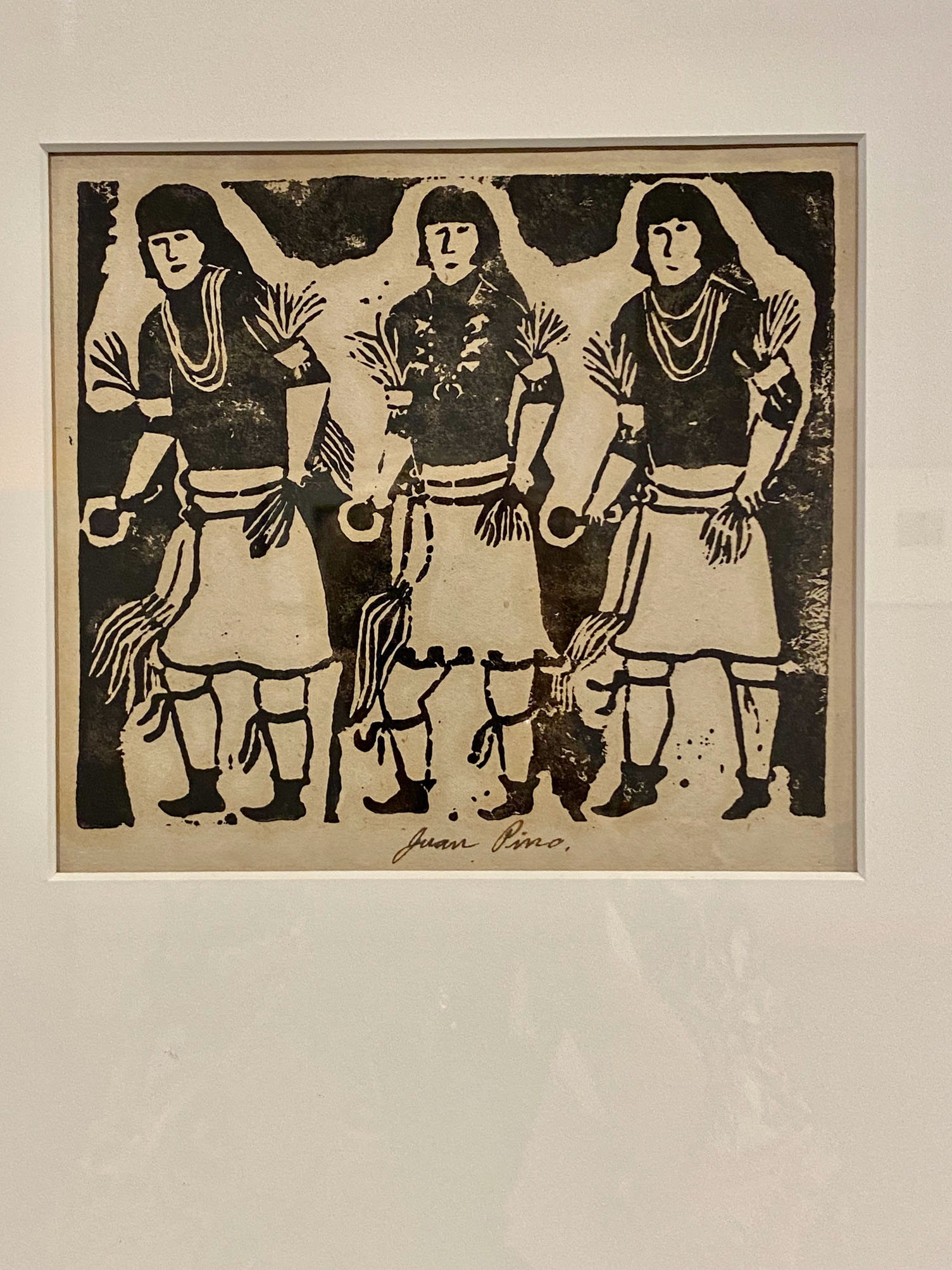
Juan Pino’s 1925 linocut print of three corn dancers – depicting himself, Vecillio Herrera, and Candido Herrera.

For linocut printmaking, you just cut your design into linoleum – a relatively accessible material since it was manufactured for use in kitchen floors or wall coverings for new homes. Once the block was carved and inked, you could either apply manual pressure to make the multiple images or ask a fellow artist to borrow their press.

Carving images into linoleum came naturally, and Juan started depicting the world around him in Tesuque – not just romanticized images of Indian life. Juan carved and printed the daily comings and goings of his fellow villagers in the pueblo plaza and images of traditional dances.

For all the car traffic and hubub on the streets of Santa Fe during the 1920s, Tesuque pueblo life still had elements of traditional Tewa ways.  Archaeologists have found remnants of village buildings dating back to 1200 CE, so Tesuque is one of the longest inhabited communities in the United States.

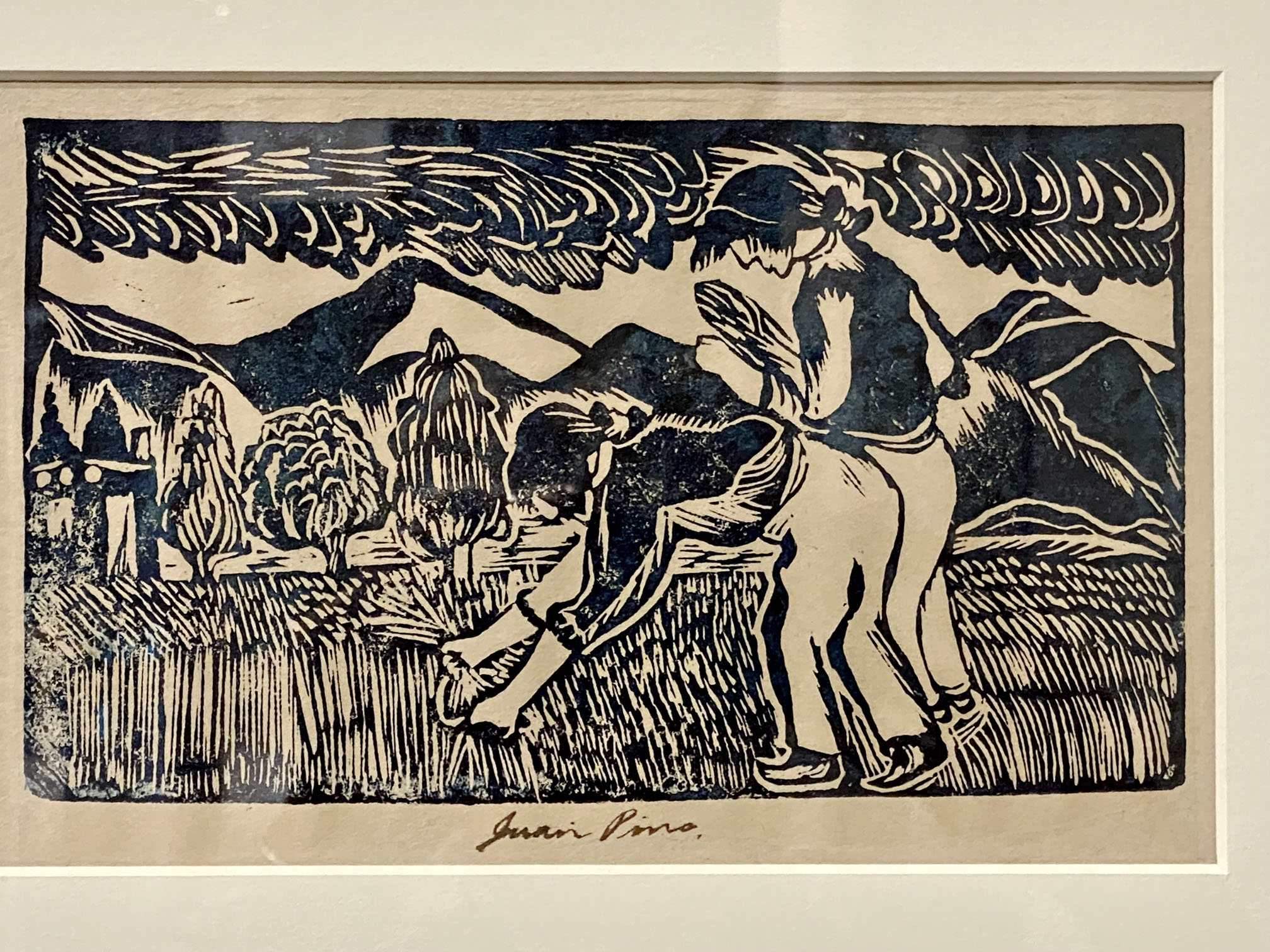
Juan Pino’s 1925 linocut print of two men harvesting wheat

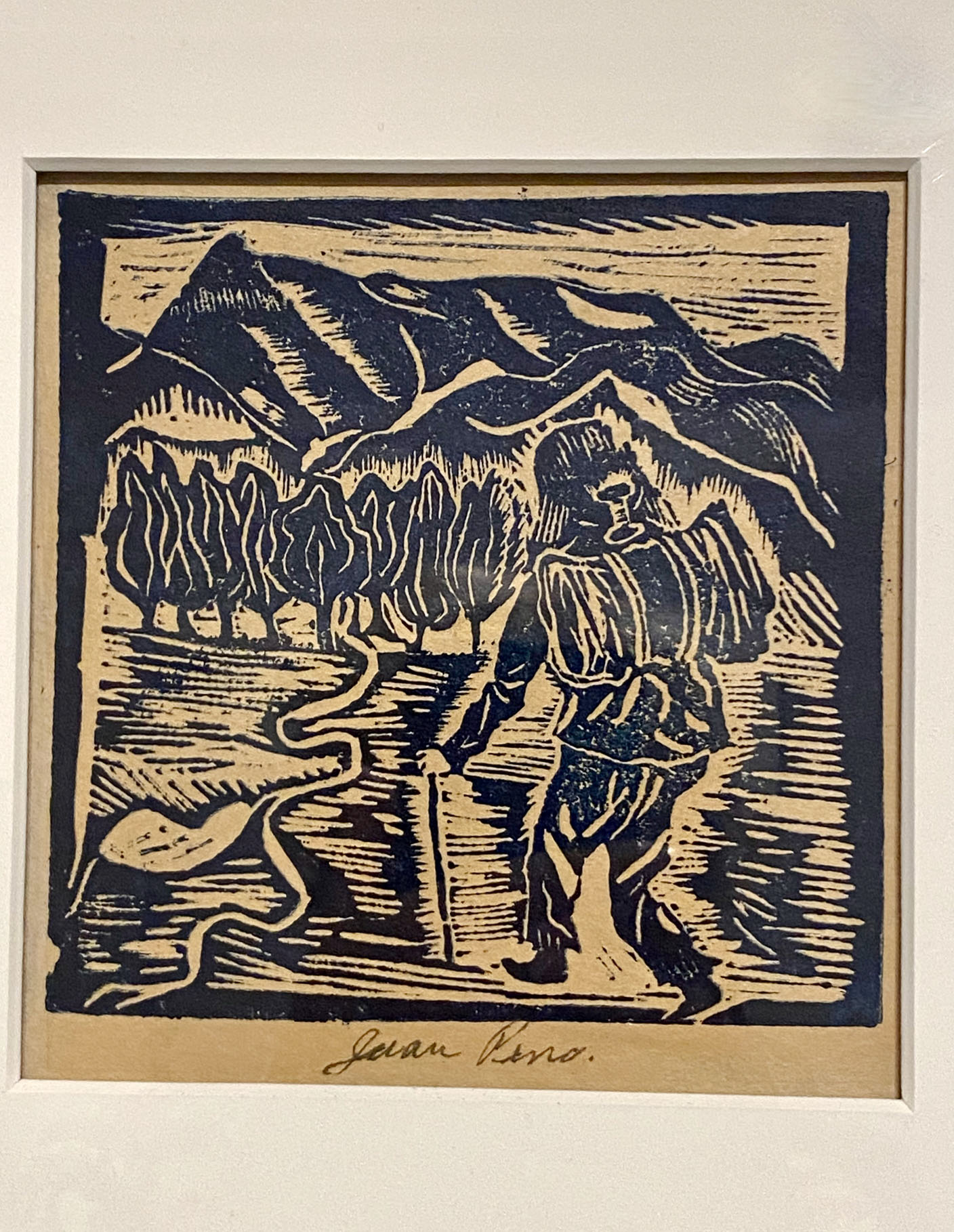
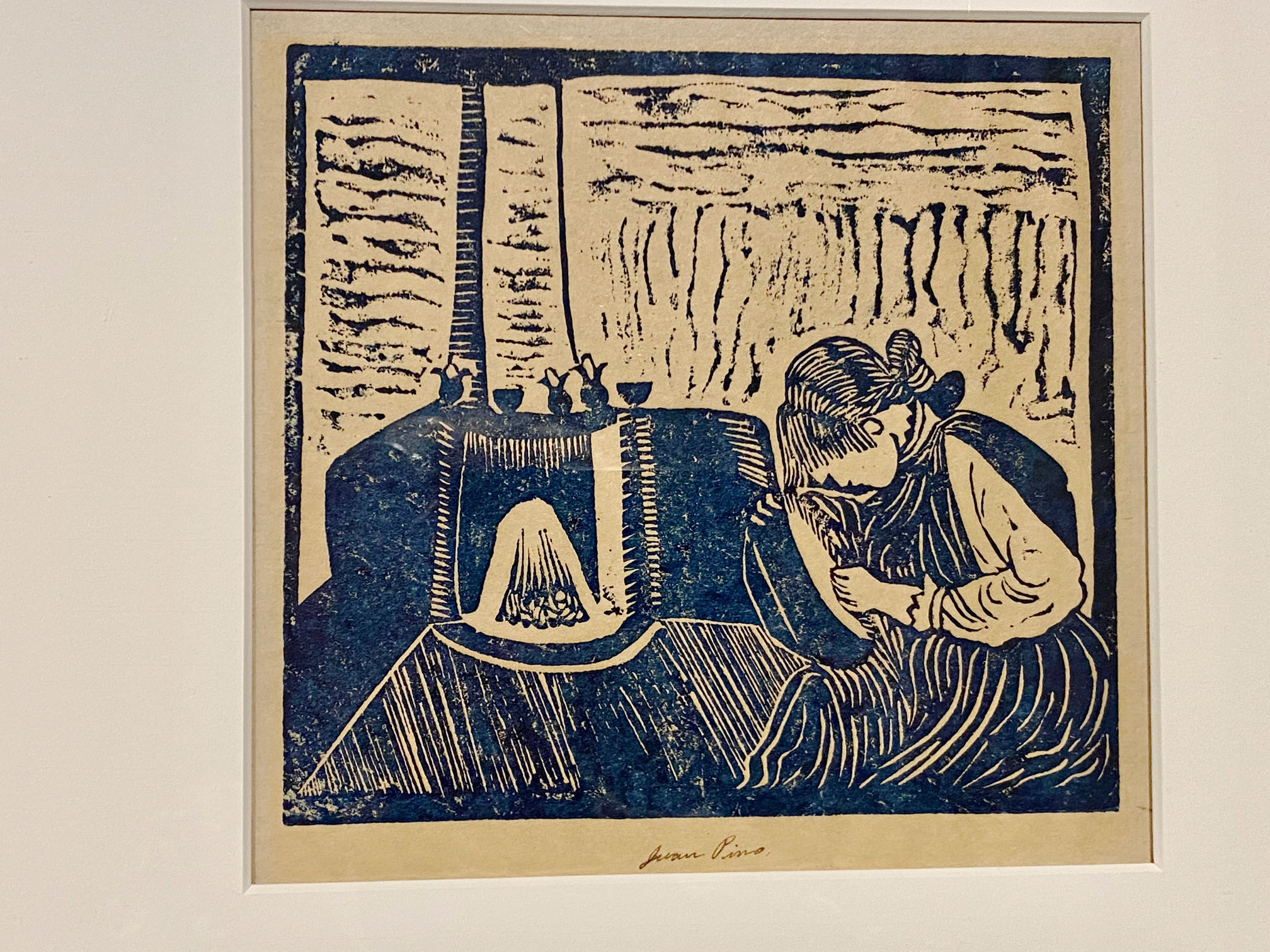
Taking in the twenty prints in the exhibition allows us to see day-to-day life as it was 100 years ago in the historic pueblo – making ceramics at home, harvesting, using oxen on the farm at a time just before horses replaced them as the work animal of choice.  We can even see detailed black-and-white depictions of the regalia men were wearing for the Corn Dance – including one print that likely includes a self-portrait!

After only a few months of making linoprints in 1925, Juan’s work was displayed at the New Mexico Museum of Art. Santa Fe and Pueblo artists celebrated his accomplishment as the first Pueblo artist to try his hand at printmaking. In Santa Fe’s commercial gallery market, however, tourists were more inclined to purchase prints and paintings that showed more romanticized visions of Indian life.

Juan kept creating, and seeing so much of his work 100 years later is truly a revelation – a set of quiet, enjoyable glimpses of everyday life at the foot of the Sangre de Christo Mountains.

Juan Pino’s 1925 linocut print of a voyaging man. Courtesy: Indian Arts Research Center, School for Advanced Research, Santa Fe.

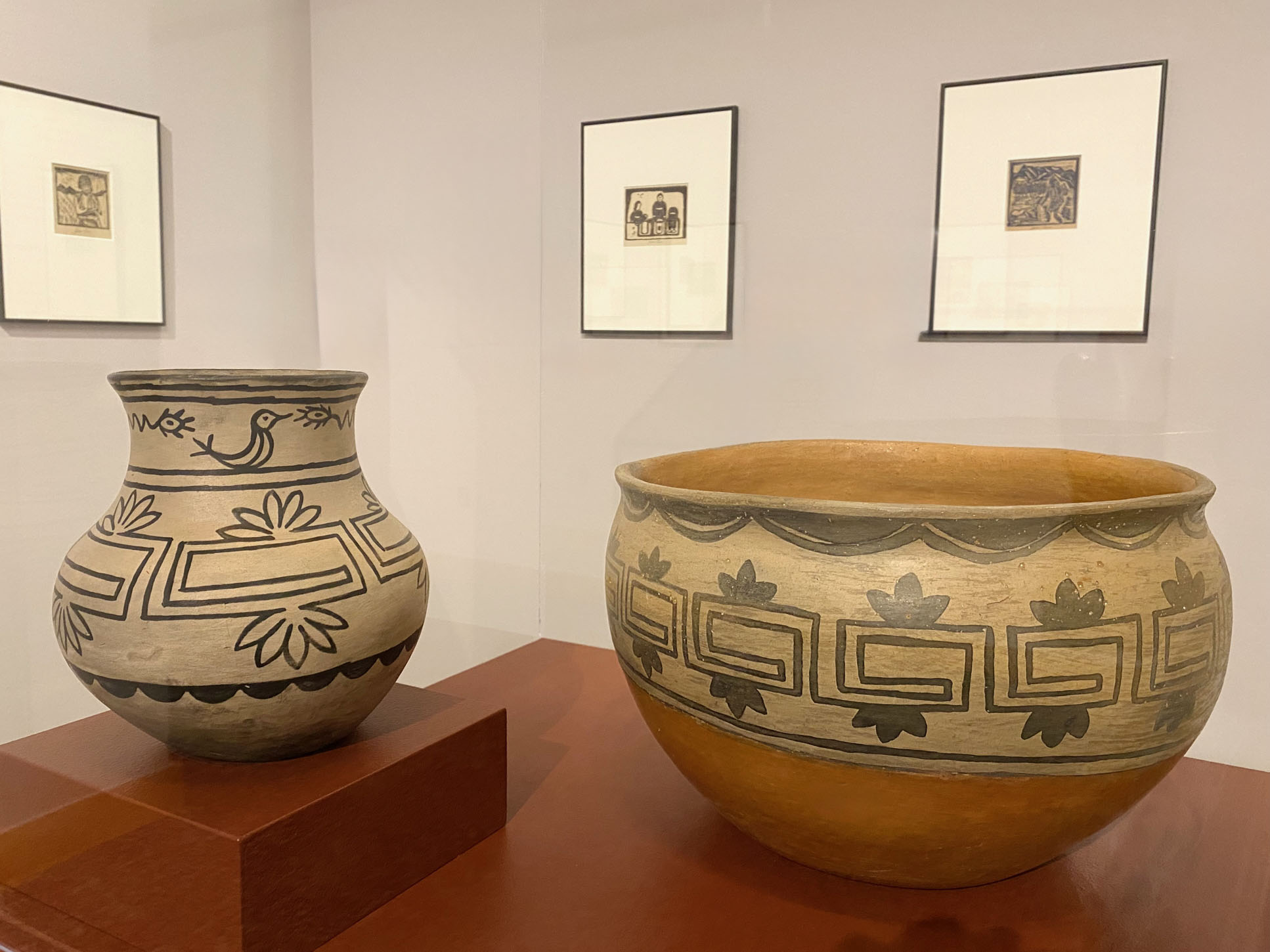
The show also has a beautiful touch that emphasizies Juan’s continuing artistic output: two large ceramic pieces from the Thirties and Forties created by his wife, Lorencita Pino. It’s likely Juan used his steady hand to apply strong, black lines – skills so evident in his masterful design for his slice-of-life print series.

Lorencita Pino ceramics likely painted by her husband, Juan Pino – a 1940 dough bowl with cloud and scroll designs and 1930 jar with bird and scroll design.
1925 linocut print of woman making pottery near fireplace…is it Lorencita?

Kite Dreams with AI at IAIA

How does a Lakȟóta artist link dreams and artificial intelligence to imagine futures for her people? Experience five years of innovative installations in Kite and Wíhaŋble S’a Center: Dreaming with AI, on view at the IAIA Museum of Contemporary Native Arts in Santa Fe through July 13, 2025.

The IAIA exhibition – Suzanne Kite’s third solo exhibition this year across the United States – presents several installations that highlight her collaborative work that merges cutting-edge technology with Indigenous knowledge systems. 

Download the exhibition catalogue here, and look at photos of the installation in our Flickr album.

2023 Wičhíŋčala Šakówiŋ (Seven Little Girls) and Wicháhpi Wóihanbleya (Dreamlike Star) use stones to translate Kite’s dreams into Lakhóta symbols.

In Iron Road and Dreamlike Star, stones and minerals (the building blocks of computers!) are arranged in Lakȟóta geometric language that suggest Lakȟóta quilt patterns. They’re placed atop a mirror to show resonance between the Earth and the cosmos (stars).

2023 Wicháhpi Wóihanbleya (Dreamlike Star) suggest that ancestor stars can point the way to Indigenous futures.

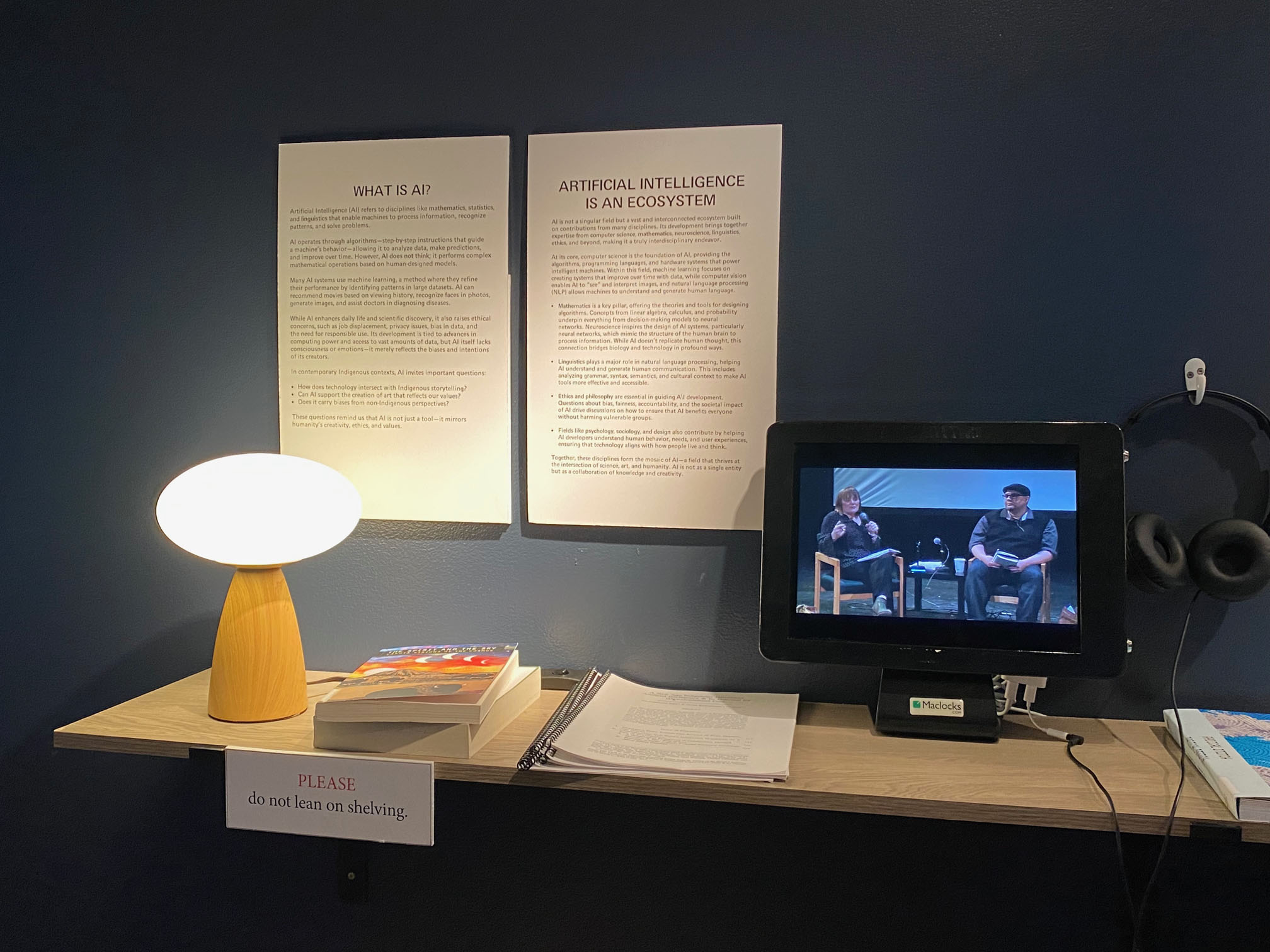
In this first section, inputs are taken from Kite’s dreams. Using AI, her dreams are translated into geometric Lakȟóta shapes created by designer Sadie Red Wing. Kite has figured out a way to bypass large-scale, commercial AI networks in favor of an AI model (run on her PC) that aligns more closely with Indigenous knowledge systems.    

A digital embroidery machine has yards of embroidered black velvet flowing out of it.  Oihanke Wanica (Infinity) is a collaboration with New York City’s Center for Art, Research and Alliances. As you examine the velvet, you’ll find geometric Lakȟóta shapes translated (using AI) from Kite’s dreams.

Nearby, there’s a comfortable lounge where you can watch Cosmologyscape, an interactive digital quilt – a public art project in which AI translates the public’s dreams into artist-created geometric symbols. It’s a collaboration with Alisha B. Wormsley, so the virtual community quilt manifests both African-American and Lakȟóta shapes.

2023 Oihanke Wanica (Infinity) – a digital embroidery machine stitches symbols representing dreams onto black velvet. Collaborator; Center for Art, Research and Alliances.
Lounge to watch Kite and Alisha B. Wormsley’s 2024 Cosmologyscape – Ai translates the public’s dreams into symbols for an ever-expanding digital quilt.

Installations in the other half of the exhibition shows collaborative projects that combine Indigenous knowledge systems and AI. Along one wall in the spectacular, tranquil gallery, you can explore a print and digital resource library on international research programs that integrate Indigenous knowledge systems into AI design.

Abundant Intelligences – a library and digital resource station for information on AI and futurism in contemporary Indigenous art.

Oneiris is a large interactive station through which visitors are invited to generate dream symbols that AI adds into a wall-sized display that looks like a portal to the cosmos. Inspired by the Lakȟóta concept of a Dream Language, she and her many technical collaborators genuinely bring dreams to life.

Oneiris – a collaborative project using advanced AI models to allow visitors to bring dreams to life.

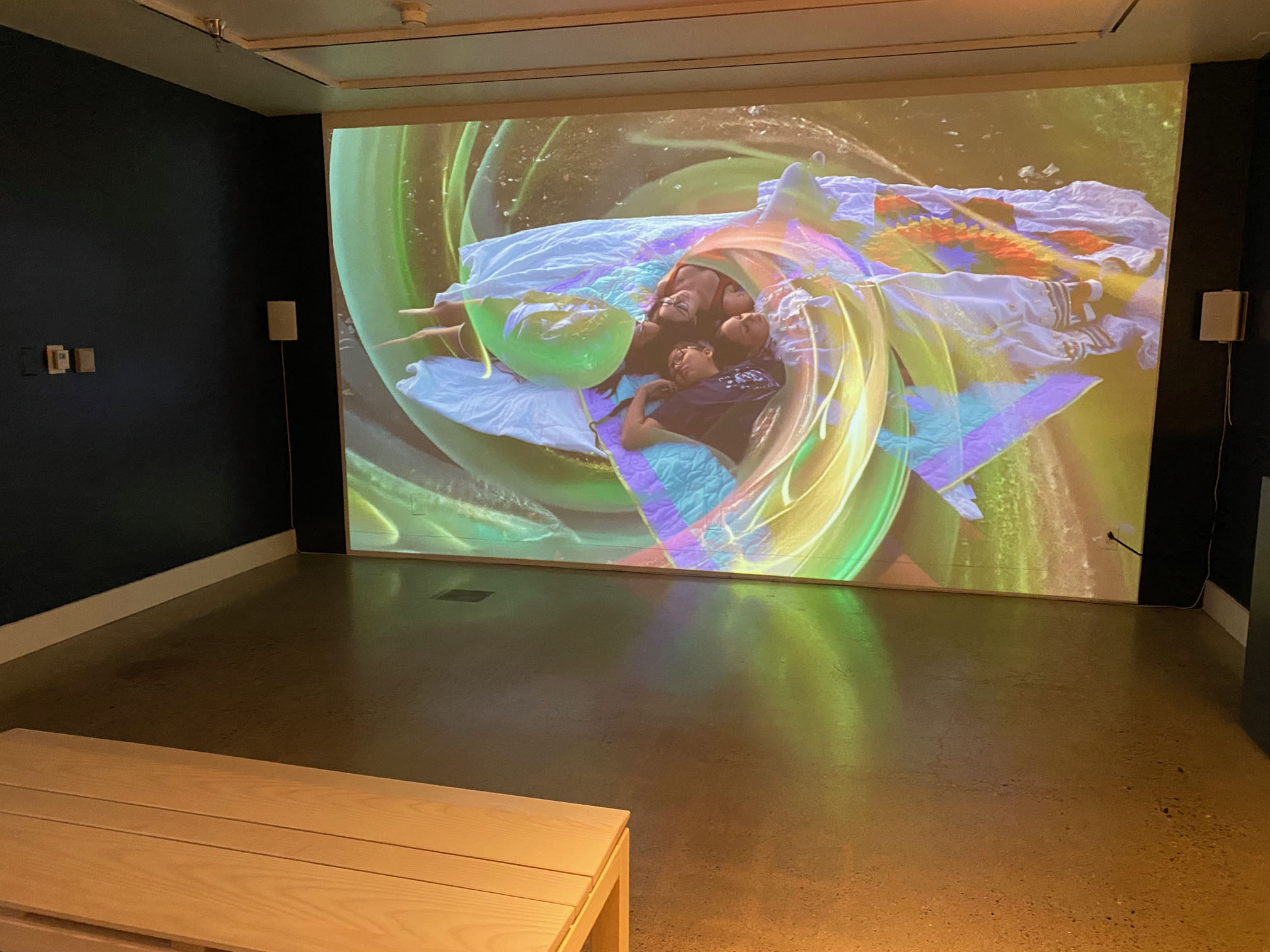
Spashed across the final wall of the space, The Land Paints Itself is a video collaboration with her Wíhaŋble S’a Center for Indigenous AI at Bard – a lab that explores Indigenous advances in this science and art. Watch as AI generates dazzling colors and patterns as four Lakȟóta dream about Indigenous futures. Kite suggests that the evolving technology of dreams is a legitimate way for her nation to envision ways forward.

2025 The Land Paints Itself video that uses AI to illustrate Lakhóta people’s dreams about Indigenous futures.

Provocative, visionary, and affirmative – meet Kite herself in an interview with Artforum editor Tina Rivers Ryan in March 2025, when Kite’s work was featured on the cover.

Marsden Hartley: A Modernist on the Move

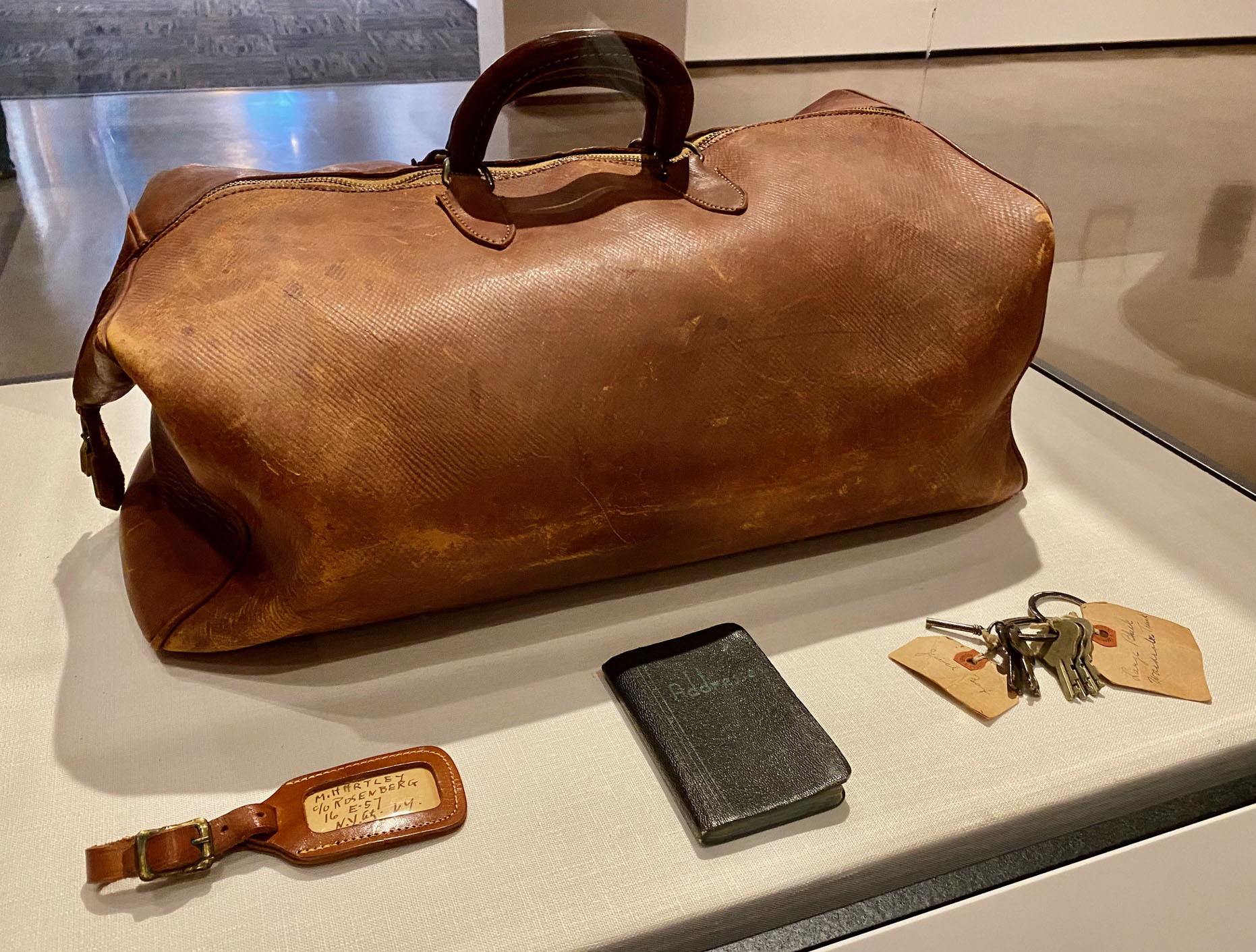
With his traveling valise sitting in the center of the introductory gallery and a map nearby, you understand instantly that superstar artist Marsden Hartley was a man on the go.

Marsden Hartley: Adventurer in the Arts, on view at the New Mexico Museum of Art in Santa Fe through July 20, 2025, uses his personal possessions, works painted on two continents, and non-stop itinerary to demonstrate how landscape, life, and modern-art legends led him to create an epic body of work.

Take a look at our favorites in our Flickr album.

Hartley’s 1914 Berlin Series, No. 2 – flat, abstracted natural symbols. Courtesy: Jan T. and Marica Vilcek Collection.
Ready to travel – Hartley’s leather valise, address book and luggage tags. Courtesy: the artist’s estate; Bates College Museum of Art.

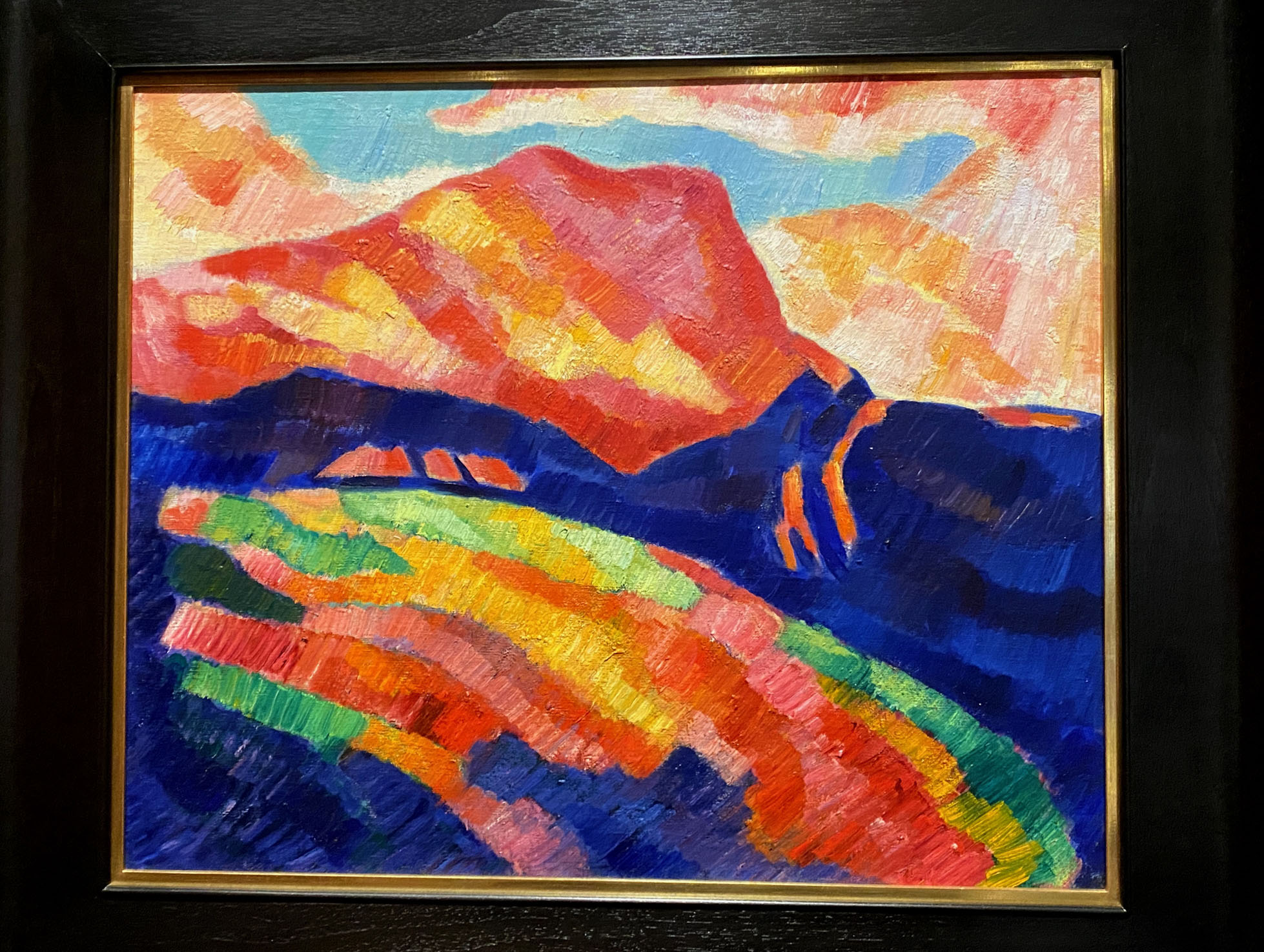
Looking around, there’s a wall of Maine mountainscapes he did in his thirties, a painting done just after Stieglitz sent him to Paris to soak up the vibes in Gertrude Stein’s salon, his accessories of rings and cigarette cases from Berlin in the 1920s, a Fauve-ist impression of Mount Saint-Victoire at Cezanne’s old stomping grounds in Aix, and photos of him and his dog at his Maine studio in the 1940s.

Hartley’s 1927 oil Mont Sainte-Victoire – painted in Aix, France where Cezanne once lived. Courtesy: Jan T. and Marica Vilcek Collection.

The exhibition merges Hartley’s paintings from the Jan T. and Marica Vilcek Collection with items donated by his favorite niece to Bates College in Maine – items he collected as he traveled; sketches and stuff sent to his neice; his camera, books, and snapshots; his studio paintbox, and other personal art. Together, the exhibition tells a story of innovation, personal journey, and relentless art making.

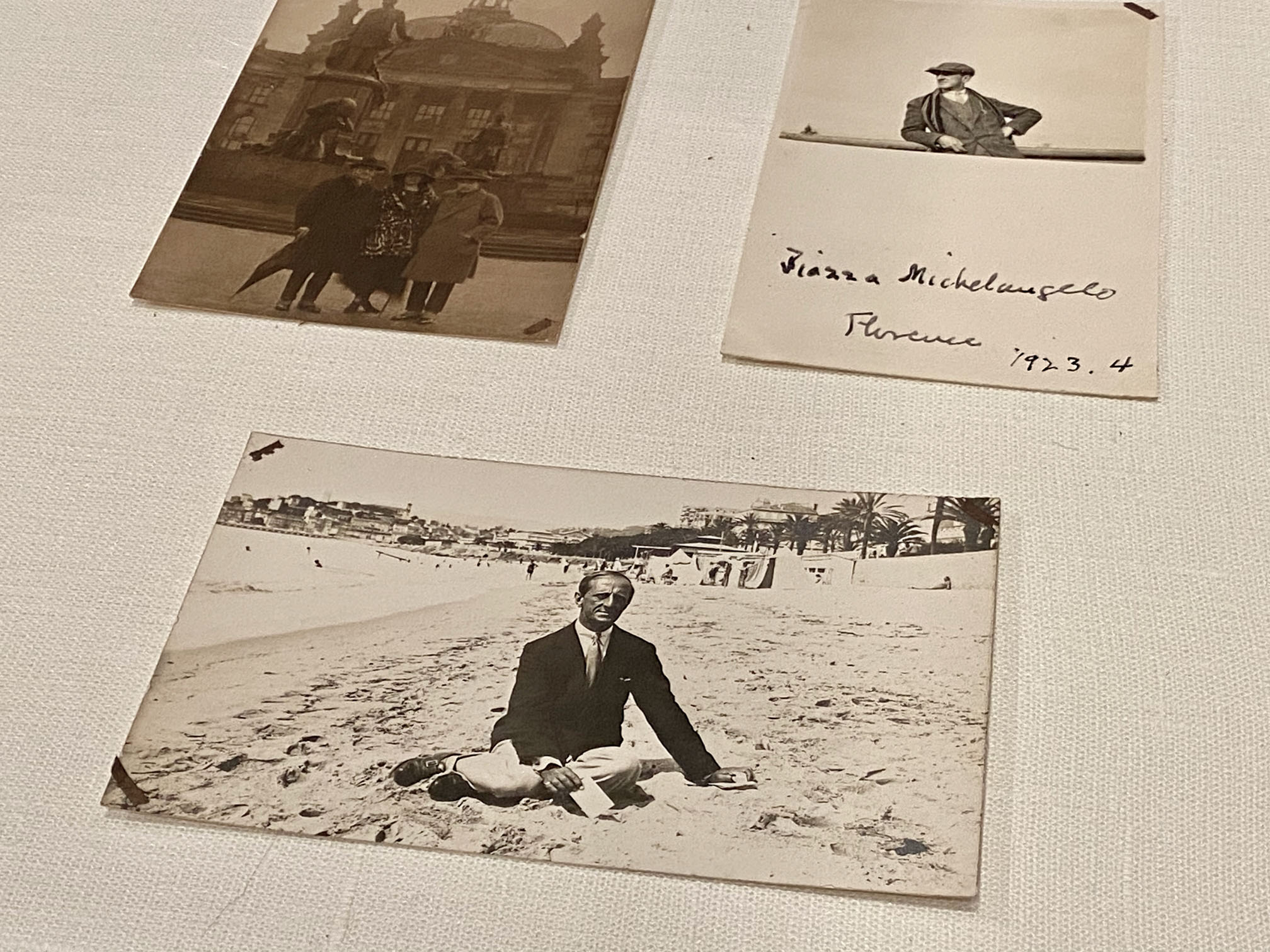
Hartley’s personal photos from his 1920s European adventures. Courtesy: Bates College Museum of Art

Hartley emerged from a hardscrabble childhood to see, feel, and experience art, nature, and transcendental spiritualism in New York, Boston, and Maine in 1890s.

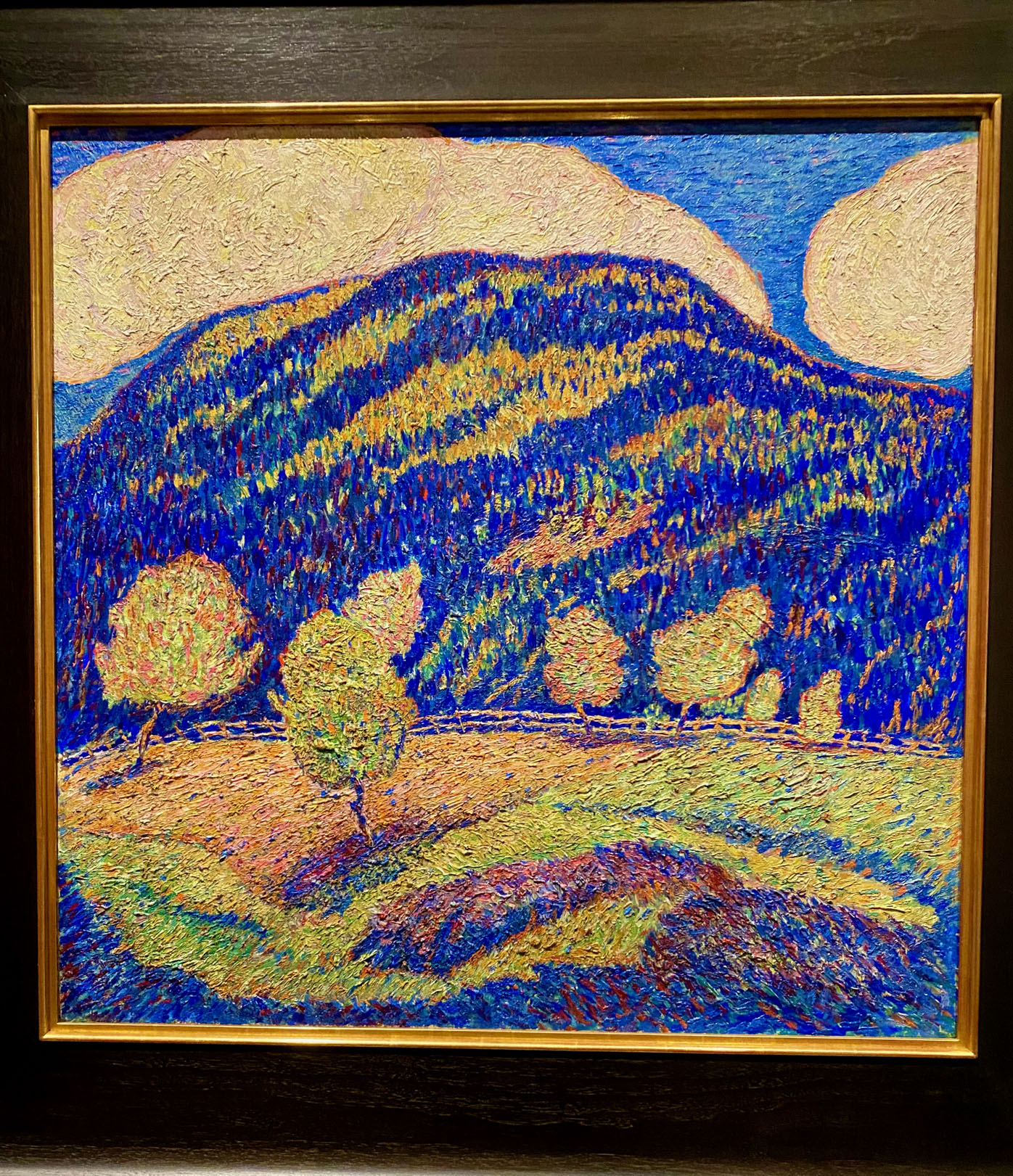
He loved painting mountains and depicted water, earth and sky as a color-filled flat plane filled with jabbing brushstrokes – an approach that stuck with him throughout his life as he journeyed through New Mexico, the Alps, Mexico, and back in Maine.

Hartley’s 1907-08 oil Silence of High Noon – Midsummer painted in Stoneham Valley, Maine. Courtesy: Jan T. and Marica Vilcek Collection.

By the time he was in his early thirties, he had shown his landscapes to The Eight, knocked on Stieglitz’s gallery door, and got a one-man show (and a dealer for the next 20 years) at 291, the hottest modern art gallery in America.

Hartley’s 1910 Untitled (Maine Landscape)– water cascading down a rock face. Courtesy: Jan T. and Marica Vilcek Collection.

Getting to Europe in 1912, the color, cubism, and symbolism of the Blue Rider, Matisse, and Picasso made his head spin. His German friends introduced him to Kandinsky’s book Concerning the Spiritual in Art. He went out of his way to meet the man himself, and his painterly wheels turned.

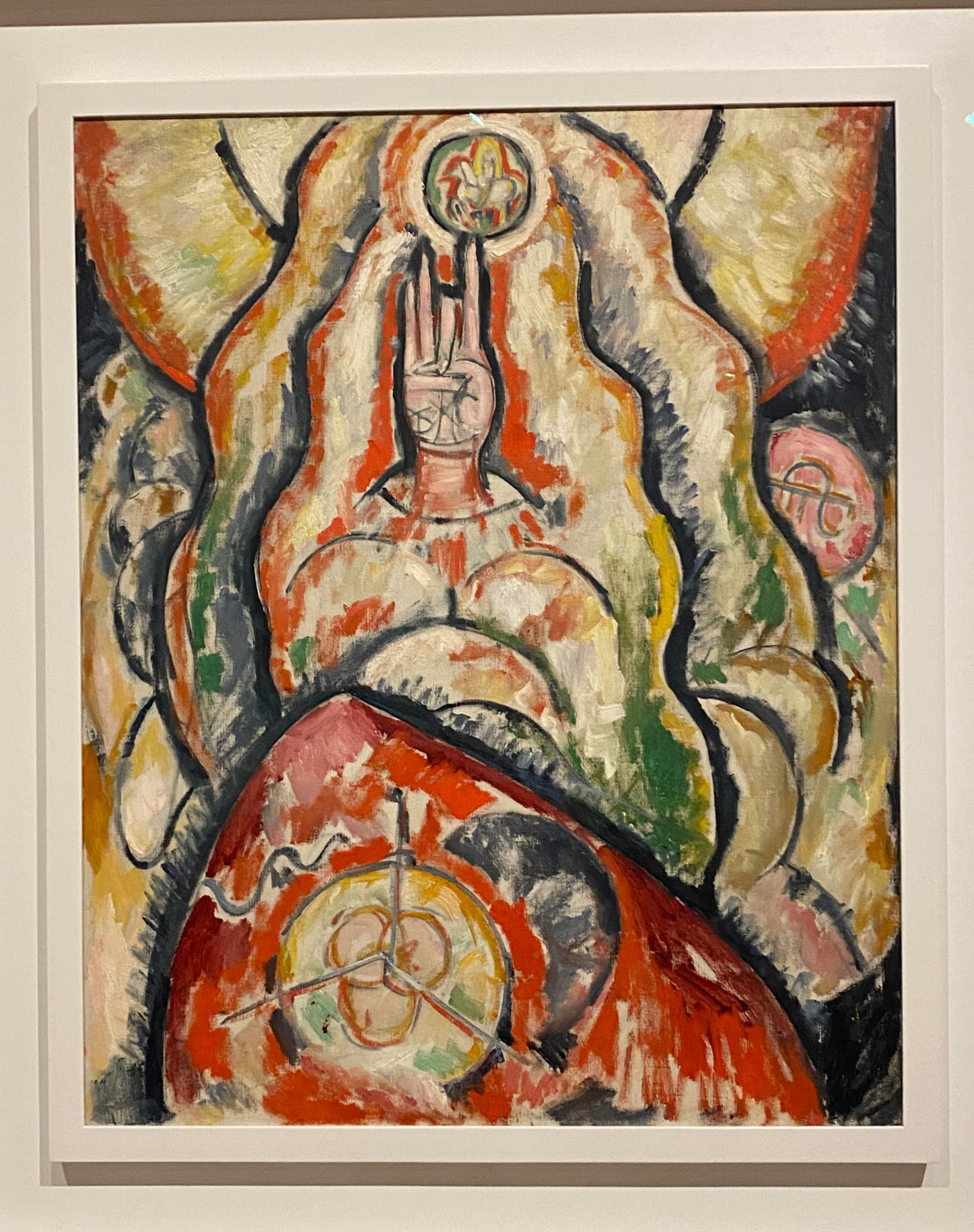
The second gallery presents a large work from his Cosmic Cubism series – an airy, dreamy arrangement of signs, spiritual symbols, colors, and planes – along with drawings from his Amerika series, based loosely on Native American symbols and other abstract shapes. On view for only the second time in the United States, Schiff is a dazzling creation drawing signs and symbols from Native American and Egyptian cultures that spill out onto the painted frame.

Hartley’s 1912-1913 Portrait Arrangement, No. 2, created in Paris. Courtesy: Courtesy: Jan T. and Marica Vilcek Collection.
Schiff – part of the Amerika series Hartley painted in Germany. Courtesy: Vilcek Collection.
April 5 – July 20, 2025

Up to this point, Hartley’s only encounter with indigenous American culture came from visits to ethnography museums in Paris and Berlin, but that would soon change. The advent of World War I tore apart the avant-garde, his social circles, and the direction of his work. Although these Berlin abstractions were long considered by late 20th century critics to be the high point of his career, Hartley abandoned this artistic path when forced to return to the United States, started over, kept wandering, and went back to landscapes and still lifes to discover his “American” expressionist vision.

Hartley’s 1934 Autumn Landscape, Dogtown – a colorful painting made near Gloucester, Maine. Courtesy: Jan T. and Marica Vilcek Collection.

The exhibition does not unfold chronologically. Instead, it shows how much friends, place, and spiritual encounters affected him.

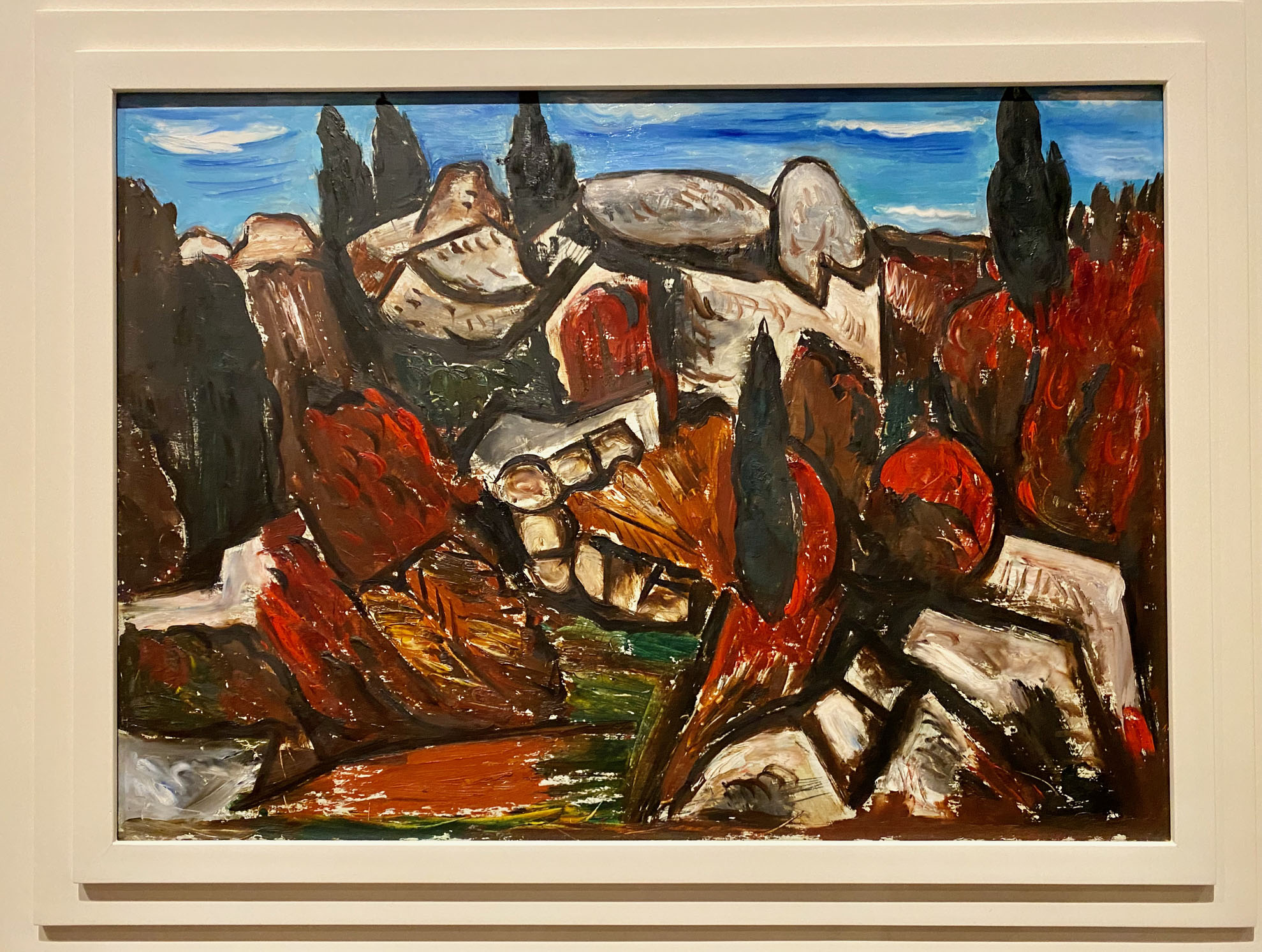
Near the Berlin abstractions are highly expressionist 1930s rockscapes from Maine and pointy Alpine peaks from his return to Bavaria. There’s an example of his stripped-down 1916 “synthetic cubist” work in Provincetown, a 1917 New England still life painted in Bermuda when he was budget-bunking with Demuth, and a red-saturated still life that is a therapeutic tribute to his Nova Scotia friends who died at sea in the late Thirties.

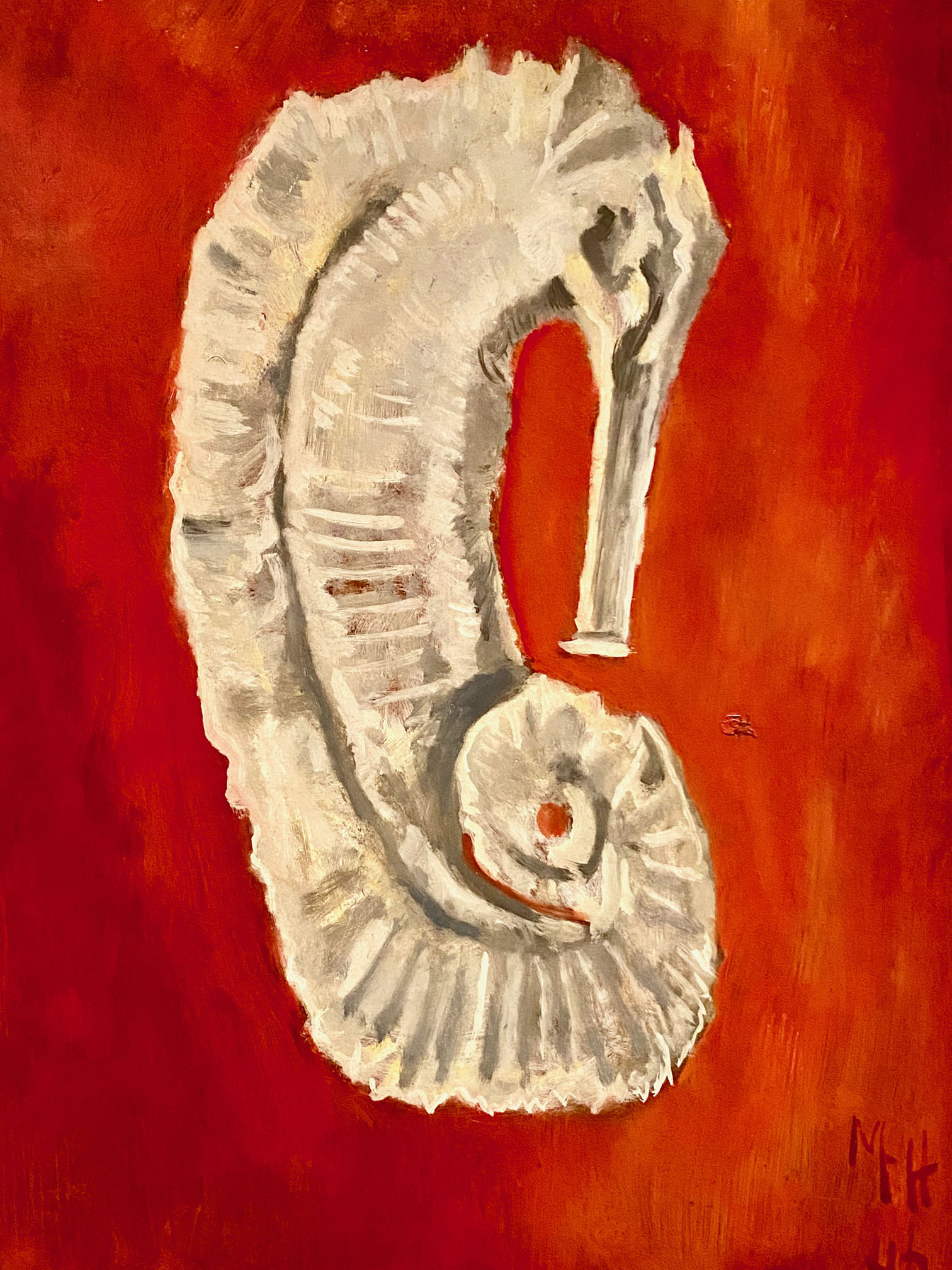
Hartley’s 1942 White Sea Horse – part of a series with vivid backgrounds done in Maine. Courtesy: Jan T. and Marica Vilcek Collection
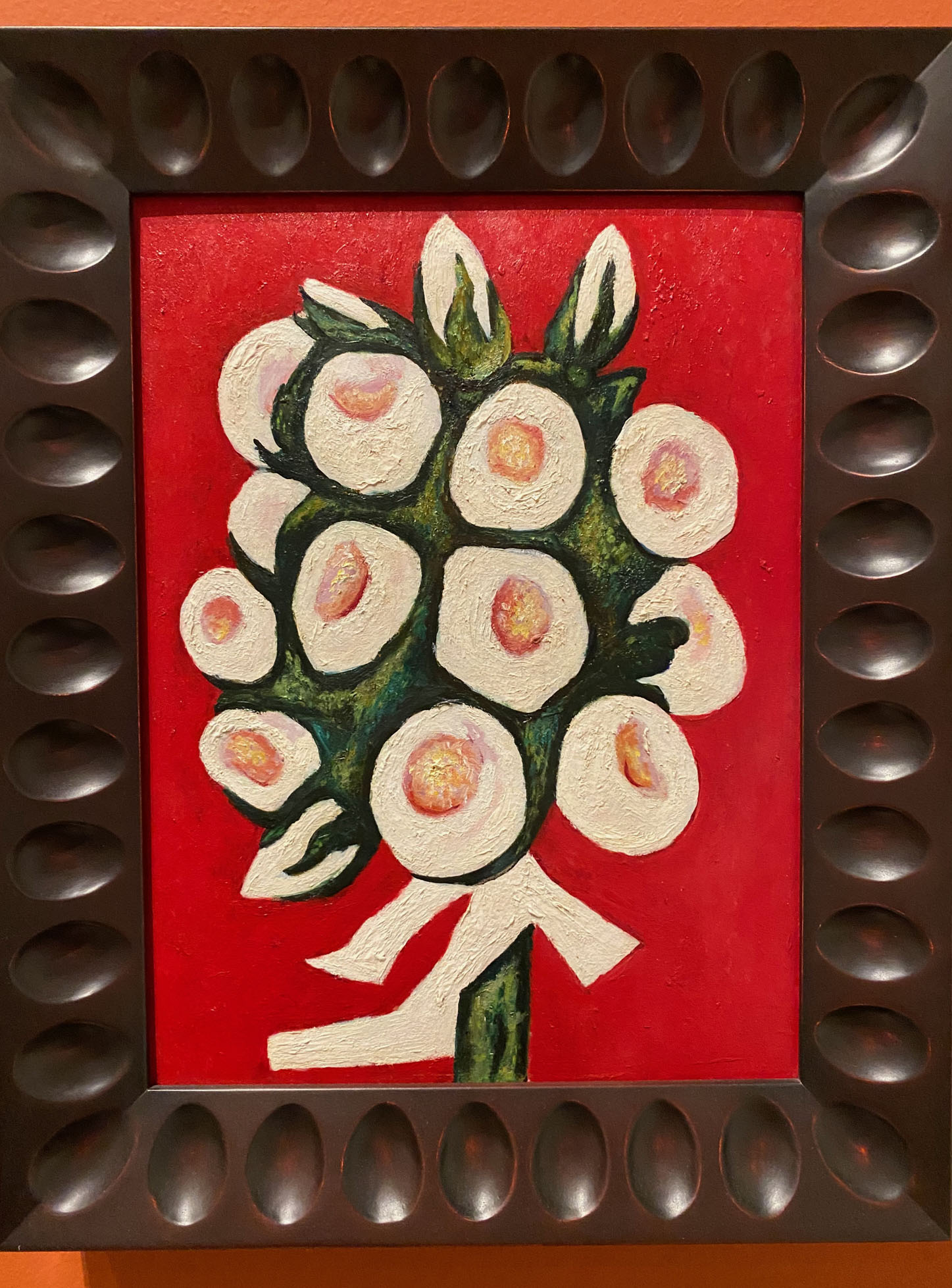
Hartley’s 1935-39 Roses for Seagulls that Lost Their Way –made in Bermuda to honor his Nova Scotia friends lost at sea. Courtesy: Jan T. and Marica Vilcek Collection.

In the middle of this gallery are vitrines with highly personal, everyday stuff from a painter who never settled down, stayed on the move, and always kept creating.

Here’s his camera, a scrapbook of personal photos, his 1923 published book of poetry, a few books from his library, and a little toy and pressed flowers sent to his niece.    

Hartley’s photos from his 1917-1918 trip to Santa Fe. Courtesy: Bates College Museum of Art

Except for the Provincetown piece, all the surrounding paintings have direct, bold outlines, vivid colors, and vigorous, unglamorized visions – a fitting prelude to the last gallery of New Mexico landscapes.

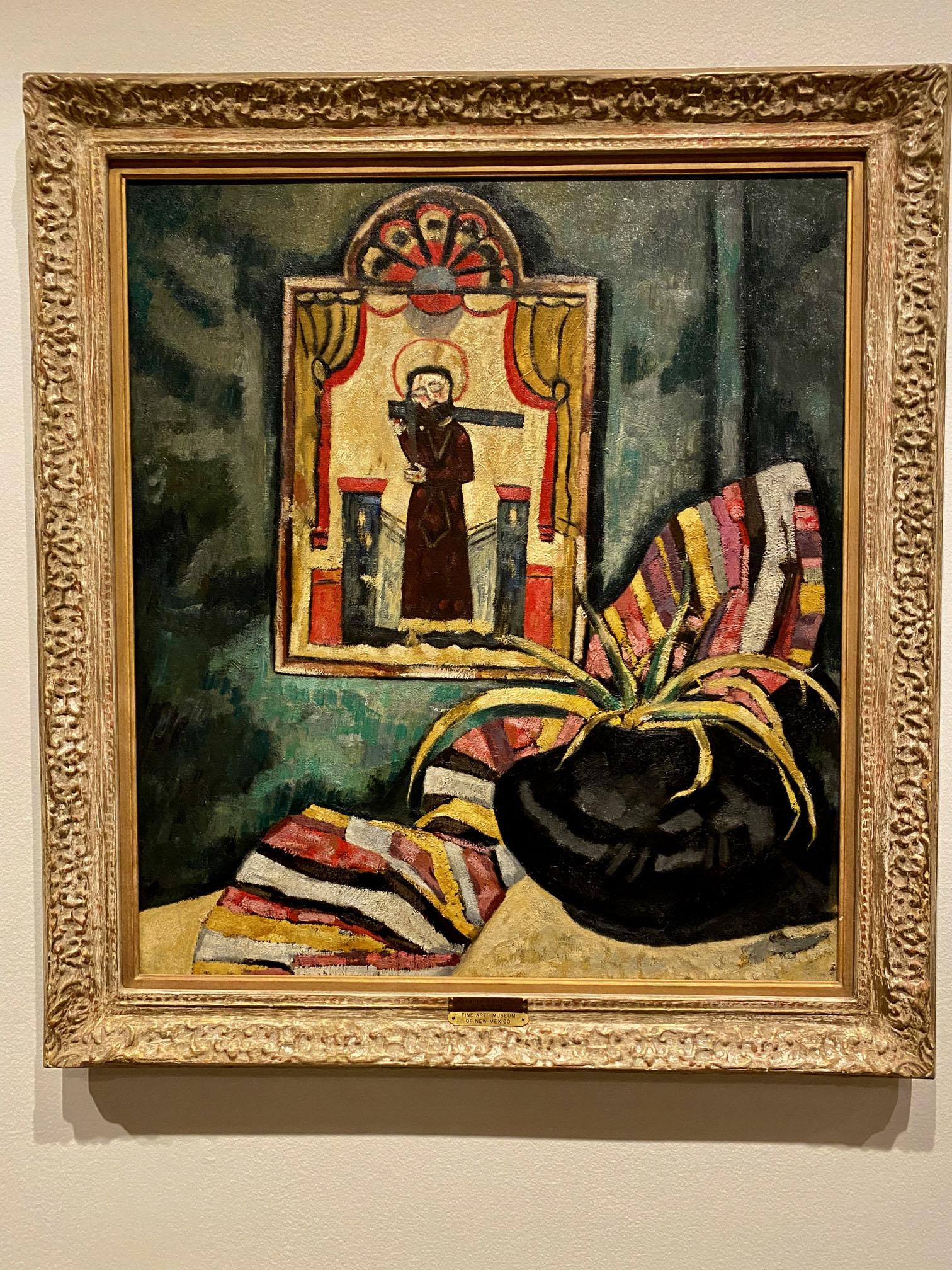
Hartley’s 1919 El Santo painted in New Mexico.

The final gallery provides a panorama of landscapes, plus a dramatic image of a ridge of Mexican volcanoes. Hartley only spent part of

1918 in Taos and Santa Fe, where he traversed the hills, attended Pueblo ceremonies, and wrote about the indigenous culture. He also completed his El Santo still life with a black-on-black ceramic vase, a striped textile, and a Northern New Mexican retablo of a suffering Jesus.  

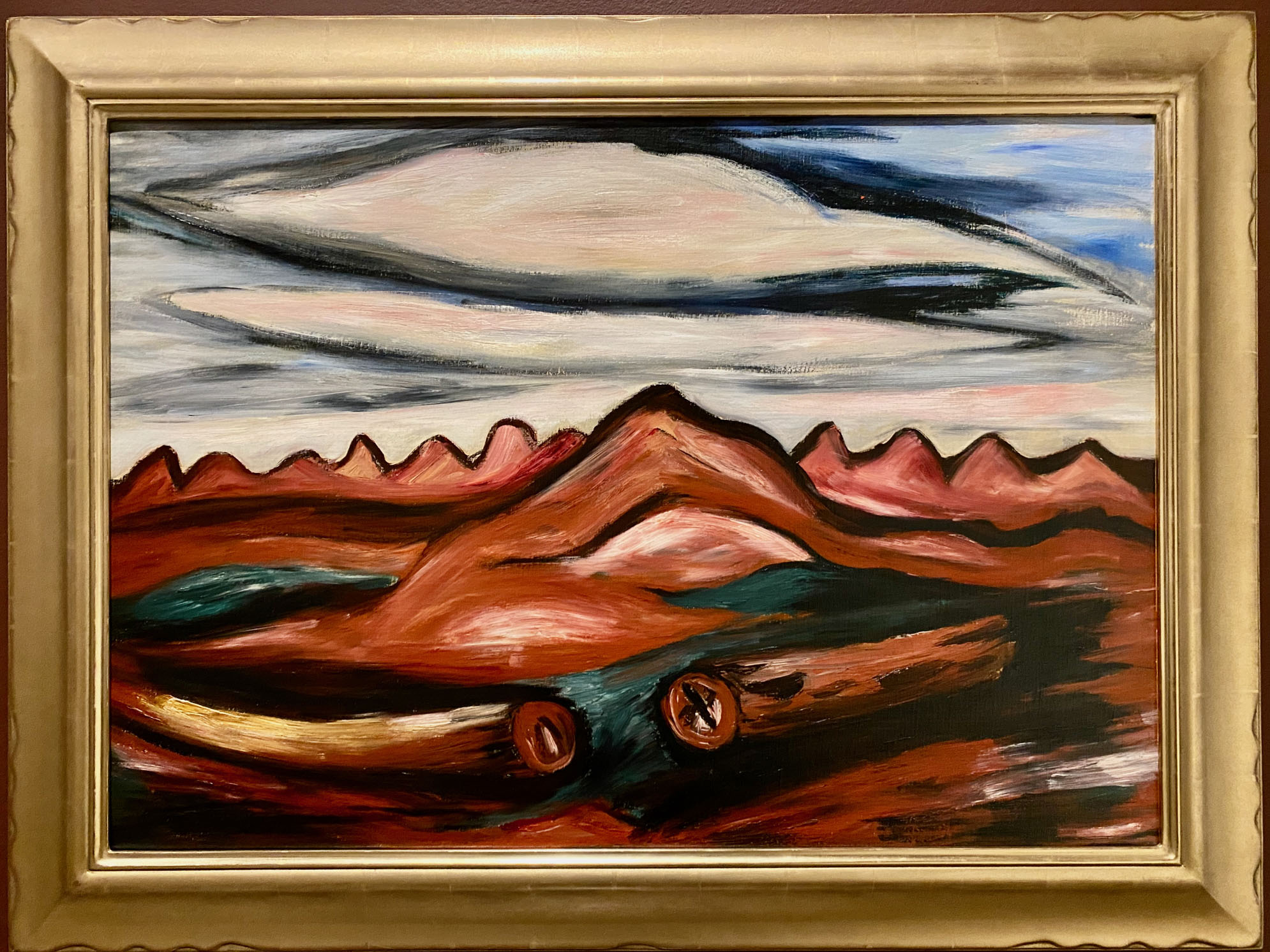
But it might be a surprise to learn that all of the Southwest landscapes were painted in Berlin in the 1920s – fittingly called his New Mexico “recollections” – or in Mexico in the 1930s.

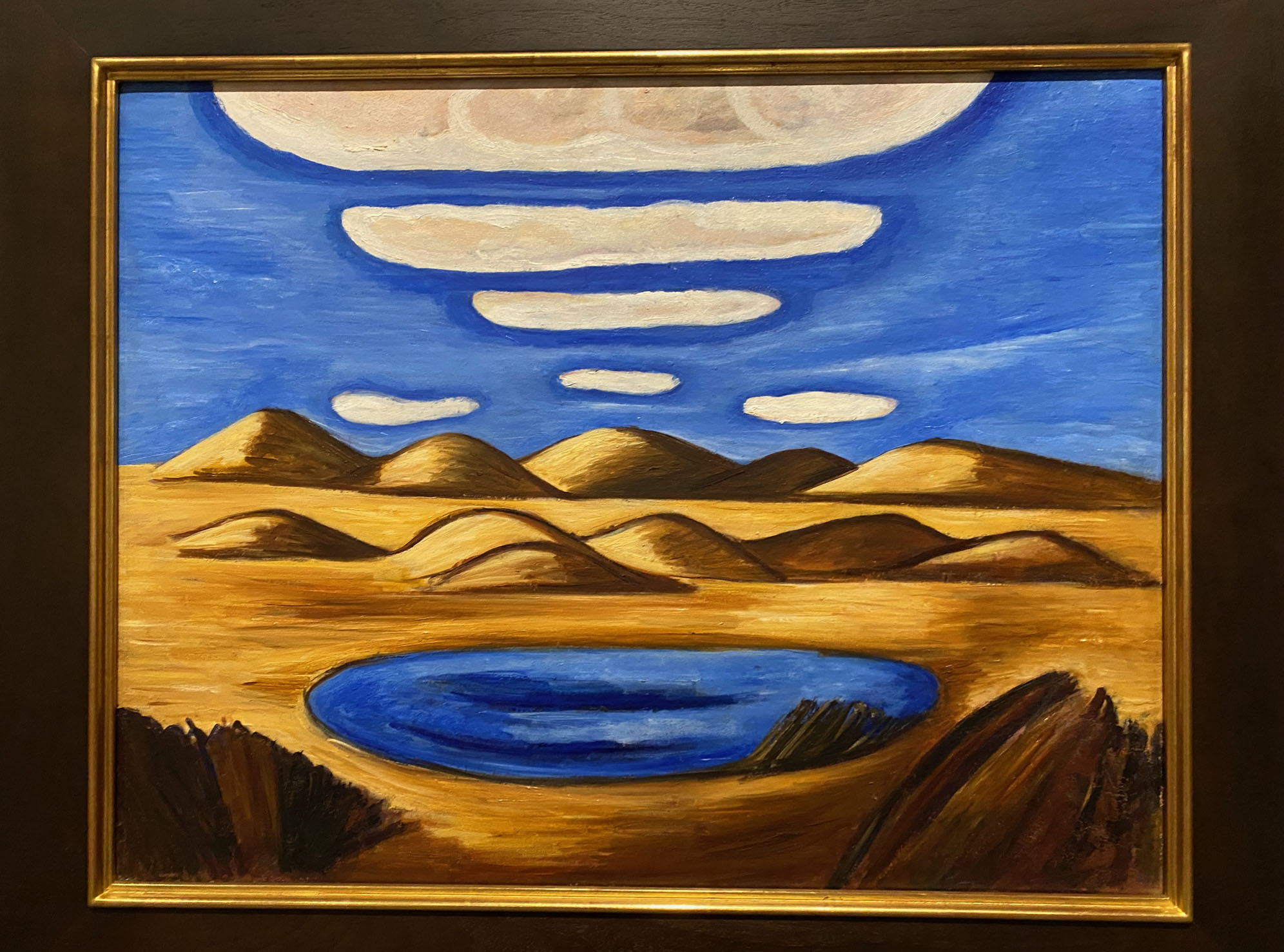
Floating clouds, expressive lines, and abstracted mountains – all from his vivid mind and recollections of spiritual and physical experiences long past.  In the 21st century, increasing numbers of art historians and artists have looked to this phase of Hartley’s work for insight and inspiration – bold brushwork, expressive memory, and both a spiritual and emotional creative process.

Hartley’s 1923 oil New Mexico Recollection #14– painted in Berlin based upon memories of his year in the Southwest. Courtesy: Jan T. and Marica Vilcek Collection.
Hartley’s 1932 oil Lost Country – Petrified Sand Hills – a symbolic landscape inspired by mystical texts he discovered while painting in Mexico. Courtesy: Jan T. and Marica Vilcek Collection.

Toward the end of his life, the accolades, awards, honors, and retrospective exhibitions came his way, but Hartley remained the hardscrabble “painter of Maine,” barely interested in cashing the checks.

His niece, who preserved her uncle’s posessions and legacy after his death in 1943, took a train trip to New Mexico for the first time to see the landscapes that so inspired her uncle. Upon emerging from the train at the stop near Santa Fe, she looked up to take in the big, dramatic, cloud-filled sky. Thinking of all her uncle’s landscapes, she said, “Those clouds…I’d recognize them anywhere!”

If you see this show in Santa Fe, you will, too.

Louise Zelda Young’s 1943 photo Marsden Hartley’s Studio, Corea, Maine, where he worked in his final years. Courtesy: Bates College Museum of Art.

Contemporary “Echoes” at The Wheelwright

Since its founding in 1937 as an institution documenting Navajo ceremonial art, Santa Fe’s Wheelwright Museum of the American Indian has shifted toward collecting contemporary Native American art and serving as a platform to boost careers of emerging artists.

The latest exhibition pays tribute to its last 50 years in Echoes: Selections from the Wheelwright Museum’s Permanent Collection, on view through June 8, 2025

The exhibit showcases well-known artists – like Tony Abeyta, T.C. Cannon, Virgil Ortiz, Rose B. Simpson, Bob Hazous, and Emmi Whitehorse – but the curators deliberately chose early-career works that haven’t been seen for a while. 

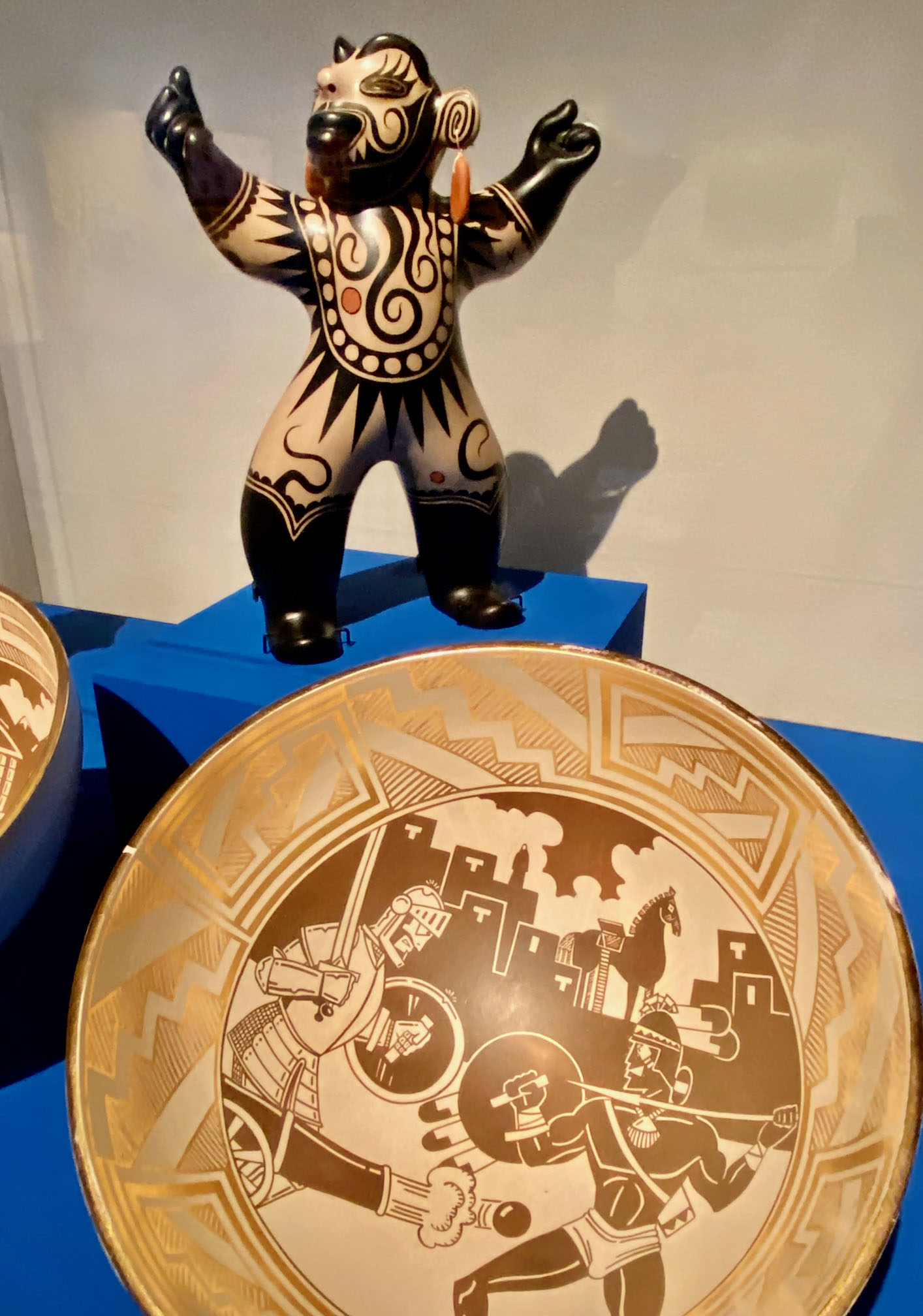
Virgil Ortiz’s (Cochiti) 2005 ceramic sculpture Monos Figure with Diego Romero’s (Chochiti) 2005 bowl Tenga Cuidado Con Griegos Salvo Obseqios.

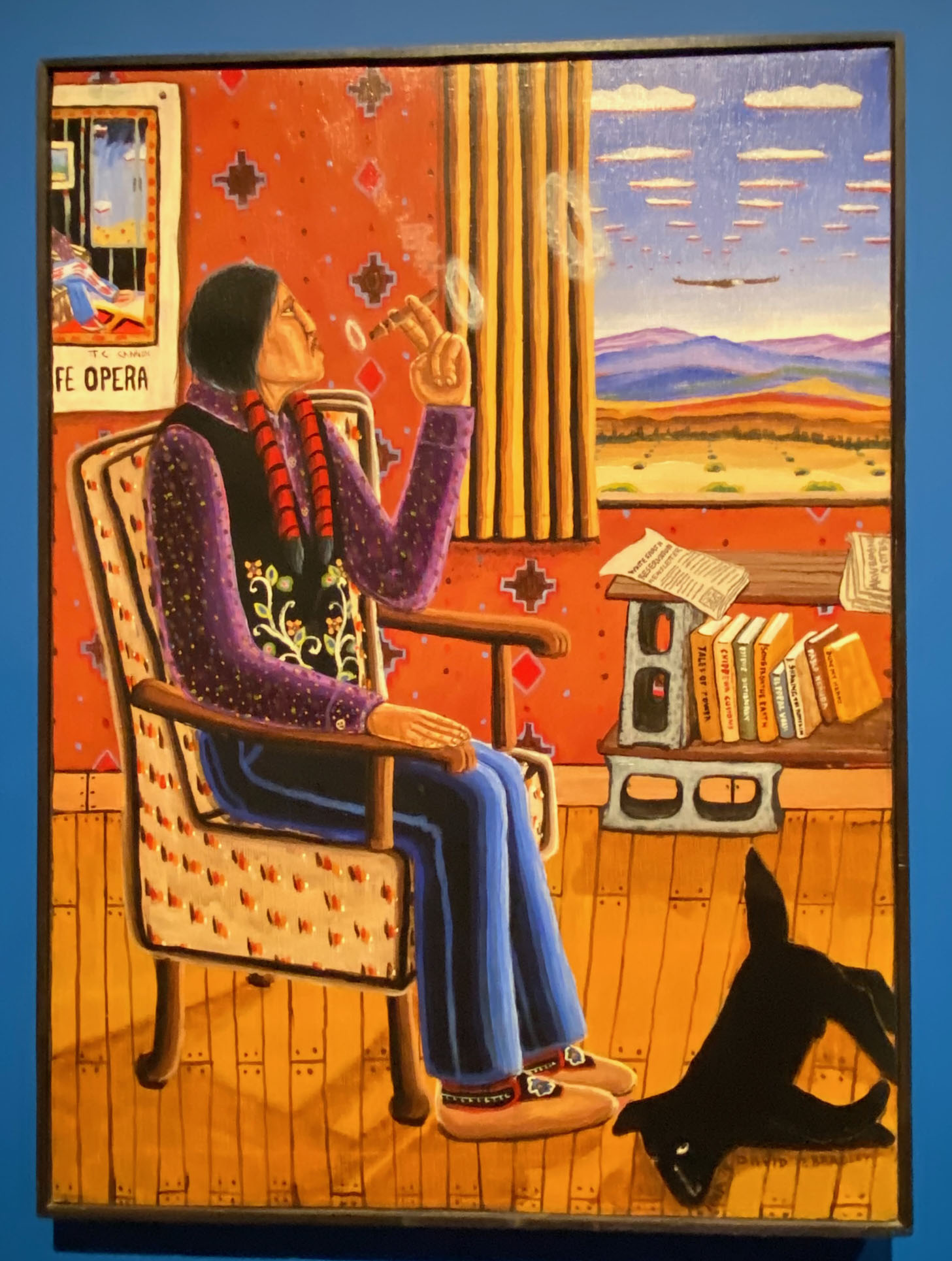
For example, on a wall honoring T.C. Cannon, the curators showcase a crazy, irreverent David Bradley work painted in T.C.’s bold, satirical style, but display a rather conservative (and rarely seen) woodcut by T.C. himself.

David Bradley’s (Minnesota Chippewa) 1979 acrylic Remembering T.C. Cannon in the style of his hero.
T.C. Cannon’s (Kiowa/Caddo) 1977 woodblock print Hopi with Manta.

Contemporary textile artist Ramona Sakiestewa’s comment that her work represents “visual echoes of what came before” inspired the title of the exhibition. Sakiestewa’s tapestry incorporates colors and motifs of traditional Hopi wicker plaques.  This theme is carried throughout the show.

Ramona Sakiestewa’s 1992 Basket Dance/9-B echoes a traditional woven Hopi ceremonial plaque.

A grouping of intricately painted Acoma ceramics pays tribute to the Wheelwright’s 1981 exhibition Sky City Salute that honored two matiarchs of that art form – Lucy Lewis, who lived at Acoma before and after tourists began beating a path to the ancient mesa-top city, and Marie Z. Chino. The curators match it with work by Marie’s grandson, Robert Patricio, who channels traditional themes into a modern ceramic context.

Acoma legacies: a 1965-85 seed pot and 1958 bowl by Lucy Lewis, and large 1980 storage jar by Marie Z. Chino.

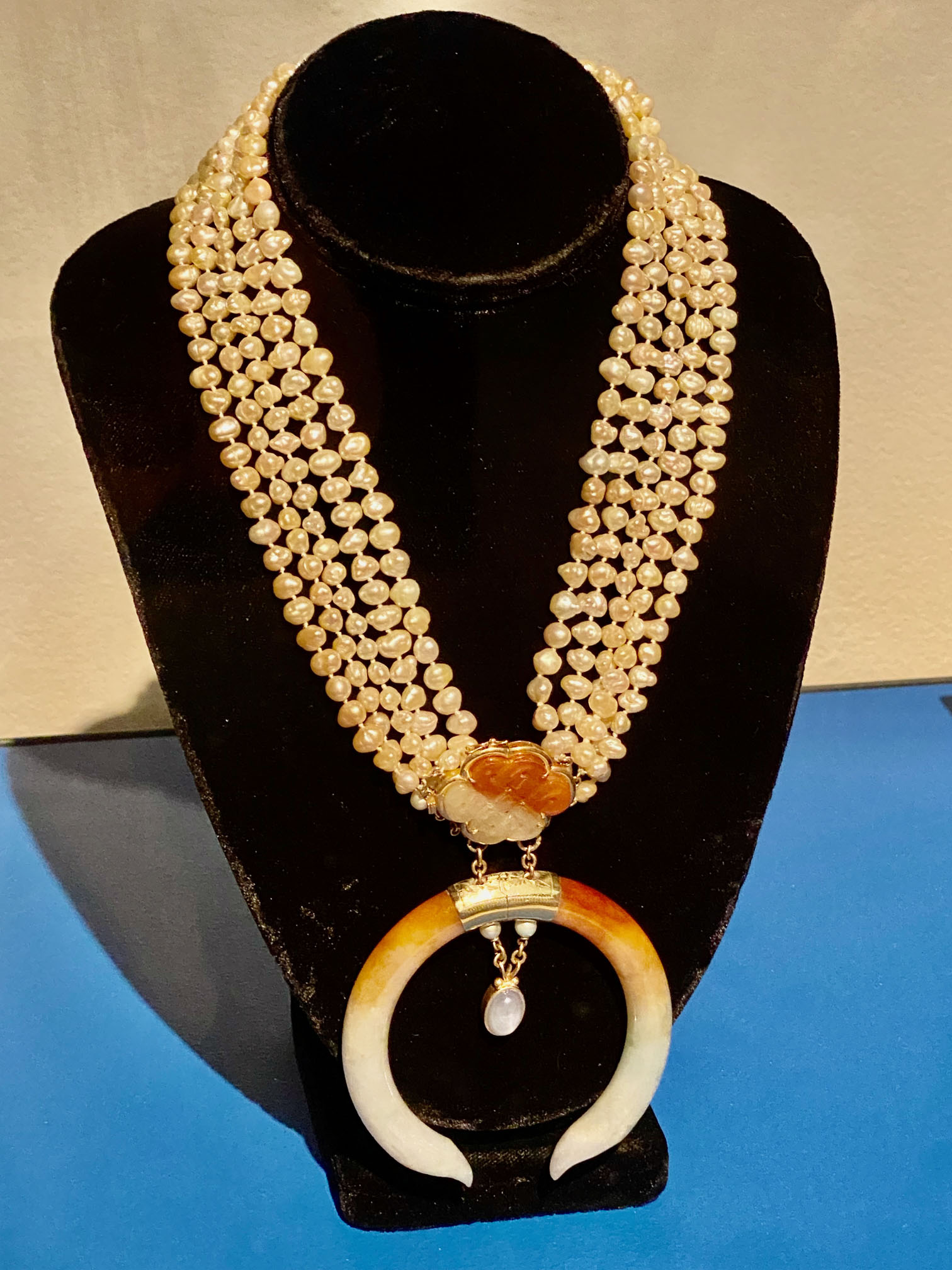
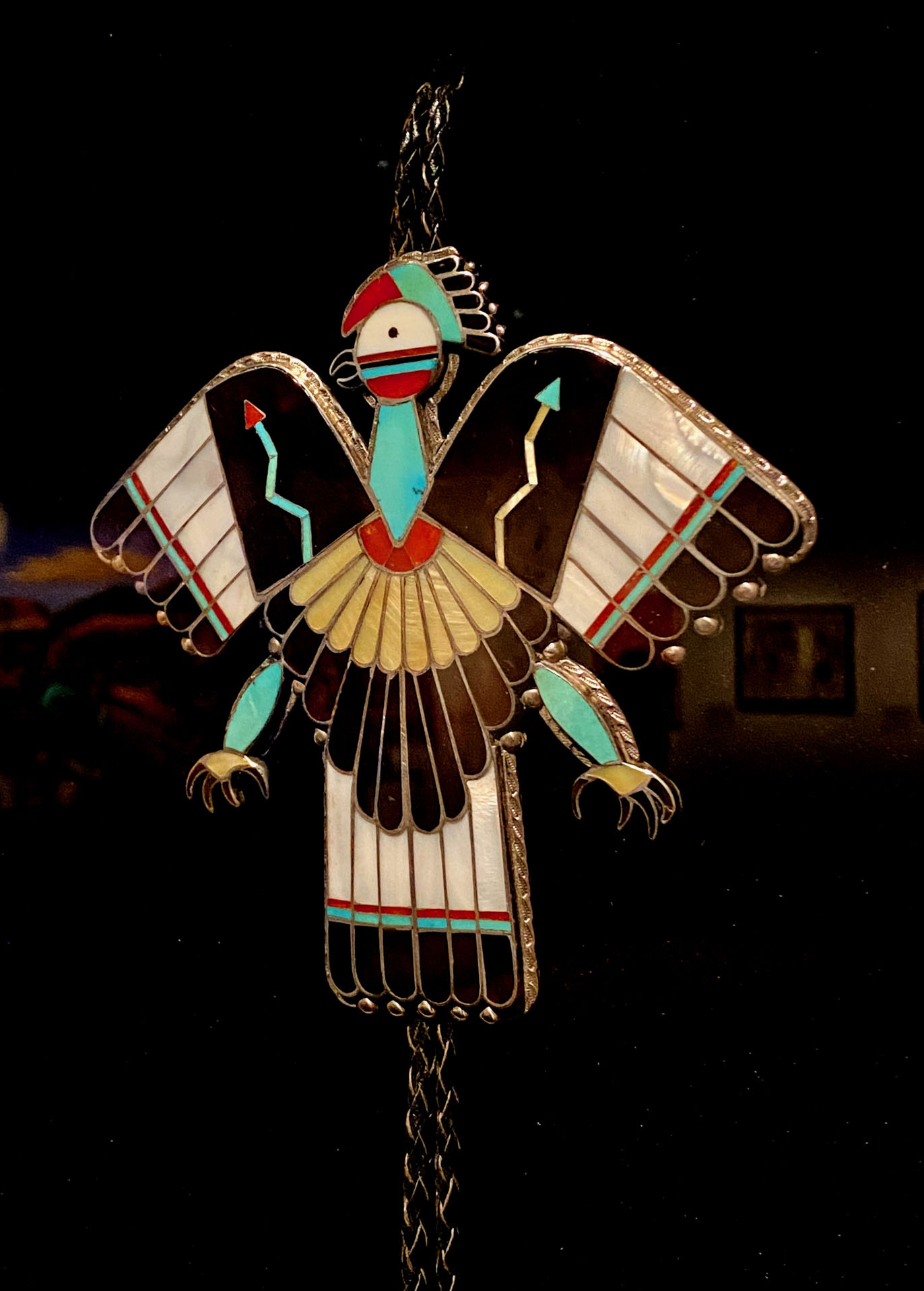
Another grouping references the Wheelwright’s 2011 show Radical Recycled Jewelry Makeover with a bold piece by Kenneth Johnson and the Wheelwright’s stellar collection of Zuni bolo-tie inlays.

Kenneth Johnson’s (Muscogee/Seminole) 2011 necklace from recycled pearls, jade, gold, and silver..
1970s-1980s thunderbird bolo by Owen Bobelu (Zuni); inlaid silver, jet, turquoise, and mother-of-pearl.

The “salon wall” is peppered with paintings that tell the interconnected histories and styles of nine Native artists – the trajectory from flat-style styles of the 1920s and 1930s to more open innovation of Ben Harjo and Linda Lomahaftewa, some of earliest graduates at the Institute of American Insitute Arts (IAIA).

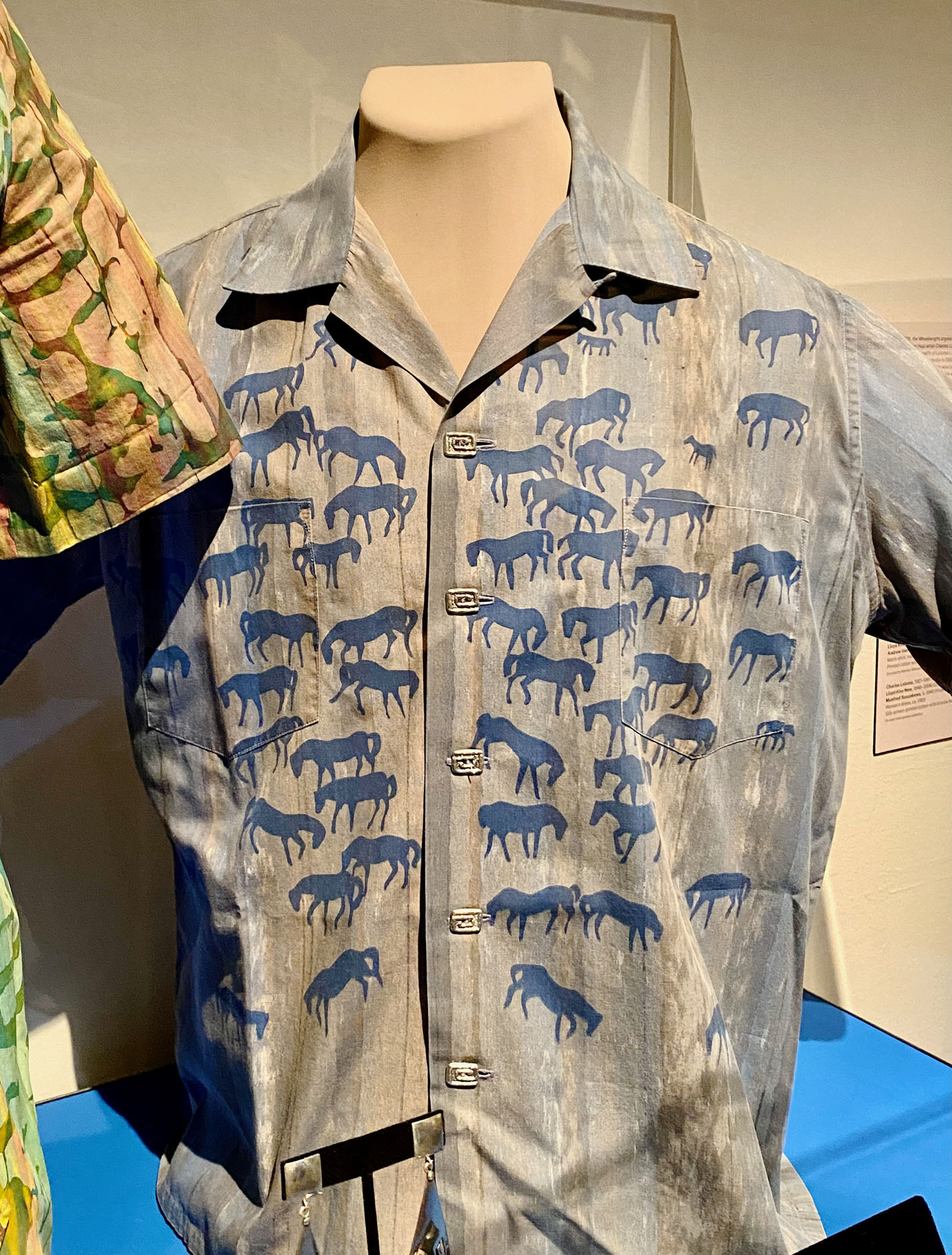
The exhibition also presents another group of work to acknowledge the artists who began working together in Scottsdale in the 1950s and who began IAIA in 1962 – clothing designed by co-founder/president Lloyd Kiva New and jewelry by instructor Charles Loloma..

Lloyd Kiva New’s (Cherokee) 1950s man’s shirt with Andrew van Tsinajinnie (Diné) printed fabric and Charles Laloma (Hopi) silver buttons.
Charles Laloma’s 1970 silver, coral, turquoise pin.

Beaded Converse sneakers by Marie Flying Horse, clever collage by Arthur Amiotte, a dinosaur pot by William Andrew Pacheco, art-world satire by Bob Hazous, and colorful Seurat references by Shonto Begay all add up to a vibrant walk through the last half-century of contemporary art innovations inside the hogan on Museum Hill.   

Take a look at our favorites on Flickr.

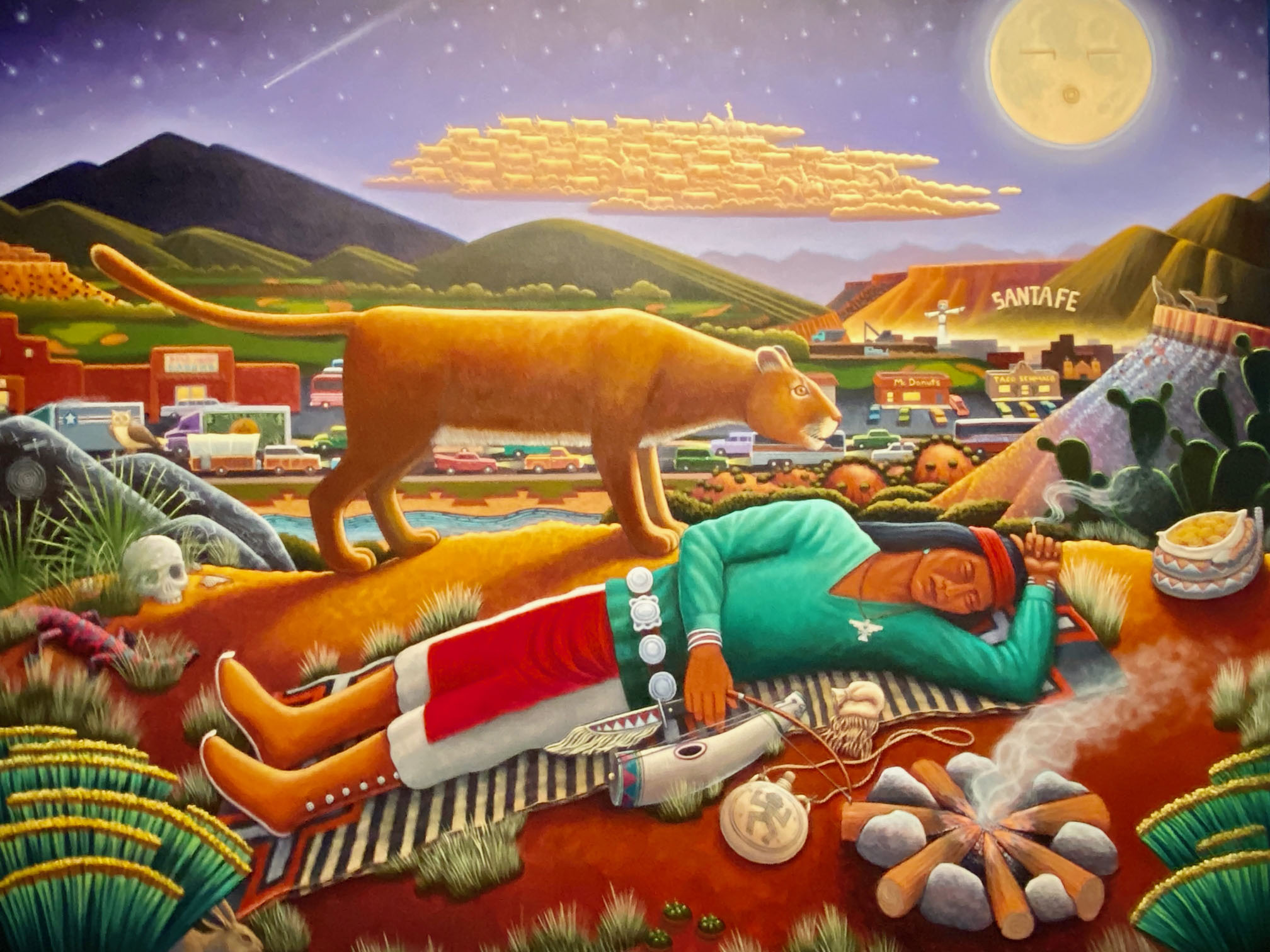
David Bradley’s (Minnesota Chippewa) 2004 acrylic To Sleep Perchance to Dream – a take on Rousseau

MIAC Connects Diné Textiles to Land and Community

Building on the groundwork laid in the artist-curated exhibition Grounded in Clay: The Spirit of Pueblo Pottery (opening in St. Louis on March 7), Santa Fe’s Museum of Indian Arts and Culture asked five Navajo textile artists, photographers, and scholars to delve into MIAC’s historic collections to tell the story of Diné weavng.

Horizons: Weaving Between the Lines with Diné Textiles, on view through February 2, 2025, presents historic and contemporary weavings alongside epic photographs of Navajo Nation landscapes to show the connections textile artist have to ancestors, their mentors, the community, the land, and their materials.

Historic Diné weaving with photomural by co-curator Rapheal Begay. Courtesy: the artist.

Appropriately, the story told by over 30 historic textiles is presented in MIAC’s Masterpieces gallery.

The entrance presents a dazzling display – a pictorial blanket woven in the 1890s set against a photomural of co-curator Rapheal Begay’s family sheep corral. It’s a visual testament to the importance of wool, life, and the 27,000 square miles of Navajo Nation. 

The blanket’s creator (unknown today) was an astute observer of the life on the land and translated it all into warp and weft – cow punchers, cattle, boots, birds, and new-fangled railroad cars, that only arrived in Navajo Country around the 1880s. Click here to see the detail.

1885 pictorial blanket created with Germantown wool yarn introduced in the Southwest by the railroads; photomural Navel (Hunter’s Point, AZ) by co-curator Rapheal Begay. Photo courtesy of artist.

Nothing was newer than the railroad, at the time this artist depicted it – a steam-fed invention from the East that would change western life forever, but that also brought a wide array of colorful yarn that could be mixed and matched with vegetal dyes to create new Native designs.

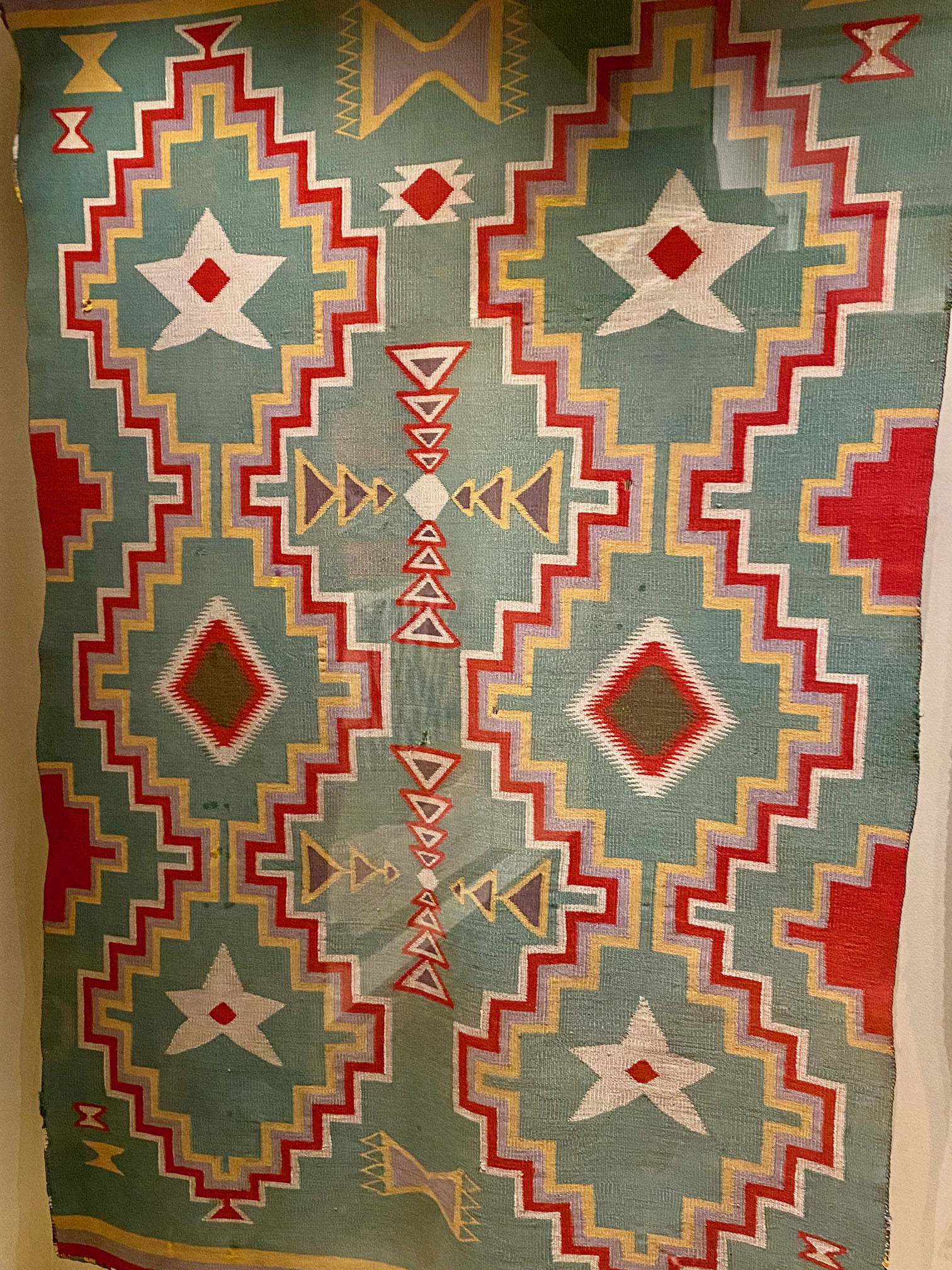
The intertwined history of Diné (“The People” in the Navajo language), textile art, and the land is told through quotes and recollections by the exhibition’s Native collaborators. While examining masterful geometric weaving techniques in 19th-century works, visitors are provided with an historic context – the types of art materials introduced to captives imprisoned at Bosque Redondo after the Long Walk, the images that could be interpreted as a longing for the homeland by the incarcerated, and coded spiritual affirmations.

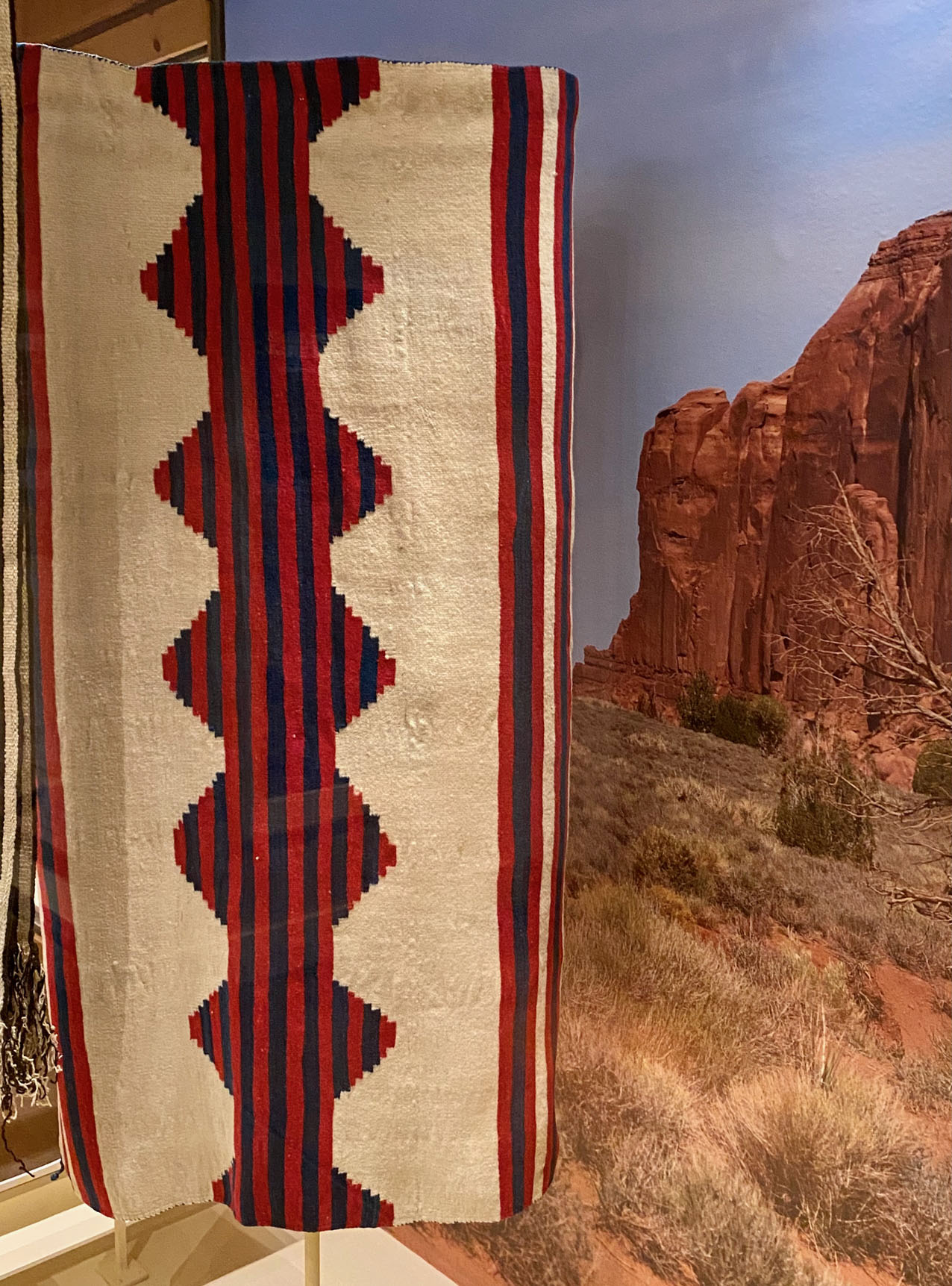
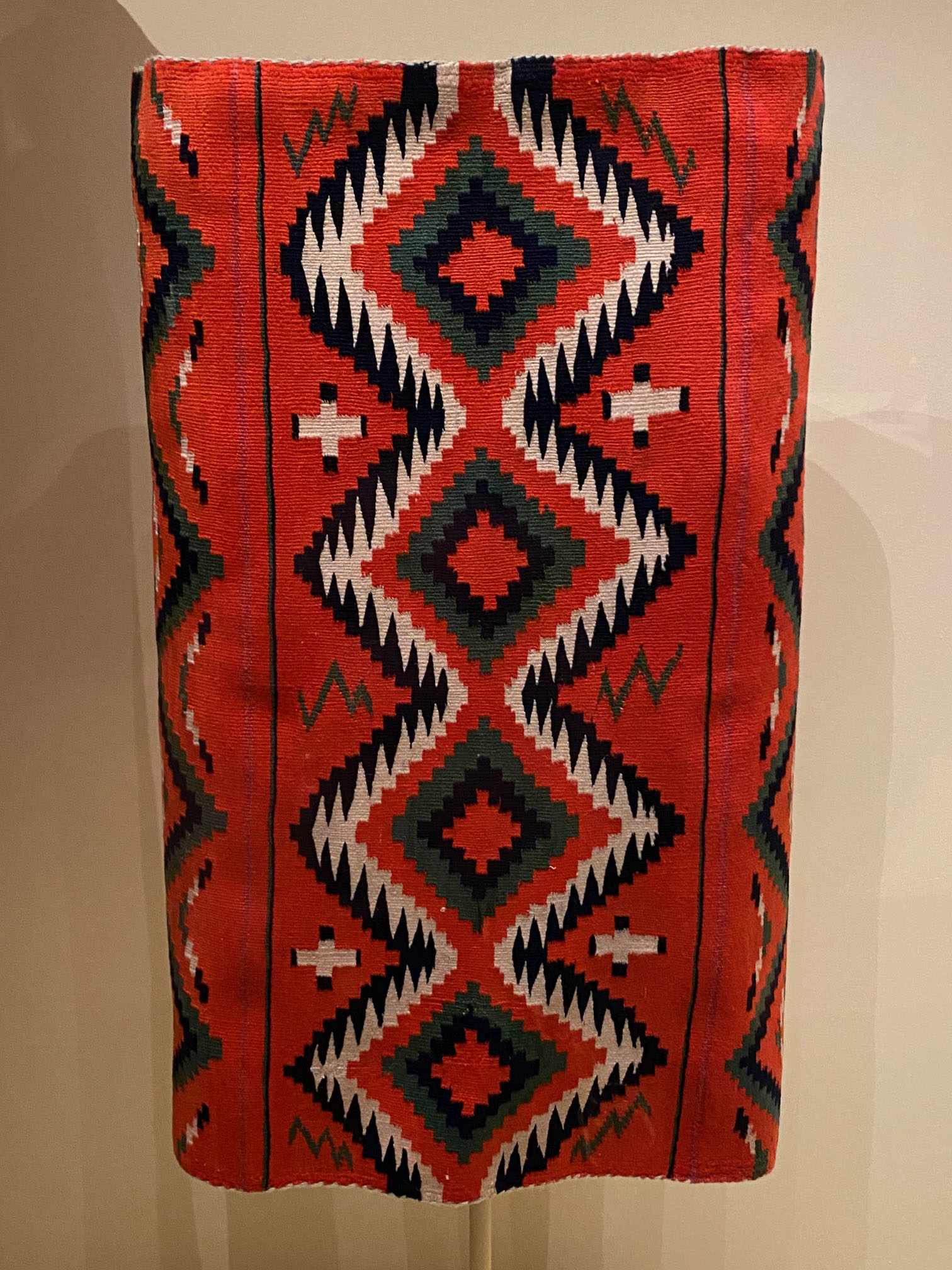
1850-1860 hand-spun wool child’s (or saddle) blanket with Spider Woman crosses; created with natural cocineal, indigo, and chamisa dye
1880-1897 rug made with Germantown wool yarn, cotton string, and raveled yarn; materials used in weaving at Bosque Redondo era, post-Long Walk.

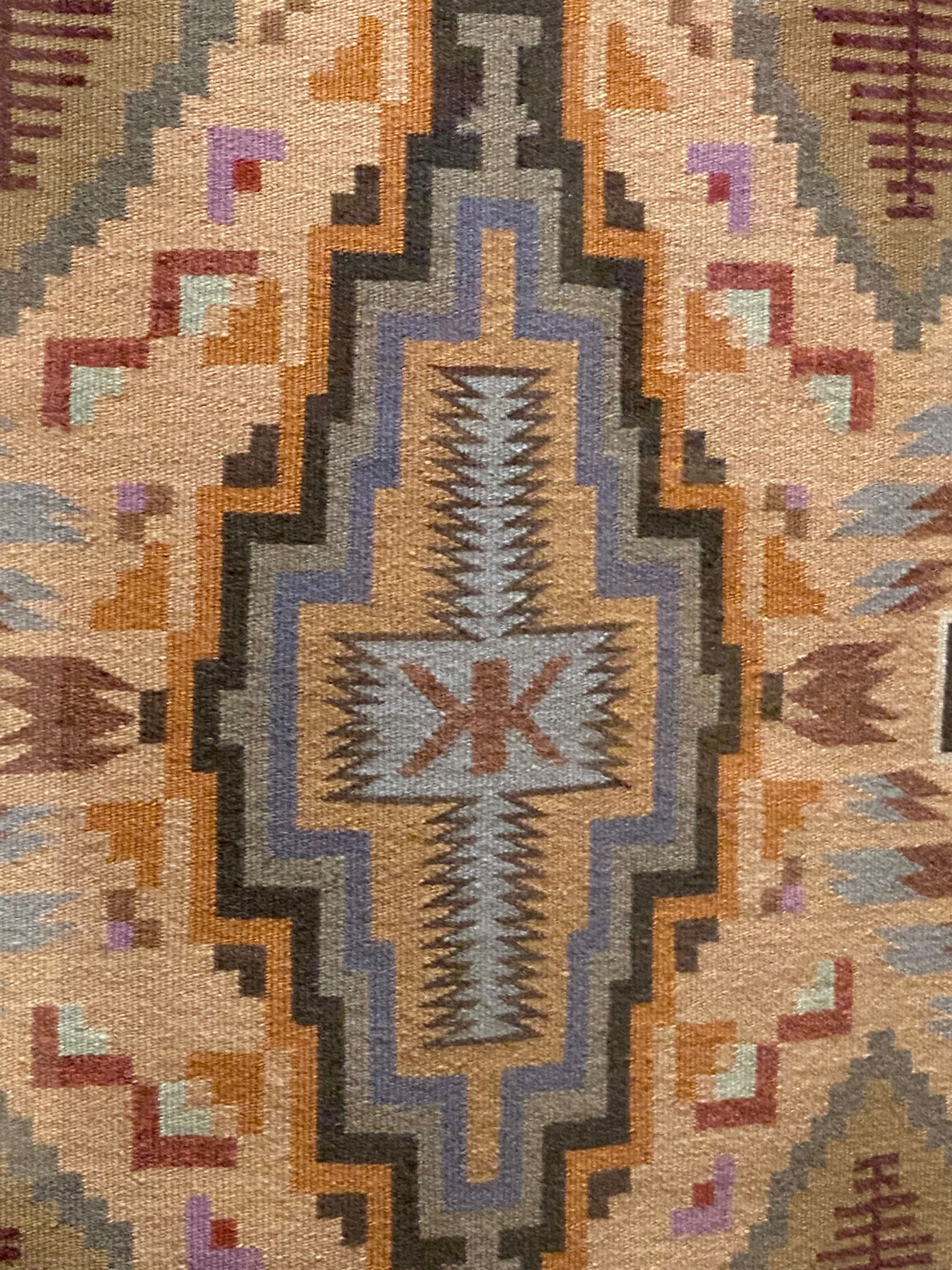
The participants in the exhibition make sure that viewers also experience how the landscape inspires the work of the past and contemporary Native textile artists. Diné fiber artist Tyrrell Tapaha includes her two-panel dress in which incorporates images of the Utah clouds and mountains that bring her spiritual peace. The masterful wall hanging by Lillie Joe uses the palette of the desert to create a mesmerizing geometric dazzler.

2020 two-panel dress by fiber artist Tyrrell Tapaha with images from Utah landscapes that inspired her; woven from churro, silk, mohair, and marino wool..
Close up of highly detailed 1980s Burntwater wall hanging by Lillie Joe, reflecting colors and patterns of the Navajo Nation landscape.

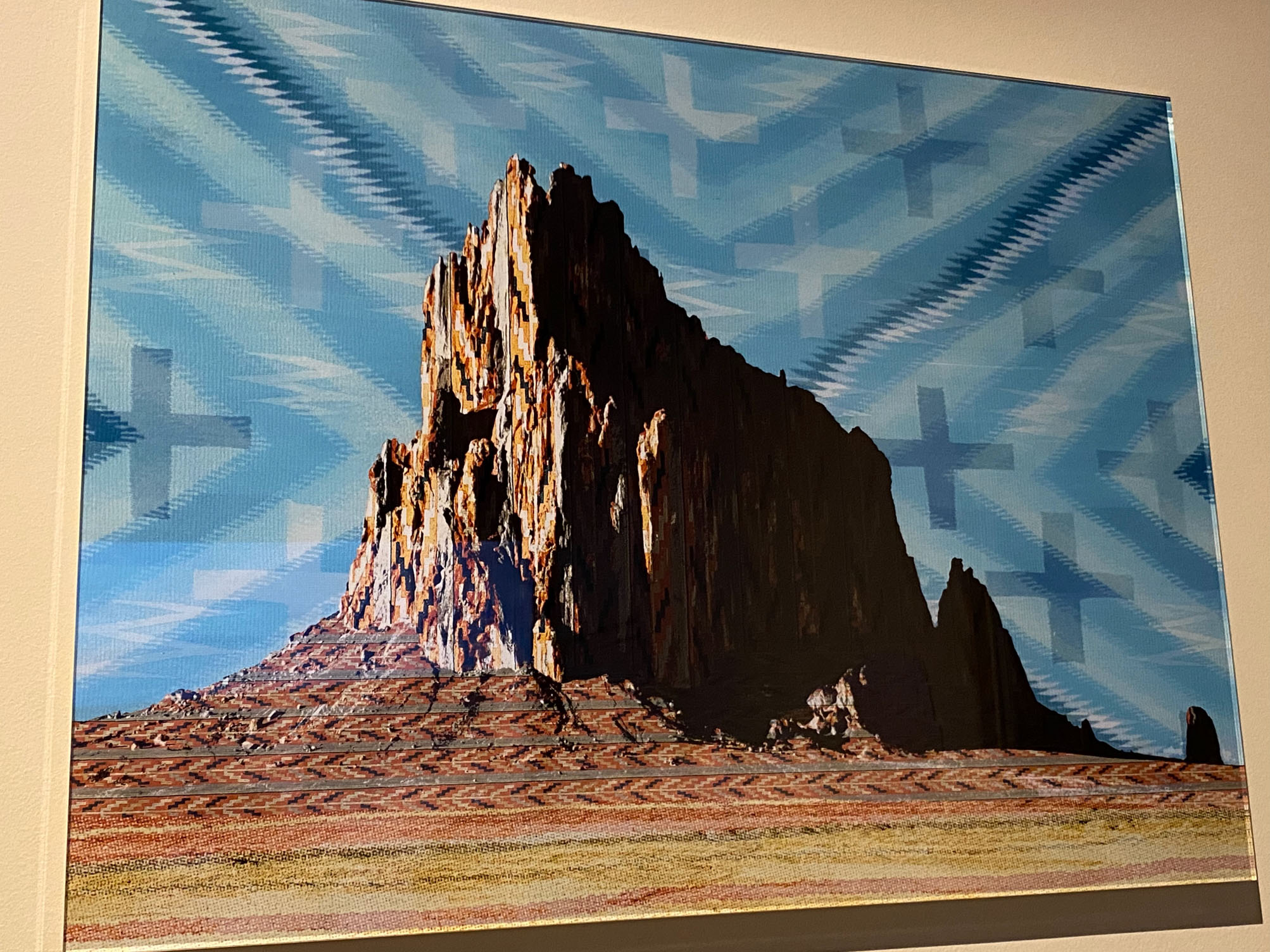
The curators feature both the photography of co-curator Rapheal Begay and Darby Raymond-Overstreet to allow gallery visitors to experience the awesome beauty of the homeland that inspires artists. Digital artist Raymond-Overstreet overlays geometric textile patterns across his luscious, beautiful landscapes.

2018 digital print Woven Landscape, Shiprock by Darby Raymond-Overstreet (Diné), overlaying digital landscapes with traditional weavings. Courtesy: the artist

Take a look at some of our favorite works in our Flickr album. And enjoy these historic and contemporary dazzlers.

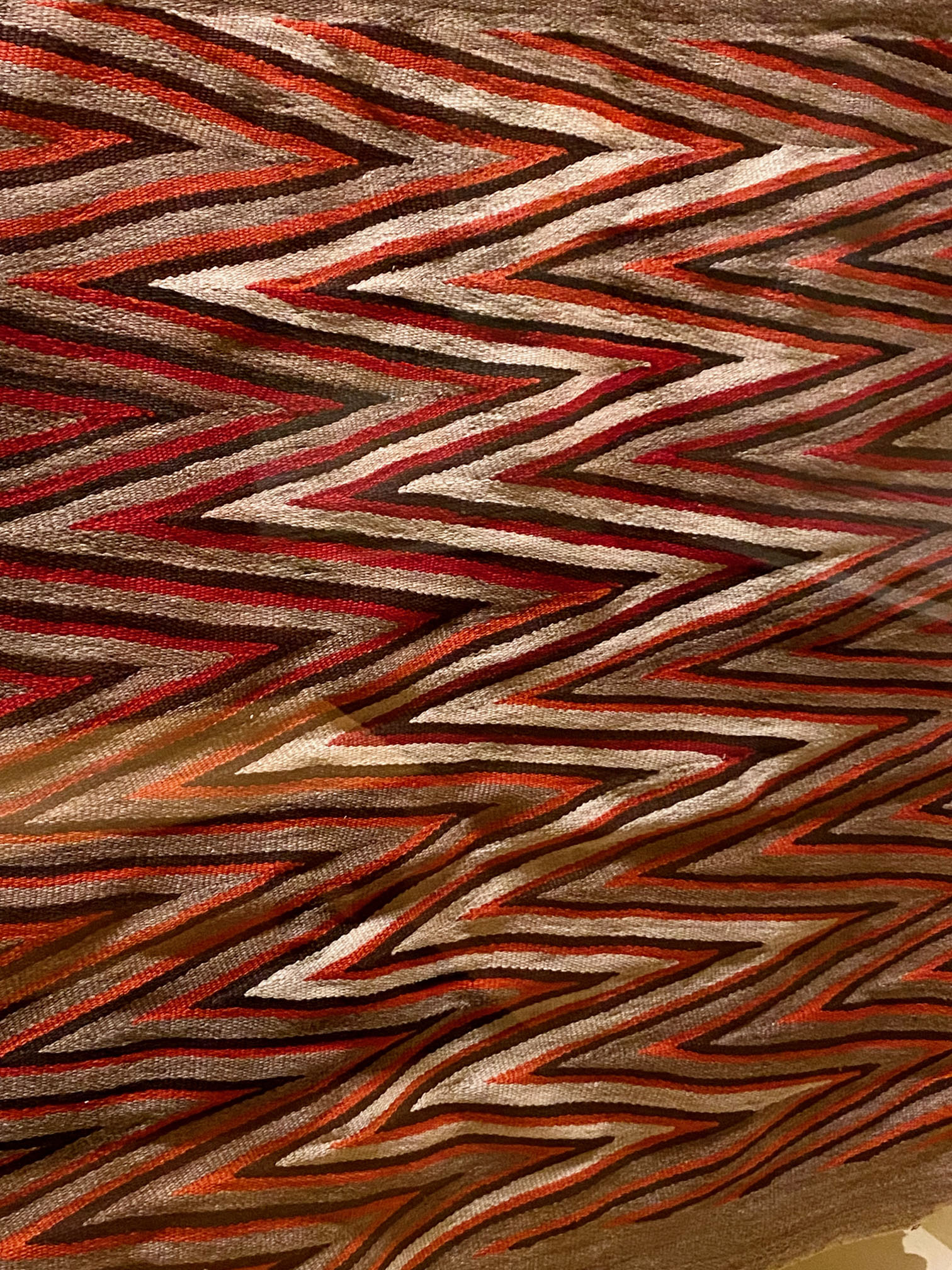
Detail of 1895 wedge weave blanket made with commercial cotton string and Germantown wool – a dramatic 19th c. weaving innovation. Courtesy: International Museum of Folk Art.
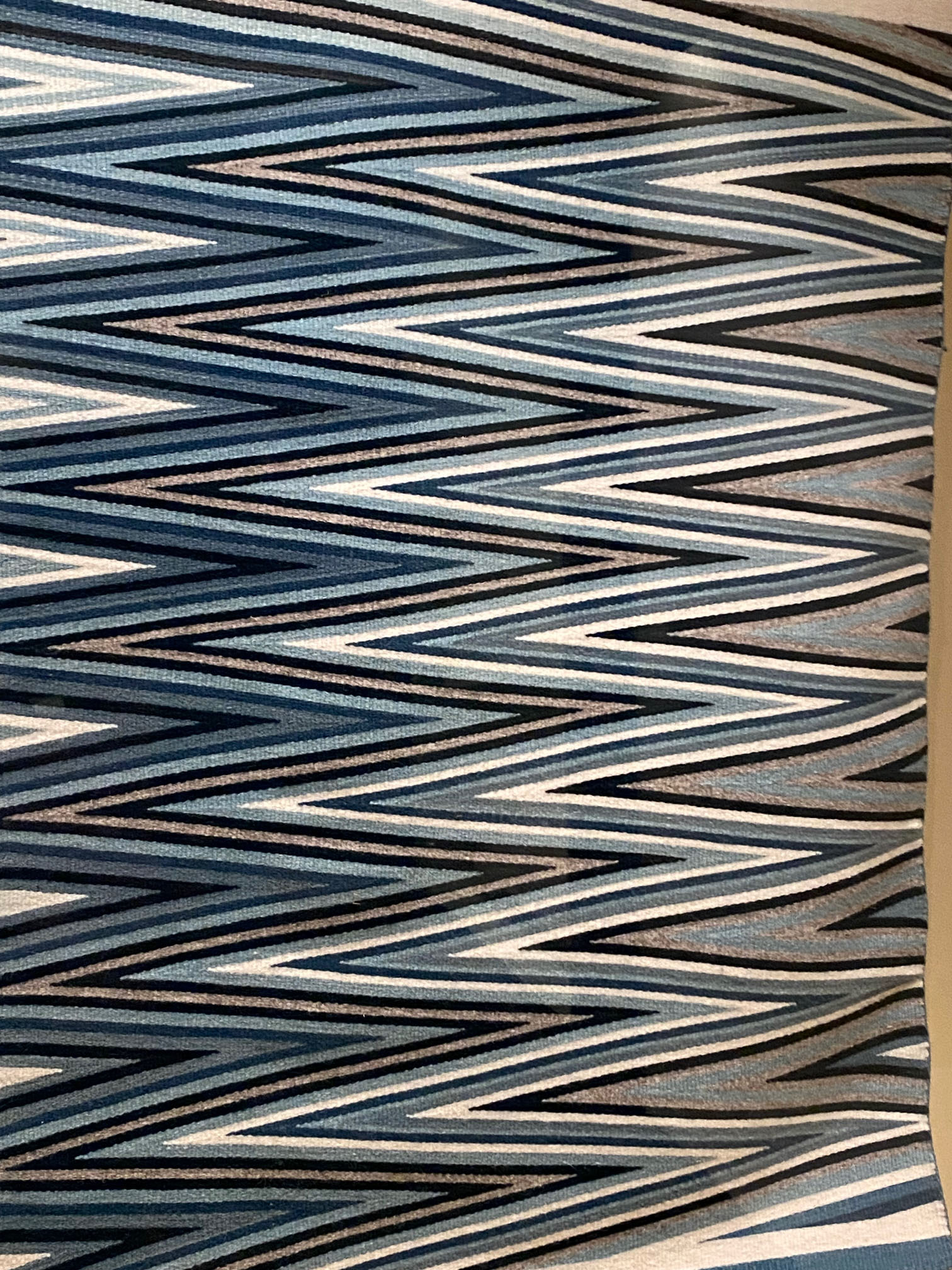
2022 wedge weave by Kevin Aspaas; white and grey wool yarn with indigo dye. Courtesy: private collection.
Detail of dynamic Diné 1960 wool tapestry weave. Courtesy: International Museum of Folk Art

Pueblo Pots Speak in “Grounded in Clay”

Contemporary artists say they can hear their ancestors speak across generations. All they have to do is hold their community’s ancient pots – living beings that connect them to the Earth and the people from the past who made them.

You can hear these modern and ancient voices and see ceramic masterworks in Grounded in Clay: The Spirit of Pueblo Pottery, an exhibition on view the The Museum of Fine Arts, Houston through January 12, 2025; continuing at the St. Louis Art Museum March 7 to September 14, 2025; and on display at the Pueblo Cultural Center in Albuquerque from March 2026 to February 2027.

In video at Museum of Indian Arts and Culture, Clarence Cruz (Okay Owingeh) reflects on a pots’s personal meaning

Clay is central to Pueblo culture, and this show is special, because it’s the first major exhibition of Pueblo pots curated entirely by the indigenous community – artists, leaders, teachers, and museum professionals.

1900 Tewa-Hopi Hno jar selected by Erin Monique Grant (Colorado River Indian Tribes); it reminded her of her Hopi family. Courtesy: Vilcek Collection.

For the 100th birthday of the Indian Arts Research Center at School for Advanced Research (SAR), the exhibition debuted in 2023 at Santa Fe’s Museum of Indian Arts and Culture, and then traveled to New York to open at the Metropolitan Museum of Art.

1907-1910 bowl by Nampeyo (Tewa/Hopi) selected by her great-great-grandson artist Dan Namingha. Courtesy: SAR

New York’s Vilcek Foundation co-sponsored the community-curation project, exhibition, and project website. The organizers consulted with sixty curators from 22 pueblo communities across the Southwest to select work from the IARC collection and write about the spirit of these works. Communications weren’t always easy, since Internet service (email) is still spotty on some tribal lands.  

But The Pueblo Collective’s inclusive approach to create the exhibition and catalog is now considered a template for major art institutions to work with tribal communities to convey their stories and culture to the public..

The IARC collection is legendary, spanning prehistoric to modern-day works. This video takes you inside IARC archive to meet a few of the Pueblo curators and the pots they selected:

Utilitarian vessels, ancient legacies, and intergenerational connections are themes explored in the 2023 installation at Santa Fe’s Museum of Indian Arts and Culture. The exhibition design artfully integrated the words and thoughts of the curators in, around, and above the spectacular selections. Take a look at some of our favorites in our Flickr album.

Two 19th-century Tesuque water jars: a jar chosen by artist Marita Hinds (Tesuque), who saw it on a 1980s class field trip; and one admired by potter Bernard Mora (Tesuque) for its personality and imperfections. Courtesy: SAR

In some cases, a curator chose an Ancestral Pueblo pot from the 1100s and reflected on how well it’s survived today. In other cases, a curator discovered their grandmother’s pot stored for decades within the IARC collection. What a joy to bring it out and let it breathe! Listen in….
This statement about Lonnie Vigil’s magnificent vessel by Nora Naranjo Morse says it all.  The MIAC gallery space recreated a Pueblo kitchen so we can experience the environment in which most Pueblo potters create their work.

1995 micaceous clay jar made by Lonnie Vigil (Nambe) selected by Nora Naranjo Morse (Santa Clara) because it glitters like stars. Courtesy: SAR
Santa Fe’s Museum of Indian Arts and Culture’s replica of Pueblo kitchen where most pottery is created

And here’s how the Met featured Lonnie’s showstopping work – made on his kitchen table – prominently in the American Wing entrance!

Micaceous clay jar by Lonnie Vigil (Nambe) in the show’s entrance at the Met’s American Wing. Photo by Richard Lee; courtesy: The Metropolitan Museum

The project website presents the curators’ biographies, their selections, and stories.

Listen to the Met’s 2023 panel with five curators behind this magnificent community-curated indigenous exhibition and find out why they believe understanding the vessels’ power is important:

Fernandez Curates Smithson at SITE Santa Fe

It’s not often you get to see Robert Smithson’s large-scale works inside gallery walls. Strolling through SITE Santa Fe’s magnificent Teresita Fernández/Robert Smithson exhibition, through October 28, provides an opportunity to see how a contemporary Brooklyn-based Cuban-American artist – inspired by landscape and societal histories of the Caribbean – positions her own work “in conversation” with Smithson’s 1960s-1970s geologic works, drawings, and photo installations.

SITE invited art-world superstar Teresita Fernández to curate this show with the Santa Fe-based Holt/Smithson Foundation. Prior to her deep dive into Smithson’s career, her primary knowledge centered around his 1970 epic Spiral Jetty – 6,650 tons of rock and earth jutting out from the shore of Utah’s Great Salt Lake.

Smithson’s 1969-1970 Mirrors and Shelly Sand and two by Fernández: 2009 Drawn Waters (Borrowdale) and 2024 Sfumato (Epic) 2. Courtesy: Dallas Museum of Art; the artist and Lehmann Maupin.
Still from Robert Smithson’s 1970 film Spiral Jetty, Great Salt Lake, Utah. Courtesy: Holt/Smithson Foundation.

But Fernández found a lot more from Smithson’s too-short career that she could couple with her own work to create SITE’s spectacular installation. Both artists use landscapes, deep time, ancient history, and travel.

Smithson’s 1968 installation A Nonsite (Franklin, New Jersey) with 2020 Archipelago charcoal work by Teresita Fernández. Courtesy: Museum of Contemporary Art Chicago; private collection

In the first gallery, Fernández selected a Smithson “nonsite” work – a minimalist series of boxes, each packed with rocks from the decidedly unromantic site of Franklin, New Jersey. Smithson’s “nonsite” includes a framed aerial photo that appears to document the site, but it’s a “readjusted” depiction of it. Not what it seems.

Next to the “nonsite,” Fernández hangs Archipelago, a charcoal wall sculpture., which appears to be a legit map, but it’s not. It’s an imagined map of separate Caribbean islands and continents linked together, making us reflect upon their shared socio-political colonial histories.

Viñales (Plateau) is a wall-sized “stacked landscape” depicting Cuba’s Viñales Valley, home of ancient karst caves once inhabited by Taino people and later where escaped plantation slaves sought refuge. At a distance, it evokes the valley’s ecological, social, and political legacies; up close, you see that the image is made up of thousands of tiny ceramic tiles. Something to get lost in.

2019 ceramic mosaic by Teresita Fernández Viñales (Plateau). Courtesy: the artist and Lehmann Maupin.

Both artists use reflection in their works. Manigual (Mirror) by Fernández– a tropical forest created from charcoal and sand – is affixed to a reflective surface, so you can “see yourself” in the charred thicket when you get right up to it. Smithson designed his earth-and-mirror Red Sandstone Corner Piece so that every gallery goer’s image is part of the visual experience – from close up, far back, and far away. You’re linked to the red sandstone.

Detail of 2023 Manigual (Mirror) by Teresita Fernández. Courtesy: Crystal Bridges Museum of American Art.

On the other hand, Smithson famous photographic series, Yucatán Mirror Displacements, documents his meticulously arranged mirrors set into Mexico’s coastal landscapes. Just reflections of landscape and sky in all the settings he documented his set of mirrors; no people.

Detail of Smithson’s 1969 Yucatán Mirror Displacements (1-9). Courtesy: Guggenheim Museum.

Nature’s continual ebb and flow, the Earth’s surface, ecosystems, and the cosmos ­are all subjects explored by both artists.What’s beneath the Earth’s surface, forces of nature, and human impact on it all pop up covertly in every room.  See more in our Flickr album.

Detail of 2017 charcoal work by Fernández Charred Landscape (America). Courtesy: the artist, Lehmann Maupin.
Detail of Smithson’s 1971 ink drawing A Profile of the Atlantic Bottom. Courtesy: private collection.

And learn more about the “conversations” that works by these artists are having in the curator lectures in SITE Santa Fe’s videos with Fernández herself and her co-curator from the Holt/Smithson Foundation.

Detail of Robert Smithson’s 1961-1963 paint and photo collage Algae, algae. Courtesy: Holt/Smithson Foundation and Marian Goodman Gallery.
Detail of 2019 graphite-covered shell installation Chorus by Teresita Fernández. Courtesy: the artist and Lehmann Maupin.