It’s not often you find yourself surrounded by vibrant contemporary art that directly connects you to dreams and stories that have been told and retold for tens of thousands of years. Meet some exceptional visual storytellers from nearly twenty Australian regions in Eternal Signs: Indigenous Australian Art from the Kaplan and Levi Collection, on view at the Nevada Museum of Art in Reno through November 2, 2025.
This exhibition showcases well-known and emerging artists in different geographic areas of Australia’s north coast and interior desert. See our favorites in our Flickr album and consult the map to locate the communities where the featured artists work.
2011 acrylic painting Wanampi Jukurrpa by Tiger Palpatja (Pitjantjatjara) from Kaltjiti, APY Lands about the water serpent and how sacred rock forms were created.
For thousands of millenia, the indigenous groups in Australia have created rock art, painted spiritual images on eucalyptus bark, and documented their “dreams” – a mix of creation stories, confirmation of people’s integration with the land and animals, and everyday life. These visual affirmations present a simultaneous representation of past, present, and future, hence the term “eternal signs.”
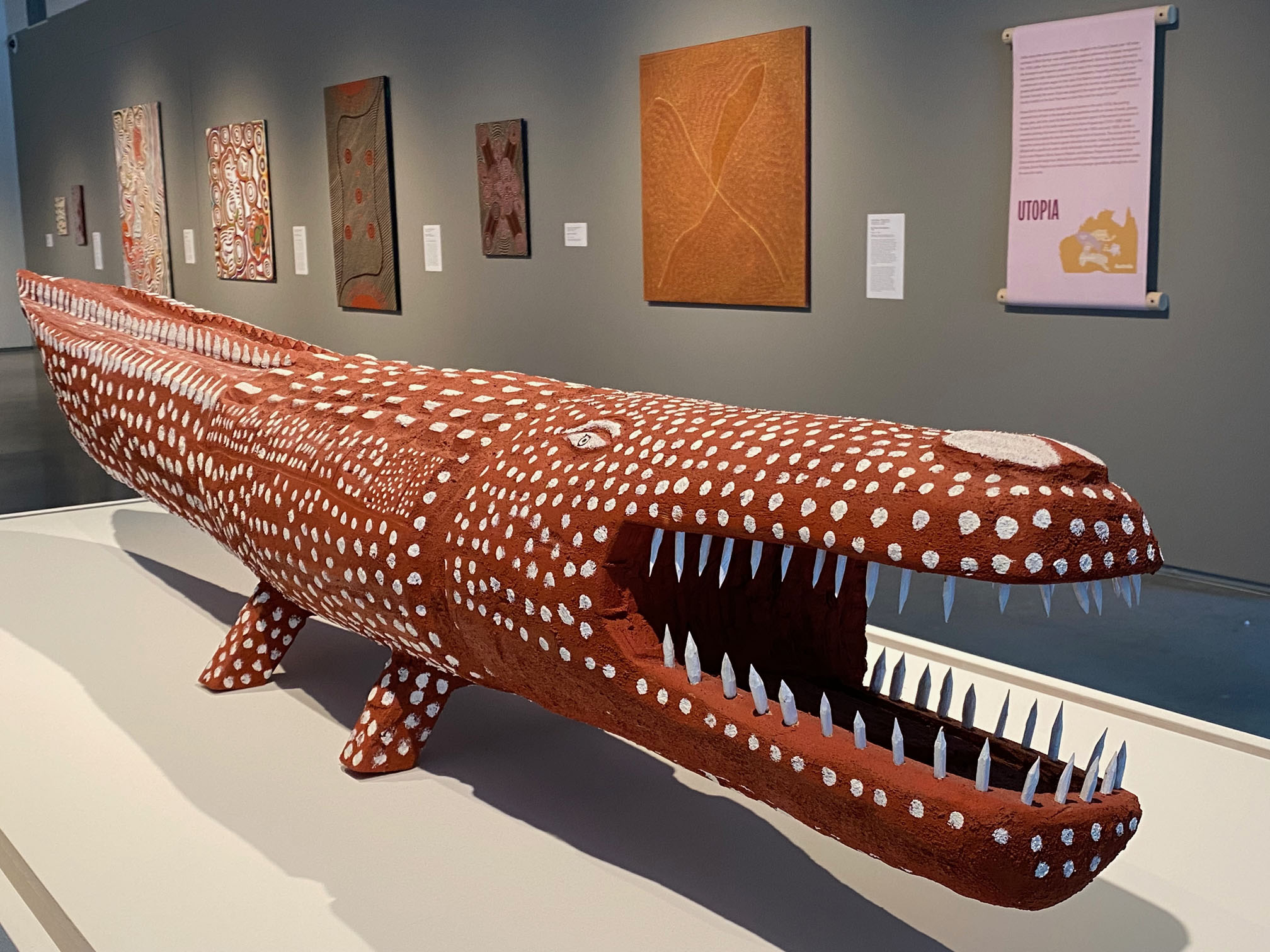
2001 Saltwater Crocodile by Craig Koometa (Wik-Alkan) from Aurukun, in far north of Queensland; at rear, paintings by artists from Utopia at the edge of the Tanami Desert.
Stories, images, culture, dreams, and language differ greatly among Australia’s 120 indigenous groups. (We’ve indicated each artist’s geographic region and particular language after their name.)
From Arnhem Land in the north, Paddy Fordham Wainburranga (Rembarrnga) from Wugularr, Northern Territory is one of the best-known artists shown. Growing up in the bush, Paddy was eleven when he first encountered anyone outside his traditional community. In the 1970s, he moved to Maningrida, a government-sponsored settlement, and began painting at the Arts & Culture Center. Paddy’s work often depicts ancestral spirits that he first encountered in rock art.
1991 Balangalngalan by Paddy Fordham Wainburranga (Rembarrnga) – a shape-shiting ancestor who guides and heals.
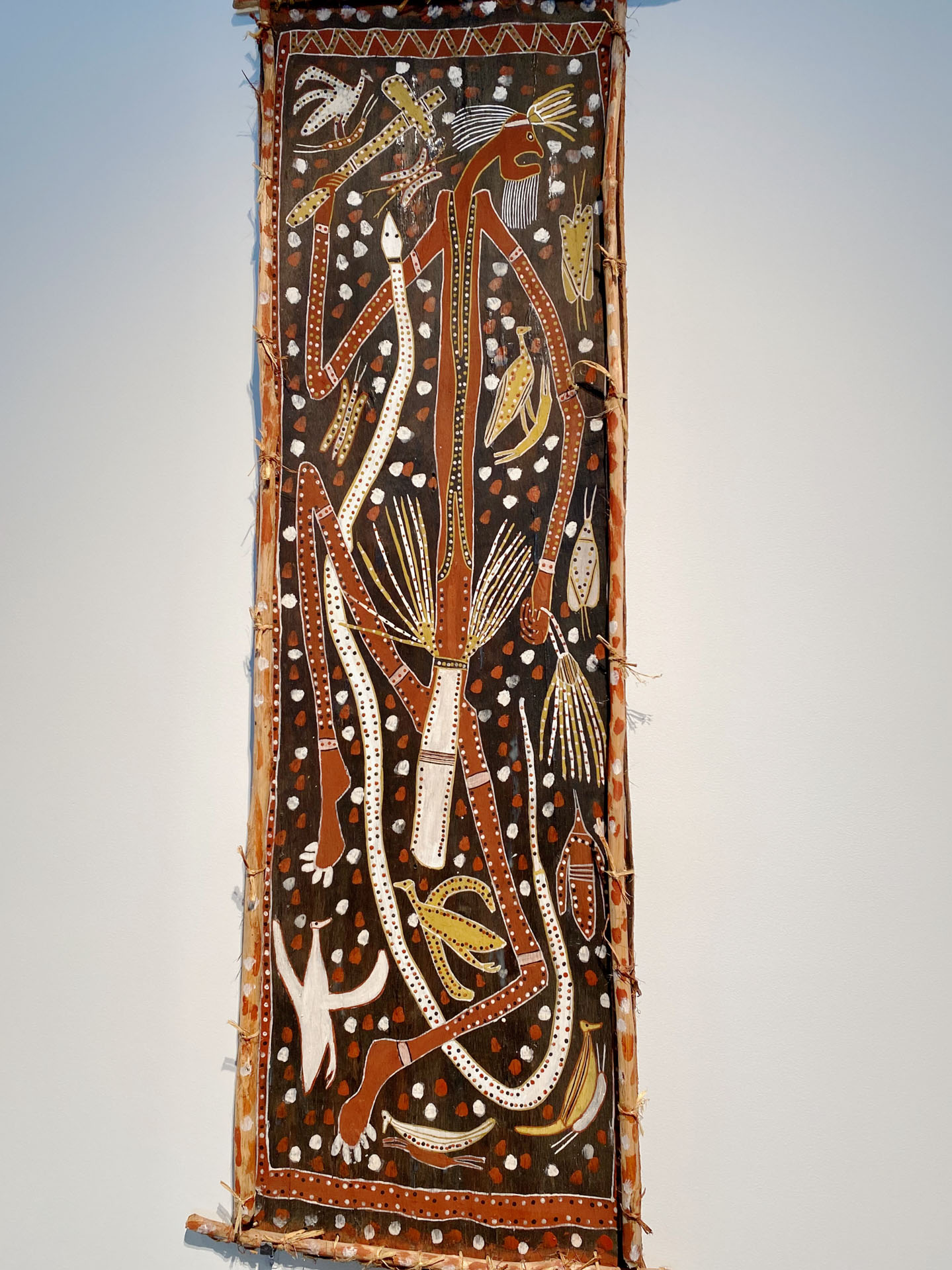
1994 painted wood Manjhkikilyo (Malevolent Mimih Spirit) by Paddy Fordham Wainburranga (Rembarrnga) from Wugularr, Northern Territory – a bad ancestral spirit from ancient cave art.
John Bulunbulun (Ganalbingu), another Maningrida Arts & Culture Center artist, also starts with traditional dreams and forms – for example, he uses a traditional hollow-log coffin as a basis from which to sculpt a three-dimensional dream about the long-necked turtle creator. Take a look.
More recent work by Yirrkala artists in East Arnham reflect ecological concerns and the clans’ interest in protecting ancestral lands. A dramatic sculpture by Guynbi Ganambarr (Naymil) reflects the rich, majestic, and spiritual coastal life of the Grove Peninsula. A masterful wall piece by Djambawa Marawili (Madarrpa) is one in a series that he’s used to affirm his people’s land and sea rights – even used as legal evidence in court cases challenging indigenous rights to land and sea, demonstrating the deep, spiritual meaning behind their claims.
Cormorant catches a freshwater fish: 2011 carved eucalyptus bark Wurran Ga Baypinga by Guynbi Ganambarr (Naymil) from Yirrkala, East Arnhem
2014 Source of Fire by Djambawa Marawili (Madarrpa) from Yirrkala in East Arnhem; ochres and sawdust on bark showing strong ancestral truth-tellers.
Here are two works by the award-winning Petyarre sisters from the area of Utopia on the border of the Tanami Desert in central Australia – an area that began to achieve acclaim as an art center in the late 1990s with dot paintings referencing the landscape and women’s expertise in bush medicine.
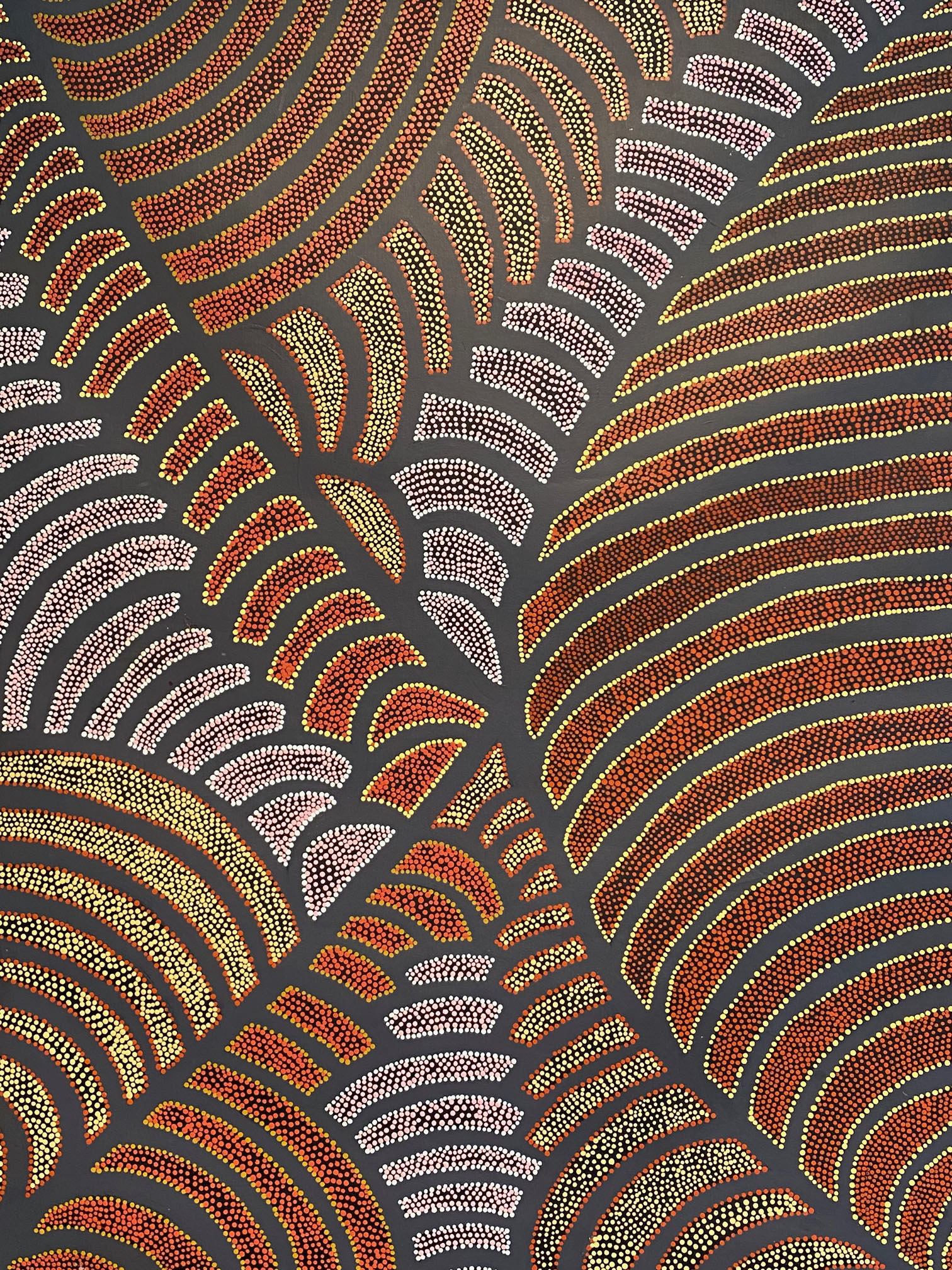
Detail of 1992 acrylic Mountain Devil Awelye by Gloria Tamerre Petyarre (Anmatyerre) from Utopia in the central Tanami Desert.
1996 acrylic My Place Atnangkere by Kathleen Petyarre (Anmatyerre) from Utopia in the central Tanami Desert; aerial view of creation story journey across the desert homeland.
We have to give a big shout-out to Robert Kaplan and Margaret Levi for donating over 70 of these amazing artworks to the Nevada Museum of Art. Their passion shows!
In case you aren’t able to enjoy this insightful, beautiful show at the Nevada Art Museum, art lovers will be able enjoy The Stars We Do Not See: Australian Indigenous Artfrom the National Gallery of Victoria in Melbourne as it tours across the North America. Right now, The Stars We Do Not Seeis scheduled for the National Gallery in Washington, D.C. through March 1, 2026.
2008 ochres on linen Sing Out Spring – Yiyili Country by David Cox (Goonlyandi/Walmajarri) from Warmun, Western Australia.
The Stars We Do Not Seewill travel to the Denver Art Museum (April 19 – July 26, 2026), Portland Art Museum (September 2026 – January 2027), Peabody Essex Museum in Salem (February – June 2027), and the Royal Ontario Museum in Toronto (July 2027 – January 2028).
Two 2004 acrylic paintings Ngura (Country) by Tali Tali Pompey (Pitjantjatjara) from Kaltjiti, APY Lands.
Fancy neck ruffles, gilt-framed portraits, sleek suits, flowing trousers, and bold plaids and stripes pop from every corner of the Costume Institute exhibition Superfine: Tailoring Black Style, on display at the Metropolitan Museum of Art through October 27.
It’s a 12-chapter journey through Black men’s style that emphasizes how superb tailoring, style, and fashionable precision has been used successfully by newly emancipated slaves, Revolutionary political leaders, activists, sports and pop stars, and high-style travelers from the 17th-century through today.
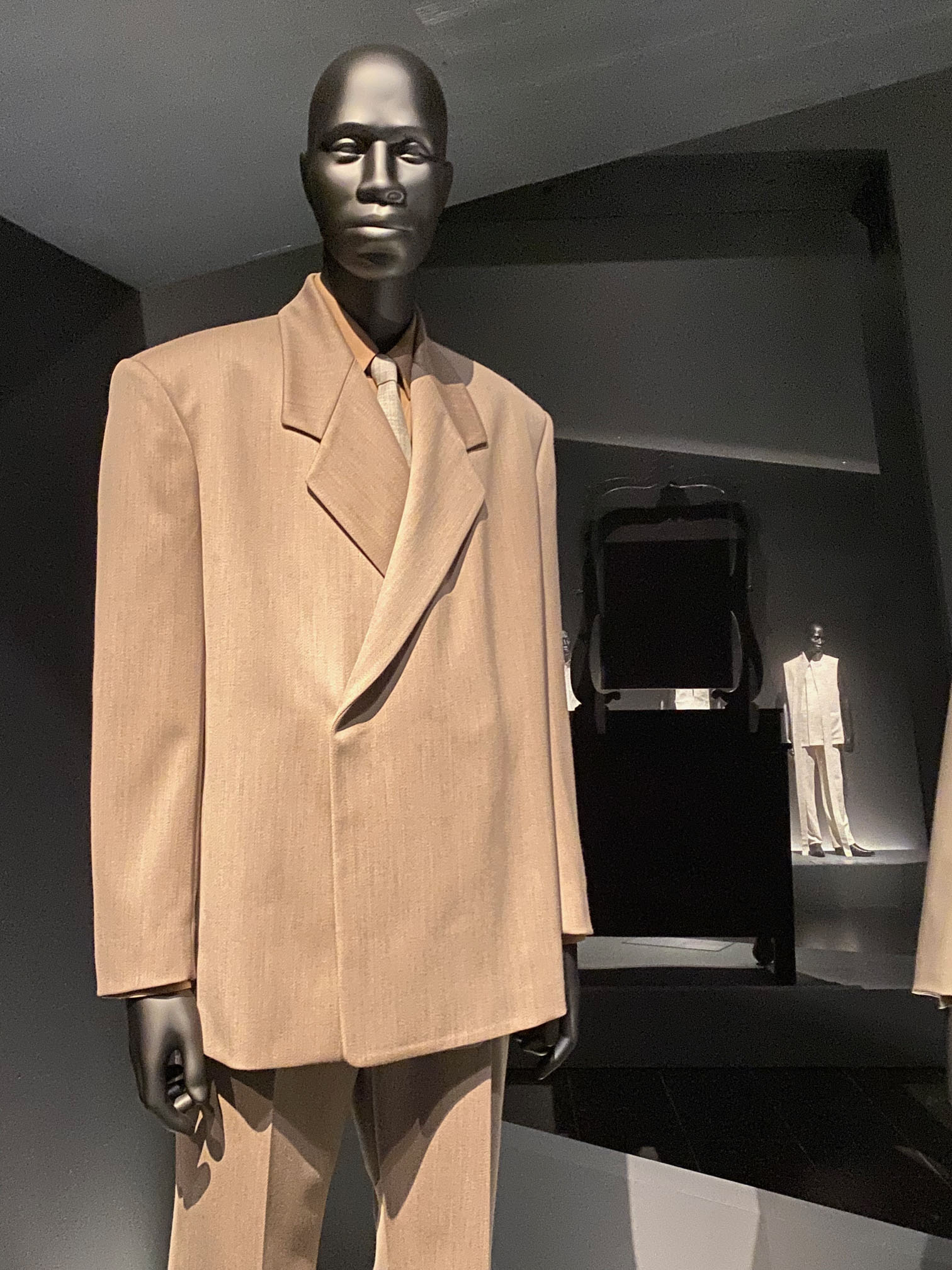
So cool: 2025 wool gabardine ensemble by Jerry Lorenzo for Fear of God – a modern throwback to Fifties’ tailoring. Courtesy: Fear of God
Each section provides a deep dive into history to explain how Black men (and a few daring women) adapted high-fashion menswear in the 17th and 18th centuries to reinvent themselves as authoritative, free, cosmopolitan high-achievers. Themes include Presence, Distinction, and Cool – based on co-curator Monica L. Miller’s acclaimed 2009 book, Slaves Slaves to Fashion: Black Dandyism and the Styling of Black Diasporic Identity.
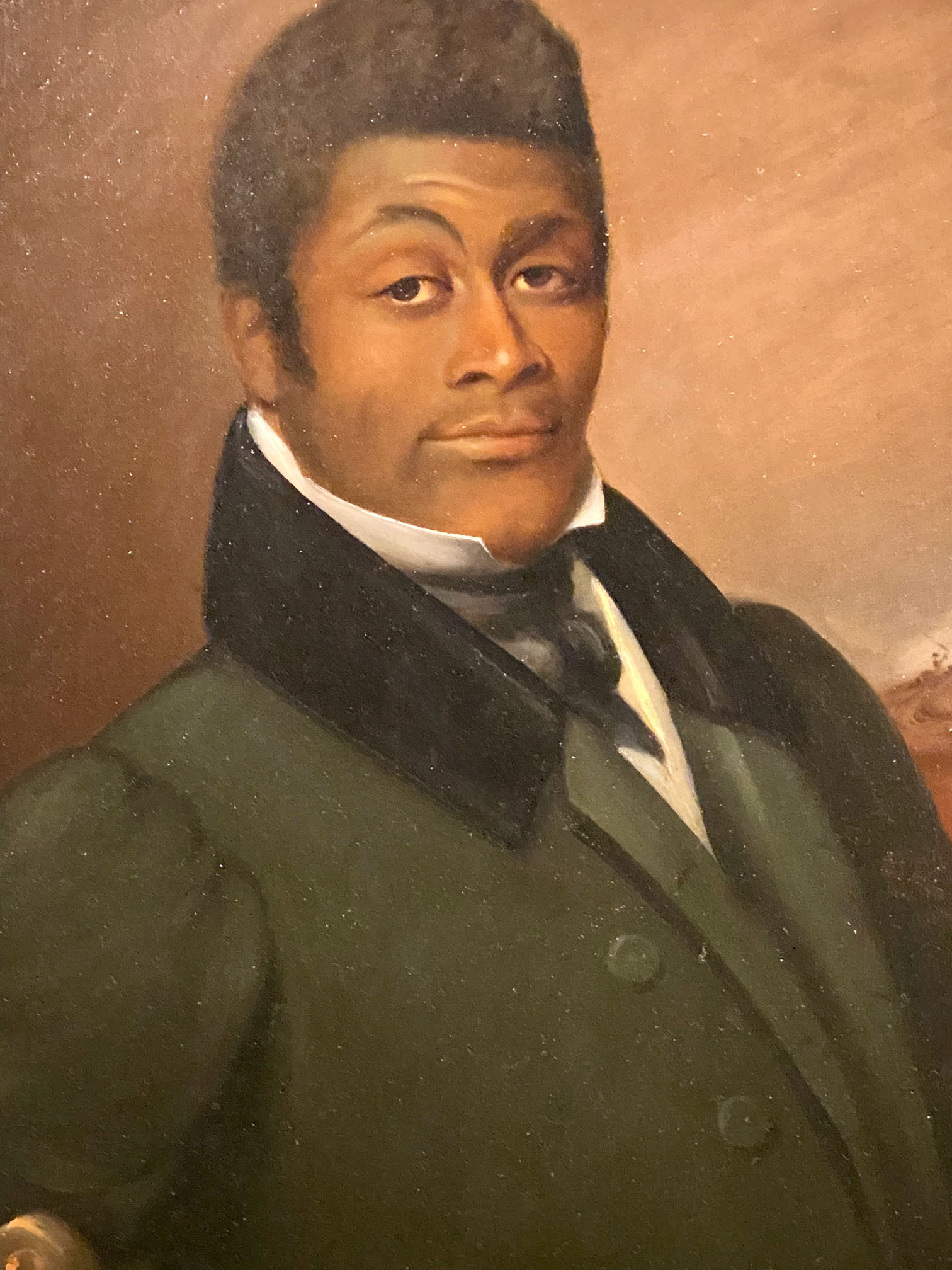
Dressing for distinction: 1804 Portrait of Toussaint L’Ouverture, leader of the Haitian revolution, painted by Giradin. Courtesy: La Maison de l’histoire européen, Brussels.
The curators leverage the Met’s extensive collection of photos, books, magazines, fashion, and accessories to provide visitors with the full visual story of each of the angles of Miller’s treatise. Plus, they’ve assembled loans from recent collections of cutting-edge contemporary Black designers who themselves are pulling inspiration from these same pages of history.
The Distinction section, for example, has a wall of impressive portraits and bedazzled swords of the first leaders of the Hatian revolution dressed in military finery – emphasizing their commitment to Englightenment ideals in the first successful slave rebellion in the Western Hemisphere.
The brilliant multi-level exhibition design features contemporary menswear inspired by 18th-century revolutionary and military style, including a swaggering great coat designed for the ever-magnificent Vogue editor-at-large, Andre Leon Talley.
Jawara Alleyne’s 2004 tailored ensemble inspired by Jamaican style; at right, ensemble from his 2021-2022 “Renegade” collection inspired by 19th-century shipwrecked sailors. Courtesy: the designer.
Worn by Andre Leon Talley; 2000-2001 haute couture coat with gold braid by John Galliano for House of Dior. Courtesy: Talley estate.
The Freedom section tells the story of the rise of the Black dandy in the 19th century and how the entrepreneurial class of African Americans dressed to impress. Historic portraits, photos, a fancy tailcoat, and a book on how to tie fancy neckwear – evidence of social upward mobility – are shown alongside cutting-edge contemporary menswear.
2023 figure-enhancing white cotton ensemble by Bianca Saunders for her “Nothing Personal” collection. Courtesy: the artist.
Freedom: Fashionable attire in 1850-1856 portrait of Thomas Howland, the first elected Black official in Providence. Courtesy: Rhode Island Historical Society.
The Champions section focuses upon how successful Black athletes – such as Jack Johnson, Walt Frazier, and Mohammed Ali – used fine clothing and style to make a statement, and how althetic wear transitioned into upscale runway fashion.
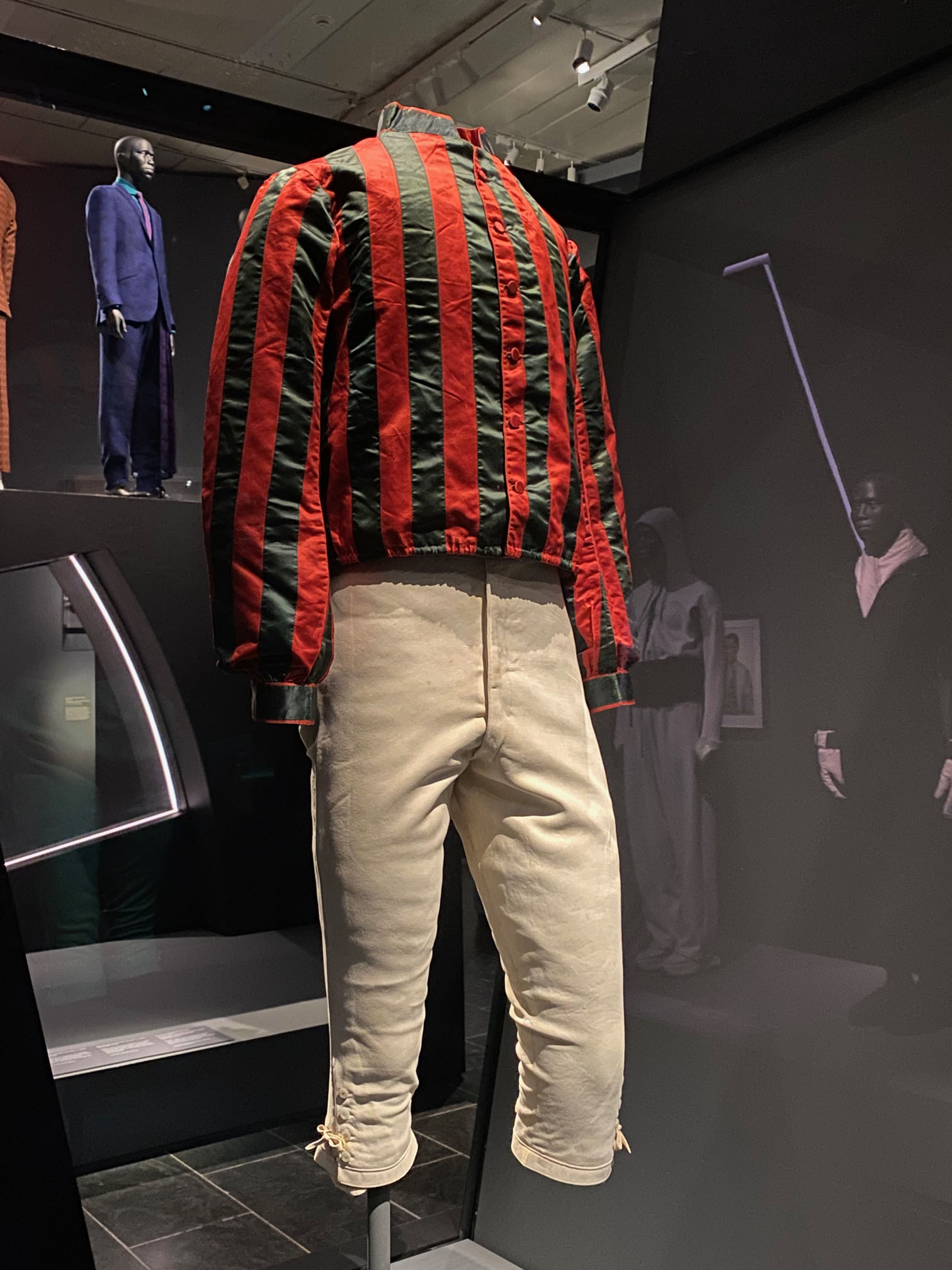
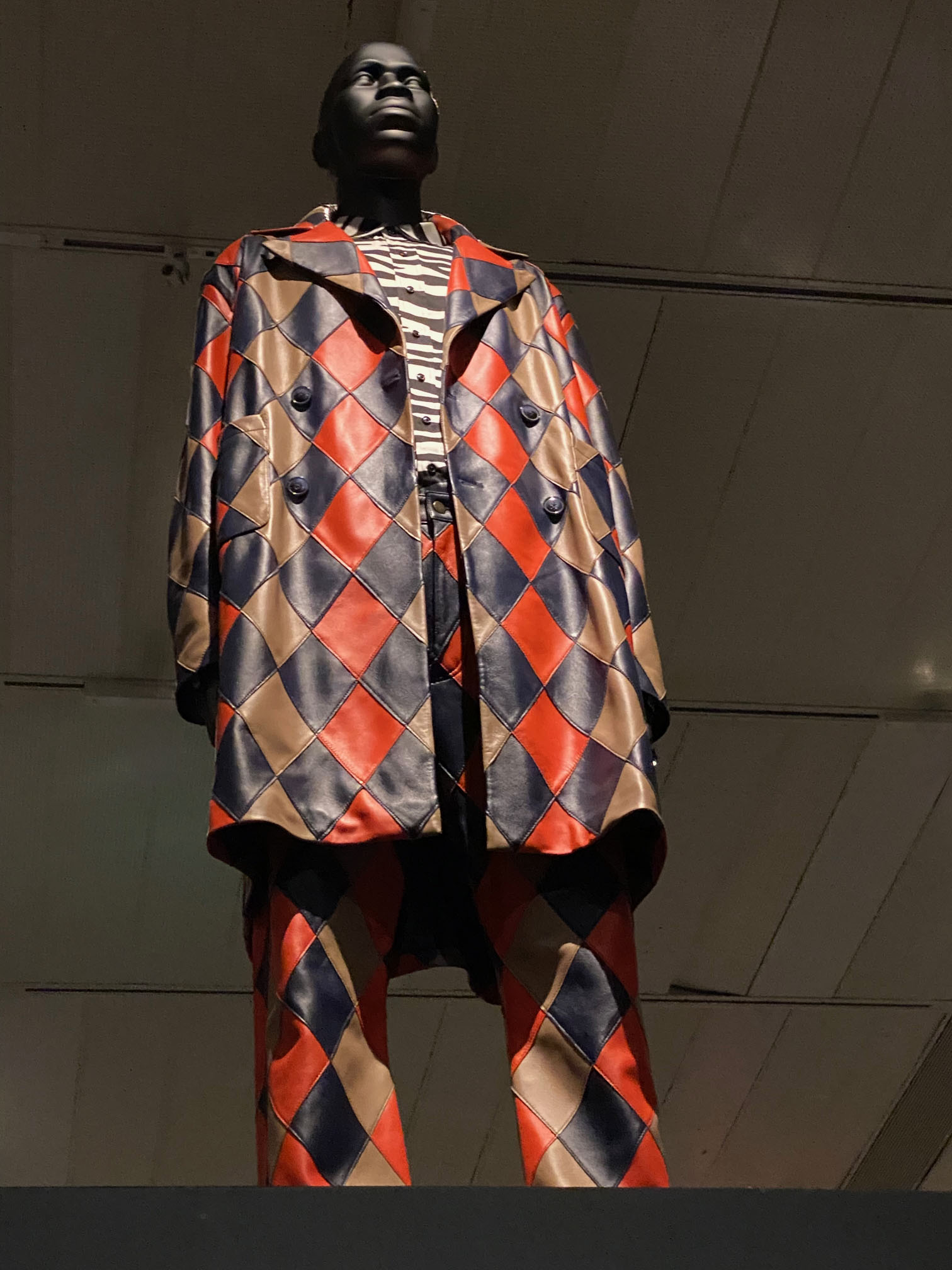
The story of Black jockeys is told – how 19th-century sports superstars got pushed out of early 20th-century racing when racial discrimination was at its peak, and how contemporary designers are incorporating this story into their designs.
EaEarliest surviving jockey suit (1830-1850): stripes appliquéd on silk jacket with and buckskin breeches made by plantation tailors. Courtesy: Charleston Museum, South Carolina.
2024 ensemble from “The Great Black Jockeys” collection by Tremaine Emory for Denim Tears; pieced lamb leather coat and trousers over silk shirt. Courtesy: Denim Tears.
The Respectability section explains how social-justice icons D.E.B. Du Bois and Frederick Douglass used their perfectionist style to draw a crown and make a statement, but it also discusses (and shows) the tools of the trade used by legions of Black tailors. There’s also a beautifully cut in-process example from Saville Row tailor Andrew Ramroop.
2024 in-process tailored jacket by Andrew Ramroop for Maurice Sedwell of Saville Row. Courtesy: Maurice Sedwell
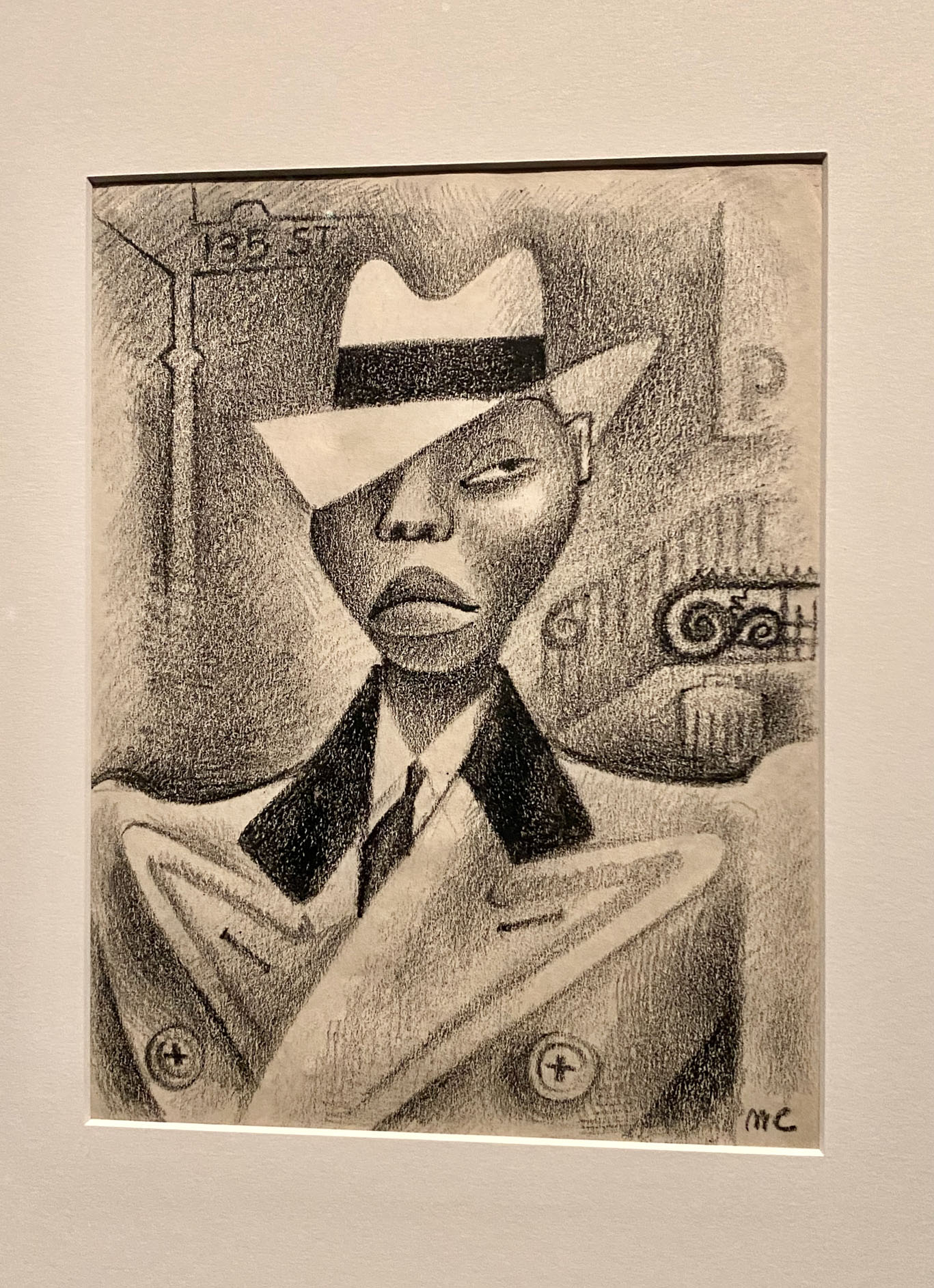
Hip community: 1930 lithograph of stylish Harlem Dandy on Striver’s Row by Miguel Covarrubias, a popular Vanity Fair contributor. Courtesy: University of Texas at Austin.
Of course, hip-hop takes its bow, too, with a tribute to Dapper Dan and other designers honoring the cool, ever-evolving style of Black musicians and performers.
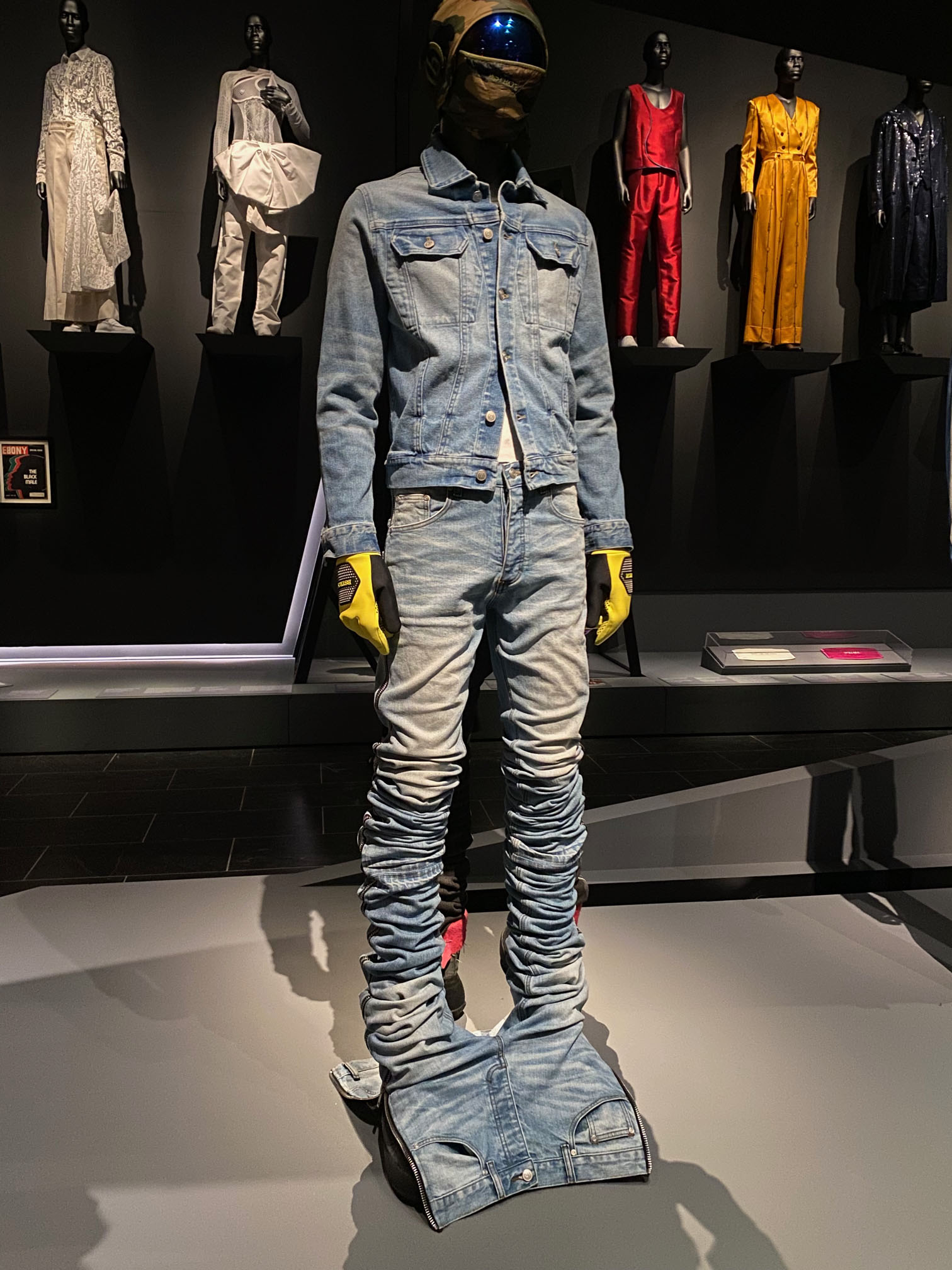
So cool: 2017 denim ensemble by Brick Owens and Dieter Grams for Bstroy, a reference to early all-denim hip-hop fashion. Courtesy: the designers.
1987 all-over LV-monogrammed leather jacket for Jam Master Jay of Run-DMC and pants for DJ Hurricane by Dapper Dan of Harlem. Courtesy: private collections.
How do abstract artists visually channel their response to awesome landscapes? You’ll get a glimpse of how ten artists approach natue and atmospheric phenomenon in Abstracing Nature, an engaging contemporary exhibition at the Albuquerque Museum, on view thorugh October 12.
Works by grand-master abstractionists Richard Diebenkorn and Agnes Martin greet you right at the entrance.
Diebenkorn isn’t normally associated with New Mexico, but decades before embarking upon his epic Ocean Park series, he spent two years (1950-1952) at the University of New Mexico (1950-1952) working toward his MFA before returning to the West Coast.
Richard Diebenkorn’s 1952 Untitled (Albuquerque), featuring deep earth tones and undulating forms.
The Diebenkorn on display is a recent museum acquisition from those years. Complete abstract expressionist approach to the colors and undulating geologic forms he saw surrounding the post-war boom town.
Martin – the abstractionist grand-dame of New Mexico – made no attempt to hide the fact that her grids and minimal approach were expressions of the tranquililty and serenity she saw and felt from her retreats in Cuba and Galisteo, New Mexico. She was channeling her emotional, meditative response in her surroundings – not following the reductivist, minimalist trend fo the East and West Coast gallery scene.
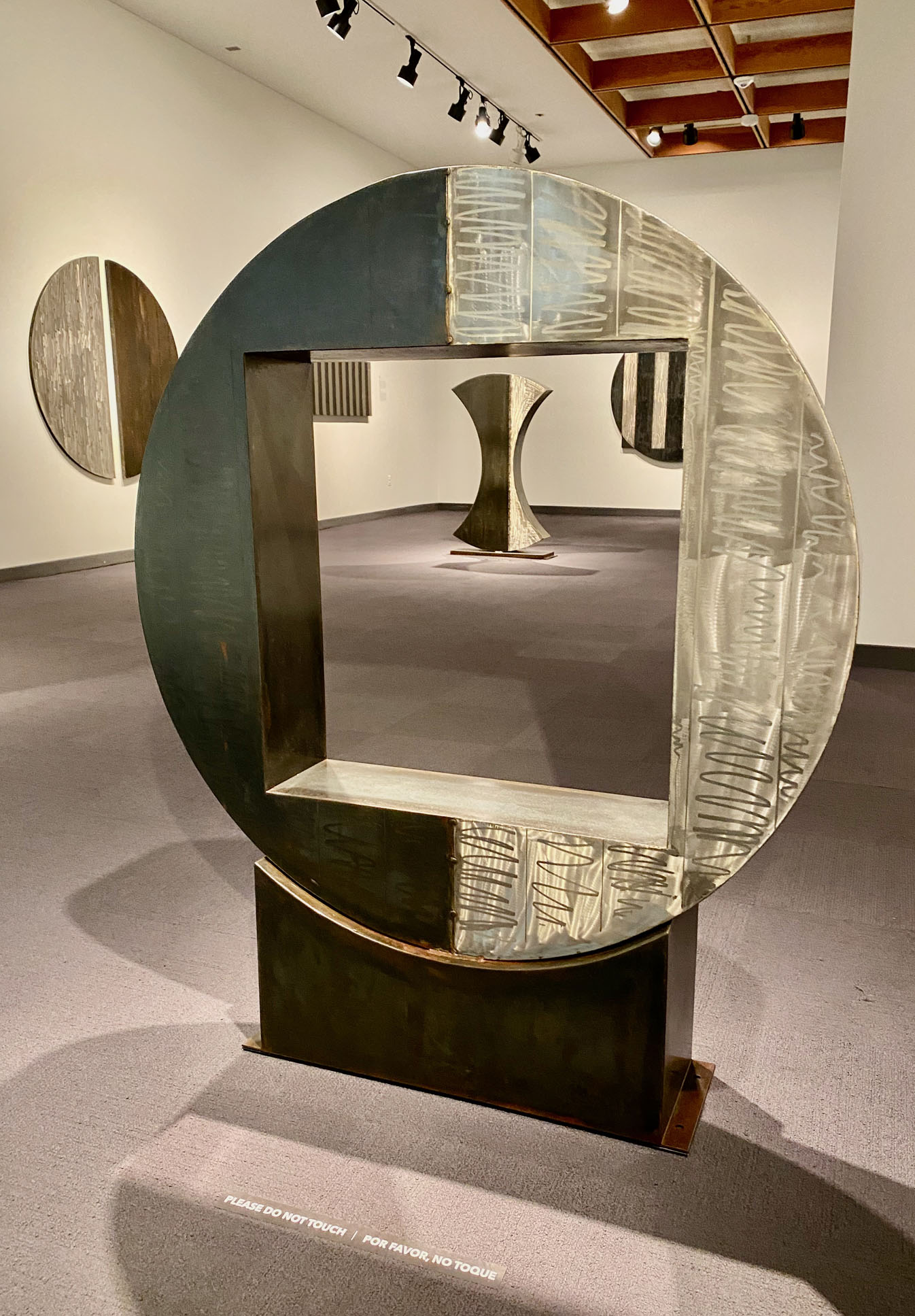
By getting up close to the two Martin paintings, you can appreciate her hand-drawn approach. Several stainless-steel sculptures by Agnes Martin’s great friend and student Karen Yank are nearby. The gleaming, hard-edged pieces do not resemble her mentor’s approach, except for the light, gestural touches across the surface.
Agnes Martin’s 1980 acrylic Untitled #6. Courtesy: New Mexico Museum of Art.
Karen Yank’s 2023 steel View with Silhouette VII and other sculptures visible through the portal. Courtesy: the artist.
The large pastels by Emmi Whitehorse look to the landscape and sacred colors of the Navajo Nation inspiration – a poetic approach most evident in Yei Retires to Mt. Taylor. Dramatic blue gestures suggest the spiritual turquoise color associated with the Navajo’s soutnern sacred mountain Tsoodzil.
Emmi Whitehorse 1985 pastel abstraction on canvas Yei Retires to Mt. Taylor.
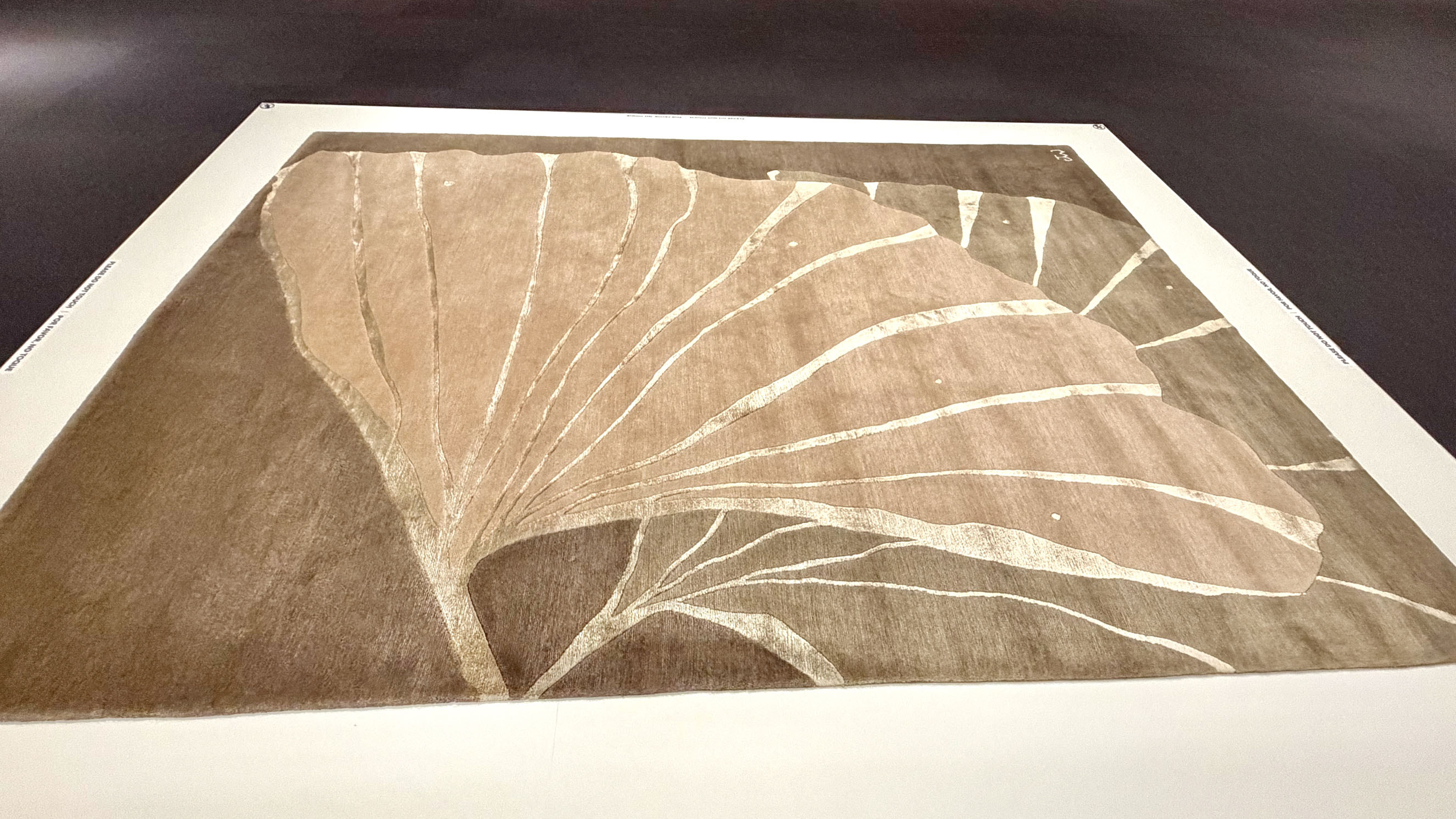
Abstractions used by textile artist Joan Weissman come from a place of process in which she starts with recognizable nature studies but allows her iterations to become more abstract. Approaching her seemingly abstract Ginko, only gradually do visitors see that the hand-knotted rug (created at large scale by Pakistani artisans) is an extreme close-up of a leaf.
Joan Weissman’s 2006 Ginko, a wool and silk hand-knotted rug, highlighting the intricacies of the leaf. Courtesy: the artist
2023 Hearing the Sun by Marietta Patricia Leis. Courtesy: the artist
Mariette Patricia Leis translates her experience of nature more formally. In one case, six seemingly minimalist wall-mounted panels are painted to reflect how we perceive the color of sunlight in different atmospheres and at different times of the day.
Enjoy walking through the full exhibition in our Flickr album.
Detail of 2018 Vacuities by Marietta Patricia Leis inspired by Iceland’s winter night sky. Courtesy: the artist.
Here’s a close look at Judy Tuwaletstiwa’s 2001 Divination. She transformed sand by creating an arrangement of glass objects – cubes, spheres, and organic shapes – all displayed across a soft sand base.
Like the rest of the work in this exhibition, it allows us to think about the natural world, our perception of it, and the many ways that the experience can be transformed into art.
Fans have had a special opportunity to get up close to that iconic black dress and gaucho hat, OK Calder pin, denim apron, and Marimekko dress in Georgia O’Keeffe: Making a Life, on view in Santa Fe through October 19 2025 at the O’Keeffe Museum.
After you’ve walked through a somewhat chronological presentation of Ms. O’Keeffe’s paintings in the museum, the final two galleries allow you to take a close-up look at tools, cookbooks, and other stuff that she used to make things – sculpture, recipes, pastels, and clay pots.
Photomural of Todd Webb’s 1962 photograph Georgia Making Stew, Ghost Ranch.
Due to the overwhelming popular response to Living Modern, the traveling exhibition that featured O’Keeffe’s wardrobe and chronicled how she portrayed herself for the greatest photographers of the 20th century, the museum curators decided to give visitors a little taste of the woman behind the art.
See some of our favorite things in our Flickr album here, and listen to the museum’s audio guide here.
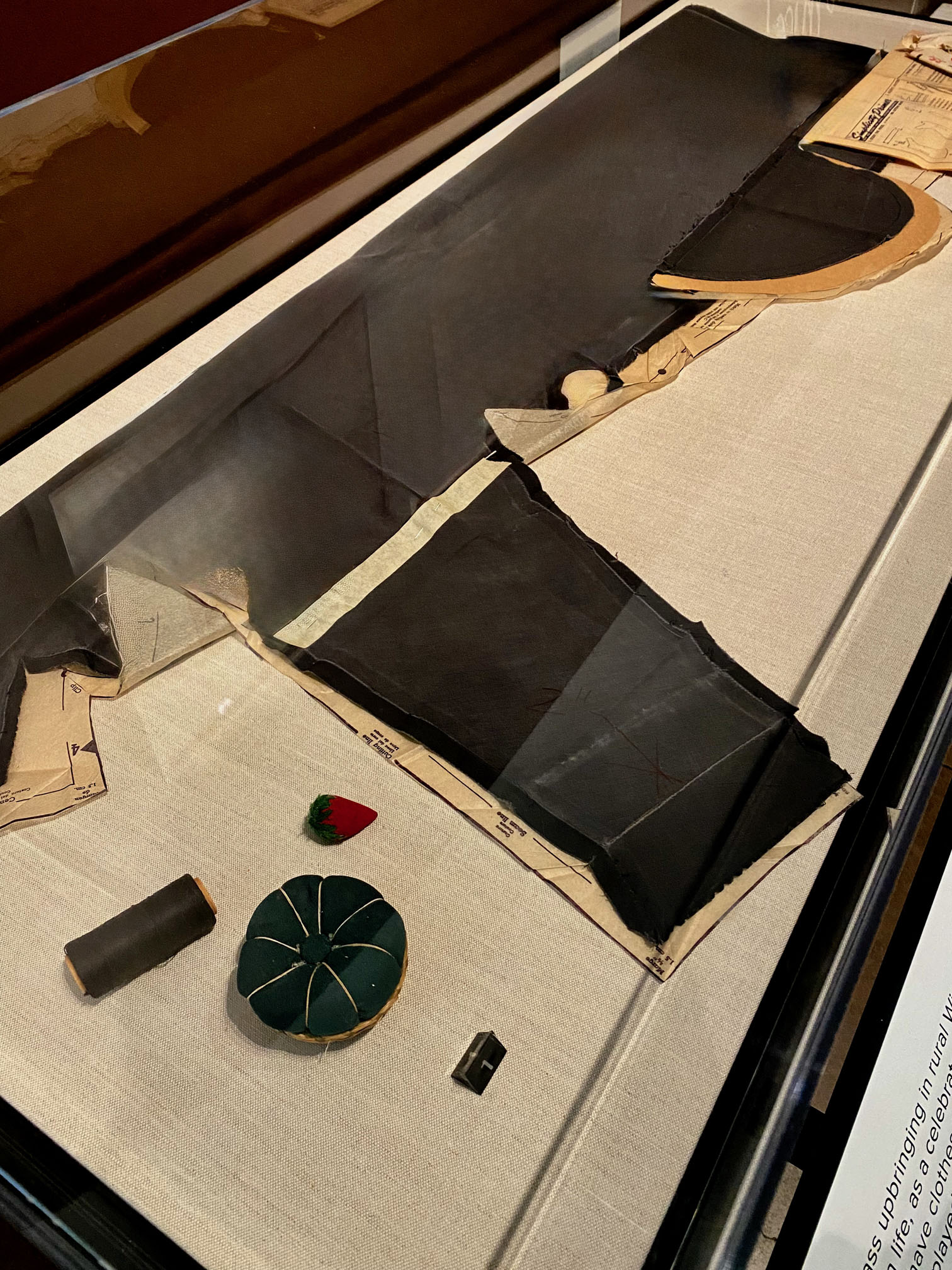
It’s the first time that the O’Keeffee Museum has itself presented her clothing. To emphasize the “making” part of her life in New Mexico, they’ve included a case showing how Santa Fe artist Carol Sarkasian moonlighted as Georgia’s seamstress. There’s a case with sewing notions and cut pattern pieces for another version of Georgia’s always in-style black wrap dress. She totally believed in multiples!
Georgia’s iconic 1960-1970 wrap dress sewn by Carol Sarkasian with 1950 belt by Hector Aguilar; Tony Vacarro’s 1960 Portrait of O’Keeffe with one of her dogs.
Sewing notions, cut fabric, and tissue-paper pattern – Carol Sarkasian’s preparation to make a wrap dress for Ms. O’Keeffe.
She also believed in wearing her clothes for a long time, and so they showed they had years of life.
The most popular feature of her Abiquiu home tour is the kitchen and pantry, and learn about Georgia’s farm-to-table approach with her garden, recipies, and day-to-day lifestyle. Here, you get a glimpse of the modern and traditional appliances used for her daily coffee ritual (yes, she loved Bustelo!) and get to peruse a sampling of her cookbooks and hand-written recipies.
Shelves with Georgia’s pantry items
One of her unrealized dreams was to write a cookbook, and it shows. She was all about healthy eating and living, and in her later years she relied upon her trusted Abiquiu team to assist with gardening, cooking, and putting out a spread for the constant stream of visitors. (No recluse, she!)
From the pantry: Georgia’s cookbooks with her hand-written breakfast, rice, and drink recipe cards.
The final room shows the process and tools she used to create her paintings, pastels, and sculptures.
There’s a dramatic photomural of Georgia standing in front of her largest sculpture – temporarily housed nearby at the New Mexico Museum of Art until the new GOK museum is built. Beneath, you see several prototypes – a wax spiral made in 1916 and bronze maquettes from the Forties.
Cast when she was in her nineties, the case demonstrates that she kept making versions of this her whole life and finding inspiration from stuff found on her New Mexico wanderings.
Bruce Webber’s photo of Georgia and her 1979-1980 spiral sculpture; the case below with its inspiration – a ram’s horn and earlier maquettes.
There are things from her travels to Japan, an unfinished work on an easel, and a case showing the pot she made when her assistant, Juan Hamilton, convinced her to keep making shapes, even when her macular degeneration made it impossible for her to paint.
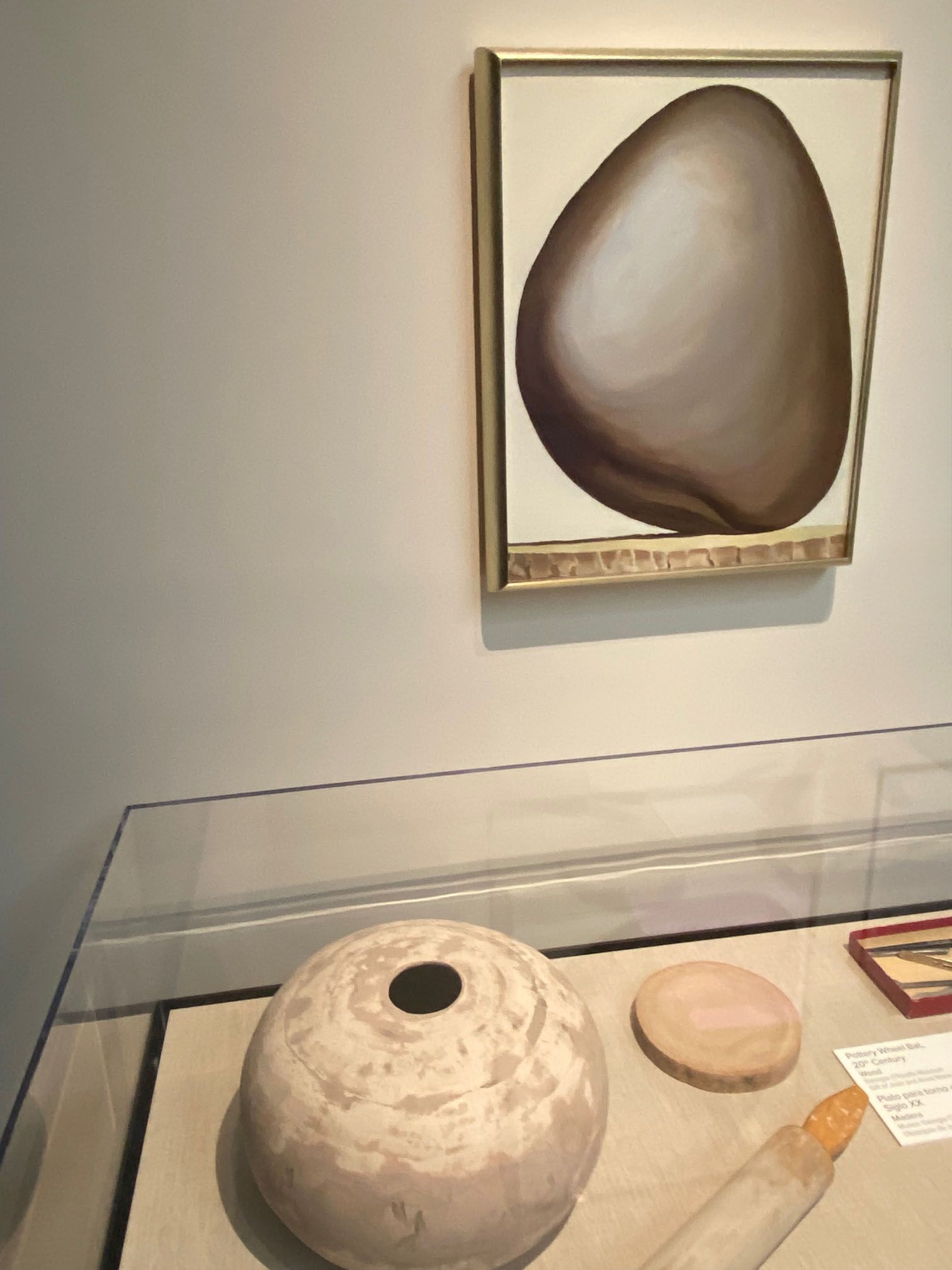
The round, smooth shape echoes the rocks that she liked to collect, so it’s fitting that the museum paired her tools and pot with a beautiful oil painting done of one of her favorites.
1963-1971 Black Rock with White Background; below, Georgia’s 1980 stoneware pot and tools– a pottery wheel bat and Sears rolling pin.
Georgia’s denim studio apron and an unfinished work – a pencil sketch on primed canvas.
For more on Georgia and her life, listen to Pita Lopez, who worked as a companion and secretary for Miss O’Keeffee from 1974 to 1986 and later oversaw maintenance and preservation of her Abiquiu and Ghost Ranch homes.
How does a Lakȟóta artist link dreams and artificial intelligence to imagine futures for her people? Experience five years of innovative installations in Kite and Wíhaŋble S’a Center: Dreaming with AI, on view at the IAIA Museum of Contemporary Native Arts in Santa Fe through July 13, 2025.
The IAIA exhibition – Suzanne Kite’s third solo exhibition this year across the United States – presents several installations that highlight her collaborative work that merges cutting-edge technology with Indigenous knowledge systems.
Download the exhibition catalogue here, and look at photos of the installation in our Flickr album.
2023 Wičhíŋčala Šakówiŋ (Seven Little Girls) and Wicháhpi Wóihanbleya (Dreamlike Star) use stones to translate Kite’s dreams into Lakhóta symbols.
In Iron Road and Dreamlike Star, stones and minerals (the building blocks of computers!) are arranged in Lakȟóta geometric language that suggest Lakȟóta quilt patterns. They’re placed atop a mirror to show resonance between the Earth and the cosmos (stars).
2023 Wicháhpi Wóihanbleya (Dreamlike Star) suggest that ancestor stars can point the way to Indigenous futures.
In this first section, inputs are taken from Kite’s dreams. Using AI, her dreams are translated into geometric Lakȟóta shapes created by designer Sadie Red Wing. Kite has figured out a way to bypass large-scale, commercial AI networks in favor of an AI model (run on her PC) that aligns more closely with Indigenous knowledge systems.
A digital embroidery machine has yards of embroidered black velvet flowing out of it. Oihanke Wanica (Infinity) is a collaboration with New York City’s Center for Art, Research and Alliances. As you examine the velvet, you’ll find geometric Lakȟóta shapes translated (using AI) from Kite’s dreams.
Nearby, there’s a comfortable lounge where you can watch Cosmologyscape, an interactive digital quilt – a public art project in which AI translates the public’s dreams into artist-created geometric symbols. It’s a collaboration with Alisha B. Wormsley, so the virtual community quilt manifests both African-American and Lakȟóta shapes.
2023 Oihanke Wanica (Infinity) – a digital embroidery machine stitches symbols representing dreams onto black velvet. Collaborator; Center for Art, Research and Alliances.
Lounge to watch Kite and Alisha B. Wormsley’s 2024 Cosmologyscape – Ai translates the public’s dreams into symbols for an ever-expanding digital quilt.
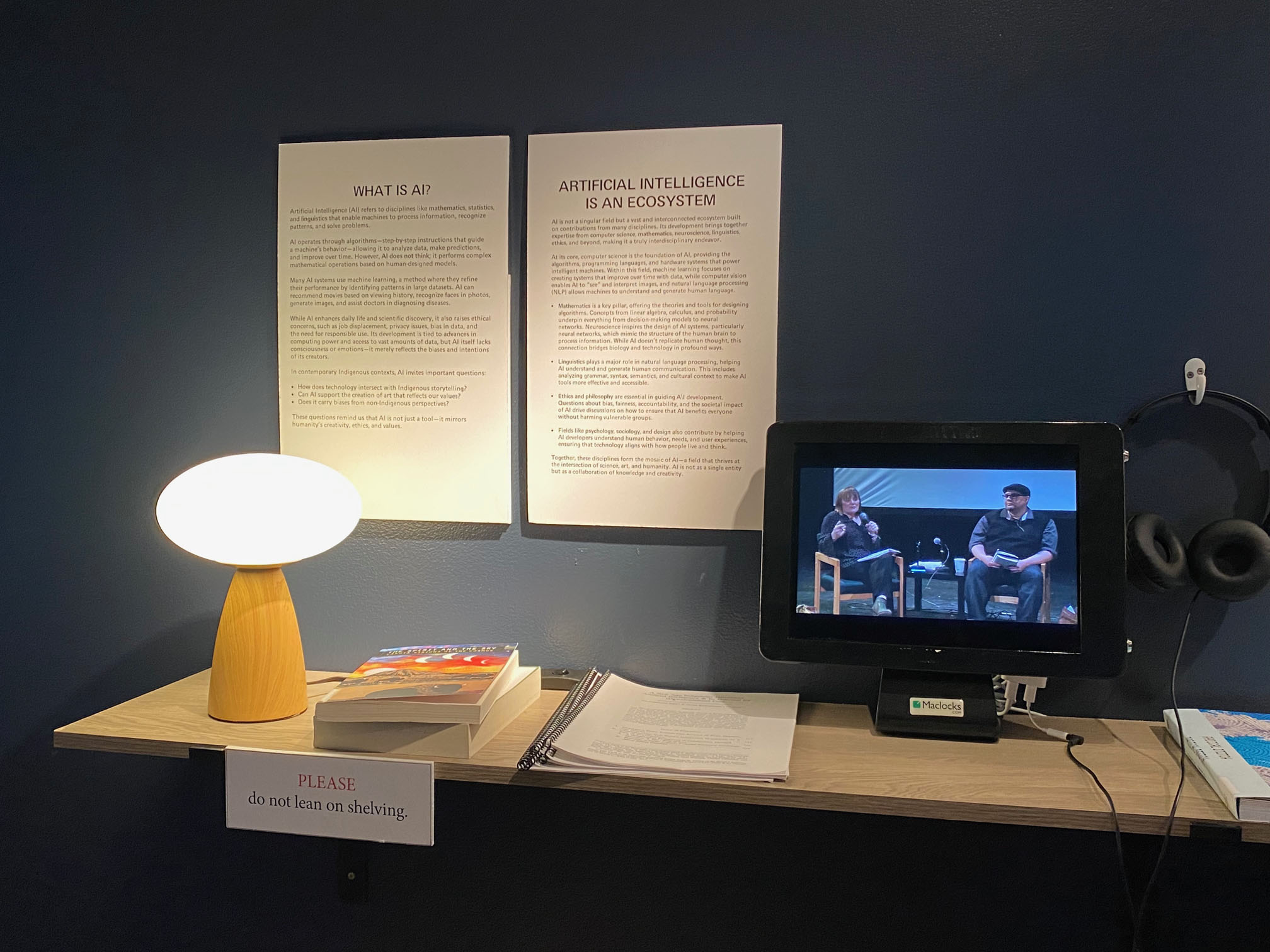
Installations in the other half of the exhibition shows collaborative projects that combine Indigenous knowledge systems and AI. Along one wall in the spectacular, tranquil gallery, you can explore a print and digital resource library on international research programs that integrate Indigenous knowledge systems into AI design.
Abundant Intelligences – a library and digital resource station for information on AI and futurism in contemporary Indigenous art.
Oneiris is a large interactive station through which visitors are invited to generate dream symbols that AI adds into a wall-sized display that looks like a portal to the cosmos. Inspired by the Lakȟóta concept of a Dream Language, she and her many technical collaborators genuinely bring dreams to life.
Oneiris – a collaborative project using advanced AI models to allow visitors to bring dreams to life.
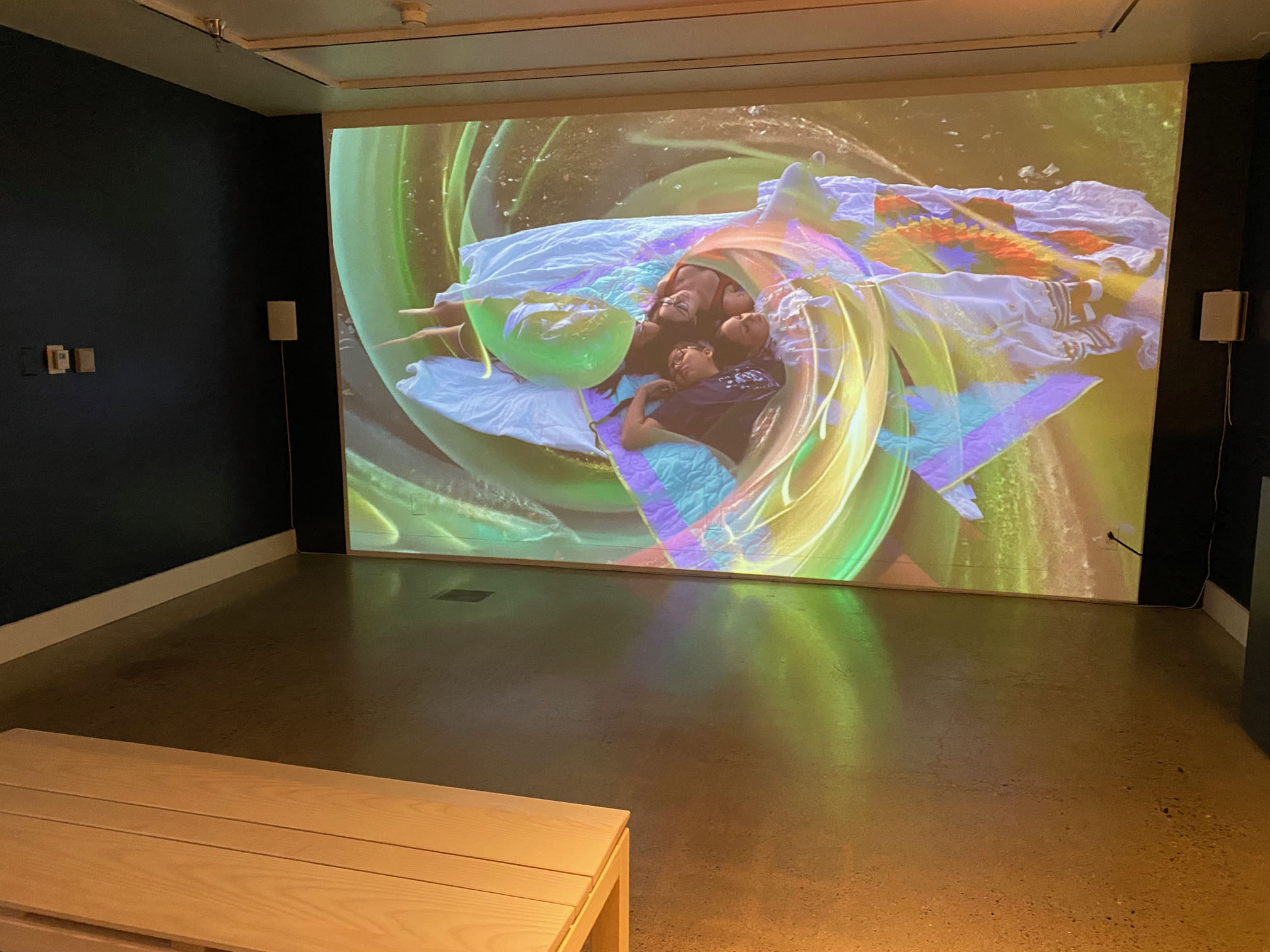
Spashed across the final wall of the space, The Land Paints Itself is a video collaboration with her Wíhaŋble S’a Center for Indigenous AI at Bard – a lab that explores Indigenous advances in this science and art. Watch as AI generates dazzling colors and patterns as four Lakȟóta dream about Indigenous futures. Kite suggests that the evolving technology of dreams is a legitimate way for her nation to envision ways forward.
2025 The Land Paints Itself video that uses AI to illustrate Lakhóta people’s dreams about Indigenous futures.
Provocative, visionary, and affirmative – meet Kite herself in an interview with Artforum editor Tina Rivers Ryan in March 2025, when Kite’s work was featured on the cover.
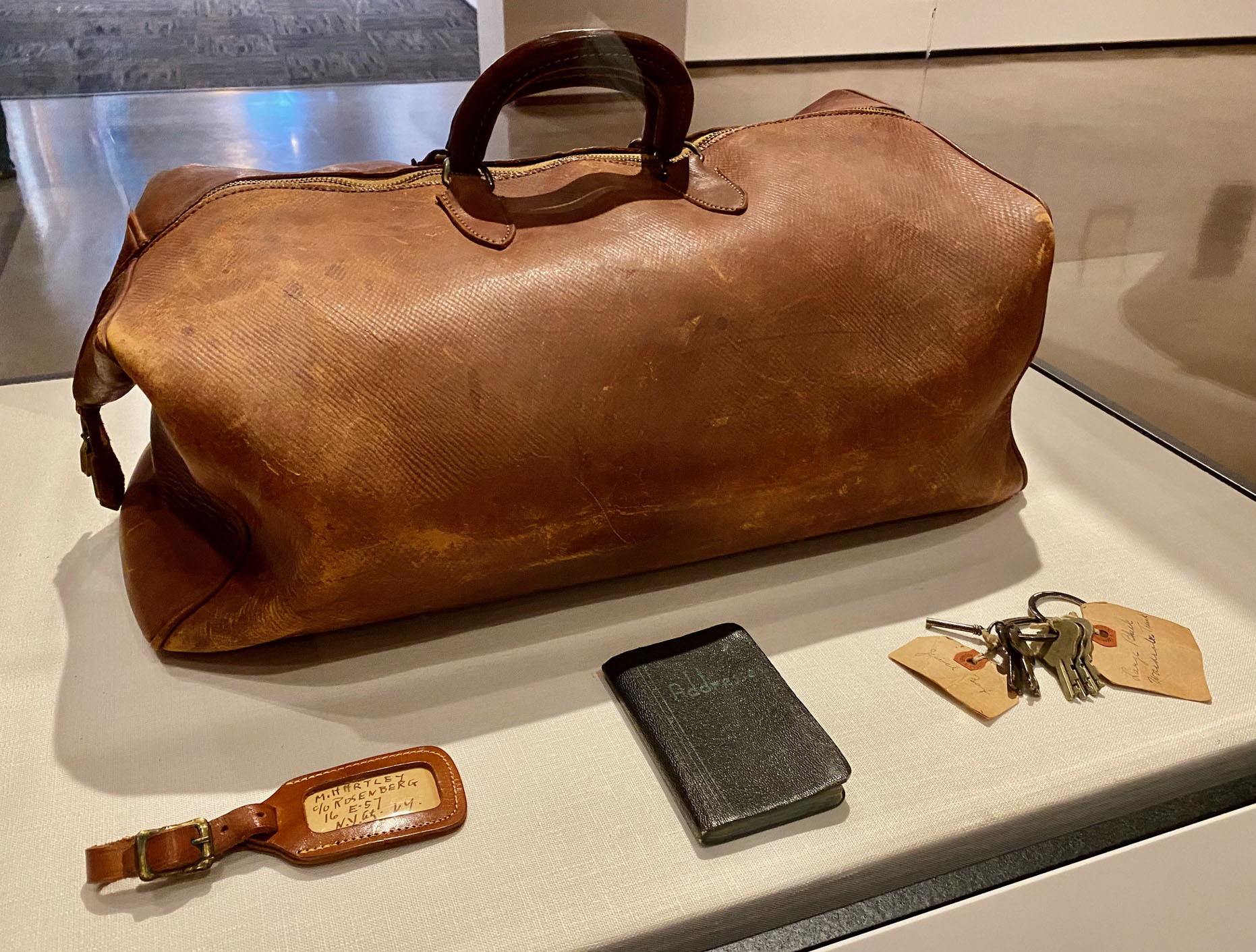
With his traveling valise sitting in the center of the introductory gallery and a map nearby, you understand instantly that superstar artist Marsden Hartley was a man on the go.
Marsden Hartley: Adventurer in the Arts, on view at the New Mexico Museum of Art in Santa Fe through July 20, 2025, uses his personal possessions, works painted on two continents, and non-stop itinerary to demonstrate how landscape, life, and modern-art legends led him to create an epic body of work.
Hartley’s 1914 Berlin Series, No. 2 – flat, abstracted natural symbols. Courtesy: Jan T. and Marica Vilcek Collection.
Ready to travel – Hartley’s leather valise, address book and luggage tags. Courtesy: the artist’s estate; Bates College Museum of Art.
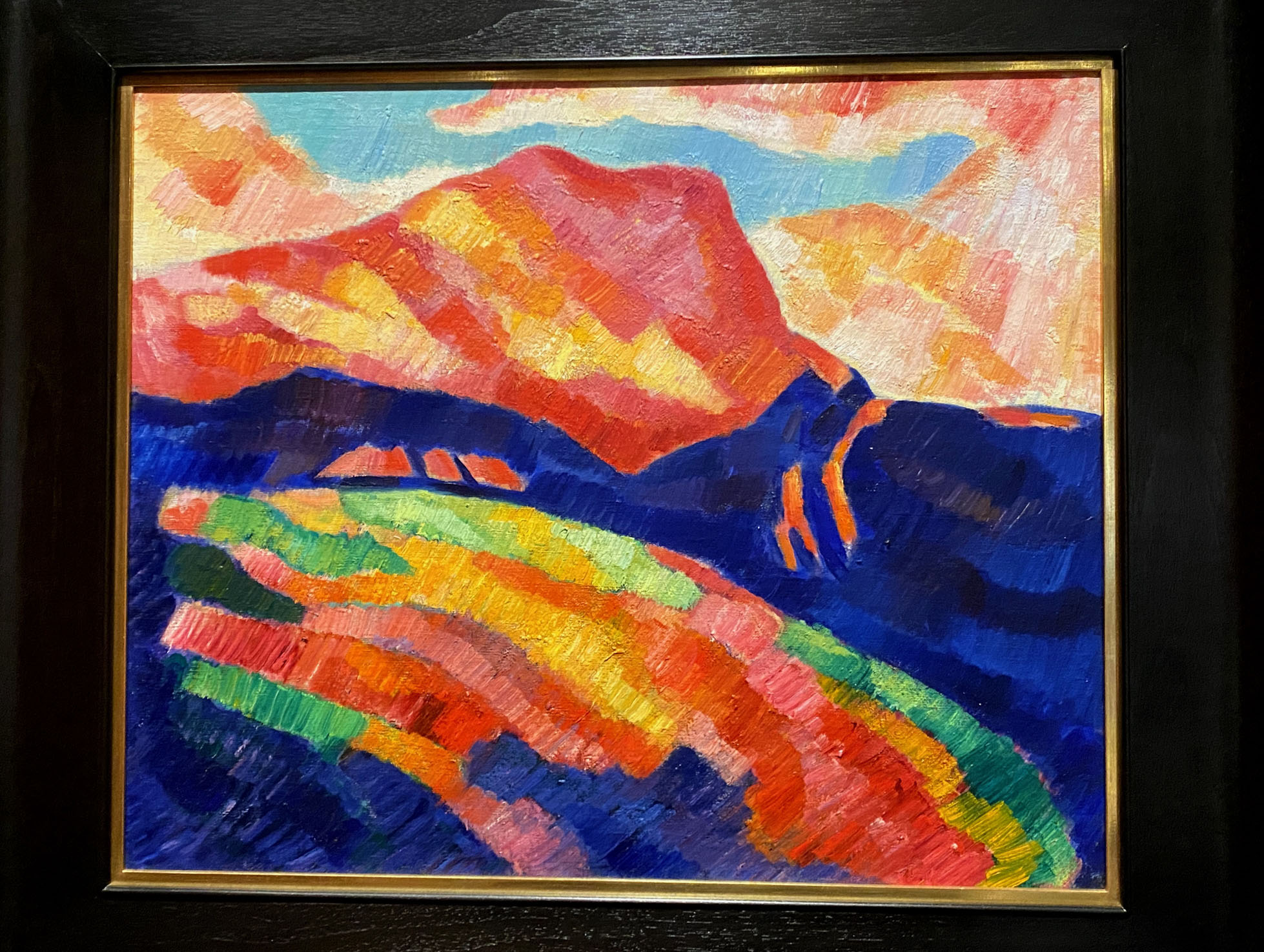
Looking around, there’s a wall of Maine mountainscapes he did in his thirties, a painting done just after Stieglitz sent him to Paris to soak up the vibes in Gertrude Stein’s salon, his accessories of rings and cigarette cases from Berlin in the 1920s, a Fauve-ist impression of Mount Saint-Victoire at Cezanne’s old stomping grounds in Aix, and photos of him and his dog at his Maine studio in the 1940s.
Hartley’s 1927 oil Mont Sainte-Victoire – painted in Aix, France where Cezanne once lived. Courtesy: Jan T. and Marica Vilcek Collection.
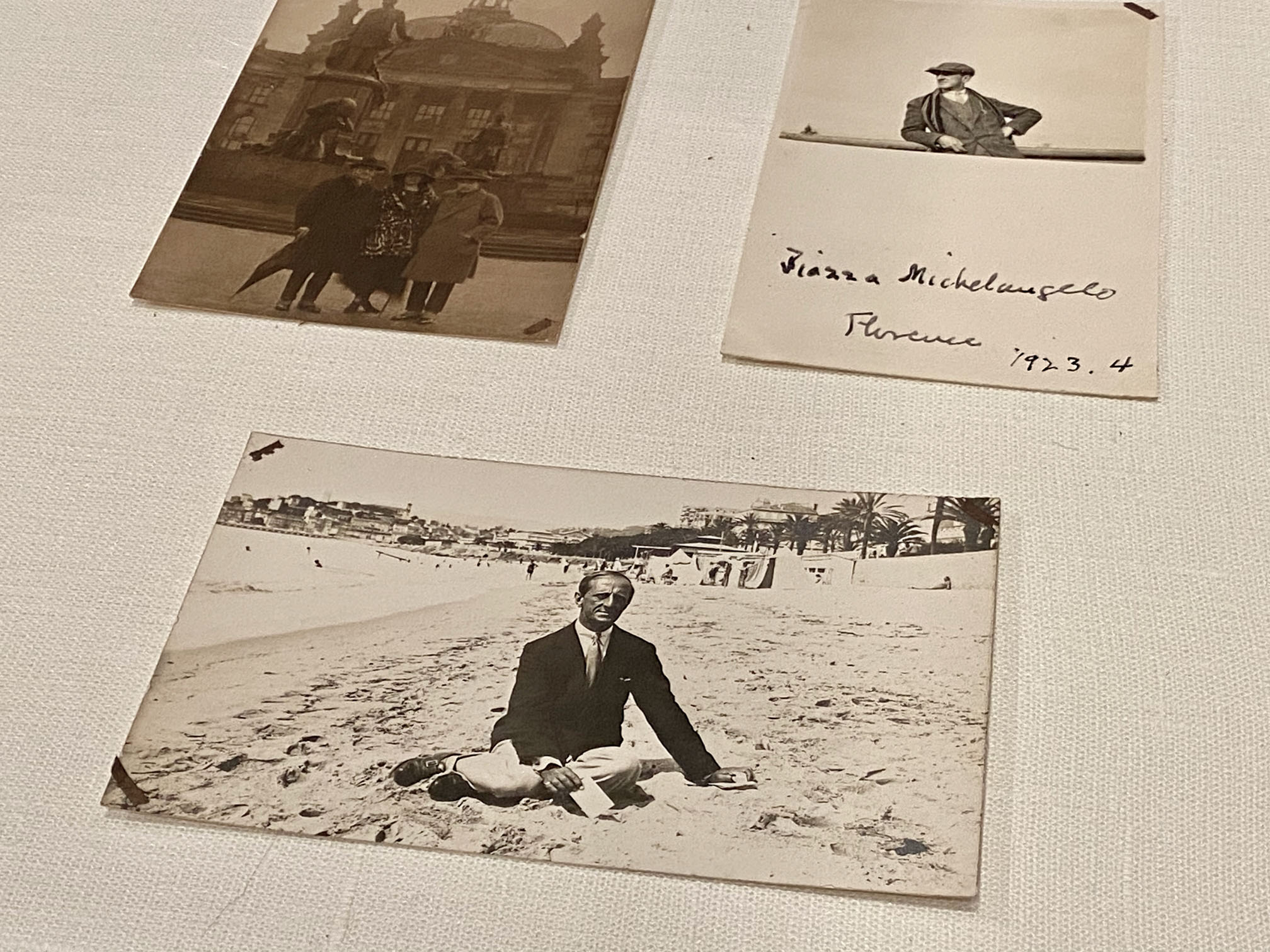
The exhibition merges Hartley’s paintings from the Jan T. and Marica Vilcek Collection with items donated by his favorite niece to Bates College in Maine – items he collected as he traveled; sketches and stuff sent to his neice; his camera, books, and snapshots; his studio paintbox, and other personal art. Together, the exhibition tells a story of innovation, personal journey, and relentless art making.
Hartley’s personal photos from his 1920s European adventures. Courtesy: Bates College Museum of Art
Hartley emerged from a hardscrabble childhood to see, feel, and experience art, nature, and transcendental spiritualism in New York, Boston, and Maine in 1890s.
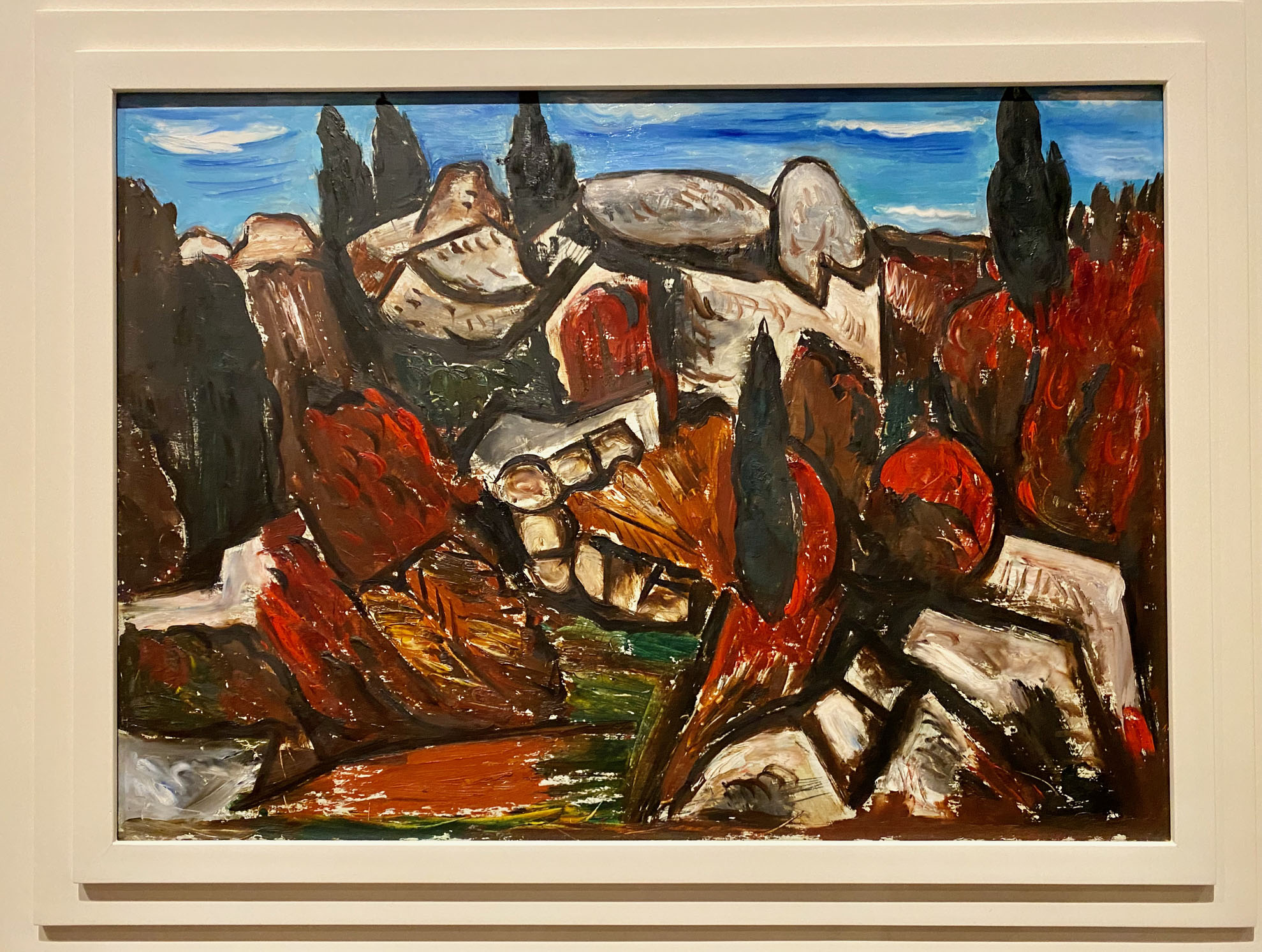
He loved painting mountains and depicted water, earth and sky as a color-filled flat plane filled with jabbing brushstrokes – an approach that stuck with him throughout his life as he journeyed through New Mexico, the Alps, Mexico, and back in Maine.
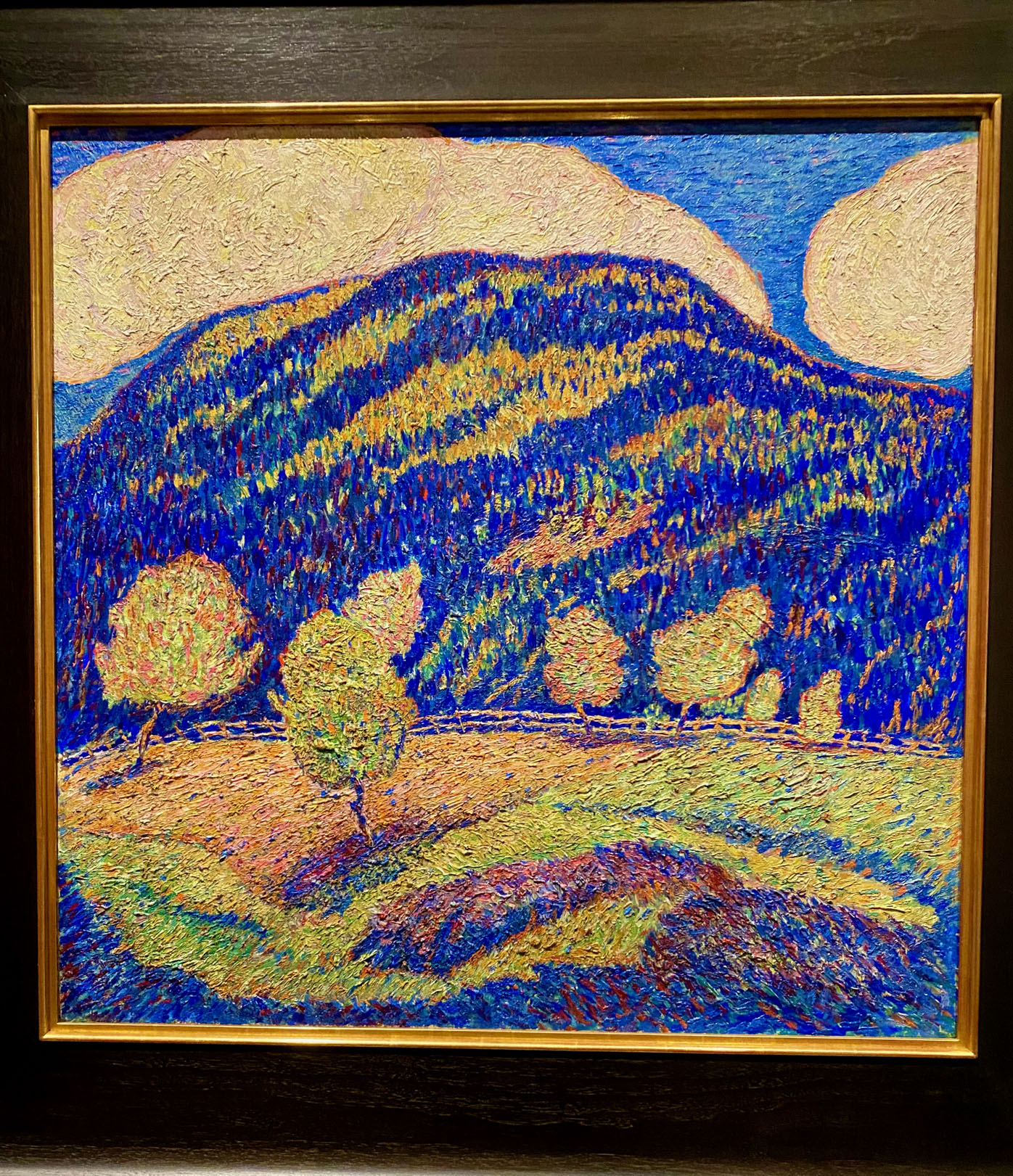
Hartley’s 1907-08 oil Silence of High Noon – Midsummer painted in Stoneham Valley, Maine. Courtesy: Jan T. and Marica Vilcek Collection.
By the time he was in his early thirties, he had shown his landscapes to The Eight, knocked on Stieglitz’s gallery door, and got a one-man show (and a dealer for the next 20 years) at 291, the hottest modern art gallery in America.
Hartley’s 1910 Untitled (Maine Landscape)– water cascading down a rock face. Courtesy: Jan T. and Marica Vilcek Collection.
Getting to Europe in 1912, the color, cubism, and symbolism of the Blue Rider, Matisse, and Picasso made his head spin. His German friends introduced him to Kandinsky’s book Concerning the Spiritual in Art. He went out of his way to meet the man himself, and his painterly wheels turned.
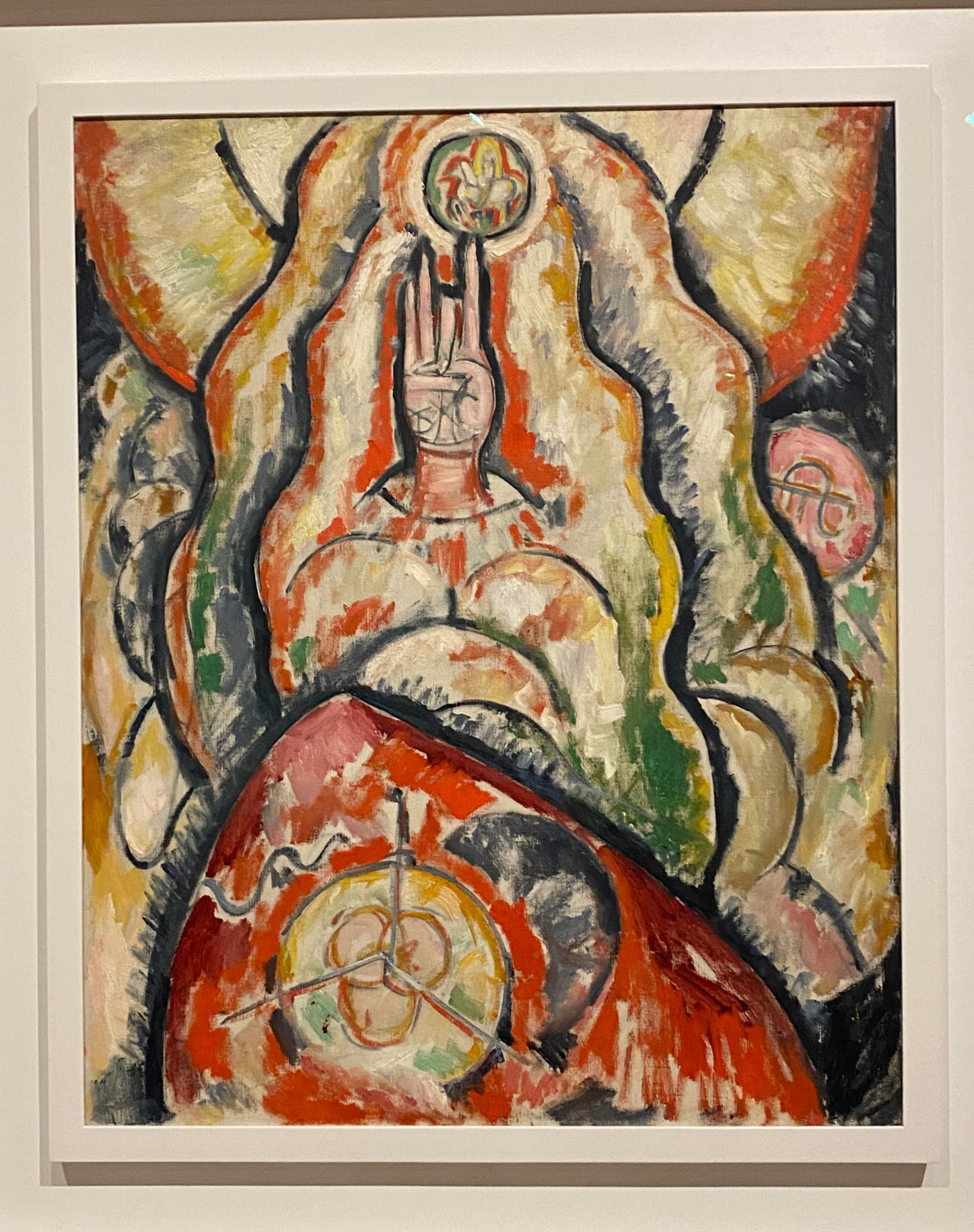
The second gallery presents a large work from his Cosmic Cubism series – an airy, dreamy arrangement of signs, spiritual symbols, colors, and planes – along with drawings from his Amerika series, based loosely on Native American symbols and other abstract shapes. On view for only the second time in the United States, Schiff is a dazzling creation drawing signs and symbols from Native American and Egyptian cultures that spill out onto the painted frame.
Hartley’s 1912-1913 Portrait Arrangement, No. 2, created in Paris. Courtesy: Courtesy: Jan T. and Marica Vilcek Collection.
Schiff – part of the Amerika series Hartley painted in Germany. Courtesy: Vilcek Collection. April 5 – July 20, 2025
Up to this point, Hartley’s only encounter with indigenous American culture came from visits to ethnography museums in Paris and Berlin, but that would soon change. The advent of World War I tore apart the avant-garde, his social circles, and the direction of his work. Although these Berlin abstractions were long considered by late 20th century critics to be the high point of his career, Hartley abandoned this artistic path when forced to return to the United States, started over, kept wandering, and went back to landscapes and still lifes to discover his “American” expressionist vision.
Hartley’s 1934 Autumn Landscape, Dogtown – a colorful painting made near Gloucester, Maine. Courtesy: Jan T. and Marica Vilcek Collection.
The exhibition does not unfold chronologically. Instead, it shows how much friends, place, and spiritual encounters affected him.
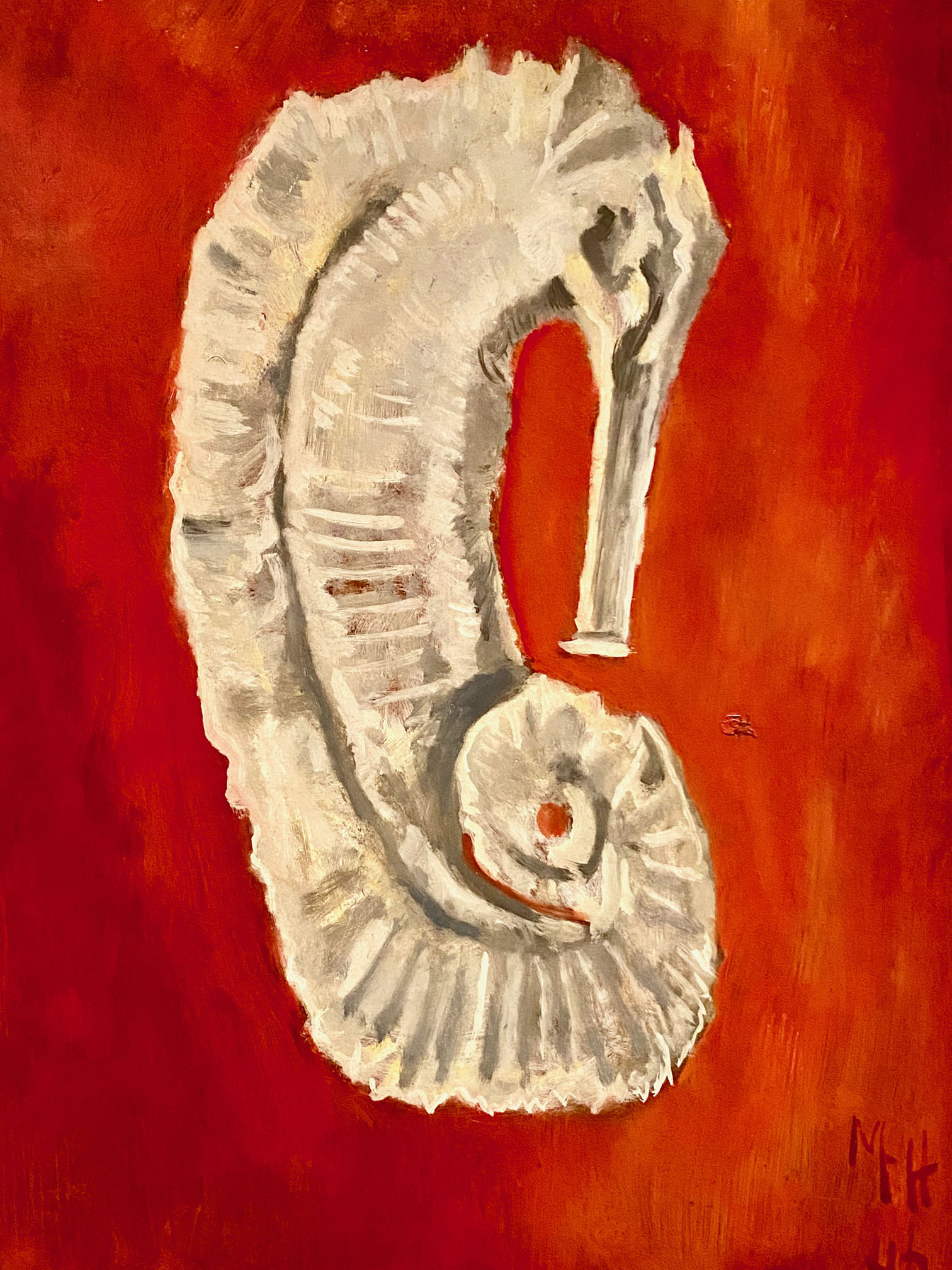
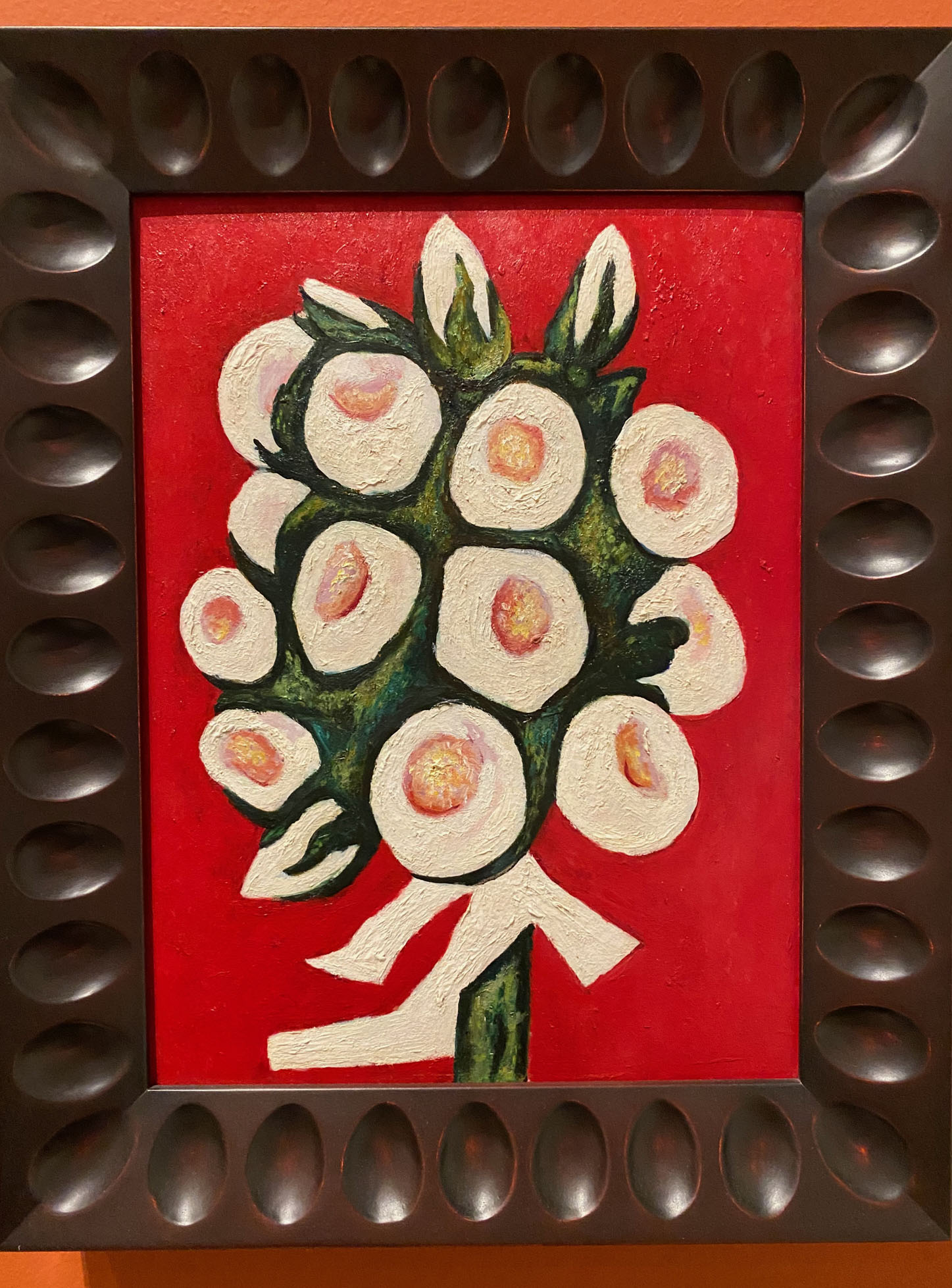
Near the Berlin abstractions are highly expressionist 1930s rockscapes from Maine and pointy Alpine peaks from his return to Bavaria. There’s an example of his stripped-down 1916 “synthetic cubist” work in Provincetown, a 1917 New England still life painted in Bermuda when he was budget-bunking with Demuth, and a red-saturated still life that is a therapeutic tribute to his Nova Scotia friends who died at sea in the late Thirties.
Hartley’s 1942 White Sea Horse – part of a series with vivid backgrounds done in Maine. Courtesy: Jan T. and Marica Vilcek Collection
Hartley’s 1935-39 Roses for Seagulls that Lost Their Way –made in Bermuda to honor his Nova Scotia friends lost at sea. Courtesy: Jan T. and Marica Vilcek Collection.
In the middle of this gallery are vitrines with highly personal, everyday stuff from a painter who never settled down, stayed on the move, and always kept creating.
Here’s his camera, a scrapbook of personal photos, his 1923 published book of poetry, a few books from his library, and a little toy and pressed flowers sent to his niece.
Hartley’s photos from his 1917-1918 trip to Santa Fe. Courtesy: Bates College Museum of Art
Except for the Provincetown piece, all the surrounding paintings have direct, bold outlines, vivid colors, and vigorous, unglamorized visions – a fitting prelude to the last gallery of New Mexico landscapes.
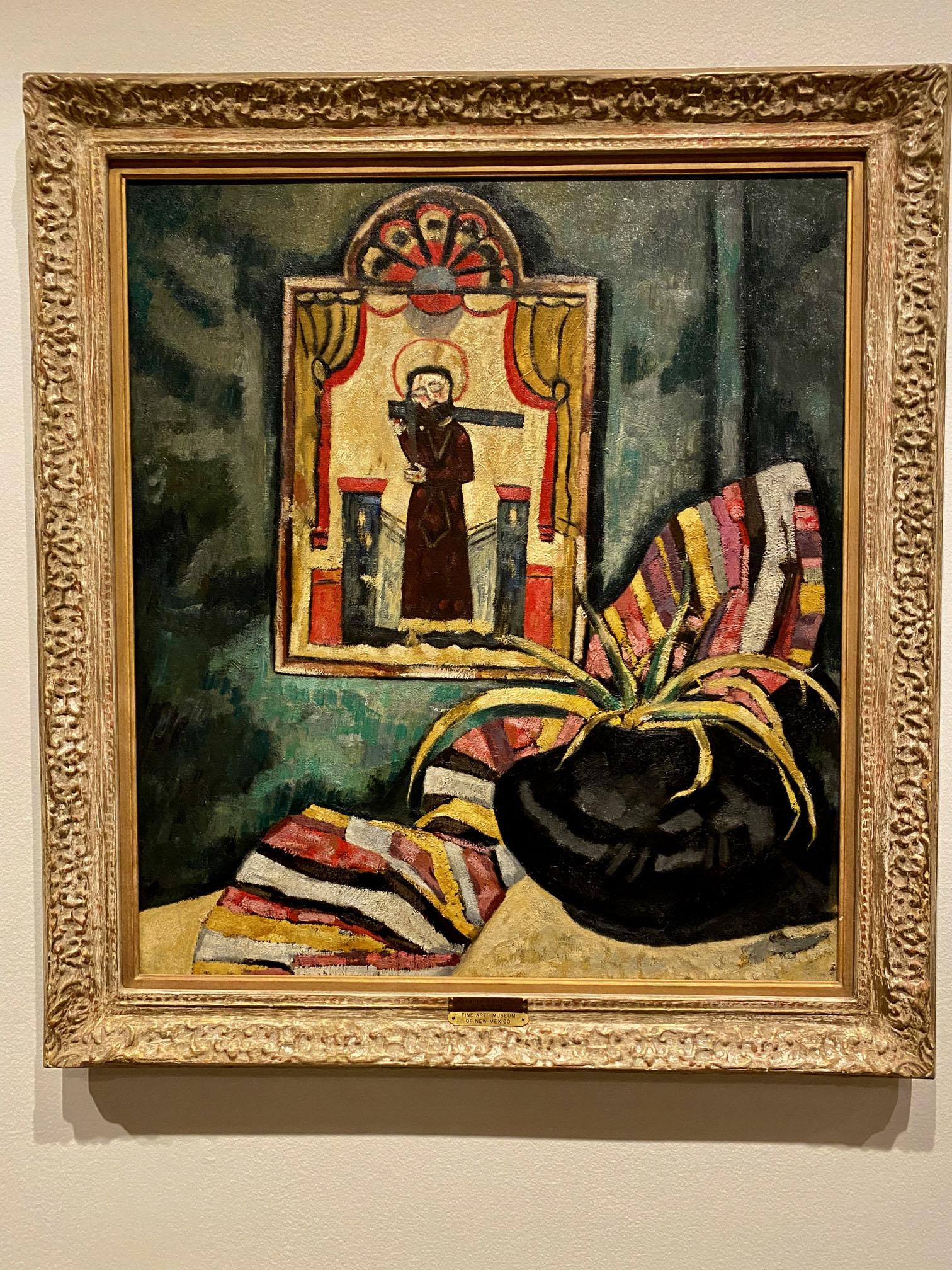
Hartley’s 1919 El Santo painted in New Mexico.
The final gallery provides a panorama of landscapes, plus a dramatic image of a ridge of Mexican volcanoes. Hartley only spent part of
1918 in Taos and Santa Fe, where he traversed the hills, attended Pueblo ceremonies, and wrote about the indigenous culture. He also completed his El Santostill life with a black-on-black ceramic vase, a striped textile, and a Northern New Mexican retablo of a suffering Jesus.
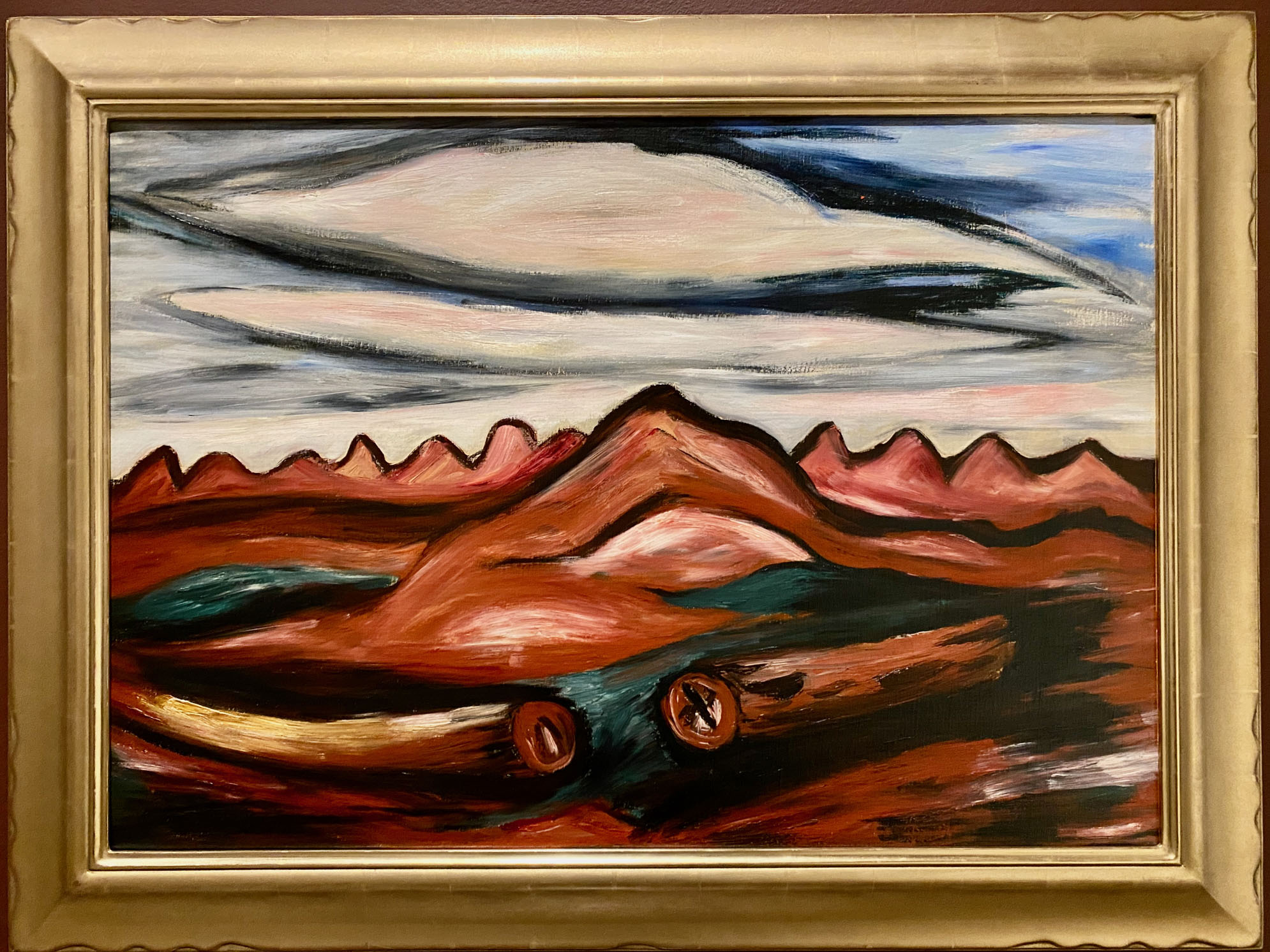
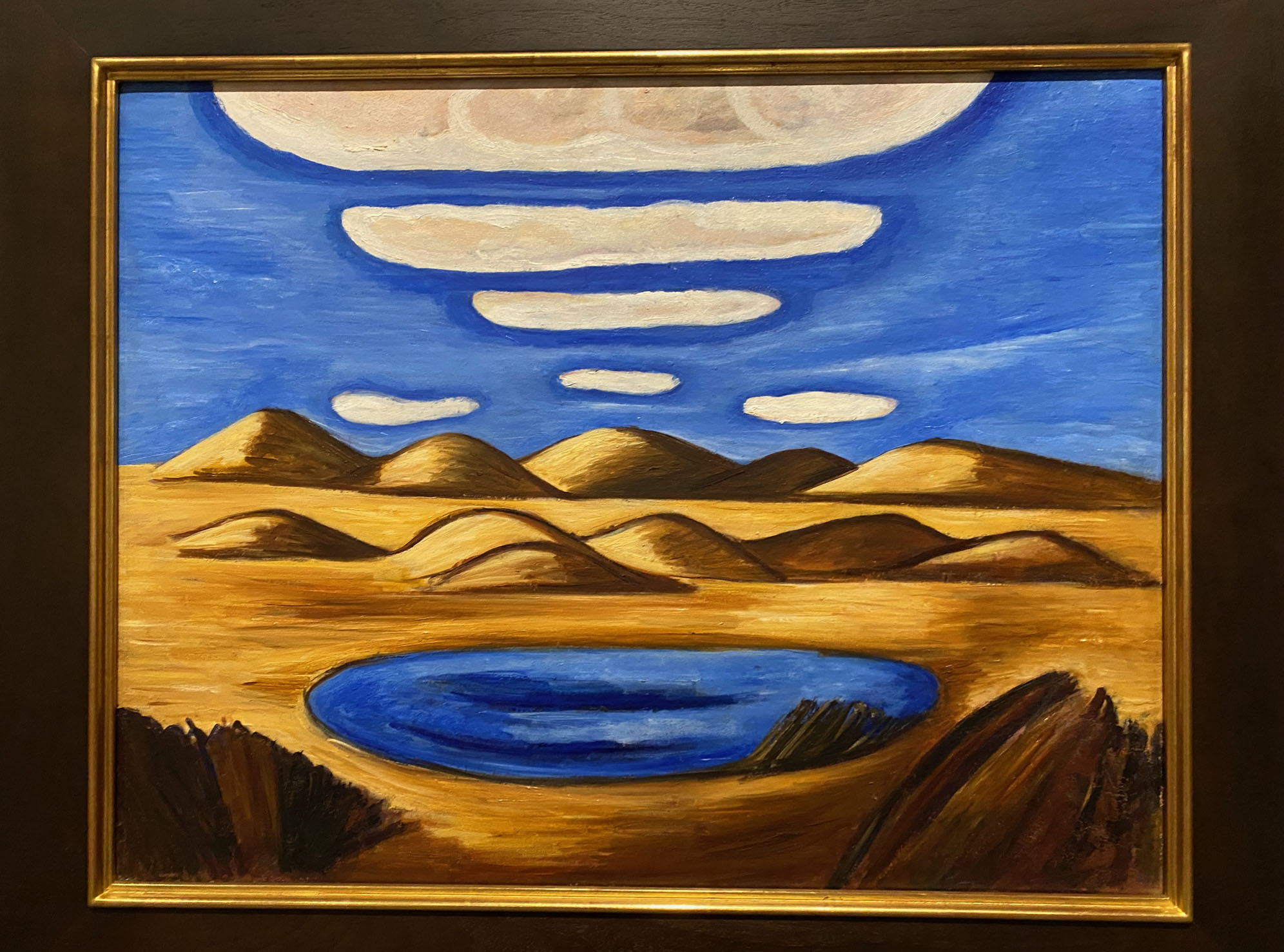
But it might be a surprise to learn that all of the Southwest landscapes were painted in Berlin in the 1920s – fittingly called his New Mexico “recollections” – or in Mexico in the 1930s.
Floating clouds, expressive lines, and abstracted mountains – all from his vivid mind and recollections of spiritual and physical experiences long past. In the 21st century, increasing numbers of art historians and artists have looked to this phase of Hartley’s work for insight and inspiration – bold brushwork, expressive memory, and both a spiritual and emotional creative process.
Hartley’s 1923 oil New Mexico Recollection #14– painted in Berlin based upon memories of his year in the Southwest. Courtesy: Jan T. and Marica Vilcek Collection.
Hartley’s 1932 oil Lost Country – Petrified Sand Hills – a symbolic landscape inspired by mystical texts he discovered while painting in Mexico. Courtesy: Jan T. and Marica Vilcek Collection.
Toward the end of his life, the accolades, awards, honors, and retrospective exhibitions came his way, but Hartley remained the hardscrabble “painter of Maine,” barely interested in cashing the checks.
His niece, who preserved her uncle’s posessions and legacy after his death in 1943, took a train trip to New Mexico for the first time to see the landscapes that so inspired her uncle. Upon emerging from the train at the stop near Santa Fe, she looked up to take in the big, dramatic, cloud-filled sky. Thinking of all her uncle’s landscapes, she said, “Those clouds…I’d recognize them anywhere!”
If you see this show in Santa Fe, you will, too.
Louise Zelda Young’s 1943 photo Marsden Hartley’s Studio, Corea, Maine, where he worked in his final years. Courtesy: Bates College Museum of Art.
To celebrate its 200th anniversary, the Brooklyn Museum decided to dazzle us with 500 gold pieces – Tiffany, Cartier, Egyptian, Renaissance altarpieces, golden sculptures, Greek wreaths, and eye-popping bedazzled fashion – in Solid Gold, on view through July 6. Half of the pieces are from the museum collection, and half loaned by private collectors and design houses. See our favorites in our Flickr album.
The ten-part show, spread across the museum’s two top-floor galleries deliberately pairs shimmering art from its vast collection with haute couture, gold records, and dramatic jewelry. The exhibition begins by acknowledging the ancient gold in Brooklyn’s Mediterranean and American collections.
Nam June Paik’s 2005 Golden Buddha checks himself out on TV. Courtesy: estate of the artist.
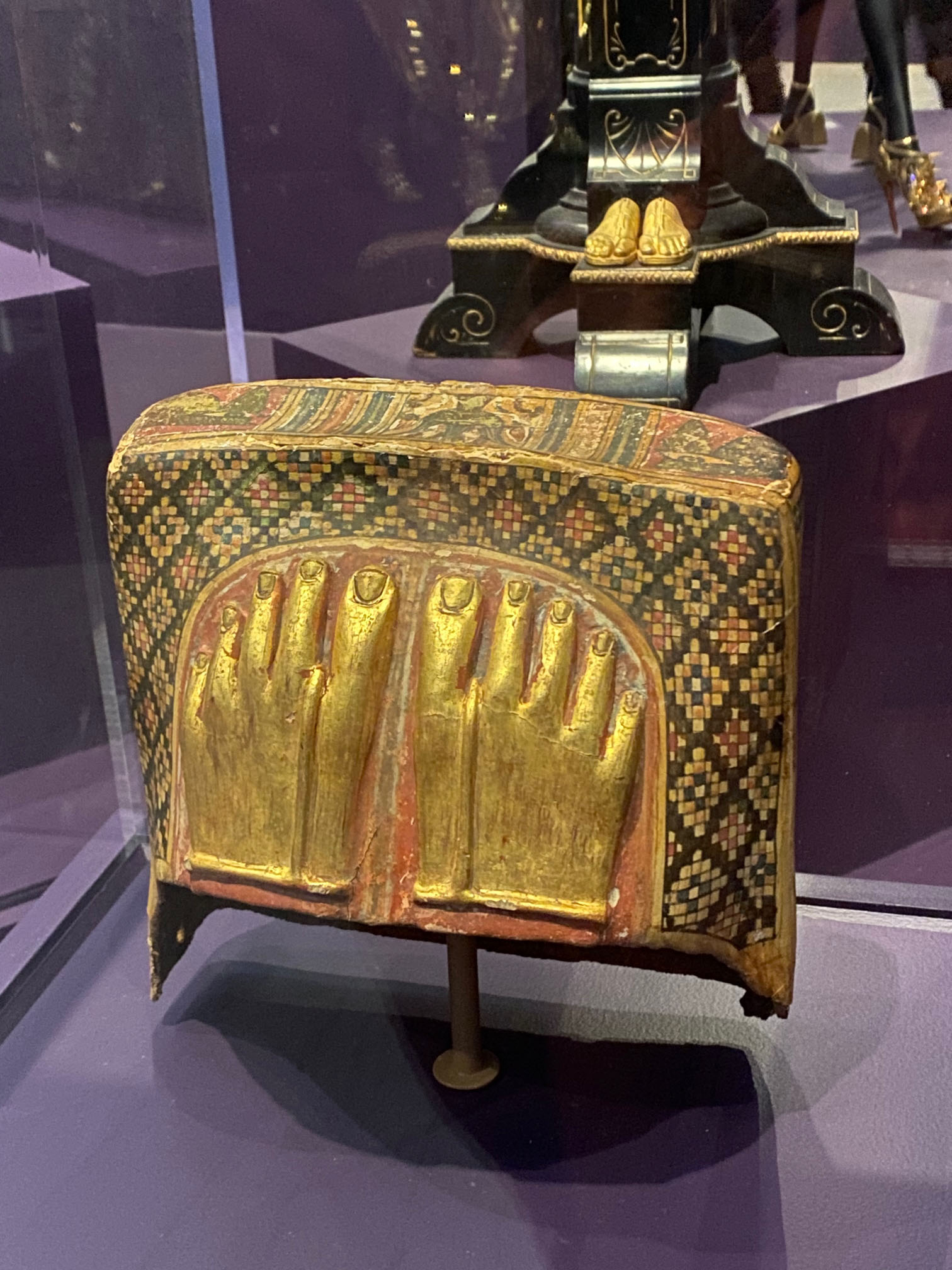
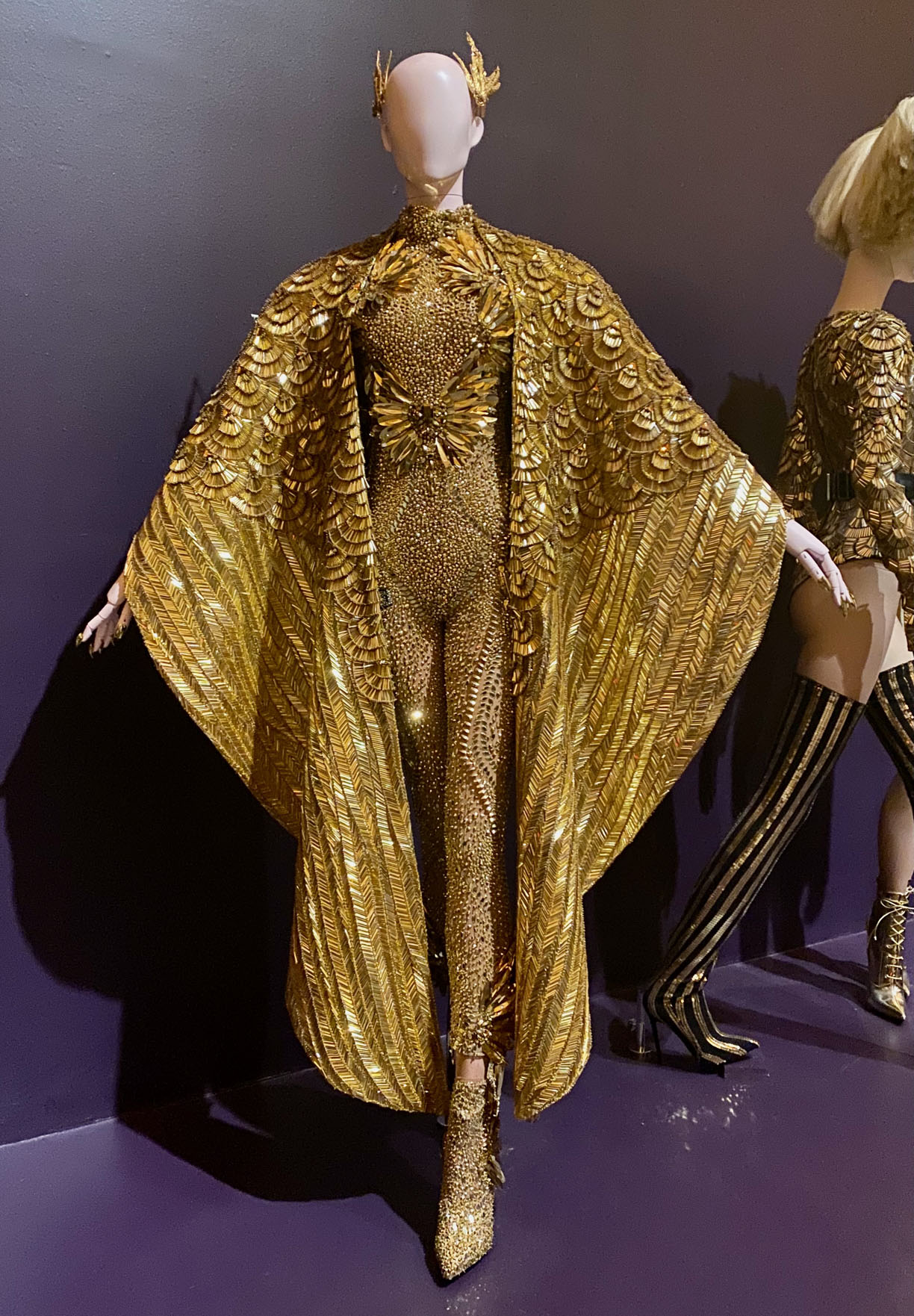
Known for its massive Egyptian holdings, the exhibition’s introductory gallery allows us to plunge directly into a mix of actual and retro Egyptian objects and fashion – golden Egyptian tomb fragments, Victorian-era faux Egyptian decor, clips of Elizabeth Taylor from her Sixties Cleopatra extravaganza, and many dazzling pieces from the Egyptian Disco collection by The Blonds, including the Cleopatra catsuit-cape that Billy Porter wore as he was carried on a litter onto the 2019 Met Gala red carpet.
Gold in the First Century: painted gold-leafed footcase from Coptic era Egypt; (rear) 1870 gilded and lacquered pedestal by Kimbel and Cabus.
From The Blonds’ Egyptian Disco collection: Cleopatra catsuit, cape, and headdress worn by Billy Porter to the 2019 Met Gala.. Courtesy: The Blonds
You could spend hours in the first room just taking in the gold, platinum, and diamond details of Jacob Arabo’s wristwatches; wondering how Galliano crafted a gown of Lurex pyramids; admiring Mary McFadden’s golden macrame gowns; or contemplating the 4th-century golden hoard from the Middle East.
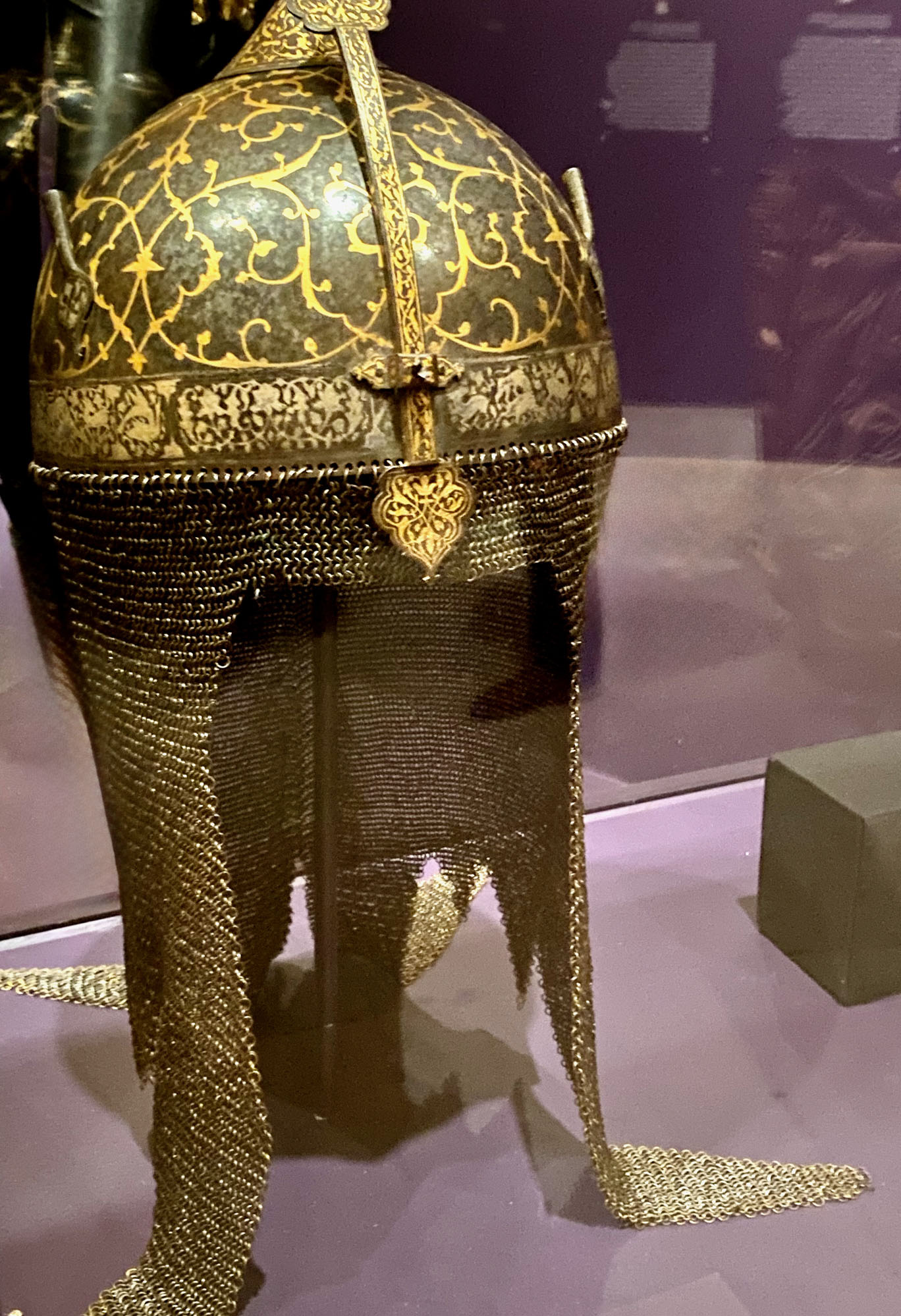
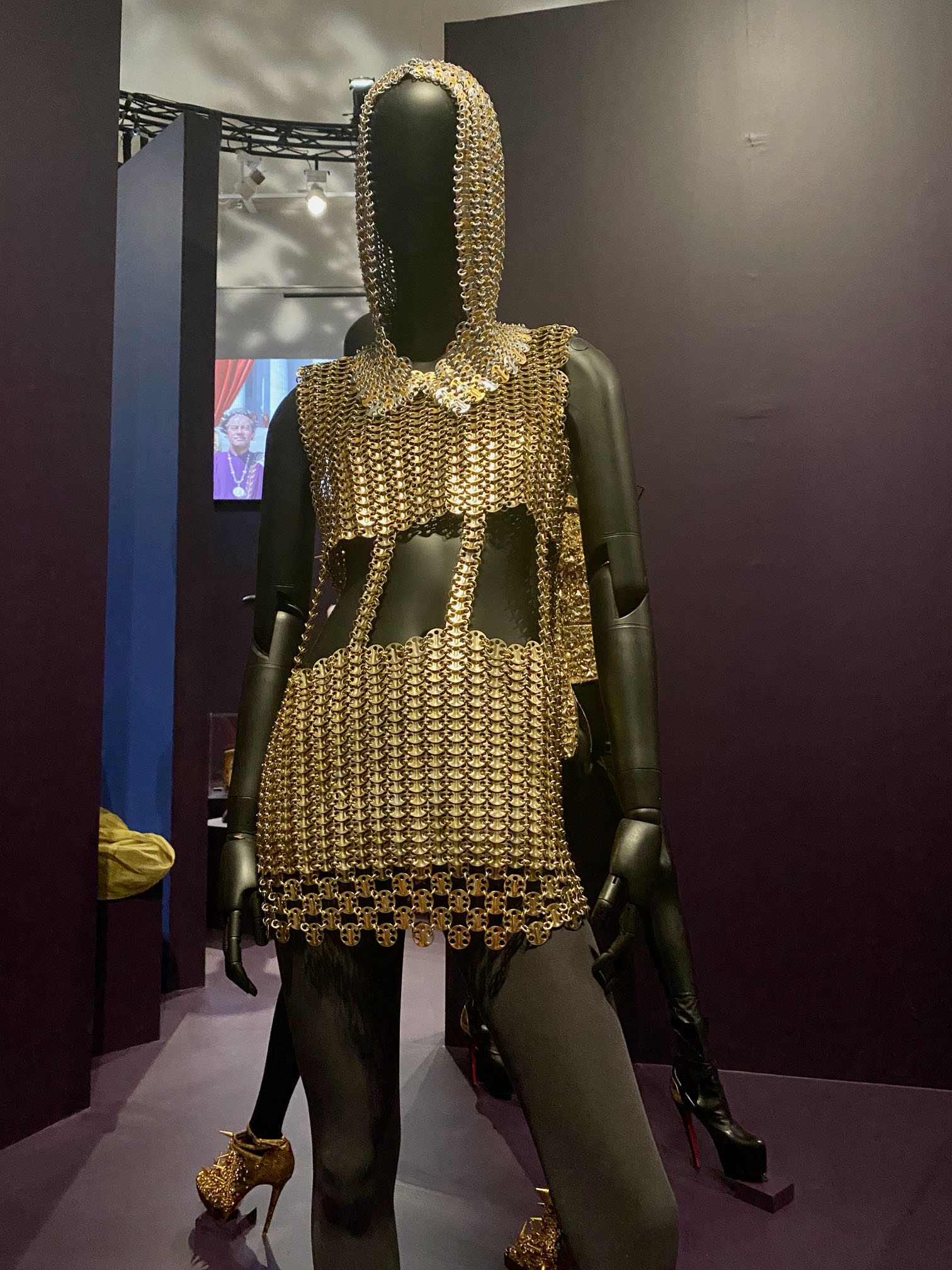
But even more dazzlers await in the linked-chain section – 18th century Islamic helmets, Janelle Monet’s gold-braid wig by The Blonds, and a Seventies chain mini by Paco Rabanne.
From the Safavid Islamic Empire in Central Asia: a 1700 steel, gold, and silver helmet.
1971-72 gold, silver, and patinated aluminum cowl and dress by Paco Rabanne. Courtesy: private collection
A large, dramatic gold sculpture punctuates the first quarter of the exhibition – the dramatic piece by Zadik Zadikian is only plaster covered in gold leaf, but if it were solid gold, it would represent $1 billion in value. Visitors take a break here to circumnavigate the piece, watch a video and read about the history of gold mining – and its human cost – throughout the world.
2024 24-karat gold Path to Nine by Zadik Zadikian – a wall of 1,000 gold bars (gold leaf on plaster). Courtesy: private collectors
Golden mosaics, golden halos, golden chasubles, embellished holy portaits, golden uniforms, and golden coin containers from Italy, Mexico, Peru, China, and Japan line the next galleries, demonstrating how different cultures have integrated gold into private and public devotions, court, and the economy. In Italy, for example, one era’s minted golden coins are transformed into another era’s golden halos for saints in home altars.
Somehow, it’s a fitting punctuation to this section of the exhibit to encounter the epic, shimming wall sculpture by El Antsui. The “golden” glow emanates from recycled whiskey bottle cap
2010 Black Block by El Antsui, a wall hanging of recycled whiskey bottle caps.
The second half of the exhibition features objects from Brooklyn’s own collection and fashions that combine gold with other colors.
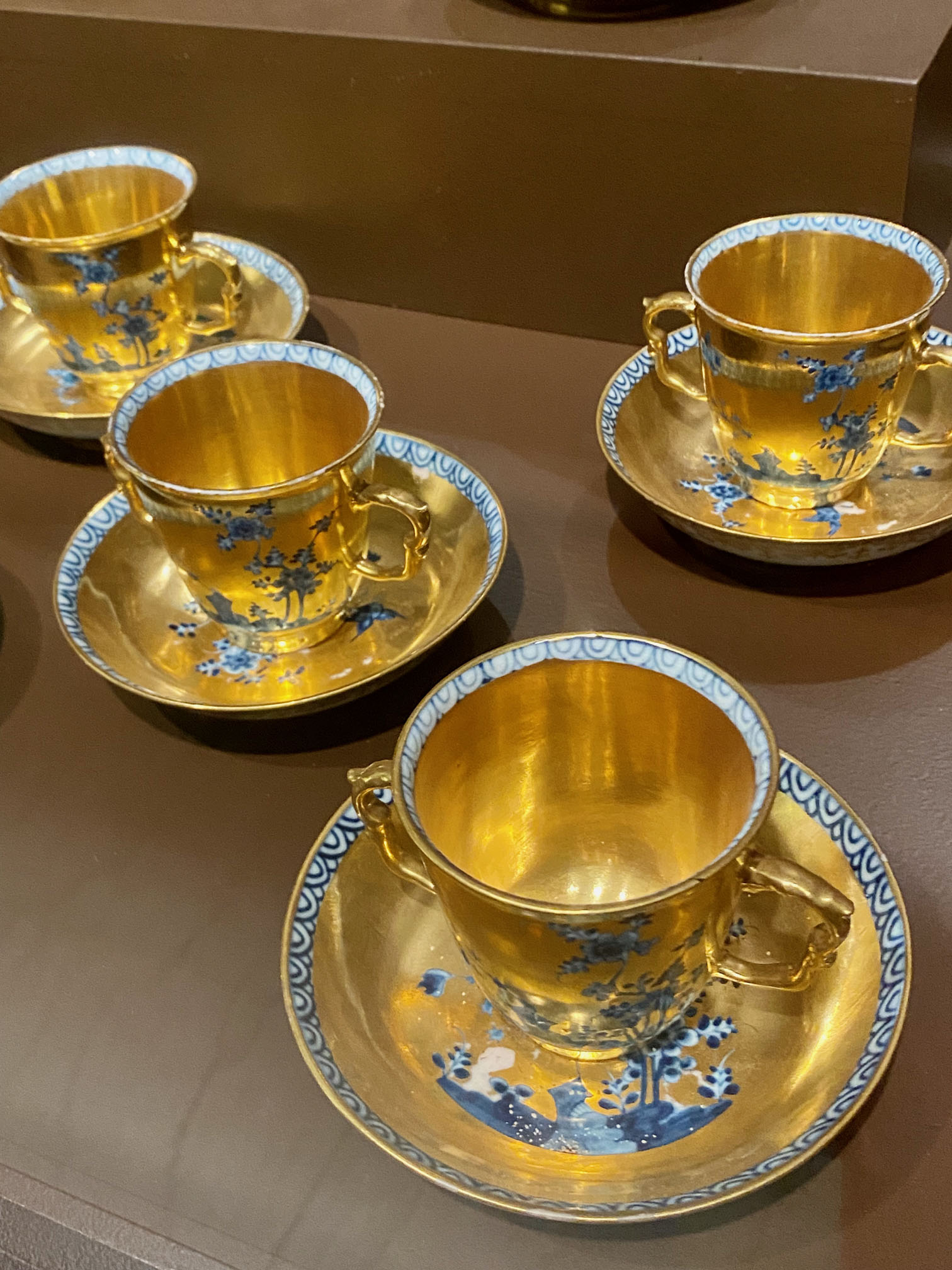
1720-25 gilded Meissen porcelain coffee and chocolate set.
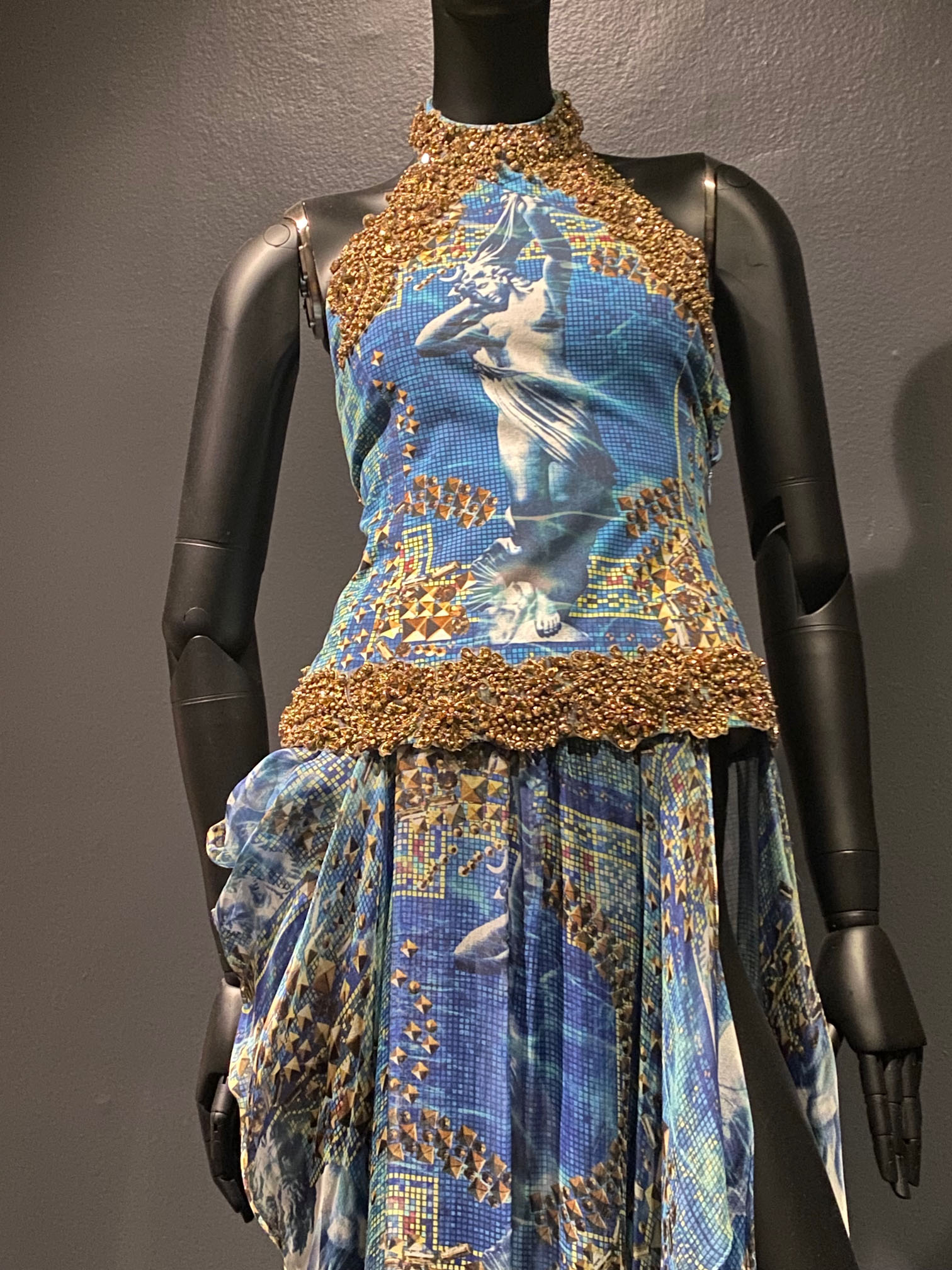
Claudio Cina’s 2017 photo-printed skirt and top depicting Venus, embroidered in gold with gold studs and crystals. Courtesy: the designer
And then it’s just one golden haute couture gown after another – Dior, Yves Saint Laurent, Cardin – accented by cases containing masterpieces of jewelry design by Cartier and Schiaparelli.
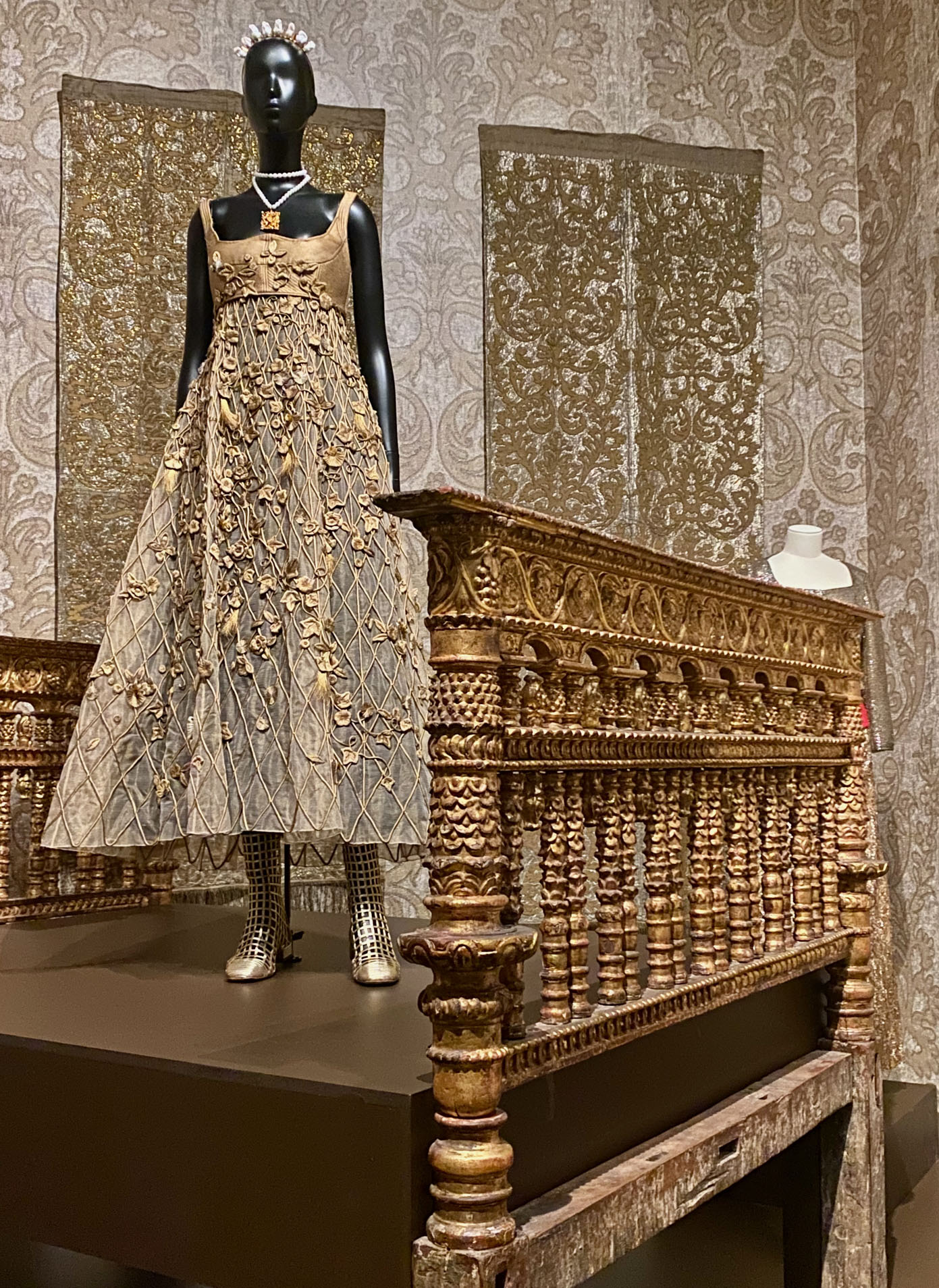
2021 embroidered gold silk haute couture dress by Maria Grazia Chiuri for Dior atop 1700-1760 gilt wood bed from Peru. Courtesy: Dior.
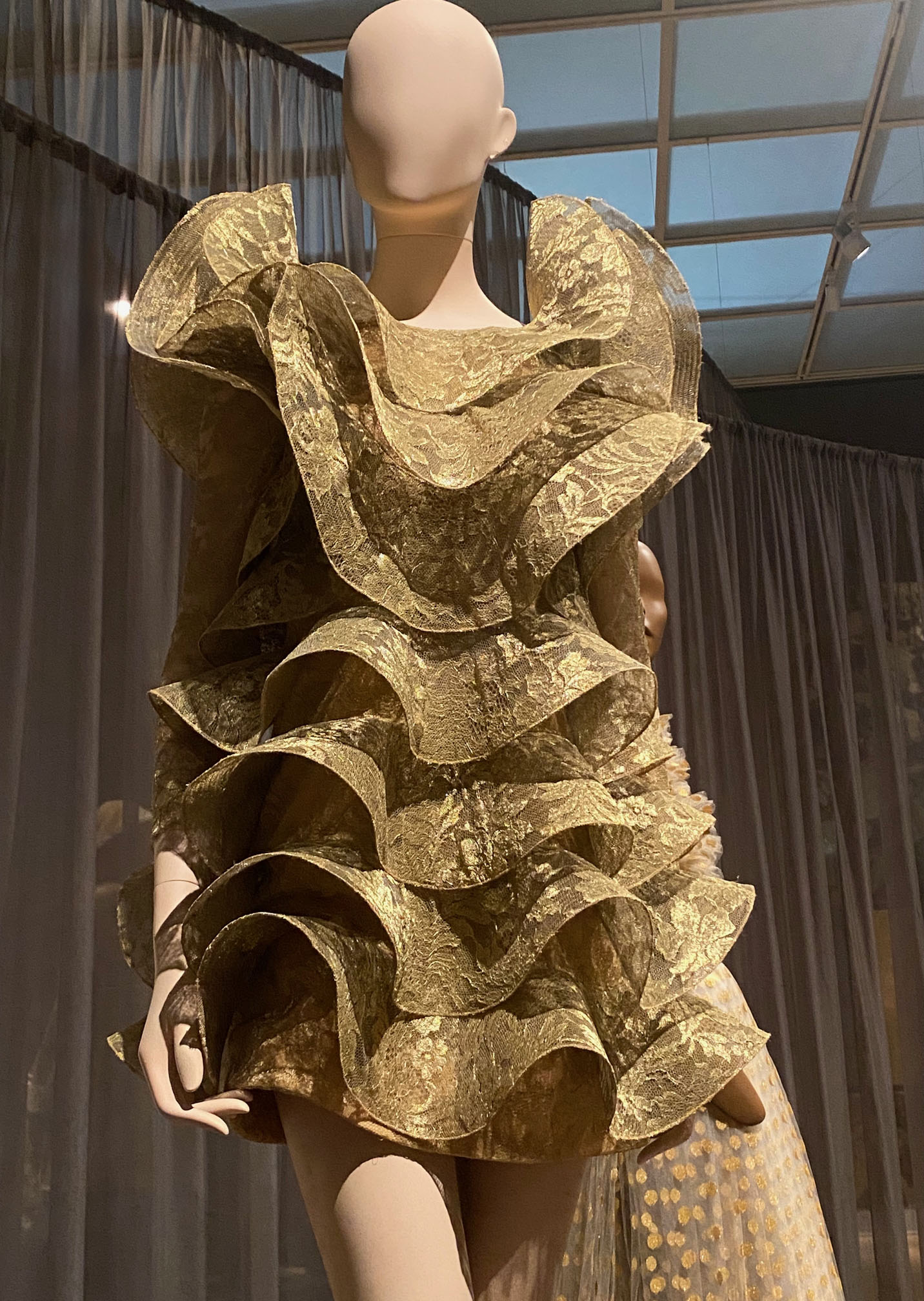
1991 gold nylon lacework ruffled cocktail dress by Pierre Cardin. Courtesy: Musée Pierre Cardin.
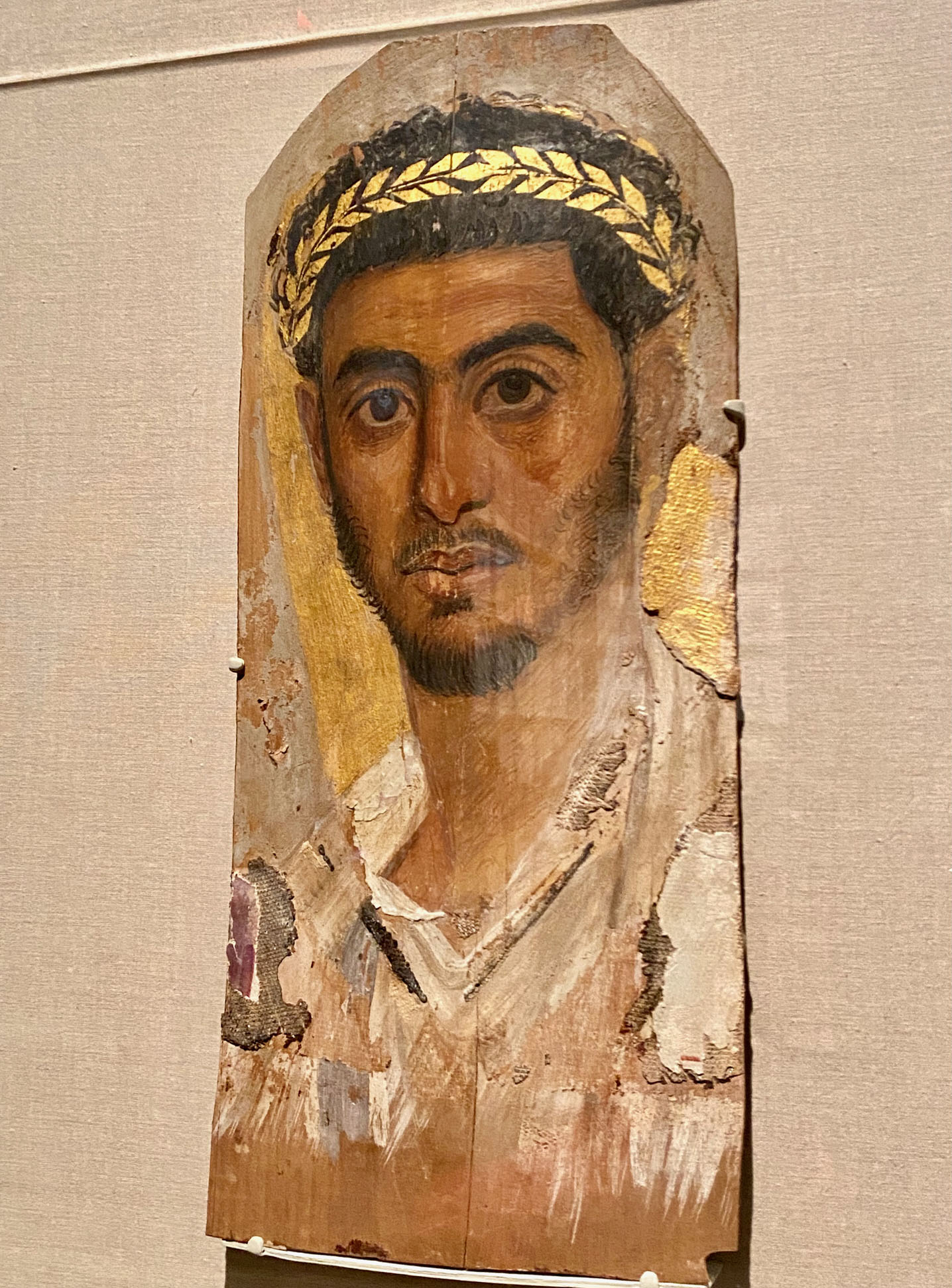
The final gallery – and it’s a stunner – shows how ancient and contemporary artists and designers use gold to signify special status and power. A gold wreath encircles an Egyptian man’s portrait, and Basquiat honors his friend in a painting by inserting his iconic gold crown. We get a chance to examine Brooklyn’s rare hammered leafy gold wreath from ancient Greece alongside a golden dress made by Dior for the opening of the 2024 Paris Olympics.
120-130 A.D. Egyptian Mummy Portrait of a Man.
Aya Nakamura’s 2024 metallic gold feather dress for the 2024 Paris Olympics opening ceremony by Maria Grazia Chiuri for Dior. Courtesy: Dior.
To see inside the gallieries and hear more, watch this video with Brooklyn Museum curator Matthew Yokobosky:
Since its founding in 1937 as an institution documenting Navajo ceremonial art, Santa Fe’s Wheelwright Museum of the American Indian has shifted toward collecting contemporary Native American art and serving as a platform to boost careers of emerging artists.
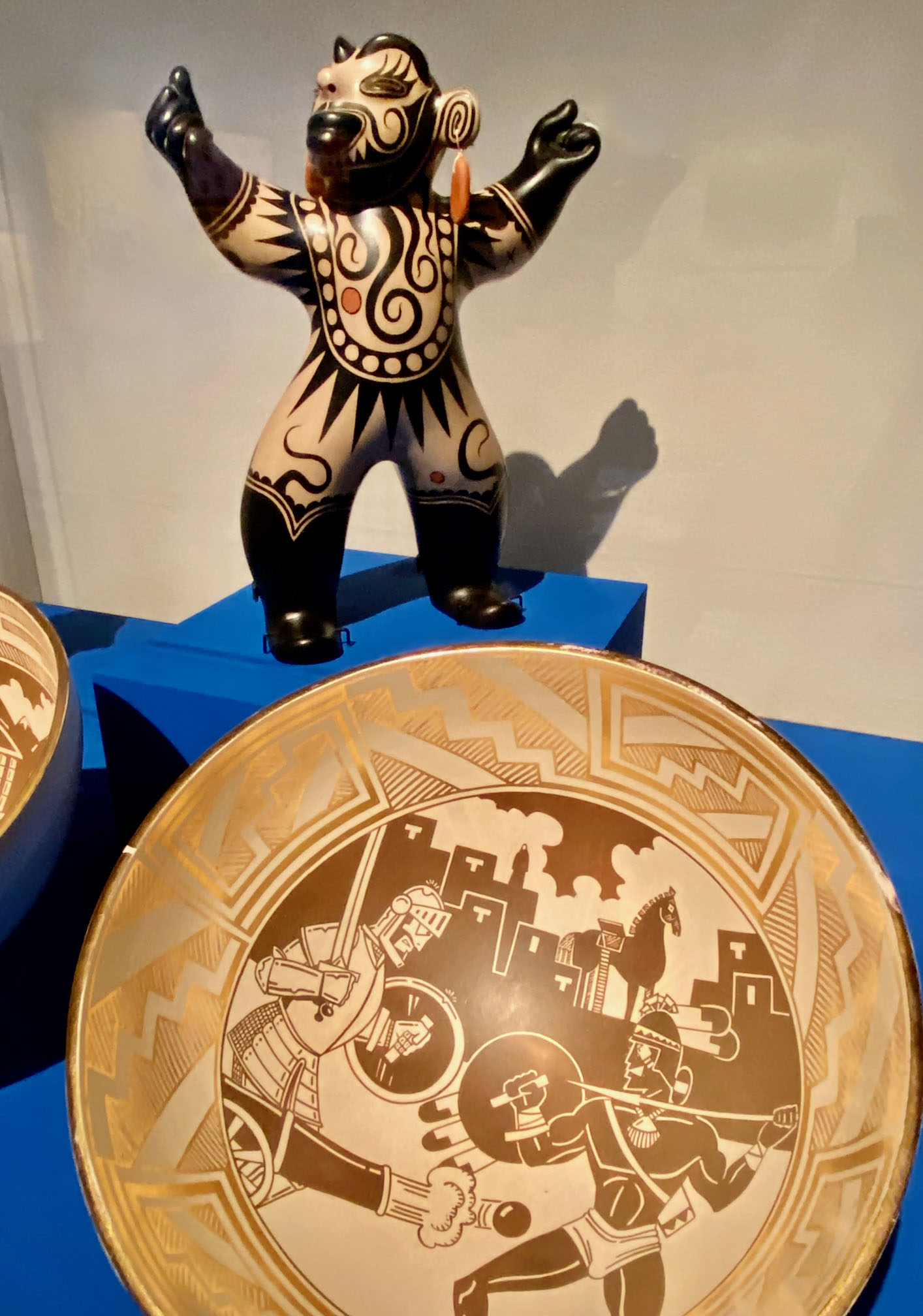
Virgil Ortiz’s (Cochiti) 2005 ceramic sculpture Monos Figure with Diego Romero’s (Chochiti) 2005 bowl Tenga Cuidado Con Griegos Salvo Obseqios.
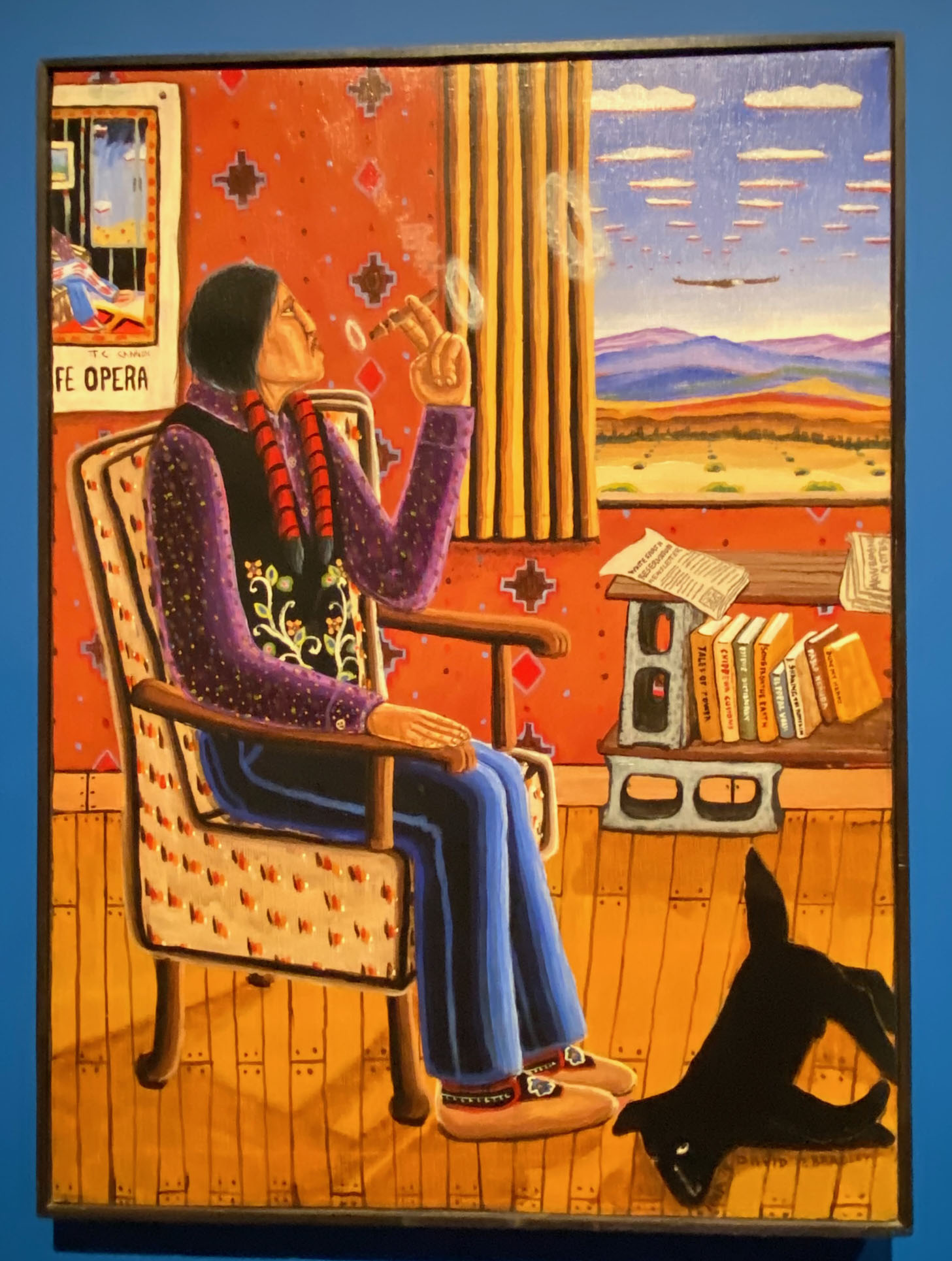
For example, on a wall honoring T.C. Cannon, the curators showcase a crazy, irreverent David Bradley work painted in T.C.’s bold, satirical style, but display a rather conservative (and rarely seen) woodcut by T.C. himself.
David Bradley’s (Minnesota Chippewa) 1979 acrylic Remembering T.C. Cannon in the style of his hero.
T.C. Cannon’s (Kiowa/Caddo) 1977 woodblock print Hopi with Manta.
Contemporary textile artist Ramona Sakiestewa’s comment that her work represents “visual echoes of what came before” inspired the title of the exhibition. Sakiestewa’s tapestry incorporates colors and motifs of traditional Hopi wicker plaques. This theme is carried throughout the show.
Ramona Sakiestewa’s 1992 Basket Dance/9-B echoes a traditional woven Hopi ceremonial plaque.
A grouping of intricately painted Acoma ceramics pays tribute to the Wheelwright’s 1981 exhibition Sky City Salute that honored two matiarchs of that art form – Lucy Lewis, who lived at Acoma before and after tourists began beating a path to the ancient mesa-top city, and Marie Z. Chino. The curators match it with work by Marie’s grandson, Robert Patricio, who channels traditional themes into a modern ceramic context.
Acoma legacies: a 1965-85 seed pot and 1958 bowl by Lucy Lewis, and large 1980 storage jar by Marie Z. Chino.
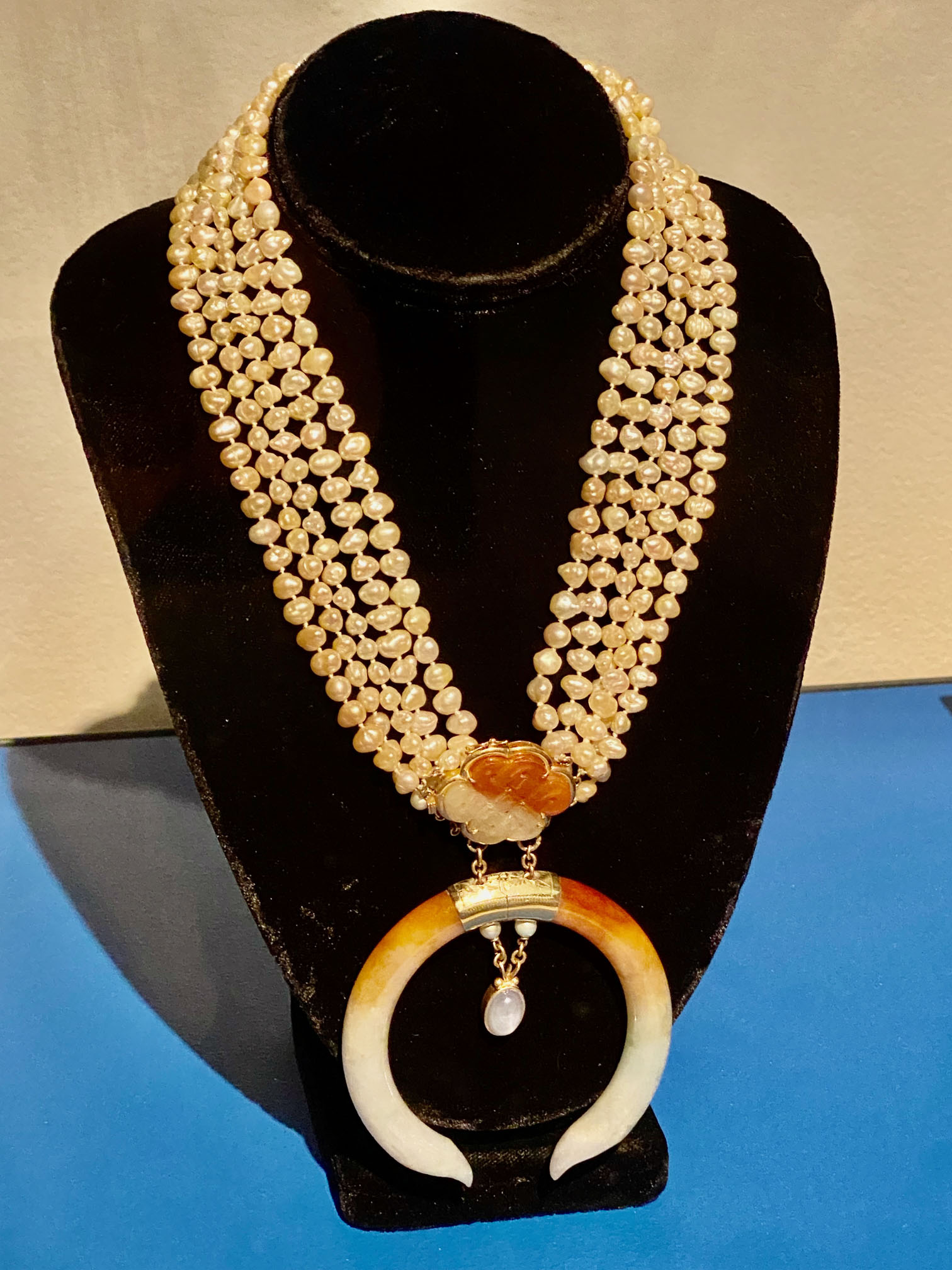
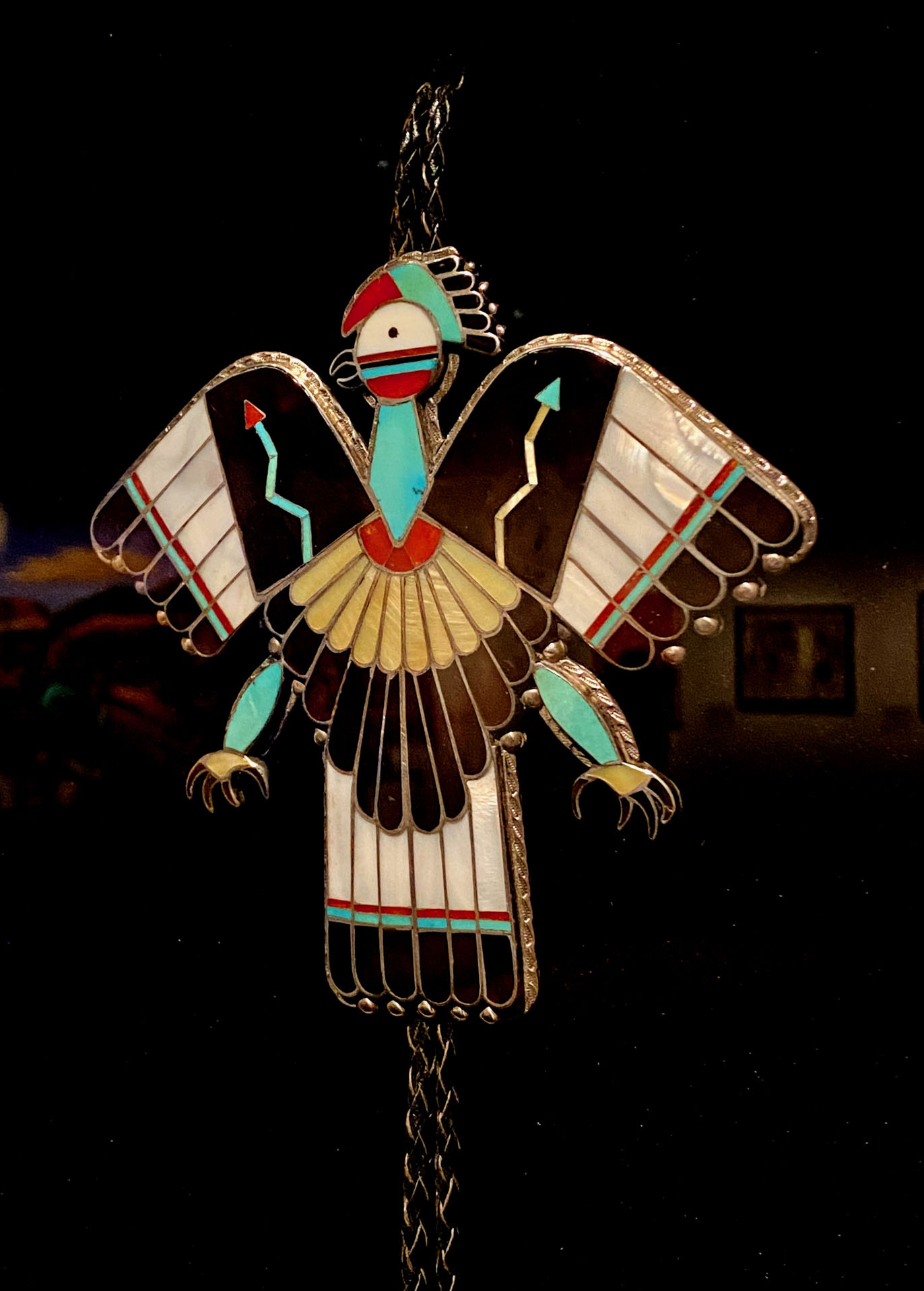
Another grouping references the Wheelwright’s 2011 show Radical Recycled Jewelry Makeover with a bold piece by Kenneth Johnson and the Wheelwright’s stellar collection of Zuni bolo-tie inlays.
Kenneth Johnson’s (Muscogee/Seminole) 2011 necklace from recycled pearls, jade, gold, and silver..
1970s-1980s thunderbird bolo by Owen Bobelu (Zuni); inlaid silver, jet, turquoise, and mother-of-pearl.
The “salon wall” is peppered with paintings that tell the interconnected histories and styles of nine Native artists – the trajectory from flat-style styles of the 1920s and 1930s to more open innovation of Ben Harjo and Linda Lomahaftewa, some of earliest graduates at the Institute of American Insitute Arts (IAIA).
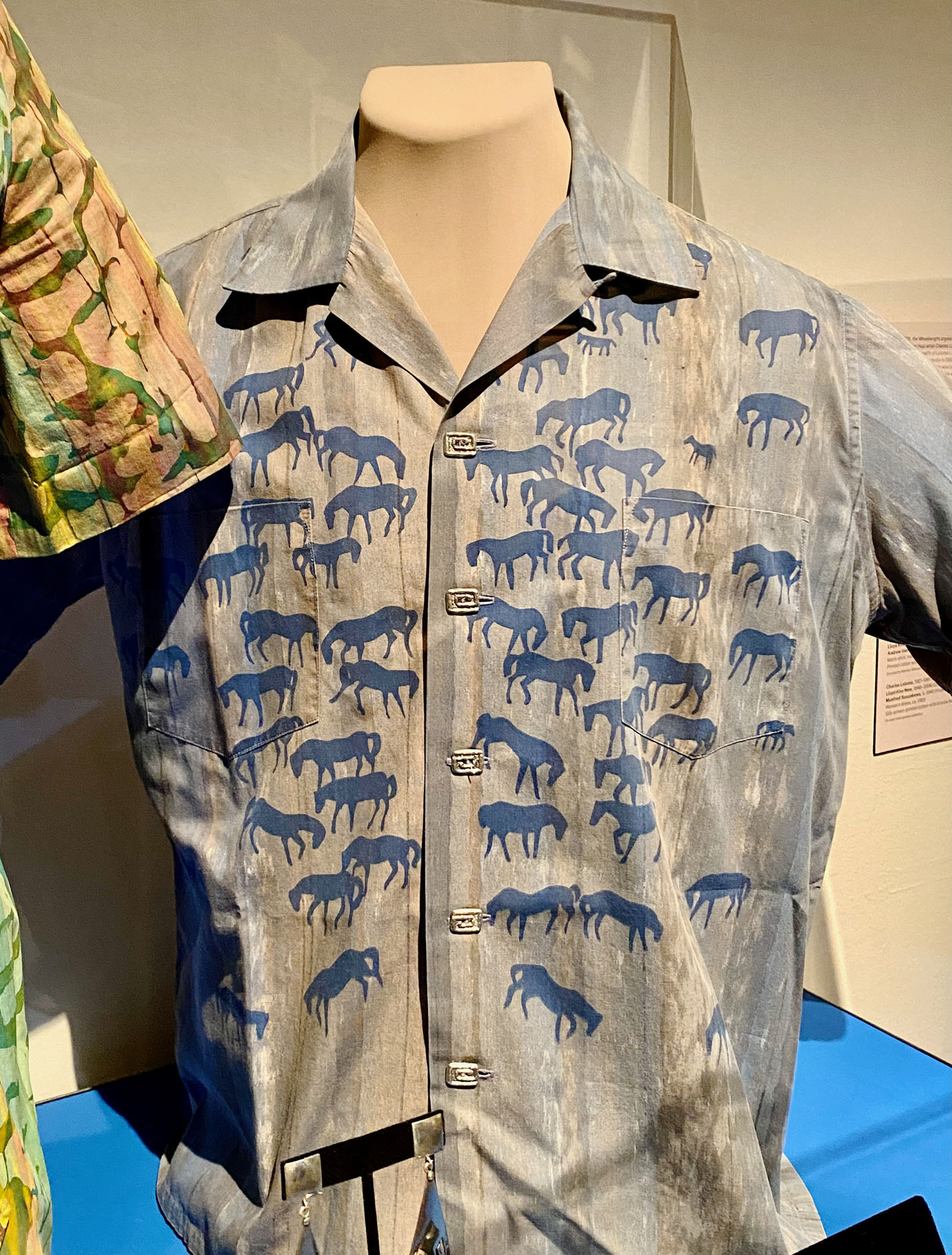
The exhibition also presents another group of work to acknowledge the artists who began working together in Scottsdale in the 1950s and who began IAIA in 1962 – clothing designed by co-founder/president Lloyd Kiva New and jewelry by instructor Charles Loloma..
Lloyd Kiva New’s (Cherokee) 1950s man’s shirt with Andrew van Tsinajinnie (Diné) printed fabric and Charles Laloma (Hopi) silver buttons.
Charles Laloma’s 1970 silver, coral, turquoise pin.
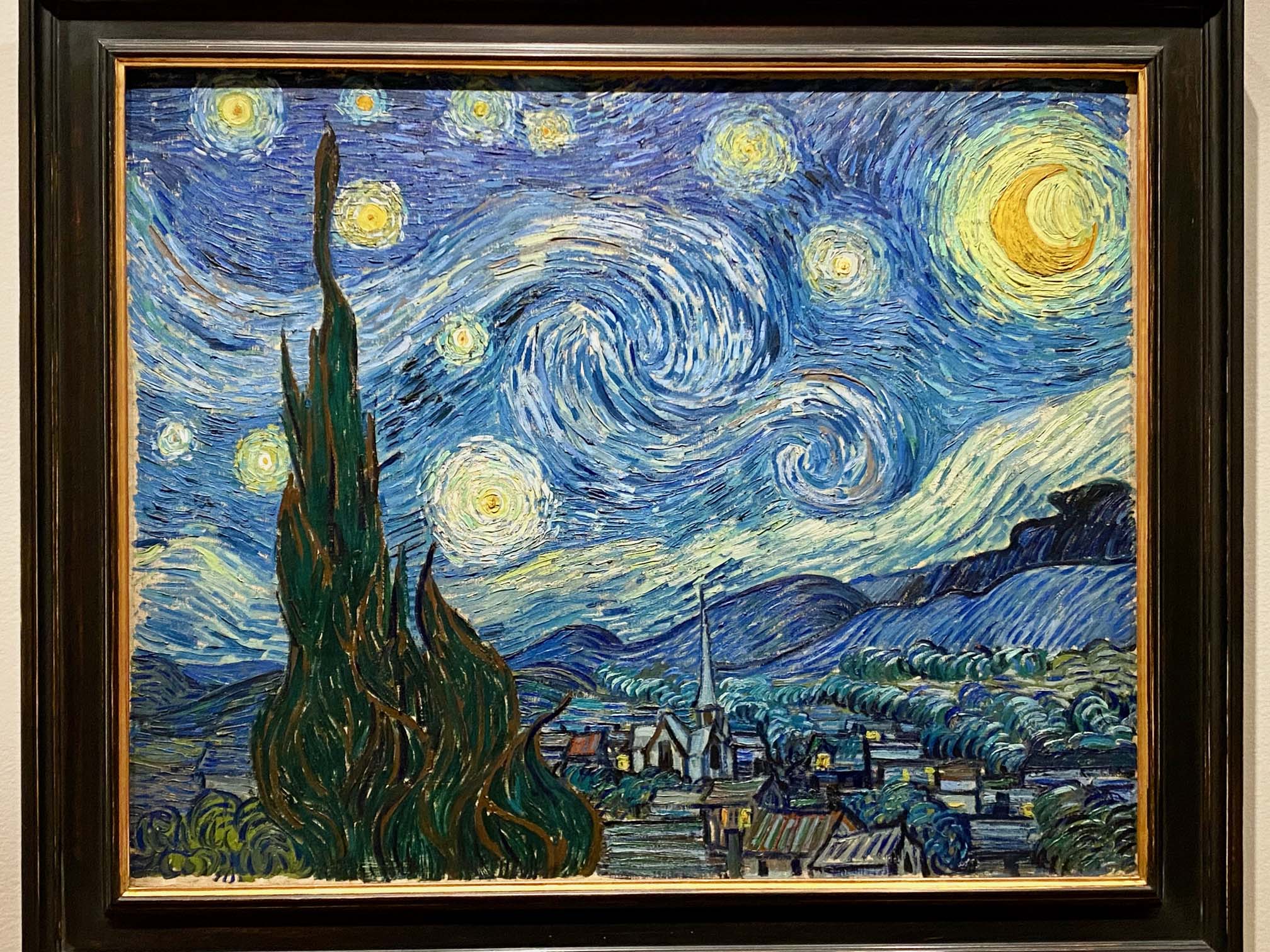
When you peek into the second-floor MoMA exhibition, you’ll see where Van Gogh’s The Starry Night has been holding court for the last few months.
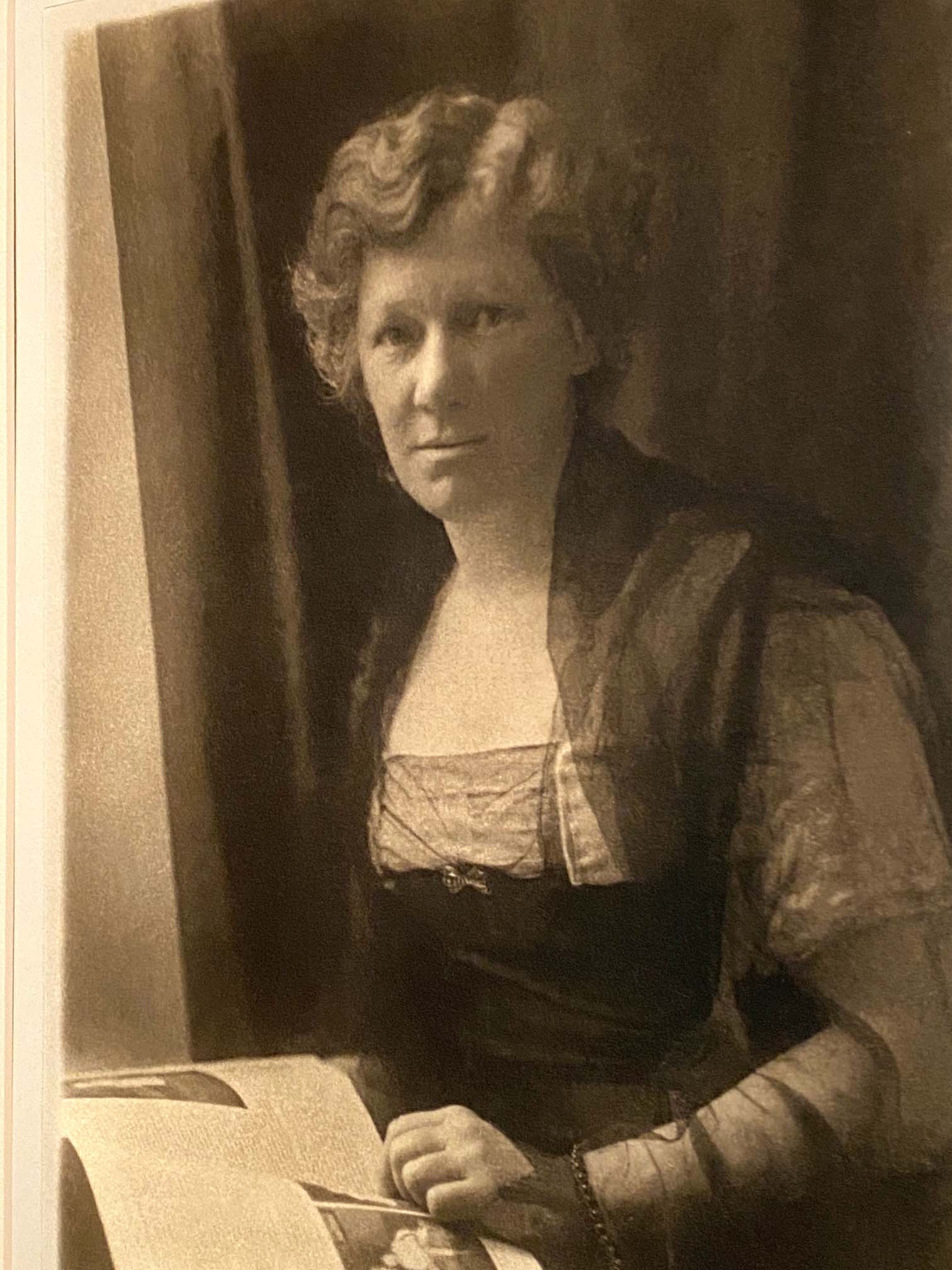
Lillie P. Bliss and the Birth of the Modern, on view through March 29, tells the story of how one woman’s passion for modern art over a century ago formed the basis of the MoMA collection and MoMA itself.
Van Gogh’s 1889 The Starry Night, one of MoMA’s most beloved works.
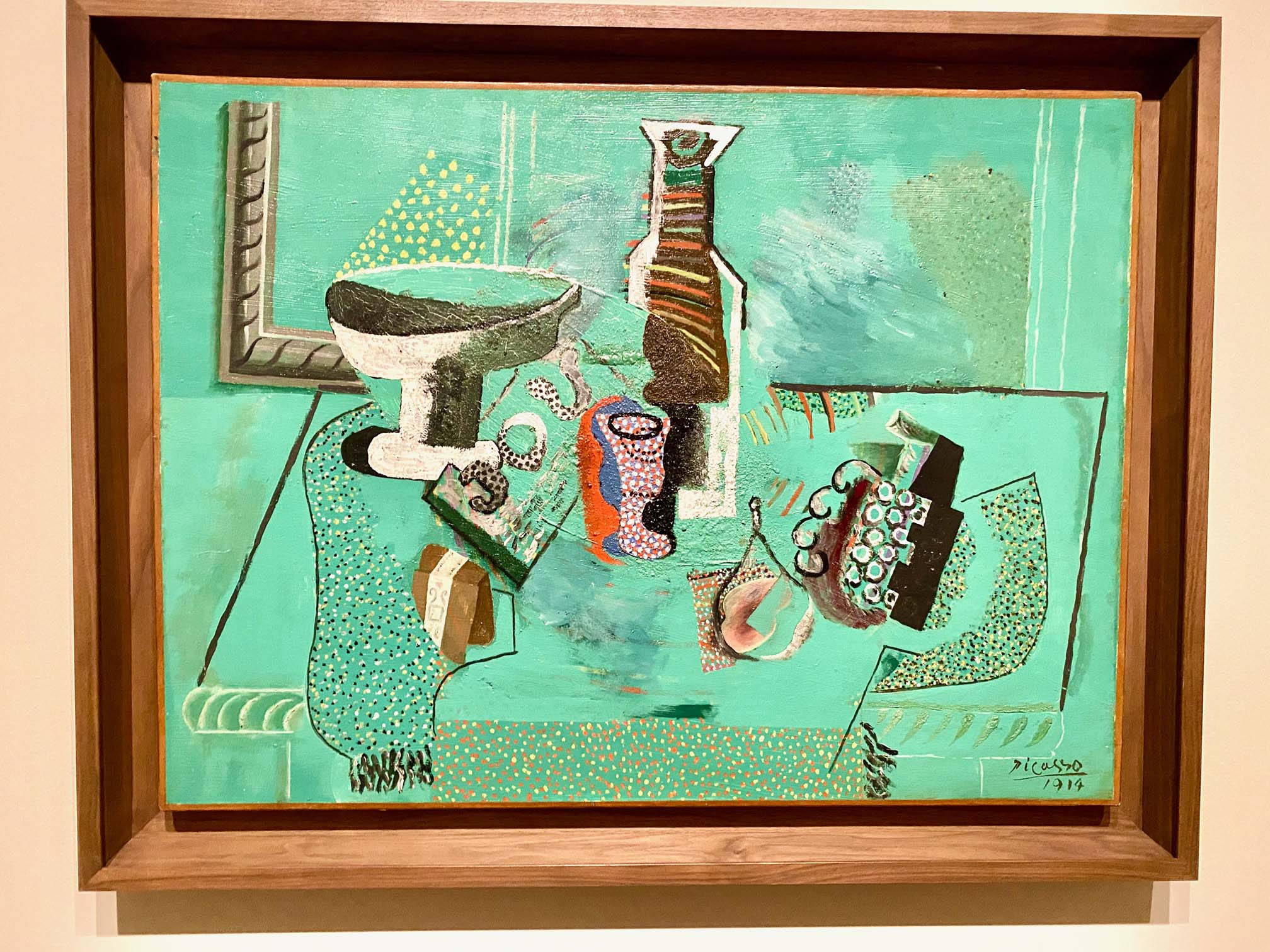
Bliss was an early American patron of Cézanne, Seurat, Picasso, and Redon at a time when New York society looked askance at modern art’s tilted tables, fractured still lifes, and stippled surfaces. She even contributed to getting the 1913 Armory Show off the ground as a sponsor, art lender, daily visitor, and new-work buyer.
Maybe the constraints of growing up female in the Victorian era gave her an appreciation for the lack of inhibition Picasso’s and Matisse’s colors, Gauguin’s wild Tahitian woodcuts, and Redon’s ethereal woodsy fantasy figures.
Picasso’s 1914 Green Still Life.
Endless modern-art discussions with art-world friends and mentors Arthur Davies and John Quinn gave her a sophisticated view of all the latest artists and trends. She joined a small group of modern-art lovers to lobby the Metropolitan Museum of Art to show the latest breakthroughs from Europe.
In 1921, the Met acquiesced and borrowed enough art to mount an exhibition of French impressionist and post-impressionist work. Bliss anonymously lent twelve pieces. People came to look, but the Met still resisted acquiring work that it considered too far-out.
When Bliss came into her inheritance in 1923, the pursestrings were unleashed. At age 49, she began to assemble the collection of her dreams via annual European buying trips and estate sales. Where could she show it?
1904 portrait of Lillie P. Bliss
In 1928, she bought a lavish uptown triplex with a two-story gallery. She hung her favorite Cezanne over the grand piano and arranged a “who’s who” of avant-garde masters. Check out The Bather front and center, surrounded by Picassos, Seurats, and Gauguins.
1929-1931 photo of Lillie P. Bliss’s modernist collection hung in the music room of her Park Avenue apartment
Cézanne’s 1895-1898 Still Life with Apples hung at home in the place of honor, above the piano
The next year in a brainstorming session with Abby Rockefeller and Elizabeth Parkinson, the trio decided that New York needed a special place that was devoted exclusively to modern art. MoMA was born!
MoMA’s first exhibition – Cézanne, Gauguin, Seurat, van Gogh – was mounted in rented space at 730 Fifth Avenue, and crowds came. The exhibition was a huge popular success, even though it coincided with the historic 1929 market crash.
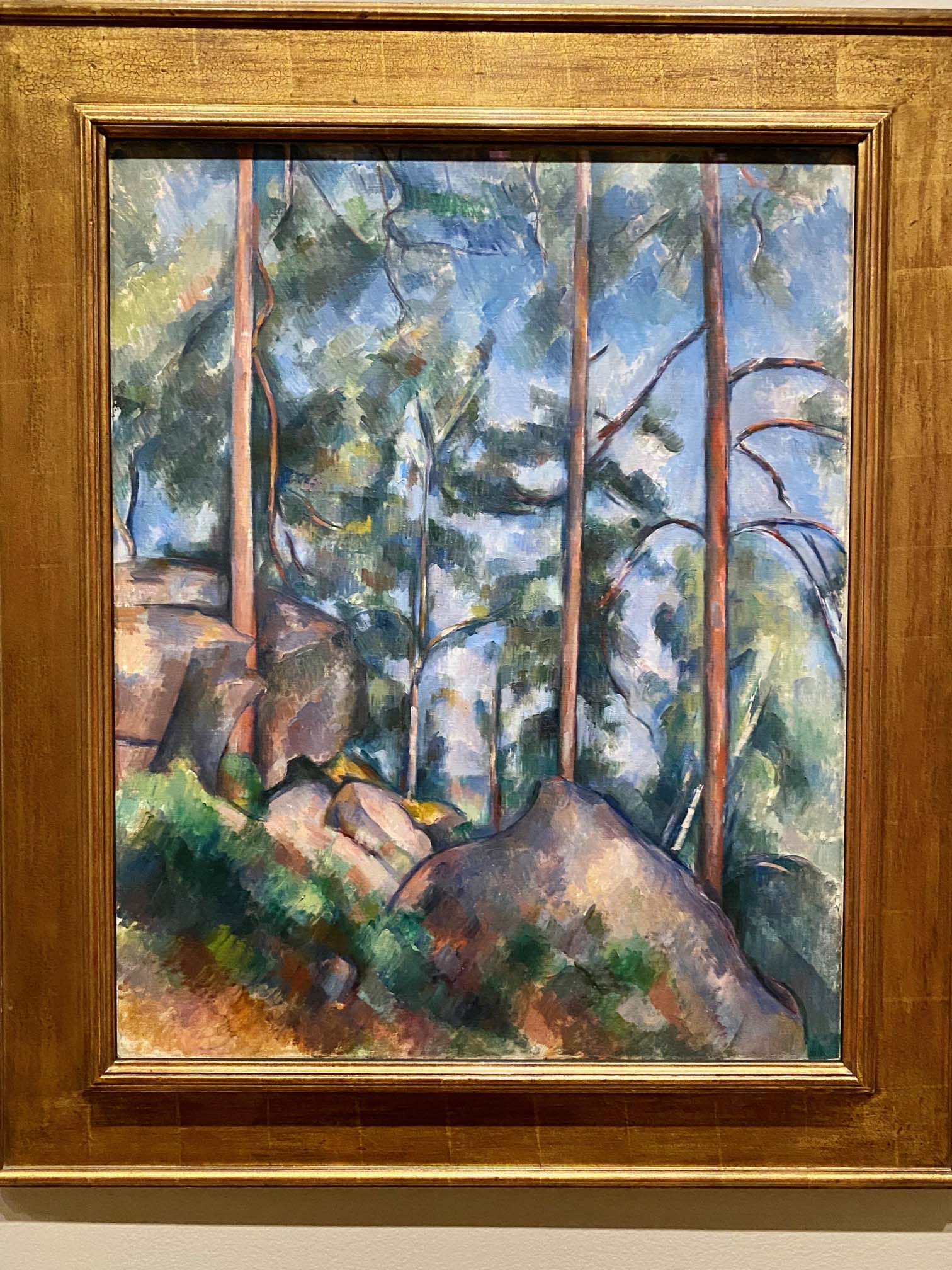
Cézanne’s 1897 oil Pines and Rocks (Fontainebleau?)
Seurat’s 1884 crayon drawing A Woman Fishing.
Lillie’s health crashed, too. On the heels of MoMA’s test run, she was diagnosed with cancer, and started drawing up a will to ensure that her beloved collection would carry on when she could not. She gave a Monet and a few gems to the Met, but bequeathed 150 works to the new Museum of Modern Art – forming the core of the collection we know today.
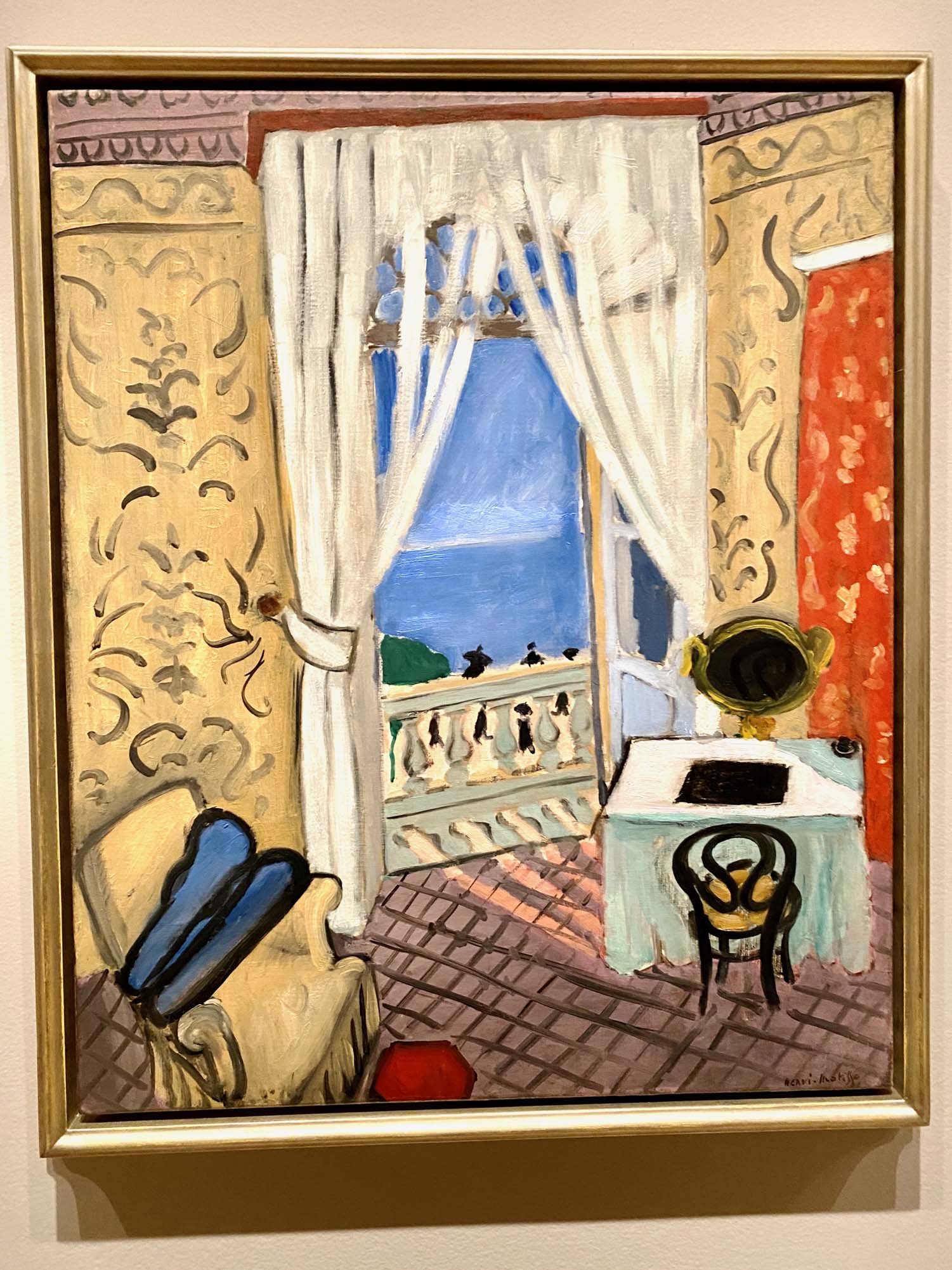
Matisse’s 1918-1919 Interior with a Violin Case.
When Lillie died in 1931 at age 66, there was only one last thing. She was never able to acquire a Van Gogh. But in her will, she did give the museum permission to sell or exchange most of the paintings she bequeathed.
A few years later, MoMA sold one of Lillie’s Degas to acquire Picasso’s epic Demoiselles d’Avignon.
And in 1941, Alfred Barr made her dream come true. He heard that a dealer possessed a very special Van Gogh, and traded three of Lillie’s paintings for The Starry Night.
See our favorite works in our Flickr album, and enjoy other stories about this visionary MoMA founder by listening to the audio guide for the exhibition here.
Gauguin’s 1894 woodcut print The Creation of the Universe from the 10-print series, Noa Noa (Fragrant Scent)
Decending into the ground-floor gallery of the University of New Mexico Art Museum, visitors find themselves in a transcendental chamber, filled with abstraction, color, and spiritual emanations.
Pelton & Jonson: The Transcendent 1930s, on view in Albuquerque through March 15, features the work, letters, and personal photographs documenting the professional and personal friendship between two artists that wanted people to see realities beyond the visible world. Artists Raymond Jonson, former UNM professor, and Agnes Pelton, the visionary New York artist who relocated to the Western desert, felt they were kindred spirits, and the exhibition shows us why.
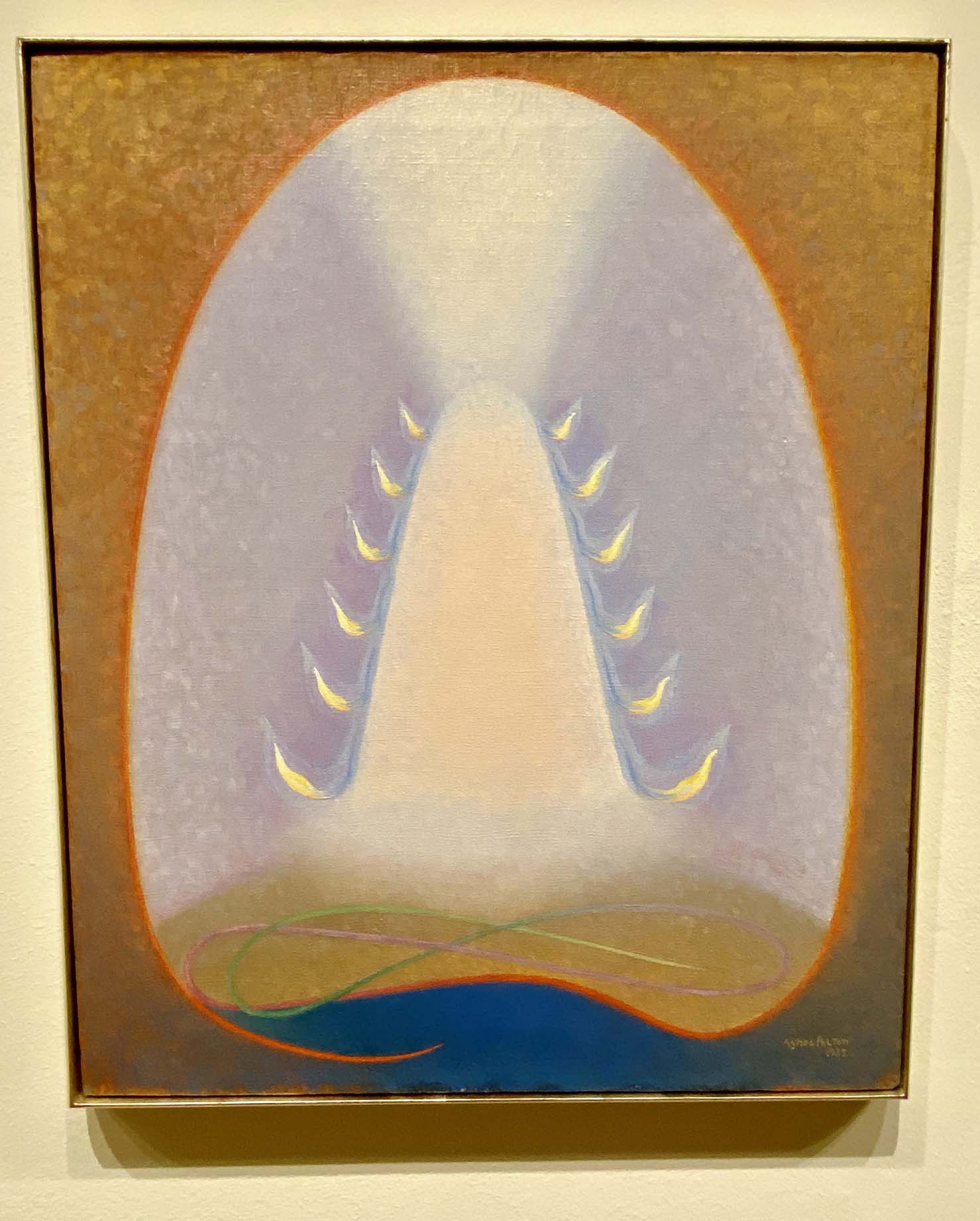
Agnes Pelton’s 1930 painting The Voice – suggesting enlightened dialogue within human consciousness.
As a young artist, Jonson was thunderstruck by the modern art he witnessed in the 1913 Armory Show when it came to Chicago (which included a painting by his future friend, Agnes Pelton from her “imaginative” period of work). Jonson read Kandinsky’s influential The Art of Spiritual Harmony when it was published in English in 1914, and increasingly pushed his work toward pure shape and design that could evoke a deeper response from the viewer.
By 1930, he and his wife moved to Santa Fe. He began teaching, curating shows, and continuing to pursue abstraction. When concepts were simply too much for a single canvas, he conceived a triptych.
Raymond Jonson’s 1930 tryptich – Time Cycle: Morning, Noon, and Night
Around 1931, new-age/Jungian composer, author, and painter Dane Rudhyar told Jonson about Pelton’s abstractions, and put them in touch. For the next 30 years, Jonson and Pelton corresponded about art making, materials, abstraction, and spiritual connections.
By this time, Pelton had had 14 solo exhibitions and been in 20 group shows. Her interest in spiritual practices kept growing, and the lure of the new-age communities in southern California beckoned her. During a 1932 yoga-retreat trip to Cathedral City, she decided to stay put and paint in the peaceful desert for the rest of her life
Pelton’s 1930 White Fire – showing light radiating from the inner self – from Jonson’s 1933 exhibition
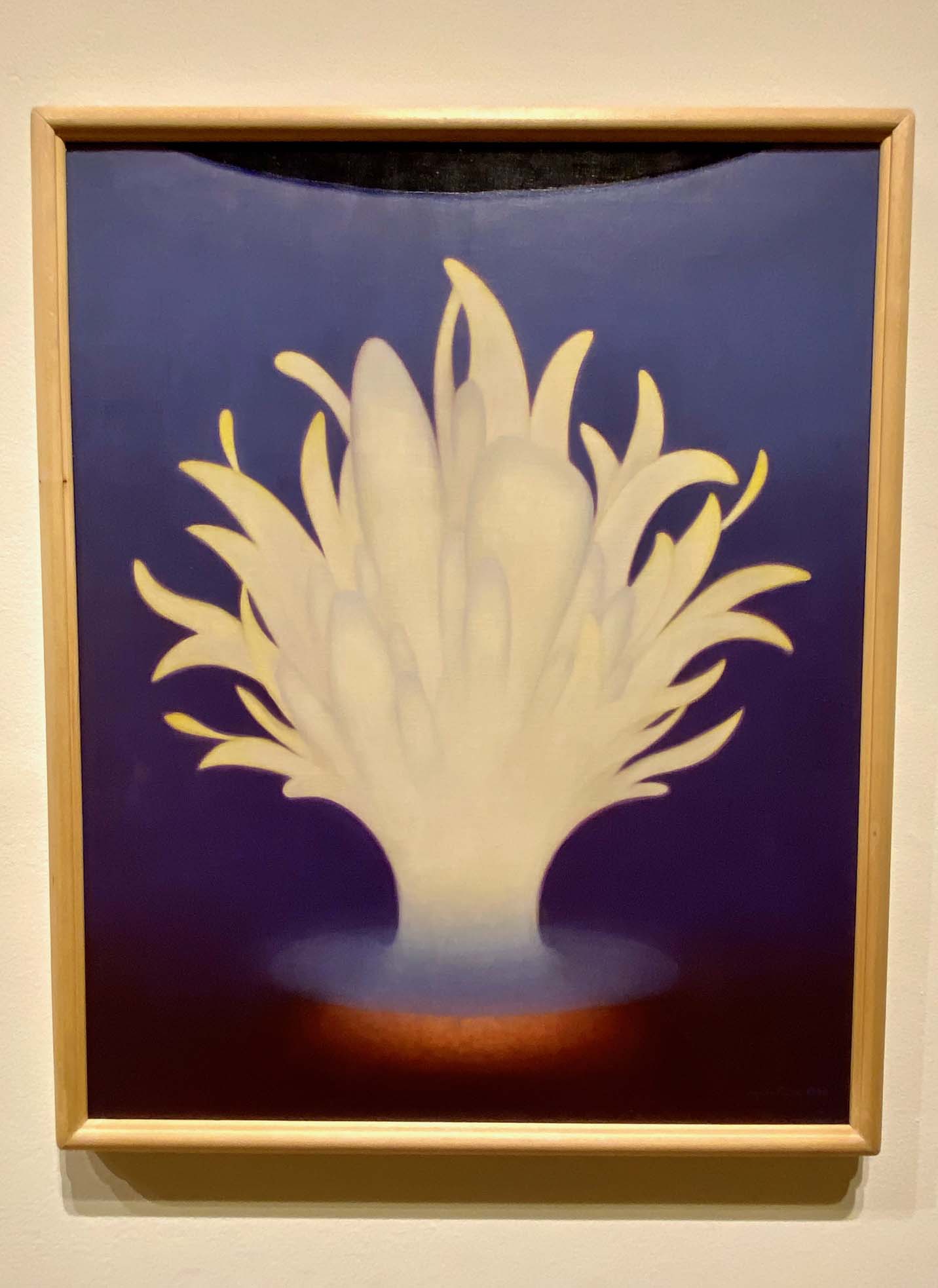
Pelton’s 1932 Mount of Flame – symbolizing the beauty in the abstract – from Jonson’s 1933 exhibition.
In 1933, Jonson invited Pelton to participate in a Santa Fe exhibition alongside himself and Cady Wells. This current exhibition at UNM commemorates this convergence by reuniting some of the original works by Pelton, Wells, and Jonson. See some of the pieces in our Flickr album.
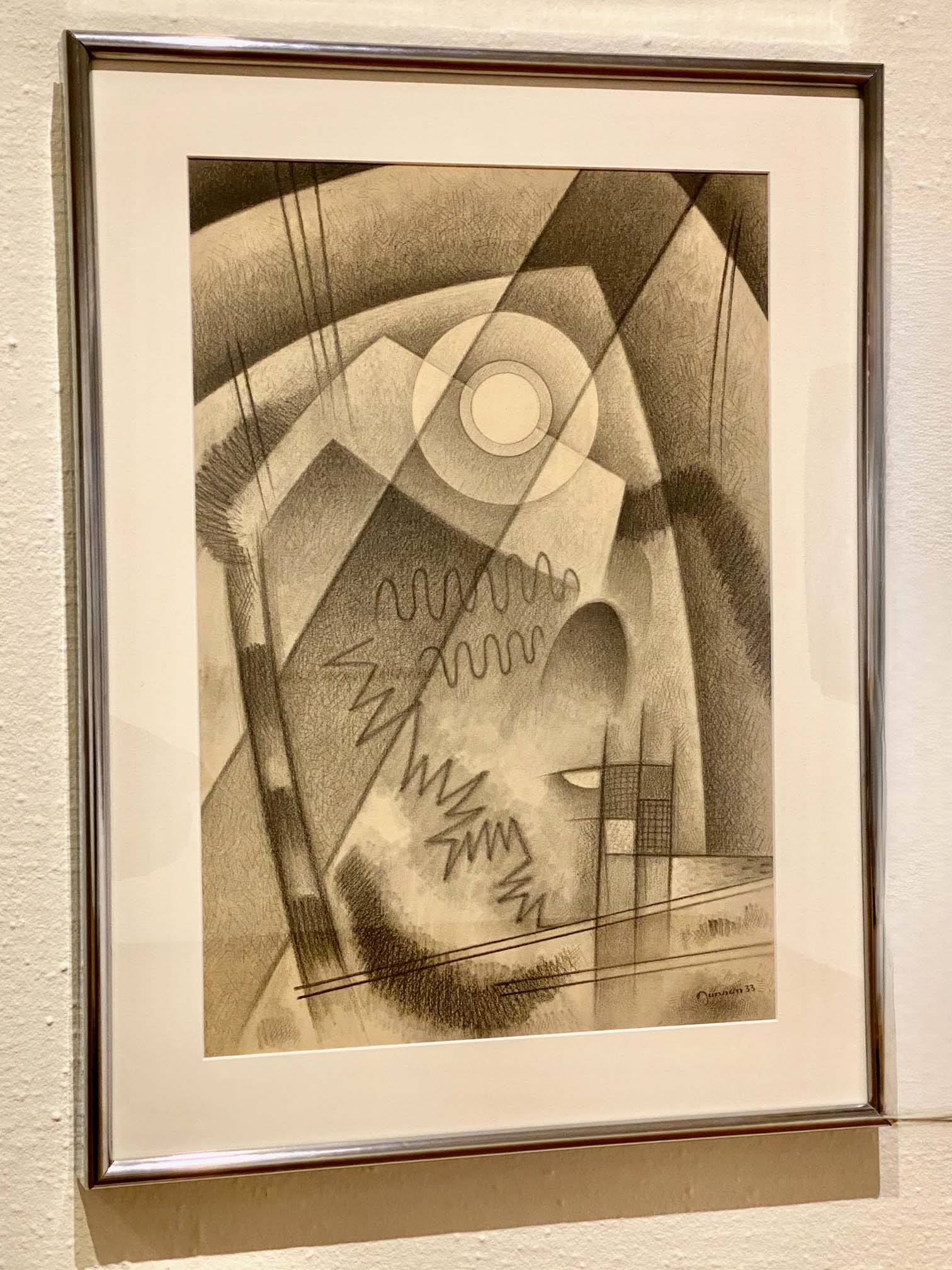
From the 1933 exhibition: Jonson’s 1933 charcoal drawing Ascending Circle
Jonson and his wife took a road trip to visit Pelton in 1935 – their one and only meeting. Although they were at a distance, the letters kept coming, and when Jonson and others in New Mexico organized the Transcendental Painting Group in 1938, she was invited to participate and serve as the grand dame/president.
In recent years, Agnes Pelton’s work has been resurgent due to the traveling exhibition organized in 2019 by the Phoenix Art Museum, which traveled to the Whitney in 2020. Read our review here.
To hear how this Albuquerque exhibition came together, listen in on Christian Waguespack’s interview with curator Mary Statzer:
UNM is lucky to have over 600 works by Raymond Jonson in its collection, and all the letters, sketches, publications, and journals he kept. For more on Raymond Jonson’s life and work, visit his portal on the UNM website.
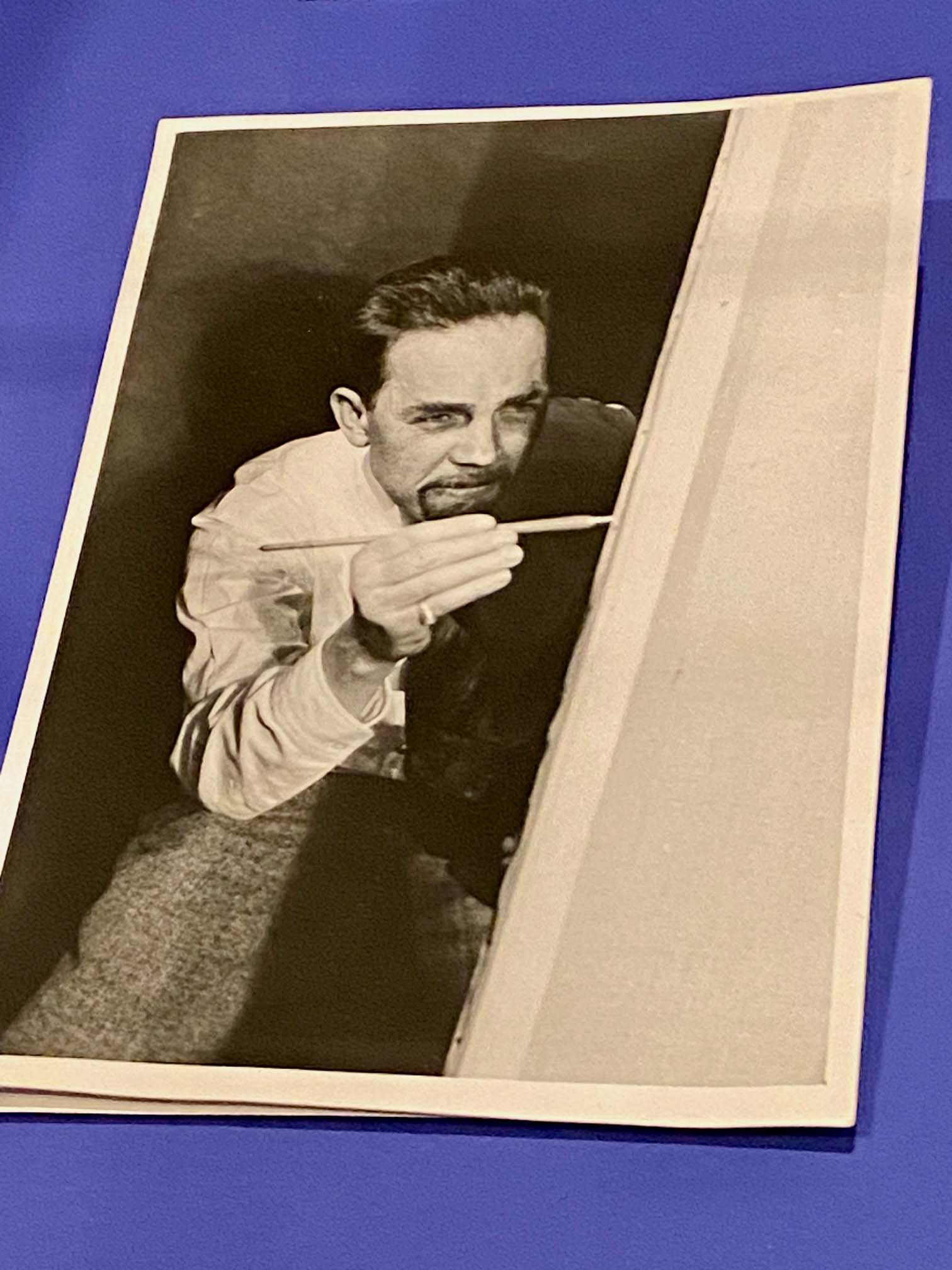
Jonson touching up work at his solo exhibition in Tulsa in a 1937 photo by F. Von James.
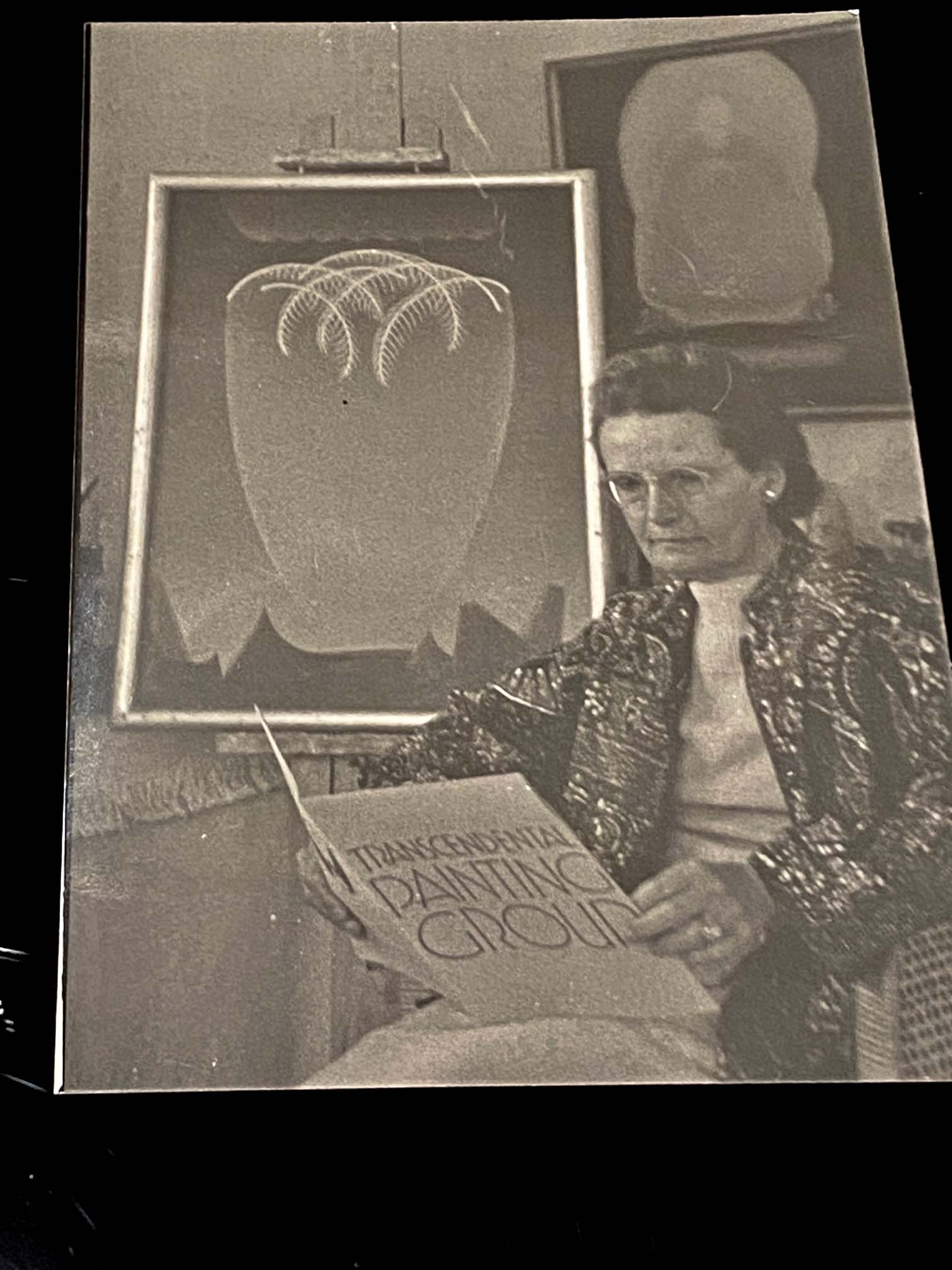
1935-1940 photo of Pelton reading the TPG brochure in her Cathedral City studio with Mount of Flame behind her.



































 itsnewstoyou