You first see a group of anonymous protestors – statues that appear to be taking it to the streets with placards and bullhorns. Elevated at different levels, they present a monument to non-violent protest – a fitting opening to Pedro Reyes: DIRECT ACTION, on view at SITE Santa Fe through May 1.
Reyes believes in participatory art projects that transform art-making into social action.
The Protesters, Reyes’ 2016-2017 monument to unified voices that bring about change from non-violent protest. Courtesy: the artist, private collectors.
Memento, 2022 – vases made from gun parts by Albuquerque and Santa Fe students. All for sale.
The products of his 2022 Memento are right behind you – an array of fun flowers popping out of tall vases. Look closer.
The airy containers are transformed guns from a New Mexico buyback program that incentivized people to exchange their guns for grocery or home-store gift cards. The vases, made by welding-class students from Albuquerque and Santa Fe, are all for sale, with proceeds going to fund activities by New Mexicans to Prevent Gun Violence.
Turning the corner into the next installation, you encounter a wall of videos and shovels in a similar transformation – Palas por Pistoles – that Reyes organized in a particularly violence-prone community in western Mexico.
Reyes’ Palas por Pistoles (2006-present) – shovels made from melted-down gun parts, which were used by schools and museums to plant trees.
Reyes asked people to donate guns to be melted down for an art project promoting environmental peace. He received 1,527 weapons, crushed them in a public-art event, and commissioned a foundry to make shovels. Schools and museums used the shovels to plant 1,527 trees.
Every turn in the gallery reveals a different type of installation and project – libraries for “the people,” sculptures referencing language systems, posters protesting nuclear arms, and musical instruments and contraptions created from weapons.
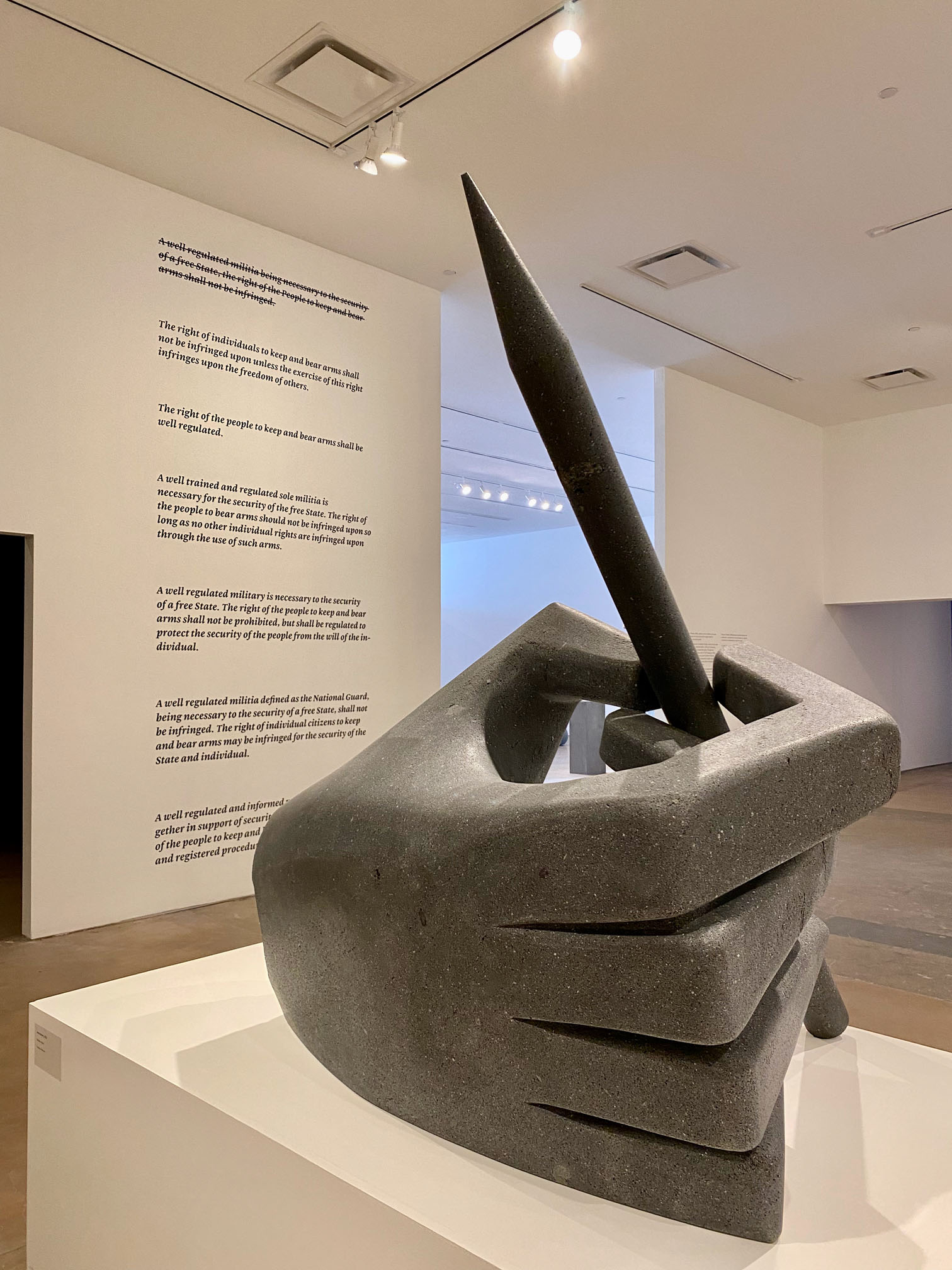
You can’t miss the artist’s large volcanic-rock hand with pencil – an emblem of Reyes’ Amendment project that held community meetings where rewrites to the Second Amendment were proposed and discussed. The idea is that with so much discussion on policies these days, it’s better to write down the “amendments to the Amendment” in pencil! A list of suggestions is prominently posted nearby.
2002 Amendment volcanic stone hand writes the Second Amendment in pencil to facilitate changes in wording as necessary. On wall, multiple drafts of the Second Amendment generated in a Tampa, Florida community project.
Reyes’ 2022 marble sculpture, Colloquium (Parafrasis) depicting the architecture of speech; in background, icons of solutions to social problems from The People’s United Nations (pUN) project – food insecurity, population, gun control, mass incarceration.
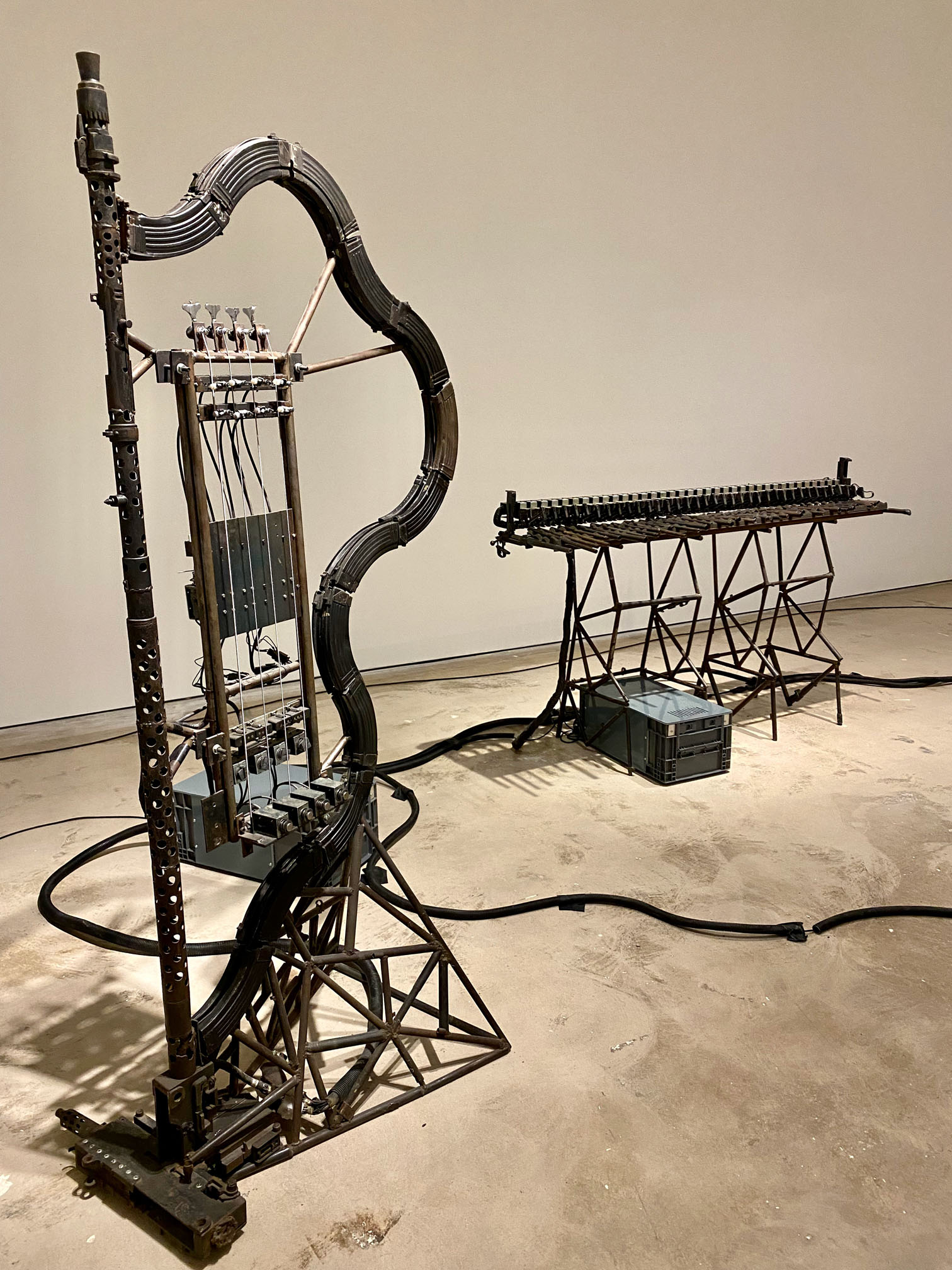
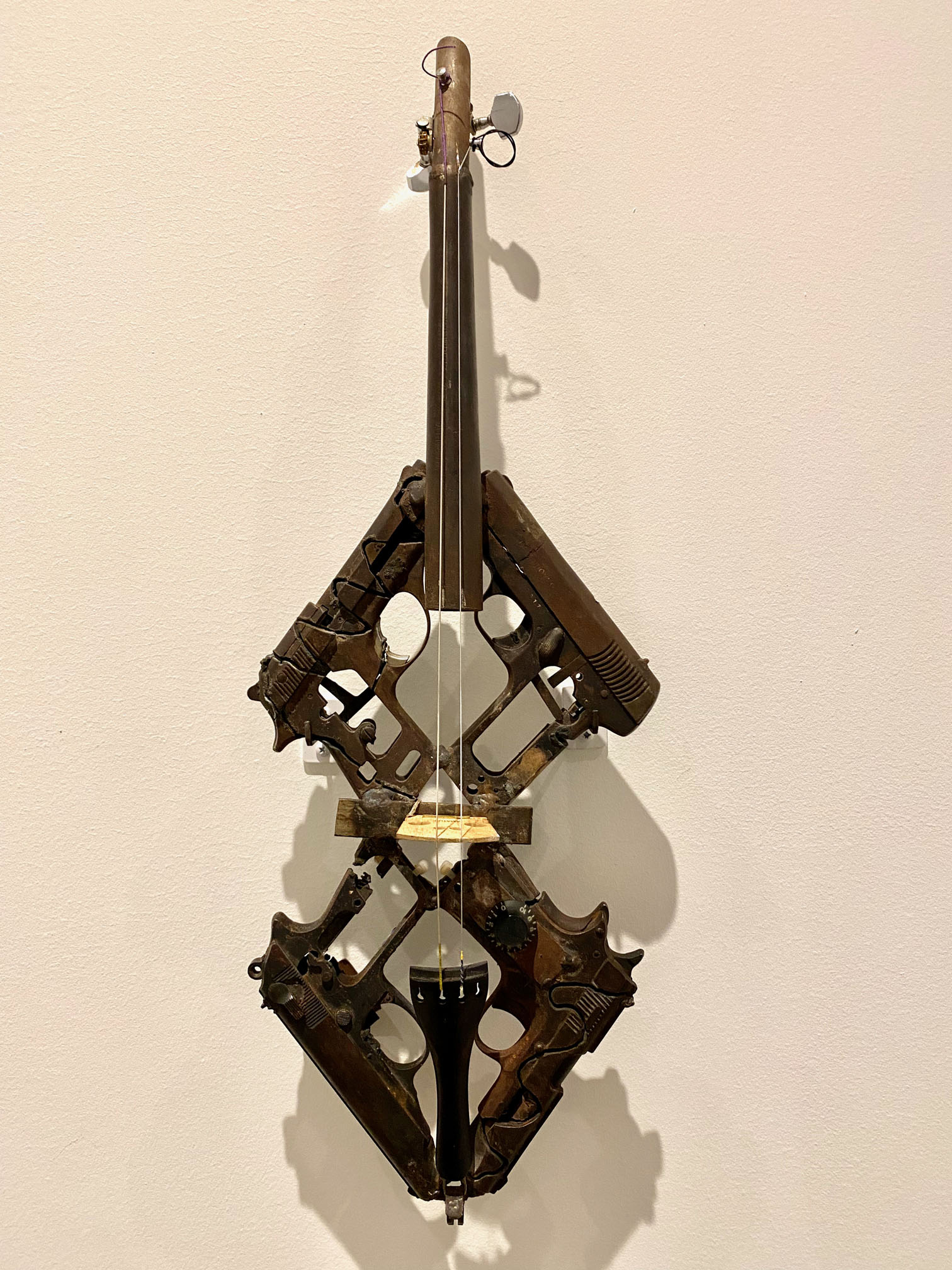
Visitors tend to linger in the Disarmgallery, closely examining the various automated musical instruments created from firearms. Every few minutes, one of the pieces awakens to pluck a string or tap out a slow sequence. It’s a bit startling, not knowing which of the seven is going to activate next.
Harpanet and Cañonófono in Disarm Mechanized, mechanized instruments made from recycled gun and rifle parts. Courtesy: Enrique Rojas.
Reyes’ 2012 Disarm (Violin) from destroyed weapons, played in SITE Santa Fe concerts in 2023. Courtesy: the artist.
Take a look at our Flickr album to see more of the exhibition and to hear the sounds made by the Disarm instruments.
SITE Santa Fe provides “activators” for Reyes’ Music Machineinstallation – an experience that demonstrates how one artist’s imagination can make you stop and think, even if it’s toward the end of a deep, contemplative show. Reyes features iconic firearms from three European countries – Austrian Glocks, Swiss Carbines, and Italian Barettas – that have been transformed into classy music boxes. When activated, each plays a musical composition by a famous composer from that country.
Gallery educator Red Hart about to activate Reyes’ Machine Music – crank-operated music boxes made of Swiss Carbine rifles, Italian Barettas, and Austrian Glock pistols.
Hear the artist talk about each of these works in the SITE Santa Fe audio guide, and take time to ponder taking direct action as you visit this beautifully installed, socially relevant, and thought-provoking show.
No Nukes installation with series of 2022 hand-painted Zero Nukes posters in different languages, representing many countries. Courtesy: the artist.
There’s a big conversation going on about epic landscapes, people’s impact upon the wilderness, and personal connections to nature. It involves four contemporary artists and American master Thomas Cole, mid-19th century landscape painter and visionary, through February 12 at the Albuquerque Museum.
Plus, visitors are able to step back in time to visit Cole’s studio, arranged much as it was at the moment of his untimely death at the age of 47 – an unfinished canvas, paint palettes, his paint box, plaster casts, and mementos of his wilderness walks and trips abroad.
1835-1845 paint box, palette, and tools in Cole’s studio. Courtesy: Greene County Historical Society’s Bronck Museum.
This section of the four-in-one exhibition is Thomas Cole’s Studio: Memory and Inspiration. The curators have also surrounded the studio recreation with a wide range of Cole’s studies and finished works, including his last completed commissioned work. Take a closer look in our Flickr album.
Unfinished Landscape with Clouds, paints, plaster casts, and furniture in Cole’s studio when he died in 1848. Courtesy: Thomas Cole National Historic Site.
Cole redefined American landscape painting in the 1830s and 1840s by merging the style of romantic European landscapes with the dramatic skies, vistas, and mountains of New York’s Adirondack wilderness. His work kick-started the Hudson River School of landscape painting, and by the time of his untimely death at age 47, he was America’s best known and best loved artist.
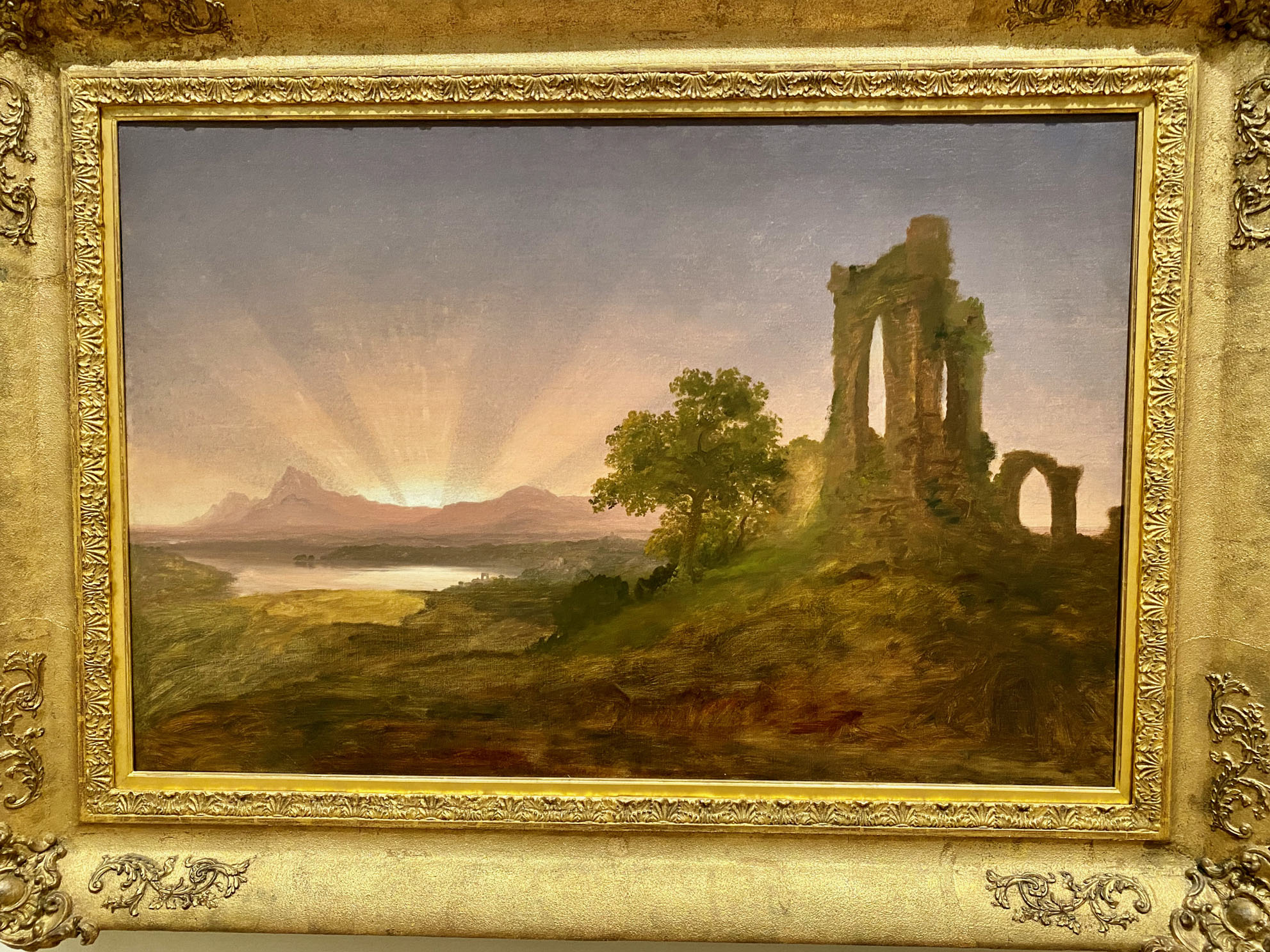
Cole’s 1848 Gothic Ruins at Sunset, an unfinished work from his studio. Private collection.
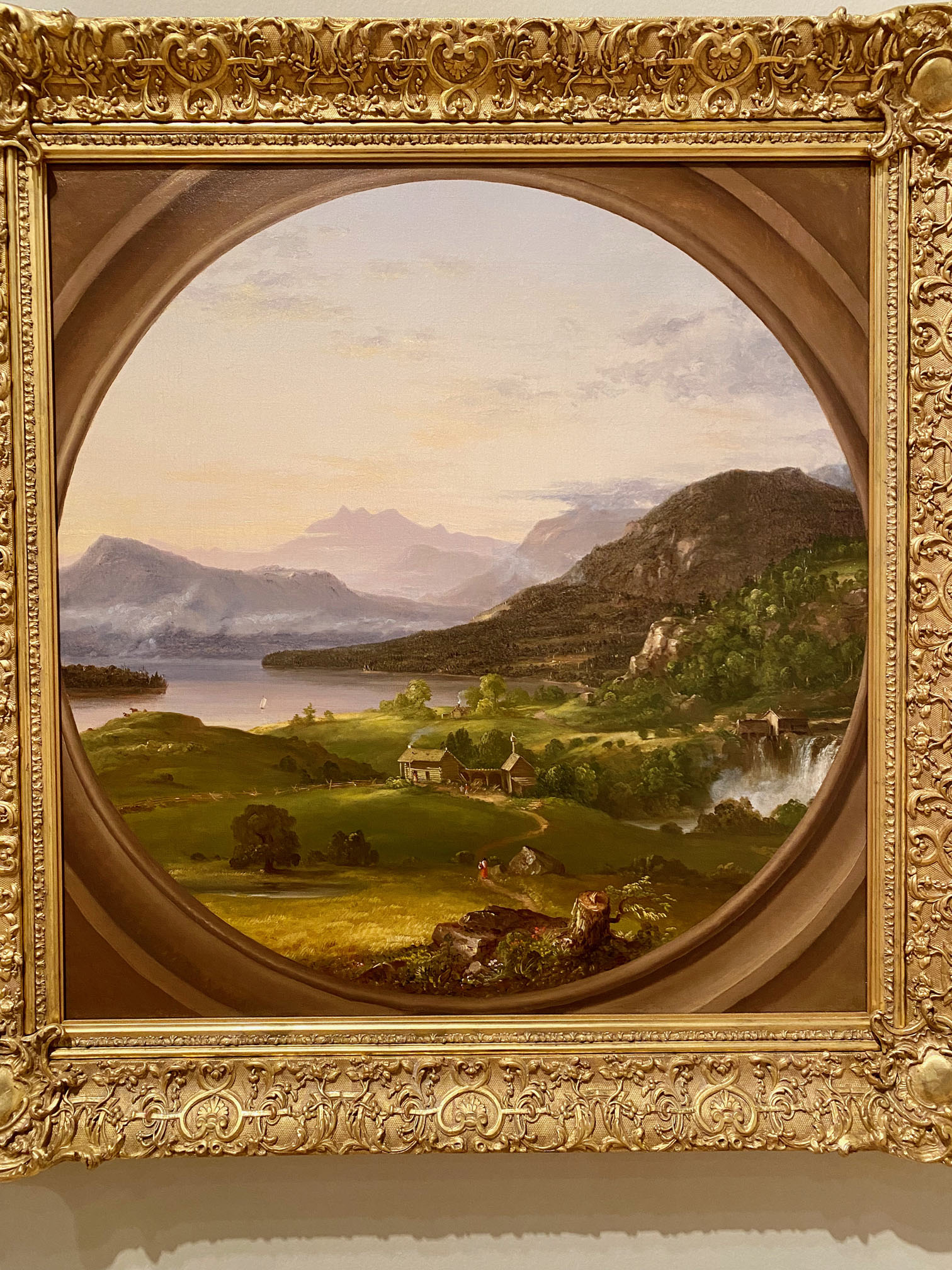
Cole’s 1846 Schroon Lake, showing a civilized landscape at the edge of mountain wilderness. Courtesy: Adirondack Experience
During his life (1801-1848), Cole witnessed how pristine American wilderness was changed by proliferating settlements, roads, bridges, mills, and commerce along the rivers. Sometimes he chose to paint sights, like Niagara Falls, minus human intrusion; other times he gently inserted “civilization” into magnificent landscapes, as in Schroon Lake.
Cole had been a mentor to innovative landscape painters like Durand, Church, Kensett, and Cropsey. When Cole passed away suddenly, they were devastated. His wife left his studio just as it was, and for the next ten years she welcomed painters to make the pilgrimage to visit it, spend time, and gain inspiration.
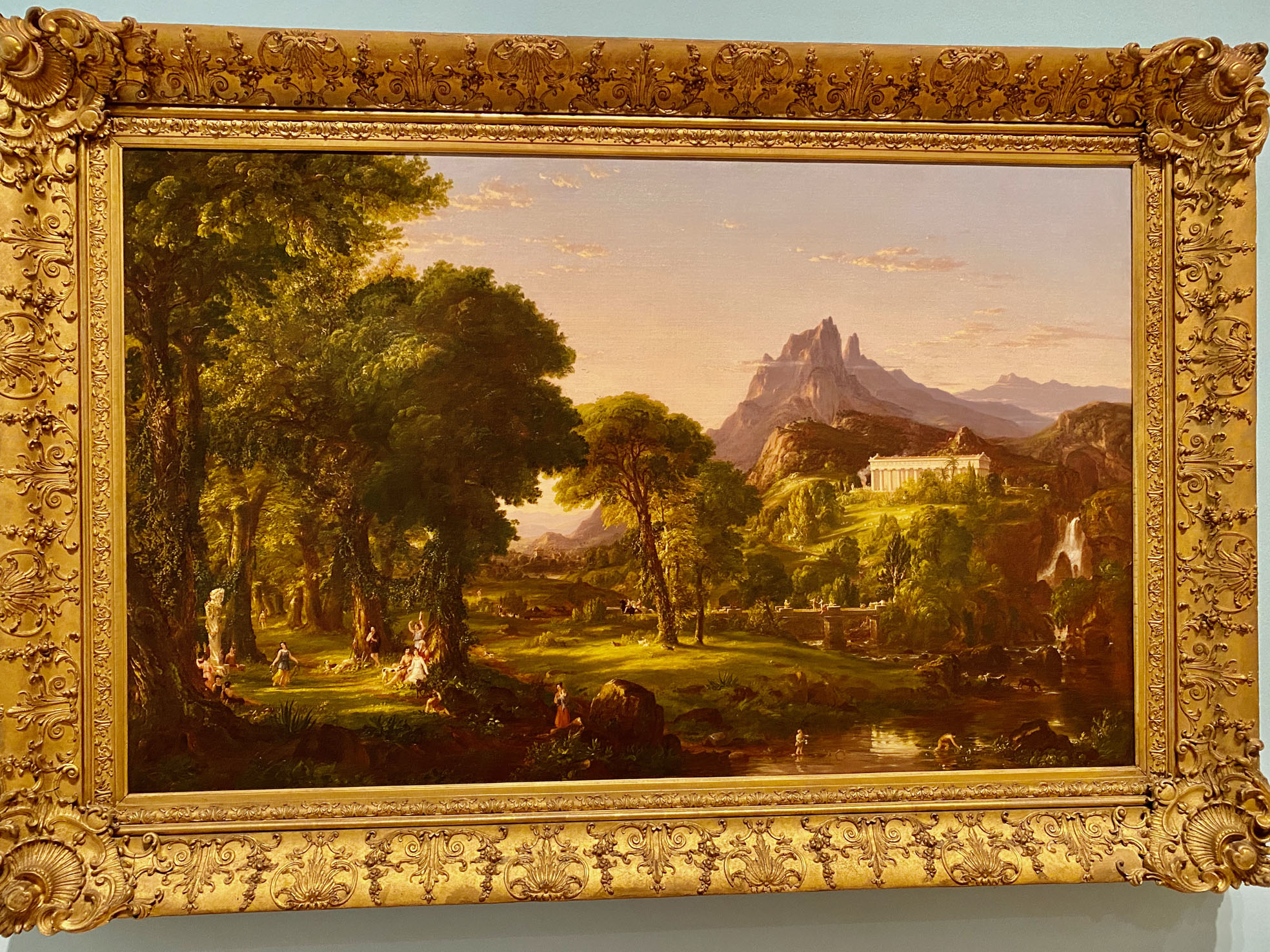
Visitors enter this exhibition and confront Cole’s large 1838 work, Dream of Arcadia, showing a mythical time when civilization existed in harmony with nature. Can this ideal state truly exist?
Thomas Cole’s 1938 Dream of Arcadia. Courtesy: Denver Art Museum.
The Thomas Cole National Historic site, which organized three of the four shows, answers this question through the eyes of two well-known contemporary artists – Kiki Smith, who owned a house along a creek a short distance from where Cole lived, and Shi Guori, who created camera obscura images at Hudson Valley sites where Cole stood and painted.
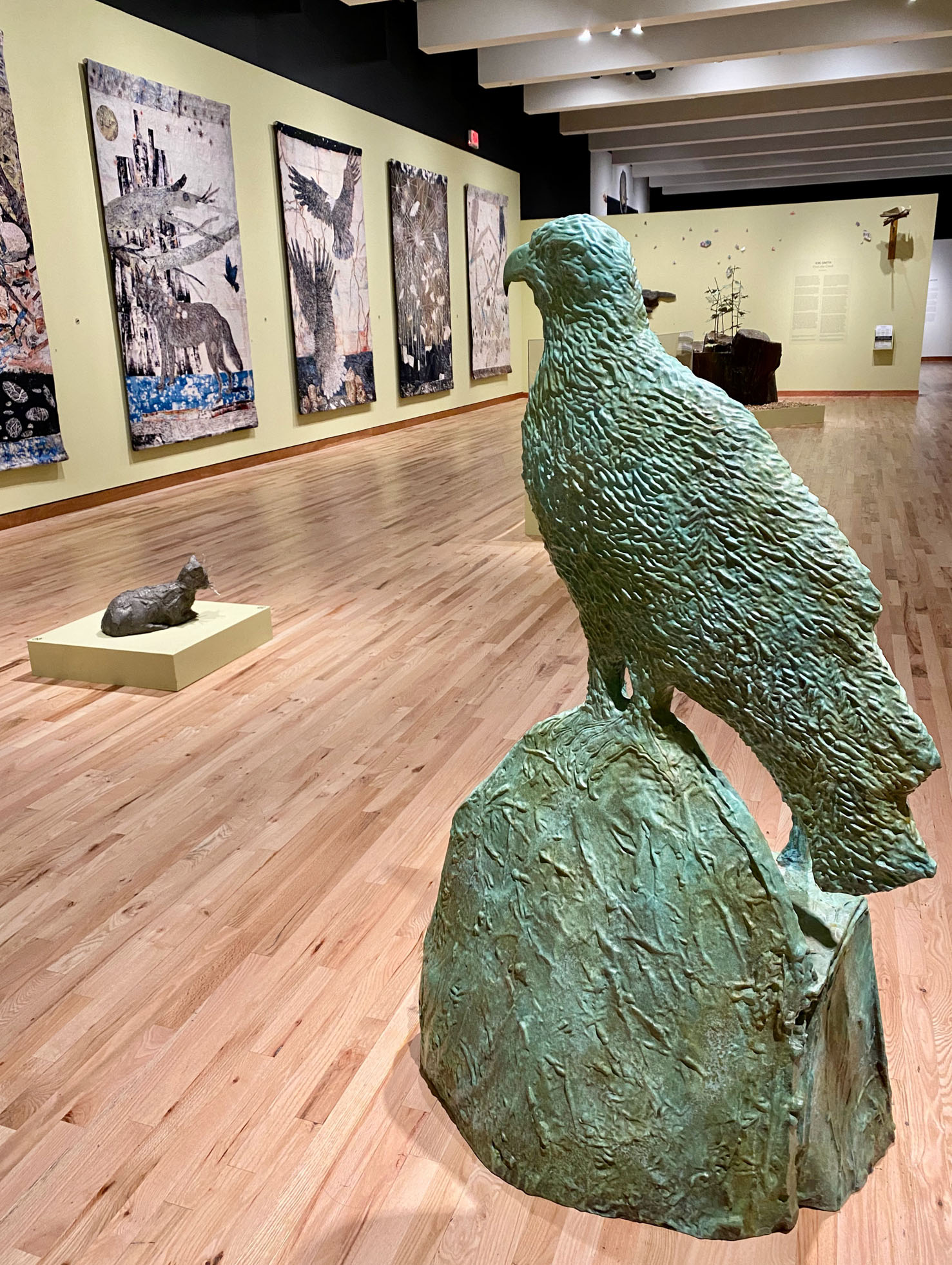
Kiki Smith’s 2016 bronze Eagle in the Pines in gallery with 2012-2014 jacquard tapestries
Visitors look up, down, and around to see owls, eagles, wolves, and pheasant peering back at them from perches, tapestries, frames, and vitrines…observing and being observed. Take a look at here.
2019 bronze Coxsackie sculpture of owl at the exhibition entrance.
Detail of Kiki Smith’s 2012 Cathedral jacquard tapestry (published by Magnolia Editions).
Kiki’s work always brings an air of other-worldly mystery. Here, it’s easy to enjoy all of her varied creations, which display her deep connection to nature and ask us to contemplate the cycles of life that busy people sometimes forget to notice. Cole’s paintings had the same impact.
Shi Guori’s Katerskill Falls, New York, July 26-28, 2019 – a 72-hour exposure made where Thomas Cole sketched in 1824. Courtesy: private collection.
Shi Guori: Ab/Sense – Pre/Sense presents monumental camera obscura images of landscapes Cole painted in the Hudson Valley 180 years ago. When he was growing up in China, Guori experienced the shock of rapid environmental disruption as Mao’s Cultural Revolution transformed the countryside.
Guori studied Cole’s documentation of similar 19th-century transformation in the Northeast, and traveled back to sites that Cole documented to bear witness to natural settings – somewhat still undisturbed – that resonated with Cole.
Guori built large camera-obscura tents, sat inside for up to 72 hours, and exposed light-sensitive paper to create his images. Images of Cole’s oil paintings at the same site are mounted nearby with Guori’s meditations on the experience.
Shi Guori’s camera obscura image The Clove, Catskill Mountains, New York, April 25, 2019. Courtesy: the artist
Basis for camera obscura work by Shi Guori: Thomas Cole’s 1827 oil The Clove. Image: Connecticut’s New Britain Museum of American Art.
In one case, Guori turned Cole’s own sitting room into a camera, capturing not only furniture that he would have used, but showing the image of nature that Cole surely would have spent hours gazing upon. View more of Guori’s work here.
Shi Guori’s camera obscura image View of the Catskill Mountains from Thomas Cole’s House, August 12, 2019 – which turned Cole’s sitting room into a camera. Courtesy: the artist
The fourth exhibition, Nicola López and Paula Wilson: Becoming Land, present large-scale environmental meditations on Southwestern desert landscapes. The Albuquerque curators selected these two popular New Mexico artists to get a bit of cross-cultural discussion going with Mr. Cole.
Wilson, who works in Carrizozo, creates gigantic, mixed-media installations that prompt viewers to consider the interconnection among different people, desert landscapes, agricultural technologies, and even the debris left by civilization.
Paula Wilson’s 2021 monumental printed and painted installation, Yucca Rising. From the artist.
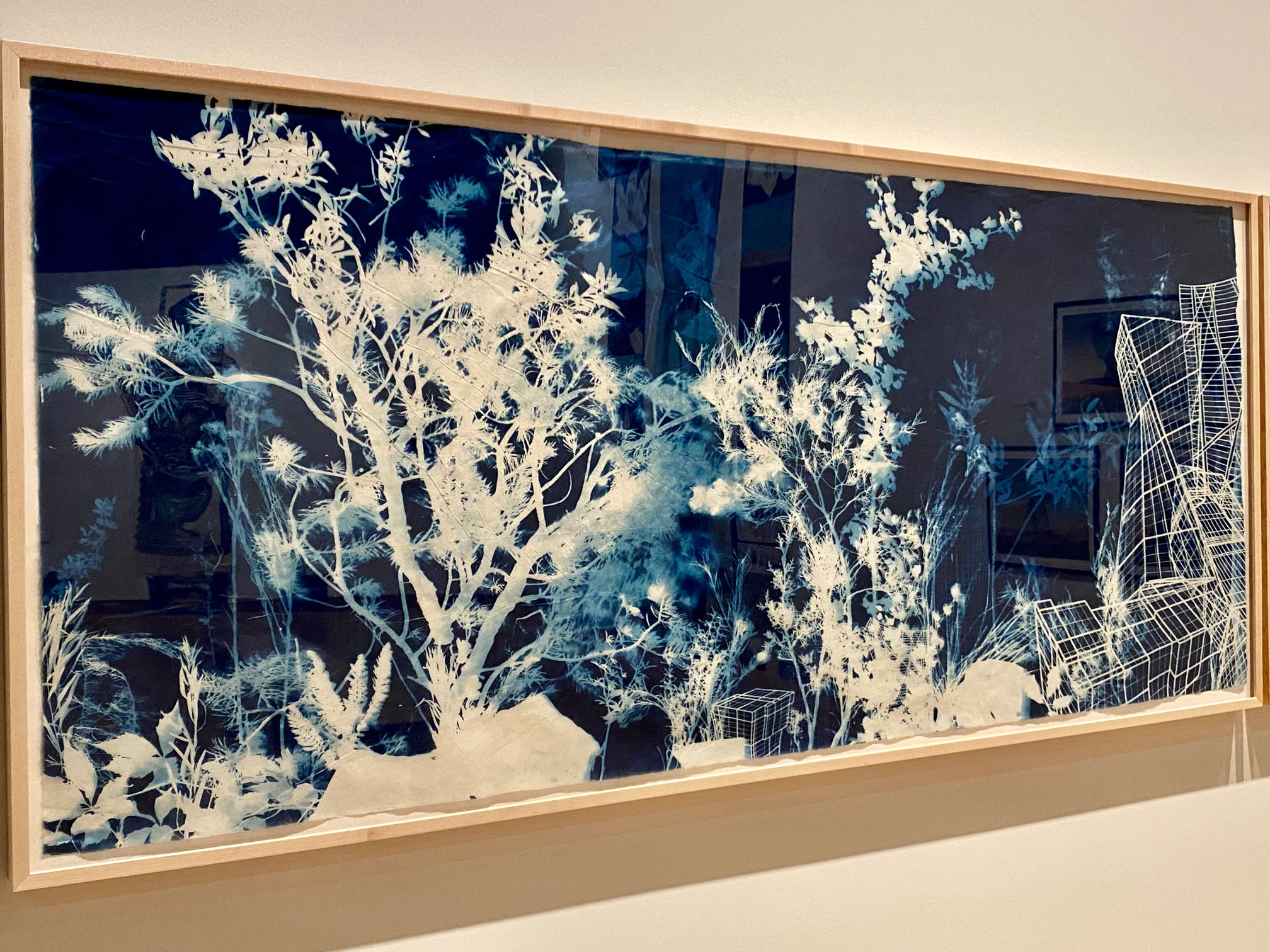
López, who works and teaches in New York, presents a large-scale cyanotype. Unlike Guori, who traveled to the Catskills to create his ghostly images with light, López was unable to travel during the pandemic and made this monumental work at home with the materials around her – a driveway, nearby desert plants, and the blazing New Mexico sun.
Detail of 2021 NeverWild cyanotype by Nicola López – ghostly images of New Mexico plants dwarfing mysterious architectural structures in the desert.
Congratulations to the Albuquerque Museum for inviting Thomas Cole’s team to collaborate in mounting such a beautiful, thought-provoking show.
If you want to have a good laugh or contemplate a biting piece of social satire, head over to Wit, Humor & Satireat the Albuquerque Museum, on view through January 29.
Pulled from the museum’s permanent collection, themed sections of the show present artists’ side-glance takes on Western mythology, art jokes, image puns, and politics.
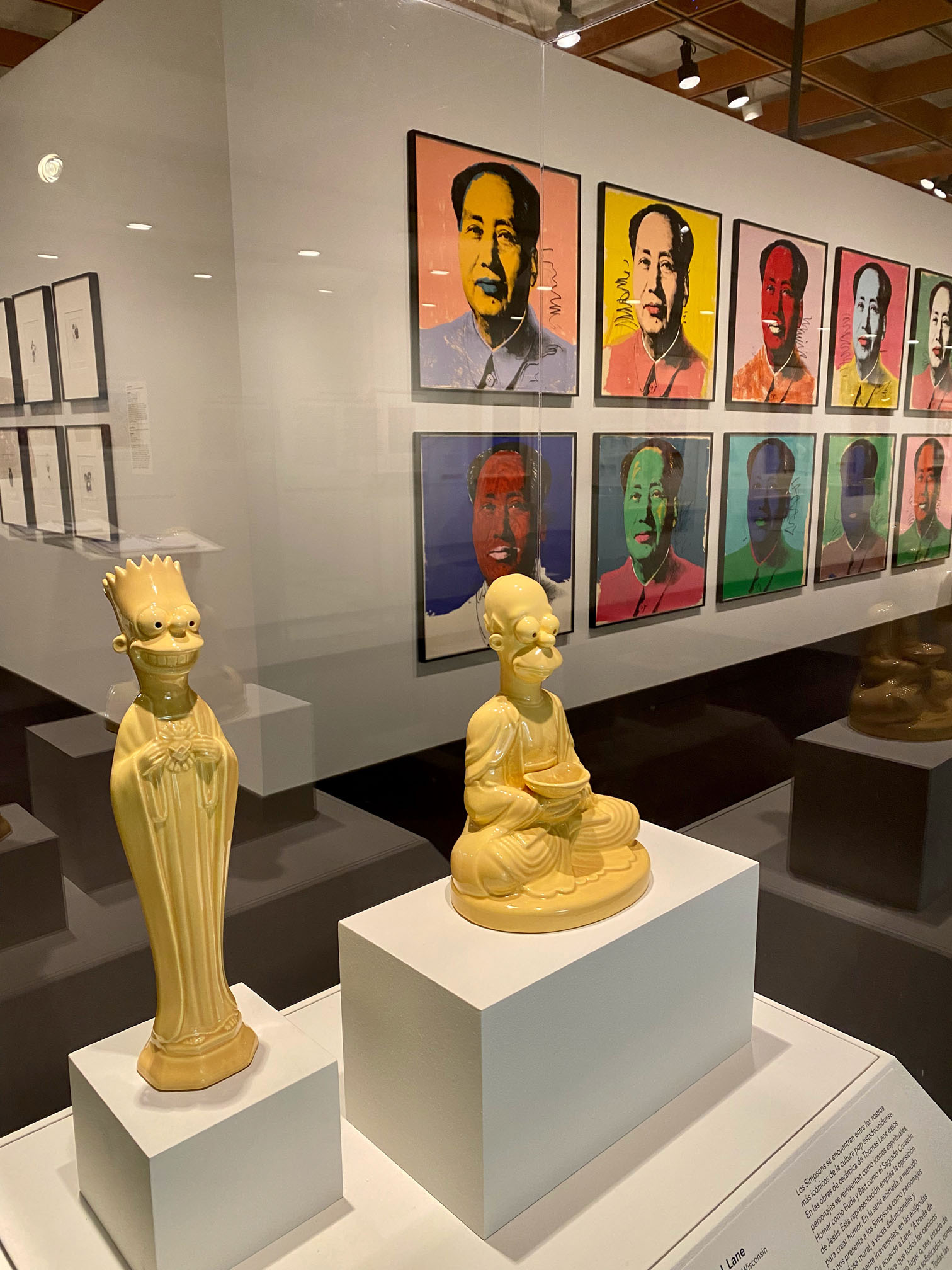
Right in the entry, you see the huge wall of Warhol Mao Tse-Tungs in blazing Pop Art colors, alongside Thomas J. Lane’s satirical ceramics – Bart Simpson impersonating Jesus and Homer as Buddha. Irreverant satire mixed with social commentary in impeccable execution.
Art history “jokes” and political portraits: Thomas J. Lane’s satirical Simpson ceramics with Warhol’s monumental 1972 Mao Tse Tung silkscreens.
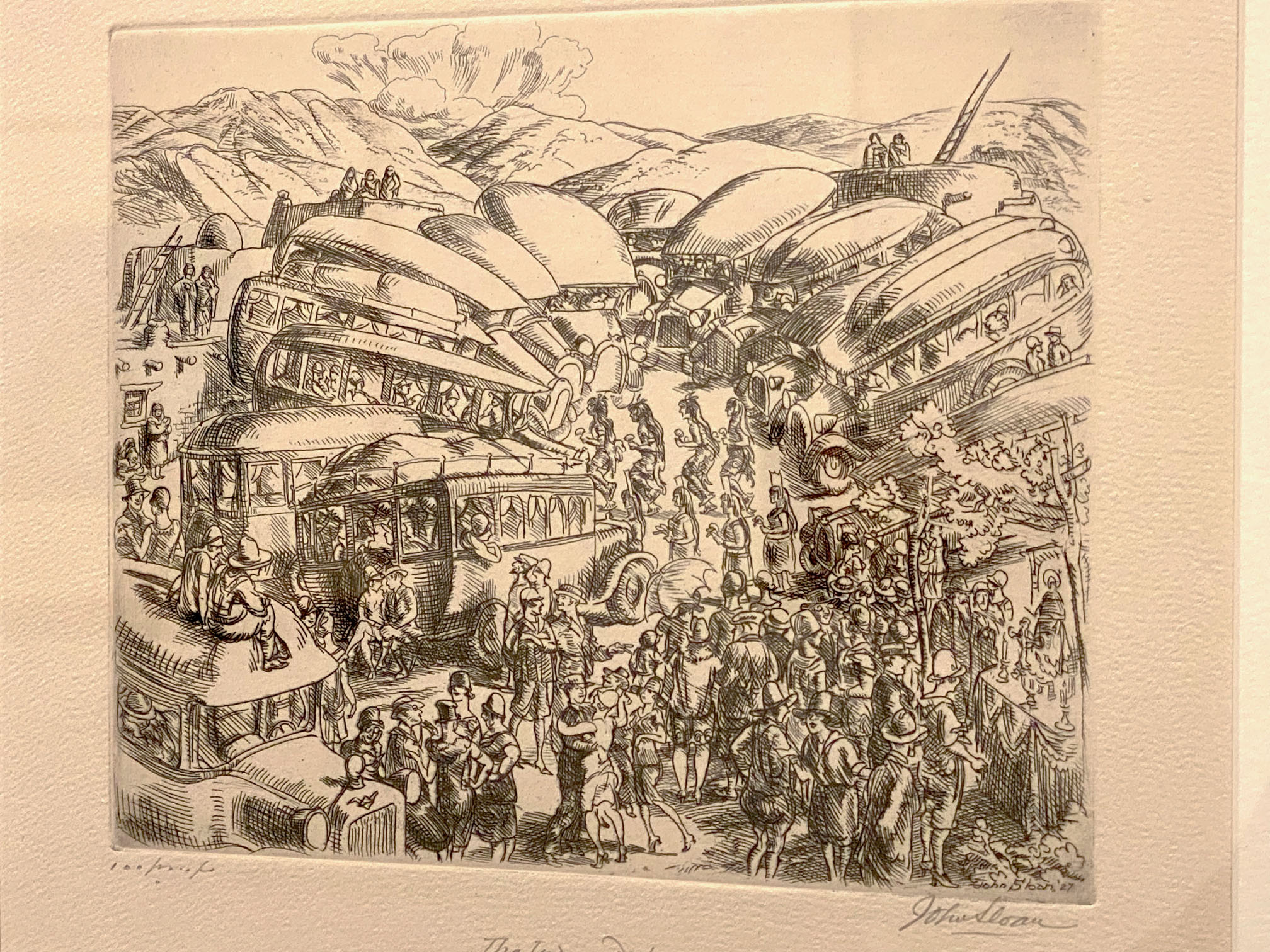
There’s a dark 18th-century Goya etching in the first gallery and a funny Sloan print skewering 1920s tourists, but most of the offerings are more recent vintage, particularly whimsical sculptures and social commentary of the Seventies, Eighties, and Nineties.
Comments on Commodification: John Sloane’s 1927 Indian Detour etching, a satire showing hoards of souvenir-buying tourists descending upon Indian pueblos on their Fred Harvey packaged excursions.
It’s nice to encounter clever Sixties and Seventies Warhol, Rauchenberg, and Red Grooms prints in other humorous sections of the show, and to revisit Southwestern superstars like the T.C. Canon and Scholder, who like challenging stereotypes of what people think of Western people and cultures.
Political commentary: Red Grooms’ 1976 silkscreen Bicentennial Bandwagon,”which references America’s troubled past versus all-out patriotic celebration of American history.
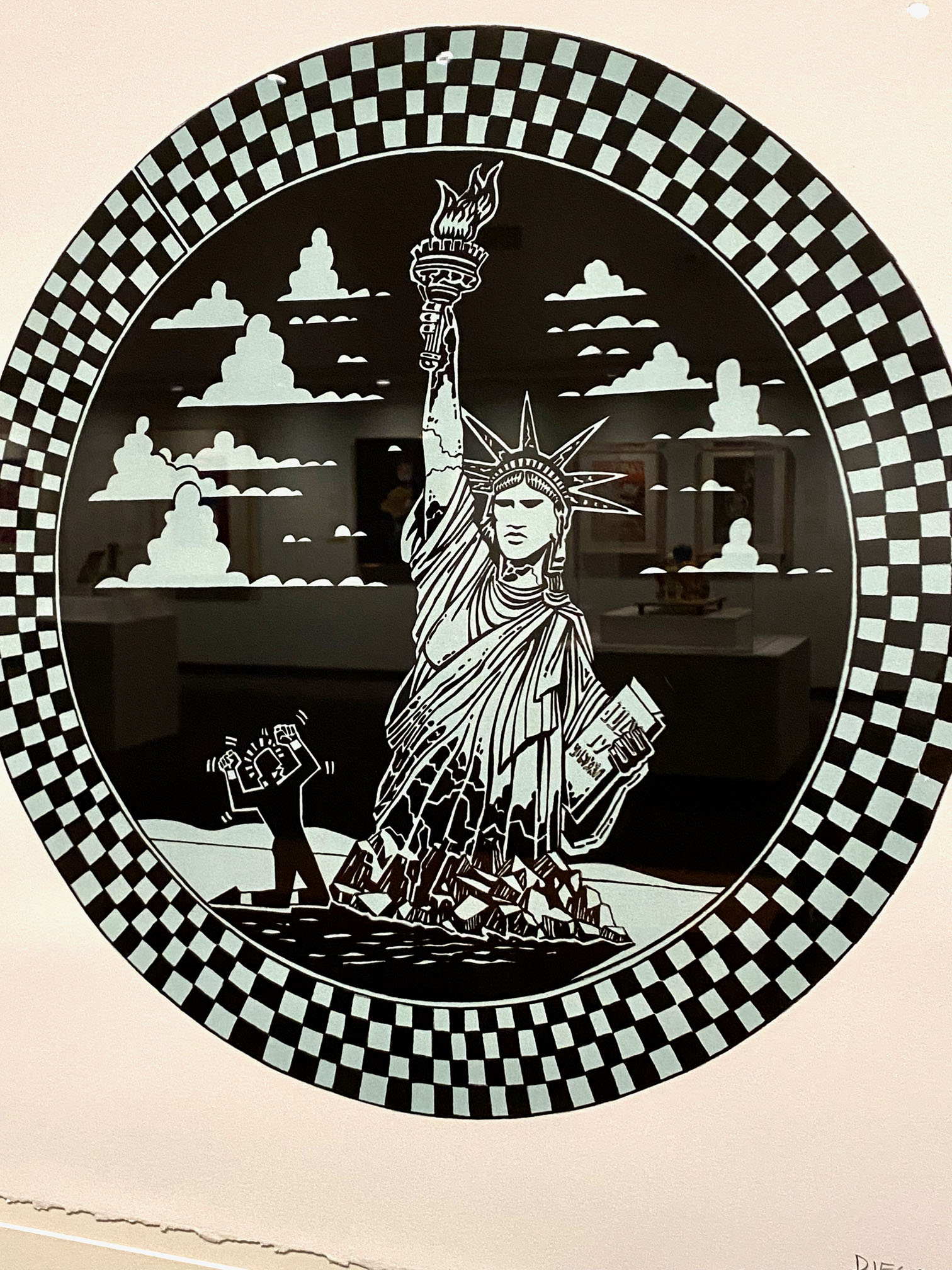
Most of the anti-War and social commentary are in the back half of the gallery, with strong pieces by Bob Haozous, John L. Doyle, and Sue Coe. Diego Romero lays it out with a lithograph that resembles his normal medium of politics-on-a-plate.
War: 1990 steel-plated sculpture El Piloto by Bob Haozous, depicting a skeleton pilot whose nose is a plane with a bomb trailing.
Political commentary: Diego Romero’s 2011 Apocalypto lithograph.
Another stand-out is the first poster ever designed by Keith Haring – a combination of images that came to define subterranean visual protest in the dark, scary times of 1980s New York. He debuted it for an anti-nuclear rally in Central Park, but his unforgettable images and icons soon became ubiquitous on City streets and subways, on T-shirts, and downtown art galleries.
Indigenous humor and commentary are well represented by Jason Garcia’s water-carrying pueblo gals in a contemporary landscape and Wendy Red Star’s Native seasons studio-portraiture spoof.
War commentary: Keith Haring’s first poster – his 1982 Anti-Nuclear Weapons Poster, featuring his iconic “radiant baby”.
Western mythologies: Subversive autumnal studio self-portrait from Wendy Red Star’s 2006 digital print series Four Seasons, which highlights artificial elements.
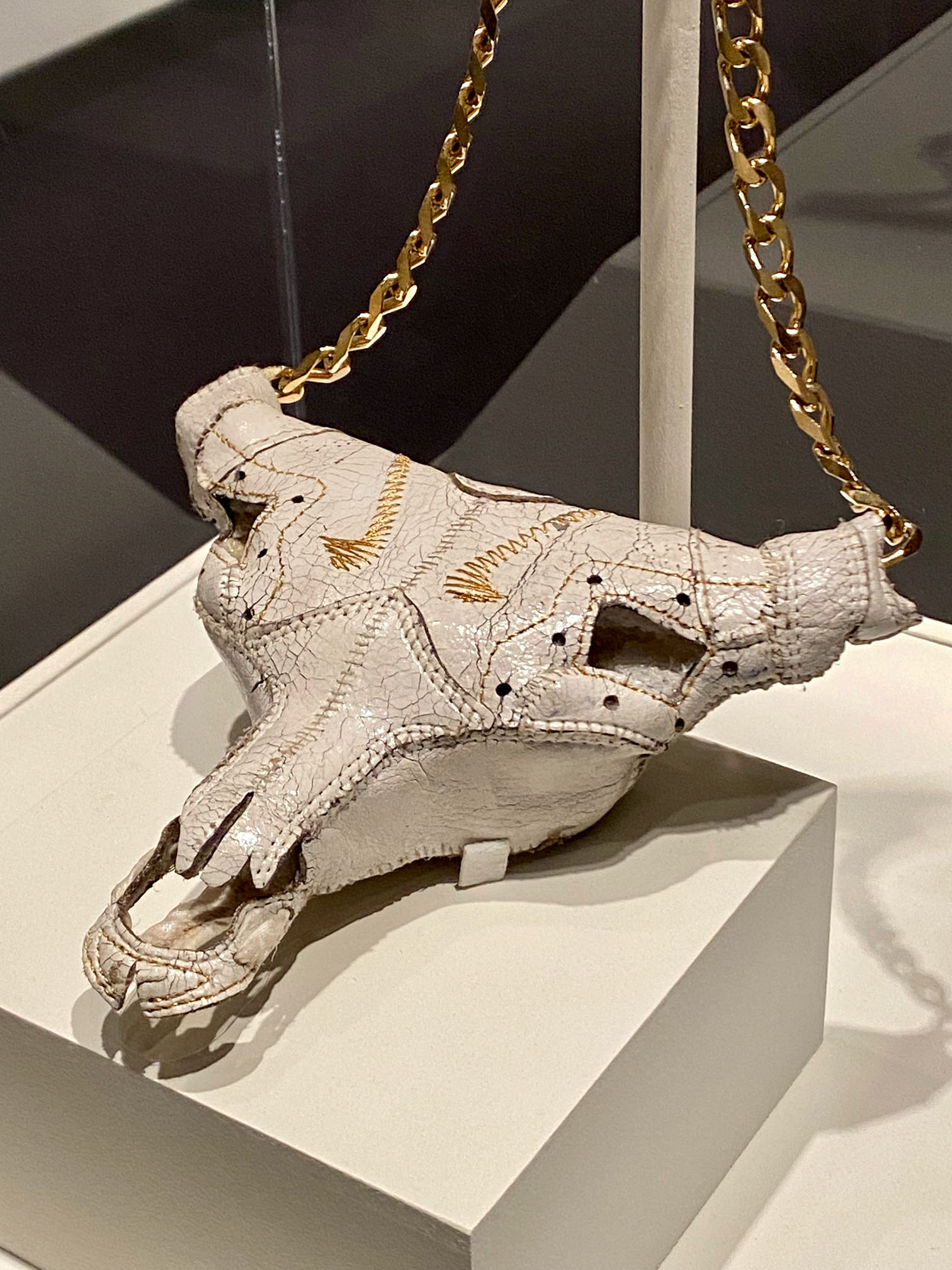
Too bad that no one knows who made the 1960s traditional Zuni pop-culture Disney necklace. But it’s fun to contemplate the Nike-sneaker sculpture/neckpiece by Sean Paul Gallegos.
Exploring wit: 1960s silver Zuni necklace by unknown artist featuring Disney characters inlaid with shell, coral, turquoise, and jet.
Commodification commentary: 2015 satiric “high fashion” neckpiece by Sean Paul Gallegos, created from recycled Nike sneakers and gold thread.
There’s a lot to think about and enjoy in this provocative show. Visit our Flickr album to enjoy more of our favorite works.












 itsnewstoyou