Portrait Masterworks at Home in Taos

To see the works by one of the top virtuoso portraitists of the 20th century, drop into the home that Nicolai Fechin designed and built for his family in Taos, New Mexico. Masterful oil and charcoal portraits created throughout his life are hung in quiet, contemplative corners of his spectacular 1920s home as part of Masterful Expression: Nicolai Fechin’s Portraiture, on view at the Taos Art Museum at Fechin House through December 31, 2025.

The house itself is a masterwork with all the doors, railings, and embellishments carved by Fechin’s own hand, but the portraits and small, carved wooden busts show why he is considered one of the greatest Russian artists ever to take up residency in the United States.

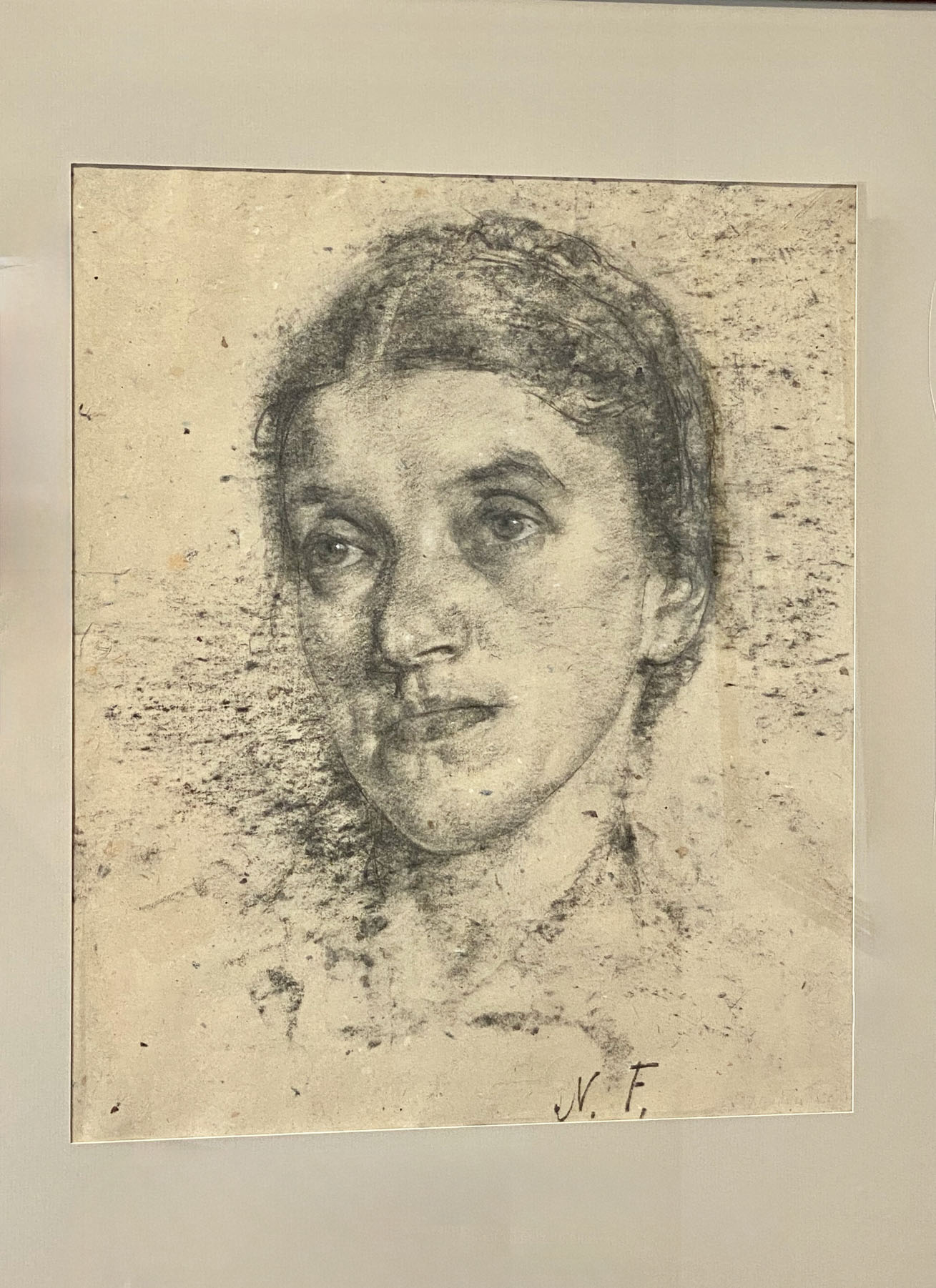
Fechin’s undated charcoal portrait Manuelita. Courtesy: private collector
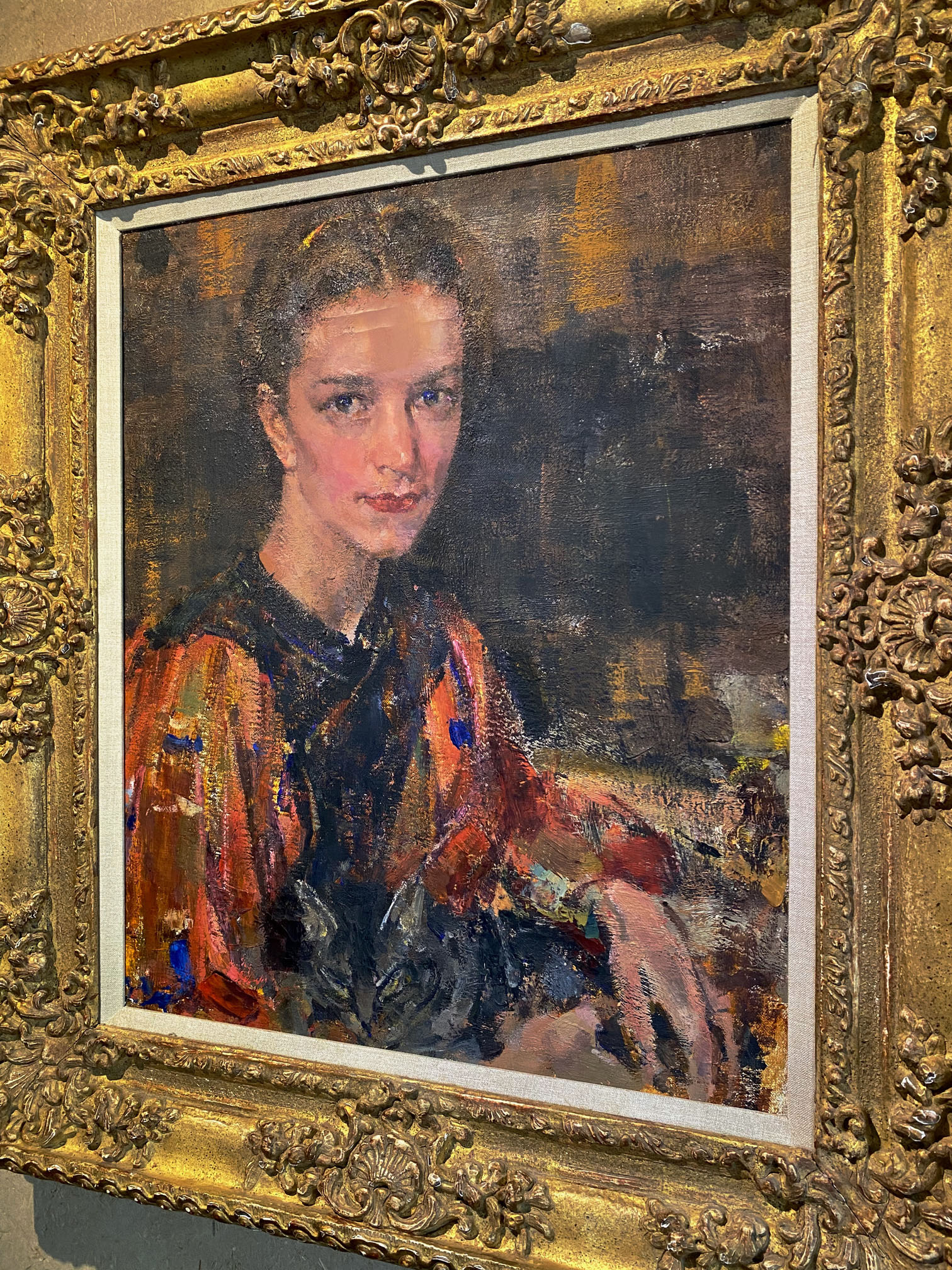
Fechin’s 1927-1933 oil painting Taos Studio Interior. Courtesy: private collection; Owings Gallery.

Fechin grew up during the time when Russia was ruled by the Czar, and thrived at the Higher Art School of the Russian Imperial Academy of Arts in St. Petersburg, where he studied with the acclaimed Russian history painter, Ilya Rapin.

Fechin’s classical training followed the principles advocated by the French virtuoso, Dominque Ingre – subtle human expression, anatomical awareness, and verisimilitude that jumps right of the page (or canvas).

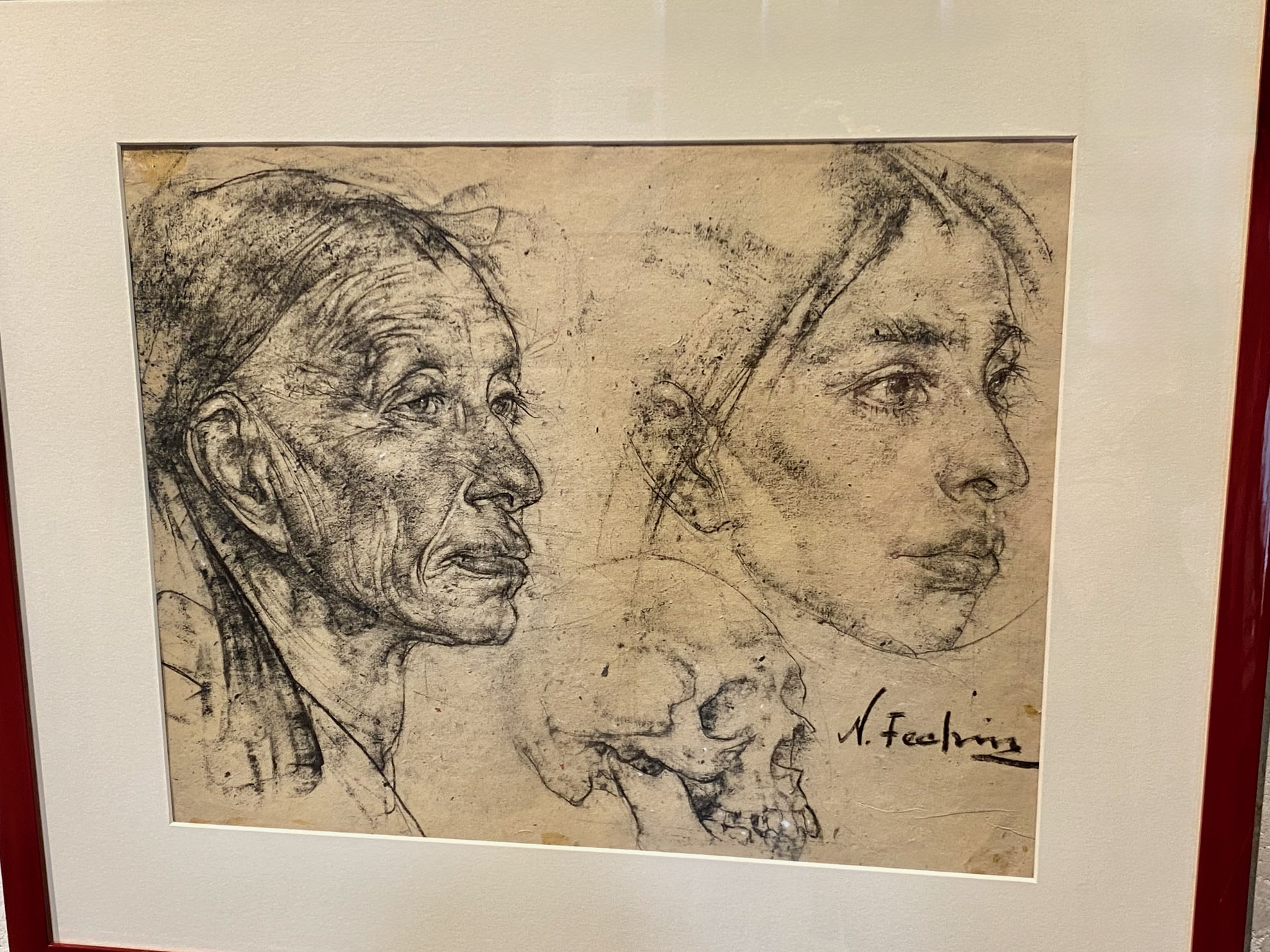
Fechin’s charcoal Head and Skull Study. Courtesy: private collector

Fechin learned his lessons well and won national acclaim in Russia by 1908 for his grand, epic depictions of peasant life, which provided an opportunity for his work to be shown internationally and gain fans in the United States.  But it was his reputation for portraits that captured the essence of human expression that cemented his reputation in the United States and provided him with continuing commissions.

When the Russian Revolution and civil war brought disruption to the domestic life he was starting to build with his new bride, Alexandra, an American benefactor arranged for them to emigrate to the United States.  As soon as the Fechin family landed in the United States, the commissions began, largely due to the enthusiastic public reaction his portraits in shows at the Grand Central Gallery and the Brooklyn Museum.

Fechin’s undated oil portrait Russian Singer with Fan. Courtesy: private collector
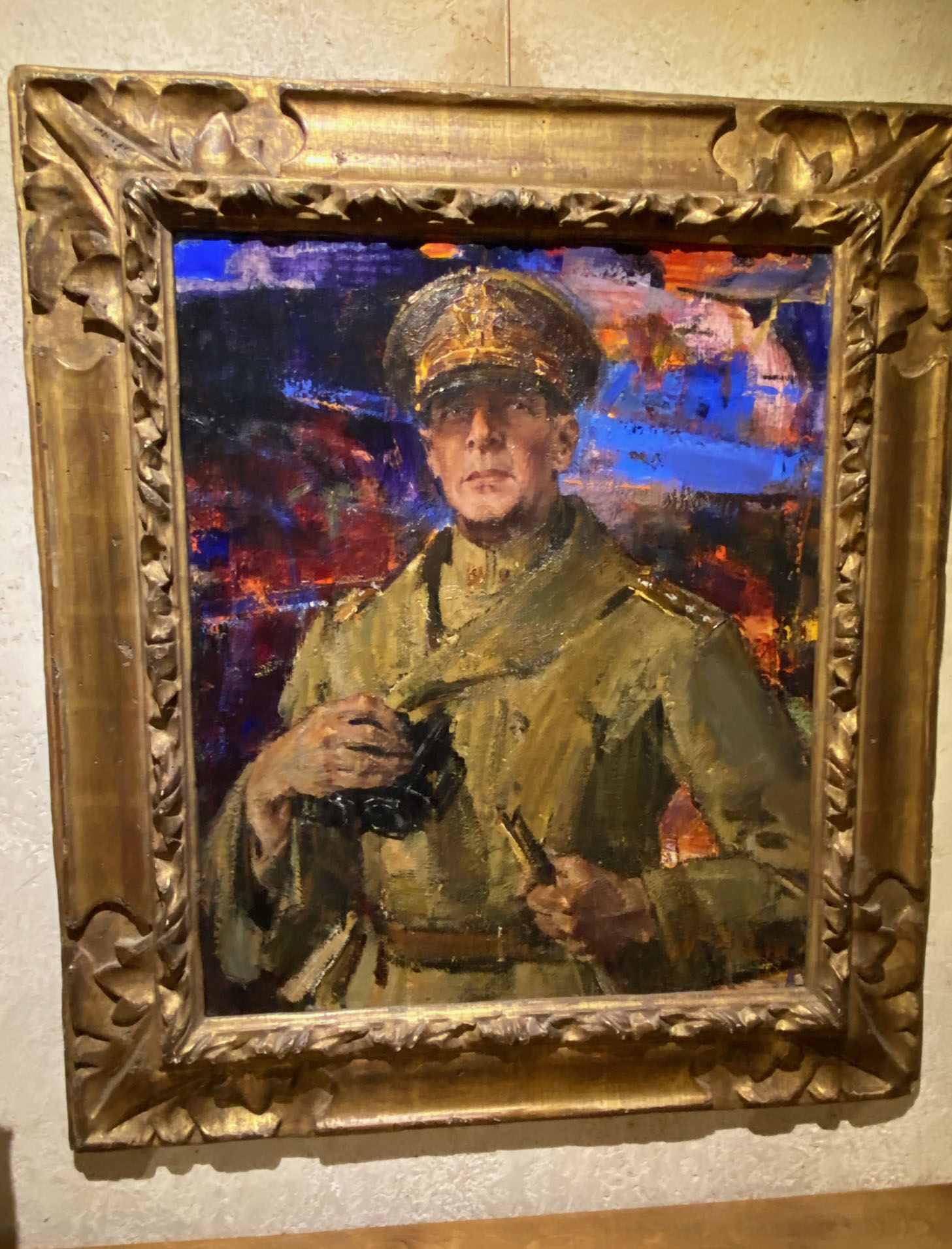
Fechin’s 1951 oil portrait of General Mac Arthur. Courtesy: Taos Art Museum

For health reasons, Fechin and his family left the sophisticated steets of New York City during the high-flying 1920s for the high desert of Taos – a thriving art community anchored by Mabel Dodge Luhan. Fechin figured that when the tumult in Russia died down, he would return. But that never happened.

The exhibition, with many works drawn from private collections, provides a glimpse of the Fechin family over time, with portraits and sculptures of his wife early in their courtship (an oil), a bronze bust, and drawn portraits in their life in New Mexico.

Fechin’s 1910 oil portrait of his wife Alexandra with Coral Beads. Courtesy: private collector
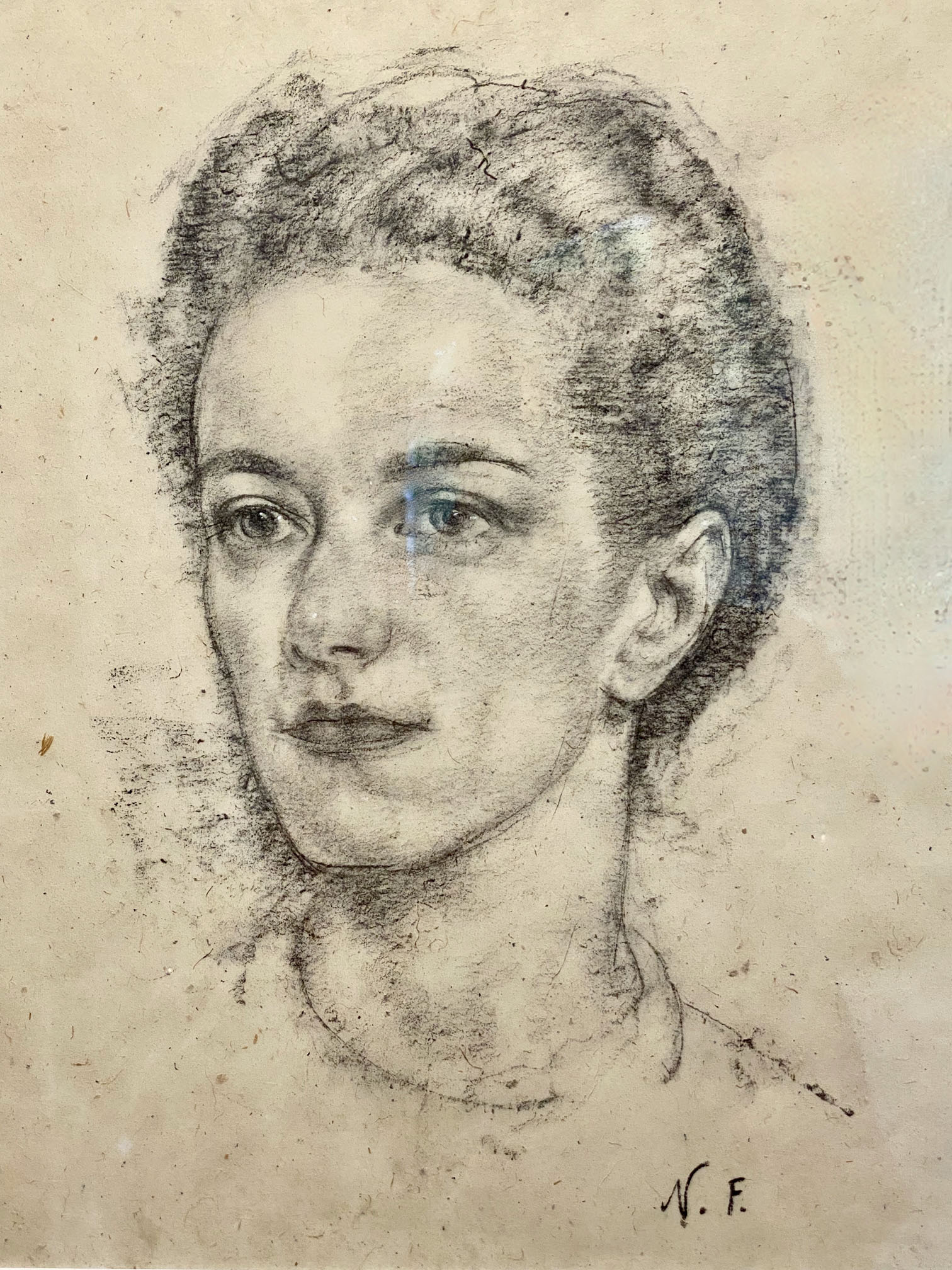
Fechin’s 1927-1933 charcoal portrait of his wife Alexandra; on rice paper. Courtesy: private collector

His beloved daughter Enya – who ultimately saved and restored this unforgettable home and her dad’s studio – is shown as a baby in Russia, as an older child in carved wooden busts, and in paintings in her coming of age, as well as a portrait of her as a grown woman looking out for her dad later in his life.

Fechin’s carved wooden bust of his daughter Eya.. Courtesy: private collector
Fechin’s 1940s charcoal portrait of his daughter Eya; on rice paper. Courtesy: private collector

The exhibit also includes sensitive, gorgeous portraits and studies that Fechin created in his five-month stay in Bali in 1938 – delicate features of young models and reflective expressions of respected elders. All have clean, sure lines and carefully observed, personalized nuances.

Fechin’s 1938 charcoal portrait Balinese Girl with Long Hair. Courtesy: private collector
Fechin’s 1938 charcoal portrait Balinese Man with Beard. Courtesy: private collector

This walk-through the Fechin home holds delight and awe at every turn – awe at the hand-carved interiors and delight at at the humanity and diversity of the faces greeting us in every room. Visit, if you can!

Take a look at more in our Flickr album.

Fechin’s 1950s charcoal self- portrait on rice paper. Courtesy: private collector
Fechin’s 1940s charcoal portrait of his daughter Eya; on rice paper. Courtesy: private collector
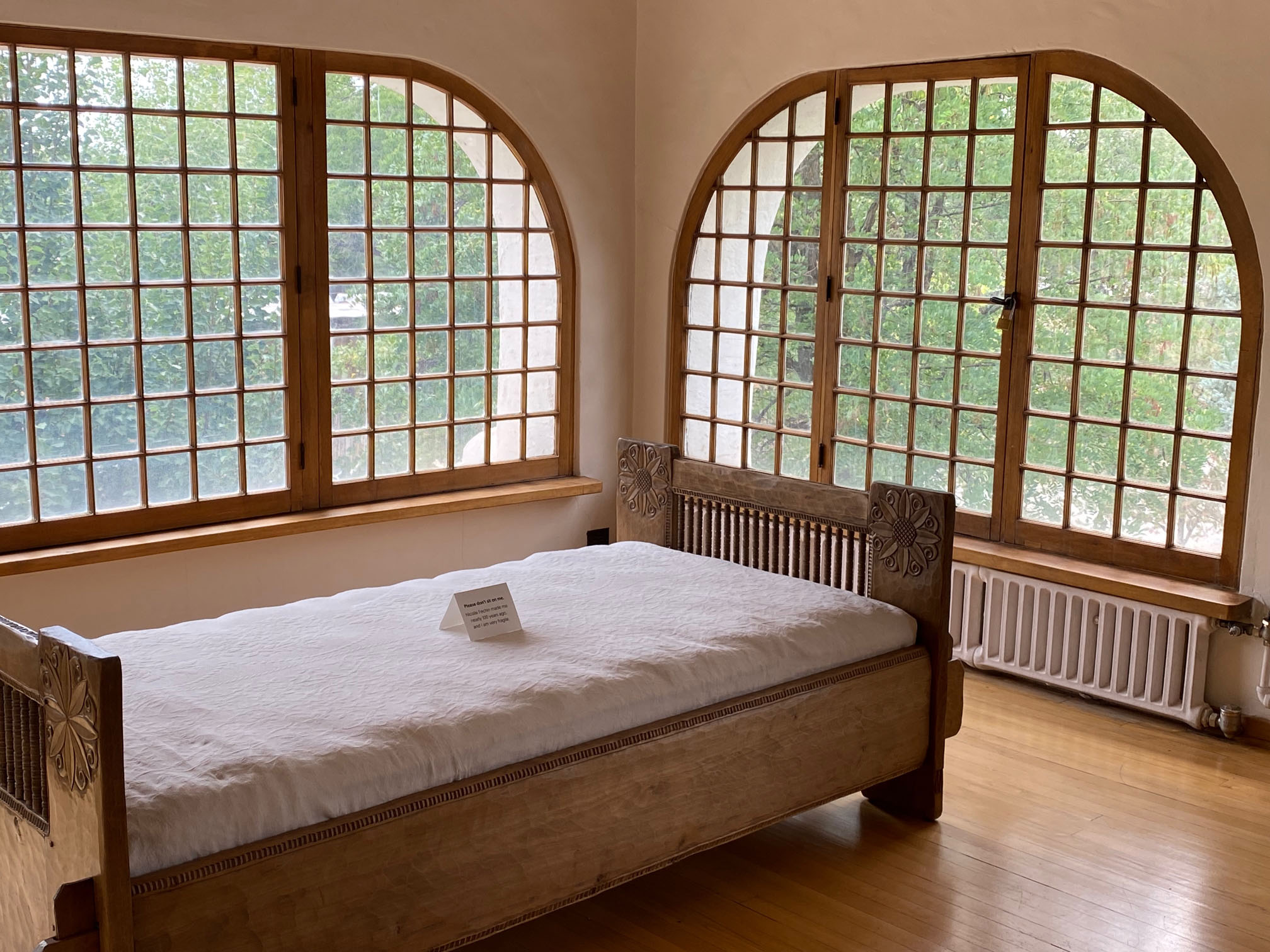
Inside the 1933 Fechin house: sunroom on the second floor features his hand-carved bed for his daughter, Eya.

Abstracting Nature in Albuquerque

How do abstract artists visually channel their response to awesome landscapes? You’ll get a glimpse of how ten artists approach natue and atmospheric phenomenon in Abstracing Nature, an engaging contemporary exhibition at the Albuquerque Museum, on view thorugh October 12.

Works by grand-master abstractionists Richard Diebenkorn and Agnes Martin greet you right at the entrance. 

Diebenkorn isn’t normally associated with New Mexico, but decades before embarking upon his epic Ocean Park series, he spent two years (1950-1952) at the University of New Mexico (1950-1952) working toward his MFA before returning to the West Coast.

Richard Diebenkorn’s 1952 Untitled (Albuquerque), featuring deep earth tones and undulating forms.

The Diebenkorn on display is a recent museum acquisition from those years. Complete abstract expressionist approach to the colors and undulating geologic forms he saw surrounding the post-war boom town.

Martin – the abstractionist grand-dame of New Mexico – made no attempt to hide the fact that her grids and minimal approach were expressions of the tranquililty and serenity she saw and felt from her retreats in Cuba and Galisteo, New Mexico.  She was channeling her emotional, meditative response in her surroundings – not following the reductivist, minimalist trend fo the East and West Coast gallery scene.

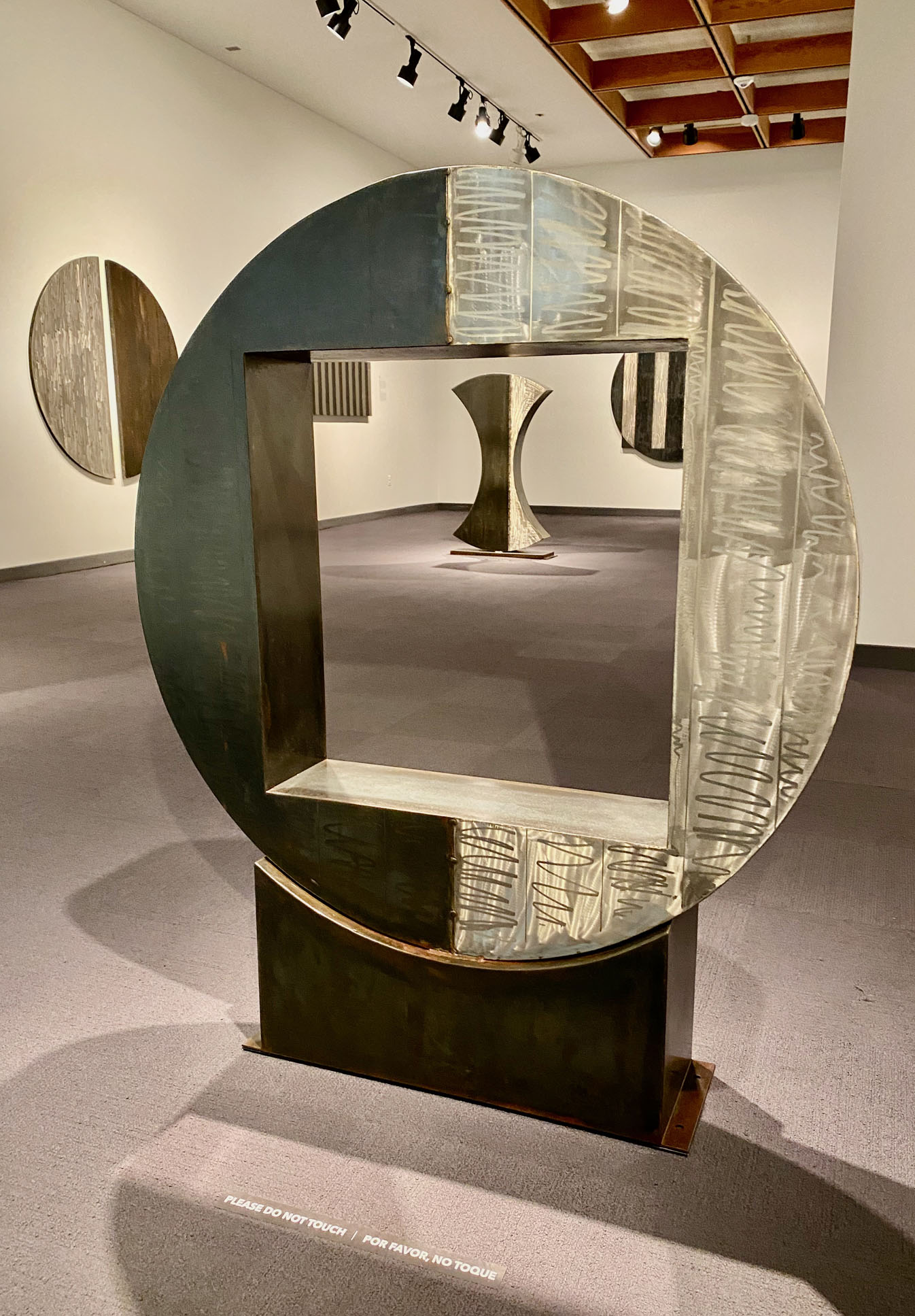
By getting up close to the two Martin paintings, you can appreciate her hand-drawn approach. Several stainless-steel sculptures by Agnes Martin’s great friend and student Karen Yank are nearby. The gleaming, hard-edged pieces do not resemble her mentor’s approach, except for the light, gestural touches across the surface.

Agnes Martin’s 1980 acrylic Untitled #6. Courtesy: New Mexico Museum of Art.
Karen Yank’s 2023 steel View with Silhouette VII and other sculptures visible through the portal. Courtesy: the artist.

The large pastels by Emmi Whitehorse look to the landscape and sacred colors of the Navajo Nation inspiration – a poetic approach most evident in Yei Retires to Mt. Taylor. Dramatic blue gestures suggest the spiritual turquoise color associated with the Navajo’s soutnern sacred mountain Tsoodzil.

Emmi Whitehorse 1985 pastel abstraction on canvas Yei Retires to Mt. Taylor.

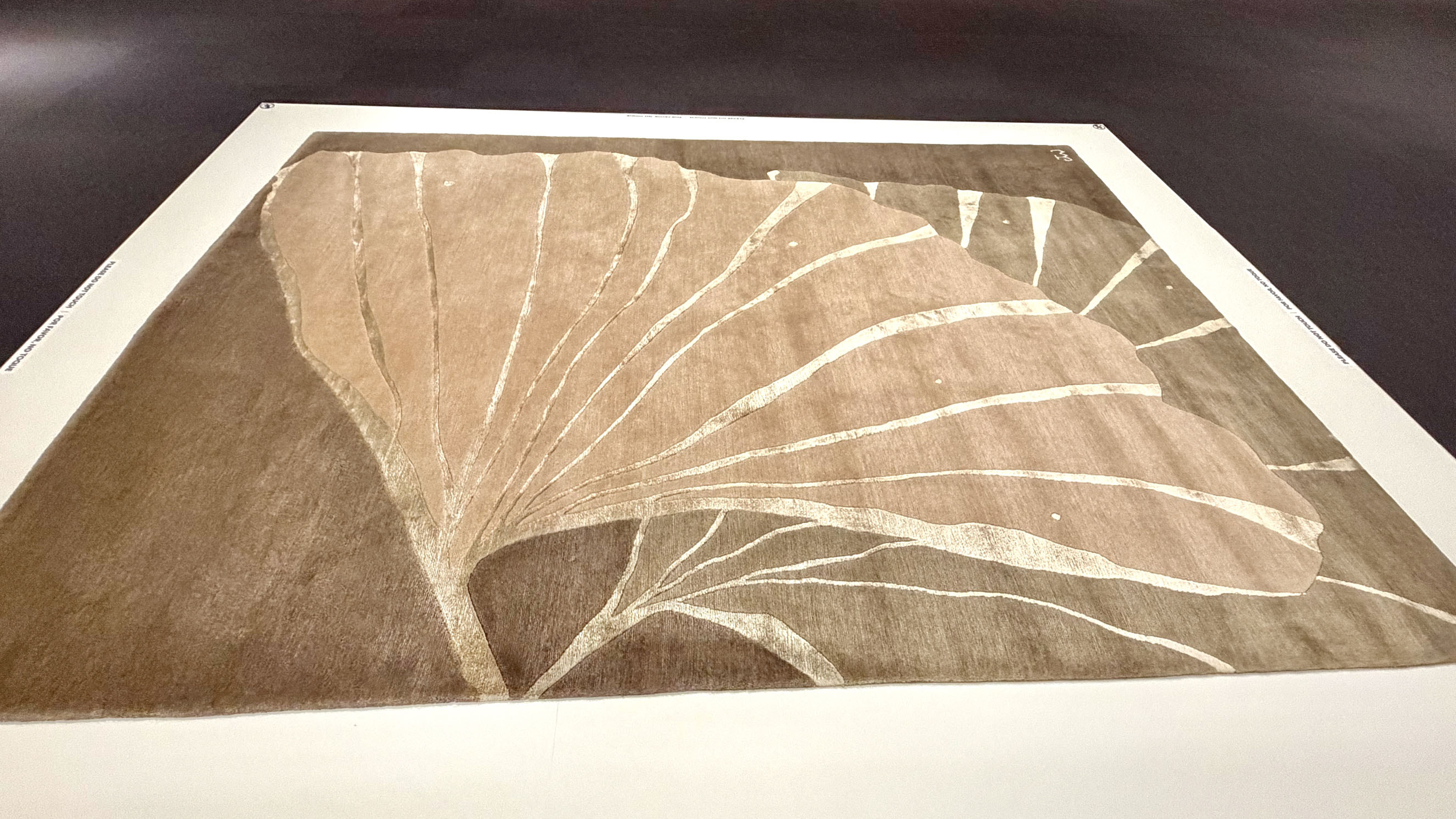
Abstractions used by textile artist Joan Weissman come from a place of process in which she starts with recognizable nature studies but allows her iterations to become more abstract.  Approaching her seemingly abstract Ginko, only gradually do visitors see that the hand-knotted rug (created at large scale by Pakistani artisans) is an extreme close-up of a leaf. 

Joan Weissman’s 2006 Ginko, a wool and silk hand-knotted rug, highlighting the intricacies of the leaf. Courtesy: the artist

2023 Hearing the Sun by Marietta Patricia Leis. Courtesy: the artist

Mariette Patricia Leis translates her experience of nature more formally. In one case, six seemingly minimalist wall-mounted panels are painted to reflect how we perceive the color of sunlight in different atmospheres and at different times of the day.

Another is a series of abstract panels suggesting horizons across volcanic surfaces during Iceland’s 24 hours of darkness.

Enjoy walking through the full exhibition in our Flickr album.

Detail of 2018 Vacuities by Marietta Patricia Leis inspired by Iceland’s winter night sky. Courtesy: the artist.

Here’s a close look at Judy Tuwaletstiwa’s 2001 Divination. She transformed sand by creating an arrangement of glass objects – cubes, spheres, and organic shapes – all displayed across a soft sand base.

Like the rest of the work in this exhibition, it allows us to think about the natural world, our perception of it, and the many ways that the experience can be transformed into art.

Hanging Out with Georgia’s Stuff

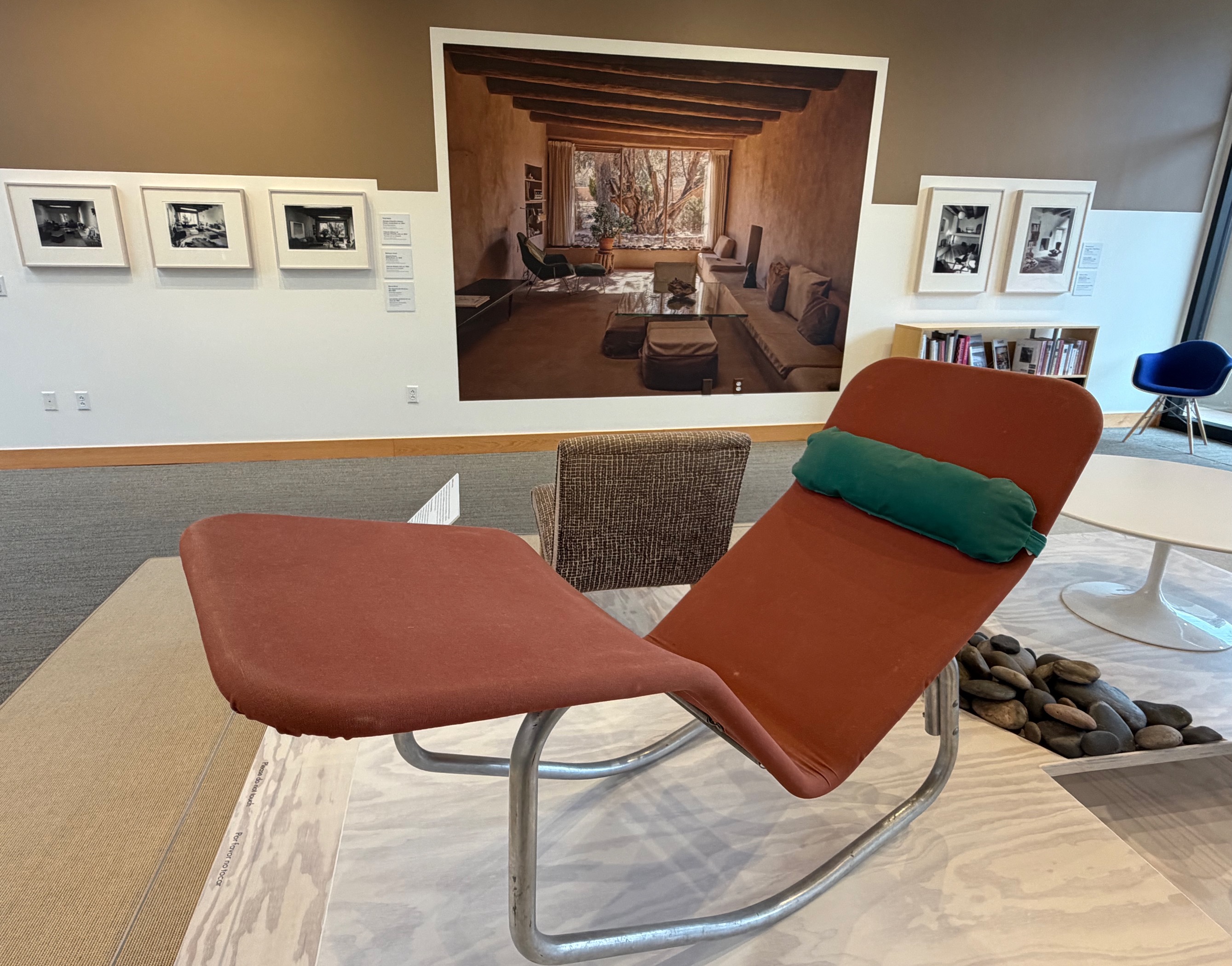
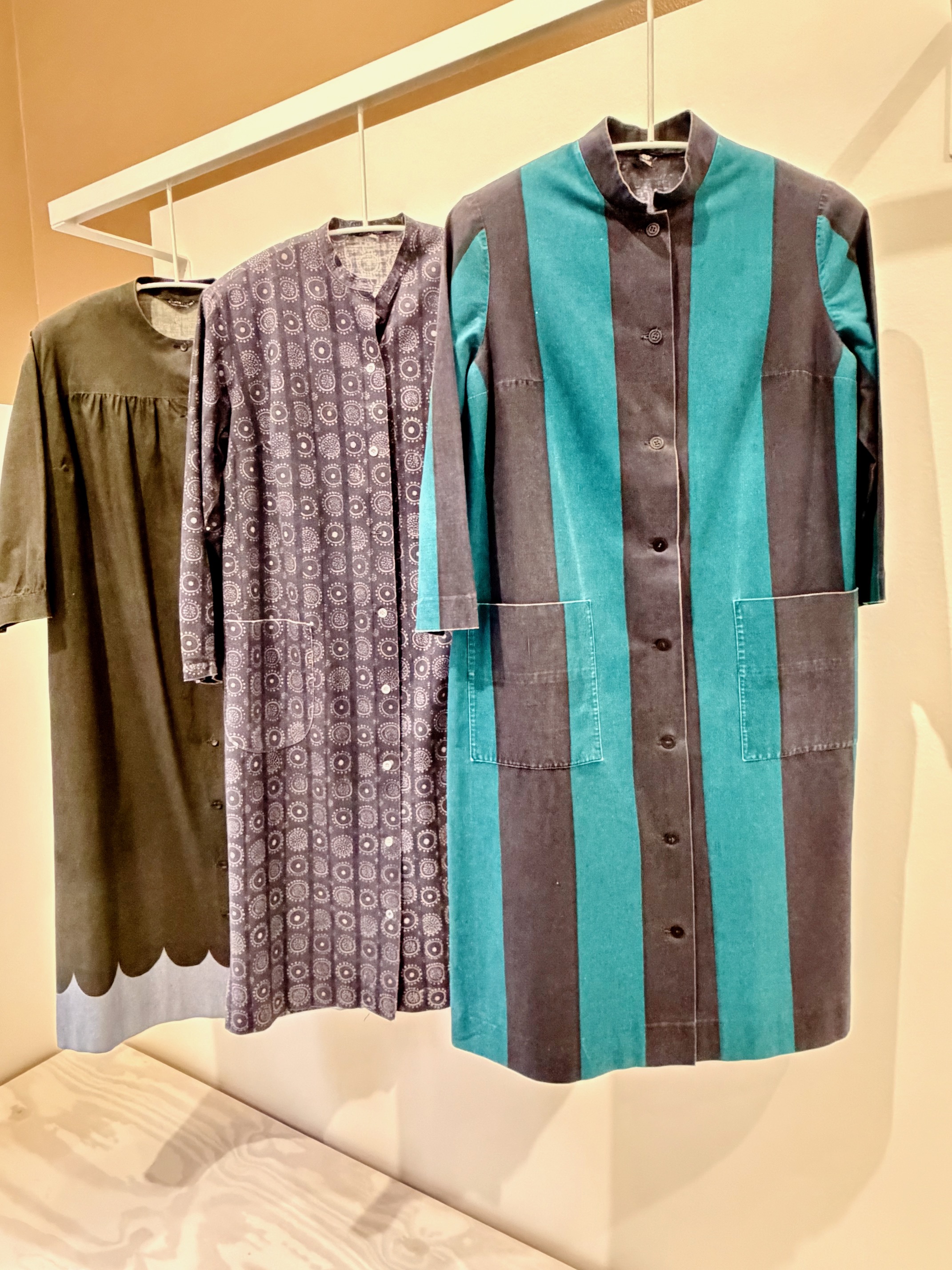
Fans have had a special opportunity to get up close to that iconic black dress and gaucho hat, OK Calder pin, denim apron, and Marimekko dress in Georgia O’Keeffe: Making a Life, on view in Santa Fe through October 19 2025 at the O’Keeffe Museum.

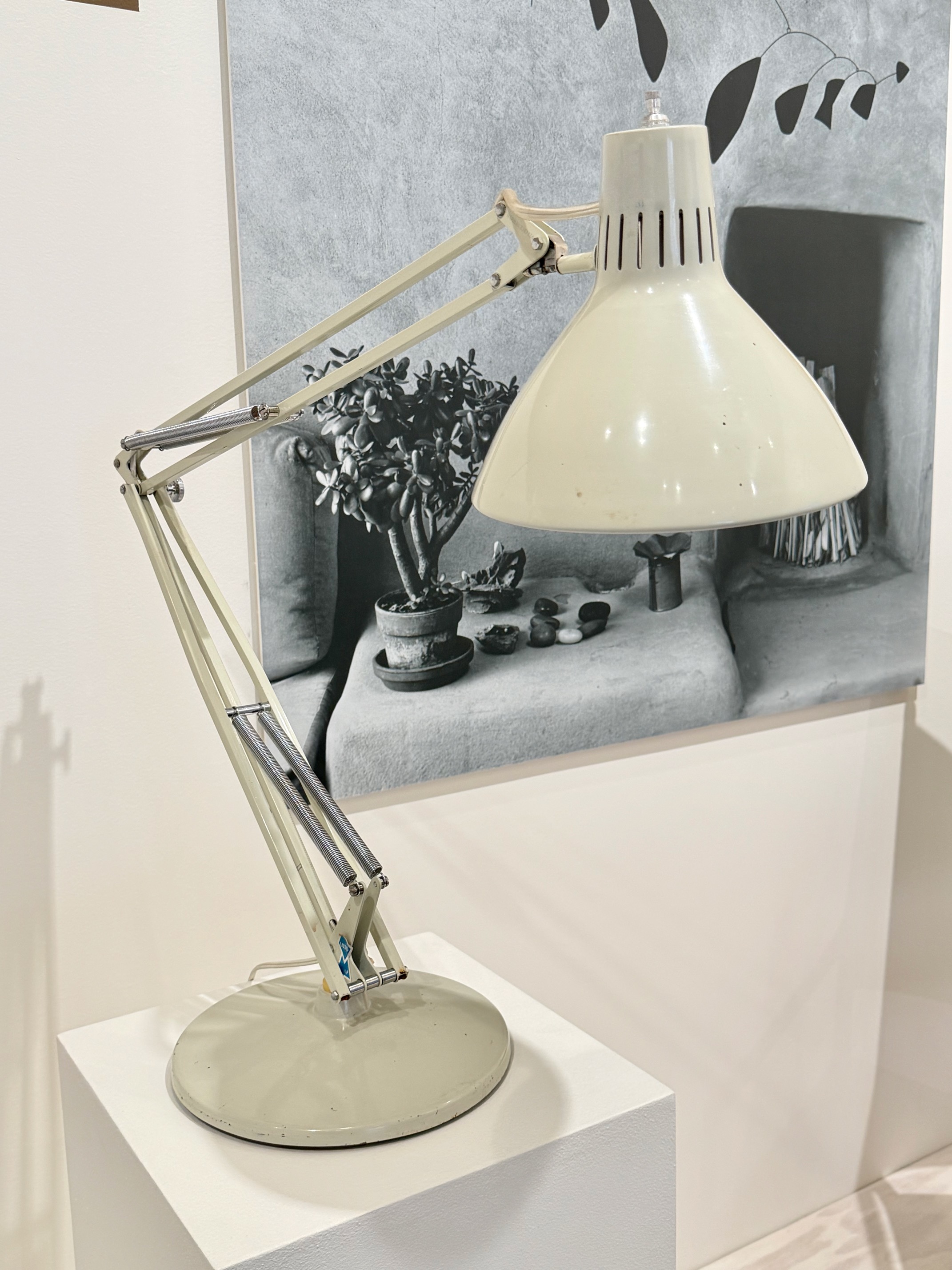
After you’ve walked through a somewhat chronological presentation of Ms. O’Keeffe’s paintings in the museum, the final two galleries allow you to take a close-up look at tools, cookbooks, and other stuff that she used to make things – sculpture, recipes, pastels, and clay pots.

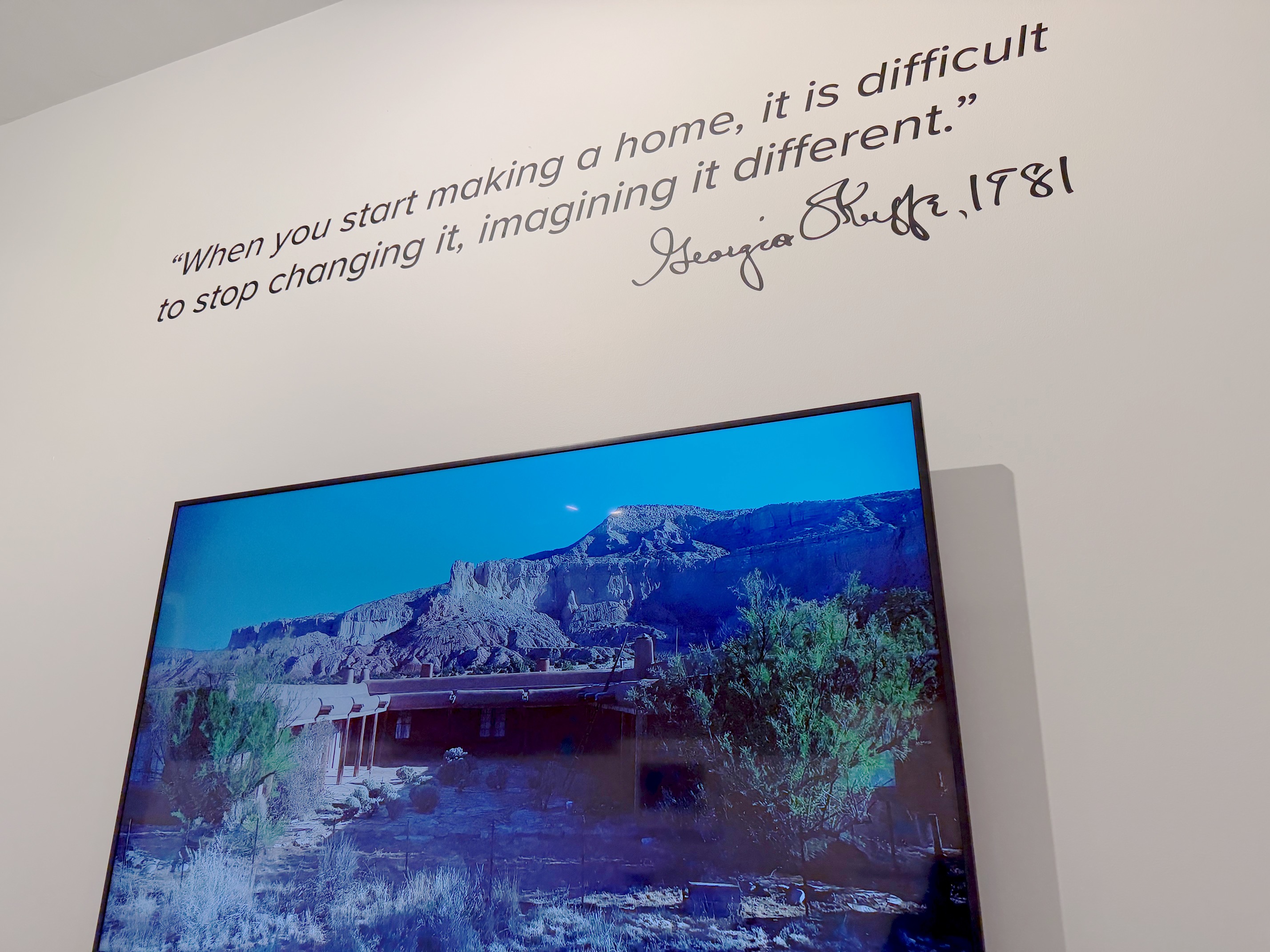
Photomural of Todd Webb’s 1962 photograph Georgia Making Stew, Ghost Ranch.

Due to the overwhelming popular response to Living Modern, the traveling exhibition that featured O’Keeffe’s wardrobe and chronicled how she portrayed herself for the greatest photographers of the 20th century, the museum curators decided to give visitors a little taste of the woman behind the art.

See some of our favorite things in our Flickr album here, and listen to the museum’s audio guide here.

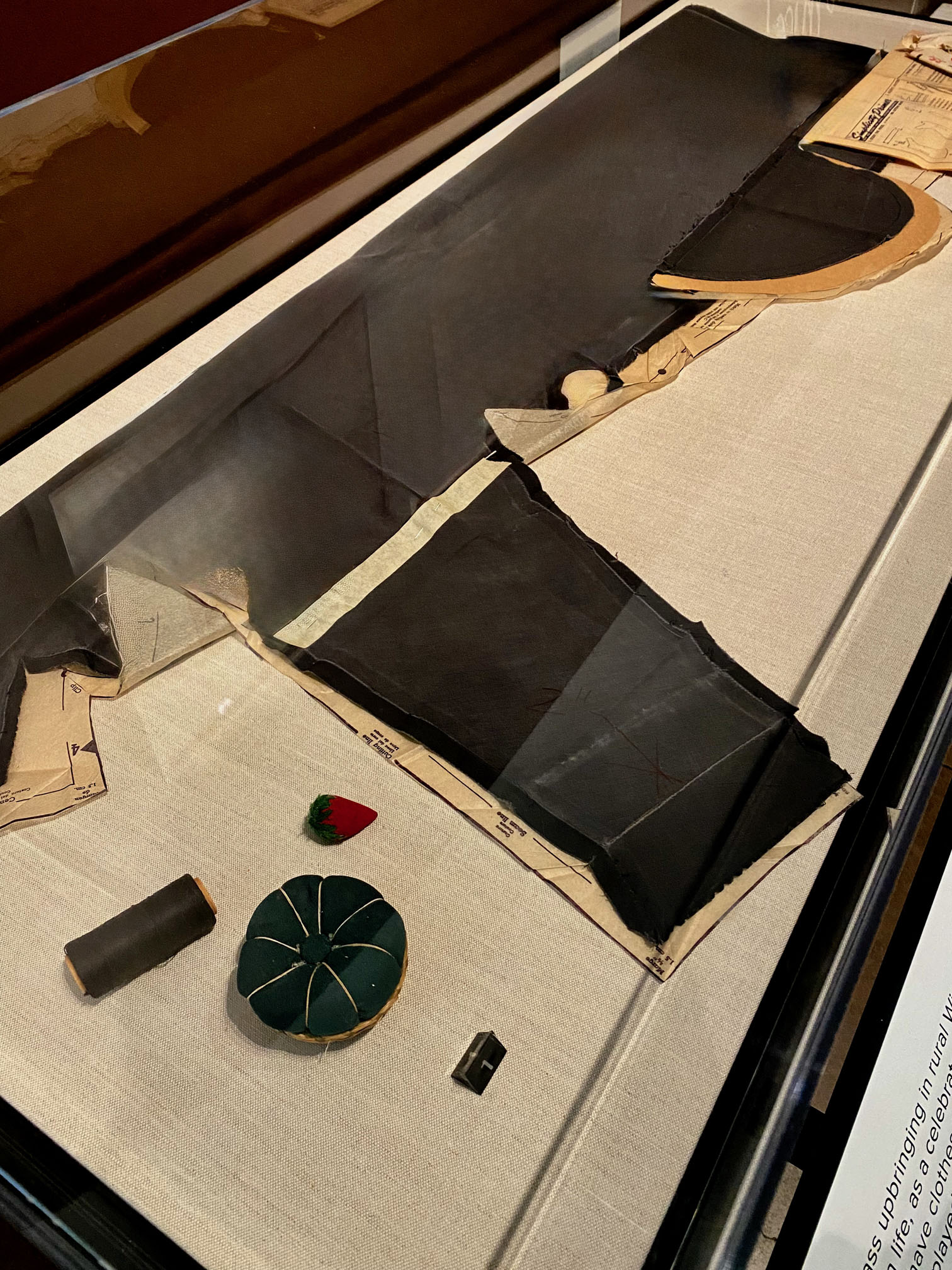
It’s the first time that the O’Keeffee Museum has itself presented her clothing. To emphasize the “making” part of her life in New Mexico, they’ve included a case showing how Santa Fe artist Carol Sarkasian moonlighted as Georgia’s seamstress. There’s a case with sewing notions and cut pattern pieces for another version of Georgia’s always in-style black wrap dress. She totally believed in multiples!

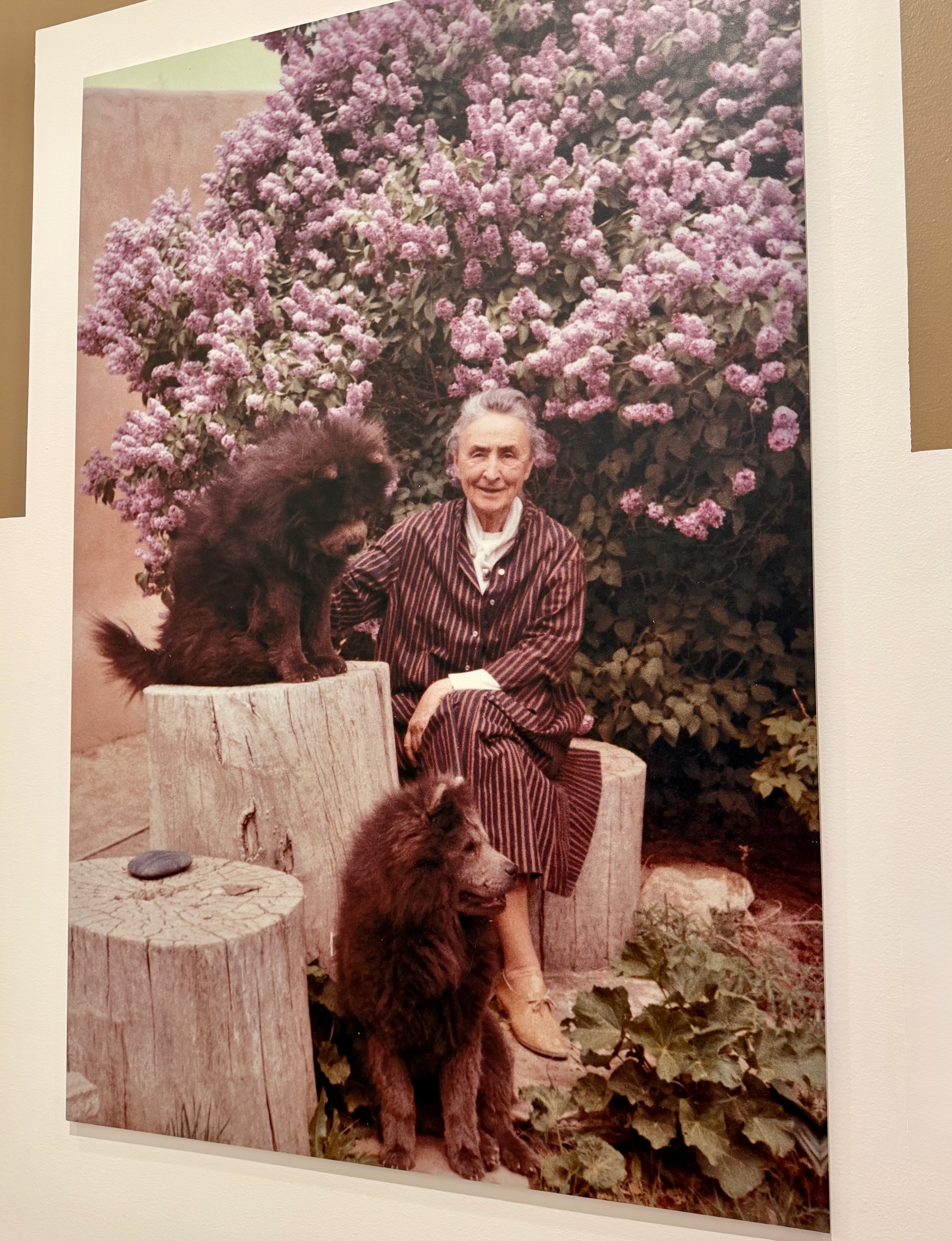
Georgia’s iconic 1960-1970 wrap dress sewn by Carol Sarkasian with 1950 belt by Hector Aguilar; Tony Vacarro’s 1960 Portrait of O’Keeffe with one of her dogs.
 
Sewing notions, cut fabric, and tissue-paper pattern – Carol Sarkasian’s preparation to make a wrap dress for Ms. O’Keeffe.

She also believed in wearing her clothes for a long time, and so they showed they had years of life.

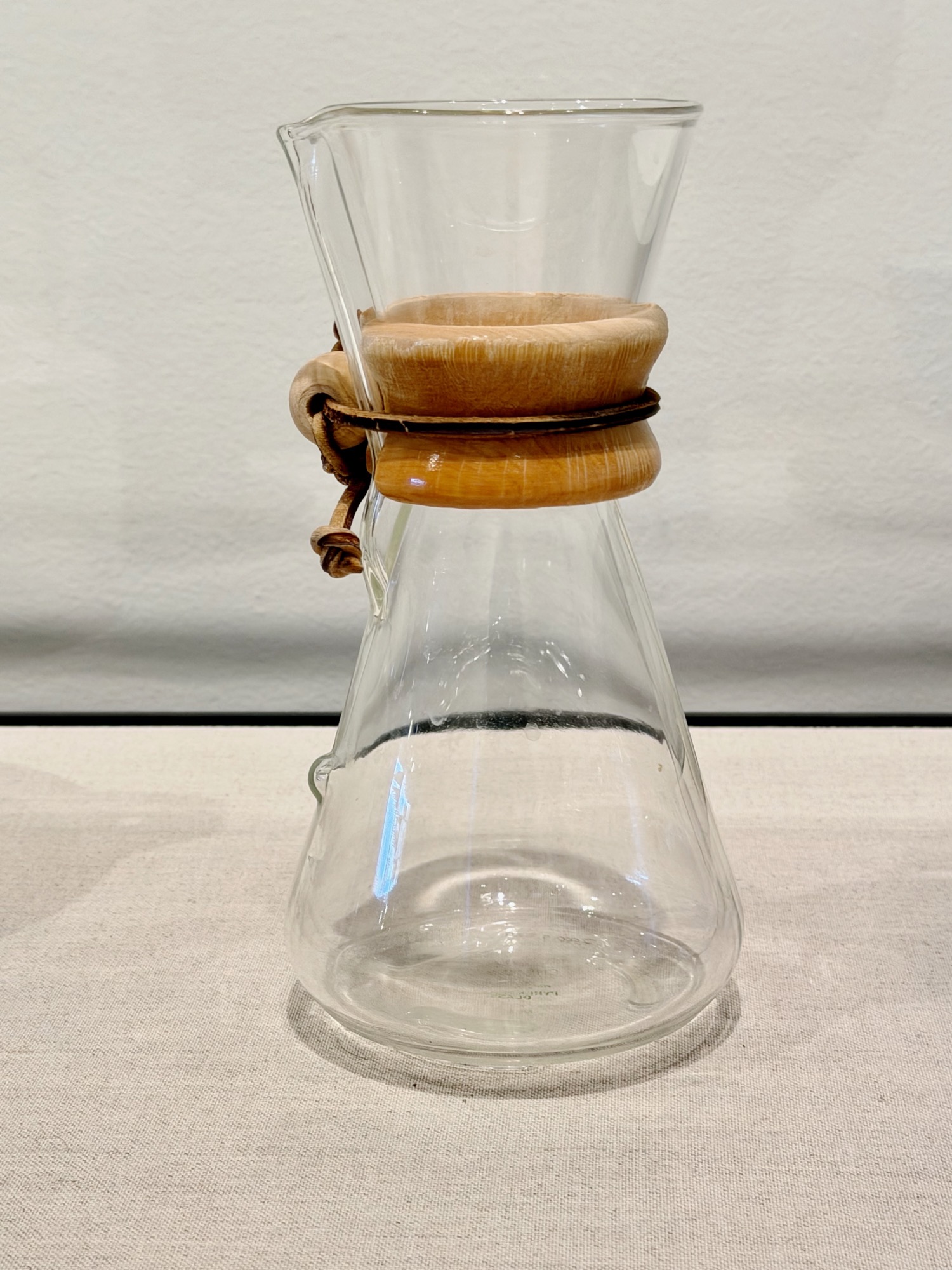
The most popular feature of her Abiquiu home tour is the kitchen and pantry, and learn about Georgia’s farm-to-table approach with her garden, recipies, and day-to-day lifestyle.  Here, you get a glimpse of the modern and traditional appliances used for her daily coffee ritual (yes, she loved Bustelo!) and get to peruse a sampling of her cookbooks and hand-written recipies. 

Shelves with Georgia’s pantry items

One of her unrealized dreams was to write a cookbook, and it shows. She was all about healthy eating and living, and in her later years she relied upon her trusted Abiquiu team to assist with gardening, cooking, and putting out a spread for the constant stream of visitors.  (No recluse, she!)

From the pantry: Georgia’s cookbooks with her hand-written breakfast, rice, and drink recipe cards.

The final room shows the process and tools she used to create her paintings, pastels, and sculptures

There’s a dramatic photomural of Georgia standing in front of her largest sculpture – temporarily housed nearby at the New Mexico Museum of Art until the new GOK museum is built.  Beneath, you see several prototypes – a wax spiral made in 1916 and bronze maquettes from the Forties.

Cast when she was in her nineties, the case demonstrates that she kept making versions of this her whole life and finding inspiration from stuff found on her New Mexico wanderings.

Bruce Webber’s photo of Georgia and her 1979-1980 spiral sculpture; the case below with its inspiration – a ram’s horn and earlier maquettes.

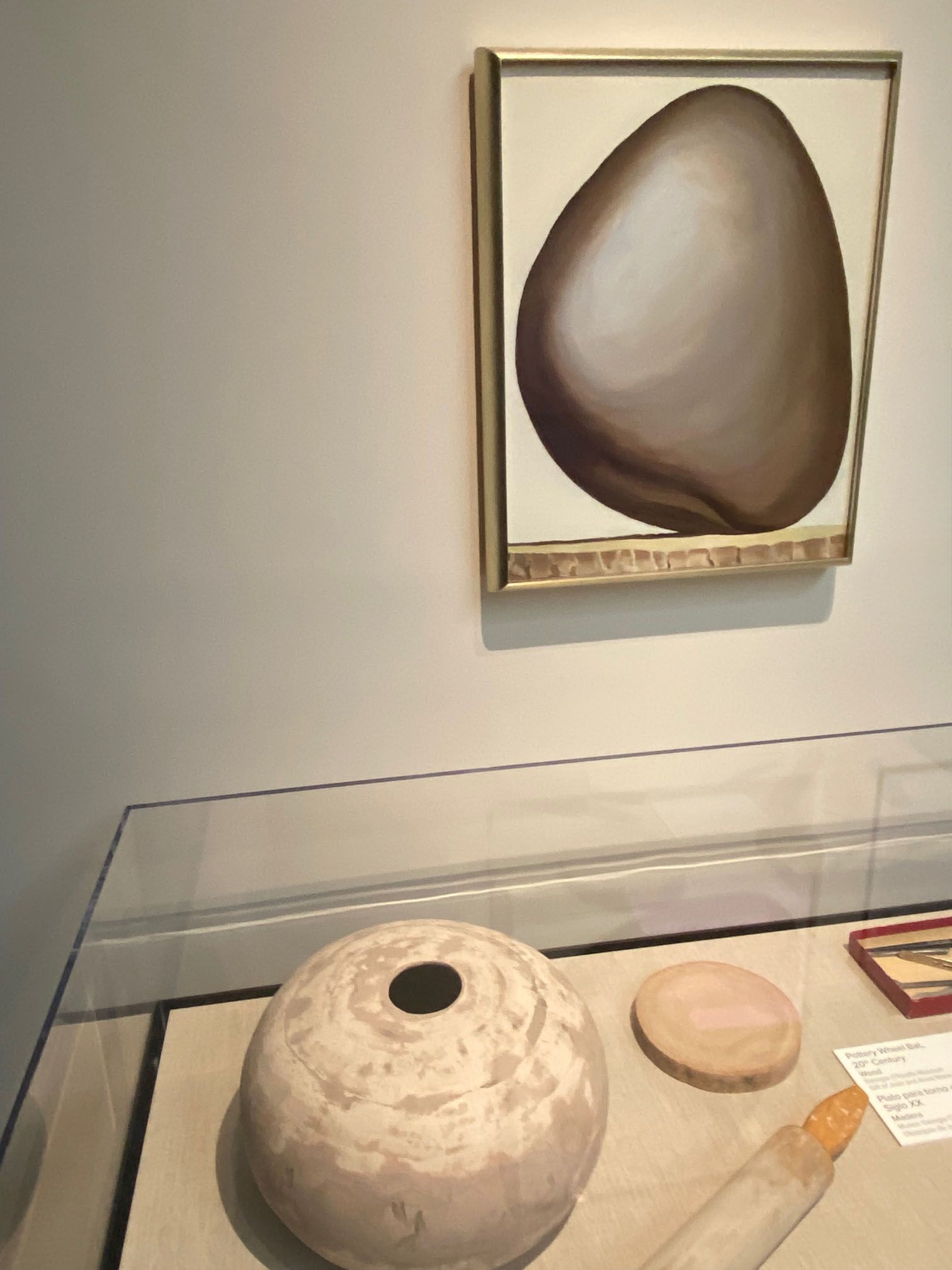
There are things from her travels to Japan, an unfinished work on an easel, and a case showing the pot she made when her assistant, Juan Hamilton, convinced her to keep making shapes, even when her macular degeneration made it impossible for her to paint.

The round, smooth shape echoes the rocks that she liked to collect, so it’s fitting that the museum paired her tools and pot with a beautiful oil painting done of one of her favorites.

1963-1971 Black Rock with White Background; below, Georgia’s 1980 stoneware pot and tools– a pottery wheel bat and Sears rolling pin.
Georgia’s denim studio apron and an unfinished work – a pencil sketch on primed canvas.

For more on Georgia and her life, listen to Pita Lopez, who worked as a companion and secretary for Miss O’Keeffee from 1974 to 1986 and later oversaw maintenance and preservation of her Abiquiu and Ghost Ranch homes.

Sculptor Shonnard Invents a Two-Continent Creative Life

The joyful retrospective Eugenie Shonnard: Breaking the Mold, on view at Santa Fe’s New Mexico Museum of Art through September 1, 2025, tells the story of a determined young artist in turn-of-the-century Brooklyn who seized opportunities to follow her dream, learn from the best, forge lifelong friendships, and transform inspirations of the nature and culture around her into fine art.

In 1927, Shonnard took up full-time residence as Santa Fe’s first academically trained sculptor. For years, the community considered her the “dean of sculpture”, but after she passed away in 1978 at the age of 91, gradually her legacy and accomplishments faded into obscurity.

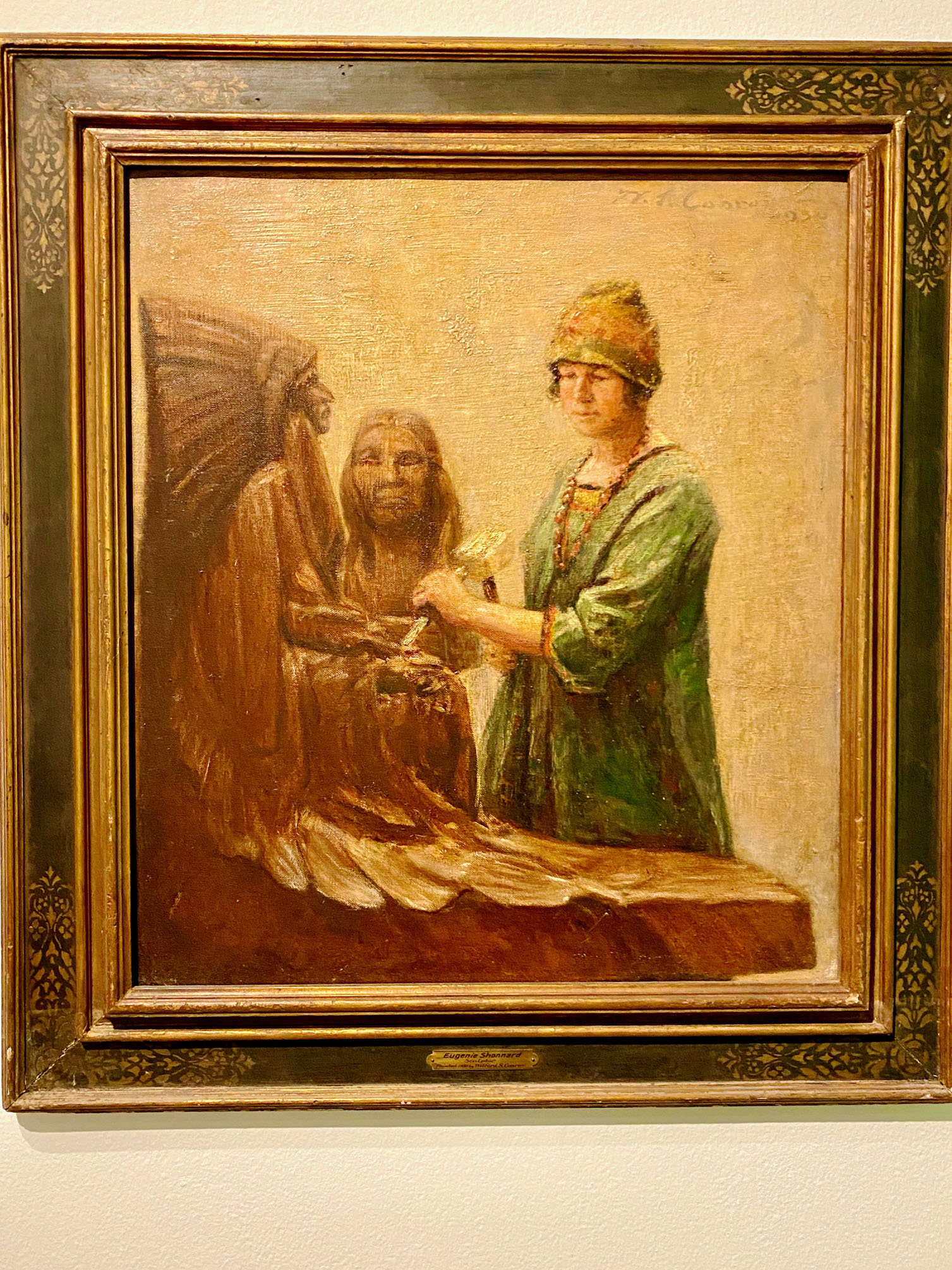
1930 portrait of Eugenie Shonnard in her sculpture studio by Wilford S. Conrow.

This year, the Museum chose to showcase Shonnard’s range of accomplishments – sculpture, painting, furniture, and architectural design. The strategy has worked, since most visitors remark, “What a beautiful body of work! Why haven’t we heard about her before?

Looking at the strong, robust sculptures of Breton peasants and Native American celebrity Dr. Charles Eastman featured in the introductory gallery, you would never guess that Shonnard started life as a sickly child whose wealthy parents kept her close to home. She spent lots of time outdoors with pets, nature, and the serenity of the Hudson Valley.

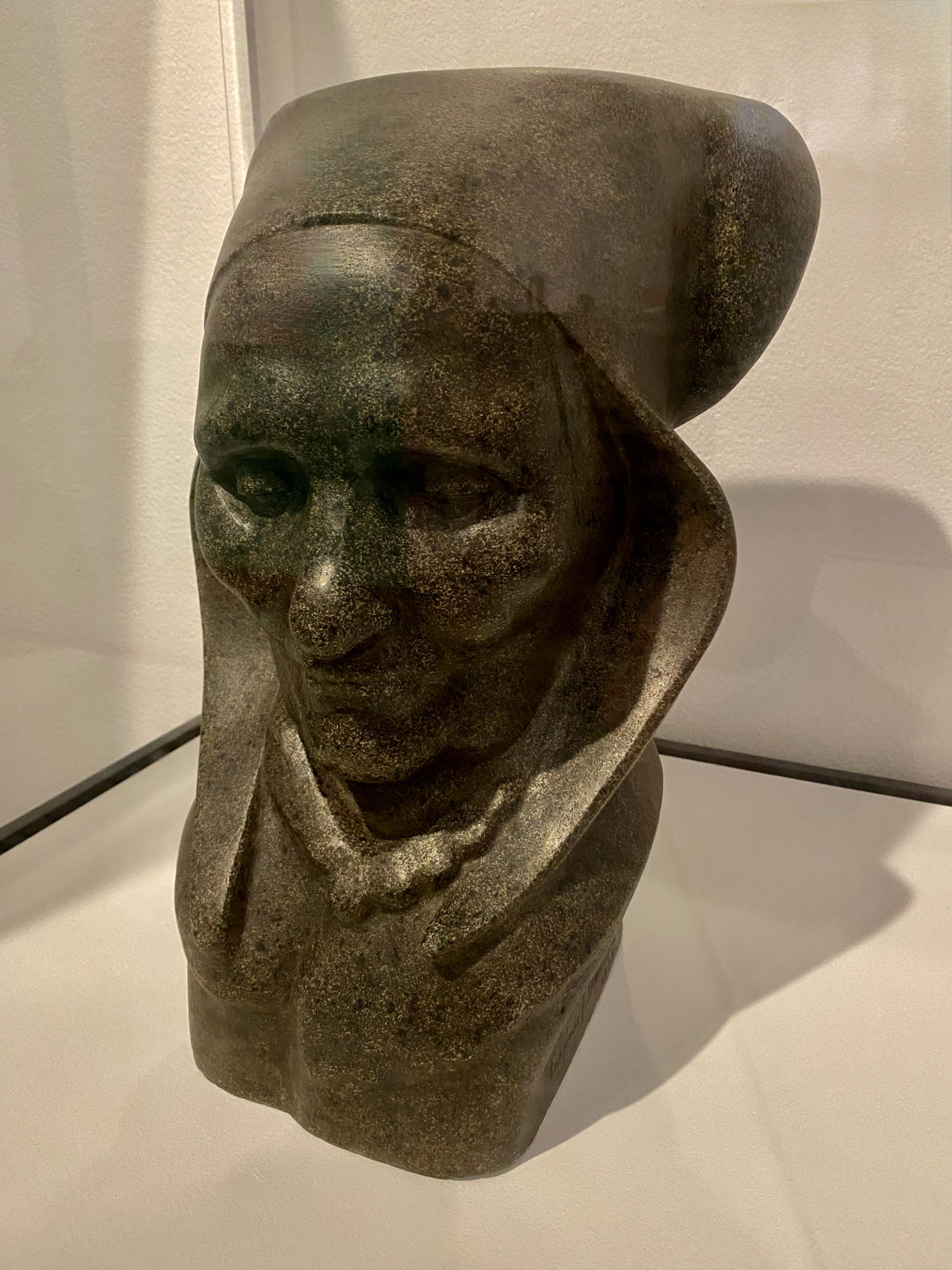
Shonnard’s 1923 granite portrait of a Basque woman, La Grandmére.
Shonnard’s 1926 direct-carved mahogany portrait of Dr. Charles Eastman, Chief Ohiyesa Communing with the Great Spirit.

Always considered a talented watercolorist, her teenage life took quite a turn when her mother allowed her to enroll in the New York School of Applied Design for Women – a school that taught proficiency in the “lesser arts” like lacemaking, wallpaper design, and book illustration, and cover design so that young women could have “appropriate” careers.

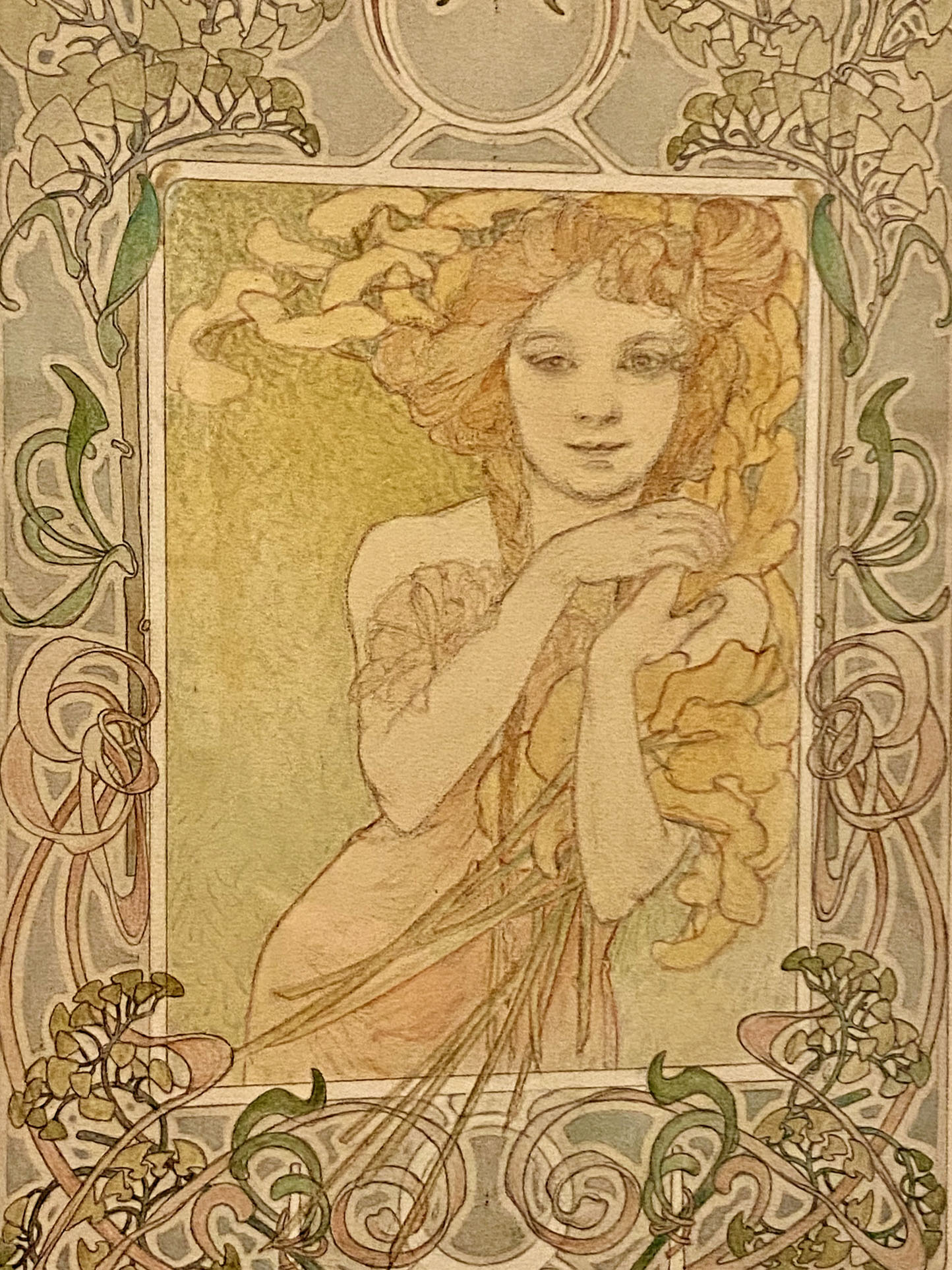
Shonnard’s 1907 pencil and watercolor design in the pastel “Mucha style” – organic designs framing ethereal woman with flowing tresses.

The most sought-after course was a figure drawing class taught by a visiting European professor – the famous Art Nouveau superstar Alphonse Mucha. A master draughtsman and designer, he taught students how to convey human expression in quick, sure, animated line and to use expressive, organic designs from nature to give their work a modern something extra.

Mucha immediately recognized Shonnard’s skill in blending human empathy and line, and advised her to think beyond what was offered at her school. He suggested that she go to Paris, train with top European sculptors (he’d provide letters of introduction), and seriously purse a “fine arts” path.  

Although her doctors advised her against making the long transatlantic passage, she and her mother set off for Paris in 1911. She loved it! She followed up with Mucha’s suggestions (and contacts), began her fine-arts sculptural training, and met other young American female sculpture students (like Gertrude Vanderbilt Whitney and Malvina Hoffman) who were soaking up all of the influences that the Parisian modern art scene offered.

Although he had retired from teaching students, Rodin made an exception for Shonnard and told her he’d be happy to review her work periodically. She worked across a variety of sculptural media (stone, clay, wood) in the atelier of Antoine Bourdelle (an early adoptor of Art Deco who also taught Matisse), showed with the American Woman’s Art Association, and exhibited at the Paris Salon.

When World War I forced Shonnard’s return to New York, she enrolled at the Art Students League for classes with superstar American sculptor James Earle Fraser.

Two of Shonnard’s popular garden commissions – a crane and pelican.

Combining everything she learned from Rodin, Mucha, Bourdelle, and Fraser, she began to excel in stripping her depictions of her subjects down to the essentials that captured each person (or animal’s) inner spirit.

Inspired by Brittany: Shonnard’s 1926 oak Figure of a Woman. Courtesy: Panhandle-Plains Historical Museum, Canyon, Texas

Her career began to take off – commissions for sculptures, shows in New York, and acclaim for her portraits of people and gentle animals. Shonnard made the most of it, showing at New York galleries and the Booklyn Museum, working with her mentor Mucha, and criss-crossing America and Europe in the 1920s.

Like decades of artists before her, she was often drawn to Brittany to capture the spirituality, nature, and culture of the people in her art.

In 1925, she made a fortuitous stop in New Mexico at the invitation of museum director Edger Lee Hewitt, who introduced her to the thriving art community and innovative Native American artists. 

As with Brittany, much about the Southwest resonated with her – dramatic landscapes, spirituality of ancient New Mexican cultures, and the unique architecture and religious art of old churches.  She also drove out into the country to create plein air watercolors of the same Abiquiu landscapes that later inspired O’Keeffe.

Shonnard’s 1925 watercolor of Abiquiu’s unique landscape, Red and White Cliffs with Mesa.

Her sculptures inspired by her New Mexico experience created a sensation in Paris in 1926 – beautiful, direct-carved portraits from the faraway Southwest on display next to her work from Brittany.

Shonnard’s untitled 1925 mahogany Indian bust, shown in her solo show in Paris.

By 1927, Shonnard moved permanently to Santa Fe and began her own full-time studio from which she produced commissions, designed Southwest-inspired furniture, and explored Spanish and Pueblo cultures more deeply.

The exhibition includes designs for private chapel commissions with John Gaw Meem, examples of her furniture, and keenstone panels – her lightweight material invention that liberated her from manipulating heavy granite and wood in her studio, so she could keep carving and sculpting with a lighter material well into her seventies.

People who knew Shonnard said that she exuded a positive spirit throughout her life, seeking harmony with nature, animals, and people. It’s fitting that this retrospective includes a large room populated with her beloved birds, woodland, and backyard animals, and concludes with works by local artists she admired and whose works she collected – Maria and Juan Martinez and Awa Tsireh.

Detail of Shonnard’s Madonna sculpture.
Shonnard’s 1950 portrait Maria, a tribute to the acclaimed San Ildefonso artist.

Get to know this Santa Fe legend by looking through all her beautiful work (and work by her mentors) in our Flickr album.

Celebrating Juan Pino, First Pueblo Printmaker

It’s been just over 100 years ago that Juan Pino of Tesuque Pueblo popped into the Santa Fe studio of Charles Kassler, and experienced his enthusiasm about linoleum printmaking – a new-ish way to make multiple images without using an expensive press or chemicals.

Charles offered Juan some materials to take home so he could try it, and Juan got to work. See the results in Printing the Pueblo World: Juan Pino of Tay Tsu’geh Oweenge, on display at Santa Fe’s Museum of Indian Arts and Culture through August 17, 2025.

Take a look at our favorites in our Flickr album.

Exhibition banner on Museum Hill

Unlike his friend Kassler, who trained formally at Princeton and the Art Institute of Chicago, Juan received his artistic training in the Pueblo world, learning observation, craftsmanship, and patience from the ceramic and textile artists around him. By 1924, booming tourism in Northern New Mexico had created a big market for modern and traditional pueblo ceramics (think Maria Martinez and Margaret Tafoya) and for pueblo painters, like Julian Martinez and Awa Tsireh (Alfonso Roybal).

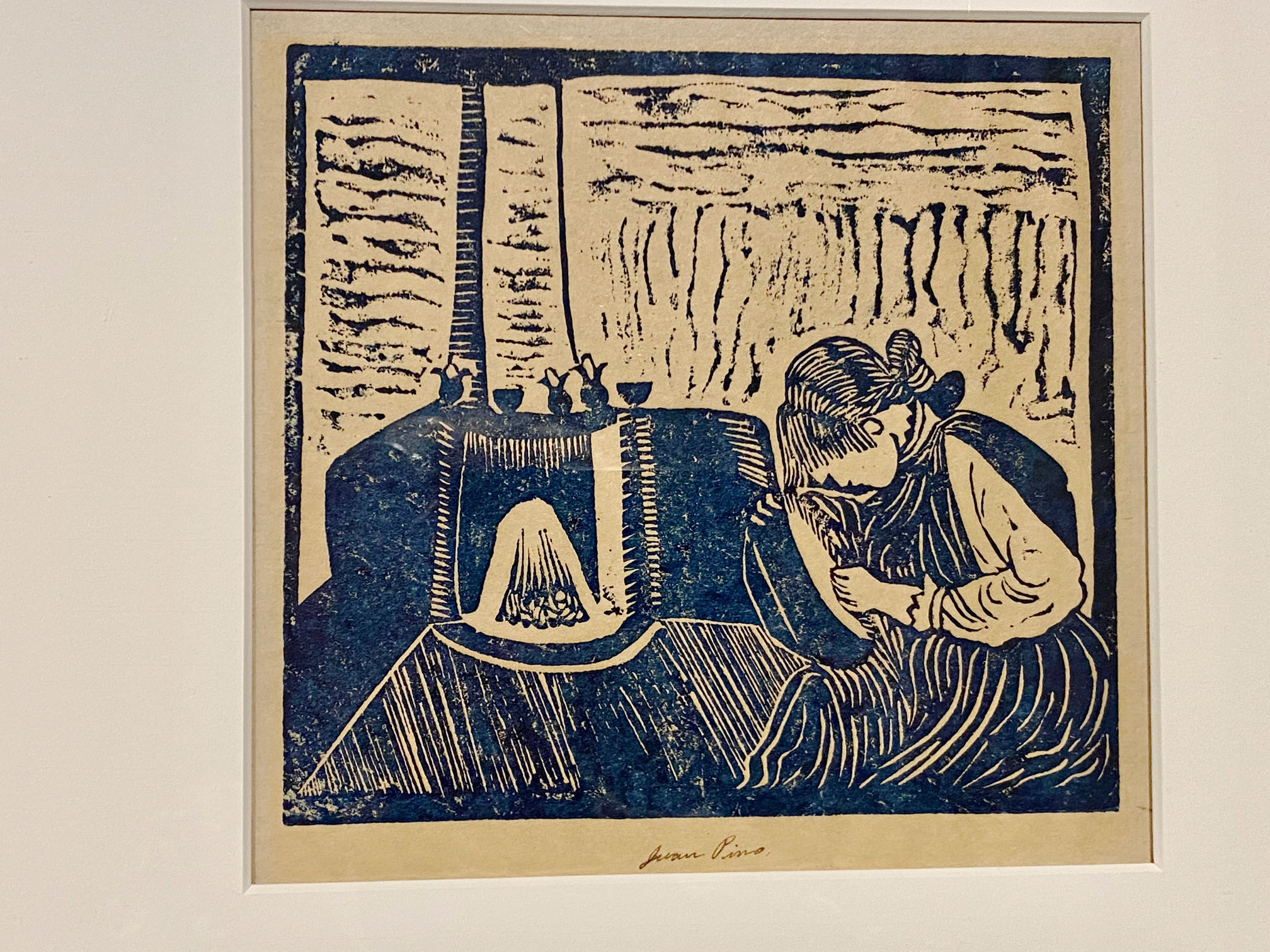
Juan Pino’s 1925 linocut print of people by the church in the Tesuque Pueblo plaza

Juan was an expert in wood carving, ceramics, textiles, and crafting dance regalia, but like most artists of his day, he juggled his artistic output with other income-generating pursuits – farming, gathering and selling home-heating wood, and posing as a model for Anglo artists flocking to the vibrant Santa Fe art colony.

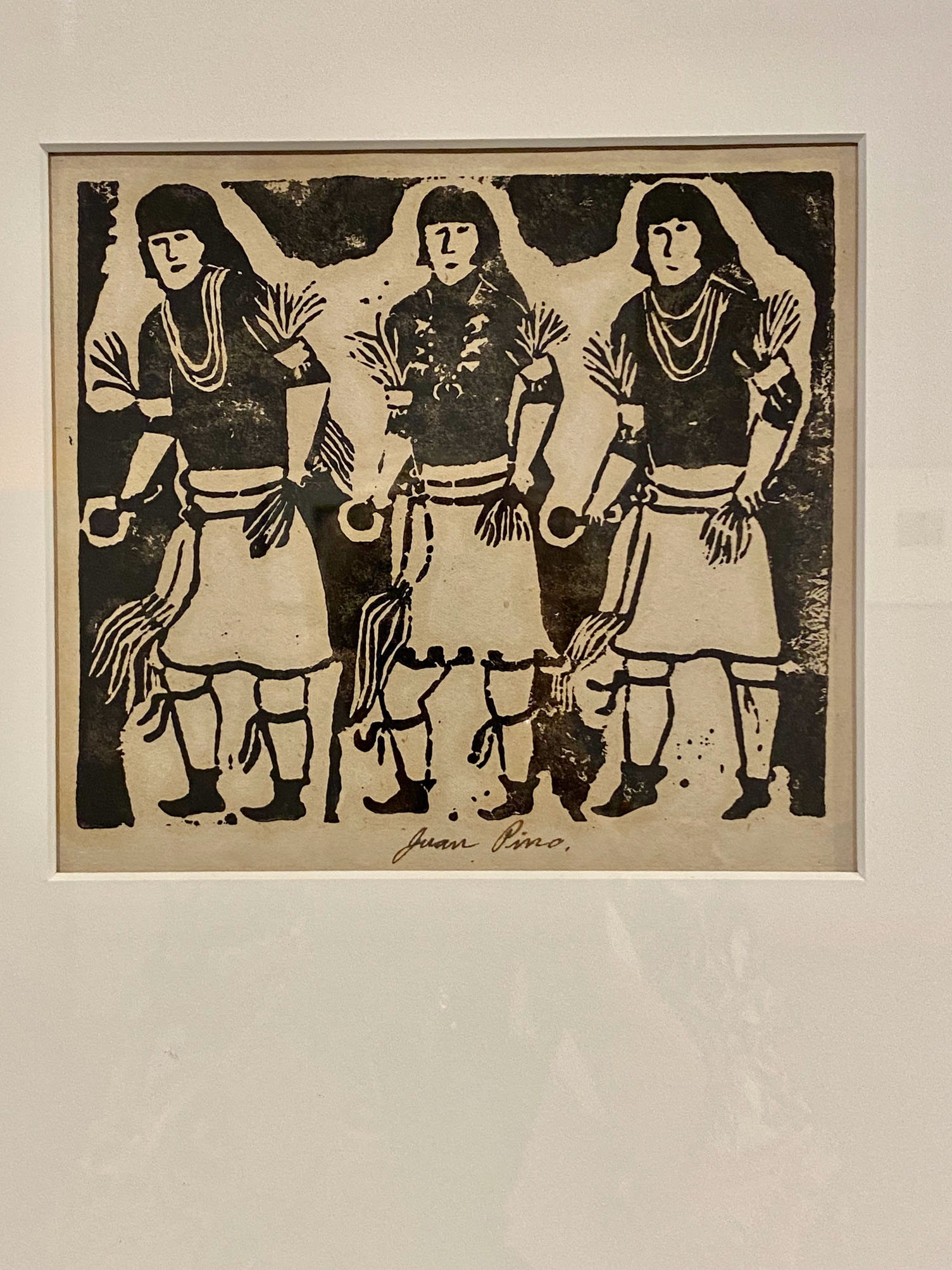
Juan Pino’s 1925 linocut print of three corn dancers – depicting himself, Vecillio Herrera, and Candido Herrera.

For linocut printmaking, you just cut your design into linoleum – a relatively accessible material since it was manufactured for use in kitchen floors or wall coverings for new homes. Once the block was carved and inked, you could either apply manual pressure to make the multiple images or ask a fellow artist to borrow their press.

Carving images into linoleum came naturally, and Juan started depicting the world around him in Tesuque – not just romanticized images of Indian life. Juan carved and printed the daily comings and goings of his fellow villagers in the pueblo plaza and images of traditional dances.

For all the car traffic and hubub on the streets of Santa Fe during the 1920s, Tesuque pueblo life still had elements of traditional Tewa ways.  Archaeologists have found remnants of village buildings dating back to 1200 CE, so Tesuque is one of the longest inhabited communities in the United States.

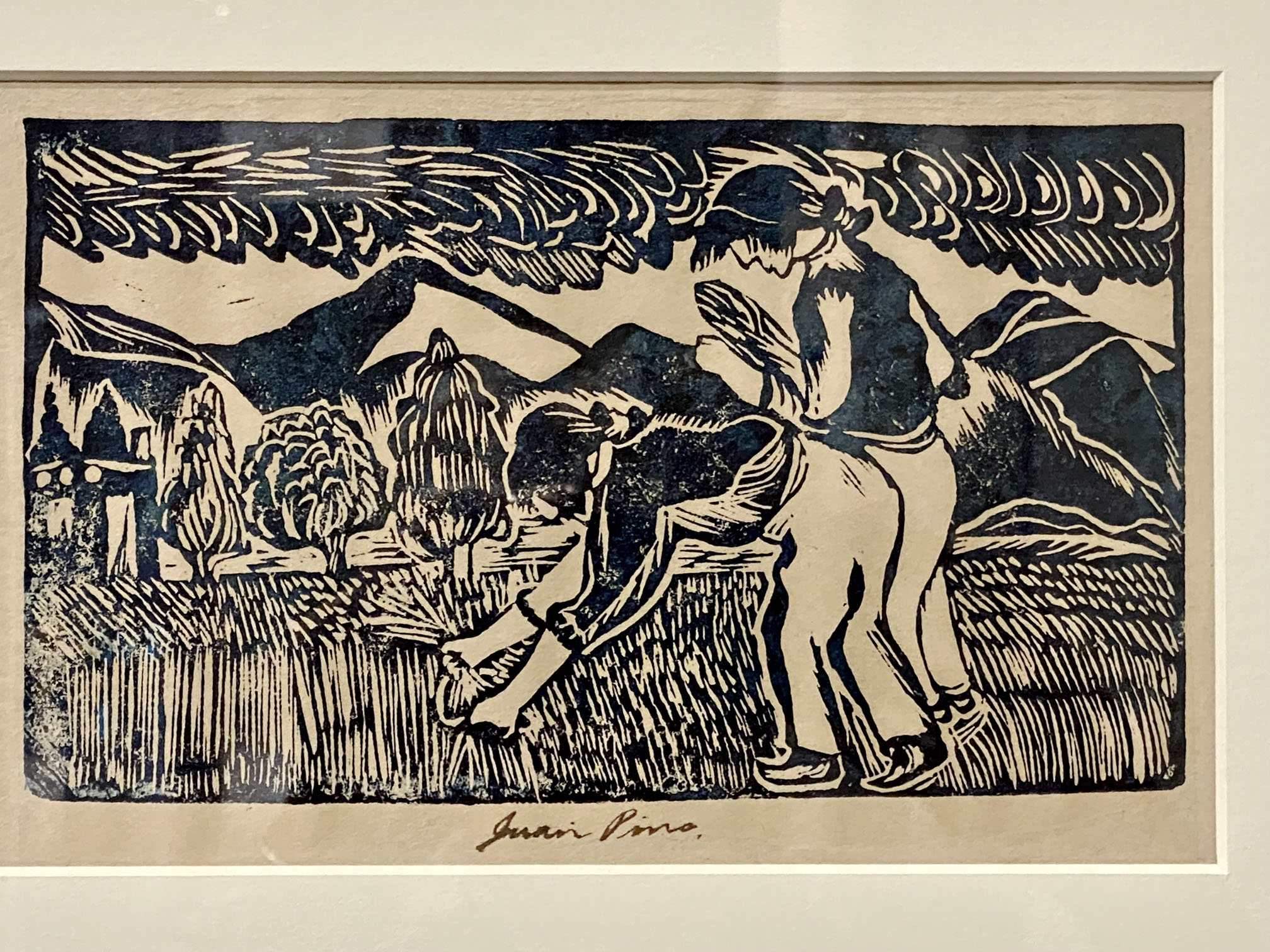
Juan Pino’s 1925 linocut print of two men harvesting wheat

Taking in the twenty prints in the exhibition allows us to see day-to-day life as it was 100 years ago in the historic pueblo – making ceramics at home, harvesting, using oxen on the farm at a time just before horses replaced them as the work animal of choice.  We can even see detailed black-and-white depictions of the regalia men were wearing for the Corn Dance – including one print that likely includes a self-portrait!

After only a few months of making linoprints in 1925, Juan’s work was displayed at the New Mexico Museum of Art. Santa Fe and Pueblo artists celebrated his accomplishment as the first Pueblo artist to try his hand at printmaking. In Santa Fe’s commercial gallery market, however, tourists were more inclined to purchase prints and paintings that showed more romanticized visions of Indian life.

Juan kept creating, and seeing so much of his work 100 years later is truly a revelation – a set of quiet, enjoyable glimpses of everyday life at the foot of the Sangre de Christo Mountains.

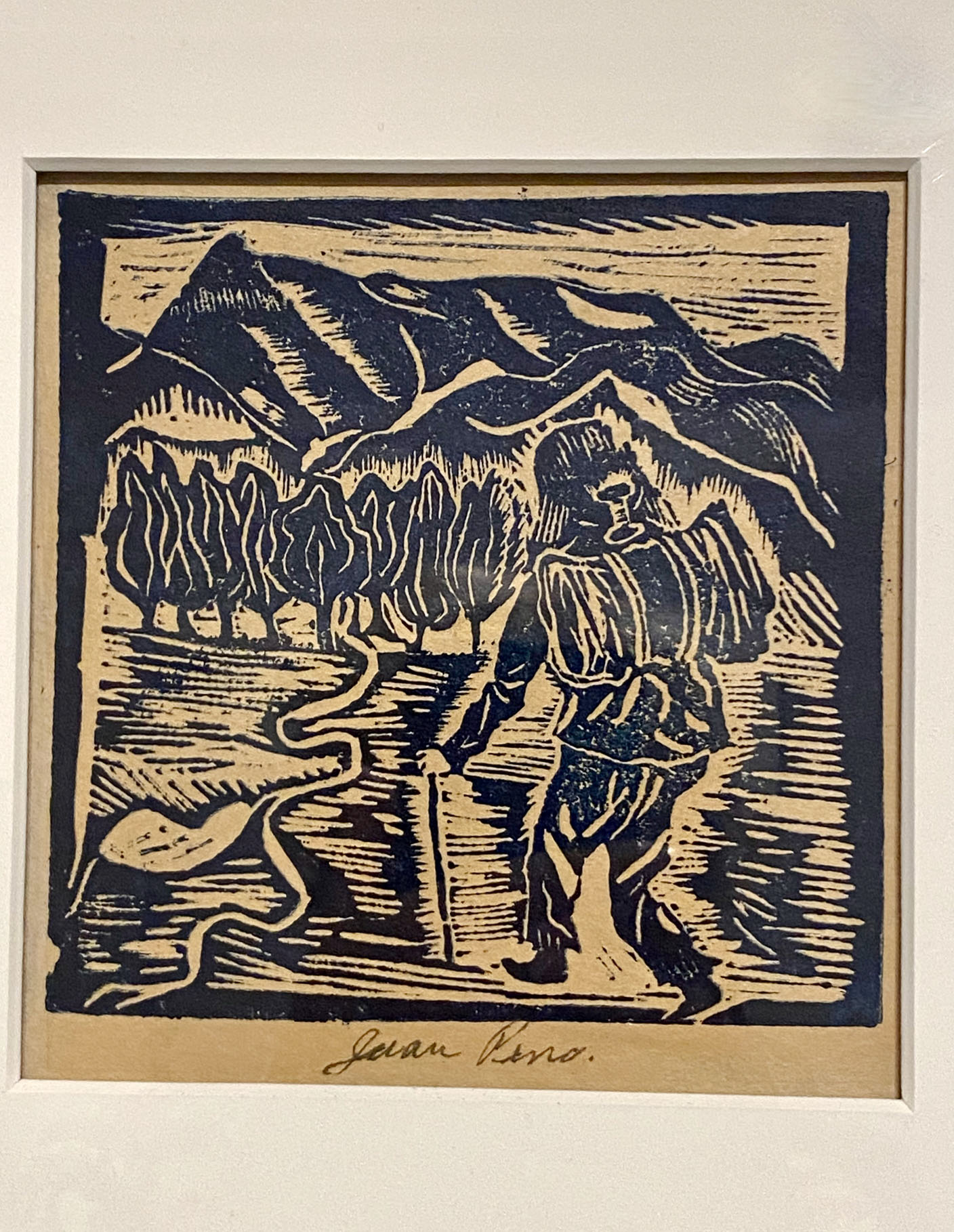
Juan Pino’s 1925 linocut print of a voyaging man. Courtesy: Indian Arts Research Center, School for Advanced Research, Santa Fe.

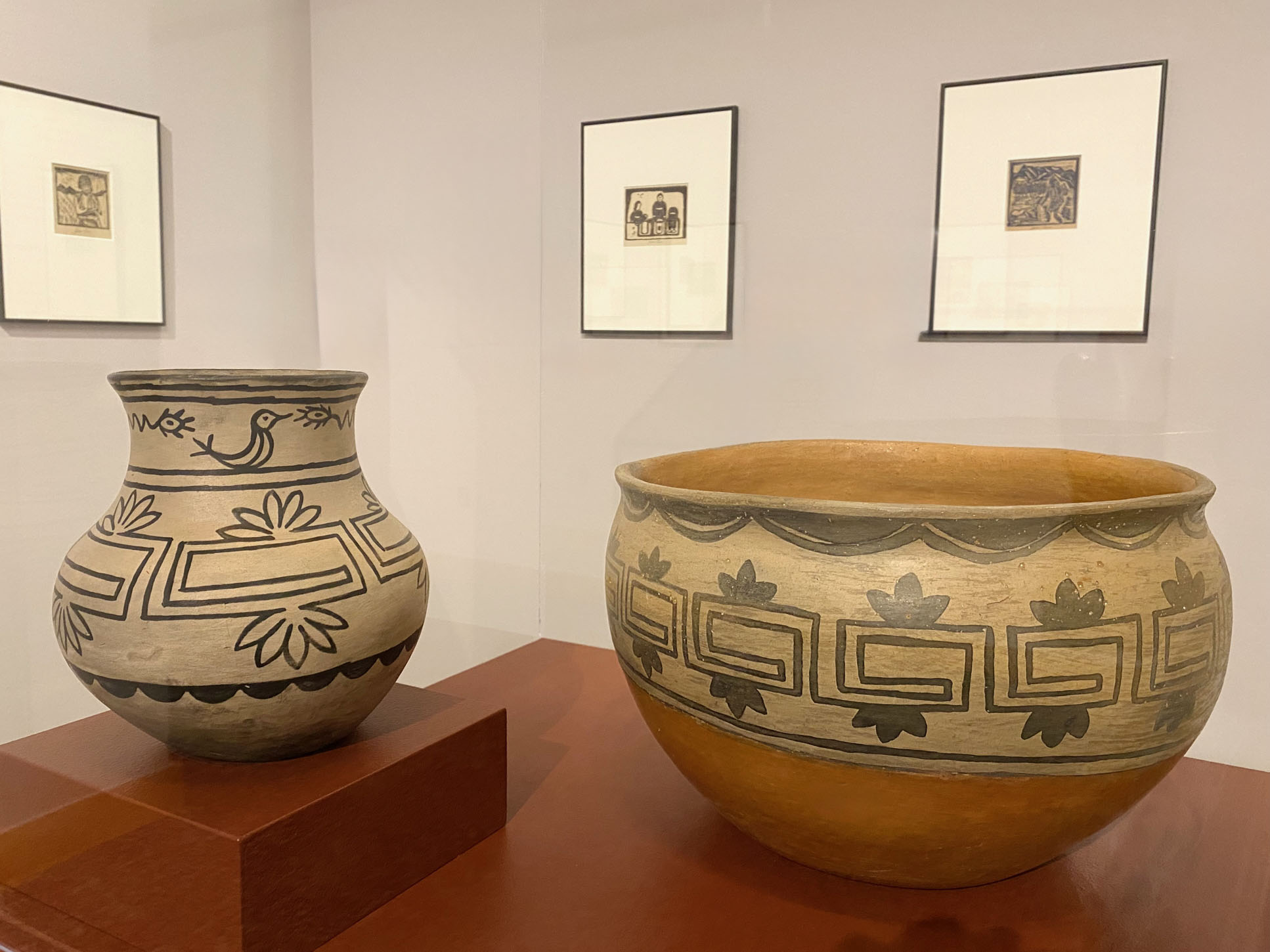
The show also has a beautiful touch that emphasizies Juan’s continuing artistic output: two large ceramic pieces from the Thirties and Forties created by his wife, Lorencita Pino. It’s likely Juan used his steady hand to apply strong, black lines – skills so evident in his masterful design for his slice-of-life print series.

Lorencita Pino ceramics likely painted by her husband, Juan Pino – a 1940 dough bowl with cloud and scroll designs and 1930 jar with bird and scroll design.
1925 linocut print of woman making pottery near fireplace…is it Lorencita?

Light, Space and Time in Albuquerque

Drift into another dimension in Light, Space, and the Shape of Time at the Albuquerque Museum through July 20, 2025. The show, with significant works from the museum’s own collection, harkens back to the founders of California’s 1960s Light and Space movement, but also presents work by contemporary artists – many from New Mexico – who continue to explore the same phenomenon.

The curators have arranged the exhibition to show how artists use light, space, and time as subjects through which visitors can slow down, contemplate, and experience.

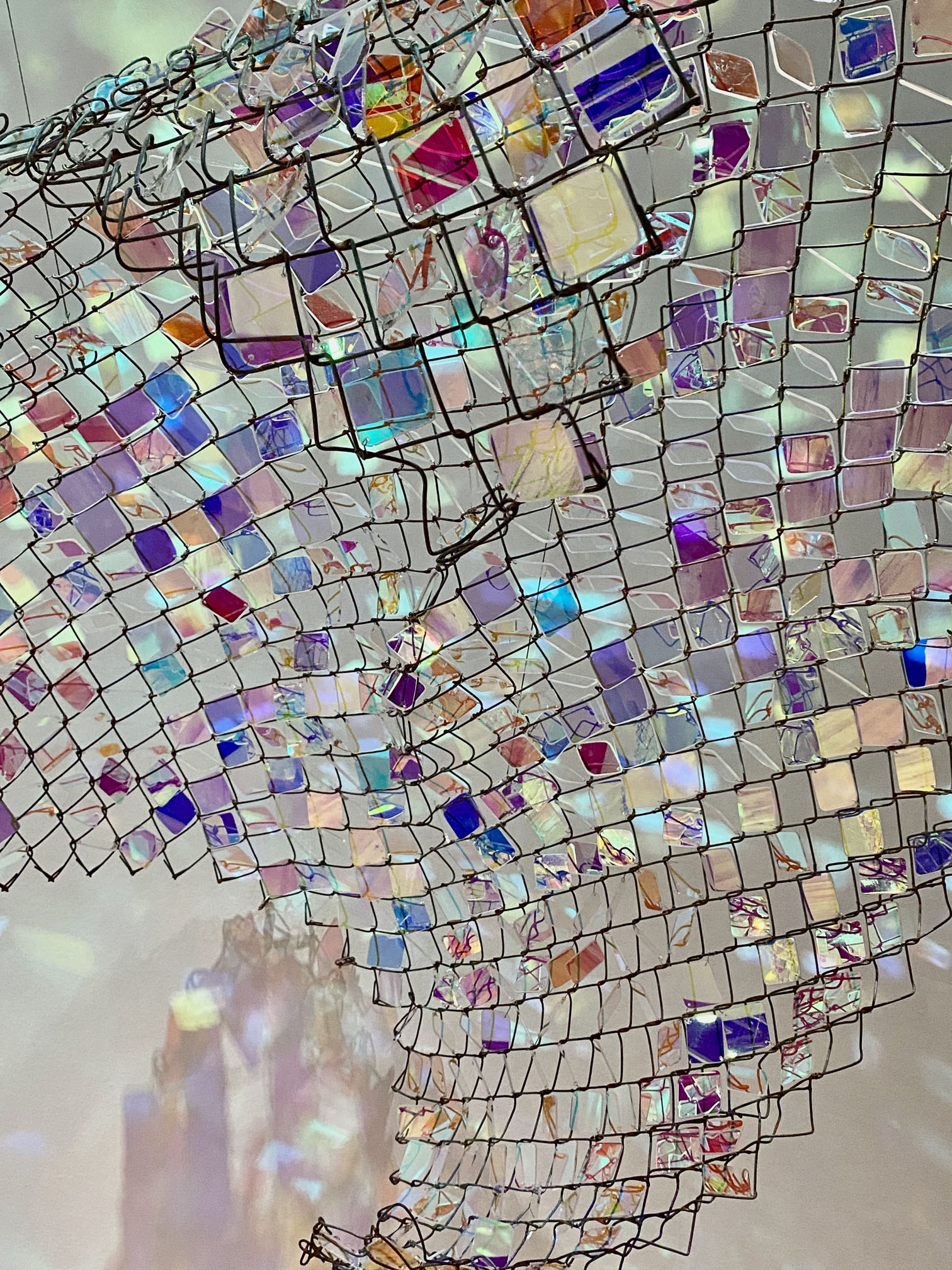
Detail of Soo Sunny Park’s 2013 Unwoven Light, an installation that seems to move as visitors walk through it. Courtesy: the artist

For more, see some of our favorites works in our Flickr album.

The first section showcases works where artists use light as the primary medium. Visitors can enjoy works by some of the most famous innovators from the Sixties and Seventies – Robert Irwin, who inspired a generation of West Coast art students to think differently; Dan Flavin, who merged minimalism with industrial light; and Helen Pashgian, who makes magic from luminous resins.

Irwin’s 2011 piece appears minimal, but his six fluorescent-light colors can be activated in four different variations, and he associated each with agricultural colors of Southern California. You can enjoy looking at Lucky You for its purity of form, or contemplate Irwin’s recollections of home.

Two fluorescent works by Space and Light superstars – Robert Irwin’s 2011 Lucky You and Dan Flavin’s 1987 untitled (in honor of Leo at the 30th anniversary of his gallery. Courtesy: Thoma Foundation

Behind the black curtain, you can enter a tranquility chamber. Helen Pashgian’s 2021 installation provides an unforgettable experience to visitors to slow down and wait. What are you seeing? The frosted, peach-colored epoxy sculpture at center stage appears dissolve in the light-filled space as lights slowly change. It’s like watching show changes to the sky during a dramatic sunset, but it’s light, white, ethereal, and pure.

Helen Pashgian’s 2021 untitled (peach lens) – the lens dissolve into space as the light changes to sunrise and sunset modes. Courtesy: Tia Collection

All-star word artist Jenny Holtzer’s Red Tilt takes an absolutely maximalist approach with multiple LED displays – a too-much, all-at-once, never-stopping tsunami of emotional words from her own story about survival and trauma.

Leo Villareal’s piece Scramble is the opposite. Albuquerque-bassed Villareal creates a mesmerizing, tranquil, never-repeating abstraction by programming LED lights. He’s done this on a larger scale in his epic commissions to light the San Francisco-Oakland Bay Bridge and all of London’s bridges over the Thames. Here, visitors get a more intimate experience – slowing down to watch Scramble’s gently changing colors and know what they’re seeing is unique to the moment.

Jenny Holtzer’s 2002 LED display, Red Tilt. Courtesy: Thoma Foundation
Leo Villareal’s 2011 Scramble, a programmed LED artwork that changes constantly. Courtesy: Thoma Foundation

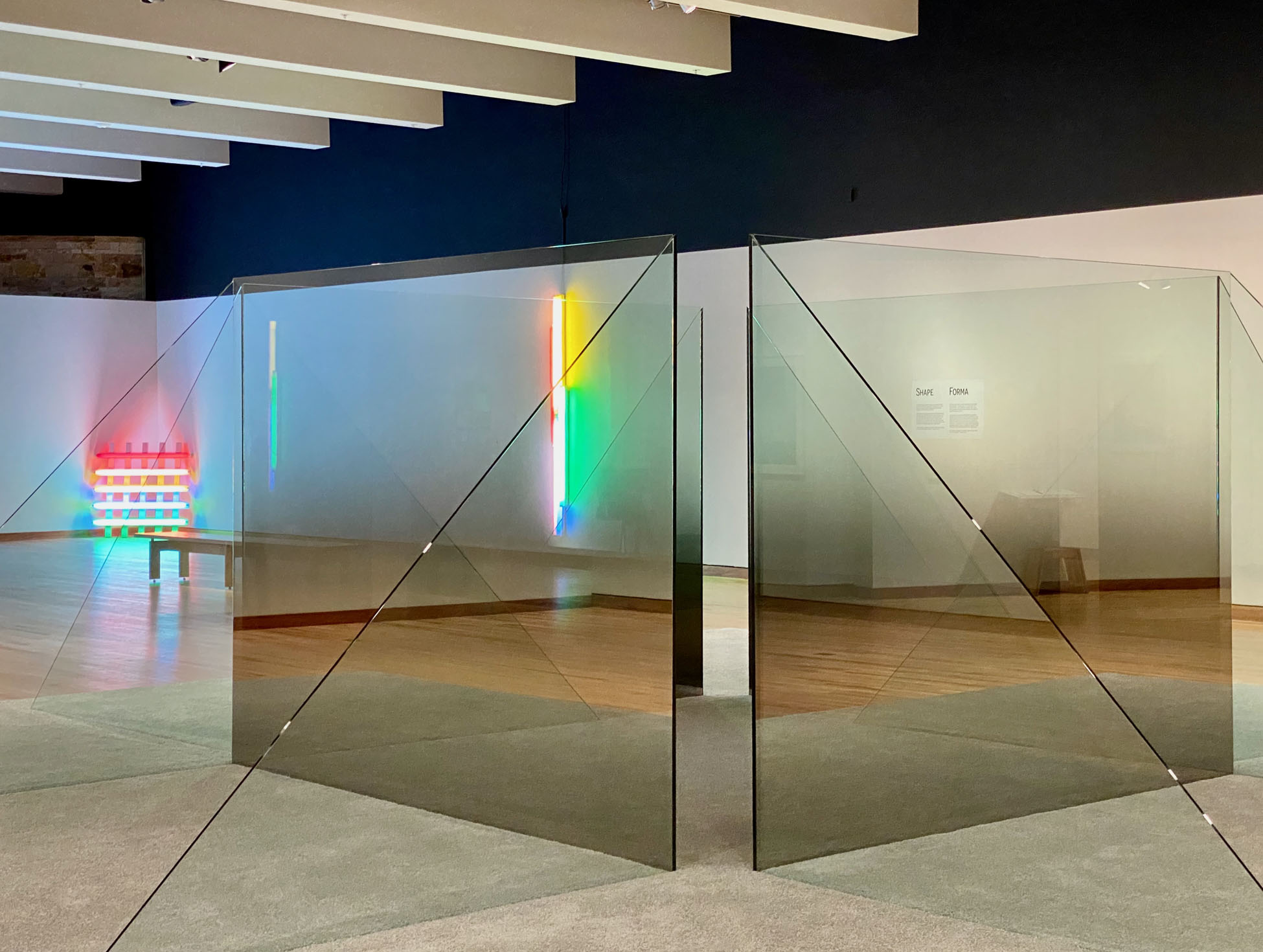
Larry Bell’s 1984 installation is the centerpiece of exhibition’s exploration of how artists use light, illusion, and technology to explore (and play with) our perceptions of space. Direct from his retrospective in Phoenix, Bell’s barely-there The Cat is a delicate but monumental presence in the show.  Huge, planes of coated and non-coated glass require a circumnavigation. Moving around, you can see how works are reflected and how some opaque surfaces block views of others.

Larry Bell’s 1984 The Cat – rectangles of coated and uncoated float glass.

Two nearby works by Santa Fe-based August Muth offer visitors a more intimate experience. Muth uses a holographic etching technique in which he creates the illusion of a “floating” image.

August Muth’s 2024 holographic etching Shadow Within Light. Courtesy: Pie Projects Contemporary Art.
August Muth’s 2022 holographic etching Terra Solaris. Courtesy: Pie Projects Contemporary Art.

The exhibition concludes with a magnificent installation by Soo Sunny Park – an installation of lights and plexiglass pieces that appear to move as you move through. Take a peek in this video.

Detail of Soo Sunny Park’s 2013 Unwoven Light installation with tiles that appear to move as the visitor moves through it. Courtesy: the artist

Kite Dreams with AI at IAIA

How does a Lakȟóta artist link dreams and artificial intelligence to imagine futures for her people? Experience five years of innovative installations in Kite and Wíhaŋble S’a Center: Dreaming with AI, on view at the IAIA Museum of Contemporary Native Arts in Santa Fe through July 13, 2025.

The IAIA exhibition – Suzanne Kite’s third solo exhibition this year across the United States – presents several installations that highlight her collaborative work that merges cutting-edge technology with Indigenous knowledge systems. 

Download the exhibition catalogue here, and look at photos of the installation in our Flickr album.

2023 Wičhíŋčala Šakówiŋ (Seven Little Girls) and Wicháhpi Wóihanbleya (Dreamlike Star) use stones to translate Kite’s dreams into Lakhóta symbols.

In Iron Road and Dreamlike Star, stones and minerals (the building blocks of computers!) are arranged in Lakȟóta geometric language that suggest Lakȟóta quilt patterns. They’re placed atop a mirror to show resonance between the Earth and the cosmos (stars).

2023 Wicháhpi Wóihanbleya (Dreamlike Star) suggest that ancestor stars can point the way to Indigenous futures.

In this first section, inputs are taken from Kite’s dreams. Using AI, her dreams are translated into geometric Lakȟóta shapes created by designer Sadie Red Wing. Kite has figured out a way to bypass large-scale, commercial AI networks in favor of an AI model (run on her PC) that aligns more closely with Indigenous knowledge systems.    
A digital embroidery machine has yards of embroidered black velvet flowing out of it.  Oihanke Wanica (Infinity) is a collaboration with New York City’s Center for Art, Research and Alliances. As you examine the velvet, you’ll find geometric Lakȟóta shapes translated (using AI) from Kite’s dreams.
Nearby, there’s a comfortable lounge where you can watch Cosmologyscape, an interactive digital quilt – a public art project in which AI translates the public’s dreams into artist-created geometric symbols. It’s a collaboration with Alisha B. Wormsley, so the virtual community quilt manifests both African-American and Lakȟóta shapes.

2023 Oihanke Wanica (Infinity) – a digital embroidery machine stitches symbols representing dreams onto black velvet. Collaborator; Center for Art, Research and Alliances.
Lounge to watch Kite and Alisha B. Wormsley’s 2024 Cosmologyscape – Ai translates the public’s dreams into symbols for an ever-expanding digital quilt.

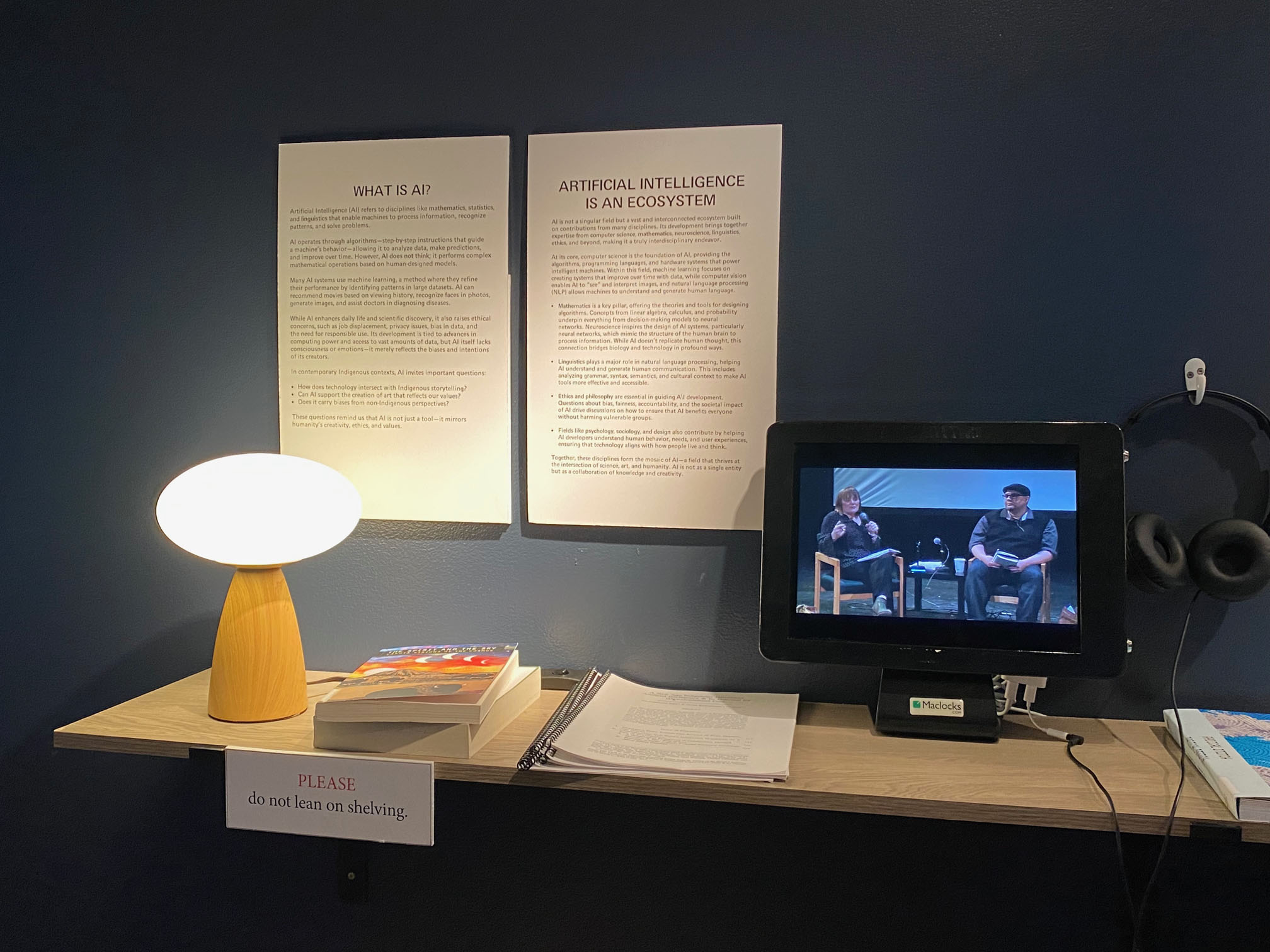
Installations in the other half of the exhibition shows collaborative projects that combine Indigenous knowledge systems and AI. Along one wall in the spectacular, tranquil gallery, you can explore a print and digital resource library on international research programs that integrate Indigenous knowledge systems into AI design.

Abundant Intelligences – a library and digital resource station for information on AI and futurism in contemporary Indigenous art.

Oneiris is a large interactive station through which visitors are invited to generate dream symbols that AI adds into a wall-sized display that looks like a portal to the cosmos. Inspired by the Lakȟóta concept of a Dream Language, she and her many technical collaborators genuinely bring dreams to life.

Oneiris – a collaborative project using advanced AI models to allow visitors to bring dreams to life.

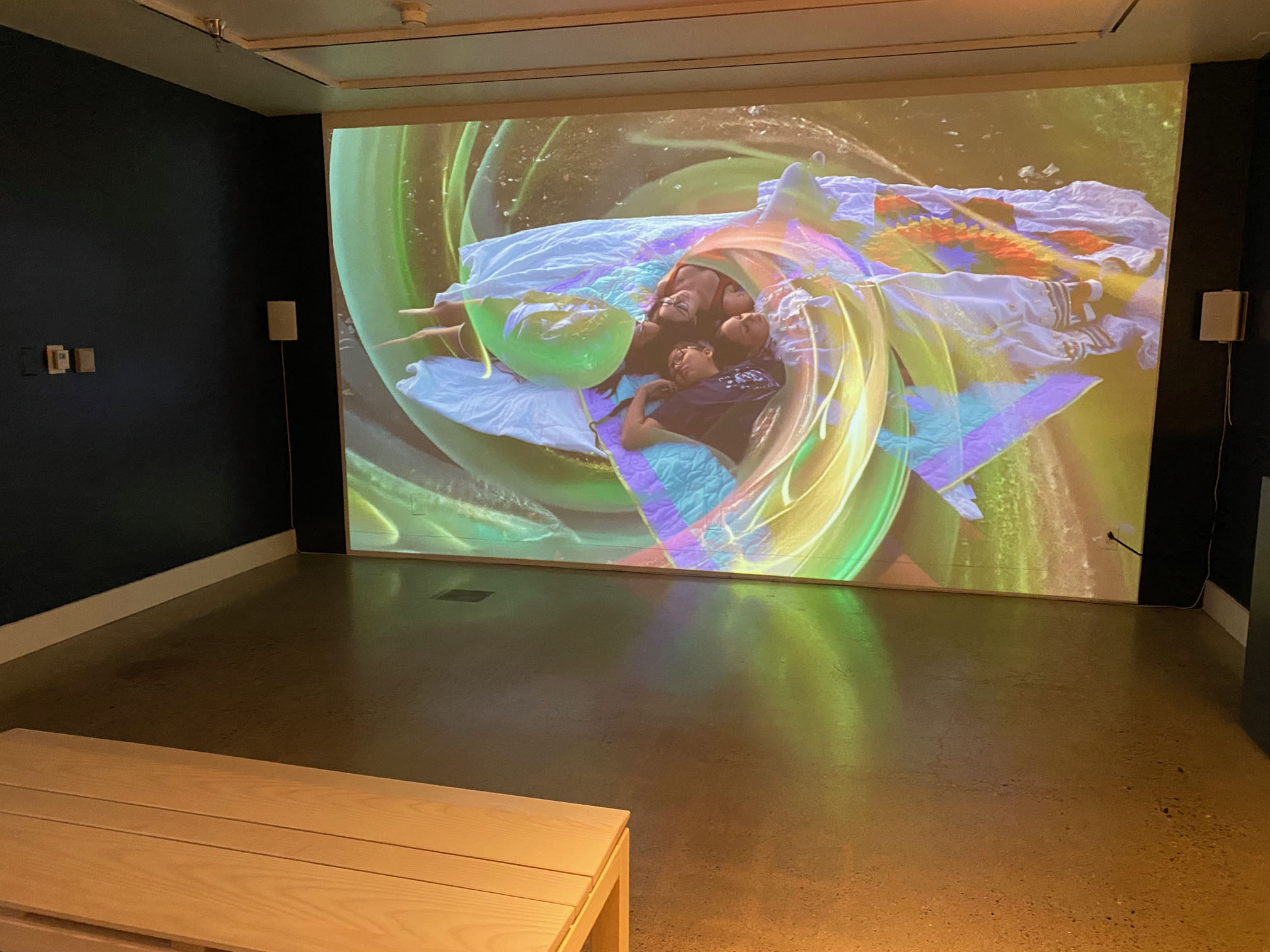
Spashed across the final wall of the space, The Land Paints Itself is a video collaboration with her Wíhaŋble S’a Center for Indigenous AI at Bard – a lab that explores Indigenous advances in this science and art. Watch as AI generates dazzling colors and patterns as four Lakȟóta dream about Indigenous futures. Kite suggests that the evolving technology of dreams is a legitimate way for her nation to envision ways forward.

2025 The Land Paints Itself video that uses AI to illustrate Lakhóta people’s dreams about Indigenous futures.

Provocative, visionary, and affirmative – meet Kite herself in an interview with Artforum editor Tina Rivers Ryan in March 2025, when Kite’s work was featured on the cover.

Marsden Hartley: A Modernist on the Move

With his traveling valise sitting in the center of the introductory gallery and a map nearby, you understand instantly that superstar artist Marsden Hartley was a man on the go.

Marsden Hartley: Adventurer in the Arts, on view at the New Mexico Museum of Art in Santa Fe through July 20, 2025, uses his personal possessions, works painted on two continents, and non-stop itinerary to demonstrate how landscape, life, and modern-art legends led him to create an epic body of work.

Take a look at our favorites in our Flickr album.

Hartley’s 1914 Berlin Series, No. 2 – flat, abstracted natural symbols. Courtesy: Jan T. and Marica Vilcek Collection.
Ready to travel – Hartley’s leather valise, address book and luggage tags. Courtesy: the artist’s estate; Bates College Museum of Art.

Looking around, there’s a wall of Maine mountainscapes he did in his thirties, a painting done just after Stieglitz sent him to Paris to soak up the vibes in Gertrude Stein’s salon, his accessories of rings and cigarette cases from Berlin in the 1920s, a Fauve-ist impression of Mount Saint-Victoire at Cezanne’s old stomping grounds in Aix, and photos of him and his dog at his Maine studio in the 1940s.

Hartley’s 1927 oil Mont Sainte-Victoire – painted in Aix, France where Cezanne once lived. Courtesy: Jan T. and Marica Vilcek Collection.

The exhibition merges Hartley’s paintings from the Jan T. and Marica Vilcek Collection with items donated by his favorite niece to Bates College in Maine – items he collected as he traveled; sketches and stuff sent to his neice; his camera, books, and snapshots; his studio paintbox, and other personal art. Together, the exhibition tells a story of innovation, personal journey, and relentless art making.

Hartley’s personal photos from his 1920s European adventures. Courtesy: Bates College Museum of Art

Hartley emerged from a hardscrabble childhood to see, feel, and experience art, nature, and transcendental spiritualism in New York, Boston, and Maine in 1890s.

He loved painting mountains and depicted water, earth and sky as a color-filled flat plane filled with jabbing brushstrokes – an approach that stuck with him throughout his life as he journeyed through New Mexico, the Alps, Mexico, and back in Maine.

Hartley’s 1907-08 oil Silence of High Noon – Midsummer painted in Stoneham Valley, Maine. Courtesy: Jan T. and Marica Vilcek Collection.

By the time he was in his early thirties, he had shown his landscapes to The Eight, knocked on Stieglitz’s gallery door, and got a one-man show (and a dealer for the next 20 years) at 291, the hottest modern art gallery in America.

Hartley’s 1910 Untitled (Maine Landscape)– water cascading down a rock face. Courtesy: Jan T. and Marica Vilcek Collection.

Getting to Europe in 1912, the color, cubism, and symbolism of the Blue Rider, Matisse, and Picasso made his head spin. His German friends introduced him to Kandinsky’s book Concerning the Spiritual in Art. He went out of his way to meet the man himself, and his painterly wheels turned.

The second gallery presents a large work from his Cosmic Cubism series – an airy, dreamy arrangement of signs, spiritual symbols, colors, and planes – along with drawings from his Amerika series, based loosely on Native American symbols and other abstract shapes. On view for only the second time in the United States, Schiff is a dazzling creation drawing signs and symbols from Native American and Egyptian cultures that spill out onto the painted frame.

Hartley’s 1912-1913 Portrait Arrangement, No. 2, created in Paris. Courtesy: Courtesy: Jan T. and Marica Vilcek Collection.
Schiff – part of the Amerika series Hartley painted in Germany. Courtesy: Vilcek Collection.
April 5 – July 20, 2025

Up to this point, Hartley’s only encounter with indigenous American culture came from visits to ethnography museums in Paris and Berlin, but that would soon change. The advent of World War I tore apart the avant-garde, his social circles, and the direction of his work. Although these Berlin abstractions were long considered by late 20th century critics to be the high point of his career, Hartley abandoned this artistic path when forced to return to the United States, started over, kept wandering, and went back to landscapes and still lifes to discover his “American” expressionist vision.

Hartley’s 1934 Autumn Landscape, Dogtown – a colorful painting made near Gloucester, Maine. Courtesy: Jan T. and Marica Vilcek Collection.

The exhibition does not unfold chronologically. Instead, it shows how much friends, place, and spiritual encounters affected him.

Near the Berlin abstractions are highly expressionist 1930s rockscapes from Maine and pointy Alpine peaks from his return to Bavaria. There’s an example of his stripped-down 1916 “synthetic cubist” work in Provincetown, a 1917 New England still life painted in Bermuda when he was budget-bunking with Demuth, and a red-saturated still life that is a therapeutic tribute to his Nova Scotia friends who died at sea in the late Thirties.

Hartley’s 1942 White Sea Horse – part of a series with vivid backgrounds done in Maine. Courtesy: Jan T. and Marica Vilcek Collection
Hartley’s 1935-39 Roses for Seagulls that Lost Their Way –made in Bermuda to honor his Nova Scotia friends lost at sea. Courtesy: Jan T. and Marica Vilcek Collection.

In the middle of this gallery are vitrines with highly personal, everyday stuff from a painter who never settled down, stayed on the move, and always kept creating.

Here’s his camera, a scrapbook of personal photos, his 1923 published book of poetry, a few books from his library, and a little toy and pressed flowers sent to his niece.    

Hartley’s photos from his 1917-1918 trip to Santa Fe. Courtesy: Bates College Museum of Art

Except for the Provincetown piece, all the surrounding paintings have direct, bold outlines, vivid colors, and vigorous, unglamorized visions – a fitting prelude to the last gallery of New Mexico landscapes.

Hartley’s 1919 El Santo painted in New Mexico.

The final gallery provides a panorama of landscapes, plus a dramatic image of a ridge of Mexican volcanoes. Hartley only spent part of

1918 in Taos and Santa Fe, where he traversed the hills, attended Pueblo ceremonies, and wrote about the indigenous culture. He also completed his El Santo still life with a black-on-black ceramic vase, a striped textile, and a Northern New Mexican retablo of a suffering Jesus.  

But it might be a surprise to learn that all of the Southwest landscapes were painted in Berlin in the 1920s – fittingly called his New Mexico “recollections” – or in Mexico in the 1930s.

Floating clouds, expressive lines, and abstracted mountains – all from his vivid mind and recollections of spiritual and physical experiences long past.  In the 21st century, increasing numbers of art historians and artists have looked to this phase of Hartley’s work for insight and inspiration – bold brushwork, expressive memory, and both a spiritual and emotional creative process.

Hartley’s 1923 oil New Mexico Recollection #14– painted in Berlin based upon memories of his year in the Southwest. Courtesy: Jan T. and Marica Vilcek Collection.
Hartley’s 1932 oil Lost Country – Petrified Sand Hills – a symbolic landscape inspired by mystical texts he discovered while painting in Mexico. Courtesy: Jan T. and Marica Vilcek Collection.

Toward the end of his life, the accolades, awards, honors, and retrospective exhibitions came his way, but Hartley remained the hardscrabble “painter of Maine,” barely interested in cashing the checks.

His niece, who preserved her uncle’s posessions and legacy after his death in 1943, took a train trip to New Mexico for the first time to see the landscapes that so inspired her uncle. Upon emerging from the train at the stop near Santa Fe, she looked up to take in the big, dramatic, cloud-filled sky. Thinking of all her uncle’s landscapes, she said, “Those clouds…I’d recognize them anywhere!”

If you see this show in Santa Fe, you will, too.

Louise Zelda Young’s 1943 photo Marsden Hartley’s Studio, Corea, Maine, where he worked in his final years. Courtesy: Bates College Museum of Art.

Contemporary “Echoes” at The Wheelwright

Since its founding in 1937 as an institution documenting Navajo ceremonial art, Santa Fe’s Wheelwright Museum of the American Indian has shifted toward collecting contemporary Native American art and serving as a platform to boost careers of emerging artists.

The latest exhibition pays tribute to its last 50 years in Echoes: Selections from the Wheelwright Museum’s Permanent Collection, on view through June 8, 2025

The exhibit showcases well-known artists – like Tony Abeyta, T.C. Cannon, Virgil Ortiz, Rose B. Simpson, Bob Hazous, and Emmi Whitehorse – but the curators deliberately chose early-career works that haven’t been seen for a while. 

Virgil Ortiz’s (Cochiti) 2005 ceramic sculpture Monos Figure with Diego Romero’s (Chochiti) 2005 bowl Tenga Cuidado Con Griegos Salvo Obseqios.

For example, on a wall honoring T.C. Cannon, the curators showcase a crazy, irreverent David Bradley work painted in T.C.’s bold, satirical style, but display a rather conservative (and rarely seen) woodcut by T.C. himself.

David Bradley’s (Minnesota Chippewa) 1979 acrylic Remembering T.C. Cannon in the style of his hero.
T.C. Cannon’s (Kiowa/Caddo) 1977 woodblock print Hopi with Manta.

Contemporary textile artist Ramona Sakiestewa’s comment that her work represents “visual echoes of what came before” inspired the title of the exhibition. Sakiestewa’s tapestry incorporates colors and motifs of traditional Hopi wicker plaques.  This theme is carried throughout the show.

Ramona Sakiestewa’s 1992 Basket Dance/9-B echoes a traditional woven Hopi ceremonial plaque.

A grouping of intricately painted Acoma ceramics pays tribute to the Wheelwright’s 1981 exhibition Sky City Salute that honored two matiarchs of that art form – Lucy Lewis, who lived at Acoma before and after tourists began beating a path to the ancient mesa-top city, and Marie Z. Chino. The curators match it with work by Marie’s grandson, Robert Patricio, who channels traditional themes into a modern ceramic context.

Acoma legacies: a 1965-85 seed pot and 1958 bowl by Lucy Lewis, and large 1980 storage jar by Marie Z. Chino.

Another grouping references the Wheelwright’s 2011 show Radical Recycled Jewelry Makeover with a bold piece by Kenneth Johnson and the Wheelwright’s stellar collection of Zuni bolo-tie inlays.

Kenneth Johnson’s (Muscogee/Seminole) 2011 necklace from recycled pearls, jade, gold, and silver..
1970s-1980s thunderbird bolo by Owen Bobelu (Zuni); inlaid silver, jet, turquoise, and mother-of-pearl.

The “salon wall” is peppered with paintings that tell the interconnected histories and styles of nine Native artists – the trajectory from flat-style styles of the 1920s and 1930s to more open innovation of Ben Harjo and Linda Lomahaftewa, some of earliest graduates at the Institute of American Insitute Arts (IAIA).

The exhibition also presents another group of work to acknowledge the artists who began working together in Scottsdale in the 1950s and who began IAIA in 1962 – clothing designed by co-founder/president Lloyd Kiva New and jewelry by instructor Charles Loloma..

Lloyd Kiva New’s (Cherokee) 1950s man’s shirt with Andrew van Tsinajinnie (Diné) printed fabric and Charles Laloma (Hopi) silver buttons.
Charles Laloma’s 1970 silver, coral, turquoise pin.

Beaded Converse sneakers by Marie Flying Horse, clever collage by Arthur Amiotte, a dinosaur pot by William Andrew Pacheco, art-world satire by Bob Hazous, and colorful Seurat references by Shonto Begay all add up to a vibrant walk through the last half-century of contemporary art innovations inside the hogan on Museum Hill.   

Take a look at our favorites on Flickr.

David Bradley’s (Minnesota Chippewa) 2004 acrylic To Sleep Perchance to Dream – a take on Rousseau

Santero Nicholas Herrera at the Harwood

The local artist honored in Taos with a lifetime retrospective lives and works only 18 miles from Georgia O’Keeffe’s famous home in El Rito. But their work, lives, purpose, and legacy couldn’t be further apart.

Nicholas Herrera: El Rito Santero, on view at the Harwood Museum of Art through June 1, fills three galleries with work by a New Mexican wood carver who not only pays tribute to saints and ceremonies important to the nearby rural Hispanic communities, but also channels politics, social commentary, lowrider culture, and pressures of modern life in a mixed-up world into his craft.

Herrera’s Espiritu mixes religion with found car parts. Courtesy: private collector

It’s a colorful, irreverent, heart-felt tribute to the people, places, religion, and culture of the rural high hills that he calls home. And here’s Herrera’s self-portrait – the namesake of this engaging retrospective.

Herrera’s 2022 hand-carved self-portrait – El Rito Santero. Courtesy: private collection
Herrera’s1998 hand-carved image of his favored protector La Virgen de Guadalupe. Courtesy: Evoke Contemporary

At first glance around the gallery at the top of the back stairs, Herrera’s work seems firmly situated in the tradition of the last 400 years of northern New Mexico saint-carving. Since the 1600s, when Spanish farmers first colonized these remote hills, the faithful relied primarily on local artists and carvers to decorate home chapels, churches, and shrines.

Herrera’s work is the 20th century version. There’s a grand, colorful painted altar honoring his brother in which a pantheon of Catholic icons gazing benevolently upon you. You’ll also meet his special icon – a bright, enigmatic Lady of Guadalupe.

In a small, dark room you’ll experience a powerful home altar, filled with hand-carved spiritual tributes, surrounded by candles and and all manner of other-worldly retablos.  

But the next two galleries, you’ll encounter work using these same materials and techniques, but reflects life-changing events in the artist’s life that are mashed up with ancient spiritual traditions – Jesus in the back of a speeding cop car, Herrera’s own near-death experience in a car crash when he was in this twenties, and a crazy lights-flashing slot machine promising allures that only the Devil can love., or aerial views of old Spanish valleys.

Herrera’s 1994 painted wood and mixed-media sculpture Protect and Serve with Jesus in the back seat of the patrol car. Courtesy: Smithsonian American Art Museum
Herrera’s 1995 painted wood and metal Los Alamos Death Truck. Courtesy: private collection

Like all great artists, Herrera is inspired from life events and the world around him – reflections about his growing up and home life, land-use and traditions in his community, and issues ripped from the headlines, like the terror of transporting Los Alamos nuclear waste or issues with the border patrol.

Herrera’s 2008 mixed-media El Agua y la Tierra no se Venden, highlighting the importance of 400 years of protective land stewardship in Northern New Mexico.

Used car parts, toy parts, and other stuff from the junkyard “tell” Herrera how and where he might use them. Lowrider culture is an important source of price in Northern New Mexico, so it’s not surprising that he’s channeled that part of the local experience into his work, too.

The Holy Family hits the road in Herrera’s 2005 carved and painted Low Rider Nativity, embellished with cloth, toy wheels, and found metal. Courtesy: private collection

See some of our favorite works in our Flickr album, and meet the artist himself in this short video profile created by the Smithsonian American Art Museum: