When Apple Met Alto and Game Boy Began

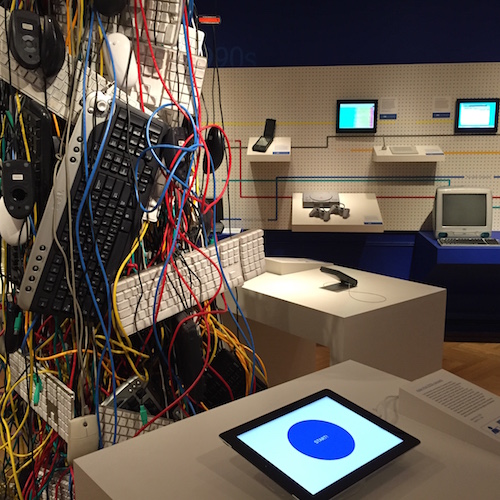
Tower of keyboards and wires in the center of the fourth-floor gallery; Newton visible against the history wall

Tower of keyboards and wires in the center of the fourth-floor gallery; Newton, PlayStation, and iMac visible on the history wall as iPad watches over everything

What’s the longest you ever sat in front of a computer screen or stared at stuff on your phone? Can you even remember a time before there were texts, browsers, and interactive screens? Bard Graduate Center Gallery has assembled a retrospective that asks you to remember your first keyboard, joystick, trackball, and mouse in their exhibition, The Interface Experience: Forty Years of Personal Computing, on view through July 19.

Plus, you can touch everything in the show and even sort through maybe every clamshell and Internet-enabled cellphone ever designed. What a stroll down memory lane!

Your first view of the fourth-floor show is a tangled tower of keyboards and cables, surrounded by a pegboard gallery with little platforms displaying the timeline of devices – desktop PCs, tablets, and game consoles.
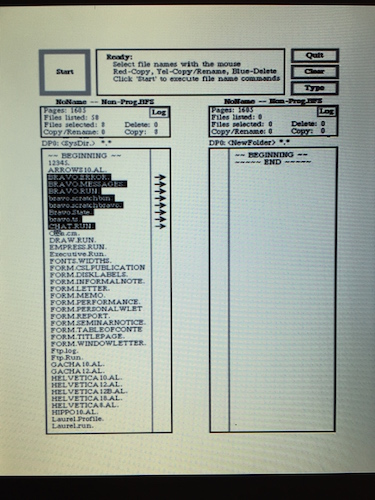
The 1973 Xerox Alto operating system featured the first mouse and graphic user interface.

The 1973 Xerox Alto operating system featured the first mouse and graphic user interface.

The oldest item in the show is the famous (but rarely glimpsed) 1973 Xerox Alto operating system, which the curators display on an ever-playing loop. Experience what Steve Jobs saw when he came face to face with the first graphical user interface, replete with the screen arrow. Brain flash on using a mouse to point to stuff on a screen – Steve said that someday everyone would be using something like this interface.

Walk on to see the Apple IIe (Woz built in an unbelievable 64K of RAM), VisiCalc (first “killer app” all quants had to have – a spreadsheet), and the predecessor to Steve’s Macintosh – the 1981 Xerox Star, which was the first commercially produced computer system to use a mouse and GUI. At a price of $16,000 in 1981, Steve’s up-and-coming Apple Macintosh was positioned to become a winner.
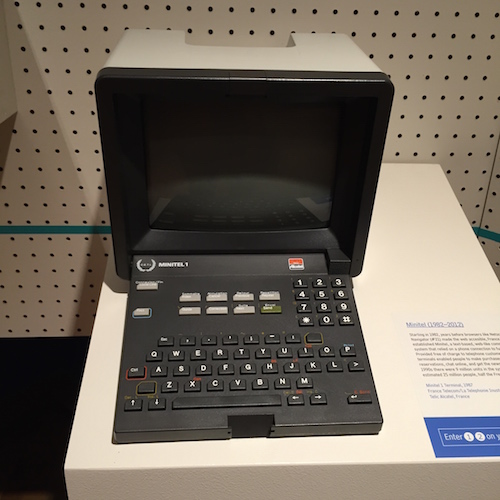
Before web browsers: Rarely seen, the exotic Minitel (1987 model) text information interface, which the French government distributed for free to half its population.

Before web browsers: Rarely seen, the exotic Minitel (1987 model) text information interface, which the French government distributed for free to half its population.

The Commodore 64 and IBM’s PC aren’t neglected, and neither is MS-DOS. Consider other game-changers such as Palm Pilot, Newton, and Kinect. You can touch them all and remember the way it was before things got smaller, faster, and got more oomph. Get a glimpse of the installation (pegboards and all) on our Flickr feed.

Don’t worry if you can’t get up to 86th Street to handle the technology in person. As usual, Bard’s students and faculty, who collaborated on this show, have produced a highly fulfilling web application that highlights everything in their show, adds historic tidbits, and shows each piece’s original print and TV ads.

Click on “Grid” to see all the exhibition items. Click on “Connections” to read interesting comments by the curators comparing different items or telling little histories about the relationships between the tech innovations. Click on “Device Statistics” to see how many units of each sold, how long it was in the market, and how much each would cost in today’s dollars. You’ll be able to sort the items by any of these parameters.

Steve’s hip and happening1998 iMac injected color into a drab, drab desktop computing world

Steve’s hip and happening1998 iMac injected color into a drab, drab desktop computing world

Example: sorted by today’s cost, the most expensive computing investment in the show would be the Xerox Alto operating system at (today) $225,981.

Be sure to click on “more” and enjoy the gallery of magazine ads for these innovations. And check out the 1979 TV commercial for Xerox Alto, on loan from the Xerox Archives, and please, do not miss the unforgettable all singing and dancing MS-DOS product introduction video.

You’ll read memories shared by gallery visitors about various items in the exhibition. For that matter, click on any item on the Grid and add your own story about your first personal encounter with these icons!

Bravo, Bard Graduate Center!
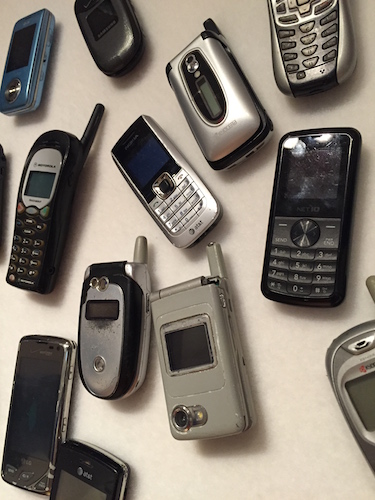
Mobile phones for days – the future of computing. The curators put these up with Velcro so visitors could feel them.
Mobile phones for days – the future of computing. The curators put these up with Velcro so visitors could feel them.
Bird Watching with Audubon: Forget the Binoculars

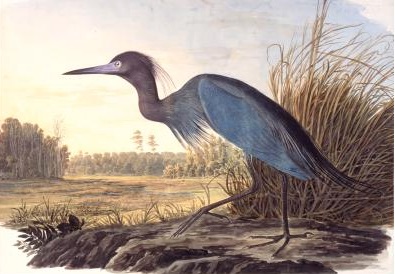
Little Blue Heron (Egretta caerulea), Havell plate no. 307, 1832

Little Blue Heron (Egretta caerulea), Havell plate no. 307, 1832

If you climb up to the second story of the New-York Historical Society to see Audubon’s birds, grab the magnifying glass right inside the gallery door. See the magnificent details painted by the watercolor master of all time in  Audubon’s Aviary: The Final Flight (Part III of The Complete Flock), running through this weekend.

NYHS is the lucky owner of every watecolor JJA produced to make his historic Birds of America subscription project in the early 1800s, which documented over 700 species.

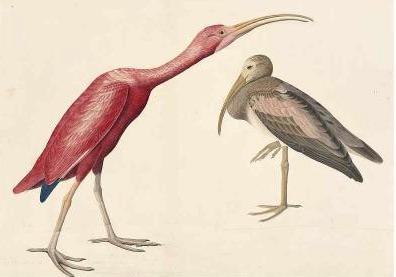
Scarlet Ibis (Eudocimus ruber), Havell plate no. 397, 1837

Scarlet Ibis (Eudocimus ruber), Havell plate no. 397, 1837

The watercolor collection – from which engravings were made – is so large that NYHS had to split the exhibition into three parts. It’s a joy to look at the life-size paintings that Audubon produced through the magnifying lens, seeing the tiny brushstrokes on lush feathers and miniscule detail on the small hummingbirds.

Paintings featured in all three shows are hung in the sequence that JJA painted them. Although JJA traveled extensively throughout the East and South, he never actually saw birds west of the Missouri in the wild.
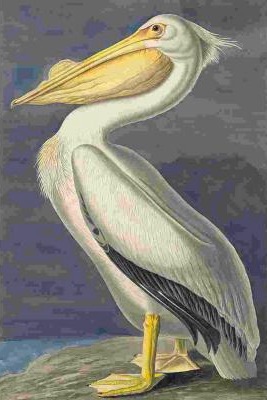
American White Pelican (Pelecanus erythrorhynchos), Havell plate no. 311

American White Pelican (Pelecanus erythrorhynchos), Havell plate no. 311

By the time Audubon began cranking out the watercolors needed for his final installment of his masterwork, lots of new birds were being discovered out West. Scrambling to keep up – after all, he committed to documenting every American bird – he accessed specimens collected by recent Western expeditions, Lewis & Clark’s trove, and other American specimens archived in Europe.

He holed up in Charleston, South Carolina in the winter of 1836 and worked, worked, worked to finish all the watercolors, which would be shipped to Mr. Havell in the UK for engraving.

How did Mr. Auduon’s studio work compare to the real thing? See for yourself in this bird-watching documentary shown inside the gallery. The birds featured are from the previous installation of the exhibit, including the rare, rambunctious Prairie Chicken at 1:25.

For more, go to the show’s excellent website, explore some of JJA’s works in more depth, and listen to the bird calls for the exhibition, courtesy of the Cornell Lab of Ornithology.

Ennion: Luxury Tableware at The Met

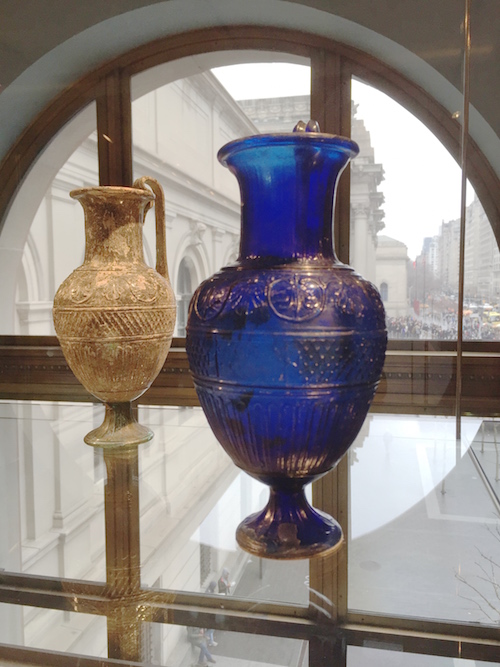
Two identical one-handled Ennion jugs from different sites. On right, the only Ennion piece with an intact foot, 1st c. A.D.

Two identical one-handled Ennion jugs from different sites. On right, the only Ennion piece with an intact foot, 1st c. A.D.

It’s unlikely that you have any of this sought-after designer’s pieces accompanying your best table setting or that the MAD Museum has any of his hand-blown, molded glassworks in their collection.

Two thousand years before ABC Carpet began retailing high-end home goods on Broadway and Martha Stewart branded her at-home lifestyle line, a Mediterranean craftsman in Sidon, Lebanon (then Phoenecia) created a line that every aspiring tastemaker in the Roman Empire just had to have. The Metropolitan Museum of Art pays tribute to his output in Ennion: Master of Roman Glass, on view just off the Greek-Roman study galleries through April 12.

Who needs old-fashioned metal cups or pottery jugs on the well-laid Roman table when Ennion was creating stunning cobalt-blue and transparent glass equivalents?

Two-handled cup, with Ennion’s Greek brand (“Ennion made this/it”). Blown glass into mold, 1st c. A.D. Courtesy: Turin museum; other by private collector

Two-handled cup, with Ennion’s Greek brand (“Ennion made this/it”). Blown glass into mold, 1st c. A.D. Courtesy: Turin museum; other by private collector

Ennion’s workshop was on the cutting edge of a manufacturing-and-craft revolution – blowing glass into decorative molds (which took the guesswork out of creating place settings for four, six, or ten) and exporting sets for sale throughout The Empire.

Ennion’s competitors were doing the same, but Ennion of Sidon had the big brand emblazoned on his work, working it into the design in the same way that MK, DKNY, DVF or YSL do today. His logo was written in Greek, the universal language of the first century: ““Ennion made me/it.” Scholars reckon that it was all made and exported from Sidon, a first-century glassmaking powerhouse, since none of Ennion’s molds featured a bilingual brand.

After two millennia, only about 50 of Ennion’s gorgeous works remain, and the Met’s show has assembled about half that amount from its own collection (courtesy of master-collector J. Pierpont Morgan), the Corning Museum, private collections, and other museums of antiquities in Israeli and Europe.

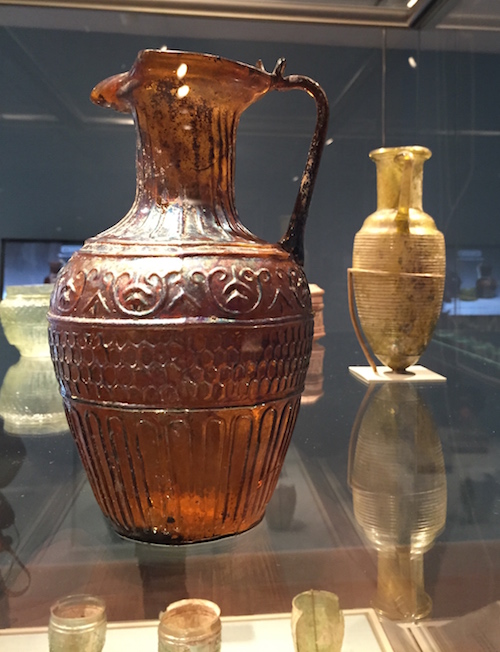
Non-Ennion glass jug made in a four-part mold; right, a two-handled amphora blown into a three-part mold, ist c. A.D. Source: The Met

Non-Ennion glass jug made in a four-part mold, 1st c. A.D. Source: The Met

In addition to Sidon, Ennion’s output has been found in excavations of ancient homes in places as far flung as Jerusalem, Croatia, Italy, and Spain. The Met’s team has had fun displaying glassware from identical molds next to one another, despite the fact that pairs were discovered thousands of miles from each other at different archeological sites.

Check out the Met’s beautiful tribute to a master artist on our Flickr feed.

Sturtevant’s Mini-MoMA Imitation Game

Sturtevant’s 2004 piece — a reproduction of an light bulb and cord installation “ Gonzalez-Torres Untitled (America)”. On far wall, “Study for Rosenquist’s Spaghetti & Glass”, an oil painted in 1965-1966

Sturtevant interprets Gonzalez-Torres Untitled (America) (2004). On far wall, Study for Rosenquist’s Spaghetti & Glass, an oil painted in 1965-1966

The free Friday night crowd at MoMA could not get enough of the Elaine Sturtevant tribute, Double Trouble, closing this weekend. Sturtevant spent her long career creating ready-mades out of other people’s art.

The show is a who’s who of 20th century art, except that all the pieces were done by Ms. Sturtevant. The show has it all – an entryway plastered with Warhol’s cow wallpaper (done by her), Lichtensteins, Rosenquists, Johns oil paintings – all done in her hand. Take a walk through our Flickr site and see more in the photos on the curator’s blog.

It’s all imitation, except that Elaine’s versions are really, really good. It’s hard to tell them from the originals displayed through the rest of the museum. Nothing in the show is a line-by-line copy, but you’ll have to go MoMA’s permanent galleries to compare them with the real thing.

Sturtevant’s 1967-1968 oil on canvas,Study for LIchtenstein’s ‘Happy Tears’

Sturtevant’s 1967-1968 oil on canvas, Study for LIchtenstein’s ‘Happy Tears’

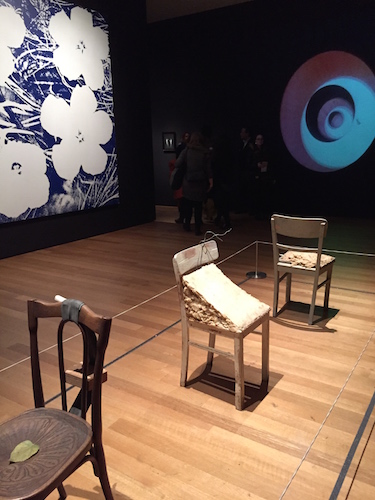
In fact, MoMA encourages a trek upstairs to compare Duchamp’s own ready-mades and whirligig. Or Mr. Beuys slabs of fat with those sitting on Sturtevant’s chairs in the darkened gallery.

Can anyone distinguish the Warhol Wall Flowers that Elaine made from the reproduced images of the originals on the stuff all over the gift shop?

The Gonzalez-Torres installation was the dramatic high point, all flashy bulbs in a charismatic, mysterious circle near the pretty perfect interpretations of early video games. Everyone is having a blast lining up to contemplate Sturtevant’s walk down digital memory lane with her interpretation of Pacman 1.0.

Is that Sturtevant’s Duane Hanson museum security guard reproduction in the corner? Oh, no, it’s an actual MoMa guard! Sorry. Just about everything else is a fool-the-eye art encounter. Total fun in the white cube.

Sturtevant’s 1990 vision of Warhol’s Flowers alongside her 1968 Duchamp film with interpretations of three Beuys chairs

Sturtevant’s 1990 vision of Warhol’s Flowers alongside her 1968 Duchamp film with interpretations of three Beuys chairs

Sending a Message by Dressing in Black

Dramatic 1861 British mourning attire in black silk moiré.

Dramatic 1861 British mourning attire in black silk moiré.

When the curators at the Metropolitan Museum of Art were researching collections for last year’s Impressionism-fashion show, they noticed something curious – a disproportionate number of luxurious 19th century American dresses in black. The black silhouettes found in the Costume Institute’s collection formed the basis for their first fall exhibition in seven years, Death Becomes Her: A Century of Mourning Attire, closing this weekend.

The show is a sumptuous walk-through of the years spanning the 1840s to the early 20th century, when fashionable women telegraphed their status as widows, paid tribute to fallen heroes, and acknowledged the passing of a member of the British royal family through dress, hats, parasols, rings, brooches, and other purchases. Click here to see our Flickr feed, and here for the Met’s own gallery views.

1868 wedding ensemble designed by West Virginia bride to honor casualties of the Civil War

1868 wedding ensemble designed by West Virginia bride to honor casualties of the Civil War

Fashion became such a rich language that the women in the 19th century felt “forced” to conform, according to associate curator Jessica Regan. It was an expensive proposition, and during the hard times of the American Civil War, many women stopped worrying about what others might think if they didn’t conform. If you didn’t have the cash to commission a new frock, it seemed to be OK just to dye an old one black.

As fashion magazines and periodicals became ubiquitous, middle-class and elite-status women eagerly sought styles that telegraphed sorrow while maintaining an up-to-the-minute silhouette.

Men of the 19th century were essentially wearing all-black suits, so the show’s focus is squarely on the ladies and the complex codes of mourning-attire etiquette. For example, after a sufficient period of time, a woman could introduce a bit of grey into her wardrobe, then mauve.

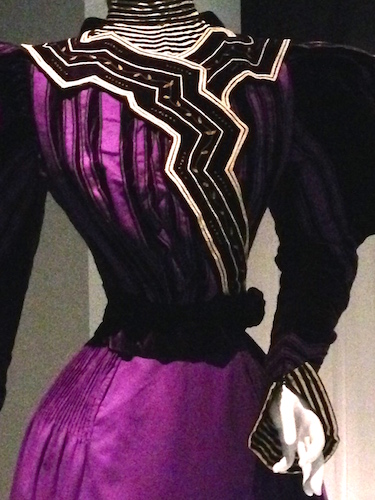
1894-1896 half-mourning dress purchased at James McCreery at 180 Broadway,when machine sewing was more common

1894-1896 half-mourning dress purchased at James McCreery at 180 Broadway,when machine sewing was more common

The team has assembled stunning examples of each from local collections (the now in-house Brooklyn collection, New-York Historical Society, and the Museum of the City of New York) as well as from the V&A’s collection in London. The most dramatic all-black look is the sweeping silk moiré gown from 1861 Britain. Perhaps the most startling is the 1868 a all-black bridal gown designed for a West Virginia bride who chose to pay tribute to fallen Civil War soldiers on her happy day.

Boutiques within department stores catered to mourning clothes buyers. Entire warehouses were filled to the brim with essential accouterments for the correct “look”. By the 1860s, mass-production of fabric increased the accessibility of the raw materials. A few decades later, heavy fabrics fell out of fashion in favor of lighter weight, more flowing options.

The 1890s fashions feature the best from New York department stores, including a mourning dress emblazoned with a bold geometric design.

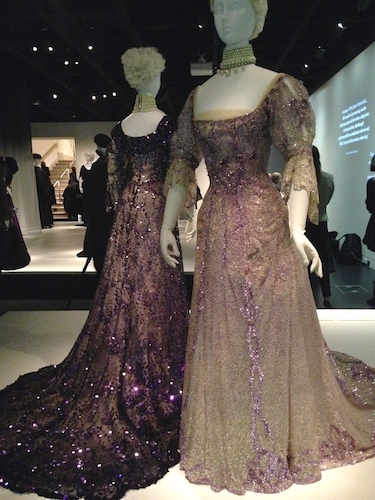
1902 dresses worn by Queen Alexandra to mourn Queen Victoria’s death. French tulle, chiffon, and sequins.

1902 dresses worn by Queen Alexandra to mourn Queen Victoria’s death. French tulle, chiffon, and sequins.

A conservative black dress worn by Queen Victoria stands in stark contrast to the sparkly mauve gowns worn in tribute to her by Queen Alexandra – exquisite and subtle, but not really subdued. The spotlights emphasize the delicate pizzazz of these French confections.

By 1910, wearing all black became fashionable, decoupling the color from its sorrowful past. The show concludes by noting that World War I essentially brought an end to mourning-attire traditions and fashions in Europe.

Enjoy this lecture by associate curator Jessica Regan here, posted on the exhibition home page.

Next up at the Costume Institute, Spring 2015: Chinese Whispers: Tales of the East in Art, Film and Fashion. Get out your cheongsams.

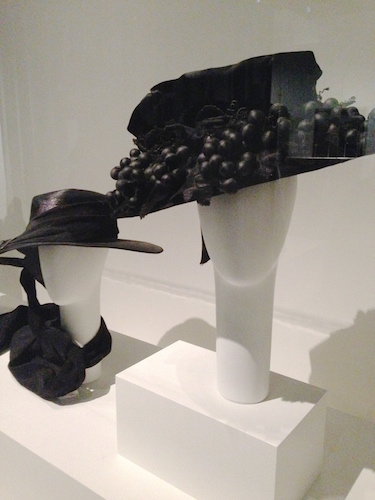
1915 Mme. Boué-Debat mourning hat with silk grapes from Brooklyn Museum collection at the Met

1915 Mme. Boué-Debat mourning hat with silk grapes from Brooklyn Museum collection at the Met

Philly Hosts Patrick Kelly’s Runway of Love

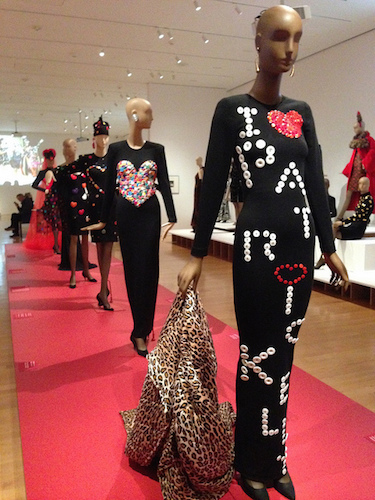
Mismatched button-inspired looks line the center runway in the show (1986)

Mismatched button-inspired looks line the center runway in the show (1986)

Supermodels having fun, crazy colorful buttons, zingy color, and tongue-in-cheek tributes to fashion’s greats – it’s all on display at the Philadelphia Museum of Art’s tribute to one of our all-time favorite fashion designers in the exhibition Patrick Kelly: Runway of Love, on through December 7.

Click here to see our favorite Flickr photos from the exhibition, which has been packed with fashion admirers throughout the show’s run. The gallery is ablaze with life, references to African-American heritage, supermodel sizzle, and the sheer joy that Patrick took in upending fashion’s icons.

The center runway features lots of Patrick’s iconic button dresses, evoking his grandmother’s way of using mismatched buttons to refresh his well-worn clothes as a kid in Mississippi. As a youngster, Patrick consumed acres of fashion magazines – Vogue and Harpers were his favorites – and high-tailed it to Paris as soon as he could.

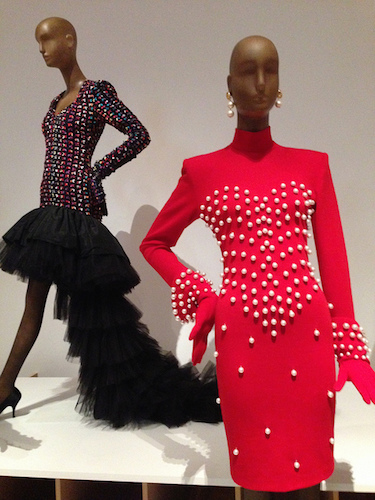
Always fun to spoof Chanel’s use of pearls (1988) and create a Ricci-inspired flamenco dress once modeled by Iman

Always fun to spoof Chanel’s use of pearls (1988) and create a Ricci-inspired flamenco dress once modeled by Iman

He made and sold voluminous coats (inspired by Issey Miyake and Balenciaga) on the streets of Paris to earn cash. But soon his cut-up jersey tube dresses caught the eye of editors of Elle. Maybe it was because he created them for his model-friends to wear on casting calls. When the “tubes” were published, Bergdorf’s placed an order, put his work in their windows, and his career was off and running.

He appropriated sly references to Black culture in the American South and put his own unique high-fashion spin – flouncy dance dresses made from bandana fabric, denim jumpers inspired by sharecropper wear, runway shows with models sporting Blackamoor turbans, and watermelon accessories. Paris went wild over his exuberant runway shows.

A lot of the excitement was over the models who walked his shows — Pat Cleveland, Iman, L’Wren Scott, and other beauties – who cavorted and flounced all his flirty and fun creations. Watch the trailer and see Patrick and his supermodels in action:


Patrick created a bit of fashion history in 1986 when Pat Cleveland interpreted Josephine Baker in Patrick’s famous Banana Dance costume, a collaboration with jeweler David Spada. The photos went viral.

Two looks inspired by Josephine Baker. Left, the “Banana Dance Costume” (1986), a collaboration with jewelry designer David Spada

Two looks inspired by Josephine Baker. Left, the “Banana Dance Costume” (1986), a collaboration with jewelry designer David Spada

The show features videos of Patrick sporting his familiar denim overalls, a joyful designer with a lot of love in his heart for his models, friends, and colleagues. It’s fitting that the museum has posted on its web the things that he loved best. Click here to see Patrick’s Love List and a photo of Bette Davis wearing one of his looks.

If you can’t get to Philly to see the show, click here to see the museum’s site and work your way through each mini-slideshow. The curator’s copy is attached to each look.

Thanks to Bill T. Jones for lending so many of Patrick’s inspired creations and to the museum’s web team that has created such a terrific documentation of this bright light.

And how does a fashion exhibition like Patrick’s all come together? Here’s a backstage look with the exhibitions team:


Tiny Show Tells Big Story at NY Historical Society

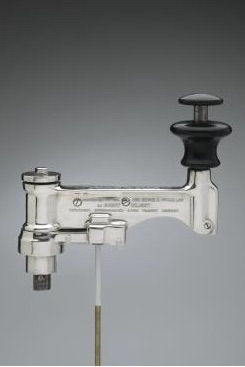
Tiffany & Co., Sterling silver controller handle used to operate NYC’s first subway train, 1904. Source: NYHS

Tiffany & Co., Sterling silver controller handle used to operate NYC’s first subway train, 1904. Source: NYHS

Has anything changed in New York in the last 400 years?

To celebrate the debut of a history book by Sam Roberts, the New-York Historical Society has filled its tiny second-floor gallery with A Brief History of New York: Selections from A History of New York in 101 Objects. Perhaps it’s always been about infrastructure, finance, and tourism. See for yourself through Sunday, November 30.

Many of the stories intertwine, and it’s fun to get insights from reading the backstories of the items on display, like the 1500s arrowhead and the 1700s oyster. We all know that New York City was the oyster capital of North America until the 1920s, but did you know that they were so abundant that crushed shells were used to line Pearl Street and provide the major component of the foundation mortar for Trinity Church on Wall Street?

Consider that the earliest guidebook to New York City (formerly New Amsterdam) was written in 1670, long before double-decker buses were trolling the mean streets.

New York's first guide book from 1640

New York’s first guide book from 1640

Mass-market media manipulations were born here as long ago as 1809, when young Washington Irving (who first used “Gotham” as a synonym the city in 1807) began posting missing-persons advertisements in a variety of city papers (the New York Evening Post is on display) to drive sales of his satirical political “history” of New York by a fictional Diedrich Knickerbocker. Move over, Buzzfeed.

City infrastructure highlights include Mr. Randal’s field books for laying out the Manhattan street grid in the early 1800s (see the digitized results here) and a snippet from the first transatlantic cable, deployed in 1854-1858. Queen Victoria sent an 88-word telegram to New York, which was officially received in an astounding 17 hours — an innovation at the time but significantly slower than dial-up AOL.

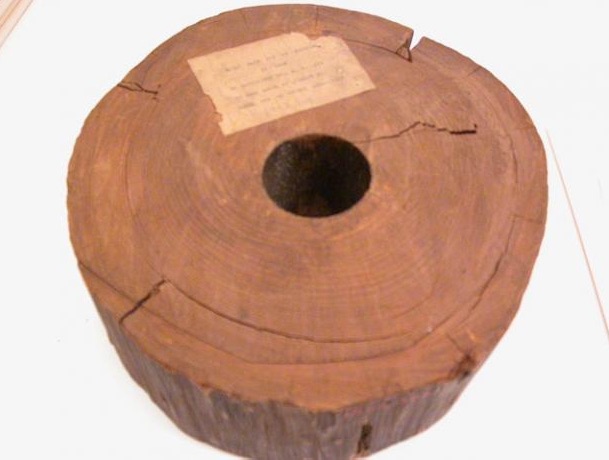
Visitors absolutely love the wooden water pipes on display at NYHS, but the show shares the fact that these were deployed by Aaron Burr, who got the state license to build New York’s first water system as part of his mission with The Manhattan Company. We’re used to hearing about the crumbling infrastructure under the streets today and contractors under-funding city technology projects, but this item underscores that it’s not a new story.

Section of water pipe, 1770-1804. The note says it was put into service in 1804 on Washington Street near Liberty Street and pulled out of the ground around 1911.

Section of water pipe, 1770-1804. The note says it was installed on Washington Street (near Liberty) in 1804 and pulled out of the ground around 1911.

Burr made money but let this innovative delivery system deteriorate. Instead of keeping the infrastructure up-to-date, he use the cash to build The Manhattan Bank (today JPMorgan Chase) to break the monopoly held by Mr. Hamilton’s Bank of New York – a rivalry that later escalated toward an historically tragic outcome. (See their dueling pistols in the lobby.)

On a happier note, one of the brightest objects in the show is the sterling silver Tiffany handle used to operate the first subway train in New York in 1904. Dignitaries used it to make the first run from City Hall up to 103rd Street on a day when 150,000 tickets were sold and New Yorkers took their first ride.

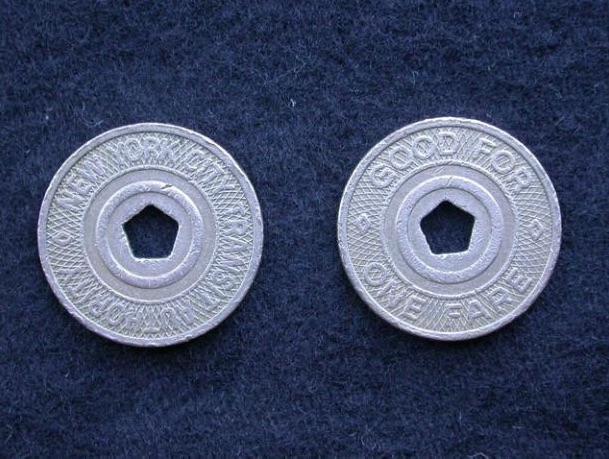
Subway tokens (1995-2003). Source: NYHS

Subway tokens (1995-2003). Source: NYHS

Although they only went extinct in 2003, the subway tokens mounted behind glass seem like ancient history – little round artifacts that look as though they should have been dangling from beaded wampum belts and not carried around as currency in the 20th century.

Thanks to NYHS for providing us with this illuminating capsule collection.

Sinclair Dinosaur Sneaks In and Out of Grand Central

Entrance to the show, featuring the 1964 monorail, transport of the future

Entrance to the show, featuring the 1964 monorail, transport of the future

Although he’s featured at the back, the famous Sinclair dinosaur from the 1964 New York World’s Fair has generated a lot of attention inside the New York Transit Museum’s show Traveling in the World of Tomorrow: The Future of Transportation at New York’s World’s Fairs, closing today.

Drawn in by the spectacular photo of the monorail, commuters and tourists visiting Grand Central have been roaming through the gallery and gift shop, checking out the photos, murals, and Dinoland movie that whisk them back to the transportation pavilions of the history-making 1939 and 1964 New York world’s fairs. What’s a dinosaur doing in the World of Tomorrow? It’s all about the car.

The 1939 World’s Fair was built on top of the Corona garbage dump during the height of the Great Depression, putting visionary architects and day laborers to work.

A 1964 New York Times photo of the Sinclair Dinosaur and Stegosaurus passing by the Empire State Building on their way to the Queens fairgrounds

A 1964 New York Times photo of the Sinclair Dinosaur and Stegosaurus passing by the Empire State Building on their way to the Queens fairgrounds

A futuristic subway station was built to deliver visitors to the fairgrounds from the A Line. You could enter a spaceship-shaped Flash Gordon amusement ride and watch the first 3D Technicolor movie ever produced inside the Chrysler pavilion.

The best was the legendary Futurama, where people could imagine a time where everyone owned their own car. The ride took them to the faraway year of 1960. Superhighways and curly exit ramps bisect acres of tall skyscrapers, with cars traveling on autopilot at the amazing speed of 55 miles per hour. Incredible!

Dinoland brochure from the Queens Historical Society

Dinoland brochure from the Queens Historical Society

Fast forward: The Sinclair dinosaur is part of the 1964 experience. By then, every family owned its own car. Sinclair’s long-necked, supersized Brontosaurus was a familiar icon to any family stopping to gas up along the newly completed interstate highway system, so why not mix a little magic, promotion, and science?

Sinclair built Dinoland and populated it with life-size replicas of nine dinosaurs. The exhibition has plenty of Dinoland souvenirs along with a movie clip of families seeing the Jurassic giant for the first time.

Robert Moses and Walt Disney look at the model of the 1964 World’s Fair. From MTA Bridges & Tunnels archives

Robert Moses and Walt Disney look at the model of the 1964 World’s Fair. From MTA Bridges & Tunnels archives

The show also pays tribute to the man who also brought another group of Mesozoic superstars to life inside the fairgrounds. Walt Disney designed four of the fair’s animatronics displays, including the robot cavemen and dinosaurs glimpsed in the Ford Motor Company’s “Magic Skyway” ride. There’s a terrific photo of New York’s Robert Moses alongside Walt, looking out over the model of the 1964 fairgrounds, and you can see the actual model itself, right inside.

Missed the show? You won’t see all the movies and hear the soundtracks that made the exhibition so exciting, but you can take a look at the galleries on our Flickr feed.

The 1964 car that everyone wanted — the Ford Mustang, which debuted at the fair

The 1964 car that everyone wanted — the Ford Mustang, which debuted at the fair

The Sistine Chapel of Fashion Virtuosity

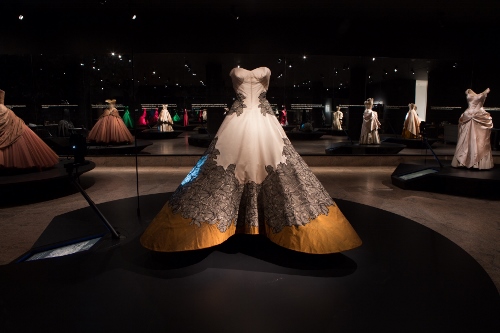
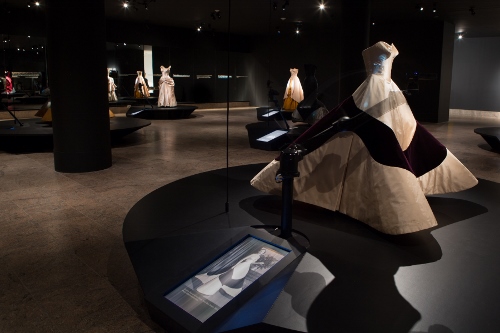
Clover Leaf Ball Gown – a 1953 silk faille, shantung, and black lace sculpture by Mr. James. Part of the Brooklyn Collection at The Met

Clover Leaf Ball Gown – a 1953 silk faille, shantung, and black lace sculpture by Mr. James. Part of the Brooklyn Collection at The Met

When the Brooklyn Museum handed its fashion archive over to the Met in January 2009, the first thought that crossed everyone’s mind was the mind-bending masterworks that would now be sheltered under the protective wing of the Costume Institute’s crack conservation team — “Oooh, maybe the Met will do a Charles James show!”

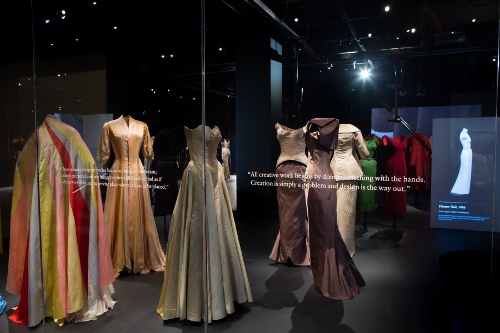
We’re glad to report that the Met has done this master proud and given his humble admirers a fitting place to worship in its triumphant two-gallery show, Charles James: Beyond Fashion, which ends this weekend, August 10.

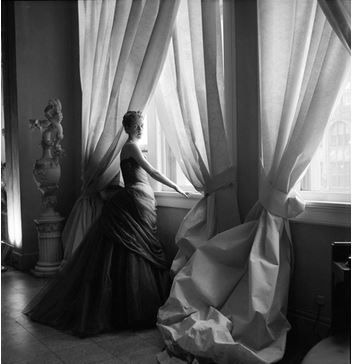
1952 portrait by Michael A. Vaccaro / LOOK Magazine. Courtesy: The Met;  Library of Congress

1952 portrait by Michael A. Vaccaro / LOOK Magazine. Courtesy: The Met; Library of Congress

Mr. James is credited with being among the first to perfect the strapless gown in the 1930s, an inspiration for Mr. Dior’s “New Look” in the 1940s, and the epitome of Vogue glamour dressing in the 1950s. He could do things with fabric that others simply couldn’t do or wouldn’t dare…well, maybe except for Madame Gres. He pushed silhouettes and fabrics further than most anyone could conceive and had the temperamental nature, drive for perfection, and uncompromising attention to detail that characterize any of history’s greatest, most passionate artists.

You always look at his creations and ask yourself, “How did he do it?” How did he get a spiral of fabric to stand out as it wraps sinuously around a sleek, strapless electric green silk mermaid dress? Is that sexy Thirties frock actually cut from one scarf?  How did he create virtual moving sculptures from the world’s most expensive fabric?

Innovative digital display tells the back story of Mrs. Hearst’s Clover Leaf Gown – too big for Ike’s inaugural, but just right for Queen Elizabeth II’s coronation

Innovative digital display tells the back story of Mrs. Hearst’s Clover Leaf Gown – too big for Ike’s inaugural, but just right for Queen Elizabeth II’s coronation

Long known for his innovative engineering, the Met came to a brilliant solution to explain the magic that Mr. James wrought over his decades of no-two-alike work – hire an architectural firm to show us.

Enter Diller Scofidio + Renfro, who have mounted these sculptures in silk inside an infinity-room gallery and paired each masterpiece with its own personal robot and humongous iPad-type display. Look at the dress and refer to the screen as the dress digitally deconstructs and is assembled again.

Cecil Beaton’s 1955  photo of Nancy James in the Swan Gown. Courtesy: The Met; Cecil Beaton Studio Archive at Sotheby's

Cecil Beaton’s 1955 photo of Nancy James in the Swan Gown. Courtesy: The Met; Cecil Beaton Studio Archive at Sotheby’s

The crowds waft from dress to dress in no particular order, clustering silently to watch digital magic, see where the robot is pointing, and view photos of Mrs. Randolph Heart, Jr., Gypsy Rose Lee, or Josephine Abercrombie in said gown. The robot with the 1954 Swan Ball Gown captivates viewers by moving underneath to televise close-up views of some of the 1,080 square feet of tulle that Mr. James used to create the oomph.

The mirrored walls of the upstairs gallery and the see-through dividers downstairs are emblazoned with the wisdom of the man himself. He seems to be talking right to you as you wonder how he made the fabric do what it’s doing (“It’s the air that’s sculpted, not the silk”) or how he thought about the world of fashion (“We who have been ahead in style have usually been ahead in our thinking”).

Downstairs gallery, newly named for Ms. Wintour, filled with James creations

Downstairs gallery, newly named for Ms. Wintour, filled with James creations

The second gallery (welcome back, ground floor Costume Institute!) displays his wool creations and sharply shaped cocktail wear. It’s interesting that James considered some of these genuinely more innovative than his often-photographed gowns. The curators have placed another of his “first” in a room at the back – the predecessor of today’s puffer coat. On loan from the V&A, it remarkably dates from the 1930s – his soft, sensual, silky answer to the boxy fur jackets that Ms. Schiaparelli was showing in Europe at the time.

We have to thank Mr. James for his vision and for making sure the Brooklyn design lab had so many examples of his masterpieces to teach and inspire future generations of Seventh Avenue designers. As he says, “In fashion, even what seems most fragile must be built on cement.”  Lesson learned.

The Met’s a great steward. Just listen to the love in the tour of the show by its curators:

If you have more time, hear what Zac Posen has to say to the co-curator about The Master:

William Morris: Meeting the Needs of Artistic Shoppers

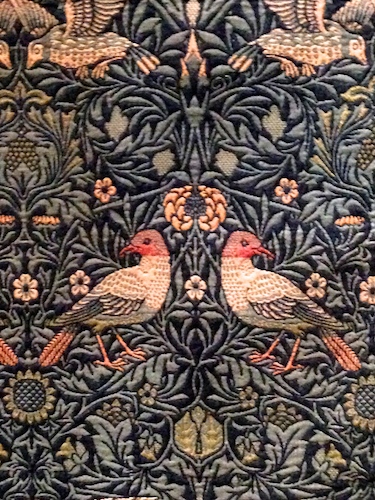
Detail of the large woolen Bird textile that Morris designed in 1878 for his home that was still being sold decades later.

Detail of the large woolen Bird textile that Morris designed in 1878 for his home that was still being sold decades later.

William Morris not only did his historic homework, but was able to channel his convictions about the magic of the Medieval to tap into what artistic Victorian shoppers wanted – stylized visions of nature and old-school craftsmanship, the way it was done in the “old days.” See the evidence in two Metropolitan Museum of Art shows on right now — The Pre-Raphaelite Legacy: British Art and Design (running through October 26) and William Morris Textiles and Wallpaper (closing July 20).

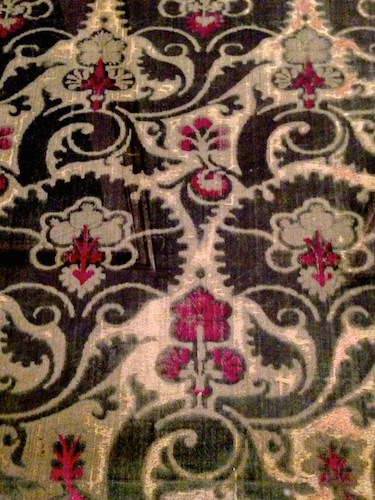
You’ll see how Morris used the historic textile collections at the Victoria & Albert Museum as inspiration for his modern wall coverings and textiles. In the little low-light gallery outside the museum’s textile center –many designed by his designer, John Henry Dearle — right next to the older textiles that inspired them both. You’ll be able to compare Morris’s own winding, intricate patterns with those woven by the 15th-18th c. Venetians, Germans, and Spaniards.

Voided velvet and silk from Venice, 1420

Voided velvet and silk from Venice, 1420

As our Flickr site shows, the Met has its own examples for you to enjoy.

Morris began designing in 1861, went through a couple of iterations of his company and collaborators, and finally landed at Hanover Square in 1917, where his workshop was located just a few steps from Liberty of London on Regent, another retail hotbed of the Arts and Crafts movement where many of the Pre-Raphaelites shopped. As Oscar Wilde once remarked, ““Liberty is the chosen resort of the artistic shopper.”

In 1923, the Met decided to scoop up all of the still-being-sold Morris textiles from London. What you’ll see in the show aren’t the originals, but likely subsequent runs of the super-popular block-printed decorating papers and yardage.


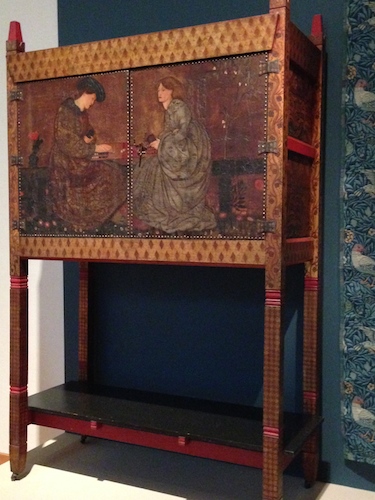
The Backgammon Players, the faux-Medieval, mixed-arts furniture collaboration that started it all1861, with the 1878 Bird wall hanging far right.

The Backgammon Players, the faux-Medieval, mixed-arts furniture collaboration that started it all 1861, with the 1878 Bird wall hanging far right.

The Pre-Raphaelite Legacy has paintings, photos, sculptures, and other works by a wide range of artists. Check out the early painted furniture that Morris did with Edmund Burne-Jones (1861) and the book, written by Morris in archaic English and illustrated by Mr. Burne-Jones at the height of Morris mania (1898).

Next to the furniture collaboration, the curators have hung Morris’s own Bird textile, an intricate woven wonder of woodland creatures and forest marvels. The detail will blow you away, but so will the fact that the original was created in 1878, but what you are looking at was likely manufactured decades later for artistic shoppers and décor enthusiasts who just had to have it.