Learn about tarot at El Museo del Barrio on Monday
Still snowing or freezing cold where you live? Escape with some great virtual NYC museum events this week – learning a little tarot, talking trends with celebrity chef Marcus Samuelsson, cooking soufflé pancakes, hanging out in a Swiss print studio, and joining MAD for a second night of conversation between Andre Leon Talley and Darren Walker.
Check the daily listings on our virtual events page. Here are a few highlights:
Marcus Samuelsson talks about art and cuisine at The Whitney on Tuesday
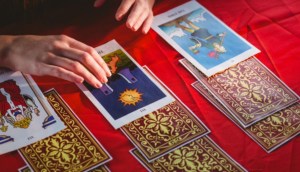
Want to see what the future holds? Today (February 8) at 4pm, see how to figure that out by popping in on Tarot 101 with Chiquita Brujita, courtesy of El Museo del Barrio.
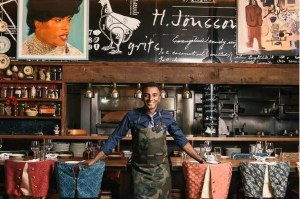
On Tuesday (February 9) at 6pm, get in on a celebrity chef and art world mash-up when Whitney museum director Adam Weinberg speaks with culinary superstar Marcus Samuelsson about “Food, Culture, and What’s Next.” It’s free to listen in.
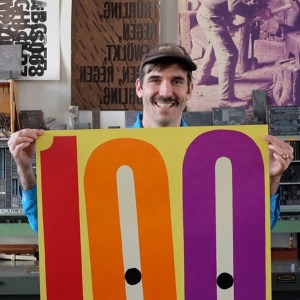
Visit Dafi Kuhn’s print studio in Switzerland with Poster House
At 7pm, if more practical kitchen projects are your thing, join Japan Society to learn how to make Japanese Soufflé Pancakes and be ready to whip out a special Valentine’s Day treat.
On Wednesday (February 10), why not run off to Switzerland and spend time with seeing the old-fashioned presses used by a cutting-edge designer to make astonishing work. At 6pm, join Poster House for a letterpress studio tour with Dafi Kühne.
At 8pm, join the Museum of Food and Drink for an evening of “Black Smoke,” a history of African-American barbeque. You know you want to meet these BBQ historians and find out why it’s all so good!
Tour PHOTO | BRUT at American Folk Art on Thursday
At 2pm, go behind the scenes with scientists at the American Museum of Natural History to learn what’s in the bone collection – one of the largest repositories of prehistoric life in the world.
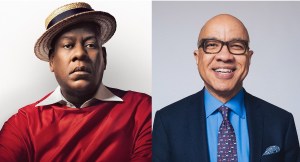
Talley and Walker meet again at MAD on Thursday
At 7pm at MAD Museum, it’s an encore performance! Everyone thought the previous conversation between fashion icon Andre Leon Talley and Ford Foundation president Darren Walker was legendary. So, the duo is back for a follow-on talk, with Leon asking the questions. See what everyone was talking about.
There’s a lot more history, art, and get-togethers, so check the complete schedule. Most of the events are free, but it’s always nice to add a thank-you donation.
Museum Updates
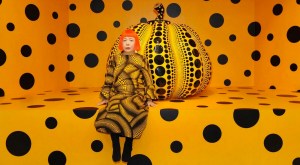
Kusama opens April 10 at NYBG
In case you haven’t heard, the New York Botanical Garden has just announced its opening date for its outdoor extravaganza withs the Queen of Dots – Kusama: Cosmic Nature opens April 10! You’ll be able to see her new monumental works, her outside Infinity Room, and floral arrangements through October 31.
An innovative, continuous exploration about rural areas along the futuristic ramps
Want to go for a trip around the world? Visit out-of-the-way places? Meet interesting people?
There’s no better trip than hanging out with Rem Koolhaas and his think tank, AMO, in their all-encompassing exhibition, Countryside, The Future, on display at The Guggenheim through February 15.
It’s a colorful, engaging, data-driven, and provocative show that began as a response to the fact that population projections show indicate that in the not-too-distant future only 20 percent of people will live in the countryside.
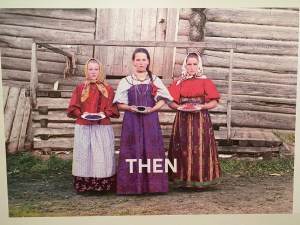
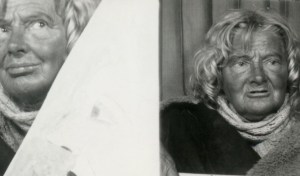
1909 photo of three peasant women in Kirilov, Russia
Rem, Samir Bantal of AMO, and their university collaborators believe that many of the most important, exciting, and radical innovations are happening outside cities, and this is their way of taking you there.
You’ll zip into the past, zoom into current village experiments, watch videos, and meet robots as you swirl your way up the Guggenheim’s ramps.
Listen to famed architect Rem Koolhaas explain the context for the project and research that make up this extraordinary experience:
As this promo notes, this exhibition opened just a few days before New York City and all the museum shut down to mitigate the pandemic. The team did not foresee the impact that the pandemic would have, but the exhibition could not be more of the moment.
1,000 Koolhaas questions about the countryside and society
In the audio guide, the curators say that you can view the exhibit like a buffet (just snacking on this and that) or dive in and read/see everything. When we experienced Countryside, everyone was digging in, reading, watching, absorbing, and interacting with everything.
The show begins with Rem’s 1,000 questions about the world and the future. He makes it clear that he and the team are not there to provide answers – that’s up to you.
How “countryside” has been equated with leisure since Roman times
There’s a walk through history on the next level by way of fun floor-to-ceiling collages filled with Romans from murals, Chinese people from scrolls, quotes, and fun facts – all to drive home the fact that for 2,000 years, major urban sophisticates have seized upon the idea that city people need to visit the country for peace, quiet, contemplation, leisure pursuits, and artistic inspiration.
The history walk continues by exploring Marie Antoinette’s decision to create a rural “hamlet” on the Versailles grounds, the desire of Sixties Hippies to create communes in the country, and the emergence of today’s rural “wellness” spas and retreats.
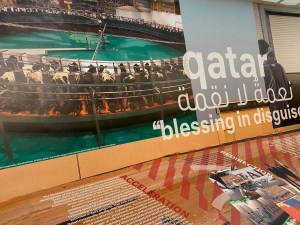
Qatar’s solution to achieving national food security after the June 2017 border closure
The story continues by presenting details about efforts by famous political leaders to “redesign” their countries rural regions on a large scale – Jefferson’s adaptation of the 640-acre grid for developing the West, how the Soviets scaled up collective farming, FDR’s “shelterbelt” policy to minimize soil erosion in the Thirties, and the agricultural emphasis in Mao’s Cultural Revolution.
The most startling story is how Qatar, which imported the majority of its food, did years of research into ways it could be self-sustaining. When the Saudis jammed Qatar’s border in 2017, the country already had a plan. Within 36 hours, it airlifted in 4,000 cows and milking machines, a move that immediately (and successfully) started its domestic dairy industry.
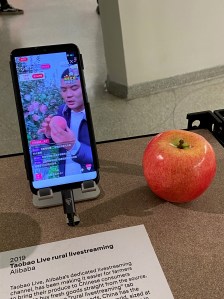
Chinese service that lets city dwellers select apples from trees
The exhibition takes you to villages in China where interesting things are happening – a dying farming town that transformed itself into a “wellness” tourist destination, and an apple-growing region that uses livestreaming on mobile phones to let city-dwellers pick out the specific apples that the villager will pick and ship to them overnight.
The exhibition includes mini-galleries on the move to “preserve” nature, presenting facts and posing land-use questions related to mountain gorilla habitats in Central Africa, permafrost melts that are exposing mammoth fossils, and American billionaires buying and preserving Patagonian land.
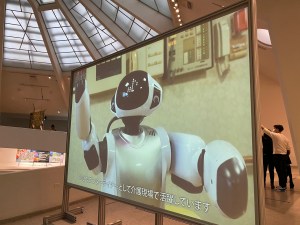
Humanoid PALRO robot from Fujisoft in action
The top floor is alive with roaming robots powered by Roombas, who invite you to enter mini-theaters to see worlds beneath the ocean, developments of industrial facilities run completely by robots, and vast expanses of industrial-level agriculture. You’ll even meet PALRO, Fujisoft’s humanoid robot who hangs out with seniors in Japan, and Prospero, a little robot farmer that’s designed to work in swarm teams.
Hear all about the research and collaborations behind the exhibition and how the exhibition design brings it all to life:
To take a leisurely stroll through the future, listen to the audio guide.
For the full report, purchase the book (a steal at $12).
Darryl McDaniels of Run-DMC talks with Kevin Burke at MCNY
Despite the massive nor’easter moving through New York, we’re assuming that the virtual NYC museum events are happening as planned – an opportunity get behind the scenes of New York’s hottest photography show, visit a West Coast design archive, meet a Rock legend, and dive into historic Southern cuisine.
Check the daily listings on our virtual events page to for these events and details on many, many others.
The Kamoinge workshop show at The Whitney. Meet the artists this week.
We want to alert you all to the upcoming opportunities that the Whitney is offering to showcase the photographers and work featured in Working Together: The Photographers of the Kamoinge Workshop. On Wednesday (February 3) at 7pm, you can meet the Kamoinge artists live and hear them talk about how Harlem influenced their work. On Friday (February 5) at 3pm, see which artists used “the body” for inspiration and which contemporary photographers take on similar themes.
Two tours of the Morgan’s David Hockey show this week.
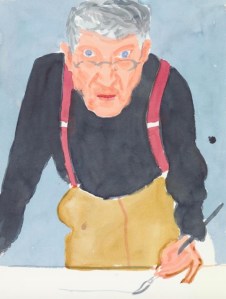
Also, just a reminder that there are two opportunities to walk through the Morgan Library’s David Hockney life-drawing show – on Wednesday, February 3 at 3pm and on Thursday, February 5 at 12:30pm.
Here’s how the rest of this week will shape up, with just a few suggestions (see the entire list here):
On Tuesday (February 2) at 4pm, take a trip to California with the Poster House to hear Letterform Archive’s Stephen Coles talk about (and show examples of) what happens when graphic designers break the rules of what typically constitutes good design.
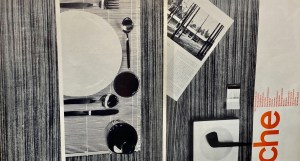
Close-up of Swiss grid at Poster House. What happens when designers ignore it?
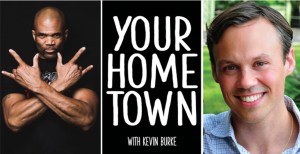
At 7pm at the Museum of the City of New York in the Your Hometown series, meet Rock and Roll Hall of Famer Darryl McDaniels of Run-DMC who will talk about growing up in Queens during the Sixties and Seventies and how the lessons learned contributed to becoming a rap icon atop the music industry.
On Wednesday (February 3), you can join two programs that take you inside museum collections and exhibitions to ask questions about how indigenous cultures and artists are represented, and what is changing. At 6pm at Bard Graduate Center, hear about “Indigenous Arts in Transition” from two Native American curators in Minnesota and Oklahoma.
Boy’s hide shirt made by female Crow artist in 1870-1900 displayed at the Met in 2017
At 7pm, join the SciCafe crowd for a talk and Q&A on “Museums and Race” at the American Museum of Natural History that has a long (and current) history of grappling with these issues. Anthropologist Monique Scott will focus on African objects in the collection in New York and other museums around the world.
At 8pm, join the Museum of Food and Drink (collaborating with the Smithsonian Folklife Festival) for a fun dive into regional cooking in “Sustaining Gullah Geechee Cooking across Land and Sea.” You’ll hear a fascinating migration story told through food and learn how to make crab fried rice.
There’s a lot more music, science, and get-togethers, so check the complete schedule. Most of the events are free, but it’s always nice to add a thank-you donation.
Museum Updates
Toxic Titan program at the AMNH Hayden Planetarium last week was a hit
We dropped in on fun virtual events last week at the AMNH, Fraunces Tavern Museum, and the NYPL’s discussion with Amber Ruffin, and couldn’t have enjoyed them more!
The Toxic Titan show with the Hayden Planetarium crew had nearly 400 viewers from around the world! Congratulations to the virtual team, who even un-muted everyone to give the crazy-good speaker a live round of virtual applause!
Get to the Guggenheim by February 14!!
Before the storm hit, we were able to visit the Guggenheim to see Countryside, the Future, the spectacular show by AMO/Rem Koolhaas. Although the curators say you can either breeze through or read through it slowly, the crowds were definitely making the most of their time and digesting everything – the history of our obsession with country and leisure, the ways 20th-century leadership tried to reshape vast swaths of their countries, and the efforts going on today to reimagine non-urban environments in Africa, the Middle East, the Arctic, and everywhere. It’s a must-see. Two more weeks.
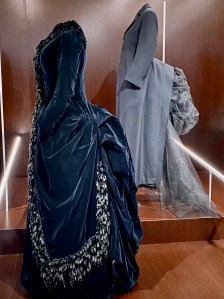
An 1885 American walking dress with 1986 Yamamoto overcoat
What day is it? What year is it? If we’re going forward in time, should we be moving counterclockwise?
As ten months of pandemic disruption sink in, there’s no better exhibition in New York to experience than the Metropolitan’s Costume Institute extravaganza, About Time: Fashion and Duration, on view through February 7.
Curator Andrew Bolton had the task of organizing a show in honor of the Met’s 150th anniversary, but wanted to take an exhibition approach that wasn’t simply a “greatest hits” showcase. He wondered what would it be like to mount a show that lets visitors see, feel, and experience how fashion sometimes folds back on itself – like time in Virginia Woolf novels.
Queen Alexandra’s 1902 riding jacket with 2018 Vuitton ensemble by Ghesquière
Stepping into the first gallery, sixty black dresses are arranged like minutes on a clock. The exhibition begins with an example from 1870, the year that the Met was founded, and progresses in time from there. At each point, you see an ensemble from that year, paired with a designer look from a different year that echoes it – bustles, princess lines, gigot sleeves, tailored jackets, flourishes of 18th-century aristocratic opulence.
The inspiration for the first room is a grandfather clock – warm wood colors, a constantly swinging pendulum, and the monotonous, even tick. As you slowly work around the room, the time is even, rhythmic, and set – just like the pace of fashion from 1870 to 1950.
1895 dinner dress by Mrs. Arnold with Rei Kawakubo’s deconstructed 2004 ensemble
The 19th century garments are solid black, with masterful tailoring, swags, trims, and embellishments. In a tribute to the home town, two were created in Brooklyn: the 1885 silk satin dinner dress by Mrs. Arnold (paired with Rei Kawakubo’s equally elaborate but deconstructed 2004 ensemble) and an 1897 riding habit from Brooklyn’s acclaimed department store, Frederick Loeser & Co. (paired with a 1968 equestrian-style suit by Victor Joris).
Some of our other favorite pairings in this room are the 1912 artistic dinner dress with its leather pannier clone by Rick Owens, the 1928 alphabet flapper dress paired with Galliano’s 1997 spider-web frock, and the 1947 Christian Dior “New Look” jacket paired with Watanabe’s 2011 experimental motorcycle jacket.
Dior’s 1947 “New Look” with Watanabe’s 2011 motorcycle jacket
The second room is a shocker – mirrors everywhere, blinding white, undulating pathways, a fractured sense of time, and fashions morphing at breakneck speed – minis, maxis, minimalism, glitter, punk, pleats, unconventional materials, technology, and 3-D printing. (And it’s no surprise that so many pairings include visionary works by Charles James!)
The displays follow the same convention – sequential years paired with a “disrupter” dress or ensemble – but the impact is enormously disorienting, since the “twin” piece could be from the past or future and the mirrored walls and ceiling turn the experience into something like Kusama’s “infinity” room.
“Shattered” gallery – evoking fashion’s accelerated pace
When you enter, it takes a few minutes to figure out where to go, how to move through the sequence, and find the continuing storyline of the exhibition. Is there another room in the exhibition that you missed? Did you just jump to the Seventies and Eighties and miss the Sixties? Is the “next garment” to the right or the left? What year are you in?
[The gallery security guards confirmed that this occurs all day long with visitors!]
To sort it out, take a look at this video – a sequential walk through fashion time punctuated by some out-of-time disrupters (or peruse some pairings on the web):
Some of our favorite pairings in the second room are the zipper twins from Gernreich (1968) and Alaia (2003), the red-edged jersey pairing of Stephen Burrows (1975) and Xuly.bet (1993), and Patrick Kelly’s simple pearl heart dress (1988) with Olivier Rousteing’s Versailles-inspired dress for Balmain lavished with pearls, crystals, and beads (2012).
2012 Iris van Herpen PVC dress with 1951 ball gown by Charles James
Check out more of our favorites in our Flickr album.
And congratulations for including an unexpected (and deserving) multi-part display – Donna Karen’s “Five Easy Pieces” mix-and-match knit separates (1985) with the totally chic, revolutionary, coordinated wool knit separates invented by the ready-to-wear sportswear founder herself, Claire McCardell (1934). Wow!
When you finish walking through this gallery, you’re left wondering if fashion ever truly changes – the last pair features a 2018 coat with a 3-D printed understructure alongside a strangely similar coat from 1889. What just happened?
Sustainability – 2020 Viktor & Rolf’s dress of leftover samples
The exhibition finale is fitting – a small chapel where visitors can meditate on “slow fashion,” sustainability, and a return to basics before they exit to the gift shop. It features a suspended (or ascending) figure clad in one of Viktor & Rolf’s sweet dresses made of leftover off-white fabric swatches.
When the Met chose the theme for the show and designed it to debut with the celebrity-filled First Monday in May event, no one envisioned that the doors would be sealed shut until August. Or that the exhibition would so perfectly mirror the sensation of endless time, interruption of cycles, and fashion disruption/rethinking happening right now.
Join the Met’s fashion collection curator, Andrew Bolton, for a tour:
Gloria Steinem and Julie Taymor at Asia Society on Monday
So many virtual NYC museum events are happening online this week – an opportunity to meet amazing women, bring organization to your life, attend a premiere at The Met, and get the inside story on Saturn’s moon, Titan. Check the daily listings on our virtual events page to for these events and details on many, many others.
Today (January 25), at 6:30pm, you can join an exciting event at Asia Society – a conversation with Gloria Steinem and director Julie Taymor, followed by a panel of visionary activists discussing how visionary women are serving as agents of change as people in our world grows more interdependent.
Tuesday talk at Japan House
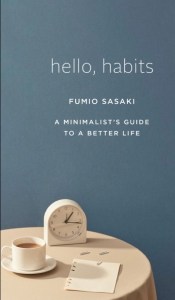
Is it time to pare down? Purge stuff? Feel more organized? On Tuesday (January 26), at 6pm, join Japan House to hear Fumio Sasaki talk about how to live a more ordered, fulfilling life – all included as part of the theme of his new book, Habit-Making: A Minimalist’s Tips for a Better Life.
At 7pm, enjoy The Met will debut a music and film collaboration on the life of Armenian-American abstract painter Arshile Gorky, who immigrated with his family in the early 20th century and influenced a generation of abstract expressionists. Watch the digital premiere of They Will Take My Island.
Curious about why Manhattan has such a big park in the center of the island?
Wednesday history of Central Park (NYHS)
On Wednesday (January 27), at 3pm, hear the New-York Historical Society talk about the origins of Central Park. You’ll get to see what’s in the NYHS archive, view the plans for its design, see construction photos, and learn about the shocking removal of Seneca Village, a thriving African-American community.
At 6pm, you can learn about more recent history with the Brooklyn Museum. Amy Raffel will talk about her latest book on the legendary Keith Haring, how he created New York’s most popular memes, and what he sold in his famed downtown retail experiment, the Pop Shop.
Composite infrared image of Titan from NASA’s Cassini spacecraft. (University of Arizona/University of Idaho/NASA/JPL)
At 7pm, join planetary scientists at the Haden Planetarium at AMNH to examine Titan, Saturn’s large but toxic moon. Understand the questions scientists are trying to answer, and whether Earthlings have lessons to learn from their solar-system neighbor.
Love gardening? Why is that? On Thursday (January 28), spend the morning at the New York Botanical Garden with UK psychiatrist-gardener Sue Stewart-Smith, who will share insights revealed in her book, The Well-Gardened Mind– how people’s minds and gardens interact.
Gardens at the New York Botanical Garden
Get a perspective that you’ve never had before from people you’ve never met – participants in a ground-breaking filmmaking workshop. At 6:30pm on Thursday night, go behind the scenes at MoMA P.S.1 to meet the organizers of the workshop and watch films made by imprisoned artists in “Pens to Pictures” – a media showcase that accompanies P.S. 1’s art exhibition, Marking Time: Art in the Age of Mass Incarceration that critics at The New York Times said was one of 2020’s best.
At 8pm, join the New York Public Library to hear Amber Ruffin, one of the funniest women in late-night TV, and her sister Lacey Lamar compare notes on hilarious and harrowing experiences with racism in New York City and Nebraska – all drawn from their new bestseller, You’ll Never Believe What Happened to Lacey.
Yes, it’s serious, but it’s also really, really funny. Amber’s first African-American woman to write for a late-night network show, and if you’ve seen her with Seth Myers, you know what we’re talking about. Don’t miss this!
There’s a lot more, so check our complete schedule. Most of the events are free, but it’s always nice to add a thank-you donation.
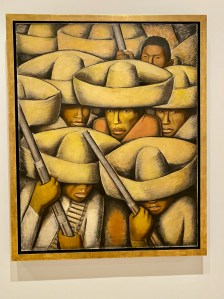
1932 Zapatistas by Alfredo Ramos Martínez. Courtesy: San Francisco Museum of Art
When you enter the Whitney Museum exhibition, you’re surrounded by tropical settings, Oaxacan beauties, lush floral compositions, and the romance of Mexico. But a few steps beyond, Vida Americana: Mexican Muralists Remake American Art, 1925–1945delivers epic struggles, monumental murals, revolutionary fervor, inspirational triumphs, and heroic views of everyday people.
It’s the most important art exhibition currently on view in New York, on view through January 31, because it shows how three acclaimed, radical Mexican artists – Orozco, Rivera, and Siqueiros – influenced a generation of artists in the United States with their commitments to public works, no-holds-barred graphic depiction of social injustices, and masterful, innovative techniques.
Diego Rivera’s 1931 fresco The Uprising – everyday people showing heroism in extraordinary times. Private collection
Take a tour through the show on the Whitney exhibition site, listen to the audio guide, and see some of our favorite works here.
The paintings, photos, and films in the first gallery celebrate a romantic vision of Mexico’s native heritage alongside works evoking poignant, sometimes violent moments in the country’s recent revolution. It’s a rich experience, with modernist photos by Modotti, evocative footage by Eisenstein, and riveting works by Khalo, Rivera, and Alfredo Ramos Martínez.
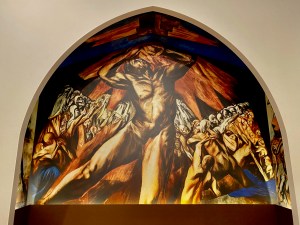
Orozco’s 1930 mythic mural Prometheus for Pomona College, California
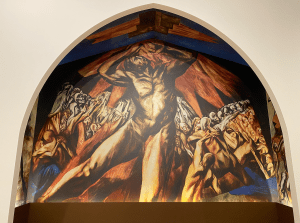
But just beyond, you’ll glimpse galleries that promise deeper stories of emotional, turbulent, modernist angst. A half-scale reproduction of Orozco’s mythic Prometheus mural occupies an alcove, surrounded by works by artists he inspired –Jacob Lawrence’s pictorial history of African-American northern migration in 1910-1940 and Jackson Pollack’s early Thirties paintings that channel Orozco’s depiction of writhing life forces.
Take a look at The Whitney’s introduction to Orozco, Rivera, and Siqueiros, which shows life in Mexico at the time they developed their distinctive styles, gained international acclaim, and came to the United States:
Another startling Pollack reveal lies in the Siqueiros gallery that tells the story of the experimental workshop that the Mexican master ran in New York, where New York artist were encouraged to experiment with airbrushes, stencils, and paint splatters.
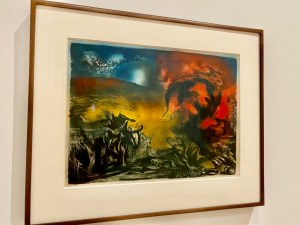
Pollack’s 1937 airbrushed litho Landscape with Steer – influenced by his workshop with Siqueiros. Courtesy: MoMA
Siqueiros was big on pushing the boundaries and using modern materials to create truly revolutionary work. Pollack’s experiments are here, along with the revelation that workshop participants were encouraged to lay unstretched canvas down on the floor and work from above. Sound familiar?
The magic of this exhibition is the side-by-side mounting that allows visitors to ponder the many ways that young Depression-era US artists took so many of the lessons of the Mexican muralists to heart.
Detail of 1939-1940 Charles White Progress of the American Negro: Great American Negroes. Courtesy: Howard University
The exhibition goes on to chronicle artists who were inspired to tell epic stories of the American frontier and forgotten African-American success stories. In one room alone, you can pivot and take in expansive, monumental paintings by Thomas Hart Benton, Aaron Douglas, and Charles White.
Another section of the show looks at Diego Rivera’s fascination with American industrialization and assembly-line workers, including a wall-size video of Rivera’s 1932 mural of Detroit’s Ford assembly line. The adjacent gallery shows his influence through WPA-funded works by Ben Shahn, Phillip Evergood, Thelma Johnson Streat, Marion Greenwood, and others. Gears, machines, heroic workers, and strivers in an industrial age.
Reproduction of Rivera’s 1934 mural Man, Controller of the Universe, originally created for Rockefeller Center
A “wow factor” at the far end of the gallery is the reproduction of the infamous Rivera mural commission for Rockefeller Center that was destroyed due to Rivera’s refusal to take out Communist references. You experience the uproar it caused by reading original newspaper clippings and magazine articles. When his work was destroyed, Mexico City’s Palace of Fine Arts invited him to recreate it. That’s the reproduction at the Whitney, giving everyone a chance to experience a piece of lost New York art.
Many exhibition visitors miss one of the most satisfying components of the show – a three-channel video of the murals done by a host of painters (under Rivera’s direction) in a market in Mexico City. Walk to the right corner of the big Rivera mural and step inside the Abelardo L. Rodriguez Market to see murals created by Ramón Alva Guadarrama, Marion and Grace Greenwood, Noguchi, and others:
Andre Leon Talley and Darren Walker at MAD on Tuesday
Nearly all of this week’s virtual museum events in New York are packed into Tuesday, Thursday, and Friday to make way for Martin Luther King’s birthday and the inauguration. So, check the daily listings on our virtual events page and dive into interesting sessions on African-American innovators and artists, art with a conscience, and flat-out fun.
1969 anti-Nixon poster from the Poster House archive
On Tuesday (January 19), it will be hard to choose: At 5pm, you can join MAD Museum at 5pm to hear a conversation on equity and design between author and style guru Andre Leon Talley and Ford Foundation president Darren Walker.
At 5:30pm, you can join Poster House and NY Adventure Club for Democracy on Paperto review political posters from the Sixties and Seventies from the museum archives.
At 6pm, New-York Historical Society hosts an in-depth look at Harriet Tubman’s life with biographer Erica Armstrong Dunbar, and the Whitney offers a program on art and social change, illustrated with works from its collection.
Book discussion on Tuesday at the Schomburg Center
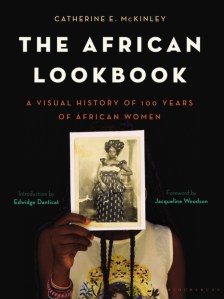
At 6:30pm, join author Catherine E. McKinley at NYPL’s Schomburg Center for Research in Black Culture to see and hear about 100 years of African women’s style and looks, as featured in The African Lookbook.
At 8pm, join the Museum of the City of New York for a special trivia contest with the MCNY curators.
On Thursday (January 21), several programs begin at noon – a lunch hour session at the Staten Island Museum on the work of famed social realist artist Raphael Soyer; a tour of the Georgia O’Keeffe Museum in Santa Fe, courtesy of the Newark Museum of Art; and a tour of the Whitney’s amazing photography exhibition, Working Together: The Photographers of the Kamoinge Workshop.
Take a tour of the Whitney’s Kamoinge Workshop show on Thursday
At 2pm, meet the New York Transit museum for Underground Heroes – a look at how transit was portrayed in satirical cartoons, comic strips, and comic books.
At 6pm, join the American Folk Art Museum for a fun “drink and draw” session on New York landmarks.
There’s a lot more, so check our complete schedule. Most of the events are free, but it’s always nice to add a thank-you donation.
Museum Updates
We joined the marathon on-line session with Neil deGrasse Tyson this week to hear his year-in-review on astronomical and planetary science. The AMNH chose to produce this via Zoom, so everyone was able to see who was asking the fascinating questions and allowed Neil to have some fun interactions, just as he does at his sold-out events. Lots of geeky questions and answers for over two hours!
Diego Rivera’s 1931 fresco “The Uprising” in the Whitney’s Vida Americana: Mexican Muralists Remake American Art, 1925-1945
We also joined the weekend crowds at The Whitney to see the epic work again in Vida Americanaand see the beautiful photographs of the Kamoinge Workshop.
To end the week, we watched Andrew Bolton describe the work behind creating the Met’s unusually prescient fashion exhibition, About Time: Fashion and Duration. Check out the YouTube (already posted!) on what it took to design this unforgettable exhibition.
45 stories about modern art jewelry, such as Greenwich Village designer Arthur Smith
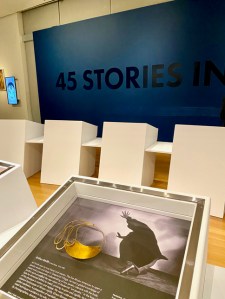
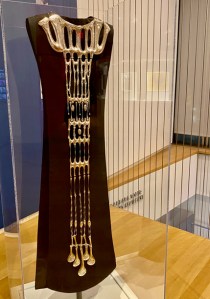
Sleek, modern, space-age, intricate, architectural, political, satirical, and comic – all descriptions of the array of modern-art jewelry selected by the Museum of Arts and Design exhibition, 45 Stories in Jewelry: 1947 to Now, on display on the second floor.
The second-floor space features a tour through modern-art jewelry’s evolution from a craft pioneered by studio artists like Art Scott and Alexander Calder to its current status as a respected and valued sector of today’s international art market.
MAD has shown art jewelry since it was founded in 1956, and its full collection now numbers 930 pieces. After redesigning its art jewelry exhibition area, MAD decided to mount a show to honor the extraordinary scope of its collection and place selected artworks into the broader context of art history.
1966 sterling silver body ornament by Arlene Fisch
Two rings of white cases offer visitors opportunities to peer into each story, see a spectacular or provocative piece, and read about its designer and context.
In every visit to this show, we saw jewelry lovers fully engaged, pouring over every detail of the craftsmanship.
The first case that drew our attention was a Constructivist pin by Margaret De Patta, a passionate California artist became immersed in modernism through her New York art studies in the Twenties, but really hit her stride in the Forties after training with Moholy-Nagy in Chicago. (This spectacular pin is prominently depicted on the museum’s timeline of modern art jewelry.)
John Paul Miller’s 1969 molten gold Armored Polyp
The museum highlights the stories of Forties artists working in studios, like Art Scott, who created body-conscious pieces for the jazz artists and modern dance innovators who visited his Greenwich Village studio.
Another early innovator honored in the exhibition is John Paul Miller, who created stunning gold pieces using ancient, forgotten techniques discovered in his archeological research.
Stories from the Fifties show how an entire generation of American designers was influenced by Danish design, particularly the sleek work of master silversmith Henning Koppel, whose work was featured internationally through the Georg Jensen brand.
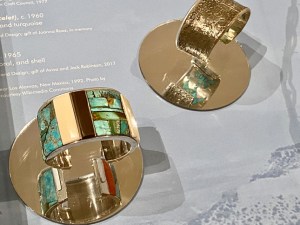
Charles Laloma’s 1968 inlaid silver bracelet and 1960 bracelet with inner turquoise inlay
Art works from the Sixties include the way-out sterling body ornament by Arlene Fisch, space-age jewelry by Danish designers Gijs Bakker and Emmy van Leersum, and modernist Hopi jewelry design Charles Laloma, a ground-breaking Native American artist.
The timeline in the exhibition details how art jewelry grew in popularity, entered museum collections, and began being shown at international art fairs.
Take a look at some of our favorites in the exhibition in our Flickr album and be sure to visit MAD in person.
Meet the 45 Stories committee members, who selected which works in MAD’s collection that embody key developments in the evolution of the art form:
It’s a packed week with over 35 virtual events planned by New York City museums, featuring evenings with celebrities, conversations about society, the future of museums, and even an escape game. Find the daily listings for everything on our virtual events page.
Scandals recounted in the Tenement Museum’s Tuesday YouTube Live book talk
Tomorrow afternoon (January 12) at 6:30pm, the Fraunces Tavern Museum again collaborates with the Keeler Tavern Museum & History Center to explore the role apples played in food, drink, and the economy of colonial and revolutionary America in the continuing “Tavern Tastings” series.
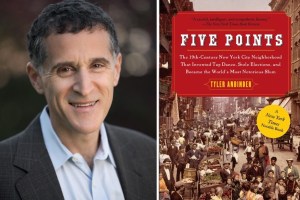
At 7pm, the Tenement Museum hosts Tyler Anbinder, to talk about his book, Five Points: The 19th Century New York City Neighborhood that Invented Tap Dance, Stole Elections, and Became the World’s Most Notorious Slum.
Mystical transformation with St. Francis and the Morgan Library on Wednesday
At 8pm, travel to the mountains of Arizona with the Newark Museum, whose planetarium experts host an evening of stargazing with Steward Observatory’s Mt. Lemmon SkyCenter.
On Wednesday (January 13) at 2pm, train fans can take a rare trip deep into the Transit Museum archives.
At 5pm, art fans can travel back to the 15th century with the Frick Collection to explore Bellini’s paintingSt. Francis in the Desert.
At 6:30pm, the Center for Brooklyn History (formerly Brooklyn Historical Society) hosts a discussion and book talk “The Authoritarian’s Playbook,” which links 20th century history with the events of the last week.
A talk with David Byrne and Maira Kalman about their new American Utopia book at the Museum of the City of New York
The “standing ovation” meet-up at Poster House featuring an array of posters of the world’s most celebrated theatrical performers and five cocktails to match.
MCNY hosts collaborators David Byrne and Maira Kalman on Wednesday. Photos: Jody Rogac, Cyndi Stivers
On Thursday (January 14) at noon, visit the Salman Toor painting exhibition at the Whitney, and at 3pm, see (and hear about) nature paintings in the collection of the New-York Historical Society.
There’s more on Friday and Saturday, so register for as many of the topics and events that you can fit into your schedule.
On Saturday at 2pm, be sure to join MAD to meet acclaimed architectural artist Brian Clarke, whose work is on display for the next month. Don’t pass up this chance to encounter a legend and hear about the entire scope of his incredible international body of work.
And a reminder for Sunday (January 17): at 1pm, take a tour of the incredible costume exhibition at the Metropolitan, About Time: Fashion and Duration. Even if you’re in New York, it’s not easy to snag a ticket to this show, so the virtual visit is the next best thing.
Most of the events are free, but it’s always nice to add a thank-you donation.
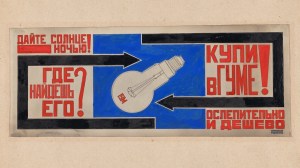
At MoMA, 1923 Gum department store lightbulb ad by Rodchenko and Mayakovsky’s ad agency
Museum Updates
We visited MoMA this past week for last looks at the Felix Feneon, textile, and Judd exhibitions. The galleries were full of visitors looking at the Parisian posters, African carvings, Seurat and Matisse paintings, Anni’s loom, and Judd’s super-slick sculptures.
Lots of Russian avant-garde, typography and collage running wild, and branding in the early 20th century that you’ve never seen quite like this. The extensive exhibition uses many works from the little-seen Berman collection, so you’ll be in for some surprises when you see it.
Although its virtual events are still happening, the Museum of the City of New York has announced a temporarily closure on Fifth Avenue for some emergency construction work.
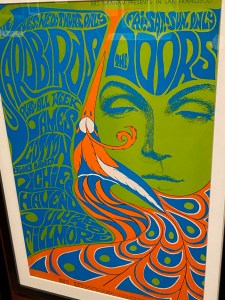
Poster by Bonnie McLean for Fillmore Auditorium July 1967. Courtesy: Bahr Gallery
New York City museums are kicking off the first week of the New Year with a look at music and transportation history, far-away places (on Earth and beyond), and artist hang-outs. Find the daily listings for everything on our virtual events page.
Tomorrow afternoon (January 5) there are two fun historical programs: at 4pm, you can take one last look at the New-York Historical Society’s great rock-and-roll extravaganza (which ended yesterday!), Bill Graham and the Rock & Roll Revolution. If you did not get to see the exhibition, don’t miss this … psychedelic posters, the story of the Fillmore East and West, how Bill’s artists got booked for Woodstock, how The Last Waltz concert happened, and lots of photos of the legendary stars he promoted.
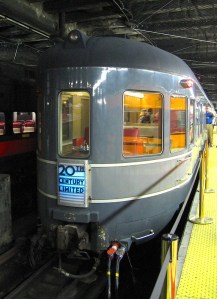
The streamlined 1947 lounge car for the 20th Century Limited.
At 5:30pm, you go back a little further in time. Join New York Transit Museum educator Joe Hartman to hear the incredible story of the legendary 20th Century Limited luxury train that ferried celebrities between New York’s Grand Central and Chicago’s LaSalle Street Station in high style for decades. Learn all about how red-carpet obsessions were born.
On Wednesday (January 6) at 7pm, hang out with a few hundred science geeks at the monthly SciCafe at the American Museum of Natural History. This month’s topic is Arctic Dragonflies with museum curator Jessica Ware, who will explain how these little guys keep from freezing. The Q&A is always fascinating with this group, so stick around for that part of the program, too!
Reproduction of Orozco’s 1930 Prometheus mural at The Whitney
On Thursday, (January 7), delve into great art: at Noon, the Whitney presents a look at the three Mexican muralists – Orozco, Rivera, and Siqueiros – whose passion and techniques inspired a generation of socially conscious artists of the Thirties and Forties. Find out more about their work in the United States and hear how Pollack, Benton, Noguchi, Lawrence, and many others learned at the feet of the masters in this talk about the blockbuster Vida Americanaexhibition.
Jesse Wine, 11:10 am / 15.10.1983 / 75 Heath Lane / Chester / United Kingdom / CH3 5SY, 2020, installation view
At 7pm, take a trip to the Sculpture Center to meet Jesse Wine, see highlights of his solo show in Long Island City, and hear about his past work and inspirations.
Many more programs are on the schedule, so register for as many of the topics and events that you can fit into your schedule. Many of the events are free, but it’s always nice to add a thank-you donation.