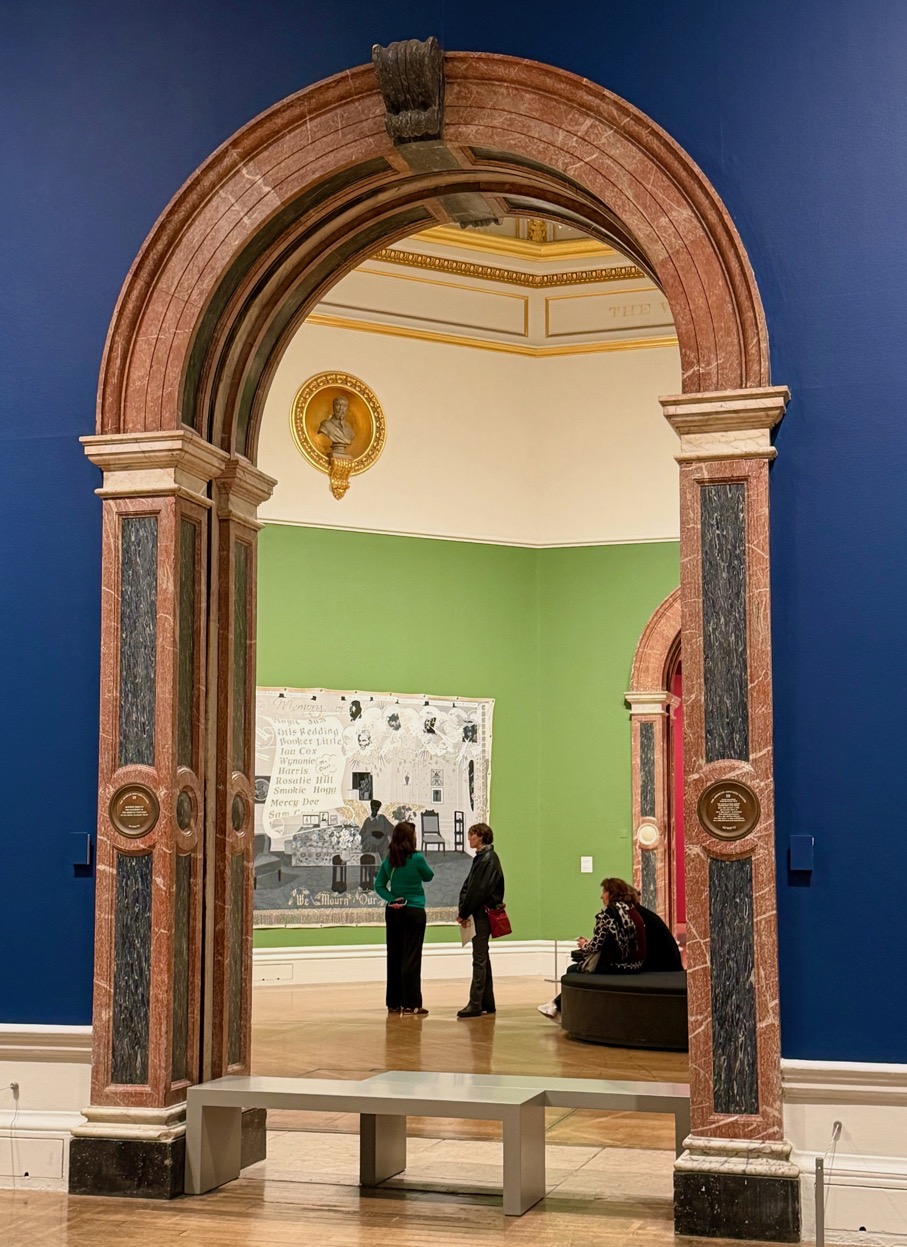
It’s fitting that Kerry James Marshall provides a master class in history painting at the Royal Academy of Arts in London – one of the most sensational shows to inhabit those hallowed galleries off Picadilly – Kerry James Marshall: The Histories, on view through January 18, 2026.
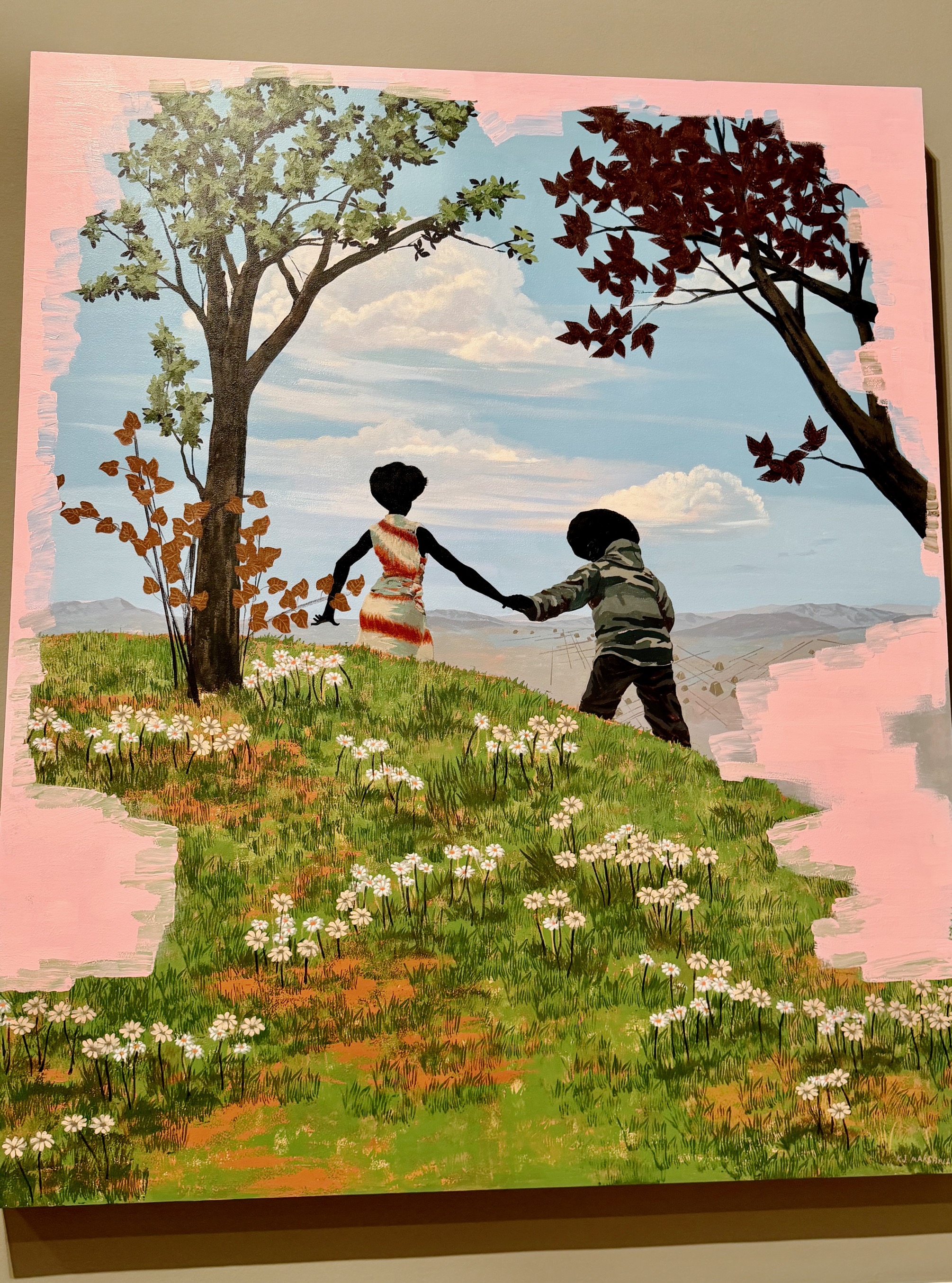
Marshall’s work fills eleven galleries of Burlington House with masterful paintings that put Black subjects back into the frame – Black citizens working in museums and art studios, delivering style in neighborhood barber and beauty shops, maintaining gardens in public housing projects, and wafting through floral fields à la Watteau and Fragonard.
Marshall’s 2008 acrylic Vignette #13 – a Rococo-inspired scene with a couple walkng through a meadow. Courtesy: private collection.
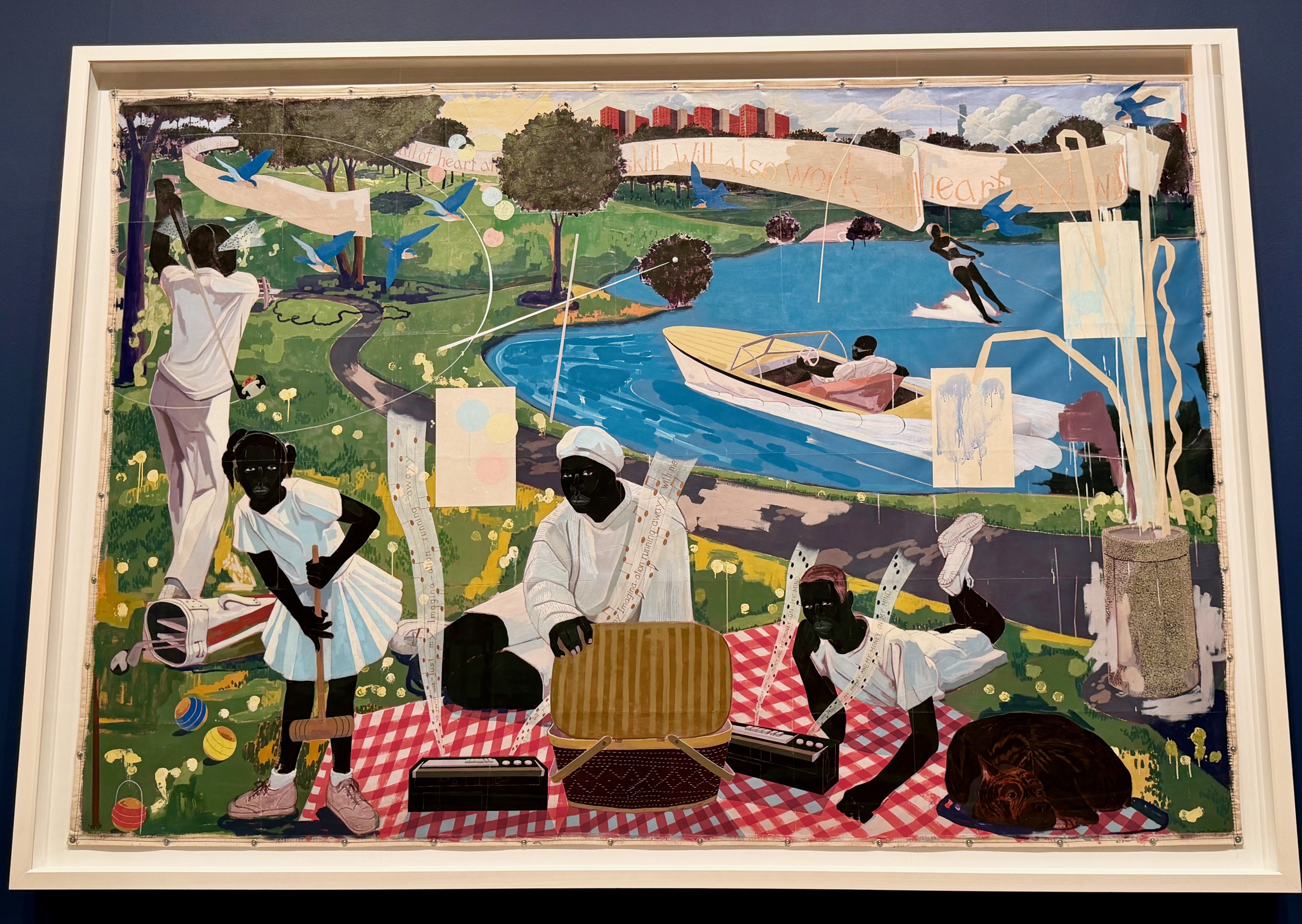
Most of these scenes are presented on a large scale and jam-packed with art-historical, literary, and world-history references. In ThePainting of Modern Life-themed gallery, his grand Past Times certainly evokes Parisian leisure-class epics by Manet and the Post-Impressionists. Marshall’s twist is to depict a wholesome, all-white-clad Black family enjoying its picnic lunch lakeside as music and lyrics by The Temptations and Snoop Dogg (literally) drift up from the radios to ask if this is “just my imagination.”
Referencing Manet and Seurat, Marshall’s 1997 acrylic and collage Past Times, where a middle-class family enjoys a picnic and music in a lakeside park. Courtesy: Art Institute of Chicago.
Take a quick look at the Academy’s exhibition preview video and hear Marshall talk about his inspirations and approach:
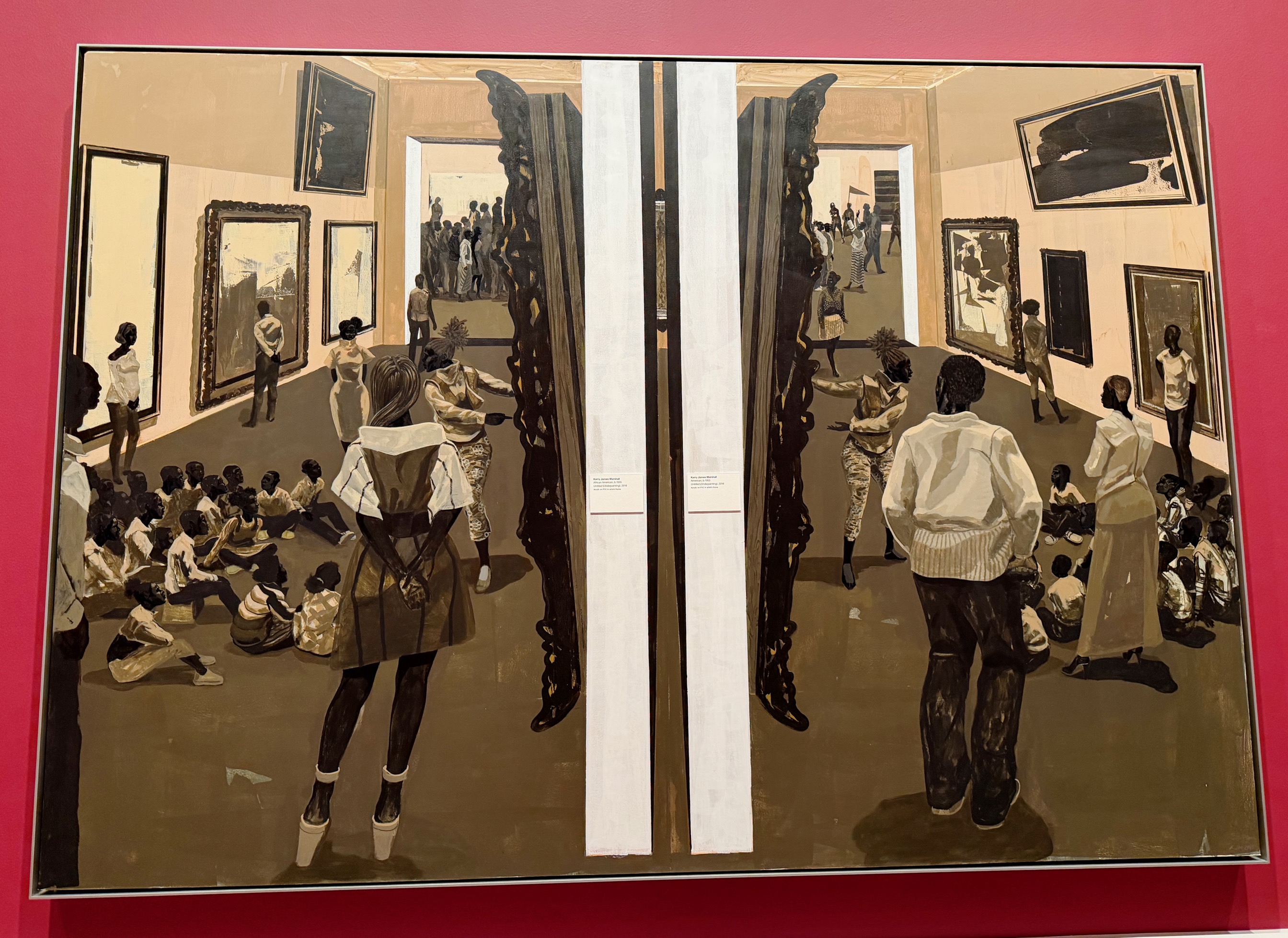
The exhibition begins with a gallery depcting self-confident artistic portraits, scenes from the academic art studio, and kids joyfully visiting a museum for the first time – a recollection of Marshall’s own exhilarating inauguration to a new world.
Marshall’s 2018 acrylic and collage Untitled (Underpainting), showing two rooms of Black kids on a museum school trip – reflecting on his earliest museum outings. Courtesy: Glenstone Museum
It’s followed by some of his earlier works inspired by Ralph Ellison’s 1952 Invisible Man and the similarly named 1897 book by H.G. Wells, with Marshall’s innovative black-on-black portraits.
Here’s a short video with Marshall describing all the different ways he uses black paint to create such vivid dimensionality:
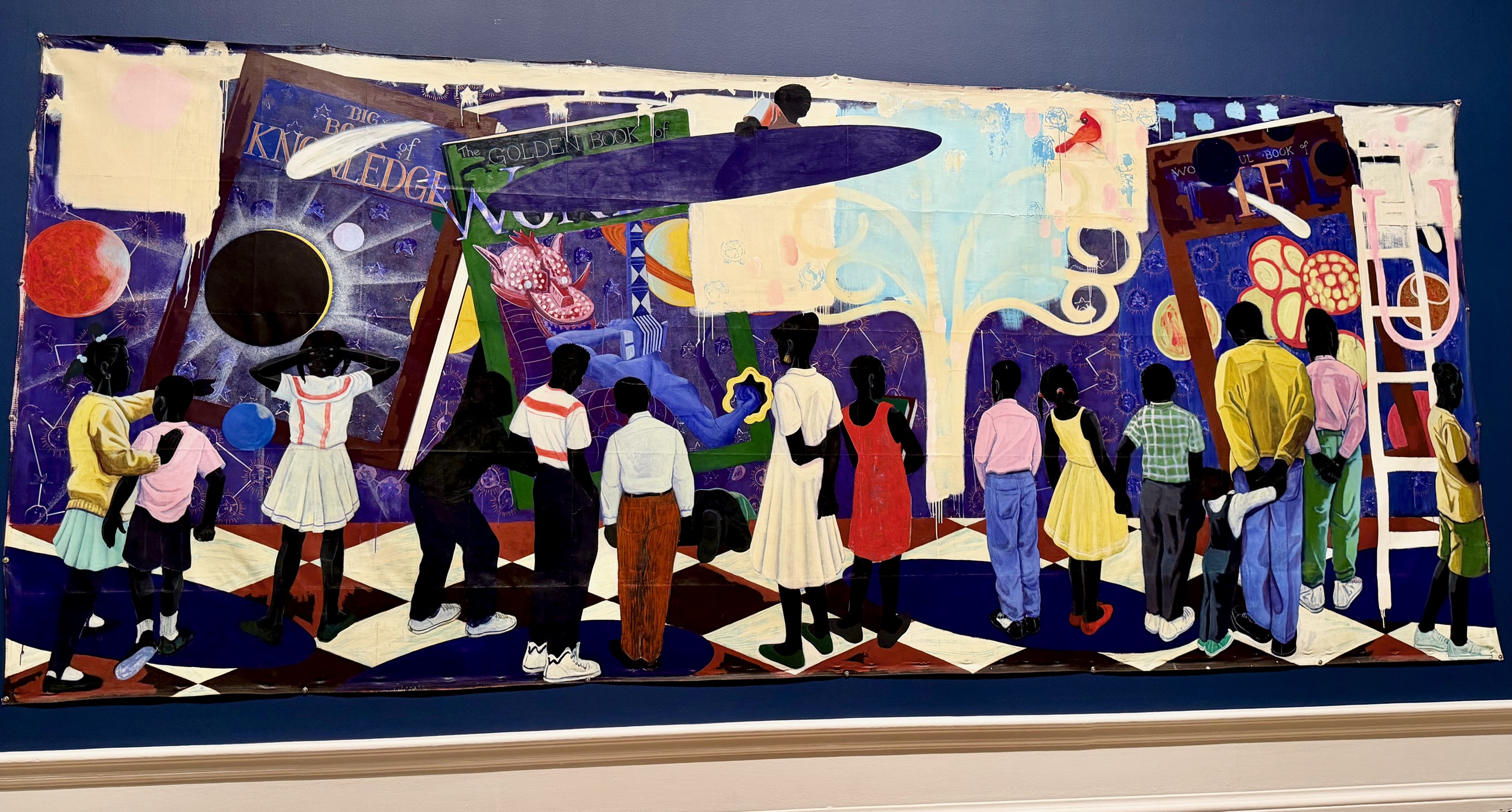
Other modern-life paintings bring viewers unexpectedly into a world of gardens among Chicago public-housing complexes and a magical world of books awaiting eager young readers.
Marshall’s 1995 mixed-media mural Knowledge and Wonder –showing inquisitive children surrounded by a world of books. Courtesy: City of Chicago Public Art Program and Chicago Public Library.
Other galleries are hung with Marshall’s assertive portraits of historic African-American abolitionist and literary figures, like Harriet Tubman and Phillis Wheatley-Peters, and tributes to 20th century political and cultural leaders.
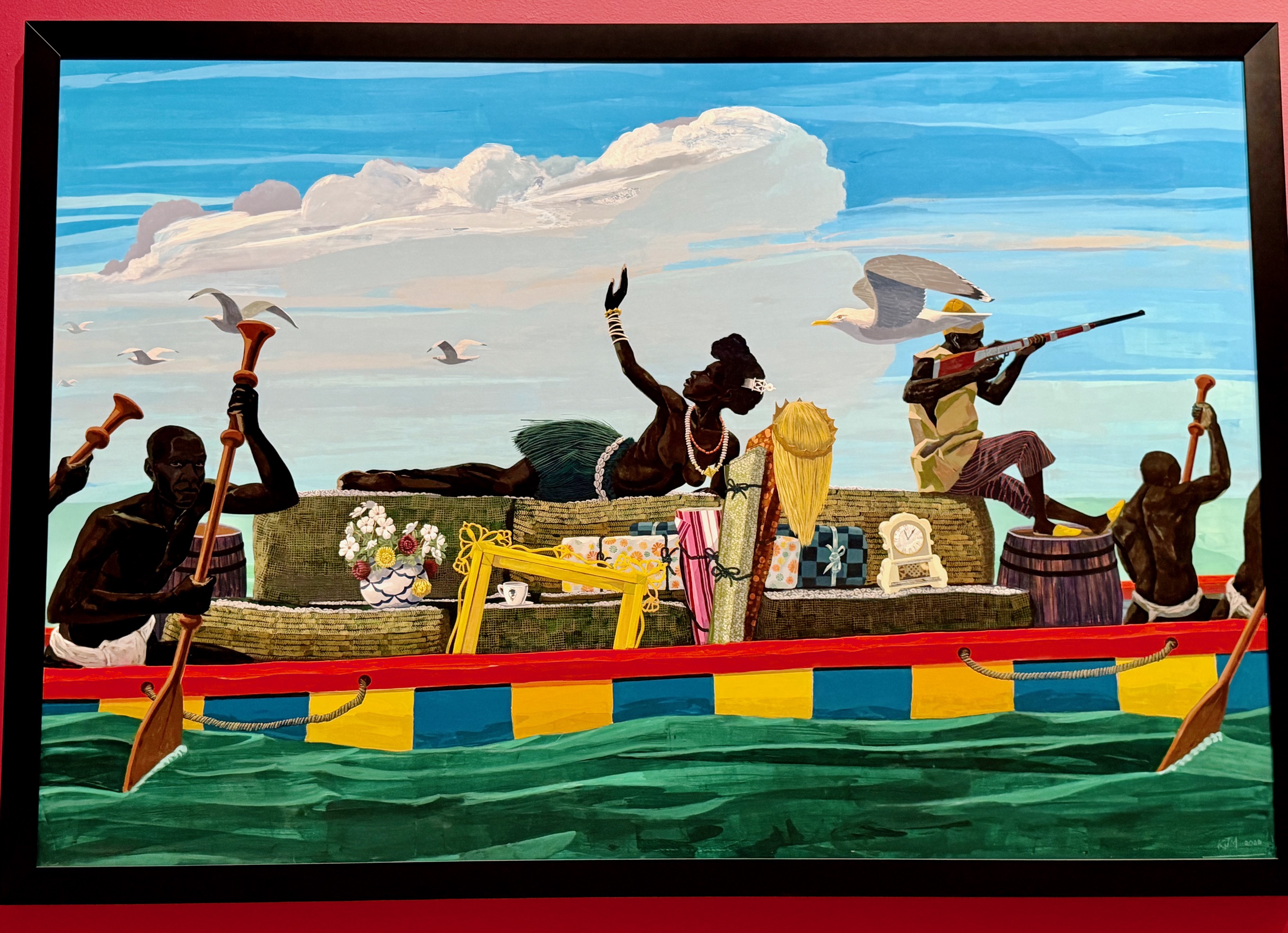
But the most talked-about works are Marshall’s grand canvases depicting the history of the trans-Atlantic slave trade – a group of symbolic works on the terrors of the Middle Passage (an Atlantic crossing where many souls never made it to the far shore) and dramatic murals of the Africans who successfully facilitated the capture and sale of fellow Africans.
Africa Revisited: Marshall’s 2025 acrylic Haul, showing Africans transporting payment from European slave traders for trafficked Africans. Courtesy: the artist and David Zwirner, London.
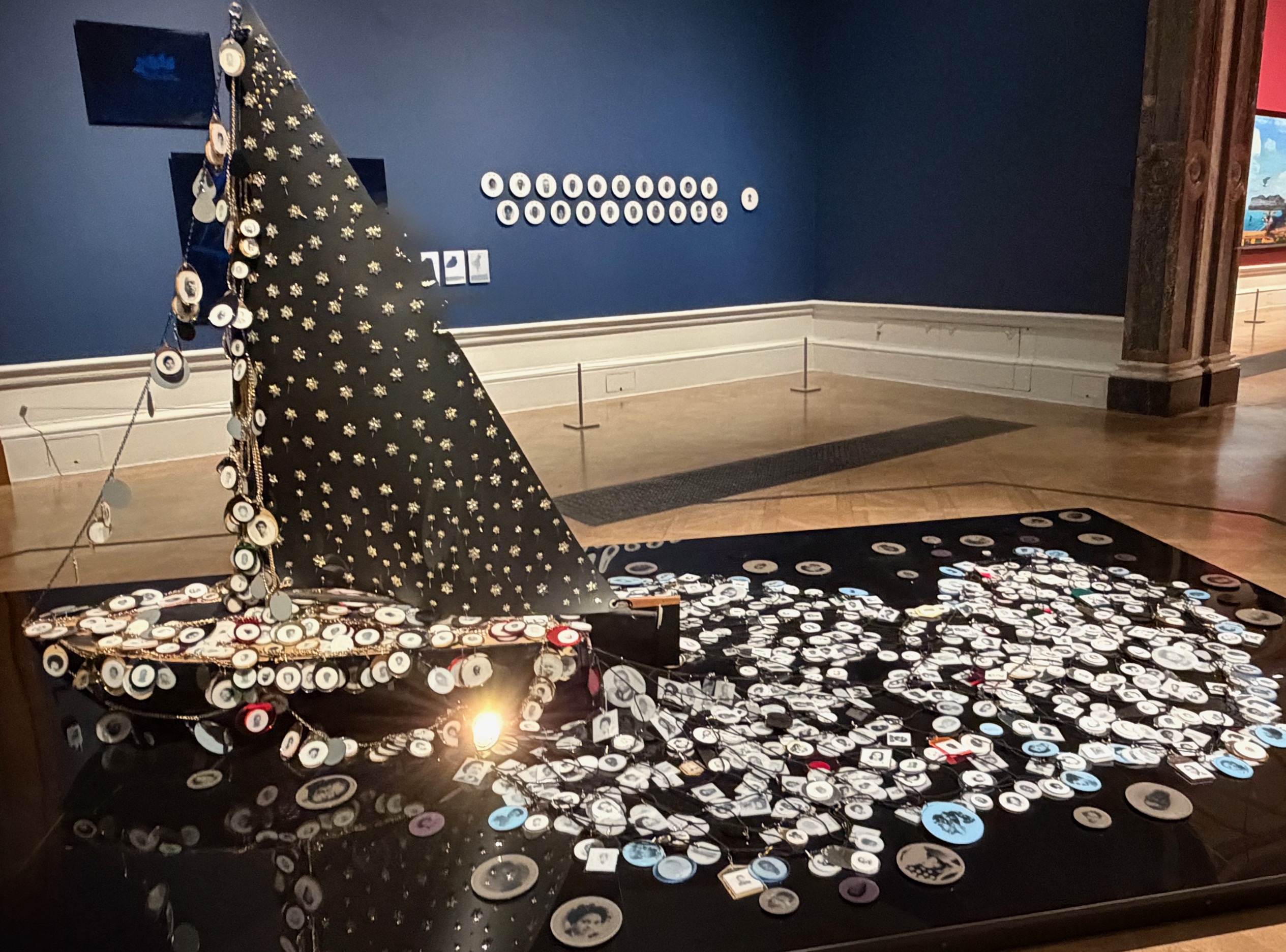
Visitors linger quietly in one of the last galleries devoted to Marshall’s installation at the 2003 Venice Bienniale. Most circumnavigate the sailing ship to get a better look at the hundreds with African-American achievement medals that are scattered about it. They also take close, respectful looks at each of the the commemorative ceramic plates that Marshall created with invented portraits of the first enslaved Africans brought to America.
Marshall’s 2003-ongoing mixed-media installation Wake originally displayed at the 2003 Venice Bienniale – a sailing ship covered with African-American achievement medals with other photographs and portraits. Courtesy: Rennie Collection, Vancouver.
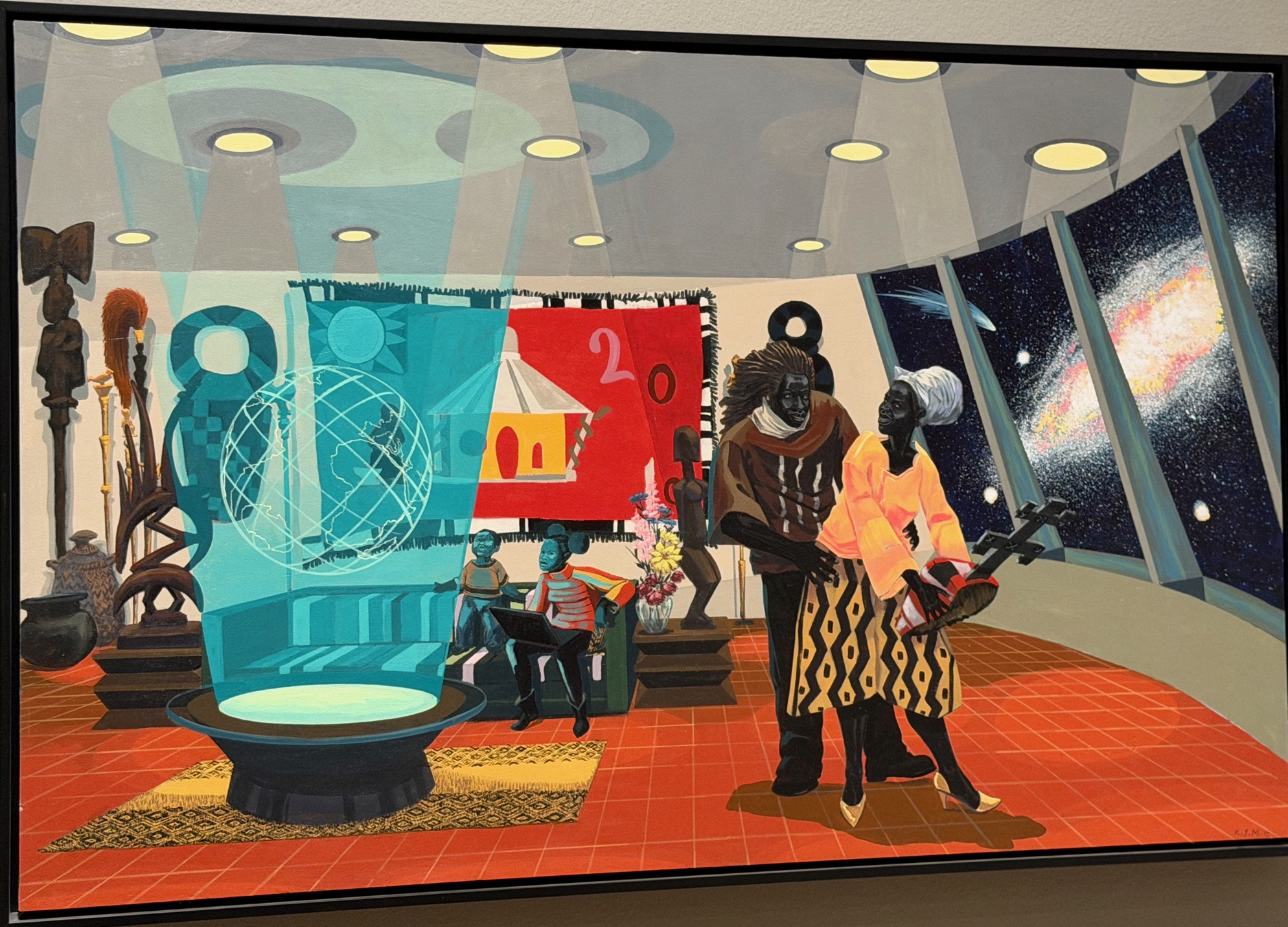
The show closes with an Afro-Futurist vision – a family in a beautifully appointed living room shooting through the universe with a view of the cosmos.
Marshall’s 2010 Afro-Futurist oil Keeping the Culture, a family of the future living in the cosmos. Courtesy: private collection.
Past, present, future, brilliant color, intriguing composition, successful Black protagonists – everything about the exhibition creates an indelible adjustment to what you thought you knew about daily Black life, lost history, and potential futures.
If you missed this show at the Royal Academy in London, Kerry James Marshall: The Histories will be shown at Kunsthaus Zürich from Februrary 27 to August 16 (2026) and at Musée d’Art Moderne de Paris from September 18, 2026 to January 24, 2027.
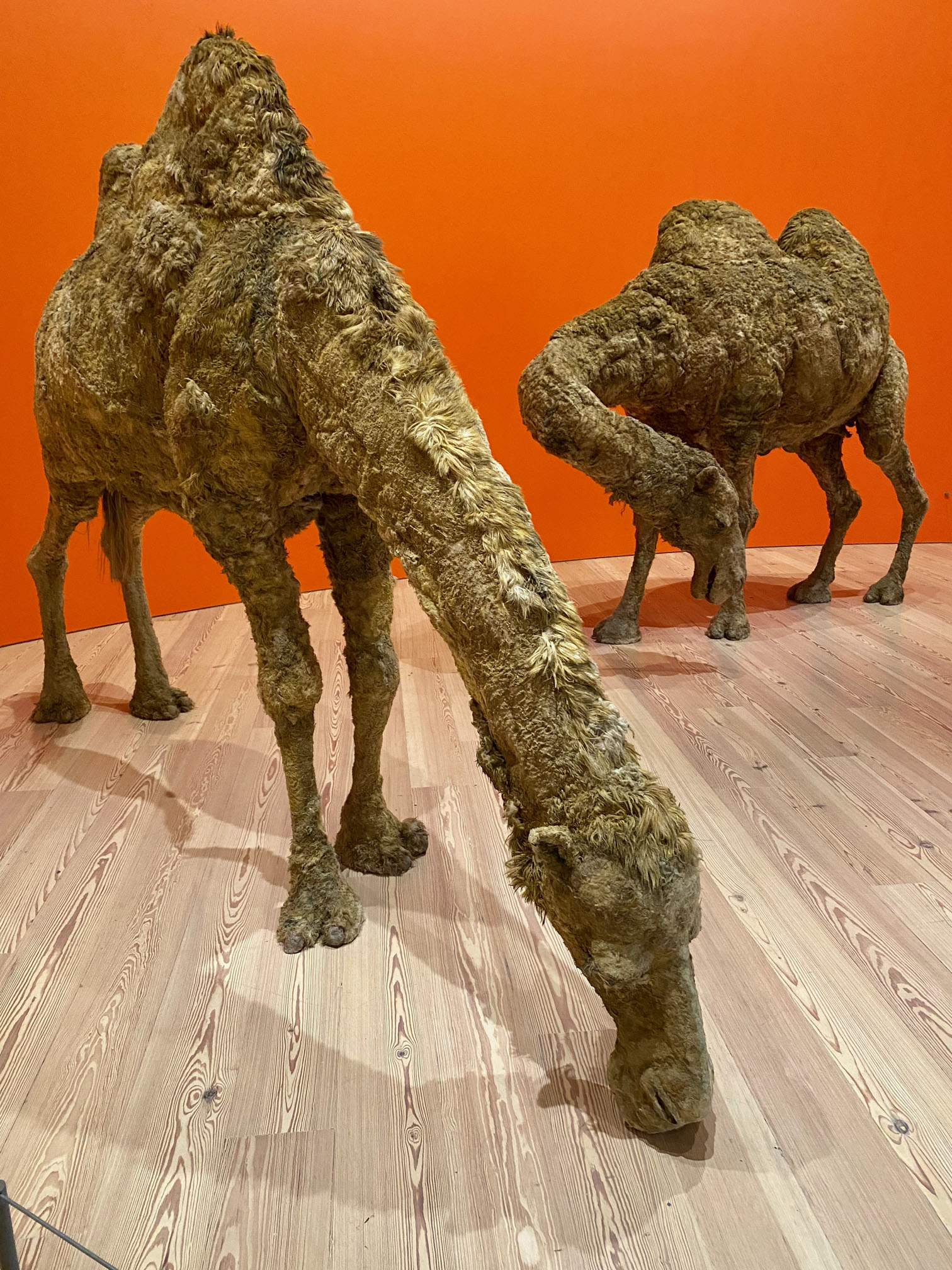
After more than 55 years, the camel herd is back at the Whitney. When they first appeared in 1969, the dromedaries were a media sensation. Who could resist the delight of seeing the life-sized camel sculptures by 28-year-old science nerd Nancy Graves nonchalantly going about their business in the pristine, white Breuer building?
At the new Whitney, the camels are welcoming everyone to Sixties Surreal – a superb exhibition (on view through January 19, 2026) that pulls out an array of engaging, cheeky work from that tumultuous decade. The show presents work by over 100 artists who chose to remain on the fringes of the big-time art world, creating pieces that poke at the Establishment, consumer culture, and social norms.
Strange, surrealistic 1968-1969 mixed-media, life-sized Camel sculptures by Nancy Graves; initially shown in her solo 1969 Whitney show. Courtesy: National Gallery of Canada, Ottawa.
The Whitney makes the case that American artists of the Sixties were not echoing the themes of European Surrealism (dreams, subconscious desires); but they did adapt a few of that group’s visual techniques to reflect and critique what was happening in America in off-center, slightly surreal ways.
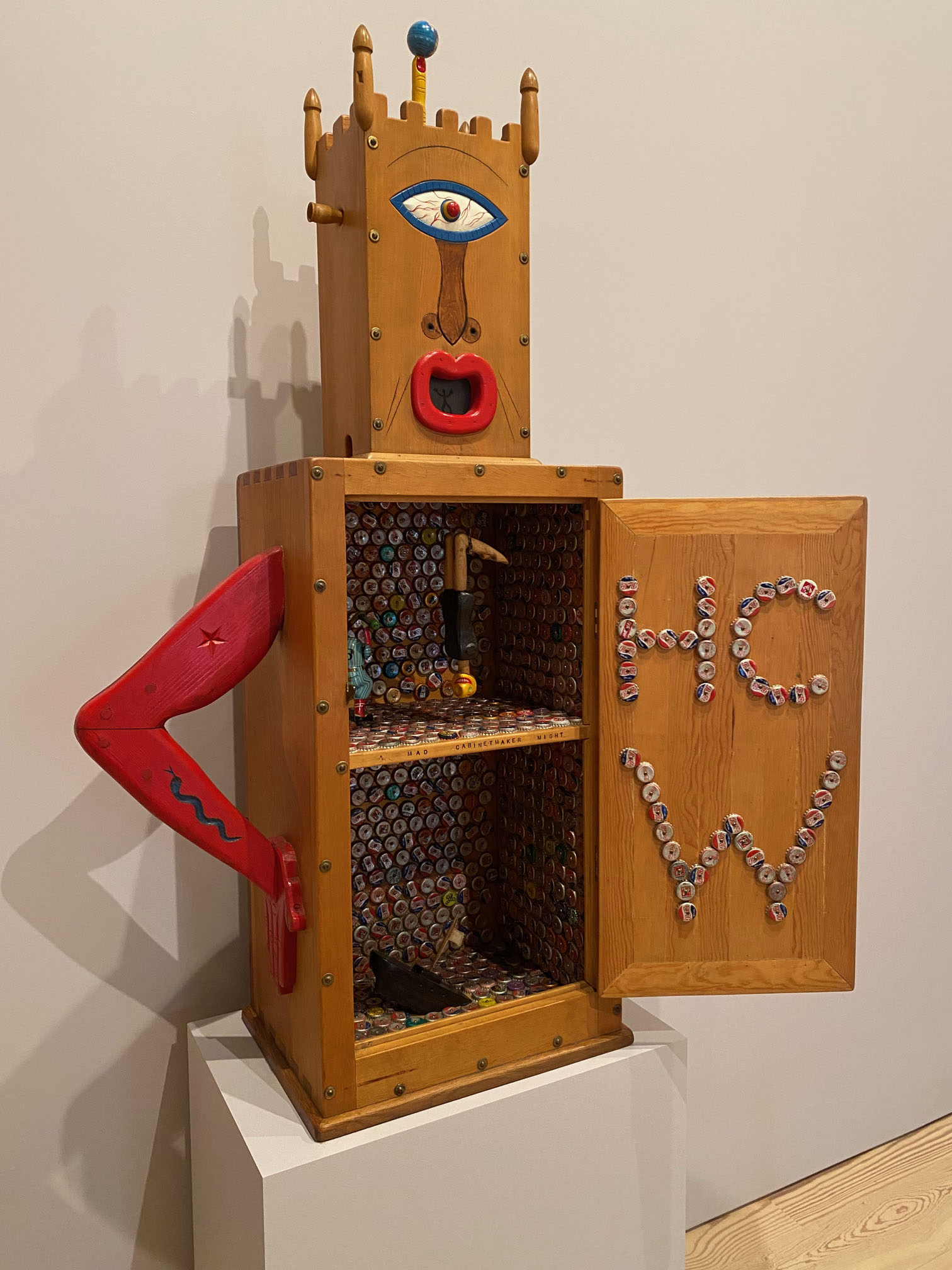
H.C. Westerman’s 1958 Memorial to the Idea of Man If He Was an Idea – a finely crafted “person” with an extremely complicated interior of bottle caps, toys, glass, metal, etc. Courtesy: Museum of Contemporary Art Chicago.
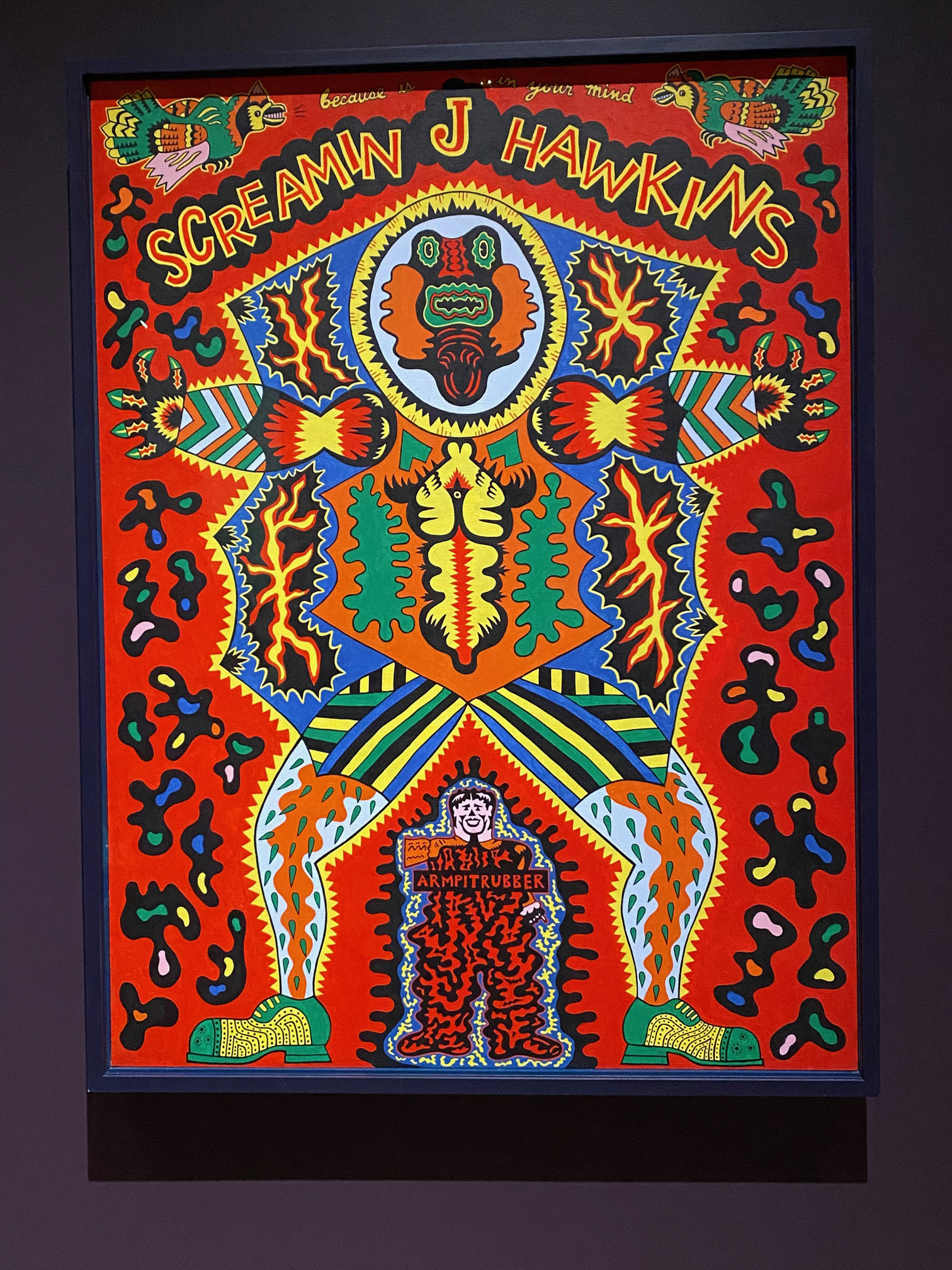
Karl Wirsum’s 1968 acrylic Screamin’ Jay Hawkins – a surreal, high-octane album cover painting for an early-rock icon. Courtesy: Art Institute of Chicago.
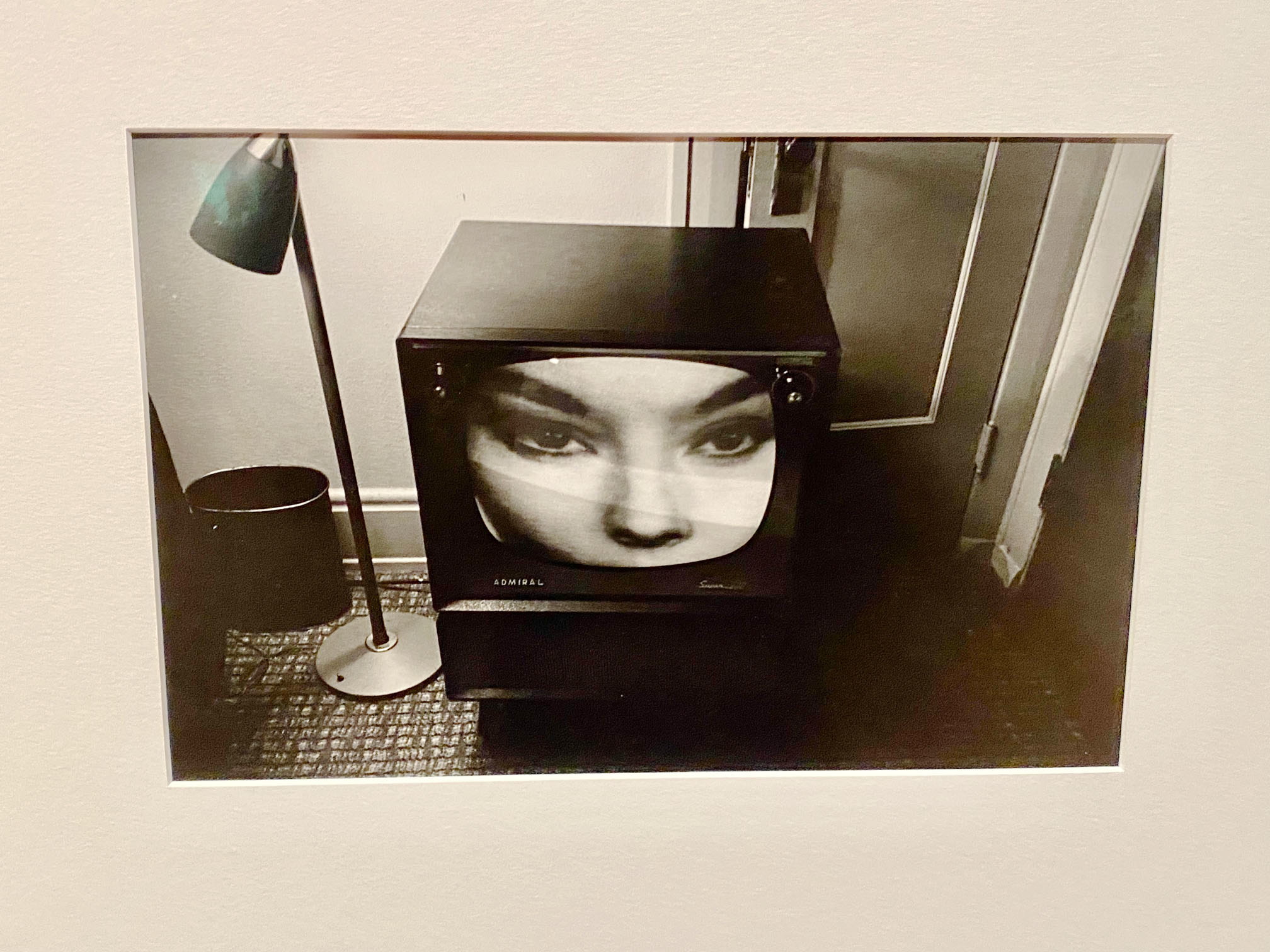
The Sixties was a decade when cultures were clashing, TVs were showering a kaleidoscope of images into people’s living rooms, nuclear catastrophes loomed, and people were landing on the Moon.
Lee Friedlander’s 1963 photograph Florida showing the surrealistic, disorienting impact of TVs in every home. Courtesy: Museum of Modern Art.
The exhibition shows how artists who didn’t belong to trendy “isms” still managed to create work that has stood the test of time – the Hairy Who of Chicago, the funk-and-pun artists of California, the downtown post-minimalists of New York, emerging Native American modernists, and social-justice artist-advocates.
Take a look at some of our favorites in our Flickr album.
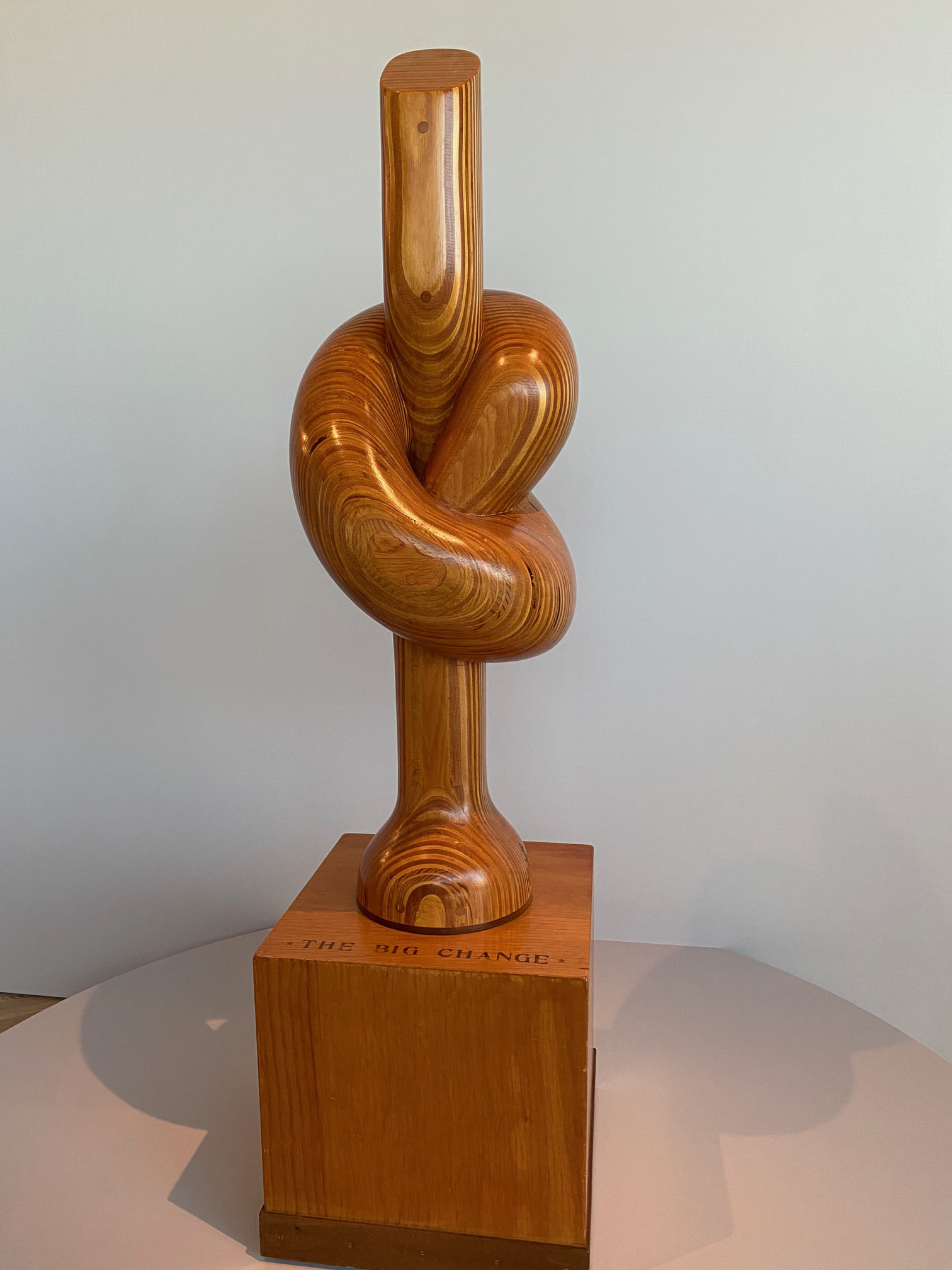
H.C. Westerman’s 1963 impossible wooden “knot” sculpture The Big Change – an allusion to all the social-political changes happening in America. Courtesy: The Art Institute of Chicago.
At a time when hard-edged minimalism and Pop Art ruled, the curators want us to see and experience (again) artists whose work was featured key exhibition showcases like Lucy Lippard’s 1966 Eccentric Abstration show at Fischbach Gallery in New York and Peter Selz’s 1967 Funk show at the Berkeley Art Museum. Each were full of work that defied contemporary art-world conventions.
The Whitney’s chosen to showcase several pieces of one of the artistic godfathers of the funk movement – H.C. Westerman. His satiric “minimalistic” shag carpet sculpture sits next to a William T. Wiley painting, but it’s wonderful to contemplate two virtuoso carved pieces – The Big Change and Memorial to the Idea of Man If He Was an Idea.
The first gallery presents disquieting creations that present strange, out-of-context juxtapositions, weird images, and out-of-proportion everyday objects that seem to reflect the feeling that we’re living in an off-kilter world. A large Rosenquist hovers over the gallery, but its muted tones and dissonant images evoke a far different mood than his famous, epic, over-the-top F-111.
Alex Hay’s 1968 strange, oversized painted fiberglass and epoxy Paper Bag sculpture. At rear, James Rosenquist’s 1961 oil The Light That Won’t Fail I, full of unsettling juxtapositions.
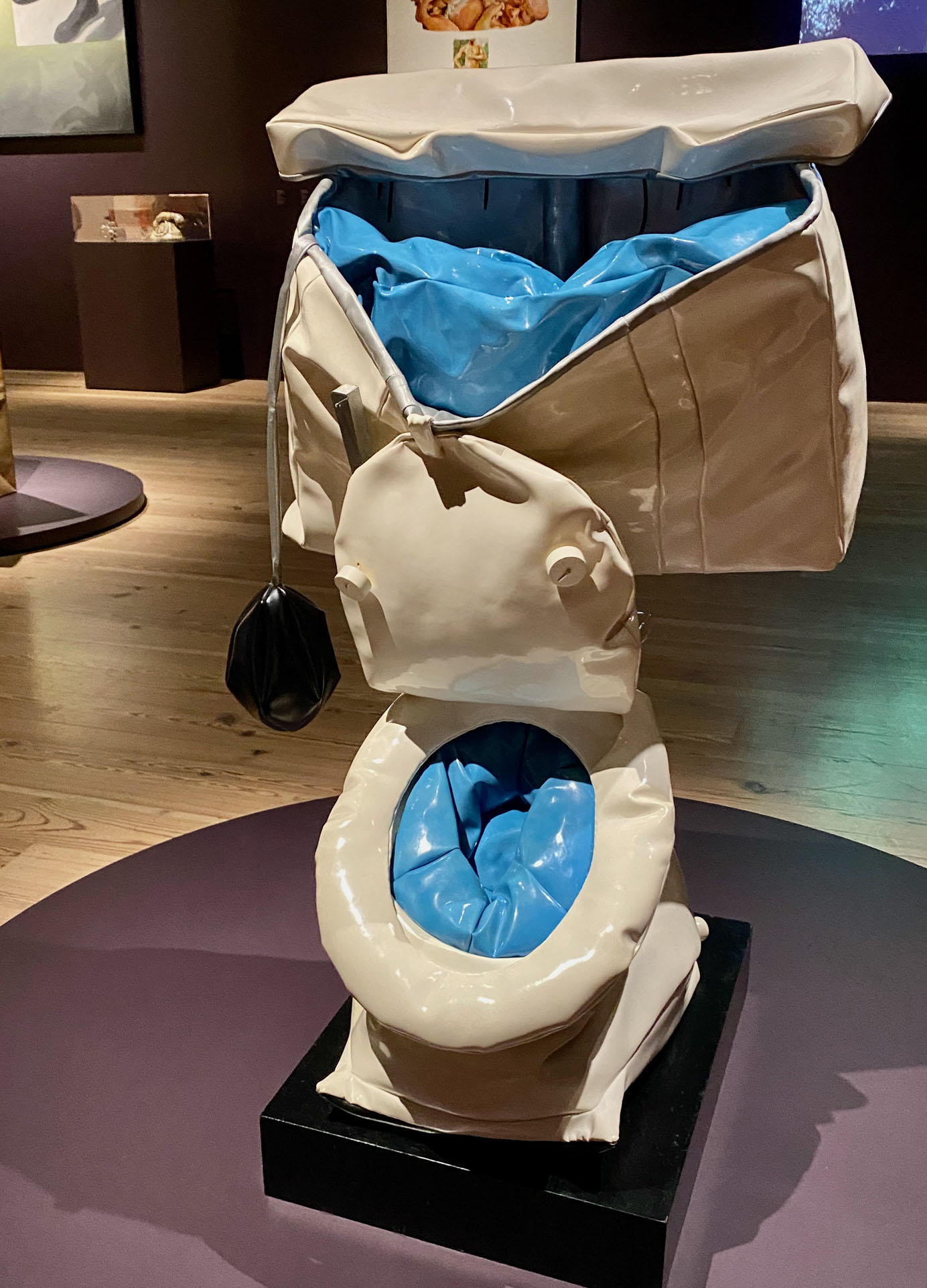
Claes Oldenburg’s 1966 mixed-media Soft Toilet – an unsettling, oversized fixture from the American bathroom.
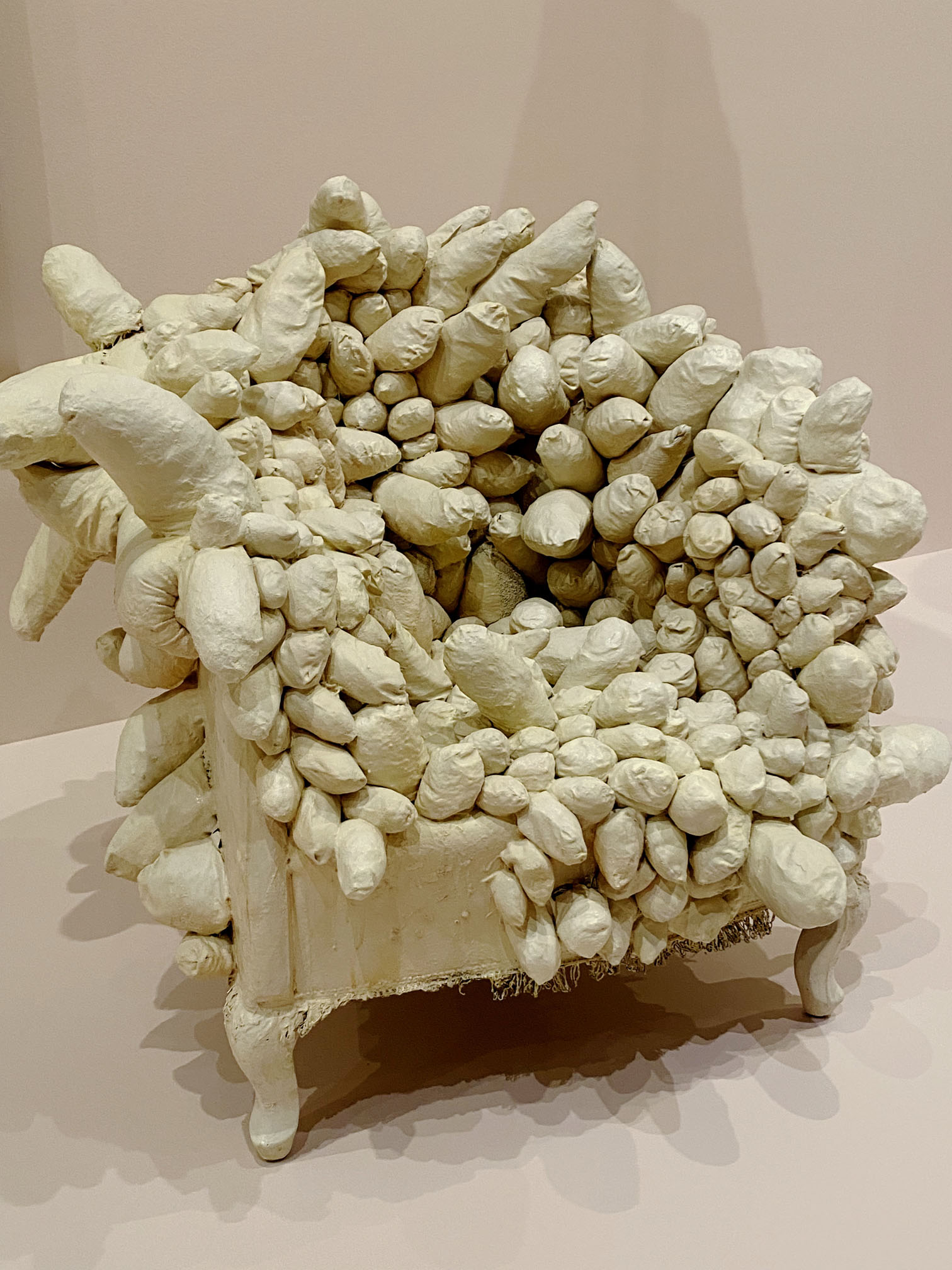
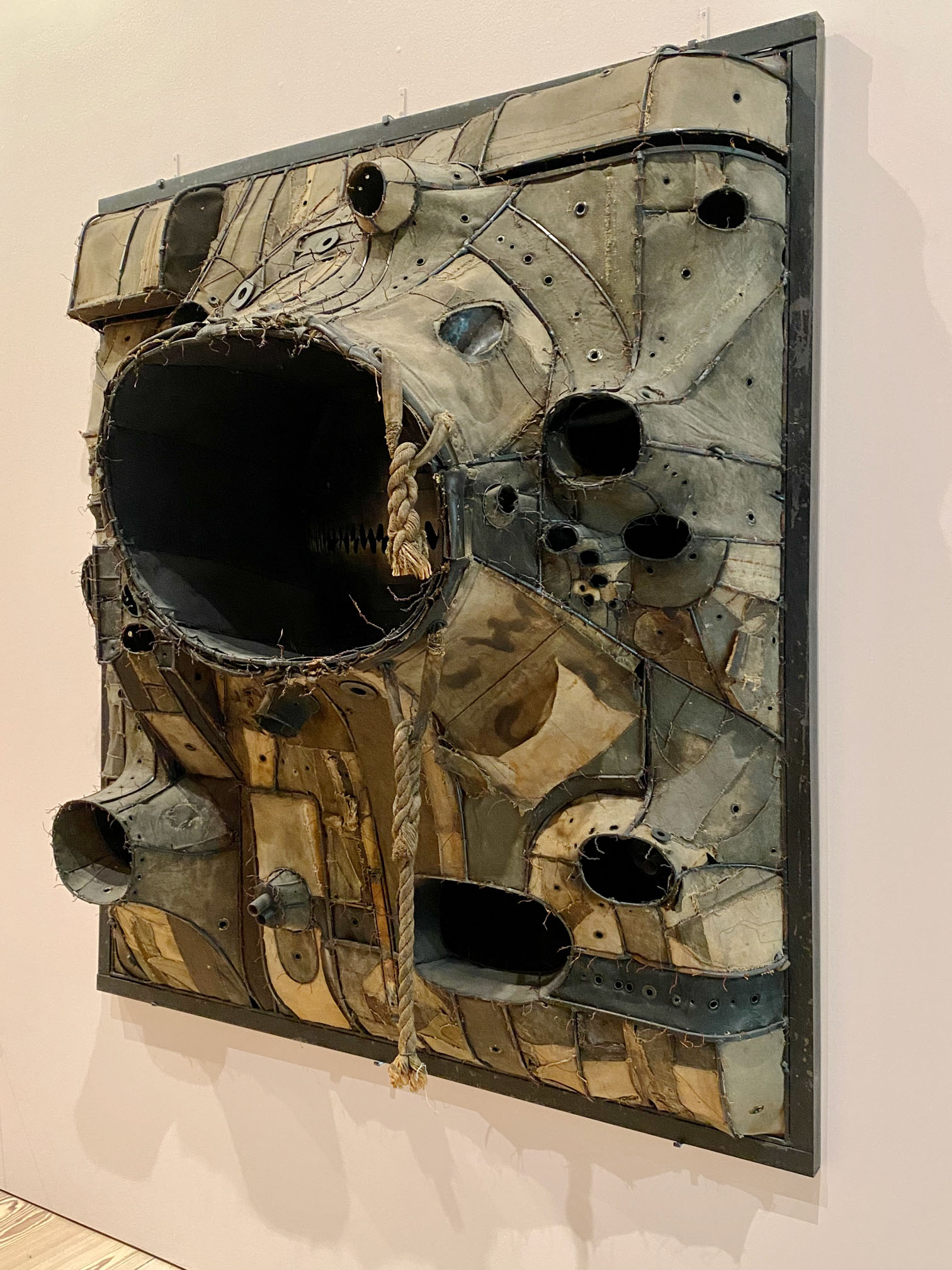
Another section presents work – many from repurposed or recycled material – with sensuous forms that suggest – but not directly depict – the human body. It’s nice to see such an array of soft, draped, and biomorphic work by artists like Kusama, Eva Hesse, Kay Segimachi, and nearly forgotten Miyoko Ito.
Kusama’s 1963 provocative hand-sewn, soft fabric-chair sculpture, Accumulation, which caused a sensation among New York critics.
Lee Bonticou’s 1961 welded, stitched canvas abstraction, created from scavenged steel, weathered canvas, clamps, wire, and rope from conveyor belts.
The far end of the exhibition presents works that take a stand to push for change in the world. Jasper Johns and Fritz Scholder let their paint do the talking. But others use a dada tactic to get the point across – hard-edge collages and assemblages.
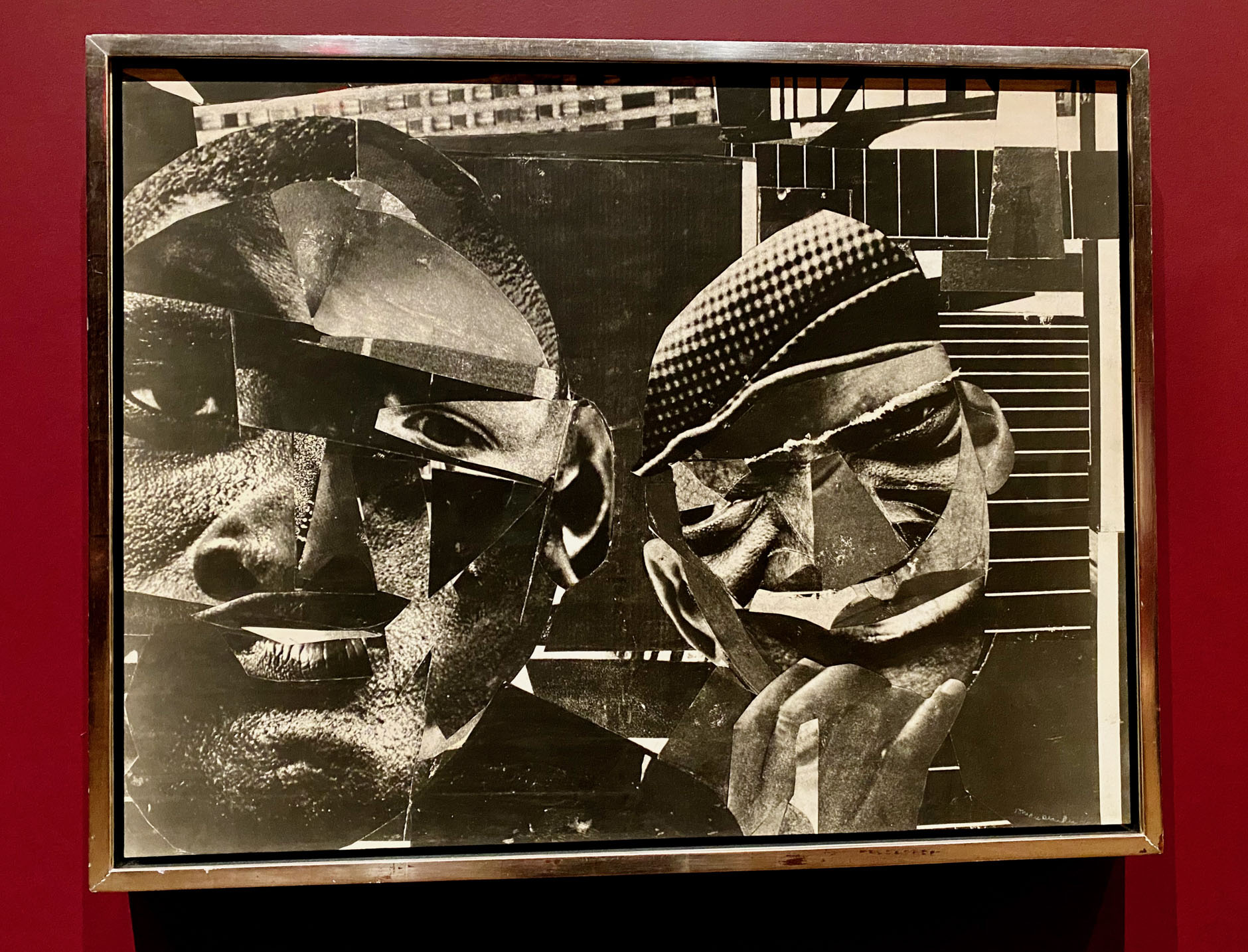
Social surreal: Romare Beardon’s 1964 Pittsburgh Memory 2/6 – mounted collage of photograph fragments creating the surreal experience of being Black in a big America city. Courtesy: private collection.
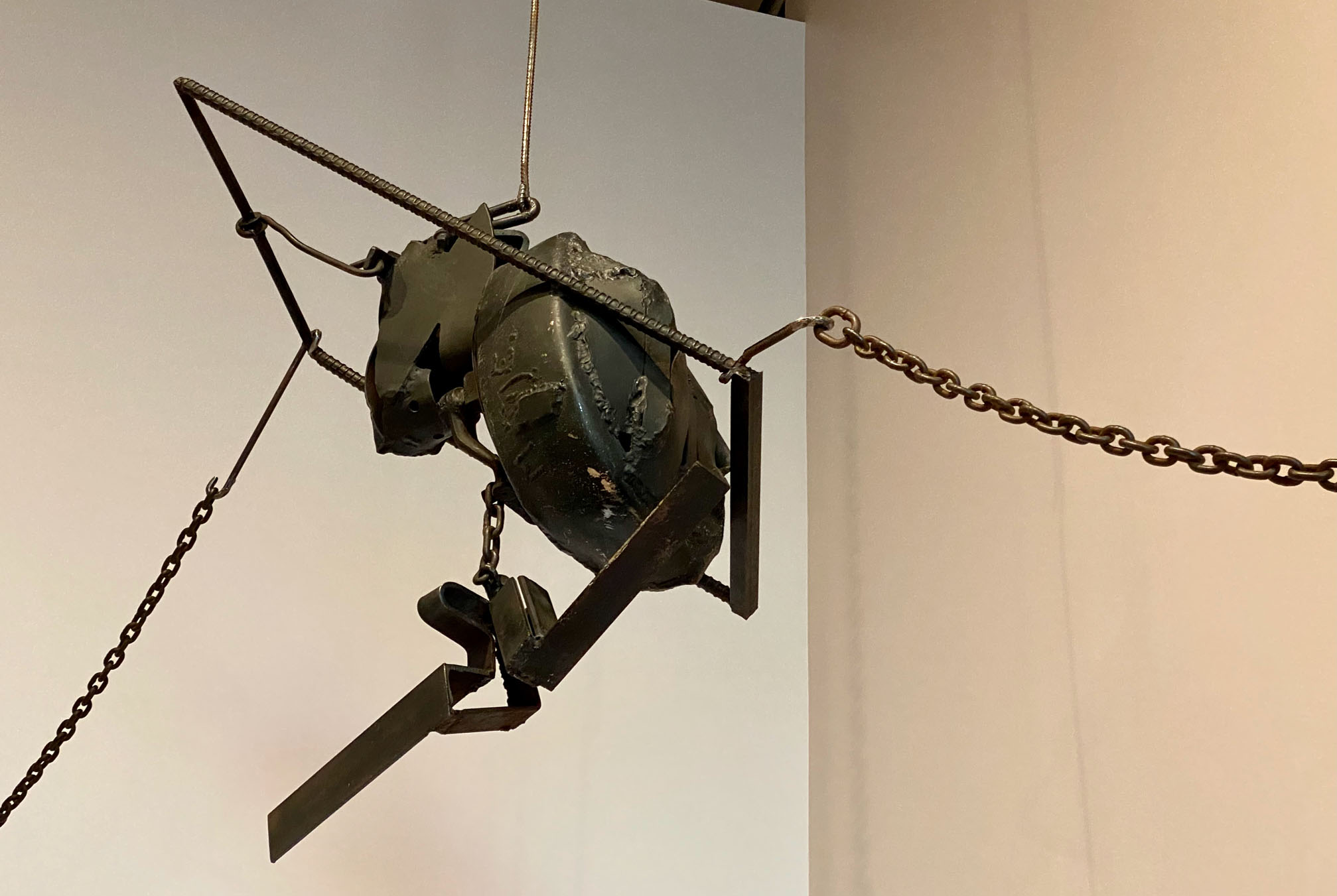
1966 Cotton Hangup by Melvin Edwards – suspended abstraction from recycled industrial equipment; evokes historic violence and oppression against African Americans. Courtesy: Studio Museum in Harlem
The show concludes with a selection of works by artists reflecting alternative spiritual practices and beliefs. At a time when organized institutions and religions were being questioned, why not turn inward?
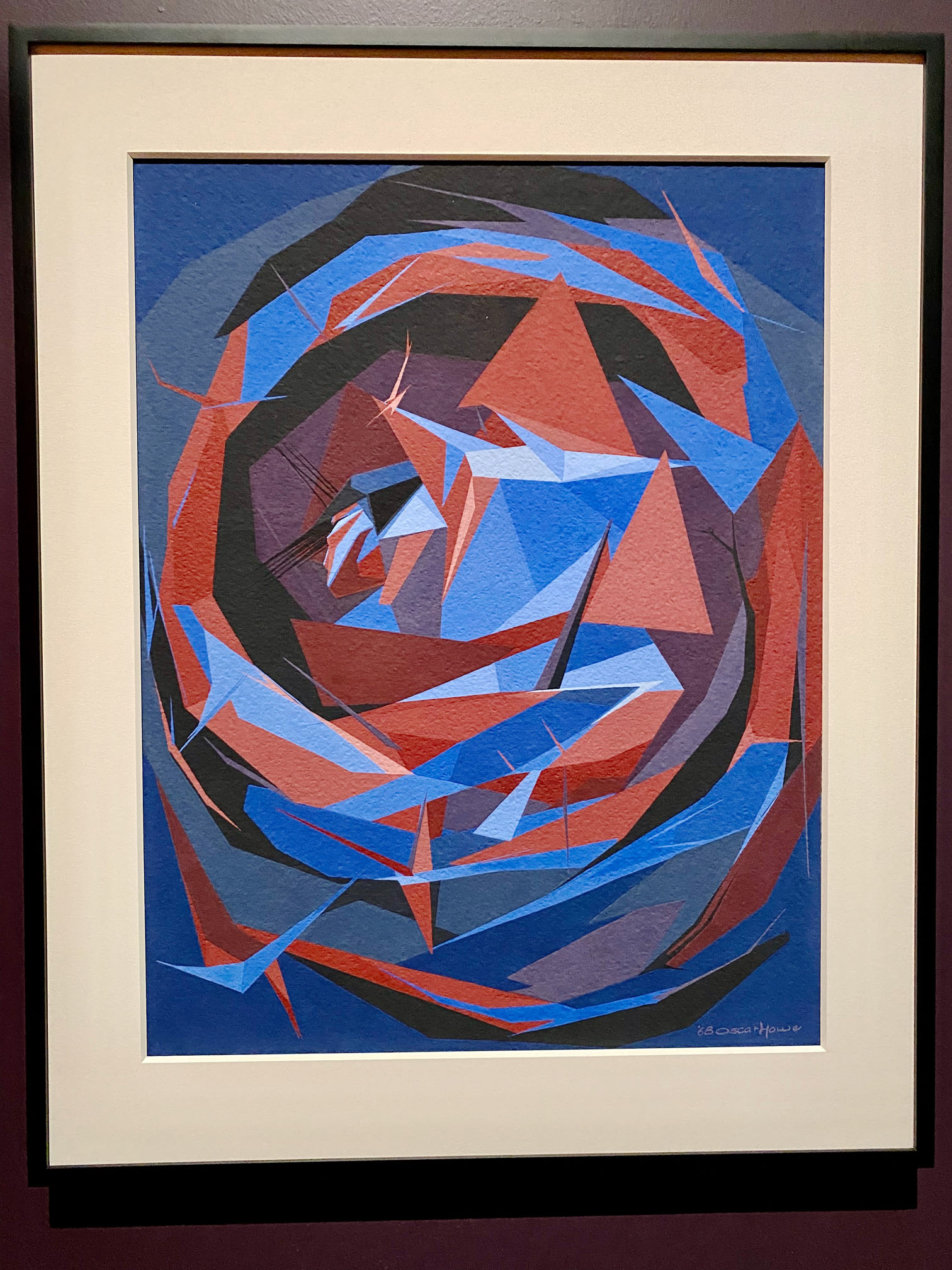
Oscar Howe’s 1968 painting Retreat – an Indigenous-modernist impression of a traditional Dakota ceremony.
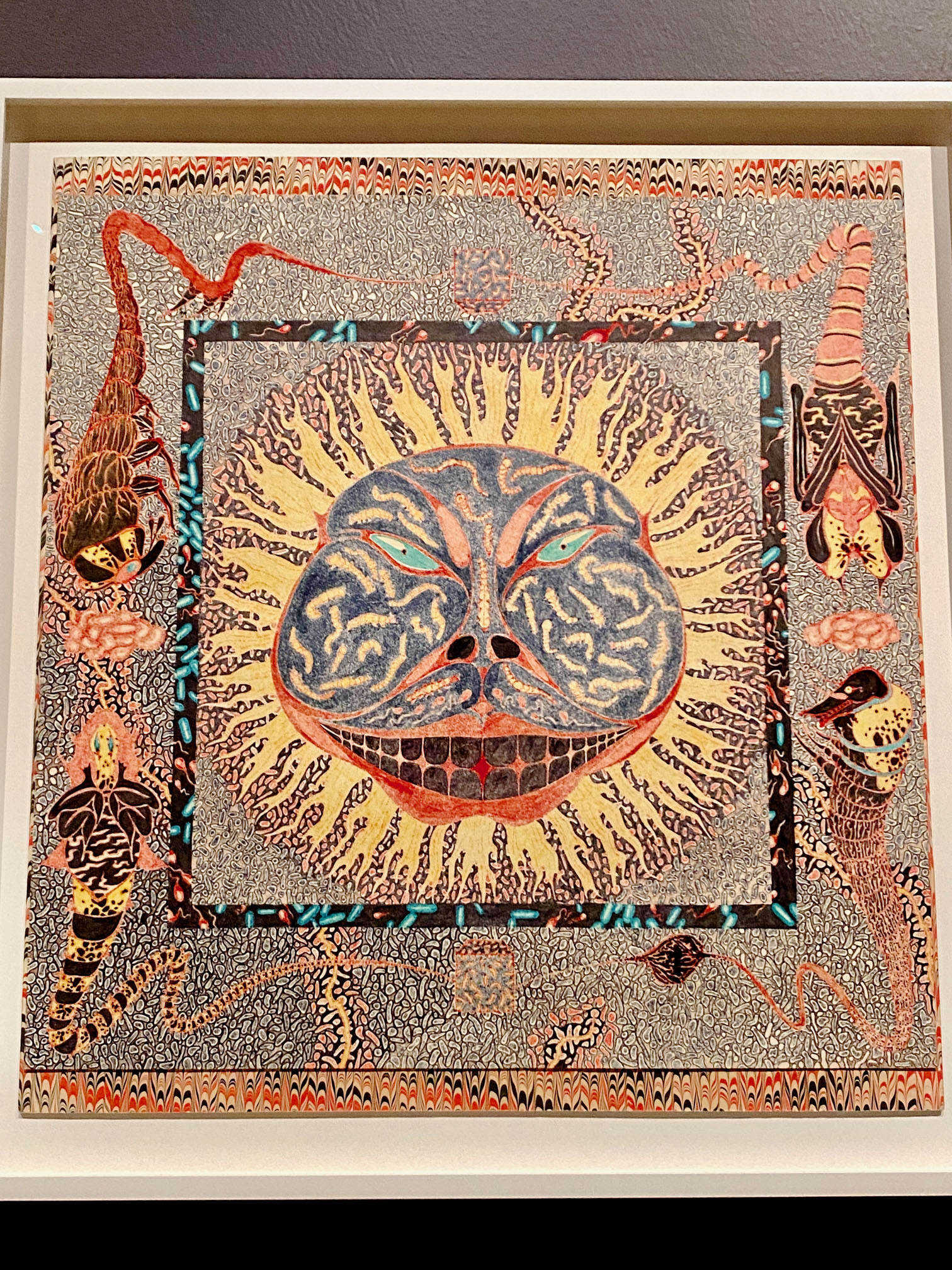
Ching Ho Cheng’s 1967 Sun Drawing, a meditative approach using a felt-tipped pen on found paper.
Have fun strolling through the Whitney’s Sixties Surreal galleries to a totally throwback Sixties soundtrack:
To hear more about specific works, listen to the curators talk about individual works in the audio guide here.
The scale and scope of the contemporary art on display is tremendous, but how often do art-seekers also get an opportunity to travel across ancient streets and landscapes, to meet real and fictional historic characters, contemplate fables and real-life stories, and see art of the past and present side by side?
It can take days to experience and fully absorb all of the history and potential futues presented in the films, paintings, sculptures, and installations in Once Within a Time: 12th SITE Santa Fe International, on view across 15 art spaces across Santa Fe through January 12, 2026.
Exhibition banner in the courtyard of Palace of the Governors (1610) (New Mexico History Museum) – gateway to SITE installations by Daisy Quezada Ureña (Santa Fe) and Charisse Perlina Weston. (Harlem, New York)
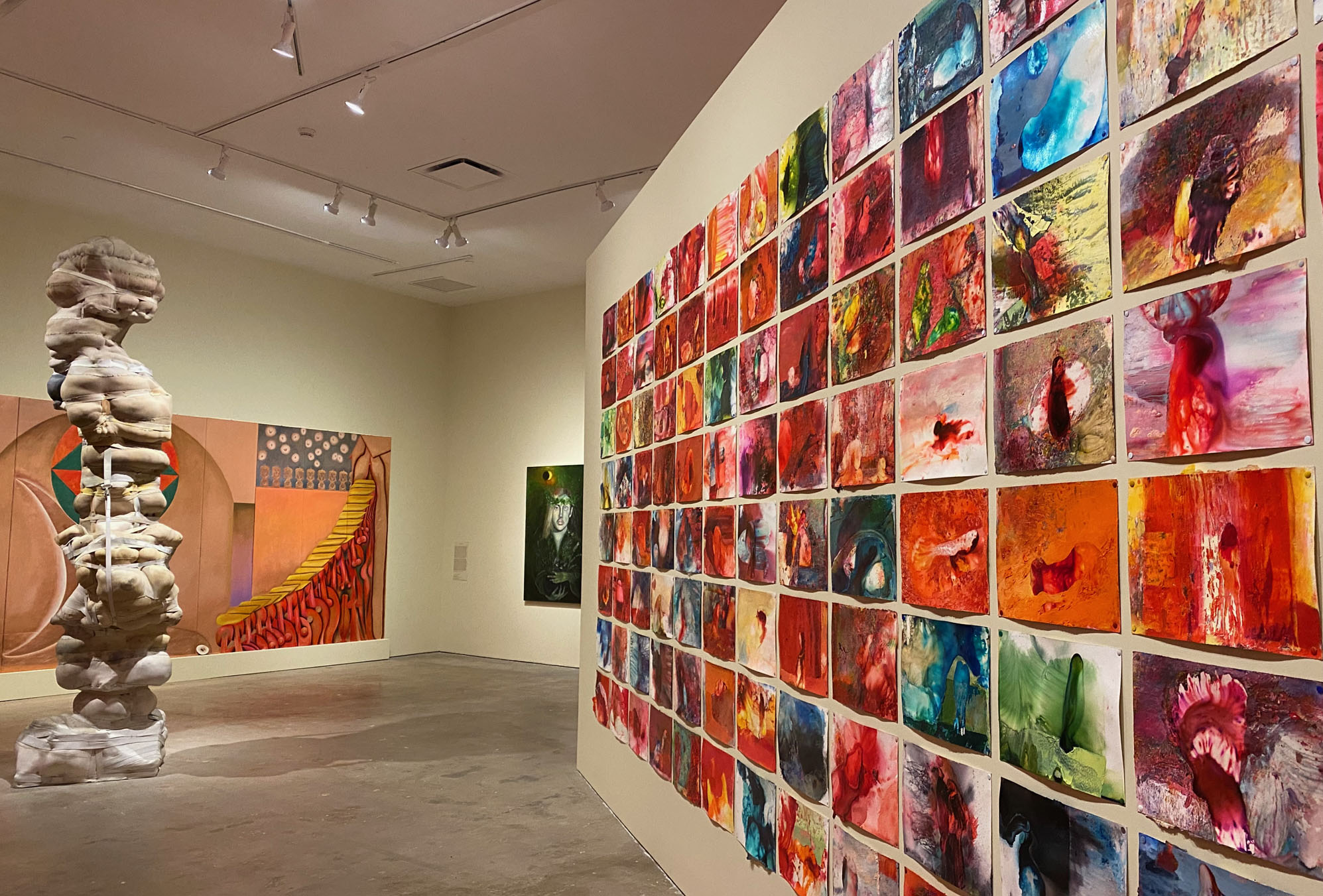
Besides the expansive white galleries and screening rooms of SITE’s museum in Santa Fe’s always-popping Railyard District, visitors can choose to contemplate giant abstract murals in a church-like auditorium, an innovative historical-object installation in a 400-year-old seat of power, or enter an old foundry to see an evocative installation by a Silk Road artist across farm fields adjacent to the Old Spanish Trail.
SITE Santa Fe gallery theme: appears like real life and sensual free-thinkers. 2025 mixed-media sculpture “18-1-4-5-7-21-14-4” by Patricia Ayres; copper work by Santiago de Paoli; Katja Sieb’s 2025 “perpetual novice” painting; and 2020 grid painting “Atlas” by Penny Siopis (South Africa).
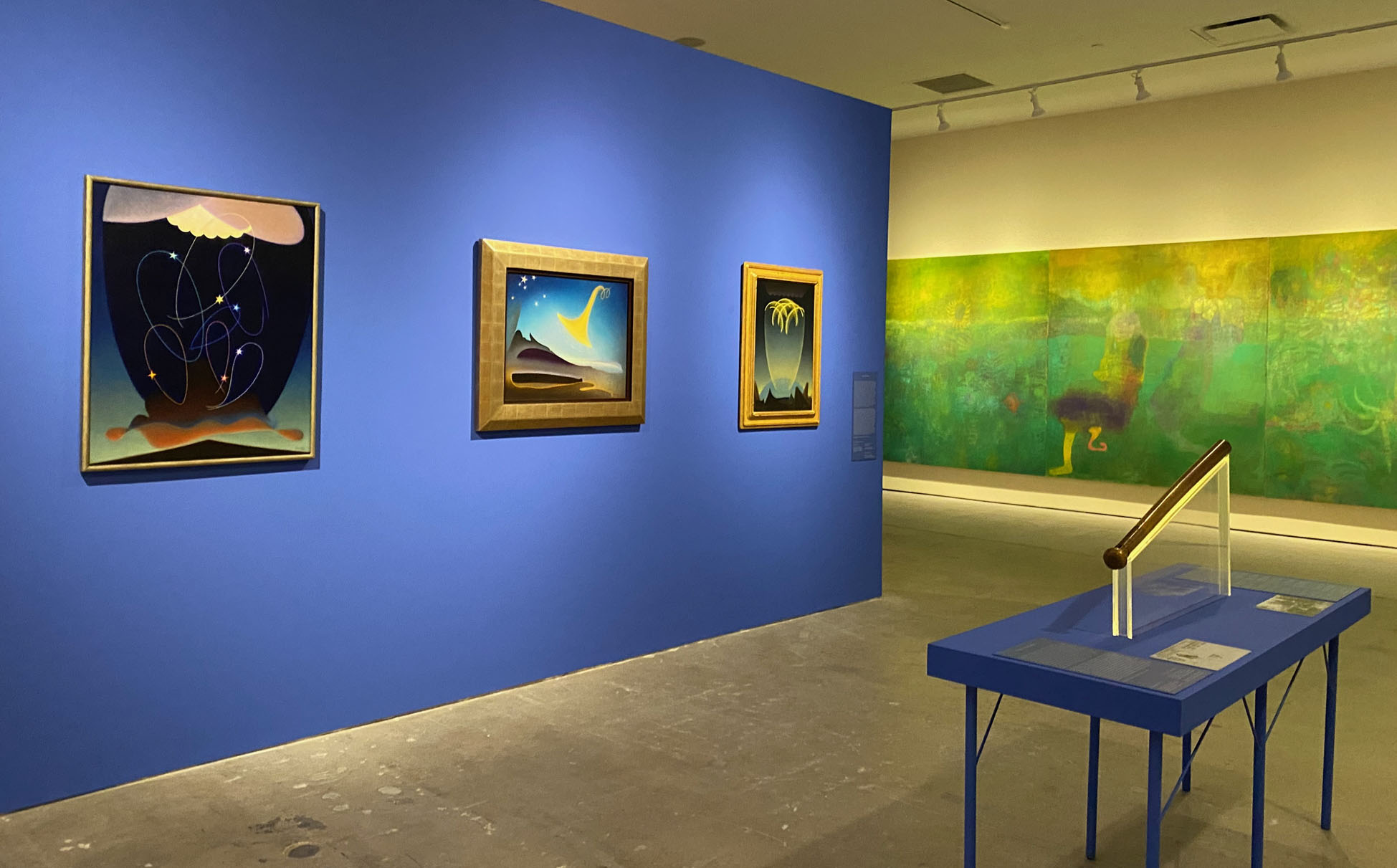
SITE Santa Fe gallery theme: in touch with light (spiritual) – Agnes Pelton’s paintings (1930s), Maja Ruznic’s mural (2025), and the 1895 healing rod of itinerant Southwestern mystic Francis Schlatter. Courtesy: Phoeix Art Museum; New Mexico Museum of Art; Oakland Museum of California; Maja Ruznic and Karma Gallery; and New Mexico History Museum.
In every space and art encounter, visitors may reflect upon whether history is repeating itself and whether inspiration can be drawn from futures that artists imagined nearly a century ago. Each space is designed for visitors to look, read, encounter, and reflect.
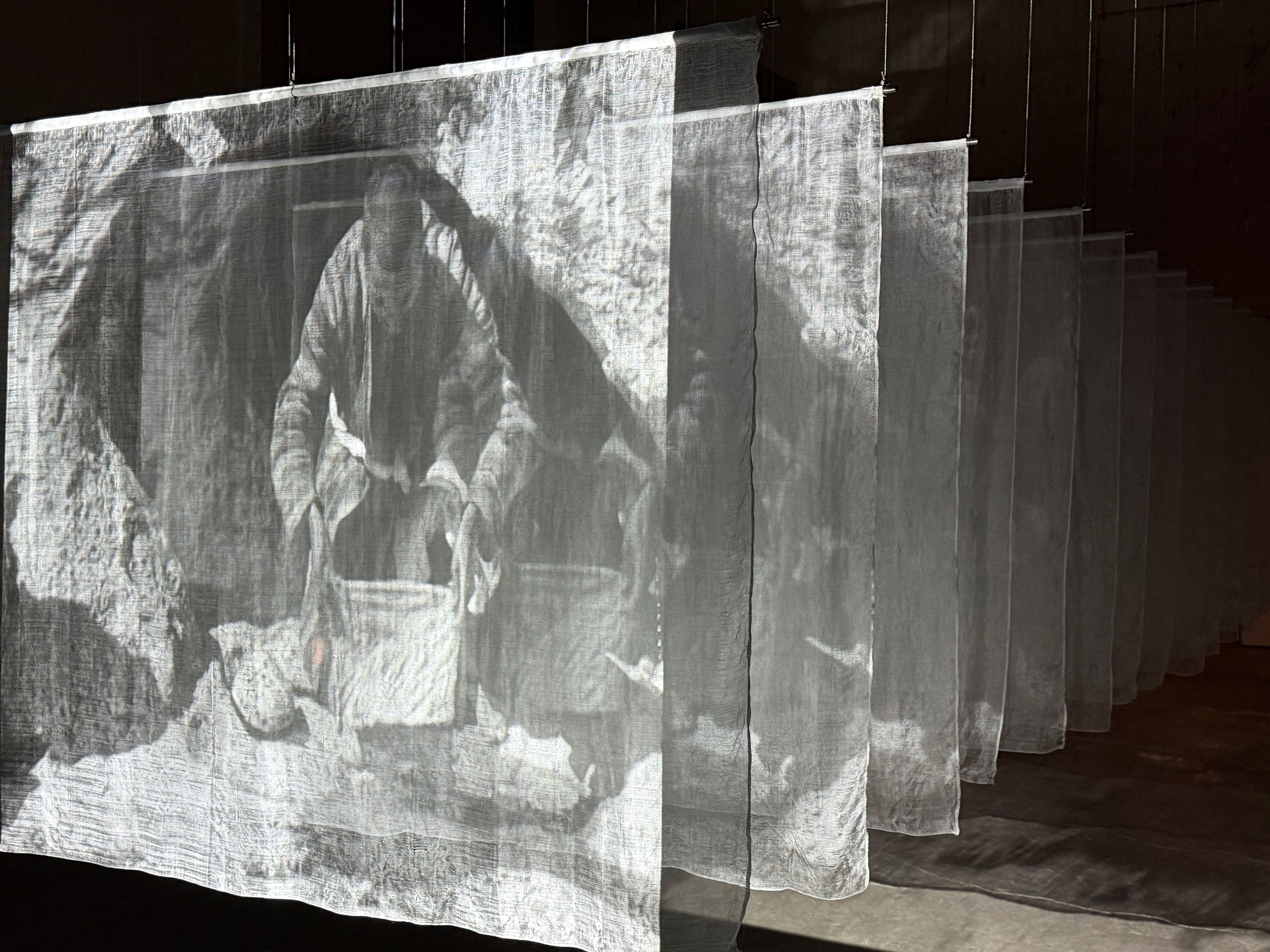
In the old foundry at Tesuque: 2024 video As We Fade by Saodat Ismailova (Uzbeckistan), showing visitors to one of Central Asia’s most sacred sites (Throne of Solomon) along the ancient Silk Road; projected across 24 suspended silk screens. Courtesy: the artist and Milan’s Pirelli HangarBicocca.
The theme for the show – Once Within a Time – is inspired by Godfrey Reggio’s most recent film – a suggestive and wordless mix of innocence, nostalgic images, visual poetry, and the future facing the next generation. The film screens continuously inside SITE, with visitors caught up in Godfrey’s dream-like images, which highlighted in this mesmerizing movie trailer:
Like Godfrey’s film, each space and gallery presents a theme, story, historic character, and provocative contemporary art that pulls back in time, creates an unforgettable experience, and asks the viewer to go inward to contemplate the future.
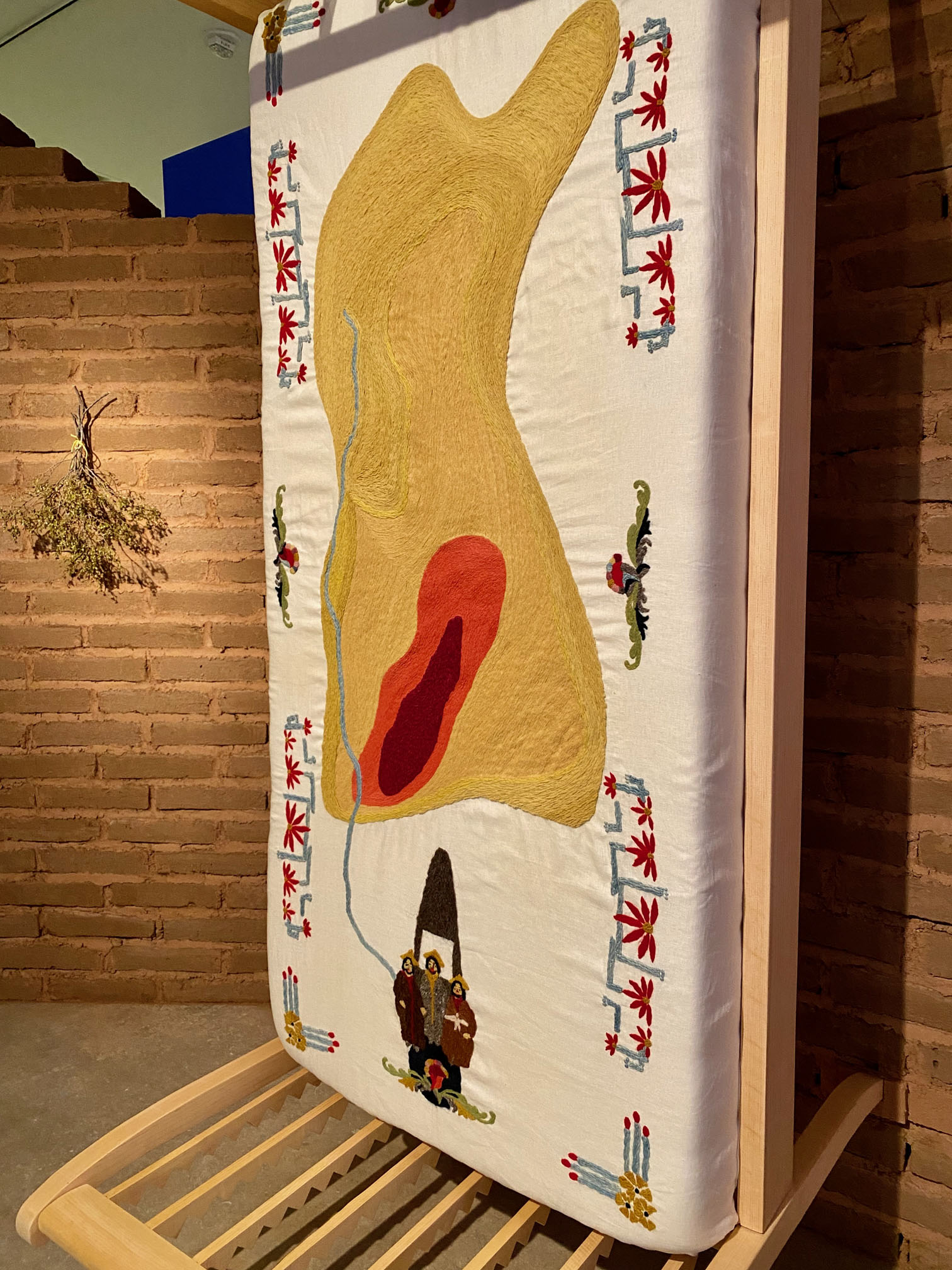
Joanna Keane Lopez’s 2024 Batter my heart, three person’d God – adobe, a handmade bed, colcha embroidery showing a radiation cloud, and creosote bush, referencing her family’s experience of living downwind of the Trinity detonation.
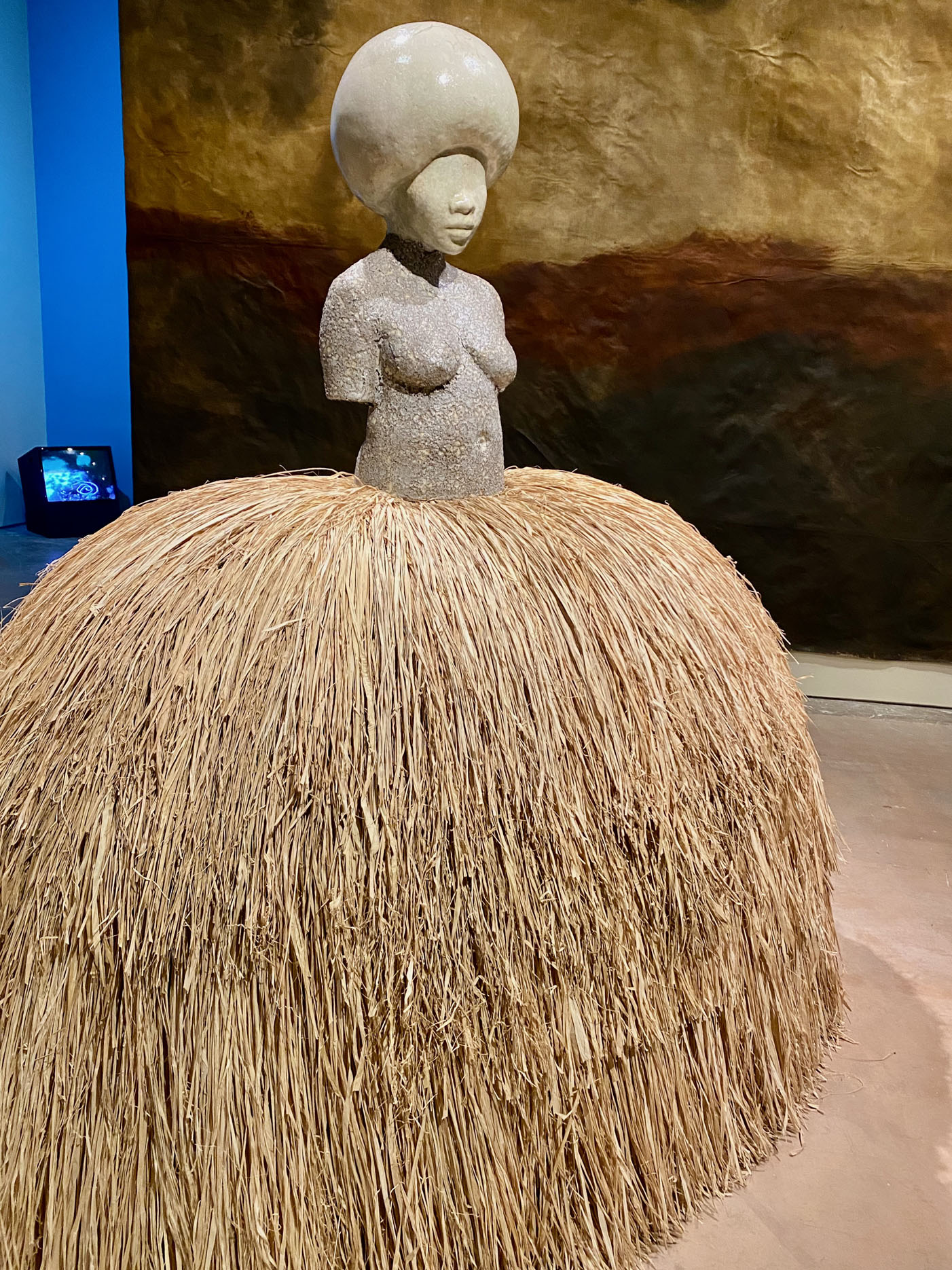
Cochiti pueblo ceramicist Helen Cordero’s storyteller figures are paired with Pablita Velardi’s storyteller illustrations (both are inspired by grandfathers and fathers) and Simone Leigh’s epic stone and raffia goddesses.
SITE Santa Fe gallery theme: storytelling. Simone Leigh’s 2025 untiled stoneware and raffia sculpture. At rear, 2025 oil The Solemn and Dignified Burial Befitting My Beloved for All Seasons by Dominique Knowles. Courtesy: Matthew Marks Gallery; the artist and Hannah Hoffman Gallery, Los Angeles.
Gallery theme: storytelling. Helen Cordero’s 1970 painted clay Storyteller – the creator of the Cochiti Pueblo sculptural tradition, inspired by her grandfather’s stories; championed by patron Alexander Girard. Courtesy: School for Advanced Research.
SITE Santa Fe gallery theme: language Marilou Schultz’s 2024 weaving Integrated Circuit Chip & AI Diné Weaving – a reference to the controvercial 1970s Fairchild Semiconductor chip plant on Navajo Nation staffed primarily with Diné women. Courtesy: private foundation.
The story of the legendary WWII heroes, the Navajo Code Talkers, is featured in a gallery alongside Marilou Schultz’s weavings of chip technology using traditional Diné methods with Fred Hammersly’s ground-breaking IBM computer drawings at the University of New Mexico in 1968-1970.
Fred was given an opportunity to create the first mainframe-generated art in the form of drawings programmed by traditional IBM punch-card technology and the Art1 program. SIITE not only displays a selection of the 400 computer drawings that he generated over the course of 18 months, but some of the punch cards he used, which are now archived at the Smithsonian’s Archives of American Art.
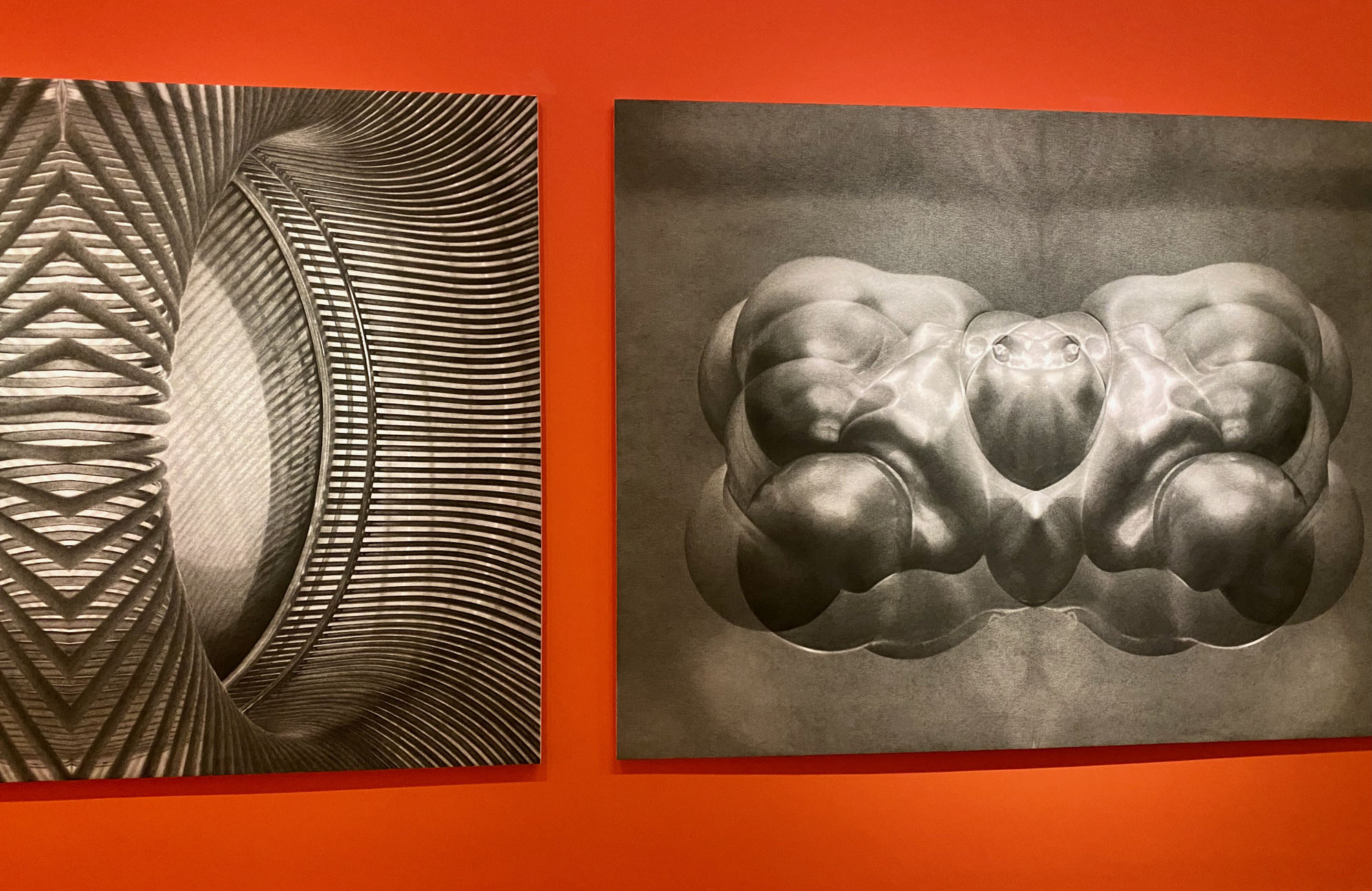
Sensual free-thinkers are represented by the story of Santa Fe gambling mogul Doña Tules (Maria Gertrudis Barceló) and her actual 1840s money chest, witty contemporary porcelain playing cards and magical paintings by Katja Seib (UK), and jaw-dropping drawings by Shanghai’s Zhang Yunyao.
SITE Santa Fe gallery theme: sensual free-thinkers. Two of three 2025 Connector drawings by Zhang Yunyao (Shanghai); pencil on stretched felt. Courtesy: the artist, Don Gallery.
Around the corner from Agnes Pelton’s transcendental paintings are Diego Medina’s landscapes reflecting the Piro-Mansa-Tiwa spiritual power inhabiting ancestral lands of Southern New Mexico and also installations about a different type of New Mexico light – the impact of the nuclear energy tests on people living downwind and the legacy of uranium mining across native lands.
SITE Santa Fe gallery theme:In touch with light (nuclear energy): Will Wilson’s 2025 series Hubris on the Land – aerial photography of abandoned 1940s uranium mines on Navajo Nation paired with his documentation of Land Art sites created by Holt, Smithson, Heiser, and Turrell in the 1960s-1970s. Courtesy: the artist
New Mexico’s natural world is paid tribute in stories and artwork by travelers and residents – watercolors of Pueblo spirits and wildlife by Awa Tsireh (Alfonso Roybal) in the 1930s, Vladimir Nabokov’s sketches of butterfly wing cells (1940s-1950s), and Eliot Porter’s spectacular photos of Tesuque jays in the 1960s.
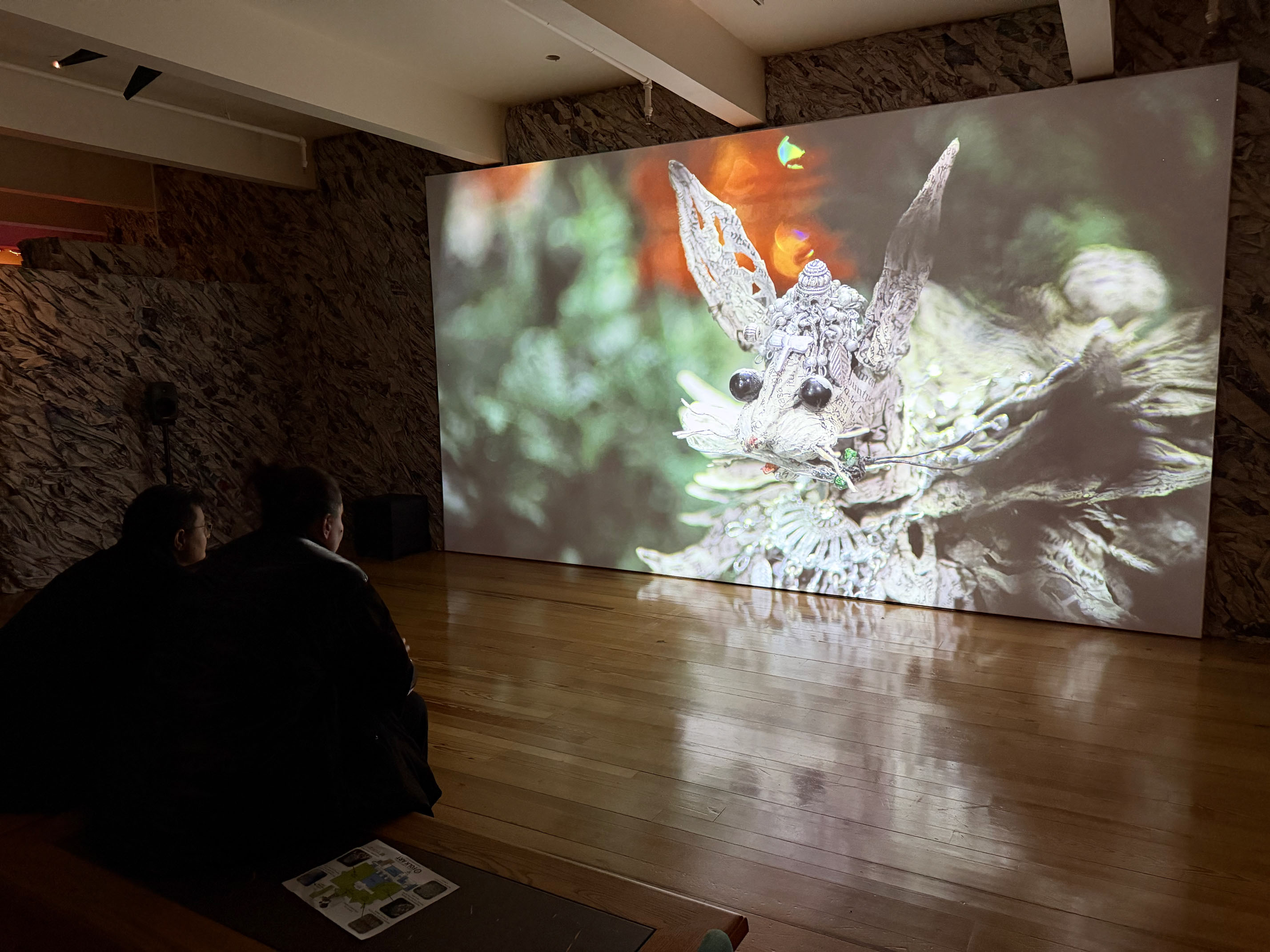
But these examples are just snippets of Once Within a Time – the entire show deserves multiple visits, and time to visit the other locations in the city, such as the hidden basement natural wonderland epic at the Museum of Internatonal Folk Art created by Taiwan ‘s Zhang Xu Zhan. It’s not only an immersive environment, but a film, animal-spirit sculptures, and selections from the MoIFA’s paper funerary object collection. Don’t miss the Day of the Dead altar, the 18th-century Pere Lachaise Cemetary tribute initially collected by Mr. Girard himself, and paper funerary fantasies made by the artist’s own family. Truly unforgettable.
Museum of International Folk Art: Zhang Xu Zhan’s 2020-2022 paper-animation video Compound Eyes of Tropical (Animal story series), with a Southeastern Asian deer-mouse outwitting a group of predatory crocodiles. Courtesy: the artist and Project Fulfill Art Space, Taiwan.
The Wheelwright Museum of the American Indian fills the Klah Gallery (in the shape of a traditional hogan) with a meditation on healing by Cristina Flores Pescorán, a wild organic sculpture by Nora Naranjo Morse, and a mini-retrospective of paintings by the incomparable Emmi Whitehorse.
Wheelwright Klah Gallery theme: journeys. Nora Naranjo Morse’s sculpture Into the Forever; on walls, Cristina Flores Pescorán’s 2025 installation Treinta y ocho. Ofrendas para reescribir historia medica y renacer Huaca. Courtesy: the artists
The Tesuque location also features rooms with installations by Mexico’s Guillermo Galindo incorporating burned wood from the recent New Mexico fires (crossed with Picasso’s Guernica), David Horvitz’s tribute to the men incarcerated in Santa Fe’s Japanese internment camp (and a hat from one them), and Thailand’s Korakrit Arunanondchai’s room-sized contemplation that incorporates the ashes from the burning of Zozobra.
Video of Korakrit Arunanondchai’s 2025 installation Unity for Nostalgia, with floor incorporating ashes from Santa Fe’s Zozobra’s burning and a prayer to the phoenix; layered soundtrack. Courtesy: the artist, Bangkok City Gallery, London’s Carlos/Ishikawa, CLEARNING NY-LA, Kukje Gallery, Seoul
Video of Max Hooper Schneider’s 2025 Written in Sand (Finquita Garden) installation; spheres mysteriously travel sand channels. Courtesy: the artist; Maureen Paley, London, Hove; Francois Ghebaley, Los Angeles, New York.
For more, take a walk through the main exhibit and five other sites in and around Santa in our Flickr album to see work by legendary New Mexican artists, and travel back and forth to see how contemporary art reflects epic histories and mystic systems of the Southwest.
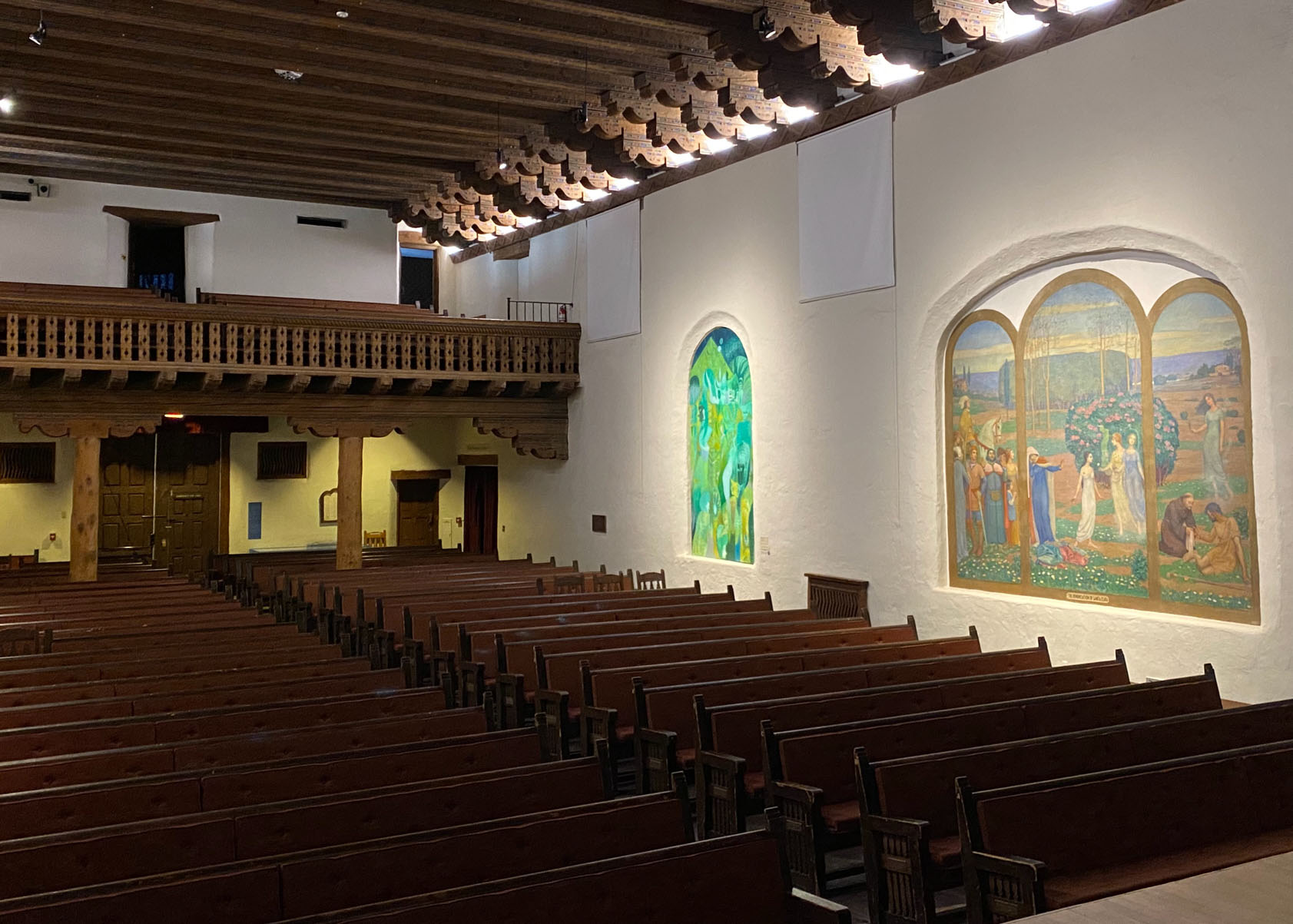
View of historic St. Francis Auditorium (1917) with Maja Ruznic’s 2025 Kisa Pada, Trava Raste, Gora Zeleni installed atop Donald Beauregad’s painting The Conversion of St. Francis; to right, Beauregard’s The Renunciation of Santa Clara.
Most fossil fans are familiar with the spectacular Jurassic marine reptiles found by Mary Anning along England’s Dorset Coast in the early 1800s, but few are aware that their predecessors – gigantic Triassic ichthyosaurs (250-201 mya)– have been emerging from the central mountains of Nevada’s Great Basin for the last 125 years.
A beautiful exhibition – Deep Time: Sea Dragons in Nevada – shines a spotlight on these magnificent extinct creatures, brings them to life through life-size animations, and tells stories of scientific discoveries at the Nevada Museum of Art in Reno through January 11, 2026.
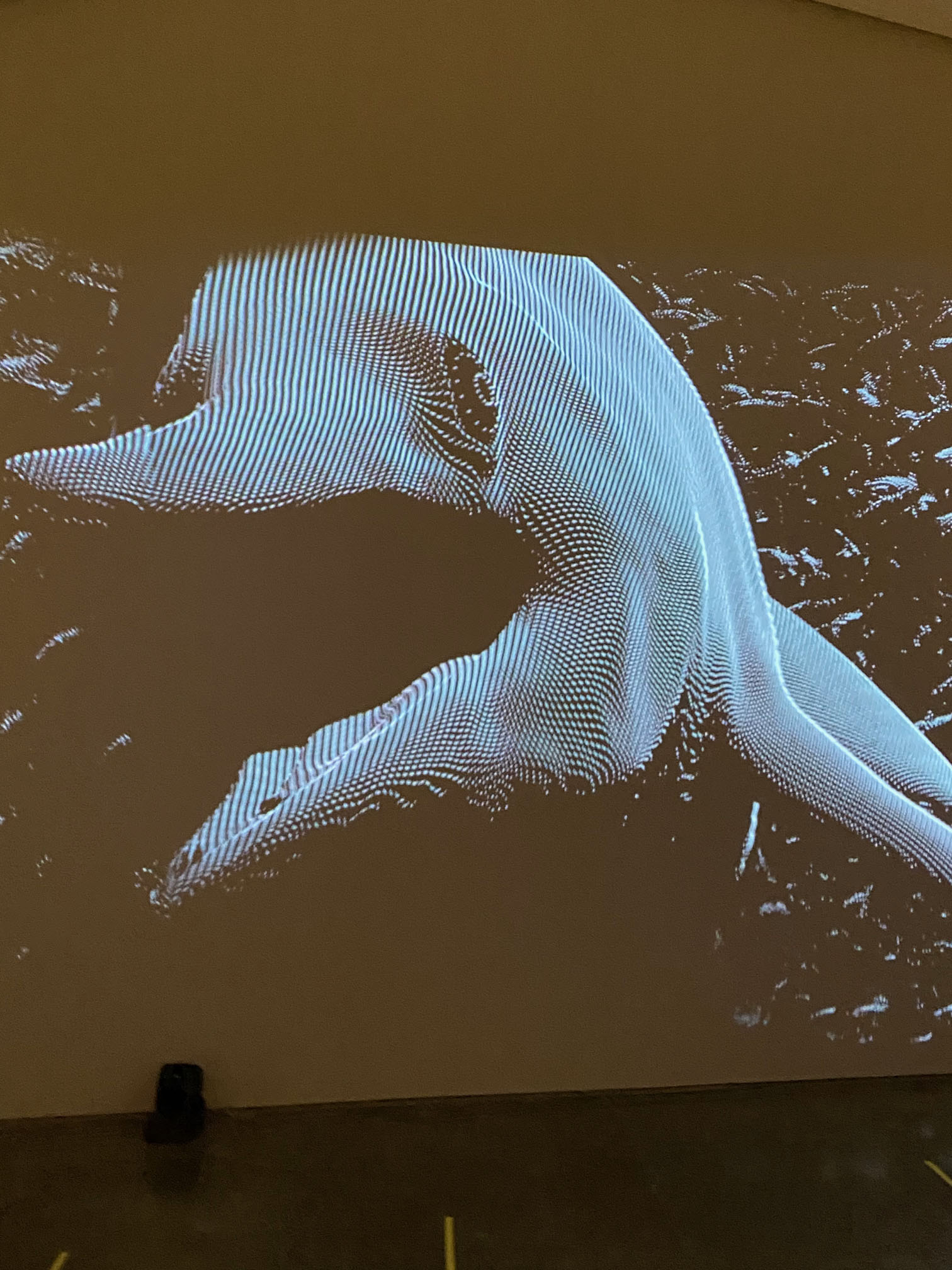
Life-sized digital animation of swimming ichthyosaur by artist Ivan Cruz, paleontologist Martin Sander, and exhibition designer Nik Hafermaas.
The art museum reunites the state’s stunning Triassic marine reptiles from museum collections across North America, and couples this with an engaging walk through 200 years of paleo-art history starring these enigmatic Mesozoic “sea dragons.”
Triassic ichthyosaur (Cymbospondylus) (245 mya) discovered in Nevada’s Humboldt Range in 1905 by John Merriam and Annie Alexander. Courtesy: UC-Berkeley Museum of Paleontology
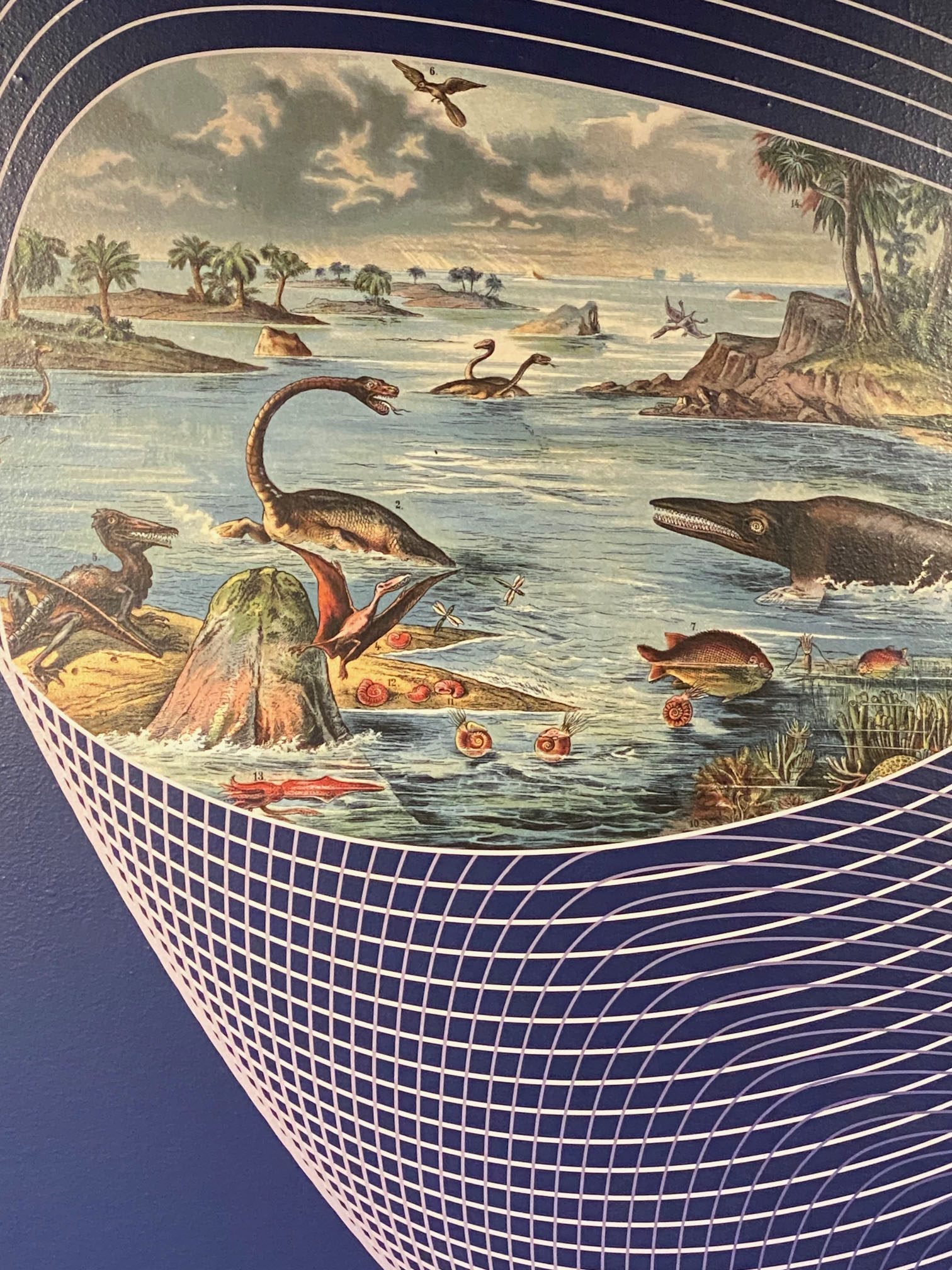
Reproduction of Frederick Rolle ‘s illustration Geology and Paleontology: Landscape of Europe in the Jurassic Era from Gotthilf Heinrich von Schubert’s 1887 Natural History.
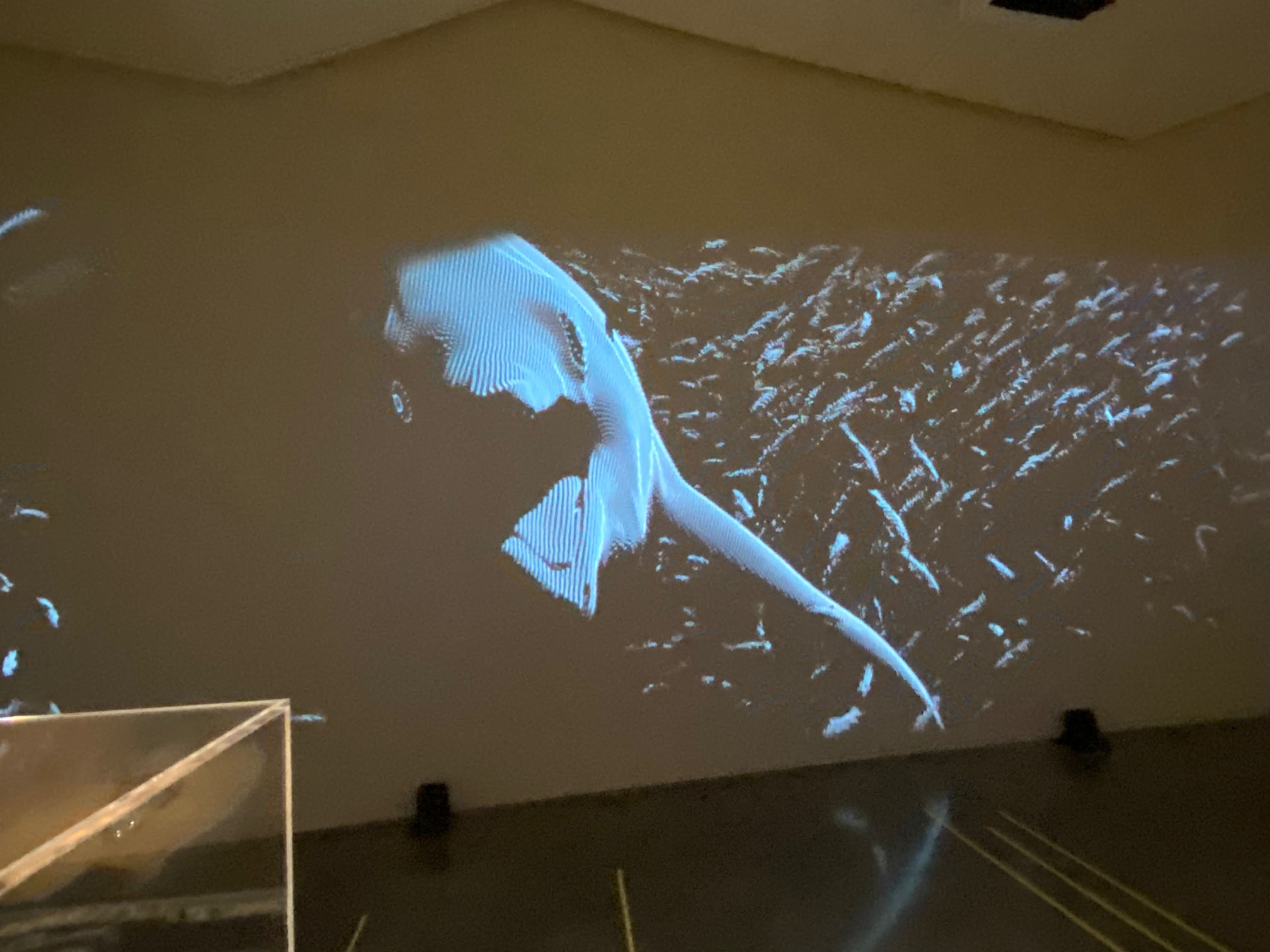
The most dramatic spectacle is on the far wall – a life-sized animated recreation of these gigantic swimming creatures by artist Ivan Cruz in collaboration with paleontologist Martin Sander and exhibition designer Nik Hafermaas. From the inky blackness, thousands of points of light emerge, float across the long wall, and coalesce into 3-D sea creatures that appear to swim across the entire length of the room.
Digital animation of swimming ichthyosaurs by artist Ivan Cruz, paleontologist Martin Sander, and exhibition designer Nik Hafermaas.
Take a close-up look at the gorgeous Deep Time exhibition design and ichthyosaur animations by Hafermaas°creative here.
History, adventure, art, and expeditions intertwine. The gallery tells the story of ichythyosaur discoveries across three Nevada mountain ranges – the Humboldt, Shoshone, and Augusta. Each section presents spectacular ichthyosaur fossils and along with tales of intrepid paleontologists who have toiled away in Nevada’s most remote regions for over a century.
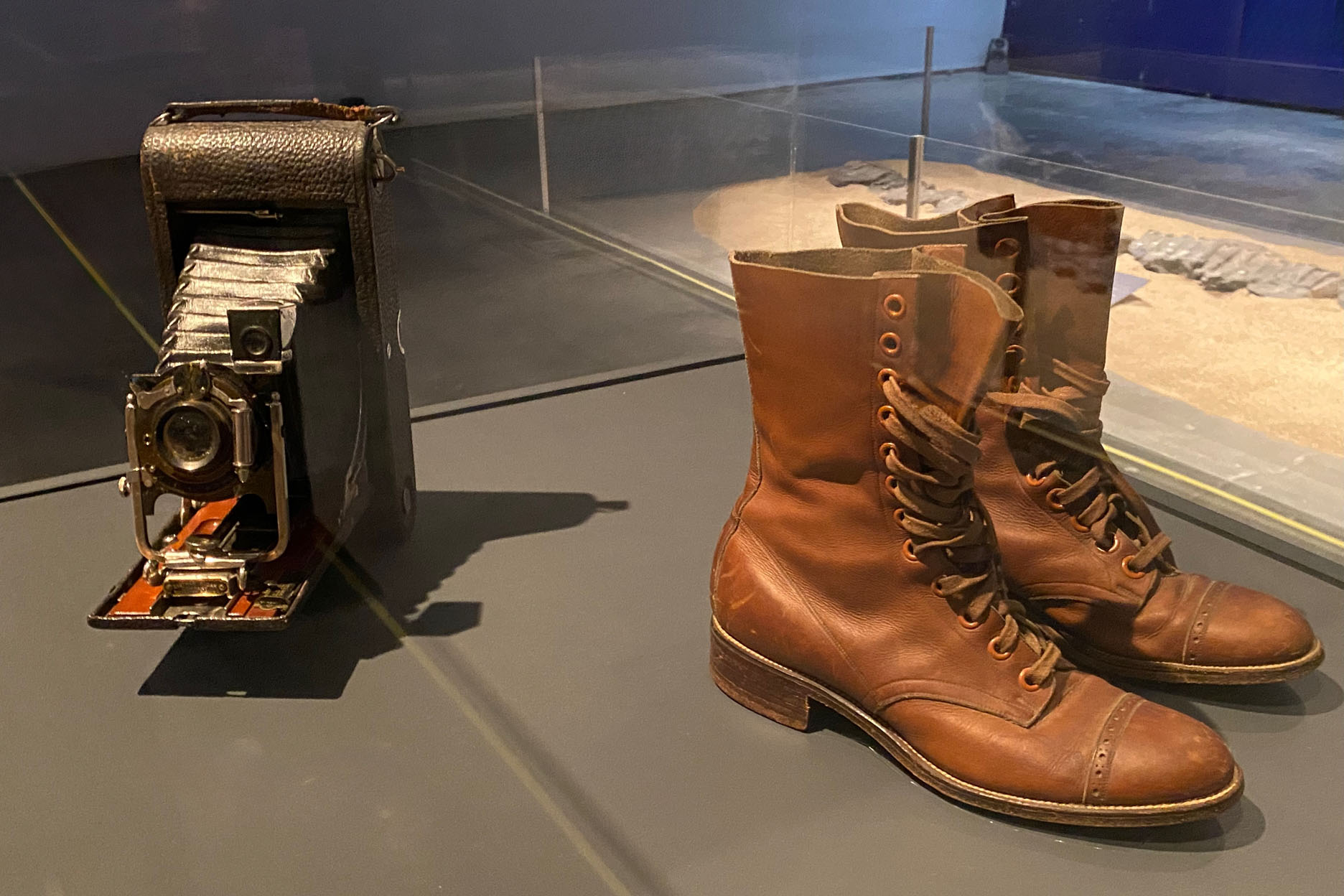
Paleontologist and philanthropist Annie Alexander’s Kodak field camera and boots; excavated 25 ichthyosaur fossils with UC-Berkeley 1905 Saurian expedition. Courtesy: UC-Berkeley Bancroft Library and Museum of Vertebrate Paleontolgy Archives.
Nevada’s “sea dragon” story begins in the Humboldt Range in 1867-1868 as the U.S. Geological Exploration of the Fortieth Parallel, led by Charles King, discovers and collects bits and pieces of ichthyosaur ribs and vertebrae in their survey of the Great Basin. These discoveries spawned national news stories. The fossils ended up in Harvard’s museum collection, so it’s nice to see them here.
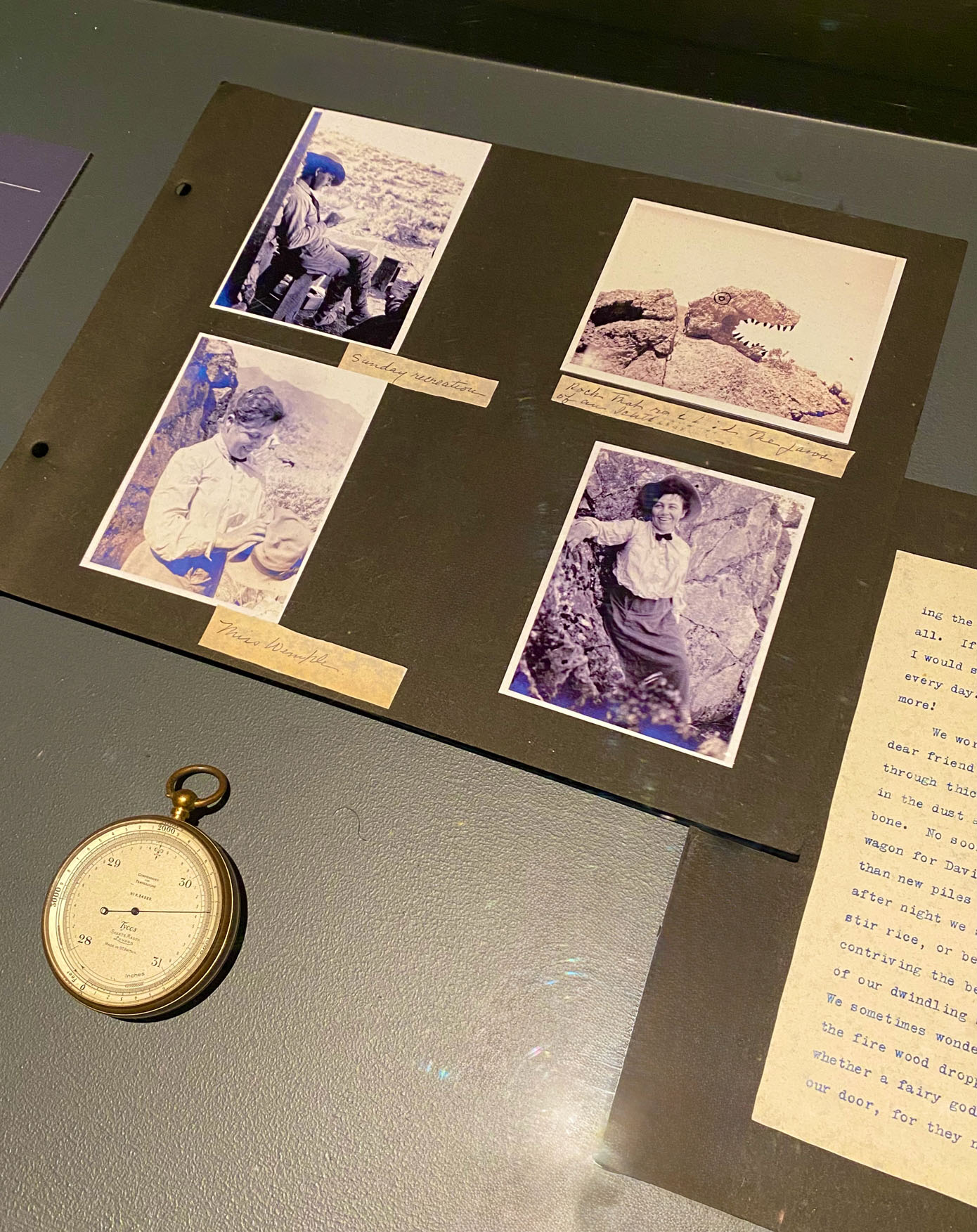
Paleontologist Annie Alexander’s field notes and photographs in scrapbook of the UC-Berkeley 1905 Saurian expedition to Nevada’s Humboldt’s Range, where she discovered and excavated 25 ichthyosaur fossils. Courtesy: UC-Berkeley Museum of Paleontolgy.
1905 was a big year for Triassic discoveries in the Humboldt Range. James Perrin Smith and his team from Stanford collected dozens of ammonites from the Humboldt slopes, and philanthropist Annie Alexander bankrolled (and participated in) John Merriam’s UC-Berkeley Saurian expedition.
Merriam’s team excavated 25 ichythyosaur skeletons, loaded them out by horse-pulled wagons, and then got them back to Berkeley via train. Annie’s field notebook and photo scrapbook give us a look at the fossils, camp, and the team. In 1907, Annie founded and funded the UC-Berkeley Museum of Vertebrate Zoology. Her subsequent field trips led her to collecting more than Triassic fossils, but Annie’s the one to thank for kicking off spectacular preservation efforts for Nevada’s marine-reptile riches.
And as most fossil hunters know, discoveries are often made inside the collections storage room. It’s nice to see one of Annie’s 1905 fossils redefined as a new ichythyosaur species in the 21st century by exhibition co-curator paleontologist Martin Sanders!
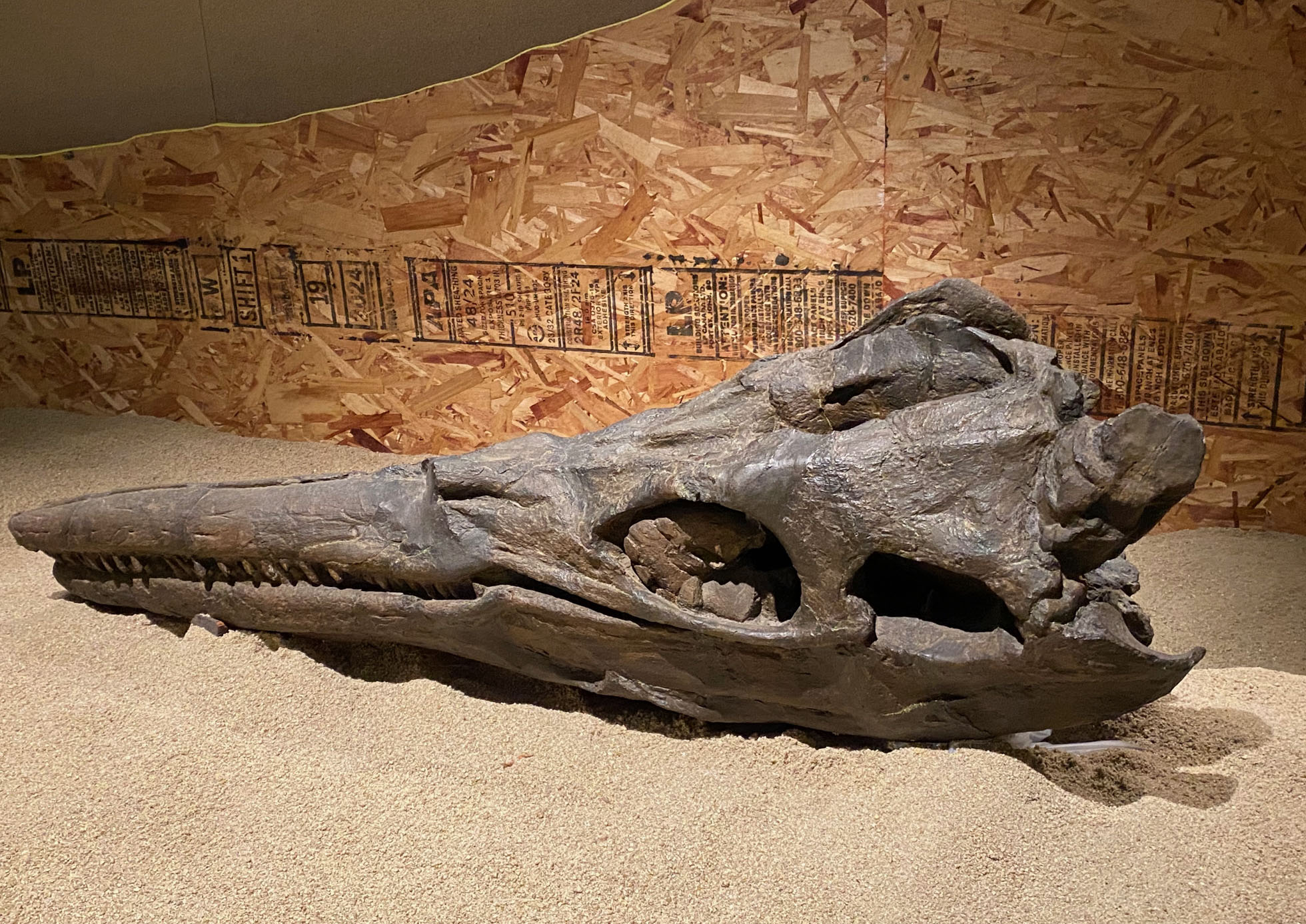
Found in the Humboldt Range: 245-million-year-old Triassic ichthyosaur skull discovered in 1905; Nicole Klein and Martin Sander have recently reclassified “slender snout” as a new species. Courtesy: UC-Berkeley Museum of Paleontology
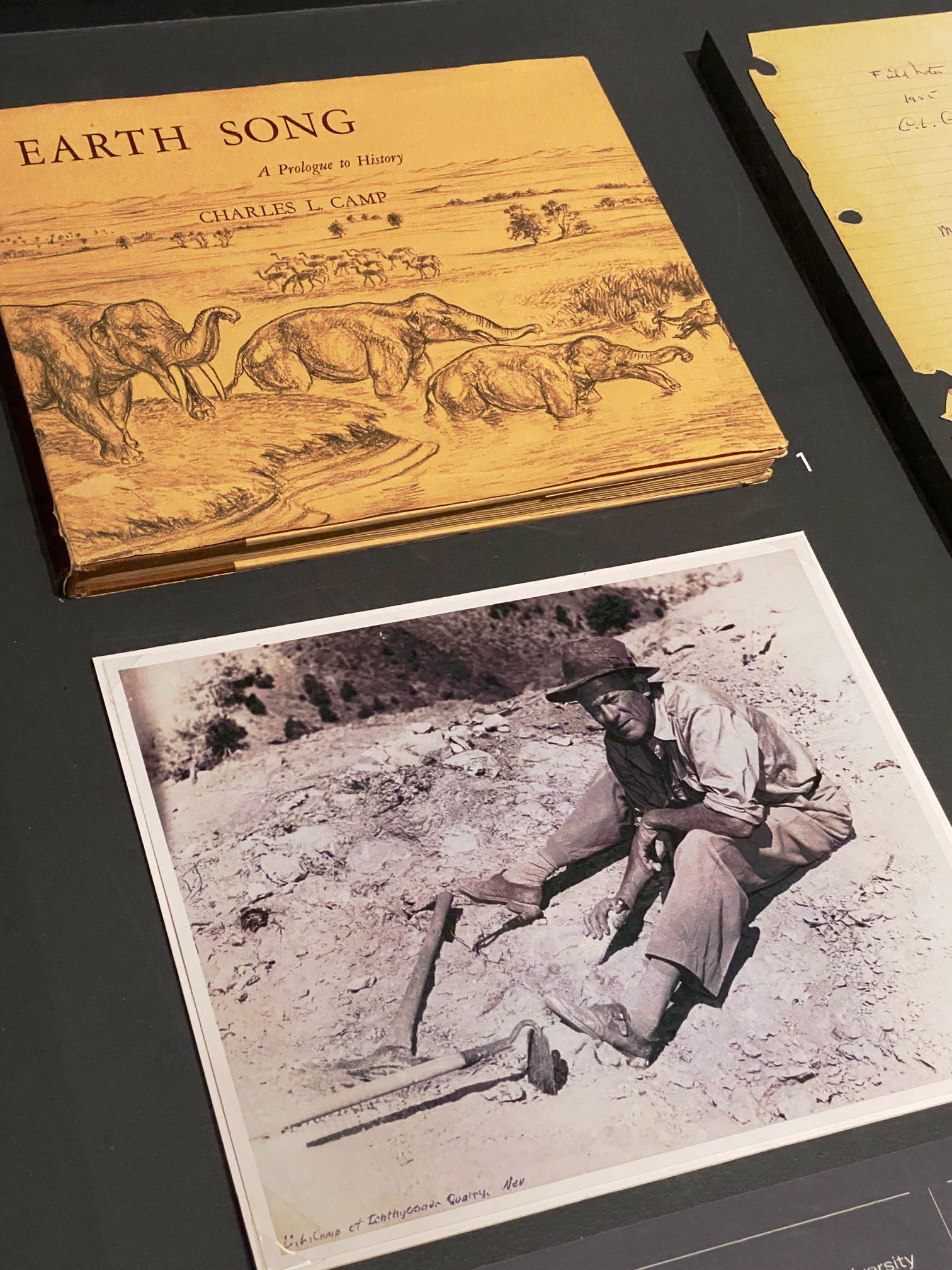
The story moves to the Shoshone Mountains near the old silver mining town of Berlin. In 1928, paleontologist Siemon Muller came across a massive amount of ichthyosaur remains encased in super-hard limestone near Berlin. Although he told the paleontologists at UC-Berkeley about them, no one followed up until Charles Camp went out to take a look in 1953. He found huge, articulated skeletons that were younger in age than the fossils from Humboldt.
In the Shoshone Mountains: 1954 photo of Charles Camp excavating fossils at the site that will become Berlin-Ichthyosaur State Park; Camp’s book Earth Song. Courtesy: University of California Museum of Paleontology; Nevada Museum of Art.
From the Shoshone Mountains: Digital print of front flipper of 228-million-year-old Triassic ichthyosaur (Shonisaurus) discovered in the 1950s by Charles Camp. Courtesy: Nevada State Museum; scan by Alyson Wilkins, Tyler Birthisel, and Randy Irmis.
Over the next ten years, Camp and his team found and sand-blasted out remains of 40 Triassic ichythyosaurs, which he later named Shonisaurus. In one quarry, the skeletons were so complete and numerous that Camp decided just to uncover their them and leave them exposed in place. People heard about these unique finds from news reports, and came out to marvel for themselves.
By 1957, the site was named a Nevada state park – a place where visitors could large concentrations of the world’s largest ichthyosaurs. Over time, Camp opened ten separate quarries in the area. The fossils Camp removed are now held in the Nevada State Museum in Las Vegas.
For the last ten years, palentologists Randy Irmis and Neal Patrick Kelly have been working in the same area. The exhibition includes their recent ichthyosaur discoveries, including baby Shonisaurus bones, teeth, and a snount containing tooth sockets – evidence that the animal was likely a formidable predator.
Watch their video here for a history of ichthyosaur collecting in Nevada, a digital model of Camp’s main quarry, and new fossils
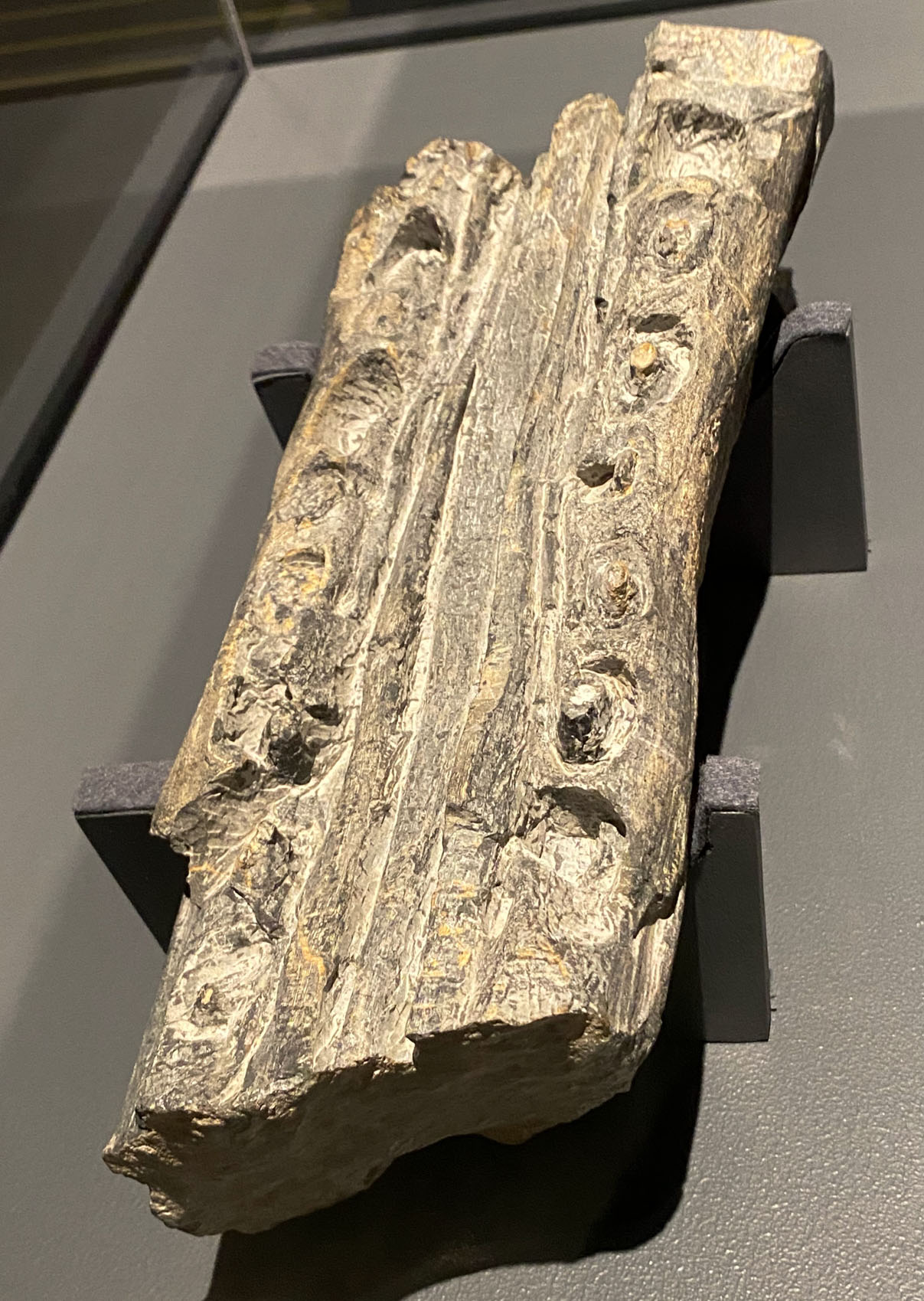
From the Shoshone Mountains: Tooth sockets in snout fragment of a 228-million-year-old Triassic ichthyosaur (Shonisaurus) discovered in 2015 by Randy Irmis, Neal Patrick Kelly, Paula Noble, and Paige dePolo. Courtesy: Natural History Museum of Utah, US Forest Service, and Nevada State Parks.
The Augusta Mountains has been the site of field work by Martin Sanders and team for nearly 30 years – – old and new ichthyosaur species, which are on display.
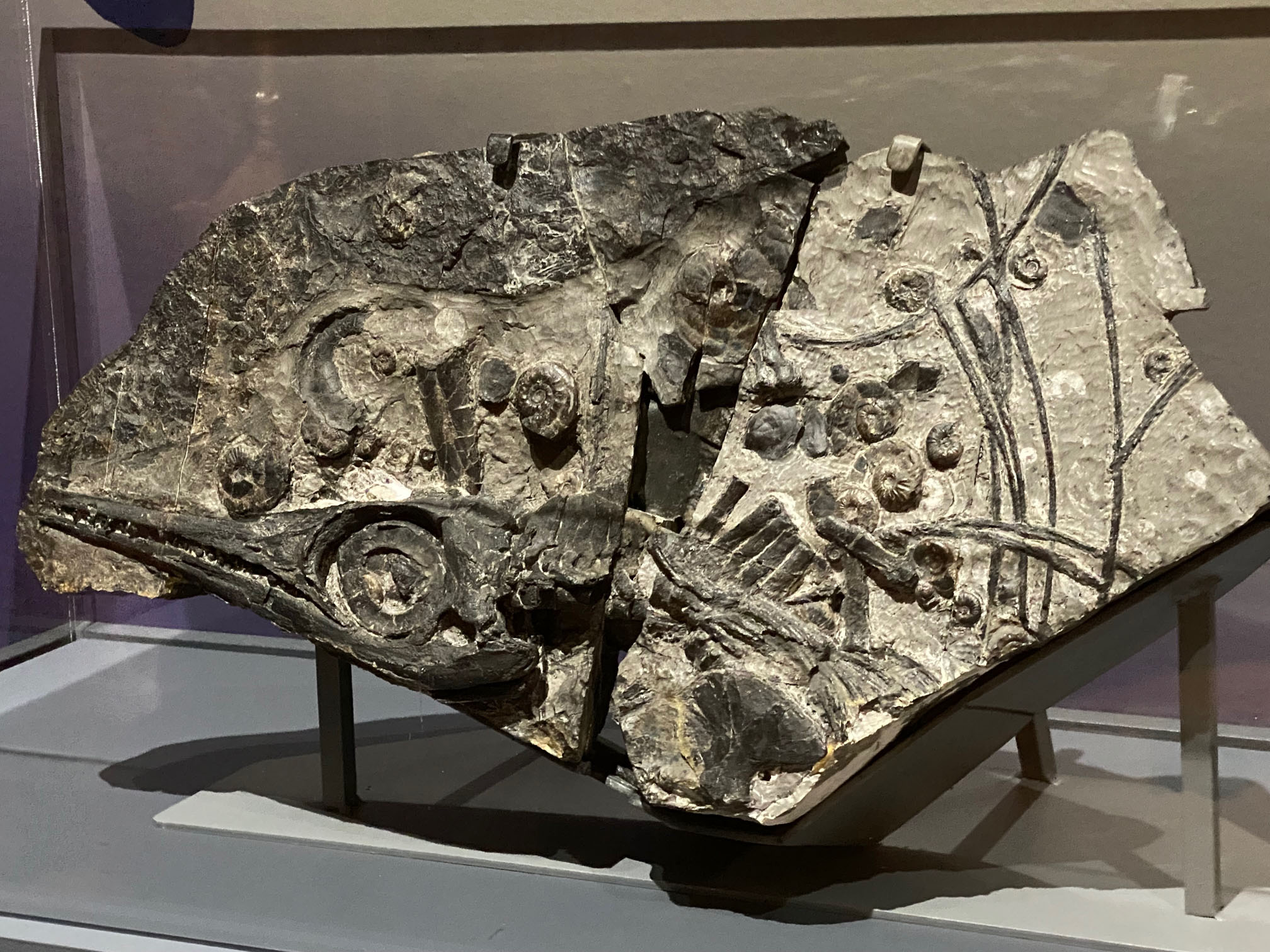
Fossilized sea floor with 242-million-year-old Triassic ichythyosaur (Phalarodon) and ammonites; found in 1996 by Martin Sander and Glenn Storrs in Nevada’s Augusta Mountains. Courtesy: Cincinnati Museum/BLM
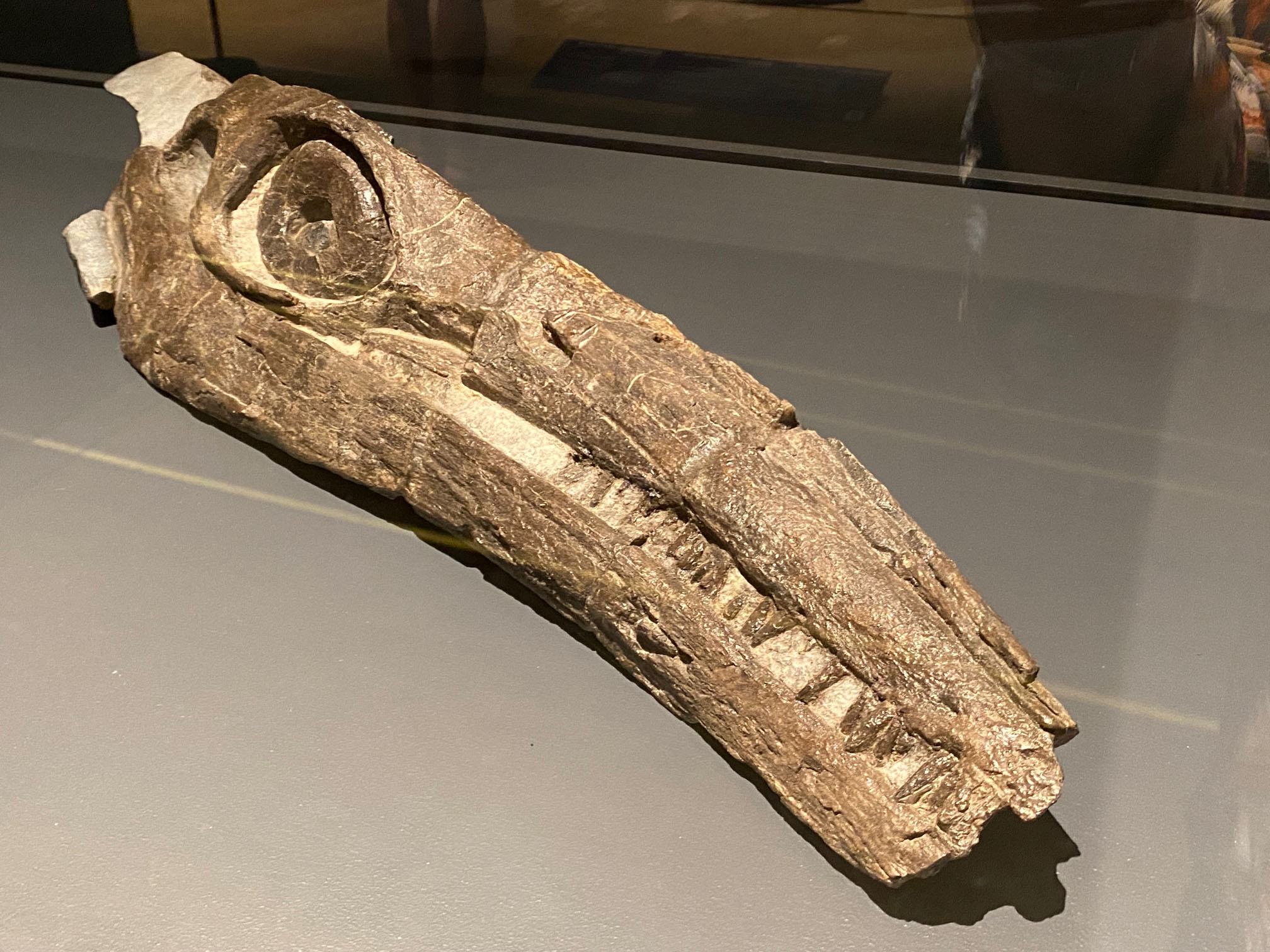
From the Augusta Mountains: Skull of 243-million-year-old Triassic ichthyosaur (Cymbospondylus) discovered in the 2011 by Martin Sander (excavated 2014). Courtesy: Natural History Museums of Los Angeles County; BLM.
The exhibition includes a whimsical corridor leading to images from 19th-century paleo art and to vintage toys from a dinosaur and prehistoric-animal collector. The final room is a kaleidoscope of nostalgia – images from Europe’s earliest prehistoric ecosystem recreations to dinosaur collectibles from Chicago’s 1934 Century of Progress Fair.
It’s a fun way to observe how scientific thinking has changed about prehistoric marine lifestyles and body plans. Remember when science thought Brontosaurus spent its life submerged in lagoons? Or ichthyosaurs used their flippers to paddle around on land?
Take a look at our favorite fossils and toys in our Flickr album.
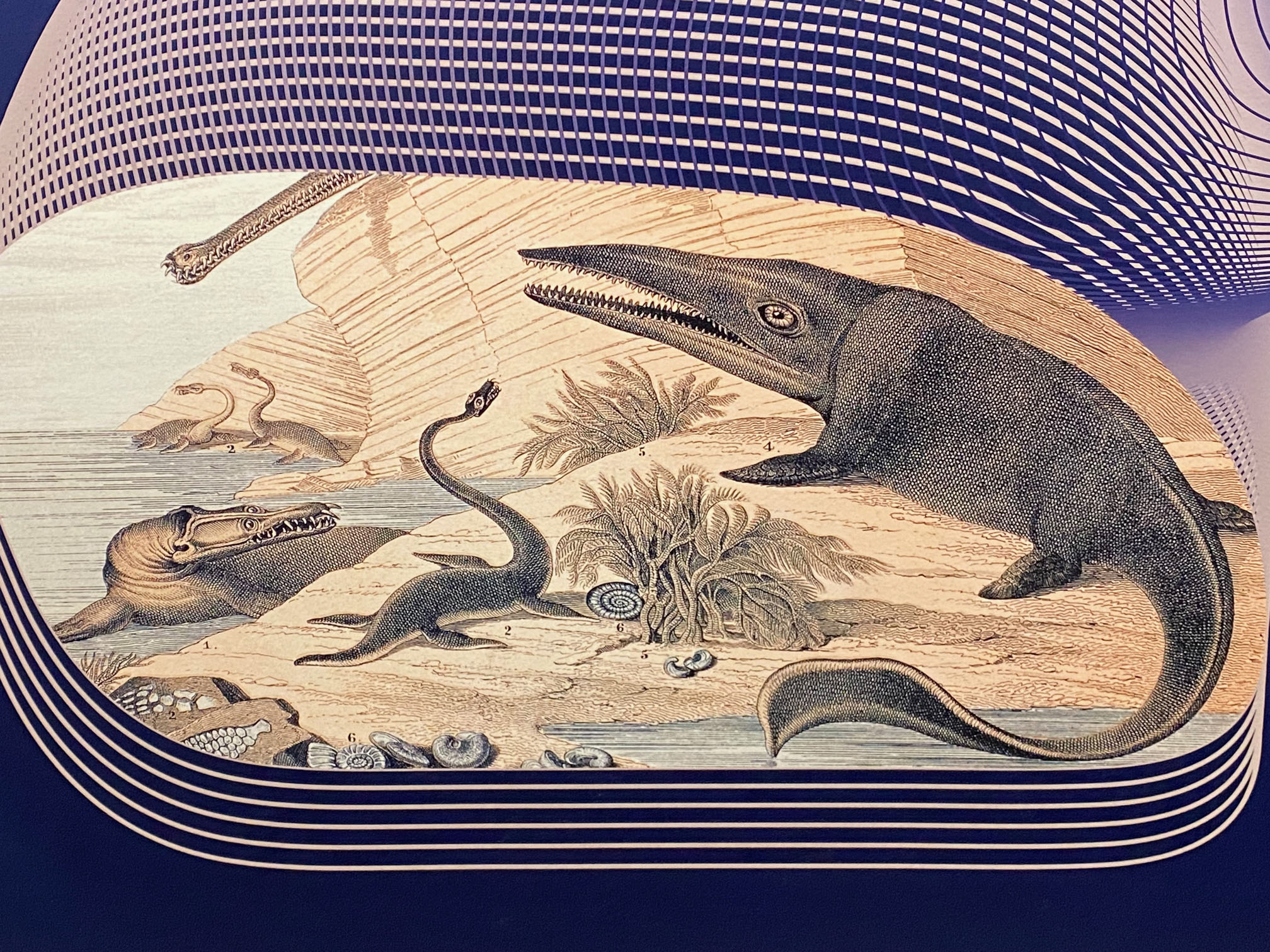
Reproduction of 1862 wall-chart illustration by Benjamin Waterhouse Hawkins Enaliosauria (extinct marine reptiles) produced for the UK’s Department of Science and Art, featuring land-dwelling Ichthyosaurus and Plesiosaurus.
To see how art and science were brought together to create this immersive time-travel experience, watch this short documentary from PBS Reno, take a trip to Nevada’s Augusta Mountains with paleontologist Martin Sander and see how artists and designers brought his Triassic creatures to life:
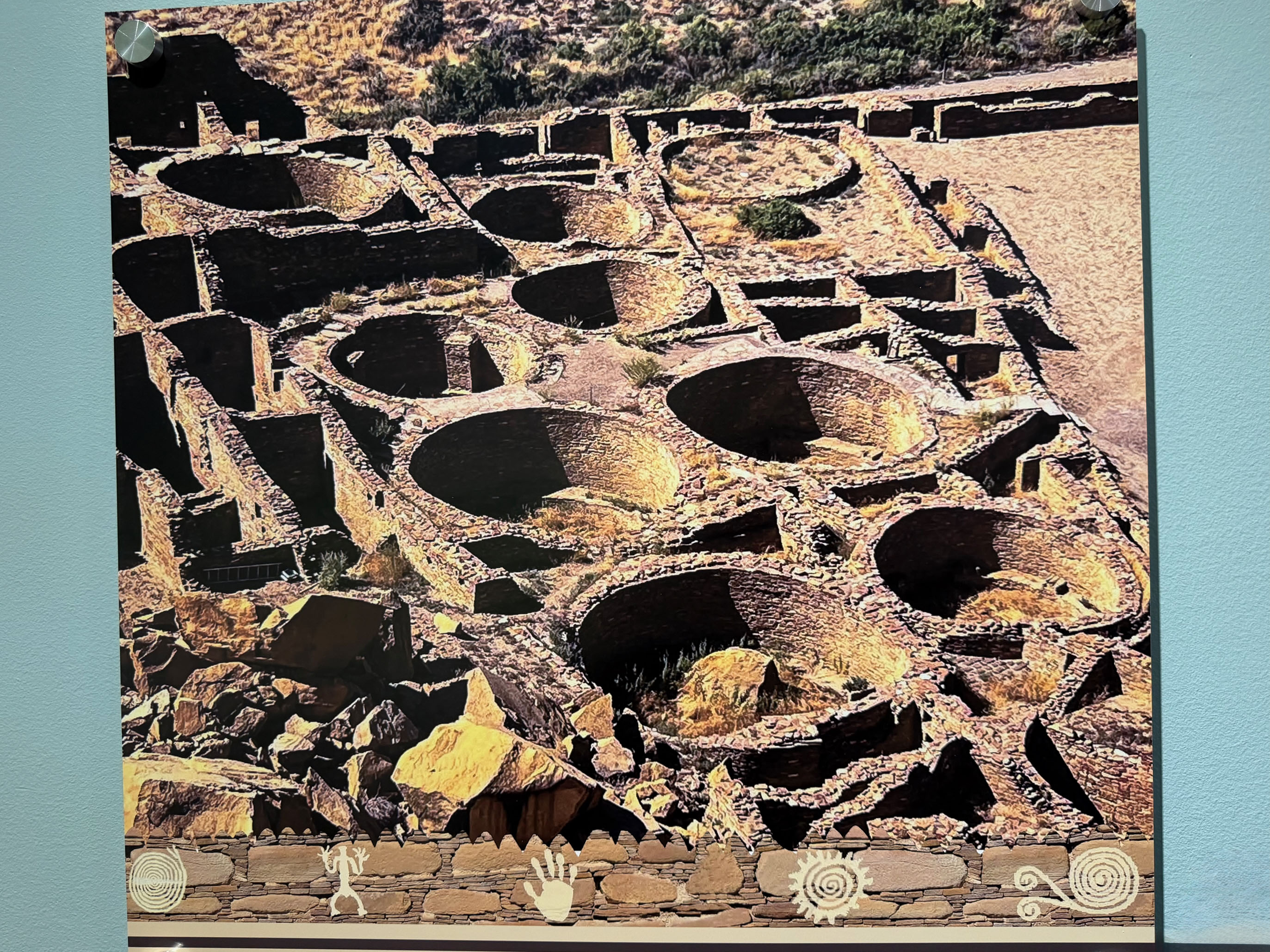
Any visitor to Chaco Canyon National Historial Park (850-1250 CE) makes the journey to appreciate innovative masonry of the Great Houses, the precision of the ancient road system, and the astronomically aligned walls, windows, and kivas. But how do contemporary Pueblo architects incorporate these traditional beliefs in their 21st century projects?
A fascinating, in-depth exhibition, Restorying our Heartplaces: Contemporary Pueblo Architecture– on view at Albuquerque’s Indian Pueblo Cultural Center through December 7, 2025 – explores how modern Indigenous architects incorporate traditional world views into their work.
2023 photo Kivas at Pueblo Bonito,Chaco Canyon by curator Ted Jojola (Islela Pueblo) showing advanced masonry and architectural concepts.
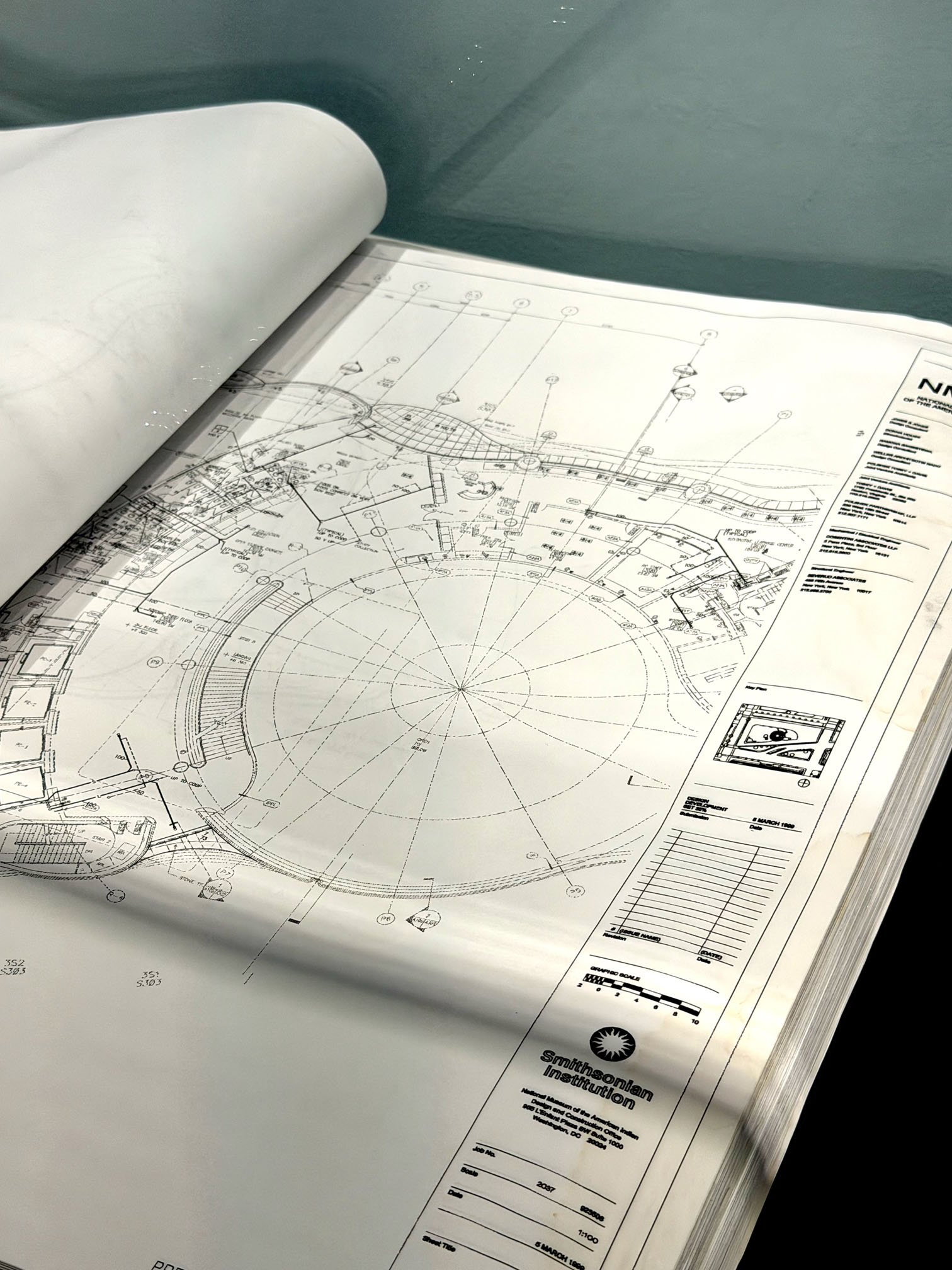
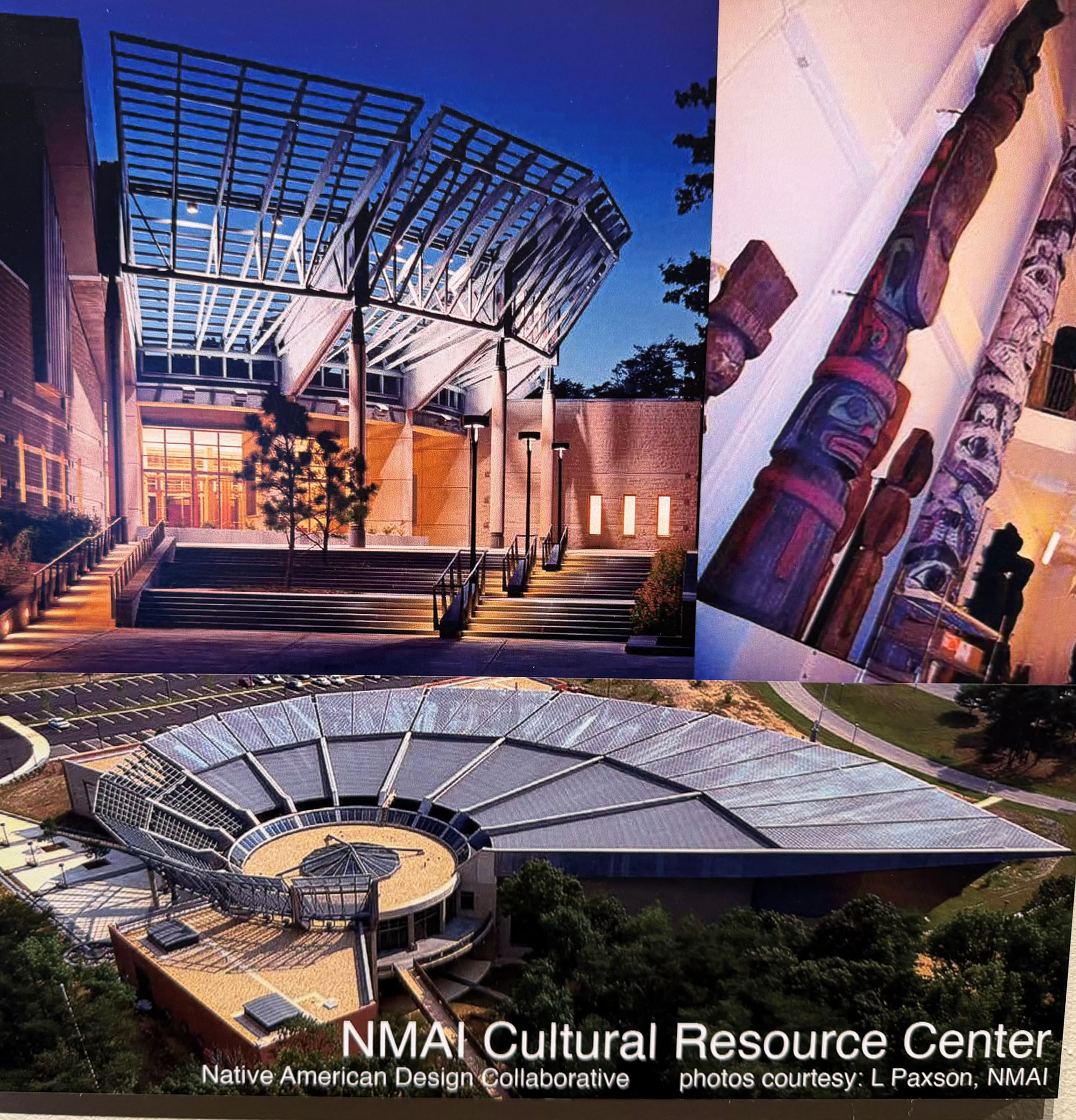
For example, just look at the design of the National Museum of the American Indian’s Resource Center – an organic design, aligned to the four cardinal directions, with extensive use of cedar wood.
1999 plans for the National Museum of the American Indian Resource Center. Courtesy: Ted Jojola (Isleta Pueblo)
Views of the 1999 National Museum of the American Indian Cultural Resource Center in Suitland, Maryland. Courtesy: Lynn Paxson.
This exhibition coincides with the 50th anniversary of the 1975 Indian Self-Determination and Education Assistance Act – legislation that shifted Native American policy in the United States from assimilation to self-determination. Tribes were now able to initiate and run justice, government, health and education departments of their own – a change that triggered a construction boom for new schools and administrative buildings.
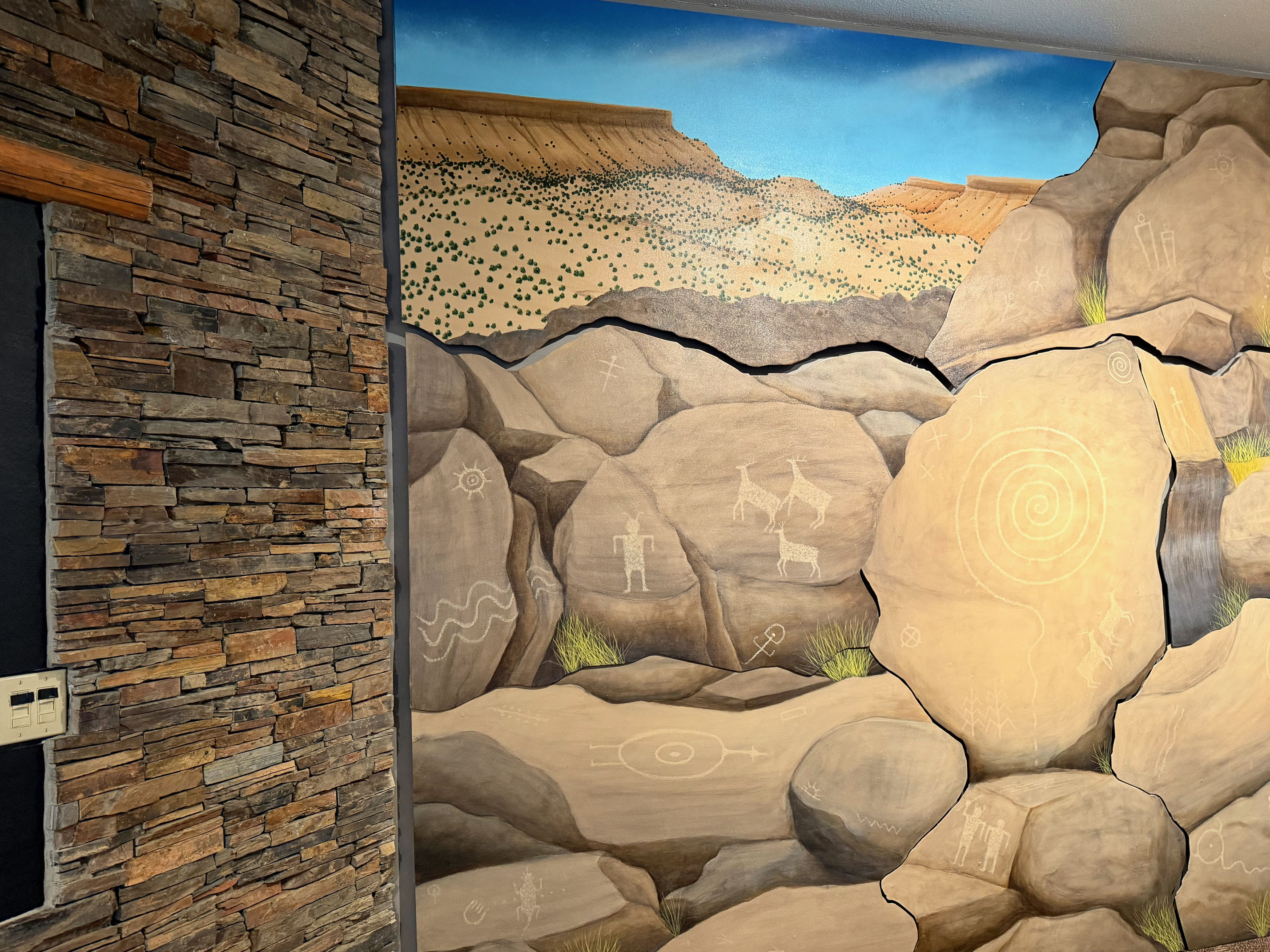
The show opens as an immersive experience in a large, circular gallery that introduces the core belief system and origin story of the Ancient Puebloans. Across a large screen in a vivid animation, the Pueblo people emerge into this world from a previous world. You watch them migrating outward in a spiral – symbols that are reflected across the art, murals, and photographs on the surrounding walls.
Mural by Dominic Aquero (Cochiti) with symbols of Pueblo creation; T-door represents the spiritual passage between two worlds (sky and Earth)
This experience sets the stage for the rest of the exhibition by showing how the stonework and beliefs reflected by the architecture of Ancient Puebloan centers points the way forward for Pueblo architects today.
2022 print by Gerald Dawavandewa (Hopi Cherokee) with T-shaped door for passage between worlds (sky and Earth]
The exhibition describes Ancient Puebloan architectural innovations – passive solar heating, precise window alignment, and masonry approaches. How did the Ancients achieve such precision in their dramatic Chaco and Mesa Verde buildings?
The curators present engineering and survey tools from archaeological excavations and modern survey backpacks side by side – plumb bobs, levels, and measuring devices.
Ancient stone and ceramic plumb bobs (from California and from Hewitt excavation at Rito de los Frijoles, Bandelier). Courtesy: Museum of Indian Arts & Culture/Lab of Anthropology.
Modern survey tools: level, tape measure, compass, brass plumb bob, wood, and string. Courtesy: curator Ted Jojola (Isleta Pueblo)
They also add comparisons of selenite used as window panels in Old Acoma’s Sky City (among the longest-inhabited communities in the US) and the contemporary architectural approach to windows in the recently built Acoma museum – a thoughtful reflection of the past
The exhibition directly addresses past HUD housing approaches on tribal lands – pushing suburban-style low-income housing, which moved families away from the traditional Pueblo plaza (the HeartPlace) and provided pitched-roof designs that blunted community cultural practices that utilized traditional Pueblo flat-roof construction.
The curators remind us of the continual upkeep required by adobe construction – a repeated communal task typically undertaken by a community’s women that happened on a regular, cyclical basis. It’s also a reminder that Pueblo communities view buildings as living presences that evolve – not just concrete objects exist in a “finished” state.
Views of the 2000 campus for the Institute of American Indian Arts in Santa Fe. Courtesy: Paul Fragua (Jemez Pueblo)
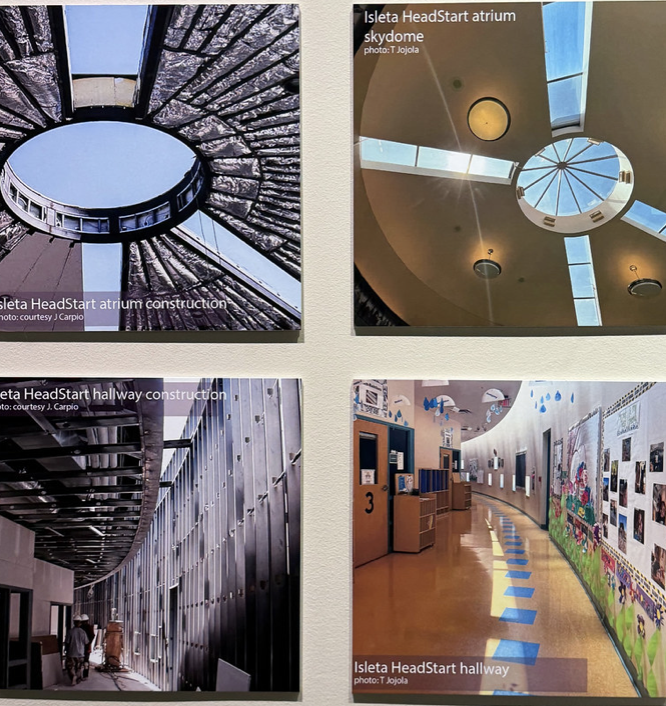
Views of 2004 building designed by Janet Carpio (Laguna/Isleta Pueblos) for Pueblo of Isleta’s Headstart/Child Care Center.
Wall panels, blueprint books, and architectural models are used to demonstrate the contemporary innovations of Pueblo architects – the Resource Center of the National Museum of the American Indian (1999), the campus of the Institute of Amercian Indian Arts in Santa Fe (2000), and the Headstart Child Care Center for Isleta Pueblo (2004). Both incorporate design elements echoing the spiral migration path, alignment to the cardinal directions, and colors and elements of the Earth.
A huge multimedia interactive theater punctuates the walk-through – an immersive visit to Acoma’s new Cultural Center and Haa’ku Museum with tribal members and designers explaining the architectural details and how the buildings reflect the landscape and traditional belief systems.
Immersive interactive experience of Acoma’s new Cultural Center and Haa’ku Museum. Courtesy: Anna Seed Productions, Electric Playouse, and UNM ASPIRE.
The exhibition features the work of the Indiginous Design and Planning Institute (iD+Pi) at UNM and presents dramatic architectural models of the past, present, and future of the community of Nambe Pueblo.
Look through the exhibition in our Flickr album here – a future-forward look at the continuing progression of innovative architectural designs and the next generation of designers and architects respecting and integrating the Pueblo world view with buildings considered to be living, breathing HeartPlaces for the community.
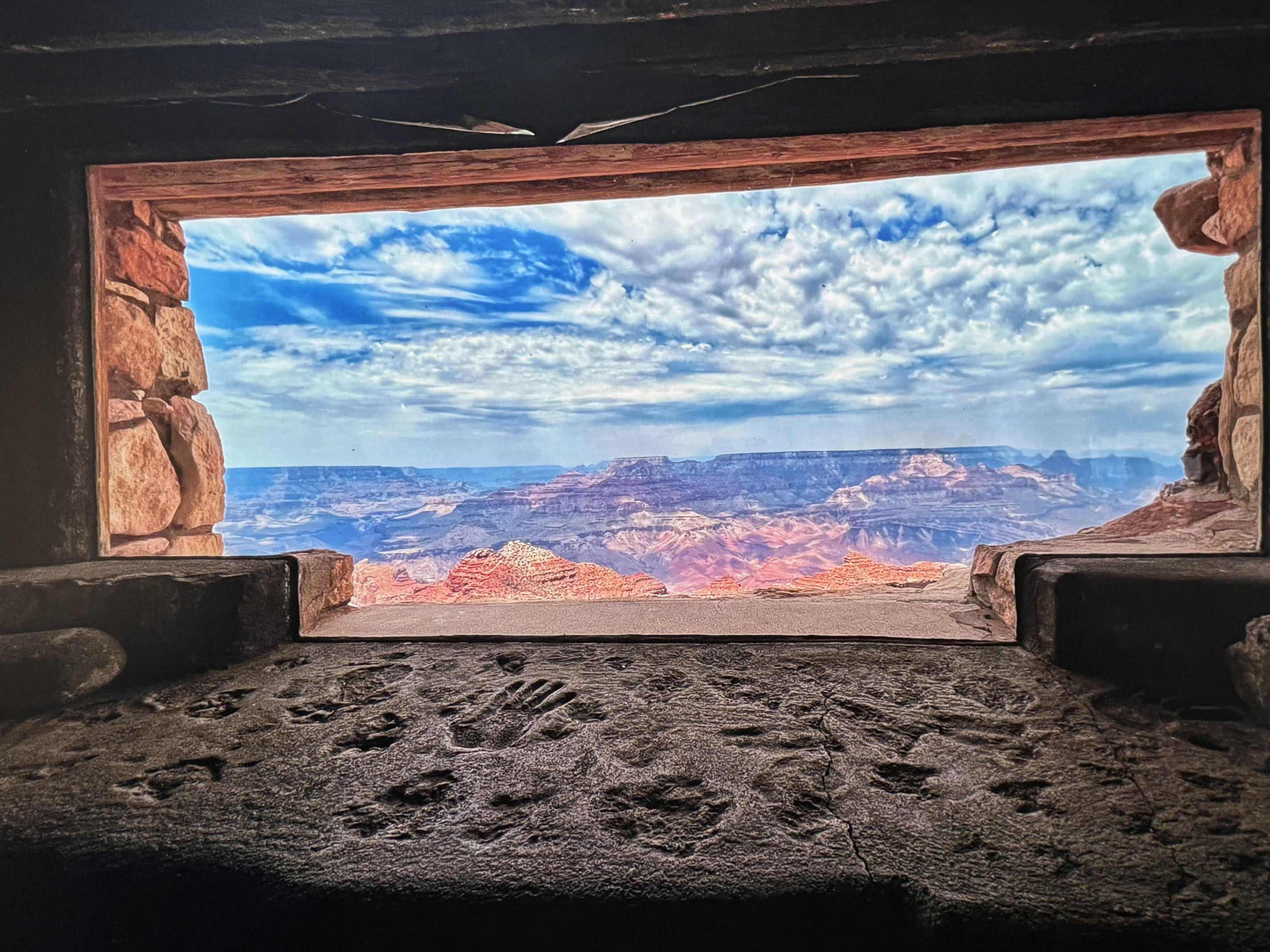
2023 photo by curatorTed Jojola (Islela Pueblo) North Window View from Desert View Watchtower, Grand Canyon showing the T-shaped doorway symbolizing passage between worlds
As the curators made clear in their opening-day remarks, a similarly extensive exhibition could explore architectural innovation and spiritualism across Navajo Nation. Let’s hope that happens!
She grew up on US military bases all over the world, and was thankful that her parents exposed her to the best museums, art, and culture in every country they resided. As an adult member of the Pit River Tribe, she moved back to her ancestors’ land in California and Nevada’s Great Basin, and began telling stories of her family’s history and modern Indigenous experience.
The Art of Judith Lowry showcases 40 years of this artist’s work in Reno, Nevada at the Nevada Museum of Art through November 16, 2025 – large-scale painting, triptychs, and installations.
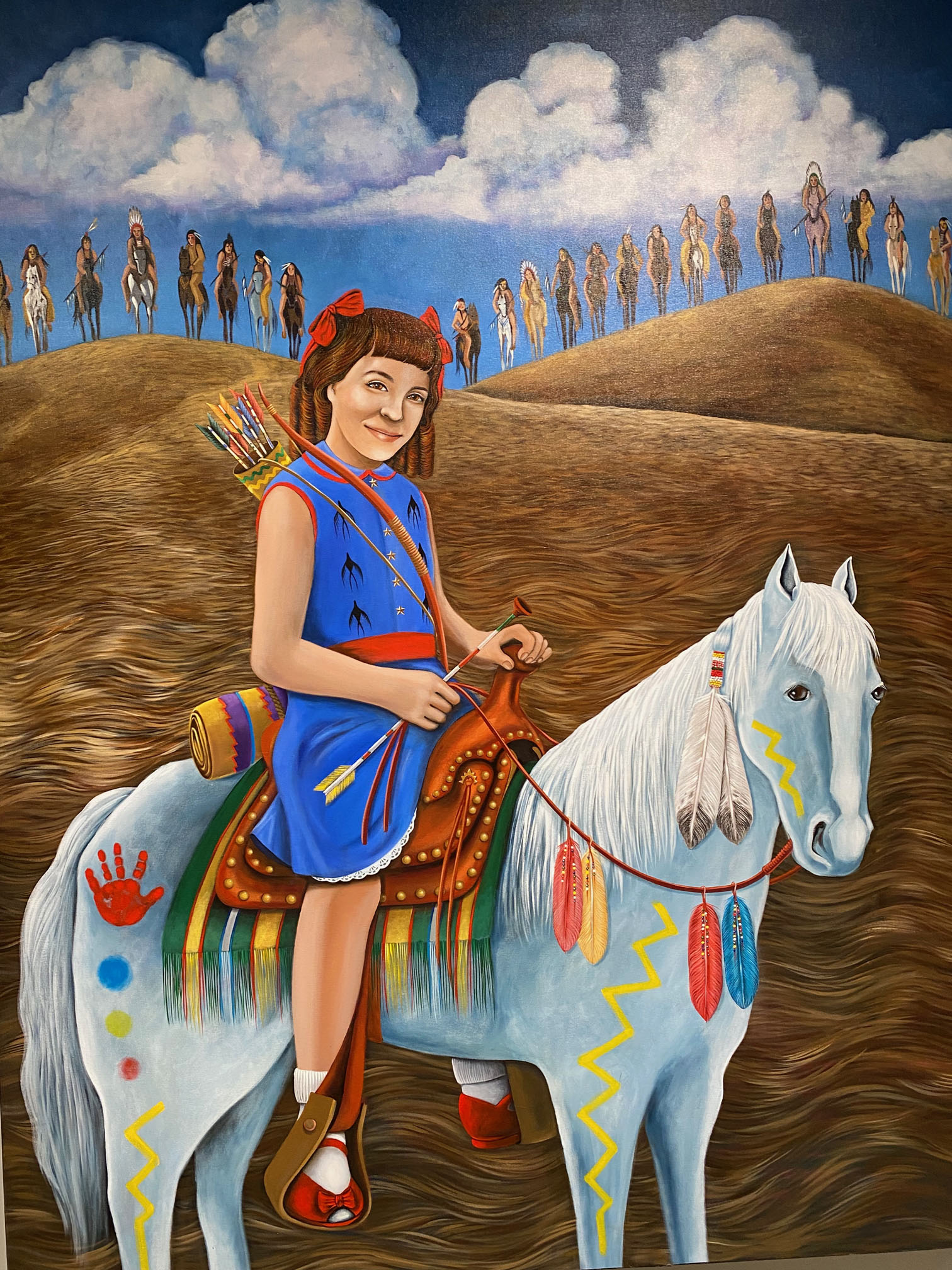
Lowry’s 1997 Red Ribbons depicts herself as a light-skinned Native American teen equipped for battle. Courtesy: The Wheelwright Museum of the American Indian, Santa Fe.
The museum assembled Lowry’s most celebrated work from major collections across the United States, but is also using the occasion to celebrate Lowry’s own (and her husband’s) gift to the museum with a companion installation of The Lowrey and Croul Collection of Native American Art.
Take a look at some at our favorites from both shows in our Flickr album.
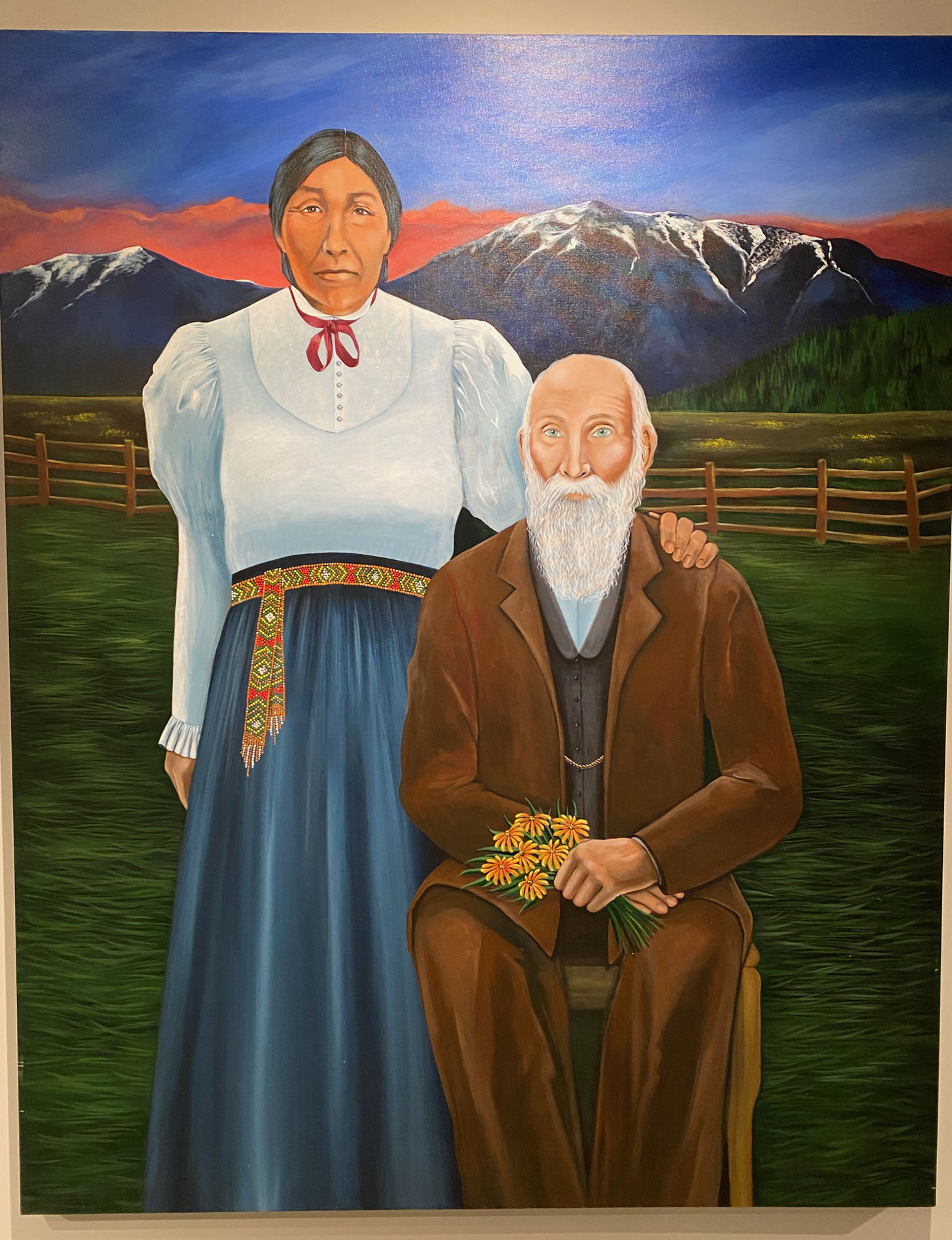
The entry of the exhibition shows how Lowry explores her complex family history at the turn of the last century in frontier ranch lands along the California-Nevada border – images of her biracial great-grandparents and a beautifully mystical depiction of her grandmother. Her regal portrait shows her ancestor’s face tatoos coupled with perfect Victorian dress and small references to the tragedies that befell her family – a symbolic approach Lowry adapted from her deep appreciation of Renaissance works by Bellini, da Vinci, and other masters.
Lowry’s 1997 The Good Marriage – her Native American great-grandmother and German-Irish great-grandfather at their Greenville, California ranch. Courtesy: private collection.
Lowry’s 1999/2012 Edna at Honey Lake depicts her biracial grandmother holding one of her many children who did not survive to adulthood.
A case in the center of the gallery presents Lowry’s paintings for her children’s book about her father and uncle’s Indian boarding-school experience, break out, and unauthorized journey back home.
She also presents family photos and representations of her own growing-up with rich stories and excerpts from her family photo albums. The experience of reading personal history, seeing her ancestors’ faces, and looking at the painted details on her epic canvases is a deep, warm experience that allows you to feel like you’re welcomed into Lowry’s complex and loving family.
Lowry’s 1995 triptych Family: Love’s Unbreakable Heaven showing the moment she understood her family’s unique biracial identity while living at an American military base in Germany. Courtesy: The Rockwell Museum, Corning, New York.
Many of the paintings are satiric takes on the pressures facing contemporary Native Americans navigating life in modern American society – startling theatrical juxtapositions in Indian casinos, retail emporiums, and Renaissance altarpieces.
Lowry’s 1996 Shopping – a sales associate shows the Virgin of Guadalupe’s cloak to a pre-Columbian mother and daughter who are shopping for prom. Courtesy: Peabody Essex Museum
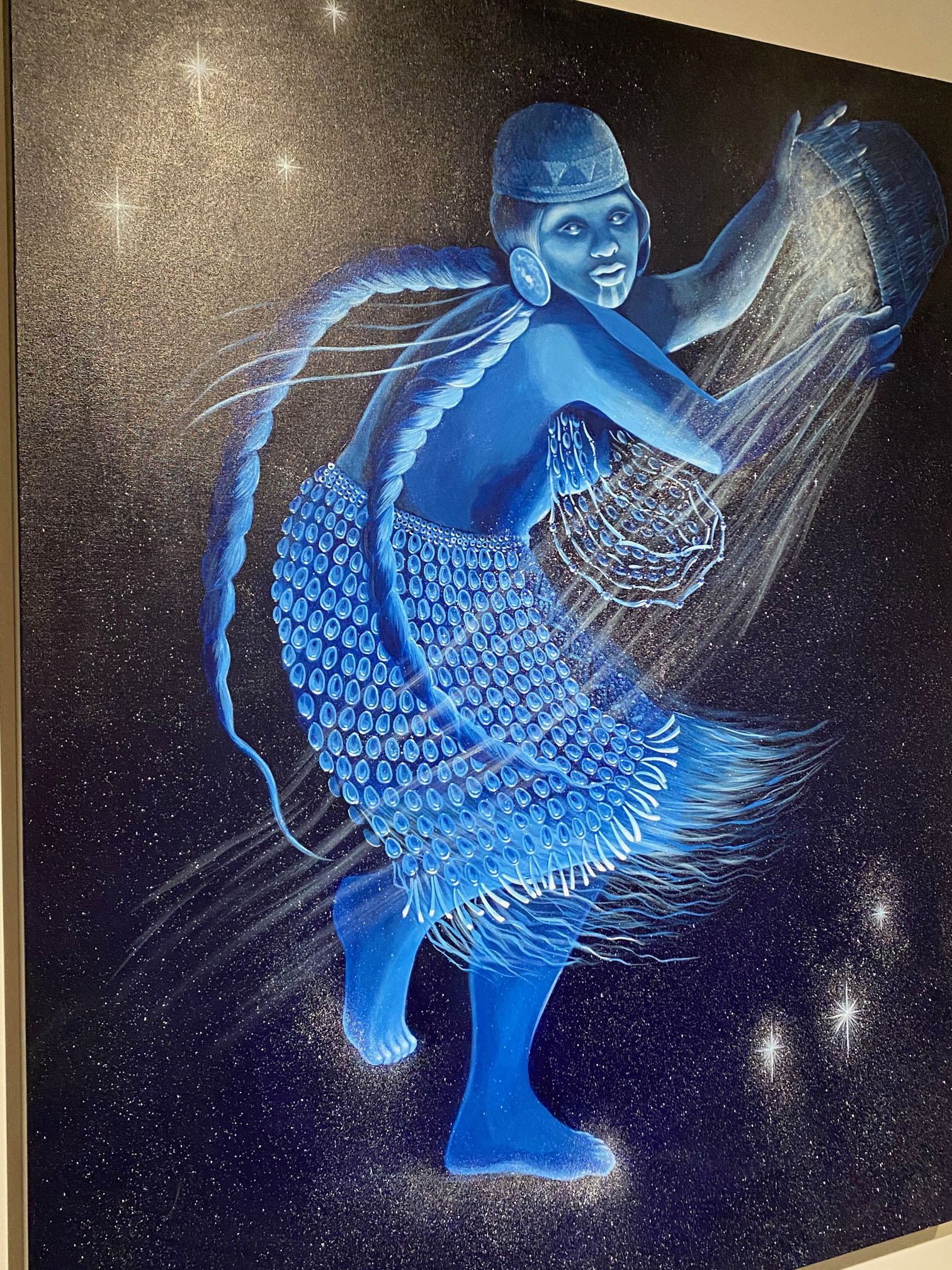
Some of the most arresting works allow us to enter a spiritual realm – magical depictions of legends, stories, and lessons that she heard from her dad growing up. Lowry’s large-scale, dramatic canvases are immersive – letting us enter the world of the girl-power Star Maidens, who who dance across the sky holding baskets of stars and tossing comets.
Lowry’s 2003 Northern Coast panel from the series Weh-Pom and the Star Sisters celebrating female autonomy and strength. Courtesy: National Museum of the American Indian, Smithsonian
Lowry’s 2003 Southern Coast panel from the story of the the Star Sisters holding their own in the sky and rejecting the advances of trickster Coyote Weh-Pom. Courtesy: National Museum of the American Indian, Smithsonian.
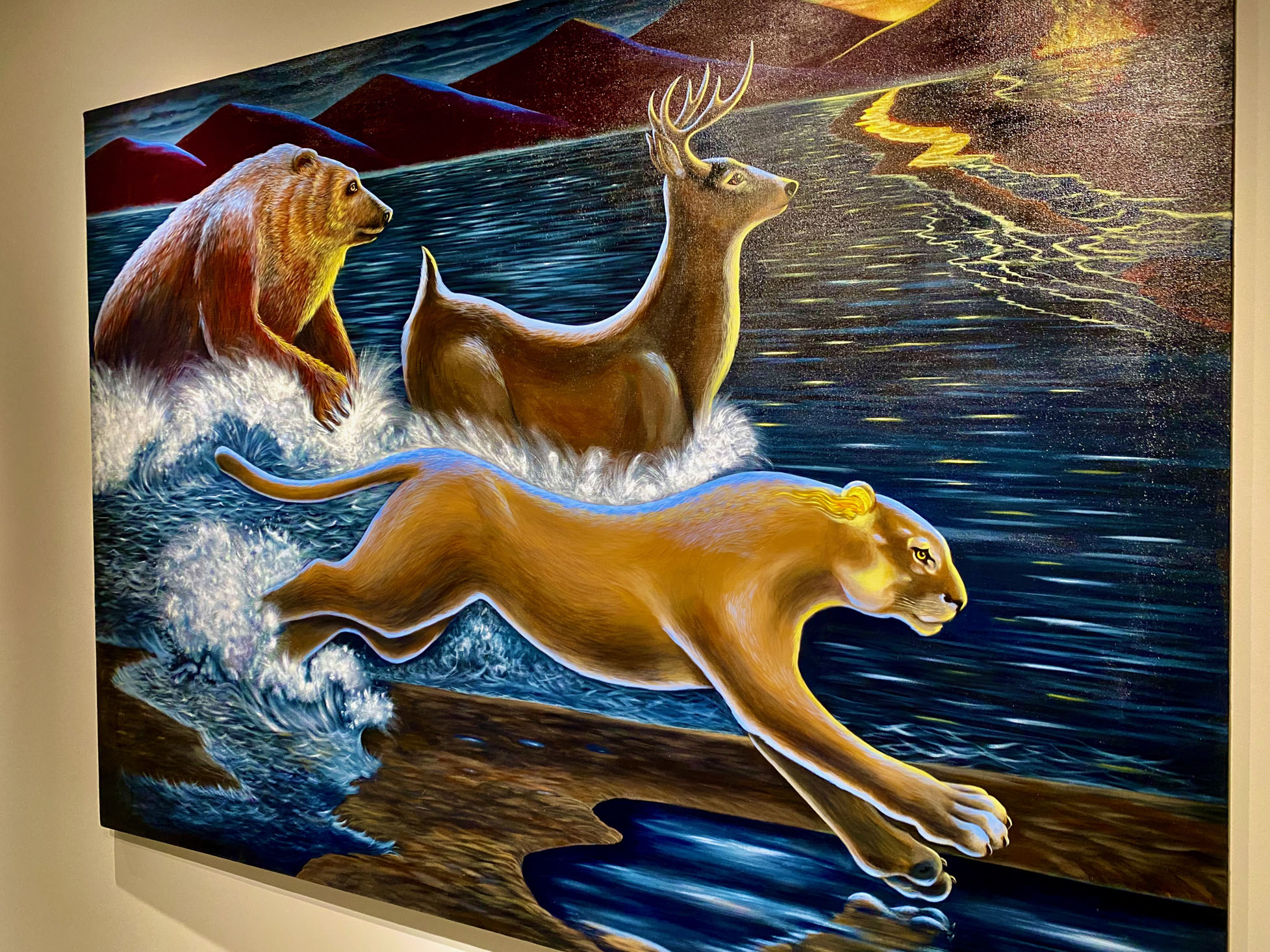
Or letting us enjoy the epic, triumphant forces of natural world that led to the environment Lowry now inhabits in the shadow of the Sierra Nevadas.
Lowry’s 2001 The Race for Fire showing animal spirits charging to retrieve fire from the mountains after a devastating flood. Courtesy: Maidu Museum and Historic Site, Roseville, California.
But at the end of her retrospective, Lowry presents the ultimate immersive experience – an imagined native Northern California roundhouse where visitors can enter, think, and see mystical images of Lowry’s inspiring female ancestors, tribal story-carriers, and cultural symbols. Visitors enter quietly and linger respectfully, taking in all the details of the painted walls and dome. See our short video to see Lowry’s comforting interior.
Lowry’s 2005/2025 mixed-media installation K’umde–go–i-dom(HomePlace), an imagined Native California roundhouse covered in snow; built for quiet reflection. Courtesy: private collection
After immersion in this spiritual space, visitors enter a bright contemporary gallery displaying some of the 125 contemporary Indigenous works that Lowry and her husband Brad Croul donated to the Nevada Museum – honoring the accomplishments of the notable artists working in the region in the 1990s. The gallery is filled with art by famed Northern California indigenous artists (inspirations and friends like Harry Fonseca and Jean LeMarr. The gift significantly expands the museum’s indigenous contemporary collection.
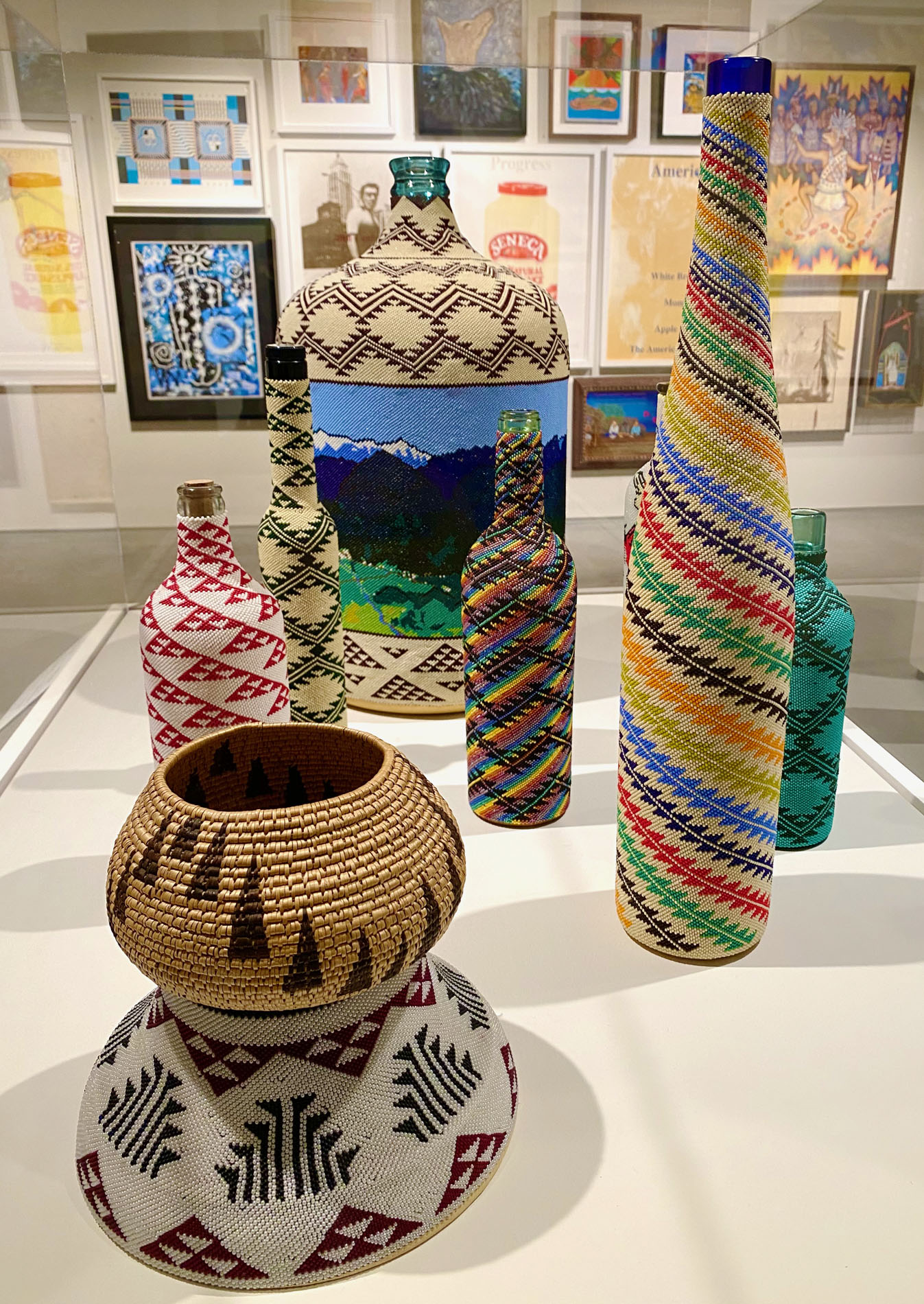
It’s also a nice punctuation that the spectacular case of beaded glasswork by Lorena Gorbet also features a treasured piece of Judith’s family history – a beautiful grasshopper-stitch basket made by Judith’s great-aunt Annie Gorbet when she was only fourteen years old.
1914 red maple and willow Grasshopper Stitch Basket by 14-year-old Annie Gorbet [Yamani Maidu (Mountain Maidu)] (Judith’s great aunt) and undated beaded glass water jug and bottles by Annie’s granddaughter, Lorena Gorbet
Car Crash Necklace by Brian Tripp (Karuk); created from auto reflector fragments, river rock, duct tape, fabric, and string.
Lowry’s work and generous collection provide a loving immersion into family, friends, and spiritual traditions of the Great Basin. It’s a rich tribute to a prolific contemporary artist – one who cares about her culture and committed to ensuring its legacy for her region.
Building on the groundwork laid in the artist-curated exhibition Grounded in Clay: The Spirit of Pueblo Pottery (opening in St. Louis on March 7), Santa Fe’s Museum of Indian Arts and Culture asked five Navajo textile artists, photographers, and scholars to delve into MIAC’s historic collections to tell the story of Diné weavng.
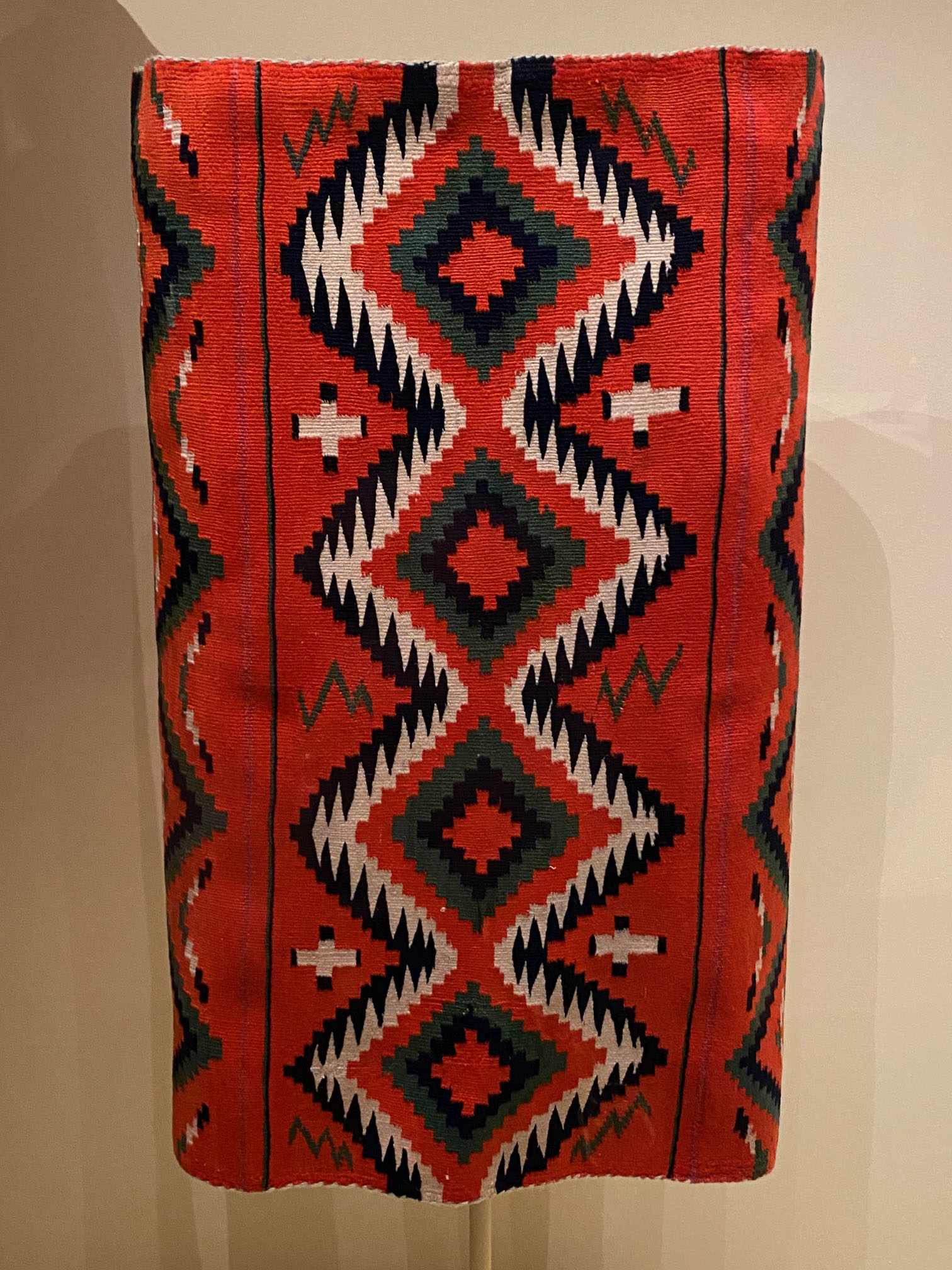
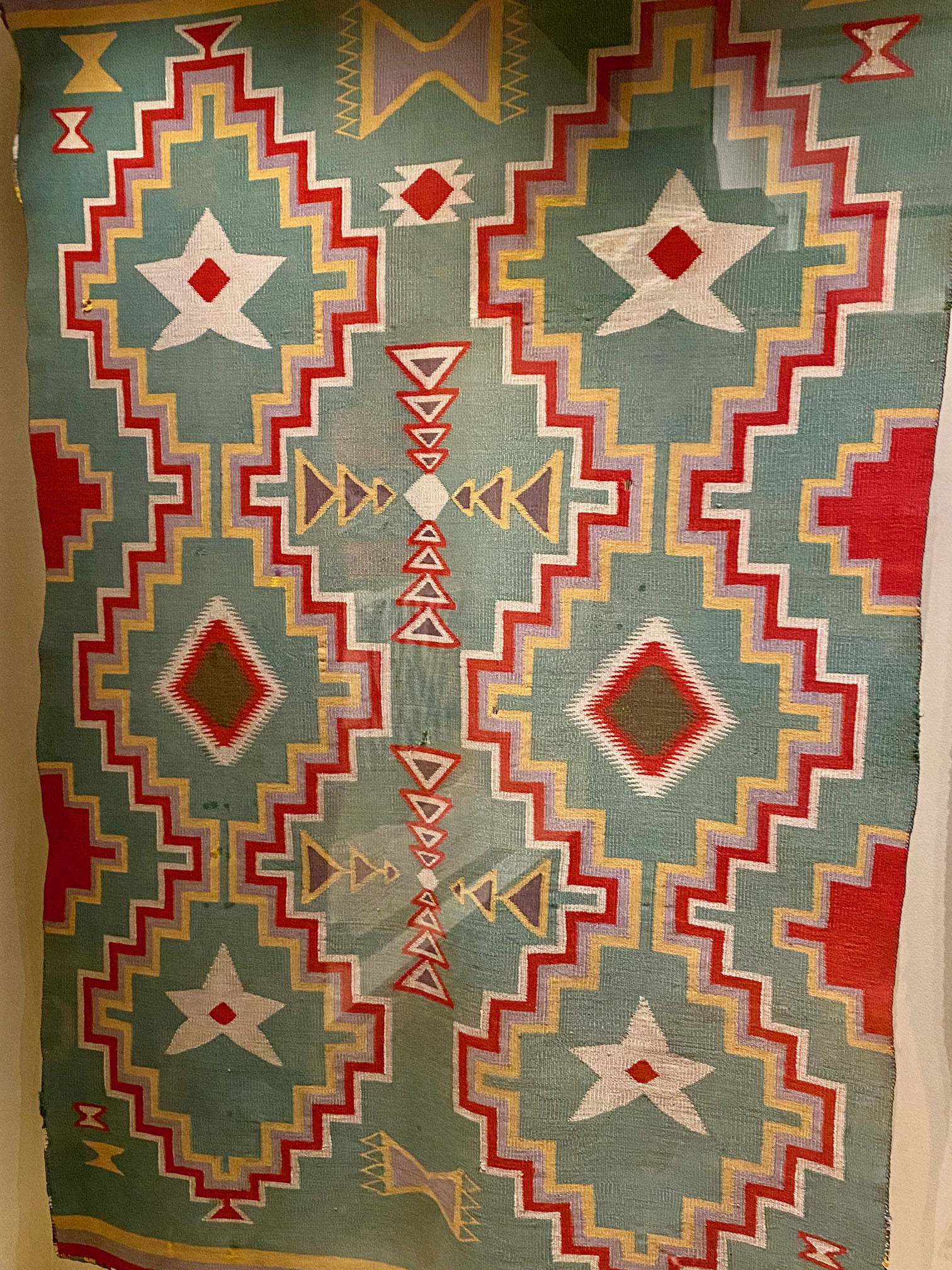
Horizons: Weaving Between the Lines with Diné Textiles, on view through February 2, 2025, presents historic and contemporary weavings alongside epic photographs of Navajo Nation landscapes to show the connections textile artist have to ancestors, their mentors, the community, the land, and their materials.
Historic Diné weaving with photomural by co-curator Rapheal Begay. Courtesy: the artist.
Appropriately, the story told by over 30 historic textiles is presented in MIAC’s Masterpieces gallery.
The entrance presents a dazzling display – a pictorial blanket woven in the 1890s set against a photomural of co-curator Rapheal Begay’s family sheep corral. It’s a visual testament to the importance of wool, life, and the 27,000 square miles of Navajo Nation.
The blanket’s creator (unknown today) was an astute observer of the life on the land and translated it all into warp and weft – cow punchers, cattle, boots, birds, and new-fangled railroad cars, that only arrived in Navajo Country around the 1880s. Click here to see the detail.
1885 pictorial blanket created with Germantown wool yarn introduced in the Southwest by the railroads; photomural Navel (Hunter’s Point, AZ) by co-curator Rapheal Begay. Photo courtesy of artist.
Nothing was newer than the railroad, at the time this artist depicted it – a steam-fed invention from the East that would change western life forever, but that also brought a wide array of colorful yarn that could be mixed and matched with vegetal dyes to create new Native designs.
The intertwined history of Diné (“The People” in the Navajo language), textile art, and the land is told through quotes and recollections by the exhibition’s Native collaborators. While examining masterful geometric weaving techniques in 19th-century works, visitors are provided with an historic context – the types of art materials introduced to captives imprisoned at Bosque Redondo after the Long Walk, the images that could be interpreted as a longing for the homeland by the incarcerated, and coded spiritual affirmations.
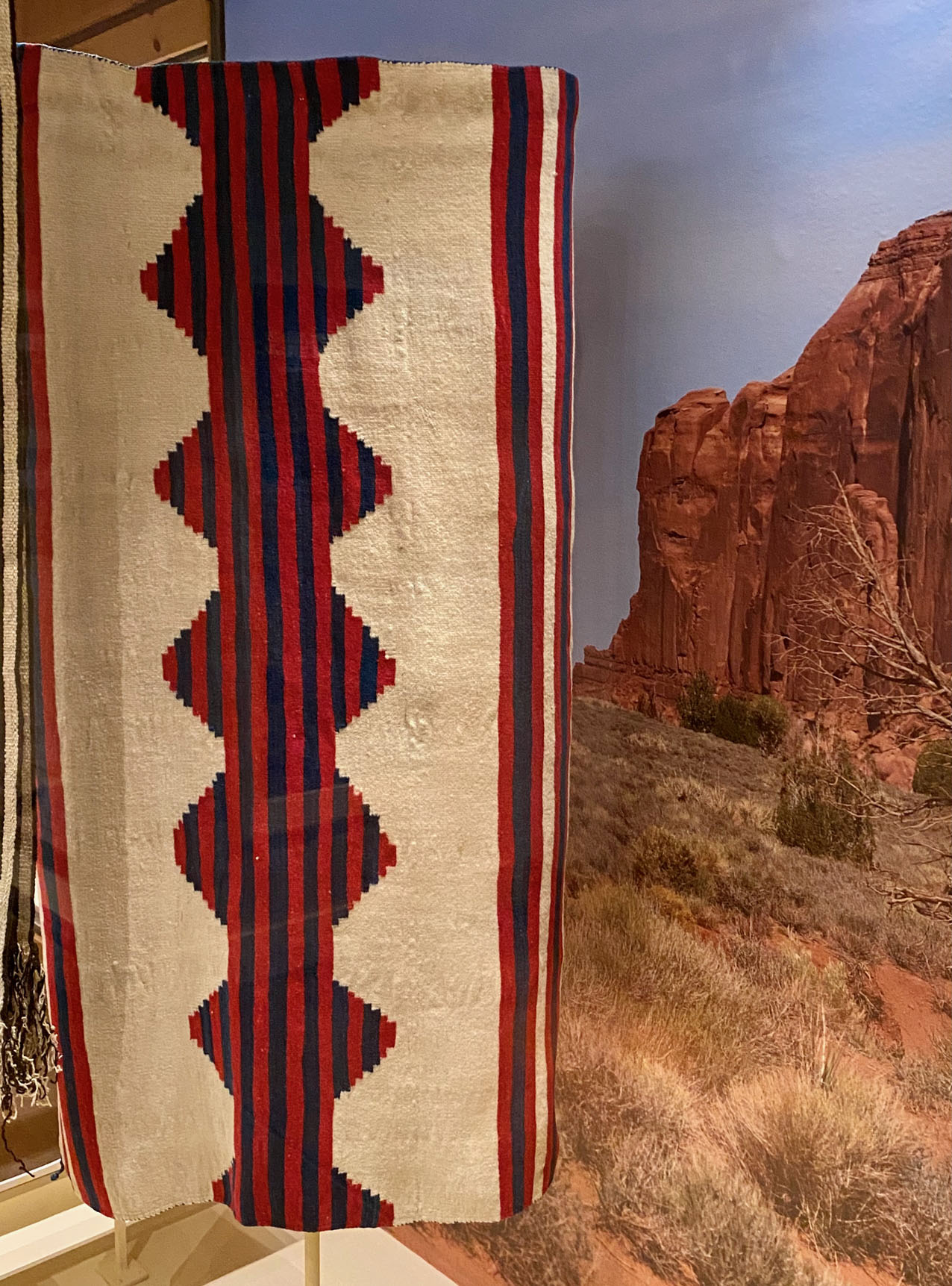
1850-1860 hand-spun wool child’s (or saddle) blanket with Spider Woman crosses; created with natural cocineal, indigo, and chamisa dye
1880-1897 rug made with Germantown wool yarn, cotton string, and raveled yarn; materials used in weaving at Bosque Redondo era, post-Long Walk.
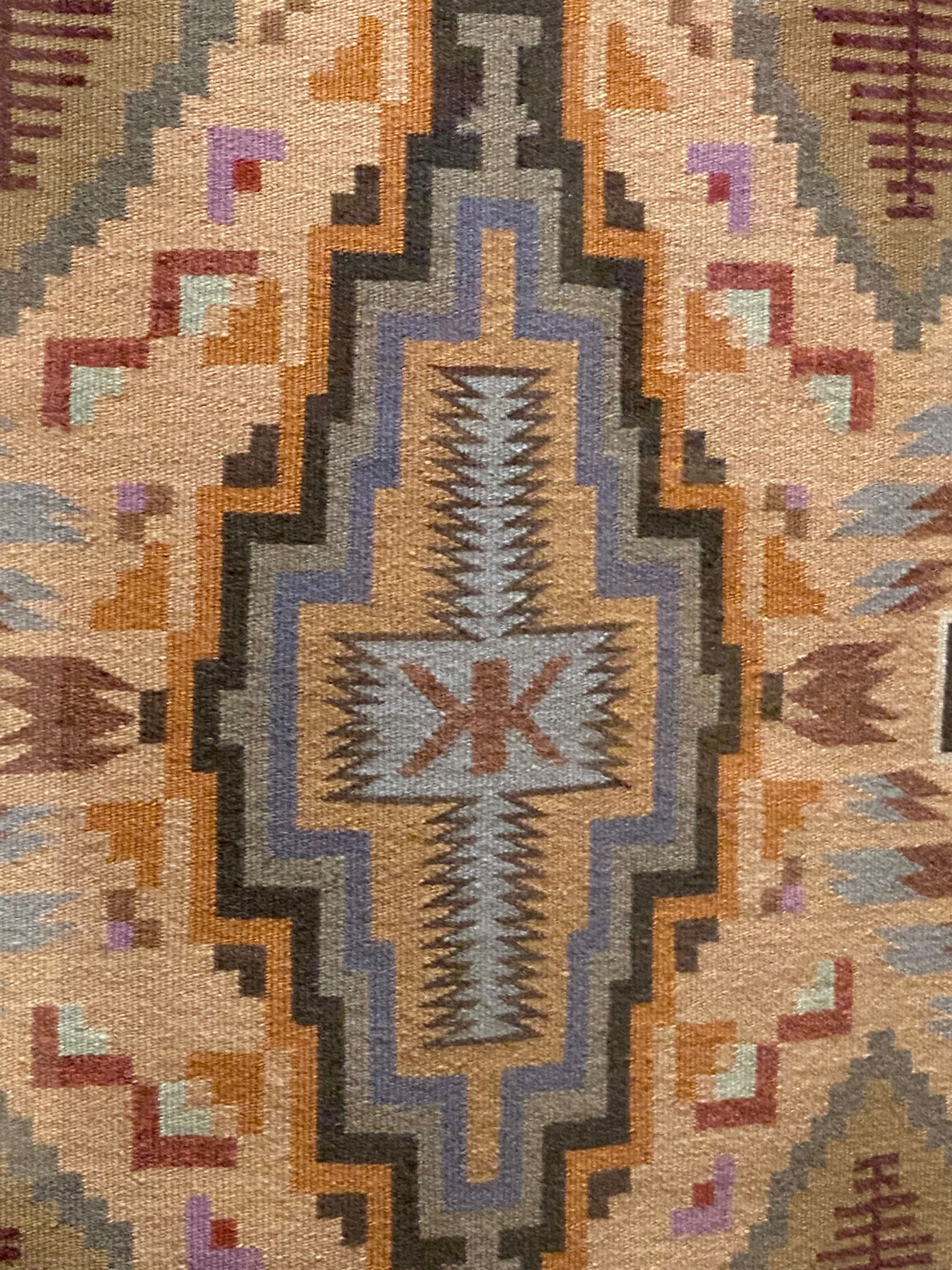
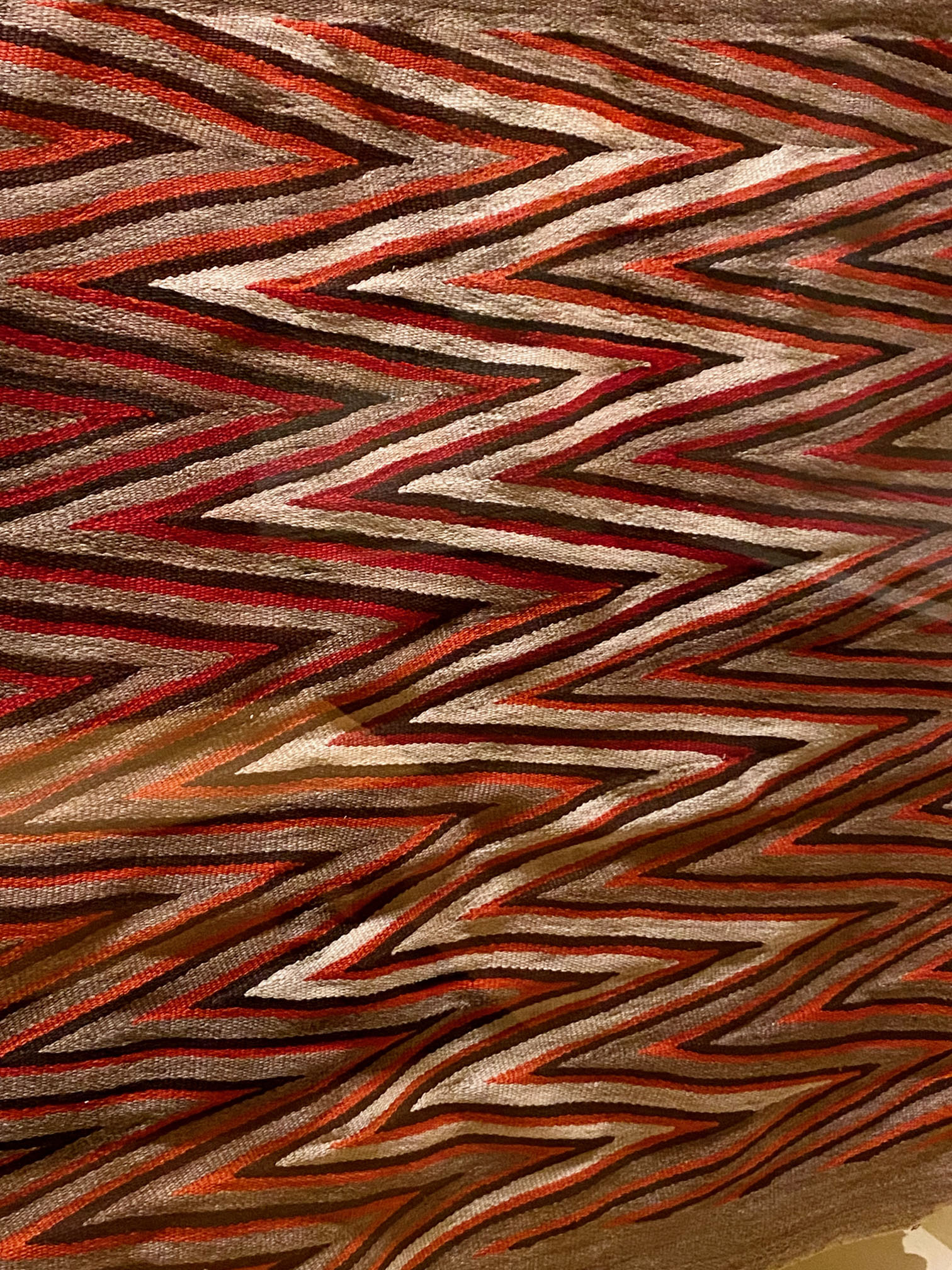
The participants in the exhibition make sure that viewers also experience how the landscape inspires the work of the past and contemporary Native textile artists. Diné fiber artist Tyrrell Tapaha includes her two-panel dress in which incorporates images of the Utah clouds and mountains that bring her spiritual peace. The masterful wall hanging by Lillie Joe uses the palette of the desert to create a mesmerizing geometric dazzler.
2020 two-panel dress by fiber artist Tyrrell Tapaha with images from Utah landscapes that inspired her; woven from churro, silk, mohair, and marino wool..
Close up of highly detailed 1980s Burntwater wall hanging by Lillie Joe, reflecting colors and patterns of the Navajo Nation landscape.
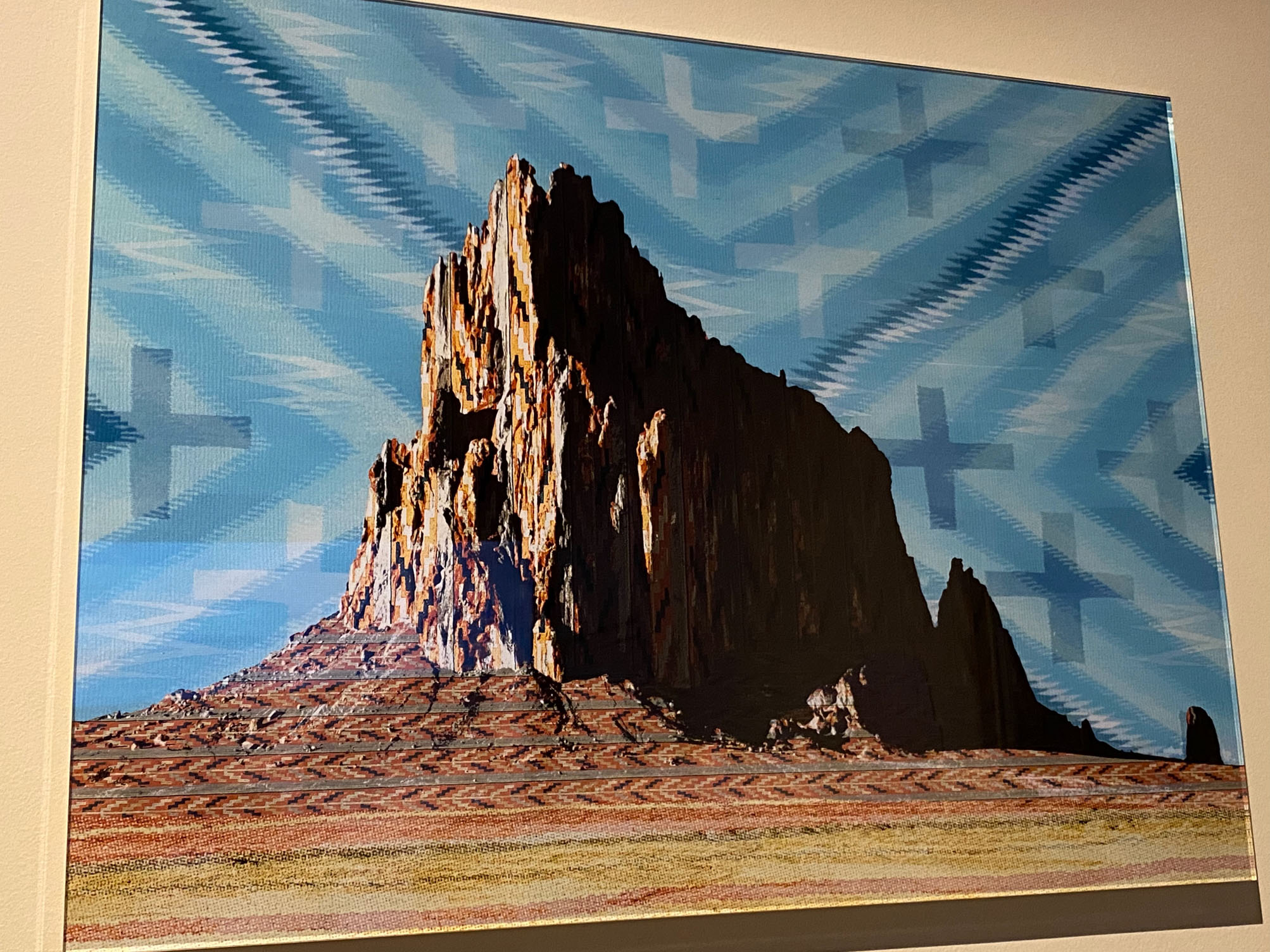
The curators feature both the photography of co-curator Rapheal Begay and Darby Raymond-Overstreet to allow gallery visitors to experience the awesome beauty of the homeland that inspires artists. Digital artist Raymond-Overstreet overlays geometric textile patterns across his luscious, beautiful landscapes.
2018 digital print Woven Landscape, Shiprock by Darby Raymond-Overstreet (Diné), overlaying digital landscapes with traditional weavings. Courtesy: the artist
Take a look at some of our favorite works in our Flickr album. And enjoy these historic and contemporary dazzlers.
Detail of 1895 wedge weave blanket made with commercial cotton string and Germantown wool – a dramatic 19th c. weaving innovation. Courtesy: International Museum of Folk Art.
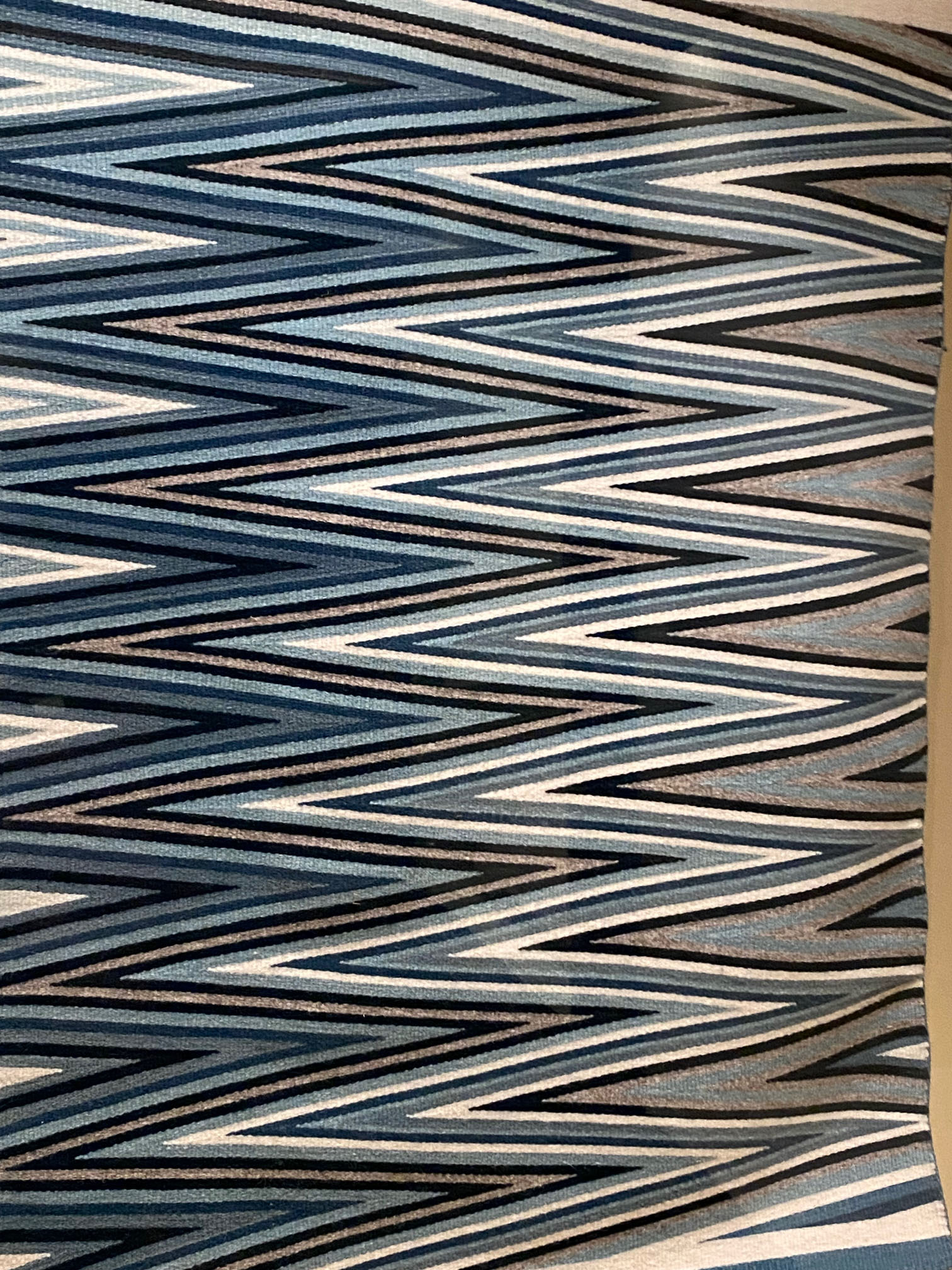
2022 wedge weave by Kevin Aspaas; white and grey wool yarn with indigo dye. Courtesy: private collection.
Detail of dynamic Diné 1960 wool tapestry weave. Courtesy: International Museum of Folk Art
Pow! Wham! What? It’s superheroes, avatars, and mixed-media channeling sci-fi social consciousness in an engaging, colorful, thought-provoking mix in the super-fun Fronteras del Futuro: Art in New Mexico and Beyond exhibition at Albuquerque’s National Hispanic Cultural Center through March 12.
These artists love mixing pop culture images, found objects, and historic iconography to question where we’ve been and where we’re going. Take a look at our favorites in our Flickr album.
Some artists use pop culture to get our attention on deeper issues. The back-to-the-future B-movie poster series by Angel Cabrales prompts reflection on societal attitudes about immigrants and border issues.
2016 B-movie poster by Angel Cabrales to spur discussion on immigration and border issues. Courtesy: the artist.
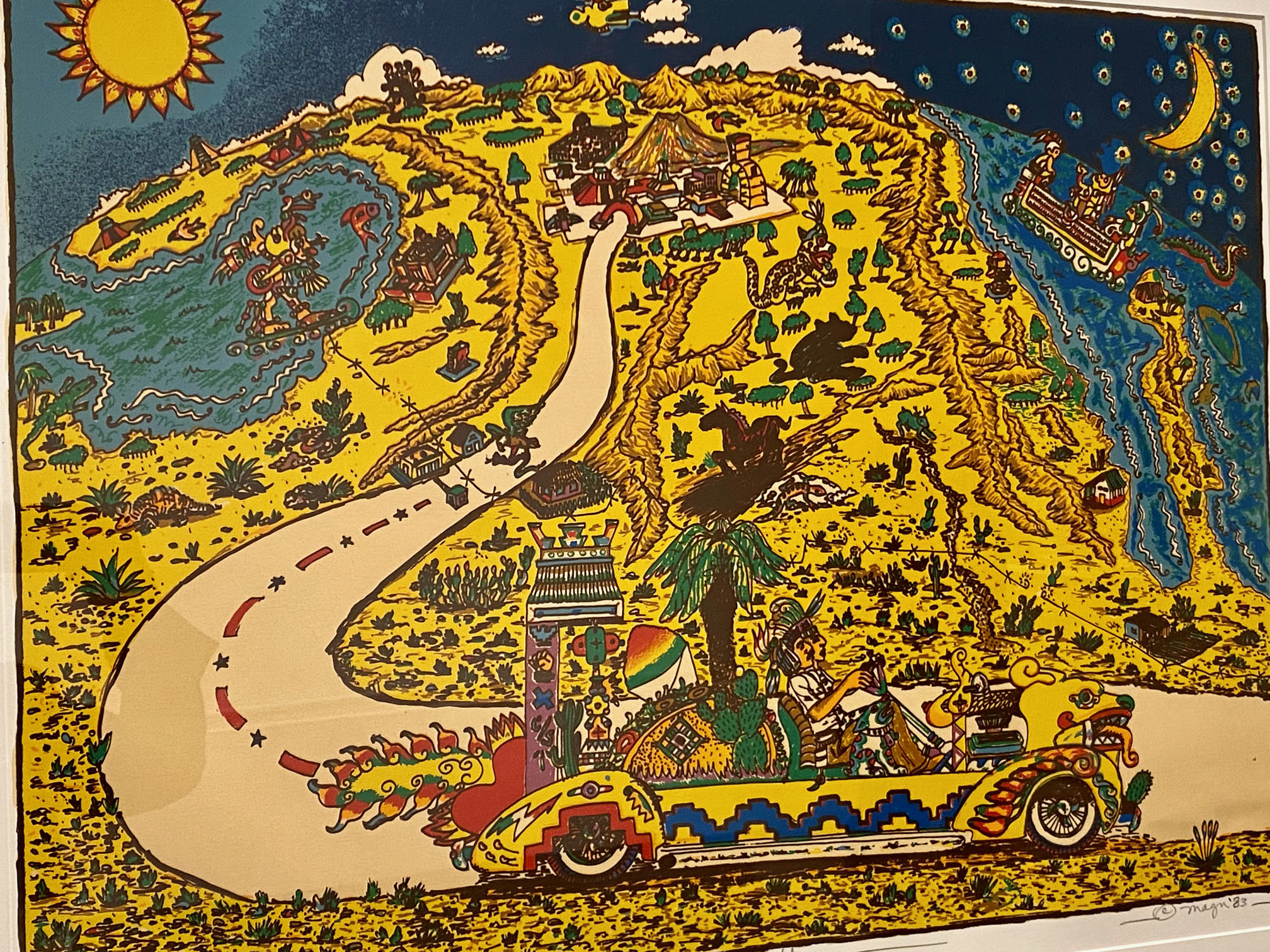
Gilbert “Magú” Luján’s silkscreen merges the epic scope of Mesoamerican history into a contemporary context. A stylish Aztec couple takes a cross-border journey from Aztlán to Texas in a pre-Columbian-styled low rider.
1983 silkscreen Return to Aztlán by Gilbert “Magú” Luján; a cross-border journey and reflection on pre-Columbian roots and heritage.
One of the most epic achievements is a wall-length, accordian-folded letterpress codex – a collaboration by Enrique Chagoya, Guillermo Gómez-Peña, and Felicia Rice. Codex Espangliensis features pop-culture superheroes, pre-Columbian imagery, comics, and social declarations to explore New World history from 1492 to the present.
Designed to be read right to left: cover and first pages of Codex Espangliensis from Columbus to the Border Patrol, a hand-colored letterpress accordian-folded book.
Pages from 1999 Codex Espangliensis from Columbus to the Border Patrol, a hand-colored letterpress book by Enrique Chagoya, Guillermo Gómez-Peña, and Felicia Rice.
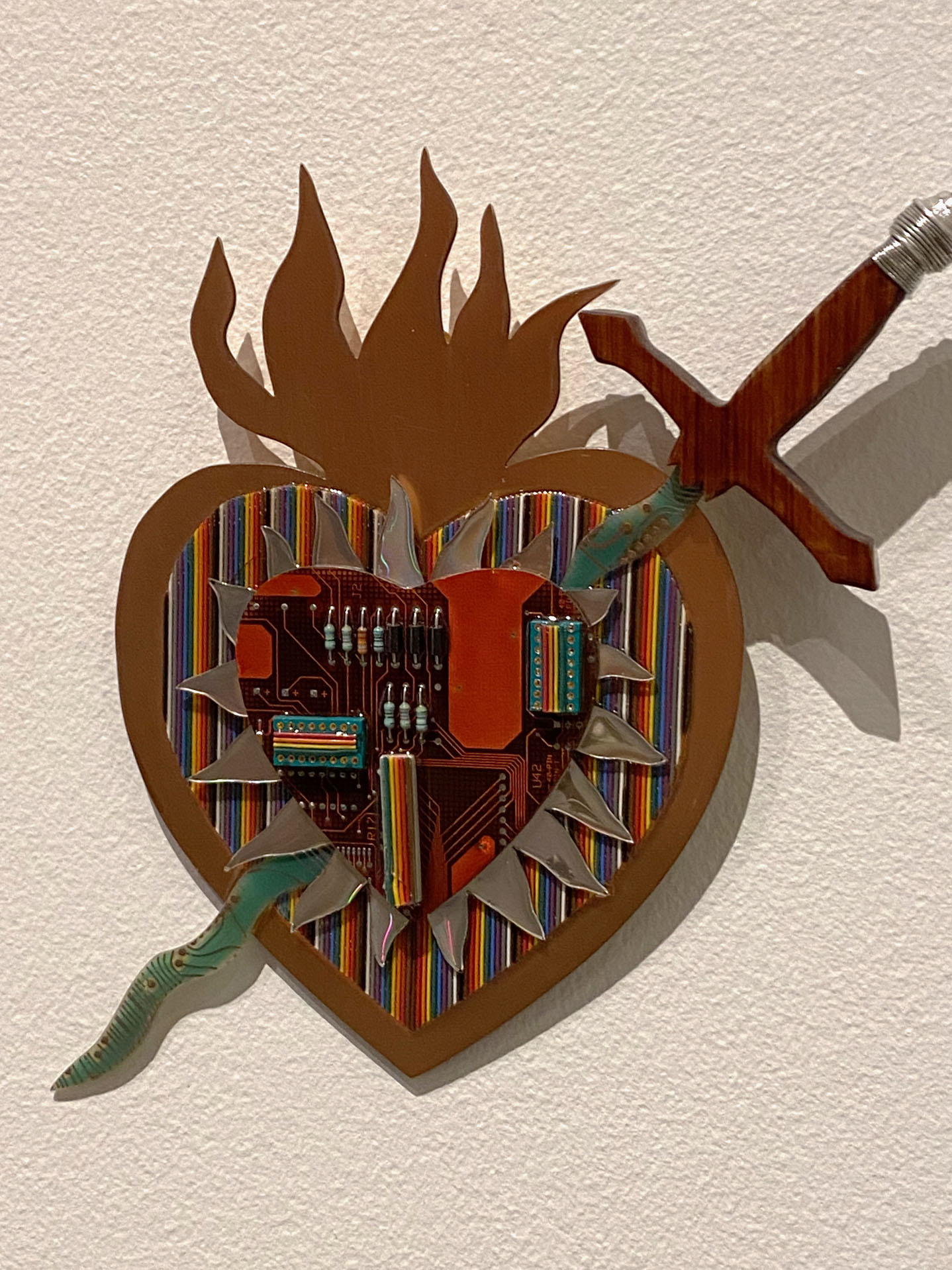
Marion Martinez’s 2002 Pierced Heart/Milagro; circuit boards and wood. Courtesy: the artist
Esteban Borjorquez’s 2018 Zena of Urion – a sci-fi creation from discarded items. Courtesy: the artist.
Marion Martinez grew up near Los Alamos National Laboratory, and started visiting its salvage area to find components from which to assemble her artworks – transforming discarded tech into beautiful icons of Northern New Mexican heritage.
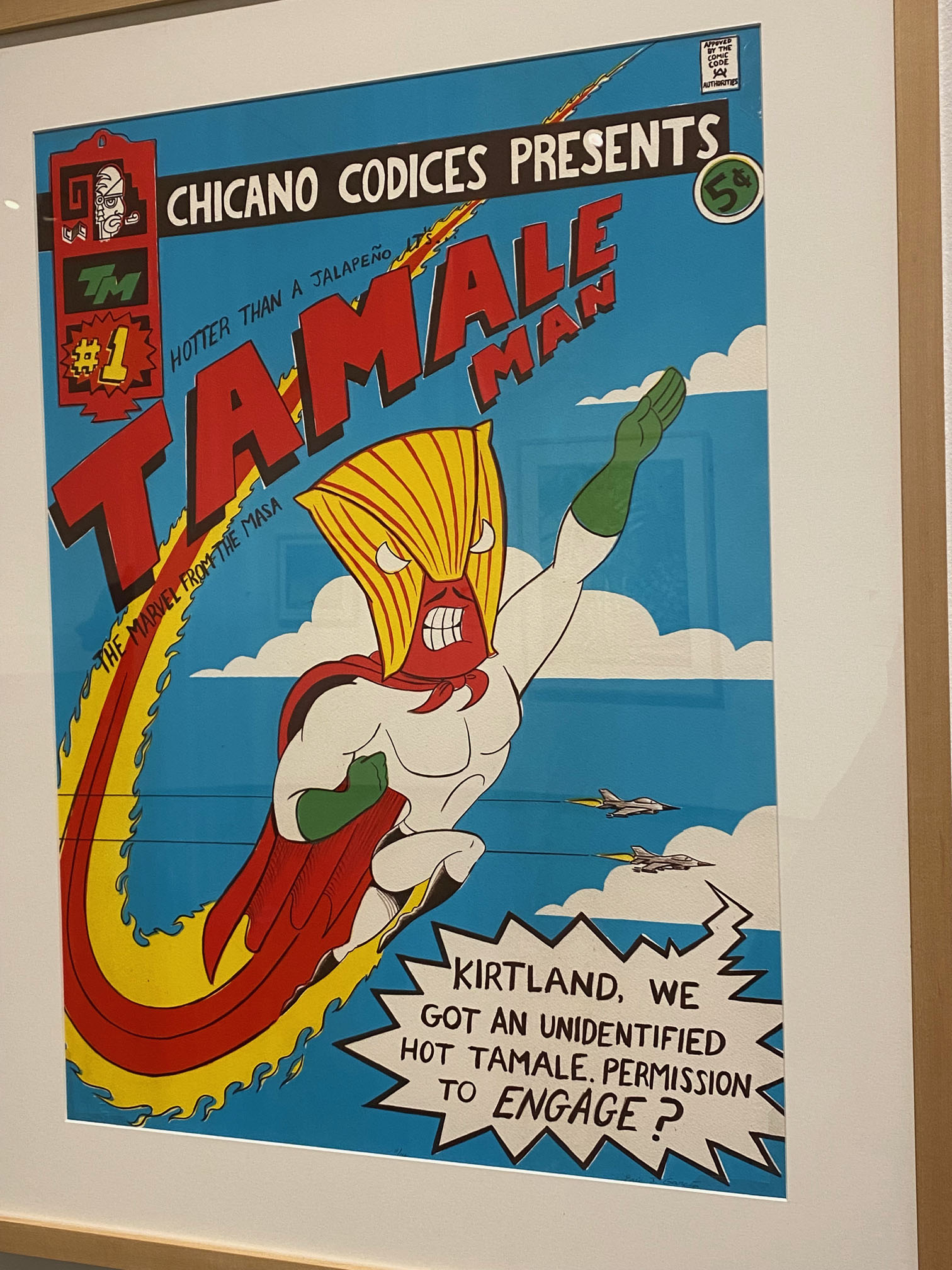
Eric J. Garcia’s 2005 lithograph Tamale Man.
Roswell political cartoonist Eric J. Garcia takes another angle on mixing New Mexico’s cultural, culinary, and nuclear history. His Tamale Man series features the transformation of a guy munching a tamale at the first blast at the Trinity Site into a radioactive superhero.
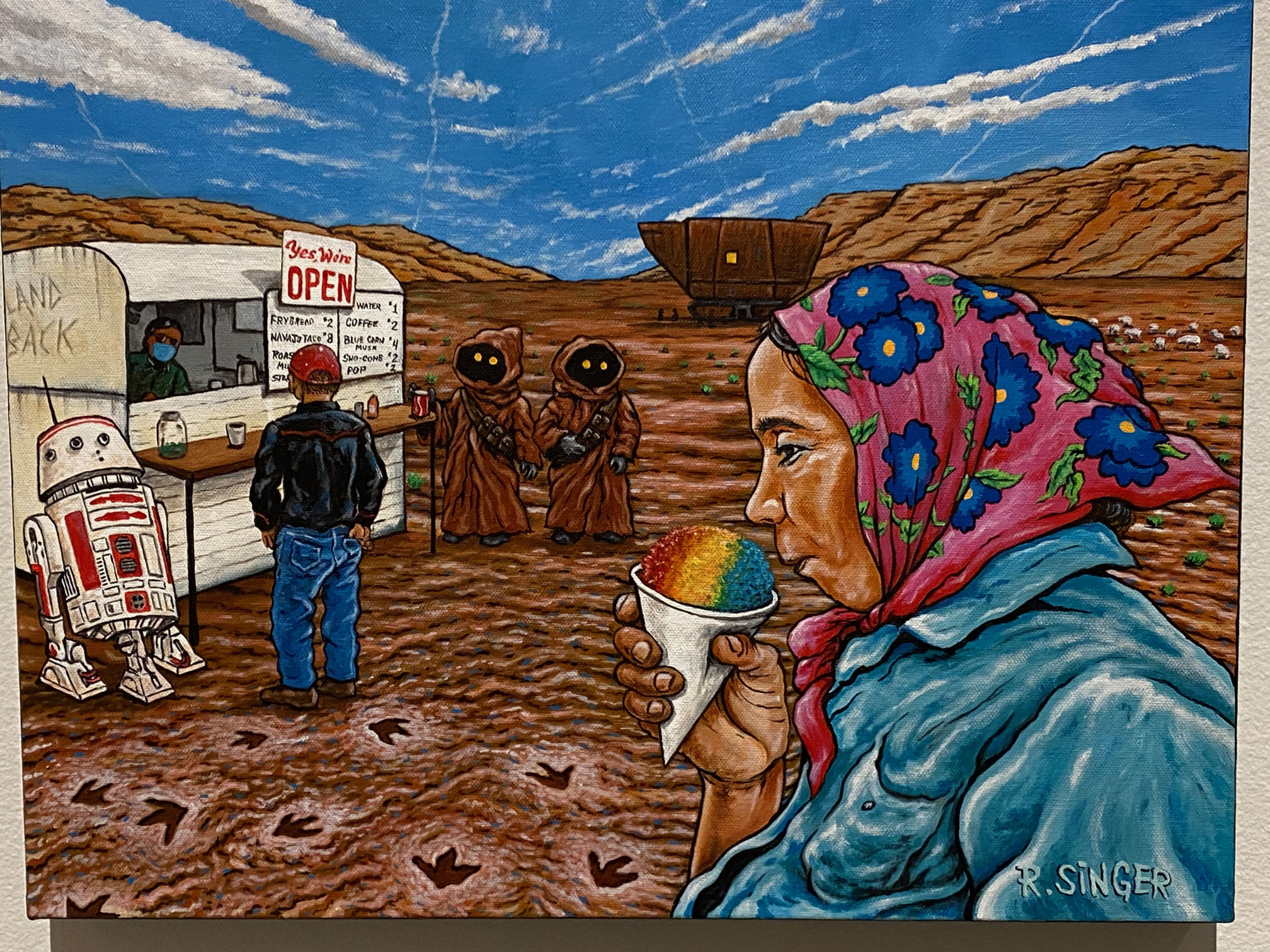
Ryan Singer’s painting series blends his childhood fascination with Star Wars and other futuristic sagas with his Navajo heritage and upbringing.
Ryan Singer’s 2021 acrylic, Rainbow Flavor.
Meet Ehren Kee Natay, a Diné artist, whose work opens the exhibition with a loving tribute to his grandfather, the first Native American to release a commercial record:
It’s a showcase for art created at the beginning of the 20th century – a time when European experimentation in abstraction, urban skyscrapers and other engineering marvels, Einstein’s breakthroughs, and the success of the women’s suffrage movement made artists optimistic about the future.
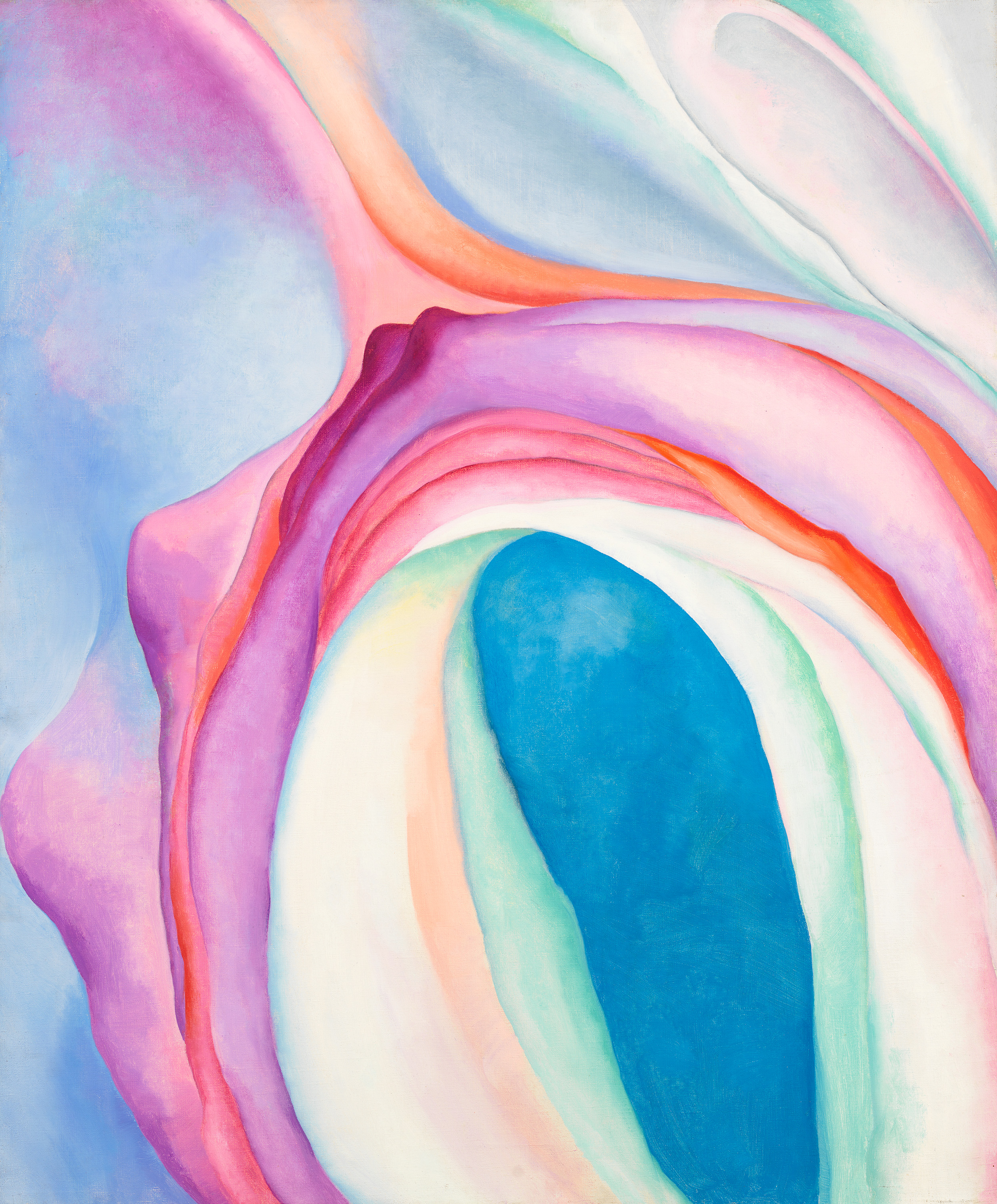
The show features work by well-known (and well loved) artists like lyrical abstractionist Georgia O’Keefe (Music, Pink and Blue No.2) and transcendentalist Agnes Pelton (Ahmi in Egypt).
But the news story here is the Whitney’s interest in pulling work by their contemporaries out of storage to provide a more expansive look at early American modernism. Nearly half of the works on display have not been out of the stacks for more than 30 years!
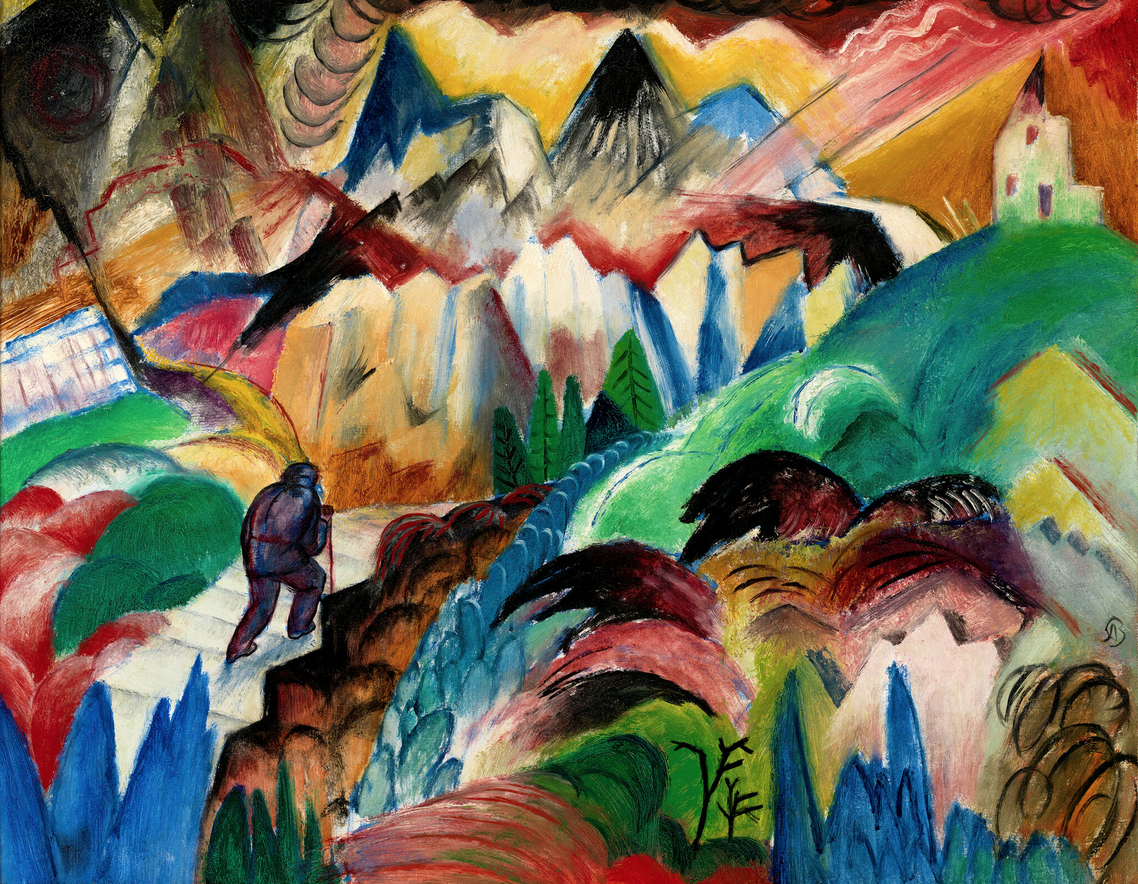
Look at Albert Bloch’s 1916 Mountain, which hasn’t been shown at The Whitney in 50 years. It’s somewhat shocking when you consider that Bloch was the only American invited to join the ground-breaking Der Blaue Reiter in 1911. It’s fitting that Bloch’s nearly forgotten, expressionist landscape was resurrected and featured as the show’s icon – a traveler on an upward journey toward a town on the hill amidst modernist peaks.
Albert Bloch’s 1916 Mountain.
The Whitney’s also pulled Carl Newman’s 1917 Bathers out of storage for this show and hung it side-by-side with Bloch.
Newman was an Academy-trained artist from Philly, but after getting swept up in the Parisian avant-garde one summer, he tried throwing art conventions out the window.
Color, rainbows, naughty nudes, pleasure craft – a scandalous and joyous mix!
Carl Newman’s 1917 oil on linen painting, Untitled (Bathers)
And what about another “forgotten” convention-breaker? The vibrant 1926 Street Scene is by Yun Gee, a Chinese immigrant modernist who started his art career in San Francisco, but found more acceptance and exhibition opportunities in Paris. Gee was the only Chinese artist running in European modernist circles, and it’s nice to see his cubist expression of San Francisco’s Chinatown right where it belongs in the Whitney’s pantheon.
Yun Gee’s 1926 oil of San Francisco’s Chinatown, Street Scene. Courtesy: estate of Yun Gee.
Works by some of our modernist favorites are also featured – synchronist master Stanton Macdonald Wright, shape-shifter Arthur Dove, and former Brancusi studio assistant and abstracted design leader, Isamu Noguchi.
Henrietta Shore’s 1923 oil, Trail of Life – a recent acquisition by the Whitney to add Shore to its collection.
The stories and careers go on. The exhibition features artists from the West Coast, artists that fled to Paris and found success there, and some modernists that just couldn’t make a go of it and stopped making art entirely.
Henrietta Shore, the Los Angeles innovator who Edward Weston credits as a great influence on his style, was one who eventually opted out.
It’s a beautiful walk through the early 20th century to meet a new set of painters using abstraction to channel an optimistic future – E.E. Cummings (yes, the poet!), Blanche Lazzell of Provincetown, Aaron Douglas of the Harlem Renaissance, and Pamela Colman Smith of Tarot card fame.
Installation view of great modernists. In vitrine: Pamela Colman Smith’s 1909 Rider-Waite-Smith Tarot Deck. Left to right: O’Keeffe’s 1918 Music, Pink and Blue No. 2; Stettheimer’s 1931 Sun; E.E. Cummings’s 1925 Noise Number 13; Macdonald-Wright,’s 1918 Oriental – Synchromy in Blue-Green; Richmond Barthé,’s 1933 African Dancer; Jay Van Everen’s 1924 Abstract Landscape. Photograph by Ron Amstutz.
Here’s a short video by curator Barbara Haskell where she talks about what it was like to find “forgotten” paintings and other stories behind the Whitney’s fascinating modernist reveal:
Forget about the picturesque fjords and pastoral views reindeer herders that we imagine when we envision Scandinavia. Completely different stories of history, revolution, oppression, and cultural revival are told by the array of colorful, decorative, embellished and loved clothing in Dressing with Purpose: Belonging and Resistance in Scandinavia, on view at the International Folk Art Museum in Santa Fe through February 19.
You’re introduced to the iconic folk clothing of three cultures when you enter the exhibition – Sweden, Norway, and Sápmi, the homeland of the indigenous Sami people that stretches across the northern boundaries of Russia and the three other Scandinavian countries.
Detail of mid-19th to early 20th century woman’s dräkt from Sweden’s Delsbo parish in Häsingland historical province.
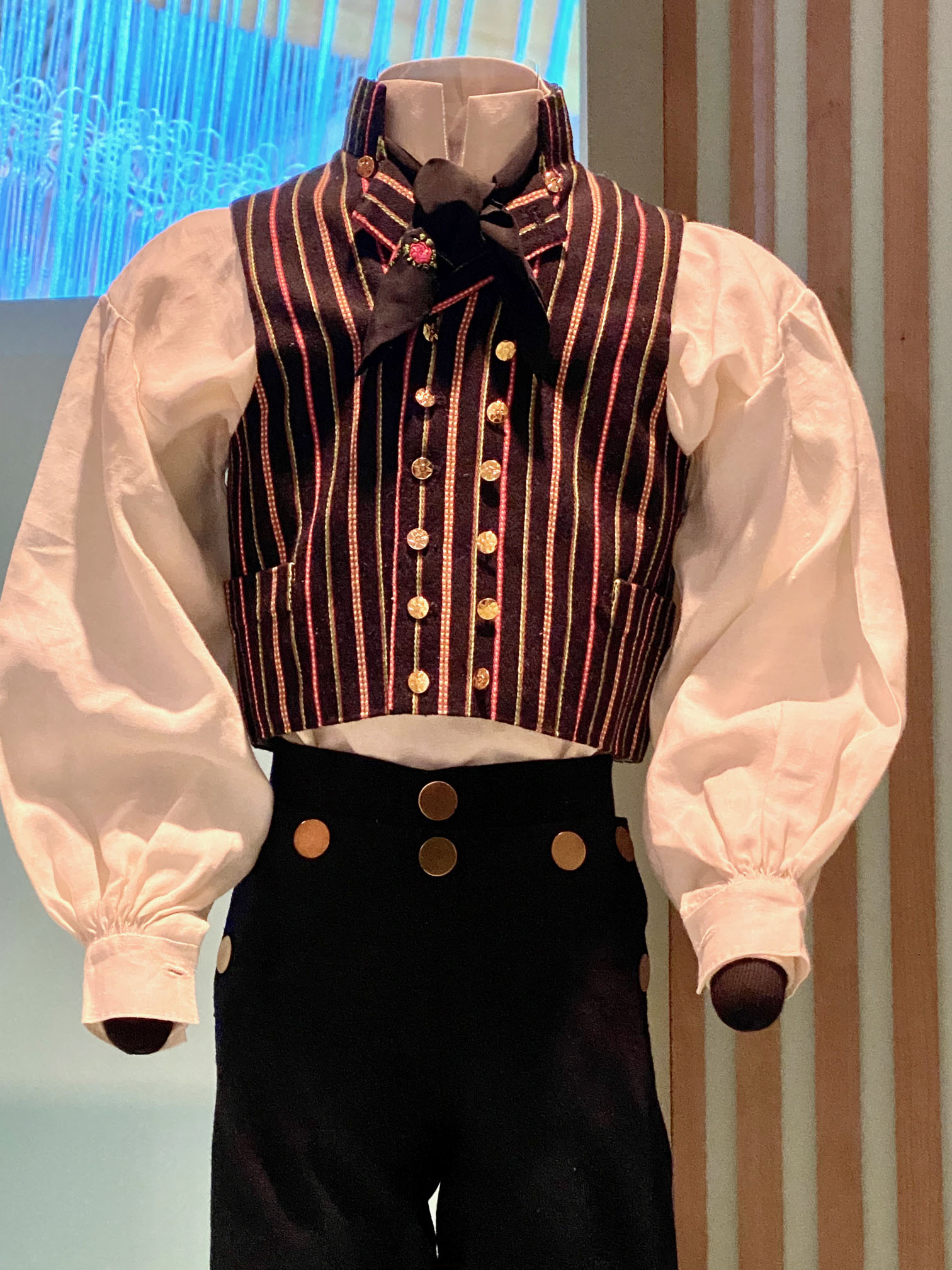
Young Swedish man’s dräkt, made in 1992 by Birgitta Lördal and Maj-Lis Halvarsson of Häsingland historical province.
But then it’s a deep dive into what each of these colorful creations represent.
The story behind Sweden’s folk costumes (folksdräkt) extends back into the 19th century, when rural peasants lived in a fairly hierarchical society and relied on their church clothes to signify where they ranked on the status ladder. Each community developed its own details and styling. In some communities, women used almanacs to help them keep track of various clothing combinations.
The exhibition displays an array of men’s and women’s country ensembles.
There are also examples of striking, elaborately silk-embroidered shawls that were essential to women’s status dressing.
In the 1800s, a series of economic and agricultural misfortunes caused rural Swedes to leave their communities and either migrate to the United States or to middle-class jobs in the city.
Swedish intellectuals worried that the rural population drain meant that country traditions and craftsmanship would vanish. Around 1900, cultural leaders prompted a craft awareness and revival movement – retail shops, showcases for hand-crafted clothing, and national museums.
Detail of woman’s 1834 silk-embroidered linen shawl, a status symbol worn on specified occasions; Leksand parish in Sweden’s Dalarna province.
Today, many Swedes gladly purchase and buy kits to make folksdräkt for festivals, parades, and other events.
The curators have even included items from a new cottage industry – protective garment bags specifically designed to store your folk costume!
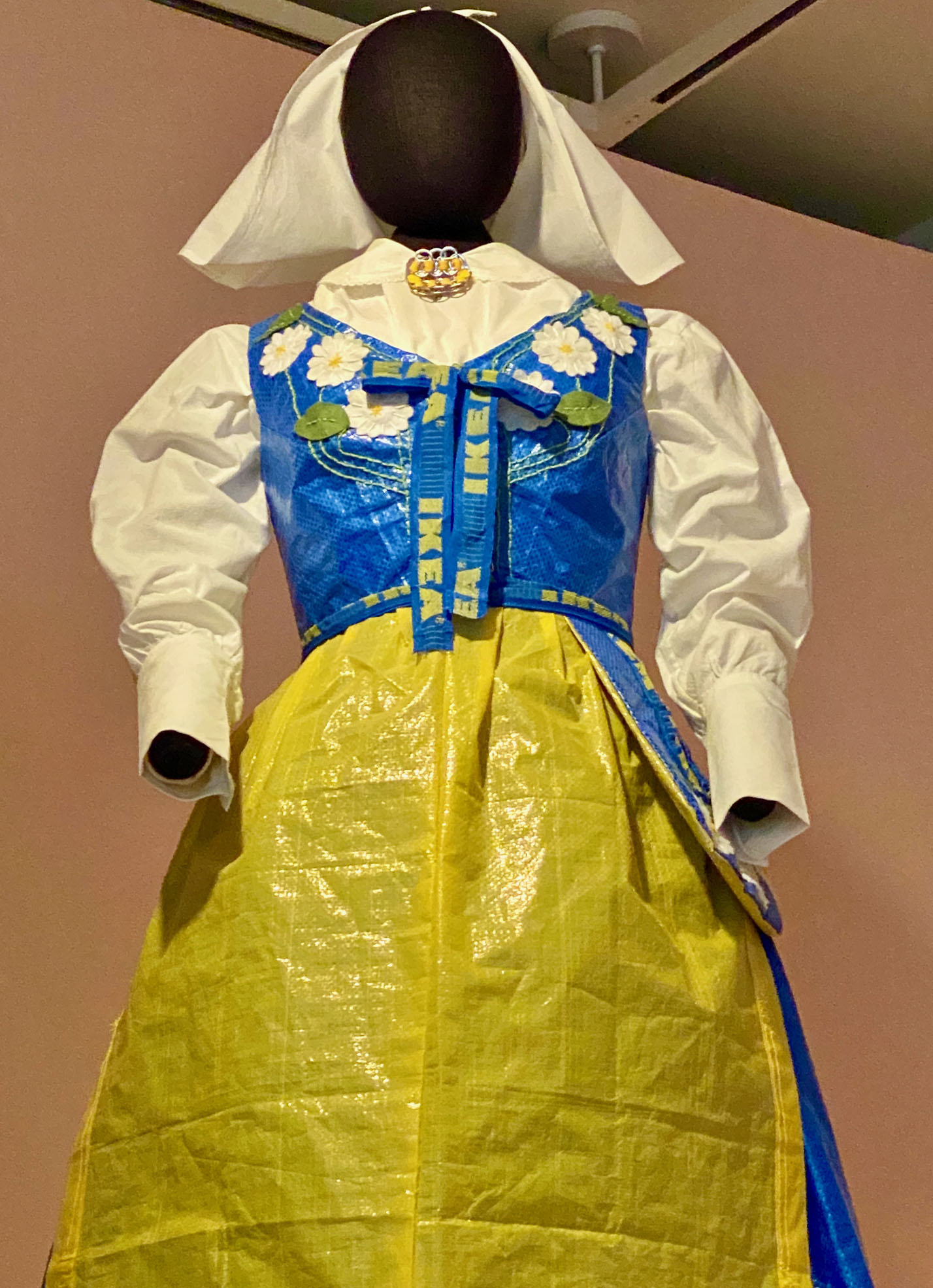
In a whimsical touch, the curators have included a contemporary take from artist Heidi Mattsson – the Swedish national costume made from Ikea shopping bags, a cotton nightshirt and napkin, and sodacan pop tops!
And the curators have included several other inventive modern takes on national wear.
Heidi Mattsson’s 2018 Swedish national costume fashioned from napkin, soda can pop tops, cotton nightshirt, and Ikea shopping bags. I
Täpp Lars Arnesson’s 2016 winter dräkt for his young daughter in Malung parish in Sweden’s Dalarna province; blended decorative elements from other parishes.
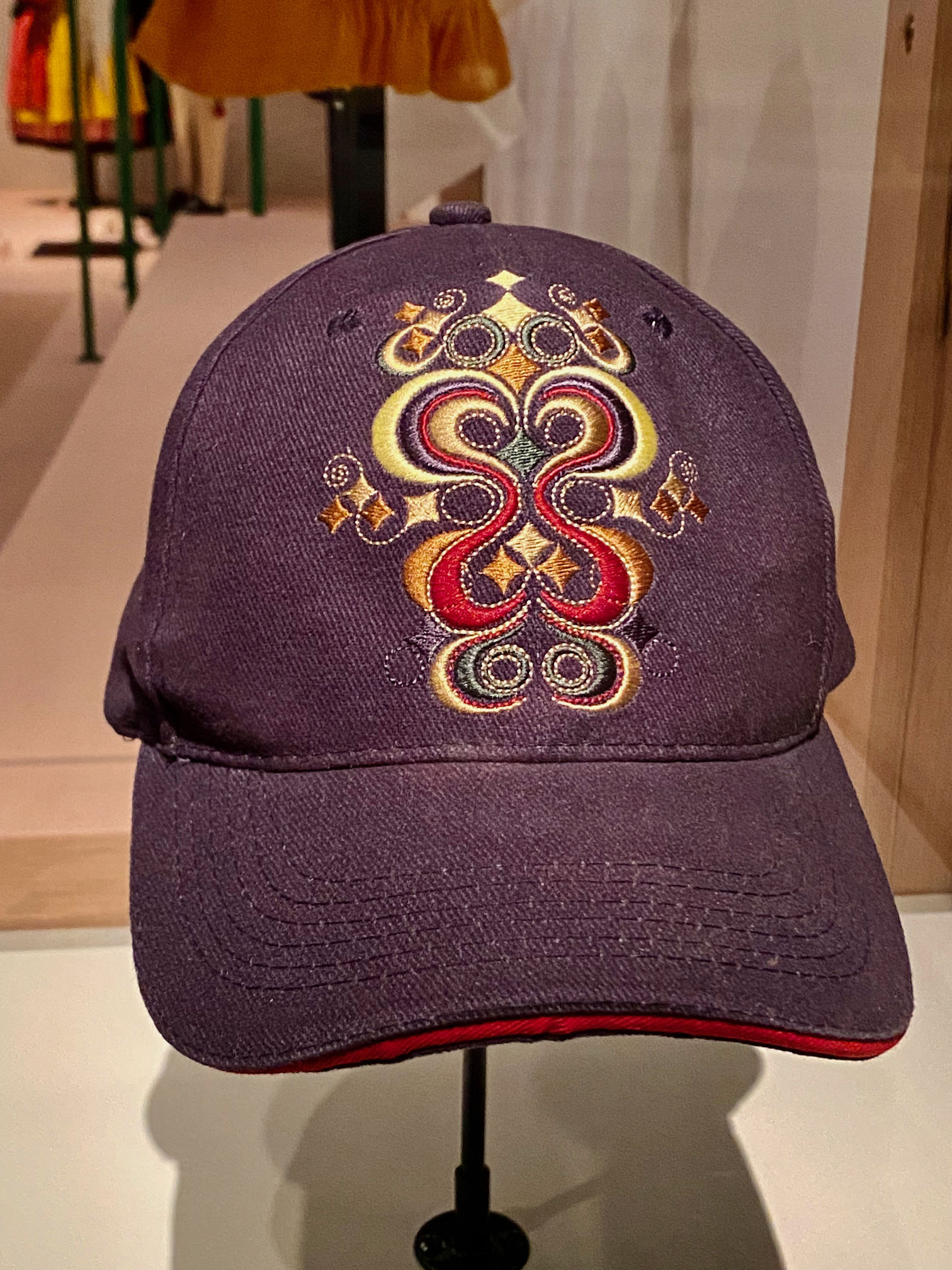
2017 embroidered baseball cap created in Leksand parish in Sweden’s Dalarna province, using traditional symbols. Private collection.
The story told by Norweigan folk dress is more tightly linked to the long revolutionary fight for independence throughout the 19th century. Rural Norwegian peasants were land owners. To city dwellers laboring under Danish and Swedish domination in the 1800s, rural people epitomized the “independent everyman” who had more control over their personal destinies.
During Norweigans’ century-long fight for independence, political activists began adopting bunader, contemporary clothing inspired by preindustrial rural clothing as a sartorial statement about their desire for freedom. It popped up at youth rallies and dances.
1900 national costume – red bodice with beaded insert and dark skirt – typical of Norway’s Hardanger district, depicted in photo.
Hans Kristiansen Lybeck’s fantasy drakt, worn in Oslo’s National Constitution Day parade in 1906. Courtesy: Vesterheim Norweigan-American Museum, Decorah, Iowa.
In 1903, activist and regional dance expert, Hulda Garborg, outlined a philosophy for nationalized clothing and popularized it. Everyone’s enthusiasm for and pride in the national costume kept going, even after independence in 1905. Even in the 21st century, it’s a sure-fire tourism draw up in Norway’s fjord country.
Close-up of Reidun Dahle Nuquist’s embroidered red-jacket bunad, made in East Telemark, Norway by a relative in 1960-1963. She wore it for her wedding and throughout her life.
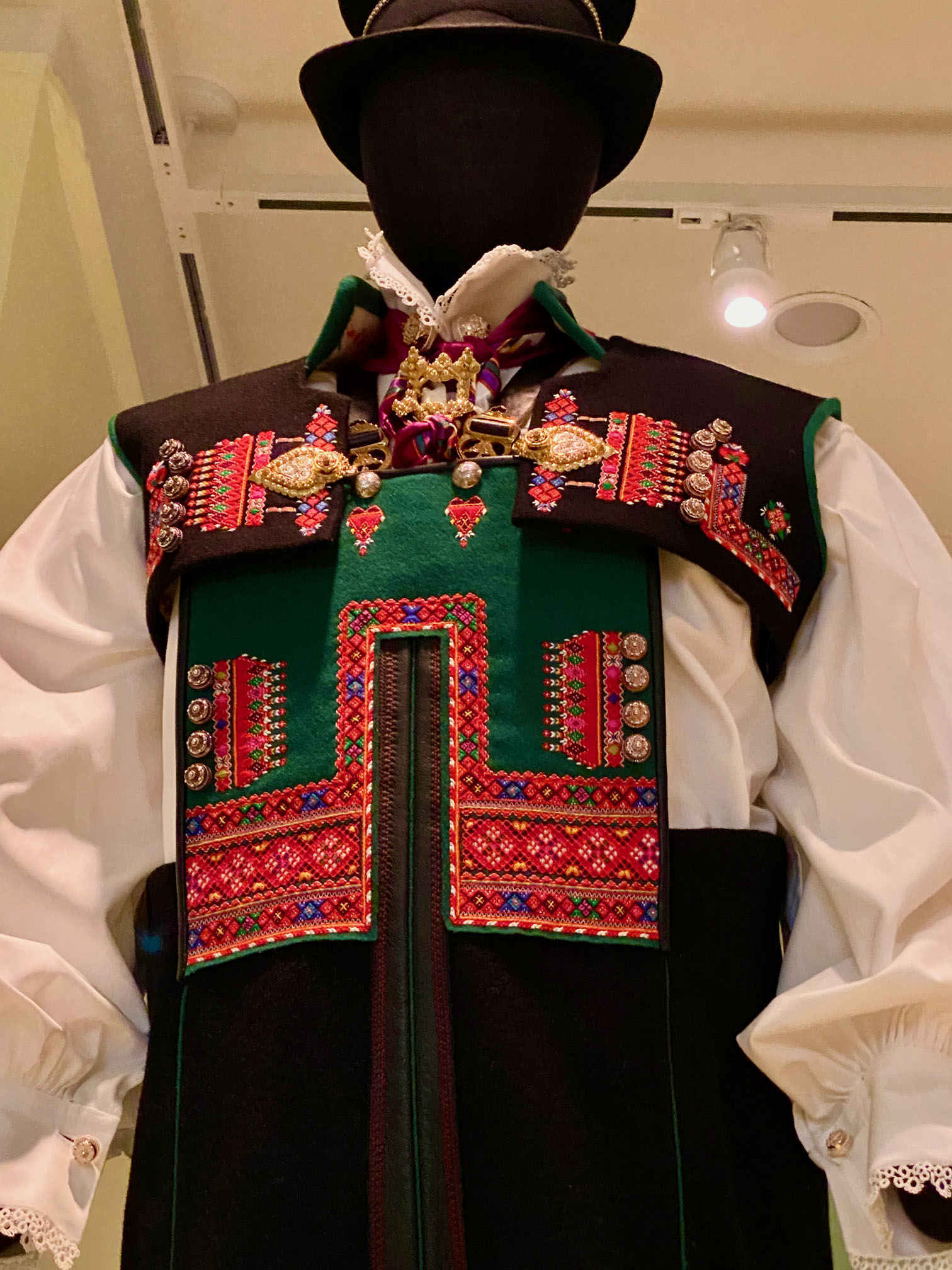
Man’s 2018 bunad by Inger Homme and other artists in Valle in Norway’s Setesdal district; silver, gold, brass jewelry by Hasla AS.
In the Sápmi portion of the exhibition, the clothing and art is mostly contemporary, with a focus on making declarative statement about indigenous rights.
Long an oppressed minority, the Sámi people have been subject to racial injustice, forced relocation of children to boarding schools, and industrialization of their traditional lands north of the Arctic Circle. In many jurisdictions, they were forbidden to wear their traditional garb.
Symbol of Sámi pride: Jenni Laiti’s 2017 gákti creation from Karasjok – in Finnmark, the Norwegian side of Sápmi. Courtesy: the artist.
Around 1970, the Sámi were able to organize and raise public awareness about their status and why they opposed government dam building in Sápmi. Across their land, people began proudly wearing the traditional gákti and other symbols of their culture and engaging in direct political action on issues affecting them.
1966 summer gákti for a Sámi couple – wool tunics embellished with rose-colored ribbons and rickrack; made in Guovdageaidnu in Finnmark (Norwegian side of Sápmi)
Contemporary Sámi design: 2017 ready-to-wear cotton and poly “party outfit” by Stoorstålka (clothing line by Lotta W. Stoor and Per Niila Stålka) of Norrbotten (Swedish side of Sápmi).
The exhibition has posters and artwork proudly proclaiming native rights and identity, including an appropriated Sámi-style Rosie the Riverter image. For the contemporary eye, some of the most exciting clothing in the exhibition are by young Sámi designers and activists – ranging from Sámi-inspired home goods, modern woven designs, and even ready-to-wear party dresses from Sámi clothing lines.
The examples from Sámi makers demonstrate how design and fashion can help to reconnect young people with their ancestors’ heritage that society blotted out.
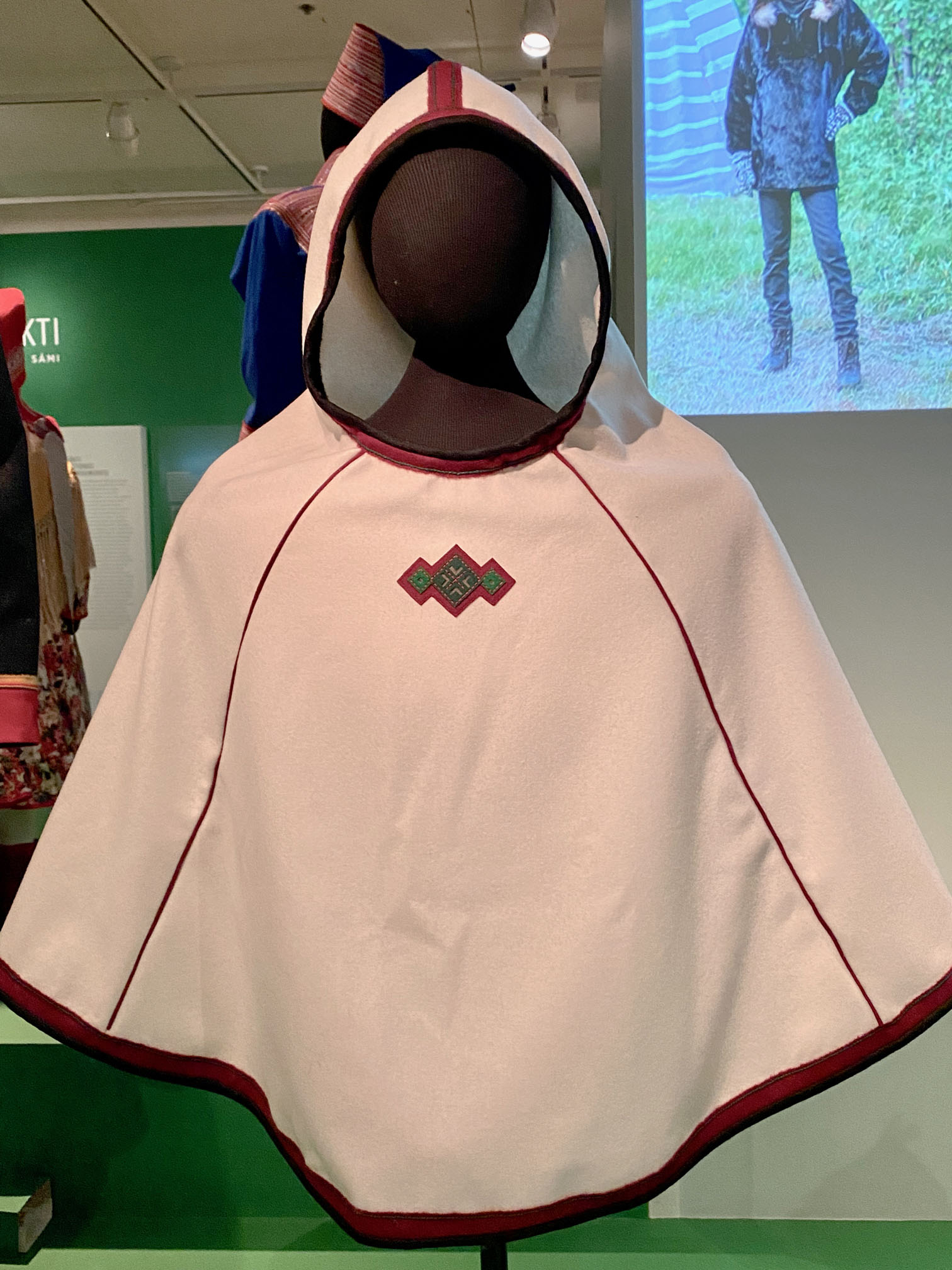
Jorunn Lokvold’s 2020 Igvu gákti with geometric applique, a style reconstructed in 1995.
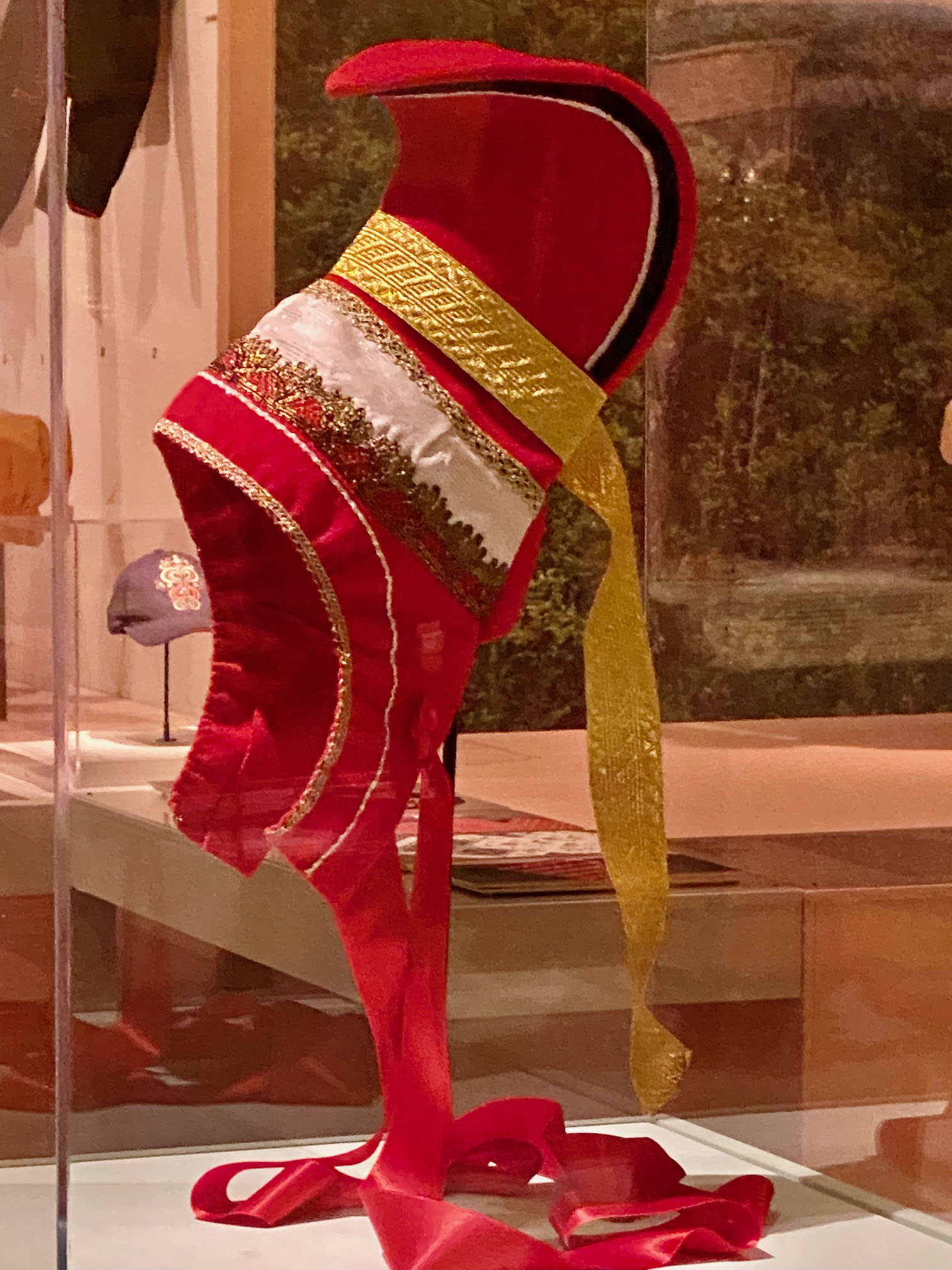
Outi Pieski’s 2020 Ladjogahpir, a revival of a headdress symbolic of Sámi women’s resistance; from Utsjoki (Finnish side of Sápmi).
This wonderful exhibition demonstrates exactly how old traditions can be reinvented to gain traction, even in the 21st century. Take a look through our Flickr album.
Resistance and revival continue in the far North. Meet Jenni Laiti, one of the Sámi artists, activists, and change-makers, who introduces you to art-making in the Arctic:

































 itsnewstoyou