When the Avant-Garde Took over Corporate Branding

Entrance to the show at Bard Graduate Gallery

With the world turned upside down by World War I, artists in the European avant-garde eagerly embraced new ways of looking, thinking, and creating.

Museum-goers are familiar with the innovative edge that Constructivism and Bauhaus thinking brought to painting and architecture, but few realize it extended so directly into corporate identity and industrial sales in those post-war years.

Bard Graduate Center tells this previously untold story through a young man’s collection who was at the center of it all in its exhibition, Jan Tschichold and the New Typography: Graphic Design Between the World Wars, on display through July 7.

Cover of 1923 Bauhaus exhibition catalog by Herbert Bayer. Courtesy: MoMA.

Recent grad Jan Tschichold, a talented young typeface designer calligrapher steeped in the art of fifteenth-century letterforms, took a quick trip to the Bauhaus in 1923 and was blown away by what he saw coming out of the print shop and the minds of artists at the interdisciplinary hothouse.

Being a works-on-paper kind of guy, Jan was entranced by the book designs and letterheads – modern san serif letters, asymmetrical page layouts, and letters used as design elements on the page. In particular, he saw an essay by Moholy-Nagy that coined the term “new typography”.

El Lissitzky’s 1920 children’s book About Two Squares, which teaches post-revolutionary ideals through interactions of abstract shapes. Courtesy: MoMA.

These rule-based design principles clearly appealed to him, and Jan soon began corresponding, organizing, sharing, and exhibiting with an energetic network of innovators like Schwitters, Moholy-Nagy, and El Lissitzky. Starting in 1925, Jan was the most vocal proponent of this “new typography.”

“Graphic design” was starting to become a “thing” and Jan found himself in the center of it. Jan began collecting anything with asymmetrical layouts, eye-catching photo-montages, and letters running wild — postcards, catalogues, book designs, business cards, brochures, promotional catalogs, and posters.

By 1928, Jan had seen and designed so much ground-breaking work that he decided to write a book that would summarize how any graphic-arts practitioner could blow up past conventions of graphic design, letters, and photography and repurpose them for industries and pop culture.

Title page of Jan Tschichold’s 1928 book, “The New Typgraphy,” which had essays by Moholy-Nagy, Dexel, and others.

Jan’s book, Typographische Gestaltung, went viral among the 80,000 members of the German print workers union, showing everyone how to juice up advertising layouts, movie posters, and industrial brochure designs in a more modern way.

German industries were just beginning to make a comeback after the war. Brochures about pumps, valves, and machinery all had a modern twist that created an identity for corporations to make a comeback. Inexpensive designs on paper — what a way to make a statement! What a way to glamorize and sell ergonomic chairs, new motorcycle engines, lathes, and metal parts!
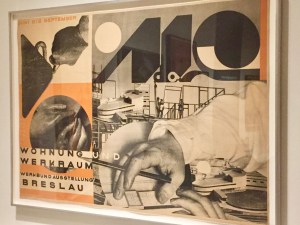
“Dwelling and Workplace” poster – an event identity campaign by Johannes Molzhan for the 1929 exhibition by Deutscher Werkbund, the German design association. Courtesy: MoMA

Curator Paul Stirton’s show shines a spotlight on this early move toward modern corporate branding, identity, industrial brochures, and the day-to-day business of simply selling things. Just like today, even avant-garde designers had to make a living!

One of our favorites is Dadaist-in-chief Kurt Schwitters’ marketing brochure to explain his design agency’s services for corporate logos, brochures, and and other types of design.

Eventually, Hungarian and Czech designers started adopting what Jan was advocating. His influence largely bypassed the United States and the English-speaking world (except by osmosis), since it took decades for his book to be translated into English.
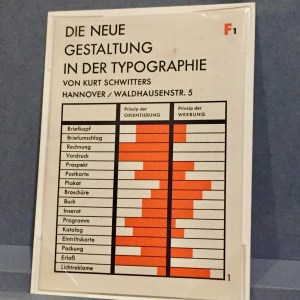
1930 marketing brochure by Kurt Schwitters to potential corporate clients. Courtesy: MoMA

Perhaps one of the most intriguing features of this show is that nearly everything on display is from Jan’s own collection, which is labeled as in the Museum of Modern Art’s collection. But ironically, much of the corporate marketing stuff on display here (and seen for the first time!) almost didn’t survive.

Jan amassed acres of his colleagues’ work in the Twenties, but had to leave the majority of his collection behind when he fled Germany in the run-up to World War II and ultimately landed in the United States.

Strapped for cash, Jan happily sold his poster collection to MoMA in the 1930s, but in the 1950s, MoMA said no to the rest of Jan’s remaining collection. Who needed that much work on paper from the Twenties when you were collecting wall-sized post-war American abstraction?

Jan Tschichold’s 1927 movie poster “The Woman Without a Name,” for Berlin’s Pheobus-Palast.

When Philip Johnson heard that MoMA refused to take Jan’s letters, catalogs, books, postcards, and other ephemera from Europe’s greats, he tracked down the California bookseller who acquired it, paid $350 for 800 pieces, and donated it to MoMA.

So, although MoMA’s closed for the summer, you can still see a capsule collection by a 20th century innovator that’s never been displayed as a whole before.

Take a look at our favorites on Flickr and watch the curator’s talk here.

MoMA Signs Off with Brancusi

Brancusi’s 1930s marble Fish

MoMA is taking a four-month break while it reinstalls its collection in its expanded 53rd Street home. For nearly a year before it closed its doors, MoMA provided a beautiful gathering space devoted to a much-loved modern master in a beautiful show Constantin Brancusi Sculpture.

Always packed with admirers, you could frequently hear visitors that turned the corner and entered the gallery exclaim, “Wow!”

There they all were – Brancusi’s marble The Fish sculpture that seemed to be swimming, the soaring Bird in Space, and the primal tall oak Endless Column.

1910 marble Maiastra, a mythical Romanian bird with a pedestal created from another sculpture

Everything was drawn from MoMA’s expansive collection. Every viewpoint joyfully represented what contemporary audiences love about Brancusi’s work. View it in our Flickr album.

Hard to believe that the epic Maiastra was created in 1910 or that this innovator grew up as a woodworker in the rural Romanian countryside and walked across the continent to relocate to Paris to be where the early modernist practice and philosophy were percolating.

For a fun look at how it all began for Mr. Brancusi, watch the film that MoMA created using footage shot by his buddy, Man Ray here and also listen to a jazzy playlist of Brancusi’s favorite songs and atonal orchestral hits of the day.

Brancusi’s work is the epitome of Modern to the contemporary eye, but it wasn’t always that way. One of the most beloved pieces in the room was initially considered a blasphemy to art when it was first exhibited in the 1913 Armory Show in New York.

Listen to MoMA tell the story:

MoMA on 53rd Street reopens on October 21. MoMA PS1 in Long Island City remains open.

Fashionable Fabric Takes Center Stage at FIT

Wool: Mila Schön’s 1968 double-faced wool coat and 1985 Azzedine Alaïa trench

The Fabric in Fashion exhibition at the Museum at FIT through May 11 makes a good point – people today do not pay much attention to the fabric in their clothing, but that’s a break with the consumer culture of the last several centuries.

Fabric telegraphed what status you had, what season it was, and how much money you might have spent on a fabulous outfit. In a clever twist, the show opens with a muslin dress in a period shape lit with all types of cross-cultural patterns and images, evoking fancy French, African, and American textiles.

FIT shines a light how traditional fabric and synthetic creations have been used in high fashion since the 18th century, starting with the stories of wool, silk, and cotton.

Take a walk through the show in our Flickr album and on FIT’s own website.

Silk sheath evening gowns – 1950 crepe by Guy Laroche and 1999 silk faille by Oscar de la Renta

Dresses from the FIT archives demonstrate the extreme flexibility of wool, which has been spun and woven since ancient times. Some wool fabrics are as light as silk, while others are molded, shaped, and bonded to create architectural forms that were as right for 19th-century women’s sportswear as they were for Carnaby Street.

The silk ensembles selected from the FIT archives show off a wide range of that fabric’s ability to drape, shape, and burst into dramatic architectural forms when buttressed by the right underlining and interfacing.  The show features silky satiny wedding attire, embellished damask gowns, stamped and gilded silk velvet Fortuny masterpieces, and sculpted Schiaparellis – demonstrating how a silk’s weight is key to its potential use.

High-fashion knit: Alexander Wang’s 2015 mesh dress inspired by Nike’s Flyknit

Side-by-side Claire McCardell dresses show how a single cut (in this case, her ubiquitous “popover” design) can be casually chic in cotton or elegant in silk.  Jersey dresses and synthetics – rayon and even Nike’s Flyknight by Wang – are featured, telling the story of how knits and synthetic went mass market by the 1970s.

Couture fabrics and innovative weaves, however, steal the show. An elaborate 1859 silk dress showcases how a single width of ottoman fabric morphs into velvet and fringe. It may not be to the taste of a contemporary eye, but is a true masterpiece of fabrication.

You are able to take a close-up look of how a strip of artfully printed metallic satin enhances a silk velvet Fortuny from the Thirties.

Couture textile: Bob Bugnand’s 1958 silk faille dress

Then turn to examine the high art of fabric from French fashion houses of the Fifties — Bob Bugnand’s matching silk faille dress and mink-trimmed coat and Jacques Griffe’s evening vision in Lurex jacquard.

But all the high-end fabric isn’t flashy. A standout is the austere, minimal evening cape, created from gazar silk developed by the Swiss textile house of Abraham specifically for Balenciaga – a key ingredient to the stunning architectural shapes for which the house was known in the Sixties.

Watch here to observe FIT’s behind-the-scenes work to make all the fabric exhibition magic happen:

Enjoy a glimpse of the multimedia that opens the show!

50 Shades of Pink at FIT

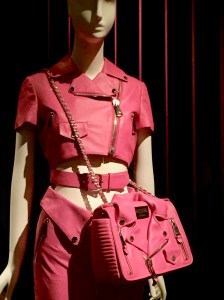
Jeremy Scott’s 2015 crazy-fun leather and zipper ensemble for Moschino, featured on posters for the show.

Everyone has an opinion about the color, and that’s brought to bear on the fun, irreverent, and insightful show at the Museum at FIT, Pink: The History of a Punk, Pretty, and Powerful Color, on view through January 5.

FIT’s downstairs gallery shows a retrospective of pink in fashion in the first room, anchored by Gwyneth Paltrow’s pale pink Ralph Lauren slip-gown that everyone remembers from the 1999 Oscars.

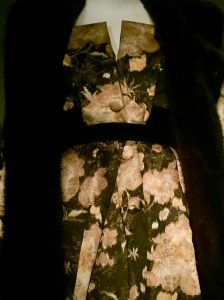
A stroll around the room is chronological, beginning with a fancy and frilly girly-girl two-piece ensemble from the 1850s, through ice-pink Chanel from the flapper period to pale pink plasticized space-age Courréges coats to the hot-pink satin features on Eighties society-ball statements by Adolfo and others.

Courréges logo and exquisite details on 1972 coat.

There’s even a full pink immersion installation of My Little Pony, Hello Kitty, and Barbie to make the point that for much of the 20th century in the West, pink has been associated with little-girl things.

Through the doors to the main gallery, curator Valerie Steele shows us the facets of how pink functions in a global society, as a transgressive color, as a wry joke, and even a power statement when applied to menswear.

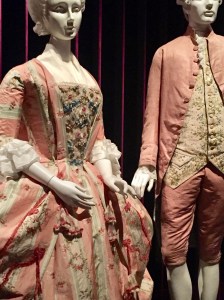
One of the most interesting facts about pink is hidden in tiny label copy inside the first historical tableaux – a gorgeous 1775 silk brocade robe á la française on loan from the Los Angeles County Museum of Art and man’s suit from the same Pompadour Pink period.

Men and women in pink, 1775 style.

The word “pink” only entered the English language in the eighteenth century – the same time that the word “rose” was coined in French.

So, yes, despite the color’s appearance in the natural world prior to the burst of fashionable plant cultivation in the 18th century, it really took off as a response to horticulture that was reflected in fashions for both ladies and men.

From there, the exhibit explores how pink came to be associated with gender-specific kids’ clothes in the early days of Western consumer culture and how it was adapted as a “like life” color in lingerie and lingerie-inspired outerwear.

There are iconic pinkish women-as-flower dresses by Charles James from the Thirties and Fifties, and examples of Schiaparelli’s “shocking pink” reimagined by the house that bears her name today.

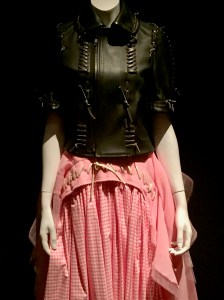
Rei Kawakubo’s 2005 biker-ballerina leather and pink gingham ensemble for Comme des Garçons.

It’s a great contemporary touch to see how punks and Rei Kawakubo subverted pink, and how Janelle Monae, Rihanna, and rappers have used it for their own pop-shock purposes.

See details of our favorites in our Flickr album. For fun, we’ve arranged the photos in chronological order and zoomed in on the embroideries, draping, embellishment, and masterful stitchery.

As usual, FIT has done an outstanding job on the digital side of the exhibition. Take a look at the exhibition website and FIT Flickr site, showing full-length photos of the ensembles. Listen to the audio tour of the show.

Enjoy curator Valerie Steele’s tour of the show here:


City Dreams by Bodys Isek Kingelez

Visionary Dorothea model created from cut paper and found objects in 2007 welcomes visitors to the show.

You can see what dreams are made of on MoMA’s upper floor when you walk into a world created by a self-taught artist from Zaire who saw all the possibilities of a new nation as his country transitioned from Belgian colonization.

Closeup of 1996 Ville Fantôme, a large utopian cityscape of cut paper, packaging, collage, and paint.

Bodys Isek Kingelez: City Dreams is a retrospective of visionary cities, skyscrapers, public buildings, stadiums, and monuments created from paper, cardboard, packaging, paint, ink, bottle caps, and other stuff over his lifetime. Experience the sheer genius of it all – and a virtual-reality tour – through January 1.

Three of his eight fully realized city models are featured at MoMA – examples of work that was eventually shown in (and collected by) art museums throughout the world.

Kingelez (1948-2015), who came from a small colonial village in the Congo, was taught by missionaries early on and went on to teach secondary school. But when political change came to the Belgian Congo in the Sixties, Kingelez became determined to contribute his vision to what his country could become.  And he used the materials at hand to create models of buildings that symbolized harmony, peace, and understanding.

After his work was shown in Paris, the international art world came calling, and Kingelez had the opportunity to work full time as an artists, creating ever more elaborate cities and models. Although he never traveled out of Zaire until 1989, Kingelez always imbued an international vision to his creations.

Detail of 1992 Reveillion Federal, a temple to democracy.

The models are precise, clean-cut visions of the future.  MoMA has created a VR-headset experience where you can walk through one of the cities, fly to the top of skyscrapers, and cross bridges to the future.  It’s a great way to enter 2019.

Take a look at our Flickr album of some of the work in this amazing show.

Enjoy this video of the artist himself showing how nature and lofty ideas can be put to work in architecture, engineering, and design:


For more on Kingelez and his life, click here. For a soundtrack, MoMA’s assembled a great one from Zaire here.


Catholic Inspiration for Fashion at the Met

Balenciaga’s 1967 silk wedding dress in the Romanesque Chapel at the Met Cloisters

The brilliant installation of haute couture in the historic halls of the Met Cloisters, Heavenly Bodies: Fashion and the Catholic Imagination, closing October 8, also serves as a surprising showcase for the spectacular medieval art residing in the same space.

Curator Andrew Bolton’s thoughtful placement and narrative creates a genuine conversation between European couture and religious-themed works made over 500 years ago at both the Cloisters and the Met’s Fifth Avenue location.

The Cloisters show starts spectacularly with Balenciaga’s 1967 wedding dress dramatically casting shadows across the floor of the largest room at the Cloisters, the Romanesque chapel with its outsized arch and crucifix.

Closeup of Jean Paul Gaultier’s 2007 evening ensemble printed with 15th c. image of the Virgin by Jean Fouquet.

The jeweled pieces of German stained glass are echoed by Gaultier gowns, and Craig Green’s avant-garde ensembles created from Islamic prayer rugs are at home amidst the 13th century tapestries in the Hall of Heroes. Looking at each contemporary expression fully reflects the magnificent artwork resting just a few feet away.

Hidden spaces, leafy cloisters, underground tombs, light-filled corridors, and dark, secret corners of the Treasury all provide surprises and context for exploring visitors – Valentino’s Garden of Eden dress, Galliano’s Machiavelli gown for Dior, Dolce & Gabbana’s gold silk-and-metal macramé wedding ensemble, and McQueen’s crown-of-thorns headpiece.  Seek and you will find.

Sleeve detail of monastic paper taffeta 1969 evening dress by Madame Grés.

Take a look at our Flickr album to see many close-up the details of all the clothes and surrounding artwork.

The Met has gone all out to make the connections between clothes and the Catholic themes explicit, providing innovative high-res photos, several brief videos and blog posts. Read more about the themes here.

Andrew Bolton, the show’s curator, gives an overview of all the inspiration and documentation of the exquisite clothing, jewelry, and inspirational art work in the show in this video here.
Closeup of Olivier Theyskens’ 1999 evening dress with a hook-and-eye closure in the shape of the cross. From the Crusades section of the show in the Gothic Chapel.

Click here to walk through every room of the Cloisters with Andrew Bolton and hear him explain how he made the selections according to the surrounding artworks.

The Fifth Avenue portion of the show is, like so much of Catholic pageantry, more of a public event, filling the Medieval hall with fashions inspired by angels, secular clergy, nuns, Mary, and saints, all dominated by an Ecclesiastical Fashion Show.

The Fifth Avenue portion of the show is, like so much of Catholic pageantry, more of a public event, filling the Medieval hall with fashions inspired by angels, secular clergy, nuns, Mary, and saints, all dominated by an Ecclesiastical Fashion Show.

Highlights include a procession of works from Gianni Versace’s last collection, Gaultier’s hologram votive dress, Mugler’s floating angel, and the loft high above it all, populated by ethereal figures wearing choir robes by Balenciaga.

1984 dress by Thierry Mugler from his Winter of Angels collection, part of the Celestial Hierarchy at Fifth Avenue

Here’s a link to the Met’s walkthrough video.

An important part of the Met’s undertaking is a spectacular mini-exhibition of incredible works of clothing art from the Vatican, which took significant negotiation. Here, Andrew shows highlights of the items on loan from the Vatican, some of which have never been displayed abroad before.
Walk through the Met’s Vatican section of the show here.

Weitzman’s Historic Shoes at NYHS

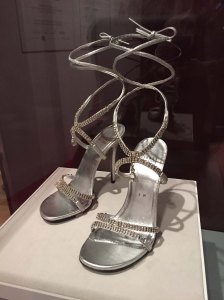
Crystal reproduction of Weitzman’s 2012 “Million Dollar Sandals”

It’s a clever journey through one man’s shoe collection. Walk This Way: Footwear from the Stuart Weitzman Collection of Historic Shoes, on display through October 8, zigs and zags through the fourth-floor gallery of the New-York Historical Society, presenting new insights to shoes and the history of American women in the workplace (and dance floor) through three centuries.

The emphasis is on history with a dash of celebrity and tons of glitter and glamor. See what we’re talking about in our Flickr album here.

The introduction, dedicated to collecting, provides glimpses into how and why shoe collections begin in the first place – wedding memories, baby mementos, and even Revolutionary archeology (go, shoe buckles!). Whether it’s everyday people or museums, it seems that there’s always a reason to collect shoes.

Ragtime era 1912-1914 beaded cross-strapped shoes

The presentation section of the show describes how footwear can be transformative – taking a dowdy career girl into an elegant, champagne-sipping flapper.  Or, more recently on Broadway, taking Cinderella to the ball or Billy Porter (aka Lola) to the town saved by Kinky Boots.

The shoes here show the progression of fashion and pop culture of trends and dance crazes that required show-off shoes.  First, it was “artistic” women who needed embroidered footwear to peep out under those Fortuny gowns. Then, it was ragtime music and high-buttoned shoes.

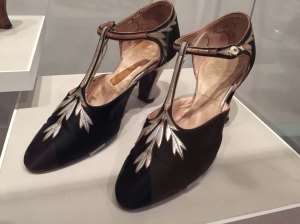
Eventually it was all about those small-heeled, strappy statement makers for the Charleston and Tango in the Jazz Age. Women were moving so fast, that they needed to make sure the shoes stayed on their feet.

1930 silk and satin Frank Bros. T-strap shoes

Next, the show tells the history of shopping in New York entirely through shoes – the evolution of Ladies’ Mile in the 1860s, the department-store-as-entertainment trend of the 1890s on Sixth Avenue, and window shopping.

It chronicles the rise of collection shoes sold exclusively at Saks (before the shoe department there had its own zip code) in the Forties and the rise of the designer label.

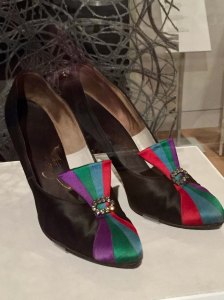
Delman 1948 leather and rhinestone evening sandals

Fads, styles, and designs like spectator pumps, platforms, high-buttoned shoes, Mary Janes, T-straps, and slingbacks are all there to tell their stories – the women who wore them and the men and women who created them. There’s even a nod to the provocative gold and silver sandal craze inspired by Hollywood sirens starring in Biblical epics and toga dramas of the 1930s and 1940s.

Back toward the end of the gallery, NYHS pulls out the history book and takes you on a brief journey to a time when the United States was the center of the global shoe industry.  They make it clear that working in the industry, beginning in the 1850s, was a way for women to step into the greater economy.

1954-55 embroidered Ferragamo “Madonna” sandals with Tuscan needlepoint lace. Originally made for Sophia Loren

By 1900, the United States was largest shoe producer in the world, and women were one-third the shoe industry labor force and 20 percent of the total American workforce. By 1910 in the era of Ragtime, eastern Massachusetts and New York City were shoe manufacturing capitals of the world.

The show puts a spotlight on Beth Levine and the other female designers who began their own labels and the current generation of concept shoe designers emerging from New York City schools (part of a program launched by Weitzman).

Fashionistas have been flocking to this show since April. Be sure to see it before this weekend so you can begin to look at your own shoe collection through an entirely new lens.

1950s silk and rhinestone pumps by Mabel Julianelli

More photos of Stuart’s remarkable, historical collection here.

How Ancient Tablets and Scrolls Became Books via Socks

Show curator, Georgios Boudalis, and map of how new book technology spread in the ancient world

How did people make the transition from reading and writing on scrolls to creating bound books? And what did it have to do with making socks and sewing?

You’ll take the journey across several centuries in The Codex and Craft in Late Antiquity, an exhibition on early bound book forms on display at the Bard Graduate Center Gallery through July 8.

Curator Georgios Boudalis of Thessaloniki’s Museum of Byzantine Culture explains how papyrus (or parchment) packages were joined together and modified over time by sewing, thread-looping, cutting, gilding, and fancy leather embellishments.

“Poetess of Pompeii” with her tablet, 50-70 A.D. Fresco photo: National Archeological Museum, Naples, Italy

Modern readers constantly debate the pros and cons of reading on tablets versus bound books, so it’s relevant that the exhibition’s story begins with fourth-century tablets.

Ancient tablets are about the same size as iPad minis, evidence that young people were using portable re-writable (i.e. wax) media long before the modern era. Just look at the portrait of the “Poetess of Pompeii.”

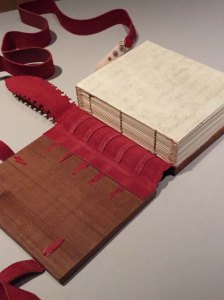
Boudalis makes the case that the technological transition to the “big book” idea began when craftsmen started to modify wax tablet frames (i.e. holes and grooves) so they could stitch and loop several together in a stack. After that, the stacks began to sport wooden covers.

The show includes some rare, early ninth-century manuscripts, when this type of book production was mainly commissioned by monastic religious orders.

Tooled and cut leather on 9th c. Gospel uses similar techniques as footwear. Collection: Morgan Library

In 1911 on his annual pilgrimage to Egypt, J.P. Morgan seized the opportunity to buy several old bound manuscripts discovered in a dry well in the Fayum oasis. The bound pages, most likely a Coptic monastery’s entire library, were hidden a thousand years earlier by monks to save their literature and gospels from destruction by invading armies.

The Morgan Library generously allowed Boudalis to examine the fragile bindings on this ninth-century treasure and lent it to Bard for the exhibition.

Along with ancient, fragile works from The Metropolitan Museum of Art, Brooklyn Museum, American Museum of Natural History, Yale, and other American collections, the exhibition’s digital animations and modern replicas vividly demonstrate how craftsmen bound books, embellished covers, and protected sacred writings.

Modern sample of cross-knit looping technique for ancient socks

Complex looped-thread techniques were used to join sections of these early books – technology application used by many ancient cultures. As evidence, the exhibition features ancient woven leather belts and creative looped-knit socks next to woven book straps and looped-thread bindings of the manuscripts.

Complicated textile patterns and interlocking designs on textile fragments are shown next to similar gilded and tooled leather book covers.

Modern facsimile of the Morgan’s 5th century Glazier Codex. By Ursula Mitra

Gilded and tooled leather shoes were likely made by the same craftsmen who cut, tooled, and gilded leather book covers. Take a look at more on our Flickr album.

As ancient people sought more convenient and artistic packages of their intellectual property, they turned to skilled craftsmen to create it.

Listen to the Boudalis speak about the art of sewing and craft in the birth of books and see his examples of Peruvian feathered blankets, Parcas textiles, and fish nets from Camaroon – which all use simple, one-thread loop techniques to create astonishing things:

Native Inventions in Spotlight as imagiNATIONS Center Debuts in New York

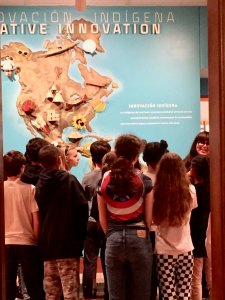
Sixth graders listen to explanation of Native American innovation map

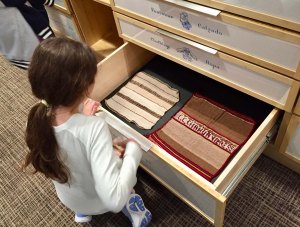
The sixth-graders were having the time of their lives cramming into the rocking kayak, finding secret treasures from far-away cultures in the drawers, and comparing sturdy lacrosse sticks made from natural materials.

It was all part of the joyous opening day of the new imagiNATIONS Activity Center, on the ground floor of the Smthsonian’s National Museum of the American Indian, right off Bowling Green in downtown Manhattan.

NMAI officials blessed the proceedings with percussion and chant, but the genuine thrill was seeing the kids pour into the new center to listen to and experience a new take on science, math, and engineering.

Tip of a contemporary surfboard – originally invented by Hawaiians.

When you walk inside, a wonderful wall summarizes the story – a map of North and South America populated with technical inventions by Native Americans over the last several thousand years! It’s a brilliant summary of the fresh ideas that you’ll encounter around the corner.

Although this sparkling, new, inspirational ImagiNATIONS Activity Center was conceived for children, rest assured that any adult museum lover will be blown away by discovering the technical innovation story too.

Although the first settlements in Manhattan and Broadway itself were created by native populations, city dwellers often get so overwhelmed by towering skyscrapers that they don’t immediately connect native cultures with what exists downtown.

Yup’ik kayak frame created by Bill Wilkinson of Kwigillingok, Alaska from spruce, cedar, driftwood, and walrus bone

OK, maybe no one is reading the news on steles in Mayan hieroglyphics anymore, but the much of the work displayed here is made by living, breathing native artists. The next time you’re stuck on a subway because of a signal malfunction, consider the fact that in the Andes, the community assembles each year to repair their chasm-crossing fiber foot bridges. Now, that’s a commuter maintenance plan!

Or consider that Arctic kayaks are custom designed to suit each individual’s weight and shape.  Or that cool surfer dudes in Hawaii are simply carrying on a wave-riding tradition that extends back thousands of years.

Cold weather waterproof kayak-hunting system

Every step makes you stop and think.  How is it that the Mayans were one of three cultures to invent concept of zero in mathematics? What brilliant minds perfected making waterproof parkas from carcass leftovers or salmon skin?  Or the engineering it takes to design watercraft that doesn’t tip?

Sixth graders learn how igloos are engineered.

The mannequin in the corner displays recently crafted components of “system dressing” for hunting from kayaks in freezing waters.  The parka has waterproof stitching and attaches to the kayak opening.  The visor includes walrus whiskers that aren’t just decoration – they transmit subtle, silent vibrations to the visor that tell expert hunters that their prey has shifted course.

Everything you experience in the center was designed to help teachers inject something new to supplement schools’ math and science curriculums. But the fun factor for learners of all ages is truly off the charts.

You’ll experience how all the significant contributions made by native people in food, architecture, sports clothing, agriculture, and engineering really add up in day-to-day modern life. You’ll want to get into the kayak and open all the drawers yourself.

Port Authority executive Janice Stein and colleague who loaned steel cables from the Bayonne Bridge

From attending the opening, we were able to meet the people from the Port Authority of New York and New Jersey, who donated a piece of repair cable from the recently upgraded Bayonne Bridge for the engineering display. Perfect for seeing and touching to see how Andean fiber cables compare to urban steel.

We also heard the story of how the kayak overhead made a 4,000 journey on a sea plane, a ship, and a truck from the workshop of Bill Wilkinson in Kwigillingok, Alaska to Anchorage to Seattle and to New York City.

Take a look at our Flickr album and make a trip to the Battery as soon as you can. The center, like the NMAI, is free, fully staffed, and open seven days a week.

Exploring drawers of textile samples.

Take your own kids, your neighbor’s kids, or your inner child and get your hands on that igloo downtown and think about what you owe the people living south of the border for the invention of chocolate.

When Jewelry Has Its Own Idea

Organic geometry: Kazumi Nagano’s brooch of folded linen paper and other materials.

Can jewelry actually speak? The Cooper Hewitt curators thought so when they went through the expansive collection that a donor had assembled, as shown in Jewelry of Ideas: Gifts from the Susan Grant Lewin Collection, on view in New York through May 28.

Lewin, who donated her collection to the Smithsonian, was passionate about collecting fairly conceptual wearable art pieces – works that reflected pop culture, or held great symbolic meaning, or told a story that was significant to the artist.

Around 150 bracelets, pendants, necklaces, and rings are on display in the show. They’re all intriguing works on their own, each telling a story, but the selections are nicely classified into sub-groups, such as Nature, Symbol and Metaphor, Memory, and so on.

Nature: Daniel Kruger’s necklace with pressed flowers and leaves.

Some groups tell the art-for-art’s sake story; other groups are made of materials with charged significance. But all reflect the deep thought that jewelry artists give to their work and the delight the wearer has in either sharing the story of the piece or just keeping its secret to themselves.

The show emphasizes how ground-breaking artists have conceptualized jewelry to go beyond the constraints of simply pretty, glitzy, or decorative ends.

For example, the paper necklaces by Kiff Siemmons speak to the artist’s interest in pulling dramatic shapes out of lowly materials and in cross-cultural collaboration – in this case, working with artisans from Oaxaca’s Arte Papel who are expertly reviving pre-Columbian paper making technology with traditional, plant-based dyes.

Attai Chen’s paper, paint and coal necklace from Nature section of the show

In the portion of the show where jewelry reflects society and the human condition, designer Deganit Stern Schocken used crushed soda cans and zircons in a piece named after Israel’s largest checkpoint, evoking the daily West Bank anxieties of passing between Jerusalem and Ramallah.

The fact that Estonian artist Kadri Malik incorporated a large shark tooth in her “It’s Getting So Dark” necklace gives the piece a voice that speaks volumes, even if the wearer doesn’t say a word. The same is true for Attai Chen’s dark riff on nature — dramatic necklace formed from paper, paint and coal.

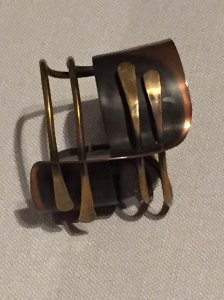
Art Smith’s 1948 Modernette Cuff Bracelet reflecting the art world’s interest in biomorphic forms

The show also touches on the history of post-war wearable art by innovators in America and Europe, including a biomorphic piece by Sixties jewelry maker Art Smith, who was connecting the dots among the cultural influences he was seeing in painting and dance studios from his Village studio.

What about other art for art’s sake? The curators showcase collection pieces that are colorfully painted, baubles incorporating found objects, and art that simply conveys the joy of pure, clean, abstractions.

Lewin certainly had fun collecting and wearing provocative pieces, and the curators also seemed to have enjoyed displaying these fascinating works in a context that suits them.

Take a look at some of our favorites in our Flickr album.

To give an idea of how kinetic artist Friedrich Becker conceptualized his work in motion, here’s a video showing how his ring activates to convey its story when worn:

This show focuses upon an international array of artists. But for anyone that wants to dig deeper into the roots of American studio jewelry 1940 – 1970, art historian Toni Greenbaum  describes how artist-made jewelry came to its cherished place in the art and design worlds today: