Avedon Wide Open

Sorry, but there’s no fashion photography here — just an amazing, controversial, challenging, and mind-bending eyeful at Gagosian’s Richard Avedon show, Murals and Portraits.
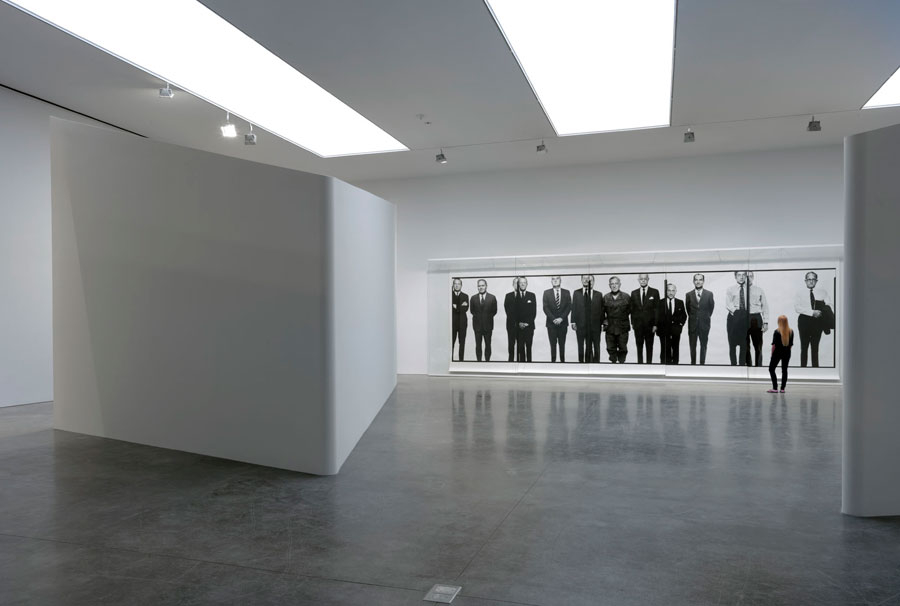
Installation photo of Richard Avedon: Murals and Portraits by Rob McKeever

Four large-scale multi-portraits are brilliantly and reverently installed in the 21st Street space, which has been transformed by architect David Adjaye with all-white X-shaped walls that only heighten the drama of the experience.

Four pathways draw you toward meeting groups that you might not otherwise encounter –1969 portraits of the Chicago Seven and Andy Warhol’s Factory crew, a 1970 portrait of Alan Ginsberg’s extended family, and a 1975 portrait of the government’s Mission Council running the Vietnam War from Saigon. Download the PDF to match the names to the players.

Peeking into the corners of the white spaces, there are dozens of other portraits from the 1960s and 1970s – all related to the four main photomurals and guaranteed to push some buttons. It’s an education in how a fashion master applies his talents to social consciousness, tearing down boundaries, and sly provocation that is not to be missed.
Shakespeare at the River

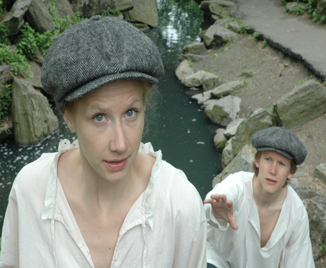
Don’t miss Twelfth Night, the latest production offered by the New York Classical Theater at the second half of the River to River Festival.

Set against the backdrop of Castle Clinton, the players enact a Shakespeare comedy as if the cases of mistaken identity were unfolding in turn-of-the-last-century New York.

Last season, the group led everyone across hill, dale, bay, and the historic buildings of Governor’s Island in Henry V. This year’s show may not involve sea travel, but is set against the backdrop of the Hudson. And it’s a chance to see free Shakespeare without standing in a line for 12 hours.

The show begins at Castle Clinton each night at 7pm. Twelfth Night continues for a few nights (until July 22) after the other official River to River festivities end on the 15th. Two more weeks; go check the calendar.

Virtual Indie Declarations

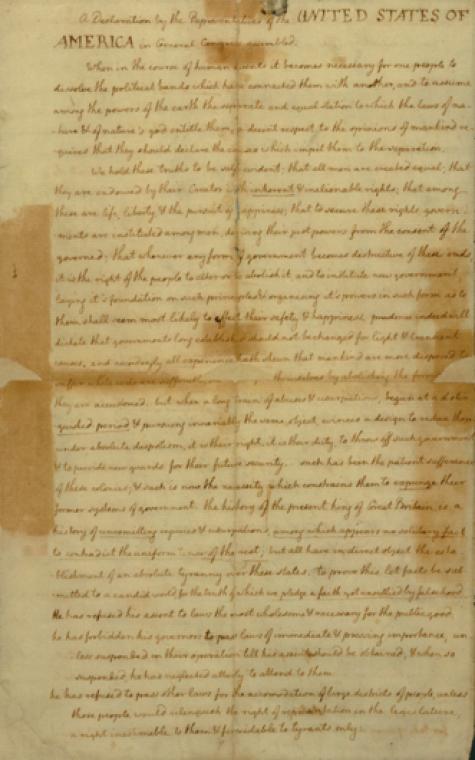
It’s never really the Fourth of July in New York without seeing Tom J’s annotated copy of his Declaration of Independence that’s usually shown this time of year at the New York Public Library.

Because Tom’s two-page handwritten draft was diplayed all year in NYPL’s 100th anniversary exhibition, the Library has decided that “It will be given a rest of a few years…” Even though you’re not able to visit Tom’s Declaration in person, the library’s digital team has made it available on line, along with a number of its other revolutionary treasures. Check out:

Ben Franklin’s June 21, 1776 note to General Washington (written while Tom was toiling away in the Philadelphia’s sweltering summer heat) that “a Declaration of Independence is preparing”.

Tom’s original draft of the Declaration with his paragraph objecting to the slave trade, which Congress forced him to edit out. (Check out this blog posting at NYPL and click on the images for a larger view.)

Tom’s clean draft that became official.

Also check out the first news report on the Declaration in The Pennsylvania Evening Post (dated July 6, 1776), telling everyone that something was up, followed by the classifieds on page 2.

Daring Sea Rescue Yields Treasure

Treasure is what you’ll find in the upstairs galleries of The South Street Seaport Museum in Lower Manhattan, following its daring rescue by The Museum of the City of New York.

Armed with a two-year plan, a dedicated team, and construction crews, MCNY figured out how to transform former storage areas into sixteen beautiful galleries, re-open, and give new life to the museum and iconic tall ships anchored downtown.

In a brilliant use of space, MCNY enables us now to enter three separate time machines that should warm the heart of any NYC booster, particularly the side-by-side installation of two versions of Manhatta (the original name of our island community). The first is the (slightly reduced) reinstallation of the acclaimed Manhatta exhibition (and scientific project), which shows you visions of the island, inhabitants, geology, river systems, and fauna that Henry Hudson would have seen in 1609. (Crowds flocked to this uptown in 2009, so you here’s your second chance.)

The second is the adjacent gallery, where you can sit down and contemplate three stunning simultaneous views of our waterfront — Paul Strand’s famous 1921 documentary of our waterfront (Manhatta), Edison’s early 1900s views of our water’s edge, and a contemporary visual meditation. Time travel doesn’t get any better than this!

The third view, MCNY’s Timescapes film, sweeps more grandly over time and history. Images pop onto three screens as Stanley Tucci narrates the whole, complete story, from forested island to home of the High Line. It’s hard to take it all in, but you’ll be swept away and seriously, it will make you proud.

Although these shows are in open-ended runs, check them out sooner rather than later. Although the Seaport Museum has been thrown a lifeline, it’s only temporary. MCNY only has 18 months to demonstrate that these stories, ships, artifacts, buildings, Bowne & Co. Stationers, and galleries are worth saving.

Be part of the rescue. Shop at Bowne, bring your friends, and step back in time.

Virtual Trip around London

Even if you’re not going to the Olympics, it’s still possible to get around London and environs on the train virtually by stopping into Grand Central to see the last week of the Transit Museum’s Art of the Poster show.

You’ll see original artwork commissioned by the London Underground made into posters seen by the riding public over the last 100 years. You’ll see how the transit network enticed folks to take the train to the country in 1913, encouraged fashionable people to get to the theater in the 1920s, brought people together during the War, and wryly encouraged courtesy in the 1950s.

There’s even a section about the designs that were never used and why.  The best known fine artists in the show are Howard Hodgkin and R.B. Kitaj, but you’ll also get to know original work by many innovators in British graphic design and see the differences between the original and the final printed product.

Walter E. Spradbery, Ascot Sunday (1924), ©TfL from the London Transport Museum

If you can’t get to Grand Central, check out the online exhibition on the London Transport Museum’s site.


Enlightenment Under the BQE

Strolling along The Fence under the BQE

Actually, it’s in the part of Brooklyn Bridge Park that sits next to the tiered speedway, over at under-construction Pier 3, just beyond the cattail ponds flanking Pier 1. Today and next weekend (Thurs-Sun) is an opportunity to peek at the work of some of the best young photographers on the planet, get some insights into the human condition, and eat/drink in the best Brooklyn style for free. Check out the photos.

Photoville’s long fence of photos is the preamble to this free shipping-container-based photo show. Once you get to Pier 3, you’ll step into other worlds through the eyes of high-quality photo documentarians.  Check out the portraits of homeless transgender teens by Josh Lehrer, or see what it’s like to live in a tent in Haiti (Wyatt Gallery) or a basement in Beijing (Magnum’s Sim Chi Yin). Two Nooderlicht containers feature the work of eleven female photographers that have documented live in prisons in South Africa, Burundi, the United States, and elsewhere.

Josh Lehrer’s shipping-container gallery with portraits of homeless transgender teens at Photoville

Different food trucks rotate through Brooklyn Lager’s beer garden every day, but on Saturday we scored with Rickshaw Dumpling (remember them from The Lot last summer?) and the “grilled cheese truck” (@morristruck) that’s always catering to long lines in DUMBO.

There’s no excuse not to stroll over, and bring your dog, too. They’re welcomed in the containers, in the beer garden, and in the fully outfitted dog run.

Seventh-Century Fashionable

If you’re running over to the Met to catch the Prada/Schiaparelli show in the next two weeks (don’t worry, it’s up until August 19), be sure to see the other rarely seen, worth-the-trip clothes – the robes, tunics, and kids’ stuff that’s straight from the Seventh Century.

It’s the textile/clothing room of the show Byzantium and Islam: Age of Transition. It’s not often you get to see clothes from 430-870 A.D., much less see a one-room summary of all the cross-cultural fashion trends.

It’s Byzantine fashion at it’s best, from a time when Greek Orthodox, Coptic, Christian, and Jewish lifestyles were all mixing and mingling across the Empire between the Seventh and Ninth Centuries.  Radio carbon dating of the fibers gave the curators a range of dates on the outfits, but let’s just call it even by saying “Seventh Century”.

In the fashion gallery of the show, you’ll see several tapestry-weave tunics (woven to shape), along with a small Egyptian kid’s fringed-trimmed hoodie (430-620 A.D.), a tunic with polychrome-pattered trim, and a huge, oversized Persian riding coat made of cashmere and wool. In a tapestry panel, you’ll see a veritable Vogue layout of various styles, including someone dressed in skins and boots below this more conservative tunic/mantle combo.  Did they really wear that?  You be the judge.

Amazingly enough, a lot of the coats and tunics come from the Met’s and the Brooklyn Museum’s own collections. Take a look and marvel at what curatorial care has wrought. (And check out the popular Samson silk fabric swatch in the adjacent gallery.)

London Siege Ends

Interruption, displacement, spatial challenge, and scrounged street materials are just a few of the components of the New Museum’s fourth-floor sculpture installation by London artist Phyllida Barlow, which continues only for the remainder of this week.

Installation view of Phyllida Barlow’s “Siege” installation at The New Museum

Part of the post-minimalist generation of London sculptors (Eva Hesse contemporaries), Barlow surprises visitors with a completely monumental, low-tech exploration in what she calls a “very, very awkward” space, particularly for visitors confronted by her work as they step out of the elevator.

Barlow says that the first time she saw her project space, it was “shocking” in its directness, which provided her with an exciting challenge. “Stepping out of the elevator, it’s as though you’ve stepped on stage,” she says, hoping that visitors find a “performative element” to their experience.

 “Once you’re in there, there’s kind of no escape,” she says, calling it a “kind of a hostage space.” No fooling. You get to poke in, around, and about the work that she aptly names Siege.

The New Museum gives us several audio tracks in which Barlow explains her process, but go down to the Bowery to experience Siege first-hand and then listen in on what Barlow has to say. It’s like having your own, private Stonehenge experience inside a white cube.

Romantic Dark Side

Entering the black-draped Wachenheim gallery off the New York Public Library’s main Fifth Avenue entrance is a quick way to travel back in time to view manuscripts, memoirs, and mementos of the 18th and 19th centuries’ most creative literary minds.

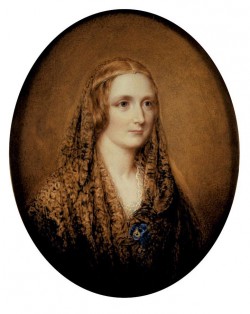
Portrait of Mary Shelley

Tragic love, unbridled romance, women’s liberation, wicked family disconnects, and man-machine mash-ups converge in a tantalizing true tale in the tiny exhibition jewel, Shelley’s Ghost: The Afterlife of a Poet. The intertwined lives of Shelley and his wife, Mary (author of Frankenstein), Lord Byron, and their circle of friends are the subject.

To untangle this web of infamous ground-breakers, the Bodleian Libraries of Oxford and the NYPL have collaborated on assembling some rarities — one of the earliest English-language treatises on women’s rights (courtesy of Mary’s mother Mary Wollenstonecraft), Mary’s first draft of her horror novel, Shelley’s baby rattle and guitar, assorted notes and diaries, and Shelley’s treatise on the advantages of a vegetarian diet.

As this exhibit’s run comes to an end, literary (and scandal) hounds are flocking to this space, Thank goodness that NYPL and Oxford have seen fit to commission a short graphic novella of Mary Shelley’s incredible life, an innovative (free) Frankenstein-themed iPad app, and throw much of the scholarship up on the web for the iPad-less fans.  Bonus: listen to some of the diary entries, personal letters, and works read online by Oxford-trained actors.

Screenshot of NYPL Biblion’s free Frankenstein iPad app

Circus on 45th

Even if you think you’ve seen it all in Times Square, be sure to catch the sights in store all summer on West 45th Street inside the magical spiegeltent.

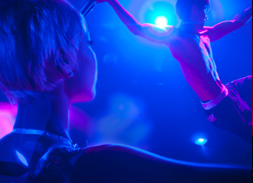
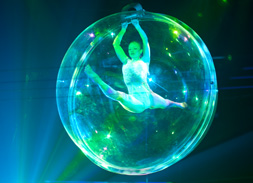
Behind the tattered fence on an empty lot in the Theater District, you’ll enter a glistening beer/music/variety hall complete with stained-glass windows, velvet booths, multiple mirrors, a carousel horse, and a central stage that’s the platform for a dozen vaudeville, burlesque, and acrobatic acts.

Empire is the latest offering from Spiegelworld (the folks who pitched their tent down at the South Street Seaport a few years ago). I don’t want to give anything away…just go, grab a beer, and enjoy the lights, costumes, illusions, and daring feats of skill, all spinning, whirling, and teetering just a few feet away. Amazing!